News
The Corne¬ Daily Sun
Discrimination dispute
A lawsuit alleges Cornell did not consider white applicants to fill a faculty vacancy. | Page 5
Sports
‘ICE Out of Ithaca’ Rally Downtown Draws Hundreds
By MADELEINE NAUMOFF Sun Contributor
Feb. 2 — Hundreds of students and Ithaca residents rallied at Bernie Milton Pavilion in the Commons on Friday, to take a stand for the people killed by the U.S. Immigration and Customs Enforcement officers. They call to “stop ICE’s reign of terror,” according to an Instagram post made by the rally’s organizers.
Organized by several on and off-campus organizations, including Cornell Young Democratic Socialists of America and the Tompkins County Workers’ Center, the “ICE Out of Ithaca Rally” was part of a national shutdown to protest ICE’s actions. The shutdown, called for by Minnesota-based student organizations and other groups across the nation, aimed to draw attention to the murders and prompt changes in ICE funding.
Minnesota saw federal immigration officers fatally shoot two residents in the last month: Renee Good, who was killed in her car on Jan. 7, and Alex Pretti, who was killed while recording an ICE operation on Jan. 24. These deaths resulted in national attention and protests against ICE’s actions.
The “ICE Out of Ithaca Rally” took place from 4 to
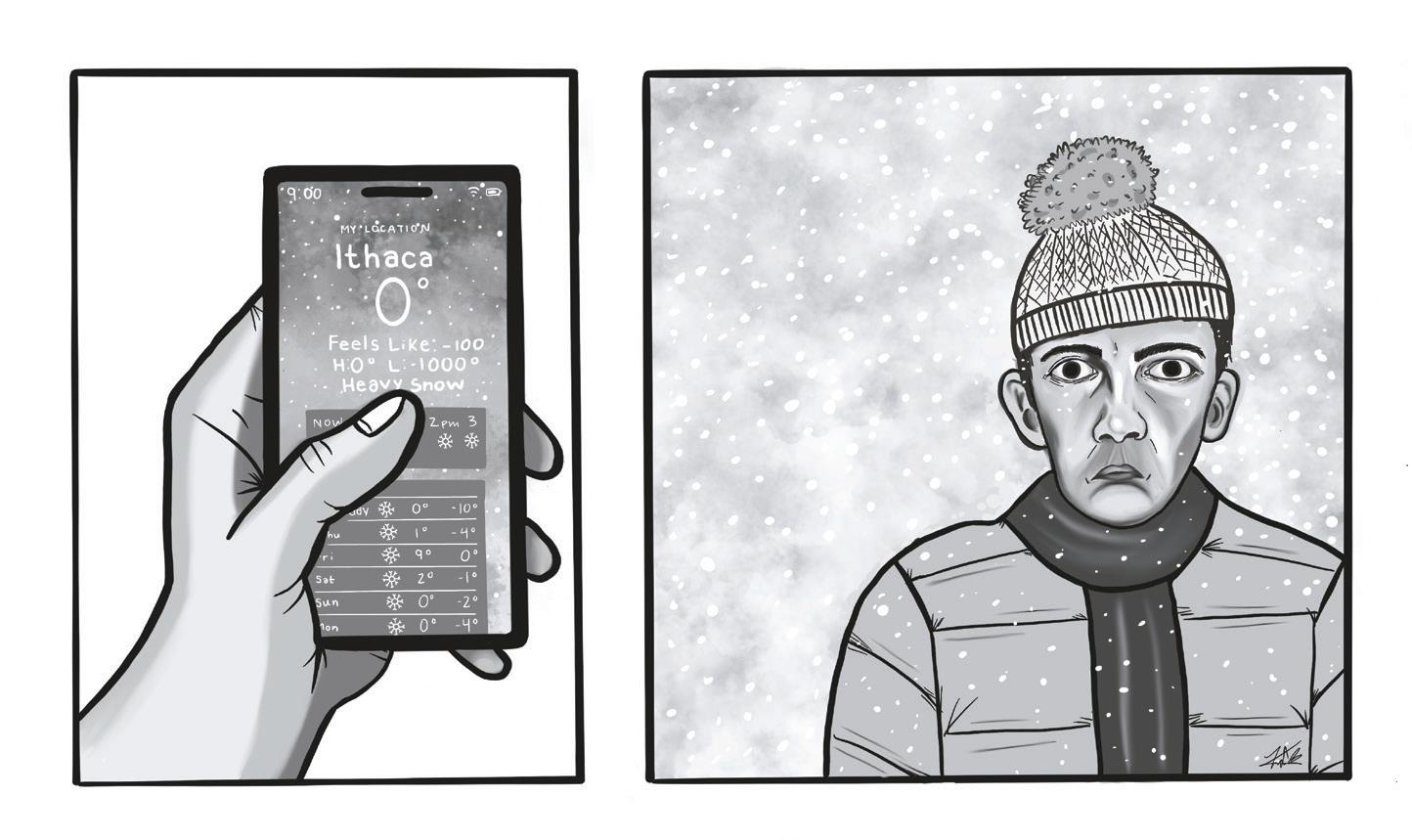
5:30 p.m. and brought together around 300 people with signs, drums and megaphones. Amid the sub-10-degree weather, volunteers and protesters distributed hand warmers and warm beverages.
The rally was publicized via Instagram and sponsored by Cornell YDSA, Ithaca Committee for Justice in Palestine, Tompkins County Workers Center, Ithaca Democratic Socialists of America and many other Finger Lakes and Ithaca-based organizations.
During the rally, community leaders gave speeches about the need for unity and action in the face of ICE’s recent actions.
Graduate student María Bulla, one of the speakers at the rally and communications secretary for Cornell Graduate Students United, told The Sun that she wants “to make it clear to the Ithaca community that we are standing with [them and] that we don’t want ICE in town or in the University.”
Cornell and Ithaca College students also spoke to The Sun, with statements centered on their overall disgust at the violence in Minneapolis and fervor to see a shift in actions by the federal government.
“Defund ICE and get rid of it entirely, defund the police, defund the government’s ability to control,” Ithaca College student David Alejandro Cohen said in a state-
How Rachel Foster ’89 Worked With Epstein Victims to Release Files
By ATTICUS JOHNSON
Sun Senior Writer
Feb. 2 — Rachel Foster’s ’89 sense of “repairing the world” started early: at nine years old, she declared herself a vegetarian.
Now, Foster, an anti-trafficking advocate and co-founder of World Without Exploitation, works with Epstein survivors to advocate for the release of files and accountability for abusers.
Foster said she values the idea in the Hebrew phrase tikkun olam — or, translated, “to repair the world.” She described the phrase’s meaning to her as “living the notion of repairing the world,” and that people “have an obligation to repair the world.”
Foster said she first got involved with vic tims of convict ed sex
offend
er Jeffrey Epstein and long
time associate Ghislaine Maxwell through Elizabeth Stein, an anti-trafficking activist and victim of Epstein, who came to WorldWE in the midst of reports that Ghislaine Maxwell — one of Stein’s abusers — might get a pardon.
WorldWE was founded in 2016 to be “the connective tissue” between anti-trafficking and gender-based violence organizations and intended to spotlight organizations when they need it and bring organizations together to
siloed, silenced and sidelined, and they really came together as a collective voice.”
At the time of the rally, Congress had yet to schedule a vote on the Epstein files, and President Donald Trump was publicly opposing their release in Congress and by the Department of Justice.
“Up until then, victims felt siloed, silenced and sidelined, and they really came together as a collective voice.”

Rachel Foster ’89
After the rally, Foster and Epstein survivors wanted to pile on pressure on Congress to schedule a vote on the release of the Epstein files. Their “multi-pronged plan,” according to Foster, included billboards, meetings with representatives and a PSA.
For one, “Courage is Contagious” billboards were put up across the country, urging representatives to release the files, and reminding them that this vote could be important to their political
ment to The Sun. “Overall, make America a much safer place for immigrants, for women, for people of color, for people in the non-binary and LGBTQ community.”
To continue reading, please visit www.cornellsun.com.

Feb. 3 — “I am an IDF Soldier Who Fought in Gaza, Ask Me Anything,” read a poster in front of Sam Fried, an American citizen who volunteered to fight in Gaza as a sharpshooter, as he tabled in Willard Straight Hall on Monday afternoon.
Throughout the tabling session, dozens of students circled Fried’s table as he defended Israel’s actions in Gaza and invited students to ask questions and debate various topics relating to the Israel-Hamas war, ranging from genocide, antisemitism and his personal experiences in the Israeli Defense Forces.
Fried’s Q&A session was announced on the Cornellians for Israel’s Instagram story at noon on Monday, minutes before the start of the event. The event was scheduled to end at 1:30 p.m. However, Fried continued for nearly two additional hours.
CFI, a Cornell organization focusing on “Israel advocacy, education, and programming” according to its Instagram bio, hosted an RSVPrequired guest speaker event with Fried a few hours after the Q&A session, where media coverage was not allowed. In contrast, Fried’s tabling was open to anyone passing by.
Originally from Queens, New York, Fried served in the IDF in the army from 2020 to 2022, ultimately ranking as a paratrooper in the 890th battalion, before returning home to pursue a degree in finance at Baruch College. After the Oct. 7, 2023 attacks, he rejoined the IDF reserves as a sharpshooter, because he felt an “obligation to be one of the fighting Jews in history,” he said in an interview with the Jerusalem Post.
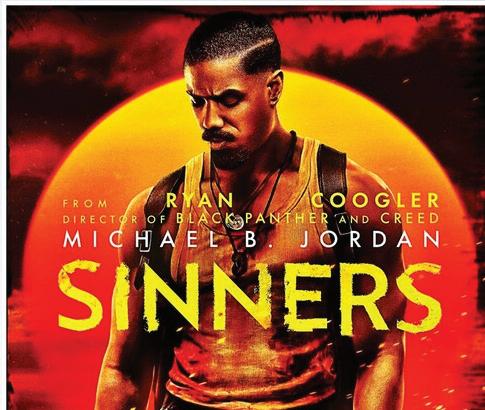
‘Sinners’ success Te movie Sinners received 16 Oscar nominations.
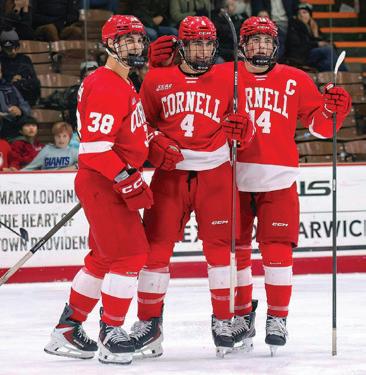
Brown bested Men’s hockey beat Brown 4-2 over the weekend.
EVERETT CHAMBALA and CORAL PLATT Sun Senior Writer and Sun Staff Writer
Chilly change | Anti-ICE protesters gathered at Bernie Milton Pavilion in cold conditions on Friday.
Protesters gathered at Bernie Milton Pavilion to take a stand for the lives lost at the hands of ICE in Minnesota
Madeleine Naumof can be reached at
NATHAN ELLISON / SUN STAFF PHOTOGRAPHER
A LISTING OF FREE CAMPUS EVENTS

American Sign Language Conversation Hour 4:15 - 5:15 p.m., G25 Stimson Hall
Cornell in Los Angeles Information Session 4:30 - 5:30 p.m., KG42 Klarman Hall
Louis K. Thaler Violinist Series: Rachel Lee Priday 7 - 9:00 p.m., Hockett Family Recital Hall, Ithaca College
Weekly Jazz at Tres Leches: Verano De Jazz 9 p.m. - 12 a.m., Tres Leches
Gatty Lecture Series: Paleo-tsunami History of Southeast Asia 12:15 - 1:30 p.m., Kahin Center Lunch served Cornell Historical Society: Board Games and Boba 5 - 6 p.m., Morrill Hall 110 Federalist Society: Alan Gura Debate with Prof. Michael Dorf 6 - 7 p.m.,
SUNBURSTS: Frozen Tensions
Amid unrest against Immigration and Customs Enforcement, Ithacans joined the hundreds of demonstrations across the country.
By SUN PHOTOGRAPHY DEPARTMENT
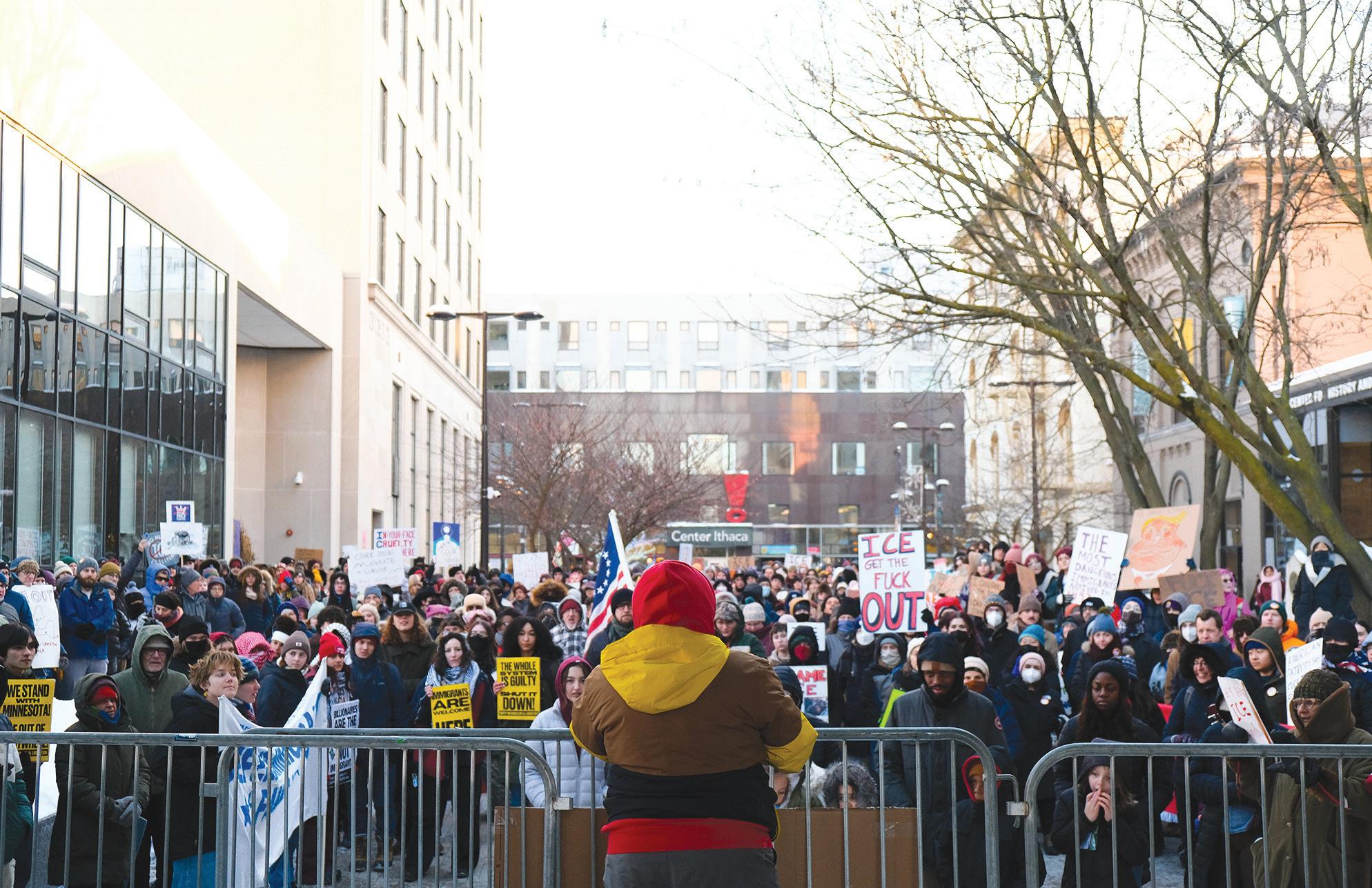
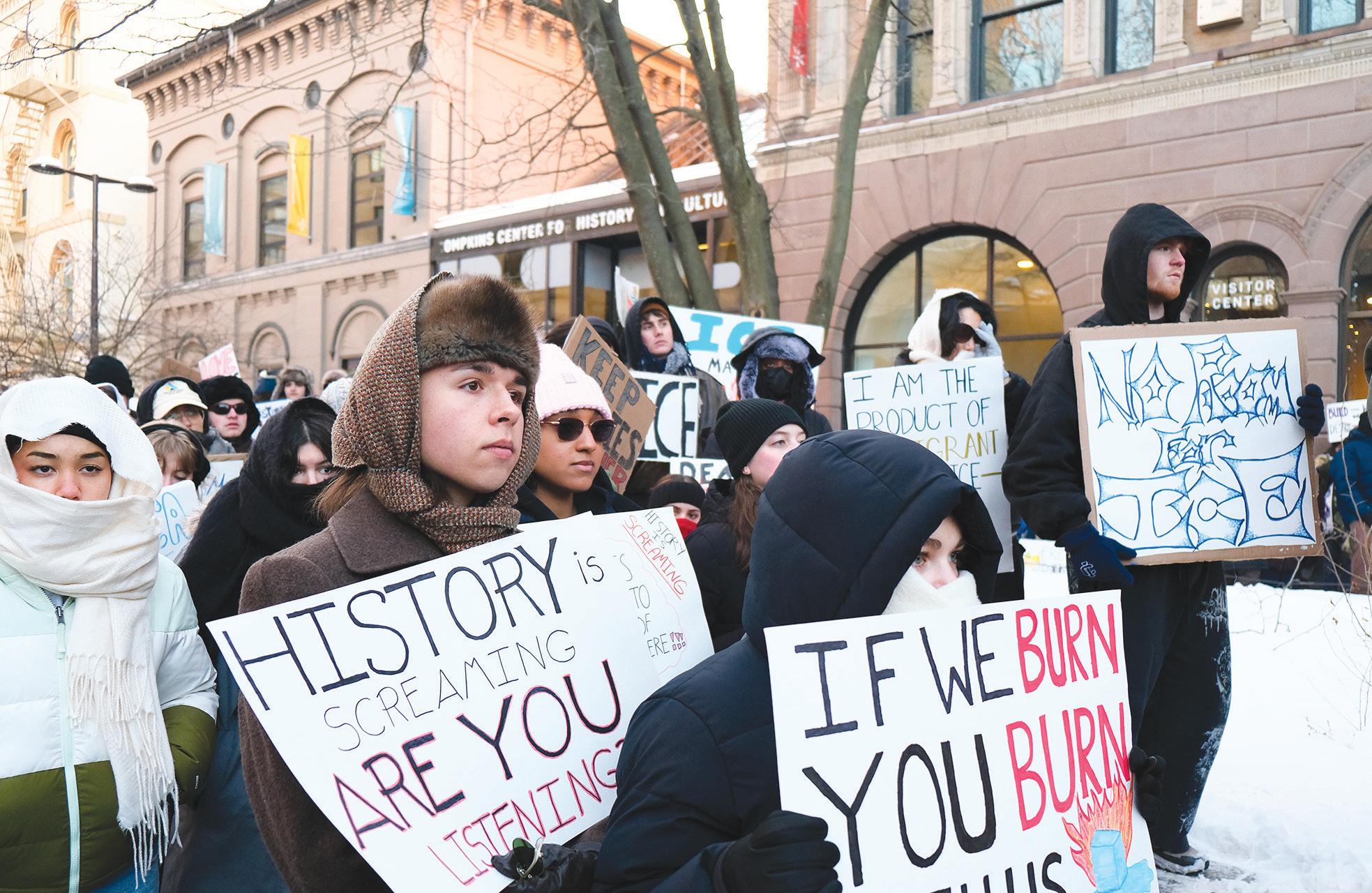
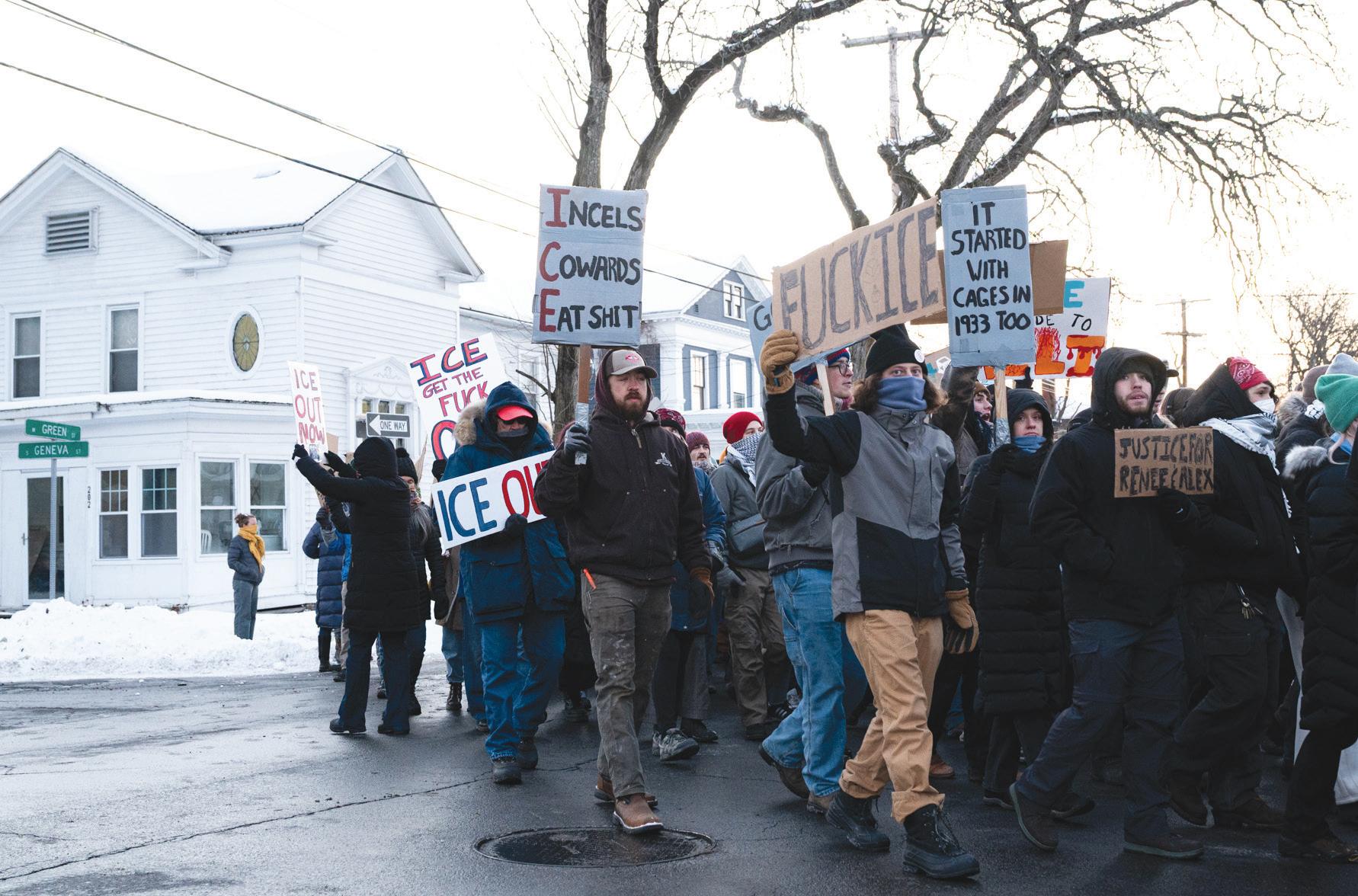


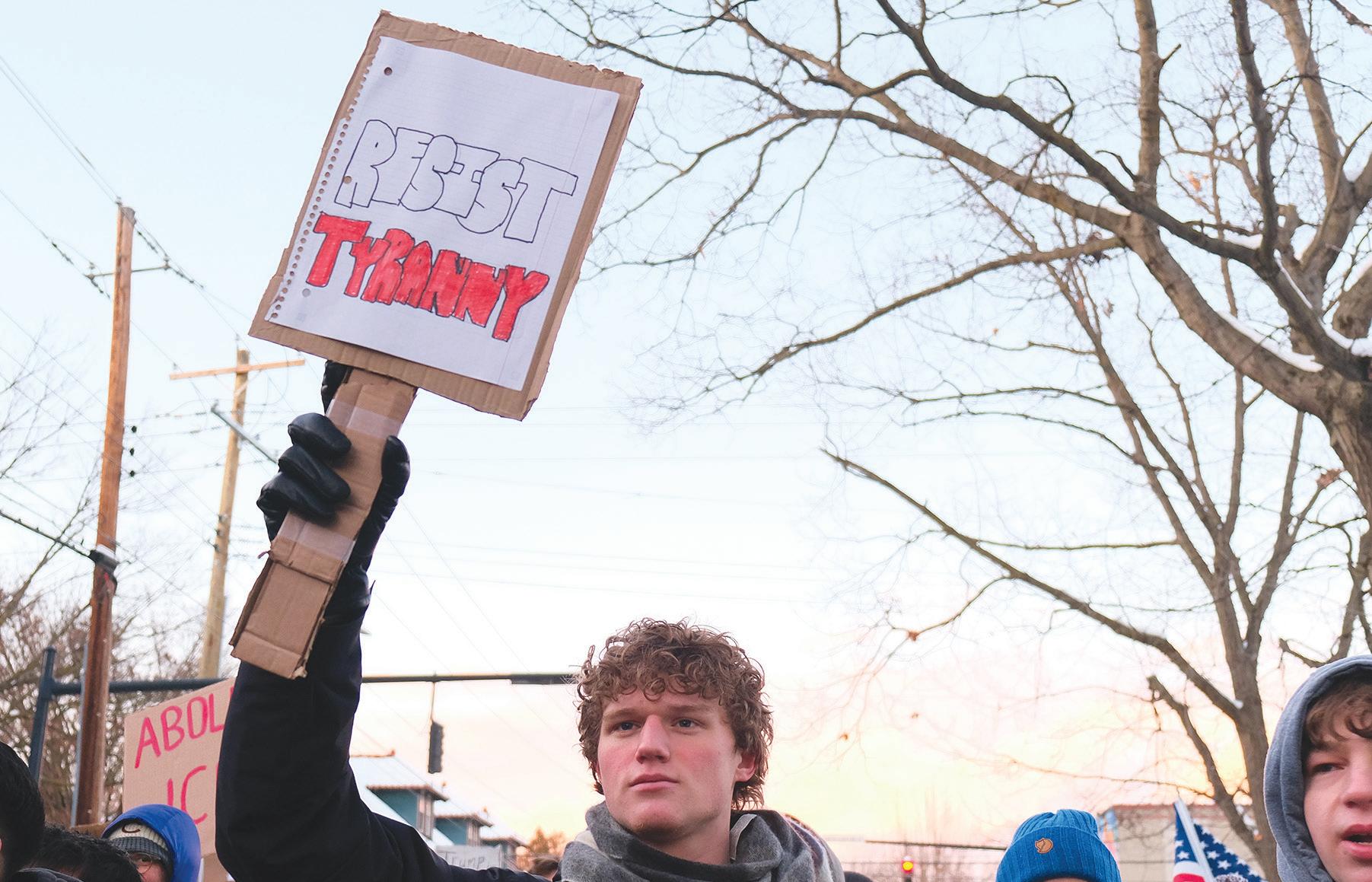

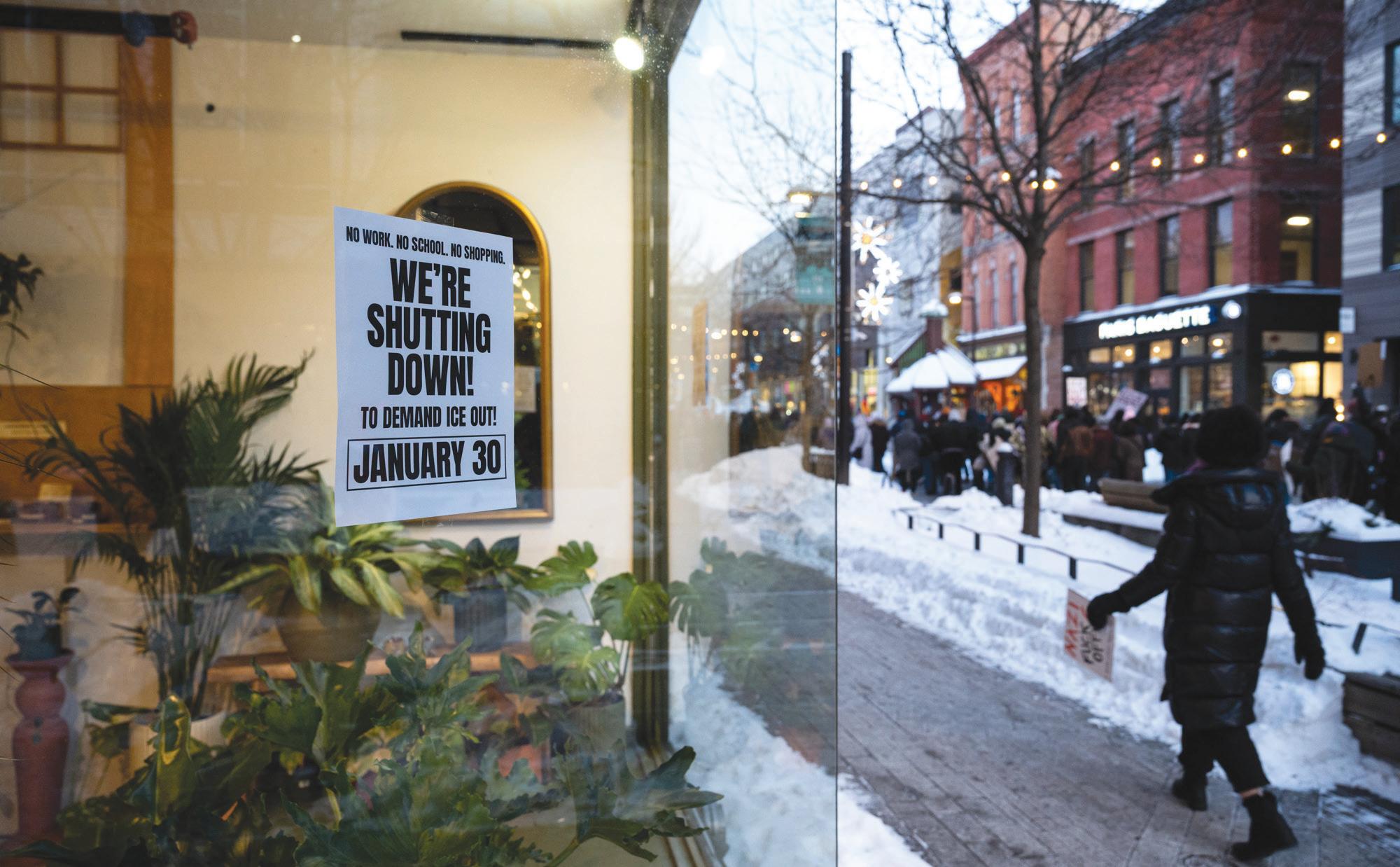
ICE OUT NOW | Protesters gather at the Bernie Milton Pavilion in demonstration against ICE.
MANY MARCHING | Ithacans and students alike stride towards downtown Ithaca to protest.
MAKING HISTORY | Protesters listen to speeches given by various community members about ICE violence and the rule of law.
STRONG STATEMENTS | Protesters carry handmade signs demanding ICE out of Minneapolis.
UNITED TOGETHER | Local organizations, including Cornell Young Democratic Socialists of America and the Tompkins County Workers’ Center, host the rally.
RESIST TYRANNY | Cornell and Ithaca College students join local Ithacans in rallying against ICE.
Nathan Ellison / Sun Staf Photographer
Photo
Adelaide Chow / Sun Staf Photographer
Nathan Ellison / Sun Staf Photographer
Adelaide Chow/ Sun Staf Photographer
Adelaide Chow / Sun Staf Photographer
Nathan Ellison / Sun Staf Photographer
ICY OUTCRY | Braving the numbing cold, Ithacans rally and hold their signs high up in the air. SHUT DOWN | Many downtown stores closed as part of an anti-ICE national shutdown on Friday, Jan. 30.
Adelaide Chow / Sun Staf Photographer Nathan Ellison / Sun Staf Photographer
‘Tat Is a Real, Binding Contract’: Student Assembly Blasts Resolution Delay, Discusses ALANA Funding
By VIVIENNE CIERSKI Sun Contributor
Jan. 31 — The Student Assembly discussed plans for Spring 2026, moved forward two previously proposed resolutions centered on allocating Assembly funds, Resolutions 23 and 24, to a third reading and voiced dissatisfaction with the administration’s speed in responding to resolutions during a Thursday meeting.
During the meeting, Assembly representatives voiced their growing frustration with the pace at which resolutions are advanced, directing criticism toward President Michael Kotlikoff and the Cornell administration who are responsible for responding to Assembly proposals within 30 days, according to the Student Assembly charter.
Max Ehrlich ’26, the School of Industrial and Labor Relations representative, shared his dissatisfaction with the administration’s response time, and said that the University should be held to the 30-day deadline.
“If they don’t respond to [resolutions] within 30 days, that legislation is inactive, that is a real, binding contract … in the real world, when you violate a freaking contract, people sue you,” Ehrlich said during the meeting. “Theoretically, a court of law could tell them to f*ck off and do what they’re supposed to f*cking do.”
Ehrlich specifically referenced delays in the administration’s response to his previously proposed resolution criticizing Cornell Career Services’ promotion of ICE jobs through the job posting platform, Handshake, as a specific example of Kotlikoff’s inaction.
“I feel like people would be more comfortable [completing resolutions] if the president of the University met his obligation to this assembly to actually respond in a timely manner to our resolutions,” Ehrlich said. “I think there’s a broader conversation to be had if there’s more we should be doing about the fact that he doesn’t respond.”
Ehrlich’s comment was met with nods and snaps from his fellow representatives. Others also expressed their frustration with the speed at which administration answers the Assembly’s resolutions.
Admir Cekic ’26, the first-generation college students representative, said that he sees a need to expedite the resolution-passing process and eliminate bureaucratic redundancies.
“I think another reason why things happen so slowly is that it effectively takes two to three weeks for a resolution to get passed with the reading calendar system,” Cekic said during the meeting. “I think it would be more productive if we went to how the Student
Assembly used to be a few years back, when a presented resolution would be voted on that day.”
“Theoretically, a court of law would tell them to f*ck off and do what they’re supposed to f*cking do.”
Max Ehrlich ’26
The Assembly also presented two resolutions that both aimed to transfer money from the Assembly’s reserve fund. The reserve fund currently totals over $552,000.
Resolution 24, authored by ALANA’s Vice President of Finance Hayden Watkins ’28, proposes allocating funds from the Assembly’s reserve, this time to the Assembly’s Special Projects Fund, which provides financial assistance to student organizations through an application process. The Special Projects Fund was most recently used to send Black Students United to the Congressional Black Caucus Retreat.
With several student organizations having already applied for funding from the Special Projects Fund during the spring semester, the resolution requests that $15,000 be transferred into this subaccount of the Assembly’s
reserve fund.
Resolution 24 was passed to a third reading.
The second resolution, Resolution 23, moves to transfer funds from the Student Assembly reserve fund to the ALANA Intercultural Board, a supplementary funding board and student organization that aims to provide programming and services that promote diversity and interculturalism across Cornell.
This action follows controversy during the fall semester, when the Assembly’s finance committee recommended reducing funding for ALANA, Cornell’s Multicultural Greek & Fraternal Council and the International Student Association. After members of these organizations and other student advocacy groups packed the three-hour-long October meeting and voiced their concerns, the Assembly ultimately rejected the committee’s proposal.
Now, the Student Assembly president, the vice president of finance, and the deputy to the vice president of finance have introduced Resolution 23, which proposes transferring $50,000 from the Assembly’s reserve fund directly to ALANA.
To continue reading, please visit www.cornellsun.com.
Vivienne Cierski can be reached at vsc38@ cornell.edu.
Conservative Biologist Sues Cornell, Alleging Anti-White Discrimination
By MATTHEW KIVIAT Sun Assistant Managing Editor
Jan. 28 Colin Wright, an evolutionary biologist, filed a lawsuit against Cornell on Monday in the U.S. District Court for the Northern District of New York, claiming that the University “intentionally discriminated” against qualified candidates by not considering white applicants when seeking to fill a faculty vacancy in the Department of Ecology & Evolutionary Biology in 2020.
The suit alleges that in its hiring process for the faculty vacancy, the University violated Title VII of the Civil Rights Act of 1964, which prohibits employment discrimination because of a person’s “race, color, religion, sex, or national origin.”
The suit also claims that the University’s hiring practices violated New York State Human Rights Law § 296 1a, 1d and 13, which prohibit employers from refusing to hire or bar candidates, and blacklisting or willfully acting to discriminate against applicants based on their age, race or creed, among other factors.
Wright, who is white, serves as a fellow of the conservative Manhattan Institute think tank. He is also an academic advisor for the Society for Evidence-based Gender Medicine and the founding editor of Reality’s Last Stand, a news page publishing articles about “free speech, science, and reality,” according to its website. Wright participated in a postdoctoral research fellowship at Pennsylvania State University, which he completed in April 2020. Although Wright never applied for the Cornell faculty position made available in 2020 and only heard of it last year, the suit claims that the University refuses “to hire–or even consider or allow to apply–individuals such as himself on the basis of race, color, and/or national origin.”
According to the suit, in an email obtained from an administrator in the Department of Ecology & Evolutionary Biology from December 2020, which is listed as confidential, the department allegedly sought to obtain a “diversity hire” for an open position and create an interview list of only “underrepresented minority scholars.”
The email allegedly states that a University administrator involved in the hiring process felt that it was best to “invite just one person” at a time to be interviewed for the position, as they were concerned about having a “search dynamic” and sought that the applicants not be in “competition with others.” According to the suit, if the top candidate was not interested in the position, the alleged email states that the department would “move on” to another candidate.
Wright’s filing of the suit follows him receiving a Notice of Right to Sue — which is a letter from a state or federal administrative agency that approves a right to initiate a lawsuit — from the U.S. Equal Employment Opportunity Commission on Jan. 23. According to the lawsuit, Wright submitted a formal EEOC discrimination charge against Cornell 180 days before Monday.
A University spokesperson declined to comment on the lawsuit when asked by The Sun.
Additionally, the suit claims that internal University records show that a spreadsheet compared potential candidates — which was curated by a “Diversity, Equity, Inclusion, Justice, and Belonging” working group — and whether or not they satisfied a “diversity axis” qualification.
“Of the top 25 candidates, all were listed as either black, Latina, LGBTQ, disability, American Indian, or Southeast Asian; not a single one had ‘white’ listed by his or her name—and this was by
design,” the suit reads.
Cornell made the opening for the position private, which the suit claims violated University Policy 6.6.1, which requires, “unless otherwise exempted in this policy,” each opening to be “posted on the Working at Cornell website for at least five business days.”
“Cornell strictly prohibits unlawful bias or discrimination and has developed policies and practices that comply with applicable laws.”
Former Interim VP for University
Relations Monica Yant Kinney
The suit follows the filing of a federal civil rights complaint against the University to the U.S. Department of Justice, U.S. Department of Education, U.S. Department of Health and Human Services and the EEOC by the America First Policy Institute, a nonprofit think tank that seeks to promote the policies of President Donald Trump, on June 26.
In their complaint, citing the December 2020 email, the AFPI claimed that the University engaged in “deeply embedded, systemic pattern of discriminatory diversity, equity, and inclusion (DEI) practices,” which have led to “a coercive and hostile environment.”
“This is about civil rights,” said AFPI’s Executive General Counsel Jessica Hart Steinmann. “Cornell’s practices violate federal law and fundamental principles of equality. It’s time for the government to act.”
In a June 27 statement, former Interim Vice President for University Relations Monica Yant Kinney responded to the AFPI complaint, explaining that the
University strictly adheres to federal discrimination law and “strongly disputes” the allegations.
“Cornell strictly prohibits unlawful bias or discrimination and has developed policies and practices that comply with applicable laws, including the Civil Rights Act of 1964, Title IX of the Education Amendments of 1972, and federal regulations that applied to federal contractors,” the statement reads. “The university trains faculty and staff on recruitment practices that comply with our non-discrimination policy.”
Kinney’s statement also addressed “personal attacks” that she explained were “leveled against our faculty members” within the AFPI complaint.
“Cornell faculty members have devoted their lives to teaching, writing, and research in their fields, and they are all dedicated to providing Cornell students with a world-class education and society with advances in science, engineering, medicine, law, technology, social science, the humanities, and other areas of scholarship,” the statement reads. “Cornell faculty members are among the most learned, accomplished, and well-qualified in their respective academic disciplines.”
In filing the suit, Wright requested that the Court declare that Cornell acknowledge that its employment practices violated Title VII and the New York State Human Rights Law and enjoin the University from “secretly comparing potential job applicants” and offering positions based on race and ethnicity. He also requested that Cornell remove policies, procedures or language directly in violation of federal and state law regarding alleged hiring practices on the University’s websites.
Matthew Kiviat can be reached at mkiviat@ cornellsun.com.
Cornell Appoints Prof. T orsten Joachims As Vice Provost for Arti f cial Intelligence Strategy
By
Jan. 29 — Prof. Thorsten Joachims, computer science and information science, was appointed to the new position of vice provost for artificial intelligence strategy on Jan. 1, according to a University press release sent on Tuesday.
The Cornell AI Initiative, which Joachims currently directs, will be expanded under the position, Provost Kavita Bala told The Cornell Chronicle. The vice provost for artificial intelligence strategy will coordinate AI efforts across the university, from furthering research to strategizing classroom use.
“With his deep knowledge and experience, Thorsten can empower and support innovation and experimentation across Cornell that advances our mission to improve lives through research, learning, public engagement and clinical care,” Bala told The Chronicle.
Created alongside the new position was the AI Strategy Council, consisting of Natalie Bazarova, associate vice provost for research; Steve Jackson, vice provost for academic innovation; Ben Maddox, chief information officer; Vinay Varughese, Weill Cornell chief information officer; and Fei Wang, Weill Cornell associate dean for AI and data science.
This council will collaborate with Joachims on AI research and work in
tandem with the Cornell AI Initiative, launched in 2021, which researches and evaluates the ethical, educational, health and labor effects of new generative technology, according to its website.
“AI tools bring both important benefits and potential harms to student learning, and we’re seeing both. Our ability to navigate these dynamics artfully in the years ahead will be essential to Cornell’s thoughtful leadership in this space,” Jackson told The Chronicle.
Joachims joined the Cornell faculty in 2001 after completing his Ph.D. at the AI Unit of The University of Dortmund,
where he also studied as an undergraduate. Joachims has previously served as the Interim Dean for Cornell Bowers, Associate Dean for Research and Chair of the Department of Information Science within the Cornell Bowers College of Computer and Information Science.
Joachims’ earlier research focused on support vector machines, a machine learning model. Since then, his research has primarily focused on Learning to Rank, a way of using machine learning to order results of models such as search engines, and other applications of machine learning to real-world systems.
Joachims’ appointment comes amid a recent rise in widespread AI usage that has made professors throughout the University rethink what AI looks like within their classrooms and for their respective fields.
“Thorsten can empower and support innovation and experimentation across Cornell that advances our mission to improve lives.”
Provost Kavita Bala
The Committee on the Future of the American University, a collection of professors also appointed by Provost Bala, emphasized AI as part of the future of Cornell, writing in a December piece in The Sun that the University should understand the “longer historical trajectory of technological change” with regards to generative AI. Additionally, Bala previously said in an October 2025 interview with The Sun that the University’s motto for AI usage was “‘AI on tap, not AI on top,’” and that with the use of AI, “instead of spending hours per day doing something, we have our staff taking minutes per day to do that.”
Caroline McHugh can be reached at cjm444@ cornell.edu
CAROLINE MCHUGH Sun Contributor
NATHAN ELLISON / SUN STAFF PHOTOGRAPHER
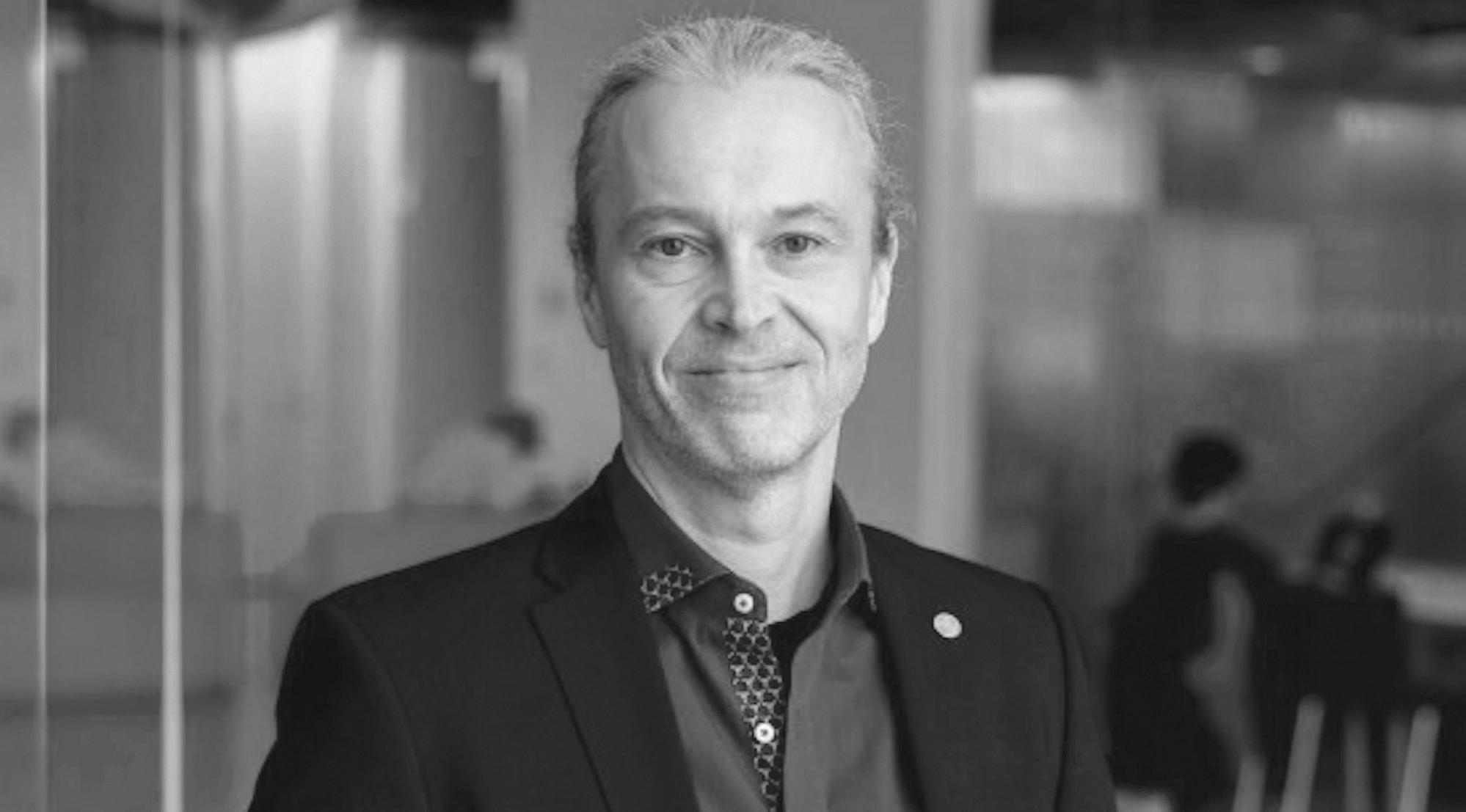
Provost and professor | Joachims’ new appointment expands his position as head of the Cornell AI Initiative.
The Corne¬ Daily Sun
Independent Since 1880
143rd Editorial Board
JULIA SENZON ’26
Editor in Chief
ERIC HAN ’26
Associate Editor
SOPHIA DASSER ’28
Opinion Editor
SOPHIA TORRES ’26
Advertising Manager
SYDNEY LEVINTON ’27
Arts & Culture Editor
JAMES PALM ’27
Assistant Arts & Culture Editor
JENNA LEDLEY ’27
Assistant Arts & Culture Editor
MELISSA MOON ’28
Assistant Arts & Culture Editor
SOPHIA ROMANOV IMBER ’28
Assistant Arts & Culture Editor
KAITLYN BELL ’28
Lifestyle Editor
MAIA MEHRING ’27
Lifestyle Editor
KARLIE MCGANN ’27
Photography Editor
MATTHEW KORNICZKY ’28
Assistant Photography Editor
STEPHAN MENASCHE ’28
Assistant Photography Editor
MIRELLA BERKOWITZ ’27
Video Editor
JADE DUBUCHE ’27
Multimedia Editor
HANNIA AREVALO ’27
Graphics Editor
HUNTER PETMECKY ’28
Layout Editor
RENA GEULA ’28
Layout Editor
CHRISTOPHER WALKER ’26
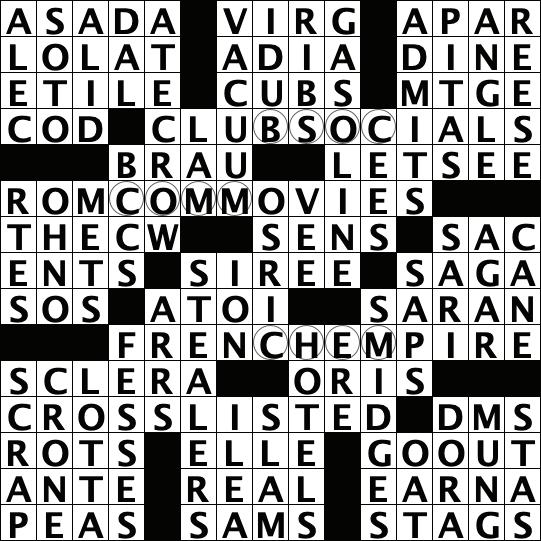
Games Editor
ALLISON HECHT ’26
Newsletter Editor
Prof. Jan Burzlaff
DOROTHY FRANCE-MILLER ’27
Managing Editor
MATTHEW KIVIAT ’27
Assistant Managing Editor
VERA SUN ’27
Business Manager
ALEX LIEW ’27
Human Resources Manager
BENJAMIN LEYNSE ’27
News Editor
VARSHA BHARGAVA ’27
News Editor
ISABELLA HANSON ’27
News Editor
CEREESE QUSBA ’27
News Editor
REEM NASRALLAH ’28
Assistant News Editor
ANGELINA TANG ’28
Assistant News Editor
KATE TURK ’27
Assistant News Editor
GABRIEL MUÑOZ ’26
City Editor
JANE HAVILAND ’28
Features Editor
ZEINAB FARAJ ’28
Features Editor
JEREMIAH JUNG ’28
Assistant News Editor
KAITLIN CHUNG ’26
Science Editor
MARISSA GAUT ’27
Science Editor
ALEXIS ROGERS ’28
Sports Editor
MATTHEW LEONARD ’28
Assistant Sports Editor
SIMRAN LABORE ’27
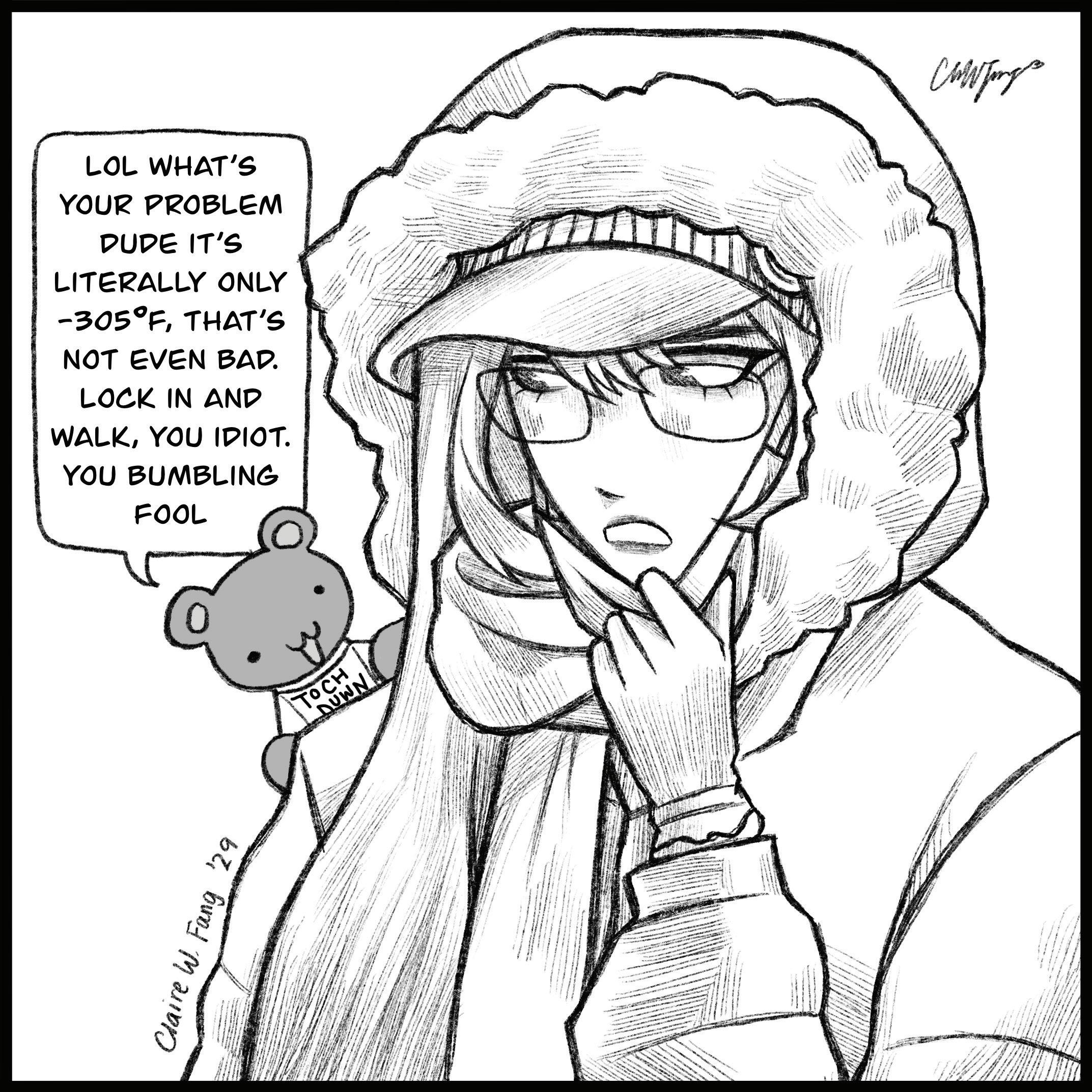
Weather Editor
Jan Burzlaf is an Opinion Columnist and a Postdoctoral Associate in the Program for Jewish Studies. Ofce Hours (Open Door Edition) is his weekly dispatch to the Cornell community — a professor’s refections on teaching, learning and the small moments that make a campus feel human. He can be reached at profburzlaf@cornellsun.com.
Te Wave in Olin
I was walking through Olin Library one afternoon when it happened. Libe café seemed particularly crowded during the first full week of classes — coats draped over chairs, laptops open, conversations hovering somewhere between urgency and early fatigue. As I passed in the hall, I noticed a familiar face at one of the tables. A former student: she looked up from her conversation, recognized me, and waved enthusiastically. I waved back. I didn't stop; she was sitting with a friend and I didn't want to interrupt. We both went on with our afternoons. And yet, I carried that moment, and the warmth it brought, with me for the rest of the day. I've also been thinking about it ever since.
As we complete the first full week of the semester — new classes underway, new professors and students finding their footing, new routines beginning to take shape — it’s worth pausing over moments like this one. Not because of what was said (nothing was), but because of what it quietly confirmed. On a campus as large as Cornell, moments like this happen constantly and usually vanish without a trace. But sometimes, they don’t. The wave in Olin reminded me that the opposite is also true. The connections we make here have a way of stretching forward. What begins during these first weeks may still be unfolding years from now.
When I first started teaching — especially larger lectures and seminars in Paris — I was told a familiar story about how it all works. A semester begins, material is delivered and assign-
Güney Acipayamli
Güney Acipayamli is a Psychiatric Nurse Practitioner at Cornell Health.
Winter Blues, SAD and the Benefts of Light Terapy
Imoved to Ithaca in August, when the fireflies were still busy in the swampy expanse behind my cottage in nearby Brooktondale. At night, that stretch of grass turned into a field of quiet, blinking light — steady and unreal. I’d recently accepted a job as a psychiatric nurse practitioner at Cornell and I remember thinking: “Okay. This isn’t so bad for a Turkish girl from the Mediterranean coast. I can do this. I can make it here.”
Fast forward several months and — welcome to Ithaca in winter. Gray sky. Early darkness. The first snow: a full foot of it. The cold season arrived all at once.
It is a beautiful experience learning about winter through its quintessence. The first snowfall. The icicles that appear overnight. The way snow quiets everything — roads, fields, even thoughts. The brightness of a white-covered landscape when the sun decides to appear.
The experience is not all romantic. Navigating hills when roads turn dangerously slick: my German shorthaired pointer refusing early-morning walks because the salted paths sting her paws, Ithaca’s steep grades wearing and wearying my car’s transmission, hands and feet staying cold no matter what I wear. The loneliness that settles as deep as the unremitting chill when you’re new somewhere, and the weather gives good reason to stay inside.
As I was adjusting to a new job, a new town, and a new season, I began hearing parallel refrains from students coming to my office for mental health support:
“I don’t know — my mood has dipped.”
“I’m tired all the time.”
“I have no energy.”
“I haven’t left my apartment in days.”
ronmental cue — a brighter morning — that some brains depend on more than others. Research also suggests that, for some people with seasonal depression, consistent morning light therapy can be comparable to an antidepressant in improving symptoms.
Light therapy is simple: place a light box off to the side while you start your morning, have coffee, read, journal, or answer emails, and let the brightness reach your eyes indirectly for 30 minutes. There is no need to stare into the light. The key is consistency. The more frequently one uses light therapy, the more benefits most people see. If you have bipolar disorder, certain eye conditions, or take photosensitizing medications, check with a clinician first. Light therapy can occasionally worsen insomnia or trigger agitation.
Keep in mind that light therapy works best alongside regular sleep/ wake times, movement, nutritious meals, vitamin D if you’re low, and some kind of social plan during the darker months.
Where to Get a Light Therapy Box Light boxes are sold in the Cornell Health Pharmacy (for $20), online, and in many local stores. Look for light boxes that emit up to 10,000 lux.
If you do want to buy your own, Wirecutter has some good recommendations.
Making Light Therapy Work
Make it bright enough to matter. Look for a 10,000-lux light box. Standard indoor lighting is usually far too dim to treat seasonal symptoms.
Make it a morning habit. Earlier is generally better — soon after waking, ideally before noon. Lateday use can be less effective and may interfere with sleep.
ments are graded. And then — cleanly, efficiently — everyone moves on. The relationship, like the Canvas site, eventually closes. Teaching, in this version, is bounded by syllabi and semesters. There is truth to that story. Teaching is labor (as is learning). It is sometimes exhausting. There are limits to what any of us can offer, and those limits deserve respect. The rhythm of the semester exists for a reason. But that story is also incomplete.
What rarely gets said — especially from the faculty side — is that students don’t simply vanish when the semester ends. They reappear, unexpectedly, months or years later. In your inbox, in a hallway, at Zeus. I still receive emails — sometimes months later, sometimes years — from students I taught in earlier chapters of my career. They write not for grades or recommendations, but simply to share news: a new job, a book they read that reminded them of something we discussed, a question they’ve been turning over. Just this week, I heard from a former student I hadn’t taught in several years, writing to tell me about an acceptance that mattered deeply to them. There was no request attached. Just a desire to share a moment of joy — to loop me back into a story I’d once been part of. That’s when it becomes clear that mentorship doesn’t end: it just changes form. Students stay with us in ways the institutional calendar doesn’t capture.
To continue reading this article, please visit www.cornellsun.com.
These sentiments and behaviors often have multiple causes. My own feelings probably stem from the normal strain of moving and starting a new job, combined with a mild seasonal dip. Winter in Ithaca is not just cold. Unlike cold yet bright and sunny locales like Colorado, Ithaca winters are frigid and dim.
Shorter, darker, colder days can change how people feel. Energy drops. Motivation falters. A lowgrade sadness can roll in. For many, this ‘winter blues’ feeling is tied to reduced exposure to natural light. When symptoms are more intense, showing up predictably between fall and spring and interfere with daily life, clinicians call it seasonal affective disorder: a type of depression that follows a seasonal pattern.
The good news is that light therapy can help.
How Light Affects Mood
Light is one of the strongest signals your brain uses to set the day. When mornings start dim for weeks, your body can drift later: sleep feels less refreshing, energy lags, and motivation gets harder to access. Bright light early is a clearer “daytime” signal, translating into feeling more awake, steadier, and more able to engage with life.
How Light Therapy Can Help
In my clinical work, I recommend light therapy boxes liberally because they are evidence-based for seasonal affective disorder, and many people with milder winter blues symptoms also find them helpful.
The idea isn’t to “force happiness.” It’s to replace a missing envi-
Make it easy to stick with. Set it up where you already sit in the morning so it becomes automatic. Follow the device instructions (often 12-24 inches away).
Don’t overthink the “right way.” Let the light reach your face/eyes while you do something else — no staring required. Give it time. Many people need near-daily use, and it can take a couple of weeks to feel a real shift.
Stack the basics. Light therapy works better alongside regular sleep/ wake times, movement, nutritious meals, vitamin D if you’re low, and some kind of social plan during the darker months.
The Bottom Line
If Ithaca winter is dimming your mood, don’t power through it alone. Get a light therapy box. Use it consistently. Build a morning routine that gives your brain the daytime signal it’s craving. You can also add movement, vitamin D and small points of social connection, and see if weathering the season becomes more manageable. And if you need additional support, please schedule an appointment with a medical or mental health provider at Cornell Health, or stop by Let’s Talk to consult informally with a Counseling and Psychological Services counselor.
I’m learning how to winter, too. Still working and adjusting. If there’s hope for a Turkish-born Mediterranean girl trying to find her footing amidst an Ithaca winter, there is hope and support for you too. Happy wintering.
Mina Petrova
North Star
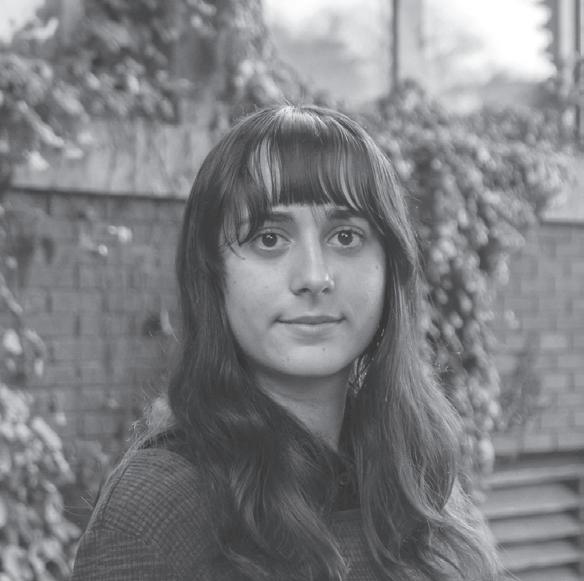
Mina Petrova '29 is a Freshman in the College of Arts & Sciences studying English, History, and Government. Her fortnightly column North Star studies the past and critiques the present, focusing on politics, protests and activism that strive toward a more equitable future. She can be reached at mpetrova@cornellsun.com.
What does our tuition fund? It is a reasonable question to ask when studying at a university that costs $92,844 to attend and whose fnancial aid policy leaves much to be desired. It is a question I kept returning to during my frst semester as I discovered dozens of more hidden fees that I expected this outrageous cost to cover.
Cornell has an operating budget with revenues of over $6 billion and a $11.8 billion endowment. A quick analysis of where the University chooses and refuses to spend its billions demonstrates how the well-being of its students and the Ithacan community are not where Cornell’s priorities lie.
Everywhere I turned my frst semester, I was greeted by surprise expenses — some avoidable and some not. Laundry costs, printing, gym memberships, the absolute scam that is CAMP and club dues (because the activities section in our tuition isn't enough) all added on extra costs. Turns out, Cornell’s tuition is ‘batteries not included.’
Going home over break, I was jealously enraged to learn that my friend who attends Johns Hopkins University gets free laundry, gym memberships and quality merchandise. As a larger school, Cornell gets more money in tuition — if the University’s administration really cared for our mental and physical health, these things would be readily available
Elise Clifford State of Confusion
Elise Cliford '29 is an Opinion Columnist and a Philosophy and Russian student in the College of Arts & Sciences. Her fortnightly column, State of Confusion, approaches the liberties and anxieties honed by disagreement, and the responsibility that comes with forming identity. She involves aspects of symbolism and skepticism that accompany the weight of glorifcation. She can be reached at ecliford@cornellsun.com.
Go to the Wall Street Journal, type ‘Lebanon’ into the search bar — you won’t fnd any mention of it on the digital front page — and read the headlines. Te website will frst show you articles on the basis of their ‘relevance.’ Once you’ve established that the recurring headlines either mention Pope Leo or Hezbollah, flter the pieces by ‘Newest to Oldest,’ and a fuller picture of Lebanese civilian life will begin to emerge. If you then go to Te New York Times, you will notice the same headline fgures in the articles that are automatically suggested. Te Economist, however, has been reporting far more on civilian distress than its American media counterparts which suggests the bias might be national. So is it that, to Americans, life in Lebanon can be encapsulated by the frst foreign tour of the nascent pope and by the country’s secessionist strong-arm military? Hardly. It is rather that we perpetually treat Lebanon as a peripheral arena — a symptom of wider regional and international conficts. In many articles reporting on the ongoing confict between Israel and Palestine, we encounter mentions of Syria and Lebanon. More often than not, they read as footnotes or evidence supporting broad claims (such as “Iran funds,
What Does Our Tution Fund?
to the student population.
Tus, Cornell acts more like a for-proft institution than a university. Everywhere else there exists a scheme designed to wring the greatest amount of money out of the student body.
While Cornell claims that through its generous fnancial aid, “the cost of a Cornell education may be less than you would expect,” university policies have not supported this claim. An antitrust lawsuit fled against Cornell four years ago, and now proceeding to trial, accuses the University and 16 other elite colleges of colluding to reduce fnancial aid.
Te cost of tuition and fees has also risen faster than infation and fnancial aid, meaning Cornell is asking for more money that is not contributing to adjust for infation or increase afordability.
While in an ideal world all higher education would be free, greatly increasing fnancial aid would be life changing for millions of families. Recently, Yale announced that it would ofer free tuition to families with incomes below $200,000, qualifying over 80% of Americans. Te cost to enact similar policies would be a small dent in Cornell’s budget but for thousands of prospective students would be the diference between being able to attend or even consider applying.
Another example demonstrating Cornell reluctance to fund student services can be observed in its recent negotiations with TCAT — the transit system that thousands of Cornell students and faculty rely on to get around campus. In October 2025, TCAT ofcials asked each of its three contributors for an additional $500,000 funding increase. Te money would address TCAT’s budget shortage and avoid service cuts. While Tompkins County and the City of Ithaca both agreed to pay the $500,000, Cornell — the University with an acting budget of billions — ofered an insultingly low $31,000.
Students on campus, inducing Cornell’s Young Democratic Socialists of American chapter, voiced their outrage through an email and calling campaign, urging Provost Kavita Bala and Community Relations Manager Jennifer Tavares to agree to TCAT’s funding request. After a series of negotiations, Cornell agreed to increase its fnancial contribution to $280,000 and TCAT accepted.
Cornell’s refusal to fund TCAT demonstrates that the
University’s priorities do not lie in public services, the environment or student convenience. Over 70% of TCAT ridership is afliated with Cornell, yet the University was the most unwilling of the three underwriters toward increasing funding.
More broadly for the Ithaca community, Cornell currently contributes only $4 million in voluntary contributions to Ithaca, far less than the $35 million a year that the University would pay if it wasn’t tax exempt.
Once again, Cornell falls behind other Ivy League institutions in productive monetary contributions. Trough the PILOT program, Yale has pledged $135.4 million to the City of New Haven, Connecticut over the course of six years. In 2021, Princeton University paid $9.8 million in taxes to Princeton, New Jersey, including $6.2 million in voluntary payments.
With a recent $371.5 million gift donation from tech billionaire David Dufeld, including $50 million for general academic pursuits, Cornell’s cry of an empty purse when negotiating with the City of Ithaca or providing student amenities seems even more outrageous.
While Cornell's cofers are empty when it comes to supporting its students or neighbors down the hill, when the federal government initiates a campaign to abuse higher education, the University is suddenly able to conjure $30 millions dollars in capitulation money. It is clear that the Administration’s commitment lies not with the community but with surrendering to an increasingly fascist government.
For decades, local activism has pushed to ensure a fairer partnership between Cornell and Ithaca. In 2023, Ithaca’s chapter of the Democratic Socialists of America launched a Make Cornell Pay Coalition centered on advocating for Cornell to provide increased funding to the City of Ithaca and a fare-free TCAT model.
As a student body, we can also do our part to ‘Make Cornell Pay.’ If Cornell is going to keep treating our education as a fnancial transaction, then we should hold the University accountable to ensure that we are getting our money’s worth. We can call and email admin, demanding free TCAT, laundry, printing, gyms, textbooks and more club funding. We can make them listen because after all, we students are also entitled with the rights to be endowed.
Te Middle Man in the Middle East
trains and arms terror proxies across the Middle East and beyond,” or “Is the Middle East headed into a broader regional war?”). What we hardly ever encounter are reports on civilian life, which has, during any given week of the past year, been ravaged by civilian displacement, Israeli strikes, pillaging, agricultural destruction and journalist killings. Tese are not peripheral consequences, yet they are often cast as secondary clauses about someone else’s war. Analyses of Western media framing — including reviews of Te New York Times — have demonstrated that coverage of the Israel-Hamas War often dilutes civilian sufering.
Te worst part in this neglect isn’t the media outlets’ marginalization of core issues; it is rather the severe scarcity of reliable, frequently updated sources that showcase the reality of Lebanese quality of life and life expectancy. Te source I judged to be the most reliable and recent was the United Nations' report on the socioeconomic impacts of the 2024 war on Lebanon, published in July 2025, which provided human loss estimates from January of that year. Almost a year later, I was not able to fnd any further research that ofers updated numbers — and I do not believe that it is because losses have subdued. Tis is very telling — not only of incompetence, but of a Western willingness to turn a blind eye. According to the Lebanese Ministry of Public Health, the UN report suggested a human death toll of 4,285, “27 per cent of whom were women and children.” Te registered injuries surpass 17,000.
Treating Lebanon as an actor instead of as a side-efect would require us to further deplore the ethicality of the United States’ military support to Israel, which has materially enabled a part of Israel’s actions in Lebanon. It would mean Israel’s military campaign, framed as preserving national security and self-determination, has formed an insatiable confict which breaches the initial borders of Hamas-infuenced territory. Although Israel’s fears are far from unfounded — their legitimacy constantly contested by
neighboring states — it has become a label under which violence is propagated against any populations which could threaten autonomy. Western media’s abandonment of Lebanon as a primary theater further obstructs the consequences of U.S. military funding.
While Western reporters have failed to relay the severity of the confict in Lebanon, Lebanese reporters have been silenced for their eforts. On Oct. 13, 2023, Issam Abdallah, a Lebanese reporter was killed by a shell fred by an Israeli tank on the Israel-Lebanon border. He was working for Reuters and was clearly marked as press when the shelling occurred. A second shell was fred seconds later, injuring six more journalists.
Te aim of censoring direct reporting indicates the inhumane conditions to which the Lebanese population is subjected, to the point where even attempts to garner international attention are suppressed. Journalists killed in the course of reporting are being considered “collateral damage” rather than victims of war crimes. Punishment for attempting to report logically deters motivation to report at all.
Western coverage has understandably focused on Palestine and on the anxiety surrounding Israel’s eternally-contested “right to exist” given the proportions of the confict and the severity of the issue. Yet, the refusal to treat Lebanon as a nation deserving of international attention and consideration remains an egregious oversight. So much so that, in reading the article on Pope Leo’s visit to Lebanon, the only time the nation was mentioned was in the title. Te constantly shifting fronts and asymmetry of the confict are not sufcient reasons to neglect the human losses and enduring consequences. Tis piece itself is guilty of what I am trying to accuse others of: I appear incapable of mentioning Lebanon without slipping some of the spotlight to its neighboring states. Even if my writing cannot fully center on Lebanon, it aims to pull attention back to a country that has served as a footnote of Western media coverage for far too long.

Student Design Competition Aims to Reduce Bird Collisions at Stocking Hall
By GABBY COLEMAN Sun Contributor
The Cornell Lab of Ornithology is hosting a Bird-Friendly Student Art Contest this semester, inviting students to submit imaginative window decal designs by March 30 to help prevent bird collisions at Stocking Hall.
The competition is open to all Cornell undergraduate and graduate students. Submissions will be accepted from Jan. 20 through March 30. The winning design will be announced on May 5 and will receive a $500 cash prize; second and third-place designs will be acknowledged without monetary awards.
Birds often collide with glass because they do not see it as a barrier, mistaking transparent and reflective surfaces for habitat or vegetation they want to access, said Cady Netland, the coordinator for bird safety with the Center for Engagement in Science and Nature.
Window decals disrupt reflections, creating an illusion of space that leads birds to perceive it as unsafe to fly through, prompting them to change course.
Submissions must feature designs for decals without gaps larger than two-by-two inches to ensure visibility for even the smallest birds seen on Cornell’s campus, said Netland.
Designs will be evaluated by a diverse panel including representatives from Stocking Hall, the Bird Friendly Cornell Group and CALS leadership. Netland will serve as a birdsafe design expert, alongside human-centered design lecturer Eddy Man Kim ’09.
Judges will consider whether designs adhere to size guidelines and complement the build-
ing and its purpose. “Feed two birds with one scone,” Netland said. “Protect the birds, while also having an aesthetic contribution to the building as well.”
The winning design will be printed on bird-safe vinyl film and installed on 15 window panes of Stocking Hall facing Tower Road, said Tara Pollock ’27, the Bird Friendly team’s student leader. The film is designed to withstand weather exposure and must be placed on the exterior of the glass to reduce reflections.
“I want students' biggest takeaway from this ... to be that this is something that people can really make direct, immediate, positive change on.”
Cady Netland
The custom vinyl is intended to be printed and installed over the summer, with donor funds from the Lab of Ornithology being allocated for installation, according to Pollock. Summer installation of the vinyl is essential to the goal of having it in place before the fall migration, which Netland said is “the most perilous time of year for birds experiencing collision.”
While migratory songbirds are at the highest risk of collision due to flight patterns, larger birds, such as hawks, still face similar dangers when encountering reflective surfaces, Pollock said. “Big Red [a hawk], a few of her fledglings have hit bus shelters. They’ve also had collisions
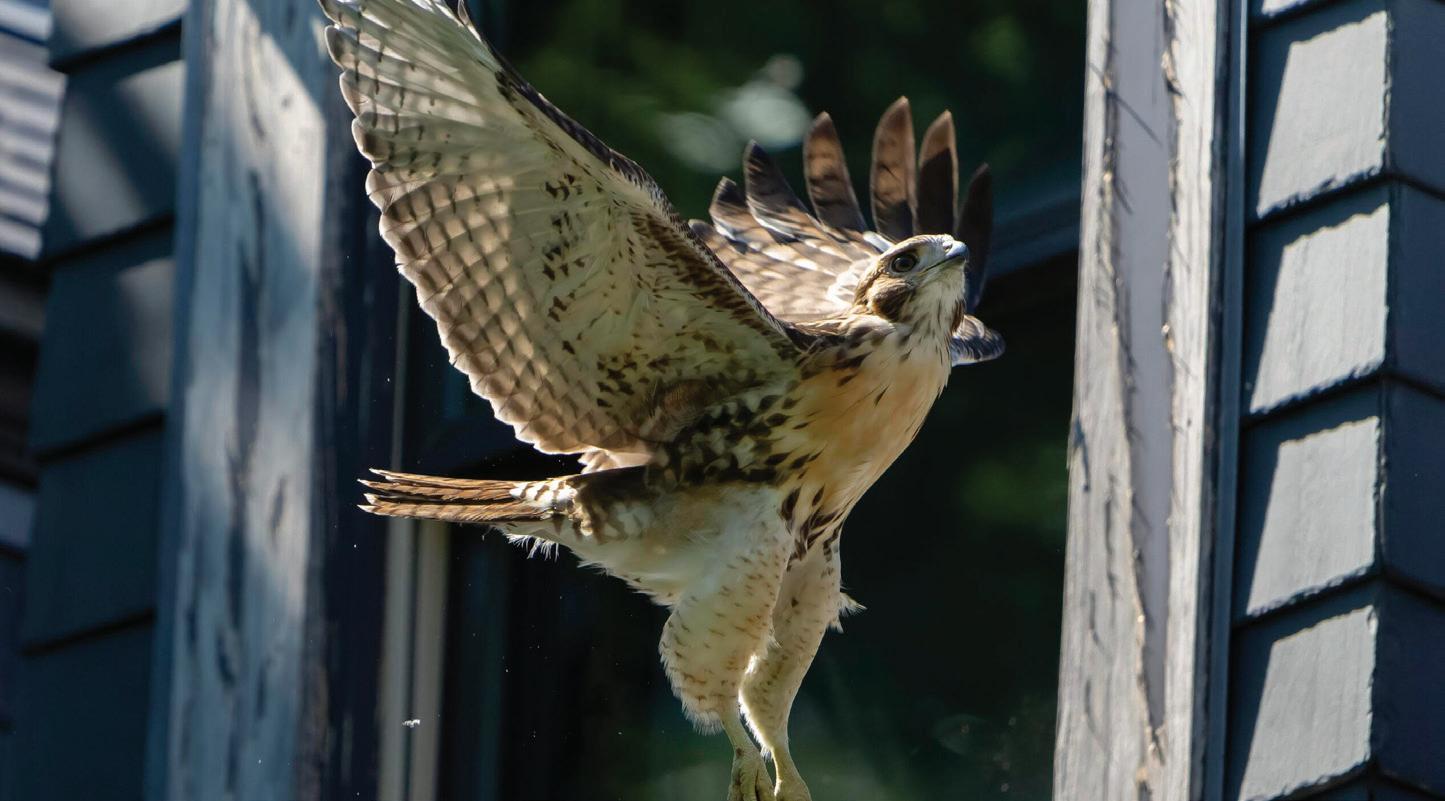
on Stocking [Hall],” Pollock said. “So it’s not just migratory songbirds, but all birds can be at risk.”
In addition to reducing bird collisions at Stocking Hall, the competition aims to raise awareness of bird-window collisions and to engage students in bird conservation efforts on campus.
“Over a billion birds die from collisions with glass every single year,” Netland said. The competition is intended to demonstrate how small-scale design interventions can reduce this risk on campus.
For students who want to learn more, Netland pointed to the Bird Collision Prevention Alliance, a multi-sector partnership directly involved with the Lab of Ornithology.
The BCPA provides information on how to make the world safer for birds, how to get involved with conservation, and other opportunities to learn about similar issues.
“I want students' biggest takeaway from this competition to be that this is something that people can really make direct, immediate positive change on,” Netland said. “That’s a really powerful thing to be able to work on, because it’s not always true when working on things.”
To continue reading this article, please visit www.cornellsun.com.
Gabby Coleman can be reached at ggc38@cornell.edu.
Te Only Team of Its Kind: Inside C2S2, Cornell's Student-Run Chip Design Team
By ASHLEY KIM Sun Contributor
In the Cornell Custom Silicon Systems project team, undergraduates get the opportunity to design and test computer chips — work typically reserved for fourth-year doctoral students or seasoned industry professionals.
C2S2 is one of the only undergraduate-led chip design teams in the country, according to Daniel Kaminski ’27, the team lead. Founded through the Shen Fund for Social Impact, the team aims to democratize chip design education by giving students hands-on experience with the complete semiconductor development process.
"The main goal is to educate undergraduates," Kaminski said. "That kind of freedom, that kind of ability to stretch yourself to your limits and to work with tools and processes and other people that you wouldn't have access to otherwise, that's really beneficial."
“That kind of freedom, that kind of ability to stretch yourself to your limits ... that's really beneficial.”
Daniel
Kaminski ’27
The team emerged from a push by Google and Efabless to make chip design accessible through open-source, publicly available design kits. Before these tools became available, designing chips required signing restrictive non-disclosure agreements with major manufacturers — barriers that effectively locked out hands-on design opportunities for undergraduate students.
Caden Xu ’27, the team's analog subteam lead, said the educational benefits of C2S2 extend far beyond the classroom. One critical lesson involves manufacturability — understanding how a chip will actually perform once produced, not just how it functions in theory.
"In a classroom, maybe you're designing something, but you're not having in mind how if this chip was actually manufactured, how it would be turned out," Xu said. "Whereas if you're actually having a goal to have this chip be produced, you're thinking a little differently."
The team's scope of work would challenge even experienced professionals. Kaminski and Xu, along with a few other members, designed an entire analog-to-digital converter, which transforms physical signals into digital data — a task that would typically occupy a full industry team for a year.
C2S2 is currently partnering with the Cornell Lab of Ornithology to develop a prototype chip system that classifies bird calls, targeting the Florida scrub jay. The team's application-specific chip can run for approximately two months on a coin cell battery, Kaminski said, because it only includes the hardware needed for this spe-
cific task.
Beyond technical skills, the team emphasizes professional development. Members present to corporate sponsors including AMD, Sandia National Laboratories and Cadence.
“When we first joined, our subteam leaders would drill into us that we have to make our presentations look a certain way,” Xu said.
Kaminski applied that training during his summer internship. “When I worked at a company this past summer, I used the same way to present the data,” he said. “It draws people’s attention to the important things … it’s a clear way of communicating.”
“[The project team] teaches you to think about things much more deeply than classes will teach you.”
Daniel Kaminski ’27
Most team members pursue careers in chip design after graduation, with many alumni now working in the semiconductor industry. But both leads said the skills transfer beyond the field.
“It teaches you to collaborate," Kaminski said. "It teaches you to think about things much more deeply than classes will teach you.”
Bird barrier | Red-tailed hawks have fatally collided with glass multiple times at Cornell. COURTESY
Lifestyle Guide: When Your Friends Visit Cornell
By Ruhi Datar
Ruhi Datar is a sophomore in the College of Arts and Sciences. She can be reached a rrd56@cornell.edu.
I’m from right outside Atlanta, which means a lot of my friends from home ended up at universities scattered across the South. It also means that I can’t go home or visit them as often as I’d like, since it requires a plane ticket. Because of that, I am always urging them to visit me here in Ithaca, something I never expected anyone to actually commit to. Flights are expensive, Ithaca is inaccessible and the weather can be brutal at times.
You can imagine my surprise when I got a call from one of my best friends from back home asking if she could come visit for a few days during her spring break. Without even an ounce of hesitation, I said, “Yes.”
Having one of my friends experience my life at Cornell is something I have been waiting for since starting school here. We immediately dove into the logistics — sleeping arrangements, dates, flights — until she asked me a question that left me stumped: “What are fun things to do in Ithaca?”
For a bit, I honestly couldn’t think of much to show her. But then I realized that when you live somewhere for a while, it’s easy to forget that everyday routines can be fun for someone experiencing them for the first time. So over the past week, I have been brainstorming a list of spots and experiences at Cornell that I could show my friend. Some of them might seem mundane to us who live in Ithaca but seeing them through your friend’s eyes can make them feel new and exciting.
Here is the list of places and experiences around Cornell’s campus for you and your visitors:
1. Go to Collegetown Bagels for Tuesday Table for One Trivia (6 to 8 p.m.), hosted by trivia master, Gina. These are challenging, but fun nonetheless.
2. Make your visitor fend for themselves and watch them try to grab a table at Temple of Zeus. This is nonnegotiable. Grab a pastry and a latte while you’re there.
3. Take your visitor on a brisk morning walk to Ithaca Falls, no matter the weather.
4. Take a look at the film calendar and enjoy a movie at the Cornell Cinema. It’s always fun to see a movie there, since it feels more intimate than a regular theater.
5. Check out some of the Johnson Art Museum’s exhibits. Even if neither of you are huge art people, I think it’s worth wandering through. While you’re there, go to the top floor of the museum for the beautiful aerial view of Cornell and Ithaca.
6. Show them around the most beautiful libraries on campus, especially the AD White Library and the Law School Library.
7. Go to Uris Hall and show them the Wilder Brain Collection. If the weather permits, pick up various snacks from GreenStar Food Co+op and set up a picnic on the Slope. Stay for the sunset and take cute photos.
8. Give them a glimpse of Cornell’s dining halls. Morrison Dining Hall is the best choice for visitors: it’s massive, has the most variety and is very
visually impressive.
9. Try one of the 20+ flavors of ice cream at Cornell Dairy Bar. Go to Ithaca Pastimes, which is located in Dewitt Mall in the Commons. There are so many trinkets, postcards, old photographs and even some vintage clothes. Even though the store is tiny, I can spend hours looking through its selection.
11. Take them to your go-to restaurant in Collegetown (mine is BiBiBowl).
12. Go for a midnight walk around campus and end up at Louie’s Lunch. Order either pickle fries or cajun fries (with ranch, of course).
13. Head to the Fuertes Observatory on North Campus (Friday evenings only).
14. Since my friend is coming during St. Patrick’s Day weekend, I will be taking her to see the Ginger Run and the darties.
15. If your visitor is coming during the fall, be sure to take them to the Ithaca Farmers Market or the Apple Harvest Festival, if the times align.
16. Have an amazing (gluten-free) grilled cheese and tomato soup at Risley Dining Hall on Mondays.
17. Go to the Guild of Visual Art’s Slope Studio hours and spend an afternoon chit-chatting while painting.
18. Go to Anabel’s Grocery for a cup of kombucha on tap.
19. Take your friend with you to class and make them sit in on your lecture. Maybe even take them to a discussion-based class, just to embarrass them a little.
20. Stop by the Cornell Store for an “Ithaca is Gorges” shirt or any other Cornell memorabilia.
21. Have lunch at Terrace and convince them to try the orange chicken burrito bowl. It sounds so questionable until you make them try it.
22. Go to any performances happening on campus that weekend — a cappella, dance teams, comedy troupes or theater. More often than not, there is always something going on.
23. Get to North Star Dining Room right as it opens and have a delightful Sunday brunch. Timing is key for this one — if you get there too late, the selection won’t be as good.
24. Go ice skating at Lynah Rink.
25. Go to Collegetown Bagels again and try one of the seasonal drinks. If the weather is nice enough (emphasis on the ‘if’), sit at one of the outside tables and people-watch.
26. Go rock climbing in Bartels Hall.
27. Dress up and have a nice dinner somewhere in the Commons (Thompson and Bleecker, Moosewood, Simeon’s).
28. Take over an auditorium in Goldwin Smith Hall at night and connect your laptop to the projector to watch a movie. Bring snacks to enhance the experience.
29. Hit up a band night. Every Thursday night, Electric Buffalo Records hosts band nights and Tres Leches has a jazz night on Wednesdays.


Xi’an Street Food: Most Popular Menu Items
By Angelina Lei
Angelina Lei is a sophomore in the College of Human Ecology. She can be reached at al2733@cornell.edu.
On my first day at Cornell, curious to see the various restaurants and stores in the area, my family and I took a walk around Collegetown. As we wandered, my brother suddenly remarked, “Their food is so good. I didn’t know they had one here but you should definitely go if you get the chance.” I whipped around to see which restaurant my brother, who typically holds very high standards for what he considers “good food,” had just praised. I was met with a grey, concrete building, with the words “Xi’an Street Food” above the door.
I decided to take my brother’s suggestion and try Xi’an Street Food, but with a twist: I would conduct a comprehensive assessment of the restaurant by ordering and rating five of the most popular items on the menu.
I pushed open the door at 6:30 p.m. on a Friday night and instantly realized I’d need to keep a keen eye out for an open table. The restaurant was packed, conversation bouncing from table to table as diners eagerly awaited their food. Every couple minutes, a new order number was announced and staff would rush by with a tray of steaming, aromatic food. I stepped to the side to place my order on the kiosk: pork dumplings, braised beef hand noodles, a stewed pork bun, spicy cumin lamb ripped noodles and cold skin peanut noodles.
Pork Dumplings: A
As an avid dumpling fan, these effectively satisfied my cravings. The dumpling wrapper is a good texture — pleasantly chewy and bouncy, with a good ratio of filling to dumpling so that the dumpling neither falls apart nor looks flat. The pork itself was flavorful and slightly salty, balancing the relatively neutral taste of the dumpling nicely. The dumplings fall on the blander side, but they come with chili oil, which eliminates this issue while adding an extra kick of flavor. Ultimately, I would highly recommend this dish, especially for dumpling lovers.
Braised Beef Hand Noodles: A+
The beef in these noodles was the star of the dish — soft and braised perfectly, so that it falls apart at the first bite. The beef flavors the broth that the noodles rest in, transmitting the flavor to the noodles in the process. The noodles themselves are unique in the way that they are ‘hand-ripped,’ or handmade. This involves stretching out dough into long and flat strands and then cooking it, resulting in a thicker noodle. The more neutral taste of the noodles add a nice contrast by offsetting the beef flavor without overpowering it. I also appreciated how they offer the option to customize the spice level for their noodle dishes — depending on my mood and spice tolerance, I could choose from ‘mild’ to ‘very hot.’
Stewed Pork Bun: B+
The pork in this bun is similar to a pork floss — a stringier, drier kind of pork. It is salty but not overpowering. The bun itself is chewy, and instantly turns soft when bitten into. The bun is definitely on the plainer side and adds no flavor of its own to the sandwich — its main job is to complement the pork that it holds, but the bun could be improved further if some oil, scallions or salt were added to the dough. Nevertheless, the bun and pork together make a satisfying combination.
Spicy Cumin Lamb Ripped Noodles: A-
The lamb in this dish is chewy but a relatively tough meat, especially when compared to its braised beef counterpart. The lamb also has an extremely strong flavor, emphasized by the cumin in the dish. This flavor is even more pronounced if a high spice setting is chosen, and for that reason I would recommend choosing a lower spice level if a milder taste is preferred. Since I like lamb, I enjoyed the bold flavor, but this could be unappealing to people who do not have such a strong affinity for lamb. That being said, the lamb’s strong flavor does not transfer into the noodles, which remain relatively neutral.
Overall, this dish is a flavor powerhouse that stimulates the taste buds, and a mustget for lamb lovers.
Cold Skin Peanut Noodles: B
True to its name, the noodles have a subtle peanut flavor that is definitely noticeable but not overpowering. This is a plus, as I was able to appreciate the noodles’ flavor independent of the peanut flavor. The crunchy bean sprouts in the dish add additional texture, contrasting the chewiness of the noodles nicely. The bean sprouts do not capture much flavor themselves, but are mainly for highlighting already existent flavors and creating variety.
Unlike all the prior dishes, this one is served cold. For this reason, these peanut noodles are refreshing to eat and can be a good choice for summer.
Upon receiving my bill, I concluded that the dishes I ordered were well worth the price. For example, the braised beef was priced at about $15, and the dumplings came to $6. One noodle bowl is filling, and along with a small side, diners can expect to leave with a full stomach — all for slightly more than $20. Even at peak hours, service is fast.
Based on its five most popular menu items, my dining experience and value, Xi’an Street Food is a must visit for Cornell students.

ANGELINA LEI / LIFESTYLE STAFF WRITER
Meanwhile, many survivors were meeting with representatives to release the files “regularly,” Foster said, and a PSA was planned featuring survivors holding up pictures of themselves when they met Epstein.
“It was another incredibly powerful moment of them coming together, and talking about the pain they felt,” Foster said.
Because Speaker of the House Mike Johnson (R-L.A.) quickly scheduled a Nov. 18 vote about the release of the files only five days before, on Nov. 13, WorldWE wanted to get as many eyes as possible on the PSA to place pressure on the House to vote in favor of the release.
WorldWE made the decision on Nov. 15 to place the spot on Monday Night Football. Despite the fact that NFL ad spots are hard to come by, and pricey, WWE was finally able to place the ad, due in part to LinkedIn billionaire Reid Hoffman’s intervention and an accelerated approval timeline from Disney, who owns rights to MNF through ABC.
The PSA went viral — amassing over 92 million views and 10,000 letters to Congressional representatives through WorldWE’s website.
The day of the vote, Nov. 18, only one representative voted against releasing the Epstein files. WorldWE and Epstein-Maxwell survivors finally won the release of the files on Nov. 19, when the Senate voted unanimously for their release.
Foster said her work advocating for Epstein survivors and other survivors of the sex
FOSTER
Continued from page 1
trafficking trade began with her mother, Zelda Foster, the pioneering social worker and a leader of the hospice movement. Foster said her mother has been “the most influential person” in her life.
“That way of looking at individuals, what they struggle with, how to be an advocate for them, really
is very much rooted in that course of study that I got at Cornell, as well as being raised by a social worker.”
Rachel Foster ’89
Because of her mom and her “liberal, Jewish upbringing,” Foster said she “grew up with a strong sense of doing social good and giving voice to people who had less power and voice.”
Foster attended Cornell’s School of Human Ecology, where she studied human development and family studies. While in Ithaca, Foster worked with survivors of sexual assault at the Tompkins County Task Force for Battered Women and for Empathy Assistance and Referral and the movement aimed at getting the University to divest from apartheid South Africa.
“That way of looking at individuals, what they struggle with, how to be an advocate for them, really is very much rooted in that course of study that I got at Cornell, as well as being raised by a social work-
er,” Foster said.
Foster said that at the time she co-founded World Without Exploitation, gender-based violence and anti-trafficking organizations across the country were “working in silos, and not necessarily working on policy issues,” she explained, adding that many were “overworked, understaffed, and underresourced.”
“I was involved with issues around sex trafficking when Lauren [Hersh] and I co-founded World Without Exploitation,” Foster said. “I was always interested in issues of gender-based violence, and this was an extension of that and [of] thinking of who was most vulnerable: [youth], those in poverty, those who have been victims of childhood sexual assault.”
One important portion of WorldWE is the Survivor Training, Advocacy, Networking, and Development program, where victims of sex trafficking and sex trade find support and advocate in their communities.
Despite victory in releasing the files, Foster said her work is not close to over — especially due to the new ways sex traffickers can exploit young girls and women, through online platforms and apps that make it easy to exploit and even easier to get away with it, not to mention artificial intelligence’s new methods of nonconsensual undress.
To continue reading this article, please visit www.cornellsun. com.
Atticus Johnson can be reached at ajohnson@cornellsun.com.
Eduroam WiFi Outages Disrupt Classes, Coursework Across Campus
By KRISTIE TO Sun Senior Writer
Feb. 1 — Recent outages of Cornell’s primary campus Wi-Fi network, eduroam, have disrupted students’ ability to complete coursework and participate in class, despite efforts from Cornell Information Technologies to remedy the network.
Cornell IT cited high network demand as a key factor behind the recent eduroam disruptions.
“Cornell’s IT team has been responding to reports of slow or inaccessible Wi-Fi in high-density areas, including public spaces and lecture halls,” Cornell IT wrote in a statement to The Sun. “The start of the semester always brings a surge in demand as thousands of community members return — often with multiple devices — and the recent stretch of extreme cold has concentrated even more people indoors, increasing wireless load.”
Early Friday morning, Cornell IT made “configuration adjustments to stabilize the network,” and reported that “initial indicators show improvement across many of the affected areas.”
Several students reported that the eduroam outages have significantly interfered with their ability to complete assignments and stay engaged during lectures.
Gracie Luong ’29 found herself frustrated by the unstable connection, which she said made
it
difficult for her to take notes on Google Docs during lecture and disrupted her ability to complete her homework.
“It was really annoying to keep reloading homework pages because I did that more than the actual homework itself,” she said.
Beyond coursework, students reported that outages affected attendance and participation in classes, especially in classes that heavily rely on online tools.
“The worst part of it is lectures that take attendance with Poll Everywhere,” said Mollie Lukowski ’28. “Sometimes Poll Everywhere doesn’t work for the professor, and sometimes I can’t log in to it in time to be counted for my attendance.”
When attendance fails to register, it can take a toll on students’ grades in courses where attendance makes up a portion of the final grade. Lukowski said she often had to follow up with a teaching assistant to receive attendance credit for the class because of connectivity issues.
Cornell IT remains sympathetic to students’ frustrations and continues to work on resolving the issue.
“We know Wi-Fi services are essential and are doing all we can to improve during this unusually high-use period,” Cornell IT wrote. “We appreciate our community’s patience and continued communication.”
Kristie To can be reached at kto@cornellsun.com.
IDF
Continued from page 1
CFI’s announcement of Fried’s presence on campus sparked controversy among students.
One student asked Fried whether the war in Gaza could be labelled a genocide.
“If this is, in fact, a genocide, then we are doing a really, really poor job at committing genocide,” Fried responded. “If we are trying to inflict as much harm as possible, we would not go through sending soldiers in and putting my life at risk.”
The war was labeled a genocide on Sept. 16 by the U.N. Independent International Commission of Inquiry on the Occupied Palestinian Territory, who reported that Israel committed four of five genocidal acts against Palestinians according to the 1948 Convention on the Prevention and Punishment of the Crime of Genocide.
The report specifically cited Israeli military operations “killing and seriously harming unprecedented numbers of Palestinians; imposing a total siege, including blocking humanitarian aid leading to starvation,” as factors considered in its labeling.
In numerous instances during the Q&A session, Fried commented on his disdain for Hamas and his belief that Hamas was interfering with achieving peace in the war. Hamas is recognized by the U.S. Department of State as a foreign terrorist organization.
“Hamas is maximizing the amount of people they are trying to get killed,” Fried said in a discussion with a student about the war’s impact on Gazan civilians. “They are
incentivized to kill more of their own people, and Israel is doing everything that they can in their defense to protect people.”
One student asked about videos he had seen of Israeli soldiers targeting civilians. Fried claimed those videos were edited, and “obviously propaganda,” explaining that he thinks people should “ask questions” about what they see online.
“I’m a normal person,” Fried continued. “I’m also a commander. I’m also a sharpshooter. I care about lives. I care about innocent Palestinians. I don’t think any of you here can look me in the eye and tell me that I murder kids.”
On Oct. 8, the U.N. Children’s Fund reported over 64,000 injuries and deaths of children in Gaza since the start of the war, excluding indirect casualties stemming from “preventable illnesses.” Fried also expressed his views on Hamas and separated the militia from the people of Palestine.
“Even in the tense moments, it’s very important for me to stress that I do care about Palestinian lives, whether we don’t agree on how we should get to the end of the war, the removal of IDF soldiers in Gaza and the destruction of Hamas,” Fried said.
To continue reading this article, please visit www.cornellsun.com.
Everett Chambala and Coral Platt can be reached at echambala@cornellsun.com and cplatt@cornellsun. com.
Ithacan Charged With Felony After Lot 10 Bomb Treat
By SHUBHA GAUTAM Sun Senior Writer
Jan. 27 — Ithaca resident Willem Zurr was arrested by the Ithaca Police Department and charged with a class D felony on Monday afternoon after a bomb threat was made earlier in the day, according to a Monday IPD press release. The target of the bomb threat was Lot 10, a night club in the Commons.
IPD stated that it became aware of the bomb threat toward Lot 10 on Monday, and that there is currently no evidence that the bomb threat toward the night club was credible. The case is still under investigation.
Lot 10 is a club located at 106 South Cayuga St. that hosts community nights such as raves and weekly queer events.
“106 South Cayuga and the surrounding area were checked by explosive-detecting K9s from the Ithaca Police Department and Cornell University Police,” IPD stated in the press release. “No explosives or other suspicious conditions were located.”
After his arrest, Zurr was arraigned in the Ithaca City Court and charged with a class D felony by Hon. Judge Seth Peacock. Under New York Penal Law 490.20, a class D felony charges individuals for “making a terroristic threat.”
Felonies are categorized from class A to class E, with class A being the most severe and class E being the least in terms of judicial consequences. Class D felonies in New York cover a spectrum of crimes, including assault in the second degree, grand larceny in the third degree and identity theft in the first degree
To continue reading this article, please visit www.cornellsun.com.
Shubha Gautam can be reached at sgautam@cornellsun.com.
By Ruthie Behrendt

Edited by Tavan Bhatia
CAS Dean Launches New Disagreements Course
By JAMES COVIT Sun Contributor
Jan. 30 — In the midst of a polarized political environment at Cornell, Peter Loewen, dean of the College of Arts and Sciences, is teaching GOVT 1109: “Disagreement,” which aims to connect students with different beliefs for conversation.
In an email statement to The Sun, Loewen wrote that he created the course because he believes that disagreements are “at the heart of a healthy university and [a] healthy democracy.” Before he assumed the role of Dean for CAS, Loewen was the director of the Munk School of Global Affairs and Public Policy and Policy, Elections and Representation Lab at the University of Toronto, which uses survey data to understand political behaviors and decision-making.
“Arts & Sciences is the perfect home for this kind of course that’s open to all undergraduate students.”
CAS Dean Peter Loewen
Over the past two years, Cornell has faced a tense political environment, from a Spring 2024 Arts Quad encampment organized by the Coalition for Mutual Liberation that urged the University to call for a ceasefire in Gaza and to divest from companies supporting the war to the Fall 2025 “Take Back Our University” rally that protested against the war in Gaza, climate change and for the rights of students.
The University’s administration has hosted events aimed at fostering “wide-ranging conversation,” including last year’s Pathways to Peace event, where former U.S. Ambassador Ryan Crocker, former U.S. Ambassador to Israel Daniel B. Shapiro,
former Israeli Vice Prime Minister Tzipi Livni and former Prime Minister of the Palestinian Authority Salam Fayyad were invited to speak to the Cornell community. The Cornell University Police Department detained or arrested 17 protesters at the event.
Loewen wrote that the point of the course is to learn how to “handle challenge
grounds share their opinions.
“Given the cross-disciplinary nature of this subject, Arts & Sciences is the perfect home for this kind of course that’s open to all undergraduate students,” Loewen wrote to The Sun.
For Kate Irwin ’26, she said GOVT 1109 will help disprove the false information she encounters online. She said she hopes that

“Disagreement” with the
disagreements.
and tense debate.”
“As scholars, we do this every day defending our research and scholarship, and we have literally centuries of accumulated knowledge from politics, theory and literature from Graeco-Roman antiquity to bring to bear on these modern issues,” Loewen said.
Some of the questions and topics students debate include: whether students should be required to read Shakespeare, how to dictate family size, if capitalism is good and how to set the speed limits, Loewen wrote.
At the time of publication, there are 132 students enrolled in the one credit course. Loewen said he is excited to see students from a diverse range of majors and back-
the course will offer her more knowledge of the contentious topics explored in class.
“In this day and age, with so much misinformation, … academics who are so knowledgeable have the truths that are often lost on social media.”
Referencing the opportunity to learn from Loewen, Whaley added that he was excited to experience a class taught by a University administrator.
“This is a really cool experience to have,” Whaley said. “It’s not often that you get to take a class from the dean of the College.”
In addition to Loewen, the class will be taught by Davide Napoli, ancient Athenian debate expert and Klarman postdoctoral fellow in CAS, as well as a team of profes-
sors from across the college. Scholars from outside Cornell will join the conversations too, including Ross Douthat, New York Times opinion writer, and professors from the National University of Singapore, Stony Brook University, Vanderbilt University and George Mason University.
Prof. Tara Holm, mathematics, is a course assistant for the class. She wrote, in an email statement to The Sun, that while she expects students in the class to disagree on topics, she hopes that they can navigate conversations with maturity and a commitment to embracing perspectives different from their own.
“The big questions raised in this course don’t have correct answers and it is essential to listen with curiosity, dig into the nuance, and be comfortable with not agreeing on all points,” Holm wrote.
She explained that disagreement is an “essential part” of her life and that she hopes she learns from the students in her section as they “take away” from the main lecture. Harry Whaley ’29, a student in the class, said he decided to enroll in the course because he believes the Cornell community needs to be willing to share differing opinions in light of the current political moment.
“When people have informed conversations … they tend to agree on more than I think is initially expected,” Whaley said.
Addison Heffernan ’29 explained that he was thinking about the worsening trend of political division and believed that this course is a rare chance to find middle ground.
“The polarization is getting a lot worse,” Heffernan said. “You see it with the current administration where they are trying to exercise a lot of power, and you see a counter reaction from the other side. A course like this allows us to come together.”
James Covit can be reached at jc3684@cornell.edu
The Class Where Building a Laser Is Part of the Lesson
By GABBY COLEMAN Sun Contributor
Jan. 27 — In their first semester, some Cornell engineering students don’t just learn about lasers in class — they build them.
This hands-on intensity is exactly what stood out to students in ENGRI 1100: “Lasers and Photonics.”
“I didn’t really know anything about applied and engineering physics. I just knew I liked physics and I liked engineering and building stuff,” said Annelise Gross ’29. “And then I saw that in this class we were able to build the nitrogen laser and we did it over six weeks. And it was really incredible to get some hands-on experience.”
Taught by Prof. Jeffrey Moses Ph.D. ’07, applied and engineering physics, ENGRI 1100 gives firstyears in the College of Engineering the chance to study light. Photonics is the science of creating, moving and detecting light as particles called photons.
The class is one of Cornell’s longest-running introductory engineering courses, according to AEP Director of Instructional Labs Jon Velazquez, and one of two within the School of Applied and Engineering Physics. It aims to introduce students to the fundamental questions relating to light, matter and quantum mechanics through working with and learning about the applications of lasers.
Offered in the fall and spring, ENGRI 1100 often serves as the first course in the AEP pathway — a specialized focus area tailored to specific career goals — which trains students in diverse applied physics disciplines. Featuring two lectures and a lab every week, ENGRI 1100 aims to help students bridge the gap between theory and practice.
In the construction lab, students build their own nitrogen laser system, which uses nitrogen gas to produce pulses of ultraviolet light. The demonstration explores how light behaves, allowing students to visualize concepts such as polarization, reflection
and diffraction.
“At the beginning of the semester, the students don’t really have lots of knowledge,” said Yanzhou Wu, a first-year graduate student and teaching assistant for the course. “In demo lab, if [a] student can see stuff by themselves, it’s easier [for] them to understand how it works.”
Wu helps guide students through experiments that turn complex ideas into something visible. Prior to each lab, he gives a short presentation to explain key concepts and bridge necessary knowledge gaps.
Early labs explore physical phenomena, such as the reflection of polarized light — light where waves vibrate in a singular direction, rather than all directions. Later in the semester, students have the opportunity to experiment with holograms and fiber optics.
“And then in the lab, [we’re] really seeing all these different parts come together, and then, boom, let there be light — It’s absolutely mind blowing.”
Annelise Gross ’29
Velazquez runs similar presentations at the beginning of the construction lab.
“I have to find out where [the students] are, in terms of what they already know, that I can build on,” Velazquez said.
Students work in groups, each responsible for one of three electronic components used to assemble a nitrogen laser from scratch.
“We were split into three groups, and each group was given a diagram of what to build,” Gross said. “And then our teacher gave us a lot of freedom to make the choices for ourselves and how we wanted to go about it.”
Students then complete presentations on the component they are responsible for. According to Velazquez, the presentation element is intended to provide students with practical experience speaking in front of their peers and to push them to truly understand how the laser works.
“It’s very open ended,” Gross said. “The benefit of that is that students are really pushed to learn [by] themselves. The best thing about the more hands-off approach in the lab was that we were given the freedom to really fail.”
By the end of the four-week construction lab, each group of students has a functioning laser, which is tested by measuring the speed of light.
“Everyone knows what the speed of light is, virtually,” Velazquez said. “So we can check and see if we did a good job measuring it.”
Though students may not approach engineering with a deep interest in the underlying principles, ENGRI 1100 supports students in understanding more practical aspects of how things operate.
“[Students] get the underlying physics, they get the hands-on aspect of actually building the device and then I also talk about applications,” Velazquez said.
The applied aspect of the course is useful because beyond academia, photonics is widely applicable in modern life. The same principles students test in class drive the technology behind phone screens, data transmission, medical imaging systems and even sunglasses. By being immersed in examples of light and photonics in action, students get a view into how such innovations shape nearly every field of engineering while having fun in the process.
“In lecture, we go in depth about wave-particle duality,” Gross said. “And then in the lab, [we’re] really seeing all these different parts come together, and then, boom, let there be light — It’s absolutely mind blowing.”
Gabby Coleman an be reached at ggc38@cornell.edu.
dean | CAS Dean Peter Loewen teaches a new class at Cornell about
KARLIE MCGANN / SUN PHOTOGRAPHY EDITOR
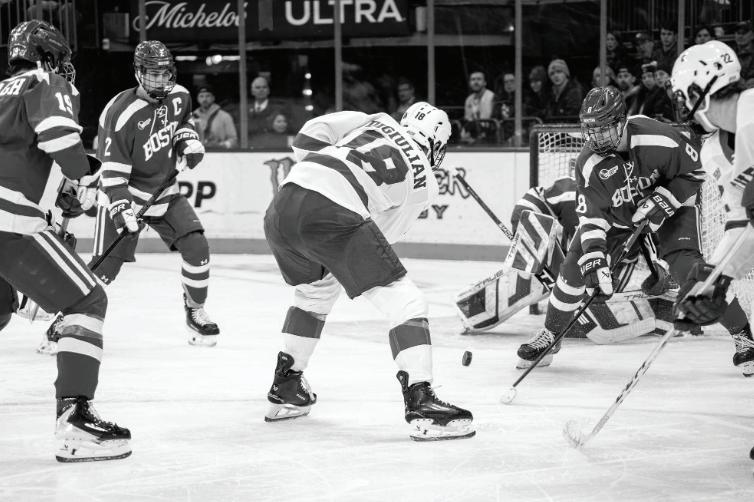

Raised in Locker Rooms and Broadcast Booths, Gio DiGiulian ’29 is Forging His Own Path
By JANE MCNALLY Sun Senior Editor
Dec. 15 — Hockey was a part of freshman forward Gio DiGiulian’s life before he even knew it.
Quite literally.
“My dad coached at [The University of Vermont] — he was an assistant there for a while, so we would go there. I don’t really remember those games. I was like, one or two,” DiGiulian said.
Years removed from Vermont Catamount games and the first skates on his outdoor rink, it didn’t take long for DiGiulian to adjust to college hockey — he came out roaring, potting four goals in his first five collegiate games as the Red’s only true freshman at center.
His shot is something DiGiulian has long worked on perfecting, spending hundreds hours on and off the ice shooting pucks at twine — 100-200 shots a day this past summer, he said. Back home in South Burlington, Vermont, his dad might have watched him from a distance, silently critiquing his form, or filing suggestions in the back of his head.
That was fine, he could keep them there — DiGiulian wasn’t looking for them.
“I don’t really like playing for him, not gonna lie,” DiGiulian said. “I like to keep it away, just separate it. … I’d say he’s a good coach. But when it clashes, I don’t like that.”
Damian DiGiulian, Gio’s father, is more than just a good coach — before retiring this past spring, he spent 30 years coaching college hockey, turning St. Michael’s College (a Division III program out of Vermont) into a top program year in and year out.
Much of DiGiulian’s childhood was spent in rinks across the Northeast, following his dad where he went — first Vermont, then Middlebury College, Rice Memorial Prep, and finally, St. Michael’s.
Lots of families in New England are “sports” families, whether it be cramming into the car for a road trip to a hockey tournament or settling on the couch every Sunday for Patriots games like ritual. For DiGiulian, it goes deeper than that. Beyond his father’s illustrious coaching career, his mother played Division I hockey at New Hampshire, and now works with college athletes at Vermont, where she serves as a sports psychologist.
“I was always around the game,” DiGiulian said. “I was just born into it, so I was lucky to have all the resources.”
DiGiulian’s first hockey memories were forged at the Gutterson Fieldhouse in Vermont, a place his dad spent eight years at before making the switch to high school prep hockey in 2010, when DiGiulian was five.
Damian DiGiulian coached prep hockey in the family’s hometown of South Burlington for two years before being named the head coach of
St. Michael’s, where he would lead at the helm for 13 seasons.
Those years were the most formative for DiGiulian, who was starting to take his hockey career more seriously than family skates and outdoor rinks.
“I’m friends with a lot of guys now that I’m older, which is cool. I was just around and in the locker room talking to the guys,” DiGiulian said. “With all my dad’s teams and the way that he’s coached his teams, I feel like [I was] learning how players act, habits off the ice, on the ice, and being able to take all that in has helped me progress, and I’m very grateful for that.”
DiGiulian played one year of high school hockey in South Burlington before transferring to the Kent School in Kent, Connecticut, playing three years of prep hockey. Those years, DiGiulian says, were the “best three years of my life so far.”
When deciding to stay or leave ahead of his final year at Kent, there was also another thing keeping DiGiulian in prep school — he wanted to pitch.
Baseball holds a special place in DiGiulian’s heart, growing up on the mound and pitching all the way through his senior year of high school. The influence for that love for baseball, much like his dad’s influence on his passion for hockey, is rooted in family.
DiGiulian’s maternal grandfather is Gary Thorne — a veteran sports broadcaster who spent 13 years broadcasting the Baltimore Orioles, and has called dozens of high-profile sporting events from the broadcast booth, including NCAA Frozen Fours, the NHL Stanley Cup playoffs and MLB World Series games.
“I was lucky to travel with him. I’d say the coolest trip was the 2013 [American League] Division Series. I went to game one and then game six, when the [Boston] Red Sox won it at home, and I was up in the press box for that,” DiGiulian said. “I was in with everything behind the scenes and stuff. So that was pretty special.”
He even called one of Gio’s high school hockey games.
DiGiulian’s most prized trip with his grandfather, though, happened a few hours south of where DiGiulian would end up at Cornell — Yankee Stadium. With his family and grandfather in tow, DiGiulian went to the Orioles’ three-game stand at the historic stadium when he was a kid.
“That’s a moment I’ll probably never forget,” DiGiulian said.
DiGiulian is no longer pitching, and he doesn’t have much time to spend hanging out in press boxes anymore — hockey is at the forefront of his mind. DiGiulian is a crucial piece of Cornell’s depth at center, and three-and-a-half years of college hockey sit in front of him.
As an alternate captain as a senior at Kent, DiGiulian led the team in goals (25) and points (49) before making the jump to the United States
Hockey League the following year. DiGiulian’s 22 goals and 51 points with the Lincoln Stars in 2024-2025 were both good for fourth on the team, earning him a spot on some NHL draft boards.
Though tabbed the No. 132 North American skater for the 2025 NHL Entry Draft, DiGiulian went unselected by an NHL club before getting to Cornell. His patience, though — perhaps cultivated in locker rooms and broadcast booths growing up — is a virtue.
“Seeing all those guys be that committed from such a young age kind of just pushed me to want to keep going, and I saw what it took to get to the next level,” DiGiulian said. “So I think just taking notes on that and watching and imitating all the guys he’s coached has helped me.”
The goals and assists weren’t surprising to head coach Casey Jones ’90, who noted the firstyear’s offensive success in the USHL “translates” to the college game. It’s the defensive side of the game — the discipline of it all — that Jones was most impressed with
“Center as a freshman is hard in college hockey, because you have a lot of responsibilities defensively [and] a lot of reads to make,” said head coach Casey Jones ’90. “So a lot of times, guys get moved to the wing initially in their first year, until they settle in. But [DiGiulian’s] been able to hit the ground running.”
DiGiulian might not be the loudest one on — or off — the ice. But he can be counted on to work hard in everything he does.
“I just think he’s around people that help him with his process. Sometimes you can miss being fully prepared as a freshman [in] some aspect, either from mental maturity or strength or conditioning,” Jones said. “Gio’s been around athletes, so he’s got good prep in that regard.”
Sports are woven into the fabric of who DiGiulian is, much like the rest of his family. When DiGiulian goes home, he’ll get to see his sister, Rosa, who is a rising star in high school field hockey. He’ll see his father, enjoying life as a retired coach. He’ll see his mother, who speaks with athletes every day as part of her job.
And when DiGiulian tells you his favorite sports teams, you might be confused at first.
“I have some weird teams that I like,” DiGiulian said. “The [New York] Rangers, Orioles, and then football, the Chargers. My uncle’s from San Diego.”
But it’s easy to understand why once you know his story — they’ve got family written all over them.
“He’s a coach’s son,” Jones noted with a smile. “He comes from a great family — he has the right values. That’s why he’s at Cornell. He’s serious about his education, but he wants to be a hockey player. That’s kind of the MO of a Cornell player, right?”
Fantastic freshman | DiGiulian is the only freshman centering a line. He scored four goals in his first five collegiate games.
GRADY MILLONES / SUN STAFF PHOTOGRAPHER
Mask or mound | DiGiulian spent much of his childhood on the ice, but the baseball mound was a close second. GRADY MILLONES / SUN STAFF PHOTOGRAPHER
‘Sinners’: Triumph and Tragedy in Black Art
Though it hasn’t even been a full year since the release of Ryan Coogler’s Sinners, the film has already established itself as a modern American classic. Sinners was the most successful film not tied to existing intellectual property at the domestic box office, grossing almost $300 million in the United States alone. Additionally, the movie received a record-breaking 16 Oscar nominations, being nominated for all but one (Best Actress) of the categories it could have competed in. In honor of Black History Month and the film’s resounding success, it is worth exploring the themes that make Sinners such a powerful work. Spoilers ahead!
Set in rural Mississippi in the 1930s, Sinners centers on twin brothers Smoke and Stack as they return to their hometown to open a nightclub for the local Black community. They soon discover, however, that a multitude of terrifying forces threaten their goal. These forces powerfully represent many of the most present dangers to Black existence and culture throughout American history.
The Ku Klux Klan acts as one of the most straightforward symbols in the movie. The infamous domestic terrorist organization has intimidated and brutalized Black communities (among other immigrant and minority groups) since the Reconstruction era. Violent hate groups like the KKK have sought to eradicate Black people and their influence in society, utilizing methods like voter intimidation, lynching and massacres of entire
YORK
communities. Many of these groups moved online in the early 2000s, which has led their dangerous philosophies to be felt today in the rhetoric of many political figures, massive far-right protests and racially-targeted mass shootings.
Vampirism, the central antagonistic force throughout Sinners, represents the more quiet avenues of cultural destruction: appropriation and assimilation. Black culture has long occupied a complicated place in American culture as a result of widespread racism. Many of the most ‘American’ art forms and genres (blues, jazz, rock and roll, soul, funk, rap, etc.) were pioneered by Black musicians. Because of the systemic racism that has pervaded the United States, however, early Black genre pioneers did not receive proper recognition for their work. Instead, white artists took from the work of Black artists and were catapulted to commercial fame (think Benny Goodman, Elvis Presley and Eminem). Additionally, Black artists would often have to shed certain aspects of their identity and art in order to gain popular appeal. Members of mainstream white society would simply not acknowledge the quality of Black art until it was served in a way that was palatable to its sensibilities. As Delta Slim (Delroy Lindo) says in Sinners, “See, white folks, they like the blues just fine … they just don’t like the people who make it.”
Symbolizing this historical pattern, Remmick (the main vampire depicted in the film) and his infected followers are drawn to Smoke and Stack’s juke joint when he hears the beautiful blues music
being performed inside. He initially tries to enter the club by presenting his group as kind, unprejudiced music-lovers. This mirrors the tactics often used by cultural appropriators; such individuals would enter black spaces as friends before capitalizing on Black art with little credit given to its originators. When entering the joint proves unsuccessful, he employs a different approach later on. Remmick outwardly acknowledges his identity as a vampire, but tries to lure the remaining survivors into joining him by offering protection and immortality. Here, Remmick’s offer symbolizes the troubling process of cultural assimilation. One of the only ways early black artists could gain acceptance and profitability was by selling out parts of their identity and craft to white record companies and managers. Similarly, Remmick offers success that is contingent on loss of control that will come for his victims as they are assimilated into his hive mind.
But Coogler deepens his depictions of appropriation and assimilation in the film in a very interesting way: Remmick, though a clear villain throughout the film, is also implied to be a victim of cultural assimilation and appropriation. Remmick is depicted as an Irish man who experienced brutal repression by British forces in his home country. He seeks to fill the void created by the destruction of Irish community and culture by taking black culture for his own, but in the process he ends up attempting to recreate the same style of oppression that he experienced in the first place. In America, many immigrant groups shed aspects of their
cultural identity to gain acceptance as ‘white.’ Most Black people, on the other hand, fundamentally unable to become ‘white’ due to deep social and institutional barriers, formed and held on to a rich cultural heritage that combined elements from African, Caribbean and European traditions.
The enduring power of Black culture as a persistent tool for transcending oppression is exemplified in Sinners’ most famous scene. As guitarist Sammie Moore (Miles Caton) performs, artists from diverse genres throughout history enter the space alongside those dancing. By contributing to a beautiful history and creating meaningful music, Sammie achieves a kind of immortality for himself and those around him — immortality not contingent on giving up his mind and soul to vampirism.
| ‘28 Years Later: T e Bone Temple’
While January is typically the weakest month of the year for new films, 2026 is already shaping up to break this trend. Less than a year after the release of 28 Years Later , the next installment in the 28 Days franchise is almost as strong as its predecessor, which ended up remaining one of my top five films of 2025. Don’t let January’s reputation as a ‘dumping ground’ for bad movies turn you away. While 28 Years Later: The Bone Temple is missing the direction of Danny Boyle, it is still an extremely strong entry into one of my favorite film series of all time.
Directly following the events of 28 Years Later , The Bone Temple follows Spike (Alfie Williams) as he joins a group of sadistic fighters using the apocalypse as cover to murder and sacrifice fellow humans. The “Fingers” are led by “Sir Lord” Jimmy Crystal, the grown version of the pastor’s son we saw in the opening sequence of 28 Years Later . After his portrayal of the vampire Remmick in last year’s Sinners , Jack O’Connell takes on an even crueller role in Jimmy Crystal, whose experiences in the beginning of the Rage Virus have turned him into a self-proclaimed Satanist. We quickly realize that everything about Jimmy’s worldview is warped, based on fuzzy childhood memories that would never be corrected. The onset of the Rage Virus in his youth and the subsequent death of his parents have left Jimmy idolizing and imitating figures like Jimmy Savile (whose crimes didn’t come to light until 2011, long after the in-universe apocalypse) and creating a story of Satanism based on no current religion.
The horrific acts of brutality we see committed by Jimmy Crystal are sharply contrasted with a story of hope. The film’s subplot follows Dr. Kelson (Ralph Fiennes) and his continued belief that humanity still remains within the infected.
The audience sees a softer side of the Alpha from 28 Years Later , whom Dr. Kelson names Samson, as the two begin to find connection. Played by Chi Lewis-Parry, Samson’s inner humanity, long suppressed by the Virus, begins to come to light under Kelson’s guidance.
In 28 Days Later , Danny Boyle flipped the zombie genre on its head, framing his human characters as the true monsters of the film, and exploring how an apocalyptic event might bring out the darkest parts of human nature. Last year, 28 Years Later went even further, changing zombies from nameless villains for our protagonists to mow down into offsets of humanity. I was struck by the film’s choice to explore how the infected might have evolved over the course of 20 years and how those impacted by the Rage Virus had formed their own culture and way of life. It makes sense, then, that in The Bone Temple , we delve even deeper. Here, the brutality of Jimmy and his Fingers is juxtaposed with the kindness, empathy and connection found between Dr. Kelson and Samson, two outcasts of society. The film draws a strong parallel between Jimmy Crystal and Samson: both characters are affected by psychosis brought on by the Rage Virus in two vastly different ways. Whereas Samson has created life, through the birth of his daughter, and has found friendship with Dr. Kelson, Jimmy’s mental state has turned him into nothing less than a monster.
The 28 Days franchise has cemented itself as one of the most fascinating film series of all time. While The Bone Temple is missing some of the flair of its precursors in its cinematography and editing, director Nia DaCosta’s less eccentric style serves the somber tone of the film. It’s difficult to feel like anything is missing, even without Danny Boyle’s direction, when the story and direction are so strong. At the center of the film is Ralph Fiennes’s performance, who brings a much-needed sense of humanity to a story so devoid of it. His empathy, for the infected, for Spike and even for
Jimmy, gives the film a sense of hope. While the visuals of The Bone Temple don’t quite live up to its predecessor, I would argue that its screenplay is even stronger than 28 Years Later ’s. Its exploration of the effects of trauma and the continued blurring of lines between human and monster make it one of the most interesting mainstream films in recent memory. So far, the box office for The Bone Temple has been undeservedly lackluster. While January releases certainly have a reputation, don’t let that stop you from making the trip. Just as 28 Years Later has stuck with me almost a year after its release, I expect The Bone Temple will remain one of the best films of 2026.

COURTESY OF SONY PICTURES RELEASING
NICHOLAS YORK ARTS & CULTURE WRITER
Matthew Rentezelas is a sophomore in the College of Arts and Sciences. He can be reached at mmr255@ cornell.edu.
MATTHEW RENTEZELAS ARTS & CULTURE WRITER
COURTESY OF WARNER BROS. PICTURES
ARTS & CULTURE
Te 20th Anniversary of ‘High School Musical’
By GIA LISH Arts & Culture Writer
All hail the movie musical. Accessible, catchy and immortalized online, musical films have revolutionized the cinematic scene. One in particular is notable, as it celebrates its 20th anniversary this month: High School Musical. With an extensive franchise spanning four movies, a TV series, two stage musicals and even a series of video games, High School Musical revitalized the musical movie genre, signalling a new era of popularity for this genre and paving the way for films like La La Land, In the Heights, and more recently, Wicked First released as a Disney Channel Original Movie, the film (and its soundtrack) rose quickly to fame, earning it a well-deserved place in the history books of Disney Channel. Despite targeting a young audience, this coming-of-age romantic dramedy tugs at the heartstrings of all kinds of viewers, high schoolers and adults alike.
High School Musical follows Troy Bolton and Gabriella Montez as they navigate the social and academic challenges of junior year. Gabriella is a transfer student, thrust into an unfamiliar school halfway through the year, whereas Troy is a star basketball player by day and an aspiring theater kid by night. Brought together by a shared love of music, the two form an unlikely friendship and ultimately decide to audition together for their school musical. This catches the attention of theater tycoon and certified diva Sharpay Evans, who becomes dead set on breaking up Troy and Gabriella and shutting them out of the theater scene permanently. Still, despite Sharpay’s torments and high school social stigmas, both students choose to break free from their peers’ expectations and embrace their own uniqueness.
After its release, High School Musical won 14 different awards, including the Billboard Music Award’s Album of the Year and the Primetime Emmy Award for Outstanding Children’s Program. The movie was nominated for 17 additional honors, particularly highlighting director Kenny Ortega, also known for his work on Broadway’s Newsies and the Descendants franchise. Needless to say, High School Musical had an outstanding public reception, encouraging the production of the most recent addition to the franchise, High School Musical: The Musical: The Series, featuring the popular stars Olivia Rodrigo and Joshua Bassett.
In addition to international fame, the film had a powerful impact on young performers who face similar struggles balancing work and passion. As an avid theater kid myself, High School Musical was a staple in my childhood. The music, particularly “Stick to the Status Quo” and “Breaking Free,” hit close to home as I was struggling to fit into one box or another in high school. It’s easy to get lost in the crowd’s expectations, but ultimately it’s your distinctive, eccentric interests that set you apart from the masses.
Though musical theater is not necessarily an unusual passion, it still exists in a world apart from mainstream media. That’s why High School Musical is such a landmark in the film industry. It was certainly not the first movie musical to hit home theaters—the first recognized movie of this genre was The Broadway Melody in 1929—but its widespread popularity securely established the genre’s prevalence in modern media for every age group. Nowadays, movie musicals are abundant, both in film adaptations of Broadway musicals and professional stage recordings. These new productions have further popularized musical theater in the public eye (thank you, Hamilton), skyrocketing
public interest in live theater, particularly among younger generations. Gen Z is seeing a spike in theater engagement, with young adults representing the greater part of regular theatergoers. Plus, recent statistics show that the 2024-2025 Broadway season was the highest grossing season in history, an exciting data point for artists around the world.
On the surface, High School Musical is just another Disney Channel film amongst over 100 others. Overall, it is fairly unimpressive in the grand scheme of American films. Yet, on a deeper, cultural level, it has made a significant social impact in the form of ridiculously catchy tunes and wholesome characters who encourage you to fly away from limiting expectations and find your calling amongst the stars.
In Memoriam: Catherine O’Hara, Best in Show(Biz)
By MAYA BLANCHARD Arts & Culture Writer
Early in the morning on Friday, Jan. 30, beloved actress and comedian Catherine O’Hara was rushed to the hospital in critical condition. She sadly passed away later that day, the cause of death still unknown. O’Hara was 71 years old when she died, leaving behind a six-decade- long legacy as a Hollywood icon. Most of our generation will recognize her as gaudy Moira Rose from Schitt’s Creek (2015) or Kevin McCallister’s loving but forgetful mother in Home Alone (1990), but those projects — while critically-acclaimed — only scratch the surface of her illustrious and impactful career. This article cannot do her genius justice, but I feel honored to be paying tribute to a woman who has made me laugh so much.
Born and raised in Toronto, O’Hara was an understudy for Gilda Radner in The Second City comedy troupe until officially joining the cast in 1974 when Radner got hired for Saturday Night Live. On Second City Television (SCTV), O’Hara charmed audiences with her impressions and iconic characters and quickly rose to recognition in the comedy world. She even got hired as an SNL cast member in 1981, but quit before ever appearing on air and instead chose to return to SCTV when it signed with NBC and began airing in the U.S. As word
of her talent spread, she made appearances on several TV shows throughout the ’90s, most notably Outer Limits and The Larry Saunders Show. Her most recognizable film credits include Delia Deetz in Beetlejuice (1986) and Kate McCallister in the Home Alone films (1990, 1992). She also lent her voice to many beloved animated movies: You can hear her in The Nightmare Before Christmas (1993), Chicken Little (2005), Over The Hedge (2006) and Frankenweenie (2012).
I can’t memorialize Catherine O’Hara’s career without referencing her longtime costar Eugene Levy. Intertwined since their days on SCTV playing the parodic Hollywood stars Lola Heatherton and Bobby Bittman, their most recent reunion as the hilariously down on their luck Moira and Johnny Rose in Schitt’s Creek (2015) is a delightful bookend moment for longtime fans. Their comedic chemistry was solidified in the late ’90s and early 2000s, when the two starred recurrently in the mockumentary-style movies of Christopher Guest. Waiting For Guffman (1996), Best in Show (2000) and For Your Consideration (2006) were a big hit during my family’s quarantine-mandated movie nights in 2020. The films feature quirky ensemble casts with comically sincere aspirations displayed in a faux-reality format, and Catherine O’Hara shines alongside Eugene Levy as a master of satirical and absurdist humor. In a
statement shared with USA TODAY on Jan. 31, Levy mourns her death, saying that “words seem inadequate to express the loss I feel today.” They truly brought out the best of each other onscreen, so it’s no surprise that they maintained a strong friendship throughout their parallel careers.
Catherine O’Hara’s reputation transcended comedic genius; she was regarded by all she worked with as a delight. News of her death hits especially hard after enjoying her portrayal of fictional studio executive Patty Leigh in the recent Apple TV series The Studio (2025) — a role that earned her an Emmy nomination for Outstanding Supporting Actress in a Comedy Series. The cast and crew of The Studio shared their parting words in Deadline, a Hollywood news blog, following her sudden passing:
“We are at a loss for words at the passing of our friend Catherine O’Hara. She was a hero to all of us, and we pinched ourselves every day that we got to work with her on The Studio She was somehow classy, warm, and hilarious all at the same time. We’re unbelievably saddened she is gone and send our deepest sympathy to Bo and all her family.”
No one can be feeling O’Hara’s loss harder than her husband, production designer Bo Welch. The couple met on the set of Beetlejuice in 1988 and married four years later. Their chemistry was undeniable after their
very first date, and she left Canada behind for good to live with him in Los Angeles. “Yeah, I moved for love,” she told The New Yorker in a 2019 interview. The couple’s film credits overlapped again later in life: During her stint as Dr. Georgina Orwell in A Series Of Unfortunate Events (2017), Welch directed two of the episodes she appeared in. Her casting in this role was a callback to the original film adaptation of Lemony Snicket’s black-comedy series, in which she also starred.
Despite both maintaining fairly limelighted Hollywood careers, Welch and O’Hara’s family life remained peaceful and undisturbed as they raised their two sons Matthew and Luke. This weekend the world said goodbye to a beacon of light that has been brightening film and television for half a century. Two young men lost their mother, and a man bid farewell to the love of his life. The loss that their family must be feeling is immeasurable, and they will be holding a private celebration of her life in the near future. I will definitely be rewatching my favorite Christopher Guest movies to honor Catherine O’Hara in my own small way, and I recommend everyone find a time to let her make you laugh.
Maya
is a senior in the College of Agriculture and Life Sciences. She can be reached at mhb237@cornell.edu.
Gia Lish is a freshman in the College of Arts and Sciences. She can be reached at gml223@cornell.edu.
Blanchard
No. 10 Men’s Hockey Beats Brown 4-2
DiGiulian lit the lamp twice in the second game of the weekend
By JANE McNALLY Sun Senior Editor
After netting his first four collegiate goals in his first five collegiate games, freshman forward Gio DiGiulian went on to score just once in his next 14 appearances.
That is, until he ventured east to Yale and Brown.
After lighting the lamp against Yale on Friday, DiGiulian tacked on two more scores on Saturday as Cornell cruised to a 4-2 victory over Brown in Providence, Rhode Island. The late-afternoon outing was yet another display of the newly assembled first line’s dominance.
“I thought it took us a little bit to work ourselves into the game, but overall, I thought it was a good weekend of hockey for us,” said head coach Casey Jones ’90.
Jones reimagined the top line — junior forward Ryan Walsh flanked by junior forward Jake Kraft and DiGiulian — last Friday against Dartmouth, citing a need for “something fresh.”
The change has quickly become one of Jones’ most effective — Cornell has scored 11 goals at even strength since then, and the first line has been responsible for five of them. In the last three games, Walsh, Kraft and DiGiulian have combined for 11 points.
“I do know that 18 [DiGiulian] and 10 [Kraft] on the outside [are] playing with good pace for [Walsh],” Jones said. “They’re getting into the dirty areas. So it’s been a good line, and we’re actually matching them up against other teams’ best players.”
Saturday’s game was not perfect —
Brown outshot Cornell 13-4 in the final frame and clawed back to cut a three-goal deficit to two with the goaltender pulled, but the Red held on to secure six vital ECAC points.
And although he allowed four goals, Brown goaltender Tyler Shea still made 29 stops, with 26 of them coming in the first two periods. Without him, the score could have been much uglier.
On the other end, freshman goaltender Alexis Cournoyer was tested much less frequently but secured the victory with 27 stops, though not before allowing a goal on the first shot he faced.
Cornell (16-5-0, 11-3-0 ECAC) had been reeling from an unsuccessful man advantage in the early moments of the game, turning the puck over to the Bears in the neutral zone before Ben Poitras took care of the rest. His shot snuck under the blocker of Cournoyer to give the Bears a 1-0 lead at 4:54 of the first period, marking the 13th time in 17 appearances that Cournoyer has surrendered a first-period goal.
A brief Brown (4-17-1, 3-10-1 ECAC) attack followed the goal up, but the Red soon regained its footing, and the game was tied just 1:48 after the Bears’ opening tally. Freshman forward Aiden Long picked up speed with the puck along the left wing, and his glove-side shot hit nothing but net, equalizing the game at 1-1.
A successful kill to open the middle frame seemed to provide Brown with a jolt of momentum, as Cornell — a bit depleted due to sophomore defenseman Michael Fisher and junior forward Luke Devlin not being in the lineup due to injuries on
Saturday — allowed the Bears a few too many odd-man rushes for comfort.
Jones said he “hopes” that the injuries to Devlin and Fisher are day-to-day.
“We’ll track to see where things are at,” Jones said. “But hopefully nothing that’s too long.”
It was not until around the 11-minute mark of the second stanza that the Red began generating some momentum. An elongated shift in its offensive zone yielded some grade-A opportunities, but Shea did an excellent job collapsing on the puck to limit second chances.
That is, until a couple of pokes by DiGiulian culminated in the puck just barely eking through Shea’s pads. Shea — having already made 22 saves up to that point — displayed dejected body language as Cornell celebrated its first lead at about the halfway point of the game.
Brown earned a power play with 5:30 to go in the period, but some timely blocks by the Cornell penalty killers preserved the slim lead.
And, with just 10 seconds left in the second period, DiGiulian tacked on his second goal of the game to make it a 3-1 game.
“He made some really good plays with that line,” Jones said. “And so I think there’s some chemistry there. I’m excited about him taking a step with that.”
The goal seemed to suck the wind out of Brown’s sails — particularly those of Shea, who attempted a diving save as DiGiulian shot for the gaping net, and did not make enough contact with the puck to keep it out of his net.
The third period allotted Cornell its third power play of the night, which soon
became its first — and only — successful man-advantage on Saturday. Freshman defenseman Xavier Veilleux lasered a shot past Shea just 28 seconds into the power play to give Cornell a 4-1 lead.
“That was a big power-play goal … we needed one there,” Jones said. “To get one and kind of put the game away [and] seal it there was important for us tonight.”
The Bears gave the Red a scare when they scored an extra-attacker goal with 4:07 left. Brown had its goaltender pulled for nearly five minutes, but Cornell failed to find the back of the vacant net, largely due to the blocks of the Bear skaters and a couple of fortuitous hit posts.
“[In the] last part of the game, they had the goalie pulled quite a bit. We’ve got to get a little better at that,” Jones said. “Gotta work on managing that. We had, like, eight shots at the empty net. … They had some zone time, but I thought we did a good job.”
Cornell held on to secure the 4-2 victory, the weekend sweep and the series sweep of both Brown and Yale. The six points claimed this weekend not only bolster the Red in its quest for a top-four seed in the ECAC playoffs, but also put the Red in the driver’s seat for an Ivy League title.
Next up, Cornell will take on Colgate in a home-and-home sequence next weekend. The Red will head to Hamilton, New York, for a 7:30 p.m. tilt with the Raiders on Friday before returning to Lynah Rink at 7 p.m. on Saturday puck drop. All action will stream live on ESPN+.
Jane McNally can be reached at jmcnally@ cornellsun.com.
Women’s Hockey Falls Narrowly to Harvard
By ALEXIS ROGERS and ELI KWAIT Sun Sports Editor and Sun Staff Writer
Women’s hockey proved it can play with the ECAC’s best when the Red defeated then-No. 7 Princeton 6-1 on Jan. 23, before turning around to fall 4-0 to thenNo. 6 Quinnipiac the next day. This week, the embattled squad recorded another surprising split.
Cornell’s 5-0 blowout victory against Dartmouth on Friday gave hope for a dominant final week of Ivy League play, but a dream of repeating Oct. 24’s decisive win over Harvard wasn’t enough in the face of fatal errors.
“We played with good energy today,” said head coach Doug Derraugh ’91. “We threw the kitchen sink at them in the third period and couldn’t find a way to get it by their goalie. That’s hockey sometimes.”
Though an early deficit didn’t phase Cornell (14-10-2, 10-7-1 ECAC) — the Red put up a consistent offensive front and notched a tying tally on the power play to end the first period — Harvard’s second-frame lead-taking goal and its netminder’s 48-save performance proved to be difference-makers in a frustrating 3-1 loss.
The opening frame began at a fast pace, with the teams trading chances. The Red outshot the Crimson 12-7 over the first 20
minutes, but Harvard (12-12-2, 6-10-2 ECC) edged out Cornell in grade-A opportunities. The Red initially worked around a couple of defensive breakdowns before taking a tripping penalty with under eight minutes left in the period.
Cornell retained possession for most of the opening minute of the penalty kill, until a defensive-zone draw gave the Crimson the chance to launch a quick strike. Zoe Boosamra, coming from the outside circle, shook off junior defender Piper Grober and brought the puck from her forehand to her backhand before roofing it blocker side to give Harvard the 1-0 lead.
“We sort of won [the faceoff], so the players started thinking of getting into breakout mode,” Derraugh said. “Once they made that step out, we lost it again. [Boosamra] beat [the defense] and made a nice move on the goal.”
With 40 seconds left on the first period clock, Harvard took a body-checking penalty and put the Red back in the driver’s seat.
After a series of patient passes, junior forward Karel Prefontaine launched a one-timer off a feed from freshman forward Nora Curtis to tie the score, 1-1, heading into the first intermission.
“The power play was working on both sides,” Prefontaine said.
“I feel like we got pretty good opportunities. I had [window] and
was like, might as well just rip it.”
Prefontaine’s fifth power-play goal of the season tied her with sophomore forward Lindzi Avar for most extra-skater tallies on the team. Avar, who left midway through the first period of Friday’s bout with Dartmouth, had not made the quick return to the ice Derraugh had hoped for and was absent against Harvard.
The momentum started by the late tally carried over into the second period, with Cornell launching coordinated attacks while fighting off several close calls for the Crimson. Both teams relied heavily on their netminders — Harvard’s Ainsley Tuffy, especially, constantly fought through traffic to block Cornell shots.
“[Tuffy] was just feeling it,” Derraugh said. “And so you have to get tips. You got to get rebounds, you got to get screens. And if you don’t, you’re not going to be successful.”
The tie finally broke after Harvard’s Ella Lucia intercepted a pass within the Cornell zone — a giveaway that caught the Red out of position. The sophomore center dished it to Boosamra, who tipped home her second goal of the game from the edge of the crease.
“It’s never just one person,” said senior defender Sarah MacEachern. “I think it’s what happens after the giveaway. That is what we need to clean up a
little bit, just making sure we’re in our position so we’re ready to help out.”
Just over three minutes later, senior defender Grace Dwyer struggled to clear the puck from behind the Red’s goal and Harvard capitalized. Battling to the front of the net, Carla McSweeney shoveled a shot that rebounded high off of Bergmann. McSweeney batted the falling puck into the net, giving Harvard what appeared to be a two-goal lead.
However, the Red received a stroke of good luck when a second look at the play showed that the puck had been played with a high stick, leading to a reversal of the call on the ice after a Cornell challenge.
Cornell did not get much time to celebrate the overturned goal. Still down 2-1, the Red committed a penalty with less than two minutes remaining in the period, resulting in 25 seconds of penalty kill to begin the third.
Though it was unsuccessful in the final moments of the power play, the Crimson found the first high quality chance of the final period. Less than five minutes into the frame, a Harvard shot ricocheted off the post and settled behind Bergmann. The ensuing scramble in the crease led to a pileup of Harvard attackers and Cornell defenders. Despite a challenge from the Crimson alleging a
goal, the play resulted in no score.
With another review in its favor, the Red looked to go on the offensive. Tuffy denied shot after shot, and the Red could not solve the goaltender who entered the game with the second-highest save percentage in the NCAA. The Duxbury, Massachusetts native ended the night with 48 saves on 49 Cornell shots, sealing the game for the Crimson.
“We need someone in front of the net,” Prefontaine said. “[Tuffy] had a really great game, but I feel like we also made her look good.”
As the window for a comeback waned, Cornell’s last attempt to turn the tides ended after Harvard scored an empty-net goal with 12 seconds remaining.
The result means Cornell will need help to capture a third straight Ivy League title. Princeton currently sits eight points behind Cornell with four conference games (and 12 possible points) remaining.
Cornell remains at home next week, with RPI first on the docket for the series. The game is set for 5 p.m. on Feb. 6, with Senior Day celebrations to come after the contest.
The matchup will be streamed live on ESPN+.
Alexis Rogers and Eli Kwait can be reached at arogers@cornellsun.com and ekwait@cornellsun.com.