
The Corne¬ Daily Sun
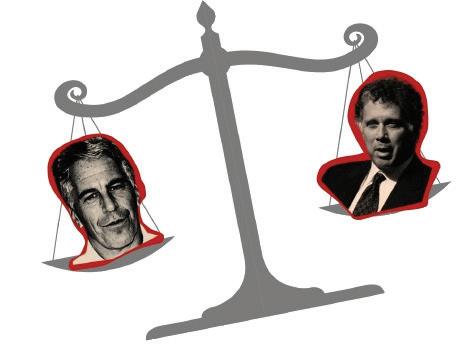
Boy Jeffrey Is Everywhere’
By ATTICUS JOHNSON Sun Senior Writer
Nov. 25 — Reid Weingarten ’71 and Darren Indyke J.D. ’91 were among the top-mentioned individuals in the latest batch of convicted child sex offender Jeffrey Epstein’s personal emails released by the House Oversight Committee on Nov. 12.
Weingarten and Indyke, lawyers represent ing Epstein in various criminal and civil cases, were both in communication with Epstein regarding President Donald Trump and how to defend Epstein against press inquiries and lawsuits.
Weingarten, an anti-corruption prosecutor turned white collar defense attorney, maintained close ties with Epstein. He was mentioned 109 times in the trove of released emails, where his corre spondences reveal a decade-long personal relationship with Epstein beyond legal representation.
In a 2011 email, Weingarten told Epstein, “weird day…some poor soul just jumped in front of my acela to commit suicide … quite a mess,” to which Epstein later replied, “time to relax. go get a massage.”
“i wish,” Weingarten wrote back.
After Trump was elected president, the two traded thoughts about politics until Epstein’s death.
a D.C. pizza shop — to Weingarten, the attorney said “Yikes...my boy jeffrey is everywhere....”
After Epstein forwarded an article about the Pizzagate conspiracy theory — alleging that the Clintons and other politicians ran a sex trafficking ring in the basement of
investigation into Russian interference in the 2016 Presidential election, Weingarten wrote to Epstein, “trump is going to fire mueller and republicans on hill wont do a thing.”
Indigenous Student Engagement Persists Despite Enrollment Drops
By SVETLANA GUPTA Sun Contributor
Dec. 2 — Following the U. S. Supreme Court’s June 2023 decision to overturn affirmative action, enrollment for Black, Hispanic and Indigenous students at Cornell remains below fall 2023 levels, despite a slight increase in 2025. This decline has raised longterm concerns among indigenous organizations on campus, who rely on diverse incoming classes to sustain their membership.
While cultural organizations have existed at Cornell for over a century, starting with Club
nied by the introduction of affirmative action policies across the country, according to the Cornell Law School Legal Information Institute.
More than five decades later, that landscape shifted when the 2023 Supreme Court ruling ended the use of affirmative action in college admissions. This marked a turning point nationwide, requiring colleges to remove race conscious criteria from their application review processes.
Data released from Cornell Institutional Research and Planning shows a second straight year of lower first-time freshman American Indian enrollment the years the
affirmative action ban. In 2023, 10 first-time freshman American Indian students enrolled at Cornell. Following the affirmative action ruling, that number dropped to two in 2024. In 2025, four American Indian students were enrolled in the incoming Class of 2029.
Native American and Indigenous Students at Cornell Co-Chair Krissia Tuzroyluk ’26 has seen the effects of lower indigenous admissions in her organization.
“It was so hard to find our Indigenous first-year students [this year], just because of how rapidly the numbers declined, and there has been an extreme loss in the sense of community in NAISAC because of that,” Tuzroyluk said.
According to Director of Undergraduate Admissions Pamela Tan, Cornell makes an effort to reach out to indigenous groups across America. In a statement to The Sun Tan wrote that “[Cornell] Undergraduate Admissions attends Indigenous college fairs, such as the Native American College Fair in St. Paul and the Rocky Mountain Association for College Admissions Counselors Fair in New Mexico.”
He also speculated that “Trump leaked the two pages … cross the government’s star witness tomorrow… its odd i still do this shit.” The exchange occurred less than an hour after some of Trump’s tax returns were leaked to Epstein and Weingarten then speculated in 2018 about the nature of then-White House communications director Hope Hicks’ relationship with Trump, sharing a “Blind Gossip” article titled ‘The Wrong Faux Boyfriend.’
Weingarten, who works as Senior Counsel at Steptoe — a top law firm based in Washington, D.C. — discussed Steptoe’s representation of Epstein.
“Jeffrey has paid about 450 and owes about 300 and seems disinclined to make Steptoe whole.....hhhhhmmmm....first reaction is déjà vu.... As you know I am the 800 pound gorilla here, Steptoe is not going to chase you down for the money but there are 500 lawyers here,” Weingarten emailed, in regards to Epstein’s apparently incomplete payment to
Steptoe, which billed over $100,000 for defending Epstein, maintains a presence at Cornell Law School’s fair and currently employs seven Cornell law school graduates.
To continue reading this article, please visit www.cornellsun.com.
By CORAL PLATT Sun Contributor
Dec. 2 — Cornell Graduate Students United announced on Nov. 26 that its members passed a referendum to adopt a statement titled “International Solidarity with the Palestinian Liberation Struggle” as the organization’s official stance. The statement, in addition to declaring solidarity with Palestine, lays out actions that the union will take to achieve this goal.
During a Nov. 13 general membership meeting for United Electrical Workers Local 300 Cornell Graduate Students United, attendees voted to put the Palestine solidarity statement drafted by the union’s political action committee to a membership-wide referendum. Members could vote from Nov. 21 to Nov. 25.
The solidarity statement explains that “the labor movements faces a once-in-a-generation opportunity to build international worker solidarity” through “end[ing] all forms of complicity with Israel’s crimes, halt[ing]
all funding and military research with ties to Israel, and center[ing] Palestine’s struggle for liberation within our struggle for better material working conditions.”
“Cornell is implicated in the Israeli genocide of Palestinians through research, recruitment, and financial ties with the weapons industry, and endowment investments” and “University workers have paid a price when standing up for Palestine,” the statement reads.
In a speech given at the “Take Back our University” rally on Aug. 28, CGSU-UE President and Ph.D. candidate Ewa Nizalowska described the union’s experiences with University retaliation.
“We have seen Cornell deliberately target graduate workers who have stood up for Palestinian rights,” Nizalowska said at the rally. “We have to protect each other from unjust firing, suspicions and attacks.”
To continue reading this article, please visit www.cornellsun.com.
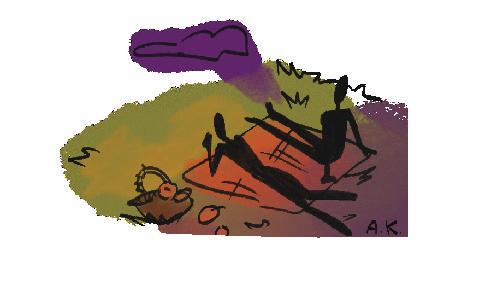
Special Credit: Sunset graphics by Ashlin Kwong / Sun Staff Artist
Midday Music for Organ: Ernest Ng 12:30 - 1:30 p.m., Anabel Taylor Chapel
Ugly Sweater Holiday Party 4 - 5:30 p.m., 200 Barnes Hall
Cornell in Los Angeles Info Session 5 - 6:30 p.m., Online
Perspectives on Polarization 5 - 6 p.m., 102 Mann Library
Therapy Dogs for Finals Season 5 - 6 p.m., Chemistry Undergraduate Lounge A Sweet Night of Slime 5:30 - 7:30 p.m., South Balch Hall Multipurpose Room 3331 Free ZUMBA! 6:30 - 7:15 p.m., Noyes Community Recreation Center Tomorrow
Midday Music in Lincoln: “Handmade Music” 12:30 - 1:30 p.m., B20 Lincoln Hall
(607) 273-0746
www.cornellsun.com
SUNBURSTS: Fall 2025 Recap
By SUN PHOTOGRAPHY DEPARTMENT
As the semester comes to an end and winter approaches, Te Sun refects on a semester of photos
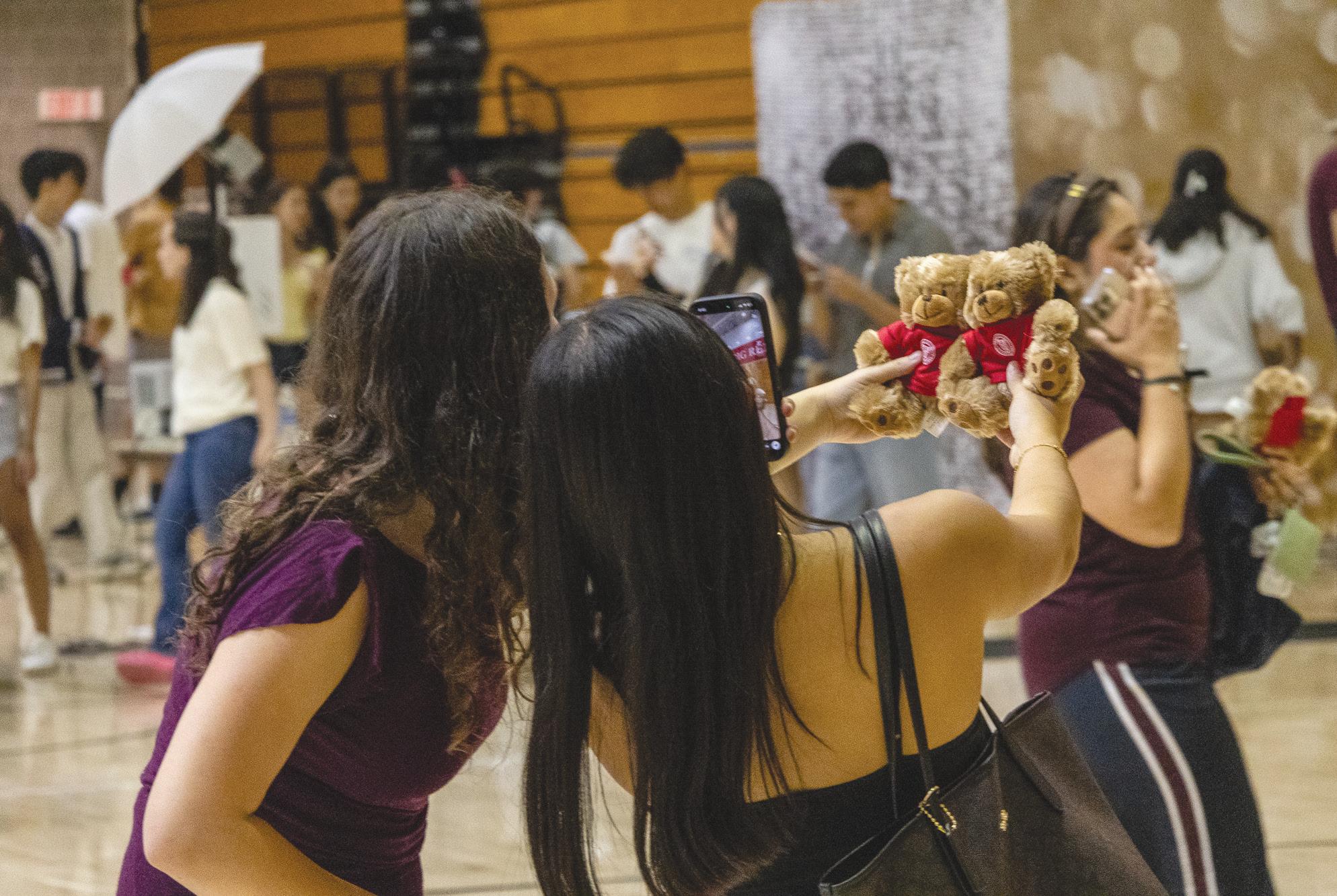

O-WEEK | First-years pose with Cornell teddy bears during the First-Year Festival in Bartels Hall on Aug. 22.
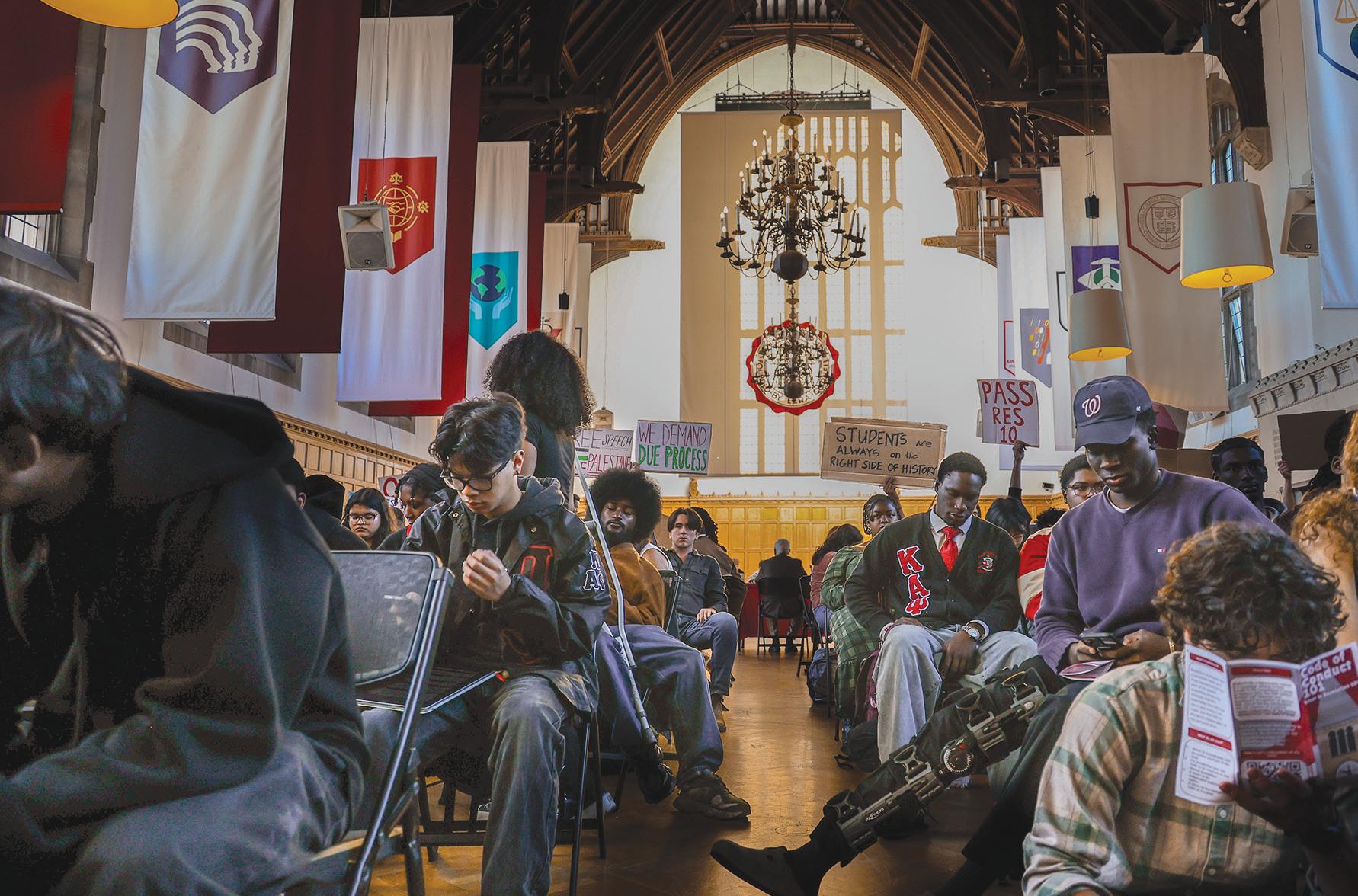
CIVIC ENGAGEMENT | Students turned their backs on President Michael Kotlikoff and Vice President for Student and Campus Life Ryan Lombardi as the two addressed the Student Assembly on Oct. 9.
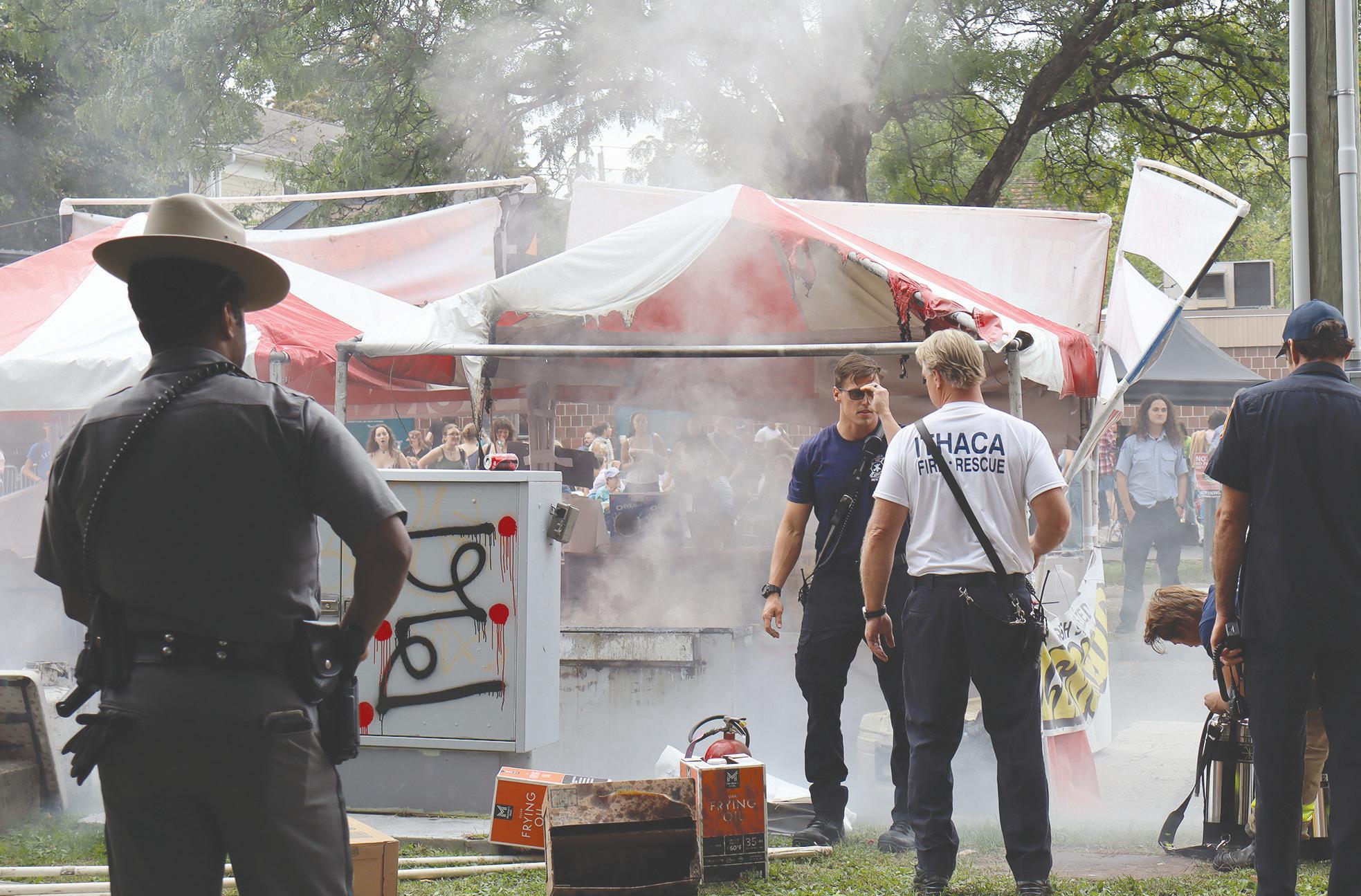
APPLE FEST FIRE | At the 43rd annual Apple Harvest Festival, a fire broke out at a food stand on the corner of State and Geneva Street on Sept. 27.
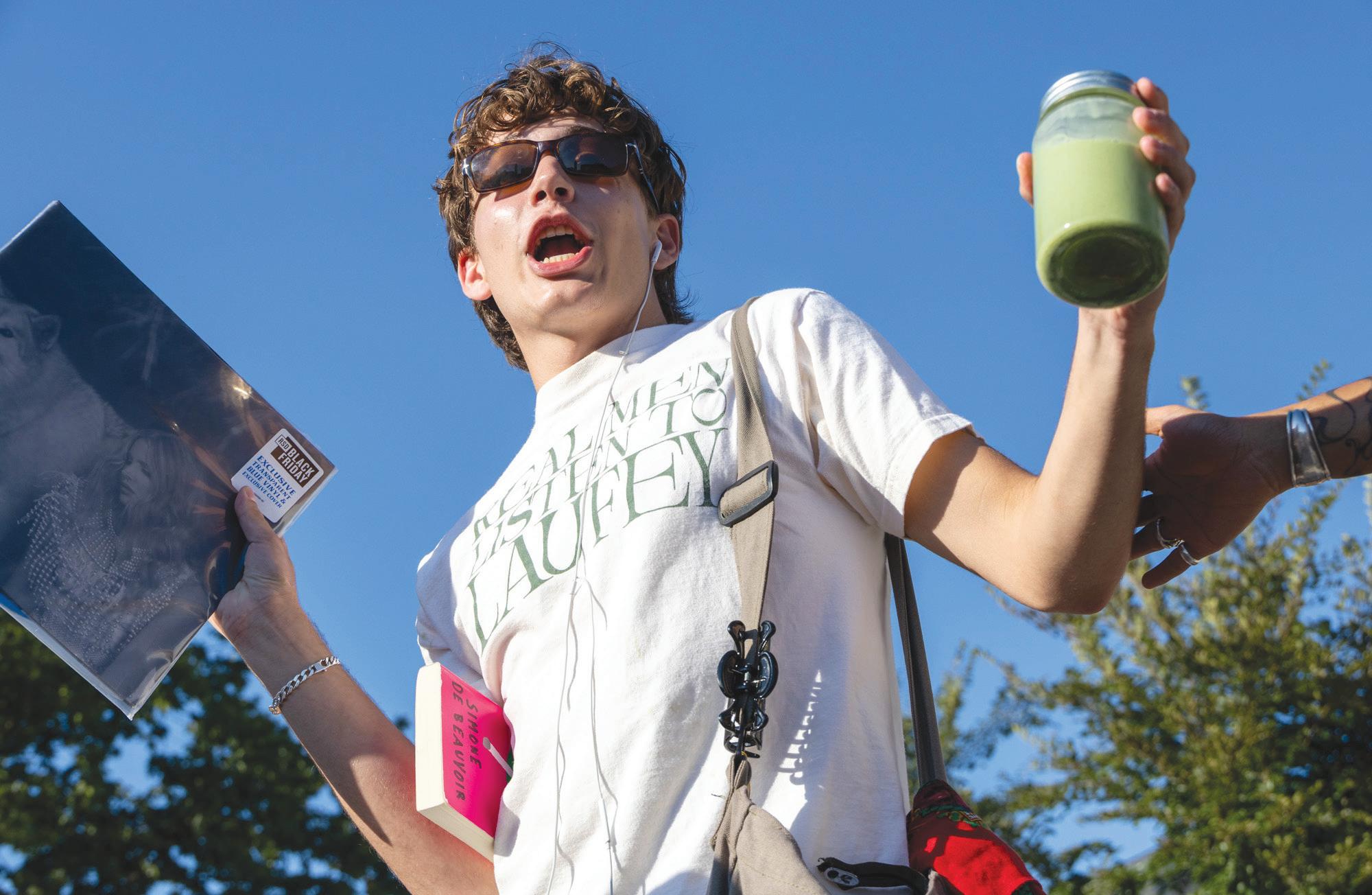
PERFORMATIVE | Students participated in a Performative Male Contest on the Arts Quad on Sept. 3, bringing matcha lattes, feminine literature, vinyls and more.
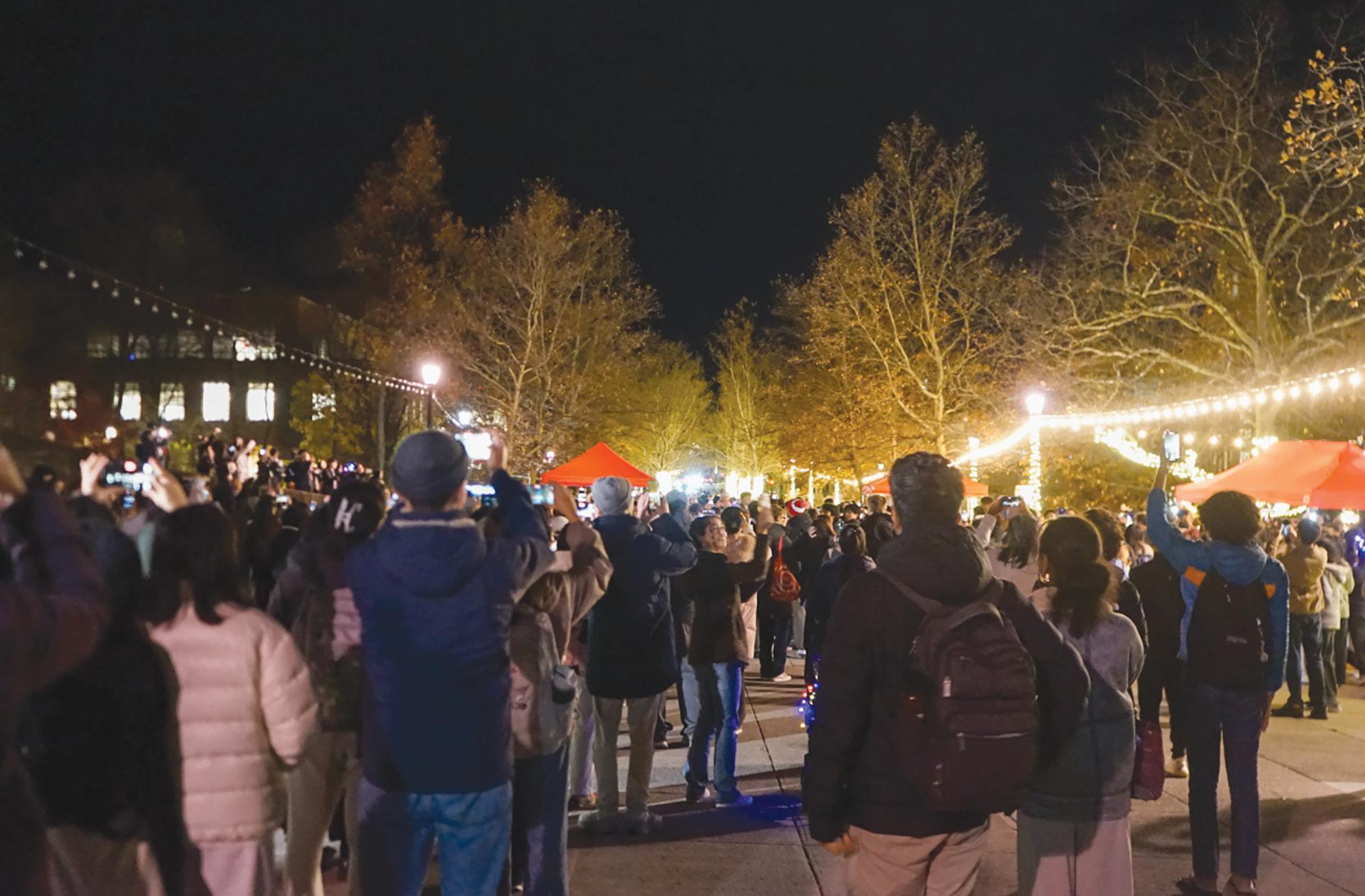
LIGHT IT UP | Cornell Minds Matter hosts a Light Up the Season event on Ho Plaza, Nov. 14.
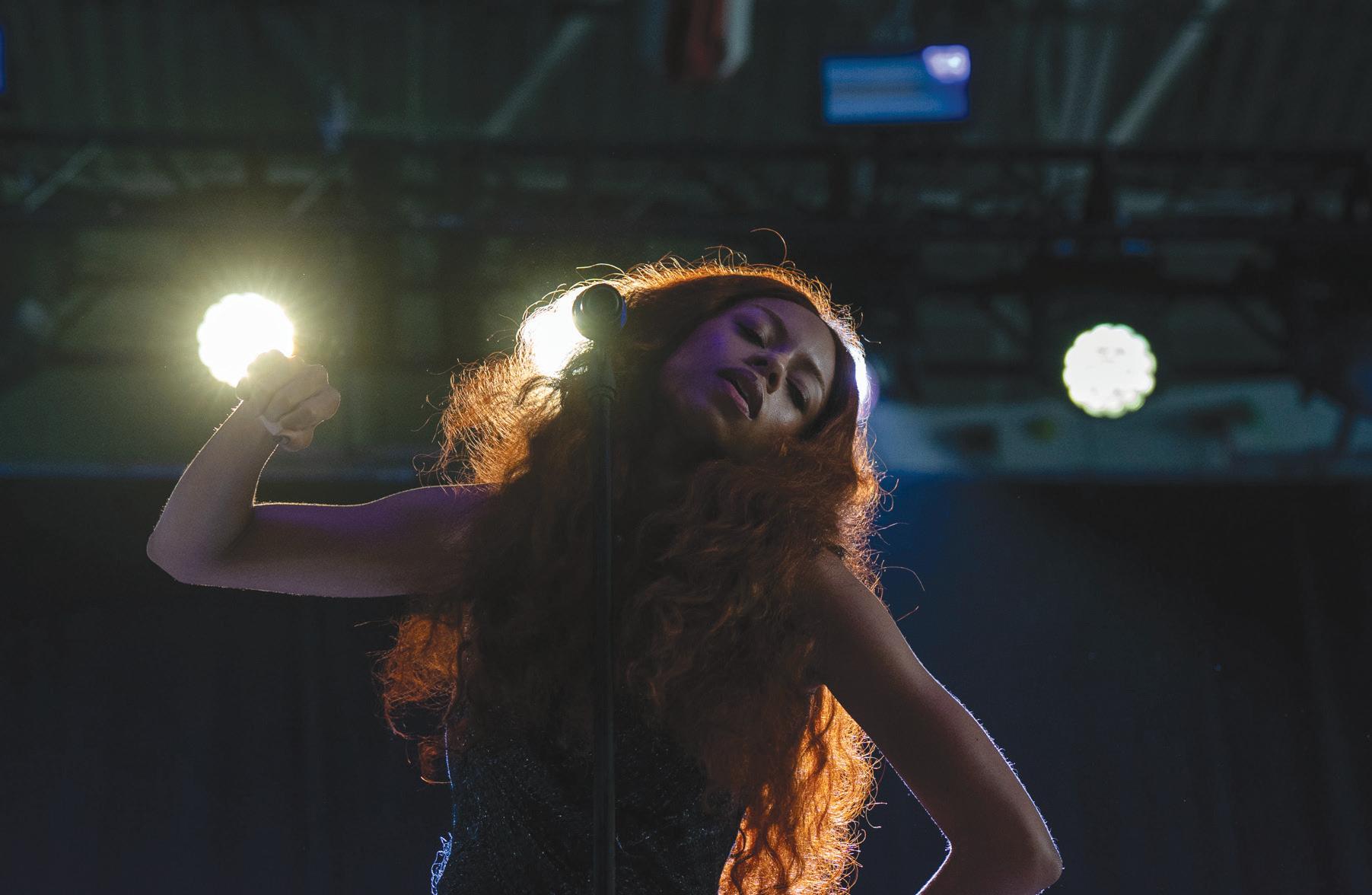
CONCERT | Ravyn Lenae performs at the Cornell Concert Commission’s annual Homecoming concert in Bartels Hall on Oct. 5.
Stephan Menasche / Sun Assistant Photography Editor
Photo
Jade Dubuche / Sun Multimedia Editor
Annie Park / Sun Staf Photographer
Matthew Korniczky / Sun Assistant Photo Editor
Karlie McGann / Sun Photography Editor
Benjamin Leynse / Sun News Editor
MORE CONCERTS | Sunkis, a Taiwanese-American pop-R&B artist, performs in Call Auditorium on Nov. 16.
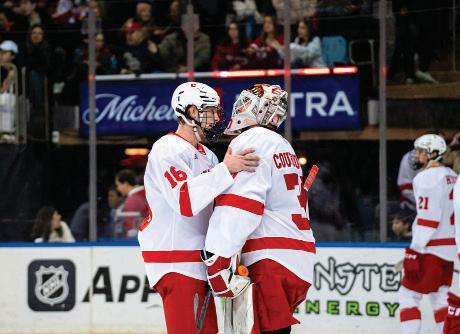
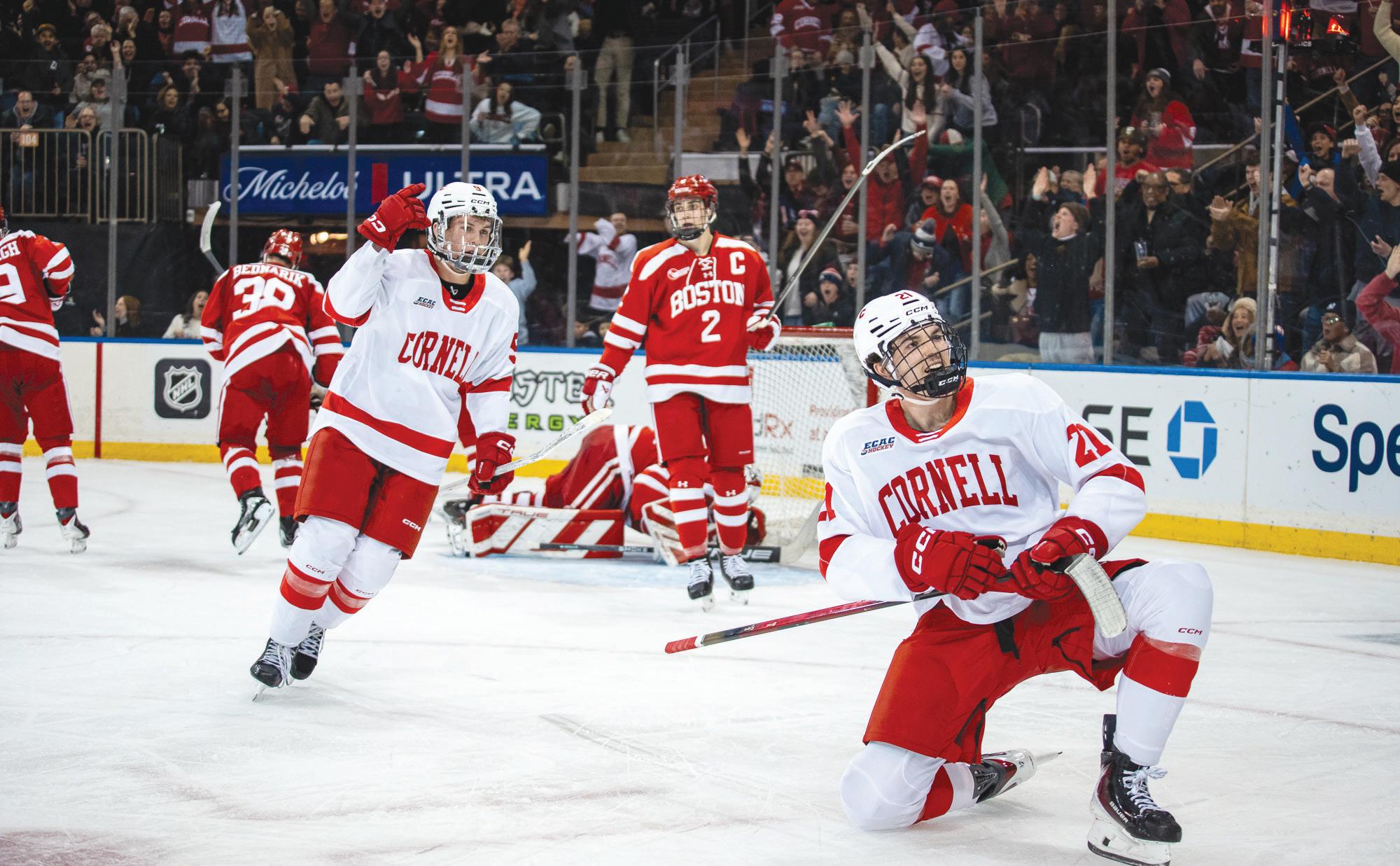
HOCKEY | Cornell’s men’s hockey team fell to Boston University 2-1 at Madison Square Garden on Nov. 29.
Jocelyn Jao / Sun Staf Photographer
G rady Millones / Sun Staf Photographer
Former Cornell Student Convicted of Rape for 2024 On-Campus Sexual Assault
By BENJAMIN LEYNSE Sun News Editor
Dec. 2 — Editor’s Note: This article contains details about sexual assault.
22 year old former Cornell student Bilguun Enkhbayar was convicted of Rape in the First Degree and Burglary in the Second Degree on Nov. 24 after a week-long jury trial found him guilty of all charges, according to a Nov. 25 press release by Tompkins County District Attorney Matthew Van Houten.
The Sun was unable to verify Enkhbayar’s student class year and could not find him in a directory of Cornell NetID’s .
Enkhbayar, then 20 years old, was arrested on Sept. 12, 2024 by the Cornell University Police Department with assistance from the Ithaca Police Department, a CUPD information release on Instagram stated at the time. According to the CUPD release, his arrest was the result of an investigation by CUPD and the Tompkins County DA’s Office into a sexual assault that occured on Cornell’s campus early the morning of Sept. 1, 2024.
Before his arrest a Tompkins County grand jury had indicted Enkhbayar on
charges of first-degree rape and second-degree burglary. He was found guilty of both these charges by the trial jury on Nov. 24. According to the DA’s press release, he had been indicted “with knowingly and unlawfully entering a dorm room with the intent to commit a crime therein.” The release also stated that Enkbayar engaged “in vaginal sexual contact with another person who was incapable of consent by reason of being physically helpless.”
The charge of rape in the first degree is the most serious of the three classifications of rape crimes in New York State and is a Class B felony – holding a maximum penalty of 25 years in state prison. According to New York State law, Class B felonies must carry at least a five year prison sentence.
Enkhbayar’s defense attorney, Jeff Alan Chabrowe, did not immediately respond to a request for comment.
Sentencing has been scheduled for February 24, 2026 at 1:30 p.m. before Tompkins County Judge Scott A. Miller.
Benjamin Leynse can be reached at bleynse@cornellsun.com.
Indigenous Student Engagement Persists
Despite Enrollment Drops
INDIGENOUS
Continued from page 1
Dec. 2 — Tan also wrote that Cornell Undergraduate Admissions “participate[s] in Indigenous college access programs like College Horizons” and “advise[s] AIISP student ambassadors, who reach out to prospective and admitted students and table at community events.”
The Cornell American Indian and Indigenous Studies Program provides academic courses and student engagement related to indigenous cultures at the University.
Now a senior, Tuzroyluk believes she has seen the effects of the affirmative action ruling play out across her four years at Cornell. Each spring, AIISP hosts a phonea-thon, where current members like Tuzrolyuk call admitted indigenous students to welcome them and answer questions about campus life.
“In my sophomore year, I called upwards of 10 to 15 admitted students,” Tuzroyluk said. “In my junior year, for the same event, I only called four.”
Shania Flores ’28 said that the phone-a-thon was “something that was very reassuring to some of [her] peers,” being the first class admitted post-affirmative action.
“Our class is tiny … a lot of people are graduating this year, and then more people will graduate … so we are at a crossroads where we just don’t have enough people,” Flores said. “We’re not at the point yet where we’re disappearing, but it is a noticeable difference.”
In spring 2025, Tuzroyluk was told that her job as a student ambassador of AIISP was ending. Tuzroyluk said the reasoning behind the change was unclear, later writing to The Sun that the ambassadors “didn’t get too much into the details about why we needed to stop.”
AIISP Student Support Specialist Sarah Buffett clarified the status of the program in a statement to The Sun.
“The AIISP ambassadors program is currently in stages of organization,” Buffett said, and “the program is not ending.”
According to Buffett, the AIISP Ambassadors program has been placed on hold since mid 2025. There have been efforts to move these admissions programs to be run by the Cornell Undergraduate Admissions Office instead of AIISP.
Buffett noted that the drop in ambassador activity was likely not a direct consequence of the Supreme Court’s affirmative action decision. Rather, the University has been consolidating admissions related programs, including AIISP’s ambassador work, under a centralized structure within the UAO.
“AIISP’s deepening partnerships with the Undergraduate Admissions Office around recruitment, and with Housing & Residential Life for support of Akwe:kon, have led to shifts in alignment that coincided with timing of the ruling but were not caused by it,” Buffett wrote in a statement to The Sun. As admissions processes evolve, Buffet stated that AIISP is working to refine their outreach methods so indigenous students can connect and feel supported in their communities.
Additionally, fluctuations in enrollment may appear more dramatic in smaller cohorts. While the posted data lists four students as American Indian in the class of 2029, that figure does not include Pacific Islander or multiracial students.
To continue reading this article, please visit www.cornellsun.com.
Svetlana Gupta can be reached at sg2622@cornell.edu.
Where Could Cornell’s $30 Million Agricultural Research Investment Go?
By CORAL PLATT Sun Contributor
Nov. 24 — Cornell’s $60 million settlement with the Trump administration includes a unique financial provision a $30 million investment in agricultural research, to occur in installments over the next three years.
However, it is not yet clear how exactly funds will be distributed.
The settlement, which was reached on Nov. 7 after months of negotiations following the Trump administration’s decision to freeze $250 million in federal research grants and contracts from April 2025, also requires the University to pay $30 million to the federal government over the next three years. In return, the administration agreed to drop the Civil Rights complaints and investigations they had raised against the University and will restore the halted funding.
The settlement states that the agricultural investment should be directed towards “research programs that will directly benefit U.S. farmers through lower costs of production and enhanced efficiency, including but not limited to programs that incorporate AI and robotics, such as Digital Agriculture and Future Farming Technologies.”
This provision for a specified research investment is unique from the four earlier settlements between elite U.S. universities and the Trump administration. Columbia will pay $200 million to the Trump administration and $21 million to Columbia employees who experienced antisemitism, while Brown will invest $50 million in Rhode Island workforce development. The University of Pennsylvania and the University of Virginia are not required to make payments under the terms of their settlements.
The agricultural investment was “Cornell’s choice” and “Cornell
alone will decide how and where to direct this $30 million agricultural research expenditure,” according to a Federal Agreement Frequently Asked Questions page created by Cornell.
When asked about the purpose of the agricultural research investment and the University’s plans for allocating the funds, a Cornell spokesperson referred back to the settlement FAQ page, stating that it “includes all the information we have to share at this time.”
Currently, the University is developing “a program within the Office of the Vice Provost for Research (OVPR) to administer the disbursement of this funding. More information will be disseminated by the OVPR later in the year,” the Federal Agreement FAQ page states.
While it is still unknown as to which programs will be funded by the investment, there are several programs and institutes at Cornell that are involved with research that connects agriculture and technology.
Cornell Institute for Digital Agriculture
The Cornell Institute for Digital Agriculture was founded in 2017 and grew out of four Cornell colleges: the College of Agriculture and Life Sciences, the Bowers College of Computing and Information Science, the College of Engineering and the College of Veterinary Medicine.
Prof. Renata Ivanek, veterinary medicine, is a co-director of CIDA, collaborator in the Cornell Agricultural Systems Testbed and Demonstration Site for the Farm of the Future and the primary investigator for the Artificial Intelligence for Agriculture program.
To continue reading this article, please visit www.cornellsun.com.
Coral Platt can be reached at csp94@ cornell.edu.
Faculty Senate Passes Resolution
Criticizing
Overuse of
Temporary Suspensions, Calling for Reform
By CHRISTINA MACCORKLE Sun Senior Writer
Nov. 25 — Dean of Faculty Prof. Eve De Rosa, human ecology, announced that the Faculty Senate voted to pass a resolution criticizing the increased use of temporary suspensions to discipline students involved in protest activity in an email to faculty senators. The resolution passed in an 80-16-15 vote on Friday.
The resolution, titled “Resolution Concerning Overuse of Temporary Suspensions, Excessive Delays that Violate Due Process in the Conduct of Disciplinary Hearings, and the Need for Reform of the Student Code of Conduct Procedures” was sponsored by 17 faculty senators and more than 30 other faculty members.
Temporary suspensions are a measure for students and organizations that may include the withdrawal of any or all University privileges and services, including class attendance, participation in examinations, and utilization of University premises and facilities. They should only be imposed when “less restrictive measures are deemed insufficient to protect the Complainant or the
University community,” according to the Student Code of Conduct.
The resolution cited the 2024 Cornell Committee on Expressive Activity report, which expressed concern that temporary suspensions were being used punitively, as a tool for “coercive discipline used to deter, retaliate, or compel immediate compliance with Cornell policies” from disciplined students.
The committee, which was established by former President Martha Pollack to formulate a report evaluating and recommending changes to the University’s existing expressive activity policies, recommended that “Cornell make clear that the primary purpose of a temporary suspension is protective and not punitive.” It also recommended that the measure should “be imposed only when immediate action is required for the protection of others or to avoid substantial property damage, and that it ceases when the risk of harm has ceased.”
To continue reading this article, please visit www.cornellsun.com.
Cornell Only Ivy to See No Rhodes Scholars Named in 2026 Class
By ANGELINA CHEN Sun Contributor
Dec. 2 — On Nov. 15, 32 students were named American Rhodes Scholars in the Class of 2026. The list included students and alumni representing all Ivy League institutions — except Cornell.
In fact, the University has not seen a Cornellian named in the past six years — all of the classes currently publicized on the Rhodes Trust website.
The Rhodes Scholarship is a prestigious, fully-funded postgraduate award to study at the University of Oxford.
Scholars Across the Ivy League
While less than 1 percent of U.S. college students attend Ivy League institutions, they account for 12 of 32, or 37.5 percent of the American Rhodes Scholarship Class of 2026.
Over the past six years, there has been an average total of 12.3 Ivy-affiliated scholars named annually, which rounds out to 1.5 average per school.
This also aligns with historical totals. Harvard, Yale and Princeton top the list of all colleges in the total number of U.S. Rhodes Scholars from 1904 to the present day, with 402, 270 and 219, respectively. Cornell, in contrast, has had 31 scholars.
Harvard also tops the Ivy League in the number of American scholars over the past six years, with 33 total, or 5.5 average per year. Yale falls second with 18 total, or three average per year, and Columbia ranks third with eight total — 1.3 average per year. Princeton, Brown University and the
University of Pennsylvania follow with a tie of four total, or an average of 0.7 per year. Dartmouth falls second to last with three total, or an average of 0.5 per year.
Harvard, Yale and Columbia are the only Ivy League institutions to have seen at least one scholar named each year throughout this time. Harvard saw the most successful year in the Ivy League throughout the past six years with the Class of 2024, with nine affiliate awardees in a single year.
Recent Cornellian Rhodes Scholars
While The Sun’s data analysis exclusively focused on U.S. Rhodes Scholars, Cornell students who are citizens of other countries may be eligible for scholarships designated to 24 other Rhodes constituencies or Global Scholarships.
Nina Acharya ’19 was one of only 11 Canadian students to be awarded the competitive fellowship in 2019, with plans to study children’s nutrition.
Ahmed M. Ahmed ’17, a first-generation Somali immigrant, was named a U.S. Rhodes Scholar in 2016. Majoring in biology on the pre-medical path at Cornell, Ahmed spent his undergraduate career involved as a researcher, student advisor, chemistry tutor and peer mentor.
Rachel Harmon ’15, who majored in industrial and labor relations, was awarded the scholarship in 2014. Christopher “Kit” Dobyns ’13 and Daniel Young ’13 were both named scholars in 2012.
New Fellowship Resources
Cornellians will now have a dedicated office to receive fellowship guidance, with resources branching out of their previous home in Cornell
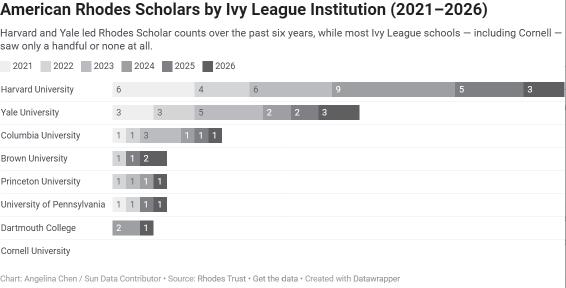
Scholar statistics | Cornell is the only Ivy to have produced no Rhodes Scholars in the last six years.
Career Services.
The University recently launched the Office of National Fellowships in 100 Barnes Hall, which aims to broaden access to opportunities for graduate study, research, service and travel funding.
“There are pockets of campus where we have high-achieving students that aren’t getting access to these kinds of opportunities,” said Krista Saleet, director of the office, in a press release.
In a November column for The Sun, Vice President of Student and Campus Life Ryan Lombardi wrote that the “true value of fellowships” is “not as markers of prestige, but as catalysts for growth.”
The office includes two advisors, peer writing support through the John S. Knight Institute for Writing in the Disciplines and connections to Cornell leadership.
“Our goal is to ensure every student knows that fellowships are for them,” Lombardi wrote. “These opportunities are for anyone curious about how their experiences, challenges and ambitions might contribute to something greater.”
According to Lombardi, in the Office of National Fellowships’ inaugural year, there was a 195 percent increase in advising appointments. Lombardi described that “for every fellowship recipient, there are many more students and alumni who have gained something equally valuable through the process of applying: the chance to articulate what matters most to them and how they hope to make an impact.”
Julia Senzon ’26 contributed reporting.
Anjelina Chen can be reached at asc337@cornell.edu.
ANGELINA CHEN / CREATED WITH DATAWRAPPER
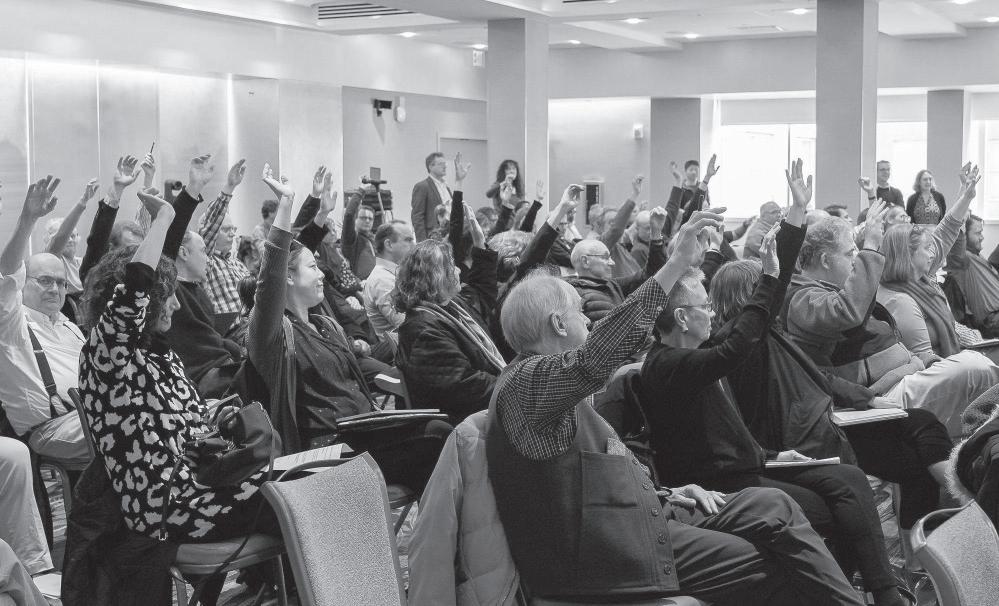
Faculty frustration | Faculty senate voted overwhelmingly in favor of the resolution.
Christina MacCorkle can be reached at cmaccorkle@cornellsun.com.
ASHLEY HE / THE CORNELL DAILY SUN
The Corne¬ Daily Sun
DOROTHY FRANCE-MILLER ’27
Managing Editor
MATTHEW KIVIAT ’27
Assistant Managing Editor
BENJAMIN LEYNSE ’27 News Editor
CEREESE QUSBA ’27 News Editor
REEM NASRALLAH ’28
Assistant News Editor
JANE HAVILAND ’28 Features Editor
MATTHEW LEONARD ’28
Assistant Sports Editor
SYDNEY LEVINTON
MELISSA
KAITLYN
KARLIE
Ayman Abou-Alfa ’27
Prof. Anurag Agrawal
Hannia Arevalo ’27
Sophia Arnold ’26
Leah Badawi ’27
Adrian Belmonte ’28
Prof. Jan Burzlaf
Natalia Butler M.S./Ph.D.
Chloe Asack ’26
Basil Bob ’27
Lusine Boyadzhyan ’27
Paulina Delgado ’27
Pen Fang ’28
ERIC HAN ’26
Associate Editor
VERA SUN ’27
Business Manager
VARSHA BHARGAVA ’27 News Editor
GABRIEL MUÑOZ ’26 City Editor
JEREMIAH JUNG ’28
Assistant News Editor
ZEINAB FARAJ ’28 Features Editor
MARISSA GAUT ’27
Science Editor
JENNA LEDLEY ’27
Assistant Arts & Culture Editor
SOPHIA ROMANOV IMBER ’28
Assistant Arts & Culture Editor
JADE DUBUCHE ’27
Multimedia Editor
STEPHAN MENASCHE ’28
Assistant Photography Editor
HUNTER PETMECKY ’28
Layout Editor
ALEX LIEW ’27 Human Resources Manager
ALLISON HECHT ’26 Newsletter Editor
Paul Caruso MPA ’26
Zara Cheek ’28
Elise Cliford ’29
Nina Davis ’26
Ezra Galperin ’27
Leo Glasgow ’26
Sophie Gross ’27
Liam Harney J.D. ’26
Charlotte Feehan ’28
Rafaella Gonzalez ’26
Kate LaGatta ’29
Ayla Kruse Lawson ’27
Gia Lish ’29
SOPHIA DASSER ’28 Opinion Editor
SOPHIA TORRES ’26 Advertising Manager
ISABELLA HANSON ’27 News Editor
KATE TURK ’27 Assistant News Editor
ANGELINA TANG ’28
Assistant News Editor
ALEXIS ROGERS ’28 Sports Editor
KAITLIN CHUNG ’26 Science Editor
JAMES PALM ’27
Assistant Arts & Culture Editor
MAIA MEHRING ’27 Lifestyle Editor
MIRELLA BERKOWITZ ’27 Video Editor
MATTHEW KORNICZKY ’28
Assistant Photography Editor
RENA GEULA ’28 Layout Editor
HANNIA AREVALO ’27 Graphics Editor
Francis X. Jaso ’28
Prof. Karim-Aly Kassam
Mohamed Zakaria Kheder ’26
President Michael Kotlikof
Ilana Livshits ’27
Mina Petrova ’29
Ella Pham ’29
Pilar Seielstad ’26
Jane Locke ’28
Leslie Monter-Casio ’27
Caroline Murphy ’28
Matthew Rentezelas ’28
Emma Robinson ’27
Marc Staiano ’27
Ava Tafreshi ’28
Mikayla Tetteh-Martey ’27
Hazel Tjaden ’28
Tommy Welch ’26
Wyatt Sell ’27
Mihir Steingard ’28
Yihun Stith ’26
Lali Tobin MPA ’28
Skylar Toddings ’29
Adriana Vink ’27
Kira Walter ’26
Rayen Zhou ’29
Jordan White ’29
Katherine Winton ’29
Josh Yiu ’27
Nicholas York ’27
Arina Zadvornaya Ph.D.
From the Editor
Aiden Chen ’29
Oakley DeCristofara ’29
Katie Istomin ’29
Joie Jean-Paul ’29
Madeleine Kapsalis ’26
Ximena Balli ’27
Chen ’28
Sophia Curbelo ’27
Claire Fang ’29
Jesus Garcia ’29
Jessie Guillen ’27
Isabelle Jung ’26
Elliot Kim ’28
Ashlin Kwong ’28
Sophia Li ’28
Le Wang ’29
Zarina Wang ’28
Until Te Sun Rises Again
As Cornell inches towards the final day of classes, we at The Sun are closing out our print edition and regular publishing schedule for the fall semester.
And in this season of gratitude, it would only be appropriate to extend our deepest appreciation to the students, faculty and community members who have kept our newspaper printing — who make The Sun shine as a vessel of curiosity and accountability for Cornellians.
To our readers: Thank you for every article read, paper picked up, interview taken, pitch emailed and guest column submitted. Your engagement with The Sun every day builds a more connected and informed campus, and your readership makes our work possible.
To our advertisers and donors: Thank you for your financial support of The Sun. Your crucial contributions support the physical and technological infrastructure that keeps The Sun a watchdog of the University.
Science Board
Jessica Agran ’27
Richard Ballard ’27
Ava Betnar ’29
Caitlin Callagher ’26
Natalie Chamberlain ’28
Selina Chen ’28
To our alumni: Thank you for laying the foundation for a fiercely independent and uniquely innovative paper. You inspire reporters to join, to stay and to excel. Our 143-year-old legacy stands on the shoulders of all who have come before us.
And to our staff: From our newest compet to our most veteran reporter to our most senior editor, you do crucial work holding the University accountable, fostering dialogue on campus and entertaining your peers.
Every day, student reporters listen in on meetings, observe protests and interview stakeholders to be the eyes and ears of campus. This semester, we have covered Cornell Career Services’ promotion of multiple positions at the Department of Homeland Security, the University’s $60 million settlement with the federal government and Prof. Cheyfitz's civil rights case that ended in his retirement. We have fostered conversation on artificial intelligence, mental health, sustainability and immigration.
The Sun will publish at a reduced capacity from the first day of study period to the inception of the spring semester, while still bringing breaking news and special content.
Until The Sun rises again, I leave you with gratitude. We will be right back with you in the spring.
— Julia Senzon, Editor in Chief
Paul Caruso Caruso's Compass
Paul Caruso is an Opinion Columnist and a second year MPA student in the Brooks School of Public Policy and the Founder of the Cornell Negotiation Student Society. His column, Caruso's Compass, focuses on politics, international afairs and campus life. Te column seeks to identify issues with the status quo and provide solutions to them. He can be reached at pcaruso@cornellsun.com.
Thereexists a complete disconnect between Cornell and its Ithaca home. Tough it’s easiest to notice superfcially (the University sits atop a hill too steep for many to climb) the devil is in the details. Cornell enjoys keeping its undergraduates in its bubble, where it can shape their reality.
If there’s anything my Catholicism teaches me, it is to love your neighbor, regardless of who they are or what they do to you. On Nov. 14, Te Sun reported that the Ithaca Police Department cleared the East Seneca Street Bus Station, where multiple unhoused people took refuge.
Te removal created another degree of separation between Cornell and the realities of the City of Ithaca. Cornell is connected to Ithaca primarily by its bus routes, and every Cornellian had to confront the reality of poverty in America whenever they went downtown. While there are many reasons the vestibule was cleared, Cornell students are now even further insulated from the realities of the real world. I spoke to three undergraduate Cornell students whose perspectives have helped shape this opinion.
Cornellians and Teir Relationship to Ithaca
Before the eviction, signs were posted telling the unhoused individuals to relocate to Southwest Park, a city-owned plot of undeveloped land temporarily autho-
Mihir Steingard Common Matters
Mihir Steingard '28 is an Opinion Columnist and a student in Cornell's School of Industrial and Labor Relations. His fortnightly column, Common Matters, is a play on words and aims to show why common matters in politics, on campus and in society should matter to us, the common people. He argues against being apolitical or apathetic and instead advocates vehemently for empathy and understanding. He can be reached at msteingard@cornellsun.com.
Most classes blur together, until the rare moment when a professor stops lecturing and starts professing. Maybe they critique a policy that’s on the slide behind them or question a trend that you hadn’t thought twice about. These are the parts of class I love — when professors lower their guard and share the viewpoint that lets you see the heart of why they teach.
But these moments appear unevenly across the University. Humanities students tend to encounter them more than anyone else. A government or history professor can integrate their views naturally into a discussion; a chemistry professor, however, cannot exactly explain a “socialist theory of bond structure.”
The difference matters because these classes where professors bring their opinion are limited. When even those spaces of expression are pressured, honest expression begins to feel impossible. Today, that pressure is growing. According to the Foundation for Individual Rights and Expression, 64 percent of faculty say they occasionally feel they can’t express their opinions fully. Compared to 2019, there has
Out of Sight, Out of Mind
rized for camping. None of the students I spoke to had any idea this place existed before the interview.
Te explanation for this is simple: Southwest Park is not just out of the way for Cornell, but is tucked behind the Walmart and the Tompkins County Recycling and Solid Waste Center. It is, quite literally, out of sight and out of mind.
According to the students, many of their undergraduate peers almost never venture downtown, let alone take the bus. “It’s underexplored and underappreciated for most students, and it’s closer than we think,” one of them said. Many of their food and amenity needs are met on campus, so it’s reasonable that it would be rare for them to leave the Hill.
I’m not the frst to notice. A transfer student from Ithaca College wrote how inward-focused Cornell students were, how little they thought of Ithaca compared to IC students and how despite access to TCAT “there isn’t much need (or reason) to willingly explore the city of Ithaca beyond Cornell’s campus.”
Te situation has been made worse by the rhetoric used in Ithaca and Cornell around the issue. Sun articles reuse infammatory language for the park like calling it “the jungle,” demonize individuals’ substance abuse and choose to display a photo of the encampment with a confederate fag raised above it. Tis kind of imagery only worsens the situation. Demeaning the humanity and dignity of these people further is a sin regardless of your religious or political proclivity.
If you’re a student reading this, I challenge you to walk with a friend around the City of Ithaca. Explore parts of the city you wouldn’t otherwise, visit its small businesses and actually listen to the people that live here. You don’t need to visit Southwest Park, but maybe by connecting with the community you share, albeit temporarily, may help you understand how to help it.
All of the students I spoke to lamented the fact that their peers don’t journey downtown more to enjoy all that Ithaca has to ofer, “students don’t interact so much with the local community because we’re so immersed in Cornell.”
Cornell University and its Willful Distance From the Town
An ongoing issue has been Cornell’s investment in TCAT, the Tompkins area bus service. Supported mostly by federal grants and large stakeholder contributions, it provides thousands of community members with access to campus and vital resources around Ithaca. Its
budget is stretched incredibly thin, and ticket sales do not constitute a stable or signifcant source of revenue.
As part of a signed agreement, Cornell contributes 6 percent, or $1.2 million, of TCAT’s annual operating budget, the same contribution as the City of Ithaca and Tompkins County. Cornell students made up 71.5 percent of all TCAT ridership in 2024, making the University’s contribution to TCAT far less than what it should be.
Cornell, atop its hill overlooking the town and Cayuga’s waters, feels and behaves further away than ever. Trough a bare minimum access to public transportation, students face a natural barrier to movement.
“With the TCAT situation, they’re not giving them enough money to create bus routes that are necessary for students,” one student said, “Cornell doesn’t really talk about these things.”
To encourage better connectivity — and for the health of its students, predominantly graduates — Cornell should invest more in TCAT. For those reliant on the bus, being left at a stop in single-digit weather or missing the only bus that will get you to work on time is not just physically risky, it produces waste. According to TCAT, they produce the routes and capacity they can based on their fnances.
Cornell recently agreed to pay an additional $228,000 out of the $500,000 TCAT asked for in support of budget shortfalls. Considering this was done to cover TCAT’s bills, it’s self-illustrative that Cornell is willingly letting TCAT struggle.
A Short Refection of the Self
Te East Seneca Street Bus Station is my bus stop. Seeing unhoused people taking shelter in its vestibule was a daily reminder of my own privilege as someone who is every day granted opportunities and an education that they are not being given.
Every day it was a sobering reminder that I am not doing enough, and as I watched dozens of students ignore them just the same, a reminder that our community is not doing enough.
My argument is not that the unhoused should inhabit a vestibule designed to give travelers a respite from the cold. It is that Cornell and Cornellians must engage with and confront more the realities of their home city. We — particularly students — are guests, and we must be courteous enough to ofer our hand to help the less fortunate at every turn and give back to the city we ought to know and love.
When Professors Stop Professing
been a 20 percentage-point drop in how strongly professors believe they have academic freedom in teaching. In clearer terms: Faculty across the board are significantly less confident that speaking openly is safe. But why?
Conservative faculty teach within overwhelmingly liberal institutions with about 60 percent of professors nationally identifying as liberal. About 55 percent say they hide their political views for fear of backlash from colleagues. At elite universities, the imbalance is even sharper with conservative faculty making up 9 percent of Harvard faculty and 14 percent at Duke. As the ideological minority, conservative self-censorship is rampant. But liberal faculty don’t have it easy either.
Roughly, one in three liberal faculty worry about damaging their reputations because someone misunderstands them. Turning Point USA’s “Professor Watchlist” is fueling their fear. By targeting professors for supporting Democratic positions on topics like DEI, socialism and feminism, the watchlist has pushed liberal professors to self-censor. At Cornell, professors withdrew from collaborations with colleagues who were listed on the watchlist out of fear of association.
Though pressures come from different avenues, professors across the political spectrum are self-censoring leading to a single outcome: fewer real opinions shared in class. As students, this should alarm us deeply. We miss out on the ideologies that make the humanities interesting. Professors directly attach their expertise and work to a viewpoint when they share their opinion in class and that is exactly what makes the material we learn shift from mechanical to humane.
To understand what we really lose when professors stay silent, I decided to ask a professor who does attach their expertise to a viewpoint. Professor Sarosh Kuruvilla in the School of Industrial and Labor Relations openly disagrees with Trump's trade strategy to bring manufacturing back to the U.S.
I asked him what value he sees in bringing his viewpoint in at all:
“Giving my opinion in class adds a third data point. It forces students to use their brain, because now they must think about both sides and now their professor. There is a layer of humanity added to a topic.”
Professor Sarosh Kuruvilla
In other words, the professor's opinion turns passive learning into critical thinking. You are forced to confront an informed perspective, not just write it down.
That “third data point” is the entire point of higher education. It’s what pushes all of us to go beyond memorizing concepts to internalizing them. When a professor shares their view, it gives you something to react to: What shaped that belief? Do I agree? Why? And together these questions shape our own ideology, it’s how we grow into critical thinkers.
In a world flooded with rage bait and AI news clips designed to provoke us, students need a grounded sense of self to resist being pulled into manufactured outrage. That sense can only be built through exposure to informed arguments grounded in expertise. And in a world where a single post, like or comment can be twisted into a judgement of character, leaving university without a defensible sense of what we believe in is a risk we cannot afford.
But as more professors hesitate to share their opinions, we lose the moments in the classroom where we can develop the armor that protects us from such manipulation.
So the next time you’re in class online shopping or scrolling Handshake and your professor takes the risk to profess a real opinion, I urge you to look up. Listen. Engage.
If they’re willing to put themselves on the line for us, the least we can do is meet that risk with engagement and let their courage push us to develop some of our own.

Cornell's Agricultural Investment Signals a Lasting Shift Toward High-Tech Farming Leadership
By GILLIAN WHITE Sun Staff Writer
Cornell reached a settlement with the Trump administration to restore hundreds of millions of dollars in frozen federal research funding. As part of the deal, the University will invest $30 million into research to strengthen U.S. agriculture over the next three years.
The agreement follows a slew of stop-work orders that began in February and rose to over 120 orders in May, which halted close to 250 million dollars of research funding. Stop-work orders are directives from a contracting officer to a contractor to stop all or parts of work for 90 days, at which point they expire or are extended.
Among several research sectors impacted, the freeze disrupted agricultural projects across the University, raising fears of widespread layoffs and threats to ongoing research.
Now, under the deal, Cornell will invest $30 million in agricultural initiatives that integrate artificial intelligence and robotics into modern farming, according to provisions of the settlement. The investment, described by Assistant Attorney General for Civil Rights Harmeet K. Dhillon in a Nov. 7 press release as “groundbreaking,” is intended to expand agricultural development and productivity nationwide.
In a statement released to the Cornell community after the deal was announced, President Michael Kotlikoff called the settlement a relief from months of uncertainty that “stalled cutting-edge research, upended lives and careers, and threatened the future of academic programs at Cornell.”
Kotlikoff added the University “looks forward
to resuming the long and fruitful partnership with the federal government that has yielded, for so many years, so much progress and well-being for our nation and our world.”
As a land-grant university, Cornell places agriculture at the center of its mission. The College of Agriculture and Life Sciences and Cornell AgriTech in Geneva have played a key role in making Cornell a national leader in agricultural fields. The new $30 million agricultural investment reinforces Cornell’s role as the only Ivy League institution with a land-grant foundation and an explicit responsibility to advance agricultural research.
To many, agriculture reflects Cornell’s original mission. The long history in sustainable agriculture still drives its impact today.
“Agriculture was a major catalyst for Cornell's creation in 1865 and it has remained the preeminent institution in agriculture, farming, and related studies,” the settlement stated. “Cornell has a history of working with governments at all levels including our federal government to support America's farmers.”
“Even if our lab wasn't directly affected, in fundamentally shifted how many of us think about our futures.”
Brit Johnson
Currently, according to the settlement FAQ page, the University is developing “a program within the Office of the Vice Provost for Research (OVPR) to administer the disbursement of this

Accelerating agriculture | Cornell's settlement restores critical research funding while positioning the University to drive long-term innovation in agriculture
funding. More information will be disseminated by the OVPR later in the year.”
While it is still unknown as to which programs will be funded by the investment, there are several programs and institutes at Cornell that are involved with research that connects agriculture and technology, including Cornell Institute for Digital Agriculture - a community for technology and artificial intelligence based farming research.
Brit Johnson, a fourth-year Ph.D. student in entomology, said she felt “very fortunate” during the federal funding freeze last Spring.
“Our lab had a long-standing project, so funding gaps didn’t stop our work. We were able to bridge over the uncertainty in a way many other groups couldn’t,” she said.
She added that “watching the labs around us
deal with the fallout was a huge morale hit. Even if we weren’t financially affected, seeing colleagues lose opportunities and have to rethink their careers was really hard.”
However, last Spring’s funding freeze still caused lasting impacts for Johnson.
“I’m hopeful things will improve now that there’s a settlement, but some of the damage is already done. People lost jobs, some had to leave programs and others saw their [principal investigator]’s research discontinued entirely.” Johnson said. “Even if our lab wasn’t directly affected, it fundamentally shifted how many of us think about our futures.”
Cornellians Weigh in on RFK Jr’s New Nutritional Guidelines
By HANA KANG Sun Contributor
The federal government’s next iteration of the Dietary Guidelines for Americans is poised to be unlike any other. Under the leadership of Health and Human Services Secretary Robert F. Kennedy Jr., officials say the guidelines will be drastically condensed — possibly just four to six pages from 130 — and will place new emphasis on whole foods, fresh meat, saturated fat and a stronger critique of ultra-processed foods.
Emily Hilliard, press secretary for the Department of Health and Human Services, did not offer input on what exactly will be in the guidelines in an interview with NPR. She referenced the MAHA strategy report and assured that the new guidelines will “align
with science, data, and health recommendations.”
Prof. Martha Field, nutrition, explained how the Scientific Advisory Committee collects data and evidence from the USDA and HHS, and works for about a year in between each five-year cycle. Normally, their report would have been released a year ago, but this wasn’t the case this time.
In terms of what people can expect to see, Field said. “No one knows, I think. I don’t think we have any idea, and that’s very unorthodox.”
She emphasized her concerns that the “MAHA movement plans to disregard much of the work done by the committee,” adding this is “unfortunate because it’s very evidence-based.”
Kennedy has not hidden his disdain for the most recent guidelines issued in 2020, during President Trump’s

first term, referring to the document as “incomprehensible” and “Biden guidelines.” His “Make America Healthy Again” framework includes initiatives such as removing petroleum-based food dyes, reforming SNAP with the USDA and investigating the cause of autism, according to the MAHA website.
He also states how the upcoming ones will exhibit a strong focus on “whole foods, healthy foods, and local foods,” according to reporting in NPR.
In terms of its impacts on the nutrition program at Cornell, Field doesn’t think it will lead to any significant changes.
“We have a very science-based program, and a long history of our faculty being on the dietary guidelines Scientific Committee. We focus a lot on the evidence, so I don’t think it will affect our curriculum,” Field said.
Since their debut in 1980, the Dietary Guidelines have served as the federal benchmark for nutrition advice, informing initiatives like school lunch programs and military rations. Traditionally, they recommended limiting saturated fat to under 10 percent of total calorie intake, and emphasized whole grains, lean protein and plant-based foods.
The updates, however, are expected to address modifications to these suggestions, particularly regarding saturated fat and ultra-processed foods. There is growing evidence linking the intake of ultra-processed foods with obesity and chronic disease. However,
the definition of an “ultra-processed food” is hotly debated by the food industry, and Field agrees that without clear terminology, it is difficult to offer clear advice.
In regards to potential recommendations to increase the intake of saturated fats, this could spark debate among professionals in the nutrition industry. Field explained that although things can change, and have in the past, other fundamentals within nutrition generally remain consistent.
“The updates might lean away from some of the things where we have really good reasonable evidence.”
Prof. Martha Field, nutrition
“The updates might lean away from some of the things where we have really good, reasonable evidence,” she said.
As the nation awaits the official release later this winter, professionals in the field are watching closely to see how the final document interprets the current evidence. Key questions regarding how scientific findings will be synthesized in the guidelines remain unanswered. Regardless of the outcome, their impact will ultimately depend on how effectively they balance accessibility with the rigor of contemporary nutrition science.
Navigating nutrition | Kennedy's new framework aims to simplify national diet adivce, prompting experts to weigh its accesibility with scientific rigor Hana Kang
Gillian White can be reached at ghw52@ cornell.edu.
The Corne¬ Daily Sun
Class Breaks: How Cornellians Fill the Time
By Jessi Zheng
Jessi Zheng is a first-year in the Brooks School of Public Policy. She can be reached at jz2423@cornell.edu.
In college, creating the perfect schedule is crucial to having a good semester. There are a lot of factors to consider, and most conflict. The classes have to be reasonably timed, you want to try your best not to have a class at eight in the morning and most importantly, there has to be a break between classes for you to grab lunch or simply relax.
During high school, I filled my lunch break by going to my local pizza place or across to the local college to eat from their cafeteria. I never brought food from home.
Not much has changed in that regard being at Cornell. Even though there are a plethora of dining halls to choose from around campus, I often choose to walk down to Collegetown to grab a bite at Ninja Chicken and Friends or Xian Street Food instead. The class before my two hour break is in Hollister Hall, and I would argue that its proximity to Collegetown makes it so that I have to eat out, rather than in a dining hall. After I eat lunch, I will either start or finish any assignments I have to do in the food establishment of choice or walk back to Olin Library and work there instead.
But, what about the students that don’t have a class in Hollister Hall before the beginning of their break? Or better yet, what about the students who do have a class in Hollister Hall, but don’t feel like traveling down to Collegetown? Where do they choose to spend their break time instead?
With the amount of work that we have as Cornell students, many opt to spend their time at the library during their breaks. Selina Chen ’28 explained her decision to go to the library during her gaps in the day, “I usually go to the library to do my work because my dorm is too far.” Chen’s break is two hours long, giving her enough time to work on her assignments, but not enough to travel to and from her dorm on South Campus.
The time spent commuting to and from central campus is a major factor for students when selecting the setting of choice. For those like Chen, who don’t have enough time to reasonably choose to go back to their dorm, they will often choose to stay in a cafe or travel to a dining hall. For students like Leila Kipnes ’29, who claim they do have enough time to go back to their dorm, they will often choose to do so.
Kipnes lives on North Campus, and her walk to her dorm takes only fifteen minutes out of her three and a half hour break. “I do my laundry or whatever else I need to do around my dorm [during my break]. Sometimes I will take a quick nap if I’m tired enough,” Kipnes said when asked what she spends her time doing during her break.
As an engineering student, Kipnes is not immune to the workload that causes many students to stay in the library, however, as she added, “If I have a lot of work , I’ll go to the library to lock in.”
The cafes on central campus are also a popular choice for many. Antonina Novicki ’29 likes to spend her time at Goldie’s Cafe, located in the Physical Sciences Building, doing her homework or meeting up with her friends. When asked about her preference for Goldie’s, Novicki explained, “It’s a convenient location because my class is in the [Physical Sciences] building and their Chopped Cheese is really delicious.” She further explained she enjoys the open, bright space that Goldie’s provides and their wide variety of seating choices, “which is perfect for a good lock in or a long yap session.”
After sitting in lecture halls and classrooms for hours on end, cafes are an ideal setting to relax and unwind for many. The environment that cafes provide are unique, as people are able to socialize and work freely alongside each other without having to be too mindful of their noise level or disrupting people around them. The selection of caffeinated beverages, meals, and pastries that cafes have are also a welcome treat for students looking to refuel before having to resume their routine of classes and assignments.
Other popular cafes on campus include Temple of Zeus in Goldwin Smith Hall, which is always overflowing with people chatting with friends or doing their work, Novick’s Cafe in Ruth Bader Ginsburg Hall, for those who live on North Campus and the Amit Bhatia Libe Cafe in Olin Library. Personally, I find enjoyment in working in a cafe rather than a library because it provides a more lively atmosphere, in contrast with the cold, depressing one that libraries possess at all hours, even in the afternoon when most people are on campus. Whether I’m working on assignments or scrolling mindlessly on my laptop, it is more encouraging to see other people happily engaging with each other during the daytime rather than individually crouched over their devices with stress marring their faces — a reminder that Cornell is not an institution restrained to only work, and more work.
However, the benefits of having a break in between classes isn’t just limited to those who have breaks. Daisy Haberman ’29 doesn’t have a break between her classes, but instead accompanies her friends who do have breaks to Okenshields, and will then walk to Lincoln Hall with some time to spare. Explaining her decision to accompany her friends to the dining hall, Haberman said, “I like chatting with them and the extra cardio before I have to sit in my FWS for the next hour or so.”
Regardless of your environment of choice during your schedule breaks — whether it be back to your dorm, to a library or to a dining hall — and your company of choice, it is important to savor the relaxation that the break provides before you have to sit in a mind-numbing or stimulating lecture hall for the next couple of hours.


Cornell Dining at Home: Homemade Campus Classics
By Angelina Lei
Angelina Lei is a sophomore in the College of Human Ecology. She can be reached at al2733@cornell.edu.
Ninth place on Princeton Review’s Best Campus Food ranking list, Cornell Dining is known to provide some of the best dining hall food in the country. Based on the many dining hall meals I have eaten in the past couple months, in my opinion, Cornell Dining’s reputation holds true. I have enjoyed the variety of options offered, as well as the plethora of dining halls on campus. Many of the options are healthy, and the availability of Asian cuisines are a plus. The taste of Cornell dining hall food even causes me to look forward to eating at Jansen’s Dining Room at Bethe House sometimes.
This Thanksgiving, inspired by the con- venience of my kitchen, my love of cooking and the food-centered nature of the holiday, I decided to replicate some of the dining hall menu options at home. Since the menus are on rotation in many of the dining halls, I have had the opportunity to eat most of the offerings at least twice. In the process, I have had the chance to decide which dishes I would try to make myself.
Three dishes, in particular, have stood out to me: General Tso’s Chicken, the Vegan Chocolate Cake and the Roasted Cubed Sweet Potatoes.
General Tso’s Chicken has stood out to me because of the unusual way in which it is prepared.
While eating this dish at Keeton House Dining Room, I realized that the General Tso’s Chicken in Cornell’s dining halls is a simple chicken nugget covered in General Tso’s sauce. It is undoubtedly tasty, but I still think that it is an awkward clash between an American fast food option and a Chinese (albeit inauthentic) dish. I hoped that making this dish myself would help me understand why Cornell dining chose to make their General Tso’s in this way. I decided to use chicken thigh to make my General Tso’s, the more traditional approach to making it. Dicing the chicken thigh was straightforward but time consuming. The rec- ipe I used instructed me to coat the chicken with cornstarch, which was when things started to go south. I dumped the chicken into the bowl that I put the cornstarch into, which instantly over-coated the chicken. This changed the chicken to have an unappealing rubbery texture and feel on the outside, which definitely reflected when I cooked it in the pan. The cornstarch formed a gooey layer on the surface of the chicken squares, which was panic-inducing. Thankfully, the next step of the recipe was relatively simple: making the actual General Tso’s sauce. I followed the measurements and ingredients laid out by the recipe, combined them into a bowl and stirred it all together. I was relieved when I poured it over the chicken in the pan and saw the dish come together (somewhat).
Based on my experience, I can understand why Cornell uses chicken nuggets. They are easy to cook in large volumes, because they don’t require much monitoring or preparation. General Tso’s sauce is also easy to make en masse and in advance. Under time constraints, this unconventional combination becomes very practical.
The next dish I attempted to make was the Vegan Chocolate Cake, which has stood out to me for a different reason: every time I walk by this dessert in Okenshields Dining Hall, I think that they are brownies. This makes me instantly crave rich, chocolate brownies — ones that unfortunately, Cornell Dining rarely offers.
Instead, the Vegan Chocolate Cake consists of a thin, top layer of rich chocolate frosting and the spongy cake component, which does not convey much of a chocolate flavor at all.
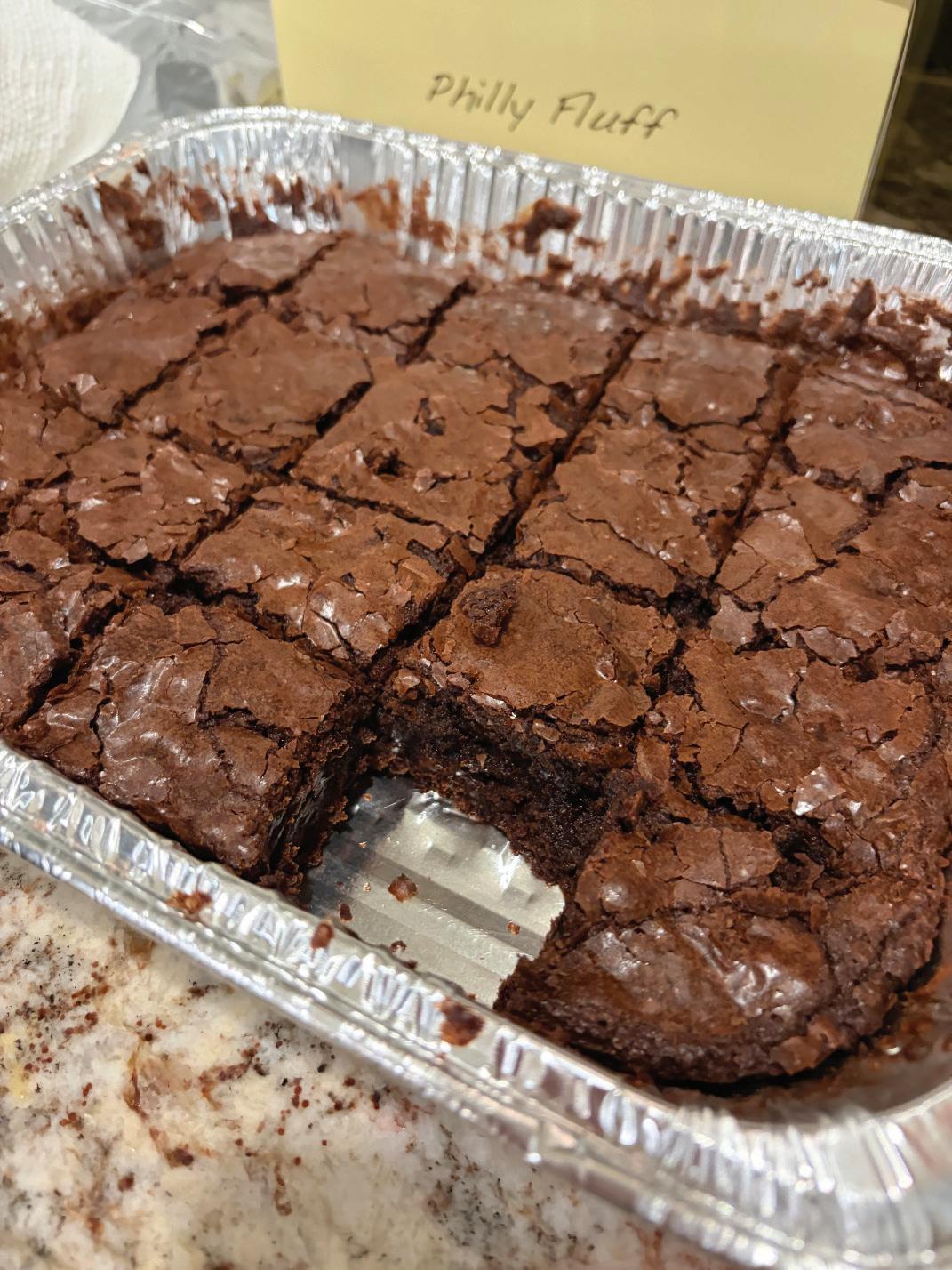
To “recreate” this dish, I decided to just make brownies; specifically, the ones with a gooey inside and large chocolate chips embed- ded throughout. Making the brownies was sim- ple. I used Ghiardelli’s box mix and followed the instructions on the box to combine eggs, water, oil, and the mix into an aluminum tin.
After the brownies baked in the oven for fifty minutes, they were done. I was elated when I sliced up the brownies and realized that they turned out exactly how I wanted: a nice crust on the outside but soft, sweet and rich on the inside.
Of course, a drawback of my brownies is that they are no longer vegan, since I put eggs in them. That being said, the Vegan Chocolate Cake is an excellent option for people who are vegan, as well as for people who are avid cake lovers. Regardless, I would love it if Cornell’s dining halls had brownies more often.
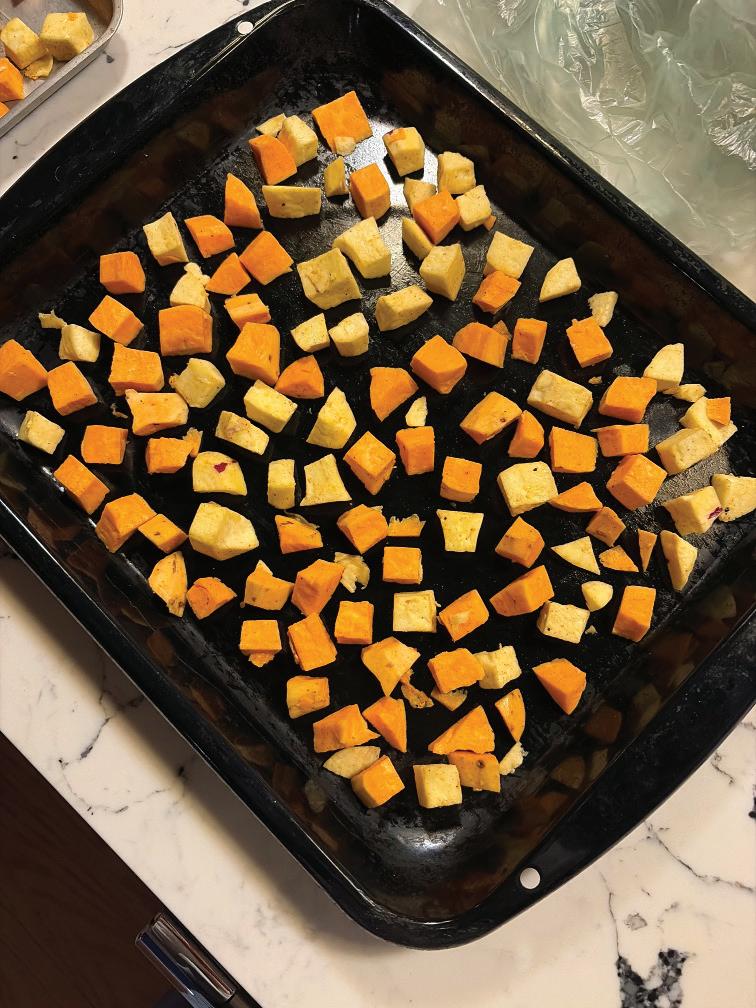
Finally, I decided to copy the Cubed Roasted Sweet Potatoes that Morrison Dining Hall sometimes offers. I chose to make this dish at home because it has single-handedly made me a fan of sweet potatoes, a vegetable I didn’t particularly care for before I came to Cornell. Learning to make sweet potatoes at home meant that I could have this delicacy anytime. Starting with two sweet potatoes, I skinned, cubed and drizzled them with oil, salt and black pepper. Then, I spread the sweet potato cubes out on a metal tray and slid them into the oven to roast for thirty minutes at 425 degrees. Twenty minutes in, I checked on them and realized that they were starting to char at the edges. I hurriedly rescued my sweet potatoes from the oven and set them on the counter. Luckily, they still tasted good and almost exactly like the ones in Morrison, if you account for ignoring the burnt edges. My dog was a big fan of them as well, and circled around the sweet potato tray until I tossed him a couple. This dish is definitely one I will make again at home. But next time, I’ll only keep them in the oven for around fifteen minutes to avoid burning them.
Through this experience, I have come to appreciate the sheer effort, amount of ingredi- ents and expertise that is required of Cornell Dining to serve Cornell’s large population of students every day. Cooking three dishes at home in a low stress environment for just myself and my family proved to be challenging. However, when there is a continuous demand for food during dining hall operating hours, there is no room for burnt edges or gooey chicken. Everything needs to be done right and quickly and there need to be options for everyone. Even when that is all said and done, cleanup efforts are massive. Even at home, I found myself looking at a mountain of dishes to wash. Magnified a couple hundred times, I can’t imagine how much cleanup is required across all of Cornell’s ten all-you-can-eat dining halls. Cornell Dining definitely deserves its reputation — not just for the taste and quality of the food that they serve, but also for sustaining thousands of students through hours of unseen labor that too often goes unnoticed.
ANGELINA LEI / LIFESTYLE CONTRIBUTOR
ANGELINA LEI / LIFESTYLE CONTRIBUTOR
SOPHIA ROMANOV IMBER / ASSITANT ARTS EDITOR
Te Ivy to Establish New Luxury Housing in Collegetown, Opens Fall 2026
By GISELLE REDMOND Sun Staff Writer
Dec. 2 — After years of sitting vacant, the corner of Dryden Road and College Avenue is slated for transformation as developers Nick Robertson and Charlie O’Conner build luxury student housing, leasing nearly all 52 units before the building has even been built.
The eight-story building, called The Ivy, is set to open in August 2026, and is currently accepting leases for units ranging from studios to seven-bedroom apartments. The developers also purchased Koko, a Korean restaurant that closed in the spring and will reopen under The Ivy, according to Robertson.
Robertson wants The Ivy to be different from other Collegetown housing by being “highly amenitized.” The building will offer amenities like a rooftop terrace, wellness center, sauna, media lounge, private study rooms and a 24-hour coffee bar, according to its website.
The building’s construction is set to be completed in late January or early February, with work on the interior set to be completed in late June or early July, in time for leases to begin on Aug. 17, according to O’Connor.
While the structure of the building is not fully complete, The Ivy wwebsite is replete with computer-generated imagery to give potential renters a sense of what the building will look like.
Though only the base and first levels have gone up, the developers said that The Ivy has seen a lot of early demand — especially for its three-bedroom apartments, which range from $5,500 to $5,800 per month.
“We’ve been trying to focus on not having vacant storefronts...[and making] Collegetown a better experience for the residents that live there.”
Charlie O’Connor
“We feel like we’re in a great position to have the building be full in the fall,” Robertson said.
For Ivy Ng ’27, it was the promise of a new, amenity-filled building that drew her to The Ivy. She noted that she thought there would be less
maintenance and was intrigued by the building’s features, such as the rooftop terrace and coffee bar.
“That sounded really nice to me,” Ng said. “I hadn’t really seen any other apartment buildings that did that.”
Ng and her roommate first reached out to The Ivy in late August, and were offered a 20 percent off discount for their early interest, according to an email she received from their leasing team. These prices increased as floors got higher.

The cheapest offering at The Ivy is a two-bedroom one-bathroom in the basement which started at $1,595 per month per person. This made the total $3,190, when it would have been $4,000 at full price.
Ng stated that these prices were more comparable to what she currently paid, but was concerned that the square footage was smaller than her current apartment.
Although the novelty of The Ivy initially drew Ng in, it also made her uncertain. Ultimately, she chose to stay with her current building.
“I just still don’t really know what it’s going to look like on the inside,” Ng said. “I’d rather just be safe and stick with what I know is going to work for me.”
With their acquisition of 325 College Ave, Robertson said that he did not want to displace Koko’s owner, Sungyoon Hwang, and her restaurant next door at 321 College Ave. He said that he and O’Connor are working to renovate the Korean restaurant and incorporate it into The Ivy.
“We’ve been trying to focus on not having vacant storefronts … [and making] Collegetown a better experience for the residents that live there,”
O’Connor said.
Robertson is no stranger to constructing housing for Cornell students, having been a part of the construction for projects including the College Townhouses, the Collegetown Terrace apartments and Cornell’s recent North Campus expansion, which added 2,000 beds.
O’Connor, too, is involved with student housing as the owner of Modern Living Rentals, a prominent management company in Ithaca that oversees a range of properties and aims to offer its residents “affordable luxury” apartments.
Both Robertson and O’Connor wanted to work on a project at 325 College Ave for years. Robertson said that the site was one that he “always wanted to be a part of.”
Even before he moved to Ithaca in 2015, O’Connor wanted to work on a project at 325 College Ave. He said that he found himself thinking: “Cornell is growing. We need more housing … there really should be a building here catering to Cornell students.”
With limited space in the neighboring areas, O’Connor said that “the only [thing] Collegetown can do is go up.”

New Collegetown Gift Store May Close Due to Financial Struggles
By TAEHEE OH Sun Senior Writer
Nov. 25 — Loki Dokey, a gift store tucked in an alley off Dryden Road, has become a cozy Collegetown escape. However, the business faces financial strains just three months after opening in August due to high rent, import costs and low visibility.
The store was founded and run by Weicher Bi, a second-year graduate student at the School of Industrial and Labor Relations. She decided to take a gap year at the end of her third semester to start and run her business.
In an interview with The Sun, Bi explained that her own experiences of buying herself little treats to relieve stress as a Cornell student inspired her to open Loki Dokey.
Bi told The Sun that after one and a half years studying at Cornell, she experienced the “pressure” of coursework, internships and jobs.
“And when I have those pressures, I like to buy little gifts to treat myself, like little stickers, pretty notebooks or some little plushies,” Bi said. “So I’m thinking maybe other Cornell students also need something to treat themselves.”
While Bi said that starting Loki Dokey was an “exciting process,” she described the many financial challenges that came with being a small business owner in Collegetown.
“I would say the money I make each month cannot even afford me to live in the dorm at Cornell,” Bi said. “After this experience, I [am] more respectful [of] small business owners.” To continue reading this article, please visit www.cornellsun.com. Taehee Oh can be reached at toh@cornellsun.com.
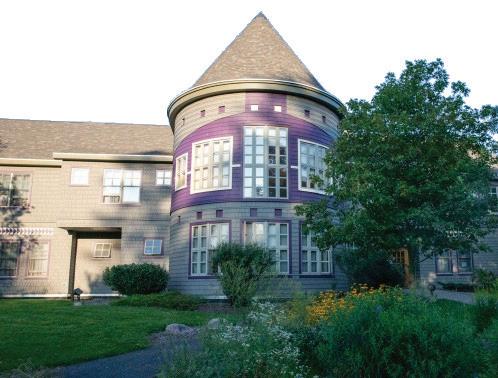
Collegetown construction |Computer generated image of The Ivy building on the corner of Dryden Road and College Avenue.
AU Now presenting the AUdacious, AUspicious, Attractive, Ucaptivating, AdventuroUs, Uharming, Amicable, Ulever…the Uoolest Air Uonditioners. Rank AU!
Cadence “causer of chaos” Barkan
Sunny “stylish sunflower tote bag” Cui
Julia “one handed flute balancing champion” Fitzgerald
Jonathan “master of name quotes” Jiang
Riddhi “she is the dancing queen” Lamba
Tina “wanna be in my TikTok” Li Katherine “hazbin hotel fiend, hot topic stock cleaned” Manning
Veena “#1 roblox /e dance emoter” Sivasubramaniam
B
Now broadcasting the Bodaciously Benevolent, Brilliantly Bright and Blazingly bold, the Baddest Bunch in the Bivy Beague, RANK B!! We BRING THE BOOM!
Alannah “THAT’S MY SAX SL babe” Dennis
Ally “back and better than ever babe“ Guo
Elizabeth “Olympic twirler babe“ Koizumi
Isabella “Winter is coming babe“ Zahl
Jordan “professional stick figure artist babe“
Quinn
Suzie “world’s best squirrel observer babe“ Barrows Violet “where’re we supposed to be (that’s my rank leader) babe“ Christensen
D Now presenting… the most Distinguished, Dazzling, Dynamic, Delightful, Dedicated, Doodylicious rank in the Ivy League, rank D!!! Ari “I.H.W.” Schor
Julia “Boston’s most doodylicious tour guide” Xiao
Matthew “Sabrina’s sleep paralysis demon”
Carolan
Monna “#backwardsjazzrun” Li
Naomi “Ari’s gymnastic’s coach” Lederman
Sabrina “Game Day DJ” Sheridan
$ Now pre$enting the $tupendou$, $pectacular, $laye$t, $piffie$t, $nazzie$t, $illie$t, $a$$ie$t, $cintillating, mo$t $axie$t rank of all:
$$$$$$$$!!!
Dawson “there’$ a WHAT emote?” Melton
Daniel “$axie$t 10:23 $tan” Fransen
Jonah “$kipping Yale for Lorde” Van der Linden
Sophia “be$t baked good$” Pasold
Max “$eer$ucker $uit” Troiano
Noah “HEY $IEVE” Kaplan
Ian “I know their fight $ong” Ali
Joe “vintage $ilver $ax” Canonzier
Kiara “$hould I $leep through my cla$$e$”
Jones
Caidan “$uper $enior” Pilarski
#
#Now introducing the most #thrilling, #thankful, #thriving, and #thorpiful rank in the #thivy #thleague, ##THORPE##! Alannah “#TallestEver” Dennis
AJ “#GrillMaster” James
Jamie “#RankWarGeneral” Heskett
Marlon “#Kirby’sBiggestFan” Clarke Jr.
Evan “#BornTwice” Bovay
Abbott “#ToxicSpeedrunner” Sherlock
Nathan “#GateTurnProdigy” Speert
Katie “#AlwaysWatching” Driscoll
M
Now introducing the Magnificent, Marvelous, Multitalented, Mighty, and Musical Members of the Most Masterful Rank in the Mivy Meague…RANK M!!! Scooby “attended his first morning rehearsal” O’Connor Detour “the responsible rank leader” Lammers Alfredo “weather prediction: too cold” Vazquez
Doc “shows up for emerald eyes” Neiss Ethan “best deputy rank leader” Liu Leap “6” Wang Spins “7” McCrocklin Sunny “wants to pet every dog in sight” Batuncang E And now wE prEsEnt to you thE most Extraordinary, ExubErant, EntErtaining, ElagEnt, Eco-friEndly, ElitEratE and confusEd rank in thE Ivy LEaguE
Skylar “sommErsaults” Bush
Abigail “ratchEt microbio” HEck BEn “murdEr at thE clocktowEr” Isaacson
RoycE “past his bEdtimE” AndrEws
Mary “on a lEavE of absEncE” King
LukE “WHATT i’vE got EEEaring problEms” Thompson Soorya “appEl dining dEEva” Thiagarajan
AbbiE “pro lyrE snappEr” Harrison
Samiha “puts thE E in biologEEEEE” Anjum CalEb “graduatEd in 2005” Takiguchi
ClairE “robot quEEn” Cho MaxinE “trEE paintEr ExtraordinairE” Hurst
F
And now introducing the most Fun, Freethinking, Fantastic, Funny, Fenomenal, Fysicsy, hot mess, Fishy, Fisual-making, Fruity rank……rank F!!!!
Christina “Can you carry my clarinet” Bray
Mary “#1 Gollum fan” King
Kathy “I’m jokingggg” Miller
Hannah “Grindin’ up bones” Blank
Amy “Feastable feen” Nguyen
Svetlana “Frozen frosted sandwich” Gupta Isaac “Kazakhstan quinoa farming” Moore
Emily “There’s a possum in the bandcenter” Mawhinney Elle “Do I have to pinwheel?” Crosley
Z
Zinging and Zooming our way through every show and rehearsal with Zesty, Zany, no-longer-Zero ZigZags #Zaddy
Lila “NOT patient zero” Kleppner
Hanna “everybody’s everything to ur mom” Lighthall
Emily “the life of a public health student” Jones
Sophia “Dr. Pepper addict” Gammel
Alex “most performative male” Coulouras
Helen “origami master” Liu
Annie “matcha club” Song
Zeke “MCR” Fox
Uzair “marching laps around us” Hashmi
Brenden “knows not to trust Lila” Annulis
Noah “split my pants” Kaplan
JL
As the one and only JLegendary Rank JL, we JLoyal JLers JLive, JLaugh, and JLove to cheer: JL on three, JL on three, one, two, three… JL JL JL JL JL!
Emily “JociaL will be so much fun!” Felts
Leah “no JLer will be alone” Chang
Caitie “the tempo has literally been different everytime” Farrell
Lara “anything is possible if we manifest enough” Rodriguez Felicity “subwoofer louder than drumline”
Martin
Josh “follow @skinks.skanks on instagram. com” Williams
Bryan “on Josh I will be at rehearsal next week” Alvarado
Retna “next great genetics genius” Arun
Malka “CAITIE!” Goldberg
Morgan “haven’t played sax since March… I think” Wilcox
Josh “og swirler” Williams
Jonathan “pigs flying at music rehearsal”
Lee
Caitlyn “time to defrost” Pelletier
Allison “sheets and water bottles” Weiher
Campbell “tush push” Mitchell
R now pResenting the Remarkableist, Rankiest, Resettingist, Reliableist Rank in the Ivy League!
Ella “general hoppiness” Johnson
Willem “bone unc” Light-Olsen
Nate “come back we miss you” Vasquez
Nick “forgot my waterbottle” Biega
Dan “that’s tough” Han
James “don’t forget the doorknob” Lynch Oded “marching without music” Haraz Yehyun “mid-rehearsal adventures” Choi
Morgan “toneba” Wilcox
Bella “empty taquito box” Davi
S
…and now, the most slupendous, slexelent, slantastic, slocked in slank in the slIvy sLeague, RANK S!
Ben “cute top” Quint
Slice “take it up the octave” Scialabba
Troy “oh, it’s focused” Madrio
Emily “D1 Hater” Andersen
Grace “Disney knees” Bittlingmaier
Jake “NAAOOWW” Donovan
Kai “back in ‘99” Nelson
Rebecca “phone thief” Cheng
Tyler “meh” Higgins
T?
Tubas: perfect attendance, no such thing as shenanigans
Jackson “oops, I dropped my hat“ Hunley
Kathy “do the tuba visual“ Miller
Violet “he ripped his pants “ Christensen
Dina “could go for a burrito“ Nabavian Yehyun “oh NOOOOO!!!!!!“ Choi
Jake “hell yeah! “ Glasser
Jonathan “I’ll march the next show “ Miller
Morgan “how do you feel about may contain “ Wilcox
N
aNd Nowwww preseNtiNg the Noicest, Nastiest, Necessary-est, Noteworthy-est, Niftiest, Neatest, Naturally Natty-est, Nubile raNk N!!!
Chuckles “barrel roll left for 16 counts”
Alexiadis
Chewie “center of the pinwheel” McNulty Dawgs “rank n for gnarly” Gu Salem “busy filming blaire witch” Stroop Vegas “drowning in lin alg and Giants losses” Caliendo Komet “where da faq da forty at?” Leiby Soup “wait I thought we need the 35?” Anthes
O
nOw intrOducing, the One and Only, mOst Objectively Outstanding, OreO-eating, OhwOhwupping, Over-achieving.... RANK O! Apples “can I get a crisp wOOt wOOt” Chuhta
Pidge “guys what if we waltzed” SherlOck Ryan “Apples we’re Over here” Carlin
Wins “halt = planking” Weinstein Goose “if only I could cameraman AND march” Kerstetter
Emily “a show three baddie” Andersen HOllywOOd “see yOu On Thursday” GOldfarb Milkers “dOes anyOne have the music?“ BilOtti
P
Presenting the more or less passable, often precise yet rarely perfect, personals of Rank P
Tumble “safety Tommy when not interviewing” Schneyer
Nate “are there any lacrosse balls” Weinberger
Chestnut “from the announcing box”
Stoner
Max “always in formal attire” Troiano
Sterling “pumpkin pie ” Chargois
Tommy “frozen pineapple” McFarland
Max “hey man you know where to find the cdjdinridjs” Fanning
Spins “drive by rank P” McCrocklin
Pipsqueak “more horn than the rest”
Howard
Abbie “tiny Abbie Harrison in my head” Harrison
H*
And now, back to its former glory, we proudly present tH* most H*rmonius, H*roic, H*larious, H*ppy, H*nking, Hl*vely
Rank H*!
Aaron “just a block of cheese” Isaacson
Henry “broken washer” Eckhause
Ethan “just here for the Yale merch” Lee
Zane “the drumline pipeline is real”
Rubenstein
Jamie “let Buckets begin” Heskett
Dawgs “silent httyd” Gu
Pidge “bong bong bong” Sherlock
Pipsqueak “not another GroupMe” Howard
Jen “jencil jenitals jenerator” JoaquiAlmendarez
Jacob “where’s my PE credit?” Seto
Derek “like the purple guy” Thompson
Carter “spooky “ Larson
Alex “you’re dragging “ Coy
W
And now presenting the only movie-commentating, catnapple-loving, Hamiltonsinging, interested-in-DRUM CADENCE Colorguard in the Ivy League…
Emily “trumpets, cucumbers, and the ER” Spans
Axel “I like being moist” Hanley
Elif “BONK ending” Aydogan
Amanda “I’m going to steal your cat” Xiao
Carson “lalalalalalala” Grubbs
Emma “meet Femur” Denecke
Elle “vamos a la playa” Crosley
Morgan “Lynah guard” Wilcox
Tommy “already nostalgic for guard” McFarland
Sunny “don’t ask about the brace” Batuncang
Justin “Boston warrior” Han
Emily “beware of the incline” Rambo
Bella “puts the drum in drum cadence” Garcia
2s
Set your SightS on thiS Supremely Stacked caSt…introducing the Swanky, Spirited, ScrumptiouS Squad of SnareS you can alwayS truSt to thruSt…rank 2s!
Bella “guard crossover!!” Garcia
Zane “completing instrument bingo card” Rubenstein
Dylan “I can taste victory” Carson Tori “Can’t stop doing jazz hands” Cotton Kir “How ba-a-a-ad can I be?” Kraus Grippers “I keep forgetting that’s not my real name” Lanz
Caleb “The great woodwind migration”
Takiguchi
Gurt “WAZAAA” Potter
May “Post rehearsal cartwheel” Tang Zacch “dripped out and fitted up” Pierre
2b
Buckle your Belts and Brace yourselves
Because the Bootylicious Basses are Bringing the Boom… rank 2b!
Emily “professional insect murderer”
Mawhinney
Kate “ice muncher” Wubbenhorst
Megan “locked the **** in” Wu
D-Train “all about that bass” Comis
Adrik “Voice of an Angel ” Aburto
Anand “nasties #1 customer” Bannerj
2c
Let’s hear it all 2gether now for the Capitally
Cymbolic, Catastrophically Cacophonous, 2
Capable 2 Count: rank 2c!
Yacharee “Can I pet your dog?” Morales
Ben “only freshman privilege” Lim
Diana “Have some candy.” Palma
Hayley “out there saving lives“ Marino
Gaby “our champion in Tims” Goldberg
Catherine “all the origami” Frank
Joey “knows every boba tea in collegetown” Zhang
Elif “flag friend!” Aydogan
Kit “I’m making this up as I go“ West
2q
Quit your Quackin’ and Quash your Quips, Quz the next Quail in the Queue is a Quorum of Quirky, Quintessential, MAD
TOUGH Quads... rank 2q!!
Clara d”a Glitter Queen”e Long
Kamili “can be heard shouting over the entire BRMB” Fernandez Ashlyn “sunshine and flowers but like also a drummer” Roeder
Luke “the Vanilla Gorilla” Smith
Max “uhhh ping pong?” Fanning
3l
aLLow us to Lighten your Life with a fuLL b3LL Line of Luminescent LiL Lads! beLLies fuLL of gLockamoLe & aLways expLoring new smeLLs... rank 3L!
Alex “Drumline Personal Odor Database System” Wong
Anja “She pees, We harmonize” Minty
Jame “Tap-Off Takeover” Nicoll
Jordyn “Breaker of Balls (& Hearts)” Hurry
Kira “Destroyer of Big Red Trumpet Gender Ratio” Thabet
Talia “Master of Belegation” Rubeo
HM
Hey Band!
I cannot believe this is the end of the season! It has been my absolute pleasure to lead you all this year, and I hope you had as much fun as I did. A huge shout out to the wonderful Bandstaph members, Section Leaders, Rank Leaders, and everyone else who worked to ensure we had a flawless season. To the new members, thank you for allowing me to show you the magic of this organization. I hope you will continue on in this organization and help spread that magic with the next group of new members. Josh, thank you for being such a great Drum Major. You made my life so much easier, and really helped me out in so many ways. I am grateful to have worked alongside you!
Thank you Band!
With Love, Emily Mawhinney
DM
Hey Band!
Thank you so much for the honor of serving as your Drum Major this past year! It has been the privilege of a lifetime to watch new members and returning marchers find their place in our band family. I’m incredibly proud of everything we’ve accomplished as a band, both on and off the field. From auditions and first night to the very last football game, the smiling faces, silly dances, and sometimes-in-tune notes are memories I will carry with me for the rest of my life. I hope you all had as amazing of a season as I did. Emily, I couldn’t have gotten through the year without you. I’m incredibly grateful for all of your amazing support and hard work as Head Manager.
Thank you for getting lost on campus during parades with me, celebrating with me in the good times, and keeping me sane during the tough times.
With pride, Josh Faber
Hey Band!
And now introducing your 2026 Drum Major… Allison Weiher! Stay true to yourself, protect the legacy, and always remember to keep your eyes filled with pride.
Love, Faber, Ellison, Kozma, Matte, Romero, Kozma, Curtis, Crosby, Preciado, Olson, Albanese, Reno, Richmond, Gerson, Seery, Caulfield, Tucker, Kerman, Ball, James, John, Wolf, Minster, Gerbracht, Frank, Cohen, French, Meier, Chamberlin, Gordon, Murray, Kohen, Dolan, Baxter, Mandarano, Kelin, Vicks, Fish, Metsa, Vicks, Bonnano, and Sherman
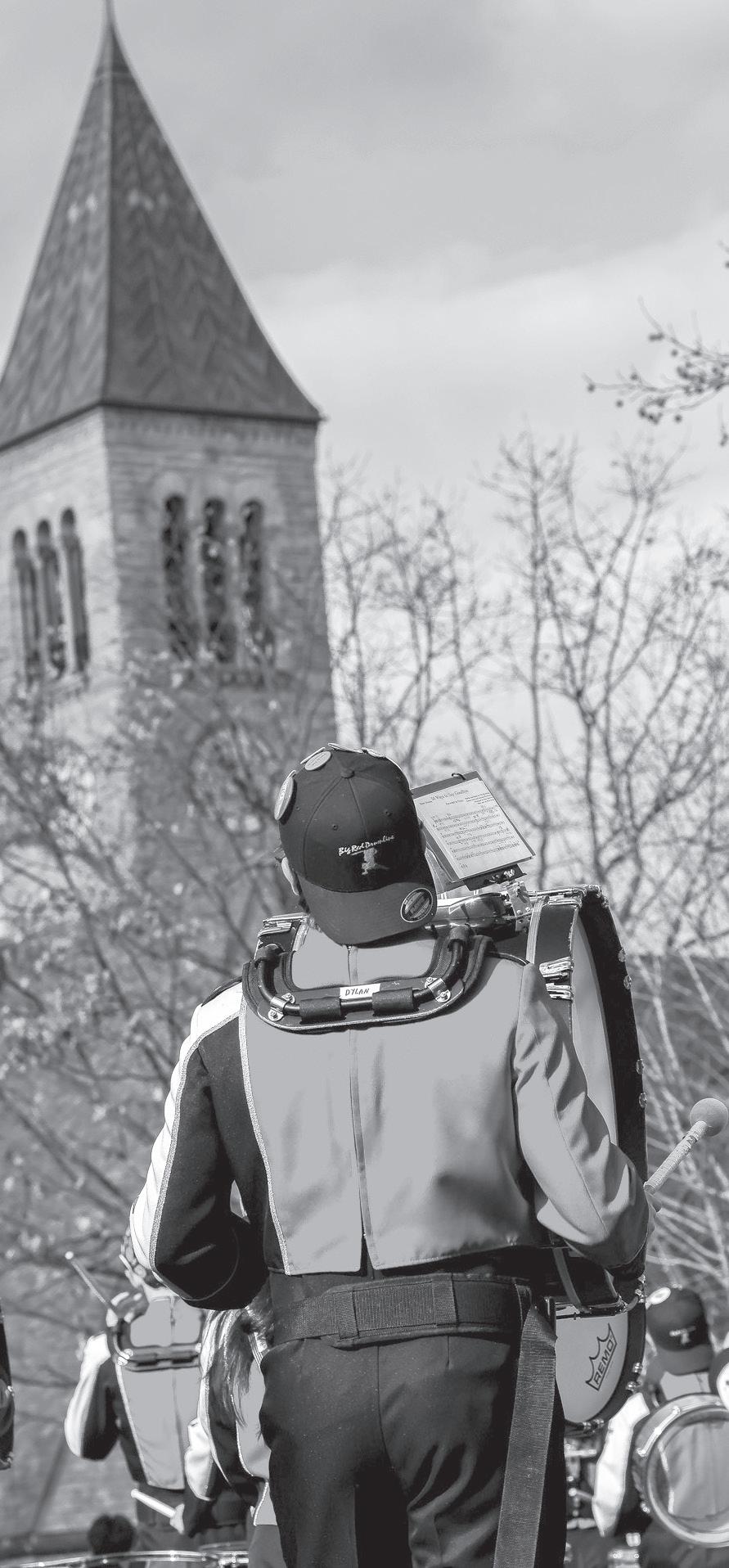
Where Nutrition Meets Innovation: A Look Inside Morrison Dining’s Discovery Kitchen
By ELIZABETH CHOW Sun Contributor
Nov. 24 — White-coated students and faculty chefs alike work together inside Morrison Dining on North Campus, inside a glass-enclosed kitchen for onlookers to see.
They are a part of the Cornell’s Discovery Kitchen which combines scientific learning with community collaboration in an interactive teaching kitchen used for culinary testing, classes and events.
“It was a great space to put there so people can see the great work that’s done across Nutritional Sciences and dining to watch people take classes, to watch people prepare meals and really kind of invigorate the spirit of understanding how food is prepared, and how to cook healthily,” said Dustin Freeley, assistant director Residential Dining and Cornell Dining.
Since its opening in Fall 2021, the Discovery Kitchen has hosted a limited number of events per semester, enabling people to sign-up to learn how to make seasonal items. Some activities that the kitchen has hosted include pumpkin-spice pastries for fall, as well as everyday foods served at the dining halls. These events implore students to understand nutrition alongside learning about how to use different ingredients to make easy, healthy recipes.
“They’ve [made] individual homemade apple pies … vegan quiche, stir fries scallion pancakes,” Freeley wrote in an email statement to The Sun. “And [the thought] behind those is to be sustainable and healthy eating, you know, just different ways to eat.”
The Discovery Kitchen also cultivates collaboration between other student organizations on campus, like an event with the Iconic Cornell series, where students worked in groups to make pizza pies, similar
to those served at Morrison Dining Hall, customizing them with toppings of their choice. Student participant Brandon Chiu ’29 described his experience at the event.
“I think that it was a really good opportunity for a lot of the student body to get to know each other and to get to know the professors as well,” Chiu said. “I did not know that making pizza was that hard. I’m eternally grateful for all that Cornell dining staff has done for me here.”
While events have limited capacity, the Discovery Kitchen also offers semester-long culinary classes in partnership with the College of Human Ecology and College of Agriculture and Life Sciences. Courses such as NS 2470: Food for Contemporary Living explain food science foundations through hands-on-preparation.
Once a week, NS 2470 students attend a three hour class that combines a traditional lecture with a food lab. The students are given quizzes before and after lectures to test their understanding on basic culinary principles, such as how each ingredient operates in a recipe or how to use the kitchen utensils and appliances.
Talia Ghetie ’28, a student who took NS 2470 last spring, emphasized the unconventional format of the class.
“It’s not a traditional classroom,” Ghetie said. “[The chef] goes into like the lecture in the beginning, and then they just set you free to cook your recipe.”
The class additionally fosters a collaborative learning experience through post-class debriefs. Teaching assistants collect samples of the students’ culinary creations, discussing the sensory and physical aspects of a dish to show off or critique student work. The course follows a curriculum that teaches students through the established recipes, which Ghetie told The Sun can decrease the
creativity that students can put into making the dishes.
Though students are generally expected to follow pre-established recipes, the course also features two large projects that allow them to develop and create their own recipes. The meal planning project requires students to form their own daily eating schedule, taking into account nutritionary factors and incorporating food preferences.
Another project, the cultural variations project, allows students to, as the name sounds, cook three dishes from various cultures. After students pick a theme to follow, they give their own lecture and presentation about food science principles behind the theme.
“My friend and I talked about mango floats from the Philippines, this avocado smoothie from Vietnam and cactus ice from Mexico.” Ghetie said. “So you get to be creative there.”
Beyond these experiences, the Discovery Kitchen also serves another purpose in supporting culinary training. This training includes culinary assessments and programming for students and staff. An example of this is the Get Cooking classes, where students learn basic culinary and nutritional skills.
While the Discovery Kitchen already hosts many different types of activities, the space is constantly evolving.
“We plan to expand programming for trainings, retreats and community events, while possibly offering additional free Get Cooking classes for students,” Freeley wrote in an email statement to The Sun. “The goal is to balance its dual role as a classroom and kitchen to support continued growth and serve the needs of our campus community.”
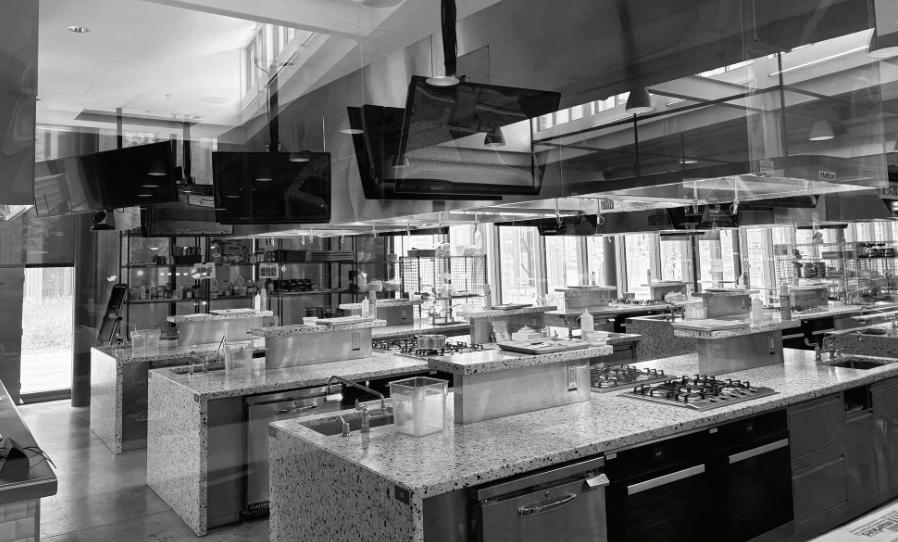
Willard Straight Hall: A Century as The Heart of Cornell
By
Nov. 21 — Willard Straight Hall, one of the first student unions in North America, has had a rich 100-year history evolving from the earliest dances, recitals and art exhibitions to the momentous protests that reshaped campus life.
On Friday, Cornell will celebrate the 100th anniversary of the Straight with an event titled “Centennial Celebration: 100 Years of Willard Straight Hall.” The event will feature historical displays and archival materials, student performances and other activities for students, faculty, staff and alumni.
The Sun recounted the Straight’s history as a home to everything from dances and recitals to armed takeovers and the ongoing negotiation between tradition and progress on campus.
Opening on Nov. 18, 1925, Willard Straight Hall was donated by Dorothy Whitney Straight Elmhirst, widow of Cornell 1901 graduate Willard Dickerman Straight, who died in World War I. At the time, Willard Straight was intended to be a place where students could gather, study and form community.
John Hunter Detmold ’43, co-chairman of the Willard Straight Browsing Library Reading Hour Committee, noted that the building made life easier for students during finals, which included “dancing coffee, tea, and cookies free to all at the Straight,” according to a History of Willard Straight video.
Throughout the years, WSH has evolved to include some of Cornell’s most historic events, including the Willard Straight Takeover of 1969.
One Takeover Triggers Campus Reforms WSH’s history is not only about creating community, but has also been a site of activism. In April 1969, students occupied the building, protesting racial inequality on campus and across the country. Tom Jones ’66, who participated in the takeover, explained that students chose to occupy the Straight because it was “the symbolic ‘heart’ of Cornell” and that they wanted to ensure that their “actions and demands could not be ignored,” in an email statement to The Sun.
Jones also described the tense standoff during the takeover with Delta Upsilon fraternity members, who, according to
him, snuck into WSH and confronted the protesters, arguing that they had “no right to occupy” the Straight.
“This was a statement that the days of blacks being intimidated by white vigilantes were over,” Jones wrote in an email statement to The Sun. “That’s how WSH became the site of the only armed building occupation in Cornell history.”
Ed Whitfield ’70, a former leader of the Cornell AfroAmerican society, which is now the Cornell Black Students United, helped to organize the occupation. He previously told The Sun that, weeks leading up to the takeover, there had been deeply troubling incidents targeting black students.
In one incident, a cross was burned outside the Wari House, a cooperative for black women, an act that Whitfield said felt reminiscent of Ku Klux Klan tactics. He also reflected on the takeover and described that it was a “principal expression of defiance.”
He told The Sun the initial plan was not to bring firearms. The weapons were introduced only after white fraternity members forced their way into the building.
Rumors of the fraternity planning to return with guns prompted the students involved in the occupation to defend themselves.
Following negotiations with administrators, the students, as Jones recalled, walked out in a military formation bearing their weapons. The scene was captured by Associated Press photographer Steve Starr and became the cover of Newsweek, later winning the Pulitzer Prize for Breaking News Photography.
The protest had lasting effects, prompting the creation of Cornell’s shared government system — a structural reform that endures today. Additionally, the Africana Studies & Research Center, John Henrik Clarke Africana library and the Ujamaa Residential College were all established following the protest.
However, Whitfield described the creation of these buildings as “bribes,” arguing that while academic structures were put in place, they did not necessarily resolve the deeper threats that black students faced.
To continue reading, please visit www.cornellsun.com. Ruthie Behrendt can be reached at rb967@cornell.edu.
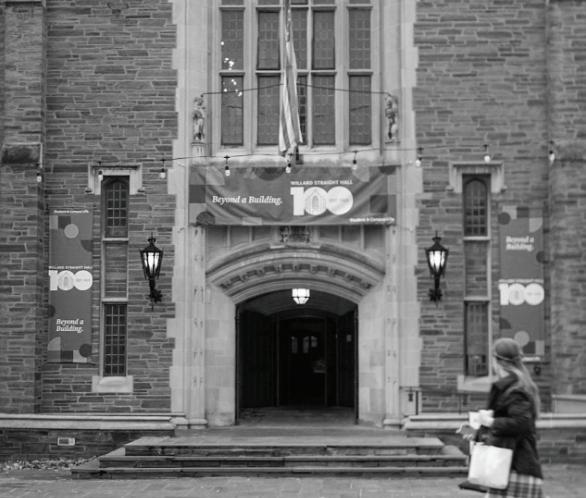
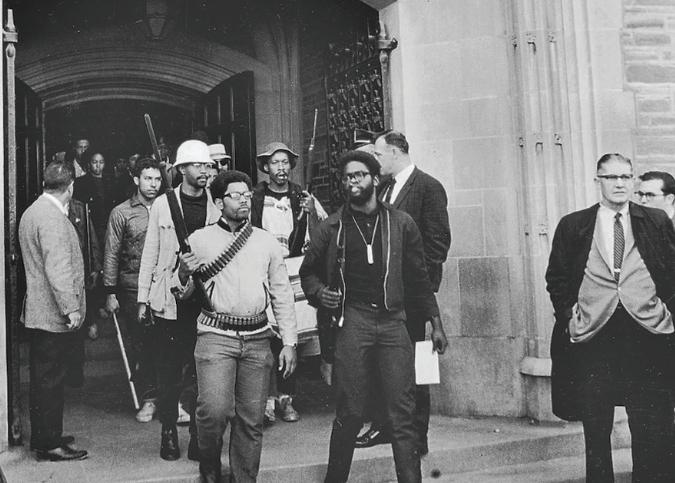
Elizabeth Chow can be reached at ec977@cornell. edu
RUTHIE BEHRENDT Sun Contributor
Krafty kitchen | Cornell’s Discovery Kitchen gives students the opportunity to learn how to cook different recipes in Morrison Dining
ELIZABETH CHOW / SUN CONTRIBUTOR
Willard’s 100th | Willard Straight Hall hosted its 100th anniversary celebration on Nov. 21
ANNIE PARK / SUN STAFF CONTRIBUTOR
Hall’s history | Eric Evans ‘69 and Edward Whitfield ‘70 walk out of Willard Straight Hall after having occupied the building on April 19 and 20, 1969
BRIAN W. GRAY / SUN FILE PHOTO
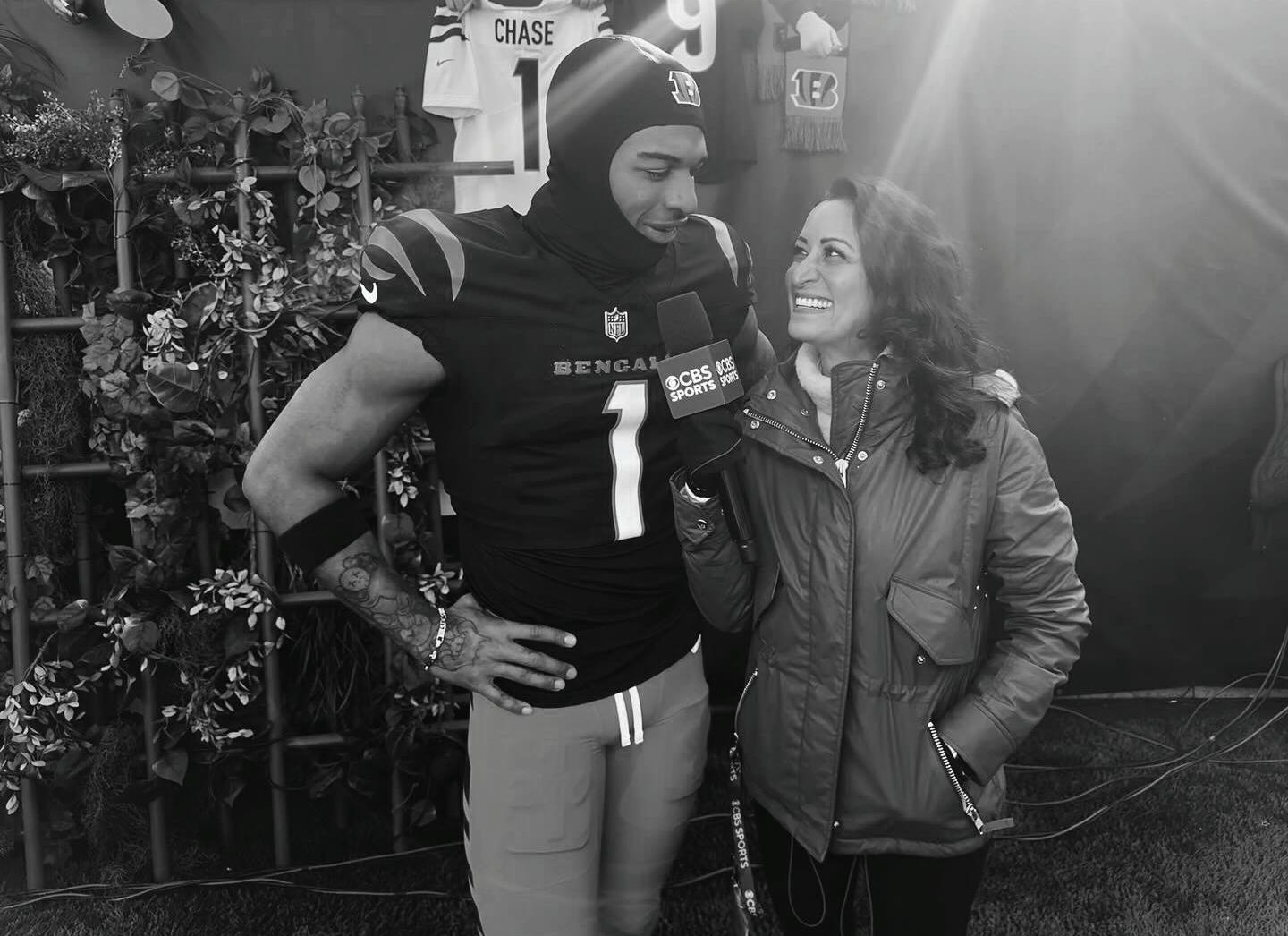
Te Life of A CBS Broadcaster: Meet Aditi Kinkhabwala ’00,‘Eyes and
By ZEINAB FARAJ Sun Features Editor
Nov. 24 — Aditi Kinkhabwala ’00 spends every NFL weekend as a CBS broadcaster in motion. Starting on Thursday night, she’s on a flight to that week’s stadium. Friday is spent at practices, in production meetings and interviewing coaches and players. Saturday brings another round of preparation on the visiting team. By kickoff on Sunday, she has already logged hours of research so she can deliver sharp updates from the sideline.
It’s a rhythm she never expected to adopt. Kinkhabwala didn’t plan to become a journalist — she studied American Studies at Cornell with the intention of going to law school. But writing kept finding its way back into her life, and eventually, it became the center of her career.
“I never made an active choice to be a journalist,” Kinkhabwala said. “I just fell into it and fell in love with it.”
Growing up in New Jersey, Kinkhabwala was a sports-obsessed “tomboy” who spent her time watching Knicks and Yankees games. She spent her evenings writing letters and journaling, and by five years old, she wrote her first book, The Case of The Missing Diamond. Her father, a chemical engineer who immigrated from India, always reminded her that strong writing was one of the most valuable skills anyone could have, regardless of their career path.
“It was just something I was doing because writing is good training for anything. It [was] fun and a great side job, [but] was never a means to an end.”
Aditi Kinkhabwala ’00
By high school, she was already reporting at the Home News Tribune, formally called News Tribune, in New Jersey and spent her summers interning at ESPN and Sports Illustrated — though she didn’t consider journalism her future.
“It was just something I was doing because writing is good training for anything,” Kinkhabwala said. “It [was] fun and a great side job, [but] was never a means to an end.”
At Cornell, she joined Alpha Epsilon Phi and wrote for the Cornell Athletics Information Department, covering football and features. Her post-college plan was to take a gap year before law school with a job at Bloomberg. But one week before graduation, she received an unexpected email from the sports editor of The San Antonio Express encouraging her to apply.
“My initial reaction was … ‘Texas, no thanks,’” she said. “But I realized that this was an all-expenses trip to a city I’ve never been to, so I might as well go to the interview.”
She got the job, and ended up falling in love with the work.
After two years at The San Antonio Express, Kinkhabwala returned to the east coast to cover Rutgers University football and basketball at The Bergen Record, then joined The Wall Street Journal as a sports writer covering the New York Giants. Each experience, Kinkhabwala said, built the foundation for her NFL reporting career.
“One of my editors told me that the best training to be a journalist is to go out and be a journalist,” Kinkhabwala said. “I never took a journalism class, but in each of my different experiences the same themes of writing on a deadline, interviewing and storytelling were skills that I learned covering high school and college football first.”
After more than a decade working at newspapers, Kinkhabwala transitioned to broadcast and now works as a sideline reporter for CBS and the NFL. She describes her on-air role as being the “eyes and ears” on game day, and says her print background, especially the structure and discipline of daily deadlines, prepared her for the fast-paced speed of live television.
“Writing teaches you how to tell a story in whatever way you need,” Kinkhabwala said. “For broadcast we are doing hours of research and preparing, but ultimately we serve our stories in snackable bits.”
She added that passion is as important as precision, creating an entertaining experience for viewers.
“The landscape of journalism has changed so much
with the rise of social media which was not around when I first started,” Kinkhabwala said. “The storytelling platform has changed so a lot more is driven right now by soundbites then by detail and striking that balance is crucial.”
Additionally, Kinkhabwala commented on how every game she prepares for is a different story — which drives her to continue journalism.
“There are so many incredible moments that it is impossible for me to pick a favorite or to fall into a constant routine,” Kinkhabwala said. “It never gets old the feeling of running up and down the sideline and chasing the story as it happens.”
Kinkhabwala recently returned to Cornell for her 25th reunion, where she moderated an Olin Lecture featuring three Cornellian Olympians alongside former NFL offensive lineman Kevin Boothe ’05. She brought her two
“You have to believe in your belonging, in your merits, and above all in yourself. I was told from day one that I was always going to have to work harder, be smarter and be more diligent to prove that you belong — and I have never resented that. It has been my attitude about everything.”
Aditi Kinkhabwala ’00
children, Nico and Kayi, with her to the reunion, sharing the campus and community that helped shape her career.
Kinkhabwala also sits on the boards of the Children’s Home of Pittsburgh and NFL Player Care Foundation.
Her message to young female journalists is simple: write constantly and never be afraid to ask questions.
“You have to believe in your belonging, in your merits, and above all in yourself,” Kinkhabwala said. “I was told from day one that I was always going to have to work harder, be smarter and be more diligent to prove that you belong — and I have never resented that. It has been my attitude about everything.”
Zeinab Faraj can be reached at zfaraj@cornellsun.com.
Post game | Aditi Kinkhabwala ’00 on the sidelines with Cincinnati Bengals wide receiver Ja’Marr Chase following the Bengals win against the Cleveland Browns on Dec. 11 2022.
CHUCK DENTON / CBS PHOTOGRAPHER
Ford field | Aditi Kinkhabwala ’00 stands on the sidelines of Ford Field, home of the Detroit Lions, reporting from the sidelines.
PHOTO COURTESY OF ADITI KINKHABWALA
Coach’s talk | Aditi Kinkhabwala ’00 chats with former head coach of the New York Jets Robert Saleh
PHOTO COURTESY OF ADITI KINKHABWALA Super bowl | Aditi Kinkhabwala ’00 outside of the New England Patriots hotel room
Who Can Say If I’ve Been Changed for the Better?
Wicked: For Good was my most anticipated movie of the year, following the smash-hit success of the first film last year. On Wednesday, Nov. 19, I burst through the doors of our local Regal Cinemas, overflowing with excitement to watch an early screening of Wicked: For Good, and while I left content with the movie, I kept asking myself if I had enjoyed it because it was an inherently good movie or if it had simply appealed to nostalgia.
From the ripe age of six, little old me has been “holding space” for the lyrics of the iconic Wicked act one finale “Defying Gravity” and dancing to “Popular,” hopping around my room pretending to be Glinda. At 12, I begged my dad to take me to New York City to see Wicked on Broadway — let’s just say I was changed for the better. Since then, I’ve seen Wicked on stage two more times (all equally as glorious) and anticipated the first movie, anxiously awaiting a faithful adaptation of Wicked that does the stage play justice. After watching the two films, I can confidently say that the stage play version of Wicked is simply unbeatable, but the first movie came close to harnessing the uniquely magical and comedic aspect that makes the story so special. For Good, however, fell short in comparison, feeling cluttered and practically overdone.
The second act of Wicked was originally one hour long, dramatically shorter than the two hour and 17 minute runtime of the film version. Act two serves to connect the story back to the source material of Wicked — The Wizard of Oz — explaining how Elphaba became the
“Wicked Witch of the West” and how Glinda became “Glinda the Good.” Part two of Wicked is a more serious story, as the protagonists are thrown into diverging chaos when Elphaba chooses to publicly go against the Wizard, and Glinda becomes his propaganda machine. Glinda and Elphaba, who were best friends in school, are now public enemies, yet both of them secretly yearn for the other’s friendship and company during their turbulent lives. These circumstances up the stakes and lead Glinda and Elphaba to put aside their friendship and decide what’s better for the fate of Oz, ultimately sacrificing their friendship for the good of the Ozians during their emotional ballad “For Good.”
During the press tour for Wicked: For Good, director John M. Chu stressed that this sequel has a much darker tone than the first film. Now, if what he meant by darker was darker color grading, he would be very right! The color grading for the Wicked films has been thoroughly criticized; especially for a movie that’s meant to honor the original Technicolor masterpiece, The Wizard of Oz, Wicked’s color saturation was nowhere to be found. It’s a genuine shame Wicked fell victim to “Netflix lighting,” dulling the beautiful practical sets designed by production designer Nathan Crowley. Colors aside, the tone of the story takes a dramatic shift from the lively fun of the first film into a serious, high-stakes, tragic story. It’s almost too tragic, leaning on the suffering of the protagonists so much more than the play does. This works for Elphaba’s character, in that she’s literally hunted like a monster and is perceived to be a “wicked witch” when all she wants to do is help free the animals and expose
It’s a long-held belief of mine that true artistic spirit can never be suppressed for long. Creativity demands an outlet, and creative people only deny the urge to their own detriment. Certainly, my interview with Jeffrey Liao ’20 didn’t do anything to dissuade me from my stance.
Liao graduated from the School of Hotel Administration in 2020 and now works in hotels and real estate. Although he’d always sung as a child — whether through choir, a capella or musical theater — he put his musical passions on hold during undergrad. “I was so hyper-focused on the hotel industry and getting the right internships and working in the real estate industry … that I kind of overlooked my love for music,” he shared. Dropped into the pressure cooker that is Cornell, Liao did exactly what the school encourages its students to do: resume-building. That isn’t to say Liao’s time at Cornell wasn’t extremely valuable, nor that he regrets his decision to attend the hotel school. In fact, he loved his time here and even misses Ithaca sometimes (shocking, I know).
But no artist can forego creation for long. Last year, Liao proved my hypothesis right and began making music under his artist name, Fedge. Though music creation and the hotel industry seem like completely disparate realms, Liao identified key ways that his Cornell education to this day complements his musical career: “[The hotel school] taught me to be a really good listener and collaborator. In music, … the ability to work well with others is so important. … It’s part of the hotel school ethos: being personable, being able to collaborate with others, being able to work in group settings.” For Liao, songwriting, although a deeply personal process, is also a deeply collaborative one. He’s grateful to his hotel classes for
the Wizard’s fascistic lies; her suffering is felt and earned. Her new ballad, created specifically for the movie, titled “No Place Like Home,” gives her a moment to explain her deep connection to the animals and how, while she is hated in Oz, it’s her home, and she’s willing to fight for it regardless of how the public feels about her. Among the many changes and additions they made to the original story to adapt it into a film, this song felt like the best decision — it marks a positive shift in the movie’s pacing, which had felt a little senseless and slow, while also explaining Elphaba’s motivations. My problem with Wicked: For Good was that it kept trying to shove Glinda’s “suffering” in my face when all the poor girl had to deal with was people pleasing. Act two of Wicked is stronger when it’s Elphaba’s story, so why am I seeing so many shots of Ariana Grande crying? Glinda’s new ballad, “Girl in the Bubble,” is meant to mark her “bubble popping,” meaning she’s finally ready to step up and live up to her “the Good” title. It was just all right.
So, let’s sum it up, the good and the wicked.
The Good Ethan Slater’s performance as the Tin Man was masterful. He had a frightening tenacity that blew me away. Cynthia Erivo’s rendition of “No Good Deed” was easily the highlight of the entire franchise; lives were changed. The tie-backs to The Wizard of Oz were entertaining and added an unexpected level of excitement to the watching experience. The allegory for fascism was stronger and clearer than ever, efficiently demonstrated visually through propaganda posters and narratively through Madame Morrible’s
PROFILE | Fedge
teaching him the necessary soft skills to get his points across both in an office and in the studio.
Beyond the semantics of songwriting, Liao sees his experience with hotels and real estate as fundamentally similar to music because it is audience-focused. “I like the hotel industry for the way it cares for others. It’s about welcoming others into your community and showing people care,” he said, “and I do that through my music. I heal myself when I write my music, and along the way I hope it heals others.”
Liao’s most recent release is the epitome of this philosophy of care. “Wish I Saw the Signs,” which came out on Nov. 14, was written in memory of a close friend Liao lost to suicide. The song, a powerful and heartfelt tribute, allowed Liao to fully process the emotions he felt surrounding his friend’s death in an unadorned, raw way. “I think that’s why my lyrics are not super decorated with metaphors — I tend to write pretty directly about what I’m feeling in the moment. It’s sort of [a] conversational train of thought.” The healing process Liao underwent while writing “Wish I Saw the Signs” is something he hopes to transfer onto any listeners struggling with their own mental health concerns to feel less alone.
This commitment to positive impact is evidenced by Liao’s decision to release the song early on Bandcamp and donate all the proceeds to the Trevor Project, an organization for LGBTQ+ youth suicide prevention. He chose the organization alongside his late friend’s sister, both of them agreeing that it was something he would have wanted. Spreading awareness and cultivating empathy is Liao’s goal. “We’re all carrying something, even though we might not show it, and I think it’s really important to me to let people know that they’re not alone,” he said.
Music in its entirety, not just this most recent release, has been a transformative thing for Liao. Songwriting came to him “at a really difficult time” and provided a much-needed outlet. “When you put

character.
The Wicked Fiyero, played by Jonathan Bailey, is a fatally underused character to drive the story forward. A ballad for his arc would’ve been more interesting than Glinda’s ballad. Michelle Yeoh as Madame Morrible (meme aside) is a hard watch; there are so many Broadway legends that could’ve brought this character to its evil glory. Finally, Ariana Grande’s extremely distracting false eyelashes.
While I do think Wicked: For Good is an enjoyable movie, it comes nowhere close to the stage version or the first movie’s charm. Nonetheless, l loved watching it because of the experience and unique moment in pop culture that the Wicked movies have harnessed. Wicked has long been a fundamental part of who I am, and now the story is available to the masses for future generations to discover and love as much as I have, ensuring that Glinda and Elphaba’s story is here to stay, for good.
your song out there into the world,” he commented, “it’s no longer just your own — your diary entry — people listen to the song, and they might find meaning in the song in ways you never even expected.” Through music, personal experience becomes variable, mutable and relatable for a broad audience. That’s one of the most powerful effects Liao discovered on his journey. And now, he’s committed to keeping that momentum going. Music, now that Liao has begun pursuing it, isn’t something he’ll ever leave behind again.
As a final note, Liao left me with the lingering sentiment that music — all-encompassing, influential, beautiful music — is capable of so much genuine, tangible good: “I hope my music makes others feel less alone in what they’re going through and reminds you to love a little louder and tell the people you love how much they mean to you.”
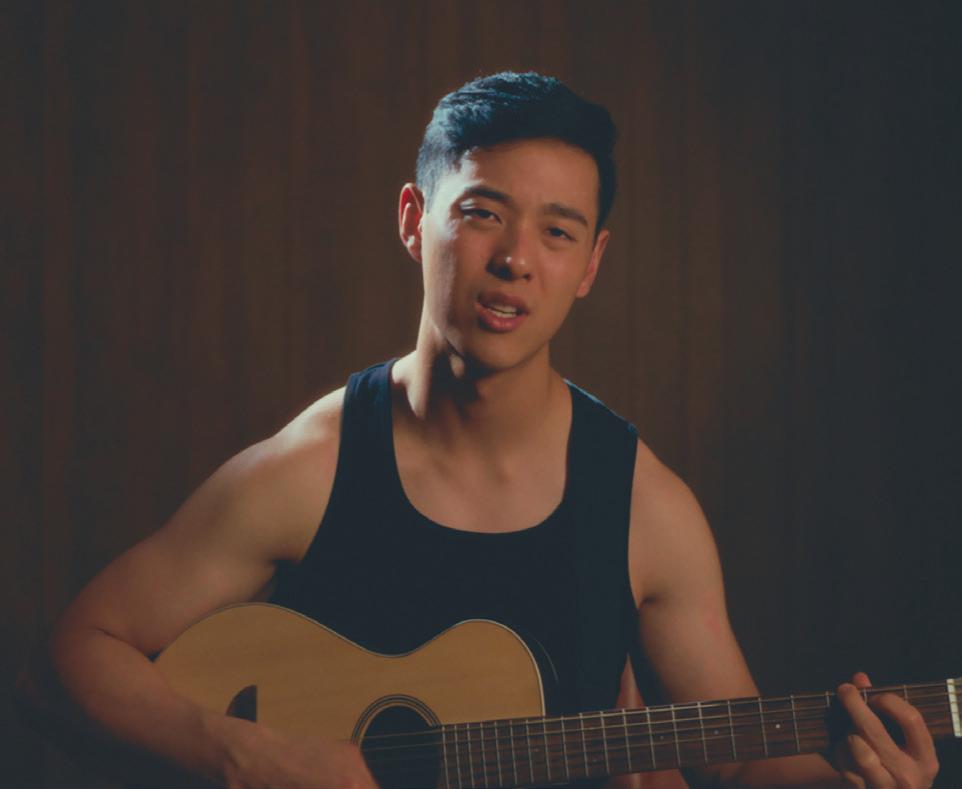
Melissa Moon is a sophomore in the College of Arts and Sciences. She can be reached at mmoon@cornellsun.com.
PAULINA DELGADO-UMPIERRE ARTS & CULTURE WRITER
Paulina Delgado-Umpierre is a sophomore in the College of Arts and Sciences. She can be reached at pmd99@cornell.edu.
COURTESY OF UNIVERSAL PICTURES
COURTESY OF ERIC NGUYEN
MELISSA MOON ASSISTANT ARTS & CULTURE EDITOR
A Sunday With Symphony Orchestra and Jazz Band
By HAZEL TJADEN Arts and Culture Writer
It will be a juggernaut of a concert.
With around 100 student musicians set to decorate the stage of Bailey Hall, the Cornell Symphony Orchestra and Jazz Band are “banding” together this Sunday, Dec. 7 at 3 p.m. for a performance bridging a motley of musical genres. The concert will brazenly explore the sounds of classical, contemporary, rock and jazz music over the course of five compositions performed by the two groups. Guest violist Kimberly Sparr will also join as a soloist alongside the Cornell Symphony Orchestra in D.J. Sparr’s “Extended Play Viola Concerto.”
In a boisterous classical style, the orchestra will open the concert with Antonín Dvo ák’s “Carnival” Overture, the second in a series of three nature-themed overtures written by the Czech composer in the 1890s under the original collective title, Nature, Life and Love . According to the Boston Symphony Orchestra’s digital program notes, the piece “represents humankind’s capacity for joy and celebration.” There’s no better way to ring in the holiday season than with Dvo ák’s bursting and jovial cheer. In fact, Cornell Symphony
Orchestra’s conductor, Gabriela Gómez Estévez, shared that one of the underlying themes of the concert is celebration.
That and electric guitar-inspired music. Following this classical celebration is an orchestral celebration of classic rock. Composer and electric guitar soloist D.J. Sparr’s “Extended Play Viola Concerto” is a contemporary piece that pushes the boundaries of orchestral music with rock influences that manifest in unique technical instructions and musical motifs. Instead of using the traditional “movement” organization form, Sparr even separates his piece into “tracks” — as is characteristic of a true EP — blurring the line between two genres of music that are too often deemed completely disparate. Sunday’s performance is especially exciting since it will serve as the collegiate premiere of the composition, completed with violist Kimberly Sparr’s role as a visiting soloist.
As a cellist in the Cornell Symphony Orchestra, my personal anticipation for the premiere is high. So far, the orchestra has rehearsed Sparr’s viola concerto with an imaginative ear; we haven’t yet played alongside Kimberly Sparr, so we have been mentally filling in the solo part where we can. This situation is standard — that a soloist and an ensemble
do not join together until concert week, often in a dress rehearsal or two. Not only does this amplify each member’s excitement to hear the piece in full, but it also tasks the orchestra with becoming a truly cohesive ensemble. As long as we know how we individually coincide with the whole, we can establish a joint responsiveness to support and fit into the solo. In our final rehearsals, the last piece of the puzzle will be placed. How exciting it will be to step away from our parts and completely experience the work!
Yet another piece fueled by the expressive sounds of electric guitar follows Sparr’s premiere; the jazz band will perform Jimi Hendrix’s “Up From the Skies,” arranged by Jim McNeely. A masterful creative mind in music during the ’60s, Hendrix was known for his experimental and avant-garde use of the electric guitar. This jazz arrangement pays homage to the musical force, also embracing the theme of genre-blending during this concert.
The peak of genre-blending will culminate at the end of the concert, when the orchestra and jazz band take the stage together for a call-and-response performance of Tchaikovsky’s renowned The Nutcracker Suite . Movement by movement, the two groups will play select works from the bal-
let. First, the orchestra plays the classical version of a movement. In response, the jazz band performs the same movement from the Duke Ellington jazz arrangement. In real time before the audience, the classical and jazz groups will engage in a diverse musical conversation. They’ll highlight the contrast between genres while simultaneously savoring their similarities. Both the jazz band and the orchestra will unite in a holiday celebration with this beloved composition.
Six weeks of rehearsals, practice and musical immersion from two different groups are on display this Sunday, highlighting the collaborative mission of Cornell’s music department. A concert like this, which mixes genres, instrumentation and subverts supposed musical norms is key to exposing student musicians and listeners to a wider range of sonic landscapes.
So stop by for a joyful, experimental, genre-bending performance this Sunday! How could you possibly miss out on a two-forone Nutcracker performance as we usher in the holiday season? And, did I mention it’s free?
Hazel Tjaden is a sophomore in the College of Arts and Sciences. She can be reached at hlt43@cornell. edu.
A New Yorker Embraces Te ‘Valley Daze’
fighting to live in proximity with people who don’t always have to.
By ERIC HAN Associate Editor
I used to argue with Genu Lee ’25 about where we should take our creative ambitions — my hometown of New York or his of Los Angeles. “You’ll get it,” we would say to each other. After all, I’m privy to a special experiential understanding of my city, one that Genu would share only if he felt it for himself. How strange, that a New Yorker would so desperately hope to induce a transplant.
When Genu wants to talk about Valley Daze, a television pilot he produced with Alessia Cruci and David Dastmalchian, he puts it in terms that I’ll understand. Sure, transplants and tourists like the opulence of Manhattan, but “the people that really move New York live in Queens. The people that really make change, the regular, real people of LA … live in the [San Fernando] Valley.”
Valley Daze hopes to be a series based on real (or rumored) coming-of-age stories from Valley locals. Its creators, Genu and Jocelyn Catt, cite Valley “folklore” and their own high school memories, like the time someone they knew was offered $10,000 to impregnate somebody. The pilot episode, directed by Marco Bizio, follows a vape’s journey between hands of varying socioeconomic and cultural backgrounds — the “rich kids and the poor kids,” the “drug addicts and the straight-edges.” The Valley’s social contradictions disclose themselves in the narration of an often tragic but still beautiful ethic of
Growing up in the Valley, Genu remembers hearing all about the movies that were being made in nearby Hollywood. “But none of us [Valley kids] are connected to it. Like, my parents are small business owners that teach kids how to code.” He mentions his childhood friends, mostly people of color, who relied on food banks while their most affluent neighbors would become celebrities. At least they found solace together: “We can’t break into this industry that’s literally, like, 10 miles away, but we’re going to stick together and make movies.”
The Valley-born creators of Valley Daze went all over town to fund the pilot. A struggle that at least caught the attention of Hollywood underdog David Dastmalchian, an actor you may recognize from The Dark Knight or Prisoners , concluded in the most fitting way I can imagine — by a grassroots fundraising campaign.
“Everybody in the Valley pulled through,” Genu tells me. Valley creatives of all ages “wanted to be a part of this thing, … and we were able to to reach our goal. Everyone on the cast are all actors that grew up here, that went to NYU and Carnegie Mellon, ... but came back to act in this thing. The director, the cinematographer, everyone from the lighting guys to costume designers, everybody in this film is from the Valley, and I think that’s really important to us.”
Valley Daze may have its roots and audience in the Valley, but Genu credits his Cornell experience with imparting expertise
that came in handy for producing. He thanks Prof. Christopher Byrne, communication, for encouraging him to pitch the script around the industry. Prof. Byrne’s course Writing and Producing the Narrative for Digital Media gave Genu the chance to work through all of the anxieties of making his first project.
“Making your first thing, it’s so nerve-racking. [Prof. Byrne’s] class really encouraged me to do that but I took that extra step to … ask questions about pitching, story structure, everything.”
Thanks to his work on Valley Daze, Genu got to produce even more projects during his time at Cornell. “People just started calling me around town, like, ‘Can you produce this movie? Can you produce my music video?’ … I would produce things that were shooting in LA and I built that resume, and I built that portfolio, and now I’m back in town, and I just get to do this full-time, which is such a blessing. And now I’m doing feature films, and I’m doing, you know, union sets, and it’s been really, really cool.”
I may still have my apprehensions about LA, but Genu and his Valley Daze colleagues paint a prettier picture than I imagined. Just like in my own city, where working class creatives starve in plain view of a robust entertainment industry, the fight for artistic uplift continues. The Valley Daze pilot is set to premiere on Dec. 13 at the Million Dollar Theater in Los Angeles.
Eric Han is a senior in the College of Arts and Sciences. He can be reached at ehan@cornellsun.com.
Men’s Hockey Falls to Boston at MSG
Cornell took its first Red Hot Hockey loss since 2013
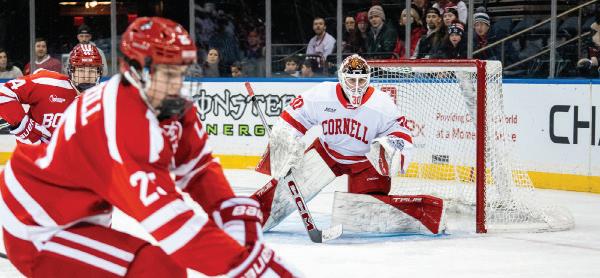
By JANE McNALLY Sun Senior Editor
NEW YORK, N.Y. — Cole Eiserman celebrated dramatically, dropping down on one knee and raising his arms in the air as he gave BU the 2-1 lead at 14:36 of the third period.
Freshman goaltender Alexis Cournoyer hadn’t even realized the puck went in.
Eiserman — a prolific offensive talent bound for the NHL in a couple years’ time, if not sooner — saw his shot eke through the five-hole of Cournoyer, who had shown few growing pains in his first seven collegiate games.
“[Cournoyer] has played eight games — that’s the first one I bet he wants back. I’ll be perfectly honest with you,” said head coach Casey Jones ’90. “I’m sure he wants that second [goal] back. That’s the game.”
On Saturday, the lights were bright. Maybe the brightest that Cournoyer — and the rest of his 12-member freshman class — had played under to date.
Eiserman — a New York Islanders draft pick who will likely play in Madison Square Garden dozens of times more in his career — noted this as a stage he thrives on. As a top NHL prospect pick, that is expected of him.
“I love these big games. Love the big lights,” Eiserman said. “When you’re in these big games, the sticks get tight, and I kind of want to loosen the other guys’ sticks up for them.”
On the other hand, freshman forward Reegan Hiscock was adamant about the nerves he felt heading into a game at ‘the World’s Most Famous Arena.’
“Obviously, this is an incredible atmosphere to play, and something I’m not really used to,” Hiscock said. “The first bit was definitely jitters and stuff, but I found I settled in pretty well.”
No. 17 men’s hockey (6-3-0, 5-1-0 ECAC) played well in its 2-1 loss to No. 19 Boston University (8-7-1, 4-4-0 Hockey East) on Saturday. The Red outshot BU 29-17. After surrendering an early power-play goal, the penalty kill largely kept the Terriers at bay.
But an all-time, 28-save game from Terrier goaltender Mikhail Yegorov and reliable defending from BU — something it had not done much of all year — suffocated the Red in front of its largest Red Hot Hockey crowd since 2013.
And much like 2013, the outcome would be a Cornell loss.
“[It was] a little bit of a lack of composure,” said junior forward Ryan Walsh. “We had the opportunities and came up short in a game where we lost the special teams battle, which is never good, and it would have been nice for the power play to find the back of the net to tie the game.”
The game was unlike any other BU had won all season — recent ups and downs have tossed the Terriers around
over to first-rounder Eiserman resulted in the puck perfectly deflecting off of second-rounder Kamil Bednarik’s stick past Cournoyer to open the scoring.
Hiscock’s goal was one of the few bright spots of Saturday’s game. It was an example of making the extra pass, being patient and seeing results — a culmination of silky passes landed the puck on Walsh’s stick.
Instead of shooting the puck, Walsh made the extra pass to Hiscock — and he made no mistakes, burying it on the open net after Yegorov came far out of his crease to defend Walsh.
Cornell’s gameplan wasn’t to shut down BU’s top players with big brooding hits or skillful poke checks — it was to make sure they didn’t have the puck in the first place.
“[It was] a little bit of a lack of composure. We had the opportunities and came up short... . It would have been nice for the power play to find the back of the net to tie the game.”
Ryan Walsh ’27
in the national polls, at one point ranking atop the nation at No. 1 per USCHO.com. But the No. 19 Terriers, struggling to beat ranked squads (BU was 2-7 against USCHO ranked opponents entering Saturday’s game), produced perhaps its most stingy defensive performance to date.
“When you get good players, you just want to make them defend,” Jones said. “With a skilled team like that, I think they’re averaging 31, 32 shots a game, if I’m not mistaken. We gave them 17.”
Both teams are young — BU has the youngest team on average in the country at 19.9 years, with Cornell trailing it at 21.2. But the Terriers, loaded with starpower and NHL talent (19 drafted players in all), held on for a mature win.
BU got on the board on a power-play goal in the first period. Aided by a five-man group of NHL-drafted players, a passing play beginning with third-rounder Gavin McCarthy, then
BU’s top line of Ryder Ritchie, Brandon Svoboda and Eiserman combined for four shots on goal. All were by Eiserman. BU’s other game-changing player, defenseman Cole Hutson (a second-round NHL draft pick), had five.
In all, Eiserman and Hutson combined for nine shots on net. All the other BU skaters combined for eight.
“When you get a really skilled team like that, sometimes their players don’t always like to play without the puck,” Jones said. “And that was our game plan.”
Another aspect of Cornell’s gameplan that was not executed came at a costly time — early in the third period, BU forced a turnover and created a chance in transition, an area it identified BU flourishing in. Eiserman collected the puck and simply threw it on net — but Cournoyer was fooled, and the puck trickled through his legs.
BU came out with fire in the third
period. Eiserman’s goal was a big-game moment from a big-game player.
“You have to be comfortable playing in games like that. You have to be — because later on, in more important games, you have to be able to be comfortable in the third period, tie game in a hostile environment,” Pandolfo said. “I think it was close to 18,000 people there tonight. So just knowing that you can play that way in a game like this is going to help our team.”
Cornell had its chances — plenty of them. It got three power plays in the third period, including a six-on-four chance in the waning minutes.
But on that two-man advantage, passes weren’t connecting. Pucks weren’t kept in the zone. Junior defenseman Hoyt Stanley rang the iron in the opening moments, but Cornell could not muster up anything more than that.
“We could have settled that down. We could have just settled it down, and got over, not rushed. We seemed rushed at the time. We had plenty of time to take advantage of that,” Jones said.
Three strong clears by BU, and a Cornell icing to cap it off, allowed the Terriers to claim its first KelleyHarkness Cup in over 10 years.
“And I give [BU] credit. They pressured, they didn’t give us too much time to set up,” Jones said. “But for me … I wanted a little bit more composure to just settle it down, take an extra second. Let’s get set. And we didn’t have to rush. Didn’t have to rush anything there.”
For BU and its 19 NHL draft picks, it found a way to win a tight game. For Cornell, it lamented at not burying the chances it got.
“[We] probably need a little bit more poise down the stretch to make that one extra play, show a little bit of composure and all that, and we were pressed a little bit,” Jones said. “But I thought they got a couple breaks in their goals, and it ends up being a 2-1 loss.”
Jane McNally can be reached at
Only takes one | Freshman goaltender Alexis Cournoyer made 15 saves on 17 shots in the 2-1 loss after allowing just nine goals over his first seven games.