INDEPENDENT SINCE 1880
The Corne¬ Daily Sun Vol. 134, No. 28
TUESDAY, OCTOBER 24, 2017 ! ITHACA, NEW YORK
16 Pages – Free
News
Science
Sports
Weather
Expanding Escapes
Microscopic Examination
Number One
Scattered Showers HIGH: 67º LOW: 42º
Even though they just opened a year ago, co-owners of Escape Ithaca are expanding their location. | Page 3
With her game-winning goal over the weekend, Mayers ’18 became the program’s all-time leading scorer. | Page 16
How do you improve technology that won the Nobel Prize? | Page 8
Anti-Semitic Posters Appear on Campus Buildings, Ezra Cornell Statue
Pollack:‘We will not allow this incident to deter us from our ongoing work’
it “appears that the fliers’ supposed sponsoring organization does not exist.” But, she said, “the fact remains that the fliers’ sentiAnti-Semitic posters with swastikas appeared on sev- ments are abhorrent, and I condemn them in the eral Cornell University buildings and on a statue of Ezra strongest possible terms.” The posters follow a series of incidents that have Cornell on Monday morning, imploring students to “Join the white gang” and advertising an apparent hate roiled Cornell and made students and parents concerned about the campus climate. The most serious of group that seems to be in its infancy or non-existent. “Just say no to Jewish lies!” screamed the large, black- those incidents occurred in September when a black student said he was beaten and-white posters plastered and called the N-word by a onto several University “They need to ask themselves why they group of white men. One buildings. They promoted a student was charged with “Solar Cross Society,” of chose our campus, because Cornell assault in that case. which there are no mentions reviles their message of hatred.” Later in September, stuon the internet. President Martha E. Pollack dents at a West Campus “Whoever is responsible residence hall were for these fliers is hiding “stunned” when someone under the cover of anonymity, having posted them overnight,” President Martha E. submitted the N-Word to an online poll. And in Pollack said in a statement on Monday afternoon after October, a student posted an anti-Semitic joke on a Cornell spokespeople refused to comment on the post- shared Google Doc that referenced the Holocaust. “We will not allow this incident to deter us from our ings for four hours. “Whoever they are, they need to ask themselves why ongoing work to address hatred and bigotry on our they chose our campus, because Cornell reviles their campus,” Pollack said. “Instead, we will stand strong message of hatred; we revile it as an institution, and I and stand together to ensure respect, dignity and safety know from many personal conversations that thousands for all our community members. Today, as in the past, I ask you to reach out and be especially kind to one of Cornellians deplore it individually,” Pollack said. She said all of the posters had been removed and that another.” By NICHOLAS BOGEL-BURROUGHS and ANNA DELWICHE
Sun City Editor and Sun News Editor
KATIE SIMS / SUN STAFF PHOTOGRAPHER
By ANNA DELWICHE
Dyson Students Demand Changes Before Dean Wooten at Town Hall Propose suggestions on improving diversity By MEREDITH LIU Sun Staff Writer
Dyson School students demanded institutional changes to address the ever-growing pre-professional culture among students and the apparent lack of acknowledgement from the school regarding recent racially charged incidents.
At a town hall on Monday, students debated the implications of the University’s mission of “any person, any study,” and proposed suggestions on improving diversity and inclusion at Cornell. The event — hosted by Dean of the Dyson School Lynn Wooten and See DYSON page 5
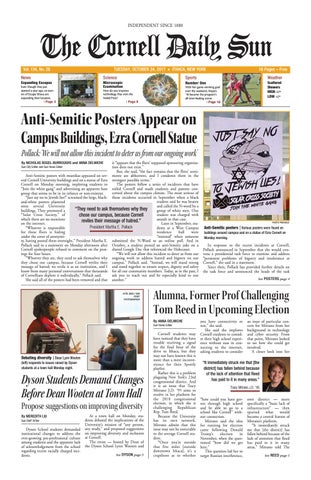
Anti-Semitic posters | Various posters were found on buildings around campus and on a statue of Ezra Cornell on Monday morning.
In response to the recent incidents at Cornell, Pollack announced in September that she would convene a presidential task force to examine and address “persistent problems of bigotry and intolerance at Cornell,” she said in a statement. Since then, Pollack has provided further details on the task force and announced the heads of the task See POSTERS page 4
Alumna, Former Prof Challenging Tom Reed in Upcoming Election Sun News Editor
Debating diversity | Dean Lynn Wooten (left) responds to issues raised by Dyson students at a town hall Monday night.
PHOTO PROVIDED
Cornell students may have noticed that they have trouble receiving a signal for the final hour of the drive to Ithaca, but they may not have known this is more than a mere inconvenience for their Spotify playlist. Rather this is a problem plaguing New York’s 23rd congressional district. And it is an issue that Tracy Mitrano J.D. ’95 aims to resolve in her platform for the 2018 congressional election, in which she is challenging Republican Rep. Tom Reed. Because the University has its own network, Mitrano admits that this issue may not be noticeable to the average Cornell student. “Once you’re outside that five miles [outside downtown Ithaca], it’s a crapshoot as to whether
you have connectivity or not,” she said. She said she implores Cornell students to consider their high school experience without ease in connecting to the internet, asking students to consider
an issue of particular concern for Mitrano from her background in technology and cyber security. From that point, Mitrano looked to see how she could get involved. A closer look into her
“It immediately struck me that [the district] has fallen behind because of the lack of attention that Reed has paid to it in many areas.” Tracy Mitrano J.D. ’95
“how could you have gotten through high school and be able to go to a school like Cornell” without connection. Mitrano said the idea for running for election came following Donald Trump’s election in November, when she questioned “how did we get here.” This question led her to target Russian interference,
own district — more specifically a “basic lack of infrastructure” — then spurred what would become a central feature of Mitrano’s platform. “It immediately struck me that [the district] has fallen behind because of the lack of attention that Reed has paid to it in many areas,” Mitrano told The See REED page 5
2 THE CORNELL DAILY SUN | Tuesday, October 24, 2017
Daybook
DAYBOOK
Tuesday, October 24, 2017
A LISTING OF FREE CAMPUS EVENTS Tomorrow Evidence of Hot-Hand Behavior in Sports and Medicine 1:15 p.m., 102 Mann Library Communication Colloquium Series: Online Communities for Health Communication - A French Perspective 1:30 - 2:45 p.m., 458 Mann Library Future of Farming and Food: Internet of Things, Block Chain and other disrupting Technologies 2:30 - 3:30 p.m., 400 Riley-Robb Hall COURTESY OF NOSTALGIA FOR THE FUTURE
Nostalgia for the Future | Directors Avijit Mukul Kishore and Rohan Shivkumar will present their film on “Indian modernity, the making of the citizen and the architecture of the home” in person tonight at Willard Straight Theatre.
Today Public and Private Management of Infrastructure Risk 4:15 p.m., G71 Martha Van Rensselaer Hall
The Everyday Politics of Dispossession: Land, Resources and Rights Cases from Indonesia, Bolivia, Peru and Mozambique 4:30 p.m., Gueralc Room, A.D. White House
How We Got to Open Access: An Activist’s Tale 4:30 p.m., Stern Seminar Room 160, Mann Library
Original Music Composition: The Odyssey 5 p.m., G70 Klarman Hall
Barry Strauss: Populism Through the Ages - A Challenge for Democracy 4:30 p.m., Lewis Auditorium, Goldwin Smith Hall Documentary Theatrics: I Am My Own Wife’s Archival Deceptions 4:30 - 5:30 p.m., 2B Kroch Library Global Voices in Education: Student Mobility, Cultural Exchange and Neoliberal Education 4:30 - 6 p.m., 143 Plant Science Building
Migration of Images: Panel by Saloni Mathur and Avinoam Shalem 4:30 p.m., 401 Physical Science Building
Film Screening: Nostalgia for the Future 7:15 - 8:09 p.m., Willard Straight Theatre
Outside the border(s): Art and the Political Imagination 5 p.m., 132 Goldwin Smith Hall
Braving Boundaries: Sexual Democracy, Migration and Kinship at Paris’s Gare du Nord 4:30 - 6 p.m., Romance Studies Lounge, Klarman Hall
C.U. Music: Guest Guitarist Tashi Dorji 8 p.m., Loft, Carriage House Cafe
Cornell Media Studies: The World According to Sound 7 p.m., Rhodes-Rawlings Auditorium, Klarman Hall
The Corne¬ Daily Sun INDEPENDENT SINCE 1880
Editor in Chief
Sophia Deng ’19
ALL DEPARTMENTS
Business Manager
Dahlia Wilson ’19
(607) 273-3606
Business: For questions regarding advertising, classifieds, subscriptions or delivery problems, please call from 9 a.m. to 5 p.m., Monday-Friday. News: To report breaking news or story ideas, please call after 5 p.m., Sunday-Thursday.
SEND A FAX VISIT THE OFFICE THE SUN ONLINE E-MAIL
(607) 273-0746 139 W. State Street, Ithaca, N.Y. www.cornellsun.com sunmailbox@cornellsun.com
Postal Information: The Cornell Daily Sun (USPS 132680 ISSN 1095-8169) is published by THE CORNELL DAILY SUN, a New York corporation, 139 W. State St., Ithaca, N.Y. 14850. The Sun is published Monday, Tuesday and Thursday during the academic year, and every weekday online. Four special issues — one for Cornell Days in April, one for seniors in May, one for alumni in June and one for incoming freshmen in July — make for a total of 90 print issues per year. Subscriptions are: $84.00 for fall term, $86.00 for spring term and $170.00 for both terms if paid in advance. Standard postage paid at Ithaca, New York. Postmaster: Send address changes to The Cornell Daily Sun, 139 W. State St., Ithaca, N.Y. 14850.
THE CORNELL DAILY SUN | Tuesday, October 24, 2017 3
NEWS
C.U. Enters New Stage of Housing Plan, Announces 2,000 More Beds
By SHRUTI JUNEJA Sun Staff Writer
Cornell’s commitment to tackle the lack of student housing now comes with a concrete vision. The University announced that is in the “early conceptual design phase” of sophomore village on North Campus. The project, which is part of Vice President for Student and Campus Life Ryan Lombardi’s multi-year Housing Master Plan, will guarantee on-campus housing to all freshmen, sophomores and transfer students. The renovations on North Campus should be completed by 2021 and will feature the addition of 2,000 new beds, the creation of a new dining facility and possibly the inclusion of new outdoor recreation fields. Cornell Media Relations declined The Sun an interview regarding specific details of the proposal. At the Joint Annual Meeting and State of the University Address on Friday, Cornell Board of Trustees Chairman Robert Harrison ’76 acknowledged that the motivations behind this plan were the problems of a housing shortage on-campus and “poor housing conditions” off-campus. Cornell has the capacity to house less than half of its undergraduates and just 10 percent of its graduate and professional students, according to the Housing Master Plan Overview. For undergraduates, this has meant that there is a competitive lottery system that “that creates intense anxiety” for first and second year students looking for options on-campus. For off-campus options, students are faced with “upward pressure on rents in
Collegetown without a corresponding increase in the quality of housing,” according to the Housing Master Plan. In addition to alleviating the housing shortage for current students, the North Campus expansion will lead to an increase in new student enrollment by up to 1,100 over the course of four years. In her State of the University address, President Martha E. Pollack said that this increase in enrollment will provide a “richer extracurricular environment” and enable Cornell to “keep up with the incredible demand in some of our programs.” Provost Michael Kotlikoff also argued that increasing enrollment will enrich the student experience. He added that “the new housing will also coincide with curricular initiatives seeking to enhance educational innovation and the student experience, particularly in our larger, gateway courses.” Lombardi said that because Cornell is one of a few Ivy League institutions not located in a major metropolitan environment, it provides students with a unique sense of community. “That, in turn, helps students new to campus develop a broad support network, of which the residential experience is foundational,” he said. “The expansion project will build upon our strong legacy in this area by expanding these opportunities for many more students than we are able to accommodate today.” Furthermore, by providing more on-campus living opportunities, the initiative should also reduce tension for finding off-campus housing in Collegetown. Harrison referred to Collegetown as an “important gateway to the campus, but one that simply does not live up to its prominent position or potential,” and
described initiatives to ensure well-maintained housing and student safety in off-campus housing. In this vein, the University is working with the City of Ithaca to create an online “safety-rating” database for all properties, regardless of whether or not they advertise on Cornell’s “Off-Campus Living” website. “Our not-so-subtle goal here is to apply market pressure on those landlords who — while meeting minimum fire and safety codes — can and should do more
“The expansion project will build upon our strong legacy by expanding these opportunies.” Chair of Board of Trustees Robert Harrison ’76 to make their properties as safe as possible for their tenants — our students,” Harrison said. In the long run, Harrison said that the University is working with the City of Ithaca and with local real estate developers to spur development in Collegetown’s infrastructure, attract retail activities and improve the appearance of the area. “As a Cornell parent whose oldest daughter spent her senior year living in a ‘questionable’ address, and whose youngest daughter may need to consider it also in Collegetown, I am personally thrilled that President Pollack and her team are giving much-needed attention to conditions there,” Harrison said. Shruti Juneja can be reached at sjuneja@cornellsun.com.
Hurricane Relief Fundraisers Aim to ‘Challenge Ignorance’ By YUICHIRO KAKUTANI
Mexico, its a different country so it’s like ‘oh it’s a different country so they can deal with their own stuff.’” Cornell’s bureaucracy also presentPennies and “Mi Gente” may not be the entire solution for relief efforts ed a significant obstacle for the orgafor Mexico and Puerto Rico, but at nization of the Penny Wars fundraiser, Herrera said. Cornell they may be a start. “Cornell’s approval is a big [issue]. To fundraise for relief efforts to people affected by the Hurricanes I got like 20 different emails saying Maria and Katia in Mexico and your project has been approved, but Puerto Rico, several student organiza- when I check the site for events it says tions are co-hosting a Penny Wars ‘status pending, status pending,’ and Fundraiser Competition — a compe- still more approvals were needed,” tition between organizations in which Herrera said. “It’s literally just putting coins in a individuals can add bills or change to containers that will either grant or jug … and it still took a very long time,” she said. deduct points from O n i n t z e other organizations “I can’t count the number Contreras ’19, oper— and a Mi Gente Remix party — a of times I have been asked ations chair of ticketed event at ‘do I need a passport to go MeCHa de Cornell, also noted that The Nines. to Puetro Rico.” Cornell’s bureauDespite activism cratic nature made it by certain student Chris Arce ’19 difficult for students organizations on to find a location for campus, Chris Arce ’19, co-president of the Puerto Rican the Mi Gente Remix party. “If the school were to provide us Student Association, remains concerned that the majority of the stu- with the resources we wouldn’t need dent body remains unaware of the to have a party outside, but because situations in Puerto Rico and of how funding works and the steps necessary to access those resources Mexico. “I think at Cornell, when students are so long, we just don’t have the are aware of what's going on they time to go through that,” Contreras care, but a lot of them really don’t,” said. Arce said that while previous Arce said. “I can’t count the number of times I have been asked ‘do I need fundraising campaigns held last a passport to go to Puerto Rico,’ or month were successful, there is still a great need for additional donations, ‘are you guys U.S. citizens.’” “I want to challenge this wide- which is what prompted the upcomspread ignorance at Cornell,” he ing fundraisers. “We wanted to do another added. Like Arce, Adriana Herrera ’20, fundraiser because while we raised chair of Movimiento Estudiantil several thousand dollars here and in a Chicano de Aztlán de Cornell, is also larger group raised a lot more, that’ s concerned that there is a particular only going to make a dent in the limited awareness of the disaster’s impact [the disaster] had on Puerto Rico,” he said. impact in Mexico on campus. The money raised by the Penny “[The Hurricane disaster] happened a month ago, and I am not sure Wars competition will be split equally if people outside the Hispanic community know,” Herrera said. “For See FUNDRAISER page 4
Sun Staff Writer
CORINNE KENWOOD / SUN STAFF PHOTOGRAPHER
Expanding escape | Despite being open for only a year, Escape Ithaca plans to expand and move across the street from its original location, co-owner Ray Weaver said.
Ithaca’s Escape Room Expands
After opening a year ago, owners to move across street By STACEY BLANSKY
Sun Staff Writer
While students from big cities may be well acquainted with the idea of escape rooms, Escape Ithaca has brought the critical-thinking and teambuilding phenomenon to downtown Ithaca. And as of recent, this phenomenon is expanding. Ray Weaver, co-owner of Escape Ithaca, explained that the company opened about a year ago in a building located above the State Theatre of Ithaca and recently moved its establishment across the street in order to expand. Escape Ithaca can now hold up to 20 people who can compete against each other simultaneously. The recent expansion of local businesses in Ithaca has proven that, despite being a small town, it can still be a good location for entrepreneurs. In fact within the past months, there have been several expansions in the Downtown Ithaca area
— with Hotel Ithaca opening 90 new rooms, making it the largest hotel in the Commons, and Comics for Collectors relocating to a new establishment, doubling its current size. However, Escape Ithaca has seen the most dramatic change in just a single year. Escape Ithaca is an interactive entertainment puzzle room that challenges teams of two to 10 people to use their problem-solving skills, according to its website. The goal is to find combinations, solve riddles and open locks that will enable the team to escape a room within a 60-minute period. “We kept hearing from customers that they wanted to bring in more people and they wanted to be able to compete with a group of friends,” Weaver told The Sun. “We just didn’t have the space to accommodate that in our old location. We See ESCAPE page 5
4 THE CORNELL DAILY SUN | Tuesday, October 24, 2017
NEWS
International Court of Justice Judge Presents at Cornell
CAMERON POLLACK / SUN PHOTOGRAPHY EDITOR
International Court | Judge Abdulqawi Yusuf from the International Court of Justice presents at Cornell on Monday night.
By AMOL RAJESH
These arbitration proceedings can bring about an economic burden for the host country. The international economy often pro“In addition to paying for counsel, tects the interests of corporations at the arbitrators, these states have to also pay for expense of the states themselves, argued a delegation to travel around the world to Judge Abdulqawi Yusuf at a lecture present its case,” he said. “This creates a Monday night. significant financial burden, particularly Yusuf, who serves as the vice president on the least developed countries which and judge of the International Court of cannot afford such an expenditure.” Justice — the main body responsible for However, Yusuf said, there are wide adjudicating international disputes in the disparities in BITs with regards to develUnited Nations — in The Hague, oping countries. Although 37 percent of Netherlands, detailed the pitfalls in bal- the world’s total flow of foreign investancing the interests between multina- ment goes toward developing countries, tional corporations and sovereign states. these account for 86 Considering that percent of the total foreign direct invest“This creates a signifi- BITs, he said. ment to developing To explain this discant financial burden, countries inflows parity, Yusuf said that totaled to $656 billion particularly on the least BITs were devised out in 2016 alone, Yusuf of a lack of trust of the developed countries.” said, the relationship court systems of develbetween the corporaoping countries. Abdulqawi Yusuf tions and states When formulating remains at the forefront these trade agreements, for U.N. leaders. developing countries can find themselves Due to the large volume of money unable to successfully negotiate due to flow, certain agreements, known as lack of trained personnel. Bilateral Investment Treaties, set the “Most developing countries and parrules for private investment from one ticularly least developed countries do not country to another. have trained investment lawyers or peoBilateral Investment Treaties, agree- ple who are skilled in the formulation of ments between capital exporting coun- legal standards in BITs,” Yusuf said. tries and host countries, often have clausYusuf also argued that developing es which stipulate that any disagreements countries are also disadvantaged when over enforcement of the treaty must go disagreements arise over the enforcement through international arbitral tribunals of the treaty. rather than local courts. “Most of the time developing coun-
Sun Staff Writer
tries do not appoint experienced arbitrators from their country to the arbitral tribunals,” he said. “As a result, perspectives from those countries are not brought to bear on the decision-making process.” This causes the arbitration process to favor the rights of investors over the interests of developing countries. Yusuf argued that it is in the long-term interest of government and corporate parties to ensure that a fair arbitration process is conducted. “If the arbitral tribunals overextend their hand and interpret the treaties in a way which is unbalanced towards countries, then there will be a backlash,” he said. “Therefore, it is in the interest of
everyone that such an overreach should not occur.” In ensuring that developing countries’ rights are advocated for, Yusuf said there needs to be proper training. “Developing states need to have skills development and negotiators who can negotiate better terms and conditions with the capital exporting countries,” he said. “They also need to have lawyers who insist on defining a term when they do not understand it and people who can participate in the arbitral tribunals themselves.” Amol Rajesh can be reached at arajesh@cornellsun.com.
Pollack Responds After Anti-Semitic Posters Appear Across Campus Similar incidents occurred at U.M. when Pollack was provost POSTERS
September, October and Students. The group released an open November that year. As a response to the series letter to the Cornell communiforce’s three committees. In ty and said they were planning of incidents the university terms of selecting the members on releasing a set of the task force, Pollack said of demands and “We revile [their act] as an instituthat the Scheinman Institute on hosting a march. Conflict Resolution in ILR will However the tion, and I know from many personal “engage with campus stakehold- group did not conversations that thousands of ers and recommend to me an seem to do appropriate and balanced task either, and its Cornellians deplore it individually.” force composition.” Facebook page President Martha E. Pollack Pollack said that a final has not been report of findings will be updated since released on May 1. March 30, 2016. Following Pollack’s stateAt the time, Pollack served as issued a statement to students ment, Rabbi Ari Weiss, director provost and executive vice presi- to “speak out against the of Cornell Hillel, posted a state- dent for academic affairs at behaviors.” Pollack’s signature ment on Cornell Hillel’s University of Michigan during a is listed as second on this stateFacebook page, issued to stu- time when the campus faced a ment. dent, alumni, parNotably, the ents and communiNovember statement was ty members, notify- “Whoever is responsible for these fliers clear that the administraing that the inci- is hiding under the cover of anonymity, tion [did] “not seek to dent was reported suppress political speech having posted them overnight.” to CUPD and that or ongoing debate of key the group will conissues,” but that they President Martha E. Pollack tinue to work “to were asking “everyone to make sure all Jewish reject hate and bigotry students feel safe and welcome series of hateful attacks. and to provide personal supon our campus and that inciIn 2016, posters promoting port,” the statement read. dents like this do not happen white supremacy from an Altagain.” Right website were found Over 18 months ago in around the Michigan campus. Nicholas Bogel-Burroughs can be March 2016, a group claiming Anti-Black, anti-LGBTQ and reached at nbogel-burroughs@corto be made up of Cornell stu- anti-Muslim posters were found nellsun.com. Anna Delwiche can dents started a Facebook page around campus throughout fall, be reached at called Union of White Cornell with incidents occurring in adelwiche@cornellsun.com. Continued from page 1
DENNIS M. RIVERA PICHARDO / THE NEW YORK TIMES
Damming destruction | People stand on the remnants of a bridge that spanned across a river in Puerto Rico, washed out by Hurricane Maria.
Orgs Fundraise for Relief FUNDRAISER
Continued from page 3
between Mexican and Puerto Rican relief efforts. Money delegated to Puerto Rican victims will go to local NGOs rather than government-led relief efforts. Donations from the Mi Gente Remix party will go toward global giving, “as they have a dual initiative [and] are partaking in both Puerto Rican and Mexican [relief efforts],” said Andrea Fortanel ’18, social chair of MeCHa. In response to Seth Klarman’s ’79 comments that to absolve Puerto Rico’s debt is amoral, Arce
stressed the need to prioritize humanitarian considerations over immediate economic concerns. “As much as I would love for all of Puerto Rico’s debt to be gone immediately, I recognize that will come with certain ramifications; however I reject the approach that only looks at Puerto Rico from an economic perspective,” Acre said. “I mean just last year, 184 schools were closed down to pay off debt. That’s outrageous.” Yuichiro Kakutani can be reached at ykakutani@cornellsun.com.
THE CORNELL DAILY SUN | Tuesday, October 24, 2017 5
NEWS
Students Debate Diversity in Dyson
News conference
DYSON
Continued from page 1
Prof. David Weeton, chief diversity officer of the SC Johnson School of Business — began with students identifying problems they have encountered at Dyson. Students pointed out the school’s scarcity of resources for Black and Hispanic students, the socioeconomic barriers to competitive business clubs and the lack of more required courses on diversity. One student said that in addition to black and hispanic students being underrepresented in Dyson, there is a lack of faculty with similar ethnic backgrounds as these students. The socioeconomic gap between students has also been recognized by several participants as the barrier that restricted their chance of joining business clubs. These clubs often require large time commitments that are somewhat impossible for students who work oncampus jobs during the week, students said. Others pointed out the career-focused culture of the Dyson school, where students “only want to succeed … and that’s all that they focus on,” said Gemma Padchonga ’20. Within this cul“Students don’t always ture, Padchonga also feel inclined to reach out said that students tend to have narrowbeyond their little area.” er social circles that are restricted by the Gemma Padchonga ’20 concentrations students pursue within the applied economics and management major. “Students don’t always feel inclined to reach out beyond their little area, that’s why inclusion comes hard,” she said. “I can see that people outside marketing exist, but I have to really put a lot of effort out there to get to know and understand them.” A solution to this issue, attendees said, could be to restructure the curriculum so students have classes that encourage teamwork and discussions with all Dyson
TOM BRENNER / THE NEW YORK TIMES
President Trump and Prime Minister Lee Hsien Loong of Singapore speak at a joint news conference in the Rose Garden of the White House.
undergraduates. This would limit the huge “sitting and listening” lectures that provide little chance of making new friends after freshman year. Attendees also called for more mentions in class of recent events on campus, such as the recent incident in Collegetown in which a black student said he was called the N-word and beat up by a group of white men, as well as discussions of these issues that are driven by instructors. One of the organizers of the forum Prof. Cindy van Es, applied economics and management, said she liked the idea of curricular restructuring, and was “pleasantly surprised to hear that students would like to have these topics mentioned in class.” Students also asked for more guidance from faculty members both on academic advising and on facilitating future conversations about diversity and inclusion.
Given the large amount of suggestions that students came up with during the forum, Padchonga anticipated that it would take a while before the administration could complete their plans. She said that regular meetings would be an efficient way for the administration to collect new ideas. “We are now throwing [out] all the emotions we felt this entire year — and it’s been a hard year,” she said. Wooten said that the next step is to share all the ideas with the faculty, students and staff, and to work on developing a timeline. The purpose of the forum was to “let the students have their voice heard,” she said, and allow them to work together to propose solutions to the Dyson School’s problems. Meredith Lui can be reached at mlui@cornellsun.com.
Escape Ithaca to Expand Former Prof to Run Against Tom Reed ESCAPE
Continued from page 3
wanted to have this larger space so we could run two games concurrently.” Weaver said that Downtown Ithaca is a good location for the business because there are a large number of college students, originally from big cities, who are already familiar with the idea of escape rooms. The next closest cities with an escape room are Syracuse and Binghamton. He added that the beyond these college students, the business is still working to inform the many Ithaca residents that have never heard of this type of operation. Escape Ithaca is currently advertising through social media, a mailing list and an e-newsletter. “Ithaca is very much a hotspot for young professionals. It is very special in that way that it can support things that other smaller communities wouldn’t necessarily be able to,” Weaver said. “I think we still have
some ways to go with educating the general community about what this business is.” For Weaver, it was rewarding to see the business progress within just a year. He and his partner both have full-time jobs apart from Escape Ithaca, and he was pleased to see his work being converted into tangible success for the company. Weaver said that he would like to expand the business to other cities in the future and thought that Utica, which is another college city two hours northeast of Ithaca, might be a good option. “We definitely see a lot of students coming down on weekends and late nights. Everyone is really wellbehaved,” Weaver said. “They’re an integral part of our business. We wouldn’t be able to be sustainable otherwise.” Stacey Blansky can be reached at sb2337@cornell.edu.
Don’t get thejoke?
There isn’t one. Read the comics.
The Corne¬ Daily Sun
trary. I didn’t do any technology 15 years ago.” “But I have these competencies in all Sun. “But the first thing that really hit me these areas, so it’s also then very easy for me was because it’s falling behind we do not to take just about any other issue and conhave connectivity to every farm, every textualize it in the political dialogue,” she continued. home, every school and every business.” On the issue of female reproductive Not having widespread and broadband connectivity within the district, she said, rights and the defunding of Planned creates a “tremendous handicap for eco- Parenthood — an issue that has gathered crowds of Ithacans and Cornellians in protest — “I believe that abortion should be legal, Mitrano’s platform differs from Reed’s policies. medically safe, available “I believe that abortion should and affordable.” be legal, medically safe, available and affordable,” she said. “And Tracy Mitrano J.D. ’95 [Reed] doesn’t believe in any of that.” Mitrano came to Cornell in 1991 as a nomic development.” Such connectivity could bring an estimated 40 percent visiting professor in the human developincrease in economic development, she said. ment department in the College of Human However, this process would usher in Ecology, with a background in American government regulations. This could be why history. After a year of teaching, Mitrano Tom Reed has been resistant, Mitrano said. attended Cornell Law School, where she She pushed back against considering this obtained her J.D. in 1995. Mitrano then taught as a professor again form of government assistance and regulain the human ecology college from 1996 to tions as a form of socialism. “It’s not socialism. It’s not a crazy 2001. In 2001, Mitrano accepted the posithought. It’s been done before. But Reed tion of director of information technology goes against all regulation, no matter what it policy, which she held until 2014. Mitrano said her background in technolis. He doesn’t think through,” she said. ogy policy gives her an edge in the political “He’s not a leader, he’s a follower.” Mitrano takes the issue of technology, world, since “technology is so much a part specifically internet connectivity, and uses it of all aspects of our lives and politics.” In all, Mitrano said she is hoping to fill as an extension for other issues in her platform. The lack of broadband was where all the role of a leader for the district, a role that she believes to be lacking with Reed in the issues came together for her. “I have a background in law, I have a office. background in social policy, I have a doctorate in American history and have taught it for years,” she said. “It’s not as if technology Anna Delwiche can be reached at is the only thing I do. In fact, to the con- adelwiche@cornellsun.com. REED
Continued from page 1
OPINION
Willow Hubsher | This is Not a Sex Column
The Corne¬ Daily Sun Independent Since 1880 135TH EDITORIAL BOARD SOPHIA DENG ’19 Editor in Chief
JOSHUA GIRSKY ’19
DAHLIA WILSON ’19
Managing Editor
Business Manager
LYDIA KIM ’18
JACOB RUBASHKIN ’19
Advertising Manager
Associate Editor
ZACHARY SILVER ’19
JULIAN OHTA ’19
Sports Editor
Web Editor
WORKING ON TODAY’S SUN DESIGN DESKERS
NEWS DESKERS
Megan Roche ’19 Julian Robison ’20 Hannah Lee ’20 Catherine Horng ’21 Greta Reis ’21 Brian LaPlaca ’18 Emma Newburger ’18 Anna Delwiche ’19
ARTS DESKER SPORTS DESKER SCIENCE DESKER PHOTO DESKER NIGHT DESKER AD LAYOUT PRODUCTION DESKERS
Katie Sims ’20 Charles Cotton ’19 Arnav Ghosh ’19 Michael Wenye Li ’20 Yuchiro Kakatuni ’19 Sophie Smith ’18 Emma Williams ’19 Brian LaPlaca ’18
Letter to the Editor
In response to‘Anti-Semitic Posters Appear at Cornell Advertising Apparently Fake Hate Group’ To the Editor: Words matter. Every choice that The Cornell Daily Sun makes, in terms of both headlines and content, has an impact that ought to be noted. We write to you to express our distress with the original headline used by The Sun for the article, “AntiSemitic Posters Appear at Cornell Advertising Apparently Fake Hate Group.” On Monday, Oct. 23, Cornell students were met with a horrifying sight: posters hung on various campus buildings that proclaimed: “Just Say No to Jewish Lies: Solar Cross Society, Join the White Gang.” These posters continue an appalling and devastating trend of hateful incidents that have occurred on our campus, including those that have specifically targeted the Jewish community at Cornell. In the broadest sense, these actions aim to isolate the groups that they target. These actions aim to make the members of the groups that they target feel uncomfortable in their identities, and unsafe on our campus. These actions must be taken seriously because they have profound negative impacts on our campus, and on each and every student at Cornell — attacks against any of us are attacks against this campus. Thus, when The Cornell Daily Sun referred to the group that committed this as “apparently fake,” we were alarmed. Flagging the group as fake seemed to diminish the reality of what happened on our campus. Even though no presence for the Solar Cross Society seems to exist, there is no verification that the group is “fake” beyond their lack of an internet presence. Moreover, insofar as the actions that those identifying as members of the Solar Cross Society took were real and terrifying for members of the Jewish community at Cornell, the Solar Cross Society must be regarded as real. Whether or not the Solar Cross Society is a recruiting organization, what is more important is what we know occurred within the past 24 hours. Individuals created and designed horrific posters, printed them and posted them with the intent to target and harm the Jewish community at Cornell. A group that is hateful, with hateful and malicious intent towards the Jewish community, has chosen to threaten the safety and security of students at Cornell. We note that words matter because we want to emphasize what we feel may have been missing in the initial article that flagged the group as “fake;” that the events that occurred this morning alongside those other atrocities that have targeted various groups at Cornell cannot merely be dismissed in a list at the end of an article. That hatred is real and rampant on Cornell’s campus right now, and that discounting that lends credence to a narrative that discounts the pain that countless individuals on our campus are currently feeling. This was an institution built on the motto of “any person, any study,” but insofar as its students continue to be targeted for their identities that motto no longer can bear weight. This should be a place of love, of learning, of compassion and of mutual understanding. When individuals do not feel that way, their ability to identify as a part of the broader Cornell community is threatened. We ask for the Cornell community to take a hard look in the mirror and ask ourselves why these obscene incidents continue to roil our campus, and think about what needs to be done to create a culture where these incidents stop being the norm. Moreover, we ask for everyone — The Sun and all others — to recognize the severity of any incident that calls into question the validity of any identity on this campus. The group that committed this action is very real, their impact is very real, and Cornell University must take very real steps in order to ensure that what has become regular occurrence, ceases. Alexandra Klein ’18, ILR Jeremy Marchuk ’19, CALS Deborah Glick ’19, CALS Haylee Schwartz ’18, Hannah Hyams ’20, ILR Human Ecology Jay Sirot ’19, ILR Brandon Cohen ’18, A&S Sloane Applebaum ’18, Human Ecology Grant Gilbert ’19 CALS Inna Grant ’19, CALS Sophie Malki ’21 CALS Nicole Sochaczevski ’20, ILR Ana Jimenez ’18 A&S Lauren Goldstein ’20, A&S Xavier Eddy ’19 ILR Rebecca Saber ’18, A&S Gabi Tepper ’19, A&S Ariel Gulchin ’19, CALS Evan Shapiro ’19, A&S Ariella Banin ’19, A&S Sara Amsalem ’18, SHA Amanda Krakauer ’19, Human Ecology Nicole Forman ’18, CALS Rachel Goldstein ’18, A&S Olivia Foster ’18 A&S Danielle Eiger ’18, A&S Deepa Saharia ’18 ILR
Me Too, Because Obviously
A
mid the wake of the Harvey Weinstein allegations, actress Alyssa Milano recently revitalized an old social media trend, asking that all the women who have been sexually assaulted or harassed in their lives write the phrase “Me too” in the effort to show the breadth and magnitude of the culture of assault we live in. For over a week now, my timelines have been flooded with friends, acquaintances, co-workers and old camp counselors posting the slogan. If this has surprised you at all, if you have been shocked by the amount of girls coming forward and saying they have been “harassed,” then you clearly have not been listening. EVERY. WOMAN. IN. AMERICA. HAS. BEEN. SEXUALLY. HARASSED. No girl makes it through life without being the victim of a lewd comment from a classmate or an uncomfortable glance from a family friend or an off putting remark by creepy
room, screaming and sobbing. She kept asking what had happened but the truth is, I didn’t really know. I was missing a sock and I was drunk and tired and upset. It never even crossed my mind to report this incident. I had gone back to this house at 2 a.m. I had enjoyed kissing him. Everything that happened after that was a blur. I didn’t know how to give my story because I didn’t know what my story was. Now, three years later, he has graduated and I’ve moved on. I rarely think about him or that night. I had seen him around campus and at parties and he always avoided eye contact. I’ve told a few friends “yeah, I had a cringy experience with him freshman year,” but until now, mostly I kept the details to myself. I’m plagued by the idea that my lack of reporting meant he could do this to someone else. The idea that my own insecurities allowed another person to
Thoughts like these force me to admit that as much as I love to call myself a feminist, I have internalized the customs of victim blaming. cab driver. Any girl who has not experienced some kind of sexual harassment is either oblivious or is a brainwashed subscriber to the “boys will be boys” philosophy. The most interesting thing to me about the “Me too” campaign is not how many girls have been harassed or assaulted, but how many people claim they were “unaware” until now. If you didn’t know, you’ve been shutting your ears to the voices of women everywhere. This is not a new concept. A few weeks ago, a friend from high school texted me. She has since graduated college and is living a real adult person life. Her roommate had plans to go on a Bumble date with a guy who had attended Cornell so she texted me to ask if I knew him and to possibly dig up any dirt. When she sent the name, my heart sank. I responded, “I don’t really know him, but I’ve heard he is kind of skeevy,” and left it at that. However, that was far from the truth. The last night of my freshman fall semester, I was sexually assaulted by him. I don’t remember all the details besides stumbling drunk through some fraternity’s halls late at night, looking for my friends to go home. He saw me and we started kissing. Admittedly, I was into it at first. He pulled me into his room and we kept fooling around and before I knew it he was on top of me. I don’t remember saying “no,” but I do remember turning my face to avoid his mouth. I remember his hands pinning my biceps to the sheetless mattress. I remember that I ran out of energy and laid there for what felt like 30 minutes but was probably two or three. Suddenly he stood up, looked around, said “this isn’t my room” and left. When I got back to my dorm that night, I called my sister from the bath-
experience this. Because I was scared and confused, maybe more people were hurt. I wish I had told my friend, “Don’t let your roommate go out with him! He is scum and I know that first hand!” But what if my memory was wrong? What if I had reported or told people and ruined this boy’s life and it was an honest mistake and he didn’t mean to step out of line? I was drunk and he was drunk and we were both stupid kids! For some reason, I found myself too scared of tarnishing this guy’s reputation on the off chance that I was remembering wrong or that he had changed. Thoughts like these force me to admit that as much as I love to call myself a feminist, I have internalized the customs of victim blaming. Ideas I would scoff at others for saying about another victim are the same patterns of thinking that I have applied to myself. That night I returned to my dorm missing my sock. The socks were from J. Crew. Navy blue knit with a white toe. Three years later, the match to that missing sock still sits in my drawer. I know for a fact that I will never find the pair but for some reason I can’t throw it out. So yes, me too. Yes, I have been harassed (news flash: everyone has). But also yes, I have been assaulted. My story is just one in hundreds of thousands of stories just like it. Sharing it will change nothing in the grand scheme. Awareness campaigns are redundant at this point, but I don’t have a solution. What I do have is a single, mateless, sock, that maybe I am ready to throw out.
Willow Hubsher is a senior in the School of Industrial and Labor Relations. She can be reached at wrh73@cornell.edu. This is Not a Sex Column appears alternate Tuesdays this semester.
THE CORNELL DAILY SUN | Tuesday, October 24, 2017 7
OPINION
Artur Gorokh & Ryan Sherman | Radically Moderate
Confessions of a Climate Change Denier
I
t was in southern Utah in 2003 that Aron Ralston amputated his own arm to escape the boulder that had crushed him against the wall of a slot canyon. The only implement on hand was a small multi-tool, and in vain he poked, jabbed and sawed at his arm, and hacked at the canyon wall and dug at the boulder. Five days later, delirious and severely dehydrated, he finally realized it had been his preoccupation with the useless tool all along that prevented him from seeing what had
distract ourselves with less unpleasant solutions and fall into the same mental trap in which Aron Ralston found himself. Let me illustrate. After the talk, a student stood up and started berating non-present Republicans for their sins and ignorance. The line between the right and wrong was demarcated by the aisle between them. Building solar panels, the student said, will replace coal, create jobs and stimulate the economy. Everyone wins.
Distracting ourselves with impotent solutions might just prove to be more dangerous in the long run than the outright detachment from reality on the right. What it engenders is a sense of fighting the good fight by creating an illusion of progress. to be done. Last week, Prof. Jon Schuldt, communication, spoke at a Cornell Amnesty International discussion about the perception of climate change in the American population. Effective communication, he explained to us, is key in raising awareness and bridging partisanship. “Doomsday” rhetoric does not help, he said, but only serves to limit action and discourage engagement. If he is right, this column will be of no help at all. The coming decades will see a world of increasing crop failure, flooding, wildfires, infrastructure failures, droughts and exacerbated inequality. This much we’ve all heard before. Much less talked of is a colossal humanitarian crisis of displaced peoples, the so-called climate refugees. Dire though all this may be, few of us have trouble falling asleep, worried for our fellow humans, or terrified of horrific calamities to come. Climate change is slow, it happens quietly in the interim and, by God, does it make for boring television. This non-urgency itself is a deathly feature. It allows us to
The student seemed to find it incomprehensible anyone would refuse to do something so straightforwardly good. This Teletubby worldview of win-win-win solutions was also the crux of President Obama's environmental policy and is a denialism of its own kind. As the former administration’s website boasts, our solar output grew 30-fold and thousands of jobs were created along the way. Impressive, to be sure, but let’s fiddle with phrasing a bit: $160 billion was spent on subsidies, and as a result solar energy now makes up for a mere 0.6 percent of total supply. This infusion of cash rendered other clean sources of energy less competitive, and even forced several nuclear power plants to shut down. The information isn’t hidden, yet no one takes much notice. The reality is that, if we are to replace coal and do it fast (say, by 2050), sunshine alone won't do the job. It won’t even come close. An invasive energy plan, full of government overreach and deals struck with devils should be forthcoming. We might have to get over
our nuclear phobia and invest into a new generation of reactors. Natural gas is not renewable nor all that clean, and fracking is controversial, but it makes for a cheap and abundant resource that could be decisive in temporarily replacing coal. Carbon tax very well may hurt the economy, but it also is a powerful incentive for corporations to reduce their emissions. (Stagnating economies also are much more environmentally friendly, by the way.) These strategies would require us to compromise our values, be they wealth, safety or even freedom, to help manage an impending crisis. Any truly effective action is likely to entail such compromise. Distracting ourselves with impotent solutions might just prove to be more dangerous in the long run than the outright detachment from reality on the right. What it engenders is a sense of fighting the good fight by creating an illusion of progress. This is evident in emerging tribal culture based in sustainable garden living, antiplastic-bag bags and dietary changes. While meritorious on one level, these are activities that don’t meet the problem in reality, and the good feelings they bring are examples the placebo effect. Aron Ralston spent days in denial before accepting what he had to do to achieve liberation from the boulder that had crushed his arm. Even when faced with the spectre of death, perhaps the truth was just too unpleasant. Severely dehydrated and delirious, he finally abandoned the useless tool and leveraged his own weight to snap the arm in two, freeing bone from boulder, and allowing himself to escape the canyon (almost) in one piece. Before he was able to do what had to be done, he had to recognize the situation for what it was. Climate does not care from which side of the aisle our political rhetoric derives. It isn’t interested in soothing communication strategies. Until our conversations describe facts, and our solutions target reality, we are all climate change deniers. Artur Gorokh is a graduate student studying applied mathematics at Cornell University. He can be reached at ag2282@cornell.edu. Radically Moderate appears alternate Tuesdays this semester. Ryan Sherman is a masters candidate in the CALS International Agriculture and Rural Development program. Radically Moderate appears alternate Tuesdays this semester.
William Wang | Willpower
The Improbable Path of a Cornell Transfer
W
hen it comes to our education timeline, we all like to think linearly and in absolute terms. We do well in high school, go to a good college, get a job or go to graduate school. We churn through our daily homework and prep for our tests; we network and interview, conscious of putting out best foot forward to secure our career interest. The slightest derailment leads to waves of anxiety — being left behind is a fear shared amongst students here. College students don’t do well when left in uncertainty. For most Cornell undergraduates, educational purgatory can be a maddeningly stressful experience. But a group of Cornell students have already gone through purgatory, and came out unscathed. Transfer students are a significant subset of the student population: Including spring transfers, Cornell accepts about 700 transfers student per year, with about half going to the College of Agriculture and Life Sciences, and a fifth going to the School of Industrial and Labor Relations. Applying as a transfer can feel a little like auditioning for a school play. If you’re not one of the guaranteed transfers at Cornell (where spend one year at another school, and if you do well, you enroll at Cornell the following year), the transfer road to Cornell can be daunting and fraught with uncertainty, filled with spending time taking required classes and maintaining a minimum GPA for transfers. Two of my high school classmates recently reached out to me about transferring to Cornell in the spring. One is currently studying at a very high-end STEM
school, working on his engineering degree; the other, at a nearby SUNY school. We’ll call them Cory and Jason, respectively. What struck me was their motivations for coming to Cornell — Cory had been left disenchanted by his school, finding he didn’t enjoy the school as much as he had hoped, and Jason had yearned to jump, in his mind, to a better school that would enhance his career prospects. Both are naturally smart, but had taken diverging paths to get here. Cory had excelled in high school, being involved in multiple clubs and holding a pristine academic record. He’d passed on an acceptance to Cornell and taken his spot at the high end STEM school. But it was Jason who had the unusual backstory. Unlike Cory, he didn’t win the awards and applause of school administrators; he was lost in a sea of struggling students. Having not done as well in high school as other students, teachers and peers alike dismissed him He didn’t enjoy that thought. From there began an arduous trek to prove something to others. In college, he clawed his way past students that achieved at a far higher level in high school, and joined clubs where he quickly shot up to hold important positions. With a new urgency, he didn’t take his education for granted. He recalled, almost bemused, telling his former guidance counselor about how well he done at college, and her response was essentially: “Really?” He liked the surprise. It was his way of knowing that the guy who had left high school was not the same guy now. For some people, things click a little later. He’d also taken the time to reach out to
me, and one day, when we hadn’t spoken in years, he sent me a quick message to see if I could host him for a visit at Cornell. I was surprised (there’s that word again), but agreed. When we met, he talked about his time away from Cornell and the journey he had
thought he could never reach. At one point, he admits just how surreal this whole situation was: “I’d never thought I’d get this far. I’d never thought I be in this position to get into an elite school like Cornell.” It’s a biting phrase, full of hope and a
He recalled, almost bemused, telling his former guidance counselor about how well he done at college, and her response was essentially: “Really?” He liked the surprise. taken to get here. Very few people would have bet on him coming this close, but here he was, talking about the application process he had completed, and the essays he had to write. His application essay ruminated on his path to Cornell, and why, after all these years, a light flickered on. What changed? He shrugged. “I just realized the importance of school to my future career.” He poured all his energy into getting into Cornell, spending hours scouring the school website to choose the school to which he would apply, and making sure he completed the transfer requirements. Even if he didn’t get in, the mere idea of Cornell had spurred him to a level he
tinge of “what if”s. So much had changed in so little time. It’s easy to gauge a person at 18 and say you can predict their life based on their accomplishments up to that point. But if extrapolation is unreliable in statistics, then it’s downright foolish to do the same for a human being. At the end of his visit, we climbed the stands overlooking Schoellkopf Field, gazing over the last remnants of homecoming. None of it feels alien to him. It feels like almost home — in his mind, he’d already chosen Cornell. Now all they had to do was choose him. William Wang is a sophomore in the College of Agricultural and Life Sciences. Willpower appears alternate Mondays.
8 THE CORNELL DAILY SUN | Tuesday, October 24, 2017
SCIENCE
research
Chemistry
Perils in the Pursuit for Scientific Novelty NPR correspondent claims reduced funding as probable cause for drop in rigor By VICTOR AGUILAR Sun Staff Writer
Scientific research isn’t perfect, far from it. In fact, according to Richard Harris, correspondent at National Public Radio, the scientific process is in need of repair. Among the many issues, the limited ability to examine existing, mundane findings seems to be a consistent obstacle. At a lecture at Cornell on Oct. 16, Harris discussed his criticisms of the manner in which science research is published and presented. Harris highlighted a critical issue affecting biomedical research in the nation and beyond: widespread reductions in funding across all sciences. Even without the cuts to research proposed in the current presidential administration’s budget, the National Institutes of Health lost 22 percent of its funding between 2003 and 2015. Coupled with a general downward trend in returns — for example, lower pharmaceutical drugs per billion dollars spent in research and development — scientists are under greater pressure than ever. “People who happen to depend upon certain literature realize there are a lot of places with a lot of defects,” Harris said. “Especially in terms of this culture, the financial pressures confronting science. There has been a
tremendous increase in the use of words like robust, novel and unprecedented.” Harris said this funding pressure forces researchers to strive for novel breakthroughs. The competition for grants seems to funnel researchers into a “publish or perish” culture, giving them little wiggle room to test different hypotheses and causing them to read too much into results, or often, designing studies that cannot be replicated. “Papers themselves don’t move science forward,” Harris said. “If papers are the endpoint of science, then you are in trouble.” “We need to think differently about the incentives in biomedical research because if you create bad incentives, researchers are not going to come up with results that they don’t want. Instead we need a open science framework that encourages people to use transparency, talk about all their data, and encourages them to generate and present hypotheses, in short to excel in the way science is done.” That scientific publishing is plagued by the pursuit of novelty over rigorous science is something Prof. Anthony Bretscher, molecular biology and genet-
ics, agrees with. “Previously, when you submitted a paper to any journal you didn’t put in a cover letter that said how wonderful your work was. You wrote a paper, the editor would get it and send it out to editors to check if it was scientifically solid and made some progress,” Bretscher said. “Now you try to say what you show in this paper is novel.
comes at the expense of necessary rigor. “If I want to publish in these journals, I have to take the results I have and try to spin them in a way that makes the research sound more novel. I spun a good story but it may not stand the test of time,” Bretscher said. He also contests Harris’ notion that publishing corrections to scientific research journals is not as widespread as it should be. Harris “Richard brought up the issue of rebuttals to incorrect science in novelty-journal papers being published in obscure journals. That ought to be immoral. Negative results tell you stuff.” One possible solution, Bretscher said, is to increase the involvement of faculty professors during the reviewing process. Open-access journals like eLife and PLoS ONE are already using such models, however increasing the number of professors who sign up for reviewer spots at journals across the world continues to be a serious challenge.
“Papers themselves don’t move science forward. If papers are the endpoint of science, then you are in trouble,” NPR Correspondent Richard Harris What does that do to science?” Furthermore, while Bretscher acknowledges that the scientific community needs to re-examine the structures that maintain the credibility of scientific research, he contests the notion that financial burdens are the cause of these issues. Instead, he finds greater fault in the decreasing scientific rigor of the reviewing process used by high profile journals. Novelty, he said,
Victor Aguilar can be reached at vaguilar@cornellsun.com.
Nobel Prize Winning Technology Demonstrates Merits Of Interdisciplinary Collaboration, Says Cornell Prof Use of Cryo-EM to benefit next level energy devices, drug development Deadly spiral l Colorized images
By CHENAB KHAKH
of the structure of the Zika virus, as visualized using Cryo-EM.
Sun Staff Writer
Why are the most fundamental structural parts of the human body referred to as cells? Robert Hooke, the man who coined the term, thought they looked like cells in a monastery. But without a picture, this analogy would never have been p o s s i b l e . Microscopes, the fundamental instruments that make these pictures possible have gone a long way from 1665, when Hooke made his discoveries. Hooke looked at dead cells while today, we freeze biochemicals to view metabolic processes as they happen. Cryo-electron microscopy does exactly this and has revolutionized the science
PHOTO COURTESY OF THE ROYAL SWEDISH ACADEMY OF SCIENCES
of biochemistry. Scientists Jacques Dubochet, Joachim Frank and Richard Henderson developed Cryo-EM to examine the structure of biomolecules in highresolution. After decades of development, they received the 2017 Nobel Prize in Chemistry for breakthroughs on the technology that enables threedimensional imaging of proteins, viruses, bacteria and more. At Cornell, Prof. Lena Kourkoutis, applied and engineering physics, has collaborated with other researchers across disciplines to use and build upon Cryo-EM. Breakthroughs in Cryo-EM were
first made when Frank developed an image processing method to convert blurry two-dimensional figures into clear three-dimensional ones between 1975 and 1986. Dubochet developed vitrifying water, which allowed biomolecules to retain their natural shape in the harsh vacuum used in electron microscopes. In 1990, Henderson succeeded in creating a clear three-dimensional image of a protein at atomic resolution. All in all, it was a process of constant improvement that lead to the technology that allows scientists to regularly develop three-dimensional images of biomolecules. Like many other scientific instruments, Cryo-EM has developed in both the life sciences and physical sciences in parallel. “It’s so important to be open to the ideas of your peers; you can really transform your method with those ideas,” Kourkoutis said. “Then, you can have much more of an impact.” Her lab conducts research on nanostructured materials and currently uses scanning transmission electron microscopy and spectroscopy to examSee MICROSCOPIC page 9
THE CORNELL DAILY SUN | Tuesday, October 24, 2017 9
SCIENCE
Researchers to Focus On Developing Methods To Use Cryo-EM MICROSCOPIC
Continued from page 8
ine biomaterials. In addition to this, Kourkoutis is interested in looking at fluids, particularly in batteries, and larger slices of cells through CryoEM. Though the technology was developed to focus on
“Cornell has a strong expertise in methods and instrument development.” Prof. Lena Kourkoutis
singular molecules, her lab prioritizes the development of methods that allow the tool to be used in several disciplines. “Cornell has a strong expertise in methods and instrument development,” Kourkoutis said. “We are using the known methods that they use in biology to
solve physical science problems.” With her team, Kourkoutis uses Cryo-EM to research next level energy devices such as fuel cells or photovoltaic interfaces on entire cells and tissues. In fact, the team has applied Cryo-EM techniques to capture the detailed structure of biological processes. This can then be used by biomedical researchers to understand the function of individual macromolecules within larger networks. Kourkoutis explained that focussing on developing new methods to use the technology will not only improve imaging in chemistry but also lead to developments in the life sciences, such as in drug development, viewing cell structure and understanding biological processes. “Researchers across campus must collaborate to improve methods and instrumentation across disciplines, which will lead to greater and more novel discoveries in both the life and physical sciences.” Kourkoutis said. Chenab Khakh can be reached at ckhakh@cornellsun.com.
Cosmic Message
CAMERON POLLACK / SUN STAFF PHOTOGRAPHER
One of the few Earth based covers of the golden record placed on NASA’s Voyager 1 was on display in Cornell University Library’s Division of Rare and Manuscript Collections.
10 THE CORNELL DAILY SUN | Tuesday, October 24, 2017
ed Collegetown Area Form Districts,
A&E
Tuesday, October 24, 2017 | The Corne¬ Daily Sun | 11
ARTS & ENTERTAINMENT Snapshots of the Homecoming Concert CAMERON POLLACK / SUN PHOTOGRAPHY EDITOR
COURTESY OF SAMA ALSHAIBI AND THE JOHNSON MUSEUM
Beyond a Pentagonal Room Sama Alshaibi’s Silsila at the Johnson BY VARUN BIDDANDA Sun Staff Writer
In the center of a dimly lit room a rug of intricate design is splayed underneath several patterned poufs. The cavelike disposition of the space channels and stretches the haunting drone of the music being played overhead. On each of the room’s five sides, all of which are made up of moveable walls, a different film is being projected. Both the video works and the accompanying soundscape border on the trancelike and reflect their roots in the traditions of Sufi mysticism. Each of the works derives its title from a significant facet of Sufi spirituality and of the five in the room, the work that attracts my particular attention is Al-Tarīqah (The Path). This piece is a convergence of multiple sections of film, whose point of centrality is the arid environment of a desert landscape. The wordless footage often oscillates between the fragmented and the continuous, inducing a state that is nothing short of hypnotic. At times, these frame shifts transmit the impression that the film is in a state of breathing. Sporadically appearing in Al-Tarīqah is a blue figure equipped with feathers. At times the mysterious subject is depicted dropping them as if surrendering their fate to the wind. At others she inserts them into the sand below, only to later remove them again. The feathers’ plurality as an object renders them a point of connection — albeit an ambiguous one — between subject and land. In a way their ambivalence in directionality and meaning mirrors the ever-evolving relations and dialogues that we share with our landscapes. Turning my attention to the other sides of the pentagonal space it becomes clear that many of these same ideas are reiterated and transformed in the remaining four works. The creations of artist Sama Alshaibi, these five works are part of a much larger exhibition (extending well beyond the five-sided enclosure) located in the Herbert Johnson Museum of Art. Silsila — an Arabic word meaning “link” — is a photographic and videographic exploration of identity, interconnectedness and the dynamic processes that shape how we define and redefine the relation of ourselves to our surrounding spaces. The landscapes of the desert is a focal point of the works of the exhibition. “In Silsila,” writes Alshaibi, “the desert serves as a metaphor of a shared geographic identity [of the Middle East and North Africa]. Sand also trespasses national borders when it drifts in the wind. As such, it reminded me of the Bedouins whose nomadic traditions erased borders between nations. I linked the three ideas together, the desert, the nomadic life, and
my own symbolic journey and performances through the significant deserts and oases of the historical Islamic world… I had hoped it would express a story of continuity, community and perseverance”. Silsila is just as much an experience for the externalities of the audience as it is an exploration of Alshaibi’s own pluralities that her identity presents. As an American citizen of Iraqi-Palestinian heritage she writes that, “I am primarily interested in speaking to the vulnerability of the human body in spaces of conflict. My own personal history of living in Iraq during the Iraq/Iran war, the continual displacements after we escaped and being an undocumented person for a few years in the USA all has deeply influenced my artwork. I am a political refugee and that is primarily my focus… [the works of Silsila] deal with the physical and psychological dispossession of the body in relationship to land, resources and identity.” Many of the works experiment with reflection and repetition of images, evoking parallels to the geometric patterns considered hallmarks of Islamic art. Not only is this an elegant expression of Alshaibi’s Muslim identity, but following the point of artistic departure this play of perspective translocates the point of origin of the work in question; in effect, the image-motif simultaneously becomes an object of focus and a component of a whole. The result is a interaction of singular and plural juxtaposed in the connective matrix of the desert, the broader implications of this being a recognition of the interstices between individual and collective experience and memory across a geographic context. Leaving the pentagonal room, the haunting music from inside gradually decays to an ambient drone. Composed by Grey Filastine and featuring cellist Brent Arnold and violinist Abdel Hak, Alshaibi remarks that, “I think the music Filastine composed creates a certain tone to the visuals and opens another portal of the journey for the audiences… The violin captures moments of a particular melody reminiscent of a very old piece of music once found in Morocco… it conjures up something distant and yet rooted regionally.” This dynamic between the familiar and the distant leads one to possibly the most salient message of Silsila; that is, the central idea that while memory is a space of exploration and rehearsal it is at the same time a sublime act of retrieval. The titular link of the exhibit captures — among innumerable others — this conceptual convergence and is perhaps most succinctly expressed by the artist’s description of Silsila as “a story of continuity, community and perseverance.” Varun Biddanda is a junior in the College of Arts and Sciences. He can be reached at vdb22@cornell.edu.
All The Other Kids | Concertgoers crowd the front barricade, watching, screaming, pushing, recording and singing during the show. MICHAEL LI / SUN ASSISTANT PHOTOGRAPHY EDITOR
Foster The Person | Mark Foster, lead vocals for Foster The People, sings at Barton Hall Saturday night. CAMERON POLLACK / SUN PHOTOGRAPHY EDITOR
Opening Up | Towkio opened the show with honest rap tracks.
CAMERON POLLACK / SUN PHOTOGRAPHY EDITOR
Pumped Up Kicks | Foster The People performed old hits, songs from their new album Sacred Hearts Club and covers for the Cornell crowd.
ARTS & ENTERTAINMENT
12 THE CORNELL DAILY SUN | Tuesday, October 24, 2017
COMICS AND PUZZLES
Sundoku Fill in the empty cells, one number in each, so that each column, row, and region contains the numbers 1-9 exactly once. Each number in the solution therefore occurs only once in each of the three “directions,” hence the “single numbers” implied by the puzzle’s name. (Rules from wikipedia.org/wiki /Sudoku)
Puzzle #723
WOBBLE
Circles and Stuff
CLASSIFIED AD RATES Ads are accepted at The Sun’s office at 139 W. State Street downtown, by phone or e-mail. Deadline: 2:30 p.m. at The Sun’s office on the day preceding publication. Monday’s deadline: Friday, 2:30 p.m. at The Sun’s office.
Standard Rate: $3.60 per day for first 15
words, 38 cents per day per word thereafter. Five or more consecutive insertions, $3.35 per day for first 15 words, 36 cents per day per word thereafter.
Commercial Rate: $5.40 per day for first
15 words, 39 cents per day per word thereafter. Five or more consecutive insertions, $5.20 per day for first 15 words, 37 cents per day per word thereafter. The Sun is responsible for only one day makegood on ads.
273-3606 classifieds@cornellsun.com
by Robert Radigan grad
3 N OTICES ************************** WHAT COURSES WILL YOU TAKE NEXT SPRING? COME TO THE INFORMATION FAIR! BIOLOGY & SOCIETY SCIENCE & TECHNOLOGY STUDIES INFORMATION FAIR Wednesday, October 25 & Thursday, October 26, 2017 9:00 am to 3:45 pm Foyer outside 303 Morrill Hall All interested students are welcome. Drop in on either day to pick up course information and other hand-outs. Learn about Abroad, Career Development Offices, Cornell-in-Washington, the STS Minor, etc. Refreshments. Questions: Email sms252@cornell.edu, call 255-6047, stop by 303 Morrill Hall, or check us out on the Web: http://www.sts.cornell.edu **************************
23 PARKING
Classic Doonesbury (1989)
by Garry Trudeau
PARKING AVAILABLE College Ave & North Campus 607.277.1234
COLLEGETOWN 607-272-3389
26 A PARTMENT FOR R ENT JUST A FEW LARGE ONES LEFT
Mr. Gnu
by Travis Dandro
403 College Ave – 8 bdrms 401 College Ave – 3, 4, 6 or 13 bdrms 400 College Ave – 1 & 2 bdrms 208 Delaware Ave – 2 & 4 bdrms www.StudentRentalsIthaca.com george@studentrentalsithaca.com (607) 277-3767 Heart of Collegetown
EDDYGATE
5, 6 and 7 bedrooms Huge apartments w/ multiple baths Fully furnished HSIA included Laundry on site www.travishyde.com kworden@travishyde.com (607) 273-1654
Campus Hill Apts. 709 Stewart Ave.
Strings Attached
by Ali Solomon ’01
We are not near the campus, We are ON THE CAMPUS, The only privately owned apartment complex literally on Cornell University's campus. 1,2,3 and 4 bedrooms. 1. Walk to classes and West Campus amenities in minutes 2. Most have brick fireplaces 3. Balconies 4. Two on site Laundry rooms 5. Free high-speed Roadrunner Internet 6. Free Standard Cable (70+ channels) 7. On site parking 8. Furnished with TVs 9. Very competitive pricing
www.kimballrentals.com 257-0313 COLLEGE AVENUE
PRICES SLASHED Large Apts, newly renovated 1,3,4,5 OR 6 BEDROOMS 607-272-3389 avramisrentals@aol.com
THE CORNELL DAILY SUN | Tuesday, October 24, 2017 13
26 A PARTMENT FOR R ENT
26 A PARTMENT FOR R ENT
26 A PARTMENT FOR R ENT
26 A PARTMENT FOR R ENT
Heart of Collegetown
Heart of Collegetown
WESTBOURNE APARTMENTS Studio, 1, 3, 4, & 5 Bedrooms.
Huge 2 bedroom with 2 bath Balcony! Fully furnished HSIA included Laundry on site www.travishyde.com kworden@travishyde.com (607) 273-1654
1. Walk to classes and Center Campus amenities in minutes 2. Units with dishwashers, fireplaces, and two bathrooms available. 3. Two on site Laundry rooms 4. Free high-speed Roadrunner Internet and Standard Cable (70+ channels) 5. On site parking 6. Furnished with TVs 7. Very competitive pricing
COLLEGETOWN TERRACE APARTMENTS Offering Semester Leases for Spring 2018!
EDDYGATE
1, 2 and 3 bedrooms Huge apartments Fully furnished HSIA included Laundry on site www.travishyde.com kworden@travishyde.com (607) 273-1654
407 College Ave
Call us (607)257-0313 for details or to schedule a tour!
West Campus
Lake Street 1 bedroom Some with Balconies Parking available Pets Allowed Laundry on site www.travishyde.com kworden@travishyde.com (607) 273-1654
XXXXXXXXXXXXXXXXXXXX XXXXXXXXXXXXXXXXXXXX XXXXXXXXXXXXXXXXXXXX XXXXXXXXXXXXXXXXXXXX PJ APARTMENTS IN COLLEGETOWN
Collegetown 2018-2019 1-6 BR APTS & HOUSES All New. Furnished. Gas fireplaces. Laundry. Parking. 315-254-1717 607-272-3160 www.cpstudentproperties.com
RIGHT NEXT TO EDDYGATE
307 College Ave. Now Leasing for 2018-2019 Completely New Modern Studios, 2, 3 & 4 Bedroom Apartments. Fully furnished, heat & hot water included. Reception area at 307 College Ave. www.urbanithaca.com 607-330-2442 info@urbanithaca.com
CONVENIENT, QUALITY & AFFORDABLE Furnished 1 – 3 Bedroom Collegetown Apartments PARKING, LAUNDRY, UTILITIES! (607) 273-7368 www.IthacaApartmentRental.com
College Avenue 5 Bedroom 1/2 block to Cornell Furnished, 2 full baths washer & dryer. UNBEATABLE PRICING *********************** COLLEGE AVENUE 4 x- large bedrooms new kitchen, 2 full baths, large living room, washer and dryer on premise, parking on premise ************************* DRYDEN ROAD 6 BEDROOM HOUSE OR CAN BE DIVIDED INTO 2/3 BEDROOMS FULLY FURNISHED 3-1/2 BATHS WASHER & DRYER, PARKING ON PREMISE 607-272-3389 avramisrentals@aol.com
2, 3, AND 4 BR APTS IN MODERN COLLEGETOWN BUILDING 204 MILLER ST. FULLY FURNISHED, Large rooms with lots of natural light. Off street parking available and laundry on site. Minutes walk to Cornell campus and East Hill Plaza. Starting at $550 per person/per month. Available June & August 2018.
Certified Properties of TC Inc 607-273-1669 certifiedpropertiesinc.com
Fully furnished includes w/wireless internet Laundry on site Parking available Pets Allowed www.travishyde.com kworden@travishyde.com (607) 273-1654
Studios to 18 BR Mansions 607-277-0910 www.pjapts.com pjapartments@gmail.com Many New Beautiful Renovations Completed.
Collegetown Crossing College Ave's Newest Location
1, 2, 3 and 4 BR
RAVENWOOD
XXXXXXXXXXXXXXXXXXXX XXXXXXXXXXXXXXXXXXXX XXXXXXXXXXXXXXXXXXXX XXXXXXXXXXXXXXXXXXXX
Available Now Looking for rural location? 3 bedroom, 1 1/2 bath home in the quiet Village of Danby. Jennings Pond is only a short walk or quick drive & only 7 minutes to Downtown Ithaca! $1900/mo + utilities – 12 month term Call/Text Tracy today @ 607-379-2776
AFFORDABLE 3, 4, 6 AND 8 BR UNITS IN CONVENIENT COLLEGETOWN LOCATION 612 & 613 E. STATE ST. FULLY FURNISHED. Large bedrooms, hardwood floors, and right next to bus stop. Quick walk to Cornell campus, downtown bars & restaurants. Starting at $585 per person/per month. Available June 5th, 2018.
Certified Properties of TC Inc 607-273-1669 certifiedpropertiesinc.com
West Campus
Lake Street 1, 2 and 3 bedrooms All utilities Included Parking available Pets Allowed Laundry on site www.travishyde.com kworden@travishyde.com (607) 273-1654
COLLEGE AVENUE 2 & 4 BEDROOM APARTMENTS AVAILABLE Novarr-Mackesey Property Management 115 S. Quarry Street 607-277-1234 office@ithacastudentapartments.com ithacastudentapartments.com
THREE BEDROOM APARTMENTS NORTH CAMPUS 207-215 Fall Creek Drive By the suspension bridge on Fall Creek gorge Rentals by the Room & Semester Leases available! Novarr-Mackesey Property Management ithacastudentapartments.com office@ithacastudentapartments.com (607) 277-1234
4 + 5 Bedroom Townhouse
RAVENWOOD 2 Floors of fun! Fully furnished includes w/wireless internet Laundry on site Parking available Pets Allowed www.travishyde.com kworden@travishyde.com (607) 273-1654
312 College Ave Collegetown’s Best Address
Large bedrooms and living area. Access to washer/dryer, parking on site. Fully furnished. $550 per person/per month plus utilities. Available 6/5/18. Certified Properties of TC Inc 607-273-1669 certifiedpropertiesinc.com
Available Now Spacious 1 & 2 bedroom Apts. Price range from $1000 to $1075/mo 12 month terms, Pets negotiable Downtown Ithaca Locations Call/Text Tracy today @ 607-379-2776
LARGE 3 BR APTS OR 6 BR HOUSE ON LINDEN AVE 204-206 LINDEN AVE. FULLY FURNISHED. 10 minute walk to campus and steps to collegetown bars, restaurants, and grocery store. Huge backyard, deck, and nicely sized bedrooms. Available June 5th, 2018.
Certified Properties of TC Inc 607-273-1669 certifiedpropertiesinc.com
********************************* RENT NOW, GET THE BEST
www.MatoulasHouses.com 3 bedroom $825 plus electric 2 bedroom $815 plus utilities ALL FURNISHED, WASHER & DRYER ON PREMISES EMAIL: MatoulasHouses@Gmail.com PHONE: (607)339-9644 FIRST – COME, FIRST – SERVED *********************************
Available for 18-19 school year, 1, 4, 7, 11 bedroom apartments, Great locations in collegetown. 607-227-2535, 607-227-4646 laurarontwo@aol.com
Houses, Apts, Parking 1 to 10 Bedroom Collegetown - College Ave, Linden Ave, Dryden Rd, Bryant Ave, Cook St. 607-330-2442 info@urbanithaca.com www.urbanithaca.com
27 H OUSE FOR R ENT 120 Oak Avenue 10 BEDROOM HOUSE & 1 Bedroom Apartment Available
Luxury studio, 1, 2, 3 Bedroom apartments. State-of-the-art fitness facility, theater, and coworking space. Free high-speed internet. Exclusive resident parking. Overnight concierge. Package delivery. 607-273-9777 or 312collegeave.com.
Right next to Collegetown Bagels Quick walk to campus Novarr-Mackesey Property Management 115 S. Quarry Street 607-277-1234 office@ithacastudentapartments.com ithacastudentapartments.com
Heart of Collegetown
HUGE 3 BR HOUSE OFF COLLEGE AVE
407 College Ave Modern Four Bedroom Apartments in Upper Collegetown
Private Rooms w/ private bath & shared kitchen, 1 Bedroom, 2 Bedroom/2 Bath, 3 bedroom/3 bath apartments Available NOW and for Spring Semester! Heat, hot water and WiFi included Free State of Art Fitness Center Free Shuttle Bus Service to campus Stackable Washer & Dryer in Apartments Don’t have a roommate? Leases by the room available for 2 and 3 bedroom apartments! Novarr-Mackesey Property Management collegetownterraceithaca.com office@ithacastudentapartments.com (607) 277-12340
STUDIOS Fully furnished HSIA included Laundry on site www.travishyde.com kworden@travishyde.com (607) 273-1654
AFFORDABLE 4 BR APT IN COLLEGETOWN 114 EDDY ST, UTILITIES INCLUDED, FULLY FURNISHED. On bus route and a quick walk to Cornell campus. Fully equipped kitchen and laundry on site. $540 per person/per month. Available June 5th, 2018.
Certified Properties of TC Inc 607-273-1669 certifiedpropertiesinc.com
116 MITCHELL ST. FULLY FURNISHED, FREE PARKING. Large bedrooms, hardwood floors, and high end kitchen. Washer/dryer, storage & bonus large study. Available August 5th, 2018.
Certified Properties of TC Inc 607-273-1669 certifiedpropertiesinc.com
103 Sage Place 7 Bedroom House w/ 9 person capacity Spacious, Furnished, 4 Baths Private Driveway & Garage Coin-op laundry in basement Novarr-Mackesey Property Management 115 S. Quarry Street 607-277-1234 office@ithacastudentapartments.com
Re cyc l e Yo u r Pa p e r To o !
14 THE CORNELL DAILY SUN | Tuesday, October 24, 2017
SPORTS
MEN’S LACROSSE
Cornell Lacrosse Releases 14-Game 2018 Schedule
After two consecutive losing seasons for first time in two decades, Red has high hopes ahead of 2018 campaign By ZACHARY SILVER Sun Sports Editor
With its captains selected and new class now on campus, Cornell men’s lacrosse announced its 2018 regular season schedule Monday afternoon, which begins at Colgate and, hopefully for the Red, results in at least a trip to New York City for the Ivy League tournament. After a Feb. 10 scrimmage with Drexel, Cornell will look to open its 2018 campaign with a 14th-straight win against Colgate on Feb. 17. Thanks to a 15-6 win over the Raiders at home last year, which snapped a five-game winless start to the season, the Red holds a 43-7-1 record in the series. Cornell will stay in-state for its next three matchups, including its home opener against Hobart on Feb. 24 for another installment of one of lacrosse’s oldest rivalries. The Statesmen took the 137th meeting between the two last year by a margin of 16-8, ending a 12-year skid to Cornell. The Red’s other two Empire State matchups include a trip on the road to Albany before a tilt with Binghamton at Schoellkopf. The Red will then look to avenge 2017’s season-opening 20-10 loss to Penn State when it
AUBREY AKERS / SUN STAFF PHOTOGRAPHER
Feeling the pressure | In his first year running the show, interim head coach Peter Milliman will be tasked with turning the struggling program around. converges with the Nittany weekend, hoping to end a two- That loss eventually came back final two regular season games Lions at US Lacrosse’s Tierney game skid against defending to bite Cornell, as Penn of the year, home against Brown Field in Sparks, Maryland. In conference champion Yale. The advanced to the Ivy tournament and on traveling to Princeton — the past two years Cornell and Red is currently in the midst of over Cornell thanks to the tie- a loss and upset win for Cornell last year, respectively. Penn State have met, the its first losing streak to the breaking win on March 25. Overall, Cornell will look to After Penn sits Air Force for Nittany Lions have taken both Bulldogs since the mid-1990s. Penn sits next for the Red, the Red’s second-ever matchup rebound this year from a 5-8 matchups. Cornell opens its 2017 Ivy which will look to avenge a 10- with the Falcons. The only other 2017 campaign, which folslate at home the following 9 loss to the Quakers in 2017. meeting came in the 1968 sea- lowed a marginally better 6-7 son-opener, a 9-6 win for 2016 — the first consecutive Cornell in Boca Raton, Florida. losing seasons for the program A road date with Dartmouth in two decades. With a new and a home matchup with face at interim head coach in Harvard — the team’s first two Peter Milliman, a core of young Ivy victories in 2017 — sit next players now with collegiate for Cornell before the highly- experience, a slew of senior anticipated Syracuse matchup, leaders returning and a freshwhich serves as the only consec- man class “seeking to provide utive home game for Cornell in competition at all positions,” 2018. The Orange trounced the Red hopes to walk away Cornell at home last year, from Princeton on April 28 despite six points from now- with a ticket punched to the sophomore attacker Jeff Teat. first Ivy tournament to be held Syracuse owns a 65-38-1 record in the concrete jungle. in the series. Cornell wraps up non-league play against Lehigh the next Zachary Silver can be reached at weekend on the road before its sports-editor@cornellsun.com.
2018 MEN’S LACROSSE SCHEDULE: Feb. 10: at Drexel (scrimmage) Feb. 17: at Colgate Feb 24: Home opener vs. Hobart March 3: at Albany March 6: vs. Binghamton March 10: vs. Penn State (neutral) March 17: vs. Yale March 24: at Penn March 27: vs. Air Force March 31: at Dartmouth April 7: vs. Harvard April 10: vs. Syracuse April 14: at Lehigh April 21: vs. Brown April 28: at Princeton
THE CORNELL DAILY SUN | Tuesday, October 24, 2017 15
SPORTS
FOOTBALL
Null Earns Special Teams Player of the Week Award
By CHARLES COTTON Sun Assistant Sports Editor
After an impressive performance during Cornell’s blowout victory over Brown Saturday, Cornell football sophomore punter Nickolas Null was named Ivy League Special Teams Player of the Week, the league announced Monday afternoon.
Golden Boot During his impressive Homecoming performance, sophomore Nickolas Null averaged over 44 yards per punt in five attempts and also made three PATs.
44.2
Tasked with the near-impossible job of replacing former All-American punter Chris Fraser ’17 in 2017, Null — who served as the team’s place kicker last season — has come into his own for the Red. Cornell trails only Columbia in punting average and is second in average return yards allowed, thanks to Null’s contributions. Null punted five times Saturday for an average net of 44.2 yards and played a key role in Cornell’s field position advantage all game. The Red’s drives started an average of 18 yards better than the Bears. To make things more interesting, junior kicker Zach Mays left in the second half due to injury, and Null was the next man up. Building on his experience from last season, the Bradenton, Florida native converted on each of his three PATs and booted all three kickoffs into the end zone for touchbacks. Null was not the only Cornell player turning heads in the team’s all-around dominant victory. Sophomores Mo Bradford (linebacker) and Harold Coles (running back), as well as juniors Mays and Chris Walker (run-
MICHAEL WENYE LI / SUN ASSISTANT PHOTOGRAPHY EDITOR
And the kick is good | Sophomore Nickolas Null has proven to be a valuable asset for Cornell, serving as the team’s punter and taking over for injured place kicker Zach Mays Saturday against Brown.
ning back) were also named to the weekly honor roll for their performance Saturday afternoon. Coles and Walker combined for three rushing touchdowns on the day, while Bradford put together four tackles (three solo, one assisted). Mays was 2-2 on field goals, 1-1 on PATs and handed Brown three touchbacks
before departing the game. Sitting at 2-1 in the league for the first time since 2000, Cornell next travels to Princeton Saturday night to take on the Tigers in a pivotal Ivy matchup. Charles Cotton can be reached at ccotton@cornellsun.com.
VOLLEYBALL
Strikers Fall to 8-9 After Road Loss to Columbia By ZORA HAHN Sun Contributor
Just under a month ago, Cornell volleyball resoundingly beat Columbia to open Ivy League play with a victory. However, when the Red traveled to New York City this past weekend to battle the Lions for the second time, the team’s luck had turned. Columbia (7-10, 2-6 Ivy) came out strong, winning the first two sets, 25-20 and 25-15, respectively. The Red (8-9, 44) fought back to squeak out the third set, 25-23, but the Lions clinched their
victory in the fourth set by a score of 2519. Head coach Trudy Vande Berg noted the improved playing of the Lions from the first meeting. She noted that Columbia grew accustomed to to Cornell’s playing style, and Cornell struggled outside Newman Arena “We have struggled on the road this year but are working through it,” Vande Berg said. “We have one more big road trip coming up and we are doing everything we can to change our mindset.” Sophomore outside hitter Samanta Arenas also emphasized that the Red
EMMA HOARTY / SUN STAFF PHOTOGRAPHER
New York, New York | The Big Apple was not kind to the Red, who fell to the Lions in New York City over the weekend.
experiences a difference in play between McCarty and senior Emily Wemhoff all added to the team’s win during the third Ithaca and its rival schools. “We’ve been struggling to maintain set. Furthermore, the 27 assists made by our composure and execute a game plan freshman setter Zoe Chamness and the when we’re on the road versus when we’re four blocks made by sophomore Jada Stackhouse at home,” she said. “We have “Columbia scouted us very well and throughout the entire game conmore of a sense of urgency at home picked up on our tendencies, so they tributed to the were able to fix the errors they team’s drive and because we want determination to to protect our made playing us the first time.” fight for every home court, but point. we need to find a Sophomore Samanta Arenas “In the third way to have that set, everyone translate into our came together and had a switch that playing when we’re away from home.” However, along with the Red’s own allowed us to play as a team rather than loss of momentum in away gyms, the individually,” Arenas added. With four kills and two blocks for five sophomore hitter agreed with her head coach and saw Columbia’s improvement points, junior hitter Kara Rogers was in play from the last time the two teams another standout for the Red, and Arenas noted her as someone who helps the faced off. “Columbia scouted us very well and team come together. “Kara did really well switching up her picked up on our tendencies, so they were able to fix the errors they made shots and stepping out of her comfort zone because Columbia was all over her,” playing us the first time,” she said. Columbia’s Anja Malesevic was a Arenas said. “Kara has been able to beat thorn in Cornell’s side all game long. The out other teams with her offensive decisenior finished the day with 25 kills, 30 sions.” Next, Cornell faces off against points and 65 total attempts, double digits more than any other player in all cat- Dartmouth (7-10, 3-5) and Harvard (116, 6-2) next weekend in Newman Arena. egories. “We couldn’t stop their right side, The Red fell to both New England teams Anja,” Vande Berg said. “She has been when they faced off in Cambridge and playing well and we had a game plan for Hanover. However, Vande Berg and her players her but didn’t execute consistently so she are determined to work hard this week to got into a great rhythm.” “[Malesevic] did really well with steer away from another loss, especially as switching up her hitting shots, which these upcoming games will be at home. “Being at home, I don’t think there is was difficult to handle when we were not disciplined on our defense,” Arenas any question that we will do what we need to do to win,” Arenas said. “We added. Despite their disheartening loss need to focus more on games after this against the Lions in the first two sets this weekend that we’re going to play away weekend, the Red fought back in the from home.” third set to a close win.The team fought persistently throughout the game, forcZora Hahn can be reached at ing the Lions to work for their win. The kills made by Arenas, senior Kit zch5@cornell.edu.
The Corne¬ Daily Sun
Sports
TUESDAY OCTOBER 24, 2017
16
FIELD HOCKEY
Mayers Breaks All-Time Scoring Record in OT Win
By BENNETT GROSS Sun Staff Writer
Coming off of two consecutive onegoal losses, Cornell field hockey bounced back in a big way by defeating Brown 2-1 in overtime on Homecoming, making some history along the way. Senior forward Krysten Mayers’ overtime goal not only clinched the victory
for Cornell (8-5, 2-3 Ivy), but cemented her place in the record books as the school’s all-time leader in both goals and points. In Mayers’ Cornell career, she has amassed 96 total points, including a staggering 41 goals in her four seasons in Ithaca. The Red was in control from the opening moments Saturday against Brown, as Cornell took a quick 1-0 lead
CORINNE KENWOOD / SUN STAFF PHOTOGRAPHER
New number one | With her game-winning goal Saturday against Brown, senior Krysten Mayers became the program leader in points and goals scored.
behind a goal from senior captain Sam McILwrick only six minutes into the game. Despite the Red’s command of the contest, Brown evened it up with a gametying goal in the second half. But Mayers was able to save the Red’s Homecoming with her overtime score that gave Cornell the much-needed victory. “We’re really happy that we pulled out the win against Brown, but we will need to work on better execution in our attacking third,” McILwrick said. The Red’s main issue this season had been its lack of offense, but despite the low-scoring affair, Cornell was able to create several scoring chances. The squad took 25 shots, 16 of which were on goal; both of those were season highs. The Red also attempted six corners. “Our offense looked better, and we had a ton of scoring opportunities, but now we know that we need to work on finishing those chances,” said head coach Donna Hornibrook. “I give a lot of credit to Brown. They played a fantastic game, but in my opinion, it shouldn’t have gone to overtime. We need to convert our opportunities better.” Defensively, the Red was characteristically strong against Brown, allowing just four corners and a total of six shots on goal throughout the entire game. Sophomore goaltender Maddie Henry continued her strong play in net, saving five of the six shots she faced. Henry has
allowed just one goal in each of her last two starts. She had originally been splitting time with senior goaltender Kelly Johnson; however, Johnson has recently been sidelined by multiple injuries, allowing Henry to become the full-time starter and really up her game. “This was a huge win for us, especially heading into the final three games of our season, because it gave us some concrete points to work on,” Hornibrook said. “But we also had several positive takeaways from the weekend, including our success in terms of creating shots on goal.” The Red will look to get to .500 in Ivy League play when the team travels to New Jersey to take on first-place No. 14 Princeton Saturday. The Tigers moved to 5-0 in league play with a win over No. 15 Harvard, officially eliminating Cornell from contention in the Ivy League race. “I believe we can beat Princeton, just like last year, especially if we play at the same caliber that we played against Harvard,” senior captain Isabel Josephs said. “We have proven that we are able to compete with the best teams in the Ivy League, and I am confident that we can come out and perform.” The Red has just three games remaining in the 2017 season. Bennett Gross can be reached at bgross@cornellsun.com.
NBA HACKATHON
Cornellians Compete in Selective NBA Hackathon in New York By JONATHAN HARRIS Sun Contributor
Thanks to a growing push for analytics and technology in the NBA, mathematics and statistics are becoming more important and prevalent than ever in the sport of basketball. And several Cornellians have made their mark at the forefront of that evolution. Two first-year Cornell graduate students, Matt Wallingford ’17 and Doug Riegel ’17, along with recent alumnus Nitin Shyamkumar ’17, who graduated with a degree in Computer Science, participated in the NBA’s second annual, two-day hackathon from Sept. 23 to 24 at Skylight Modern in New York City. The NBA received more than 900 applications for this year’s Hackathon, ultimately selecting 207 students to form 60 teams, according to information provided to The Sun by the NBA. As a kid, Wallingford took a liking to basketball, playing for his high school varsity team. Hailing from Los Angeles, he also grew up around one of the sport’s most storied associations, the Los Angeles Lakers. All the participants at the hackathon had the opportunity to meet current and former players, including two-time NBA champion Shane Battier,
current up-and-comers Rondae Hollis-Jefferson and Tim Hardaway Jr. Also in attendance were basketball analytics gurus Nate Silver, editor-in-chief of FiveThirtyEight.com, as well as ESPN’s Zach Lowe, a product of Dartmouth, and Pablo Torre, a Harvard alumnus. “It was definitely exciting,” Wallingford told The Sun about participating in this year’s hackathon. “I was a big fan of Shane Battier and watched a lot of him guarding Kobe as a kid so meeting him was cool. [NBA commissioner] Adam Silver gave a talk about the importance of analytics in NBA decisions and knowing that the NBA is leading professional sports in that direction is exciting.” Traditional computer science hackathons, such as Cornell hosted BigRedHacks, are typically predicated upon an individual or group building a computer science program in the form of a website or an application, Wallingford said. But the NBA decided to take a different direction with this hackathon. “This [hackathon] was a data science hackathon, so they gave us a bunch of data then we tried to get different insights out of the data,” Wallingford explained. “One of the prompts we did was to try to predict the entertainment value of two games and then what the determining factors of entertainment
COURTESY OF NBAE / GETTY IMAGES
Stiff competition | Two Cornell graduate students and one recent alumnus joined together to compete with 59 other teams.
value are.” For this hackathon, there were three winners selected from the total 50 teams that participated. A panel of judges, including the well-known statisticians Silver and Torre, chose the winner based on a two-page write-up the teams had to submit by the event’s end. Wallingford explained that the end-goal of the hackathon was to make a business decision based on the insights they gathered throughout the event. His group concluded that the main factors in determining the entertainment value of a game are social media presence and the popularity of the stars playing in that game.
“We drew the conclusion that the NBA should drive their social media presence, their jersey sales and their merchandise,” Wallingford said. As a whole, the future of analytics in basketball has advanced with the hiring of several analytical whizzes around the NBA. All 30 teams employ individuals who focus on utilizing analytics to better the team’s play, according to NBAStuffer.com. And this evolution this is not limited to the NBA. The Ivy League has emerged at the forefront of sports analytics with programs like the Harvard Sports Analysis Collective and Yale Undergraduate Sports Analytics Group, which pro-
vides forecasts and breakdowns for several of the Ancient Eight’s leagues. All that is in addition to the Ivy Leaguers at the September Hackathon, including Wallingford, Riegel and Shyamkumar and friend Matt Cancilla, an undergraduate at Penn. As for Wallingford, though he currently doesn’t plan to actively pursue a career in sports analytics, what he and his classmates showed at the September hackathon is the clear integral relationship between sports analytics and the Ivy League. Jonathan Harris can be reached at jrh293@cornell.edu.