The Corne¬ Daily Sun

By ESTEE YI and LUCAS
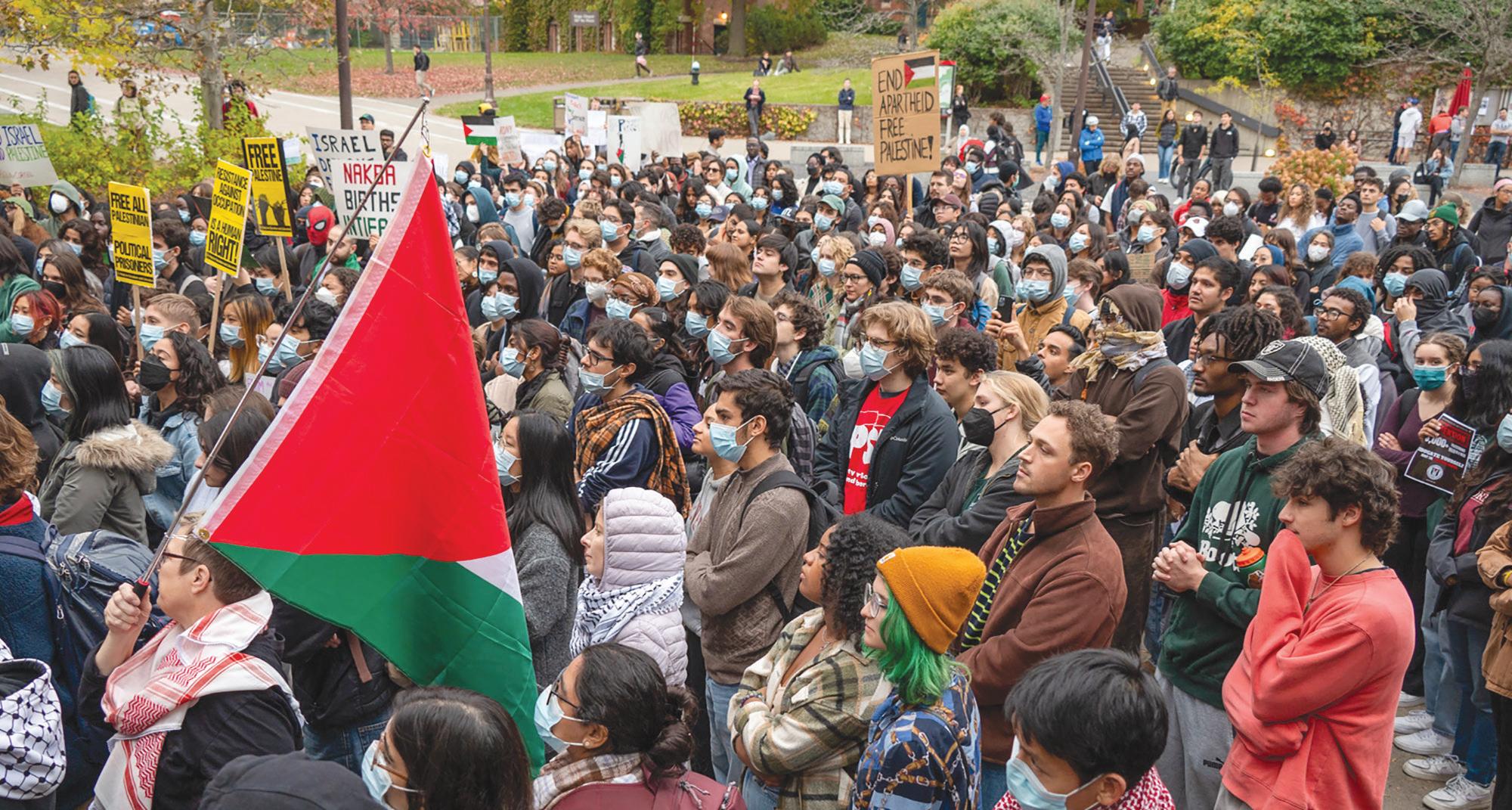
“Free, free Palestine;” “From the river to the sea” and “No justice, no peace” were just a few of the chants that rang through Ho Plaza on Wednesday, Oct. 18. At 5 p.m., students, faculty and staff gathered at a rally hosted by Students for Justice in Palestine in solidarity with Palestinians impacted by the ongoing Israel-Hamas war.
Participants gathered at the entrance to Willard Straight Hall, carrying signs with phrases like “We know occupation” and “End Apartheid, Free Palestine.” Some wore a Palestinian keffiyeh, a traditional scarf that has become a key cultural symbol of Palestinian identity.
Before the rally began, an SJP member urged participants to beware of doxxing — the release of one’s personal information to the public without consent, which has been occurring among university students and activists that openly condemn Israel, including at Harvard University. Many participants donned blue surgical masks to protect their identities.
The rally began with a reading of a revised statement from SJP which addressed President Martha Pollack’s updated statements on the war and Tuesday’s strike on Al-Ahli Arab hospital in Gaza that killed at least 500 people, many of which were seeking treatment following the start of Israeli air strikes on the Gaza strip, among other issues. Israeli and Palestinian officials are blaming each other for the strike.
Following the reading came various speeches from current and retired faculty members and students that condemned Israel’s occupation of Palestine and expressed disappointment with the University’s response.
“Right now the focus should and must be on peace and liberation. Ongoing genocidal tactics are antithetical to human rights and international law,” one professor stated. “The rally calls for migrants' right to stay home.”
In their speeches, in addition to the Gaza hospital bombing, speakers also addressed the death of a six-year-old Muslim child in Illinois, fatally stabbed by his landlord who was upset over the Israel-Hamas war.
Despite the nature of unity from the rally, many par-
ticipants of various backgrounds had different reasons for attending.
Many students pointed to the lack of support from the University administration, particularly regarding Pollack’s statements. They pointed to how, of the three statements, Palestinians were only briefly mentioned, with no mention of the humanitarian crisis in Gaza.
Many rally-goers also shared accounts of threats and harassment that they have encountered on campus and online. They stressed an increased fear of violence for supporting Palestine or for their ethnic and religious identities.
Caitlin Blanchfield, a visiting faculty member in the architecture department, attended the rally with her young son, who is Iranian-American, in a stroller. Between the giggles and sneezes of the small infant, she emphasized the importance of being there for Muslim children who have been targeted in
recent days, and expressed her desire for her son to develop his political voice and engage in the community.
“I want political action to be part of his life, even though he’s so little right now,” Blanchfield said. “It’s important to be here with him for the children of Muslim backgrounds who have been targeted in the last days.”
Blanchfield also emphasized how the presence of the community at the rally provided a sense of safety and solidarity, and she hoped that the momentum would continue to grow in urging the University to speak out against ongoing issues.
A full version of this article will be available at www.cornellsun.com on Thursday.
Estee Yi can be reached at jyi@cornellsun.com. Lucas Santiago can be reached at lsantiago@cornellsun.
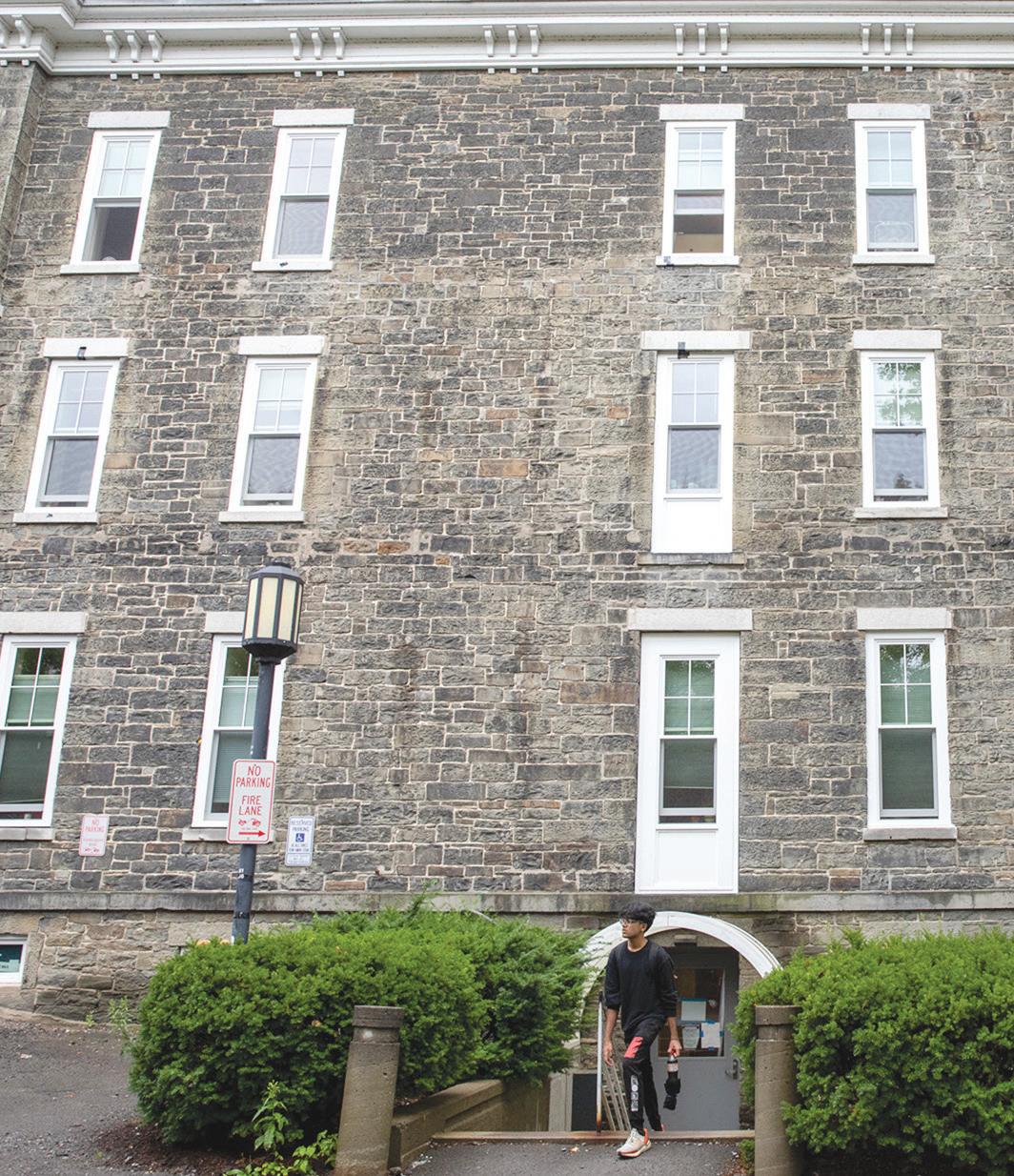
has provoked new security measures.
By SOFIA PRINCIPE Sun Staff Writer
Editor’s Note: This story discusses rape on campus.
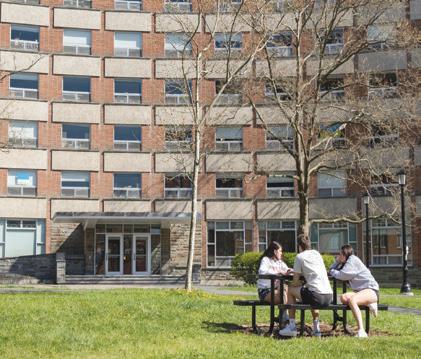
When Bridget Sisk ’26 found out about the rape that occurred in Cascadilla Hall, her residence hall, she had an uneasy feeling she couldn’t shake. Since then, she has become hyperaware of her residential surroundings, constantly feeling uncomfortable in her own home.
“Every time I hear a loud door slam outside my room or people in the halls at night, I get nervous,” Sisk said.
The Cornell student community received a Crime Alert about an on-campus rape on Thursday, Sept. 14, which resulted in several students telling The Sun they feel unsafe in their residence hall and prompted a series of security renovations to quell resident fears.
“A victim reported to a
University official that she was forcibly raped by an unknown person, in an unknown residence hall, sometime on Sept. 14,” the alert stated. “The victim described the suspect as a male, six feet tall and weighing approximately 160 pounds. The victim was able to escape after kicking the suspect.”
Cascadilla Hall residents received a subsequent email on Sept. 15 informing them that the event occurred in their residence hall, without further information regarding the identity of the offender or specific details about the location. In a follow-up email on Sept. 19, Housing and Residential Life encouraged students to report any helpful information and “take steps to maximize the current safety and security measures already in place.”
“I feel like they didn’t do a good job of communicating what really happened,” said Isha Patel ’26.
Iapologize for the horrible choice of words that I used in a portion of a speech that was intended to stress grassroots African American, Jewish and Palestinian traditions of resistance to oppression. I recognize that some of the language I used was reprehensible and did not reflect my values. As I said in the speech, I abhor violence and the violent targeting of civilians. I am sorry for the pain that my reckless remarks have caused my family, my students, my colleagues and many others in this time of suffering. As a scholar, a teacher, an activist and a father, I strive to uphold the values of human dignity, peace and justice. I want to make it clear that I unequivocally oppose and denounce racism, anti-semitism, Islamophobia, militarism, fundamentalism and all systems that dehumanize, divide and oppress people.



By CARLY HERMANN Sun Contributor
When Steven Kim ’27 hears the fire alarms in his dorm, Mary Donlon Hall, he is unfazed despite a series of recent arson incidents on North Campus.
“Honestly, [the arson incidents don’t] really impact how I feel about my safety,” Kim said. “From what I’ve heard, it’s just someone putting a lighter to a wall. I don’t think the building’s going to burn down.”
The Cornell University Police Department announced a series of arson incidents on North Campus in both Ganedago: and Mary Donlon Hall in Crime Alert emails to the student body on Sept. 13, 19 and 24. Each email has stated that no suspect has been identified, and that investigation into the incidents is ongoing.
In a statement to The Sun, David Honan, associate vice president for public safety, urged students not to participate in pranks involving fire and to report incidents of arson.
“As I stated in the weekly message, pranks involving fire are not safe and can lead
to serious injuries or death,” Honan said. “Arson prevention and reporting are crucial for everyone’s safety.”
Despite these incidents, however, students have said they are unconcerned. Nicole Yan ’27, another Donlon resident, said she believed the incidents to be students looking for attention.
“I don’t feel anything about it because people are
“It’s just someone putting a lighter to a wall. I don’t think the building’s going to burn down.”
Steven
Kim ’27
just burning their name on the wall because they think it’s funny,” Yan said. “I don’t really feel much about it.”
This is not the first time CUPD has reported cases of arson in the dorms. During the 2021-22 school year, a series of arson incidents in Ganedago: Hall resulted in security cameras being placed in the common areas and CUPD officers patrolling the hallways.
Sentiments towards
Cornell’s handling of the situation were mixed. Kim expressed support for Cornell’s response, because the administration sent an email out to the entire community. He also stated that his floor had a meeting on Thursday, Oct. 5 to discuss the incidents and safety protocols.
However, Yan disagreed, saying calling the police for such a minor incident was an overreaction.
“I think it’s an overreaction to call the police, but Cornell actually needs to do something about the people,” Yan said. “I just think they should actually do something about it that’s not sending an email generally threatening kids. But calling the police isn’t exactly going to help that.”
Both students said they have had floor meetings with their respective resident advisors as a response to the arson incidents.
Investigations into these incidents are ongoing. Anyone with information can call (607) 255-1111 or make an anonymous report via the Silent Witness system.
By NIA PERRY Sun Contributor
In honor of International Day of the Girl, Cornell senior and softball player Lilly Travieso ’24 attended First Lady Jill Biden’s first ever “Girls Leading Change” event at the White House on Wednesday, Oct. 11.
Travieso was invited to the event for her leadership with ELLA Sports Foundation, which she founded with her mother, Patty Godoy-Travieso, in 2018. ELLA, an acronym standing for Empowering Leadership in Latina Athletes, is also the Spanish word for “she.”
The foundation hosts leadership development, professional networking and empowerment workshops all over the United States to assist young Latina athletes during the college recruitment process. It also provides coaching seminars, opportunities for athletes to showcase their talent and a platform of advocacy for women in sports.
From a young age, Travieso said she dreamt of playing softball at a top university. However, she encountered obstacles experienced by many other Latina athletes during her journey, such as cultural misconceptions and financial inequalities. In founding ELLA, she said she aims to help other young Latinas achieve their dreams and overcome these adversities.
Gabriel Reyes, public relations specialist for ELLA, said the organization
aims to support young women as they build their futures.
“ELLA wants to provide women and their families opportunities and resources to support them so they can succeed in life, and they can make their own legacy, like Lilly is doing,” Reyes said.
Being surrounded by like-minded women, Travieso plans to continue building on ELLA’s mission to assist Latina athletes in their academic and athletic endeavors, while aiding in their development as individuals.
“I was honored to be invited to [Girls Leading Change, an] important gathering celebrating young women who are agents of change in their community,” Travieso said. “We have been inspired [by] meeting so many role models and are energized to continue our work at ELLA, supporting girl athletes everywhere.”
At last week’s event, Biden recognized 15 young women leaders — including Gabriella Nakai, who worked to shift perceptions of Native people in America, Julia Garnett, who spoke out against book bans in her local school board meeting and Mona Cho, who raised awareness on online safety — selected by the White House Gender Policy Council for making a positive impact on their communities. To continue reading this article, please visit www.cornellsun.com.
Nia Perry can be reached at ncp44@cornell.edu.
Seven representatives won out of 20 candidates, the Student Assembly announced on Tuesday
By JULIA SENZON Sun News Editor
Following voting ending on Wednesday, Oct. 11, the Student Assembly released its election results on Tuesday, Oct. 17. Contested positions included the College of Engineering representative, freshmen representatives, transfer representative and students with disabilities representative at-large.
To improve voter engagement for the Fall 2023 election cycle, the S.A. offered raffle entry to prizes for students who completed all eligible ballots. Four students won Hydro Flask water bottles, two won Bose Speakers and one won a Nintendo Switch.
College of Engineering Representative
Amida Akpan ’25 was elected the College of Engineering representative over Le-Qi Tang ’26 and Audrey Pinard ’25.
Akpan received 176 votes out of the 412 ballots in the first round of counting. The number of votes for Akpan, however, was adjusted to 218 in the second round of counting due to the use of ranked-choice voting. Ranked-choice voting allows voters to order their candidate preferences as a list ranking as opposed to only voting for one candidate. In each round of counting, the candidate receiving the least votes is eliminated.
At an S.A. forum held on Sept. 29, Akpan noted that many engineering students lack awareness of academic support resources.
“What I would like to do is increase or advertise all the options and all the help that engineering first and second years have available for them,” Akpan said. “[I want] to make sure that they are aware [that if they] feel overwhelmed in a class and don’t understand the material, they have free tutoring, or if they don’t under-
stand how to select classes for the next semester or next year, they can go to their advisor.”
Freshmen Representatives
The elected freshmen representatives include Zora deRham ’27, David Diao ’27, Christian Flournoy ’27 and Cion Kim ’27. Thirteen first-year students ran for the position. Out of 919 ballots — according to the ninth round of counting to adjust for ranked-choice voting — Rham received 152 votes, Diao received 199 votes, Flournoy received 186 votes and Kim received 171 votes.
According to deRham, Central Campus should offer more meal swipe options, such as at existing dining options like Trillium. School spirit, deRham said, can also be fostered by offering buses to away games.
Looking at the positive feedback of the S.A. doubling the Slope Day budget, deRham said she wants to continue to engage students with the S.A.
“That budget increase prompted a lot of people to just say, ‘I’d love to suggest more artists that I know,’” deRham said. “It prompted a lot of talk about the Student Assembly.”
Diao and Kim also expressed wishes to increase student engagement with the S.A., specifically by offering students more information about the S.A. and opportunities to voice their concerns to the S.A.
“It is our role as representatives, or people in candidacy to be representatives, to provide students with information that provides them with transparency,” Diao said. “That is the best way to have representation.”
Kim suggested that the S.A. facilitate forums to connect students with each other.
“We should have a more open forum so that students know where to ask and
how to ask [so their opinions] will make an impact,” Kim said. “The [aspect] I really want to focus on is [a forum] on advice and communications. One [forum] would be connecting upperclassmen to lower classmen so that [freshmen] could get advice.”
Flournoy expressed a desire to improve mail and housing services for students, pointing toward the long lines for picking up packages on North Campus, where first-year residences are located.
“One idea … is having certain dorms pick up certain packages on certain days — it might help with the rush and long lines,” Flournoy said.
Transfer Representative
Simone Chan ’25, who transferred to Cornell after studying at Pasadena City College for two years, won the transfer representative election with 51 votes, compared to Hasham Khan ’26, who obtained 25 votes.
At the forum, Chan emphasized the difference between the experiences of regular transfer students, including herself, and those offered the guaranteed transfer option when applying to Cornell as high school seniors. These two groups, Chan said, require different types of support.
“Cornell does a really good job in reaching out to transfer option students [before arriving on campus],” Chan said. “The transfer students that are not transfer options are more like the freshmen, in terms of [not knowing] what’s coming. We come here with all new expectations, and everything is so brand new.”
Chan said she hopes to bring more resources to transfer students throughout the year. As a transfer student, Chan struggled to select classes but said she felt more information could have aided in this process.
“One struggle [I had that] was really
scary [was] I couldn’t select my classes for some reason,” Chan said. “So [Cornell Student Center] didn’t really fully register my status as a student. So I was really panicking during the whole summer.”
Students With Disabilities Representative At-Large
The position of students with disabilities representative at-large went to Allison Helkowski ’26, who received 698 votes, compared to Admir Cekic ’26, who received 626 votes.
At the forum, Helkowski expressed an interest in creating more comfortable opportunities for students with disabilities to share their concerns with the S.A. outside of the larger S.A. meetings.
“Some people who are identified as having disabilities are oftentimes insecure when they come to discussing what they need [and] what they’ve gone through — it is a very emotional topic,” Helkowski said at the forum. “We should open our doors, we should be more marketable when it comes to looking at things like students with disabilities.”
Helkowski also noted that obtaining a Student Disability Services accommodation may unjustly discriminate against individuals with invisible disabilities — an umbrella term for disabilities that are not as visibly noticeable — due to the burden of proof required in the application process. Academic accommodation plans are approved based on the student’s disability documentation, academic history and additional information provided to SDS.
“Epilepsy, ADHD, autism spectrum disorder [and] things of that nature that aren’t exactly visible to the human eye, but still qualify as a disability that requires accommodations,” Helkowski said.


CASCADILLA
Continued from page 1
According to Cornell’s 2023 Security Report, in response to an event that constitutes a threat to students and employees, the University will issue a Crime Alert containing “a brief description of the incident; the date, time, location of the incident and precautions to take.” The report adds that “the amount and type of information presented in the warning will vary depending on the circumstances of the crime.”
Not only were Cascadilla Hall residents alarmed by the recent assault, but they have already adopted safety habits to combat the increasing sexual violence on and near campus. Sisk has increasingly taken measures to ensure her safety during her time in the dorm.
“When I signed a housing contract to live in Cascadilla Hall, I knew because of the long history of theft I was going to have to be vigilant about locking my door when I was away, but I am constantly checking that my door is locked when I’m in the room,” Sisk said.
Last year, there were three Crime Alerts that reported thefts in Cascadilla Hall. The first theft occurred on Aug. 24, 2022 in which a Nintendo Switch gaming console, controllers and charger were stolen. The second occurred on Nov. 15, 2022 in which a laptop and iPad were stolen. In a third incident on May 9, 2023, a backpack was stolen.
In all three cases, the thieves entered through unlocked dorm rooms, and in one case, the room was occupied.
Even before the rape occurred, Patel was weary of her residence’s security after encountering two aggressive men on Sept. 1. She said she was startled at 2:30 a.m. by loud knocks on her door, which she assumed were from her friends who frequently visit her room at all hours.
“I was freaking out because I said really quietly, ‘come in,’ thinking it was my friends, but it was two random men who got really aggressive,” Patel said. “That was really scary.”
Patel reported the incident to her residential advisor.
Patel extended her complaint about the Administration’s lack of transparency regarding the rape to include concerns about a general lack of information surrounding suspicious activity in Cascadilla Hall.
“I went down and identified them to the head RA, and she said, ‘this description is exactly like someone a couple of days ago who was going into the women’s restroom,’” Patel said. “Why did no one tell us this?”
Many residents feel Cascadilla Hall’s location in the Collegetown area contributes to these security concerns, as it may be vulnerable to more non-residents. Amanda Peh ’26 has been uncomfortable with the number of people who loiter around Cascadilla Hall, especially after the rape reported in the building.
“In Collegetown, there is a high probability that someone is not a student here,” Peh said. “That’s why I don’t like people loitering.”
Peh explained that when she enters Cascadilla Hall and is uncertain if a loiterer is a resident, she usually waits for them to go away or walks to a different entrance to avoid interacting with them. Even more
so, she said, the cars that park outside her building for long periods of time make her the most concerned for her safety.
“The cars are what make me uncomfortable, because what if they just take me?” Peh said.
Some Cascadilla Hall residents, including Sisk, have felt that their dorm is “forgotten and neglected” and that their “safety is being put on the backburner.” The rape has served as an unfortunate indication that better security is required for students to feel sufficiently protected.
In a September interview with The Sun, David Honan, associate vice president of public safety, mentioned some of the security measures that the University has put in place in response to growing sexual assault risk, including education campaigns.
“We started off educating people about the tailgater issue — don’t let anybody into the residence hall if you don’t know them,” Honan said during the interview. “People can be cautious about not wanting to offend somebody, but in doing so, we accidentally let some people into residence halls that probably shouldn’t be there.”
Honan also mentioned that the University plans to install a secondary ID scanner in Cascadilla Hall that will provide “two layers” of security to residents.
According to Peh, Cascadilla residents have recently received email updates on new renovations to strengthen security in the building — including the new card access reader installed for the second floor elevator in an effort to ensure only residents can enter the residential areas of the building. Other renovations include improvements to blinds and windows, and testing alarms and horns in individual rooms. Residents were also informed about increased police presence in and around the building.
Some residents feel more comfortable living in Cascadilla Hall after security measures were introduced. Patel shared she is less scared in her dorm than she used to be.
“They have [increased] security, so now it’s feeling more safe… the first month, at least, was really scary,” Patel said.
Other residents feel the new safety implementations are still insufficient to adequately protect residents given the severity of the incidents that have occurred and Cascadilla Hall’s Collegetown location.
“The underwhelming response by the security team and Cornell Administration was disheartening, especially when they offered subpar safety improvements,” Sisk said.
Amid security threats in Cascadilla Hall, housing staff members have encouraged South Campus residents to enlist help whenever they feel afraid in their dorm or on campus.
“If you ever feel unsafe in Cascadilla, in any other residence hall or anywhere on campus, please don’t hesitate to pick up your phone and call for help,” wrote South Campus Area Coordinator Kristi Shorter in an email to residents obtained by The Sun. “You have every right to be here, live your life, go to school and feel safe. That is the basic right of any student at this institution.”
Sofa Principe can be reached at sprincipe@cornellsun.com.

BY DANIELA ROJAS Sun Dining Editor
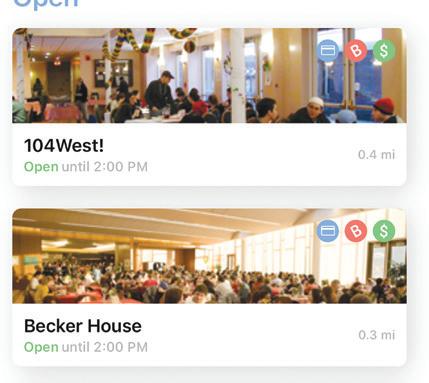
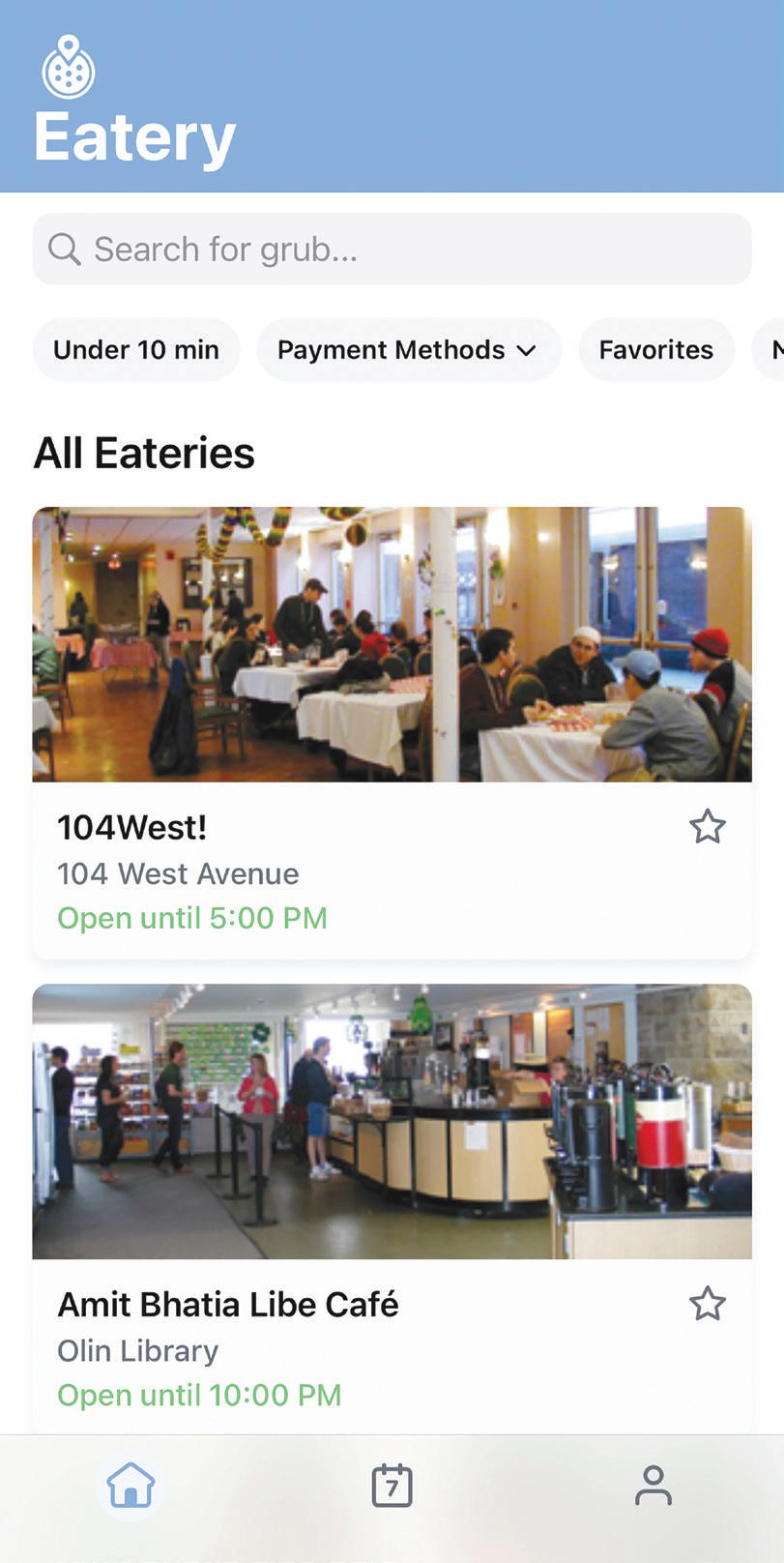
The Cornell Eatery app, developed by Cornell AppDev, is just like your favorite foods in your pantry: reliable with a wide-array of choices. With their new software update, it occurred to me that the app is more than just a cool thing to have access to; it’s something that provides a needed convenience for many students like myself.
The update, which launched on October 12, creates a “renewed user interface” alongside new tools for exploring and saving favorite foods on the app. The Sun reported that Eatery hosts 3,500 daily users and 11,000 monthly users. Eatery was developed as Cornell AppDev’s debut flagship app. The app is nothing short of a success, being originally introduced in 2014. Cornell AppDev is also home to some other locally-useful apps, including Ithaca Transit, CourseGrab, Uplift and Pear.
Coming to Cornell in 2021, Eatery was described in online threads as an essential app to navigate food on campus. Eatery is my everyday go-to for deciding where to eat; as a matter of fact, I originally thought Eatery was created by Cornell Dining. Upon learning that Eatery is student-made, I suddenly became more optimistic about the intersection of food and technology. Eatery’s recent new update renewed my optimism.
The convenience, in my opinion, has helped me budget my time and resourc -
Are you hungry... for more tasty content?
Have satisfying, perhaphs salivating, suggestions?
Let us know!
Contact: food@cornellsun. com.
es. I don’t have an unlimited meal plan, so when I use my swipes, I want them to matter. I like being able to select favorite foods on the menu and having the app advertise the dining halls that are serving them. Yes, there are times where I don’t have the time to choose which dining
hall tastes better. Even in those circumstances, Eatery still helps me find which dining hall is open.
Other times, I use Eatery to help me budget my BRBs. Cornell has so many places to eat that I don’t remember off the top of my head which places take BRBs, which don’t, etc. When I go out with friends to eat on campus, I’m not surprised about the payment method. Considering that all food spots on campus have their own sets of operating hours, the app telling the user when a food spot will close, in addition to which spot is closest to a user, has saved me so much angst.
I’m not the only one who feels this way, even with in the past decade. When looking into this topic, I stumbled across an old article from the Sun dining section on how Eatery is “simply app-etizing.” Sun staffer Qijia Yu in April 2016 walked through the app from a user’s perspective, highlighting how convenient this app is in comparison to Cornell Dining Now, a web application. Cornell Dining Now is still running to date.
However, one glance at the site and I am overwhelmed. Eatery is not only user-friendly but it’s visually and aesthetically pleasing. Sure, that’s not the point of the app, but it does add to the user experience and satisfaction.
Thank you Cornell AppDev for creating a powerful tool that makes the lives of students easier. I know an app for finding food spots on campus doesn’t sound revolutionary, but it’s the little things that matter. It makes a difference: eating at a college campus is hard enough.

Sometimes I don’t know what to eat, and other times if I’m too tired or nothing is open, my bad habit is skipping meals. Eatery has helped me avoid that and plan ahead. I look forward to seeing how Eatery continues to be app-etizing to students' taste buds and busy life schedules.
Daniela Rojas (she/her), dining editor, is a thirdyear student in the College of Arts & Sciences. She can be reached at dwise-rojas@cornellsun.com.

KATIE CHEN ’25
SHEILA YU ’25 Advertising Manager
NOAH DO ‘24 Associate Editor
HUGO AMADOR ’24
EMILY VO ‘25
JONATHAN MONG ’25
JULIA SENZON ’26
JULIA NAGEL ’24
GRAYSON RUHL ’24
TENZIN KUNSANG ’25
JOANNE HU ’24
MARISA CEFOLA ’26
MAX FATTAL ’25
MING DEMERS ’25
KATE KIM ’24
ISABELLE JUNG ’26
VEE CIPPERMAN ’23
ESTEE YI ’24
PAREESAY AFZAL ’24
ANGELA BUNAY ’24
The Cornell Daily Sun is devoted to publishing a broad and diverse set of content from the Cornell and greater Ithaca community.
We want to hear what you have to say about today's paper or any of our pieces.
Guidelines on how to submit can be found at Cornellsun.com. And here is our email: opinion@cornellsun.com
SOFIA RUBINSON ’24 Managing Editor
GRACE XIAO ’25 Web Editor
AIMÉE EICHER ’24
UYEN HOANG ’25
LIANG ‘24
REILLY ’25
GABRIEL MUÑOZ ’26
NIHAR HEGDE ’24
DANIELA ROJAS ’25
RUTH ABRAHAM ’24
BHATIA ’24
CABALLO ’25
REYEN ’25
PLOWE ’25
LI ’24
SUGARMANN ’24
PALLRAND ’24
WU ’24
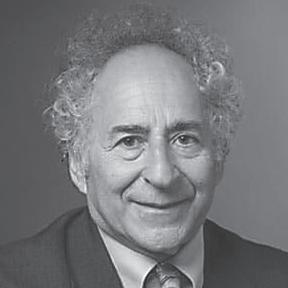
Daniel R. Schwarz
Daniel R. Schwarz is the Frederic J. Whiton Professor of English Literature and Stephen H. Weiss Presidential Fellow in the College of Arts & Sciences. He is Te Cornell Daily Sun’s 2023 visiting columnist. He can be reached at drs6@cornell.edu.
At this time of national tragedy for Israel I, as a longtime Jewish faculty member and as a human being, feel strong and impassioned sympathy and empathy for innocent victims of barbarous Hamas terrorists who murdered and kidnapped defenseless people including babies, small children and elderly people.
I respect the frustrations of the Palestinian people who want their own country. But what occurred Oct. 7, on the Jewish Sabbath, were not acts of resistance but atrocities on the order of the Holocaust and pogroms Jews suffered in Europe. Such inhumane and horrific behavior will not move the Palestine community towards its goal.
On Thursday, Oct. 12, for the first time in 56 years teaching at Cornell, I spent much of the time in my “Imagining the Holocaust” class discussing parallel current events to our course subject, namely how the barbaric murder and kidnapping of Israeli civilians by Hamas resemble the Holocaust as well as the pogroms in Russia before the Holocaust. I commend my students for a nuanced, insightful discussion, one in which we differentiated between those of any ethnicity who commit atrocities and those who are decent human beings.
I understand that within Gaza are innocent victims who have nothing to do with terrorism, but I also know that the continued existence of a Hamas presence in Gaza dedicated to the destruction of Israel is intolerable. We hope to differentiate between Palestine civilians caught in the maelstrom of war and Hamas terrorists, although it is sometimes hard to identify those who aid and abet terrorism and those who are innocent bystanders.
Israel has no choice but to destroy Hamas if it is to avoid a repeat of these atrocities. No decent person can cheer for innocent people, especially children, being killed inadvertently by Israeli bombs. But what other choice does Israel have when Hamas terrorists take refuge in schools, hospitals and mosques?
I teach and write about the Holocaust. I have always understood the need for a two-state solution with an independent Palestinian state with a capital in East Jerusalem. I have lectured in Israel and have friends and colleagues there, but I have also visited Morocco, Tunisia, Jordan and the West Bank (as well as Egypt which is not Arab but mostly Muslim). I have always been somewhat stuck on an island when it comes to Israel: not willing to sign petitions endorsing illegal settlements in Palestine terri -
tory and concerned that Israel respect the rights of its Arab citizens, but also unwilling to condemn Israel for defending itself.
I would hope that those of my colleagues who continually fault Israel but did not denounce the Oct. 27, 2019 killing of Jews at a synagogue in Pittsburgh; who fail to notice that virtually every synagogue in the world, including those in America and right here in Ithaca, requires special security; and who have repeated, without supporting evidence, universal condemnation of Israel’s behavior — no matter what the provocation from terrorists — would consider their role in fostering an atmosphere where anti-Zionism bleeds into anti-Semitism. Today, as I write, rallies against Israel which often become blatant celebrations of violence to Jews are occurring every day.
It behooves educational leaders, who for the most part have lagged behind political leaders, to denounce what occurred in the most forceful terms. I have the highest regard for President Pollack, but her first statement — along with some of the other Ivy League Presidents — fell far short of my expectations for moral leadership. Equating Hamas’ behavior to natural disasters or unrelated events in Armenia, as she did in her statement, is demeaning what occurred in Israel on Oct. 7. Even her use of the word “atrocities” was confined to events that had nothing to do with what occurred in Israel.
Not surprisingly, many of Cornell’s Jewish alumni and students are outraged at President Pollack’s letter and not fully satisfied by the second one which some attribute to pressure from Jewish donors and trustees. Nor is she alone among university presidents in disappointing not only her Jewish alumni audience, but also all those who understand the significance of Hamas’s sadistic attack on innocent civilians in their own homes. Finally, on Oct. 16, nine days after Hamas’ hideous attack, President Pollack wrote the Cornell Community a letter that began to recognize the implications of what was a pogrom. What happened on Saturday Oct. 7 in Israel — killing and kidnapping babies, children and the elderly — had something to do with the fraught and complex history of the Middle East. But for Jews it had far more to do with a history of the persecution of Jews dating back centuries, including pogroms, and culminating in the Holocaust.
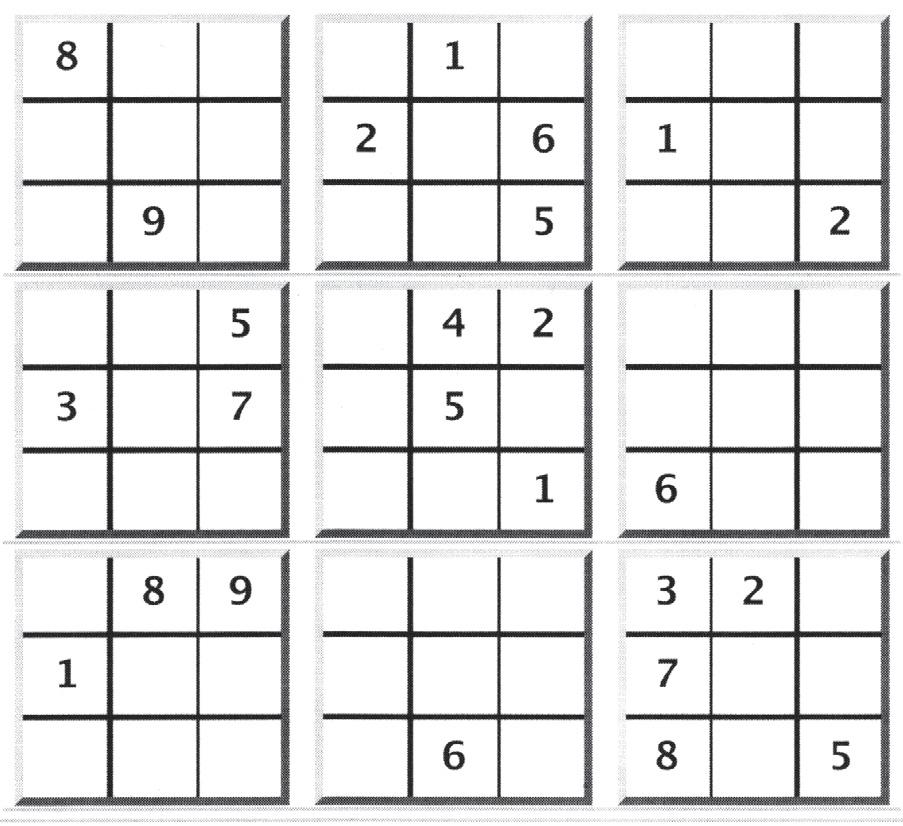
Fill in the empty cells, one number in each, so that each column, row, and region contains the numbers 1-9 exactly once. Each number in the solution therefore occurs only once in each of the three “directions,” hence the “single numbers” implied by the puzzle’s name. (Rules from wikipedia.org/wiki/ Sudoku)



By ELLIE VANHOUTEN Sun Contributor
An advancement in wearable technology, powered by Cornell researchers, transforms a simple shirt into a health and fitness tracker. Prof. Heeju Park, human centered design, and Jeyeon Jo grad created a compression shirt that uses embroidered optical fibers to provide real-time respiratory rate monitoring. The new smart shirt primarily benefits those with respiratory disorders, but may also appeal to athletes and anyone wishing to track the rhythm of their breathing.
“Wearable technology isn’t really comfortable. Nobody wants to wear an ugly, uncomfortable, heavy garment with dangling electronics and wires,” Park said. “So my intention was to create a garment that provides a useful function, but at the same time is just normal clothing.”
The fitted nature of the shirt around the ribcage enables it to accurately and rapidly measure respiratory rate, which refers to the number of breaths a person takes per minute — a key health indicator separate from heart rate.
“Though a health concern, heart rate is predictable. You usually know if you have high blood pressure and just need to
monitor it,” Park said. “But a change in respiratory rate signals a sudden, serious issue in the respiratory system.”
For example, in certain cases of sleep apnea, the muscles around the throat can temporarily relax, narrowing the airway and temporarily cutting off breathing. While a heart rate sensor wouldn’t identify the problem since the heart is still beating, a smart shirt would detect the absence of breath- ing and immediately alert the individual or their caregiver.
Optical fibers — flexible plastic strands about as thick as human hair — incorporated into the shirt detect changes in light intensity to determine whether the chest has expanded or contracted. Unlike other bulky and rigid electronic sensors, the optical fibers are flexible, virtually unnoticeable and can be easily stitched into a shirt as a part of its conventional production.
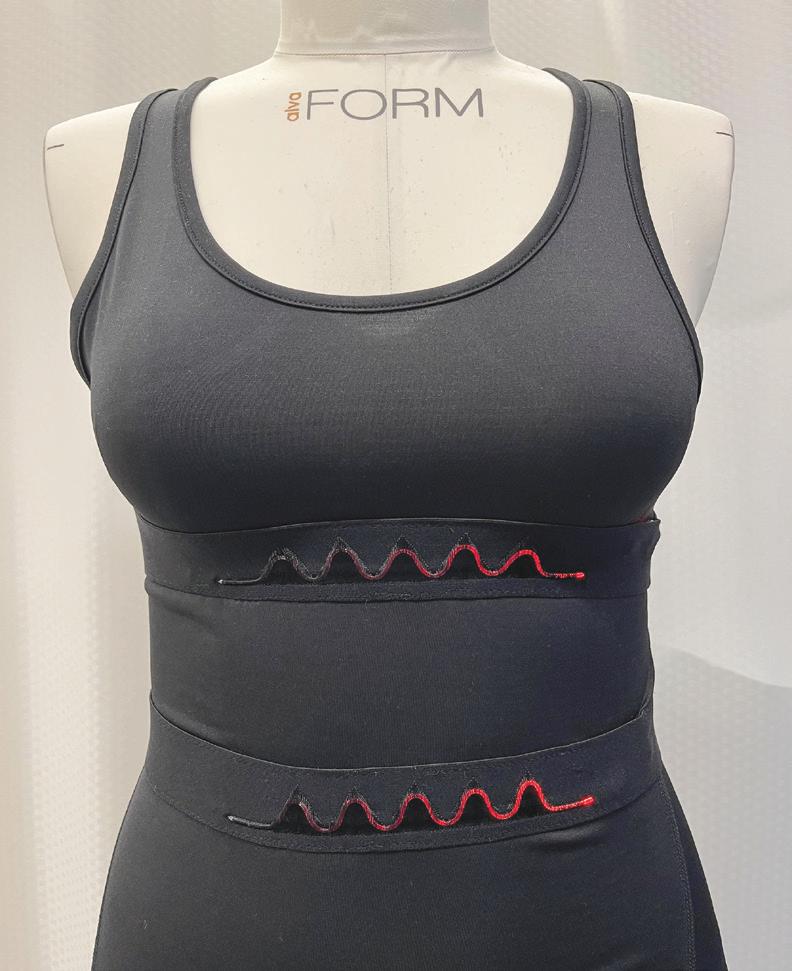
the fiber is under a lot of stress from being stretched, just poking it will decrease the amount of light that reaches the end.”
Park compared optical fibers to a computer cord, pulling both ends outwards until taut and then moving his hands together until the cord relaxes and bends.
“Compression reduces the light passing through the fiber optic from one end to the other,” Park said. “If
The optical fiber straightens and bends with every inhale and exhale. The shape affects how much light is detected by the microcontroller at the end of the fiber. A curved optical fiber causes a weaker light intensity, indicating a contraction of the chest and the exhalation of the wearer.
A straight optical fiber causes a stronger light intensity, signaling that the chest has expanded and
the wearer has inhaled.
The flexibility of a fiber optic strand enables it to measure the most subtle expansions and contractions of the chest, but this flexibility also means it can easily lose its original form.
“If I stretch the fiber optic on a piece of fabric and then allow it to release, it won’t always go back to its original shape,” Park said. “That was a big problem, because the fiber optic couldn’t function as a sensor anymore.” Instead of returning to its symmetrical curves, the strand bent unpredictability, weakening its ability to accurately measure light intensity.
To address this unpredictability, Park stitched the fiber optic strands into a nylon casing. The embroidered enclosure acts like a tunnel, gently guiding the movement of the strand as it straightens and curves with an individual’s breaths. The casing also prevents the fragile threads from rubbing against other layers of clothing.
Park and Jo filed a patent application for the embroidery of the fiber optic sensor and are now expanding this technolo-
gy to other wearable devices. With support from the Cornell Technology Licensing Office IGNITE fund, they recently developed a smart shoe insole capable of real-time gait monitoring.
“Now the optical fiber is not a stretch sensor but a compression sensor. As the wearer takes a step, we are able to monitor which fiber optics are compressed more, compressed less or not compressed,” Park said.
By monitoring the sequence of foot pressure, the smart insole can tell the wearer if they tend to overpronate or underpronate, which refers to the way the foot rolls inwards or outwards. Excessive pronation in either direction can increase the risk of ankle sprains and cause foot and back pain. These gait-monitoring insoles can also be used by children with cerebral palsy or autism who may walk on their tiptoes.
“If you think about walking, it’s a lifetime exercise. It’s a daily routine,” Park said. “[Wearable technology] can be more practical than an LED flashing on your jacket. It offers a kind of home care — a remote health care.”
Ellie VanHouten can be reached at etv8@cornell.edu.
By CRISTINA TORRES Sun Staff Writer
A new understanding of how drugs are taken in by cells could impact the way drugs are administered to patients.
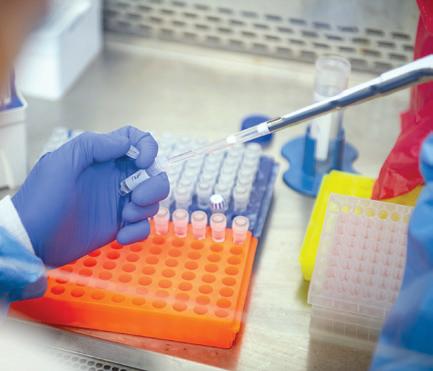
In an Aug. 30 study published in Nature that details structural changes of the Transient Receptor Potential Vanilloid ion channel family when overexposed to activating compounds, Weill Cornell researchers Shifra Lansky, Simon Scheuring and Crina Nimigean, Ph.D. tracked the structure of these channels as pore enlargement was induced.
TRPV is a classification of Transient Receptor Potential ion channels that responds to natural molecules in compounds, such as spicy foods. This ion channel is also involved in the regulation and measurement of internal body temperature and external environment temperature sensation.
For example, the heat felt after eating a spicy meal is due to capsaicin — an active component of chili peppers — binding to the TRP1 receptor. When capsaicin binds to TRP1, it activates the heat sensor, causing an increase in body temperature and heat sensation.
In the TRPV ion channel family, the temperature sensors and compound receptors have been scientifically recognized as tetrameric, meaning they are made up of four subunits with a pore in the middle to stimulate movement of ions through the outer layer of the cell.
Nimigean’s lab focuses on the relationship between ion channel structure
and their mechanisms within biological processes and systems, such as the TRP channels, which were believed to be tetramers until her lab discovered the five unit, pentameric characteristic.
Using techniques like atomic force microscopy, live images were taken of TRPV channels forming a star shape by incorporating another subunit into their structure. This meant that the ion channel was adopting a new conformation through an external method — not an internal change.
Atomic force microscopy works like a record player — it uses a very small tip to scan the protein’s surface, which creates a topography map of the molecules, providing a detailed image of the bumps and ridges of the surface of ion channels. Atomic force microscopy allows for this analysis through high speed image acquisition due to its ability to capture multiple frames per second.
“The biggest advantage of the massive diversity is that this TRP doesn’t care if it is in air or in liquid, you can actually watch the molecules in a native environment and have the molecules perform their native function while you watch them,” Scheuring said.
In the images captured through this type of microscopy, Schering and Nimigean discovered the fifth subunit that transformed into a star-like shape.
The change in structure is likely in response to its environment due to prolonged exposure to the addition of activating compounds, causing the middle pore to enlarge.
This phenomenon, known as pore dilation, leads to a greater influx and outflux of particles, which can increase particle transmission if there is an uneven concentration inside or outside the cell.
Ion channels are mean to maintain the gradient of particles inside and outside the cell, so pore dilation could be a response to an unequal distribution in both sides.
To confirm whether the pentameric transition was pore dilation, Scheuring added a compound called DPPA, which is a stimulant that induces pore dilation within the ion channels.
They found that when pore dilation was induced, the number of pentameric ion channels increased, meaning that this prolonged activation of the ion channels may lead to the structural change.
Although it is not yet well understood why these structural changes occur in the body, one hypothesis states that it may be a response to disease mutations that cause unstable protein
interfaces.
There are many topics that are currently being explored such as how pore dilation is being used to more effectively get medication into the cell.
These discoveries have great implications for medical understanding and can lead to more targeted drug therapies for debilitating diseases.
“The population has already used this phenomenon to deliver drugs without knowing how it works,” Scheuring said. “Because, often, it is a problem to bring a drug into a cell.”
To continue reading this story, please visit www.cornellsun.com
Cristina Torres can be reached at ct538@cornell.edu.