INDEPENDENT SINCE 1880
The Corne¬ Daily Sun Vol. 134, No. 10
MONDAY, SEPTEMBER 11, 2017 ! ITHACA, NEW YORK
12 Pages – Free
News
Arts
Sports
Weather
Xenophobia And Race
Richenburg At Johnson Museum
Glimpse Into The Future
Mostly Sunny HIGH: 75º LOW: 50º
A faculty panel discussed the rise of xenophobia and racial rhetoric in politics on Friday. | Page 3
The Red had a taste of the course it will be running this past weekend. | Page 12
In his debut article for Arts, Yongyu Chen ’20 reviews a Johnson exhibition. | Page 6
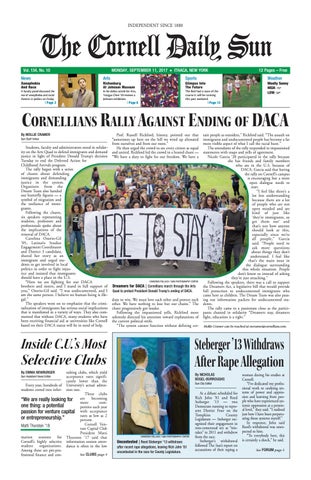
CORNELLIANS RALLY AGAINST ENDING OF DACA By MOLLIE CRAMER Sun Staff Writer
Students, faculty and administrators stood in solidarity on the Arts Quad to defend immigrants and demand justice in light of President Donald Trump’s decision Tuesday to end the Deferred Action for Childhood Arrivals program. The rally began with a series of chants about defending immigrants and demanding justice in the system. Organizers from the Dream Team also handed out butterfly figures — a symbol of migration and the resilience of immigrants. Following the chants, six speakers representing students, professors and professionals spoke about the implications of the removal of DACA. Carolina Osorio-Gil ’05, Latina/o Studies Engagement Coordinator and District 3 candidate, shared her story as an immigrant and urged students to get involved in local politics in order to fight injustice and insisted that immigrants should have a place in the U.S. “Here we are fighting for our DACA brothers and sisters, and I stand in full support of you,” Osorio-Gil said. “I was undocumented, and I am the same person. I believe no human being is illegal.” The speakers went on to emphasize that the criminalization of immigrants has serious social implications that is manifested in a variety of ways. They also commented that without DACA, many students who have been receiving financial aid at universities like Cornell based on their DACA status will be in need of help.
Prof. Russell Rickford, history, pointed out that “sometimes up here on the hill we wind up alienated from ourselves and from our roots.” He then urged the crowd to see every citizen as equal and united. Rickford led the crowd in a heated chant — “We have a duty to fight for our freedom. We have a
CAMERON POLLACK / SUN PHOTOGRAPHY EDITOR
Dreamers for DACA | Cornellians march through the Arts Quad to protest President Donald Trump’s ending of DACA.
duty to win. We must love each other and protect each other. We have nothing to lose but our chains.” The chant progressively got louder. Following the impassioned yells, Rickford more solemnly directed his attention toward explanations of the current political strife. “The system cannot function without defining cer-
Mollie Cramer can be reached at mcramer@cornellsun.com.
Steberger ’13 Withdraws After Rape Allegation
Inside C.U.’s Most Selective Clubs By EMMA NEWBURGER
sulting clubs, which yield acceptance rates significantly lower than the Every year, hundreds of University’s actual admisstudents crowd into infor- sion rate. These clubs becoming “We are really looking for are more comone thing: a potential petitive each year passion for venture capital with acceptance rates as low as 2 or entrepreneurship.” percent. Cornell VenMatti Thurston ’18 ture Capital Club President Matti mation sessions for Thurston ’17 said that Cornell’s highly selective information session attenstudent organizations. dance is often in the low Among these are pre-proSee CLUBS page 4 fessional finance and con-
tain people as outsiders,” Rickford said. “The assault on immigrants and undocumented people has become a far more visible aspect of what I call the racial hunt.” The attendants of the rally responded to impassioned statements with snaps and yells of agreement. Nicole Garcia ’20 participated in the rally because she has friends and family members who are in the U.S. because of DACA. Garcia said that having the rally on Cornell’s campus is encouraging but a more open dialogue needs to start. “I feel like there’s a lot less understanding because there are a lot of people who are not open minded and are kind of just like ‘they’re immigrants, so get them out’ and that’s not how anyone should look at this, especially since we’re all people,” Garcia said. “People need to ask more questions about things they don’t understand. I feel like that’s the main issue in the dialogue surrounding this whole situation. People don’t know so instead of asking they’re just attacking.” Following the speakers, there was a call to support the Dreamers Act, a legislative bill that would provide full protection to undocumented immigrants who came here as children. The Dream Team was also passing out information packets for undocumented students. The rally came to a passionate close as the participants chanted in solidarity “Dreamers stay, dreamers fight, education is a right.”
By NICHOLAS BOGEL-BURROUGHS
Sun Assistant News Editor
Sun City Editor
CAMERON POLLACK / SUN PHOTOGRAPHY EDITOR
Uncontested | Reed Steberger ’13 withdraws after recent rape allegations, leaving Rich John ’81 uncontested in the race for County Legislature.
At a debate scheduled for Rich John ’81 and Reed Steberger ’13 — two Democrats running to represent District Four on the Tompkins County Legislature — Steberger recognized their engagement in non-consensual sex as “mistakes” in 2011 and withdrew from the race. Steberger’s withdrawal followed The Sun’s report on accusations of their raping a
woman during his studies at Cornell. “I’ve dedicated my professional work to undoing systems of power and oppression and learning from people who have experienced systemic oppression at a personal level,” they said. “I realized just how I have been perpetuating those systems myself.” In response, John said Reed’s withdrawal was unexpected to him. “To everybody here, this is certainly a shock,” he said. See FORUM page 3
2 THE CORNELL DAILY SUN | Monday, September 11, 2017
Daybook
DAYBOOK
Monday, September 11, 2017
A LISTING OF FREE CAMPUS EVENTS MAE Colloquium: Anna C. Balazs, Ph.D., “Designing Bio-Inspired, Adaptive Gels with Controllable 3D Structures” 4 p.m., B11 Kimball Hall
Today Chemical Engineering Seminar: Arthi Jayaraman 9 a.m., 165 Olin Hall
“Christian Encounters with Early Modern East Asia: Lessons in Cultural Accommodation and Dialogue” 4:30 - 6 p.m., 120 Physical Sciences Building
Mini-Course-Cluster-Robust Inference 10 a.m. - 1 p.m., 125 Riley Robb hall SAP Seminar Series: “The Paradox of Vinod Kumar Shukla” by Arvind Krishna Mehrotra 12:15 - 1:30 p.m., G08 Uris Hall
Professional Directions: Q & A with David N. Weiss (Shrek 2, The Smurfs) 4:30 - 5:30 p.m., 124 Schwartz Center for Performing Arts
Communication Colloquium Series: Second Year Project Poster Session 1:30 - 2:45 p.m., 450B Mann Library
Saving the Dream for All with Professor F. Michael Higginbotham 4:30 - 6 p.m., Klarman Hall Auditorium
Introduction to Bloomberg 4 - 5 p.m., Stone Classroom, Mann Library
The Five Elements: Earth, Metal, Water, Wood, Fire Exhibition Opening 5 - 6 p.m., Jill Stuart Gallery, Human Ecology Building
“Humanitarianism, Genocidal Witnessing and Southeast Asian Cinemas” 4:30 p.m., Asian Studies Lounge, 374 Rockefeller Hall
Zumba 5 - 6 p.m., 5th Floor Lounge, Willard Straight Hall
Tomorrow
Tech/Law Colloquium 7 - 8:15 p.m., G01 Bill and Melinda Gates Hall
Lecture: “Establishing Normal: Insight into Chimpanzee Medicine in the Republic of Congo” 4 - 6 p.m., LH2 Cornell College of Veterinary Medicine
COURTESY OF CORNELL UNIVERSITY
Visual Culture Colloquium 4:30 p.m., History of Art Gallery, Goldwin Smith Hall
The Corne¬ Daily Sun INDEPENDENT SINCE 1880 Editor in Chief
Sophia Deng ’19
ALL DEPARTMENTS
Business Manager
Dahlia Wilson ’19
(607) 273-3606
Business: For questions regarding advertising, classifieds, subscriptions or delivery problems, please call from 9 a.m. to 5 p.m., Monday-Friday. News: To report breaking news or story ideas, please call after 5 p.m., SundayThursday.
SEND A FAX VISIT THE OFFICE THE SUN ONLINE E-MAIL
(607) 273-0746 139 W. State Street, Ithaca, N.Y. www.cornellsun.com sunmailbox@cornellsun.com
Postal Information: The Cornell Daily Sun (USPS 132680 ISSN 1095-8169) is published by THE CORNELL DAILY SUN, a New York corporation, 139 W. State St., Ithaca, N.Y. 14850. The Sun is published Monday, Tuesday and Thursday during the academic year, and every weekday online. Four special issues — one for Cornell Days in April, one for seniors in May, one for alumni in June and one for incoming freshmen in July — make for a total of 90 print issues per year. Subscriptions are: $84.00 for fall term, $86.00 for spring term and $170.00 for both terms if paid in advance. Standard postage paid at Ithaca, New York. Postmaster: Send address changes to The Cornell Daily Sun, 139 W. State St., Ithaca, N.Y. 14850.
Elemental art | The Barbara L. Kuhlman Scholars will display their work at the Fiber Arts and Wearable Arts Exhibition tomorrow. Their garments will each represent at least one of the five earthly elements.
THE CORNELL DAILY SUN | Monday, September 11, 2017 3
NEWS
Senior Wins Hospitality Scholarship for 3rd Straight Year
By AMANDA CRONIN Sun Contributor
For the third consecutive year, Matt Korman ’18 received a scholarship from the Illinois Hotel and Lodging Association’s scholarship, a preeminent group of hospitality industry professionals based in his home state. Each year, a scholarship of $2,000 to $5,000 and entry into a wide professional network is awarded to a select set of outstanding Illinois-native college students. This year, Korman was one of 26 recipients. When Korman initially applied to the School of Hotel Administration, he dreamed of becoming a chef, he said. Growing up in Highland Park, Illinois, some of his fondest childhood memories were related to cooking. “I have lots of awesome memories of grilling steak in my backyard with my dad — he loves to cook,” Korman said. “When I was 14 I started working in restaurants … just doing simple things like preparing spinach, but I got super into it.” Korman went on to work in five restaurants before coming to Cornell. But since his freshman year, his dreams of culinary school have changed. In 2014, he was awarded his first scholarship from the IHLA. Because the scholarship is renewable, Korman has remained a recipient every year since 2014. Along the way, he has interviewed with industry leaders at Westin and
Hyatt, interned at several high-profile restaurants and hotels, and made valuable connections throughout the industry. “Each individual [chosen for the scholarship] has incredible promise for the future of hospitality and we are excited to recognize their achievements and assist them with college finances,” said Nabil Moubayed, chairman of IHLA Education Foundation and general manager at Kimpton Gray Hotel.
“I enjoy working with Matt. He is a good listener, he has a great sense of humor, and he works hard.” Prof. Andrew Quagliata After three years as an IHLA scholar, the senior has switched his academic focus from the restaurant world. Korman discovered that his true passion is to work in the realm of real estate. As much as Korman loved working as a restaurant consultant or floor manager, he never felt that he was truly contributing to the progress of the industry. “I never felt like I was fixing anything,” Korman said. “If something went wrong, it would be like, ‘Oh, just put some tape on it.’ I wanted to have a bigger impact than
that.” This summer, Korman received an internship at Harrison Street Real Estate Capital in Chicago through the IHLA network. For the first time, “I could be an innovator, I was on the forefront of things and my work was actually making a difference. I was working 17 hour days but I was interested in what I was doing,” he said. “I enjoy working with Matt. He is a good listener, he has a great sense of humor, and he works hard,” said Prof. Andrew Quagliata, management communication. “He has a unique combination of qualities and skills that will allow him to excel in whichever field he chooses.” Korman said his experience as an IHLA scholar has given him the confidence and network connections to discover his calling. When asked to offer advice to incoming hotelies seeking to achieve the same, he said, “Branch out. Networking is so important professionally and socially. Foster good relationships with your professors and with peers, they will help you later on.” Even though he has transferred his career to real estate, Korman remains a self-proclaimed foodie. When asked the polarizing question of his favorite on-campus eatery, he responded like a loyal hotelie. “I have to say Terrace. I’m going to miss Orange Chicken burrito Wednesdays and Fridays.” Amanda Cronin can be reached at ahc235@cornell.edu.
Panel Discusses Causes of Rising Global Xenophobia By MIGUEL SOTO Sun Contributor
Months after Britain’s decision to leave the European Union and the election of President Donald Trump, guest lecturers from around the world discussed explanations for the global rise of xenophobia and
“[It is] difficult to struggle against [racial issues] when you cannot name things by what they are.” Prof. Miguel Mollino Islamophobia and the proliferation of racial discourse in the United States during a symposium on Friday. Hosted by the Minority, Indigenous and Third World Studies Research Group, the event included short presentations by international scholars on racial politics in the United Kingdom, Italy and India. Contemporary attitudes toward Muslim culture and the perception of extremism are products of Western imperialism, said Prof. Arun Kundnani, media,
culture and communication, New York University. The imperialist lens is not limited to foreign or domestic Islamophobic policy but plays a role in shaping progressive calls to integrate Muslim culture into Western society, Kundnani said. Prof. Miguel Mollino, University of Naples, focused on understanding the nuances of racism engendered by local pride in Italy to emphasize the overlooked complexities in issues regarding islamophobia and xenophobia. Italy’s lack of self-awareness has made it difficult for the country to address pressing issues regarding treatment and abuse of European refugees and migrants, Mollino explained. “[It is] difficult to struggle against [racial issues] when you cannot name things by what they are,” he said. Prof. Priyamvada Gopal, English, University of Cambridge, spoke about the predictive power of comparative politics, alluding to several salient similarities between Indian and American politics. Gopal drew comparisons to Indian Prime Minister Narendra Modi’s assertion of “Hindu supremacy” and “white supremacy” and Modi and Trump’s rise to
Hurricane Irma
JASON BEN NATHAN / SUN STAFF PHOTOGRAPHER
Tied together | Prof. Arun Kundnani analyzes the relationship between Western imperialism and Muslim culture and the perception of extremism.
power through a majoritarian wave. Trump and Modi’s rhetoric of economic inequality, identity politics, targeting of journalists and chauvinism share similarities, she said. Gopal concluded her lecture urging people to resist and confront the rising
islamophobia and xenophobia by reciting a verse by Turkish poet Nâzım Hikmet. “Being captured is beside the point, the point is not to surrender,” she quoted. Miguel Soto can be reached at mas743@cornell.edu.
Debate Becomes Forum After Withdrawal FORUM
Continued from page 1
SAM HODGSON / NEW YORK TIMES
Anticipating Hurricane Irma, members of the Urban Search and Rescue Team, California Task Force One and the Federal Emergency Management Agency discuss logistics in Orlando, Fla.
Following Reed’s announcement, what was scheduled to be a debate turned into a forum for John, where he outlined his platform and took questions from the audience. Asked about his stance on the Ithaca Plan — a proposal aimed to establish different approaches to combat Ithaca’s rising drug overdoses — John said he was not ready to endorse the supervised injection site but supported other proposals, including increased funding to address response to opioid
crisis. “In our budget, we are making a commitment to more funding for the probation department, more funding for mental health, and more funding for nurse positions in the jail,” the incumbent said, describing the county’s new annual budget he helped create. Asked about his ideas about Ithaca’s housing crisis, he said that giving tax abatement to private development projects that are beneficial to the community through the Tompkins County Industrial Development Agency. “We support economic
development, but it has to be responsible economic development,” he said. “We have to always be looking at, ‘is this good for the community?’ ” Further questions posed by the audience ranged from green energy, incarceration, and taxes. With Reed’s withdrawal from the race, John’s candidacy for reelection in the Tompkins County Legislature became uncontested less than a week before the elections — to be held on September 12. Nicholas Bogel-Burooughs can be reached at nbogelburroughs@cornellsun.com.
4 THE CORNELL DAILY SUN | Monday, September 11, 2017
NEWS
Consulting Clubs See Steady Decline in Acceptance Rates CLUBS
Continued from page 1
triple digits, while the club usually accepts below 10 new members each year. When Thurston first joined CVC in 2015, the number of attendees at information sessions was significantly lower — only about 50 people. “CVC has grown more competitive over the last several years as more and more students enter with an interest in entrepreneurship from both the STEM and business sides,” he said. “More and more people seem to know about startups and entrepreneurship every year, logically aligned with what appear to be some core goals of Cornell and that definitely has been observed in applications.”
Let us keep you informed every day in
The Corne¬ Daily Sun News • Sports • Entertainment
“We really try to get to know the people we talk with to make sure they really have the hunger.” Matti Thurston ’17 Despite concerns that these clubs may be inaccessible for students without professional experience in finance or consulting, leaders from competitive organizations, including Cornell Consulting Club, Cornell Finance Club and Mutual Investment Club of Cornell, all explained that applicants do not necessarily need professional experience to be considered. “When we are looking at potential members, we are really looking for one thing: a potential passion for venture capital/entrepreneurship,” Thurston said. When Thurston applied to CVC as a freshman, he said he had no background in venture capital, but a fascination for new technology and markets. “This means that we do not have a set screen for who we take,” he said. “Rather, we really try to get to know the people we talk with to make sure they really have the hunger.” Cornell Consulting Club has also become more competitive in recent years. The highly selective student-run organization offers consulting services to clients in a wide range of industries including hightech, investment banking and financial services. With a higher volume of applicants in the last few semesters, CCC’s acceptance rate recently dropped to 2 percent. Executive Vice President Kristin Zakoworotny ’18 said that the club accepted four students last semester. “Our recruitment process is centered around understanding the intellectual and moral character of each applicant,” she said. “We seek passionate, intelligent and driven individuals.” CCC teams have engaged with both large and small clients, including Fortune 500s, a top university and international companies, as well as local and national startups, Zakowortny said. Mutual Investment Club of Cornell — Cornell's largest undergraduate investment fund with over $70,000 under management — has seen between
125 and 200 applications each year for the past few years. The club accepts a class of 6 to 10 analysts, yielding a mid-single digit acceptance rate. MICC President Brendon Piccinni ’18 said that while qualifications of applicants improve year-overyear, MICC, like CVC and CCC, focuses on applicant potential more than relevant finance background. “When I first joined the organization, I could never have imagined being able to create a complete pitch deck from scratch or fully conduct fundamental analysis with a financial model,” he said. “However, now I find myself teaching my peers and hopefully providing them an even smoother navigation through the process than I had.” Cornell Finance Club is yet another undergraduate organization with a significantly declining acceptance rate of about 9 percent in the most recent recruitment cycle. The club typically sees over 100 students at information sessions each semester, and accepts six to 10 applicants per semester. The decline in acceptance rates exemplifies CFC’s increasingly competitive nature, which President Rushil Patel ’18 attributes to its growing professional network and educational resources. “When I joined my first semester freshman year, CFC was an entirely different organization,” Patel said. “It was young and ripe with potential. As a result, the most rewarding part about being involved with CFC has definitely been witnessing its growth.” Since its inception in 2012, CFC has built out an education program focused on financial modeling and valuation and has established corporate partnerships with several firms, including Goldman Sachs and Citibank. “We do not expect students to have professional experience in finance prior to joining CFC,” Patel added. “In fact, we hope to provide a platform for students to develop the skills they need to secure that dream job or internship.” Most consulting and finance clubs on campus follow similar application processes, which consist of three rounds aimed to weed out applicants and identify the most qualified candidates. Following resume review, chosen prospective members are usually invited to a second round of interviews consisting of behavioral questions and quantitative analysis. The third round is often a case presentation to a panel of members or another series of interviews. While Cornell’s consulting and finance groups aim to prepare members for the professional world, students say that the clubs also provide mentorship and social opportunities. “When I went to the information session my freshman year, I met people that would become my role models and mentors for both my professional and personal life,” Zakoworotny said. “Although many of these people have now graduated, those within the club now, my peers continue to teach and inspire me.” Emma Newburger can be reached at enewburger@cornellsun.com.
Debt ceiling
PETE MAROVICH / THE NEW YORK TIMES
Senate Minority Leader Chuck Schumer (D-N.Y.) was one of the leading voices in establishing the bipartisan spending-and-debt deal with President Donald Trump.
THE CORNELL DAILY SUN | Monday, September 11, 2017 5
NEWS
S.A. Calls for Action Against Verbal Marginalization Mayra Valdez ’18, undesignated at-large representative. Jung Won Kim ’18, president The floor of Student of S.A., also brought up the Assembly was emotional as the Assembly’s previous attempts to Thursday meeting started with a pass resolutions expanding on call to action in response to the diversity. “Our assembly will approach recent events at the Latino Living Center on North the topic of diversity again,” he said. “Sometimes just educating Campus. Early Wednesday morning — our peers would be a huge step less than a day after President in the right direction to solving Donald Trump ordered an end the campus climate.” The floor opened to a forum to the Deferred Action for Childhood Arrivals program — with President Martha Pollack residents of the Latino Living and Vice President for Student Center on North Campus heard and Campus Life Ryan chants of “Build a wall” from the Lombardi, during which students repeatedly echoed Torres’s Zeta Psi fraternity house. concerns the lack “I don’t think it would be fair without me about of action on saying that I am beyond devastated and campus. “I know beyond disgusted by what happened.” that you don’t want to hear President Martha Pollack ‘I’m sorry’ anymore, but I “I had to sit there as a leader don’t think it would be fair withof my community and watch out me saying that I am beyond students who just got here feel devastated and beyond disgusted unsafe and attacked,” said Irving by what happened,” Pollack said. In response to the many calls Torres ’18. “I come to you, as those who are elected to repre- for action, Pollack noted that sent our community, to ask what “it’s only been a few hours,” and are you going to do and what are while the administration does you going to say. I’m asking you not currently have a set response to listen to me and look at me.” or plan of action yet, she said In response, multiple repre- that she is “committed” to the sentatives discussed the lack of cause. “I don’t have a response yet consequences on campus to verabout what we are going to do bal marginalization. “It’s disgusting that hate and what we are not going to do, speech like this is not followed but we are looking into options,” up with repercussions,” said Pollack said. “Things like facili-
By RONNI MOK
om
Sun Staff Writer
l
ls u
w ww
.c or
nell
m•w sun.co
c or
ne
ww .
n.c
w •w
w.
co
r
ll ne
sun
.com
MICHAEL WENYE LI / SUN ASSISTANT PHOTOGRAPHY EDITOR
Build a wall | President Martha Pollack listens to concerns voiced by the Student Assembly, following chants of “Build a wall” from the Zeta Psi fraternity house to residents of the Latino Living Center. tating conversation, holding the fraternities responsible, serious investments in getting more faculty and counselors of color.” Following President Pollack’s suggestions for changes, the Assembly continued to discuss other potential action plans. “President Pollack offered solutions and those are very helpful, but those do not deal with the root of the problem,” said Renee Alexander ’74, director of Intercultural Programs. “I
believe we need to work on people from the moment they step on this campus.” While brainstorming, members of the Codes and Judicial Committee suggested potential changes to the Code of Conduct, noting that a current rough draft for an amendment would allow for extended periods of suspension for student organizations who violate the code. Overall, representatives were
in agreement on the need for action and moved to discuss the limits of their jurisdiction in order to make a real impact on the student community. “We’re putting the emotional labor on people of color to tell others not to be racist,” said Jaelle Sanon ’19, first generation student liaison at-large. “We need to look at ourselves.” Ronni Mok can be reached at rmok@cornellsun.com.
A&E
6 | The Corne¬ Daily Sun | Monday, September, 11, 2017
ARTS & ENTERTAINMENT RICHENBURG: CORNELL’S ABSTRACT EXPRESSIONIST BY YONGYU CHEN Sun Contributor
Richenburg’s works, once exhibited in the Ninth Street Show of 1951, along with canvases of Pollock, Krasner and the de Koonings, have since become neglected. The Johnson’s exhibit finds it necessary to remind spectators, frequently, not to confuse Richenburg with his betterknown soundalike, Rauschenberg — who, ironically, was one of the first artists to break from abstract expressionism. Once part of the avant-garde New York School, Richenburg moved away from the city and its art scene in 1964, when he felt that his experimental teaching practices were being restricted by the Pratt Institute. He moved north. In 1964, he became a professor at Cornell University. In 1970, he became a professor at Ithaca College. Before leaving New York City, Richenburg completed a seminal series of “Black” paintings. These are the highlights of the exhibition. Generally speaking, these “Black” paintings are large canvases; these are canvases that are larger than most walls. Made by applying a layer of black paint upon a chaotic field of primary colors — and then by chipping away at this layer of black in order to recover some of the color that remained underneath — these are remarkable works. You think instantly of photographs taken by spacecraft: longexposure shots of deep space punctuated by unknown stars. While these paintings are undoubtedly works of the abstract expressionist period, they are unlike anything else from the movement. They define one of the logical endpoints of the New York School. They attain a perfection in one of its many directions — a point of exhaustion, an impasse, an Everest. (As do, each in its unique way, Willem de Kooning’s “Woman” series, Pollock’s drip paintings and Rothko’s late colorfields in dark red.) The most notable of Richenburg’s “Black” paintings is “City Lights”. When you enter the exhibit, it’s the first thing you see. It’s mounted on the far wall of the room. It draws you in with its own gravity. It pulls you until you’re just a foot away from the canvas, face-to-face with one of the hundreds of patches of black paint that Richenburg didn’t chip off. This black paint is rough, thick; you flinch at it — you think it’ll cut you if you touch it. “City Lights” evokes Richenburg’s own New York City at night. It’s an abstract work, but, unambiguously, it evokes an urban patchwork of streetlamps and advertising signs — a city caught in its own night’s net of black. It feels like New York City in the winter, when glasses are fogged by breath, when there’s the impression that everything is blurring, that everything is receding, that all doors in the world are shutting at the same time. And it’s the feeling that the net of the night is moving closer to you, but there are holes in it, and these holes are perfectly shaped so that all the lights in the city fall straight through. Everything falls straight through. City Lights is a painting that pulls you in — but then it pushes you away. You begin to walk backward. You almost trip on the bench behind it. You try to see the whole painting once more. And you do. But, all of a sudden, this isn’t enough either. Once more, you move forward, drawn by the details, the texture of the paint — drawn by the desperation of the palette knife
ARTS & ENTERTAINMENT
that chiseled away at the black surface, drawn by the desperation that persists in the air around the canvas. Close up, there are patches of color that capture your attention. Each of these is like a ruined Rothko. Like a Rothko, but the two or three colors are all mixed up, caught in each other’s teeth. And the surprising thing is this — though City Lights has an urban vibe, it also evokes a unmistakably nautical feeling, a certain back-and-forth. As the spectator, you feel like the buoy caught between the demands of two oceans, two tides, two desires. And all of this emotional complexity comes from a single painting — from a half-forgotten avant-garde who, like many others, once lived four hours away from us in New York City. For me, it was art at its most effective. The “Black” paintings can be compared to a strange cocktail of Kline and Rothko. They’re a combination of Kline’s jagged black marks and Rothko’s gorgeous fields of color. Incredibly, however, these works of Richenburg seem to surpass those of both Kline and Rothko. They’re even more dynamic than Kline’s works (I recall my eyes moving from corner to corner of “City Lights”, “Strong Defense,” “Homage to Valéry”). And, at the same, the interaction of colors within their nonblack patches expresses, using color alone, a turbulence that Rothko never quite achieved. As I mentioned above, these bits of color are like ruined Rothkos — miniature Rothkos that are plunged into our city streets, into the urban madnesses of Kirchner, into the sunsets of Munch’s “The Scream”. These paintings also evoke Goya. The title “Black” paintings pays clear homage to Goya, whose own series of black paintings are much more famous. (It’s hard to avoid seeing the Spaniard's Saturn Devouring his Children at least once or twice in a lifetime.) And it’s an appropriate homage. For me, the most important link between the Goya and Richenburg works is how they both manage to make black an active force. On the canvas, Richenburg’s black paint is no longer just a color but an active negation, a negation with a beating heart. As such, Richenburg’s canvases (along with the way they were layered, as mentioned above) begin to tell a story. It’s a story of how color and life are negated — and then of how color and life are sought to be recovered. However, they’re never fully recovered. What’s most notable about “City Lights” is, of course, simply how much black remains there, and how this black always forms a unanimous foreground that can never be fully penetrated. Not by any flashlight. Not by any lighthouse, any imagination. Like Goya’s paintings, then, these works of Richenburg express loss, forgetting, violence and the impossibility of fully recovering from them — the impossibility of living on after extreme trauma, be it of personal experience or international conflicts.
It’s at this point that the plaque next to “Tic Tac Torn,” “Window Poke, “II” and Untitled III” is most salient: Richenburg, it says, was “a combat engineer [in WWII]” who drove “a truck loaded with TNT”; and, at night, “in the immense, haunting blackness around” him, he had the “feeling of things moving in on” him. As with much art and philosophy in the 20th century, Richenburg’s works are linked with such experiences of disaster. And yet, paradoxically, Richenburg’s slashes through his layer of black paint reveal a passion to them; they reveal the exigency of at least attempting to restore what was lost — the exigency of rebuilding. Here, there’s a hidden hopefulness which, perhaps, isn’t great conso-
(See, for example, the strange Study for Ecce Homo.) These are interesting works. Ultimately, however, they’re forgettable when compared to Richenburg’s deeply provocative black canvasses. The exhibition ends this Sunday, on Sept. 10. Before that time, I would recommend seeing the exhibit. (And if you’ve seen it already, then why not see it again? I’ve returned to the Johnson three times already — and always, the same nervousness and surprise I feel before his works remain). The Johnson Museum is just off the Arts Quad. The exhibit is on the floor below the floor on which you enter the museum. In the end, these are simply paintings that stick with you. If you see them, you’ll
COURTESY OF JOHNSON MUSEUM OF ART/RICHENBURG COLLECTION
lation — but it’s still something. Not even this little comfort is present in Goya. Sometimes, you think that you can almost see Richenburg on the other end of his paintings and on the other end of 50 years. It’s hard to find images of him — so you have to imagine. Sometimes, you imagine him as another sloppy-haired avant-garde. You see a studio filled with canvases and lost paint. You see him as if in a black and white photograph: grainy, in the city, sitting in a chair, looking a bit tired, irascible, not quite smiling. But sometimes, he begins to look entirely other, like a deep-sea diver. The extreme explorer, the vertical Columbus, the seafloor Shackleton who finds fragments of a vase from Atlantis — and who pieces together what he can of it, and who carries to the surface an incredible halfamphora shot through with holes. Richenburg — he who carries away that part of things that persisted through the unknown siege. The exhibition, of course, also displays paintings from other eras of Richenburg’s career. There are works from Richenburg’s “more lighthearted” Cornell period — as well as early works from his 1950s and before. In the latter subset of works, you can find paintings that, in their sea of rectangles and vibrant colors, recall the works of Hans Hofmann — Richenburg’s former teacher. Some highlights include Thinking and Redeem. Finally, there are two gouache watercolors that feature surreal Matta-and-Gorky-like alien figures.
remember them. Afterwards, from time to time, they emerge on the surface of your consciousness. You experience them once more, superimposed like a montage on the world in which you live. And they enrich your vision. Imagine this. One night, it’s summer. It’s the top of Libe slope. It’s 1 a.m. To the southwest, you see the lightscape of the Commons. You see the part of West Seneca Street that the horizon forgets to hide. And what surprises you is how small the lights look. And how the 5000 streetlamps aren’t enough to illuminate all the dark alleyways in such a small city. And this is when you remember “City Lights.” You see the Richenburg floating behind the Commons; or in front of it; or superimposed on it; you see two images at once; shipwrecking into each other; until you’re reeling; you can’t tell apart where the painting is and where the night is; you see the twin cinema; the double vision; and, for a second, the world in front of your eyes changes; it’s a meter deeper, thicker; a tentative extension into the nameless dimension. Richenburg’s paintings. They’re like what another avant-garde, Bolano, writes from the edge of a different continent and a different decade — “you take a step, uncertain but necessary, in the middle of the night.” Yongyu Chen is a sophomore in the College of Arts & Sciences. He can be reached at yc874@cornell.edu.
A&E
TEST S PINS O O O O O O O O O O O O O
OO
OOO O O O O
Kitty Miami Garden Club Pretty Wavvy BY SHAY COLLINS Sun Staff Writer
Miami Garden Club is the kind of album that makes you want to wake up at 2 p.m. and spend the rest of the day playing Animal Crossing and taking selfies in your Calvin Klein underwear. Kitty’s been laying the groundwork for such an album for a while. In her earlier tracks, the Daytona Beach-based rapper mixed goofiness and sadness with occasional glimpses of stark honesty. She’s at her most evocative dropping lines like, “You apologize to me when I see you do a line, but like/I’m open-minded and it’s fine/I don’t do that shit but I don’t really mind it.” But with tracks like “Give Me Scabies” and “Ay Shawty: THE SHREKONING, ” Kitty long fronted her tumblr tongue-incheek detachment over her vulnerability. I first fell in love with Kitty’s “Florida.” Over a shimmering beat by Hot Sugar, Kitty spins out emo hometown angst. “And I promised I’d be gone and forget it by 2012,” Kitty raps, “And I thought if I got out I’d never visit.” It’s bittersweet to have a favorite song. It’s wistful to wish that were more songs that elicited the same feelings and, resigned, to replay the track until the novelty wears off and you grow to hate it. I played “Florida” in moderation, careful to preserve the first few shimmering sections. I knew I’d eventually overplay “Florida.” What a song, what a shame. Then, Miami Garden Club dropped. It was a long time coming. Kitty launched a Kickstarter to fund the album on August 10, 2015. She raised more than $50,000 in less than a month. She seemed poised for a tour-de-force: enough money for an album and a tour, as well as an engaged online base. But life got in the way. As Kitty related to Noisey’s Emma Garland, a slew of setbacks hit her in quick succession: she lost the album’s draft in stolen luggage, a professional relationship disintegrated, she faced stresses in her personal life. Kitty headed back to Daytona Beach. “I sat on my dad’s porch for days at a time watching Florida wildlife, and realized the story I wanted to tell was right there,” Kitty told Garland. Over two years passed between the start of Kitty’s Kickstarter campaign and Miami Garden Club’s release. I followed Kitty on Twitter sometime in the middle. Mixed in with tweets about playing Overwatch and her marriage to Teen Suicide’s Sam Ray, Kitty feuded with and assured fans who started to doubt that the album would ever come out. I didn’t have much skin in the game. I was always down for more Kitty’s tracks, but if none materialized, que sera sera. Two years and 15 days later, the album dropped. Miami Garden Club is, in a
strict sense, transcendent. It is, like “Florida,” grounded in Kitty’s descriptive dread (and seemingly now acceptance) of her home city. Yet, the album also ascends to a realm of Internet-based aesthetics. It’s a master class in vaporwave done right. Trying to describe vaporwave is like trying to describe memes: super lame. In short, vaporwave calls back ’80s and ’90s aesthetics — early personal computers, smooth jazz licks, pink-andturquoise, corporate logos — to instill a sense of nostalgia. For many millennials, vaporwave is a genre of liminal space. Just recent enough to remember, but not recent enough to remember well. Think of the scene in Dope when Malcolm and Dom joust over “old school” hip-hop. The wiser Dom bests Malcolm, pointing out that most of his beloved ’90s tracks were recorded in the ’80s and the 2000s. Vaporwave requires suspension of disbelief, or intentional mis-remembering. You have to travel not backwards, but sideways, to an alternative conception of the ’90s that sort of existed, maybe, for some people. Kitty repurposes and reinvigorates the vaporwave aesthetic on Miami Garden Club because she crafts songs that reveal that vaporwave is, in fact, grounded in the mid-aughts Internet, not some half-forgotten history. The album sounds unified. The Florida wildlife that Kitty recounted watching shows up throughout the album — birds chirp at the beginning of “2 Minutes,” and “Overpass” opens with gulls calling. Kitty works with a cohesive set of luscious, bubblegum-y synths. The album sounds great in my upstate New York collegetown house, but I can’t help but know that it would sound a hell of a lot better on a Daytona Beach balcony with an ocean view. Kitty takes that sound profile, though, and explores a vast variety of emotions. There’s the sweltering, urgent rush of new love in the insistent beat of “2 Minutes.” The goofy, earworm-inducing bump of “Mass Text Booty Call.” The overwhelming, washed out haze of “Running Away.” And, of course, my new fave — the forlorn placidness of “Overpass.” Kitty took the angst of “Florida,” simmered and distilled it down to make a track that feels at once grounded and embodied, but also lost and carried out to sea. “Hidden planet, pretty hands, you take mine, melting me down/Whisper sweet, you’re wishing me a safe night, and sending me out,” Kitty raps. Miami Garden Club marks a star turn for Kitty. The playfulness and openness that first endeared early fans are still present, but Kitty has revealed herself to be a top-tier songwriter with an excellent ear for glamorous melodies and replayable hooks. Shay Collins is a senior in the College of Arts and Sciences. He can be reached at scollins@cornellsun.com.
ARTS & ENTERTAINMENT
OPINION
The Corne¬ Daily Sun
Michael Glanzel | Cornell Shrugged
Independent Since 1880 135TH EDITORIAL BOARD
SOPHIA DENG ’19 Editor in Chief
DAHLIA WILSON ’19
JOSHUA GIRSKY ’19
Business Manager
Managing Editor
JACOB RUBASHKIN ’19
LYDIA KIM ’18
Associate Editor
Advertising Manager
BRIAN LAPLACA ’18
ZACHARY SILVER ’19
Design Editor
Sports Editor
WORKING ON TODAY’S SUN DESIGN DESKERS NEWS DESKERS ARTS DESKER SPORTS DESKER PHOTO DESKER NIGHT DESKER AD LAYOUT PRODUCTION DESKERS
Megan Roche ’19 Jamie Lai ’20 Cameron Ibrahim ’20 Stephany Kim ’19 Alisha Gupta ’20 Andrei Kozyrev ’20 Josh Zhu ’20 Cameron Pollack ’18 Anu Subramaniam ’20 Sophie Smith ’18 Brian LaPlaca ’18 Emma Williams ’19
Narayan Reddy | Reddy, Set, Go!
O
Clashing
pen queer people declare their pride amid rainbow flames while homophobic and transphobic masses still exist. But I’m not proud. I’m jealous. Pride parades remind me of a Russell Peters bit. His dad momentarily tunes to one on television and sees some brown boys. He then turns to his son and skeptically asks, “Do you know any of them?” Don’t get me wrong, it’s funny. The first time I saw it, I laughed along with everyone else as we watched it on something called YouTube. While I was laughing, my stomach dropped and I ran to the bathroom. After several minutes of nausea and nothing else, I postponed my breakdown for later. A decade later, I’m watching a recent pride parade on YouTube. Some boys yelling at the cameras got my attention and a vivid memory resurfaced. Again, nothing, but this time around I’m an SJW. It looked like Holi, but most of the colors weren't stuck to skin. The queer community has always been plagued with racism, but its lack of diversity isn’t solely due to discrimination against people of color. It’s also due to the catastrophe owning such an identity creates within the communities we came out to, when we literally came out. Identity formation plays a central role in queer narratives because, unlike racial, cultural or religious identities, queer people aren’t born identified as queer. We fight for it. We acknowledge this. We don’t, however, acknowledge that all fights aren’t equal. We can be born into oppressed communities that are very capable of oppressing their own. Queer icons are often born into families in which developing their queer identity doesn’t amount to self-immolation. It’s why I feel admiration but also bitterness when I see queer people advancing the visibility of queer people. Having a queer Asian-American represent our entire undergraduate student body feels historic, but I can’t even represent myself. I’m not hateful. I’m just jealous. For most queer people of color, these brutal restrictions obstruct our basic ability to make meaning out of our own lives. Lemons are of no use if you can’t make (and sell) lemonade. It may seem paradoxical to include in a social movement people who, because of their intersectionality, can’t be overtly included. That being said, fighting for inclusion has been the movement’s primary aim since it started. Prominent queer voices must acknowledge their privilege and raise the voices of our most invisible. Ending the deep pains of silence and repression should be at the forefront of activism. By the way, this urgent need would inform a great project for our currently nonexistent S.A. LGBTQ+ Liaison At-Large to take on. I personally can’t do it because I’m too
busy thinking about boys, boys, boys. Brown boys who turned green with envy when I got into Cornell. After that, they got thirsty for tea that would put me back in my sunken place. Fittingly, my voice betrayed me even when I strained to contain it. Ever since they caught on, I've repeatedly been a victim of “shade” on our GroupMe, quotation marks because using “faggot” isn’t shade. Two winners, one of whom I called “my brother” in a speech at his graduation party, “pranked” me by trying to convince our group that I requested pictures of “my brother’s” member and created a fake Snap as evidence. Quotation marks, in both instances, because we were both dead wrong. I stupidly confronted them with a question: “do you guys hate me?” Now I only acknowledge their existence when they're at my house, but they still prevent me from acknowledging mine on the daily. Not just in terms of activism, but in terms of everything. I want to meet more queer people, sing Beyoncé on a capella and slay on social media. I’m a person who seeks instruction in Lesbian, Gay, Bisexual & Transgender Studies. I pray to one day be jealous of exes and side twinks. I want a real love, not some English cottage fantasy I’ll never wake up from. I don't want to hide anymore. But here I am, in my room, Saturday night, writing while my YouTube app is open and a craving for Insomnia tempts me to open another. I'm too scared to Grindr or Tinder or LGBT Resource Center because I know they’re scrolling. I don't waste any hate on them. I'm just jealous. My bullies are brown but straight. They exist in ways I can only dream of. Non-queer people will always feel free to reach for life's most beautiful gift no matter how shitty they are. They have that Notebook love while we settle with “Gay & Lesbian movies.” Intersectionality isn't even indie. Although, from what you can surmise, I still have hope. I would make a deal with my idol to be reincarnated as a white man born to liberals. If the catch was that I’d be gay, it would take me a second more to accept. I'm already “troubled,” but I wouldn't be if such was the case. I know this may surprise my beloved alt-right readers, but in this savage world that oppresses the white man more than ever, I still want what you have. I understand that pride is central to one’s humanity as a marginalized person, but I’m not enlightened. For the fierce queens who are, please help expand my catalogue. Green on brown is downright criminal, especially in this horrendous lighting. Narayan Reddy is a senior in the College of Arts and Sciences. He can be reached at nreddy@cornellsun.com. Reddy, Set, Go! appears alternate Mondays this semester.
T
Free Speech Is Necessary
he right to freedom of speech is the hallmark of the American democratic experiment. The United States was the first nation to guarantee an individual’s right to speak freely and openly about one’s thoughts and ideas. It was, and remains, a radical concept. Today, speech is constantly restricted –– even in the most democratic of societies. And it appears as if the restrictions that chain free speech are beginning to wash upon our shores as well. The events in Charlottesville, Va. were, quite clearly, an egregious and despicable act of hatred, bigotry and racism. Any sensible person would agree that the actions taken by the radical neo-Nazis and white nationalists that occupied Charlottesville’s streets represent all that is wrong and evil with our society. However, even these radicals have a right to free speech. Obviously, I would rather that these deranged lunatics keep their mouths shut and mind their own business. It would be ideal if those who harbor the most deplorable of thoughts and philosophies were to just disappear and leave us all to live our lives in peace. Yet if we try to achieve this ideal by preventing freedom of expression, we risk running a very slippery slope. If the government, or any body for that matter, has the ability to censor one group of people, a door is opened to future suppressions. The history of tyranny is laden with examples of governments removing freedoms of expression from fringe groups, and then using such removals as justifica-
Shapiro at Cal State, college campuses across the nation are beginning to embrace these sorts of restrictions. If one does not possess the political views of the students, they are unwelcome to speak on their campus. This philosophy is disturbing on a number of grounds. First of all, these refusals to listen to another person’s ideas and opinions carry a sort of medieval ignorance. Ostracizing those who do not adhere to the majority view is the sort of thinking that led to Galileo and Darwin’s rejection from society. Furthermore, refusing to listen to someone else’s ideas doesn’t make you principled –– it makes you weak and insecure. Those who are truly grounded in their ideals and principles are those who truly understand the other side of the argument. But perhaps the most concerning aspect of this philosophy is that further deepens the divide of this country. You may think that Ann Coulter and Ben Shapiro’s ideas are outlandish –– but nearly half the country agrees with these people. By refusing to listen to their thoughts and ideas, you are effectively refusing to understand how the other half of this country thinks. Yet this suppression of free speech is not just limited to college kids on liberal campuses –– conservatives are just as guilty as liberals at silencing those they disagree with. Many conservatives seem to genuinely believe that American liberalism is a
If the government, or any body for that matter, has the ability to censor one group of people, a door is opened to future suppressions. tion for steadily removing the freedoms of more and more groups. In essence, the protection of a white nationalist’s freedom of speech is the protection of our own right to speak freely. But there are issues that are boiling that extend well beyond the range of white nationalism. In 2014, former Secretary of State Condoleezza Rice was scheduled to speak at Rutgers University. Yet this decision greatly angered students, who were upset at Rice’s involvement in the Iraq War. As a result, students launched a massive –– and ultimately successful –– effort to pressure Rice to rescind the convocation invitation. This event marks one of the most troubling and disturbing attacks on freedom of thought and speech. Surely most Americans agree that the Iraq War was an unmitigated disaster and a largely unnecessary conflict. And it is quite clear that as President Bush’s national security advisor, Rice played a role in facilitating American involvement in the region. Yet a poor policy decision does not discredit the ideas of an individual –– especially an intellectual powerhouse such as Rice. By forcing Rice to rescind Rutgers’s speaking invitation, the students at the university were essentially stating that anyone who does not align with their political views is not welcome to speak. And, unfortunately, this is not an isolated incident. From Ann Coulter at Berkeley to Ben
sort of disease. They believe that liberalism is an ideology whose sole purpose is to hurt hard-working Americans and benefit those who contribute nothing to society (think welfare recipients, college students and the unemployed). Because of this mentality, they too refuse to allow liberals to speak their mind. As a moderate, I tend to see both sides of the argument. And as someone who personally knows a great deal of liberals and conservatives, I know for a fact that their hatred of one another is driven by their unwillingness to respect the other’s right to speak freely. Each side refuses to truly listen and understand the other side –– and as a result, misinformation is spread and people get very, very angry. A fellow student in one of my classes once stated that people who are pro-life want to punish a woman for having sex; a conservative once tried to convince me that liberals want to let Muslims enter the country so that they can establish Sharia law. These utterly ridiculous, offensive and wrong claims are the product of a repression of a free and open dialogue. If civility is to return to our civic discourse, then freedom of speech –– and the willingness to actually listen to others’ ideas –– must reign as the core of our nation’s principles. Michael Glanzel is a senior in the College of Arts and Sceinces. He can be reached at mglanzel@cornellsun.com Cornell Shrugged appears alternate Mondays this semester.
THE CORNELL DAILY SUN | Monday, September 11, 2017 9
OPINION
William Wang | Willpower
Ara Hagopian The Whiny Liberal
I
How Porn Divides Us
fancy myself an amateur anthropologist and social critic. I have several fruits of my undercover labor, some more cogent than others. I believe that death is humanity’s greatest asset and that the prolonging of our lifespans by artificial means will lead to the demise of civilization not through overpopulation, but through widespread hedonism and immortal dictators. I believe that Captain “Sully” Sullenberger gets far too much credit for landing a plane in the Hudson and saving his own ass. I have reason to suspect that a kid in my class might be faking his British accent. But there is one petty hypothesis of mine that I wish to focus on in this column. I am somewhat proud of this particular theory insofar as it is original and accurate, but it is far from my favorite opinion for two reasons. First, it’s far too indelicate to discuss at dinner parties. And second, it’s depressing. I believe that pornography is a major contributor to the division in America. I once read on the internet that it is impossible for sociologists to study the effects of porn on young men because there’s no way to compose a control group; there just aren’t any boys who don’t watch the stuff. This may be apocryphal, but it is certainly true that the impact of the adult industry on society is not well understood. Some put forth that pornography causes low libido, impotence and a failure to see sex as a form of intimacy. All of these repercussions are unfortunate, but in my they fall squarely into the category of “harm done by oneself to oneself.” If people can smoke and eat McDonalds and play tackle football, they should be able to watch porn and kill their own libidos all they want. More worrying to me are the claims that viewing pornography can lead to misogynistic attitudes and an increased propensity towards sexual violence. And that may not even be the end of it. In the interest of transparency, I will admit that the following an opinion for which I have no supporting evidence. But if I were an ethnographer studying pornography and I had the means to gather supporting evidence, this is where I would start. Anyone who has viewed their fair share of internet pornography knows that much of it has a rather ugly racial component. I feel disinclined to go into details, but the fact that I feel that way proves the point I am about to make. Porn is a major driver of racial prejudice that remains unaddressed largely because talking about it makes people uncomfortable. Representation in popular culture matters, but it faces an uphill battle against representation in internet pornography, which many young men watch daily. If someone lives in a homogenous community, it’s possible that their primary exposure to a particular ethnic group may be through porn. And porn is a medium in which stereotypes are not only tolerated, but encouraged. And to top it all off, these ideas enter the brain at a time when it is at its most vulnerable. There’s a reason that the insult-of-choice of Trump supporters is “cuck.” There’s a reason that people fixate on the image of refugees and immigrants as “rapists.” It would be unwise to dismiss these viewpoints as the ramblings of a few losers who can’t get girls. For one thing, I think it is wrong to demean men who are unsuccessful with women, partly because it reinforces the sexist belief that women are objects to be “gotten.” But more importantly, fanatics don’t come out of a vacuum. For every extremist, there’s 10 moderates who share at least some of their views. How long will we ignore the sexual dynamics of bigotry in the interest of propriety? Ara Hagopian is a senior in the College of Arts and Sciences. He can be reached at ahagopian@cornellsun.com. The Whiny Liberal appears alternate Fridays this semester.
W
Career Fair As a Sophomore
e’re constantly worried about our careers — Handshake, networking, info sessions, apply, wait, rinse, repeat. Honestly, I’m tired of it, especially after a couple of torturously long info sessions this past week, but the career machine never stops. And so, in the latest installment of career related madness, I decided to attend Cornell’s Fall Career Fair Day along with a few friends. This year’s career fair was held at Barton Hall, which proved to be a good and bad decision. Good, because the sprawling mess of career fair booths left just enough room for students to squeeze into lines to greet the recruiters. But bad, because each time I saw the track stripes that circled around the hall, I was reminded that in some way or the other, each and everyone here was competing against the person behind them in line. I can sum up the problem of being a sophomore at the career fair with two hands. One one hand, at least you weren’t a freshman. On the other hand, that didn’t matter to some companies. Depending on your expectations going into the fair, you could either leave underwhelmed or a little richer. It all depended on your approach. One way to approach the fair was with sheer ambition. One of my friends, who was interested primarily in consulting, began to sift through the lines of companies such as Oliver Wyman and EY. It was bold, but also inefficient. The line of students around these booths constricted movement, which meant you had to wait at least 20 minutes before you got your turn. And when you got to the front of the line, things weren’t much better. As he described it, as soon as you mentioned you were a sophomore, their attention shifted and their gaze glazed, leaving you futzing with your suit as the recruiter droned on and on. Big name companies have the luxury of picking from the top of the pile, which generally means juniors or seniors only. The assumption is they have the most experience and skills, which means they will be easier to train. Whether that assumption is correct, I don’t know, but that is the joy of being rich and famous. It doesn’t matter what you think or do. The best fish always flop in your boat, and all you have to do is whack them.
Another way was to pick through the companies was to visit the booths that had the fewest visitors. Oftentimes, this meant the companies that you hadn’t heard of before, or weren’t in fields that were very popular amongst Cornell students. Using this strategy, I ended up at some interesting companies: Venture for America, the fellowship program that sends students around the country to work in startups; Media, the online advertising company; and B&G Goods. Each one I went to, I was given a time to breathe and relax. No one worried about what year I was, and no one shooed me aside when I said I was a sophomore. But companies were companies, and I was still a little wretched at times from nervousness. So perhaps the best way to approach it was to play the game as cooly as the companies did. At the end of the day, both recruiter and student are looking to extract value from the other. Being a sophomore gives you the freedom to explore, and the freedom to not care as much as others. This year is practice for next year. At least my other friend got that. She whirled around from booth to booth, practicing her pitch, and snatching up free stuff along the way, without much care in the world. It was all about the swag this year. “Look at what I got!” she exclaimed excitedly, pointing to her the two full bags swinging on her arm after we were done. She’d somehow managed to procure $50 worth of items from the employers at the Career Fair under two hours. Not bad for a first time trip. Given the three approaches, maybe it was hers that struck closest to the mark. As sophomores, we’re not given much of a chance to make the most impactful mark at a career fair. But keeping an open mind, practicing your networking skills and poking around to see what companies interest you is just as important. In any sense, this year’s career fair won’t be as vital for sophomore as next year’s. It’s too early to worry — not yet, anyways. William Wang is a sophomore in the College of Agricultural and Life Sciences. Willpower appears alternate Mondays.
Kelly Song | The Songbird Sings
Just Call Me Fake
L
ike any other quarter-life-crisis- must have a set of raw, honest character- my flip flops are still intact, I have 20/20 undergoing college student, I am a istics about them that simply don’t match vision and I don’t even like kale. We’re more complex than these labels. set of contradictions. I like avocado up. Otherwise, they’re not real. Yet here were are, boxing real humans We’re more real than these titles. Let’s stop toast with the useless radish garnishes spread on the plate, but I also like in between the slow-drip coffee and the seeing the world through such an incredicrumbly Cheez-Its grabbed out of the kombucha lover category. We’re even less bly narrow lens and instead pick up the box at 4 a.m. I sing “old people” music in real than the characters of my all-nighter kaleidoscope of colors. It’s okay to find an the shower, but I still bop my head if essays. We’ve turned into a writer’s night- easy way to identify people, because it’s Halsey comes on the radio. I showed up mare, siphoning off our very “real” char- human instinct to try to simplify what we in Lululemon leggings to my morning acteristics into a set of things we can can’t understand. But when we get class, but I fell asleep in a baggy band t- understand, a set of descriptions we can pigeonholed into categorizing people, we miss all the details that make shirt. them human. While we’re staring So by that equation, I’m We give them a cliché just to at their Canada Goose jacket, we labeled as “basic,” right? Let me miss the tiny quirks they have, say that again with a valley girl accent: if insulated water bottles understand them, and to Hell with like the zebra-striped shoelace or the skateboard tattoo. We miss are in the equation, then I’m defthe rest of their personality. out on all the things that make initely basic. But wait, if I like them complex and interesting sunflowers and leather-bound journals, then I’m hipster. But if I wear hold in the palm of hands. We’ve crushed and memorable, until the entire world Ugg boots I’m shallow, if I love mis- our varying hopes and dreams and desires ends up just being flat. No one is “fake-hipster” just because matching socks I’m fake-quirky, if I raise into two-dimensional greeting-card they like The Beatles, and no one is descriptions, pastel envelopes and all. my hand in seminars I’m a try-hard. And it’s not just the bad eggs that do “fake-scholarly” just because they read But none of those things capture who I am. None of those things fit anyone, this. I found myself being sucked into Jane Austen. We weren’t made to be because none of us are any “one” particular this impulse too — it became the easy squeezed into boxes (yes, even the ones thing. But lately I’ve noticed that we don’t route to characterize someone by their used to sled down Libe Slope), packed know how to identify each other in any initial behaviors. The sports player in my with bubble wrap, and shipped with a other way — we box each other between seminar must like football, the computer sticker. We’re meant to be sifted through, mediocre adjectives and uninventive nick- science major must be obsessed with observed with an open eye and ultimatenames pulled from the back of a flea-mar- tech, the painter in Sibley Hall must like ly to be understood. So, nice to meet you, I’m a workaket dictionary, just so it’s easier to to give sparkling water. I even started trying to someone a place in our lives. We give them label myself — an English major must holic millenial, a sundress loving old lady, a cliché just to understand them, and to love kale and falling-apart flip flops and a “fake-but-not-too-fake” hipster. I like modern furniture but I also like quilts wire-rimmed glasses. Hell with the rest of their personality. But I’m no Sherlock Holmes, and I and floppy hats and slightly-cracked cofMy creative writing professor taught a lesson about building a fiction character realized I can’t capture people in a two-sec- fee mugs. I go to Target but you can’t pull today. He said, for a character to be real- ond snapshot. I found out the sports play- me away from a thrift store, especially the istic, for them to be true-to-life, they er likes cute patterned journals, the com- vintage one on the Commons. This is must have features that contradict them- puter science major likes old films shot on me; who are you? selves. They must be selfish yet kind- wobbly cameras and the painter likes the Kelly Song is a sophomore in the College of Arts and Scences. The hearted. Fearful yet spontaneous. They tiny jugs of apple cider sold at Olin. And Songbird Sings appears alternating Mondays this semester.
10 THE CORNELL DAILY SUN | Monday, September 11, 2017
COMICS AND PUZZLES
Sundoku Fill in the empty cells, one number in each, so that each column, row, and region contains the numbers 1-9 exactly once. Each number in the solution therefore occurs only once in each of the three “directions,” hence the “single numbers” implied by the puzzle’s name. (Rules from wikipedia.org/wiki /Sudoku)
Puzzle #135
BINGO CLUB 8 1 5
CLASSIFIED AD RATES
2 9
8
Standard Rate: $3.60 per day for first 15
4
2 9
4
7 3
7
3 8
5 8
9
15 words, 39 cents per day per word thereafter. Five or more consecutive insertions, $5.20 per day for first 15 words, 37 cents per day per word thereafter. The Sun is responsible for only one day makegood on ads.
9
273-3606
6
classifieds@cornellsun.com
3
4
I Am Going to Be Small
words, 38 cents per day per word thereafter. Five or more consecutive insertions, $3.35 per day for first 15 words, 36 cents per day per word thereafter.
Commercial Rate: $5.40 per day for first
6
5
4
Ads are accepted at The Sun’s office at 139 W. State Street downtown, by phone or e-mail. Deadline: 2:30 p.m. at The Sun’s office on the day preceding publication. Monday’s deadline: Friday, 2:30 p.m. at The Sun’s office.
by Jeffrey Brown
11 F OR S ALE 2016 Honda Ruckus Scooter 49cc motor. Less than 500 miles. Excellent condition. $2300. 607-319-0794
23 PARKING PARKING AVAILABLE College Ave & North Campus 607.277.1234 Parking Available Assigned Spaces in Convenient Collegetown Locations Ithaca Renting Company 607-272-3000 www.ithacarenting.com
COLLEGETOWN 607-272-3389
25 ROOMS FOR RENT
Classic Doonesbury (1989)
by Garry Trudeau
AVAILABLE NOW COLLEGE AVE FURNISHED ROOMS INCLUDES UTILITIES 1-607-272-3389
26 A PARTMENT FOR R ENT Available Now Looking for rural location? 3 bedroom, 2 bath home Located on a quiet country road. Short distance to Taughannock State Park The Black Diamond Trail runs along west side of the property. Less than 10 minutes to Downtown Ithaca! $1900/mo + utilities – 12 month term Call/Text Tracy today @ 607-379-2776
Mr. Gnu
by Travis Dandro
COLLEGETOWN TERRACE APARTMENTS Private Rooms w/ private bath & shared kitchen, 1 Bedroom, 2 Bedroom/2 Bath, 3 bedroom/3 bath apartments Available NOW and for Spring Semester! Heat, hot water and WiFi included Free State of Art Fitness Center Free Shuttle Bus Service to campus Stackable Washer & Dryer in Apartments Don’t have a roommate? Leases by the room available for 2 and 3 bedroom apartments! Novarr-Mackesey Property Management collegetownterraceithaca.com office@ithacastudentapartments.com (607) 277-1234
Nicest Apts. in Collegetown Located on Eddy St. 4 Bedrooms
American Affairs Desk
by Mark Kaufman
Fully furnished. Spacious living areas with large bedrooms & closets. Hardwood floors, spectacular views, eat-in kitchens with additional sun rooms. Laundry & parking.
607-339-1137 bgm900@gmail.com Available Now 3 bedroom, 2 bath home located on West Hill w/great winter city views! Minutes to Ithaca’s west end. Large back yard, finished lower level to entertain, Living room w/fireplace, spacious dining room w/patio doors to a large east facing deck, very roomy kitchen, one car garage & plenty of storage!!! $2200/mo + utilities – 12 month term Call/Text Tracy today @ 607-379-2776
THE CORNELL DAILY SUN | Monday, September 11, 2017 11
SPORTS
26 A PARTMENT FOR R ENT THREE BEDROOM APARTMENTS NORTH CAMPUS 207-215 Fall Creek Drive By the suspension bridge on Fall Creek gorge Rentals by the Room & Semester Leases available! Novarr-Mackesey Property Management ithacastudentapartments.com office@ithacastudentapartments.com (607) 277-1234
Available Now Spacious 1 & 2 bedroom Apts.
26 A PARTMENT FOR R ENT
26 A PARTMENT FOR R ENT
WESTBOURNE APARTMENTS Studio, 1, 3, 4, & 5 Bedrooms.
5 & 6 Bedrooms Available.
1. Walk to classes and Center Campus amenities in minutes 2. Units with dishwashers, fireplaces, and two bathrooms available. 3. Two on site Laundry rooms 4. Free high-speed Roadrunner Internet and Standard Cable (70+ channels) 5. On site parking 6. Furnished with TVs 7. Very competitive pricing
Dryden Rd. 2 & 3 Bedrooms Available.
607-273-8576
27 H OUSE FOR R ENT
Call us (607)257-0313 for details or to schedule a tour!
Price range from $1000 to $1075/mo 12 month terms, Pets negotiable Downtown Ithaca Locations Call/Text Tracy today @ 607-379-2776
XXXXXXXXXXXXXXXXXXXX XXXXXXXXXXXXXXXXXXXX XXXXXXXXXXXXXXXXXXXX XXXXXXXXXXXXXXXXXXXX
Campus Hill Apts. 709 Stewart Ave.
PJ APARTMENTS
We are not near the campus, We are ON THE CAMPUS, The only privately owned apartment complex literally on Cornell University's campus. 1,2,3 and 4 bedrooms. 1. Walk to classes and West Campus amenities in minutes 2. Most have brick fireplaces 3. Balconies 4. Two on site Laundry rooms 5. Free high-speed Roadrunner Internet 6. Free Standard Cable (70+ channels) 7. On site parking 8. Furnished with TVs 9. Very competitive pricing
College Ave.
IN COLLEGETOWN
Townhouses 3 & 4 Bedrooms 1 & 1/2 bath. Furnished. Parking. Laundry.
607-319-6416 CATHERINE ST AND LINDEN AVE 5 AND 8 BEDROOMS AVRAMISREALESTATE.COM 607-272-3389
RIGHT NEXT TO EDDYGATE Eddy St.
Studios to 18 BR Mansions
House for 7 persons. Furnished, 2 kitchens, 3 bath. Non coin laundry.
607-277-0910
House for 5 persons. Furnished, 1 & 1/2 baths. Free laundry. Free parking.
www.kimballrentals.com 257-0313
Many New Beautiful Renovations Completed.
607-273-8576
2,3,4,6,8 BEDROOM APARTMENTS ON EDDY ST. PRICE $725 INCLUDES HEAT *************** COLLEGE and LINDEN AVE 1- 8 BEDROOMS AVRAMISREALESTATE.COM 607-272-3389
XXXXXXXXXXXXXXXXXXXX XXXXXXXXXXXXXXXXXXXX XXXXXXXXXXXXXXXXXXXX XXXXXXXXXXXXXXXXXXXX
************************************* RENT NOW, GET THE BEST
www.MatoulasHouses.com Apartments & Houses In Collegetown LINDEN AVE, COLLEGE AVE, CATHERINE ST, EDDY ST , E. SENECA ST & OAK AVE ALL FURNISHED EMAIL: MatoulasHouses@Gmail.com PHONE: (607) 339-9644 FIRST-COME, FIRST-SERVED *************************************
Available Now Looking for rural location?
307 College Ave. Now Leasing for 2018-2019 Completely New Modern Studios, 2, 3 & 4 Bedroom Apartments. Fully furnished, heat & hot water included. Reception area at 307 College Ave. www.urbanithaca.com 607-330-2442 info@urbanithaca.com
Houses, Apts, Parking 1 to 10 Bedroom Collegetown - College Ave, Linden Ave, Dryden Rd, Bryant Ave, Cook St. 607-330-2442 info@urbanithaca.com www.urbanithaca.com
2, 3, 5 & 8 Bedroom Houses on Linden Ave. Living room, dining room, large bedrooms. Parking.
607-339-1137 bgm900@gmail.com Collegetown 2018-2019 1-6 BR HOUSES & APTS All New. Furnished. Gas fireplaces. Laundry. Parking. 315-254-1717 607-272-3160 www.cpstudentproperties.com 3 & 6 Bedroom Houses on Blair Street Living room, dining room, large bedrooms. Fully furnished. Laundry & parking on premises.
607-339-1137 bgm900@gmail.com
3 bedroom, 1 1/2 bath home in the quiet Village of Danby. Jennings Pond is only a short walk or quick drive & only 7 minutes to Downtown Ithaca! $1900/mo + utilities – 12 month term Call/Text Tracy today @ 607-379-2776
Ithaca Renting Company Apartments, Houses, Parking Central Collegetown Superb Panoramic Views Modern Elevator Buildings Collegetown Plaza: Fitness Room, fantastic Cayuga Lake Views Studio, 1, 2, 3, 4, 5, 6 BRs Parking Collegetown Center: Concierge Service, quiet building, Fitness Room Studio, 1, 2 BRs Parking Collegetown Court: Super convenient, exceptional value Studio, 1, 3, 4, 5 BRs Other Collegetown Locations: Apartments and Houses Dryden Road, Eddy Street, Buffalo Street 2, 3, 4, 6, 8, 10, 14 BRs Parking Rent Smart. Live Well.
607-272-3000 Visit our office at: 119 Dryden Road
www.ithacarenting.com
VOLLEYBALL
Continued from page 12
know what to expect with the chemistry on the court,” Vande Berg said. “[Arenas] gelled very quickly and did an incredible job.” The win against St. John’s proved to be the highlight of the weekend for coach Vande Berg. The Red came together and pulled off the tough win “Beating St. John’s was incred-
while Cornell put on a show in the third set with a 25-21 win, Valparaiso easily took the fourth 17-25 to win the match. Despite the disappointing end to the tournament, two members of the Red were acknowledged for their outstanding performances. McPeek, who recorded a match high 29 digs against Vaparaiso, and Wemhoff, who recorded 20 kills on the night, were both named to the all-tournament team.
“I want to make sure that in the next week that we are really focusing on keeping that sense of urgency, even when we have a lead.” Head Coach Trudy Vande Berg
College Ave.
www.pjapts.com pjapartments@gmail.com
Collegetown Crossing College Ave's Newest Location
Red Ends Meet 2-1, Looks Forward to Colgate Invitational
www.cornellsun.com
ible for us,” Vande Berg said. “We were very steady and very disciplined the entire match, staying very calm. Everyone did what they need to do to play well, we weren’t doing anything outside of our comfort zone. We were doing what our role was and it was really good to see.” Heading into the final match of the Cornell Invitational looking to end the tournament with a perfect record and win its first Big Red Invitational title since 2005, the Red headed into its match with Valparaiso with a sense of the stakes. As the match got underway, a five-point lead by the Red was erased as it had to fight off five set points. The match had fans on the edge of their seats, but ultimately Valparaiso came back to stun Cornell with a 32-30 win in the first set. The Red fell 0-2 after losing a less contested second set. And
In its match against Valparaiso, the Red gave up some key plays during crucial moments. Looking ahead, the team will work on keeping the momentum in its side of the court. “There were times when we would go on a run and have four or five points … then give them a couple of easy points and ... swing the momentum back into the other team’s favor,” Vande Berg said. “I want to make sure that in the next week that we are really focusing on keeping that sense of urgency, even when we have a lead.” The Red will next see action during Sept 15. and Sept. 16’s Colgate Invitational. Cornell will take on La Salle, Stony Brook and Colgate over a twoday span. Karen Papazian can be reached at kpapazian@cornellsun.com.
Sports
The Corne¬ Daily Sun
MONDAY SEPTEMBER 11, 2017
12
CROSS COUNTRY
Runners Finish 1st, 2nd in Season Openers By JOSHUA ZHU Sun Assistant Sports Editor
The Cornell men’s and women’s cross country teams took the first step toward achieving their lofty goals and ambitions after placing first and second, respectively, in their season openers on Friday. Both teams traveled to Van Cortlandt Park in New York City to compete against host school Columbia, along with Brown and New York University. The men’s team clinched its first-place victory with its top five runners finishing close together in the top 10 — an encouraging sign for a
“It was good to have the experience for later in the season [and] to know that we would be fine as long as we ran in a pack.” Senior Chase Silverman team which has emphasized pack running this year. “We wanted to use the meet to practice getting out together and just sticking together throughout the race,” said senior tri-captain Chase Silverman. “I thought we executed pretty well and we were able to stick together and just help each other.” Silverman used his closing speed in the last 800 meters to finish second overall. Sophomore Connor Horn, senior Sam Chauvin, junior Tyler Fischer and senior Josh Dyrland finished at fourth, sixth, eighth, and 10th, respectively, with only 22 seconds separating the five runners. “In the past 10 years or so, we’ve usually had one guy out in front of the others,” Silverman said. “This year, we have a lot of strong guys who are pretty similar, and this meet showed that as long as we stick together on narrow courses, it’ll make it easier on all of us.” The women’s team ran the same course later in the day, placing second behind Columbia. Senior tri-captain Jackie Katzman placed second in a field of 50, with fellow senior tri-captain Erin McLaughlin, junior Briar Brumley and senior tri-captain Shannon Hugard following close behind at seventh, eighth, and 11th respectively. “We went into the meet really to familiarize ourselves with the really technical course which we aren’t really used to,” Katzman said. “I thought we executed pretty well, but the team definitely left hungry for more.” As expected from most first races, the Red also suffered
CAMERON POLLACK / SUN PHOTOGRAPHY EDITOR
Road to redemption | After a disappointing performance at last year’s Heps, the Red took its first step towards a redemption year with this weekend’s performance.
from some pacing issues after a long offseason. “Especially in the first race, it’s tricky to transition from feeling like you’re racing to feeling like you’re running very hard,” Katzman said. “I think as our workouts progresses, we’ll start switching gears into race-mode, not really getting locked into a certain pace or energy system.” While the Red’s top four finishers were upperclassmen, the next four finishers were comprised of entirely freshmen: Gabrielle Orie at 12th, Leya Salis at 16th, Raisa Kochmaruk at 17th and Izzie Dobson at 24th. “We knew the incoming class would be a factor, but we had no idea they would have this big of an impact right away,” Katzman said. “Entering into the season, we emphasize that there shouldn’t be a pecking order, and this race just showed that the freshmen can finish up there with the upperclassmen.” Moving forward, the Red will remember its experience at Van Cortlandt Park, which will play host to the Ivy
League Heptagonal Championship at the end of the season. “Only two or three of our returners have ever run this course, so we wanted to make sure to get out early to get used to it,” Silverman said. “It was good to have the experience for later in the season [and] to know that we would be fine as long as we ran in a pack.” “The course is really different from a lot of other courses because it’s so technical with the backhills,” Katzman added. “The experience of running it on Friday will definitely be helpful for Heps.” Both teams will see a short break before returning to action. The men’s team will get back to competition on Friday, Sept. 29, at the Paul Short Run, while the women’s team will return a week earlier on Friday, Sept. 22 at Boston College. Joshua Zhu can be reached at jzhu@cornellsun.com.
VOLLEYBALL
Red Evens Record, Downs Binghamton, St. John’s By KAREN PAPAZIAN Sun Staff Writer
After a shaky performance in last weekend’s season opening tournament and an injury to junior captain Carla Sganderlla, the Cornell women’s volleyball team (3-3) looked to bounce back during this weekend’s Cornell Invitational. While the Red went 1-2 in last weekend’s Tropical Smoothie Invitational, head coach Trudy Vande Berg believed that the team would fare better as the season progressed after nerves subsided. “Now that the team is past the first weekend, [the team was] able to relax a little bit,” Vande Berg said. “After last weekend, we knew what we needed to work on and we really executed and fixed things that we didn’t do so well.” Heading into the Cornell Invitational with a 1-2 overall record, the Red looked to even out its record in its first match against Binghamton (3-7) — and it did just that. A career-best 31 digs from senior captain Kiley McPeek, along with a combined 30 kills from senior captains Kit McCarty and Emily Wemhoff helped
push the team to its first win of the invitational. McPeek attributed a large portion of win to the positive atmosphere that the fans provided.
“[Playing at home] is definitely different,” McPeek said. “We still try [to] keep calm and steady, but it’s nice to have all of the fans behind you and cheering for
you and not … heckling you.” The Red headed into the tournament’s second day looking at a doubleheader against St. Johns and Valparaiso.
“After last weekend, we knew what we needed to work on and we really executed and fixed things that we didn’t do so well.” Head Coach Trudy Vande Berg
MICHAEL SUGUITAN / SUN STAFF PHOTOGRAPHER
Back and forth | The first set between the Red and Valparaiso kept spectators at the edge of their seats and went to five set-points before Valparaiso took the set 32-30.
Hoping to build on its momentum, the Red faced off against St. John’s (7-3) first. Sophomore Samanta Arenas, filling in for Sganderlla, had notable game with 14 kills, 11 digs and three blocks, while junior Lauren Donnelly and senior Chelsea Sincox combined for 37 assists to fuel the offense. The Red ultimately pulled off the victory against the Red Storm in three tight sets, 27-25, 25-23 and 25-22. “With [Sganderlla’s] injury, we didn’t See VOLLEYBALL page 11