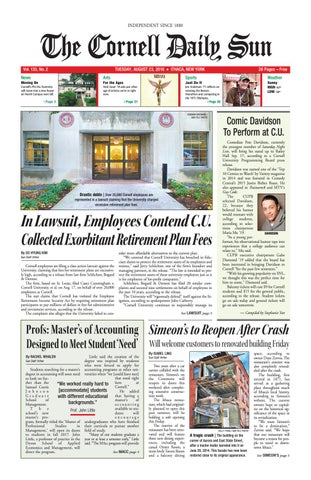
INDEPENDENT SINCE 1880
The Corne¬ Daily Sun Vol. 133, No. 2
TUESDAY, AUGUST 23, 2016 ! ITHACA, NEW YORK
28 Pages – Free
News
Arts
Sports
Weather
Moving On
For the Ages
Just Do It
Sunny HIGH: 82º LOW: 58º
Cornell’s Phi Mu fraternity will move into a new house on North Campus next fall.
Nick Swan ’19 asks just what age of artistry we’re in right now.
| Page 3
Jon Anderson ’71 reflects on winning the Boston Marathon and competing in the 1972 Olympics. | Page 28
| Page 21
CONNOR ARCHARD / SUN FILE PHOTO
sider more affordable alternatives to the current plan. “We contend that Cornell University has breached its fiduciary duties to protect the retirement assets of its employees and retirees,” said Jerry Schlichter, one of the firm’s founders and managing partners, in the release. “The law is intended to protect the retirement assets of these university employees just as it is for employees of for-profit companies.” Schlichter, Bogard & Denton has filed 20 similar complaints and secured nine settlements on behalf of employees in the past 10 years, according to the release. The University will “vigorously defend” itself against the litigation, according to spokesperson John Carberry. “Cornell University continues to responsibly manage its
Comedian Pete Davidson, currently the youngest member of Saturday Night Live, will bring his stand up to Bailey Hall Sep. 17, according to a Cornell University Programming Board press release. Davidson was named one of the ‘Top 10 Comics to Watch’ by Variety magazine in 2014 and was featured in Comedy Central’s 2015 Justin Bieber Roast. He also appeared in Trainwreck and MTV’s Guy Code. The CUPB selected Davidson, 22, because they believed his humor would resonate with college students, according to selections chairperson Maria Mu ’19. DAVIDSON “As a young performer, his observational humor taps into experiences that a college audience can relate to,” Mu said. CUPB executive chairperson Gabe Diamond ’19 added that the board has been interested in bringing Davidson to Cornell “for the past few semesters.” “With his growing popularity on SNL, we thought this was the perfect time for him to come,” Diamond said. Balcony tickets will cost $9 for Cornell students and $15 for the general public, according to the release. Student tickets go on sale today and general tickets will go on sale tomorrow.
See LAWSUIT page 5
— Compiled by Stephanie Yan
Drastic debts | Over 20,000 Cornell employees are represented in a lawsuit claiming that the University charged excessive retirement plan fees.
In Lawsuit, Employees Contend C.U. Collected Exorbitant Retirement Plan Fees By SO HYUNG KIM Sun Staff Writer
Cornell employees are filing a class action lawsuit against the University, claiming that fees for retirement plans are excessively high, according to a release from law firm Schlichter, Bogard & Denton. The firm, based on St. Louis, filed Casey Cunningham v. Cornell University, et al. on Aug. 17, on behalf of over 20,000 employees at Cornell. The suit claims that Cornell has violated the Employee Retirement Income Security Act by requiring retirement plan participants to pay millions of dollars in fees for administrative and investment services, according to the release. The complaint also alleges that the University failed to con-
Comic Davidson To Perform at C.U.
Profs: Master’s of Accounting Simeon’s to Reopen After Crash Designed to Meet Student‘Need’ Will welcome customers to renovated building Friday Little said the creation of the Sun Staff Writer degree was inspired by students who were forced to apply for Students searching for a master’s accounting programs at other unidegree in accounting will soon need versities when “we [could have met] that need right to look no furhere at ther than the “We worked really hard to Cornell.” Samuel Curtis [accommodate] students He added Jo h n s o n Graduate with different educational that having a master’s of School of backgrounds.” accounting Management. available to stuT h e Prof. John Little dents will school’s new encourage master’s program, formally titled the ‘Master of undergraduates who have finished Professional Studies in their curricula to pursue another Management,’ will open its doors field of study. “Many of our students graduate a to students in fall 2017. John Little, a professor of practice in the year or at least a semester early,” Little Dyson School of Applied said. “The MAcc program will provide Economics and Management, will See MACC page 4 direct the program. By RACHEL WHALEN
By ISABEL LING
Sun Staff Writer
Two years after a car carrier collided with the restaurant, Simeon’s on the Commons will reopen its doors this weekend after completing extensive construction work. The Ithaca restaurant, which had originally planned to open this past summer, will be holding a soft opening this Friday. The interior of the restaurant has been renovated and will feature three new dining experiences, including the casual Oyster Room, a more lively Tavern Room and a balcony dining
KELLY YANG / SUN FILE PHOTO
A tragic crash | The building on the corner of Aurora and East State Street, after a tractor-trailer barreled into it on June 20, 2014. This facade has now been restored close to its original appearance.
space, according to owner Dean Zervos. The restaurant’s exterior was also completely remodeled after the crash. The building, first erected in 1871, has served as a gathering place throughout much of Ithaca’s local history, according to Simeon’s website. The current owners hope to capitalize on the historical significance of the space in its revitalization. “We want Simeon’s to be a destination,” Zervos said. “We hope that our restaurant will become a reason for people to travel to downtown Ithaca.” See SIMEON’S page 5
2 THE CORNELL DAILY SUN | Tuesday, August 23, 2016
Daybook
DAYBOOK
Tuesday, August 23, 2016
ORIENTATION WEEK EVENTS Today
Fine Arts Library Tour 4:30 p.m., Rand Hall, Fine Arts Library
Matthew Schreiber Crossbow Exhibition 10 a.m. - 5 p.m., Johnson Museum of Art
C.U. Jazz Ensemble Auditions 4:30 - 10 p.m., Uris Library
Quantitative Single-Cell Biophysics Seminar 12:20 - 1:45 p.m., 700 Clark Hall
Free Showing of Beauty and the Beast For New Students 7 - 8:40 p.m., Willard Straight Theatre Free Showing of Zootopia For C.U. Students 9:30 - 11 p.m., Willard Straight Theatre
Tomorrow Vintage Vision Exhibition: Vogel, Vogue and the Art Of “Gazette Du Bon Ton” 8 a.m. - 5 p.m., Mann Library Exploring Cornell Library’s Rare Books and Manuscripts 3:40 p.m., Kroch Library Intersectional Advocacy: A Welcome Social From the Students and Staff In Dean of Students 4 - 6 p.m., Bear’s Den, Willard Straight Hall CAMERON POLLACK / SUN PHOTOGRAPHY EDITOR
Cutting edge | Matthew Schreiber’s laser light
Veterinary Senior Seminars 4:30 - 5:45 p.m., College of Veterinary Medicine
installation opens today at the Johnson Museum of Art.
The Corne¬ Daily Sun INDEPENDENT SINCE 1880
Editor in Chief
Sofia Hu ’17
ALL DEPARTMENTS
Business Manager
Louis Liu ’18
(607) 273-3606
Business: For questions regarding advertising, classifieds, subscriptions or delivery problems, please call from 9 a.m. to 5 p.m., Monday-Friday. News: To report breaking news or story ideas, please call after 5 p.m., Sunday-Thursday.
SEND A FAX VISIT THE OFFICE THE SUN ONLINE E-MAIL
(607) 273-0746 139 W. State Street, Ithaca, N.Y. www.cornellsun.com sunmailbox@cornellsun.com
Postal Information: The Cornell Daily Sun (USPS 132680 ISSN 1095-8169) is published by THE CORNELL DAILY SUN, a New York corporation, 139 W. State St., Ithaca, N.Y. 14850. The Sun is published Monday, Tuesday and Thursday during the academic year, and every weekday online. Four special issues — one for Cornell Days in April, one for seniors in May, one for alumni in June and one for incoming freshmen in July — make for a total of 89 issues per year. Subscriptions are: $84.00 for fall term, $86.00 for spring term and $170.00 for both terms if paid in advance. Standard postage paid at Ithaca, New York. Postmaster: Send address changes to The Cornell Daily Sun, 139 W. State St., Ithaca, N.Y. 14850.
COURTESY OF THE CORNELL PLANTATIONS WEBSITE
Poems for the people | Pulitzer Prize-winning poet Gary Snyder will speak at the Cornell Plantations tomorrow.
Cornell Plantations Fall Lecture Series: Gary Snyder 5:30 p.m., Call Auditorium, Kennedy Hall Free Showing of Walkabout For New Students 7 - 8:40 p.m., Willard Straight Theatre Free Showing of Some Like It Hot For New Students 9:30 - 11:30 p.m., Willard Straight Theatre
THE CORNELL DAILY SUN | Tuesday, August 23, 2016 3
NEWS
Gannett to Become ‘Cornell Health’
University Cornell Professor Elected Chair of New York Council For the Humanities Prof. Jonathan Culler, English and comparative literature — who has served on the board of the New York Council for the Humanities since 2007 — was recently elected the organization’s chair, according to a University press release. The council, a partner of the National Endowment for the Humanities, supports public opportunities in the arts that reach over a million New Yorkers every year. The program also provides two fellowships for Cornell doctoral candidates, the release said.
Name of New Bacterium Honors Cornell Food Science Researcher Students at Cornell’s Food Safety Laboratory have named a new bacterium after one of the institute’s professors, Prof. Martin Wiedmann, food science, according to a University release. The microbe, Bacillus wiedmannii, was collected from raw milk and can cause food poisoning if ingested before pasteurization. In addition to recognizing Wiedmann’s contributions to Cornell’s dairy program, the bacterium’s name also reflects Wiedmann’s family history — his father had three plant species named after him, according to the release. “It’s a fantastic feeling to have students and staff proposing to name a bacterium after you, and it’s fun to become part of a ‘family legacy’ of taxonomy, across different groups of life,” he said in the release.
National Four Companies Drop Contracts With Ryan Lochte Following Incident In Rio Speedo is one of four companies that will discontinue their business partnerships with swimmer Ryan Lochte after he told a false story about being robbed at gunpoint in Brazil, according to The New York Times. Ralph Lauren, the mattress brand Airweave and Syneron Candela — a company that sells hair-removal devices — also announced that it would end its relations with Lochte, according to The Times. In a Twitter post, Speedo said it plans to donate $50,000 of Lochte’s fees to a charity for Brazilian children, The Times reported. “We cannot condone behavior that is counter to the values this brand has long stood for,” the company said in a statement. — Compiled by Stephanie Yan
Facility will undergo renovations, expand to new Campus Road building
both by “generous donors” and contributions from all the University’s schools, colleges and administrative units. Kent Bullis, Gannett’s interim executive Gannett health services will only be availdirector, said one of the project’s goals is the able in the facility’s new addition on Campus consistent provision of more integrated medRoad while the original building is renovated ical and mental health services. and renamed over the next year, the “Our collaborative care teams — made up University announced in June. of medical providers, counselors, psycholoNianne VanFleet, Gannett’s associate gists, nutritionists and others — are now codirector of operations, said the health facility located in ‘integrated care suites’ where will double in size after upcoming renoproviders from different backgrounds vations. She described this coming year as “The original facility was severely and specialties work together to support a “transition period,” when many offices undersized to serve Cornell’s growing our patients’ and clients’ physical and and services will be moved to temporary mental health,” Bullis said. locations in the new addition while the student population.” Bullis noted that another aim of the original building is renovated to reflect a Sharon Dittman revamped Gannett will be to improve visneed for more space. itor experience and create a peaceful “The expansion will really ‘right size’ atmosphere in the facility. our facility, since we had been operating “Many of our visitors come to us when in a space that was much too small and no four years later when a local firm was hired to longer met healthcare standards,” VanFleet design a facility that would incorporate the they are feeling their worst, and we believe construction of a significant addition into the that providing a welcoming, peaceful physical said. space is an important part of delivering highOnce complete, the new building will existing building. “This transformation of Cornell’s health quality care and helping our patients and have up-to-date and accessible medical facilities, an increased numbers of exam rooms, services is a $55 million project — less than clients feel their best,” he said. The University also announced that in counseling offices, an expanded pharmacy half the cost of the original design,” Dittman Spring 2017, Gannett will officially change and larger waiting area, according to said. She explained that the expansion and renVanFleet. Sharon Dittman, Gannett’s associate ovation of the health facility is being funded See GANNETT page 5
By KIMBERLY LEE Sun Staff Writer
director for community relations, described the expansion of Cornell’s health center as a project that has been a “University priority” since 2005. “The original facility was severely undersized to serve Cornell’s growing student population and evolving campus needs,” she said. Dittman explained that plans for the new facility in 2009 had to be tabled due to budgetary concerns, but discussions resurfaced
COURTESY OF CORNELL UNIVERSITY
The Gan-next step | Gannett will temporarily move some of its facilties to a new Campus Road building while its old structure undergoes renovations.
Phi Mu Fraternity Purchases North Campus House By JOSEPHINE CHU Sun News Editor
Cornell’s chapter of the Phi Mu fraternity has secured a house at 509 Wyckoff Road after a twoyear real estate search, according to Amy Maurer, Phi Mu director of collegiate membership. The house — which accommodates 38 people — is currently being leased to Alpha Chi Omega, according to Maurer. Phi Mu has arranged for a long-term lease with the owner and will move into the house in fall 2017. The chapter currently has 100 active members and will hold recruitment at the new house in the spring of 2018. Maurer explained that the national fraternity has been searching for the right property for the Phi Xi chapter ever since the chapter’s establishment at Cornell in 2014. Last fall, the Cayuga Heights Planning Board unanimously rejected a request from the Phi Mu fraternity to purchase property at 520 Wyckoff Road due to opposition from the community, The Sun previously reported. Community members composed a petition to exclude the
female fraternal organization from the residential neighborhood, claiming that a chapter house would be “inappropriate usage for the lot and the location.” Since the new house at 509 Wyckoff is already being used as a sorority house, the fraternity did not encounter the same difficulties as last year, according to Maurer. Maurer said that having a chapter house at Cornell will “put Phi Mu on the same playing field as the other sororities.” “[Having a house] will further strengthen the strong bond of sisterhood that the sisters have already established,” she said. Christina Nastos ’19, a Phi Mu member, agreed, saying that it is important for a sorority to offer new members the same benefits as other sororities on campus. “I’m most excited to have Sunday chapter meetings in a living room,” Nastos said. “Our living room will be much more comfortable and cozy than Goldwin Smith.” Ayanna Allen ’17, president of the Phi Xi chapter, called the new house a “second home” for the
Phi Mu sisters on campus. “Our chapter is very close, and I think having the house will add to the love and strength of our sisterhood,” Allen said. “The biggest challenge will be figuring out all of the logistics, but we have time to make plans and we are collaborating with the headquarters to work through all of the details.” Julianna Meely ’18, a Phi Mu member, called the new house “gorgeous, bright and cheery.” She expressed excitement about
this new opportunity but said she does not think it is necessary for a sorority to have a house. “While it seems that most potential new members are enchanted by the opportunity to live in a house, they will quickly discover, as did I, that a house doesn't make a sorority, the bonds of sisterhood make a sorority,” Meely said. Josephine Chu can be reached at jchu@cornellsun.com.
COURTESY OF JACKIE ISAACSON
Mu frontiers | Cornell’s Phi Xi chapter will move into its new house at 509 Wykoff Road in the fall of 2017.
4 THE CORNELL DAILY SUN | Tuesday, August 23, 2016
NEWS
Gannett Undergoes Transformation
Expanded facility to improve visitor experience, promote ‘peaceful atmosphere’ GANNETT
COURTESY OF CITY OF ITHACA
New face | This rendering shows the new entrance planned on the Ho Plaza side of the original Gannett structure.
Continued from page 3
its name and operate in its entirety under the new name “Cornell Health.” The facility was originally built in the 1950s and named “Gannett Clinic” in appreciation for a generous donation “We believe that providing a from the Gannett Foundation. welcoming ... space is an According to Dittman, the new renovations seemed to sigimportant part of delivering nify an appropriate time for a high quality care.” new name. Dittman explained that Kent Bullis “Cornell Health” was the result of ideas generated from surveys and focus groups involving Cornell community members. “[The shift] reflects the evolution of our mission, our holistic approach to providing medical, mental health and public health services, and the commitment of the university to health as a core value for the whole campus community,” she said. Kimberly Lee can be reached at kimberlylee@cornellsun.com.
New Master’s of Accounting Program To Launch in Fall ’17 MACC
Continued from page 1
them the opportunity to round out their time at Cornell, attaining a master’s degree while also preparing for the CPA, CMA or CFA exam.” Students interested in the program should have a background in “core business classes,” but the most critical prerequisite is Intermediate Accounting, which should be taken this fall for students who are
An estimated 20 recent graduates are expected to enroll in 2017, according to Little, but he predicted that the program “will likely expand beyond Cornell borders.” The MPS program was approved by Cornell and New York State in 2015 and “shows the power of the newfound College of Business,” Little said. “We really wouldn’t be able to do this without combining the forces of Johnson with Dyson and the School
“I think this shows what the collective power and positive change that the CCB can bring to Cornell.” Prof. Robert Libby interested in applying to the program in the spring, according to Little. “We worked really hard to make the program requirements flexible enough to accommodate students with different educational backgrounds,” he said. “A Dyson or Hotel student who is already an accounting concentrator can take fewer accounting classes and more management electives. On the other hand, someone with an undergraduate business major may have some core accounting to make up, so they would take fewer management electives.”
of Hotel Administration,” he said. Prof. Robert Libby, accounting, agreed, adding that although the program is “housed and administrated” by the Johnson School, the College of Business created the dialogue that made the project a reality. “This program was talked about in the past, but it took the CCB to bring it to the forefront,” Libby said. “I think this shows what the collective power and positive change that the CCB can bring to Cornell.” Rachel Whalen can be reached at rwhalen@cornellsun.com.
THE CORNELL DAILY SUN | Tuesday, August 23, 2016 5
NEWS
One Third of Simeon’s Original Staff to Return
Flood warning
SIMEON’S
Continued from page 1
The restaurant’s grand opening has been delayed several months due to the slow pace of construction. However, Zervos and co-owner Rich Avery — who took over the restaurant in 2007 — remain optimistic about the restaurant’s successful reintroduction. “We are just looking forward to the re-opening and serving our friends and customers,” Zervos said. “The Ithaca community has been very good to us [since we have closed], and we are excited to open our doors.” The restaurant’s family ambiance is apparent in the return of about one third of its original staff. However, the absence of Amanda Bush, a former bartender who died in the crash that closed the restaurant, will not go unnoticed. The owners honored Bush’s memory by dedicating building’s new additions to her. “You never really move past it; we lost a friend in the tragedy and we don’t want to move past it,” Zervos said. “That’s why we dedicated the build-out to her.” Isabel Ling can be reached at iling@cornellsun.com.
C.U.Counters Allegations LAWSUIT
Continued from page 1
retirement plans for the greatest possible benefit to employees and retirees, and has been responsive to interests in having a reasonable range of funds available,” Carberry said. Cornell has also been monitoring retirement funds through its Retirement Plan Oversight Committee, according to a University press release. “The fees listed for funds that Cornell monitors are those that the University, using its leverage as
major employer, has negotiated with TIAA, Fidelity and for Weill Cornell Medicine employees,” said Paul Bursic, senior director of benefits services, in the release. “These are the lowest fees possible, often at rates significantly below retail.” RPOC meets quarterly to evaluate how the retirement funds are performing for their costs, the release said. The University declined to comment further on the litigation. So Hyung Kim can be reached at sohyungkim@cornellsun.com.
EDMUND D. FOUNTAIN / THE NEW YORK TIMES
A sign warns potential looters amid debris from a flood-damaged home in Central, La., on Saturday.
6 THE CORNELL DAILY SUN | Tuesday, August 23, 2016
NEWS
University Librarian,‘Leader in Library Science,’ to Retire By JENNA RUDOLFSKY Sun Staff Writer
“I’m most looking forward to doing a lot of reading,” said University Librarian Anne Kenney,
who announced her plan to step down in April and retire by October 2017. “There are just great books that have been sitting on my bedside table for a long time.”
Kenney said she has served as the Carol A. Kroch University Librarian since 2008, managing the institution’s $55 million budget, the 18 libraries on campus — a combination of physical and vir-
tual entities — and a staff of nearly also for the role she played as uni500 people. versity librarian in transitioning Kathryn Boor, Dean of the the system to an age of new media. College of Agriculture and Life Prof. Bruce Lewenstein, comSciences, predicted that Kenney munications and science and techwill be remembered as “the librari- nology studies, called Kenney a an responsible for unifying all “relentlessly positive person.” libraries across the entire “I can’t think of a time that I University.” haven’t seen Anne come into a “She has boldly created collec- meeting or situation saying, ‘How tions for the University that are do we move this forward,’” Lewenstein said. peerless,” Boor said. Lewenstein recounted working Kenney explained that she first came to Cornell 30 years ago as a with Kenney for many years, conservation liaison librarian, whether it be through his own before becoming engrossed in dig- research and archiving projects or as a member and acting ital imaging for chair of the University archives. Faculty Library Board. “I spent a decade “She’s leaving a very plus doing research in healthy library system, digital imaging for one that has dealt well libraries and archives,” with major financial she said. “We estabconstraints that affectlished standards that ed most of her time as were adopted around university librarian,” the world for capturing KENNEY Lewenstein said. “She text-based materials. We wrote a couple of books on it, became librarian just as the finanand we developed a series of work- cial crisis hit us. She had to manage shops that attracted an internation- in a really challenging time.” As she approaches retirement, al audience.” These workshops transformed Kenney said she plans to travel in both Kenney and Cornell into addition to enjoying her time in internationally renowned figures in Ithaca. “I also want to try my hand at library science, according to Boor. “Anne is recognized around the writing murder mysteries,” globe as a bold leader in library sci- Kenney said. “It’s always been at ence,” Boor said. “She is frequently the back of my mind to do that. I consulted by others regarding issues published a lot in scholarly work, that shape the way academicians but never anything that was popular reading.” are able to access information.” Kenney’s time at Cornell will be remembered not only for her Jenna Rudolfsky can be reached at research accomplishments, but jrudolfsky@cornellsun.com.
THE CORNELL DAILY SUN | Tuesday, August 23, 2016 7
NEWS
Student Claims ‘Unlawful Conduct’ In Sexual Assault Case
Big red welcome
By STEPHANIE YAN Sun Assistant News Editor
A Cornell student is suing the University for alleged unlawful conduct during a sexual assault investigation, according to court documents obtained by The Sun. The student, identified as “John Doe,” submitted a petition to the Tompkins County Supreme Court on May 10 requesting that Cornell pause disciplinary proceedings while his suit is ongoing and pay him at least $500,000 in compensation for his suspension. Doe claims that Cornell did not provide him with a hearing, that the investigation against him was biased and delayed and called his suspension from the school “arbitrary and capricious.” His petition argues that the University’s actions, as well as its compliance with sexual assault investigation Policy 6.4 — which was criticized in a December 2015 Judicial Codes Counselor report and is currently undergoing revision — violated Section 6444(5) of New York State Education Law, which describes New York’s sexual assault policies. Doe’s suit is nearly identical to that of Wolfgang Ballinger ’17, who was accused of assaulting a student in his room at the Psi Upsilon fraternity this winter and also filed a petition in May claiming that Cornell’s investigation of the incident was “flawed.” Doe is a member of Cornell’s Theta Delta Chi fraternity and intended to graduate in January 2017 prior to his suspension, the documents said. Alleged Assault
In Doe’s formal written complaint, he alleged that a female student — called “Jane Doe” in the documents — visited his fraternity house the night of Sep. 17, 2015 and was sexually aggressive toward him. She pinned him to
CAMERON POLLACK / SUN PHOTOGRAPHY EDITOR
The Cornell Marching Band performs on the terrace adjacent to Uris Library and McGraw Hall on Monday.
his bed after they began kissing and punched him in the testicles when he rolled her off him, the documents said. Jane Doe’s account of the incident alleged that John Doe was the aggressor, pulling her hair and choking her, according to the documents. The petition added that neither party was intoxicated and no sexual intercourse occurred. University investigators issued no contact orders to both parties and temporarily suspended John Doe, the petition said. Doe successfully appealed to have his suspension lifted on Oct. 15. Doe said that throughout the process, investigators behaved in ways “that presupposed his guilt” — including suspending him without hearing his version of events and speaking to him “in an accusatory and intimidating manner” — according to the documents. Suspended Again
Following the recommendations of Cornell’s sexual
assault case investigator, the University suspended Doe again in the middle of the spring semester, but reversed the decision April 26, the documents said. His suspension will be stayed until the Policy 6.4 process is completed, though Doe has appealed to have it completely annulled, according to the petition. The petition repeatedly stressed Doe’s “stellar” academic reputation, saying he maintained a 3.8 GPA while enrolled in a “grueling schedule” as a math and physics double major. The document also claimed that the repeated suspensions caused him “grave emotional distress and mental anguish” and damaged his academic career. If the court approves his petition, investigations will halt until Doe receives a hearing to resolve all allegations against him, the documents said. Stephanie Yan can be reached at syan@cornellsun.com.
Pa.Rally Supports Former C.U.Student Convicted of Sexual Abuse Peter Mesko ’13 was convicted of first-degree sexual abuse, second-degree burglary in 2015 By JOSEPHINE CHU Sun News Editor
Several Pennsylvania residents rallied on Sunday Sunday in support of former Cornell student and wrestler Peter Mesko ’13, who in 2015 was sentenced to five years in prison for drunkenly sexually abusing a woman, according to
a Facebook group entitled “Justice for Pete’s Sake.” The rally’s organizers aimed to “bring awareness to our corrupt legal system and undeniable presence of prosecutorial misconduct” and to “speak for the wrongfully accused and convicted when they cannot speak for themselves,” according to Facebook
page. As of Saturday, the page has received over 80 likes. Mesko was found guilty of firstdegree sexual abuse and second-degree burglary on Jan. 29, 2015, according to The Voice. He was also charged with rape, but the jury was deadlocked and unable to reach a verdict on this charge. Mesko was accused of raping a
COURTESY OF THE ‘JUSTICE OF PETE’S SAKE’ FACEBOOK PAGE
Disputed conviction | Members of Pete Mesko’s ’13 hometown gathered at Wayne County Courthouse in Honesdale, Pa. on Sunday.
female student in her girlfriend’s bedroom while she was asleep on the morning of March 30, 2013, The Sun previously reported. The victim’s girlfriend — who was in the room with her — helped to fend off the attack before the two fled to an upstairs bedroom. The victim’s girlfriend returned downstairs to take pictures of the assailant, who was lying on her bed with his jeans “slightly pulled down,” The Sun previously reported. They later identified Mesko as the attacker using the Cornell athletics department website. Mesko’s attorneys argued that Mesko was too drunk the night of the crime to have formed the “requisite intent to be found guilty rape,” The Voice reported. Forensic scientists testified in court that “minute levels of male DNA was found on the back area of the victim's bra and underwear, but not at significant enough levels to determine if it belonged to Mesko,” according to The Ithaca Journal. Jeff Deskovic, who spent 16 years in prison for after being falsely accused of murdering and raping a classmate prior to being exonerated by DNA testing in 2006, spoke at the rally, according to the Facebook page. The rally took place from noon to 2 p.m. on Sunday at the Wayne County Courthouse in Honesdale, Pennsylvania — Mesko’s hometown. Josephine Chu can be reached at jchu@cornellsun.com.
OPINION
The Corne¬ Daily Sun
Jacob Rubashkin | The Jacobin
Independent Since 1880 134TH EDITORIAL BOARD
SOFIA HU ’17 Editor in Chief
LOUIS LIU ’18
PHOEBE KELLER ’18
PAULINA GLASS ’18
JORDAN EPSTEIN ’18
RYAN TORRIE ’17
ADAM BRONFIN ’18
SOPHIA DENG ’19
CAMERON POLLACK ’18
Managing Editor
Business Manager
Advertising Manager
Associate Editor Web Editor
Sports Editor
Photography Editor
Blogs Editor
BRIAN LAPLACA ’18
MELODY LI ’17
JOSEPHINE CHU ’18
YUN SOO KIM ’17
DIVYANSHA SEHGAL ’18
JOSH GIRSKY ’19
Design Editor
Design Editor News Editor
News Editor
Science Editor
News Editor
TROY SHERMAN ’18
SHAY COLLINS ’18
Arts & Entertainment Editor
Arts & Entertainment Editor
STEPHANIE YAN ’18
MADELINE COHEN ’18
Assistant News Editor
Assistant News Editor
JACK KANTOR ’19
SHAN DHALIWAL ’18 Assistant Sports Editor
Assistant Sports Editor
ZACHARY SILVER ’19
EMILY JONES ’18
BRITTNEY CHEW ’17
SUZY PARK ’18
Dining Editor
Assistant Sports Editor
Video Editor
Assistant Photography Editor
MEGAN LEE ’18
SIERRA RINALDI ’18
Marketing Manager
Human Resources Manager
REBECCA BLAIR ’17
GWENDOLYN AVILES ’17
Senior Editor
Senior Editor
SLOANE GRINSPOON ’17
MICHAELA BREW ’18
Senior Editor
Senior Editor
JOON LEE ’17 Senior Editor
WORKING ON TODAY’S SUN DESIGN DESKERS PHOTO NIGHT EDITOR NEWS DESKERS SPORTS DESKER ARTS DESKER
Guest Cartoon
Brian LaPlaca ’18 Emma Williams ’19 Michaela Brew ’18 Josephine Chu ’18 Stephanie Yan ’18 Shan Dhaliwal ’18 Troy Sherman ’18
By J.T. Kim
Call Your Congressman T
here is a lot in this life that is predictable. The Patriots are going to make the playoffs. Lemonade is going to get all of the Grammys. Katie Ledecky is going to win. (Win what, you ask? Pretty much everything.) And what can we predict from the United States Congress, my home for the summer? Well, your best bet is that Congress isn’t going to do very much of anything at all. Even in more favorable political climates than the current one, the legislative process is slow. By design, most congressional actions suffer through a tortuous gestation period during which they are assailed from all sides and, more often than not, thoroughly expunged of anything meaningful and therefore “controversial.” While it is true that every once in a while, something big gets done (think ObamaCare), those moments are few and far between, and these days the “big things” usually come pre-negotiated by the leadership and only appear once the outcomes are predetermined. Simply put, there’s usually very little suspense or intrigue on Capitol Hill. Sometimes, however, they just up and throw the rulebook straight out the window. Such was the case with the Great Sit-in of 2016. On Wednesday, June 22, Democrats in the House of Representatives, frustrated by the lack of congressional response to gun violence in America, decided to take a stand. What they did was against the rules. It was a breach of decorum unprecedented in scope, and it was glorious. Civil rights hero, Georgia congressman and all-around mensch Rep. John Lewis (D-Ga.) led the effort, seizing control of the House floor at 11:30 a.m. and proceeding to give the assembled members of both parties an education on gun violence. A dozen or so members of the caucus soon joined him on the floor. Flustered and unwilling to engage, the speaker hastily gaveled the chamber into recess and turned off the C-SPAN cameras that had been broadcasting the day’s events. But John Lewis did not stand down, and neither did the rest of his party. Over the course of the following 24 hours, over 160 members of Congress occupied the floor of the House of Representatives. Unaided by microphones, representative after representative stood up and spoke of the ways gun violence had affected their district. At first, only those of us inside the Capitol complex even knew that something was going on. The Republican leadership had cut C-SPAN’s live feed in an attempt silence John Lewis and the Democrats. In another age, the story would have ended along with that official broadcast. But we live in an extraordinary era. Armed with their smartphones and iPads, several congressmen began to live stream the sit-in on a variety of platforms, employing a tactic unheard of just years ago. Before long, the shaky footage from cell phone cameras was picked up by C-SPAN and millions of Americans gained an unvar-
nished glimpse into their nation’s governing process. That’s when the calls started pouring in. On most days, my office would field a handful of calls an hour. Callers were rarely constituents, and were almost always furious about something related (tangentially, at best) to the Congressman. The vitriol we were confronted with on a daily basis surprised me. In my time there I was admonished and threatened and called a litany of names and epithets too hateful to put in print. Most days I was reticent to even answer the phone, knowing the verbal assault that awaited me on the other end of the line. Such was not the case during the sitin. In what was perhaps the single largest day for our office (in terms of incoming calls) in history, my faith in the decency of the American people was restored to its pre-Capitol Hill level. The calls we received that day were gracious. They were supportive. The amount of positive energy emanating from the phones was a wonderful thing to feel, in my office and in the offices of Democrats all throughout the Capitol complex. By acting unpredictably, with a sort of reckless abandon that only a battletested and indomitable leader like Rep. Lewis can inspire, the House Democrats awoke something deep within the American people. For once, our politicians stuck out their necks and shouted that they were mad as hell and not going to take it anymore. For once, they refused to be constrained by the arcane formalities that have come to characterize Washington. For once, they spoke out in defiance of the most powerful special interest in America. They spoke, and America responded. That push for common sense gun safety legislation fell short, as had every other before it. But the sit-in was different. It was refreshing, a bolt of electricity straight to the heart of a normally staid and predictable organization. If we want to effect real change down the road, the sit-in is the model we must emulate. Congress must continue to unshackle themselves from convention; convention is simply not working. Our leaders must attack the challenges of the day with the same vigor and conviction they showed during the sit-in. That being said, governing is a twoway street. We, as constituents, have a responsibility to let our representatives know that if they stick up for us, we will stick up for them. So the next time you see your congressman do something that makes you proud, give them a call. Let them know what they’re doing right. Give them the energy they need to continue to fight. Tell them to keep being unpredictable, keep being implacable, keep pushing for progress. When the negative voices drown out all else, it’s no wonder nothing gets done. It is only with a positive attitude and an eye on the future that we can move forward as a nation. Jacob Rubashkin is a sophomore in the College of Arts and Sciences. He may be reached at jrubashkin@cornellsun.com. The Jacobin appears alternate Mondays this semester.
THE CORNELL DAILY SUN | Tuesday, August 23, 2016 9
OPINION
Hebani Duggal |
Web
Comment
Teach Me How to Duggal
First One Back T
he first column of the semester is always the one that weighs the heaviest. It’s the one my idle mind wanders to those times in the summer when I feel like I haven’t done much of anything or those other times I feel like my internship has turned me into a middle-aged man that goes to bed at 10 p.m. and doesn’t particularly like his life too much. I had a column outlined coming into the school year — something well-researched, with sources hyperlinked in and a powerful ending that forced you to reconsider your plan for the entire upcoming year (note: tune in next week, it’s probably better to plan out your year after you’ve fully recovered from OWeek). I changed my mind about what it is that I wanted to share with you all when I got to campus. Coming back to campus is always a cathartic experience. O-Week is filled with the joy of being back at it with your friends, the excitement of a new school year, the angst of having to head
Newton’s third law, as critical as my high school physics teacher made it out to be, is not really that fascinating in itself to me. What is, however, is its application to our actions as (mostly) rational, decision-making characters. to class in just a few short days and adjusting to a familiar environment with the not so familiar lessons you might have learned over the summer. It’s not always the same for everyone — it can be a lot worse for some than others, but either way, coming back to campus, O-Week and the time right before classes start is always something to everyone. My O-Week had me thinking a lot about consequences. Newton’s third law states that for each action, there is an equal and opposite reaction — if you apply a downward force on a chair by sitting in it, the chair will apply an upward force on you in return. Newton’s third law, as critical as my high school physics teacher made it out to be, is not really that fascinating in itself to me. What is, however, is its application to our actions as (mostly) rational, decision-making characters. Take Ryan Lochte and the three other swimmers caught in web of their own lies earlier this week. Now, I’m not sure about the term “equal and opposite” necessarily applying in every situation as well as it does in Lochte’s, but the part about a reaction for every action most definitely does. For those of you who missed every news channel and outlet for the past week, Lochte and three other swimmers lied about being held up at gunpoint after attending a party in Rio. Authorities in Brazil later discovered the four athletes vandalized a gas station and denied any robbery actually took place. What does Lochte, Newton and Cornell’s famed O-Week have to do with each other then? For me, O-Week has been about discovering the impact of consequences. Every action here has a reaction. It might not always be equal and/or opposite, but it always occurs. In looking to the upcoming semester, it is my single hope that not everyone’s lesson in Newton’s third law is as harsh as Lochte’s. Hebani Duggal is a junior in the College of Arts and Sciences. She can be reached at hduggal@cornellsun.com. Teach Me How to Duggal appears alternate Tuesdays this semester.
of the day
“Regardless, male or female, it seems like the majority of these things happen when alcohol is used. It’s the main perpetrator. Alcohol opens the flood gates for these things to happen. ...The answer is people shouldn’t drink to the point where they’re in a position where they do something that has consequences they’re not going to want to deal with when they’re sober. These are Cornell students. They have pretty decent lives, it really isn’t worth it.” Answers...? Re: “Ballinger ’17 Indicted for First-Degree Sexual Abuse,” News July 15, 2016
Alex Davies | Have I Got News for You?
The Morning After E
ven if Hillary Clinton forming the fundamental func- maybe there is something that wins a crushing victory in tioning of government, sections “the Second Amendment peoNovember, she will enter of the populace lose hope in ple”can do... “maybe there is, I office as one of the most dis- rational dialogue as a means for don't know.” Obama was threatening to liked presidents in history. She effecting change. People worry about perceived some because of their belief that is seen as untrustworthy and untruthful, treating the law alterations of process because he is a foreign-born Muslim or with haughty disdain. Many on they transgress the bounds of the simply his being a black man. All the right, encouraged by today’s normal political ebb and flow. of these factors, true or false, political echo chamber, believe People begin to fear that such could be argued against with the her to be a criminal deserving of changes will not only disadvan- full weight of history. Those who the sharp end of a firing squad. tage their participation in the sys- believed him to be a member of Calls for politicians to face exe- tem but threaten their lives out- the Muslim Brotherhood out to cution used to be a mark of the side the system. When the girders destroy America could easily be insane. Now one hears them of American life (the right to bear dismissed as unhinged. routinely. Donald Trump asserts that a Clinton When politicians, particularly presidents (or presidential canvictory in November will didates), are believed to be altering that structure, changing be because she the very processes through which the system operates and cheated. This plays into the transforming the fundamental functioning of governnarrative of ment, sections of the populace lose hope in rational criminality surr o u n d i n g dialogue as a means for effecting change. Clinton — one could argue that it is only politics a la Trump — but telling arms, spurious though it may be, Clinton is threatening to Americans that Clinton is med- or representative, democratic gov- some because she is a woman, dling in the very mechanisms of ernment) are seen to be jeopar- yes, but also because she helped electoral democracy is a threat to dized, radicalism gains greater her husband harass women (suprational, reasoned discourse. It appeal. The water in the reservoir posedly) and killed four doesn’t matter that the electoral of tyranny is no longer contained Americans in Benghazi (apparprocess is sound in actuality; it by the great wall that each indi- ently). One cannot argue matters that the ballot box is vidual has mentally erected to against such accusations with believed to be impermeable to the hold back the tide and those historical force. They require bloody hands of the Killary car- innumerable dams begin to crack. nuanced and complex ripostes, As people watch the flood rise subtleties that are sorely lacking tel. When politicians are seen to they see no way of preventing from current American disoperate within a structure, merely themselves from being drowned course. As such, it is more diffialtering the variables of that beneath it. Pulling the plug on cult to dismiss the Crooked structure (who controls the presi- the vast cesspool seems to be the Hillary believers as lunatics and dency, number of seats in only way out. thus more difficult to convince Men and women decide to take those with nagging doubts not Congress, etc.), the populace retains faith in the system — matters out of political discourse to give credence to the accusawhat is done can always be and place them squarely in the tions leveled against her. undone. When politicians, partic- realm of physical conflict. One ularly presidents (or presidential has only to look at the shootings candidates), are believed to be of abortion clinics or recent retal- Alex Davies is a senior in the College of Arts and Sciences. He can be reached at altering that structure, changing iation killings of police officers to ajd253@cornell.edu. Have I Got News For the very processes through which see the consequences of such You? appears alternate Tuesdays this semesthe system operates and trans- action. As for Crooked Hillary, ter.
10 THE CORNELL DAILY SUN | Tuesday, August 23, 2016
Pitchfork? Too mainstream.
I get my music from The Sun Arts Section.
THE CORNELL DAILY SUN | Tuesday, August 23, 2016 11
12 THE CORNELL DAILY SUN | Tuesday, August 23, 2016
UNITARIAN CHAPLAINCY AT CORNELL Our mission is to create connection, find inspiration, and engage the world.
RELIGIOU
— CORNELL UNITED R
MEMBER G
Connect, Inspire, Engage. Rev. Jane Thickstun (607) 273-7521 ext, 22 minister@uuithaca.org
TIBETAN BUDDHIST MEDITATION
Sponsored by First Unitarian Society of Ithaca At the corner of Aurora and Buffalo Streets www.uuithaca.org
The Venerable Tenzin Choesang, CURW Chaplain tc342@cornell.edu
The Religious Society of Friends
Meditations:
Ithaca Monthly Meeting
Quakers
Wednesday 11:15-12:00 pm Founders Room Anabel Taylor Hall
Student Welcome Picnic
Namgyal Monastery Institute of Buddhist Studies 201 Tibet Drive Danby Road/Rte. 96B Ithaca, NY 14850
Saturday, August 27 at 5:30 p.m. Burtt House Friends Center, 227 N. Willard Way (A3) Rides from Purcell (Jessup Rd. side) (E1) at 5:15 p.m. – Look for the car with FRIENDS sign
607-272-2785 office@namgyal.org
(607) 273-5421
Meditations: Namgyal Monastery Mon. Wed. Fri. 5:15-6:00 pm Meditation Instruction: 4:30 pm 1st Friday of Month Tea Social: 6:00-6:45 pm 1st Friday of Month
Meeting for Worship Sundays 10:30 a.m. 120 Third Street, Ithaca (607) 229-9500 www.ithacamonthlymeeting.org
Chabad is dedicated to bringing the warmth and richness of Jewish life and tradition to students of all backgrounds. We are your home away from home… the heart of Jewish campus life. Come for our free home-cooked Shabbat dinner, or for a Torah class. Call for information about Judaism, or just to talk. For more information regarding Chabad’s programs and activities, please e mail: Rabbi Eli and Chana at: es79@cornell.edu or call: (607) 257-7379 Eli & Chana Silberstein www.chabadcornell.com
CUR
CORNELL RELIGIOUS
THE CORNELL DAILY SUN | TTuesday, August 23, 2016 13
14 THE CORNELL DAILY SUN | TTuesday, August 23, 2016
THE CORNELL DAILY SUN | TTuesday, August 23, 2016 15
16 THE CORNELL DAILY SUN | Tuesday, August 23, 2016 T
THE CORNELL DAILY SUN | Tuesday, T August 23, 2016 17
OUS LIFE
D RELIGIOUS WORK — R GROUPS
Thursdays, 7:00-8:00
http://dos.cornell.edu/cornell-unitedreligious-work/how-we-can-serveyou/find-your-religious-community/ our-affiliated
LUTHERAN CAMPUS MINISTRY WELCOMES YOU TRINITY LUTHERAN CHURCH 149 Honness Lane Worship at Trinity at 10:30 a.m. Sunday (607) 273.9017
RW
L UNITED US WORK
www.trinityithaca.org
Welcome Picnic & Campus Fellowship check out details at: trinityithaca.org
Anuhea DeLude: ard225@cornell.edu Prof. Mike Thompson: mot1@cornell.edu Rev. Robert Foote, Pastor: rmf93@cornell.edu Deaconess Intern Cheryl Cox: cac363@cornell.edu Holly Hollingsworth: LSF@trinityithaca.org
Free transportation provided for all events
Help Pack 300,000 meals Sept. 22-24 check out: www.facebook.com/ithacamobilepack
SEVENTH DAY ADVENTIST SATURDAY SERVICES Worship – 10:45 a.m. Sabbath School – 9:30 a.m. Fellowship Luncheon To Follow Services Weekly
1219 Trumansburg Road, Ithaca • Phone 273-5950 LENOX BROWN, Pastor • www.ithacaSDAchurch.com
ITHACA AREA CONGREGATIONS
18 THE CORNELL DAILY SUN | Tuesday, August 23, 2016
CHRISTIAN SCIENCE SERVICES
SUNDAY SERVICE/SCHOOL 10:30AM WEDNESDAY TESTIMONY MEETING 7:30PM FIRST CHURCH OF CHRIST, SCIENTIST • 101 UNIVERSITY AVENUE, ITHACA CHRISTIAN SCIENCE READING ROOM 117 SOUTH CAYUGA STREET 607-272-1650, MON-FRI 11AM-5PM, SAT 11AM-2PM christianscience.com
St. Catherine Greek Orthodox Church
120 W. Seneca Street, Ithaca, has regularly scheduled liturgical services on Sundays, feast days, and special saints days. On Sundays, Orthros begins at 9:00 a.m. and Divine Liturgy at 10:00 a.m. On special feast and saints days, Orthros begins at 8:30 a.m. and Divine Liturgy at 9:30 a.m. The weekly meeting time of the Orthodox Christian Fellowship (OCF) is Wednesday from 7 p.m. until 9 p.m., in the Edwards Room of Anabel Taylor Hall (ATH). Morning prayer service is offered at 9 a.m. in the Tabernacle Chapel in ATH.
Confessions are taken by appointment by the Rev. Fr. Athanasios (Thomas) Parthenakis by calling (607) 273-2767 and (607) 379-6045. Everyone is welcome to attend these worship services and Wednesday OCF meetings at ATH, Cornell University
THE CORNELL DAILY SUN | Tuesday, August 23, 2016 19
A&E
20 | The Corne¬ Daily Sun | Tuesday, August 23, 2016
ARTS & ENTERTAINMENT 2016’S ANIMATION SURGE: Kubo and the Two Strings
BY BRENDAN COYLE Sun Contributor
First things first, I absolutely adore animation. In my eyes, it’s the most creative and culturally diverse medium in the film industry today, and if 2016 has proven anything to us, it’s that animated films are on a roll with hits like Zootopia, Finding Dory, Sausage Party and the upcoming Moana. Animation works so well for fictional stories because it’s able to make anything believable. It takes just as much time and money for an animator to draw a man walking down the street as it does for them to draw a dragon fighting a giant octopus. The only limits are the filmmakers’ imaginations. So now we have Kubo and the Two Strings, the latest project from Laika studios, famous for beautiful stopmotion films such as Coraline, ParaNorman and The Boxtrolls. Not since Aardman Studios or the animated Tim Burton films have we seen stop-motion done with such skill. By blending classic pose-and-shoot, puppetry, and computer-generated effects, Laika pulls off a style unique to itself which boasts impressive visuals while keeping intact the imperfect, shaky charm of stop-motion. Without giving too much away, Kubo and the Two Strings follows the story of a young boy named Kubo who lives outside of a small village with his single mother. His father was a great warrior who died protecting him, and his story lives on through Kubo’s performances in the village square. Using a Japanese three string guitar called a shamisen, Kubo brings origami PHOTOS COURTESY OF LAIKA STUDIOS
characters to life with magic and recounts the story of his samurai father, Hanzo. Unfortunately for our hero, two dark figures come looking for him, and he is separated from his mother, embarking on a quest to find his father’s powerful magic armor. It’s a classic hero’s journey, through and through. Along the way he is joined by a Monkey (Charlize Theron) and a samurai cursed to be held inside the body of a Beetle (Matthew McConaughey). These two characters are
a blast, and their relationships with both Kubo and each other bring out the best in their characters. Monkey is a sarcastic, no-nonsense guardian sent to protect Kubo, and while she’s a bit of a hardass, you can see her compassion shine through in later scenes. Meanwhile, Beetle is the best performance I’ve seen out of McConaughey in a long
time, mostly due to the fact that his character had actual depth, rather than the usual “Alright, alright, alright” coolness McConaughey usually delivers. Beetle suffers from memory loss due to his curse, which reminded me of The Wizard of Oz’s Scarecrow; this, paired along with his confident and cocky warrior attitude, makes for some solid comedy. The story is a pretty by-the-numbers hero’s journey, but the structure works very well for a film like this. Kubo has to travel the lands to find three pieces to complete his father’s armor, and he faces three challenges to obtain each one. While this structure is predictable, it’s incredibly entertaining. For example, when the three heroes enter a cave to obtain the Sword Unbreakable, an enormous skeleton monster appears to destroy them. This monster is so heavily influenced by video game bosses from The Legend of Zelda and Shadow of the Colossus that it breaches plagiarism, with which I would have had more of a problem if I hadn’t just witnessed what was for all intents and purposes a Zelda boss fight in a movie. My few problems with the story mostly concern some slower scenes that drag, and within these scenes I felt like the film was trying a little too hard to make the audience laugh. Granted, there is some solid comedy and fun banter, but there was certainly the occasional line which failed to land as intended. In addition, there are some small twists which, while interesting and dramatic, ended up muddying a few characterizations. I’m a sucker for movies about storytelling or the creative process, and this film revolves heavily around that trope while also asking its audience some heavy questions. In my opinion, children are film’s most important audience, and when I see movies that try to pander to younger viewers or treat them without intelligence or respect, it’s infuriating. Movies like Kubo, on the other hand, ask young viewers to consider things like death, memories and their respective meanings. Although in the end Kubo ends up dictating the moral of the movie pretty explicitly, this doesn’t take away from how refreshing it is to see these questions posed in a children’s movie. It asks viewers what’s more important: the truth or how we remember it? Can memories be more powerful than facts? Does death truly end one’s story? The way this film entrenches itself in Japanese culture through its character designs, folklore, music and themes was, as far as I can tell, incredibly respectful and something I wish I saw from more wide releases. In the end, Kubo and the Two Strings is an absolute pleasure, bringing together stunning animation, engaging and engagement with Japanese culture, a kickass soundtrack including a stellar cover of “While My Guitar Gently Weeps” and an adventurous story sprinkled with fun characters, solid vocal performances and surprisingly humbling and melancholy themes. I truly hope that 2016 is the year that proves to audiences that cartoons aren’t just “kid’s stuff.” Definitely give Kubo and the Two Strings your support in the box office so we can get more exciting hits like it from studios like Laika. Brendan Coyle is a junior in the College of Agriculture and Life Sciences. He can be reached at brc77@cornell.edu.
ARTS & ENTERTAINMENT
A&E
Tuesday, August 23, 2016 | The Corne¬ Daily Sun | 21
Joyce Manor “Fake I.D.”
Epitaph Records Shay Collins
SPINNING SINGLES O O O O O O O O O O O O O O O O O O
new and notable music in review
Before getting to “Fake I.D.,” let’s lay down some background on Joyce Manor. The California four-piece works in a grey area between emo and punk. Their lyrics skew far more often towards crypticness than the melodrama in their emo and pop-punk contemporaries’ work. Their songs are complicated, throbbing with raw energy and short: their four LPs all clock in at fewer than 20 minutes. The band’s 2011 self-titled debut posed a commitment to bile and pettiness that continued throughout their later releases. Joyce Manor are weird (consider a song called “Ashtray Petting Zoo”) and blunt, if not mean, willing to call out former friends for “pissing out your insecurities to people who don’t need you now.” Joyce Manor established the band as an angry and immature counterpart to emo’s central pathos. Throughout the ensuing years, Joyce Manor continued putting out complex emo/punk releases and pissing off and thrilling people along the way. 2014’s Never Hungover Again proved that the band’s central aggression burnt strong even as their sound matured, partially thanks to production by Hop Along’s Joe Reinhart. During the same year they also riled scenesters by stopping shows to call out stage divers. Was singer/guitarist Barry Johnson standing up for vulnerable fans, or was he defiling the spirit of getting your nose broken in the name of punk rock? Who’s to say. Johnson took most of the blowback from enraged tweeters and the whole debacle inspired the excellently titled Noisey article “Is Jumping on Someone’s Head OK?” Simply put, Joyce Manor has long been rightfully regarded as an exciting, divisive band making music that is somehow both accessible and enigmatic. And then there is “Fake I.D.,” the first single off of Cody, which is slated to be released by Epitaph Records on October 7. One of Joyce Manor’s long-time strengths is their ability to draw out bizarreness and discomfort from everyday items and places: beach communities, leather jackets, toy train sets. “Fake I.D.,” however, veers too far into mundanity, focusing largely on a conversation about just how great Kanye West is (according to the song’s characters, he’s better than John Steinbeck and Phil Hartman). The band tried out “Fake I.D.”’s power pop tone in Never Hungover Again’s closer, “Heated Swimming Pool.” The wit and strangeness that carried “Heated Swimming Pool” are absent from “Fake I.D.,” replaced by lagging references and a new sense of earnestness. Perhaps in October we’ll find that “Fake I.D.” is an odd one-off from Cody and not the harbinger of a calmer, sillier Joyce Manor.
Archetypes and Artistic Expression
I
n 1997, the historians William Strauss and Neil Howe published The Fourth Turning, a book that describes and expands upon the generational theory of history for which the two authors are regarded. Strauss and Howe contend that all of a society’s history is divided into saecula, or roughly 88-year periods that span the length of a long human life. Within each saeculum lie four ordered eras, or “turnings,” that include a “high,” “awakening,” “unraveling” and “crisis,” after which point the cycle repeats and a new saeculum begins. A high is comprised by an era of good, or stable feelings and conditions. The awakening occurs when high-era ideals are challenged and replaced. During an unraveling, society endures the clash of awakening ideals and burgeoning high-era institutions. Finally, the crisis witnesses events that ultimately change the meaning of life in one society and establish a new status quo in the next saeculum. The Fourth Turning applies this theory primarily to American histor y beginning after World War II. Postwar prosperity is the high; 1960s and 1 9 7 0 s Consciousness Revolutions form the awakening; 1980s and 1990s culture-clashes comprise the unraveling. Strauss and Howe predicted this saeculum’s crisis to begin in the early 2000s, and end sometime in the 2020s. So far, events like the September 11th attacks and the 2008 financial crisis have threatened to extend the validity of their theory. The group of individuals
born during one turning is considered a generation, and Strauss and Howe identify a similar cycle of generations, or archetypes. Those born during a high turning comprise the idealist “prophet” archetype. Prophets are indulged as children, and grow up to lead the self-oriented awakening following the high turning. The reactive “nomad” archetype is born during an awakening, and is particularly under-protected during childhood. They might grow up feeling somewhat alienated, or even shunned f r o m other gene rations Swan’s and thus Song take a pragmatic and cautious approach to later life. Civicminded “Heroes” are born during an unraveling, and come of age during a crisis, where they provide that groundwork that steers a society into the
Nick Swan
n e x t saeculum. Finally, the adaptive “artist” archetype is born during a crisis, and comes of age accepting the conformity and stability of a
high turning. I like Strauss and Howe’s theory because it provides an interesting sort of lens with which to consider artistic expression throughout history. If art is a type of reflected reality, then it can allow one to identify with various archetypes and moods of the past and aptly compare artists of entirely different times and eras. Take, for example, Jazz Age literature of the early twentieth century and grunge music of the 1990s — two movements that were led by nomad archetypes who worked during periods of intense social stratification. The burgeoning fervor of Progressive and Consciousness Era idealism (as well as brief American involvement in violent conflict) polarized the values of individuals and institutions. Thus, despite using vastly different mediums, writers like Fitzgerald or Hemingway and bands like Nirvana explored similar themes of youthful cynicism and disillusionment. A newly pessimistic Nick Carraway leaves West Egg after Gatsby's death and sparsely attended funeral; Kurt Cobain highlights his discovered ennui with stardom on In Utero’s “Serve the Servants.” Tones and themes from antiquated works suddenly blister with life in juxtaposition with more aesthetically familiar pieces. Perhaps most alluring about the Strauss-Howe generational theory is its implications for the millennial generation. As part of the lineage of “hero” generations, millennials will be busy, charged with solving current crises, such as mass student
debt, income inequality or climate change. I think that it is far too difficult to aggregate current artistic trends without making completely inadequate generalizations. However, it is easier to assess the work of previous heroes who COURTE acted out SY OF S CHRIBN ER’S the last crisis setting in and around World War II. Many authors who endured the war, like Vonnegut ’44 or Heller, wrote critically of it, describing the debilitating mental effects that combat inflicted on soldiers and citizens. As millennials gradually see the positive or negative resolutions of current problems, how will we reflect about our experiences? Will it consist of glorious portrayal or grim remembrance, through some unforeseen medium? As the great civic workers of all the archetypes, heroes possess a unique perspective of significant, lasting events, and thus have the ability to create some of the most inspiring artistic reflections. Strauss and Howe’s theory is certainly not flawless. Its very nature relies upon the acceptance of gross generalizations about time periods and the individuals that inhabited them. Moreover, its established boundaries of generations and turnings are sometimes thought to be quite arbitrary. Yet, to indulge the notion of generational archetypes and turnings can, as Strauss and Howe stress, allow for clear insight into a common human nature. Furthermore, it gives meaning to why we reflect and express artistically, as so many remarkably similar individuals have done before. Nick Swan is a sophomore in the School of Industrial and Labor Relations. He can be reached at nswan@cornellsun.com. Swan’s Song appears alternate Tuesdays this semester.
ARTS & ENTERTAINMENT
22 THE CORNELL DAILY SUN | Tuesday, August 23, 2016
Los Angeles Times Daily Crossword Puzzle Edited by Rich Norris and Joyce Nichols Lewis
ACROSS 1 Opinion piece 6 Resident’s winter expense 10 Formal agreement 14 Apartment agreement 15 Waist-measuring unit 16 River through Spain 17 Missouri’s largest metropolis 19 Israel’s Barak 20 Costa __ 21 Cooking-withgarlic enticement 22 First leg of racing’s Triple Crown 26 Prepare for the gala 28 Signaled on stage 29 “Sure, sure” 30 Sagan of “Cosmos” 31 Place to relax 34 1990 comedy about a detective posing as a teacher 39 Suffix with Japan or Brooklyn 40 Water conduit 41 Greek war god 42 Entertained with a tune 43 Unfavorable reputation 46 Oslo attraction honoring Heyerdahl’s expedition 50 Run __ of the law 51 Old Norse explorer 52 Ball of smoke 53 “Roots” hero from Gambia 59 Mil. flying branch 60 “Say that’s true ... ” 61 Water from France 62 Vietnamese holidays 63 Haunted house sound 64 Fix errors in, as software DOWN 1 Antlered grazer 2 Aegean, for one 3 __ Bernardino
4 Braying beast 5 Longs (for) 6 Minor setback 7 Room-size computer introduced in 1946 8 Perform on stage 9 Biblical “your” 10 Looked intently 11 Hate 12 Speck of bread 13 Start of the rest of your life, so it’s said 18 In __: as found 21 One-named singer 22 New Hampshire city 23 Founded: Abbr. 24 1980s Chrysler line 25 Mongolian tent 26 What Brinker’s boy plugged with a finger 27 Score-producing MLB stats 30 Is able to 31 “Get lost!” 32 Words from Wordsworth 33 Church recess 35 Online message
36 Corporal or colonel 37 1958 Chevalier musical 38 Half of Mork’s sign-off 42 Fills with feathers, as a pillow 43 Richard who married Liz Taylor ... twice 44 Cambodia’s continent
45 Knocked down 46 Done for 47 Helpful 48 Jack Sprat’s diet restriction 49 High-IQ group 53 Actress Novak 54 Sci-fi aircraft 55 “__ seen worse” 56 Penpoint 57 Greek cross 58 Subj. with writing exercises
ANSWER TO PREVIOUS PUZZLE:
xwordeditor@aol.com
08/23/16
COMICS AND PUZZLES
Sun Sudoku
Puzzle #808
GATTARA Fill in the empty cells, one number in each, so that each column, row, and region contains the numbers 1-9 exactly once. Each number in the solution therefore occurs only once in each of the three “directions,” hence the “single numbers” implied by the puzzle’s name. (Rules from wikipedia.org/wiki /Sudoku)
CLASSIFIED AD RATES Ads are accepted at The Sun’s office at 139 W. State Street downtown, by phone or e-mail. Deadline: 2:30 p.m. at The Sun’s office on the day preceding publication. Monday’s deadline: Friday, 2:30 p.m. at The Sun’s office.
Standard Rate: $3.60 per day for first 15
words, 38 cents per day per word thereafter. Five or more consecutive insertions, $3.35 per day for first 15 words, 36 cents per day per word thereafter.
Commercial Rate: $5.40 per day for first
15 words, 39 cents per day per word thereafter. Five or more consecutive insertions, $5.20 per day for first 15 words, 37 cents per day per word thereafter. The Sun is responsible for only one day makegood on ads.
273-3606 classifieds@cornellsun.com
I Am Going to Be Small
23 PARKING by Jeffrey Brown
Parking For Rent Available Now. Central Collegetown Dryden Road and College Ave
607-272-3000 www.ithacarenting.com Office at 119 Dryden Road
RIGHT BY CU PARKING REASONABLE RATE 607-227-0557
25 ROOMS FOR RENT By Lila Cherry ©2016 Tribune Content Agency, LLC
Classic Doonesbury (1987)
Rooms for Rent Stewart Ave. Available Now 607-327-2927
08/23/16
by Garry Trudeau
26 A PARTMENT FOR R ENT ************************************** RENT NOW, GET THE BEST!
matoulashouses.com
APARTMENTS & HOUSES IN COLLEGETOWN 1-16 BEDROOM HOUSES/APARTMENTS ALL FURNISHED LINDEN AVE, COLLEGE AVE, CATHERINE ST & EDDY ST EMAIL: tsintzina@yahoo.com PHONE: (607)339-9644 FIRST- COME, FIRST - SERVED **************************************
Mr. Gnu
by Travis Dandro
Ithaca Renting Company Apartments, Houses, Parking Central Collegetown Superb Panoramic Views Modern Elevator Buildings Collegetown Plaza: Fitness Room, fantastic Cayuga Lake Views Studio, 1, 2, 3, 4, 5, 6 BRs Parking Collegetown Center: Concierge Service, quiet building, Fitness Room Studio, 1, 2 BRs Parking Collegetown Court: Super convenient, exceptional value Studio, 1, 3, 4, 5 BRs
Mr. Gnu featuring Bigfoot
by Travis Dandro
Other Collegetown Locations: Apartments and Houses Dryden Road, Eddy Street, Buffalo Street 2, 3, 4, 6, 8, 10, 14 BRs Parking Rent Smart. Live Well.
607-272-3000 Visit our office at: 119 Dryden Road
www.ithacarenting.com
Collegetown 4 Bedroom Apts. 3 to choose from – Available now & also 2017-2018! Located on Eddy Street & Buffalo, these 4 bedroom units are available as apartments or will consider renting by the room for 2016-2017 term. Call or Text Tracy for details 607-379-2776
THE CORNELL DAILY SUN | Tuesday, August 23, 2016 23
26 A PARTMENT FOR R ENT Must see beautiful 2 story, 2 BR, 2 B. Located in Fall Creek area & 4 blocks north of Ithaca Commons. Features galley kitchen, huge living room & formal dining, 2 bedrooms w/private baths – one on the main floor & other is upper loft. $1900/mo + utilities.
Available Now!
Call or Text Tracy for details or showings 607-379-2776
AVAILABLE NOW Completely Remodeled 1 Bedroom. 607-327-2927
RIGHT BY CU 1 to 4 BEDROOM REASONABLE RENT NO STREET NOISE 607-592-7694
27 H OUSE FOR R ENT Linden Ave. 5 Bedroom House Available for Next School Year 2017-2018. 607-327-2927
Looking for that rural setting – well look no further. Duplex – 4 bedrooms, 2 1/2 bath 6 miles to Cornell University. 1500 sq. ft. living space Available Now! $1250/mo + all utilities Call or Text for further details Chris Anagnost, Broker – 607-279-5520
Let us keep you informed every day in
The Corne¬ Daily Sun
24 THE CORNELL DAILY SUN | Tuesday, August 23, 2016
SPORTS
New Managers In New Places
W
hen Abel Hernandez kicked the ball back towards his orangeclad teammates, Hull City’s Uruguayan striker made the first pass of the 2016-17 Premier League season. Perhaps the most prominent feature of this new season is the many excellent managers who have taken their talents to the Premiership over the summer. Let’s run the rule over each of the new arrivals and evaluate who will be deemed successful once the season’s last ball is kicked in May. Two weeks into the season, it seems like Manchester United’s Jose Mourinho is best positioned for instant success. Mourinho brings a pedigree of success, both in England with Chelsea FC and on the conti-
position left open by Ronald Koeman, who departed for Everton. There, he will face many challenges. The Everton squad is talented but has been underperforming as a team; I give Koeman a fifty-fifty chance for a successful season. Just three managers left now, as we get to the smaller clubs and the managers who are more likely to fail. Sunderland’s David Moyes, of Everton, formerly Manchester United and Real Sociedad, has a reputation as a steady hand. That’s exactly what Sunderland needs after several years of flirting with relegation, and Moyes’ sole goal is to avoid another relegation battle. Watford had a decent season last year, but decided to fire Quique Sanchez Flores, and
Kevin Linsey The Beautiful Game nent with Real Madrid, Porto and Inter Milan. He bought wisely over the summer, including superstars Zlatan Ibrahimovic and Paul Pogba. So far, his team has won each of their games by two goals. Hot on his heels is Chelsea’s Antonio Conte, the Italian formerly in charge of the Italian national team. With the Azzurri, he pulled off an upset of Spain with one of the worst Italian line-ups in years. At Chelsea, he is infusing youth into an aging team, which experienced a terrible, tenthplace season last time out. Manchester City’s Pep Guardiola is widely considered the best coach in the world. However, his new club might struggle to perform as well as Mourinho’s United or Conte’s Chelsea. Yes, Guardiola is an amazing coach, but his unique style of play, where the goalkeepers and defenders are encouraged to play short passes instead of long clearances upfield, is very difficult to implement in England, where clearing the ball has been the norm for years. Guardiola already seems likely to jettison one of the world’s best goalies, Joe Hart, just because Hart does not fit this system. The Hart situation exemplifies the possible growing pains for Guardiola at City. Southampton’s Claude Puel is another new manager likely to succeed. The Frenchman relocated to the south coast after a productive spell at the French club, Nice. Southampton is a demanding job, with the board pushing for inclusion of young players and progress in the league. While the Frenchman’s record at Nice suggests he has a shot at success, a tie and a loss so far suggests there may be an adjustment period. Claude Puel filled the
the new man in charge is Walter Mazzarri. The Italian boss faces adversity from the ridiculously high expectations of the owners, the Pozzo family. Also, Premier League managers typically struggle to manage largely foreign squads that lack experience in England, like Watford’s. The least likely to succeed is Hull’s Mike Phelan, who has taken over in an extremely difficult situation. Hull City, despite the club’s strengths like striker Hernandez, are tipped for relegation. Fans are discontent with the club’s ownership, who have put into place an unpopular membership scheme and tried to rename the club “Hull City Tigers.” The team also has only 13 fit senior players; five players are out injured for long periods and they have not signed a single player this summer, so their bench is mostly their youth team. The manager, Steve Bruce, left a month ago because of poor relations with the unpopular owners, and assistant manager Phelan was promoted. Phelan has impressed by pulling off two wins in two games, but this is a flash in the pan; Hull should return to relegation form soon, as all this adversity will take its toll on the Tigers. Each fall, soccer leagues around the world begin their seasons amid a wave of storylines, new signings, and fan expectations. Here in The Beautiful Game, I focus on the English Premier League, but I also work in coverage of other major leagues in Europe. Come back every other Tuesday for another column of The Beautiful Game ! Kevin Linsey is a second year columnist. He can be contacted at klinsey @cornell.edu.
THE CORNELL DAILY SUN | Tuesday, August 23, 2016 25
SPORTS
Anderson ’17 Shines New Coach Hopes to Repeat Success OnTrack Post-C.U. MEN’S SOCCER
By JACK KANTOR
tion to three consecutive Heartland Conference Championships. A new chapter of Cornell Incarnate Word was Smith’s men’s soccer is beginning as head first and only experience as a head coach John Smith takes the helm coach before coming to Cornell. of the program. Smith is coming “That was a great opportunioff a National Championship sea- ty,” Smith said. “You feel the difson at Stanford, where he was ferent pressure because it is cerassociate head coach. tainly different when you’re a The 2015 season head coach. The buck was Smith’s fourth with stops with you, good Stanford, and second and bad.” as associate head coach. Smith’s coaching Smith helped lead the career began at CSU Cardinal to its first Bakersfield as an NCAA title in the procoach. assistant gram’s history after During his time years of struggling. there, he helped bring SMITH “We just went the program a ahead in trying to California Collegiate change the culture, to instill a cul- Athletic Association title. ture that was conducive to sucThe city of Bakersfield is comcess,” Smith said. monly given a bad label, accordSmith perennially brought in ing to Smith. However, he feels strong recruiting classes and man- that the challenge of building a aged to put up a record of 50-20- program there helped him as a 11 during his time with the pro- coach and more importantly as a gram. recruiter. “Last year, winning the “You have go into San Diego National Championship and to or Los Angeles and ask them to be involved in that type of turn- go to Bakersfield — and we did,” around in the last four years … he continued. “I learned how to was special,” Smith said. sell and really build up a proPrior to his tenure at Stanford, gram.” Smith was also a decorated coach Smith’s recruitment experiin Division II, where he was the ence at Bakersfield transferred head coach of Incarnate Word over to Stanford, where he was in and won 62 games in six seasons. charge of recruiting the champiSmith won three consecutive onship lineup. Coach of the Year awards in addiAt age 16, Smith began his
Sun Staff Writer
ANDERSON
Continued from page 28
the Olympics that he found at the trials, Anderson still considers competing at the games one of the highlights of his track career. Walking into the Olympic stadium with the rest of Team USA was like nothing the then 23year-old had ever experienced. “There was just this huge rush,” Anderson said. “Because we were the U.S. team, the whole place went crazy when we came in. Probably only the German team got a bigger welcome.” After Anderson was done competing, he took some time to enjoy the city, running the Olympic marathon route with some of his friends, just for fun. “We set the course record,” he recounted casually. The Olympics were overshadowed by a terrorist attack on Israeli athletes and Anderson watched the events unfold from the edges of the athlete's village. A darkness hung over the games following the attacks and Anderson actually left early, skipping the closing ceremonies all together. Throughout college, Anderson never made competing in the Olympics his target destination. Instead of having these “dreamy” goals of representing his country, Anderson focused on what was in reach at the moment, then set about accomplishing that. “First of all you have to have a goal, then you have to have a plan to get to that goal, Bowerman taught me that” Anderson said. “Lay out that plan and review it with some regularity and adjust it if you have to, because things happen.” ‘It Was Definitely Worth It’
Back in the U.S., Anderson returned to his regiment of training, working and occasionally competing. After racing in a few marathons, he set his sights on the Boston Marathon, one of the
world’s most popular track events. Like the 10,000-meter Olympic trial held nearly a year before, the day of the race was another hot day. Again, the heat strung out the runners and Anderson hung back, keeping pace with some of his friends. At about the halfway point, Anderson had positioned himself just inside the top 10. As the temperatures pushed past 80 and the sun continued to beat down hard, he began to make his move. One-by-one, Anderson passed his competitors, moving closer towards etching his name in the history of the famed marathon. Finally, all that lay ahead of him was Olavi Suomalainen, six miles and the incline nickname “Heartbreak Hill.” Suomalainen, a 26-year-old from Finland, was the defending champion and the favorite entering the race. There was a large contingent of Finnish supporters in Boston and they had let everyone know they believed Suomalainen would be the one winning the race by painting an extra ‘N’ on the Finish Line sign on the asphalt at the end of the race. At the start of Heartbreak Hill, Anderson inched past Suomalainen, taking the lead, a position he would retain for the rest of the race. “Once I realized I was in the lead, I never ran so hard,” Anderson said. “It was all downhill after Heartbreak Hill and it was painful, but I obviously was motivated. When your legs are tired, the beating they take is something else on a downhill.” After crossing the finish line, Anderson jogged back the way he came, soaking in the victory. To cool off, he jumped in a fountain and let the water wash over him. “The next day walking down the steps was difficult,” Anderson said with a laugh. “It was definitely worth it.” Adam Bronfin can be reached at abronfin@cornellsun.com.
COURTESY OF JON ANDERSON ‘71
Switching Paths | Anderson grew up in a skiing family and got his start in track in field while training for the ski season in the offseason. SHAILEE SHAH / SUN FILE PHOTO
soccer career as a member of the Wigan Athletic Football Club’s first team. Afterwards, he was with Oldham Athletic Football Club for one year where the team advanced to the semifinals of the league cup. “I left school when I was fifteen and a half to join Wigan Athletic,” Smith said. “The great thing about that is that you’re living and breathing the sport.” By 1993, Smith decided to move to the United States to play soccer at Rollins College. During his collegiate career, the Englishman was a two-time AllAmerican and broke the program’s record for points with 142. With great success at the college level, Smith was drafted by the Columbus Crew with the 13th overall pick in the 1997 Major League Soccer draft. Smith never reached the top league of the MLS, and played a couple years in the A-league representing three different teams. From 1997 to 1998, Smith led the Nashville Metros in points. Now, Smith will start a new chapter in Ithaca leading the Red in this upcoming soccer season. With a men’s soccer team which did not see much success last season, Smith finds himself in a similar situation to when he came to Stanford. Jack Kantor can be reached at jkantor@cornellsun.com.
26 THE CORNELL DAILY SUN | Tuesday, August 23, 2016
SPORTS
MEN’S HOCKEY
Freshman Class Small but Offensively Strong
Five freshmen look to help squad offensively,replace four graduating seniors only one hits the 200-pound plateau. However, head coach Mike Schafer ’86 welcomed the players’ smaller stature, citing the Aiming to replace a four-memalternative physical prowesses that ber senior class, Cornell men’s they will add to the team. hockey will rely on a talented “We still want players that group of five skaters in its freshhave a fighting spirit in man class this upcoming them, that will play physseason. ical, will play strong, but Corey Hoffman, “With your seniors and juniors you cannot play that Noah Bauld, Jeff know what type of guys they are going you kind of hockey where Malott, Connor Murphy and Yanni to be ... but the biggest jump you hope you physically intimidate Kaldis make up the to see are coming out of your freshmen teams,” Schafer said. “It has to be more now with incoming class of 2020, and sophomores.” your feet.” with Kaldis serving as “We saw that more the lone defender in the Mike Schafer ’86 last year with guys that group. The five reprewe brought in with sent the smallest class on Mitch Vanderlaan, the team; the other three Anthony Angello and Luc Lalor classes are all at least seven skaters seems to have been met. “All five of them lean toward and now with the guys we have strong. “We try not to over-recruit the offensive side in players and this year it is very similar.” In terms of hometowns, four with kids we have,” head coach that’s what we saw in them,” he of the five incoming Cornellians Mike Schafer ’86 said. “The five said. Four of the five incoming are native to Canada, with only guys coming in replaces what we have in our program with the skaters are under six feet tall and one skater — Hoffman — hailing By ZACH SILVER
Sun Staff Writer
[four] guys that graduated.” Overall, Schafer and his staff stressed offensive talent in this incoming class. With four attackers and one defender who is labelled as generally more offensive for his position, that goal
from within the United States. After the addition of the incoming class, the roster is split exactly in half between American and Canadian players, 14 from each country. Hoffman spent the past year on two teams in the British Columbia Hockey League, amassing 39 points in 56 games between his two clubs, leading the Cowichan Valley Capitals in playoff scoring with 10 points in six games. Bauld averaged just under one point per game with the Lloydminster Bobcats in the Alberta Junior Hockey League, helping lead the team to the RBC Cup, the championship game for Canadian Junior A teams. Murphy spent the past two seasons on two different teams in the United States Hockey League, notching 57 regular season points in that span. Before that, he was the Ontario Hockey Association
PIZZA/WINGS/ CALZONES/PEPSI
Ithaca’s Favorite Pizza
A Proud Sponsor of Cornell Athletics
CAMERON POLLACK / SUN PHOTOGAPHY EDITOR
Small Stature | Only one of the incoming freshmen is over six feet tall; nevertheless, all are very quick and strong offensive threats.
Junior B Player of the Year and was honored with the OHA top prospect award. “Hoffman, Bauld and Murphy are all similar … players,” Schafer said. “One thing we definitely want to do is increase our speed up front offensively and we think we accomplish that with all three guys with their speed and skill.” Malott joined Bauld in the AJHL on the Brooks Bandits, recording a total of 80 points in 99 games, including 60 points in 46 games this past season. Malott was named the Bandits’ most valuable player and was selected to be on the AJHL South Division All-League Team. A stark contrast in size to his fellow classmates, Malott sets the bar in height and weight for the class of 2020. The lone defender, Kaldis, spent his past two years with the Nanaimo Clippers as a major playmaker, as evidenced by his 110 assists in 112 games, placing him second in scoring in the league last season among defensemen. Schafer lauded this part of his game and greets it as a welcome addition to the Cornell club. “[Kaldis] comes in as a firstteam all-star for his league, a power play type of defenseman, an offensive defenseman and that’s what we saw in him,” Schafer said. “That ability on special teams on the power play and also that transition to offense was a role that we saw in him.” Kaldis also joins the Red at a time where only two defensemen on the roster are upperclassmen. With a young defensive core, Schafer hopes to see development up and down the roster as the year progresses. “With your seniors and juniors you know what type of guys they are going to be and you hope they develop, but the biggest jump you hope to see are coming out of your freshmen and sophomores,” he said. “We hope the sophomores continue to progress and that Yanni steps in and is able to do things he did in junior hockey.” While each incoming skater has his own personal collection of accolades, all-star selections and hardware won on previous teams, they now begin a shared future in Ithaca come hockey season. Zach Silver can be reached at zsilver@cornellsun.com.
THE CORNELL DAILY SUN | Tuesday, August 23, 2016 27
Be a part of 135 years of proud history that includes
E.B.White ’21,
Kurt Vonnegut ’44, ESPN’s Jeremy Schaap ’91, various Pulitzer Prize winners and many others. Learn more about The Sun at an informational meeting: • Mon., Aug.29, 5 p.m., 165 McGraw Hall, or • Tues., Aug.30, 5 p.m. Lewis Auditorium, Goldwin Smith Hall G76
Sports
The Corne¬ Daily Sun
TUESDAY AUGUST 23, 2016
28
COURTESY OF JON ANDERSON
Finishing first | Anderson won the 1973 Boston Marathon, a year after competing in the Olympics.
Step by Step:Anderson’71 Stars on National Stage By ADAM BRONFIN Sun Sports Editor
On the hottest day of the year, in the center of the track and field universe, Jon Anderson ’71 had just about lost hope. He was approaching the final lap of the US Olympic trials for the 10,000 meter. Held in Eugene, Oregon, Anderson’s hometown, the time trials would determine who would make up the United States’ Olympic delegation in Munich. Anderson, in fourth, saw his chances at being an Olympian slipping away. The topthree finishers would qualify outright to the 1972 games, while fourth earned a place as the alternate runner. “I’m in fourth and I’m thinking ‘This is worthless. This is the worst spot to be in,’” Anderson said. He knew, as a reserve, it would be incredibly unlikely that he'd get to represent his country at the games. Fourth place would mean sitting on the couch, hoping that one of the qualifiers would get a stress fracture. Fourth place would mean being so close to earning the vaunted status of Olympian, but not actually attaining the honor. “I just started running as hard as I could,” he said. And so, revered as if he wore Oregon green, Anderson was cheered on by the thousands of spectators in the stadium. As he made his way around the track, the noise followed him, almost pushing him forward towards the finish line and towards Munich. “All of a sudden, with about 200 meters to go, I can remember feeling that the noise got even louder,” Anderson said. “It was like I got swept in.” Anderson made up eight seconds on the final lap, sprinting to pass an exhausted Jack Bacheler with just 50 meters to go. He improbably took third in the race,
sealing his spot to the upcoming Munich Olympics. “In hindsight, I could not have done that anywhere else,” Anderson said, of winning in front of the hometown crowd. Growing Up in the Track Capital
Before Michael flew and LeBron amazed, before Tiger roared and Serena dominated, there was Jon Anderson and a pair of hastily assembled Nike shoes. Since Anderson laced up those classic white sneakers with the now-ubiquitous swoosh, Nike has sold hundreds of millions of shoes and has become a cultural and style icon. Born and raised in Eugene, Oregon, the unofficial capital of track and field and the birthplace of Nike, Anderson — an Olympian in 1972 and the winner of the 1973 Boston Marathon — was the first athlete ever to win a sporting event in a pair of Nikes. Anderson grew up in a skiing family. With the help of his dad — the former mayor of Eugene — and a few other parents, Anderson and his brother started a competitive ski team in high school. Anderson got his start in track and field while training for the ski season during the offseason. “The spring of my junior year I started dry land training which included jogging,” Anderson said. “And jogging became running and I tried out for cross country and that was it.” The Andersons were family friends with Bill Bowerman, one of the co-founders of Nike. Anderson received shoes from Bowerman over the years, but, more importantly, he received advice. Bowerman was, after all, the longtime coach of the Oregon track and field team and is largely considered responsible for shifting the track and field axis to the Pacific Northwest college town. “When I got into running, after my
COURTESY OF JON ANDERSON
Big Red | Anderson (right) enrolled in Cornell and immediately joined the track and field team; he credits much of the team’s success over his fours years there to head coach Jack Warner (center).
cross country skiing season, I was a senior in high school,” Anderson recalled. “My dad said you got to go up and talk to Bill if you’re going to go out for track.” Anderson made the trip out to Bowerman’s house and, sitting at the dining room table, Bowerman offered him a green sheet of paper, a training program that would guide Anderson through his running career. “His basic idea was that — this may sound obvious now, but it wasn’t back then — when you train, you train hard one day and then rest your body the next so that it can recover to a higher level of fitness, but the overall straight line is upwards,” Anderson said. Bowerman also taught him to establish reachable targets and work tirelessly towards them. Talking about his life, Anderson returns to this concept of “the reachable carrot” often. It’s always been about setting attainable goals and coming up with plans to achieve these objectives. From his days training as a skier in high school to running track in college to competing at the highest international level, he has consistently motivated himself incrementally forward, taking it “one step after another.” ‘What Else Am I Going to Do? I’m Going to Run.’
Anderson enrolled in Cornell in the fall of 1968 and immediately joined the track and field team. According to Anderson, the squad had fallen on “some hard times” in the years prior to his joining the program. He credits long-time coach of the program Jack Warner for reinvigorating the team and bringing it back to prominence. Warner began his 25-year career with the Red around the same time that Anderson entered Cornell as a freshman. “Jack Warner knew how to build a team,” Anderson said. “Even though a lot of people think that track is individual, there is a team aspect to it. We had a team attitude and in my four years, you could see it develop.” After struggling to adjust to all the challenges that come with being a freshman in college, Anderson really got involved with the team sophomore year, spending time with the guys both in and out of practice. After a successful junior season that included a third place finish in the NCAA in the six-mile, Anderson went to a training camp held by the US Olympic committee back home in Eugene. Spending time with other runners, many of whom were several years out of college, Anderson realized that running could be something to pursue after graduation. Late in his senior year, Anderson’s season was truncated when he suffered a broken foot at the Ivy championships, ending his collegiate running career. After graduating, Anderson drew a low number in the
Vietnam War draft and moved to California. “I became a conscientious objector working in a kitchen in San Francisco for two years,” Anderson said. “What else am I going to do? I’m going to run.” Life was simple in San Francisco. Each morning, Anderson would wake up at 5:30 a.m. and run five miles to work at a kitchen in a small cafe in a hospital. After a day of work, he'd run home — albeit this time at a slower pace, taking a more direct route. A quick nap later, Anderson would go out again and train. It was “eat, sleep, run, work.” Working in the kitchen allowed Anderson to concentrate on his running and to set goals for himself, always making sure the goals were within reach. He credits the simplicity of the San Francisco days for the success he would find later in his career. “There was some kind of toughness that developed out of that and some focus as well,” Anderson said. “I didn’t have any distractions.” On the World’s Biggest Stage
After months of working in the kitchen, Anderson was granted some leave time from his job in order to compete in the Olympic Trials back in Eugene. He had originally planned to only compete in the marathon, but a conversation with a fellow runner named Bill Clarke helped change Anderson’s mind. “The gist of the conversation from Bill and my thoughts was kind of ‘why not run the 10K?’” Anderson recalled. The initial trials and the finals for the 10,000 meter were held early in the 10-day meet, and then Anderson planned on having about a week to rest for the marathon, the event he was most focused on. Despite his status as a “hometown boy,” Anderson admits that many of the local track fans were surprised he even made the finals for the 10,000 meter yet there he was, on a sweltering 95-degree day in Eugene, ready to race some of the most talented runners in the nation. After the gun, the heat caused the pack to string out pretty quickly. Anderson had laid back, allowing some of the other runners to burn out. After keeping a slow pace for much of the race, he worked his way back into the fray, moving into fourth place with about a lap to go. His remarkable comeback, passing Jack Bacheler on the final sprint, earned him a spot on the 1972 Olympic team. With his ticket to Munich booked, Anderson opted not to run the marathon in the trials. While he didn’t find the same magic at See ANDERSON page 25