The Corne¬ Daily Sun
Artificial Intelligence
task force recommends use of A.I. in admissions to expedite review process. | Page 3

Sips


Artificial Intelligence
task force recommends use of A.I. in admissions to expedite review process. | Page 3
Sips
Cornell’s “failure to adequately protect Jewish students from discrimination and harassment.”
Chairman Jason Smith (R-M.O.) of the Ways and Means Committee of the U.S. House of Representatives sent a letter on Jan. 10 to Cornell President Martha Pollack demanding additional information about Cornell’s response to the Hamas-led attacks on Israel on Oct. 7, which killed about 1,200 people. Smith called into question the University’s tax-exempt status, citing what he deemed as
This letter was also sent to Massachusetts Institute of Technology President Sally Kornbluth, Harvard Interim President Alan Gerber and University of Pennsylvania Interim President J. Larry Jameson. Kornbluth, former Harvard President Claudine Gay and former UPenn president Elizabeth Magill were called to testify in a Dec. 5 U.S. House
of Representatives Committee on Education and the Workforce hearing where they received widespread backlash over evasive answers to questions about antisemitism, calls to genocide and hate speech on their campuses. Gay and Magill have since resigned. In the weeks since Kornbluth’s, Gay’s and Magill’s congressional appearances, Pollack has clarified Cornell’s policy on calls to genocide and instituted new regu-


Jon Lindseth ’56, emeritus member of the Cornell Board of Trustees and donor to the University, published an open letter on Wednesday, Jan. 23 to Board of Trustees Chair Kraig Kayser MBA ’84 and the entire Board of Trustees. The letter called for President Martha Pollack and Provost Michael Kotlikoff’s resignation, citing the University’s failure to appropriately address antisemitism on campus amid a “misguided commitment” to diversity, equity and inclusion which has “yielded not excellence but disgrace.”
According to Lindseth, antisemitism is growing on campus as Cornell becomes increasingly focused on adhering to DEI policies.
“President Pollack’s failure to act with conviction and moral clarity was a watershed moment as I watched the harmful effects of DEI programming play out on a whole generation of Cornellians,” Lindseth
wrote in the letter. “Under President Pollack’s leadership, antisemitism and general intolerance have increased on campus.”
At a pro-Palestine rally occurring off-campus on Oct. 15, Prof. Rickford, history, who is now on a voluntary leave of absence, called Hamas’s invasion into Israel “exciting” and “exhilarating.” Rickford’s comments sparked a debate as to whether his speech violated University policy.
Pollack and Kayser condemned Rickford’s comments in a statement but said that the University “doesn’t need [to] and shouldn’t ban
deeply offensive or hateful speech” at the Faculty Senate’s meeting on Wednesday, Nov. 8.
On Oct. 28 and Oct. 29, Patrick Dai ’24 posted antisemitic threats online against Jewish students and the Cornell Center for Jewish Living. Pollack called Dai’s messages “horrendous” in a statement on Oct. 29.
“We will not tolerate antisemitism at Cornell,” Pollack wrote. “During my time as president, I have repeatedly denounced bigotry and hatred, both on and off our campus.”

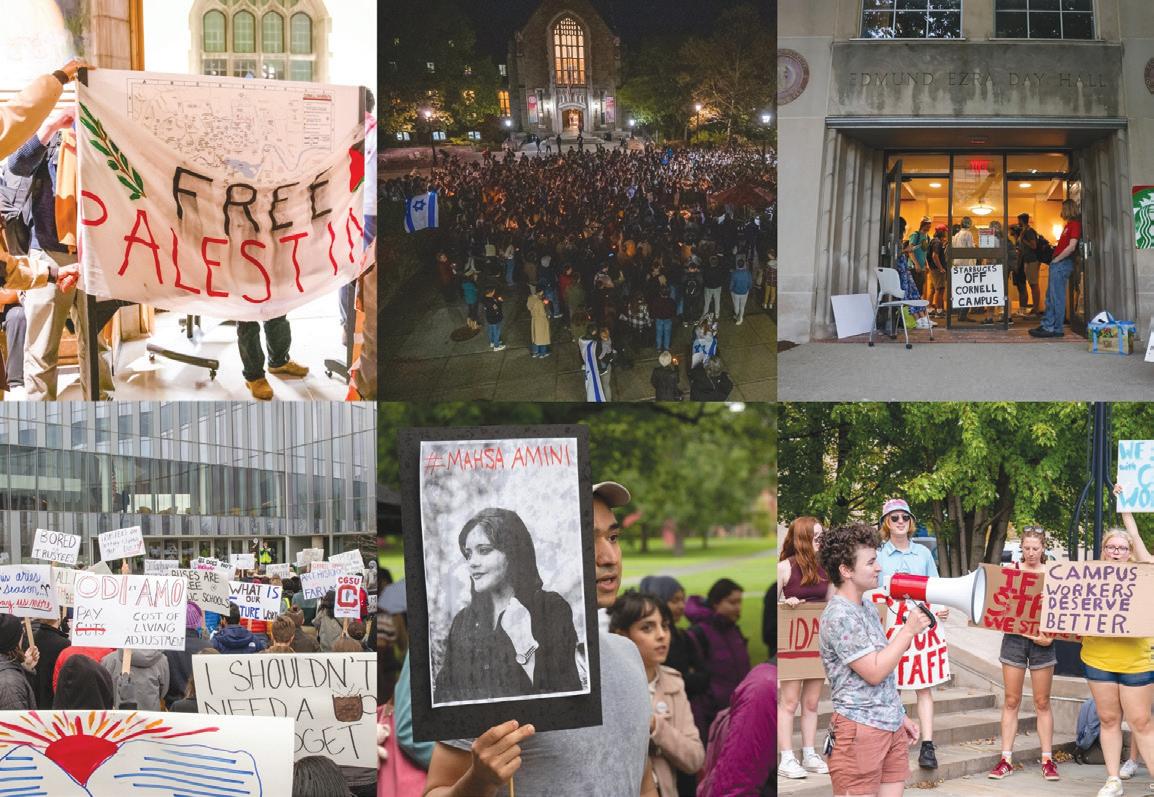
As classes start at Cornell, students return to a campus marked by new policies toward expression and doxxing. In a message to the University community on Wednesday, Jan. 24, President Martha Pollack announced new interim policies with implications for protests, posters, speaker events and more.
These policy changes come after university presidents from Harvard, the University of Pennsylvania and the Massachusetts Institute of Technology testified before Congress for their handling of campus discourse. Pollack herself
has come under the scrutiny of Jon Lindseth ’56, an ex-trustee and major donor, in advance of the Board of Trustees meetings on Jan. 26 and 27.
As stated in Pollack’s letter, work on these policies began in the spring of 2023 in anticipation of the Freedom of Expression Theme Year. The new guidelines also follow a semester of high tensions on campus following online threats, protests and discourse spurred by the Israel-Hamas war.
The Interim Expressive Activity Policy imposes new restrictions on outdoor demonstrations with an emphasis on reducing the disruptiveness of demonstrations. The policy requires organizers to officially register outdoor events that
involve more than 50 people at the Ithaca, Cornell Tech and Agritech campuses, or of more than 15 people at the Weill Cornell Medicine campus.
Public address systems such as megaphones, under the new stipulations, may be used without prior approval on Ho Plaza and in front of Day Hall between only 12 p.m. and 1 p.m. The use of such systems at any other time or location will be prohibited without prior written approval.
Nadine Strossen, an American legal scholar and former President of the American Civil Liberties Union, asserted that increased guidelines can improve campus free
Today Tomorrow
Let’s Meditate With Sophia Scholl
8:30 a.m. - 9 a.m., 501 Cornell Health
Data and Donuts
9:30 a.m. - 10:30 a.m., 100 Mann Library
Soup and Hope With Foula Dimopoulos Noon - 1 p.m., Sage Chapel
Energy Seminar With Lindsay Anderson 12:20 p.m. - 1:10 p.m., 101 Phillips Hall
Making Memories in Mice With Sheena Josselyn
12:30 p.m. - 1:30 p.m., A106 Corson/Mudd Hall
Into the Dark: The Role of Dust in Shaping Galaxy Evolution
3:30 p.m. - 4:30 p.m., 105 Space Sciences Building
Materials Science and Engineering Seminar With Wenhao Sun 4 p.m., B11 Kimball Hall
Radical Chemistry: From Single-Molecule Magnets
To Photoredox Catalysts With Colin Gould 4 p.m., 120 Physical Sciences Building
Sonic Extractivism and Digital Rights in Indigenous Audiovisual Production in Latin America With Ana María Ochoa Gautier
4:30 p.m., Virtual Event
Two Voids With Róisín Heneghan
5:15 p.m., Milstein Auditorium
Winter Career Carnival
5:30 p.m. - 7:30 p.m., Morrison Hall Multipurpose Room
International Scholars Coffee Hour 10 a.m. - 11 a.m., 100 Mann Library
Winter Wonders: A Mindful Botany Walk Noon - 1 p.m., Brian C. Nevin Welcome Center
How to Juggle Tasks and Still Make Progress on Your Goals With Vida Maralani
Noon - 1:15 p.m., 2250 Martha Van Rensselaer Hall
Turning Pathogens into Cell Biology Tools With Shaeri Mukherjee
12:15 p.m. - 1:30 p.m., College of Veterinary Medicine Lecture Hall 3
A Planner’s Guide to Designing Impact-Oriented Research on Disasters, Climate Change and Community Resilience With Andrew Rumbach and Sara McTarnaghan 12:20 p.m., Milstein Auditorium
Ezra’s Round Table With Andreea Minca 12:20 p.m., 253 Rhodes Hall
Essential Replication Skills for Your Research 1:30 p.m. - 4:30 p.m., 291 Clark Hall
Consulting Essentials Workshop 1: What is Consulting? For HumEc and Brooks Students 2:30 p.m. - 3:30 p.m., 1203 Martha Van Rensselaer Hall
Café con Leche
6 p.m. - 7 p.m., Latino Living Center
Glee Club and Chorus Return From Tour Concert: CU Music 7:30 p.m., Sage Chapel

By JULIA SENZON Sun News Editor
Since ChatGPT’s inception in November 2022, the platform simultaneously unnerved and excited Cornellians regarding artificial intelligence’s academic implications.
According to the Administrative AI Task Force, which included over 30 stakeholders from across the University, Cornell should utilize AI in tasks including admissions application review, transfer credit evaluation and website accessibility, as outlined in the Jan. 5 task force report entitled Generative AI in Administration.
The report overall provided responsible and effective AI use guidelines for academic and administrative contexts. AI refers to machine-based systems that accomplish tasks typically requiring human intelligence.
Artificial Intelligence in Applications
The report supports simultaneously deploying AI in central Cornell functions and providing technologies and resources for Cornell community members to begin using AI responsibly.
“If the University fails to provide safe, broad access to AI platforms and sandboxes, it is likely community members will seek out their own, possibly unvetted AI tools that could place Cornell’s data at significant risk,” the report states.
The Task Force notably proposes that there is significant potential for AI tools to supplement human evaluation for undergraduate and graduate applications to Cornell given the “volume of applications Cornell receives.” AI could potentially speed up the application review process to give applicants a faster response.
However, the report states that an economic analysis must be considered with AI implementation in admissions, as this application requires buying technology from a vendor or developing an AI application in-house.
Following the overturn of affirmative action, prohibiting colleges from considering race in admissions processes, using AI in college admissions review processes has raised equity concerns, according to an article published by the University of Southern California Rossier School of Education.
The paper also notes that AI tools can potentially find talented applicants who are traditionally overlooked in admissions processes, but AI is also prone to bias embedded in the human decisions on which they are trained.
Still, Cornell is not the only University considering the benefits of AI use in applicant review. According to
Continued from page 1
regulations on student demonstrations. On Dec. 9, Pollack stated that “an explicit call for genocide, to kill all members of a group of people, would be a violation of [Cornell’s] policies.” On Jan. 24, Pollack announced a new “expressive activities” policy that instituted clearer standards for protests and demonstrations on campus.
In his letter, Smith demanded answers from the three current and interim University presidents by Jan. 24 to 13 questions on topics that included the treatment of Jewish students; freedom of speech; the issuance of official University statements and diversity, equity and inclusion programs. University officials told The Sun in an email statement that Cornell issued a response to these questions on Jan. 24 but did not specify what this response consisted of.
$1,000 in property value. This is over eight times greater than the current $4 million dollars the University currently pays to the City of Ithaca as stipulated in the recently-negotiated memorandum of understanding with the City.
Smith justified this drastic threat to the University’s finances — which would require Cornell to pay local property taxes and federal income taxes and render the institution ineligible for receiving tax-deductible contributions and federal grant money — by calling into question the University’s compliance with federal anti-discrimination laws, citing Chapter 41 of Title 42 of the US Code.
The Supreme Court held in Bob Jones University v. United States that non-compliance with “fundamental public policy” — which would include this statute — was grounds for the elimination of a University or other publicly funded institution’s tax-exempt status.
an Intelligent survey of 399 education professionals in September, half of higher educational institutions are already using AI in admissions.
Full Use Cases
The report divides the University’s AI technology use into three categories. Vertical/embedded AI, refers to AI features of existing technologies, such as Microsoft 365 Copilot. Large language models like ChatGPT and Meta’s Llama2 generate, summarize and translate human-sounding language. Generative AI like Azure Open AI can create content beyond text, like images and music.
Mitigating Risks and Consequences
In the report, the Task Force also emphasizes that AI should be deployed in compliance with the law and in a manner that considers potential community impacts, including discrimination and privacy breaches.
The Task Force’s outline for determining responsible AI use includes conducting system testing, consulting with diverse stakeholders, enacting contingency plans and informing the public about the use of AI in important University decisions.
The report acknowledges security concerns with AI use, including elaborate phishing campaigns — fraudulent emails or websites that attempt to obtain sensitive information. But the report also stresses the risks associated with a lack of coordination with regard to AI, such as inappropriate AI use and “Cornell’s competitive standing relative to its peers.”
According to the report, providing proper training to users and establishing a quality reporting mechanism can aid in mitigating risks to information quality and precision. The report also recommends understanding AI vendors’ carbon goals and assessing models’ energy efficiency before selecting a vendor.
As for concerns that AI may replace Cornell staff in completing routine tasks, the report identifies “integrat[ing] AI in a way that augments rather than replaces human capabilities” as a key challenge. The report suggests that “removing drudgery and enhancing individual performance can lead to a more effective and innovative workforce.”
“It is critical that AI adoption be democratized — focused on benefiting all employees,” the report states. “AI can be an asset across all Cornell service domains, embraced as an opportunity to supplement staff capabilities rather than a threat.”
Smith mentioned Patrick Dai’s violent threats to Cornell’s Jewish community and the subsequent FBI investigation to portray the severity of antisemitic behavior on Cornell’s campus. He also cited testimony from Cornellians for Israel Vice President of Finance Talia Dror ’25 about Cornell’s response to the events of Oct. 7, where she said during a Nov. 15 Ways and Means Committee hearing that “students, professors and administrators at Cornell celebrated the massacre of innocent civilians.”
Dror, in a recent interview with The Sun, said that the Ways and Means Committee’s threat to Cornell’s tax-exempt status has the potential to encourage the University to take a more active role in combating antisemitism.
“I think the Ways and Means Committee is exerting significant pressure on universities to address questions, which is more influential than what individuals without such leverage could achieve in obtaining tangible responses,” Dror said Cornell — which owns $2.7 billion in tax-exempt property — would pay roughly $32.5 million in property taxes should this status be revoked and Cornell pay the City of Ithaca tax rate of $12 per
In his letter, Smith condemned D.E.I. initiatives on college campuses, citing research from the Heritage Foundation, a conservative activist group, that claimed campus D.E.I. staff were “unwelcoming toward Jewish students.”
He also criticized what he called the four universities’ “disappointing and lackluster responses” to the Oct. 7 terrorist attacks.
In the week following the attacks, Martha Pollack released three email statements condemning Hamas’s violence. In her congressional testimony, Dror denounced Pollack’s first statement from Oct. 10, which referred to members of Hamas as “militants” and simultaneously addressed lives lost in the Hamas attacks and 6.3 magnitude earthquake in Afghanistan.
“In [the University’s] initial statement, they compared the ‘loss of life in the Middle East’ to deaths caused by natural disasters,” Dror said.
To continue reading this article, please visit www. cornellsun.com.
Kate Sanders can be reached at ksanders@cornellsun.com.
By GABRIEL MUÑOZ Sun News Editor
A federal district court judge denied an appeal to reconsider the detention of a former student accused of posting antisemitic threats on Tuesday, Dec. 19.
From the Syracuse courthouse of the U.S. District Court for the Northern District of New York, Chief Judge Brenda Sannes sustained the decision previously made by the court to have Patrick Dai ’24 remain in custody at the Broome County jail
“The Court finds that no condition or combination of conditions can reasonably mitigate these risks.”
Judge Brenda Sannes
pending trial. The court concluded that Dai presents a risk of “non-appearance” and a “danger to any other person and the community” and can not be released.
“The Court finds that no condi-
tion or combination of conditions can reasonably mitigate these risks,” Sannes wrote in the 20-page opinion.
The opinion upheld the previous ruling made last month by U.S. Magistrate Judge Thérèse Wiley Dancks on Nov. 9, which deemed Dai a risk of flight due to his history of mental health struggles and the fact that his father is currently employed in China.
The court also cited Dai’s access to a shotgun and a katana as concerns for him becoming a danger to “himself or others.” The court rejected
the arguments made by his public defender, Lisa Peebles, that imprisonment would worsen Dai’s mental state. Dai, who was an engineering student, was first detained by the FBI on Oct. 31, following violent antisemitic threats he posted on the website Greekrank. He has been held at the Broome County jail since and will remain there until his next hearing, which is yet to be scheduled.
Gabriel Muñoz can be reached at gmunoz@cornellsun.com.

POLICIES
Continued from page 1
speech. Strossen, a Senior Fellow at the Foundation for Individual Rights and Expression, added that, while unhelpful if the guidelines themselves suppress speech, reduced discretion through more narrowly tailored guidelines is important in protecting speech.
But Strossen expressed hesitation about the implications of increased requirements for event registration.
“You want the campus community to be able to express a reaction or view properly after something of note has happened that they want to express a view about,” Strossen said in an interview with the Sun. “They shouldn’t have to wait an unduly long time in order to be able to do that.”
Strossen was also concerned about Section Three of the policy, which states that in rare cases, Cornell may use its sole discretion in prohibiting activities, though in a content-neutral manner. Strossen worried that such language could potentially widen administrative discretion to the detriment of free speech.
For student groups whose speech and demonstrations have faced intense scrutiny, the changes are seen as unwelcome constraints.
“We find the new interim policies on expression to be reprehensible extensions of the existing repression of Palestine solidarity movements throughout university campuses, especially at Cornell,” wrote Cornell’s Coalition for Mutual Liberation in a statement to The Sun. “These policies are an attempt to further intimidate student groups and limit students’ freedom of expression.”
Student groups also had mixed reactions to the new University policy on doxxing.
Malak Abuhashim ’24, President of Cornell’s Students for Justice in Palestine, welcomed the updated doxxing policy.
“We feel it important to acknowledge that Cornell’s lack of action in earlier situations has exposed numerous students and faculty to threats, harassment and silencing,” Abuhashim said.
“While we have been in conversation with the University about its anti-doxxing policy, we find the current anti-doxxing policy to be incomplete and are continuing dialogue with the administration to make it comprehensive.”
CML –– which had advocated for a doxxing policy –– also noted what they viewed as the University’s failure to respond to recent cases of online harassment.
“The administration has yet to act on the rape and death online threats received by SJP members last fall, or on the group of Muslim women who were filmed while leaving Friday prayer in an act of stalking by another student,” CML wrote.
Talia Dror ’25, the Vice President of Finance for Cornellians for Israel, was more supportive of Wednesday’s changes.
“I’m really happy that the University is taking further action in the hopes of creating a climate on our campus that fosters respect and open dialogue and really connects back to what our university values,” Dror said. “It really is a wonderful way to start off the semester, ensuring that we can calm down tensions on campus to ensure the safety and well-being of all students.”
But Dror also noted that such


policies require active enforcement and criticized instances where she perceived a lax attitude from the University toward conduct violations.
“I think there were several times last semester where students and organizations have violated the University’s code of conduct. And my personal principle is — if a university holds a code of conduct and claims to abide by it, then if you violate the code of conduct, you get punished.”
Dror also pointed to pragmatic concerns about the threat of disruptive protest to a productive learning environment.
“At the end of the day, every single student at Noon on a Tuesday, sitting in Goldwin Smith Hall, shouldn’t be interrupted in the middle of their class because of an issue that maybe is very important and a lot of students care to express, but shouldn’t impede other students’ abilities to learn,” Dror said.
While freedom of expression has been promoted as central to Cornell’s identity throughout the ongoing theme year, Strossen made clear that, as a private university, Cornell is not constitutionally beholden to the First Amendment. Instead, Strossen explains, private universities which advertise themselves as bastions of free speech are contractually bound to respect the promises they make to students.
The University is now soliciting feedback from faculty, staff and students to comment on the interim policies.
To continue reading this story, please visit www.cornellsun.com.
Iskander Khan can be reached at ikhan@cornellsun.com.
LINDSETH
Continued from page 1
Lindseth said that Cornell’s educational quality has diminished since Cornell has embraced DEI initiatives, including its web-based bias reporting system, which was established in 2000, and the recent development of the University’s Center for Racial Justice and Equitable Futures. He said that the University’s DEI focus is suppressing free speech as “the University continues to put more value on DEI’s broad application rather than merit.”
“There is no racial justice with DEI,” Lindseth said.
In response to the letter, Kayser reaffirmed his support for Pollack in a statement to The Sun.
“For nearly seven years, I have strongly supported President Pollack, and that support remains strong today,” Kayser wrote. “The board is working effectively with the administration to respond to various challenges facing higher education and opportunities to advance the university’s mission.”
“There is no racial justice with DEI.”
Jon Lindseth ’56
Lindseth said he called the trustee meeting. But Joel Malina, vice president for university relations, contended that the board meeting was previously scheduled in a statement to The Sun.
“Cornell’s trustees are gathering in New York [City] this week as part of a regularly scheduled series of meetings to discuss
university affairs,” Malina wrote. “Board meetings are scheduled many years in advance.”
The Board of Trustees is set to meet on Friday, Jan. 26, in New York City. Lindseth will discuss his concerns regarding President Pollack, advocating for Pollack’s and Provost Kotilkoff’s resignation, along with six other demands.
“Campuses, which should be the bastion of robust and civil discourse, ... have not been living up to that mission.”
Nadine Strossen
Nadine Strossen, an American legal scholar and former President of the American Civil Liberties Union, will also be speaking at the Board of Trustees meeting on invitation from President Pollack. In an interview with the Sun she explained that guidelines have to be created for free speech to ensure that they safeguard freedom of expression.
“I think that future generations are going to look back on the recent past and compare it to the McCarthy era as a period when campuses which should be the bastion of robust and civil discourse and viewpoint diversity, unfortunately, have not been living up to that mission,” Strossen said. “The pendulum I think has been pushed back now.”
Anushka Shorewala can be reached at ashorewala@cornellsun.com.
Julia Senzon can be reached at jsenzon@cornellsun.com.
By KATIE RUEFF Sun Staff Writer
Your source for good food

elcome back to Cornell!
Temperatures may be low but spirits are, well, at least a tad bit higher since it’s the start of a brand new semester. It’s time for some cozy moments of peace while we still have a few weeks before our first major assignments are due . So, wrap your self up in a snowy soft blanket and enjoy our drink recom mendations. And, in an effort to appreciate the lovely environment that’s brought us this amazing snow, all of the recipes below can easily be vegan.
First, topping the list is, of course, the classic hot chocolate. Make this drink vegan by swapping dairy milk for a milk alternative such as almond or oat milk. Don’t want to skimp on the marshmal lows? Try out a vegan marshmallow brand like Dandies. Walmart may carry these.
cornstarch.
Next, for those who can’t decide between tea and coffee, you’re in luck because we have a warm winter option for both.
For the coffee fans, try a warm, banana milk
of a classic fall favorite: the PSL (pumpkin spice latte).
Lastly, for those who may not need much more of a caffeine boost today, try this London Fog tea, a Canadian twist on the classic Earl Grey. Following International Desserts Blog’s rec ipe, try coconut

it may
sound a little weird at first, this delectable delight is a certain musttry. Using Inside the Rustic Kitchen’s highly rated recipe, simply switch out the milk for a dairy alternative and you’re ready to go! Some have even related this drink to a winter version

an equally delicious, healthier and more eco-friendly version. With four simple drinks to prepare you for long winter nights of studying (and hopefully some relaxing, too), The possibilities of soul-warming drinks are as endless as the snow outside!
Katie Ruef, dining stafer, is a frst year in the College of Arts and Sciences. She can be reached at kr468@cornell.edu.

Rueff ’26
As a tip, once you’ve found your favorite hot chocolate recipe, play around with add-ons and sweeteners. Want your hot chocolate more bitter? Sprinkle in a dash of cacao powder. Want some extra sweetness or a different flavor? Try a drizzle of (vegan) caramel or some crushed candy cane.
Nostalgic for simpler times (ie: last fall)? Well, then it’s time for some hot apple cider! For a more eco-friendly alternative to buying bottles, try out an instapot apple cider recipe. Saucy Kitchen has a recipe for this, which includes fresh apples, brown sugar, cinnamon and even fresh oranges. This is also the perfect drink to add some vegan caramel drizzle, which can be made from home with some coconut cream, brown sugar, and

SHEILA YU ’25
Advertising Manager
NOAH DO ‘24
Associate Editor
HUGO AMADOR ’24
Opinion Editor
JONATHAN MONG ’25
News Editor
JULIA SENZON ’26
JULIA NAGEL ’24 Photography Editor
GRAYSON RUHL ’24 Sports Editor
TENZIN KUNSANG ’25 Science Editor
JOANNE HU ’24
Assistant News Editor
MARISA CEFOLA ’26
Assistant News Editor
MAX FATTAL ’25
Assistant Arts & Culture Editor
MING DEMERS ’25
Assistant Photography Editor
KATE KIM ’24
Layout Editor
ISABELLE JUNG ’26
Graphics Editor
VEE CIPPERMAN ’23 Senior Editor
ESTEE YI ’24
Senior Editor
PAREESAY AFZAL ’24
Senior Editor
ELI PALLRAND ’24
Senior Edito
ANGELA BUNAY ’24
SOFIA RUBINSON ’24
Managing Editor
GRACE XIAO ’25
Web Editor
AIMÉE EICHER ’24
Assistant Managing Editor
UYEN HOANG ’25 Assitant Web Editor
ANNA LIANG ‘24
Assistant Advertising Editor
ERIC REILLY ’25 News Editor
GABRIEL MUÑOZ ’26 News Editor
NIHAR HEGDE ’24
Arts & Culture Editor
DANIELA ROJAS ’25
Dining Editor
RUTH ABRAHAM ’24
Sports Editor
MEHER BHATIA ’24
Science Editor
MARIAN CABALLO ’25
Assistant News Editor
CARLIN REYEN ’25
Assistant News Editor
KIKI PLOWE ’25
Assistant Arts & Culture Editor
CLAIRE LI ’24
Assistant Photography Editor
DAVID SUGARMANN ’24
Assistant Sports Editor
ALLISON HECHT ’26 Newsletter Editor
JASON WU ’24
Senior Editor

Henry Schechter is a second-year student in the College of Arts & Sciences. His fortnightly column Onward focuses on politics, social issues and how they come to bear in Ithaca. He can be reached at hschechter@cornellsun.com.
About every other day, I walk up to a short, old building made of Ithaca bluestone, quarried from the bottom of the slope. It’s an attractive building, named after a lover of architecture, but usually fails to catch students’ eyes. It’s old and solid, sitting in a line of buildings called “Stone Row.” The famous Cornell professor, Goldwin Smith, once said of those buildings that “nothing can redeem them but dynamite;” he clearly disagreed about their architectural beauty. On my way into class, I ascend a set of steep steps, swing open a set of large double doors, and pad past large aluminum letters that I glance over: “Morrill Hall, Arts and Sciences.”
I always assumed it was named after another donor, alumnus or professor. Until I started writing this piece I didn’t put together who its namesake was. I, like most of us here on campus, didn’t realize he had a greater impact on Cornell than any student, donor, alumnus or professor put together.
What he accomplished in his life, much like the building constructed in his name, is old and solid. It has lasted a lifetime.
The Cornell Daily Sun is devoted to publishing a broad and diverse set of content from the Cornell and greater Ithaca community.
We want to hear what you have to say about today's paper or any of our pieces.
Guidelines on how to submit can be found at Cornellsun.com. And here is our email: opinion@cornellsun.com
Cornell, founded in 1865, owes its entire existence to United States Senator Justin Morrill, a strikingly side-burned politician from Vermont. Despite the little we may know about him today, historians and congressional enthusiasts alike admire his power. He was respected by his political colleagues; his portrait hangs outside the Senate chamber; he was known as “The Father of The Senate.”
Today, Morrill’s name doesn’t float around American history like other prominent figures from his time: people like President Abraham Lincoln, Stephen Douglas or General Ulysses S. Grant. Many of Morrill’s actions have been lost in the annals of history, like his anti-polygamy law or protective Civil War era tariff in 1861. But in 1862, while he was still in the House of Representatives, he moved a revolutionary law through congress, an act that cemented his position among the greats of the American legislative branch and plastered his name on a Cornell building; it was called the Morrill Land Grant Act.
That act isn’t living up to its original intent. We need to revive it. It’s time for a sequel.
His magnum opus was a law that provided one-sixth of what the government called “unclaimed public lands” to states for public education. Morrill’s hallmark legislation was proposed to move the country forward economically, to “provide colleges for the benefit of agriculture and the Mechanic arts” (mechanic arts essentially means engineering). Within a few decades, the passage of the act made America an outright leader in the field of technical education. But today, Senator
Morrill’s vision has fallen by the wayside as our society has evolved and become more complex. His idea of schools that would train the common laborer has flamed out in today’s age, but we need them now more than ever. We need to reshape his forward-thinking idea and once again use those Land Grant schools to teach people technical skills, the skills that drive the heart of our economy. Cornell can be one of many schools to take on that challenge.
In 1860, two years before the Land Grant Act, the United States held a population of about thirty-one million people, just under a tenth of what we have today. The U.S. Civil War had not yet been fought, Americans still traveled on horseback and light bulbs didn’t exist. America wasn’t industrialized — it was agricultural.
Senator Morrill’s idea took full advantage of that pre-industrialized economy. At the time, the act was targeted at America’s working classes to “promote the liberal and practical education of the industrial classes in the several pursuits and professions in life.” It used government power to educate Americans in trades that would bolster the developing economy. They were the agricultural trades that America’s economy relied on, and Congress saw that we needed skilled workers to help drive them. And by all accounts, it was a massive success. It transformed the U.S. into a beacon of technical education.
The Land Grant Act lived up to its mission at the time of its founding. It created and funded a cohort of incredible schools that focused on teaching young people the tools of America’s powerhouse industries. It targeted vital industries; at the time of Morrill’s legislation, 53 percent of Americans worked in agricultural jobs. Today that number is just 10 percent. The specialties of these schools were closely aligned with the needs of the nation. The Agricultural College of Pennsylvania (now known as Penn State), for example, focused on teaching mechanical arts, agriculture, metalworking and carpentry.
Justin Morrill’s vision slipped away quickly, though, as industrialization was swept across the world. As the economic composition of the country changed, these schools migrated away from their vocational-agricultural mission and began producing research important to the academic and scientific growth of our country. While they do important work, they no longer do the job they were intended to do. Their failure in this respect isn’t because they started with the wrong goal, it comes from their ability to adapt to a modern age.
The universities it created now mostly educate the academic elite, and no longer support the working class like they were intended to....

Fill in the empty cells, one number in each, so that each column, row, and region contains the numbers 1-9 exactly once. Each number in the solution therefore occurs only once in each of the three “directions,” hence the “single numbers” implied by the puzzle’s name. (Rules from wikipedia.org/wiki/ Sudoku)




By LAINE HAVENS
Cornell researchers recently used genetic engineering to improve the extraction of rare earth elements using a bacteria called Vibrio natriegens.
Rare earth elements are a group of metallic elements with chemical similarities including scandium, yttrium and the lanthanides. According to the paper, published in the journal ACS Synthetic Biology, bacteria can provide a positive alternative to outdated and environmentally harmful methods of REE extraction.
According to co-lead author Sean Medin grad, REEs are components of sustainable technology like magnets, electric vehicles and wind turbines. However, the methods used to obtain high purity REEs often involve toxic solvents, high temperatures and a significant carbon impact. In their paper, Medin and co-lead author Anastacia Dressel ’24 demonstrated genetic engineering to make V. natriegens better suited for extracting the elements without emitting such pollutants.
“I’m interested in finding any way we can use synthetic biology to solve problems to do with climate change, and that involves reinventing our world’s energy system,” said Prof. Buz Barstow, biological and environmental engineering, who leads the lab which oversees the research, in an interview with
the Sun. “Rare earths are something that just really took off for us.”
V. natriegens is a good candidate for extracting REEs from the environment due to many natural qualities of the bacteria useful to lab research. According to co-author and postdoctoral associate David Specht M.Eng. ’18 Ph.D. ’21, V. natriegens has a number of advantages that make it easy to work with. Not only is V. natriegens the fastest growing organism on earth, but it also grows at room temperature and can be engineered with many of the same genetic tools used with E. Coli, conventionally one of the easiest organisms to work with.
The natural process at the heart of extracting REEs with bacteria is biosorption, a passive process that occurs when a substance from the environment, like REEs, sticks to the outside of a bacteria. V. natriegens is one of the bacteria capable of biosorbing REEs.
Barstow was inspired by previous research which suggested that biosorption could be selective — meaning certain bacteria appeared to prefer sticking to some elements over others. This selectivity made biosorption a potential tool in element processing.
In the planned application of this research, after biosorption, the researchers would wash the bacteria and dissolve the REEs into a solution. Then, by exposing the bacteria to that new solution, the biosorption process would repeat.
Due to this selectivity for certain elements, the paper predicts that a repetition of the process results in a REE solution of high purity. According to Barstow, biosorption causes REEs to stick to bacteria but not that well — like a sticky note — making this purification process very easy.
The researchers genetically engineered V. natriegens by inducing random mutations — a necessary process that allows the bacteria to mutate into a more selective version with a greater capacity to adsorb REEs.
“It’s very unlikely that we’re going to find organisms that really selectively interact with one rare earth metal. We’re trying to do something that doesn’t exist in nature,” Specht said in an interview with the Sun.
Throughout three rounds of mutations, the researchers selected samples of bacteria and screened them to determine the extent of biosorption. One version of V. natriegens improved biosorption by 210 percent for the REE dysprosium, a common component of magnets.
The researchers also observed an increase in selectivity between the lightest and heaviest REEs, indicating further potential to improve V. natriegens’ capability as an REE separator.
However, despite improving the biosorption capacity and selectivity, the researchers remain unsure exactly how particular genes con-

Biosorbent bacteria | Researchers genetically manipulated Vibrionatriegens to improve its ability to adsorb rare earths
tributed to the change.
“I explored a little bit of the genetics here, but it’s very circumstantial,” Medin said in an interview with the Sun. “[After scaling up and optimizing] I might actually be able to see — What’s the actual genetic basis? How can I actually mess with this a little bit better? That’s something that I’m looking forward to.”
Medin is continuing to research biosorption as a method of REE extraction at REEgen, a startup company in Cornell’s Praxis Center for Venture Development, where he is also working on the technology to separate the REEs from the bacteria. REEgen, co-founded by
Medin and Alexa Schmitz Ph.D. ’18, is dedicated to utilizing biology to extract rare earths without the environmental cost, thus providing sustainably sourced materials to create more sustainable energy technologies.
“I think that biology is going to help us build a revolutionary new sustainable energy infrastructure,” Barstow said. “I would be even more surprised if [by the end of the century] there wasn’t at least one or two important energy technologies that were based on syn[thetic] bio[logy].”
Laine Havens can be reached at lhavens@cornellsun.com.
By KAITLIN CHUNG Sun Staff Writer
In a study published on Jan. 10 in Nature Communications, researchers of the Cornell Lab of Ornithology discovered that over 80 percent of the global land area supporting both human well-being and biodiversity is unprotected.
To effectively define priority regions for protection, the researchers expanded on past efforts and approached mapping from a new perspective. Using mathematical modeling, the researchers factored in the contributions of ecosystem services — the benefits that nature provides to people, including food, clean air and soil quality — and potential conflicts with human development — examples of human development include agricultural and renewable energy expansion.
The study found that approximately half of global land, excluding Antarctica, provides almost all of nature’s services to people. This land also preserves biodiversity for 27,000 species of mammals, reptiles, amphibians and birds. However, only 18 percent of this land is sufficiently protected, based on information from the World Database of Protected Areas.
The WDPA is a comprehen -
sive international database of protected marine and terrestrial land areas. Protected areas are established through government involvement at local, regional, or national levels; land purchase by private organizations and community movements. The researchers used the database to create maps of areas that need protection prioritization around the world.
However, the findings indicate that there may be conflicts between land conservation and development goals. Thirty-seven percent of the global land areas that provide nature’s services to people are also ideal for human development with agriculture, renewable energy and urban expansion. Such contradictory goals mean that successful land conservation may require creative approaches.
“At a high level, our work illustrates how we can use spatial planning to reduce the land footprint required to meet biodiversity, climate and ecosystem service goals and, by doing so, better accommodate human activities associated with development goals,” said lead author Prof. Amanda Rodewald, natural resources and the environment, in an email statement to the Sun.
According to Rodewald, there are formidable challenges to this process with the limited international

Conservation chart | Cornell researchers recently identified regions important to both biodiversity and human development, indicating conflicting interests
resources available to address biodiversity loss, poverty, food and water insecurity as well as climate change.
The Lab’s work sets the foundation for identifying global targets and priority regions for efficient conservation and sustainable development investments.
In the future, solutions will need to be carefully designed to ensure that human development initiatives are compatible with conservation goals.
According to first author and doctoral candidate Rachel Neugarten, these solutions could involve cultivating
native pollinator gardens under solar panels or implementing livestock grazing under wind farms.
“Avoiding or reducing [conflicts between climate, biodiversity and development goals] requires that we be strategic and deliberate about planning where we direct conservation and development efforts,” Rodewald said.
Kaitlin Chung can be reached at kchung@cornellsun.com.