Warren County Connection A Publication of Cornell Cooperative Extension of Warren County
October 2021
Helping Teens Cope Now and Later In this issue:
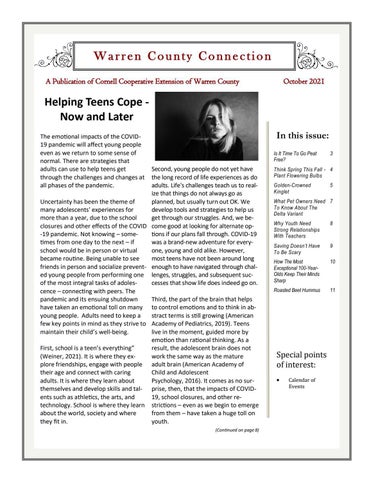
The emotional impacts of the COVID19 pandemic will affect young people even as we return to some sense of normal. There are strategies that adults can use to help teens get through the challenges and changes at all phases of the pandemic.
Is It Time To Go Peat Free?
Second, young people do not yet have the long record of life experiences as do adults. Life's challenges teach us to realize that things do not always go as Uncertainty has been the theme of planned, but usually turn out OK. We many adolescents' experiences for develop tools and strategies to help us more than a year, due to the school get through our struggles. And, we beclosures and other effects of the COVID come good at looking for alternate op-19 pandemic. Not knowing – sometions if our plans fall through. COVID-19 times from one day to the next – if was a brand-new adventure for everyschool would be in person or virtual one, young and old alike. However, became routine. Being unable to see most teens have not been around long friends in person and socialize prevent- enough to have navigated through chaled young people from performing one lenges, struggles, and subsequent sucof the most integral tasks of adolescesses that show life does indeed go on. cence – connecting with peers. The pandemic and its ensuing shutdown Third, the part of the brain that helps have taken an emotional toll on many to control emotions and to think in abyoung people. Adults need to keep a stract terms is still growing (American few key points in mind as they strive to Academy of Pediatrics, 2019). Teens maintain their child’s well-being. live in the moment, guided more by emotion than rational thinking. As a First, school is a teen’s everything” result, the adolescent brain does not (Weiner, 2021). It is where they exwork the same way as the mature plore friendships, engage with people adult brain (American Academy of their age and connect with caring Child and Adolescent adults. It is where they learn about Psychology, 2016). It comes as no surthemselves and develop skills and tal- prise, then, that the impacts of COVIDents such as athletics, the arts, and 19, school closures, and other retechnology. School is where they learn strictions – even as we begin to emerge about the world, society and where from them – have taken a huge toll on they fit in. youth. (Continued on page 8)
3
Think Spring This Fall - 4 Plant Flowering Bulbs Golden-Crowned Kinglet
5
What Pet Owners Need 7 To Know About The Delta Variant Why Youth Need Strong Relationships With Teachers
8
Saving Doesn’t Have To Be Scary
9
How The Most Exceptional 100-YearOlds Keep Their Minds Sharp
10
Roasted Beet Hummus
11
Special points of interest: •
Calendar of Events
Warren County Connection
Page 2
Cornell University Cooperative Extension of Warren County 377 Schroon River Road Warrensburg, NY 12885
Phone: (518) 623-3291 or (518) 668-4881 Fax: (518) 668-4912
Warren County Connection
CALENDAR Please visit our website for more events www.cce.cornell.edu/warren
Who We Are
10/5/2021 4:30 PM - After School Archery Club - This program is limited to 8 total youth, at least 8 years and up to 19 as of January 1. If you are interested, please call or email John Bowe at 518-668-4881 or jfb32@cornell.edu. Location - Cornell Cooperative Extension Warren County 377 Schroon River Road Warrensburg, NY 12885
The Cornell Cooperative Extension network brings you the expertise of Cornell University, other land-grant universities across the country and locally-based Extension Educators, volunteers, and other experts through such programs as: horticulture, youth and families, leadership, environment, food, nutrition & health, home environment, and financial management.
10/9/2021 1:00 PM - 3:00 PM - Food and Football Football season is here, so why not enjoy it with some tasty, guilt-free food? In this workshop, we will explore and make some healthy, simple, easy and delicious snacks to enjoy during football season and beyond! To register for this course, contact SUNY Adirondack Continuing Education at conted@sunyacc.edu or call 518-7432238. Location - SUNY Adirondack 640 Bay Road Queensbury, NY 12804
Visit Our Web Site: www.cce.cornell.edu/warren
Nation-wide, thousands of people in each state tap into their state’s land-grant university research and know-how to make sound confident decisions concerning family, home, business, finances, and the future. In New York State, the land-grant university is Cornell University.
Staff
Dr. James Seeley, Executive Director John Bowe, Associate Team Leader Dan Carusone, 4-H Natural Resources Coordinator Marybeth Mitcham, Nutrition, Food Safety & Healthy Living Educator Roxanne Westcott, 4-H Family Living Educator Kali DeMarco, Farm to School Coordinator Rebecca Devaney, Community Horticulture Coordinator Sharon Bellamy, Finance Manager Amy Sabattis, Public Relations/Publications Manager Michele Baker, Administrative Assistant Chris Dittus, Administrative Assistant
Board of Directors
Laura Conway - President Peter Benoit - Vice President Dan Bruno - Secretary William Hamelin - Treasurer Aimee Azaert Lisa Earl Ed Griesmer Jim Kneeshaw David Little David Strainer Michael White
Extension Service Committee Chair - Ben Driscoll Daniel Bruno Andrea Hogan Brad Magowan
10/19 - 11/16 2021 12:00 PM - 1:00 PM Community Parenting Program - This 5-week series will focus on replacing ineffective or hurtful parenting styles with effective, child-friendly skills and will teach five basic parenting skills that highlight key parenting issues. The skills are applicable for parents with children of every age. The classes are free of charge but registration is required by October 13, 2021. Contact CCE at 518-746-2560 to register. Registrants must have an email address and internet connection to participate. Location - Online Training Via Zoom CCE Warren & Washington County 10/23/2021 10:00 AM - 12:00 PM Bread Baking for Beginners - The art of bread baking is an ancient one, but one that is still very much in use today. If you have ever wanted to learn how to bake yeast and batter breads, then this class is for you! We will learn the basics of bread making, and will make some yeast-based soft pretzels, focaccia bread & Amish Friendship Bread starter together. To register contact SUNY Adirondack Continuing Education at conted@sunyacc.edu or call 518-743-2238. Location - SUNY Adirondack 640 Bay Road Queensbury, NY 12804 If you have special needs as addressed by the Americans with Disabilities Act and need assistance with attending these workshops, please make your needs known by the registration deadline. Reasonable efforts will be made for accommodations.
Warren County Connection
Is it Time to Go Peat Free? By Mike Nuckols, Local Foods & Horticulture Program Manager, CCE Jefferson County For decades, peat moss has been harvested from bogs in the United States and Canada for use in the horticultural industry and home gardens. Light and fluffy, peat readily absorbs and holds water, making it a perfect component to soil-less potting and seed-starting mixes. Peat is naturally free of weed seeds. Peat is also an excellent soil amendment in everything from vegetable gardens to landscaping. Here in Jefferson County, where our soils are often alkaline, peat added to garden soils can help lower the pH. In addition to its horticultural uses, peat has also been harvested for decades as a fuel in countries such as Great Britain and Russia. Unfortunately, the harvest of peat has significant downsides.
Peat forms slowly in bogs, adding mere millimeters each year. Beneath the thin living layer of sphagnum peat on the surface are deposits many feet thick and thousands of years old. The peat deposits beneath a typical bog often date back to the late Ice Age – a stunning 12,000 to 14,000 years old. These deposits tend to hold water near the surface, resulting in unique ecosystems filled with rare and treasured plants. The lack of nutrients in these highly acidic environments has resulted in some of nature’s most interesting plants. Carnivorous plants such as pitcher plant, Venus fly traps, and sundews are forced to scavenge nitrogen and other nutrients by capturing insects. Other interesting species include buttonbush, endangered fringed orchids, black spruce, and Labrador tea. From a climate change perspective, peat bogs are a critical component in capturing carbon from the atmosphere. While many ecosystems simply recycle carbon as trees grow and die, peat bogs continuously store it away in deep deposits, building layer upon layer every year. Because peat bogs are anaerobic beneath the surface, the peat does not decompose – essentially becoming a type of fossil fuel. One study estimated that peat bogs store three times as much carbon each year as a growing forest.
Page 3
Once removed from a bog and processed for use in horticulture, peat is exposed to oxygen. Peat will, in a few short years, be broken down by decomposing fungi and bacteria. Consequently, peat’s stored carbon is quickly released back into the atmosphere. In short, using peat moss for horticulture has the same effects as burning fossil fuels. For this reason, Great Britain is banning the sale of peat and peat products, beginning in 2024. British horticultural suppliers are rapidly introducing peat-free mixes using composted materials to compensate. Looking for ways to avoid similar bans in North America, the Canadian peat industry is beginning to restore previously mined peat bogs by placing live sphagnum moss harvested from active mines onto the surface of restored mining sites. While these efforts may restore ecological function, it may take thousands of years for these restored bogs to reclaim the carbon released when they were initially mined. Here in the United States, finding potting mixes that do not contain peat is particularly difficult. For those interested in going peat-free, gardeners will generally need to mix their own seed-starting using alternative ingredients. One potential substitute is finely shredded coconut coir. Taken from the husk of coconuts, coir is shipped in highly compressed bricks. Upon soaking in water, the bricks expand to many times their original size. Though a renewable resource, there have been no studies to determine the carbon impacts of shipping coir from distant overseas locations, which are likely great. The shipment of coir also deprives farmers in tropical locations a costeffective source of organic material to use on their farms. For most gardeners, compost is probably going to be the best alternative to peat. Unfortunately, quality potting mixtures made using only compost are rarely available in commercial settings. Compost itself can often be a scarce commodity, particularly for urban and suburban residents. A scan of Cornell’s map showing the location of composting facilities shows few in the North Country (http://compost.css.cornell.edu/maps.html). Though most municipalities collect yard waste, grind it, and then compost it, few make the resulting compost available to residents. Recent changes in New York State law related to food waste and composting may accelerate the availability of compost from municipal sources in coming years. To their great credit, Fort Drum already allows on-post residents to receive free compost from Public Work’s composting facility, located just outside the Cerjan Gate. Hopefully, other municipalities will follow suit. Until more commercial sources of compost come online, this (Continued on page 4)
Page 4 (Continued from page 3)
means that for most of us, going peat-free means making our own compost.
Warren County Connection
Think Spring This Fall -Plant Flowering Bulbs By Linda Naeve, Department of Horticulture, Iowa State University
At CCE Warren, we have many excellent resources available for those wishing to begin composting at home or on the farm (http://warren.cce.cornell.edu/gardeninglandscape/compost-resources). When using compost in place of peat, it is particularly important that compost comes from piles that have reached a temperature that will kill weed seeds. Materials should also be well-rotted; wood chips or other fresh materials will rob plants of nitrogen.
Once you have a good quality source of compost, the next step is to mix a potting or seed-starting mixture. Compost used for seed-starting should be carefully sieved to ensure a fine and uniform particle size. Materials can then be mixed in a plastic tub or a wheelbarrow. Gardeners often develop their own custom potting mixes, which they tweak based upon what they are growing. The addition of vermiculite or perlite, which often appear in commercial potting mixes, help to improve drainage. Plants that require good drainage, such as cactuses or succulents, might benefit from the addition of coarse grit or sand. Plants that are heavy feeders, ranging from houseplants to tomatoes, might require the addition of fertilizers. This can be in the form of time-released granules such as Osmocote™ or organic products such as bone meal or feather-meal. For acid-loving plants, consider using compost made from pine bark or needles. One great additive that benefits most plants is leaf mold, which is made from shredded leaves that are allowed to partially decompose (compost). As gardeners and farmers, most of us are keenly aware of the importance of working with nature. Our actions directly impact the climate – which ultimately impacts the health of our plants. Reducing the amount of peat that we use is one thing that gardeners can do to mitigate our impacts to global environment. That said, stepping away from the use of peat will be difficult for most of us. One approach might be to gradually reduce the quantity that we use, substituting a portion of potting mixes with whatever amount of compost is available. Secondly, as more sources of compost made with sustainable sources become available at our local nurseries and garden centers, we should purchase them, encouraging their adoption by industry. Finally, we need to spread the word to other gardeners.
I believe garden flowers are most appreciated and enjoyed in early spring. They are a refreshing change from the drab browns of winter. Unfortunately, we have to plan and plant for this beauty several months before we actually see the end result. Fall is the time of year to plant spring -flowering bulbs for that early splash of color in your garden and landscape. Although most gardeners think of tulips, daffodils, and hyacinths whenever the term "bulbs" is mentioned, there is a large selection of spring-flowering bulbs that can be grown successfully in gardens. You may want to plant something different this fall, such as the small-growing snowdrops, scilla, glory-of-the-snow, and grape hyacinths, or the tall-growing crown imperial (fritillaria), and giant onion (allium). Bulbs require little space in the garden and can be planted in annual or perennial flower beds, among shrubs, under trees, and in practically every area of the landscape. The primary considerations for site selection are full sun or partial shade and good soil drainage. There are certain "rules" to follow to achieve the most impact from the bulbs. Avoid small numbers of bulbs planted individually or in straight rows. Plant blocks of no less than five to ten bulbs of the same species and color. Mass plantings of only one or two colors, five or more bulbs, spaced 4 to 6 inches part, rather than individual bulbs spaced several feet apart throughout the area. The short-growing bulbs, such as scilla, crocus, and grape hyacinths, should be planted in drifts of 25 to 50 bulbs for the greatest impact. (Continued on page 5)
Page 5
Warren County Connection (Continued from page 4)
Golden-Crowned Kinglet
Be choosy when purchasing your bulbs. Select, large, firm, plump bulbs or corms. Do not purchase any that are bruised, blemished, or soft. Remember, if they look unhealthy at planting time, they are not going to improve once they are planted. Plant the bulbs as soon as possible after you purchase them. Although tulips and daffodils have a dry protective covering (tunic) over the bulbs that will allow them to be stored for several weeks, you never now how soon winter will arrive and you may be caught with several dozen bulbs in the house and several inches of snow on the ground. Also, some bulbs like snowdrops, fritillaria, and lilies deteriorate rapidly in storage and should be planted as soon as possible. Generally, the best time to plant spring-flowering bulbs is September and October. However, if weather permits most spring-flowering bulbs can be planted as late as early December. Fertilize the flower bed prior to planting. Inorganic fertilizers, such as a 5-10-5, at the rate of 2 to 3 pounds per 100 square feet can be worked thoroughly and deeply into the soil before planting. A good organic fertilizer for bulbs is bonemeal with its high phosphorus content. Apply 3 to 4 pounds of bonemeal per 100 square feet of area. If planting clumps of bulbs, work 1 tablespoon of bonemeal into the bottom of the planting hole. The planting depth and plant spacing varies with the species. Generally, plant to a depth that is 2-1/2 to 3 times the bulb's largest diameter.
Adult Male
Adult Female
Basic Description - Golden-crowned Kinglets are boldly marked with a black eyebrow stripe and flashy lemonyellow crest. A good look can require some patience, as they spend much of their time high up in dense spruce or fir foliage. To find them, listen for their high, thin call notes and song. Though barely larger than a hummingbird, this frenetically active bird can survive –40 degree nights, sometimes huddling together for warmth. They breed in the far north and montane west and visit most of North America during winter. Find This Bird - Search for Golden-crowned Kinglets in dense stands of spruce and fir during summer—or, if you live south of their breeding range, look for them in winter, when they may be in shrubs or deciduous trees. They’re tiny, hard to see birds that spend much of their time among dense needles, often high in the tree. So use your ears and listen for the high, tinkling song of males and especially the high, thin call notes, frequently given while foraging. Once you’ve heard your target, look for move(Continued on page 6)
Page 6 (Continued from page 5)
ment high in conifers and be prepared for quick views. If you want to attract a kinglet closer for a better look, try making a pishing sound to bring in kinglets along with, possibly, chickadees and warblers.
Habitat - Golden-crowned Kinglets breed mainly in boreal or montane coniferous forests up to about 11,000 feet elevation. They also nest in deciduous and mixed forests, wooded bogs, conifer plantations, hemlock groves, cottonwood-willow forests, and groves in parks and cemeteries. During migration, Golden-crowned Kinglets stop in a broad range of habitats at medium to high elevations, including coniferous and deciduous forests, old fields, parks, and backyards. They winter in a variety of coniferous and deciduous habitats, bottomland hardwoods, swamps, riverside habitats, cities, and suburbs. Food - Golden-crowned Kinglets eat mainly insects. During the breeding season, they glean small, soft-bodied arthropods and their eggs from branch tips, under bark, and in tufts of conifer needles. The diet includes springtails, grasshoppers, crickets, lice, bugs, lacewings, beetles, caddis flies, moths, butterflies, flies, bees, wasps, spiders, mites, and some mollusks. In winter the kinglets also eat small amounts of seeds and may forage in brush piles and understory trees. Besides gleaning, they hover to capture prey under leaves, peck at the bases of pine needles, and hawk for aerial insects. Golden-crowned Kinglets forage in similar parts of a tree as Ruby-crowned Kinglets and chickadees. They sometimes shift where they’re feeding to avoid competition with Carolina Chickadees or Tufted Titmice. Nest Placement - Golden-crowned Kinglets nest up to about 60 feet from the ground in the tops of conifers such as balsam fir, white spruce, and black spruce, usually close to the trunk and protected from the elements by overhanging needles. Nest Description - The male and the female spend 4-6 days building a deep, four-cornered, cup-shaped nest with inward-arching rims, either suspended by or resting on twigs. They collect materials within about 65 feet of the nest tree, including mosses, spiderweb, downy plant material, parts of insect cocoons, lichens, and strips of bark. The nest lining consists of finer pieces of similar materials, along with deer hair and feathers. The completed nest measures about 3 inches high and 3 inches across on the outside, with an inner cup about 1.5 inches across and 1.5 inches deep. Behavior - The male establishes a territory and chases
Warren County Connection
male intruders, while giving rapid-fire tsee notes and flaring his crown patch. Pairs are monogamous and most have two broods each season, one after another. The female does all of the incubation, while the male provides food for her. Males drive off other males all throughout the nesting period, until the second brood fledges. Golden -crowned Kinglets are also territorial toward Blackburnian Warblers, Black-throated Green Warblers, Chipping Sparrows, Black-capped Chickadees, Boreal Chickadees, Pine Siskins, and Red-breasted Nuthatches. Their nest predators include red squirrels, Gray Jays, and Blue Jays. Adults may be preyed on by Eastern Screech-Owls, Sharp-shinned Hawks, red squirrels, and bobcats. Outside of the breeding season, Golden-crowned Kinglets are more social: they flock with each other and with other small songbirds including Pine Warblers, Mountain Chickadees, Yellowrumped Warblers, Downy Woodpeckers, Chestnut-backed Chickadees, and Red-breasted Nuthatches. Conservation - Golden-crowned Kinglets are numerous, although populations declined between 1966 and 2014, according to the North American Breeding Bird Survey. In the U.S., the species declined by over 2.5% per year during this time, resulting in an overall decline of 75%. Partners in Flight estimates a global breeding population of 100 million, with 87% spending some part of the year in the U.S., 67% in Canada, and 4% wintering in Mexico. The species rates an 8 out of 20 on the Continental Concern Score and is not on the 2014 State of the Birds Watch List. Despite declines in the U.S. and western areas of their range, populations in eastern North America appear to have slightly increased during the same time period, perhaps as a result of spruce reforestation. Logging, forest fires, and other disturbances have detrimental effects on breeding densities. Though kinglets used to breed only in boreal spruce-fir forests, they have been expanding southward into spruce plantings in Pennsylvania, Illinois, Indiana, and Ohio. Because of the species’ varied winter habitat, it is probably relatively unaffected by human disturbances on its wintering grounds. Source: The Cornell Lab of Ornithology
Page 7
Warren County Connection
What Pet Owners Need to Know About the Delta Variant
Do dogs and cats need to be vaccinated for SARS-Cov-2? Is a SARS-Cov-2 vaccine for animals available? Currently, there are no commercial vaccines available for animals. Zoetis has donated over 11,000 doses of its experimental COVID-19 vaccine to many zoos. This is for vaccinating more than 100 mammalian species. Except for farmed minks, the USDA is not considering approval of commercial vaccines for animals. Russia has the world’s first COVID-19 vaccine for animals (Carnivac-Cov, or Karnivak-Kov), which has been designed for carnivores.
As the Delta variant spreads, pet owners may wonder if this strain of SARSCoV-2 can infect animals and what the future holds for animals. Dr. Leyi Wang, an expert in coronaviruses and recent recipient of the University of Illinois Presidential Medallion for his outstanding contributions to the university’s and nation’s response to the pandemic, answers some of these questions.
What other important or interesting information would you like to share? A recent study showed that 40% of wild white-tailed deer were shown seropositive for SARS-CoV-2, so continued monitoring in domestic and wild animals is needed. Source: University of Illinois Urbana - Champaign, College of Veterinary Medicine
Leyi Wang, DVM,
Q & A With Dr. Leyi Wang Did the new Delta variant come from an animal? The original SARS-CoV-2 strain likely originated from bat coronaviruses. The Delta variant was first identified in India in December 2020 and has dominated outbreaks in several countries, including the United States. The Delta variant evolved through genome mutations in the original SARS-CoV-2 strain in humans and did not come directly from animals. Why is the Delta variant more transmissible? It may be due to significantly more viral particles being present in the airways of individuals infected with the Delta variant. One study showed that Delta variant viral loads are ~1,000 times higher than those caused by other variants, facilitating viral transmission from infected to uninfected individuals. Can animals get the new Delta variant? Yes, there is one report about the infection of captive Asiatic lions with Delta mutant strain. If yes, can they transmit it back to a human? Documented evidence showed that infected minks with non-Delta strains transmitted the virus back to humans, so it is highly likely that animals infected with the Delta variant can transmit the virus back to humans.
Family Budget Coaching Program Now Available for Families and Individuals in Warren County Cornell Cooperative Extension of Warren County is now offering a free, confidential Family Budget Coaching Program to community residents. The one-on-one sessions are available to individuals and families who want to improve their financial literacy, set goals, create a savings plan, reduce debt and get a better handle on finances. The trained coaches will offer sessions either via Zoom or in person in Glens Falls, Warrensburg and Johnsburg. Since 1914, Cornell Cooperative Extension has responded to the needs of New York residents enabling people to improve their lives and communities through partnerships that put experience and research-based knowledge to work. For more information on this program, please contact Roxanne Westcott at rmw38@cornell.edu or (518) 668-4881.
Page 8 (Continued from page 1)
In a presentation during the Commonwealth Prevention Alliance’s annual conference, Weiner (2021) shared strategies on how adults can support youth during the pandemic as well as in future challenging times. He suggests that parents and adults communicate with "L.O.V.E." to connect with the teens in their lives. 1. Listen. Let the young person talk about their feelings and experiences. Ask open-ended questions, those that require more than a yes or no response to help them explore their thoughts. Listening also shows that you are seeking to understand better. Re-state or summarize what you hear them saying. This also demonstrates your willingness to see the world from their vantage point. Saying "Tell me more about that" or "What I hear you saying is . . ." are examples of how you can do this. 2. Offer. Provide your input, but do not lecture or tell. Weiner suggests the "feedback sandwich" technique where you ask if you can share some of your thoughts, give the input, then ask for their reactions to it. "May I share some ideas with you on how you might handle this?" is a way to get the young person’s permission to give some input. 3. Validate. Show the teen that his or her feelings are important and real. Avoid criticizing or downplaying. Validation helps a young person to see himself or herself as capable and confident. They learn that they can trust feelings. You might say something like, "You feel like your whole world went topsy-turvy this year." 4. Empathize. Try to walk in the other person's shoes. Step out of the role of seeing the world through adult eyes and look at the world through their eyes. Saying something like, "Learning from home has been difficult for you," can go a long way in helping a young person feel supported and understood. While it has been an unprecedented year for all generations, the COVID-19 pandemic is probably not the only challenging or stressful time that young people will experience in their lifetimes. While many situations are out of our control, the way we manage them and the perspective we take as adults will help equip young people to face future difficult times as well. References: American Academy of Child and Adolescent Psychiatry, Facts for Families (September 2016). The teen brain: behaviors, problem-solving and decision-making. Retrieved June 28, 2021, American Academy of Pediatrics (December 9, 2019). “What’s going on in the teenage brain?". Retrieved June 28, 2021, Weiner, Aaron Ph.D. (2021, June 17). COVID impacts on adolescent mental health. [Conference presentation]. Commonwealth Prevention Alliance (CPA) 2021 virtual conference. State College, PA, US.
Warren County Connection
Why Youth Need Strong Relationships With Teachers
The past two school years have been extremely challenging – and even traumatic – for youth across the globe. In the spring of 2020, the COVID-19 pandemic forced the vast majority of students throughout the U.S. to switch to virtual learning. Many suffered academically without in-person contact with their teachers and emotionally without contact with their peers. In addition, the pandemic was a traumatic event for many students, especially if their loved ones became ill or died, or family members’ work was impacted by pandemic shutdowns. The 2020-2021 school year brought uncertainty. Some students remained learning virtually, while others went to school in-person, part, or full-time. For those who attended school in person, quarantines often created dis-jointed and unpredictable learning experiences. To help navigate this chaotic learning environment, a growing body of evidence demonstrates that students’ relationships with teachers, coaches and mentors are especially important. Multiple studies show that students’ relationships with teachers, are especially essential for academic success. This year, as many students restart inperson education, those relationships will be especially important. A study published last year by the non-profit Search Institute, which aims to help youth be successful, surveyed middle and high school students to examine the importance of their relationships with teachers. More than 1,200 middle and high school students filled out questionnaires at the beginning and end of the school year. Researchers found that developmental relationships with teachers directly and significantly impacted students’ motivation and the school climate overall. In addition, (Continued on page 9)
Warren County Connection (Continued from page 8)
Page 9
Saving Doesn’t Have To Be Scary
students with stronger developmental relationships with teachers were more likely to have higher grade point averages. An earlier study also examined how developmental relationships affect middle‐school students’ motivation, belonging and grade point average. For this study, researchers surveyed 534 students from diverse backgrounds; 46 percent of participants were not white and a third were eligible for free or reduced meals at school. They found similar results: students with strong developmental relationships were more likely to feel motivated and a sense of belonging and had higher G.P.A.s compared to those who did not report having developmental relationships with teachers. They also found students from poorer families were less likely to have strong developmental relationships with teachers, and those relationships were more likely to decline through the school year.
So, developmental relationships are important for kids’ success. But what, exactly, is a developmental relationship? Researchers describe five important aspects of a developmental relationship: demonstrating to youth that they matter; pushing youth to improve and holding them accountable for their actions; offering advice and emotional support to navigate challenges; treating youth with respect; and providing youth with connections to help broaden their worlds. It’s important to note that, in these studies, researchers did not simply look for teachers who demonstrated they cared for students and challenged them academically. In the strongest relationships teachers also offered students support through difficult times and help in achieving their goals, giving them opportunities to lead and participate in decision-making and exposing them to new ideas and experiences.
Children are the living messages we send to a time we will not see. ~Neil Postman, The Disappearance of Childhood, 1982 The love of children inspires an interest in the welfare of all humanity. ~James Lendall Basford (1845–1915), Sparks from the Philosopher's Stone, 1882
Saving money may seem scary or intimidating, especially if past budgeting attempts have been frustrating or felt unattainable. The Consumer Financial Protection Bureau recommends putting 20% of your monthly income into savings. They suggest following a 50-30-20 ratio with your budget after taxes: 50% on needs, 30% on wants, and 20% on savings. If that number seems unrealistic for your budget, don’t be scared to consider other ways to save that may work better for your family. Think Big Picture The first step to saving is becoming aware of how much money flows in and out of your household each month. To do this, compare your income to your expenses. Create and tally three lists: (1) sources of monthly income, (2) recurring monthly bills and financial obligations, and (3) other expenses that occur throughout the year, such as annual bills, holiday gifts, or vacations. From big purchases to small ones, estimate how much you spend on groceries, gas, entertainment, and unplanned purchases. Certain categories are essential such as housing, utilities, transportation, and food. Others leave room for discretion. Start Saving Small Once essential needs are met, closely examine the amount of money you have remaining. Decide how much money you can realistically put into savings each month. This amount will vary based on your personal budget and debt-to-income ratio. Saving deposits do not have to be large to make an impact. Small amounts will add up over time, especially if invested in an account that earns compound interest. Look for ways to cut back and redirect that money into savings. For example, choosing to cook at home rather than eat out once a week could free up enough to start a small savings account. That $30 a week adds up to more than $1500 for the year (and likely more with earned interest).
(Continued on page 11)
Page 10
How the Most Exceptional 100-Year-Olds Keep Their Minds Sharp
Warren County Connection
of cognitive decline. While the study wasn’t able to draw firm conclusions about why the centenarians were able to maintain their cognitive abilities, the results show that participants were either able to resist neurological decline or what they call “cognitively resilient,” meaning they were exposed to the risk factors for cognitive decline but somehow avoided the disease. The researchers did find some common attributes of the centenarians. Most attained a high level of education. On average, they finished high school and attained some advanced training or college education. More than half lived independently.
Nearly 15 percent of people age 70 and older experience some form of dementia; that number jumps to nearly 35 percent for people over age 90. And yet other people live more than 100 years with sharp minds. What helps some people protect their brain health well into the later years of life? That’s the question researchers from the Netherlands asked in a new, longitudinal study published in JAMA Network Open that examines mentally sharp 100-year-olds. The researchers recruited 330 centenarians whom caregivers confirmed were mentally sharp. The participants underwent extensive testing of their cognition, memory, decision-making skills, verbal and special skills, attention and processing speed. The researchers combined these data with participants’ sex, age, education, vision and hearing capabilities, and physical health indicators. They followed them for as long as they could—until death or until they were no longer able to participate in the study. They found surprising results. Study participants experienced no major declines in cognitive function except for slight losses in short-term memory. Most maintained their abilities to make decisions, come up with lists of words, recreate a drawing they had looked at, and avoid distraction. After their deaths, forty-four of the participants underwent autopsies to measure the plaques, or tangles of protein, in their brains that are typical markers of Alzheimer’s disease. Although many participants had the brain plaques typical of people who develop Alzheimer’s disease, none of them showed signs of disease itself. In addition, participants with the genes linked to an elevated risk of developing Alzheimer’s disease showed no signs
The majority of participants had good vision and hearing capacities. This is important because when older adults lose their ability to see and hear, they lose social connections and their ability to process information, which in turn can lead to cognitive decline. And most of the participants had lived relatively physically active lives; more than 75 percent were still able to walk independently at the start of the study. The take-home message: There are no firm conclusions about how to keep a sharp mind, but these centenarians give us some clues about how to maintain cognitive functioning: by staying physically active, attaining a high level of education, and optimizing our abilities to hear and see. Most importantly, they show us that it is possible to avoid neurological aging and maintain a sharp mind later in life. Source: Evidence Based Living Cornell University
A few wrinkles add some character to a face... Without wrinkles we all who are far from young would look unfinished. ~Cid Ricketts Sumner, "The body — and something more," A View from the Hill, 1957 Great artists say that the most beautiful thing in the world is a baby. Well, the next is an old lady, for every wrinkle is a picture. ~Will Rogers (1879–1935) Dear. I hope that when you are very, very old you can look back and say "Heavens. That was a lovely life." ~Pam Brown, To a Very Special Daughter, 1991
Warren County Connection Warren County Connection
Roasted Beet Hummus By Marybeth Mitcham, Nutrition, Food Safety, and Healthy Living Educator, CCE of Warren County Hummus is a wonderful dip and spread that is rich in fiber and protein. It can be made in many different variations. One of my favorites includes roasted beets. You can use any variety of beet for this recipe. The color of your hummus will change, depending on what variety of beet you choose. A golden beet will result in a yellowcolored hummus, while a Chioggia beet will result in a pink hummus. Regardless of what variety of beet you choose, you will end up with a beautiful spread that also packs a nutritious punch. Enjoy!
Makes about 2-1/2 to 3 cups of hummus Ingredients: Beets (either 2 small or 1 large) 2 garlic cloves 1 can chickpeas, drained 1/4 cup tahini
2 tablespoons almond butter 1 tablespoon white miso paste 2 Tablespoons lemon juice (or juice of ½ lemon) 1/4 teaspoon crushed red pepper (or more, if you
prefer a kick) 1/4 cup olive oil Salt and pepper to taste
Directions: Preheat the oven to 425 degrees Fahrenheit. Wrap garlic and beets in foil packet, place on baking
sheet, and roast for 45 minutes, until soft. Remove beets and garlic from oven, and allow to
cool. Once cool, remove beet and garlic skins. In a food processor or blender, add chickpeas, tahi-
ni, almond butter, miso paste, lemon juice, and crushed red pepper. Puree until smooth, scraping down the sides if necessary. Add roasted beets, garlic, and olive oil, pureeing
again until smooth, and scraping down the sides if
necessary. Nutrition Information: Serving size ½ cup. Servings per recipe: around 5; Calories: 220; total fat: 14 g; saturated fat: 1.8 g; cholesterol: 0 mg; sodium: 92 mg; carbohydrates: 19 g; fiber: 5.5 g; sugar: 4 g; protein: 6.2 g *Recipe adapted from Minimalist Baker
Page 11 (Continued from page 9)
ONE OF YOUR FIRST SAVINGS GOALS SHOULD BE TO BUILD AN EMERGENCY FUND Save For Emergencies One of your first savings goals should be to build an emergency fund. Aim to cover three to six months of necessary expenses in the event of an unexpected financial emergency. This may include job loss, medical bills, home repairs, or automobile maintenance, for example. Because emergencies rarely come with warning, make sure that this money is easy to access when needed and can be withdrawn without excessive penalty. Talk to a trusted financial adviser or banker at your financial institution to discuss high yield, accessible options. Tips For Successfully Saving Work to pay off debt then stop buying things that don’t fit in your budget. Instead of paying interest toward a credit card, put money into savings and earn interest instead. Set specific savings goals — such as saving for a car, a vacation, or concert tickets — to help motivate you to cut out unnecessary purchases and stick to your savings plan. At the end of the month, if you don’t spend all money in a budgeted category, put the difference into savings. Set up automatic transfers to your savings account each payday. This ensures that you “pay yourself first” before any nonessential spending. Put a portion of unexpected or additional income into savings, such as from tax returns, stimulus payments, gifted money, or bonuses. Remember that saving doesn’t have to be scary. Don’t be afraid to make changes to your budget and lifestyle until you find a savings method that adds up for you. Reference - Consumer Financial Protection Bureau. My spending rule to live by. https://files.consumerfinance.gov/f/201603_cfpb_rules-to-live-by_myspending-rule-to-live-by.pdf Source: Money Wise, University of Kentucky
Even when we know what is right, too often we fail to act. More often we grab greedily for the day, letting tomorrow bring what it will, putting off the unpleasant and unpopular. ~Bernard M. Baruch If you could kick the person in the pants responsible for most of your trouble, you wouldn't sit for a month. ~Theodore Roosevelt
Cornell Cooperative Extension 377 Schroon River Road Warrensburg, NY 12885 RETURN SERVICE REQUESTED
IF THERE IS A CHECK IN THIS BOX , THIS IS THE LAST ISSUE OF THE WARREN COUNTY CONNECTION YOU WILL BE RECEIVING. To renew your subscription clip the form below and send to Cornell Cooperative Extension of Warren County.
Warren County Connection
THANK YOU INTERNATIONAL PAPER!!
"Paper for this newsletter was donated by International Paper, proudly produced at the Ticonderoga, New York Mill from trees harvested in working Adirondack forests that are managed responsibly in accordance with the principles of the Forest Stewardship Council (FSC) and the Sustainable Forestry Initiative (SFI)." “International Paper is proud to join almost 60 manufacturers and importers supporting the Paper & Packaging – How Life Unfolds™ campaign.” “Cornell University Cooperative Extension of Warren County provides equal program and employment opportunities.” “The information given herein is supplied with the understanding that no discrimination is intended and no endorsement by Cornell Cooperative Extension is implied.” The Cornell Cooperative Extension educational system enables people to improve their lives and communities through partnerships that put experience and research knowledge to work. "Cornell Cooperative Extension actively supports equal educational and employment opportunities. No person shall be denied admission to any educational program or activity, or be denied employment on the basis of any legally prohibited discrimination involving, but not limited to, such factors as race, color, religion, political beliefs, national or ethnic origin, gender, sexual orientation, age, marital or family status, veteran status, or disability. Cornell Cooperative Extension is committed to the maintenance of affirmative action programs that will assure the continuation of such equality of opportunity."
Just $5.00 per year will give you one full-year subscription to the “Warren County Connection,” mail this coupon to : Cornell Cooperative Extension ☺ Be sure to include your fee of $5.00 to cover the cost of mailing.
Name______________________ Address____________________ __________________________ Zip Code___________________ OR To get this publication FREE e-mail als77@cornell.edu and you will be added to our E-Edition.
We’re on the Web! http://counties.cce.cornell.edu/warren/ & Facebook - Look for CCE Warren