Warren County Connection A Publication of Cornell Cooperative Extension of Warren County
May 2022
Hungry Caterpillars in the Garden By Tom Butzler, Extension Educator, While the insect does not have a PennState Extension wide host range (as in the children's story), it does have a huge appetite. One of the more popular books read For most gardeners, their activity to children is the Very Hungry Cater- goes unnoticed at first. The female pillar. The story follows a large cater- moth lays eggs on the underside of pillar as it eats its way through vari- the leaves in early summer and small ous foods as a subtle way to teach little larvae hatch out and start to counting and an insect's life cycle, feed shortly thereafter. The damage from egg to butterfly. from their small chewing mouthparts is easily missed. In addition, they perfectly blend into the surrounding foliage with their green bodies with white diagonal stripes on the sides. But as they go through their numerous growth stages (instars), the feeding intensity increases. The caterpillar can reach lengths of 4 inches and half-inch wide in the last instar.
In this issue: Nasturtium: A Favorite Old-Fashioned Flower
4
Can You Really Save Money by Gardening?
5
Spring Grass and Laminitis in Horses
7
Live United Resource Guide
8
Treatments to Relieve Allergy Symptoms May Impact Blood Glucose
10
The Physical Benefits of Camping
11
Leave No Trace
11
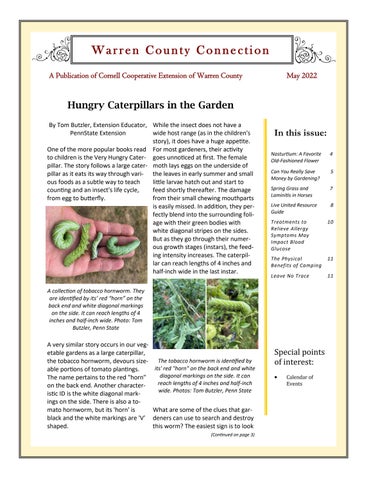
A collection of tobacco hornworm. They are identified by its’ red “horn” on the back end and white diagonal markings on the side. It can reach lengths of 4 inches and half-inch wide. Photo: Tom Butzler, Penn State
A very similar story occurs in our vegetable gardens as a large caterpillar, the tobacco hornworm, devours sizeable portions of tomato plantings. The name pertains to the red "horn" on the back end. Another characteristic ID is the white diagonal markings on the side. There is also a tomato hornworm, but its 'horn' is black and the white markings are 'V' shaped.
The tobacco hornworm is identified by its' red "horn" on the back end and white diagonal markings on the side. It can reach lengths of 4 inches and half-inch wide. Photos: Tom Butzler, Penn State
What are some of the clues that gardeners can use to search and destroy this worm? The easiest sign is to look (Continued on page 3)
Special points of interest: •
Calendar of Events
Warren County Connection
Page 2
Cornell University Cooperative Extension of Warren County
Warren County Connection
CALENDAR
377 Schroon River Road Warrensburg, NY 12885
Please visit our website for more events www.cce.cornell.edu/warren
Phone: (518) 623-3291 or (518) 668-4881 Fax: (518) 668-4912
May 2022
Visit Our Web Site: www.cce.cornell.edu/warren
Who We Are Nation-wide, thousands of people in each state tap into their state’s land-grant university research and know-how to make sound confident decisions concerning family, home, business, finances, and the future. In New York State, the land-grant university is Cornell University.
WHEP: Amazing Amphibians - Thursday, May 12, 2022, 6:00 PM - 7:00 PM - If possible we will visit Pack Forest Lake to see if we can find frogs, toads, and salamanders as they move into or out of vernal pools. Cloverbuds welcome, with adult! No fee. Cornell Cooperative Extension, 377 Schroon River Road, Warrensburg, NY 12885
The Cornell Cooperative Extension network brings you the expertise of Cornell University, other land-grant universities across the country and locally-based Extension Educators, volunteers, and other experts through such programs as: horticulture, youth and families, leadership, environment, food, nutrition & health, home environment, and financial management. Staff Dr. James Seeley, Executive Director John Bowe, Associate Team Leader Dan Carusone, 4-H Natural Resources Coordinator Marybeth Mitcham, Nutrition, Food Safety & Healthy Living Educator Roxanne Westcott, 4-H Family Living Educator Kali DeMarco, Farm to School Coordinator Rebecca Devaney, Community Horticulture Coordinator Sharon Bellamy, Finance Manager Amy Sabattis, Public Relations/Publications Manager Michele Baker, Administrative Assistant Chris Dittus, Administrative Assistant Connor Eastman, Maintenance
Board of Directors David Strainer - President Jim Kneeshaw - Vice President Dan Bruno - Secretary William Hamelin - Treasurer Aimee Azaert Lisa Earl Maureen Folk Ed Griesmer David Little Cynthia Muratori
Plant Sale - Friday, June 3, 2022, 9:00 AM - 3:00 PM Saturday, June 4, 2022, 9:00 AM - 3:00 PM - Annual plant sale fundraiser which benefits both 4-H and the Master Gardener Program. Order form with a deposit of 50% of your order due by May 3rd. Orders are first come, first serve basis. Contact our office for a list of annual, perennial flowers, herbs, and vegetables. Please mail your order form and check payable to CCE Warren County, 377 Schroon River Rd., Warrensburg, NY 12885 or pay with credit card by calling 518-668-4881.
Extension Service Committee Chair - Ben Driscoll Daniel Bruno Andrea Hogan Brad Magowan Debra Runyon
If you have special needs as addressed by the Americans with Disabilities Act and need assistance with attending these workshops, please make your needs known by the registration deadline. Reasonable efforts will be made for accommodations.
Warren County Connection (Continued from page 1)
for their feeding activity. Tomato limbs stick out like a sore thumb with 90% of their leaves missing. Also, the later instar caterpillars will feed on the fruit itself. A halfeaten tomato, hanging from a limb, is easily noticeable. Also, look on the garden floor for fecal pellets. Ravenous eaters need to get rid of their waste; large input (leaves) leads to large outputs (poop). Droppings are much easier to find than the camouflaged hornworm. Note that fresh droppings are green while older droppings, after being exposed to warm temperatures, are black.
Page 3
plant and squish or feed to the chickens. There are also some tiny wasps that lay their eggs inside the body of the caterpillar and offer some control, typically later in the season. If left unchecked, the tobacco hornworm will drop to the soil, pupate, and emerge in the spring as the Carolina Sphinx. The adult moth typically flies in the evening, looking for nectar in flowers with long corollas, such as petunias.
While insecticides are certainly effective in controlling hornworms, they are usually not in large enough numbers to warrant an application. Look for signs of their presence and start the hunt. Once spotted, pick off the
The easiest way to locate hornworm feeding activity is to use a piece of white paper held against the plant. Tomato limbs stick out like a sore thumb with 90% of their leaves missing.
In addition to hornworms devouring foliage, they will also feed on the fruit. Can you spot the two hornworms in the picture above? Photos: Tom Butzler, Penn State
Large green hornworm droppings (left) represent fresh feeding activity while blackened droppings are old (right). Large green droppings are a hint that the tobacco hornworm has recently been feeding. Photos: Tom Butzler, Penn State
Carolina Sphinx moth (Manduca sexta) Photo: Government of Bermuda, Department of Environment and Natural Resources, A. Copeland Tobacco Hornworm and Carolina sphinx moth
Page 4
Nasturtium: A Favorite Old-Fashioned Flower By Dr. Leonard Perry, Horticulture Professor Emeritus University of Vermont
Nasturtiums are a trailing annual plant, easy to grow, with flowers in various colors (mainly red, orange or yellow) all summer. They’re great as a groundcover, in large containers, hanging baskets, or trailing out of raised beds and down slopes. The abundant, colorful blooms can be cut for use as an elegant entree garnish or salad decoration. The leaves, which contain a good dose of vitamin C, can be used to add a peppery flavor to fresh salads. It is this flavor, similar to that of cress, from which the common name comes, meaning “nose twister” in Latin. Perhaps it is the resurgence of interest in growing oldfashioned flowers that has helped the nasturtium make a comeback in gardens and seed catalogs. The flowers have a delicate fragrance that many people will remember from grandma's garden. A couple of more famous displays are at the Isabella Stewart Gardner Museum in Boston, plants forced for spring blooms in their courtyard (www.gardnermuseum.org), and at the artist Claude Monet’s home in Giverny, France (fondationmonet.com/en). The scientific name for the nasturtium (Tropaeolum minor) comes from the Greek word meaning "to twine," which is descriptive of some of the 50 species in this genus. Nasturtium was first found growing in Mexico and Peru, where it was used instead of cress to flavor foods. It was brought to Europe in the 16th century, where it was considered a symbol of conquest and victory in battle. This meaning morphed into “patriotism” in the symbolic Language of Flowers of Victorian times. Victori-
Warren County Connection
an women used it in their practical “tussie mussies” (small bunches of flowers) to ward off bad smells. Nasturtiums come in three types: dwarf, semi-trailing, and climbing. Some are heirlooms, dating back 100 years or more. Dwarf types are bushy and compact and include the ‘Alaska Mix’ with variegated leaves and flowers in yellow, red and orange; ‘Empress of India’ with bluish leaves and bright scarlet flowers; ‘Jewel Mix’ with semidouble to double flowers in various colors; ‘Mahogany’ with dark mahogany red flowers; ‘Peach Melba’ with creamy yellow flowers and red inner markings; ‘Phoenix’ with unusual split petals on a color mix of orange, red or yellow; ‘Strawberries and Cream’ with primrose-yellow flowers with red markings; ‘Vesuvius’ with bluish leaves and salmon flowers; and ‘Whirlybird Mix’ with single to semi-double flowers in various colors. Semi-trailing types reach a length of two to three feet, making them ideal for hanging baskets. The Gleam series— an All-America Selections winner in 1935— has semi-double to double flowers in various colors. It is a good choice for this habit, as is ‘Troika Red’ or ‘Troika Orange.’ The latter also have variegated leaves. Gleam was originally found in a convent garden in Mexico in the 1920’s and became popular during the Depression, with seeds selling for five cents each.
The climbing types like ‘Jewel of Africa’ or ‘Tall Trailing Mix’ send out six to eight foot strong runners that climb trellises like vines. Fragrant, single flowers of this type are bright and range from yellow and orange to rose and crimson. Nasturtium is one of the easiest flowers to grow from seed. The best flowering will be in full sun, but they will tolerate partial shade (four to six hours of direct sun daily). Seeds can be sown directly in the garden beginning in late May, or started indoors to get a good head start on the season. However, as nasturtiums do not fare well when transplanted, use peat pots and plant these directly in the soil. Nasturtiums are not choosy about their soil but, given a choice, do prefer a light, sandy soil. Don't spoil them with rich, fertile soil and fertilizers as this will only result in lush foliage and few blooms. Soil shouldn’t be too wet either, or they may rot. The large seeds of nasturtiums are easily held by tiny fingers, making them a good flower for children to help (Continued on page 5)
Page 5
Warren County Connection (Continued from page 4)
plant. In addition, the seeds germinate quickly and plants grow rapidly, so children can see the results of their nurturing soon.
Can You Really Save Money by Gardening? By Mike Nuckols, Agriculture & Natural Resources Program Manager, CCE Jefferson County
Only a small space is needed to provide a child with his or her own garden. Even a single foot square container can become a spring-to-fall garden. In the early spring, sow fast growing seeds like lettuce and radishes with the nasturtiums. By the time they are harvested, the nasturtiums will be ready to bloom until fall. Nasturtiums also are planted by many as a companion plant in the vegetable garden to ward off pests, and look attractive at the same time. Interplant nasturtiums with member of the cabbage family (cabbage, kale, cauliflower and similar) to deter cabbage caterpillars and whiteflies. Interplant with cucumbers, too, for perhaps fewer whiteflies and cucumber beetles. Grown with runner beans, nasturtiums help keep aphids off the bean plants. If you have problems with aphids and whiteflies on tomatoes and potatoes, interplant nasturtiums. And interplant with squash to deter squash beetles and borers. In addition to deterring unwanted insects, they are useful in attracting beneficial predatory insects to your garden.
Have a Gardening Question? Cornell Cooperative Extension’s Master Gardeners answer questions on a variety of topics including growing vegetables, fruits, ornamental and turf grass, plant identification, pruning, and insect and disease problems.
Call 518-623-3291
A topic on everyone’s mind these days is inflation. Escalating fuel costs and higher grocery bills are nipping away at the value of everyone’s hard-earned dollars. One frequently suggested method to save money on the food bill, particularly for those living in rural or suburban communities, is to plant a vegetable garden. While gardening enthusiasts quickly embrace this notion, others scoff at the idea that a garden can save money. I frequently speak with non-gardeners in our community who claim that gardening is simply an expensive hobby and that you cannot grow vegetables cheaper than purchasing them from the supermarket. Some cite anecdotal stories about people spending hundreds of dollars to harvest a few tomatoes. Others argue that large farms have economies of scale that cannot be replicated at home or that gardening requires such a high level of skill that the average person cannot be efficient. Who is right? Is there actual data supporting one argument or the other? Can a family save money by vegetable gardening? What is the return on investment for a family garden, if any?
One of the benefits of working with the Extension system is that we have access to university professionals who evaluate questions like this with an unbiased and critical eye. In 2014, Gail Anne Langellotto of Oregon State University published a comprehensive survey in The Journal of Extension that reviewed historic and contemporary analysis of gardening costs and the value of produce harvested. According to her analysis, an average home vegetable garden produces $678 worth of fruits and vegetables beyond the cost of $238 worth of materials and supplies, exclud(Continued on page 6)
Page 6
Warren County Connection
(Continued from page 5)
grocery stores is increasing.
ing the costs of labor. On average, this equates to about $0.88 a square foot in net profit. When a family’s labor costs are included at prevailing rates in their community (at least minimum wage), this value decreases to an average of negative $81 per garden (a loss). Her study also showed tremendous variability between different studies that have been conducted throughout the nation. She concluded that local environmental conditions, gardening practices, crop choice, and, most importantly, the skill of individual gardeners influence the actual net value of a home garden. Which means the true answer to this question is complex and depends upon many variables. Given that labor was consistently the deciding factor, the better question to ask is whether a home garden can save YOU money in relation to the time spent? How would you spend your time otherwise and would that alternative use of time be profitable? Do you have a good garden spot – or would you struggle due to lack of light or poor soils? Every situation will be different. Everyone values their time differently.
Saving money on groceries is not the only reason to garden though. Vegetable gardening has been documented to promote healthy eating, provide stress relief, and increase physical activity – leading to longer and happier lives. Gardening has also been linked to a decreased risk of dementia and may be more effective at treating childhood obesity than other interventions. Home-grown vegetables have been documented to have higher nutritional content than most conventional supermarket produce – which generally translates into better flavor. As most of us with excess zucchini know, home gardens often produce more than most families can use, allowing us to donate to our friends or local food pantries – helping to build our community. Advanced gardeners might even have enough to sell.
One thing we do know is that beginners are less likely to have a successful garden than those with many years of experience. That is why we strongly advise new gardeners to start small and scale up gradually over many years. As you gain experience and your garden matures, your successes will increase proportionately every year. We recommend that beginners start with a small ten by twelve plot filled with easy-to-grow and high-value items like peas, salad greens, kale, tomatoes, peppers, green beans, or annual herbs. Small plots are easier to establish, particularly when converting from lawn using methods such as tarping, sheet-mulching, or no-till methods. Weeding and managing pests is also easier in a small and dense garden plot –resulting in more yield per square foot and higher-quality results.
If growing your own vegetables does not interest you, there is a great alternative – shopping at farmers markets and farmstands. As was the case in 2021, we expect that produce sold in-season will again be cheaper than produce shipped in from the west coast, particularly given increased shipping costs and supply chain difficulties that have persisted after the pandemic. Local produce will also be significantly fresher and is usually of higher quality. Buying locally also helps support preservation of farmland.
To be cost-effective, you also need to be prudent when spending your garden budget. Free compost that you make yourself often gives results superior to the use of expensive chemical fertilizers. Six-packs of tomato transplants quickly catch up in growth to transplants sold in large 4 or 6-inch pots (which cost significantly more). A packet of cucumber seeds sown directly into the garden will give you 20-30 plants as compared to double the cost for a single cucumber transplant. Saving your own seeds and trading produce with neighbors can also reduce your costs. Cardboard boxes from all those internet purchases, when stripped of plastic tapes, can make an excellent weed barrier. Planting fall crops can extend your harvest period through November, just as the price of produce in
So, how much is a home garden really worth? Only you can answer that question. If vegetable gardening is for you, Cornell Cooperative Extension has many resources to help you get started.
The window is open and a warm, delicious little breeze comes wandering in. It smells of magnolias and dogwood and it whispers in our ears enticing little stories of gurgling brooks and cool woods. Yes, we have got spring fever and got it bad. ~Country Life, June 1922 A little madness in the Spring Is wholesome even for the King… ~Emily Dickinson And the Spring arose on the garden fair, And the Spirit of Love fell everywhere; And each flower and herb on Earth's dark breast Rose from the dreams of its wintry rest… ~Percy Bysshe Shelley, "The Sensitive Plant," 1820
Page 7
Warren County Connection
Spring Grass and Laminitis in Horses Every year, once winter is over and the snow has receded, the grass starts its yearly explosion of growth. The spring helps bring hay and fresher forage for our horses. However, with the fresh forage comes the risk of a condition known as “grass founder.” This condition, a form of laminitis, can be lethal to horses with certain diseases, such as insulin resistance and Cushing’s disease. Dr. Scott Austin, a boarded specialist in equine internal medicine at the University of Illinois Veterinary Teaching Hospital in Urbana, explains what causes this form of laminitis and how horse owners can protect their horses from getting it. What Is Laminitis? Laminitis is a very painful condition that involves sensitive structures, called the laminae, found in the hooves of horses. Lamina is a thin piece of tissue that attaches the coffin bone—the bone at the furthest extremity of the horse’s leg—to the inside of the hoof wall. “The word laminitis literally means inflammation of the attachments between the hoof wall and skeleton,” explains Dr. Austin. When damage to the laminae is severe, the coffin bone may sink or rotate within the hoof capsule—a condition called “founder”—resulting in severe and often debilitating pain. Once rotation of the bone has occurred, the bone’s attachment to the hoof wall becomes permanently disrupted. A good farrier can help reduce the ill effects but cannot restore the original anatomy. “It is much better to prevent laminitis than to manage the damage after the fact,” says Dr. Austin. Laminitis can be triggered by many things, including grain overload, repeated striking of hard ground, hormonal imbalance (Cushing’s disease), obesity, and lastly lush grass. Lush Forage So what makes grass “lush” in the spring and how does it contribute to laminitis? The fertile grass of spring contains higher amounts of nonstructural carbohydrates, such as sugars and starches, and less structural carbohydrates or fiber, than grass later in the season.
Dr. Austin says, “As grass matures, there is a shift to structural carbohydrates making the grass more fibrous. When grass is starting to develop seed, we now this transformation has occurred. When you squeeze some in your hand, you feel the stems poke you.” In spring, when horses consume the lush grass, the extra starches and sugars ferment in the horses’ gastrointestinal tracts. This fermentation affects the balance of bacteria in the GI tract, which in turn can trigger laminitis. The actual mechanism by which this change in the microbiome of the GI tract brings about laminitis hasn’t been identified. However, many researchers in equine nutrition are working to understand it. Another problem related to spring grass arises in obese horses that have insulin resistance. “Exposure of an insulin-resistant horse to a high-carbohydrate diet, as we see with lush pastures, will cause a great increase in insulin levels in the horse,” says Dr. Austin. “High insulin levels can affect blood flow to the laminae and cause laminitis.” Prevention Although veterinarians are not exactly sure the mechanism that causes grass founder, there are many things owners can do to decrease the risk of laminitis in their horses. “Don’t let your horse get fat,” warns Dr. Austin. “Learn how to recognize ideal body weight by doing body condition scoring. Obese horses should be tested for insulin resistance, and horses that are insulin resistant should not be allowed to graze on lush pastures.” Instead, he advises keeping these horses in dry lot and feeding hay until pastures are more mature. Additionally, when these horses go out on pasture, use a grazing muzzle to decrease grass consumption. “If the horse shows any tenderness when walking or turning, immediately remove it from pasture and have it evaluated by a veterinarian,” says Dr. Austin. “ Horses with previous episodes of laminitis should not be out on pasture or should only go out to mature pasture after consuming their morning hay ration and should wear a muzzle. Pastures should be mowed to keep grass short.” Laminitis is a very painful condition that can be deadly. By learning about risk factors such as spring grass, horse owners can decrease the risk that their horses will founder. Source: University of Illinois Urbana-Champaign
Page 8
Warren County Connection
Live United Resource Guide Information & Resources to Help Communities
Heap (Home Energy Assistance Program) NYS HEAP Hotline.............................800-342-3009 Warren County DSS...........................518-761-6338 Washington County DSS....................518-746-2300 Saratoga County DSS.........................518-884-4140 Home Repair / Rehab Homefront Development Corp........518-747-8250 City of Glens Falls (residents).........518-761-3833 (Also check with local town clerks for available grant funds)
Rent Assistance Family Service Association..............518-793-0797 LEAP..................................................518-746-2391 Saratoga County DSS.......................518-884-4140 Warren County DSS..........................518-761-6300 Washington County DSS..................518-746-2300 WAIT House......................................518-798-4384 Warren/Hamilton Com. Action........518-793-0636 Mortgage/Foreclosure The Salvation Army...........................518-792-1960 Warren/Hamilton Comm. Action......518-793-0636 Legal Aid Society of NE-NY...............518-587-5188 Emergency Lodging Saratoga County DSS.......................518-884-4140 Warren County DSS..........................518-761-6300 Washington County DSS..................518-746-2300 WAIT House......................................518-798-4384 Warren/Hamilton Com. Action........518-793-0636 North Country Ministry.....................518-623-2829 American Red Cross (Fire/Flood)....518-792-6545 Shelters of Saratoga.........................518-581-1097 Weatherization/Energy Warren Hamilton Comm. Action.....518-793-0636 LEAP..................................................518-746-2391 Homefront Development Corp........518-747-8250 NYSEG: Gas: 800-572-1121 Electric: 800-572-1131 NYSERDA........................................nyserda.ny.gov National Grid..................................1-800-642-4272
Accessibility Southern ADK Independent Living...518-792-3537 Homefront Development Corp.........518-747-8250 Prospect Child and Family Center...518-798-0170 Housing and Community Renewal...518-473-6981 Housing Education, Budget and Credit Counseling Cornell Cooperative Extension (CCE): Warren County..............................518-623-3291 Washington County......................518-746-2560 Saratoga County...........................518-885-8995 Homefront Development Corp.........518-747-8250 Legal Questions/Rights Homefront Development Corp.........518-747-8250 New York State Office for the Aging: Warren County..............................518-761-6347 Washington County......................518-746-2100 Saratoga County...........................518-884-4100 Senior Services New York State Office for the Aging: Warren County..............................518-761-6347 Washington County......................518-746-2420 Saratoga County...........................518-884-4100 Senior Centers: Greater Glens Falls........................518-793-2189 Queensbury....................................518-745-4439 Kingsbury Fort Edward..................518-747-9352 Retired Senior Volunteer Program.....518-743-9158 Moreau Community Center................518-792-6007 LEAP....................................................518-746-2391 AmeriCorps Seniors RSVP.................518-743-9158 Veteran’s Services Adirondack Vets House.....................518-683-2686 Glens Falls VA Clinic..........................518-798-6066 Warren County Veteran's Services....518-761-6342 Washington County Vet's Service.....518-746-2470 (Continued on page 9)
Page 9
Warren County Connection (Continued from page 8)
Employment Training Warren County One Stop Career......518-743-0925 Saratoga County One Stop Career...518-884-4170 LEAP...................................................518-746-2391 Crandall Library....................518-792-6508 ext 266 Salvation Army...................................518-792-1960 Tax Assistance-VITA Program Free tax Preparation for Qualifying Individuals For Questions: Tri-County United Way..................518-793-3136 To Schedule an Appointment: Please Call..................................1-800-211-5128 Counseling Services ADK Samaritan Counseling ..............518-747-2994 Salvation Army...................................518-792-1960 Caleo Counseling Services................518-747-8243 Catholic Charities...............................518-793-6212 Health Insurance Enrollment Saratoga Office for the Aging...........518-884-4100 ADK Health Institute Enrollment....1-866-872-3740 Community Health Advocate............888-614-5400 Prescription Assistance Family Service Association................518-793-0797 Warren Office for the Aging...............518-761-6347 LEAP.............................................518-746-2391 Food Pantries/Food Resources Warren County Chestertown Town Hall.....................518-494-2433 Hague Community Center.................518-543-6161 Horicon Community Center...............518-494-3647 ADK Community Outreach ................518-251-3481 Lake George Caldwell Presbyterian..518-668-2613 Stony Creek Town Hall......................518-696-3575 St. Mary's Church Glens Falls...........518-792-0989 Thurman Town Hall...........................518-623-9649 First Presbyterian Church.................518-623-2185 Maxfield Community Food Pantry....518-696-4979 Warren/Hamilton Com. Action.........518-793-0636 Open Door (Glens Falls).....................518-792-5900 The Salvation Army............................518-792-1960 Gathering Place (Warrensburg)........518-623-2829 Emergency Food Box Mission..........518-793-9728 Family Services Association.............518-793-0797
Saratoga County Corinth Food Pantry.............................518-615-9564 Saratoga County EOC..........................518-288-3206 Schuylerville Food Pantry....................518-507-6043 Moreau Community Center.................518-792-6007 Pine Knolls Alliance Church................518-793-7101 Wilton Food Pantry..............................518-350-4456 Family Service Association.................518-793-0797 Washington County Bread of Life Food Pantry...................518-747-2808 Cambridge Seniors Building...............518-677-8592 Fort Ann Cornerstone Bible Church...518-639-4009 Fort Edward Community Pantry.........518-747-5939 Granville Ecumenical Food Pantry.....518-642-1262 Greenwich Food Pantry.......................518-692-3082 Hartford Food Bank.............................518-469-3162 Salem First United Presbyterian.........518-791-8485 Washington County DSS (SNAP)........518-746-2300 LEAP.....................................................518-746-2391 Whitehall United Methodist Church....518-499-2039 Family Service Association...................518-793-0797
You must have long-range goals to keep you from being frustrated by short-range failures. ~Charles C. Noble The four most important words in the English language are: "How can I help?" ~Author unknown, c. 1960s
Family Budget Coaching Program Now Available for Families and Individuals in Warren County Cornell Cooperative Extension of Warren County is now offering a free, confidential Family Budget Coaching Program to community residents. The one-on-one sessions are available to individuals and families who want to improve their financial literacy, set goals, create a savings plan, reduce debt and get a better handle on finances. The trained coaches will offer sessions either via Zoom or in person in Glens Falls, Warrensburg and Johnsburg. Since 1914, Cornell Cooperative Extension has responded to the needs of New York residents enabling people to improve their lives and communities through partnerships that put experience and research-based knowledge to work. For more information on this program, please contact Roxanne Westcott at rmw38@cornell.edu or (518) 668-4881.
Warren County Connection
Page 10
(hyperglycemia) is very important for people with diabetes who take steroids.
Treatments to Relieve Allergy Symptoms May Impact Blood Glucose By Pamela Daniels, Michigan State University Extension Get relief and stay safe during allergy season. Spring ushers in seasonal allergies. First, trees release pollen soon followed by summer grasses, rye and weeds generating hay fever. Allergens can be more intrusive for individuals with diabetes. If you have diabetes, you know that being under the weather from seasonal allergies may affect how you manage your diabetes. Diabetes can alter the body’s immune system and reaction to both allergy symptoms and allergy medications. Even on a good day, keeping blood sugar levels where they should be, getting enough sleep, staying disciplined with medications or insulin along with exercising can be challenging. What about the days when we are not feeling well?
Follow these helpful tips if you take allergy medications Before starting any new treatment, always talk to your provider or asthma specialist about treatment options while managing your diabetes. Stay prepared for any diabetic health risk by monitoring your blood sugar frequently. If you are having unusually high or low blood sugar readings, contact your healthcare provider. * High blood sugar - Hyperglycemia * Low blood sugar - Hypoglycemia
Diabetes self-management with allergies Allergy season can be especially hard for people with diabetes. Allergies themselves may not affect blood glucose, but medications to treat allergies can. Almost all medications whether over the counter or prescribed may impact blood sugar. Medication side effects such as drowsiness, hyperactivity, nausea, diarrhea and dizziness impact blood sugar. Common allergy medications According to dLife, medications, whether over the counter or prescription, can affect blood sugar levels. Check with your pharmacist or healthcare provider before taking allergy medications. Here is a short list of allergy medications and possible side effects: Decongestants—common allergy medication containing decongestants may raise blood sugar, blood pressure and heart rate. Antihistamines—they tend to not affect blood sugar; however, antihistamines do tend to make you drowsy. Therefore, it is important to understand that long periods of drowsiness can also be associated with hypoglycemia and hyperglycemia. Drowsiness may make you less able to accurately monitor blood sugar. Steroids (Corticosteroids)—prescribed by providers but there are types that can be purchased over the counter. A side effect of steroids is they may make blood sugar go up. Monitoring for high blood sugar
If you take allergy medication while on insulin, you may need to adjust your dose. Ask you provider or asthma specialist about treatment options and managing diabetes. Read labels. Medication labels contain important information for our health. Taking your medicine before peak allergy season can help alleviate symptoms. Pay attention to your local allergen report, which commonly includes mold, pollen and the breathing index. Use weather applications on your phone/ tablet or check your local weather station’s web page for a daily or weekly forecasted allergy index. Plan on exercising indoors during peak allergy season. Keep your windows and basement doors closed to help avoid allergens from entering your home. If you need to do yard work during peak allergy season, wear a mask.
Food allergy medications impact blood glucose Food allergy is in the group of disorders called food intolerance. Although much rarer than seasonal allergies, treatments administered to treat non-life-threatening allergic reactions such as hives, diarrhea, mild hand, lip or eye swelling may include seasonal allergy medications such as Zyrtec, Singular and Benadryl, for example. These medications like those mentioned above can have the same impact on blood glucose levels.
Warren County Connection Warren County Connection
The Physical Benefits of Camping By: Christina Pay, Extension Assistant Professor, Utah State University A recent survey reported that more North Americans are discovering the benefits of camping and spending time outdoors. According to the 2020 North American Camping Report, there are more than 94.5 million camper households throughout North America. In the United States, 48.2 million households reported that they camped at least once during 2020, including 10.1 million households who said they went camping for the first time (Cairn, 2020). With the increased number of campers, one might wonder, what’s the draw to the outdoors?
Camping provides a host of benefits. Simply put, camping is good for you, both in body and mind. Benefits include relationship building, opportunities to learn and develop new skills, unplugging and getting away from screens, connecting with nature, stress reduction, and increasing physical fitness. The fitness benefits of camping are well documented. Research suggests that physical activity in the outdoors and feelings of connection to nature enhance psychological health and well-being. Activities such as walking in forests and participating in outdoor activities have been shown to enhance mood and focus, and increase attention and cognitive capacity. Additionally, significant improvements in self-esteem occur with physical activity in the great outdoors (Lawton et al., 2017). The physical demands of backpacking, setting up tents and making camp, hiking, fishing, and exploring nature certainly count as exercise which contributes to our overall health and well-being. Outdoor physical activity has been linked to a decrease in depressive thoughts and sleeping under the stars can help promote our natural circadian rhythm, which is a foundation for high quality sleep and health (National Park Service, 2019). With all of these health benefits, why wouldn’t you want to go camping? Perhaps you are new to camping and feel a bit intimidated. Start small and work your way up. To ease into it, consider a camping trip close to home. Pitch a tent in your backyard or someplace close to where you live. Another idea would be to plan a backpacking trip close to home. These are great for overnighters where you can pack light and carry what you need with you. Campouts close to home take less planning and allow for scheduling flexibility. As you explore areas and find hiking trails close to where you live, you may discover a location you didn’t realize would become your new favorite place to camp. As you become more comfortable with camping, you can branch out and dis-
Page 11
cover the beauty of state and national parks or one of many campgrounds across the country. When you consider all of the amazing benefits to your health and life in general, whether you go camping in your back yard or in a campground, time spent camping is time well spent!
Leave No Trace When you enjoy all the outdoors has to offer, make sure that you follow the seven principles of Leave No Trace so what you are enjoying will remain pristine and available to other explorers for generations to come! 1. Plan Ahead and Prepare - Make sure you have proper equipment, food, and supplies. Choose a site that will accommodate everyone in your party, not too close to the trailhead or parking lot and not too far either. Also, ensure you know where you are going so you lessen your impact on hiking surfaces! 2. Travel and Camp on Durable Surfaces - Camp at least 200 feet away from water sources and hike on established trails (even when muddy!). 3. Dispose of Waste Properly - Pack all of your waste and bring it back with you! Even if something is biodegradable (like banana peels), it should not be left. If you need to “do your business” in the woods, then make sure you do so at least 200 feet from water sources, dig a cat hole, and bury the evidence. Pack toilet paper and other sanitary items and bring them back with you.
4. Leave What You Find - Leave No Trace means just that – take only pictures and leave only footprints (hopefully left only along designated paths!). 5. Minimize Campfire Impacts - If a fire pit already exists, use that. Only use fuel that is “dead and down” (no cutting trees down or pulling bark off trees). This notion is completely different from the original Outdoor Cookery by Gertrude Armbruster and Fred Winch, Jr. from 1960, which instructed readers to, “Remove [bark] from tree by pulling it off with the fingers.” When you are done with the fire, make sure you put it completely out (no live coals left) and scatter the ashes. 6. Respect Wildlife - Do not feed, handle, or disturb wildlife – no matter how cute they might be! This does two things, prevents the wildlife from becoming accustomed to people and prevents you from being injured or contracting germs from the animals themselves. 7. Be Considerate of Other Visitors - Show courtesy by yielding the trail to others who might want to pass you, keep your volume down so everyone can enjoy the sounds of nature, and be sure to be off the trail when you take a break or camp. Ultimately, if you follow the seven principles of leave no trace, you will not only be able to enjoy the great outdoors, but allow others – visitors and inhabitants of the outdoors alike – to enjoy the bounty of nature for years to come. ***For more information on Leave No Trace, visit www.lnt.org
Cornell Cooperative Extension 377 Schroon River Road Warrensburg, NY 12885 RETURN SERVICE REQUESTED
IF THERE IS A CHECK IN THIS BOX , THIS IS THE LAST ISSUE OF THE WARREN COUNTY CONNECTION YOU WILL BE RECEIVING. To renew your subscription clip the form below and send to Cornell Cooperative Extension of Warren County.
Warren County Connection
THANK YOU INTERNATIONAL PAPER!! "Paper for this newsletter was donated by International Paper, proudly produced at the Ticonderoga, New York Mill from trees harvested in working Adirondack forests that are managed responsibly in accordance with the principles of the Forest Stewardship Council (FSC) and the Sustainable Forestry Initiative (SFI)." “International Paper is proud to join almost 60 manufacturers and importers supporting the Paper & Packaging – How Life Unfolds™ campaign.” “Cornell University Cooperative Extension of Warren County provides equal program and employment opportunities.” “The information given herein is supplied with the understanding that no discrimination is intended and no endorsement by Cornell Cooperative Extension is implied.” The Cornell Cooperative Extension educational system enables people to improve their lives and communities through partnerships that put experience and research knowledge to work. "Cornell Cooperative Extension actively supports equal educational and employment opportunities. No person shall be denied admission to any educational program or activity, or be denied employment on the basis of any legally prohibited discrimination involving, but not limited to, such factors as race, color, religion, political beliefs, national or ethnic origin, gender, sexual orientation, age, marital or family status, veteran status, or disability. Cornell Cooperative Extension is committed to the maintenance of affirmative action programs that will assure the continuation of such equality of opportunity."
Just $7.50 per year will give you one full-year subscription to the “Warren County Connection,” mail this coupon to: Cornell Cooperative Extension ☺ Be sure to include your fee of $7.50 to cover the cost of mailing. Name______________________ Address____________________ __________________________ Zip Code___________________ OR To get this publication FREE e-mail als77@cornell.edu and you will be added to our E-Edition. We’re on the Web! http://counties.cce.cornell.edu/warren/ & Facebook - Look for CCE Warren