Warren County Connection A Publication of Cornell Cooperative Extension of Warren County
February 2022
Winter Warmth: Keeping Weight on Your Horses By Abbey Jantzi, Dairy & Livestock Specialist, CCE Jefferson County
In this issue:
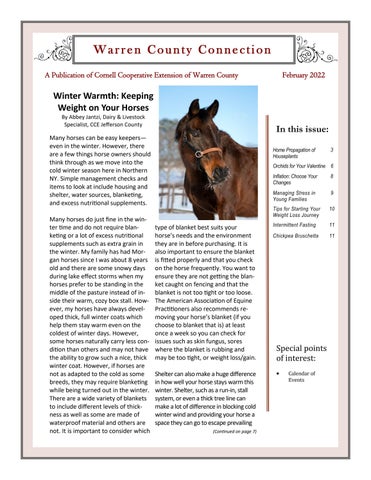
Many horses can be easy keepers— even in the winter. However, there are a few things horse owners should think through as we move into the cold winter season here in Northern NY. Simple management checks and items to look at include housing and shelter, water sources, blanketing, and excess nutritional supplements. Many horses do just fine in the winter time and do not require blanketing or a lot of excess nutritional supplements such as extra grain in the winter. My family has had Morgan horses since I was about 8 years old and there are some snowy days during lake effect storms when my horses prefer to be standing in the middle of the pasture instead of inside their warm, cozy box stall. However, my horses have always developed thick, full winter coats which help them stay warm even on the coldest of winter days. However, some horses naturally carry less condition than others and may not have the ability to grow such a nice, thick winter coat. However, if horses are not as adapted to the cold as some breeds, they may require blanketing while being turned out in the winter. There are a wide variety of blankets to include different levels of thickness as well as some are made of waterproof material and others are not. It is important to consider which
Home Propagation of Houseplants
3
Orchids for Your Valentine 6
type of blanket best suits your horse’s needs and the environment they are in before purchasing. It is also important to ensure the blanket is fitted properly and that you check on the horse frequently. You want to ensure they are not getting the blanket caught on fencing and that the blanket is not too tight or too loose. The American Association of Equine Practitioners also recommends removing your horse’s blanket (if you choose to blanket that is) at least once a week so you can check for issues such as skin fungus, sores where the blanket is rubbing and may be too tight, or weight loss/gain. Shelter can also make a huge difference in how well your horse stays warm this winter. Shelter, such as a run-in, stall system, or even a thick tree line can make a lot of difference in blocking cold winter wind and providing your horse a space they can go to escape prevailing (Continued on page 7)
Inflation: Choose Your Changes
8
Managing Stress in Young Families
9
Tips for Starting Your Weight Loss Journey
10
Intermittent Fasting
11
Chickpea Bruschetta
11
Special points of interest: •
Calendar of Events
Warren County Connection
Page 2
Cornell University Cooperative Extension of Warren County 377 Schroon River Road Warrensburg, NY 12885
Phone: (518) 623-3291 or (518) 668-4881 Fax: (518) 668-4912
Visit Our Web Site: www.cce.cornell.edu/warren
Who We Are Nation-wide, thousands of people in each state tap into their state’s land -grant university research and know-how to make sound confident decisions concerning family, home, business, finances, and the future. In New York State, the land-grant university is Cornell University. The Cornell Cooperative Extension network brings you the expertise of Cornell University, other land-grant universities across the country and locally-based Extension Educators, volunteers, and other experts through such programs as: horticulture, youth and families, leadership, environment, food, nutrition & health, home environment, and financial management.
Staff Dr. James Seeley, Executive Director John Bowe, Associate Team Leader Dan Carusone, 4-H Natural Resources Coordinator Marybeth Mitcham, Nutrition, Food Safety & Healthy Living Educator Roxanne Westcott, 4-H Family Living Educator Kali DeMarco, Farm to School Coordinator Rebecca Devaney, Community Horticulture Coordinator Sharon Bellamy, Finance Manager Amy Sabattis, Public Relations/Publications Manager Michele Baker, Administrative Assistant Chris Dittus, Administrative Assistant Connor Eastman, Maintenance
Board of Directors David Strainer - President Jim Kneeshaw - Vice President Dan Bruno - Secretary William Hamelin - Treasurer Aimee Azaert Lisa Earl Maureen Folk Ed Griesmer David Little Cynthia Muratori
Extension Service Committee Chair - Ben Driscoll Daniel Bruno Andrea Hogan Brad Magowan Debra Runyon If you have special needs as addressed by the Americans with Disabilities Act and need assistance with attending these workshops, please make your needs known by the registration deadline. Reasonable efforts will be made for accommodations.
Warren County Connection
CALENDAR
Please visit our website for more events www.cce.cornell.edu/warren PS: It Works! Parent Education Program 2/8, 2/15, 2/22, 3/1, 3/8/2022 - 6:00 PM - 7:00 PM Learn tried and true basic parenting skills in this interactive program. We will explore five skills that you can implement as a parent/caregiver. A collaboration between Warren and Washington Counties. Pre-register by contacting Roxanne Westcott, rmw38@cornell.edu or 518-668-4881. Online Training Via Zoom CCE Warren County Senior Snowshoe 2/10/2022 - 9:30 AM Physical activity can be fun when done as part of a group! Join us for an easy group snowshoeing event that (weather permitting) will run for around 2 hours. Registration is limited for this event. To register, please contact Director Barb Mitchell at 518-696-6451. Location TBA CCE Warren County Cuisines Around the World: Jamaica 2/11/2022 - 11:00 AM Come and join us as we tour Jamaica through food and a video presentation. To register, please contact Director Stephanie Smith at 518-761-8224. Queensbury Senior Center, 742 Bay Road, Queensbury, NY 12804 Senior Snacks 2/16/2022 - 10:30 AM - 11:30 AM What types of snacks are delicious, inexpensive, easy to make, and help to support a healthy senior diet? Come and join us as we discuss different types of senior snacks and make and sample some, too! Registration is limited for this event. To register, please contact Director Barb Mitchell at 518-696-6451. Lake Luzerne Senior Center, 539 Lake Ave., Lake Luzerne, NY 12846 Holistic Wellness: Treats for Furry Friends 2/19/2022 - 10:00 AM If the past two years have taught us anything, it is the importance of caring for ourselves and others so that we can remain healthy and well. In this interactive series, we will learn how easy it is to make treats for our pets. Registrants may e-mail MB at mem467@cornell.edu to receive recipes so that you can make these items at home along with me! Cost: Free. Registration link - https://cornell.zoom.us/meeting/ register/tJ0rcO-vrjgvGNa4YPdPkJY_TGX7ZsZhW2xP. Online Training Via Zoom CCE Warren County 4-H Public Presentation Training 2/24/2022 - 11:00 AM - 12:00 PM A fun and engaging program that will help get you get started with your 2022 public presentation. Register by contacting Roxanne Westcott, rmw38@cornell.edu or 518-668-4881. Cornell Cooperative Extension, 377 Schroon River Road, Warrensburg, NY 12885
Warren County Connection
Home Propagation of Houseplants Plant pieces cut from a parent plant and rooted to form new plants are called “cuttings.” Use of cuttings is a simple, inexpensive way to multiply houseplants and garden plants. Many plants can be propagated by cuttings. Each new plant will have the characteristics and genetic makeup of its parent plant. Types of cuttings Cuttings may be taken from stems, leaves or roots. Herbaceous stem cuttings, sometimes called slips, are commonly used. Popular plants such as African violet and begonia are propagated from leaf cuttings. A few plants may be propagated by cutting their long stems into segments, and others can be propagated by simple division. Herbaceous stem cuttings The type of stem cutting suitable for propagating most houseplants is the herbaceous cutting, which is made from tender growth of terminal shoots. Herbaceous cuttings are commonly used to propagate geranium, chrysanthemum or coleus (Figure 1). Cuttings taken from a rubber plant, dracaena or croton usually contain more woody tissue and are often called softwood cuttings. Techniques for taking and rooting these cuttings are the same, however. Figure 1 Five-inch coleus stem tip cutting that contains a terminal growing point.
Page 3
If a small portion of the main plant stem containing a bud is included with the petiole, the cutting is known as a leaf -bud cutting. Use of leaf-bud cuttings is limited. Hydrangea and rubber plants, however, are sometimes started with leaf-bud cuttings. Figures 2 and 3 Violet leaf cutting without the petiole and cutting with a 1/2-inch petiole.
Plants from stem sections A few houseplants may be propagated by cutting 1- to 2inch sections from the stem (Figure 4). These segments, without leaves, are placed in the rooting medium in a horizontal position and covered slightly. Figure 4 Stem section cutting with a prominent axillary bud.
How to take cuttings Take cuttings from vigorous, healthy shoots. Most cuttings should be 4 to 6 inches long. Cut just below a node (where a leaf is attached) with a sharp, clean knife. Remove leaves from the lower half of the cutting. Use a rooting hormone on all except easy-to-root plants such as coleus. Rooting compounds are available from many garden supply stores, mail-order seed and nursery companies, and mass merchandisers. Carefully use the hormone as directed. Keep cuttings clean. Don’t place cuttings in dirty containers or on dirty tables.
Leaf cuttings Leaf cuttings include only a leaf blade or the blade and a portion of the petiole (Figures 2 and 3). Leaf cuttings of plants such as African violet should not be rooted with long petioles. Trim the petiole to no more than 1/2 inch long.
Containers A 6- to 8-inch plastic pot filled with quality potting soil can be used to root several cuttings. Place the pot in a large (Continued on page 4)
Page 4
Warren County Connection
(Continued from page 3)
plastic bag, and seal the bag to maintain high levels of humidity (Figure 5). Do not place the bag in direct sunlight. Figure 5 Large zip-type plastic bag secured at base of pot with a rubber band. Rooting materials Clean, coarse, construction-grade sand is suitable for rooting many cuttings; however, it needs to be heatsanitized prior to use. It is also excellent mixed with an equal volume of peat moss. Vermiculite is a lightweight material used for rooting. It holds water well and promotes root growth. Perlite is another excellent propagation material. It is lightweight and provides good aeration for rooting. Perlite makes one of the best rooting materials when mixed with an equal volume of peat moss. Don’t use field soil as a rooting medium. It packs too tightly when wet and is prone to develop diseases. Compressed peat pellets are available for seeding and can also be used for rooting cuttings. The pellets expand rapidly when soaked in water. Place them in plastic bags after soaking and draining; insert a single cutting in each pellet and close the bag at the top. No additional watering is necessary until the cutting is rooted and the bag opened. Cleanliness Pots, medium and equipment used for rooting cuttings must be clean and sterile. Pots should be washed thoroughly using a household cleaner and disinfectant. Tools should also be washed in such a solution or dipped in alcohol. Any rooting medium that is not known to be sterile can be moistened and heated thoroughly in an oven at 150 to 200 degrees F for 20 to 30 minutes. Peat moss, vermiculite and perlite don’t need sterilization when new. Inserting the cutting Promptly place the prepared cutting in the rooting material. Stick the base of the cutting 1 or 2 inches deep, de-
pending on the length of the cutting. Firm the medium around the base and settle the medium by watering. Care of cuttings Never allow the propagation medium to dry out during the rooting process. Because the cuttings have no root system, high humidity must be maintained at all times. Clear plastic is inexpensive and easy to use for covering the cuttings. A plastic bag slipped over a pot is simple and airtight. Support the plastic with wire loops or stakes if necessary to keep it from resting on the leaves.
Never place a plastic-covered container in direct sunlight. Heat will build up under the plastic and burn the foliage. Care of rooted cuttings The time needed for cuttings to form roots differs greatly among plants. Check the cuttings occasionally by carefully removing a few from the medium. When a cutting has roots at least 1 inch long, transplant it into a separate container. The move from high humidity and moist rooting conditions to lower humidity and drier soil is the most critical step in successfully growing new plants from cuttings. Closely monitor the young plants the first few weeks after the move. A good potting medium designed for houseplants is suitable for potting newly rooted cuttings and can be found at local garden centers or mass merchandisers. After a cutting has become established in the medium, apply a soluble houseplant fertilizer according to directions. Then fertilize at monthly intervals. When the cutting is growing vigorously, normally in spring and summer, fertilizer may be applied every two weeks. During the winter, fertilize once a month. Division Division is the easiest method of multiplying plants that naturally produce offsets or basal shoots. These new shoots usually have a few roots and can be separated and planted individually (Figure 6).
(Continued on page 5)
Page 5
Warren County Connection (Continued from page 4)
Figure 6 Spider plant offset from the parent plant.
Layering Layering is a method of rooting a new plant while the stem is still attached to the parent plant. This easy propagation method can be done in the home without special equipment or structures. The four layering techniques — simple, tip, air and compound — are discussed in detail in MU Extension publication G6970, Home Propagation of Garden and Landscape Plants Air layering • Remove all leaves several inches on each side of the point where the layer is to be made. • From the center of the layering area, make a slanting cut upward an inch or more in length and about halfway through the branch. A preferred method of wounding is removing a strip of bark 1/2 to 1 inch wide around the branch (see Figure 7). • Apply a rooting hormone to the wounded surface or cut. • If a cut has been made, don’t let it heal. Instead, insert a small piece of wood such as a toothpick in the cut to keep the wound open. • Take a handful of unmilled sphagnum moss that has been soaked in water and squeeze out excess water. Pack the moist sphagnum around the branch to cover the wound. • Cover the ball of moist moss with clear plastic wrap; an 8- by 10-inch sheet is generally large enough. Wrap the plastic around the moss so that it overlaps and will not allow the moss to dry out. Clear plastic permits you to see when roots have developed. • Secure the plastic at each end with electrical tape, string, plant ties or other convenient fasteners. It will usually take a month or more for roots to appear. Compound layering Compound layering is suitable for long vines that may be alternately covered and exposed. Wounds should be made on the lower portion of each curve. For more information, see MU Extension publication G6970, Home Propagation of Garden and Landscape Plants.
After rooting, the vine can be cut into segments, each containing its own roots. Care after rooting Root systems of newly rooted layers are small in relation to the canopy. After the new plants are severed from the parent plant and potted, the humidity must be kept high. Enclose the new plants in a loose, clear plastic bag for the first week or until they are well established and do not wilt excessively. Figure 7 Air layering steps Remove strip of bark around the branch.
If stem is weakened by the cut, use a stick splint for support.
Cover with a ball of moist sphagnum.
Wrap a piece of clear plastic around the branch and tie at each end.
Source: MU Extension University of Missouri
Page 6
Warren County Connection
Orchids for Your Valentine By Dr. Leonard Perry, Extension Professor, University of Vermont
with green root tips also are a sign of a healthy plant. As with other flowering plants, buy orchids with some buds still left to open. Make sure flowers and leaves don’t have spots, which could be from poor culture or even disease. Orchids are commonly grouped as cool, intermediate, and warm, based on the plant's optimum night requirements (45 to 50 degrees F, 55 to 65 degrees F, and above 65 degrees F, respectively). For warm homes, consider the Dendrobium, moth orchid (Phalaenopsis), or Vanda orchids. The moth orchids grow under similar conditions to African violets, making them one of the best choices for growing indoors.
Orchids are exotic, elegant, and romantic. That's what makes them the perfect gift for your special someone on Valentine's Day. Orchids come in all colors except black (although there are orchids that are almost black), in all sorts of beautiful and bizarre shapes, and in a wide range of sizes. Although most garden centers carry reasonably priced, easy -to-grow varieties (mostly tropical species), in the natural world there are more than 20,000 species of orchids, growing in every type of habitat from tropical rain forests to the tundra and semi-arid desert, and on every continent except Antarctica. Orchids grow in all 50 states, even Alaska! Since many homes are quite dry in winter, particularly those with forced-air heat, you’ll want to choose species that tolerate such conditions. Not all orchids grow in rain forests; some grow in areas with seasonal dry periods. Some of the more common are found among dendrobiums, oncidiums, and the corsage orchid (Cattleya). More uncommon for dry climates are Brassavola and some Aerangis orchids. Generally those that grow best in dry, indoor air include ones with seasonal growth, hard leaves, and “pseudobulbs” (a swollen stem area the plant uses for storage). Using a humidifier near plants, or placing them on a tray of pebbles, kept moist, will help most any orchid in dry indoors. When buying an orchid, the plant should be securely rooted in the pot and have lustrous flowers and firm, succulent leaves and pseudobulbs. For those “epiphytes” — that grow naturally on the sides of trees, that get their nutrients and moisture from rain and air, which are the ones you’ll find growing in bark — fresh, white roots
Those for intermediate temperatures, such as Cattleya and its hybrids, may need more humidity to grow well than is usually possible indoors. Cymbidum and Oncidium, while taking cooler temperatures in winter, also need high humidity and high light to grow best. Some orchids may not bloom if the nighttime and daytime temperatures are the same. Consistently warm temperatures are good for leaf growth, but may suppress flower development. Most orchids require relatively high light intensities and should be grown in an east or south window. However, a few will grow well under low intensity fluorescent lights. Insufficient light is the most common reason orchids don't flower. If there is too little light, the leaves become a deep, lush green. With too much light, the leaves turn yellow-green. Orchids vary in their water requirements. The tropical orchids, which mainly are epiphytes, should be grown in a very porous potting medium such as coarse fir bark or lava rock. Place these pots in the sink and run lukewarm water through them for about 15 seconds, then allow to drain for about 15 minutes. Terrestrial types, rooted in soil, require a well-drained growth medium. One of my favorite orchids, which is easy to grow in soil indoors in the north and lasts for many years, is the Jewel orchid (Ludisia). Another popular terrestrial orchid, easy to grow indoors, is the lady slipper (Paphiopedilum). Watering and fertilizer frequency depends on orchid, and the medium in which they are potted. Most orchids growing in bark cannot survive prolonged drought and should be watered often. However, some require a "dry season" of six to eight weeks during which watering is (Continued on page 7)
Page 7
Warren County Connection
reduced but not stopped. This "dry season" must occur immediately after the current growth matures and is often necessary to initiate future flowering. Some Dendrobium and Oncidium orchid species are in this group. Orchids are affected by many of the same pests and diseases as other houseplants. Insects such as mealybugs and aphids can be controlled with water rinses and insecticidal soaps. If you want to buy a potted orchid for yourself or for a gift, check online for local orchid growers or societies, or visit your local florist, greenhouse, or garden store. These can be great sources of information, as is the American Orchid Society (www.aos.org). If all this culture sounds too much for you or your Valentine recipient, consider a cut-flower orchid you can find at florists. Protect it from cold on the way home, and from cold drafts once home. Keep away from direct sun and heat sources. Cut Cattleya should last for one week. Phalaenopsis, Oncidium, and Paphipedilum should last one to two weeks as cut flowers. Longest lasting orchids as cut flowers, often from 4 to 6 weeks, are Cymbidium orchids.
Family Budget Coaching Program Now Available for Families and Individuals in Warren County Cornell Cooperative Extension of Warren County is now offering a free, confidential Family Budget Coaching Program to community residents. The one-on-one sessions are available to individuals and families who want to improve their financial literacy, set goals, create a savings plan, reduce debt and get a better handle on finances. The trained coaches will offer sessions either via Zoom or in person in Glens Falls, Warrensburg and Johnsburg. Since 1914, Cornell Cooperative Extension has responded to the needs of New York residents enabling people to improve their lives and communities through partnerships that put experience and research-based knowledge to work. For more information on this program, please contact Roxanne Westcott at rmw38@cornell.edu or (518) 668-4881.
(Continued from page 1)
snow gusts as well. No one enjoys being in cold gusts of wind with nowhere to escape it, including your horse. Even though the temperatures are dropping, your horse still needs access to clean water. Be sure your horse always has access to water. If you keep the water tank outside, consider a heated tank or be sure to check it at least once daily and break the ice so that your horse can access the drinking water. Consider keeping a water source indoors during the winter months. For example, my family has a water tank outside in the main paddock and a heated tank inside the barn. In the winter, we shut the water off to the outdoor tank and the horses use the indoor, heated tank. Keep in mind that very cold water can decrease feed intake, which is definitely something you want to avoid if you have trouble keeping weight on your horse during the winter months. Additionally, a horse’s nutritional requirements can change as they age. Age-related changes and ailments can impact how well your horse can keep weight on in the winter, whether you regularly blanket them or not. As horses age, their teeth may deteriorate and require more frequent check-ups and visits from a horse dentist. Aging teeth can mean that it may be harder for your horse to eat certain feeds or they may drop more grain as they are chewing. Less body fat or condition as well as age may mean your horse needs extra energy in the cold winter months. There are a variety of supplementation products out there that contain various ingredients. If you are unsure of what to buy, be sure to connect with your local Cornell Cooperative Extension educator or your veterinarian to determine what types of mixes and supplements may be best for your horse’s individual needs. Carbohydrates and fat provide a lot of energy to any animal. Consider amping up your feeding regimen by adding more of one or both of these nutrients if you find your horse loses weight in the winter or needs more energy to stay warm in the frigid temperatures. Some horses may benefit from that extra scoop of grain in the winter, while others may be able to get enough energy to maintain themselves and stay warm from good quality hay. According to a Penn State Extension article titled: “Winter Care for Your Horse” by Ann M. Swinker (https://extension.psu.edu/ winter-care-for-your-horse), horses will eat 1 to 1 ½ pounds of hay per 100 pounds of bodyweight per day, so keep this in mind when buying your winter hay stock. Getting a forage analysis done on your hay before winter can give you an idea of the nutritive value of the forage and whether it alone may be enough to support your horse’s needs for the winter. Managing your horses can differ depending on the time of year, but for winter, it is important to think about these topics going into and during the season to make sure you are best addressing your horse’s needs.
Page 8
Inflation: Choose Your Changes By Barb Wollan, Family Finance Program Specialist, Iowa State University Extension and Outreach
Warren County Connection
make the cake in exchange for you watching her children one Saturday. Think about ways in which you can use your own time and energy and skills to accomplish things that you usually pay for. And remember that your friends also have skills they may be willing to share. Common examples include: cooking from scratch rather than using convenience foods, shoveling your own snow instead of paying someone else, learning to cut family members’ hair to avoid the cost of regular haircuts, giving gift certificates for your time and talent (I’ll bake you a pie!) in place of purchased gifts.
2. Make use of community resources that are available. Even if you have never before applied for energy assistance or used the free tax preparation available in your community, when times are tight, using these services and others can make a big difference.
3. Careful shopping can make limited funds stretch further. Even with increased prices, retailers still have sales, and generics are still less expensive than brand names. Sometimes changing where we shop and what brand we buy makes it possible to save money even without severely cutting back our shopping list.
Someone asked me a couple weeks ago whether I had written a blog post yet on inflation, which has certainly been in the news lately. My first thought was “Well no – there’s nothing we can do about inflation, and we can’t foresee the future… so what could I write?” It dawned on me later that in fact there ARE some points I can share to help us all deal with higher prices. If prices go up and our income doesn’t increase enough to keep pace, it’s a lot like getting a pay cut. Our normal patterns of spending and saving no longer work – something has to change. For some people the change involves minor sacrifice – perhaps eating out fewer times a week, or at less-expensive restaurants. For other people, higher prices may mean much more challenging changes. The good news is that at least YOU are the one who gets to decide what changes to make. Ideas for making the changes less painful:
1. You may be able to use non-monetary resources to meet some of your needs. For example, if you usually buy birthday cakes for your family, perhaps you can make them instead. OR perhaps you have a friend who could
When the reality is that we are going to need to “do without” something, we can consider our priorities and choose what to keep and what to give up. One person might “give up” their morning stop at a coffee shop, so they could continue to pay for their streaming services or premium cable; another person might make the opposite choice. Recognizing that we have a choice can help our attitude: we don’t “have to” give up anything; instead, we choose what to give up. For example, instead of feeling deprived about not going out for lunch every day, we can feel proud about bringing lunch to work so that we can continue to use funds for something more important. Too much to-day means too little to-morrow. ~"Poor Richard Junior's Philosophy," The Saturday Evening Post, 1903, George Horace Lorimer, editor Other people become less confusing once you realize that Happiness is not one-size-fits-all. ~Dr. SunWolf, professorsunwolf.com Most of us can read the handwriting on the wall; we just assume it's addressed to somebody else. ~Ivern Ball, in National Enquirer, as quoted by The Reader's Digest, 1991
Page 9
Warren County Connection
Managing Stress in Young Families Managing Time and Money Maria dreads another week of rushing to child care, work, and home just in time for the chaos of supper and bedtime. Even with Pedro’s extra late-shift job they aren’t keeping up with the bills. Many young people feel they don’t have enough time and money. Often families need two paychecks to pay the bills. When both adults work outside the home, the time available to meet family needs is limited. No one formula works for managing time and money. Tips to Manage Time and Money Set priorities, identify goals. Agree what is most important right now, and where you want to be in 1, 5, or 10 years. Use your goals and priorities to make decisions about how you will use money and time. If an activity is not consistent with your goals, do not accept it. Be realistic about what you can and cannot do. Plan for interruptions, especially those that will occur with young children. Plan ahead to spend money and time. Plan a cushion for unexpected expenses. Save now for retirement. Regular savings, as little as $10 a month, begun when you are 25 will result in more money than a much larger amount saved when you are 50. Stress and conflict An overload of daily demands and times of real crisis can cause tension in your family. You can take charge by resolving conflicts with others. Create a quiet time to talk. Conflicts can’t be resolved when you’re stressed for time. Ask each other’s opinions—good ideas grow from listening to each other. Be empathetic. Try to understand how the other person feels. Listen well and be clear about your feelings. Work on one goal at a time. What do you want to do or change? Look for humor every day. Show appreciation to the people you care about.
Eat Well. Be well. Eating well and daily physical exercise can help you and your children feel good—physically and mentally. Enjoy your food, but eat less Avoid oversized portions Make half your plate fruits and vegetables Make half your grains whole grains Switch to fat-free or low-fat (1%) dairy products Choose foods lower in sodium Drink water instead of sugary drinks Choose lean meat and poultry Visit MyPlate.gov for dietary guidelines. Smart Snack Strategies Plan food at home Fill your cupboard and refrigerator with healthy food choices: whole grain crackers dried fruits unsweetened cereal pudding cups Grapes baby carrots cheese cubes fruit cups mini-bagels boxes of vegetable or fruit juice Plan snacks as part of daily food choices Provide snack choices from several food groups Schedule regular snack times and amounts; don’t let children nibble constantly during the day Be a label detective Limit convenience-type snacks that are high in sugar, fat, and salt and use excessive packaging Create snack stations Package your own ready-to-go snacks Allow children to make their own snacks Provide chef-in-training opportunities Let youngsters help pick out fruits, vegetables, and cheeses when shopping Include children in snack food preparation Use snacks to introduce new foods Bottom line Healthy snacks supply energy and help meet a child’s daily nutrition requirement Do-it-yourself snacks help children practice independence Source: Iowa State University of Science and Technology, Iowa State University Extension and Outreach
Page 10
Warren County Connection
coffee drinks, energy drinks, and sweetened fruit blends) and white bread products like bread, buns, and donuts as well as white rice and pasta. Rather than feeling deprived, concentrate on the benefits of water and the carbs you can have – whole grains, vegetables, fruits, and dairy.
Tips for Starting Your Weight Loss Journey By Melissa Wdowik, PhD, RDN, FAND, is an assistant professor at Colorado State University in the Department of Food Science and Human Nutrition, and director of the Kendall Reagan Nutrition Center. 2.
Focus on eating protein throughout the day, with every meal and with every snack, if you snack. Dietary protein causes a smaller increase in blood insulin than carbohydrates. A surge in insulin after simple carbohydrate intake can cause a drop in blood sugar that triggers cravings and overeating, a cycle not usually seen after protein intake. This does not mean you should use protein supplements or eliminate all carbs, either; instead, eat a palm-size portion each of a protein and a carb food, such as a chicken thigh with a half cup of wild rice. Fill the rest of your plate with vegetables.
3. Eat fewer calories. Start by leaving some food on your plate at every meal. Then begin serving yourself smaller portions, being sure to serve it on a plate, not eat from a container. You can feel satisfied with this smaller intake by drinking water, eating slowly, and filling up on low calorie, high fiber vegetables.
4. Replace some of your meat and noodles with leg-
Americans gain an average of 3 pounds per year, but tend to not pay attention until they are 15 to 20 pounds above their usual weight. What causes that gradual creeping up of weight? More time sitting and less time being physically active. Extra calories taken in. Too much stress. Too little sleep. Together, these factors create the perfect storm of imbalanced hormones, cravings, overeating and weight gain. In this chemical environment, weight loss is challenging, and in our societal environment, weight loss is even more daunting. While there is no simple approach that works for everyone, there are six significant changes you can make to start this important journey. The six changes 1. Decrease intake of simple sugars and processed carbohydrates. Cut back on sweetened beverages (soda,
umes, such as beans, peas or lentils. I cook chicken breast with black beans, turkey with lentils, and shrimp with peas. This technique helps meet the first three goals, because legumes contain complex carbohydrates rather than simple, they are a good source of protein, and they have enough fiber to fill you up and leave you satisfied.
5. Work on your stress and sleep management. Stress can cause overeating and fat storage thanks to the hormone cortisol, while inadequate sleep increases hunger due to the hormone ghrelin.
6. Get physical activity every day. Even without a gym membership, you can be active walking, exercising with an app, or even doing jumping jacks while watching TV. While weight loss is neither quick nor easy, you have to start somewhere and sometime in order to protect yourself from diabetes, heart disease, digestive disorders and other ailments. Take the first step of your journey with a positive attitude.
Warren County Connection Warren County Connection
Intermittent Fasting By Jenna Smith, Extension Educator, Nutrition and Wellness, Illinois Extension
The New Year has many people thinking about change, and more often than not, it’s a change in eating habits that pursue. Intermittent fasting has become a popular way to lose weight, as many celebrities have taken it to the stage with the media in the front-row seat. The question you may be asking yourself: should I follow suit? Intermittent fasting is different from most diets because it focuses on when you eat, rather than what you eat. It involves regular periods of fasting, the abstinence or severe reduction of consuming calories for a specific amount of time. Two common patterns include alternate day fasting or restricted eating window. An example of alternate day fasting is the popular 5:2 diet, which requires one to fast for two non-consecutive days every week. This could be less than 500 calories on fasting days, but no calorie limit on non-fasting days. A restricted eating window example is the 16:8 diet. This diet requires you to fast every 16 hours and consume foods only within an 8-hour window. Therefore, if you start fasting at 6:00 p.m., you cannot eat again until 10:00 a.m. A major problem with this popular diet is that it doesn’t focus on eating healthier foods, and it pushes us to ignore hunger and satiety cues. Moreover, the diet could be dangerous for those with diabetes, high or low blood pressure, pregnant or breastfeeding women, those with a current or past history of disordered eating, older adults and adolescents. While intermittent fasting can be effective for weight loss when done correctly, most studies are short-term, such as six months or less. More research is needed to determine any long-term effects. Consult your healthcare provider before trying intermittent fasting, and ask a dietitian for non-fad diet ways to losing weight.
Page 11
Chickpea Bruschetta By Dr. Marybeth Mitcham, Nutrition, Food Safety & Healthy Living Educator, Cornell Cooperative Extension of Warren County Bruschetta has to be one of the best creations on this Earth. A small handheld pizza with fresh veggies? Um, yes, please! This recipe is very refreshing and bright in flavor! The use of sun-dried tomatoes give this recipe a tart flavor and combined with the chickpeas makes for a delicious experience. Chickpeas also provide a great amount of protein and allow for all different diets to enjoy this amazing appetizer! Easy to make and packed with many flavors and benefits, this is sure to stand out on any occasion! Ingredients: 1 can chickpeas, rinsed and drained 1 baguette or rustic bread 2 Tbsp chopped parsley leaves, plus extra to serve 6 sun-dried tomatoes, drained and chopped 1 Tbsp extra virgin olive oil or olive oil, plus extra to serve 1 Tbsp lemon juice 2 garlic cloves, peeled 1/4 tsp fine salt, or according to taste black pepper, to taste Directions: 1. Smash the chickpeas and add in parsley, olive oil, sun-dried tomatoes, lemon juice, salt, and pepper and mix well. 2. Cut your baguette into diagonal slices about ½ inch thick and place onto a baking sheet to bake at 400°F until crispy and dry (8-10 minutes). You can also toast these slices on the stove with olive oil until golden brown. 3. Rub on peeled garlic clove and top with your chickpea mixture. Drizzle some olive oil and garnish with parsley and enjoy.
Nutritional Information: Serving size: 1 slice | Servings per recipe: 10 | Per serving: 142 kcal |Carbohydrates: 15.8g | Dietary fiber: 4.1g | Protein: 5.5g | Fat: 7.2g | Sodium: 267.7g | Sugars: 2.3g Recipe adapted from TheCleverMeal.com
Cornell Cooperative Extension 377 Schroon River Road Warrensburg, NY 12885 RETURN SERVICE REQUESTED
IF THERE IS A CHECK IN THIS BOX , THIS IS THE LAST ISSUE OF THE WARREN COUNTY CONNECTION YOU WILL BE RECEIVING. To renew your subscription clip the form below and send to Cornell Cooperative Extension of Warren County.
Warren County Connection
THANK YOU INTERNATIONAL PAPER!! "Paper for this newsletter was donated by International Paper, proudly produced at the Ticonderoga, New York Mill from trees harvested in working Adirondack forests that are managed responsibly in accordance with the principles of the Forest Stewardship Council (FSC) and the Sustainable Forestry Initiative (SFI)." “International Paper is proud to join almost 60 manufacturers and importers supporting the Paper & Packaging – How Life Unfolds™ campaign.” “Cornell University Cooperative Extension of Warren County provides equal program and employment opportunities.” “The information given herein is supplied with the understanding that no discrimination is intended and no endorsement by Cornell Cooperative Extension is implied.” The Cornell Cooperative Extension educational system enables people to improve their lives and communities through partnerships that put experience and research knowledge to work. "Cornell Cooperative Extension actively supports equal educational and employment opportunities. No person shall be denied admission to any educational program or activity, or be denied employment on the basis of any legally prohibited discrimination involving, but not limited to, such factors as race, color, religion, political beliefs, national or ethnic origin, gender, sexual orientation, age, marital or family status, veteran status, or disability. Cornell Cooperative Extension is committed to the maintenance of affirmative action programs that will assure the continuation of such equality of opportunity."
Just $5.00 per year will give you one full-year subscription to the “Warren County Connection,” mail this coupon to: Cornell Cooperative Extension ☺ Be sure to include your fee of $5.00 to cover the cost of mailing. Name______________________ Address____________________ __________________________ Zip Code___________________ OR To get this publication FREE e-mail als77@cornell.edu and you will be added to our E-Edition.
We’re on the Web! http://counties.cce.cornell.edu/warren/ & Facebook - Look for CCE Warren