Warren County Connection A Publication of Cornell Cooperative Extension of Warren County
September 2021
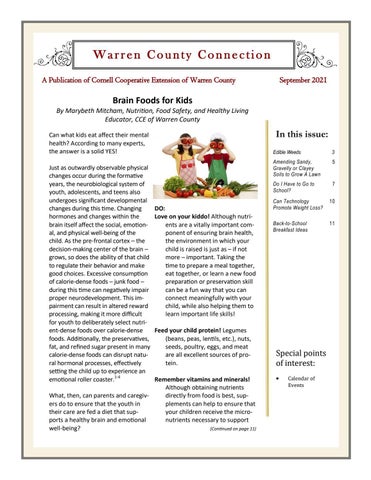
Brain Foods for Kids By Marybeth Mitcham, Nutrition, Food Safety, and Healthy Living Educator, CCE of Warren County
In this issue:
Can what kids eat affect their mental health? According to many experts, the answer is a solid YES! Just as outwardly observable physical changes occur during the formative years, the neurobiological system of youth, adolescents, and teens also undergoes significant developmental changes during this time. Changing hormones and changes within the brain itself affect the social, emotional, and physical well-being of the child. As the pre-frontal cortex – the decision-making center of the brain – grows, so does the ability of that child to regulate their behavior and make good choices. Excessive consumption of calorie-dense foods – junk food – during this time can negatively impair proper neurodevelopment. This impairment can result in altered reward processing, making it more difficult for youth to deliberately select nutrient-dense foods over calorie-dense foods. Additionally, the preservatives, fat, and refined sugar present in many calorie-dense foods can disrupt natural hormonal processes, effectively setting the child up to experience an emotional roller coaster.1-4
DO: Love on your kiddo! Although nutrients are a vitally important component of ensuring brain health, the environment in which your child is raised is just as – if not more – important. Taking the time to prepare a meal together, eat together, or learn a new food preparation or preservation skill can be a fun way that you can connect meaningfully with your child, while also helping them to learn important life skills! Feed your child protein! Legumes (beans, peas, lentils, etc.), nuts, seeds, poultry, eggs, and meat are all excellent sources of protein.
Remember vitamins and minerals! Although obtaining nutrients What, then, can parents and caregivdirectly from food is best, supers do to ensure that the youth in plements can help to ensure that their care are fed a diet that supyour children receive the microports a healthy brain and emotional nutrients necessary to support well-being? (Continued on page 11)
Edible Weeds
3
Amending Sandy, Gravelly or Clayey Soils to Grow A Lawn
5
Do I Have to Go to School?
7
Can Technology Promote Weight Loss?
10
Back-to-School Breakfast Ideas
11
Special points of interest: •
Calendar of Events
Warren County Connection
Page 2
Cornell University Cooperative Extension of Warren County 377 Schroon River Road Warrensburg, NY 12885
Phone: (518) 623-3291 or (518) 668-4881 Fax: (518) 668-4912 Visit Our Web Site: www.cce.cornell.edu/warren
Who We Are
Nation-wide, thousands of people in each state tap into their state’s land-grant university research and know-how to make sound confident decisions concerning family, home, business, finances, and the future. In New York State, the land-grant university is Cornell University.
The Cornell Cooperative Extension network brings you the expertise of Cornell University, other land-grant universities across the country and locally-based Extension Educators, volunteers, and other experts through such programs as: horticulture, youth and families, leadership, environment, food, nutrition & health, home environment, and financial management.
Staff
Dr. James Seeley, Executive Director John Bowe, Associate Team Leader Dan Carusone, 4-H Natural Resources Coordinator Marybeth Mitcham, Nutrition, Food Safety & Healthy Living Educator Roxanne Westcott, 4-H Family Living Educator Kali DeMarco, Farm to School Coordinator Sharon Bellamy, Finance Manager Amy Sabattis, Public Relations/Publications Manager Michele Baker, Administrative Assistant Chris Dittus, Administrative Assistant
Board of Directors
Laura Conway - President Peter Benoit - Vice President Dan Bruno - Secretary William Hamelin - Treasurer Aimee Azaert Lisa Earl Ed Griesmer Jim Kneeshaw David Little David Strainer Michael White
Warren County Connection
CALENDAR Please visit our website for more events www.cce.cornell.edu/warren 9/9/2021 11:00 AM - Apple Salsa - Join us as we learn
how to make a simple, healthy, and delicious apple salsa, using fresh and local apples. To register, please contact Stephanie Belden at: 518-793-2189. Location: Greater Glens Falls Senior Center. 9/11 & 9/12 2021 - Wild Edibles - Do you know what wild -growing plants are safely edible? How can you harvest and cook them? In this interactive, hands-on workshop, Becoming Outdoors Women (BOW) participants will learn how to identify, harvest, and prepare several wild-growing plants that can be found in the northeastern United States. For more information contact Marybeth Mitcham at 518-623-3291. Location: Silver Bay YMCA BOW. 9/14/2021 11:00 AM - Lotion Bars - Did you know that you can make your own inexpensive and eco-friendly bath and body products? In this workshop, we will make lotion bars and also explore how to create soaps and other bath and body products. To sign up for this program, please contact Director Barb Mitchell at 518-696-6451. Location: Lake Luzerne Senior Center. 9/15/2021 10:30 AM - Charoset - Although charoset, a
ridiculously tasty apple side dish, showcasing fresh and local apples, is usually eaten in the spring, we will be making it in the fall! To register, please contact Director Barb Mitchell at 518-696-6451. Location: Lake Luzerne Senior Center. 9/17/2021 11:00 AM - Culinary Tour of the World: Peru! - Come and join us as we learn about the culture of Peru, touring Peru through videos and enjoying a Peruvian dish. To sign up for this program, please contact Director Stephanie Smith at: 518-761-8224. Location: Queensbury Senior Center.
Extension Service Committee Chair - Sylvia Smith Daniel Bruno Ben Driscoll Andrea Hogan Brad Magowan
If you have special needs as addressed by the Americans with Disabilities Act and need assistance with attending these workshops, please make your needs known by the registration deadline. Reasonable efforts will be made for accommodations.
Warren County Connection
Edible Weeds By Jo Anne Pedersen, Warren County Master Gardener There are many thing you must consider when you decide to start picking edible weeds. What season is the best time to pick that weed, what part of the plant do you want; flower, leaves, roots or the whole plant? What do you do with them once you pick them? Even how much of that plant should you take when in the wild? Also does it have any poisonous look-alikes you need to steer clear of? Hopefully I will cover all these questions to make this adventure as much fun as possible.
Chickweed: Stellaria media Part used: aerial portions (leaves, stems, flowers) Medicinal Properties: It is cooling and moistening and great for hot conditions. It can sooth irritated eyes, dry coughs and skin conditions that are red and itchy. It contains Vitamin C, B1, B2 and B3. Bioflavonoids, calcium, magnesium, potassium, iron, manganese and zinc. Chickweed likes cool weather and moist shady spots. It is found in the early spring and fall. You can tell it’s chickweed by the fine hairs running down the sides of the stems. You harvest the aerial parts of chickweed when the plant is young and tender, harvest in the morning to avoid heat. Then place them in cool water for 5-10 minutes to crisp them up if they wilted, roll in a paper towel to dry them off. Place them in the refrigerator. You can harvest it when it’s in flower but not when it has gone to seed. Cut the parts with a scissor making sure you leave some behind. The more you harvest it, the bushier it will get. Chickweed is great to throw in salads. Make pesto, add to soups and stews. You can use it whenever you use spinach. It makes a great Chickweed Vinegar: The apple cider vinegar extracts all the minerals from the chickweed. Great for salad dressing. Also making a salve with it brings relief to hot and dry tissues, rub it over bug bites, hot rashes, clean wounds, diaper rashes and any itchy conditions.
Dandelion Leaf and Flower: Taraxacum officinale Parts used: leaves, flowers Medicinal Properties: The leaves are drying and cooling, while the flowers are cooling in nature. Dandelion leaves are used to
Page 3
stimulate digestion. They are also a diuretic. Eating a lot of the leaves will make you urinate. The leaves are filled with fiber, calcium, potassium, vitamin C, phosphorus, magnesium, beta-carotene, zinc and manganese. Flowers are both food and medicine. They are sweet and slightly bitter. The flowers are high in flavonoids. Dandelions has an old reputation as a “spring tonic” and “blood purifier”. Eating dandelion greens in the spring is a widespread European practice that has migrated to the New World. Dandelion leaves can be added to salads, sautéed or made into a pesto. Flowers can be eaten whole, added to salads, prepared as jams or wine, honey or added to baked goods. The leaves have a peppery bite to them. You can substitute dandelion greens whenever a recipe calls for kale, collard greens, turnip greens, or beet greens. You can harvest the leaves and flowers by hand or scissors throughout the growing season. The leaves are best when young, because they become more bitter and tough as they age. The flowers and buds can be used whenever they are available. When you do harvest them make sure no herbicides are used on them and do not harvest any plant near a road that you will be eating. Caution: There is one look-alike plant called, “Fall Dandelion” (Leontodon autumnalis) it has multiple inflorescence on one stem where the common dandelion only has one. It also has more narrowly cut leaves with lobes that point forward or backward. The stem is wiry and does not have the milky juice of the common dandelion. Also the taproot is short and thick while the common dandelion is long. Dandelion Root: Taraxacum officinale Parts used: root Medicinal properties: The root is a classic liver tonic or “blood purifier” with a stimulating and decongesting effect on the liver. The root stimulates the production of bile, which helps to break down cholesterol and fat. Timothy Lee Scott, Invasive Plant Medicine write that dandelion is considered an excellent dynamic accumulator of potassium, phosphorus, calcium, copper, and iron. He also reports that dandelion has rid soils of heavy metals like copper, zinc, manganese, lead, and cadmium. Dandelion roots, when young, can be chopped like a carrot and added to stir fries and soups. You can roast them with chicory root to make a coffee-type drink. Note caution above. (Continued on page 4)
Page 4 (Continued from page 3)
Wild Mustard: Alliaria petiolata Parts used: leaves, flowers, seeds Medicinal properties: It is used to ease symptoms of upper respiratory infection, it can warm you when you are chilled and can support a fever. It helps to stop internal bleeding similar to shepherd’s purse. The young spring leaves and flowers can be eaten raw and can be cooked with foods such as vegetables, meats and soups. Stay with the young leaves, as the plant matures the leaves become spicier and may leave the plant unable to be eaten. Harvest the plant early in the growing season when tender. Be careful where you harvest it from because the mustard plant can pull up heavy metals from the soil. The greens can be cooked down to a nutritious mess of greens. Flowers can be tossed into salads for a little spice. The seeds can be dried and then ground down and used as a peppery spice. Please be conscious, as this is an invasive plant. Nettle: Urtica dioica Parts used: young leaves, roots, seeds Medicinal properties: Nettles is a strong diuretic . It is very drying, the leaves have calcium, fiber, protein, potassium, flavonoids, ascorbic acid, glucosamine, betacarotene, vitamin K, and more. The leaves also contain iron. Seasonal allergy suffers can find relief from drinking nettle tea or taking freeze-dried nettle capsules during allergy season. The seeds can be used to help people with severe kidney disease. The roots support prostate health and helps to alleviate benign prostatic hyperplasia (BPH). It is often combined with saw palmetto. When regularly eaten or used as a tea, it often results in healthier bones, stronger teeth, and vibrant hair. Nettle grows in damp, nutrient dense, disturbed soils and can spread to form large colonies. The leaf surfaces have bristly, stinging hairs. These hairs act as a hypodermic needle. Injecting histamine, acetylcholine and 5hydroxytryptamine into the wound. This creates localized pain, prolonged itching and red swelling. Harvesting is done with gloves on and scissors to avoid being stung. Leaves are harvested in early spring, seeds in late summer and roots in the autumn.
Warren County Connection
Leaves are nourishing greens that must be cooked first or dried before using to remove their stinging hairs. You can blanch them first and then add them to stir-fries, pesto’s and any dishes you would use spinach. Dried and powdered leaves can be added to smoothies and other foods. Nettle roots are used dried and taken as a tea, tincture or capsule. Plantain: Plantago major Parts used: Leaves, seeds Medicinal properties: Plantain is most known for its use to sooth insect bites, and stings. Apply a plantain leaf poultice (in other words chew up a leaf – a spit poultice and place it right on the bite). Plantain promotes skin healing such as cuts, scrapes, burns and blisters. The leaves are antimicrobial, so it helps prevent infections. It heals the mucous membrane in the digestive track. The seeds are mucilaginous and high in fiber. If you plan on eating the leaves, they are better when young, for medicine they are most potent before the plant has flowered and gone to seed. To harvest the seeds, cut off the stalks after they have turned brown or black. Plantain grows in sunny disturbed soil, and seems to be found everywhere. The leaves grow in a low rosette and the leaves have prominent parallel veins. There is the broad leaf and narrow leaf type, both can be used. Use the smaller leaves raw in salads, larger leaves for making chips. You can substitute plantain leaves for any kale recipe. Dried leaves can be used for a tea. Purslane: Portulaca oleracea Parts used: Leaves, stem, flower buds, seed capsules Medicinal uses: Purslane is cooling and moistening and can be used to sooth hot, irritated tissues, such as sunburn and dry cough. Every part of this plant is edible . Purslane has 5 times more omega-3 content than spinach. It contains Vitamin A, Vitamin C, and Vitamin E, as well as potassium, magnesium, calcium, phosphorous, and iron. Purslane grows in disturbed soil, it has succulent leaves and thick stems. You can harvest it in spring, summer, and fall as long as the leaves and stems are tender and (Continued on page 5)
Warren County Connection (Continued from page 4)
succulent. Purslane picked in the morning tastes more sour. To encourage regrowth, pick only the tops. It can be eaten fresh or cooked. They can be added to green salads, potato salads, sandwiches, juices, smoothies and cold soups. They can be steamed, sautéed, and boiled in soups. Caution: Avoid poisonous spurge (Euphorbia spp.) which has a similar appearance and often grows near purslane. Spurge has a thinner and sometimes hairy stem and flatter non-succulent leaves. If you break the stem of spurge, it will exude milky white sap that can irritate the skin. Final note: Usually when wild crafting herbs/weeds you only take one third of the plant you find. This enables what is left for the animals/bees and some so the plant has enough energy to continue growing. BUT since these are mostly invasive weeds and you come across a large patch of let’s say wild mustard, go to town and pick as much as you need . Always remember never to pick where the soil may have been sprayed, anywhere near a road and always ask permission if you go on private property. Happy hunting! Sources: Easly, Thomas. The Modern Dispensatory A Medicine making Guide, Tilgner, Sharol. Herbal Medicine From the Heart of the Earth Swift, Katja & Midura, Ryn. Herbal Medicine for Beginners Gladstar, Rosemary. Medicinal Herbs Sams, Tina. The Healing Power of Herbs Tierra, Michael. The Way of Herbs
Caution: Identify plants with 100% certainty. Look at all the plant’s identifying characteristics and be certain they match all given descriptions. A 4-H Wild Edibles guide can be obtained though CCE of Warren County. We suggest using this guide with at least one (preferably two) other reference books. All traditional or historical medicinal uses stated for each plant included are for educational purposes only. Consult with a physician for any medical treatment.
Page 5
Amending Sandy, Gravelly or Clayey Soils To Grow A Lawn Introduction: Lawn grasses are no different than most shrubs and trees in that they all grow best in a fertile, welldrained loam that has a fair degree of moisture holding ability. A soil with a very sandy texture holds only small amounts of water and nutrients, since there is a lack of clay and silt particles, which have better water and nutrient holding abilities. Sandy soil is like a mass of tiny stones, allowing water to drain quickly. Most plants, including lawn grasses, do not grow well in these droughty, low-fertility conditions. Conversely, soils with high clay content may hold too much water and therefore lack adequate drainage. If too much water is retained, the oxygen content of the soil decreases, and plant roots suffocate. Clay soils also add to the problem of compaction. Compaction occurs when the tiny clay particles become too closely packed together. Compaction also decreases soil oxygen, and roots have difficulty physically penetrating a compacted clay soil.
While a few plant species exist which will grow well in soils with high sand or clay content, most plants, including lawn grass species, will perform much better if these difficult soils are amended before planting. How to improve difficult soils: The best way to improve a very sandy or gravelly soil for a lawn is to work organic matter and topsoil into it. These amendments must be mixed thoroughly with at least the top 4 inches of existing soil, and more deeply if possible. While organic matter or topsoil could be used alone, a sandy or gravelly soil is improved more if you add both organic matter and topsoil than if you add either material alone. Organic matter is depleted by microbial activity over time, while topsoil will be a more permanent amendment. However, be especially cautious in adding a clayey topsoil to sand, since the result can resemble concrete! In the case of a soil with high clay content, adding organic matter is usually more important than adding topsoil. Incorporate the organic matter into at least the top 4 inches of soil. Extreme care is needed when buying topsoil. There are no regulations about the actual content of topsoil, hence many different materials are called topsoil in the landscape and building trades. Some "topsoils" have been found to contain excessive amounts of stones, clay, sand, wood, demolition debris, or other undesirable matter. Always (Continued on page 6)
Page 6
Warren County Connection
(Continued from page 5)
inspect topsoil before you buy it. Insist on an accurate sample if you buy topsoil from someone who will deliver it for you. If a slightly moist sample of the topsoil seems adequate to make clay pots from, it is probably too high in clay. If it is extremely gritty, then it contains too much sand. Stones and other larger debris should be apparent by visual inspection. If possible, be on-site when the topsoil is delivered, so that a load can be rejected if it is not the same as the sample material you previously inspected. There are several sources of organic matter. Peat moss, composted animal manure, composted leaves and yard waste, and composted brewery waste are just some of the materials available. Again, an inspection of organic matter before purchase is recommended, especially when a large load is to be delivered by truck to your site. If you have a difficult soil but already have planted a lawn, topdressing with compost may provide some improvement in the soil. Topdressing is defined as spreading a thin layer of material over the surface of a lawn. For home lawns, topdressing 1/4 of an inch of compost in spring and fall may improve soil conditions. Topdressing can be done with homeowner-type drop spreaders, but a fine compost with few large bits or lumps must be selected. If topdressing is combined with core cultivation (a practice which involves removing plugs of soil from the lawn), the results will probably be even better. How much topsoil or compost do I need to buy? Two inches of compost and/or topsoil is needed to begin to amend a very difficult soil, with three or four inches even better. Although large amounts of compost and topsoil can be expensive, a lawn is a long-term investment, so try to purchase as much as your budget allows. Follow the chart below in order to know how much material to obtain.
Cubic Yards Of Compost Or Topsoil Needed Inches of compost or topsoil you want to apply Area to be amended (insquare feet) 100 1,000 5,000 10,000 15,000 20,000
1/4
1/2
1
2
3
4
0.08 0.8 4 8 12 16
0.16 1.6 8 16 24 32
0.32 3.2 16 32 48 64
0.62 6.2 31 62 93 123
0.92 9.2 46 92 138 184
1.24 12.4 62 124 186 248
* Some values are rounded to a whole number For anything but the smallest areas, buying topsoil or compost in bulk makes the most sense. A large bale of peat moss contains about 7.5 cubic feet of material, so about 3-1/2 bales of peat are needed to make one cubic yard of peat. The above chart was composed using the following formula: Area to be amended (in square feet) X Inches of material you want to apply = Cubic yards of material needed 27 cubic feet Fact sheet 7.381 2/01 Written by David Chinery, Cornell Cooperative Extension of Rensselaer County Based on "Preparing Very Sandy Soils For Growing Lawns," (original source unknown), and "Calculating Compost Capacity" from the December 1993 edition of Lawn and Landscape Maintenance.
Page 7
Warren County Connection
Do I Have to Go to School?
• • • • • • •
Handling your child’s school anxiety Stomachaches, headaches, trouble sleeping or statements like “school is just sooo stupid”—all can be protests from your child about going to school. Parents often find these complaints and resistance to school frustrating, as it is difficult to see one’s child so upset. WVU Extension emotional wellness specialists provide some guidelines for parents in dealing with this common problem. Q: Lots of children resist going to school. How can parents recognize true anxiety? A: It is normal for younger children, especially preschoolers, to be anxious about school and separating from their parents. Separation anxiety is your child’s way of showing that they don’t want to say goodbye to mom or dad! For most, these fears resolve quickly as the child adjusts to school. However, when anxiety about school causes a child significant distress, intervention is often needed. This is particularly true for adolescents, who should have resolved normal fears about school. Signs of children being worried about school can be physical, emotional or behavioral. Often they’ll complain about upset stomach or headaches or become unusually clingy. Young kids, especially preschoolers, frequently talk about their fear of school and may ask for repeated reassurance from parents: “Can you stay at school with me?” Many children suddenly have difficulty sleeping and may begin asking to sleep with their parents. Older kids and teens may show their anxiety with sudden outbursts of tears or anger or become withdrawn. For teens, red flags are sudden changes. Q. What causes school anxiety? A: For young children: • Separation from parents and familiar routines • Fear of new children and experiences For kids who have been to school: • Being bullied or teased
Negative experiences in the classroom Feeling inadequate for not knowing the answers Not having fashionable, up-to-date clothes Losing papers and books, or having incomplete homework Parental pressures about school achievement Embarrassment about being uncoordinated in sports Significant family problems or changes
Q: What can parents do to help prevent school anxiety? A: Prevention is the best solution. Parents’ attitudes and messages about school can help young children feel more comfortable. • Prepare your child for school with positive messages like “School can be fun and interesting.” • Send the message that you expect him to go to school no matter how much he cries, fusses or stamps his feet. • Develop a goodbye routine. For example: kiss, hug, rub noses or special hand signals that mean “I love you, am thinking about you, and will see you soon.” • Read school-themed picture books to your child, particularly ones that introduce the idea of classroom rules and routines. One recommendation: The Art Lesson by Tomie dePaola, in which young Tommy must learn to balance his creativity with his art teacher’s by-the-book lessons. • Encourage your child to be more independent. Help young children take pride in dressing themselves (figuring out outfits the night before can help!). Middle school children and teens should be in charge of setting their alarm clocks to get up on time. Help them figure out how much time they will need. • Reward positive steps toward independence. For example, put a sticker on your son’s chart every day he attends school without tears or clinging, and when he earns a certain number of stickers, take him on a special outing. Q: Do parents ever trigger school anxiety? A: Yes, sometimes parents are overprotective of a child who has had medical problems or has been shy as a baby. If parents have emotionally relied on their child to comfort them, kids can worry about mom being okay when they are at school. It is important to understand that parents’ worries are contagious. Denise Cordivano, a New York City early childhood director, says, “If the parent is so-so about school, the child is going to pick up on those emotions and it will be more difficult for the child to adjust.” (Continued on page 8)
Page 8
Warren County Connection
(Continued from page 7)
To avoid “infecting” your child with your own worries: • Don’t hover around when you drop off your child. Your child will sense your anxiety and may worry too. • Talk with your spouse, co-parent or friend about your worries to get perspective—don’t unload your worries on your child. • Get to know your child’s teacher in advance to get more comfortable and to raise any concerns you might have. Volunteer to help in the classroom to ease your mind, but know when it is time to leave! • For the sake of your child, find a way to keep an upbeat and positive attitude about your child’s school, teacher and new friends. This will help your child feel safe and enjoy his time at school. Q: What can parents do to help kids feel more comfortable? A: Try these ideas: • “My love will go with you to school.” Put an encouraging note in your child’s lunchbox or backpack. Some children feel more comfortable when they take a favorite small toy or object with them to school. Tuck a favorite picture of you into her pencil box to look at during the day. • Take time to listen every day. Learn to listen to what your child says as well as the unspoken feelings. This builds a strong relationship and helps your child feel secure. Taking 20 minutes for yourself before you reunite with your children at the end of the day puts you in a better space to listen. • Don’t overreact. If the first few days, or even weeks, are a little rough, try not to over-react. Young children in particular may experience separation anxiety or shyness at first, but teachers are trained to help them adjust. When you drop them off at the bus or at school, try not to linger. Reassure them that you love them, will think of them during the day and will be back when school ends. • Arrange playdates with new classmates. To help the
•
transition, step into the other room for a few minutes while the kids are playing. This helps your child learn to tolerate a little anxiety and gradually learn to handle the discomfort of separation. Role play for practice. Use puppets, dolls, stuffed animals or family members to play out potentially stressful social situations that worry your child, such as meeting the teacher for the first time or finding the bathroom.
Q: How should parents handle it when their child says he’s sick and wants to stay home? A: Always check out recurrent physical symptoms with a pediatrician to rule out medical problems. Assuming kids are physically healthy, parents need to be firm about not allowing them to miss school. Just as it’s our job to work and raise our family, it’s part of a child’s job to go to school. Here’s a script: You know, ______ (child’s name), it’s normal and okay to feel a little scared in new situations. Feeling nervous means you are excited about this new situation and that you feel unsure about it. You have done many new things in your life, like remember when you slept at Grandma’s house for the first time without me. That was hard at first, but remember how happy you were to do that? Wouldn’t it be sad to miss out on those fun things in school and new friends?
If school refusal appears suddenly, ask your child and his teacher if something upsetting happened, such as bullying or teasing—both are very common causes of school anxiety. Is your child worried about changes at home—a move, a divorce or even the death of a family pet?
Helpful websites on bullying for kids and parents: http://www.stopbullying.gov/ http://www.pacerkidsagainstbullying.org/ Q: Is it normal for children to backslide into old behaviors? A: Of course! After all, adults, too, sometimes wish they could take a day off. Even though you love your job, aren’t there some days you just want to stay in bed? Expect children to go back to old behaviors, like crying when being dropped off, when they don’t feel well or are experiencing stress. Soothe your child. Once the upset is calmed down, talk with her about her feelings. Remember your basic message, “I will help you (Continued on page 9)
Warren County Connection (Continued from page 8)
figure out what’s wrong. I do expect you to be in school and will work to make sure it is a safe place.” Q: When should parents seek professional help? A: If for a month you’ve tried everything discussed above and the anxiety interferes with your child’s enjoyment of other areas of her life—she’s having difficulty sleeping regularly, is isolating herself, or is always worried or sad, for instance—then it’s time to have her evaluated by a mental health professional. For example, some kids develop school refusal or phobia—a fear so intense that the children can’t be coaxed onto the school bus or into the building. If they manage to get to school, they cry, complain of aches and pains and can’t be calmed down by the teacher. One guideline: Usually, kids who have serious school anxiety will show a range of stress—or anxiety-related symptoms, like insomnia or headaches, trouble concentrating and irritability or depression. Children with true school anxiety struggle with it every day. It’s not something they have one day but not the next. These kids aren’t just being oppositional; they’re trying to avoid a situation that makes them scared. Severe school anxiety may be a symptom of an anxiety disorder. Recent studies show that anxiety disorders are one of the most common mental health conditions among kids, with as many as 10 percent suffering from undiagnosed anxiety disorders (OCD, social phobia or panic disorder) which require medical treatment. Whether you consult a social worker, a psychologist or a psychiatrist, choose someone who specializes in working with kids your child’s age. Be sure that this expert, your child’s teacher and you work together as a team. Finally, remember that kids see their friends attending school; they want to be able to do that too. Some just need extra help to overcome their fears. Q: What is the treatment for school anxiety? A: Treatment usually begins with cognitive behavioral therapy, which teaches relaxation and coping skills to reduce anxiety and can result in improved behavior over several months. If symptoms are severe, doctors may prescribe medication, which can produce some results within two months. The good news is that anxiety disorders are the most treatable mental health condition, and treatment has been repeatedly shown to be effective. It is much better
Page 9
that you find appropriate treatment for your child than watch him or her suffer in silence. Remember, school anxiety is most often a sign of close connections between the child and parents. This means you have done your job well! This strong loving bond will help you and child work through the fears. Q: Can you recommend helpful books? A: Consider these as a place to start. Overcoming School Anxiety: How to Help Your Child Deal with Separation, Tests, Homework, Bullies, Math Phobia, and Other Worries by Diane Peters Mayer (2008).
Freeing Your Child from Anxiety: Powerful, Practical Solutions to Overcome Your Child’s Fears, Worries, and Phobias by Tamar Chansky (2004). These books, written for children, teach skills to manage anxiety and worry. What to Do When You Worry Too Much: A Kid’s Guide to Overcoming Anxiety by Dawn Huebner, PhD (2006). Published by American Psychological Association When My Worries Get Too Big! A Relaxation Book for Children Who Live with Anxiety by Kari Dunn Buron (2008). Source: West Virginia University. Reviewed by Eric Murphy, former WVU Extension Service Families & Health Extension Agent, Monongalia County Sources: Helping Children Succeed in School. University of Illinois Extension. https:// web.extension.illinois.edu/succeed/stress.cfm Carolyn Tobin, M.D. (2011) Separation Anxiety: 15 Ways to Ease Your Child’s Fears http:// www.ivillage.com/separation-anxiety-15-ways-easeyour-childs-fears/6-a-145201?p=2http:// www.ivillage.com/separation-anxiety-15-ways-easeyour-childs-fears/6-a-145201?p=2
Page 10
Warren County Connection
Can Technology Promote Weight Loss?
ditional advice by a health care provider and four provided tailored advice to individual participants. The analysis found that the tailored advice was significantly more effective than the more generic interventions, but that follow-up by a health care provider did not significantly improve weight loss. When thinking about the health and wellness of people who are overweight, long-term maintenance is a primary challenge because biological, behavioral, and environmental factors combine to promote the re-gaining of weight that was lost.
More than half of the world’s population is overweight or obese, a trend that is contributing to significant health problems in people across the globe. Obesity is a major risk factor for many chronic health problems including heart disease, cancer, and diabetes.
Encouraging people to lose weight is one solution, but the evidence shows that weight loss is difficult and rarely sustained. A new systematic review demonstrates that technology can play an important role. The meta-analysis conducted by public health researchers at the University of Cambridge in England took a careful look at whether digital self -monitoring—for example, tracking eating behaviors and physical activity using an app—promotes weight loss. The review includes 12 randomized-controlled trials of wellness programs that use phone applications, websites, text messages, or some combination of these to track diet and physical activity. The analysis demonstrates that digital-self monitoring is effective at improving weight loss, increasing physical activity, and reducing calorie intake for overweight and obese adults. Participants in these programs had a mean weight loss of more than six pounds and consumed an average of 180 fewer calories a day. While that may not sound like much, there is clear evidence that this small amount of weight loss coupled with healthy behaviors reduces obesity-related illness and death. What Kind of Program Works Best? Delving further into the studies, the researchers found that variations in the details of the program made a difference. Of the studies in the review, five included ad-
But even small amounts of sustained weight loss make a difference. Evidence shows that losing five to ten percent of starting body weight lowers the risk of heart disease, diabetes, and cancer and takes a significant amount of stress off of the body’s joints. The take-home message: Digital tracking apps are useful tools for promoting weight loss and physical activity. And it doesn’t take much! Even small, sustained losses help people to avoid weight-related illnesses. Source: https://evidencebasedliving.human.cornell.edu/
Family Budget Coaching Program Now Available for Families and Individuals in Warren County Cornell Cooperative Extension of Warren County is now offering a free, confidential Family Budget Coaching Program to community residents. The one-on-one sessions are available to individuals and families who want to improve their financial literacy, set goals, create a savings plan, reduce debt and get a better handle on finances. The trained coaches will offer sessions either via Zoom or in person in Glens Falls, Warrensburg and Johnsburg. Since 1914, Cornell Cooperative Extension has responded to the needs of New York residents enabling people to improve their lives and communities through partnerships that put experience and research-based knowledge to work. For more information on this program, please contact Roxanne Westcott at rmw38@cornell.edu or (518) 668-4881.
Warren County Connection Warren County Connection (Continued from page 1)
healthy brain function. Minerals like zinc and iron, and vitamins like A, B2, B6, B12, and D are especially important. Good food sources of these vitamins and minerals include fortified foods like cereals, dark leafy greens, potatoes, carrots, meat, dairy, and fish. Don’t forget your healthy fats! Healthy fats are extremely important for promoting good brain health. Two of these fats, omega-3 and omega-6, cannot be produced by the body, so must be obtained from food or supplement sources. Flaxseed, walnuts, fatty fish, and eggs are some excellent sources of these healthy fats.
Avoid chemicals! The chemicals used as preservatives, additives, or even food dyes can negatively affect dietary patterns, as the brain is effectively rewired to crave those chemicals. Unprocessed or minimally processed foods are not only more nutrient-dense, but they will also better support healthy neurodevelopment. Don’t forget the water! Drinking plenty of water can help to rid the body of toxins as well as support healthy physiological and neurological function. Hydration is key! Food and drink are only one small component of supporting healthy neurodevelopment for children. However, it is an important component. By providing your children with a variety of nutrient-dense foods, water, and (of course!) love, they – and their developing brains – will be off to a good start. References: Reichelt AC, Rank MM. The impact of junk foods on the adolescent brain. Birth Defects Res. 2017;109(20):1649-1658. doi:10.1002/bdr2.1173 Reichelt AC. Adolescent maturational transitions in the prefrontal cortex and dopamine signaling as a risk factor for the development of obesity and high fat/high sugar diet induced cognitive deficits. Front Behav Neurosci. 2016;10:189. Published 2016 Oct 13. doi:10.3389/ fnbeh.2016.00189 Lowe CJ, Morton JB, Reichelt AC. Adolescent obesity and dietary decision making-a brain-health perspective. Lancet Child Adolesc Health. 2020;4(5):388-396. doi:10.1016/S2352-4642(19)30404-3
The link between food and mental health. https://www.apa.org.
Page 11
Back-to-School Breakfast Ideas BREAKFAST BARS 6 Tablespoons margarine 3 cups miniature marshmallows ½ cup peanut butter ½ cup nonfat dry milk ¼ teaspoon cinnamon 1 cup raisins 4 cups oat o's cereal Spray a 9" x 9" x 2" square pan with nonstick cooking spray. In a large saucepan, melt margarine and marshmallows over low heat, stirring constantly. Stir in peanut butter until melted. Remove from heat and stir in milk and cinnamon. Fold in raisins and cereal, stirring until evenly coated. With buttered hands, pat into pan. Cool thoroughly and cut into squares. MAKES 12 SERVINGS: One serving provides 229 calories, 5 grams protein, 2 grams fiber, and l l grams fat.
FRITTATA 1 egg ¾ cup flour ½ teaspoon salt ¼ teaspoon dried oregano 1 cup 2% milk 1 cup grated mozzarella cheese 3 Tablespoons grated Parmesan cheese Mix egg, flour, salt oregano, and milk. Pour into a blender and blend until foamy. Add mozzarella cheese and pour into greased pie pan. Bake 400°F for 30 minutes. Top with Parmesan cheese. Continue baking until Parmesan is slightly melted. Serve warm or cold. MAKES 6 SERVINGS. One serving provides 157 calories, 10 grams protein, and 5 grams fat. FRUIT SMOOTHIE 2 cups of any 100% juice 5 to 6 ice cubes, crushed 1 teaspoon vanilla extract ²⁄₃ cup nonfat dry milk powder
Crush the ice in a blender. Add juice, vanilla, and milk powder to the ice in the blender or other container with a lid. Shake or blend well. Pour into glasses and serve right away. MAKES 4 SERVINGS. One serving provides 99 calories, and 5 grams protein.
Cornell Cooperative Extension 377 Schroon River Road Warrensburg, NY 12885 RETURN SERVICE REQUESTED
IF THERE IS A CHECK IN THIS BOX , THIS IS THE LAST ISSUE OF THE WARREN COUNTY CONNECTION YOU WILL BE RECEIVING. To renew your subscription clip the form below and send to Cornell Cooperative Extension of Warren County.
Warren County Connection
THANK YOU INTERNATIONAL PAPER!!
"Paper for this newsletter was donated by International Paper, proudly produced at the Ticonderoga, New York Mill from trees harvested in working Adirondack forests that are managed responsibly in accordance with the principles of the Forest Stewardship Council (FSC) and the Sustainable Forestry Initiative (SFI)." “International Paper is proud to join almost 60 manufacturers and importers supporting the Paper & Packaging – How Life Unfolds™ campaign.” “Cornell University Cooperative Extension of Warren County provides equal program and employment opportunities.” “The information given herein is supplied with the understanding that no discrimination is intended and no endorsement by Cornell Cooperative Extension is implied.” The Cornell Cooperative Extension educational system enables people to improve their lives and communities through partnerships that put experience and research knowledge to work. "Cornell Cooperative Extension actively supports equal educational and employment opportunities. No person shall be denied admission to any educational program or activity, or be denied employment on the basis of any legally prohibited discrimination involving, but not limited to, such factors as race, color, religion, political beliefs, national or ethnic origin, gender, sexual orientation, age, marital or family status, veteran status, or disability. Cornell Cooperative Extension is committed to the maintenance of affirmative action programs that will assure the continuation of such equality of opportunity."
Just $5.00 per year will give you one full-year subscription to the “Warren County Connection,” mail this coupon to : Cornell Cooperative Extension ☺ Be sure to include your fee of $5.00 to cover the cost of mailing.
Name______________________ Address____________________ __________________________ Zip Code___________________ OR To get this publication FREE e-mail als77@cornell.edu and you will be added to our E-Edition.
We’re on the Web! http://counties.cce.cornell.edu/warren/ & Facebook - Look for CCE Warren