Warren County Connection A Publication of Cornell Cooperative Extension of Warren County
April 2021
Air Plants (Tillandsia)
By Master Gardener Sandy Vanno, Cornell Cooperative Extension Warren County Tillandsia, commonly known as air plants, are the houseplants of the moment in the gardening scene! If you have visited a garden center in the last few years, you have undoubtedly come across an interesting-looking display of air plants! Care is not difficult if you understand how they grow in their natural environment. In nature, Tillandsia species are epiphytes, meaning they attach to other plants or rocky substrates as a means of support. They are unique because they get all their water and nutrients from the air through special scalelike structures on their leaves, which trap moisture and dust, providing the plant with water and nutrients. Their roots are used solely for attachment – rather than absorbing nutrients or water via roots.
In this issue:
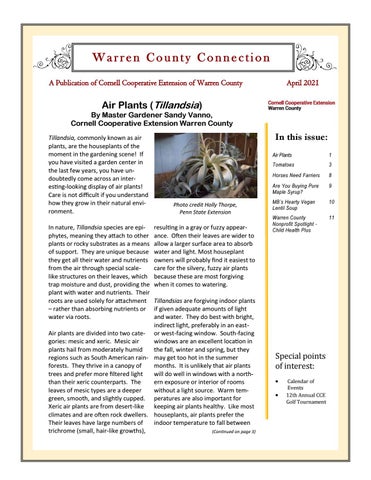
Photo credit Holly Thorpe, Penn State Extension
resulting in a gray or fuzzy appearance. Often their leaves are wider to allow a larger surface area to absorb water and light. Most houseplant owners will probably find it easiest to care for the silvery, fuzzy air plants because these are most forgiving when it comes to watering.
Tillandsias are forgiving indoor plants if given adequate amounts of light and water. They do best with bright, indirect light, preferably in an eastAir plants are divided into two cate- or west-facing window. South-facing gories: mesic and xeric. Mesic air windows are an excellent location in plants hail from moderately humid the fall, winter and spring, but they regions such as South American rain- may get too hot in the summer forests. They thrive in a canopy of months. It is unlikely that air plants trees and prefer more filtered light will do well in windows with a norththan their xeric counterparts. The ern exposure or interior of rooms leaves of mesic types are a deeper without a light source. Warm temgreen, smooth, and slightly cupped. peratures are also important for Xeric air plants are from desert-like keeping air plants healthy. Like most climates and are often rock dwellers. houseplants, air plants prefer the Their leaves have large numbers of indoor temperature to fall between trichrome (small, hair-like growths), (Continued on page 3)
Air Plants
1
Tomatoes
3
Horses Need Farriers
8
Are You Buying Pure Maple Syrup?
9
MB’s Hearty Vegan Lentil Soup
10
Warren County Nonprofit Spotlight Child Health Plus
11
Special points of interest: • •
Calendar of Events 12th Annual CCE Golf Tournament
Warren County Connection
Page 2
Cornell University Cooperative Extension of Warren County 377 Schroon River Road Warrensburg, NY 12885
Phone: (518) 623-3291 or (518) 668-4881 Fax: (518) 668-4912 Visit Our Web Site: www.cce.cornell.edu/warren
Who We Are
Nation-wide, thousands of people in each state tap into their state’s land-grant university research and know-how to make sound confident decisions concerning family, home, business, finances, and the future. In New York State, the land-grant university is Cornell University. The Cornell Cooperative Extension network brings you the expertise of Cornell University, other land-grant universities across the country and locally-based Extension Educators, volunteers, and other experts through such programs as: horticulture, youth and families, leadership, environment, food, nutrition & health, home environment, and financial management.
Staff
Dr. James Seeley, Executive Director John Bowe, Associate Team Leader Dan Carusone, 4-H Natural Resources Coordinator Marybeth Mitcham, Nutrition, Food Safety, & Healthy Living Educator Roxanne Westcott, 4-H Family Living Educator Jessica Holmes, Master Gardener Coordinator Sharon Bellamy, Finance Manager Amy Sabattis, Public Relations/Publications Manager Michele Baker, Administrative Assistant Chris Dittus, Administrative Assistant Samantha Sprague, Maintenance & Farm to School Assistant
Board of Directors
Laura Conway - President Peter Benoit - Vice President Vacant - Secretary William Hamelin - Treasurer Aimee Azaert Daniel Bruno Lisa Earl Ed Griesmer Jim Kneeshaw David Little David Strainer Michael White
Extension Service Committee Chair - Sylvia Smith Daniel Bruno Ben Driscoll Andrea Hogan Brad Magowan
Warren County Connection
CALENDAR Please visit our website for more events www.cce.cornell.edu/warren 4/6/2021 9:00 AM - 4:30 PM - Sportsman Education - The NYS Department of Conservation program required to purchase a hunter education certificate. Topics covered: ethics, firearms safety individual and in groups, basic shooting skills, what do you do when you harvest a deer? Youth must be 11.5 years of age when they take the class. Limit of 10 students. To register e-mail John Bowe at jfb32@cornell.edu or call 518-668-4881 Monday-Friday 9-4 (leave a message with name, address, DOB, telephone, and e-mail if possible). Location: Dunham’s Bay Fish & Game Club 2080 Ridge Road, Queensbury, NY 12804. 4/7/2021 10:00 AM - 11:00 AM- Wildlife Habitat Education Program General wildlife identification and habitat overview with hands-on experience with pelts and hides. Limit of 8 students. To register call 518-6684881 or e-mail mlb222@cornell.edu. Cornell Cooperative Extension Warren County 377 Schroon River Road, Warrensburg, NY 12885. 4/11/2021 9:00 AM - 11:00 AM - 4-H Basic Archery - Learn the basic skills to foster success with a bow or arrow, whether for target or hunting. We will cover range rules, eye dominance, stance, bow grip, your hook (how you set your fingers on the string), and your anchor point. Youth must be 8 years of age and no older than 18. Participation requires enrollment in 4-H. Fee is $15 for non-members (including 4-H membership) and $5 for current members. To register call 518-668-4881 or email mlb222@cornell.edu. Dunham’s Bay Fish & Game Club, 2080 Ridge Road, Queensbury, NY 12804. 4/20/2021 12:00 PM - 1:00 PM - Floral Design Webinar - Join Jessica Holmes, Master Gardener Coordinator, to learn about the basics of floral design along with the identification of flowers. Register online - https:// pub.cce.cornell.edu/event_registration/main/events_landing.cfm? event=FloralDesign_252 or call 518-668-4881. Online Training Via Zoom CCE Warren County.
Please join us on Saturday, August 28, 2021 for the 12th Annual Cornell Cooperative Extension Golf Tournament. All proceeds from this benefit will be used to help financially support Cooperative Extension educational programs. SIGN UP EARLY AND SAVE!! PREPAY BY AUGUST 13th $95.00 PER PERSON WE ACCEPT CREDIT CARDS, CASH OR CHECK. PAY ON THE DAY OF THE EVENT COST PER PERSON $100.00. Includes: green fees, cart, barbecue, goodie bag, awards and prizes. The tournament will begin with registration at 9:00 a.m., followed by a shotgun start at 10 a.m. The tournament format is a 4-person scramble. Individual players are welcome and will be placed within a team. Pre-registration for tournament and barbecue is required by contacting Amy Sabattis at 518-623-3291 or 668-4881.
If you have special needs as addressed by the Americans with Disabilities Act and need assistance with attending these workshops, please make your needs known by the registration deadline. Reasonable efforts will be made for accommodations.
Page 3
Warren County Connection
65-85°F in the daytime and between 50-65°F at night time. At lower temperatures, growth tends to be poor, and plants are more prone to rot. Misting, rinsing, or soaking are three methods of watering Tillandsias. Misting air plants to the point of run-off may have to be done every other day with low household humidity. However, rinsing seems to be the simplest watering technique. Twice a week, gather the air plants, hold them under the faucet, rinsing them thoroughly with tepid water. Lay them face down on a paper towel for a few seconds to drain off excess water. Other sources report great success by submerging air plants weekly for 20 minutes to an hour, then draining them well. Be aware that air plants can be sensitive to chlorine and fluorine. Slightly rolled or curled leaves indicate it is time to water, and brown leaf tips are a sign that plants aren't getting enough water. Good air circulation is important to air plants. While they look great enclosed in glass, be sure to allow plants to dry at least 4 hours after watering before placing them back in a terrarium. Air plants bloom but once in their lifetime. The flowers come in many shapes and in a range of colors, from coral to pinks and purples. After they flower, they produce “pups” or small offsets – new plants emerging from the base of the mother plant. Once pups are one-third the size of the mother plant, they can be gently separated from the main plant and grown on their own or left in place, allowing the plant to form a clump. Tillandsias should also be fertilized about once a month or so. The easiest way to do this is to soak them in a diluted fertilizer solution for a few minutes. Any watersoluble houseplant fertilizer will do, though it is possible to buy specific fertilizers formulated for bromeliads and air plants. The fact that air plants thrive without soil offers lots of options for their use in decorating. Displaying them is really where most of the fun comes in. One popular option is to place them inside glass globes. Other possibilities include attaching them to bark or cork with wire or glue or displaying them in dishes of decorative pebbles. Air plants can be grown on essentially any surface that dries quickly and makes it easy to water. You are only limited by your own creativity! Sources: Penn State Extension and UNH Extension
Tomatoes
Tomato, is today the most popular garden vegetable in America. For many years, however, tomatoes (then called "love apples") were considered poisonous and were grown solely for their ornamental value. Tomatoes are usually easy to grow and a few plants provide an adequate harvest for most families. The quality of fruit picked in the garden when fully ripe far surpasses anything available on the market, even in season. The tomato plant is a tender, warm-season perennial that is grown as an annual in summer gardens all over the continental United States. Spring and fall freezes limit the outdoor growing season. Recommended Varieties Hundreds of varieties of tomatoes are now available for the home gardener. They range widely in size, shape, color, plant type, disease resistance and season of maturity. Catalogs, garden centers and greenhouses offer a large selection of tomato varieties and choosing the best one or two varieties can be extremely difficult. Evaluate your needs, then choose the varieties best suited to your intended use and method of culture. Tomato plants fall into one of two types that affect ultimate plant height and cultural requirements. Tomatoes are determinate if they eventually form a flower cluster at the terminal growing point, causing the plant to stop growing in height. Plants that never set terminal flower clusters, but only lateral ones and continue indefinitely to grow taller are called indeterminate. Older varieties are almost all indeterminate. These can be counted upon to produce abundant foliage and to ripen flavorful fruit. They may, however be extremely late in maturing. The first determinate varieties developed had real problems with inadequate foliage cover and taste, but they ripened very early. Newer determinates produce better foliage, may grow taller and ripen fruit of similar quality to modern indeterminate varieties. They still tend to ripen their fruit (Continued on page 4)
Page 4
over a shorter period of time, so successive plantings may be desirable with determinates to keep the harvest coming through the entire season. Determinate vines are easier to control and support during the growing season. Some of the extreme dwarf types are determiGuide to Abbreviations nate as well as dwarf, producing some truly tiny ma- A=Alternaria ture plants. F=Fusarium Days to harvest are gener- N=Nematodes ally determined from the T=Tobacco mosaic virus time transplants are plantV=Verticillium ed in the garden.
First-Early Red (60 or fewer days to harvest) These varieties have more compact plant growth than the main-season varieties and sunburning of the fruit is a problem in hot weather. The main crop varieties are generally far superior for summer long harvest. First early varieties are better suited for northern areas, where the growing seasons are shorter and the summers cooler. They have small to medium-sized red fruit and are usually not suitable for pruning. Sub Arctic Plenty (45 days to harvest; 3 to 4 ounces; fruit concentrated in center clusters; determinate) Early Cascade (55 days; 4 ounces; trailing plant, large fruit clusters; indeterminate; resistant to VF) Early Girl (54 days; 5 ounces; earliest full size; indeterminate; resistant to V) Quick Pick (60 days; 4 ounces; round, smooth, heavy yield; indeterminate; resistant to VFNTA) Medium-Early Red (60 to 69 days) These varieties are intermediate between the extreme earliness of the first earliest and the sounder plant type and production characteristics of the main crop types. Fruit size is improved, as is quality. The real tomato harvest season begins with the medium early varieties. Champion (65 days to harvest; 10 ounces; solid, smooth, large; indeterminate; resistant to VFNT) Mountain Spring (65 days; 9 ounces; globe, very smooth; determinate; resistant to VF) Main-Crop Red Most of the main crop varieties bear medium sized to large fruit, have adequate foliage cover, and are relatively free from fruit cracking and other deformities. They are suitable for growing on mulch, in wire cages or on trellises. Many of them can be pruned and trained to stakes. As the name implies, they should make up the bulk of the main crop harvest because they have superior yield, better staying power in the garden and fruit of high quality.
Warren County Connection
Celebrity (70 days to harvest; 10 ounces; large, productive; determinate; resistant to VFFNT) Mountain Delight (70 days; 10 ounces; no green shoulders; determinate; resistant to VF) Fantastic (70 days; 9 ounces; deep globe, high yield; indeterminate) Better Boy (72 days; 12 ounces; easy-to-find plants; indeterminate; resistant to VFN) Mountain Pride (74 days; 10 ounces; smooth, flat globe; determinate; resistant to VF) Floramerica (75 days; 12 ounces; All America Selection winner, bright red; determinate; resistant to VF) Burpee's Big Girl (78 days; 16 ounces; crack-resistant, attractive fruit; indeterminate; resistant to VF) Supersonic (79 days; 12 ounces; solid, crack resistant; indeterminate; resistant to VF) Extra-Large Red These varieties are relatively late maturing. The fruits may be extremely large but also can be misshapen, with rough scar tissue ("cat-facing") on the blossom end. When this scar tissue must be cut away, some of the advantage of extra-large size is lost. Large size, though, is almost never about total yield, but more often about the novelty of huge size. Some of the newer hybrid large types like Supersteak and Beefmaster have fruit with much more consistent shape. Delicious (OP) (77 days to harvest; over 1 lb.; world record (7 lb. 12 oz) with this variety; indeterminate) Supersteak (80 days; 1 to 2 lb.; extra meaty; indeterminate; resistant to VFN) Beefmaster (81 days; 1 to 2 lb.; large Beefsteak type; indeterminate; resistant to VFN) Yellow or Orange Contrary to popular belief, yellow and orange fruited varieties are not significantly lower in acid content than red tomatoes, and they are equally safe to can or process. They "taste" sweeter than red varieties, because they have a higher sugar content. Current varieties in this classification have much earlier maturity and better plant growth characteristics than older yellows and oranges, which tended to be big, sprawling and late maturing. Mountain Gold (OP) (70 days to harvest; 8 ounces; deep tangerine orange; determinate; resistant to VF) Lemon Boy (72 days; 7 ounces; lemon yellow, mild flavor, productive; indeterminate; resistant to VFN) Jubilee (OP) (72 days; 8 ounces; deep orange-yellow; indeterminate) Golden Boy (80 days; 8 ounces; deep golden fruit, few seeds; indeterminate) (Continued on page 5)
Warren County Connection
Pink These varieties always have maintained a loyal following in certain regions of the country. Pinks traditionally have been similar to yellows with regard to plant type and maturity. Recent breeding work has developed diseaseresistant plants with very attractive fruit. For the highest eating quality, some of the older types may still be at the top for flavor. Pink Girl (76 days to harvest; 7 ounces; smooth, crack resistant; indeterminate; resistant to VF) Brandywine (OP) (80 days; 12 ounces; large, rough, heirloom; juicy, great taste; indeterminate) Other Colors and Types Although odd colors and types have been around for a long time, they have experienced a resurgence of popularity, fueled in part by the upscale salad bar. As these outlets have competed to offer the newest and brightest assortment of produce, some almost-forgotten tomatoes have been "rediscovered." White Wonder (OP) (85 days to harvest; 8 ounces; creamy white flesh and skin; indeterminate) Evergreen (OP) (85 days; 8 ounces; green skin tinged with yellow; flesh bright green at maturity; indeterminate) Long Keeper (OP) (78 days; 6 ounces; orange skin, orange-red flesh; solid, keeps for weeks; indeterminate) Yellow Stuffer (OP) (80 days; 4 ounces; lobed, lemon yellow, shaped like pepper; semi-hollow, easy to stuff; indeterminate)
Red Paste Types Paste tomatoes are usually used for making catsup, paste and sauces and for canning whole. Their solid, meaty, low-moisture flesh makes processing these products less complicated. Recently, some of them are becoming trendy and popular for eating fresh. These are usually short plant types that tend to set up a large load of fruit in a short time and then ripen a large proportion of this fruit at once. With tomatoes used fresh, it is usually seen as an advantage to have fruit ripening over an extended season on individual plants, but ripening most of the crop in a short period has been a bonus for paste tomatoes because processing activities are best done in fairly large lots. Veeroma (OP) (72 days to harvest; 2 to 3 ounces; early Roma type, deep square shape; deter.; resistant to VF) Roma (OP) (75 days; 2 ounces; standard red plum, tolerant to early blight; determinate; resistant to VF) San Marzano (OP) (80 days; 3 ounces; deep red, crack resistant, meaty and dry; determinate) Viva Italia (80 days; 3 ounces; meaty, sweet; good fresh; determinate; resistant to VFN)
Page 5
Small-Fruited/Salad These varieties are generally vigorous growing and productive. They vary in size from 1 to 1-1/2 inches in diameter and are usually suitable for pruning. Production per plant is very high, to the point that picking may become tedious. Whole clusters may sometimes be picked at one time to speed the harvest. Splitting seems to be more of a problem with cherries, though newer hybrids have attempted to lessen the problem. These types are usually described as especially sweet and tasty. Super Sweet 100 (70 days to harvest; 1 inch; red, cherrysized fruit in large clusters; indeterminate; resistant to VF) Sweet Million (65 days; 1 inch; red, sweet, crack resistant; large clusters; indeterminate; resistant to FNT) Yellow Pear (OP) (70 days; 1 inch; clusters of yellow, pear-shaped fruit; indeterminate) Large Red Cherry (OP) (70 days; 1-1/2 inch; solid, deep red, tasty fruit; indeterminate) Mountain Belle (65 days; 1 1/4 inch; red, crack resistant, ripens uniformly and holds on the vine; determinate; resistant to VF) Dwarf/Container These tomatoes are popular for use in containers, hanging baskets and garden or patio locations where space is limited. Because more people now live where traditional vegetable gardening is not possible, container and patio gardens have become more popular. Their ornamental value is an added benefit and their fruit quality has recently been improved as well. They have fruit in red and some other colors and are not suitable for pruning (except the new Husky hybrids). Tiny Tim (45 days to harvest; 1 inch; very dwarf, red cherry fruit; determinate) Cherry Gold (45 days; 1 inch; golden version of Tiny Tim; determinate) Red Robin (55 days; 1 inch; super-dwarf plant, 6 inches tall; mild taste; determinate) Yellow Canary (55 days; 1 inch; similar to Red Robin, but yellow fruit; determinate) Pixie Hybrid II (52 days; 2 ounces; compact dwarf plants; determinate) Patio Hybrid (65 days; 3 ounces; strong dwarf plants, relatively large fruit, ideal container plant; determinate) Small Fry (72 days; 1 inch; red, good in hanging baskets; determinate) Husky Red Hybrid (68 days; 6 ounces; dwarf plant, large fruit; extended harvest; indeterminate; resistant to VF) Husky Gold Hybrid (70 days; 6 ounces; AAS winner; same plant types as Red and Pink; gold fruit; indeterminate; resistant to VF) (Continued on page 6)
Page 6
Husky Pink Hybrid (72 days; 6 ounces; smooth pink fruit on same husky-type plant; indeterminate; resistant to VF) Greenhouse Gardeners interested in growing greenhouse tomatoes should know that specific varieties have been developed for this environment. Some catalogs now routinely list these types, which should be used for the most satisfactory results. Consult catalogs for varieties available. Heirloom A particularly large number of heirloom tomato varieties are available today, mainly because tomatoes normally do not cross-pollinate. Seed saved from fruits of non-hybrid varieties produce plants fairly identical to the parent plant. Many of the odder colors and types that have resurfaced lately have their origins in these older, self-saved varieties. The plant type is usually large, sprawling and late compared to current commercial varieties. Disease resistance may also be suspect. If, however, the gardener wants to try a few truly weird or tasty types, these usually mature some fruits almost anywhere except in the shortest-season areas. Specialty seed houses and exchanges are a source of the widest variety of heirloom tomatoes imaginable. When to Plant Buying transplants or starting seeds indoor early, gets tomatoes off to the best start in the garden when warm weather finally arrives and it saves several weeks in growing time. Some gardeners transplant their tomatoes soon after the soil is prepared for spring gardening, when there is a high risk of damage from freezing. Be prepared to cover early set plants overnight to protect them from frost. For best results with very early plantings, consider black plastic mulch and floating row covers for heat accumulation and frost protection. For best results with minimal risk, plant when the soil is warm, soon after the frost -free date for your area. For fall harvest and early winter storage of tomatoes, late plantings may be made from late spring until midsummer, depending on the length of the growing season. These plantings have the advantage of increased vigor and freedom from early diseases, and they often produce better quality tomatoes than later pickings from early spring plantings. Time late plantings for maximal yield before killing freezes in your area (up to 100 days from transplanting for most varieties). Spacing & Depth The space required depends upon the growth pattern of the variety and method of culture. Space dwarf plants 12 inches apart in the row, staked plants 15 to 24 inches
Warren County Connection
apart and trellised or ground bed plants 24 to 36 inches apart. Some particularly vigorous indeterminate varieties may need 4 feet between plants and 5 to 6 feet between rows to allow comfortable harvest room. Care Apply starter fertilizer when transplanting. Hoe or cultivate shallowly to keep down weeds without damaging roots. Mulching is recommended, especially for gardeners who wish to maintain their plants for full season harvest. Black plastic or organic materials are suitable for mulching. Delay application of organic materials until after the soil has warmed completely in early summer so that growth is not retarded by cool soil temperatures early in the season. Water the plants thoroughly and regularly during prolonged dry periods. Plants confined in containers may need daily or even more frequent watering. Side-dress nitrogen fertilizer (ammonium nitrate) at the rate of one pound per 100 feet of row (equivalent to 1 tablespoon per plant) after the first tomatoes have grown to the size of golf balls. (If ammonium nitrate is not available, use 3 pounds of 10-10-10 fertilizer.) Make two more applications 3 and 6 weeks later. If the weather is dry following these applications, water the plants thoroughly. Do not get fertilizer on the leaves. Many gardeners train their tomato plants to stakes, trellises or cages with great success. Not all varieties, however, are equally suitable for staking and pruning. Tomato cages may be made from concrete-reinforcing wire, woven-wire stock fencing or various wooden designs. Choose wire or wooden designs that have holes large enough to allow fruit to be picked and removed without bruising. The short, small, narrow type often sold at garden centers is all but useless for anything but the smallest of the dwarf types. Most modern determinate tomatoes easily grow 3 to 4 feet tall and indeterminates continue to get taller until frozen in the fall, easily reaching at least 6 feet in height. Use cages that match in height the variety to be caged and firmly anchor them to the ground with stakes or steel posts to keep the fruit-laden plants from uprooting themselves in late summer windstorms.
Trellis-weave systems have recently been developed for commercial operations and can work just as well in a garden planting. Tall stakes are securely driven into the tomato row about every two or three plants in the row. Make sure the stakes are tall enough to accommodate the growth of your tomato varieties and make sure they (Continued on page 7)
Page 7
Warren County Connection
are driven very securely into the ground to prevent wind damage. (The woven rows of tomatoes can catch much wind.) As the tomatoes grow upward, strings are attached to the end posts and woven back and forth between the supports, holding the tops of the plants up and off the ground. This operation is repeated about as often as the tomatoes grow another 6 inches, until the plants reach maturity. The fruit is held off the ground as with staked or caged plants; but the foliage cover is better than with staked plants, and the fruit is more accessible than with cages. Harvesting Tomatoes should be firm and fully colored. They are of highest quality when they ripen on healthy vines and daily summer temperatures average about 75°F. When temperatures are high (air temperature of 90°F or more), the softening process is accelerated and color development is retarded, reducing quality. For this reason, during hot summer weather, pick your tomatoes every day or two, harvest the fruits when color has started to develop and ripen them further indoors (at 70 to 75°F). On the day before a killing freeze is expected, harvest all green mature fruit that is desired for later use in the fall. Wrap the tomatoes individually in paper and store at 60 to 65°F. They continue to ripen slowly over the next several weeks. Whole plants may be uprooted and hung in sheltered locations, where fruit continues to ripen. Common Problems Tomato hornworms are large (2 to 3 inch long when fully grown), green caterpillars with white stripes on the body. A horn protrudes from the top rear end of the worm. Tomato hornworms feed on the leaves and fruit. Several worms on one plant can quickly defoliate it and ruin developing fruit. Because their green coloring so closely resembles tomato foliage and stems, they are difficult to see. Handpick in cooler parts of the day or use suggested biological insecticides. If you see hornworms with small, white cocoons protruding, leave them alone. These structures are the pupae of parasitic insects that help control the hornworm population and the individual wearing them is already doomed.
in the spots. Although early blight is most severe on the leaves, it sometimes occurs on the stems and can cause severe defoliation. Certain varieties (Roma and Supersonic) are more tolerant of early blight than others. Septoria leafspot is characterized by numerous small black spots on the leaves. The centers of these spots later turn white and tiny black dots appear in the white centers. The disease starts on the bottom leaves and may become severe in wet weather. Blossom-end rot is a dry, leathery brown rot of the blossom end of the fruit that is common in some seasons on tomatoes. It is caused by the combination of a localized calcium deficiency in the developing fruit and wide fluctuations of soil moisture. The problem is especially bad in hot weather. Soil applications of calcium seldom help, though foliar calcium sprays may minimize the occurrence of the problem. Make sure the formulation is designed for foliar application or severe damage could result. Pruning causes stress to the plants that may increase the incidence of blossom-end rot. Some tomato varieties are much more susceptible to this condition than others. Mulching and uniform watering help to prevent blossom-end rot. Once the blackened ends appear, affected fruits cannot be saved. They are best removed and destroyed so that healthy fruit setting later can develop more quickly. Poor color and sunscald occur when high temperatures retard the development of full red color in tomatoes exposed directly to the hot sun. Sunscald occurs as a large, whitish area on the fruit during hot, dry weather. It becomes a problem when foliage has been lost through other diseases such as early blight or on early varieties that normally have poor foliage cover as the fruit ripens. Source: University of Illinois Extension
Verticillium and fusarium wilts are soil-borne diseases that cause yellowing of the leaves, wilting and premature death of plants. These diseases persist in gardens where susceptible plants are grown. Once they build up, the only practical control is the use of resistant (VF) varieties. Early blight is characterized by dead brown spots that usually start on the lower leaves and spread up the plant. Upon close inspection, you can see concentric rings with-
It's difficult to think anything but pleasant thoughts while eating a homegrown tomato. ~Lewis Grizzard
Page 8
Warren County Connection
Horses Need Farriers
Sermersheim has twice been named AFA’s Clinician of the Year, has served eight times as an official farrier at the Rolex Kentucky Three Day Event, and has been a supervisor for the official farriers at the World Equestrian Games.
Horses need new shoes every 4 to 6 weeks What animal regularly wears shoes and needs help putting them on? It’s a horse, of course! Horses need their hooves trimmed and horseshoes placed regularly, a procedure referred to as “shoeing” a horse. The person trained to shoe horses is called a farrier. Farriers provide an important part of the regular care that keeps horses healthy.
A glowing hot horseshoe is pulled from a forge at the university’s Midwest Equine practice in Farmer City. In the photo at the top of the page, a smouldering shoe is
Steve Sermersheim, a certified journeyman farrier at the University of Illinois Veterinary Teaching Hospital, provides this service at the hospital and the university’s horses-only clinic, Midwest Equine at Illinois. He also makes farm calls to shoe horses.
Shoeing a Horse “We shoe horses for three reasons: protection, traction, and correction,” Sermersheim says. “Protection from injuring the hoof, traction to avoid falling, and correction to modify any deformity of the hoof.”
Farrier Training “Farriers have a big responsibility to horses and their owners because we maintain the length, balance, and integrity of the hoof capsule and all the components of the hoof,” Sermersheim explains.
Although most horses are regularly shod, not all horses must be. Some horses do just fine without shoes.
The horse hoof has many weight-bearing parts that affect how the horse moves and its athletic success. The outer part is called the hoof wall, and the inner portion includes the sole and the frog. Most people who want to become a farrier attend farrier school and then do an apprenticeship to get hands-on experience and practice. Currently, there is no U.S. regulation of farriers; the tools and shoes can be purchased by anyone. Sermersheim has extensive experience and certification, however. Not only has he been certified by the American Farrier’s Association (AFA), but he has additionally earned a “therapeutic endorsement” from the AFA, meaning he has advanced skills to correct lameness problems using special types of shoes. He has further credentials as an associate of Great Britain’s Worshipful Company of Farriers.
The process of shoeing a horse typically starts with evaluating the horse’s hoof balance. Farriers make their assessment by watching the horse move at a walking pace and at a faster pace. “After watching the horse move, I will examine the horse up close by looking at the hoof itself,” Sermersheim says. To do this, a well-behaved horse can be tied to a stall or in stalks. If the horse is less calm, another person can help hold the horse still. In some cases, a veterinarian is needed to sedate the horse for a better exam. The farrier will safely position themselves to hold the horse’s limb between their legs to examine the underside of the hoof. Preparing the Hoof “While looking at the underside, I can determine the excessive growth of the outer portion of the hoof, and better evaluate the sole of the foot,” Sermersheim explains, “I can also see the shape of the hoof to determine what shoe will fit best.” It is important for the horse’s (Continued on page 9)
Page 9
Warren County Connection (Continued from page 8)
Are You Buying Pure Maple Syrup?
comfort to be fitted with an appropriate shoe. If the shoe is ill-fitted, the horse will not be able to walk around like normal and its athletic performance may be impacted. Before a new shoe can be placed, the hoof itself must be the correct length. This is done with a variety of tools that wear down the excessive growth of the hoof. “We have hoof knives, nippers, rasps, and various hammers,” Sermersheim says. These tools allow the farrier to properly trim the hoof down to a more natural length, making walking easier and more comfortable for the horse.
By Mike Nuckols, Local Foods & Horticulture Program Manager
Choosing the Right Shoe “Many companies sell machine-made horseshoes,” Sermersheim says, “while many farriers make their own.” The type of shoe a horse needs depends on what the horse’s job is, what substance it walks or works on, and the shape of its foot. Horseshoes come in a variety of materials such as steel, aluminum, plastic, rubber, and wood. According to Sermersheim, the most common material of horseshoes is steel or aluminum.
One of the things I enjoy most on a cold winter’s day is fresh hotcakes with homemade butter and pure maple syrup. Maple syrup is one of the North Country’s great local products. A couple tablespoons added to your morning oatmeal or in baked goods can add not only sweetness but deep flavor. Filled with healthy phenolic compounds, real maple syrup has a unique flavor that cannot be replicated. Maple syrup also contains quantities of potassium, magnesium and calcium.
Once the exam is completed and the correct shoe is selected, the shoe is safely burned or seared on to the hoof and often nailed in place through that same hoof wall. Although this sounds like it would be painful to the horse, it is not. The outer section of the hoof, the hoof wall, does not contain any nerve endings and therefore feels no pain.
Interestingly, in the 19th Century, maple syrup production was promoted by northeastern abolitionists as a way to cut ties with sugar plantations worked by slaves. The idea was that locally made syrup and maple sugar could replace white cane sugar. Today, as we look for ways to reduce our carbon footprint by eating more foods grown locally, we can once again look to maple syrup for a touch of sweetness.
Every horse is different, but most horses will need a visit from a farrier every 4 to 6 weeks. This length of time is determined by the way the hoof grows and the wear on their shoes. “The biggest benefit of having a farrier shoe a horse is to keep the horse sound,” Sermersheim says. A sound horse is one that has no issues with lameness or discomfort. Lameness is one of the most common reasons that horses are no longer able to do their job, whether that job is on a farm, on a racetrack, or in a show ring. Shoeing horses helps keep horses in business. If you have questions about shoeing your horse, contact your local veterinarian. Source: Beth Mueller, University of Illinois, College of Veterinary Medicine
When buying maple syrup, it’s important to ensure that you are paying for the real deal. That is, you don’t want syrup that has been adulterated with cane sugar or corn syrup sweeteners. Unscrupulous manufacturers may stretch pure maple syrup by adding other sweeteners – while charging full price. Be sure to read the food label completely. There should only be one ingredient: Pure Maple Syrup. The grade of maple syrup is another thing to review on the label. The USDA has enacted strict regulations about grading of maple syrup. USDA Grade A maple syrup must be free of defects, have good color and flavor, be free of cloudiness, and have not more than 68.9% solids by weight. Processing grade maple syrup, on the other hand, may contain off flavors and odors and have a strong taste. (Continued on page 10)
Page 10
Processing grade maple syrup is often added to cheaper corn-syrups. In general, consumers should look only for Grade A syrup. Grade is not to be confused with color. Which color of syrup that you purchase (golden, amber, dark or very dark) is a solely matter of preference rather than an indication of quality. Sap harvested early tends to be light in color while that harvested later in the season tends to be darkest. Some sugar producers will blend sap from late and early in the season in order to adjust the color and flavor. The North Country is home to dozens of small, mostly family-owned sugar shacks. Although COVID has restricted the ability of these businesses to host tours of their operations during the sugaring season as is done in most years, you can still purchase their products from their stands and online. A directory of maple sugar producers can be found on the website https://nysmaple.com. Maple sugar is made by collecting syrup throughout February and March. Traditionally, galvanized buckets with lids were hung from taps placed into the tree. Today, you’re more likely to see blue food-grade tubing strung from tree to tree throughout the woods. Most commonly, sap flows by gravity downhill into large tanks. Where gravity collection is not possible, producers may use vacuum pumps to facilitate collection. This sap is then taken to a sugar shack for processing. In the old days, producers would boil the sap down for hours over wood fires until the syrup reached the proper viscosity. Today, producers are more likely to first process the sap using reverse osmosis, a method that uses significantly less energy to remove water. This concentrated sap is then boiled in the same manner in large vats until it is concentrated and ready for bottling. It takes 40 gallons of sap to make a single gallon of syrup! For those with maple trees on their property, consider making your own. Taps, bags, and other equipment can be purchased inexpensively at local hardware stores. You first drill a hole in your tree, hammer in the tap, and then hang either a covered-bucket or a food-safe plastic bag. Every day you’ll need to empty the bag into a collection container for cold storage until you have enough to process. Sap can then be boiled on the stove in a shallow pan. For more information on maple syrup, check the following webpage from Cornell University: https:// blogs.cornell.edu/cornellmaple/aboutmaplesyrup/
Warren County Connection
MB’s Hearty Vegan Lentil Soup By Marybeth Mitcham, Nutrition, Food Safety, and Healthy Living Educator, Cornell Cooperative Extension of Warren County I love food that is inexpensive, filling, healthy, and flavorful. This recipe hits all of my requirements. For more of a kick, feel free to add some cayenne powder! Servings: 5 Ingredients: 1/2 sweet onion, chopped 4 carrots, diced 4 stalks celery, chopped 4 cloves garlic, minced 2 teaspoons dried oregano 2 bay leaves 2 teaspoons dried basil 1/2 teaspoon red pepper flakes (more if you like spicy food) 1 (28-ounce) can crushed tomatoes (Italian style is best) 2 cups dry lentils 6 cups veggie broth Salt to taste (pink Himalayan is best) Freshly ground black pepper to taste
Directions: In a large soup pot, heat up 2 cups of veggie broth. Add onions, garlic, carrots, and celery; cover, cook, and stir occasionally until veggies are tender. Add remaining veggie broth, crushed tomatoes, lentils, and spices, and bring to a boil. Reduce heat, and simmer until lentils are fully cooked (around an hour), stirring occasionally. When ready to serve, season to taste with salt and pepper. Nutrition Information: (1 serving) - Calories: 131.7; Total fat: 1.1g; Saturated fat: 0.2g; Cholesterol: 0mg; Sodium: 521mg; Carbohydrates: 28.9g; Fiber: 6.1g; Sugar: 11.9g; Protein: 7.1g * Recipe from Marybeth Mitcham, MPH
April brings the primrose sweet, Scatters daisies at our feet... ~Sara Coleridge (1802–1852), "The Months"
Warren County Connection Warren County Connection
Page 11
Warren County Nonprofit Spotlight
Cornell Cooperative Extension 377 Schroon River Road Warrensburg, NY 12885 RETURN SERVICE REQUESTED
IF THERE IS A CHECK IN THIS BOX , THIS IS THE LAST ISSUE OF THE WARREN COUNTY CONNECTION YOU WILL BE RECEIVING. To renew your subscription clip the form below and send to Cornell Cooperative Extension of Warren County.
Warren County Connection
THANK YOU INTERNATIONAL PAPER!!
"Paper for this newsletter was donated by International Paper, proudly produced at the Ticonderoga, New York Mill from trees harvested in working Adirondack forests that are managed responsibly in accordance with the principles of the Forest Stewardship Council (FSC) and the Sustainable Forestry Initiative (SFI)." “International Paper is proud to join almost 60 manufacturers and importers supporting the Paper & Packaging – How Life Unfolds™ campaign.” “Cornell University Cooperative Extension of Warren County provides equal program and employment opportunities.” “The information given herein is supplied with the understanding that no discrimination is intended and no endorsement by Cornell Cooperative Extension is implied.” The Cornell Cooperative Extension educational system enables people to improve their lives and communities through partnerships that put experience and research knowledge to work. "Cornell Cooperative Extension actively supports equal educational and employment opportunities. No person shall be denied admission to any educational program or activity, or be denied employment on the basis of any legally prohibited discrimination involving, but not limited to, such factors as race, color, religion, political beliefs, national or ethnic origin, gender, sexual orientation, age, marital or family status, veteran status, or disability. Cornell Cooperative Extension is committed to the maintenance of affirmative action programs that will assure the continuation of such equality of opportunity."
Just $5.00 per year will give you one full-year subscription to the “Warren County Connection,” mail this coupon to : Cornell Cooperative Extension ☺ Be sure to include your fee of $5.00 to cover the cost of mailing.
Name______________________ Address____________________ __________________________ Zip Code___________________ OR To get this publication FREE email als77@cornell.edu and you will be added to our E-Edition
We’re on the Web! http://counties.cce.cornell.edu/warren/ & Facebook - Look for CCE Warren