Warren County Connection A Publication of Cornell Cooperative Extension of Warren County
September 2020
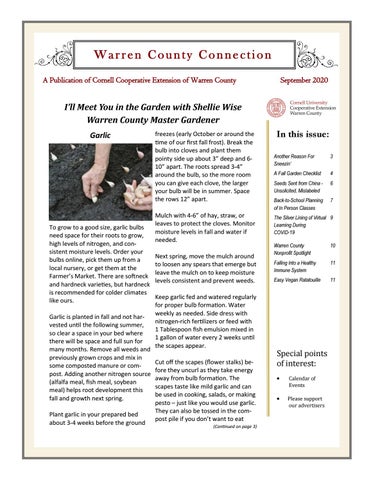
I’ll Meet You in the Garden with Shellie Wise Warren County Master Gardener Garlic
To grow to a good size, garlic bulbs need space for their roots to grow, high levels of nitrogen, and consistent moisture levels. Order your bulbs online, pick them up from a local nursery, or get them at the Farmer’s Market. There are softneck and hardneck varieties, but hardneck is recommended for colder climates like ours. Garlic is planted in fall and not harvested until the following summer, so clear a space in your bed where there will be space and full sun for many months. Remove all weeds and previously grown crops and mix in some composted manure or compost. Adding another nitrogen source (alfalfa meal, fish meal, soybean meal) helps root development this fall and growth next spring. Plant garlic in your prepared bed about 3-4 weeks before the ground
freezes (early October or around the time of our first fall frost). Break the bulb into cloves and plant them pointy side up about 3” deep and 610” apart. The roots spread 3-4” around the bulb, so the more room you can give each clove, the larger your bulb will be in summer. Space the rows 12” apart. Mulch with 4-6” of hay, straw, or leaves to protect the cloves. Monitor moisture levels in fall and water if needed. Next spring, move the mulch around to loosen any spears that emerge but leave the mulch on to keep moisture levels consistent and prevent weeds. Keep garlic fed and watered regularly for proper bulb formation. Water weekly as needed. Side dress with nitrogen-rich fertilizers or feed with 1 Tablespoon fish emulsion mixed in 1 gallon of water every 2 weeks until the scapes appear. Cut off the scapes (flower stalks) before they uncurl as they take energy away from bulb formation. The scapes taste like mild garlic and can be used in cooking, salads, or making pesto – just like you would use garlic. They can also be tossed in the compost pile if you don’t want to eat (Continued on page 3)
In this issue: Another Reason For Sneezin’
3
A Fall Garden Checklist
4
Seeds Sent from China Unsolicited, Mislabeled
6
Back-to-School Planning of In Person Classes
7
The Silver Lining of Virtual 9 Learning During COVID-19 Warren County Nonprofit Spotlight
10
Falling Into a Healthy Immune System
11
Easy Vegan Ratatouille
11
Special points of interest: •
Calendar of Events
•
Please support our advertisers
Warren County Connection
Page 2
Cornell University Cooperative Extension of Warren County 377 Schroon River Road Warrensburg, NY 12885
Phone: (518) 623-3291 or (518) 668-4881 Fax: (518) 668-4912
Visit Our Web Site: www.cce.cornell.edu/warren
Who We Are Nation-wide, thousands of people in each state tap into their state’s land-grant university research and know-how to make sound confident decisions concerning family, home, business, finances, and the future. In New York State, the land-grant university is Cornell University.
The Cornell Cooperative Extension network brings you the expertise of Cornell University, other land-grant universities across the country and locally-based Extension Educators, volunteers, and other experts through such programs as: horticulture, youth and families, leadership, environment, food, nutrition & health, home environment, and financial management.
Staff Dr. James Seeley, Executive Director John Bowe, Associate Team Leader Dan Carusone, 4-H Natural Resources Coordinator Marybeth Mitcham, Nutrition, Food Safety, and Healthy Living Educator Roxanne Westcott, 4-H Family Living Educator Anne Mills, Farm to School Coordinator Jessica Holmes, Master Gardener Coordinator Sharon Bellamy, Finance Manager Amy Sabattis, Public Relations/Publications Manager Michele Baker, Administrative Assistant Chris Dittus, Administrative Assistant Samantha Sprague, Maintenance
Board of Directors
William Mason - President Laura Conway- Vice President Julie Pearl - Secretary William Hamelin - Treasurer Aimee Azaert Daniel Bruno Peter Benoit Ed Griesmer Jim Kneeshaw David Strainer Michael White
Extension Service Committee Chair - Andrea Hogan Daniel Bruno John Diamond Ben Driscoll Susan Shepler Matthew Simpson Michael Wild
Warren County Connection
CALENDAR Please visit our website for more events www.cce.cornell.edu/warren 9/1/2020 2:00 PM - 3:00 PM - Diabetic Diet Series - If you are prediabetic, have diabetes, have a friend or family member who is concerned about diabetes, or just would like more information on a diabetic-friendly diet and lifestyle, then this webinar series is for you! Pre -registration is required, and there is no cost for the webinar. To sign up for this free webinar, register at this zoom link - https://cornell. zoom.us/meeting/register/tJEtfuspzouHdER4ReWlDJ6RNZV n345Unc0. For more information contact Marybeth Mitcham 518-623-3291. Webinar for Conkling Center Warren County
9/3/2020 1:00 PM - 2:00 PM - Energy Ball Party! - It's time to make energy bites! Come and join us as we prepare energy balls together in real time. Participants will be provided with a list of ingredients prior to the session, so that they, along with everyone else attending the webinar, can create their own energy balls. These are no-cook, and are easily able to be made by cooks of all ages. Pre-registration is required, and there is no cost for the webinar. Register at this zoom link - https://cornell.zoom.us/meeting/register/tJEqfumvpzsv GtPAVuGQnfGtDb4-sGTjf729. For a shopping list for the class, please email Marybeth Mitcham at mem467@cornell.edu. Online Training Via Zoom Warren County. 9/9/2020 1:30 PM - 2:30 PM - Nutrition and Healthy Living Workshop - During this interactive class, participants will learn about nutrition and healthy living and enjoy some delicious and healthy snacks, and ask questions! For more information contact Marybeth Mitcham 518-623-3291. Greater Glens Falls Senior Center 9/10/2020 8:00 AM - 4:00 PM - Game of Logging Level 1 - This course will focus on introducing the participant to open face felling and to develop techniques to safely fall a tree. Topics include: personal protective equipment, chainsaw safety features, chainsaw reactive forces, bore cutting, pre-planning the fell, and understanding hinge wood strength. Participants need to bring safety equipment (hard hat/shield; hearing protection; chaps; steel toe boots...), chainsaw and lunch. Cost per person, per class $45.00. Pre-registration is required. To register call 518-668-4881 or email Dan Carusone at djc69@cornell.edu. 105 Dankers Rd Johnsburg, NY 12843. 9/10/2020 1:00 PM - 2:00 PM - Hummus Party! - It's time to make easy, tahini-free hummus! Participants will be provided with a list of ingredients prior to the session, so that they, along with everyone else attending the webinar, can create their own hummus. A blender is required to make this recipe. To sign up for this free webinar, register at this zoom link - https://cornell.zoom.us/meeting/register/ tJYlcumgrzMpGdxRbRSIoSAgcyBDmp8G4dVI. For a shopping list for the class, please email Marybeth Mitcham at mem467@cornell.edu. Online Training Via Zoom Warren County
If you have special needs as addressed by the Americans With Disabilities Act and need assistance with attending these workshops, please make your needs known by the registration deadline. Reasonable efforts will be made for accommodations.
Page 3
Warren County Connection
them. Stop feeding at this time but continue to monitor moisture levels. Around the end of July-beginning of August, about a month after your scapes appeared, leaves will begin to yellow. They yellow from the bottom up. Stop watering when several bottom leaves are yellow, but top leaves are still green. Each green leaf represents a layer of the papery wrapper that will rot as each upper leaf dies, so you don’t want to lose too many. Allow the soil to dry about a week before you harvest. To harvest, loosen the soil with a spading fork, gently pull up the heads and shake off the soil. Enjoy fresh or dry the entire plant in a well-ventilated area for 3-5 weeks. When cured, brush off any remaining soil, trim the roots & tops to within 1” of the bulb, and store in a cool, dry, dark place. Some varieties will last in storage for up to a year.
Pickled Garlic • • •
• • •
3 cups peeled garlic cloves 1½ cups white distilled vinegar (5%) acidity ½ cup sugar ½ teaspoon non-iodized salt 1 teaspoon pickling spices (optional) Red chili flakes (Optional for hot garlic)
Heat vinegar, sugar, salt and spices to boiling. Boil garlic cloves for 1 minute in a pan of boiling water. Drain and pack hot cloves into hot ½ pint or pint jars leaving ½ inch headspace. Pour boiling brine over garlic, leaving ½ inch headspace. Remove bubbles. Wipe top of jar, adjust lids, process in a boiling water canner for 10 minutes. After processing, take canner off heat. Remove lid and wait 5 minutes before removing jars. Yield 3 half pints. Source: Oregon State University
Another Reason For Sneezin’ By David Chinery, Horticulture Turf Management Sr. Resource Educator, Cornell Cooperative Extension Rensselaer County
I have suffered through several seasons with allergies, an unfair plight for a gardener. Let those who prefer to spend their summer cruising the superstores or shopping on-line in an air-conditioned house have the allergies, I say, and give us outdoorsy types immunity to pollen! Well, I am not in charge, but I did go for allergy testing, which revealed my nose runs when I am anywhere near over a dozen things, including a bunch of plants. And while I’ve always known that ragweed wasn’t my friend, I’ve only come to recently appreciate that another prevalent weed makes my head throb and eyes water. Broadleaf plantain (Plantago major) is a low-growing perennial with fat green leaves on chunky stems. It loves to grow in lawns –and in fact, a good swath of my back lawn is only broadleaf plantain. It thrives beneath the mower blades, surviving quite nicely at a few inches tall, although unshorn it grows to a foot. It will feel at home in any soil from wet to dry and likes all exposures from sun to shade. Broadleaf plantain is tolerant of compacted soils and grows so readily on dirt paths and roads that when the first Europeans inadvertently imported it, Native Americans noted that it sprouted in their footsteps. They named this unknown plant “white-man’s foot,” at least according to Henry Wadsworth Longfellow’s poem “Hiawatha.” Ever the opportunist, broadleaf plantain will flourish in the hell-strip between street and sidewalk, or even in a sidewalk’s crack. Once on the east coast, broadleaf plantain hitched a ride to all fifty states and Canada. In broadleaf plantain, we have both a curse and a blessing. Its tiny flowers are borne on upright spikes above a rosette of leaves from June to September. As do many wind-pollinated plants, it produces copious quantities of pollen, which causes unfortunate folks like yours truly, to snivel and wheeze. Other plantain species cause allergies, (Continued on page 4)
Page 4
too, including English or Buckhorn plantain (Plantago lanceolata), also common on the local scene. Aesthetically, folks desiring a grassy lawn lament broadleaf plantain for its coarse look and thuggish ways of taking over. It is perhaps number three (behind ground ivy and crabgrass) on the list of troublesome lawn weeds about which people quiz this Extension horticulturist. Yet broadleaf plantain has virtues, too. Packed with vitamins and minerals, it served as a spring tonic for the centuries before fresh vegetables were available year-round and a pharmacy inhabited every street corner. A chewed leaf applied topically will quell a bug bite, and ingested bp lowers cholesterol. Colonial Americans used Plantago majorto reduce fevers, to prevent tuberculosis and to treat cholera, bleeding gums and blood disorders. Dried leaves, roots and seeds have all been pressed into service in various concoctions. And in the most interesting twist, plantain can be used to treat...seasonal allergies. What shall I do? Although experts say that ridding your garden of plantain will not help (there is just too much pollen on the wind), I still wonder. Gesundheit!
Warren County Connection
A Fall Garden Checklist By Dr. Leonard Perry, Horticulture Professor University of Vermont
Fall is a more relaxed time in the garden, but there is still plenty to do. I usually keep busy until snow flies and I can’t see the ground! Tending to and tidying gardens and landscapes now will give you a jump on activities next spring. Here is a checklist of some usual and important fall outdoor projects for gardeners.
Fall is a good time for planting trees, shrubs, bulbs and perennials. Earlier in the fall is best, as it gives them time to from a known, reputable seed company increases the likeli- form roots and get established before the soil gets too cold hood of receiving properly labeled seeds that meet germina- and roots stop growing (often when the soil temperature tion, sanitation and trueness to variety standards. It also en- gets down to 40 degrees (F). Spring bulbs should be plantsures the seeds have met standards that protect plants and ed in fall, even if you do so late, rather than try to hold agricultural crops from invasive pests and noxious weeds. them until next season. (Continued from page 6)
Residents can email the USDA at erich.l.glasgow@usda.gov
Evergreens, particular wide-leaved ones such as rhododen-Update From New York State Department of Agriculture drons, should be kept well-watered in early to mid fall, parand Markets on Unsolicited, Mislabeled Packages of Seed ticularly if they don’t get an inch or more of rain per week. This is all the water they’ll get until spring, once the Being Sent From Foreign Countries ground gets cold and freezes. Without sufficient water, their leaves will dry out and burn, turning brown. Sprays called JULY 30, 2020 | ALBANY, NY “anti-dessicants” are sometimes used to help prevent them “Our office has received questions from a few New Yorkers who have received unsolicited packages allegedly sent from drying out in winter, but may not be effective. from China that are marked as containing jewelry but which actually contain plant seeds. Similar packages have As long as your grass is growing, keep it mowed. Then, usually about mid-October with the last mowing, you can been received in other states and the United States Delower the mowing height by about a third. This keeps the partment of Agriculture is investigating. People who regrass from being too long by spring, more susceptible to ceive seeds should not plant or handle the seeds. They should store them safely in a place children and pets can- snow mold and other diseases. not access and email USDA immediately at erich.l.glasgow @usda.gov for instructions. Seeds imported into the Unit- Canna, gladiolus, dahlias and other summer bulbs should ed States are rigorously tested to ensure quality and pre- be dug for winter storage, after frost kills the tops. Canna can be stored in pots with soil or compost, gladiolus can be vent introduction of invasive species, insects and diseasstored dry in paper bags. Dahlias should be allowed to dry, es. We will continue to monitor this issue and will pass once dug, for only a few hours to a day, or they will begin along guidance as it is received from USDA.” -Statement by NYS Commissioner of Agriculture, Richard A. Ball to shrivel. Then either wrap the dahlia (Continued on page 5)
Warren County Connection
(Continued from page 4) tubers in plastic wrap, or store in slightly moistened peat moss or sawdust. Kept too dry over winter and the tubers will shrivel; kept too wet and they’ll rot. Fall is not the best time to prune, as wounds won’t heal fully before winter, and so diseases can enter the exposed stems. Do prune if you can’t wait until spring, or if branches are dead, diseased, or damaged. Prune them too if they’re crossing and rubbing other branches.
Page 5
add an inch or two, and scratch into the soil with a tined hoe or gravel rake. If perennials such as daylilies have gone by and are looking ugly, cut their leaves back to a few inches high. Also, cut back any perennials whose leaves may be diseased, such as phlox with powdery mildew. Dispose of diseased leaves in trash, don’t compost them, as disease spores often will survive. Leave perennials that are upright, attractive, and that have seed heads to provide food for birds.
Fall is a good time to test your soil, particularly for pH if nothing else. This is the soil acidity—responsible for nutrients being available to plants. Generally in our area it can be a bit low, needing the application of lime. Use a slow-acting form (not hydrated) of lime in fall, so the soil will be ready by spring. Wait until spring when plants begin growth to add fertilizer. Keep leaves raked, particularly from lawns, as they’ll smother grass. They can be left on perennial beds to help provide winter protection, and recycle nutrients back into the soil, but you’ll need to make time to rake them mostly off next spring. You can compost leaves, use them as a mulch around shrubs or, if no place for them and too many, haul to a recycle center where they can use your leaves for making high quality compost. Clean up dead annuals and vegetables in fall, and rake leaves from under fruiting trees and shrubs. Such “sanitation” removes possible overwintering diseases, and is a good practice for cultural control of diseases. Fall is a great time to add compost to flower and garden beds, particularly once they’re cleaned up. The compost can work into the soil over winter, and be ready for spring planting. Since compost breaks down in the soil, it needs to be added every year or two. If you add compost yearly, you can merely “topdress” lightly. Otherwise
Most peonies can be left in place for many years, even decades. But if they are too large or need moving, fall is the time to divide them. Dig them up, cut off the stems, then divide the roots into sections. Each section should have at least three “eyes” or growing buds—they’re usually reddish, plump, and quite obvious. Don’t replant peonies too deeply—buds should only be an inch or two deep—or they won’t bloom. Once divided, it may take peonies a year or two before they bloom. If you have garden beds, fall is a good time to edge them to keep grass from encroaching. You can use edging tools just for this purpose, or a square-tipped spade to cut the edge and hoe to remove any grass. If a small and more formal area, you might consider adding an edging material such as paving stones or flexible upright plastic edging from home supply stores. If you have special trees, particularly newly planted ones this year, you may need to protect them from deer and rabbit browsing. You can wrap (loosely) tree trunks with hardware cloth screen, or buy special tree trunk wrap at complete garden stores and online. Tree wraps may be white, and may be fabric or plastic. The white reflects light, keeping the tender bark on trunks from sunscald in winter. If sunscald isn’t a concern, you can wrap trunks with black plastic mesh tree guards. (Continued on page 6)
Page 6 (Continued from page 5)
Once you’re done with tools and equipment such as mowers, get them ready for winter. Add stabilizer additives to mower fuel, or drain the fuel so fresh can be added in spring. Clean grass clippings from mower decks. Drain hoses, and store clay pots so they won’t get wet, freeze, and crack. Clean dirt off tools, and oil them so they don’t rust. Now is a good time to sharpen hoes and particularly pruning tools. Many hardware and garden stores have sharpeners for the latter. Wait until late fall to mulch tender plants such as roses and some perennials. You can mulch sooner if you want to trap some ground heat, keeping soils warmer longer and roots growing later into fall. This may be a good idea for recent plantings. Don’t use straw or leaves around roses and shrubs if you have mice in the area. They’ll make winter homes in this material and chew on plant stems. Compost and soil work better around and over tender plants in such situations. Don’t forget during these last days in the garden this season to reflect back and make notes on changes, crop rotations, new plants for next year, and what worked and didn’t work out well. If you have plant labels, revisit all your plants one last time and make sure the labels are intact, legible, and don’t need replacing. Take time to enjoy the fall colors, the weeded beds, your new plantings, and birds in the garden as you put out feeders and heated birdbaths. Check at feed and garden stores for fall sales on high quality bird seed (such as black oil sunflower), and suet, and stock up for winter. (Continued from page 9)
to get more sleep. Students in the study who started school later performed better academically and socially.’ Virtual schooling provides a unique opportunity to align teens’ school schedules with their biological clocks. Especially if educators use asynchronous learning – where teachers record educational content for students to engage with on their own schedules – teenagers should be able to do their schoolwork at times of day that work best for them.
Warren County Connection
Seeds Sent from China Unsolicited, Mislabeled Recently people across the U.S. have received unexpected packages of seeds from China in the mail. The packages often are marked to indicate that they contain jewelry. Do not open, handle or plant the seeds. As of 7/30, the USDA and NYS Dept. of Agriculture and Markets are asking New Yorkers to mail the sealed package of seeds, original packaging, their contact information, and any additional relevant details directly to: Office of the State Plant Health Director of New York c/o Christopher Zaloga, USDA, 500 New Karner Road, Albany, NY 12205. Seeds imported into the United States are rigorously tested to ensure quality and prevent the introduction of invasive species, insects and diseases. The New York State Dept. of Agriculture & Markets is monitoring this issue and will pass along guidance as it is received from USDA. NY Ag and Markets Press Release: "Due to the high volume of inquiries and reports from residents receiving unsolicited, mislabeled and/or unlabeled packages of seed in the mail, the New York State Department of Agriculture and Markets, along with the United States Department of Agriculture, are asking that New Yorkers please mail the sealed package of seeds, the original packaging, the residents’ contact information, and any additional relevant details directly to the USDA at: Office of the State Plant Health Director of New York c/o Christopher Zaloga, United States Department of Agriculture 500 New Karner Road, Albany, NY 12205 “ Those who receive seeds should not use 9-1-1 to report the receipt of seeds. The USDA is investigating this situation and has stated that it currently does not have any evidence indicating this is something other than a “brushing scam,” where people receive unsolicited items from a seller who then posts false customer reviews to boost sales.
Legitimate seeds imported into the United States meet rigorous standards to ensure quality and prevent introduction of invasive species, insects and diseases. People who receive seeds that they did not order, that are mislabeled, or are from a questionable source, should not plant The take-home message: While virtual learning is certainly or handle the seeds. not ideal for many kids, it does offer the silver lining of flexible sleep schedules for older students. The Department recommends that if residents buy seeds Visit Cornell University’s Bronfenbrenner Center for Trans- online, they buy from a reputable, known source. Most seed companies maintain their own e-commerce sites. Purchasing lational Research’s website for more information on our work. (Continued on page 4)
Page 7
Warren County Connection
◦ ◦ ◦ ◦
Back-to-School Planning of In Person Classes Checklist for Planning •
Check in with your child each morning for signs of illness. If your child has a temperature of 100.4 degrees or higher, they should not go to school.
•
Make sure your child does not have a sore throat or other signs of illness, like a cough, diarrhea, severe headache, vomiting, or body aches.
•
If your child has had close contact to a COVID-19 case, they should not go to school. Follow guidance on what to do when someone has known exposure. Identify your school point person(s) to contact if your child gets sick.
•
◦
•
Develop a plan as a family to protect household members who are at increased risk for severe illness.
•
Make sure your information is current at school, including emergency contacts and individuals authorized to pick up your child(ren) from school. If that list includes anyone who is at increased risk for severe illness from COVID-19, consider identifying an alternate person. Be familiar with your school’s plan for how they will communicate with families when a positive case or exposure to someone with COVID-19 is identified and ensure student privacy is upheld. Plan for possible school closures or periods of quarantine. If transmission is increasing in your community or if multiple children or staff test positive for COVID-19, the school building might close. Similarly, if a close contact of your child (within or outside of school) tests positive for COVID-19, your child may need to stay home for a 2week quarantine period. You may need to consider the feasibility of teleworking, taking leave from work, or identifying someone who can supervise your child in the event of school building closures or quarantine. Plan for transportation: ◦ If your child rides a bus, plan for your child to wear a cloth face covering on the bus and talk to your child about the importance of following bus rules and any spaced seating rules. ◦ If carpooling, plan on every child in the carpool and the driver wearing cloth face coverings for the entire trip. If your school uses the cohort model, consider finding families within your child’s group/cohort at school to be part of the carpool.
•
•
Be familiar with local COVID-19 testing sites in the event you or your child develops symptoms. These may include sites with free testing available.
•
Make sure your child is up-to-date with all recommended vaccines, including for flu. All school-aged children should get an influenza flu vaccine every season, with rare exceptions. This is especially important this year because we do not yet know if being sick with COVID-19 at the same time as the flu will result in more severe illness.
•
Review and practice proper hand washing techniques at home, especially before and after eating, sneezing, coughing, and adjusting a face cover. Make hand washing fun and explain to your child why it’s important.
•
Be familiar with how your school will make water available during the day. Consider packing a water bottle.
•
Develop daily routines before and after school—for example, things to pack for school in the morning (like hand sanitizer and an additional (back up) cloth face covering) and things to do when you return home (like washing hands immediately and washing worn cloth face coverings).
•
Talk to your child about precautions to take at school. Children may be advised to:
Wash and sanitize their hands more often. Keep physical distance from other students. Wear a cloth face covering. Avoid sharing objects with other students, including water bottles, devices, writing instruments, and books. Use hand sanitizer (that contains at least 60% alcohol.) Make sure you’re using a safe product. FDA recalled products that contain toxic methanol. Monitor how they feel and to tell an adult if they are not feeling well.
•
•
(Continued on page 8)
Page 8
Warren County Connection
(Continued from page 7)
•
•
•
•
•
•
• •
•
•
If your child has an Individualized Education Program (IEP) or 504 Plan or receives other learning support (e.g., tutoring), ask your school how these services will continue. If your child receives speech, occupational or physical therapy or other related services from the school, ask your school how these services will continue. If your child receives mental health or behavioral services (e.g., social skills training, counseling), ask your school how these services will continue. If your school uses a cohorting model, consider limiting your child’s in-person out-of-school interactions to children in the same cohort or to activities where physical distancing can be maintained. Reinforce the concept of physical distancing with your child. Talk to your school administrators and teachers about their plans for physical education and physical activity (e.g., recess). Safer options include being outdoors when possible, reducing the number of people in an indoor space, and encouraging students to stay at least 6 ft apart. Ask how your school plans to help ensure that students are following practices to reduce the spread of COVID-19.
Cloth Face Coverings If your school is requiring or encouraging cloth face coverings. Actions to take and points to consider
•
•
Have multiple cloth face coverings, so you can wash them daily and have back-ups ready. Choose cloth face coverings that: ◦ Fit snugly but comfortably against the side of the face ◦ Completely cover the nose and mouth ◦ Are secured with ties or ear loops ◦ Include multiple layers of fabric ◦ Allow for breathing without restriction ◦ Can be washed and machine dried without damage or change to shape Label your child’s cloth face coverings clearly in a permanent marker so that they are not confused with those of other children.
•
•
•
•
Practice with your child putting on and taking off cloth face coverings without touching the cloth. Explain the importance of wearing a cloth face covering and how it protects other people from getting sick. Consider talking to your child about other people who may not be able to wear cloth face coverings for medical reasons (e.g., asthma). As a family, model wearing cloth face coverings, especially when you are in situations where physical distancing is difficult to maintain or impossible. If you have a young child, help build their comfort wearing a cloth face covering and become comfortable seeing others in face covers. ◦ Praise your child for wearing a cloth face covering correctly. ◦ Put a cloth face covering on stuffed animals. ◦ Draw a cloth face covering on a favorite book character. ◦ Show images of other children wearing cloth face coverings. ◦ Allow your child to choose their cloth face covering that meets any dress requirements your school may have. ◦ Suggestions from the American Academy of Pediatrics - https://www.healthychildren.org/English/ health-issues/conditions/COVID-19/Pages/ClothFace-Coverings-for-Children-During-COVID-19. aspx Consider providing your child with a container (e.g., labeled resealable bag) to bring to school to store their cloth face coverings when not wearing it (e.g., when eating).
Mental Health & Social-Emotional Wellbeing Considerations Actions to take and points to consider • Talk with your child about how school will look different (e.g., desks far apart from each other, teachers maintaining physical distance, possibility of staying in the classroom for lunch). • Talk with your child about how school is going and about interactions with classmates and teachers. Find out how your child is feeling and communicate that what they may be feeling is normal. • Anticipate behavior changes in your child. Watch for changes like excessive crying or irritation, excessive worry or sadness, unhealthy eating or sleeping habits, difficulty concentrating, which may be signs of your child struggling with stress and anxiety. • Try to attend school activities and meetings. Schools (Continued on page 9)
Warren County Connection (Continued from page 8)
•
•
•
•
•
may offer more of these virtually. As a parent, staying informed and connected may reduce your feelings of anxiety and provide a way for you to express any concerns you may have about your child’s school. Ask your school about any plans to reduce potential stigma related to having or being suspected of having COVID-19. Check if your school has any systems in place to identify and provide mental health services to students in need of support. If so, identify a point of contact for these services at your school. Check if your school has a plan to help students adjust to being back in school. Students might need help adjusting to how COVID-19 has disrupted their daily life. Support may include school counseling and psychological services (including grief counseling), social-emotional learning (SEL)-focused programs and curricula, and peer/social support groups. Check if your school will provide training for students in mindfulness, incorporating SEL into classroom curriculum (either virtually or in-person), or support a child’s ability to cope with stress and anxiety. If not, consider asking about ways to add this to your child’s at-home learning. You can be a role model for your child by practicing self-care: ◦ Take breaks ◦ Get plenty of sleep ◦ Exercise ◦ Eat well ◦ Stay socially connected
Source: CDC/coronavirus
Page 9
The Silver Lining of Virtual Learning During COVID-19 Children are heading back to school this month in many states across the nation. In most school districts, this is the first time that kids have been inside school buildings since COVID-19 spread across the U.S. in March. School certainly looks different this year. Some districts are starting off with a virtual-only option with kids participating in online learning from home. Other districts are offering a hybrid education model, where smaller classes of children – donning masks and keeping their distance – meet in person for some days, and learn from home on other days. This is a far cry from the most ideal circumstances for kids and educators. Virtual learning is a real challenge for younger kids, who learn through social connection; many kids with learning disabilities; and kids who don’t have reliable access to technology or nutrition at home. Going to school in person is a scary proposition for students or family members who have health risks. The media is ablaze with policy makers and parents reciting, “There are no good options.” And, for the most part, that’s true. But the evidence does provide a silver lining for both the virtual and hybrid learning models – at least for teenagers. Educators have long studied the most ideal times of day for kids to learn. Evidence demonstrates that when young people begin puberty, their biological clocks shift; they typically become sleepy later—as late as 11 p.m.—and need to sleep later in the morning to get the recommended 8 to 10 hours of sleep each night. A large body of evidence documents ill effects on youth who don’t get enough sleep. Young people who regularly get less than eight hours of sleep per night are more likely to be overweight, suffer from depression, engage in risky behaviors (such as drinking, smoking tobacco, and using drugs) and perform poorly in school. In 2017, the Campbell Collaboration published a comprehensive review that found starting school later in the day is beneficial for teens. The review compiled evidence from 17 studies with nearly 300,000 participants in total. It found that starting school later in the morning led teens (Continued on page 6)
Page 10
Warren County Connection
Warren County Nonprofit Spotlight
NEED HEALTH INSURANCE? AHI can help—with free, friendly and fast assistance! Explore your health insurance options today. Medicaid: Expanded income guidelines for 2020. You may qualify if you are an individual making less than $17,609 annually. Child Health Plus: Regardless of income, every child is eligible to apply with NO co-pays or deductibles. Essential Plan: Available for lower income individuals and families who don’t qualify for Medicaid. Medical-only coverage has a monthly premium of $20. Medical/Dental/Vision coverage has a premium of $40. Depending on income, there may be zero premium/zero copays! Essential Plan Guidelines: Family of 1…. Max Household Income = $25,520 Family of 2…. Max Household Income = $34,480 Family of 3…. Max Household Income = $43,440 Family of 4…. Max Household Income = $52,400 Family of 5…. Max Household Income = $61,360
For a FREE phone appointment, please visit us on the web at ahihealth.org/EASE or call 1-866-872-3740
ENROLLMENT ASSISTANCE SERVICES & EDUCATION: EASE is an AHI Program For more information, visit www.ahihealth.org/EASE
Warren County Connection Warren County Connection
Falling into a Healthy Immune System
Page 11 •
By Marybeth Mitcham, Nutrition, Food Safety, and Healthy Living Educator, Cornell Cooperative Extension of Warren County This fall, many people are concerned about maintaining a healthy immune system. Thankfully, there are many easy strategies that you can implement to help strengthen each part of your body that cooperatively works together to keep you safe from pathogens. Ultimately, if your body is getting what it needs to function at its best, then you will not only have a better chance at helping to keep short-term illnesses at bay, but also to reduce your likelihood of developing longer-term health complications and diseases. Here are some simple steps that you can take to support a healthy immune system: •
•
•
•
•
•
Prevent Infections – this includes activities such as handwashing, mask wearing, social distancing, and regular and thorough cleaning of frequentlytouched surfaces. Reducing Stress – although it is impossible to avoid stressors, developing and implementing healthy coping mechanisms such as hobbies, spending time outdoors, exercising, connecting with other people, playing with pets, prayer, listening to music, and meditation can help you handle stress in a healthy manner. Get Enough Sleep – strategies such as setting a regular bedtime and wake-up time each day can help, as can eliminating screen time for at least an hour prior to sleeping, and ensuring that your bedroom is as conducive as possible to supporting sleep can help you get enough sleep each night. Exercise Regularly –the recommendation for exercise is at least 30 minutes a day, 5 days a week (150 minutes) of moderate exercise, but adding in additional activities such as bicycling, hiking, jogging, or sports, can help you enjoy exercise and provide a new hobby. Remember that housework and yardwork can also count as exercise! Cut Toxins – avoid tobacco products and recreational drugs, and either limit consumption of alcoholic drinks, or avoid altogether. Drink Water – ensure proper hydration by drinking water throughout the day. Although the exact amount that you should drink will vary based on factors such as the level of physical activity, the general recommended amount of water consumed each day is about 64 ounces, or around 2 liters.
•
Eat Clean – eat a healthy, balanced diet, that is rich in vegetables and fruits, lean protein, and whole grains, and that minimizes heavily processed, fatty, or sugary foods. Treats can be consumed in moderation, but a diet that is based on good nutrition is one that will help keep your body, mind, and emotions functioning at their best, along with your immune system. Maintain a Healthy Lifestyle – just as your immune system is a combination of different parts of your body, so, too, does each aspect of what you do and put in your body each day affect your health. By maintaining an overall healthy lifestyle, you will help your immune system help you in keeping you healthy.
Easy Vegan Ratatouille Although I love gorgeous, spiralized versions of ratatouille, I do not usually want to take the extra time when cooking it myself to make it look that pretty. This easy vegan version still produces delicious ratatouille, but without the extra fuss. For a non-vegan version, you can sprinkle parmesan cheese (or, to keep it vegan, you can sprinkle vegan parmesan cheese) between each layer of vegetables. Ingredients • 3 cloves garlic, minced • 2 Tablespoons fresh parsley, chopped • 1 large eggplant, cut into 1/2 inch cubes • 2 small zucchinis, sliced thinly • 1 large onion, sliced into rings • 2 cups fresh mushrooms, sliced thinly • 1 large green bell pepper, sliced thinly • 2 large tomatoes, chopped • Salt and pepper to taste White wine, optional Directions 1. Preheat oven to 350 degrees Fahrenheit. 2. In a Dutch oven over medium heat, cook garlic in a little white wine (or water) until lightly browned, stirring occasionally to keep it from sticking. Mix in parsley and eggplant, cooking and stirring until eggplant is soft, about 10 minutes. Season with some salt and pepper. 3. Spread eggplant, garlic, and parsley mixture evenly across the bottom of the Dutch oven, and then cover with an even layer of zucchini, onions, mushrooms, bell peppers, and tomatoes. Lightly salt and pepper. Continue layering in this order (zucchini, onion, mushrooms, bell pepper, and tomatoes), making sure to lightly sprinkle salt and pepper the top of each layer. Bake in preheated oven for 45 minutes and serve warm. Nutrition Information: Serving size: ¼ recipe| Servings per recipe: 4; Calories: 107.7, total fat: 1 g, saturated fat: 0.2 g, trans fat: 0 g; cholesterol: 0 mg, sodium: 18.9 mg, carbohydrates: 23.3 g, fiber: 8.6 g, sugar: 13.5 g, protein: 5.5 g
Cornell Cooperative Extension 377 Schroon River Road Warrensburg, NY 12885 RETURN SERVICE REQUESTED
IF THERE IS A CHECK IN THIS BOX , THIS IS THE LAST ISSUE OF THE WARREN COUNTY CONNECTION YOU WILL BE RECEIVING. To renew your subscription clip the form below and send to Cornell Cooperative Extension of Warren County.
Warren County Connection
THANK YOU INTERNATIONAL PAPER!! "Paper for this newsletter was donated by International Paper, proudly produced at the Ticonderoga, New York Mill from trees harvested in working Adirondack forests that are managed responsibly in accordance with the principles of the Forest Stewardship Council (FSC) and the Sustainable Forestry Initiative (SFI)." “International Paper is proud to join almost 60 manufacturers and importers supporting the Paper & Packaging – How Life Unfolds™ campaign.” “Cornell University Cooperative Extension of Warren County provides equal program and employment opportunities.”
“The information given herein is supplied with the understanding that no discrimination is intended and no endorsement by Cornell Cooperative Extension is implied.” The Cornell Cooperative Extension educational system enables people to improve their lives and communities through partnerships that put experience and research knowledge to work. "Cornell Cooperative Extension actively supports equal educational and employment opportunities. No person shall be denied admission to any educational program or activity, or be denied employment on the basis of any legally prohibited discrimination involving, but not limited to, such factors as race, color, religion, political beliefs, national or ethnic origin, gender, sexual orientation, age, marital or family status, veteran status, or disability. Cornell Cooperative Extension is committed to the maintenance of affirmative action programs that will assure the continuation of such equality of opportunity."
Just $5.00 per year will give you one full-year subscription to the “Warren County Connection,” mail this coupon to : Cornell Cooperative Extension ☺ Be sure to include your fee of $5.00 to cover the cost of mailing. Name______________________ Address____________________ __________________________ Zip Code___________________ OR To get this publication FREE email als77@cornell.edu and you will be added to our E-Edition
We’re on the Web! http://counties.cce.cornell.edu/warren/ & Facebook - Look for CCE Warren