Warren County Connection A Publication of Cornell Cooperative Extension of Warren County
December 2019
Online Tool Helps Guide Wildlife Repopulation Efforts By Lauren Cahoon Roberts, Assistant Director of Communications at the College of Veterinary Medicine, Cornell University
In this issue:
It’s a common sight in the Northeast: Flocks of wild turkeys strutting across the road, frustrating commuters. But this wasn’t always the case. Less than a century ago, Eastern wild turkey had been nearly eliminated from the Northeast, requiring careful planning by wildlife ecologists to reestablish them in their natural habitat. The effort took decades. Wildlife ecologists often turn to reintroduction programs to help sustain key species in certain habitats. While the wild turkey effort was a success, other long-term reintroduction programs struggle to see their species thrive. To help address this problem, a multidisciplinary team with the Cornell Wildlife Health Lab has created StaPOPd, an interactive online tool that tells users exactly how many plants or animals they need to introduce into a habitat in order to establish a stable population. “The theorems that support these calculations have long been known in mathematics,” said Brenda Hanley, a
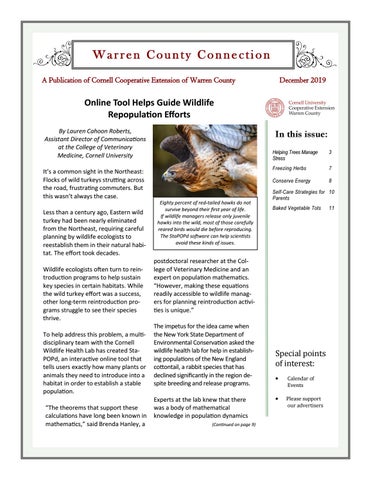
Eighty percent of red-tailed hawks do not survive beyond their first year of life. If wildlife managers release only juvenile hawks into the wild, most of those carefully reared birds would die before reproducing. The StaPOPd software can help scientists avoid these kinds of issues.
Helping Trees Manage Stress
3
Freezing Herbs
7
Conserve Energy
8
Self-Care Strategies for 10 Parents Baked Vegetable Tots
postdoctoral researcher at the College of Veterinary Medicine and an expert on population mathematics. “However, making these equations readily accessible to wildlife managers for planning reintroduction activities is unique.” The impetus for the idea came when the New York State Department of Environmental Conservation asked the wildlife health lab for help in establishing populations of the New England cottontail, a rabbit species that has declined significantly in the region despite breeding and release programs. Experts at the lab knew that there was a body of mathematical knowledge in population dynamics (Continued on page 9)
Special points of interest:
Calendar of Events
Please support our advertisers
11
Warren County Connection
Page 2
Cornell University Cooperative Extension of Warren County 377 Schroon River Road Warrensburg, NY 12885
Phone: (518) 623-3291 or (518) 668-4881 Fax: (518) 668-4912
Visit Our Web Site: www.cce.cornell.edu/warren
Who We Are Nation-wide, thousands of people in each state tap into their state’s land-grant university research and know-how to make sound confident decisions concerning family, home, business, finances, and the future. In New York State, the land-grant university is Cornell University.
The Cornell Cooperative Extension network brings you the expertise of Cornell University, other land-grant universities across the country and locally-based Extension Educators, volunteers, and other experts through such programs as: horticulture, youth and families, leadership, environment, food, nutrition & health, home environment, and financial management.
Staff Dr. James Seeley, Executive Director John Bowe, 4-H Team Coordinator Dan Carusone, 4-H Community Educator Marybeth Mitcham, Nutrition, Food Safety, and Healthy Living Educator Roxanne Westcott, Parent Educator/Energy Educator Anne Mills, Farm to School Coordinator Jessica Holmes, Master Gardener Coordinator Sharon Bellamy, Finance Manager Amy Sabattis, Public Relations/Publications Manager Michele Baker, Administrative Assistant Chris Dittus, Administrative Assistant Rand Fosdick, Maintenance
Board of Directors
William Mason - President Laura Conway- Vice President Julie Pearl - Secretary William Hamelin - Treasurer Aimee Azaert Daniel Bruno Peter Benoit Ed Griesmer Jim Kneeshaw David Strainer Michael White
Extension Service Committee Chair - Andrea Hogan Douglas Beaty Jack Diamond Ben Driscoll Cynthia Hyde William Loeb Brad Magowan Eugene Merlino Michael Wild
Warren County Connection
CALENDAR Please visit our website for more events www.cce.cornell.edu/warren 12/1/2019 1:00 PM - 3:00 PM Holiday Gifts in a Jar - The Holiday Gifts in a Jar workshop will allow participants to make and bring home one jar of freezer jam, one jar of layered soup mix, and one jar of layered brownie mix. Additional mix recipes will be provided, and food safety and nutrition information will be covered. This class has a fee of $15.00 which includes all materials. Pre-registration is required. For more information, or to sign up, please contact Marybeth at Cornell Cooperative Extension of Warren County at mem467@cornell.edu or 518623-3291. Cornell Cooperative Extension Warren County, 377 Schroon River Road, Warrensburg, NY 12885. 12/8/2019 1:00 PM - 3:00 PM Treats for Your Furry Friend Treats for Your Furry Friend workshop will allow participants to make and bring home several no-bake and baked healthy dog treats. Additional treat recipes will be provided, that are not only safe for doggie consumption, but can also double as yummy people snacks! Cost is $15.00. For more information contact Marybeth Mitcham at mem467@cornell.edu or 518-6684881. Cornell Cooperative Extension Warren County, 377 Schroon River Road, Warrensburg, NY 12885 12/8/2019 1:00 PM - 4:00 PM Basic 4-H Air Rifle - Participants will learn about firearm safety like MATT or Muzzle in a safe direction, Action open, Finger off the trigger, be sure of your Target and what's beyond it. Learn proper carrying and shooting steps .177 air rifles. Positions will begin at Bench Rest and move toward off hand. Must be a registered 4-H member at least 9 years of age to participate. Fee: $5.00 per person for current members, $10.00 for new members including annual membership. Registration is required and can be done by contacting the CCE Office at 518-668-4881 or e-mailing: mlb222@cornell.edu. Dunham’s Bay Fish & Game Club, 2080 Ridge Road, Queensbury, NY 12804 If you have special needs as addressed by the Americans With Disabilities Act and need assistance with attending these workshops, please make your needs known by the registration deadline. Reasonable efforts will be made for accommodations.
Warren County Connection
Helping Trees to Manage Stress
Page 3
ture of soil leading to compaction of that soil. Compaction reduces the level of oxygen in soil, slows the penetration of water, and hinders the development of roots. Other consequences of human activity, especially air pollution and road salt applications, are a little more difficult to assess and to prevent. For people living in areas prone to frequent air pollution events, the best remedy, as far as tree health is concerned, is to select species that are somewhat tolerant of common air pollutants. Similarly, different species of trees have different tolerances to salts. If exposure to road salt is a problem, for example, salt tolerant species such as ginkgo may be planted.
Introduction Trees are the dominant component in the natural and managed landscape in New England. For the most part, trees in forests thrive and, typically, live more than one hundred years. On the other hand, trees planted in cities and towns, and along roadways, often survive no more than a few decades, if that long. These trees are subjected to a variety of factors that reduce vigor and may eventually lead to decline and death. Almost all of these factors are the result of human activity. It is the purpose of this fact sheet to introduce the reader to the stresses imposed on trees growing in communities and around homes, describe the common symptoms of stress, and suggest ways to prevent or reduce the impact of these stresses on trees. Causes of Stress: An Overview Most people believe that insects and diseases are the primary cause for decline and death of trees in the landscape. In fact, it is human activity which causes most of the problems that trees experience. Even many pest and disease problems can be related directly or indirectly to the prior stresses imposed upon trees by human activity. These activities may include improper planting and pruning of trees, as well as poor care. Applying too much or too little water, especially after planting, may injure roots and cause stress. Over application of fertilizer can also lead to root injury or rapid but weak growth that makes the tree prone to certain insect pests and plant diseases. Mechanical injuries from lawn mowers and weed trimmers can damage tree bark and create the opportunity for invasion by certain disease organisms. Excessive foot or vehicular traffic around trees can destroy the struc-
Diagnosing the source of stress on a tree can sometimes be difficult because tree decline is rarely caused by one factor alone. It is more likely that a combination of factors are working together to cause the decline of a tree over a period of many years. The growing environment of a stressed tree should be carefully evaluated to determine as many of the causal factors as possible. Check for proper planting depth and for girdling roots. The past history of the tree should also be reviewed. Previous applications of chemicals, recent periods of drought, extremely cold or open winters, flooding and similar events can be important in evaluating sources of stress. Nurseries and garden centers sell a great variety of trees, each with its own specific environmental requirements. Landscape features such as soil acidity, sun or shade, level of soil moisture and drainage can influence how well a tree will grow and prosper. It is important to match these site features with the environmental needs of a tree before making a purchase. Symptoms of Stress The symptoms of stress often develop slowly, more slowly than insect or disease symptoms. Some things to look for include: the appearance of abnormally small leaves, pale green coloration of leaves, unusually slow growth, premature development of fall leaf coloration, early leaf drop, dieback of twigs and branches, wilting of leaves and tender new growth, peeling bark, and presence of fungi protruding from stems and branches. Repeated occurrence of these symptoms over a period of years is a good indicator that a tree is being subjected to some chronic stress influences. Some sources of stress, e.g. a prolonged drought, may reduce the vigor of a tree but, if provided with a good growing environment, the tree may overcome this stress and resume normal growth. However, it should be noted that it may take a tree several years to overcome a single (Continued on page 4)
Page 4
stress factor. Also, the effects of drought on tree health may not become apparent until 2 or 3 years after the drought event.
Warren County Connection
Dig the planting hole to a depth equal to the height of the root ball, as measured from the trunk flare to bottom of the ball. To determine the true height of a root ball that is wrapped in burlap, remove the twine and burlap at the top of the root ball. Then carefully remove soil away from the tree trunk until you find the point where the trunk begins to flare. This is the natural point where the tree trunk ends and the root system begins. Planting a tree with the flare below ground level can lead to stress and subsequent death of the tree.
Dig the hole at least two to three times as wide as the width of the root ball. If the site soil is severely compacted, the hole should be four to five times the root ball width.
Set the tree into the hole so that the top of the root ball, where the trunk flare is visible, is at the same level as the surrounding grade or 1 to 2 inches higher than grade. Leave the bottom of the hole undisturbed.
After setting the tree in the planting hole, remove all the twine and as much of the burlap as possible without allowing the rootball to break apart. If nondegradable materials have been used in wrapping the rootball (such as plastic burlap), remove all of the material before backfilling. It is also advisable to remove the top 8 to 16 inches of a wire basket if one has been used around the rootball. Removal of the wire should only be done after the rootball is securely in place in the planting hole.
Backfill the hole with the original soil. Do not amend the backfill with peat moss or other organic materials. If the soil is of very poor quality, that is, very sandy or of heavy clay, it may be amended prior to digging the hole by working organic matter into an area that is at least 5 times larger than the diameter of the tree's rootball. Organic matter amendment should not exceed 20-35% of the backfill by volume or 5% by weight.
Firm the backfill by lightly tamping the soil. Do not pack the soil! You may also firm the soil by stopping periodically and watering the backfill until the soil is settled.
Water the soil thoroughly after completing the planting. Then apply a 2 to 4 inch layer of organic mulch, such as bark chips, over the planting area. Do not place any of the mulch against the trunk of the tree!
Water the soil around newly planted trees once each week through the first growing season. Soil should be
Unfortunately, once symptoms of decline or stress become apparent, it is often too late to stop or reverse the damage to a tree. Therefore, prevention is the best approach to eliminating stress to trees. Prevention begins with proper selection and planting, and continues with regular inspection and care of these trees. Proper Planting Techniques Perhaps nothing is more important in preventing stress than the proper planting of trees. Research has shown that a tree planted at the correct depth, in a hole of sufficient size to accommodate the tree's expanding root system, has a much greater chance of survival than an improperly planted one. Here are some rules to follow when planting trees: Locate trees away from high foot traffic areas that may cause compaction of soil and away from the street if road salts are routinely applied during the winter. Avoid planting trees where their roots may be confined, such as close to a street, sidewalk or building. Also, avoid planting trees beneath utility wires.
Evaluate the planting site with respect to drainage, exposure to wind, amount of sunlight, type of soil (sandy or clay), space for root development, and soil pH. Also, note the hardiness zone in which you live so that you are sure to select a tree that will survive the prevailing winter temperatures. Have soil tested prior to planting. Phosphorous, potassium and limestone are best incorporated into the soil before a tree is planted. When applied to the soil surface after planting, limestone, phosphorous, and potassium (to some extent), move very slowly into the soil. A soil test will determine the amount, if any, of these materials that needs to be incorporated. It is not necessary to apply any other fertilizer at planting time. However, if fertilizer containing nitrogen is applied, the nitrogen must be in a slow-release or water insoluble form. Organic fertilizers are a good choice. Follow the directions on the product label. At planting time it is better to apply too little nitrogen than too much. Fertilizers should be mixed thoroughly with the backfill material. Select a tree whose growth requirements most closely match the environment of the site where the tree will be planted. Remember, choose the right plant for the right place.
(Continued on page 5)
Warren County Connection
soaked to a depth of at least 6 inches at each watering. A slow soaking, extended over several hours is more effective than a large application of water all at once. Specialty "soaker" hoses are effective in applying water to newly planted trees.
Page 5
Caring for Trees Once trees are planted, some routine care should be given to them to insure their health and vigor. This includes pruning, watering, fertilizing, mulching and checking for presence of any insect or disease problems.
Watering Once a tree is established, it seldom needs watering. The exceptions are for trees growing in sandy soils, and those exposed to a prolonged drought. When watering, it is important to apply enough water to penetrate the soil to a depth of at least 10 to 14 inches. This is where most of the water absorbing roots of a tree are located. A test hole can be dug to determine how long one needs to water, or how much water needs to be applied, to moisten the soil to that depth. In general, such applications should be made about once every two weeks.
Pruning Pruning is an important element in the care of trees. The primary purposes of pruning are to remove dead, damaged or diseased branches; to selectively eliminate crowded branches or stems; to correct structural problems with tree limbs and stems; and to control the shape of a tree.
Fertilizing Trees growing in a forest do quite well by relying on nutrients made available from rocks in the soil, and from the decay of organic matter in the soil. In home landscapes, trees may not get all the nutrients they need by way of these processes. Therefore, it is sometimes necessary to apply fertilizer around trees to provide the essential elements needed for growth. It should not be assumed, however, that trees need annual applications of fertilizer for their survival. Too much fertilizer can actually lead to stress on a tree rather than relieve it.
Pruning should be initiated while trees are still young and small. It is much easier and safer to remove poorly growing stems and branches on small trees than on older, larger ones. While proper pruning does require some knowledge and skill, much pruning work can be done by the homeowner.
Trees that have been in place for at least two or three years have a well developed root system capable of absorbing adequate amounts of mineral nutrients from the soil. Fertilizer application to trees should only be made if tree leaves are showing symptoms of nutrient deficiency, such as abnormally pale leaf color or abnormally small leaves. Other symptoms of nutrient deficiency include shorter than normal annual twig growth and tip die-back of branches. Be aware that these same symptoms may be the result of stress factors other than a lack of nutrients. Always evaluate the tree and the area around the tree for other possible explanations for the tree's decline.
Do corrective pruning to: prevent branches from rubbing. remove dead, diseased or damaged branches. remove double leaders. remove narrow, V-shaped crotches. remove branches growing back toward the center of the tree. Do not remove or "top" the central leader (stem) unless it is damaged. Cut branches at the branch collar, not flush against the trunk. Use the "three cut" technique for large branches. If pruning requires the use of a chain saw, removal of very large branches, or climbing into the tree, it is best that this work be done by a certified arborist (check local Yellow Pages under "Tree Service"). Pruning under such situations can be very dangerous and should be left to the professional.
If fertilizer is to be applied, use one with an N-P-K ratio of 3-1-2 or 4-1-2. Fertilizer with an analysis such as 24-8-16, 12-4-4, 18-6-12 or similar formulation would be a good choice. Products designed for application to lawns are satisfactory but avoid those containing weed killers. Fertilizers containing a high proportion of the nitrogen in a slow-release or water insoluble form should be used. Care should be taken when applying fertilizer or any garden chemical that correct amounts are used. Apply fertilizer at a rate that is equivalent to no more than 1 pound of actual nitrogen per 1000 square feet of area. This rate may be adjusted upward if the plant response is less than satisfactory. Fertilizer should be applied in spring or in early (Continued on page 6)
Page 6
fall. The easiest way to apply fertilizer is to spread it on the ground around the tree, beginning about 6 feet away from the trunk and extending to a distance several feet beyond the drip line of the tree. Where there is danger of burning the lawn around a tree, fertilizer application may be split into 2 or 3 applications, each about 4 weeks apart. Water the area thoroughly after applying fertilizer. Just as important as applying fertilizer is application of limestone. In Massachusetts, most soils are acidic, with the exception of parts of the Berkshires and planting areas near concrete surfaces. Limestone is used to reduce soil acidity. The amount to apply depends upon soil pH, a measure of soil acidity. Have soil tested for pH every 4 or 5 years. For the most part, trees prefer a pH between 6 and 7 for good growth. Mulching Mulching involves the placement of wood chips, bark nuggets, pine needles, or other organic material over the soil surface surrounding a tree. The purpose of the mulch is to keep soil cool during the hottest months, reduce moisture loss from the soil, and eliminate weeds that compete with trees for water and nutrients. The use of mulch can also help prevent injury to trees by keeping lawn mowers and weed trimmers away from the trunks of trees. Mulches should be applied to a depth of 2 to 4 inches and spread over as large a portion of the root zone of a tree as is possible. The mulch should not be in contact with the trunk of the tree. Since organic mulches decompose over time, it will be necessary to replenish the mulch every few years. However, the depth of the undecomposed organic mulch should not exceed 4 inches. Insect/Disease Control The key to insect and disease control in trees is to maintain a proper growing environment for trees and to en-
Warren County Connection
courage their vigor. Vigor should not be interpreted as rapid growth since very fast growth, especially that induced by over fertilization, can make a tree more prone to pest problems. Good cultural practices such as those previously mentioned are crucial for vigorous growth. Most trees are often able to withstand a certain amount of insect infestation. It is when pest populations build to very high levels that problems occur. Unfortunately, pests are not usually noticed until they are in abundance. Therefore, a program of regular and methodical inspection of trees should be implemented, especially during the spring months when many insect infestations occur. Tree inspection should include examination of bark, stems, and leaves for any signs of pests or abnormal appearance of these plant structures. There are many options for controlling insect pests on trees, including many measures that do not rely on the application of chemical pesticides. When dealing with small trees, pest control materials may be applied by the homeowner. A local garden supply dealer may be consulted regarding the appropriate materials to use. With large trees, specialized equipment will be needed to make applications of control materials. In such cases, it may be practical to hire an arborist who is licensed and certified to apply pesticides.
Tree diseases develop slowly and are usually caused by fungi or bacteria. Symptoms of disease infections typically appear as leaf spots, blights, yellowing of leaves, or wilting. Proper recognition of tree disease symptoms requires familiarity with the "normal" appearance and growth of trees. Trees should also be examined regularly for signs of peeling bark, dieback of twigs and branches, and fungi growing out from the trunk or at the base of the trunk. Some diseases result in little lasting damage to trees while others become progressively worse and can eventually kill trees. The damage caused by diseases can be compounded if the tree is being affected by other stress factors such as drought. If a wilt disease or dieback of branches is occurring, the problem may be internal or below ground. In these situations, it is best to consult with a professional. When leaf spot and blight symptoms are visible, it is usually too late to apply chemical controls for that season. In addition, trees with good vitality generally have the capacity to limit and compensate for these kinds of disease infections. When diseases occur, effective management strategies include removing fallen leaves, pruning diseased and damaged branches, and providing good care. Source: University of Massachusetts Amherst
Page 7
Warren County Connection
Freezing Herbs
freezer and freeze solid. After the trays are frozen solid, pop out the herb cubes and store in a freezer bag. Label and date. Strong smelling herbs should be double wrapped in foil or placed in freezer jars to avoid the transfer of odors. To use, add a frozen cube in soups, sauces, stews or other combination cooked dishes.
Freezing Herbs in Oil
Some herbs maintain their flavor better when frozen instead of dried. Freezing works well for herbs like parsley, dill, basil, chives, lemon balm, mint or tarragon. Experiment with various herbs to determine which ones you prefer frozen. Frozen herbs can be used in the same proportion as fresh herbs. Keep in mind that freezing will cause the water in the cell walls to expand, and the herbs will be limp when thawed. As a result, you may prefer to use frozen herbs in cooked dishes. They will generally not be attractive as garnishes.
Harvesting Herbs
Most herbs are best for drying just before the flowers first open. Flowering herbs tend to be somewhat bitter. New leaves at the tip of the plant will have the most concentrated flavor. Select fresh herbs in mid-morning when dew is off the plants but before the sun has evaporated the oils that provide the flavor. Use scissors to cut the stems just above a leaf or pair of leaves. Leave 4 to 6 inches of stem for later growth. Rinse the herbs in clear water and pat dry or spin them dry in a salad spinner. Don’t crush them.
Freezing Herbs in Ice Cube Trays in Water
Strip leaves from stems and chop them as you would to use them fresh. Fill an ice cube tray half full of water. Place herbs in each section of the tray—about 1 tablespoon in each. Push herbs under the water as much as possible. Place in the freezer. The next day when herb cubes are frozen solid, add additional water to top off the cube. Return to the
Chop herbs. Mix ⅓ to ½ cup of oil with 2 cups of chopped herbs. (The oil allows the mixture to be scraped from the jar more easily because it doesn’t freeze as hard.) This can be frozen in ice cube trays and used as above, or it can be frozen in small jelly jars. The oil will not freeze solid like ice, and you can scrape out the amount you want to use. A neutral flavored vegetable oil such as canola oil allows the flavor of the herb to dominate. Olive oil is suitable if it complements the flavor of the herb. Herbs frozen in oil maintain their color better than those frozen individually. This method works well with basil. Another option is to make a paste by mixing ⅓ cup oil with 2 cups fresh herbs in a blender until smooth.
NOTE: Oil should only be added to herbs if it will be frozen. Do not store herbs in oil at room temperature.
Freezing Herbs Flat Cooks find that herbs frozen in cubes cook unevenly as the cube melts. Try this alternative for use in sauces and cooked dishes. Place a thin layer of chopped herbs and oil inside a zipper-lock bag. Seal leaving about a half-inch of space open. Squeeze out excess air before sealing the bag completely. Place the bag on a large plate or baking sheet, spreading out the herb mixture to a thin, even layer and place it in the freezer until completely frozen solid. When ready to use, cut or break off as much as you need, reseal the bag, and store the rest for later use. Because of the greater surface area, herbs frozen this way freeze and melt quickly.
(Continued on page 8)
Page 8
Warren County Connection
Freezing Stems and Leaves Leaves: Strip leaves off the stems and spread in a single layer on a cookie sheet and place in the freezer. As soon as they are frozen, place them in a freezer bag. Because the leaves are frozen separately, you can remove the amount you need. Caution: Work quickly when removing leaves from the bag to avoid thawing. When thawed and refrozen the leaves will freeze together. Chop chives and lemon grass before freezing. They are thin and will freeze quickly. Another option is to blanch leaves of larger herbs such as basil for 15 seconds to stop enzyme reactions; immediately plunge in ice water to stop the cooking. Drain, pat dry and freeze on a tray before packaging. Stems: Dill weed can be frozen as stems. Wrap 3 or 4 stems in plastic wrap and then overwrap in aluminum foil. Freeze. Dill weed will become limp and dark in color but will still impart flavor for pickling. Rosemary and thyme can also be frozen on the stem.
Caution: Herbs give off odors that can be absorbed by other foods in the freezer. Avoid the transfer of odors by wrapping herbs in foil or placing in glass jars with an air tight lid. Plastic freezer bags and boxes suitable for freezing vegetables and fruits allow for the transfer of odors. Do not thaw herbs before adding to cooked dishes.
Conserve Energy By Evelyn Prasse, Consumer and Family Economics Extension Educator, University of Illinois Extension
Conserve energy and keep costs down by using energy conservation practices: weatherstrip and caulk doors and windows, insulate the attic, install storm windows, buy energy efficient appliances. Fall is a good time to conduct an inspection to get the home ready for winter. Some of the areas that need to be inspected include:
Source: PennState Extension
Check weatherstripping around doors and windows for damage and tightness. In the fall, hardware, building supply, and discount stores often have sales on a variety of products. Check caulking at doors, windows, and other openings. If replacement is needed, be advised that many caulking products need to be applied when the outdoor air temperature is above 45-50 degrees. Check the label on the package for application instructions. Check vents, louvers, chimney caps and housings, and gutters and downspouts for bird nests and other debris. Have the heating system checked by a qualified service person. Clean around the furnace. Replace the filters monthly during the heating season or as recommended by the manufacturer. Remove window air conditioners. Weatherstrip window openings if needed. Clean and repair window wells, storm drains. and remove any leaves or other debris. Even a few leaves can clog outlets. Drain outdoor hoses and water lines to prevent freezing. Clean humidifiers and replace the filters as recommended.
Add insulation to walls, attic, and other areas. Check with building supply stores for the recommended R-value. Home maintenance can be expensive and time consuming. But, it can add to the value of your investment if you decide to sell your home in the future.
Page 9
Warren County Connection (Continued from page 1)
that could be harnessed to solve the problems they were facing. So Hanley, wildlife veterinarian Dr. Beth Bunting and wildlife disease ecologist Krysten Schuler took up the challenge. The team took established equations and developed an online interface that allows non-mathematicians to harness the information for real-world application. The software asks users to enter their management end goals – the number of animals that they wish to exist in their restoration area after a certain number of years. The app then calculates, factoring in natural population dynamics, the exact number of animals in each stage in the life cycle needed to achieve their goal. A key input for the StaPOPd software is the number of life stages. A life stage represents a period of time in an animal’s life when its survival or fertility rate is distinctly different from other stages.
ronment.” Being able to foresee how certain release efforts could play out from the perspective of innate population dynamics is critical for wildlife conservation projects both far and wide. The species are as diverse as the geographic applications. So far, it’s been used to assist Hanley in her research on bald eagle population dynamics and Bunting’s hellbender salamander conservation work in upstate New York. “The interdisciplinary teamwork is saving managers a lot of effort,” Bunting said. “We may not necessarily have to track the animals in the field for 10 years to see how that population is doing. So we’re hopeful we can save government agencies and scientists time, effort and money when doing these projects.”
Some species, like rabbits and squirrels, have just two stages: juvenile and adult. Other animals, such as the bald eagle, have three: hatchling, immature and adult. In fact, plant and animal species can be modeled with any number of stages as long as they appropriately reflect the biology of their life cycle. “It is tempting to think of all individuals as being the same,” said Hanley. “But in terms of reintroduction efforts and population dynamics in general, the same individual adds different value to the population at different stages in its life cycle.” If that detail is ignored, reestablishment efforts can go to waste, says Bunting. For example, 80% of red-tailed hawks do not survive beyond their first year of life. If wildlife managers release only juvenile hawks into the wild, most of those carefully reared birds would die before reproducing. Besides enabling managers to align population into stable growth patterns, StaPOPd can save scientists considerable effort. “Reintroduction projects are often exciting because people feel like positive action is being taken, but we also want people to take a step back and run the numbers. When you look at the math, does this project actually work?” said Bunting. “If there aren’t enough young to maintain the breeding adults in a stable population, you have to change what you’re releasing out into the envi-
The StaPOPd app asks users to enter their management end goals, then calculates, factoring in natural population dynamics, the exact number of animals in each stage in the life cycle needed to achieve their goal.
Page 10
Self-Care Strategies for Parents Let's start with this important fact that all parents should keep in mind: Taking time for yourself supports not only your own wellbeing, but drastically impacts the lives of your children. Frazzled, over-stressed parents can make for frazzled and overstressed families. As a parent, you may feel the need to be on call all the time and this is exhausting. Having one child is demanding (and some children require more than others), having more than one child even more so. Even if your kids have an easy-going temperament much of the time, the simple logistics of getting them out of bed, dressed, fed, out the door, and then back inside later on, all while continuing to manage all the grown-up tasks you’ve always had, can lead to parenting stress.
Warren County Connection
The often-unspoken part of our "fight or flight" response is a mental “freeze” that can cause us to stop thinking clearly. Stress relates to less flexible problem solving and a decreased capacity to sustain an effort (like sticking to discipline and guiding intentions or a new homework routine). That stress induced mental state makes managing family life harder, which can lead to a cycle that keeps us feeling exhausted and worn-out. If we don’t find time to build our own resilience through self-care, we create patterns that repeat themselves. Whenever family life seems unstable and overly chaotic (as opposed to routinely chaotic), an important first step to hitting the reset button may be spending a few minutes to take care of yourself. Rediscovering your own strength, or simply taking a moment to settle, is often what we need to take care of our children and ourselves.
A little stress keeps us on our toes and motivated, but we can all benefit from having a few strategies to manage our parenting stress.
Four Healthy Self-Care Strategies for Parents 1. Value what keeps you healthy. Find an activity that keeps you sane and strong. No matter how busy you are, make it happen - even for a few minutes. Listen to music on the commute to work, read for a few minutes in the bathroom, take your child outside with you for a walk or hike. Taking these moments will help your well-being and allow you to have more energy for your family. Keep in mind, it's not just for you; children tend to pick up similar healthy habits to those they see. 2. Be patient with yourself. As with children, adult resilience relies on acknowledging what you do well, instead of focusing on self-judgment. Take small, steady steps toward change, pushing back against mental habits like perfectionism and negativity and allow for long-term progress toward family goals. 3. Value your relationships. If you have the resources (and not everyone does), schedule a regular babysitting night so that you and your significant other can go out and do something grown up. Or trade nights of babysitting with another family. Likewise, and particularly if you’re a single parent, find times for friends as consistently as you’re able to. Creating this time also embodies healthy relationships for your children, letting them see the importance of treating others with warmth and compassion. 4. Take. A. Break! Throughout your day (and your life!), when you see a chance, take a breather. Instead of continually doing and fixing and checking social media, email, and giving in to the pull of your smartphone, actively choose something that allows you a calm, restorative minute or two.
There’s a further implication to undermanaged stress:
Source: Oregon State University
There’s nothing most of us care more about than our children. Just having them causes most parents a fair amount of worry about their well-being. Add on chronic sleep deprivation and disrupted routines related to eating, exercise, and your personal life....altogether, being a parent can come with a great deal of stress. Not to mention, parenting can feel like one big sloppy mess, especially since family life never goes exactly as we plan. A big school project that you were told is due next month is due tomorrow, and you forgot to stop by the store for milk on the way home, you haven’t exercised in a month, and you wonder if your daughter forgot to bring her raincoat to school yet again. It seems there is always one more thing to worry about or to do or to fix or to change. All the anxiety around raising children isn’t without consequence. When we feel overwhelmed, it affects how we think and how we act. Chronic stress undermines our physical and mental health and it changes how we think. One study even suggested that one of the best measures of a child’s stress is their parents’ stress level.
Warren County Connection Warren County Connection
Baked Vegetable Tots By Marybeth Mitcham, MPH, Nutrition, Food Safety, and Healthy Living Educator, CCE of Warren County
Page 11
1 medium (2.75 oz.) carrot, peeled 1 teaspoon salt, divided 2 flax eggs (2 tablespoons flaxseed meal + 6 tablespoons water) ⅓ cup nutritional yeast ⅓ cup panko breadcrumbs 1/4 cup finely chopped parsley 1/2 medium (4 oz.) white onion, finely diced 2 cloves garlic, finely minced 1/8 teaspoon black pepper
Directions: Into a large bowl or onto a cutting board, grate the zucchini, white potato, cauliflower, and carrot, with a coarse grater. Transfer the grated vegetables to a large bowl mix them together with a ½ teaspoon of salt. Let the vegetables sit for 20 minutes to allow the salt to draw out some of the moisture. The holidays are upon us! Not only do the holidays bring together friends, family, and members of our community, but they also provide a fantastic medium for doing so - food! From mashed potatoes and gravy to cookies and pies, the options for holiday treats are endless. Thankfully, enjoying delicious food does not have to mean that you will enjoy unhealthy food. Healthy options for holiday meals and snacks abound. One of my current favorite recipes to make is baked vegetable tots. I was introduced to this particular version of the recipe by our dietetic intern, who made them for the staff on the last day of her internship. There were zero leftovers! These kid-friendly vegan treats are not only ridiculously delicious, but are also chock-full of nutrients and fiber. The flax “egg” that is used as a binder are rich in the essential omega-3 fatty acids that help to promote good cardiovascular health, and also contain immune-boosting antioxidants. The nutritional yeast provides a fantastic source of Vitamin B-12, and the vegetables provide essential minerals and vitamins, along with fiber. They are good paired with a dipping sauce (sweet chili is my current go-to), or just eaten as-is. Why not try them, and let me know how they turn out! Baked Vegetable Tots Ingredients 1 large (8.2 oz.) zucchini 1 medium (8.5 oz.) white potato, peeled ½ small (10.4 oz.) head of cauliflower (or substitute 1 10 oz. bag riced cauliflower)
In the meantime, prepare the flax egg. In a small bowl, mix together 2 tablespoons of flaxseed meal with 6 tablespoons of water and set it aside to thicken. Preheat oven to 400°F and line a baking sheet with a silicone mat or parchment paper.
After 20 minutes, transfer the grated veggies into a clean kitchen towel (or a cheesecloth or a nut milk bag). Clean the bowl they were in by giving it a quick rinse, drying it, and setting it aside. Grab a small bowl and strain out as much liquid from the vegetables as you can. Discard liquid. Place the grated veggies back into the bowl and mix in the prepared flax eggs, nutritional yeast, panko breadcrumbs, parsley, white onion, garlic, pepper, and remaining salt. Mix until well combined. Scoop out 1 tablespoon of the mixture and form it into a tater tot shape. It may be difficult to start, but eventually, you will get the hang of it. Continue until you have formed 20-25 tots. Transfer to the lined baking sheet and place into the oven for 25-30 minutes or until they are golden brown, being sure to flip halfway through. Cool and then serve with your choice of dipping sauce. Enjoy! Source: *Sweet Simple Vegan
Cornell Cooperative Extension 377 Schroon River Road Warrensburg, NY 12885 RETURN SERVICE REQUESTED
IF THERE IS A CHECK IN THIS BOX , THIS IS THE LAST ISSUE OF THE WARREN COUNTY CONNECTION YOU WILL BE RECEIVING. To renew your subscription clip the form below and send to Cornell Cooperative Extension of Warren County.
Warren County Connection
THANK YOU INTERNATIONAL PAPER!! "Paper for this newsletter was donated by International Paper, proudly produced at the Ticonderoga, New York Mill from trees harvested in working Adirondack forests that are managed responsibly in accordance with the principles of the Forest Stewardship Council (FSC) and the Sustainable Forestry Initiative (SFI)." “International Paper is proud to join almost 60 manufacturers and importers supporting the Paper & Packaging – How Life Unfolds™ campaign.” “Cornell University Cooperative Extension of Warren County provides equal program and employment opportunities.” “The information given herein is supplied with the understanding that no discrimination is intended and no endorsement by Cornell Cooperative Extension is implied.” The Cornell Cooperative Extension educational system enables people to improve their lives and communities through partnerships that put experience and research knowledge to work. "Cornell Cooperative Extension actively supports equal educational and employment opportunities. No person shall be denied admission to any educational program or activity, or be denied employment on the basis of any legally prohibited discrimination involving, but not limited to, such factors as race, color, religion, political beliefs, national or ethnic origin, gender, sexual orientation, age, marital or family status, veteran status, or disability. Cornell Cooperative Extension is committed to the maintenance of affirmative action programs that will assure the continuation of such equality of opportunity."
Just $5.00 per year will give you one full-year subscription to the “Warren County Connection,” mail this coupon to : Cornell Cooperative Extension ☺ Be sure to include your fee of $5.00 to cover the cost of mailing. Name______________________ Address____________________ __________________________ Zip Code___________________ OR To get this publication FREE email als77@cornell.edu and you will be added to our E-Edition
We’re on the Web! http://counties.cce.cornell.edu/warren/ & Facebook - Look for CCE Warren