State Supplement sponsored by:
ARIZONA STATE EDITION
A Supplement to:
SHIP WITHIN 48 HOURS SAME DAY PARTS AVAILABILITY
®
January 6 2019
24 HOUR TECHNICAL SUPPORT BACKED BY A 75 YEAR BUSINESS Thousands in Service!
Vol. III • No. 1
“The Nation’s Best Read Construction Newspaper… Founded in 1957.”
Affordable Price. Premium Service.
CALL 800-367-4937
Your Arizona Connection – Debbie Hansen – 1-702-239-0348 – dhansen@cegltd.com
*On approved credit • Financing Available
Celebrating 50 Years of Arizona’s Water Conservation Project
Central Arizona Project photo
Central Arizona Project photo
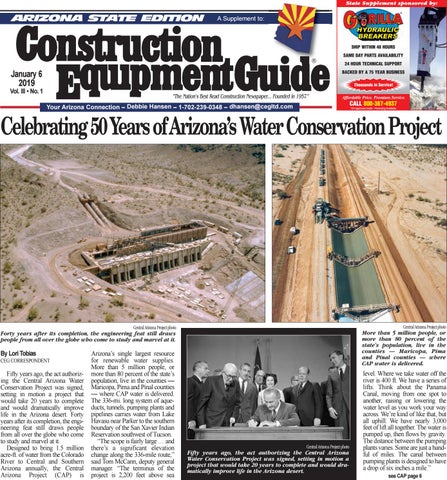
Forty years after its completion, the engineering feat still draws people from all over the globe who come to study and marvel at it.
More than 5 million people, or more than 80 percent of the state’s population, live in the counties — Maricopa, Pima and Pinal counties — where CAP water is delivered.
By Lori Tobias CEG CORRESPONDENT
Fifty years ago, the act authorizing the Central Arizona Water Conservation Project was signed, setting in motion a project that would take 20 years to complete and would dramatically improve life in the Arizona desert. Forty years after its completion, the engineering feat still draws people from all over the globe who come to study and marvel at it. Designed to bring 1.5 million acre-ft. of water from the Colorado River to Central and Southern Arizona annually, the Central Arizona Project (CAP) is
Arizona’s single largest resource for renewable water supplies. More than 5 million people, or more than 80 percent of the state’s population, live in the counties — Maricopa, Pima and Pinal counties — where CAP water is delivered. The 336-mi. long system of aqueducts, tunnels, pumping plants and pipelines carries water from Lake Havasu near Parker to the southern boundary of the San Xavier Indian Reservation southwest of Tucson. “The scope is fairly large … and there’s a significant elevation change along the 336-mile route,” said Tom McCann, deputy general manager. “The terminus of the project is 2,200 feet above sea
Central Arizona Project photo
Fifty years ago, the act authorizing the Central Arizona Water Conservation Project was signed, setting in motion a project that would take 20 years to complete and would dramatically improve life in the Arizona desert.
level. Where we take water off the river is 400 ft. We have a series of lifts. Think about the Panama Canal, moving from one spot to another, raising or lowering the water level as you work your way across. We’re kind of like that, but all uphill. We have nearly 3,000 feet of lift all together. The water is pumped up, then flows by gravity. The distance between the pumping plants varies. Some are just a handful of miles. The canal between pumping plants is designed to have a drop of six inches a mile.” see CAP page 6
Page 2 • January 6, 2019 • www.constructionequipmentguide.com • Arizona State Supplement • Construction Equipment Guide
Girders Set for Two South Mountain Freeway Interchanges As the Loop 202 South Mountain Freeway advances, bridge girders were installed last month at two of the 14 planned traffic interchanges, marking the first time on this Arizona Department of Transportation project that these massive support beams were set at two interchanges in the same week. Working overnight, crews with Connect 202 Partners, the developer building the South Mountain Freeway, placed 15 steel-reinforced concrete girders over 32nd Street near Pecos Road in Ahwatukee. Each of the girders weighs 105,000 lbs. and is 116 ft. long. Two large cranes carefully hoisted and set these girders atop the abutments and piers. Placing a single concrete girder can take up to one hour. With the 32nd Street girder placement completed, the same crews moved several miles to the northwest and set an additional 16 girders over three nights at the Broadway Road overpass near 59th Avenue in Laveen.
All of the girders are manufactured locally and were hauled to construction sites overnight, when traffic is lighter. Thus far, more than 600 girders have been installed on 40 bridge structures throughout the South Mountain Freeway corridor. With girders in place at 32nd Street and Broadway Road, crews will finish pouring concrete decks and add barrier walls on the bridges. In November, ADOT announced plans to add a South
Mountain Freeway interchange at 32nd Street following an environmental study stemming from stakeholder input. The connecting ramps at the 32nd Street interchange will be completed after the South Mountain Freeway opens. The 22-mi. South Mountain Freeway, which is scheduled to open as early as late 2019, will provide a long-planned direct link between the East Valley and West Valley and a much-
Arizona Department of Transportation photo
Each of the girders weighs 105,000 lbs. and is 116 ft. long. Two large cranes carefully hoisted and set these girders atop the abutments and piers.
needed alternative to Interstate 10 through downtown Phoenix. Approved by Maricopa County Arizona Department of Transportation photo voters in 1985 and again in 2004 Working overnight, crews with Connect 202 Partners, the developer as part of a comprehensive building the South Mountain Freeway, placed 15 steel-reinforced regional transportation plan, it will complete the Loop 202 and concrete girders over 32nd Street near Pecos Road in Ahwatukee.
Loop 101 freeway system. For more information, visit SouthMountainFreeway.com. (This story also can be found on Construction Equipment Guide’s website at www.constructionequipmentguide.com.)
Benefactors Give $8M for UA Sports Center Construction University of Arizona supporters Cole and Jeannie Davis have committed $8 million toward the construction of an indoor sports center, which will include a football practice field. The spacious, climate-controlled multipurpose facility will be used for training and conditioning for a variety of athletic programs, and will serve as a game-day hospitality area as part of an effort by Arizona Athletics to enhance the fan experience at football home games. With their support of the new center, to be called the Cole and Jeannie Davis Sports Center, their giving to the UA has reached a total of $18 million. Their previous gifts went toward renovations of McKale Memorial Center, construction of the Richard Jefferson Gymnasium, renovations to the basketball locker room, the Cole and Jeannie Davis Strength and Conditioning Center inside the Richard Jefferson Gymnasium, and other projects. “What we love about our community and the University of Arizona is the people,” Cole Davis said. “Our passion in Tucson is helping young men and women aspire for greatness and achieve their dreams. Student-athletes at Arizona compete at the highest levels as part of a team, strive for success in the classroom and aim to make a difference in our community. We want to make a positive impact on the experience of all the exceptional student-athletes at this great university as they pursue their dreams and become future leaders.” The gift is a key component in Arizona Athletics’ $66 million capital campaign, which includes multiple projects aimed at enhancing the experience of Arizona’s nearly 500 student-athletes, including renovations to the east side of
Arizona Stadium, Hillenbrand Aquatic Center, Hillenbrand Softball Stadium and McKale Center locker rooms. Construction has begun on the Cole and Jeannie Davis Sports Center, which has a projected cost of $18 million. “This transformative gift will help us to not only offer an exceptional experience to our student-athletes, but also to offer a gathering place for football fans who visit campus to cheer on the Wildcats,” said Robert C. Robbins, UA president. “The Davises’ commitment to the success of studentathletes, in every sense of the word, goes well beyond their financial support. With warmth and genuine affection, Cole and Jeannie have made an effort to get to know these talented young people over the years and have been a source of inspiration and encouragement. In so many ways, Cole and Jeannie have made an incredible and lasting mark on the University of Arizona, and we are so grateful for their partnership.” Located on the former site of Kindall-Sancet Stadium, the Cole and Jeannie Davis Sports Center is expected to be completed in January. The building will contain a 90-yd. field, with a 10-yd. end zone and a ceiling height of 65 ft. “What makes Arizona Athletics and the University of Arizona special is our Southern Arizona community,” said Dave Heeke, vice president and director of athletics. “Cole and Jeannie Davis are tremendous models of the exceptional support we have in our community. We can’t thank them enough for their incredible generosity and commitment to Arizona Athletics, the University of Arizona and Tucson. They are wonderful ambassadors of our campus and continue to make a huge difference in the lives of all our student-
athletes. This gift is a vital investment in the vision and mission of our athletics department and university as we continue to educate and develop the next generations of leaders.” The Davises have been active philanthropists since arriving in Tucson nearly 20 years ago. In addition to their support of Arizona Athletics, they have made commitments to the UA College of Fine Arts, the Arizona Cancer Center, the Boys & Girls Clubs of Tucson and Casa de los Niños, and other organizations. “The Cole and Jeannie Davis Sports Center is going to have an immediate impact on the development of our student-athletes,” said head football coach Kevin Sumlin. “We will be able to shape our off-season work, training camp and in-season practices in a way that allows us to maximize what we do with our team. On behalf of our entire football program, I am grateful for the tremendous support from Cole and Jeannie. Their generosity is an incredible example of our university's vision and commitment to the success of our student-athletes.” The Davises are members of the 1885 Society, which is a group that provides unrestricted support to the University of Arizona for advancement in academic excellence. “This game-changing gift builds on an exceptional history of support. The Davis family’s motivation to make the UA the best university it can be continues to make a huge difference for our students and our future,” said John-Paul Roczniak, president and CEO of the UA Foundation. (This story also can be found on Construction Equipment Guide’s website at www.constructionequipmentguide.com.)
Construction Equipment Guide • Arizona State Supplement • www.constructionequipmentguide.com • January 6, 2019 • Page 3
Page 4 • January 6, 2019 • www.constructionequipmentguide.com • Arizona State Supplement • Construction Equipment Guide
EPA Awards Arizona $30.8M for Drinking Water, Wastewater Projects The U.S. Environmental Protection Agency (EPA) has awarded more than $30.8 million to Arizona for drinking water and wastewater infrastructure improvements. “These funds will be used for numerous local projects that will boost the economy while improving water systems,” said Mike Stoker, EPA Pacific Southwest regional administrator. “EPA is committed to investing in local infrastructure to benefit the communities we serve.” EPA awarded more than $30.8 million to Arizona’s clean water and drinking water State Revolving Fund programs. These federal funds are supplemented with state funding sources, which together provide low-interest loans for wastewater and drinking water infrastructure projects. As money is repaid to the revolving loan fund, Arizona funds new infrastructure projects. The state’s Drinking Water State Revolving Fund (SRF), which is administered by the state’s Water Infrastructure Finance Authority
(WIFA), received almost $20 million to improve public water systems, including the following: • The city of Safford has identified 58 mi. of pipeline in its water distribution system that are outdated and failing. The city will relocate existing mains, build upgrades, and rehabilitate other wells. • The Tierra Buena Water Company will install a centralized arsenic treatment system to address local arsenic issues in the city of Glendale. The state’s Clean Water SRF, also administered by WIFA, received almost $11 million to support a variety of water infrastructure improvement projects, including the following: • The town of Marana will design and construct a new lift station and force main to convey sewage from the Adonis Neighborhood to the existing town of Marana municipal system. Once the project is completed, the sewage from the neighborhood will be treated at the recently completed Marana Water Reclamation Facility, allowing Marana to reuse the water in
various ways. • The city of Prescott will centralize its wastewater treatment system. Once complete, the system will be able to direct sewage to the recently expanded Airport Wastewater Treatment Plant. The project also will include improvements to several trunk mains and construction of a lift station. Centralization of wastewater treatment will reduce the city’s operating and maintenance costs and eliminate odor complaints from the previous Sundog plant. EPA has awarded more than $693 million to Arizona’s clean water and drinking water revolving fund programs since their inception in 1988 and 1996, respectively. These funds support Arizona’s efforts to address an estimated $16 billion worth of water infrastructure needs. For more information, visit epa.gov/ drinkingwatersrf, epa.gov/cwsrf and epa.gov/region9/water. (This story also can be found on Construction Equipment Guide’s website at www.constructionequipmentguide.com.)
$200M Medical, Senior Living Campus Will Bring High-Paying Jobs to Mesa On Dec. 10, the city of Mesa moved forward a plan for a 20-acre, multi-use, campus-style community at Crismon Road and Hampton Avenue. This $200 million project called GrandeVita, a Biocity Enterprise by Khangura Development, will allow seniors to “age in place” in a hightech and innovative environment. A 127 room Residence Inn by Marriott is the first project to be completed on the campus and will be open in January 2019. When completed, GrandeVita will create an estimated 326 jobs with an average wage of $45.25 an hour and generate $28.6 million in wages. GrandeVita’s concept and design has been developed with the intent of creating a unique campus atmosphere with a world class resort feel. The campus is nearly 700,000 sq. ft. of independent and assisted living, hotel rooms, multiple dining options, medical offices, a luxury tower and luxury condos, nursing school and rehab clinic spread out over 20 acres. “There is substantial demand for a high-end, assisted living community like GrandeVita,” said Kelly Copeland, COO of BioCity Enterprises. “Khangura Development and BioCity Enterprises are excited to build a property that will revolutionize the current model with this kind of facility. It will be unrivaled when it’s completed,” continued Copeland. Mesa Mayor John Giles emphasizes GrandeVita’s posi-
tive impact on the city of Mesa. “GrandeVida is an excellent addition to southeast Mesa,” Mayor John Giles said. “Its innovative approach to building a senior community with integrated healthcare, recreation and resort living will change the way we think about aging.” BioCity plans to incorporate a high-end resort-style design in to GrandeVita, complete with reflecting pools, pergolas, fountains and green roofs. In order to increase pedestrian mobility, the development will include winding pedestrian walkways and bridges. The integrated independent living facility will provide senior Mesa residents with unique housing opportunities, skilled services, and recreational activities. Conveniently located to the north is the Mountain Vista Medical Center, making the site an ideal location. “GrandeVita will allow its residents to age in place, in a community that feels like home,” said Copeland. “They will get the opportunity to be around the people and places that are familiar to them while also providing them with quality care,” continued Copeland. GrandeVita is located in Mesa, bordered by U.S. 60 Superstition Highway, making other parts of the valley easily accessible. (This story also can be found on Construction Equipment Guide’s website at www.constructionequipmentguide.com.)
Arizona Department of Transportation photo
The Arizona Department of Transportation has finished $6.5 million worth of improvements that include paved vehicle pullouts, adjustments to several curves and replacement of some existing sections of old guardrail.
$6.5M Apache Trail Project Complete With a project to resurface the roadway and construct improvements along a 17-mi. stretch of State Route 88 (Apache Trail) complete east of the Valley, the keys to safety on this historic, winding roadway remain obeying the speed limit, staying alert and not driving impaired. The Arizona Department of Transportation has finished $6.5 million worth of improvements that include paved vehicle pullouts, adjustments to several curves and replacement of some existing sections of old guardrail. But these important safety improvements are no substitute for safe driving along a roadway that, due to the area’s topography, has always been designed for lower speeds. In addition to primary posted speed limits ranging between 25 and 40 mph, drivers should heed slower advisory speed limits on signs and, now, painted on the roadway at points such as curves. Slower advisory speed limits range between 10 and 20 mph. According to data provided to ADOT by law enforcement agencies, speed too fast for conditions was the most common driver violation in crashes along this stretch of SR 88 in 2017 and the first half of this year. Officers cited speed too fast in 40 percent of crashes. Violations cited in another 20 percent of crashes included failing to keep in the proper lane and driving in the opposing lane, passing in no-passing zones and following too closely. About one of five crashes involved alcohol or drugs. SR 88 is a historic roadway that travels in part within the Tonto National Forest. The Apache Trail’s origin dates back more than 100 years as a route to transport materials, equipment and workers for construction of Roosevelt Dam. The completed project also installed new raised pavement markers, centerline rumble strips to warn drivers if their vehicle is drifting into an opposing lane, and new signs. Crews improved the ride along SR 88 by resurfacing the highway starting 3 mi. northeast of Apache Junction and extending to 7 mi. beyond Tortilla Flat. Improvements started in fall 2017 and included the removal of several large and potentially unstable boulders above the highway. For more information about ADOT’s state highway improvement projects visit azdot.gov/projects. (This story also can be found on Construction Equipment Guide’s website at www.constructionequipmentguide.com.)
Construction Equipment Guide • Arizona State Supplement • www.constructionequipmentguide.com • January 6, 2019 • Page 5
NEXT ISSUE CLOSES JANUARY 24, 2019
3 3 3 3 3 3 3
empirecat.com/eloy / l | 520-582-2900 520 582 2900
Page 6 • January 6, 2019 • www.constructionequipmentguide.com • Arizona State Supplement • Construction Equipment Guide
CAP’s Engineering Feat — Buckskin Mountain Tunnel
Central Arizona Project photo
The scope is fairly large … and there’s a significant elevation change along the 336-mi. route. The terminus of the project is 2,200 ft. above sea level.
Central Arizona Project photo
The 336-mi.-long system of aqueducts, tunnels, pumping plants and pipelines carries water from Lake Havasu near Parker to the southern boundary of the San Xavier Indian Reservation southwest of Tucson.
CAP from page 1
The Mark WiImer pumping plant, named for the Phoenix attorney who successfully established Arizona’s right to its allotment of Colorado River water, was the first built on the system with construction beginning in 1973. It has a lift of 824 vertical ft. and features six 66,000-hp pumps capable of moving 3,600 cu. ft. of water per second. Each pump requires 50 megawatts of power, more than is required for the entire city of Lake Havasu on the hottest day of the year. When all are running, they could: • Fill an Olympic-sized swimming pool in less than three seconds • Use the amount of energy that would be used by 300,000 homes • Move more than 100 million gal. of water per hour In order to move the water once it has achieved 824 vertical ft., builders had to build a tunnel to transport the water through Buckskin Mountain. “The seven-mile-long Buckskin Mountain Tunnel was quite an engineering feat. They had to know accurately where that tunnel was going to come out,” said Darrin Francom, director of operations, power and engineering. “The alignment was laid out first above land and they had to figure out where it would start and end and then brought in the boring machine to build it underground. “Another advance we saw was how they paved the tunnel. Building the canal, they first used excavators and scrapers to dig out
“The seven-mile-long Buckskin Mountain Tunnel was quite an engineering feat. They had to know accurately where that tunnel was going to come out.” Darrin Francom CAP
Central Arizona Project photo
CAP maintains its own machine shop on site to repair and fabricate parts and pieces of the system no longer commercially produced. The machine shop will be featured on the Discovery Channel in 2019 about ancient infrastructures.
Central Arizona Project photo
In order to move the water once it has achieved 824 vertical ft., builders had to build a tunnel to transport the water through Buckskin Mountain.
the trapezoid. Then they had to pave the tunnel with concrete so it was better at holding water. The first sections were paved in pieces, the bottom, then the sides. But as contractors developed better technology, they pushed each other for efficiency, and paved it all at one time.” The project also used siphons 21 ft. in diameter, McCann said. “We were moving water across the state over existing drainages that it has to cross. The way they did that was by having the see CAP page 7
Construction Equipment Guide • Arizona State Supplement • www.constructionequipmentguide.com • January 6, 2019 • Page 7
Pros Kno Pros Kno ow! w!
®
T Those in the know w,, know Takeuchi Take euchi
Takeuchi of o ffers a wide range of compact excavatorss to help you get your tougheest tasks comppleted. PUT A TAKEUCH A HI TO WORK ON O YOUR JOBSITE AN ND EXPERIIENCE THE DIFFEREN NCE!
www.ditchwitchaz.com
4028 S 36th Street Phoenix, AZ 85040 (602) 437-0351 6975 N Camino Martin Tucson, AZ 85741 (520) 579-0261
takeuch hi us.com hi-us.com
Study Concludes CAP Results in Economic Development CAP from page 6
CAP aqueduct flow into underground pipe and then back up on the other side. As long as you get the flow started and entry is higher than exit, the water will keep flowing through. Some of our employees have become recognized experts in prestressed concrete siphons.” Likewise, pipe used in the project also was huge. “The pipe was the largest of its kind, calling for special fabrication to build and work with it, Francom said. “Ameron built what we call a pipe mobile. It would drive the front end of the vehicle into the pipe, grab the pipe and tilt it vertically and then is able to drive with the pipe held vertically. Put it down in place and push it home. I believe that piece of equipment was built just for that installation.” Today, CAP maintains its own machine shop on site to repair and fabricate parts and pieces of the system no longer commercially produced. The machine shop will be featured on the Discovery Channel in 2019 about ancient infrastructures. “Some of the pieces you can’t just buy, like very large butterfly valves,” Francom said. “Some are 96 inches in diameter. When it’s time to repair it, we bring it in and completely break it down and put it back together. Do it
on pumps, wearings, bearings, bushings. The machine shop rebuilds it from scratch. Some of the equipment they use are WWII vintage. Still have the stamps in brass.” Without CAP the Phoenix/Tucson landscape would no doubt be dramatically different. The project has meant, in the shortest terms, McCann said, “life.” “The Phoenix area in particular has two primary renewable water supplies,” McCann said. “The salt water project brings water off the Salt River, which starts in northern Arizona and flows down to Phoenix. That would only support growth to a certain point. At some point in the past we needed a second supply and that is what the CAP has been. “It has really driven the economic development of the state. A study by the University of Arizona on the impact of CAP concluded that it produces about $100 billion a year. The water that CAP produces in Arizona is $2 trillion in total. About one-third of the state’s domestic gross state project is directly attributable to the fact of CAP being here and making it possible to have the population and busiThe Mark WiImer pumping plant, named for the Phoenix attorney who success- ness we have.” (This story also can be found on fully established Arizona’s right to its allotment of Colorado River water, was the first built on the system with construction beginning in 1973. It has a lift of 824 Construction Equipment Guide’s website at vertical ft., and features six 66,000-hp pumps capable of moving 3,600 cu. ft. of www.constructionequipmentguide.com.) Central Arizona Project photo
water per second.
CEG
Page 8 • January 6, 2019 • www.constructionequipmentguide.com • Arizona State Supplement • Construction Equipment Guide
Public Auction held the 2nd Saturday of every month. Preview Every Monday - Friday 7am - 4pm Consignments Welcome Western Sales Management, Inc 1616 S 67th Ave. Phoenix, AZ 85043
623-936-3300 wsmauctioneers.com wsmauctionbiz@yahoo.com
Next Auction January 12, 2019
File Photo