Illegally discarded debris increases flood risk on South Coyote Creek
YASSER MARTE AND TRAVIS SNELL
The CUJ
MISSION — A homeowner on the Umatilla Indian Reservation illegally dumped construction and personal debris into upper South Coyote Creek on trust land, violating tribal regulations, according to a warning notice from the Confederated Tribes of the Umatilla Indian Reservation (CTUIR).
CTUIR officials issued the warning to homeowner George Diggins on Oct. 21, 2025, after determining he transported materials from the Wildhorse Resort & Casino construction site across his fee land onto trust land near the end of South Market Road.
To confirm property lines, tribal officials surveyed the area to confirm property boundaries along an easement road. Diggins lives on fee land east of the stream, while the
See DUMPING, Page A13
BOT approves $373K to battle opiod crisis
Funds will support prevention, recovery, treatment programs
YASSER MARTE
The CUJ
MISSION — The Confederated Tribes of the Umatilla Indian Reservation (CTUIR) Board of Trustees (BOT) approved $373,761 in opioid settlement funds to support prevention, treatment and recovery programs in the community.
The BOT authorized the funding through Resolution 25-089 on Nov. 24, 2025, adopting the Opioid Settlement Plan and Budget. The funds are designated for opioid abatement efforts aimed at reducing opioid-related harm and will be spent in 2026.
To implement the plan, the tribe allocated funding for equipment, training and programs to address the opioid crisis. This includes $32,700 for a TruNarc electronic
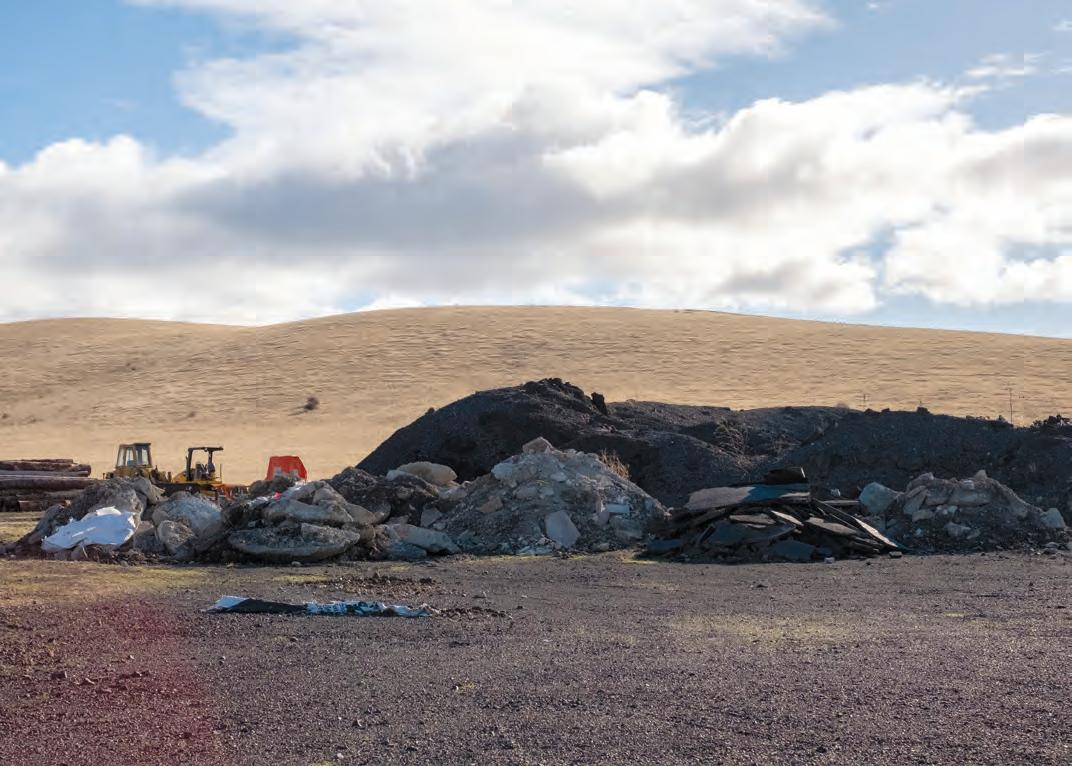
“CTUIR will strengthen its response through culturally relevant prevention, treatment and recovery strategies tailored to the community.”
— CHANDA YATES, CTUIR deputy executive director
narcotic analysis machine and $21,750 for police training on its use. In addition, $25,000 will fund naloxone distribution in the community as part of prevention efforts.
Meanwhile, the Umatilla Tribal Fire Department will receive $110,000 for first responder equipment and protective gear, including ALS monitors, chest compression devices, intubation scopes, Vscan EMS ultrasound equipment, respiratory gear, chemical-resistant gloves, full-body protection and eye protection to support overdose response. Support
services for EMS response, such as peer-to-peer behavioral health groups, will receive $3,625.
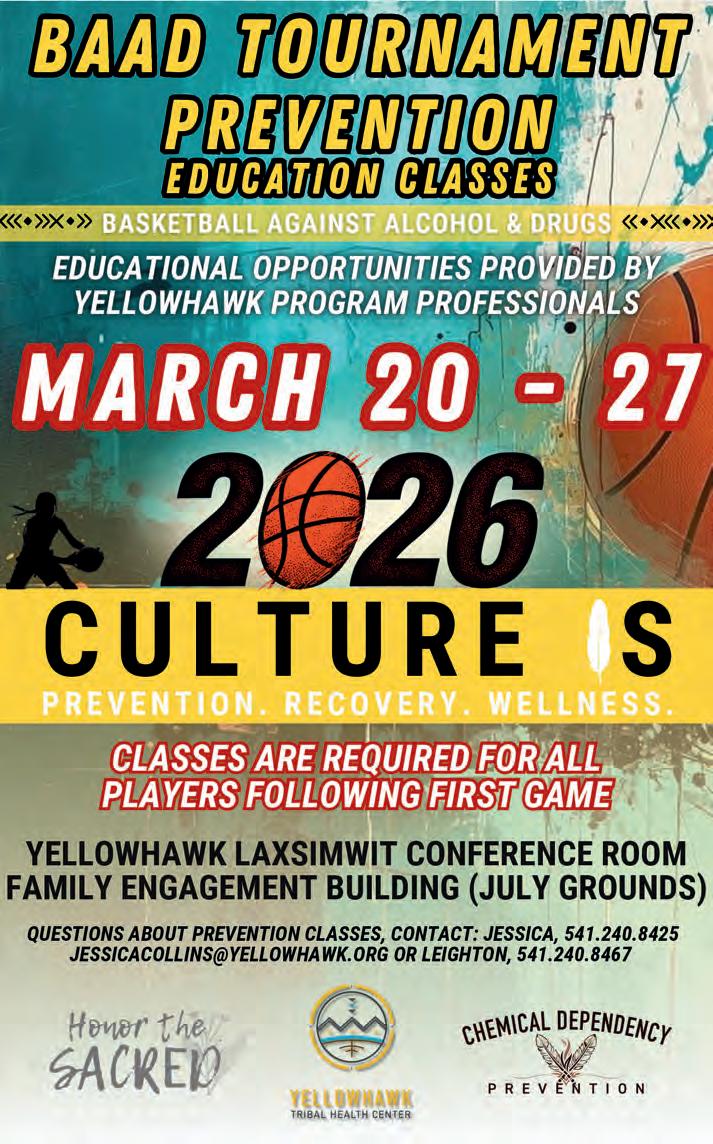
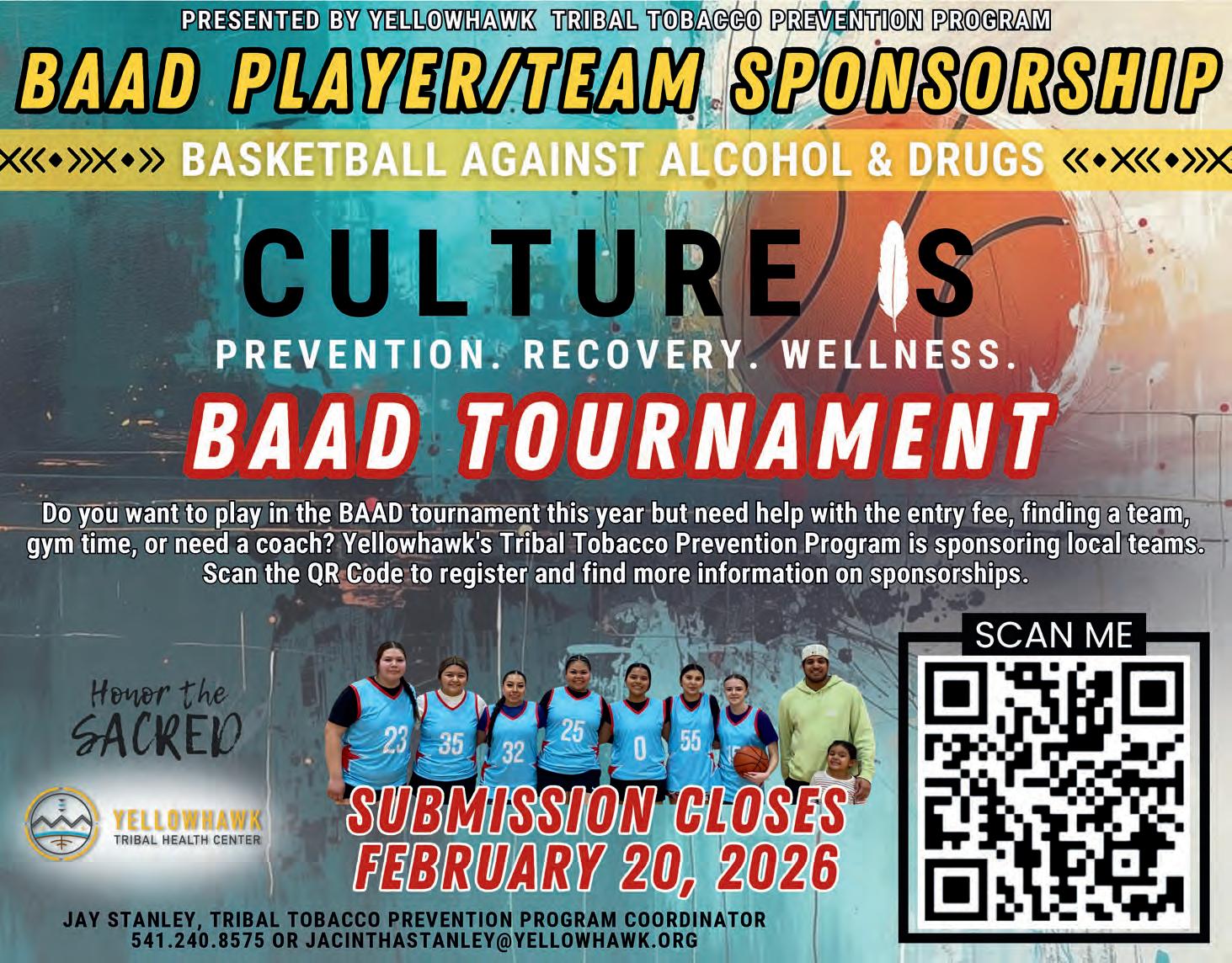
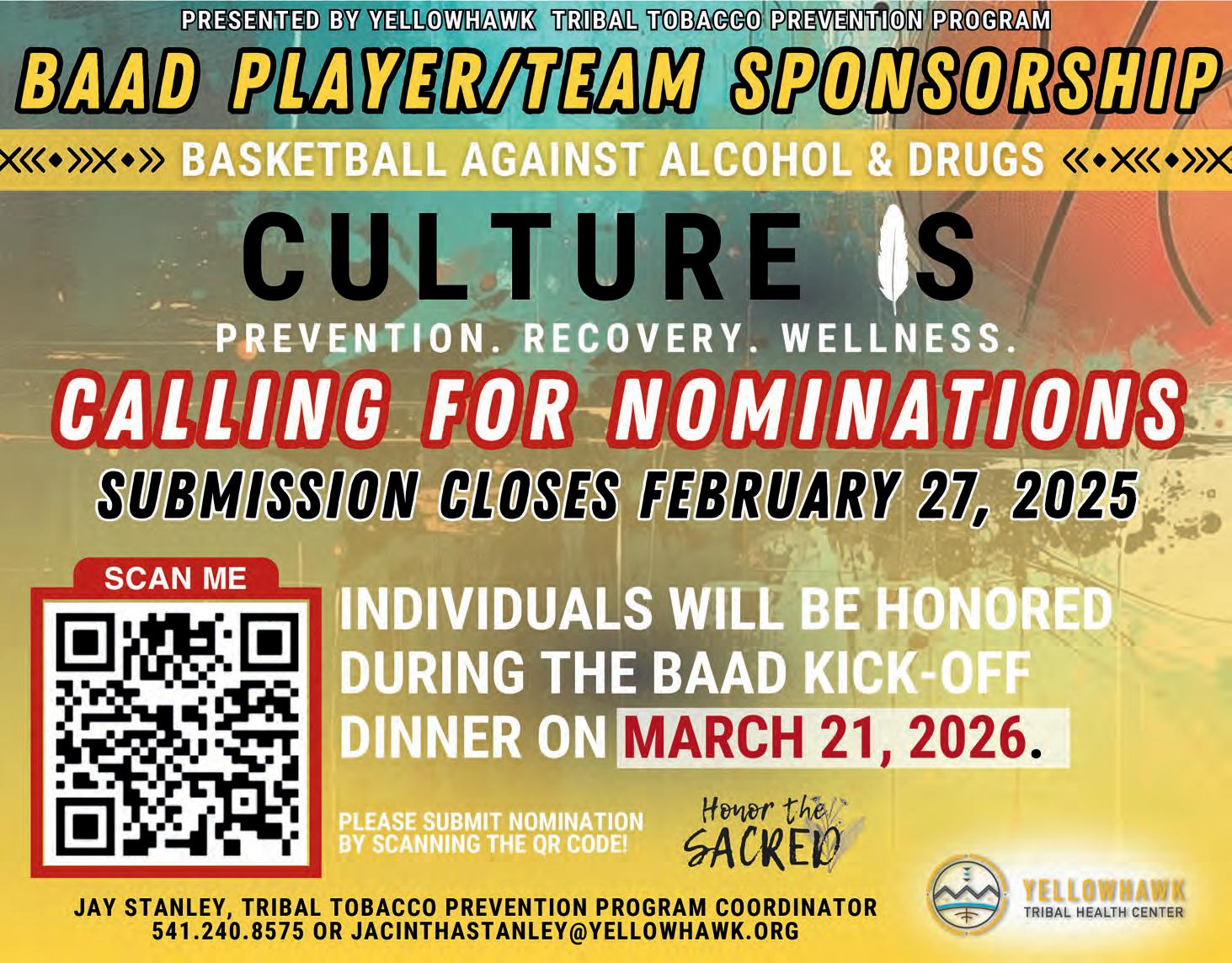
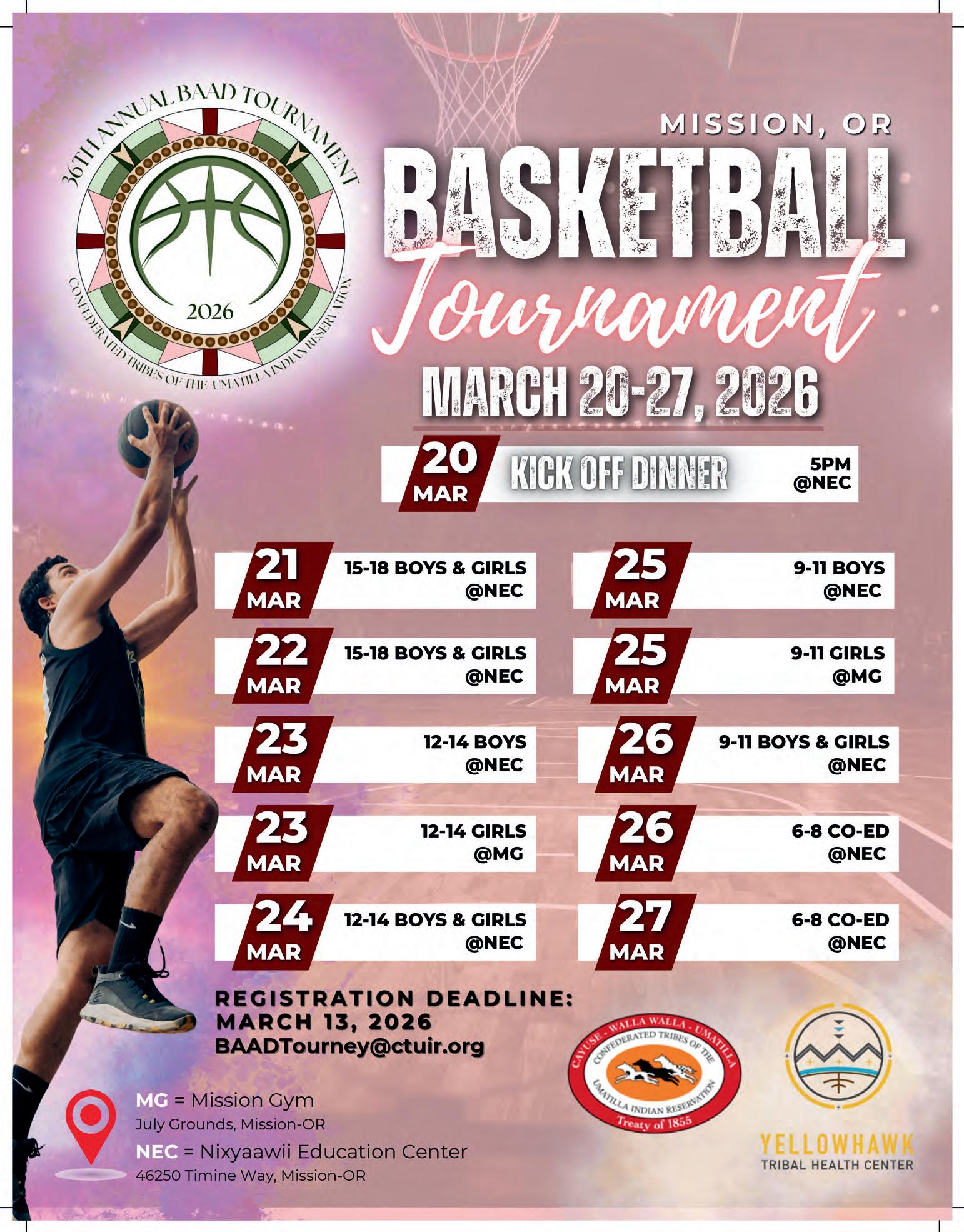
Funding for prevention and community engagement includes $100,000 for events, conferences and media development by the Department of Children and Family Services; $20,000 for the department’s Basketball Against Alcohol and Drugs program; and $60,686 for Hunting for Sobriety, a cultural prevention activity.
Addressing a public health crisis
Chanda Yates, deputy executive director of CTUIR, said the funding addresses a severe public health
Fighting Hunger
PAGES A10-11
crisis. While data show smaller numbers for the CTUIR, the community still experiences the effects of the opioid epidemic, including addiction, overdose deaths and strain on families and health care systems.
“The funds will support evidencebased programs for opioid use disorder, mental health and substance use treatment,” Yates said. She said the funding also enables culturally appropriate solutions, including Tribal Abatement Strategies that incorporate traditional healing practices and community-based approaches.
Yates noted that the funding fills service gaps by supporting behavioral health facilities, naloxone distribution, prevention programs and community engagement initiatives that otherwise might not be funded. Though temporary, she said the
See OPIOIDS, Page A17
Indian
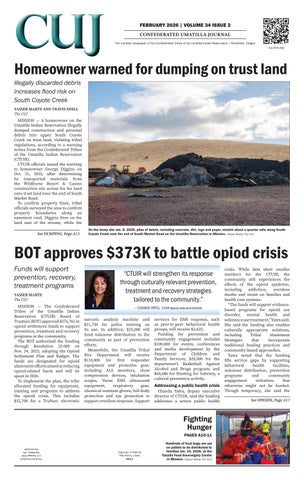
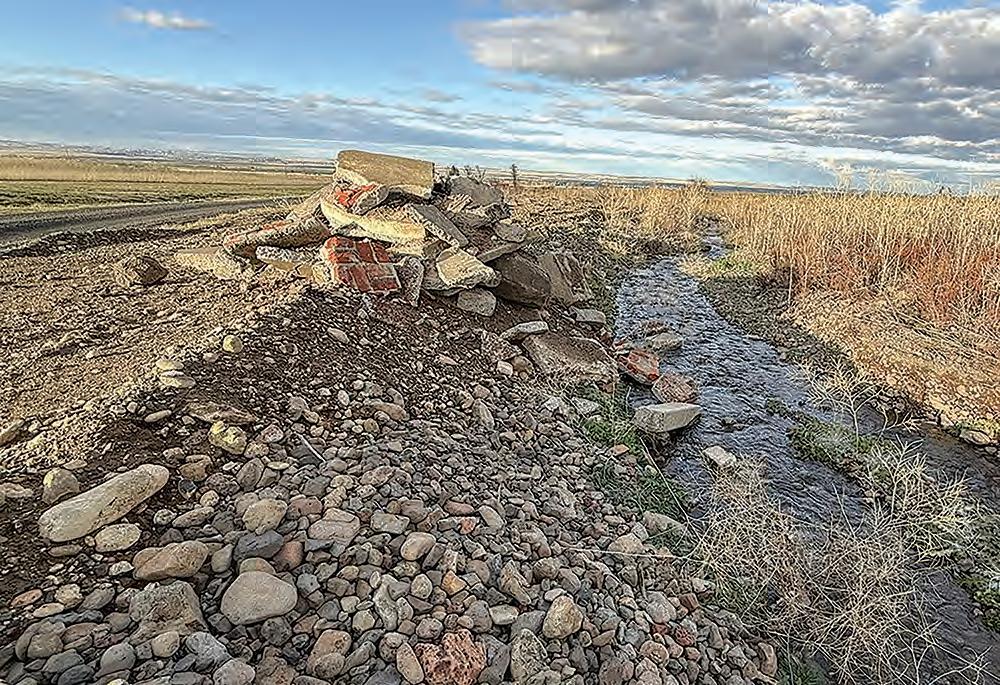
On the dump site Jan. 8, 2026, piles of debris, including concrete, dirt, logs and paper, stretch about a quarter mile along South Coyote Creek near the end of South Market Road on the Umatilla Reservation in Mission. (Yasser Marte/The CUJ)
Smith resigns from Columbia Development Authority
YASSER
MARTE
The CUJ
BOARDMAN — Greg Smith has resigned as executive director of the Columbia Development Authority (CDA).
Smith turned in his letter of resignation during a board meeting on Jan. 27 in Boardman. The resignation took effect immediately.
“My work has become a distraction,” Smith wrote in his letter. “The responsibilities and accountability I have carried for this authority and this board will no longer be my burden.”
The CDA is a partnership of five local governments made up of the Ports of Morrow and Umatilla, the Confederated Tribes of the Umatilla Indian Reservation (CTUIR), and Morrow and Umatilla counties.
These agencies oversee the redevelopment of the former Umatilla Army Depot near Hermiston into an industrial complex. They focus on industrial development, environmental cleanup and regional economic growth.
Smith, who led the CDA since 2015, stepped down after nearly a decade. However, his departure comes amid allegations of ethical corruption and self-dealing.
In December 2025, the Oregon
“My work has become a distraction. The responsibilities and accountability I have carried for this authority and this board will no longer be my burden.”
— GREG SMITH, in his resignation letter to Columbia Development Authority on Jan. 27
Government Ethics Commission concluded that Smith violated state ethics law by using his CDA position to increase his 2023 salary from $129,000 to $230,000 without CDA board approval.
Earlier that year, in March 2025, the U.S. Defense Department cut roughly $300,000 in federal funding for the CDA after finding that Smith’s time cards did not clearly separate his legislative work from his duties as executive director.
Meanwhile, Smith, a Republican representative from Heppner, has held office since 2001 and is running for a 14th term. He represents Umatilla, Morrow, Gilliam, Sherman, Wheeler, Wasco, Jefferson, Marion and Clackamas counties. Smith will face a primary challenger, former Morrow County Commissioner Jim Dorherty.
J.D. Tovey III, executive director of the CTUIR and a CDA board member, said he did not anticipate
Smith’s resignation and only learned of it upon arriving at the meeting.
“My immediate focus was on identifying next steps to ensure organizational continuity,” Tovey said.
He said that maintaining dayto-day operations remains the board’s priority. He also stressed the importance of preserving strong relationships with federal funding partners, while noting that unresolved ethical and financial issues from Smith’s tenure still need to be addressed.
Following the resignation, on Jan. 30, the board unanimously appointed Emily Collins as interim executive director, with an annual salary of $118,800. Collins, who previously served as the authority’s project coordinator, will hold the interim position for up to six months unless the board takes further action.
She will oversee daily operations,
including financial obligations, meeting coordination and administrative functions, while the board considers next steps.
During the same meeting, the board approved an amended motion to settle a long-running legal dispute with Umatilla County.
In July 2024, Umatilla County filed a lawsuit against the CDA, claiming the board had made improper votes on past land allocations and seeking at least $1 million. The lawsuit stemmed from the CDA board’s March 2024 meeting, when representatives from Morrow County and two ports voted to transfer thousands of acres in industrial and exclusive farmuse zones to port control. At that time, Umatilla County and CTUIR opposed the transfer.
The amended motion approved on Jan. 30 overturned the 2024 votes that had allocated CDA land to the CTUIR and the Ports of Morrow and Umatilla, leaving the counties out.
The CDA board voted unanimously to allocate the land among Cleaver Farms, the CTUIR, the Port of Morrow, the Port of Umatilla and Umatilla County.
As a result, Umatilla County will remove the lawsuit notice, allowing the land allocation to move forward.
BOT approves reimbursement for passports, REAL IDs
Initiatives aim to ensure tribal members have secure, up-to-date identification
YASSER MARTE
The CUJ
MISSION — The Confederated Tribes of the Umatilla Indian Reservation (CTUIR) Board of Trustees (BOT) approved a resolution to reimburse Tribal members for passports and REAL ID driver’s licenses.
The BOT met Jan. 26 at the Nixyáawii Governance Center and unanimously approved a policy allowing the CTUIR Enrollment Office to reimburse members for updated identification cards, helping ensure tribal members maintain current identification.
In the weeks leading up to the approval, the board took several steps to expand access to updated identification cards for tribal members.
On Jan. 9, the BOT and the Umatilla Tribal Police Department held a work session to discuss protecting tribal members during potential encounters with U.S. Immigration and Customs Enforcement (ICE), including identification, internal readiness and public messaging. The
meeting was prompted by reports that ICE had declined to recognize tribal IDs, leading the CTUIR to develop a protocol to help members maintain current identification and safely navigate interactions with the agency.
The discussion also renewed focus on the tribal identification project, which the CTUIR started in June 2025, but paused after costs proved too high.
On Jan. 12, after the work session, the board approved a separate resolution allocating $3,000 to provide free tribal ID cards to CTUIR members, which normally costs $5.
Continuing the effort, the BOT held a work session on Jan. 15 to discuss broader strategies for improving tribal members’ access to identification. Toni Minthorn, CTUIR Enrollment director, addressed the BOT, outlining ways members could update their REAL IDs and explaining the BOT’s efforts to make IDs more accessible.
“Last year, we explored creating an enhanced tribal ID card, similar to projects other tribes nationwide have pursued, but it proved to be very expensive,” Minthorn said.
She added that initial estimates suggested it
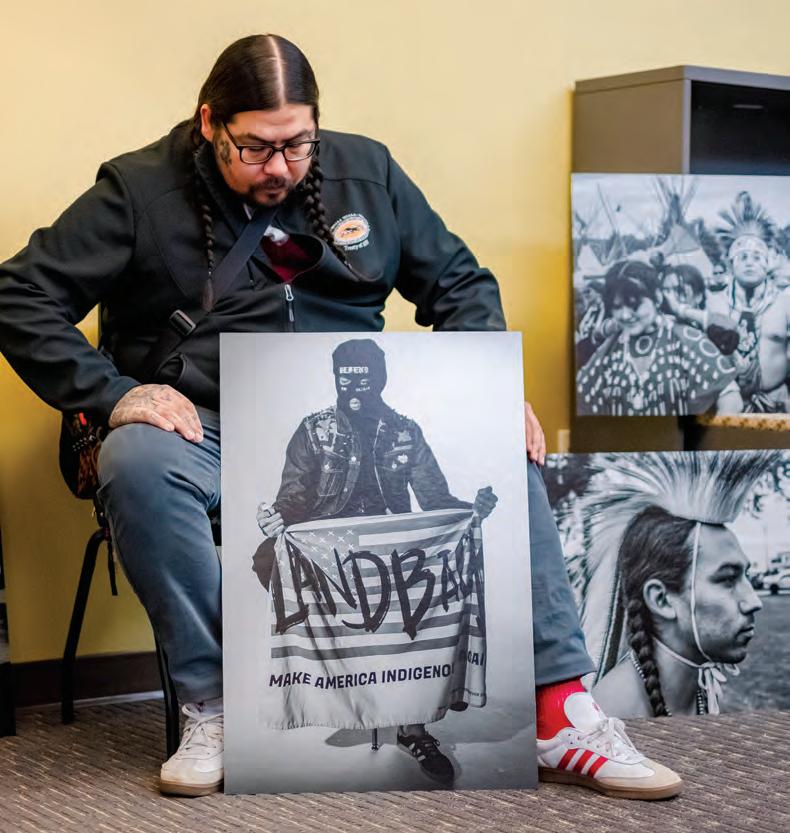
A photo by Kathy Aney published in the December edition of
ABOUT THE CUJ
The Confederated Umatilla Journal (CUJ) was created in 1975 as the official publication of the Confederated Tribes of the Umatilla Indian Reservation (CTUIR), which includes the Cayuse, Umatilla and Walla Walla people. The CUJ is produced monthly by the CTUIR Communications Department.
CONTACT US Confederated Umatilla Journal 46411 Timíne Way Pendleton, OR 97801 email: cuj@ctuir.org phone : 541-429-7005
EMAIL ADVERTISING, LETTERS TO THE EDITOR, AND OTHER SUBMISSIONS TO: cuj@ctuir.org
ADVERTISING DEADLINE: 20th of the month prior to publication. The CUJ prints on the first Thursday of each month.
would have been cheaper to purchase passports for every traveling member than to implement the enhanced ID project.
“Even after costs were lowered over the years, vendor issues caused expenses to rise, and we ultimately terminated the project,” she said. “In place of that project, the board directed that we reimburse tribal members for state-issued enhanced driver’s licenses or ID cards.”
Free tribal ID updates and reimbursement guidance
In an ongoing effort to support tribal members, the CTUIR is providing free tribal identification cards to any member in need.
According to the CTUIR Enrollment Office, officials issued 342 cards during the last six months of 2025. The tribe has roughly 3,200 enrolled members.
As part of the initiative, enrollment officials will track when a tribal member receives a free ID for three years. Members who need a replacement card within that period must pay for it.
To qualify, an individual must have one parent
See IDENTIFICATION, Page A18
SUBSCRIBE: The CUJ is free to pick up at tribal entities and area businesses. However, a mailed subscription can be purchased for the price of shipping and handling by contacting the CTUIR Finance Department. Call 541-429-7150 or visit the Finance Department in person at Nixyáawii Governance Center, 46411 Timíne Way, Pendleton. One Year: $15 Two Years: $28
For more information or daily news, visit the CUJ online at: cuj.ctuir.org
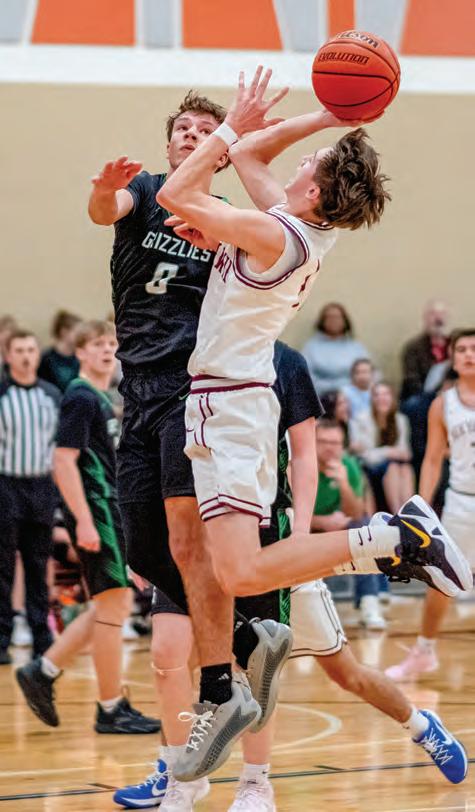
the CUJ on page B9 was missing its cutline. The photo shows WestonMcEwen’s Manaia Wolf throwing the ball to a teammate while playing Kennedy during the 2A Basketball Preview on Dec. 29, 2025, at the Pendleton Convention Center. We regret the omission.
Tribal leaders developing ICE protocols
YASSER MARTE
The CUJ
MISSION — Amid reports that U.S. Immigration and Customs Enforcement (ICE) has detained Native Americans and refused to accept tribal identification, the Confederated Tribes of the Umatilla Indian Reservation (CTUIR) are developing a protocol to help tribal members deal with the federal agency.
The CTUIR Board of Trustees (BOT) and the Umatilla Tribal Police Department (UTPD) met Jan. 9 at the Nixyáawii Governance Center for a work session focused on protecting tribal members during potential interactions with ICE agents by addressing tribal identification, internal readiness and public messaging.
CTUIR Executive Director J.D. Tovey III said the tribe is responding to ongoing questions and concerns about ICE interactions. He said leaders must carefully plan how to address ICE-related rumors without amplifying misinformation.
Rumors of ICE agents being spotted on the reservation, on social media and in nearby Pendleton have raised concern among some tribal members.
“We had a lot of people coming and going, and that stirred rumors throughout the community,” Tovey said.
UTPD Chief Tim Addleman said the department has not encountered ICE agents and has no indication the agency plans to operate on the reservation. He said UTPD works closely with the U.S. Marshals Service, the Bureau of Alcohol, Tobacco, Firearms and Explosives and the FBI. The department has previously communicated with Homeland Security, he noted, but reports of ICE activity on the reservation were misinformation.
“Even though there has been no interaction or communication with ICE, it still doesn’t change the facts of what’s happening in the United States at this time, and people who look like us are being harassed,” Trustee Corinne Sams said. Safety, community trust drive Tribal ID update efforts
Chair Kat Brigham raised concerns about outdated tribal identification cards, noting that some members, including fishermen along the Columbia River, still carry IDs that could be easily damaged. She added that while some members already have current IDs, others may need help obtaining replacements.
Sams proposed providing free tribal IDs to all enrolled members during a six-month window and launching a no-cost outreach program to assist members.
“We might want to allocate some funding so they have the opportunity to come in, get a new ID, and carry it with them,” Sams said.
Tovey raised concerns about possible ICE encounters outside business hours. He noted that the Nixyáawii Governance Center operates from 7:30 a.m. to 4 p.m., Monday through Friday, and questioned whether the tribe needs a 24-hour call line or staff on site if a member is detained.
In addition, Sams emphasized that CTUIR should prepare public messaging and ensure internal readiness, including possibly having a lawyer available or on call. While CTUIR attorneys do not have much immigration law experience, CTUIR attorney Brent Leonhard said the tribe could seek legal help from someone who does.
CTUIR Communications Director Kaeleen McGuire added that the tribe is also working with other jurisdictions to ensure children are safe. She noted that many families are mixed and that one parent could be an immigrant, so all those considerations matter.
“We want to protect our families, our tribal members and all children, whether or not they are enrolled tribal members,” McGuire said.
In the meantime, CTUIR Communications is developing public messaging and outreach strategies while coordinating with the UTPD to establish a dispatch line for any tribal member who encounters ICE.
If approached at work or in public:
• ICE can enter a public workspace without a warrant. Public spaces include a lobby, supermarket, retail store or restaurant dining area.
• ICE cannot legally enter a workplace’s private space unless given permission by the employer or a judicial warrant.
• Do not panic. Ask if you are free to leave. If yes, calmly walk away.
• If you are not free to leave, ask if you are being detained. If being detained, you do not have to answer questions, including those about another person’s identity or whereabouts. If you are being detained, you must show a form of identification.
If approached and you are a minor:
• Minors have the right to remain silent about their immigration status, their parents’ status, where they were born, and their address.
• Say, “I choose to remain silent. I want to speak to a lawyer.”
• Minors are not legally required to carry identification unless operating a vehicle. Carrying a copy of your tribal ID, passport, birth certificate, or legal residency document should be done only if necessary and with safeguards (e.g., in a sealed envelope labeled “Confidential: Legal Documents – Access Only by Guardian”)
• If you and/or your parent are detained, you have the right to be near and in-touch with your parent
If approached at home:
• Do not open the door unless presented a valid judicial warrent signed by a judge. Most ICE warrants are administrative and do not allow ICE to enter your home without permission. A valid judicial warrant: 1. Names a person in your residence and/or what specific areas are to be searched at your residence; and 2. Is signed by a judge (not an immigration judge or ICE officer.)
• Ask ICE to slide the warrant under the door. Do not open the door to receive the warrant.
• If an ICE agent enters your home without permission or a valid judicial warrant, do not resist as that could subject you to criminal charges.
• If ICE searches your home, make it clear you do not consent. You have the right to remain silent or state, “I am exercising my right to remain silent.”
• Do not lie to ICE agents.
• Record the interaction if it is safe to do so, or ask someone else to record it. If you record, do not interfere with the ICE operation.
If you are detained by ICE, stay calm.
• You have the right to remain silent and to consult with a lawyer. You can state: “I wish to remain silent and ask for a lawyer.”
• Since you are a United States citizen, say: “I am a United States citizen” and ask why you are being detained.
• If you are being detained, you must show a form of identification. Use your non-expired state-issued ID or tribal ID to show your United States citizenship. If an ICE agent refuses to accept your tribal ID, request to speak to the agent’s supervisor.
• Do not say or sign anything or make any decisions without a lawyer.
• Once detained, you have the right to make phone calls to family, friends, or a lawyer, depending on specific detention facility rules.
What to do when you are released:
• Write down what happened to you, or ask someone else to write it for you. Include names and badge numbers of ICE agents, and anything that was said or done.
• Discuss your encounter with an attorney. Native Americans who believe ICE have violated their rights may call the Native American Rights Fund at 303-447-9760.
CTUIR MEMBERS CAN REQUEST FREE TRIBAL ID CARDS
The CTUIR Board of Trustees on January 12, 2026, approved funds to cover the cost of tribal ID cards with a limit of one ID per person every three years, regardless of age or location.
IF YOU NEED A TRIBAL ID, VISIT THE CTUIR ENROLLMENT OFFICE AT 46411 TIMÍNE WAY, CALL 541-429-7035 OR EMAIL ENROLLMENT@CTUIR.ORG
The CTUIR is also strengthening internal readiness, improving after-hours coordination with enrollment staff and providing faster assistance to members while protecting tribal citizenship and collective rights.
“We always try to be ready for something, even if we don’t know exactly what we’re preparing for,” Trustee Toby Patrick said. “We can go home, talk to our families and let them know where we stand as a community, not just as a tribe. In the end, it all means the same thing because we as a community and a tribe are standing together, and that should mean something.”
ICE quota and detainment data
CTUIR planning comes as ICE ramps up nationwide enforcement, raising concerns for Native Americans and immigrant communities.
On the same day of the CTUIR work session, CBS News reported, ICE detained four members of the Oglala Sioux Tribe in Minneapolis. Three
were transferred to an ICE facility at Fort Snelling, ABC News reported.
In another incident, The CUJ reported in Jan. 2026, actress Elaine Miles, a member of the CTUIR, was stopped by ICE officers on Nov. 3 while walking to a bus stop in Redmond, Washington. Although federal agencies are required to recognize tribal identification because of the nation-to-nation relationship between federally recognized tribes and the United States, Miles said the officers demanded another form of identification. She said she handed over her passport before the officers accepted her identification and allowed her to leave.
On May 30, 2025, The Associated Press reported that White House deputy chief of staff Stephen Miller told Fox News the administration was aiming for 3,000 daily ICE arrests, a target he said could rise further.
LETTERS TO THE EDITOR
Listening, learning, and working together
I’m now about two months into serving as chair of the CTUIR Board of Trustees (BOT), and it’s been a busy start. A lot of my time has been spent catching up, listening and learning about what’s happening across our departments and programs.
One thing that’s really stood out is how important it is that we talk to each other and work together. For the BOT to make good decisions, we need clear and coordinated information. That means departments communicating with one another and remembering that none of us can do this work alone.
Our elders have always reminded us that everything is connected, and I keep coming back to that teaching. Water is a good example. Among other things, water is tied to our culture, our diet and health, our economy, our history and our future. When our 1855 Treaty is respected and protected, it doesn’t just help CTUIR — it helps everyone who depends on this land and these waters. That’s something we’ll continue to stand firm on.
We’re also working on improving communication in some practical ways. The BOT has asked that resolutions and letters coming forward be clear and well-prepared. That helps keep things moving and makes sure everyone understands what’s being asked and why. At
the end of the day, we all want the same thing: to serve CTUIR members and take care of our reservation.
In February, some of us on the BOT will be heading to the Affiliated Tribes of Northwest Indians (ATNI) convention in Portland. It’s always a good opportunity to hear what other tribes are dealing with, learn what’s coming at the federal and state level and bring that information back home. Not everything we hear will benefit CTUIR, but we must stay informed.
There are also a few specific updates I want to share.
Because of what we’ve read about and heard about U.S. Immigration and Customs Enforcement (ICE), we are urging tribal members to update their IDs. Replacements will be free for the next six months. We sure hope we won’t need to show tribal ID to ICE agents, but we want to be prepared just in case.
We’ve also started conversations to learn more about small-reactor nuclear power. We haven’t said yes, and we haven’t said no. Right now, we’re just learning and asking questions. Late last year, the BOT put out a letter that took no position on nuclear power. We’ve decided to at least remain engaged in the process, so we know what’s going on.
Another big step forward is veteran and elder housing. This is something our community has needed for a long time — years, even decades — and work will be starting soon. Taking care of our elders and veterans is something we all agree on, and I’m glad to see movement here.
Finally, as an individual - I’m not speaking for the BOT - I want to lend my support to the Two Cultures, One Community Powwow. TCOC is about building better understanding and communication with the Pendleton community, and it does that in the best way possible — through culture, music, dance and gathering together. The third-annual powwow is Feb. 27, 28 and March 1 at the Pendleton Convention Center. This role means a lot of engagement with each other here at CTUIR and, when needed, with people and governments outside the tribe whose decisions can affect us. If we stay connected, keep talking and remember that everything is linked, we’ll be in a better place moving forward. If you have questions or just want to reach out, you can contact me at katbrigham@ctuir.org or
‘Open Mic’ returns to General Council regular
‘ee’ysni’n heetewit leeheyn oykalo (Happy Valentine’s Day, everyone) from your General Council. Prayers this month towards heightened compassion, care and love shown for one another in our small tribal community. Every one of us holds a basic human need for affection from others, and for our concerns to be heard.
To that end, “Open Mic” has returned to the General Council regular meeting agenda. This is an unrestricted time for members to share their experiences, knowledge, and concerns about any topic for the good of the people. All concerns brought up before the Council, including past and future motions, will be acted upon. I thank Board members and the executive director
I hope this message finds you all well, and your new year is starting off right. I am finding my footing as I navigate my new role as the Board of Trustees secretary, and I wanted to reach out to share more about myself and express my enthusiasm for serving in this role for our Tribal government, our community and our people.
(and staff) beforehand, for their due diligence to bring closure to any outstanding community matter, with the hope that it leads to realignment towards togetherness, not divisiveness. And thank you General Council members, for your courage to share your concerns. Our primary goal is to provide all attendees a safe, learning environment. And of course, carry your voice on.
During our January meeting, General Council members individually listed Five Top Priorities they felt should be immediately addressed and considered at the
MONICA PARADISE Secretary, CTUIR Board of Trustees
For starters, I come from the Pond family. My grandfather is Ronald “Rooney” Pond, my grandma Anna Jane “Jainey” Wilkinson Pond, and my father is Clifford “Punky” Pond. My grandparents instilled in me their love for this community, our people and the land, as well as our promise. They always reminded me of our “laws” of life, our Tamánwit.
I’ve overcome many hardships and faced barriers, as many of our people have, but it has inspired me to learn all I can so that I can give back to the community and our people.
meeting agenda
BOT retreat. There were no real surprises or additions to our collective list, as most have already been identified in the past. Once ranked and summarized, the General Council will share the final retreat report (our “marching orders,” if you will). Also, a shoutout to Althea HuestiesWolf, who provided the annual Yellowhawk update, and is completing her final term as chair of the Health Commission.
At our February meeting, the CTUIR (draft) Energy Strategy will be discussed. And over the course of several meetings, we will altogether brainstorm elements of
I believe that when one of our own wins, we all win. I was inspired by my grandfather, Rooney, to pursue my education and utilize it to understand policies, procedures, and operations. I earned my master’s degree in legal studies- Federal Indian Law, which primarily involves understanding and exercising our autonomy and inherent rights. I wanted to put my education to use and, instead of only learning about policy, implement policy grounded in our traditions, knowledge, culture, history, innovation and advancing technology. I am honored to pick up the torch from past leaders and carry it as we plan for our future generations, including the grandchildren’s grandchildren and children we may never meet or know, but who are always at the forefront of our minds.
I look forward to the next couple of years and to learning more about the efforts underway to advance our tribes, economy and wellness.
a General Council Communications Plan to guide current and future interactions with the entire membership, whether living on or off the rez.
In closing, know that each of your perspectives is valuable, and that your involvement and feedback is critical to ensuring we create procedures, which will provide for meaningful timely engagement on any topic needing discussion amongst us.
This is your forum, and your officers will ensure to facilitate your concerns to the best of our abilities. Please let us know how we’re doing and how we can improve as representatives of your voice. Emails are welcome at GeneralCouncil@ctuir.org.
Support the TCOC Powwow
PAT BEARD AND FRED HILL SR.
Co-Chairs, Two Cultures, One Community Powwow
We are seeking sponsorship support for the Nápt Tananáwit, Láxs Níšayčt (Two Cultures, One Community) Powwow, scheduled for February 27 to March 2, 2026, at the Pendleton Convention Center.
The TCOC Powwow is a volunteer-organized event that brings our community together to celebrate culture, strengthen relationships and promote unity. In its inaugural year in 2024, the powwow welcomed more than 12,000 attendees, including dancers from across the United States and Canada and the renowned host drum, Northern Cree.
To ensure the continued success of this event, we rely on the support of businesses, organizations and individuals who understand the value of investing in community. Sponsorships help make this gathering possible and demonstrate a commitment to the people and partnerships that sustain our region.
Supporting TCOC is more than a financial contribution; it is an investment in community connection. We invite local leaders, businesses, and organizations to join us in making the 2026 Two Cultures, One Community Powwow a success for everyone involved.
LINDSEY X. WATCHMAN Chair, CTUIR General Council
KAT BRIGHAM Chair, CTUIR Board of Trustees
Marte takes the helm as new CUJ editor
THE CUJ
MISSION – Former East Oregonian reporter Yasser Marte recently took over the reins of The Confederated Umatilla Journal as its new editor.
Marte was hired in December and began Jan. 2. Marte’s background includes a three-year stint at the East Oregonian, starting as regional photojournalist before transitioning to the reporter position. Before that he was at South Florida Media Network in Miami, interning for a year. He also served at The Corsair, the college newspaper in Santa Monica College in California as reporter and social media editor before becoming a managing editor.
As editor, he said he plans to continue covering the news of the Confederated Tribes of the
Umatilla Indian Reservation (CTUIR) as well as trying to cover more stories about the Umatilla Indian Reservation (UIR) community and its residents.
“Obviously, the CUJ has to cover what happens at the Nixyáawii Governance Center and what the Board of Trustees is doing,” Marte said. “However, I would like to get more stories about the community and the people who live there in the paper and online. Not only is the sports coverage the CUJ has taken on since local media quit covering sports important, but I believe there are other news-worthy stories in the community. Just have to get out and find them.”
Marte said that task will be easier to achieve once a full-time reporter is hired. The CUJ has been without a staff reporter since this past summer.
Along with more UIR news, Marte said he’s looking to revamp the look of the CUJ website
and social media platforms. That includes adding more videos.
“I want to give the website and social media a more modern look and be more active with Instagram. Not only do I want them to be user friendly but also pleasing to the eyes,” he said. “I would like to also start incorporating more videos as time goes by. I know that there’s a growing audience for videos.”
Prior to Marte, CTUIR Public Relations Specialist Travis Snell served as interim editor following the resignation of former CUJ Editor Daneli Atilano on Nov. 1. Atilano served three months as editor.
“I’m hoping to stabilize the position since the resignation of the last full-time editor,” Marte said. “I plan to continue to make the CUJ a publication where community members are able to amplify their voices and share their experiences.”
Kayak tightens belt amid Kotek’s transportation plan
Current level of service will continue for now
YASSER MARTE
The CUJ MISSION — As Gov. Tina Kotek urges lawmakers to act quickly to stabilize Oregon’s transportation system, Kayak Public Transit is watching closely to see how proposed funding changes could affect service in Eastern Oregon.
At the Oregon Transportation Forum on Jan. 7, Kotek outlined a three-part plan she described as “redirect, repeal and rebuild” to shore up the Oregon Department of Transportation (ODOT), which faces a projected $242 million budget shortfall.
She urged lawmakers to redirect existing transportation funds toward essential operations and maintenance during the February legislative session. She said emergency action is needed to prevent layoffs, preserve core services and reduce vulnerability to severe weather and infrastructure failures.
Kotek also called for repealing House Bill 3991, a transportation funding package passed during a 2025 special legislative session. Key revenue provisions of the law are currently frozen after opponents successfully referred them to the November ballot. Kotek said leaving the law in place forces ODOT to absorb new costs without additional funding, prolonging uncertainty for the agency and local communities.
“These decisions won’t be easy,” she said. “There will be tradeoffs and consequences. But giving up is not an option.”
The Statewide Transit Tax is among the provisions affected by the referral. HB 3991 included an increase to the employee-paid transit tax from 0.1% to 0.2%, but that increase is now on hold pending the statewide vote.
Until voters decide, employers are required to continue withholding the tax at the current 0.1% rate. While the bill was intended to provide emergency funding for roads, bridges and transit
“These decisions won’t be easy. There will be tradeoffs and consequences. But giving up is not an option.”
— OREGON GOV. TINA KOTEK
while strengthening ODOT’s finances, the delay of its fee and tax increases has added to the uncertainty surrounding Oregon’s transportation funding system.
Local transit agency keeps a close eye
Kayak Public Transit, which serves Pendleton, Hermiston, Boardman, Pilot Rock, Milton-Freewater and Walla Walla, is monitoring long-term funding conditions as uncertainty continues at the state level.
Kayak, operated by the Confederated Tribes of the Umatilla Indian Reservation (CTUIR), receives major funding from the ODOT's Statewide Transportation Improvement Fund. It also draws support from the Washington State
Department of Transportation, the Federal Transit Administration, CTUIR general funds and other local sources.
Eric Smith, general manager of Kayak Public Transit, said grants approved for July 1, 2025, will provide stable funding for the next two years.
“If our funding can stay at this level when it’s time to apply again, we’ll be in good shape,” Smith said. “But even now, we’re operating on a very tight budget.”
Smith said staffing and hiring have not been affected, though the agency is tightening its belt.
Kayak is also monitoring the Statewide Transit Tax as voters consider changes tied to House Bill 3991, though it remains unclear how
the outcome could affect transit funding, Smith said.
Smith warned that potential funding reductions could have significant impacts on local commuters, particularly seniors, people with disabilities and students who rely on the service.
Kayak operates multiple daily routes connecting communities throughout Eastern Oregon, and ridership increased more than 20% last year, reaching 88,970 riders, up from just over 73,000 in 2024.
“We run service four times a day from this area,” Smith said. “If funding were cut, that might drop to twice a day. That’s a big deal. People rely on this to get to medical appointments, work and school.”
For now, Smith said Kayak plans to maintain its current level of service. “My message right now is that we’re still going to deliver the same dependable service that people have come to rely on from Kayak, and that’s our anticipation going forward,” he said.
Gov. Tina Kotek rides in one of Kayak Transit’s two electrical vehicles during her visit to the Umatilla Indian Reservation in April 2024. Kayak Public Transit has provided free public transportation for the northeast Oregon region to and from the UIR, Umatilla, Union, and Morrow counties in Oregon and Walla Walla County in Washington State. (CUJ file photo)
YASSER MARTE
New tip in case yields no results; Jones still missing
THE CUJ
MISSION – Umatilla Tribal Police Department (UTPD) officials said they recently received a tip in the case of missing Confederated Tribes of the Umatilla Indian Reservation (CTUIR) member Wesley Dixon Jones, but that it failed to yield results.
On Jan. 29, UTPD Det. William Morris said he received a lead about the 71-year-old Jones, who went missing Oct. 5, but that it didn’t lead to any results. Morris did not go into details about the nature of the lead because of the investigation.
As for now, the case remains open, but Morris said in January that if no new leads develop, then investigators would eventually determine if they should classify it as a cold case. A cold case is an unsolved investigation that remains open but is not active pending the discovery of new information.
“An open investigation and an active investigation are not exactly the same thing,” Morris said. “I can’t say the investigation is closed because we haven’t discovered the truth, so it’s open but functionally inactive.”
That’s why he still encourages the public to bring forth any new leads to the UTPD. Anyone with information can call the UTPD at 541-2780550.
Jones was last seen along East Short Mile Road on the Umatilla Indian Reservation in a gray 2003 Ford Escape with Oregon license plate SM15454. When the vehicle returned west on the same road, Jones was no longer visible in it. The driver’s identity hasn’t been disclosed because of the investigation.
He is described as a 5-feet, 8-inch-tall Native American weighing approximately 140 pounds with long black hair and brown eyes. Jones was last seen wearing a black and red TigerScot
jacket, black shirt, black sweatpants and boots.
Since Oct. 6, the UTPD has conducted searches with the Umatilla County Sheriff’s Office Search & Rescue, aerial drone searches over parts of the Umatilla River and searches on foot. Other areas included in the investigation are between Cayuse and Bingham roads, as well as Short Mile Road to Cayuse Road, including River Road.
From Oct. 31 to Nov. 2, the MMIW Search & Hope Alliance used sonar at deeper spots in the Umatilla River. That search also included an area east of Sampson Lane and Short Mile Road along the railroad right-of-way, as well as upriver
around the Cayuse community.
On Nov. 18, the UTPD, with the help of CTUIR’s Geographic Information Systems, conducted an aerial drone search in three previously unsearched locations. Citing the investigation, Morris did not specify the locations, other than that they were farther away from the Umatilla River.
On Dec. 3, a five-member FBI dive team searched Johnley Pond near Cayuse with boats using specialized equipment, including an underwater drone. However, the search yielded no results.
Be part of the intertribal work to protect salmon and treaty fishing rights!
WESLEY JONES
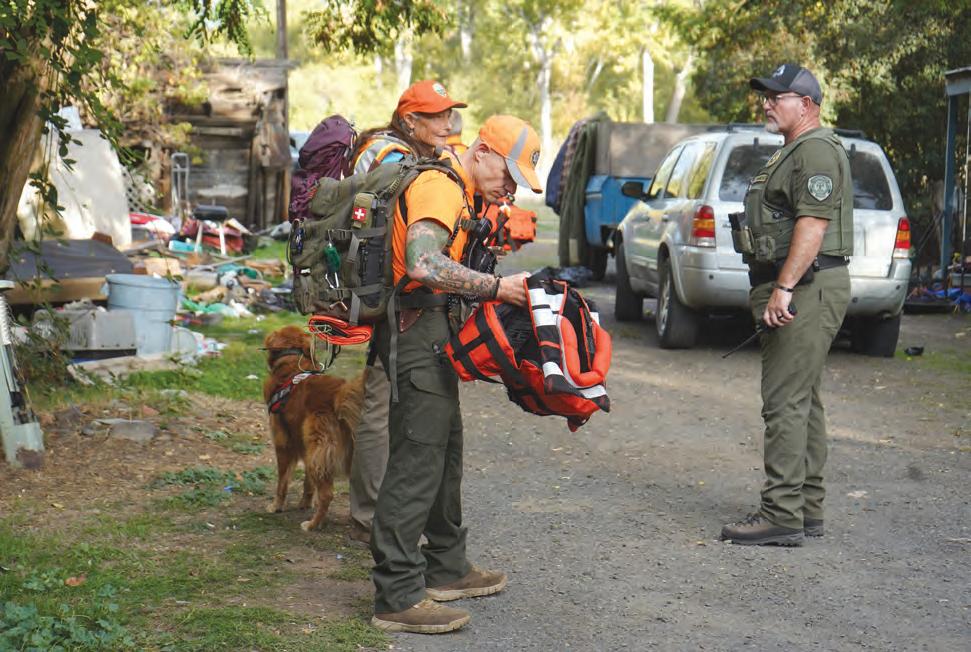
Officers from the Umatilla County Sheriff’s Office and Umatilla Tribal Police, joined by three search dogs, coordinate a search for missing Wesley Dixon Jones on Oct. 8, 2025, at his Parr Lane home in Mission. (Lee Gavin/CUJ file photo)
Woman gets one year for embezzling $100K from Spokane Tribe
Colvin continued to fraudulently transfer funds to her personal account even after being fired
THE CUJ
SPOKANE, WASH. — A former employee of the Spokane Tribe of Indians was sentenced to one year and a day in prison for embezzling more than $100,000 from a tribal program serving children in foster care, according to the Department of Justice (DOJ).
U.S. District Judge Rebecca Pennell sentenced Tawhnee Willow Colvin, of Davenport, Washington, on Jan. 21, after a jury convicted her on 26 counts of bank fraud and embezzlement from a tribal organization. The jury returned its verdict following a trial in September 2025.
The federal judge also ordered Colvin to serve five years of supervised release and to pay $100,830 in restitution to the Spokane Tribe of Indians.
Colvin had worked as an assistant director of the Spokane Tribe of Indians’ Department of Health and Human Services and its Division of
Child and Family Services.
According to the DOJ, Colvin had access to a Spokane Tribe of Indians bank account that held per capita funds for children in the tribe’s temporary custody. From October 2019 through November 2023, she made more than 70 fraudulent transfers from the account to her personal bank account, starting with small amounts and later moving thousands of dollars at a time. The transfers totaled more than $50,000, and she also withdrew more than $50,000 in cash from the same account.
The tribe fired Colvin on Oct. 23, 2023. Prosecutors said she continued to fraudulently transfer funds to her personal account even after her termination, according to the DOJ.
“In an egregious breach of trust, Ms. Colvin exploited her position as assistant director of the Spokane Tribe of Indians’ Division of Child and Family Services to steal thousands of dollars from vulnerable children over several years,”
First Assistant U.S. Attorney Pete Serrano said. “She brazenly continued her crimes even after the tribe terminated her employment. Sadly,
it remains unknown how many children were harmed.”
Serrano credited the FBI for investigating the case and thanked the Spokane Tribe of Indians, along with prosecutors and staff in the U.S. attorney’s office, for their cooperation in bringing the case to justice.
During the sentencing hearing, Judge Pennell noted that the evidence of Colvin’s guilt was overwhelming and showed that instead of using the money for the benefit of children in foster care, Colvin took it for herself.
“For years, Ms. Colvin abused the trust placed in her as a public servant by stealing tribal funds intended to care for children in foster care,” W. Mike Herrington, special agent in charge of the FBI’s Seattle field office, said. “She stole more than $100,000 for her own personal gain, nearly draining the account. Each of the dozens of transfers diverted resources away from the most vulnerable members of our society.”
Herrington said the FBI remains committed to holding accountable those who misuse funds entrusted to their care.
Most CTUIR members won’t receive 1099 tax forms this year
THE CUJ
MISSION – Most enrolled members of the Confederated Tribes of the Umatilla Indian Reservation (CTUIR) will not receive the U.S. tax form 1099 for tax year 2025, CTUIR officials said.
CTUIR Finance Department officials said the majority of tribal members who received 1099 tax forms in the past will not receive one this year because the quarterly General Welfare payments are tax exempt and will not be reported on the 1099 form.
In October 2023, the Board of Trustees (BOT) moved from
the previous Gaming Revenue Allocation Plan (GRAP) in favor of a general welfare distribution model. The new model made the quarterly payments tax-exempt, so more money was available to tribal members to pay for living expenses.
CTUIR officials made the change after the IRS changed rules to allow such payments to be made tax free as long as tribal members pledged they were using the funds to pay for common expenses such as food, housing and utilities. But only about half of the tribal members returned the one-page form that was required
to ensure they wouldn’t face any tax penalties.
However, in talks with federal tax officials, CTUIR leaders learned that the IRS would likely allow tribal governments to issue declarations on behalf of their entire tribal membership that payments were being used for allowable expenses.
So in February 2025, the BOT adopted a resolution that rescinded the documentation requirement that was instituted after the CTUIR
changed the GRAP by reclassifying payments as untaxed General Welfare payments.
Prior to the resolution, tribal members who failed to return required paperwork regarding the GRAP payments would have been required to pay taxes on the quarterly disbursements. The resolution came after tribal officials learned that the federal government was likely to disregard individual certification mandates.
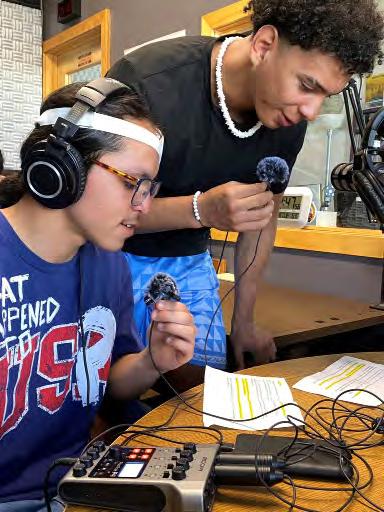
CTUIR Communications, University of Montana teaming up to host teen journalism workshop
Participants will learn skills to make audio stories that can be aired on KCUW
THE CUJ
MISSION – The Confederated Tribes of the Umatilla Indian Reservation (CTUIR) Communications Department is partnering with the University of Montana School of Journalism to host a workshop for all area teens, March 24-27, on the Umatilla Indian Reservation.
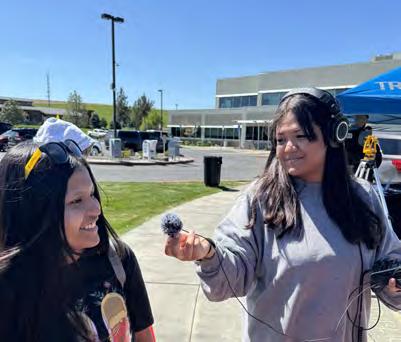
Mary Auld, director of the Montana Media Lab at the University of Montana School of Journalism, said the Youth Voices Spring Program is a radio reporting training for youth to learn the needed skills to create audio stories that can be aired on KCUW 104.1 FM, the CTUIR’s radio station.
“Students will spend four days learning from CTUIR community members and University of Montana journalists,” Auld said. “They will be out in the community reporting, with microphones and notebooks, to find and document stories they think are important.”
The Montana Media Lab has facilitated audio journalism training for youth in Indigenous communities for several years, Auld said. According to its website, Montana Media Lab has worked with high schools in Lodge Grass, Ronan, Box Elder, Missoula and other Montana communities.
Spring Program
MARCH 24-27
ON THE AIR YOUTH VOICES
Communications survey, the KCUW radio station still resonates strongly with elders and other members, ensuring accessibility for those less inclined to use digital tools. However, the department is aiming to update the station’s facility and equipment as well as attract younger listeners by providing youthoriented segments and podcasts.
The radio station is looking for volunteers, along with people interested in reporting for radio and podcasts, McGuire said.
The workshop is for teens ages 13-19 and will be taught by Auld and several University of Montana School of Journalism instructors. Local media leaders and CTUIR Communications staff will also support the teens’ work.
“Students will learn about journalism and how to report stories they think are important to the community,” Auld said. “They’ll also learn skills that will allow them to excel at interviewing, editing and narrating audio stories for the radio. Along the way, they’ll learn life skills including research, teamwork, project management, writing, digital editing and communication.”
Auld said the idea for CTUIR Communications to co-host a workshop came from its director, Kaeleen McGuire, wanting to include more youth voices on KCUW.
“This is the beginning of what I hope are several opportunities to come to empower area youth with
training, and a platform to share their perspectives,” McGuire said. “It’s also very important to remind everyone in the power of radio and what KCUW 104.1 means to our area.”
According to a 2024 CTUIR
The training runs from 9 a.m. to 3 p.m. March 24-26 and from 9 a.m. to 1 p.m. on March 27. That day, the workshop culminates with a community celebration where family and friends are invited to listen to the students’ stories. Snacks and lunch will be provided on all days.
Enrollment is limited to 20 students. To apply, email mary@ montanamedialab.com or communications@ctuir.org.
A homecoming for Upper Columbia River salmon
PAUL MOLYNEAUX
National Fisherman
In early September 2025, for the first time in over 80 years, members of the Syilx Okanagan, Secwépemc, and Ktunaxa Nations saw salmon returning to the upper reaches of the Columbia River in British Columbia.
While only two sockeye salmon that had been released as fry in the upper Columbia River in 2023 returned to Canada as adults, it marked the first step in what the tribes hope will be the restoration of viable salmon to their ancestral spawning grounds.
The Bringing the Salmon Home initiative, launched in partnership with the governments of British Columbia and Canada, is part of an international effort to bring fish back to over 1,000 miles of their former spawning grounds above the Chief Joseph and Grand Coulee dams.
On the U.S. side, the Upper Columbia United Tribes (UCUT) and the Northwest Power and Conservation Council finalized a plan, “Fish Passage and Reintroduction into the U.S. and Canadian Upper Columbia Basin,” aimed at long-term restoration of Chinook and Sockeye runs above the dams.
The first phase of the plan
investigated whether the habitat and food resources above the dams were sufficient for returning salmon. The investigation, completed in 2019, found the Upper Columbia could support the production of 76,000 adult Sockeye salmon and 44,000 adult summer/fall Chinook.
The second phase, Phase 2 of the Implementation Plan (P2IP), relies on trapping and transporting returning adults and also introducing hatchery fish to the Columbia. The bulk of the $200 million budget for P2IP will go towards getting fish past the dams.
According to the UCUT, the
organization and its member tribes secured over $15 million for full implementation of the decadeslong plan. Funding sources include the U.S. Congress, U.S. Bureau of Reclamation, NOAA’s Pacific Coastal Salmon Recovery Fund, the taxpayers of Washington State (through the state budget), the departments of the State of Washington, and others.
According to the UCUT literature, the long-term goals are to establish access to sources of non-ESA Chinook and Sockeye donor stocks and develop interim hatchery facilities to produce fish for
feasibility studies. Gather data on key metrics specific to fish behavior and survival in the blocked area. Develop and test upstream and downstream interim fish passage facilities while maintaining current operations at blocked area hydropower facilities. Provide the data necessary for full-scale reintroduction and permanent fish passage. “As the program grows, we expect the number of adults and juveniles to increase into the thousands of adult salmon and hundreds of thousands of juvenile salmon,” says the UCUT.
The project gained support from the Biden Administration and benefited from an agreement that the administration made with the Lower Columbia Tribes in 2023. But in June 2025, President Trump revoked the 2023 Biden memorandum, “Restoring Healthy and Abundant Salmon, Steelhead, and Other Native Fish Populations in the Columbia River Basin”.
While the Columbia saw increased returns in 2025, Yakama Nation Tribal Council Chair Gerald Lewis said in a statement. “This termination will severely disrupt vital fisheries restoration efforts.”
(This article has been reprinted with permission from National Fisherman.)
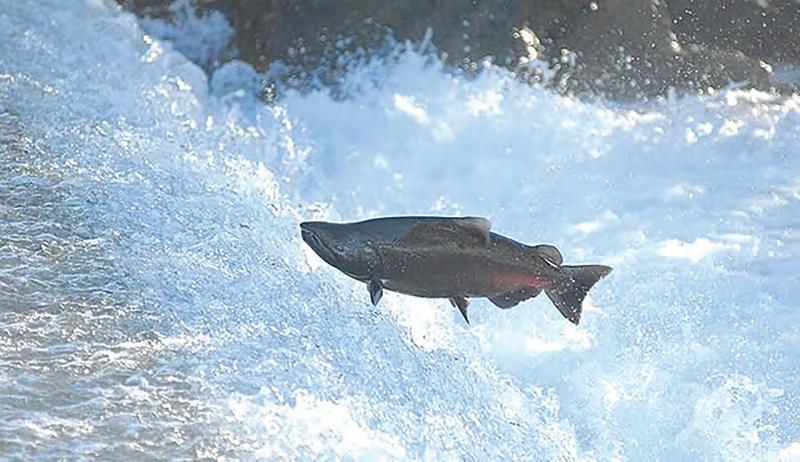
Sockeye salmon are completing a journey unseen for generations, reaching the upper Columbia River in British Columbia and signaling renewal for the Syilx Okanagan, Secwépemc and Ktunaxa Nations. (National Fisherman/Contributed Photo)
Volunteers help feed families on the Umatilla Reservation
YASSER MARTE
The CUJ
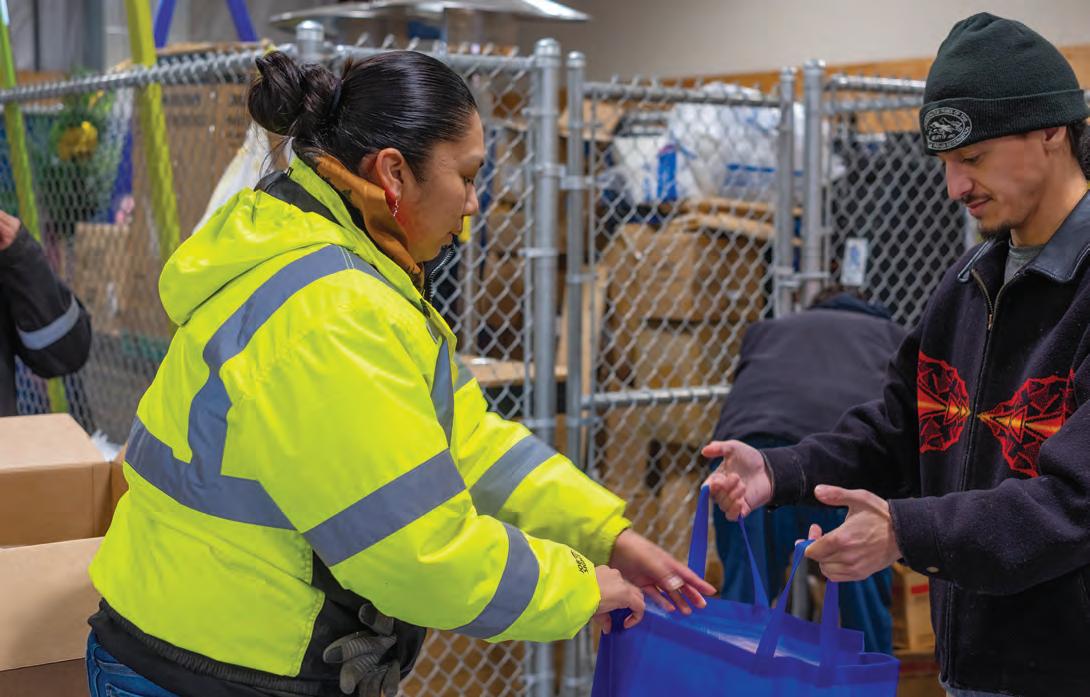
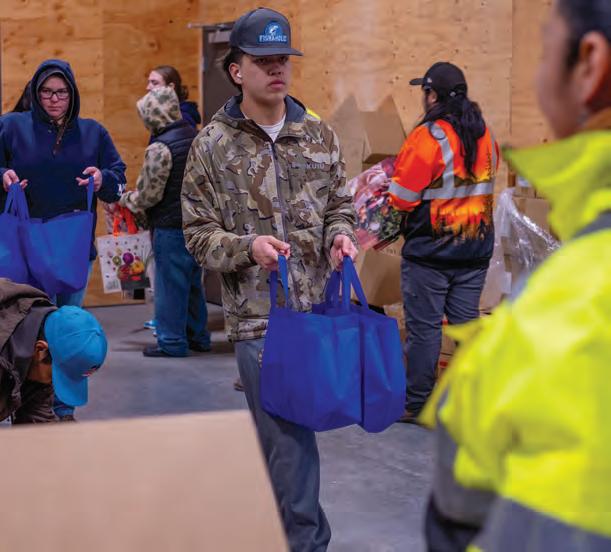
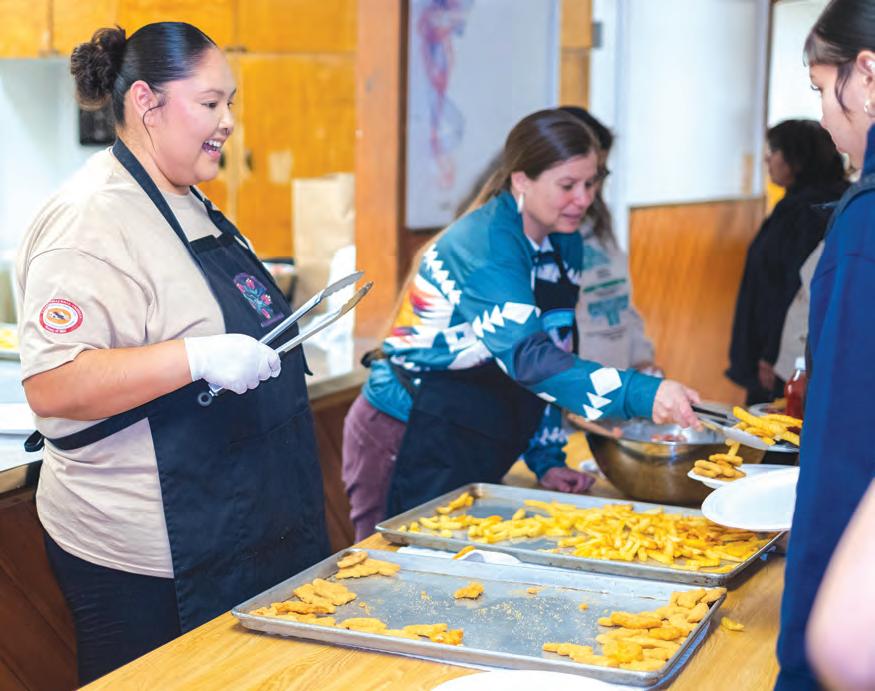
MISSION — Cold weather did not slow volunteers at the Tutuilla Food Sovereignty Center, where they packed hundreds of bags of fresh food, bringing comfort and nourishment to families across the Umatilla Reservation.
Nearly 20 volunteers gathered Jan. 15 to support the Confederated Tribes of the Umatilla Indian Reservation’s (CTUIR) Food Distribution Program, which provides fresh produce, canned and dried goods, frozen fruits, vegetables and meat to lowerincome families.
In addition, the program works to ensure consistent access to healthy food for those in need.
Supporting these efforts, the U.S. Department of Agriculture’s (USDA) Food Distribution Program on Indian Reservations (FDPIR) is part of the Indigenous Food Sovereignty Initiative, which promotes traditional foodways, supports tribal food markets and advances Indigenous health.
Through this partnership, the CTUIR program is able to reach more families and offer a wider variety of foods. The program is open to all residents of the Umatilla Indian Reservation who meet financial eligibility requirements.
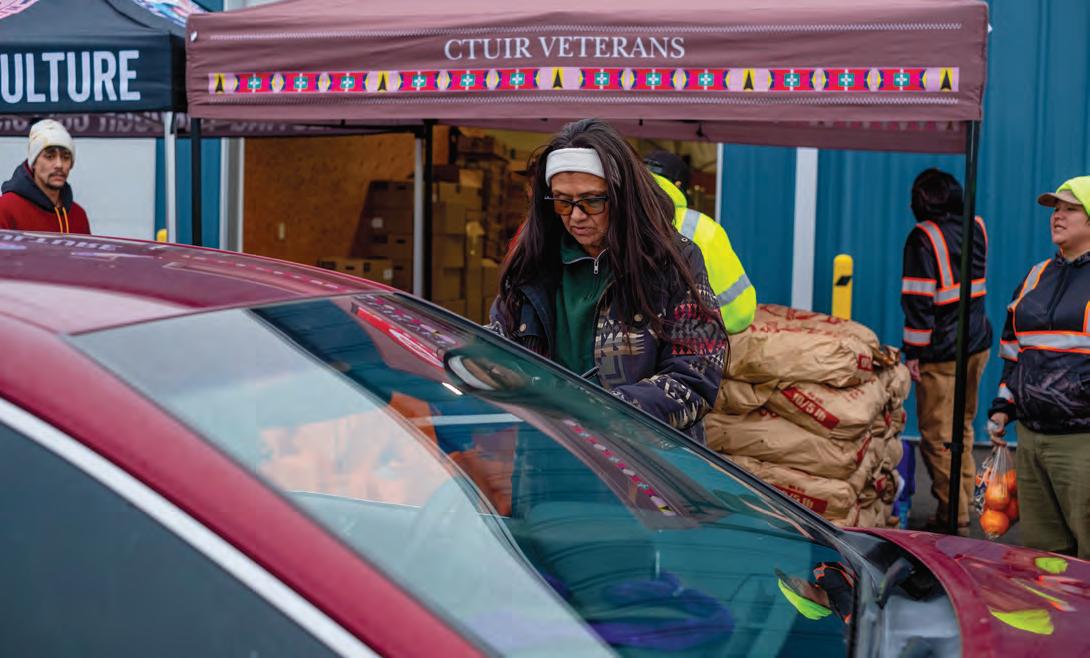
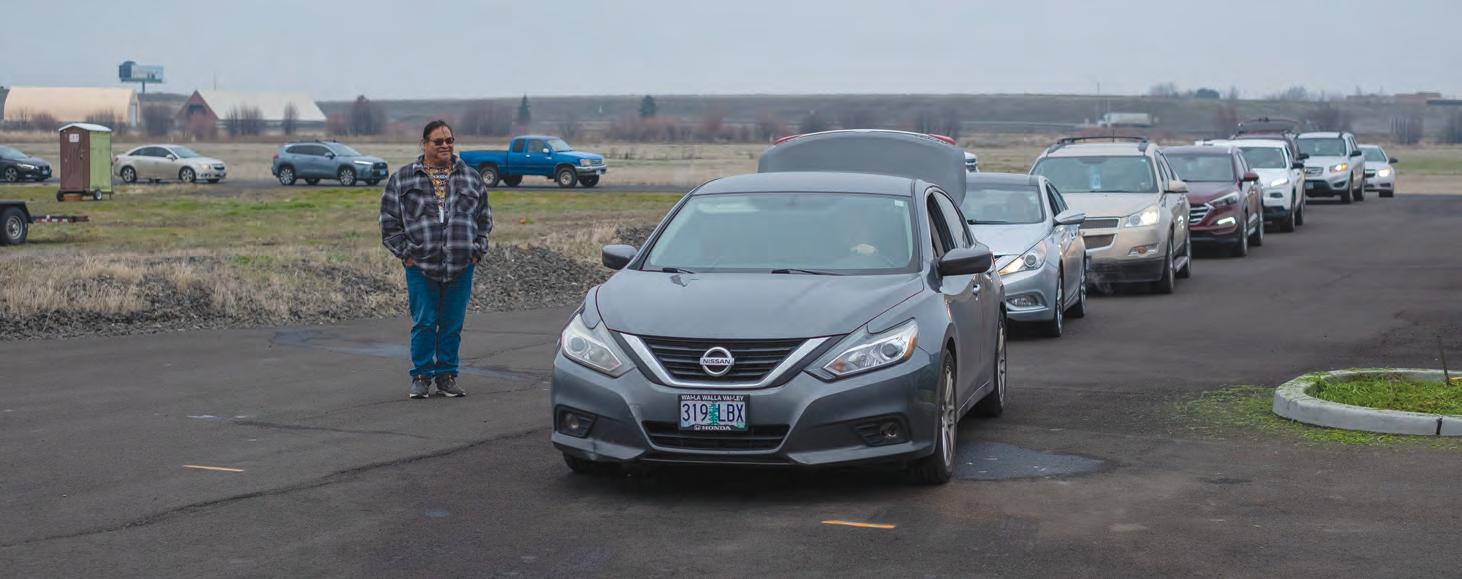
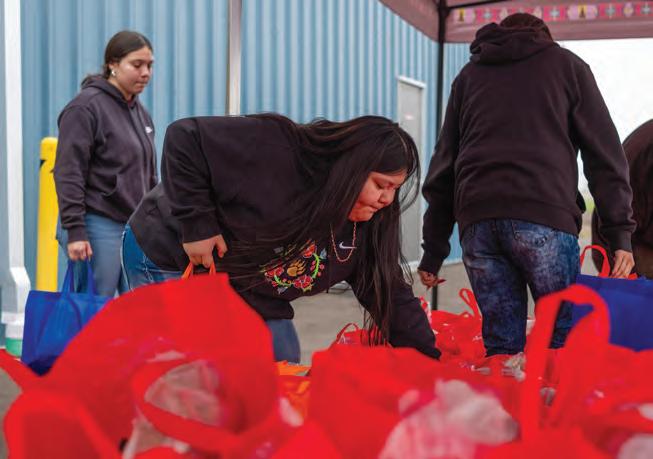
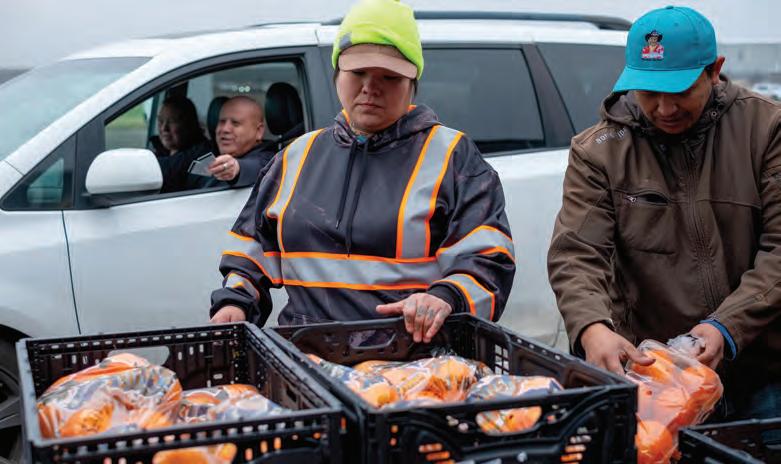
To help the distributions run smoothly, students from Nixyáawii Community School joined volunteers from the CTUIR Workforce Development and BOLSTER (Building Opportunities for Learning and Skills Training for Employment Readiness) program to pack and distribute bags of food. The volunteer team stocked the warehouse with bread, potatoes, oranges, meat and other essentials, then packed hundreds of reusable bags for pickup. Outside, cars stretched down the street as families
waited while volunteers stacked bags on pallets and organized boxes of produce for each household.
Liana Stewart, 17, a senior at Nixyáawii Community School, said she enjoys helping the community while earning service hours.
“I like how we’re able to help the community and get food back to people who obviously need it,” she said. “I want to go to college to help people. I’m undecided on exactly what I want to do, but I want to give back to my community. I think it’s important to help people because everyone needs help.”
Lawanda Bronson, manager of the Food Distribution Program for the CTUIR, said the program has reached hundreds of families, with car lines of 300 to 400 vehicles on some distribution days. In addition, the program serves members
“I like how we’re able to help the community and get food back to people who obviously need it.”
— LIANA STEWART, senior at Nixyáawii Community School
of federally recognized tribes, including surrounding tribes such as Warm Springs, Yakama and Idaho.
Through Yellowhawk Tribal Health Center’s elders program, Community Health Representatives collect large quantities of food — typically 20 to 40 bags at a time — and deliver them to elders who cannot pick up a bag themselves.
Bronson said the program recently awarded contracts to Hines Meat for ground beef and roasts, while local producers in
Long Creek, Hermiston, Elgin and Pendleton provide fresh produce.
As a result, the program now offers a wider variety of seasonal foods than ever, including squash, asparagus, carrots, melons and apples, along with canned goods and frozen juice. Previously, it focused on cheese, milk and canned meats such as tuna, chicken and beef.
As the day grew windier and sprinkles of rain fell, volunteers waved cars in, and families drove up to pick up their winter food. For both volunteers and recipients, the work reflects a simple goal: making sure no one in the community goes without food.
Volunteer Shawn Simpson said the community faces both new and ongoing challenges. He added that it was encouraging to see the high school students helping out. Simpson said it was a “great turnaround,” adding that at 33 years old, he found it inspiring to see the next generation get involved.
The next distribution events are planned for Feb. 26 and March 12, though Julie Taylor, director of the Department of Children and Family Services for the CTUIR, said the schedule might change.
Community members who qualify can pick up their orders at the Tutuilla Food Sovereignty Center, 46678 Tokti Road in Mission, during hours announced by the Food Distribution Program. For more information, call 541-429-7322 or email lawandabronson@ctuir.org.
Nichelle Begaym, left, a volunteer and member of the BOLSTER program, and Bill Weyekin, right, place loaves of bread into food bags for families Jan. 15, 2026, at the Tutuilla Food Sovereignty Center in Mission.
Lawanda Bronson, manager of the Food Distribution Program for the CTUIR, checks on families arriving at the food drive.
BY YASSER MARTE
LEFT: Shawn Simpson, 33, distributes food bags to families. Simpson represents CTUIR Workforce Development and the BOLSTER program.
At the Tutuilla Food Sovereignty Center in Mission, Michael Ray Johnson, CTUIR General Council vice chair, helps greet drivers arriving at the food drive.
Breezy Appenay, 17, a senior at Nixyáawii Community School, places food bags for distribution.
Carissa Close, left, and Chezray Frank, right, grab bags of oranges to give to families alongside food bags.
PHOTOS
RIGHT: Bryson Boyd, 18, a senior at Nixyáawii Community School, prepares food bags for families.
Empower your voice
Making the effort to vote alleviates future effort, struggle
The Hard-fought Native American Voting Rights Act is 102 years old. Use it. “The first people on this land should not be the last to vote,” said Jacqueline De León of Isleta Pueblo, a senior staff attorney at the Native American Rights Fund.
What is the point of voting when many states, including both Washington and Oregon, where the Confederated Tribes of the Umatilla Indian Reservation (CTUIR) traditional territory lies, seem to be locked in politically?
STERLING COSPER CTUIR Legislative Affairs Manager
As the CTUIR’s Legislative Affairs manager, I can tell you, while this is a valid question, there is a lot more nuance to elections where this should not deter voting, especially recently.
I can assure you firsthand that your vote matters, particularly in state and local elections. There are ballot measures where you, as a citizen, can directly decide important issues, including how your taxes are spent.
Often overlooked, more so in recent years, the primary elections are important and stand to be fairly contested in many areas. A shift has been happening in both parties for a while, where the center and more hardline segments have had open and candid debates like no other time in modern history.
Internally, they have been splitting even on issues that were previously considered core to their identity. There are also widening rifts regarding how to advocate for the ones they still agree on.
Eventually, this dynamic also stands to potentially change states that aren’t expected to swing in elections. There have been some surprises and close calls in recent elections, and other states have changed a little more slowly over the past two decades.
There is no better time than now to affect not just the issues that matter to you, but the entire political makeup of the country.
Also, don’t forget that your state officials influence the makeup of your electoral votes in federal elections. There are current big redistricting fights in California and Texas and this trend may continue to spread.
This is all while the portion of the Voting Rights Act that prohibits racially discriminatory voting laws and maps is being challenged in the U.S. Supreme Court.
The people you vote for affect how the voting maps are drawn and who serves as judges, all of which affect your very right to vote and be represented as a citizen.
The simple way to put it is, if you don’t use it, you potentially stand to lose it. This is likely followed by many more rights you may take for granted.
Whether you want things to change or not, or are somewhere in between, this is an era where your vote has more impact and is more important than it is has been in the past few decades.
To vote, logically, we also need to be informed, which takes effort as well as mental and emotional fortitude, especially given the current social and political climate.
Take it from me, who does this for a living, the middle way is the best and most sustainable. Live your life and don’t overdo it, but certainly don’t bury your head in the sand. Also, try and set aside time that works best for you to stay current on the issues.
As author George Orwell said, “In our age, there is no such thing as ‘keeping out of politics.’ All issues are political issues...If one is successful in avoiding politics, at some point, the effects of the political decisions they abstained from participating in will reach their front door.”
While I am working on helping to advocate for the CTUIR’s issues, I need your help to have advocates in the halls of power.
In return, I am working with the rest of the CTUIR Department of Communications, our lobbyists and other CTUIR departments to close the loop on internal communication to share more and better-quality information with you as members to help inform and empower your voice.
According to the CTUIR enrollment office, a significant number of offreservation CTUIR members reside in Oregon, Washington, California, Idaho and Oklahoma. However, this list does not include all members, as many live elsewhere across the United States.
Oregon
PRIMARY ELECTION
APRIL 28 - Last day to register to vote or change party affiliation.
MAY 19 - Statewide primary election.
Idaho
PRIMARY ELECTION
MARCH 13 - Deadline to change party affiliation or become unaffiliated before the primary.
APRIL 27 Early voting may begin in counties that choose to offer it.
MAY 8 - Deadline for absentee ballot applications to be received by county clerks.
MAY 15 - In-person absentee and early voting ends.
MAY 19 - Primary Election Day.
Washington
PRIMARY ELECTION
JULY 17 - Start of 18-day voting period through election day. Ballots are mailed out and Accessible Voting Units are available at voting centers.
JULY 27 - Deadline to receive new registrations and voter updates online and by mail for the Primary Election.
AUG. 4 - Primary Elections and deadline for inperson registration and voter updates. Deposit ballots in an official drop box by 8 p.m.
California
PRIMARY ELECTION
MAY 4 - County elections offices begin mailing ballots. Early voting sites open.
MAY 5 - Ballot drop-off locations open.
MAY 18 - Last day to register to vote.
MAY 23 - Vote centers open for early in-person voting in all Voter’s Choice Act counties.
JUNE 2 - Primary Election Day. Vote-by-mail ballots must be postmarked on or before Election Day and received by June 9.
Oklahoma
PRIMARY ELECTION
MAY 22 - Voter registration deadline.
JUNE 1 - Absentee ballot request deadline.
JUNE 11 - 12 (8 a.m.–6 p.m.) and June 13 (8 a.m.–2 p.m.) Early voting.
JUNE 16 - Primary Election Day. Polls are open from 7 a.m. to 7 p.m.
NOV. 3 - General Election Day. Polls are open from 7 a.m. to 7 p.m.
DUMPING: Diggins cooperating with CTUIR to restore site
Continued from Page A1
affected trust land lies to the west.
Under the Bureau of Indian Affairs, fee land is privately owned and subject to state and local law, whereas trust land is held by the federal government for tribal use and governed by tribal and federal regulations.
According to the warning notice, Diggins placed bulk waste and fill on the property without required permits, violating CTUIR land development, environmental health and safety, water and historic preservation codes.
“This unpermitted land use is in violation of CTUIR law, must stop immediately, and requires immediate remedial action,” the notice stated. “If the violation is not corrected within 30 days, or steps toward correction are not being followed, citations will be issued.”
Brian Fullen, an environmental health and safety specialist for CTUIR, said the debris, including asphalt, cinder blocks, bricks, crushed PVC plastic and dirt, filled about three-quarters of a mile of the creek and floodplain.
He added that the dumping has created flood risks and could require a cleanup costing up to $500,000, which would be Diggins’ responsibility to handle the finances.
Meanwhile, Patty Perry, CTUIR Planning director and author of the notice, said Diggins is cooperating with the tribe to restore the site.
“What was done has to be fixed. It’s hard to go back in and remove debris that’s just been piled randomly without any plan.”
— PATTY PERRY, CTUIR planning director
“He is working on arrangements to get a qualified engineer involved with a restoration plan for removing the material and restoring the stream,” Perry said. “He must submit that plan to us within a certain period of time.”
She noted that the tribe extended Diggins’ 30-day notice because he has begun cleanup efforts.
In addition, CTUIR officials have met with Diggins to outline next steps, Fullen added, and he is expected to receive detailed instructions from the tribe’s legal office.
Speaking to the CUJ, Diggins emphasized that the issue is being resolved. “It’s all been taken care of,” he said, before quickly hanging up.
Fullen also sent letters to nearby residents, warning that upstream disturbances could increase flood risk during the wet season.
“Due to the upstream disturbances, there is potential for abnormal and unpredictable water flows throughout the wet season,” the notice stated. “We urge you to exercise caution and be prepared for possible flooding.”
CULTURAL INSTITUTE
FREE FIRST FRIDAY!
FREE admission all day at Tamástslikt Cultural Institute.
February 6, 10am-5pm
FREE admission all day. Dine inside at Kinship Cafe or order take-out. Enjoy Indian Tacos ($13) and Frybread ($6) from 11am-2pm. Shop the Museum Store for up to 50% o winter apparel.
UP TO 50% OFF WINTER APPAREL!
Sale ends February 28
It's going to be cold. Be prepared with warm winter apparel now on sale at up to 50% o ! You'll find jackets, sweatshirts, gloves, sweaters, and more! A variety of sizes and many colorful designs. As a gift or for yourself, now is the time to take advantage of these low prices.
He emphasized that cleanup work must be done by licensed contractors and engineers.
“What was done has to be fixed,” Perry said. “It’s hard to go back in and remove debris that’s just been piled randomly without any plan.”
She added that improper removal could cause additional damage, so restoration work must accompany any cleanup.
In the meantime, CTUIR officials are monitoring downstream risks during high-water season. Fullen said previous flood mitigation work could be undone by the dumped debris, potentially affecting homes, septic systems, and the Umatilla River.
Perry also noted that the creek is prone to rapid flooding, especially near culverts, which can become blocked and send water over roads.
She said there is no estimate for when the cleanup will be complete, as progress depends on the homeowner’s cooperation.
Residents with concerns about flooding were advised to contact CTUIR Environmental Health and Safety at 541-429-7521. In an emergency,
JOIN THE ÍNWAI CIRCLE OF FRIENDS!
If you aren't already a member of our Ínwai Circle of Friends, we invite you to join. There are several options from which to select and include at minimum such benefits as a free regular admission to all exhibits, advance notice of events, store and café specials, 20% discount at Museum Store, 10% discount at Kinship Café, and free regular admissions to our cultural partners: Oregon Historical Society, North American Reciprocal Museum (NARM) Association, and Fort Walla Walla. Select the level of membership that fits your needs, enjoy the benefits, and accept our deepest gratitude for playing a vital role in ensuring the traditions, life ways, and histories of our Tribes.
Simply go to www.tamastslikt.org/membership or stop by the reception desk at Tamástslikt.
Museum Store
Protecting Umatilla Reservation streams
TROY BAKER
CTUIR Water Resources Program Manager
Streams and rivers on the Umatilla Indian Reservation (UIR) are more than just lines on a map. They provide clean water, support fish and wildlife, help protect homes and roads during floods and sustain First Foods that are central to tribal culture and identity. When these waterways are healthy, the entire community benefits.
That’s why riparian areas—streams, nearby banks, floodplains, and the vegetation along the water—are so important. These areas function as a connected system, so when one part is disturbed, the effects can extend far beyond a single property.
Why riparian areas matter
Vegetation along streams keeps waterways healthy. Trees and shrubs provide shade to keep water cool for fish, and their roots stabilize soil to reduce erosion. Floodplains give high waters space to spread safely rather than damaging roads, fields or homes.
When soil, rock, construction debris, or other material is placed too close to a stream, or when vegetation is removed, these natural protections begin to break down. Sediment can cloud the water, temperatures can rise and floodwaters may shift course. Even small, well-intended projects can unintentionally create long-term problems downstream.
What is a stream zone alteration?
A Stream Zone Alteration is any work in or near a stream channel, floodplain, or riparian area that could change water flow, sediment movement, or stream function. This includes grading, placing rock or construction fill, removing vegetation, or working directly in the stream.
Because these areas are sensitive and closely connected, the Tribal Water Code requires a Stream Zone Alteration Permit before work begins.
Why are permits required
Permits are not meant to stop projects. It ensures work near streams is done safely and responsibly. When a Stream Zone Alteration Permit application is submitted, technical staff review the proposed work to identify potential risks and suggest ways to avoid unintended impacts.
In many cases, this early review saves time and money by preventing problems before they occur. Over the past year, the Water Resources Program has seen several cases where work proceeded without a permit. Often, this happened because people did not realize a permit was needed or underestimated how sensitive stream areas can be.
Correcting unpermitted work usually takes far more time and effort than doing it correctly from the start. Removing misplaced materials, repairing streambanks and restoring vegetation can take months or even years. These efforts are not about punishment. They are about protecting shared waters that affect everyone upstream and downstream.
Streams do not follow property lines
Streams do not stop at fences or property boundaries. What happens along one stretch of a creek can influence water quality, flooding and habitat far away. That is why the Tribal Water Code applies to everyone working on the UIR. Protecting streams is a shared responsibility.
If you are considering work near a stream, floodplain, or riparian area, the best first step is to contact the Department of Natural Resources Water Resources Program. Early conversations can help determine whether a permit is needed, reduce delays, and ensure projects move forward without unintended consequences.
For questions about Stream Zone Alteration Permits, contact Water Code Administrator Devan Noblit with the Water Resources Program at 541-276-3165. Staff are available to provide guidance and help protect the Reservation’s waters for future generations.
A pile of broken concrete lies near a stream along Upper South Coyote Creek near South End Market Road in Mission on Jan. 9, 2026, an example of an unpermitted stream-zone alteration. (Troy Baker/Contributed Photo)
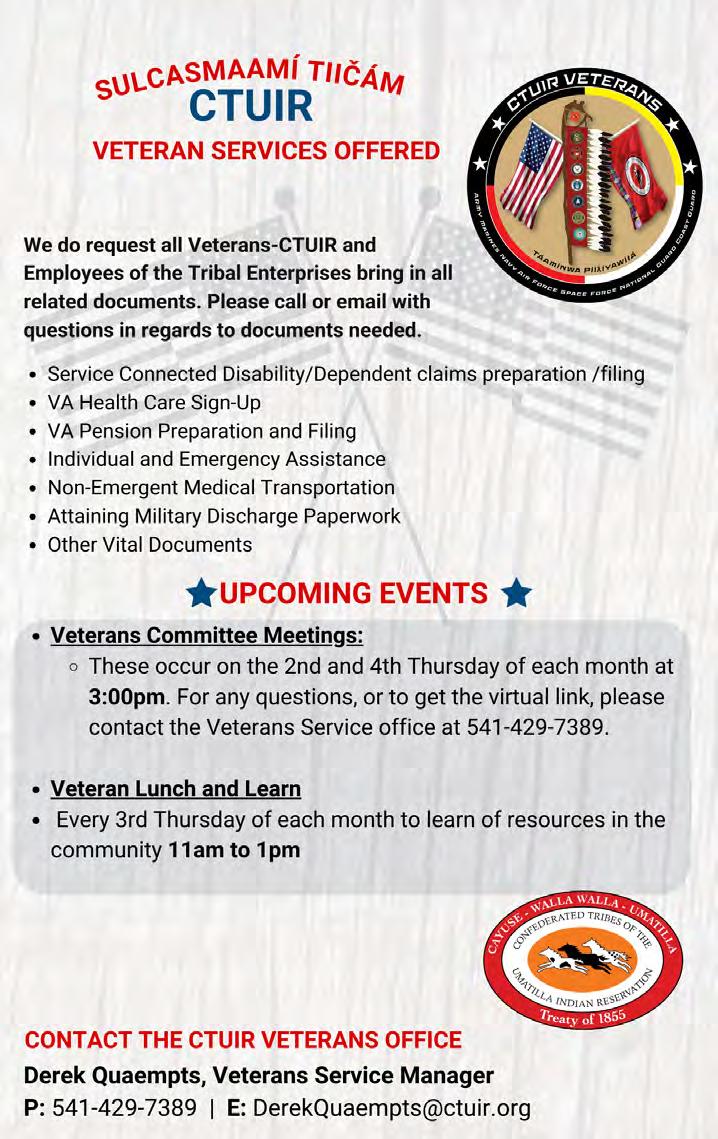
CTUIR veterans logo, flag established as
DEREK QUAEMPTS
Veterans Service Program Manager
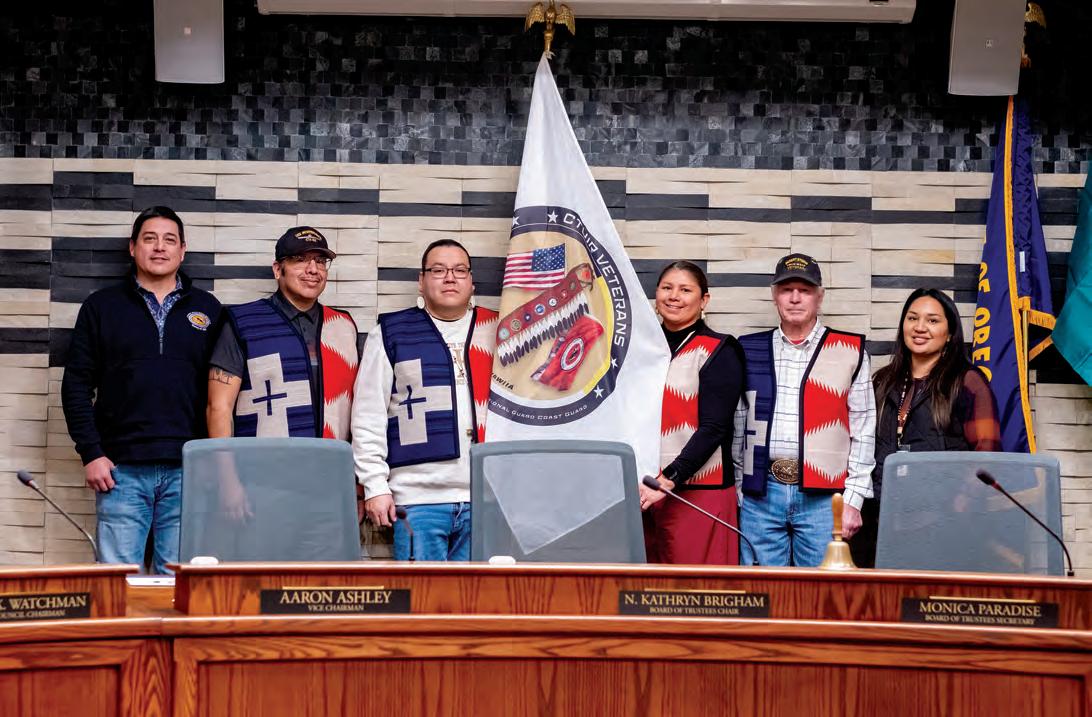
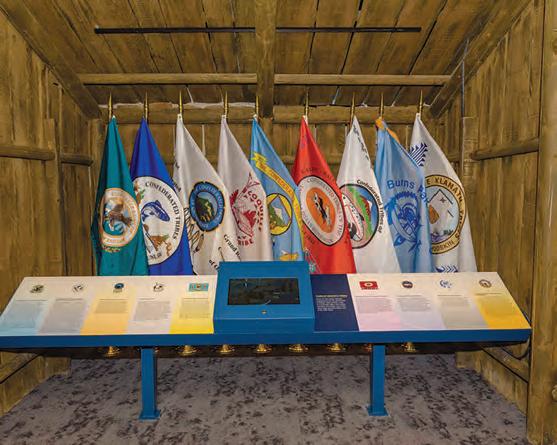
The CTUIR veterans logo and flag now displayed in the Nixyáawii Governance Center Board Chambers symbolize more than design — they honor service, sacrifice and the ongoing presence of Tribal veterans in the life of the Confederated Tribes of the Umatilla Indian Reservation.
The effort to create a unified visual identity for CTUIR veterans began in 2024, led by the CTUIR Veterans Committee and the Veterans Office within Children and Family Services (DCFS). Committee leaders recognized the need for an official emblem to represent veterans across programs, events, publications, and ceremonial functions.
Then, Veterans Committee Chairman Edward “Joe” Lewis coordinated the logo project.
Gabriella Lewis designed the emblem, working closely with the Veterans Office and committee leadership to ensure it reflected both military service and tribal identity. The team produced multiple drafts, including color, background and black-and-white versions for official and practical use.
After committee review and selection, the final design was adopted and later approved under CTUIR Communications and branding guidelines. The emblem began appearing in veterans’ program materials and outreach in early 2025.
Following the logo’s adoption, the committee produced a CTUIR Veterans flag. Members formally requested that it be placed in the Board Chambers alongside other recognized flags during official sessions and events.
The Board of Trustees leadership and administration approved the placement. Committee
members and staff coordinated the acquisition of a matching pole and stand, assembly of the flag, and its final placement.
The committee considered holding a formal posting of the colors with veterans present but prioritized immediate display so the flag could begin representing all CTUIR veterans — past, present, and future.
Today, the CTUIR veterans logo and flag stand as lasting symbols of unity, recognition and respect. They provide a consistent and honorable identifier for veterans’ programs and events and serve as a visible reminder of the contributions Tribal veterans continue to make to both the Tribe and the country.
The CTUIR Veterans and Board of Trustees (BOT) honor the CTUIR veteran logo and flag, displayed Feb. 2, 2026, in the BOT chamber at the Nixyáawii Governance Center. From left: BOT Vice Chairman Aaron Ashley, veteran Clifford Stanger, veteran Derek Quaempts, veteran Ashleigh Wolf, veteran William (Guy Guy) Herrera and BOT Secretary Monica Paradise. (Yasser Marte/The CUJ)
CTUIR celebrates Discover Program participants and mentorship awards
MISSION — The Confederated Tribes of the Umatilla Indian Reservation (CTUIR) celebrated the achievements of tribal employees during the 2025 Discover Program and honored outstanding mentors with the Wapsúx Sápiskʷat “Outstanding Mentorship” Awards.
The 2025 mentorship awards were presented to Teara FarrowFerman, Lorene Broncheau and Catherine Barkley during a Dec. 10 Board of Trustees work session, alongside the participants’ end-ofyear presentations for the Discover Program.
The trio was recognized for their leadership, guidance and dedication to professional development.
The Discover Program, part of the Pamáwaluukt Empower Program, is a year-long training initiative designed to strengthen tribal members’ knowledge of CTUIR government operations while supporting career growth.
Participants rotate through multiple departments, receiving mentorship from directors, managers, and supervisors, and
complete hands-on projects including report writing, presentations and specialized training.
“This program and these awards highlight the importance of investing in our workforce and supporting future leaders,” Broncheau said. “Mentorship and hands-on experience strengthen both the employees and the tribe as a whole.”
The 2025 cohort included Candice Patrick, Program Manager Trainee; David Wolf, Supervisor Trainee; and Richard Orna, Supervisor Trainee. Each completed their final departmental rotations on Dec. 5, culminating a year of professional growth and cross-departmental experience.
During the work session, participants presented lessons learned, leadership skills gained, and insights into tribal operations, demonstrating how the program prepares employees for supervisory and program manager roles.
CTUIR expressed its gratitude to the 2025 Discover Program participants and Wapsúx Sápiskʷat Award recipients for their commitment to leadership, learning and service to the tribal community.
OPIOIDS: OHA report cites sharp rise in overdose death rates among
funds can help build infrastructure and programs that reduce opioid misuse and save lives.
According to the Oregon Health Authority’s 2024 report, “Opioids and the Ongoing Drug Overdose Crisis in Oregon,” overdose death rates among American Indian and Alaska Native Oregonians have risen sharply, climbing from 36.9 per 100,000 in 2020 to 111.7 per 100,000 in 2023 — the highest rate of any racial or ethnic group in the state.
Identifying service gaps
According to the Tribal Opioid Abatement Use Report, CTUIR hosted an opioid workshop on Aug. 12, 2025, with tribal departments and entities to identify unmet needs and service gaps related to opioid prevention, treatment and recovery.
A second workshop held Aug. 25, 2025, focused on identifying the root causes of addiction and overdose, setting goals to reduce opioid-related harm and pinpointing areas and populations most in need of treatment and intervention services. The session also emphasized training, technical assistance and strategies outlined in the tribal opioid abatement plan.
“While current data indicate relatively low levels of opioid misuse in the community, residents have expressed growing concern.”
From the Tribal Opiod Abatement Use Report
approaches” was also identified as a priority.
“Existing services provide a solid foundation, but limitations in staffing, outreach, service hours, and access to care remain,” Yates wrote in the report. “Many programs operate during standard business hours, and recruiting qualified professionals continues to be a challenge, especially in a rural setting. Finally, outreach efforts need to be more proactive and better resourced to engage high-risk populations.”
native Oregonians
Treatment and recovery options
Yates said community members who struggle with opioid addiction can access multiple resources through Yellowhawk Behavioral Health.
Shanna Hamilton, public relations manager for Yellowhawk Tribal Health Center, said Yellowhawk Behavioral Health’s outpatient chemical dependency program provides counseling and group support for community members dealing with addiction.
In addition, when clients need a higher level of care than the program can offer, staff connect them to residential treatment and medicationassisted treatment programs in the Pendleton area. Meanwhile, for those not ready for outpatient treatment, Yellowhawk Behavioral Health employs two chemical dependency prevention coordinators who organize monthly events and activities focused on sober, healthy living.
The report, signed and written by Yates, stated that, “while current data indicate relatively low levels of opioid misuse in the community, residents have expressed growing concern.” It said workshops highlighted needs for “more youth prevention programs, increased family support, and expanded access to harm reduction tools, medication-assisted treatment and mental health services.” Staff training in “traumainformed care and culturally responsive
The report also identified gaps across the full continuum of care, including detox and residential treatment, transitional housing and supportive services such as child care and transportation. It noted a need for improved coordination between departments, consistent messaging and policy changes that reduce barriers to care.
“To address these needs, priorities must be integrated into long-term planning, with attention to sustainable funding and crossdepartment collaboration,” Yates wrote. “CTUIR will strengthen its response through culturally relevant prevention, treatment and recovery strategies tailored to the community.”
The chemical dependency program also includes six peer recovery mentors with lived experience in addiction and recovery. Through their support, the mentors help community members connect to resources, participate in cultural recovery activities such as sweat and Washat and receive assistance with job searches, resumes and other needs.
To further promote harm reduction, Yellowhawk Behavioral Health operates two vending machines on the Umatilla Indian Reservation — at Mission Market and Wildhorse Resort & Casino — that provide free Narcan. In addition, Yellowhawk Behavioral Health offers Narcan directly and provides brief training on how to use it. Continued from Page A1
Every picture tells a story
Photographer Lee Gavin unveils his collection of black-and-white photographs on Feb. 2, 2026, at The CUJ office in Mission. Gavin’s work was featured in the “Indigenous Visions” exhibition, which ran from Nov. 8 to Dec. 21, 2025, at the Anita Building in Astoria. Gavin, an AV support specialist with CTUIR Communications since 2022, has received recognition for his photography. Last year, one of his published photos won second place for Best News Photo in the Professional Division II – Print/Online category. He also earned second place in the division’s Best Multimedia category for a video story about the Pendleton Round-Up and Happy Canyon. (Yasser
IDENTIFICATION:
Any enrolled CTUIR member is eligible for reimbursement
Continued from Page A2
or grandparent who is an enrolled member and possess at least one-fourth degree of Indian blood from any federally recognized tribe in the United States, according to CTUIR enrollment requirements.
Additionally, the CTUIR has implemented a reimbursement program to help members cover fees for tribal, state or federal identification documents.
Minthorn said reimbursement applies only to fees paid after Jan. 26, the policy’s approval date. However, the board made the resolution retroactive to Jan. 1, allowing members who obtained one of the documents between Jan. 1 and Jan. 26 to receive reimbursement.
She added that tribal members are responsible for selecting which document to submit and for completing all application requirements, including passport applications. Members must pay all fees up front and submit receipts to the Enrollment Office for reimbursement.
Under the policy, any enrolled tribal member is eligible for reimbursement for one identification document, regardless of age or location. The CTUIR will cover fees for a passport, a REAL ID card, or a standard driver’s license, including renewal fees submitted before or at expiration. Fees paid for lost or stolen documents or for expedited processing are not eligible.
To apply, members must complete a Request for Reimbursement Form, available at the Enrollment Office or online. Along with the completed form, members must provide the original receipt for fees paid, a printed copy of any electronic receipt and a photocopy of the passport book, passport card, REAL ID card, or driver’s license.
The Enrollment Office will issue reimbursement to the person listed on the receipt, who must be an enrolled tribal member. Once reimbursed for one eligible document, a member is not eligible for another reimbursement until the original document expires.
The initiatives aim to ensure tribal members have secure, up-to-date identification and are prepared to assert their rights during any federal encounter.
Tribal members seeking an update or reimbursement should call the CTUIR Enrollment Office at 541-429-7035 or email enrollment@ctuir.org.
Marte/The CUJ)
Umatilla Enrolled Members: CTUIR will exercise its Option to Purchase the land interests in the estate listed below, pursuant to the CTUIR Inheritance Code. CTUIR’s Option to Purchase is subject to Section 1.05(e) Tribal Member Right to Purchase.
CTUIR Inheritance Code Section 1.05(E) – Tribal Member Right to Purchase:
Eligibility Requirements: Any member of the Confederated Tribes owning an interest in trust land parcel where the Confederated Tribes has �iled a Notice to Purchase pursuant to Sections 1.05(D)(2), (3) and/or (5) of the Code may purchase such lands in the place of the Confederated Tribes if:
a) The member of the Confederated Tribes owns an interest in the subject trust parcel on the date of death of the decedent;
b) The eligible member of the Confederated Tribes �iles his/her notice of intent to purchase the interest in the subject trust parcel with the Secretary of the Board of Trustees within 30 days after publication of the purchase by the Confederated tribes in the Tribal newspaper; and
c) The eligible member of the Confederated Tribes’ right to purchase under this subsection shall be subject to the requirements that the fair market value of the interest in trust lands as determined by the Secretary [of the Interior] must be paid as et forth in section 1.05(C)(4) of [the] Code, and shall be subject to the rights of the surviving spouse and Indian lineal descendants set forth in section 1.05(C)(2), (3) and (7).
d) The eligible member of the Confederated tribes deposit payment in the amount equal to the fair market value of the subject trust parcel or interests therein, with the BIA Umatilla Agency Superintendent which payment shall be accompanied by the identi�ication of the decedent, the probate case number and trust parcel in questions. The eligible member must make the full payment for the subject trust parcel, or interest within 60 days of �iling its notice of intent to purchase. In such an event, the eligible member shall be authorized to acquire the interest in the subject parcel in the place of the Confederated Tribes.
Local sisters explore Native heritage in new book
THE CUJ
PENDLETON — From flowing ribbon skirts to buckskin dresses, three local sisters showcase the beauty and tradition of Plateau Native culture in their latest book.
Sisters Katie Harris Murphy, Anna Harris and Mary Harris, members of the Wallowa Band Nez Perce, Cayuse, Umatilla and Karuk tribes, have released “This Native American Life: Soul of the Dress,” which highlights more than 20 traditional dresses they have made and explores their ceremonial meaning and craftsmanship.
The book features portraits by art and fashion photographer Kyle La Mere, who has documented the sisters’ creative process since 2017.
In 2010, the sisters began recreating plateau-style ceremonial buckskin dresses to preserve their tribal heritage. Each dress, they write, carries “beauty, connection, trauma, and love,” as well as “the souls of the women who lived in them.”
The book also explores ceremonial dances, including jingle, fancy shawl and swan dancing, and explains the cultural significance of symbols seen in plateau-style regalia. It touches on the internal conflict some Native Americans experience between pursuing opportunities beyond the reservation and staying to serve their communities.
“Our father is one of five brothers and didn’t have any women’s regalia or horse trappings to pass down,”
“When I was a Happy Canyon Princess in 2010, our loving Atwai Great Aunt Janie Wilkinson Pond lent me their family’s regalia. That inspired me to begin creating my own buckskin dress and accessories.” — KATIE HARRIS
Katie said. “When I was a Happy Canyon Princess in 2010, our loving Atwai Great Aunt Janie Wilkinson Pond lent me their family’s regalia.
That inspired me to begin creating my own buckskin dress and accessories.”
Fifteen years later, the sisters
mentor members of the plateau community in crafting family heirlooms to pass down through generations.
Published in April 2025, This Native American Life serves as both a tribute to plateau artistry and a testament to the strength of family and enduring Native culture. Copies are available for $49.99 through the Harris Sisters Collaborative website: www.harrissisterscollaborative. com/shop.
Summer Wildbill named a CNAY Champion for Change
THE CUJ
PORTLAND — Summer Wildbill is among six Native youth named to the 2026 Champions for Change class by the Center for Native American Youth (CNAY) at the Aspen Institute.
CNAY announced the honorees on Jan. 27, recognizing their leadership and impact in their communities.
Wildbill, 21, of the Confederated Tribes of the Umatilla Indian Reservation (CTUIR), is a junior at New York University in New York City, studying
international relations, and joins a cohort of young leaders from across the country who are driving change in areas such as education, mental health, economic development, language revitalization, financial literacy and tribal sovereignty.
Before pursuing her education in New York, Wildbill served on the CTUIR Youth Council and interned at the East Oregonian newspaper.
Since then, Wildbill has been committed to advancing culturally relevant financial education for Indigenous communities, and has plans to collaborate with Nixyáawii Community Financial Services in the coming months. She
Community
STORY & PHOTOS ON PAGES B10-11
has researched financial literacy inequities on reservations and developed a financial education app for Indigenous youth, supported by her tribe and grants.
She has also collaborated with the Federal Reserve Bank to curate curriculum and worked with CNAY as a Remembering Our Sisters Fellow, CNAY noted. Furthermore, Wildbill has experience with the Research Alliance for New York City Schools, the office of Oregon U.S. Sen. Jeff Merkley and currently interns with the
See WILDBILL, Page B13
LEFT: Keeyana Mata, Family Engagement specialist for the CTUIR, center, joins in teaching a dance. RIGHT: Diana Azure, center, practices a bear powwow dance, claws extended and wearing bear feet, on Jan. 14, 2026, at Culture Night in the Mission Longhouse.
(Yasser Marte/The CUJ)
Summer Wildbill
From left, sisters Katie Harris Murphy, Anna Harris and Mary Harris have published a book in April 2025, showcasing the traditional dresses they have designed. (Kyle La Mere/Contributed Photo)
Two Cultures, One Community Powwow brings Native arts, crafts and food to Pendleton
WIL PHINNEY for The CUJ
PENDLETON — When the Two Cultures, One Community (TCOC) Powwow comes to the Pendleton Convention Center Feb. 27 to March 1, local vendors will take center stage alongside sellers from across the nation.
More than three dozen vendors from seven states will set up shop in two large rooms on either side of the dance floor, offering Indigenous and Western arts and crafts. Another eight food vendors will be stationed outside in the convention center parking lot.
Oregon leads the way with 16 vendors, including 10 from Pendleton, Echo, Adams and Athena.
Local booths will feature work by Native artists Ellen Taylor, Ella Mae Looney and Nizhoni Toledo, known for their bold, colorful artwork.
Shoppers can also find a Pendleton saddle maker, an Echo vendor selling turquoise, and an Adamsbased botanical seller. The Atina Club from Weston-McEwen High School will also be on hand.
Washington brings the secondlargest group of vendors, many from the Yakima and Toppenish area, along with sellers from Olympia, Seattle and Spokane. Whitman College in Walla Walla will sell Pasxapa Powwow T-shirts and sweatshirts to support Native student activities.
Additional vendors will also travel from Arizona, Idaho, Utah, North Dakota and Montana. From Montana, Dougie Hall of Browning, owner of Good Medicine Bucking Horses LLC and a cast member of the Netflix series Landman, will be selling merchandise.
Coming the farthest is Hustle Tribe of Minnesota, returning to Pendleton for the third time with its popular urban-Indigenous hats and clothing.
MEET THE ARTISTS
Nizhonia’s Artistry
At just 21 years old, artist Nizhonia Toledo creates work that she describes as “born from the stories passed down by my ancestors, the colors of the land that raised me, and the traditions that shape who I am.”
An enrolled member of the Confederated Tribes of the Umatilla Indian Reservation, Toledo said art has been a powerful outlet and constant companion throughout her life.
“Art is my way of keeping our culture alive — of telling truths that words sometimes cannot, and of offering healing and hope,” she
said. “It’s my purpose, my passion, and my offering to the world.”
Her work draws deeply from culture, community and family.
“These connections are not only my inspiration—they are the heart of everything I create,” she said. “I honor the traditions and stories that have shaped me while carving space for contemporary Indigenous expression.”
Toledo designed the logo for the 82nd annual National Congress of American Indians Convention and Marketplace. She said design reflects the message: “We are sovereign. We are resilient. We are culture in motion.”
ERL Studios
Ella Mae Looney, a member of the Yakama Nation, creates art that reflects Indigenous identity, cultural teachings, and lived experience. Her work spans painting, sewing, beadwork and digital art, honoring traditional values while embracing modern Indigenous expression.
Looney began her creative journey in high school, when art became both therapy and a way to express her experiences growing up on an Indian reservation. She taught herself by making her own traditional regalia so she could dance, later expanding into beadwork and painting. Each piece tells a story deeply connected to her culture and life.
She shares her knowledge through workshops on beaded keychains, moccasins, graduation caps, wing
dresses and acrylic painting.
“My goal is to continue passing my gifts on,” Looney said. “Uplifting others and celebrating the creativity that has always lived within Indigenous people.”
Old Meacham Creek Designs
Cassandra Franklin is the creative force behind Old Meacham Creek Designs, a business offering artwork and jewelry that “honor Indigenous identity and storytelling.”
Operating from her family home in Gibbon, Oregon, Cassandra describes her work as “neotraditional Indigenous jewelry design and creation.”
Inspired by colors, patterns and designs from her childhood along Meacham Creek on the Umatilla Indian Reservation (UIR), each of her handmade pieces is one-of-akind.
“No two pieces are identical, so each one you buy will be an original,” she said. “Some antique beads and buttons from my grandmother make it into my work to honor her memory and her encouragement to create.”
Base of the Blues Leather and Beadwork
Alice Johnson, an enrolled member of the Warm Springs Nation of Oregon, grew up on the UIR.
In her youth, she rode horses, traveled to powwows, and learned beadwork and weaving. In 2024, she taught herself leatherworking, saying: “I don’t know how, but I am
thankful it came easy.”
What began with making leather belts for herself and her sons has grown into a thriving creative venture. Today, Alice crafts hats, keychains, bracelets, earrings, medallions, breastplates and belts, blending beadwork and leather artistry.
Waterlilly Botanicals LLC
Adrienne Sampson is the founder and manager of Waterlilly Botanicals LLC, a female- and Indigenous-owned business operating on the UIR.
Her handcrafted skin products — made with sustainable, organic ingredients — include body butters, balms, ointments, rubs, and essential oil rollers, all designed to create the “purest herbal” experience.
With nearly 20 years of experience studying herbs and essential oils, Sampson was inspired to “offer safe alternatives” after learning about the toxins commonly found in cosmetics.
In business for more than five years, Waterlilly Botanicals aims to “improve mind, body, and spirit.” The brand appears at the Pendleton Farmers Market from spring through fall and offers custom products in select Pendleton stores.
Sampson shares updates on Instagram and Facebook, and noted that a new and improved website will be launching soon.
Stacia Morfin of Nez Perce Traditional Gift Shop greets customers at last year’s Two Cultures, One Community Powwow in Pendleton Convention Center. This year’s event, scheduled for Feb. 27 to March 1, will bring together Indigenous and Western arts from across the nation.
(Wil Phinney/ The CUJ)
Acosia Red Elk returns as head judge at TCOC Powwow
WIL PHINNEY for The CUJ
PENDLETON — Acosia Red Elk, a 10-time world champion jingle dress dancer, will again serve as head women’s dance judge at the Two Cultures, One Community powwow, scheduled for Feb. 27–28 and March 1 at the Pendleton Convention Center.
Red Elk said it is an honor to return to the role at what she described as a growing, high-profile event on the powwow circuit.
“TCOC puts us on the map for big professional productions,” she said. “It’s contemporary, competitive and entertaining.”
Red Elk is an enrolled member of the Confederated Tribes of the Umatilla Indian Reservation and a descendant of Chief Joseph Hin-mah-too-yah-lat-kekt. Her Yakama name, Acosia, means “young swan rising from the water.”
She began jingle dress dancing at age 16 and has spent nearly 30 years competing at powwows across the United States and Canada, as well as performing internationally.
As head judge, Red Elk will not score dancers directly. Instead, she oversees the judges who evaluate women competitors in traditional, jingle and fancy shawl categories based on technique, style, regalia and overall presentation.
“My job is to keep the judging fair for all dancers,” she said.
Red Elk selects judges from different regions to ensure a range of stylistic knowledge. The role requires long hours and careful attention to
avoid conflicts of interest.
Red Elk is among the most accomplished dancers on the powwow circuit. She won five world championship titles at the Gathering of Nations in Albuquerque, New Mexico, from 2004 to 2008, with additional wins in 2011, 2014 and 2015. She also won a jingle dress world title in Connecticut and claimed another world
championship at the Indian National Finals Rodeo in Las Vegas in 2016. She won the jingle dress contest again at the Gathering of Nations in 2022.
After decades of competition, Red Elk said her focus has shifted.
“I don’t feel the need to compete anymore,” she said. “Now I go to dance, not to win.”
Today, she is frequently hired as part of the powwow head staff, serving as a head judge or head dancer.
Beyond powwows, Red Elk works in advocacy, wellness and performance. She incorporates Indigenous teachings into her yoga practice and has led retreats and performances across the United States and internationally.
In 2024, she received a Doris Duke Artist Award, which provides $525,000 over seven years in unrestricted funding. The award helped her establish 7GEN, a dance-theater and wellness collective in downtown Pendleton. The group blends Indigenous movement, yoga and performance and is based in the former First Interstate Bank building.
Red Elk said a key goal of her work is to mentor young tribal members.
“I want to teach youth how to powwow dance and how to present dance in a theatrical way,” she said. “And then I want them to see the world.”
Red Elk said she is proud to return home to serve as head judge.
“It’s good for Pendleton to see contemporary Native dance and how powwow dancing has evolved,” she said.
HEAD EMCEE: Ruben Little Head Sr.
CO-EMCEE: Andre Picard
ARENA DIRECTOR: Alex Meninick
DRUM JUDGE: Malcolm Murphy
MEN’S DANCE JUDGE: Russell McCloud
WOMEN’S DANCE JUDGE: Acosia Red Elk
WHIPMAN: Andrew Wildbill
WHIPWOMAN: Judy Farrow
HONORARY HOST DRUM: Háwtmi
DRUM LIST
RED HOOP – Marty Montgomery, NV
BAD EAGLE – Dakota James, BC
THA CREE – Colin Chief, Alberta, CA
LIGHTNING CREEK – Tom Williamson, ID
BUFFALO TRAIL – Todd Beebe, WA
BUFFALO HILL – Colby White, WA
WILD ROSE – Caseymac Wallahee, WA
HÁWTMI – Matt Farrow Jr., CTUIR, OR (Honor Drum)
ADULT CATEGORIES
GOLDEN AGE (55+): Women & Men, All Categories
JUNIOR ADULT WOMEN (18-34):
Jingle - Fancy - Traditional - Basket Hat
Junior Adult Men (18-34):
Grass - Fancy - Traditional - Round Bustle/Chicken
Senior Adult Women (35-54):
Jingle - Fancy - Traditional - Basket Hat
Senior Adult Men (35-54):
Grass - Fancy - Traditional - Round Bustle/Chicken
KIDS’ CATEGORIES
TINY TOTS GIRLS & BOYS: All Dances (6 & Under, must be dressed)
JUNIOR GIRLS (7-12): Jingle - Fancy - Traditional
JUNIOR BOYS (7-12): Grass - Fancy - Traditional
TEEN GIRLS (13-17): Jingle - Fancy - Traditional
TEEN BOYS (13-17): Grass - Fancy - Traditional
Ten-time world champion jingle dress dancer Acosia Red Elk again judges women’s dance competitions at the third annual Two Cultures, One Community powwow, Feb. 27–28, 2026, and March 1 at the Pendleton Convention Center. (Wil Phinney/The CUJ)
Wildhorse Foundation marks 25 years of giving back
THE CUJ
MISSION — The Wildhorse Foundation celebrates 25 years of giving back and supporting programs that strengthen the Confederated Tribes of the Umatilla Indian Reservation (CTUIR) and neighboring communities.
The Wildhorse Foundation, a community fund managed by the CTUIR in partnership with Wildhorse Resort & Casino (WRC), has now reached a significant milestone of 25 years of giving back to the surrounding communities.
According to the foundation’s press release, more than $20 million in grants have been awarded to support education, public health and safety, gambling addiction prevention, the arts, the environment, cultural programs, salmon restoration and historic preservation. In recent years, the organization has distributed more than $1.5 million annually through over 100 grants.
Among the recipients in the most recent quarterly cycle are Crow’s Shadow Institute of the Arts ($30,000), Nixyáawii Community School ($20,346), Neighbor 2 Neighbor Pendleton ($25,000) and the Salvation Army Pendleton Corps ($25,000).
Neighbor 2 Neighbor Executive Director Dwight Johnson said the Wildhorse Foundation has been critical to the organization’s survival.
“Without the Wildhorse Foundation, we wouldn’t be operating,” Johnson said. “They’ve supported us in a variety of ways, but most importantly through a significant portion of our operating funding.”
Johnson said the organization’s expenses increased after COVID-19 reduced its volunteer pool, forcing it to hire nighttime staff.
“That significantly raised our costs, and the Wildhorse Foundation became our primary supporter,” he said. “We’ve had help from others, including the Blue Mountain Community Foundation and, most recently, Amazon Web Services, but Wildhorse has been the foundation for us.”
In addition to operating support, Johnson said the Wildhorse Foundation helped fund major facility needs, including replacing a
“People feel that impact, and they see it everywhere they go, through the services they depend on, the opportunities available for their children. Many of these funds are used to reduce barriers to accessing the resources that allow all in the region to thrive.”
— ELLA MEYERS, administrator for the Wildhorse Foundation
broken furnace.
“They covered more than half the cost, which was significant,” he said. “We’re very appreciative of everything they do.”
Pendleton Public Library Director
Jennifer Johnson said she spoke with a Wildhorse Foundation representative at a funder’s forum several years ago and was struck by the foundation’s focus on supporting new ideas rather than providing recurring funding for the same projects.
“I walked away knowing I needed to create a sustainability plan for each project we asked the foundation to fund,” she said. “They want to see that you’ve taken that seed money and figured out how to make your project work long term.”
Johnson said the Wildhorse
it offers quarterly grant cycles, a simple application process and supports a wide range of projects across a broad area.
“People feel that impact, and they see it everywhere they go, through the services they depend on, the opportunities available for their children,” Meyers said. “Many of these funds are used to reduce barriers to accessing the resources that allow all in the region to thrive.”
In 2000, the Board of Trustees (BOT) of the CTUIR formally approved the establishment of the Wildhorse Foundation, the Wildhorse Fund and its bylaws. The grants were to be expended for the benefit of the public within Umatilla, Union, Morrow and Wallowa counties. This included charitable organizations, the CTUIR, and local government bodies.
In 2009, an amendment to the compact expanded the foundation’s footprint by changing the list of grant-eligible recipients. The new definition also included the Tribes’ ceded territory in Washington State, which is most of Benton, Columbia, and Walla Walla counties, as well as any Native American tribal government agency or Native American charitable organization with its principal office and base of operations within the State of Oregon, and any national or regional Indian organization.
Foundation has supported the library in a variety of ways over the years, from story time incentives and technology upgrades to capital funding for an ADA-accessible mobile library campaign.
With the foundation’s support, the library has expanded story times, upgraded technology and recently launched a fundraising campaign for an ADA-accessible mobile library, she said.
These projects reflect the foundation’s focus on supporting strong initiatives that continue to benefit communities beyond the initial grant.
Built on tradition, expanded through gaming
The foundation became operational in January 2001, as part of the amended Tribal-State Compact between the CTUIR and the State of Oregon. The amendment determined that with the introduction of new Class III gaming at Wildhorse, a percentage of gaming revenues generated would be contributed to a community benefit fund.
Ella Meyers, administrator for the Wildhorse Foundation, said the organization provides a valuable funding option for many institutions in the region. She said
“Often, organizations approach the foundation for a relatively small contribution on a much larger project, but then leverage that grant when they approach larger foundations and pursue state grants. Showing that initial contribution from a regional foundation can really make a difference,” said Meyers.
In 2023, the foundation amended its bylaws, raising the annual cap on fund awards per recipient to $30,000 from $20,000. This decision was made in response to inflation and the resulting increases in project costs.
“Over time, the foundation has become an important resource for nonprofits in our area, and often for smaller organizations that are largely volunteer-run and have limited capacity. It’s certainly left a big mark in 25 years, staying approachable but with a large regional footprint. Some of these funding relationships span decades, like Oregon East Symphony, Athena’s Gem Theatre, and Umatilla County Historical Society,” said Meyers.
This grantmaking reflects the CTUIR’s traditional values of giving back and stewarding the homeland communities of the Cayuse, Umatilla and Walla Walla people. Although gaming helped establish the foundation, it builds on a longstanding tradition of generosity and stewardship.
The Wildhorse Foundation donated $15,000 to the Pendleton Public Library on Dec. 2, 2025. Holding the check, from left, are Pendleton Public Library Director Jennifer Johnson, Wildhorse Foundation Administrator Ella Meyers and Assistant Library Director James Simpson. (Wildhorse Foundation/Contributed Photo)
BMCC Spring Powwow to celebrate Native art, culture and community
YASSER MARTE
The CUJ
PENDLETON — At Blue Mountain Community College (BMCC), students are bringing tradition to campus with a Spring Powwow celebrating Native culture, art and community.
The community powwow is scheduled for May 3 at the McCree Athletic Center on the BMCC campus in Pendleton. The event is being led by the Native American Student Alliance (NASA), a studentled organization coordinating the cultural event.
The powwow will feature two grand entries at noon and 7 p.m., with dance contests in all categories: traditional jingle, fancy, traditional grass and combined golden-age divisions for men and women. Dancers of all ages may compete in appropriate divisions, including juniors, teens, adults and golden-age participants, with registration available the day of the event.
Joining the powwow as the host drum is Buffalo Trail of Wapato, Washington.
Shaundeen Smith, a tribal navigator at BMCC for the Confederated Tribes of the Umatilla Indian Reservation (CTUIR), helps tribal students navigate their educational journeys. In her role, she helps students achieve their academic goals. While building strong relationships with the college, Smith helps students feel welcomed and respected on campus.
“The college supports us, we support the college and we support all the students,” she said.
Smith said that BMCC has about 170 tribal students, a self-reported number that includes CTUIR members, other tribal members, Alaskan Natives and online students, including those taking classes in Idaho. Of these, she noted, roughly 30 are known to be CTUIR members.
Regarding the powwow, Smith said the event aims to highlight the relationship between CTUIR and the college.
“When
you dance, you show who you are as a Native person—your family, your designs, your colors, and even your dance style. Different areas of the U.S. have different styles, and that diversity will be showcased here.”
— SHAUNDEEN SMITH, a tribal navigator at BMCC for the CTUIR
“A lot of people don’t know much about Native Americans, not just at the college, but anywhere,” she said. “The free, public event will help share that knowledge. It will teach people things they otherwise might not know.”
So far, six vendors have registered, including participants from New Mexico, Kansas, Washington and Oregon. They will sell arts and crafts, snow cones and coffee from Mission-based food truck Rez Roast. Organizers hope to add more vendors as promotion of the event continues.
To support the event, Smith said
the group has raised funds through a spaghetti dinner last November that served more than 100 plates and by operating the concession stand at recent BMCC boys’ and girls’ basketball games against Wenatchee Valley. Both efforts, she added, drew strong community support.
In addition, Smith shared her personal experience with powwows, saying she has been dancing since she could walk and grew up traveling to powwows across the country.
“When you travel from North Dakota to Kansas or New Mexico, you meet people who become lifelong connections,” she said. “Once you have that relationship, it becomes another form of family.”
She also expressed that dancing and designing your own regalia showcase personal expression.
“Not everyone has the ability to make an outfit or dance,” Smith said. “When you dance, you show who you are as a Native person— your family, your designs, your colors, and even your dance style. Different areas of the U.S. have different styles, and that diversity will be showcased here.”
Highlighting the significance of music, Smith said many songs are passed down through generations and that the powwow celebrates “good feelings and good vibes.”
Vendor registration and information
Applications remain open for indoor arts, crafts and apparel vendors, as well as outdoor food and beverage vendors. Each vendor booth costs $200, payable by March 3, 2026, by check or cashier’s check (no cash). Payments should be made to the BMCC NASA Club with “Powwow Vendor Fee” in the memo line. Vendors will be notified by phone or email if they are selected and will receive additional details as the event approaches.
Set-up is scheduled for 8:30 a.m.–10:30 a.m. on May 3, and clean-up is from 9–11 p.m.
Indoor booth spaces are 10-by10 feet and include a table and two chairs upon request. Vendors may also bring their own tables and chairs. Access to electricity is limited.
Outdoor food and beverage vendors must be self-contained and bring all necessary equipment, including tents, tables, chairs and a grease mat. Electricity and water are limited; vendors should bring extension cords, power generators and water supplies if needed. Food vendors must indicate menu items on their application to determine if a Temporary Restaurant License from Umatilla County Public Health is required. At least one person with an Oregon food handler card must be present at each food booth during operation. For more information or to apply, contact the Native American Student Alliance Club at nativeclub@bluecc.edu or call 541-278-5935.
From left, Faye French, president of the Native American Student Alliance at Blue Mountain Community College; Shaundeen Smith, a tribal navigator at BMCC for the Confederated Tribes of the Umatilla Indian Reservation; and NASA member Andrew Jackson participate in fundraising efforts for the Spring Powwow on Nov. 21, 2025. (Lynette Minthorn/Contributed Photo)
Wrecked: Unsettling Histories from the Graveyard of the Pacific
In this book talk, historian Coll Thrush will discuss the history of shipwreck along the Vancouver Island, Washington, and Oregon coasts in order to reframe cultural encounter, Indigenous survivance, and the settler colonial project as seen through the disasters that created the nickname “The Graveyard of the Pacific.”
Tuesday, March 3, 2026 ∙ 5 p.m.
Flags of nine federally recognized tribes displayed in the “Experience Oregon” exhibit at the Oregon Historical Society in Portland. These flags highlight the state’s diverse history, culture and enduring presence of Indigenous communities.
Virtual series examines tribal sovereignty, civil rights in Oregon
THE CUJ
PORTLAND — How tribal sovereignty shapes everyday life in Oregon communities will be explored during a virtual discussion hosted by the Oregon Historical Society (OHS).
The all-virtual discussion is part of a five-part series, “Oregon Connections: A Conversation Series on the Right to Be Free,” a free program that began Jan. 29. All sessions start at 12 p.m. and registration is required.
According to the OHS, the series coincides with the upcoming semiquincentennial, marking 250 years since the signing of the Declaration of Independence. Historians and legal scholars will lead each session, covering topics such as incarceration, immigration, tribal sovereignty and labor. Each program will include opportunities for audience participation through live questions and discussion.
“Oregon’s history shows us that the work of freedom is neither simple nor complete,” Eliza E. Canty-Jones, chief program officer at the Oregon Historical Society, said.
The series encourages reflection on how people in the state have pursued liberty through both institutional change and individual action, she said.
The session, titled “Tribal Sovereignty and Civil Rights,” will take place on March 19 and feature tribal scholars Bobbie Conner, director of the Tamástslikt Cultural Institute, and Robert Kentta, a member of the Confederated Tribes of Siletz Indians of Shasta and Applegate River Athabaskan
(Dakubetede) and a member of the Siletz Tribal Council. They will examine the historical intersections of U.S. citizenship and Native sovereignty in Oregon.
According to the OOHS website, the discussion will explore how Native peoples in what is now the United States have exercised sovereignty for thousands of years. Citizenship within the United States has remained a complex issue for many Indigenous communities. The U.S. Constitution recognizes treaties, including those made with sovereign Native nations, as the “supreme law of the land.” In Oregon, tribal nations and tribal citizens have asserted their rights while working to maintain their sovereignty within the United States.
All conversations will be recorded and posted on the Oregon Historical Society’s Past Programs page, along with resources for further exploration of Oregon’s history.
2026 Oregon Connections Series Schedule
• Jan. 29: “Incarceration” with Peggy Nagae and Kimberly Jensen
• Feb. 12: “Immigration and Deportation” with Chelsea Rose and Jerry Garcia
• March 19: “Tribal Sovereignty and Civil Rights” with Bobbie Conner and Robert Kentta
• May 21: “Race, Citizenship and Labor” with Jennifer Fang and Johanna Ogden
• June 4: “Community Organizing” with Kimberly Jensen, Carmen Thompson and Diane Hess
(Oregon Historical Society/Contributed Photo)
Reynolds lacing up spikes for EOU
Pendleton distance runner will compete in cross country and track
ANNIE FOWLER
The CUJ
PENDLETON — When Ben Welch signs an Eastern Oregon athlete to his program, he knows he will get someone with an honest work ethic.
The longtime Eastern Oregon University coach recently added Pendleton’s Jack Reynolds to the fold for cross country and track.
“Those are the ones we like to recruit,” Welch said. “It’s easier to do in a small community. It’s not hard to tell who has the grind mentality. There is an art to that. You don’t always get it right, but it’s a lot of fun when you do get it right. Jack is not afraid to work. That is one of the biggest components in life, and this sport in particular.”
Welch has built a nationally ranked program in La Grande.
The EOU men finished seventh at cross country nationals in the fall, led by sophomore Grady Greenwood of Condon, who turned in a time of 25:08.60 for 31st place and All-American honors.
His incoming freshman class, along with Reynolds, includes 2A state champion Wyatt Jacobson of Knappa, Miguel Fuentes of Hermiston, Diego Zambrano of Santiam Christian and Ethan Beaty of Riverside.
“That freshman class is shaping up to be huge,” Welch said. “It’s really an exciting crew.”
Reynolds, one of the most successful cross-country runners to grace the halls at Pendleton High School, said he was glad to get the college process over so he could concentrate on the upcoming track season.
“After my freshman year of cross country, I thought I wanted to run in college,” Reynolds said. “From there, that is one of the main reasons I push myself. Now that I’ve reached that, I am content. I don’t have to worry about making it to school. I just want to go out and do well.”
Welch said Reynolds’ talent is pretty raw.
“It will be interesting to see how far he can go,” Welch said. “He has a lot of untapped potential, for sure. I’m always a little cautious. I don’t want to set them up for failure. You don’t want them to struggle. I think his best years are ahead of him. Those individuals are capable and not used up.”
In Reynolds, EOU is getting a cross-country runner who has qualified for state four years in a row.
His freshman year, he was 29th (17:55.10), and he moved up to 15th his sophomore year with a time of 17:28.40. He also was 15th as a
junior (16:52.90) despite shaving more than 30 seconds from his time the year before.
As a senior, Reynolds placed ninth (16:42), and reached the top10 podium for the first time.
“I was seeded 17th or 18th before state, so I was happy to be there (on the podium),” Reynolds said.
Reynolds ranks second all-time in school history for the fastest time over a 5,000-meter course with a personal best of 16:29.20. Nick Knobel holds the school record of 16:20.50, set in 1981.
“I missed the school record by like 8 seconds,” Reynolds said. “I really wish I would have gotten that. I PRed in September and couldn’t better my time after that.”
Reynolds said he did not pick EOU out of a hat. He also had interest from George Fox and the College of Idaho.
“I got recruited real hard from George Fox, but it really wasn’t my vibe,” Reynolds said. “I was also looking hard at the College of Idaho because one of our former coaches (Ben Bradley) is an assistant coach there. I went on visits to all three and decided on Eastern. I texted Ben (Welch), and he said he had a spot for me. I really like all the guys on the team. I think it will be really good.”
The proximity to home is pretty good, as well.
“I drove over there for an indoor meet and it took me 40 minutes,” said Reynolds, who plans to major in business.
Reynolds doesn’t have a winter sport, but that doesn’t mean he takes time off. In the winter months,
he will run 20-30 miles a week, and take time for duck hunting.
During the summer, the miles vary between 40–50 miles per week, and he’s more consistent because he does not like to run in the cold.
“What will help him here is the group he will have to run with,” Welch said. “Over there, I think he pretty much runs solo. They blossom here because they aren’t doing it on their own. It helps to have people around you.”
At the college level, the races will move 5,000 meters (3.10 miles) to an 8K (4.97 miles).
Pendleton’s Jack Reynolds competes in the Hermiston Melon Fest varsity boys 5,000-meter run on Sept. 13, 2025, at Sandstone Middle School. Reynolds clocked 17:30.58 to finish 35th out of 150 racers. (Kathy Aney/The CUJ)
Bridging the gap
ANNIE FOWLER
The CUJ MISSION — High school can be a tough transition for any student. Moving three states away from where you grew up, and not knowing anyone, can make that first day a bit more frightening.
Nixyáawii Community School freshman Cryssa Kirkie, who moved from Crow Creek, South Dakota, to the Pendleton area in the fall, said she was apprehensive about leaving the only home she’d ever known, but playing sports has helped her ease into her new school.
“It was scary at first,” Kirkie admitted. “I got the hang of it. It’s easier with a small school. When you play sports, it’s ten times easier. It only took a couple of weeks before I felt like I belonged.”
Kirkie, an enrolled member of the Confederated Tribes of the Umatilla Indian Reservation, said she had visited family in the Pendleton area when she was younger, but hadn’t been back in some time.
“I didn’t really want to move,” Kirkie said. “My mom (Crystal Pond Kirkie) wanted to move back to her hometown and my dad (Austin Kirkie) agreed. He wanted us to explore new things.”
Kirkie, 15, has two younger sisters, Cadence, who is 10, and Cena, who is 8. They both are both involved in sports like their older sister.
At 5-foot-9, Kirkie is hard to miss in the hallways and on the court, where she earned starting positions in volleyball and basketball.
Basketball has always been her main sport, and she adapted quickly to the Golden Eagles, where she is their top scorer and rebounder this season.
Nixyáawii’s first-year coach, Fred Grass and Kirkie were both newcomers to the program in November, but he said the transition for both was pretty smooth.
“I saw her athletic ability at the start,” Grass said. “She is easy to coach. I haven’t heard her say anything negative about anyone. She’s just out there having fun.”
The Golden Eagles, who compete in the highly competitive Meacham Division of the Old Oregon League with No. 4 Imbler and No. 8 Echo, are 2-4 in league play, and 7-13 overall, as of Feb. 2.
“It’s more competitive and there are more teams to play,” Kirkie said of the Old Oregon League. “It’s nice playing against the other players. Some of them are really good.”
Kirkie is also an outstanding student and hopes to get more involved in tribal culture and the teen programs offered.
“My parents always said be a student first and then an athlete,” she said.
It hasn’t taken long for Kirkie to adjust to Eastern Oregon, and she appreciates the mild winters.
“It’s way better here than in South Dakota,” she said. “I don’t miss the snow. I’m more of a summer girl.”
Talent runs deep
It’s hard for Kirkie not to have success on the court. Her athletic lineage runs deep.
Sports have helped Nixyáawii’s Kirkie adjust to the new school
“When you play sports, it’s ten times easier. It only took a couple of weeks before I felt like I belonged.”
— CRYSSA KIRKIE
Crystal Pond went to Pendleton High School for two years and graduated from Nixyáawii. Over the course of two schools and four years, she played volleyball, basketball, ran cross country and ran track.
Crystal earned first-team Big SkyEast basketball honors in 2006.
She was a Happy Canyon princess in 2006, following a long line of family members before her.
“She’s told me all kinds of stories,” Cryssa said.
Austin Kirkie, a member of the Sisseton Wahpeton Oyate tribe in South Dakota, was a standout basketball player in high school, winning a state title in 2001, and a talented softball player in the men’s league in South Dakota.
He ranks sixth all-time in South Dakota high school basketball for points scored at the state tournament with 112.
Austin also coached the Crow Creek High School boys and girls basketball teams.
Austin died Oct. 21, 2025, but his spirit continues through his daughter.
“I wasn’t going to play (basketball) this year, but something pushed me,” Cryssa said. “I just got the strength of family and friends and it made me happy. I know he’s watching me.”
Nixyáawii’s Cryssa Kirkie high fives with Imbler players before playing a game on Jan. 23, 2026, in Mission. (Kathy Aney/The CUJ)
Golden Eagles hit their stride
ANNIE FOWLER
The CUJ
MISSION — Nixyáawii boys basketball coach Aaron Noisey knew this season would be a challenge.
The Golden Eagles graduated eight seniors last year and had just a handful of returning kids when practice got underway in November.
A program that is used to winning the lion’s share of its games found itself with a 2-6 record through its first eight games.
“I’m very proud of these boys,” Noisey said. “Since the start of the season, I knew there were people who didn’t think we could make it to district. I think the boys should be proud of themselves and proud of themselves as a team. People look and say, so and so isn’t here, but I am proud of the kids who are here and working hard to represent our school and our community. I hope the community is proud of what they have done. I didn’t give up on the boys and they didn’t give up on me.”
In that eight-game span with six losses, Nixyáawii dropped games to Goldendale, Washington, 2A power Stanfield and 3A Umatilla.
The Golden Eagles’ fortunes soon turned around. They have lost just three games since Dec. 23 — to Joseph, Union and Echo.
“Depending on what day and what hour you look, Union is the No. 1-ranked team,” Noisey said. “You have losses and you have quality losses. You would rather lose to quality teams, and we have lost to quality teams. No one hates to lose more than me. When we look at who we lost to, and what it has prepared us for, it has helped us in our league.”
Nixyáawii has won five games in a row and has an 11-9 overall record.
The Golden Eagles lead the Meacham Division of the Old Oregon League with a 5-1 record with four league games remaining (as of Feb. 2).
Nixyáawii’s lone league loss was at Echo on Jan. 15. The teams meet again Feb. 5 in Mission.
“Echo needs to win, and we need to win,” Noisey said. “It will come down to who wants it and who will be prepared. Ben (Echo coach Campbell) is always well prepared. We had a hard time stopping (Mack) Murdock. We have to find a way to curtail him. You have to stick a body on him. He will grab every rebound.”
The Golden Eagles have already beaten Pilot Rock twice, and have a couple of league games remaining — at Griswold on Feb. 7, and at Imbler on Feb. 12. In the midst of the league games is a nonleague contest at Pendleton on Feb. 10.
“Pendleton is playing tremendously well,” Noisey said. “Jubal (Hoisington) is going to be tough to stop. If we were to host, we would have to host at the convention center. No way could we put everyone in our gym.”
Every game is crucial at this point of the season, and the Golden Eagles want the No. 1 seed from their division to the district tournament.
The top two teams from each division get an automatic berth into the OOL district tournament, while the No. 3 and No. 4 teams have to play to get in.
As of Feb. 2, the Meacham Division standings are: Nixyáawii 5-1, Echo 5-3, Pilot Rock 4-2, Imbler 3-4, Griswold 2-4 and Cove 1-6.
“I’m cautiously optimistic that we could still get the No. 1 seed,” Noisey said. “We still have four league games we have to play. I don’t want to say that we will get the No. 1 seed, but if we do what we can do and play the way we need to, we can do that. It would be a nice accomplishment with the way we have been playing and the teammates we have lost due to academics. It would be nice to have that No. 1 spot.”
The Golden Eagles recently lost four players off their roster because of poor academics, but the team is moving forward with what it has.
“These kids are scrappy, they are really starting to understand the game of basketball, they are depending on one another, and they are playing as a team,” Noisey said. “When they play as a team, they are hard to stop. You can’t concentrate on one or two kids. If you try to stop Kash (Bronson), then Irvin (Stewart) takes over. You stop Irvin, then Jeffrey (Van Pelt) takes over. If we do it together, we can be dangerous.”
Nixyáawii’s Kash Bronson (1) drives to the basket and goes up for a layup against Helix on Jan. 16, 2026, at Nixyáawii Community School. (Yasser Marte/The CUJ)
Dancing, drumming and community fill Mission Longhouse with life
YASSER MARTE
The
CUJ
MISSION — Within the communal space of the Mission Longhouse, each step carried meaning as children moved across the floor, learning variations of powwow dances that told stories older than the room itself, connecting past and future generations in motion.
The Confederated Tribes of the Umatilla Indian Reservation (CTUIR) hosted Community Culture Night on Jan. 14 through its Family Engagement Program, a weekly Wednesday event designed to strengthen cultural identity, language, history, traditional crafting skills and the value of showing up for one another.
The evening focused on powwow social dancing.
Drums set a steady pace while singers filled the Longhouse with song and rhythm. Elders and parents gathered nearby, offering guidance as children learned different steps, including bear, fancy feet and more.
Children followed experienced dancers, adjusting their movements and finding their own rhythm in the communal space.
“Having the elders here makes all the difference,” Keeyana Mata, Family Engagement specialist for the CTUIR, said. “We want families to come as a unit. We provide dinner so the kids have a safe place to learn their powwow dances.”
As children practiced their steps, they also had access to a small but growing closet of regalia — shawls, wing dresses, shell dresses, bear-claw feet, ribbon shirts and more — giving them a chance to see how movement and regalia work together.
In a quieter corner, a group of women spread long bolts of fabric across tables. They measured, ironed and stitched vibrant materials, shaping the first forms of colorful dresses. Each project could take weeks to complete, a labor of love and a wearable expression of heritage, culture, care and creativity.
Vivian Demary, one of the seamstresses and organizers who started Culture Night, said the program began when she noticed many tribal children had not received hands-on instruction in traditional skills.
“This is a different generation, and a lot of the tradition had not been passed down,” she said. “The first year, we made 53 pairs of moccasins. After that, everyone had to make their own. That’s how we got everyone learning to create their own wing dresses, regalia, moccasins, and for the boys, breastplates and featherwork.
“Having the elders here makes all the difference. We want families to come as a unit.”
— KEEYANA MATA Family Engagement specialist for the CTUIR
I don’t necessarily teach them anymore. Now they’re teaching each other.”
Demary said many traditional arts and cultural practices were lost over generations due to forced assimilation. “A lot of that was taken away from our tribal elders — language, dress, traditions, it was a form of cultural genocide. Now, we are bringing it back.”
She recalled learning from elders and by attending powwows across the Northwest for more than a decade, studying regalia and asking
questions about construction and design.
“When I came here [Mission Longhouse], I started sharing that knowledge. Many kids didn’t even have moccasins. They were dancing in their street clothes, and that broke my heart,” she said. Now, she expressed, youth are learning to sew their own regalia, inspired by what other children create.
“It’s just bringing back our culture and our tradition so we don’t lose it,” she said. “If you lose your language and your culture, then you’re lost. That’s what we’re about. We’re a very traditional tribe.”
By night’s end, generations held hands and danced around the drummers. Some children learned to roar like bears and swipe at the air with imaginary claws. The Longhouse buzzed with sound and motion, a community united in rhythm, in song, and in the simple act of passing tradition from one generation to the next.
Diana Azure, center, practices her best bear dance with her mother, Syreeta Azure, during the social dance on Jan. 14, 2026, at Culture Night in the Mission Longhouse.
Salmone Schulte, 5, center, tries on a wing dress for the social dance on Jan. 14, 2026, at Culture Night in the Mission Longhouse.
Jaslyn Broncheau, left, and Braire Azure, right, practice their bear moves during the social dance on Jan. 14, 2026, at Culture Night in the Mission Longhouse.
“It’s just bringing back our culture and our tradition so we don’t lose it. If you lose your language and your culture, then you’re lost. That’s what we’re about. We’re a very traditional tribe.”
— VIVIAN DEMARY
Keeyana Mata, Family Engagement specialist for the CTUIR, hands out free chicken nuggets and French fries to children on Jan. 14, 2026, at Culture Night in the Mission Longhouse.
Musician Charles Wood drums and sings on Jan. 14, 2026, at Culture Night in the Mission Longhouse.
Photos by YASSER MARTE
The CUJ
Xaslu Bevis practices her dance moves during the social dance on Jan. 14, 2026, at Culture Night in the Mission Longhouse.
Vivian DeMary, left, one of the seamstresses and organizers who started Culture Night, lays out a pattern on the long fabric to create a dress with her niece Cara Greene, right, on Jan. 14, 2026, at Culture Night in the Mission Longhouse.
WILDBILL: Program highlights Native youth leadership
Continued from Page B1
Uznited Nations Permanent Forum on Indigenous Issues, focusing on global Indigenous policy and advocacy.
Her work combines research, public service and lived experience to strengthen Indigenous communities and promote long-term economic and educational equity.
Meet
the other 2026 Champions for Change
The 2026 class is the largest in the program’s history, according to the CNAY press release. The yearlong program begins Feb. 8 with “Champs Week” in Washington, D.C., culminating in a public panel discussion on Feb. 10.
Champions for Change highlights Native youth leadership and equips participants to become advocates for tribal sovereignty and community development. Each year, the program selects Native youth ages 14 to 24 to participate in experiencebased learning, advocacy training and public events. Nearly 60 alumni from previous classes remain active in their communities.
Tracy Goodluck, executive director of the CNAY and a member of the Oneida Nation of Wisconsin and Mvskoke Creek, said the 2026 class reflects the depth and breadth of Native youth leadership across the country.
“The wide range of experience
and passion these six young leaders demonstrate is a true testament to the depth and breadth of Native youth leadership happening across the nation,” she said. “It is our privilege to facilitate this work and uplift the young people who will collectively shape our futures.”
Among the other cohorts are Sebastian April, 21, a member of the Mi’kmaq Nation from Connecticut, who is studying plant science with a minor in cannabis cultivation at the University of Connecticut.
In addition, McKaylin Peters, 24, Menominee, from Wisconsin, is pursuing a master’s in organizational leadership at Johns Hopkins University while also serving as executive director of the Menominee Tribe of Wisconsin.
Meanwhile, Zianne Richardson, 24, Haliwa-Saponi, from North Carolina, is a second-grade teacher at the Haliwa-Saponi Tribal School and holds a master’s in teaching from UNC Chapel Hill.
Furthermore, Kaylah Toves, 22, of Kanaka Maoli and Acoma Pueblo heritage from Hawaii, is studying government and American studies at Cornell University with a minor in American Indian and Indigenous studies.
Finally, Moses Wiseman, 24, from the Village of Chefornak, Alaska, is pursuing an executive master’s in business administration in strategic leadership at Alaska Pacific University.
JANUARY 12, 2026
BOT Present: Kat Brigham, BOT Chair; Aaron Ashley, Vice-Chair; Raymond Huesties, Treasurer; Monica Paradis, Secretary; Corinne Sams, Member; Sierra Quaempts, Member; Lisa Ganuelas, Member; and Lindsey X. Watchman, General Council Chairman. Quorum present. Toby Patrick, Member; on Personal Leave. Kat Brigham departed for travel at 10:55 am. Lindsey X. Watchman and Lisa Ganuelas departed for travel.
OLD BUSINESS. None
NEW BUSINESS:
Proposed Resolutions: Next resolution number is 26-002: Resolution 26-002: Topic: Umatilla Basin Water Rights Negotiation Team Appointments.
RESOLVED, that the Board of Trustees hereby appoints the following persons to be the Tribal Negotiation Team moving forward: N. Kathryn Brigham, Chair, Board of Trustees, Eric Quaempts, Director, Department of Natural Resources, Brent Hall, Tribal Contract Attorney, and Joe Ely, the Tribal water rights consultant from Stetson Engineers; AND BE IT FURTHER RESOLVED, that the Board of Trustees hereby directs the Executive Director to designate appropriate staff and consultants to provide technical assistance to the Tribal Negotiation Team as needed and requested by the Tribal Negotiation Team; AND BE IT FURTHER RESOLVED, that the Board of Trustees hereby directs that the Tribal Negotiation Team report regularly to the Tribal Water Commission and the Tribal Fish & Wildlife Commission, quarterly to the Board of Trustees and at least annually to the General Council, or as requested, on the status of and progress made in water rights negotiations; AND BE IT FURTHER RESOLVED, that any motion or resolution approved or adopted by the Tribal Water Commission, the Fish & Wildlife Commission or the Board of Trustees prior to the enactment of this Resolution regarding
CTUIR
the establishment of a Tribal Water Rights Negotiation Team, including Board of Trustees Resolutions 03-097 (November 3, 2003) and 10-062 (August 9, 2010) are hereby superseded to the extent that they conflict with this Resolution; AND BE IT FINALLY RESOLVED, that any settlement agreement to settle any water rights of the Confederated Tribes shall be subject to and require final Board of Trustees approval.
Motion Raymond Huesties moves to adopt Resolution 26-002 as amended. Corinne Sams seconds. Discussion. Question. Motion carries. 7-0-0.
Resolution 26-003: Topic: Fiscal Management Policies - Adopt Amendments of the CTUIR Fiscal Management.
RESOLVED, that amendments to Part VII shall be implemented effective January 1, 2026; AND BE IT FURTHER RESOLVED, that, prior to adoption of procurement procedures authorized pursuant to the amended Part VII, the Executive Director shall review such procedures with the Board of Trustees; AND BE IT FINALLY RESOLVED, that the Treasurer of the Board of Trustees and the Executive Director are authorized to take all actions necessary to implement policy changes adopted by this resolution.
Motion: Raymond Huesties moves to adopt Resolution 26-003. Corinne Sams seconds. Discussion. Question. Motion carries. 7-0-0.
OTHER BOARD ACTION:
Appointments to Outside Organizations by Monica Paradise, BOT Secretary.
Motion: Corinne Sams moves to defer appointments to the Outside Organization List until the next meeting, scheduled for January 26, 2026. Raymond Huesties seconds. Discussion. Question. Motion carries 7-0-0
BOT Leave and Travel Requests:
Aaron Ashley, travel request to attend IGA Tradeshow & Convention in San Diego, CA from March 29 to April 3. Toby Patrick, two travel requests: Olympia, WA, to attend
Senate President Rob Wagner’s fundraiser event Jan 22-23, and Portland on Feb. 1-5 to attend ATNI Winter Convention.
Motion: Raymond Huesties moves to approve leave requests. Lindsey X. Watchman seconds. Discussion. Question. Motion carries 6-0-0.
JANUARY 05, 2026
BOT Present: Kat Brigham, BOT Chair; Aaron Ashley, Vice-Chair; Raymond Huesties, Treasurer; Monica Paradise, Secretary; Toby Patrick, Member; Lisa Ganuelas, Member; Corinne Sams, Member; Sierra Quaempts, Member; and Lindsey X. Watchman, General Council Chairman. Full Quorum present.
OLD BUSINESS:
Amended Resolution 25-102: Topic: Remington Real Estate Contract of Sale. Motion: Raymond Huesties moves that the Remington property acreage is 39.99 acres to make the resolution accurate. Corinne Sams seconds. Discussion: BOT Chair Brigham asked that, in the future, clean documents be presented to the BOT. Question. Motion carries 8-0-0.
RESOLVED, that the interest rate to be credited to all funds held for Minors in the Custodial, the Sisseton-Wahpeton and the General Welfare Saving and Spending Trust Accounts shall be changed from 4% to 6% per annum effective January 1, 2026; AND BE IT FURTHER RESOLVED, that the Finance Director shall review annually the interest rate being credited to the Minor Trust accounts and shall further review the investment earnings on such funds; AND BE IT FINALLY RESOLVED, based upon this review, the Finance Director shall make a recommendation to the Board of Trustees for any adjustment to the interest rate applied to the Minors Trust Accounts, which adjustment shall be consistent with
the above referenced requirements of the Gaming Revenue Allocation Plan and are subject to approval by the Board of Trustees. Motion: Raymond Huesties moves to adopt Resolution 25-101 as amended. Toby Patrick seconds. Discussion. Question. Motion carries 8-0-0.
OTHER BOARD ACTION: Commission/Committee Update by Monica Paradise, BOT Secretary.
CTUIR Community Wellness Improvement Collaborative (CCWIC): 1 BOT position, 2-year term. Motion: Corinne Sams moves to appoint Lindsey X. Watchman, General Council Chairman to CCWIC, term expiring 12/01/27. Raymond Huesties seconds. Discussion. Question. Motion carries 7 for (Corinne Sams, Raymond Huesties, Lisa Ganuelas, Sierra Quaempts, Aaron Ashley, Monica Paradise, Toby Patrick) 0 against; 1 abstaining (Lindsey X. Watchman).
CTUIR Culture Coalition: 1 BOT position and 1 position advertised, 3-year term. Motion: Raymond Huesties moves to approve Monica Paradise, BOT Secretary, to fill the BOT Member position and advertise for the Secretary position for a 3-year term. Lindsey X. Watchman seconds. Discussion. Question. Motion carries 8-0-0. Election Commission: 2 positions, 4 Year Staggered Term. BOT appoints positions 2,4, 6, & 8. General Council appoints positions 1, 3, & 7 Motion: Raymond Huesties moves to advertise for two General Council positions on the Election Commission, one term expiring 02/02/26 and the other term expiring 02/06/26. Aaron Ashley seconds. Discussion. Question. Motion carries 8-0-0. Enrollment Commission: 1 position, 4 Year Staggered Term. Motion: Corinne Sams moves to advertise for one position with the Enrollment Commission for a term expiring 01/03/26. Aaron Ashley seconds. Discussion. Question. Motion carries 8-0-0. Gaming Commission: 1 position, 4 Year Staggered Term. Motion: Raymond Huesties
Continued on Page B15
Continued from Page B14
CTUIR BOARD OF TRUSTEES MINUTES
moves to accept Greg Penny’s letter of resignation and to advertise for his position expiring 09/06 /27. Corinne Sams seconds. Discussion. Question. Motion carries 8-0-0.
Health Commission: 1 position, 3 Year Staggered Term. Motion: Corinne Sams moves to approve to advertise for 1 position on the Health Commission whose term expires 02/09/26. Toby Patrick seconds. Discussion. Question. Motion carries 8-0-0.
Housing Commission: 1 position, 2 Year Term. Motion: Corinne Sams moves to approve to advertise one position for Housing Commission for a term expiring 01/03/26. Raymond Huesties seconds. Discussion. Question. Motion carries 8-0-0.
Science and Technology Committee: 1 position with 1 application from Isaiah Welch received, 2 Year Term. Motion: Raymond Huesties moves to approve Isaiah Welch to serve the remaining term expiring September 05, 2027. Toby Patrick seconds. Discussion. Question. Motion carries 7 for (Monica Paradise, Raymond Huesties, Toby Patrick, Corinne Sams, Lisa Ganuelas, Sierra Quaempts, and Lindsey X. Watchman)1 against (Aaron Ashley)0 abstaining.
Tiicham Conservation District: 1 position, 2 Year Term.
Motion: Corinne Sams moves to approve to advertise one position for Tiicham Conservation District for a term expiring 02/12/26. Lindsey X. Watchman seconds. Discussion.
Question. Motion carries 8-0-0.
TERO Commission: 1 position with 2 applications received from Dave Tovey and Rosa Hays for a 2 Year Term.
Action: By secret ballot, Dave Tovey was appointed to the one position for the TERO Commission for a term expiring 01/03/26.
Wildhorse Foundation: 1 BOT Member, 1 position advertised, and 1 appointment nomination request from Pendleton City Council, 2 Year Staggered Terms. Motion: Raymond Huesties moves to advertise for one position for the staggered 2-year term and to reappoint Aaron Ashley, BOT Vice-Chairman, as BOT representative, and to notify the City of Pendleton of their representative position. Corinne Sams seconds. Discussion. Question. Motion carries 8-0-0. Will advertise the following positions on the Public Notice, dated January 05, 2025:
1 - Wildhorse Foundation; meets Quarterly Applications are due by 4 pm on Friday, Feb. 13. A BOT work session is scheduled for Friday, Feb. 20, and BOT appointments will be made on Feb. 23.
BOT Travel Reports
Kat Brigham, telephone conference call with Mr. Harrison, BPA Administrator.
Motion: Corinne Sams moves to approve travel report. Raymond Huestie seconds. Discussion. Question. Motion carries 8-0-0.
BOT Leave and Travel Requests
Aaron Ashley polled personal leave for 12/30 and 31 all day. Kat Brigham, travel 1/12-13 to Salem for LCIS meeting; amended because of the Olympia trip, which has been approved for the same day. Raymond Huesties, travel request for 2/1 to 2/5 to Portland to attend ATNI Winter Convention. Toby Patrick polled personal leave: 12/30 from 1 to 4 pm, 12/31 and 1/2/26 all day. Motion: Raymond Huesties moves to approve leave requests and Chair Brigham’s amended travel. Corinne Sams seconds. Discussion. Question. Motion carries 8-0-0.
DECEMBER 29, 2025
BOT Present: Kat Brigham, BOT Chair; Aaron Ashley, Vice-Chair; Raymond Huesties, Treasurer; Monica Paradise, Secretary; Toby Patrick, Member; Lisa Ganuelas, Member;
CTUIR BOARD OF TRUSTEES MINUTES
Corinne Sams, Member; Sierra Quaempts, Member and, Lindsey X. Watchman General Council Chairman. Full Quorum present.
OLD BUSINESS: None
NEW BUSINESS: None
BOT Travel or External Meeting Reports: Kat Brigham, on December 19th attended Teams meeting regarding TNT update.
Motion: Raymond Huesties moves to approve travel report. Lisa Ganuleas seconds. Discussion. Question. Motion carries 8-0-0.
BOT Leave and Travel or Outside Meeting Requests:
Aaron Ashley, personal leave request for 12/23. Corinne Sams, three requests, polled personal leave on 12/22 for 4 hours, polled personal leave on 12/23 all day, personal leave 1/2/26 all day. Kat Brigham, two leave requests travel 02/07 to 2/13 to NCAI at Washington, DC. Personal leave Dec.31 from 7:30 to 9:30 am. Lisa Ganuelas four leave requests travel 02/02 to 02/05 to PDX for ATNI, polled personal leave on 12/19 for 2.5 hours, personal leave 12/31 all day and personal leave 1/2/26 all day.
Motion: Raymond Huesties moves to approve all travel and personal leave requests. Lindsey X. Watchman seconds. Discussion. Question. Motion carries 8-0-0.
DECEMBER 22,
2025
BOT Present: Kat Brigham, BOT Chair; Aaron Ashley, Vice-Chair; Raymond Huesties, Treasurer; Monica Paradise, Secretary; Toby Patrick, Member; Lisa Ganuelas, Member; Corinne Sams, Member; Sierra Quaempts, Member; and Lindsey X. Watchman, General Council Chairman. Full quorum present.
OLD BUSINESS:
Polled Letter re: Commodities and Futures Trading Commission (CFTC).
Motion: Raymond Huesties moves to ratify polled letter re: Commodities and Future Trading Commission (CFTC). Corinne Sams seconds. Discussion. Question. Motion
carries 8-0-0.
NEW BUSINESS: Proposed Resolutions Resolution 25-098: Topic: Confidential Mitigation Agreement – Marley Creek Cellular Tower TCNS 295023.
RESOLVED, that the Board of Trustees hereby approves the Confidential Mitigation Agreement attached to this Resolution as Exhibit 1C and authorizes its Chair to execute it on behalf of the Confederated Tribes and to take such further action and execute other documents, if any, that are necessary to carry out the purposes of the Confidential Mitigation Agreement and this Resolution.
Motion: Raymond Huesties moves to adopt Resolution 25-098. Toby Patrick seconds. Discussion. Question. Motion carries 8-0-0.
Resolution 25-099: Topic: Arrowhead Travel Plaza Alcohol Sales.
RESOLVED, that the Board of Trustees hereby authorizes Arrowhead Travel Plaza to offer alcohol sales as permitted by Resolution 23-056; AND BE IT FURTHER RESOLVED, that the Board of Trustees hereby authorizes the Wildhorse Chief Executive Officer and Arrowhead Manager to take such further action as may be necessary to carry out the purpose of this Resolution.
Motion: Toby Patrick moves to adopt Resolution 25-099. Aaron Ashley seconds. Discussion. Question. Motion carries 7 for (Aaron Ashley, Monica Paradise, Raymond Huesties, Corinne Sams, Toby Patrick, Sierra Quaempts, and Lisa Ganuelas) -0 against -1 abstaining (Lindsey X. Watchman).
Resolution 25-100: Topic: Amended Department of Children & Family Services Policies and Procedures Manual.
RESOLVED, the Confederated Tribes approves the amendments to the Department of Children & Family Services’ Policies and Procedures Manual, attached as Exhibit 1, and authorizes the Department to make administrative amendments to
comply with any future changes in law and/ or regulation.
Motion: Corinne Sams moves to adopt Resolution 25-100 as amended. Toby Patrick seconds. Discussion. Question. Motion carries 7 for (Aaron Ashley, Monica Paradise, Raymond Huesties, Corinne Sams, Toby Patrick, Sierra Quaempts, and Lindsey X. Watchman)-0 against – 1 abstaining (Lisa Ganuelas).
Resolution 25-101: Topic: Huff Real Estate Contract Sale.
RESOLVED, that the Board of Trustees does hereby approve the attached Real Estate Contract of Sale between the Confederated Tribes and Tyler L. Huff for the Huff Property and the associated Warranty Deed; AND BE IT FURTHER RESOLVED, that the Board of Trustees hereby acknowledges receipt of and approves the attached Preliminary Report for Title Insurance commitment number ORC-2241 on the Huff Property and accepts the encumbrances on that Property except as noted in Section 6 of the Real Estate Contract of Sale; AND BE IT FURTHER RESOLVED, that the Board of Trustees does hereby authorize its Chair, or her designee, to execute the above referenced Real Estate Contract of Sale, or a contract containing substantially similar terms; AND BE IT FURTHER RESOLVED, that the Board of Trustees hereby appropriates from the Pacific Coast Salmon Recovery funds allocated to the Confederated Tribes an amount sufficient to pay the purchase price for the Huff Property and related expenses as set forth in the attached Real Estate Contract of Sale on the closing date; AND BE IT FURTHER RESOLVED, that the Board of Trustees directs the Office of the Executive Director and staff to timely develop and submit the additional documents needed to secure approval of the use of Pacific Coast Salmon Recovery Funds to pay the purchase price of the Huff Property, which documentation includes
Continued on Page B17
but is not limited to, the management plan for the Huff Property; AND BE IT FURTHER RESOLVED, property taxes, weed control, maintenance and operation costs for the Huff Property will be paid from cost center 495-023; AND BE IT FINALLY RESOLVED, that upon receipt of title to the Huff Property, the Land Program Manager shall expeditiously file a fee to trust application for the Huff Property.
Motion: Raymond Huesties moves to adopt Resolution 25-101. Corinne Sams seconds. Discussion. Question. Motion carries 8-0-0. Resolution: 25-102: Topic: Remington Real Estate Contract.
RESOLVED, that the Board of Trustees does hereby approve the attached Real Estate Contract of Sale between the Confederated Tribes and John Remington and Marisa Remington for the Remington Property and the associated Warranty Deed; AND BE IT FURTHER RESOLVED, that the Board of Trustees hereby acknowledges receipt of and approves the attached Preliminary Report for Title Insurance commitment number 879996 on the Remington Property and accepts the encumbrances on that Property except as noted in Section 6 of the Real Estate Contract of Sale; AND BE IT FURTHER RESOLVED, that the Board of Trustees does hereby authorize its Chair, or her designee, to execute the above referenced Real Estate Contract of Sale, or a contract containing substantially similar terms; AND BE IT FURTHER RESOLVED, that the Board of Trustees hereby appropriates from the Pacific Coast Salmon Recovery Funds allocated to the Confederated Tribes an amount sufficient to pay the purchase price for the Remington Property and related expenses as set forth in the attached Real Estate Contract of Sale on the closing date; AND BE IT FURTHER RESOLVED, that the Board of Trustees directs the Office of the Executive Director
CTUIR BOARD OF TRUSTEES MINUTES
and staff to timely develop and submit the additional documents needed to secure approval of the use of Pacific Coast Salmon Recovery Funds to pay the purchase price of the Remington Property, which documentation includes but is not limited to, the management plan for the Remington Property; AND BE IT FURTHER RESOLVED, property taxes, weed control, maintenance and operation costs for the Remington Property will be paid from cost center 495-023; AND BE IT FINALLY RESOLVED, that upon receipt of title to the Remington Property, the Land Program Manager shall expeditiously file a fee to trust application for the Remington Property.
RESOLVED, that the Confederated Tribes Board of Trustees hereby requests that the Bureau of Indian Affairs, Umatilla Agency, remove all Tribal trust and Tribal fee lands from grazing permits 90000142327 and 90000152327 associated with Range Units 14 and 15, and authorizes and directs the Board of Trustees Chair to transmit a formal written request to the Umatilla Agency consistent with Exhibit 1 to this Resolution; AND BE IT FURTHER RESOLVED, that removal of Tribal lands from these permits shall be effective in accordance with 25 CFR §166.228 and shall result in termination of Tribal grazing authorizations under these permits; AND BE IT FINALLY RESOLVED, that the Board of Trustees supports the Range, Agriculture and Forestry Program’s recommendation to maintain a moratorium on cattle grazing on Tribal lands within Range Units 14 and 15 until livestock management practices can ensure full compliance with permit conditions and support Confederated Tribes natural resources and First Foods objectives.
Motion: Corinne Sams moves to adopt
Resolution 25-103. Toby Patrick seconds. Discussion. Question. Motion carries 8-0-0. Other BOT Action Items:
1. Internal Committee/Commission and other organizations’ appointments
Motion: Raymond Huesties moves to approve the internal commission/ committee’s list. Aaron Ashley seconds. Discussion. Question. Motion carries 7-0-0 [Toby Patrick not present for vote]. 2. External organizations’ list.
Motion: Corinne Sams moves to defer the list for further review. Toby Patrick seconds. Discussion: Question. Motion carries 8-0-0. BOT Travel of External Meeting Reports: Kat Brigham, one report: Virtual meeting on December 15, 2025, with USFWS. Motion: Corinne Sams moves to approve travel report. Raymond Huesties seconds. Discussion. Question. Motion carries 8-0-0 BOT Leave and Travel Requests: Corinne Sams two polled requests: Polled: 12/15-17 and 12 /18. Kat Brigham 3 requests: Travel, 01/06/2026, Portland; Travel, 02/01-5/2026, ATNI-Portland; Personal leave on 12/23 from 2:30 to 4 pm. Lindsey Watchman two polled personal leave requests: 12/16 and 12/19. Lisa Ganuelas polled personal leave on 12/16. Monica Paradise polled personal leave from 12/16-19. Sierra Quaempts 2 polled personal leave requests: 12/10-12 and 12/23.
Motion: Raymond Huesties moves to approve leave requests. Corinne Sams seconds. Discussion. Question. Motion carries 8-0-0.
DECEMBER 15, 2025
BOT Present: Kat Brigham, BOT Chair; Aaron Ashley, Vice-Chair; Raymond Huesties, Treasurer; Toby Patrick, Member; Sierra Quaempts, Member; and Lindsey X. Watchman, General Council Chairman. Three members are on personal leave: Monica Paradise, Secretary; Lisa Ganuelas, Member; and Corinne Sams, Member. Quorum present.
NEW BUSINESS: Proposed Resolutions Resolution 25-093: Topic: Education Project New Market Tax Credit Unwind. RESOLVED, that the Board of Trustees hereby approves the Unwind of the New Market Financing for the Education Project and authorizes the Confederated Tribes, on its own behalf and following consummation of the Investor Exit on behalf of Investment Fund, to enter into each of the Unwind Documents to which the Confederated Tribes and Investment Fund is a party; AND BE IT FURTHER, RESOLVED, that the Board of Trustees hereby authorizes its Chairman, or her or designee, to execute and deliver each of the Unwind Documents to which the Confederated Tribes or Investment Fund is a party; AND BE IT FURTHER RESOLVED, that the Board of Trustees hereby authorizes and directs that all necessary acts and further steps and actions, including but not limited to the execution of documents or agreements that may be required of the Confederated Tribes or Investment Fund or that the Chairwoman of the Board of Trustees or Executive Director deem necessary or appropriate to carry out the purposes of this Resolution, to facilitate the Unwind of NMTC Financing for the Education Project; and that this Resolution be construed as including any form of specific authorization required to enable the Confederated Tribes to do or cause to be done all other acts and to take or cause to be taken all further steps and actions necessary or appropriate, and to execute and deliver all agreements, documents and instruments that the Chairwoman of the Board of Trustees, on behalf of the Confederated Tribes, deems necessary and appropriate, to consummate the transactions contemplated herein and to facilitate the Unwind of the NMTC Financing of the Education Project; AND BE IT FURTHER RESOLVED, that the Business Lease, Sublease, Leasehold Deed of Trust, Assignment of Rents and Leases, Security
Continued on Page B18
Continued from Page B17
Agreement, and Financing Statement and the Subordination, Non-Disturbance and Attorney Agreement and Estoppel Certificate documents recorded with the Land Title Records Office be terminated; AND BE IT FURTHER RESOLVED, that all acts previously taken by the Confederated Tribes, or by any officer, director or employee of the Confederated Tribes to effect and carry out the intent of this Resolution is approved, ratified, and confirmed in all respects; AND BE IT FINALLY RESOLVED, that this Resolution shall become effective as of the date and time of its passage by the Board of Trustees.
Motion: Raymond Huesties moves to adopt Resolution 25-093 with corrections. Toby Patrick Seconds. Discussion. Question. Motion 5-0-0.
Resolution 25-094: Topic Shoshoni Wildbill Space Lease Agreement.
RESOLVED, that the Board of Trustees hereby approves Space Lease Agreement between the Confederated Tribes and Shoshoni Wildbill attached to this Resolution as Exhibit 1C; AND BE IT FURTHER RESOLVED, that the Board of Trustees hereby authorizes its Chairwoman to execute the attached Space Lease Agreement, or one containing substantially similar terms, AND BE IT FINALLY RESOLVED, that the Board of Trustees authorizes its Chairwoman and Executive Director to take such further action and to execute documents that may be necessary to carry out the purposes of this Resolution.
Motion: Raymond Huesties moves to adopt Resolution 25-094. Lindsey X. Watchman seconds. Discussion. Question.
Motion Carries 5-0-0
Resolution 25-095: Topic Amended and Restated Singh Lease Agreement.
RESOLVED, that the Board of Trustees hereby authorizes its Chairwoman to execute the attached Amended and Restated Lease Agreement or a document
CTUIR BOARD OF TRUSTEES MINUTES
containing substantially similar terms; AND BE IT FURTHER RESOLVED, that the Board of Trustees hereby waives the requirement that Singh be required to post a performance bond as permitted at 25 CFR §162.434(f); AND BE IT FURTHER RESOLVED, that the Board of Trustees approves of the lease payments that have been negotiated as being in the best interest of the Confederated Tribes and waives the valuation of the Leased Premises as provided in 25 CFR §162.420(a) and any periodic review for valuation or lease adjustment as provided in 25 CFR §162.428; AND BE IT FINALLY RESOLVED, that the Board of Trustees authorizes its Chairwoman and Executive Director to take such further action and to execute documents that may be necessary to carry out the purposes of this Resolution. Motion: Raymond Huesties moves to adopt Resolution 25-095. Toby Patrick seconds. Discussion. Question. Motion 5-0-0. Resolution 25-096: Topic: Zing Drone Solutions, Inc. Space Lease Agreement. RESOLVED, that the Board of Trustees hereby approves Space Lease Agreement between the Confederated Tribes and Zing Drone Solutions, Inc. attached to this Resolution as Exhibit 1C; AND BE IT FURTHER RESOLVED, that the Board of Trustees hereby authorizes its Chairwoman to execute the Space Lease Agreement attached as Exhibit 1C, or one containing substantially similar terms; AND BE IT FINALLY RESOLVED, that the Board of Trustees authorizes its Chairwoman and Executive Director to take such further action and to execute documents that may be necessary to carry out the purposes of this Resolution.
Motion: Lindsey X. Watchman moves to adopt Resolution 25-096. Raymond Huesties seconds. Discussion. Question. Motion carries 5-0-0. Resolution 25-097: Topic: General Welfare Payments Tax Exempt. RESOLVED, that the Board of Trustees does hereby determine that the quarterly
payments made to Tribal members from Wildhorse Net Revenues pursuant to the Confederated Tribes budget approved by Resolution 24-088 and the 2024 Amended Gaming Revenue Allocation Plan are General Welfare Benefits that are exempt from Federal income tax as provided by Federal and Confederated Tribes’ law, which determination is based on Board of Trustees consideration the Tribal General Welfare Exclusion Act, the recently proposed IRS guidance, as well as conducting its own review of individual Tribal member expenses, and objective cost of living data, including IRS collection standards for housing and living expenses, taking into account Tribal member needs for safe harbor expenses as outlined in Revenue Procedure 2014-35. Based on that review and taking into account the unique facts and circumstances of the Confederated Tribes and its members, the Board of Trustees has determined that the amount of annual general welfare benefits in 2025 are substantially below the actual general welfare needs and expenses of its members; AND BE IT FINALLY RESOLVED, that the Board of Trustees does hereby authorize its Executive Director and Finance Director to take such further action as may be necessary to carry out the purposes of this Resolution.
Motion: Toby Patrick moves to adopt Resolution 25-097. Raymond Huesties seconds. Discussion. Question. Motion Carries 5-0-0
BOT Travel of External Meeting Reports: Lisa Ganuelas two reports: 12/10/2025 Virtual Testimony to Nuclear Regulatory Commission; and 12/10/2025 Virtual USDA Food Distribution on Indian Reservations-Tribal Leaders Consultation Work Group.
Motion: Raymond Huesties moves to approve the two trip reports. Toby Patrick seconds. Discussion. Question. Motion carries 5-0-0.
BOT Leave and Travel Requests: Kat Brigham, one request: 12/09/2025
Polled Birthday Leave.
Motion: Raymond Huesties moves to approve the leave request. Aaron Ashley seconds. Discussion. Question. Motion Carries 5-0-0.
DECEMBER 8, 2025
BOT Present: Kat Brigham, BOT Chair; Aaron Ashley, Vice-Chair; Raymond Huesties, Treasurer; Toby Patrick, Member; Lisa Ganuelas, Member; Corinne Sams, Member; Sierra Quaempts, Member; and Lindsey X. Watchman, General Council Chairman. Monica Paradise, Secretary, is on personal leave. Quorum present. NEW BUSINESS: Proposed Resolutions Resolution 25-091: Topic: NCAI Tribal Membership.
RESOLVED, that the Confederated Tribes of the Umatilla Indian Reservation, which is the official governing body of the abovenamed Tribes, hereby authorizes N. Kathryn Brigham who is the official principal tribal official, to take the necessary action to place the Tribes in Membership with NCAI; AND BE IT FURTHER RESOLVED, that tribal funds in the amount of $30,000, based on the Tribal Membership dues schedule of the NCAI-By-Laws, Article III-Members, Section C(2) are authorized to be paid for such Tribal Membership in NCAI; AND BE IT FURTHER RESOLVED, that based on the Tribal citizenry of 3,191 persons, the Tribe shall have 130 votes, in accordance with Article II-Members, Section B(1) (d); AND BE IT FINALLY RESOLVED, that pursuant to Article III-Members, Section B (1)(b) of the NCAI Constitution and ByLaws, the Confederated Tribes of the Umatilla Indian Reservation designates the following persons as Delegate and Alternate Delegates, and instructs them to become Individual Members in Good Standing in National Congress of American Indians in order to fulfil their responsibilities as Official Delegates to the National Congress of
Continued on Page B19
CTUIR BOARD OF TRUSTEES MINUTES
Continued from Page B18
American Indians Annual Session, Mid-Year Session and Executive Council Sessions.
Motion: Corinne Sams moves to adopt Resolution 25-091 as amended. Raymond Huesties seconds. Discussion. Question.
Motion Carries 7-0-0.
Resolution 25-092: Topic: ATNI Delegates. RESOLVED, that the CTUIR pays annual membership dues in the amount of $7,500 based on the Tribal Membership Dues, Section (A) of the ATNI Bylaws; AND BE IT FURTHER RESOLVED, based on a Tribal citizenship enrollment of 3,191 the CTUIR shall have 250 votes in accordance with Article II- Annual Membership Dues, Section (A) of the ATNI Bylaws; AND BE IT FINALLY RESOLVED, that the CTUIR Board of Trustees designates N. Kathryn Brigham, as the primary delegate, Aaron Ashley as primary alternate, and the Board Members set forth below as additional alternates to serve on the Executive Committee of the Affiliated Tribes of the Northwest Indians; Delegate: N. Kathryn Brigham, BOT Chair; Alternate: Aaron Ashley, BOT Vice Chairman; Alternate: Raymond Huesties, BOT Treasurer; Alternate: Monica Paradise, BOT Secretary; Alternate: Toby Patrick, BOT Member; Alternate: Corinne Sams; BOT Member; Alternate: Lisa Ganuelas, BOT Member; Alternate: Sierra Quaempts, BOT Member; and Alternate: Lindsey X. Watchman, General Council Chairman. Motion: Raymond Huesties moves to adopt Resolution 25-092. Corinne Sams seconds. Discussion. Question. Motion carries 7-0-0
Other BOT Action Items: Committee/Commission Update by Nakeyha Watchman, BOT Administrative Assistant II.
Election Commission: One position advertised, one application received from No’alani Malumaleumu.
Motion: Corinne Sams moves to appoint No’alani Malumaleumu by acclamation to serve a 4-year term on the Election Commission. Aaron Ashley seconds. Discussion. Question. Motion carries 7-0-0. Science & Technology Committee: advertise for Monica Paradise’s position
expiring September 05, 2027. Toby Patrick seconds. Discussion: Aaron Ashley asked about the vacancy notification, then notified the BOT of a vacant position. Question. Motion Carries 6 for (Raymond Huesties, Toby Patrick, Lisa Ganuelas, Sierra Quaempts, Lindsey X. Watchman, and Aaron Ashley)-1 against (Corinne Sams) -0 abstaining.
Tribal Employment Rights Office (TERO) Commission: One position advertised for a 2-year term.
Motion: Lindsey X. Watchman moves to advertise for one position on TERO for a 2-year term, with Dave Tovey serving as a member until the position is filled. Toby Patrick seconds. Discussion. Question. Motion carries 7-0-0
Tiicham Conservation District: one 2-year term.
Motion: Corinne Sams moves to appoint Adrienne Sampson as the seventh Ticham Conservation District member for a 2-year term. Toby Patrick seconds. Discussion. Question. Motion carries 7-0-0.
Vacancies to be advertised:
1. One Science and Technology committee position, 2-year term, meets every 2ND and 4TH Tuesday at 1:30 p.m.
2. One TERO Commission position, 2-year term, meets every 1ST and 3RD Tuesday at 1:30 p.m.
All applications are due Monday, December 29th at 4 p.m., with a work session scheduled for Friday, January 02, 2026, and appointments made on Monday, January 05, 2026.
BOT Leave and Travel Requests:
Aaron Ashley polled personal leave, 12/5 all day. Corinne Sams four requests: polled personal leave 1 hour on 12/04 and 3 hours on 12/05. Personal leave all day on 12/09 and travel request to Portland, OR for CRITFC meeting 12/10-12. Lisa Ganuelas three requests: polled personal leave on 12/5 for 2 hours from 2-4 p.m., virtual consultation on FDPIR 12/10, and travel 03/23-26 to Prior Lake, Minnesota, to attend Native Land Conference. Monica Paradise personal leave from December 04 returning December 16.
Motion: Lisa Ganuelas moves to approve leave requests. Raymond Huesties seconds. Discussion. Question. Motion carries 7-0-0.