Demolition work began on buildings at the July Grounds. Buildings set to be razed over the next eight weeks include the old Cay-UmaWa Education Facility, the former Yellowhawk Tribal Health Center and the former Nixyaawii Community School.
More than 400 people lined up during two food distributions on the Umatilla Indian Reservation in April and May. Read about it on Page 10A.
Quincy Sams, a second grader at Washington Elementary, is learning from home with his sister, Ella. Read about distance learning on Page 4A and 5A.
See more on Page 3A.
Confederated Umatilla Journal
2 Sections, 44 pages Publish date May 7, 2020
The monthly newspaper of the Confederated Tribes of the Umatilla Indian Reservation ~ Pendleton, Oregon May 2020
Section
Family holds feast to honor foods, ‘live by Indian law’
Volume 28, Issue 5
Yellowhawk study will determine reopening decisions
Tribal member could face jail or fine for violating COVID-19 gathering guidelines
COVID-19 forces Wildhorse to cancel July 4 pow-wow
By Wil Phinney of the CUJ
MISSION – More than two dozen members of Toby Patrick’s family gathered April 18 to honor the foods that his elders promised would protect them. Now he could face up to a year in jail or a maximum fine of $5,000 for violating a COVID-19 social gathering directive issued in March by the Board of Trustees for the Confederated Tribes of the Umatilla Indian Reservation (CTUIR). “I understand the coronavirus, but there are still things and laws we have to live by, too, as Indian people,” Patrick said in a phone interview May 5. The CTUIR Incident Command Team initiated an investigation in late April after a photo of the gathering was posted on Facebook. Patrick said he was interviewed by an officer from the Umatilla Tribal Police. According to Incident Commander Chuck Sams, a police report was submit-
A
By the CUJ
Cous for you
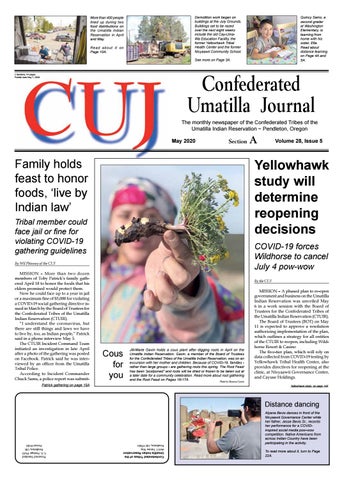
Jill-Marie Gavin holds a cous plant after digging roots in April on the Umatilla Indian Reservation. Gavin, a member of the Board of Trustees for the Confederated Tribes of the Umatilla Indian Reservation, was on an excursion with her mother and children. Because of COVID-19, families rather than large groups - are gathering roots this spring. The Root Feast has been “postponed” and roots will be dried or frozen to be taken out at a later date for a community celebration. Read more about root gathering and the Root Feast on Pages 16-17A. Photo by Shawna Gavin
Patrick gathering on page 15A
MISSION – A phased plan to re-open government and business on the Umatilla Indian Reservation was unveiled May 6 in a work session with the Board of Trustees for the Confederated Tribes of the Umatilla Indian Reservation (CTUIR). The Board of Trustees (BOT) on May 11 is expected to approve a resolution authorizing implementation of the plan, which outlines a strategy for all entities of the CTUIR to reopen, including Wildhorse Resort & Casino The five-tier plan, which will rely on data collected from COVID-19 testing by Yellowhawk Tribal Health Center, also provides directives for reopening at the clinic, at Nixyaawii Governance Center, and Cayuse Holdings. Yellowhawk study on page 14A
Distance dancing Alyana Bevis dances in front of the Nixyaawii Governance Center while her father, Jesse Bevis Sr., records her performance for a COVIDinspired social media pow-wow competition. Native Americans from across Indian Country have been participating in the activity. To read more about it, turn to Page 22A.
Confederated Tribes of the Umatilla Indian Reservation 46411 Timine Way Pendleton, OR 97801
Presorted Standard U.S. Postage PAID Pendleton, OR Permit #100
CUJ News
Leaders ‘Zoom’ in on distance government By the CUJ
MISSION – Besides the challenges of making tribal government work from the isolation of their homes, leaders on the Umatilla Indian Reservation are feeling a little lonely like everybody else. They miss their friends and families. For General Council Chair Lindsey X. Watchman, that means “not being able to hug family members long and tightly, to see smiles and hear the laughter of our extended families at a community event.” Board of Trustees Chair Kat Brigham just misses the people. “I miss talking to people. That’s how we get a better understanding. I miss intermingling. I miss my family. I miss sitting down and talking to people. My kids tell me how to do Facetime, but I haven’t seen my grandkids since March 2,” Brigham said. But paramount to tribal leaders and staff is making tribal government work as efficiently as possible using computers and phones from home and taking advantage of internet services that allow groups of individuals to hold videoconference meetings. There was a learning curve for some members of the Board of Trustees (BOT), but they’ve had lots of practice now with multiple work sessions and weekly Monday meetings for the last two months. During one meeting, the washer could be heard running in the background at Brigham’s house. “There’s been a time or two when I’ve been on mute and I say something and wonder ‘Why aren’t they listening to me?” Brigham said. Another time, early on in the process, she was in a conference call with other northwest tribal leaders. The meeting was to start at 9 so she called in at 8:30 not realizing that she could be seen before showering or brushing her hair. “You have to get up and get ready to go to work,” Brigham said. Brigham has relied on Executive Administrative Assistant Dana Quaempts and Boots Pond, the youngest BOT member, to walk her through the Internet jungle. Quaempts has been the host and administrator for all the Board’s Zoom
BOT Secretary Sally Kosey addresses fellow Board of Trustees members during a Zoom videoconference in April. CUJ photo/Phinney
video-conference meetings. At one point she remembers not being able to figure out what Vice Chair Jeremy Wolf was trying to explain. “He told me I need a 16-year-old in my house,” she laughed. General Council meetings have been cancelled in March and April because of CTUIR social distancing rules that won’t allow gatherings of more than 10 people. But that hasn’t been all bad, Watchman said. “This challenge provides your GC officers an opportuning to think out of the boardroom and to develop new ways to communicate with the people,” Watchman said in an e-mail. To that end, he said, GC officers are meeting with Tribal staff to “determine methods to engage tribal members through virtual online meeting.” Of course, Watchman said, “protecting CTUIR privacy” is a top concern. General Council Vice Chair Shawna Gavin has been a proponent of social media as a communication tool and is pleased that a Facebook page has been established. “It’s been my dream to have a virtual communication available to us such as we may have in the upcoming GC meetings,” Gavin said in an e-mail. “I’ve long asked for and been awaiting an opportunity for GC members from Portland, Oklahoma, Florida, Colorado to be able to click the link and call in.”
Confederated Umatilla Journal
46411 Timine Way Pendleton, OR 97801 Phone 541-429-7005
2A
Fax 541-429-7005 Email cuj@ctuir.org www.ctuir.org
Gavin is familiar with Zoom and other types of video-conference meeting platforms. “Maybe it’s more of an urban process that we’ve been used to, but it’s nice to be able to meet whether we can gather or not,” she said, noting that the Northwest Portland Area Indian Health Board is planning its quarterly board meeting on Zoom in late May or early June. Watchman said it didn’t take long for BOT members and CTUIR staff to become familiar with virtual meetings, even though many had not been exposed to Zoom. “We’ve gotten over that learning curve and are nearing return to full business as usual,” he said in late April. Watchman he thinks the BOT is doing a good job in spite of its inability to meet in person. “The BOT is doing an absolutely wonderful job of trying to take care of every Tribal member on and off the Rez,” he said. “I applaud my fellow trustees and all our hard-working staff.” And the work won’t end as long as there is no vaccine. “No one knows the course this virus will take,” he said. “But we do know whatever the course, we have to protect our people’s lives and livelihoods.” Watchman has been a strong advocate for providing cash to Tribal members during the pandemic.
He said the Tribes should take care of urgent needs now. “Creator will have ways to take care of future needs, in the future,” Watchman said. “I’m not concerned with how much it costs us to take care of every emergency need for every tribal member. That is why we earned it and save it up to this point. To me, savings is a rainy day fund and it is certainly raining on the Nixyaawii Nation. We have the capacity to take care of ourselves in the future, as soon as our enterprises re-open.” Brigham is mindful of that very situation. “We’re all going to hurt, not just this tribe. Every tribe that is dependent on a casino. That’s our tax base, where we get our funding,” she said. “When our casino is gone our funding is gone. We’re all going to figure out what’s best for our future. It’s frustrating because we don’t know when it’s going to reopen.” Brigham was the first woman elected BOT Chair for the CTUIR last November and took office in December. Within five months she’s been hit by a catastrophic flood and then COVID-19. If she’d have known then what she knows now, she still would have wanted the job, she said. “Because I care about this Tribe and this community,” Brigham said, “although there are times when I’m thinking, ‘What are you doing?’ I’m glad we have a good Board and good staff helping us through this.” Ted Wright, CTUIR Executive Director, said working from home is challenging because there are distractions and it’s difficult to stay connected to all the work and people doing the work. “Plus, it’s just mentally and emotionally draining to be alone and so far outside the norm,” Wright said. “But we know are maintaining productivity because all of the work that can be done is getting done. And in those cases where the work can’t be done or the employees are vulnerable and can’t work, we have to accept that there will be a decline in productivity, which is temporary. We will find ways to make up for lost time, as the agencies and entities we work with also get back on track.”
... The monthly newspaper for the Confederated Tribes of the Umatilla Indian Reservation Publish date
Ad deadline
News deadline
June 4
May 19
May 26
July 2
June 16
June 23
August 6
July 14
July 21
September 3
August 18
August 25
Confederated Umatilla Journal
May 2020
Demolition begins at July Grounds By the CUJ
MISSION – Demolition work is beginning at the July Grounds on the Umatilla Indian Reservation. Heavy equipment has moved in to tear down the Cay-Uma-Wa Education Center, the old Yellowhawk Tribal Health Center, the former Nixyaawii Community School, and the old Tribal Police station. About the only buildings left at the July Grounds will be the Community Center, which includes the gymnasium, plus the Longhouse and a modular used as a daycare facility. Once buildings are razed, according to J.D. Tovey, Planning Department Director for the Confederated Tribes, work will continue with architects to develop “community-driven options” for what will be done with the property in the future. A July Grounds renovation was planned three years ago as the third part of the Education Facility Development. The first two phases were the renovation of the Community Center gym and construction of the new Nixyaawii Education Center, which was built just west of the new Yellowhawk Tribal Health Center. The buildings in the July Grounds became vacant as departments and programs began moving west to the Nixyaawii Governance Center complex. First the Tribal Police moved to its own building, then Yellowhawk transferred to its new site, followed by Cay-Uma-Wa and Nixyaawii Community Center to the new education center. A resolution passed by the Board of Trustees in November of 2017 approved the Tribal Education Facility, the community gym renovation and demolition of Cay-Uma-Wa. That resolution did not initially include demolition of Yellowhawk Tribal
Wes Leers of Portland, who works for 3 Kings Environmental from Battle Ground, Washington, sprays water on the former accounting office for Yellowhawk Tribal Health Center. That building and several more, including the old clinic and CayUma-Wa Education facility, are being razed over the next eight weeks. That will leave the July Grounds mostly empty except for the Community Center, the Longhouse and a couple of other smaller buildings. CUJ photo/Phinney
Health Center and over the years many groups and programs have indicated an interest in using the facility. The list of suggested possibilities has ranged from a new senior center or a veterans home to a vocational training facility or transitional housing for recovering substance abusers. 3 Kings Environmental from Battle Ground, Washington, was the successful bidder to demolish not only Cay-UmaWa, the old police station, and an old Yellowhawk accounting modular, but also the Nixyaawii Community School and the old Yellowhawk Tribal Health Center, which were added as alternatives to the bid request. The BOT reviewed the budget along
with construction documents for the July Grounds abatement and demolition project at a work session April 9 and passed a resolution approving the project on April 27. Tovey said the old Yellowhawk building was added to the demolition mix based on a number of factors, which included the current condition of the building, the cost/benefit of renovation, availability of functions or programs that could inhabit the space, existing issues with infrastructure, and a desire to alleviate seasonal flooding that often occurs in that area. Perhaps the biggest issue that came up repeatedly during discussions about
potential use was the cost for operation and maintenance of the building. Whenever one program or another indicated an interest in using the building, the idea was quickly dismissed when it was determined there was no money budgeted to pay for the buildings’ upkeep. “A number of programs expressed interest in the building, or small portions of the building,” Tovey said in an email. “The cost for individual programs or entities to help offset operation and maintenance made it infeasible for them. Especially for programs that are located in the NGC building.” Demolition work is expected to last in July.
‘Sober Transition’ homes may open in August Houses for men and women will each serve six adults By Wil Phinney of the CUJ
MISSION – More than 30 years after the first official resolution cited the need, a pair of “Sober Transition” homes could open as early as August for a dozen adults on the Umatilla Indian Reservation. The Confederated Tribes’ Health Commission, working with Yellowhawk Tribal Health Center and its Alcohol & Drug Program, put together the Sober Transition Housing Project over the last year. Yellowhawk will develop two 2,000 plus square foot homes, one for men and another for women who are returning after spending time at a detoxification or in-patient treatment facility for a diagnosed substance-use disorder or have been diagnosed with a substance-use disorder with a risk of relapse. “This won’t be a silver bullet, but for 12 people for one year it will be a
May 2020
safe place to get established back in the alcohol and drugs. The same report inTribal community,” said Shayne Arndt, dicated 60 percent of all referrals to the Alocohol and Drug Clinical Manager at CTUIR Department of Children and Family Services Yellowhawk, who is headinvolved ing up the effort. There is plenty of anec- ‘This won’t be a silver alcohol and drugs. dotal evidence that indicates the need for transi- bullet, but for 12 Arndt said data for the tional housing. Recovering people for one year Umatilla Inaddicts are quick to acknowledge that returning it will be a safe place dian Reservation shows to the reservation from to get established treatment facilities is diffia large number of peocult because they come back back in the Tribal ple struggle to the same situations and with alcohol circumstances that put them community.’ abuse, but at risk in the first place. Shane Arndt, Alocohol and Drug But Nancy Kirksey, Bethey also are Clinical Manager at Yellowhawk dealing with havioral Health Administrative Assistant, said remethamphetamine or opisearch also quantifies the oid abuse. To a lesser extent, and usudemand. The Community Impact of Substance ally in combination with the other three Abuse report of 2010, completed by the substances, people on the reservation use Northwest Portland Area Indian Health marijuana, which is legalized in Oregon Board in collaboration with the Confed- but remains illegal by Tribal statute. erated Tribes, showed 46 percent of all Nationally, Kirksey said, the relapse arrests by Umatilla Tribal Police involved after in-patient treatment is about 75
Confederated Umatilla Journal
percent because of barriers when individuals return to the same environment from which they left. Plans call for a grand opening later this summer; however with the COVID-19 situation that time could change, Kirksey said. A CTUIR Board of Trustees resolution in 1989 first recognized the need for a drug-and-alcohol transition house. The last facility, the Transition Living Center (also known as the log cabin in Tutuilla Flats) closed in 2000 after a client violated rules. The co-ed facility was operated as a component of Yellowhawk’s Tribal Chemical Dependency Program. An analysis of the program suggested it be changed to males only with a stay limited to two months and a focus on finding housing and employment. It was not staffed all day and all night. In 2008, an independent assessment by the Native American Rehabilitation Association of the Northwest (NARA) determined the Transition Living Center was not suitable as a residence for adults returning to the reservation after receiving Sober Transition Homes on page 24A
3A
A COVID EDUCATION Family’s distance learning involves daily schedule for school and chores, on-line learning systems and educational websites for children ages 4-16 By Wil Phinney of the CUJ
PENDLETON – With five children ranging in age from 4 to 16, Talia Tewawina knew she had to establish a schedule for school work, chores and exercise. And although it hasn’t always been easy, after a month of following the 7 a.m. to 2 p.m. routine the three boys and two younger girls have adapted. “It’s evolved,” said Talia. “Sometimes I have to reiterate the expectations.” Talia was working mornings at the Yellowhawk Community Garden Program and the kids just weren’t getting things done. “If I wasn’t there in the morning, by the time I got home at lunch, everyone was doing something else. The chores weren’t done, they were snacking, they hadn’t showered,” she said. So she switched to afternoons at Yellowhawk and came up with a morning schedule, complete with a rotating chore list, that’s posted on the refrigerator. Everyone gets up at 7 a.m., showers and eats breakfast by 8. School work starts at 8 with four laptops simultaneously accessing different educational websites . The stay-at-home students use a number of online learning systems - Acellus, Google Classroom, Khan Academy, Zoom, and Ignite@home by Hatch as well as video lessons sent via email from their teachers. School work is usually completed by 10 before daily chores begin – vacuuming, cleaning the bathroom, doing the dishes and laundry, etc. Lunch is an hour starting at 11:30. Talia picks up lunches from the Pendleton School District to “save money on groceries so they don’t eat everything they see.” After lunch the five are expected to exercise for a half hour and then, by 2 p.m., if they are done with school and chores, they have free time. The family lives on Southwest Nye off Tutuilla Road so Sunridge Middle School and Grecian Heights Park are nearby. In their free time they take walks and ride bikes, scooters and skateboards. When free time starts “depends on their motivation,” Talia said. Talia leaves for work at 12:15 during the kids’ lunch and returns about 4:30. She calls home about 4:15, which sometimes serves as an alarm clock/ warning in case all the chores haven’t been completed. “Since we started this schedule it’s been going great. I don’t stress because I know they’re getting the school work done and I trust the system on doing the chores.” If they don’t do what’s expected there are consequences. If a chore isn’t completed, it might mean the loss of a cell phone, or a tablet, or TV time. If one of them doesn’t do a chore at all, the next day he or she has to do their chore and one of their sibling’s chores as well. Talia’s oldest son, Leo Crawford, 16, is finishing his sophomore year at Pendleton High School. In addition to his friends, Crawford said he is “missing greatly” the audition-required acapella choir. Crawford said, “I know I’m learning more every day,” but admitted he’s easily distracted working exclusively on the computer instead of in the classroom “where you can actually see what’s going on.” Over the Internet, Crawford can private-message teachers, but there isn’t always an immediate response. In addition to school work, Crawford said CO-
4A
Talia Tewawina, bottom right, is a warrior mom, keeping her five children on track during the COVID-19 pandemic with a daily schedule that includes schoolwork, chores, exercise and freetime while she works a part-time job at Yellowhawk Tribal Health Center on the Umatilla Indian Reservation. The family, which lives in Pendleton, includes husband Andrew, plus the children, Midnight Rose Tewawina at the bottom, Ayanna and Ayden Star in the middle next to their mother, and Anthony and Leo Crawford on the top step. CUJ photo/Phinney
VID-19 and stay-at-home orders have given him more time to read science fiction and watch Japanese anime on Netflix. But he misses his friends and their regular Dungeons and Dragons pen-and-paper role-play nights. Crawford said when he’s older he will tell his children or his nieces and nephews, maybe his grandchildren, that during the coronavirus pandemic “all the people did their part by staying at home and not going out in public.” He will tell them that people stayed six feet away from each other and that Walmart wouldn’t allow a lot of people in their store. He said he thinks there will be a “new normal” and he’s wondering if he’ll be participating this year in the war scene at Happy Canyon or selling sodas in the stands with the acapella choir.
the outbreak he was invited to a sleep-over that didn’t happen. Anthony is an athlete who plays basketball and football, and was planning to try out for track this spring. He trots from home to school each day and friends suggested he try distance running around the track. At school, Anthony likes band. He plays saxophone at school, but practices the keyboard at home. For schoolwork he does what the teachers send home on Khan Academy, which produces short video lessons as well practice exercises. For Anthony, COVID-19 has caused no stress. He’s a laid back dude. What’s he going to tell his kids? “I lived through it and had to stay home.”
Anthony Crawford, 14, was finishing the eighth grade at Sunridge and will be joining his older brother as a freshman at PHS in the fall. Anthony’s not a big talker. He’s not so fond of his mom’s schedule because he “loves sleeping.” His biggest challenge is “not being able to go outside and staying away from people.” Right before
Ayden Star is an 11-year-old fifth grader at Sherwood. During regular school he gets up at 6, so he’s getting to sleep in now. He gets to see his friends in the classroom each day through Zoom. He likes his teachers – Mrs. Curtis, Mrs. Murphy and Mr. Heriza. At the end of the day, students get 20 minutes to talk to each other, Ayden
Confederated Umatilla Journal
COVID Education on page 20A
May 2020
By Casey Brown and Wil Phinney of the CUJ
O
regon students haven’t been sitting in desks in front of their teachers since March 12, but education hasn’t stopped, it’s just been from a distance. Like everything COVID, social distancing came to Oregon schools on March 12 when Oregon Gov. Kate Brown virtually closed the state over the novel coronavirus pandemic. In mid-April schools were directed to begin “Distance Learning for All.” Instead of big busy buildings with bustling hallways and buzzers every 50 minutes, homes with kitchen-table desks, rambunctious brothers and sisters, and noisy pets have become the classrooms for students across the country. Students are working from home computers and laptops on loan from schools in a variety of age-appropriate, multi-media communication and blended-learning strategies, not just digital/ online platforms. In addition to teachers, parents and older siblings are the instructors. Young people are keeping up with algebra and science, and they are drawing cars and writing essays. They are learning about self-motivation, time management and how to deal with stress. All of a sudden they have time to spend with their families and many are learning more about their culture. The CUJ asked several young people and their parents what they were doing during the COVID-19 pandemic. The following is a sampling of their responses.
Taking the classroom home... Ivory Herrera Ivory Herrera is a junior at Nixyaawii Community School where her schedule includes anatomy, her favorite, plus Language Arts 3 and algebra 2. She sports a 3.8 grade point average. Ivory is self-motivated, but it doesn’t hurt that her father, Freddy Herrera, is a retired Marine MP who gives her marching orders. “My dad makes sure I get it done,” Ivory said. She’s online with Acellis at 7:30 each morning. She uses the school’s gmail or Remind message to communicate with teachers who “get back right away.” In addition to her regular classes, Ivory is a reader. She likes to read books about Native America, but currently is working on ‘Night Shift,’ one of Steven King’s thrillers. A basketball player for the Golden Eagles this year, Ivory said she misses her friends but keeps up with texts and facetime. COVID-19 hasn’t caused her much stress. “I’m cool with it,” she said. Her father said the coronavirus has been “kind of a blessing in disguise” because it “gets down to what matters” and that may be learning outside the classroom. He takes Ivory, an aspiring veterinarian, to the mountains to hunt and fish, to learn about and gather roots. “I want her to learn our traditions and ceremonies, our way of life,” her father said.
having the hardest time adapting to a new routine. “They know they are all in the same boat,” Nikki said. “He’s a boy, so I feel that he’s got all this extra energy. He’s pretty social. I think out of all of my kids, he’s had the toughest time adjusting.” It’s been hard for them to “miss going to school, not see any family, not going anywhere.” Ella’s youngest sibling, Sarah, goes to Cay-Uma-Wa Head Start on the Umatilla Indian Reservation, and her two oldest brothers, Greyson and Dakota, go to Pendleton High School. Ella, 13, shares a birthday with her younger sister Sarah, 5, and they celebrated birthdays in quarantine this year. “It’s tough to celebrate in quarantine because they are used to celebrating with their whole family. That was a tough one for Ella,” Nikki said. When she can go back to school, she’s most looking forward to one thing: her friends. “Getting out of the house. It gets boring being stuck with your family for so long without going someplace,” she said. In the meantime, she’ll continue focusing on schoolwork, including her favorite class, which is history because her teacher is “chilled back.” He doesn’t overwhelm students with too much work in the Google Classroom, Ella said. “It’s a lot. We have five kids at home,” Nikki said. “It’s a big change because every day is a different day.” Lindsey Littlesky Pasena Lindsey Littlesky Pasena is a sophomore at Pendleton High School where she excels academically and athletically. She is the Chair of the Youth Council for the Confederated Tribes of the Umatilla Indian Reservation. She said being away from school was “making everything else important” and giving her time to do things she didn’t think she had time for before. “I didn’t have time for family, I didn’t have time to draw, I didn’t have time to engage in my culture. Now I have time to try new things,” Lindsey said. In addition to being a student, Lindsey also serves as a teacher for her brother Kyman, 10, and sister, Brees, 9. Her mom is a teacher at Nixyaawii Community School but isn’t familiar with online instruction so Lindsey is helping her as well. She continues to take Spanish via video and honors biology. She’s writing persuasive essay and dialogue in English and using Acellus for math and world history. “It’s hard to focus when the focus is on everything in the world,” Lindsey said, adding that her mother has the news on “all day.” “Our world literally changed in a week span,” Lindsey said. “This is the new normal and we have to make it what we can. It’s up to you to motivate yourself and stay active.” Some positive things may come of COVID-19, Lindsey said. In fact, the earth may be healing itself. “The animals are returning. They may be on the streets, but they’re back. The pollution is gone; traffic is gone. It’s sad to say we’ve had to sacrifice lives to fix what other people have done to the world.”
Avery Quaempts is a sixth grader at Sunridge Middle School. Avery Quaempts Avery Quaempts, a sixth grader at Sunridge Middle School, finds math easiest to learn at home. Science is the most difficult because she misses in-class instruction. “It’s difficult because we don’t have our teacher to explain in words,” she said. The information is in text form rather than a lecture, which is what she’s used to. In mid-April, during her first week of distance learning, she was is using her own computer to log into Google Classroom, an online learning platform used by the Pendleton School District. Her dad, Justin, says that paper packets are an option, but are more appropriate for students that can’t get internet access. Justin, recovering from two back surgeries, has been to stay home with Avery, but he’s looking forward to projects at Crow’s Shadow Institute of the Arts. Avery misses her friends, but she stays in touch on Snap Chat and FaceTime. She also misses her softball, which has been a big part of her life. “It feels devastating because I remember that we used to have a team bond. We’d get so excited to see each other at tournaments and create memories,” she said. But she isn’t letting being away from school stop her from being active. She still conditions for softball and practices basketball skills, particularly dribbling to get her “handling down.” Her dad says they are adjusting and dealing with the ups and downs of the constant changes and uncertainly, while also staying active and positive. “It’s been kind of a state of uneasiness just because the overall sentiment in the world is not knowing what’s going on now. Or in the future. That energy infiltrates no matter where you are. The past few weeks that’s been overwhelming, rightfully so,” he said. Avery and Justin say they know what to do because they look to their ancestors. “As a tribe, we’ve got to understand that that’s what we’ve been doing for centuries is adapting. This is just a modern day iteration of that. If we trust what our ancestors told us for a long time I think we’ll be okay,” Justin said.
May 2020
Ella Sams sits next to her brother Quincy. She shares a birthday with her younger sister Sarah that they celebrated in quarantine. Ella Sams Ella Sams, a seventh grader at Sunridge Middle School, gets bored easily sitting at home all day. She knows she’s staying home due to social distancing requirements for COVID-19, but she doesn’t like to talk about the virus. “We don’t really talk about it because we want it off our minds,” she said. Her mom Nikki already works from home for a consulting company out of Maryland. She said that despite the official designation to move to distance learning the week of April 13, she’s had her kids working on school work since Pendleton schools closed in March. “She started pretty much when they left school. I wanted them to stay on top of things, so we got in touch with Janet Maddern,” Nikki said. Janet Maddern is the Indian Education Coordinator at Sunridge, and she has been using two programs from her home for a couple of years. She has experience with distance learning. “It has been a bit easier for me, since I have had Acellus classes put into place for the past two years,” she said. “I am able to keep in contact with the kiddos either through e-mail or calling the parents,” Maddern said. “I have given all parents my e-mail address and phone number, just in case the kids need help.” She’s also come up with an interesting way to help students who seem to struggle with the same assignments. “It seems that the math part has been difficult for many of the kiddos and the parents, so sometimes I will post the problem on Facebook, so all can see how to work it out together,” she said. To get her assignments, Ella logs on to her student e-mail and turns in her work on Google Classroom. She also uses i-Ready, an online learning program, for math and reading. For her physical education (P.E.) class, she keeps a log that she turns in to a teacher. She’s been running and working on softball skills with her dad, Ryan Sams. “I have these softball exercises, so I put down hitting, throwing, and softball workouts like sit-ups, pushups, crunches,” she said. Ella’s brother Quincy is in second grade. Mom said he’s been
Confederated Umatilla Journal
Serenity Antelope has been excelling in classes while studying from home. She’s improved two grade levels in math this year. Serenity Antelope Serenity Antelope is a seventh grader at Sunridge Middle School. She said she likes doing schoolwork at home. “It’s been fun because I can do my work at my own pace. I like working at my own pace,” she said. “I can still get help from my teachers if I e-mail them. We do this thing called Google Meets where we video chat with our teachers,” she said. Her uncle, David Filkins, helps her with her schoolwork. “I bother my Uncle Bubba a lot,” she said. “It helps me get my schoolwork done.” Like most students, Serenity misses her normal routine. “I miss school because I like to interact with the teachers. It’s kind of weird not seeing their faces. I miss being social. It’s hard to keep my distance,” she said. However, she’s been staying in touch with her family via FaceTime, a video chat program available on iPhone and iPads. She says that math her most difficult subject. “It’s hard because I can’t ask questions. When I’m face-to-face with my teachers I know what to ask. When I’m typing, it is more confusing to ask questions. I have to go to all these apps and find the stuff that he’s posting for me. I’d rather just get my packet that we usually do,” she said. She’s been working on improving her math skills with a proTaking the classroom home on page 20A
5A
CUJ Op-Eds & Columns Follow guidelines so we can reopen community By N. Kathryn Brigham
T
he Confederated Tribes of the Umatilla Indian Reservation are at war with an invisible enemy and we fight this war alongside all 574 Tribal Nations, the United States, and the World as a whole. In the beginning it seemed that this enemy would only take those over 60 years of age. Now we know that it will take anyone who is not careful. On one of my many conference calls this week a statement was made that 4,000 tribal people in Indian Country have lost their lives to this enemy. This past Monday (April 20) a tribal fisher let us know that a person who attended the Celilo Salmon Feast April 18-19 had been tested presumptive positive with coronavirus. Then we heard two other tribal members in Warm Springs and Yakama had also been tested as presumptive positive. On Friday (April 24)
and symptoms. The longer people continue to go out into the community and get or spread the coronavirus the longer we will have a Stay Home, Stay Safe, Stay Healthy and Save Lives. Your actions will determine how long it takes to reopen up our community and be able to see each other once again. Are we going to be able to get back into the community in the near or far future? The Board of Trustees does not want to lose this war and we want to reopen up our Tribal community. We do not want to lose anyone and we want to be able to see each other again soon. We want all of us to survive, but we can only do this if you take care of yourself and your family. Please continue to Stay Home, Stay Safe, Stay Healthy and Save Lives. Kat Brigham is Chair of the Board of Trustees for the Confederated Tribes of the Umatilla Indian Reservation.
night this invisible enemy took a strong Yakama fisherman from Celilo Village. Now our thoughts and prayers are with the family on their loss. We are all praying that this enemy will not spread to any of the family or friends in the Village or the Columbia Plateau Tribes. All of us want to go out into our community to see our family and friends. Oregon’s Governor Brown also wants to reopen the economy and community. The Governor is willing to look at a reopening county by county. Kat Brigham But in order to reopen up Umatilla County one of the guidelines is that we need to have TWO WEEKS of declining coronavirus cases
Kii hiiwes wew’eex wala! – it’s spring time!
N
ormally during this time of year, the weather becomes warmer, daylight longer, and families enjoy community events like the Fun Run and Flag Day. Normally playgrounds and basketball courts are active with our children. Also during this time, you can find tribal members in the mountains carefully harvesting, caring for, and preparing our sister roots. Normally, we are honoring our First Foods with feasts (celery, root, salmon) in acknowledgement of our perpetual dependence, and in reciprocity. We gather at feast to hug, to sing, to laugh, and to eat together as a People. We gather to show gratitude to nuunim Hanyawaat (our Creator). Unfortunately, this year has not been normal at all. The best guidance in order to protect our Elder population … is to continue to practice social distancing. Nobody knows how long, nor what course this virus will take next. In short, we have a new normal to adjust to. Any change to one’s daily, weekly and seasonal
routines is not easy (especially if it feels forced upon) … but as a community, we are in a scary situation where we must decidedly and collectively – as one Nation – work together to reduce potential, adverse impacts. We need to do this for a bit longer. But alas, springtime means renewal! Trees and flowers are blossoming, birds chirping, animals giving birth. That vibrancy and optimism is what I’d like to leave you all in closing. Here are a few ideas that may help you re-connect with yourLindsey X. Watchman self, and with each other during this abnormal time. Meditate. Read or write a book. Practice your hobbies and crafts. Listen to old school, or new music. Start a journal. Checkmark items off that long ‘honey-do’
list. Call instead of text. Whatever you choose, keep your faith strong, and keep looking for things to be grateful for – including the love and people around you. As a reminder, the best way to stay up-to-date with current BOT decisions is to follow one or more CTUIR Facebook pages: CUJ, General Council, Yellowhawk and Atawisamatas home visiting program are very informative. And finally…be sure to express your love to the backbone of the Nixyaawii People … our mothers, grandmothers and aunties … on their special day May 10th. Until I see you again (q’oc pamaawa), may Creator’s blessing fall upon you and your loved ones. Weetu maawa pala’amno – we will never fade. Yox kalo. Lindsey X. Watchman is Chair of the General Council for the Confederated Tribes of the Umatilla Indian Reservation.
Maintaining productivity in crisis-management mode By Ted A Wright, PhD
T
hese have been challenging times for us all, through the devastation of the Umatilla River flood right into a worldwide viral pandemic. So, as a government, we’ve been working in crisismanagement mode for 13 weeks, and most management and staff have not taken a day off since the end of January. Despite all these struggles, the disastrous damage to homes and lands and now the fear and loneliness of isolation as we fight an invisible killer – we can also celebrate the good: Numerous employees are working hard so that tribal members and reservation residents continue to receive services. Almost all employees are working from home, onsite, or in the field, and the CTUIR is maintaining its productivity. The time spent at home has led many to reflect more on the importance of family, community and taking
CUJ Confederated Umatilla Journal
6A
care of one another. Most everyone in our area has taken the stay-athome directives seriously and have therefore helped our area keep the infection rate relatively low. When we come out of this difficult time, we will be better trained in disaster preparedness and even more efficient in emergency operations. Make no mistake, we have a way to go before we’re out of the woods with this pandemic. Though we may gradually re-open the government as summer arrives, we will likely have a return of the virus in the fall or winter. To some extent that may depend on how disciTed Wright plined we are now, but even as good as we are doing, we can count on some continuing impacts on how we do business through the end of this year and well into next.
46411 Timine Way Pendleton, OR 97801 541-429-7005 FAX 541-429-7005 e-mail: cuj@ctuir.org www.ctuir.org
Acting Publisher:
Jane Hill CUJ staff: Wil Phinney, Editor Casey Brown, Reporter/Photographer Dallas Dick, Freelance Photographer
Confederated Umatilla Journal
So, while we are aware of what may happen later this year and are planning so we are prepared, most of our energy and focus immediately is on helping tribal members who have lost their jobs or are otherwise struggling during this crisis. To this end, the Board of Trustees has taken action to support tribal members with rent, utilities, food and other basic needs. And just so we fully understand what problems are out there, we have established a call center so that every tribal member will receive a call asking how we can help. That information will be passed on to departments already fully engaged in meeting needs as they arise. In closing, thank-you for your patience during this dark time, and keep the light of hope and kindness going in your corner of the community, state and nation. Ted Wright is the Executive Director for the Confederated Tribes of the Umatilla Indian Reservation.
Display advertising rate $5.50 per column inch. Full page: $297 Three Quarter Page: $223 Half page: $149 16 awards in 2018, including first places for best feature story, feature photo, environmental Quarter page: $72 coverage. Business Card: $33 Full color and spot color available Mail Subscriptions: $15 per year or $28 for two years.
Next CUJ: June 4 Ad deadline: May 19 News deadline: May 26
May 2020
CUJ Op-Eds & Columns COVID-19 gives new meaning to Mother’s Day By Jill-Marie Gavin for the CUJ
T
his year Mother’s Day has landed in the middle of Covid-19. While our governments, communities and families brace themselves for the requirements of essential work, sheltering in place and seemingly endless extensions of stay-at-home orders there have been words of encouragement. Some of these messages have been soothing, and some not so much. A couple of phrases have been especially problematic. “We’re all in this together,” they say. Well, they are wrong. Yes, we are all facing this pandemic together, and, yes, we are all wondering when this will end, but we are not all in this together. We are also not all in the “same boat.” Hearing and reading these words Jill-Marie Gavin don’t quite resonate, especially for parents at home with children in need of education, reassurance, food and love. The mother is the well from which the spring of life flows. Some days that well is a little dry. This year Mother’s Day is different than any other we have experienced. Our children need a parent who can tell them everything is going to be okay. The little ones are very aware that life is not the same. They have heavy emotions and, being the person who gave them life, we must continue to breathe life into them. That becomes difficult when there are no immediate answers to the questions. Will mom have a job? Will she be able to afford the groceries we need to get by? When
will this end? Thankfully, our community has been doing its best to make sure no one goes hungry, yet there are other worries for the matriarchs of our homes. Fathers have been tasked with this responsibility as well, but the mother has special obligations and pressures. When our babies get sick, scared or sad they call out for mama. The comfort that a mother gives her children is a beautiful thing, but right now that comfort can be difficult to summon, especially for mothers who are doing this on their own. Providing food, shelter and electricity has been difficult for some homes during this unprecedented time. Furthermore, we’ve had to take on additional duties. Now you’re not just a parent, now you’re a teacher, too. I have struggled providing my children with the education they need. I see on social media, and occasionally post as well, fun-filled days with baking and outdoor adventures. It’s a wonderful thing to experience and share those days, but it’s important to acknowledge the other days as well. I don’t pretend to know the unique struggles of every family, but I do know that not every day is sunshine and rainbows. There are days when mom is tired, she is scared and she is a little sad. Self-care is so important and preached by so many, as it should be, but it’s not always easy. Self-care is not all bubble baths and pedicures. Sometimes self-care is allowing yourself to sleep-in and wear your jammies all day. Self-care is also allowing yourself to be stressed and allowing yourself to cry, allowing yourself to feel the weight of this pandemic and letting yourself close the shades and let the house be messy, even if just for a few hours. As much as I adore this time with my children, I
haven’t spent this many days in a row with my babies and since I became a mother 11 years ago I won’t pretend we don’t have bad days in my home. Nobody’s household is perfect, there will be days with yelling and frustration. There will be days when packets and online classes don’t get finished and that’s okay. It’s okay to forgive yourself for what you may see as failures, but are actually the everyday realities of being human. I have been blessed to have a strong family support system and I am very thankful for this, but I know some mothers are in this on their own. So while I can appreciate the sentiment of all “being in this together,” I know that’s not the case. We are all remaining strong and pushing to get through this, but that looks different for every family. I have so much respect, love and admiration for Indigenous mothers. We know struggle, we know pain and most of all we know love. Take some of that love and extend it toward yourself. No, we’re not perfect, but we’re here, here with our children. Treasure your children and treasure yourself because you are a gift to this earth and to your children and even when the days get rocky you are still shining bright. Happy Mother’s Day.
There are days when mom is tired, she is scared and she is a little sad.
Jill-Marie Gavin is the mother of four children - Penelope Gavin-Harvey, 11, Abigayle McIntosh 8, LisaFaye McIntosh, 6, and Jeremiah McIntosh, 4 - and a member of the Board of Trustees for the Confederated Tribes of the Umatilla Indian Reservation.
Coronavirus changes ceremonies, challenges leaders By Don Sampson
O
ur tribes and our ancestors have been infected by deadly viruses and diseases brought to the shores of our native homeland by European immigrants since Columbus in 1492. This onslaught of new disease spread by European immigrants amongst Native Americans resulted in millions of Native people dying in the “greatest demographic disaster in human history.” The deadliest were smallpox, malaria, viral influenza, yellow fever, measles, typhus, bubonic plague, typhoid fever, cholera, and pertussis (whooping cough). Among these, half appeared in epidemic form in Oregon and Washington during the first century of contact, from the late 1700s through the mid-1800s. This biological warfare decimated millions of Native people. There was no available treatment, a shortage of medicines, and our people had no biological resistance, genetic or acquired, to these diseases. Don Sampson The loss of our population Peo Peo Mox Mox resulted in abandoned and consolidated villages, the breakdown of social and political structures, and the loss of accumulated cultural and ecological knowledge possessed by specialists within our tribes, making the epidemics cultural as well as biological disasters. We worked together to survive those times. Today, Americans and other countries around the world are feeling the pain and impact that our Native people have experienced and endured over the past 500 years. Now we are facing it again. We have had to isolate ourselves, shelter in place, be
May 2020
prepared to survive what our great-great grandparents endured. Right now, hundreds of our people are without jobs and income. Our tribal elected officials must step up and provide financial and community support to our people. While much has been done, more will be needed. Our tribe built a substantial investment fund with millions of dollars – for a time like this. We have many tribal members who are suffering and struggling just to put food on the table. The most recent $300 payment was a good start and tribal members appreciate and needed that help. This pandemic will affect us for the foreseeable future. What is our plan? I believe the Board must re-engage and listen to tribal members during this prolonged crisis. Perhaps the Board can hold a listening session using the new internet technology “Zoom meetings” so they can hear firsthand how tribal members are impacted and struggling. Many are having difficulty getting unemployment and paying bills. Schedule three or four sessions in the next two weeks so tribal members can get online and tell the Board what they need. As the new foods come, we must carefully consider how we continue our traditional food gathering and ceremonies. We must first and foremost protect our elders and youth. The knowledge the elders carry is precious and treasured. They are our teachers. In today’s world, we must try the best we can to preserve our ceremonial life, continue to gather our native foods and keep our promise to those foods. As the roots and salmon return, we must try to continue with our new food ceremonies. Even if it is within our smaller family groups. The Board and Incident Commanders say less than 10 people in a gathering. As many elders remember, the Kow-we-yut or food ceremonies of the past were
Confederated Umatilla Journal
conducted by each family group. The root feasts and the washut songs were sung by family leaders – both men and women in places like Cayuse, Tutuilla flats, Fishhook, Chamna, Wallula and others. I encourage individual families – the diggers, hunters, fishers, huckleberry gatherers – to go in small family groups to gather our native foods. Seek advice from your elders in the family. But do so in a careful, protective, and deliberate way knowing we face the same deadly coronavirus our great-great grandparents may have died from. Protect the health of your family. Just recently at Celilo, the deadly coronavirus was spread during the salmon feast. My good brother Bobby Begay, the grandson of the great Celilo Chief Howard Jim, passed because of this virus. It is a great loss to all of us. People from Warm Springs also caught the virus. We are being taught an important lesson. We must be careful. We can’t afford to lose our cultural, spiritual, and elder leaders, our children, or anyone of our Native people during this pandemic. Because of this, our families have decided that we will not have our regular Mother’s Day root feast in May. Rather, each small family group will hold their own Know-we-yut feast so they can go dig roots. We had our small family feast and now will go gather roots. Perhaps once this coronavirus passes, we can return to our larger ceremonial gatherings. I pray for the strong health of our people and our traditions during this difficult time. I also pray for our elected leaders that they will be guided and think of the people first. We must work together and protect our community while continuing our traditions the best we can – carefully and deliberately. Don Sampson, Peo Peo Mox Mox, is chief of the Walla Wallas. He is a former Chair of the Board of Trustees and General Council, and a former Executive Director for the Confederated Tribes of the Umatilla Indian Reservation.
7A
CUJ Almanac Obituaries Lorene Videl Spencer Aug. 12, 1935 – April 4, 2020 Lorene Videl Spencer passed away at her home surrounded by loved ones on April 4, 2020. A private dressing was conducted at Burns Mortuary on April 5. The viewing at Burns Mortuary was followed by burial at Tutuilla Church Cemetery on April 6. Lorene Videl Minthorn was born on August 12, 1935 to the late Wilbur and Lucy Minthorn. She was delivered by the late Annie Wannasee (midwife/aunt) at the family home. She was an enrolled member of the Yakama Nation. She was married to Roland L. “Jack” Spencer and resided in Satus, Washington until the time of her death. Lorene worked in canneries for 30 years until she retired. She enjoyed traveling with Jack while he fished. She was one of eight children. As a young child Lorene traveled with her family to camp at Mt. Adams to pick huckleberries every year. Lorene attended and graduated from Pendleton High School and attended Haskell Indian College. She learned to cook traditional foods from her mother and enjoyed salmon, deer, eels, roots, etc. She was an excellent canner and preserved foods throughout the year. She enjoyed watching all sports and traveled to watch her children, grandchildren and great grandchildren play. She loved watching football, volleyball, basketball, baseball and many other sports. She traveled and attended powwows every year. Bingo was something she was very passionate about. She enjoyed traveling to play bingo in different areas as well as meeting up with her bingo partners at Saint Joe’s Bingo in Union Gap. She was faithful to the Washat and the Longhouse beliefs. She was a very loving and caring wife, sister, mother, grandmother, great grandmother and aunt. Lorene was very supportive to all her family and traveled many miles in her lifetime to remain connected to her family and community. She is survived by her husband Roland L “Jack” Spencer; siblings Leslie Minthorn of McKay Creek and Roger Minthorn of Warm
Springs; children Vernita Lee Van Pelt of Mission, Jue Jue Withers-Lyons of Mission, Michelle Spencer of Mission, Jacqueline Smartlowit, and Debbie Hoptowit; sons Dirk Spencer of Satus, Jake Spencer, Nick Spencer, and Jack Spencer; 15 grandchildren, 17 great grandchildren, numerous nieces and nephews and extended family. She was preceded in death by her mother Lucy Peeps Minthorn, her father Wilbur Minthorn, her brothers Burt “Buddy” Jones, Sylvester “Sully” Minthorn, Alvin “Chipmunk” Minthorn, Phillip “Poots” Minthorn; sister Eulalia “Eullie” Minthorn; son John Withers Jr. and grandson Wilber Withers.
Martha Quaempts Franklin April 2, 1941 — April 10, 2020 PENDLETON - Martha Ann Quaempts Franklin peacefully went home to be with the Lord and her family on April 10, 2020. Because of the COVID-19 gathering limits, services were held for family and live-streamed on Folsom-Bishop Facebook on April 16. It was her wish to be cremated and placed beside her sister at St. Andrews Cemetery. The family will live steam her burial also through Facebook at a future date to be determined. When the COVID limits are lifted the family will hold a celebration of life for family and friends to gather, share hugs and eat a meal together. Martha was born to William and Annie Quaempts at the family homestead on Meacham Creek. This is where she would grow and gather with her brothers, sisters and many relatives. She loved to tell stories of how her father grew yummy strawberries, the largest garden and raised horses, which also became her passion. She had many horses but her favorite was Mike, who she raised from a colt, and they became best buddies for life. Martha was the youngest of nine and she traveled all over the Northwest with her mother (Annie) visiting family, friends and businesses from whom Annie loved to purchase her goods. Martha attended school at St. Andrew’s and would finish at St. Joseph High School. Martha married David A. Franklin on Sept. 23, 1961. They lived in Gibbon, where Martha eventually became the first postmaster at the Gibbon store. She then worked in forestry at the
Umatilla Tribes Bureau of Indian Affairs. Martha had two children, Paula (1962) and David (1963). As they grew and went to school in Athena she began working as the Tribal Johnson O’Malley Assistant at Athena Elementary. She loved working with all the tribal kids, helping them to succeed in their academics, taking them on ski trips to Spout Springs and making sure they all got to do different adventures that they had dreamed of accomplishing, even if that meant money out of her own pocket and time. Martha and her sisters Loretta and Rosie were the first educators to begin traveling to many of the schools around the area to educate children on her Native traditions and history. It was her passion to make sure that the communities and people who lived there understood that her Native people were thriving and wanted to be part of the growth within these communities. Martha was a very spiritual woman who came to know and grow with the Lord. She was one of many in building the Pendleton Chapter of Aglow for Women and served on the Aglow Board. She shared her passion for the Lord and her love for her tribal traditions across the country through Aglow, and again with her sister Rosie in many venues. In her sharing she connected and helped many other people in finding the Lord, and they would become her friends and family for life. She wanted everyone to know the Lord could bring peace, hope and love into their hearts and households. She could be called by anyone at any time to pray or seek help and never once thought twice about being there for them. Martha’s family traditions, love for the Lord and flair for fun will continue through Paula Wallis (Jim) and David Franklin (Sandy), her grandchildren Cassandra (Jeff), Jerimiah (Mindy), Josh (Ashley), Jessica (Ryan), Rachael and Jacob, and great-grandchildren Hayden, Abi, Paityn, Paxton, Harper and Bentley. She was also as a surrogate mother and grandmother to many who walked through her door. Online condolences may be shared at www. pioneerchapel.com.
Weather
Happy Mother’s Day - May 10
Weather information summarize data taken at the Pendleton Weather Station The average daily temperature was 66.4 degrees with a high of 78 degrees on April 28 and a low of 28 degrees on April 13. Total precipitation to date in April was 0.21 with greatest 24hr average 0.10” on April 30. The average wind speed was 9.3 mph with a sustained max speed of 29.0 mph from the West on April 21. A peak speed of 40 mph occurred from the West on April 14. There were 0 Thunder storms, 5 days out of 30 in which some rain fell, 0 Haze events/days, 2 Fog/Mist. Air Quality Index values remained in the Healthy levels during April 2020.
Jobs COLUMBIA RIVER INTER-TRIBAL FISH COMMISSION EMPLOYMENT OPPORTUNITIES Job Title: Human Resources Manager Department: Human Resources Classification: Fulltime, Regular, Exempt Salary Range: Grade 12-14 (DOE) Location: Portland, OR Closing Date: May 15, 2020 Job Summary: The Human Resources Manager is responsible for CRITFC’s human resources functions as assigned by the Executive Director. This position supports the Commissioners, Executive Director, managers and supervisors and employees in achieving CRITFC’s mission and goals by providing effective, contemporary and strategic human resources services. Job Title: Temporary/Seasonal Maintenance Worker Classification: Full-time, Temporary, Nonexempt Salary Range: $16.26-17.34/hr (DOQ) Location: The Dalles, OR Closing Date: May 15, 2020 Job Summary: The position provides the maintenance of the Tribal In-Lieu / Treaty Fishing Access Sites along the Columbia River during the COVID-19 outbreak by: performing work that involves a variety of trade practices such as painting, plumbing, carpentry, masonry, electrical, and custodial work, to include sanitizing all facilities. Maintenance workers will use hand and power tools to accomplish this work.
APPLICATION PROCEDURE:
Under the authority of Section 7 of the Indian Self-Determination and Education Assistance Act, CRITFC shall give preference in employment matters to qualified enrolled members of the four CRITFC member tribes, then to qualified enrolled members of other federally recognized tribes. If CRITFC is unable to fill openings with such qualified tribal members, other qualified applicants will be considered. Note: Incomplete applications will not be considered. Send a complete application materials include a cover letter, CV/resume, completed job application with signature, electronic or typed in signature is accepted (available on our website at www.critfc.org “employment opportunities” on the bottom left corner or by calling 503.238.0667, a copy of relevant certifications and a list of at least three professional references. Submit to: Columbia River Inter-Tribal Fish Commission Attn: Human Resources 700 NE Multnomah Street, Suite 1200, Portland, Oregon 97232 Email: hr@critfc.org Fax: 503.235.4228 To view more career opportunities or to learn more about Columbia River Inter-Tribal Fish Commission, please visit https://www.critfc.org/ critfc-employment-opportunities/.
Pendleton Pioneer Chapel received three prestigious awards in 2009
w The Oregon Funeral Directors Association Award of Funeral Service Excellence w The Best Of Eastern Oregon Award as voted by the readers of the East Oregonian w Pendleton Chamber of Commerce 2009 Business of the Year
Our experienced family provides caring, compassionate care including:
Burial Services ~ Military Services Cremation ~ Monuments
8A
Confederated Umatilla Journal
May 2020
Public Notice For Public Review
Land Use Control Documents for Properties Leaving Army Control Umatilla Chemical Depot, Hermiston, Oregon Department of the Army, Office of the Deputy Chief of Staff, G-9 Base Realignment and Closure (BRAC) Division The Umatilla Chemical Depot (UMCD), located east of Hermiston, in Morrow and Umatilla counties, Oregon, was closed in August, 2012. Of the 17,148.72 acres, 9,648.72 acres will transfer out of Army Control to the local reuse authority, the Columbia Development Authority (CDA). Land Use Controls (LUC) will be implemented on the UMCD as some of property is restricted due to environmental contamination and past use. Restrictions on land use are coordinated with the United States Environmental Protection Agency (EPA) and the Oregon Department of Environmental Quality (ODEQ). The applicable sites are either Comprehensive Environmental Response, Compensation, and Liability Act (CERCLA) or Resource Conservation, and Recovery Act (RCRA) sites. The CERCLA sites were remediated under applicable Records of Decision (RODs), which set forth the selected remedial actions, defined the clean-up standards and, in some instances, selected applicable LUCs to be implemented following active remediation. In other instances, LUCs are selected as a component of the remedial action in a modification to the ROD referred to as an explanation of significant differences (ESD) or Memorandum for the Record (MFR). The following five documents relating to the LUCs are being made available for public comment:
CTUIR
1. Easement and Equitable Servitude: Documents LUCs and identifies enforcement by EPA and ODEQ. 2. Land Use Control Implementation Plan (LUCIP): Summarizes LUC sites and applicable restrictions. 3. Site 34, The Active Landfill (closed) ESD: The 17.49 acre Active Landfill was a permitted landfill used for the disposal operationally generated industrial waste. 4. Site 47, The Deactivation Furnace ESD: Remediation of the 15.97 acre Deactivation Furnace was completed in 1998. However, since then the lead exposure limits for unrestricted use have decreased and LUCs will be implemented to address these changes. 5. Site 39, The Quality Assurance (QA) Function Range MFR: The 635.68-acre QA Function Range was used for testing of conventional munitions, weapons and related materials. With whom may I discuss this? The Army point of contact is Michele Lanigan, 541-564-5325, michele.m.lanigan.civ@mail.mil. Where can I find a copy of these documents? A digital copy of these documents will be available for review by the general public by contacting Michele Lanigan, 541-564-5325, michele.m.lanigan.civ@mail.mil. How long is the comment period? The public comment period is for 30 days and begins on May 7, 2020 and ends June 8, 2020. Submit written comments to Michele Lanigan, 541-564-5325, michele.m.lanigan.civ@mail.mil or mail to Michele Lanigan, Umatilla Chemical Depot Bldg 32, Hermiston, OR 97838. Written comments must be received no later than 5:00 p.m. on June 8, 2020.
Board of Trustees
General Council
Chair Kathryn Brigham
Chair Lindsey X. Watchman
Vice Chair Jeremy Wolf
Vice Chair Michael Ray Johnson
Treasurer Sandra Sampson Secretary Sally Kosey
Secretary Shawna Gavin Interpreter Thomas Morning Owl
At-large BOT Members: Jill-Marie Gavin General Council contact Info Office: 541-429-7378 Armand Minthorn Email: GeneralCouncil@ctuir.org Boots Pond Meeting updates and information on: www.ctuir.org/government/general-council Corinne Sams Executive Director :
Ted Wright, Ph.D.
General Council Meeting
Committee, Commission openings
Nixyaawii Governance Center
To Be Announced CTUIR Express Phone Directory
Ad deadline is May 19 News deadline is May 26 The next CUJ will be on the streets June 4 May 2020
Tribal Court 541-276-2046
Human Resources 541-429-7180
Department of Children and Family Services 541-429-7300
Science & Engineering/Air Quality Burnline 541-429-7080
Enrollment Office 541-429-7035
Senior Center 541-240-8700
Finance Office 541-429-7150
TERF 541-276-4040
Finance – Credit Program 541-429-7155
Confederated Umatilla Journal 541-429-7399
Confederated Umatilla Journal
9A
Staff from CTUIR departments and programs, as well as many volunteers, handed out food to hundreds of tribal members and others who reside on the Umatilla Indian Reservation during first-come, first-served distributions April 18 and May 1. In addition to the menu listed below, elders received hamburger patties and a half gallon of milk; families received half a roasted chicken and a chub of ground beef. Other items that were purchased or donated for the distribution included celery, a whole pineapple, sliced turkey, mixed berry yogurt, fruit mix, flour tortillas, bread, hot instant cereal and a bag of plastic resealable bags. Julie Taylor, director of the Department of Children and Family Services, who stands on the other side of the silver car, organized the event. CUJ photo/Phinney
More than 400 Reservation residents receive food DCFS organizes two distributions April 18, May 1 By the CUJ
MISSION – Nearly 200 people in cars lined up for nearly a half mile Saturday morning, April 18, to receive potatoes, onions, milk and bread, as well as other items in the first of two food distributions on the Umatilla Indian Reservation. A second first-come, first-served distribution on May 1 drew more than 215 members of the Confederated Tribes as well as other Native Americans and community members who reside on the reservation. Volunteers on April 18 joined staff from the Confederated Tribes’ Department of Children and Family Services who started filling bags with groceries at 8 a.m. The food distribution was advertised to start at 10 a.m., but the first car showed up about 9 to be first in line. That proved to be a good idea. With vehicles stacking up behind the leader, Julie Taylor, DCFS Director, started the show at 9:50 and less than a half hour later the crew started rationing the supplies, reducing the number of potatoes and onions, cutting back to a single loaf of bread and one gallon of milk to make the vittles go further. Before the hand-out ended, cars were backed up to the grassy BIA yard. Taylor coordinated the event and kept track of the cars and families on a clip board. Kathleen Peterson and Dionne Bronson from DCFS directed the volunteers who deftly handled a variety of tasks. Volunteers loaded groceries from
10A
pallets on the pavement and from two semi-trailers, one that was refrigerated, into bags that were handed to Tribal members, other Indians, as well as families that reside within the Reservation boundaries, through van doors and car windows and into SUV trunks and pickup beds as vehicles moved slowly one-after-the-other, like the hotrods at the end of the Dress-Up Parade, across the parking lot near the former Nixyaawii Community School. Each family or community member was allowed to pick up their own food and people were instructed to stay
in their vehicles while the food was distributed. Elders were able to send a representative to obtain and sign for their households. Some vehicles had just a driver, some vans were full of adults and children. The distribution ended about 10:45 with Kathleen Peterson sitting on the tail of a hatchback waving late-comers away. Volunteers included KC Picard, Rylen Bronson, Tahner Bates, Lindsey Watchman, Cassie Nez, Angela Hummingbird, Emiliano Delgado, Arnold Aleck, Celeste Watchman and Frances Marsh, Mark French, Joe Ball, Pros Picard, Mike Ortiz
Some of the staff from the Department of Children and Family Services at the food distribution May 1 included, from left, Kola Shippentower, Kathleen Peterson, Dionne Bronson, Taylor Jerome, and Julie Taylor. Contributed photo
Confederated Umatilla Journal
and Terence Cowapoo. Emile Bill and Mike Enger were there representing Wildhorse Resort & Casino, which helped with ordering and delivery of food; Brad Spencer organized the donation of onions and potatoes from AgriNorthwest Farming (Plymouth, Washington) and River Point Farms (Hermiston) with the Pendleton Church of Jesus Christ Latter Day Saints, which was represented by Bishop Gary Edwards and Elders Quorum President Matt Yoshioka. KC Picard and Rylen Bronson traveled to Hermiston to pick up a load of potatoes and onions.The COVID-19 Incident Command Team provided funding to pay for food purchased from SYSCO, which provided two semitrailers for each distribution. Maureen and Victor Bates made breakfast burritos for all the volunteers on April 18. At the May 1 distribution, which was followed by a fish-and-meat giveaway, staff from CTUIR departments included Taylor, Peterson, Bronson, Kola Shippentower, Natasha Herrera, Lawanda Bronson, Sam Spino and Taylor Jerome from DCFS; Tim Elliot, J’Shon Thompson and Ashley from Yellowhawk Tribal Health Center, who donated 175 masks; Chris Marsh, Marcus Conner and KC Picard from Tribal Housing; Koko Hufford, Bruce Zimmerman, and Kelly George from the Department of Economic and Community Development, who delivered a variety of foods to the distribution site and Gabe Jones from Public Works, who assisted with filling hand-sanitizer containers. Other volunteers included Tyasin Burns, Michael Ortiz, and JillMarie Gavin, a member of the CTUIR Board of Trustees. Donations and delivery was made by Wildhorse Resort & Casino, SYSCO, and AgriNorthwest Farms.
May 2020
Register by June 2 for FEMA flood assistance
SALEM, Oregon – Residents of the Umatilla Indian Reservation who sustained damage or loss due to the February storms and flooding have until June 2 to register for disaster assistance with the Federal Emergency Management Agency (FEMA). Individuals or families from across Umatilla County, including the Reservation, who had property damage or loss as a result of the Umatilla River flooding event that occurred February 5 -9, 2020, may qualify for FEMA assistance. By law, FEMA assistance cannot duplicate the assistance received from insurance companies; however, assistance may be received for uninsured or underinsured items.
How can disaster assistance be accessed? • By phone: 1-800-621-FEMA (3362) • The TTY number is 1-800-462-7585 • For 711 or Video Relay Service, call 1-800-621-FEMA (3362) • Online: www.DisasterAssistance. gov • Use FEMA’s disaster app on a smartphone. To download the app, go to www. fema.gov/mobile-app. • SBA offers federal low-interest disaster loans to businesses of all sizes, most private nonprofit organizations, homeowners and renters. • Information about how to apply for low-interest SBA loans for businesses and residents is available online at www.
May 2020
Free legal flood hotline available TIGARD, Oregon - A free legal hotline is now available for survivors of the severe storms, flooding, landslides, and mudslides on the Umatilla Indian Reservation. Disaster survivors facing legal issues can call the hotline at 503-431-6408 or (800) 4528260 ext. 408. Callers can receive limited legal assistance from a volunteer lawyer through a partnership between the Oregon State Bar, the American Bar Association Young Lawyers Division (ABA YLD), and the Federal Emergency Management Agency (FEMA). The type of legal assistance available includes:
SBA.gov/disaster. People may also call 1-800-659-2955 or email disastercustomerservice@sba.gov. Hearing impaired individuals may call 800-877-8339. How to Submit Documents: After registering with FEMA to receive assistance, important documents such as an insurance denial or settlement letter, proof of ownership of the damaged property, or receipts and/or estimates for repair work that has already been done or still needs to be done will need to be provided. There are three options to do this: 1. Set up a Disaster Assistance account at www.DisasterAssistance.gov and upload documents electronically. If assistance is needed in setting up an account, a FEMA representative can guide applicants through the process over the
• Assistance with securing FEMA and other government benefits available to disaster survivors; • Assistance with life, medical and property insurance claims; • Help with home repair contracts and contractors; • Replacement of wills and other important legal documents destroyed in the disaster; • Assisting in consumer protection matters, remedies and procedures; • Counseling on mortgage-foreclosure problems; • Counseling on landlord-tenant problems.
phone. 2. Fax documents to: 1-800-827-8112. Include your FEMA registration number on all pages included in the fax. 3. Mail documents to: FEMA, P.O. Box 10055, Hyattsville, MD, 20782-8055. Please include your FEMA registration number on all pages included in the envelope. Accommodating Survivors: FEMA has made it a priority to reach everyone who needs help – including people with disabilities, older adults, and people who do not speak English. If a disability accommodation is needed, extra assistance processing paperwork, or are unclear about what happens next, notify FEMA staff at the time of registration or anytime throughout the assistance process.
Confederated Umatilla Journal
Things people may not know: • Even if repairs have already been made, assistance may still be available from FEMA. • If applicants have flood insurance, they still may be eligible for items that aren’t insurable (wells, septic systems, private roads and bridges). • If referred to the SBA, people should complete a loan application – even if they don’t want a loan. If offered a loan, there is no obligation to take it, but if declined for a loan, a referral back to FEMA may be made for additional assistance. For further information, visit DisasterAssistance.gov; Oregon Office of Emergency Management (Facebook, Twitter); and Umatilla County Emergency Management (Facebook). The U.S. Small Business Administration is the federal government’s primary source of money for the long-term rebuilding of disaster-damaged private property. SBA helps businesses of all sizes, private nonprofit organizations, homeowners and renters fund repairs or rebuilding efforts and cover the cost of replacing lost or disaster-damaged personal property. For more information, applicants may contact SBA’s Disaster Assistance Customer Service Center at 800-659-2955. TTY users may also call 800-877-8339. Applicants may also email disastercustomerservice@sba.gov or visit SBA at www.SBA.gov/disaster
11A
46314 Timine Way
Pendleton, Oregon 97801
541-966-9830
www.yellowhawk.org
YELLOWHAWK Tribal Health Center is hiring. For more information visit yellowhawk.org/careers or contact Lorasa Joseph HR Staff Recruiter 541-240-8713 or lorasajoseph@yellowhawk. org
12A
Confederated Umatilla Journal
May 2020
BUILDING RESILIENCY: Strengthening People and Communities By Kodie Mobbs, MSW, LSWAIC, Counselor I
May is Mental Health Awareness month and May 9th is Children’s Mental Health Awareness Day and Yellowhawk Tribal Health Center would like to share resources for the community to help during this crisis. We have never experienced something like the COVID-19 pandemic. However, there are tools and resources you can use to make this time a little easier for everyone. Connection is an important part of maintaining mental health. It is crucial to be purposeful in maintaining connections, whether it is making sure you have game nights with your household, regular phone calls, or virtual chats. Now is a good time to deepen your attachment with your children and help them deepen their connections with family, friends, and animals. Providing predictability for yourself and your family by maintaining a schedule throughout the day is important to both mental and physical health. Be sure to include good sleep hygiene and a sleep schedule in your routine, as sleep has a direct influence on stabilizing and maintaining mental health. Mobility is important in regulating stress hormones and assisting in selfregulation. Exercise is also a healthy part of a daily schedule. Going for walks, yoga, pow wow yoga, cross fit workouts, and dancing are some examples. There are many online videos and apps that can provide instruction for any of these. If you are unable to participate in these types of mobility activities, singing, playing an instrument, drumming, or sit and fit exercises are a good alternative. Changing your environment can make a big difference as well. Remember, you can go outside and enjoy nature as long as you stay six feet away from those who are not part of your household. Mindfulness is also crucial during this crisis. It is important to feel and acknowledge the emotions that you experience in order to let them pass. Meditation can be a great tool in building mindfulness and also providing space to feel the emotions in order to self-regulate. This skill is useful for people of all ages. Even children can learn the basics of mediation and mindfulness. Safety is crucial in this time. Maintaining a sense of safety in a world of uncertainty is important for everyone’s mental health. Children may be demonstrating more attention-seeking behaviors, such as “neediness” or defiance, during this time. Be sure to take time to reassure them with positive attention such as hugs, cuddles, game time, or other activities. Privacy is also important to provide a sense of safety. Everyone can benefit from having their own space to be able to withdraw from the world around them when they need to. Make sure each member of the household gets a chance to have a little alone time every day. These are challenging times for everyone. Practicing behaviors that support
May 2020
your mental health, and supporting children as they do the same, can help us all weather this storm and strengthen the community. Recommended Resources: The Youth Mental Health Project: Virtual support parental support groups and downloadable youth mental health resources. Ymhproject.org Mental Health America: Mental
health and COVID-19 resources. https:// mhanational.org/covid19 Recommended Apps: Insight Timer-Meditation App: This is a free app with over 10,000 different types of meditations from many different people; therefore, if you don’t like one you have many more to choose from. It is great because you can choose meditations-based time frames or the purpose
Confederated Umatilla Journal
of the meditation such as, depression, anxiety, sleep, and mindfulness which include guided meditations or music only. There are even bedtime stories for children to help them fall asleep. Calm Harm: This free app helps a person manage emotions and identify triggers that can lead to self-harming behavior through various activities. It focuses on “riding the wave” of the emotion. This service is password protected. Sanvello: Another free app that helps monitor stress, anxiety, and depression. This app assesses what your needs are from first use to adapt how it can support you. It incorporates meditations, journaling, goal setting, and maps your progress and triggers. Connect with others through the app who understand and support you when you need it. Calm Fear: Is from the same makers as calm harm. It focuses on providing activities to help control your anxiety by providing self-monitoring and mindfulness activities. Its framework is supportive by helping change anxious thoughts and emotions.
13A
Yellowhawk study will determine reopening decisions Continued from page 1A
All the reopening decisions will be determined based on information gathered and analyzed from the epidemiology study being conducted this month and in June by staff from Yellowhawk and recommendations will be sent to the CTUIR Incident Command Team (ICT) for determination. The ICT will be responsible for reporting the data and decisions to the BOT on a weekly basis, according to the proposed resolution. Yellowhawk’s COVID-19 testing plan will involve 100 CTUIR employees on the front lines of responding to the pandemic and those with frequent contact with the public. The testing will occur in three stages and will provide information on the prevalence of the novel coronavirus in the Reservation community, according to the draft resolution read at the work session. Yellowhawk’s epidemiology study will establish baseline infection data in three test phases in two-week intervals May 13 to June 13. The study populations will be 50 volunteer employees from Yellowhawk and 50 volunteer employees from Wildhorse, Arrowhead, Mission Market, the CTUIR Department of Children and Family Services, Tribal Police and Kayak Transit. At the meeting May 6, Yellowhawk CEO Lisa Guzman said the study still needs volunteers. She said Tribal members willing to volunteer for the nasal swab and antibody blood tests should contact the clinic. Yellowhawk plans to do contact tracing for any persons that test positive. The presentation was the work of the Tribal Reopening Committee Report, which was recommended to the BOT by
the CTUIR Incident Command Team. we’ll get over and clean it,” Tovey told Incident Commander Chuck Sams led the BOT. the meeting with presentations from There will be 21 refillable sanitizer Ted Wright, CTUIR Executive Director; stands “everywhere” around the casino Al Tovey, Casino manager at Wildhorse; and hotel. Lisa Guzman, CEO at Yellowhawk; and The casino will be closed from 3-7 a.m. Billy Nerenberg, CEO at Cayuse Hold- Monday through Thursday for cleaning. ings. Entrances will be limited to the hotel Wildhorse CEO Gary E. George an- and Cineplex with staff at the doors handnounced at the work session that the ing out masks. annual July 4 Wildhorse Pow-Wow is Four thermal imaging temperature being cancelled this year. gauge machines have been ordered, Among many other things, the re- including one for the employee entrance opening guideat the back of the lines will require building, to make Wildhorse emsure people aren’t ployees and cus- ‘We want to open when showing up sick. tomers to wear we know we have a safe Card games masks while they will be limited to environment to do so and are moving about three players per local health facilities have the casino floor. game and people Al Tovey, the the capacity to handle any will be able to “architect” of a play at only ev30-page reopen- new COVID 19 cases.’ ery other slot maing plan for Wildchine. - Wildhorse CEO Gary George horse, said the Tovey said 100 hotel, gift shop, slot machines will restaurants in a be removed from limited fashion, Hamley Steakhouse and the main casino floor, which will be rethe Western Store in Pendleton, and both configured to make pods of slots to allow golf courses are tentatively scheduled to for social distancing. Some of those slots, reopen to the public in mid-May. equipped with Plexiglas dividers, may be A reconfigured gaming floor may stationed in the front end of the Rivers open, Tovey said, in late May. Event Center. In order to reopen, Tovey said, guests Tovey said that even when the rewill be required to wear masks when they sort is “open” some things will remain are moving around the casino floor. They closed. Machines have been pulled out will not be required to wear a mask when of the arcade because construction on they are eating, drinking or gambling at the Family Entertainment Center, part of a machine. They will be able to smoke the bowling alley complex, is continuing. while playing the slots. Valet parking will be discontinued until Slot machines will be wiped down COVID-19 is under control. multiple times an hour. And poker is out until there’s a safe “Whenever we see someone get up way to play again.
“Players sit next to each other for extended periods of time,” Tovey said. “We’re going to have to really think before we bring that back.” Tovey said if everything went according to plan Wildhorse could be at full speed by early June. “But things change so fast every day,” he said. “We start something and it’s scrapped by noon. I think we have a pretty good plan in place that we know we can implement it, execute it. We wanted to make sure we could do it before we tell the world we could do it.” Ted Wright, the Tribes’ Executive Director, said some core personnel are working in the Nixyaawii Governance Center and others will be added gradually. The reopening of government operations, he said, will be decided by the ICT based on the Yellowhawk study. Until then, visitors to the NGC will need to make an appointment or wait in an entry area for an escort to wherever they need to do business. Only the front doors will be open; the side doors will remain locked, with entry only accessible to employees with card-keys. Each Tribal department will be determining specific staffing issues, Wright said. Staggered shifts and isolation measures will also be decided by individual department directors and supervisors. In an email message received after the meeting, Gary George said “it is ‘not a done deal’ to reopen…any re-opening will be based on some of the factors we discussed previously (declination of COVID-19 positives, based on data and science, etc). We want to open when we know we have a safe environment to do so and local health facilities have the capacity to handle any new COVID 19 cases.”
We’re pleased to present the ...
Achiever of the Month Kathleen Peterson Workforce Development Coordinator for the CTUIR Department of Children and Family Services Kathleen has been working hard with DCFS and continues to shine with her beautiful smile. She is amazing and is a great team player within the CTUIR. Appreciate all her dedication to the children, families and community!
Accessible on your mobile device Read digital exclusives (and everything else) Easily share CUJ stories
cuj.ctuir.org
National Suicide Prevention Lifeline * 1-800-273-8255 * text "NAMI" to 741741 * www.nami.org 14A
Confederated Umatilla Journal
May 2020
Patrick gathering Continued from page 1A
ted to the Tribal Prosecutor to determine disposition of the Patrick gathering. Tribal Police Chief Tim Addleman said the CUJ’s questions were related to potential prosecution and would need to be answered by Prosecutor Kyle Daley, who did not respond to e-mail sent May 5, nor to phone calls made May 6 – the day the CUJ went to press. The Patrick incident is not the only “unsanctioned gathering” that’s been investigated by Umatilla Tribal Police, according to a report presented by Sams to the CTUIR Board of Trustees on the morning of May 6. Sams noted an “uptick” in such activity since mid-April by CTUIR members as well as Indians from other tribes. Patrick said he made it clear to the Tribal Police investigator from the start that they were coming at the issue from opposite poles. “Before we started in on anything I wanted to make sure he knew his belief was not my belief and mine ain’t his,” Patrick said. “I wanted to get that straight. The way he believes and the way I believe are two different things.” Patrick said he knew on the morning of the feast, when more people arrived than he expected, that there probably would be repercussions. “I mentioned it at that morning service,” he said. “I told them what we’re doing, we’re going to get in trouble because a lot of people ain’t going to understand. They’re not going to know the feeling we’re holding on to here right now.” That feeling, Patrick said, is about believing what he was taught by his elders, back when he was an 8-year-old sharing a sweat with his grandfather and uncles. He remembered a lesson they taught him about the importance of traditional foods and the sweat. A teacher in his sophomore year of high school told him he could make up his grade if he wrote a paper about the depression. He was to ask his elders what it was like to live in those desperate years. Instead of an answer for his paper he received a stern rebuke during a sweat as his uncles kept pouring the water on the hot rocks, making the environment nearly unbearable. Once he told his elders he was asking the question for a school paper they relaxed, but they admonished him for not know the answer himself. “We had the food, we hunted, we had the roots, the berries, we knew how to preserve, how to take care of the foods from year to year,” Patrick said. “That’s what my elders taught me, that’s the feeling from my elders and that’s why I stand on the foods.” But, he acknowledged, “I know the rules and if I did wrong and I get charged then I guess I let that fall into place too … if they feel that strongly about a family gathering and hate what I did.” As an Indian, Patrick said he should be able to remember what his elders told him and live by their words. “I believe what I’ve been taught and that faith will take care of me and my family. I believe that if I follow what I’m following we’ll be okay. I can only hope and pray that I’ll be okay, and for all those people who were offended and hurt by our gathering, I’m praying for you folks, too.”
May 2020
The Agency Cemetery is located on the Umatilla Indian Reservation. COVID-19 social distancing requirements apply even during graveside services. CUJ photo/Phinney
Virus has affected grieving process By Wil Phinney of the CUJ
MISSION – COVID-19 has locked Longhouse doors not only for celebrations, but for the traditional grieving process of funerals on reservations across Indian Country. “It’s been difficult because we can’t do all the ceremonies and those ceremonies are what help the family move on,” said Armand Minthorn, a Longhouse Washat religious leader and an elected member of the Board of Trustees for the Confederated Tribes of the Umatilla Indian Reservation (CTUIR). Since the coronavirus stay-at-home orders were instituted in March, the Confederated Tribes, like the Yakamas, Nez Perces, Warm Springs and Wanapums, have observed shortened funeral services, which have been mostly held at mortuaries. Two of the three CTUIR funerals during the last two months began with dressings at Burns Mortuary in Pendleton while a third dressing took place at the family home. All three ended with graveside services where family members tried to observe social distancing. “We can’t go to the Longhouse, that’s the worst thing,” said Brian LaFollette, funeral director at Burns Mortuary. “We do the graveside services, but the families can’t do their normal meals because they are limited to the number of people that can attend.” Although the process has changed, the culture and traditions remain the same, said Minthorn. “Families have the beginning of healing with ceremonies and we don’t have those now, but we’re going to trust that they have their own sense of healing because the old people showed us and told us how we can take care of ourselves through tradition and song and ceremony,” Minthorn said. “And we know that people are still doing that even though we can’t do it all together.” Andrew Wildbill, a young whipman for the Confederated Tribes, usually helps with funerals, but he’s stayed away since the COVID-19 Incident Command put restrictions on large gatherings and funerals. It’s affected his own family. “We were all planning a big memorial for my dad’s four sisters, and namings, at the end of this month,” Wildbill said, “but because of this virus influence we’re postponing.” Wildbill was unable to attend the funeral of his uncle, Fermore Craig Sr., who died in late March, because he was following the Tribes’ guidelines. “I didn’t want to put my family at risk,” said Wildbill, who, along with his wife Ashley Harding, have three young children. Not being able to attend funerals is hard on families, Wildbill said, because everybody wants to help out the best they can. “Friends and family show up at funerals not just to pay respect, but to help a family out. It’s not just about showing support, it’s sharing a song, even just cleaning and cooking. A lot of people chip in little things, whether it’s making a
Confederated Umatilla Journal
meal or even just bringing something to replace something that’s been lost, material items to help with a giveaway,” Wildbill said. Wildbill said individuals go through the grieving differently and the Longhouse has always been an avenue for that reflection, whether it’s through a song, witnessing on the Wash, stories about the one who’s passed, or sharing family history. “Each step has a purpose,” he said. “Taking care of somebody from the dressing to the very last song and the last meal, all of that. I haven’t been present at recent funerals, but all of those honorings and memorials that follow help everybody, give everybody a better understanding.” LaFollette said the loss of the Longhouse isn’t the only way Tribal funerals have changed. “It’s not like a normal funeral,” LaFollette said. “Elders are staying home, which is good for them. I’m here to protect the public, the elders, and help people get through difficult times.” When funerals have taken place Tribal members have been conscientious about using gloves, masks and hand sanitizer, LaFollette said. Attendance, obviously, has been down even though state regulations have been relaxed so that gathering limits have been lifted to allow 25 people instead of 10. “Those are my rules in the building, but unfortunately if people have a large family, who are you going to tell they can’t come in, we’re full? That’s wrong,” LaFollette said. Minthorn said LaFollette has been very understanding as a funeral director and continues to work with the Tribes during this coronavirus. “He knows what we do. He knows the difficulty of us not being able to do all of our ceremonies. He understands that,” Minthorn said. But the ceremonies are continuing, even if they are shorter and even if fewer people are allowed to attend. “That’s the most wonderful thing about ceremonies. It takes all of us to uphold those ceremonies, not just one or two people. No, it’s those ceremonies that take care of us, really take care of us, because they took care of the people before us. “Never in my short life, I never had anything like this before,” Minthorn said. “It’s a difficult time whether we as people go through it or we go through a loss, a funeral death of a family member, but its old people’s words that tell us to do the best you can. What we’re going through today they would probably say to do the same thing, do the best you can, don’t forget your tradition, your customs, ceremonies or foods.” Minthorn said funerals are part of the Indian way. The funeral restrictions created by COVID-19 have left a “feeling of being incomplete,” but not hopelessness, Minthorn said. “At some point we will be complete. I truly hope and trust that there aren’t any feeling helpless because we have each other. We can all look to one another for help, for guidance and encouragement.”
15A
The roots return Linda Sampson took these photos during an April root gathering expedition. The Sampson family had to cancel their annual Mother’s Day Feast, but plans to get together at a later date to celebrate the return of the First Foods.
Root Feast ‘postponed’ until ‘semblence of normal’ By the CUJ
MISSION – The Root Feast on the Umatilla Indian Reservation, one of the last on the spring Longhouse calendar among Northwest tribes, has been postponed – not cancelled – because of COVID-19. “It’s kind of sad that we can’t, but also with the virus it’s understandable,” said Linda Jones, the head cook and root gatherer of the Confederated Tribes. “We don’t want to catch something from somebody coming to visit.” In late April, Jones led a contingent of ladies and girls – traveling in small groups with a social distancing protocol – on two digging expeditions south and west of Pilot Rock. Other families have started gathering bitterroot (pyaxi) and cous (xwas) at their own favorite locations. The Root Feast here always draws a big crowd from other reservations around the Northwest because it is one of the final celebrations – and because
16A
this area is known for its plentiful and desirable cous. Jones remembers when her mother’s relatives visited bringing gifts. “They’d come out and bring stuff. That’s what they were doing. Trading her shawls, blankets, material. They’d want cous. She had a stash. She’d smile and fill a bag up and they’d be all happy,” Jones recalled. Armand Minthorn, a Longhouse religious leader, told his fellow members of the Board of Trustees on April 22 that Tribal women have agreed that because of the virus the feast will not take place as planned. “What they decided is that the ladies will go out and gather and bring the roots back and disperse them out to their nieces and granddaughters to peel them, then freeze them and when the times are right and we get back to normal lifeways then we can have a feast,” Minthorn told the BOT at a work session. “That’s what we’re going to do this year for Root Feast.” BOT Treasurer Sandy Sampson announced then that her family was cancelling their annual Mother’s
Confederated Umatilla Journal
Day (May 10) Feast. And BOT Vice Chair Jeremy Wolf said the Children’s Feast, which last year was held in tandem with the Salmon Feast, was also being cancelled. BOT members discussed the need to encourage Tribal members, especially youngsters, to continue to practice traditions and cultures, albeit in small family units, and to “save roots for grandma” and “learn the songs.” Jones noted that just because COVID-19 stopped the Root Feast doesn’t mean it stopped the roots. “The foods aren’t going to wait and if we don’t dig we’ll be without for one whole year,” Jones said. Cous is bursting yellow right now, but Jones is focusing first on bitterroot. “It’s one of the first foods and it doesn’t last through May,” she said. “It’s time here is very short before it flowers and goes to seed.” Cous is next and the ladies “need enough to put that up for a whole year, for our feast to last until next year in May or April,” not to mention for sharing and trading.
May 2020
Gathering at a distance
Cara Greene was part of a five-person delegation that travelled to the Blue Mountains in the Pilot Rock area to gather bitterroot April 30. Bitterroot is one of the First Foods of the Cayuse, Umatilla, and Walla Walla peoples and has been traditionally gathered every spring since time immemorial.
Small group digs bitterroot
C
Linda Jones, left, Cara Greene, and Linda’s dog Maisy are on the lookout for bitterroot amongst all the flowers, weeds, and cous that isn’t quite ready yet.
The day’s haul of bitterroot (and one piece of cous) from a contingent that included Linda Jones, Cara Greene and her daughter Diamond Greene, Trinette Nowland and her daughter Latis Nowland.
May 2020
ara Greene was part of a five-person delegation that traveled to the Blue Mountains in the Pilot Rock area to gather bitterroot April 30. But this year, during the COVID-19 pandemic, things looked a lot different. No wing dresses, no Longhouse, no Root Feast. Tribal elder Linda Jones, leader of the expedition and Longhouse cook, said some years there is snow, some years there is sun, but there is always wind. Besides Greene and Jones, the delegation consisted of Green’s daughter Diamond Greene, Trinette Nowland, and her daughter Latis Nowland. Ordinarily, diggers would dress in wing dresses, but they decided against it this year since they are unable to bring the roots back to the Longhouse. The Longhouse is currently closed by order of the Incident Command Team for the Confederated Tribes of the Umatilla Indian Reservation, which has prohibited groups of 10 or more from gathering.
CUJ photos, story by Casey Brown Confederated Umatilla Journal
Linda Jones shows what a clean root looks like. She said this particular root essentially “cleaned itself” as she pulled it out of the ground. She explained that when a bitterroot plant is ready, it is easier to clean off the parts that don’t get eaten (root system, dirt).
Diamond Greene, a CTUIR tribal member and Nixyaawii Community School student, examines a bitterroot plant that she dug up with her rebar digger. Diamond, and her mother, Cara, were practicing social distancing with three other diggers.
17A
Five seek Umatilla County Commission post Vote-by-mail primary election deadline May 19 By Casey Brown of the CUJ
There is one seat open on the threeperson Umatilla County Commission in the May 19 primary election. Five candidates are running to succeed retiring Commissioner Bill Elfring from Echo who has filled position #3 for two terms. The five candidates running for the open seat include Jonathan Lopez, Patricia Maier and Dan Dorran, all from Hermiston; HollyJo Beers of Milton-Freewater; and Mark Gomolski of Umatilla. No candidate from Pendleton is running. The top two candidates will face off in the November General election on Nov. 3. George Murdock from Pendleton and John Shafer from Athena will continue serving their terms. Vote-by-mail primary election voters who choose to drop off their ballots can use one of nine ballot boxes, including one in front of the Nixyaawii Governance Center on the Umatilla Indian Reservation and one at the Umatilla County Courthouse in Pendleton. All five candidates responded to a questionnaire provided by the CUJ. Full responses from each candidate can be read on the CUJ website at ctuir.cuj. org/2020/04/county-commissionerquestionnaires.
One of the five candidates has elected local government experience, while all five have strong connections to local government. Mark Gomolski has worked on multiple campaigns for local positions, including in Cook County, Illinois, which is the second largest county, by population, in the county. He lived in Chicago for 30 years before moving to Umatilla County in 2013. He currently sits on the Hermiston School Board, which he was elected to in February 2017. This is not his first go round with a Umatilla County commissioner campaign. He managed Elfring’s successful re-election campaign in 2015. Dan Dorran has extensive fair and rodeo management experience, and served on the Umatilla County Charter Review Committee from 2018-2019. The charter is required to be reviewed every four years. Dorran currently sits on the Farm-City Pro Rodeo Board and has served as president of the Umatilla County Fair Board. He was a member of the governing board of the Eastern Oregon Trade and Event Center (EOTEC), which is where the Umatilla County Fair is now held. Pat Maier is the former director of United Way of Umatilla and Morrow counties, and the former assistant to the superintendent of schools in Butler, Kansas. Jonathan Lopez, the youngest candidate in the race at 29, is the owner of Einstein Learning Center in Hermiston and the English pastor and worship leader at Living Springs Apostolic Church. He moved to fulfill a work contract and
when the contract expired in 2018 he chose to stay. HollyJo Beers is retired with a background in law enforcement and newspaper publishing. Beers, who graduated from Eastern Oregon University, is a former security officer at Wildhorse Resort & Casino. She worked for the Umatilla County Courts as a court clerk and jury clerk, and was a reserve police officer in Umatilla for nearly five years. The CUJ asked candidates several questions, ranging from knowledge of Tribal history to tribal government and the relationship between Umatilla County and the CTUIR. Maier says she knows CTUIR is a “sovereign nation” that “controls their own government,” but she is unaware of how tribal members are taxed. “That is one thing I will understand at some point,” she said. “The reason I’m running for County Commissioner is to represent each and all of the county residents. I would like to believe all businesses, including CTUIR’s, are important to the county.” When speaking about tribal government Gomolski said, “Elections are held and the citizens elect their own officers in the tribal government. But the citizens are also allowed by law to take part in local, state and federal elections in the United States.” Gomolski mentioned his knowledge of the Tribes’ committee-and-commission process, treaty fishing rights and Kayak public transit. Dorran says he learned about the Treaty of 1855 in the Hermiston School
District. “Growing up in Hermiston and Umatilla County, I was lucky that the Walla Walla Treaty of 1855 was taught as part of our history classes,” he said. Dorran said he is willing to learn more about the Tribes. “Listening will be critical to understanding. If or where we disagree, I would hope that all will realize that it is not with malie or negative intentions, but each will have a consturency to represent. I look forwared to posiotive and constructive relations.” When asked about the relationship between Umatilla County and the CTUIR, Lopez said he believes bridges can be built. “I believe that the county and the tribes yet have bridges to build in relationships. Just as I come from a Latino background we have yet to see more partnerships for success,” he said. Beers recognized the CTUIR’s economic power in the region, listing off the Tribes’ entities such as Wildhorse, Cayuse Technologies, Arrowhead Travel Plaza and the recent acquisistions of Hamley Steakhouse and Birch Creek Golf Course. She was also aware of Indian Lake and KCUW. “The CTUIR is vital to the economy of the county … is generous in their assistance to different businesses and entitites by way of grants, gifts and advertising reach… The number of people employed by the Tribes is only eclipsed by those employed at EOCI (Eastern Oregon Correctional Institution) in Pendleton,” Beers said.
Quickly meet the candidates... Dan Dorran
HollyJo Beers
Jonathan Lopez
Mark Gomolski
Patricia Maier
Dan Dorran of Hermiston grew up in Umatilla County where his family homesteaded more than 150 years ago. As a teenager, he spent his weekends and vacations working on Dorran Ranch in Juniper Canyon, Weston Mountain, and Cold Springs. A f t e r graduating from Hermiston High School, Dorran left for the Army and college, and then spent 12 years in Alaska before returning in 1993. His family has lived continuously in Umatilla County since 1851. His father, Russ Dorran, was the President of Umatilla Electric Cooperative for 30 years and was involved in the electrification of rural Eastern Oregon. His oldest son, Cutter, is a member of the Eklunta Village and was adopted before birth. He has three other children, Mitch, Brandi, and Dauson, and is married to wife Terri.
HollyJo Beers of MiltonFreewater was born in Pendleton and has lived in Umatilla County her entire life. She is a graduate of Pilot Rock High School and she attended Blue Mountain Community College in Pendleton. In 2012 she received a Bachelor of Science degree in Liberal Studies from Eastern Oregon University in La Grande. Beers wrote her senior thesis on the women of the Confederated Tribes of the Umatilla Indian Reservation (CTUIR). She has worked in various fields throughout the county, including as a security officer at Wildhorse Resort & Casino, a reserve police office in Umatilla, and a deputy clerk for Umatilla County courts. Two of her brothers work at Wildhorse. Beers’ late parents are Red and Elnor Beers from Pilot Rock.
Jonathan Lopez of Hermiston moved to Umatilla County in December 2017. He was born in LA and grew up in Harrisonburg, Virginia. L o p e z and his wife, Jasmin, are the owners of Einstein Learning Center in Hermiston, a tutoring service for children with specific learning disabilities. Lopez also serves as the English pastor and worship leader at Living Springs Apostolic Church. The couple has one “furry friend” together, a tea cup Yorkie named Dexter. Lopez is the eldest of three children and the only boy of Eliseo and Orfa, who have been married for 30 years. His family on his grandfather’s side are descendants of the Tarahumara Indians of the Sierra Madre Occidental in Chihuahua, Mexico.
Mark Gomolski of Umatilla is originally from Chicago where he lived and worked for 30 years. His grandparents settled there to work in the steel mills, and he worked in county government in Cook County, the second largest county by population in the country, for 30 years. He chose Umatilla County as the place he would like to semi-retire. He serves as the leader of the Knights of Columbus and is a Rotarian. He is the current Vice-Chairman of the Hispanic Advisory Council in Hermiston, among other civic engagements such as volunteering for a high school mentoring program, food bank, and local soup kitchen. He was the campaign manager for Bill Elfring county commissioner campaign four years ago.
Patricia Maier of Hermiston has lived in Umatilla County for 48 years. She is the owner of 1-A Construction and Fire, which is a local general contracting company that has been in operation for the past 17 years. She was born in Strong City, Kansas and attended Butler Community College in Kansas. She was assistant to the superintendent of schools in Butler County, Kansas and the director of United Way of Umatilla and Morrow Counties. She also worked for Northwest Pipeline as an administrator. On her candidate filing with the Umatilla County Election Office, she also lists working in other industries, such as working for the railroad and working in health care. Maier was also a student athlete, according to the East Oregonian.
18A
Confederated Umatilla Journal
May 2020
May 2020
Confederated Umatilla Journal
19A
Taking the classroom home Continued from page 5A gram called i-Ready, which is part of her Individual Improvement Plan (IEP). When she completed the placement test, she tested into a third grade math level, but has already improved two grade levels this year. Her P.E. class is her favorite to do from home because she counts dog walks, bike rides, and mowing her lawn. Her Uncle Bubba helped her by setting up a spreadsheet to track her physical activity. “She really likes mowing the lawn,” he said, which stands out to him because most kids don’t like that chore. While spending more time at home, she’s been learning to cook by making pasta, breakfast burritos, and eggs, bacon, and toast. And her uncle says that’s been nice to have those tasks taken off his plate. “For somebody like her who is special needs and has her IEP, for her to have that drastic of a change, it’s been really tough, but she’s done amazing. She’s really stepped up being a teammate for me at the house with the cooking and cleaning. The little things that it takes to get the house going, especially since we are both here 24/7,” he said. Staying in touch with her friends isn’t done in the typical way that most teenagers stay in touch with their friends. “It is tough to go from school every day where she has access to her friends to only living with Uncle,” he said. We do limit her online access. She doesn’t have those apps, TikTok, Snapchat. It’s hard to monitor those apps 24/7. It’s easier to not allow them at all.” “Serenity gets why I do that. If she’s a teenager and can get it, then adults can too,” he said. “If we are going to talk about Missing and Murdered Indigenous Women around here like we do, we should talk about that more. Especially since we live right by the highway that will take you clear to Portland and Salt Lake City in a matter of hours. That’s the reality of it.” Serenity has, however, started something new that she and her uncle are proud of: reading. “She’s never been much of a reader. In the short time that this has gone on, she’s read three and a half books. They are big books too – ‘A Dog’s Journey,’ ‘A Dog’s Way Home,’ and then ‘Red Wall.’ “She’s really stepped up a lot.”
Keyen Singer Keyen Singer, a sophomore at Nixyaawii Community School, was learning on Khan Academy, an online non-profit tutoring platform, before the state required schools to start distance learning. Keyen and her sister, Diamond, a NCS freshman, and her 13-year-old brother, Tony, live with their mom, Cara, who is taking classes at Blue Mountain Community College. It’s a houseful of students. Keyen is now learning on Google Classroom and receiving gmail assignments from her NCS teachers. “Mom makes us get up in the morning at 8 and we’re online at 9,” Keyen said. “I’m self-motivated and want to learn, but you have to push yourself to do this.” She started running with her sister; they are both on the NCS cross country team. She also lifts weights and does Zumba with her mother, who has prediabetes. “You stare at the computer for three hours and it’s easy to eat all the time so we workout, walk up to TCI (Tamastslikt Cultural Institute). I want to make sure my brother stays healthy so he works out too. We walk as a family, us four and two pets (Kiwi, the cat,
who walks off a leash, and Kelosh, the dog, who walks on a leash).” The home classroom isn’t as efficient or effective as the one in school with a teacher you can ask questions, but Keyen said she’s learning and she doesn’t mind sharing her instruction time with her brother and sister. Keyen said her mom sometimes gets irritated with her for helping Tony instead of doing her own school work. “But then Mom helps Tony and she falls behind on her BMCC work,” Keyen said. “It’s frustrating. We’re a big family and we all have to come together and work together. Now we know, it’s hard to be a teacher.” Weptas Brockie Weptas Brockie, a seventh grader at Sunridge Middle School, wakes up at about 7:30 a.m. and starts his schoolwork at 8. “We do our schoolwork in the morning and then do whatever we want in the afternoon,” Weptas said. “Sometimes I play with the ball with my sister [Swatas]. She can’t quite catch yet, but she can throw.” He’s at home with his mom, Midnite Koski, dad, Joshua Spencer, and his siblings Demetri, Marilyn, Swatas, and Joshua. He said he prefers learning at home. “Just being at home and not being crazy and hectic at school because most of my classmates talk a lot. It’s hard to hear the teacher sometime,” he said. Like most of his Weptas Brockie, Nixyaawii hoodie, is a 7th grader at Sunridge Middle School. classmates with internet He enjoys being home with his family, access and a Chromeincluding his younger siblings Marilyn, book or computer, he uses Google Classroom Joshua, and baby Swatas. to turn in his assignments. “I’ve been on a Chromebook doing a Google Classroom. It gives me a list of assignments every day, and I have to do my reading, and Khan Academy, and workouts for my PE classes.” He uses Khan Academy, a free online learning platform, for his math and English/Language Arts (ELA) classes. He gets his exercise during free time with his family. “I like going outside with my baby sisters and doing our family workout,” he said. “Me, my mom, and my brother. We do a bunch of stuff like pushups, and sometimes we lift our weights at home and do ‘bicycles,’ running in place for 20 seconds, squats,” Weptas said. He said his favorite activity is lifting weights, and he sees these
days as a good time to “get to spend time with family.” Midnite says she doesn’t take the kids out when they leave the house and go grocery shopping. It’s been part of their adjustment to the new changes. Getting her two boys, including Weptas, to focus on schoolwork was difficult at first, but she says it got better when they were told that they were staying home for the rest of the school year. “It has been interesting trying to get them out of play mode and take it serious about doing their schoolwork,” she said. Things changed, Midnite said, when the boys realized their parents’ expectations. “They know for sure they aren’t going back to school and they are getting used to their routine. Me and their father talking to them allowed them to take it more seriously,” she said. She’s been at home with them full-time as well. “It’s really nice to have them home knowing they are safe.” Bryson Spino Bryson Spino is a sophomore at Nixyaawii Community School where in addition to his regular class schedule he takes Umatilla as his language class. He’s still able to learn his native language using a verbal audio recording program called Quizlet. He is using Acellus and Google Classroom, with assignments sent from NCS teachers, for other classes like biology, U.S. history, and math, etc. He misses weight lifting, but does exercise throughout the day. He had started boxing at the Rec Center in Pendleton before the coronavirus showed up. Bryson, who has asthma and “heart problems,” is stuck inside all day long. He gets to sit out on the porch once in a while. “If I caught COVID I’d be pretty messed up,” he said. To relieve the stress of being cooped up, Bryson “mostly walk upstairs and look out the window for a couple of minutes to calm down.” Bryson spends time with his brother, Nolan Enright, a freshman at Nixyaawii, and his 17-year-old sister, Alexia Spino, and two dogs – a black Lab-German shorthair pointer mix and a Chesepeake Bay-chocolate Lab retriever – that are “also cooped up in the house.” “They are my only source of social life,” he said. Once COVID-19 is over Bryson plans to go for a walk. “I’m bored with it,” he said. Rosie Blue Thunder Rosie Blue Thunder is a sophomore at Pendleton High School. She’s home now but still studying history, algebra and English on a laptop. Classes like foods, weights and study skills aren’t so easy on a computer. Working at home isn’t so bad, Rosie said. You watch a video and take a quiz. If you pass you move on to the next. At the end there’s a test and you get a grade. Rosie, the daughter of Elizabeth Star and the granddaughter of Woodrow Star, is home with two brothers, Michael, 9, and Robert, 8, who both attend Washington Elementary. She helps them with online classes and with their afternoon school packets. In her spare time, Rosie reads and watches Disney movies. She’s reading the Hobbit right now. When she’s older she’ll tell her kids about the time she was “stuck in her house because somebody ate some bats over in China.”
COVID Education Continued from page 4A
said. Then it’s chores and 30-minutes of exercise. Ayden tried to say his exercise was playing the keyboard and video games, but couldn’t get away with that, so switched to riding his scooter on the park paths. He acknowledged brotherly arguments, lots of times over whose turn it was to play video games. Each kid gets 12 hours a week playing video games. Ayden said there’s “nothing wrong” with staying home during COVID-19. “All you have to do is stay home and stay away from people. There’s nothing wrong with the orders you have to do,” he said. However, it does “suck” that he can’t see his friends. Ayanna Star, 10, is finishing fourth grade at Sherwood. She likes the schedule and said she’s actually doing less now than she was before COVID-19. Her teachers send her lessons on Google Classroom. Ayanna’s favorite subject is art. Her teacher, Mrs.
20A
Summerfield, often texts random students asking them to suggest what to draw. If Mrs. Summerfield ever asks Ayanna she will suggest drawing a dog. Maybe a pug, but probably a husky because that’s her dream dog. Come on Mrs. Summerfield. Ayanna is a reader and especially likes Epic Reader. Her favorites right now are Dear Diary books. Does she sometimes feel cooped up with all those boys? “Sometimes my sister and I grab our bikes and go down the hill,” she said. And if truth be told, she bosses Ayden around. Midnight Rose Tewawina is 4. Her mom said she listens to Leo and Anthony, but she gets perturbed with Ayden and Ayanna. Talia said her older siblings baby Midnight Rose and often pick up after her. The youngest child has recently started using Ignite, an interactive touch-screen learning program. “She thinks it’s a game,” Talia said. “She counts items and touches words in a sentence. The other day I heard her saying ‘I don’t know how to read the word ‘the’. She had on headphones and was yelling at the tablet ‘What is the word the?’ She’s learning. It
Confederated Umatilla Journal
pulls apart her name and asks her to touch the upper case M or R. If she gets it right she gets to dress her icon person. She earns shoes, sunglasses, different color hair for her little person by touching the correct letters. On the first day she had more than 300 items for her little person. Now she has outfits and 200 pair of shoes.” After a month, things are rolling along well in the Tewawina, Crawford and Star house. (Talia’s husband Andrew Tewawina works through TERO for Gage It Construction.) “It feels like everybody is tuned in,” Talia said. However, the youngest children don’t always understand social distancing. “I tell them they can’t go to their friends on the weekends and they say ‘What’s the big deal?’ I had to sit them down a couple of times and tell them this is serious, it’s a real thing,” she said. But the family is following the rules, learning from a distance, and waiting for COVID-19 to run its course. “We’re just in the groove of things and it’s going well. We’re doing what’s supposed to be done.”
May 2020
Feds release partial coronavirus funding By Rebecca Beitsch / THE HILL
WASHINGTON, D.C. - The Treasury Department announced May 5 that it would begin distributing some of the coronavirus stimulus intended for Native American tribes, irking lawmakers who say the administration took far too long to dole out partial funding. The CARES Act passed on March 25 set aside $8 billion for tribal governments to cover the costs of combating the coronavirus. But getting that funding in tribal coffers has been delayed in a court battle over which entities should qualify. “We are pleased to begin making $4.8 billion in critical funds available to tribal governments in all states,” Treasury Secretary Steven Mnuchin said in a statement. That figure, 60 percent of total funding, will be distributed based on tribes’ total populations starting May 5. The rest, to be handed out “at a later date,” will take into account the number of people employed by the tribe. Congress gave Treasury 30 days to distribute the stimulus funds — a deadline that was missed.
“Native communities needed these resources for their health and economic recovery plans weeks ago. The full fund should have been distributed by now,” Sen. Tom Udall (D-N.M.), vice chairman of the Senate Committee on Indian Affairs, said in a statement. “All $8 billion of the Tribal relief fund— and not a dollar less — needs to get out the door, on the ground, and into the right hands immediately,” he added. “And the administration must stop deploying COVID-19 resources in a way that systemically excludes Tribes and Native communities.” Native American communities have been hit particularly hard by the virus, flooding rural and tribal hospital systems with patients. The funding for tribes was delayed due to disputes over whether corporations affiliated with tribes should receive funds. A form to apply for the assistance asked applicants to list either their total tribal population or their number of shareholders, a nod to the numerous corporations owned by Alaska Natives that make money from vast land and oil
holdings. Their profits do not typically go into tribal coffers. The controversy resulted in calls for the resignation of Tara Sweeney, the Interior Department’s assistant secretary for Indian affairs. Sweeney is an Alaska native and former vice president with the Arctic Slope Regional Corporation, one of the corporations that would have been eligible for stimulus funding. A court sided with tribes that argued the funds were intended for governments assisting with the pandemic. U.S. District Court Judge Amit Mehta said giving “dollars to for-profit corporations does not jibe” with the law’s “general purpose of funding the emergency needs of ‘governments.’” “Tribes needed these funds right away, but the Trump administration put corporations first and delayed the
process,” Rep. Deb Haaland (D-N.M.), co-chair of the Congressional Native American Caucus, tweeted after Treasury’s announcement. “It shouldn’t have taken this long, but I’m glad Native communities will start getting some relief.” The White House held a roundtable with some Native leaders Tuesday, issuing a proclamation outlining support for the community and noting that the administration distributed 150 ventilators to tribes, along with distributing testing supplies to the Indian Health Service. President Trump said the administration is deploying the “full resources” of the federal government to help tribes. “Together we are fighting for everybody, but we are fighting this terrible coronavirus,” Trump said. “It is a tough opponent but we are winning.”
Happy Asian American and Pacific Islander Heritage Month!
May 2020
Confederated Umatilla Journal
21A
Logan Quaempts dances near Twin Sisters at Wallula Gap for the video he submitted to a COVID-inspired social network pow-wow competition.
Contributed photo
DISTANCE DANCING
By Wil Phinney of the CUJ
W
ALLULA GAP – Logan Quaempts’ moccasins moved nimbly on the basalt deck, a crisp spring wind off the Columbia River, a setting sun in the west at his back, and it was almost like he was floating in that round bustle, a chicken-dance special to the sound of the Bull Horn Drum from the Blood Reserve in Alberta. And although Sierra, his wife, videotaping with a cell phone, and a few drivers honking as they motored along Highway 70 near the Twin Sisters were the only other humans around, Quaempts was dancing to the same beat and the same song with hundreds of others competing in a COVID-inspired socialnetwork pow wow. Quarantine Dance Specials 2020, a Facebook page created on March 24, has more than 55,000 members and averages about 100 dancing posts a day. Quaempts said he decided to dance late on April 3 and had a spot picked out near Twin Sisters, the basalt lava rock chimneys that carry the legend of Coyote and his siblings, but had to move because of high wind. He ended up closer to the highway, the phone’s camera focused west with the Columbia River behind him squeezed between the rocky cliffs on the south and
north shores of the cold, flowing ribbon that separates Oregon and Washington. He posted his video on Quarantine Dance Specials the next morning where it was judged based on the number of “likes” it received between 8 a.m. and 8 p.m. During that 12 hour period, Quaempts’ chicken dance earned 1,759 likes and finished in third place. “It’s still being liked and it’s almost up to 3,000 likes with more than 300 shares. I can’t believe it,” said Quaempts, who earned 100 bucks for third place. The winner and second place finisher had what Quaempts called professionally edited videos. “We just recorded in two tries. It was too dark to record any more than that,” he said. “So it was pretty neat to have a grainy video that still ended up getting that much love.” The big question? Was his dance alone along the Columbia River good enough to win on Saturday at the Pendleton RoundUp? “It felt good, pretty neat to dance by the river,” Quaempts said. “Who knows who the last person was to dance out there? The bells, drums and singing, yeah, I was having fun, not thinking. I was happy to put on my outfit, my roach, to be in the powwow circle.”
“Who knows who the last person was to dance out there? The bells, drums and singing, yeah, I was having fun, not thinking. I was happy to put on my outfit, my roach, to be in the powwow circle.”
22A
Confederated Umatilla Journal
T
wo weeks later Caseymac Wallahee, a powwow MC from White Swan, was contacted by Whitney Rencountre, the co-founder of Social Distance Powwow, another Facebook site promoting Native performers during the COVID-19 crisis. The Facebook group, with more than 165,000 members, allows people to share photos and videos of themselves dancing in regalia. “He gave me a week’s notice so I put the word out to dancers,” Wallahee said. “I wanted to represent the Plateau round bustle, basket hat and short fringe. He was asking for some powwow dancers and I was noticing everybody was doing powwow intertribal dancing. I told him I want to represent our round bustle and he liked that.” Wallahee recruited four dancers from the Umatilla Rez – Quaempts, plus Acosia Red Elk, Tyera Pete and Edwina Morning Owl dancing short fringe. Additionally, he gathered other round bustle dancers – Terry Heemsaw Sr. from Toppenish, Gary Villa from Warm Springs and Jeremy Takala from Georgetown; basket dancers – Patricia, Dolly and Jordan Heemsaw from Toppenish; and a fourth short fringe dancer – Destiny Buck from Mattawa (Priest Rapids). Rencountre initially gave Wallahee one hour for the live show, but after he saw the line-up he told them they can have 90 minutes. Wallahee stretched it another 15 minutes. All the dancers downloaded an app on their phones then recorded their videos at the same time from remote locations, which they sent to Wallahee, who was in his front yard in White Swan. Quaempts and Red Elk shot their footage from their yards. Pete’s video was taken from in front of the statue at the Pendleton Round-Up grounds. Terry and Patricia Heemsaw, brother and sis-
May 2020
Alayna Bevis dances while her father, Jesse Bevis Sr., records a video that they submitted to a social network pow-wow site. Native Americans from across Indian Country have been participating in the activity, some of which is competitive. Alanna was dancing here in front of the Nixyaawii Governance Center. CUJ photo/Phinney
ter – and neighbors – decided to shoot their dances together. “I don’t know if they got confused or what?” Wallahee said. “They were up early that morning and set up a tee-pee for their background. Both were on horseback, recorded it and sent it to me, but the video was supposed to be live in half an hour. They were all out of breath from taking the tee-pee down. They thought it was like the Quarantine (Social Dancing Facebook page). I told them ‘This is live.’” The live feeds were sent to Rencountre who edited and produced the hour-and-45-minute show, which started with Patricia Heemsaw in full regalia on a horse in full trappings. “That was her idea. She threw it out as a joke, but I told her if she wanted to do it on horseback it would be awesome,” Wallahee said. Wallahee, who has served as a powwow MC across Indian Country and is the lead singer for the Wild Rose drum, served as the video host, introducing dancers, explaining the history about the round bustle, short fringe and basket hats. “I just kept it going, threw in a couple jokes, like a powwow MC to keep the crowd in it,” Wallahee said. The Wallahee video was uploaded to Social Distance Powwow on April 18, but the Umatilla dancers’ notoriety didn’t stop there. A segment was picked up on the local Yakama CBS News affiliate for the network’s regional viewers.
Q
uaempts grew up on the Umatilla Indian Reservation and started dancing as a “little snot-nosed kid” attending Cay-Uma-Wa Head Start. He remembers his auntie and grandmother making him dress up. He is the grandson of atways Eli and Lucille Quaempts. He graduated from Weston-McEwen High School in 2009, spent a year in Eugene, then came back to the Reservation. “As soon as I got back to the circle and heard that drum it took off, like riding a bike,” Quaempts said. By 2013, Quaempts was competing in round bustle.
May 2020
He won a little money and that was it. “I started building my outfit. I could feel the transformation. It was under my skin,” he said. “I earned my right as a champion round bustle dancer and it was crazy how my confidence grew. I don’t know where I’d be without it.” For Quaempts, the son of Steve and Shirley Quaempts and the father of 5-year-old Hazel, dancing is a huge part of his life. He and Sierra were married last October and “it’s been great,” he said. Quaempts proposed marriage to Sierra inside the arena last year during Round-Up, but it probably wasn’t a surprise; they’d been together for eight years. “We didn’t know what we expected to change; it stayed the same,” he said, telling Sierra, “I knew you were the one.” Quaempts used to work for the Tribes’ Housing Department, but he’s become a state-certified caregiver for his grandfather-inlaw, Harry James, who moved in with Quaempts’ family three years ago. Harry’s a character and keeps Quaempts on his toes. Harry doesn’t get around as much as he used to, but he still tries to take off now and again, especially now that spring weather has arrived. Sierra has an “essential” job in the Family Strengths Program at Yellowhawk Tribal Health Center where she works three days a week. Quaempts said his success wouldn’t be possible without the support of Sierra and his closes friends.
Logan has been making arrowheads because he wants to “knock over an elk with his recurved bow” using hand-made sharps. Hazel has been learning from the school packets the parents fetched from Hawthorne School. “I’ve also been taking her to the hills, looking for mushrooms, fishing. The other day she gutted a little trout. We’re trying to keep her up on school work and some real life, get her into the weeds and bushes, get dirty, be a kid and go learn.” Quaempts is hanging on to real-life as well, but the sounds and rhythms that carry him across the tangible dance floor have been transformative in a way that he has trouble describing, yet perhaps his stream of consciousness says it plain enough. “For me it’s just a feeling, when you walk on and off the floor. I don’t know how to say it. I represent myself and my family. My wife is a big supporter; she really pushes me. And I want to dance for my family because no one else in the family dances. I know who I am and where I come from. I’m glad I represent Umatilla and Mission,” Quaempts said. When he takes the floor with a good drum group and good song Quaempts loses himself. “It’s easy to almost … I don’t want to say trance, but it’s almost like floating, almost like, uh, it’s hard to describe. I try to remember the feeling when I walk on, when I’m putting my bells on, getting dressed, even putting my roach away. It’s not a ceremony, how do I say it, putting your outfit away the same way you put it on,” he said. “Everything is a little ritual, not necessarily spiritual, but pretty good for the soul.”
‘For me it’s just a feeling, when you walk on and off the floor. I don’t know how to say it ... Everything is a little ritual, not necessarily spiritual, but pretty good for the soul.’
D
uring the COVID-19 “stay-home” period, Sierra has been sewing on Hazel’s outfit.
Confederated Umatilla Journal
23A
Sober Transition Housing Continued from page 3A
drug- or alcohol-abuse treatment. Among the reasons cited was the isolation of the facility, which made it difficult to monitor and manage, and created problems for clients to interact in the community and get to additional treatment available at Yellowhawk in Mission. The log cabin has been used since then as a residence, but the demand for a transition home has not diminished. In 2015 an Alcohol and Drug Task Force again made a recommendation for a transition house and this year Yellowhawk’s annual work plan included such a facility. The new units, which will be adjacent to one another but separated by a courtyard, will be located on B Street in the BIA compound. Yellowhawk will turn the old CTUIR Fisheries building into the house for men. It will be like a “typical home,” Kirksey said, with two bathrooms, a kitchen, and a living room with the nor-
24A
mal furnishings like television. A new modular unit that will be moved in for the women will be much the same, but it will include three bathrooms. The facilities will be supported 24-hours-a-day seven-days-a-week by peer-recovery mentors, and will have space for a supervisor and licensed counselor, Arndt said. The sober transitional housing will serve all persons eligible for services at Yellowhawk who are 18 years of age and older and meet the criteria of “diagnosed substance-use disorder” and are pursuing recovery, Arndt said. Arndt gave an example of someone who completes treatment at NARA and wants to return to the Umatilla Indian Reservation. “Historically they have not had a safe place because of the risk of returning to the same people, places and things,” Arndt said. “We hope to offer a safe place with their peers, culturally grounded in the services we provide with a focus on
recovery where individuals can return to school or develop job skills to get into the work force. As they develop sobriety on the reservation, they become more self-sufficient.” Arndt said it will be important that beyond treatment, Yellowhawk is able to partner with Alcoholics Anonymous and Narcotics Anonymous chapters that function on the Umatilla Indian Reservation. Men and women maintaining sobriety may stay in the Sober Transitional Housing for up to a year. They would be able to leave “when they are ready” in “consultation with a counselor.” During fiscal year 2018-19, the CTUIR Tribal Health Commission, in coordination with Yellowhawk Chief Executive Officer Lisa Guzman, recognized the need for the Sober Transitional Housing. Guzman, in coordination with Arndt, identified and earmarked grant funds for development of the Sober Transitional
Confederated Umatilla Journal
Housing. A business plan was developed by Yellowhawk administrators. The project was approved by the Tribes’ Capital Improvements Committee in March and the BIA gave its blessing provided the agency is held harmless for the facilities and operations. Following a work session April 7, the BOT gave its support and authorized Yellowhawk to apply for permits and proceed with the project April 13. Tribal government approved the use of $75,000 toward the project using the 2020 Wellbriety Budget, which is funded by money earned from sales of alcohol at Wildhorse Resort & Casino. The other grant money is from state and federal opioid-response funding secured through the Northwest Portland Area Indian Health Board. Arndt, who wrote the proposal requests, said Kirksey has been “invaluable” in implementing Yellowhawk’s transitional housing plan.
May 2020
News & Community The monthly newspaper of the Confederated Tribes of the Umatilla Indian Reservation ~ Pendleton, Oregon
Section
B
May 2020
Croswell will lead Cayuse Shared Services team MISSION - Debra Croswell has been assigned new duties as President/Managing Director of Cayuse Shared Services, which will provide administrative support functions for the Cayuse Holdings family of companies. Croswell, who joined Cayuse Technologies in January of 2018, is an enrolled member of the Confederated Tribes of the Umatilla Indian Reservation, which owns Cayuse Holdings and its subsidiary companies. Shared Services provides “back-office” support functions for the Cayuse family of companies, including Human Resources, Talent Acquisition, IT Services, Facilities, Finance, Marketing and Compliance/Legal. Debra Croswell As president of Cayuse Shared Services, Croswell will manage about 40 people responsible for providing services at the lowest cost to assure Cayuse business units “will be able to be faster and more price competitive,” said Billy Nerenberg, CEO at Cayuse Holdings. Croswell joined Cayuse two years ago as the Director of Compliance and a Chief of Staff after working for more than 23 years for CTUIR government as the Interim Executive Director, Deputy Executive Director and Communications Director. In her executive roles, working directly for the Board of Trustees (CTUIR’s governing body), Croswell had oversight of up to 16 departments with more than 400 employees and an operating budget of $120 million. Croswell earned her Bachelor’s degree from Oregon State University. She grew up on the Umatilla Indian Reservation and graduated from Weston-McEwen High School in Athena. Croswell has served on the Wildhorse Foundation board of directors, the Pendleton Chamber of Commerce board, the Athena-Weston School Board and budget committee, and the Oregon Commemorative Coin Commission (a Governorappointed group who designed the Oregon state quarter). At Cayuse, Croswell has worked closely with the executive team and the Cayuse Board of Directors and took an active role in providing guidance and support for Cayuse’s interactions with the CTUIR Board of Trustees. She was instrumental in restarting the employee newsletter in late 2018 and in creating the new Cayuse Apprenticeship Program, which will launch this spring.
May 2020
Gail Shippentower pulls puncture vine May 3 from the walkway that leads into the Nixyáawii Veterans Memorial in the July Grounds on the Umatilla Indian Reservation. He and his wife, Brenda, wanted to clean up the memorial for Memorial Day.
Volunteers clean Warriors Memorial As Gail and Brenda Shippentower of Mission pulled weeds and swept sidewalks in the July Grounds, they didn’t want anyone to know what they were up to. They were getting the Nicht-Ya-Wi Warriors Memorial ready for Memorial Day. “It is almost Memorial Day, so we’ve got to clean it up for the guys,” Brenda said. Gail was pulling puncture vine that he says is not native to the reservation lands. “When I was a kid we never had this problem, and it just grew, grew, grew, and got out of hand,” Gail said. “They were carried here by boxcars” when the railroad was put in. “It’s hard on animals. And people too, if they are barefoot,” he said. The names of their family members are listed in the memorial, which was constructed in 1996. Many of the Shippentowers are Gail’s relatives. His cousin Warren Williams is named. Brenda is related to Viola Penney Wocastsie. “Vi is one of the few women veterans in there,” she said. As they were cleaning, some out-of-towners visited the memorial. “Someone was walking, and I told them, ‘It is embarrassing that we have a memorial for our guys, but no one cleans it.’” The Memorial sees the most activity during the Fourth of July parade and during some community events in the July Grounds. Brenda and Gail keep an eye on it year-round, not just during Memorial Day and Fourth of July. Gail said they aren’t sure what condition it will be in when Memorial Day does come around because some “little hoodlums” “may be messing with it by tomorrow.” He said that someone, or some people, has been trying to pry rocks out. As they loaded up their pick-up truck with buckets of puncture vine, Gail said that puncture vine is difficult to get rid of. “You have to burn it.” Brenda said the ball fields in the July Grounds are next. She’s got her eyes on the puncture vine over there, and Gail’s got his eyes on the yellow Russian Thistle weed.
CUJ photos & story by Casey Brown
Confederated Umatilla Journal
Brenda and Gail Shippentower spent two days pulling weeds and removing puncture vine from the Nixyáawii Veterans Memorial to get it ready for Memorial Day on May 25.
1B
Taking hoops to the next level
CTUIR ramp up broadband speeds for those required to work and study from home
Two Nixyaawii Community School alumnae have signed letters of intent to play collegiate bsketball. Tristalynn Melton, who will graduate this year from NCS, will start her next fall at Walla Walla Community College as a member of the women's basketball team. Milan Schimmel, a 2018 NCS graduate, will move to the University of Cincinnati from Eastern Florida State College with two years of eligibility.
By Casey Brown of the CUJ
Screenshot from University of Cincinnati Contributed Photo/Randall Melton
DID YOU KNOW? When enough salmon was dried and stored away in caches, the bands would prepare to move to the foothills of the Blue Mountains to dig roots. The couse root (Kowsh, also known as biscuitroot) with its bright flowers turned the late spring and early summer hillsides of Eastern Oregon yellow. Women dug the roots with diggers made of hardwood or antlers. The roots were mashed together and shaped into small biscuits and dried in the sun. The biscuits were stored away for later use. Gathered from ctuir.org.
2B
Confederated Umatilla Journal
MISSION – Broadband speeds on the Umatilla Indian Reservation's "UmaRez" network have been ramped up to assist reservation residents and tribal members who are working or going to school from home due to COVID-19. Marguarite Becenti said that CTUIR’s Office of Information Technology (OIT) has increased bandwidth speed and replaced hardware, which resulted in a significant increase. Becenti is the director of OIT and a member of the COVID-19 Incident Command Team (ICT). Free, public wi-fi is available on the reservation. The network is called “UmaRez.” Residents can access the broadband by signing in with their email and agreeing to a disclaimer that they are on public wi-fi provided by the CTUIR. Becenti said that some people had suggested utilizing parked vans as “hot spots,” but she says that the upgrades should be enough to provide adequate internet access to those who need it. “If the upgrades we’ve done aren’t enough we can look at mobile hot spots,” she said. She says that most housing residents in the housing projects near the July Grounds should have high enough speeds with the new upgrades, but for those who do not get enough speed she noted the places where wi-fi is fastest. Marcus Luke, director of housing, says it is “pretty simple” to access the wi-fi network, including in the tribal housing projects located near the July Grounds. In the July Grounds, she listed the old Yellowhawk building, old Nixyaawii Community School, and the Cay-UmaWa building. “If they can’t get it in their homes, then they can park there and access UmaRez,” she said. OIT started conducting speed tests in 2019 throughout the reservation that were used for this upgrade project, and will continue to be used for future goals of CTUIR’s Broadband Team. In one area of tribal housing near Walla Walla Court, speeds went from 15 megabytes (MB) to a minimum of 190MB. Bencenti says that depending on how many people are using the wi-fi at any one time, speeds have been as has as 290MB. “That’s a huge improvement.” The City of Pendleton also offers free, public wi-fi. It is called “Kix” and provided courtesy of the Pendleton Public Library. According to the City website, Kix is available in the Main Street area and downtown parks. Best connections are listed as City Hall/Library, Brownfield Park, and Rudy Rada Skatepark, among others. For more information, visit https://pendleton.or.us/pendleton-kixwi-fi-access.
May 2020
CUJ Community News Senior Center will be 'one of last' to re-open MISSION – The Nixyaawii Senior Center on the Umatilla Indian Reservation will be “one of the last” places to re-open as social distancing and quarantine restrictions are loosened on the reservation. Currently, no plans to start re-opening have been announced by the CTUIR’s COVID-19 Incident Command Team. However, Clifford Stanger, manager, stated that while they are preparing for the day the facility does re-open, it will not happen until the time is right in his newsletter. The reason he listed is that elders are a high-risk population for contracting COVID-19. “In the meantime, we will continue to provide meal delivery and keep everyone updated,” he said. The newsletter also included additional resources, such as tribal commodities from CAPECO (541-2785694), a food pantry at St. Andrew’s Mission (contact Kateri at 541-2760767), the Outreach Food Pantry in Pendleton, and lunches from CAPECO’s senior nutrition program for those who are in need of a free lunch (contact Robin at 541-278-5695).
May 2020
First Foods, Food Systems project wins grant MISSION - Yellowhawk Tribal Health Center has received a $32,000 grant to support the efforts of the First Foods & Food Systems Collaborative for the Confederated Tribes of the Umatilla Indian Reservation (CTUIR). The grant from the First Nations Development Institute of Longmont, Colorado, will support development of a comprehensive First Foods and Food Systems Report and Strategic Plan, and provide funding to help host six interactive and educational First Food excursions. Throughout the year-long project, the collaborative plans to improve the CTUIR food system based on community specific needs and increase knowledge of First Foods, said Carrie Sampson-Samuels, Community Wellness director at Yellowhawk. The project will gather community and leadership input through three public planning sessions. Yellowhawk’s Community Wellness Department and CTUIR’s Cultural Resources Protection Program (CRPP) have created a First Foods and Food Systems workgroup. The group meets regularly to plan and implement strategies for First Foods and Food Systems.
Contributed Photo/Community Wellness
From left, Adrienne Berry, Community Garden Coordinator; Carrie Sampson-Samuels, Community Wellness Director; Teara Farrow Ferman, CRPP Manager; Talia Tewawina, Community Garden Program Assistant; Wenix Red Elk, Public Outreach & Educational Specialist; Shoshoni Walker, Health Educator. Not pictured: Bambi Rodriguez, CRPP Assistant Program Manager.
“The collaboration between the Department of Natural Resources’ (DNR) Cultural Resources Protection Program and Yellowhawk’s Community Wellness Department will provide more resources for tribal members to engage in First Food excursions and Food System activities,” said Teara Farrow Ferman, CRPP Manager. “Through knowledge sharing and hands on activities, tribal members will be reengaging in cultural teachings and practices of our ancestors.
Confederated Umatilla Journal
The Foods will be remembered and reawakened thus we will be keeping our promise to them. Additionally, input we receive from the tribal community will help guide our direction on the types of foods and activities they want to learn more about and inform DNR management goals and actions.” For more information, contact Sampson-Samuels at carriesampson@yellowhawk.org or 541-969-1111.
3B
Despite COVID-19 pandemic, 2020 Census must go on By Casey Brown of the CUJ
UMATILLA INDIAN RESERVATION – The 2020 Census continues rain, shine, or pandemic. The decennial count of every person in the county reached “an important milestone” on April 28, according to Shana Radford, tribal partnership lead for Oregon and Idaho. She said that half of all households in the nation have responded to the 2020 Census. She has also been tracking the responses from Oregon's nine tribes. The Confederated Tribes of the Umatilla Indian Reservation(CTUIR) are in third. The Coquille Indian Tribe has the highest rate of responses, and Confederated Tribes of the Coos, Lower Umpqua, and Siuslaw Indians rank second. “The US Census has pushed the last day of response to October 31, 2020. CTUIR has been maintaining 3rd place out of all 9 Oregon Tribes. National average is 56.6% right now and I would like to challenge our Tribe and community to meet at least a 50% response rate by May 31st!”
Elfrina Lubrin said. Lubrin is the chair of CTUIR’s Tribal Complete Count Committee and administrative office manager in Enrollment. She reminds respondents to list their tribe. CTUIR members will use “Umatilla Tribe,” while Indians from other nations will need with their Enrollment office. CTUIR is about 12 percentage points behind where they finished in the 2010 Census. However, Radford and members of the Tribal Complete Count Committee are working to insure 2020 numbers eclipse 2010’s record. Final response rate fell short of a complete count by 40%, and they believe that CTUIR tribal members can do better than that, especially since this year is the first year tribal members can respond to the Census online. All households are required to respond to the Census. Responses can be filed online using the unique household identifier, over the phone by calling 844330-2020, or by filling out the paper forms received in the mail. For special circumstances such as people who are home-
less, college students, and military personnel, visit 2020census. gov/en/who-to-count.html. The Census Bureau announced May 5 that some field operations will resume, in coordination with federal, state, and local health officials. They will engage in a “phased restart.” However, according to the Census Bureau, field operations are not scheduled to resume in Oregon yet. Radford says the field office is in contact with both Update Leave Tribes in her region. One of which is the Confederated Tribes of Warm Springs. “The health and safety of Census Bureau staff and the public is of the utmost importance. All returning staff will receive safety training to observe social distancing protocols in the COVID-19 environment,” according to 2020census.gov, which also states that staff, whether in the field or in an office, will wear personal protective equipment (PPE). CTUIR tribal members can get assistance locally from Lubrin at 541-429-7035 or email enrollment@ctuir.org. Contributed/Shana Radford
4B
Confederated Umatilla Journal
May 2020
COVID-19 funds help Yellowhawk feed more elders By Casey Brown of the CUJ
MISSION – The Nixyaawii Senior Center is currently providing 520 meals per week, two hot and three frozen each for 104 elders, thanks to funding from the federal CARES Act. The supplemental funding from the coronavirus relief bill (CARES Act) increased the number of meals the senior center can provide to tribal elders, which helps them stay home during the coronavirus pandemic. It also helps elders stay fed during stay-at-home orders from the COVID-19 Incident Command Team (ICT) for the Confederated Tribes of the Umatilla Indian Reservation (CTUIR). U.S. Senators Jeff Merkley and Ron Wyden announced in April that Oregon tribes will receive more than $430,000 to supplement money they receive each year from the Older Americans Act (Title VI). Yellowhawk Tribal Health Center received $76,760 that will pay for consumables like food and freezer- and microwave-safe containers. It adds to the $121,000 they received so far this year from Title VI funding. Yellowhawk may use part of the money to upgrade the van used to deliver senior meals. “The coronavirus poses unique risks and challenges to elders in communities across Oregon – and some of these challenges are felt the hardest among tribal communities,” Merkley said in a press release. “The federal government is not doing enough overall to help tribes through this crisis, but I’m glad that these grants will help keep food on the table for these communities.” The Nixyaawii Senior Center has historically always faced low funding, according to Carrie Sampson-Samuels, community wellness director at Yellowhawk. “Getting the extra funding has been a great relief because our senior center has historically been underfunded and we’ve needed to seek supplemental funding to ensure that meals can be provided to elders five days a week,” she said. Under ordinary circumstances, the Senior Center provides about 25 meals per day, Monday-Friday, to homebound and disabled seniors who are unable to participate in the congregate meals served at the facility on Umatilla Loop. However, those numbers have grown to 104 meals per day as the stay-at-home orders were announced in mid-March. Sampson-Samuels said the elders’ safety is of utmost importance. Older Tribal members receive critical ICT updates and donated safety items, such as cloth masks. “We can’t assume that all elders are on social media, or on the web, or getting it from their families,” Sampson-Samuels said. “We want to make sure we are providing them the tools and content they need to stay informed.”
Xochitl Roman, prep cook & dishwaher
Michael Ray Johnson, delivery driver
Suzann
e "Mis
Sophie Enos
s Purp
le" Bar nett
William Shawaway
Melva Lopez, head cook
Victoria Baker, assistant cook C lif fo rd ri bu te d by ager Ph ot os co nt Center Man or ni Se r, ge Stan
Vans make fewer runs, deliver more meals By the CUJ
A team of six people have changed the way they provide nutritious meals to tribal elders during the COVID-10 pandemic. Usually hot meals are delivered each weekday. However, to protect elders, one of the most at-risk populations, staff have decreased food delivery to twice per week during the coronavirus outbreak. To make up the difference, they deliver two hot meals on Tuesdays and Thursdays, along with a frozen meal on Tuesdays and two frozen meals on Thursdays. Clifford Stanger is the manager of the Nixyaawii Senior Center, where the meals are cooked and prepared in freezable and microwave-safe containers. He said the process continues to evolve and the Senior Center meals staff is committed to getting meals out. “If our numbers keep going up we will have to come up with a different plan, but for the moment I think we are doing
okay,” he said. “We’ll continue to do meal delivery because the elders are more at risk to contract the virus.” The cooks work four days a week and the delivery driver works two days a week, according to Carrie SampsonSamuels, community wellness director at Yellowhawk Tribal Health Center. Meal van driver Michael Ray Johnson runs his usual route where he delivers 125 meals per week. Now that the number has climbed to 520 meals per week for 104 elders, a second route has been added. Stanger and Xochitl Roman, prep cook/dishwasher at the Senior Center, are in charge of the second route. “Since our numbers have increased, there has been a couple people who jokingly say, ‘Why you late today? I’ve been waiting for you,’” Stanger said. Victoria Baker, assistant cook, and Melva Lopez, head cook, run the kitchen and ensure elders get their food each day.
June ad deadline May 19 News deadline May 26 May 2020
Confederated Umatilla Journal
5B
AT&T, Union Pacific projects impact culturally significant sites By the CUJ
MISSION – The Confederated Tribes have negotiated mitigation agreements with AT&T and Union Pacific Railroad to mitigate for impacts to culturally significant sites caused by construction projects in Umatilla and Gilliam counties, respectively. Both companies will contribute to the First Foods Fund, which is managed by the Cultural Resources Protection Program (CRRP) for the Confederated Tribes of the Umatilla Indian Reserva-
tion (CTUIR). Such mitigation agreements are a common practice between the CTUIR and companies when construction impacts culturally significant resources. AT&T will mitigate for impacts to sites caused by construction of a telecommunications facility on private land on Battle Mountain about 10 miles southwest on Pilot Rock in Umatilla County. Union Pacific will mitigate for impacts to sites near Blalock Canyon about eight miles downriver from Arlington in Gilliam County.
The one-time lump sum payments, the amounts of which are confidential, will be used by CRRP to conduct traditional use studies. The AT&T mitigation funds will be used to study the Battle Mountain area; the Union Pacific funds will be used to conduct a study at a location yet to be determined, according to agreement documents. AT&T, through New Cingular Wireless PCS, LLC, a Delaware company, plans to construct a facility consisting of a 180-foot tall self-support steel lattice tower and various cabinets and vaults
within a 60-foot by 60-foot compound, as well as utilities and an access route. Union Pacific plans to construct a 100foot tall steel lattice positive train control tower in their right of way. Both construction projects require compliance with the National Historic Preservation Act. CRRP has identified impacts to National Register eligible historic properties of religious and cultural significance within the viewshed of the telecommunications facility. The CRRP has also identified, through viewshed modeling and simulated photographs, that the Union Pacific project will adversely affect several culturally significant historic properties by altering the “characteristics of setting and feeling.”
Happy Older Americans Month! Hug an elder. <3 Looking for a new you?
Call me Kimberly Weathers
Head 2 Toes Full Service Salon & Spa 221 South Main St. Suite 2 Pendleton, OR 541-379-0010 6B
Confederated Umatilla Journal
May 2020
Casino closures affect thousands of jobs in Oregon (This story was written and published in mid-April by Underscore.news.) By Dawn Stover
When Oregon health officials identified the state’s third known victim of COVID-19 early last month (March) as an adult who worked at the Wildhorse Resort & Casino near Pendleton, the Confederated Tribes of the Umatilla Indian Reservation jumped into action. Tribal leaders immediately announced the case as a public health emergency and set up an incident command center to manage their response to the pandemic. By noon, the tribes’ board of trustees closed the casino, hotel, convention center, restaurants, and other resort facilities to begin what they described as a 48-hour “thorough and deep cleaning.” Those closures marked the first time that the tribal organization – a union of Cayuse, Umatilla and Walla Walla tribes – had shut down the casino in a quartercentury of operation. By mid-March, even before Gov. Kate Brown issued her stay-home order, all nine of Oregon’s casinos, owned and operated by eight of the state’s nine federally recognized tribes, had closed. The
Cowlitz Indian Tribe’s casino resort in southwest Washington, ilani, deferred to guidelines from Gov. Jay Inslee and will remain closed through May 4. These casinos were not alone. Across the United States, tribal officials have reportedly closed more than 500 casinos, a shutdown that is not only hammering tribal economies but also surrounding communities. The greatest job losses will be among non-Indians, who are at risk of losing more than 900,000 jobs, according to a Harvard research team. The Wildhorse Resort & Casino employee stricken with COVID-19 was not a member of Confederated Tribes of the Umatilla Indian Reservation. The tribe reported that the employee worked in a restricted area of the casino with no contact with the public. That person, who has not been publicly identified, was hospitalized in Walla Walla, Washington, and has recovered. That was just the beginning of the coronavirus outbreak and its impacts on Oregon’s tribal casinos. Some of the casinos announced target dates for reopening, but the closures have since been extended, in most cases until further notice. Closures have also affected casino-related facilities such as hotels,
RV parks, restaurants, and golf courses. Brown has prohibited non-essential recreational and social gatherings, banned on-premises consumption of food or drink, and ordered Oregonians to stay home “to the maximum extent possible.” However, the governor has made it clear that she has no authority to close casinos on tribal lands. As sovereign nations, tribes make the decisions about when their casinos will open or close. “We have followed the rule of whatever’s best for our customers and our tribal members,” said Delores Pigsley, chairman of the Confederated Tribes of Siletz Indians, which owns the Chinook Winds Casino Resort in Lincoln City. The tribes have a weekly call with the governor and, Pigsley said, the state has respected their decisions. She added that Brown wants to know about anything the state and tribes can jointly do to address the pandemic. The Siletz Tribal Council, which serves as the board of directors for Chinook Winds, closed its casino on March 17, and it will remain closed through April 30. Although each Oregon tribe will make its own decision about when to reopen, Pigsley said the tribes have had a couple of multi-tribe meetings since the casinos
closed to share information and ideas. “What we all are doing is the same guessing game,” she said. The question on everyone’s mind: “Do you think we’re going to be able to open in May?” The answer will have an enormous impact on the jobs and services that tribal governments provide across Oregon. Pigsley described the revenues derived by Chinook Winds and other casinos across the state as extremely significant. Tribal governments do not collect taxes like a state or local government, so revenues from gaming and other tribal enterprises are effectively their tax base. The amusement, gambling and recreation sector—along with casino hotels—accounted for nearly 60 percent of Indian tribal government employment in Oregon last year. Casinos also provide jobs for nontribal members, who are the majority of casino employees. Oregon casinos are located on tribal lands in predominantly non-urban areas, where they stimulate tourism and are major drivers of the local economy. The Oregon Tribal Gaming Alliance, a coalition that includes seven of Oregon’s Casino closures on page 18B
USDA approves program to feed kids WASHINTONG, D.C. - U.S. Secretary of Agriculture Sonny Perdue announcedMay 1 Oregon has been approved to operate Pandemic Electronic Benefit Transfer (EBT), a new program authorized by the Families First Coronavirus Response Act (FFCRA), signed by President Trump, which provides assistance to families of children eligible for free or reduced-price meals dealing with school closures. Oregon will be able to operate Pandemic EBT, a supplemental food purchasing benefit to current SNAP participants
and as a new EBT benefit to other eligible households to offset the cost of meals that would have otherwise been consumed at school. For the 2019-2020 school year, Oregon had approximately 287,000 children eligible for free and reduced-priced lunch, or nearly 49% of children in participating schools. Other states are eligible such as Delaware, Michigan, Rhode Island, New Nexico, Kansas, and more. For more information, contact the United States Department of Agriculture's press office at press@oc.usda.gov.
Memorial Day Monday, May 25 Memorial Day is a day to honor the men and women who died while serving in the U.S. armed forces. The holiday began in the years following the Civil War and was known as Decoration Day. It became a federal holiday under its current name in 1971.
www.ddorran.com / dandorran@ddorran.com Paid for by Friends for Dan Dorran
May 2020
/
242 E. Main St., Box 2020
Confederated Umatilla Journal
/
Hermiston, OR 97838
7B
t c e El
PAT MAIER Candidate for
Umatilla County Commissioner I believe in: - God and our Christian Nation before all others - Our Constitution and our First and Second Amendments. - Less government and taxes, balanced budgets and financial transparency. - Openness, honesty and integrity in our government; no back room deals. - No foreign land ownership in USA. - Government entities receiving tax dollars should not compete against private businesses. - Legal immigration only. - Small business ownership and entrepreneurs. - Drug and alcohol testing for those on public assistance. - Helping the homeless rejoin society. - Support 40 hour living wage.
I believe in: - Tax deferred projects should pay prevailing construction wages to all companies. Owners of deferred projects should pay all costs including roads and utilities. - No business should refuse to take cash which is legal tender. Paid for by the Committee to Elect Pat Maier Umatilla County Commissioner
Handmade by us, Home baked by you It’s Pizza Perfection - Love at 425 degrees
May Special Large Taco $13
Julie Taylor, far right, was recognized by the City of Pendleton for her volunteer service as a volunteer Pendleton Youth Basketball (PYB) coach. Here she stands with her team, Team Taylor, of 3rd-4th graders. Back row from left, Brooklyn Jones (Taylor's granddaughter), Tatum Ganuelas, Kaitlyn Lyda, Miranda Case, and Charlie Swisher. Kneeling, from left, Audrey Tribelhorn, Ayanna Star, Yasmin Ferman. Not pictured, Layla Berumen. Contributed Photo
Taylor honored among Pendleton volunteers The City of Pendleton has recognized Julie Taylor during National Volunteer Week, April 19-25, for the work she does in the local community. Taylor is a member of the Confederated Tribes of the Umatilla Indian Reservation (CTUIR) and the director of CTUIR's Department of Children and Family Services. The City noted in a letter that Taylor served 27 hours coaching youth basketball in 2019. “You played a vital role in serving the City of Pendleton and its citizens by working together with our staff to enhance, expand and deliver quality programs and services,” the letter states. Team parents Rieanna Lyda says she is grateful that Taylor coached her daughter Kaitlyn. "Coach Taylor is a great coach and has so many great skills to teach the kids. She has great patience and makes practice and games fun," she said in an email.
AZIMUTH 315 APARTMENTS
2155 NW LABICHE LANE BEND, OR 97703
Choose Beef or Chicken 541-276-7272 613 Sw Emigrant Open Daily 10 a.m.- 9 p.m.
Taylor has volunteered as a Pendleton Youth Basketball (PYB) coach for several years. She also coaches during the Basketball Against Alcohol and Drugs (BAAD) tournament on the Umatilla Indian Reservation, and during various other events. "I've coached since my children were in PYB. I took a break and am now coaching my grandchildren," she said. The letter goes on to state: “The City of Pendleton has 500+ citizens signed up to serve in our various departments. "Volunteers do everything from shelving books at the library, keeping our parks clean, providing recreation activities...We are overwhelmed with gratitude to see the impact volunteers like you make in our city. In 2019, 120 City of Pendleton volunteers and 19 volunteer groups logged over 4,345 hours of service. What an incredible, generous and selfless group of people. We are proud to call you our volunteers.”
Now accepting applications for federally funded housing. 1 and 2 bedroom units with affordable rents when available. Income and student restrictions apply. Project phone #: 541-797-0177 TTY: 1(800)735-2900
“This institution is an equal opportunity provider.”
We gladly accept EBT. 8B
Confederated Umatilla Journal
May 2020
Firewood permits free through June 1 PENDLETON – The Umatilla National Forest is offering free personal-use firewood cutting to the general public through June 1. This temporary authorization is intended to provide the public firewood cutting opportunities while still complying with COVID-19 regulations set forth by Governors limiting face-to-face interactions associated with issuing and managing permits. These free authorizations are valid for cutting up to four cords of personal-use firewood. A cord is the amount of tightly piled wood in a stack four feet high by four feet wide by eight feet long. The authorization packets are limited to one per person and only individuals that are 18 years or older may participate in the free personal use firewood program. The Forest intends to offer firewood after June 1, but the method for administering the program will depend on the progression of the COVID-19 pandemic and the states’ executive orders. The Forest is providing these authorization packets to the public in the following ways: 1. An individual can pick-up an authorization packet at any one of the five National Forest offices during regular business hours. A self-service table will be located near the front entrance at each office. Forest staff ask that woodcutters leave contact information in the onsite dropbox when picking up their packet. 2. An authorization packet may be requested electronically by sending an email to r6_umatilla_public_inquiries@ fs.fed.us. A Forest employee will assist individuals with completing proper documentation to receive the electronic authorization packet. 3. Forest users can also obtain the 2020 free firewood cutting authorization packet from several local partner businesses. Individuals will be asked to complete a contact information card prior to receiving their packet. Woodcutters must carry the authorization packet with them while cutting. Umatilla National Forest officials urge the public to plan ahead and contact their local ranger district prior to starting their trip. Many Forest roads are still not accessible due to mud, snow or snow drifts. In addition, traveling on thawing, saturated, and muddy roads can result in resource damage and serious safety concerns, especially if visitors are unprepared. Additionally, the public is reminded that recreation facilities are temporarily closed to limit the spread of COVID-19. Forest roads, trails, and general forest lands remain open to the public. Flood repair activities are ongoing and some roads and trails on the Forest are closed due to flood damage. All closure signs will be posted on the ground and detailed maps of the closure information is available on the Forest website and at any Forest office. For specific forest information and firewood cutting guidelines please contact one the Umatilla National Forest offices or visit the website at https://www. fs.usda.gov/umatilla.
May 2020
NICHT-YOW-WAY ELDERS GROUP 55+
NONOTRAVEL TRAVEL due to the
COVID-19 PANDEMIC #stay home # stay safe
April, May, June, July and August or until the stay-at-home order is lifted by the Board of Trustees for the Confederated Tribes of the Umatilla Indian Reservation. If you need assistance or have questions please call the Department of Children & Family Services at 541-429-7300.
Pendleton Farmers Market June 5 from 4-6:30 p.m. Old Elk's parking lot This is no time to socialize ... shop and make room for others so we can respect social distancing. Wearing a mask is encouraged. These are challenging times for vendors and shoppers ... but the Farmers Market can fill a need and do it safely if we all cooperate. We look forward to a time when the market can resume being a community gathering place with music and samples. For now it's strictly about safely sharing the bounty of our vendors.
TRIBAL EMPLOYMENT RIGHTS OFFICE 2020 CONSTRUCTION SEASON
Confederated Umatilla Journal
9B
46314 Timine Way 541- 966-9830
Pendleton, Oregon 9780 www.yellowhawk.o
‘Our Tribal Community achieves optimal health through a culture of wellness.
Nixyaawii Senior Center New Phone Number 541-240-8700
10B
Confederated Umatilla Journal
May 2020
01 org
.’
May 2020
Confederated Umatilla Journal
11B
New listing on the Umatilla Reservation! o you like fishing? Do you like wildlife? Come live in this beautiful log cabin up the Umatilla River. 61.23 acres, 4-car detached garage/ shop. Large patio with heated concrete to the hot tub and toward driveway. A great place to live!!! $529,000 Call Ned Londo 509-386-7541.
D
rmls 2051071
Like our Facebook page Clark Jennings & Associates OR LLC and you will be entered to win a gift certificate to The Saddle Restaurant in Pendleton!!!
Forest Service begins invasive species treatment
PENDLETON – The Umatilla National reduce biodiversity including wildlife Forest began invasive plant treatments in habitat, wildlife and domestic livestock late April using an integrated approach forage and streamside vegetation. Invaof prevention, manual, mechanical, her- sive plants targeted for treatment include bicide, biological control common crupina, yellow and cultural treatments to starthistle, leafy spurge, reduce the risk of invasive spotted and diffuse knapspecies expanding on the weeds, rush skeleton weed, forest. Treatments are exmeadow hawkweed, Scotch pected to continue through thistle, sulphur cinquefoil, October. dalmation toadflax, and Treating invasive plants hound’s-tongue. is one of the Forest’s manTreatment sites are loMeadowwood hawkweed. agement priorities during cated across the Umatilla the COVID-19 pandemic. National Forest and herOther commercial and private activities, bicide treatments will be signed on the such as timber harvest, grazing, and ground at the time of treatment. Maps of dispersed recreation, are also ongoing. the proposed treatment sites are available All developed recreation sites are closed. at: www.fs.usda.gov/umatilla/. Employees working in the field are using For more specific information, contact extra precautions and following social the local Ranger District Office coordinadistancing requirements to align with the tors: Heppner Ranger District, Tim ColStates’ executive orders. lins - (541) 676-2114; North Fork John Day “The majority of herbicide treatments Ranger District, Brad Lathrop - (541) 427will be spot application to individual 5365; Pomeroy Ranger District, Blaine invasive plants using truck sprayers, Beehler - (509) 843-4663; and Walla Walla backpack sprayers and UTVs,” said Paula Ranger District, Terry Reynolds - (509) Brooks, Forest Botanist. Some broadcast 522-6071. application is also planned along a small For additional information about the subset of roadsides. forest invasive treatment program, conHerbicides to be used include amino- tact Paula Brooks, Forest Botanist, at (541) pyralid, chlorsulfuron, clopyralid, ima- 278-3931. Additional information about zapic, metsulfuron methyl, and picloram. the Umatilla National Forest is available Invasive species have been shown to at https://www.fs.usda.gov/umatilla
Round-Up scheduled as usual PENDLETON – Hoping to emerge from the coronavirus with “renewed energy and resilience,” the volunteers behind the Pendleton Round-Up and Happy Canyon expect the show to go on in September. “As of now we’d like to take the time to reassure our community that the Pendleton Round-Up and Happy Canyon have our sights set on celebrating our 110th anniversary in September,” Round-Up President Randy Bracher told supporters in an April 25 e-mail. Bracher said the COVID-19 pandemic is being actively monitored with decisions made following guidance from the Centers for Disease Control and Prevention (CDC), the World Health Organization (WHO), and state and county health departments. “We know that navigating through these trying times are very complicated, not only for us but for everyone,” Bracher
wrote. “Just remember we are all in this together … As the world stands still so many cherished traditions are being lost due to COVID-19. This crisis will end and it is our hope that we all will not only survive the present difficulties, but emerge from this period with renewed energy, resilience, and a great appreciation for one another.” In other news, the Round-Up Association reported that the new retail and administration building, under construction on the old Albertson’s site, is expected to be completed by late summer. The 13,000 square foot building will consolidate retail, ticketing and administration operations. The new building will include Dutch Bros Coffee, a Round-Up newsletter reports. The new franchise will be owned by Marc and Angela Lee, who own Dutch Bros drive-throughs in La Grande and Hermiston.
ELKHORN VILLAGE APARTMENTS 3085 RESORT ST. BAKER CITY, OREGON Now accepting applications for federally funded housing for those that are sixty-two years of age or older, or handicapped or disabled of any age. Studio 1 and 2 bedroom units with rent based on income when available. Income and student restrictions apply. Elkhorn Village Phone# 541-523-6578 TTY: 1(800)735-2900 (Oregon properties)
“This institution is an equal opportunity provider.”
12B
Confederated Umatilla Journal
May 2020
Seattle casino will go smoke-free in response to pandemic By Jerry Cornfield, HeraldNet.com
ARLINGTON, Wash. — Here’s what you won’t be able to do inside Angel of the Winds Casino Resort when it reopens: Smoke. Blame it on COVID-19. Those wishing to puff on a cigarette or cigar, or vape, will need to do so outside the resort’s 300,000 square feet, which covers the gaming, hotel, bowling alley and entertainment areas. Leaders of the Stillaguamish Tribe, at the request of resort management, signed off on the major change as part of a broader effort to ensure a healthier venue for workers and customers in response to the pandemic.
“As we worked on our (coronavirus) response plan, it was part of the conversation. We understand this virus affects the respiratory system, ” General Manager Travis O’Neil said Tuesday. “This is a bold statement that we will take the team members’ and the guests’ health into consideration.” The casino closed March 17 as Gov. Jay Inslee moved to shutter restaurants and bars and ban gatherings of large numbers of people. While the governor’s order didn’t apply on tribal lands, leaders of the Stillaguamish and other federally recognized tribes followed suit on their own by shutting down their gaming operations. Tribal leaders are in contact with
Inslee and want to remain on the same page in the fight against the spread of the potentially deadly virus, O’Neil said. Switching to a 100% smoke-free establishment wasn’t too hard, he said. A six-week shutdown provided time to air the place out. The change, announced Monday on Facebook, elicited many posts of praise. But some customers posted they won't be back. Economics didn’t drive the decision, O’Neil said. “At this point, it is a matter of health,” he said. “We want to get through this and get back to a new normal, whatever that is.”
~In Memorial~ Tyson Wilcher May 10, 1982 - June 7, 2019 Tyson was raised by his mom’s side in St. John’s, and he was proud of his mom and grandmother. He always regretted not knowing his father’s people.
Your family is sad we don’t know how you died. We pray for our brothers behind bars.
~Happy Birthday~ Jacq Jones
May 29 We Love You! ~Happy Birthday~ Brooklyn Jo Jones
May 11, 2010 10 years old - We Love you!
~Happy Birthday~ Sid Jones
May 27
We Love You!
Birthday ad deadline is May 19 May 2020
Confederated Umatilla Journal
13B
Federal Law Enforcement Leaders Affirm Importance of Protecting Civil Rights During Coronavis Pandemic
P
ORTLAND—U.S. Attorney Billy J. Williams and FBI Special Agent in Charge Renn Cannon have denounced discrimination and acts of hate targeting Asian Americans, Pacific Islanders, Native Americans, and other racial and ethnic minorities and called on Oregonians to take steps to counter xenophobia throughout the state.
sources for news and public health guidance. Examples include: the Centers for Disease Control and Prevention (CDC.gov), the WHO (WHO.int), and the Oregon Health Authority (Oregon. gov/OHA).
r Encourage people you know to report all incidents of bias and hate—There is a significant disparity between “During these challenging times, Oregonians must come to- hate crimes that actually occur and those reported to law enforcegether to stop the spread of both COVID-19 ment. It is critical to report hate crimes not and racial bias,” said U.S. Attorney Wilonly to show support for the individual(s) liams. “It is categorically false that certain directly impacted, but also to send a clear groups of people are more susceptible to message that the community will not tolerate carrying the virus based on their real or these kinds of crimes. Reporting also enables perceived race or ethnicity. Spreading these law enforcement to fully understand the untruths puts communities at risk of real scope of the problem in a community and physical harm and must stop.” assign resources toward preventing and addressing crimes of bias and hate. U.S. Attorney Williams and Special Agent in Charge Cannon urged Oregonians to take On March 18, 2020, U.S. Attorney Williams the following steps to protect racial and announced the appointment of a COVID-19 ethnic minority community members from civil rights coordinator to lead investigations bias and hate: into known and suspected hate crimes and civil rights violations related to the nation’s r Use language supported ongoing public health emergency. by public health officials when referring to the global pandemic and the precipitating virus—World Health If you or someone you know are in immediate danger, please Organization (WHO) officials have recommended using “coro- call 911. If you believe you’ve been the target or victim of a hate navirus disease 2019” or “COVID-19” as appropriate descriptors. crime or other violation of your civil rights, please contact the FBI Portland Field Office by calling (503) 224-4181 or submitting r Disseminate accurate COVID-19 information a tip online at tips.fbi.gov. within professional and social networks—U.S. Government officials have warned the public about widespread misinforThe U.S. Attorney’s Office COVID-19 civil rights coordinamation and disinformation related to the COVID-19 pandemic. tor will be notified of tips submitted via the above reporting Avoid spreading inaccurate information by relying on trusted methods.
Reporting Oregon Businesses For Discrimination
14B
Confederated Umatilla Journal
May 2020
10-4 good buddy Arrowhead Travel Plaza says "Thank You" to the "road warriors" on the highways 24/7. Arrowhead is one of the few businesses on the Umatilla Indian Reservation that has remained open throughout the COVID-19 pandemic. The Tribally owned business provides fuel and supplies, plus food, drinks and other grocery and sundry items as well as gifts. There is also a McDonald's attached. "We will stay open. The truckers need us," said Stephanie Williams, McDonald's store manager. Truck drivers are one of the groups on the frontline of the pandemic, hauling and delivering necessary supplies that stock hospitals, grocery stores, and the travel plaza itself. Multiple signs honoring truckers can be seen from Market Road, just off the I-84 interchange, and at Arrowhead entrances. Contributed photo
May Birthdays 1st: Dionne Bronson 2nd: Leah Van Pelt 3rd: MayAnn Frank 4th: Rylen Bronson 7th: Nazhoni Medellin ~ Happy 1st!! 9th: Kelly Tarr 13th: Robert Van Pelt and Chris Marsh 14th: Jenny Brigham 15th: Kyle Bates 17th: Emma Kash Kash and Paisly McLaughlin 19th: Stanley James, Sr. 20th: Kyella Picard 21st: Pam Peterson 22nd: Delilah Eickstaedt and Adah Quaempts 24th: Chance Squiemphen, Jr. 25th: Buzz Brigham and Alek Van Pelt 26th: Stacey Kash Kash 28th: MaKeisha Van Pelt 29th: Elliot Brigham Watchman 30th: Moon Frank
Vote Larry Anderson city Council Ward 3
NO NEW TAXES! As your new City Councilor I will: •
Ask Department Heads to find ways to work within their budget…
•
Ask for an independent Efficiency Audit...
•
Work to find ways to reduce City Government…
•
Listen to you instead of trying to “educate” you... Paid for by the Friends of Larry Anderson
May 2020
Confederated Umatilla Journal
15B
CUJ Photo/Dallas Dick
EASTERN OREGON CENTER FOR
Earth Day
INDEPENDENT LIVING
Usually the Umatilla Indian Reservation is swarming with "busy bee" activity on Earth Day, which was Wednesday, April 22. Tribal Environmental Recovery Facility (TERF) leads an annual clean-up event where volunteers gets a lot of work done outdoors. However, this year no such gathering could take place. All regularly-scheduled (and new) events on the reservation were cancelled by tribal government. Instead, Dallas Dick captured this bee mid-flight during this year's quiet, rainy Earth Day.
A Global Disability Resource and Advocacy Center EOCIL is a proud supporter of the CTUIR community and other communities and programs that promote and value inclusion, equality and opportunities for people with disabilities. EOCIL is a global disability resource and advocacy center that provides an array of services for people with disabilities. EOCIL is operated by people with disabilities.
W
H E ARE IRING
Don’t call an expensive plumber or pay national franchise fees when all you need is a professional Sewer and Drain Cleaner!
Housing Specialist
Locally-owned with fair pricing and integrity.
Job Summary: Through intense support services, medical and behavioral health services, and rental assistance, the housing specialist works with individuals (approximately 8 per caseload) and their support team members to provide intensive housing stability coordination.
• Sewer and Drain Cleaning • Septic Tank Pumping • Drain Field Restoration • High Pressure Sewer Line Jetting
ACRN Registered NurseMedical Case Manager
• Sewer Line Video Inspection Service • Portable Toilets •Backhoe and Dump Truck Service
Job Summary: The MCM participates in a multidisciplinary team that works in partnership with medical providers to assess the medical needs of individuals living with HIV and mental health disabilities and alcohol and drug addictions. The MCM conducts a Nurse Assessment to determine the client's medical needs. MCM works with individuals to develop nursing plans, performs nursing interventions (treatment adherence, nutritional health, oral health, and liver health), advocates on behalf of the client, and participates in the care coordination team to improve client health outcomes.
Behavioral Health Specialist
541-276-6595
Job Summary: Evaluate mental and behavioral health needs and develop Individualized SeNices and Support Plan (ISSP) for the delivery of seNices supporting mental and behavioral health for individuals living with HIV and mental health disabilities and alcohol and drug addictions. SeNices include, but are not limited to, biopsychical assessments; psychotherapy; individual, family and group counseling; and referrals.
16B
541-567-1015 Hermiston
Fast Service Day or Night! Never an overtime charge. 53091
For more information or to apply, contact Jeff Williams at 541-276-1037, jeff@eocil.org, or 322 SW 3rd St., Pendleton. Full job descriptions are available at www.eocil.org.
Pendleton
Confederated Umatilla Journal
CCB: 197219 • DEQ: 38882 • Licensed-Bonded-Insured
May 2020
Cayuse rewarded for commitment to military personnel, vets By he CUJ
Cayuse Holdings, a CTUIR-owned enterprise located on the Umatilla Indian Reservation, is the recipient of the Seven Seals Award at the highest level. The U.S. Department of Defense, Employer Support of The Guard and Reserve (ESGR), awarded Cayuse the Gold Award for “meritorious leadership and initiative in support of the men and women who serve America in the
Contributed Photo/Chris Swartz
Chris Swartz is currently deployed to Somalia. When he returns, he will resume his duties as the director of Information Technology. Swartz started at Cayuse nine years ago in an entry-level position. He has since used company benefits to pay for two college degrees.
May 2020
National Guard and Reserve.” Cayuse Holdings employs 60 veterans, out of 316 employees, which is nearly 19 percent of the company. One of their holdings is Native Hawaiian Veterans, who previously won the Seven Seals Award at the gold level, before they were acquired by Cayuse Holdings. Heather Collins, managing director of the western region for Cayuse Government Services, , went to the State Capitol in Salem to receive the award March 3. Collins is a member of the Leech Lake Band of Ojibwe and has been in her current position for three years. “There were 11 companies altogether that won an award. Only four companies received the Tier I award,” she said. “Through our history, I believe we put a large importance on not only employing and supporting Native people, but we also see the importance on hiring and supporting veterans.” Cayuse’s Chief Executive Officer Billy Nerenberg said the company seeks out veterans as part of its hiring practices. “There are a number of ways to search for people, and one of those is to search for veterans or people with former government service,” Nerenberg said. “There’s a different way to approach those candidates so they know you speak the lingo.” When veterans do get hired, they receive support from Cayuse in several ways, and Nerenberg said Collins is a big part of that effort. He described her as “proactive” and “a go-getter.” Cayuse also takes into account the
Heather Collins travelled to Oregon's state capitol March 3 to collect Cayuse Holdings' Seven Seals Award from Salem. She took a snapshot with Governor Kate Brown while she was there. Cayuse is owned and operated by the Confederated Tribes of the Umatilla Indian Reservation.
knowledge they learn from other veterans. “Something Lindsey [Watchman, CTUIR General Council Chair and U.S. Air Force veteran] was talking to me about is that often when you are in the military and in the reserves, you have different responsibilities. We work well with that,” Nerenberg said. “We provide people with back up and give them extra time.” For example, Chris Swartz, director of Cayuse’s Information Technology Department is currently deployed to
Confederated Umatilla Journal
Somalia, but Cayuse is holding his job so he can pick up where he left off. Swartz started in the help desk and has since used Cayuse’s veterans benefits to work up to his current position, according to Nerenberg. Since he started in 2011, he has used education benefits to obtain both a bachelor’s degree and a master’s degree in Information Technology. Receiving the gold award from the Department of Defense is a distinction for which companies like Cayuse strive. “It was an honor to receive this award on behalf of our company,” Collins said.
17B
Casino closures Continued from page 7B
nine tribes, reports that tribal gaming accounted for $1.49 billion dollars in total economic output in 2017, the latest year for which data are available. This supported 11,262 jobs statewide either directly or indirectly. Casino revenues provided $131.5 million in 2017 to the tribes operating them. Oregon’s tribal casinos donated $134.1 million to local charities from 1992, when the first Oregon casino opened, to 2017. In Washington, the ilani casino resort last month donated $775,000 to Pacific Northwest nonprofits aiding people affected by the COVID-19 pandemic. In a press release, tribal chair William Iyall called this “a bittersweet moment” for the tribe, noting that the donations “are made possible by the many individuals who have been integral to the success of our casino, ilani, which has temporarily ceased operations as we work to protect our team members and their families as well as our guests and the wider community.” Project director Bob Whelan, the lead author of the economic analysis prepared for the Oregon Tribal Gaming Alliance by the consulting firm ECONorthwest, estimates that Oregon tribal casinos and the hotels and restaurants associated with them probably would have pulled in about $620 million in revenue this year, if not for the COVID-19 closures. The tribes would have paid at least $215 million of that revenue in wages and benefits for approximately 4,500 casino employees. After expenses and charitable donations, the tribes would have been left with roughly $130 million to support tribal services, Whalen estimates. Those programs employ about 650 teachers, dentists, social workers, and other personnel. The casino and tribal government jobs are about half of the total workforce supported by gaming, according to the ECONorthwest analysis. Casino restaurants on the Oregon coast, for example, indirectly support local jobs in the fresh seafood business. When the casinos shut down last month, tribal income abruptly stopped, but the bills for utilities and other expenses keep coming, and the tribes need to retain key staff for their eventual reopening. Researchers at the Harvard Project on American Indian Economic Development released the preliminary results of
a study reporting that “the COVID-19 crisis poses an immediate threat to three decades of steady improvement in economic conditions across Indian Country.” Across the nation, the study noted, tribes have closed more than 500 casinos, as well as non-gaming businesses. Prior to this mass shutdown, according to the study, tribes’ gaming enterprises alone channeled more than $12.5 billion per year into tribal government programs. Researchers warned that “the largest share of lost jobs and lost income would be borne by non-Indians,” who stand to lose 915,000 of the 1.1 million jobs at stake. Wildhorse Resort & Casino: The Confederated Tribes of the Umatilla Indian Reservation paid wages and health benefits for its employees through the end of March. Since then, the casino furloughed employees from April 1 to April 12, giving them the option of using accrued sick or vacation leave. All non-essential employees are on unpaid leave until April 26 and can file for unemployment benefits. Businesses that derive more than 30 percent of their gross annual revenues from legal gambling activities are ineligible for the Paycheck Protection Program under CARES (the Coronavirus Aid, Relief, and Economic Security Act), and businesses with more than 500 employees are ineligible for Small Business Administration loans. Tribes and gaming industry associations are hoping for some relief in the fourth federal package. “It could bring in some stimulus dollars to hold us over,” said Chuck Sams, who serves as the COVID-19 incident commander for the Confederated Tribes of the Umatilla Indian Reservation. For now, tribal governments are focused on how and when they can safely reopen their casinos. Dawn Stover is a freelance science and environmental writer based in White Salmon, Washington, and a contributing editor and columnist at the Bulletin of the Atomic Scientists. Previously, she was a staff editor at Harper’s and Popular Science magazines, and an adjunct instructor in the Science, Health and Environmental Reporting Program at New York University. Underscore.news is a nonprofit news team based in Portland, Oregon. Our reporting is funded by foundations, corporate sponsors and you! Please consider a donation to support our in-depth, collaborative coverage of Oregon.
ST. PATRICK'S SENIOR APARTMENTS 190 N. MAIN ST. HEPPNER, OR 97836 Now accepting applications for federally funded housing. 1 bedrooms units $525, utilities included. On-site laundry, off-street parking. Income restrictions apply. Project phone #: 541-797-0177 TTY: 1(800)735-2900 “This institution is an equal opportunity provider.”
18B
Confederated Umatilla Journal
May 2020
May 2020
Confederated Umatilla Journal
19B
20B
Confederated Umatilla Journal
May 2020