Thursday, November 21, 2013 7
Coastal View News • Tel: (805) 684-4428
rocked by JFK shooting 50Ago: Carpinterians Community response recorded by CHS students
Years
Photos Courtesy oF CarPinteria Valley MuseuM oF history
Twenty-five years after President John F. Kennedy’s death, Carpinteria High School students interviewed dozens of Carpinterians about the events of Nov. 22, 1963. In the interviews, which have been preserved by teacher Casey Roberts and retired teacher Joe Cantrell, historic tragedy collides with everyday life to create indelible memories of Carpinteria life a half-century ago. In honor of the 50th anniversary of Kennedy’s assassination, Cantrell compiled the following accounts from a few of those oral histories. To say 1963 Carpinteria was a quiet, rural town would be an understatement. Insulated by ocean and miles of lemon and walnut orchards, many of the 5,000 residents had known one another all their lives. The city’s hub was a four-way stop at Carpinteria and Linden avenues. On opposite corners, Mills Drugstore and the Chevron gas station were lit day and night by a relentlessly pulsing, red traffic light. Eighth-grader David Mendoza spent so much time hanging-out there that he counted the flashes: exactly 43 times per minute. Wild weekend nights for local kids Jeff Mecham and Ruben Gonzalez involved rolling marble-filled coffee cans down the aisles at the “Fly Trap” (aka The Plaza Theater) to the consternation of other patrons. Carpinteria was most famous for “The World’s Safest Beach” sign and the Santa Claus Lane mini-railroad. Shortly after 11 a.m. on a November Friday, Ophelia Morales and her toddler daughter Andrea set out on foot to visit family on Plum Street. Two other young wives and moms—Hope Christensen and Lucy Diaz—were in their respective Carpinteria homes watching the TV soap opera “As the World Turns.” They forgot their household chores when the show was interrupted by alarming bulletins from Dallas. Fifteen years later Ophelia, Hope and Lucy all worked together on staff at Carpinteria High School, where Andrea was a student. Morales’ route ran close by the “Saragosa Block” on 5th Street. Trinidad Saragosa lived there, and his neighbors on all sides were Saragosas. At that moment, Trinidad was with Ophelia’s husband, Arthur, painting new condominiums near Goleta. Minutes later Ophelia and Andrea walked past Aliso School. Tony Burquez recalled that he was in the Aliso thirdgrade classroom hatching plans to chase Terry Hickey (Banks) around the playground at the first opportunity. By Tony’s account, his reverie ended abruptly as “frantic” Principal Jo Costantini burst in yelling, “The President has been shot!” Arriving at Plum Street, Ophelia found her relatives glued to the radio (there was no TV set in the house.) During her 20-minute stroll nearly every Carpinterian had learned about the shooting in Dallas either by TV, radio or word-of-mouth. News spread rapidly at three major employers. (All have since closed local operations.) Staff at Infrared Industries on Linden Avenue jammed into to the office to hear a single radio. Rudy Casso stayed uninformed for an hour laboring in a sound-proof room. A block away at the lemon packing house, Tony Jimenez, Henry Macias, Joe Rubio and Lupe Tejeda finished lunch and resumed “pushing hand trucks down the aisles” when the boss stopped them. Production halted at Josten’s in Summerland. Four Carpinterians worked near the “Gold Crib” where precious metals for school class rings were stored: Sylvia Vasquez, Grace Anderson, Edith Christie and Pauline Kelsey. Meanwhile, in Santa Barbara, a thirdgrader named Ben Hallock was gathering acorns to throw at his friends during lunch recess. Pauline Kelsey’s greatgrandson Connor is a starter on the 2013
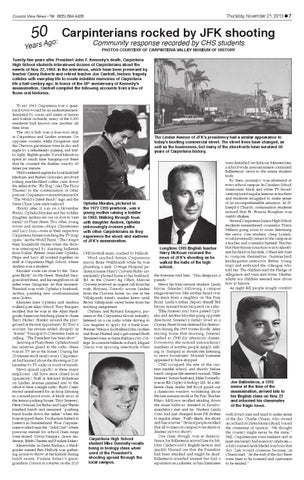
The Linden Avenue of JFK’s presidency had a similar appearance to today’s bustling commercial street. The street trees have changed, as well as the businesses, but many of the storefronts have survived 50 years of Carpinteria history.
Ophelia Morales, pictured in the 1972 CHS yearbook, was a young mother raising a toddler in 1963. Walking through town with daughter Andrea, Ophelia unknowingly crosses paths with other Carpinterians as they experience the shock and sadness of JFK’s assassination. CHS football team, coached by Hallock. Word reached future Carpinteria mayor Ernie Wullbrandt while he was plumbing a sink. Cottage Hospital pediatrics nurse Nancy Cravens Rubio immediately phoned home to her husband, Ed. At the County Ag Office, Marcus Cravens received an urgent call from his wife, Rowena. Directly across Linden from the Cravens home, no one at the Villalpando family market knew until Reyes Villalpando raced home from his teaching assignment. Chiharu and Richard Kitagawa, pioneers in the Carpinteria flower industry, listened on a car radio while driving to Los Angeles to apply for a bank loan. Former Warrior footballers John Godkin and Brian Husted and a girl named Ruth Tremmel were at Santa Barbara City College. In a remote hillside orchard, Miguel Garcia was spraying insecticide when
Carpinteria high school student Mike Donnelly recalls being in biology class when word of the President’s shooting spread through the local campus.
Longtime CHS English teacher Harry McKown received the news of JFK’s shooting as he walked the halls of the high school. the foreman told him, “Una desgracia a pasado.” News hit Marymount student Linda Mayer (Meeder) following a campus religious service. Her mother heard over the fence from a neighbor on Star Pine Road. Linda’s father, deputy sheriff Ted Mayer, learned from his patrol car radio. Tillie Jimenez may have passed Ophelia and Andrea Morales going opposite directions. Jimenez’s family lived in a Cramer Street house destined for destruction during the 1969 winter floods. After staying home that morning, Jimenez rushed to CHS for afternoon classes. Downtown she noticed extraordinary numbers of somber people simply talking or clumped in storefronts listening to news broadcasts. Normal business appeared to have stopped. CHS occupied the site of the current middle school, and shortly before lunch campus life seemed normal. Tillie Jimenez’ future husband, Mike Donnelly, was in Ed Copley’s biology lab. In a different class, surfer Jeff Boyd gazed out a classroom window wondering about the late autumn swell at Tar Pits. Teacher Harry McKown recalled striding down the main hallway dressed in facultymandatory suit and tie. Student Linda Ortiz had just changed from PE clothes to regular attire: “Puffy skirts, flat shoes and hair scarves.” Several people recalled that all women on campus wore skirts or dresses (not too short!). One class, though, was in disarray. Senior Joe Ballesteros arrived late for Mr. John Calderwood’s English section and quickly blurted out that the President had been attacked and might be dead. Ballesteros sounded earnest but had a reputation as a jokester, so his classmates
were disturbed yet dubious. Minutes later a school-wide announcement confirmed Ballesteros’ news to the entire student body. By then, normalcy was shattered at every school campus. In Canalino School classrooms, black and white TV broadcasts replaced regular lessons as teachers and students struggled to make sense of an incomprehensible situation. At St. Joseph’s Church, confirmation students noticed that Fr. Francis Roughan was visibly shaken. Several Carpinteria Junior High School students remembered counselor Tyson Willson going room to room delivering the news. One student, Greg Lomeli, would eventually return to the campus as a teacher and counselor himself. Teacher Nat Hawthorne’s reaction was to silently rest his head on his desk. Others left class to compose themselves. Summerland kindergarten instructor Esther Young wept and embraced the colleague who told her. The children said the Pledge of Allegiance and were sent home. Neither adults nor children seemed sure about how to behave. As night fell people sought comfort
Joe Ballesteros, a CHS senior at the time of the assassination, arrived late to his English class on Nov. 22 and informed his classmates of the tragic news. with loved ones and tried to make sense of the day. Charlie Chunn, who owned an orchard on Santa Monica Road, voiced the consensus of opinion: “We thought the country might never be the same.” Still, Carpinterians were resilient and at least one family had reason to celebrate— a baby named Andi Medel was born that day. Life would continue because, as Chunn said, “At the end of the day there were trees to be watered and customers to be tended.”