
CARPINTERIA MAGAZINE
Welcome New Cottage Medical Group Providers
Our Cottage Medical Group (CMG) physicians offer a broad scope of services, including primary care, neurosciences, cardiovascular care, rheumatology, surgical and women’s services. Cottage Health’s efforts to expand primary and specialty care are part of a tradition that has shaped health care on the Central Coast for more than 135 years.
COTTAGE PRIMARY CARE

Daniel Crossman, MD Internal Medicine

Barry Statner, MD, CM Internal Medicine Infectious Disease

COTTAGE CARDIOLOGY CLINIC
Amir Jalilian, MD Family Medicine RHEUMATOLOGY

Casey Whipple, MD Family Medicine
Elizabeth Hutchins, MD, PhD General Cardiology
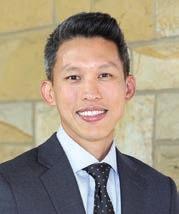
Chee Yuan Ng, MD Cardiac Electrophysiology
COTTAGE SURGICAL CLINICS
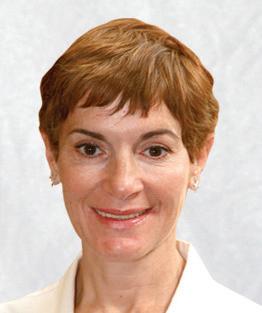
Farida Bounoua, MD, FACS General and Bariatric Surgery

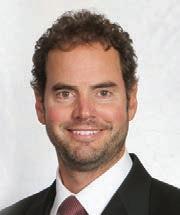
David Thoman, MD General and Bariatric Surgery
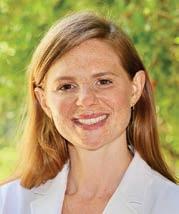
Courtney Stull, MD Rheumatology
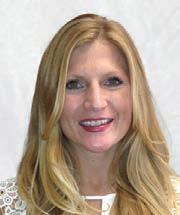
Lexine Yurcho, MD General and Colorectal Surgery





Welcome to our office!
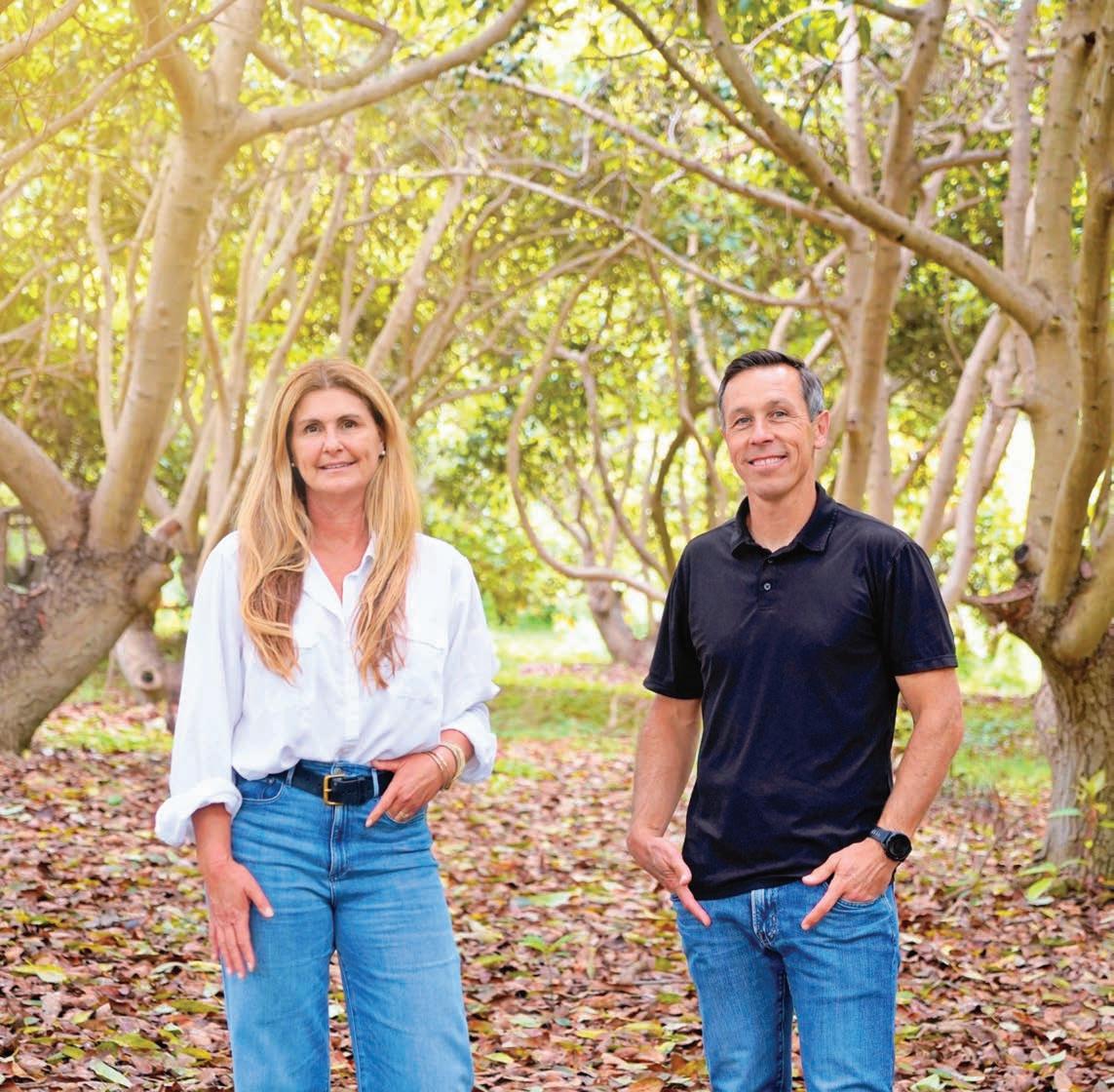
We are Aaron Crocker and Beth Cox and we would love to create personalized strategy to help you achieve your financial goals. We are incredibly passionate about Carpinteria and our community and look forward to helping turn your financial hopes and dreams into reality.
Our commitment to you
We believe when it comes to your financial journey, you deserve a personal relationship and professional advice. This means focusing on the future you see for yourself, building strategies just for you and helping you stay on track. Our areas of focus include:
• Retirement income strategies
Estateandlegacystrategies
• Saving for education
Wealth strategies
• Business retirement plans
Sociallyconscious investing
Aaron P. Crocker
Financial Advisor
aaron.crocker@edwardjones.com
Beth Cox Branch Office Administrator elizabeth.cox2@edwardjones.com
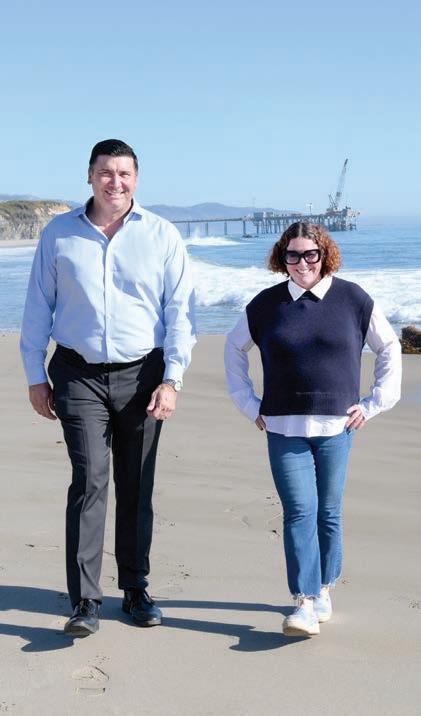















































Buying or selling a home with us is like a walk on the beach!
Seascape Realty






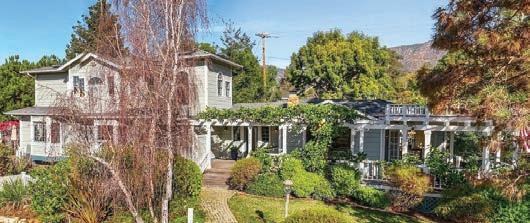
BEAUTIFUL VISTA DE SANTA BARBARA SENIOR COMMUNITY! Manufactured in , bedroom, bath featuring vaulted ceilings and lots of closet space throughout. he living room is open to the dining area and large itchen with a wal in pantry and brea fast bar. here are mountain views from the living room and itchen. he laundry room has washer, dryer and storage space. here is a two car covered carport and a large storage shed. wners may have two pets. ar amenities include a ool, acu i, and Clubhouse. OFFERED AT $519,000.
Please call Shirley Kimberlin at 805-886-0228 A WELL MAINTAINED, FRIENDLY SENIOR COMMUNITY FOR RESIDENTS
55+... ight and right home with
of
light. arge living room, dining room, and a room ad acent to the itchen which can be used as a den family room. wo bedrooms, two full baths. wo car covered carport and two storage sheds. ancho ranada

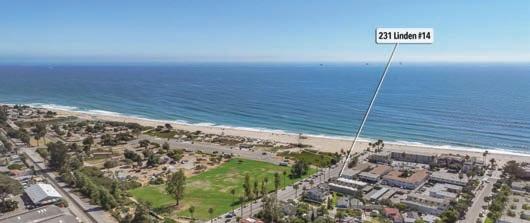
LOCATED JUST TWO BLOCKS FROM THE SANDY BEACH WITH LOVELY MOUNTAIN VIEWS... Take a short stroll from this charming co age to the beautiful beach or to downtown Carpinteria with uni ue shops, restaurants and more he Wal Score from this location is and the i e Score is . erfect location for a vacation home or for full time en oyment. he large lot o ers the possibility of adding an additional unit.
OFFERED AT $1,600,000.
Please call Shirley Kimberlin at 805-886-0228

GREAT LOCATION IN A WONDERFUL NEIGHBORHOOD... large entry porch ta es you into this two bedroom, two bath home with a large bac yard with a beautiful ra ilian pepper tree and two fruit trees. short stroll from l Carro ar and Canalino lementary School. property with lots of potential.
OFFERED AT $1,100,000.
Please call Shirley Kimberlin at 805-886-0228

Please call Shirley Kimberlin at 805-886-0228
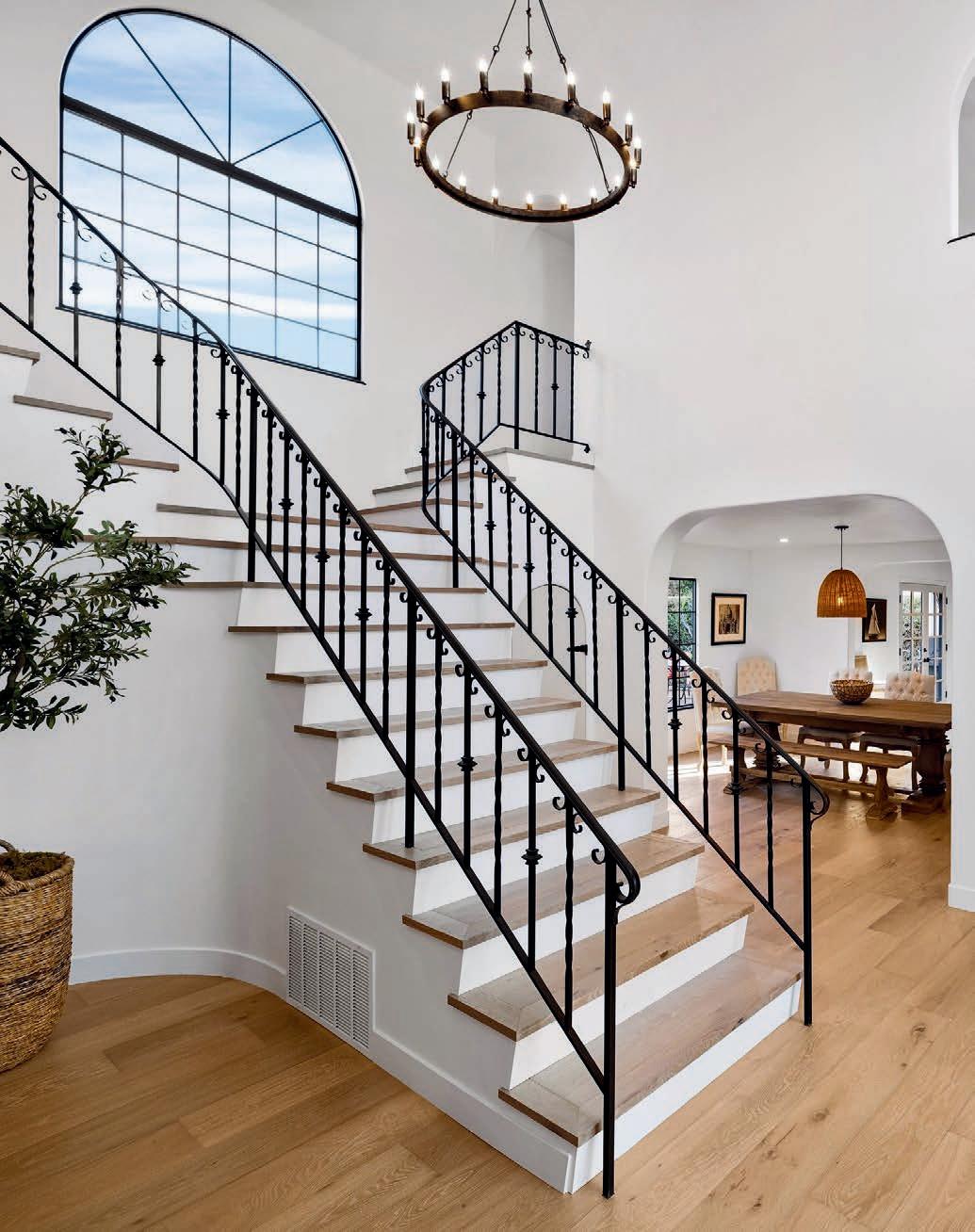



Debbie Murphy, Realtor-Broker
Kim Fly, Realtor-Broker Associate
Leah Wagner, Realtor
Carolyn Friedman, Realtor
Ross Gill, Realtor
Stacey Zubiate, Realtor
Heidi and Jim Michener, Vacation Hosts

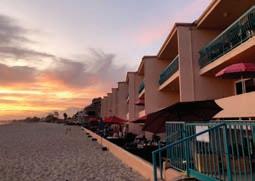
Carpinteria Shores is right on the sand. Select from a range of prices for our individually owned and decorated two bedroom vacation rental condos which sleep up to six comfortably. Everything included e cept linens hich e’re pleased to provide upon request. Available for short or long term stays.
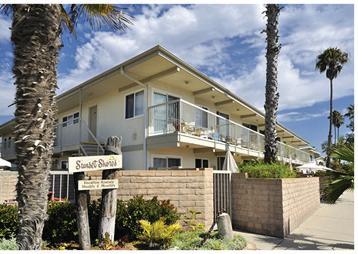
Sunset Shores sits right across the street from Carpinteria City Beach. We manage several units of varying sizes in this desirable complex with amenities that include: heated pool, hot tub, BBQ & Picnic areas, laundry room and EV Charging Stations.

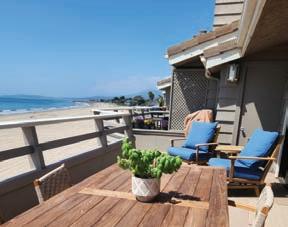
Panoramic ocean views from this spacious 3 bedroom / 3 ath top oor condo. Amenities include Elevator, Washer/Dryer, gas grill, private parking for 2 vehicles, outdoor showers and easy beach access. Available for short or long term stays.

Nestled in the Carpinteria Foothills, with sweeping valley and mountain views, this 2 bd. /1 bath luxury vacation home sits on 3 acres and has a 1 bd. / 1 bath guest cottage. Available for 30+ days or more.

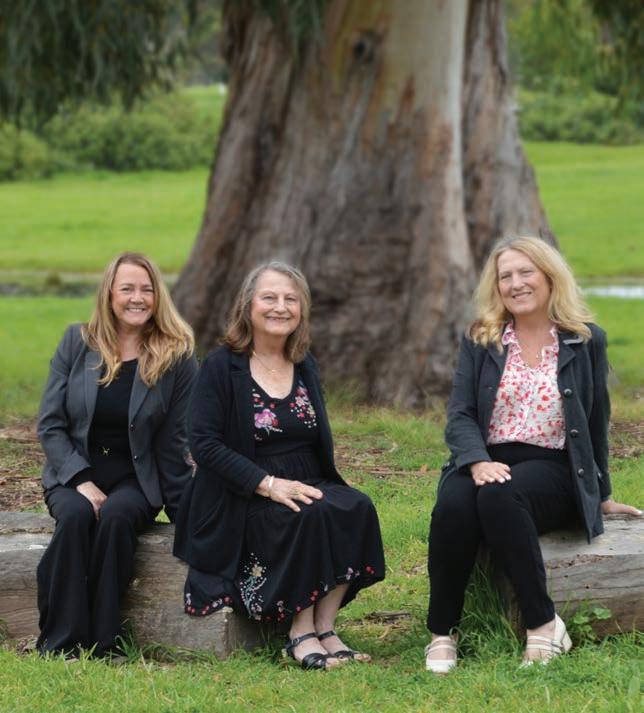
Debbie Murphy Kim Fly Leah Wagner
Carolyn Friedman Heidi and Jim Michener
Villa Sortino Stunner!



CARPINTERIA MAGAZINE WINTER 2026
EDITOR: Lea Boyd
PRODUCTION & DESIGN: Kristyn Whittenton WRITERS
Peter Dugré • Keith Hamm
Amy Marie Orozco • Alonzo Orozco
Evelyn Spence • Jun Starkey
PHOTOGRAPHERS
Ingrid Bostrom • Susie Clothier
Matt Dayka • Robin Karlsson • Daniel Kuras
Mayra Martinez • David Powdrell
PRODUCTION SUPPORT
Carpinteria Valley Museum of History Rockwell Printing
ADVERTISING
Karina Villarreal karina@coastalview.com (805) 684-4428
GET SOCIAL WITH US CarpinteriaMagazine.com Instagram and Facebook @CarpinteriaMagazine
All articles, photographs and artwork appearing in this publication are the copyrighted intellectual property of RMG Ventures, LLC. RMG Ventures, LLC aggressively protects its intellectual property rights. No part of this publication may be reproduced or copied in any form without the express written permission of the publisher. ©2026 RMG Ventures, LLC.

ON THE COVER
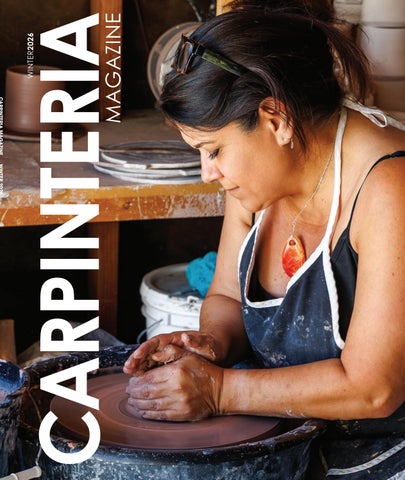
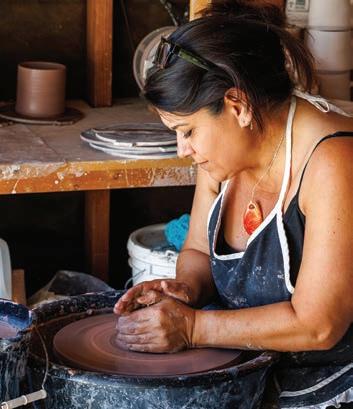
Nicole Velasquez-Slawson doesn’t mind getting her hands dirty. The founder of Sola Ceramics creates small batch pottery that checks the boxes for pretty and practical. Read more on page 66.
~ Photo by Matt Dayka
Published by RMG Ventures, LLC
Michael VanStry, President
Gary L. Dobbins, Vice President
4180 Via Real, Suite F, Carpinteria, California 93013
Tel: (805) 684-4428
Email: info@carpinteriamagazine.com

CARPINTERIA
MAGAZINE WINTER 2026
EDITOR: Lea Boyd
PRODUCTION & DESIGN: Kristyn Whittenton WRITERS
Peter Dugré • Keith Hamm
Amy Marie Orozco • Alonzo Orozco
Evelyn Spence • Jun Starkey
PHOTOGRAPHERS
Ingrid Bostrom • Susie Clothier
Matt Dayka • Robin Karlsson • Daniel Kuras
Mayra Martinez • David Powdrell
PRODUCTION SUPPORT
Carpinteria Valley Museum of History Rockwell Printing
ADVERTISING
Karina Villarreal karina@coastalview.com (805) 684-4428
GET SOCIAL WITH US CarpinteriaMagazine.com Instagram and Facebook @CarpinteriaMagazine
All articles, photographs and artwork appearing in this publication are the copyrighted intellectual property of RMG Ventures, LLC. RMG Ventures, LLC aggressively protects its intellectual property rights. No part of this publication may be reproduced or copied in any form without the express written permission of the publisher. ©2026 RMG Ventures, LLC.
ON THE COVER
Nicole Velasquez-Slawson doesn’t mind getting her hands dirty. The founder of Sola Ceramics creates small batch pottery that checks the boxes for pretty and practical. Read more on page 66.
~ Photo by Matt Dayka
Published by RMG Ventures, LLC
Michael VanStry, President
Gary L. Dobbins, Vice President
4180 Via Real, Suite F, Carpinteria, California 93013
Tel: (805) 684-4428
Email: info@carpinteriamagazine.com



Farm to Table • Chef’s Seasonal Specials
Sustainable Meats & Seafood
Extensive Wine List • Patio Dining

Farm to Table • Chef’s Seasonal Specials
Sustainable Meats & Seafood

Cheese & Bread
Specialty Grocery
Wine & More

Extensive Wine List • Patio Dining
Pasture-Raised • Sustainable Organic • Local ~ BUTCHER ON DUTY ~









DEAR READERS,
Fall of 2025 delivered its signature warm days and cool nights, and prompted thoughts of chillier times to come. Mild seasons are among the many qualities that make Carpinteria such a sought-after place to live or visit. But let’s be clear, we do have our seasons.
For me, the fall is best defined by the angle of light. Pale yellow fingers of sunshine that dislodge memories of pumpkin patches and empty beaches. Setting suns that sit fat atop the ocean in the gap between Santa Cruz Island and Leadbetter Point in Santa Barbara.
Winter for me means adding blankets to the beds and opening the musty hall closet that’s sardined with jackets and long sweaters. But we don’t pack away the bathing suits and beach gear at the change of seasons — Carpinterians know that there are always a handful of 75-plus-degree days in January and February that draw our pale skin onto the sand for a glorious break from cold.
This edition of Carpinteria Magazine feels particularly wintery to me. There’s the cozy feel of Kellen Meyer’s fiber arts, the spotlight on Channel Islands Marine Wildlife Institute and their storm season work rehabbing pinnipeds, and the butterflies zipped up in their sleeping bag chrysalises. There’s also plenty of sunshine, because that’s on tap most Carpinteria winters.
Our winter edition also makes me think of holidays and the importance of community support for local merchants. Our businesses cannot live on tourist season alone. So, reader, close the computer and head out to our mom-and-pop shops for your gifts this year. Supporting local businesses echoes into just about everything — our local nonprofits, the livelihood of friends and neighbors, and even Carpinteria Magazine!
Thank you for reading a product that our little staff pours its heart into.
Onward & upward,
Lea Boyd, Editor






















































The Food of the People



OPEN
OPEN
Wednesday - Sunday Noon - 8 pm
OPEN
Wed. & Thurs. 3-8 pm
Fri. & Sat. & Sun. 12-8 pm
$15 LUNCH SPECIAL
Wed. & Thurs. 3-8 pm
Fri. & Sat. & Sun. 12-8 pm
HAPPY HOUR
Wednesday - Friday Noon - 3pm
Wed. thru Fri. 3-5 pm
HAPPY HOUR
HAPPY HOUR
Wed. thru Fri. 3-5 pm
Wednesday - Friday 3 - 5 pm
Book your table today!
805-684-2209
Book your table today!
805-684-2209
3807 Santa Claus Lane, Carpinteria
3807 Santa Claus Lane, Carpinteria



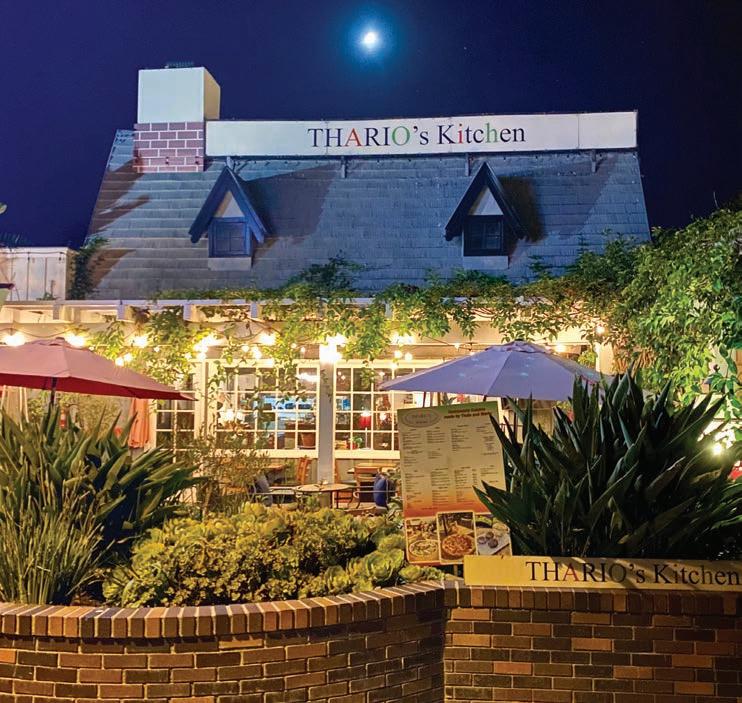
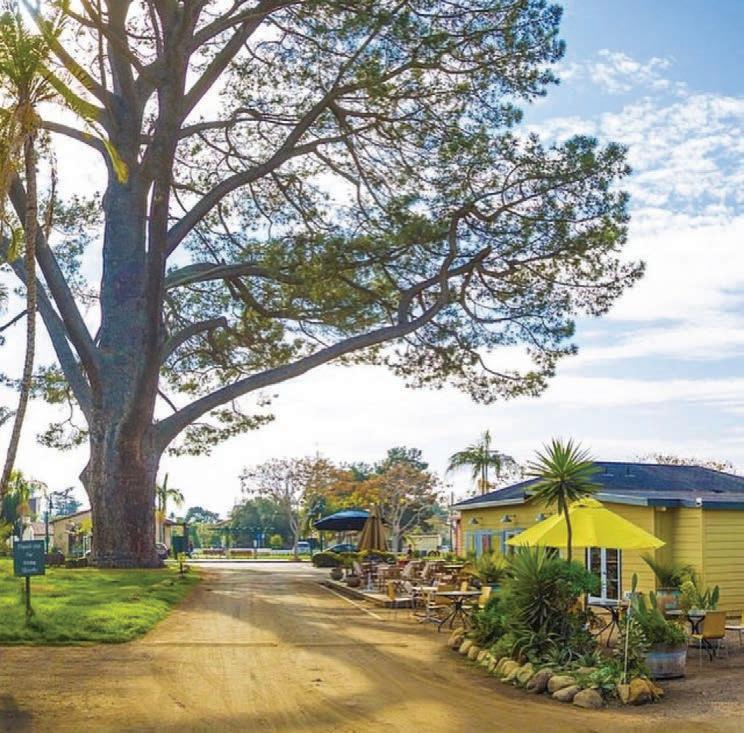
6:30AM - 2:30PM
CONTRIBUTORS

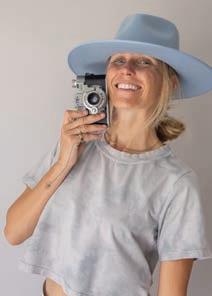
INGRID BOSTROM
Nothing pleases me more than finding and capturing light — both what lights people up within and emphasizing luminance through the environment.
Nothing frustrates me more than men instantly directing me at my photoshoots.
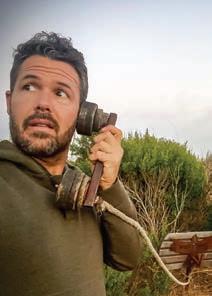
MATT DAYKA
Nothing pleases me more than putting people at ease in front of the camera. Nothing frustrates me more than when equipment misbehaves.
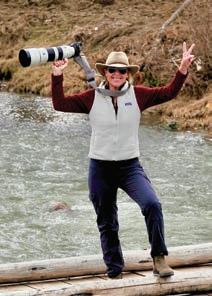
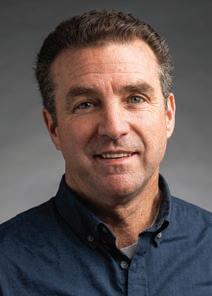
SUSIE CLOTHIER
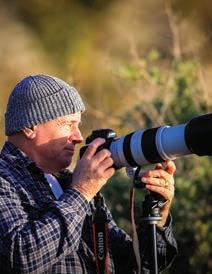
Nothing pleases me more than being out on a trail or a field and experiencing the wild beauty of nature and capturing it with my lens. Nothing frustrates me more than being out in nature and not having a long enough lens to capture an image!
KEITH HAMM
Nothing pleases me more than getting out-of-the-blue texts and emails from editors asking if I’d like to get paid to interview and write about interesting people. Nothing frustrates me more than my own optimism when it comes to relying on social media for balanced news coverage and commentary.
WHAT OUR CONTRIBUTORS LOVE ABOUT THEIR WORK (AND WHAT THEY DON’T...).
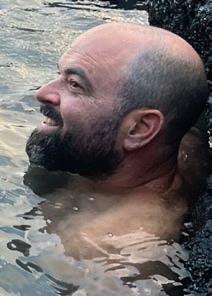
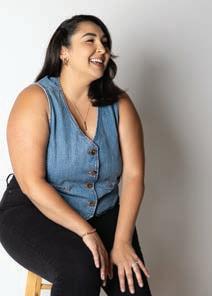
PETER DUGRÉ
Nothing pleases me more than learning new things from interesting, passionate experts. Nothing frustrates me more than reading an error that I’ve made in print.
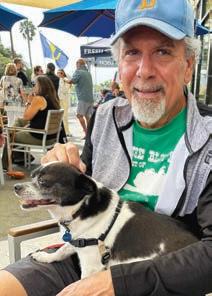
ALONZO OROZCO
Nothing pleases me more than when the photos synchronize with what I’ve written. Nothing frustrates me more than when I think I have a great opening sentence to a story and it gets edited out.
MAYRA MARTINEZ
Nothing pleases me more than photographing a family year after year and watching them grow.
Nothing frustrates me more than the wind trying to steal the spotlight during a shoot.
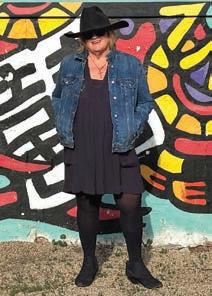
ROBIN KARLSSON
Nothing pleases me more than someone thanking me for a photo I took of them and they actually like it! Nothing frustrates me more than getting “the shot” but it’s out of focus.

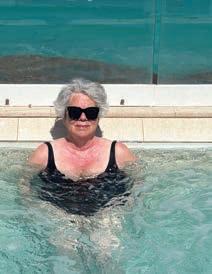
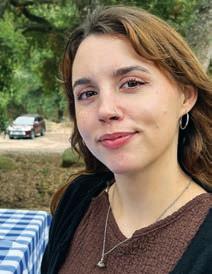
DAN KURAS
Nothing pleases me more than a day at the beach with family, board, and camera. Nothing frustrates me more than time wasted, life is too short.
AMY MARIE OROZCO
Nothing pleases me more than allowing myself the time after an interview to enjoy the writing part of my job. Nothing frustrates me more than a cat climbing on the keyboard right before I hit send on a final draft.
PHOTO CREDIT: ALONZO OROZCO
DAVID POWDRELL
Nothing pleases me more than photographing a surfer and giving them the digital image in high resolution format.
Nothing frustrates me more than not being able to get a digital photo of a surfer to them, for whatever reason.
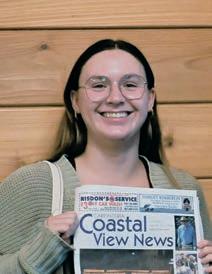
EVELYN SPENCE
Nothing pleases me more than seeing my stories laid out in print. Nothing frustrates me more than capturing a blurry photo!
PHOTO CREDIT: ROBIN KARLSSON
JUN STARKEY
Nothing pleases me more than finding a pen at the bottom of my bag when I thought I didn’t have one. Nothing frustrates me more than not being able to understand my own notes.

Formed as its own entity in 2023 by dedicated residents, the Carpinteria Community Association (CCA) is a nonprofit organization committed to celebrating the unique character of our beloved town. Join us at the Community Awards Banquet Saturday, April 18, 2026
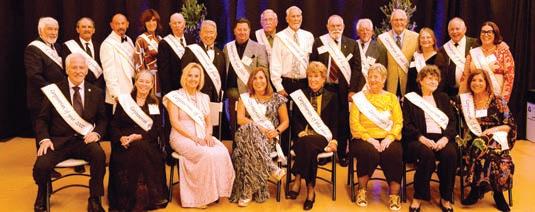
This cherished annual event honors outstanding students, educators, and community members, including the announcement of the prestigious Carpinterian and Junior Carpinterians of the Year Awards.

KARLSSON



UNCOMMON THREAD:
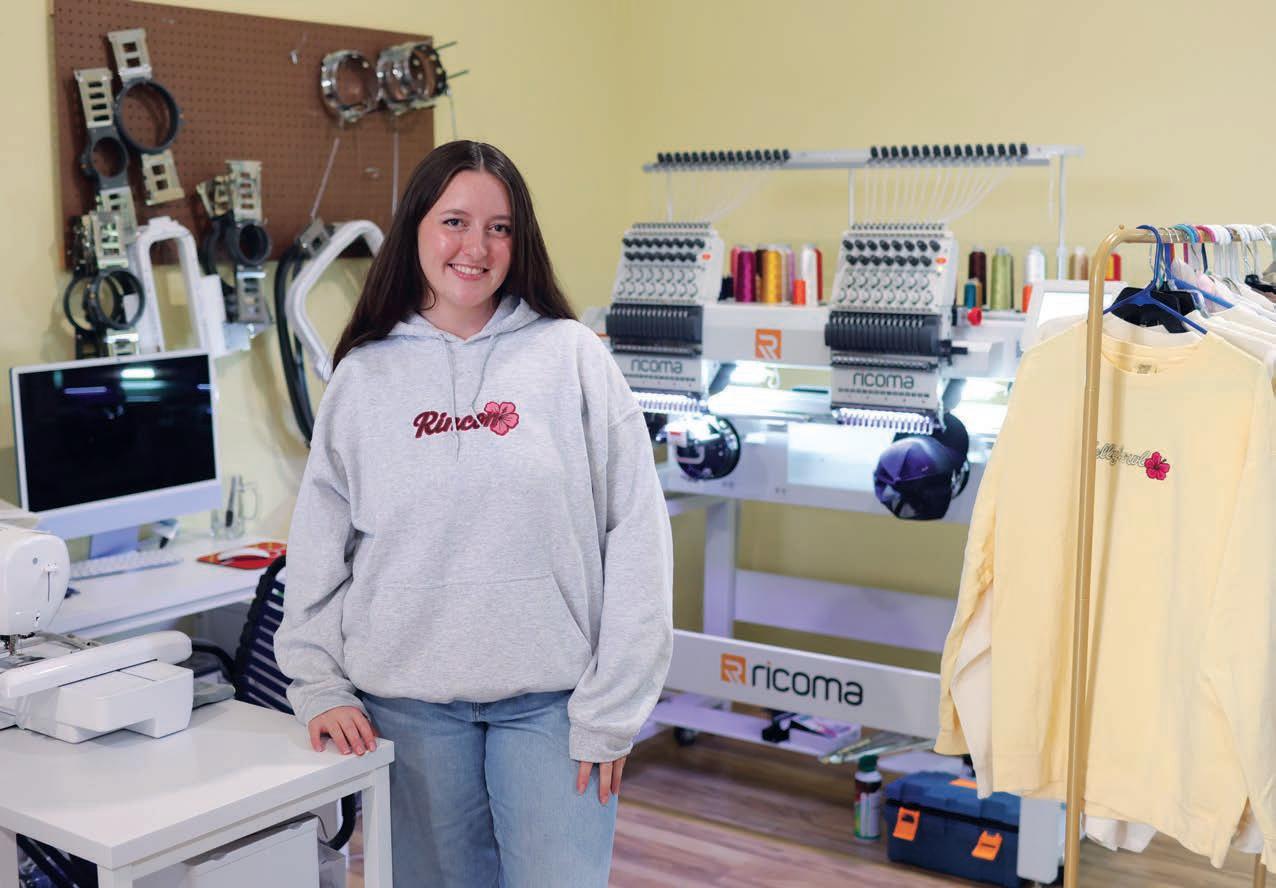
WOlivia Sheaffer with the tools of her trade.
Poppy and Snow introduces creative,
custom embroidery
WORDS BY JUN STARKEY
PHOTOS BY MAYRA MARTINEZ
hat began as a dorm room hobby has blossomed into a serious income for lifelong Carpinterian Olivia Olivia, founder of Poppy and Snow Embroidery.
Olivia caught the embroidery bug about a year and a half ago. She signed up for a class while attending Iowa State University, where she majored in apparel merchandising before graduating and returning to Carpinteria in 2024. After enjoying the class, Olivia decided to take a leap.
“I became really interested (in embroidery) and bought an embroidery machine just to have fun with my friends,” Olivia says. It wasn’t until requests started flooding in from her social circle that she realized the business potential of her work.
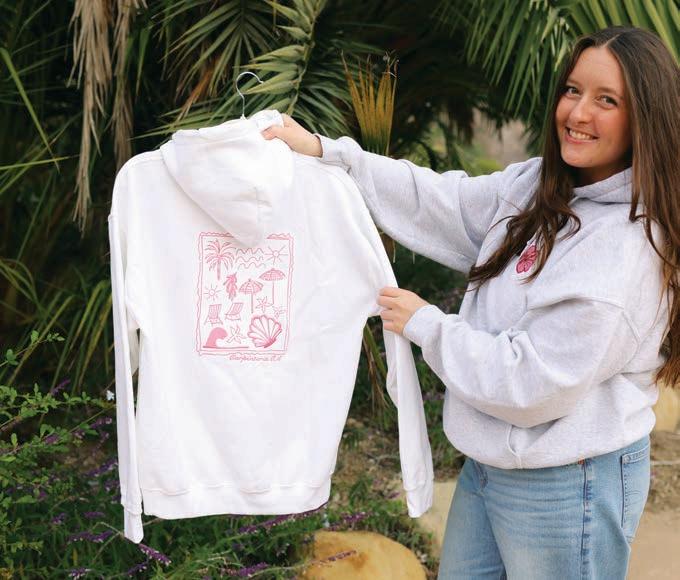
She begins with a design — customers can pick from graphics on her Etsy store or send in a custom order request. Custom designs can be embroidered onto an array of articles, including shirts, sweatshirts, hoodies, hats, tote bags, aprons, and jackets. She then sketches the design in Procreate, digitizes it, and sends to her embroidery machine, which completes the actual stitching.
Her work has evolved since she began back at Iowa State. ome o li ia’s first pieces were pet portraits, with se eral of her friends submitting photos of their beloved pets to be embroidered onto sweatshirts and hoodies. She then began receiving requests for Greek life wear, creating personalized designs for members of fraternities and sororities.
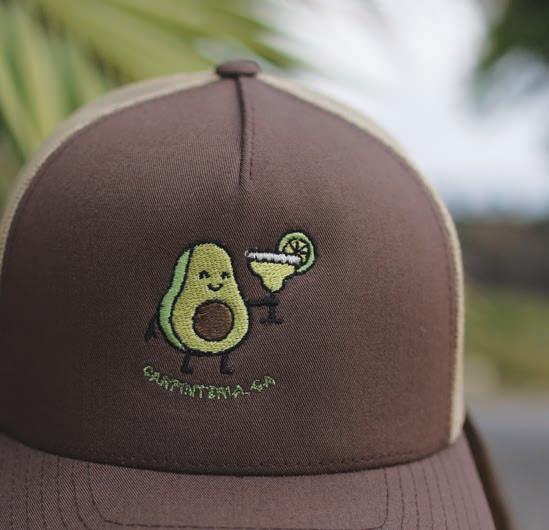
Now, Poppy and Snow features some of Olivia’s own designs, such as a pair of cowgirl boots standing on the beach and a vintage truck with a surfboard resting in the trunk. She has created artwork that references iconic spots around Carpinteria such as Jelly Bowl or Rincon. Her latest design was for the California Avocado Festival and features a smiling avocado holding a margarita.
li ia is in the process o ettin an o ficial oppy an Snow website up and running. She is also working with local shops throughout Carpinteria and Santa Barbara and hopes to see some of her pieces on shelves in the near future.
Follow her on Instagram at @poppy.and.snow.embroidery
Thrifting with a Heart of Gold
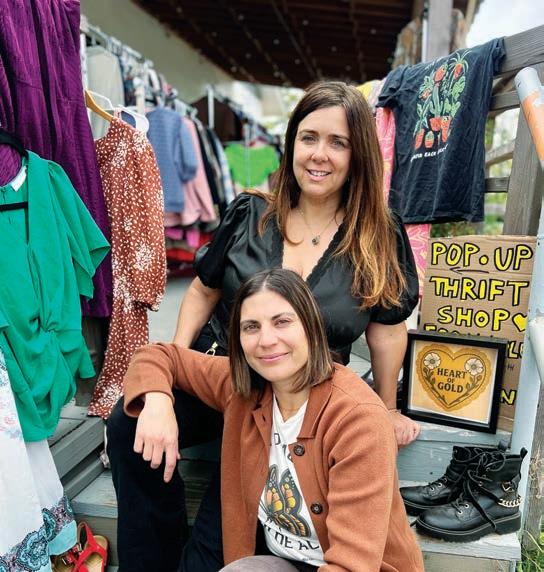
Goodbye fast fashion. Hello feel-good fashion. That’s the ibe behin Heart o ol , a new nonprofit o n e by Carpinterians Kellie Wolf and Vanessa Van Der Kar. By selling pre-loved clothing, the pair has big plans for comm nity benefits.
Kellie and Vanessa, both longtime thrifters, share a deep commitment to the circular economy—the practice of keeping clothing out of landfills and reducing resource consumption. But they didn’t stop at just recycling. After a conversation last spring brought to light their shared vision, they decided to make the sustainable concept a vehicle for creative change in Carpinteria. Heart of Gold’s mission is a win-win-win:
lothes are recycle an i erte rom lan fills.
• Community members have access to highly affordable clothing.
• Proceeds fund local art enrichment programs and scholarships.
As Vanessa puts it, “What’s better than converting a free pro ct into a benefit to the comm nity
The founders are already making a local impact. They’ve partnered with the Carpinteria Children’s Project and provide vouchers to connect families with free clothing. “Now more than ever, putting time into your own community is important, ellie says.
rrently, yo can sna ni e fin s at their pop p thri t shop on the last Saturday of every month at Carpinteria Children’s Project. The duo hopes to eventually sign a lease on a permanent brick-and-mortar shop.
To donate, drop off items at the Carpinteria Skate Foundation, 1041 Casitas Pass Road, or email info@heartofgoldthrift.org.
Follow @heartofgoldthrift on Instagram for details on monthly pop-up locations and dates.
Sheaffer stitches her creativity into Poppy and Snow designs.
Vanessa Van Der Kar, top, and Kellie Wolf at a pop-up in October.


y the n mbers
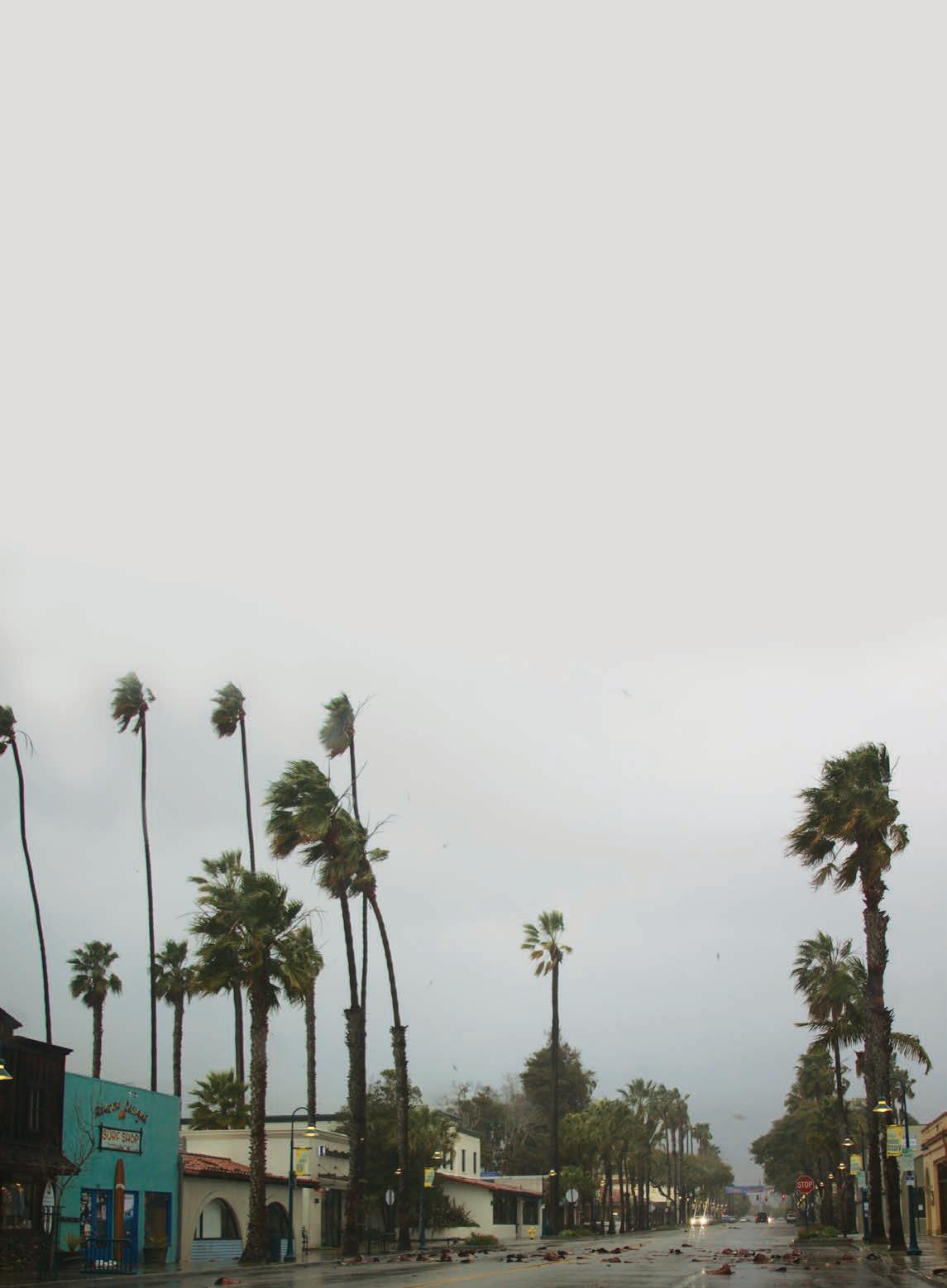
Is it normal to be a little obsessed with rainfall data? If so, Carpinteria Magazine staff alifies as normal. not, we embrace o r weir . he o nty o anta arbara’s loo ontrol istrict keeps incre ible rain all recor s, the kin we co l et lost in or ho rs an ho rs. ecor s or arpinteria rain all o back to the water year o the water year be ins ept. . his i es s almost years o ata to istill own to a list o hi hli hts that sho l be interestin to e en those less rain all ner y than s
* Records for rainfall intensity begin in1964/65








8.4 INCHES: Highest 15-minute rainfall intensity, recorded in 2017/18* .86 INCHES:






4.71 INCHES:


Lowest annual rainfall total, recorded in 2020/21

FEB. INCHES:






Highest Santa Barbara County rainfall month, accounting for 22% of annual rainfall






Last year’s rainfall total
45.83 INCHES:





Highest annual rainfall total, recorded in 1997/98

17.2 INCHES:







Average annual rainfall total

5.43 INCHES:






Highest 24-hour rainfall intensity, recorded in 1994/95
























RUSH HOUR
PHOTO BY DAN KURAS



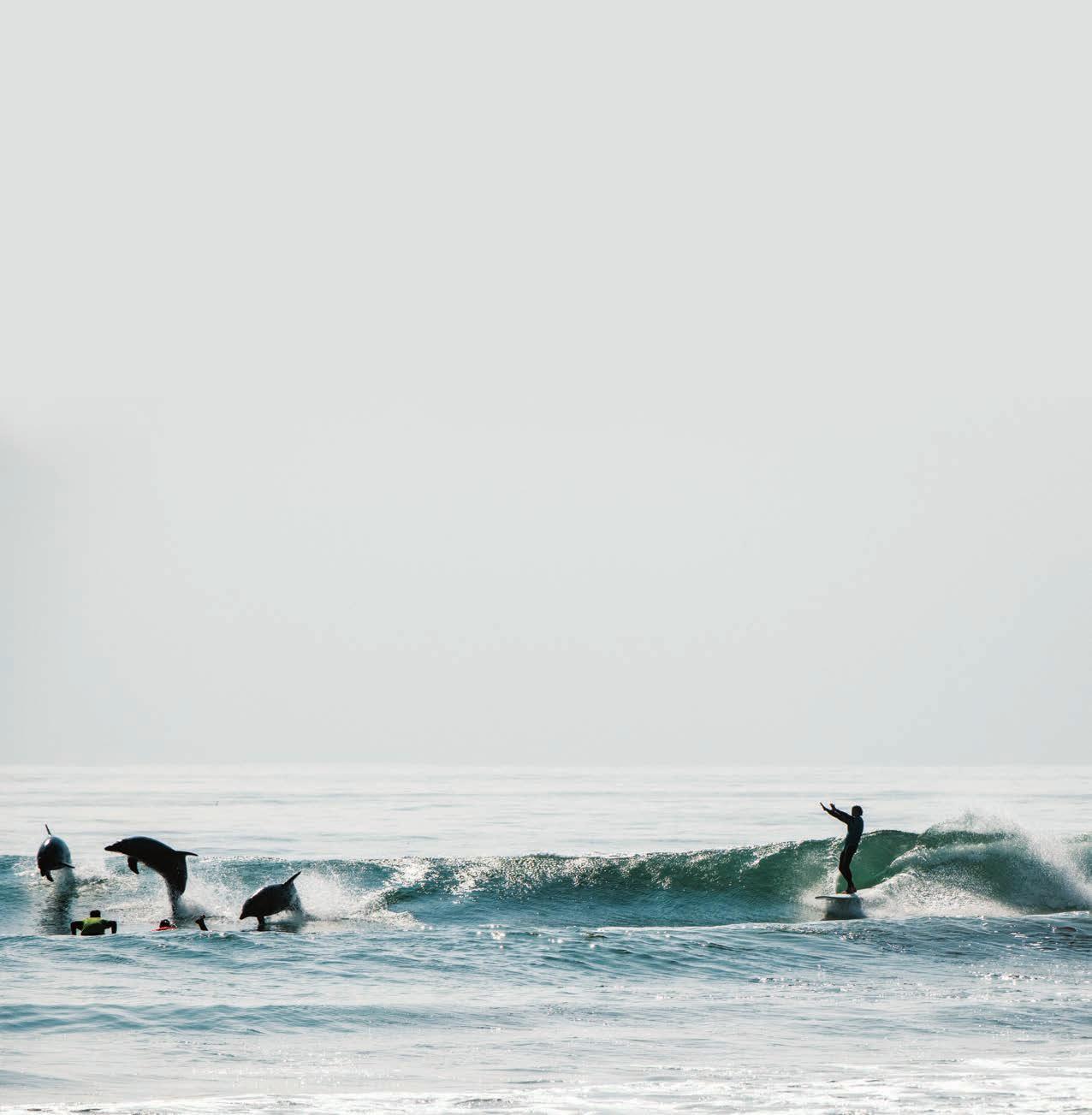
Carpinterian Timmy Davis shares a wave with some friends during the Toes in the Cove Rincon Longboard Classic on Nov. 2, 2025. The dolphins stole the show, demonstrating how millions of years of evolution have sharpened their surfing skills, no boards required. Spectators on the beach and contestants in the water celebrated the marine mammal cameo, cheering as Timmy and the dolphins rode the wave from Rincon Point into the Cove.


































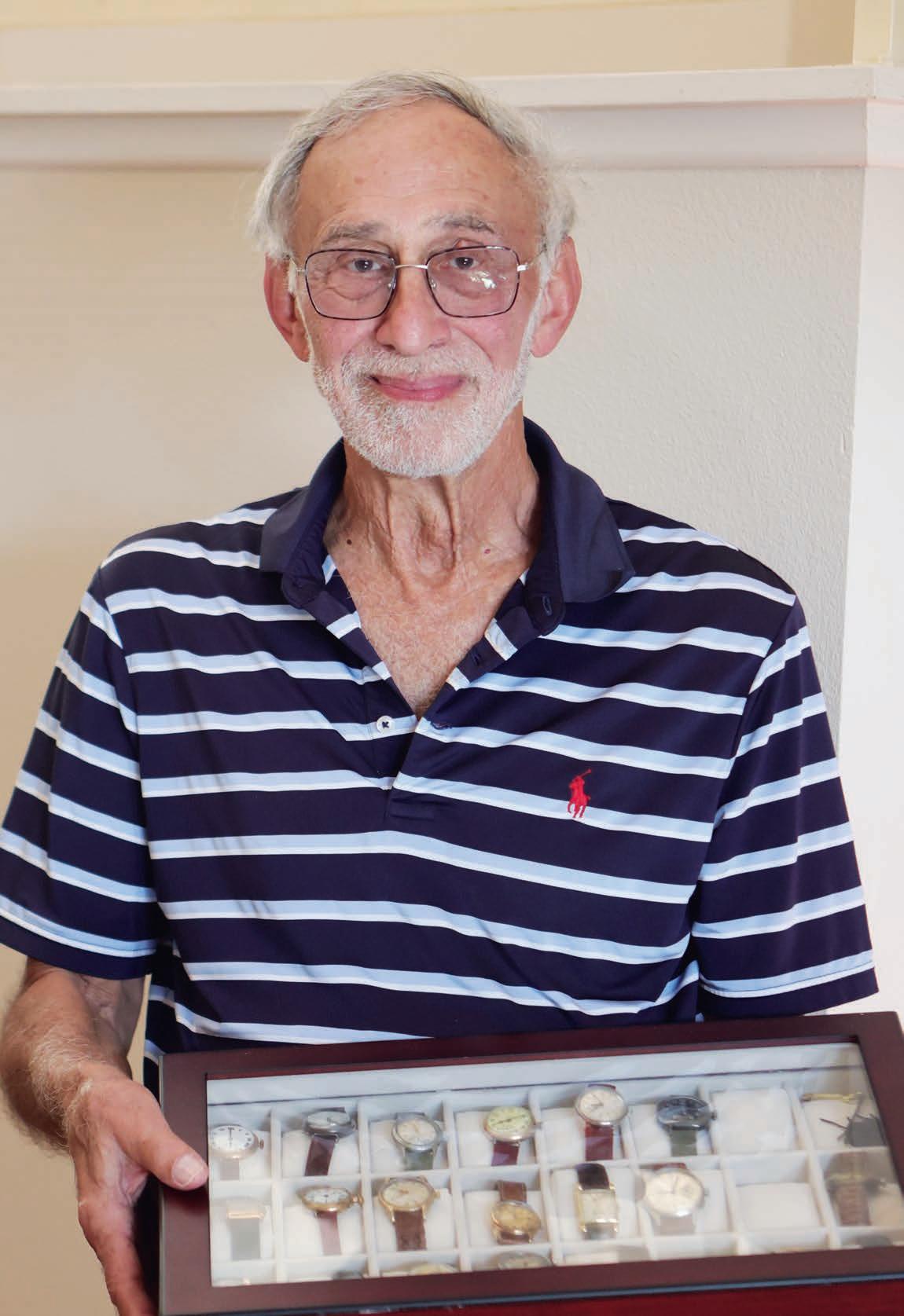
with one of several display cases for his watch collection.
Bob Stokes
TIME PEACE Carpinterian reunites families with their past
WORDS BY ALONZO OROZCO PHOTOS BY MAYRA MARTINEZ
Carpinterian Bob Stokes has been a collector since he was a boy. “I collected everything. I had all the baseball cards, had all the coins,” explains the 78-year-old. These days, Bob sets his sights on a more intricate item, the wristwatch.
When he started focusing on watches, he discovered that some are engraved with names. He began to ponder the lives of these original owners and how they become separated from these valuable pieces. This led to online research at newspapers.com and ancestry.com in search of family information.
Bob’s sleuthing prompted an idea. Could he reunite the families with these sparkling remembrances of their history?
“When I wear them (the watches), I know so much about them that I’m thinking about this person,” says Bob.
Now he searches through the thousands of shiny specimens on eBay, bidding on some, and spending anywhere from $25 to $200.
Four years ago, Bob took his interest to the next level, joining the National Association of Watch and Clock Collectors (NAWCC) Chapter 190 of Ventura and Santa Barbara counties, which meets every third Sunday at Ventura College. He currently serves as chapter president.
Because of the advanced age of many of the watches, many are in need of repair. Although Bob doesn’t tinker
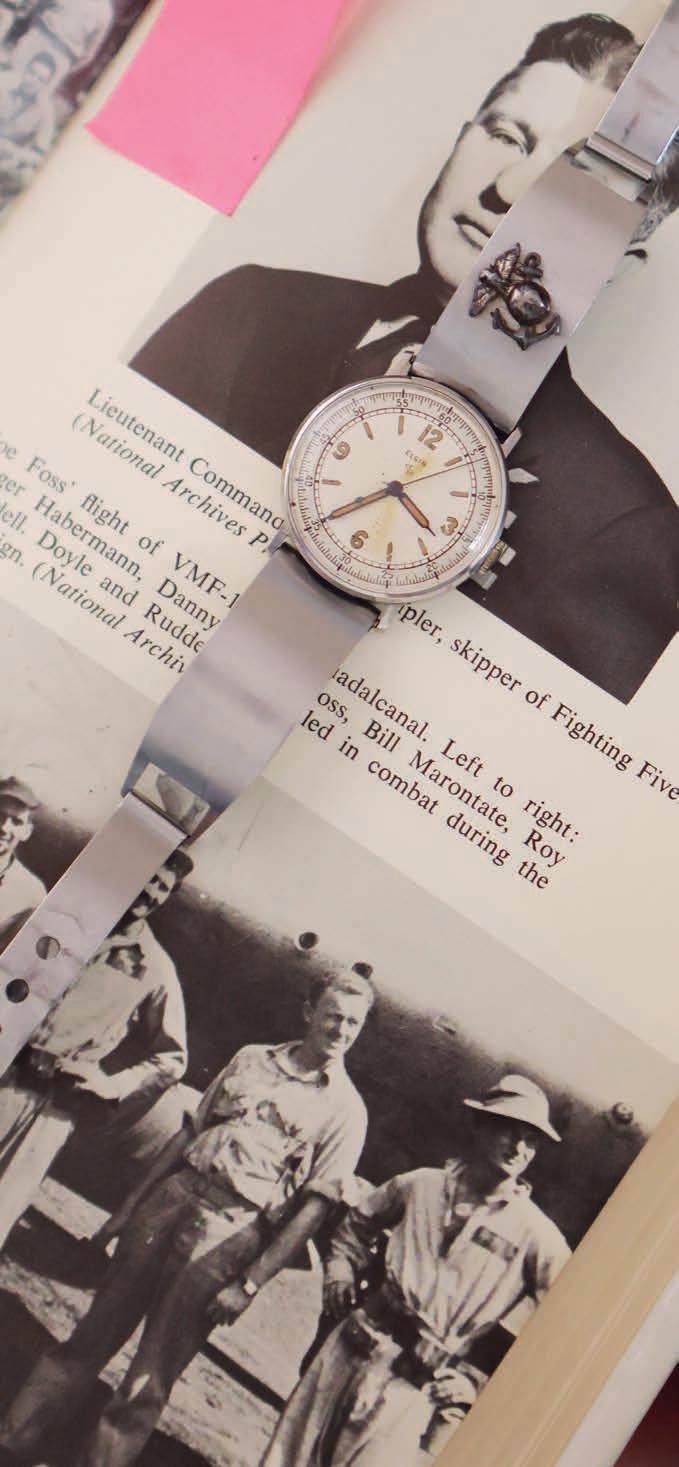
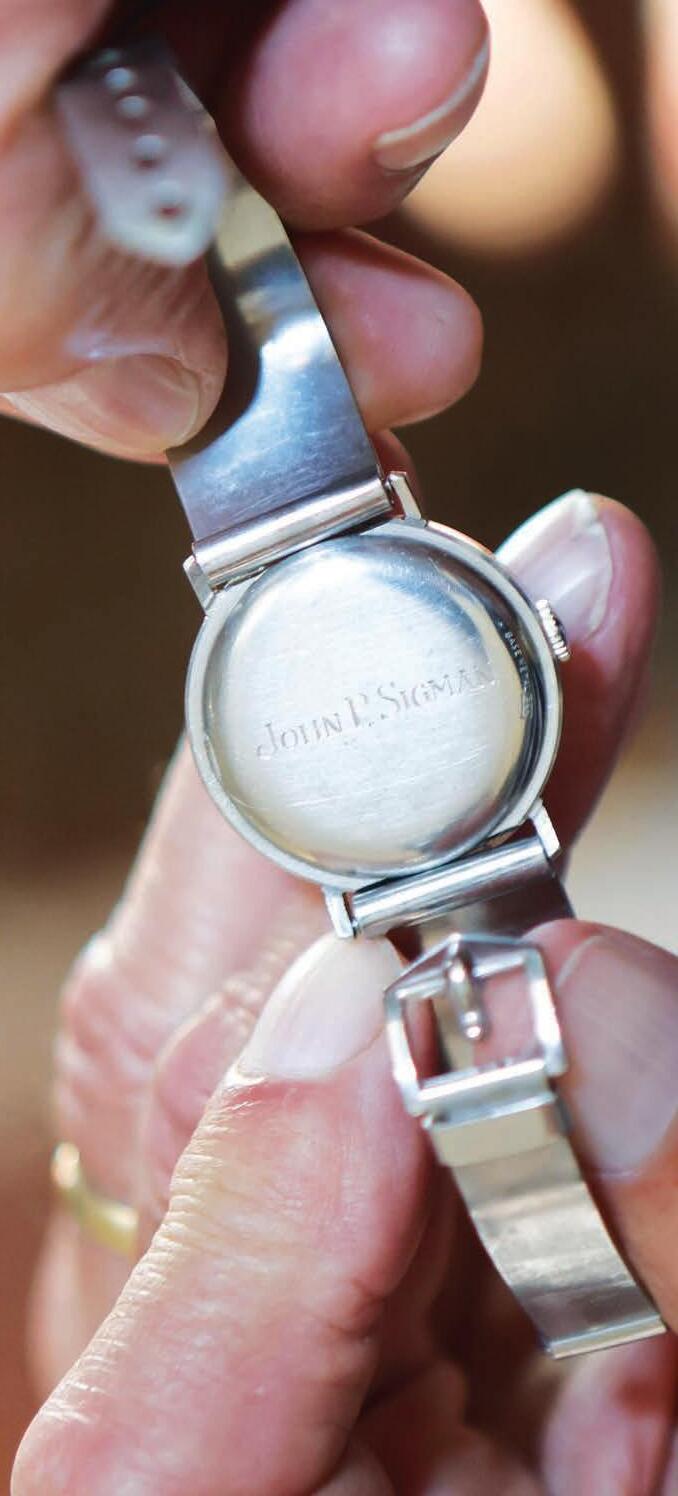
Worn by World War II Marine pilot John P. Sigman, the Elgin watch at right is part of Bob Stokes’ collection.
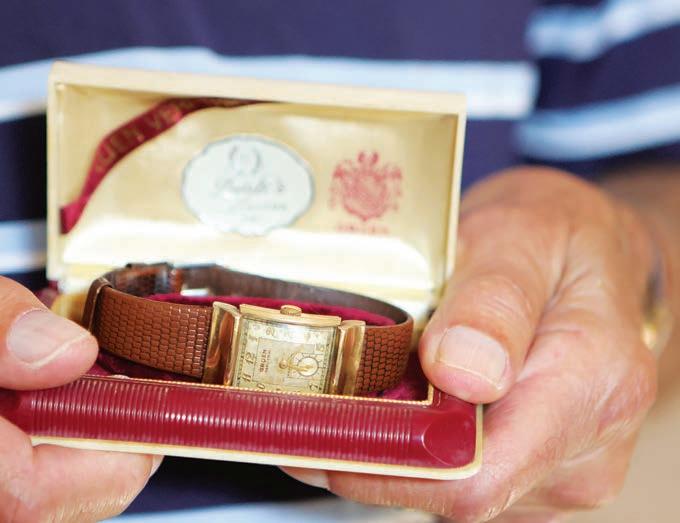
This 1943 Gruen wristwatch was presented to Harry Alexander, a National Maritime Union organizer and merchant seaman who was involved in integrating the crew of the World War II ship SS Booker T. Washington . Engraved on the back is, “To Harry Alexander ~ Good Shipmate And Union Member ~ From Crew of Booker T Washington ~ Oct 17 1942 to Sept 16 1943”.
with repairs himself, the association has an experienced group of craftspeople who can get inside the tiny spaces inside the casing. “It takes anywhere from two weeks to a month, depending on the problem,” reports Bob of the time and effort for restoration.
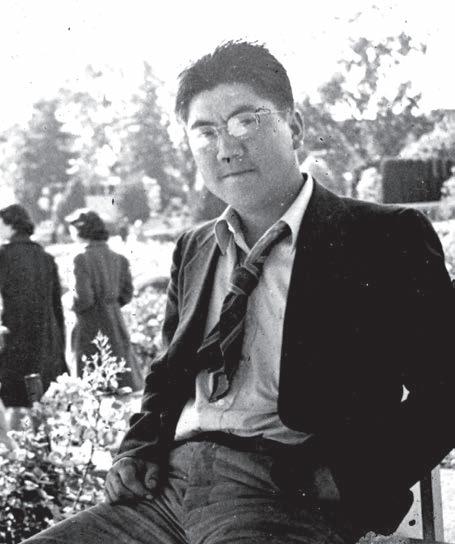
In recent years, Bob has managed to connect 20 watches with the families of their original owners at no charge. One of his more moving successes involved a Bell watch owned by Private Chikara Masuda, a World War II Nisei Soldier. The 15th of 19 children and son of a California farmer, Chikara volunteered to join the U.S. Army in October of 1941 just before Pearl Harbor. After completing basic training in Texas, he purchased the watch for $42 and had it personally engraved.
Shortly after he enlisted, his family, like many other Japanese families of this era, lost their land and were placed in an internment camp. Nonetheless, Chikara excelled in the service, earning four medals while being stationed overseas. After the war, he started a family and operated a farm in Gilroy, Calif. Later he worked as a gardener in San Jose until he passed away in 1993.
Chikara’s watch likely passed through numerous hands between 1945 and 2019 when Bob purchased it from an eBay dealer in Vermont. Detective work commenced, and later that year, Bob met Chikara’s daughter Karen Chang in Carpinteria to reunite the family with a long-lost heirloom.
Readers can email Bob at timecapsule.watch@gmail.com or visit TimeCapsule.com to learn more.
World War II Marine pilot John P. Sigman was a member of the famed “Cactus Air Force” on Guadalcanal in 1942. He was credited with shooting down four enemy planes.







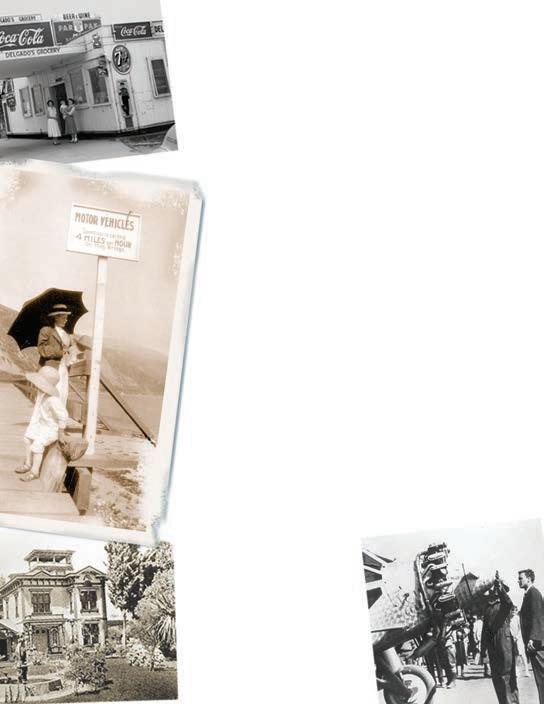

Conversations with the past
WORDS BY AMY MARIE OROZCO
If the Carpinteria Valley Museum of History walls could talk, they would say, “Listen to the oral history collection. Housed in the aple venue nonprofit’s library, the collection has 300-plus, two-sided cassette tapes holding about 500 hours of interviews with Carpinterians and/or about Carpinteria.
Today, museum Executive Director and Curator Jayme ahr, is creating digital files from the cassettes. ne by one,
in real time, she e ports the audio to a file and names the file readying it for upload to carpinteriahistoricalmuseum. org, where each one is accessible to the public free of charge. Most tapes are from the late 1970s through the early 1980s, when they were recorded as part of a county-wide, museumrelated project.
It’s not a di cult process but it takes time, notes ayme. She’s been uploading oral histories in batches.
Tom Ota on a tractor in 1939. The Ota family history is told in interviews that are now available on the Carpinteria Valley Museum of History website.
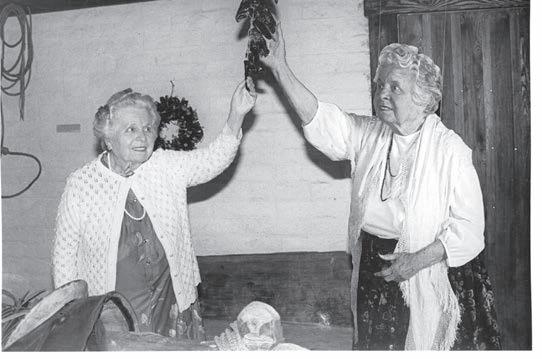

Nellie Ayala describing her 1949 arrival in Carpinteria during a 1979 interview:
“What I remember was most of the people here were probably landowners, ranchers. There were very few houses like there are now (in 1979). I remember there on 9th Street there was a hedge of eucalyptus trees and they were so huge that they’d … come together with just a tunnel going through them … There were no streets that were paved, there were st trails thro h there e first mo e to a house on the corner of 7th and Holly. There’s a little house that we rented there for $12 a month. That’s hard to believe, isn’t it?”
Ayala pictured at left in 1986 alongside her
Nellie
life-sized photo in a Carpinteria Valley Museum of History exhibit.
Tom Ota in 1939. Listen to his interview on the Carpinteria Valley Museum of History website.
As of this magazine’s printing, there are 78 on the website.
On the cassette tapes are the voices of an interviewer and one or two people being interviewed. The interviewees are a demographic cross section, including male, female, varying ages, and different neighborhoods. general list of topics — where you grew up, where you went to school, memories of town — mixes with talk of local events and how international events touched Carpinteria. People talk about farming and the changing crops and changing industries. There’s Frank Bauhaus and the aviation world. It’s a singular person’s memory of time and history, a voicemail from the past, if you will.
The dialogue is raw. Interviewees are candid with topics, memories, and the way things were done. They are not edited at all, and the museum has no intention of editing them.
People listen to the oral histories to learn about a specific event or theme, but many come to hear the voices of their relatives. “That is the most meaningful aspect,” says Jayme. Relatives can listen to the voices of parents or grandparents. All they have to do is hit play.
The digitizing project has been in the works for a year and a half. The time to be able to work on it comes in waves, says Jayme. It probably will take another two years, minimum, to finish.
dditionally, the new documentary film “ oces Civil Liberties Injustices in Carpinteria,” a museumcreated film with grant funding from the California State Library that explores the connections between the incarceration of Japanese Americans and the Mexican American community of Carpinteria during the 1940s, not only makes use of the oral history collection but adds to it with contemporary interviews with Carpinterians recounting civil liberties injustices.
Why is Jayme, who began her tenure at the museum in August 2022, making the oral history project a priority? “It’s a doable thing,” she says. She can multi-task while the tapes are playing. The pro ect is finite and “complete-able. She is very worried about the quality of the tapes and that they could be ruined and lost forever. The tapes are used, hold much information, and the public requests to listen to them.
fter the last tape is converted to a digital file, the museum will forever keep the tapes, storing them archivally. “But they will deteriorate,” says ayme, “light, flood, fire, Carp’s coastal salty air is not good for books and film.

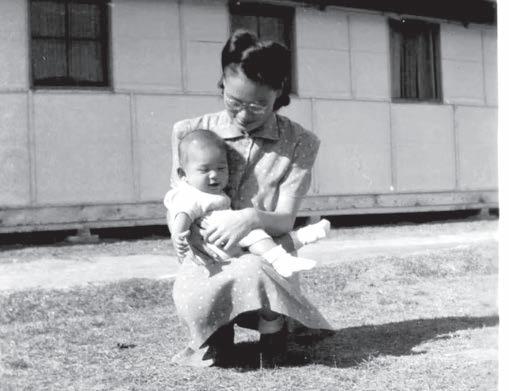
Miyeko Ota Fukasawa photographed in Gila River War Relocation Center in 1943 with her baby John Fukasawa Jr.
Miyeko Ota Fukasawa in a 1987 interview excerpt describing her arrival with her new husband John Fukasawa at the Manzanar War Relocation Center where the US government incarcerated Japanese immigrants during World War II :
“We got to Manzanar about 3 or 4 o’clock when the bus got there. And we had to all stay in our busses. And the doctor got in there and checked us to make sure we were all well. Before they let us off, they’d shoot us with a typhoid shot … And then they gave us two great big bags an they sai , o fill that with straw that’s yo r mattress for your cots.’ … And we, of course, laughed about it and John said, “This is our wedding night, dear. We’re going to have our honeymoon here.” At least he had a sense of humor about it.”
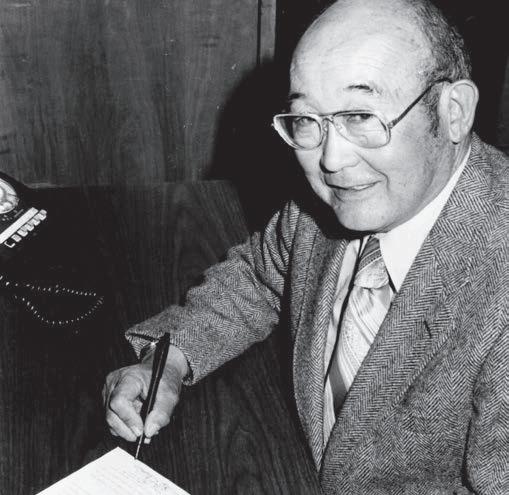



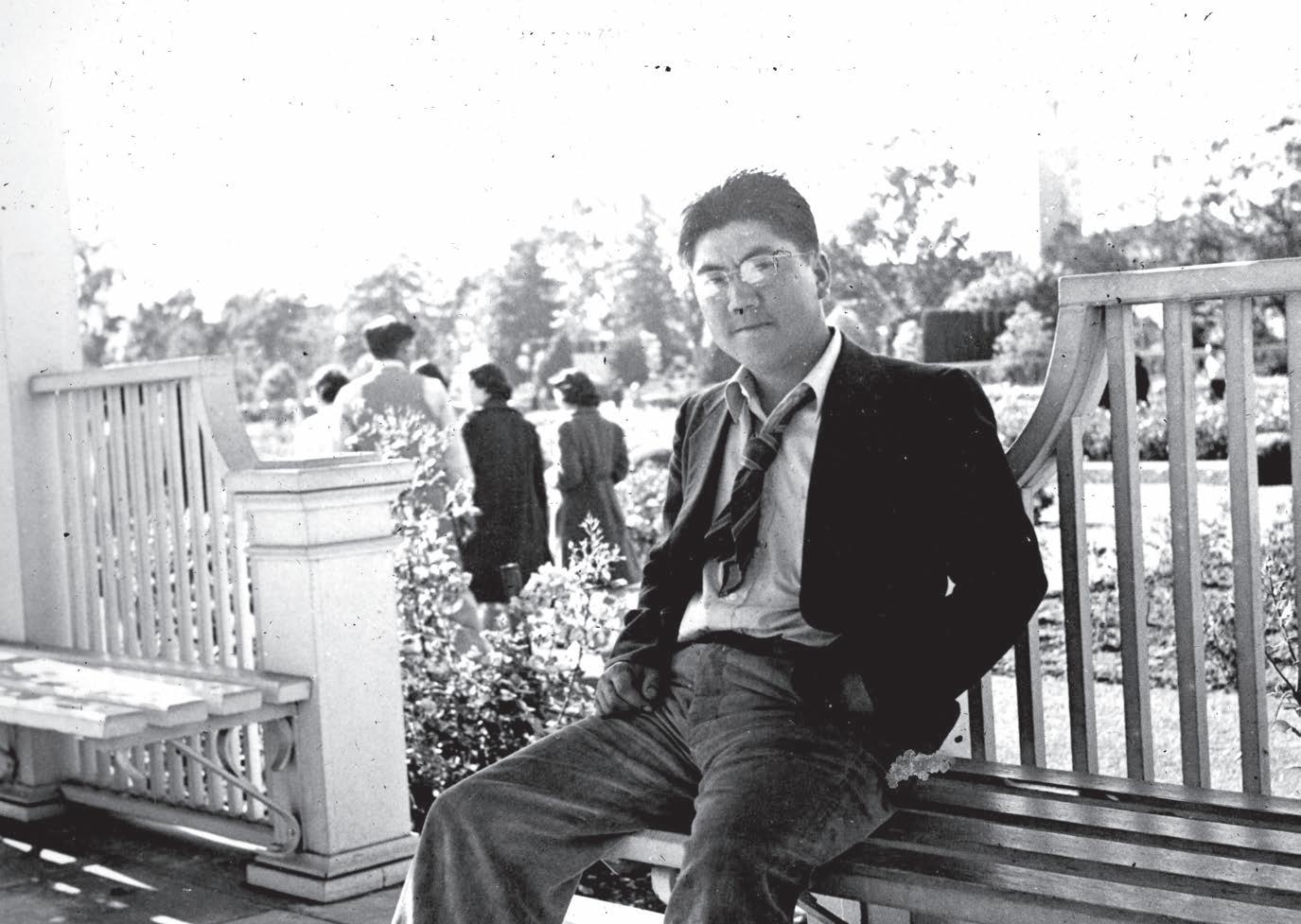
John Fukasawa Sr. photographed in1982, when he was the City of Carpinteria mayor.










Robin Karlsson

CALLING ALL BUTTERFLIES AND BEES
Carpinteria provides prime real estate for pollinators
A matilija poppy catches the eye of a pollen-laden honeybee.
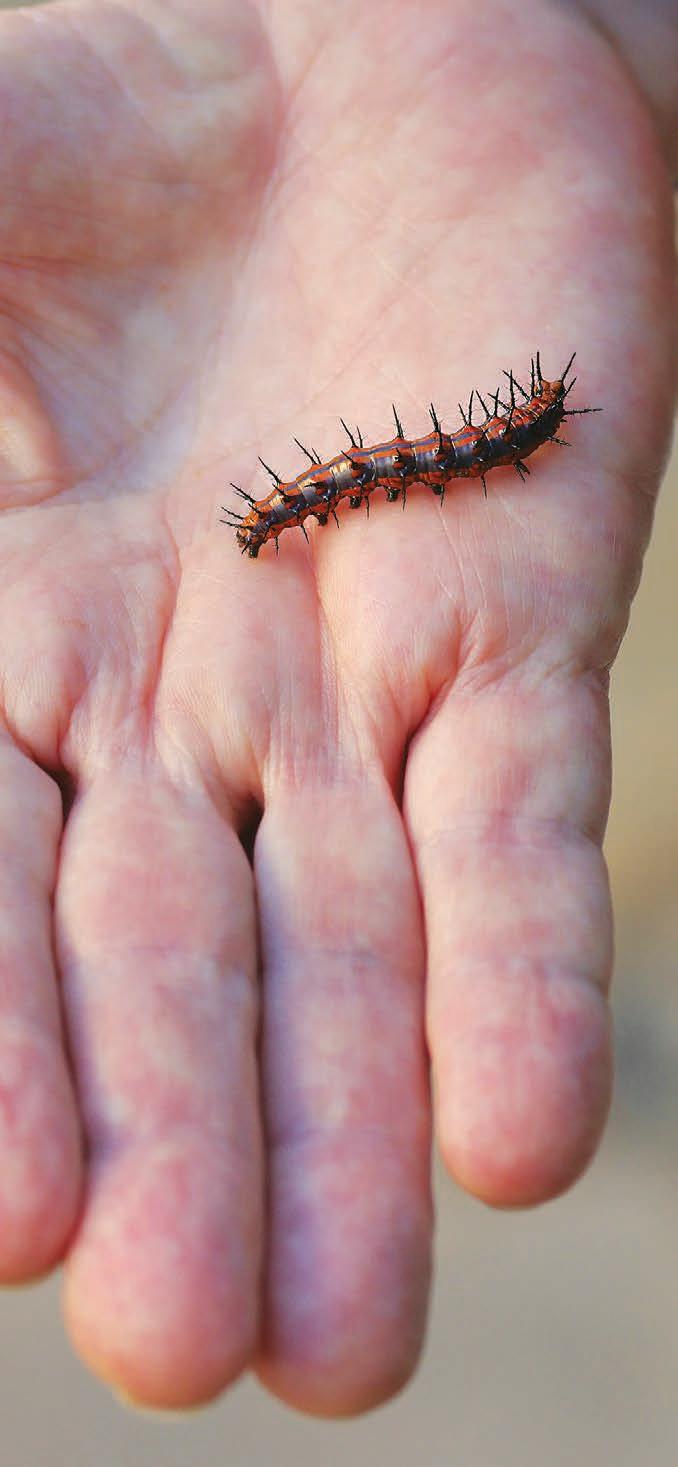
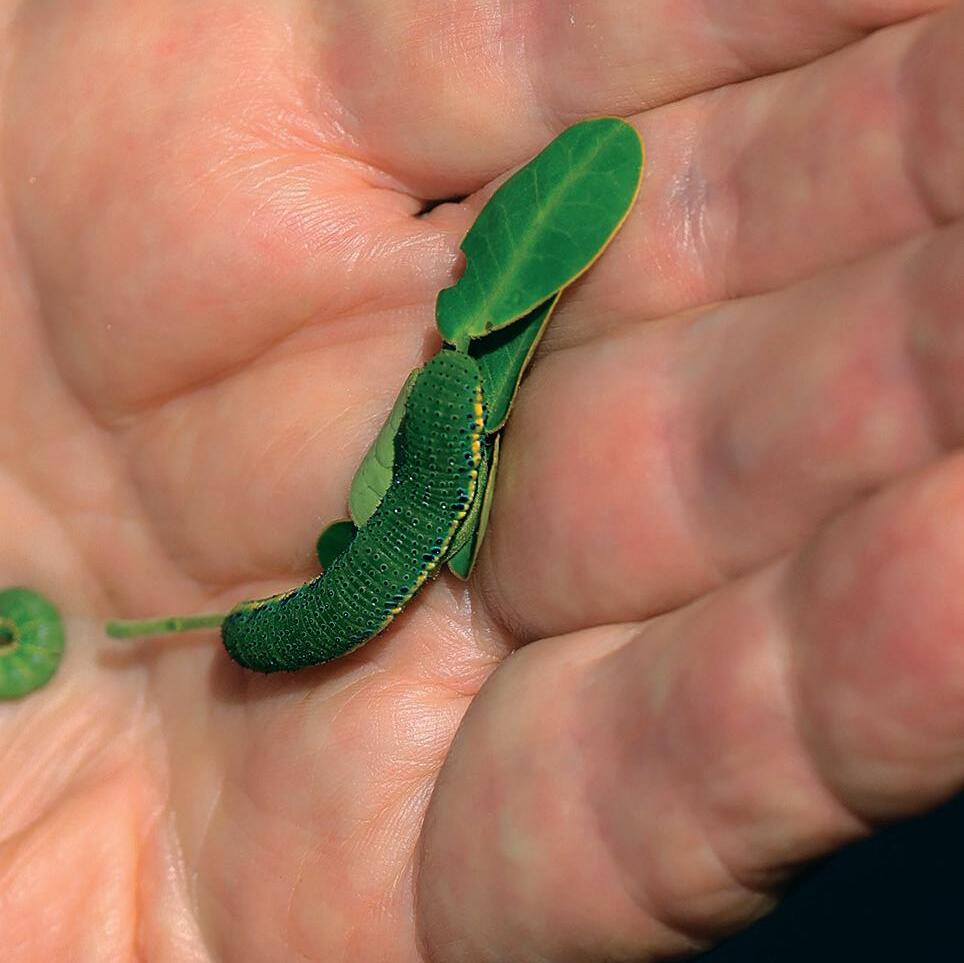
A gulf fritillary caterpillar treks the contours of Donna Grubisic’s palm.
WORDS BY EVELYN SPENCE
PHOTOS BY DAVID POWDRELL
Creating a safe haven for caterpillars. Nurturing kids’ love of butterflies. ffering native plants and pollinators a chance to blossom. Bringing 1980s childhood memories to today’s generation.
In Carpinteria, locals thrive on nurturing nature.Connected by their love of butterflies, bees and hummingbirds, four Carpinterians spoke to Carpinteria Magazine about doing their part in bringing pollinators to this small corner of the world.
A SAFE HAVEN
Donna Grubisic’s backyard on Azalea Drive is indubitably a labor of love.
ver years, onna, a seed analyst,turned the backyard of her home into a scene straight of a child’s picture book — a safe haven for monarchs and countless other caterpillars and butterflies.
“Everyone has something that they love,” she says as a gulf fritillary caterpillar crawls up her arm. (Despite its intimidating look, the caterpillar’s black “spikes” are rather soft.) Caring for pollinators “was just something different and not known about very much, so that’s what drew me in.”
She began transforming her backyard in 1995. It took hours of research and recommendations from books and later oogle . oday, thanks to her efforts, do ens of caterpillars swing and eat from the branches of a tree, while full-fledged butterflies flitter nearby and hummingbirds and bees take their turns exploring the blooms.
A college class germinated Donna’s interest in seeds and pollinators. While attending Cal oly San uis bispo, instead of taking a class on topical fruits and vegetables like most of her classmates, shechose one on seeds.
Decades later, it’s both her daytime job and her afterwork love. ftentimes, she sits out in her backyard and watches butterflies flutter around her head and her arms, relishing her decades of dedication.
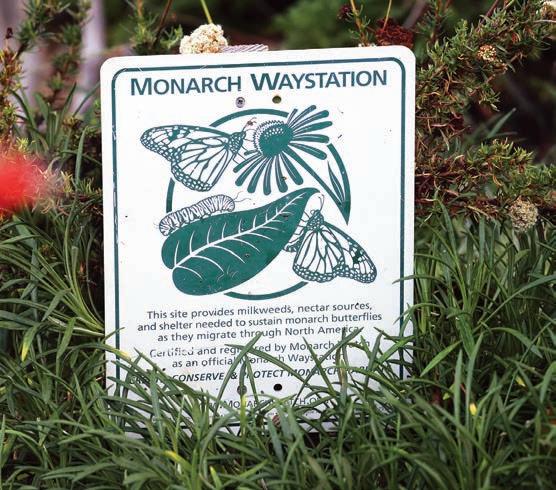
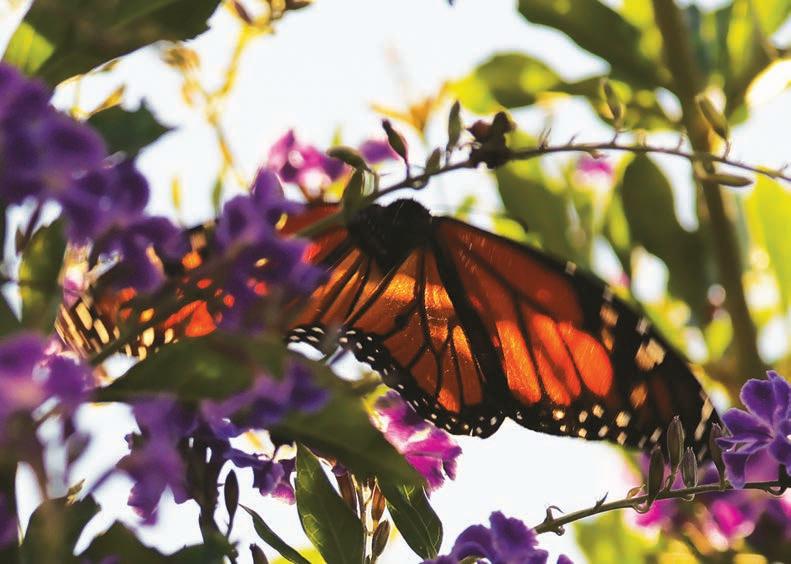
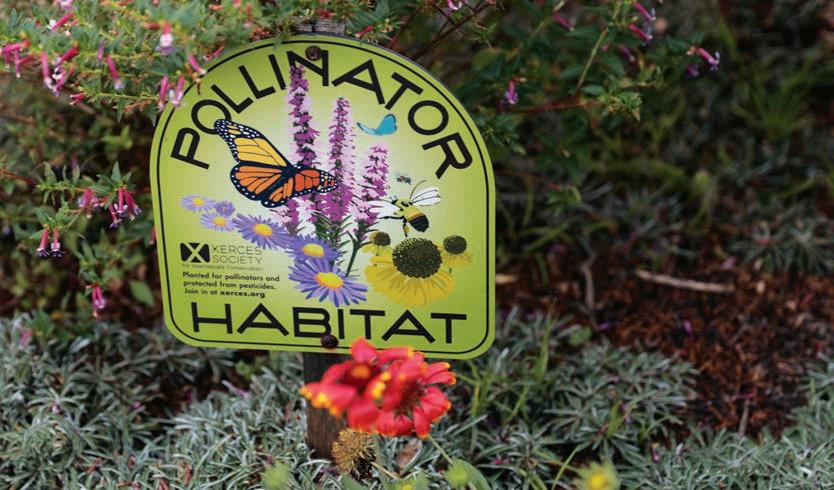
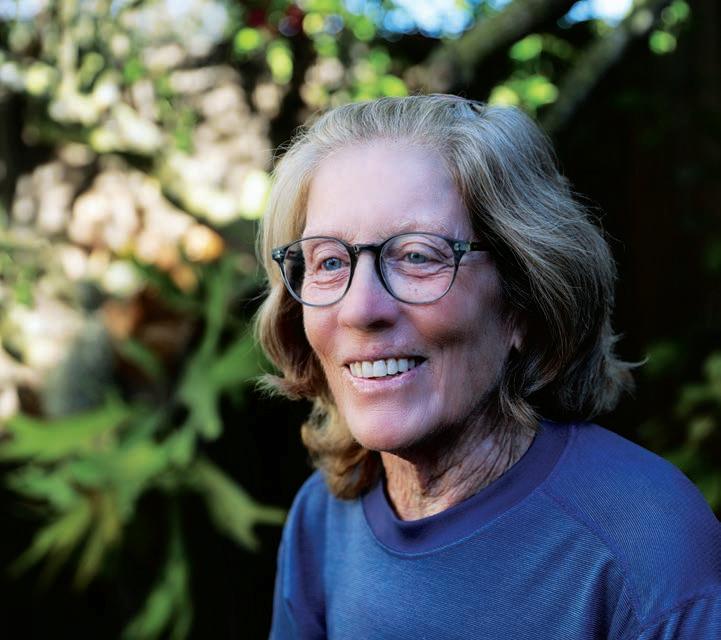
Grubisic has converted her yard into a place where pollinators can rest up, refuel and sometimes replace their caterpillar feet with butterfly wings.

Donna
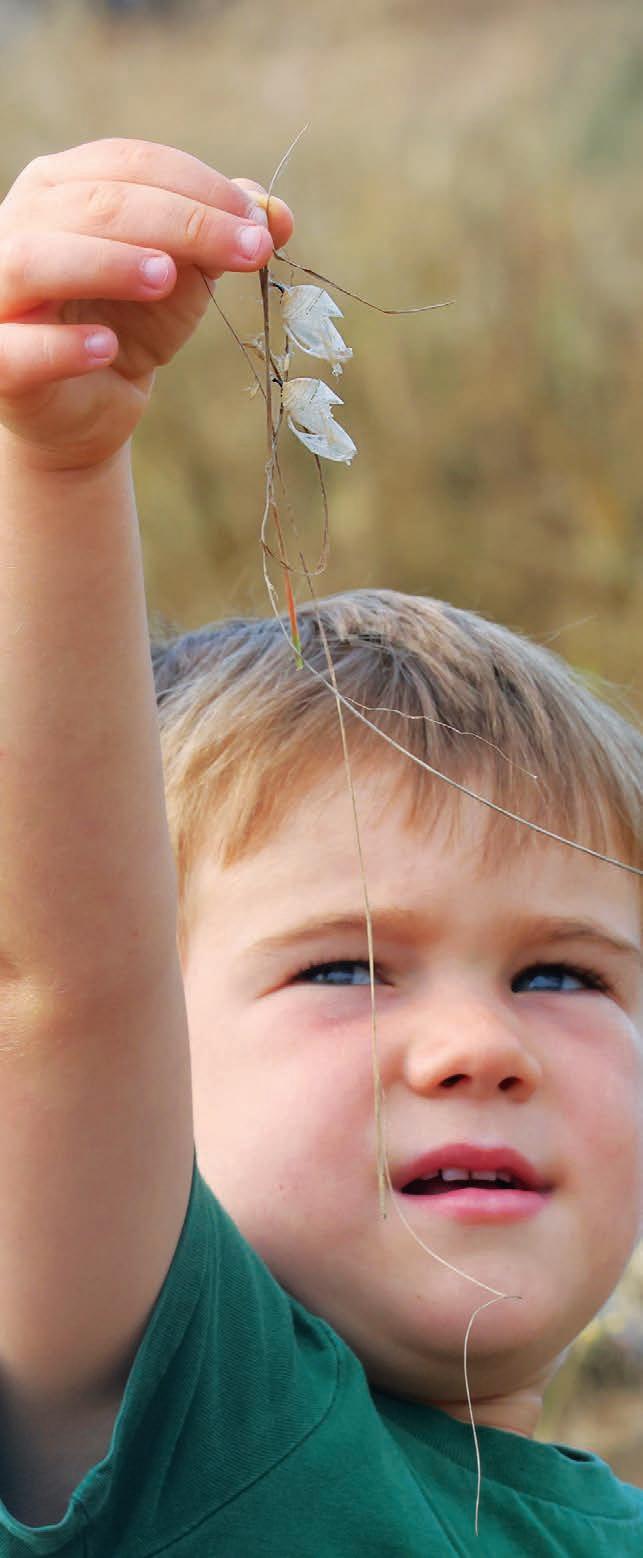

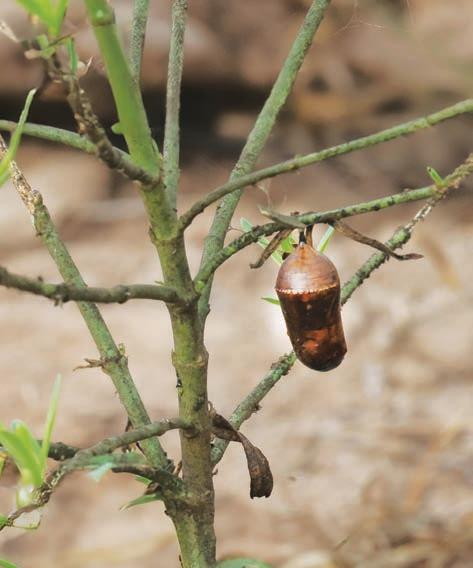
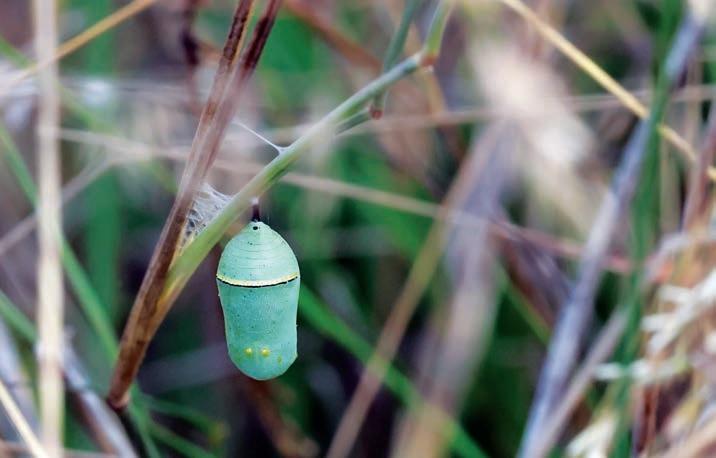
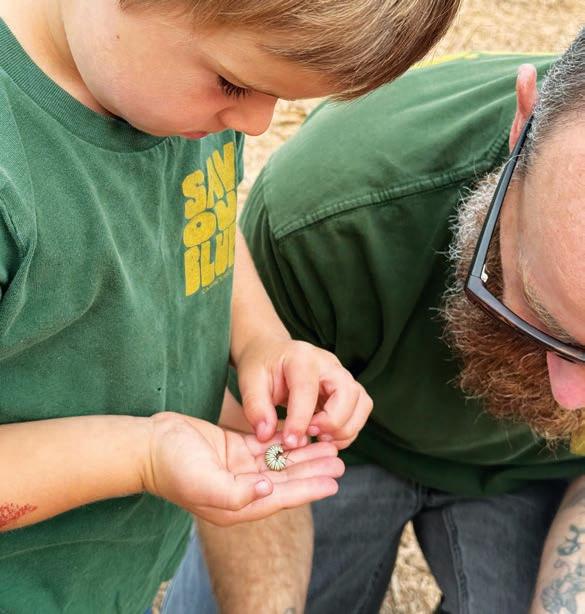
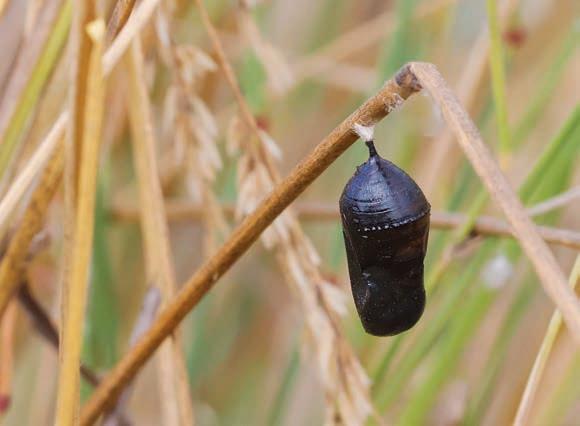
Ryan Crooks holds monarch crysalises after the hatch, and at right he checks out a caterpillar.
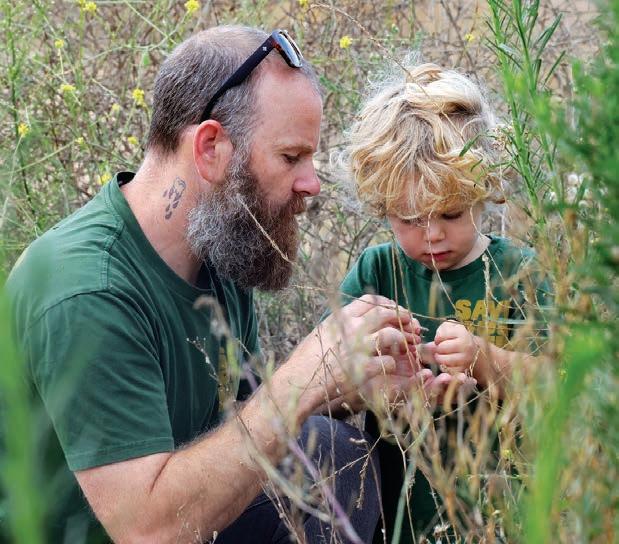
From left, Patrick and Dylan Crooks amid the dried milkweed on the Carpinteria Blufffs.
IT’S A GENERATIONAL THING
When Patrick Crooks —wildlife biologist and president of the advocacy group Citizens for the Carpinteria luffs was a child at Carpinteria’s ou rant arentChild Workshop, his teachers used to take him down to Carpinteria Creek.
There, he saw “tens of thousands” of monarchs. Those moments of oy stayed with him. He’s got a tattoo of a monarch butterfly to prove it.
ut those moments of wonder from atrick’s childhood no longer e ist here. onarch butterfly populations have plummeted the nonprofit environmental group erces Society counted fewer than 5,000 monarchs across 223 overwintering sites on the West Coast during theseason — a 96 percent drop from the previous year, and the lowest since the count began in 1997.
Seeing thousands of butterflies as a child “seemed normal, atrick says, adding, “that you can’t e perience that now, 35 years later, is pretty sad.”
ut atrick’s kids are now and , and he’s determined to pull those moments from his own childhood into 2025 for them.
In April, members of Citizens, volunteers, and scores of Carpinteria third-graders planted narrowleaf milkweed on the luffs to create habitat for migrating monarch butterflies. Carpinteria students have taken a luffs field trip every year for atie oberts luffs ay, an event that honors atie for her efforts to protect the luffs from development. ut
this year’s butterfly pro ect was a new addition. atrick purchased the seeds and Farm Cart Organics owner Jason esh helped to grow seedlings before the pril planting.
“It’s really essential for kids, and really any human, to have those experiences in nature and have that connection to the world around them,” Patrick says.
His family bikes out to the luffs at least one a week to check out the progress. “ We’re recogni ing the benefit of pollinators in our world, he says. “ he plants have done way better than I could have expected.”
GIRL POWER IN THE GARDEN
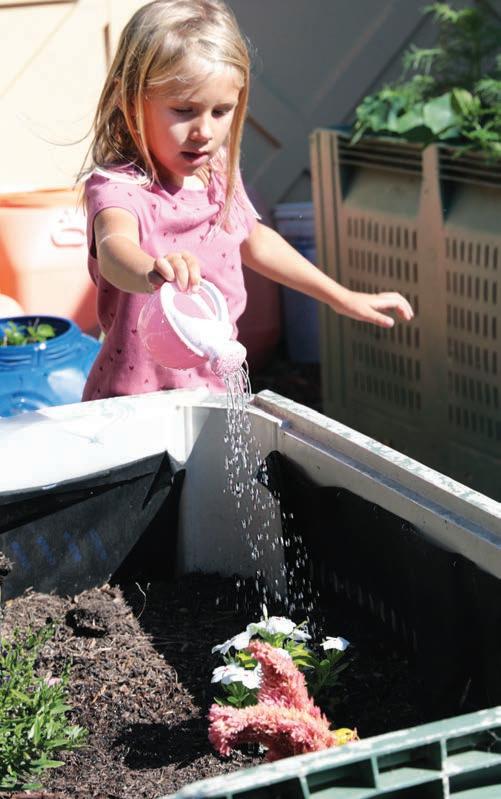
he irls Inc. of Carpinteria butterfly garden launched in une of , and the garden under the watchful eyes of the ardening Club continues welcoming migrating butterflies.
he garden concept grew out of the homas ire and the ontecito ebris low, when ecutive irector amie Collins started thinking about how the nonprofit could help pollinators.
embers of irls Inc. had always been fascinated by butterflies and bees, so with the help of the ions Club of Carpinteria and materials donated by Carpinteria alley umber’s ason and arilyn inteer, the garden was born.
he garden’s milkweed primarily serves monarch butterflies, but staff members and the kids often see different animals mosey in and out of the area. In the garden’s first cycle, the girls monitored the transformation of five eggs to caterpillars then butterflies.
It’s become “a small way to teach girls about sustainability and their natural environment, amie says. “Seeing them count the number of cocoons that we’ve had on a given day and then seeing how many caterpillars turn into cocoons it’s a fascinating cycle.
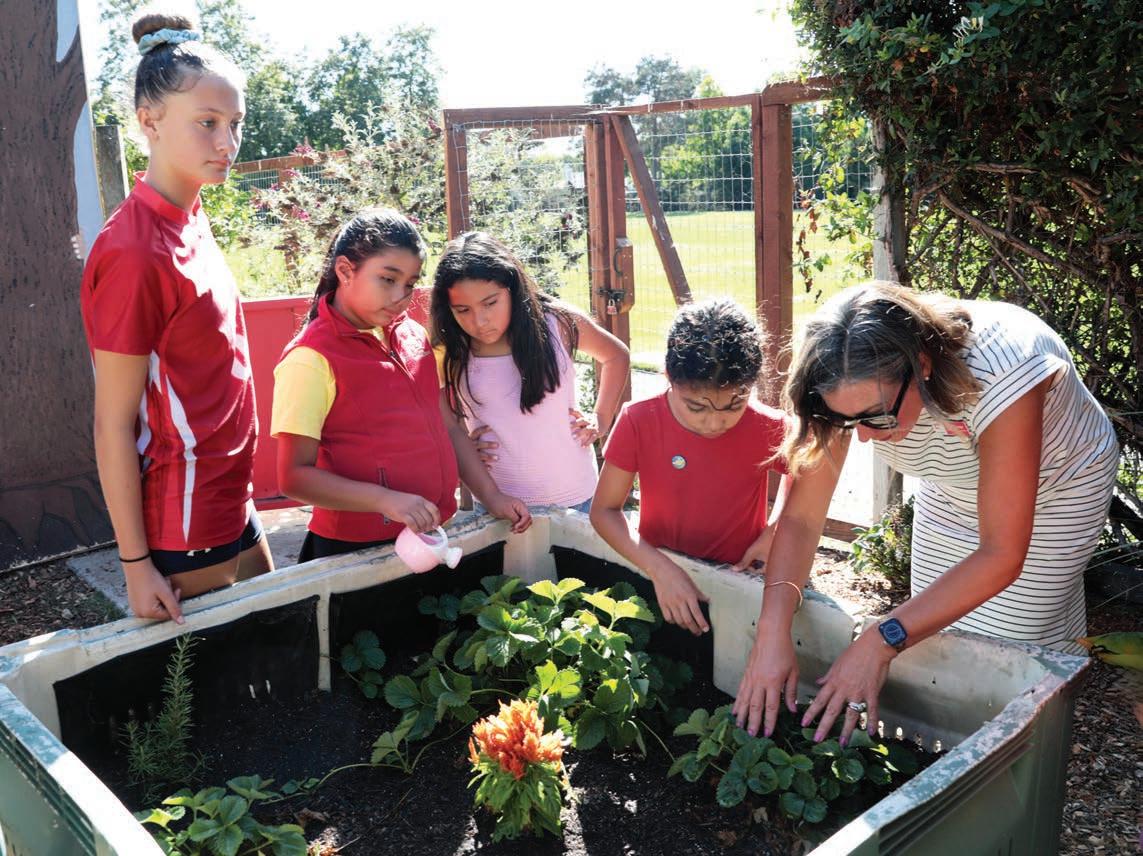
From left, Abby Putnam, Natalia Flores, Aileen Vega, Camilla De Leon and Aja Forner search for signs of pollinators in the Girls Inc. of Carpinteria garden.
Eloise Meyer, member of Girls Inc. of Carpinteria, waters a plant in the pollinator garden.
THE TALE OF ONE TRAIL
Ray Kolbe, a software engineer and video developer who moved to Carpinteria a dozen years ago, was drawn in 2017 to the plight of a trail not far from his home: the Santa Monica Creek Trail.
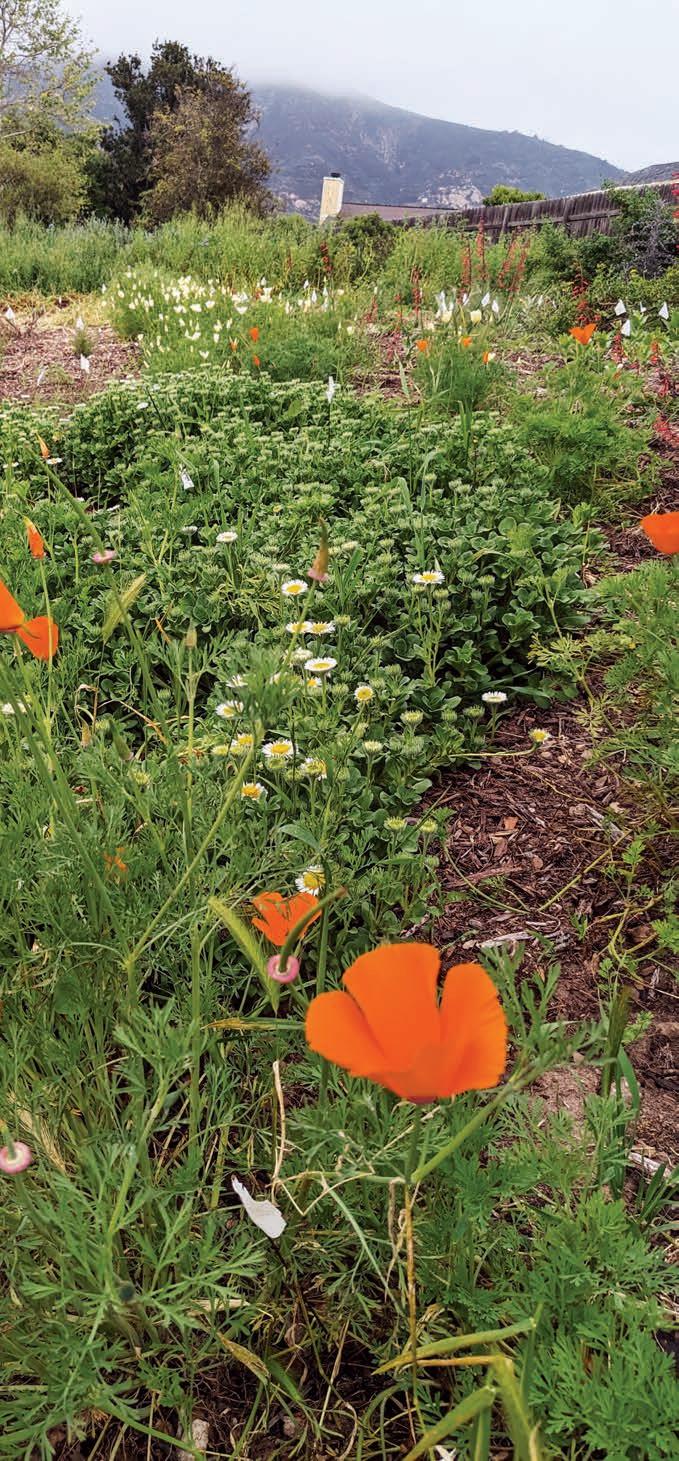
It was overrun by non-native plants and lacking in the blooms needed for pollinators to thrive.
“I kept hearing about the die-off of butterflies and bees, in particular the Western monarch,” Ray says while sporting a -shirt covered with butterfly print. “I thought, I can’t do nothing. I can’t ust let them die.’
Determined to help, Ray launched the Santa Monica Creek rail ro ect. He kicked off the trail’s transformation with e traordinary luck and generosity through a friend’s connection, Santa ne ’s es es Nursery offered ay hundreds of plants for free.
oday, bees, butterflies, and hummingbirds thrive along the Santa Monica Creek Trail, as Ray and his fellow volunteers continue to clear out the non-native plants and replace them with natives. he pro ect formali ed in under the nonprofit ollinator Habitat ro ect, with seven board members at the helm, including Donna Grubisic.
“ ou go out there, you see a lot more flying insects you see a lot more birds,” Ray says, adding that he continues to grow and learn as a gardener. he California Native lants Society website is a huge help, he emphasizes.
His team has dedicated the last Saturday of the month to this endeavor. Grants from the Santa Barbara Foundation and volunteers from the California Conservation Corps also “really allows us to get a handle on things,” Ray says.
He recalls one moment last spring, when a -year-old girl oined her parents on the trail. She really loved butterflies but hadn’t witnessed their cycle firsthand. “I was able to show her eggs, caterpillars, chrysalises, and butterflies in one setting,” he says. “Just to see the excitement and awe on her face was so heartwarming.”

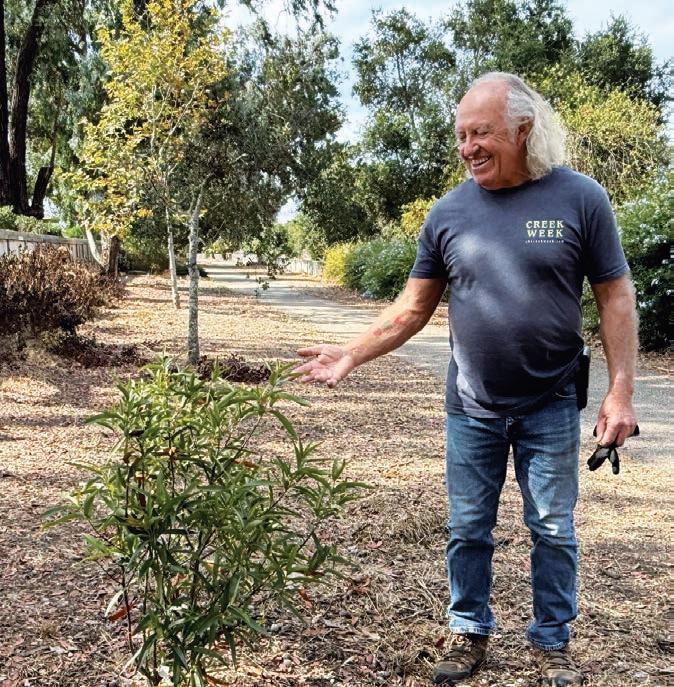
Ray Kolbe on the Santa Monica Creek Trail.
PHOTO CREDIT: RAY KOLBLE
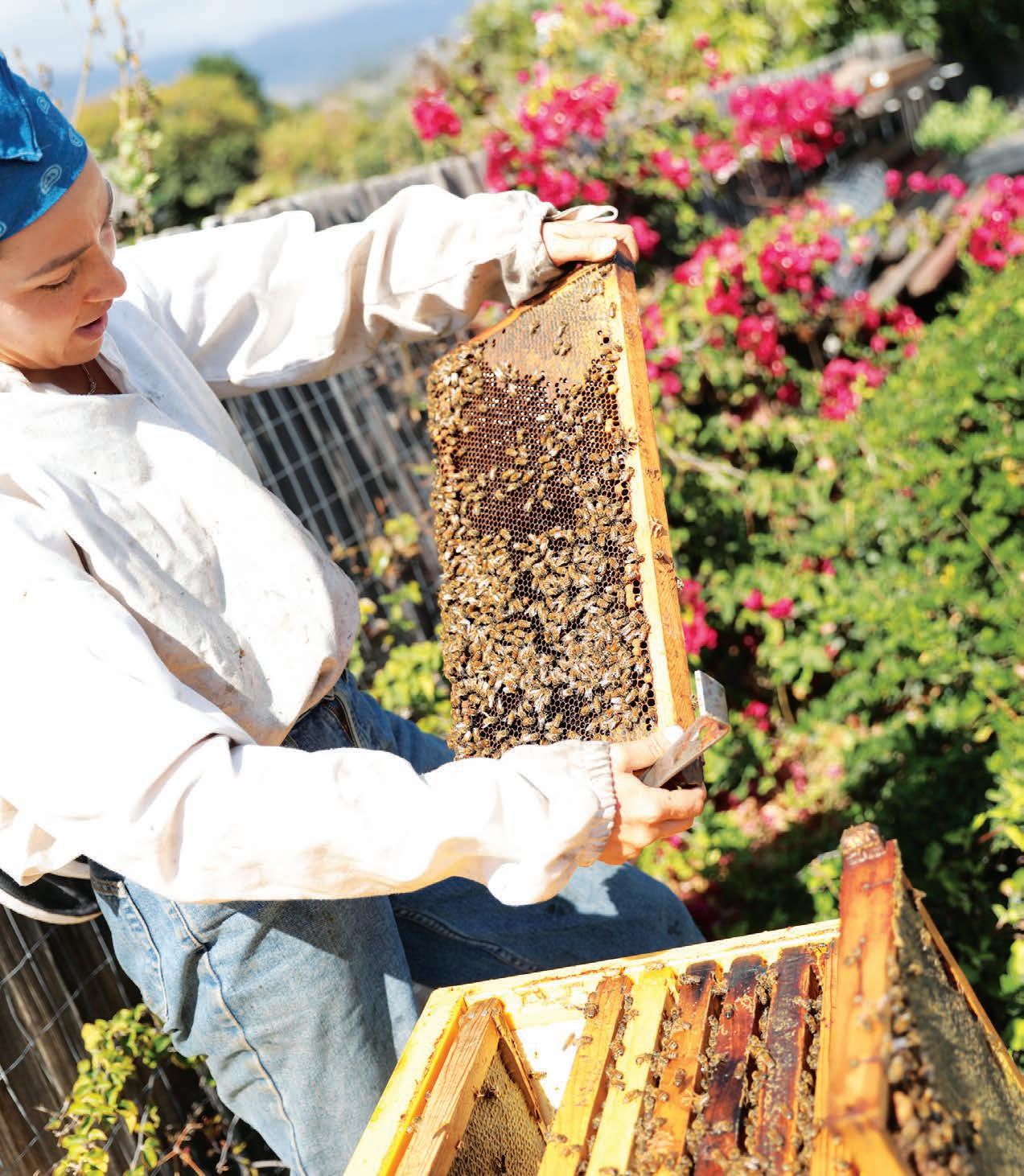
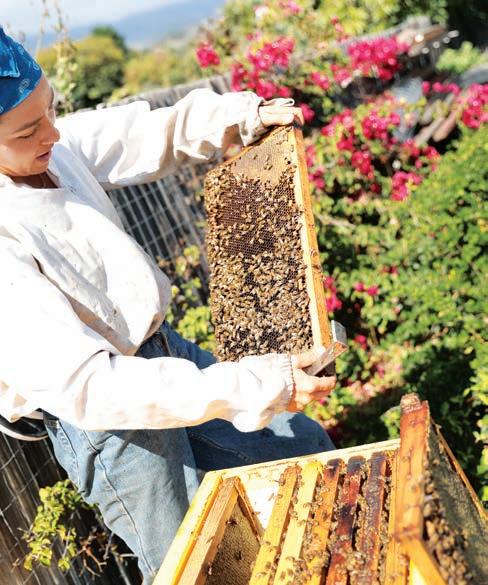
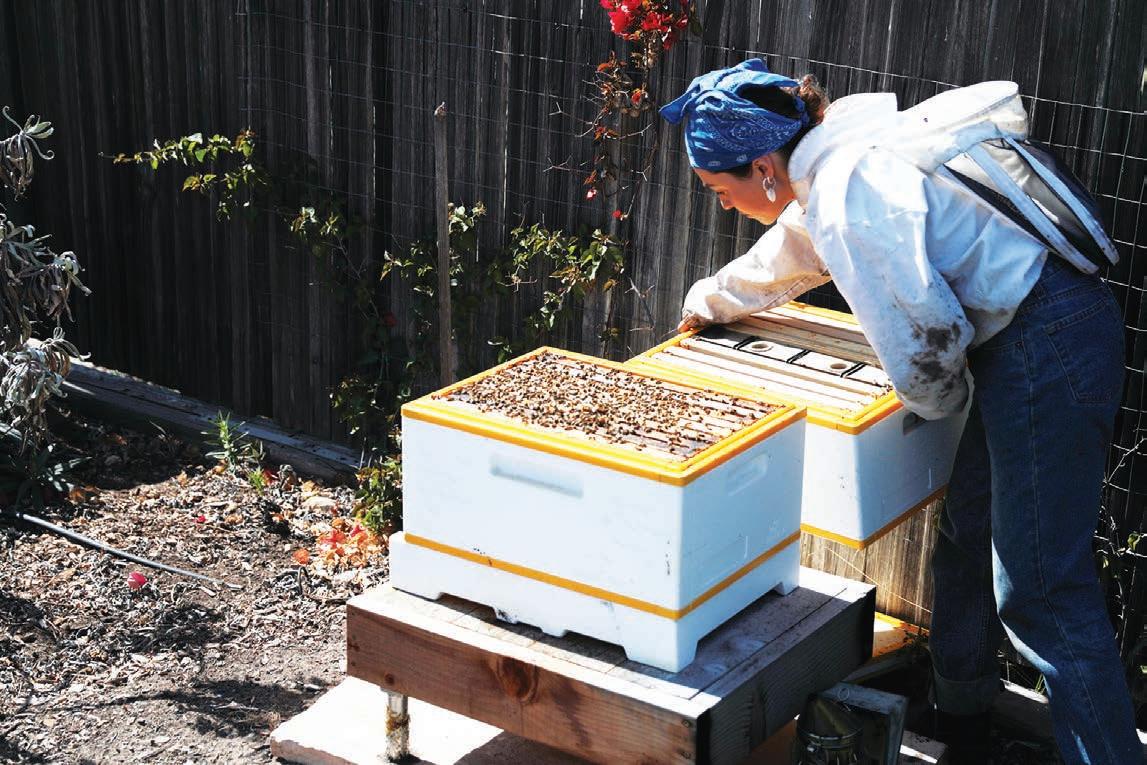
Santa Barbara Hives beekeeper Bela Sandoval Lafferty checks in on a hive in the backyard of photographer David Powdrell.
SANTA BARBARA HIVES: MORE
THAN REALLY GOOD SOURDOUGH
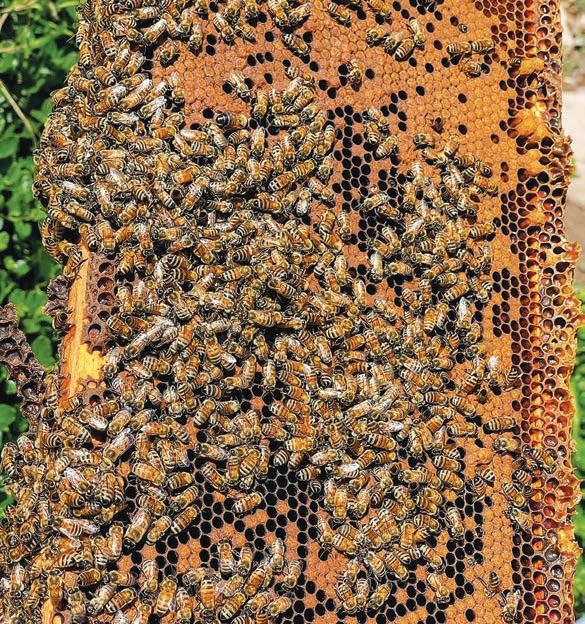
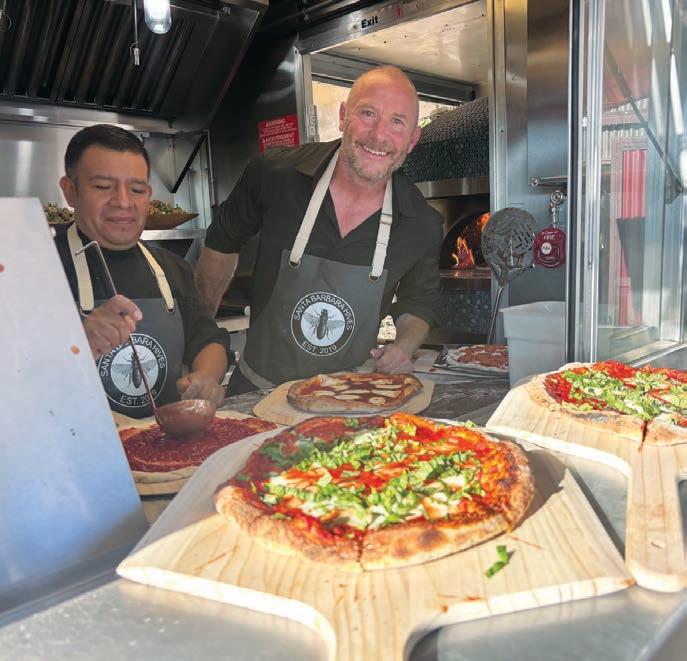
Sure, you’ve fallen hard for their sourdough pizza and flaky croissants, but did you know that bees are the core mission of Santa arbara Hives wners arnaby raper, at Carroll and ill arris are apiarists who take pride in carefully rescuing and relocating bees, then ensuring they thrive in happy hives. arnaby and his partners believe that small-scale backyard beekeeping is the key to reversing bee population decline. hey mentor do ens of new beekeepers each year, and source their honey directly from Santa arbara County hives, including acres of avocado orchards in Carpinteria.

hrough Santa arbara Hives, you can start your own beekeeping ourney. he company offers nucs starter bee colonies and ueen bees to help yousucceed.
hough the caf and shop on alm venue is now bustling with customers picking up lunch or grabbing a coffee to go, it was originally envisioned solely as a space for honey processing. ike the bees themselves, the shop has undergone a beautiful evolution. arnaby loves it all, but says, “We are beekeepers first.
Barnaby Draper with piping hot Santa Barbara Hives pizza pies.
COURTESY PHOTO
NOW IT’S YOUR TURN TO PLANT A POLLINATOR GARDEN
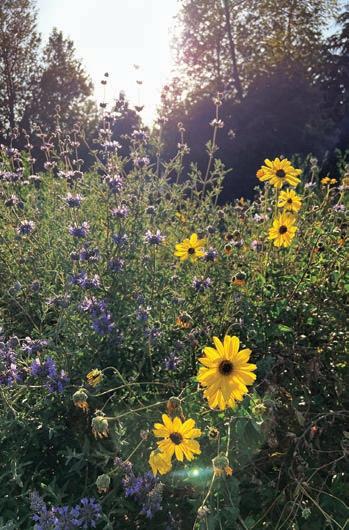
If you’re inspired to save the bees and butterflies, it’s time to plant your own pollinator garden! The key is to select native plants that have co-evolved with native pollinators to offer the best pollen and nectar sources. our garden will earn you ecological karma points while providing you with beautiful blooms and attracting pollinator pals aplenty.

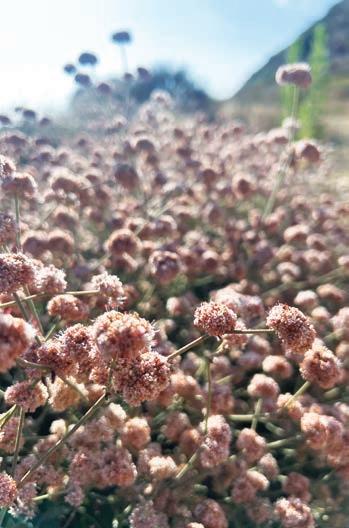
PRIORITIZE NATIVE PLANTS: volving in tandem, native plants and native pollinators are the perfect pair for your new garden. In Carpinteria, consider species like California buckwheat Eriogonum fasciculatum , various native sages Salvia spp. such as black or white sage, narrowleaf milkweed Asclepias fascicularis for monarchs, and California fuchsia Epilobium canum . hese are adapted to the region’s climate and attract native bees, butterflies, and hummingbirds.
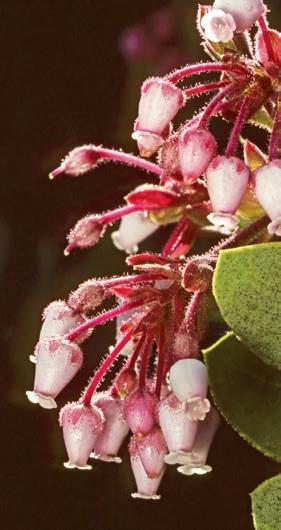
ENSURE YEAR-ROUND BLOOM: Pollinators need food resources continuously. Select a variety of native plants with overlapping bloom times to provide nectar and pollen from early spring through fall. or e ample, plant early bloomers like man anita, mid-season flowers like sticky monkeyflower, and late bloomers like California aster or California fuchsia.
1. 3. 2.

CREATE POLLINATOR
PLANT IN THE FALL: he best time to plant native species is late fall ctober- ecember so rains assist with root growth. nce established typically - years , most native pollinator plants are drought-tolerant and re uire little to no irrigation.
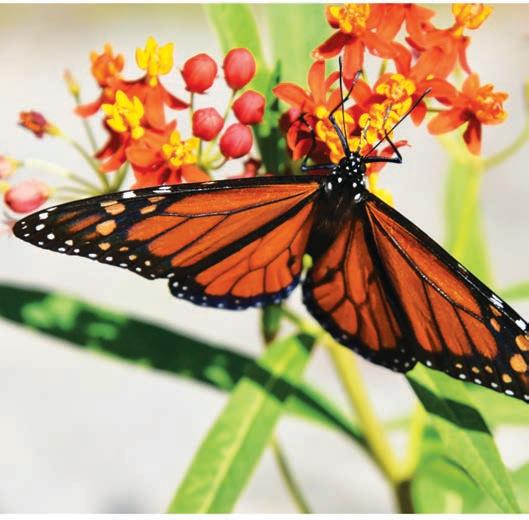
TARGETS AND PROVIDE NESTING/ HOST HABITATS: lant flowers in clusters or large drifts rather than single plants. his makes the flowers more visible and e cient for pollinators to forage. lso, include larval host plants like milkweed for onarchs or California lilac ceanothus for various butterflies .
ELIMINATE PESTICIDES: void the use of all insecticides, herbicides and especially systemic pesticides neonicotinoids . he last thing you want to do is draw pollinators then douse them with fatal or harmful materials. If pest control is necessary, use the least to ic methods available and spray late at night when pollinators are inactive. 5. 4.
California buckwheat
Manzanita
Sticky monkey flower
Sage and California sunflower
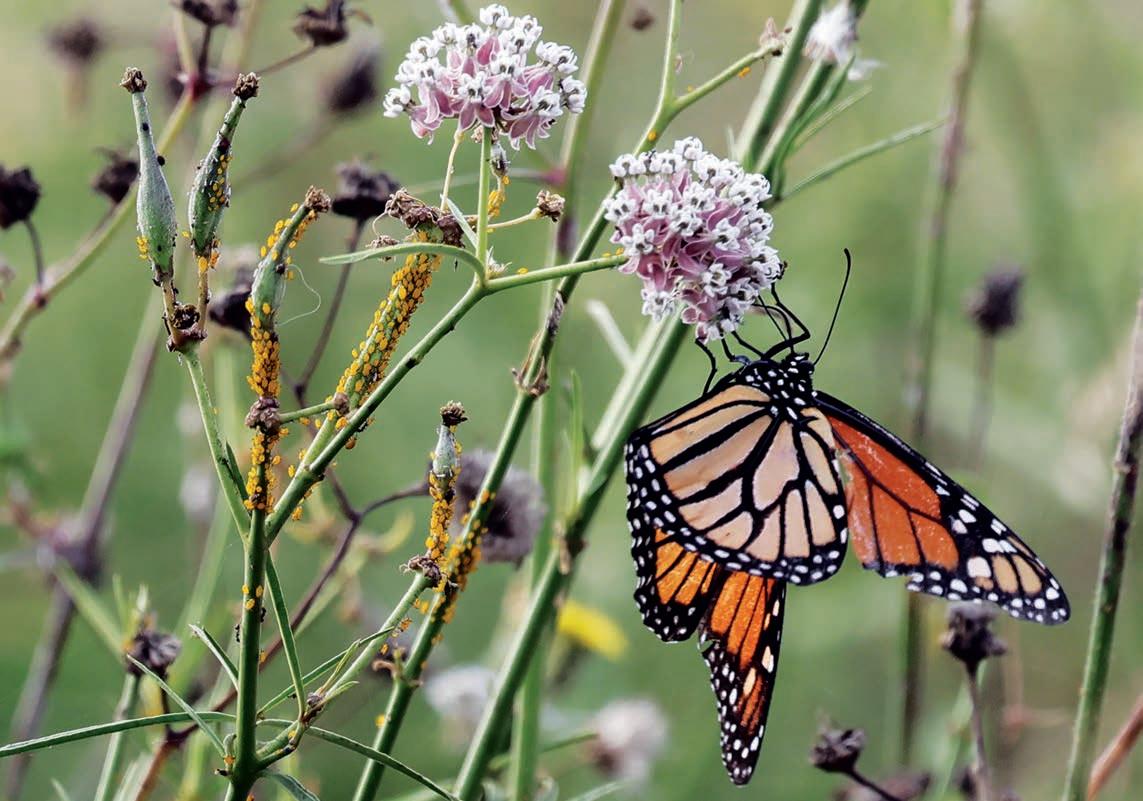
Monarch on milkweed.
























South on Linden and turn up the volume

WORDS BY AMY MARIE OROZCO
PHOTOS BY INGRID BOSTROM
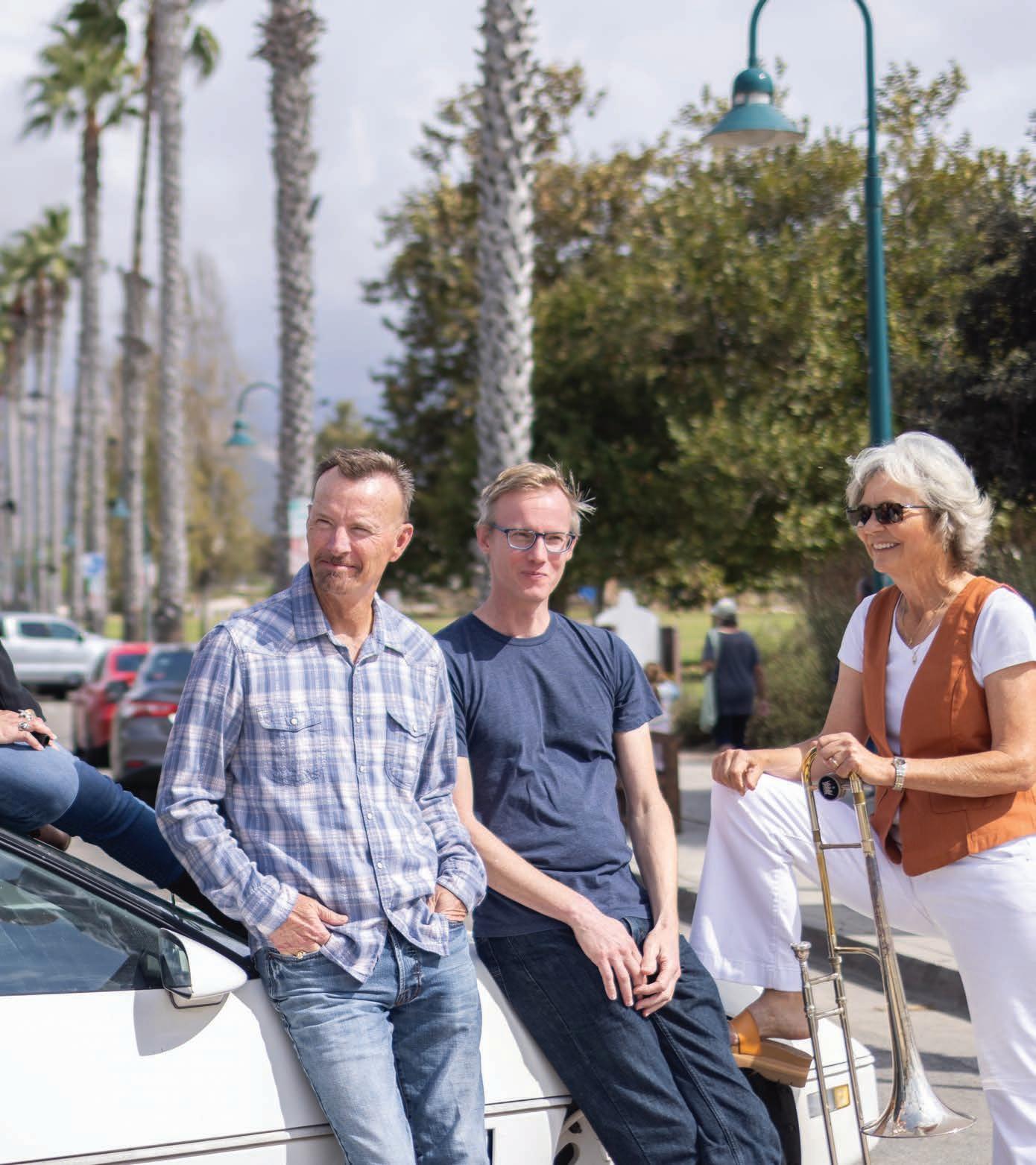
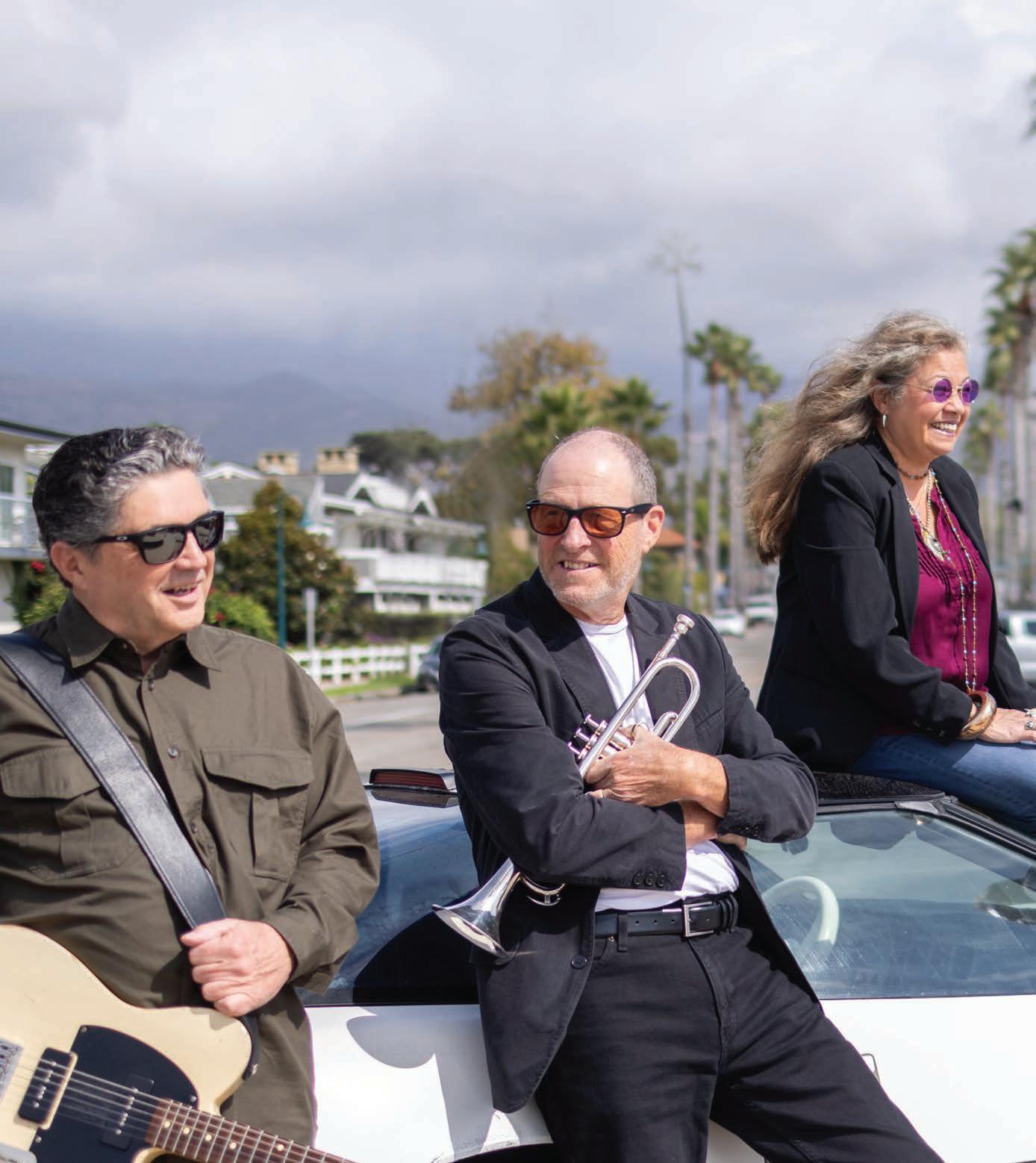
From left, Jon Everett, Lenny Price, Trish Remley, Dave Durflinger, Daryl Anderson, and Lisa Price.

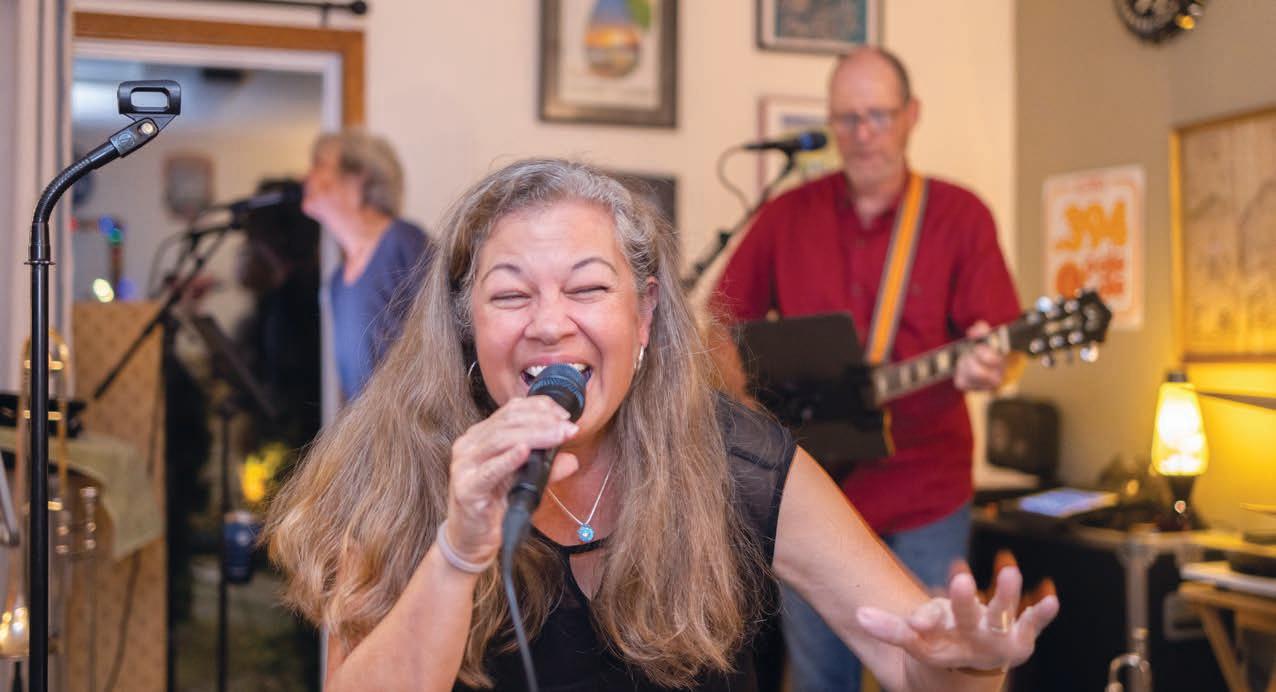
Trish “the dish” Remley belts it out.
Lisa Price wails on the harmonica while her husband looks on.
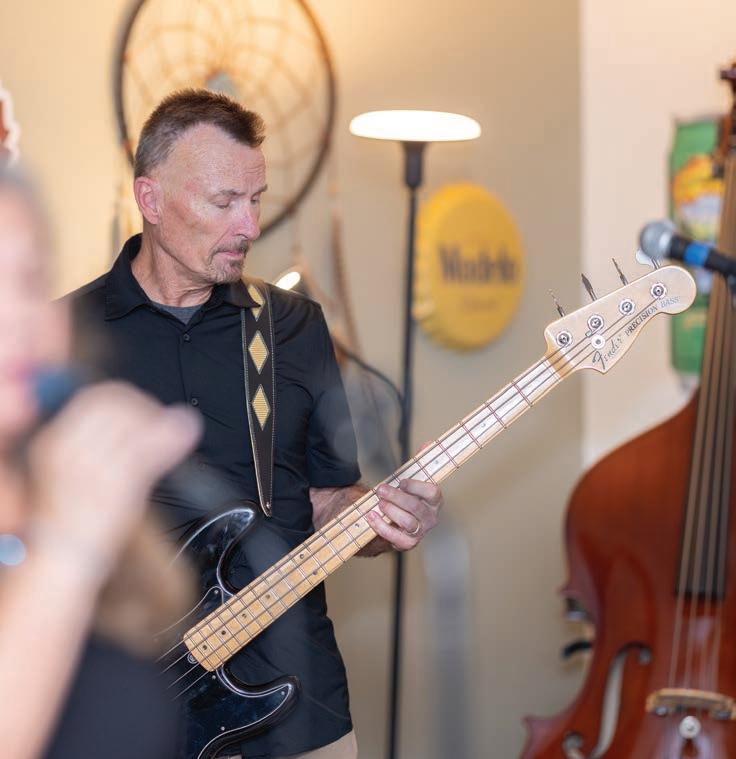
Dave Durflinger slaps the bass.
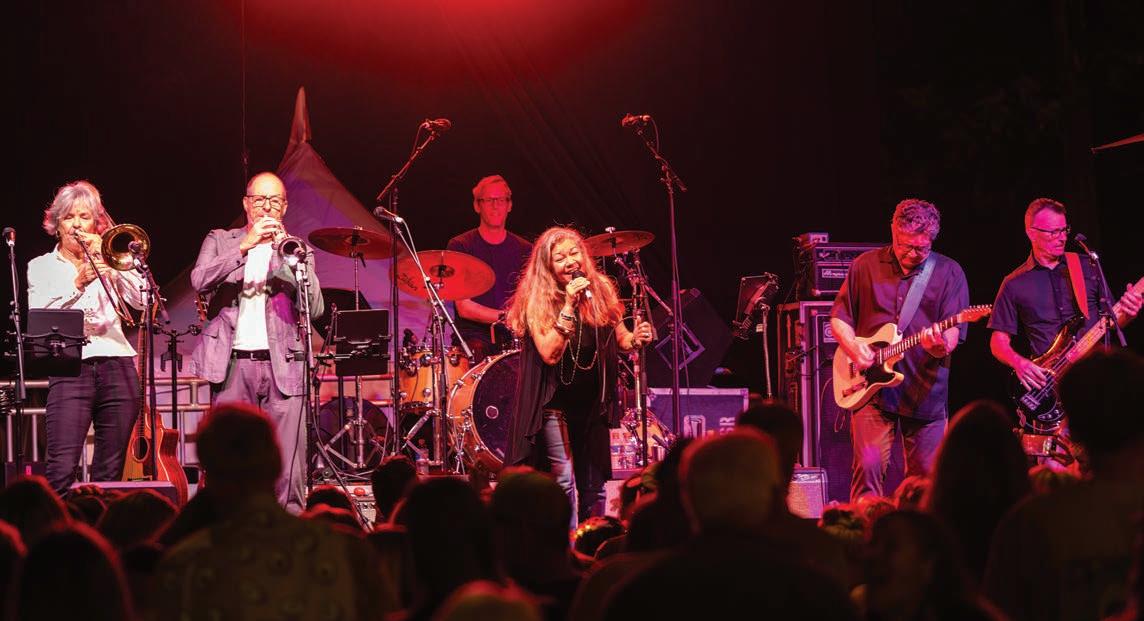

Rock and soul” is the motto that South on Linden plays by. The popular band, known for drawing big crowds at local haunts like the Arts Center, Avocado Festival, Alcazar Theatre, and Island Brewing Company, is comprised of serious musicians who take pride in their work and want their name associated with a good quality show.
Credited as founder of South on Linden, Lenny Price’s philosophy for a “really good” band is “every member is important, and everyone needs to have the same work ethic. Doing the homework so when you come to rehearsal you’re rehearsing, not learning.”
SOL distilled from The Brewery Boys, a garage band-style group from the early aughts that jammed at Island Brewing. In 2014, committed to raising the bar on his musicianship, Price asked then-fellow band members Jon Everett, Dave urflinger, and rish emley if they’d be interested in forming their own group. Later, they heard drummer Kevin Silk jamming at the brewery and asked him to join. Kevin played with the band for six years.
Dedicated to a weekly rehearsal, SOL meets at Lenny’s backyard in the former pool house that is now a studio with double-paned windows. The music stays true to rock and soul, and bandmates stay true to each other with an all-or-nothing approach. If someone isn’t available for a concert, then they won’t play, resulting in always consistent presentations.
A typical gig is two 80-minute sets with a break in between. Jon presents a set list, and everyone needs to agree. If someone really hates a song, they won’t play it. he first set is largely Motown horn-based soul. The second set is country rock, Summer of Love music (a term coined by SOL), and maybe the odd Tom Petty tune. As they play to the crowd, the song lineup can change. This year they added eight new songs to their set list, including ’80s rock, reports Jon.
What’s in a name?
he band’s first gig was in rish’s backyard. “She would throw big parties with a roasted pig,” Lenny recalls. When Trish asked for the name of the band and there wasn’t one, they opened the naming to the crowd of 100 to 150 and received about 80 responses. There wasn’t a suitable name in the bunch.
Because the band-with-no-name had a gig at the quickly approaching Avocado Festival, Jon made an executive decision that the name had to have a local reference and facilitated a brainstorming session. What’s a fun place in town? The Palms, Island Brewing … All the answers shared the same geographical location: south of Linden.
The newly minted band name didn’t hit a high note with Mike Lazaro, the man in charge of the AvoFest music lineups, Lenny recalls. Mike gave it a few seconds thought and suggested, “How about South on Linden?”
Always an Avofest crowd favorite, South on Linden serves it up with a side of guac last October.
The Prices make up the horn section.

Why they do it
he band is a lot of work, says enny. “It’s not a financial consideration at all. I love the people I play with. I wouldn’t do it otherwise. he response we get we have great crowds. It’s for the friendships, for the music. isa his wife and I play in three bands together. We met in the rmy and. It’s who we are. She’s all in. It’s what we do.” on agrees. When young, he got he Stones’ “Satisfaction. hat’s what drew him into playing guitar. Now he really gets it. “Something inside impels me, says the guitarist. rish refers to her bandmates as bandages “because they heal my soul no matter what is happening they bring the sunshine. dlibbing she adds, “whether times are good or bad, happy or sad, fire or flood, earth uake or mud she also considers S fortunate to play many a fundraiser and special shows when “ et’s Stay ogether captured the moment, such as during the homas ire, ontecito mudslides and the Covid pandemic.
S depends on uss Castillo and ichael sang for sound engineer services and is most appreciative. Since there’s not a marketer in the group, the rices take on publicity enny does acebook and isa does Instagram he band plans to continue performing at all the fun places on inden and elsewhere. eep an ear out, you’ll hear from them soon.
Meet the band

{Guitarist Jon Everett thinks his favorite rock ’n’ roll song to listen to, the Rolling Stone’s “(I Can’t Get No) Satisfaction,” rings as true today as it did 60 years ago. His musical inspirations, in no particular order, include Robbie Robertson, Steve Cropper, Eric Clapton and Duane Allman. Number one musician he’d like to meet? It’d have to be the package deal of Derek Trucks and Susan Tedeschi. In 1968, 14-year-old Jon atten e his first concert imon ar nkel.
If pressed, lead singer Trish Remley, aka Trish the Dish, would say her favorite song to listen to is Al Green’s “Let’s Stay Together.” Her favorite song to play is “Somebody to Love” by Jefferson Airplane. She has too many female artists to list as inspirations. Cher ranks as Trish’s number one m sician she’ like to meet. Her first concert t the olar Raceway in Anchorage with Cheap Trick.
Daryl Anderson keeps the beat at Avofest.
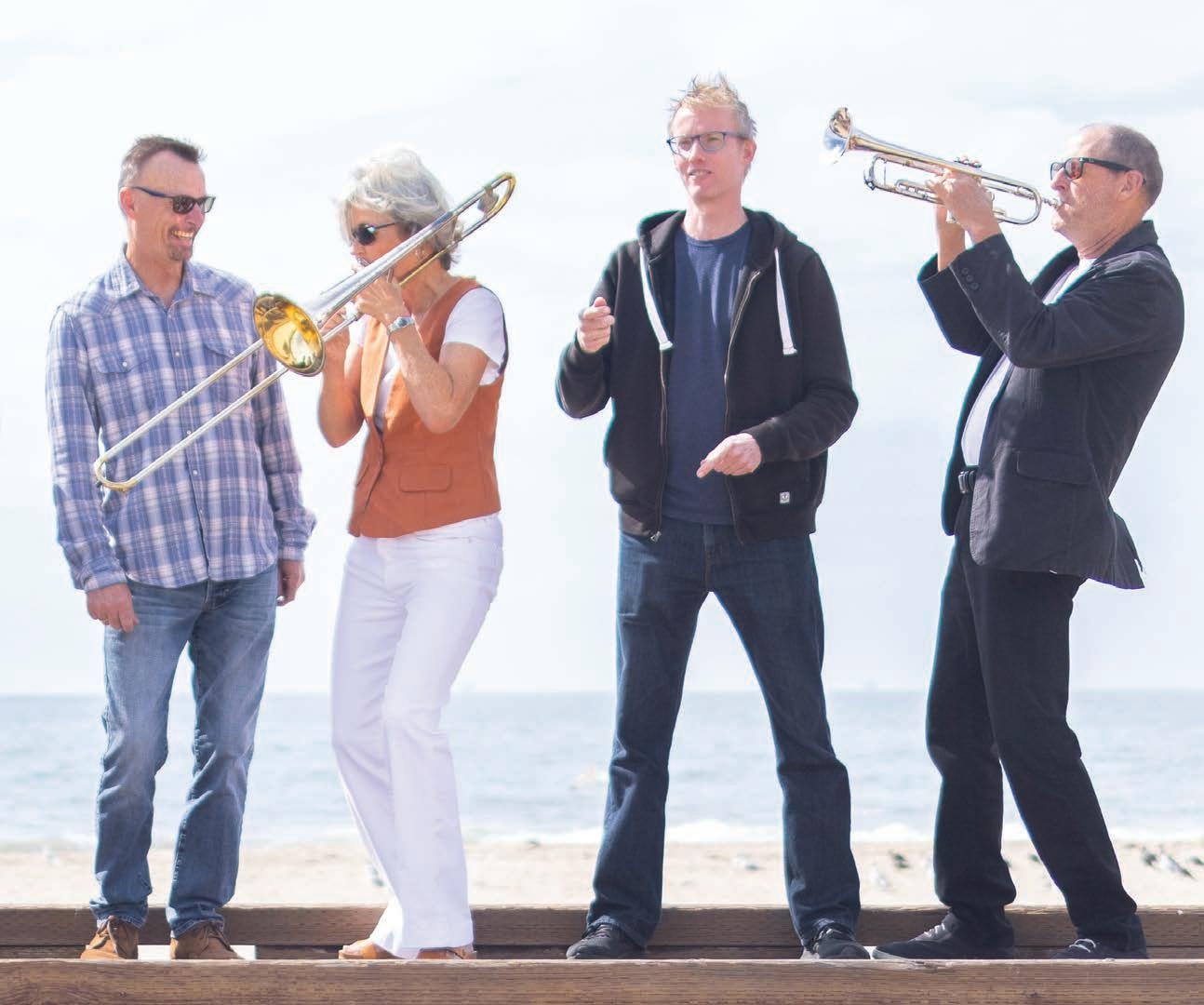
{ { { {
Dave Durflinger is the band’s bassist and also performs vocals. Stevie Wonder’s “Superstition” is his favorite listening song. Dave can’t name a favorite song to sing as he “loves ’em all.” His musical inspiration is Carol Kaye. Dave already met his number one musician he’d like to meet: Elvis Costello. According to the bassist, the first concert he attended worth mentioning was Yes in Long Beach in 1979.
Lisa Price’s role in the band includes trombone, harmonica, and percussion. Earth, Wind & Fire’s “September” is her all-time favorite listening song. Her favorite song to play? “Any song with our family band— Lenny, me and our daughter on banjo.” Bill Watrous, but he almost made her quit he was so good, is her musical inspiration. The multi-genre, huge talent Lady Gaga is the number one musician she’d like to meet. Lisa’s first concert was the Beach Boys at UCSB.
Drummer Daryl Anderson is the newest and youngest bandmember. He claims “Claire de lune” by Debussy as his favorite song to listen to and “The Ocean” by Led Zeppelin as his favorite song to play. Miles Davis, who is the number one musician Daryl would like to meet, with Tony Williams and John Coltrane with Elvin Jones are his musical inspiration. His first concert was Pantera with Sacred Reich.
Lenny Price plays trumpet, electric and acoustic guitars, and vocals. Chuck Mangione’s “Bellavia” is Price’s favorite song to listen to, and “Sweet Jane” is his favorite to play. His father is his original musical inspiration followed by his high school band director. “Now Jim Mooy, James Watson, and Scott Pickering, amazing trumpet players that I play with at SBCC.” Fela Kuti is the number one musician he’d like to meet. Lenny’s first rock concert was The Who at Hampton Roads Coliseum, Virginia.
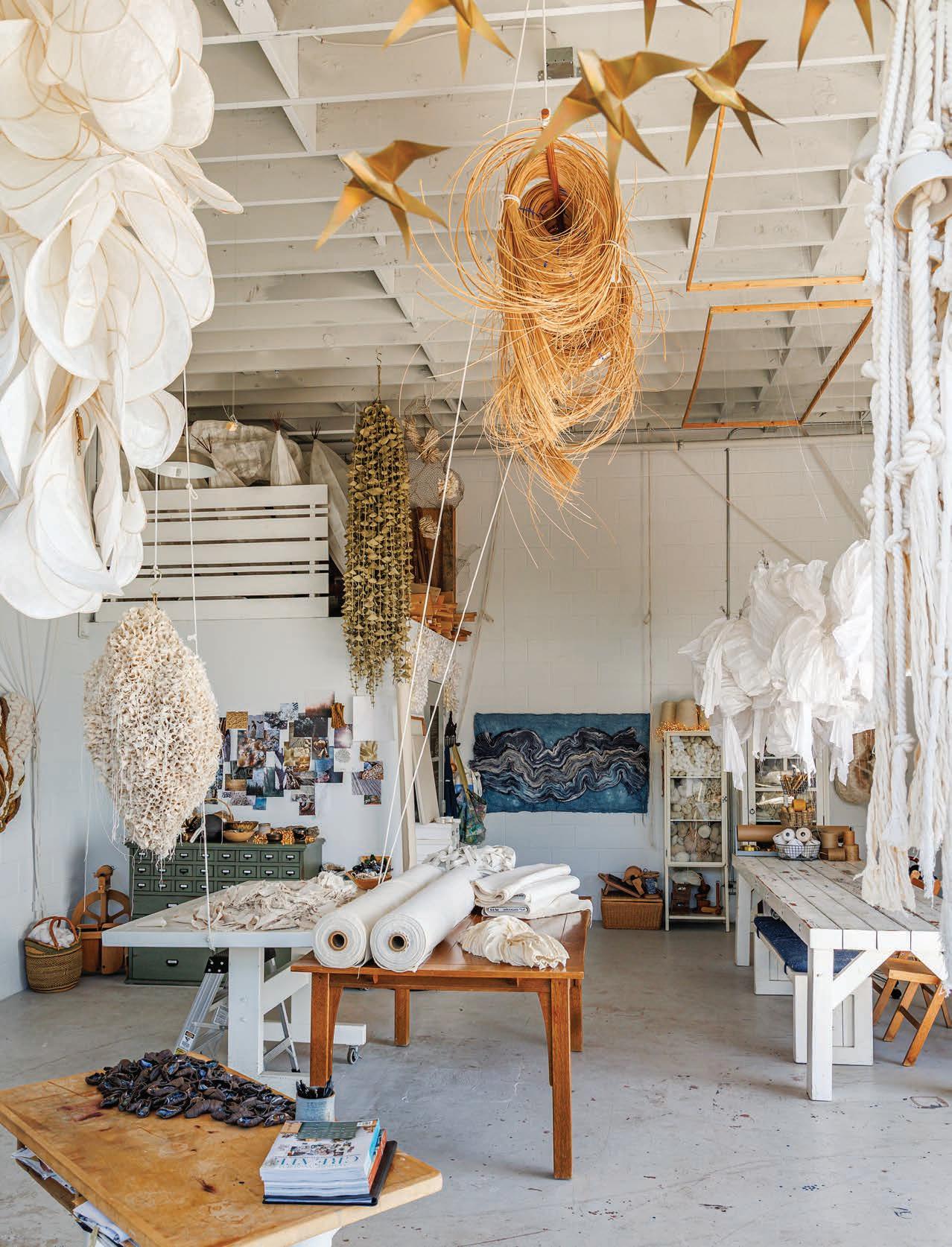
Kellen Meyer’s studio in Carpinteria.
NATURE PLAY
Fiber artist stitches, knits, tears, and tucks Carpinteria
WORDS BY KEITH HAMM PHOTOS BY MATT DAYKA
Kellen Meyer recalls two vivid moments critical to her life as a professional artist.
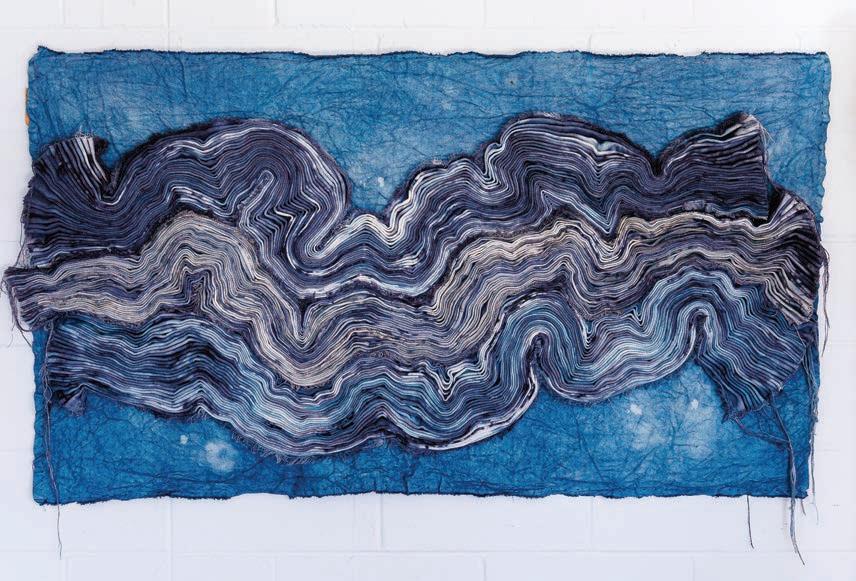
he first was inspirational. uring a morning beach walk, sand striations caught her eye. t home, she transformed her vision of those sandy patterns into a -foot-tall, five-foot-wide te tured sculpture of knit wool. She titled it “In Search of Wonder.”
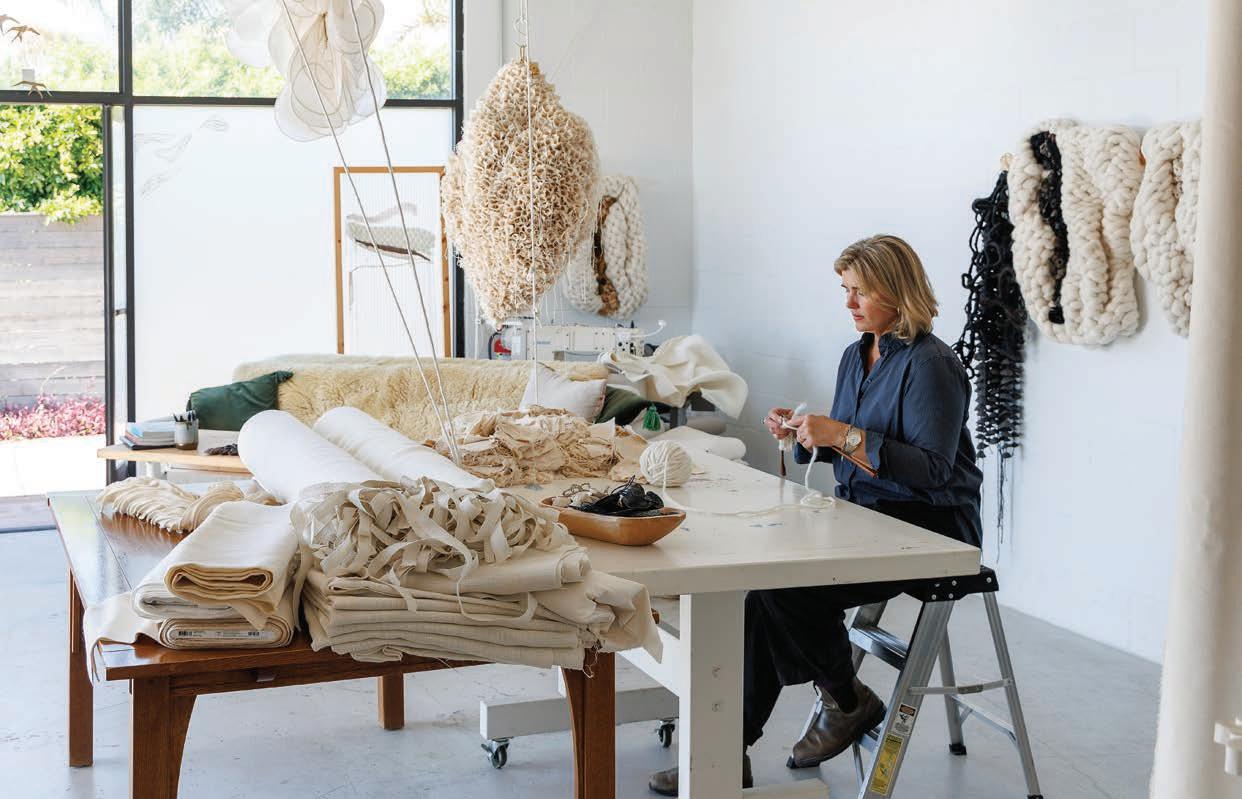
he second moment was more practical, arriving in when she signed the lease on an art studio overlooking the Carpinteria Salt arsh. Her work had outgrown space at home, she remembers, and it was time to “really take this seriously because the rent is due.
In a sense, inspiration and practicality have long informed ellen’s path. s a girl, she followed the lead of several creative family members, including her mother, who made and tailored clothing for ellen and her three brothers and also built and refinished household furniture.
“I would say I come from a very artistic family, says ellen, who was born in aguna each, raised in uma, ri ona, and landed in Santa arbara with her husband and children about years ago. “Surrounded by creative people since I was very young, it made me reali e that if I can find the right materials, I can always
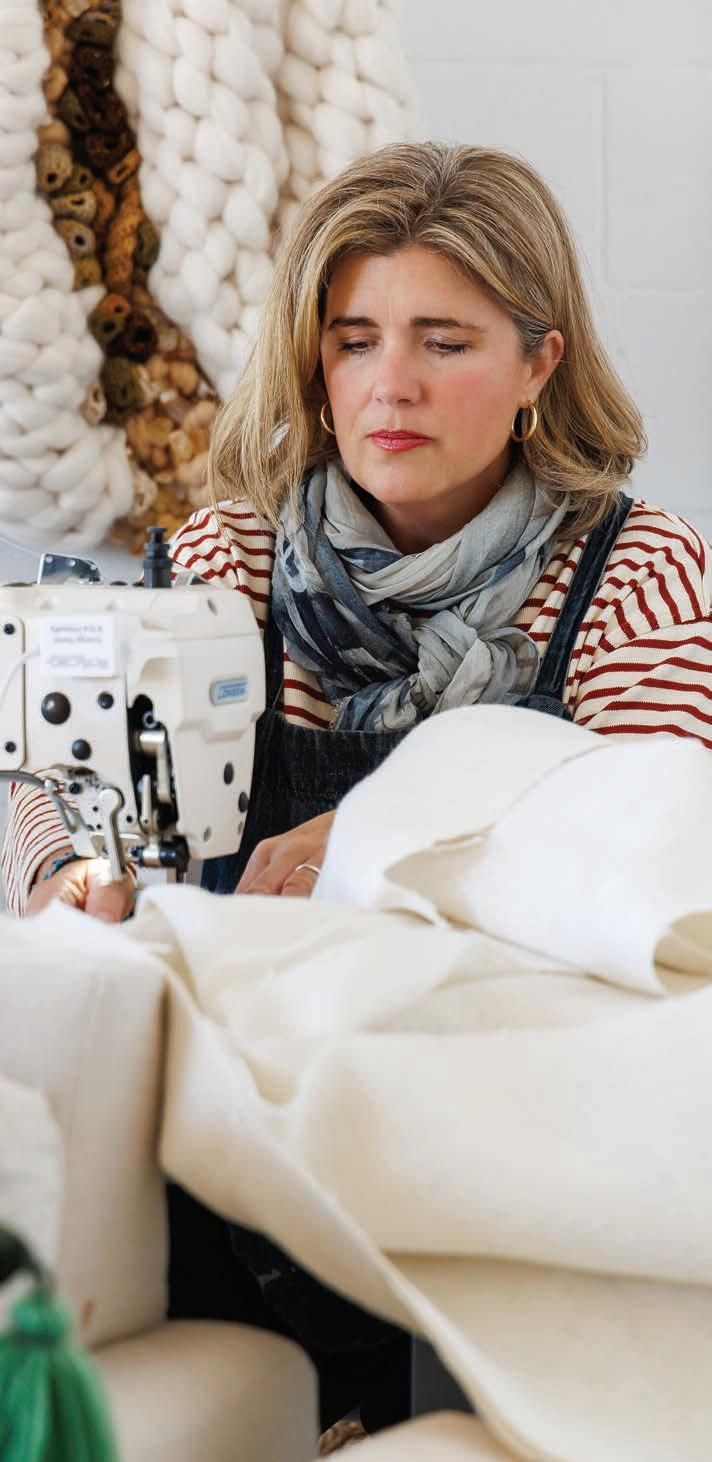
Kellen sews burlap for an installation piece.
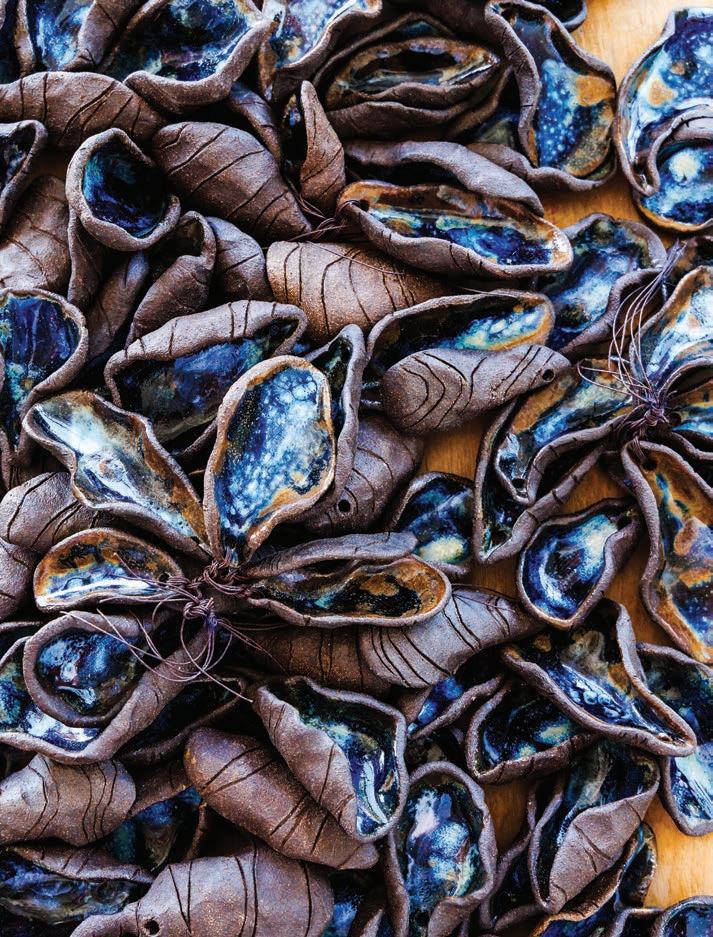
be creative and innovative. In my art now, I utilize a lot of different materials wool, fabric, paper, clay because that’s how I grew up.
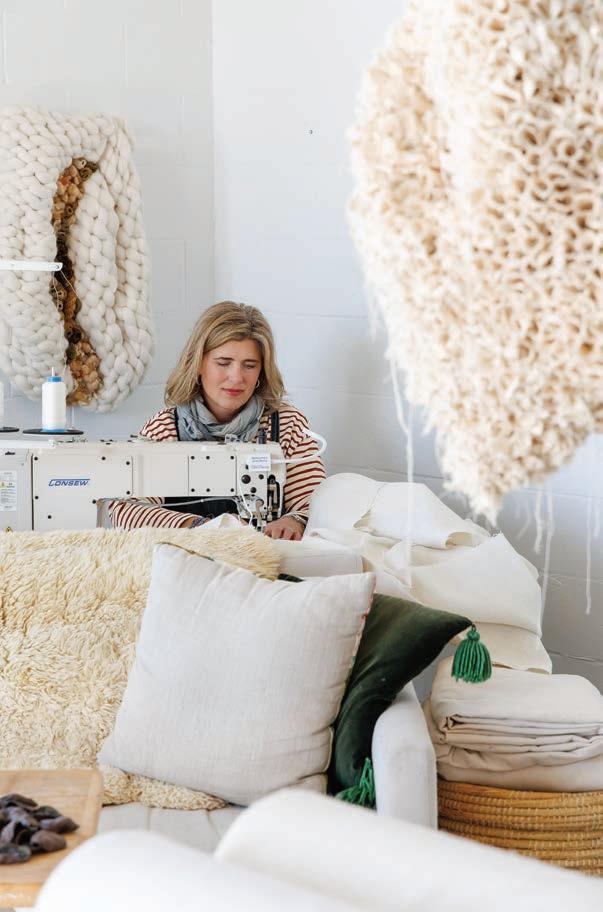
ellen learned to sew when she was and made most of her own clothing in high school. ff to the niversity of ri ona, she “thought about being a costume designer, she remembers, “but instead I got a degree in business and marketing, which has been very helpful in my art career. hat formal education shines through in her clear, e cient messaging on social media, and in the sheer number of installations, e hibitions, commissions, and commercial clients she has booked in recent years, including do ens of group and solo shows in her hometown and along California’s Central Coast. She also landed residencies recently in Italy and ustralia, both of which, she says, filled her with the gratitude of “getting to know people from all over the world ust doing their art and making friends with a real sense of purpose.
Her international r sum and clean professionalism complement the interpretive nature of her art, which she describes as, above all, biophilic, that deep, biologically
“Box of Urchin” behind collected inspiration.
Ceramic clay shells
"From the Heights," fiber art piece for Kellen’s solo show at Indah Gallery.
Kellen at work in her Carpinteria studio.
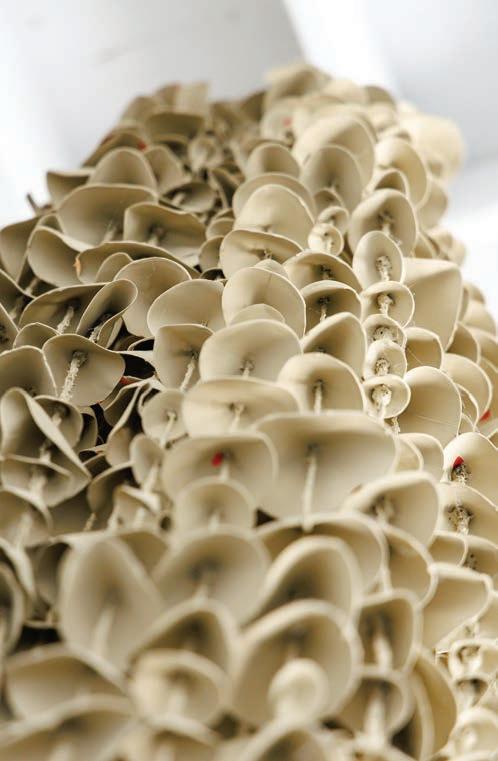
“Falling Leaves” clay sculpture.
“Islands Meet the Sea,” indigo fiber art piece
Inspiration board.
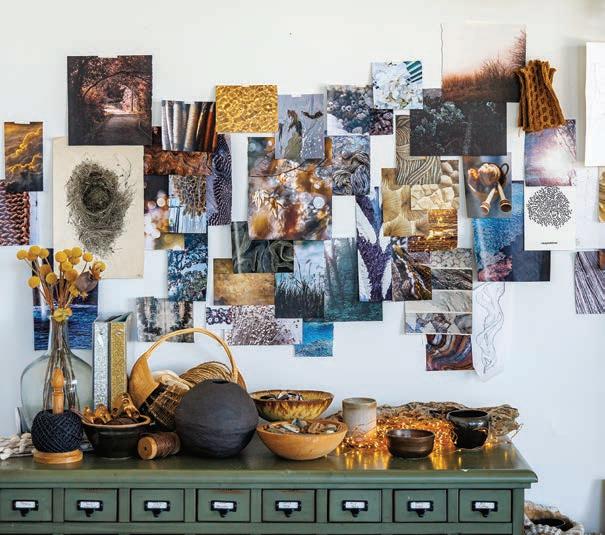
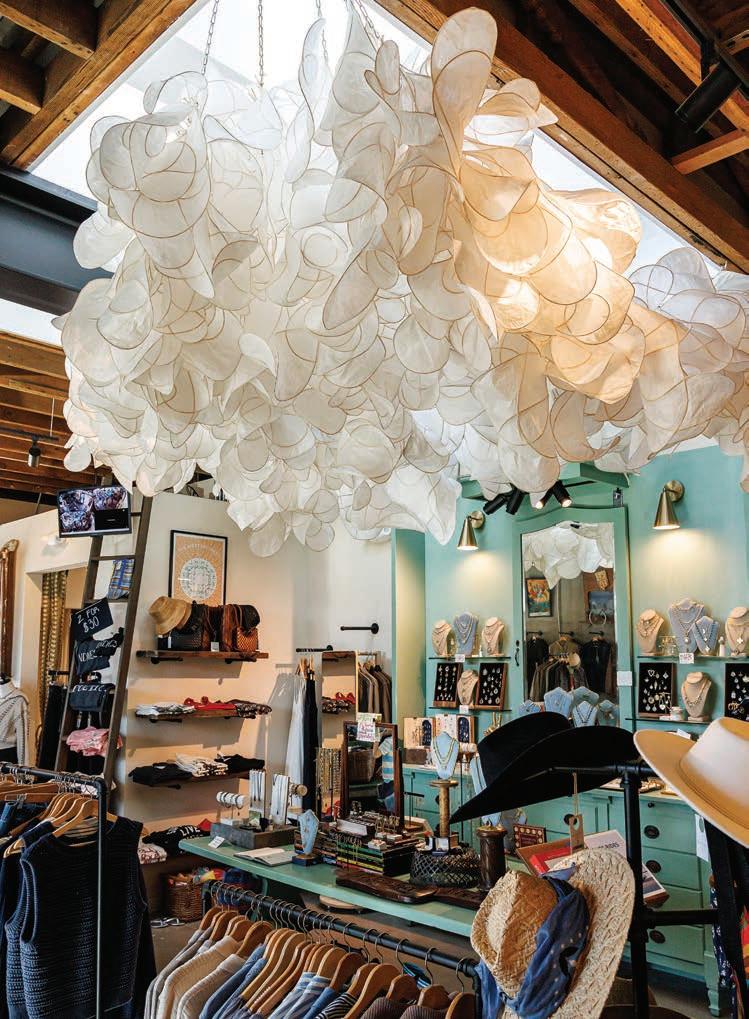
“In the Light of the Moon,” sculptural paper petal installation at The Shopkeepers in Linden Square.
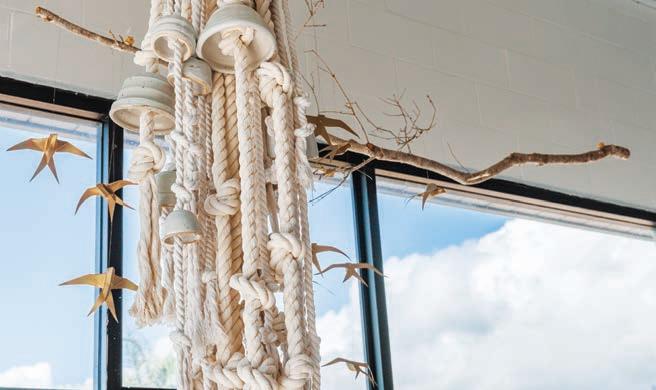
Rope and ceramic piece in the forefront, origami birds in the background.
Kellen Meyer on her machine with beehive sculpture in the foreground.

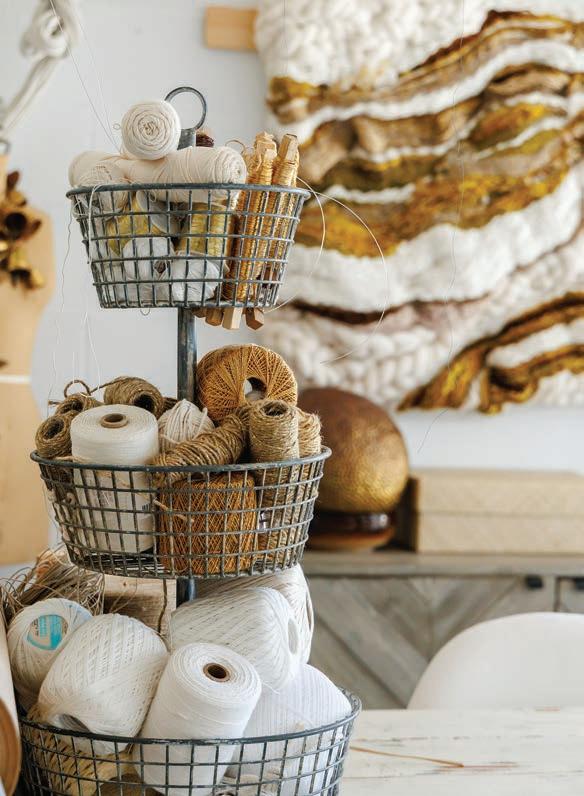
Fiber art supplies with a glimpse of future pieces for solo show at Indah Gallery in November.
driven tendency in humans to connect with nature. In design, biophilic philosophy blends natural materials, tones, and textures.
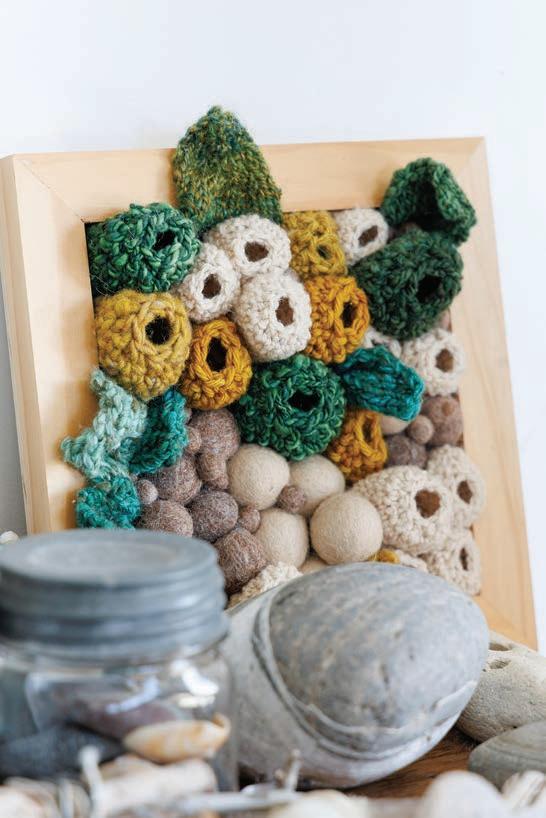
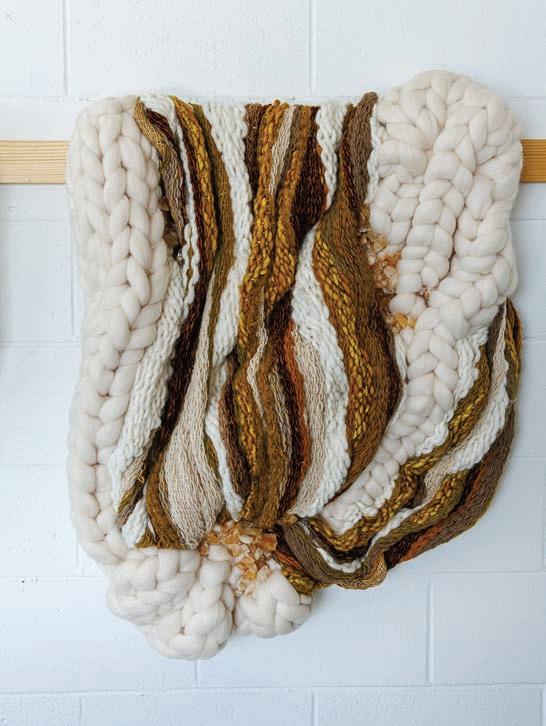
“ y work is heavily influenced by the outdoors, she says. From her studio she often spots the bees, hummingbirds, hawks, and shorebirds that frequent the 120-acre salt marsh as it floods and drains daily with the tides. n the nearby beach or out to sea on scuba diving trips, she’s a collector of colors, shapes, patterns, and myriad natural wonders that appeal to her artistic craft. Back in the studio, she’s knit tidal habitats out of wool, crafted kelp forests from paper, and built beehives in raw canvas.
Since the spring of this year, her pieces — including “In the ight of the oon, a ceiling installation of petals made of paper and reed — have been on display at The Shopkeepers store on Carpinteria’s Linden Avenue. Her wall-mounted knit pieces — in dyed wool, raw stone, and seashell — are “glimpses of tidepools, she says. “ s an artist, my interest is in the wild outdoors and trying to bring a bit of that inside to create biophilic connections.
Also locally, upward of 30 of Kellen’s pieces, including a large-scale installation, will be up at Indah Gallery, located at the Roblar Winery vineyard in the Santa Ynez Valley; the solo show runs until December 22. In collaboration with Arte Laguna and MoCA Italia, she will also be exhibiting in Shanghai through December 15.
For more, visit kellenmeyer.com
Kellen in her studio on the west end of Carpinteria.
Ea h and Fire:
Sola Ceramics rises
WORDS BY JUN STARKEY • PHOTOS BY MATT DAYKA
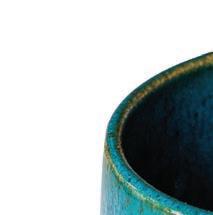
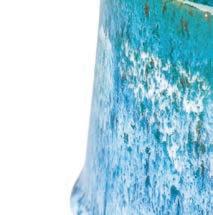
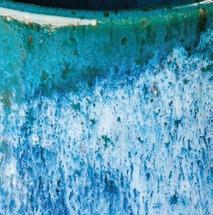
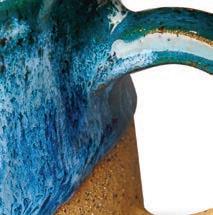
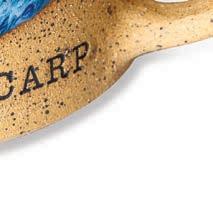
Carpinterian Nicole Velasquez-Slawson has transformed her creative outlet, Sola Ceramics, into a livelihood by shaping clay into a unique brand of nostalgia and practicality.
Nicole had always been an art lover and notes that she was lucky to have parents who supported her creativity. She graduated from U.C. Santa Barbara in 1995 as an art major with an emphasis in pottery. She kept up the craft for a while after college, then set it aside. She didn’t get her hands back in the clay until 2019.
After spending several years in New Mexico as an artist’s assistant and taking some time to raise her children, Nicole decided to revisit the craft to supplement her income. At
the time, she was living alone with her two daughters. Her business’ name was inspired by her daughters, Sophia and Lila. The their names combine to create “Sola,” and her logo also features them as two small birds.
Sola Ceramics began with practical, everyday items, such as bowls, plates and cups. “ y products have reflected my life, Nicole says, explaining that as her daughters became older and more independent, she was able to begin crafting more intricate pieces, like berry bowls and butter and salt dishes.
Now that her daughters are in high school, Nicole has ventured into more artistic pieces, such as small chimeneas, big enough for a tealight candle, or nichos, a type of Spanish folk art that Nicole discovered during her time in New
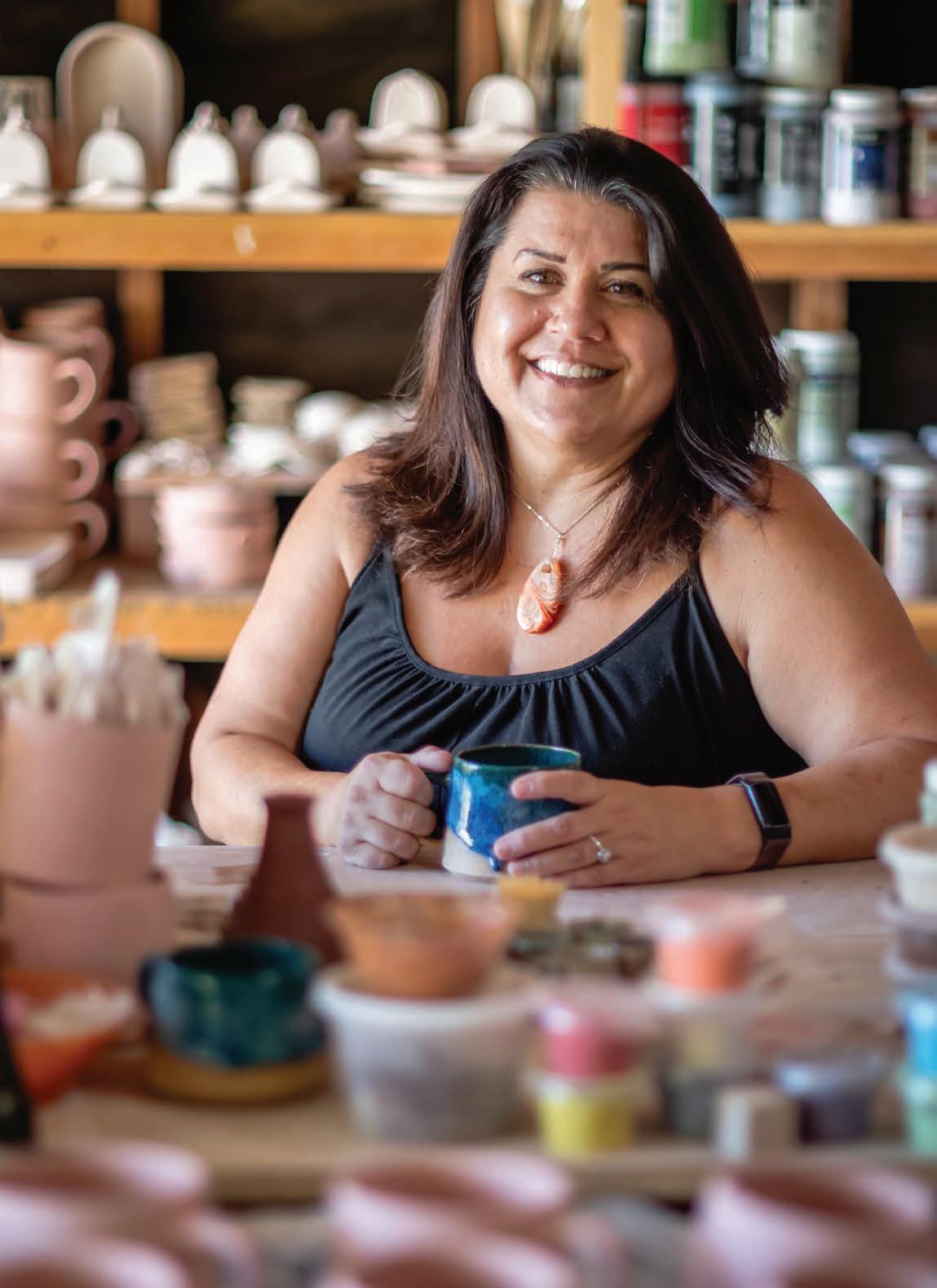
Nicole Velasquez-Slawson in her pottery studio.
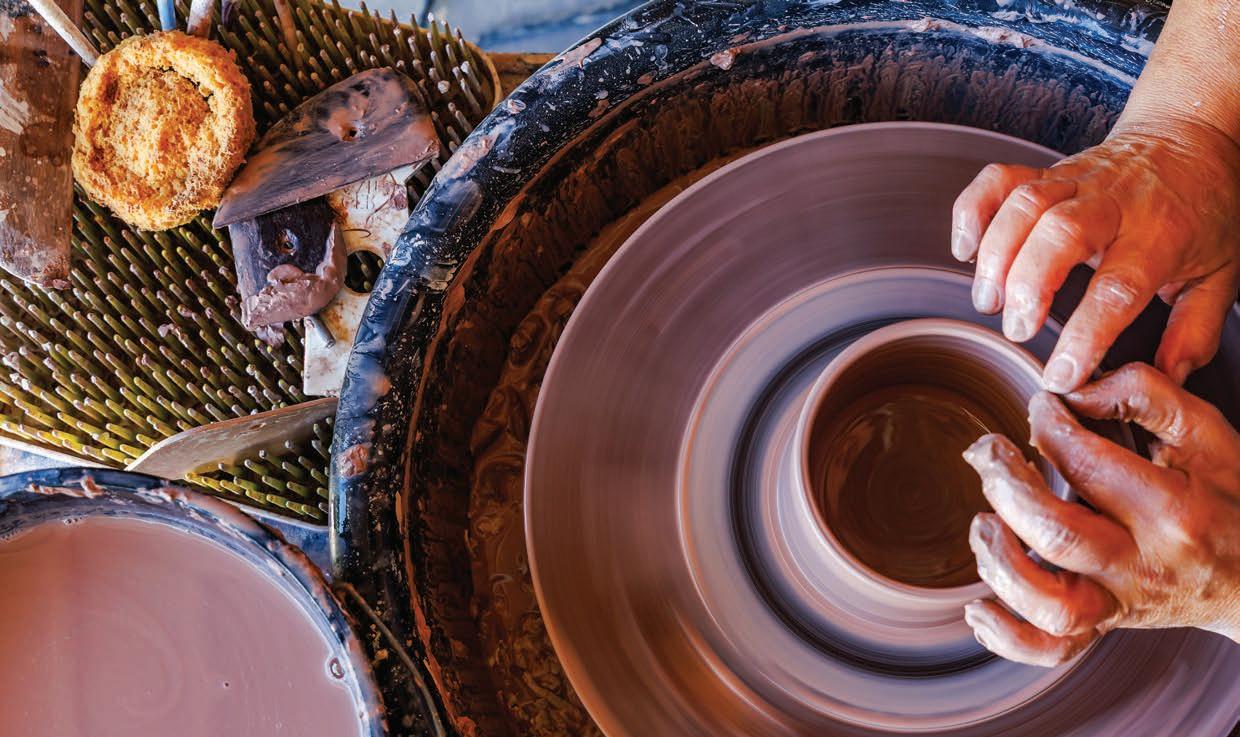
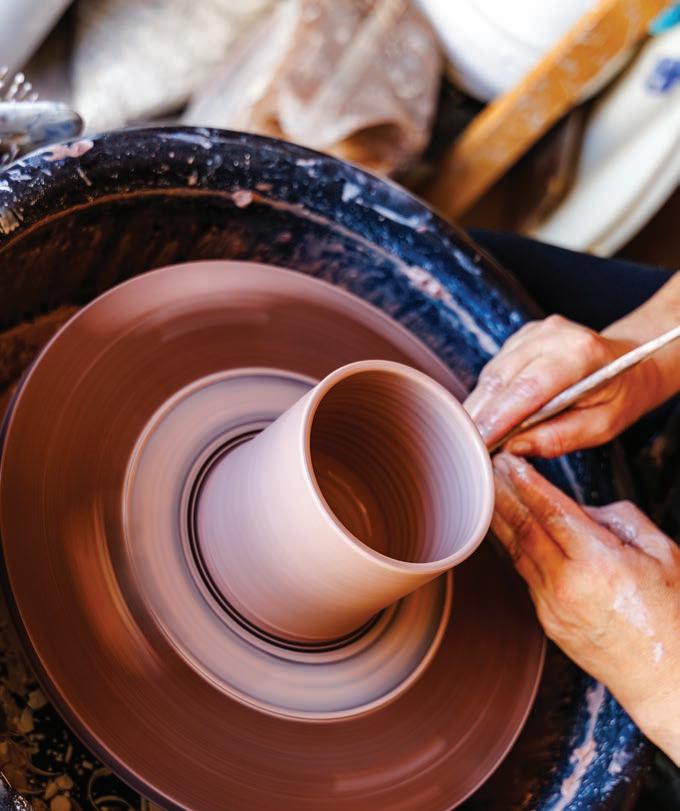
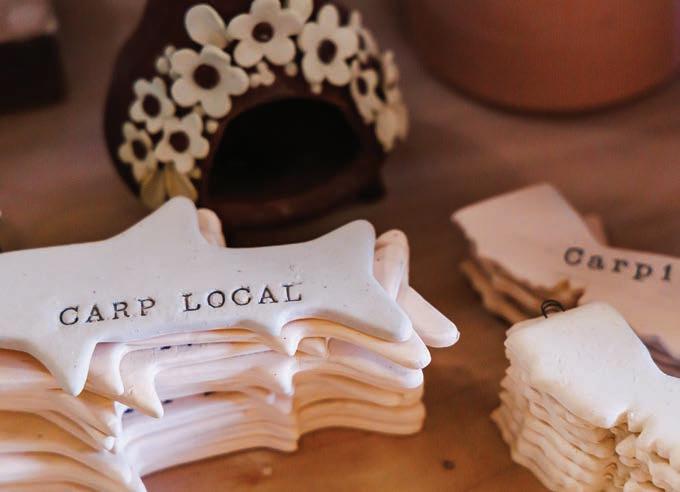





























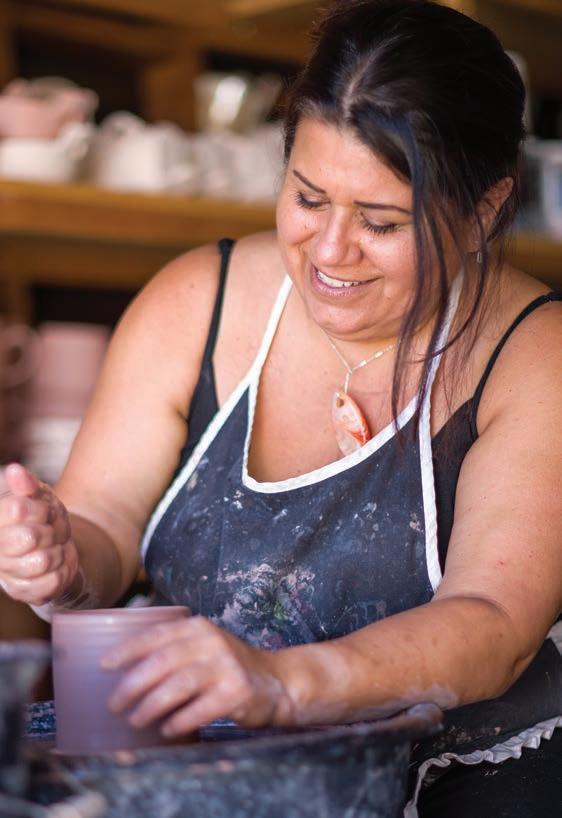


Nicole Velasquez-Slawson spins one of her popular mugs.


Mexico. Nichos are three-dimensional display pieces, sometimes used as shrines for honoring lost loved ones.





“I was super inspired by that way of celebrating,” Nicole says. “(I was) trying to create something beautiful to honor loved ones.”





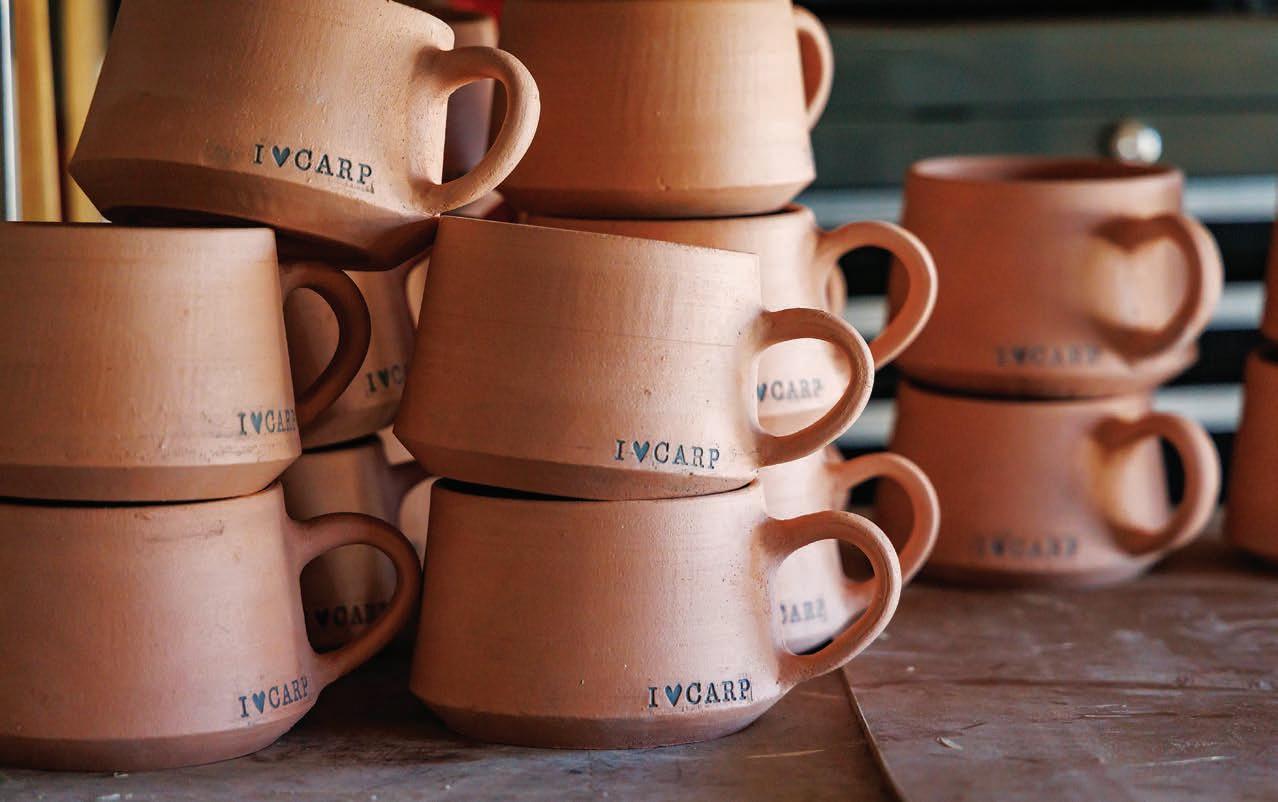
Some of her more popular products are her mugs referencing nostalgic spots around Carpinteria, like Santa Claus Lane, Tar Pits, Rincon, and Jelly Bowl. Nicole said she has shipped these mugs around the world to homesick Carpinterians, or once-upon-a-time visitors.



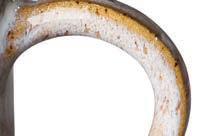
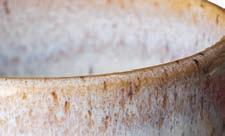
Nicole is a small batch potter and works with a kiln that can accommodate about 40 mugs at a time. Every piece is handmade, unique, and often part of a limited collection. Her garage serves as her studio, a space to mold and shape her creations on the wheel before adding designs, gla ing and firing her pieces. he process is lengthy, but Nicole said she hopes to acquire a larger kiln soon to allow her to take on more orders, as well as open an online store.




Follow Nicole on Instagram at @sola_ceramics for information about holiday pop-ups and makers markets. Soon, Nicole plans to host workshops that allow others to express their creativity in clay.

“I’m happy that others can appreciate what I’m making,” Nicole says. “Carpinteria is a very unique place.” referencing nostalgic spots around Carpinteria, like Santa accommodate said to an

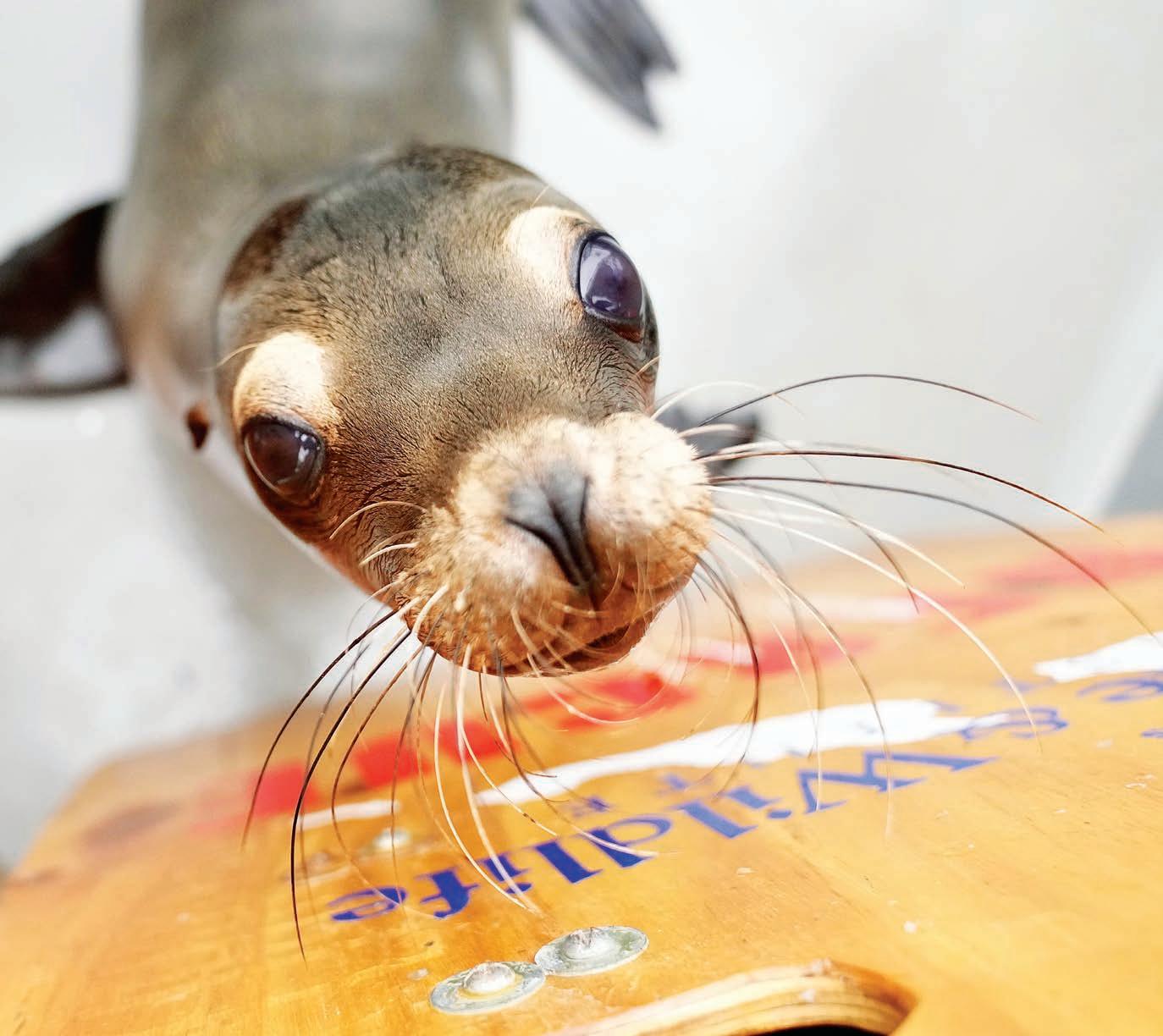
A young sea lion looks for a snack while being rehabilitated at the CIMWI facility.
CIMWI to the rescue
Nonprofit rehabs pinnipeds in distress
WORDS BY PETER DUGRÉ • PHOTOS BY SUSIE CLOTHIER
There’s a reason some people call them sea dogs. Seals and sea lions play like our canine friends. When they’re distressed, they give you that sideways puppy glance, the whites of their eyes eclipsing the rim of the dark iris, a look that draws you in, seems to connect and ask for help.
On a gray day last September, a team of mostly volunteers transported two rehabilitated sea lions to a secluded beach
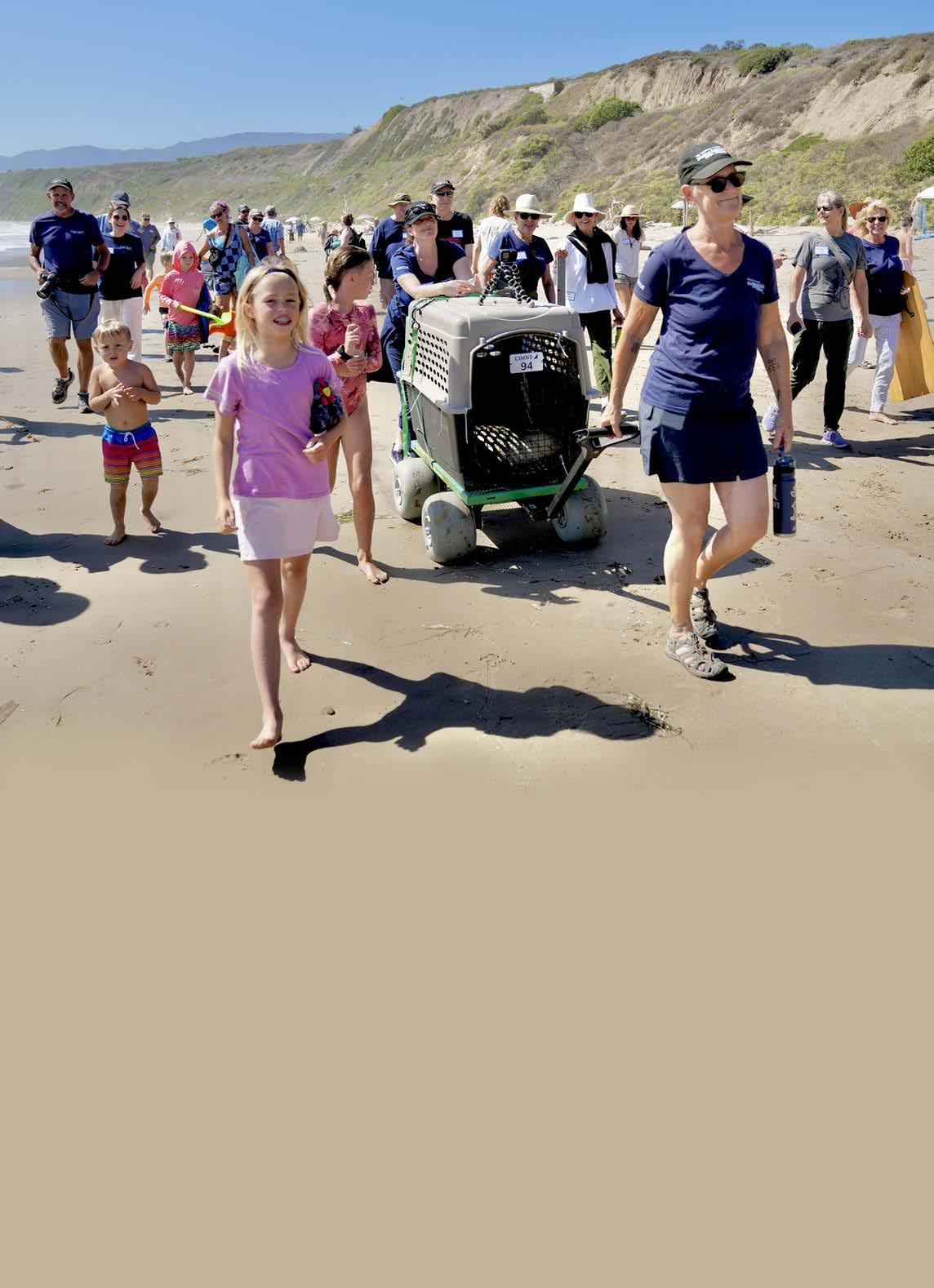
in Hollister Ranch, where the Channel Islands Marine & Wildlife Institute, best known as CIMWI (“sim-wee”), released them.
The young sea lions’ transport kennels were opened 20 yards from the water. After four to six weeks of care, these marine mammals knew what to do. sing front fins, they pulled their well-fed bodyweight across the sand to enter
Flanked by beachgoers, Jennifer Levine-Griffiths, Stranding Operations & Animal Care Manager for CIMWI, wheels a rehabbed harbor seal to be released at Rincon Point July 10, 2025.
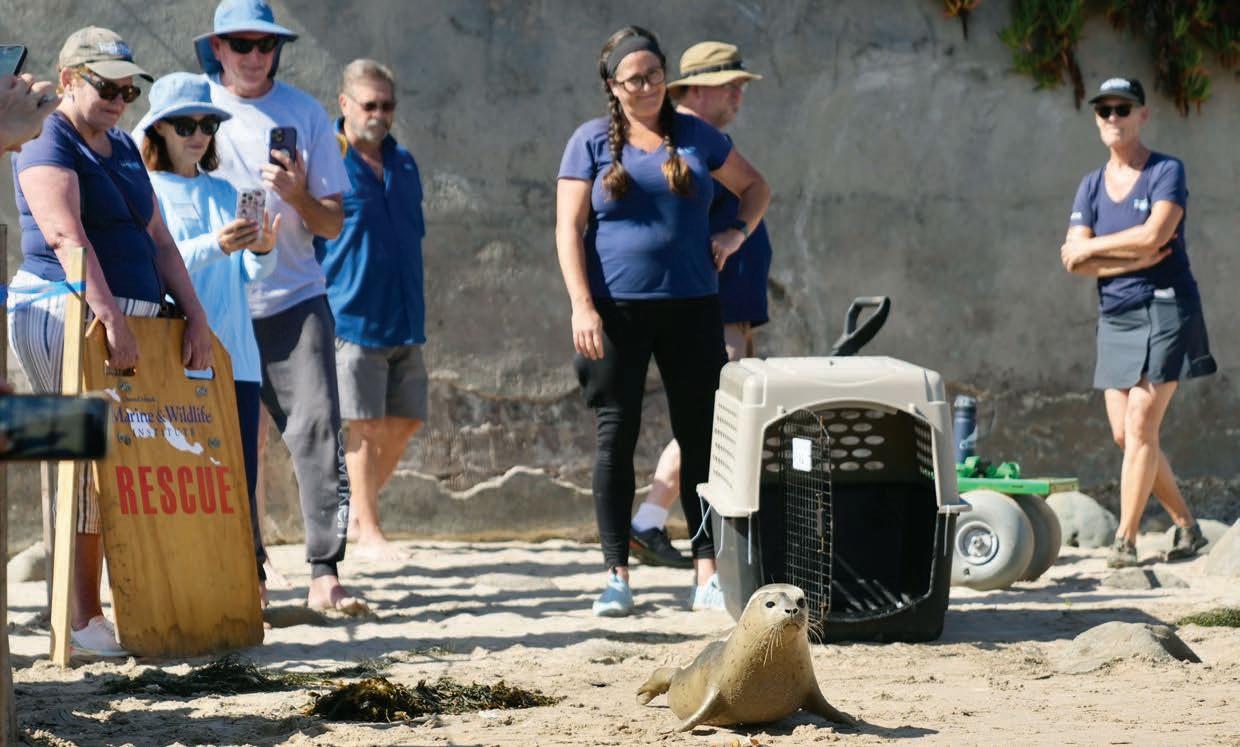
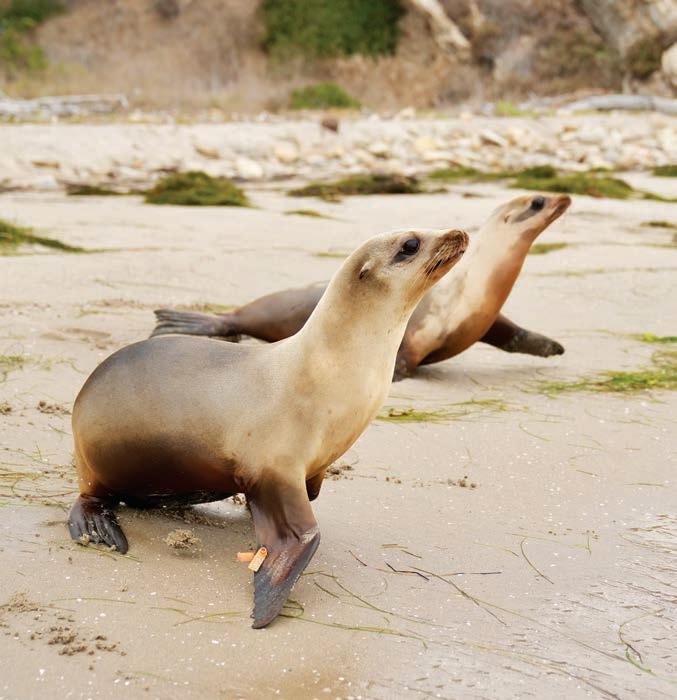
Ready to return to the wild, #94 leaves the CIMWI crate and heads to the water at Rincon Point. The young female harbor seal was prematurely separated from her mother. Under CIMWI’s care she gained 34 pounds and returned home healthy.
the water. Plunging home, they adeptly sliced through a couple of small waves, emerging together just past the break, touching whiskery noses above the water, a Hollywood happy ending enabled by the compassion of those who answer the call to save the pinnipeds.
Dr. Sam and Ruth Dover founded CIMWI in 2006. Sam is a veterinarian by trade and oversees diagnosis and treatment plans for the mostly seals and sea lions rescued from 155 miles of shoreline along Santa Barbara and Ventura counties. Ruth, her background in hotel management consulting in Chicago, leads the team from their facility, the old Vista Del ar nion School, off Highway on the aviota Coast.
As of September, CIMWI had rescued 143 animals in 2025. The annual average is 225. Another 190 are found deceased and e amined to collect scientific data. CI WI’s territory was originally just Ventura County, but starting in 2015, it became the only certified rescue operation in both counties.
Home to the seal rookery, salt marsh, and a vibrant offshore ecosystem, Carpinteria’s seven miles of coastline are an active stretch for reports of distressed animals, including those suffering from domoic acid poisoning. he pair of sea
A pair of sea lions dash toward the ocean after receiving care at CIMWI.
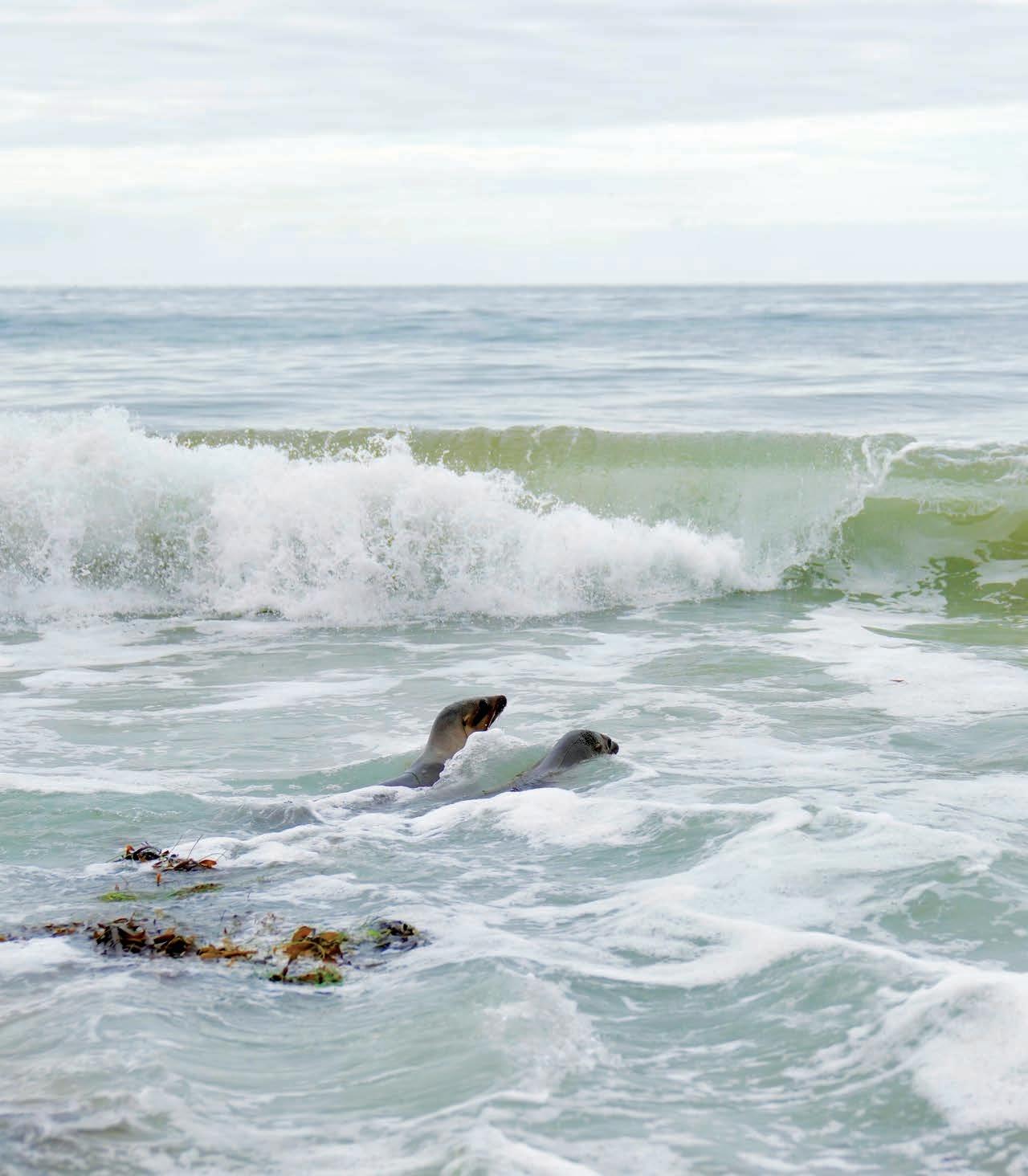
lions released at Hollister Ranch in September came from Carpinteria State and La Conchita beaches, and like most CIMWI rescues, beach walkers called them in, then volunteers responded to assess the animals, who were transported to the rehabilitation center.
WHERE THERE’S A WILL
CIMWI was Sam’s dream. The timeline of his relationship with Ruth roughly coincides with the launch of CIMWI, their baby, and though the nonprofit’s funding sources ebb and flow, the operation runs largely on passion for the animals.
“We joke that I make Sam’s dream come true every day,” says Ruth, making intros before a Monday morning team meeting. he crew consists of five volunteers and ennifer evine- ri ths, a former EMT and now fulltime Stranding Operations and Animal Care Manager at CIMWI. She started with CIMWI the same way most do, with a walk on the beach and an encounter with a distressed pinniped. Those eyes!
“All of the people here are so amazing,” says Jennifer, sitting at a desk wearing yellow waders. “We all want to be here for the love of the animals. We all have the same goals; we come together, and everyone gives so much.”
Volunteers at the rescue facility include a retired Santa arbara City College biology teacher, a retired police o cer, a retired substitute teacher, a retired stockbroker, and college students honing their marine biology skills through hands-on experience. Across the counties, a large network of trained volunteers are the rapid responders who answer the call when beached marine mammals are reported.
Though this operation is reliant on fundraising and volunteers, it’s a professional mix of animal care and scientific research and one of the largest of its kind in the state. Licensing is strict, and collaboration with universities, scientists, and veterinarians make it a valuable marine biology research resource. Tasks of the day include measuring water clarity, pH and temps for the pools, weighing out feedings, and hiding medication in the first fish, to observe the rollicking patients ingesting it.
Domoic acid, a naturally occurring neurotoxin that collects in fish and shellfish, is poisoning more sea lions and
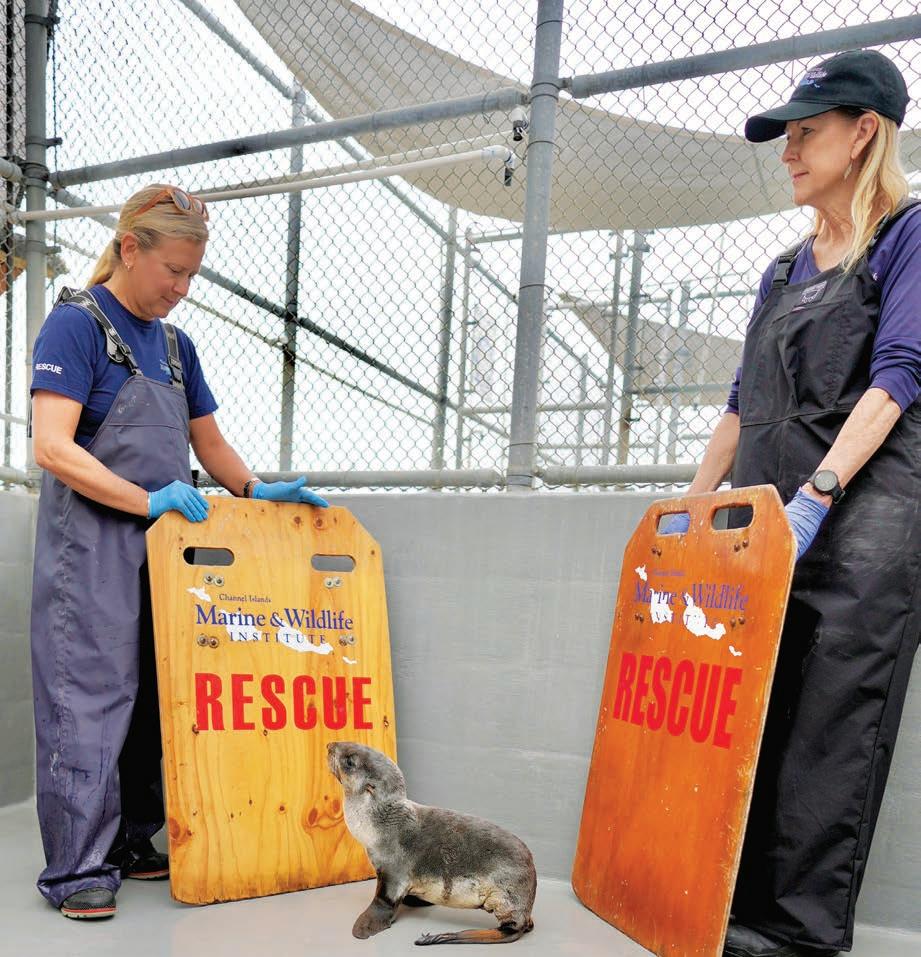
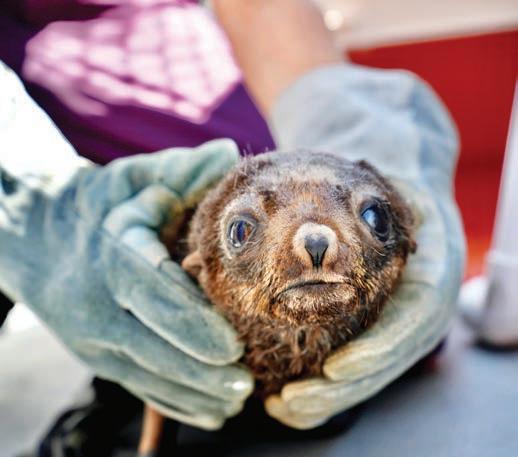
From left, CIMWI volunteers Beth Whitney, DVM, and Dedie Jones move a new patient into a rehabilitation pen at CIMWI. The Northern fur seal pup was rescued in October because of premature maternal separation.
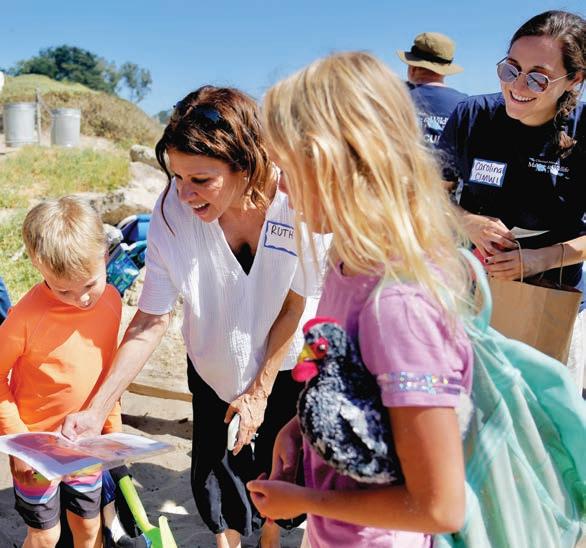
CIMWI Managing Director Ruth Dover educates young ocean stewards at Rincon County Beach.
dolphins than ever before. There used to be an outbreak every four to seven years, but for the past four consecutive years there has been no relief. Telltale signs are exhibited by confused animals on the beach, often slowly bobbing their heads, listless in appearance.
Often by the time they’re beached, these animals have permanent brain damage and succumb to the illness. If the condition is caught early enough, some can be saved, but animals with domoic acid poisoning often end up on the necropsy table for research.
CIMWI is partnering with a biotech company that is developing medication for neurodegenerative conditions. “Everyone is looking into it,” Sam says. “We collaborate with other centers on what works and what doesn’t. When the animals come in, we never know how much domoic acid was ingested or when.”
Marine scientists theorize that the uptick in domoic acid cases is attributable to many causes including higher water temps and fertili er runoff along the coastline feeding the phytoplankton blooms which produce domoic acid.
COMPASSIONATE CARE FOR WILD ANIMALS
Returning animals to the wild is the primary goal, so while animals need urgent care, CIMWI must also mold their intervention on not domesticating them through over-exposure to helping hands. This means that outside of feedings and examination, the animals — up to 60 at a time — are left alone with their pools and each other’s company.
Most rescues are pups. They’ve been separated from their mothers, fresh from weaning, and have hardly, if at all, started to consume fish.
“We have to teach them that fish is food, so they’ll eat,” Sam says. “Then one day a light bulb goes off and they start eating. I get it.’
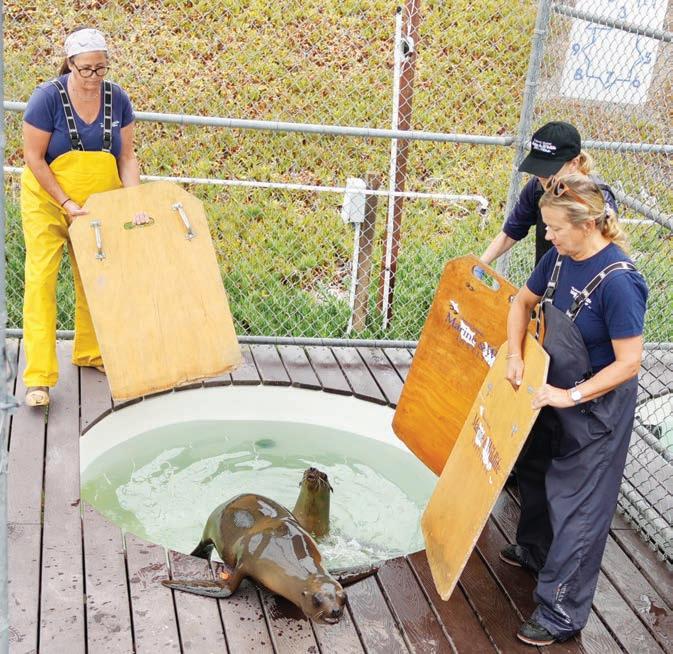
Because the animals are unpredictable, their caretakers use wooden shields as a barrier during interactions. Feedings are happy times for recovering animals, mostly sea lions. ach will consume to pounds of fish per daily feeding, depending on life stage. When elephant seal pups come in mostly early in the year, the massive mammals require multiple feedings per day. A northern fur seal pup, weighing just over 10 pounds, had
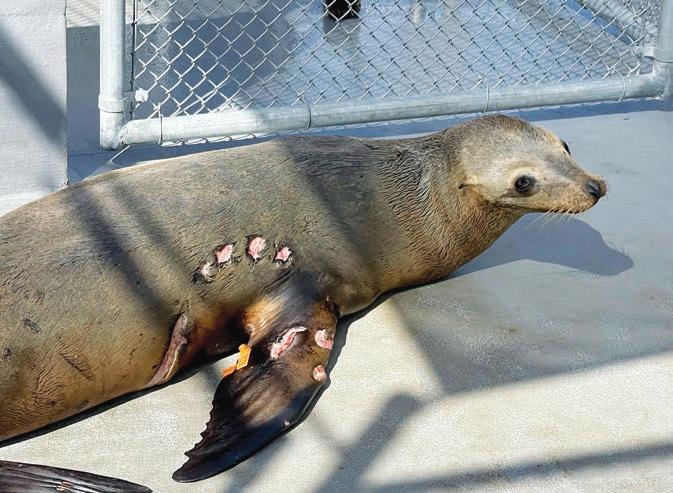
This sea lion was rescued at Jalama Beach with wounds indicating a killer whale bite. She was returned to the wild after 42 days of expert medical care and rehabilitation.
From left, Jennifer Levine Griffiths, CIMWI Stranding Operations & Animal Care Manager; volunteer Dedie Jones, and volunteer Beth Whitney, DVM, prepare to move two sea lion sub-adults into kennels for their return to the wild at Hollister Ranch Preserve in September.
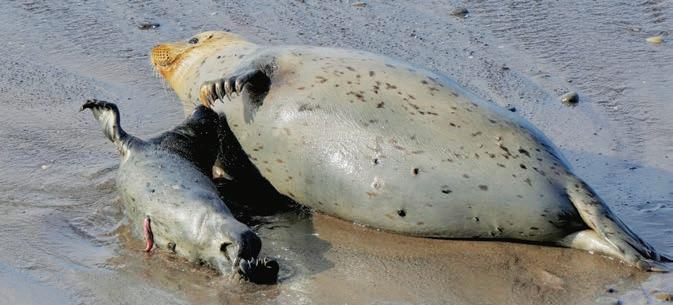
A healthy mother and pup harbor seal pair at the Carpinteria rookery.
been admitted a day earlier and was tube fed until it could be stabili ed and adapt to eating fish.
In addition to young malnourished pups, other rescues include shark bites, entanglements, and cancer. he rehab center is e uipped with endoscopy e uipment and other high tech diagnostic tools. Sam does the diagnostic work. “I’ve been doing this for years, he says from the lab of sophisticated diagnostic tools.
CLOSING THE LOOP
t the morning team meeting, the volunteer crew, in uniform fishing waders to prepare for the splash of feeding,
celebrated the four sea lions who were rehabbed and ready for reintroduction to the wild. he foursome was dubbed “the olden irls, and particularly e citing was one of the animals who had been rehabbed from an early detection of domoic acid poisoning. wo of the girls were headed to Hollister anch and the other two would be taken by Island ackers out to Santa Cru Island for their release.
With these rescues nearly complete, CI WI was receiving a fresh report of an adult sea lion who had made its way out of entura Harbor, through a drainage canal and wandered near to ast Harbor oulevard, a four-lane highway. No rest for the weary.
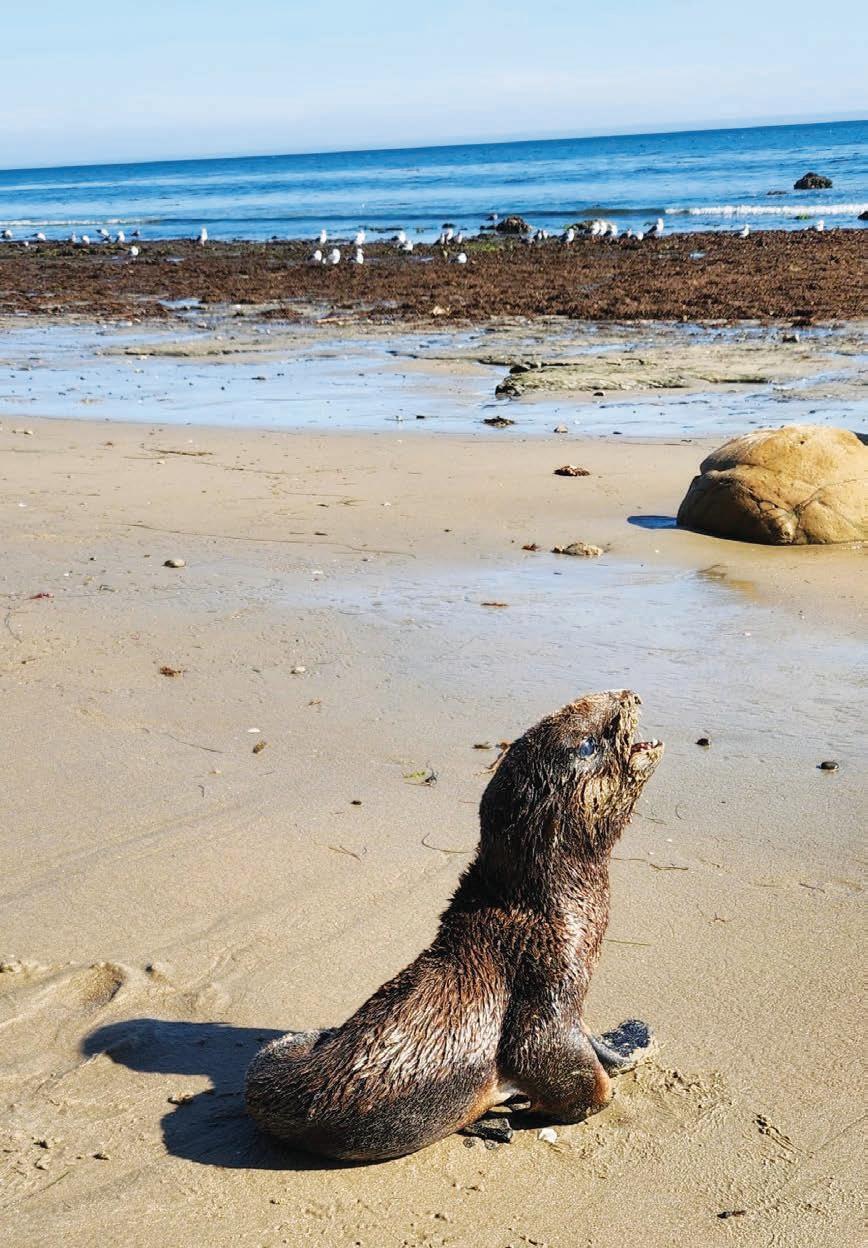
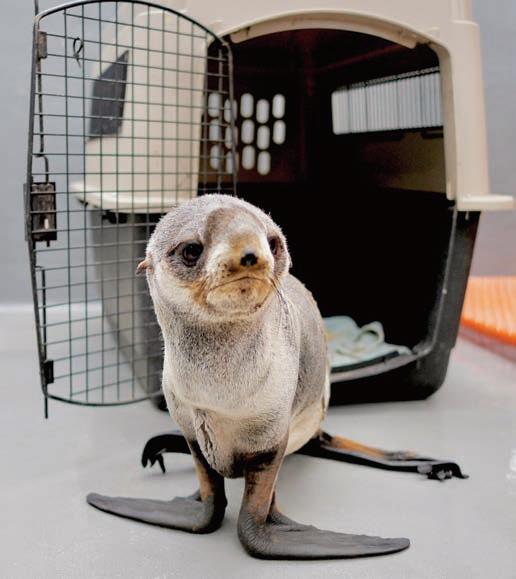
A northern fur seal pup, in September at Hollister Ranch because of premature maternal separation. The emaciated and dehydrated pup pictured in this photo and at top right was already much healthier one week later in the photo at bottom right.









If you rush out to the newsstand every Thursday morning eager to learn of local happenings, clip photos for your refrigerator, or consider it your civic duty to engage with Carpinteria content exclusive to CVN, then it’s your time to become a Sustaining CVN Member. While we plan to continue to distribute CVN as a free publication, please consider supporting us and becoming a member who can proudly participate in our future.



AN EXCERPT FROM “ RED SUMMER”
NOVEL BY FRANCES PETTEY DAVIS
{OCTOBER 1943}
Althea’s head pounded with the strident band music. Shouts and whistles, babies crying, sounds, and colors rained down on her like stones. She wanted to block out the crazy seesaw of wind-blown noise, run from the crowds, and the train waiting to take Wince to the ships and war in the acific. She had to see him off. She owed him that. Someone jostled from behind, and Wince took her arm. He was finally getting his wish, the last name uell a crisp tag on his khaki uniform. A man pushed by as they neared the gate where civilians fell back and the wave of soldiers surged forward. “Kiss your sweetheart, Private,” the man

said. “Give her a good one to make it last.” Wince touched her chin and she tilted her face, staring up at his pale blue eyes. She felt his breath, then his lips pressing hers. “I’ll come back for you,” he said. He turned and was gone, moving with the khaki flow to the train. She hugged herself in the dress too thin for the blowing mist of San Francisco and watched the train move into the tunnel to Fort Mason and the waiting ships.
{JUNE 1954}
Althea was born strange and knew it early on. An oddball, a sport, like a single white petal on a red flower. She was ust five when her older sister ouise slapped her for e claiming over the pretty orange and yellow colors coming from their brother’s harmonica. Only a freak would think that sounds had color, ouise told her.
earning she was different from other human beings had come as a blow to Althea. Her world, where wind could be blue and a car horn a blast of purple, wasn’t the same as the one e perienced by her sister and brother or parents. She was an outsider, abnormal. Over the years she had tried to balance the feeling of loss with a sense of gain. No one else could see the sharp green glints at the edges of laughter or the smooth caramel of a cat’s purr. It was a gift she kept to herself. She learned to pass, living the normal life she longed for.

At the moment she had stopped in front of the veterinarian’s house to listen to a tapping noise. he sounds floated an image of small black triangles in her head, and she looked for the source. It was Wince. He stood in the vacant lot ne t door, tacking something to the single sycamore there. The triangles in her head scintillated a moment and disappeared. She sighed.
She didn’t want to meet Wince this way. Ten years was too long a gap to bridge with the strained politeness of some fumbled words. Ten years and two months, which was how long she’d been back in Bear River. She looked toward the brick storefronts wavering in the heat.
cross the street small houses with yellowing yards filled the block, her sister’s beauty shop the last in line, faded blue
awnings cranked open. A dog barked in the vet’s back yard. A single dark slash. She straightened her shoulders and moved forward.
Wince looked up from tucking a small hammer under his belt. “Althea,” he said, with that familiar sideways tic of the head. He wore a Western shirt and sunglasses, his blond hair combed back. He was a little heavier, but still handsome.
Just Althea, simple as that, the sound of his voice a pale gray hatch-work, like most people’s. She shaded her eyes.
“You can come into the shade, Althea. I don’t bite.”
Once he had bitten her, though. It was in second grade when he’d come to school so beaten he couldn’t sit down. At recess she’d touched him, and he bit her hand. Little savage, the teacher had called him.
“Meant to stop by earlier, say hello,” Wince said. “You settling in okay?”
“Fine,” she answered. What did okay mean? Moving back into the house of her childhood, sleeping in the same room, the same bed, watching over her father, “keeping him out of mischief,” as her brother put it.
“Your husband?” Wince’s lips quirked. “He’s not here yet?”
She shook her head. She’s left Sayer behind to come and rescue her father, coax him back from the grief-stricken stall he’d entered since her mother’s death. “He had to finish a teaching job in Stockton,” she said.
“Heard he got that job at our high school,” Wince said, laying a hand on the tree’s trunk. A shaft of sunlight lit the gold hairs on his arm. “Never could figure you settling in that port town. How’d you occupy yourself down there?”
Down there. Sixty miles, not far, but another world, far enough to start the life she wanted. She felt sweat gathering and swiped at her hair line. “I did some bookkeeping. Mostly I was busy raising my little girl.”
He rocked back on his heels, a faint smile on his lips. “Saw her go by, running like a blue streak. Fredericka, is that right? Fast for a girl.”
“We call her Freddie.” But he would know. Nothing in town escaped his notice now.
He had taken off his sunglasses. She watched the pupils contract in his gray irises. Darker than she remembered, more like steel.
She stared at the poster nailed to the tree. A silhouette of a masked figure with evil-looking eye slits, and under it, “The Red Menace is Real. Report all Suspected Communist Activity.”
She frowned and took a step back. Sayer would hate it. Fear mongering, he called such things.
Wince was watching her. “They’re everywhere, Althea, even here,” he said, replacing his glasses. “You must have seen it down there in Stockton, all those commie dock workers.”
She shook her head. Sayer had friends among those longshoremen. Across the street she could see Sybil Hare’s round head framed in the big window of the H & H Variety store on the corner. Sybil would already be kneading their encounter into a juicy ball of gossip.
“I hope you’ll come to our Bar-B-Q,” Wince said. “Claudia said she sent you the invite.” He was standing so close she could smell him, musky, a wash of pine that made her think of forests.
She had thrown the invitation in the trash. A big celebration to show off Wince and Claudia’s new bomb shelter. “I don’t know, without Sayer.”
“Thought maybe you’d outgrown that shyness.” His voice had fallen to a lower timber that caused a tingle along the rims of her ears. “Say you’ll come, Little Sparrow.”
His old nickname for her. Images like blown pages flew through her consciousness — she and Wince running from a rock-throwing gang, Wince beside her as she helped him with sixth grade math, Wince breaking another boy’s ribs in high school. Their lives so intertwined no one thought they’d ever come undone.


MEET THE AUTHOR
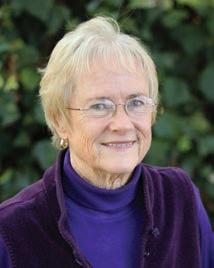
Journalist and poet Francis Pettey Davis was born and raised in California’s Central Valley. A Lamar York prize-winning author and Pushcart nominee, she is a long-time newspaper columnist and reporter. Her essays, short stories, and poetry appear in print and online journals, lifestyle magazines, and travel books.
Fran called Summerland home for nearly 50 years and was a long-time columnist for Coastal View News. She continues to contribute an occasional column “Fly-By,” which she pens from her home in Goleta, where she moved to be closer to children and grandchildren.
Fran’s new novel, “Red Summer,” is available at Chaucer’s Books in Santa Barbara, Tecolote Book Shop in Montecito, and on Amazon.com.



FINAL FRAME

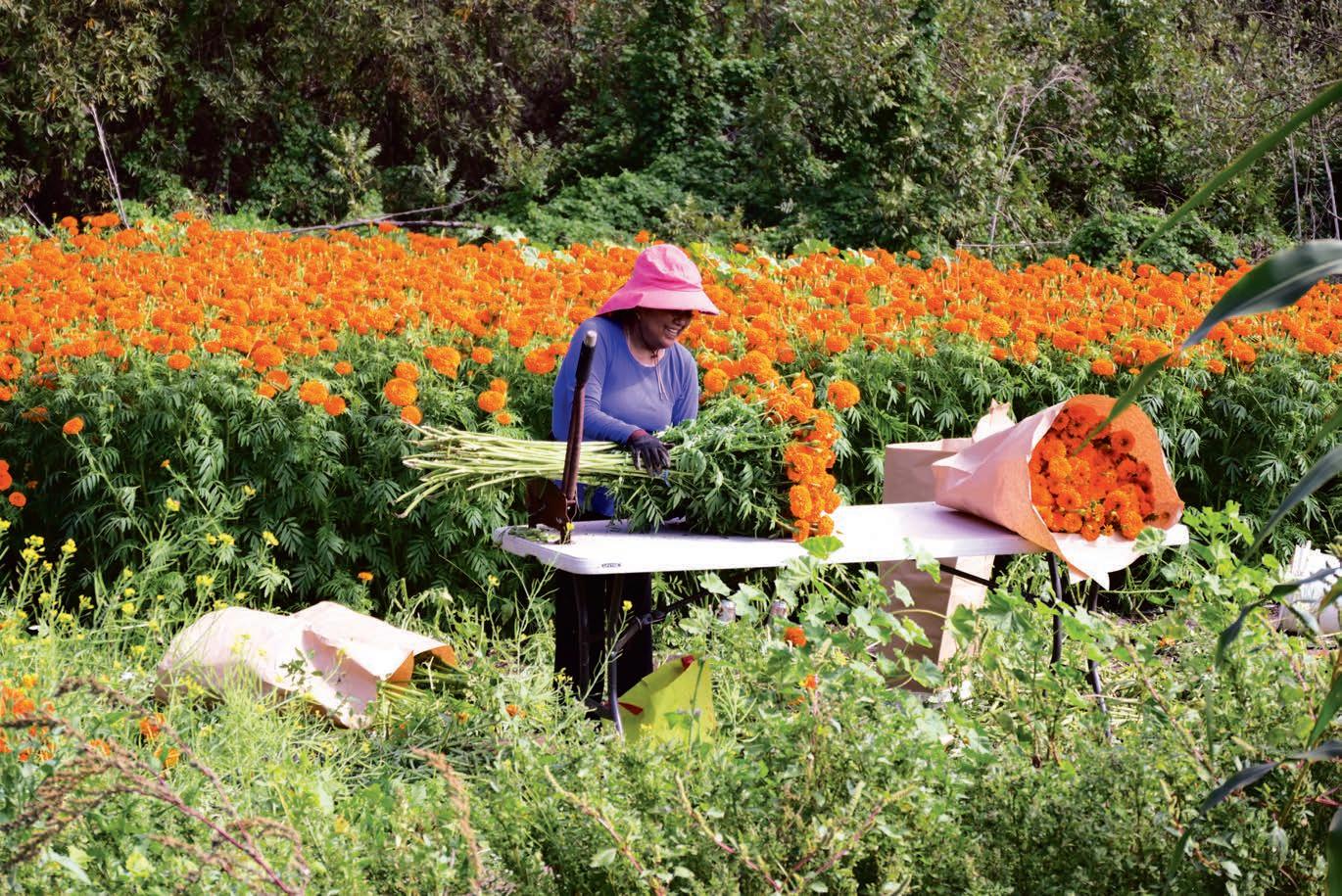
FIELDS OF GOLD
Maria Samaguey bundles marigolds at the Abbott Ranch in preparation for Dia de los Muertos 2025. More than just festive pops of petal, marigolds hold a special place in Day of the Dead celebrations. Their alluring fragrance and eye-catching color are said to lead souls from their burial place to their family homes.
PHOTO BY ROBIN KARLSSON