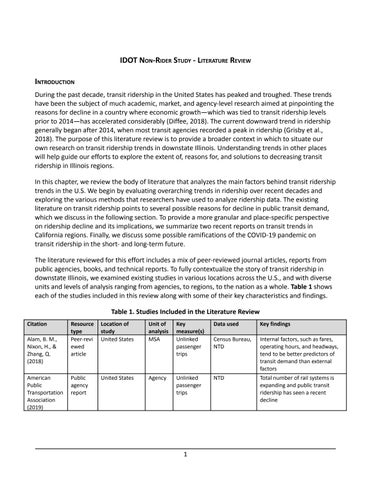
IDOT NON-RIDER STUDY - LITERATURE REVIEW INTRODUCTION During the past decade, transit ridership in the United States has peaked and troughed. These trends have been the subject of much academic, market, and agency-level research aimed at pinpointing the reasons for decline in a country where economic growth—which was tied to transit ridership levels prior to 2014—has accelerated considerably (Diffee, 2018). The current downward trend in ridership generally began after 2014, when most transit agencies recorded a peak in ridership (Grisby et al., 2018). The purpose of this literature review is to provide a broader context in which to situate our own research on transit ridership trends in downstate Illinois. Understanding trends in other places will help guide our efforts to explore the extent of, reasons for, and solutions to decreasing transit ridership in Illinois regions. In this chapter, we review the body of literature that analyzes the main factors behind transit ridership trends in the U.S. We begin by evaluating overarching trends in ridership over recent decades and exploring the various methods that researchers have used to analyze ridership data. The existing literature on transit ridership points to several possible reasons for decline in public transit demand, which we discuss in the following section. To provide a more granular and place-specific perspective on ridership decline and its implications, we summarize two recent reports on transit trends in California regions. Finally, we discuss some possible ramifications of the COVID-19 pandemic on transit ridership in the short- and long-term future. The literature reviewed for this effort includes a mix of peer-reviewed journal articles, reports from public agencies, books, and technical reports. To fully contextualize the story of transit ridership in downstate Illinois, we examined existing studies in various locations across the U.S., and with diverse units and levels of analysis ranging from agencies, to regions, to the nation as a whole. Table 1 shows each of the studies included in this review along with some of their key characteristics and findings. Table 1. Studies Included in the Literature Review Citation Alam, B. M., Nixon, H., & Zhang, Q. (2018) American Public Transportation Association (2019)
Resource type Peer-revi ewed article
Location of study United States
Unit of analysis MSA
Key measure(s) Unlinked passenger trips
Data used
Key findings
Census Bureau, NTD
Public agency report
United States
Agency
Unlinked passenger trips
NTD
Internal factors, such as fares, operating hours, and headways, tend to be better predictors of transit demand than external factors Total number of rail systems is expanding and public transit ridership has seen a recent decline
1