
Energy Science, Technology and Policy Master’s Program
Graduate Student Handbook
Academic Year 2025-2026
Version 16.1 August 2025
Energy Science, Technology and Policy Master’s Program
Carnegie Mellon University 5000 Forbes Avenue, Scott Hall 5103 Pittsburgh, Pennsylvania 15213
Phone: (412) 268-6072
Email: energy@andrew.cmu.edu
Web: www.cmu.edu/engineering/estp

I) Welcome and Introduction
The Faculty and Staff of the Energy Science, Technology and Policy (ESTP) program welcome you to Carnegie Mellon University (CMU). ESTP is an interdisciplinary Master of Science (MS) degree program in the College of Engineering and is affiliated with CMU’s Scott Institute for Energy Innovation (SIEI) ESTP proudly builds upon the significant accomplishments in energy by CMU’s faculty, researchers, students, and graduates
Introduction:
ESTP offers distinctive and customizable Master of Science degrees based in engineering, aligned with new discoveries in science, attuned to sustainability and the environment, and informed by a broader perspective in economics and public policy. Effective solutions to energy problems will come from engineers and technical managers who understand the interdisciplinary challenges of energy and appreciate the broad interconnected issues of its supply, conversion, transport, storage, demand, utilization, policy, economics, sustainability, and the environment
ESTP is a professional master’s degree program oriented towards career preparation of engineers and scientists who have a passion for leading society’s energy future. The MS degrees are awarded for successful completion of their required coursework. Regardless of the degree program, all ESTP graduates share core energy knowledge, delivered in our four required courses, and an engineering focus, assured through completion of an engineering concentration (choosing one from six engineering departments). Further customization is achieved through the many courses and different curricular paths available, including a large range of individual energy-related courses and projects at CMU, as well as six degree-variants, including applied, advanced, applied advanced study, and AI engineering, in addition to the base ESTP degree.
ESTP graduates pursue diverse careers where they lead in the development of new technologies and policies for the production, transport, and efficient use of energy. The curriculum is designed to prepare you for a position of responsibility in all energy sectors, including traditional energy utilities and suppliers, alternative and renewable energy and storage, power generation and distribution, energy intensive manufacturing, energy efficiency and sustainability practices, consulting companies, government labs, non-profits, and academic institutions. We have designated career counselors in CMU’s Career and Professional Development Center.
Graduate Student Handbook:
This handbook will guide and inform your opportunities and choices in the ESTP program. It contains detailed information about ESTP degree requirements, policies, and procedures, and it supplements the College of Engineering graduate policies and the University policies. As you join us in the middle of our second decade as CMU’s Engineering Energy master’s program, we hope you have a productive and rewarding academic year, which will serve as a foundation to an impactful career Please do not hesitate to contact us with any questions.1
1 Note that modifications to this standard handbook may occur in the 2025-2026 academic year. Modifications will be communicated in separate documents delivered by email or posted to Canvas and possibly addended to this handbook.
16.1 includes updates to MSE concentration courses in appendix and updated TOC.
A) Overview of ESTP Degree Options
The College of Engineering’s ESTP program offers professional master's degrees in energy Table I lays out the degree programs by the number of semesters required (columns) to complete each program and whether a summer internship is required (rows)
Degrees build from the top, left entry (the base ESTP degree) downward and to the right Each of the Applied Study Degrees (lower row) are constructed from the Foundational Degrees (upper row) directly above them. Similarly, the three semester degrees Advanced Study and AI Engineering Degrees ((ight two columns) build directly from the two-semester degrees to their left
Table I
• The M.S. in Energy Science, Technology and Policy (ESTP) degree is the base two-semester program, on which all the other ESTP degrees are built. Two semesters of full-time study are required for completion of 96 units of qualifying coursework.
• The M.S. in ESTP – Applied Study (ESTP-APS) degree integrates professional development (3 units) and a summer internship (3 units across two courses) with the base ESTP degree. Two semesters of full-time study and a summer internship between those semesters are required for completion of 102 units of qualifying coursework.
• The M.S. in ESTP - Advanced Study (ESTP-ADS) degree integrates further targeted study (36 units) in an Advanced Study Concentration, including Energy Projects, Data Science, or a second Engineering Concentration, with the base ESTP degree. Three semesters of full-time study are required for completion of 120 units of qualifying coursework.
• The M.S. in ESTP – Applied Advanced Study (ESTP-AAS) integrates professional development (3 units) and a summer internship (3 units across two courses) with the ESTP-ADS degree Three semesters of full-time study and a summer internship between two of those semesters are required for completion of 126 units of qualifying coursework.
• The M.S. in AI Engineering - ESTP (MSAIE-ESTP) degree integrates AI engineering fundamentals with the base ESTP degree program. Three semesters of full-time study are required for completion of 120 units of qualifying coursework. Only available for fall semester start.
• The M.S. in AI Engineering -ESTP - Applied Study (MSAIE-ESTP-APS) degree integrates professional development (3 units) and a summer internship (3 units) with the MSAIE-ESTP degree. Three semesters of full-time study and a summer internship are required for completion of 126 units of qualifying coursework. Only available for fall semester start.
Prospective students apply to and receive an admission offer for one of the distinct ESTP degrees, as well as one the six engineering concentrations within the ESTP program. Prospective students apply to and receive admission offers directly from the ESTP program of the College of Engineering at CMU, not one of the six affiliated engineering departments.
All ESTP degrees require:
24 units of Energy Core, 36 units of one Engineering Concentration, and 36, 24, or 12 units of Breadth Electives, depending on degree
The three Foundational Degrees have the following requirements (all require the Energy Core and Engineering Concentrations listed above)
The ESTP (ESTP) degree requires 36 units of Breadth Electives for a total of 96 units.
The Advanced Study (ESTP-ADS) degree requires 24 units of Breadth Electives and: 36 units of Advanced Study Concentration for a total of 120 units.
The AIE-ESTP (MSAIE-ESTP) degree requires 12 units of Breadth Electives and: 48 units of AI Engineering fundamentals for a total of 120 units.
The Applied Study Degrees build off these three Foundational Degrees by integrating: 3 units of career and professional development and 3 units related to a summer internship, separated across two courses, for an additional 6 units to the total of the appropriate Foundational Degree.
The three Foundational Degrees are compared in Table II, which reveals the fundamental similarities in their structure and highlights how the degrees build from left to right in the number of units and semesters required, as well as in degree customizability using breadth electives or a third semester focus.
The three Applied Study degrees are compared in Table III, each adding identical requirements (in the lowest row) to the Foundational Degree on which it is built. Comparing Table II and Table III highlights how the Applied Study degrees build from the appropriate Foundational Degrees
The ESTP and ESTP-ADS Foundational Degrees are illustrated using puzzle graphics in Figure 1, and their two related Applied Study Degrees are illustrated using puzzle graphics in Figure 2, and the two MSAIE degrees are illustrated using puzzle graphics in Figure 3.
The puzzle graphics aim to highlight how the distinct components of the degrees fit to a larger whole, and to indicate the flexibility in designing a degree that fits your individual career goals
Table II.
Foundational Degrees Energy Science, Technology & Policy (ESTP)
Master of Science (M.S.)
2 semesters of full-time study are required
Master of Science (M.S.)
3 semesters of full-time study are required
Master of Science (M.S.)
3 semesters of full-time study are required 96
Energy Core:
o 24 units required
o 39-610, -611, -612, -613
Engineering Concentration:
o 36 units
o Choose 1 concentration: CEE, CHE, ECE EPP, MEG, MSE
o Courses approved by each department
Breadth Electives
o 36 units
o Advisor approval needed
o Graduate level engineering courses, and limited nonengineering graduate classes related to energy
Energy Core:
o 24 units required
o 39-610, -611, -612, -613
Engineering Concentration:
o 36 units
o Choose 1 concentration: CEE, CHE, ECE EPP, MEG, MSE
o Courses approved by each department
Breadth Electives
o 24 units
o Advisor approval needed
o Graduate level engineering courses, and limited nonengineering graduate classes related to energy
Advanced Study
o 36 units
o Energy Projects or
o Data Science or
o 2nd Eng Concentration
Energy Core:
o 24 units required
o 39-610, -611, -612, -613
Engineering Concentration:
o 36 units
o Choose 1 concentration: CEE, CHE, ECE EPP, MEG, MSE
o Courses approved by each department
Breadth Electives
o 12 units
o Advisor approval needed
o Graduate level engineering courses, and limited nonengineering graduate classes related to energy
AI Engineering:
o 48 units
o 14-763, 24-787 (18-661), 24-788, 24-784
Table III.
Applied Study Degrees Energy Science, Technology & Policy (ESTP) ESTP-APS
Master of Science (M.S.)
2 semesters of full-time study are required
Energy Core:
o 24 units required
o 39-610, -611, -612, -613
Engineering Concentration:
o 36 units
o Choose 1 concentration: CEE, CHE, ECE EPP, MEG, MSE
o Courses approved by each department
Breadth Electives
o 36 units
o Advisor approval needed
o Graduate level engineering courses, and limited nonengineering graduate classes related to energy
Master of Science (M.S.)
3 semesters of full-time study are required
Energy Core:
o 24 units required
o 39-610, -611, -612, -613
Engineering Concentration:
o 36 units
o Choose 1 concentration: CEE, CHE, ECE EPP, MEG, MSE
o Courses approved by each department
Breadth Electives
o 24 units
o Advisor approval needed
o Graduate level engineering courses, and limited nonengineering graduate classes related to energy
Advanced Study
o 36 units
o Energy Projects or
o Data Science or
o 2nd Eng Concentration
Applied Study
o 6 units required
o 39-699, 39-661, 39-662
o Internship required*
Applied Study
o 6 units required
o 39-699, 39-661, 39-662
o Internship required*
Master of Science (M.S.)
3 semesters of full-time study are required
Energy Core:
o 24 units required
o 39-610, -611, -612, -613
Engineering Concentration:
o 36 units
o Choose 1 concentration: CEE, CHE, ECE EPP, MEG, MSE
o Courses approved by each department
Breadth Electives
o 12 units
o Advisor approval needed
o Graduate level engineering courses, and limited nonengineering graduate classes related to energy
AI Engineering:
o 48 units
o 14-763, 24-787 (18-661), 24-788, 24-784
Applied Study
o 6 units required
o 39-699, 39-661, 39-662
o Internship required*
* The internship is required between a full-time spring and subsequent full-time fall semester.
II.A. Overview of
Degree Options (cont’d)
Foundational Degrees
Energy Science, Technology & Policy (ESTP)
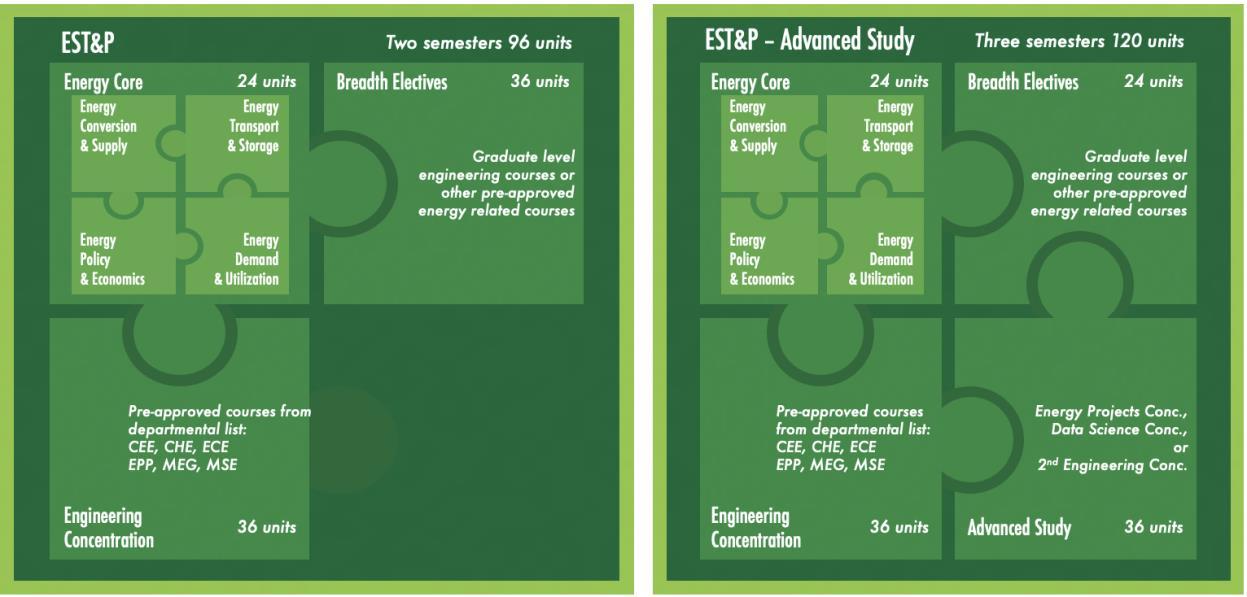
1. Puzzle graphics describing two foundational degrees in Energy Science, Technology & Policy: ESTP (left) and ESTP Advanced Study (right).
Note: The number of semesters are those that students are required to be full time.
Applied Study Degrees
Energy Science, Technology & Policy (ESTP)
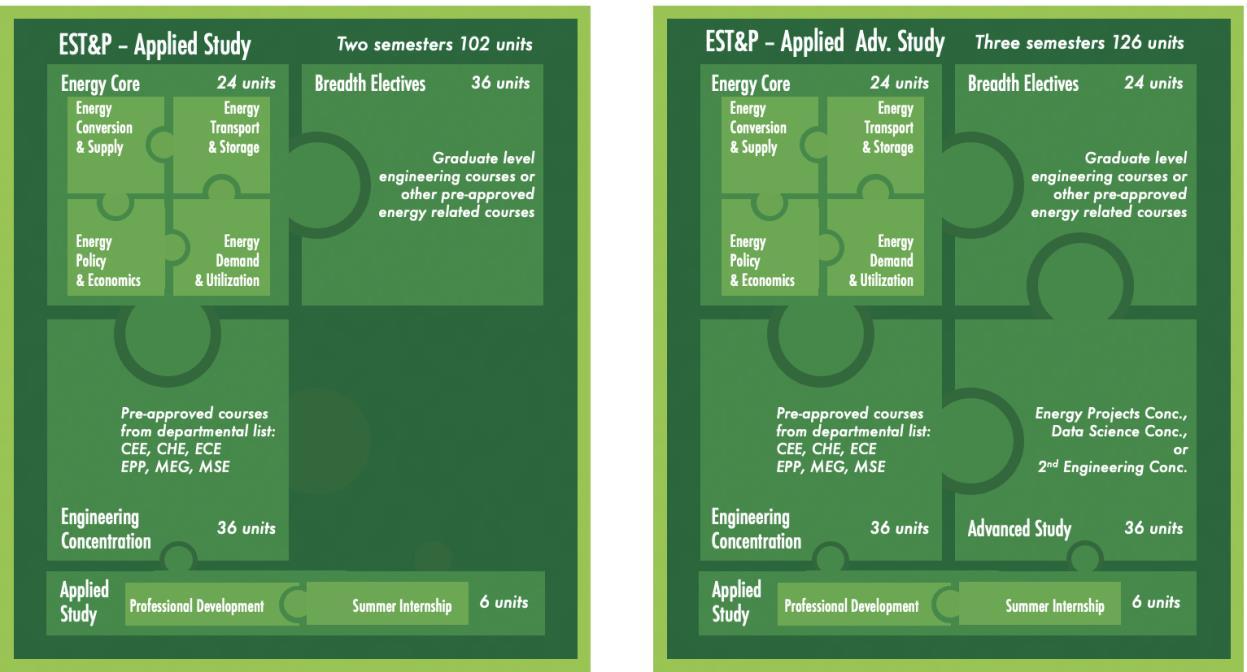
2. Puzzle graphics describing two Applied Study Degrees in Energy Science, Technology & Policy: ESTP- Applied Study (left) and ESTP Applied Advanced Study (right).
Note: The internship is required between a full-time spring and subsequent full-time fall semester.
Note: The number of semesters are those that students are required to be full time.
II.A. Overview of ESTP Degree Options (cont’d)
AI Engineering -ESTP Degrees Energy Science, Technology & Policy (ESTP)
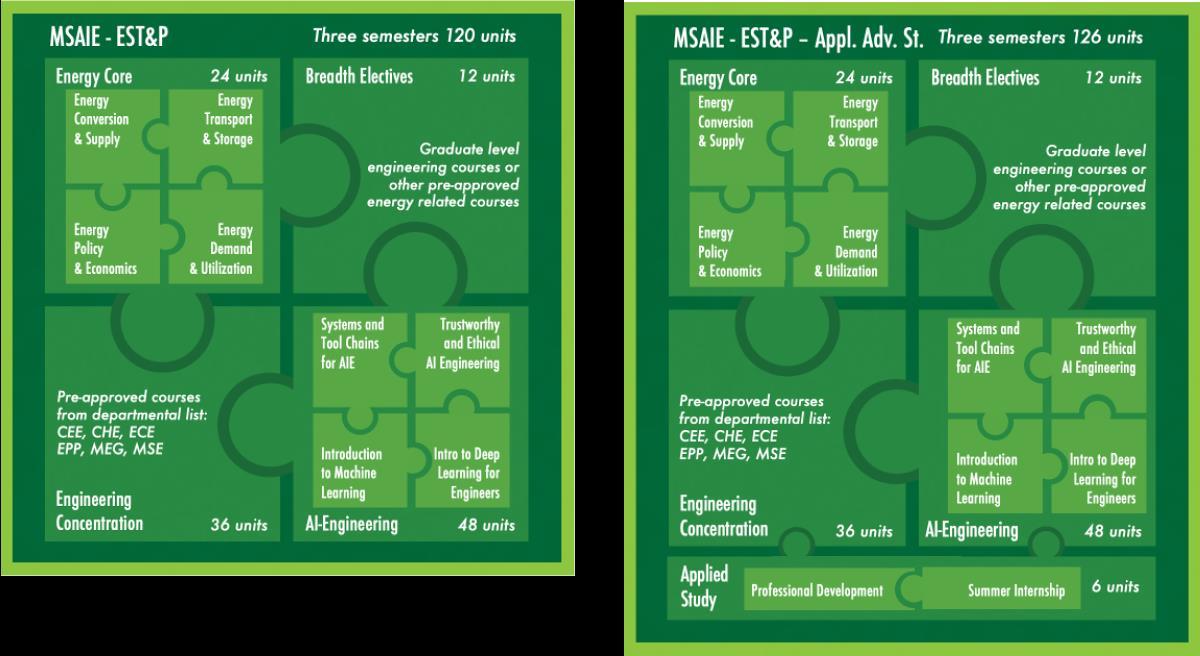
Figure 3. Puzzle graphics describing the AI Engineering Degrees in Energy Science, Technology & Policy: MSAIE-ESTP (left) and MSAIE-ESTP-Applied Study (right).
Note: The internship is required between a full-time spring and subsequent full-time fall semester. Note: The number of semesters is those that students are required to be full time.
Energy Core (24 total units of required coursework):
Students in all ESTP degrees must take the following four core courses.
1. 39-610 Energy Conversion and Supply (6 units, mini 1)
2. 39-613 Energy Transport and Storage (6 units, mini 2)
3. 39-611 Energy Demand and Utilization (6 units, mini 3)
4. 39-612 Energy Policy and Economics (6 units, mini 4)
The required Energy Core provides a foundation for understanding energy as an engineer, presenting different perspectives on the multifaceted issues in energy. Students participate in multidisciplinary teams to describe and develop solutions to energy problems, present results and write reports, and engage in active discourse with faculty and colleagues.
Engineering Concentration (36 units):
Students in all ESTP degrees must select one of six engineering concentrations (this is initially done when applying for admission). The engineering concentration sets the template for engineering depth coursework.2
Each participating engineering department has identified courses that are pre-approved to fulfill their concentration requirement. Only departmentally approved courses will count towards meeting the engineering concentration degree requirement. Concentrations may vary in structure from department to department.
For complete details please refer to Appendix B of this Handbook and/or pages on the ESTP Website: https://engineering.cmu.edu/estp/degree-programs/curriculum/engineering-concentrations.html
Engineering concentrations include:
• Chemical Engineering
• Civil and Environmental Engineering
• Electrical and Computer Engineering
• Engineering and Public Policy
• Materials Science and Engineering
• Mechanical Engineering
The ESTP program works with concentration departments to maintain these lists of approved courses. If courses become available that are not listed in the engineering concentrations, please consult your Academic Advisor to discuss the potential inclusion of new courses as fulfilling concentration requirements.
For students that have concerns regarding their engineering concentration, it is their responsibility to consult with their Academic Advisor
2 Note that the concentration is not listed in the degree title, and it does not appear on diplomas or transcripts
Breadth Electives (36 units):
Students in all ESTP degrees must take an additional 36, 24, or 12 units of breadth electives (depending on their degree), which are graduate-level College of Engineering classes, or approved graduate level alternatives. Students are encouraged to take breadth electives outside the department associated with their engineering concentration.
Breadth electives allow for significant customization of the degree toward the specific interests of individual students, and standard policies are listed below. Selection of breadth elective courses is generally made in consultation with an ESTP academic advisor.
Most engineering graduate courses are acceptable as breadth electives. Graduate courses satisfy this requirement if they do not have significant overlap with other courses taken by the student.
Up to 12 units of advisor-approved upper-level undergraduate coursework (400 or 500 level) can be counted toward the breadth elective requirement, when the course is needed as preparation for a graduate class. Classes at the 300 level and below do not count towards the ESTP degree.
Preceding written advisor approval is required.
Up to 18 units of pre-approved graduate level classes at Carnegie Mellon, outside the College of Engineering, can be counted toward the breadth elective requirement.
Preceding written advisor approval is required.
Up to 12 units of advisor-approved directed research / independent study / master’s project may count as Breadth Electives.
To count as a Breadth Elective, a factorable letter grade must be assigned for the course
Preceding written advisor approval is required.
Preceding written approval by the supervising faculty member is required.
A master’s project approval request form is available on Canvas.
• This form requires a 1-page plan of study describing the project topic, expected outcomes, deliverables, and the method of evaluation
• This form must be signed by both the student and the supervising faculty member
• Once approved, the student will be allowed to be registered for the appropriate number of units of ESTP master’s project (39-660)
• Where a similar process or course number exists in the supervising faculty member’s home department, that procedure may optionally be followed.
Copies of the completed departmental forms must also be submitted to the ESTP office to be included in a student’s permanent records
Advanced Study (36 units):
As an interdisciplinary engineering program focused on energy, educating engineers and technical managers to understand the interdisciplinary challenges of energy, advanced study is naturally represented by a balance of breadth and depth. Advanced Study Concentrations balance breadth and depth in energy-related engineering coursework and increase degree customizability.
ESTP‐ADS and ESTP‐AAS students must take 36 units of Advanced Study work. These units must be from the appropriate pre-approved lists and/or have preceding advisor approval.
There are several paths to satisfy the Advanced Study requirement of ESTP degrees:
a. 2nd Engineering Concentration
b. Data Science Concentration
c. Energy Projects Concentration
a. 2nd Engineering Concentration
Students may complete the Advanced Study concentration by satisfying the requirements of a second Engineering Concentration, as described previously Here, breadth is achieved by exposure to a second engineering discipline’s approach to energy, and depth is achieved through completing a second cluster of concentrated engineering coursework. As examples, a student with CEE and EPP concentrations can be strong and broad in areas of sustainability and climate policy; or a student with MEG and ECE concentrations may be broad and strong in areas of generation and storage in modern grids. Many other examples are possible in achieving advanced studies in energy that are customized to individual students’ interests and technological needs.
b. Data Science Concentration
Students may complete the Advanced Study concentration by satisfying the requirements of the Data Science concentration, described here. The Data Science concentration is structured similarly to an Engineering Concentration. The Data Science concentration requires 36 units of approved coursework. Data Science courses are available across all 6 partner departments within CIT and cover topics relevant such as data, coding, computations, analytics, and machine learning. Data Sciences are becoming increasingly relevant across engineering fields, including energy, which is also reflected in the number of courses taught across our partner departments. Students can take any courses on the list below, with advisor approval, either staying within one discipline or surveying across disciplines.
Approved data science courses include several regularly scheduled engineering classes that have a significant data science component described in the syllabus. Examples include:
• 12-740 Data Acquisition
• 12-741 Data Management
• 06-681 Special Topics: Data Science and Machine Learning in Chemical Engineering
• 18-645 How to Write Fast Code I
• 18-785 Data, Inference and Applied Machine Learning
• 19-603 Data Science for Technology, Innovation and Policy
• 24-780 Engineering Computation
The ESTP program maintains this list of approved courses.
If courses become available that are not listed in the Data Science concentration, please consult your Academic Advisor to discuss the potential inclusion of new courses as fulfilling concentration requirements.
c. Energy Projects Concentration
Students may complete the Advanced Study concentration by satisfying the requirements of Energy Projects Concentration, described here
The 36 units in the Energy Projects Concentration are satisfied by taking a combination of:
i. 0 to 36 units of Independent Master’s Project work
ii. 0 to 36 units of Project-Intensive coursework
iii. 0 to 12 units of Breadth Elective coursework.
These three categories are described on the following pages.
i. Independent Master’s Project Work:
Carnegie Mellon faculty are engaged in a wide range of energy related research, in which undergraduate, master, and doctoral students participate. ESTP students interested in independent project work are encouraged to explore research areas and opportunities on campus by reading the webpages of ESTP affiliated departments, institutes, and faculty, discussing with ESTP advisors and students, and discussing with individual faculty. Independent energy project opportunities can be found through agreement with individual faculty.
Once identified and approved by the student, supervising faculty, and ESTP advisor, students will then sign up for the appropriate course number with the approved number of units. The ESTP Master’s Project course is 39-660; course numbers from partner engineering departments may also be used when registering for faculty supervised project work, as can other pre-approved appropriately supervised independent projects.
A maximum of 36 units of advisor-approved directed research / independent study / master’s project can be counted toward the 36-unit Energy Project requirement. This is usually taken as 39-660, or as the equivalent master’s project courses in affiliated departments. To count towards the Energy Project requirement, a factorable letter grade must be assigned for the course.
Preceding written advisor approval is required
Preceding written approval by the supervising faculty member is also required.
• A master’s project approval request form is available on Canvas.
• This form requires a 1-page plan of study describing the project topic, expected outcomes, deliverables, and the method of evaluation
• This form must be signed by both the student and the supervising faculty
• Once approved, the student will be allowed to be registered for the appropriate number of units of ESTP master’s project (39-660)
• Where a similar process or course number exists in the supervising faculty member’s home department, that procedure may optionally be followed. Copies of the completed departmental forms must also be submitted to the ESTP office to be included in a student’s permanent records.
Summer Project Work:
Students wishing to count summer project work may register and pay appropriate number of units of 39‐660 Master’s ESTP Project or equivalent. With preceding approval from both the ESTP advisor and the supervising faculty, these units may count towards the Energy Projects Concentration requirement. Students wishing to carry out summer project work in an internship must discuss this with their academic advisor.
All policies described above for project Independent Project Work apply to Summer Projects. To count towards the degree requirements, project / course supervision must be provided by an ESTP advisor or affiliated faculty member and a factorable letter grade must be assigned
ii. Project-Intensive Engineering Courses:
With advance approval from an ESTP advisor, regularly scheduled project‐intensive engineering courses may count towards meeting the Energy Projects Concentration requirement. Approved courses are generally 12-unit graduate engineering courses that have a significant energy-related project integrated with the coursework (as indicated in the syllabus) In this context, a significant project represents 30 % or more of the overall grade in a 12-unit course.
Approved project-intensive courses include several regularly scheduled engineering classes that have a significant project component described in the syllabus. An up-to-date list is available on the website and examples include:
• 24-722 Energy System Modeling
• 24-618 Computational Analysis of Transport Phenomena
• 12-761 Sensing & Data Mining in Smart Structures and Systems
• 12‐718 Environmental Engineering, Sustainability and Science Project
• 12‐745 Advanced Infrastructure Systems Project
• 39‐605 / 39-606 Engineering Design Projects
• 18‐500 ECE Design Experience, 12 units (counting also as the 12 allowed undergraduate units)
iii. Breadth Elective Coursework
Up to 12 units of general Breadth Electives can be used to count towards the Energy Projects Concentration. Breadth Elective Coursework has been described previously. Ideally, the breadth elective will be related to a student’s interests in project work. Advisor approval is required.
Applied Study (6 units):
All Applied Study students (i.e., students in ESTP‐APS, ESTP‐AAS, and MSAIE-ESTP-APS degrees) must successfully complete 3 units of career and professional development and 3 units related to a summer internship, separated across two courses.
a. Career & Professional Development for Engineering Master’s Students:
Applied Study students must successfully complete the 3-unit course 39-699 - Career & Professional Development for Engineering Master’s Students before they start their required summer internship. This course will have students develop the professional skills necessary to be successful in a job/internship search. 39-699 is a required course, and the grade option for it is Pass/No Pass. This is the only course with a Pass/No Pass grade option that will count towards degree requirements. Students must receive a “Pass” grade to register for 39-661 - Master’s ESTP Internship.
b. Master’s ESTP Internship
Upon the student successfully completing 39-699 and securing a summer internship, Applied Study students will enroll for 2 units of 39-661 – Master’s ESTP Internship during the Summer/All section. 39-661 is a supervised internship course that engages students in activities that enhance learning from their internship experience through articulating their learning objectives, reflecting on their experiences, and communicating their experiences in professional modes such as reports. Master’s ESTP Internship is a required course for any Applied Study degree and must be successfully completed before students may register for 39-662 - Communication of ESTP Internship Experience.
c. Communication of ESTP Internship Experience
Following their summer internship, Applied Study students will participate in the Mini-1 course 39-662Communication of ESTP Internship Experience. The course provides a platform for students to communicate their internship experience to their peers and faculty through oral presentations. Students will also work on developing a LinkedIn profile and resume by taking advantage of the available university resources, allowing them to enhance career prospects. This is a required course for all Applied Study degrees
AI Engineering (48 units):
All AI Engineering students (i.e., students in MSAIE-ESTP and MSAIE-ESTP-APS degrees) must complete 48 units of AI Engineering fundamentals. These courses are set by the College of Engineering MSAIE program and are required. They cannot be replaced, substituted, and no exceptions are permitted to be made. The courses are described below.
a. Systems and Toolchains for AI Engineering (12 units)
Adopting Artificial Intelligence in the modern era has much more to it than learning the theoretical foundation of AI algorithms. The implementation of Machine Learning and Artificial Intelligence at a large scale requires solid technical infrastructure to support its complex, heavy processes. In this course, students will learn to be effective users of AI systems. Students will gain hands-on experience with modern ML frameworks and infrastructure tools, in the context of large real-world datasets and under conditions requiring engineering design choices. This experience will be gained in conjunction with the practical application of class topics in a real cloud environment. The premise of this course is to build a broad and solid foundation in Artificial Intelligence Infrastructure that will pay significant dividends throughout a students research and work career across data science and Artificial Intelligence related fields. In this class, we will focus on the following topics: Data Collection and Storage. Data Streaming. Data Engineering Modern ML Frameworks. Model Validation and Monitoring. Neural Network Design and Implementation Embedded Machine Learning Deployment of ML Models to the Cloud. The course material will focus on recent and landmark research papers and existing tools and software systems. Students will have substantial programming project work in which they design, implement, and analyze aspects of AI-model infrastructure.
b. Machine Learning and Artificial Intelligence for Engineers (12 units)
This course introduces fundamental machine learning and artificial intelligence techniques useful for engineers working on data-intensive problems. Topics include: Probability and Bayesian learning, generative and discriminative classification methods, supervised and unsupervised learning, neural networks, support vector machines, clustering, dimensionality reduction, regression, optimization, evolutionary computation, and search. The lectures emphasize the theoretical foundations and the mathematical modeling of the introduced techniques, while bi-weekly homework assignments focus on the implementation and testing of the learned techniques in software. The assignments require knowledge of Python including text and image input/output, vector and matrix operations, simple loops, and data visualization. Students must have undergraduate level experience with linear algebra and vector calculus.
c. Introduction to Deep Learning for Engineers (12 units)
This course introduces the deep learning methodology. Students will learn about the basics of deep neural networks, and their applications to different tasks in engineering. Students will be able to apply Deep Learning to a variety of artificial intelligence tasks pertinent to different engineering problems. Neural Networks and Convolutional Neural Networks (CNN) and different variations of it will be taught. The fundamental knowledge and mathematics behind backpropagation and automatic differentiation will be discussed. Deep learning libraries such as Pytorch will be taught, and students will learn to use these libraries for developing deep learning models.
d. Trustworthy AI and Ethical AI Engineering (12 units)
Innovations driven by recent progress in artificial intelligence such as deep learning and reinforcement learning, have shown human-competitive performance. However, as research expands to real-world cyber-physical autonomy, the question of safety is becoming a crux for the transition from theories to practice. This course will first review fundamental knowledge for trustworthy AI autonomy, including adversarial attack/defend, generative models, hierarchical Bayesian models, safe reinforcement learning, rare-event/few-shot learning, and robust evaluation. Then from the research perspective, students will explore the novelty and potential extension of various state-of-the-art trustworthy AI research and their implementation through a series of readings. Students will develop the ability to conduct research in teams. Knowledge and research skills learned in this course can be applied to self-driving, healthcare devices, assistant robots, and intelligent manufacturing
C) Course Registration, Full/Part-Time Status, & Practical Training
Course registration:
Course registration is accomplished through CMU’s Student Information Online (SIO) system, accessible through the HUB website. Students are responsible for enrolling in courses appropriate to their degree program. Students are encouraged to register as early as possible to reduce the chances of being waitlisted in a desired course. Students should refer to the University calendar for official registration dates (mid-November for Spring registration; mid-April for Fall registrationhttps://www.cmu.edu/hub/calendar/index.html).
Before beginning online registration, please carefully review the degree and course requirements summarized in various sections of this handbook (including appropriate appendices).
The ESTP degrees have been incorporated into the Stellic system (https://www.cmu.edu/es/stellic/index.html); students’ degrees and concentrations can be planned, tracked, and audited within Stellic (the ESTP advisor can help make exceptions). Pay close attention to required courses in any concentration. Be aware that most graduate courses are taught only once per academic year.
The ESTP Academic Program Manager serves as the primary academic advisor for the program; the Director is the technical advisor. Academic advisors are available to help students choose courses that meet both stated degree requirements and their personal / professional objectives.
Add / Drop Policies / Deadlines: Students can modify their registered schedule by adding / dropping courses up until the add/drop deadline Students taking undergraduate and master’s level courses must follow the procedures and deadlines for adding, dropping, or withdrawing from courses as identified on the academic calendar. Information can be found at https://www.cmu.edu/hub/registrar/course-changes/index.html. There is a separate calendar for doctoral level courses. As a courtesy to others, students should drop a course as soon as they decide not to take it. This may allow a waitlisted student to be enrolled and will limit the disruption to any team-based projects.
Add / drop deadlines are usually at the end of the first week of classes for mini courses, or at the end of the first 10 days of classes for semester long courses. Add / drop deadlines for engineering courses follow the university wide academic calendar, and specific deadline dates can be found here: https://www.cmu.edu/hub/calendar/index.html. Courses in the Heinz School (policy), Tepper School (business), and School of Computer Science often have their own unique academic calendars (including for add, drop, audit, and pass/fail deadlines), which is often different from the university academic calendar. In addition, doctoral (PhD) level courses may have different add / drop deadlines: such courses are department identified in SIO. ESTP students must adhere to all course-specific deadlines.
Late drops are handled through the Drop Voucher system, which permits students a limited number of late course drops Master's students are permitted one drop voucher per 12 months of study (beginning with the month they started) and may use only one voucher per semester (including summer). Courses dropped using a voucher will be removed from the student's transcript, as long as the drop is confirmed in SIO by the student within 24 hours of receiving the automated voucher email
Students should always consult their academic advisor for details and to check the impact that specific add / drop events have on progress towards graduation and student status.
II.C. Course Registration, Full/Part-Time Status, & Practical Training (cont’d)
Full-time student status:
Full-time CMU students must register for a minimum of 36 units
Unless admitted as a part-time degree-seeking student, all ESTP students are required to register as a fulltime student each semester, for the number of semesters indicated in Table I and described below.
• Students in the Energy Science, Technology and Policy (ESTP) degree program complete their degree in two required full-time semesters of 48 units per semester, for a total of 96 units of qualifying coursework. They can begin in the fall or spring semester.
• Students in the ESTP – Applied Study (ESTP-APS) degree program complete their degree in two required full-time semestersof 48 units per semester and complete an additional 3-unit professional development before their internship, a 2-unit internship in the summer between two semesters, and a 1-unit communication of internship course after their internship, for a total of 106 units of qualifying coursework.
ESTP-APS students must begin in the spring semester.
• Students in the ESTP - Advanced Study (ESTP-ADS) complete their degree in three required semesters of full-time study with a typical course load of 42 units per semester, for a total of 120 units of qualifying coursework. They can begin in the fall or spring semester.
• Students in the ESTP – Applied Advanced Study (ESTP-AAS) complete their degree in three required semestersof full-time study with a typical course load of 42 units per semester and complete an additional 3-unit professional development before their internship, a 2-unit internship in the summer between two semesters, and a 1-unit communication of internship course after their internship, for a total of 126 units of qualifying coursework. They can begin in the fall or spring semester.
• Students in the AI Engineering – ESTP (MSAIE-ESTP) complete their degree in three required semesters with a typical course load of 42 units per semester, for a total of 120 units of qualifying coursework. MSAIE-ESTP students must begin in the fall semester.
• Students in the AI Engineering – ESTP Applied Study (MSAIE-ESTP-APS) complete their degree in three required semesters of full-time study with a typical course load of 42 units per semester and complete an additional 3-unit professional development before their internship, a 2unit internship in the summer between two semesters, and a 1-unit communication of internship course after their internship, for a total of 126 units of qualifying coursework. MSAIE-ESTP-APS students must begin in the fall semester.
Details on minimum and maximum units are given in Section III(D).
Part-time student status:
Part-time MS ESTP enrollment is an option available for students who have applied and received admission to a part-time degree program of study. This option is made available for students who would like to pursue an ESTP degree while maintaining external employment. Note that immigration regulations do not allow Carnegie Mellon University to issue F1 visa documents to a part-time MS degree-seeking student.
II.C. Course Registration, Full/Part-Time Status, & Practical Training (cont’d)
Practical Training:
Curricular Practical Training (CPT)
When eligible, international students may carry out Curricular Practical Training (CPT)
The Office of International Education (OIE) determines eligibility based on immigration law / policy.
International students who are in good standing in the ESTP-APS, ESTP-AAS or MASIE-ESTP-APS degree programs may be eligible for a Curricular Practical Training (CPT) summer internship after one full-time semester
These degrees require completion of a CPT internship.
Students in the ESTP-APS degree program must begin in the Spring semester.
Students in the MASIE-ESTP-APS degree program must begin in the Fall semester.
International students who are in good standing in the ESTP-ADS or MSAIE-ESTP degree programs may be eligible for a Curricular Practical Training (CPT) summer internship after two full-time semesters.
These degrees do not require completion of a CPT internship.
International students who enter these two degree-programs (as well as the base ESTP degree program) in the spring semester are not eligible (a US student visa regulation) for CPT in the summer, as they will have only completed 1 full-time semester by summer.
During a CPT internship related to the ESTP-APS, ESTP-AAS or MSAIE-ESTP-APS degree programs, a student must register for 2 units of coursework in Master’s ESTP Internship (39-661). These units count towards your Applied Study Degree requirements.
During a CPT internship related to other degree programs, a student must register for at least 3 units of coursework in an appropriate course, as guided by your academic advisor. These units may count towards your degree, in any category they fill appropriately
Tuition must be paid for Internship units, and they will be billed at the part-time per-unit graduate tuition rate. Units for 39-661 may be eligible for scholarships.
Pre-completion Optional Practical Training (OPT)
When eligible, international students may carry out Pre-completion Optional Practical Training (OPT) The Office of International Education (OIE) determines eligibility based on immigration law / policy, and provides guidance on implications for post-completion OPT.
Pre-completion Optional Practical Training (OPT) is also available to international students for US-based off-campus summer internships, as an alternative to CPT, and in some cases part-time employment during the academic year.
Students must apply early in spring semester to receive timely pre-completion OPT approval. Summer course registration is not necessary for a pre-completion OPT internship
In all cases, international students must consult with the Office of International Education (OIE) for eligibility before seeking an internship or signing an offer contract.
Typical Completion Timelines:
Students may begin ESTP degree programs in either the Fall or Spring semesters, except students in the ESTP-APS, MSAIE-ESTP, and MSAIE-ESTP-APS programs. ESTP-APS students must begin in the Spring MSAIE-ESTP and MSAIE-ESTP-APS students must being in the Fall.
Students in the ESTP and ESTP-APS program typically finish in two full-time semesters. Students in the ESTP-ADS, ESTP-AAS, MSAIE-ESTP, and MSAIE-ESTP-APS programs typically finish in three full-time semesters. The minimum course load for full time status is 36 units.
Depending on the starting semester and degree duration, students graduate in either the Fall or Spring semesters after completing the number of consecutive full-time semesters appropriate to complete the specific degree program
Carnegie Mellon graduate students are expected to complete their degree requirements within the standard length of time for their program of study as outlined in the relevant Graduate Student Handbook. Standard program lengths for graduate students vary significantly – ranging from two semesters for some full-time master’s programs to several or more years for doctoral programs. Upon completion of the graduate program degree requirements, the degree will be certified by the student’s academic program in the semester in which the student completes the requirements.
Early Completion
Graduate students who consider the completion of all degree requirements in less than the standard length of time for their program of study may consult with their degree-granting program or department to determine if early degree certification is allowed and under what circumstances.
Extended or Longer-than-Standard Completion
Longer-than-standard degree completion may occur due to academic interruptions in making progress toward the degree as defined by the academic program, interruptions of full-time study or progress towards the degree due to serious, documented medical issues, or other unusual or unforeseen circumstances
Master’s students who require longer than the standard time to complete their degree requirements are expected to remain in close contact with their graduate program and will be certified at the end of the semester in which they have completed their degree requirements. Students shall reference CMU Policy on Master’s Student Statute of Limitations ( www.cmu.edu/policies/student-and-student-life/mastersstudents-statute-of-limitations.html ) regarding guidelines and restrictions which place an upper limit on the maximum length of time allowable for master’s degree completion and certification.
Additional Guidance for Students
Program of study.
Students seeking guidance about their program of study and degree requirements should consult with their academic advisor and/or appropriate associate dean, financial aid, and student accounts. Students are expected to make normal progress toward their degree to graduate within the standard timeframe for their program of study. Under U.S. Federal Title IV regulations, student eligibility for federal financial aid is contingent upon enrollment in and successful completion of courses that are counted as credit toward their current degree program. To receive the maximum amount of federal financial aid for which they may be eligible, students must enroll each semester in at least 36 units that count toward their current degree level. (See separate guidance regarding integrated degree completion.) Students should consult with their designated college liaison in The HUB regarding billing and financial aid, particularly for early completion, longer-than- standard completion, or integrated undergraduate and master’s degree programs.
International students.
Immigration status for students in F-1 and J-1 non-immigrant status is tied to making normal progress toward completing degree requirements. Therefore, F-1 and J-1 students who are considering completing their degree requirements early, anticipating longer-than-standard completion, or moving from an undergraduate to a graduate student classification (integrated undergraduate-graduate study) should consult with their designated advisor in the Office of International Education (OIE) to ensure compliance with immigration regulations.
Deferred Admission Policy:3
At the time of the admission offer, ESTP applicants may petition to defer admission for one semester or one academic year. A petition form submitted to ESTP and a written (email) decision will be returned to the applicant within approximately 14 days.
After the deadline to accept or defer admission has passed, applicants wishing to be reconsidered must reapply for admission. In such cases, ESTP sponsors the application fee, and will re-use any official tests scores, transcripts, and other documentation sent in support of the original application, if the applicant chooses 3
Switching Degree Programs:3
Admitted students that have already accepted admission but wish to change between ESTP degrees must follow the procedures to transfer to another CMU degree program. A student must apply to the new degree by the posted admission deadline (the ESTP program sponsors the application fee, and will re-use any official tests scores, transcripts, and other documentation sent in support of the original application) The student’s application will be reviewed by the appropriate admissions committee. If admission is granted to the new degree, then the necessary degree change paperwork is submitted to the registrar and OIE, as appropriate
3 Consult closely with the Director and Academic Program Manager to determine if deviations from the described policies will be allowed.
Minimum and Maximum Units per Semester:
Full-time CMU student status requires registering for a minimum of 36 units per semester
The typical minimum course load (not including units for Applied Study) for full-time students enrolled in the ESTP and ESTP-APS degrees is 48-units of degree satisfying courses per semester, thereby enabling the completion of the 96-unit or 102-unit degree requirement in the required 2 semesters. Deviations from the typical minimum unit requirement must be approved by an ESTP advisor, and may lead to additional time for degree completion.
The typical minimum course load (not including units for Applied Study) for full-time students enrolled in the ESTP-ADS, ESTP-AAS, MSAIE-ESTP, and MSAIE-ESTP-APS degrees is 40-units of degree satisfying courses per semester, enabling completion of the 120-unit or 126-unit degree unit requirements in the required 3 semesters.
Deviations from the typical minimum unit requirement must be approved by an ESTP advisor, and may lead to additional time for degree completion.
As required by F1 visa rules, international students must maintain full-time student status (i.e., registering for at least 36 units) in all semesters, including their last semester, and must make normal progress toward degree completion each semester. Therefore, international students are advised that a semester course load below 48 units towards the ESTP and ESTP-APS degrees or 40 units towards the ESTP-ADS, ESTP-AAS, MSAIE-ESTP, or MSAIE-ESTP-APS degrees may affect student visa status, if such students are deemed as not making normal progress towards degree completion. Deviations from the minimum unit requirement must be approved by an ESTP academic advisor, after student consultation with the Office of International Education (OIE).
An ESTP student’s schedule is over-loaded when it exceeds 48 units per semester. Students are permitted to register for up to 54 units, to facilitate scheduling of preferred courses. Once the semester starts, as the drop deadline approaches students should return to the maximum units. To be eligible for an overload (exceeding 48 units per semester), students must petition their academic advisor for advance approval.
An academic advisor will require a minimum Quality Point Average (QPA) of 3.6 or above, as of the prior CMU/ESTP semester, to consider an overload.
Official audit (which are not generally approved) or pass/fail units do count toward full-time or overload status (but not towards degree requirements)
Master’s Thesis:
Energy Science, Technology and Policy is a coursework-based professional master’s program, and a Master’s Thesis option is not available.
II.D. Misc. Program Information, Student Status, and Financial Policies (cont’d)
Courses without Factorable Letter Grades (cont’d):
Courses without Factorable Letter Grades:
Under limited circumstances, for courses other than 39-699 Career & Professional Development for Engineering Masters Students, a student may be permitted to register or to convert a course registration to Pass/No Pass (or Audit) with appropriate advisor and instructor approval.
To receive ESTP advisor approval, a student must submit a completed petition form that explains why they would like to complete coursework that does not count towards the degree and does not receive a letter grade
Please note that ESTP policy is to DECLINE advisor approval of Pass/No Pass (or Audit) for any student registered for an overload schedule of more than 48 units.
Courses taken as Pass/No Pass (or Audit) will not count toward ESTP degree requirements, apart from 39-699 (Career & Professional Development for Engineering Masters Students), which is a Pass/No Pass course required for the ESTP-APS and ESTP-AAS degrees. Students in all ESTP degree programs are encouraged to take 39-699.
The ESTP program prefers the Pass/No Pass grade option to the Audit grade option.
Officially auditing a course means being present and participating in a class without receiving academic credit or a letter grade. To audit a course, one must first register for the course and then file a request for audit that requires program and instructor approval. The units of audited courses count toward the maximum course load units, but do not count toward degree requirements. A successfully completed audit course will appear on a transcript with an ‘O’ audit designation, which is not a factorable letter grade (it does not get factored into the QPA). The scope and extent of a student’s participation must be arranged and approved by the course instructor in advance. Auditors are expected to attend class as though they are regular class member. Some faculty may require an auditor to submit homework and to participate in team project work Students who do not attend the class regularly, or prepare themselves for class, or meet other instructor audit requirements will receive a blank grade.
If a student decides they cannot complete a class for letter grade and are not approved to convert that course registration to Pass/No Pass (or Audit), they must drop the class in SIO prior to the drop deadline, have and use a voucher appropriately by the voucher deadline, or withdraw and receive a W on their transcript.
CMU Canvas System:
Most instructors use the CMU Canvas web service to manage course communications, assignments, and reference materials. Carnegie Mellon’s Canvas homepage is: https://cmu.instructure.com/. Login credentials are the CMU single sign in credentials (Andrew ID credentials). Students are expected to check Canvas weekly and respond to requests for Canvas submissions appropriately
II.D. Misc. Program Information, Student Status, and Financial Policies (cont’d)
Courses without Factorable Letter Grades (cont’d):
Graduate Transfer Credits:
Up to 12 units of graduate work completed at other universities may be considered for transfer credit, provided that the course work is part of a graduate program leading to the degree sought and that the grade in each course is 3.0 or greater. Transfer credit is not granted prior to admission to ESTP and are only approved after the student has satisfactorily completed at least 36 units of graduate courses at Carnegie Mellon. Transfer credit requests will be handled on a case-by-case basis, with special consideration to whether the transfer credits can be applied toward the ESTP degree requirements. Criteria used to evaluate transfer credit are: accreditation status of the sending institution, course description, learning outcomes, syllabus, and student work products. Approval of transfer credits to CMU is not a guarantee that courses count towards the ESTP degree unit requirements. Transfer credits will not substitute for ESTP’s core classes. CMU’s policy on transfer credit evaluation can be found here: https://www.cmu.edu/policies/student-and-student-life/transfer-credit-evaluation-and-assignment.html
Cross-Registration/PCHE:
Carnegie Mellon University offers students the opportunity to take courses for credit through a crossregistration program (see Pittsburgh Council on Higher Education (PCHE) and Cross-registration below) and through the receipt of transfer credit from other accredited institutions. The Carnegie Mellon University transcript will include information on such courses as follows: Carnegie Mellon courses and courses taken through the university's cross-registration program will have grades recorded on the transcript and be factored into the QPA. All other courses will be recorded on this transcript indicating where the course was taken, but without grades. Such courses will not be considered for academic actions, honors or QPA calculations. CMU’s policy on cross-registration can be found here: https://www.cmu.edu/hub/registrar/registration/cross/
Misc. Program Information, Student Status, and Financial Policies (cont’d)
Tuition and Cost of Attendance:
ESTP tuition is charged at the standard College of Engineering master’s student rate. Students are billed each semester for one-half of the academic year graduate tuition. The current College of Engineering’s graduate tuition and fees are posted on the HUB website’s Graduate Tuition & Fees page. There is usually a modest increase in tuition at the beginning of every Fall Semester.
An ESTP or ESTP-APS degree student will complete the program in two semesters of full-time study and must pay full-time tuition for two semesters (most likely with a modest increased rate for the 2nd semester tuition if they start in the Spring Semester).
An ESTP-ADS, ESTP-AAS, MSAIE-ESTP, or MSAIE-ESTP-APS degree student will complete the program in three semesters of full-time study and will pay for three semesters of full-time tuition (most likely with a modest increased rate at the beginning of every Fall semester after the first semester).
An ESTP-APS, ESTP-AAS, MSAIE-ESTP-APS degree student will also complete 2 units of a summer internship and tuition for those units are billed at the part-time unit rate for that summer. Scholarships for these units are available.
The overall cost of attendance is estimated for the College of Engineering on the Hub website Itemized College of Engineering Cost of Attendance page; costs include activity & technology fees, transportation, off-campus housing, health insurance, etc..
Financial Aid:
Students in the ESTP program are self-funded, are funded by their employer, or are funded by external scholarships, fellowships, and educational loans. General information on financial assistance for engineering graduate students is available on the College of Engineering site, as is additional information about graduate student fellowships and assistantships. Graduate students should consult the graduate student financial aid information found on the HUB website: https://www.cmu.edu/sfs/financialaid/graduate/index.html. Students will find the Graduate Financial Aid Guide, information about funding options, and how to apply for financial aid, as well as other helpful links. Those who find themselves in need of immediate funds for emergency situations should contact the Office of the Dean of Student Affairs (see also Appendix A) www.cmu.edu/student-affairs/index.html .
Emergency Loans:
The Office of the Dean of Student Affairs offers short-term emergency loans for supplies, medication, food, or other unexpected circumstances. The loans are interest-free and for short periods of time (not longer than a month).
Taxes:
The deadline for local, state, and federal taxes is April 15. Questions about your tax status should be addressed to the IRS or the Pennsylvania Department of Revenue. Although subject to federal taxes, student stipends are generally not assessed local or state taxes.
A) Course and Minimum QPA
Apart from 3 units of 39-699 (Career & Professional Development for Engineering Masters Students) counted for the Applied Study Degree programs, all courses that are counted towards ESTP degree requirements must be taken for credit with a factorable letter grade assigned (e.g., A, B, C, D, R).
Apart from 3 units of 39-699 (Career & Professional Development for Engineering Masters Students) for the Applied Study Degree programs, all courses taken as pass/no pass (or audit4) grading DO NOT COUNT towards the unit ESTP degree requirement
For each course taken, the policies and procedures of the instructor, the department, and the college in which the course is offered must be followed by ESTP students. The grade assigned by the course professor / instructor is final and cannot be changed. The decision to use plus or minus grading for graduate level courses is at the discretion of each course instructor. Mid-semester Grades, which are optional, and Final Grades are posted online to SIO.
Carnegie Mellon graduate students are graded on a letter grade scale, which (for courses at the graduate level) can optionally include plus or minus designations at the discretion of the course instructor. The factorable letter grades (and numerical equivalent factor) are interpreted by ESTP as:
A (4.0) Excellent; student work exceeds expectations
B (3.0) Good; work is acceptable for an ESTP student
C (2.0) Marginal; student work is not up to ESTP program standards
D (1.0) Unacceptable work for an ESTP student, does not count towards the degree
R (0.0) Unacceptable work for an ESTP student, does not count towards the degree A plus/minus designation adds/subtracts 0.3 to all grades (A+ and D- are not allowed).
ESTP students, in any degree program, must maintain a minimum overall QPA5 of 3.0 (B) or above (in all courses that count towards the ESTP degree) and must maintain a minimum QPA over all of their required courses of 3.0 (B) or above (including: 39-610, 39-611, 39-612, and 39-613) to remain in good academic standing and to satisfy the requirements of the Master's Degree
Students with cumulative QPAs, or current semester QPAs, lower than 3.0 at the end of a semester are placed on academic probation 6 If a student obtains a grade below a C+ (2.3) in any required course, or a student has below a 3.0 QPA in their core courses, they will be immediately placed on academic probation Students on academic probation are notified by an ESTP Academic Advisor or the ESTP Program Director. Students on academic probation must increase their cumulative, current semester, and required course QPA to 3.0 or better during their next full-time academic semester.
No course with a grade lower than C (2.0) may be counted toward the Master's Degree requirements, and no required course with a grade lower than C+ (2.3) (including: 39-610, 39-611, 39-612, and 39-613)
When calculating the QPA to meet ESTP degree graduation requirements, the average grade of only the course units (with a factorable letter grade) that meet degree requirements for a student’s degree shall be at least a B 3.0. If a student has taken more than minimum number of total units for the distinct degrees, then the student may choose any of the 96 of the first 120 units attempted for the ESTP and ESTP-APS degrees, or 120 of the first 144 units attempted for the ESTP, ESTP-APS, MSAIE-ESTP, and MSAIE-ESTP-APS degrees, to compute the grade average, providing the courses selected meet all degree requirements.
4 ESTP generally does not approve audit courses.
5 CMU uses a quality point average (QPA), which is identical to a grade point average (GPA).
6 See next section on academic probation.
At the end of each semester, after grades have been posted, the academic performance of each student is reviewed. Courses that negatively affect the QPA cannot be removed from the requirement unless another completed course can replace the course with the lower grade and the student has not reached the maximum number of total units. The QPA for academic review is computed based on the guidelines for graduation requirements.
Any student with a Required Course QPA of less than 3.0, or with a Cumulative QPA of less than 3.0, or with a QPA of less than 3.0 in the most recently completed full semester is immediately placed on academic probation. Additionally, if a student obtains a grade below a C+ (2.3) in any required course, they will be immediately placed on academic probation. The student will receive an electronic notification (email) of their academic probation status, including a description of the specific terms of their probation and the timeframe and requirements to remove probation All students on probation are subject to the following sanctions:
• The student cannot receive a program scholarship or program support.
• The student cannot be selected to receive awards, travel / conference funding, etc.
• The student may not formally represent ESTP as an officer or other positions in a student club or campus organization.
In most cases, a student on academic probation will automatically be removed from probationary status at the end of the subsequent enrolled semester if they qualify to do so.
If an ESTP student has a Required Course or Cumulative QPA lower than 3.0 during an initial and subsequent semester, the student may be permanently dropped from the ESTP program and may not graduate. If this occurs, the student will have an opportunity to appeal to the Provost. Unless the decision is overturned, the student is not entitled to a refund of tuition or student fees
C) Process for Appealing Final Grades
Final grades will be changed only in exceptional circumstances and only with the approval of the instructor and the department, unit, or program. Grading is a matter of sound discretion of the instructor and final grades are rarely changed without the consent of the instructor who assigned the grade.
The following circumstances are the unusual exceptions that may warrant a grade appeal:
(a) the final grade assigned for a course is based on manifest error (e.g., a clear error such as arithmetic error in computing a grade or failure to grade one of the answers on an exam), or (b) the faculty or staff member who assigned the grade did so in violation of a university policy.
The full university policy can be viewed here: https://www.cmu.edu/graduate/policies/appeal-grievance-procedures.html
D) Degree Planning and Tracking : Stellic
It is the responsibility of each student to ensure that she or he is enrolled in courses to remain in good standing with the degree program and to complete all the necessary coursework for graduation according to the degree timelines. Each student is assigned an academic advisor, who is communicated to you via email and is listed in the HUB Student Information Online (SIO).
Stellic:
The ESTP program uses the degree planning and tracking (auditing) interface supported by CMU called Stellic (academicaudit.andrew.cmu.edu). Stellic functions as both a degree audit and a semester-tosemester scheduling tool. Degree audit software allows students to keep track of degree requirements so that they can stay on track to graduate. Students can view degree requirements, see which courses are prerequisites and co-requisites, then drag-and-drop classes into their schedules and share their course plans with their academic advisors. Stellic was founded and developed by CMU undergraduates and was designed to be easy to use and responsive to the needs of CMU students and academic advisors.
The ESTP program’s degrees have been incorporated into the Stellic system and all students’ degrees and concentrations can be planned and tracked within Stellic, including auditing the courses taken / planned with respect to degree requirements. If you have questions concerning your degree planning or audit, please discuss with your academic advisor.
ESTP aims to use Stellic as official degree audits, unless exceptional circumstances arise that fall outside Stellic functionality. Note that this system is continually improving, and there are very few exceptional circumstances; in most cases, Stellic audits can be modified to catch new circumstances.
Students should work with their advisor to ensure that Stellic audits are accurate
E)
Requirements and Statute of Limitations
It is the responsibility of each student to ensure that she or he has completed all the necessary coursework for graduation. The ESTP Director and Program Manager / Academic Advisor are available to advise students during the semester, but only the student can be held responsible for failure to meet graduation requirements. Note that the ESTP curriculum and graduation requirements may be revised from time to time. However, the requirements in effect at the time of a student's matriculation will dictate the graduation requirements that must be followed (unless approved by the student and advisor)
All units required for a master’s degree in the College of Engineering, whether earned in residence or transferred from another institution, must be recorded on the transcript within seven years of the date the student enrolled in the program.7 This statutory period can be extended by the College of Engineering’s Associate Dean for Graduate and Faculty Affairs for special circumstances that do not make it possible for the student to complete the requirements within the statutory period. Any request for a waiver of the statute of limitations for master’s degree studies must be approved by the ESTP Director and by the College of Engineering’s Associate Dean for Graduate and Faculty Affairs. The waiver request must explain the exceptional circumstances that warrant an extension. For cases in which a waiver is granted, the waiver will cover specific courses and will specify a period for completion of the program.
As outlined in the Master’s Students Statute of Limitations, https://www.cmu.edu/policies/student-andstudent-life/masters-studentsstatute-of-limitations.html students will complete all requirements for the master’s degree within a maximum of seven years from original matriculation as a master’s student, or less if required by a more restrictive department, school, or college policy. Once this time-to-degree limit has lapsed, the person may resume work towards a master’s degree only if newly admitted to a currently offered master’s degree program under criteria determined by that program.
Under extraordinary circumstances, such as leave of absence, military or public service, family or parental leave, or temporary disability, a school or college may, upon the relevant department's recommendation and with the written approval of the dean (or designate), defer the lapse for a period commensurate with the duration of that interruption.
Students who are pursuing a master’s degree as part-time students for all semesters of their program, as approved by their program, may also appeal to their program or department for extension of the time to degree limit.
7 For more details on the University’s Statue of Limitations policy, visit here: https://www.cmu.edu/policies/studentand-student-life/masters-students-statute-of-limitations.html
F) Leave of Absence, Withdrawals & Enrollment Verification
Students in the ESTP program are expected to attend all classes and participate in program activities. This excludes any defined academic break periods, and official University holidays. For the most up-to-date University calendar please see: https://www.cmu.edu/hub/calendar/index.html
Leave of absence:
A student may need to take a temporary leave of absence for many reasons This is done by filing a Leave of Absence form with the HUB after securing the appropriate signature approvals. The leave will take effect on the date that the form is signed by the Dean of Engineering. Return from a voluntary leave of absence requires program approval through a Request for Return from Leave of Absence form. Students in good standing in all courses, and with no current or pending academic action when taking a Leave of Absence, will be reinstated with the same standing as prior to the leave. Students in poor standing, on academic probation, or with an academic integrity violation at the time of their Leave of Absence, must submit a written request for re-instatement. This request will be evaluated by the ESTP admissions committee, who will respond in writing to the request within two weeks. Requests for reinstatement must be submitted within the time limit imposed by the 7-year statute of limitations.
Withdrawal:
A student who decides to leave the university with no intentions of returning is required to file a Withdrawal form with the HUB. A student cannot return from a Withdrawal. For more information visit the University’s Student Leave and Student Return policies.
Withdrawal of Degree:
The university reserves the right to withdraw a degree even though it has been granted should there be discovery that the work upon which it was based or the academic records in support of it had been falsified. In such a case, the degree will be withdrawn promptly upon discovery of the falsification. The complete reference to this university policy is available at: https://www.cmu.edu/policies/student-and-student-life/withdrawal-of-a-degree.html.
Enrollment Verification:
Enrollment Services is the only University office that can provide an official letter of enrollment, an official transcript, or an enrollment verification.
Enrollment verification can be requested online through The HUB.
A student can request the ESTP program to provide a letter certifying their Engineering Concentration or Advanced Study Concentration, as this information is not specified on either the diploma or transcript.
A) Degree and Program Requirement Knowledge
Students are responsible for successfully completing the program, being aware of the rules and policies, and swiftly resolving any issues. When questions arise, students should first consult this ESTP Graduate Handbook, the official CMU website, the HUB, SIO, Stellic, and other appropriate official references. If further clarification is needed, students should consult with ESTP staff, especially with the student’s academic advisor. Students must always verify informal and unofficial sources of information, such as word of mouth from fellow classmates, through the official sources listed above, and always verifying with their academic advisor.
Changing Academic Requirements and Policies:
The ESTP program changes requirements sometimes, to continually improve the program.
ESTP uses a “grandfather” policy regarding these changes; every student has the right to graduate: (a) under the policies in effect at the time of entry into the graduate program, or (b) under the policies in force at the time of receiving the degree.
Student Handbook:
It is the responsibility of each student to read and understand the contents of this handbook. This handbook is not exhaustive and is subject to change, clarification, and revision at any time.
B) Academic Advisor
The role of the Academic Advisor is complex and can vary from student to student. At least three primary roles can be identified: evaluator, permissions grantor, and counselor/mentor. The Academic Advisor is responsible for evaluating the student’s progress toward degree completion, for granting written approval for specific degree requirements / exceptions, and for providing guidance to assist individuals achieve successful degree and career outcomes.
As such, students should meet with their advisor to obtain specific information on course options and degree progress, discuss or obtain written approval required for courses or degree exceptions, or to get career and professional advice
Advisors do their best to provide information and point students to relevant resources
Keep in mind:
• The ESTP Academic Advisor is a cooperative partner, along with other CMU resource partners, helping each student stay on track towards academic and professional career success Students are ultimately responsible for their own success.
• Conversations with your Academic Advisor are not considered “written approval ” Written approval is defined as clear approval indicated on a signed form, on a note in the official student file (such as in Stellic), in a letter, or in an email. When required, permission is granted only by written approval.
• An Academic Advisor may provide broad context and specific positive / negative aspects related to a particular decision path: an Academic Advisor does not “make a decision for students ” Decisions are made exclusively by the student.
Change of Advisor:
The Academic Program Manager serves as the primary Academic Advisor for all ESTP students, while the Director serves as the secondary academic advisor. It is the responsibility of both the Advisor and Student to seek accommodations of differences in good faith. If a student wishes to change their primary Academic Advisor, this can be done via an email request to the Director, who will consult with the student and make an update to the student’s file if granted
C) Academic Calendar, Registration, Pre-Requisites, Degree Planning
ESTP and the College of Engineering adhere to the official CMU Academic Calendar. The Academic Calendar can be found at https://www.cmu.edu/hub/calendar/index.html and provides information on all deadlines including registration dates, class start dates, add/drop deadlines, exam dates, and more Note that BS/MS courses and PhD courses may have different specific calendars (especially add/drop deadlines). The Heinz College and the Tepper School of Business follow their own calendars, with dates that differ from the university’s calendar for add, drop, audit, and pass/fail deadlines. ESTP students must adhere to these deadlines if they are taking courses from those colleges.
Registration for courses begins in April (November) for the Fall (Spring) semester. CMU students are not permitted to register for two courses that conflict in time. It is not uncommon to be waitlisted from some classes at the time of registration up until the tenth day of class. This is common practice across the university to ensure that students within their home department have priority to register for courses. Individual departments and instructors control and manage waitlists. As a courtesy to others, students should drop a course as soon as they decide not to take it. This may allow a waitlisted student to be enrolled and will limit the disruption to any team-based projects.
Courses at CMU generally have specified pre-requisites, which limit the ability of undergraduate students without pre-requisites to register for such courses. As a graduate student, SIO will allow you to register for courses without having the published prerequisite. It is each student’s responsibility to ensure they have adequate background knowledge to be successful in the courses they take.
Students are responsible to track their progress towards completion of ESTP degree requirements by monitoring course registration and degree progress in Student Information On-Line (SIO) and Stellic. If further clarification is needed, students should consult with their academic advisor, who maintains the official tracking of degree progress.
D) Semester Timeframes and Attendance Requirements
All ESTP students must be physically present and attend classes from the beginning to the end of each semester. All ESTP students must attend final exams as scheduled by the university and individual course instructors. Neither the ESTP program nor course instructors have control over the university exam schedule. Students should keep this in mind when arranging travel at the end of a semester. Having purchased airline tickets is not an acceptable excuse for missing a final exam
Proper registration for appropriate courses, attending courses and exams throughout the semester and finals, and maintaining an appropriate QPA (discussed elsewhere herein) are necessary conditions to stay in good standing with the program. Delays caused by failing or dropping a class, or academic probation due to poor grades, are not allowable reasons for extending a program of study.
E) Petitions for Exceptions and General Requests
Petition to Change Engineering or Advanced Study Concentration:
ESTP students are admitted into a degree program with an Engineering Concentration as requested at the time of application. To petition for a change in Engineering Concentration or Advanced Study Concentration, the following rules must be followed. ESTP students must complete their first semester under their admitted concentration before petitioning to change concentrations. ESTP students must first meet with their academic advisor to discuss the feasibility8 of an Engineering Concentration change This change must be made by the end of the first week of class of the semester of graduation. Students cannot change Engineering or Advanced Study Concentration to extend the time of their studies.
Petition to Change Degree Programs:
ESTP students are admitted into a specific degree program. In some circumstances, students can change degree programs. Whether and how this can be accomplished is determined through consultation with your academic advisor.
F) Miscellaneous Items and Responsibilities
Change of Address:
Students are responsible for notifying ESTP and the HUB of all address changes in a timely manner. Students will be held responsible for any failure to receive official college notices due to having an incorrect address on file; F-1 students may jeopardize their status if address information is not kept current. Students can change their address using SIO, which is available via the HUB website: http://www.cmu.edu/hub/index.html.
Timing for Requests and Replies:
Please allow a minimum of 24 hours (one business day) to process a required form or to respond to an email request. ESTP Staff may occasionally accommodate a “last minute” request but cannot guarantee availability or appropriate processing.
Suggestions for Success:
A few general guidelines / expectations for students to have a successful tenure within the ESTP program are that students:
• Participate in the ESTP program, energy activities, and CMU community.
• Take responsibility for their learning, decision-making, actions, and well-being.
• Be respectful of fellow students, professors, and ESTP staff members and their time.
8 This feasibility includes a clear reasoning, as well as a plan and path to maintaining good academic standing and graduating within the appropriate timeframe of the student’s degree.
Professional Development and Other Resources and Opportunities
Carnegie Mellon University, the ESTP program, and the Scott Institute for Energy Innovation, offer several professional development opportunities and benefits, such as: on-campus career fairs, professional networking opportunities, workshops, career counseling, conference registration and travel funds, professional development support, scholarships, and Graduate Student Assembly (GSA) representation. The following list identifies opportunities and application procedures.
The Carnegie Mellon Career and Professional Development Center (CPDC): The Carnegie Mellon Career and Professional Development Center (CPDC) provides numerous career preparation and job search resources. These include guidance in preparation of resumes and cover letters, interviewing skills, offer negotiation and career networking, and career fairs.
CPDC staff hold drop-in sessions and teach a 3-unit course entitled “Career & Professional Development for Engineering Master’s Students” (39-699). We strongly recommend all ESTP students take 39-699 in their first semester. It is a requirement to take in the Applied Study degree programs.
CPDC sponsors an Energy Career Fair in association with Energy Week, sponsored by the Scott Institute of Energy Innovation. Information about the Energy Career Fair and Energy Week will be communicated during the year.
Be sure to sign up for Handshake for full access to CPDC resources.
ESTP Professional Development Allocation:
ESTP students may apply to receive up to $100 per semester in professional development expense reimbursement, during each semester of full-time enrollment in the ESTP program. Expenses MUST be pre-approved and allocated by the ESTP directors. Expenses must meet CMU guidelines for allowable non-employee expense reimbursement. Typical allowed expenses include professional certification exams, poster printing, and the like.
ESTP Alumni, Program, and Director Scholarships:
A limited number of scholarships are offered to incoming ESTP students having exceptional qualifications. Scholarship offers are made by the admissions committee at the time that admission is offered; recipients currently receive ~ 20-50% reduction in their semester tuition. Scholarship recipients must be full-time ESTP students. Scholarships may be extended for an additional semester if funding is available and if the student is in good academic standing (as judged by QPA and collaboration with faculty). Scholarships are not offered at any time other than admission
ESTP Intern Opportunities:
Several intern opportunities with the ESTP program are available throughout the year. Opportunities are announced during the academic year. These may include requests for a Course Assistant for an ESTP related class or for a Student Ambassador to support ESTP development and marketing, etc. When available, ESTP will advertise these opportunities to all eligible students and provide details on the application process.
The CMU Graduate Education Office:
The CMU Graduate Education office provides numerous programs, workshops, and services of value to ESTP professional master’s students. Check their Professional Development page for up-to-date listing of events.
Graduate Student Assembly (GSA):
The GSA is a university-wide branch of student government that represents all graduate students at Carnegie Mellon. ESTP students elect their own representative to GSA, who serves as their contact regarding GSA issues and events
GSA returns a portion of ESTP students’ fees to the ESTP student group, if there is an ESTP representative. These funds can be used to support social and educational events, as decided by the ESTP students (and following CMU spending policies).
ESTP GSA representatives may be elected by students or appointed by the ESTP program office. Current representatives often assist to find their successor(s). Note that ESTP asks each GSA representative to sign a responsibilities agreement.
Responsibilities of the ESTP GSA representative include attending GSA meetings, organizing at least one social event per semester (i.e., rock climbing, bowling, ice skating, etc.), sitting on the funding award committee, acting as a liaison between ESTP program staff and students, and helping with ESTP events.
Graduate Student Conference Funding:
Graduate Student Conference Funding is available through the Graduate Student Assembly and the Provost's Office and is managed by the Office of the Assistant Vice Provost for Graduate Education. Award amounts are up to $750 per student or up to $1,500 per group. Preference is given to students making presentations. The open application periods and deadlines are listed on the graduate education website To obtain funding, students must read and follow all directions and ensure they meet all criteria for acceptance, including required post-conference activities of reporting and publicity participation.
ESTP Conference Travel Supplemental Reimbursement:
There are opportunities throughout the academic year to attend energy related conferences, present posters or papers, and represent the ESTP program. If you wish to attend and participate in a professional meeting or conference, and to represent ESTP, you may request financial support for your travel by meeting with the Director to discuss the opportunity.
Awards are contingent on availability of program funds, and priority is given for those making a paper or poster presentation, and for those making cost efficient travel plans. Your professional development allocation will be used as part of any awarded conference funding, and preference is given to supplement GSA conference funding awards. Only one supplemental request for travel support per student will be considered. Submission and approval of a Conference Travel Application is separate from but related to the travel reimbursement process.
You are responsible for reading and abiding by the University’s Business and Travel Expense Policy. Receipts and justifications must be submitted within one week of purchase date or return from travel. Failure to follow University policy can lead to disciplinary action and/or non-payment of travel. For both professional development and travel reimbursement process, please contact the ESTP program coordinator for further detail and instructions.
Graduate students are expected to discuss any concerns or grievances with members of their academic program, including the Academic Advisor, Academic Program Manager, Director, and/or Program Ombudsperson, as appropriate. If a student wishes, the Associate Dean for Graduate and Faculty Affairs of the College of Engineering is also available for consultation. All such discussions will be considered confidential provided no laws are broken and unless otherwise told by the graduate student.
ESTP Ombudsperson:
Within the ESTP program, students are encouraged to work with the Academic Program Manager and Director when problems arise. However, situations may occur where students need advice on some aspect of their activities or interactions with others in the ESTP program yet may not feel it is appropriate to speak with members of the ESTP staff or faculty. While close friends and family are important resources in such situations, it is also true that their scope of experience might not include working toward a master’s degree in engineering at CMU. For this reason, ESTP relies on a Graduate Ombudsperson from our administrative home department.
The Materials Science and Engineering Ombudsperson is Paige Houser and ESTP students may contact her at phouser@andrew.cmu.edu. She is available to consult with students about any situation that affects their work and, where appropriate, offer advice or attempt to resolve a problem. Conversations with the Ombudsperson are confidential (provided no laws are broken and unless otherwise told by the graduate student) and the Ombudsperson will not communicate information to the ESTP program office, Director, or Academic Program Manager, Engineering Department Heads, or other faculty/staff members without the student's consent.
University Ombudsperson:
The University Ombudsperson for Faculty and Students is Monique McKay. You can read her bio here: https://www.cmu.edu/ombudsperson/meet/index.html
The Ombudsperson’s role is to provide support for graduate students under complete confidentiality (provided no laws are broken and unless otherwise told by the graduate student). The Ombudsperson will assist and support graduate students to help clarify issues and suggest possible solutions to problems, as well as direct students to the appropriate departmental and college processes and resources for handling conflicts.
Grievance Resolution:
If resolution of an academic grievance or concern cannot be obtained within their academic departments, graduate students may file a formal appeal of academic actions to the Associate Dean for Graduate and Faculty Affairs of the college. If a resolution cannot be reached by this process, an appeal may be made to the Provost at the request of either the student or the college.
A summary of the graduate student appeal and grievance procedures is available at the following link: www.cmu.edu/graduate/policies/appeal-grievance-procedures.html
I) Safeguarding Educational Equity
CMU Policy Against Sexual Harassment and Sexual Assault: The University prohibits sex-based discrimination, sexual harassment, sexual assault, dating/ domestic violence, and stalking. The University also prohibits retaliation against individuals who bring forward such concerns or allegations in good faith.
The University’s Sexual Misconduct Policy is available at https://www.cmu.edu/policies/administrativeand-governance/sexual-misconduct/index.html
The University’s Policy Against Retaliation is available at https://www.cmu.edu/policies/administrativeand-governance/whistleblower.html
If you have been impacted by any of these issues, you are encouraged to contact any of the following resources:
• Office of Title IX Initiatives
o https://www.cmu.edu/title-ix/, 412-268-7125, tix@cmu.edu
• University Police
o https://www.cmu.edu/police/, 412-268-2323
Additional resources and information can be found at: https://www.cmu.edu/title-ix/resources-and-information/index.html
Maternity Accommodation Protocol:
Students whose anticipated delivery date is during the semester may consider taking time away from their coursework and/or research responsibilities. Any student who gives birth to a child while engaged in coursework or research is eligible to take either a short-term absence or formal leave of absence. Students are encouraged to consult with relevant university faculty and staff as soon as possible as they begin making plans regarding time away.
• Students must contact the Office of the Dean of Student Affairs to register for Maternity Accommodations. Students will complete an information form and meet with a member of the Dean’s Office staff to determine resources and procedures appropriate for the individual student.
o Planning for the student’s discussion with appropriate academic contact(s) (advisor, associate dean, etc.) may be reviewed during this meeting.
• Students in course work should consider options for the semester of the anticipated birth such as working with their course instructors to receive incomplete grades, electing to drop to part-time status or taking a full semester leave of absence.
• Students engaged in research must work with their faculty to develop plans for the research for the time they are away and for resuming upon return.
• Master's students who receive an academic stipend funded by Carnegie Mellon are eligible to continue to receive stipend funding for up to six (6) weeks during a Short-Term Maternity Accommodation or a Formal Leave of Absence. Continued academic stipend funding may be extended by two (2) weeks, for a total of eight (8) weeks, if an absence longer than six weeks is medically necessary. To receive this support students must be registered with the Office of the Dean of Students
For additional information, please visit the Student Maternity Accommodation Protocol webpage.
A) Building and Office Locations
Scott Hall:
The ESTP administrative offices and study lounge are located on the 5th floor of Scott Hall (see upper image of Figure 3, viewed from Forbes Ave.)
The 5th floor of Scott Hall is also home to the Scott Institute for Energy Innovation.
When entering the main doors of Scott Hall (see lower image of Figure 3), these enter to the 5th floor, continue walking straight down the hallway in front of you. The ESTP offices are located on your right.
ESTP Offices:
The ESTP study lounge (5101) is the first room (on the right), the Academic Program Manager’s office (5103) is the second room, and the Director’s office (5105) is the third room (the last of the Hallway). Turning left at the end of the hallway leads you towards the Scott Institute of Energy Innovation offices and towards the Admissions and Program Coordinator’s office (5120B). On the left, pass the laboratory, take the first door to 5120 space, and the office is the second on the right.
Directions to Scott Hall:

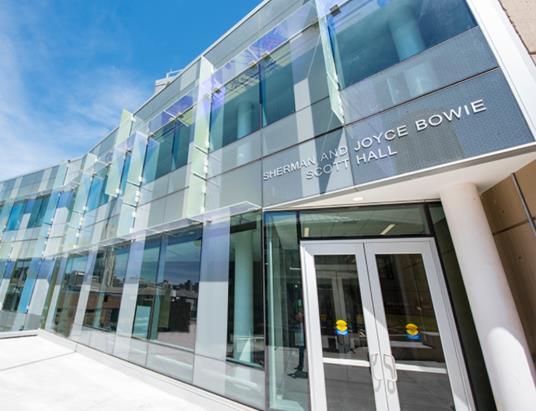
From “the mall” between Baker Hall and Doherty Hall, walk past Wean Hall until you see the Sherman and Joyce Bowie Scott Hall on your right- this is an all-glass building (see Figure 3)
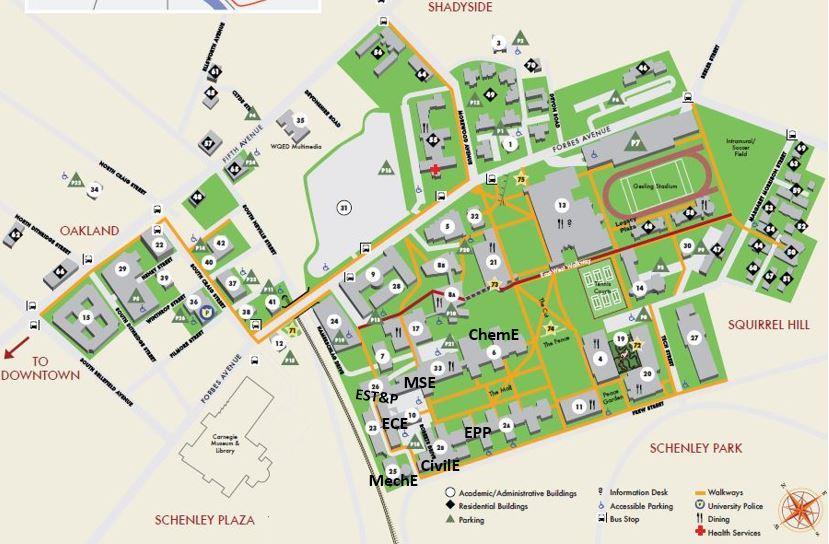
Carnegie Mellon University (see maps of campus for more). Some important locations are marked in the lower center of the map.
B) ESTP Affiliated Faculty and Staff Contact Information9
ESTP Administrative Staff
Bernens, Alyssa 5103 Scott Hall
412-268-2947 abernens@andrew.cmu.edu
Academic Program Manager ESTP
Salvador, Paul 5105 Scott Hall 412-268-7672 paulsalvador@cmu.edu
Director ESTP
Professor of Materials Science and Engineering
Rihn, Nicole 5120B Scott Hall 412-268-6072 nethomps@andrew.cmu.edu
Admissions & Program Coordinator ESTP
ESTP Support Staff
Heisler, Brooke 252 West Wing 412-268-2064 bheisler@andrew.cmu.edu
Career Consultant
Houser, Paige 3317 Wean Hall 412-268-3357 phouser@andrew.cmu.edu
Ombudsperson ESTP
Vaughan, Liz 103 CUC 412-268-870 eav@andrew.cmu.edu
Student Life Coordinator
ESTP Core Faculty
Cook, Elizabeth 39-613 Energy Transport and Storage ecook2@andrew.cmu.edu
Muller, Nicholas 39-613 Energy Policy and Economics 254C Posner Hall 412-268-812 nzm@andrew.cmu.edu
Lester and Judith Lave Professor of Economics, Engineering, and Public Policy
Salvador, Paul 39-610 Energy Conversion and Supply 5105 Scott Hall 412-268-7672 paulsalvador@cmu.edu
Director ESTP
Professor of Materials Science and Engineering
Blackhurst, Michael 39-613 Energy Demand and Utilization 5113 Wean Hall N/A mfb@andrew.cmu.edu
Executive Director – The Open Energy Outlook Initiative Engineering & Public Policy
9 For an extended list of associated faculty please see: ESTP About Us: Affiliated Faculty.
ESTP maintains a lounge in Scott Hall 5101 for ESTP students to use appropriately.
The Scott Hall 5101 door to the ESTP student study lounge can be accessed by swiping your CMU Student ID. This door must always remain closed: it should never be propped open.
The kitchen area in the ESTP study lounge is available for student use, so long as everyone works together to maintain a clean and safe area.
CMU custodial services will ONLY empty trash and occasionally vacuum the floor.
ESTP’s professional staff DO NOT provide custodial services. Each student is responsible to leave the lounge in reasonable order upon departing.
Unrestricted access to the study lounge requires responsible adult behavior by every ESTP student. If the room is not kept in good condition and becomes a health and safety hazard, access to the study lounge will be restricted, such as: access only during business hours or only when ESTP staff are present.

Examples of health and safety hazards include cups, dirty dishes, or other items in the sink; unclean surfaces or furniture; food containers or other trash, or any personal items, left in the study lounge. Any items left in the lounge will be discarded. Students will be notified by email of any change to the access policies to the Study Lounge.
Printing:
As a CMU graduate student, you have an assigned Andrew printing quota of $40 per semester. Please see https://www.cmu.edu/computing/services/endpoint/printing-kiosks/quota.html for printing information. A laser printer is currently available in the ESTP study lounge for limited black and white printing. This printer is a HP LaserJet Pro 400 model M401dne, and you can print by connecting your laptop to the printer’s USB cable, or from the on-campus network using the printer’s static IP address [172.22.51.11]. Low-cost poster printing service is available through the Sorrells Engineering and Science Library in 4400 Wean Hall. Contact the library or see the reference instructions on the Canvas site- ESTP Professional Resources.
Computing:
Each student is assigned a single-sign-on account (Andrew account) that is used to access campus-wide and ESTP computing resources. Andrew accounts can be managed by visiting the Computing Services website at www.cmu.edu/computing/accounts. Students may contact the Computing Services Help Center if you have any IT issues (i.e., computers, phones, printers, etc.) at 412-268-4357 or it-help@cmu.edu
Mail :
Mailboxes are not available for ESTP students, neither for academic nor personal use. If a student plans to have something shipped to themselves at ESTP, please notify the staff in advance and use the following address:10
Your Name, c/o ESTP Program
Carnegie Mellon University 5000 Forbes Ave, Scott Hall 5103 Pittsburgh, PA 15213-3890
10 Please communicate with ESTP staff prior to sending any packages to this address.
D) College of Engineering Department Locations and Department Head Contacts
College of Engineering
Burcu Akinci
219 Ansys Hall
219 Ansys Hall
Dean of Engineering, University Professor
Porter, Lisa
224 Ansys Hall
Associate Dean for Faculty and Graduate Affairs, Professor of Materials Science and Engineering
Chemical Engineering
1107 Doherty Hall
Laird, Carl 1111 Doherty Hall
Professor of Chemical Engineering
Civil & Environmental Engineering
Lowry, Gregory
119 Porter Hall
119D Porter Hall
412-268-5090
412-268-4047
412-268-2230
412-268-3966
412-268-2940
412-268-2959
Interim CEE Department Head & Hamerschlag University Professor
Electrical & Computer Engineering Hamerschlag Hall
Pileggi, Larry 1106 Hamerschlag
412-268-7400
412-268-3299
ECE Department Head & Tanoto Professor of Electrical & Computer Engineering
Engineering & Public Policy Wean Hall
DeCarolis, Joseph 5222 Wean Hall
EPP Department Head & Professor
Materials Science & Engineering
3325 Wean Hall
Dickey, Elizabeth 3327 Wean Hall
412-268-2670
412-268-2838
412-268-2700
412-268-3913
MSE Department Head & Teddy & Wilton Hawkins Distinguished Professor Professor of Materials Science and Engineering
Mechanical Engineering
4th Floor Scaife
412-268-2500
Cagan, John 401 Scaife Hall 412-268-3657
MEG Department Head & George Tallman Florence Barrett Ladd Professor in Engineering, Professor of Mechanical Engineering
E) University Offices
University Police: emergency 412-268-2323 non-emergency 412-268-6232 www.cmu.edu/police Student Health Services 412-268-2157 www.cmu.edu/health-services
Counseling & Psychological Services 412-268-2922 www.cmu.edu/counseling Housing Services 412-268-2139 www.cmu.edu/housing Dining Services 412-268-2139 www.cmu.edu/dining Office of International Education 412-268-5231 www.cmu.edu/oie
Language and Communications Support in the Student Academic Success Center 412-268-6823 https://www.cmu.edu/student-success/ Sorrells Engineering & Science Library 412-268-7217 www.library.cmu.edu Career & Professional Dev. Center 412-268-2064 www.cmu.edu/career
Asst. Vice Provost for Grad. Education 412-268-7307 www.cmu.edu/graduate/programs-services
Enrollment & Finances for Grad Students www.cmu.edu/hub/new-grad/ Graduate Education www.cmu.edu/graduate Graduate Student Assembly www.cmu.edu/stugov/gsa
Please see Appendix A for more information relating to University’s offices and resources.
Students at Carnegie Mellon, because they are members of an academic community dedicated to the achievement of excellence, are expected to meet the highest standards of personal, ethical, and moral conduct possible.
These standards require personal integrity, a commitment to honesty without compromise, as well as truth without equivocation and a willingness to place the good of the community above the good of the self. Obligations once undertaken must be met, commitments kept.
As members of the Carnegie Mellon community, individuals are expected to uphold the standards of the community in addition to holding others accountable for said standards. It is rare that the life of a student in an academic community can be so private that it will not affect the community as a whole or that the above standards do not apply.
The discovery, advancement, and communication of knowledge are not possible without a commitment to these standards. Creativity cannot exist without acknowledgment of the creativity of others. New knowledge cannot be developed without credit for prior knowledge. Without the ability to trust that these principles will be observed, an academic community cannot exist.
The commitment of its faculty, staff and students to these standards contributes to the high respect in which the Carnegie Mellon degree is held. Students must not destroy that respect by their failure to meet these standards. Students who cannot meet them should voluntarily withdraw from the university.
The Carnegie Mellon Code can also be found on-line at: https://www.cmu.edu/student-affairs/theword/
B) University Policies & Expectations
It is the responsibility of each member of the Carnegie Mellon community to be familiar with university policies and guidelines. In addition to this departmental graduate student handbook the following resources are available to assist you in understanding community expectations:
The Word/Student Handbook https://www.cmu.edu/student-affairs/theword//index.html
Academic Integrity Policy
https://www.cmu.edu/policies/student-andstudentlife/academic-integrity.html
University Policies Website www.cmu.edu/policies/
Office of Graduate and Postdoc Affairs https://www.cmu.edu/graduate/policies/index.html
Please see Appendix A for additional information about The Word and University resources.
Expectations and Requirements
Carnegie Mellon maintains the highest ethical standards and makes continuous efforts to identify and create the kind of academic environment that its members wish to enjoy. As a CMU graduate student, you are an important participant in our university partnership that includes all faculty, staff, administrators, undergraduates, and graduate students. Thus, you are responsible for academic integrity, honesty, and fairness, as are all university community members.
Please review the University Policy on Academic Integrity (https://www.cmu.edu/policies/student-andstudent-life/academic-integrity.html). The policy includes the University expectations around academic integrity and provides definitions of cheating, plagiarism, and unauthorized assistance
A review of the University’s Academic Disciplinary Actions procedures (https://www.cmu.edu/studentaffairs/theword/academic-discipline/index.html) is also recommended. These procedures outline the process for investigating, reporting, and adjudicating violations of the University Policy on Academic Integrity. The procedures also outline the appeal process.
In support of the university’s position, ESTP encourages EVERY incoming student take the CMU/CIT recommended training offered by the Collaborative Institutional Training Initiative (CITI). Furthermore, ALL students in degrees requiring Independent Study or Master’s Project work, and any students taking Independent Study or Master’s Project course work, are REQUIRED to complete the training by the end of their first semester December 8, 2025 and to submit their certificate of successful completion to the ESTP Program Coordinator.
The CIT Graduate Student Policy provides the following instructions. “For CIT graduate students, the CITI physical science module package is recommended, rather than the module package for engineers, although both are acceptable. The courses are available at CITI’s website: www.citiprogram.org/ . Select Carnegie Mellon University as your participating institution when you create your account. This topic is described fully in the CIT Graduate Student Policy page under Responsible Conduct of Research (RCR).”
Required Plagiarism Quiz:
The University of Indiana has an exceptional website that provides examples and a quiz to determine if you understand the difference between proper and improper attribution of text. All ESTP students are required to complete this quiz before the end of the first week of classes and print and submit the certification provided when the quiz is passed. Certifications will be submitted via the ESTP Canvas site and collected by the ESTP Admissions and Program Coordinator. Submitting this certification indicates that you have learned and understand the approved processes for text attribution. You will be held responsible for this information if a conflict arises in the academic year. Please complete the plagiarism quiz using the following link: https://plagiarism.iu.edu/mainLogin.php
A review of the University’s Academic Disciplinary Actions procedures (https://www.cmu.edu/studentaffairs/theword/academic-integrity-actions/index.html) is also recommended. These procedures outline the process for investigating, reporting, and adjudicating violations of the University Policy on Academic Integrity. The procedures also outline the appeal process
Cheating occurs when a student avails her/himself of an unfair or disallowed advantage that includes but is not limited to:
1. Theft of or unauthorized access to an exam, answer key, or other graded work from previous course offerings.
2. Use of an alternate, stand-in, or proxy during an examination.
3. Copying from the examination or work of another person or source.
4. Submission or use of falsified data.
5. Using false statements to obtain additional time or other accommodation.
6. Falsification of academic credentials.
Plagiarism is defined as the use of work or concepts contributed by other individuals without proper attribution or citation. Unique ideas or materials taken from another source for either written or oral use must be fully acknowledged in academic work to be graded. Examples of sources expected to be referenced include but are not limited to:
1. Text, either written or spoken, quoted directly or paraphrased.
2. Graphic elements.
3. Passages of music, existing either as sound or as notation.
4. Mathematical proofs.
5. Scientific data.
6. Concepts or material derived from the work, published or unpublished, of another person.
Unauthorized assistance refers to the use of sources of support that have not been specifically authorized in this policy statement or by the course instructor(s) in the completion of academic work to be graded. Such sources of support may include but are not limited to advice or help provided by another individual, published or unpublished written sources, and electronic sources. Examples of unauthorized assistance include but are not limited to:
1. Collaboration on any assignment beyond the standards authorized by this policy statement and the course instructor(s).
2. Submission of work completed or edited in whole or in part by another person.
3. Supplying or communicating unauthorized information or materials, including graded work and answer keys from previous course offerings, in any way to another student.
4. Use of unauthorized information or materials, including graded work and answer keys from previous course offerings.
5. Use of unauthorized devices.
6. Submission for credit of previously completed graded work in a second course without first obtaining permission from the instructor(s) of the second course. In the case of concurrent courses, permission to submit the same work for credit in two courses must be obtained from the instructors of both courses.
Procedures for dealing with allegations of these policy violations are detailed in the university’s Academic Disciplinary Action Procedures for Undergraduate Students and the Academic Disciplinary Action Procedures for Graduate Students, which are published in The WORD student handbook. Periodic review of these procedures will be overseen by the Dean of Student Affairs or her/his designee in consultation with Faculty Senate and the relevant student governing bodies. Any amendments to these procedures are subject to the approval of Faculty Senate. Additional guidelines and procedures for graduate students may exist at the college/department/program level, in which case they are communicated in the college/department/program graduate student handbook.
VI.D University Policy Violations (cont’d)
In extreme cases where the first violation is particularly deplorable, as determined by the ESTP Director and Assistant Director, a student may be permanently dropped from the ESTP program. Upon a second academic integrity violation, the student will immediately be dropped from the ESTP program
University-wide Academic Disciplinary Protocol: Procedures for dealing with allegations of these policy violations are detailed in the university’s Academic Disciplinary Action Procedures for Graduate Students: https://www.cmu.edu/studentaffairs/theword/academic-discipline/index.html which is published as part of The WORD student handbook
Periodic review of these procedures will be overseen by the Dean of Student Affairs, or her/his designee, in consultation with Faculty Senate and the relevant student governing bodies. Any amendments to these procedures are subject to the approval of Faculty Senate. Additional guidelines and procedures for graduate students may exist at the college/department/program level, in which case they are communicated in the college/department/program graduate student handbook.
A) Acknowledgements
This handbook was prepared with the help and support of our partner engineering departments: Chemical Engineering, Civil & Environmental Engineering, Electrical & Computer Engineering, Engineering & Public Policy, Materials Science & Engineering, and Mechanical Engineering. Portions of the text herein are copied with permission from some of their graduate student handbooks. Every attempt is made for ESTP program policies to conform with The Word and College of Engineering graduate policies These include policies on intellectual property, freedom of expression, student privacy, academic disciplinary actions, and academic integrity
B) Consumer Information
Students in the ESTP program are self- or family-funded, funded by their employer, or by external scholarships, fellowships, and educational loans. Students are permitted to enroll in project-based classes, as well as independent study and master’s project research courses. The CMU HUB website consumer information page provides access to information that current and prospective students of the University may need to be informed consumers. The CMU website also provides student consumer information linked on their Middle States Accreditation pages.
C) Carnegie Mellon University Statement of Assurance
Carnegie Mellon University does not discriminate in admission, employment, or administration of its programs or activities on the basis of race, color, national origin, sex, handicap or disability, age, sexual orientation, gender identity, religion, creed, ancestry, belief, veteran status, or genetic information. Furthermore, Carnegie Mellon University does not discriminate and is required not to discriminate in violation of federal, state, or local laws or executive orders.
Inquiries concerning the application of and compliance with this statement should be directed to the university ombudsman, Carnegie Mellon University, 5000 Forbes Avenue, Pittsburgh, PA 15213, telephone 412-268-1018.
Obtain general information about Carnegie Mellon University by calling 412-268-2000. The Statement of Assurance can also be found on-line at: https://www.cmu.edu/policies/administrative-and-governance/statement-of-assurance.html
D) Assistance for Individuals with Disabilities
The Office of Disability Resources at Carnegie Mellon University ( http://www.cmu.edu/educationoffice/disability-resources/ ) has a continued mission to provide physical and programmatic campus access to all events and information within the Carnegie Mellon community. They work to ensure that qualified individuals receive reasonable accommodations as guaranteed by the Americans with Disabilities Act (ADA) and Sections 503 and 504 of the Rehabilitation Act of 1973. Students who would like to receive accommodations can begin the process through Disability Resources secure online portal or email access@andrew.cmu.edu to begin the interactive accommodation process
For more information, please see http://www.cmu.edu/education-office/disability-resources/ Students with disabilities are encouraged to self-identify with the Office of Disability Resources and request needed accommodations. Any questions about the process can be directed to Catherine Getchell, 412268-6121, getchell@cmu.edu
E) University Policies & Expectations
It is the responsibility of each member of the Carnegie Mellon community to be familiar with university policies and guidelines. In addition to this ESTP graduate student handbook, the following resources are available to assist you in understanding community expectations:
• The Word/Student Handbook: www.cmu.edu/student-affairs/theword
• Academic Integrity Website: https://www.cmu.edu/policies/student-and-student-life/academic-integrity.html
• University Policies Website: www.cmu.edu/policies
• College of Engineering Graduate Student Policy website: https://engineering.cmu.edu/education/academic-policies/graduate-policies/index.html
• Graduate Education Website: www.cmu.edu/graduate/policies
• Computing Services Website: https://www.cmu.edu/computing/
• Carnegie Mellon’s policy on alcohol and drugs. All students should be aware of university policies: https://www.cmu.edu/policies/administrative-and-governance/alcohol-and-drug-policy.html
International Students must register and attend the mandatory Office of International Education (OIE) international student orientation. If you are unable to attend orientation, you may make an appointment to meet with an advisor in the Office of International Education in Posner Hall3rd floor. You must check in with OIE by the 10th day of classes or face administrative withdrawal.
The commitment of its faculty, staff, and students to these standards contributes to the high respect in which the Carnegie Mellon degree is held. Students must not destroy that respect by their failure to meet these standards. Students who cannot meet them should voluntarily withdraw from the university.
The Carnegie Mellon Code can also be found on-line at: https://www.cmu.edu/student-affairs/theword/
F) University Health Requirements
As a full-time student, you must have medical insurance and required immunizations that meet the university’s minimum requirements. Please see 2025-2026 student health insurance criteria at www.cmu.edu/health-services/student-insurance
All full-time students must meet the university’s immunization requirements11 posted at www.cmu.edu/health-services/immunization. Students must complete an online immunization form and/or waiver by August 11, 2025 documenting that you have either had the required vaccines or have had blood tests proving immunity to certain diseases. Students can complete the immunization form in HealthConnect, accessible at www.cmu.edu/health-services. Failure to submit the online immunization form or meet the requirements before the start of classes will result in disenrollment from classes and removal from university housing.
Students must also confirm enrollment in the required health insurance plan, or certify compliance with mandatory health insurance coverage at Student Health Services: by August 28, 2023.
G) Employment Eligibility Verification
If you are receiving a stipend, you are going to be a TA, or you are planning to have a position with CMU then Employment Eligibility Verification is required.
Form I-9 must be completed within 3 business days of beginning work for any type of compensation (stipend or employment). Additional details are highlighted below.
To ensure compliance with federal law, Carnegie Mellon University maintains the Employment Eligibility Verification (I-9) Policy [pdf] covering the university’s I-9 and E-Verify requirements:
Every individual receiving a stipend from CMU or employed by CMU must comply with the I-9 Policy by completing the Form I-9 within three business days following the first day of stipend start date/employment
Individuals who expect to work on a federally funded project are further responsible for submitting an EVerify Processing Request Form to the Office of Human Resources.
For more information, please see CMU’s Guidance for Completing the Form I-9 and E-Verify Requirements at CMU [pdf], or visit the Human Resources Service website to learn more about Form I-9 and E-Verify and to schedule an appointment to complete the Form I-9.
H) Consensual Intimate Relationship Policy Regarding Undergraduate Students
https://www.cmu.edu/policies/student-and-student-life/consensual-relationships.html
This policy addresses the circumstances in which romantic, sexual or amorous relationships/interactions with undergraduate students, even if consensual, are inappropriate and prohibited. The purpose of this policy is to assure healthy professional relationships. This policy is not intended to discourage consensual intimate relationships unless there is a conflicting professional relationship in which one party has authority over the other as in the policy.
11 Please note that all students are required to have a WHO authorized COVID-19 vaccine for Fall 2022. Students can find more information on the accepted vaccines here: https://www.cmu.edu/health-services/new-students/