Periodical Supplement to Cleveland Jewish News, December 5, 2025
NORTHEAST OHIO | arts | music | performance
Winter 2025
Limited time buy one, gift one memberships Limited time buy one, gift one memberships Limited time buy o
NOW THROUGH 12.31 one memberships NOW THROUGH 12.31
NOW THROUGH
Join us in preserving history and inspiring change by becoming a member of the Maltz Museum today! Now through December 31, 2025, Join us in preserving history and inspiring change by becoming a buy a membership and give one to a family member or friend - for free! member of the Maltz Museum today! Now through December 31, 2025, buy a membership and give one to a family member or friend - for free! Take advantage of free us daily and history a 10% Museum Store Join in admission preserving and inspiring chan discount throughout the year plus many more membership benefits! Take advantage member of free daily admission a 10%today! Museum Store of the Maltz and Museum Now through discount throughout year plus manyand moregive membership buythe a membership one to abenefits! family membe Available for purchase exclusively at the Maltz Museum.
CONDITIONS APPLY, NOT AVAILABLE ON-LINE. Available for purchase exclusively at the Maltz Take advantage of Museum. free daily admission and a CALL FOR DETAILS AT 216-593-0589 OR EMAIL RMARCS@MMJH.ORG discount throughout the year plus many more mem CONDITIONS APPLY, NOT AVAILABLE ON-LINE. CALL FOR DETAILS AT 216-593-0589 OR EMAIL RMARCS@MMJH.ORG
Available for purchase exclusively at the Maltz Museum.
CONDITIONS APPLY, NOT AVAILABLE ON-LINE. CALL FOR DETAILS AT 216-593-0589 OR EMAIL RM
Visit the Maltz Museum this the Holiday Season! Visit Maltz Museum this Holiday Season! December 14 | 3:00pm Join the Friends of the Maltz December 14 | 3:00pm Museum in celebration of the first
Visit thewithMaltz Museum night Hanukkah traditional Join theofFriends of the Maltz songs, storytelling, andofa the menorah this Holiday Season! Museum in celebration first lighting. Adults and children of all night of Hanukkah with traditional ages are welcome to participate songs, storytelling, and a menorah in crafts and games relating to the lighting. Adults and children of all holiday. Goody bags will also be ages are welcome to participate available for families to keep the in celebration crafts and games going atrelating home! to the holiday. Goody bags will also be Joinfor the Friends of the available families the Maltz Register today at to keep celebration going at home! Museum in celebration of the first maltzmuseum.org
December 14 | 3:00pm
night of Hanukkah with traditional
Register today at songs, storytelling, and a menorah maltzmuseum.org
HAVE YOU SHOPPED OUR
Museum Store? Museum The Maltz Museum’s Store? gift shop is the
HAVE YOU SHOPPED OUR
perfect place to The Maltz Museum’s HAVE YOU SHOPPED OUR find thoughtful gift ashop is the
Museum
perfectgift. place to holiday From find a thoughtful inspiring books
Store?
to artful, gift. locally holiday From made items, you’ll inspiring books discover meaningful to artful, pieces for locally everyoneThe Maltz Museum’s made you’ll on youritems, list—while gift shop is the discover meaningful supporting the pieces for everyone Museum’s mission. perfect place to on your list—whilefind a thoughtful supporting the Museum’s mission.holiday gift. From
lighting. Adults and children of all inspiring books Visit us at maltzmuseum.org for more information ages are welcome to participate to artful, locally in crafts and games relating to the made items, you’ll Visit usalso at maltzmuseum.org for more information holiday. Goody bags will be discover meaningful
uy one, gift ips
UGH 12.31
ARTWORK UNSEEN
IT TOOK 250 YEARS
VOICES UNHEARD
STORIES UNTOLD
TO SEE THIS CELEBRATION OF AMERICAN FEMALE VISUAL ARTISTS.
For the first time anywhere, never before assembled in
change by becoming a place, see over 100 examples of women shattering ugh December one 31, 2025, mber or friend -expectations, for free! barriers, and conventions to make a
lasting impact on the art world. d a 10% Museum Store membership benefits!
eum.
November 25, 2025 – March 1, 2026 CantonArt.org/shattered-glass
E. IL RMARCS@MMJH.ORG
PRESENTED IN PARTNERSHIP WITH PROGRAMS BY Clockwise left to right (in detail): Marilyn (Vanitas), 1977. Audrey Flack. The University of Arizona Museum of Art. © 1977, Audrey Flack. Spring (from The Four Seasons Series), 2006. Wendy Red Star, Apsáalooke (Crow). Saint Louis Art Museum. © Wendy Red Star. Coerora, 1904. Emily Sargent. Sargent House Museum.
SPONSORED BY
PRESENTING SPONSOR
© 2025 Canton Museum of Art
19
Who’s Next: Emerging artists of Northeast Ohio
6 Editor’s Note
Rebecca Meiser highlights the winter arts scene
8 On Deck
Upcoming openings and current events from around Northeast Ohio
10 Mandel Foundation lauded for arts contributions Receives Cleveland Arts Prize’s Barbara S. Robinson Prize for the Advancement of the Arts
“Piranha” (2025) by Jordi Rowe. gouache and acrylic on canvas 48” x 40.”Photo courtesy of the artist
INSIDE
14 Love and Grief, Faith and Flesh: The Art of Moshe Gershuni On view at Cleveland’s Roe Green Gallery and Mishkan Or Museum through February 2026
19 Who’s Next
Emerging artists of Northeast Ohio
28 A $13 Million Investment in Creativity Inside Cleveland Institute of Art’s New Interactive Media Lab
Periodical Supplement to Cleveland Jewish News, December 5, 2025
NORTHEAST OHIO | arts | music | performance
Winter 2025
On the cover
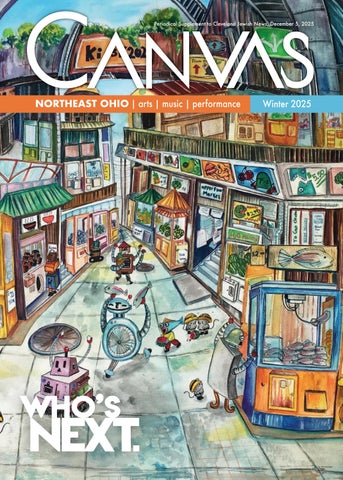
Artist Chi-Irena Wong explores the idea of “What if we went grocery shopping in claw machines?” in this piece. Titled “Grocery Shopping,” it was completed in 2019 on 29-inch-by-31-inch paper in watercolor, gouache, acrylic ink and artist’s markers. Photo courtesy of the artist.
32 Summit Artspace
Undergoes $1 Million Transformation to Serve Akron’s Next Generation of Artists
36 Holiday Giving
Meaningful Ways to Support Local Makers
40 Holiday Gift Guide Museums and galleries to visit this holiday and winter season
42 Listings
Local listings for museums, galleries, theaters and more
43 Curator Corner
“Longevity Monument” by Lauren Yeager
4 | Canvas | Winter 2025
CanvasCLE.com
Advertisement
The Canton Museum of Art
The Canton Museum of Art is presenting an original exhibition, Shattered Glass: The Women Who Elevated American Art, to both commemorate the Semiquincentennial of the United States of America and as a signature exhibition for the Museum’s 90th Anniversary. The exhibition will be on display from November 25, 2025-March 1, 2026. Filling all four of the Museum’s galleries, the exhibition showcases American women artists from the past 250 years who made a lasting impact on the art world. Traditional art history has relegated many women into obscurity by rendering their contributions as “less than” those of their male counterparts. It wasn’t until the late 1800s that women were granted access to a state funded artistic education. Even then, it was another 90 years before they were permitted to study the nude in a classroom setting, providing their male contemporaries with a stark advantage in the study of the human form. Meanwhile, the American Civil War, abolition of slavery, and the beginning of the women’s suffrage movement were all taking place in the United States. Women were almost exclusively omitted from any scholarly art publications until the 1970s when the feminist movement began to gain traction in the United States. The artists in Shattered Glass have all fought for their right to create art alongside male contemporaries and while doing so, revolutionized the field. These remarkable women faced adversity due to not only their gender, but also race, sexuality, economic status, family, and life challenges. The Canton Museum of Art has worked with museums and private collections nationwide, and drawn from its own Collection, to assemble more than 100 major works and inspiring stories from nearly 80 women artists, never before experienced in one exhibition. Among the artists represented are: • Margaret Bourke-White (1904-1971), a commercial photographer who later became the first American female war photojournalist. She was with Patton’s Third Army in 1945 and documented the liberation of the Buchenwald concentration camp; • Selma Burke (1900-1995), a sculptor and member of the Harlem Renaissance movement, her portrait of President Franklin D. Roosevelt created in 1944 inspired the design found on the dime; • Audrey Flack (1931 – 2024), a painter, sculptor, and a pioneer of photorealism who reshaped the rules of art creation in the
middle of the twentieth century; • Wanda Gág (1893 – 1946), an artist, illustrator, printmaker, and author best known for the children’s book, Millions of Cats, which is the oldest American picture book still in print; • Anne Goldthwaite (1869 – 1944), Painter and printmaker, advocate for women’s rights and equal rights, she was part of the painting event held during the 1932 Olympic Games; • Claude Hirst (1855 – 1942), Claudine, a Cincinnati-born painter of still life, used a male pseudonym to disguise her gender as an artist and now renowned for her trompe-l’oeil watercolor technique; and • Maria Martinez (1886-1980), a ceramicist who revitalized blackware pottery made by the Santa Clara Pueblo makers and instrumental in the perception of traditional ceramics as fine art rather than just functional table settings.
Top: Marilyn (Vanitas), 1977. Audrey Flack (1931 - 2024). Oil over acrylic on canvas, 96 x 96 in. The University of Arizona Museum of Art; Purchased with funds provided by the Edward J. Gallagher, Jr. Memorial Fund. © 2025 Audrey Flack. Left: An Interesting Book, 1890. Claude Hirst (18551942). Watercolor on paper, 10 ¼ x 14 ¼ in. Collection of the Canton Museum of Art; Purchased with funds from the Doran Foundation in memory of Edward A. and Rosa J. Langenbach Right: Portrait of the artist Wanda Gág, photographer unknown, c.1918, public domain VISIT CMA’S WEBSITE FOR MORE INFORMATION: CANTONART.ORG/SHATTERED-GLASS
Editor’s Note Art Where We Live
O
ne of the quiet truths about Northeast Ohio’s arts community is that it’s always been bigger than its buildings. Yes, this issue celebrates spaces — from the Cleveland Institute of Art’s new $13 million Interactive Media Lab, a major investment in the future of creative technology, to Summit Artspace’s $1 million transformation to better serve Akron’s next generation of artists. These are significant, ambitious projects that signal something important: institutions here are rebuilding not just for audiences, but with them in mind. But when you look closely at the artists shaping our region right now, the story goes far beyond bricks and mortar. It’s about the places art takes root. For David Ramsey, founder of Deep Roots, art began in the places he didn’t see it — on the blocks of Buckeye where museums felt “a state away.” His work now creates the kind of space he once searched for: one where Black and brown artists feel seen, where culture can be lively, emotional, and unsterile. Dr. Jordi Rowe reminds us that creativity can restore us. A breast pathologist turned painter, she moves between precision and play, embracing spontaneity as a way to reimagine what a life in art — or a life in general — can look like. Anna Chapman redefines what it means to create together. Through community looms, foraged materials, and experimental gatherings, she builds environments where making becomes a shared act and connection becomes part of the art. And Chi-Irena Wong — whose whimsical worlds jump from the
Follow us on Facebook and Instagram, @CanvasCLE. Sign up for Canvas’ free e-newsletter at canvascle.com/signup.
6 | Canvas | Winter 2025
margins of school notebooks to the sides of Cleveland buildings — shows how imagination can become its own kind of architecture, reshaping how we see the city. Taken together, these artists — each charting their own path, each deeply rooted in place — show us what investment in the arts really looks like. It’s not just new labs or renovated buildings (though those matter, too). It’s the people who fill them. It’s the stories they tell, the communities they build, the risks they take, and the ways they pull all of us closer to the creative lives we deserve. Northeast Ohio is in a moment of growth, experimentation, and redefinition. Institutions are expanding. Artists are carving out new modes of making. Communities are reimagining what it means to gather — and who art is for. As you page through this issue, I hope you feel the same thing I do: Art is not happening somewhere else. It’s happening here, in real time, in the communities we live in, in the hands of artists who are transforming what’s possible.
Editor Rebecca Meiser editor@canvascle.com Creative Director Stephen Valentine
President, Publisher & CEO Kevin S. Adelstein Vice President of Sales Adam Mandell Editor, Cleveland Jewish News Bob Jacob CFO Tracy Singer Custom Publishing Manager Paul Bram Sales & Marketing Manager Andy Isaacs Events Manager Gina Lloyd Events Coordinator Sam Spiegle Digital Marketing Manager Courtney Byrnes Columbus Bureau Chief Becky Raspe Operations Manager Abby Royer Editorial Casey Couch, Ellie Evans Jimmy Oswald Advertising Marilyn Evans, Adam Jacob, Nell V. Kirman, Sherry Tilson, Danielle Zwick Senior Designer Jessica Simon Designer Ricki Urban
Warmly,
Digital Content Producers Stephanie Holmes, Daniel Newman
Rebecca (Becky) Meiser
Business & Circulation Alisa Guseynov, Amanda LaLonde, Abby Royer, Ellye Wetherwax
Editor
Subscriber Services 216-342-5185/circulation@cjn.org
Becky is also the Director of Volunteers, Community and Program Development at National Council of Jewish Women/ Cleveland.
Display Advertising 216-342-5204 advertising@jstylemagazine.com
Stay-up-do-date with around the clock local community and world news from Northeast Ohio and beyond
Canvas Contributors Ed Carroll, Shannon Mortland, Alyssa Schmitt, Elizabeth Weinstein, Carlo Wolff Canvas is published by the Cleveland Jewish Publication Company, 23880 Commerce Park, Suite 1, Beachwood, OH 44122. For general questions, call 216-454-8300 or email info@cjn.org.
CanvasCLE.com
CLEVELAND ISRAEL ARTS CONNECTION
2026 WINTER HIGHLIGHTS DOCUNATION: Embracing the Israeli Spirit February-April 2026
The Cleveland Israel Arts Connection is partnering with DocuNation to present a monthly series of uplifting documentaries.
MEMORY: Moshe Gershuni Open through February 2026 “Scandals, Secrets, and Struggles of Moshe Gershuni” with curator Katya Oicherman on Sunday, January 11 “Creating the Exhibition” with curator Matthew Garson on Sunday, January 18
Noa Yedlin presented by Siegal Lifelong Learning at CWRU February 24-25
To learn more, scan this code.
Bestselling Israeli author, Noa Yedlin talks about her book “Stockholm.”
THESE EVENTS, AND MORE, ARE PROUDLY SPONSORED BY
Roe Green, Honorary Producer a program of the Jewish Federation of Cleveland
For updates join the Cleveland Israel Arts Connection Facebook group or visit jewishcleveland.org/israelarts.
The Leonard Krieger Fund of the
Roe Green Foundation
ON DECK
Upcoming openings and current events from around Northeast Ohio Compiled by Rebecca Meiser
CLEVELAND MUSEUM OF ART “Renaissance to Runway: The Enduring Italian Houses” | On display through Feb. 1, 2026 Step into five centuries of Italian artistry, where Renaissance grandeur meets modern couture. Over 100 iconic designs from Versace, Valentino, and Ferragamo sit alongside historical masterpieces, illustrating how centuries of Italian innovation continue to shape fashion today. At the entrance, an immersive video animates rare archival garments with AI, showing how they once moved and flowed. Renaissance to Runway celebrates centuries of Italian creativity, connecting past and present in a dazzling showcase of style and innovation. Special exhibit. Ticket required. clevelandart.org Eleanora d’Arborea” Evening Ensemble,fall 2024. Antonio Marras (Italian, b. 1961) for Antonio Marras (Italy, est. 1987). Wool jacquard fil coupé, viscose, cotton, polyester, polyamide. Courtesy of Antonio Marras. Photo courtesy of Getty Images
DAVID SCHWARTZ PHOTOGRAPHY Holiday Open Studio: First Viewing of the USPS Route 66 Centennial Stamp Fine Art Prints | Dec. 4–7, 2025 Lakewood photographer David J. Schwartz opens his studio for a special four-day Holiday Open Studio, showcasing the photographs selected for the upcoming 2026 USPS Route 66 Centennial Stamp Collection. For the first time, visitors can see and purchase fine art prints from the series, explore more than 200 photographs captured over two decades along Route 66, and browse other giftable pieces. Schwartz—who has documented Route 66 over more than 40 trips—will be on hand to share stories behind the images, the stamp project, and his decadeslong passion for preserving “the Mother Road.” Open Studio hours: Thu., Dec. 4, 5:30–8:30 p.m.; Fri.–Sat., Dec. 5–6, 1–8 p.m.; Sun., Dec. 7, 1–5 p.m. David Schwartz Photography, 17010 Madison Ave., Lakewood Check out David Schwartz’s fine art prints of Route 66 at his Holiday Open Studio. Top: The Golden Highway to Unlimited Dreams Bottom left: Storm Light on Route 66 Bottom right: When the Road was Young Photos courtesy of the artist
8 | Canvas | Winter 2025
CanvasCLE.com
THE CAP SHOW – CLEVELAND ARTS PRIZE Dec. 12, 2025 – Jan. 31, 2026 | Opening: Dec. 12, 5–8 PM Bostwick Design Art Initiative Gallery See Cleveland’s most celebrated artists together for the first time in decades. From bold paintings to stunning glass, ceramics, and photography, 23 Arts Prize winners illuminate the city’s creative legacy. Select works available for purchase—support the artists who define Northeast Ohio’s cultural scene. 2729 Prospect Avenue, Cleveland, OH 44115 clevelandartsprize.org/events/the-cap-show
Left: Brent Kee Young in his studio with A Matrix series work photo. Photo courtesy of Michael Weil Middle: Janice Lessman-Moss at her TC2 loom with Diamonds in the Sky II. Photo courtesy of Michael Weil Right: Laurence Channing Third Little Road Picture. Photo courtesy of The Cap Show
Artists from across the country and Northeast Ohio take center stage at the Lake Erie Folk Festival’s signature evening concert. Photo courtesy of Lake Erie Folk Festival
LAKE ERIE FOLK FESTIVAL Feb. 14–15, 2026 Celebrate traditional music in Northeast Ohio at the Lake Erie Folk Festival, returning Valentine’s Day weekend to Case Western Reserve University. Produced by the Northeast Ohio Musical Heritage Association in partnership with WRUW-FM, LEFF has grown into the region’s largest winter gathering for traditional music, drawing visitors from five counties and three states. The festival offers something for everyone: all-day jam sessions, free community concerts, hands-on workshops, and a standout evening concert featuring national and local talent. Daytime events run 1–6 p.m. in Thwing Center and are free to attend, while the evening concert takes place in the intimate, acoustically rich Harkness Chapel. Tickets for the concert are available in advance at lakeeriefolkfest.com.
BRITE WINTER Feb. 21, 2026 Cleveland’s beloved winter arts festival arrives in a new neighborhood for its 17th season, bringing fire, music, and creative energy to the Waterloo Arts District. With at least five stages and more than 30 local, regional, and national acts, Brite Winter invites visitors to wander between galleries, clubs, outdoor bonfires, and pop-in bars and restaurants—all woven into six arts-filled blocks. Known for its mix of live music, participatory art, and cold-weather camaraderie, the festival remains committed to accessibility and community. Expect warming stations, familyfriendly activities, and plenty of chances to explore Waterloo’s vibrant studios and creative spaces. Ticket updates, volunteer info, and lineup announcements will be available at britewinter.com. britewinter.com An artist transforms a block of ice into art at the annual Brite Winter music and arts festival. Photo courtesy of Robert Muller
@CanvasCLE
Winter 2025 | Canvas | 9
Mandel Foundation lauded for arts contributions Receives Cleveland Arts Prize’s Barbara S. Robinson Prize for the Advancement of the Arts
By Jimmy Oswald
I
t was a night that Thom Mandel said his father, Mort, would have loved: celebrating the rich Cleveland arts scene and honoring those who have contributed to the growth of the community. The Jack, Joseph and Morton Mandel Foundation - which Thom Mandel’s father and two uncles founded in 1953 to support Cleveland’s cultural, health care, educational and Jewish institutions - received the Barbara S. Robinson Prize for the Advancement of the Arts at the Cleveland Arts Prize’s 65th Annual Awards on Oct. 22. What made the honor even more Mandel meaningful was that the ceremony took place at the Simon and Rose Mandel Theatre – named for the Mandel brothers’ parents – on the Cuyahoga Community College Eastern Campus in Highland Hills. “My dad was a huge fan of the arts,” Thom Mandel, an Akron resident, told the Cleveland Jewish News. “I remember walking through the Museum of Modern Art in New York City and going ‘My dad has one of those and he has one of those.’ He would have been absolutely thrilled at this.” Richard K. Smucker, chairman emeritus of the J.M. Smucker Co. and a longtime trustee and former board chair of The Cleveland Orchestra, presented the award to Stephen H. Hoffman, chairman of the Mandel Foundation, who accepted the honor on behalf of the organization. “On behalf of our president, our board, our staff and myself, thank you for this really wonderful recognition of our foundation’s efforts,” Hoffman said to the audience while receiving the award. “The (Mandel) brothers have created our foundation’s priorities to embrace the promotion of the humanities as a field of study and in public life. In this way, we see the arts as an expression of human yearning and understanding, the search for meaning through faith,
10 | Canvas | Winter 2025
Lead picture: Stephen H. Hoffman, chairman of the Mandel Foundation, speaks while a picture of the Mandel brothers, Joseph, Morton and Jack, is on display during the Cleveland Arts Prize’s 65th Annual Awards on Oct. 22 in the Simon and Rose Mandel Theatre at Cuyahoga Community College’s Eastern Campus in Highland Hills. Above: Richard K. Smucker, left, with recipients of the Cleveland Arts Prize’s 65th Annual Awards, who assembled for a group photo on the stage of the Simon and Rose Mandel Theatre at Cuyahoga Community College’s Eastern Campus in Highland Hills. Each honoree was presented a medal and bouquet of flowers. | CJN photos / Jimmy Oswald philosophy and history in the making.” Hoffman concluded his acceptance speech by announcing that the Mandel Foundation would match up to $20,000 in donations raised that evening to support the Cleveland Arts Prize and its mission to sustain Northeast Ohio’s vibrant arts community. “My dad would have been very proud of Stephen and the way he presented and the fact that he was matching tonight’s fundraising,” Mandel said. “He loved the orchestra, he loved the art museum. If it was going on in University Circle, he was
CanvasCLE.com
Koehn Sculptors’ Open House 46 years
Christkindlmarkt • Every Thursday through Sunday 11 am till 5:30 pm through Dec. 24 1936 S. Green Rd. South Euclid, OH 44121 • (216) 691-1936 • sanctuaryongreen.com
Richard K. Smucker, chairman emeritus of the J.M. Smucker Co. and a longtime trustee and former board chair of The Cleveland Orchestra, congratulates Stephen H. Hoffman, chairman of the Mandel Foundation, after introducing the Jack, Joseph and Morton Mandel Foundation as the recipient of the Barbara S. Robinson Prize for the Advancement of the Arts at the Cleveland Arts Prize’s 65th Annual Awards, hosted in the Simon and Rose Mandel Theatre at Cuyahoga Community College’s Eastern Campus in Highland Hills on Oct. 22. | CJN photo / Jimmy Oswald there. It really meant a lot to him.” By the ceremony’s end, $27,700 had been raised – matched by the Mandel Foundation for a total of $47,700 – with additional donations expected during the after-party. “Steve Hoffman’s announcement to match equal to our goal tonight is simply breathtaking,” Charna Sherman, a trustee for Cleveland Arts Prize, said from the podium. “And it’s even more poignant that we are in a Mandel theater. We all need to absorb what an impact another $20,000 would be to the core mission of this extraordinary organization. This really is a first for the Cleveland Arts Prize, and it will go far in continuing our 65-year tradition of keeping the arts alive, vibrant and thriving in our beloved home of Cleveland.” When introducing the award, Smucker described the foundation as one that provides “extraordinary” leadership and philanthropic support to Northeast Ohio’s cultural landscape. “From the Cleveland Museum of Art to the Cleveland Public Theater to the Cleveland Institute of Art to The Cleveland Orchestra – the foundation’s approach to giving is never just about funding,” he said. “It’s about strengthening institutions and communities and ensuring that the arts continue to inspire, educate and connect people across our city.” Smucker emphasized the Mandel Foundation’s $50 million grant to The Cleveland Orchestra, the largest in its 103-history, as an example of the impact the organization has had. “It secured the orchestra’s ability to not only continue to share great music, but to strengthen our community education efforts by creating the Jack, Joseph and Morton Mandel Opera and Humanities Festival, now in its fourth year, which brings together music, art and civic dialogue with a number of other arts organizations in new and inspiring ways.” It also resulted in the Jack, Joseph and Morton Mandel Concert Hall at Severance Music Center in Cleveland’s University Circle neighborhood. Helping provide a boost to the orchestra is just one of
12 | Canvas | Winter 2025
many philanthropic actions that the foundation has taken on over the years. It also provided funding to the Cleveland Museum of Art, expanding access, exhibitions and community engagement as well as updating and renaming the Armor Court to the Jack, Joseph and Morton Mandel Armor Court. The foundation also awarded a 2024 challenge grant to Cleveland Public Theatre to enhance its Gordon Square campus and made gifts to the Cleveland Institute of Art to establish the Jack, Joseph and Morton Mandel Atrium, support academic programs, and expand student access through the Mandel Leadership Scholarship. It also continues to supply ongoing support for local community arts initiatives, including placemaking murals along East 72nd Street commissioned by LAND studio and the CLEVELAND WALLS! mural program organized by MidTown Cleveland Inc. In one of its latest moves, the Mandel Foundation awarded $5 million to philanthropists at Friends of Mendelsohn to aid in transforming Park Synagogue’s Cleveland Heights campus into Park Arts. “I also want to express our profound appreciation for the other honorees tonight as we celebrate their creativity and artistry,” Hoffman told the crowd. “Having our name associated with Barbara Robinson is especially meaningful to me as I knew her well. We had many conversations over the years about the funding of the arts and the vitality of the arts scene in Cleveland.” The Cleveland Arts Prize began in 1960, founded by the Women’s City Club, with its main mission being to recognize outstanding artists from all disciplines. It accepts applications from visual, music, literature, design, theater and dance artists. This year, 180 applications were received. Other winners included: • Emerging Artist Award: Ali Black, a vital voice in Cleveland’s literary scene whose latest poetry collection, We Look Better Alive, explores the struggles and resilience of Black women. • Mid-Career Artist Award: Jason Vieaux, a Grammywinning guitarist and longtime Cleveland Institute of Music instructor. Known for his international performances and local community engagement, Vieaux is celebrated for offering free concerts, teaching in underserved areas, and inspiring audiences with his artistry. • Lifetime Achievement Award: Mark E. Howard, a sculptor, painter, muralist and textile artist whose works have graced some of the city’s most prominent public spaces, including the Cleveland Museum of Art, Cleveland Hopkins International Airport, and the Cleveland Public Library. • Robert P. Bergman Prize: Greg Peckham, whose 20 years as executive director of LAND Studio transformed Cleveland’s public spaces through art and place-making initiatives. Peckham now brings his vision for equity and access to the Cuyahoga Valley Land Conservancy. • Martha Joseph Prize for Distinguished Service to the Arts: Robin Pease, a playwright, actor, educator, and founding artistic director of Kulture Kids. Of Native American descent and a member of the Mohawk Nation, Pease’s interactive performances celebrate Indigenous heroes and history, fostering empathy and cultural pride in audiences of all ages. To learn more about The Cleveland Arts Prize, visit clevelandartsprize.org. This article first appeared in the Cleveland Jewish News, a sister publication of Canvas. To read more like this, visit cjn.org.
CanvasCLE.com
NOW OPEN IN LEGACY VILLAGE! Representing dozens of artists from over 20 countries
www.LeeHayden.com (440) 871-4747
Love and Grief, Faith and Flesh:
The Art of Moshe Gershuni
On view at Cleveland’s Roe Green Gallery and Mishkan Or Museum through February 2026 By Ed Carroll
T
here’s a fitting coincidence in the latest collaboration between the Cleveland Israel Arts Connection and Mishkan Or Museum: it features an artist known for uniting seemingly disparate themes and emotions. The exhibit, Memory: Moshe Gershuni, showcases the work of Gershuni, an innovative and sometimes controversial Israeli artist recognized for blending Jewish and Christian imagery, grief, death, the Holocaust, and homoeroticism. Though Gershuni died in 2017, he remains one of Israel’s most important contemporary artists. The exhibit’s centerpiece is “Kaddish,” a portfolio illustrating the poem of the same name by Jewish-American
14 | Canvas | Winter 2025
Beat poet Allen Ginsberg, written in memory of his mother. One half of the work is displayed at the Roe Green Gallery at the Jewish Federation of Cleveland’s Jack, Joseph and Morton Mandel Building, and the other at the Hartzmark Gallery at Congregation Mishkan Or’s Jack and Lilyan Mandel Building, both in Beachwood. “Kaddish” features 24 screens on gold leaf, presented alongside both Ginsberg’s original text and a Hebrew translation by Israeli poet Natan Zach. In addition to half of the portfolio, each location will display other artworks by Gershuni. The exhibit runs through February 2026. Katya Oicherman, museum director at Congregation Mishkan Or and co-curator of the exhibit, said Gershuni’s innovative work and uncompromising personality often made
CanvasCLE.com
UPCOMING RELATED EVENTS: Art Talk: Scandals, Secrets, and Struggles of Moshe Gershuni
Lecture by Katya Oicherman, Ph.D., Presented by Congregation Mishkan Or
Sunday, January 11, 2026 @ 1:00 pm Moshe Gershuni was a truly “stiff-necked” individual and artist. From the early 1970s, he expressed ideas that went against the grain of the Israeli political and cultural establishment. When he broke through internationally in the 1980s, his life Oicherman became especially turbulent and open to public judgment, culminating in his nomination for and disqualification from the Israeli Prize for painting in 2003. To register, email koicherman@mishkanor.org or call 216-455-1697
Art Talk: Creating The Exhibition
Matthew Garson, Curator | Presented by Cleveland Israel Arts Connection, Jewish Federation
Above: Gershuni’s gold leaf glows with both sorrow and radiance. Photo courtesy of The Jewish Federation of Cleveland Previous page: Israeli artist Moshe Gershuni (1936–2017) challenged conventions, merging passion, loss, and Jewish heritage in works now on view in Cleveland. Photo / Dan Porges - Getty Images him controversial in Israel. She said he began to incorporate conceptual art into his practice, and in doing so, pushed Israeli art—then primarily focused on modernism and nationalist ideas—to embrace an international perspective and “speak the global language.” Beginning in the 1980s, she said, Gershuni primarily painted, creating a body of work that expressed both the beauty and the difficulty of Israeli Jewishness. “He was able to bring together the experience of war and violence with homoerotic love, existential post-Holocaust grief with profound connection to the Jewish religious texts and prayers,” said Oicherman. “Instead of trying to create the ‘new Jew,’ an infallible, masculine and victorious ‘Sabra’ [native born Israeli] construct, Gershuni challenged that ideal. He showed how vulnerable and full of inner contradictions this ‘new Jew’ is [and] how deeply he is connected to the diasporic Jewish past and European culture. His art speaks to us about the beauty and the suffering of being an Israeli Jew and reminds us of the responsibility and the price of the Jewish statehood.” She said that the combination of Gershuni and Ginsberg was “strangely harmonious, as far as harmony is the right word to apply in their case,” and that the idea of interconnectedness was central to Gershuni’s work. “Israeli and Jewish identities are complex and interlinked,” she said. “Israel and diaspora are interlinked. Jewish pasts and presents are interlinked. Israel and the world are interlinked. Art even in its most local expression is always already reaching out, links itself to the global and the universal.” She said Gershuni was able to portray both bodily love and passion, as well as loss and suffering—emotions she described as inescapable aspects of Israeli life. “Love and grief cohabit his artistic universe, beauty and passion are always shadowed by death,” she said. “He incorporated citations from Jewish prayers and Biblical verses in his art, including the story of Isaak’s sacrifice. The beautiful son to be sacrificed by his father in the name of loving God. The grave tension and contradiction in this story are very
16 | Canvas | Winter 2025
Garson
Sunday, January 18, 2026 @ 1:30 pm Curator Matt Garson shares how a visit to a Jerusalem art gallery in spring 2023 evolved into the first Cleveland Israel Arts Connection exhibition shared between two Cleveland institutions. For reservations, visit jewishcleveland.org or call 216-593-2900
Film Screening: The Life and Times of Allen Ginsberg
A film by Jerry Aronson | Presented by the Maltz Museum Wednesday, January 21, 2026 @ 7:00 pm – 2929 Richmond Road, Beachwood This 1993 film chronicles poet Allen Ginsberg’s life, his views on death, and his creative journey. When Aronson showed the film to Ginsberg, he reportedly nodded thoughtfully and said, “So, that’s Allen Ginsberg.” After Ginsberg passed in 1997, Aronson updated the ending. For information, visit maltzmuseum.org or call 216-593-0595
meaningful and contemporary. Replace ‘God’ with ‘state’ and you’ll see fathers sacrificing their sons on the altar on the Jewish statehood. This powerful image and tension have never left the Israeli society but became embedded in the fabric of the Israeli experience.” Matthew Garson, volunteer director of the Roe Green Gallery and co-curator of the exhibit, said he remembers the first time he saw “Kaddish” in June of 2023. “I remember my immediate response, along with the other people I was with, on how stunning and powerful the work was,” he said. “I knew right then that I had to find a way to bring this to Cleveland. CIAC had never collaborated with anyone on an actual exhibition, only the programming for exhibitions. I felt this might be the perfect opportunity to branch out and split the show in half. This would expand the possibilities of the community experiencing the work of Moshe Gershuni.” He said he felt it was appropriate to collaborate with a
CanvasCLE.com
@CanvasCLE
Winter 2025 | Canvas | 17
Gershuni’s shimmering gold leaf sits beside Allen Ginsberg’s poem, drawing viewers into a shared landscape of memory, mourning, and love. Photo courtesy of The Jewish Federation of Cleveland synagogue because the actual Kaddish is a Jewish prayer. “I immediately thought of Congregation Mishkan Or because the Federation has a strong connection with them, they were close by and I knew they not only had an art program, but a gallery as well,” he said. “It made perfect sense to collaborate with them. When I approached Katya Oicherman, she didn’t even hesitate. She knew how important Gershuni was in the overall art history of Israel.” Oicherman said the collaboration is a first for Congregation Mishkan Or, and one the congregation is excited about. She said the organizations joined resources—including people, knowledge and finances—to produce the project. Their combined efforts also made it possible to offer rich, diverse programming and outreach, encouraging visitors who might
18 | Canvas | Winter 2025
typically attend one location to explore both. The proximity of the two galleries doesn’t hurt, either. “We also used our joint knowledge and expertise of the local cultural scene, extending the programming to partner with other cultural organizations locally, including Literary Cleveland, Cleveland Dia de los Muertos and Cleveland Public Theatre, Waterloo Arts, [Case Western Reserve University] Siegal Lifelong Learning, the Maltz Museum, Zygote Press,” she said. “It is an achievement and an inspiration for further collaborations, and we are grateful to all our amazing partners. Together, we are able to show how diverse and vital contemporary Jewish culture is, how relevant and approachable it is for Jews and non-Jews alike.”
CanvasCLE.com
EMERGiNG ARTiSTS OF NORTHEAST OHiO @CanvasCLE
Winter 2025 | Canvas | 19
ANNA CHAPMAN Threads of Connection: How Artist Anna Chapman Weaves Community, Ecology, and Art
By Shannon Mortland
I
n a world that often prizes individualism, Anna Chapman is quietly weaving a counter-narrative—one rooted in connection, ecology, and collective healing. The 36-year-old artist and educator, who recently returned to Chagrin Falls, creates from materials gathered from the land itself: foraged sticks, black walnut husks, and locally processed fibers transformed into ink, charcoal, and yarn. Her art—and her teaching—invite others to slow down, reconnect, and remember the creative power of community. When did you first know you wanted to be an artist?It became clear when I was doing anything I could to spend most of my time in the art room. Going to the Rhode Island School of Design showed me what I was capable of as a creator and exposed me to a wide range of creatives who have become lifelong friends and collaborators. [For instance], my best friend from undergrad, Max Frieder, started an organization called Artolution, which facilitates youth-led murals around the world. I have been by his side since he developed that project, and it deeply informed my understanding of the potential for community art and art education to bring people together. What mediums do you primarily work in, and how did you come to focus on them? I’m trained in painting and drawing. One of my favorite drawing tools is charcoal, which I make. I [also] use a lot of black walnut ink in my work. More recently, I have begun integrating fibers into my practice. How has your family influenced your current practice? My mother weaves at Praxis Fiber Workshop in Cleveland, a community weaving studio. About three years ago, I started a Creative Storytelling Collective as I was frequenting Praxis. I had this idea to create a massive, collectively woven rug for the storytelling gatherings. I began collaborating with others to initiate a Community Loom Project. My main collaborator, Kiran Jandu, designed and built the loom, which over 600 people have woven on in five
20 | Canvas | Winter 2025
Chapman’s tools begin outdoors—here she collects black walnuts to turn into ink for her drawings. Photos courtesy of Anna Chapman different locations. I believe that there is a need for art to become part of living culture, not just something living on a wall. What are the emotional and personal dimensions of the Community Loom Project? I was working alone in a studio for a while. It became apparent to me that it wasn’t a healthy, sustainable path. I had
CanvasCLE.com
Chapman’s Underworld/Otherworld opens a portal between grief and transformation—an invitation to dwell in the threshold. to wayfind my path. It had everything to do with connecting to community, the land and my ancestors. What has emerged through that shared creative space? It’s not necessarily specific stories but the generative communion of being together. The synergy of being together, listening and sharing, was something I felt really grew all of us. Stories came together in many different ways, often transcending the literary into the form of song, food, dance or art. I’m trying to find and listen for how creatively being together can take shape in Cleveland. A mentor once told me: “In the center of the word company is ‘p-a-n.’ Pan also means bread. Bread is the thing that brings people together. So, I ask myself, what can I use to bring people together? This concept has been central to my community art practice. What projects have been pivotal to your growth as an artist? There are two projects. One is my solo show, Underworld/ Otherworld, which first showed at the McDonough Museum of Art in Youngstown, Ohio, in January [2025]. It bridges my representational painting and drawing practice with more recent explorations into sculpture and ritual. The second project I’m working on is called Retangle, with my collaborator, Kiran Jandu. We have been curating a series of experimental art happenings that center a community loom. In the fall of 2026, I will begin building a new loom sculpture during my artist residency at Vessel City in Cleveland. What are you trying to express or repair through your work? We live in a culture that prizes individualism. So, I’m asking: how do we practice being together? How can art be a vehicle for that? I teach artists how to lead a sustainable practice, both materially and conceptually. Materially, we look closely at the materials being used. Conceptually, we consider how our practice is connected to community and place. Many of the materials I source are from my surrounding environment, requiring participation with the land, animals and people around me. What challenges have you had to overcome? It can be hard to tap into the art world. If you can’t find a space to show your work, you have to create one. Finding a way to support myself while getting my bearings on my education was also a challenge. I was working in the decorative art industry in NYC for a few years, but was eventually able to shift into art education.
@CanvasCLE
What do you consider breakthroughs? Realizing that I can be an artist, an art educator and a community arts facilitator at the same time is a breakthrough. I find that there is immense synergy between these three modalities. They all inspire and enhance each other. For example, right now I have three large-scale works on display at a gallery at Connecticut State College, where I am about to facilitate four workshops and artists talks to undergraduate drawing classes. What does success look like for you? In art education and community arts, success is being able to inspire others to access their own creative agency. In my own art practice, success feels like creating something larger than myself that talks back to me and impacts others. Where do you see your work evolving next? I would like to continue exploring the integration of art, art education and community art. I’d like to start curating experimental art happenings in post-industrial spaces throughout the Rust Belt region. I am also working on a new body of work called Holding Capacity. This body of work is about the capacity of the feminine (queer and trans inclusive), to hold, contain and support amidst destabilization. I am also launching a humanities educational program with my dad and a small team of folks. We have been working on this for over 20 years. The project is called Culture Atlas [It’s an immersive overview of major world cultures past and present.] How do you want your art to shift the way people move through the world? I want my work to invite people to create. People who do not identify as artists are so hesitant to create. In my community art practice, my hope is that it will inspire people to explore being agents of change, to recognize their agency to be a creator and be a shaper, rather than be shaped by the world. For my independent fine art practice, I want to create space for people to feel more. For example, in my Underworld / Otherworld series, I hope to cultivate a willingness to be with endings. We live in a youth-obsessed, death-illiterate culture. We do not center elders in our culture and we do not know how to be with grief. I hope to inspire an appreciation for endings as transitions into something new.
Winter 2025 | Canvas | 21
DAViD RAMSEY Making Art Accessible - Founder of Deep Roots
By Rebecca Meiser
G
rowing up in Cleveland’s Buckeye neighborhood, curator and gallery owner David Ramsey didn’t see much art. The Cleveland Museum of Art felt “like another state away,” he says and creative careers were something he couldn’t picture. Years later, that absence became his inspiration. Through his gallery, Deep Roots Experience, Ramsey is building what he once needed, a space where Black and Brown artists can see themselves represented, where communities feel ownership over art, and where culture is not just displayed but lived. What began as a grassroots experiment on the corner of East 79th and Central in Cleveland’s Fairfax neighborhood has evolved into a professional, citywide vision — one that’s now reshaping how institutions like the Cleveland Botanical Garden and University Hospitals connect with community. Canvas: You’ve said that as a kid, art felt out of reach. How did that early experience shape your vision for Deep Roots? I grew up in Buckeye, and honestly, I don’t remember seeing art. When you’re a kid, going to the Cleveland Museum of Art feels like going to another state, so it wasn’t often a thing. My attachment to art wasn’t clear to me then, but I knew I wanted to create something. What I want now is for communities like the one I grew up in to have a clear, direct opportunity to engage with art, to be able to drive by on a Wednesday and see a space where art exists, where an artist might be painting or building something. That visibility matters. It’s the first step in developing a real relationship between communities and art. You didn’t start out in the art world. How did you find your way here? I graduated from Kent State in 2010 with a degree in Organizational Communications and went into PR. I worked at PR Newswire for six years, then at Kent in an outsourced training department. Slowly, I realized I was moving away
22 | Canvas | Winter 2025
from corporate messaging and toward service and support. From there, I worked at the Boys and Girls Club in Akron, Youth Opportunities Unlimited, and then St. Luke’s Episcopal Church — that’s where I really started exploring what arts programming could look like. It was the first time I saw art as a tool for connection and healing. What was the turning point that made you decide to open a gallery? A good friend, Mr. Soul, invited me to Atlanta to meet artist Miya Bailey and others at the City of Ink anniversary show [an annual urban Atlanta art and tattoo exhibition celebrating community creativity and highlighting underground local artists]. That trip changed everything. It was an art show full of people just enjoying it — no elitism, no barriers about who you were or how you dressed. I remember this moment clearly: a DJ named Mike Flo, who’s covered in tattoos and calls himself a “music shaman,” was standing next to a guy in a three-piece suit, both staring at the same art piece, deep in conversation. Two completely different people, connected through art. I’d never seen that in Cleveland. That was the lightbulb moment for me. I wanted to create a space that allowed culture to be represented in a way that wasn’t traditionally seen. How did Deep Roots get started? I had a friend who was running for council — he didn’t win — but he had this space on the corner of 79th and Central. I remember seeing the big windows and the sunlight hitting them. It just looked cool. When I told people about the idea for a gallery, nobody thought it was good. But I wanted to create a place where Black and Brown artists could show their work without feeling the heaviness of trying to fit into an art community that didn’t understand them. A place where they could exist as they are. At first, it was rough. I didn’t know shit about lighting or hanging work. We just put stuff everywhere. But we learned. The first year, we featured about 60 pieces from artists I’d
CanvasCLE.com
With the artist Mr. Soul’s piece in the foreground, The Nature of Healing reflects Deep Roots’ mission to bring culture into public spaces where everyone feels welcome. Photos courtesy of David Ramsey met through community programs or on Instagram. It wasn’t polished, but it was ours. You’ve talked about wanting to make art spaces less “sterile.” What do you mean by that? Cleveland’s art scene isn’t intentionally elitist, but it can feel exclusionary. So many galleries are white walls and bright lights — sterile spaces that can strip the culture right out of the art. But culture isn’t sterile. It’s lively, active, emotional. A gallery should be a clean slate for storytelling, yes — but the culture that story represents has to be present too. Otherwise, the work loses its meaning. Deep Roots is about keeping culture in the room. How has your approach evolved since those early days? At first, I said yes to everyone. I wanted everyone to feel included, but that made it hard to maintain quality. Over time, I realized we could honor artists and culture better by setting standards, by showing what excellence looks like. People say art is subjective. I don’t fully agree. There are things that are innately more aesthetically pleasing, more visually engaging. The work we show now has to connect to culture and be visually strong — something that captures people, even if they don’t fully understand it. So now, we’re more intentional. We’re not excluding people — we’re elevating the craft. Deep Roots has also collaborated with the Cleveland Botanical Garden. How did that partnership begin, and what did it grow into? We’ve been connected with the Botanical Garden for about five years now, and it started pretty casually — someone called and said, “Hey, the Garden wants to give some money to do something, but we don’t know what.” I immediately thought of artist Asia Armour, who works in floral collage. One of her signature pieces, Puzzle Head, became the foundation for our first project: a living mural made of flowers and plants during Fresh Fest [a free annual festival celebrating music, art, community, wellness, and urban agriculture in the Kinsman area.] It was wild to see her artwork literally grow out of the ground. That small project turned into a deeper partnership. Together, we created The Nature of Healing, a large-scale exhibition exploring how nature can help people process grief, loss, and trauma. We featured more than 30 artists — sculptors, painters, and installation artists — whose work lived throughout the Garden. It was the kind of show I’d always dreamed of building: immersive, emotional, and accessible. Over 5,000 people saw it.
@CanvasCLE
Working with an institution like the Garden pushed me to think differently, not just about art, but about audience. They helped me broaden the project beyond grief to explore resilience and the relationship between hardship and nature. It taught me that when you bring art and nature together, you open people up. It’s not just about beauty; it’s about seeing feelings manifest in real time. You also recently worked with University Hospitals in Glenville. What did that partnership look like? That project really reflects what we mean when we say art is health. UH invited Deep Roots to curate art for two new community wellness centers — it was the first time they’d worked with a guest curator. We helped them acquire 21 pieces from nine local Black and brown artists, including Aldonte The Artist, Asia Armour, and Emanuel Wallace. We spent about six months selecting the work to align with the themes of the wellness centers: healthy living, community, and belonging. The idea was that when people come in for a checkup, a class, or to pick up food pantry items, they’re surrounded by culture — not advertisements or sterile walls, but art that feels like home. What impact have these partnerships had on you and on Deep Roots? They confirmed for me that we can build anything — that we don’t need permission. As long as we hold ourselves to a high standard and stay rooted in culture, people will respond. Working with places like the Botanical Garden and University Hospitals showed me what collaboration looks like at scale — how to lead across departments, manage big projects, and still keep the work intimate and real. What’s next for Deep Roots and your broader vision? When people walk into Deep Roots, I want them to feel safe. Black culture is safe — it’s welcoming, embracing, and allows anyone to experience its beauty. From there, I want people to feel engaged. Art should make you look, think, and feel. We’re reopening soon with new energy and launching Deep Root Studios, a creative space for all our projects. Next year, we have a couple of solo shows planned, including Bee1ne and Asia Armour, though the lineup is still flexible. I’m finishing my MFA in Arts Administration, and we’re planning a pilot program in the Buckeye neighborhood to make art a permanent, institutional part of that community. That’s home for me. My mom still lives there. My sons get their haircuts at the same barbershop I did. That neighborhood deserves to have culture rooted right where it lives.
Winter 2025 | Canvas | 23
DR. JORDi ROWE Where Medicine Meets Art
By Rebecca Meiser
I
n Dr. Jordi Rowe’s world, science and creativity are not separate paths—they intertwine. Step into her office, and you immediately sense it: there are no college or medical degrees on the walls. “They’re in a pile on the floor,” she laughs, her voice as cheery as her bright yellow shirt. Instead, her walls overflow with art—her own and that of her friends. There’s a poster from her solo show It Tastes Like Cotton Candy at Waterloo Arts, an abstract painting of a face with sliding eyes by her former instructor Mike Meier, a whimsical poodle portrait by her friend Frank Hadzima, and a framed photo of bottles filled with urine, “which I think is the funniest thing,” she says. It’s a reflection of her life: rigorous medicine and boundless art, coexistence rather than compromise. Growing up in Calgary, nestled in the Canadian Rockies, Rowe was drawn to art early. Both her grandmothers were artists. “I just remember sitting at our kitchen table drawing with one of them, and said I wanted to do this,” she says. She even won awards in junior high—but in her family, a career in art “was not what people expected you to do,” she says. Her mother, who became a child psychologist when Rowe was in middle school, shaped her understanding of care and empathy, but also taught her that life can pivot unexpectedly. When Rowe was in tenth grade, her mother was diagnosed with breast cancer. She passed away during Rowe’s second year of university, leaving a final request: that Rowe pursue medicine. Flying back to school after her mother’s death, Rowe says, “I couldn’t stop sobbing. In those moments, you lose things that are bigger than you. I lost my belief in religion. I lost my connection to my family because I was in school and they lived far away. I lost the hierarchy of women in my family. I think what happens is you end up connecting more to nature, because if you’ve given up on God, you better pick up something else.” Rowe honored her mother’s wish, becoming a pathologist at the Cleveland Clinic in 2007, where she specialized in breast pathology. “I found I was really good at it,” she says. “I don’t
24 | Canvas | Winter 2025
East Slope Sunrise, an oil painting, asks viewers to pause—a moment of stillness from an artist who spends her days in the urgency of diagnosis. Photos courtesy of Dr. Jordi Rowe know if it was because I had a vested interest or if it’s just one of those things you’re naturally good at.” Yet Rowe never abandoned art. It became an escape from the pressures of medicine. She took classes at the Cleveland Museum of Art, studying Chinese brushwork. Surrounded by retirees, she realized: “I don’t want to be a retiree and then get to do the art. I want to do the art before that happens.” So, like her mother, she made a mid-career pivot. In 2018, a friend’s child, Maeve Billings, was applying to the Cleveland Institute of Art, which prompted Rowe to ask, “Do you think
CanvasCLE.com
Above: In “Winter Lodge Pole Pines,” Rowe layers oil, acrylic, and spray paint to capture the quiet vastness of nature she’s always returned to.; Below: “Red Bellied Piranha,” captures Rowe’s fascination with the sublime—where the beautiful and the threatening coexist. my art’s good enough?” She applied—and was accepted. Some friends suggested painting on the side instead of going all in on a degree, but Rowe was adamant: “I was like, no, I’ve been just painting for quite some time, and it comes and goes, it waxes and wanes. I wanted to actually paint, to know where I fit in the lineage of painting, to learn more about art history, and to be part of a community.” She knew she could handle the workload. “If I could be a part-time physician, I could be a full-time student. I knew that if I could get through medical school, I could get through art school.” Conveniently, CIA was just five minutes from the Clinic. She balanced three-quarters time at work with full-time study. Colleagues would ask, “‘How’s your hobby going?’” She’d think, It’s an entire undergraduate degree, actually. In art school, she kept her identity under wraps. “I didn’t want anyone to know I was Dr. Rowe, because I wanted critiques to be fair. I needed to learn from my peers without that shifting the balance. I hadn’t been in a formal art class since ninth grade, so I came in knowing nothing.” She explored oils, acrylics, spray paint, and ultimately developed a voice as an abstract painter. Influences range from Pat Steir and John Cage to Gerhard Richter. Her themes reflect the sublime, the vastness of human experience, and the play of light in our environments. Her painting is unprecious. “That’s so different from what I do at work,” she says. “In pathology, there’s no room for error. If your diagnosis is incorrect, your surgery is incorrect, your treatment is incorrect—everything dominoes from there. There’s a huge responsibility to get it right. Painting is the opposite.
There are no mistakes. They tell you, ‘You should paint thick over thin,’ or ‘Never mix oil and acrylic.’ I don’t listen to that. Painting is freeing. What others call mistakes, I call fun. Spray paint over watercolor? Sure. Mix oil and acrylic? Absolutely.” Her themes are equally expansive. “We are small in a huge world,” she says. “We experience it all in different ways. For me, it’s gorgeous and beautiful to be here. I want everyone to be happy—but I also recognize the terror, the lurking darkness. That tension—the joy and the fear—that’s what drives my work.” She graduated in 2023, embracing her full identity: “I got to wear my doctoral robes, and I didn’t want to hide anymore, didn’t want to ignore that other half of me.” Since then, her work has been widely exhibited—in the CAN Triennial in Cleveland, solo shows at Waterloo Arts Gallery, the Valley Art Center in Chagrin Falls, and Studio M at the Massillon Museum—and spans everything from moody, gloaming-inspired oils and pastels to playful, pink-hued pieces.” My first hope,” she says, “is that people look at it and think, ‘This is gorgeous.’ Something juicy that makes them want to just stop and be present for a moment. I want them to slow down, take a breath, and spend a little time with it. Just to look at a piece of art is to look a little inside yourself every time.” She experiments with chance—letting paintings dry in the rain, exploring spontaneity—and collaborates with Maeve in a shared studio, JXM. Their first pilot show was a success; the second, Dangerous Beauty, on December 12th, will feature their own work, alongside guest artist Nikki Woods, who also serves as Director of Exhibitions + Galleries at the Cleveland Institute of Art. For Rowe, painting isn’t just creative—it’s restorative. “Diagnosing cancer every day can burn you out, especially cancers like the ones I’ve experienced in my own family. Painting is rejuvenating. When I create, I give something back. Diagnosing takes something from people, but creating gives. It balances my interior soul.”
CATCH ROWE’S WORK NEXT: DANGEROUS BEAUTY
A group exhibition featuring paintings by Jordi Rowe, Maeve Billings, and Nikki Woods December 12 | 4–10 p.m. JXM Studio 23600 Mercantile Rd, Suite 115 Beachwood, OH 44122.
@CanvasCLE
Winter 2025 | Canvas | 25
CHi-IRENA WONG By Alyssa Schmitt
S
elf-proclaimed doodler Chi-Irena Wong credits the beginning of her art journey to the margins of her high school homework papers. Anime characters crowded the edges of worksheets, and she taught herself to experiment with whatever affordable materials she had, like watercolor and colored pencils. What began as a collection of small, off-to-the-side sketches has since scaled far beyond notebook paper. Today, Wong’s work can be seen across Northeast Ohio—in exhibitions, on library cards, in coloring books and tote bags, and even stretched across the sides of Cleveland buildings, transforming blank facades into vibrant, absurd fantasy worlds of her own making. Yet when she first started out, inspired by Japanese artist and filmmaker Hayao Miyazaki and “Tekkonkinkreet,” a cult Japanese animated film, art wasn’t a perceived skill—just the one thing she felt drawn to. “All I really had was not even a talent,” Wong, 27, says. “It was like a passion, and I just followed my passion.” That passion led her to apply to the Cleveland Institute of Art with a portfolio built from observational drawings and creative pieces. In 2016, as a CIA freshman studying drawing, she felt inspired—and slightly behind her classmates—and began developing the technical foundation of her skills. Once she began focusing on her specific discipline, she noticed her work shift. “That’s where we were honing our foundation skills and technical skills,” the Brook Park resident explains. “There were also classes that allowed free creativity to draw what you are interested in, and so I started drawing my characters.” In time, those characters developed distinct lives, personalities and quirks—always mixed with a bit of humor or absurdity. Wong’s smaller works often focus on a single figure captured in a slice-of-life moment, while her larger pieces tend to arrive in a different way. “That is when I started asking myself these really silly
26 | Canvas | Winter 2025
What if clocks were pancake makers? Wong explored the idea in this piece titled “Griddle Alarm completed in 2021 on 22-inchby-18-inch paper in watercolor, gouache and acrylic ink. Photo courtesy of Chi-Irena Wong Above: Chi-Irena Wong stands with her work on display in a solo exhibition at the Shaker Historical Society Museum. | Canvas Photo / Alyssa Schmitt questions, which is called ‘What if?’ and ‘Why not?’” she explains. “Basically I will ask these silly questions, like, ‘What if corn was turned into a flower?’” From there, her imagination widens into entire worlds that fold the ordinary into the absurd: characters browsing through bouquets of corn; a diner with clocks that make pancakes; grocery shopping done by claw machines; burger joints that produce lint cheese from overworked washing machines. The question, she says, serves as a prompt that allows her to draw more details and explore the world. These are not
CanvasCLE.com
mere cartoons but inventive economies, complete with their own infrastructures and social norms. Wong’s characters— often cute, imaginative creatures and humans—move across canvases, accruing minor histories and idiosyncratic habits, so that one painting reads like a page from a lived-in world. As Wong builds her worlds, she draws heavily from the architecture and infrastructure of her early inspirations—narrow alleyways, compact storefronts, tangled telephone wires, trash cans, fire hydrants. These elements anchor her scenes, giving even the most whimsical scenarios a sense of place. “(It’s) filled with bustling activity, and so that kind of energy, I like to translate that,” she says. Much of that energy comes from her childhood summers in New York City, where she visited her grandparents. “I really enjoyed going to Chinatown in Manhattan in New York City, because it was such a compact place,” she says. “It’s also a place where there were a lot of Asians. Living here in Cleveland, Ohio, there’s not that many. So, in a sense, I felt at home and connected.” She encountered that same mix of density and energy during a trip to Hong Kong in September 2023, made possible by the Cleveland Institute of Art’s President’s Traveling Scholarship. Traveling with her parents, who had also lived in the city, Wong wandered through neighborhoods, taking note of the efficiency and compactness of the urban landscape—details she says will shape her future work. “(The architecture) was the most insane element there,” she says. “They’re known for their sky-high-rise buildings, and you could just see how tall they were. Things were narrow as well, and you’d see little shops on the ground floors and you can see the wear and tear from the age, and you can also see it had such a small setting, yet they’re operating very well.” Near the end of her time at CIA, Wong was offered the opportunity to paint her first mural at a Parma ice rink. After her last semester was thrown off course by the COVID-19 pandemic— which Wong describes as one of the hardest challenges of her career—she graduated in 2020, and more mural work followed. “In the beginning, it wasn’t something I had initially thought I would go into, but I didn’t say no to any project,” she says. “I wanted to grow my art career, so I was just like, ‘Yes, I’ll do it.’” Murals are a daunting task, she notes, as she has to scale up from a piece of paper to a full wall. Her yes-mentality has led her to works like a 50-by-20-foot noodle bowl mural she created in partnership with AsiaTown Cleveland and LJ Shanghai; a 20-by-8-by-9-foot shipping container that serves as a mobile library in AsiaTown; and her largest ye- a two-piece sidewalk mural with lily pads and a koi pond near Wade Early Learning Center, all in Cleveland. Her most recent mural completed its run at Public Square in September 2025 on the back side of Rebol, as part of LAND Studio’s rotating art wall. There, Wong invited viewers into the Bellflower Salon, which stemmed from the question: “What if the new hairstyle is to shape your hair into bells?” “That was one of those ‘I made it’ moments,” Wong says. “Anyone that walks out of Tower City—you’ll see that mural.” Wong began partnering with the Ohio chapter of Asian Services in Action (ASIA Inc.) during the pandemic, creating coloring books, playing cards, posters and, later, vaccination stickers. “Because I am Chinese myself, I knew I wanted to be part of the Asian community somehow and bring my art and my skills there,” she says. Looking ahead, Wong is in the research phase, exploring ways to secure funding and new projects while continuing to
@CanvasCLE
Above: Corn isn’t the ingredient you cook with in this world, it’s a flower you give a loved one. This work stemmed from the question “What if corn was turned into a flower?” Titled “Corn Flower,” it was completed in 2020 on 28-inch-by-34-inch paper in watercolor, gouache and acrylic ink. Below: A fantastical fast food restaurant that sells lint-based food, stemming from the question “What if lint is the new form of cheese and then there’s a lint burger joint?” Titled “Burger Joint,” it was completed in 2019 on 19-inch-by-29-inch paper in watercolor, gouache, acrylic ink. Photos courtesy of Chi-Irena Wong
expand her collection of prints. Her next dream is a large-scale collaboration with the RTA, creating art-wrapped buses—a vision inspired by the vibrant transit designs she admired during her trip to Hong Kong. “I’m living the dream,” she says. “The fact that I went from originally watercolor drawing to mural works and now public health campaigns … I’ve come a long way since 2020.”
CATCH WONG’S WORK NEXT: Wong’s work can currently be seen in a solo exhibition at the Shaker Historical Society Museum through Feb. 15, 2026.
Winter 2025 | Canvas | 27
Atop the CIA XR Studio, Matthew McKenna and Rachel Yurkovich survey the heart of the Integrated Media Lab, where virtual production and hands-on innovation meet. Photo courtesy of CIA
28 | Canvas | Winter 2025
CanvasCLE.com
A $13 MiLlion INvestmeNt
iN CreativiTy Inside Cleveland Institute of Art’s New Lab
By Carlo Wolff
F
or many Cleveland Institute of Art students, the journey to the future starts on the bus. Their ride from University Circle to East 66th and Euclid takes them not just across town, but into the CIA’s new Integrated Media Lab — a 14,000-square-foot creative playground where they can spraypaint stencils one hour and step inside a virtual snowstorm the next. Tucked inside the MidTown Innovation Center, the
@CanvasCLE
$13 million IML is CIA’s boldest move yet to keep its students ahead of a fast-shifting creative and technological landscape. A collection of interconnected teaching and learning spaces in the city’s Hough neighborhood, the IML is designed to spark collaboration and exploration. Since its formal opening Sept. 19, the lab has introduced students to a range of emerging technologies, giving them room to test ideas, build skills and see where the tools of tomorrow
Winter 2025 | Canvas | 29
In the Arcade, CIA students dive into game design, interactive storytelling, and the technology shaping tomorrow’s digital worlds. Photo courtesy of CIA might take their work. But the IML is more than a suite of high-tech rooms. It represents a larger ambition. As Kathryn Heidemann, CIA’s president and CEO, puts it, the goal is to create “a whole new market space for the value of creatives in all sectors, not just in arts and culture,” she says. The lab’s design intentionally blurs the lines between classroom and industry hub, fostering collaboration with businesses, cultural organizations, and startups across Cleveland. It’s the kind of investment that could reshape what’s possible—for students, for Cleveland, for Ohio. “There’s nothing else like it in the state,” Heidemann says -or, for that matter, at many art and design colleges across the country. Inside, the IML hums with activity. Students move between specialized spaces and hands-on tools that bring their ideas to life. The Experience+Edit Center and the Arcade support game design and digital storytelling. Dedicated Spaces and Studios open doors to making and experimenting across any medium. At Equipment Checkout, VR/AR headsets, 3D scanners, professional cameras and motion-capture gear are all in reach. The lab’s recording studios support audio, music and podcast production. And throughout the building, facilities built for virtual production allow students to test ideas at full scale. At the heart of the lab is the two-story extended-reality XR Studio — the “crown jewel” of the IML, says Matthew McKenna, CIA’s vice president of technology and digital strategy and chief information officer. Digital waves, sunsets, snowfall and more can be rendered inside the LED volume, made to integrate physical objects with virtual environments for commercials and films. From an educational standpoint, it offers a real-world experience for students exploring contemporary cinematic technologies. “We can do motion capture in this space along with virtual production,” McKenna says. “We have a garage door that opens right into our space. We can drive a vehicle in or load equipment in. The fact that we’re in Midtown Cleveland, equally distant from downtown and University Circle, is a game changer. Every other studio I’ve been that has virtual
30 | Canvas | Winter 2025
“The fact that we’re in Midtown Cleveland, equally distant from downtown and University Circle, is a game changer. Every other studio I’ve been that has virtual production capabilities is in an industrial parkway or some back lot. We’re in the middle of a city.” Matthew McKenna, CIA’s vice president of technology and digital strategy
production capabilities is in an industrial parkway or some back lot. We’re in the middle of a city.”
Opening Doors
The IML’s entrance doubles as a gallery. For the opening celebration, it showcased “Portals,” a project conceived by faculty member Nicole Condon-Shih and executed by her students. “It was part of our course called Studio Discovery,” says Condon-Shih. “This was a two-week workshop, and the goal was to have students be exposed to how to make paper stencils and use spray paint to make analog physical works on paper.” In the first week, students developed basic shapes in Adobe Illustrator and cut vinyl at CIA’s print center. In week two, they moved the work into the IML. After learning the equipment, students became “the curators of their own exhibition,” Condon-Shih says. “So they took the 2D pieces that they made with the spray paint and their vinyl pieces were the frames, if you will, and made a collaborative piece. The best part about this was the IML component.” Once complete, the students photographed their work to view on VR headsets, allowing them “to look around and be immersed within what they created in 2D,” she says. Sacha Elliott, a first-year Foundation student, says “Portals” turned out better than expected, even though they didn’t immediately take to spray painting. So much was new,
CanvasCLE.com
they say, but that was part of the excitement. Condon-Shih allowed the class to design their own gallery arrangement. “This freedom stumped us a bit, but once we figured it out, I feel like it helped us make a more creative product than a professional gallery arranger may have produced, but it also looked less professional,” Elliott says. “Learning new skills made it super fun, and the VR aspect was interesting and tied in well with the spray paint because spray paint has such nice texture.” George Ramirez, an assistant professor of Media Studies, says the IML has been central to shaping his liberal arts class. “We did a reading on the history of computer graphics and talked about the transformation from physical object to its digital form,” he says. “Then we were able to go to the IML and do a 3D scanning demo so students could understand the process rather than just read about it. So for me, the IML has been central to getting students to embody and interact with these technologies so they understand the critiques that media study scholars, art historians and other fields in the humanities are making about these media.”
The Long View
Heidemann joined CIA in 2019, when early conversations about the IML were underway. In 2020, then-President Grafton Nunes asked her to further develop the concept and push it toward reality. Funding for the IML came from a mix of public and private sources, including individual donors, foundations and the State
Find Unique Art Pieces for the Perfect Holiday Gift!
of Ohio. Cleveland Development Advisors, an affiliate of the Greater Cleveland Partnership, was a key funder, providing $8 million in federal and Ohio New Markets Tax Credit allocations to support the project. The vision sharpened further after the Cleveland Foundation announced plans to move its headquarters to MidTown and sought partners for a collaborative venture. (Other partners in the MidTown Innovation Center include Case Western Reserve University, the Assembly for the Arts O.H.I.O. Fund, University Hospitals, JumpStart and Hyland Software.) For Heidemann, the question driving the project is simple — and expansive. “How can we leverage the Interactive Media Lab to show the relevance of art and design education?” she asks. The answer touches not only CIA’s traditional fields but also healthcare, medicine, technology, education, hospitality and entrepreneurship. Making those connections is a win for business and industry, and it helps address the pressures facing higher education: declining enrollment, population shifts and growing public mistrust. By positioning art and design at the center of cross-sector innovation, Heidemann hopes to open new pathways — for students and for the region. “It’s within those creative synapses where those interdisciplinary ideas come together to create something new,” Heidemann says. “That’s creativity. That’s something we nurture here.”
Handmad e One-of-a , -K Gifts For ind Art $ From Loc 250 Or Less al Artists !
Valley Art Center 155 Bell St. Chagrin Falls, OH 44022 valleyartcenter.org | 440-247-7507 @CanvasCLE
Winter 2025 | Canvas | 31
Summit Artspace Undergoes $1 Million Transformation to Serve Akron’s Next Generation of Artists By Shannon Mortland
T
he building at 140 E. Market Street in downtown Akron has a storied past and, now undergoing a $1 million renovation, is poised to be part of the city’s future. Built in 1927 as the home of the Akron Beacon Journal, the threestory building now houses Summit Grieshammer Patrick Artspace, which includes artist studios, creative businesses, and five art galleries. Its public programs aim to connect the community and local artists to create a thriving, diverse region. John S. and James L. Knight ran the daily newspaper from the building in the early part of the 20th century. The 55,000-square-foot building, owned by Summit County, has housed many businesses in its nearly 99 years, so upgrades are needed, said Natalie Grieshammer Patrick, executive director of Summit Artspace. To accommodate construction, Summit Artspace closed
32 | Canvas | Winter 2025
in August, with a goal of reopening in early 2026. The renovations, funded by Summit County, the Akron Community Foundation and the GAR Foundation, are an important piece of the city’s creative ecosystem. “We have picked the most pressing updates needed throughout the building and we will address some improvements for safety and comfort,” she said. “For the artists we’re serving, it will be impactful.” Passersby will see the changes through new front doors that complement the building’s original art deco design. Inside, new pathways will replace a “dead-end bank of studios,” better connecting spaces, Grieshammer
Patrick said. Some of the building’s beauty and grandeur will also be uncovered, including a marble staircase and wood paneling that had been covered for years. “Many visitors did not realize they could use that staircase,” she added. Surfaces will be refinished in event spaces, on the second-floor gallery and in stairwells. Ceilings will be replaced, LED overhead lighting added, and a new HVAC system installed to create a more comfortable environment for artists and a better climate for art. “It will be great for our artists to have a more polished space to exhibit their work,” Grieshammer Patrick said. Most of Summit Artspace’s 30
“People don’t buy art without understanding what it’s about. (At Summit Artspace,) people can get to know me. They get a chance to feel my heart.” Robert Reza Greer Sr. CanvasCLE.com
2026 2026 FINEFINE PRINT PRINT FAIRFAIR April 16–19 April 16–19 Ames Family Atrium, The Cleveland Museum of Art Ames Family Atrium, The Cleveland Museum of Art
one of the nation’s Shop one ofShop the nation’s largest sales largest sales of fine art prints—from affordable affordable of fine art prints—from to rare. Theto fairrare. is free to and open to Theand fairopen is free the public April 17–19, with a ticketed the public April 17–19, with a ticketed evening preview on April 16. on April 16. evening preview Learn moreLearn at more at printclubcleveland.org. printclubcleveland.org.
Save Save the Date the Date
Save the Date
11150 East Boulevard Cleveland, OH11150 44106East Boulevard Cleveland, OH 44106 cma.org
cma.org
Stay at the HEART of University Circle AT THE GLIDDEN HOUSE You are Adjacent to Arts... Moments from Music... Close to Culture... Steps from School... Doors from Dining...
For special packages go to: www.gliddenhouse.com
GLIDDEN HOUSE A HISTORIC BOUTIQUE HOTEL
1901 Ford Dr. | University Circle | 216-231-8900 @CanvasCLE
Winter 2025 | Canvas | 33
resident artists must endure the temporary closure and displacement. While a few were able to remain, others found backup spaces. Robert Reza Greer Sr. is one of the artists who had to move his work out during construction. Having a creative space at home has not been ideal, but the improved Summit Artspace will be worth the wait, he said. “As an artist, making the building more accessible means more people can enjoy the building and my art specifically,” Greer said. “The way the aesthetics are changing, they will be more inviting and they make me want to do more programming.” Though his associate degree from Stark State College is in graphic arts, Greer expresses his creativity in many ways. He has a clothing line, writes poetry, practices photography and is a rapper. He will release a book next year. “People don’t buy art without understanding what it’s about,” Greer said. “(At Summit Artspace,) people can get to know me. They get a chance to feel my heart.” Resident artists at Summit Artspace are from Summit and surrounding counties. They can reserve space for workshops, rent studio spaces, and connect with other artists for shared creativity. In addition to serving as a creative hub for artists and the community, the building is a downtown staple amid Akron’s ongoing revitalization. The Akron Civic Theatre saw its historic lobby and entrance restored, an $8.5 million project that also added the Knight Stage and an outdoor deck connecting Main Street to locks three and four. Lock 3 Park underwent a $17 million transformation to add a performance pavilion, landscaping, and a stronger connection to the Ohio & Erie Canal Towpath Trail. Main Street received a $27 million boost to create a more walkable, tree-lined corridor that also improved transit and public art. “When we talk about downtown Akron, revitalization is important,” said Grieshammer Patrick. “As a city, we’re on the precipice of something really great.” She believes Summit Artspace is also positioned for many more years to come. “We grew a lot under the previous director (Heather Meeker). She helped us double our budget and define how we carry out our mission,” said Grieshammer Patrick, who previously served as the Artspace’s director of artist resources before succeeding
34 | Canvas | Winter 2025
Above: Demolition in the second-floor Forum Gallery reveals the building’s original character as Summit Artspace restores and modernizes the historic 1927 structure. Photos courtesy of Summit Artspace Lead page: Renovation in progress: Summit Artspace’s third-floor event space will soon welcome exhibitions, workshops, and community programs. Meeker in June. Her goal is to double the budget again and ensure it directly benefits artists while developing revenue streams that pay them. Summit Artspace is currently raising $15,000 to help alleviate artists’ rent in the building. So far, they’ve raised about 70% of that goal, with a stretch goal of $20,000. As construction continues, Grieshammer Patrick and her team are revisiting exhibitions and preparing for the spring reopening, while planning programming to attract multiple generations. She will continue professional development for artists and
community art walks, a popular piece of downtown’s fabric for years. “I am looking for new ways to activate the space,” she said. “I’m connecting with community members to develop a really clear vision for the next five to 10 years.” The goal, Grieshammer Patrick said, is to honor the building’s role in downtown Akron’s history while creating a more updated space for local artists and the community. “Local artists help to make our city home and help us define what it means to be human and living in a place like Akron,” she said.
CanvasCLE.com
Alice, manager
Loganberry Books Annex Gallery
13015 Larchmere Blvd Shaker Heights, OH 44120 www.loganberrybooks.com gallery@logan.com 216.795.9800
January 20 - February 28 From WOMAN 19: ART CREATED BY WOMEN, OF WOMEN & ABOUT WOMEN curated by Mary Urbas
Feb 13 - Mar 1, 2026
SENNEY THEATER
Beck
Center
Feb 13 – Mar 1, 2026
IN COLLABORATION WITH
arts FOR THE
TICKETS: BECKCENTER.ORG | 216.521.2540 Chagrin Valley Little Theatre 40 River Street • Chagrin Falls, OH • CVLT.org • 440.247.8955
Closing Reception: February 28, 2-4pm 525 Wick Avenue, Youngstown, OH 44502 330.941.1400
by KEN LUDWIG by RUSSEL STICH & NANCY NIXON
Jan 23 - Feb 8
Gallery Hours: Tuesday - Saturday 11am-4pm
Mar 6 – Mar 15 Youngstown State University does not discriminate on the basis of race, color, national origin, sex, sexual orientation, gender identity and/or expression, disability, age, religion or veteran/military status in its programs or activities.
Words and Music by GERRY GOFFIN, CAROLE KING, BARRY MANN, CYNTHIA WEIL Book by DOUGLAS McGRATH
by JOHN HERMAN SHANER
Mar 27 - Apr 19
Jun 5 - Jun 21
Book by JOHN WEIDMAN Music by DAVID SHIRE Lyrics by RICHARD MALTBY, JR.
Jul 24 - Aug 16
Our 96th Season continues…
Get tickets now at CVLT.org @CanvasCLE
Winter 2025 | Canvas | 35
5
Meaningful Ways to Support Local Makers This Holiday Season
By Elizabeth Weinstein
T
his holiday season arrives during a particularly challenging time for independent artists and makers. Rising material costs from tariffs and the ripple effects of the recent government shutdown have created tighter margins for creative professionals who were already balancing the demands of running a small business. As photographer and author Greg Murray puts it, “Being a working artist means wearing a lot of hats: photographer, marketer, editor, accountant, fundraiser and advocate. It’s not just about taking pictures; it’s about storytelling, connection and consistency.” But Cleveland’s creative community has always been resilient, and this season, showing up for local artists matters more than ever. Supporting makers goes far beyond holiday shopping — though that certainly helps. This season, here are five meaningful ways to support the artists and makers who keep Cleveland’s creative spirit alive. 1. SHOW UP: ATTEND MARKETS, EVENTS AND EXHIBITIONS “The most meaningful way to show support for artists is to show up! Buy their work, attend their shows and tell their stories,” says Deidre McPherson, chief community officer at Assembly for the Arts, a nonprofit working to promote equity, unify the arts and strengthen Greater Cleveland’s creative community. “Visit galleries, attend performances and local holiday markets. Your enthusiasm helps keep Cleveland’s arts community visible, valued and vibrant.” Rachel Bernstein, executive director of Heights Arts, adds: “When you buy from a local artist or maker, you are supporting the people who live and work in your own community. The creative economy preserves and reflects our culture, and supporting it only serves to enrich our and others’ lives where it counts — in our own neighborhoods and business districts.” The Heights Arts Holiday Store, she notes, features “one-of-a-kind work people can connect to from artists and makers within their own community. These works are created with intention, and make meaningful gifts for loved ones.” 2. BUY DIRECT: PURCHASE ART, PRINTS AND GIFT CARDS One of the most direct ways to make an impact is to purchase an artist’s work. “Buy their prints,” says Lauren Pearce, a mixed media figurative artist who works out of 78th Street Studios. If an artist’s original work is outside your budget, buying a print can go a long way toward helping them pay their bills. Pearce says the idea that purchasing a print lessens the value of the original work is simply incorrect. And if you’re feeling generous, you can visit an artist at their studio and give them a $15 gift card as a token of your appreciation for the work they do, Pearce suggests. Murray, who specializes in commercial and editorial animal photography, agrees that direct investment matters: “Community support is important. When local businesses, organizations or individuals invest in my work, whether
36 | Canvas | Winter 2025
Cleveland photographer Greg Murray captures the charm of his fourlegged muses — work that also helps support local makers and animal rescue efforts. Photo courtesy of Greg Murray through licensing images, hosting exhibitions or commissioning portraits, it allows me to continue giving back through animal rescue photography and charitable projects.” People can also book sessions with Murray, purchase gift certificates or buy his 2026 wall calendars featuring animal photography. 3. SPREAD THE WORD ON- AND OFFLINE “Beyond purchasing art, one of the most meaningful ways to support artists is through genuine engagement: sharing our work, telling friends about us, leaving reviews and helping spread the word about what we do,” says Murray. “Every post shared or kind comment left might seem small, but it truly helps independent artists reach new audiences and stay visible in a busy digital world.” And if art is something you value, “take a moment to share how the arts have touched your life, within your own network or from whatever platform you may have available to you,” adds Sarah Sisser, executive director and CEO of CreativeOhio, the statewide advocacy organization for creatives and the creative economy. “The most powerful advocacy tool any of us has is our own story. Those personal stories are often what move hearts, shape priorities and remind decision-makers that creativity isn’t a luxury, but essential to who we are as Ohioans.” 4. GIVE EXPERIENCES THAT LAST BEYOND THE HOLIDAYS When it comes to meaningful gifts, experiences often outlast things. “The holiday season is as good a time as ever to see a performance, take a class, explore a gallery, learn about history, or create something with your friends or family,” says Jill Paulsen, executive director of Cuyahoga Arts & Culture. And those experiences don’t have to be one-time events — they can be gifts that keep giving year-round. A Cleveland Museum of Art membership offers free admission to ticketed exhibitions for members and their guests, plus member-only previews and
CanvasCLE.com
Live Holiday Events at Stocker Arts Center ents Ballet Legato pres tcracker” Nu he “T y’s sk ov Tchaik
Nashville Noel:
A Country Chris
tmas Spectacula
r
oject: l Theatre Pr
The Musica
DECEMBER 3, 2025 In Four Voices: Camerata Series
t
as Cabare
A Christm
Collegiate Chorale Concert
ncert
Civic Chorale Co
ww w. sto ck er ar
: nic Band r Sympho be m e Patriots m e to R
tsc en te r.c om
Scan here for a full list of holiday events
as
A Christm
Free Parking Available!
JANUARY 21, 2026 Madness & Melancholy: Camerata Series FEBRUARY 6, 7, 8, 2026 Love in Bloom
YOU HAVE A CREATIVE VISION.
EXECUTE IT USING CIA’S IML. Cutting-edge tech is at your fingertips at CIA’s Interactive Media Lab. Scan the QR code to learn more about how you can use the IML to transform your content creation. cia.edu/iml
@CanvasCLE
Winter 2025 | Canvas | 37
special events, while MOCA Cleveland memberships provide free daily admission and other member-exclusive perks. For performing-arts lovers, Playhouse Square gift cards or Cleveland Orchestra subscriptions bring live music and theater all season long. And for the lifelong learners on your gift list, workshop and class gift certificates offer hands-on creative experiences. The Cleveland Institute of Art’s continuing education classes cover everything from ceramics to puppet making, while Heights Arts and Valley Art Center in Chagrin Falls offer workshops in painting, jewelry-making and more. 5. DONATE TO ARTS ORGANIZATIONS THAT HEAL “Art has incredible properties, whether we’re creating, viewing or sharing it. Art is known to reduce stress, release dopamine and enhance cognitive functioning,” says Michelle Epps, executive director of Art Therapy Studio on Cleveland’s east side. “Art is part of what makes us human; it connects us, heals us and reminds us of our shared experience.” Art Therapy Studio provides art therapy and therapeutic art programs to Greater Cleveland residents, with a focus on serving vulnerable populations. “More than 85% of the individuals we serve live at or below the poverty level and many are often living with disabilities, mental health challenges or the effects of aging,” Epps adds. “The most impactful way to support Art Therapy Studio this holiday season is by making a charitable gift to the Christine M. Treu Memorial Fund. This fund directly supports our community art therapy and therapeutic art programs, allowing us to offer programs to the public at little or no cost.” Giving your time can be equally valuable. Cuyahoga Arts & Culture — the county’s largest source of consistent funding dedicated to supporting nonprofit arts organizations — funds more than 300 groups that provide programs in
At Art Therapy Studio, participants paint their way toward healing, with holiday gifts helping keep these therapeutic programs accessible to all. Photo courtesy of Art Therapy Studio every ZIP code. More than 55% of CAC-funded programs are free of charge. “Getting involved is a great way to connect with the groups CAC supports,” says Jill Paulsen, CAC’s executive director. “In a given year, the hundreds of nonprofit organizations we fund engage more than 10,000 volunteers and board members.” Whether through financial gifts, donated time as a volunteer, gallery docent or board member, or simply showing up to free community programs, supporting arts organizations ensures creativity and healing remain accessible to everyone — not just those who can afford to pay.
You wouldn’t borrow your parents’ toothbrush...
why borrow their CJN?
cjn.org/subscribe
38 | Canvas | Winter 2025
CanvasCLE.com
CHECK OUT THE LATEST ISSUES OF CANVAS AT ISSUU.COM/CJPC
Holiday Gift Guide 2025-2026 TRI-C ® CL ASSICAL PIANO SERIES
Presented by:
The Tri-C Classical Piano Series, now in its 19th season, continues to bring internationally acclaimed artists and rising young stars from around the world to Greater Cleveland. Admission is free to all concerts, but tickets are required. Use the QR code to reserve your seats today.
Genova & Dimitrov Piano Duo
The Tri-C Classical Piano Series is made possible by the William O. and Gertrude Lewis Frohring Foundation.
Sunday, April 12 2 p.m.
MUSEUMS
25-0980
Sunday, Feb. 15 2 p.m.
Stewart Goodyear
THE ARTISTS ARCHIVES OF THE WESTERN RESERVE 1834 East 123rd St., Cleveland P: 216-721-9020 : ArtistsArchives.org : facebook.com/ artistsarchivesofthewesternreserve Artists Archives of the Western Reserve will be temporarily closed to the public, after the conclusion of our current exhibitions on December 6, as we undergo a complete transformation of our archival storage with modern, museum-grade equipment. These upgrades ensure safety, visibility, and longevity for our collection. While our galleries will be closed to the public for approximately 4 – 6 months, we will be producing offsite programming to continue to engage our members and the general public. Details on these opportunities, and our grand re-opening, will be available through our mailing list, website, and social media channels.
MASSILLON MUSEUM 121 Lincoln Way East, Massillon P: 330-833-4061 : massillonmuseum.org : facebook.com/massillonmuseum Visit the Massillon Museum, where art and history come together, offering exhibitions, events, and educational programming. View “Stark County Artists Exhibition” (through 1/11/26); “Saving Face: Salvaged Negatives of Henry Clay Fleming”; Katy Richards: “Fleeting Florals” (12/13/25 – 1/25/26); “Heart Gallery” (2/1/26 – 3/1/26); “Small but Mighty: Big Personalities in Local Circus History” surrounding the Immel Circus diorama; “Titles & Claims: Cultivating a Championship Program”; the fine and decorative arts gallery; the local history gallery; and four additional galleries. Browse the unique shop, enjoy the TWilite Café, and take a break in a sensory room. Free admission and parking.
PJ Rogers, After Dinner Games IV Etching, Aquatint print
Katy Richards, Brittle
40 | Canvas | Winter 2025
CanvasCLE.com
GALLERIES
Holiday Gift Guide CLEVELAND INSTITUTE OF ART 11610 Euclid Ave., Cleveland P: 216-421-7000 : cia.edu/events : @cleinstituteart Two beloved shopping events will return to CIA this holiday season: the Student Holiday Sale and the 100 Show + Sale. At the 2025 Student Holiday Sale, shop for creative handmade gifts in glass, metal, ceramics, illustration and other media — all of which will be made by CIA’s talented students. During the 100 Show + Sale, works by faculty, students and friends of CIA will be sold for $100 each (or denominations of $100). Both sales take place from 5 to 9 p.m. Friday, Dec. 5 and from 10 a.m. to 6 p.m. Saturday, Dec. 6.
Presented by:
EILEEN DORSEY STUDIO 1305 West 80th Street, Suite #105 Cleveland 216-245-8313 : eileendorseystudio.com/s/shop : eileen_dorsey_studio Capturing both local landscapes and fantasy scenes in vibrant hues, Eileen Dorsey paints meditative forests of light and color. Dorsey is an award-winning artist and muralist. Her clients include, NBC, Barrio Tacos, Redwood Apartments and Living, Sherwin Williams, and globally-known band Twenty One Pilots. The readers of Scene Magazine have voted her as Best Artist or Painter for the last 8 years in a row. In 2021, the mayor of her hometown of Westlake, gave a proclamation officially declaring July 31st of 2021 as “Eileen Dorsey Day.” Voted Best Painter of 2024 by Scene Magazine! Holiday Hours: Dec. 13th:10 a.m. - 8 p.m. Dec. 14th:10 a.m. - 4 p.m. Dec. 19th: 5 p.m. - 9 p.m. Dec. 20th:10 a.m. - 5 p.m. “Transitioning Light with Yellow Leaves,” oil on canvas, 30”x 40” by artist Eileen Dorsey.
KAREN KOCH STUDIO 75 Milford Drive, #310, Hudson P: 216-789-2751 : LifeNeedsArt.com : lifeneedsart Karen Koch relies on her love of nature and memories of days gone by for inspiration. Her style evokes warm reminders of childhood road trips and the promise of grand adventures. Paper, thread, and sentimental objects combine into artwork that sings with color, texture, and pattern! You are welcome to visit her studio. Hours vary, so inquire before visiting. (Please know that the studio is on the 2nd floor, accessible only by stairs.) You can also see her work at The Red Twig in Hudson and at Hudson’s Christkindlmarkt, outdoors on the Green, Dec. 12-14.
KOEHN SCULPTORS’ SANCTUARY ON GREEN 1936 S. Green Road, South Euclid P: 216-691-1936 : sanctuaryongreen.com : facebook.com/sanctuaryongreen Celebrating our 46th Annual Open House & Christkindlmarkt from 11 a.m. to 5:30 p.m. Thursdays through Sundays, through Dec. 24. We are Northeast Ohio’s destination gift shop showcasing thoughtfully created sculptures from our studio, and gifts and ornaments from around the world – an unparalleled shopping experience. We feature: exquisite ornaments of wood, blown glass and metal; German nutcrackers, smokers and pyramids; candles; giftware; toys; handmade jewelry, scarves, purses; nativities, angels and everything imaginable for the holidays. We invite you to enjoy a personalized shopping experience in our century home. Celebrate the season with a stroll in our gardens adorned with sculptures and yard art. Visit our website at: sanctuaryongreen.com.
LEE HEINEN STUDIO 12402 Mayfield Road, Cleveland P: 216-921-4088, 216-469-3288 : leeheinenstudio.com : lee.heinen About the artist: Lee Heinen’s artwork is characterized by bold colors and simplified colored fields, often interpreting the American experience through portraiture, landscapes, and scenes of internal contemplation. She has been recognized with the Ohio Governor’s Spotlight Award and the Ohio Arts Council Award for Excellence. As this is a working studio in Little Italy, I don’t keep regular open hours, so I ask that you call 216-469-3288 or email leeheinen@ gmail.com and I will happily meet you there at your convenience. I have a varied selection of original paintings and giclee prints at reasonable cost. My work is also available on saatchionline.com.
“Harvest Moon,” 30 x 40 inches, paper and thread on canvas by artist Karen Koch.
“Dove of Peace Obelisk,” 6 feet tall, fir wood. Private collection. Norbert & Victoria Koehn.
“Remembrance,” 48 x 36 oil on canvas by artist Lee Heinen.
@CanvasCLE
Winter 2025 | Canvas | 41
LISTINGS
MUSEUMS MALTZ MUSEUM
GALLERIES
2929 Richmond Road, Beachwood P: 216-593-0575 : maltzmuseum.org
LEE HAYDEN GALLERY 24671 Cedar Road, Lyndhurst 440-871-4747 : LeeHayden.com
The Maltz Museum introduces visitors to the beauty and diversity of heritage in the context of the American experience. It promotes an understanding of Jewish history, religion and culture, and builds bridges of appreciation and understanding with those of other religions, races, cultures and ethnicities. It’s an educational resource for Northeast Ohio’s Jewish and general communities.
Lee Hayden Gallery has been a fixture in the Cleveland art scene for more than 20 years. Each day they display original art from over 70 artists representing more than 20 countries. The moniker of “Art For Everyone” applies to Lee Hayden Gallery as they offer hand made inexpensive gift items as well as investment grade paintings and sculpture.
STAGES
LOGANBERRY
BECK CENTER FOR THE ARTS 13015 Larchmere Blvd., Shaker Heights P: 216-795-9800 : loganberrybooks.com
Loganberry Books Annex Gallery features a monthly rotation of local artist exhibitions, with an opening reception on the first Wednesday evening of the month. M. GENTILE STUDIOS 1588 E. 40th St., 1A, Cleveland P: 216-881-2818 : mgentilestudios.com
A personalized art resource for individuals, collectors and businesses. We offer assistance in the selection and preservation of artwork in many media. Our archival custom framing services are complemented by our skill in the installation of two- and three-dimensional artwork in a variety of residential and corporate settings. THE POP UP ART GALLERY Eton Mall 28601 Chagrin Boulevard, Woodmere, OH 44122 P: 216-410-5115 : ThePop.art
Explore an Internationally Curated Collection. Our gallery showcases original works from 50 countries, including the largest curated collection of naive and museum-caliber folk and naive art in the United States. This historical core is thoughtfully paired with contemporary works by extraordinary artists across Contemporary, Pop and Abstract art. We bridge the gap between audience and creator. Every exhibition is complemented by intimate programming of artist talks, live painting, and curated appointments, fostering direct connections with the artists’ stories. VALLEY ART CENTER 155 Bell St., Chagrin Falls P: 440-247-7507 : valleyartcenter.org
Valley Art Center is the hub of the visual arts in Chagrin Falls! VAC offers classes for all ages and in every medium including painting, jewelry design, drawing, clay and more. VAC also presents five gallery exhibitions annually and the iconic Art by the Falls outdoor art festival in June each year.
Listings are provided by Canvas advertisers and as a courtesy to readers.
42 | Canvas | Winter 2025
17801 Detroit Ave., Lakewood P: 216-521-2540 : beckcenter.org
Beck Center for the Arts in Lakewood produces Spring Awakening in collaboration with Oberlin College & Conservatory Music Theater Program, running February 13 to March 1, 2026 Get your tickets now for this 20th anniversary production of this important piece of theater at beckcenter. org/shows/spring-awakening or by calling 216-521-2540
FRIENDS OF CANVAS CLEVELAND ISRAEL ARTS CONNECTION Jewish Federation of Cleveland E: israelarts@jewishcleveland.org : jewishcleveland.org/israelarts
The Cleveland Israel Arts Connection features the finest in Israeli film, documentary, theater, dance, music, visual art and literature. For updates, visit jewishcleveland.org/israelarts. Please join the Cleveland Israel Arts Connection Facebook page for additional opportunities to experience Israeli arts. CUYAHOGA COUNTY PUBLIC LIBRARY : cuyahogalibrary.org : Branch locations: cuyahogalibrary.org/branches
Cuyahoga County Public Library has 27 branches and serves 47 communities across the county. Our Mission: To empower individuals and communities by providing opportunities for all to read, learn, create and connect. Our Vision: We envision a thriving and inclusive Cuyahoga County where all residents benefit from and are inspired by Cuyahoga County Public Library’s innovative resources, services and programs. RADIO ON THE LAKE THEATRE 18516 Scottsdale Blvd, Shaker Heights 216-802-8595 : radioonthelaketheatre.org
Radio on the Lake Theatre is a professional theater company specifically dedicated to the creative development and educational outreach of the audio arts. Our programs include a weekly live radio play broadcast on 88.3 WBWC The Sting with Baldwin Wallace University students, a monthly live series at Negative Space Art Gallery and a partnership with the Center for Arts-Inspired Learning to teach audio storytelling in the Cleveland Metropolitan School District.
CanvasCLE.com
CURATOR CORNER Longevity Monument by Lauren Yeager
By Rebecca Meiser
I
magine walking past a stack of orange water coolers, styrofoam containers, a green planter, and a plastic sink basin—and suddenly seeing a towering monument: a sculpture that transforms discarded everyday objects into something Thea Spittle, enduring and SPACES Curatorial poetic. That’s Coordinator the experience of Lauren Yeager’s Longevity Monument, an eight-foot column that reimagines what we throw away as material worthy of attention. Yeager is a conceptual sculptor whose work elevates the overlooked. In Longevity Monument, scratches, fingerprints, and imperfections tell stories of the objects’ prior lives, yet together they form a precise, balanced structure that commands attention. Now at SPACES, the piece continues to challenge perceptions, prompting audiences to reconsider what we discard, what we value, and how everyday objects can hold lasting significance. Below, SPACES Curatorial Coordinator Thea Spittle shares insight into Yeager’s process and the impact of the work. Canvas: Can you tell us the background of the piece? Spittle: Lauren Yeager’s Longevity Monument continues the artist’s interest in using salvaged plastic materials to create sculpture. By referencing classical and modernist sculptural forms, Yeager elevates the value of objects she sources from tree lawns and sidewalks, stacking and balancing them into pillars, monoliths, and monuments. What makes the piece noteworthy? Spittle: The piece was created specifically for the group exhibition Everlasting Plastics, which premiered in 2023 at the US Pavilion at the Venice Biennale of Architecture. The exhibition was co-curated by then SPACES Executive Director, Tizziana Baldenebro, and independent curator, Lauren Leving. Everlasting
@CanvasCLE
Plastics explores the cultural ubiquity of plastic and the ways in which our reliance on the material has shaped a fraught, yet enmeshed, kinship. Longevity Monument was one of thirteen sculptures that Yeager created for the exhibition, forming a sculpture park in the graveled entrance to the US Pavilion. What response does the piece create for the viewer? Spittle: The viewer will easily recognize the raw materials used in Longevity Monument, which are now stacked together referencing classical architecture: a monument. This familiarity is a sure entry point to the work. But what happens when we look past the coolers and styrofoam, and begin to view the sculpture as one unified form? Viewers are encouraged to consider the timelessness of plastic, how this material is made from fossilized organic material that decomposed millions of years ago, and is now turned into a raw material that can be thrown away in the blink of an eye. Yeager’s piece enables us to stand in the murkiness of discomfort with our trash, reflecting back to us a different way of seeing. How do the materials used add to the overall feeling of the piece? Spittle: Since Longevity Monument is formed out of previously-used commonplace and everyday objects, the materials show traces of their life before being salvaged. The styrofoam elements have hand prints and dirt, the water coolers have scratches, and the planter has a hole. This suggests a connection to the lifecycle of the materials themselves, and the transformative power of changing the context of how something is being used. Yeager arranges each object with as much precision as someone sculpting a form out of stone, keeping in mind the relationship of contours, shape and scale. What was happening at the time that might have influenced the artist? Spittle: Since this work premiered at the Venice Biennale, at the US Pavilion, Yeager may have been influenced by the neoclassical architecture of the building, hence creating this classical monument. With the intent of creating a sculpture park, Yeager was committed to each sculpture having a different height and scale, creating a diversity of sightlines throughout the installation.
Longevity Monument (2023) by Lauren Yeager is an 8 foot vertical stack of different colored plastic objects, including orange water coolers, styrofoam containers, a green plastic planter, and a plastic sink basin. Courtesy of artist and Abattoir Gallery. Photo by Jacob Koestler. What makes this a notable work from the artist? Spittle: Longevity Monument is the second tallest sculpture in the series. Its tapering, hourglass form reflects the playful arrangement of its raw materials. The piece also includes a plastic green planter that was intentionally made to look like stone, a typical material for many monuments. What else should we know about this piece? Spittle: Longevity Monument has an internal steel rod, which acts as the armature for the piece, ensuring each element stays in place and is level. Although the objects are made out of plastic, the piece is quite heavy. SPACES is the third exhibition venue where this piece has been shown, after the Venice Biennale and the Carnegie Museum of Art.
ON VIEW: LONGEVITY MONUMENT Artist: Lauren Yeager Location: SPACES, 2900 Detroit Avenue, Cleveland Dates: On view through January 17, 2026 Hours: Wednesday–Saturday, 12–5 PM
Winter 2025 | Canvas | 43
2025-2026 TRI-C ® CL ASSICAL PIANO SERIES
Genova & Dimitrov Piano Duo Sunday, Feb. 15 2 p.m.
Stewart Goodyear
Sunday, April 12 2 p.m.
The Tri-C Classical Piano Series is made possible by the William O. and Gertrude Lewis Frohring Foundation.
25-0980
The Tri-C Classical Piano Series, now in its 19th season, continues to bring internationally acclaimed artists and rising young stars from around the world to Greater Cleveland. Admission is free to all concerts, but tickets are required. Use the QR code to reserve your seats today.