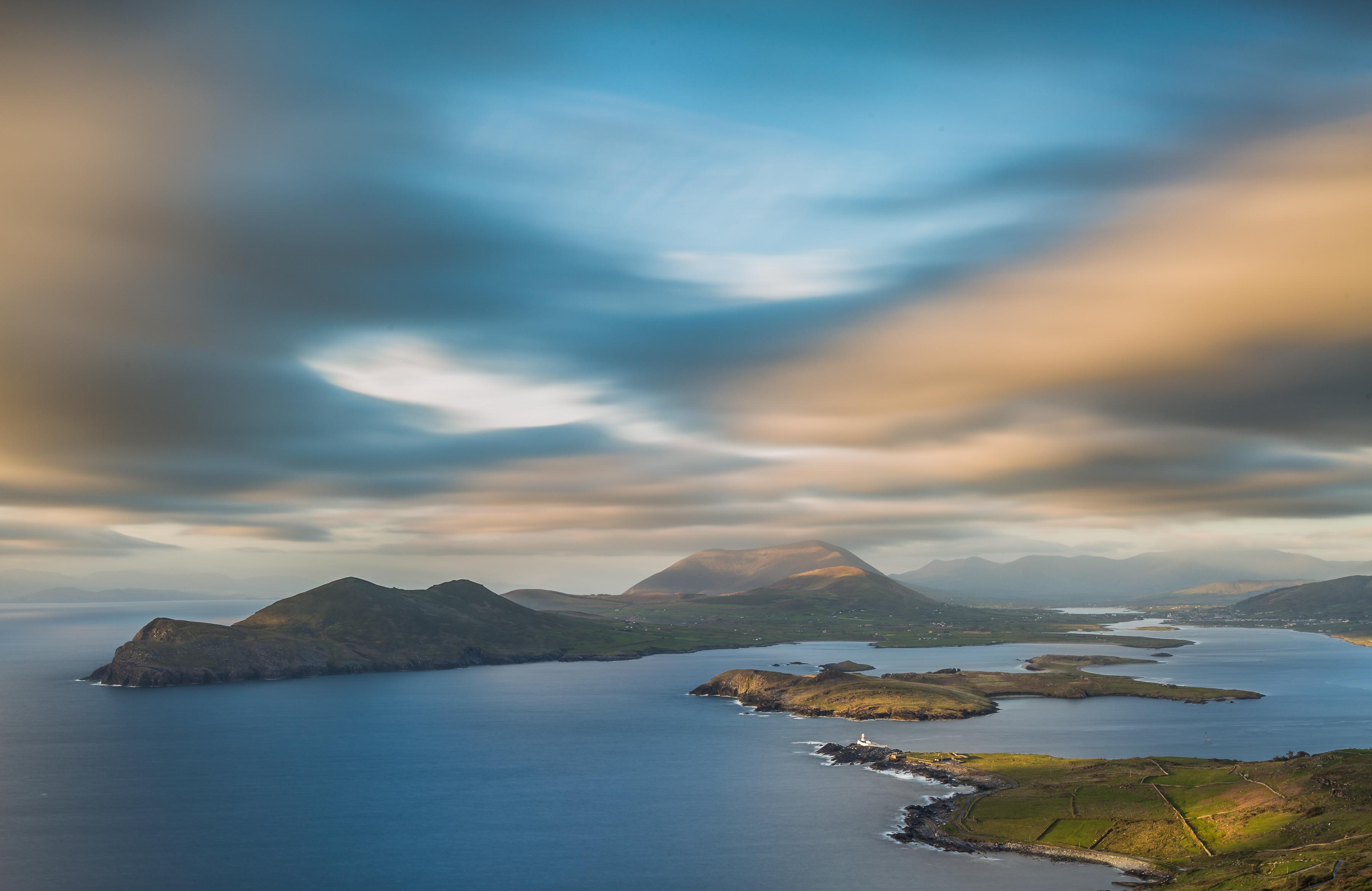
YOUR 10TH FESTIVAL E V E N T P R O G R A M M E Chamber Music on Valentia 17-20 AUG 2023 WORLDClass music on VAlentia island C H A M B E R M U S I C O N V A L E N T I A C O M
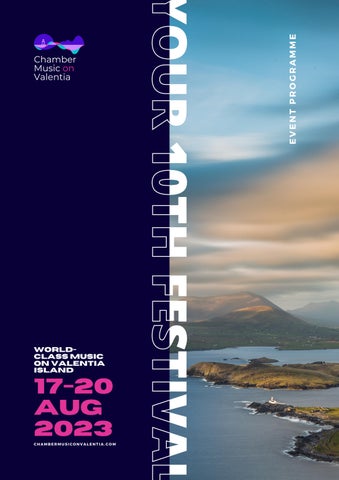
W e a r e d e l i g h t e d t o a n n o u n c e o u r 1 0 t h a n n u a l C h a m b e r M u s i c o n V a l e n t i a F e s t i v a l . W i t h c o n c e r t s , i m m e r s i v e b a s e d e x p e r i e n c e s , a n d m u s i c w o r k s h o p s , t h e r e i s s o m e t h i n g f o r e v e r y o n e a n d w e l o o k f o r w a r d t o w e l c o m i n g y o u t o t h e i s l a n d .
T h i s y e a r w i t h o u r 1 0 t h a n n i v e r s a r y c e l e b r a t i o n s w e w e l c o m e g u e s t a r t i s t s f r o m U S A , A u s t r i a , U K a n d I r e l a n d . O u r i n n o v a t i v e c u r a t o r s h i p h i g h l i g h t s i n c l u d e ; g a t h e r i n g o u r l a r g e s t e n s e m b l e e v e r t o p e r f o r m t h r e e o f B a c h ’ s m a g n i f i c e n t B r a n d e n b u r g C o n c e r t i , a p r o g r a m m e w i t h t h e c o m p e l l i n g e n s e m b l e o f f l u t e , v i o l a a n d h a r p i n C h a p e l t o w n , w e i n c l u d e m a j o r w o r k s b y B r a h m s a n d S c h u b e r t a n d s o n g s b y I r i s h f e m a l e c o m p o s e r s I n a B o y l e a n d A i l í s N í R í a i n , a n d o u r c l o s i n g c o n c e r t f e a t u r e s t h e t w i c e G r a m m y n o m i n a t e d c e l e b r a t e d v o c a l i s t I a r l a Ó L i o n á i r d T h e s e a r e o n l y s o m e o f t h e a m a z i n g m u s i c a n d p e r f o r m a n c e s y o u c a n e x p e c t T h r o u g h o u t t h e F e s t i v a l o t h e r h i g h l i g h t s a n d e n g a g e m e n t o p p o r t u n i t i e s i n c l u d e m a s t e r c l a s s e s , a n o p p o r t u n i t y t o p e r f o r m w i t h F e s t i v a l A r t i s t s , a n d t h e n o w m u c h l o v e d ‘ M u s i c a l M a p ’ o n S a t u r d a y 1 9 t h W e h a v e l a t e n i g h t c o n c e r t s o f F i d e l i o T r i o ’ s ‘ P o p A r c h i v e ’ a n d s t a r A m e r i c a n c e l l i s t S e t h P a r k e r W o o d s i n a s o l o a p p e a r a n c e a n d f e a t u r e w o n d e r f u l m u s i c i a n s M i c h a e l C o l l i n s ( c l a r i n e t ) , D a r r a g h M o r g a n ( v i o l i n ) , M a i g h r é a d M c C r a n n ( v i o l i n ) , F i o n a W i n n i n g ( v i o l a ) , R o s e R e d g r a v e ( v i o l a ) , T i m G i l l ( c e l l o ) , R o n a n D u n n e ( d o u b l e b a s s ) , D a v i d A d a m s ( h a r p s i c h o r d ) , C a t r í o n a R y a n ( f l u t e ) a n d G e r a l d i n e O ’ D o h e r t y ( h a r p ) T h i s a l l h a p p e n s w i t h i n a m u l t i t u d e o f a m a z i n g v e n u e s o n V a l e n t i a I s l a n d
W e l o o k f o r w a r d t o y o u j o i n i n g u s f o r o u r 1 0 t h F e s t i v a l t h i s A u g u s t a n d a s e v e r t h a n k o u r s u p p o r t e r s , v e n u e s , v o l u n t e e r s a n d a u d i e n c e i n m a k i n g t h i s F e s t i v a l e x i s t i n s u c h a m a g i c a l p l a c e .
M a r y D u l l e a A r t i s t i c D i r e c t o r
FRIDAY, 18 AUGUST 2023 | 7pm at Glanleam
House with Michael Collins clarinet, Darragh Morgan & Maighréad McCrann violins, Fiona Winning viola, Tim Gill cello, Ronan Dunne double bass, Megan O’Neill soprano (Young Artist) & Mary Dullea piano
Franz Schubert Der Hirt auf dem Felsen (1828) (1797-1828)
‘The Shepherd on the Rock’ for soprano, clarinet and piano
Pieces for solo piano: (1894 - 1950) White Mountain (1927), Summer Valley (1925), Bank Holiday (1925)
Ernest John Moeran
Suite from L’histoire du Soldat (1882-1971) (1918) for clarinet, violin and piano (arranged by the composer)
Igor Stravinsky
Franz Schubert
Piano Quintet in A major, (1797-1828) D.667 ‘Trout’ (1819)
Franz Schubert
Der Hirt auf dem Felsen (1828) (1797-1828)
‘The Shepherd on the Rock’ for soprano, clarinet and piano
Der Hirt auf dem Felsen was written for the great Berlin Court Opera singer Anna Milder Hauptmann and was possibly the last work that he ever wrote. And her request was for a real showstopper. The text Schubert uses is of a shepherd lamentingly waiting for spring to come so that he can see his loved one again. So, he ‘flings’ his voice into the valley and listens to the echo that returns. But when realising the real distance between him and his beloved, his sadness increases in the middle section. However, thoughts of the arrival of spring bring renewed hope and happiness, the clarinet being the ‘echo’ throughout.
Wenn auf dem höchsten Fels ich steh’, ins tiefe Tal hernieder seh’, und singe und singe, fern aus dem tiefen, dunkeln Tal schwingt sich empor der Widerhall, der Widerhall der Klüfte.
Je weiter meine Stimme dringt, je heller sie mir widerklingt, von unten, von unten. Mein Liebchen wohnt so weit von mir, drum sehn’ ich mich so heiss
When aloft to the highest crag I go, and view the valley far below, and sing there, and sing there... Up from the dusky vale I hear my ev’ry note reechoed clear, the echo from the cavern.
The further I can fling my voice, the clearer it returns to me from far below, from far below. But further still my darling dwells, in vain I long to reach her there, too far off, too far off.
nach ihr hinüber, hinüber.
Je weiter meine Stimme dringt...
Wenn auf dem höchsten Fels ich steh’...
fern aus dem tiefen, dunkeln Tal...
In tie fem Gram verzehr’ ich mich, mir ist die Freude hin, auf Erden mir die Hoffnung wich, ich hier so einsam bin, ich hier so einsam bin.
So sehnend klang im Wald das Lied
so sehnend klang es durch die Nacht, die Herzen es zum Himmel zieht mit wunder barer Macht.
Der Frühling will kommen, der Frühling meine Freud, nun mach’ ich mich fertig zum Wandern bereit,
Je weiter meine Stimme dringt, je heller sie mir widerklingt...
The further I can fling my voice...
When aloft to the highest crag I go...
Up from the dusky vale I hear...
Again in grief my strength is spent, no joy the path to cheer, no hope for me nor yet content, I live so lonely here, I live so lonely here.
The yearning in my song of love so haunts the woods by day and night. It draws the heart t’wards Heav’n above with wonder working might.
And Spring will be coming, with joys for me in store, through high summer pastures to wander once more,
The further I can fling my voice, the clearer it returns to me...
And Spring will be coming...
Der Frühling will kommen...
Je weiter meine Stimme dringt...
The further I can fling my voice...
(1894 - 1950)
White Mountain (1927)
Summer Valley (1925)
Bank Holiday (1925)
Ernest Moeran was born in Heston near London, to an Irish clergyman father and mother from Norfolk. Shortly after his birth, the family moved to the remote Norfolk Fen Country. As a child he learned to play the violin and piano and subsequently enrolled at the Royal College of Music to studied composition with Charles Villiers Stanford. He fought in World War One and after discharge, in 1920 he continued his studies at the Royal College, studying there under John Ireland. Moeran spent a considerable amount of time in Ireland, including on Valentia Island and he is buried on the outskirts of Kenmare, having died there in 1950. As well as larger scale works, he composed several pieces of chamber music for a variety of different instrumentation types. It is believed that Moeran composed twenty pieces for solo piano. The ‘White Mountain’ is known famously as ‘The Star of the County Down’. This setting effectively alters the character of the original song to a mystical contemplation, reflected in his title. ‘Summer Valley’ is more representative of Moeran’s harmonic language and dedicated to Frederick Delius. The upbeat and spirited ‘Bank Holiday’ completes this selection.
Igor Stravinsky
(1882-1971)
1. Marche du Soldat
2. Le Violon du Soldat
3. Petit Concert
4. Tango-Valse-Rag
5. La Danse du Diable
Suite from L’histoire du Soldat (1918)
(The Soldier’s Tale) for clarinet, violin and piano (arranged by the composer)
The ‘tale’ in question is taken from a collection of over 600 folk tales collected in the mid-19th century by Alexander Afanasyev,
but the text that Stravinsky uses is by Lausanne writer Charles Ferdinand Ramuz. They developed the idea of a small travelling theatre production, and this piece was originally written for a troupe of three actors (the soldier, the devil, and a narrator), two dancers and seven instrumentalists with a conductor. The first performance was in 1918 and this suite appeared the following year.
The Soldier’s Tale itself is a Faust-like story from peasant recruits to the Russo-Turkish War. Joseph returns to his village on leave (Marche du Soldat) but is accosted by the Devil, disguised an old man. Joseph agrees to give the Devil his beloved fiddle in exchange for a book that can describe the future (Le violon du Soldat). He soon realises the book’s potential financially and returns home, rich. However, three years have in fact passed. His beloved has married and has children, and his old friends turn their backs on him. The Devil of course reappears, disguised, and sells back the violin but Joseph can no longer play and throws both the violin and book away.
He is persuaded by a friend to try curing the sick daughter of the king. Yet again he is confronted by the Devil who is now taunting him at the palace as a virtuoso violinist. He goes on to play the Devil at cards, losing all his money in order to be free. Able to play the fiddle again (Petit concert) he then moves into the Princess’s bedroom (Tango-Valse-Rag) and cures her. The Devil comes back again to interrupt but Joseph protects the Princess exhausting the Devil who is eventually is dragged away (La Danse du Diable). Although the suite ends on a high note, in the original the Devil recovers and reappears to warn Joseph not to leave the bounds of the castle or he will return to his powers. Today’s suite ends here on a musical high note. But in the main piece, the Devil recovers and reappears to warn Joseph that he will return to the Devil’s power if he were ever to leave the bounds of the castle.
1. Allegro vivace
2. Andante
3. Scherzo. Presto
4. Tema con variazione. Andantino
5. Finale. Allegro giusto
The exuberant 'Trout' quintet of 1819 is the work of a master. Together with the 'Quartettsatz' written in 1820 it sets the scene for the great chamber works of his later years: in 1824 the Octet, the A minor “Rosamunde” quartet and the D minor 'Death and the Maiden'; in 1826 the G major quartet; in 1827 his two piano trios; and in his last year, 1828, the incomparable C major two-cello quintet.
The 22-year old Schubert's cellist friend Sylvester Paumgartner commissioned the 'Trout' quintet while Schubert was visiting his hometown of Steyr in Upper Austria. Paumgartner asked Schubert to include material from his 1817 song 'Die Forelle'. As their mutual friend Albert Stadler, later wrote: '[it was] the particular request of my friend Sylvester Paumgartner, who was quite taken with the delicate little song. The Quintet, according to his wish, was to adopt the structure and instrumentation of Hummel's Quintet, originally Septet, which was then still new.' Paumgartner had invited friends round to play this Hummel quintet, an arrangement, probably by Hummel himself, of the Op 74 Septet of 1816. The Allegro vivace opening flourish of the Trout quintet (illustrated) has a clear resemblance to the triplet arpeggio at the start of the Hummel quintet's Allegro second movement (illustrated). These arpeggios are major motifs of both works.
The rather curious instrumentation of the Trout quintet – adding a double-bass to the conventional piano quartet's violin, viola and cello - had been used by Hummel back in 1802 for an original piano quintet as well as for the later septet arrangement that
brought together Paumgartner's friends and spawned the Trout. The addition of the double-bass raises all sorts of possibilities for Schubert particularly in the well-known fourth movement with its variations on the 'Die Forelle' theme. It allows him for example to liberate the piano from providing the deep bass, and (in the third variation) send it off on brilliant high octave passage work while the cello and bass, also in octaves, growl the theme. They stay together for the fourth variation doing unexpectedly nimble fortissimo triplets, even finishing with that A-major triplet arpeggio that the piano flourished right at the work's opening. Happily, a related arpeggio that starts the piano accompaniment to 'Die Forelle', leaps into action in the final variation. The success of a movement consisting of variations on one of his songs may have encouraged Schubert to repeat the recipe 5 years later in the "Death and the Maiden" string quartet.
Full biographies are available on the website
Michael Collins is one of the most complete musicians of his generation. With a continuing, distinguished career as a soloist, he has in recent years also become highly regarded as a conductor. From 2010-2018 he was the Principal Conductor of the City of London Sinfonia and has recently been Artistic Director of London Mozart Players. Recent guest conducting and play-directing highlights have included engagements with the Melbourne Symphony Orchestra, BBC Symphony Orchestra and the Zurich Chamber Orchestra. Recent highlights include a return to the Philharmonia Orchestra, performances worldwide with orchestras including Minnesota Orchestra, Swedish Chamber Orchestra, the
Rheinische Philharmonie, Kyoto Symphony Orchestra, BBC Concert Orchestra and Kuopio Symphony Orchestra and tours in South Africa, Australia (with the Melbourne Symphony Orchestra), Japan and Mexico (with the Orquesta Sinfónica Nacional).
Michael celebrated his 60th Birthday in 2022 and gave commemorative concerts at Wigmore Hall and Queen Elizabeth Hall with the London Mozart Players. He was also interviewed for a double page spread in Gramophone Magazine. In January 2021 Michael gave the debut performance of new ensemble Wigmore Soloists, a new Associate Ensemble funded by the Wigmore Hall and led by Michael Collins and violinist Isabelle van Keulen. Wigmore Soloists sees leading international instrumentalists coming together to perform a wide range of chamber music repertoire, from duets to works for up to 13 musicians. The ensemble released the Schubert Octet on disc in 2021 to great acclaim (BIS Records). More recently, they have released a trios disc and recordings of Beethoven and Berwald septets.
Michael Collins has been committed to expanding the repertoire of the clarinet for many years and has received the Royal Philharmonic Society’s Instrumentalist of the Year Award in 2007 in recognition of his pivotal role in premièring repertoire by some of today’s most highly regarded composers. In great demand as a chamber musician, Collins performs regularly with the Borodin, Heath and Belcea quartets, András Schiff, Martha Argerich, Stephen Hough, Mikhail Pletnev, Joshua Bell and Steven Isserlis. His ensemble, London Winds, celebrated its thirtieth anniversary in 2018 and the group maintains a busy diary with high calibre engagements such as the BBC Proms, Aldeburgh Festival, Edinburgh Festival, City of London Festival, Cheltenham International Festival and Bath Mozartfest. During the 2019-20 season he was an Artist in Residence at the Wigmore Hall. Michael Collins records for BIS, and in his prolific recording career he has covered an extraordinarily wide range of solo repertoire, which also includes releases on Chandos, Deutsche Grammophon, Decca, EMI, and Sony. He is one of the world’s most recorded
clarinettists, having made no fewer than twenty discs for Chandos alone.
Maighréad McCrann has been the Concertmaster of the ORF Vienna Radio Symphony Orchestra since 1993. In 1997 she was appointed Professor of violin at the University of Performing Arts in Graz. During this time, she has also enjoyed a versatile career as a soloist, chamber musician and directing chamber orchestras from the violin. Her passion for teaching has resulted in many masterclasses and intense coaching with the youth orchestras of Spain, Catalunya, Columbia, the Vienna Jeunesse Orchestra and the National Orchestral Institute in Washington. Born in Dublin where she studied with Brian McNamara, she graduated from Trinity College of music in 1984 and commenced studying in Vienna with Ernst Kovacic. Further violin lessons with Sandor Vegh and David Takeno. She was a member of the Chamber Orchestra of Europe and played baroque violin with Nikolaus Harnoncourt’s Concentus Musicus. In 2020 she was appointed to the board of the Wiener Jeunesse Orchestra and became a member of the advisory committee of the Austrian National Bank for the allocation of valuable instruments. She is artistic director of the Neuberg Masterclasses in Austria. www.maighreadmccrann.com
Described by The Strad Magazine as ‘hugely impressive, he plays with seemingly effortless control’ Irish violinist Darragh Morgan was born in Belfast. Darragh has appeared as a soloist at Aldeburgh Festival, Philips Collection Washington DC, Wiener Konzerthaus, Spitalfields Festival, Osterfestival Tirol and BBC Proms Chamber Music. His numerous concerto appearances with The Ulster Orchestra include the World Premiere of ‘Hymn of Dawn’ by Sir John Tavener which he also performed with Istanbul Symphony Orchestra. With National Symphony Orchestra of Ireland, he has toured Beethoven Triple Concerto, recorded ‘Elastic Harmonic’ by Donnacha Dennehy for NMC Recordings and he has
premiered Brian Irvine’s ‘A Mon Seul Desir’. With RTÉ Concert Orchestra and London Musici/Rambert Dance Company he has given over 40 performances of ‘Tabula Rasa’ by Arvo Pärt (including in the presence of the composer). Darragh gave the South African premiere of Barber Violin Concerto with the KZN Philhamonic Orchestra. Other concerto appearances have included Kölner Kammerorchester and Cyprus Symphony Orchestra. He has collaborated with such distinguished musicians as Thomas Adès, Emmanuel Pahud, Darius Brubeck, Joanna MacGregor, John Tilbury, Mícheál Ò Súilleabháin and David Holmes.
A passionate chamber musician Darragh is founder member of ‘the virtuosic Fidelio Trio’ (Sunday Times). They were shortlisted for the Royal Philhamonic Society Awards Ensemble Prize and have received Gramophone Magazine Editor’s Choice for their recordings. The trio have appeared at prestigious venues around the globe including Shanghai Oriental Arts Centre, Wigmore Hall, Purcell Room Southbank Centre, Casa da Musica Porto, National Sawdust New York, Morrison Artist Series San Francisco, Princeton Sound Kitchen, Andy Warhol Museum Pittsburgh, National Centre for Performing Arts Mumbai, Beijing Modern Music Festival, National Concert Hall Dublin, Kilkenny Arts Festival, Brighton Festival, Cheltenham Festival, and the Vale of Glamorgan Festival. They have collaborated with actor Adrian Dunbar, writer Alexander McCall-Smith and poet Sinead Morrissey.
Darragh was for a number of years violinist with the award winning Smith Quartet, praised by The Guardian as ‘Britain’s answer to the Kronos’. He regularly leads London Sinfonietta, has appeared as leader of Ensemble Modern and with Musik Fabrik. He has worked closely with conductors including Oliver Knussen, Pierre Boulez, Francois Xavier Roth, John Eliot Gardiner, Heinz Holliger, En Shao and Paul Daniel. He has appeared as guest leader of Aurora Orchestra, The Philharmonia, RTÉ National Symphony Orchestra, Macau Orchestra, Les Siecles and Athelas Sinfonietta, Remix Ensemble, BCMG and Red Note Ensemble. Darragh directs
European Union Chamber Orchestra and 2004-2005 was Artistic Director of Baroque 2000, South Africa’s premiere period instrument ensemble. He has recorded over 50 chamber music and solo albums for NMC, Resonus, Delphian, Signum, Diatribe, Metier, Da Capo, Centaur, Naxos and Col Legno. Darragh regularly records for soundtracks at Abbey Road Studios and Air Lyndhurst Studios. Darragh plays an 1848 Giuseppe Rocca violin, generously on loan from the Morgan-Rocca Instrument Trust which is administered by The Royal Society of Musicians and a bow by Joseph Alfred Lamy.
www.darraghmorgan.com
Fiona Winning studied at the Juilliard School in New York, going on to become Principal Violist of the Royal Philharmonic and Royal Liverpool Philharmonic Orchestras. For many years she has been a regular guest principal of the London Philharmonic Orchestra (including four seasons at Glyndebourne Opera), Aurora Orchestra and Scottish Chamber Orchestra. Fiona’s orchestral activities have taken her to many of the worlds most prestigious halls and as a principal she has worked closely with eminent conductors such as Charles Dutoit, Vladimir Jurowksi, Yannick Nezet-Seguin, Gianandrea Noseda and Vasily Petrenko.
A passionate performer of contemporary music, she is a regular guest principal with the London Sinfonietta, with whom she has performed at the BBC Proms, South Bank Centre, Huddersfield Festival and in Europe and the Far East. Other highlights include George Benjamin’s Into the Little Hill at the Wigmore Hall and one of Pierre Boulez’s last conducting engagements (Stravinsky Dumbarton Oaks). She performs regularly with the Red Note Ensemble (Scotland), most recently in a nationwide tour of George Crumb’s epic electronic quartet Black Angels. Fiona was for seven years a member of the Scottish Ensemble with whom she broadcast regularly on BBC radio 3, appearing at the Edinburgh International Festival, BBC proms, Wigmore Hall, Huddersfield, Lichfield and City of London Festivals. As a session musician she
records at Abbey Road and Air studios in London, and can be heard on numerous soundtracks for film and TV.
Fiona loves the mountains, and has climbed in the Bolivian Andes, Himalayas, Alps and her local hills near Loch Lomond.
Megan O’Neill is a soprano from County Kerry. She is currently studying with Prof. Mary Brennan and Dr Andrew Synnott and is in third year of the Doctor in Music Performance Degree at the Royal Irish Academy of Music. She completed the BMus Degree in Maynooth University in 2018 and graduated with a First ClassHonours Degree. In August 2020, she completed the Masters in Music Performance Degree at the RIAM, where she also received a First Class-Honours. Most recently, Megan played the titular role of Cinderella, an opera by Alma Deutscher, at Wexford Festival Opera as part of the Wexford Factory programme. In the 2022 Feis Ceoil, Megan was the winner of the German Government Cup and the prestigious Gervase Elwes Memorial Cup. She was also awarded the 2022 RDS Music Bursary of 15,000EUR. Megan played the role of ‘Teen polar bear’ in The Scorched Earth Trilogy, a street art opera by Brian Irvine and John McIlduff, which was produced by Irish National Opera and Dumbworld Production Company in March 2022. She played the role of Signora Avoglio in All the Angels by Nick Drake, which took place in the Everyman Theatre, Cork, and Smock Alley, Dublin, from October 2021 to December 2021. She is also a company chorus member with Irish National Opera, and will be performing in Così fan tutte by Mozart in May and June 2023.
Tim Gill studied at Cambridge University, reading music (and meeting his future wife and eminent cellist Joely Koos), the Royal Academy of Music and the Banff Centre in Canada. In 1988 he was selected to play at the South Bank as part of the Park Lane Group concert series and has since enjoyed a lifelong
commitment to contemporary music. In 2001, he became Principal cellist with the Royal Philharmonic Orchestra, and two years later was made principal with the London Sinfonietta, drawing critical acclaim for his solo performances of music by Stravinsky, Xenakis and Maxwell Davies.
In 2011 he enjoyed a brief spell as principal with English National Opera, before returning the next year to the RPO. He now freelances in London, focussing on his solo and chamber music commitments while retaining his association with the London Sinfonietta. He has appeared throughout the world as a soloist, most recently at the BBC Proms and at London’s Kings Place “Cello Unwrapped” series. Tim plays on a cello by Francesco Ruggeri, dated 1695.
Ronan Dunne began his musical training as a chorister with the Palestrina choir in Dublin’s Pro-Cathedral. He then took up the double bass and aged eighteen, went on to study in London and later, in Vienna.
He spent a couple of wonderful years touring Ireland as a member of the Irish Chamber Orchestra before becoming a member of the BBC Philharmonic, where he has played since 2002 and was appointed principal bass in 2015. As well as enjoying touring to Europe and the far east, he is hugely enthusiastic about the wide variety of repertoire the orchestra performs and records each season. As a guest principal bass, he plays regularly with Scottish Chamber Orchestra, The Philharmonia Orchestra, Royal Philharmonic Orchestra, Royal Northern Sinfonia, The Hallé, Royal Scottish National Orchestra, BBC Concert Orchestra, Royal Liverpool Philharmonic and Opera North.
As a chamber musician, he has enjoyed many interesting collaborations, including regular concerts with ensemble 360 as well as such quartets as the Voglers and the Callinas. Ronan is passionate about teaching and bringing on the next generation of young bass players. He teaches, tutors and takes classes at the Royal Northern College of Music and has given masterclasses around Europe and most recently in China.
As soloist and chamber musician, Irish pianist Mary Dullea leads a diverse performance career internationally. Her frequent broadcasts include BBC Radio 3, Radio 4, RTHK, RTÉ Lyric FM, WQXR, Radio New Zealand and Sky Arts, Irish, French, Austrian and Italian television. Concerto appearances include RTÉ Concert Orchestra, RTÉ National Symphony Orchestra and KZN Philharmonic Orchestra. Of her multiple CD releases, recent collaborations include premiere recordings of Philip Glass for Orange Mountain Music and, on Divine Art Métier, solo piano music from Iran by composers Amir Mahyar Tafreshipour and Hormoz Farhat.
Mary’s piano trio, Fidelio Trio, are passionate advocates for piano trio repertoire around the world. They were shortlisted for the Royal Philharmonic Society Awards Ensemble Prize and have been Gramophone Magazine Editor’s Choice for their recordings. The trio have appeared at prestigious venues around the globe including Shanghai Oriental Arts Centre, Wigmore Hall, Purcell Room Southbank Centre, Casa da Musica Porto, Morrison Artist Series San Francisco, Andy Warhol Museum Pittsburgh, National Centre for Performing Arts Mumbai, Beijing Modern Music Festival, National Concert Hall Dublin, Kilkenny Arts Festival, Brighton Festival, Cheltenham Festival and Gümüşlük International Classical Music Festival. They have collaborated with actor Adrian Dunbar, writer Alexander McCall-Smith and poet Sinead Morrissey and constantly commission new works. Mary is the curator of Soundings (an annual UK/Austrian collaborative music festival) at the Austrian Cultural Forum London from since 2008. She has
served on the jury of ‘Schubert und die Musik der Moderne’ International Chamber Music Competition in Graz, Austria. In 2014 she founded 'Chamber Music on Valentia' an annual chamber music festival in Co. Kerry, Ireland, with the aim of bringing chamber music performances of international standing, innovative programming and engagement programmes to this unique place. Mary’s own studies were at The Royal College of Music, London on the Edith Best Scholarship, Goldsmiths, University of London (MMus) and her PhD in Performance is from Ulster University. Mary was on the piano faculty of Royal Welsh College of Music and Drama for 9 years. She previously held the position of Director of Performance at University of Sheffield and since 2015 she has held this position at Royal Holloway, University of London where she is also Professor in Music.
www.marydullea.com
To find out more about our 2023 events, please visit chambermusiconvalentia.com/our-2023-festival or call +353 (83) 096 5977
Family Concert at the Lighthouse Concert
Musical Map Live Events Experience
PRELUDE Concert with Music Generation
Bach to Folk Concert
Seth Parker Woods (cello) Late Night Solos Concert
Debussy, Takemitsu and Roussel
Flute, viola & harp
Finale with Iarla Ó Lionáird, Cormac McCarthy, Darragh
Morgan & Seth Parker Woods
11.00am | Lighthouse, Cromwell Point (Booking essential)
1:30pm – 4:30pm | All across Valentia Island
7.00pm | Church of the Immaculate Conception, Knightstown
7.30pm | Church of the Immaculate Conception, Knightstown
9.30pm | Church of the Immaculate Conception, Knightstown
1.00pm | Church of St. Dorarca and St. Teresa, Chapeltown
7.30pm | Church of the Immaculate Conception, Knightstown
W e a r e g r a t e f u l t o a l l o f o u r F r i e n d s a n d S u p p o r t e r s f o r t h e i r c o m m i t m e n t a n d c o n t r i b u t i o n s . W e a c k n o w l e d g e t h e a s s i s t a n c e o f A r t s C o u n c i l I r e l a n d , M u s i c G e n e r a t i o n K e r r y , K e r r y C o u n t y C o u n c i l , F e x c o , a n d R T É S u p p o r t i n g t h e A r t s
T h e F e s t i v a l w o u l d n o t b e p o s s i b l e w i t h o u t t h e h e l p o f s o m a n y v o l u n t e e r s o n V a l e n t i a w h o a s s i s t w i t h v e n u e s , e q u i p m e n t , a d v e r t i s i n g , a c c o m m o d a t i o n a n d a h o s t o f o t h e r b e h i n d t h e s c e n e s a c t i v i t i e s t h a t m a k e t h e F e s t i v a l r u n s m o o t h l y



F R I E N D S O F T H E F E S T I V A L
M a r g o t F e r w e r d a
R o s a l e e n O ’ M u i r c h e a r t a i g h
D a v i d a n d B r e n d a W i l k e s