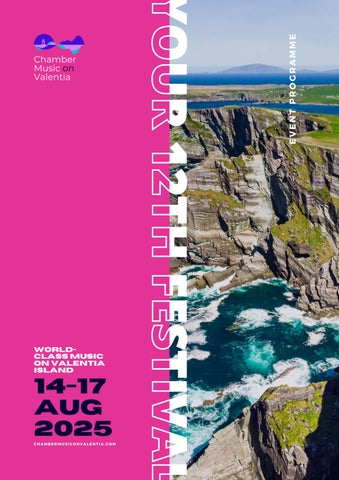
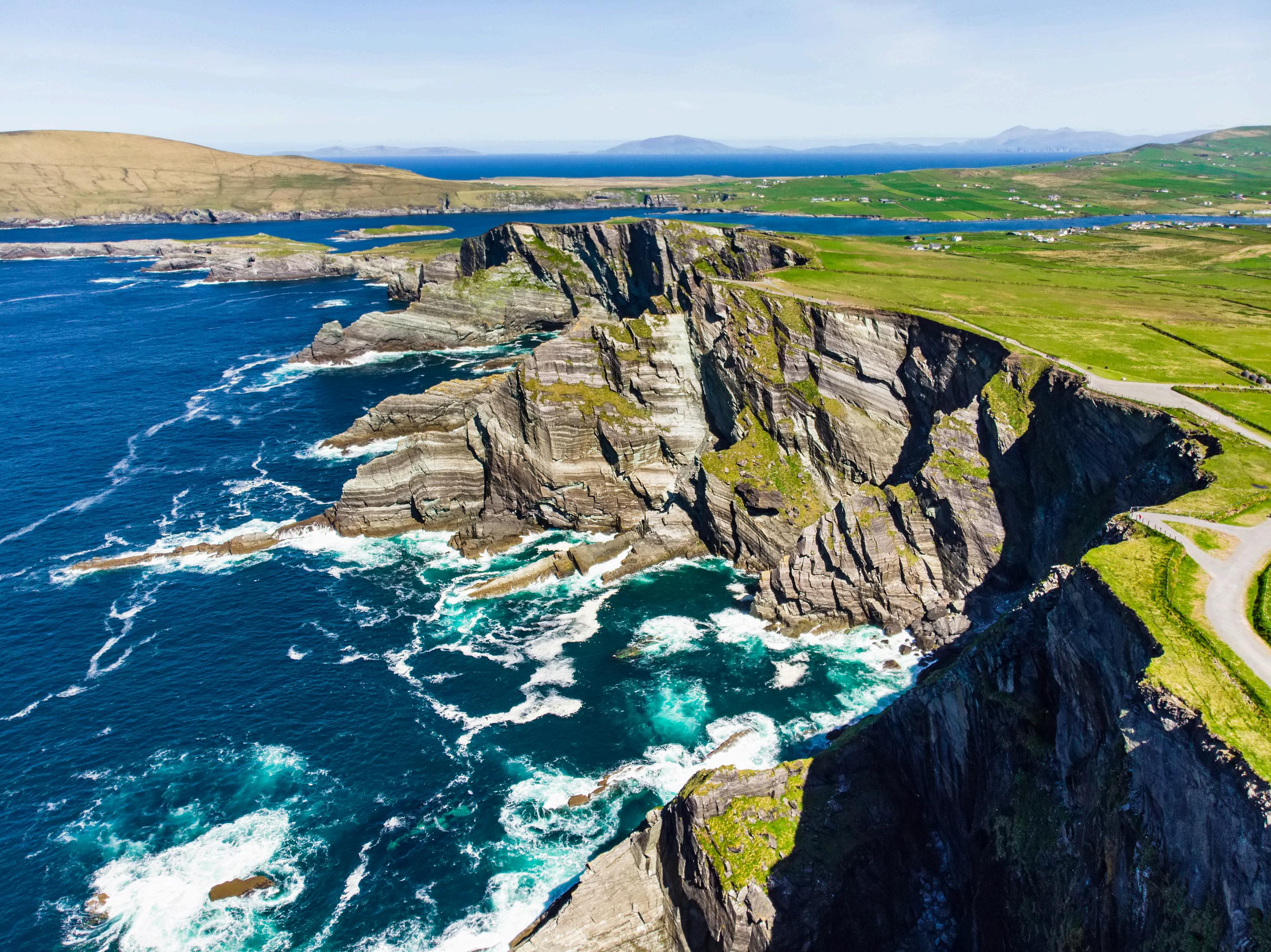
FÁILTE
W e a r e d e l i g h t e d t o l a u n c h y o u r 1 2 t h a n n u a l C h a m b e r M u s i c
o n V a l e n t i a F e s t i v a l . G o i n g f r o m s t r e n g t h t o s t r e n g t h , w e
h a v e c u r a t e d a r i c h a n d d i v e r s e p r o g r a m m e o f c o n c e r t s ,
m u s i c w o r k s h o p s , i m m e r s i v e e x p e r i e n c e s , a n d p a r t i c i p a t o r y
e v e n t s t h a t c e l e b r a t e m u s i c f r o m a l l o v e r t h e w o r l d . T h e r e ’ s
s o m e t h i n g f o r e v e r y o n e , a n d w e c a n ’ t w a i t t o w e l c o m e y o u
t o t h e i s l a n d .
W i t h g u e s t a r t i s t s f r o m t h e U S A , T a i w a n , t h e U K , a n d I r e l a n d , t h i s y e a r ’ s f e s t i v a l
f e a t u r e s e i g h t c o n c e r t s o v e r f o u r d a y s , p l u s t h e m u c h - l o v e d ‘ M u s i c a l M a p ’ o n t h e
a f t e r n o o n o f S a t u r d a y , 1 6 t h A u g u s t .
O u r o p e n i n g c o n c e r t o n T h u r s d a y , 1 4 t h A u g u s t , i s s p e c i a l l y c u r a t e d a r o u n d ‘ T h e K e r r y
P o l k a a n d M o r e ’ , c o m b i n i n g s t r i n g q u a r t e t s f r o m B o h e m i a a n d S c a n d i n a v i a w i t h s e t s
b y a c c l a i m e d I r i s h m u s i c i a n s J a c k T a l t y ( c o n c e r t i n a ) a n d U l t a n O ’ B r i e n ( f i d d l e ) T h e
S t r i n g E x t r a v a g a n z a F i n a l e o n S u n d a y , 1 7 t h A u g u s t , w i l l b e a j o y f u l c e l e b r a t i o n o f
V i v a l d i c o n c e r t i a n d o t h e r m u s i c a l g e m s W e ’ r e a l s o t h r i l l e d t o f e a t u r e K e r r y n a t i v e s
G a v a n R i n g ( t e n o r ) a n d C o r m a c H e n r y ( f l u t e ) , w h o j o i n u s t h i s y e a r . W i t h a f o c u s o n
m u s i c f r o m A s i a , w e w e l c o m e C h i a - Y i n H u n g o n t h e p i p a a n d g u q i n
C o r e t o t h e p r o g r a m m e a r e m a s t e r p i e c e s o f t h e c h a m b e r r e p e r t o i r e , i n c l u d i n g a
B r a h m s S t r i n g Q u i n t e t , M e n d e l s s o h n P i a n o T r i o , M o z a r t F l u t e Q u a r t e t , a n d m u c h
m o r e O u r a t m o s p h e r i c l a t e - n i g h t c o n c e r t s i n c l u d e ‘ S i l k a n d S t r i n g s ’ o n A u g u s t 1 4 t h
a n d t h e m e d i t a t i v e w o r k s o f P h i l i p G l a s s a n d A r v o P ä r t o n A u g u s t 1 6 . W e a r e h o n o u r e d t o w e l c o m e t h e f o l l o w i n g a r t i s t s : D a r r a g h M o r g a n ( v i o l i n ) , C h a r l e s S p r u i l l ( v i o l i n ) , J a n e A t k i n s ( v i o l a ) , A n d r e e a B a n c i u ( v i o l a ) , P e t e r A d a m s ( c e l l o ) , A d r i a n M a n t u ( c e l l o ) , G a v a n R i n g ( t e n o r ) , C o r m a c H e n r y ( f l u t e ) , C h i a - Y i n H u n g ( p i p a / g u q i n ) , J a c k
T a l t y ( c o n c e r t i n a ) , a n d U l t a n O ’ B r i e n ( f i d d l e ) . t h
T h i s y e a r ’ s f e a t u r e d I r i s h c o m p o s e r i s S i o b h á n C l e a r y , a n d a s a l w a y s , w e p r o u d l y s u p p o r t Y o u n g A r t i s t s a n d e n c o u r a g e c o m m u n i t y e n g a g e m e n t t h r o u g h o u r f e s t i v a l p r o g r a m m e . A l l o f t h i s t a k e s p l a c e a c r o s s a v a r i e t y o f u n i q u e v e n u e s o n b e a u t i f u l
V a l e n t i a I s l a n d . W e l o o k f o r w a r d t o w e l c o m i n g y o u t h i s A u g u s t f o r o u r 1 2 t h F e s t i v a l .
A s e v e r a h u g e t h a n k y o u t o o u r s u p p o r t e r s , v e n u e s , v o l u n t e e r s a n d a u d i e n c e i n m a k i n g t h i s F e s t i v a l e x i s t i n s u c h a m a g i c a l p l a c e .
M a r y D u l l e a A r t i s t i c D i r e c t o r
FESTIVAL FINALE STRING EXTRAVAGANZA
SUNDAY, 17 AUGUST 2025 | 7.30pm at Church of Immaculate Conception, with Darragh
Morgan violin Chase Spruill violin Siobhan Doyle violin Jane Atkins viola Andreea Banciu viola Peter Adams cello Adrian Mantu cello & Mary Dullea continuo, plus our Young Festival Artists Orla McGarrity and Katie Ni Mhaolain
EVENT PROGRAMME
William Boyce: Symphony No. 4 in F major
Georg Philipp Telemann: Viola Concerto in G major (Jane Atkins, solo viola)
Georg Philipp Telemann: Concerto for 4 violins in D major, TWV 40:202
INTERVAL
Francesco Geminiani: Concerto Grosso Op. 3 No 1
Antonio Vivaldi: Cello Concerto in D major Op. 3 No. 9 (Adrian Mantu, solo cello)
Antonio Vivaldi: ‘Summer’ from Le Quattro Stagioni (Darragh Morgan, solo violin)
PROGRAMME NOTES
William Boyce: Symphony No. 4 in F major
William Boyce’s eight symphonies are not only the most well known and most recorded of all his works, but are also probably amongst the most famous, most played and most loved of any English Baroque musical work. They were first published by John Walsh (Handel’s publisher) in 1760 but each one was in fact composed over the previous 21 years as either an ode to a vocal or stage work or as an overture.
This was originally composed as the overture to ‘The Shepherd’s Lottery’ – a pastoral opera with words by Moses Mendez (1690-1758) which opened at the Drury Lane Theatre on 19th November 1751. Although following on from The Chaplet it was less successful. It was performed at the Three Choirs Festival in Hereford in 1753 – now the world’s longest-running classical music festival. It was published by John Walsh in 1750. The title page stated:
THE SHEPHERDS LOTTERY, A MUSICAL ENTERTAINMENT
As it is Perform’d at the Theatre Royal in Drury Lane.
Compos’d by Dr. Boyce.
London. Printed for I. Walsh in Catherine Street in the Strand.
Georg
Philipp Telemann: Viola Concerto in G major (Jane Atkins, solo viola)
1. Largo
2. Allegro
3. Andante
4. Presto
Of Georg Philipp Telemann's surviving concertos, his Viola Concerto in G major, TWV 51:G9 is among his most famous, and still regularly performed today. It is the first known concerto for viola and was written circa 1716–1721. Telemann focused on composing for lesserknown instruments, resulting in the composition of this Viola Concerto. Telemann's Concerto for Viola represents a major Baroque concerto, as he explored the soloistic sound of the instrument, allowing it to be viewed as more than just an ensemble instrument. Unlike J.S. Bach and Vivaldi's standard concerti of three movements, Telemann's Concerto in G major for Viola contains four movements, and follows sonata da chiesa form, alternating between the tutti and solo sections, a common practice during this period.
Georg Philipp Telemann: Concerto for 4 violins in D major, TWV 40:202
1. Adagio
2. Allegro
3. Grave
4. Allegro
Georg Philipp Telemann gave us one of the richest legacies of instrumental music from the eighteenth century. Though considered a definitive contribution to the genre during his lifetime, his concertos, sonatas, and suites were then virtually ignored for nearly two centuries following his death. Yet these works are now among the most popular in the baroque repertory. In Music for a Mixed
Taste, Steven Zohn considers Telemann's music from stylistic, generic, and cultural perspectives. He investigates the composer's cosmopolitan "mixed taste" - a blending of the French, Italian, English, and Polish national styles - and his imaginative expansion of this concept to embrace mixtures of the old (late baroque) and new (galant) styles.
Georg Philipp Telemann's Concertos for Four Violins (TWV 40:201–204; original title: Concertos à 4 Violini Concertati) is a set of four concertos for four violins without continuo. Each concerto has four movements.
Francesco Geminiani: Concerto Grosso Op. 3 No. 1
1. Adagio
2. Allegro
3. Adagio
4. Allegro
The Italian violinist and composer Francesco Geminiani belongs to the generation of Bach and Handel. He studied in Rome with the violinist-composer Arcangelo Corelli and the opera-composer Alessandro Scarlatti. In 1714 he moved to London, where he soon established himself as a performer and composer, later publishing a number of theoretical works on performance techniques and on harmony. He visited Ireland on various occasions and died in Dublin in 1762.
Following the example of his teacher, Geminiani wrote a number of sets of Concerti grossi, works for string orchestra, with a small solo group consisting of two violins and basso continuo, with the addition of a viola.
Antonio Vivaldi: Cello Concerto in D major Op. 3 No. 9
(Adrian Mantu,
solo cello)
Strangely for someone who wrote more concertos for solo cello than anyone else in history - the most recent calculation puts their number at twenty-eight - Vivaldi is not known to have been a player of the instrument. His virtuosity on the violin was supreme, and his playing of the viola d’amore evoked admiration. In addition, he taught an instrument named the viola inglese, which recent research has identified as the viol. But of Vivaldi as cellist we learn nothing. One infers that he had a good working knowledge of the instrument, since he writes for it with such expertise. Moreover, he had an unrivalled feeling for the ‘soul’ of the cello, its capacity to express both hilarity and pathos.
Solo parts for cello in concertos go right back to the origins of the genre in northern Italy in the last decades of the seventeenth century. There are no concertos written exclusively for cello without further soloists (normally, one or more violins) before the earliest ones by Vivaldi, which date from the first decade of the eighteenth century. Vivaldi continued to write cello concertos almost up to his death in 1741, and the general tendency over this long period is for the lyrical dimension to expand at the expense of the passagework, which itself also evolves by becoming more diverse and inventive. The lyrical passages in the fast outer movements of his concertos in fact prefigure the ‘singing Allegro’ style of the Classical period later in the same century.
The initial stimulus towards Vivaldi’s composition of cello concertos was doubtless his activity, from 1703 onwards, as director of instrumental music at the Ospedale della Pietà, Venice’s famous home for abandoned children. Because most of the female wards of the Pietà remained at the institution into adulthood, whereas its male wards departed at the age of eighteen, it was rational to train only the girls in musical skills. So successful was the Pietà as a musical academy, using as its tutors partly masters brought in from outside and partly its own senior musicians, that its choir and orchestra
became renowned throughout Europe, earning many donations and legacies for the Pietà and enhancing its status as an exemplary charitable institution.
Antonio Vivaldi: ‘Summer’ from LeQuattroStagioni (Darragh Morgan, solo violin)
1. Allegro non molto
2. Adagio
3. Presto, tempo impetuoso d'estate
In 1725, when Spring, Summer, Fall, and Winter were published as the first four concertos of Vivaldi’s Op. 8 (the title “Four Seasons” was not yet used), they were viewed as crazy modern music, or facile curiosities, or tasteless gimmickry, or the way of the future, and pretty much everything in between. Antonio Vivaldi (1678-1741) was as controversial and polarizing a figure in his time as Beethoven and Wagner in theirs.
The feature of the Four Seasons that drew the most positive and negative attention when they were new was the one aspect that was largely ignored when, after two centuries of obscurity, they started to get played again in the 1950s and 1960s: their pictorial literalness. Vivaldi included a sonnet for each concerto explaining what was going on, supplying not just descriptions, but performance instructions. The sonnet verses are printed not only as prefaces to each concerto, but also in all the instrumental parts, in the midst of tempo and dynamic markings. This is something that can pass unnoticed by the modern audience, which consists of listeners who aren’t looking at the music on the page. But in Vivaldi’s day the audience for his publications consisted mostly of accomplished amateur players, who could play the Four Seasons with as many players as could gather around the part-books, or as few as six, as the highlight of a social gathering. They would have been keenly aware that the sounds they were making represented specific scenes.
In Summer, the opening bars present the “merciless summer sun” and sweltering “man and flock.” In the first solo, the violin is an ornamented cuckoo – it’s the soloist’s task to make the cuckoo’s notes distinct in a barrage of semiquaver notes. The second solo depicts the turtledove and goldfinch, and rustling of the gentle zephyr breeze, which is joined by the violent north wind. The wind subsides long enough to let us hear how it makes a shepherd fear a coming storm, his agitated state depicted in a sequence of chromatically descending diminished chords – dissonances that lead to other dissonances instead of resolving. The second movement depicts the gentle, buzzing insects, and the shepherd listening with apprehension to distant thunder. The third movement brings the long-awaited storm.
ARTIST BIOGRAPHIES
Full biographies are available on our website. You can scan this QR code on your phone or tablet to take you straight there:
SUPPORT US
Chamber Music on Valentia is most grateful to our Friends and Supporters who, through their contributions, help us to continue and develop our work in this Festival.
We would like to invite additional friends to help support the festival this year as we return to an in-person experience on Valentia Island. Supporting Chamber Music on Valentia will develop an association with an already far-reaching annual event with real creative potential in this special region and on this special island. It builds on the history and pride of place that continues to attract world-class innovations and the people who make them happen. By joining us as a sponsor you will not only be able to avail of the benefits offered but will be joining our team, helping to continue the growth of this exciting and culturally unique Festival.
Our sponsorship packages are listed on our website at www.chambermusiconvalentia.com and we would be delighted to add your name to the list of one our offerings.
Please get in touch with our Festival Team if you would like to discuss any aspect of the above, by emailing info@chambermusiconvalentia.com.
We also look forward to welcoming you to our 2026 festival, so why not pop the date in your diary now? Join us Thursday 13th to Sunday 16th August 2026.
GO RAIBH MAITH AGAT
W e a r e g r a t e f u l t o a l l o f o u r F r i e n d s a n d S u p p o r t e r s f o r t h e i r c o m m i t m e n t a n d
c o n t r i b u t i o n s W e a c k n o w l e d g e t h e a s s i s t a n c e o f A r t s C o u n c i l I r e l a n d / A n
C h o m h a i r l e E a l a í o n , R T É S u p p o r t i n g t h e A r t s , K e r r y C o u n t y C o u n c i l /
C o m h a i r l e C o n t a e C h i a r r a í , F e x c o , M u s i c G e n e r a t i o n K e r r y , a n d t h o s e
c o n t r i b u t o r s w h o w i s h t o r e m a i n a n o n y m o u s .
T h e F e s t i v a l w o u l d n o t b e p o s s i b l e w i t h o u t t h e h e l p o f s o m a n y v o l u n t e e r s o n
V a l e n t i a w h o a s s i s t w i t h v e n u e s , e q u i p m e n t , a d v e r t i s i n g , a c c o m m o d a t i o n a n d
a h o s t o f o t h e r b e h i n d t h e s c e n e s a c t i v i t i e s t h a t m a k e t h e F e s t i v a l r u n
s m o o t h l y
OUR PRINCIPAL PARTNERS



OUR FRIENDS AND SUPPORTERS
M a r g a r e t a n d D e n i s D u l l e a
M a r g o t F e r w e r d a
R o s a l e e n O ’ M u i r c h e a r t a i g h
P r o f e s s o r É a m a n n a n d M r s M a r y B r e a t h n a c h
D a v i d a n d B r e n d a W i l k e s
M a r i e - C l a i r e S t a c e y