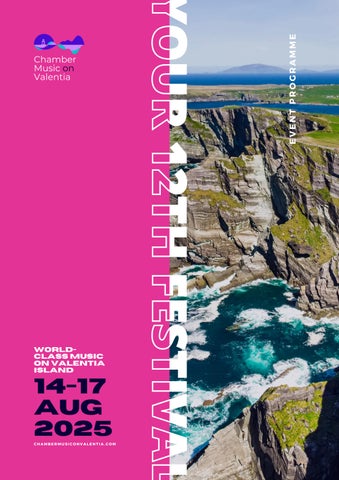

FÁILTE
W e a r e d e l i g h t e d t o l a u n c h y o u r 1 2 t h a n n u a l C h a m b e r M u s i c
o n V a l e n t i a F e s t i v a l . G o i n g f r o m s t r e n g t h t o s t r e n g t h , w e
h a v e c u r a t e d a r i c h a n d d i v e r s e p r o g r a m m e o f c o n c e r t s ,
m u s i c w o r k s h o p s , i m m e r s i v e e x p e r i e n c e s , a n d p a r t i c i p a t o r y
e v e n t s t h a t c e l e b r a t e m u s i c f r o m a l l o v e r t h e w o r l d . T h e r e ’ s
s o m e t h i n g f o r e v e r y o n e , a n d w e c a n ’ t w a i t t o w e l c o m e y o u
t o t h e i s l a n d .
W i t h g u e s t a r t i s t s f r o m t h e U S A , T a i w a n , t h e U K , a n d I r e l a n d , t h i s y e a r ’ s f e s t i v a l
f e a t u r e s e i g h t c o n c e r t s o v e r f o u r d a y s , p l u s t h e m u c h - l o v e d ‘ M u s i c a l M a p ’ o n t h e
a f t e r n o o n o f S a t u r d a y , 1 6 t h A u g u s t .
O u r o p e n i n g c o n c e r t o n T h u r s d a y , 1 4 t h A u g u s t , i s s p e c i a l l y c u r a t e d a r o u n d ‘ T h e K e r r y
P o l k a a n d M o r e ’ , c o m b i n i n g s t r i n g q u a r t e t s f r o m B o h e m i a a n d S c a n d i n a v i a w i t h s e t s
b y a c c l a i m e d I r i s h m u s i c i a n s J a c k T a l t y ( c o n c e r t i n a ) a n d U l t a n O ’ B r i e n ( f i d d l e ) T h e
S t r i n g E x t r a v a g a n z a F i n a l e o n S u n d a y , 1 7 t h A u g u s t , w i l l b e a j o y f u l c e l e b r a t i o n o f
V i v a l d i c o n c e r t i a n d o t h e r m u s i c a l g e m s W e ’ r e a l s o t h r i l l e d t o f e a t u r e K e r r y n a t i v e s
G a v a n R i n g ( t e n o r ) a n d C o r m a c H e n r y ( f l u t e ) , w h o j o i n u s t h i s y e a r . W i t h a f o c u s o n
m u s i c f r o m A s i a , w e w e l c o m e C h i a - Y i n H u n g o n t h e p i p a a n d g u q i n
C o r e t o t h e p r o g r a m m e a r e m a s t e r p i e c e s o f t h e c h a m b e r r e p e r t o i r e , i n c l u d i n g a
B r a h m s S t r i n g Q u i n t e t , M e n d e l s s o h n P i a n o T r i o , M o z a r t F l u t e Q u a r t e t , a n d m u c h
m o r e O u r a t m o s p h e r i c l a t e - n i g h t c o n c e r t s i n c l u d e ‘ S i l k a n d S t r i n g s ’ o n A u g u s t 1 4 t h
a n d t h e m e d i t a t i v e w o r k s o f P h i l i p G l a s s a n d A r v o P ä r t o n A u g u s t 1 6 . W e a r e h o n o u r e d t o w e l c o m e t h e f o l l o w i n g a r t i s t s : D a r r a g h M o r g a n ( v i o l i n ) , C h a r l e s S p r u i l l ( v i o l i n ) , J a n e A t k i n s ( v i o l a ) , A n d r e e a B a n c i u ( v i o l a ) , P e t e r A d a m s ( c e l l o ) , A d r i a n M a n t u ( c e l l o ) , G a v a n R i n g ( t e n o r ) , C o r m a c H e n r y ( f l u t e ) , C h i a - Y i n H u n g ( p i p a / g u q i n ) , J a c k
T a l t y ( c o n c e r t i n a ) , a n d U l t a n O ’ B r i e n ( f i d d l e ) . t h
T h i s y e a r ’ s f e a t u r e d I r i s h c o m p o s e r i s S i o b h á n C l e a r y , a n d a s a l w a y s , w e p r o u d l y s u p p o r t Y o u n g A r t i s t s a n d e n c o u r a g e c o m m u n i t y e n g a g e m e n t t h r o u g h o u r f e s t i v a l p r o g r a m m e . A l l o f t h i s t a k e s p l a c e a c r o s s a v a r i e t y o f u n i q u e v e n u e s o n b e a u t i f u l
V a l e n t i a I s l a n d . W e l o o k f o r w a r d t o w e l c o m i n g y o u t h i s A u g u s t f o r o u r 1 2 t h F e s t i v a l .
A s e v e r a h u g e t h a n k y o u t o o u r s u p p o r t e r s , v e n u e s , v o l u n t e e r s a n d a u d i e n c e i n m a k i n g t h i s F e s t i v a l e x i s t i n s u c h a m a g i c a l p l a c e .
M a r y D u l l e a A r t i s t i c D i r e c t o r
LUNCHTIME CONCERT
MOZART MEETS THE PIPA
SUNDAY, 17 AUGUST 2025 | 1.00pm at Church of St. Dorarca and St. Teresa, Chapeltown, with Chia-Yin
Hung pipa Cormac Henry flute Darragh Morganviolin Chase Spruill violin Jane Atkins viola Peter Adams cello
EVENT PROGRAMME
Wolfgang Amadeus Mozart: Flute Quartet in D major, K. 285
Traditional Chinese music arr. for flute and pipa
Traditional Chinese music for pipa
Tan Dun: Concerto for Pipa and String quartet, Movement 2
PROGRAMME NOTES
Wolfgang Amadeus Mozart: Flute Quartet in D major, K. 285
The years 1777 and 1778 were among the most disillusioning of Mozart’s life. On reaching his 21st birthday, he realized that he could no longer trade on his reputation as a wunderkind. The easiest course would have been to settle down like his father as a court musician in Salzburg, his hometown, but the ruling archbishop was a petty man of limited musical taste. Mozart asked for leave to perform at other courts, but the archbishop refused, saying he did not want his servants running around like beggars. In desperation, Mozart resigned and accompanied by his mother, he set off on a tour of several European cities to find a new post as a composer, teacher or instrumentalist.
The tour was largely a disaster. First in Munich, and then in Augsburg, Mannheim, Paris and Strasbourg, Mozart was welcomed by audiences and other musicians, but he found no patrons interested in paying permanently for his services. In Mannheim, then the instrumental capital of Europe, he spent several months composing and performing but was unable even to gain admittance to the Elector’s palace. Then in Paris, his mother became ill and died in his arms. Finally, in January 1779, he returned to Salzburg, depressed and with a foretaste of the financial hardships that were to dog him the rest of his life.
While the primary purpose of the trip was frustrated, it was brightened by a few commissions for new works. One such commission came in Mannheim in December 1777, from a wealthy Dutch merchant whom Mozart called “De Jean” probably a corruption of “Dejong.” An amateur flutist, Ferdinand De Jean offered Mozart 200 gulden to write “three short, simple concertos
and a couple of quartets for the flute,” the latter being works for flute plus three strings.
Mozart found the commission an uphill battle, writing his father: “It is not surprising I’ve been unable to finish all the pieces for Monsieur De Jean. I never have a single quiet hour here, so that I can only compose in the late hours of the night. Then, of course, I cannot get up early as well. Besides, one is not always in the mood for working. I could, to be sure, scribble off things the whole day long, but a composition of this kind goes out into the world, and naturally I do not want to be ashamed of my name on a title page. Moreover, you know I become quite powerless whenever I must write for an instrument I cannot bear!”
Eventually, Mozart delivered one new concerto for the flute, a second adapted from an existing oboe concerto, one quartet of three movements, and one shorter quartet of two movements. In return, De Jean paid only 96 of the 200 gulden. K. 285 is the threemovement quartet. Whether Mozart truly disliked the flute or was merely making an excuse for indolence, the instrument did not inspire him in the same degree as the piano, the violin and later the clarinet. The flute quartets are more divertimentos than serious chamber works, with an emphasis on casual entertainment rather than subtle musical thought. In his quartet writing, moreover, Mozart had not yet learned from Haydn how to give equal attention to each of the four parts, and here, as might be expected, the flute overshadows the strings.
The first movement of K. 285, allegro, is in the usual sonata form, but with a lovely dip into the minor mode in the development, and the third movement is a tuneful rondo. The strongest movement by far is the adagio; only 35 measures long, it was described by Alfred Einstein, Mozart’s biographer, as “of the sweetest melancholy, perhaps the most beautiful accompanied solo ever written for the flute.”
Copyright © 2012 by Willard J. Hertz
Tan Dun: Concerto for Pipa and String quartet, Movement 2
Concerto for String Orchestra and Pipa is derived from Tan Dun's theatre piece Ghost Opera. Set in four movements to be performed without pause, the piece opens with elements of minimalism, includes different styles of American dance rhythms, uses Bach quotations, and highlights Chinese elements drawn out of the pipa solos.
Ghost Opera is a five-movement work for string quartet and pipa with water, metal, stones, and paper. The composer describes this work as a reflection on human spirituality, which is too often buried in the bombardment of urban culture and the rapid advances of technology. It is a cross-temporal, cross-cultural, and cross-media dialogue that touches on the past, present, future, and the eternal; employs elements from Chinese, Tibetan, English, and American cultures; and combines performance traditions of the European classical concert, Chinese shadow puppet theatre, visual art installations, folk music, dramatic theatre, and shamanistic ritual.
In composing Ghost Opera, Tan was inspired by childhood memories of the shamanistic "ghost operas" of Chinese peasant culture. In this tradition, which is over 4,000 years old, humans and spirits of the future, the past, and nature communicate with each other. Tan's Ghost Opera embraces this tradition, calling on the spirits of Bach (in the form of a quotation from the Prelude in Csharp minor from Book II of The Well-Tempered Clavier), Shakespeare (a brief excerpt from The Tempest), ancient folk traditions, and earth/nature (represented by the Chinese folk song "Little Cabbage"). The Bach excerpt acts, the composer says, as "a seed from which grows a new counterpoint of different ages, different sound worlds, and different cultures." In the final movement, the gradual transformation of the counterpoint brings the spirits of Bach and Shakespeare, the civilized world, and the rational mind, "this insubstantial pageant," into the eternal earth. The
installation employs paper, shadow, and water gong basins placed around the performing space. The performers' movements among the different positions reflect the back-and-forth movement between different time frames and spiritual realms that is characteristic of the "ghost opera" tradition.
Ó Composer’s note
ARTIST BIOGRAPHIES
Full biographies are available on our website. You can scan this QR code on your phone or tablet to take you straight there:

SUPPORT US
Chamber Music on Valentia is most grateful to our Friends and Supporters who, through their contributions, help us to continue and develop our work in this Festival.
We would like to invite additional friends to help support the festival this year as we return to an in-person experience on Valentia Island.
Supporting Chamber Music on Valentia will develop an association with an already far-reaching annual event with real creative potential in this special region and on this special island. It builds on the history and pride of place that continues to attract world-class innovations and the people who make them happen. By joining us as a sponsor you will not only be able to avail of the benefits offered
but will be joining our team, helping to continue the growth of this exciting and culturally unique Festival.
Our sponsorship packages are listed on our website at www.chambermusiconvalentia.com and we would be delighted to add your name to the list of one our offerings.
Please get in touch with our Festival Team if you would like to discuss any aspect of the above, by emailing info@chambermusiconvalentia.com.
JOIN US AT OUR UPCOMING EVENTS
SUNDAY, 17 AUGUST 2025
When Mozart met the Pipa
String Extravaganza Finale
1.00pm | Church of St. Dorarca and St. Teresa, Chapeltown
7.30pm | Church of the Immaculate Conception
To find out more about our 2025 events, please visit www.chambermusiconvalentia.com/your-2025-festival/ or call +353 (83) 096 5977
SAVE THE DATE
We also look forward to welcoming you to our 2026 festival, so why not pop the date in your diary now? Join us Thursday 13th to Sunday 16th August 2026
GO RAIBH MAITH AGAT
W e a r e g r a t e f u l t o a l l o f o u r F r i e n d s a n d S u p p o r t e r s f o r t h e i r c o m m i t m e n t a n d
c o n t r i b u t i o n s W e a c k n o w l e d g e t h e a s s i s t a n c e o f A r t s C o u n c i l I r e l a n d / A n
C h o m h a i r l e E a l a í o n , R T É S u p p o r t i n g t h e A r t s , K e r r y C o u n t y C o u n c i l /
C o m h a i r l e C o n t a e C h i a r r a í , F e x c o , M u s i c G e n e r a t i o n K e r r y , a n d t h o s e
c o n t r i b u t o r s w h o w i s h t o r e m a i n a n o n y m o u s .
T h e F e s t i v a l w o u l d n o t b e p o s s i b l e w i t h o u t t h e h e l p o f s o m a n y v o l u n t e e r s o n
V a l e n t i a w h o a s s i s t w i t h v e n u e s , e q u i p m e n t , a d v e r t i s i n g , a c c o m m o d a t i o n a n d
a h o s t o f o t h e r b e h i n d t h e s c e n e s a c t i v i t i e s t h a t m a k e t h e F e s t i v a l r u n
s m o o t h l y
OUR PRINCIPAL PARTNERS





OUR FRIENDS AND SUPPORTERS
M a r g a r e t a n d D e n i s D u l l e a
M a r g o t F e r w e r d a
R o s a l e e n O ’ M u i r c h e a r t a i g h
P r o f e s s o r É a m a n n a n d M r s M a r y B r e a t h n a c h
D a v i d a n d B r e n d a W i l k e s
M a r i e - C l a i r e S t a c e y