
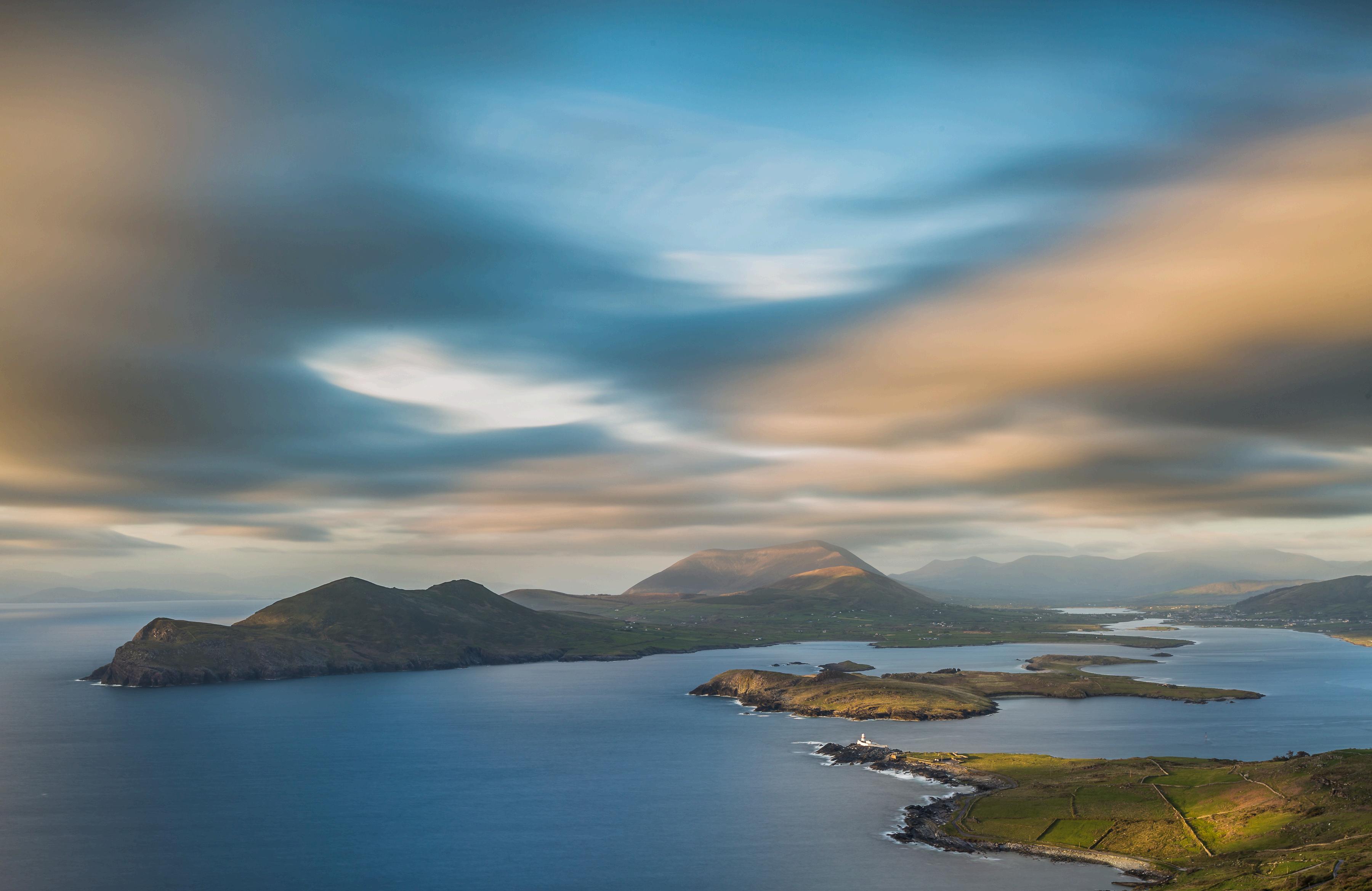
FÁILTE
W e a r e d e l i g h t e d t o a n n o u n c e o u r 1 1 t h a n n u a l C h a m b e r
M u s i c o n V a l e n t i a F e s t i v a l . F o l l o w i n g o u r l a n d m a r k 1 0 t h
a n n i v e r s a r y i n 2 0 2 3 , w e h a v e a p u t t o g e t h e r a
p r o g r a m m e o f c o n c e r t s , m u s i c w o r k s h o p s , i m m e r s i v e -
b a s e d e x p e r i e n c e s a n d p a r t i c i p a t i o n o p p o r t u n i t i e s t h a t
c e l e b r a t e m u s i c f r o m a l l o v e r t h e w o r l d .
T h e r e i s s o m e t h i n g f o r e v e r y o n e a n d w e l o o k f o r w a r d t o w e l c o m i n g y o u t o t h e i s l a n d .
W i t h g u e s t a r t i s t s f r o m S w i t z e r l a n d , N e t h e r l a n d s , U K a n d I r e l a n d o u r i n n o v a t i v e
c u r a t o r s h i p h i g h l i g h t s i n c l u d e : ‘ F o u r S e a s o n s o n V a l e n t i a ’ w h e r e w e c l o s e t h e f e s t i v a l
w i t h a l l o f V i v a l d i ’ s ‘ F o u r S e a s o n s ’ ; a f o c u s o n h a r p s w i t h t h e s t u n n i n g H A R P L A N D b y
R u t h W a l l a n d G r a h a m F i t k i n t a k i n g u s o n a j o u r n e y t h r o u g h t h e a g e s ; W e s t A f r i c a n
k o r a p l a y e r a n d c e l l i s t , T u n d e J e g e d e ; g e m s o f t h e c h a m b e r r e p e r t o i r e i n c l u d i n g
B o r o d i n , B e e t h o v e n , B r a h m s , M o e r a n . T h e o p e n i n g c o n c e r t w a r m l y w e l c o m e s b a c k
D u o S i n g e r & F i s c h e r f r o m S w i t z e r l a n d w i t h m u s i c f o r c e l l o a n d g u i t a r f r o m B a c h t o t h e s i g h t s a n d s o u n d s o f S p a i n . G r á i n n e M u l v e y i s o u r f e a t u r e d I r i s h c o m p o s e r a n d a s e v e r w e a r e d e l i g h t e d t o s u p p o r t Y o u n g A r t i s t s t h r o u g h o u r p r o g r a m m e s a n d o p p o r t u n i t i e s .
T h r o u g h o u t t h e F e s t i v a l o t h e r h i g h l i g h t s a n d e n g a g e m e n t o p p o r t u n i t i e s i n c l u d e
m a s t e r c l a s s e s , a n o p p o r t u n i t y t o p e r f o r m w i t h F e s t i v a l A r t i s t s , a n d t h e n o w m u c h
l o v e d ‘ M u s i c a l M a p ’ o n S a t u r d a y 1 7 t h . W e h a v e l a t e n i g h t c o n c e r t s o f t h e u n i q u e
m u s i c o f E r i c S a t i e i n t h e ‘ S a t i e H o u r ’ a n d T u n d e J e g e d e ‘ s ‘ T e s t i m o n y ’ f e a t u r i n g t h i s
a r t i s t o n k o r a a n d c e l l o . W e f e a t u r e w o n d e r f u l a r t i s t s D a r r a g h M o r g a n ( v i o l i n ) ,
E l i s a b e t h P e r r y ( v i o l i n ) , K e i t h P a s c o e ( v i o l i n ) , C a r m e n F l o r e s ( v i o l a ) , S é b a s t i e n S i n g e r
( c e l l o ) , A n d r é F i s c h e r ( g u i t a r ) , R u t h W a l l ( h a r p s ) , G r a h a m F i t k i n ( e l e c t r o n i c s ) , T u n d e
J e g e d e ( k o r a / c e l l o ) , O r l a C h a r l t o n ( a c t o r ) . A l l o f t h i s h a p p e n s w i t h i n a m u l t i t u d e o f
u n i q u e v e n u e s o n V a l e n t i a I s l a n d .
W e l o o k f o r w a r d t o y o u j o i n i n g u s f o r o u r 1 1 t h F e s t i v a l t h i s A u g u s t i n a r a n g e o f
u n i q u e v e n u e s o n V a l e n t i a I s l a n d . A s e v e r t h a n k y o u t o o u r s u p p o r t e r s , v e n u e s , v o l u n t e e r s a n d a u d i e n c e i n m a k i n g t h i s F e s t i v a l e x i s t i n s u c h a m a g i c a l p l a c e .
M a r y D u l l e a A r t i s t i c D i r e c t o r
MAJESTIC QUARTETS
Friday, 16 AUGUST 2024 | 7.30pm at Church of the Immaculate
Conception, Knightstown with Darragh Morgan violin Elisabeth Perry violin Carmen Flores viola André Fischer cello Mary Dullea piano
PROGRAMME
Alexander Borodin
String Quartet No 2 in D major (1833 – 1887)
1. Allegro moderato
2. Scherzo. Allegro
3. Notturno (Nocturne): Andante
4. Finale: Andante – Vivace
Alexander Borodin was a remarkable man. Always interested in and talented at music, he spent most of his career as an academic chemist. He became a Professor in St Petersburg in 1864 and conducted important research in organic chemistry. Tall and good looking he spoke four European languages and was an ardent advocate of women’s rights and education. In 1872 he helped found the first University course in Russia for female doctors. He had a passionate marriage to an eminent pianist, Ekatarina Protopopova. They had no children themselves but adopted children in need. He also composed some of the most glorious music of the second half of the nineteenth century.
Borodin was one for the Mighty Handful of Russian composers who laid the foundations for the later achievements of Russian music. Most of them composed little chamber music but for Borodin it was a lifelong interest. He started to compose and play chamber music at home while a teenager. He played the cello while his best friend played the violin. They both played the piano.
The Second Quartet, composed in the summer of 1881, was dedicated to his wife to celebrate twenty years of marriage. All four movements are in sonata form. The first movement opens with the mellifluous main theme on the cello. The first violin takes over and the two instruments pass the theme back and forth until the violin introduces the more robust second subject. This is then played by violin and cello together. All the instruments interplay a four-note motif as the opening comes to an animated conclusion. The development begins again on the cello which is answered by the violin. The viola also takes part in the thematic development and finally the second violin as well. The music slows for the start of the recapitulation. The movement ends quietly with the viola repeating the four-note motif
The Scherzo is built around a busy first subject where the first note of each bar is strongly emphasised. The second theme is a glorious waltz-like tune played by both first and second violins. The harmonies here (and in other parts of the quartet) mix lushness with astringency. At times it almost sounds like Mahler.
The famous (and much copied) third movement is a wonderful Nocturne. The sumptuous opening tune is introduced by the cello with a throbbing second violin and viola before being taken up by the violin. The second theme begins with an upward scale followed by a descending sequence of trills. This is played by the violins in turn. In the development the upward scale is used as an introduction to the main theme which is now played by all four instruments After the viola has had its turn, Borodin constructs a canon with the cello leading and the first violin following a beat behind. He repeats this idea with the first violin leading and the second violin again a beat behind. The viola and cello provide a tremolo and pizzicato accompaniment respectively. The effect is wonderfully passionate and romantic. It is hard not to think of lovers lying entwined on a warm summer night (of which more below).
The Finale begins with a brief slow introduction made up two different phrases. The first is played by the violins; the second, a more serious motif, by the viola and cello. The movement proper begins introduced by pizzicato cello and taken up by all the instruments in turn almost like a train gathering speed. The slow introduction returns at the beginning of the development, the viola and cello playing the first vivace and the two violins playing the second andante. Finally, the slow introduction returns for a final time played by all four instruments in unison at the start of the recapitulation.
Russian critics have constructed a programme for the whole quartet. They argue that the cello stands for Borodin and the first violin for Protopopova. The first movement describes their meeting, the second with its waltz like theme their courtship. Their passion is consummated in the third movement and in the finale what? Normal life resumes perhaps
It is true that in the first and third movements the cello often introduces themes which are then taken up by the first violin. But this does not invariably happen, and it does not happen at the climax of the third movement If you are writing a quartet for your wife on the occasion of your wedding anniversary, the inclusion of a passionate and romantic slow movement seems quite natural. The marvel here is quite how romantic and passionate the third movement actually is. The rest of the quartet is abstract music. The whole quartet is beautifully constructed and is one of the great pieces of chamber music of its time.
This quartet was the last major work Borodin completed. After all he had plenty of other things to do. He died six years later of a sudden heart attack at a ball in St Petersburg. He had the good manners to complete an energetic waltz before dying almost immediately. Protopopova died six months later. Although Borodin’s scientific work is not entirely forgotten, his music and, especially this Second Quartet, will continue to delight audiences for a very long time.
Ernest J. Moeran
String Trio ‘Allegretto giovale’ (1894
– 1950)
In a letter to Warlock written in November 1930, Moeran stated: “I have started a String Trio and if I can keep it up I hope the purgative effect of this kind of writing may prove permanently salutary… It is an excellent discipline in trying to break away from the mush of Delius-like chords… Perhaps some good has come of being abed and unable to keep running to the keyboard for every bar.”
The first two fruits of this came in the Sonata for Two Violins of that year, which to a certain extent might be seen as the technical exercise in composition which enable Moeran to complete the String Trio itself – there is evidence to suggest he has started the Trio before the Sonata. Certainly, there are similarities between the two, but ultimately it is the String Trio which stands as his first mature masterpiece.
The Trio may have gained a shot of unexpected – and unwanted – inspiration on 17th December 1930, when Warlock committed suicide by gas poisoning. The death of his dear friend was an immense blow to Moeran, who from then on would go out of his way to avoid mentioning Warlock. Did Moeran instead put his thoughts into music with the Strong trio, which contains some of the darkest and bleakest music in his output? Whilst there is no documentary evidence to suggest a deliberate link to Warlock in the music, it is certainly an interpretation worthy of examination. The opening movement, whilst ostensibly pastoral and often bright, is frequently shadowed by something darker and more restless. Could Moeran be hinting at the regular bouts of depression from which his friend suffered and which he frequently witnessed?
Grainne Mulvey
Interference Patterns (b. 1966) for solo piano
“My music is increasingly concerned with a sense of place - with the natural world and mankind's relationship with that world.”
Gráinne Mulvey’s music has been performed and broadcast across the globe. She has been the recipient of many awards, commissions and honours. She has represented Ireland twice at the ISCM World Music Days in 2008, and 2009 and at the International Rostrum of Composers in 1994 and 2006.
RTÉ National Symphony Orchestra has commissioned many pieces, and her work featured in the Horizons Series in 2015 and in 2007. Her work has also been performed by the Lithuanian National Symphony Orchestra, The Northern Sinfonia, UK, The Hradrec Králové Orchestra, Prague, The Romanian Radio Chamber Orchestra and Orchestre National De Lorraine, France. The Dublin International Piano Competition has commissioned a test piece for May 2015 and she is currently writing a piece for Chamber Choir Ireland, to be premiered in 2016 to commemorate the centenary of the Easter Rising 1916.
She is Head of Composition at the DIT Conservatory of Music and Drama. She is also a member of the AIC, IAWM, IMRO, Donne In Musica, Italy and Aosdána, Ireland’s organisation of creative artists. Her music is published by Babel Scores, France and Prairie Dawg Press, New York. She has given several seminars on her music and has been involved in several outreach projects.
Interference Patterns (2014), a piano piece commissioned for the Dublin International Piano Competition, captures the essence of John Tyndall - physicist, explorer, poet, and cultural icon - and his research into diffraction, unfolding as variations on a ground theme that shifts through different registers and harmonic spectra.
Johannes Brahms Piano Quartet No 1 in G minor Op. 25 (1833 - 1897)
1. Allegro
2. Intermezzo: Allegro ma non troppo Trio: Animato
3. Andante con moto
4. Rondo alla Zingarese: Presto
A twenty-eight-year-old Brahms wrote his ambitious Piano Quartet No. 1 in G Minor in 1861. The third composition in what would become an oeuvre of some twenty-six chamber music masterworks, the quartet enjoys a fine reputation in
- 4 -
no small part because of the vigorously effective Gypsy Rondo itself. No less than Arnold Schoenberg found the quartet worthy of his own orchestral transcription. The finale is indeed a tour-de-force of rhythmic and melodic bravado where the sectional form of the rondo serves as a brilliant vehicle for dynamic contrast of the very sort found in traditional Hungarian dances and Bartók's rhapsodies. In the main refrain, Brahms employs a characteristic 2/4 metre, swift with a stomping dactyl accent on the first beat, a mirror of the Hungarian language that tends to accent the first syllable of each word (as in the words "Kodály" and "Bartók"). In subsequent episodes, Brahms creates fleet and ringing piano textures as if to intentionally evoke the sound of the cimbalom, a hammered dulcimer commonly found in Hungary and Romania, particularly among the Gypsies. Brahms leverages a rather subtle and intricate rondo structure for a calculated drama delivering the wild escalation and unbridled release of our most thrilling conception of the "Gypsy Style." Needless to say, Brahms precedes the Gypsy rondo with three marvellous and expansive movements provoking additional commentary for which there is no more space available. As it has done for nearly over one hundred and fifty years, the quartet is left to speak eloquently for itself.
ARTIST BIOGRAPHIES
Full biographies are available on the website
DARRAGH MORGAN VIOLIN
Described by The Strad Magazine as ‘hugely impressive, he plays with seemingly effortless control’ Irish violinist Darragh Morgan was born in Belfast. A renowned exponent of contemporary music, Darragh has appeared as a soloist at Aldeburgh Festival, Philips Collection Washington DC, Wiener Konzerthaus, Spitalfields Festival, Osterfestival Tirol and BBC Proms Chamber Music. His numerous concerto appearances with The Ulster Orchestra include the World Premiere of ‘Hymn of Dawn’ by Sir John Tavener which he also performed with Istanbul Symphony Orchestra. With National Symphony Orchestra of Ireland he has toured Beethoven Triple Concerto, recorded ‘Elastic Harmonic’ by Donnacha Dennehy for NMC Recordings and he has premiered Brian Irvine’s ‘A Mon Seul Desir’. With RTÉ Concert Orchestra and London Musici/Rambert Dance Company he has given over 40 performances of ‘Tabula Rasa’ by Arvo Pärt (including in the presence of the composer).
ELISABETH PERRY VIOLIN
The versatile British violinist Elisabeth Perry is widely acclaimed for her contributions to all facets of the musical métier. Applauded for her virtuosity in the standard repertoire, an avid proponent of contemporary music, a committed chamber musician, dedicated pedagogue and an internationally renowned concertmaster, Ms. Perry has reaped unanimous praise for her ability to convey urgency while emphasizing the distinctive lyrical and dramatic qualities in a large repertoire.
CARMEN FLORES VIOLA
Carmen Flores is a musician dedicated to creating new pathways for experiencing and performing classical music. From 2007 – 2019 Carmen was Principal Viola of the Royal Ballet Sinfonia, performing with the orchestra across the UK and abroad for the Birmingham Royal Ballet. Carmen has performed as soloist and Guest Principal Viola with orchestras and ensembles including English National Opera, Canadian Opera Company, Orchestra of the Swan, English Chamber Orchestra, Britten Sinfonia, Sinfonia VIVA, BBC Concert Orchestra and the European Union Chamber Orchestra.
SÉBASTIEN SINGER CELLO
Sébastien Singer, who has been passionate about chamber music since early childhood, became a natural cellist with the Swiss Piano Trio in 2000. From then on, he was involved in the artistic rise of the ensemble, with which he won successively the 1st prize of the International Competition of Caltanissetta (I), the 1st prize of the International Brahms Competition (A) and the coveted Swiss Ambassador’s Award. After sixteen years of international career in over fifty countries on all continents, numerous record releases and hundreds of concerts in halls such as the Wigmore Hall in London, the Tonhalle Zurich, the Victoria Hall in Geneva, the Concert Gebouw in Amsterdam, the Great Hall of the Tchaikovsky Conservatory in Moscow and many others, Sébastien Singer decided in 2016 to end his activity in the Swiss Piano Trio.
MARY DULLEA PIANO
As soloist and chamber musician, Irish pianist Mary Dullea performs internationally at venues including London’s Wigmore Hall, Casa da Musica (Porto), Shanghai Oriental Arts Centre, Phillips Collection Washington D.C., Symphony Space New York City, Palazzo Albrizzi Venice (Italy), Johannesburg Music Society and National Concert Hall Dublin. Festival appearances include City of London, Cheltenham, St. Magnus International Festival, Huddersfield, Aldeburgh, Sound Scotland as well as Lodi Festival (Italy), TRANSIT Festival (Leuven) and National Arts Festival (South Africa). Her frequent broadcasts include BBC Radio 3, Radio 4, RTHK, RTÉ Lyric FM, WNYC, Radio New Zealand and Sky Arts, Irish, French,
- 6 -
Austrian and Italian television. Concerto appearances include RTÉ Concert Orchestra, RTÉ National Symphony Orchestra and KZN Philharmonic Orchestra
MORE EVENTS
FRIDAY, 16 AUGUST 2024
The Satie Hour Concert
SATURDAY, 17 AUGUST 2024
Musical Map Live Events Experience
Celebration of Kerry Concert
HARPLAND Concert
Testimony with Tunde Jegede Late Night Solos Concert
SUNDAY, 18 AUGUST 2024
Lunchtime with Harps & Strings Concert
Finale: Four Seasons on Valentia Concert
9.30pm | Church of the Immaculate Conception, Knightstown
From 2.00pm | All across Valentia Island
6.00pm | Church of the Immaculate Conception, Knightstown
7.30pm | Church of St. John the Baptist, Knightstown
9.30pm | Church of the Immaculate Conception, Knightstown
1.00pm | Church of St. Dorarca and St. Teresa, Chapeltown
7.30pm | Church of the Immaculate Conception, Knightstown
To find out more about our 2024 events, please visit chambermusiconvalentia.com/our-2024-festival or call +353 (83) 096 5977
GO RAIBH MAITH AGAT
W e a r e g r a t e f u l t o a l l o f o u r F r i e n d s a n d S u p p o r t e r s f o r t h e i r c o m m i t m e n t a n d
c o n t r i b u t i o n s W e a c k n o w l e d g e t h e a s s i s t a n c e o f A r t s C o u n c i l I r e l a n d / A n
C h o m h a i r l e E a l a í o n , R T É S u p p o r t i n g t h e A r t s , K e r r y C o u n t y C o u n c i l /
C o m h a i r l e C o n t a e C h i a r r a í , F e x c o , M u s i c G e n e r a t i o n K e r r y , E m b a s s y o f
S w i t z e r l a n d i n I r e l a n d , a n d S w i s s A r t s C o u n c i l .
T h e F e s t i v a l w o u l d n o t b e p o s s i b l e w i t h o u t t h e h e l p o f s o m a n y v o l u n t e e r s o n
V a l e n t i a w h o a s s i s t w i t h v e n u e s , e q u i p m e n t , a d v e r t i s i n g , a c c o m m o d a t i o n a n d
a h o s t o f o t h e r b e h i n d t h e s c e n e s a c t i v i t i e s t h a t m a k e t h e F e s t i v a l r u n
s m o o t h l y
OUR PRINCIPAL PARTNERS





OUR FRIENDS AND SUPPORTERS
F R I E N D S O F T H E F E S T I V A L
M a r g a r e t a n d D e n i s D u l l e a
M a r g o t F e r w e r d a
R o s a l e e n O ’ M u i r c h e a r t a i g h
D a v i d a n d B r e n d a W i l k e s