This publication is intended for information purposes only and the information herein should not be applied to specific fact circumstances without the advice of counsel.
The Canadian Bar association, British Columbia Branch represents more than 6,400 B.C. members and is dedicated to improving and promoting access to justice, reviewing legislation, initiating law reform measures and advancing and improving the administration of justice.
BarTalk Publication Sales agreement #40741008
re SPONS e TO TH e OCTOB er i SSU e
Comments on Tony Wilson’s October Column
Reality Cheque: Tony Wilson
Just a quick note to tell you how much I enjoyed your “Reality Cheque” article in the recent BarTalk. It mirrored the time when my two girls were graduating high school and how proud that they were both bright and at the same time, very nice people. I also reflected that the teachers who shepparded them through school deserved a large measure of credit for that result. They are now 36 and 32 and still really nice people. Thanks for the reminder!
— George Pellatt FH&P Lawyers
Wow, thank-you. Such a com- pliment to all teachers. I wish more adults had your appreciation of the work that teachers do. If I may, I’m going to forward your link to some of my colleagues. This is a really busy time for many of us and we need this kind of support as we struggle to meet so many demands.
— Pam Guilbault
Sara: “That’s a great article – I’m going to take it to school and post it on my bulletin board.”
John: “But it’s still not funny.”
— Anonymous
I continue to read and laugh with your column every month. Do you think I could count it toward my CLE hours?
— Barbara Norell Harper Grey
Damn good article in the Octo- ber BarTalk. Glad to hear you are still holding the very worst aspects of the legal profession at bay! We are a small but gallant band....
— Geoff Moyse
I always enjoy your articles, but I really enjoyed the “Reality Cheque” in BarTalk, having three little ones, the oldest just in Grade 1.
— Karen Carteri Partner, Lang Michener LLP
Letters to the
Tarbotton
Senior editor
Bar association B.C. Branch Fax: 604-669-9601 Toll-free fax: 1-877-669-9601 email: jtarbotton@bccba.org
Note: BarTalk undertakes every effort to publish letters to the editor, subject to space and editorial discretion. Letters to the editor can also be found in BarTalk Online at www.cba.org/bc.
Inside This Issue
It’s unavoidable; British Columbia is on a collision course with the 2010 Winter Olympics. In a few short months, athletes and spectators will transform B.C.’s host cities and our courts will fall silent. In this issue we interview one of Canada’s most medalled athletes; lawyer and Olympian, Tricia Smith and feature a diversity of articles, reflective of the wide scope of this profession: Patricia Jordan discusses the impact of technology on our privacy; Walter Rilkoff and Amir Ghahreman examine the ethics of negotiation and Frank Sanitate and Douglas Gillies provide insight into what your paralegal really thinks
News and Events
17 2010 Mid-Winter Meeting in Ottawa
Proposed anti-Spam Legislation is Overbroad
CBa Welcomes extension of ei Benefits to Selfemployed Persons
18 New Chief Justice of the Supreme Court of B.C. Land Title and Survey authority
19 Boughton/BCLi great Debate recap annual Bench & Bar Dinner recap goals for the equality & Diversity Committee
20 Two interventions at the Supreme Court of Canada Update to Code of Professional Conduct
CLeBC Update
21 Legislative Update
Branch & Bar Calendar
Laptop Searches at the Border: New U.S. guidelines
22 CBaBC/UVic-UBC Mentoring receptions
CBaBC Work Life Balance
From t he President
Ja M e S M. B OND
The
Value of a Good Education
lack of understanding results in lack of confidence.
We regularly read and hear about the public’s lack of confidence in the justice system – the foundation upon which the rest of our society’s institutions function. We are told that the public has the same level of esteem for lawyers as they do for used car salesmen. Judges and their decisions are regularly criticized in and through the media. Police are likened to either mall security guards on the one hand, or thugs on the other.
Yet those of us who operate within the Canadian justice system know that while it is not perfect, it is without a doubt one of the best justice systems in the world. Government officials, judges, lawyers and law enforcement agencies from around the world come to Canada to learn how our system
works. Every day our justice system puts guilty people behind bars, frees innocent people, welcomes individuals who deserve to become new Canadians, sends back those who don’t and awards damages to people who have been injured. So why the disconnect?
There are undoubtedly a myriad of reasons. However, I believe that chief among them is a lack of education – and therefore, a lack of understanding – about the justice system. I fear that members of the public do not have an adequate understanding of the underlying principles of our justice system, including the need to uphold the rule of law and ensure the proper administration of justice. I worry that they do not distinguish between the roles that each of the players within the system has, which ensure that a proper outcome is achieved. I am particularly concerned that we aren’t taking the time to teach our youngest members of society about these things. We shouldn’t be
surprised when people don’t have confidence in a system they either don’t understand or they misapprehend.
include the role of the justice system in Canada in the educational programs taught in British Columbia schools.
The British Columbia Branch is concerned about this increasing lack of public confidence and has commissioned a study to identify some of the key reasons why there is a growing gap in confidence. While the results of the report are yet to be released, I can tell you that the study points to a significant connection between the lack of understanding about our justice system and the level of confidence in it.
In my view, lawyers, judges and law enforcement personnel all need to take responsibility in educating the public – not just about our own roles within the justice system, but about how the system as a whole works. Currently, some stakeholders in the justice system (including the Canadian Bar Association) are working on secondary education curriculum proposals which would
Unfortunately, one of the best tools the justice system has had for teaching the importance of the justice system (and in particular the role of the courts) to students in this province has been gutted. The Justice Education Society, which until now has run extremely successful court visits and school outreach programs across the province, has had its funding cut by 62 per cent – from $500,000 to $110,000. Without proper funding of the Justice Education Society, we will have lost one of our best educational tools for combating lack of confidence in the justice system.
Lamenting the problem of lack of public confidence is not enough. Neither is simply responding to criticism when it is levelled at the system. Lawyers, judges, law enforcement and governments need to be proactive. Restoration of the funding to the Justice Education Society would be a good (but small) first step.
James m. Bond president@bccba.org
executive director
The Headlong Rush to December 31 The facts about Professional Development requirements.
By December 31, every practicing lawyer must complete at least 12 hours of Professional Development (PD) in accredited educational activities. No less than two of the 12 hours must pertain to any combination of professional responsibility and ethics, client care and relations, or practice management. If the annual requirement of 12 hours is not met by December 31, the Law Society will charge a late fee of $200. If the requirement is not met by April 1 of the following year, the Law Society will impose a suspension until all required PD is completed. Note: CBABC is providing extra courses to help you meet the requirement in time if you haven’t already.
Although the rules are made by the Law Society, CBA staff do get a lot of questions about the new requirements
so I thought it might be helpful to outline some basic things that are important to know, as well as some exciting new changes that will allow mentoring to qualify as an approved PD activity as of January 1, 2010.
First, the key points: The topic must be of significant 1. intellectual or practical content with the primary objective of increasing the professional competence of lawyers, paralegals, articling students and/ or law students; it must deal primarily with substantive, procedural, ethical, practice management (including client care and relations) or skills topics related to the practice of law; and it must be primarily designed and focused for an audience that includes primarily lawyers, paralegals, articling students and/or law students but not if the subject matter is targeted primarily at clients, the public, other professions or other students.
There must be more 2. than one person involved, either inperson, online or on the telephone, so that there can be discussion and/or a Q&A session. CBA Section meetings and CBA 3. approved PD events count, as do other events by “approved” providers (visit lawsociety.bc.ca to see a list). You can also organize your own self-study group, Bar association PD or internal firm activity, either by registering with the Law Society or by partnering with the CBA (we have packaged modules, specifically designed to meet the 2-hour ethics requirement.
The Law Society created three 4. very useful online courses with testing components that count: the Small Firm Practice Course, Practice Refresher Course and Communications Toolkit. Teaching a law-related course 5. counts three hours for every one hour taught. This includes for
audiences other than lawyers, law students and paralegals if it is “a continuing professional education or licensing program for another profession, or a post-secondary educational program.” Note: CLEBC and Sections Chairs always welcome volunteer presenters. Time spent writing 6. law books or articles for publication counts as long as it is related to the study or practice of law (including articles in BarTalk!). If you are ever in 7. doubt about whether a PD activity will be approved, talk to the Law Society staff about it at 604-669-2533 or toll free 1-800-903-5300.
The Law Society will allow some kinds of mentoring activity to count for up to six hours of PD credits as of January 1, 2010. The CBABC Women Lawyers Forum has had a mentoring program for years – contact cba@bccba.org or visit online at cba.org/bc under Professional Development. And don’t forget that your CBA PD and Section meeting hours are automatically listed online at cba.org/bc/PD to make your Law Society reporting easy!
caroline nevin cnevin@bccba.org
nothingofficial
TONY W i LSON
Barristers, Solicitors and Zombies We’ve
become
Zombies to the Billable Hour.
i’m tired of trying to figure out if a telephone call was a “point 1” or a “point 2,” and whether confirming an appointment, or advice given over lunch is recordable. I’m tired of trying to figure out how to bill the $8,000 my competitors are charging for an agreement that, due to my own efficiencies and experience, might only take $2,000 in time to produce. And I’m fed up with having to deal with $13,000 worth of Work-In-Progress that the client is only prepared to pay $6,000 for. I. Hate. Billable. Hours.
I asked someone at my old exploded firm 24 years ago “Is thinking about a file during the shower recordable?” “Yes,” I was told. “Write it down, when you’re dry.” “What about during sex?” I asked, quite sarcastically. “Write it down when you’re dry.” A Seattle lawyer told me 20 years ago that all lawyers at his firm were instructed to record their time in the
bathroom as “Boeing Time;” Boeing being the firm’s biggest client. The quest for billable hours is so endemic in practice, it leads us to docket all sorts of things we’d never expect to pay for if we were paying the legal bills ourselves. When I speak to young lawyers at other firms about the practice of law, they always speak dazzlingly about the number of hours they have to put in, as opposed to the dollars that those hours represent, as if the hours were an end unto themselves. They aren’t dollars, as many defunct U.S. law firms discovered over the past year. They’re something else, like derivatives, credit swaps, hedge funds and other forms of securitization that might turn into dollars or might not. Billable hours are like smoke, wafting in the air. Whether the quota is 1600 hours or 2000 hours, using billable hours as a measure of performance is like the kid being more interested in the box than the Christmas gift. Face it, we’re addicted to billable hours the same way junkies
value the nouns, verbs and adjectives differently. In fact, differential rates might become the standard, so that nouns, verbs, adverbs and adjectives have a higher value than mere prepositions.
are addicted to drugs, or the western world is addicted to oil. Sometimes, I wonder if we’re all Zombies and the quest for the billable hours has created this Billable Hour Zombieland we all work in.
I say we dispense with the billable hour altogether and start basing our billing practices on the billable word. It’s not tied to time, so, we might be more efficient. It’s tied to something of value that actually relates to the work that’s produced.
Perhaps solicitors will finally have a leg up on their litigation brethren because the litigators, despite working weekends and evenings, can be chastised at partner’s meetings for not being up to their “billable word quota.”
Value billing is hard enough to justify to clients in the current billable hour regime, (especially after the Inmet Mining case), but it would be quite straightforward in a billable word model; simply
There would never be a discussion with a client accusing the lawyer of “padding time” or taking too long on a project because time will be up to the lawyer. The only billing issue the client could conceivably complain about would be whether the job took too many words. “Well, what words would you have omitted?” strikes me as an easier sell. And in any billing dispute with a client, you can always agree to not charge for certain words to reduce the account and make the client happy. “OK… we’ll deduct all the prepositions; and the four uses of the word “narly!”
Mind you, it won’t take the London, New York and Toronto firms very long to see the real value of the billable word model: the billable syllable! The billable letter! The billable punctuation mark! And my favourite; the billable space! Wacky, yes. But is it any wackier than the billing model we currently use?
Yes, this is in fact, tony’s picture, but only at month end when he has to bill his hours. if you’d like to see the picture of tony BarTalk rejected, check out his Facebook page!
The Use of Technology How technology impacts privacy.
each day numerous companies create records about our personal habits. Our detailed personal information is used in ways that may surprise many, and while most of the purposes for gathering that information are benign, what is questionable is that the person whose information is being collected may be unaware of this process. Loyalty programs are marketing initiatives that reward and encourage loyal buying behaviour by providing discounts or points. While many shoppers are aware that loyalty cards are used to compile profiles of their shopping habits, they may be unaware that this data is often shared with third-parties. Most large retailers collect personally-identifying information from customers when they apply for a loyalty card. Personally-identifying information includes your name, ad-
dress, birth date, bank account, credit card number, telephone number and other information by which you can be identified. The use of radio-frequency identification (RFID) technology in loyalty cards raises privacy concerns, as the owner may be unaware of the RFID tag and that it can be read at a distance without the knowledge or consent of the individual.
In April 2006, Thomas Wellinger was sentenced to 19 to 30 years after pleading guilty to seconddegree murder in Michigan. Oakland County Prosecutor Ken Frazee stated that Thomas Wellinger was traveling at approximately 70 MPH when he crashed his SUV into the back of a Honda, killing Judith Weinstein and her sons. Crucial evidence about his driving habits was gathered from his vehicle’s event data recorder (EDR). The EDR captures what happens in an automobile in the seconds before and after an airbag is released. The EDR indicated that the engine throttle speed was heavily engaged
and for the five seconds prior to impact there was no attempt at breaking. The information gathered from the EDR was considered as crucial to the case against Wellinger.
In the future, a minor technological adjustment to the EDR could enable it to monitor the speed and driving habits of individuals, allowing police to issue speeding tickets without being present and to affect automobile insurance rates. While many know that Internet searches are stored in databases, many are unaware of how a cellphone’s tracking device can be used to remotely activate the microphone in a cellphone, allowing someone to eavesdrop on a conversation, or that a GPS vehicle tracking device can be used to track vehicle movement. Many businesses now monitor employees online through tracking service websites. GPS vehicle tracking devices send signals to an office computer pinpointing the location of vehicles in real time.
I asked Chris Bennett, a partner at Davis LLP who specializes in technology and privacy law, about how these new technologies impact privacy. In his words: “There is a constant tension between privacy law and new technology. For example, Google Street View is a fantastic way to get familiar with a foreign city before you travel there, but it also captures images of people on private property who did not consent to having their images appear online. Likewise, Facebook has become an enormously popular way to connect with people, but the amount of personal information collected and disclosed through Facebook is staggering and potentially dangerous. Canadian privacy law is able to address these issues, which is clear from the fact that Facebook has agreed to revise its privacy practices in response to a report issued by the Canadian privacy commissioner’s office. Tech companies therefore need to consider and address these privacy issues as part of their legal due diligence prior to commercializing their products and services.”
Patricia Jordan is the cBABc Web manager. she welcomes your comments, questions and suggestions. tel: 604-646-7861; email: pjordan@ bccba.org; visit: www.cba.org/bc.
Benefiting from Social Media The cost of silence in a social world.
r Reach out and touch – Somebody’s hand – Make this world a better place – If you can… r – Music and lyrics by N. Ashford & V. Simpson, recorded by Diana Ross.
gartner Research just issued their top 10 strategic technologies that companies should be considering as they prepare their business plans for the New Year. “Social Computing” has come back to the top 10 list after an absence over the last two years. Gartner stated:
“Social Software and Social Networking. Social software includes a broad range of technologies, such as social networking, social collaboration, social media and social validation. Organizations should consider adding a social dimension to a conventional website
or application and should adopt a social platform sooner, rather than later, because the greatest risk lies in failure to engage and thereby, being left mute in a dialogue where your voice must be heard.” (http://www. gartner.com/it/page.jsp?id=777212)
But wait one minute: how many law firms permit their staff to have access to social media while at their desk? Larger and many smaller law firms have blocked access to such sites as Facebook (www.facebook. com), Twitter (www.twitter.com) and LinkedIn (www.linkedin.com) on the belief that doing otherwise would lead to unproductive time and loss of productivity. Or they are fearful that the firm will suffer a loss of confidentiality or have a loss of face arising from an errant post. As a result, they have not taken any steps to add any social networking to their marketing mix. What does it matter if your law firm is not on Facebook?
According to Facebook: Facebook contains more than 300 million active users
50 per cent of Fa- cebook active users log on to Facebook in any given day
the productivity of lawyers and decreasing their wasted time.”
The authors then go on to list the “Four ways legal professionals can benefit from social media:”
1) Enables the exchange of valuable information.
The fastest growing demographic is those 35 years old and older
OK – you say your clients are not on Facebook. Think again. With the developed world sitting at one billion people – Facebook is reaching about 30 per cent of the developed world (or at least those with access to a computer and time to use it). What business enterprise can afford to ignore a market of that size?
OK – you say that social media is not an effective way for your firm to communicate your message. Think again. In an article “Social Media – An Effective PR Tool for Law Firms” (http://tinyurl.com/ yhanp3t) stated: “According to the recently released, 2009 American Bar Association Legal Technology Survey Report, one in eight firms uses social networks. The report also stated that tools that use the Internet are significantly increasing
One of the more effective social media tools is blogging. “Blogging is particularly useful for enhancing one’s legal knowledge. An attorney who commits to maintaining a blog, or frequently participating in conversation on social networks, builds credibility as they develop and refine substantive expertise in their area of practice through their online content. Discussing developments through writing and online interaction requires a very concentrated effort and is an ideal way for a lawyer to share their expertise and establish themselves as a leader in their area.”
2) Expands your professional network and opens up opportunities. How often do we hear about lawyers wanting ways to reach out and meet new clients? According
continued on page 9 >>>
The views expressed herein are strictly those of the author and may not be shared by the Law Society of B.C.
david J. Bilinsky is the practice management Advisor for the lsBc. email: daveb@lsbc.org Blog: www.thoughtfullaw.com
dave’s techtips
Social Media Overview
Who is using social media? One great example is erik Magraken and his blog: http://bc-injury-law. com/blog/. Not only does erik list how to subscribe to his blog using rSS (really Simple Syndication) he lists nice icons that allow you to link to him on Linkedin, Twitter, JDSupra and Facebook. Furthermore, he has gone further by offering free video consultations via Skype on his blog. Now you may ask – how does this fit with the LSBC’s Client iD rules? rule 3-92 (2) (b) (ii) provides that rules 3-93 to 3-1010 do not apply when a lawyer provides legal services that do not involve a financial transaction in the circumstances where this is in the form of pro bono summary advice. To be prudent i would record client iD information (name, contact number etc.) as you would want a record of the advice given and the person to whom it was given for future reference – such as
continued from page 8
to the authors: “Social media will put you in touch with others who are interested in your subject area, and getting to know these various groups online will provide you with possible collaborators, employees or employers.”
Another benefit is exposure. “Since social networking sites are search engine friendly, don’t be surprised if you get a phone call from
potential conflicts. But certainly the use of video and audio communication via Skype represents a new way for lawyers to reach out to potential clients in innovative ways. Hats off to erik for being one of the first to incorporate this into his blog!
Where do you find the icons that erik used on his blog to link to his social networks? http:// www.theistudio.com/muse/5nifty-free-social-media-icon-sets/ has five sets of icons that are free for use in blogs and web pages. kevin O’keefe, whose company builds blogs for lawyers, has a great FaQ section and definition of a legal blog on his website: http://www.lexblog.com/catlaw-blogs-defined.html. a nice review of developments in legal blogging can be found at: http:// legalblogwatch.typepad.com. a great blog on how to use social media in your practice can be found at: http://lawyerist.com. a wonderful listing of the web pages and blogs built by our own Doug Jasinski’s Skunkworks Creative group for lawyers in B.C. can be found at: http://www. skunkworks.ca/portfolio_web.php.
a member of the press asking you to provide insight for a story or to publicise a recently won case.”
3) Social media has the power to humanize your firm.
We all know that people want to hire lawyers, not law firms. Accordingly, “Potential clients may be less intimidated to pick up the phone and call or email you if they feel like they know you. Sometimes being able to match a name with
and of course, the B.C. Courthouse Library Society has just completely revamped their website and incorporated a blog within it: http://www.bccls.bc.ca/. Social media sites include the following:
Twitter (www.twitter.com) a micro-blogging site.
Linkedin (www.linkedin.com) and Plaxo (www.plaxo.com) which are professional networking sites. Facebook (www.facebook.com) which is perhaps the greatest social networking site today.
YouTube (www.youtube.com) where attorney Bruce Flint has produced a rap animated car accident commercial (http://tinyurl. com/yfnf92b). You can find other law firm commercials as well.
JD Supra (http://www.jdsupra. com) where lawyers upload documents, filings, articles etc. as a way of demonstrating their expertise in their chosen market area.
Last, but certainly not least, rex gradeless, a self-dubbed “Social Media Law Student” has a great listing of different social media sites on his blog: http:// socialmedialawstudent.com.
a face can increase their trust and comfort level, and put you a step above a competing firm that is not as personable.”
4) And last but not least, social media can attract potential clients. The firms that are reluctant to adopt social media in their firms may find that they are on the outside looking in as other firms have soared when they reached out and touched someone.
sections
Keep Current A review of provincial Section meetings.
insurance Law
Meeting: September 22, 2009
Speaker: Tony Saunders, guild Yule LLP
Topic: “insurance 101”
Construction Law
Meeting: october 2, 2009
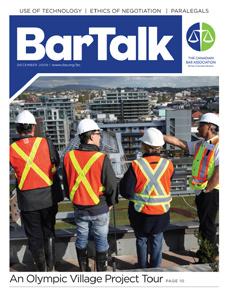
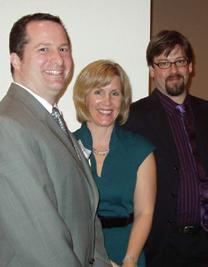
Speaker: Bill Aujla, Project Manager Southeast False Creek & olympic and Paralympic village City of vancouver (photo: left to right is Albert Wallrap; Linda Kerr; Bill Aujla
Topic: olympic and Paralympic village Project Tour – Working Construction Site
Family Law
vancouver
Meeting: october 8, 2009
Speakers: Jonathan Lazar, Watson goepel Maledy LLP; Lisa Hamilton, Hamilton Fabbro; John-Paul (JP) Boyd, Aaron gordon & Daykin
Topic: Highlights of the new Supreme Court Family Rules
elder Law
Meeting: September 16, 2009
Speaker: Allan A. garber of Parlee McLaws LLP
Topic: Challenging government Health Delivery Decisions
Insurance Law
uAnthony Saunders of Guild Yule LLP presented “Insurance 101” before nearly fifty members of the Insurance Law Section. The well-received seminar broached various topics including insurance policy structure, insurance contract interpretation and research resources. Mr. Saunders, an Adjunct Professor of the UBC Law School, also introduced basic insurance principles, such as indemnity, statutory conditions, and tripartite relationships, and he discussed changes in the law with respect to these and other areas. Included in the presentation were historical and pragmatic insights into practising in the area of insurance law.
Construction Law
uWearing mandatory protective equipment for an active construction site, several members of the Construction Law Section went on a “field” trip to the Olympic and Paralympic Village instead of their traditional Section meeting. Project Manager, Bill Aujla gave an informative two-hour tour of the site in Southeast False Creek, the last remaining large tract of undeveloped waterfront land near downtown Vancouver. The City selected Millennium Southeast False Creek Properties Ltd. to develop and construct the buildings that comprise the Olympic and Paralympic Village. Millennium’s development is branded “Millennium Water,” and it comprises approximately 730 market condominiums, 120 rental units and retail/ commercial spaces. Millennium is also developing approximately 250 housing units for the City as
part of the Olympic and Paralympic Village; these are currently proposed as affordable housing. The City also renovated its heritage Salt Building which will be used as retail/commercial space after the Games. VANOC will return this development back to the City and the City will turn over the Millennium Water portion of the development to Millennium to retrofit and sell or lease (as applicable) after the Olympics and Paralympics.
Family Law Vancouver
uA trio of Vancouver family law lawyers entertained, as well as enlightened, some 80 colleagues in a well-prepared presentation on the upcoming rules changes for family law proceedings in the Supreme Court coming into effect July 1, 2010. Some of the main changes that will affect family law lawyers and that were discussed included: Family Law Cases, a new defined term, will begin with filing of a Notice of Family Claim, which is replied to with a Response to Family Claim – gone are the Writ of Summons, Statement of Claim and Statement of Defence; plaintiff and defendant will become claimant and respondent; whenever practical, the same judge or master is to preside over all judicial case conferences, interlocutory applications and the trial of a given family law case; and chambers proceedings will now be initiated with the filing of an allencompassing chambers brief called a Notice of Application, including a date for the hearing – this notice to be served on the application respondent at least seven days before the hearing. In short, the timehonoured principles and practices of litigation remain unchanged, all
the practical details will change, all the forms will be different, and family law cases will receive different treatment from the courts than will non-family law cases.
Elder Law
uMr. Garber is the lead counsel on the class action Elder Advocates of Alberta Society v. Alberta, [2008] A.J. No. 909 (Alta.Q.B.),which is breaking new ground by challenging the government’s delivery of health services to elders based on the duty of care, fiduciary duties, and s.15 Charter rights. He reviewed the background of the Elder Advocates of Alberta Society (“EAAS”) case and the causes of action that were confirmed (or denied) at the class action certification hearing. While many causes were confirmed, the claim of a fiduciary duty was denied at the hearing but has been cross-appealed. Mr. Garber noted that class actions are designed to serve three goals: ensure access to justice, create judicial economy, and influence behaviour modification. The vulnerability of the members, whose average age is 85, with chronic disabilities is a strong indicator in favour of the first goal of access to justice. He discussed that the Society was able to act as the representative member under the Alberta class action legislation and would also be able to do so under the B.C. legislation.
For enrolled cBA members, more detailed information and available minutes from the section meetings are online at www.cba.org/bc in sections under Professional development.
April Gilliland
08/09
“Many of our meetings are held during lunch hour to allow lawyers with families and other commitments the chance to attend. it is especially valuable for those who live outside of Vancouver and who find it too expensive or time consuming to take CLe’s on the mainland. Sections provide an economical way to gain professional development hours that do not take you out of the office for too long a time.”
S e CT i ON N e WS
New Section in the Valley
at the September 26th Provincial Council meeting a resolution was passed to form a Family Law Section in the Fraser Valley to promote education and networking in the field of family law and to create a stronger community of family law lawyers in the Fraser Valley. Topics for upcoming meetings include: New Family Law Court rules Part 1 and Part 2 presented by Co-Chairs Cristen gleeson and John Lee, QC; current issues in spousal maintenance; and common-law property claims and unjust enrichment. enrol today! Download a form at www.cba.org/bc.
Calculating Attorney Fees in U.S. Subrogation Claims. Making Cents of it All
As a personal injury lawyer in British Columbia, you may have come across the odd client or opposing party that has a Washington State-based insurance policy, creating a subrogation lien on your client’s claim for damages. In Washington State, your client is entitled to a reasonable attorney fee in having their lawyer collect on that U.S. subrogation interest.
In the United States, where insurance is for the most part a private industry, there is often language in a policy agreement between the insurer and insured to the effect that upon any payments made for medical benefits (called Personal Injury Protection or “PIP”), akin to Part 7 benefits in British Columbia, the insurer will agree to pay a portion of the legal fees to the Plaintiff’s lawyer for acting on behalf of the carrier in collecting their PIP expenses.
Thiringer v. Am. Motors Ins. Co., 91 Wn.2d 215, 588 P.2d 191 (1978) announces Washington’s public policy in favour of full compensation for injured persons. No insurance company has a right of reimbursement unless the plaintiff has first been fully compensated for his or her injuries.
The off-spring of Thiringer came in the form of the Washington State Supreme Court decisions in Mahler v. Szucs, 957 p.2d 632(1998); Winters v. State Farm
Mut. Auto. Ins. Co., 144 Wn.2d 869, 31 P.3d 1164 (2001); and Hamm v. State Farm Mut. Auto. Ins. Co., 151 Wn.2d 303, 88 P.3d 395 (2004). These three cases make it clear that if an insurer is entitled to reimbursement, the amount of the reimbursement must be reduced by a pro rata share of the attorneys’ fees and costs expended by the insured in obtaining the funds from which reimbursement is made possible.
The formula that arose from the cases of Mahler, Winters and Hamm is very easy to use from the practitioners’ perspective. It must be noted the formula applies to any common subrogation interest scenario that can arise in a Washington State subrogation claim1. The formula is:
F – The actual attorney (lawyer) fees charged.
C – The actual amount of costs charged.
As a B.C. lawyer, a Washington State insurance carrier will likely assume you do not know about the Mahler formula. In most instances, the insurance company will provide you with their share of the attorney fees for collecting their subrogation claim. It is our advice to take great caution in blindly accepting their amount. In a typical soft tissue damage case, where damages may not be that high, the reduction of any lien on the claim can sometimes be the difference between your client wanting to settle, or not. By using the Mahler calculation, you will be in a position to not only advise your client appropriately, but to provide them a greater net return on their settlement.
FR = CR - ((CR/CF) * (F + C))
FR – The final reimbursement (the amount your client pays the insurer on their subrogation claim).
CR – The amount of the claimed reimbursement.
CF – This is the common fund of recoveries from all sources of liability insurance, including any underinsured motor vehicle policy amounts.
1 Thiringer, Mahler, Winters, and Hamm apply to common law reimbursement under state law. these cases do not apply to statutory rights of reimbursement such as the statutory right of reimbursement for Washington department of labor and industries, Washington department of social and health services, or Federal statutory rights of reimbursement.
mr. Belanger is licensed to practice law in both Washington state and British columbia. to contact mr. Belanger visit www.crossborderlaw.com.
Competing for Balance
An Interview with Olympian and Lawyer, Tricia Smith.
PRoFiLe:
Member of the 1976, 1980, 1984 (silver medal) and 1988 Olympic teams
Within moments of meeting lawyer and Olympic silver medallist Tricia Smith the considerable scope of her contributions to the Olympic movement were apparent. Freshly returned from a meeting of the Pan-American Sports Organization Women’s Committee in Ecuador, Tricia was enthusiastic about the role of sport in the pursuit of gender
equality and how this can take many different forms in different cultures. At one time Canada’s most internationally medalled athlete, Tricia is a tireless advocate for women’s equal involvement in sport, from competing to coaching and administration.
Covering each of Tricia’s past and current roles in the Olympic movement, including: Vice-President of the Canadian Olympic Committee; Honorary Mayor of Vancouver’s Olympic Village, along with Rick Hansen; and board member of the International Council of Arbitration for Sport would be a tall order, so I encourage you to visit www.bcsportshalloffame.com to learn about Tricia’s many achievements in greater detail.
Competing in the women’s coxless pairs, Tricia attained international success, along with her rowing partner Betty Craig Eaton. She demonstrated great versatility over her competitive career, also successful at an elite level in the coxed four and eights. Over lunch, I asked Tricia about her experiences as a four-time Olympic rower, her current involvement in the Olympic movement and her reflections about
the relationship between the law and competitive sport.
What were your most memor- 1. able Olympic experiences?
One was marching from the athletes’ village to the stadium in 1976, at home in Montreal. An old drill sergeant was attempting to keep us in formation as we made our way toward the stadium. The path was lined with supporters, all cheering for Canada. We went into the tunnel under the stadium and you could hear the drums from the music. Then we came out into the light and they announced “Canada.” The roar was deafening and continued for our entire march around the track of the stadium. The other, of course, was winning the silver medal in 1984!
Are there any lessons learned 2. from your experience as an Olympian that can be applied to your career in the law? Yes. Setting both long-term and short-term goals, that is the key to staying motivated – and make sure you are having fun at what you’re doing. Having fun is just as important when you’re making a living as it is in sport.
Another obvious one is competitiveness. Lawyers are, by and large, competitive, motivated, and intelligent groups of people who know how to get things done. My rowing teammates had those qualities.
What advice would you give to 3. young athletes striving toward the Olympics?
To think of the big picture… so what if you’re the fastest rower (or anything) in the world…. How does this fit into what else you are going to do in your life? You’ve got to put it all into context.
What Does Your Paralegal Really Think?
Ideas to make work and life better.
Do you wonder what your paralegal thinks?
In time mastery workshops, paralegals wrote what they wished their bosses knew. The results are instructive.
i HAve A LiFe 1.
If you need me to stay late, warn me so I can make arrangements. Work/life balance is important. Many paralegals have work/ life balance problems because the lawyers they work for don’t have balance. It’s usually because lawyers can’t say “no!”
Tip: The simplest way to learn balance and say “no” is to go “cold turkey.” Pick a specific time to leave the office and do it, even if it’s only five minutes earlier than you normally leave.
i LiKe APPReCiATioN 2.
I appreciate getting credit for my work.
I’ll work diligently if you treat me like a professional.
Lawyers are often too timestressed to appreciate paralegals’ work.
Tip: Pick one thing a day to acknowledge your paralegal for.
PRoviDe CLeAR 3. iNSTRUCTioNS
Give clear instructions.
Speak clearly when dictating.
Unclear communication results from caving into time pressures.
Decide who runs your business, you or your clients.
Tip: Meet with your paralegals to set priorities, answer questions and learn what they’ve been doing for you.
geT oRgANizeD 4.
Good habits start with proper organization/management.
Set realistic time- lines for tasks.
Tip: Have staff meetings specifically for organization. Ask, “How do I interfere with your efficiency?” Then tell them how they interfere with yours.
SToP LAST-MiNUTe 5.
Communicate with your paralegal.
Tip: Use joint working sessions as teaching opportunities. Walk paralegals through processes until they learn them.
SToP PRoCRASTiNATiNg 8.
Don’t give me last-minute tasks. Last-minute assignments and interruptions often result from procrastination.
Practice Tip: Use the “Worst First” technique. Make a list of everything you have to do that day. Do the one you most dislike first!
ReqUeSTS/iNTeRRUPTioNS
Don’t expect last-minute work to get done immediately. Interruptions will control your time if allowed; then you will interrupt your paralegal.
Tip: Take a Priority Hour every day, a time block with no interruptions. Encourage paralegals to do the same.
6. THiNgS TAKe TiMe
Tasks take longer than you think. Be selective.
LeT’S WoRK TogeTHeR 7. It’s productive to meet weekly to review assignments.
SoMeTiMeS i 9.
NeeD HeLP
Avoid burnout, hire help.
Maybe paralegals are overworked because you are. Get help.
Tip: Work on high priorities, delegate other activities. Hire help, if needed.
To summarize, maximize the potential of your paralegal and your office: Talk to them! Ask their advice. Help them prioritize.
Control your time. Most issues stem from poor time-management skills. Set priorities, say no, stop procrastinating. Get organized, manage well, and balance work and personal life.
Frank sanitate (pictured above) and douglas Gillies present time mastery telephone seminars for lawyers and paralegals at www. QualitytimePros.com. Frank conducts onsite time mastery seminars and douglas practised law in california for more than 30 years.
The ethics of Negotiation
Knowledge is Power… or is it?
in the August 2009 issue we discussed the different approaches taken by B.C. and Alberta with respect to professional conduct rules governing negotiation. Alberta’s approach is more heavily codified whereas B.C.’s approach is largely based on general principles.
We now turn to the ethics of negotiation in the context of settlement discussions. While lawyers can’t lie, the art of negotiation is all about trying to make the lawyer opposite and his or her client believe something which may or may not be so. Like poker and seduction, negotiations are all about puffery. So where is the boundary between lying and puffing?
Imagine your client has told you that she will accept anything more than $100,000 to settle her claim. Suppose opposing counsel probes, “Will your client accept $105,000?”
In this circumstance, you clearly cannot answer “No,” even though for various reasons, you believe that your opponent will go higher. What to do?
Like poker and seduction, negotiations are all about puffery. So where is the boundary between lying and puffing?
$105,000? If he is, I will take it back to my client but I can tell you that he will increase his chances of acceptance by offering something in the $120’s.” However, even a response such as this tip-toes along the ethical boundaries. Is it really true that a settlement is more likely to be reached if the offer was in the $120’s rather than $105,000 given that the client has told you that she will accept anything more than $100,000? It may be unduly technical but, given your instructions, offers of both $105,000 and $120,000 have equal chances of being accepted, even though your client will obviously be more pleased with the higher offer. Having knowledge of your client’s bottom-line figure may interfere with your ability to puff and use your skills to obtain the best possible settlement.
actual bottom-line. This will allow you greater scope to puff away to obtain the best offer for your client without skating over the fuzzy line between a puff and a lie. You can speculate on what your client will accept, you can wax eloquent on the merits of your client’s position and you will be on the preferred side of the ethical line.
The approach may be trickier where your client has already advised you of her bottom-line; in those situations, consider persuading her to withdraw those instructions. In our view you are still on
the preferred ethical side of the line, provided that any instructions as to her bottom-line figure have been unequivocally withdrawn, even if you are left with a good idea where the bottom-line is likely to be.
This approach is even stronger under the Alberta Code, since Chapter 11, Rule 3(b) requires an Alberta lawyer to “... promptly and fully communicate all settlement offers to the client.”
One approach suggested by some commentators is to parry the question1. You might respond by asking: “Is your client offering
Is there another, ethically safer, way that provides for the full scope of negotiation skills without the restrictive nature of ethical rules? In our view, it is safer to arrive without instructions as to your client’s
In other words, in Alberta, you would have to consult your client after every settlement offer anyway, even if it was higher than her bottom-line figure.
1 “commentary: ethical negotiation: misdirection without falsehood,” William hodes, lawyers usA, march 16, 2009.
Providing help to lawyers in need. CBA (BC) Benevolent Society
“The member has made a fabulous recovery, personally and professionally. He had requested that we pass along his utmost appreciation and gratitude to the Benevolent Fund for providing him with funds when he was in desperate need of same. This is truly a success story for our legal profession.”
The formation of the CBA (BC) Benevolent Society arose from a tragic incident that occurred where a lawyer was brutally attacked and seriously injured by a disgruntled litigant in a New Westminster court. A fund was raised from members of the Bar to assist the lawyer’s recovery.
In 1997, the Society was established to provide assistance to lawyers in British Columbia who have suffered illness or injury arising from any cause. It also provides assistance to the families of lawyers who are affected by a lawyer’s illness or injury. One of the principles of the Society is to maintain and uphold the dignity of those lawyers and their families in need.
The establishment of the Society’s capital fund of $882,905 was provided by the members of the B.C. Bar, whom in 1997 and 1998, contributed $100 per member in each of the two years. The interest from the capital fund is used to provide grants to recipients. However, this is not sufficient to fund the growing requests for assistance and the Society constantly seeks to raise additional funds to meet these needs.
In most cases where the Society is approached to provide financial assistance, the recipient’s
circumstances are among the most difficult that one will ever encounter. These circumstances can be tragic. They may involve the death of a lawyer who had no insurance and whose family was dependent upon him or her, or a disabling illness such as brain aneurysm, drug or alcohol addiction, depression or other medical circumstances. The Society is a last resort for such lawyers or their families and therefore the assistance that is provided is invaluable.
to providing benevolence to colleagues and their families.
There have been many different fund raising events over the past years, but by far the most successful have been through the Annual Battle of the Bar Bands held in Vancouver, which last year raised almost $65,000. These events have grown more successful each year and have expanded to similar Battle of the Bar Bands events held annually in Victoria, Nanaimo and Kelowna, each raising further funds for the Society. The Directors wish to thank all of the organizers, the bands, the partici-
pants and the sponsoring legal firms for making these events a success.
The Directors of the Society are: Derek Brindle, QC; Carol Brown; David Hay; Jim Herperger; Basil Hobbs; Terry LaLiberte, QC; the Hon. H.A.D. Oliver, QC; Margaret Sasges; John Waddell, QC; the Hon. Anne Wallace; Kenneth Walton, QC; and the Hon. Thomas Woods.
During the twelve years since the Society was incorporated, the Directors have approved requests totalling almost $700,000. During this time there has been no paid staff running the Society. The Directors devote their time on a voluntary basis and none of the money raised for the Benevolent Fund is spent on administrative expenses, with all of the proceeds contributing directly
And yet even with all of these efforts, the Society struggles to meet the ever-growing requests for assistance each year.
Please consider making a donation or leaving a bequest in your will to the Society. Your generosity will assist the Society in helping our colleagues who have met with unforeseen and often catastrophic circumstances.
Please contact any of the directors if you or a colleague requires assistance from the Benevolent Fund, or call the cBABc at 604-687-3404 or toll free at 1-888-687-3404, or contact the President of the society, Basil r. hobbs at 250-753-3477 or by email at bhobbs@hobbslaw.com.
Ba S i L r . H OBBS
Mark Your Calendar for the 2010 Mid-Winter Meeting in Ottawa
The CBA 2010 Mid-Winter Meeting of Council is just around the corner. The upcoming meeting will take place in the nation’s capital from February 12 to 14. The venue is Ottawa’s historic Fairmont
Château Laurier, located at the top of the Rideau Canal, across the street from the country’s most famous skating rink. Council meets on February 13 and 14 for reports, resolutions and presentations.
CBA Says Proposed Anti-Spam Legislation is Overbroad
The CBA fully supports the government’s efforts to combat unsolicited commercial email messages, but raises a number of concerns with Bill C-27, the Electronic Commerce Protection ACT (ECPA), including its overbroad approach and overlap with existing regulatory schemes.
“Parliament should reconsider its general legislative approach in the ECPA by directly targeting
only that conduct that results in abusive communications, rather than introducing an entirely new regulatory regime for electronic communications,” says the CBA in its submission letter to the Commons Committee on Industry, Science and Technology.
The Canadian Bar Association commends the federal government for introducing Bill C-56, Fairness for the Self-Employed Act, that would extend Employment Insurance (EI) special benefits, including maternity and parental leave benefits, to the self-employed.
“The CBA wholeheartedly welcomes a system of special benefits that treats all families equally regardless of whether parents are employed or self-employed,” says CBA President Kevin Carroll of Barrie, Ontario. “The new program will also enhance the contribution of women professionals and entrepreneurs to the Canadian economy.”
Self-employed parents will now be entitled to the same special benefits as employed persons, based on their net self-employment income as shown on their past year’s tax return, if they opt in and pay EI premiums for a year. The CBA has advocated for the extension of EI maternity and parental benefits for the self-employed since 1995, stressing the negative effect the absence of such provisions has on women. The CBA notes that studies have shown that there are fewer women than men who are self-employed, and that professional women delay having children (if they do at all).
NaT i ON a L Ne WS
news&events
New Chief Justice of the Supreme Court of British Columbia
The Honourable Robert J. Bauman, formerly of the Court of Appeal of British Columbia, has been appointed Chief Justice of the Supreme Court of British Columbia. He replaces The Honourable Chief Justice Donald Brenner, who retired on September 7, 2009.
Chief Justice Bauman was appointed to the Supreme Court of British Columbia in 1996 and elevated to the Court of Appeal of British Columbia in 2008. He has been a member of the Provincial Attorney General Rules Committee since 2004 and Chair of the Supreme Court civil law committee since 2005.
Chief Justice Bauman completed a Bachelor of Arts (BA) from the University of Western Ontario in 1971 and Bachelor of Laws (LLB with Honours) from the University of Toronto in 1974. He was an associate and partner with Wilson, King Co. in Prince George, British Columbia from 1975 to 1977, and a partner with Wilson, Bauman in Kelowna, British Columbia from 1977 to 1981. He practised with Bull, Housser & Tupper in Vancouver, British Columbia from 1982 to 1996, just prior to his appointment to the Supreme Court of British Columbia.
N e WS
Land Title and Survey Authority
LTSA’S “oLD” TiTLe SeARCH AND DoCUMeNT ReTRievAL SYSTeM
ReTiRiNg oN JANUARY 3, 2010
Customers selecting the BC OnLine menu option “Land Title and Survey Authority” now access the LTSA’s new Title Search and Document Retrieval and Electronic Filing System (www.ltsa.ca/ electronic-filing-system) services in one place. Access to the old search system and 3270 emulator search screens will no longer be possible after January 3, 2010.
ReMiNDeR
The Land Title and Survey Authority’s Electronic Filing System Training qualifies for two hours of Continuing Professional Development Credits.
Wa NT e D
Heroes
Amongst Us
BarTalk WANTS YoUR SToRieS ABoUT oUTSTANDiNg B.C. LAWYeRS.
The pages of BarTalk, distributed to every lawyer in B.C., are the ideal place to recognize lawyers whose exceptional contributions to their profession and their community raise the bar for all of us. in 2010, BarTalk’s legal Heroes series will feature stories, written by you, about your fellow professionals. in 250 words, please help us spread some good news stories about the exceptional lawyers in this province. Please send your submissions to bartalk@bccba.org.
Boughton/BCLI Great Debate
The 2nd annual Boughton/BCLI Great Debate, held on October 28, was a hugely fun and elegant event, attended by more than 150 guests of the legal community.
The resolution, which contended that the hourly rate is going the way of the dodo bird, was defeated by the UBC representative
More than 350 Bench & Bar Members Attended the Annual Bench & Bar Dinner
More than 350 members of the Bench & Bar attended the 25th Annual Bench & Bar Dinner on November 4, 2009 in Vancouver. The event was co-hosted by Mr. James M. Bond, President of the Canadian Bar Association, B.C. Branch (CBABC) and Mr. Gordon Turriff, QC, President of the Law Society of B.C. Special guests included the Honourable Steven Point, Lieutenant Governor of B.C., Chief Justice Lance Finch, Attorney General Michael de Jong, Chief Justice Robert Bauman, and Associate Chief Judge Gurmail Gill.
team. The judges ruled that despite the humorous arguments brought forth by each team, the hourly rate for lawyers is, fortunately or unfortunately, here to stay.
The Lieutenant Governor spoke about the importance of the rule of law to a free and democratic society, the importance of an independent Bench & Bar to the vitality of the rule of law, and shared some anecdotes about his own experiences as a member of the legal profession. The Attorney General
Planned Goals for 2009-2010 for the Equality & Diversity Committee
The Equality & Diversity Committee is looking forward to a productive year. The Committee will review, analyze and present recommendations to the CBABC Executive Committee on three key issues: Overcoming Barriers to CBA 1. Leadership, Feb. 2009 – The Committee will review, analyze and consider possible means to attract and increase the involvement of visible minorities, gays and lesbians, and persons with disabilities
to CBA leadership roles and make recommendations, if any. The Business Case for Retain- 2. ing and Advancing Women in Private Practice in British Columbia, Law Society of British Columbia, July 2009 – The Committee will review, analyze and consider whether the Business Case encompasses equality and diversity perspectives and make recommendations, if any. Addressing Discriminatory 3. Barriers facing Aboriginal Law Students and Lawyers.
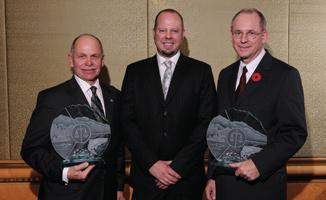
spoke on behalf of the Government of B.C. in congratulating the Law Society on its 125th Anniversary. CBABC President Bond presented M. Jerry McHale, QC and Art Vertlieb, QC with the CBABC Georges A. Goyer, QC Memorial Award for Distinguished Service. Both recipients gave inspiring acceptance speeches, expressing their gratitude for the opportunities provided to them throughout their legal careers and for the support of family, colleagues and friends.
The Committee will identify and formulate practical action items to address barriers faced by Aboriginal lawyers, articled students and law students.
oTHeR ACTiviTieS
FoR 2009-2010
The Equality & Diversity Committee will also recommend nominees for the CBABC Equity & Diversity Award and submit articles to BarTalk for publication. Please contact Jennifer Chow, Chair, at jennifer.chow@justice. gc.ca or any member of the CBABC Equality and Diversity Committee with your suggestions or questions.
left to right: the honourable Wally oppal, Qc and mr. Jim emmerton, British columbia law institute.
left to right: Art vertlieb, Qc, cBABc President James m. Bond and m. Jerry mchale, Qc.
news&events
Two Interventions at the Supreme Court of Canada
The CBA intervened in two cases heard by the Supreme Court of Canada in November.
In R . v. Cunningham the Court considered a number of important and at times conflicting rules which guide counsel’s right to withdraw from a criminal case. The requirement that counsel explain why they must withdraw will inevitably touch upon matters protected by solicitor-client privilege. The CBA argues that courts should sparingly use their power to compel lawyers to act and should generally presume that counsel adhere to rules of professional conduct.
In Prime Minister v. Khadr, the CBA says that the refusal to request Khadr’s repatriation is a continuation of the government’s conduct, which began when Canadian officials gained access to interrogate him in circumstances that violated his international
CLEBC
human rights. The CBA has a long-standing interest in ensuring due process under law. Given the circumstances of the Khadr case, the CBA has argued that it can best be accomplished by repatriating him to Canada.
Media Marketing: Update to Code of Professional Conduct
In the past, your shingle on Main Street let passersby know you were available to take on their legal work. Today, millions of potential clients can find you with the click of a mouse. What rules apply to lawyers who use the Internet to seek out clients?
The CBA’s Ethics and Professional Responsibility Committee presents a new report interpreting the CBA’s Code of Professional Conduct in the context of new media. The report covers everything from email tag lines to blog etiquette to web-based lawyer referral services.
Read the guidelines \ http://www.cba.org/CBa/activities/ pdf/ethicsguidelines-eng.pdf
CLeBC geARiNg UP To eDUCATe B.C. LAWYeRS oN THe NeW SUPReMe CoURT RULeS
April 29 and 30, 2010 – a comprehensive two-day program on the Supreme Court Civil Rules, co-chaired by Master William McCallum and Mr. Justice Malcolm Macaulay, will cover conferences, case planning, trial management, judicial settlement, discovery, expert
evidence, expedited litigation, and costs.
April 16, 2010 – CLeBC’s fullday course on the new Supreme Court Family Rules. Co-chaired by Mr. Justice Brian Joyce and Dinyar Marzban, QC, the program will cover the new forms, the new process for applications, experts, discoveries, and more.
CLe-Tv – online noon-hour preview of the new rules. March 16, 2010 – Family rules presented by Mr. Justice Brian Joyce and Dinyar Marzban, QC. March 30, 2010 – Civil rules presented by Mr. Justice Malcolm Macaulay and Donald Brenner, QC .
Civil rules Transition Guide –the Civil rules Transition Guide scheduled for February, 2010 release will include an overview by Donald Brenner, QC, the complete text of the Civil rules annotated, and a Table of Concordance.
Further information on cleBc publications and courses is available from cle customer service at 604-893-2121 (toll-free in canada at 800-663-0437) or at www.cle.bc.ca.
IN FORCE
current from september 3 to october 22, 2009
legislative Update is provided as part of the CBaBC legislative and law reform program. It is a service funded by CBa membership fees, and is, therefore, provided as a benefit of CBa membership. The full version of legislative Update is now only published online and available to CBa members exclusively at www.cba.org/bc.
Sections 1(j), 12, 14, 15, 51(b) and 18 to the extent that it repeals sections 73 to 75 of the Securities Act, are in force September 28, 2009. Sections 33 and 47(f) to the extent that it strikes out 127 in section 155(1)(b) of the Securities Act are in force September 28, 2009
Sections 8, 10, 11, 19 and 42 are in force September 28, 2009
DECEMBER
5 Provincial Council Meeting
7
BCSC Welcoming Ceremony for The Honourable Mr. Justice Gregory Bowden
9 & 23 laP: Overcoming Procrastination
9 The International Centre for Criminal law reform & Criminal Justice Policy Forum
9 CBaBC PD Seminar – Ethics in action: Practice and Community
11 New Westminster Bar association annual Christmas Dinner & Extravaganza
JANUARY
4 BCSC Welcoming Ceremony for The Honourable Mr. Justice Brian Mackenzie
6, 13 & 27 laP: Overcoming Procrastination
12 New Westminster Bar association annual Judges Dinner
21 CBaBC Executive Committee
21 The Honourable Donald Brenner, QC Tribute Dinner
21 The lawyer Management Challenge: attracting and keeping Great Talent
22 local and County Bar Presidents Meeting
Laptop Searches at the Border: New U.S. Guidelines
Anyone who regularly travels to the U.S. on business should be aware of the U.S. Department of Homeland Security (DHS) guidelines announced on August 27, 2009, which detail what constitutes a lawful search and the process governing devices that are searched and/or detained at the border. Canadian law firms should also
consider adopting some standard procedures for how sensitive data, if any, should be stored on electronic devices used on business trips.
More on New guidelines \ http://www.cba.org/CBa/Practice Link/TaYP/laptopborderupdate.aspx
r MO re i NFO r M a T i ON ONL i N e
e V e NT re C a P
CBABC/UVic and CBABC/UBC, Faculty of Law Mentoring Receptions
On October 21, 2009, the Canadian Bar Association
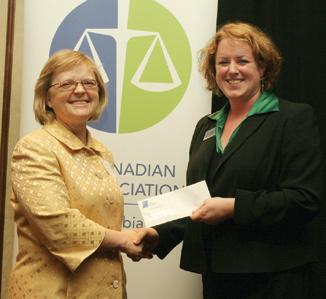
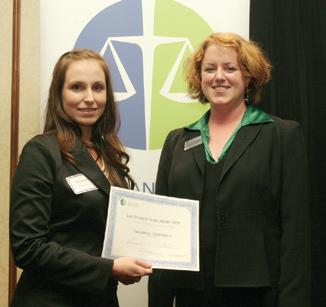
B.C. Branch (CBABC) held the CBABC/UVic, Faculty of Law Mentoring Reception in Victoria. CBABC Young Lawyers’ Representative Kerry Simmons presented the $4,000 CBA Entrance Scholarship to Suzanne Harkness. Ms. Simmons announced, on behalf of CBABC President James Bond, a $30,000 endowment which will support the existing CBABC Branch Entrance Scholarship. The $30,000 endowment will be matched by $30,000 from the Law Foundation of British Columbia. The combined $60,000 endowment will be created and governed by the policies of the University of Victoria Foundation and administered by the Faculty of Law and the Student Awards and Financial Aid office at the University of Victoria.
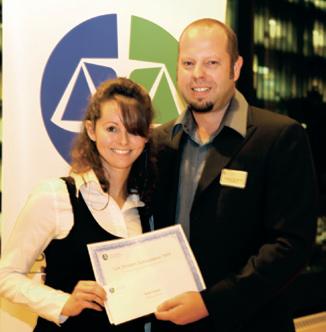
The following day, at the CBABC/UBC, Faculty of Law Mentoring Reception in Vancouver, Kaity Cooper was presented with the second CBA Entrance Scholarship. The scholarships are awarded to one student entering the UVic Faculty of Law and one student entering the UBC Faculty of Law who have best shown a strong commitment to the ideals served by the Canadian Bar Association, which include the promotion of Justice and/or law reform, through his or her exemplary public service or community service, as demonstrated by extra-curricular activities at educational institutions, volunteer work with community or charitable organizations, or any kind of public service activities.
THe LAWYeR MANAgeMeNT CHALLeNge: ATTRACTiNg AND KeePiNg gReAT TALeNT
Wondering why the old law firm practice model isn’t working so well for the younger generation in particular?
Looking for both economic success and long-term talent retention? Hear about three real-life B.C. examples of new approaches to law firm management that provide win-winwins for law firms, lawyers and clients. Nicole garton-Jones of Heritage Law (Nominee for Work Life Balance award, 2008), ashley Bayliss of Pushor Mitchell (Winner of Work Life Balance award, 2009) and Scott Stanley of Murphy, Battista (Nominee for Work Life Balance award, 2008) will present three new models for increasing both productivity and retention to the Work Life Balance Section on January 21, 2010. Contact Mimi Chen at mic@bht.com to register.
dean donna Greschner, university of victoria, Faculty of law and Kerry simmons, cBABc Young lawyers’ representative
suzanne harkness and Kerry simmons, cBABc Young lawyers’ representative
Kaity cooper and James m. Bond, cBABc President
fundingnotice 2010 Projects Initiative
The Law Foundation anticipates establishing a projects budget of $750,000 for 2010 for one-time projects.
The Law Foundation encourages applicants and projects that reflect the diversity of British Columbia. The Law Foundation’s working definition of diversity is: Diversity includes age, different abilities, socio-economic level, education, ethnicity, language, family, gender, marital/relationship status, race, religion, work experience, geographic size and location, and sexual orientation.
WHo CAN APPLY?: a non-profit organization in British Columbia whose proposed time-limited project falls within one or more of the five statutory mandated areas of the Law Foundation: legal aid; legal education; legal research; law reform; and law libraries.
AReAS oF eNCoURAgeMeNT: The Law Foundation is particularly interested in receiving proposals that meet needs in the following areas:
employment Law
Consumer and Debt issues
Family Law
LaW F OUNDaT i ON OF Bri T i SH C OLUMB ia
Law Foundation of British Columbia GRADUATE FELLOWSHIPS 2010/2011
vALUe: Up to five (5) awards of $13,750 each (subject to change).
CLoSiNg DATe: January 8, 2010.
FieLD oF STUDY/ eLigiBiLiTY:
The Law Foundation will consider proposals in areas other than those listed above as long as they fall within the program objectives of the Law Foundation.
gRANT Size: The maximum amount available for each project is $75,000.
Note: if your project is for $15,000 or below, please apply under the Law Foundation’s Small Projects initiative. For further information, please contact the Law Foundation, see contact information below.
APPLiCATioN PRoCeSS: There will be a two-stage process: a Letter of intent stage followed by selected applicants being invited to submit full applications.
Please contact Law Foundation staff at 604-688-2337 to discuss your project prior to submitting a Letter of intent form.
To be considered, please submit a Letter of intent form by 3:00 p.m., Friday, January 15, 2010 by mail, courier, or fax. Please do not email Letter of intent forms.
Letter of intent forms may be obtained:
from our website, www.law- foundationbc.org (Microsoft Word or PDF format) by emailing us at lfbc@tlfbc.org by calling us at 604-688-2337
Projects that meet the legal needs of people in rural areas of the province by faxing us at 604-688-4586 by writing us at the Law Founda- tion of B.C., 1340 – 605 robson Street, Vancouver, B.C. V6B 5J3
Selected applicants will be invited to submit full applications for adjudication at the June 2010 Board of governors’ meeting.
Please note that the Foundation may require an organization to have audited financial statements or an audit of the project.
Full-time graduate studies in law or a law-related area. applicants must either be residents of British Columbia; graduates of a British Columbia law school; or members of the British Columbia Bar.
WHeRe TeNABLe: recognized universities in Canada, the U.S. or abroad. NOTe: The Law Foundation graduate Fellowship is not available for the graduate programs of the Faculties of Law at the University of British Columbia and the University of Victoria, as the Law Foundation makes separate grants to the graduate Fellowship programs at these universities.
APPLiCATioNS: Please visit our website, www.lawfoundationbc.org or contact us at Law Foundation of B.C., 1340 – 605 robson Street, Vancouver, B.C. V6B 5J3 / Tel. 604-688-2337 / email lfbc@tlfbc.org for an application form or further information.
memberservices
every issue of BarTalk highlights regular discounts available to members from a range of national and regional preferred suppliers. Seasonal promotions and special offers to members are promoted weekly via cBABc News & Jobs. Don’t miss any promotion by subscribing to the member services e-bulletin: email members@bccba.org or fill in and fax the sign-up box below to: 1-877-669-9601 (toll-free) • 604-669-9601 (Lower Mainland).
TeCH TiP: Member services are available 24/7 via the CBaBC website. To access member services on the site, log onto www.cba.org/bc, then choose member savings from the drop-down list under membership. On the member savings page, you will find links to the suppliers highlighted below, plus many more.
Just in time for the Holidays, CBaBC has some suggestions for gifts and stocking stuffers that are always in good taste and sure to be appreciated.
Vancouver Canucks
great Stocking Stuffer. Hockey fans, CBaBC members receive up to 20 per cent off on selected games through to March 30th. Ticket sales have been brisk, with many games selling out fast. There is still a limited number of tickets for some games, so be sure to order early to avoid disappointment.
TeCH TiP: Select Sports on the member savings page
Alpine Resorts
CBaBC Members receive various discounts of up to 25-50 per cent off at the following resorts: keLOWNa: Big White Ski resort kaMLOOPS: Sun Peaks resort
Sign Me Up!
Yes, please send me monthly updates on the latest CBaBC promotions.
NAMe
FAx ...............................
eMAiL .............................
Please complete this form and fax back to: 604-669-9601
Toll free: 1-877-669-9601
Or sign up by emailing your information to members@bccba.org
VaNCOUVer: Whistler Blackcomb
VerNON: Silver Star Mountain resort.
TeCH TiP: Select alpine resorts on the member savings page.
Bugatti Lawyers’ Cases
Personalised lawyers’ cases, executive briefcases, and travel
bags by Bugatti make a great gift for others or for treating yourself. all bags are made of genuine leather and can be personalised with your name, initials, law firm or anything else you might want at a huge discount. TeCH TiP: Select Lawyers’ Cases on the member savings page.
Lindt Chocolate Holiday Sale
Now is your chance to load up on holiday chocolate to give as gifts, serve at parties, or to treat yourself! CBaBC Members save 30 per cent off on all regular priced merchandise from December 6th to December 20th. TeCH TiP: Select Chocolate on the member savings page.
SeekiNg WiLLS
Seeking Will of Norma Yvonne
Lougheed, Deceased. Call Andrew MacKay of Alexander Holburn Beaudin & Lang LLP at 604-484-1700.
SerViCeS
intellectual Property
Let us assist you in providing protection for your clients. Douglas B. Thompson Law Corporation – Registered Patent Agent, Registered Trade Mark Agent. Practice restricted to Intellectual Property, Victoria, B.C. (www.BCpatents.ca) Email: doug@BCpatents.ca.
OFFiCe SPaCe aVaiLaBLe
office Space Sharing
Law firm in downtown Chilliwack has space available for 3-4 lawyers to join in a space sharing arrangement. Three boardrooms, contemporary office spaces and excellent street-side exposure. Minutes from Supreme Court. Please call 604-795-4529.
office Space Available in Royal Centre, vancouver
Norton Stewart, Business Lawyers is seeking an established lawyer who wants the opportunity to practise in a downtown business law firm setting. Excellent facilities, collegial atmosphere, maximum flexibility. Set your own pace, control your own destiny. Call John Norton or Ken Burgess at 604-687-0555.
Summer Positions for 2nd Year Students Applications Now Being Accepted
BarTalk Gets Results
barmoves
Who’s Moving Where
Donald Brenner, qC has joined Farris as Senior Counsel. after 17 years on the Bench, Mr. Brenner recently retired as Chief Justice of the B.C. Supreme Court. as Senior Counsel at Farris, Mr. Brenner will advise Farris clients and lawyers.
olga Rivkin has joined Bull, Housser & Tupper LLP as an associate with the local government group. Prior to joining the firm, Olga practised at McCarthy Tétrault in their real estate group focusing on municipal law.
Kevin Hyde has joined the firm of McQuarrie Hunter LLP in the New Westminster office as an associate. Mr. Hyde practises in the areas of personal injury litigation, commercial litigation, real estate disputes and employment law.
Lisa Holland (formerly Pape) has joined rBC Dominion Securities as an investment advisor. as part of a multidisciplinary team, Lisa helps business owners and professionals manage their investments and coordinate their wealth.
Ming Song is working on her own as Songbird Law Corporation. Ming specializes in the area of aboriginal Law providing legal services as a consultant to law firms and directly to First Nation clients. She formerly worked at McDonald & Company.
Justine Kates has joined McCullough O’Connor irwin LLP as an associate.
geoffrey Trotter has joined gudmundseth Mickelson LLP as an associate practising commercial and civil litigation and administrative law.
Lisa Phillips has joined gudmundseth Mickelson LLP as an associate practising commercial and civil litigation and administrative law.
Joel Hill
Tim Thielmann
was called to the Bar in September, 2009 and stayed on to practise aboriginal law with Devlin gailus as an associate.
September & October 2009
Regular Members
emily Boyle
Cox, Taylor
Victoria
Carmen K. Cheung
BC Civil Liberties Association
Vancouver
Samuel de groot
Burns, Fitzpatrick, Rogers & Schwartz LLP
Vancouver
Kwang Lim has joined Farris as an associate. kwang joins Farris as a solicitor, with a practice that focuses on general corporate and commercial transactions, securities and mergers and acquisitions.
has joined Hakemi & Company Law Corporation as an associate practising commercial litigation. Hill brings experience in representing clients before all levels of court in B.C. and administrative tribunals.
Robert Janes, Robert Freedman, Rosanne Kyle, eric Woodhouse, Karey Brooks and Barbara Harvey have established Janes Freedman kyle Law Corp., focused on civil litigation and aboriginal law.
Luke Dineley
Borden Ladner Gervais LLP
Vancouver
Ahmad erfan
Alexander Holburn
Beaudin & Lang LLP
Vancouver
Jennifer S. Frahm
Singleton Urquhart LLP
Vancouver
Pawanjit S. Joshi
Surrey
Sanjana P. Khaira
Greiner, Bethell & Company
Burnaby
Annabel H. Kim
Aikenhead Moscovich & Jones
Vancouver
Leyna R. Roenspies
Cates Carroll Watt
Kamloops
William Walters
Horne Coupar
Victoria
Jonathan Wittig
Scholar
Daniel P. Parrott
Articling Students
Courtney AuBuchon
Fulton & Company LLP
Kamloops
Alexandra Cocks
Supreme Court of B.C.
Vancouver
Julie Rene Facchin
Scott Foster
Vancouver
eric Heath
Valley Law Group
Abbotsford
Taylor Henshaw
Owen Bird Law Corp.
Vancouver
Harold Russell Hicks
Fulton & Company LLP
Kamloops
Jilliane Humphreys
McCarthy Tétrault LLP
Vancouver
Debra Larsen
Ministry of Attorney General
Prince George
Adam Picotte
McLarty Wolf
Vancouver
Chantelle Rajotte
Miller Thomson LLP
Vancouver
Debra Rusnak
Singleton Urquhart LLP
Vancouver
To view all new \ members please visit www.cba.org/bc/ bartalk_06_10/12_09/ membership.aspx
Not only does our break-even pricing goal , it makes it possible for you to benefit from those occasions when our financial results exceed our long-term requirements.
This year is one such occasion as two of our most popular and lowest cost plans have had financial performance that exceeds our long term requirements.As a result, mostinsurance clients qualified for a of their paid 2008 premiums, and most of our insurance clients qualified for a of their paid 2008 premiums.
Over the last decade, better than anticipated plan performance has allowed us to return approximately $30 million to our clients through rate reductions, benefit improvements and refunds. Does your insurer share its financial success with you?
Consider joining the more than 30,000 members of the legal profession that choose the CBIAfor their insurance protection. Please contact provide you with insurance at a cost that’s much lower Term Life Business Expense Disability Mass and Company Financial Planning at (604) 247-8007 or visit www.barinsurance.com. 15% refund 45% refund