An exciting new initiative of the Canadian Bar Association, British Columbia Branch (“CBABC”) is set to increase awareness of the many career opportunities that exist for young lawyers outside of urban areas in the province. The Rural Education and Access to Lawyers (“REAL”) Initiative is designed to encourage law students to gain legal experience in non-urban areas throughout British Columbia, with the expectation that this exposure will lead to the attraction of new lawyers to communities with a population of less than 100,000 and with more than 500 people per lawyer.
In the coming months, CBABC will be embarking on a campaign to raise awareness of the resources that are available to law firms, solo practitioners and community and non-profit organizations through the REAL Initiative. These resources, made available through a three-year funding grant from the Law Foundation of British Columbia, include:
• Funding for summer student placements in rural and small communities;
• Financial and promotional support to assist with the marketing of regions to law students and young lawyers; and
• Professional support from the CBABC Regional Legal Careers Officer to assist with the recruitment, hiring and retention of students and young lawyers in rural and small communities. The REAL Initiative was established in response to the current and projected challenges regarding
access to legal services in rural and small communities. The goals of the initiative include increasing awareness of practice opportunities that exist outside of urban areas, ensuring an adequate number of young lawyers are attracted to rural and small communities to facilitate the transfer of knowledge from retiring practitioners, and ensuring access to legal services for people living outside of urban centres by filling current gaps in access, and preventing additional gaps from occurring due to the projected retirement of a large number of lawyers in coming years.
CBABC President Miriam Maisonville summarized the impetus behind the goals of the REAL Initiative as follows:
The Rural Education and Access to Lawyers Initiative will bring significant value to the profession and the province as a whole by not only ensuring that there are an adequate number of lawyers practising outside of the urban regions in British Columbia to provide access to legal services but also by helping to maintain the high quality of legal services currently offered in the province through the transfer of knowledge from senior to junior practitioners.
Further information regarding the REAL Initiative can be found online at www.realbc. org. Lawyers, law firms and other organizations interested in taking part in the REAL Initiative are encouraged to contact the CBABC Regional Legal Careers Officer at mlitchfield@bccba.org. BT
bar moves uu
Have you recently changed firms or opened a new firm? Send your bar moves submission (maximum 25 words) to cba@bccba.org.
KASh GAndhAm, SuKhI nunRhA, and hERb duLAy, formerly associates at MMT Law, have left that firm and opened a new firm named Nordel Law Group LLP. They will be practising in the following areas: plaintiff personal injury, real estate, corporate/commercial and criminal.
McQuarrie Hunter LLP has welcomed douG ConoLLy into the Partnership. Mr. Conolly’s practice is focused on commercial litigation, including disputes arising from real estate transactions, commercial leases, shareholder/partnership agreements, construction contracts and builders’ liens.
McQuarrie Hunter LLP is pleased to announce that dAvId hALKEtt has become a partner with our firm. Mr. Halkett’s practice focuses in the areas of family law, general civil litigation and criminal defence litigation.
oLwyn buRKE has joined Bull, Housser & Tupper LLP as an associate with the Energy & Infrastructure Group. Olwyn was called to the Irish Bar in 2001 and the Scottish Bar in 2003 where she practised as an Advocate for three years in criminal, human rights, trusts and child protection law.
Ruth P. mAGnuSSon has joined the team at Horne Coupar, in their downtown offices in Victoria, B.C. She practises mainly in the area of wills, estates and elder law.
mIKE PoznAnSKI of Davidson Lawyers LLP is the new President of the Vernon Bar Association. Mike moved to Vernon in May 2008 after graduating from law school at the University of Alberta. He is articling with Davidson Lawyers LLP in Vernon. After being called to the Bar, he will continue with Davidson Lawyers LLP as an associate.
bRIAn A. yuEn has departed Bell Alliance and now practises personal injury law at Jeffery & Calder.
Health & Wellness TIP
did you Know?
uuu In season, locally grown and produced foods are fresher and are often less expensive than imported products. buying local also supports local farmers and producers and helps reduce the number of trucks on the road.
Doug Conolly
David Halkett
olwyn burke
ruth P. magnusson
April is an important month for B.C.’s legal community with Law Week events taking place across the province, and law students finishing their exams and on the lookout for their first positions as professionals. Law Week events provide British Columbians with accurate information about the law and seek to address the theme of Public Confidence in the Justice System. Career Services Offices at UBC and UVic law schools urge firms to hire articling students and lend their support to the future generation of lawyers. Elsewhere in this edition, legal ethics are examined through a case study of the recent Hollywood blockbuster Michael Clayton, while the Land Trust Alliance of B.C. uses its “plot” to explain and promote the practice of “ecological gifting.”
to Justice: Public Confidence by Kathleen Kendall, Law Week Committee Co-Chair
FEAtu
Send your L E tt ERS to th E Ed I to R to:
Jesse Tarbotton, barTalk Senior editor
Canadian bar Association, b.C. branch
Fax: 604-669-9601
Toll-free fax: 1-877-669-9601
email: jtarbotton@bccba.org
note: barTalk undertakes every effort to publish letters to the editor, subject to space and editorial discretion. letters to the editor can also be found in barTalk online at www.cba.org/bc.
CovER StoRy CLARIFICAtIon (voL. 21, no. 1)
In the February edition of BarTalk , the cover story reported on reductions and elimination of a number of Legal Services Society services. These recent cuts were not the result of any reduction in government funding, but rather the result of decreased revenue from other sources such as the Notaries Foundation (due to the current economy), and increased demand beyond the available budget for family law, immigration and criminal law cases.
ChARLIE don’t SKAtE – tony wILSon (voL. 21, no. 1)
I was born and raised in the North of England. I was raised in an atmosphere of unquestioning support for the monarchy. As a little lad, I attended a street party for the Charles and Diana marriage. At Cubs, I learned the entire National Anthem. I even gave Princess Anne a clock (why is another story) when she visited our school (if memory serves, she was “opening” it – it was, of course, about a dozen years old at the time). For many years, I was a good little subject.
And so to Mr. Wilson’s column. First off, don’t get me wrong. I am anti-monarchy.
The fact is that there is much more that binds GBR and N. Ire to Canada than not. A small thing like the underpinnings of the legal system, for starters. And then there’s the really important stuff, such as TV (BBC World/Canada anyone?). It might not be hockey (though there are many Canadians plying their trade in the Elite League). And it might not be polo. (But who in the UK does play polo? None of my mates, that’s for sure.) But there are real ties that indeed bind. Perhaps that’s why Mr. Wilson reads the UK papers.
The problem is, simply, the monarchy itself. The world has outgrown it. It’s an anachronism. But if that was its worst offence, it could perhaps be tolerated. But it’s not. Far from it. Frankly, in a nutshell, the monarchy sends the wrong message. It perpetuates the scandal of hereditary power, and the culture of upper-class entitlement that comes along with it.
So, in the interest of clarity, I fully support Mr. Wilson’s call for the removal of the monarchy from Canadian life. Just for very different reasons. Let the constitutional debate begin. It’s about time.
This publication is intended for information purposes only and the information herein should not be applied to specific fact circumstances without the advice of counsel.
The Canadian bar Association, british Columbia branch represents more than 6,400 b.C. members and is dedicated to improving and promoting access to justice, reviewing legislation, initiating law reform measures and advancing and improving the administration of justice.
barTalk Publication Sales Agreement #40741008
why Legal Aid matters
Do you remember the first time you went into a courthouse? The first time you appeared as counsel? Or the nervousness felt as counsel for the first time? Now try to imagine the same thing without legal education. For many, they are not only nervous, they are terrified. Imagine you are instead a litigant –you are there to have your matter brought before the judge. You are hoping for a fair resolution of your matter, custody of your children or, worse, you have been charged with an offence and are appearing in Criminal Court charged with breaching your conditions of bail. Will you be able to get legal advice?
miriam maisonville President 2008/2009 b.C. branch Canadian bar Association
For many of us, the issues surrounding the Legal Services Society are not at the fore. But they should be – they matter. People seeking legal aid are amongst the most vulnerable in our society: women, children and seniors. It matters because we need to know, as a society, that all people get proper legal representation, be it in family matters, financial matters such as bankruptcies, or criminal matters, particularly where a loss of liberty may occur. The mother seeking child support, the father seeking access to his children, and representation on a criminal matter – all are entitled to seek justice. We need to know as a society that a person had a fair hearing or appeal. We need to be certain rights are respected and if a person is jailed, we need to know that it was after a fair hearing on all the evidence.
This sense of the importance of legal aid is shared by all British Columbians. In a poll conducted by Ipsos Reid in March of 2008 the following was posed: Government should give funding for legal aid the same priority as they give to funding for other social services such as health care, education, welfare, and child protection.
Fully 78 per cent of those polled agreed, including 40 per cent who agreed strongly. Access to legal representation matters. Many lawyers provide assistance through the framework of our Legal Services Society to ensure that access to justice is obtained. The British Columbia Legal Services Society mission statement holds: Our mission is to provide innovative and collaborative legal aid services that enable people with low incomes to effectively address their issues within the justice system.
Now, more than ever, it is critical to ensure ongoing support for the Society to ensure those most requiring it have their help. The funding sources of the Law Foundation (due to falling interest rates) and from the Notaries (due to fewer transactions) are down but the demand has not similarly declined, and in these troubled times, is likely only to further increase. The CBABC applauds the Legal Services Society’s efforts to stretch its dollars to the maximum, to try to service all, but, as we all know, this has not been possible without a reduction in service, notably even to those who may be facing jail. For example, funding will cease for category one offences such as failure to appear in court when required to do so. Typically, being found guilty in such a case will attract a jail sentence.” In the past, facing jail terms meant legal aid coverage. No longer. The CBABC calls on the government to strengthen the justice system and reduce financial barriers to accessing justice by providing legal aid funding that matches the increased demand and reduced revenue sources of the Legal Services Society. This way no one – the poor or working poor – will fail to receive needed legal representation. If the axiom is correct that, as a society, we are judged on how we treat the most disadvantaged, then a properly funded legal aid system shows our commitment to ensuring justice to all. BT
Coping with Information overload
How do we know (or communicate!) what really matters?
In the age of email overload, paper overflow, BlackBerrys, Twitter, blogs and RSS feeds, one must constantly process multiple pieces and sources of information at once, and at an exacting pace. Depth perception – the ability to discern the important from the immediate – is overwhelmed by sheer volume.
Here are some tips to help you stay sane and get your own message through:
bREAKInG thRouGh thE CLuttER
Caroline nevin, executive Director b.C. branch Canadian bar Association
1. Become known for only sending relevant, succinct emails. At all costs avoid becoming the “CC Queen” whose emails get deleted/unread.
2. The new email limit is five sentences; three is even better. Anything more and there’s no hope of retaining attention, never mind comprehension.
3. That said, don’t cut out the niceties. Treat email as real correspondence, with salutations, sign-offs and proper language. If you’re too abrupt, people will read disrespect into your message.
4. Use the phone more. The human element is actually more, not less efficient, and it avoids the misunderstandings of email.
5. Be clear. Your readers are busy. If you need something, highlight what it is and when you need it by. Don’t bury it and expect them to extract it themselves.
6. If you’ve been away from your email for a while, read your entire inbox before responding to anything. Too many people shoot off fast replies without seeing subsequent emails that would change their approach or make their email unnecessary (see #1 above).
hAndLInG thE EmAIL tSunAmI
1. Invest some time in an Outlook tutorial to learn what sorting capabilities you’re not yet using.
Check out ClearContext or Xobni to add some extras.
2. Block and protect time in your day solely to manage email. The minimum is once in the morning and once in the afternoon or evening. If you can, keep your email turned OFF on your computer screen except for those times. (Just try it for a week; it’s addictive.)
3. Refuse to reply to email instantly. Unless it’s truly urgent, don’t do it. There is no prize for being the most reachable, distractible person on the planet.
tAmE thE PAPER dRAGon
1. The days of simple “in” and “out” boxes are gone. You need to, at minimum, separate “action” items (including things BF’d), “information” items (no action required, but should be read), and “spare time” items (e.g. magazines).
2. Clear your action items daily, information items weekly, spare time items monthly. Clutter really does clutter your mind, so make a fierce effort to get rid of paper.
3. Google “paper management.” One of those articles or approaches will resonate; try it.
tunE out
It’s a proven fact that time-outs improve productivity. If the clutter and “noise” of information overload is destroying your ability to focus, it’s time to stop. Get out for a walk if you can, or turn off your phones and computer and shut your door. Close your eyes and just breathe for a while. It will be harder than you think. When you’re ready, return to your tasks, focusing only on one at a time. Good luck!
(The CBA specializes in practical tools and resources for busy lawyers. Check out CBA PracticeLink at cba.org/cba/practicelink.) BT
Economic woes Ahead?
More tips for staying afloat
Theskyisfalling
And no one will lift theireyestosee
Theskyisfalling
And no one will care as longasitlandsoverseas...
music and lyrics by Thrice
The news these days is filled with economic woes. There are corporate bailouts, countries are failing (Iceland, Ukraine and others) and people are being laid off worldwide. Yet Canada seems to be a bubble in the storm. Can it be that we will largely escape the woes that seem to be surrounding us? I think not, if for no other reason that we are a major trading nation and our biggest customer (the USA) is on very hard times indeed. As any managing partner knows, if your biggest client takes a nosedive, you had better be building a contingency plan. So here are some tips against the (possible) hard times ahead:
David J. bilinsky is the Practice management Advisor for the lSbC. email: daveb@lsbc.org blog: www.thoughtfullaw.com
satisfying in taking control of your life and practice in the long term, even if this entails uncertainty and the unknown in the short term.
3. Go green and cut costs, too! There are numerous ways to cut expenses without cutting into production. Here is a short list: Vampire power: • Most offices have devices that draw power whether or not they are on. Furthermore, most offices leave photocopiers, computers, monitors and scanners – virtually anything that draws power, on or in a “sleep” state overnight or on weekends. Shut these down at the end of the day or use powerbars with an on/off switch to ensure that those little vampires are not sucking energy needlessly (powerbars can save you from power spikes as well).
1. Be careful of what you cut: We all know that when times are tough, management starts tightening the belt. However, at the firm of McDermott Will & Emery in Chicago, after announcing staff layoffs, they announced that they were cutting back their coffee service for staff. Wrong move. Not only would associates (and partners) have to run down the street to Starbucks for a caffeine hit, they would lose a half hour of billable time in the process. According to the ABA Journal, a partner said in an email that this cut “will make only a small difference financially while sending a ‘message of desperation.’”
2. Make the jump yourself: If you get the feeling that your job isn’t secure, it may be better to start aligning your ducks to make the move to solo or shared office practice yourself, rather than receiving a pink slip. There is something inherently
Go paperless: Digital Lifestyles reports that more than 210 billion emails are sent every day. There is a big cost on the environment and to your pocketbook if your share of those emails are printed – particularly if you use an inkjet printer (since the price of inkjet inks are stratospheric!) Better to spend the time to organize your office to handle all communications in a paperless manner. Look to Worldox or iManage or other document management software. Create and file documents electronically (see Tech Tip on page 19). In this way you only print the absolute minimum number of documents necessary. Furthermore, you save all the transportation costs involved in moving physical copies around.
By preparing now, we can avoid running around like Chicken Little if the worse should happen and the economic sky starts falling around us. BT
there Could be blood
Any lawyer interested in the future of the legal profession (and more poignantly, whether they’ll have a career in a decade) should be reading Richard Susskind’s The End of Lawyers?: Rethinking the Nature of Legal Services. It suggests a future that ain’t pretty for those of us who are practicing, especially those of the solicitor persuasion. To paraphrase a few of Susskind’s horsemen of the apocalypse (and to embellish with one of my own), law firms must commoditize and repackage their services to lower their costs, or their services will become an unaffordable luxury. Secondly, law firms will outsource more and more legal and paralegal work to India to reduce costs, (and maybe clients will too!). Third, shrinking corporate budgets will force inhouse counsel to create online closed communities among competitors to avoid sending work to more expensive outhouse counsel. And finally, because the Internet has made it possible for clients to buy an imperfect contract on the web for $99.95 that a lawyer might perfectly draft (but charge $10,000 for), some lawyers may find they are the equivalent of buggy-whip manufacturers in 1902.
There could be blood.
Tony Wilson is a Franchise and Intellectual Property lawyer at boughton in vancouver, an Adjunct Professor at Simon Fraser university and has written for the Globe and mail, macleans, and Canadian lawyer.
Seattle Post Intelligencer abandoning a “print edition” of their paper in March of this year, watch for a slew of other newspapers either folding or going totally online; the rationale being that if you can read any paper in the world on the Internet for free, why on earth would you pay for a subscription?
As for the work solicitors do, if a client on a limited budget can’t afford $10,000 or $20,000 for the “perfect contract” that I might (ever-so-humbly) draft, he might consider downloading his contract off the Internet for a song, as if it were a song! Or a book. Or anything else you can download these days; taking the risk that the downloaded contract will protect him “just enough” (and that “something” is better than “nothing”). Or the client might decide to have his expensive contracts prepared in India for $1000 by a lawyer or paralegal (who may have been trained in North America). In short, if lawyers aren’t careful, we might be the slumdogs and some enterprising corporation in Mumbai might be the millionaires.
In some ways, why on earth should the legal industry be any different from the buggy whip industry, or more recently, the CD business? The CD business was decimated by free online downloads until my pal Steve Jobs re-invented the model for iTunes. Amazon changed the way we buy books, making “brick and mortar” bookstores an endangered species. Craigslist re-invented the classified ad. Google has made the yellow pages obsolete. And with the
And although litigation might not take the same hit as solicitors in Susskind’s Brave New World, everyone in the profession will have to get used to things such as “legal knowledge engineers” and legal procurement departments shopping out the work just like we had to get used to email and voicemail in the 1990s (the reliance on email being totally predicted in Susskind’s last book on the topic, The Future of Law).
Perhaps one solution to avoid the same fate as the buggy-whip and CD industry is to free law firms from the crushing burden of salaries and rent by
Continuedonpage27
Professional development
The Canadian Bar Association (CBA), on a National and Provincial level, offers Professional Development (PD) opportunities to members through CBA National CLE programs, conferences, seminars, Sections, teleconferences and webinars. The CBA is an approved education provider sanctioned by the Law Society of British Columbia to deliver accredited PD that meets the mandatory annual requirement.
PRoFESSIonAL dEvELoPmEnt
REPoRtInG houRS
Patricia Jordan is the CbAbC Web manager. She welcomes your comments, questions and suggestions. Tel: 604-646-7861 email: pjordan@bccba.org
Effective January 1, 2009, all Law Society members are required to report their PD hours every year. As a service to CBA members, we automatically record your attendance at Section meetings and other CBA PD events when you signin at the meeting or register for a CBA PD event. Our online printable record of your PD hours makes it easy for you to check your record, and to see if you have completed your mandatory 12 hours of PD which includes two hours of the ethics/practice management requirement. Your online PD Report is available at cba.org/bc in “Professional Development Report” under “Professional Development.”
SECtIonS/FoRA
Sections are designed to meet the educational, advocacy and professional needs of lawyers. Section membership provides you with an excellent means to enhance your legal expertise, network and contribute to your profession. Many Section meetings are available by teleconference and webinar, making it easier for you to attend remotely. The CBA offers its members 70 B.C. Provincial Sections and 32 National Sections that are organized according to specific areas of law. Section members have online access to meeting
notices, minutes, executive contact information and more at cba.org/bc in “Sections” under “Professional Development.” Enrolment in Sections is a great way to satisfy the Law Society’s minimum expectation for Professional Development. Special-interest groups are also an excellent resource for PD. The Canadian Bar Association, British Columbia Branch Women Lawyers Forum (WLF) promotes the stature and interests of women in the legal profession through programs for education, mentoring and networking. The CBA National WLF provides a forum for sharing resources with other legal jurisdictions, organizations of professional women and women in the judiciary.
LIStSERvS
Provincial Section listservs are available for Administrative Law, Business Law, Civil Litigation, Criminal Justice, Employment Law, Family Law, Immigration Law, Labour Law, Law Practice Management, Real Property/Commercial Real Estate, Wills and Trusts, Young Lawyers and the Woman Lawyers Forum. Section listservs are available to any Section where 20 or more members express an interest to participate. Section members are encouraged to contact their Section’s Chair to suggest the creation of a listserv. CBA National Section listservs include Alternate Dispute Resolution, Citizenship and Immigration Law, Elder Law, Privacy Law and Sexual Orientation and Gender Identify Conference.
dId you Know?
• There were 1,181,015 visits to cba.org/bc or an average of 3,226 per day in 2008.
• In 2008, employment ads were downloaded 156,748 times, a 48 per cent increase since 2007. BT
Section update
Keep your practice current
The following are brief summaries of several recent Section meetings held throughout the province. For enrolled CBA members, more detailed information and available minutes from the Section meetings go online to www.cba.org/bc in Sections under Professional Development.
GEnERAL PRACtICE, SoLo And SmALL FIRm –
LowER mAInLAnd
mEEtInG: January 22, 2009
SPEAKER: murray Chan, b.Sc., CDP, Pacific breeze Systems, your network and SharePoint Specialist
toPIC: Protecting your law Firm’s Data Files From the bonnies and Clydes of Cyberspace Mr. Chan gave an informative PowerPoint presentation and overview of how to protect your law firm’s data files. Attendees in person and by Webinar heard how cyberspace thieves are invisible and know no boundaries. Mr. Chan discussed how law firms can protect themselves against data harvesters, hackers and frontal attacks, and how cyberthieves can get in through the back door. Email is not a secure form of communication unless the law firm is using a service like RPOST, which provides receipt verification with encryption and is strongly recommended by Mr. Chan for very important emails.
humAn RIGhtS
mEEtInG: January 14, 2009
SPEAKER: Heather mcnaughton – b.C. Human rights Tribunal Chair toPIC: b.C. Human rights Tribunal – 2008 and beyond Ms. McNaughton provided members with trends, emerging issues and other topics of interest from the Human Rights Tribunal. In 2007, after consultation with the Human Rights community asking for comments about the rules of practice, an important change was made to the complaint form, adding a diary line and making it easier to assess the timeliness of a complaint. All Human Rights Tribunal awards are published. Of the 424 decisions issued by the Tribunal last year, 378 (89 per cent) were preliminary decisions. The
Tribunal receives between 1000 and 1100 complaints each year. In 2007-2008, it received 1053 complaints. Approximately 25 per cent (276 complaints) were not accepted at the outset. A case manager makes a recommendation about the processing of each filed complaint. Before a complaint is accepted, the Tribunal offers mediation, especially in circumstances where the issue appears to be miscommunication between the parties. Approximately six mediations per month are attended by Tribunal members and contract mediators are also used. There were 373 settlement meetings including 226 early settlement meetings in 2007-2008 representing an increase of six per cent. At the end of its fiscal year in March, the Tribunal produces an annual report that is passed to the Attorney General.
PubLIC SECtoR LAwyERS
mEEtInG: February 24, 2009
SPEAKER: Harry neufeld, Chief electoral officer for b.C. toPIC: The role of the Chief electoral officer for british Columbia and Issues of Topical Interest related to This role
Proposed new Section
The CbAbC is always pleased to support the creation of a new Section. A new Section, Work life balance is proposed, and with the necessary requirements could become active by the end of June. If you are interested in adding your name to the list of interested members supporting this Section email sections@bccba.org.
An explanation of Mr. Neufeld’s role and functions of his office were described to members. He gave details of the highlights of the Election Act and recent amendments to that Act including the new limits on third-party spending which take effect 60 days before the writ is issued and end on general voting day: see the Election Amendment Act, 2008, S.B.C. 2008, c. 41. Mr. Neufeld also discussed issues around voter turnout and the 2009 referendum on the electoral system in B.C. His detailed PowerPoint presentation included “Looking to the Future” with new technology such as live updates to a list who has voted, barcode scans to improve speed and Internet voting. BT
Section name Change
At the march 7, 2009 Provincial Council meeting a motion was passed to change the name of the Computer law Section to the Intellectual Property and Technology law Section whose mandate will be to deal with legal issues affecting intellectual property and the technology industry.
CbC Radio talks Animal Law
have you heard?
Attendance at Section meetings counts toward your 12 hours of mandatory CPD (Continuing Professional Development) requirements by the law Society of b.C. enroll in one or many of the 70 CbAbC Sections and benefit from the CbA member online reporting program. A 2008–2009 Section enrolment form can be found at: www.cba.org/bC/PD/main/sections.aspx.
on February 24, 2009, The Current, with guest host Gillian Findlay, interviewed Daphne Gilbert, a professor at the university of ottawa, Faculty of law who is advocating changes to animal law in Canada and victor Schwartz, a lawyer with Shook Hardy & bacon llP, a liability expert and dog-owner, who thinks the efforts to expand animal law could backfire on pet-owners. ms. Findlay began her program informing listeners of the newly created CbAbC Animal law Section, the first in Canada, and also told listeners that over the last two years, a dozen Canadian law schools have added animal law courses to their curricula. The complete program can be heard at: www.cbc.ca/thecurrent/2009/200902/20090224.html.
buSInESS LAw And tAXAtIon LAw SECtIon JoInt mEEtInG
mEEtInG: January 20, 2009
SPEAKERS: robert owen – borden ladner Gervais llP & robert
Kopstein – blake, Cassels & Graydon llP
toPIC: british Columbia unlimited liability Companies and Tax Issues relating to the use of ulCs Arising from the Fifth Protocol
The topic of the day for this extremely well-attended lunch-time meeting (128 Section members) was the use of unlimited liability companies, or ULCs, in British Columbia. Robert Owen and Robert Kopstein jointly presented, speaking on corporate issues and tax planning issues, respectively. Mr. Owen’s presentation focused on the statutory framework under which ULCs have been introduced to British Columbia. His presentation included discussion on amendments to the Business Corporations Act permitting the incorporation of ULCs, practical requirements of British Columbia ULC legislation, and differences between the legislation in British Columbia, Alberta and Nova Scotia. In particular, he focused on practical pointers relating to the implementation of ULCs including: the requirements for formation, the liability of shareholders, the ability to convert entities into and out of ULCs through alteration of the notice of articles and amalgamation, and the ability to continue ULCs into and out of British Columbia.
Mr. Kopstein’s presentation focused on the tax planning applications of ULCs. His presentation included a discussion of how ULCs have been used by U.S. corporations in tax planning, including the opportunity for double dipping, the U.S. response to double dipping in the Fifth Protocol to the Canada-U.S. Tax Convention, and the alternatives to deal with existing ULC structures. Directly addressing a major concern of those in attendance, Mr. Kopstein explained how anti-hybrid rules in the Fifth Protocol could adversely impact treaty benefits for amounts paid from Canadian ULCs to U.S. shareholders starting in 2010. He concluded by exploring seven options for current ULCs including transferring shares of ULCs to a Luxemburg holding company and converting a ULC into a Canadian corporation for U.S. tax purposes.
Law week 2009
Access to Justice: Public Confidence in the Justice System
Law Day is a national event created by the CBA celebrating the signing of the Canadian Charter of Rights and Freedoms Held every April, Law Day provides an opportunity for Canadians to learn about their justice system and to project a positive image of the legal profession.
Law Day is held in communities throughout B.C. and in some, it’s expanded into Law Week. This year, events will be held in Cowichan Valley, Fort St. John, Kamloops, Kelowna, Nanaimo, New Westminster, Terrace, Tri-Cities, Vancouver and Victoria, and possibly Maple Ridge and Prince George.
Law Week is made possible by the efforts of hundreds of lawyers and other partners in the justice system who volunteer thousands of hours of their time.
In the Cowichan valley
Law Day will be held April 23 from 4:00 p.m. to 6:00 p.m. at the Duncan Law Courts. Visitors will have an opportunity to watch a fairy tale trial, view various community displays, question a lawyer, tour with the sheriffs and go on a treasure hunt (well, the kids, at least).
In Fort St. John
Events will be held throughout April.
APRIL 8
The RCMP will give a presentation on “Responding to Drug Houses.”
APRIL 16
Goldilocks will stand trial at the Fort St. John Courthouse, charged with theft of porridge and mischief, ably prosecuted and defended by the Grade 5/6 class from Ambrose Elementary.
APRIL 25
There will be an open house at the RCMP detachment from 1:00 p.m. to 4:00 p.m., including a canine unit demonstration at 3:00 p.m.
APRIL 30
There will be a Family Law Clinic at Northern Lights College.
In Kamloops
Luke Skywalker will stand trial during the open house at the Kamloops Law Courts on April 16. Visitors will have an opportunity to meet a judge, ask a lawyer questions, visits displays put on by more than 40 community groups, judge an elementary school poster contest, go on a scavenger hunt, learn more about the RCMP and tour the courthouse with a sheriff.
In Kelowna
Kelowna Law Courts will be the site of Law Day on April 18 from 10:00 a.m. to 2:00 p.m. during which a Girl Guide will be arrested and tried. Other events will include several information sessions on a variety of legal topics where the public can ask questions of lawyers and/or a Supreme Court judge, information booths from community groups, RCMP demonstrations, a mock trial for Law 12 students, and opportunities to meet a sheriff and tour the courthouse.
In nanaimo
Law Day will be held on April 25, from 10:00 a.m. to 2:30 p.m. at the Nanaimo Courthouse. Some of the events include seminars on wills and estates and family law, a Q & A with a Supreme Court judge, tours of the courthouse with a sheriff, information booths including the RCMP, presentations by Court Registry on e-filing of civil and small claims matters, and R. v. The Big Bad Wolf, with a Provincial Court judge holding him to account for all the huffing and puffing.
In terrace
Law Day events will take place on April 16. An open house will be at the Terrace LSS at 12:00 p.m. to 1:00 p.m. with lunch provided, then at 1:30 p.m. there will be a courthouse tour followed by justice workers/professionals speaking in a courtroom from 2:00 p.m. to 4:00 p.m.
In vancouver
The Vancouver Law Day Open House takes place on Saturday April 25th at the Vancouver Public Library, 350 West Georgia Street from 10:00 a.m. to 2:30 p.m. Admission to the open house is free. This year’s events include free law classes, displays from a number of key organizations in B.C.’s legal
Law week Sponsors & Partners
community, Dial-A-Lawyer, mock trials, a public speaking contest for students, a student outreach program, a citizenship ceremony, and a free public forum featuring senior representatives of B.C.’s justice system.
In victoria
Law Day is April 18. Visitors will enjoy a Fairy Tale trial, a police presentation including the K-9 dog demonstration, talks with judges, introduction to family law and dispute resolution via a skit, resource rooms, a high school moot trial competition and a scavenger hunt for the kids. BT
For more information on Law week 2009 events visit www.bclawweek.org.
wE wouLd LIKE to thAnK ouR SPonSoRS oF thIS yEAR’S LAw wEEK EvEntS:
In AddItIon, wE wouLd ALSo LIKE to thAnK thE mAny LAwyERS And othERS FoR voLuntEERInG thEIR vALuAbLE tImE to mAKE thESE EvEntS A huGE SuCCESS.
Legal Ethics in michaelClayton
In the film Michael Clayton, George Clooney plays an associate at a large New York firm defending a class action against a pharmaceutical manufacturer. The partner leading the defence team learns of a damaging internal memorandum. Rather than produce the document, the client’s general counsel, played by Tilda Swinton, has the partner murdered and moves swiftly to complete a fraudulent settlement before the plaintiffs learn of the document’s existence. When Clooney finds the memorandum, he too becomes a target and narrowly escapes a car bomb. Clooney’s solution to this minefield? He cooperates with the police, taping Swinton offering to buy his silence.
character, and not the company, is behaving corruptly. If the firm were to withdraw immediately, no one else might learn of the damaging memorandum and Swinton’s fraud on the plaintiffs could continue unchecked. In certain circumstances, the Handbook recognizes the limitations of immediate withdrawal. For example, a lawyer must first do everything reasonably possible to prevent the client from adopting a course prohibited by Chapter 8 before withdrawing (Chp. 8, ss. 7 and 8). On the other hand, if the firm withdraws too late, it risks breaching its professional obligations, civil liability to those harmed by the client’s dishonest acts and, in an extreme case, criminal liability.
It is hard to imagine a more dysfunctional lawyer-client relationship. Swinton is on a crime spree. The lawyers are working against the client. Swinton responds by attempting to terminate the relationship – with extreme prejudice.
What should we do when a client engages in dishonest conduct? An obvious answer is to withdraw from the representation. After all, the Professional Conduct Handbook (the "Handbook"). says a lawyer must not engage in any activity that the lawyer knows or ought to know assists or encourages any dishonesty, crime or fraud (Chp. 4, s. 6). Nor can a lawyer acquiesce in the client doing anything dishonest or dishonourable (Chp. 8, s. 1(b)).
But immediate withdrawal is not always the right answer. It may be an overly simplistic response that does not satisfy our duties to the client or our own ethical obligations.
In Michael Clayton, Clooney and his firm’s duties are owed to the pharmaceutical company. Swinton’s
One option to consider before withdrawing is up-the-ladder reporting. If Clooney had no success in changing Swinton’s course of action, he could have reported the matter to the company’s CEO, and ultimately, to the board of directors. Up-the-ladder reporting: recognizes the distinction between the dishonest manager and the true client, the corporation; avoids disclosure of client confidences; and, by acting on the source of the problem – the dishonest individual – it is more likely to be effective. The concept of up-the-ladder reporting is now found in the ABA’s model rules. It is implicit in our rules in the circumstances covered by Chapter 8 of the Handbook.
What if Clooney had reported up? Swinton’s removal by the company’s board may not have made as entertaining an ending to the film, but it may have been just as effective, without violating client confidences. Up-the-ladder reporting can be a nuanced way of meeting our obligations to organizational clients, and navigating the difficult question of when it is time to withdraw. BT
Andrew nathanson of Fasken martineau Dumoulin llP
Legal needs Survey
The Legal Services Society (LSS) recently conducted a province-wide survey (www.lss.bc.ca/ assets/aboutUs/reports/legalAid/ IPSOS_Reid_Poll_Dec08.pdf) to get a better understanding of the current legal needs of low- and middle-income people. The results are very interesting with more than 80 per cent of those surveyed saying they have experienced a legal problem in the past three years that was serious and difficult to resolve.
mark benton, QC, executive Director, legal Services Society of british Columbia
Consumer, money, and housing issues topped the list of legal problems with employment and family relations following close behind.
Of those who experienced a legal problem, the vast majority took some action to resolve the issue. Most, however, took action on their own without the benefit of legal or non-legal assistance. Acting on one’s own is certainly appropriate for some legal disputes. After all, who hasn’t resolved a disagreement over an appliance warranty without the help of a lawyer? But is self-help best in a family law matter or a dispute over welfare benefits? The root cause of both may well be the person’s inability to resolve disputes or to deal with complex, stressful situations.
Equally troubling is the incidence of additional, non-legal problems triggered by unresolved legal complaints. More than half the people who reported a legal problem also reported emotional or physical health issues flowing from their legal problem, while more than one-third said their legal problems triggered drug or alcohol problems.
The survey’s results are remarkably similar to a nation-wide survey on the same issues carried out by the Department of Justice in 2006 and are consistent with results from surveys in several other countries.
Information and research from the B.C. survey will
shape the way the Legal Services Society provides legal aid to lowincome British Columbians. There are, however, lessons all lawyers can take from it and start building into their practices right away.
Consider this example which many lawyers will have encountered in their practices: A family gets into debt (the number two problem in our survey). The debt leads to family discord (number five on the list) and the spouses separate. The stress of the separation leaves the wife an emotional wreck (60 per cent said legal problems triggered emotional health problems) and she is unable to work. Without work, the wife seeks social assistance, her troubles continue, and the costs to the justice, health care and social service systems mount up.
Obviously, this downward spiral, and its burden on the social safety net, could have been eliminated with some early advice when the first cheque bounced. This speaks to the need for lawyers to adopt a more holistic approach to their work that supports their clients’ efforts to address non-legal issues that have an impact on the legal problems. In the case of legal aid clients, this often means dealing with addiction, domestic violence or poverty. Lawyers must not forget that theirs is a helping profession.
Another point we can take from this survey is the importance of legal aid. For many low-income people, it is their only source of hope. Everyone knows more money is needed to maintain and sustain legal aid services in B.C. LSS and its stakeholders, such as the B.C. Branch of the CBA, are working to secure increased funding. But there is also a need for more lawyers, particularly outside the major urban centres, willing to handle legal aid cases. Anyone interested in legal aid work should contact LSS. BT
hiring an Articling Student
Have you considered bringing an articling student into your firm?
The Career Services Offices of the UVic and UBC Faculties of Law would like B.C. lawyers to know that a number of high caliber third-year law students are still seeking 20092010 articling positions.
Jennifer moroskat, law Careers officer, uvic and Kerry Parker Smith, Director, Career Services, ubC
For a law student, articling is a critical stage of legal training, and a mandatory step on the path to admission into the Law Society of British Columbia. Students are eager to put their skills to work and to experience the practice of law under expert guidance so they can develop a successful legal career.
Students can perform useful and billable work that benefits a firm or legal department. For a lawyer who serves as principal to a student, that assistance is valuable. Principals also draw satisfaction from the important contribution they make. Principals help develop their students into strong lawyers through guidance, training and mentorship, which benefits the profession as a whole.
nEw ARtICLES REGIStRy
To help connect law firms with students, the website of the Canadian Bar Association, British Columbia Branch (CBABC) now contains an Articles Registry, developed by the CBABC with support from the Law Society of British Columbia. The Registry allows law firms to profile their firm and post multiple articling positions with varying criteria. The Registry is popular among students as they can search for positions by interest, location and start date.
ShAREd ARtICLES REGIStRy
If your firm is not able to hire a full-time articling student you can consider taking a student for shared or split articles. This option allows a student to work
for two or more firms with two or more principals during their articling term, and allows the student to gain experience in a variety of work environments and practice areas. The CBABC website has a Shared Articles Registry developed jointly by the Career Services Offices of the UBC and UVic Faculties of Law, the CBABC Branch, and the Law Society of B.C. Firms and organizations can use the Registry to advertise their need for an articling student, specifying length of articles available and practice areas covered.
REquIREmEntS to bEComE A PRInCIPAL
To become a principal, you must be a practising lawyer in good standing with the Law Society with seven years of practice experience. For more on the qualifications of principals and the articling relationship, please see Law Society Rules 2-27 through 2-46. Please also refer to the background information – including the current articling agreement and checklist – in the “Licensing & Membership” section of the Society’s website at www.lawsociety.bc.ca. If you are not certain if you qualify as a principal, please contact Lesley Small, Manager, Credentials & Licensing at the Law Society of B.C. at 604-669-2533 or lsmall@lsbc.org.
The UBC and UVic Career Services Offices are ready to assist lawyers that are considering hiring an articling student by answering your questions, posting positions and advertising to students.
Please contact either Jennifer Moroskat, Law Careers Officer, University of Victoria at moroskat@ uvic.ca, phone: 250-472-4719, fax: 250-721-6390 or Kerry Parker Smith, Director, Career Services, University of British Columbia at parkersmith@law. ubc.ca, phone: 604-827-5052, fax: 604-822-9486. BT
Gu ES t J enn IF er moro SKAT A n D K erry PA r K er S m ITH
boost your RoI and Give your Staff more Energy and Resilience
The Work-Life Balance Committee has brought work-life balance issues to the fore with its 2009 Luncheon Series. The first two luncheons (reported below) were a big success, and, when BarTalk went to press, we were looking forward to the final event on Thursday, March 26, 2009, featuring Russell Hunter speaking on “Energy Management, not Time Management – The Key to Improved Performance.”
The most successful programs, agreed the presenters, draw on genuine top-down commitment and participation from partners and employees, and rely on the multiplier effect of shared goals, encouragement and participant success.
Our first luncheon was “Return on Investment on Health and Wellness Initiatives in the Legal Profession ” on January 22nd, with UBC Law Professor Joe Weiler, UBC Research Associate, Arun Mohan, and Antonio Zivanovic, President of Corporate Occupational Solutions, Inc.
The presenters collectively called law firms to action to establish meaningful health and wellness initiatives and, specifically, to utilize firm-appropriate “hard” or objective metrics to measure their results.
Weiler and Mohan presented their CBA Foundation for Legal Research-funded study demonstrating local law firms can realistically obtain a 600 per cent Return on Investment (‘ROI’) on workplace health and wellness initiatives. The WeilerMohan Study and/or its Executive Summary are available by emailing Joe at weiler@law.ubc.ca
By drawing on his company’s experience providing workplace health and wellness programs to firms in the Vancouver marketplace, Zivanovic provided proof of the Weiler-Mohan research results. He delivered ten key points that explained how to successfully design, implement and maintain these programs, and how to utilize firm-appropriate metrics to measure results objectively and ensure program sustainability. In his view, firms will obtain the greatest ROI by adopting a strategy that builds on these areas and tailoring a program that specifically addresses the needs within the organization.
Although it seems counter-intuitive to spend money on these programs in the current economic climate, investing in staff health and productivity now will help firms come out of the recession at peak productivity and profitability. ROI also tends to be higher on longer-running programs than shorter ones.
What are “hard” or objective metrics? They include increased attorney health improvements, productivity and profitability, reduced health care utilization and insurance premiums, and reduced attorney attrition, absenteeism and “presenteeism” (when employees are physically at their desks but mentally elsewhere). Even “soft” or subjective metrics, such as increased employee satisfaction, morale, and loyalty indirectly impact the bottom line and improve firms’ competitiveness in hiring and retention.
Our second event was “Overworked and UnderPowered,” on February 27th. Attendees learned from Diana Steele, Registered Dietitian, and Linda Robertson, Lawyer Coach/ Practice Consultant, how to boost their energy and resiliency. Steele suggested several easy and gradual nutritional improvements to increase energy, and answered attendees’ questions on controversial nutritional matters. Robertson explained the importance of resiliency in today’s environment, and offered several ways to increase ours, such as by taking control of our lives back from technology and interruptions, by defining – and writing down – our values and priorities in all areas of our lives, and by planning, far ahead if necessary, to meet them.
We hope you caught at least one of our Luncheons, and hope to see you at our next event. BT
CbAbC Work life balance Series 2009 luncheon Presentation
Legal tools to Protect Areas of natural and Cultural diversity on Private Land in b.C.
Deforestation and changes in land use are the second leading cause of global warming.
Some of the most biologically diverse natural areas are on small pockets of land in densely populated areas – the southern Okanagan, the Lower Fraser Valley and southeastern Vancouver Island. “Taking Nature’s Pulse,” a recent scientific evaluation of our globally significant biodiversity, reports that due to habitat destruction and climate change, more than half of the ecological communities in B.C. are of provincial conservation concern.
ruth masters donated her 18-acre property to the city of Courtenay with a Conservation covenant held by the Comox valley land Trust and TlC, The land Conservancy of b.C.
land that is capital property for qualifying gifts made after May 1, 2006. The second is the introduction of the split receipting rules which apply to gifts made after December 20, 2002, permitting the donor to receive partial consideration for the donation and still, in many circumstances, receive a reduction in income taxes based on the receipted amount, which is the fair market value of the property donated, less the consideration received.
Professional advisors involved in Real Estate and Estate Planning are in a good position to help. Private lands can be protected in collaboration with land trusts through acquisition or through conservation covenants. Land trusts (often called conservancies) have worked across B.C. with professionals and landowners to protect nearly a million hectares of land, in perpetuity.
In 1994, Section 219 of the B.C. Land Title Act was changed so that approved non-government organizations could hold covenants. Conservation covenants are customized to suit the goals of the landowner and the land trust responsible for its enforcement. They can apply to all or just a portion of the land. The owner can receive a charitable receipt for donations on the value of the land, and in some cases reduced property taxes.
Conservation covenants allow families or individuals to protect forested areas or wetlands permanently, and continue to live and work on the property. Some land trusts will acquire ecologically significant property, and arrange life estates or a lease to ensure the continuation of its private use, while protecting its biodiversity.
There are several tax advantages associated with “Ecological Gifts.” The first is exemption from capital gains arising on the gifting of ecologically sensitive
The ecological gifting provisions of the Income Tax Act allow for either a deduction from income for a corporation, or a tax credit for an individual, unless the land is classed as inventory to the donating taxpayer. No limitation on the amount of eligible donation applies to ecological gifts and donation amounts not used to reduce taxes in the current year may be carried forward for five years. Thus donors of ecologically sensitive capital property may eliminate their entire tax obligation.
The process of making an ecological gift involves finding an “eligible recipient” who will agree to act as stewards for the land, help in determining the covenant restrictions, and to monitor and enforce the covenant. It is recommended that two organizations/ agencies share the stewardship, management and other long-term responsibilities. The owner must obtain Ecological Gift and Appraisal certification from Environment Canada. As with most taxing legislation, there are many intricacies that may bear on specific transactions. Though tax benefits may be a factor, the over-riding motivation for most people will be to contribute to a conservation legacy.
For further information contact Sheila Harrington at The Land Trust Alliance of British Columbia: www.landtrustalliance.bc.ca / 250-538-0112 / Sheila@ landtrustalliance.bc.ca. or Susan H. Mehinagic / 250995-3356 / smehinagic@grantthornton.ca. BT
every effort is made to ensure the accuracy of the information provided to you in this article but the information should not be relied upon. lawyers should refer to the specific legislative or regulatory provision. you will see a reference in some cases to the number of the bill when it was introduced in the House. This number may be different from the chapter number of the new Act which is quoted after the title of the Act and which is the proper citation for the Act. The bill number has been given to make it easier for you to note up the bills you may have in your library.
CuRREnt FRom JAnuARy 1, 2009 to FEbRuARy 24, 2009 legislative update is provided as part of the CbAbC legislative and law reform program. It is a service funded by CbA membership fees, and is, therefore, provided as a benefit of CbA membership. The full version of legislative update is now only published online and available to CbA members exclusively at www.cba.org/bc.
ACtS In FoRCE
AttoRnEy GEnERAL StAtutES
AmEndmEnt ACt, 2007, S.b.C. 2007, C. 14 (bILL 33)
Sections 17, 18, 20, 22, 23, and 28(b) are in force March 2, 2009
mISCELLAnEouS StAtutES
AmEndmEnt ACt,(no.2),2008, S.b.C. 2008, C. 42 (bILL 43)
Sections 88 to 91 and 92(a) and (c) are in force February 6, 2009
PubLIC SAFEty And SoLICItoR GEnERAL (GIFt CARd CERtAInty)
StAtutES AmEndmEnt ACt, 2008,
DAVE's TECH TIP
S.b.C. 2008, C. 15 (bILL 17)
Sections 16 and 17 are in force January 30, 2009
tRAdE, InvEStmEnt And LAbouR mobILIty AGREEmEnt ImPLEmEntAtIon ACt, S.b.C. 2008, C. 39 (bILL 32)
Section 57 is in force January 16, 2009
Technology Tip from Dave Bilinsky’s Award-Winning Blog: (www.thoughtfullaw.com):
There are many packages available that allow you to create and file documents electronically:
• In the LTO: There are now four providers of conveyancing software to create and file documents electronically in the lTo: Pro-Suite (neW!) from the notaries Society (www.pro-suite.com/). (annual fee includes training, upkeep
and maintenance).
e-Convey (www.econveyance.com/) by onemove Technologies Inc. (per transaction charge).
brief Conveyance (www.econveyance.com/) powered by Stewart Title (per transaction charge).
Convey master (www.conveymaster.ca) by r&D Systems Auditing Inc. (installation and first year
maintenance up front and $25 per transaction until the purchase price is paid).
• For corporate documents, you can create, maintain and share corporate documents electronically using AlF Corporate (www.alfcentral.com/).
• Rather than mailing documents to clients, use Adobe Acrobat to create PDF’s (and lock down the document in the process) and save trees, postage and handling costs (www.adobeacrobat.com).
• Adopt practice management software: Amicus Attorney, TimeMatters, LawStream etc all can save time, paper and increase efficiency in a busy office by handling office administrative tasks and information electronically (www.amicusattorney.com).
new LtSA title Search System
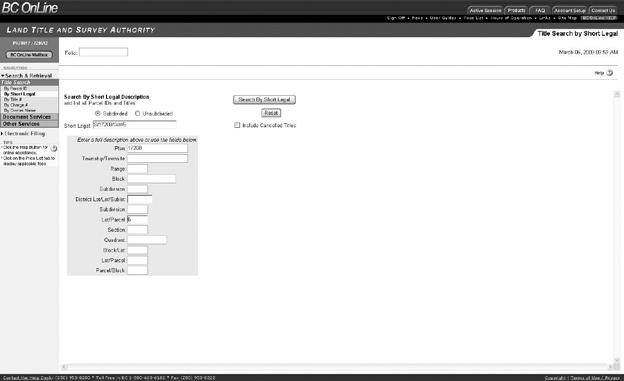
The land Title and Survey Authority of bC (lTSA) has modernized its land title search and document retrieval system on bC online. The improved website design streamlines searches and enables the addition of new functionality. The lTSA and bC online are ensuring that users successfully transition to the improved system to allow the old system to be phased out in a few months. read more at www.ltsa.ca.
honourary member
Reception
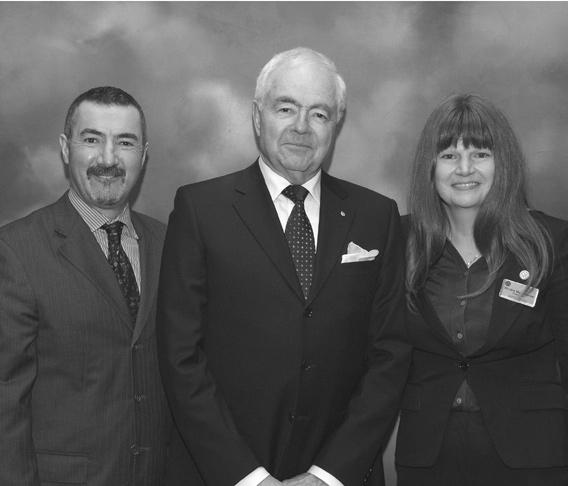
on march 6, 2009, the CbAbC hosted a special member reception honouring those who have continuously supported the Canadian bar Association for 50 consecutive years or more. Canadian bar Association b.C. branch President miriam maisonville and national President Guy Joubert presented each Honourary member with a CbA pin in appreciation of their support.
Past-President Ken Walton, QC was on hand as mC for the event and is recognized as founder of the CbAbC membership Pin recognition Initiative. members who were not able to be present were named and honoured by the mC. both President maisonville and President Joubert gave heartfelt remarks to gathered members and supporters.
Honourary membershipsareawardedtoanypersonwhohasbeena member of a lawSocietyinCanadaortheChambredes notaires for aperiodof50yearsandoftheCanadian barAssociationforaperiod notlessthan20consecutiveyears.
CLEbC Announcement
nanaimo County Gets master Reinstated on trial basis
Members of Provincial Council were pleased to welcome Chief Justice Brenner to the December meeting. At that meeting, he made a commitment to follow up with the members of Nanaimo County, and subsequently had ongoing discussions on this matter with CBABC representatives Stephen McPhee and Grant Currie. Starting February 2009, the access to a Master in Nanaimo County for two weeks each month was reinstated for a trial term.
The CBABC remains committed to assisting Chief Justice Brenner and the courts in our shared task of ensuring access to legal services across the province, and we thank both of them for this opportunity to have done so in Nanaimo County.
ClebC Chair michael roman has announced the retirement of Jack J. Huberman, QC as executive Director of ClebC, after almost 30 years of outstanding service to b.C.’s legal profession.
Jack is widely respected as a world leader in legal education. He was appointed as a visiting Kellogg Fellow at oxford university and as a research Fellow at the College of law in london and Guilford, england, both for a full academic year. In 1989, Jack was designated Queen’s Counsel.
Jack led ClebC through its growth from a tiny organization providing a few live courses to a robust Cle organization with a comprehensive curriculum delivered live in vancouver and throughout the province online. During Jack’s tenure, ClebC developed the only comprehensive Cle legal publishing program in Canada and received many awards, including an unprecedented three in one year from the International Association for Continuing legal education (ACleA). Jack served on ACleA’s executive Committee for several years and shared his expertise with younger colleagues.
Jack was active in the wider legal community as a founding member of the CbAbC’s Professional Services Committee (now the member Services Committee) and a career-long CbA supporter. He served on the Curriculum Committees of both british Columbia law schools.
ron Friesen has been appointed Acting executive Director. ron has been with ClebC for more than twenty years, most recently as Director of education. ron has strong business and project management experience and is recognized nationally and internationally for his work in legal education. He currently leads a major project funded by the law Foundation of b.C. to enhance access to legal education through technology.
From left to right: Guy Joubert, William e. Ireland, QC and miriam maisonville.
Save the date!
Nomination forms for the 2nd Annual CBABC Work Life Balance Award are available on the CBABC website and must be submitted by 4:30 p.m. on April 24, 2009. The Honourable Wally Oppal, QC, Attorney General, will present the award at the Luncheon sponsored by Corporate Occupational Solutions on Thursday, June 25, 2009.
2008 top ten dial-A-Law downloads
1. Spousal Support
2. Traffic Tickets
3. buying a used Car
4. marriage Contracts
5. Custody and Access
6. If you’re Fired: Wrongful Dismissal
7. Foreclosure
8. Changing your name
9. Separation: Deciding Who Will move out
10. Garnishment
DIAL-A-L AW TM
Dial-A-Law (DAL) is a library of scripts prepared by lawyers that offers general information on a variety of topics on law in British Columbia, but not legal advice. DAL is a free, convenient and easy way for the public to learn about the law and their rights as a resident of British Columbia. DAL is available at: dialalaw.org.
Administrative Law website
Launch
Government agencies, commissions and boards make decisions that affect
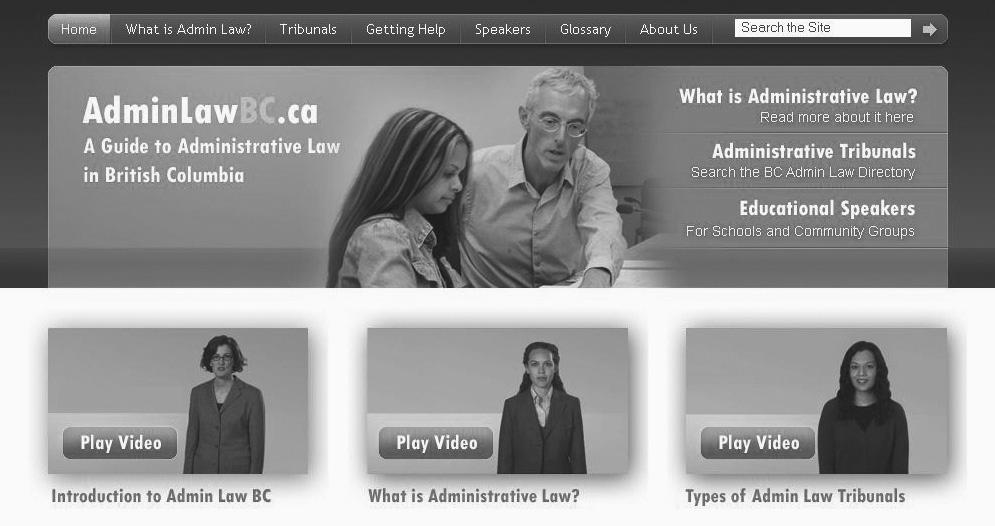
us all. AdminlawbC.ca gives british Columbians an important resource when learning about administrative law or preparing for a tribunal. This new website is the first in Canada to bring information on the complete range of administrative law resources together under one domain. The website includes videos explaining administrative law, links to a range of federal, provincial and specialized tribunals as well as self-help resources.
AdminlawbC.ca was developed by the law Courts education Society and the british Columbia Council of Administrative Tribunals (bCCAT), with support from the Administrative Justice office, Justice Services branch, ministry of the Attorney General of b.C. Funding was provided by the notary Foundation of b.C. and the law Foundation of b.C.
uvic Keeps winning at Law Games
law students from the university of victoria continued their winning ways at the25th annual law Games, hosted this January by the university of Saskatchewan in Saskatoon.
The defending Spirit Cup (overall) champions from uvic braved –50 degree temperatures, captured three sports championships, repeated as winners of the talent competition, and had the honour of passing along the Spirit Cup – as is customary at law Games – to crown an enthusiastic group of mcGill university students the new champions.
law Games began as a one-day hockey tournament in 1985 and has grown into a four-day marathon of athletics, academics, revelry and tradition, attended this year by 350 students representing 13 of Canada’s 20 law schools. The event is an incomparable opportunity for budding lawyers to build relationships within their professional cohort.
b ranch and b ar Calendar (see cba.org/bc for details)
April - may 2009
April 6 & 20
April 7
April 8 & 22
Lawyers Assistance Program: Women’s Success Group
CBABC PD Seminar: Developing Your Career & Refining Your Skills in a Down Economy (Lawson Lundell LLP, Vancouver)
Lawyers Assistance Program: Self Esteem Group
April 8, 16, 25 & 30 Fort St. John Law Day 2009
April 9
CBABC PD Seminar: Ethics in Action - Practice & Community (Ramada Hotel Downtown, Prince George)
April 16 Kamloops Law Day 2009 (Kamloops Courthouse)
April 16 Barry Sullivan Law Cup (Heritage Courtrooms, Vancouver Art Gallery)
April 16 Terrace Law Day 2009 (Courtroom 3, Terrace Courthouse)
April 18 Victoria Law Day 2009 (Victoria Courthouse)
April 18 Kelowna Law Day 2009
April 22 New Westminster Law Day 2009 (New Westminster Law Courts)
April 23 Cowichan Valley Law Day 2009 (Duncan Courthouse)
April 23 Tri-Cities Law Day 2009 (Port Coquitlam Courthouse)
April 25 Vancouver Law Day 2009 (Vancouver Public Library)
April 25 Nanaimo Law Day 2009 (Nanaimo Courthouse)
April 25 Free Law Classes (Alma Van Dusen Room, Vancouver Public Library)
April 26 CBABC Law Week 5km Fun Run 2009 (Locarno Beach Park, Vancouver)
April 29 Fraser Valley Bar Association Meeting (Sonoma Grill, Langley)
May 4 & 18
May 4
May 6 & 13
May 7
May 21
June 1
Lawyers Assistance Program: Women’s Success Group
ALSST Dinner
Lawyers Assistance Program: Self Esteem Group
UBC Law Alumni Annual Dinner (Four Seasons Hotel, Vancouver)
Executive Committee Meeting (CBABC Boardroom)
Lawyers Assistance Program: Women’s Success Group
Annual new westminster/Fraser valley bar Golf tournament
The annual new Westminster/Fraser valley bar Golf Tournament will be held on Thursday, July 9th at Guildford Golf Course in Surrey. There will be both stroke play and a Texas Scramble option for your group. Dinner after golf at the course. lawyers, judges, court reporters etc. are welcome. Cost is $95 per person for golf and dinner, and part of the proceeds will be donated to the lawyers’ benevolent Fund. Contact rick molstad at 604-515-3234 for further details. Application forms will be distributed in may.
Richard Susskind named Special Adviser to CbA
Author and legal futurist richard Susskind is bringing his new and challenging ideas about the future of the legal profession in Canada to the CbA in the newly-created role of special adviser to the Association.
“We welcome richard Susskind as a special adviser and look forward to his unique contribution. His insight is particularly useful as law firms face the challenge of delivering the best possible services to clients in a changing world,” says CbA President Guy Joubert of Winnipeg, in announcing the agreement.
richard Susskind’s latest book The end of lawyers?: rethinking the nature of legal Services was released in Canada in February at a launch co-sponsored by the CbA and oxford university Press. The book predicts significant new pressures on the legal marketplace and great change in the world of legal services. The author suggests that the legal profession will be driven by two forces in the coming decade: a market pull toward the commoditization of legal services, and the pervasive development and uptake of new legal technologies.
Excerpts from the first chapter uuu www.cba.org/CbA/events/ pdf/susskind_endoflawyers_ chapter1.pdf
To order the book email uuu customer.service.ca@oup.com
Conflicts of Interest – toolkit
Successfully managing conflicting interests and ensuring that a client’s confidential information is protected need to be a part of every lawyer’s practice, and the CBA Conflicts of Interest Toolkit was designed to help you achieve this objective. It complements and supplements the task force’s final report and recommendations that were adopted in 2008, and the amendments to the CBA Code of Professional Conduct that were adopted at the 2009 MidWinter Meeting of Council.
CBA Conflicts of Interest Toolkit uuu www.cba.org/CBA/ groups/conflicts/
mid-winter meeting 2009 highlights
lake louise and the spectacular victoria Glacier served as the backdrop for this year’s mid-Winter meeting of Council. The event attracted more than 200 people to Chateau lake louise from across the country where delegates dealt with a full program of debates and resolutions.
The roll-out of the CbA’s new brand was the culmination of a process of formal market research and broad consultations with members that began in 2007.
In his mid-year report, President Guy Joubert spoke of the four most critical developments: the retention of author richard Susskind as special advisor to the CbA; increased efforts to continue universality among law firm members; the report of the Working Group on barriers to leadership within the CbA; and the launch of the CbA’s rebranding campaign.
In a resolution carried by an overwhelming majority of delegates, the CbA is now urging the Canadian and u.S. governments to negotiate the terms of omar Khadr’s repatriation to Canada in recognition of the optionalProtocoltotheConventiononthe rightsoftheChildontheInvolvementofChildreninArmed Conflict, due process and the rule of law. The CbA is also urging the u.S. government to transfer all evidence respecting mr. Khadr’s conduct to the Canadian government.
other resolutions addressed changes to the conflict of interest provisions of the Code of Professional Conduct, and the call for CbA to become a signatory to the nairobi Declaration on Women and Girls’ right to remedy and reparation.
Delegates also had a chance to hear from the two national Second vice-Presidential candidates, Trinda l ernst, QC and robert G. Patzelt, QC, both hailing from nova Scotia. An online vote, was open to members of Council, and closed march 25. The results will be announced on CbA.org.
every issue of barTalk highlights regular discounts available to members from a range of national and regional preferred suppliers. Seasonal promotions and special offers to members are promoted weekly via CBABC News&Jobs Don’t miss any promotion – subscribe to the member services e-bulletin. email: members@bccba.org or fill in and fax the sign-up box below to 1-877-6699601 (toll-free) or 604-669-9601 (lower mainland).
TeCH TIP: member services are available 24/7 via the CbAbC website. To access member services on the site, log onto www.cba.org/bc, then choose member Savings from the drop-down list under Membership on the Member Savings page, you will find links to the suppliers highlighted below, plus many more.
Lindt Chocolates for Easter
Hop to it – from March 30 to April 12 enjoy 30 per cent off all regular priced Lindt Chocolate merchandise at Sears’ robson Street boutique. Te CH TIP: Select Chocolate on the Member Savings page, download the invitation flyer, and be sure to show your CbA ID when purchasing in order to access the discount.
open and Shut Case
Bugatti makes a good case for the legal profession. Six different cases, in fact. Five styles in leather, all sized for laptops between 15-17 inches, with or without wheels. bags range from $145 to $353 and can be personalised with embossing for an additional fee. orders go in on the 15th and 30th of each month. TeCH TIP: Select lawyer’s Cases on the Member Savings page.
PnE Playland Returns
As of March 30, regular Playpasses (must be more than 48 inches tall) can be purchased at the special discounted CbAbC rate of $19.05 before taxes. Compared to the gate price of $26.95, that’s a 36 per cent saving. order online using the code gepexil2. TeCH TIP: Select youth on the Member Savings page.
Electronic Filing Services
buying a home or Renewing your mortgage?
based in Western Canada, The Mortgage Group Canada Inc. has been in business for nearly two decades, helping almost a quarter million Canadians find the right mortgage for their financial needs. Take advantage of ryan Hammerer’s expertise and personalised service with the potential to save you thousands of dollars, all at no cost to you, with your interests (not the lender’s) at heart. bonus: Get a $100 gift card upon completion of your mortgage. TeCH TIP: Select banking on the Member Savings page.
NetLegal, the national Preferred Supplier for electronic legal filing services, is dedicated to providing clients with secure, easy, and reliable access to court information while saving them time and money. law firms can serve and file documents faster and be notified immediately. Students can practise using the service for free and access articling positions. Information is securely hosted in Canada so data never leaves the country. TeCH TIP: Select Service & e-Filing Documents on the Member Savings page for more information.
Sign me up!
q yes, please send me monthly updates on the latest CbAbC promotions.
Please complete this form and fax back to 604-669-9601/ toll-free 1-877-669-9601 or sign up by emailing your information to members@bccba.org.
nEw mEmbERS
The CBABC Branch welcomes its newest members! The following new members joined in the months of January and February of 2009:
SARAh mAthIESEn
WorkSafeBC
Vancouver
REnEE muLLIGAn
Ministry of Attorney GeneralCivil & Family Law Policy
Victoria
Regular Members
KEvIn L. boonStRA Kuhn & Company
Abbotsford
mELAnIE L. duGGAn
CARmEL LISA EAmES
McConnan Bion O’Connor & Peterson
Victoria
ELISAbEth GRAFF
Ministry of Attorney GeneralCivil Litigation
Victoria
dEboRAh C. JEFFREy Mandell Pinder
Vancouver
KEIth A. SAbEy Beairsto Sabey Kelowna
KAREn whonnoCK Legal Services Society Terrace
Scholar JAquA PAGE
Articling Students
ChRIStInA bEnInGER
JoSEPh bRoAdhuRSt MacLean Family Law Group Vancouver
CLEbC update
CIvIL JuRy InStRuCtIonS, SECond EdItIon
RAChEL A. dRummond
Borden Ladner Gervais LLP
Vancouver
nAtAShA duRICh
Vancouver
ShAun tEmPLE FRoSt
Guild Yule LLP
Vancouver
RyAn GREEn
bRIAn hoFFmAnn Carfra & Lawton Victoria
mEGAn KAmmERER Harper Grey LLP Vancouver
mIChELLE Kooy Sangra Moller LLP Vancouver
StEPhAnIE mAyoR
Vancouver
SAhAub mISSAGhI Windsor Law Group
Victoria
nAthAn muRRAy Kamloops
mARK myhRE
Vancouver
LEAh PEnCE
dEAnnA StonE
Pushor Mitchell LLP Kelowna
bRAd woodS
Borden Ladner Gervais LLP
Vancouver
Law Students
KRIStIAn dEJonG
mInA hoLmES
Vancouver
dREw LAFond
GRAhAm SEmEnIuK Edmonton
RIChARd tRumAn
Vancouver
The Continuing legal education Society of british Columbia is pleased to announce the brand-new Second edition of Civil Jury Instructions (CIvJI).
CIvJI is more authoritative than ever, and easier to use for both the bench and the bar. It has been thoroughly reworked and updated. revised instructions track more closely the language used in the leading authorities; culled annotations and distilled case summaries make the jurisprudence more accessible; updated user notes reflect current practice; and renumbered content and new Section numbering make for ease of reference.
CIvJI – Second edition will be updated annually.
PRoGRAmS to FoCuS on wEAthERInG A RECESSIon
british Columbia is in the midst of a major economic slowdown. The legal profession is not immune to recessions, but certain practice areas thrive in tough times.
ClebC will offer a number of courses in these growing practice areas, including Foreclosure Practice 2009 (April 23, 2009), Foreclosure basics for legal Support Staff 2009 (April 24, 2009), and bankruptcy & Insolvency 2009 (may 29, 2009). Courses in other areas of the law will also focus on practice during troubled economic times. These include Commercial leasing: Structuring and managing lease relationships in a recession (June 11, 2009), and real estate Deals: making and breaking Them in Challenging Times (June 19, 2009).
Further information on ClebC publications and courses is available from ClebC customer service at 604-893-2121 (toll-free in Canada at 1-800-663-0437) or at www.cle.bc.ca.
The Board of Governors of the Law Foundation of B.C. met on November22,2008andapproved funding for a number of continuingprogramsandprojects.
Chair Mary Mouat is pleased to announce that funding totalling $6,938,761wasapproved.
Funding totalling $4,878,370 was approved for the following 17 continuingprograms:
$3,599,750 LEGAL SERvICES SoCIEty
Operating Grant 2009/2010
$175,610
downtown EAStSIdE RESIdEntS’ ASSoCIAtIon
DERA Advocacy Service 2009
unIvERSIty oF bRItISh CoLumbIA
$167,000 First Nations Clinical Program
$120,000 Graduate Fellowship 2009/2010
$58,000 Undergraduate Scholarships 2009/2010
$27,500 Projects Grant 2009/2010
$27,000 Entrance Awards 2009/2010
$166,920
GREAtER vAnCouvER LAw StudEntS’ LEGAL AdvICE SoCIEty Law Students’ Legal Advice Program
$153,590
b.C. CoALItIon oF PEoPLE wIth dISAbILItIES Advocacy Access Program
$76,000 LAw CouRtS EduCAtIon SoCIEty Northern Public Legal Education Program for First Nations Communities
$71,500
LAw SoCIEty oF b.C. CanLII Virtual Law Library
$70,000
b.C. FREEdom oF InFoRmAtIon And PRIvACy ASSoCIAtIon Law Reform & Public Legal Education Program
unIvERSIty oF vICtoRIA
$60,000 Graduate Scholarships 2009/2010
$58,000 Entrance and Renewal Scholarships 2009/2010
$27,500 Projects Grant 2009
$20,000
dEbAtE And SPEECh ASSoCIAtIon oF b.C. Law Foundation Cup 2009
For full details of the programs and projectsthatreceivedfunding,please visit the Law Foundation of B.C. websiteatwww.lawfoundationbc.org.
FundInG notICE: Legal Research Fund
The law Foundation of british Columbia has established a fund of $100,000 per year to support legal research in british Columbia.
Purpose of the Initiative: The purpose of the Initiative is to support legal research projects that “advance the knowledge of law, social policy, and the administration of justice.”
Who can apply? members of the law Faculties at the university of british Columbia and the university of victoria and others in the legal profession who can demonstrate that they have the background, interests and capacity to carry out a project which will meet the stated purpose of this Initiative.
The Foundation seeks Letters of Intent for proposals for one-time projects.
• To be eligible for funding, a project must fall within the Law Foundation’s legal research program objectives of advancing the knowledge of law, social policy and the administration of justice through the identification of areas and issues needing study and analysis and the encouragement and support of projects to address those needs.
• The Law Foundation encourages applicants and projects that reflect the diversity of British Columbia. The Law Foundation’s working definition of diversity is: Diversity includes age, different abilities, socio-economic level, education, ethnicity, language, family,gender,marital/relationshipstatus,race,religion,workexperience,geographicsizeandlocation,andsexualorientation.
Length of project: The Foundation will consider one-year projects, as well as multi-year projects.
Grant size: The maximum amount available for each project is $20,000.
Application process: To be considered, please submit a letter of Intent by 3:00 pm, May 20, 2009 for consideration at the June law Foundation board of Governors meeting, by mail, courier, or fax. Please do not email letters of Intent.
The letter of Intent, which should be no more than 3 pages long, should contain the following information:
(a) name of project/proposed research; (b) Description of the proposed research; (c) need for the proposed research; and (d) budget/Amount of request.
Materials should be sent to: law Foundation of british Columbia, 1340 – 605 robson Street, vancouver b.C. v6b 5J3 Fax. 604-688-4586.
Please contact michael Seaborn, Program Director at 604-689-2048 to discuss your project prior to submitting a letter of Intent.
Continuedfrompage8
going “virtual” with those lawyers who don’t really need the “real estate” of a traditional law firm. As a franchise lawyer, I tend to see everything as a potential franchise. Maybe the future law office looks a little more like a REMAX or CENTURY 21 office, (though without those hideous jackets).
Let me explain, using my own practice as an example. I don’t need a physical office in downtown Vancouver. My clients are all over Canada and the U.S. and I’ve only met 20 per cent of them face to face. All my advice is either provided over the phone or delivered by email over the web, and that includes the expensive contracts I (humbly) draft. Armed with a laptop, a wireless Internet connection and a cellphone, I can anchor my sailboat in English Bay on a nice summer day, and draft any letter or document from the foredeck. Or I can work from my home office and not waste time commuting to and from the marina! Or I can work eight weeks a year from Argentina, like a colleague of mine currently does. And as many of us know, sometimes we can get more work done in four concentrated hours outside the office than eight hours in it, unburdened by administrative interruptions, meetings and distractions.
Lawyers fortunate enough to have their own practices don’t always need the bricks and mortar that a traditional law office requires. But there are four things we do need. First is the brand, image and name recognition that comes with a large established firm. Second, we need the “back office” personnel who word process, check conflicts, open files, send bills, cut trust cheques, manage the payables, collect receivables and do all the administrative work that isn’t “legal work.” Third, we need to be able to give the legal work that we don’t want to do (or shouldn’t be doing) to other qualified lawyers or paralegals in the “firm,” and get credited for it somehow. And finally, we need meeting rooms once or twice a week, in case a client really wants a meeting. It’s not for everyone, but allowing certain lawyers to practice “remotely” will free up office space for those lawyers (presumably litigators) who truly need the bricks to launch their mortars.
Costs are lowered for the firm because “remote lawyers” (let’s call them “iLawyers”) won’t have the same “real estate” needs that other lawyers have, and the law firm can either reduce their rental space accordingly (and save money), or hire other lawyers in
the traditional manner who need the space. The iLawyer’s overhead will be much lower and that’s worth something to the iLawyer in terms of compensation. Likewise, use of the firm’s brand and back-office by the iLawyer is worth something to the firm.
So I think the future law office could look a little more like a franchise, where a firm’s brand and administrative support are “licensed” to independent lawyers who will actually pay the firm an initial franchise or license fee for the right to become one of their lawyers. The iLawyer won’t have an office per se, or benefits, or even a “salary” and will have to pay insurance and everything else as an independent sole practitioner would pay, except rent. All legal work generated by the iLawyer using the firm’s brand would be billed and collected through the firm, whether the iLawyer is in Argentina or on a sailboat. And the law firm will take some percentage of the iLawyer’s cash receipts as an ongoing “royalty,” reducing some of its leasing costs in the process. Better yet, to balance their lifestyles, iLawyers can work as hard as they want, whether from Argentina or their sailboats.
Although there are variations of the “all cash-in deal” or “percentage of cash-in” deals in many law firms, I’m not aware of any firm using the “franchise model,” where real estate is taken out of the equation and the firm charges an upfront fee for a lawyer to actually work there. But whether it’s a franchise model or cash-in model, the key concept here is that some lawyers don’t need the “real estate,” but they need the brand and the back-office administration that comes with a larger firm. Lawyers who can practice remotely (and law firms who are prepared to do creative deals) may “change the game” enough to survive and thrive. I suppose we’ll know in 2010 when the Olympics shuts Vancouver down and most of us will have to work remotely anyway.
When an industry is confronted by monumental change like lawyers seem to be in this economy, the industry either shifts the paradigm like iTunes did or it runs the risk of sharing the fate of the CD business, the book business, and oh yeah… the buggywhip business.
By the way, I bought Susskind’s book on Amazon.ca, because it wasn’t in bookstores when I wanted to buy it, it was cheaper and I didn’t have to venture outside in the rain to look for it. That may be prophetic about the future of our profession. BT
CLASSIFIEd (per line)
CbAbC members/Firms
$25
Commercial organizations $50 next deadline: may 8
dISPLAy
3” x 2.5”
CbAbC members/Firms $450
Commercial organizations $900
6” x 2.5”
CbAbC members/Firms $810
Commercial organizations $1,620 next deadline: may 8
InSERt (all of b.C.)
CbAbC members/Firms
$1,200
Commercial organizations $2,400 next deadline: may 13 next mailing: June 5
direct bartalk advertising inquiries to:
Jesse Tarbotton
barTalk Senior editor Tel: 604-646-7856 or 1-888-687-3404 email: jtarbotton@bccba.org
Practice Restricted To WCB
Sec. 257 Determinations, Opinions and Court Applications on referral
The Firm has openings for a research lawyer and junior barrister to join our practice. Applicants for the research position should have exceptional academic records, creative analytical skills and a broad interest in both public and private law. The junior barrister should be in their first three years of practice, have an excellent academic background and preferably have some experience in civil litigation. We welcome applications from lawyers wishing to work in a stimulating and high-end litigation practice. Interested lawyers should send their c.v. and transcript of their grades to K. Michael Stephens, at Suite 2100-1040 West Georgia Street, Vancouver, B.C., V6E 4H1
LoCumS – OnPoint Law Corp. is looking for exceptional litigators and solicitors to join
WCB & CPP DISABILITY CLAIMS
GOSAL & COMPANY
Barristers & Solicitors
Over 14 YEARS of Workers’ Compensation Claims & Appeals Experience*
its Locum Division. Successful applicants must have at least five years experience in one area of law, and be available for flexible placements. Please send a resumé to Sarah Picciotto at spicciotto@onpointlaw.com or call 604-879-4280.
S ER v ICES
IntELLECtuAL PRoPERty: Let us assist you in providing protection for your clients. Douglas B. Thompson Law Corporation –Registered Patent Agent, Registered Trade Mark Agent. Practice restricted to Intellectual Property, Victoria, B.C. (www.BCpatents.ca) Email: doug@BCpatents.ca.
AtKInSon LAw Office Business/Immigration, www.AtkinsonLaw.com referrals paid.
PRACt ICE Fo R SALE
Established Solicitor’s practice located in Victoria, mainly business law, commercial real estate, wills, estates, trusts, and selective residential real estate. Senior lawyer retiring. Willing to assist in transition. Terrific clients, great location. Contact James Shaver shaverlaw@telus.net.
2009 Law Week
Fun Run
Benefitting Law Week and The Greater Vancouver Food Bank 5k m
Sunday, April 26th, 2009 Locarno Beach Park
Star t Time: 10 AM
To register online please visit: www.bcla wweek.o rg Or call Events at 604-687-3404 ex t 306
2009 CbAbC winter Conference Los Angeles, California november 20-22, 2009
Mark this event in your calendar! A great way to complete your mandatory professional development credits, socialize with faculty and attendees, visit beverly Hills and Hollywood, and take your kids to universal Studios and Disneyland, all in one weekend! The agenda will include hands-on advice on practice management and ethics, as well as relevant topics for both solicitors and litigators. Stay tuned for further details in the next barTalk!