Every month, the lawyers of B.C. are required to collect from clients about $10 million dollars in government tax on legal services. That's more than $300,000 every day of the year, taken out of the economy directly from t he pockets of individuals and businesses.
Right now, untold millions of dollars are in legal limbo, sitting in trust accounts around the province
The amount grows every day. Meanwhile, the government of B.C. is taking its fight to keep the tax to the Supreme Court of Canada. The Canadian Bar Association will be intervening in that case on behalf of the profession.
The tax was declared unconstitutional in part in the Christie cross-appeal decision, but that decision was later made subject to a partial stay pending the government's SCC appeal. Lawyers are now required to collect the tax on all legal services, but to hold it in trust in some cases and remit it to government in others. The question is: which legal services fall into which category?
The tax has been declared unconstitutional "to the extent that it purports to tax legal services related to the determination of rights and obligations by courts of law or independent administrative tribunals ." The government has said it will release guidelines to provide direction to lawyers about what kinds of services do and don't fall under the Christie decision and subsequent partial stay. The Law Society has confirmed that lawyers will not be
penalized for holding the monies in trust until the guidelines come out.
Lawyers in B.C are confused and frustrated with the current state of affairs. The added administrative burden is a serious hardship for small firms and sole practitioners in particular, who make up the majority of the B.C . Bar. "Everyone's tired of collecting a tax that makes no sense," said CBABC President Meg Shaw. "No other professional service is taxed by the province in B.C , and no other province singles out legal services for a tax - in Alberta and Ontario, our closest competitors, access to justice is not subject to provincial tax at all."
In March, the CBA commissioned and publicly released an economist's report that bolsters the case for scrapping the tax The CBA and B.C 's Chamber of Commerce jointly issued a news release stating
"Lawyers are confused and frustrated with the current state of affairs."
that it is absurd for the government to continue to colle ct a tax that MLAs, the courts, businesses, and economists have all acknowledged as unfair and discriminatory
Said President Shaw: "Our message to B.C.'s government and Opposition members is simple: Do the right thing for B.C. - remove the tax on legal fees- now!" BT The Canadian Bar Association British Columbia
Canadian Bar Association, B C Branch
1Dth Floor. 845 Cambie Street Vancouver, B.C V6B 5T3
Tel : 604-687-3404
Toll-free (in B C.!: 1-888-687-3404
BarTalk is published six times per year by the Canadian Bar Association, British Columbia Branch.
This publication is intended for information purposes only and the information herein should not be applied to specific fact circumstances without the advice of counsel.
The Canadian Bar Association, British Columbia Branch represents more than 6 ,200 members within British Columbia and is dedicated to improving and promoting access to justice, reviewing legislation, initiating law reform measures and advancing and improving the administration of justice
BarTalk Publication Sales Agreement #40741008
(VOL. 18, NO. 1I
I just finished reviewing the latest issue of BarTalk. With no disrespect intended to you, or the individual authors , I found the experience somewhat depressing. Articles such as:
Send your LETTERS TO THE EDITOR to:
Caroline Nevin, Bar Talk Senior Editor
Canadian Bar Association, B C Branch Fax: 604-669-9601
Toll-free fax: 1-877-669-9601
E-mail: cnevin@bccba org
• Healthy Lifestyle- Do You Enjoy One?
• Forget Balance- Think Quality
• Top Employers "Got It"
• "Fire a Client Day"- March 1st
• Beating the " Blahs"
• Depression and the Practice of Law
Perhaps these articles are simply intended to encourage healthy discussion and "venting" among colleagues . However, as a 2000 call with the majority of my working life still ahead of me, I can't help but wonder if I've made a poor career choice. My concern might be eased a little if there were some counter-balancing articles in BarTalk from senior members of the bar commenting on how rewarding and fu lfilling their personaVfamily lives have been while earning their income in the legal profession. Do these people exist?
- Charlie C. Tutt
CLASSIFIED (per Line)
CBABC Members/Firms
Commercial Organizations
Next deadline: May 12
DISPLAY
3" X 2.5"
CBABC Members/Firms
Commercial Organizations
6" X 2.5"
CBABC Members/Firms
Commercial Organizations
Next deadline : May 12
INSERT !all of B.C.l
CBABC Members/Firms
Commercial Organizations
Next deadline: May 19
Next mailing: June 9
Direct Bar Talk advertising inquiries to: Jesse Tarbotton Communications Co-ordinator
Tel : 604-646-7856 or 1-888-687-3404
E-mail: jtarbotton@bccba.org
Professional Courtesy and Civility
When I was interviewed by Barbara Young, QC for the usual "meet the new president" article that was published in The Advocate, Barbara asked me, "If you cou ld change one thing about the profession of law, what would it be?" My answer was that I would increase the professionalism and collegiality in the bar.
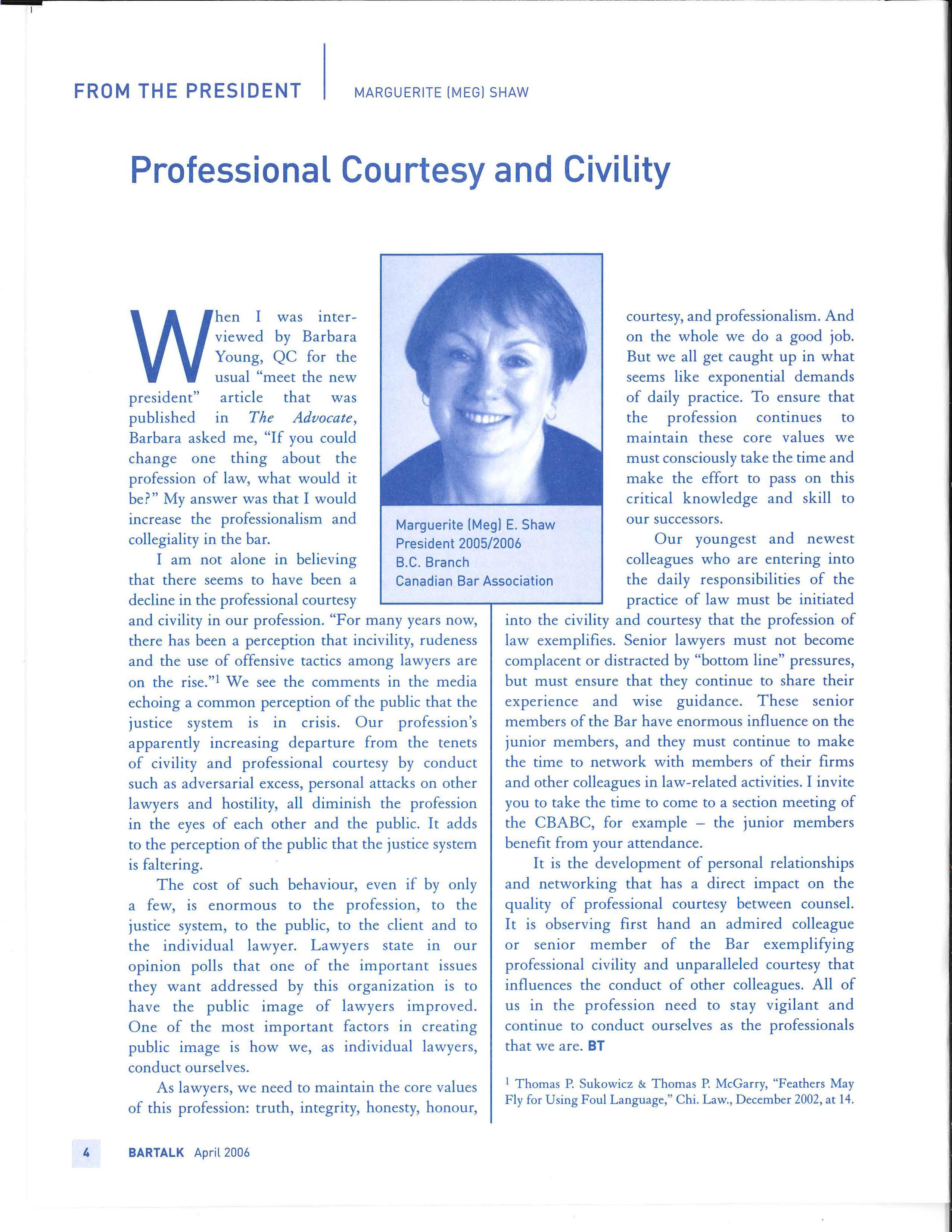
Marguerite [Meg) E Shaw President 2005/2006
B.C. Branch
I am not alone in believing that there seems to have been a Canadian Bar Association decline in the profess ional courtesy and civility in our profession. "For many years now, there has been a perception that incivility, rudeness and the use of offensive tactics among lawyers are on the rise."! We see the comments in the media echoing a common perception of the public that the justice system is in cns1s. Our profession's apparently increasing departure from the tenets of civility and professional courtesy by conduct such as adversarial excess, personal attacks on other lawyers and hostility, a ll diminish the profession in the eyes of each other and the public. It adds to the perception of the public that the justice system is faltering.
The cost of such behaviour, even if by only a few, is enormous to the profession, to the justice system, to the public, to the client and to the individual lawyer. Lawyers state in our opinion polls that one of the important issues they want addressed by this organization is to have the public image of l awyers improved. One of the most important factors in creating public image is how we, as individual lawyers, conduct ourselves.
As lawyers, we need to maintain the core values of this profession: truth, integrity, honesty, honour,
4 BARTALK April 2006
courtesy, and professionalism. And on the whole we do a good job. But we all get caught up in what seems like exponential demands of daily practice. To ensure that the profession continues to maintain these core values we must consciously take the time and make the effort to pass on this critical knowledge and skill to our successors.
Our youngest and newest colleagues who are entering into the daily responsibilities of the practice of law must be initiated
into the civility and courtesy that the profession of law exemplifies. Senior lawyers must not become complacent or distracted by "bottom line" pressures, but must ensure that they continue to share their experience and wise guidance. These senior members of the Bar have enormous influence on the junior members, and they must continue to make the time to network with members of their firms and other colleagues in law-related activities. I invite you to take the time to come to a section meeting of the CBABC, for example - the junior members benefit from your attendance.
It is the development of personal relationships and networking that has a direct impact on the quality of professional courtesy between counsel. It is observing first hand an admired colleague or senior member of the Bar exemplifying professional civility and unparalleled courtesy that influences the conduct of other colleagues. All of us in the profession need to stay vigilant and continue to conduct ourselves as the professionals that we are. BT
1 Thomas P. Sukowicz & Thomas P McGarry, "Feathers May Fly for Using Foul Language, " Chi. Law , December 2002, at 14.
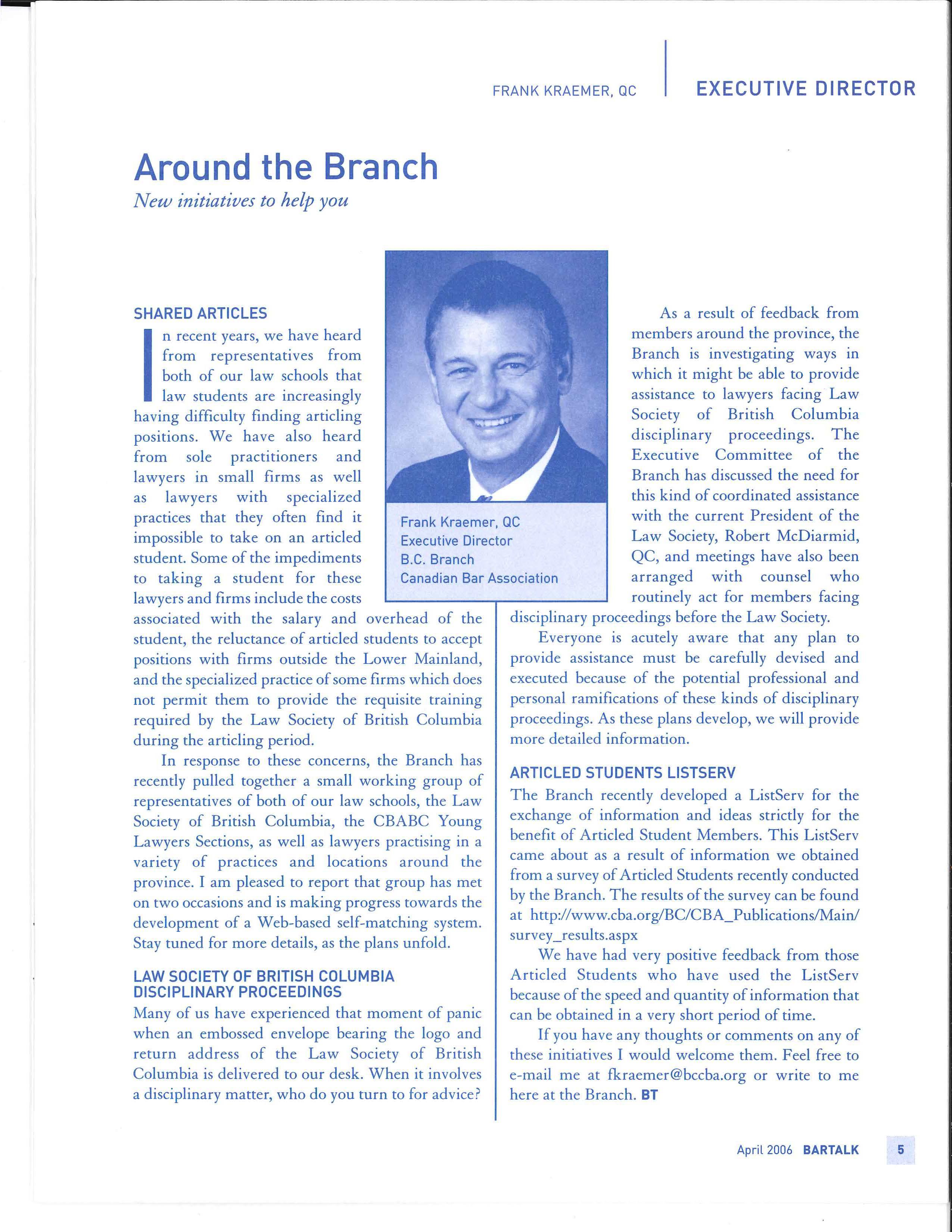
FRANK KRAEMER, QC
Around the Branch
New initiatives to help you
SHARED ARTICLES
In recent years, we have heard from representatives from both of our law schools that law students are increasingly
having difficulty finding articling positions We have also heard from sole practitioners and lawyers in small firms as well as lawyers with specialized practices that they often find it impossible to take on an articled student. Some of the impediments to taking a student for these lawyers and firms include the costs Canadian Bar Association
Frank Kraemer, QC Executive Di rector B.C. Branc h
As a result of feedback from members around the province, the Branch is investigating ways in which it might be ab le to provide assistance to lawyers facing Law Society of British Co l umbia disciplinary proceedings. The Executive Committee of the Branch has discussed the need for this kind of coordinated assistance with the current President of the Law Society, Robert McDiarmid, QC, and meetings have also been arranged with counsel who routinely act for members facing associated with the salary and overhead of the student, the reluctance of articled students to accept positions with firms outside the Lower Mainland, and the specialized practice of some firms which does not permit them to provide the requisite training required by the Law Society of British Columbia during the articling period.
In response to these concerns, the Branch has recently pulled together a small working group of representatives of both of our law schools, the Law Society of British Columbia, the CBABC Young Lawyers Sections, as well as lawyers practising in a variety of practices and locations around the province. I am pleased to report that group has met on two occasions and is making progress towards the development of a Web-based self-matching system. Stay tuned for more details, as the plans unfold.
LAW SOCIETY OF BRITISH COLUMB IA DISCIPLINARY PROCEEDINGS
Many of us have experienced that moment of panic when an embossed envelope bearing the logo and return address of the Law Society of British Columbia is delivered to our desk. When it involves a disciplinary matter, who do you turn to for advice?
disciplinary proceedings before the Law Society Everyone is acutely aware that any plan to provide assistance must be carefully devised and executed because of the potential professional and personal ramifications of these kinds of disciplinary proceedings As these plans develop, we will provide more detailed information.
ARTICLED STUDENTS LISTSERV
The Branch recently developed a ListServ for the exchange of information and ideas strictly for the benefit of Articled Student Members. This ListServ came about as a result of information we obtained from a survey of Articled Students recently conducted by the Branch The results of the survey can be found at http://www.cba.org/BC/CBA_Publications/Main/ survey_results.aspx
We have had very positive feedback from those Articled Students who have used the ListServ because of the speed and quantity of information tha t can be obtained in a very short period of time . If you have any thoughts or comments on any of these initiatives I would welcome them Feel free to e-mail me at fkraemer@bccba.org or write to me here at the Branch. BT
Annual Report
CBA Past President Susan McGrath has launched the first-ever online CBA Annual Report The report describes CBA activities and accomplishments during the 2005 CBA year in 10 key areas, including advocacy, professional development, membership, and international development. http://www. cba.org/CBA/about!pdf/annualreport.pdf
Practice Direction Issued By Chief Justice Brenner
This practice direction amends the practice direction issued by Chief Justice Brenner on September 9, 2005 The amendments are the resu l t of changes to the Criminal Code that came into effect on January 3, 2006, which resulted in the renumbering of some of the sections referred to in the original practice direction.
PDF Document: http://www.cba .org/bc/pdf/ cou rts/sc_02_23 _ 06 .pdf
Li n k to Supreme Court notices on B C Branch site [CBA ID needed to view this page]: http://www.cba.org/BC/Practice_Resources/supreme_ cou rt/supreme_cou rt.aspx
Upcoming CBA Spring CLE Programs
Second Annual Environmental, Energy & Resources Law Summit: Canada- U.S. Cross-Border Issues
April 27-29, 2006, Toronto
Second National Civil Litigation and Insurance Law CLE Conference
April 28-29, 2006, Toronto
Into the Future: The Agenda for Civil Justice Reform
Presented by the Canadian Forum on Civil Justice
April 30 - May 2, 2006, Montreal
National Citizenship and Immigration Law Conference
May 5-6, 2006, Quebec City
Fourth National Symposium on Charity Law
May 11, 2006, Toronto
2006 National Construction Law Conference
May 12-13, 2006, Whistler, B.C.
Full list and details: http ://www.cba.org/cbalcle/cleOO/
6 BARTALK April 2006
Notice to the Profession
The Honourable Chief Judge Hugh C. Stansfield Provincial Court of British Columbia
February 2, 2006
In response to the increase in the monetary jurisdiction of the small claims act to $25,000, the Provincial Court of British Columbia has made a number of scheduling changes in order to resolve cases in a "just, speedy, inexpensive, and simple manner," according to the mandate in Section 2 of the Small Claims Act. Read more at http://www.cba.org/BC/ pdflcourts/ pc 02 02 06.pdf
Doug Miller Award
Anne M. Wallace, QC, of Saskatoon, was named the 2006 winner of the Douglas Miller Award In announcing the winner, CBA President Brian A. Tabor, QC, of Halifax said Anne has been an active and enthusiastic CBA member ever since her university days, demonstrating outstanding commitment and team spirit in all her involvement with the Association." Anne is a partner in Wallace Meschishnick Clackson Zawada in Saskatoon, where she is a Chartered Arbitrator and Mediator.
CCCA National Spring Conference
Leading change in a brave new regulatory world is the theme of this year's Canadian Corporate Counsel Association's spring conference, April 23-25 in Ottawa On the agenda:
• The Post 9/11 World - How Risk Management and New Regulations Affect Your Business
• The Criminalization of Environmental Liability
• When the Regulators Come Knocking -A Practical Guide to Internal Investigations
Information: http: //www.ca ncorpcounsel.org/En/ Education/pdf/ Spring_Conference_Agenda_2006. pdf
The Canadian Bar Association strongly supports public legal education. Law Day is made possible through the funding of the Canadian Bar Association, the Vancouver Bar Association, the Law Foundation of B.C., and lawyers who donate thousands of hours of volunteer time to the events. Law Day is a program that helps Canadians learn about their justice system through a number of events, such as mock trials, free legal classes, open houses at courthouses (including tours), public speaking and essay contests for high school students, and many more activities This year's theme is "The Law: Friend or Foe?" For more information or to volunteer, please contact the local representative or visit our website www.cba.org/bc (under Public and Media)
Sarah Klinger 250-385-4311 (sklinger@waddellraponi.com)
CBABC WOMEN LAWYERS FORUM
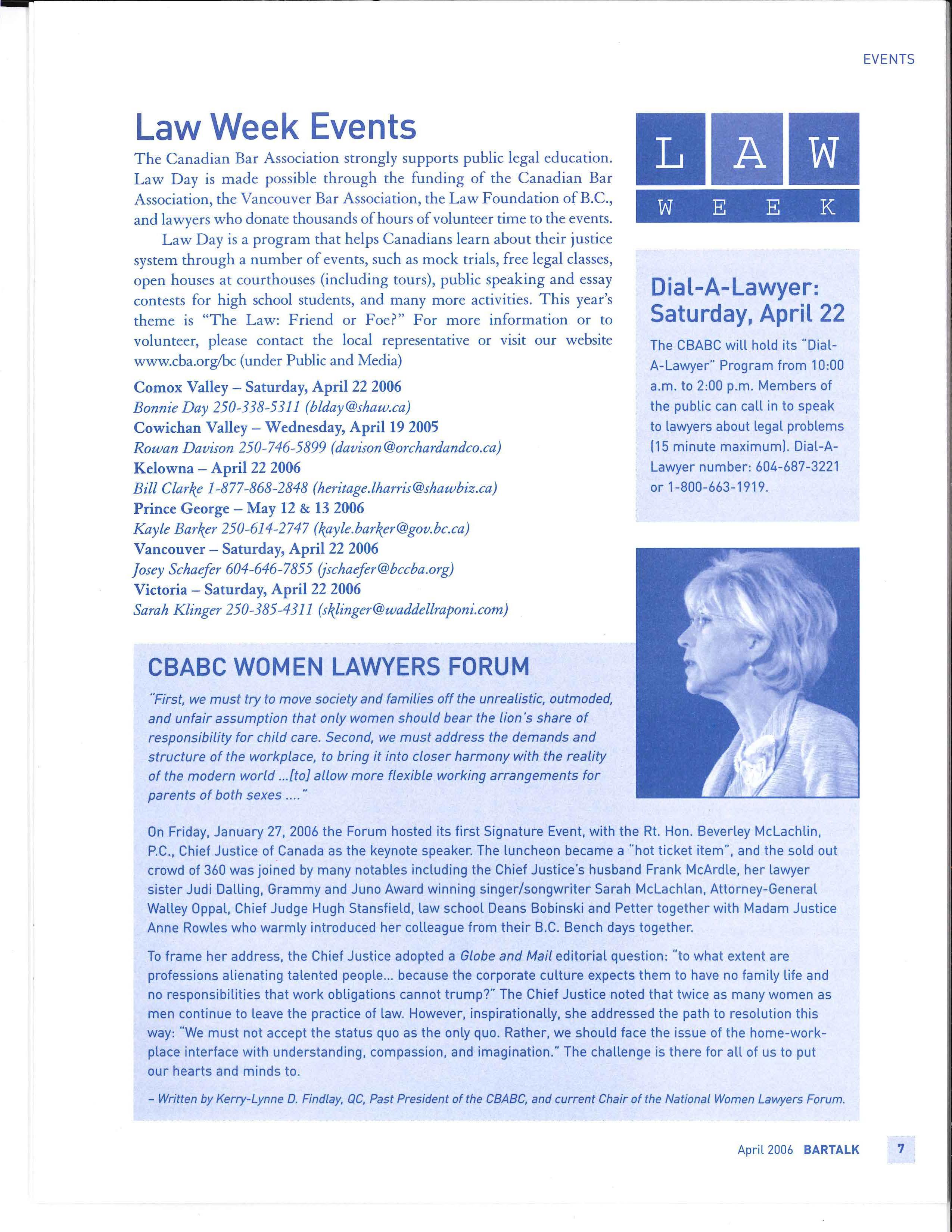
'First, we must try to move society and families off the unrealistic, outmoded, and unfair assumption that only women should bear the lion's share of responsibility for child care. Second, we must address the demands and structure of the workplace, to bring it into closer harmony with the reality of the modern world .[to] allow more flexible working arrangements for parents of both sexes
Saturday, April 22
The CBABC will hold its "DialA-Lawyer" Program from 10:00 a.m. to 2:00 p.m Members of the public can call in to speak to lawyers about legal problems (15 minute maximum]. Dial-ALawyer number: 604-687-3221 or 1-800-663-1919
On Friday, January 27, 2006 the Forum hosted its first Signature Event, with the Rt. Ha n Beverley Mclachl in, P.C., Chief Justice of Canada as the keynote speaker. The luncheon became a "hot ticket item", and the sold out crowd of 360 was joined by many notab les including the Chief Justice's husband Frank McArdle , her lawyer sister Judi Dalling , Grammy and Juno Award winning singer/songwriter Sarah Mclachlan, Attorney-General Walley Oppal, Chief Judge Hugh Stansfield, law school Deans Bobinski and Petter together with Madam Justice Anne Rowles who warmly introduced her colleague from their B C. Bench days together
To frame her address, the Chief Justice adopted a Globe and Mail editorial question: "to what extent are professions alienating talented people because the corporate culture expects them to have no family life and no responsibilities that work obligations cannot trump?" The Chief Justice noted that twice as many women as men continue to leave the practice of law. However, inspirationally, she addressed the path to resolution this way: 'We must not accept the status quo as the only quo. Rather, we should face the issue of the home-workplace interface with understanding, compassion, and imaginat ion." The challenge is there for all of us to put our hearts and minds to .
- Written by Kerry-Lynne D. Findlay, QC, Past President of the CBABC, and current Chair of the National Women Lawyers Forum.
Section Update
Keep your practice current
The following are brief summaries of several recent Section meetings held throughout the province. Section enrolment provides free access to all current and archived minutes online at www.cba.org/bc.
ABORIGINAL LAW- VANCOUVER ISLAND
MEETING: February 21, 2006
SPEAKER: Provinc ia l Court Judge Steven Point
TOPIC: The Treaty Negotiation Process: Current Issues and Deve l opments
Provincial Court Judge Steven Point was appointed Chief Commissioner of the B.C . Treaty Commission by agreement of the governments of Canada and British Columbia and the First Nations Summit, effective February 28, 2005 He has been a provincial court judge since February 1999. Judge Point served as the Tribal Chair of the Sto:lo Nation from 1994 to 1999 and elected Chief of Skowkale First Nation for 15 years between 1975 and 1999 . Among the many issues raised at this well-attended meeting in Victoria , Judge Point discussed communication between First Nations and local governments, as they are the ones who will work with the Treaty once it is in effect
ADMINISTRATIVE LAW- VANCOUVER
MEETING: March 2, 2006
SPEAKER: Gregory Levine, Associate Professor, University of Western Ontar io
TOPIC: Government Ethics Law- Trends and Prospects
A unique form of administrative law and government ethics law has grown tremendously in the
last 20 years. Ethics codes, lobbyist laws and the like have sprung up , as have the administrative tools necessary to promote and enforce them Mr. Levine discussed recent trends federally, in B.C. and Ontario, and contrasted aspects and trends in the setting of rules and mechanisms used m current ethics regimes.
ADR- NANAIMO
MEETING: March 2, 2006
SPEAKER: Charles Hill, ADR Practitioner and Facilitator; Marjorie Kamp, Vancouver Island Health Authority
TOPIC: Elder Mediation: Shared Fami ly Decision Making Mediation provides an opportunity for the elder and all concerned members of a family to participate in creating a thoughtful plan for the future. Mr. Hill and Ms. Kamp presented a workshop where small groups discussed and described three different scenarios and outcomes of four diverse elder families. Mediators trained in issues relating to estates, eldercare, and social gerontology can help facilitate family discussions about matters relating to safety, finances and capabilities while keeping in mind the seniors' desire for individual control and respect
CIVIL LITIGATION -VANCOUVER
MEETING: February 8, 2006
SPEAKER: Dr Martin Fe l sky, a lawyer and CEO of Commonwealth Legal , Canada 's largest litigation document management services company
TOPIC: Wrestling wit h Electro n ic Discovery : Current Case Law in Canada and the Impact of the Ontar i o Task Force Guidelines
Required Reporting
The Law Society now requires lawyers to report annually on their professional development activities. The Benchers also now encourage each practising lawyer in B.C. to complete a minimum of 12 hours of coursework [the equivalent of two full course days] and 50 hours of se l f-study each year. The targets are set as minimum expectations for the profession but are not mandatory. Attendance at CBA Section presentations is reportable as coursework , and review of Section minutes/ materials is reportable as self-study hours [as long as it is not for the purpose of research for a file/easel.
Dr. Felsky provided an overview of the law, strategy, and practice of electronic discovery in Canada, including the Ontario Task Force Guidelines, their meaning and impact He also reviewed pertinent Canadian case law, developing e-production protocols in British Columbia, and some real-life e- discovery disasters.
CRIMINAL JUSTICE- VANCOUVER
MEETING: March 1, 2006
SPEAKERS: Stephen Bindman, Mary Ainslie, Tamara Levy, Peter Wilson, QC, Richard Fowler
TOPIC: Preventing Wrongful Convict ions
Each guest speaker presented his or her thoughts and ex perience on how best to educate current and future lawyers about the important issues raised by the reports on wrongful conviction cases. One of the most notorious cases of wrongful conviction in Canada, the Thomas Sophonow case, was discussed.
IMMIGRATION LAW
MEETING: January 25, 2006
SPEAKER: Heather Michaud, Vice-Consu l , Canadian Consulate in Seattle
TOPIC: Immigration Operations in Seattle Section members e-mailed questions and issues to Ms. Michaud in advance of this meeting Ms. Michaud gave an overview of operational issues at the Seattle visa office . She refrained from making comments on policy, given the recent change in the federal government. Ms Michaud dealt with a number of specific issues with regard to preparing applications and submitting supporting evidence.
Section Enrolment 2005 - 2006
Section activity for this year w i ll conclude at the end of June. It's not too late to enroll! Enrolled members can access current and past minutes and Sect ion Papers on the CBABC website www.cba.org / bc at no charge. CBABC members receive one Section free. Not a Section member? You can download a Section enrolment order form at www.cba.org/bc under Section News on the home page
PENSIONS, BENEFITS AND COMPENSATION
MEETING: February 23, 2006
SPEAKER: Thomas G Anderson, QC
TOPIC: Part 6 of the Family Relations Act - Proposed Revisions
Mr. Anderson, who has had extensive involvement with issues of pension division on marriage breakdown, discussed the work of the Pension Division Committee of the British Columbia Law Institute, which is reviewing Part 6 of the Family Relations Act Mr Anderson also worked through an example constructed to show how the various models of pension division
across Canada would approach the problem, and what can be learned from those models. This was one of several meetings intended to present the Committee's work and solicit input for legislative reform
SECURITIES LAW
MEETING: March 2, 2006
SPEAKER: Dan Miller, Dorsey & Whitney LLP
TOPIC: Significant Reforms to U S Securities Laws In December of 2005, significant reforms were made to U.S. securities laws that will affect all Canadian issuers offering securities in the United States. Dan Miller from the Vancouver office of Dorsey & Whitney LLP spoke of recent reforms to U.S securities laws and provided a Power Point presentation to the attendees.
YOUNG LAWYERS -VICTORIA
MEETING: February 15, 2006
SPEAKERS: Associate Chief Judge B. Neal and Judge A. Palmer
TOPIC: Advocat ing Effect ively in Small Claims Court; and How the $25 ,000 L i mit has Changed Provincial Court Tr ia l s The monetary jurisdiction of the Court was increased to $25,000 to allow more claims to be brought in Small Claims Court, rather than Supreme Court, and to provide greater access to the court system. The Small Claims Act allows the jurisdiction to be increased to up to $50,000 by regulation and there have been discussions about increasing the limit as high as $100,000.
UPCOMING SECTION MEETINGS
April 11 - Fami ly Law- Nanaimo
April 18 - Aboriginal Law- Vancouver Island
April 19 - Taxation Law
April 26- Women Rainmakers- Vancouver Is l and May 3- Women Rainmakers- Vancouver Island May 5- Joint ADR/Family Law- Okanagan
You can access your Section 's upcoming meeting notices online at www.cba.org/bc under "Section News " on the home page .
Salutations Shelley!
After 19 years as the author of the much - beloved Section Talk " column, Shelley Bentley has decided it's time to pass on the "Sections torch. The entire profession has benefited from Shelley ' s valuable contributions to Bar Talk. We sincerely thank Shelley for her dedication and wish her all the best.
DAVID J BILINSKY
Changes in the Practice of Law
Adopting to new pressures of practice
))I've seen the future, baby: 1\ it is murder J
Writer and vocalist, Leonard Cohen
Law is a business. If there ever was any doubt of the direction in which we have been moving, the last few years have clearly proven the truth of this statement. Yes, we are members of a long and honourable profession. Yes, we serve the public interest.
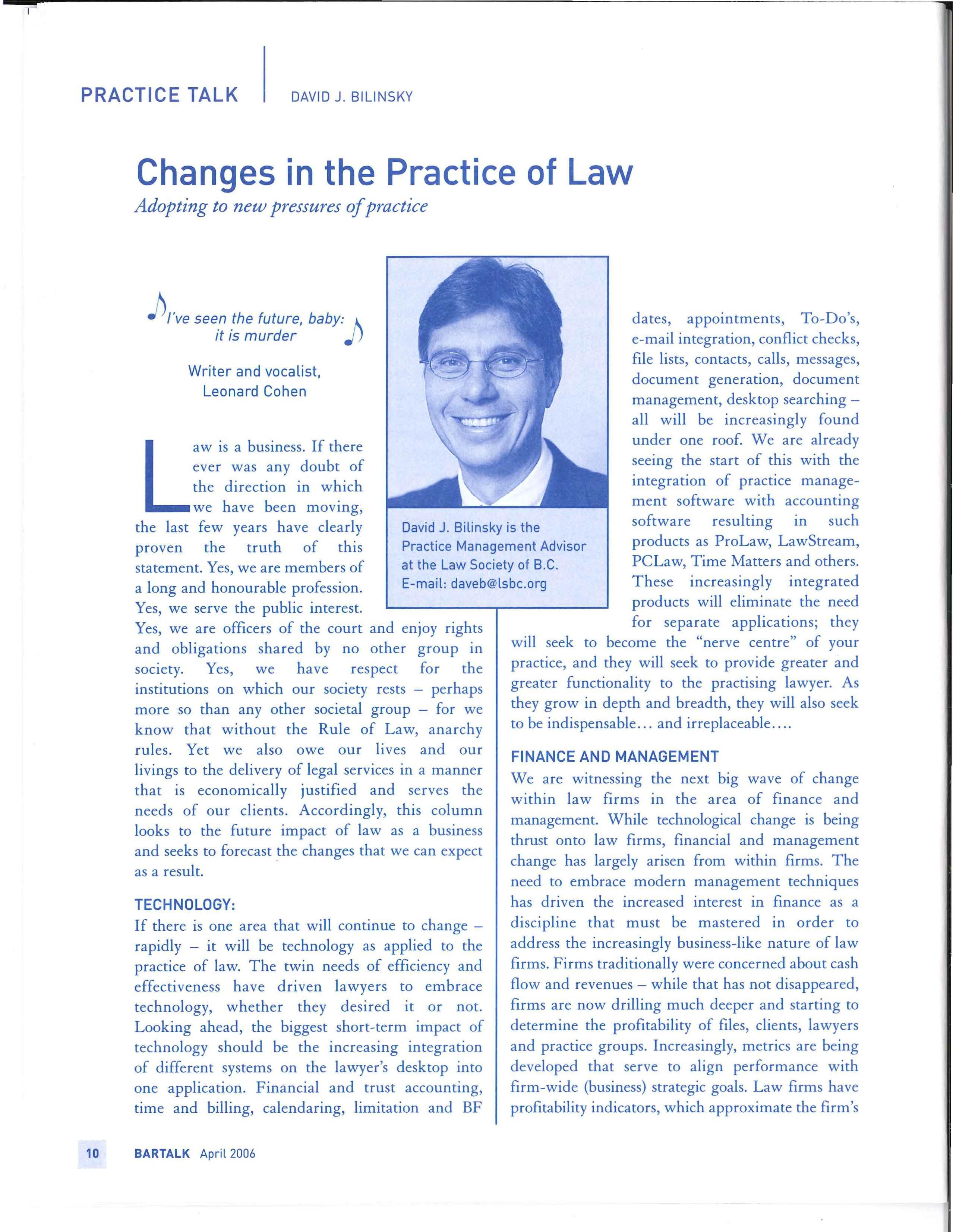
David J. Bilinsky is the Practice Management Advisor at the Law Society of B.C. E-mail: daveb@lsbc.org
Yes, we are officers of the court and enjoy rights and obligations shared by no other group in society. Yes, we have respect for the institutions on which our society rests - perhaps more so than any other societal group - for we know that without the Rule of Law, anarchy rules. Yet we also owe our lives and our livings to the delivery of legal services in a manner that is economically justified and serves the needs of our clients. Accordingly, this column looks to the future impact of law as a business and seeks to forecast the changes that we can expect as a result.
TECHNOLOGY:
If there is one area that will continue to changerapidly - it will be technology as applied to the practice of law. The twin needs of efficiency and effectiveness have driven lawyers to embrace technology, whether they desired it or not. Looking ahead, the biggest short-term impact of technology should be the increasing integration of different systems on the lawyer's desktop into one application. Financial and trust accounting, time and billing, calendaring, limitation and BF
dates, appointments, To-Do 's, e-mail integration, conflict checks, file lists, contacts, calls, messages, document generation, document management, desktop searchingall will be increasingly found under one roof. We are already seeing the start of this with the integration of practice management software with accounting software resulting in such products as ProLaw, LawStream, PCLaw, Time Matters and others. These increasingly integrated products will eliminate the need
for separate applications; they will seek to become the "nerve centre" of your practice, and they will seek to provide greater and greater functionality to the practising lawyer. As they grow in depth and breadth, they will also seek to be indispensable and irreplaceable
FINANCE AND MANAGEMENT
We are witnessing the next big wave of change within law firms in the area of finance and management. While technological change is being thrust onto law firms, financial and management change has largely arisen from within firms. The need to embrace modern management techniques has driven the increased interest in finance as a discipline that must be mastered in order to address the increasingly business-like nature of law firms. Firms traditionally were concerned about cash flow and revenues - while that has not disappeared, firms are now drilling much deeper and starting to determine the profitability of files, clients, lawyers and practice groups Increasingly, metrics are being developed that serve to align performance with firm-wide (business) strategic goals. Law firms have profitability indicators, which approximate the firm's
(or lawyer's) hourly cost of production. Given these profitability measures (and the hours worked on a file and the revenues resulting therefrom), management can quickly determine if a file, client, lawyer or department is meeting its targets. And of course , compensation and promotion within a firm is being tied to meeting explicit financial and strategic goals.
MARKETING
Once viewed as simply advertising, marketing has come to reflect the "action" part of the firm's strategic goals. In many ways, lega l marketing, once restricted to yellow pages and print adyertising, has come alive via the Internet. Electronic newsletters were the first incarnations, quick ly followed by web sites, web-search optimizations, group marketing and now blogs. Lawyers and law firms pay for the privilege of popping up in Google ads ("Adwords"). Lawyer web pages are optimized to appear at the top of Google searches. Lawyers now join online directory listings. Law firms now purchase and develop CRM (Contact Relationship Management) software. Law firms recognize that the development of clients is an exercise in personal relationships - and they build extranets to allow an electronic bridge to be built between clients and their files within a law firm. Blackberries have provided clients with 24/7 access to their t ru sted legal advisor, thereby increasing the bond between lawyer and client. Remote access via laptops and other technologies allows lawyers to work from home, from the Whistler cabin or from a different continent - thereby allowing the firm to develop the relationship between lawyer and clientnotwithstanding barriers of time and distance . Furthermore, by combining marketing, the Internet and strategic planning, law firms have achieved a geographic reach and focus unheard of in the past. With the needs of clients becoming global in nature, it can only be expected that law firms will also become increasingly global in outlook This will require that law firms transcend jurisdictional and geographic boundaries and start to view the need to be able to reach out to many of the markets shared by their clients . Baker & McKenzie already calls itself "the world's leading global law firm."
LIFE AND BALANCE
The major impact of these three areas - technology, finance and management , and marketing - will be the degradation of the lawyer's individual life Work and life balance, already stressed by technology, will be under pressure from the need to meet the increasing wishes of clients Law firmsparticularly the largest ones - will find it difficult to retain lawyers under the unrelenting pressures and needs of clients. Even smaller firms will suffer from the divergence between younger lawyers who desire ba lance in their lives (particularly the X, Y and 'Net generations) and the need of the firm for associates and partners who are willing to work the hours required in the new economic reality. Accordingly, law firms will face a new requirement: helping younger lawyers balance long hours and increasing work intensity. Personal relationships, already difficult in a stressful professional life, will be under new pressures. As a resu lt, law firms will be seeking consultants who can assist in helping to increase morale, motivation, commitment, and engagement in their professional staff. The need for diversity, recruitment, and retention of staff will be increasingly important inside law firms. Recognition as an "employer of choice" will be a distinction of note, as the competition for quality staff increases Furthermore, law firms will recognize that increasing productivity and competitiveness will depend on keeping and motivating their work force, for all levels of staff, including professionals.
The challenges awaiting law firms are unlike any faced in the past. They are formidable. However, lawyers have shown in the past that they have considerable assets to bring to the table and they draw upon a long history of adapting to change. I have every confidence that having reference to the principles of their profession that have stood the test of time lawyers will be able to avoid being casualties of the future. BT
The views expressed herein are strictly those of the author and may not be shared by the author"s employer, the Law Society of B.C.
When Words Are Not Enough
just do what I do and create new ones
You have to really love words to do trademark law Choosing a Mark, and then trying to distinguish it from others over something as trivia l as a hyphen is something that could only appeal to word lovers. Truth be told, I love words so much, I have been known to create new ones when the need arises.
For instance, a few years ago, I coined the word "schadenfreudeh" in an article in Macleam magazine. The German word schadenfreude is generally well known and means the perverse pleasure some people feel at the misfortune of others
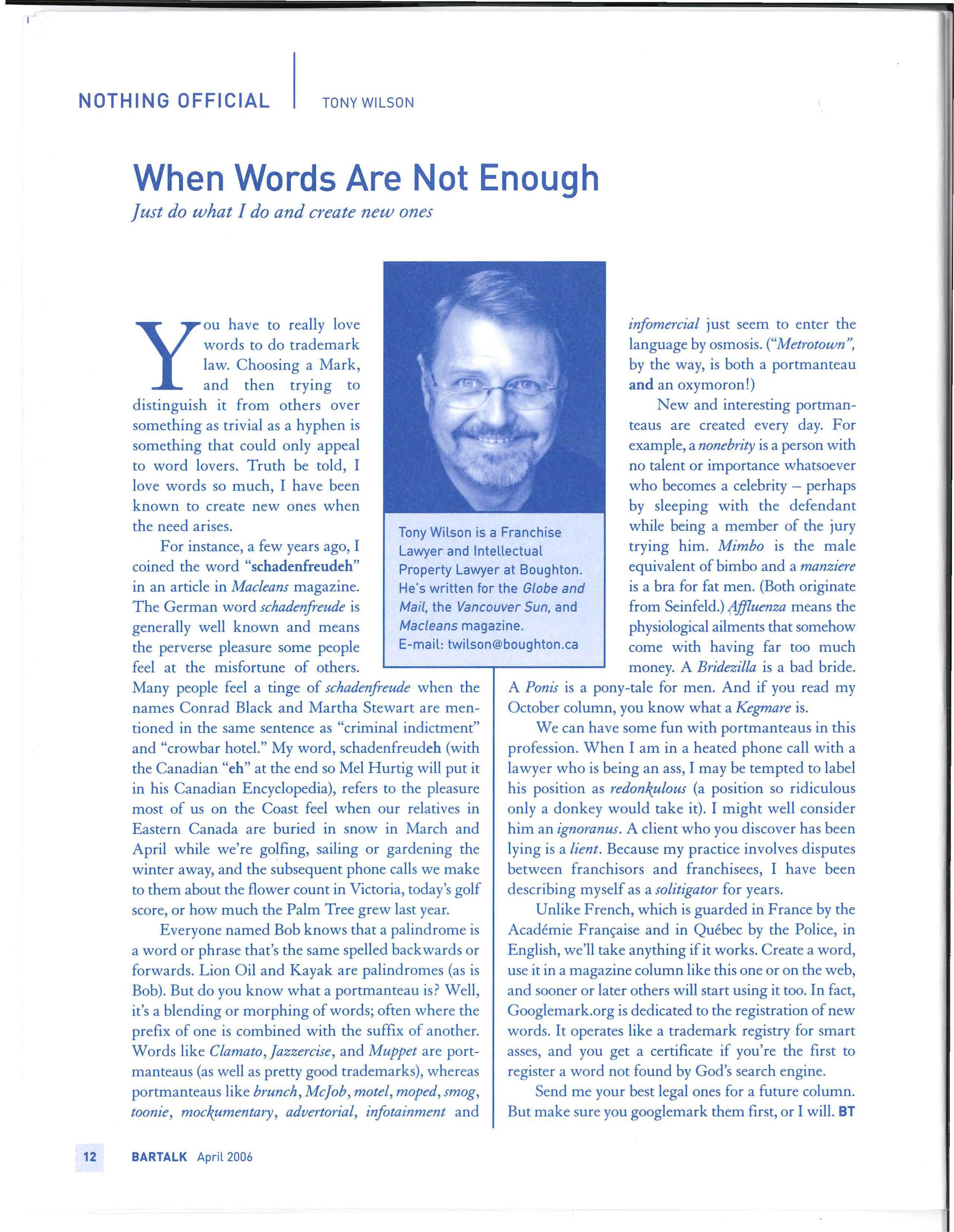
Tony Wilson is a Franchise Lawyer and Intellectual Property Lawyer at Boughton. He's writte n for the Globe and
Mail, the Vancouver Sun, and Macleans magazine.
E-mail : twilson@boughton.ca
Many people feel a tinge of schadenfreude when the names Conrad Black and Martha Stewart are mentioned in the same sentence as "criminal indictment" and "crowbar hotel." My word, schadenfreudeh (with the Canadian "eh" at the end so Mel Hurtig will put it in his Canadian Encycloped ia), refers to the pleasure most of us on the Coast feel when our relatives in Eastern Canada are buried in snow in March and April while we're golfing, sailing or gardening the winter away, and the subsequent phone calls we make to them about the flower count in Victoria, today's golf score, or how much the Palm Tree grew last year. Everyone named Bob knows that a palindrome is a word or phrase that's the same spelled backwards or forwards. Lion Oil and Kayak are palindromes (as is Bob). But do you know what a portmanteau is? Well, it's a blending or morphing of words; often where the prefix of one is combined with the suffix of another. Words like Clamato,]azzercise, and Muppet are portmanteaus (as well as pretty good trademarks), whereas portmanteaus like brunch, Mcfob, motel, moped, smog, toonie, mockumentary, advertorial, infotainment and
infomercial just seem to enter the language by osmosis. ("Metrotown", by the way, is both a portmanteau and an oxymoron!)
New and interesting portmanteaus are created every day. For example, a nonebrity is a person with no talent or importance whatsoever who becomes a celebrity - perhaps by sleeping with the defendant while being a member of the jury trying him . Mimbo is the male equivalent of bimbo and a manziere is a bra for fat men. (Bo th originate from Seinfeld.) {lffluenza means the physiological ailments that somehow come with having far too much
money. A Bridezilla is a bad bride.
A Ponis is a pony-tale for men. And if you read my October column, you know what a Kegmare is.
We can have some fun with portmanteaus in this profession. When I am in a heated phone call with a lawyer who is being an ass, I may be tempted to label his position as redonkulous (a position so ridiculous only a donkey would take it). I might we ll co n sider him an ignoranus. A client who you discover has been lying is a lient. Because my practice invo lves disputes between franchisors and franchisees, I have been describing myself as a solitigator for years.
Unlike French, which is guarded in France by the Academie and in Quebec by the Police , in Engl ish, we'll take anything if it works. Create a word, use it in a magazine column like this one or on the web, and sooner or later others will start using it too. In fact , Googlemark.org is dedicated to the registration of new words. It operates like a trademark registry for smart asses, and you get a certificate if you're the first to register a word not found by God's search engine
Send me your best legal ones for a future column. But make sure you googlemark them first, or I will. BT
Law Student and Young Lawyer Resources
At CBABC, we are working to provide you with better access to online resources that help satisfy your professional needs. At the request of several law students and young lawyers, CBABC created a resource page containing information on CBA membership, member savings, Section membership, publications, legal careers, listservs, the studen t mentor program, practice advisory panels and more Visit the "Law Student and Young Lawyer Resources" page in "Practice Resources" for further information.
NEW LISTSERVS
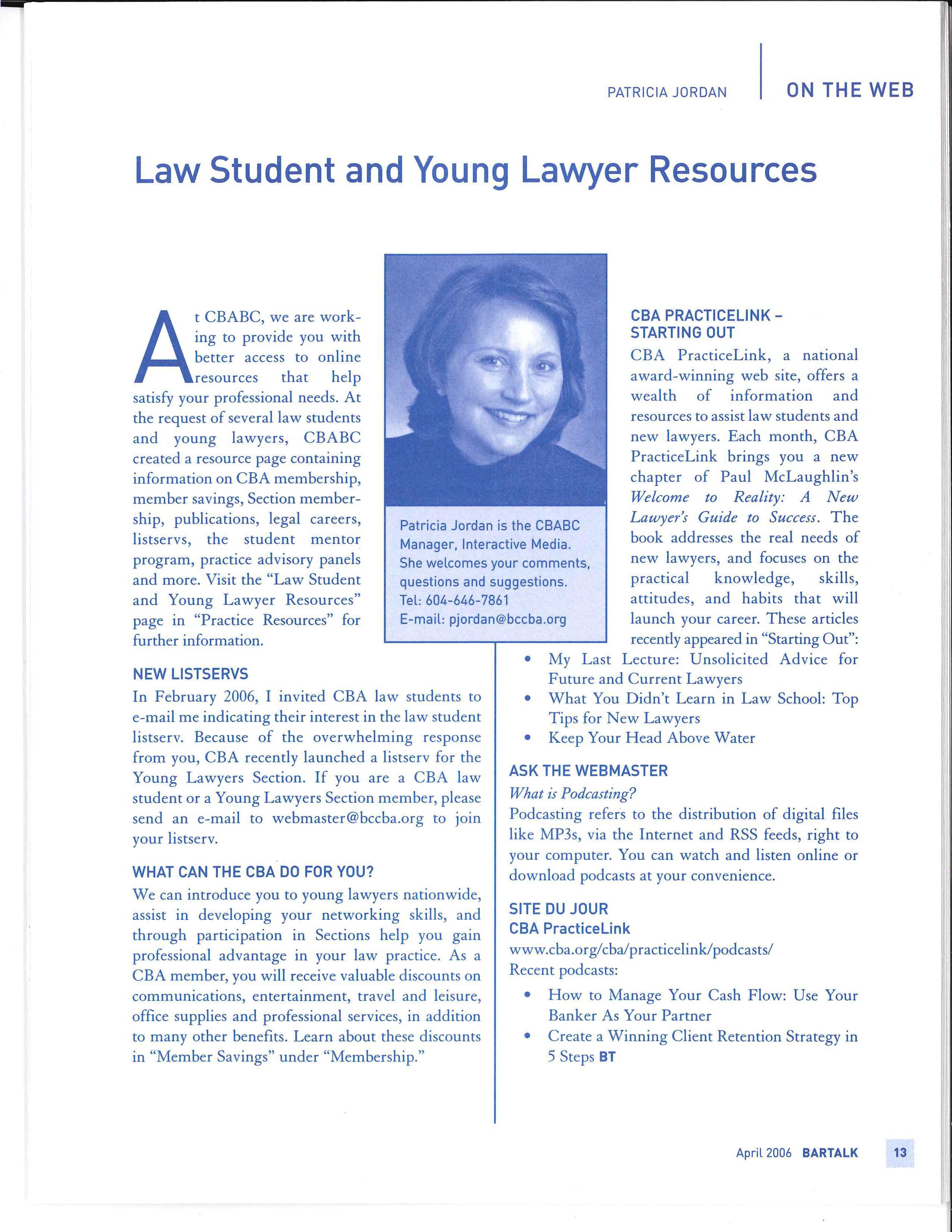
Patricia Jordan is the CBABC Manager, Interactive Media. She welcomes your co mments, questions and suggestions Tel : 604-646-7861
E-mail: pjo r dan@bccba.org
In February 2006, I invited CBA law students to e-mail me indicating their interest in the law student listserv . Because of the overwhelming response from you , CBA recently launched a listserv for the Young Lawyers Section. If you are a CBA law student or a Young Lawyers Section member, please send an e-mail to webmaster@bccba .org to join your listserv.
WHAT CAN THE CBA DO FOR YOU?
We can introduce you to young lawyers nationwide , assist in developing your networking skills , and through participation in Sections help you gain professional advantage in your law practice As a CBA member, you wi ll receive valuable discounts on communications, enter t ainment, travel and leisure , office supplies and professional services, in addition to many other benefits. Learn about these discounts in "Member Savings" under "Membership ."
CBA PRACTICELINKSTARTING OUT
CBA PracticeLink, a national award-winning web site, offers a wealth of information and resources to assist law students and new lawyers. Each month, CBA PracticeLink brings you a new chapter of Paul McLaughl in's Welcome to Reality: A New Lawyer's Guide to Success The book addresses the real needs of new lawyers, and focuses on the practical know ledge, skills, attitudes, and habits that will launch your career. These articles recently appeared in "Starting Out" :
My Last Lecture: Unsolicited Advice for Future and Current Lawyers What You Didn't Learn in Law School: Top Tips for New Lawyers Keep Your Head Above Water
ASK THE WEBMASTER
What is Podcasting?
Podcasting refers to the distribution of digital files like MP3s, via the Internet and RSS feeds, right to your computer. You can watch and listen online or download podcasts at your convenience.
• How to Manage Your Cash Flow : Use Your Banker As Your Partner
• Create a Winning Client Retention Strategy in 5 Steps BT
Every effort is made to ensure the accuracy of the information provided to you in this art i cle but the information should not be relied u pon Lawyers should refer to the specific leg islative or regu l atory provision You will see a r eference in some cases to the number of the Bill when it was introduced in the House This number may be different from the chapter numbe r of the new Act which is quoted after the title of the Act and which is the proper citation for the Act. The Bill number has been given to make it easier for you to note up the Bi lls you may have in your library.
Legislative Update is prov ided as part of the CBABC legislative and law reform program It is a service funded by CBA membership fees , and is therefore provided as a benefit of CBA membership. The full version of Legislative Update is now published online , available to CBA members exclusively at www cba org/bc.
NORTH ISLAND-COAST DEVELOPMENT INITIATIVE TRUST ACT, S.B.C. 2005, C. 36 (BILL 7)
Act in force February 27, 2006
SOUTHERN INTERIOR DEVELOPMENT INITIATIVE TRUST ACT, S.B.C . 2005, C. 39 (BILL 81
Act in force February 27, 2006
Victoria Battle of the Bar Bands
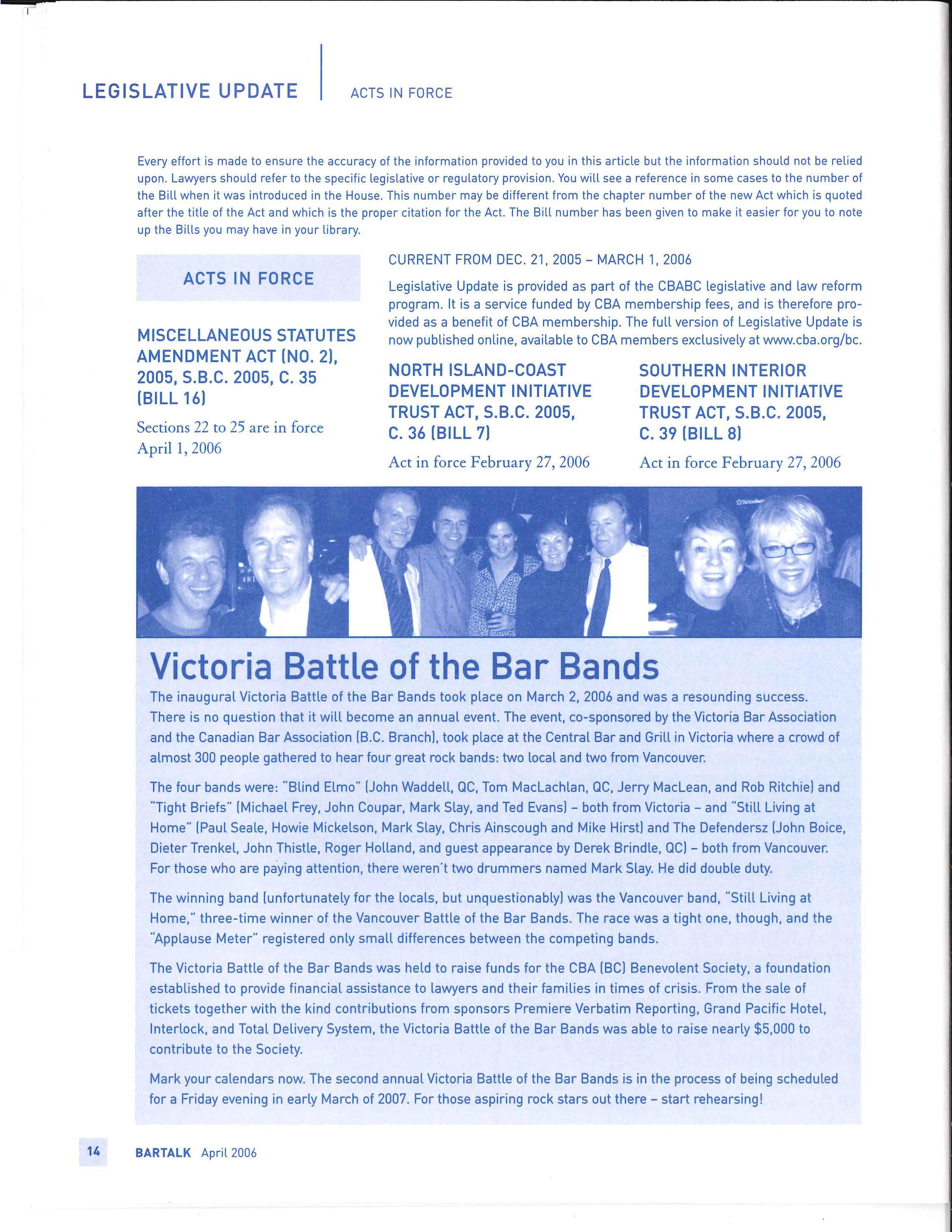
The inaugural Victoria Battle of the Bar Bands took place on March 2, 2006 and was a resounding success. There is no question that it will become an annual event. The event, co - sponsored by the Victoria Bar Association and the Canadian Bar Association (B.C. Branch], took place at the Central Bar and Grill in Victoria where a crowd of almost 300 people gathered to hear four great rock bands: two local and two from Vancouver.
The four bands were: "Blind Elmo " !John Waddell, QC, Tom Maclachlan, QC, Jerry Maclean, and Rob Ritchie) and " Tight Briefs" (Michael Frey, J ohn Coupar, Mark Slay, and Ted Evans)- both from Victoria -and "Still Living at Home" (Paul Seale, Howie Mickelson, Mark Slay, Chris Ainscough and Mike Hirst) and The Defendersz !John Boice, Dieter Trenkel, John Thistle, Roger Holland, and guest appearance by Derek Brindle, QC) - both from Vancouver For those who are paying attention, there weren't two drummers named Mark Slay He did double duty.
The winning band (unfortunately for the locals, but unquestionably) was the Vancouver band, "Still Living at Home," three - time winner of the Vancouver Battle of the Bar Bands. The race was a tight one, though, and the "Applause Meter" registered only small differences between the competing bands.
The Victoria Battle of the Bar Bands was held to raise funds for the CBA (BC) Benevolent Society, a foundation established to provide financial assistance to lawyers and their families in times of crisis. From the sale of tickets together with the kind contributions from sponsors Premiere Verbatim Reporting , Grand Pacific Hotel, Interlock, and Total Delivery System, the Victoria Battle of the Bar Bands was able to raise nearly $5,000 to contribute to the Society.
Mark your calendars now The second annual Victoria Battle of the Bar Bands is in the process of being scheduled for a Friday evening in early March of 2007. For those aspiring rock stars out there- start rehearsing!
E-Filing: The British Columbia Experience Past, Present and Future
0ver the last two years, we have seen the introduction and implementation of a number of electronic filing ("e-filing") initiatives across the province. In the spring of 2004, both the Corporate Registry and the Land Title Registry launched systems that allowed for the submission of electronic information and/or documents to those institutions over the Internet. Last fall, the B.C courts launched e-filing pilot projects in Kelowna and Vernon with a plan to enable province - wide e- filing for Civil Supreme and Provincial Court
matters by the spring of this year.
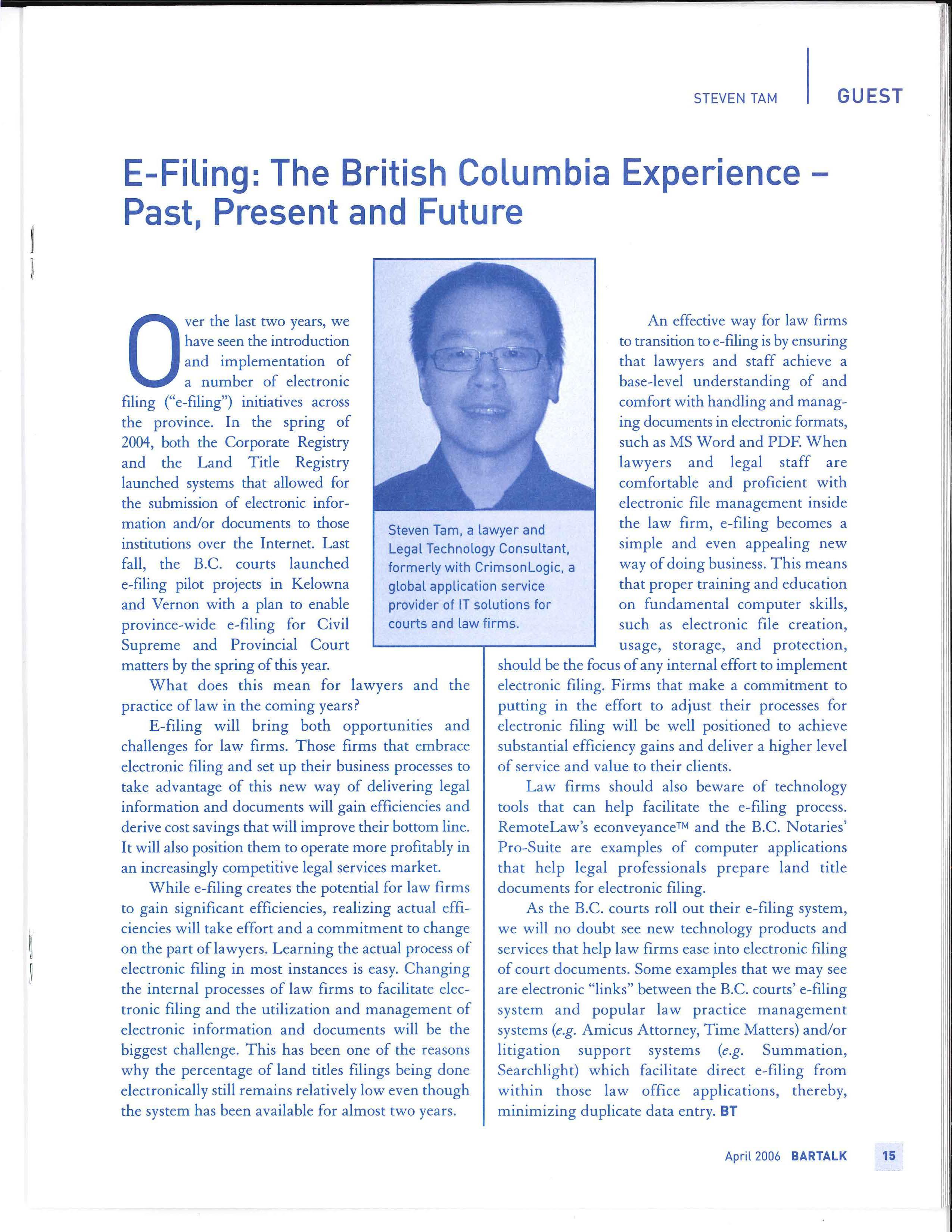
Steven Tam, a lawyer and Legal Technology Consultant,
formerly with Crimson log ic, a global application service provider of IT solutions for courts and law firms.
What does this mean for lawyers and the practice oflaw in the coming years?
E - filing will bring both opportunities and challenges for law firms Those firms that embrace electronic filing and set up their business processes to take advantage of this new way of delivering legal information and documents will gain efficiencies and derive cost savings that will improve their bottom line . It will also position them to operate more profitably in an increasingly competitive legal services market.
While e-filing creates the potential for law firms to gain significant efficiencies, realizing actual efficiencies will take effort and a commitment to change on the part of lawyers . Learning the actual process of electronic filing in most instances is easy. Changing the internal processes of law firms to facilitate electronic filing and the utilization and management of electronic information and documents will be the biggest challenge. This has been one of the reasons why the percentage of land titles filings being done electronically still remains relatively low even though the system has been available for almost two years.
An effective way for law firms to transition toe -filing is by ensuring that lawyers and staff achieve a base-level understanding of and comfort with handling and managing documents in electronic formats, such as MS Word and PDF. When lawyers and legal staff are comfortable and proficient with electronic file management inside the law firm , e- filing becomes a simple and even appealing new way of doing business This means that proper training and education on fundamental computer skills, such as electronic file creation,
usage, storage, and protection, should be the focus of any internal effort to implement electronic filing. Firms that make a commitment to putting in the effort to adjust their processes for electronic filing will be well positioned to achieve substantial efficiency gains and deliver a higher level of service and value to their clients .
Law firms should also beware of technology tools that can help facilitate the e- filing process. RemoteLaw's econveyanceTM and the B.C. Notaries' Pro-Suite are examples of computer applications that help legal professionals prepare land title documents for electronic filing
As the B.C. courts roll out their e- filing system, we will no doubt see new technology products and services that help law firms ease into electronic filing of court documents. Some examples that we may see are electronic " links" between the B.C courts' e-filing system and popular law practice management systems (e.g. Amicus Attorney, Time Matters) and/or litiga tion support systems (e.g. Summation, Searchlight) which facilitate direct e-filing from within those law office applications , thereby, minimizing duplicate data entry. BT
FEATURE KARl BOYLE AND DEBORAH LYNN ZUTTER
Regulation of Mediation - How Could This Impact Your Legal Practice?
INTRODUCTION
Members of the Law Society of B.C. (LSBC) are very familiar with "regulation." Some lawyers recommend mediation to their clients. Increasing numbers of lawyers are mediating instead of, or in addition to, practising law. Should mediation practices be subject to regulation?
ONTARIO BILL 14
Issues about the regulation of mediation arose in Ontario with the introduction ofBill14, Schedule C of the Access to Justice Act 2005. Schedule C includes amendments to the Law Society Act intended to provide a framework for regulation of paralegals in Ontario. The Schedule C approach moves from a "membership" model to a "licensing" model. It authorizes the Law Society to license persons by class to practise law or to provide legal services. The definition of "legal services" includes activities that could be associated with mediation, particularly those with a more evaluative emphasis .
The Ontario ADR community believed th a t Bill 14 "over - reached" and argued that mediation and mediators should be exempt from the Act. Although the Law Society has stated that it will exempt mediators in its by-laws, the Ontario Bar is lobbying the Attorney General to list the exemptions specifically in the legislation.
WHAT ARE THE ISSUES?
The Ontario situation raises important issues relevant to B.C. about the nature of mediation, its relationship to the practice of law and the appropriateness of regulation, issues like the following :
1. What is the purpose of regulation?
The primary purpose is the protection of the public In addition, for Court-connected mediation
programs, it is important to ensure the competence of the mediators and, thereby, the integrity of the court process.
2. What is the present situation in B.C.?
With the exception of lawyer mediators working within the definition of family disputes as those are defined in Appendix 2 to the Professional Conduct Handbook, mediators practising in B. C. are unregulated. This is not to say that many unregulated mediators do not voluntarily subscribe to codes of conduct produced by organizations to which they belong, such as the ADR Institute of Canada (locally known as BCAMI) and Family Mediation Canada (FMC). Furthermore, mediators who appear on the B C. Mediator Roster Society Directories (Civil, Family and Child Protection) have met prescribed standards of training and ability and they agree to abide by the Code of Conduct established by the Roster Society The regulations set out in Appendix 2 describe situations in which a lawyer mediator is disqualified from acting (conflict of interest), the duties of the mediator (actively encourage Independent Legal Advice) and require that family law disputants enter into a written agreement that addresses matters such as confidentiality before mediation commences . Mediation confidentiality is an issue. There is statutory protection in limited situations when mediations are conducted pursuant to the Child, Family and Community Service Act or pursuant to the Notice to Mediate (General) Regulation. Mediation confidentiality has been recently attacked in British Columbia and in Ontario.
Some med iators voluntarily seek certification by mediation organizations to which they belong, such as FMC and BCAMI. To qualify, they must demonstrate the ir ability to mediate and, to some extent, their knowledge of law. As a condition of employment,
Family Justice Counselors, who provide no-fee mediation services to qualifying couples with parenting disputes, must be certified by FMC . There are no provisions in the Professional Conduct Handbook specifically regulating lawyers whose clients are participating in mediation.
3. What could regulation mean?
There are a number of different regulatory models, including (in rough order of formality):
• Codes of conduct
• Certification
• Licensing- Qualification/admission requirements
• Performance standards and expectations
• Performance assessment, complaints processes, discipline and decertification.
4. What are some of the benefits of regulation?
The arguments for regulation include :
• Public protection - Mediation participants should receive competent and ethical mediation services
• Confidentiality- The confidentiality of mediation communications must be legally protected.
• Conflict of Interest - Providing guidelines to lawyer mediators and to lawyers about what is a conflict in mediation matters and what to do about it would benefit clients
• Clarity of Role - Clients need to understand that when lawyers mediate, they are acting as neutrals.
• Transparency - The type of mediation that is being offered, the procedural preferences of the mediator, how mediation services are paid for and who will learn about mediation outcomes should be regulated
• Appropriate, not Alternative - Mediation is a 21st century dispute resolution option. For example, the Uniform Mediation Act is being enacted across the United States with the result that the behavior of lawyers in relation to mediation is being regulated.
5. What are some of the risks of regulation?
The arguments include:
• Unnecessary - "If it isn't broken, don't fix it."
The LSBC receives very few complaints about lawyer mediators. Labour mediation is well-established.
• Unduly Restrictive - Any regulatory scheme
would likely include requirements for qualification and for on - going training. Lawyer mediators who are currently providing mediation services could fail to qualify and could be prohibited from mediating as members of the LSBC. There is also the concern that creating competency criteria could be abused and create a 'closed market' benefiting a few, privileged lawyer mediators
• Barriers to Entry - Many excellent mediators possess professional backgrounds other than law. Any effort to limit mediation to the practice of law would disenfranchise these mediators and could limit public access to excellent dispute resolution services .
• Stifle Creativity - Mediation is evolving. Regulation could inhibit its natural growth, could entrench standards that have little empiric worth, or, worse, have unintended results that cause harm.
• Cost- Effective regulation is expensive
WHERE TO NOW?
Issues regarding regulation are much too complex to discuss in detail in this brief article . The LSBC has considered the regulation oflawyer mediators and of lawyers whose clients participate in mediation. The ADR Task Force delivered its draft report and recommendations to the Benchers on October 14, 2005 and asked that the report be circulated to the members of the bar for feedback. The Benchers declined to do so . The report has been returned to the ADR Task Force Whether the report will be circulated and in what format remains to be decided. BT
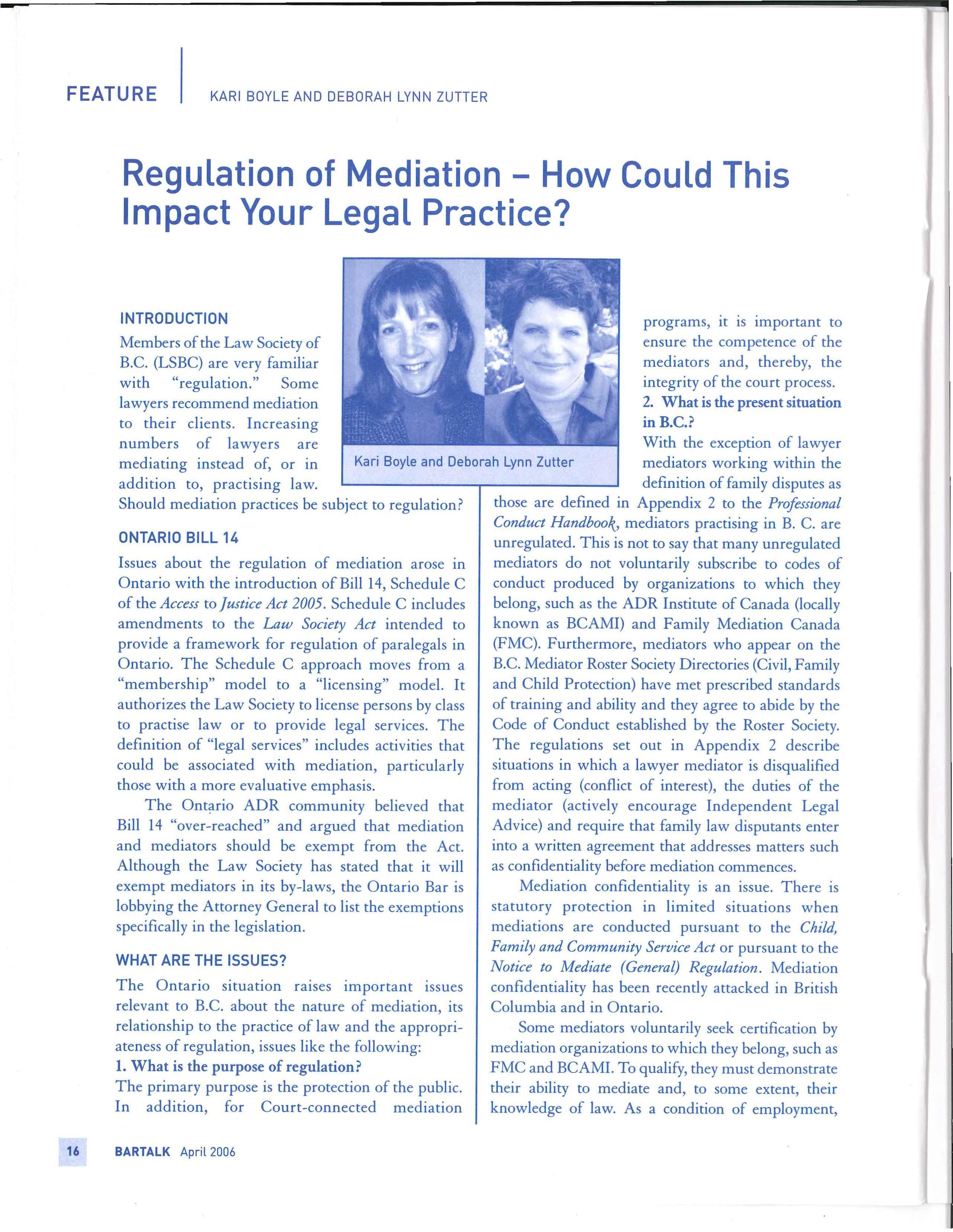
Kari Boy l e LL.B Kari is an experienced lawyer and consultant, Chair of the ADR Section [Vancouver], the Executive Director of the B.C Dispute Resolution Practicum Society, and Project Manager of the Civil Ju stice Reform Working Group.
Deborah Lynn Zutter, LL.B., LL.M., C.C F.M Deb is the Past-Chair of the ADR Task Force of the Law Society of B C and the author of Prepari ng for Mediation: A Dispute Resolution Guide. She is certified as a Comprehensive Family Mediator with Family Mediation Canada and she practices relationship mediation and Collaborative Law. April 2006 BARTALK
The CBA/ACLA Criminal Law Reform & Advocacy Project in China
The CBA, through its International Development Program, continues to promote the rule of law in various countries around the world. In China, the CBA has been working with and supporting the All China Lawyers Association (ACLA) since 1994.
Two Vancouver lawyers, Ursula Botz and Gil and cross-examination as well as closing arguments. The Chinese participants were also given an opportunity to practice their own advocacy skills in front of the class.
McKinnon, QC, recently volunteered as members of Canadian delegations to China participating in the CBN ACLA Crimina l Law Reform & Advocacy Project. The project's objective is to improve the professional skills of the Chinese defence lawyers and to assist their Association in advancing criminal law reforms. Funding for the
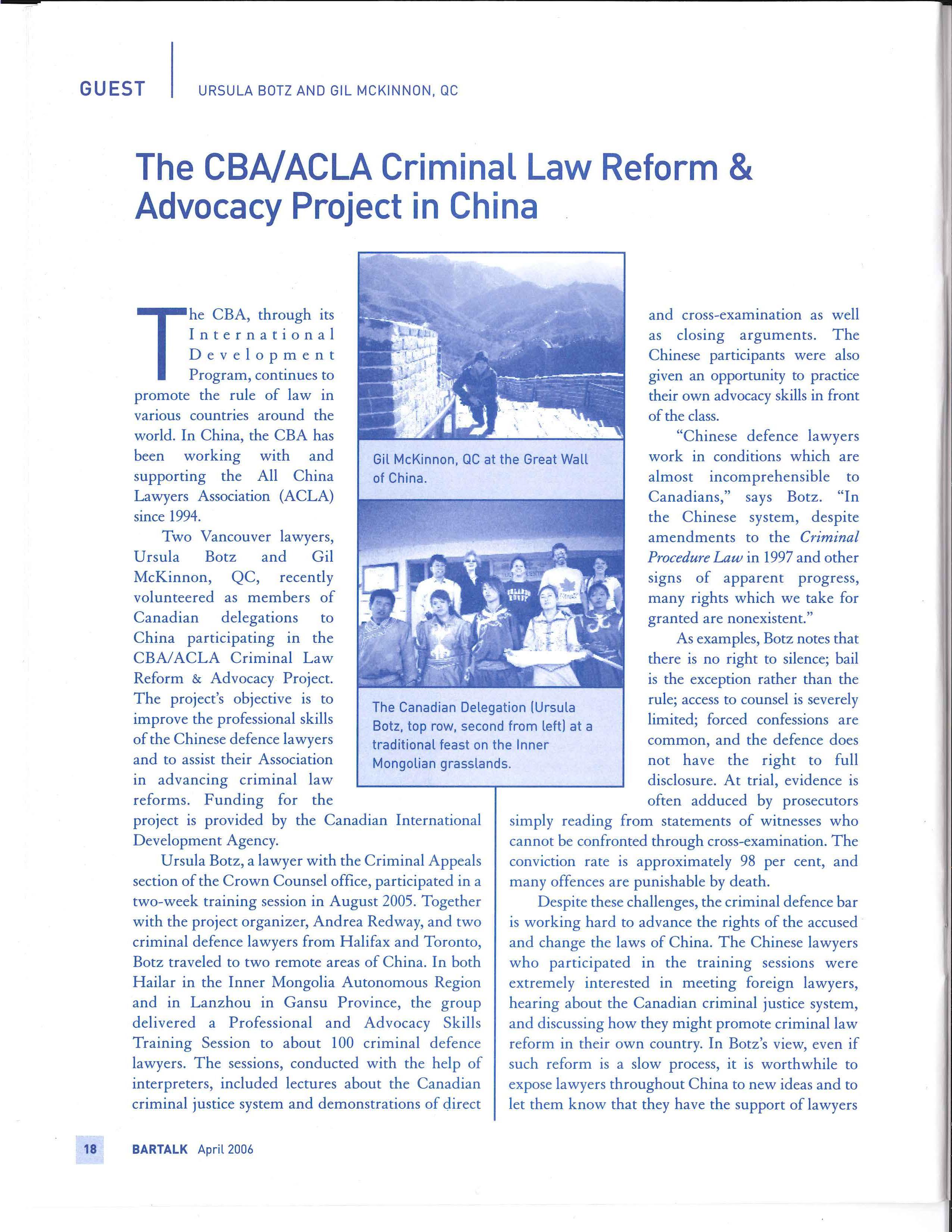
The Canadian Delegation (Ursula Botz, top row, second from left) at a tradition a l feast on the Inner Mongo l ian grasslands
project is provided by the Canadian International Development Agency.
Ursula Botz, a lawyer with the Criminal Appeals section of the Crown Counsel office, participated in a two-week training session in August 2005. Together with the pro ject organizer, Andrea Redway, and two criminal defence lawyers from Halifax and Toronto, Botz traveled to two remote areas of China. In both Hailar in the Inner Mongolia Autonomous Region and in Lanzhou in Gansu Province, the group delivered a Professional and Advocacy Skills Training Session to about 100 criminal defence lawyers. The sessions, conducted with the help of interpreters, included lectures about the Canadian criminal justice system and demonstrations of direct
18 BARTALK Ap ri l 2006
"Chinese defence lawyers work in conditions which are almost incomprehensible to Canadians," says Botz. "In the Chinese system, despite amendments to the Criminal Procedure Law in 1997 and other signs of apparent progress, many rights which we take for granted are nonexistent "
As examples, Botz notes that there is no right to silence; bail is the exception rather than the rule; access to counsel is severely limited; forced confessions are common, and the defence does not have the right to full disclosure At trial, evidence is
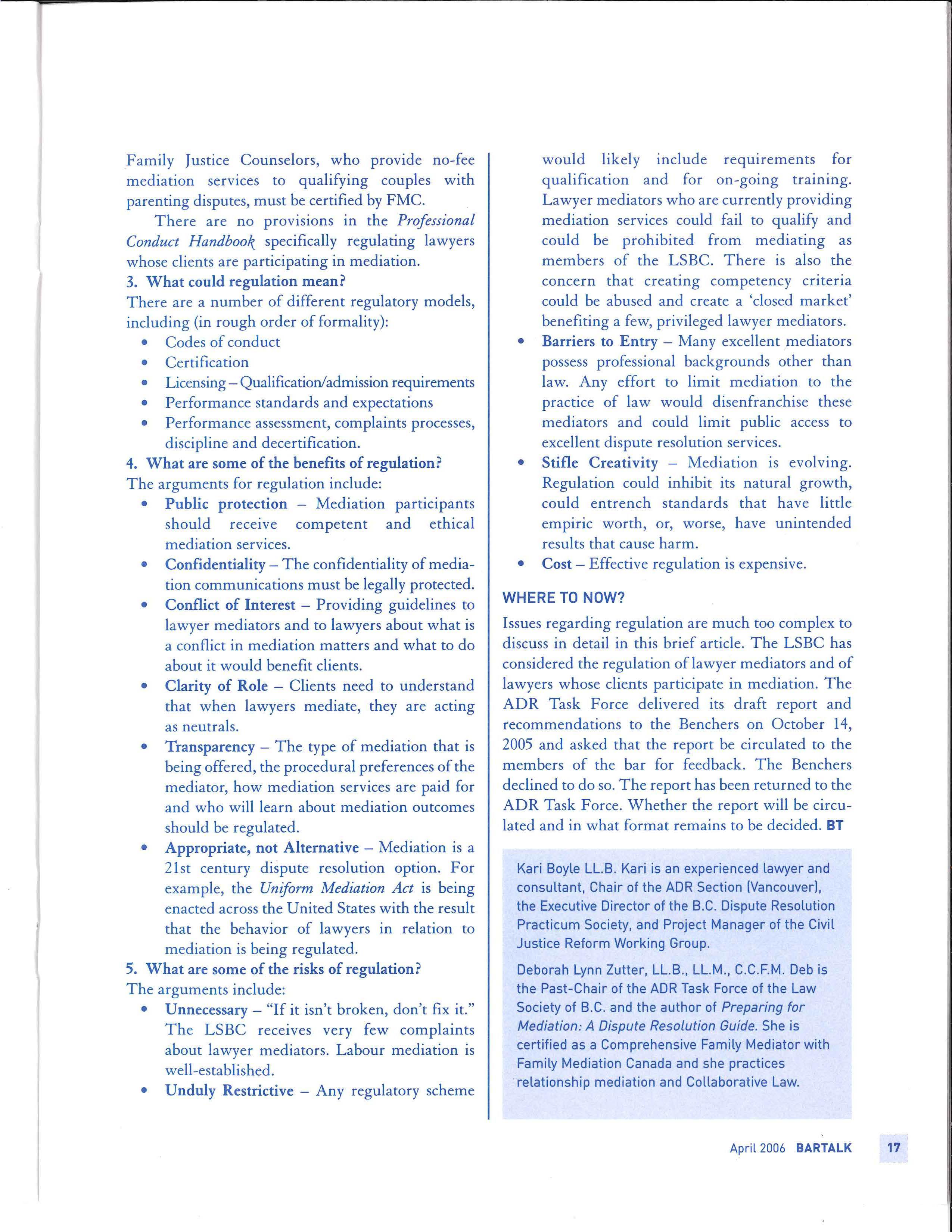
often adduced by prosecutors simply reading from statements of witnesses who cannot be confronted through cross-examination The conviction rate is approximately 98 per cent, and many offences are punishable by death. Despite these challenges, the criminal defence bar is working hard to advance the rights of the accused and change the laws of China. The Chinese lawyers who participated in the training sessions were extremely interested in meeting foreign lawyers, hearing about the Canadian criminal justice system, and discussing how they might promote criminal law reform in their own country. In Botz's view, even if such reform is a slow process, it is worthwhile to expose lawyers throughout China to new ideas and to let them know that they have the support of lawyers
in Canada as they work to establish a criminal justice system with greater procedural fairness.
Gil McKinnon traveled to China at the end of November, 2005 with Ms. Redway and three lawyers from Ontario. They spent one week in Beijing and another week in Kunming, the capital of the beautiful south-west province of Yunnan. In Beijing they participated in the Annual Working Session of the ACLA, with representatives from all the Chinese provinces. The purpose of this Session was to finalize a draft Code for criminal procedure in China. The ACLA hopes to present its proposal to China's National People's Congress this year McKinnon says there was a lot of enthusiastic debate during the conference. The Canadians contributed by answering questions about Canada's criminal justice system and presenting short lectures and demonstrations on pre-trial (arrest, bail, disclosure) and trial procedures.
In Kunming the Canadians participated in a training session for defence lawyers, prosecutors and
judges from Yunnan and neighboring provinces , including Tibet. One day the Canadians did a mock criminal trial. The following day the Chinese participants conducted a mock Chinese trial using the same fact pattern. The Chinese delegates served as the jury. In both trials, the "jurors" voted to acquit the accused. McKinnon says that watching the Chinese mock trial and exchanging points of view in the discussion that followed provided the Canadians with a fascinating glimpse into the operation of the Chinese system. It is a daunting task to establish a justice system based on the rule of law having only 180,000 lawyers in a country of 1.3 billion people. McKinnon says that whatever assistance Canadian lawyers can provide should be encouraged. He believes that the work of the CBA in China is a good investment for both Canada and China . Any criminal lawyer interested in participating in this project should contact Andrea Redway and send her a resume to: aredway@cba.org. BT
Battle of the Bar Bands IV- Charity Rocks in Vancouver
Mark your calendar for Friday, June 9, 2006 when the Fifth Annual Battle of the Bar Bands will once again rock the Commodore Ballroom. A sell-out crowd of over 900 is expected. Lawyers, law firm friends, and clients are all welcome to attend. Eight rocking Lawyers Bands will be competing for the ZSA Cup, the Lexpert Cup and bragging rights in being the best Bar Band in the land.
See the ZSA insert in this issue for a ticket order form. For bands wishing to enter this event or to obtain competition rules and entry requirements please call Jan Whyte 604-681-6564 or e-mail jwhyte@jml.ca for more information
New Westminster/ Fraser Valley Bar Association Golf Tournament
It will be held this year at the Guildford Golf & Country Club in Surrey on Thursday, July 6th. Stroke play or Texas Scramble at your option Proceeds are donated to the CBA Benevolent Fund . More information can be obtained from Rick Molstad of McQuarrie Hunter at 604-526-1821. Mark this date in your calendars now.
2006 Canadian Legal Conference in St. John's
Mark your calendar now for the 2006 Canadian Legal Conference in St. John's, Newfoundland, August 13 to 15, 2006. The Registration Brochure was mailed to all members with the March National magazine. For updated information and online registration visit: http://www.cba .org/CBA/annua lmee t ing/main/
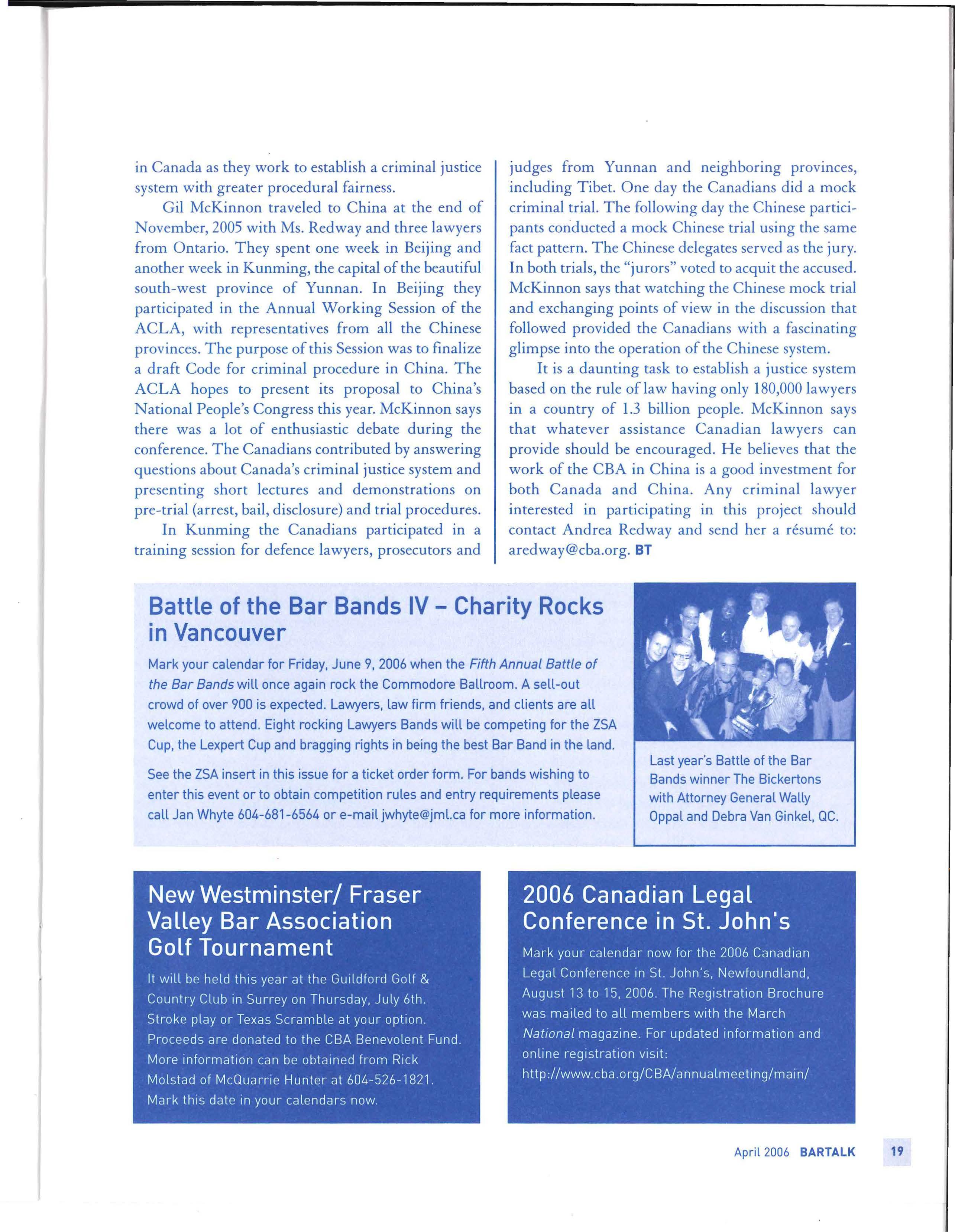
Last year 's Battle of the Bar Bands winner The Bickertons with Attorney General Wally Oppal and Debra Van Ginkel, QC.
Counterfeit Goods -Will There Be a Free" Canada?
The sale of counterfeit goods is an international phenomenon with billions of dollars in annual sales. In addition to economic harm to intellectual property (IP) right holders and loss of tax revenue, counterfeit goods can pose serious health and safety risks - e.g. in pharmaceuticals,
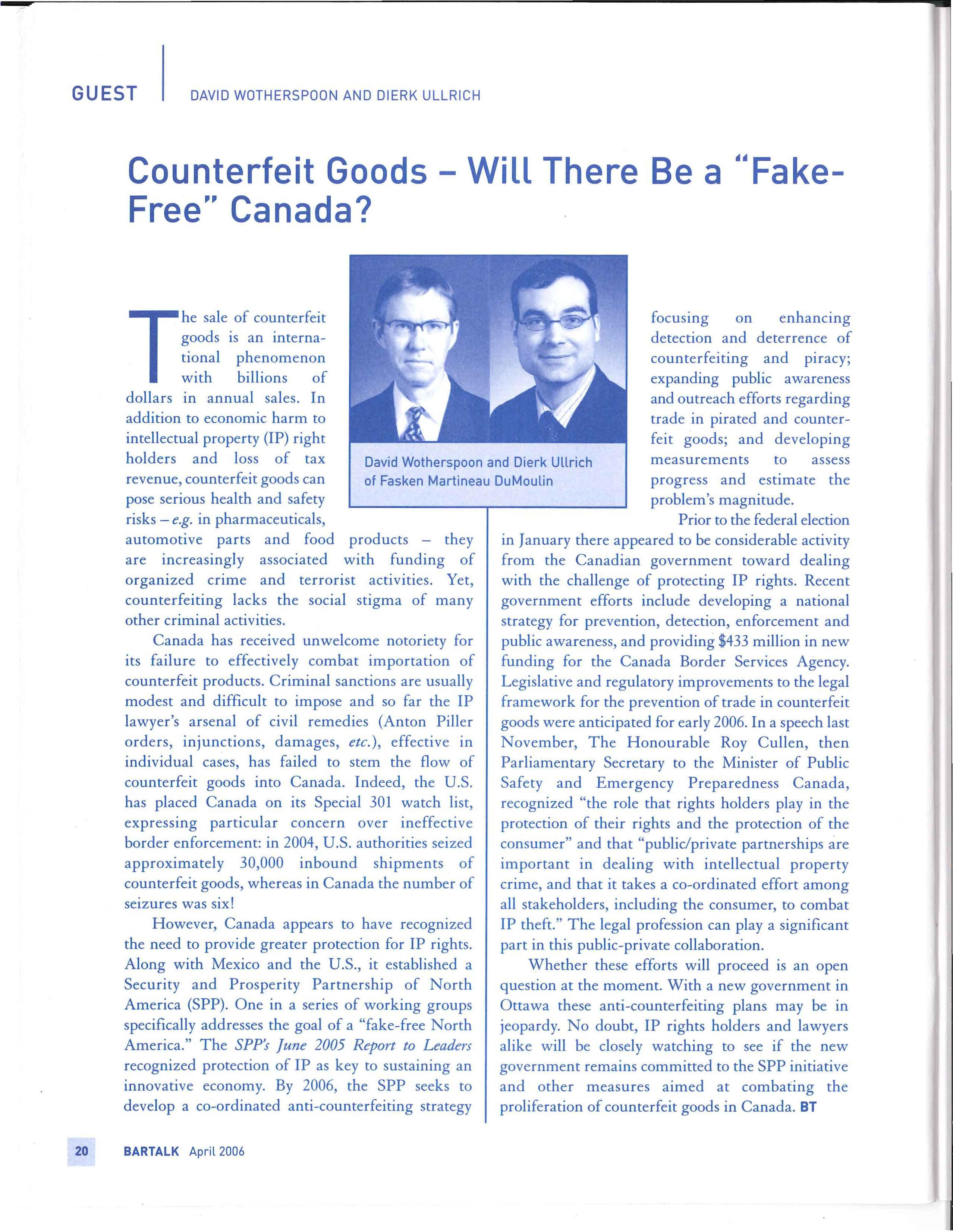
David Wotherspoon and Dierk Ullrich of Fasken Martineau DuMoulin
automotive parts and food products - they are increasingly associated with funding of organized crime and terrorist activities. Yet, counterfeiting lacks the social stigma of many other criminal activities.
Canada has received unwelcome notoriety for its failure to effectively combat importation of counterfeit products. Criminal sanctions are usually modest and difficult to impose and so far the IP lawyer's arsenal of civil remedies (Anton Piller orders, injunctions, damages, etc.), effective in individual cases, has failed to stem the flow of counterfeit goods into Canada. Indeed, the U.S. has placed Canada on its Special 301 watch list, expressing particular concern over ineffective border enforcement: in 2004, U.S. authorities seized approximately 30,000 inbound shipments of counterfeit goods, whereas in Canada the number of seizures was six!
However, Canada appears to have recognized the need to provide greater protection for IP rights. Along with Mexico and the U.S., it established a Security and Prosperity Partnership of North America (SPP). One in a series of working groups specifically addresses the goal of a "fake-free North America." The SPP's June 2005 Report to Leaders recognized protection of IP as key to sustaining an innovative economy. By 2006, the SPP seeks to develop a co-ordinated anti-counterfeiting strategy
focusing on enhancing detection and deterrence of counterfeiting and piracy; expanding public awareness and outreach efforts regarding trade in pirated and counterfeit goods; and developing measurements to assess progress and estimate the problem's magnitude.
Prior to the federal election in January there appeared to be considerable activity from the Canadian government toward dealing with the challenge of protecting IP rights. Recent government efforts include developing a national strategy for prevention, detection, enforcement and public awareness, and providing $433 million in new funding for the Canada Border Services Agency. Legislative and regulatory improvements to the legal framework for the prevention of trade in counterfeit goods were anticipated for early 2006. In a speech last November, The Honourable Roy Cullen, then Parliamentary Secretary to the Minister of Public Safety and Emergency Preparedness Canada, recognized "the role that rights holders play in the protection of their rights and the protection of the consumer" and that "public/private partnerships are important in dealing with intellectual property crime, and that it takes a co-ordinated effort among all stakeholders, including the consumer, to combat IP theft." The legal profession can play a significant part in this public-private collaboration. Whether these efforts will proceed is an open question at the moment. With a new government in Ottawa these anti-counterfeiting plans may be in jeopardy. No doubt, IP rights holders and lawyers alike will be closely watching to see if the new government remains committed to the SPP initiative and other measures aimed at combating the proliferation of counterfeit goods in Canada. BT
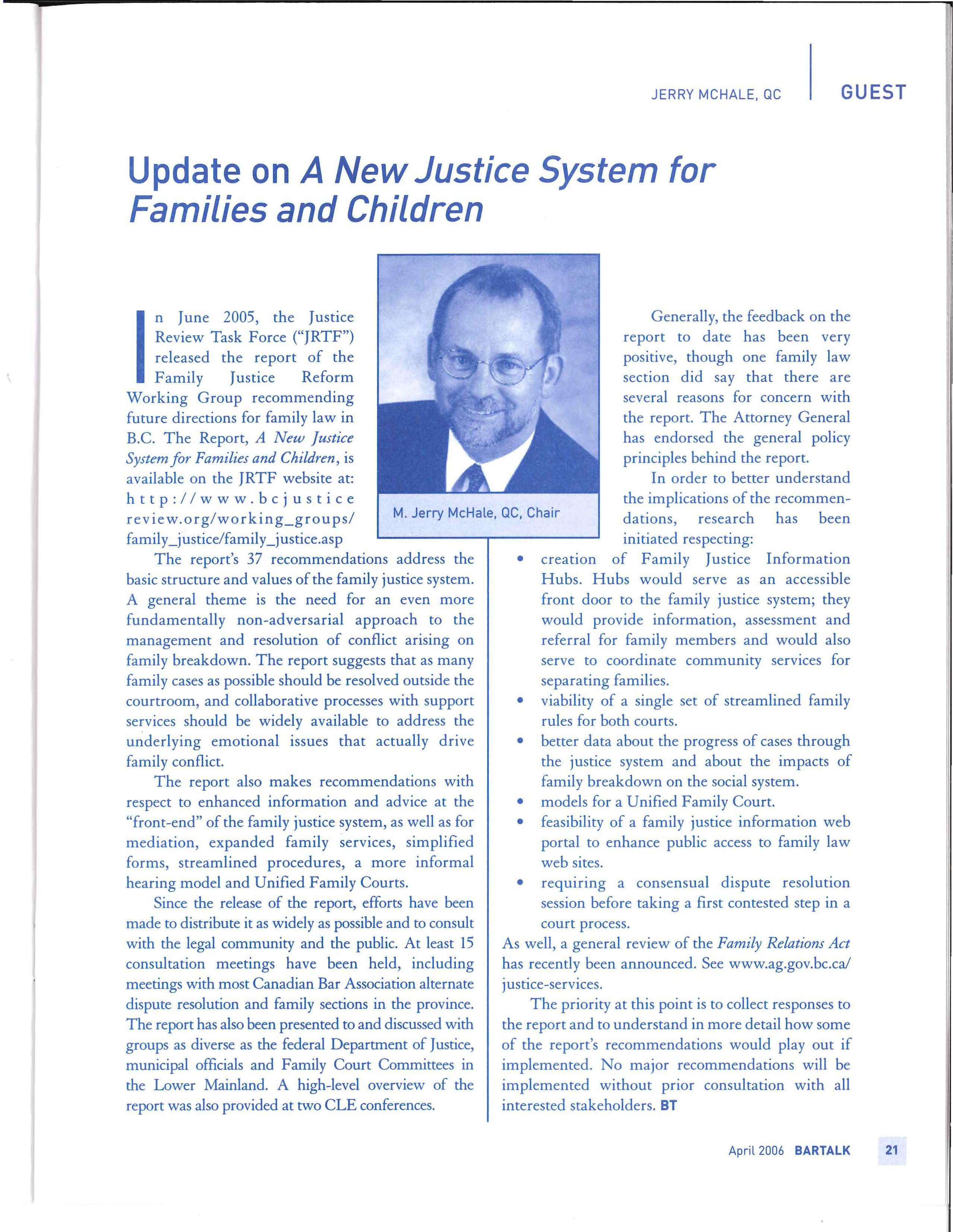
Update on A New Justice System for Families and Children
In June 2005, the Justi ce Review Task Force ("JRTF") released the report of the Family Jus t ice Reform Working Group recommend ing future directions for family law in B C. The Report , A New Justice System for Families and Children, is available on the JRTF website at: http: // www.bcjustice review . org / wor king_groups/ family_justice/family_justice.asp
The report's 37 recommenda tions address the basic structure and va lues of the family justice system A general theme is the need for an even more fundamentally non-adversarial approach to the management and resolution of conflict arising on family breakdown . The report suggests that as many family cases as possible should be resolved outside the courtroom, and co ll aborative processes with support services shou ld be widely available to address the underlying emotional issues that act u a ll y drive family conflict.
The report also makes recommendations with respect to enhanced informat ion and advice at the "front-end" of the fami ly justice system, as well as for mediation, expanded family services, simplified forms, streamlined pro cedures, a more informal hearing model and Unified Fam ily Courts
Since the release of the report, efforts have been made to distribute it as widely as possible and to consult with the legal community and the public. At least 15 consultation meetings have been held, including meetings with most Canadian Bar Association alternate dispute resolution and fami ly sections in the province
The report has also been presen ted to and discussed with groups as diverse as the federal Department of Justice, municipal officials and Family Court Committees in the Lower Mainland. A high-level overview of the report was also provided at two CLE conferences
Generally, the feedback on the report to date has been very positive , though one fami ly law section did say that there are several reasons for concern with the report The Attorney General has endorsed the general policy principles behind the report.
In order to better understand the implications of the recommendations, research has been initiated respecting:
• creation of Family Justice Information Hubs . Hubs would serve as an accessible fro n t door to the family justice system; they would provide information, assessment and referral for family members and would also serve to coordinate community services for separating families.
• viability of a single set of streamlined family rules for both courts.
• better data about the progress of cases through the justice system and about the impacts of fam ily breakdown on the social system.
• models for a Unified Family Court.
• feasibility of a family justice information web portal to enhance public access to family law web sites
• requiring a consensual dispute reso l ution session before taking a first contested step in a court process.
As well, a general review of the Family Relations Act has recently been announced. See www.ag.gov.bc.cal justice-services.
The priority at this point is to collect responses to the report and to understand in more detail how some of the report 's recommendations would play out if implemented. No major recommendations will be implemented without prior consultation with all interested stakeholders
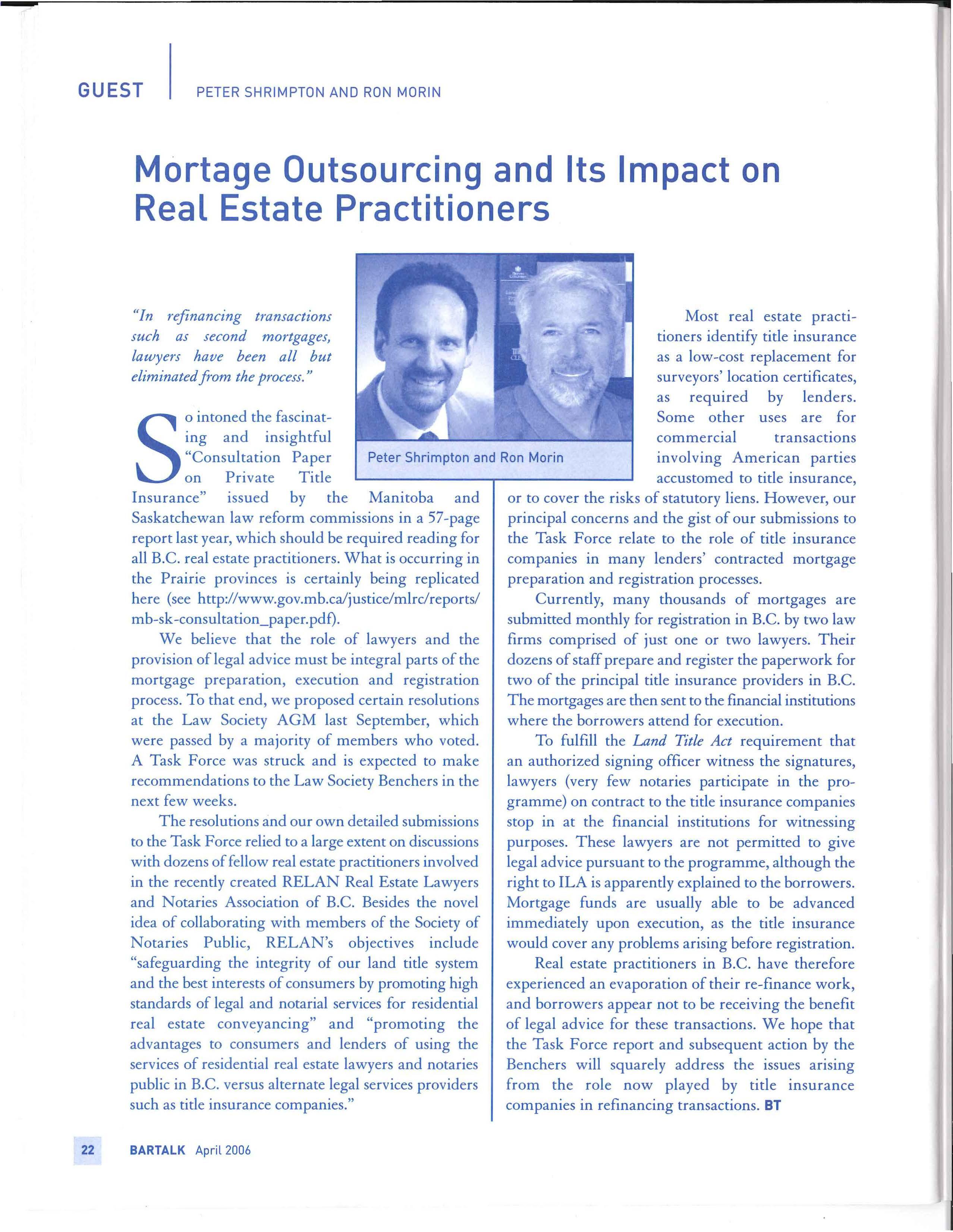
Mortage Outsourcing and Its Impact on Real Estate Practitioners
" In refinancing transactions such as second mortgages, lawyers have been all but eliminated from the process."
So intoned the fascinating and insightful "Consultation Paper on Private Title Insurance" issued by the Manitoba and Saskatchewan law reform commissions in a 57-page report last year, which should be required reading for all B C. real estate practitioners. What is occurring in the Prairie provinces is certainly being replicated here (see http://www.gov.mb.ca/justice/mlrdreports/ mb-sk -consultation paper. pdf).
We believe that the role of lawyers and the provision oflegal advice must be integral parts of the mortgage preparation, execution and registration process. To that end, we proposed certain resolutions at the Law Society AGM last September, which were passed by a majority of members who voted. A Task Force was struck and is expected to make recommendations to the Law Society Benchers in the next few weeks.
The resolutions and our own detailed submissions to the Task Force relied to a large extent on discussions with dozens of fellow real estate practitioners involved in the recently created RELAN Real Estate Lawyers and Notaries Association of B.C. Besides the novel idea of collaborating with members of the Society of Notaries Public, RELAN's objectives include "safeguarding the integrity of our land title system and the best interests of consumers by promoting high standards of legal and notarial services for residential real estate conveyancing" and "promoting the advantages to consumers and lenders of using the services of residential real estate lawyers and notaries public in B.C. versus alternate legal services providers such as title insurance companies "
Most real estate practitioners identify title insurance as a low-cost replacement for surveyors' location certificates, as required by lenders.
Some other uses are for commercial transactions involving American parties accustomed to title insurance, or to cover the risks of statutory liens. However, our principal concerns and the gist of our submissions to the Task Force relate to the role of title insurance companies in many lenders' contracted mortgage preparation and registration processes.
Currently, many thousands of mortgages are submitted monthly for registration in B.C by two law firms comprised of just one or two lawyers. Their dozens of staff prepare and register the paperwork for two of the principal title insurance providers in B.C. The mortgages are then sent to the financial institutions where the borrowers attend for execution.
To fulfill the Land Title Act requirement that an authorized signing officer witness the signatures, lawyers (very few notaries participate in the programme) on contract to the title insurance companies stop in at the financial institutions for witnessing purposes. These lawyers are not permitted to give legal advice pursuant to the programme, although the right to ILA is apparently explained to the borrowers. Mortgage funds are usually able to be advanced immediately upon execution, as the title insurance would cover any problems arising before registration.
Real estate practitioners in B.C. have therefore experienced an evaporation of their re - finance work, and borrowers appear not to be receiving the benefit of legal advice for these transactions We hope that the Task Force report and subsequent action by the Benchers will squarely address the issues arising from the role now played by title insurance companies in refinancing transactions. BT
Mortgage Versus Term Insurance
MORTGAGE INSURANCE- BORROWER BEWARE: When you negotiate your mortgage, you may be offered a mortgage insurance policy that pays your outstanding principle in the event of death. Before you say "yes", be aware that these policies typically offer far less value than the life insurance alternatives available to you. Here are some typical issues to keep in mind:
COST: Most mortgage insurance policies offer premium s that stay level , or increase at each renewal. However, as you pay down your principal, the protection declines , thus increasing your cost per $1000 of benefit.
COVERAGE CAN BE CANCELLED: A typical mortgage life insurance policy renews when you renew your mortgage. If your health changes , you may be deemed uninsurable and lose your coverage.
LACK OF CONTROL: Mortgage insurance pays the lender in the event of death. However, what if your beneficiary has a different need for the money?
YOU CANNOT KEEP YOUR INSURANCE IF YOU CHANGE LENDERS: If you move to a different lender to take advantage of a lower interest rate, you can't take your mortgage insurance with you You have to re-apply at an older more expensive age bracket and risk being declined for health reasons.
PERSONALLY OWNED LIFE INSURANCE AS AN ALTERNATIVE TO MORTGAGE INSURANCE:
Personall y owned life insurance offers several important advantages over a typical mortgage insurance policy
• You decide how to spend the proceeds
• You keep the coverage regardless of moves to new lenders
• Your premium cost is often much lower
• You will not lose coverage if your health changes
The Canadian Bar Insurance Association (CBIA) offers personally owned mortgage protection life insurance options that blend superior design with low prices. Visit www.barinsurance.com or call Mass Financial at 604-688-8790 I 1-888-477-5630.
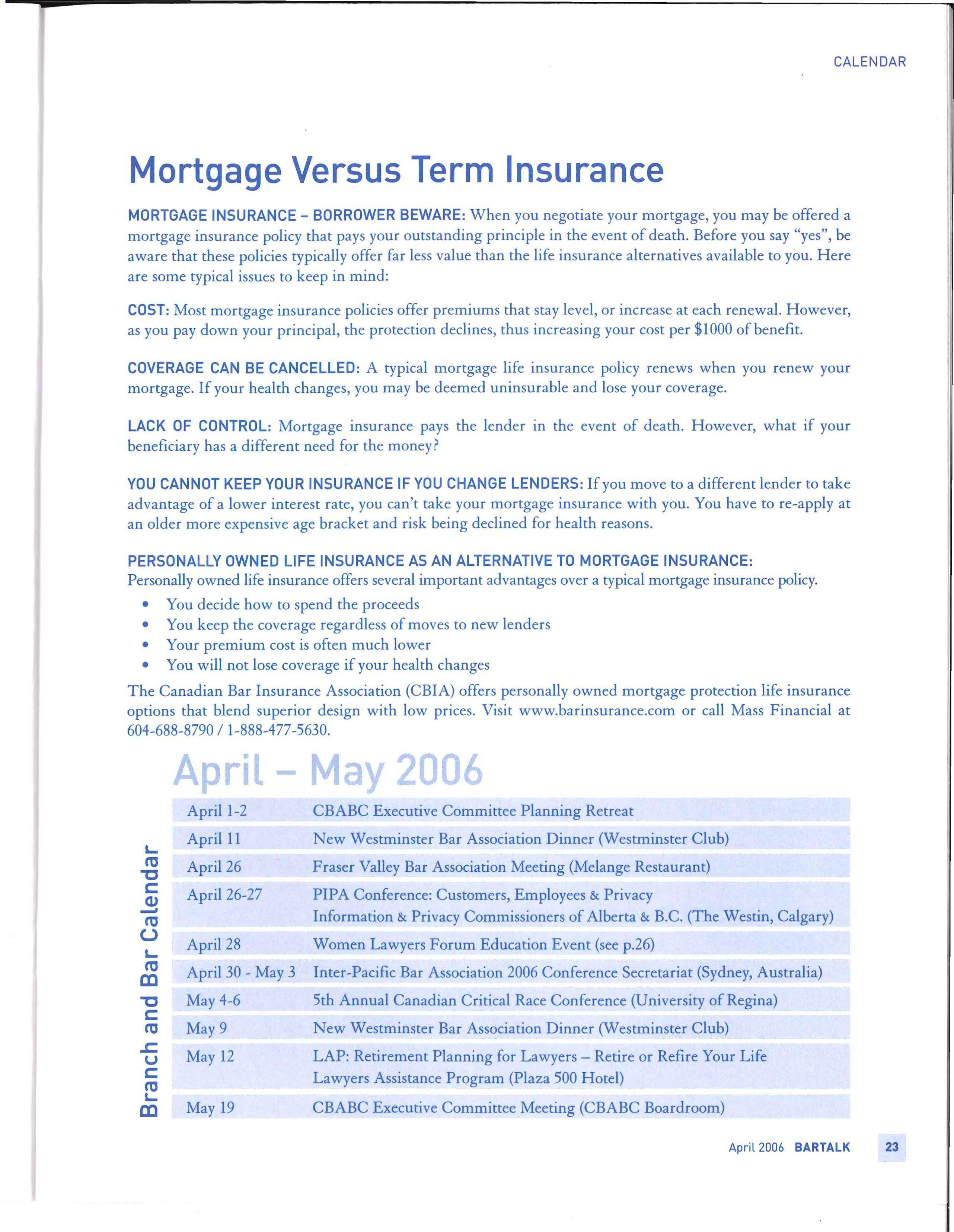
Aprill-2 Aprilll
April26
April26-27
April28 -
April 30 - May 3
May 4-6
May9
May 12
May 19 2
CBABC Executive Committee Planning Retreat
New Westminster Bar Association Dinner (Westminster Club)
Fraser Valley Bar Association Meeting (Melange Restaurant)
PIPA Conference: Customers, Employees & Privacy Information & Privacy Commissioners of Alberta & B.C. (The Westin, Calgary)
Women Lawyers Forum Education Event (see p 26)
Inter-Pacific Bar Association 2006 Conference Secretariat (Sydney, Australia)
5th Annual Canadian Critical Race Conference (University of Regina)
New Westminster Bar Association Dinner (Westminster Club)
LAP: Retirement Planning for Lawyers - Retire or Refire Your Life
Check out MeetingMax at www.cba.org/bc under accommodation [Member Savings) and compare hotels all over B.C. and book them online. MeetingMax has proven to be a great addition to Member Services and we encourage members to go online and get the best deal possible.
Automobile Leasing and Sales
Afrique Enterprises and Carter Auto Group join ProGroup as the latest automobile leasing and sales suppliers. We encourage members to call and compare to get the best rates possible.
Afrique Enterprises, 604- 540-2277
Carter Auto Group, Brian Wishart 604-291-2266, or 1-877-311-2260
ProGroup Auto Leasing and Sales 604-270-4466 www.progroupbc.ca
Spring Training
CBABC is set for spring and is excited to see the return of the local sporting teams. The Vancouver Canadians, the Whitecaps, and the B.C . Lions have been training and are ready to take us through this year's season. CBABC is happy to provide its members with a 10-20 per cent discount as well as other promotions throughout the 2006 season.
Please call Josey Schaefer at 604-687 -3404 x 500 for ticket information.
Spring Skiing
CBABC introduced Big White and Silver Star to its "Mountain of Savings" this year, and is happy to continue to offer discount dual mountain lift tickets As well, we still have tickets available for Whistler Blackcomb and Mt Washington. Ticket order form is available online at www.cba.org/bc under Member Savings (Membership).
CBABC Home and Hospitality Exchange Registry
CBABC would like to introduce the Home Exchange Program. This program is perfect for the out-of-town wedding, graduation, conference, or for just getting away; the Registry offers a no-cost alternative to pricey hotels . The easy-to-use Registry makes family vacations, senior/retired vacations, and work-related home and hospitality exchanges both attractive and affordable. Home exchangers live like locals, not tourists, shopping in neighborhood markets and cafes
This is a free home exchange, not a rental. For more information go to www.c ba.org/bc or call Josey Schaefer at 604-687-3404 x 500
Lawyers Take the Stage for 5th Annual Lawyer Show
Twenty-six local lawyers are deep in rehearsals and scripts for the upcoming production of Elmer Rice 's classic tale, Counsellor-At-Law Following four years of success, the Lawyer Show brings out the finest acting talents of Vancouver 's legal community, who will grace the Stanley Industrial Alliance stage for two nights only on April 28 & 29th
A fundraising event for local theatre companies, the Arts C lub Theatre Company and Touchstone Theatre, the Lawyer Show is proudly supported by the Canadian Bar Association and the legal community at large. CBA member Sarah Hentschel of Watson Goepel Maledy LLP is making her Lawyer Show debut in Counsellor-at-Law as Bessie Green , the bubbly New York receptionist in the 1930s When asked why she auditioned, Sarah credits the benefits of networking: "the CBA's support of this project allows lawyers to connect with a different segment of the community, while also meeting lawyers who share similar interests and a love of theatre "
In celebra tion of the 5th Anniversary of the Lawyer Show, organizers are introducing a new group price of $60 per person for parties of six or more. Regular tickets are $75 per person. Tickets can be purchased online at www.artsclub.com or by calling the Box Office at 604-687-1644. Tickets include the performance, post-show reception with the cast and a charitable tax receipt for a portion of your ticket price.
Bar Moves 1':: 71
Have you recently changed firms or opened a new firm? Send submissions [maximum 25 words) to Bar Moves at cba@bccba.org.
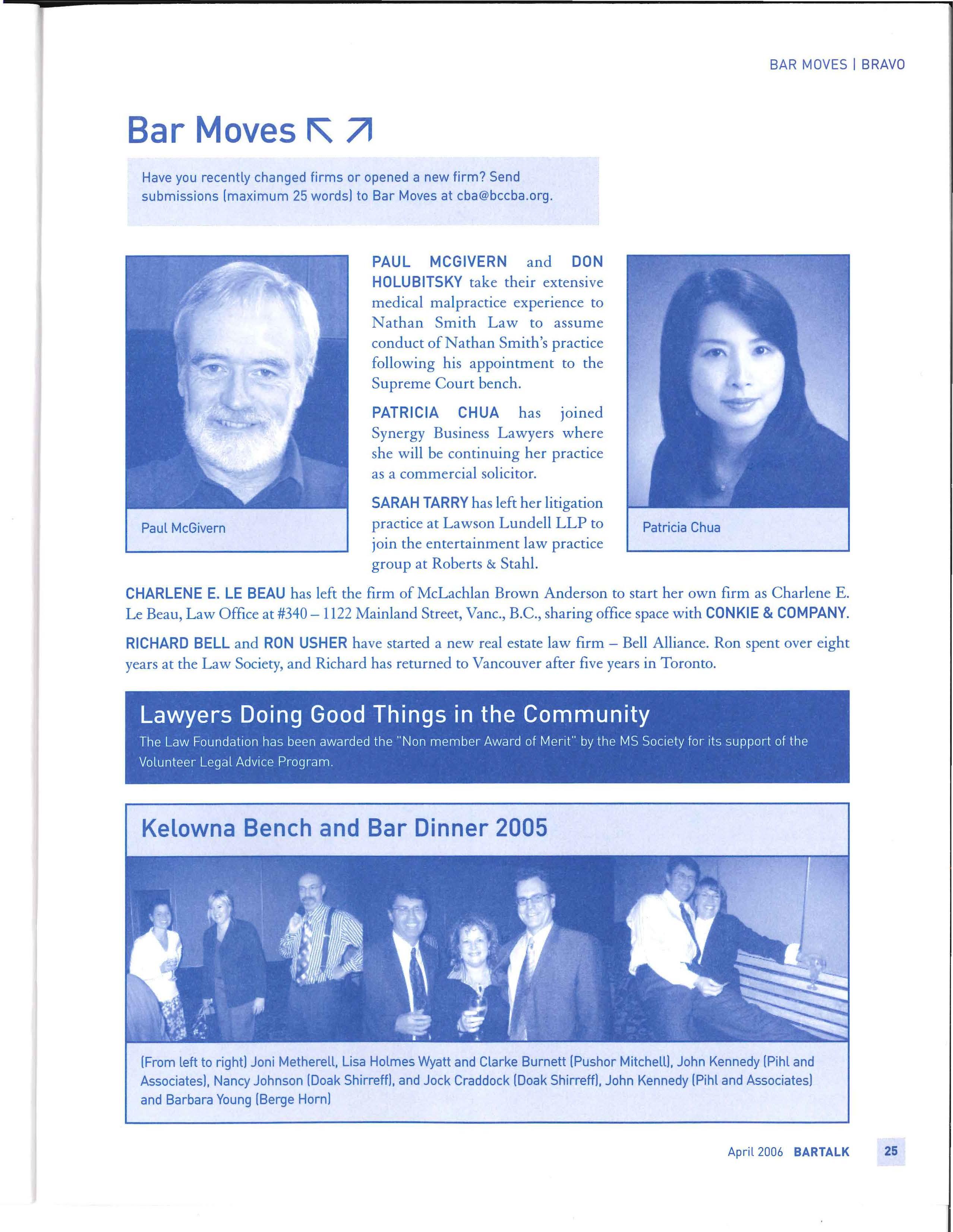
Pau l McGivern
PAUL MCGIVERN and DON HOLUBITSKY take their extensive medical malpractice experience to Nathan Smith Law to assume conduct of Nathan Smith's practice following his appointment to the Supreme Court bench.
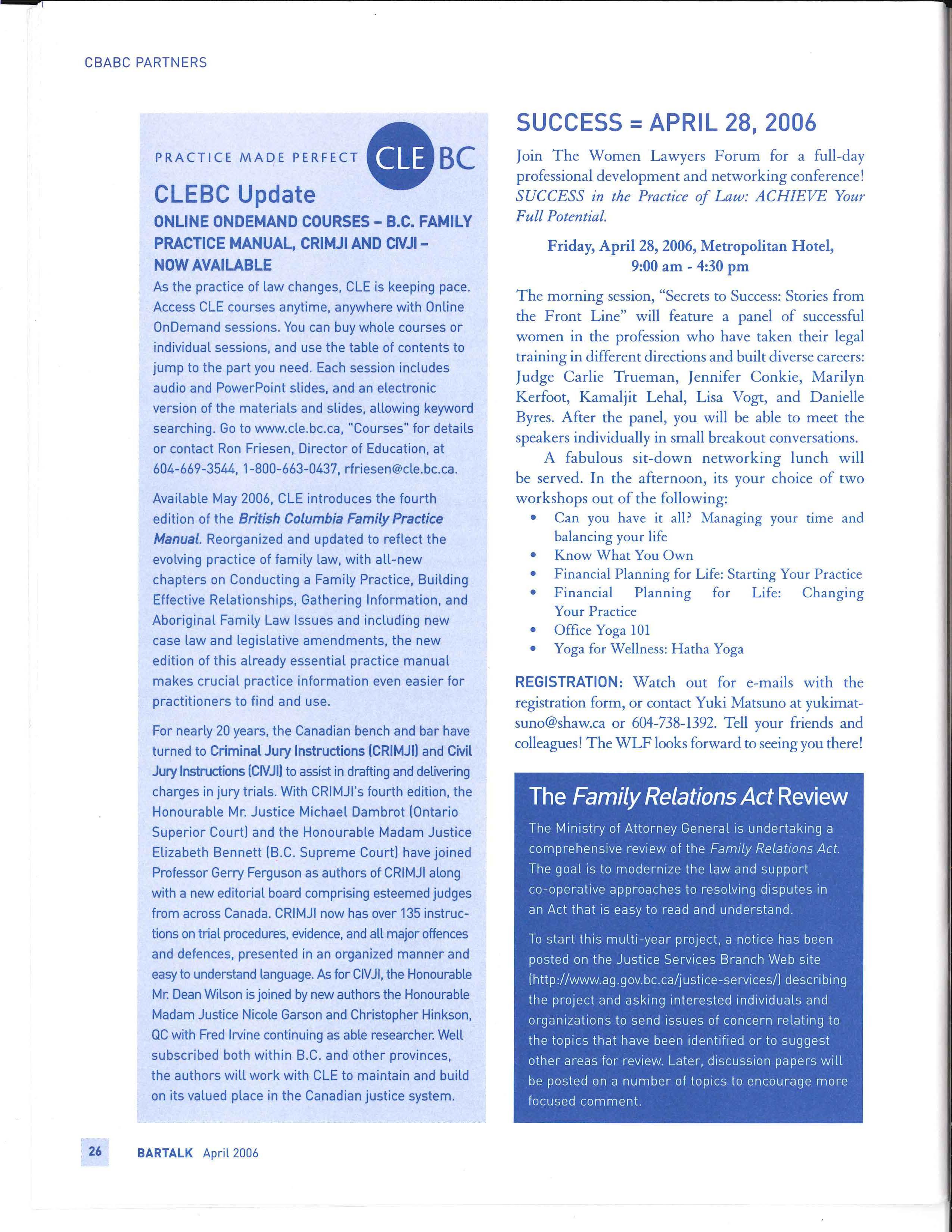
PATRICIA CHUA has joined Synergy Business Lawyers where she will be continuing her practice as a commercial solicitor.
SARAH TARRY has left her litigation practice at Lawson Lundell LLP to join the entertainment law practice group at Roberts & Stahl.
CHARLENE E. LE BEAU has left the firm of McLachlan Brown Anderson to start her own firm as Charlene E LeBeau, Law Office at #340 -1122 Mainland Street, Vane., B.C., sharing office space with CONKlE & COMPANY.
RICHARD BELL and RON USHER have started a new real estate law firm- Bell Alliance. Ron spent over eight years at the Law Society, and Richard has returned to Vancouver after five years in Toronto.
Lawyers Doing Good Things in the Community
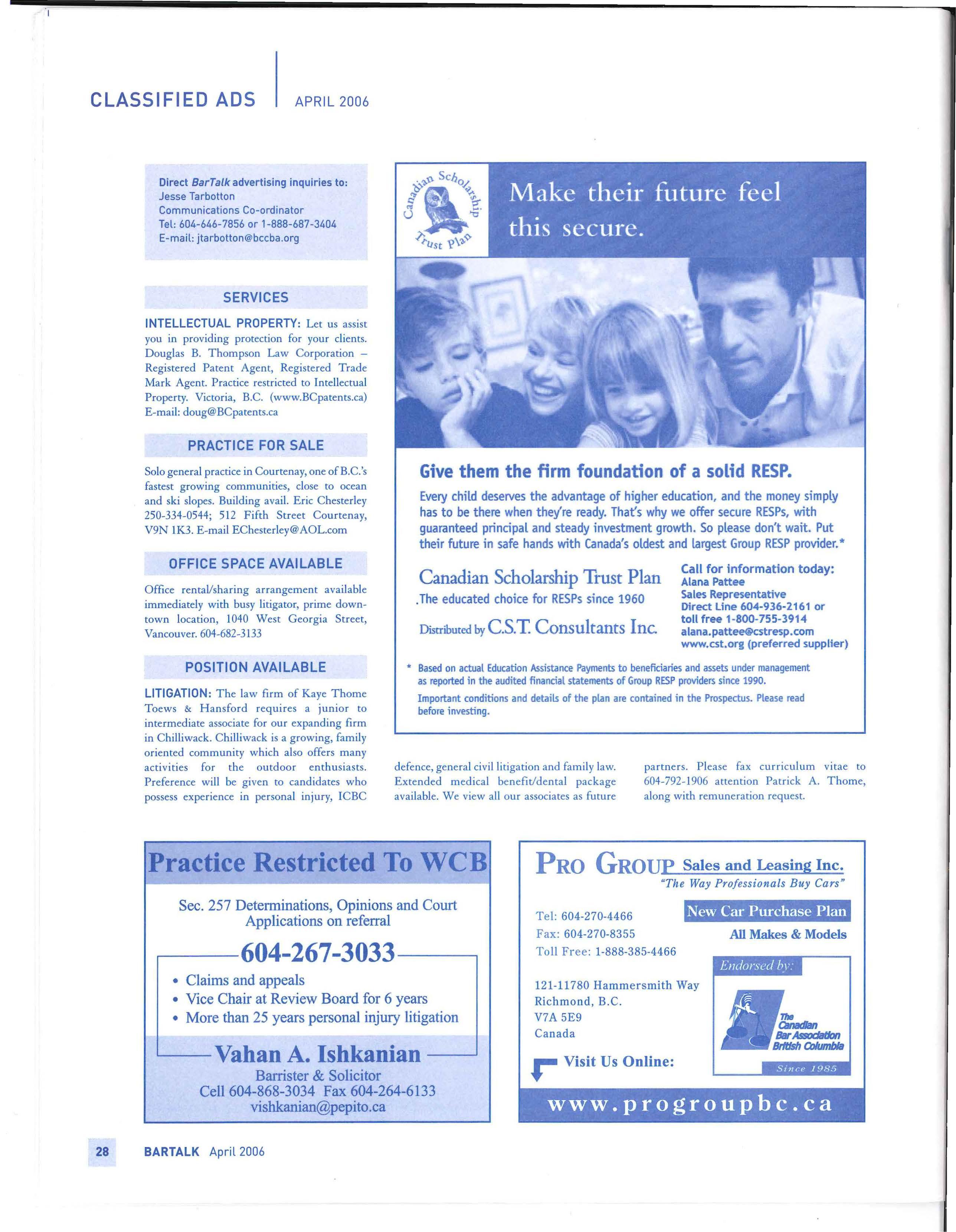
Kelowna Bench and Bar Dinner 2005
Patricia Chua
The Law Foundation has been awarded the "Non member Award of Merit" by the MS Society for its support of the Volunteer Legal Advice Program.
[From left to right) Joni Metherell, Lisa Holmes Wyatt and Clarke Burnett [Pusher Mitchell), John Kennedy [Pihl and Associates). Nancy Johnson [Doak Shirreffl. and Jock Craddock [Doak Shirreff), John Kennedy [Pihl and Associates) and Barbara Young [Berge Horn)
PRACTICE MADE PERFECT •
CLEBC Update
ONLINE ONDEMAND COURSES- B.C. FAMILY
PRACTICE MANUAL, CRIMJI AND CIVJINOW AVAILABLE
As the practice of law changes, CLE is keeping pace. Access CLE courses anytime, anywhere with Online On Demand sessions. You can buy whole courses or individual sessions, and use the table of contents to jump to the part you need. Each session includes audio and PowerPoint slides, and an electronic version of the materials and slides, allowing keyword searching Go to www.cle.bc.ca, "Courses" for details or contact Ron Friesen, Director of Education, at 604-669-3544, 1-800-663-0437, rfriesen@cle bc.ca.
Available May 2006, CLE introduces the fourth edition of the British Columbia Family Practice Manual. Reorganized and updated to reflect the evolving practice of family law, with all - new chapters on Conducting a Family Practice, Building Effective Relationships, Gathering Information, and Aboriginal Family Law Issues and including new case law and legislative amendments, the new edition of this already essential practice manual makes crucial practice information even easier for practitioners to find and use.
For nearly 20 years, the Canadian bench and bar have turned to Criminal Jury Instructions (CRIMJI) and Civil Jury Instructions (CIVJI) to assist in drafting and delivering charges in jury trials. With CRIMJI's fourth edition, the Honourable Mr. Justice Michael Dambrot (Ontario Superior Court] and the Honourable Madam Justice Elizabeth Bennett (B.C Supreme Court] have joined Professor Gerry Ferguson as authors of CRIMJI along with a new editorial board comprising esteemed judges from across Canada CRIMJI now has over 135 instructions on trial procedures, evidence, and all major offences and defences, presented in an organized manner and easy to understand language. As for CIVJl, the Honourable Mr. Dean Wilson is joined by new authors the Honourable Madam Just ice Nicole Garson and Christopher Hinkson, QC with Fred Irvine continuing as able researcher. Well subscribed both within B.C and other provinces, the authors will work with CLE to maintain and build on its valued place in the Canadian justice system.
SUCCESS= APRIL 28, 2006
Join The Women Lawyers Forum for a full-day professional development and networking conference! SUCCESS in the Practice of Law: A CHIEVE Your Full Potential.
Friday, April 28, 2006, Metropolitan Hotel, 9:00 am - 4:30 pm
The morning session, "Secrets to Success: Stories from the Front Line" will feature a panel of successful women in the profession who have taken their legal training in different directions and built diverse careers: Judge Carlie Trueman, Jennifer Conkie, Marilyn Kerfoot, Kamaljit Lehal , Lisa Vogt, and D a nielle Byres. After the panel , you will be able to meet the speakers individually in small breakout conversa tions . A fabulous sit-down networking lunch will be served. In the afternoon , its your choice of two workshops out of the following:
• Can you have it all? Managing your time and bala ncing your life
• Know What You Own
• Financial Planning for Life : Starting Your Practice
• Financial Planning for Life: Changing Your Practice
• Office Yoga 101
• Yoga for Wellness: Hatha Yoga
REGISTRATION: Watch out for e-mails with the registration form , or contact Yuki Matsuno at yukimatsuno@shaw ca or 604 -738-1392 Tell your friends and colleagues! The WLF looks forward to seeing you there!
The Family Relations Act Review
The Ministry of Attorney General is undertaking a comprehensive review of the Family Relations Act. The goal is to modernize the law and support co-operative approaches to resolving disputes in an Act that is easy to read and understand.
To start this multi-year project, a notice has been posted on the Justice Services Branch Web site (http://www ag.gov.bc ca/justice-services/) describing the project and asking interested individuals and organizations to send issues of concern relating to the topics that have been ident i fied or to suggest other areas for review. Later, discussion papers will be posted on a number of topics to encourage more focused comment.
The Board of Governors of the Law Foundation of B. C. met on November 19, 2005. Chair Warren Wilson, QC is pleased to announce that funding totalling $4, 511,200 has been approved for the following programs. In addition, the Foundation approved 9 projects for $1,150, 000 at the November meeting, previously listed in the Feb r uary 2006 issue of Bar Talk
APPOINTMENT OF GOVERNOR
Margaret Sasges, barrister and solicitor, of Victoria, B.C., has been appointed to the Board of Directors of the Law Foundation of British Columbia for a threeyear term commencing January 1, 2006.
Margaret Sasges (Canadian Bar Association, B.C. Branch Appointment)
Ms. Sasges earned her law degree from the University of Victoria and was called to the Bar in 1990. She practises in the areas of wills and estates, elder law, environmental covenants, business, societies and real · property at the firm of Clay & Company in Victoria. Ms. Sasges is the Vice-Chair of the CBA National Resolutions, Const itution & By-laws Committee and was formerly an officer of the Executive Committee of the Canadian Bar Association (B.C Branch). She a l so served as a director of the Continuing Legal Education Society from 1995 to 2002, serving as its chair from 1999 to 2001 She is an act ive member of the UVic Law Alumni Steering Committee.
Funding up to $4, 156, 200 was approved for t h e following 17 continuing programs:
$136,900 BC COALITION OF
THE@LAW FOUNDATION
PEOPLE WITH DISABILITIES OF BRITISH COLUMBIA Legal Advocacy Program
$20,800 B.C FREEDOM OF INFORMATION & PRIVACY ASSOCIATION LAW REFORM AND PUBLIC Legal Education Program
$14,300 DEBATE AND SPEECH ASSOCIATION 2006 Law Foundation Cup Debates
$103,300 DOWNTOWN EASTS I DE RESIDENTS ASSOCIATION Legal Advocacy Program
$121,000 GREATER VANCOUVER LAW STUDENTS LEGAL ADVICE PROGRAM Legal Advice Program
$60,800 LAW COURTS EDUCATION SOCIETY Northern Public Legal Education Program for Firs t Nations communities
$84,600 LAW FOUNDATION EDUCATION AND TRAINING FUND Education and Training Fund for Law Founda tion funded lay advocates
$65,000 LAW SOCIETY OF B.C. CANLII Virtual Law Library
$3,272,500 LEGAL SERVICES SOCIETY Core Operating Grant
$65,500 UNIVERSITY OF BRITISH COLUMBIA First Nations Legal Clinic
$127,500 UNIVERS ITY OF BRITISH COLUMBIA 2006/ 2007 Graduate Fellowships, Undergraduate Scholarships, Entrance Awards, Projects Grants
$84,000 UNIVERSITY OF VICTORIA 2006/ 2007 Graduate Fellowships, Entrance and Renewal Scholarships, Projects Grants
Funding up to $355,000 was approved for the following 4 new Child Welfare Fund Initiative: Focus on Alternative Dispute Resolution and Aboriginal Children project grants:
$150,000 B.C. DISPUTE RESOLUTION PRACTICUM SOCIETY Child Protection Mediation Practicum
$70,000 CARRIER SEKANI FAMILY SERVICES Family Dispute Resolution Project
$65,000 INTERIOR METIS CHILD AND FAMILY SERVICES Metis Alternate Dispute Resolution Proje ct
$70,000 STO:LO NATION SOCIETY Sto:lo Nation Children and Family Services Program
Please visit www.lawfoundationbc.org for more information. Apr il 2006 BARTALK 27
CLASSIFIED ADS APRIL 2006
Direct Bar Talk advertising inquiries to: Jesse Tarbotton Communications Co-ordinator
Tel: 604-646-7856 or 1-888-687-3404
E-mail : jtarbotton@bccba.org
SERVICES
I NTELLECTUAL PROPERTY: Let us assist you in providing protection for your clients Douglas B Thompson Law CorporationRegistered Patent Agent, Registered Trade Mark Agent Practice restricted to Intellectual Property. Victoria, B.C (www.BCpatents.ca) E -mail : doug@BCpatents ca
PRACTICE FOR SALE
Solo general practice in Courtenay, one of B C .'s fastest growing communities , close to ocean and ski slopes Building avail. Eric Chesterley 250 -334 -0544; 512 Fifth Street Courtenay, V9N IK.3. E -mail EChesterley@AOL. com
OFFICE SPACE AVAILABLE
Office rental/sharing arrangement available immediately with busy litigator, prime downtown location , 1040 West Georgia Street, Vancouver. 604-682-3133
POSITION AVAILABLE
LITIGATION: The law firm of Kaye Thome
Toews & Hansford requires a junior to intermediate associate for our expanding firm in Chilliwack Chilliwack is a growing, family oriented community whi ch also offers many activitie s fo r the outdoor enthusiasts Preference will be given to candidates who possess experience in personal injury, ICBC
Every child deserves the advantage of higher education, and the money simply has to be there when they're ready. That's why we offer secure RESPs, with guaranteed principal and steady investment growth. So please don't wait. Put their future in safe hands with Canada's oldest and largest Group RESP provider.*
Canadian Scholarship Trust Plan
.The educated choice for RESPs since 1960
Distributed by C.S.T Consultants Inc.
Ca ll for Information today: Alana Pattee
Sales Representative Direct Li ne 604-936-2161 or toll f r ee 1-800-755-3914 alana.pattee®cstresp.com www.cst.org (preferred supplier)
• Based on actual Education Assistance Payme nts to beneficiaries and assets under management as reported in the aud ited financial statements of Group RESP providers since 1990 Important conditions and det ails of the plan are contained in the Prospectus Please read before investing
defence, genera l civil litigation and family law Extended medical be nefit/dental package avai lable We view all our associates as future
partners Please fax curriculum vitae to 604-792 - 1906 attent ion Patri ck A. Thome , along with remun eration requ est
Practice Restricted To WCB PRO GROUP Sales and Leasing Inc
Sec. 257 Determinations, Opinions and Court Applications on referral 604-267-3033