CBABC submission sparks call to look at removal of the tax
0n October 21 , 2005, CBABC Vice President Frits Verhoeven presented the CBA's submission to the provincial government's Standing Committee on Finance and Government Services at its 2006 budget consultation in Vancouver. This was the CBA's third submission and followed two years of concentrated advocacy efforts aimed at MLAs and business groups to build support for the elimination of the tax on legal services.
This year, the CBA's issue and submission were highlighted in the Committee's report Specifically, the report included the following excerpt:
"The tax on legal fees is incompatible with the government 's goal of creating a competitive business environment in B.C The tax inflates the cost of doing business in British Columbia , relative to other jurisdiction s where no such tax is imposed, notably Alberta and Ontario. We recommend that the provincial government eliminates the seven percent social service tax on legal services - the only professional services in B.C . subje ct to the sales tax ." (Canadian Bar Association, British Columbia Branch)
In its report, the Committee formally recommended that the government examine the remov a l of the tax on legal services. This is consistent with growing agreement among MLAs on both sides of the House that the tax is discriminatory and an
impediment to business competitiveness and public access to justice
The case against the SST on legal services has been bol stered by two recent court decisions that have sent a clear message to government : the tax is an impediment to justice and u n constitutional as it applies to people with low incomes. While the tax was introduced under the guise of funding legal aid, it has always gone to General Revenue.
"Collecting a tax on people and businesses that need legal services makes no sense, except as an arbitrary money generator." said Mr Verhoeven "You don't pay the tax when you access any other profession's servi ces in B.C., and you don't pay the tax in a law office in Alberta or Ontario , B.C.'s main competitors for legal business "
The B.C Business Council has agreed, stating that the tax on legal services is a business input cost that should be removed. CBABC President Meg Shaw, who also Chairs the CBA's SST Task Force, notes that the negative impact of the tax is particularly relevant in industries with high us e of legal services including the high technology, biotech, film and resource industries. "This arbitrary tax takes money out of the economy, from the pockets of businesses and individuals who already pay corporate and personal income taxes; it's time to get rid of it "
For more information about the CBA's advocacy campaign to remove the tax on legal services , visit www.cba .org/bc . BT
The canadian Bar Association British Columbia
Canadian Bar Association, B.C. Branch 1Oth Floor, 845 Cambie Street Vancouver, B.C. V6B 5T3
Tel: 604-687-3404
Toll-free lin B C.I: 1-888-687-3404
BarTalk is published six times per year by the Canadian Bar Association, British Columbia Branch.
This publication is intended for information purposes only and the information herein should not be applied to specific fact circumstances without the advice of counsel.
The Canadian Bar Association, British Columbia Branch represents more than 6,200 members within British Columbia and is dedicated to improving and promoting access to justice, reviewing legislation, initiating law reform measures and advancing and improving the admin istration of justice
BarTalk Publicat i on Sa l es Agreement #40741008
CAROLINE NEVIN LETTERS TO THE EDITOR
AN EXPA NDED ROLE FOR B.C. PARA LEGALS (VOL. 17, NO.5)
In your article on page 1 regarding the expanding role of paralegals the following appears: "The Task Force has expressed the view that
Send your LETTERS TO THE EDITOR to: Caroline Nevin, Bar Talk Senior Editor
Canadian Bar Association, B. C. Branch Fax: 604-669-9601
Toll-free fax: 1-877-669-9601
E-mail: cnevin@bccba.org
lawyers sho u ld be permitted to allow their paralegals to represent client's before administrative tribunals if permitted by the tribunals and not prohibited by law. "
In fact, the Task Force expressed no such view. I have now reviewed the Task Force's report, and the Task Force did not make this egregious error in the use of the apostrophe, which happens to be one of my pet peeves It would appear that the CBA is so lely responsible for this error.
- Harvey Wolfson
EDITOR'S NOTE :
To those members of the profession who know former CBABC Executive Director AlfEddy, we advise that he has recently been unwell and is n ow home follow ing an extended hospital stay. Mr. Alf Eddy can be reached c/o CBABC, lOth Floor, 845 Cambie St., Vancouver, B.C. V6B 5T3, or at aeddy@6163.ca
CLASSIFIED (per line)
CBABC Members/Firms
Commercial Organizations
DISPLAY
3" X 2.5"
CBABC Members/Firms
Commercial Organizations
6" X 2.5"
CBABC Members/Firms
Commercial Organizations
Next deadline: Ja nuary 13
INSERT (all of B.C J
CBABC Members/Firms
Commercial Organizations
Next deadline: January 19
Next mailing: February 10
Direct BarTalk advertising inquiries to: Jesse Tarbotton
Communications Coordinator
Tel: 604-646-7856 or 1-888-687-3404
E-mail : jtarbotton@bccba org
The canadian
Staying Connected
The focus of this edition of Bar Talk is on the theme of techno logy. Those of us who have practised for a while, barristers and solicitors a li ke, have witnessed enormous tec h nological changes in the practice oflaw
As with anything, though, change shou ldn't be made for change's sake . Prudent lawyers weigh the costs and benefits of any technology they are considering adopting.
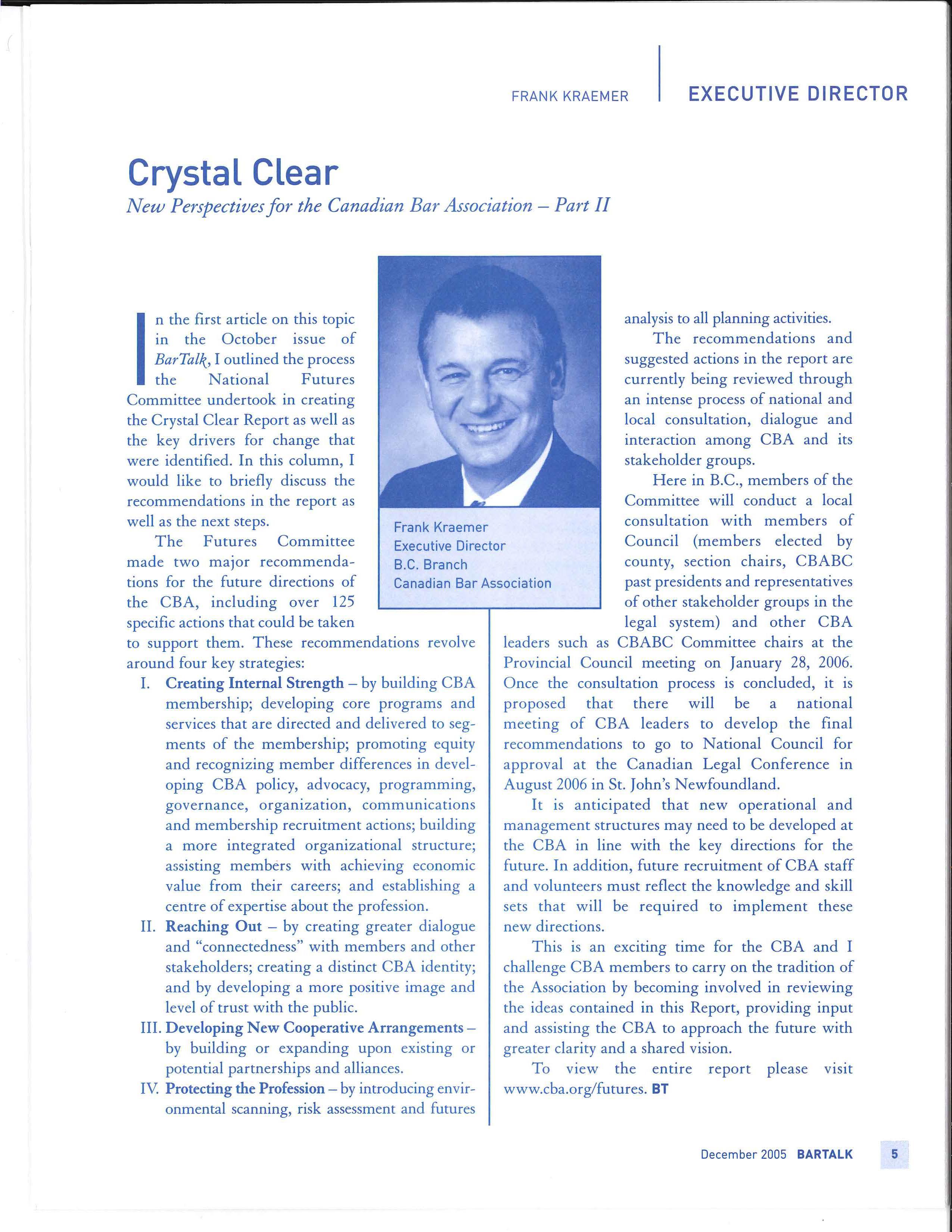
Marguerite (Meg) E. Shaw
President 2005
B.C Branch
As a barrister and partner in a small, two-lawyer firm, I don't have the luxury of an IT department to Canadian Bar Association support my forays into the world of computer-speak. My computer knowledge is earned the hard way: through experience. Sometimes firsthand experience is pleasant, and sometimes, difficult and costly. And cost, of course, is a real concern, especially for a small practice with few lawyers to spread that cost across. I'd like to share with you my most recent experience.
I knew that I would be spending significant time away from both my practice and my home during my presidential year, and the ability to stay in touch with my office, collect my e-mail, access my files, and keep my calendar up to date was of paramount importance. Remote access to my computer at work was an absolute necessity
A virtua l private network, or VPN, is one way to meet my connectivity goals Through a combination of hardware and software, a secure, encrypted tunnel is created over the internet between a notebook computer and the server back at the office. This has the theoretical potential to afford access to all the applications I use at the office: Amicus Attorney, PC Law, WordPerfect, and Outlook Express. In practice, the learning curve was very steep, it was finicky to set up, and some of my applications refused to run over the VPN. The cost wasn't very high for
4 BARTALK December 2005
the hardware and software, but the cost in lost time trying to make it all work was extremely high.
The next attempt was to use a service called GoToMyPC. Insomniacs will be familiar with this solution as it is advertised heavi l y on late night television. They even offer a 30-day free trial. Setup took all of five minutes, it worked immediately, and i t has worked flaw lessly ever since! A small program is installed on your office computer, and then anywhere you have access to the
internet, you can connect to that computer and control it just like you were sitting at your desk Like with the VPN, a secure, encrypted connection is made, so confidentiality is maintained. You pay a modest monthly fee for each month you need the service. The cost, both financially, and in time and effort was extremely low.
For those times when I need to know my schedu le or have to contact a client while out of the office, and I am not nea r a computer, I carry a SmartPhone. Whether you choose the now ubiquitous Blackberry or, as I did, a Palm - based phone for its ability to communicate with Amicus Attorney, these devices have become indispensable to busy prac t itioners. They get smaller and more powerful every year. I don' t know how I would do witho u t mine.
For those members who prefer to benefi t from the firsthand experience of others, the Canadian Bar website, www.cba.org has numerous articles of interest on technology and the practice of law. Click on the Practice Tools menu, then choose CBA PracticeLink. BT
FRANK KRAEMER
Crystal Clear
New Perspectives for the Canadian Bar Association - Part II
In the first article on this topic in the October issue of Bar Talk, I outlined the process the National Futures Committee undertook in creating the Crystal Clear Report as well as the key drivers for change that were identified. In this column, I would like to briefly discuss the recommendations in the report as well as the next steps.
The Futures Committee made two major recommendations for the future directions of the CBA, including over 125 specific actions that could be taken
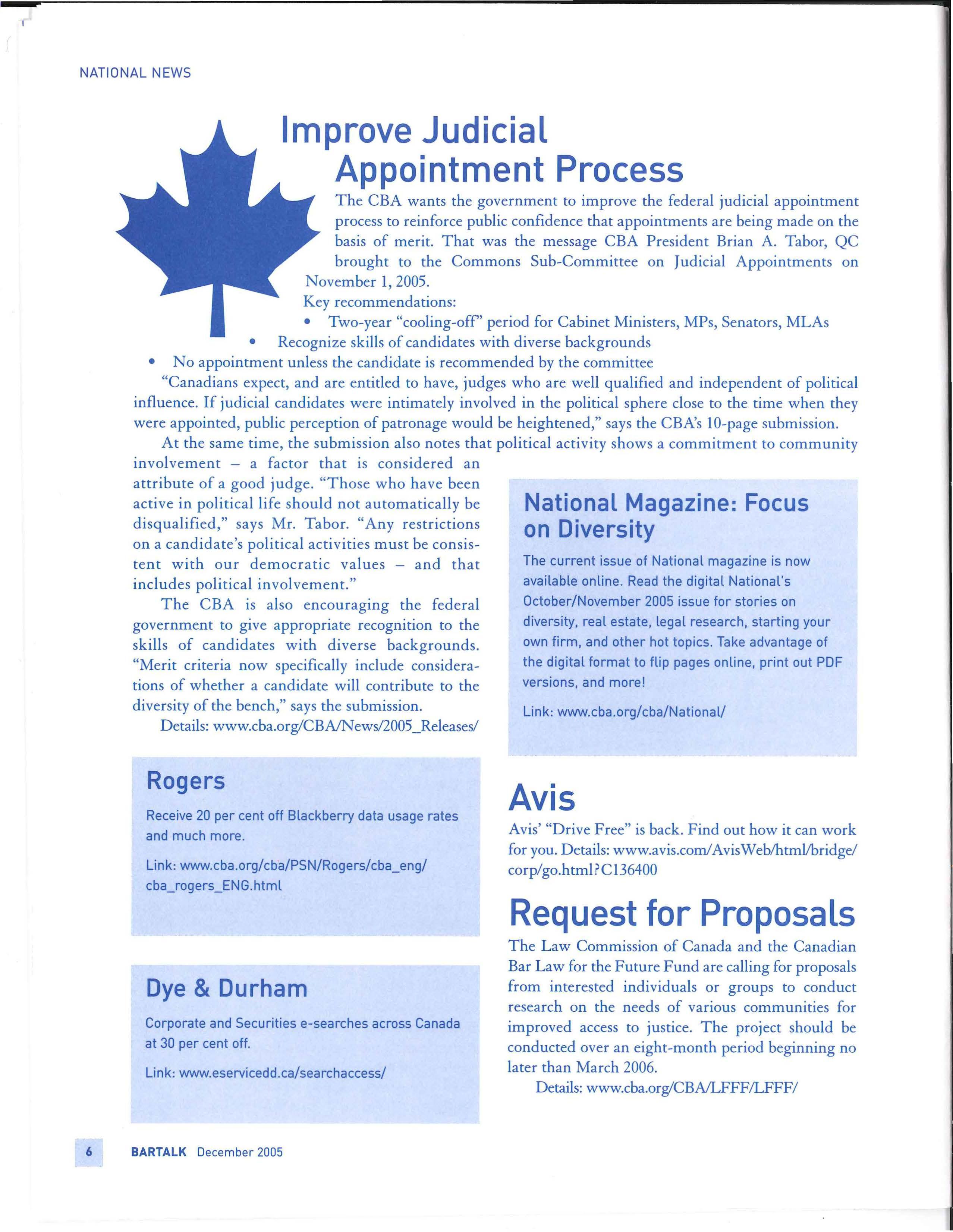
Frank Kraemer
Executive Director B.C. Branch
analysis to all planning activities. The recommendations and suggested actions in the report are currently being reviewed through an intense process of national and local consultation, dialogue and interaction among CBA and its stakeholder groups.
Here in B.C., members of the Committee will conduct a local consultation with members of Council (members elected by county, section chairs, CBABC past presidents and representatives of other stakeholder groups in the Canadian Bar Association
to support them These recommendations revolve around four key strategies:
I. Creating Internal Strength - by building CBA membership; developing core programs and services that are directed and delivered to segments of the membership; promoting equity and recognizing member differences in developing CBA policy, advocacy, programming, governance, organization, communications and membership recruitment actions; building a more integrated organizational structure; assisting members with achieving economic value from their careers; and establishing a centre of expertise about the profession
II Reaching Out - by creating greater dialogue and "connectedness" with members and other stakeholders; creating a distinct CBA identity; and by developing a more positive image and level of trust with the public
III. Developing New Cooperative Arrangementsby building or expanding upon existing or potential partnerships and alliances.
IV. Protecting the Profession- by introducing environmental scanning, risk assessment and futures
legal system) and other CBA leaders such as CBABC Committee chairs at the Provincial Council meeting on January 28, 2006. Once the consultation process is concluded, it is proposed that there will be a national meeting of CBA leaders to develop the final recommendations to go to National Council for approval at the Canadian Legal Conference in August 2006 in St. John's Newfoundland
It is anticipated that new operational and management structures may need to be developed at the CBA in line with the key directions for the future. In addition, future recruitment of CBA staff and volunteers must reflect the knowledge and skill sets that will be required to implement these new directions.
This is an exciting time for the CBA and I challenge CBA members to carry on the tradition of the Association by becoming involved in reviewing the ideas contained in this Report, providing input and assisting the CBA to approach the future with greater cl a rity and a shared vision.
To view the entire report please visit www .cba.org/futures. BT
Improve Judicial Appointment Process
The CBA wants the government to improve the federal judicial appointment process to reinforce public confidence that appointments are being made on the basis of merit. That was the message CBA President Brian A Tabor, QC brought to the Commons Sub-Committee on Judicial Appointments on November 1, 2005.
Key recommendations:
• Two-year "cooling-off ' period for Cabinet Ministers, MPs , Senators, MLAs
• Recognize skills of candidates with diverse backgrounds
• No appointment unless the candidate is recommended by the committee "Canadians expect, and are entitled to have, judges who are well qualified and independent of political influence. If judicial candidates were intimately involved in the political sphere close to the time when they were appointed , public perception of patronage would be heightened," says the CBA's 10-page submission.
At the same time, the submission also notes that political activity shows a commitment to community involvement - a factor that is considered an attribute of a good judge. " Those who have been active in political life should not automatically be disqualified," says Mr. Tabor. " Any restrictions on a candidate's political activities must be consistent with our democratic values - and that includes political involvement "
The CBA is also encouraging the federal government to give appropriate recognition to the skills of candidates with diverse backgrounds . "Merit criteria now specifically include considerations of whether a candidate will contribute to the diversity of the bench," says the submission.
Details: www.cba.org/CBA/News/2005 _Releases/
Rogers
Receive 20 per cent off Blackberry data usage rates and much more
Corporate and Securities e-searches across Canada at 30 per cent off
Link: www eservicedd.ca/searchaccess/
National Magazine: Focus on Diversity
The current issue of National magazine is now available online. Read the digital National's October/November 2005 issue for stories on diversity, real estate, legal research, starting your own firm, and other hot topics. Take advantage of the digital format to flip pages online, print out PDF versions, and more!
Link: www.cba.org/cba/National/
Avis
Avis' "Drive Free" is back Find out how it can work for you Details: www.avis.com/AvisWeblhtmllbridge/ corp/go.html?Cl36400
Request for Proposals
The Law Commission of Canada and the Canadian Bar Law for the Future Fund are calling for proposals from interested individuals or groups to conduct research on the needs of various communities for improved access to justice. The project should be conducted over an eight-month period beginning no later than March 2006 .
Details: www.cba org/CBAILFFF/LFFF/
SITE DU JOUR
CBA Practicelink at cba.org/cba/Practicelink
Look in "Technology" for information on:
• Legal Practice and the Internet: Marketing Strategies
• Client Services in the Legal Information Age
• Network News
• Building a Better Website
• Using Technology for Efficiency, Less Stress and Increased Profits
The Dirty Dozen Viruses, Hackers, and Spyware - Bandits on the Internet!
Technology for the Solo, Home, and Mobile Office : Networking and Data Protection
• Technology for the Solo, Home or Mobile Office : Mobile Computing
• Focus on Electronic Authentication Security Alert
• Net Gain A Portal in Any Storm High-tech Hardware
Connecting With Your Clients
''T Jl N '1, )) l..i.\ i.\I..
The CBABC Lawyers Alive column is a biographical feature of a living B.C. lawyer (or lawyer who practiced in B C for a significant time period). This column is I intended to celebrate the achievements of our colleagues while they're still alive to appreciate it. It's a place to talk about the great work and diverse interests of our friends and colleagues.
Profiles should be 500 words or less , photo welcomed. For more information about our author guidelines e-mail bartalk@bccba.org or call 604 - 646 - 7856.
Don·t Compromise
Lawyer-Client Confidentiality
Solicitor-client privilege and confidentiality must not be compromised says a CBA brief on Bill C-53 , Criminal Code (proceeds of crime) and Controlled Drugs and Substances Act Amendments The legislation has the potential to erode the lawyer-client relationship through a search warrant scheme that could apply to law offices. The CBA says special rules must be followed for searches where privileged or confidential materials are likely to be located
The CBA has serious concerns about section 462.46 , that would allow documents seized through a search warrant to be copied before being returned , even if a judge ordered them returned because they were seized improperly or in the eyent of an acquittal.
"It is quite extraordinary that a court might order documents to be returned if an individual is acquitted of charges , yet the Attorney General would continue to take advantage of the seizure of the documents by keeping copies," says the submission.
The Bill would create a new regime for forfeiture of property believed to be
the proceeds of crime, putting the onus on the offender to prove that the property is not proceeds of crime. However, the CBA believes that this provision represents a significant change to our sentencing scheme as forfeiture would be imposed on the standard of a "balance of probabilities" and not the usual standard of "beyond a reasonable doubt "
*Heather Perkins - McVey of Ottawa , member of the National Criminal Justice Section, presented the brief to the Commons Justice Committee on November 1, 2005.
Details: www.cba.org/CBNnews/ 2005 _Releases/
The CBABC sponsors 68 Sections which play a vital role in keeping members informed both on changes in the law , and l egal and political issues affecting a given area of practice They are the main resource utilized by the CBABC in legislative review, law reform initiatives , and in responding to matters affecting the profession What follows is a sample of the recent activities of some Sections
CRIMINAL JUSTICE (VANCOUVER) SECTION AND INTERNATIONAL LAW SECTION
Gordon Longmuir, former Canadian Ambassador to Cambodia, spoke on the prosecution of crimes committed during the Khmer Rouge Regime (19751978) in Cambodia.
During the Khmer Rouge Regime approximately 1.7 million people out of a population of 7 million died through overwork, starvation or murder by the government. The leaders of the regime have never been held
FAMILY LAW (NEW WESTMINSTER)
In May, 2005 the Family Justice Reform Working Group, set up by the Justice Review Task Force of the Law Society of B.C., published its report titled: "A New Justice System for Families and Children." A number of significant reforms to the family justice system are proposed Two members of the Working Group, Dinyar Marzban, QC and M. Jerry McHale, QC spoke about the mandate of the in Vancouver
Working Group and some of the details of the proposals.
accountable for their crimes. According to Mr. Longmuir subsequent governments, though not as brutal as the Khmer Rouge, have governed in a far from democratic manner using intimidation and nepotism to stay in power and have never embraced the Rule of Law. The current government has little desire to hold the Khmer Rouge leaders responsible but because almost half of Cambodia's GDP is derived from foreign aid, international pressure has forced current leaders to try those responsible for the atrocities committed. The government signed an agreement with the l.Tnited Nations in 2003 to create a hybrid tribunal to conduct the trial where foreign and Cambodian judges, prosecutors, defence lawyers and investigators will work together. The process has just begun and will take many years to complete.
Mr. Longmuir emphasized that the goal of the public international tribunal is to come to grips with the Rule of Law and to allow Cambodians to see an open and impartial judicial process . He noted that Canadian lawyers have been held in high regard in other similar international prosecutions and felt that Canadian lawyers had a great deal to contribute He encouraged them to consider becoming involved.
8 BARTALK December 2005
The group was specifically asked to think in terms of fundamental change rather than changing a court rule here or there, to make recommendations for a Unified Family Court and to look at historical process, including the reports on this topic produced since 1973.
A review of previous reports in this area revealed:
a We need courts but not a court-based system so that disputes are mainly resolved outside the courtroom. Access to justice is unaffordable in our current system.
b In respect of family law, the system needs to take into account that litigation can be driven by non-legal, emotional issues.
c. We need a system with a settlement orientation. Instead of using mediation, collaborative law and judicial case conferences as add-ons to an adversarial system, we need to start with a collaborative system as a focus.
The Working Group's recommendations are in four areas:
1. "front end load" - Front end load refers to the mandate of providing information and orientation to the public up front and includes recommendations for providing family justice
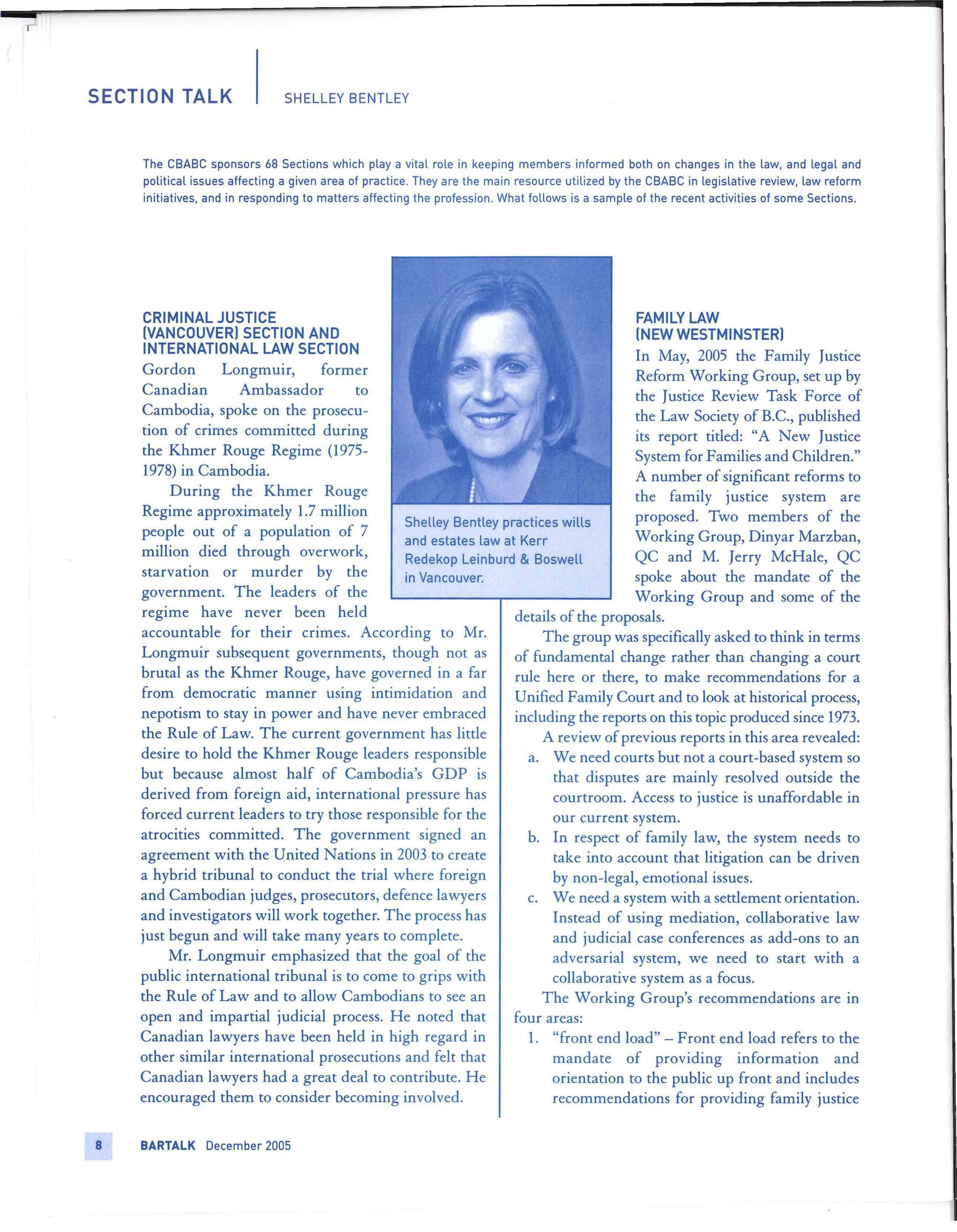
Shelley Bentley practices wills and estates law at Kerr Redekop Leinburd & Boswell
information in all formats including in person, by internet and video and for coordinating community resources for this purpose.
2. consensual dispute reso l ution services - An initial assessment is recommended to decide whether dispute resolution is inappropriate, for example, in cases where there is abuse, violence or an imbalance of power.
3. simplified forms and procedures - The Working Group feels that most court forms are too complicated to be used effectively by self- represented parties
4. unified family courts - The Working Group recommends that we learn from the problems encountered in other provinces and institute a unified court when there is sufficient funding including judicial resources and services to make it work effectively
WILLS AND TRUSTS (VANCOUVER)
The Succession Law Reform Project conducted under the auspices of the B C Law Institute and chaired by Peter Ramsay, QC has been working toward making comprehensive recommendations for reform of B C. succession law This Project is organized into 5 subcommittees: estate administration, alternate succession vehicles, small estates, intestate succession/Wills Variation Act ("WVA")/Family Relations Act and testate succession.
Guest speakers, Peter Ramsay, QC, James Baird, Brad Anderson and Greg Blue discussed the draft proposals of the subcommittees a n d sought comments and questions from section members. Mr. Ramsay, QC stressed that the work of the subcommittees was at this point a work in progress and that none of the proposals are final. He invited comments from all members and requested that they be directed to Greg Blue at gblue@bcli.org.
The most contentious proposals discussed were those surrounding the WVA . The r ecommendations are aimed at bringing the B.C law surrounding dependant 's relief closer to the Canadian mainstream. The draft proposals call for application of dependant's relief to both wills and intestacies. The clas s of possible claimants would continue to consist only of spouses and children. Although there would be no restrictions on the right of a spouse or minor
child to seek relief, a child of the deceased who is 19 or over would only b e eligible for relief if unable to be self-supporting because of:
• illness
• mental or physical disability
• full-time enrolment tn an educational program; or
• economic need arising from circumstances for which he or she is not responsible (form of wording not settled yet)
Further, the draft proposals include anti-avoidance provisions requiring the capital value of listed inter vivos transactions to be treated as if it were a testamentary disposition and included in the value of the net estate. The listed inter vivos transactions include common will substitutes such as:
• beneficiary designations for life insurance and RRSPs
• the deceased's interest in a joint account
• property transferred by the deceased into joint tenancy
• trusts created by the deceased where rights of beneficial enjoyment or revocation are reserved In addition a clawback provision would target unreasonably large transfers or payments made within a specified tim e (3 years) prior to death for no consideration or inadequate consideration . They would be rebutably presumed to have been made for the purpose of defeating rights under the WVA.
The proposals depart from the rest of common law Canada in that they include a recommendation that parties be permitted to contract out of the protection of th e WVA. BT
Ask Yourself Before You Send an E-Mail
• Is the message really necessary?
• Would a telephone conversation or a meeting be quicker?
• Is the message clear and to the point?
• Are the recipients those who need to know?
• If this message got into the public domain, would I be embarrassed?
DAVID J B I LINSKY
Telephone Frustrations
The fine art of not communicating
j) If you're screening your calls I know you're busy and1\ I won't keep you long J
Words and music by Evan & Jaron.
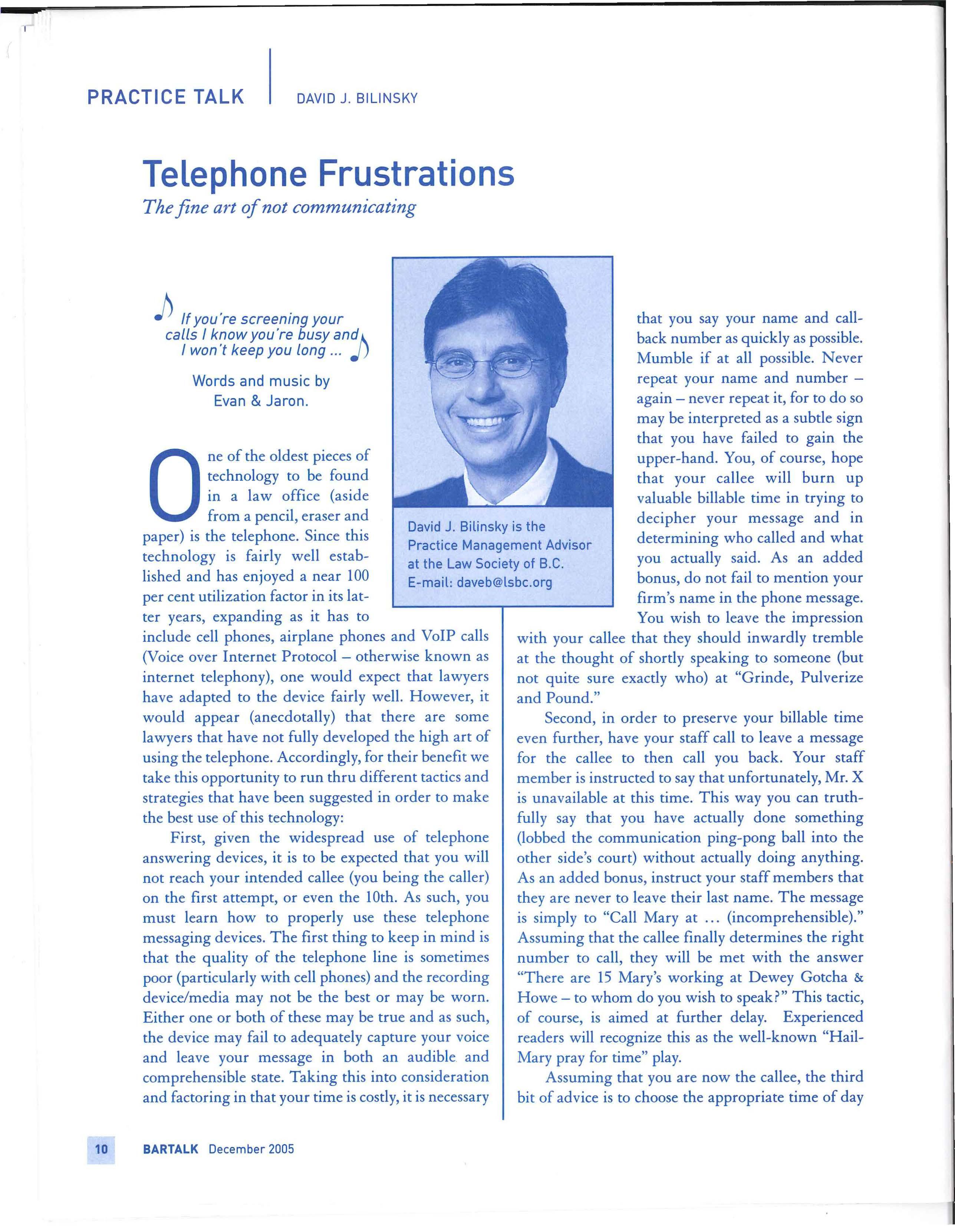
0ne of the oldest pieces of technology to be found in a law office (aside from a pencil, eraser and paper) is the telephone. Since this technology is fairly well established and has enjoyed a near 100 per cent utilization factor in its latter years, expanding as it has to David J. Bilinsky is the
Practice Management Advisor at the Law Society of B.C E-mail: daveb@lsbc.org
include cell phones, airplane phones and VoiP calls (Voice over Internet Protocol - otherwise known as internet telephony), one would expect that lawyers have adapted to the device fairly well. However, it would appear (anecdotally) that there are some lawyers that have not fully developed the high art of using the telephone. Accordingly, for their benefit we take this opportunity to run thru different tactics and strategies that have been suggested in order to make the best use of this technology:
First, given the widespread use of telephone answering devices, it is to be expected that you will not reach your intended callee (you being the caller) on the first attempt, or even the lOth. As such, you must learn how to properly use these telephone messaging devices. The first thing to keep in mind is that the quality of the telephone line is sometimes poor (particularly with cell phones) and the recording device/media may not be the best or may be worn. Either one or both of these may be true and as such, the device may fail to adequately capture your voice and leave your message in both an audible and comprehensible state. Taking this into consideration and factoring in that your time is costly, it is necessary
that you say your name and callback number as quickly as possible. Mumble if at all possible. Never repeat your name and numberagain- never repeat it, for to do so may be interpreted as a subtle sign that you have failed to gain the upper-hand. You, of course, hope that your callee will burn up valuable billable time in trying to decipher your message and in determining who called and what you actually said. As an added bonus , do not fail to mention your firm's name in the phone message
You wish to leave the impression with your callee that they should inwardly tremble at the thought of shortly speaking to someone (but not quite sure exactly who) at "Grinde, Pulverize and Pound."
Second, in order to preserve your billable time even further , have your staff call to leave a message for the callee to then call you back Your staff member is instructed to say that unfortunately, Mr. X is unavailable at this time. This way you can truthfully say that you have actually done something (lobbed the communication ping-pong ball into the other side's court) without actually doing anything As an added bonus, instruct your staff members that they a re never to leave their last name. The message is simply to "Call Mary at ... (incomprehensible)." Assuming that the callee finally determines the right number to call, they will be met with the answer "There are 15 Mary's working at Dewey Gotcha & Howe- to whom do you wish to speak?" This tactic, of course, is aimed at further delay. Experienced readers will recognize this as the well-known "HailMary pray for time " play.
Assuming that you are now the callee, t he third bit of advice is to choose the appropriate time of day
to return a call. First, aim to do so very early in the morning. This is designed to maximize the underlying message that while they are not at work, you are. Earn bonus marks by topping it off with a voice mail message to the effect that when they get into the office, they can call you back. Other variations on this theme are to call just after 12 noon (hoping that the callee will then be off at lunch and thereby unable to take the call) or call well after 6 pm, gauging that they have already left.
The last tactic in this area is to use your voice mail and call-display to screen all calls during normal office hours. Moreover, set up your voice mail system so that the caller is continually provided with a list of things to do such as "Press 1 to speak to Mr. X, press 2 to speak to Mr. X's assistant" etc . - but ensure that none of these actually results in connecting to anything but further voice mail options. This ensures that your billable time is actually spent working on client matters that you deem most important. After all, if it was really important, they would send you an e-mail instead, now, wouldn't they?? Of course, some people do use their secretary to screen calls, but this is seen as being a less-effective option, as the caller actually does get a chance to speak to a live person.
Now despite all these tactics, sooner or later someone will actually manage to reach you on the telephone. Desperate times call for desperate measures! Here it is handy to have some last-ditch tactics close at hand. First, you need a sheet of crinkly cellophane placed near the telephone to simulate static on the line which enables you to request the caller to call back - at which point you will ensure that all calls will then go directly to voice mail. Of course, many readers will also recognize the well-worn line: "Urn, I would love to continue with this, but I have a meeting ... can I call you back?" If you are on a cellphone, you can always say: "Hello? Hello? You are fading . . . I can't seem to hear you ... either you or I am in a dead spot" at which point you then hang up on the call.
There is always the realization that the telephone line may not be clear (cellphones are notorious here) and that the person with whom you are nominally speaking may have a hearing deficiency (all of us lose a certain amount of hearing as we grow older) The other party may not have a volume control on their
phone that allows them to amplify your voice. Accordingly, take this into account and speak as softy as possible, which keeps the other person off-center and guessing. Moreover, it may force them to discontinue the call until a later time when they can hear you better.
All of these suggestions, properly applied, will allow you to prevent the telephone from being used as it actually was designed - an evil Machiavellian technology designed by others to take control of your life! Of course, this is all tongue-in cheek and I am not suggesting that any lawyer actually does any of \ these deliberately or otherwise.
However, there is the view that the telephone, graciously and courteously used, with due respect for the time, schedules, disabilities and lives of our opposing counsel, clients and others, can be a very effective time saving device that can help lawyers cut to the chase and solve problems, ease conflicts and sort out lives. Like any technology, the telephone is a tool and how we view that tool and put it to use is reflected in the bigger picture of how we approach our obligations of professional courtesy, respect, dignity for others and ethics. And perhaps in this way we all can continue to use this ancient technology effectively, thereby avoiding screening calls and causing even greater stress in our busy lives. BT
The views expressed herein are strictly those of the author and may not be shared by the author's employer, the Law Society of B.C
Tips for Dealing with E-mail Overload
• Do not use e-mail when a meeting would be more effective
Avoid "e-mail conversations"
• Limit the amount of information in an e-mail
• Avoid trivial responses- it is not always necessary to respond
• Do not send too many CCs for information
• Avoid overusing e-mail outside normal work hours. especially to assign tasks or to make various requests
• Reduce the number of non-business e-mail
The Pirate's Code
Is the Softwood Dispute a Hollywood Movie or a wild rollercoaster ride? Or both?
Don't you just love the Softwood Lumber Dispute these days?
With billions of dollars being held to ransom by a seemingly unscrupulous adversary, thousands of jobs at stake, and its own brand of Courtroom drama, I can't decide whether it's a Hollywood movie or a wild ride at Disneyland.
Let's think of a movie script that tells the same story, only allegorically. Perhaps it's a western. Picture a Big Company run by Big Men who aren't afraid of using Big Sticks when the Big Moment strikes them. Because they're so big, we'll call them "Bigco." But as
Tony Wilson is a Franchise Lawyer and Intellectual Property Lawyer at Boughton. He's written for the Globe and
Mail, the Vancouver Sun, and Macleans magazine. E-mail: twilson@boughton.ca
every Western has to have an underdog, we'll call our protagonist "Smallco."
Smallco sells so much stuff to Bigco, it begins to realize that it's vulnerable to the whims of its biggest customer, (not to mention the Big Politicians whose campaign expenses Bigco not-so-coincidentally finances). Smallco has done rather well off its business with Bigco, but it wonders whether Bigco might use one of those Big Sticks against it some day. Being small, (and arguably thinking small), Smallco doesn't like being drawn into messy battles with sticks. It prefers to play by the rules. So in one of Bigco's weaker moments, Smallco persuades it to enter into a "Code" which they'll use to settle any conflicts that might come up. Bigco signs the deal because it gets a secure source of something Smallco has lots of (such as "oil") Smallco adopts the Code only because the dispute resolution rules are binding on Bigco. Just for fun, lets say they call their Code "NAFTA."
And in our story, the Code works well for a time. That is, until there's a Big Problem that turns our Western into a Legal Drama. Bigco has done
something rather dodgy over a boring trade issue like "softwood lumber." Backed by its Big Politicians, it refuses to return to Smallco an unimaginably Big sum ofSmallco's money. Relying on the rules it forged under the Code, Smallco takes the matter to a hearing. It wins. Bigco appeals. Smallco wins again. Bigco appeals again and loses. This goes on for a very long time and each time they have a hearing, Bigco always loses. Finally, with no appeals left, Bigco loses for the last time. Smallco is vindicated. In movie parlance, the asteroid is destroyed, the crew is
rescued, the cattle come home, the boy gets the girl and the villain is forced to pay up. Hugs are exchanged in the halls of Smallco, and rousing emotional music fills the theatre to jerk tears from the audience's eyes.
But wait. It's a false ending! Our good story now turns bad and ugly. Instead of doing what everyone else does when they lose the last appeal (i.e they pay up so the audience can go home), we get on a rollercoaster ride. "Frankly" says Bigco "I don't give a damn what the court says." "I'm not giving you your money back. And there ain't nothin' you can do about it!" Outraged, Smallco holds up the Code and all the judgments in its favour, and says: "We entered this Code because we wanted both of us to live by these rules. Now you won't comply with the Rules you helped to write?" "Well", says the man from Bigco, "They're not really Rules." "They're more like Guidelines." "Here at Bigco, we call it 'The Pirate's Code."'
So there you have it. It's not a Western or a Legal Drama! It's a Pirate movie! But there's just one problem with our Pirate movie.
We're not the Pirates. BT
E-mail Management for Lawyers
Are you overwhelmed with e-mail and spam?
You are not alone. I receive dozens of messages dai l y and often find e-mail difficult to manage. Statistics released by MessageLabs (messagelabs.com) in September identified the global ratio of spam in e-mail traffic was 67.6 per cent or 4 in every 6 e-mails sent were identified as spam. The globa l ratio of e-mail-borne viruses in email traffic was 1.9 per cent, or 1 in 41 e-mails contained a virus.
If you maintain an e-mail address, your clients and colleagues
Second, in Outlook rightclick on the message you want to base a rule, then click "Create Rule" and follow the instructions in the Rules Wizard The WLF
Patricia Jordan is the CBABC listserv recipient display name is BC Women Lawyers Forum Listserv. I used this recipient display name to create my rule and move all messages with this display name to the BC WLF listserv folder. My "BC WLF listserv" rule looks like this in Outlook : Manager, Interactive Media. She welcomes your comments, questions and suggestions. Tel: 604-646-7861
E-mail: pjordan@bccba.org will want to communicate with you via e-mail. Regardless of how small or large your firm is, they will expect a quick response. Many firms use basic programs such as Microsoft Outlook and Lotus Notes to manually respond to messages. If you use Microsoft Outlook, I suggest you use the Rules Wizard to organize and process your messages more efficiently. Setting up a new rule is easy. Ru les are a set of conditions, actions, and exceptions that process and organize messages automatically. Once you create a rule, Outlook will apply a rule's criteria to messages as they arrive in your inbox
As CBABC webmaster, I am also the moderator for CBABC listservs and the recipient of dozens of listserv messages . The Rules Wizard has been invaluable for organizing and sorting e-mail I receive on a daily basis. The simplest way to create a rule is to base it on a message.
First, create a new folder in your inbox for messages with a particular topic in the subject header or a specific recipient. For the Women Lawyers Forum (WLF) listserv, I created a folder entitled "BC WLF listserv" in my inbox.
"App l y this rule after the message arrives with BC Women Lawyers Forum Listserv in the recipient's address move it to the
BC WLF listserv folder."
• The Rules Wizard can also be used to: move messages to a particular folder based on who sent them
• move certain kinds of messages, such as Out of Office messages, to another folder
• delete messages in a conversation
• flag messages from a particular person
• set up a notification, such as a message or a sound, when important messages arrive
• redirect a message to a person or to a distribution list
• ask the server to automatically reply to a certain type of message by using a message you've created
• assign categories to messages you send based on the contents of the messages
• delay delivery of messages by a specified amount of time
• start a program BT
See Site du Jour on page 7
See Ask Yourself Before You Send an E-Mail on page 9
See Tips for Dealing with E -mail Overload on page 11
ACTS IN FORCE
Every effort is made to ensure the accuqlCy of the information provided to you in this art i cle but the informat i on should not be re li ed upon Lawyer s should refer to the spec ific legi s lative or regulatory provision You will see a reference in some cas es to the number of the Bill when it wa s introduced in the House This number may be different from the chapter number of the new Act wh ich is q uoted after the title of the Act and which is the proper c itation for the Act The Bill number has been given to make it easier for you to note up the Bills you may have in your library.
CURRENT FROM SEPTEMBER 10 to NOVEMB ER 7, 2005
L eg is l ative Update is prov i ded as pa r t of t h e CBABC l eg is l a t ive and l aw reform prog r am It is a service fun ded by CBA membership fees, and is therefore provided as a benefit of CBA membership The fu ll version of Legis l ative Update is now pu blished o n line, availab l e to CBA members exclusively at www cba.org/bc.
ACTS IN FORCE
BRITISH COLUMBIA RAILWAY (REVITALIZATION)
AMENDMENT ACT, 2003, SBC 2003, C. 91 (BILL 89)
Section 2 is in force Sept.l6, 2005
CORONERS ACT, R.S.B.C. 1996,C. 72
Stuart Rennie
B.C. Branch Legislation & Law Reform Officer
Tel: 604-949-1490
E- mail: srennie@bccba.org
Section 3 of the Supplement to the Act is in force Oct. 20, 2005
FORESTS STATUTES
AMENDMENT ACT , 2004, S.B.C. 2004, C. 36 (BILL 33)
Sections 78 and 113 are in force October 20, 2005
MOTOR VEHICLE ACT, R.S.B.C. 1996, C. 318
Section 10 of the Supplement to the Act is in force Oct. 20, 2005
British Columbia Law Institute Project on Pension Division on Marriage Breakdown
At the request of the Ministry of Attorney General, the British Columbia Law Institute has established a committee to review the division of pensions on marriage breakdown [Part 6 of the Family Relations Act). A list of iss ue s under consideration is at www.bcli.org/pendiv.html. Comments on how the legislation is working or suggestions for reform [on these issues or any others) must be submitted to the Pension Division Project Committee no later than January 31st, 2006
Security Checklist
Here's an eight-point checklist to help make your law office secure!
1. PROTECT THE HARDWARE.
Richard Ferguson, Past Chair ofCBA's Law Practice Management and Technology section and a lawyer with Lynass Ferguson & Shoctor says "Recognize that a computer is a desirable object and that "anyone can pick it up and all the information stored on it, so you may wish to attach it to something, like the floor. Don't laugh," he adds. "We've had computers lifted."
2. ENCRYPT YOUR DATA.
Scramble the data on your network and hard drives, so that if someone does steal your computer, they won't be able to read your files. Ferguson says a variety of good encryption software is readily available ·on the Net (see sidebar at www.cba.org/CBA/PracticeLink/ National_articles/39.aspx for a list of security products and their websites).
3. INSTALL A FIREWALL.
Basically, a firewall is a program that prevents hackers from coming down your computer's "pipeline" to the Net, so that no one can hack you or create chaos, explains Ferguson. "Having a firewall is not just getting one and installing it," adds Dan Pirinington, Director of Practice Pro, the risk management arm of Lawpro in Toronto. "You want to make sure you've gone through the various settings to lock down things to the extent that you want to."
4. STOP THOSE VIRUSES!
Install a good anti-virus program. "Put it on your server and on each computer, so if anyone tries to introduce a virus into your network, it will not cause havoc," says Ferguson. Once it's installed, make sure you update it regularly. "Most of the major products now allow for automatic updates," Pinnington notes That
means you can set the program to go to its home Website and download new v1rus definitions as often as you wish.
5. BACK UP YOUR DATA.
"If something screws up today, if someone steals the computer today, if it is destroyed in a fire today, you have the information necessary to carry on your practice," advises Ferguson. "That means backing up daily, taking backup media offsite on a regular basis, and checking that backup data to make sure it's working."
This last point is often overlooked, even by the experts. Ferguson's firm used the same tape backup system faithfully for years. "Then the hard drive got munched, and lo and behold, no one made that kind of tape drive anymore We had to send the tape to a processing outfit in the States to get it restored onto a hard drive."
6. WHAT'S THE PASSWORD?
Use passwords and manage them properly. "A password gets you through a locked door," Pinnington observes. "You have to get people using them and keeping them secret. Then there's the issue of changing them Do you change them every 30, 60, 90 days; in case they've been compromised?"
7. WATCH FOR TURNOVER.
Pay attention when staff are fired or quit. "It's possible to change a password the moment you terminate someone, so they can no longer get on the network and screw up anybody else," says Ferguson . This is especially important if the termination is acrimonious. "A disgruntled employee may say, 'To hell with this' and issue that formidable command, 'Format Drive C,' and all that was there is gone."
8. MIND YOUR PORTABLES.
Remember that everything that we've said about computers also applies to portable datasaving devices like laptops, Palm Pilots and even cellphones . BT
TOM CARTER GUEST
Guide to Effective Computer Presentations for Lawyers: In the Courtroom and at the Office
Like many lawyers, the thought of incorporating computer presentations into your practice probably leaves you cold and sweaty. After all, you're a legal professional, not a computer expert, an AIV technician, or a graphic designer
But across Canada, a number of forward - thinking lawyers have already taken the plunge and discovered that a well-planned presentation, using Power Point or special trial presentation soft ware, can enhance courtroom persuasiveness, communication with clients, and marketing efforts
The technology isn't even that difficult to master - if you can operate e-mail and word processing software, computer presentations are within your grasp. Given the ease of use, low cost and reliability of modern presentation technology, traditional excuses simply don't apply anymore. Lawyers that stick to old-school thinking and that adhere to exaggerated criticisms of technology risk being left in the dust. Here 's the scoop on why you need make the leap to computer presentations, what equipment you'll need to get going, and how to make the most of it.
ADVANTAGES IN THE COURTROOM
Quite simply, computer presentations are the most effective way to communicate with juries who have grown up with television . Research has shown that 72 hours after hearing information, a jury remembers only 10 per cent of it. If you present the information visually, a jury remembers 20 per cent But if you combine oral and visual presentations, the recall rate can shoot up to 65 per cent.
If you're trying to explain how a medical procedure went wrong, compare two documents side-by-side, or outline a complex sequence of events, an image will tell the story far better than words can
A few bullet points of text can drive home your opening or closing arguments or summarize key
testimonial, while an animation can be a powerful way to recreate an accident scene.
Further, when you present evidence electronically, both judge and jury can see it clearly and quickly. It eliminates the need to wait while everyone fumbles to find the correct page in a hefty binder or takes their turn examining an exhibit. And while some judges insist on traditional methods, many are realizing that it's easier, faster, and more efficient to view a CD's worth of documents rather than going through stacks of paper.
At least one B.C. insurance litigator is convinced. Michael Maryn of Maryn & Associates says he was able to convincingly show the impact of a client's injury with a PowerPoint presentation . "Our job as lawyers is to assist jurors in understanding the issues," he explains. Based on his experience , Maryn believes that visual presentations are much more effective than oral arguments alone.
ADVANTAGES AT THE OFFICE
Computer presentations can also expand your ability to drive home your message at the office, whether it be through marketing your practice or communicating with clients. Milton Zwicker of Zwicker, Evans & Lewis in Barrie, Ontario specializes in condo law and estate planning. He is a passionate advocate of using computer-generated flowcharts that he creates with Inspiration (www.inspiration.com) to explain wills, contracts and other complex legal documents to his clients In every case, he finds that diagrams convey meaning far better than words . Consider that over half of malpractice claims result from the client failing to understand what was communicated, or the lawyer failing to communicate something in the first place, and you've got a compelling reason to start thinking visually
In terms of marketing, an informative PowerPoint presentation can be an excellent way to impress current or potential clients. Zwicker, for
example, often gives seminars on condominium law to boards of directors and condo owners. At Thompson Dorfman Sweatman LLP in Winnipeg, PowerPoint presentations are used in meetings with clients , group meetings within the firm, and marketing talks to industry groups.
10 TIPS FOR DELIVERING EFFECTIVE COMPUTER PRESENTATIONS
1. Practice makes perfect! It may sound obvious, but presenters too often forget that a slicklooking presentation will fall on deaf ears if the delivery lacks confidence or is unrehearsed.
2. Be professional - another no-brainer that's often overlooked. Ensure all slides are organized , clear and consistent. If you're not comfortable with the technology, get trained or get somebody else to handle the highly technical aspects of the presentation.
3. If possible, scope out the room ahead of time Older courtrooms may not have enough electrical outlets, and it may be difficult to position a screen so that everyone can see it
4. Use a projector and a screen It will yield a clearer picture than simply projecting onto a white wall. If possible, test visibility in advance.
5. Speak to your audience , not to the screen or the computer. Take quick glances at your presentation to ensure everything is working, but keep the focus on your audience
6. Visual clarity is key. Avoiding distracting colors and cluttered backgrounds. Simple, warm colors and readability are far more persuasive.
7. Always strive for clear, concise and readable text, and avoid placing too much text on a slide. Limit yourself to six words on a line and six lines on a slide.
8. Don ' t go overboard on images and audio/ video Make the most of the technology, but don ' t use graphics, sounds and video for the sake of doing so . Ensure that all such additions are essential to the effective delivery of the presentation.
9. Remember that content is still king. Don't spend all your efforts focusing purely on the technology. A glitzy computer presentation can't make up for poor messaging, communication and execution.
10. Finish your presentation with a conclusion slide that encapsulates your main points. A wellplaced quote can also have staying power in the minds of your audience
RESPECTING MURPHY'S LAW: SIX TECHNOLOGY TIPS
Technology is guaranteed to fail at the most inopportune time, so it's wise to be prepared for all the things that can go wrong:
1. Before making courtroom presentations, be sure the judge will permit it, and don't forget to advise opposing counsel of your plans.
2. Find out what equipment the court can supply. Be prepared to bring your own screen and projector if necessary.
3. Arrive early to set up the equipment and make sure it all works. Ensure that the audience will have a clear view of the presentation and that any sound components will be audible
4. Come equipped with extension cords, extra projector bulbs, and spare batteries for your remote
5. Disable the power management feature on your computer-that little energy-saving program that turns off the screen or even turns off the computer if the keyboard hasn ' t been used for a certain period of time. Failure to do so may result in a blank screen halfway through your presentation.
6. Be prepared for equipment failures or lastminute objections from opposing counselhave an "unplugged" presentation ready to deliver if necessary.
GETTING EQUIPPED
After you've bought into the power of computer presentations and made a commitment to bring the necessary technology into your practice, you'll need to get the right equipment for your needs. The following link is to the full article and offers a breakdown of the hardware and software that's available to help you get up and running with additional tips on mastering the technology: www.cba.org/cba/PracticeLink/ T AYP/ Julie Stauffer is a freelance writer based rn Guelph, Ontario. BT
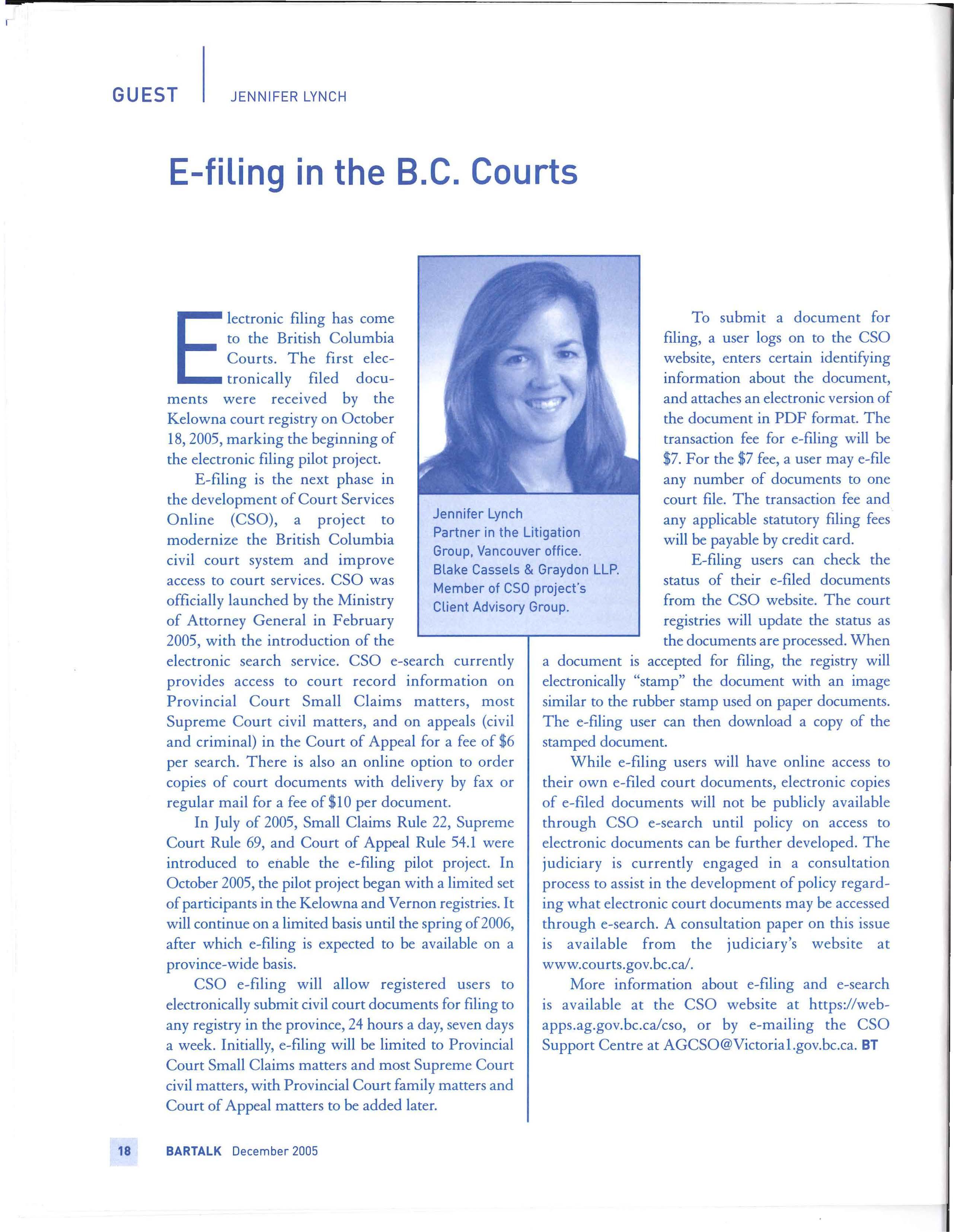
E-filing in the B.C. Courts
Electronic filing has come to the British Columbia Courts. The first electronically filed documents were received by the Kelowna court registry on October 18,2005, marking the beginning of the electronic filing pilot project
£ - filing is the next phase in the development of Court Services Online (CSO), a project to modernize the British Columbia civil court system and improve access to court services. CSO was officially launched by the Ministry of Attorney General in February 2005, with the introduction of the
Lynch
Partner in the Litigation Group, Vancouver office.
To submit a document for filing, a user logs on to the CSO website, enters certain identifying information about the document, and attaches an electronic version of the document in PDF format. The transaction fee for e-filing will be $7. For the $7 fee, a user may e-file any number of documents to one court file The transaction fee and any applicable statutory filing fees will be payable by credit card. £-filing users can check the status of their e -filed documents from the CSO website . The court
B l ake Casse l s & Gra ydon LLP. Member of CSO proje ct's Client Advisory Group. registries will update the status as
electronic search service. CSO e-search currently provides access to court record information on Provincial Court Small Claims matters, most Supreme Court civil matters, and on appeals (civil and criminal) in the Court of Appeal for a fee of $6 per search. There is also an online option to order copies of court documents with delivery by fax or regular mail for a fee of $10 per document.
In July of 2005, Small Claims Rule 22, Supreme Court Rule 69, and Court of Appeal Rule 54.1 were introduced to enable the e-filing pilot project. In October 2005, the pilot project began with a limited set of participants in the Kelowna and Vernon registries. It will continue on a limited basis until the spring of2006, after which e-filing is expected to be availab le on a province-wide basis.
CSO e-filing will a ll ow registered users to electronically submit civil court documents for filing to any registry in the province, 24 hours a day, seven days a week . Initially, e-filing will be limited to Provincial Court Small Claims matters and most Supreme Court civil matters, with Provincial Court family matters and Court of Appeal matters to be added later.
the documents are processed . When a document is accepted for filing, the registry will electronically "stamp" the document with an image similar to the rubber stamp used on paper documents. The e-filing user can then download a copy of the stamped document.
While e-filing users will have online access to their own e-filed court documents, electronic copies of e-filed documents will not be publicly available through CSO e-search until policy on access to electronic documents can be further developed. The judiciary is currently engaged in a consultation process to assist in the development of policy regarding what electronic court documents may be accessed through e-search A consultation paper on this issue is available from the judiciary's website at www.courts.gov.bc.ca/
More information about e-filing and e -search is available at the CSO website at https: //webapps .ag .gov.bc.ca/cso, or by e - mailing the CSO Support Centre at AGCSO@Victorial.gov.bc.ca. BT
Jennifer
Privacy Law, Information Security & ID Theft
Identity theft, which increases significantly every year , involves misuse of an individual's personal information to
impersonate someone for gam. Criminals are increasingly using discarded credit card receipts, loan applications and similar records containing personal information to exploit innocent individuals' personal information, for example, by obtaining credit cards and false ID . Meanwhile, technological developments have facilitated the
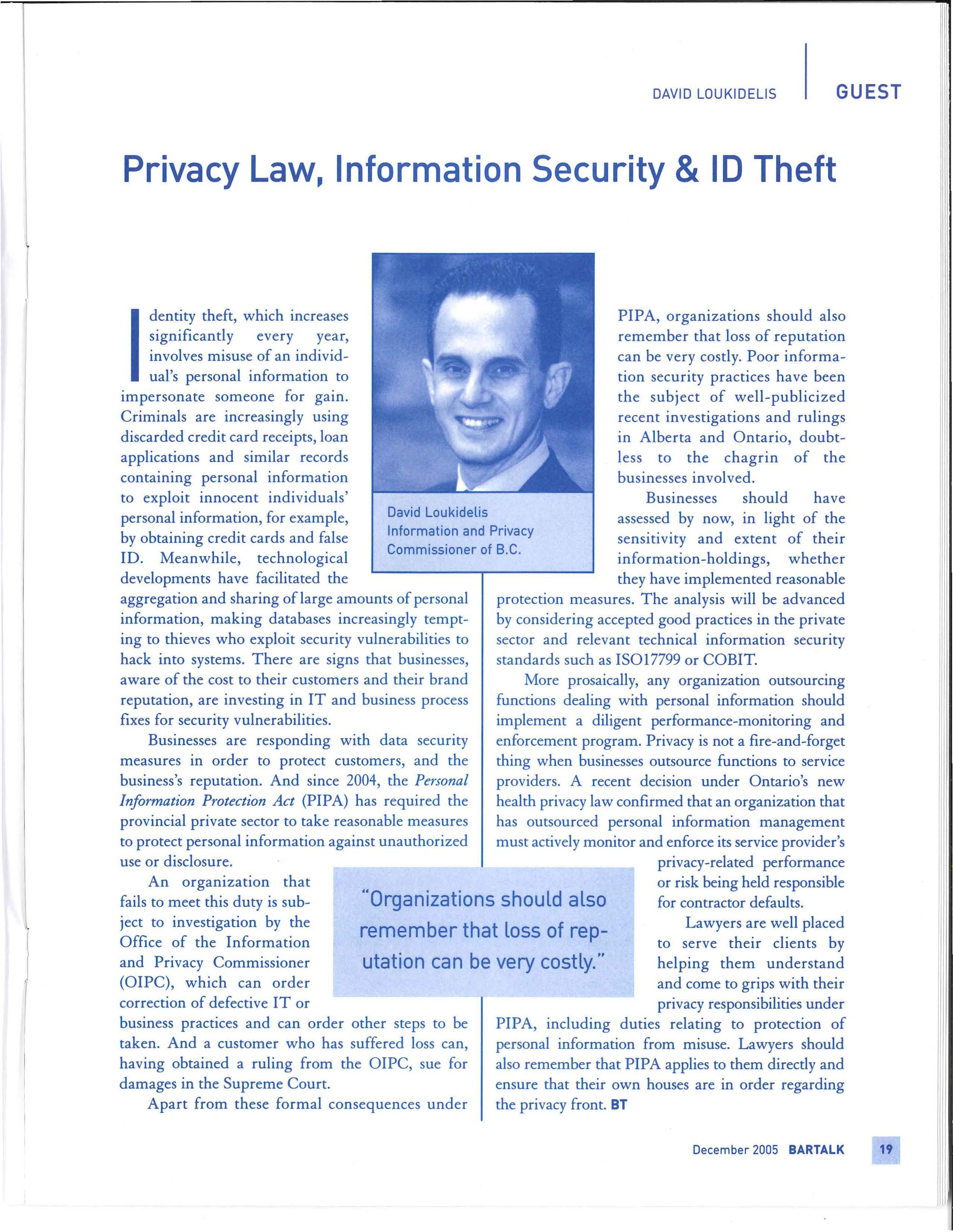
David Loukidelis
Information and Privacy Commissioner of B C.
PIPA, organizations should also remember that loss of reputation can be very costly . Poor information security practices have been the subject of well-publicized recent investigations and rulings in Alberta and Ontario, doubtless to the chagrin of the businesses involved.
Businesses should have
assessed by now, in light of the sensitivity and extent of their information-holdings, whether aggregation and sharing oflarge amounts of personal information, making databases increasingly tempting to thieves who exploit security vulnerabilities to hack into systems There are signs that businesses , aware of the cost to their customers and their brand reputation , are investing in IT and business process fixes for security vulnerabilities.
Businesses are responding with data security measures in order to protect customers, and the business's reputation . And since 2004, the Personal Information Protection Act (PIPA) has required the provincial private sector to take reasonable measures to protect personal information against unauthorized use or disclosure.
An organization that fails to meet this duty is subject to investigation by the Office of the Information and Privacy Commissioner (OIPC), which can order correction of defective IT or
they have implemented reasonable protection measures. The analysis will be advanced by considering accepted good practices in the private sector and relevant technical information security sta ndards such as IS017799 or COBIT.
More prosaically, any organization outsourcing functions dealing with personal information should implement a diligent performance-monitoring and enforcement program. Privacy is not a fire-and-forget thing when businesses outsource functions to service providers . A recent decision under Ontario's new health privacy law confirmed that an organization that has outsourced personal information management must actively monitor and enforce its service provider's privacy-related performance
"Organizations should also remember that loss of rep-
utation can be very costly."
business practices and can order other steps to be taken. And a customer who has suffered loss can , having obtained a ruling from the OIPC , sue for damages in the Supreme Court.
Apart from these formal consequences under
or risk being held responsible for contractor defaults . Lawyers are well placed to serve their clients by helping them understand and come to grips with their
privacy responsibilities under PIPA, including duties relating to protection of personal information from misuse. Lawyers should al so remember that PIPA applies to them directly and ensure that their own houses are in order regarding the privacy front. BT
Juricert, Digital Signatures, and EFS
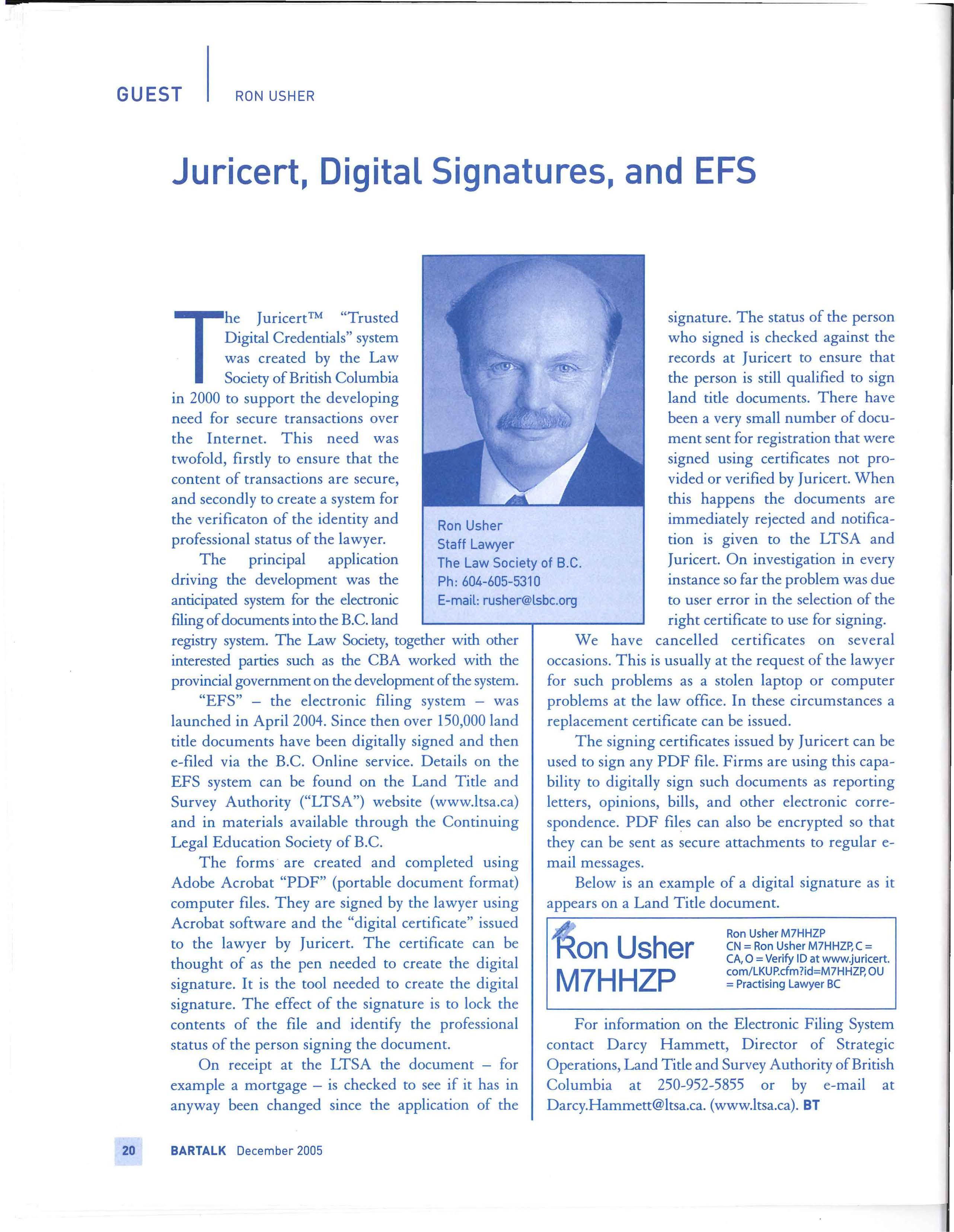
The Juricert™ "Trusted Digital Credentials" system was created by the Law Society of British Columbia in 2000 to support the developing need for secure transactions over the Internet. This need was twofold, firstly to ensure that the content of transactions are secure, and secondly to create a system for the verificaton of the identity and professional status of the lawyer. Ron Usher
The principal application driving the development was the anticipated system for the electronic filing of documents into the B.C. land
Staff Lawyer
The Law Society of B.C. Ph: 604-605-5310
signature. The status of the person who signed is checked against the records at J uricert to ensure that the person is still qualified to sign land title documents There have been a very small number of document sent for registration that were signed using certificates not provided or verified by Juricert. When this happens the documents are immediately rejected and notific ation is given to the LTSA and Juricert. On investigation in every instance so far the problem was due to user error in the selection of the E-mail: rusher@lsbc.org
registry system The Law Society, together with other interested parties such as the CBA worked with th e provincial government on the development of the system. "EFS" - the electronic filing system - was launched in April 2004 Since then over 150,000 land title documents have been digitally signed and then e-filed via the B C. Online service Details on the EFS system can be found on the Land Title and Survey Authority ("LTSA " ) website (www.ltsa.ca) and in materials available through the Continuing Legal Education Society of B.C.
The forms · are created and completed using Adobe Acrobat "PDF" (portable document form a t) computer files. They are signed by the lawyer using Acrobat software and the "digital certificate" issued to the lawyer by Juricert. The certificate can be thought of as the pen needed to create the digital signature. It is the tool needed to create the digital signature. The effect of the signature is to lock the contents of the file and identify the profession a l status of the person signing the document
On receipt at the LTSA the document - for example a mortgage - is checked to see if it has in anyway been changed since the application of the
right certificate to use for signing .
We have cancelled certificates on several occasions . This is usually at the request of the lawyer for such problems as a stolen laptop or computer problems at the law office. In these circumstances a replacement certificate can be issued.
The signing certificates issued by Juricert can be used to sign any PDF file. Firms are using this capability to digitally sign such documents as reporting letters, opinions, bills, and other electronic correspondence. PDF files can also be encrypted so that they can be sent as secure attachments to regular email messages
Below is an example of a digital signature as it appears on a Land Title document
Ron Usher
M?HHZP
Ron Usher M7HHZP
CN =Ron Usher M7HHZP, C = CA, 0 =Verify ID at www.juricert. com/LKUP cfm ?id=M7HHZP, OU = Practising Lawyer BC
For information on the Electronic Filing System contact Darcy Hammett , Director of Strategic Operations, Land Title and Survey Authority of British C olumbi a at 250-952-5855 or by e-mail at Darcy.Hammett@ltsa .ca . (www.ltsa.ca). BT
JOHN D WADDELL , QC
Client•s Guide to Litigation: Understanding The Litigation Process
AClient's Guide to Litigation serves a need which was artfully described in the Guest column of Bar Talk , October 2005 edition, authored by Ms. Diana Lowe, Executive Directo r of the Canadian Forum on Ci v il Justice and entitled " What does the public really want from their lawyers and from the justice system?" In her article, Ms. Lowe quotes a represented litigant in a motor vehicle action :
"It would have been very nice ifl could just go to court and type in somewhere or ask somebody what to expect based on what happened to me. Give me ten sheets of examples of this happening to someone else and I can just read through it. In month three this happens, in month four this happens . Just so that you are not sitting around and getting random phone calls at random times giving you updates, but you have no idea what the process is "
Into that breach steps David Roberts , QC.
Its Preface sets out the purpose of the Guide: "On the principle that "knowledge is power" it should create a better informed client who will, in consequence, be of more help to their lawyer as the lawsuit progresses. " There is, therefore, a mutuality of benefit to lawyer and client which should motivate those in the profession to purchase and distribute this book.
The chapter headings of the Table of Contents are conceived to suit the purpose of the Guide. "Avoiding Litigation, " "When Litigation Starts," "The Court Structure ," "Publicity and Discussing the Case with Others" and "How to Help your Lawyer" are examples. The chapter titled "The Right to a Second Opinion and How to Change Lawyers " might be seen as subversive to the interests of lawyers , but this sage advice to the client will assuage any such concerns :
"Be polite , firm and pay his bill immediatel y. You can always have it assessed later (see ch. 5) Thank him for what has been done so far and take
the file away with regret and not in anger. "
Ah, if it were alwa ys so
Other chapter headings portra y th e alm o st unavoidable shortcoming of the Guide The lay reader is still left to wrestle with the nomenclature of the adversarial process : " Examination for Discovery," "Discovery of Documents," " Chambers Applications," " Pleadings ," etc While each step is admirably described in the body of the chapter, the language remains highly literate . This b ook will be most useful to a client who comes to the game with a grasp of linear logic , and a solid vocabulary Despite its lean and efficient organization, the Guide will still pose a challenge to the unsophisticated client hoping for a quick and simple explanation .
As a consequence, the Guide 's best use will be for those clients with whom the law yer has an ongoing relationship and who can use the book as a ready reference in the course of one or more cases . In that way, the book can be digested casually, and with contentment.
A final comment on the cover graphic b y AnneMarie Harvey whose caricatures, not surprisingly, grace the monthly covers of The Advocate. When you have a copy of the little book in hand , take note of the facial expression of the judicial figure depicted . In that face you might see expressed the mixed emotion s of the litigation process : interest, fatigue, exasperation, respect and , hopefully, dignity BT
Client's Guide to Litigation: Understanding The Litigation Process, By David Roberts, QC Vancouver/West Vancouver: CBA- B.C. Branch/Pilot House Publishing, 2005. 76 pages, $19.95 (with discounts for CBA members and bulk purchasers].
Reviewed by John D. Waddell, QC
* Ontario Bar Association Foreign Conference Tours Argentina,
Uruguay & BrazilMarch 17 to April 2, 2006
Experience Rio de Janeiro's fabulous setting from the top of Sugar Loaf Mountain and immerse yourself in the Afro-Brazilian cultural intensity of historic Salvador. Cool off in the spray of the incredible Iguacu Falls and soak up the Latin charm of Buenos Aires. From the mad passion of Carnaval to the immensity of the Amazon, Brazil and Argentina are countries of mythic proportions. Argentina is a land of dramatic contrasts, from the sophistication of Buenos Aires to the rugged beauty of Patagonia. Brazil is a land of superlatives, boasting the longest beaches, the largest rivers, the biggest forests and some of the most fertile soil in the world. This
CBA in Ethiopia
The CBA's International Development Committee has been helping the Ethiopian Bar Associationand law societies in other African countries including Kenya, Uganda, Tanzania, and Zimbabwe -to become strong independent self-regulating institutions. As part of that effort, the CBA facilitated a Governance Capacity Workshop and study tour for African Law Societies and Bar Associations in Addis Ababa, Ethiopia, in September, funded by CIDA.
Highlights of the Ethiopian initiative:
•
• The group met the Ethiopian Ministry of Justice, responsible for the regulation of the lawyers in Ethiopia.
Visiting African law societies encouraged the Ministry to begin to allow the Ethiopian Bar Association to self-regulate the profession
journey incorporates some of the staggering natural beauty of both countries, while allowing time to relax and enjoy the impressive museums, colourful marketplaces and historic monuments of the cities. In addition, we'll take a diversion into Uruguay to visit Montevideo, a modern metropolis surrounding a colonial old town and rimmed with white sand beaches.
The Conference will hold meetings with lawyers and judges throughout the regions we visit. Special receptions will be held with overseas dignitaries, and we will have unique opportunities to compare and improve your legal skills through discussions with judges and lawyers of each region The pace of the Conference will be leisurely but instructive . For those wishing to lengthen their tour, Worldwide Adventures offers a pre-Conference Antarctica expedition and a Chile! Argentina lake crossing, as well as a post-Conference extension to the Brazilian Amazon. Link to brochure: www oba.org/en/pdf/obaflyer.pdf
I hope you can join me.
J. Douglas Grenkie , Foreign Conference Director
Januar
CBABC Member Services
Your Member Services Committee is anxious to find and provide the maximum possible benefits to you as a member of the CBA. We particularly want to increase the number of benefits to those members living outside the Lower Mainland. But we need your help. If you will suggest services in your area that might offer discounts or other benefits, we will do the work of contacting them.
Some suggested types of businesses or services:
• Hotels
• Theatres
• Recreational Facilities
• Office Supply
• Book Stores
Perhaps the list below will give you some ideas
Here are some examples of greatly reduced rates ONLY for members through Meeting Max at Vancouver hotels:
• Sheraton Wall Centre [across the street from the Law Courts] -$139
• Hyatt Regency- $134
• Georgian Court [across from B.C. Place] - $99
• Sandman Suites [1 block from GM Place and B.C . Place]- $90
• Wedgewood [Boutique, across the street from Law Courts] - $149
• Opus [Boutique, Yaletown] - $165
• Fairmont Waterfront- $199
Other discounts for CBA members:
• All Coast Hotels- 10-15% off corporate rate
• All Delta Hotels -significant discounts from corporate rate
• Playhouse and Stanley Theatres - 20% off regular and season tickets
• Disney on Ice - 15% off ticket price
• Vancouver and Vi ctoria Symphonies- 15% and 20% of ticket prices
• Whistler/Blackcomb, Sun Peaks and Mt. Washington lift tickets on sale now!! Save up to 20%! Order form are available online at www.cba bc.org/bc
• Canucks and B.C Lions discounts
• Coming Soon - Big White/Silver Star
GO TO THE CBABC WEBSITE AT WWW.CBA.ORG/BC TO FIND ALL OF THE SPECIAL SERVICES YOU ARE ENTITLED TO AS A CBA MEMBER.
Cancun Update - MidWinter 2006 REGISTER NOW!
Cleanup operations following Hurricane Wilma are in full swing, a nd as o f November 8, the CBA is advised that the Omni Cancun will be fully operating by January 31 , 2006 Extra time has been allotted to ensure the hotel is in tip-top shape for a best - ever Mid- Winter meeting. CBA Council members are encouraged to register without delay as hotel space is filling up quickly! Det a ils : www .cba.org/ CBA/ annualmeeting/ midwinter.
Join the e-mail news list to receive information about discounts , special promotions, exclusive events and more Your e-mail address will be added to the confid ential Member Services distribution list . E-mail members@bccba org and sign up today!
Bar Moves 71
Have you recently changed firms or opened a new firm? Send submissions [maximum 25 words) to Bar Moves at cba@bccba org.
MARGARET OSTROWSKI, QC has been appointed as a full time member of the Immigration and Refugee Board of Canada, Immigration Appeal Division.
IIIII
JENNIFER KWOK has joined Coutts Weiler & Pulver as an associate lawyer. The firm limits its practice to labour relations, employment, and related administrative law.
FAITH E. HAYMAN has moved from Murphy Battista to set up her own practice in Vancouver specializing in large personal injury, disability insurance and mental health law.
TAMARA S. ROGERS has left Cook Roberts to join the Civil Litigation Group of the Ministry of Attorney General, Legal Services in Victoria .
DALE DARYCHUK and KERRY DEANE-CLOUTIER, formerly ofMacleod Thorson Darychuk, are now practising as Darychuk Deane-Cloutier. They will continue to practice in civil litigation.
NATHAN R BAUDER has moved from practising family law in Prince George to opening his own general legal practice (Nathan R. Bauder Law Corporation) in Fort Nelson, B.C.
MICHAEL L. WARSH has moved from practising family law with Geselbracht Brown to opening up his own law practice specializing in family law, wills and estates under the name Bartlett Warsh at 225 Vancouver Avenue, Nanaimo, B.C.
Nanaimo Student Mentor Program
The Student Mentor Program has long been a successful part of the Law Week. Strong support from lawyers has provided a valuable opportunity for many high school students to explore law as a career option and to broaden their understanding of the legal profession.
The program has two components: the first, involves having students spend a half a day at the lawyers office or in court; and the second, involves having lawyers attend the sc hools to discuss their work and help increase students understanding about the legal profession
This year the program in Nanaimo was organized by Michael L. Warsh with 8 schools and 14lawyers participating. The Law Week Committee looks forward to the continuing success of this program next year and thanks the following lawyers for their participat ion this year: Peter Hertzberg, Chuck Radcliffe, Ben Falkenberg , Jerad Larson, Michael Wasserman, Chris Churchill, Nicole Cederberg, Peter Theocaris, Peter McNeil , Rick Johnston, Vic Svacek, Burt King, QC, John Bennie; and Lou Shelling.
Margaret Ostrowski, QC
• The Continuing Legal Education Society of British Columbia
CLE Update
CLE PRACTICE MANUALS ONLINE
Access your trusted CLE practice manuals online, complete with links to full-text legislation and case-law, cross-references to other CLE publications, keyword searching, and downloadable forms and precedents. Save time, effort and money by quickly locating the key commentary, legislation and case law you need, with cross-references to additional relevant resources.
ONLINE ON-DEMAND
CLEs newest online learning experience, Online OnDemand, gives you 24/7 access to certain CLE online conferences. One conference costs about the same as the live course, and you get 90 days of access plus all the course materials and PowerPoint slides. See the presenter's PowerPoint slides synchronized with his or her voice and photo. "Modules" or portions of a course are also available for about 1/6th of the cost of the full course. Check it out at www.cle.bc.ca - click on CLE Online, then Online OnDemand.
For more details on these or other CLE of B.C Society's products and events, watch for brochures, visit their website, or call and speak directly to their customer services representatives, 604-8932121 [or Toll Free: 1-800-663-0437).
CBIA: For Lawyers, by Lawyers
The Canadian Bar Insurance Association recently launched a new term - life insurance benefit that provides comprehensive, level coverage to age 80, at some of Canada's most competitive rates.
Visit www.barinsurance.com
Legal Agents to Department of Justice
The Department of Justice Canada is looking for qualified law firms to express their interest in being considered as legal agents of the Attorney General of Canada. If you would like your firm to be considered, please check out details at:
Pro Bono Law of B.C. to Launch
New Website
Pro Bono Law of B.C. (PBLBC) is launching its new ProBonoNet.bc.ca website in January 2006. Responding to the demand for its Online Poverty Law Training Course and its directory of services and resources, PBLBC is streamlining navigation to the se cured sections of the website to make it easier for lawyers to a ccess the training and new pro bono opportunities. Time spent by lawyers learning from and reviewing the content ofPBLBCs Online Poverty Law Training Course can be included in the self- study section of the Law Society's Annual Practice Declaration. The training course includes an overview of welfare law, income assistance and disability assistance, effective skills for interviewing poverty law clients, reconsideration applications, tribunal proceedings and judicial review applications. The new website will also manage PBLBCs Roster Programs which were launched in November 2005. The Federal Court of Appeal Program, Judicial Review Program and Family Law Program provide lawyers with opportunities to assist pre-screened clients with well - defined and meritorious legal issues Each volunteer lawyer determines the scope and terms of the assistance that s/he can provide, while PBLBC provides the necessary support and resources so that volunteer lawyers are able to focus on the discrete goal of the representation agreement. For more information, contact Executive Director Jamie Maclaren at info@probononet.bc.ca or 604-893-8392. December 2005 BARTALK
Funding Notice
The Law Foundation has established a projects budget
one-time projects.
The Law Foundation encourages applicants and projects that reflect the diversity of British Columbia. The Law Foundations working definition of diversity is: Diversity includes age, different abilities, socioeconomic level, education, ethnicity, language, family, gender, marital/relationship status, race, religion, work experience, geographic size and location, and sexual orientation.
THE@LAW FOUNDATION OF BRITISH COLUMBIA
1340 - 605 Robson Street, Vancouver, British Columbia V 6B 5J3 Canada tel: (604) 688-2337 fax: ( 604) 688-4586
2006 Project Initiative
WHO CAN APPLY?
A non-profit organization in British Columbia whose proposed timelimited project falls within one or more of the five statutory mandated areas of the Law Foundation: legal aid; legal education; legal research; law reform; and law libraries
AREAS OF ENCOURAGEMENT:
The Law Foundation is particularly interested in receiving proposals that meet needs in the following areas:
• Aboriginal Justice
• Family Law
• Legal Research
• Women and the Law
The Law Foundation will consider proposals in areas other than those listed above as long as they fall within the program objectives of the Law Foundation
GRANT SIZE:
The maximum amount available for each project is $75,000. Note: If your project is for $15 ,000 or below, please apply under the Law Foundation's 2006 Small Projects Initiative. For further information, please contact the Law Foundation, see contact information below.
APPLICATION PROCESS:
There will be a two-stage process: a Letter of Intent stage followed by selected applicants being invited to submit full applications.
Please contact Law Foundation staff at (604) 688-2337 to discuss your project prior to submitting a Letter of Intent form.
To be considered, please submit a Letter of Intent form by 5:00 pm, Friday February 10, 2006 by mail, courier, or fax . Please do not e-mail Letter of Intent forms .
LETTER OF INTENT FORMS MAY BE OBTAINED:
• from www.lawfoundationbc.org (Microsoft Word or PDF format)
• by e-mailing lfbc@tlfbc.org
• by calling (604) 688-2337
• by faxing (604) 688-4586
• by writing the Law Foundation of B.C., 1340 - 605 Robson Street, Vancouver, B.C. V6B 5J3
Selected applicants will be invited to submit full applications by Thursday April 13, 2006 for adjudication at the June 2006 Board of Governors' meeting.
Please note that the Foundation will require an organization's audited financial statements or an audit of the project for any grant in excess of $30,000.
Funding
Notice
The Law Foundation has established a budget of $100,000 for small, onetime projects for 2006. To be eligible for funding, a project must fall within one or more of the five program objectives of the Law Foundation: legal aid; legal education; legal research; law reform; and law libraries.
2006 Small Project Initiative
The Law Foundation encourages applications from organizations that are interested in implementing projects of a smaller scale
The Law Foundation encourages applicants and projects that reflect the diversity of British Columbia . The Law Foundation's working definition of diversity is: Diversity includes age, different abilities, socio-economic level, education, ethnicity, language, family, gender, marital/ relationship status, race, religion, work experience, geographic size and location , and sexual orientation.
All applications that fall within the program objectives of the Law Foundation will be considered.
The maximum amount available for each time-limited project is $15,000.
To be considered at the 2006 June Board meeting, a small project application must be received by the Law Foundation no later than 5:00p.m. on Friday, February 24, 2006.
The Small Projects application guidelines and form may be obtained:
• from www.lawfoundationbc.org (Microsoft Word or PDF format)
• by e-mailing lfbc@tlfbc.org
• by calling (604) 688-2337
• by faxing (604) 688-4586
• by writing the Law Foundation of B C., 1340 - 605 Robson Street, Vancouver, B.C. V6B 5J3
Please contact Law Foundation staff at (604) 688-2337 to discuss your project prior to submitting your application.
GRADUATE FELLOWSHIPS 2006/2007
VALUE:
Up to four (4) Awards of $13,750 each (subject to change).
CLOSING DATE:
All applications and support materials must be received by the Law Foundation offices by January 5. 2006 Late or incomplete applications will not be considered.
Application Documents
Letter of Intent forms, application guidelines and application forms for the above funding initiatives may be obtained from: www.lawfoundationbc.org; bye-mailing lfbc@tlfbc.org; by calling (604) 688-2337; or by writing the Law Foundation of B.C., 1340-605 Robson Street, Vancouver, B.C. V6B 5J3
INTELLECTUAL PROPERTY: Let us assist you in providing protection for your clients.
Douglas B Thompson Law CorporationRegistered Patent Agent, Registered Trade Mark Agent Practice restricted to Intellectual Property Victoria, B.C. (www.BCpatents.ca) E-mail: doug@BCpatents.ca
LECTURE
The Rt Honourable Beverley McLachlin, Chief Justice of Canada will del iver the Hycroft Lecture at the University Women 's Club of Vancouver on Friday, January 27/ 06. The topic is fudging in the 21st Century. At 7:00p.m., cash bar, 8:00 p m. lecture & question period followed by refreshments. Cost: $25.00 UWCV members; $35.00 non-members. Reservations, payments by noon Friday, January 20 604-7314661; 1489 McRae Ave ; uwcv@telus net
OFFICE FOR SALE
Semi Waterfront on False Creek 778 sq ft. overlooking False Creek & Granville Island, 12 min. walk to Courthouse, $438,000 00. For more information, call Bob Eades at 604-681-5874 or 604-263-1234 or e-mail: r-eades@towncore.com
OFFICE SPACE AVAILABLE
KAMLOOPS: Approx 1200 sq. ft with private offices and reception area, reasonable rent. Flexible lease terms. Central location in commercia l area ofTranquill e Rd. Please call604-415-4591.
PRACTICE FOR SALE
Looking to get established in Victoria? Sole practitioner retiring from thriving genera l practice including family law. Would be willing to assist with transition E-mail to : retiring@shaw.ca
POSITIONS AVAILABLE
Busy Coquitlam law firm is looking for a litigation lawyer with a minimum five years experience in th e plaintiff, personal injury field. We are centrally located with established market in g and referrals Great working environment and excellent staff. Please call Joe McStravick of DRYSDALE BACON MCSTRAVICK at 604-939-8321 for more details.
DUNNAWAY, JACKSON & ASSOCIATES requires a bright, energetic , junior lawyer to p ractise family law The successful applicant will have a superior academic record, strong advocacy and drafting skills, and an abi li ty to work independently. Please fax a covering letter and your resume in confidence to: Dunnaway, Jackson & Associates, Attention: Tracey Jackson, Fax: 604-682-8711
LITIGATION ASSOCIATE REQUIRED: Well established firm in Pitt Meadows- Maple Ridge seeking full time litigation associate to participate in the growth of the practice. Family law and general civil litigation trial experience required. Windows PC familiarity an asset. We use the following software: PC Law, Amicus Attorney, Wordperfect 8 & 10; MS Word, Divorcemate Compensation commensurate with experience Resumes will be received in confidence. Contact: John Becker, Becker & Company, Phone: 604-465-9993, Fax: 604-4650066, E-mail : beckerlaw I @shaw.ca
Direct Bar Talk advertising inquiries to: Jesse Tarbotton Communications Coordinator Tel: 604-646-7856 or 1-888-687-3404
E-mail: jtarbotton@bccba.org
SHIELDS HARNEY LEGAL COUNSEL
Shields Harney is a progressive commercial law firm with offices and lawyers in Vancouver and Victoria.
Shields Harney provides legal services to a range of reputable and established local, provincial and national businesses and organizations.
The firm seeks a lawyer with 3 -10 years experience to join and grow with our team , based out of Victoria, but with the ability and inclination to travel frequently to our Vancouver office.
The practice area is primarily commercial litigation , with some potential to do a smaller component of corporate! commercial work complimentary to the commercial litigation (i.e. franchising, leasing, commercia l agreements).
The firm has first class office space and current technology in both Victoria and Vancouver. Compensation will be very competitive with substantial performance incentives. Respond to Greg Harney (gharney@ shieldsharney.com) or 250-405-7612.
Victoria 844 Courtney Street, 6th Floor Victoria, B.C. V8W IC4, Phone: 250-405-7616, Fax: 250-405-7619 Vancouver 1285 W. Pender Street, 9th Floor Vancouver, B C V6E 4B l Phone: 604-682-7770, Fax : 604-682-1822