Law Society to look at new rules for non-lawyer legal services
Two years ago, the Law Society's Paralegal Task Force was asked by the Benchers to consider revisions to Chapter 12 of the Professional Conduct Handbook to expand the range of services that could be delegated by lawyers to their non-lawyer employees. An interim report outlining the Task Force's conclusions to date was provided on March 29, 2005, and a final report is expected before the end of 2005.
The concept of an expanded role for paralegals has arisen because, in the words of the Task Force, "using lawyers for all legal matters is not always economical or affordable." The interim report lists a number of services which could potentially be delegated to paralegals under the supervision of lawyers:
a) Simple Solicitor's Services
The Task Force has expressed the view that there is a role for paralegal employees to attend on the client to advise and take instruction on matters where the issues are not complex and the amounts in question are not large This includes "uncontested divorces, simple conveyances, simple wills and other services that might be provided by a notary public "
b)Small Claims Court Matters
Even when issues in Small Claims Court are complex, the Task Force believes that it remains uneconomical to hire a lawyer to provide representation. The Task Force is seeking consensus with the Provincial Court on the issue of paralegal representation in small claims matters, in order to provide the public with an economical, but
nonetheless regulated, alternative to hiring a lawyer.
c) Criminal and Family Matters
The Task Force has concluded that there is no appropriate role for delegation to paralegals in Supreme Court matters, but has expressed a willingness to revisit that issue should a demand arise In Provincial Court criminal matters, the Task Force and Chief Judge agreed that paralegal representation should be permitted in those classes of cases that the Chief Judge assigns to Sitting Justices of the Peace. This precludes cases where there is a risk of imprisonment or a significant fine or other serious consequence (e.g. loss of driver's licence). In Provincial Court family matters, the Task Force has concluded that lawyers should be permitted to allow paralegals to represent clients on uncontested or consent applications.
d)Administrative Tribunals
The Task Force has expressed the view that lawyers should be permitted to allow their paralegals to represent client's before administrative tribunals if permitted by the tribunals and not prohibited by law. Lawyers who have not read the Law Society 's Task Force report are encouraged to do so - look under "Reports" at www.lawsociety.bc .ca . If you have any concerns or input , contact your Bencher and/or elected CBABC representatives The CBA encourages all lawyers to ensure that their views are heard when important regulatory decisions are being made by the Law Society. BT
Canadian Bar Association, B.C. Branch
1Oth Floor, 845 Cambie Street Vancouver, B.C. V6B 5T3
Tel: 604-687-3404
Toll-free lin B.C.I: 1-888-687-3404
BarTalk is published six times per year by the Canadian Bar Association, British Columbia Branch.
This publication is intended for information purposes only and the information herein should not be applied to specific fact circumstances without the advice of counseL
The Canadian Bar Association, British Columbia Branch represents more than 5,600 members within British Columbia and is ded icated to improving and promoting access to justice, rev iewing legislation, initiating law reform measures and advancing and improving the administration of justice.
BarTalk Publication Sales Agreement #40741008
CAROLINE NEVIN LETTERS TO THE EDITOR
Court Services Online
Send your LETTERS TO THE EDITOR to:
Caroline Nevin, BarTalk Senior Editor
Canadian Bar Association, B. C. Branch
Fax: 604-669-9601
Toll-free fax: 1-877-669-9601
E-mail: cnevin@bccba.org
Court Services Online (CSO) is an initiative of the Court Services Branch of the B.C. Ministry of Attorney General and the B.C. Judiciary. CSO provides electronic court registry services via the Internet with 24/7 access to every court registry in the province.
For a $6 per file service fee, the CSO e-search service provides access to court record information on Small Claims matters, most Supreme Court civil matters, and appeals in the Court of Appeal. There is also an option to order copies of court documents with delivery via fax or regular mail for a fee of $10 per document.
CSO will soon begin a pilot of its e-filing service. E-filing will allow users to electronically file court documents to any registry in the province. Look for a feature on CSO e-filing in the December issue of Bar Talk. For more information on CSO, visit the website at https://webapps .ag .gov.bc.ca/cso
Come to Cancun
CBA Mid-Winter Meeting takes place in sunny Cancun, Mexico from Feb. 16-19, 2006. Register before Oct. 30 to ensure your place in the sun. Details on the CBA website at : http://www.cba.org/CBA/annual meeting/midwinter/
Policy Resolutions
Highlights of this year's CBA policy resolutions include the recognition of legal pluralism in judicial appointments, appointments of bilingual judges, and a statement of opposition to capital punishment. To view the resolutions , please visit: http://www.cba.org/CBA/resolutions/2005res/Default.aspx
Have you moved? Let us know!
If you have changed firms, addresses, e-mail addresses or phone/fax numbers, you need to let us know. E-mail us at data@bccba.org, phone 604-687-3404 or fax 604-669-9601 or contact us toll-free [phone 1-888687-3404, fax 1-877-669-9601).
The Challenge of Change in the Profession
We begin another year at the CBABC this September, and like many British Columbian families with school-aged children, the start of another year is filled with a mixture of longing for a summer that is over, and excitement and uncertainty about the year ahead. What will the year be like?
What challenges will be faced?
This Branch has a long and successful history of lawyers volunteering their time and effort on behalf of an organization that
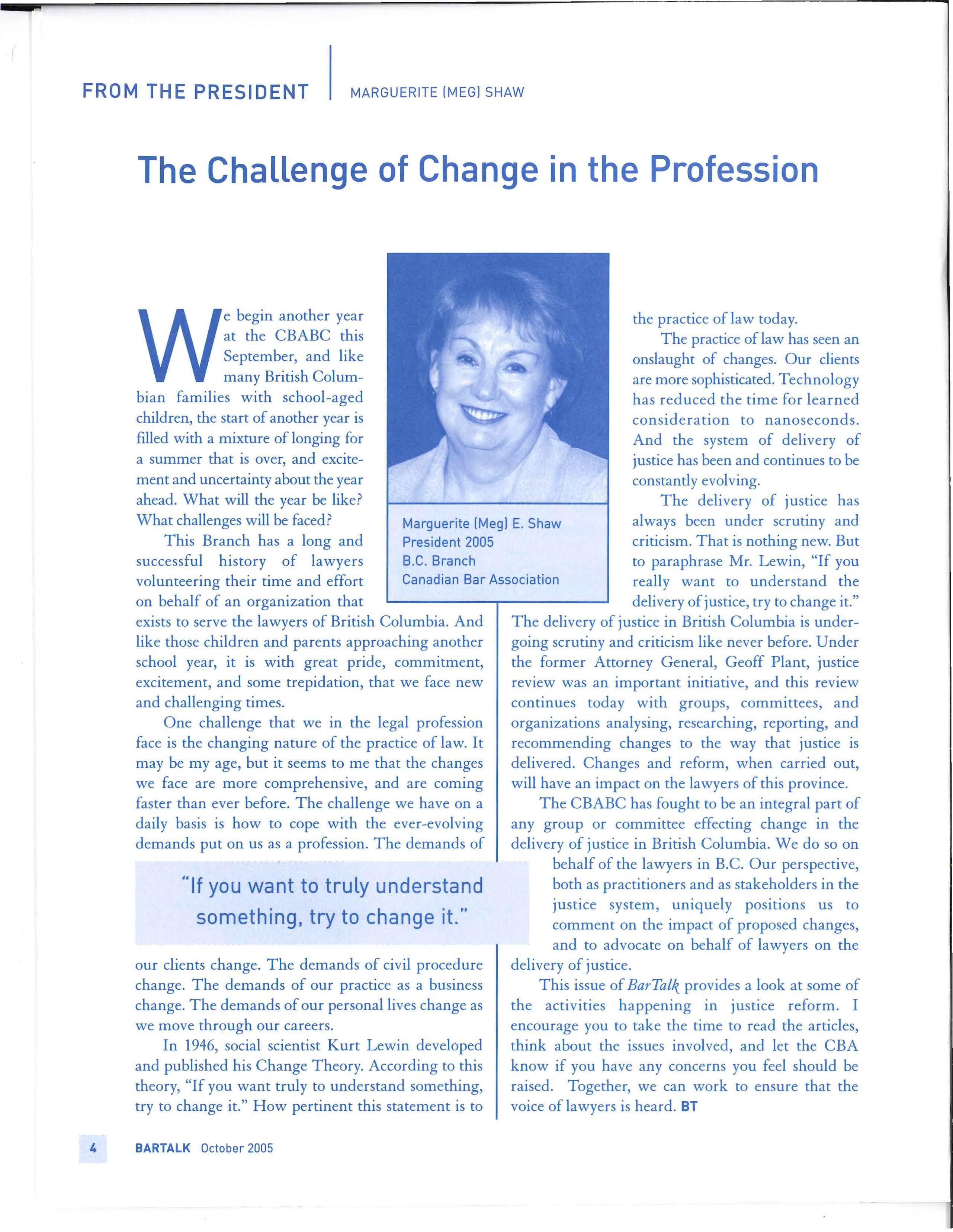
Marguerite (Meg) E. Shaw President 2005
the practice of law today.
The practice oflaw has seen an onslaught of changes . Our clients are more sophisticated. Technology has reduced the time for learned consideration to nanoseconds. And the system of delivery of justice has been and continues to be constantly evolving.
The delivery of justice has always been under scrutiny and criticism . That is nothing new. But to paraphrase Mr. Lewin, "If you really want to understand the B.C Branch Canadian Bar Association
exists to serve the lawyers of British Columbia. And like those children and parents approaching another school year, it is with great pride, commitment, excitement, and some trepidation, that we face new and challenging times.
One challenge that we in the legal profession face is the changing nature of the practice of law. It may be my age, but it seems to me that the changes we face are more comprehensive, and are coming faster than ever before The challenge we have on a daily basis is how to cope with the ever-evolving demands put on us as a profession. The demands of
"If you want to truly understand something, try to change it."
our clients change. The demands of civil procedure change. The demands of our practice as a business change. The demands of our personal lives change as we move through our careers.
In 1946, social scientist Kurt Lewin developed and published his Change Theory According to this theory, "If you want truly to understand something , try to change it." How pertinent this statement is to
delivery of justice, try to change it." The delivery of justice in British Columbi a is undergoing scrutiny and criticism like never before. Under the former Attorney General, Geoff Plant, justice review was an important initiative, and this review continues today with groups, committees, and organizations analysing, researching, reporting, and recommending changes to the way that justice is delivered. Changes and reform , when carried out, will have an impact on the lawyers of this province
The CBABC has fought to be an integral part of any group or committee effecting change in the delivery of justice in British Columbia We do so on behalf of the lawyers in B.C. Our perspective, both as practitioners and as stakeholders in the justice system, uniquely positions us to comment on the impact of proposed changes, and to advocate on beha lf of lawyers on the delivery of justice.
This issue of BarTalk provides a look at some of the activities happening in justice reform I encourage you to take the time to read the articles, think about the issues involved, and let the CBA know if you have any concerns you feel should be raised. Together, we can work to ensure that the voice of lawyers is heard. BT
FRANK KRAEMER EXECUTIVE DIRECTOR
Crystal Clear
New Perspectives for the Canadian Bar Association
The Canadian legal profession is in the midst of profound, ac celerating change. In response, the CBA Futures Committee was
formed to examine the challenges facing lawyers and the legal profession, and to make recommendations about the kind of organization the CBA should be in 2015 and what it would need to offer lawyers and the legal profession in order to be relevant and vibrant I have had the pleasure of serving on this Committee for the last two years.
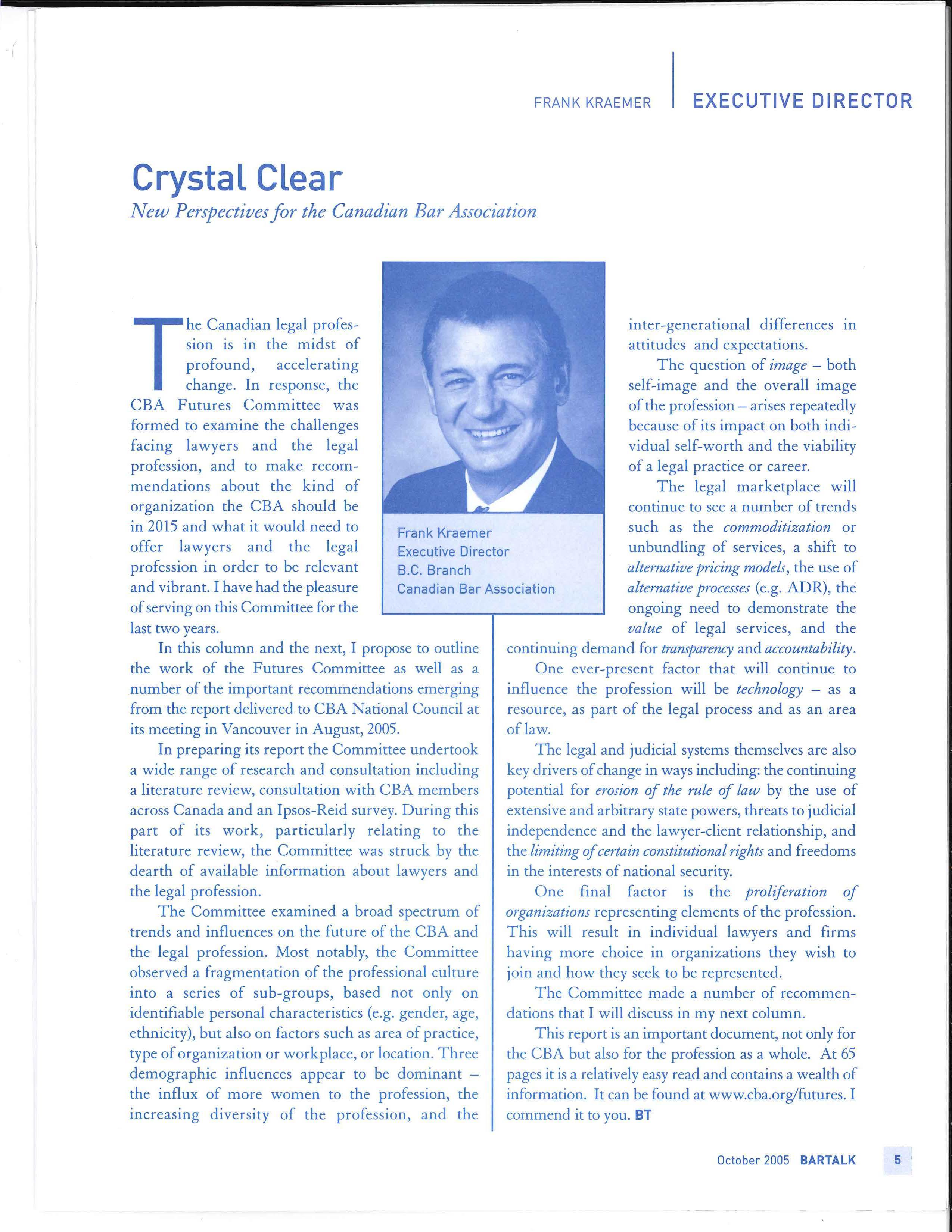
Frank Kraemer Executive Director B.C. Branch
Canadian Bar Associat i on
In thi s column and the next, I propose to outline the work of t he Futures Committee as well as a number of the important recommendations emerging from the report delivered to CBA National Council at its meeting in Vancouver in August, 2005.
In preparing its report the Committee undertook a wide range of research and consultation including a literature review, consu l tation with CBA members across Canada and an Ipsos-Reid survey During this part of its work, particularly relating to the literature review, the Committee was struck by the dearth of available information about lawyers and the legal profession.
The Committee examined a broad spectrum of trends and influences on the future of the CBA and the legal profession. Most notably, the Committee observed a fragmentation of the professiona l culture into a series of sub-groups, based not only on identifiable personal characteristics (e.g. gender, age , ethnicity), but also on factors such as area of practice, type of organization or workplace, or location. Three demographic influences appear to be dominantthe influx of more women to the profession, the increasing diversity of the profession, and the
inter - generational differences in attitudes and expectations.
The question of image - both self- image and the overall image of the profession- ari ses repeatedly because of its impact on both individual self-worth and the viability of a legal practi ce or career.
The legal marketplace will continue to see a number of tr ends such as the commoditization or
unbundling of services, a shift to alternative pricing models, t he u se of alternative processes (e.g. ADR), the ongoing need to demonstrat e the
value of legal services, and the continuing demand for transparency and accountab ility.
One ever-present factor that will continue to influence the profession will be technology - as a resource, as part of the legal process and as an area of law.
The legal and judicial systems them selve s ar e also key drivers of change in ways including: the continuing potential for erosion of the rule of law by the use of extensive and arbitrary state powers, threats to judicial independence and the lawyer - client relationship, and the limiting ofcertain constitutional rights and freedom s in the interests of national security.
One final factor is the proliferation of organizations representing elements of the profession. This will result in individual lawyers and firms having more choice in organizations they wish to join and how they seek to be represented.
The Committee made a number of recommendations that I will discuss in my next column.
This report is an important document, not only for the CBA but also for the profession as a whole. At 65 pages it is a relatively easy read and contains a w ealth of information. It can be found at www.cba.org/futures. I commend it to you BT
NATIONAL WOMEN LAWYERS FORUM
The National CBA has caught a B.C. wave with the inaugural meeting of the National Women Lawyers Forum held at the Annual Canadian Legal Conference in Vancouver on Monday, August 15th, 2005. The organizing of the National Forum saw the election of the first executive with powerhouse volunteers from across Canada: Chair, Kerry - Lynne Findlay, QC (B.C.) ; ViceChair, Kathleen Quigg (N.B.), Secretary/Treasurer, Sheryl Beckford (Ont.), Members -at-Large, Julia Cornish (N.S.), Noemi Gal-Or (B.C.), Joanne Horton (Ont.), and Sharon Pratchler (Sask.) Rounding out the present executive is Jennifer Conkie as Chair of the British Columbia WLF. As other Branch divisions are formed, each Forum Chair will join the national executive committee. Our first meeting was well attended with interested CBA members from virtually every Branch . We were also visited by Caroline Flanagan of the Law Society of Scotland, who wants to see our successes here replicated back home B .C. Branch President, Meg Shaw, was there to express her support, as was Brian A. Tabor, QC on behalf of the national executive.
The first meeting went by far too fast after introductions and elections, mostly in discussion about our vision for the National WLF and how the B.C experience can be copied and adapted in other jurisdictions. New Brunswick is first out of the gate. This year's launch event in B.C . was on September 14th and was followed by New Brunswick's first launch event on September 16th at the Beaverbrook Art Gallery in Fredericton. Connecting women in the law is what it is all about!
We have already heard from women lawyers in Alberta, Quebec and Nova Scotia who are interested in expanding upon local initiatives by participating in Women Lawyers Forum activ iti es. Tell CBA women you know about the National Women Lawyers Forum and help us build a national momentum! Contact the Chair, Kerry - Lynne Findlay, QC at kfindlay@wgmlaw.com or 604-609-3066 .
B.C.'s Legal Lights shine at CLC
West coast Law practitioners were in the spotlight as five B.C. Lawyers - four from Vancouver and one from Victoria -took home national awards during the Canadian Legal Conference.
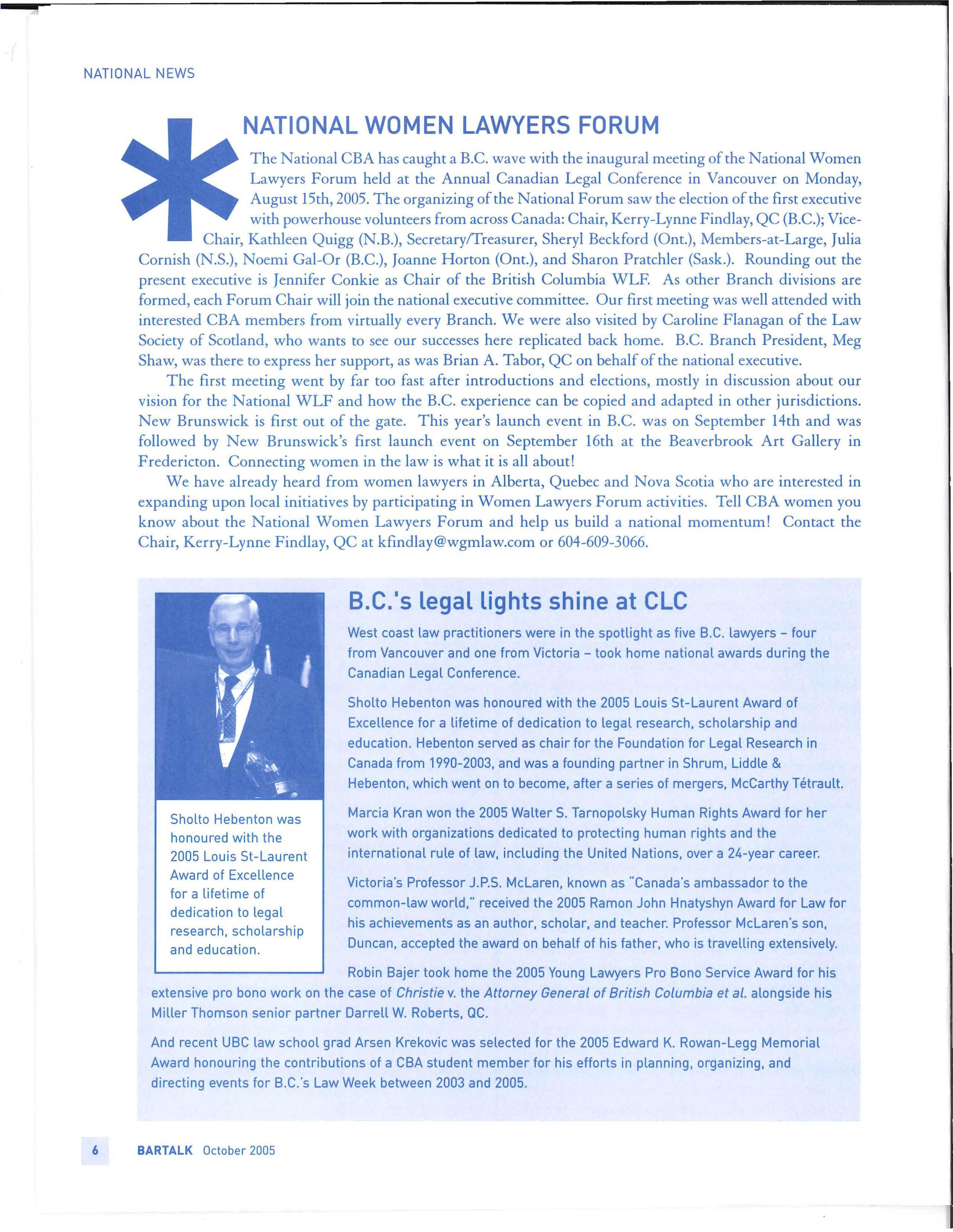
Sholto Hebenton was honoured with the 2005 Louis St-Laurent Award of Excellence for a Lifetime of dedication to Legal research, scholarship and education. He benton served as chair for the Foundation for Legal Research in Canada from 1990-2003, and was a founding partner in Shrum, Liddle & Hebenton, which went on to become, after a series of mergers, McCarthy Tetrault.
Sholto Hebenton was honoured w ith the 2005 Lo u is St-Laurent Award of Excellence for a Lifetime of dedication to Legal research, scholarship and education.
Marcia Kran won the 2005 WalterS. Tarnopolsky Human Rights Award for her work with organizations dedicated to protecting human rights and the international rule of Law, including the United Nations, over a 24-year career.
Victoria's Professor J P.S. Mclaren, known as "Canada's ambassador to the common-Law world," received the 2005 Ramon John Hnatyshyn Award for Law for his achievements as an author, scholar, and teacher Professor Mclaren's son, Duncan, accepted the award on behalf of his father, who is travelling extensively
Robin Bajer took home the 2005 Young Lawyers Pro Bono Service Award for his extensive pro bono work on the case of Christie v. the Attorney General of British Columbia et al. alongside his Miller Thomson senior partner Darrell W. Roberts, QC.
And recent UBC Law school grad Arsen Krekovic was selected for the 2005 Edward K. Rowan-Legg Memorial Award honouring the contributions of a CBA student member for his effo r ts in planning, organizing, and directing events for B.C.'s Law Week between 2003 and 2005.
2005 CLC Headliners
• United Nations Ambassador Allan Rock said the U.N. is at a crossroads in its evolution in light of recent events that have called its legitimacy into question He said the U.N. can accomplish a great deal of positive work, and that the time has come to revisit what the founders had in mind when the organization was created.
• Federal Justice Minister Irwin Cotler called the judicial appointments process a '"critical part of the administration of justice in this country."' He described the four steps in the appointment process to the Supreme Court of Canada: preparation of the short list, eva l uation of individuals by an advisory committee, recommendation to the Prime Mi nister, and the appearance by the Minister before the Justice Committee.
• Chief Justice Beverley Mclachlin called for improvements in access to justice for Canadians. Citing the rising number of unrepresented litigants, she decried the serious repercussions for both the justice system and the public. She called on judges, lawyers and governments to each play a part.
Vancouver 2005 CLC Roundup
CBA Futures Committee Report
A centre for information and expertise that would collect statistics, initiate surveys, track and analyse trends and their impact, and develop a corporate memory for the profession is an innovative proposal contained in the Canadian Bar Association's report on its future, Crystal Clear: New Perspectives for the Canadian Bar Association.
"In the course of our deliberations, we realized that there is a dearth of reliable information about the profession," noted Robert Patzelt of Halifax, Chair of the CBA Futures Committee, which released its report at the CBA Canadian Legal Conference on Aug. 14. "The centre would provide us with the necessary tools to understand the needs of the profession and how the CBA can position itself to meet those needs," he said.
Recognizing that the legal profession is operating in a climate of profound and accelerating change, Mr. Patzelt noted : "Our Committee was created to study the challenges facing lawyers and the legal profession and to make recommendations about what kind of organization the CBA should be in 2015."
Futures Web site and report: http://www.cba .org/CBA/futures/Mainl
Meet the National President
Brian A. Tabor, QC, ofHalifax took over the reins of the CBA as National President on Aug. 16. He says lawyers must strive for improved access to justice and the protection of individual freedoms for the benefit of all Canadians. He adds that the CBA's legal aid test case, challenging British Co l umbia's legal aid plan, will be a top priority during his term.
Another focus for Mr. Tabor will be finding a balance between security and individual rights when assessing anti - terrorism measures. While the CBA understands the motives behind these measures, it argued for curtailing some of the proposed sweeping new powers for police and security agencies in its three-year review of Bill C- 36, the Anti-terrorism Act. "As vigilant as we must be in preventing terrorism, we must be equally vigilant that we do not lose our own princip les and freedoms in the process," Tabor says.
The start of Mr. Tabor's tenure coincides with the release of the Report of the CBA Futures Committee, which looks ten years into the future of the legal profession and recommends ways in which the CBA can prepare itself to be most relevant to its members "We've got a great opportunity to engage each other in a dialogue about where we are and where we need to be as an association and as a profession," he says.
Tabor brings CBA experience to his new role, having served as Branch President for Nova Scotia (20012002), Provincial and National Chair of the Real Property Section, and CBA Co - Chair of the National Real Estate Project. He was called to the Bar in 1987, after completing his education at the University of Ottawa (B .Sc., 1979) and the University of New Brunswick (LL.B., 1986).
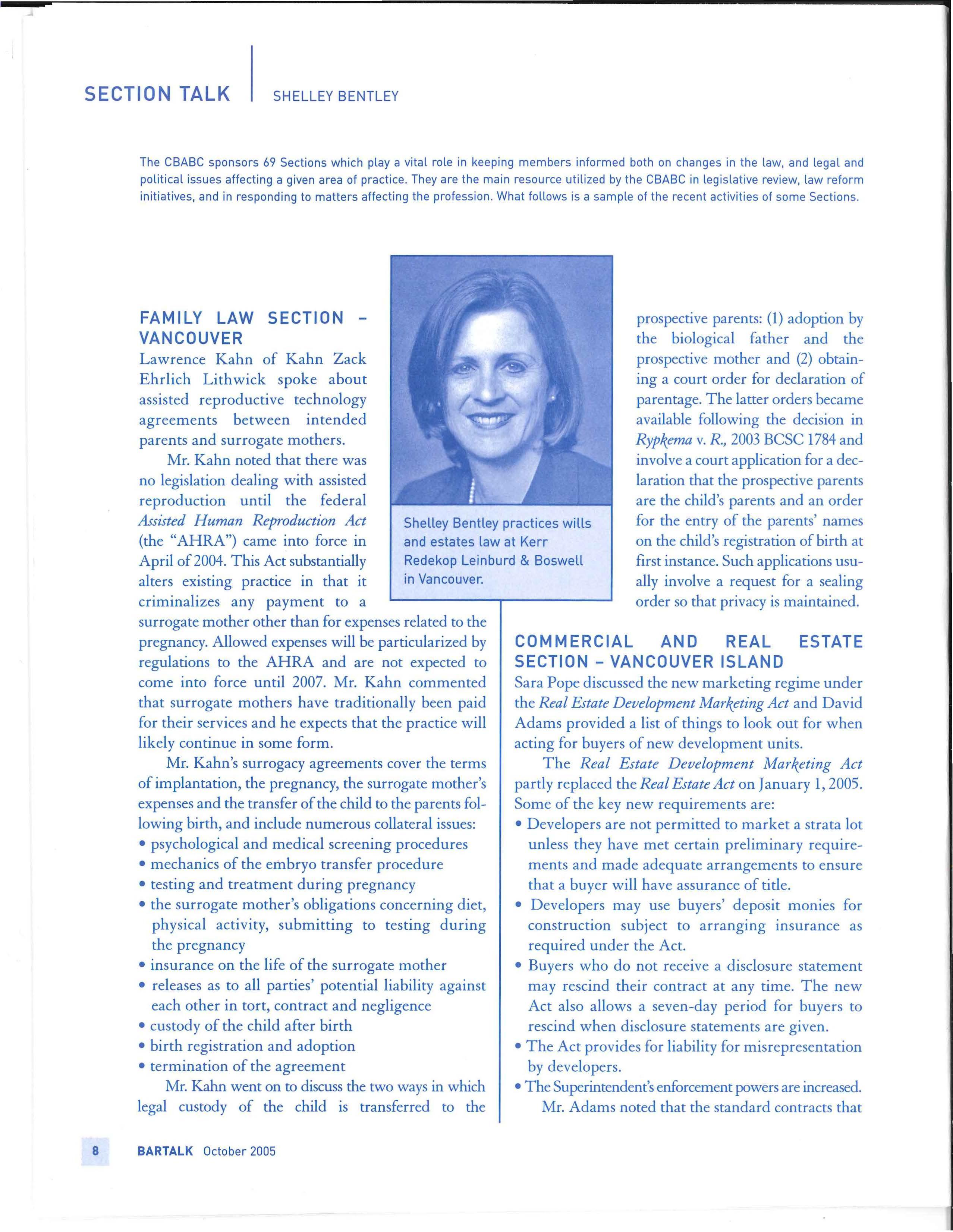
SECTION TALK SHELLEY BENTLEY
The CBABC sponsors 69 Sections w h ich pl ay a vital role in keeping members informed both on changes in the law. and legal and pol itical issues affect i n g a gi ven area of pr act ice They are the main resource utilized by the CBABC in legislative review. law reform init iatives , and i n respondi n g to matters affecting the profession What fo ll ows is a sample of the recent activities of some Sections
FAMILY LAW SECTION VANCOUVER
Lawrence Kahn of Kahn Zack Ehrlich Lithwick spoke about assisted reproductive technology agreements between intended parents and surrogate mothers.
Mr. Kahn noted that there was no legislation dealing with assisted reproduction unti l the federal Assisted Human Reproduction Act (the "AHRA") came into force in April of2004. This Act substantially alters existing practice in that it criminalizes any payment to a Shelley Bentley practices wills
and estates law at Kerr Redekop Leinburd & Boswell in Vancouver
surrogate mother other than for expenses related to the pregnancy. Allowed expenses will be particularized by regulations to the AHRA and are not expected to come into force until 2007. Mr. Kahn commented that surrogate mothers have traditionally been paid for their services and he expects that the practice will likely continue in some form.
Mr. Kahn's surrogacy agreements cover the terms of imp lantation, the pregnancy, the surrogate mother's expenses and the transfer of the child to the parents following birth, and include numerous collateral issues:
• psycho logical and medical screening procedures
• mechanics of the embryo transfer procedure
• testing and treatment during pregnancy
• the surrogate mother's ob ligations concerning diet, physical activity, submitting to testing during the p r egnancy
• insurance on the life of the surrogate mother
• releases as to all parties' potential liability against each other in tort, contract and negligence
• custody of the child after birth
• birth registration and adoption
• termination of the agreement
Mr. Kahn went on to discuss the two ways in which lega l custody of the child is transferred to the
8 BARTALK October 2005
prospective parents : (1) adoption by the biologic a l father and the prospective mother and (2) obtaining a court order for declaration of parentage. The latter orders became available following the decision in Rypkema v. R., 2003 BCSC 1784 and involve a court application for a declaration that the prospective parents are the child's parents and an order for the entry of the parents ' names on the child's registration of birth at first instance. Such applications usually involve a request for a sealing order so that privacy is maintained.
COMMERCIAL AND REAL ESTATE SECTION -VANCOUVER ISLAND
Sara Pope discussed the new marketing regime under the Real Estate Development Marketing Act and David Adams provided a list of things to look out for when acting for buyers of new development units.
The Real Estate Development Marketing Act partly replaced the Real Estate Act on January 1, 2005 Some of the key new requirements are:
• Developers are not permitted to market a strata lot unless they have met certain preliminary requirements and made adequate arrangements to ensure that a buyer will have assurance of title
• Developers may use buyers ' deposit monies for construction subject to arranging insurance as required under the Act.
• Buyers who do not receive a disclosure statement may rescind their contract at any time. The new Act also allows a seven-day period for buyers to rescind when disclosure statements are given
• The Act provides for liability for misrepresentation by developers.
• The Superintendent's enforcement powers are increased . Mr. Adams noted that the standard contracts that
are used tend to be heavily weighted in favour of the developer It is common for new developments to be pre-sold, often long before the developer has broken ground. The buyers are relying on drawings and specifications prepared by the seller so it is difficult for buyers to know what they are buying. The contract often provides that the seller can change drawings to comply with municipal requirements or make reasonable changes to materials used. Such provisions tend to give the developer a lot of latitude.
Deposits are often held in trust for as long as two years. Interest provisions should be che cked carefully. Developers often team up with lenders who offer time sensitive mortgage commitments. If the development takes longer than expected the favourable interest rate can be lost.
Builders' lien provisions often p lace the onus on the buyer's lawyer to discover liens and report them to the seller's lawyer within a specified time. If the buyer's lawyer does not report liens within the specified time, the holdback is released to the seller.
The contracts often define the comp letion date based on the anticipated construction completion but do not tie it to the issuance of an occupancy permit. Because lenders usually require an oc cupancy permit before advancing funds, buyers could find themselves contractually bound to complete but unable to obtain mortgage funds.
Force majeure clauses are typically broad and cover such things as labour shortages, construction financing problems and other problems that are arguably within the developer's control.
Many contracts also have a provision that states that the contract does not give the buyer an interest in land and consequently the buyer cannot register a caveat against the title.
In situations where the buyer wishes to get out of these developer - weighted purchase contracts the best avenue of attack may be to concentrate on whether the developer has deviated substantially from the specifications promised in the drawings
YOUNG LAWYER'S SECTION -VICTORIA
Mr. Justice Grant Campbell of the Ontario Superior (Family) Court gave subsection members his view of life as a lawyer. He offered guidance in the form of "six freebies":
• be proud
• be reasonable
• be honest
• beware
• belong/thankful
• be balanced
Proud
People look to lawyers for advice not just when they're paying for it, but as a member of the community Law is a very broad field and presents vast opportunities for community involvement
Reasonable
Pick your areas of effort. Charge appropriately and be direct about the cost of your services. Free yourself from clients who cannot or will not listen or are just crazy. Abandon unreasonable campaigns If an important principle is involved however, you may need to hang in there even if it means working pro bono.
Expect your clients to be on time but return client calls and treat clients reasonably. Be reasonable in your remuneration expectations
Honest
Realize that people take what you say as gospel and be cautious and honest.
Never assist clients to be dishonest.
You're entitled to fair compensation for your services. Be honest . Get a retainer and bill on an interim basis .
Beware
Beware of business schemes your clients come up with.
Belong
Recognize what your hard work has achieved and be thankful rather than arrogant about it. Give back to your community.
Balanced
Don't forget family. Take time off so you can recharge and regenerate your enthusiasm . Learn to say "No."
Recognize you have much to offer our society. You are not merely what you do. You are who you are. BT
Leading the Way
A new destiny for partners
j) So let your light so shine before men I\
Let your light so shine J
Music and new lyrics by Stephen Schwartz.
We live in a dark, conflicted and confusing time. On one hand , we have never been so much in need of real leadership. We have international, national and regional corporations, nonprofits and other organizations of
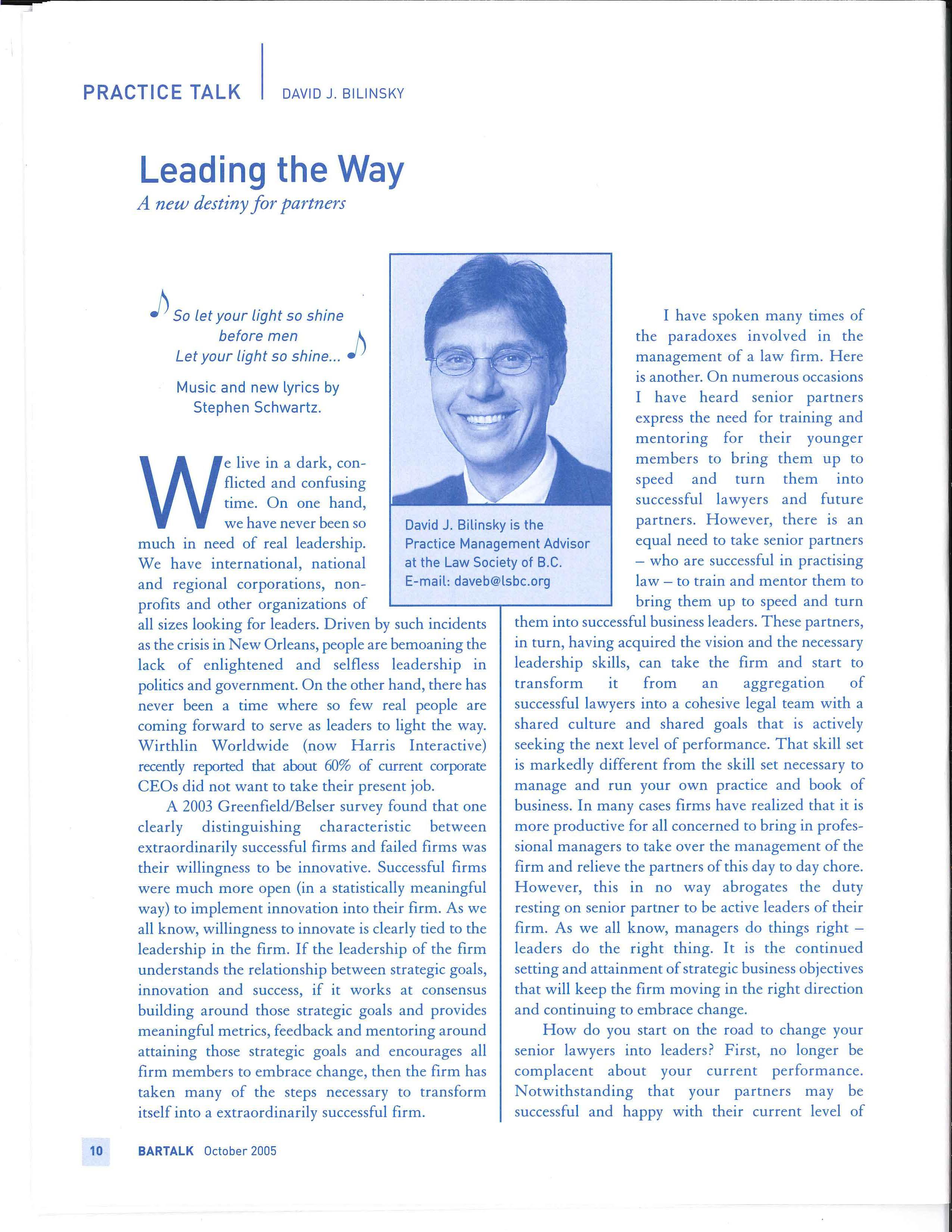
David J. Bilinsky is the
Practice Management Advisor at the Law Society of B .C. E-mail: daveb@lsbc org
all sizes looking for leaders. Driven by such incidents as the crisis in New Orleans, people are bemoaning the lack of enlightened and selfless leadership in politics and government. On the other hand, there has never been a time where so few real people are coming forward to serve as leaders to light the way.
Wirthlin Worldwide (now Harris Interactive) recently reported that about 60% of current corporate CEOs did not want to take their present job.
A 2003 Greenfield/Belser survey found that one clearly distinguishing characteristic between extraordinarily successful firms and failed firms was their willingness to be innovative. Successful firms were much more open (in a statistically meaningful way) to implement innovation into their firm As we all know, willingness to innovate is clearly tied to the leadership in the firm. If the leadership of the firm understands the relationship between strategic goals, innovation and success, if it works at consensus building around those strategic goals and provides meaningful metrics, feedback and mentoring around attaining those strategic goals and encourages all firm members to embrace change, then the firm has taken many of the steps necessary to transform itself into a extraordinarily successful firm. 10 BARTALK October 2005
I have spoken many times of the paradoxes involved in the management of a law firm . Here is another. On numerous occasions I have heard senior partners express the need for training and mentoring for their younger members to bring them up to speed and turn them into successful lawyers and future partners. However, there is an equal need to take senior partners - who are successful in practising law- to train and mentor them to bring them up to speed and turn
them into successful business leaders. These partners, in turn, having acquired the vision and the necessary leadership skills, can take the firm and start to transform it from an aggregation of successful lawyers into a cohesive legal team with a shared culture and shared goals that is actively seeking the next level of performance. That skill set is markedly different from the skill set necessary to manage and run your own practice and book of business. In many cases firms have realized that it is more productive for all concerned to bring in professional managers to take over the management of the firm and relieve the partners of this day to day chore. However, this in no way abrogates the duty resting on senior partner to be active leaders of their firm. As we all know, managers do things rightleaders do the right thing. It is the continued setting and attainment of strategic business objectives that will keep the firm moving in the right direction and continuing to embrace change.
How do you start on the road to change your senior lawyers into leaders? First, no longer be complacent about your current performance. Notwithstanding that your partners may be successful and happy with their current level of
income and operating status of the firm, you have to remind them that in spite of the fact that they don't wish to change, the world (especially their clients) is constantly in a state of change around them. Competitors are constantly working on their own aggressive business plans and are aiming to capture your clients. For example, if you have a dependency on only a few major accounts, then your firm is vulnerable to a major economic upset if one of those major accounts should leave. Your long - term existence as a firm is dependent on your continued development of le adership- just reflect for a minute and you can recall the names of law firms that no longer exist today. There is no law yet written that states that your firm must be in business tomorrow.
Secondly, expose your major partners to new ideas and developments in the business arena that are outside the law. Lawyers tend to narrow their practice focus - for obvious reasons - but this constant narrowing and development of their legal skills removes them from exposure to bigger ideas and new developments in other fields . Send your people to 'thought conferences' - gatherings that are not CLE-oriented but rather are aimed at developing business, strategy or inter - personal skills - that will immerse them in a nutrient - rich environment of ideas. Have them serve in leadership positions in other community-service organizations - where they will come into contact with leaders in other fieldsand bring that wealth of experience back to the firm Have the firm take on an important pro - bono file that serves to benefit both society as well as the partners by connecting to their inner 'higher calling' and sense of purpose and serves as a leadership example to other members of the firm.
Thirdly, have your senior partners demonstrate the most important leadership quality of all - to become a living example of the qualities that they wish to see reflected in their associates and junior partne r s. [If we are to develop lawyers into future leaders, we need to foster and encourage those who clearly demonstrate that they can indeed, walk the talk. ] This is not a modern management principle. One of the earliest statements of this idea is as follows:
"The soul is dyed the color of its thoughts. Think only on those things that are in line
with your principles and can bear the light of day. The content of your character is your choice. Day by day, what you choose, what you think, and what you do is who you become Your integrity is your destiny it is t h e light that guides your way."
- Heraclitus [?535BC-475BC) Greek Philosopher
Our own collective future is premised in part on senior partners developing their inner leadership skills in order for them to ignite their own light for it to shine before others. BT
The views expressed herein are strictly those of the author and may not be shared by the author's employer, the Law Society of B.C.
2005 Bench & Bar Dinner
Thursday, November 17th 2005
Reception -5 :45 p.m. [cash bar]
Dinner-6 :30p.m
Sheraton Wall Centre 1088 Burrard St.
Business attire
This year's Bench & Bar Dinner comes to the Sheraton Wall Centre, offering members of the legal profession and the judiciary a unique opportunity to enjoy an evening of good company and conversation.
Please visit the website at www.cba.org/bc to download a ticket order form that can be returned by mail or fax to the CBABC office. For more information on the Dinner, please contact Josey Schaefer at 604-687-3404, ext. 306.
··rm Tony and I'll Be Your Lawyer Tonight"
Old Keg waiters seem to be everywhere these days. Even on the Bench.
So how's the book coming?" is a question I'm asked all too often these days . "Which book?" is my stock response, alluding to a book on franchise law I've had out since February. "No, not that thing" they say dismissively, not caring about sales, royalties, or for that matter, franchising "The other book You know, the one you're writing about your days at 'The Keg."'
Yes. I am writing a book about "The Keg." Like so many of us in this profession, including, I've just discovered, the new ChiefJudge of the Provincial Court (we' r e everywhere!), my legal education in the
Tony Wilson is a Franchise Lawyer and shameless book promoter at Boughton He's wr itten for the Gl obe and Mail,
the Vancouver Sun, and /vfacleans magazine E-mail: twi l son@boughton.ca
early '80s was financed by the tips I earned slinging steaks at The Keg; in my case, the Kegs of Victoria. So in 2003, I wrote a piece for the Globe called "Confessions ofa Former Keg Waiter." I described what it was like to say "Hi my name's Tony and I'll be your waiter tonight", go to wild hot-tub parties after work and lead the hedonistic life that Keg waiters led in those wonderful days when our professional services were performed, billed a n d collected in the space of 90 minutes without the need for liability insurance or collection agencies. (Imagine the concept you put the bill on the tab le and they pay it before they leave! Now why can't we do that in this profession?)
The reaction to the article was astounding. Not only did it cause a reunion of my old crew in Victoria, but I received around 40 e-mails from perfect strangers from across Canada, some of whom suggested I turn it into a book. So that's what I'm doing. Its full of my old war stories about loopy customers, separate cheques, dropped drinks, not-sodumb waiters, and what those former waiters (and waitresses) may be doing now that their salad bar
12 BARTALK Oc t o be r 20 05
days are over. I don't know whether to call it "Everything I Learned About Law, I learned at The Keg" or "Kegmares" (being the name we gave to the restaurant based nightmares that we all still get) With around 120,000 ex-Keg employees out there , nostalgic for stories of their wayward misspent youth, the book's not such a wacky idea when you do the math. And out of the millions of Keg customers over the past 36 years, you'd think a few thousand might like to find out why the line-ups were so long and what really happened to the people who didn't pay their bills
(we didn't tax their accounts, if you're wondering).
So far, publishers seem lukewarm to the idea. After all, it's Canada, and I'm not Margaret Atwood. The people I've dealt with obviously never worked at a Keg, and only become interested if they think The Keg will buy a few thousand copies to give away instead of spanish coffee glasses. And I think The Keg, quite understandably, is leery about committing, sight unseen, to a book about its colourful history in much the same way that Virgin billionaire Sir Richard Branson doesn't like being reminded in front of the Queen that he once promoted the Sex Pistols. But as someone's toying with a Fringe Festival production based on my manuscript, I guess I'd better finish it. Needless to sa y, with a busy law practice and a couple of kids in every extra-curricular activity known to MasterCard, it's hard to find the time. And as much as I have a lot of funny stories from my own experience, I could use a few more from those of you who ever worked, drank, partied or of all things, ate at a Keg. Send them my way for your very anonymous 15 minutes of fame . Even if you're now a judge. BT
PATRICIA JORDAN
Join a Section Listserv
Communicate and Network Online
In the April 2005 issue of BarTalk, I invited Section members to send me an e-mail indicating an interest in their Section's listserv. I would like to thank all Section members who responded. CBABC is pleased to announce the activation of Section listservs for Administrative Law, Business Law, Civil Litigation, Criminal Justice, Employment Law, Family Law, Immigration Law, Labour Law, Real Property, and Wills & Estates. Please send an e-mail to webmaster@bccba.org if you are interested in joining your Section's
Manager, Interactive Media. She welcomes your comments, questions and suggestions. Tel: 604-646-7861
E-mail: pjordan@bccba.org
Do you have a law practice to sell? Are you looking for office space? The B.C. Branch's newest service for CBABC members offers you direct access to the legal community. Ads are posted in "Online Classified Ads" under "Public & Media." Visit cba org!bc!home/main/advertise.aspx for details and a price list .
CBABC News & Jobs E-mail
Reaching more than 5,000 lawyers through e-mail
CBABC offers advertisers competitive pncmg for job ads listserv. CBABC will launch additional Section listservs in 2006.
NOT A SECTION MEMBER?
You can download a Section enrolment order form at cba.org/bc; look under "Section News" on the home page.
B.C. LAWYERS' DIRECTORY WEBSITE
As a value of CBA membership, CBABC members have free access to the.Lawyers' Directory portion of the online Directory site at bccbadirectory.org. The Legal Resource Directory ("the white pages") is available to members for a nominal fee of $20.00. The legal support staff of CBABC members can access the full Directory site for only $32.50 + tax.
LEGISLATIVE UPDATE- AVAILABLE ONLINE
Legislative Update, a service funded by CBA membership fees, is now only available online, and only to members, at cba.org/bc in "CBA Publications" under "Legislation & Law Reform."
that reach the legal community through our weekly "CBABC News & Jobs" e-mail. Send your ad to ads@bccba.org. If you missed the latest e-mail, you can view it online by clicking on the "CBABC News & Jobs" link under "Quick Links" on the home page at cba.org/bc. Only CBA members who choose e-mail as their CBA communication preference receive CBABC News & Jobs. Contact data@bccba.org if you would like to receive e - mail notices from us. For more information, visit cba.org/bc/home/main/advertise.aspx.
E-mail HR Ad Rates
CBABC Members/Firms [>50% CBA Membership]
• $250 for one e-mail distribution
• Free one-month posting on cba.org/bc in "Legal Careers" under "Practice Resources" Non-Members
• $500 for one e-mail distribution
• $100 for one-month posting on cba org/bc in "Legal Careers" under "Practice Resources" BT
Patricia Jordan is the CBABC
ACTS IN FORCE
Every effort is made to ensure the accuracy of the information provided to you in this article but the information should not be relied upon. Lawyers should refer to the specific legislative or regulatory provision You will see a reference in some cases to the number of the Bill when it was introduced in the House. This number may be different from the chapter number of the new Act which is quoted after the title of the Act and which is the proper citat ion for the Act The Bill number has been given to make it easier for you to note up the Bills you may have in your library
CURRENT FROM JULY 5- SEPTEMBER 9, 2005
Legislative Update is provided as part of the CBABC legislative and law reform program It is a service funded by CBA membership fees, and is therefore provided as a benefit of CBA membership. The full version of Legislative Update is now published online , available to CBA members exclusively at www cba org/bc
ACTS IN FORCE
GREATER VANCOUVER TRANSIT SERVICES SETTLEMENT ACT, S.B.C. 2001, C. 25 (BILL 13)
Act is repealed effective July 28,2005
Stuart Rennie
B.C. Branch Legislation & Law Reform Officer
Tel: 604-949-1490
E-mail: srennie@bccba org
HEALTH CARE SERVICE COLLECTIVE AGREEMENTS ACT, S.B.C. 2001, C. 26 (BILL 15)
Act is repealed effective July 28, 2005
HEALTH PROFESSIONS AMENDMENT ACT, 2003, S.B.C. 2003, C. 57 (BILL 62)
Section 21, as it enacts section 32.3 of the Health Professions Act, is in force October 1, 2005
INCOME TAX AMENDMENT ACT, 2005, S.B.C. 2005, C. 5 (BILL 7)
2 Client"s Guide to Litigation, is a new publication by David Roberts, QC, with 76 pages of concise detail about the litigation process. Volume and CBA member discounts. Order form available inside this Bar Talk issue, or online at www.cba.org/bc.
Building Public Confidence in the Justice System
Thank you for this opportunity to contribute to your publication.
With my move from the judiciary into the world of politics, the media is often asking me questions like: what are your priorities? What legacy will you leave behind when your time as Attorney General is done? My main goal - and it's one I will be asking for your help to achieve- is to build public confidence in the justice system Members of the
The Han. Wally Oppal
Attorney General and Minister Responsible for Multiculturalism
legal profession know that our courts in B.C. enjoy a reputation of excellence at every level.
However, there is a growing divide between this reality and the public 's perception. More and more people are so distrustful of the system that they are simply not reporting crimes anymore. And that is a serious problem in our society All of our personal and business relationships, our whole system of democracy, is based on the foundation of a
fair and accessible justice system, one that people believe in and trust.
To help build this public confidence , the justice system needs to become more publicly accessible. We need to take action to put reasonable limits on trials
meetings to see if there are facts or specifics on which both sides can agree, before a trial begins
Enhancing public confidence also means expanding the public perception of how the system works. We need to be letting people know what we do and how we do it. We need to demonstrate that the system is an extension of the public's values, not something foreign to them. Over the next few months, we will be engaging in renewed effort to educate the
public about the justice system that is here to serve them, to help make our streets safer and our quality of life the best in Canada.
As your Attorney General, I will be working hard to promote a broader and more successful understanding of the justice system. Ours is a vast province. Many communities are far flung from Vancouver or Victoria. Each and every one of them
"More and more people are so distrustful of the system that they are
simply not reporting crimes anymore."
that have become excessively long. Lengthy trials not only undercut the public's confidence in the justice system , they are also a drain on time , money and resources. Of course, such reforms will always be balanced by the need to protect and respect Charter rights . We will be considering solutions to this challenge, including options such as imposing a reasonable time on cross-examination. We are already moving to refine discovery and pre-trial case
deserves the best possible justice system. I look forward to working together with all of you to build the public's confidence in the administration of justice in British Columbia through both education and reform. BT
Comments or questions may be e-mailed to the Attorney General by going to the following Internet address: http://www ag .gov. bc.ca/contacts/emai lag. htm
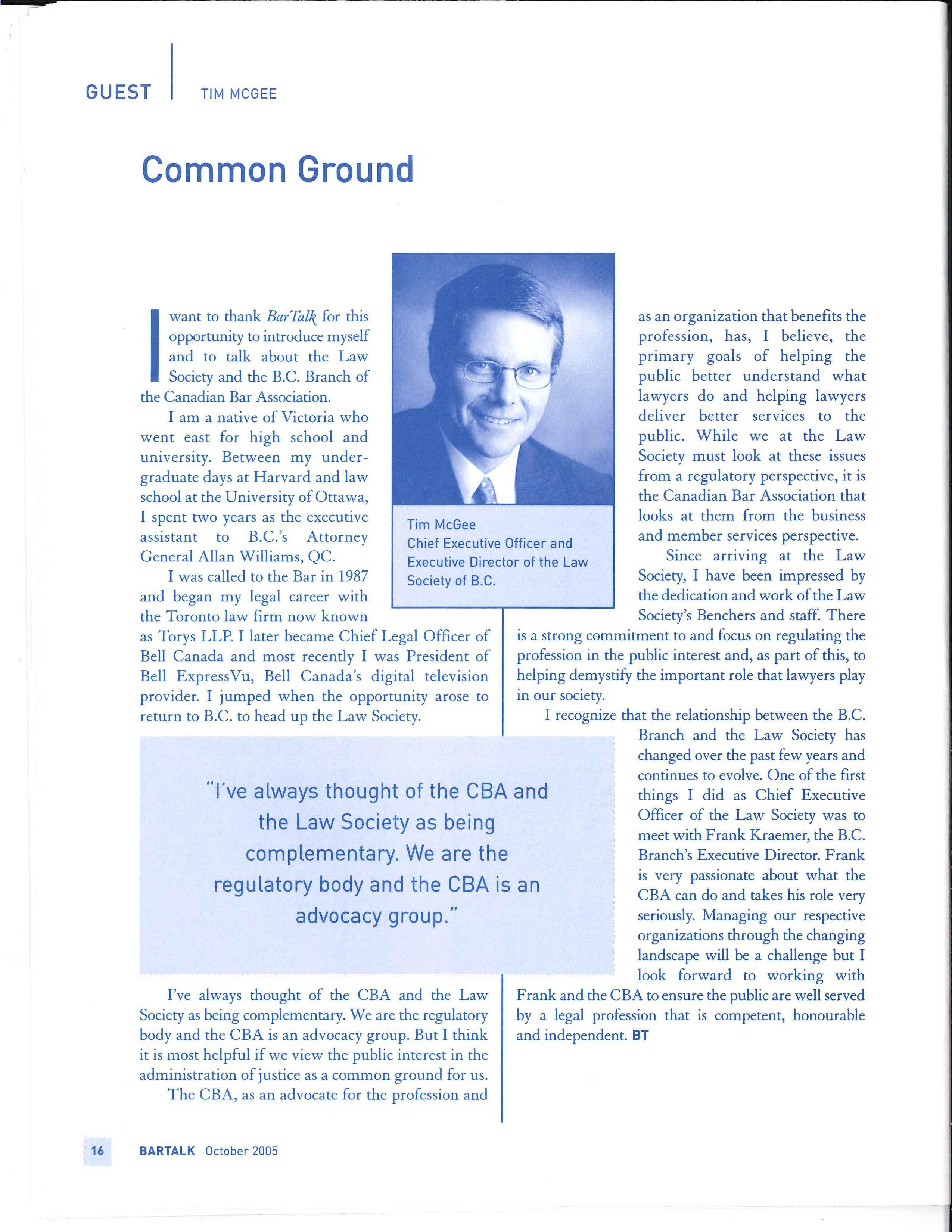
Common Ground
Iwant to thank BarTalk for this opportunity to introduce myself and to talk about the Law Society and the B.C. Branch of the Canadian Bar Association
I am a native of Victoria who went east for high school and university . Between my undergraduate days at Harvard and law school at the University of Ottawa, I spent two years as the executive assistant to B.C.'s Attorney General Allan Williams, QC.
I was called to the Bar in 1987 and began my legal career with the Toronto law firm now known
Ch i ef Execut ive Officer and
Executive Director of t h e Law Society of B.C.
as an organization that benefits the profession, has, I believe, the primary goals of helping the public better understand what lawyers do and helping lawyers deliver better servi c es to the public While we at the Law Society must look at these issues from a regulatory perspective, it is the Canadian Bar Association that looks at them from the business and member services perspective
Since arriving at the Law Society, I have been impressed by the dedication and work of the Law Society's Benchers and staff. There as Torys LLP. I later became Chief Legal Officer of Bell Canada and most recently I was President of Bell ExpressVu, Bell Canada's digital television provider. I jumped when the opportunity arose to return to B.C. to head up the Law Society.
is a strong commitment to and focus on regu lating the profession in the public interest and, as part of this, to helping demystify the important role that lawyers play in our society
I recognize that the relationship between the B.C. Branch and the Law Society has changed over the past few years and
"I've always thought of the CBA and
the Law Society as being complementary. We are the regulatory body and the CBA is an
advocacy group."
I've always thought of the CBA and the Law Society as being complementary. We are the regulatory body and the CBA is an advocacy group. But I think it is most helpful if we view the public interest in the administration of justice as a common ground for us. The CBA, as a n advocate for the profession and
continues to evolve . One of the first things I did as Chief Executive Officer of the Law Society was to
meet with Frank Kraemer, the B.C. Branch's Executive Director. Frank is very passionate about what the CBA can do and takes his role very seriously. Managing our respective
organizations through the changing landscape will be a challenge but I look forward to working wit h Frank and the CBA to ensure the public are well served by a legal profession that is competent, honourab le and independent BT
Tim McGee
Thanks for your Support of the CBA!!
Remember to Renew ...
As a member of the CBA , you already know the benefits of membership. Here's one more compelling reason to join the CBA:
Recently, the Law Society of B.C. instituted a requirement that all members annually report their professional development activities. Although these activities are not mandatory, Benchers encourage every lawyer to complete a minimum of 12 hours of professional development activities and 50 hours of self- study hours. Your CBA membership can help you reach these expectations, through:
• SECTION ACTIVITY - Attendance at CBA Section presentations IS reportable as professional development activity Review of Section minutes and material, where that review does not relate to a specific case or file, can be included in the self-study activities report. Note: Only CBA members can enrol in Sections.
• PUBLICATIONS - Reading published materials such as relevant legal articles in the Canadian Bar Review, BarTalk and Legislative Update Online (only available to CBA members) can also be included in the self-study activities report.
Our mandate is excellence m service to our members, and compelling advocacy in the interests of the legal profession. We have the reputation, expertise and infrastructure to help you make the most of being part of Canada 's legal profession An invoice for your renewal will be mailed to you prior to your membership renewal date If you have any questions or input we would be pleased to hear from you at cba@bccba.org, 604-687-3404 or toll free 1-888-687-3404
-· Q) :::J OJ Q) .., )> en en 0 0 -· -· 0 :::J
This year's Bench and Bar Dinner comes to the Sheraton Wall Centre Hotel in Vancouver, offering members of the legal profession and the judiciary a unique opportunity to enjoy an evening of good company and conversation.
The Dinner will honour the recipient of the CBA Georges A Goyer, QC Memorial Award for Distinguished Service (to be announced this Fall).
The Continuing Legal Education Society of British Columbia is pleased to present its inaugural Leaders in Learning Award , celebrating lawyers, judges, and legal support staff who distinguish themselves by making exceptional volw1teer contributions to the society.
Please join the Benchers of the Law Society and the members of the CBA Executive and Provincial Council in paying homage to d10se who have made outstanding contributions to the cause of justice in British Columbia.
Bene
Date:
Time:
Place:
Dinner
The Law Society of B.C. and the Canadian Bar Association, B.C. Branch, warmly invite members of the profession and the judiciary to attend the 21st Annual Dinner for the Bench and Bar Tickets: $85.00 per person
Dress :
Thursday, November 17, 2005
Reception-5:45p.m (cash bar)
Dinner- 6:30 p m (wine included)
Sheraton Wall Centre
Pavilion Ballroom 1088 Burrard Street
Vancouver, B.C.
Business attire
Send _ tickets @ $85 00 each Total $ _ _ (For more information or special requirements, contact Josey Schaefer at 604-687-3404, ext 306.)
Name :
Firm:
Address:
City:
Telephone:
Postal code:
Facsimile:
0 Visa 0 MasterCard 0 Cheque enclosed (payable to the Canadian Bar Association, B C. Branch)
Credit card number :
Signature:
Expiry date:
BY FAX: Please fax your ticket order, with credit card information, to 604-669-9601 or 1-877-669-9601. BY MAll..: Mail your ticket order, with payment, to Josey Schaefer, CBABC, lOth Floor- 845 Cambie Street, Vancouver, B C. V6B 5T3.
In conjunction with the Kelowna Bar Assocation there will also be a venue in Kelowna. For information and tickets contact Cathie M Heinrichs at familylaw@heinrichs ca or 25().868-9454
The Law Society
of British Columbia
The Canadian Bar Association British Columbia
Nominating Silk
Just as "taking silk" is one of the great honors of our profession , "nominating silk" is one of our profession's great responsibilities. Ensuring that appointments of Queen's Counsel represent the excellence of the legal profession is a duty not only of those in the selection process, but every member of the profession. The CBABC Equality Committee asks lawyers to consider diversity as an aspect of excellence when they make QC nominations.
The basic criteria for QC appointments are set out on the Attorney General's website (www ag.gov.bc.ca/queens - counsel/). A candidate must demonstrate professional integrity, good character, and excellence in the practice of law. Excellence can be shown by a candidate being acknowledged by their peers as leading counsel or an exceptionally gifted practitioner, demonstrating exceptional qualities of leadership in the profession, or doing outstanding work in the fields of legal education or legal scholarship.
Increases in the diversity of the profession beg a broader consideration of what excellence means Many women lawyers, lawyers with disabilities, minority lawyers, lawyers of non-traditional sexual orientation, and lawyers practicing in non-traditional areas oflaw, have surpassed hurdles of discrimination and economic disadvantage to practice law These lawyers offer legal representation to individuals and groups who might otherwise be denied access to justice. They are role models and mentors who inspire youths and junior lawyers facing similar societal barriers. Their efforts challenge assumptions about who they are and what they can achieve.
To the extent possible, QC appointments should reflect the strides forward the profession has made in terms of equity The goal of true equality in the profession among peers has not, however, been met. Using gender as an example, law schools in Canada in recent years have graduated more women than men, and the ranks of the legal profession and the
judiciary in B.C. now include significantly higher numbers of women than in the past. However, the number of women appointed as Queen's Counsel is still relatively small compared to their representation in the profession .
The ranks of Queen's Counsel should represent a broad spectrum of lawyers of diverse backgrounds , including those who have helped pave the way for newer lawyers facing similar barriers to success. Leadership by representation is one key to ensuring the evolution of a bar that can effectively serve the diverse ranges of clients in need of its expertise . Moreover, as the Queen's Counsel Act requires only that a person be a member of the bar for at least five years, we believe a year of call greater than provided for in the legislation should not be used as a screening tool.
To these ends, the Equality Committee encourages the QC advisory committee, and all lawyers, to focus on diversity as an aspect of excellence, and consider candidates who have overcome significant barriers to succeed in the profession. In the recent years, we have actively encouraged nominations of candidates showing a commitment to equality issues and access to justice. We have also encouraged nominations of lawyers making outstanding contributions to the profession while overcoming factors that might traditionally have limited them from the most senior ranks of the profession. Equity in the QC process must begin with those who nominate. The Equality Committee encourages lawyers to nominate colleagues of diverse backgrounds who have blazed a trail for others in the profession, and made a difference to the profession in other-than-traditional ways. BT
Submitted by the CBABC Equality Committee
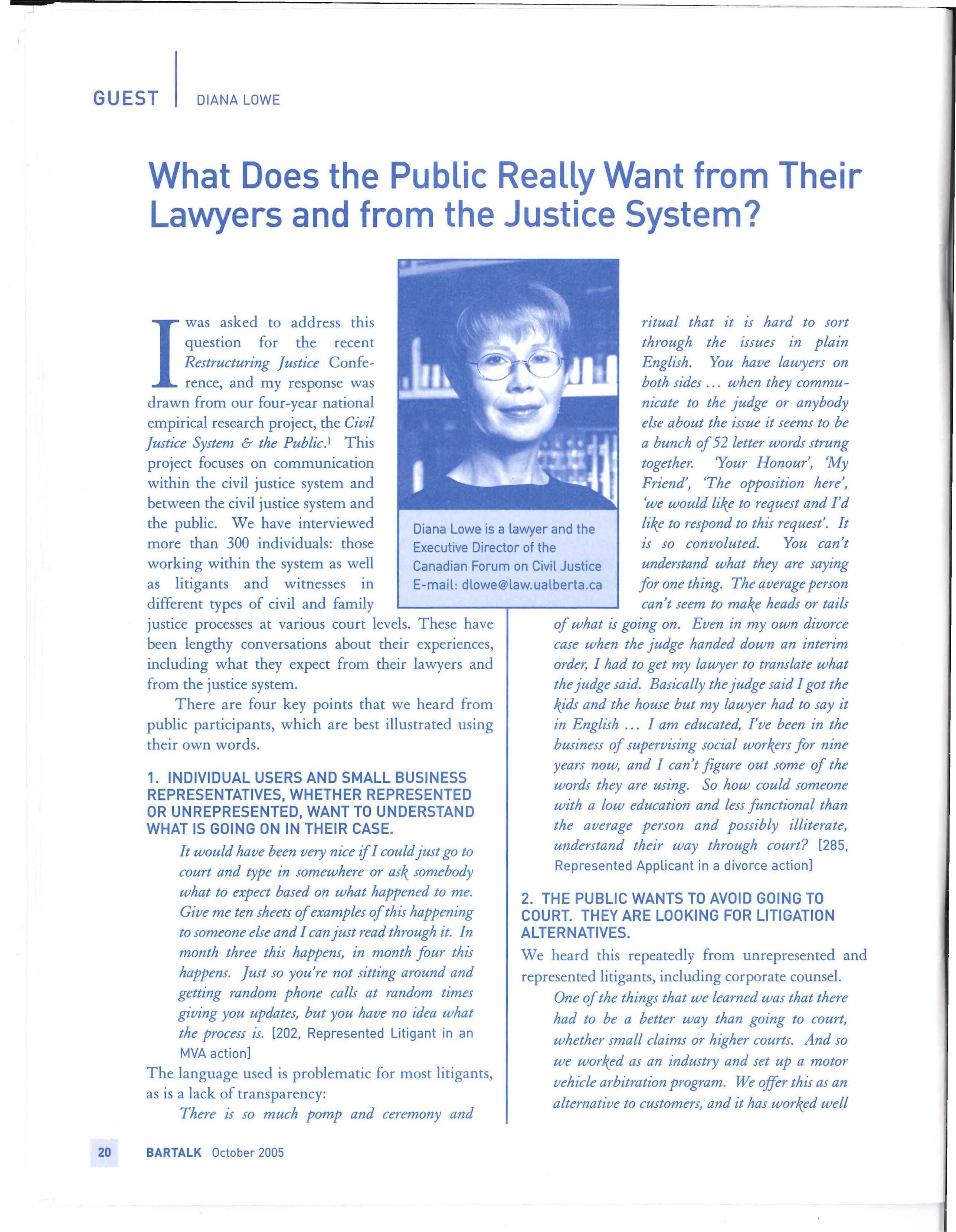
What Does the Public Really Want from Their Lawyers and from the Justice System?
Iwas asked to address this question for the recent Restructuring Justice Conference, and my response was drawn from our four-year national empirical research project, the Civil Justice System & the Public.' This project focuses on communication within the civil justice system and between the civil justice system and the public We have interviewed more than 300 individuals : those working within the system as well as litigants and witnesses in different types of civil and family
Diana Lowe is a lawyer and the
Executive Director of the Canadian Forum on Civil Justice E-mail: dlowe@law.ualberta.ca
justice processes at various court levels. These have been lengthy conversations about their experiences, including what they expect from their lawyers and from the justice system.
There are four key points that we heard from public participants, which are best illustrated using their own words.
1. INDIVIDUAL USERS AND SMALL BUSINESS REPRESENTATIVES, WHETHER REPRESENTED OR UNREPRESENTED, WANT TO UNDERSTAND WHAT IS GOING ON IN THEIR CASE.
It would have been very nice if I could just go to court and type in somewhere or ask somebody what to expect based on what happened to me. Give me ten sheets ofexamples ofthis happening to someone else and I can just read through it. In month three this happens, in month four this happens. Just so you're not sitting around and getting random phone calls at random times giving you updates, but you have no idea what the process is. [202, Represented Litigant i n an MVA action ]
The language used is problematic for most litigants , as is a lack of transparency: There is so much pomp and ceremony and
ritual that it is hard to sort through the issues in plain English You have lawyers on both sides . . . when they communicate to the judge or anybody else about the issue it seems to be a bunch of 52 letter words strung together. 'Your Honour', 'My Friend', 'The opposition here', 'we would like to request and I'd like to respond to this request'. It is so convoluted. You can't understand what they are saying for one thing The average person can't seem to make heads or tails
of what is going on. Even in my own divorce case when the judge handed down an interim order, I had to get my lawyer to translate what the judge said. Basically the judge said I got the kids and the house but my lawyer had to say it in English I am educated, I've been in the business of supervising social workers for nine years now, and I can't figure out some of the words they are using. So how could someone with a low education and less functional than the average person and possibly illiterate, understand their way through court? [285, Represented App li cant in a divorce action]
2. THE PUBLIC WANTS TO AVOID GOING TO COURT. THEY ARE LOOKING FOR LITIGATION ALTERNATIVES.
We heard this repeatedly from unrepresented and represented litigants, including corporate counsel. One of the things that we learned was that there had to be a better way than going to court, whether small claims or higher courts. And so we worked as an industry and set up a motor vehicle arbitration program. We offer this as an alternative to customers, and it has worked well
for us and for customers so we have expanded it across the country. It has meant that at least 213's of the warranty litigation cases that would have gone to court now go through this arbitration process in a much more efficient and expeditious way. [815, Corporate Counsel]
3. THE PUBLIC FINDS THE CIVIL JUSTICE SYSTEM ALIENATING, INTIMIDATING AND SOMETHING VERY REMOVED FROM THEIR LIVES.
Too often members of the public are made to feel that they are passive participants in the justice system. Even worse, participants often overhear disrespectful comments from those within the justice system.
I was in that courtroom from start to finish, you know until my thing came up and I had listened to the lawyers Joke about this case or that case or whatever else and then they get to mine and they say, "Oh well, you know, he really has it in for her doesn't he and blah, blah, blah", and I'm just sitting back there listening to these clowns talk about my case and my life. I let them talk for a Jew minutes and then I said, "That's me!You're talking about me now".
A certain sense of respect for the humanity of people involved in the whole situation is just knocked out the window. You are just so - not alive- you know what I mean? You're just this number or this file or this docket or this whatever and it's really, really shameful. [523, Re presented Applicant in a fami ly matter. Also exper i enced with criminal system as a victim of domestic abuse.]
4. THE PUBLIC KNOWS WHAT THE ISSUES ARE. WE NEED TO LISTEN.
It is encouraging that those working within the justice system want to learn what the public needs and expects. The individuals we spoke to were willing to share their views and expressed interest in being involved in reform initiatives, but were concerned that their perspectives might not be taken seriously. As the following quote illustrates, the public experience and insight is valuable even on questions of process:
I've been into court 25 times in the last year and a half, and it's all because my ex has broken every court order that we've ever had. But one of the things that I find extremely
frustrating is that you're never ever seeing the same judge For every little thing you're going to a different judge which is absolutely ludicrous. You go into a court and have a trial, you vary an order and then if it's not followed through you're seeing a different judge and they're making some different ruling. It was absolutely ridiculous. [607, Applicant in a custody matter Originally represented, then self-represented for more than a year because unable to afford to continued representation ] This is really a discussion about case management and it is important for those within the justice system to hear that the public has a view on this and other issues. If we remind ourselves that the civil justice system exists for the public (rather than for lawyers, judges and court administrators) it becomes clear that we must not only be receptive to the public's questions and observations, but that we must both seek their input and respond effectively. That may mean changing the way we do things . And from what we hear, that is what the public really wants. BT
1 The Civil Justice System and the Public is a collaborative research project funded by the Alberta Law Foundation and the Social Sciences and Humanities Research Council of Canada. Details Forum on
JUSTICE of the project are available at http://www.cfcj-fcjc.org/research.htm I wish to thank all of the members of our research team for their contributions to the development of this project - our project partners (who include the CBA]. research participants, field research team, Research Coordinator Mary Stratton and coResearch Directors Barbara Billingsley, Lois Gander, and Teresa Rose.
canadien Civil sur Ia
FEATURE CHIEF JUSTICE DONALD BRENNER AND ALLAN SECKEL, QC
Report of the Civil Justice Reform Working Group
In the December, 2004 issue of BarTalk, we announced the formation of the Civil Justice Reform Working
Group, whose task is to consider how our civil (non-family) justice system can provide more affordable, effective and proportional dispute resolution.
Since the publication of that issue, the Working Group has
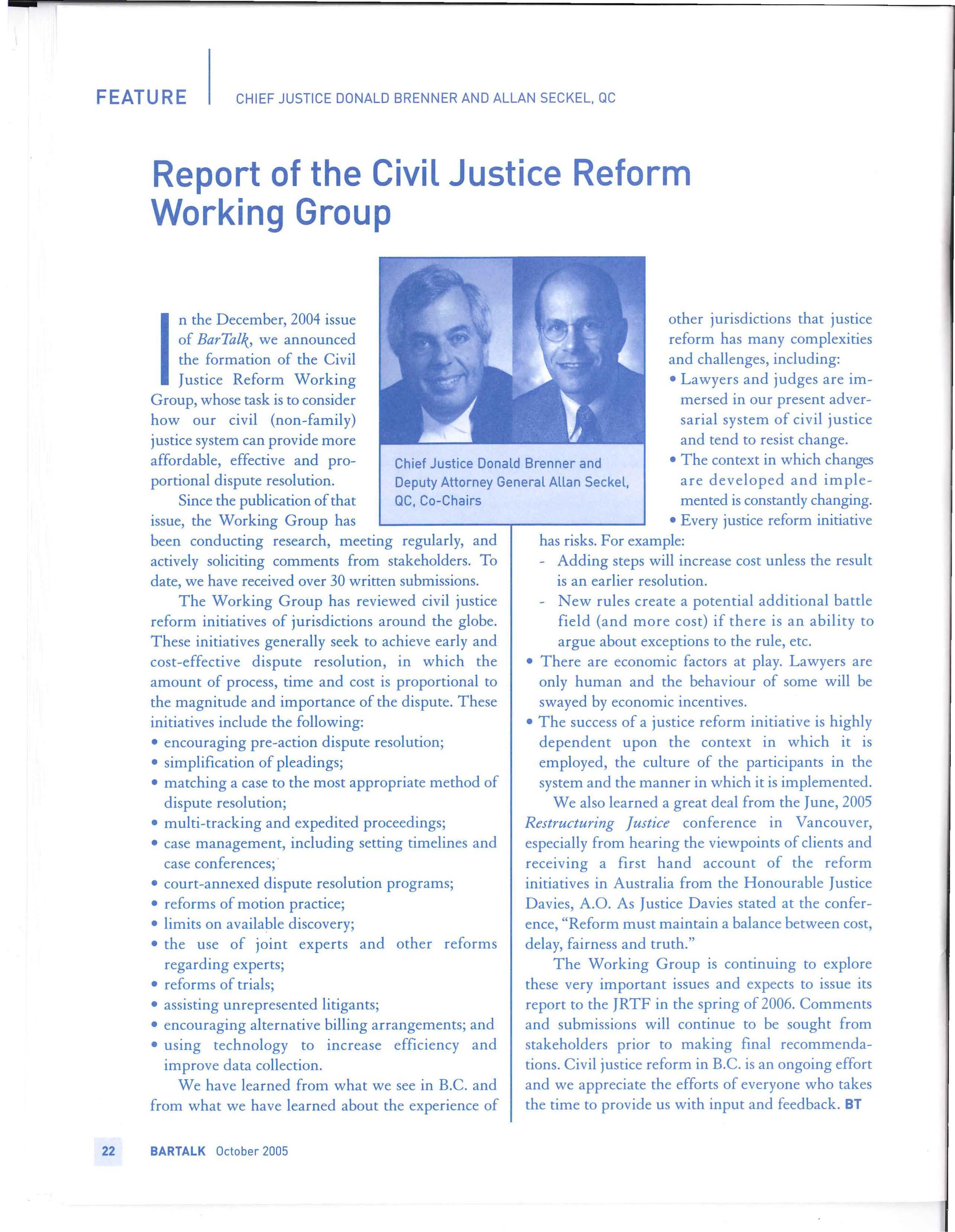
Chief Justice Donald Brenner and Deputy Attorney General Allan Seckel, QC, Co-Chairs
been conducting research, meeting regularly, and actively soliciting comments from stakeholders. To date, we have received over 30 written submissions.
The Working Group has reviewed civil justice reform initiatives of jurisdictions around the globe. These initiatives generally seek to achieve early and cost-effective dispute resolution, in which the amount of process, time and cost is proportional to the magnitude and importance of the dispute. These initiatives include the following:
• encouraging pre-action dispute resolution;
• simplification of pleadings;
• matching a case to the most appropriate method of dispute resolution;
• multi-tracking and expedited proceedings;
• case management, including setting timelines and case conferences; ·
• court-annexed dispute resolution programs;
• reforms of motion practice;
• limits on available discovery;
• the use of joint experts and other reforms regarding experts;
• reforms of trials;
• assisting unrepresented litigants;
• encouraging alternative billing arrangements; and
• using technology to increase efficiency and improve data collection.
We have learned from what we see in B.C. and from what we have learned about the experience of
other jurisdictions that justice reform has many complexities and challenges, including:
• Lawyers and judges are immersed in our present adversarial system of civil justice and tend to resist change.
• The context in which changes are developed and implemented is constantly changing.
• Every justice reform initiative has risks For example:
- Adding steps will increase cost unless the result is an earlier resolution.
- New rules create a potential additional battle field (and more cost) if there is an ability to argue about exceptions to the rule, etc.
• There are economic factors at play. Lawyers are only human and the behaviour of some will be swayed by economic incentives.
• The success of a justice reform initiative is highly dependent upon the context in which it is employed, the culture of the participants in the system and the manner in which it is implemented. We also learned a great deal from the June, 2005 Restructuring Justice conference in Vancouver, especially from hearing the viewpoints of clients and receiving a first hand account of the reform initiatives in Australia from the Honourable Justice Davies, A.O. As Justice Davies stated at the conference, "Reform must maintain a balance between cost, delay, fairness and truth."
The Working Group is continuing to explore these very important issues and expects to issue its report to the JRTF in the spring of 2006. Comments and submissions will continue to be sought from stakeholders prior to making final recommendations. Civil justice reform in B.C. is an ongoing effort and we appreciate the efforts of everyone who takes the time to provide us with input and feedback. BT
Report of the Family Justice Reform Working Group
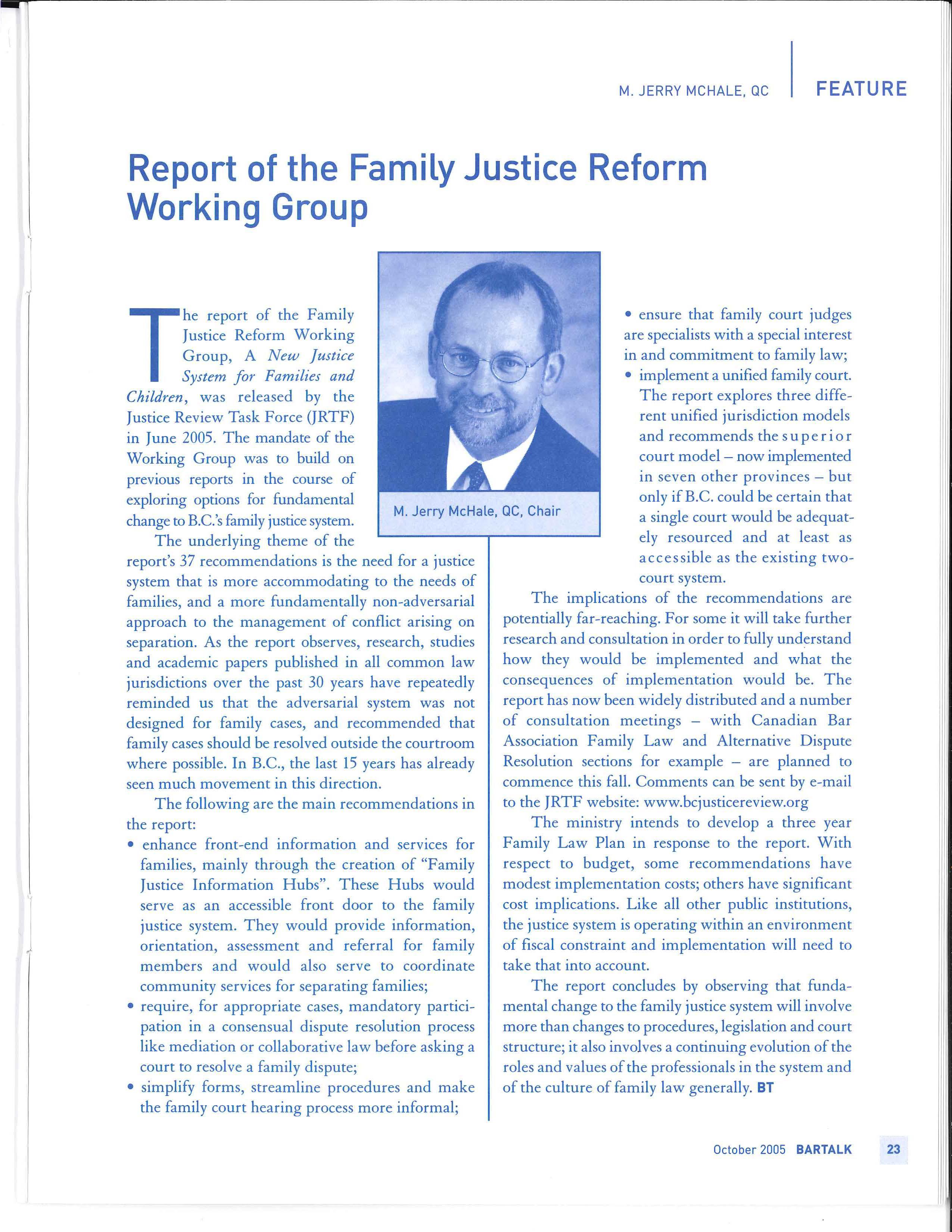
The report of the Family Justice Reform Working Group, A New Justice System for Families and Children, was released by the Justice Review Task Force (JRTF) in June 2005 The mandate of the Working Group was to build on previous reports in the course of exploring options for fundamental change to B.C.'s family justice system
The underlying theme of the r eport's 37 recommendations is the need for a justice system that is more accommodating to the needs of families, and a more fundamentally non-adversarial approach to the management of conflict arising on separation. As the report observes, research, studies and academic papers published in all common law jurisdictions over the past 30 years have repeatedly reminded us that the adversarial system was not designed for family cases, and recommended that family cases should be resolved outside the courtroom where possible. In B.C , the last 15 years has already seen much movement in this direction.
The following are the main recommendations in the report :
• enhance front-end information and services for families , mainly through the creation of "Family Justice Information Hubs" . These Hubs would serve as an accessible front door to the fam ily justice system. They would provide information, orientation, assessment and referral for family members and would also serve to coordinate community services for separating families;
• require, for appropriate cases, mandatory participation in a consensual dispute resolution process like mediation or collab o rative law before asking a court to resolve a family dispute ;
• simplify forms, streamline procedures and make the family court hearing process more informal;
• ensure that family court judges are specialists with a special interest in and commitment to family law;
• implement a unified family court The report explores three different unified jurisdiction models and recommends the s up e rio r court model - now implemented in seven other provinces - but only if B .C . could be certain that a single court would be adequately resourced and at least as accessible as the existing twocourt system.
The implications of the recommendations are potentially far - reaching For some it will take further research and consultation in order to fully understand how they would be implemented and what the consequences of implementation would be The report has now been widely distributed and a number of consultation meetings - with Canadian Bar Asso ciation Family Law and Alternative Dispute Resolution sections for example - are planned to commence this fall. Comments can be sent by e-mail to the JRTF website: www.bcjusticereview.org
The ministry intends to develop a three year Family Law Plan in response to the report With respect to budget, some recommendations have modest impl e mentation costs; others have significant cost implications . Like all other public institutions, the justice system is operating within an environment of fiscal constraint and implementation will need to take that into a ccount
The report concludes by observing that fundamental change to the family justice system will involve more than changes to procedures, legislation and court structure; it also involves a continuing evolution of the roles and values of the professionals in the system and of the culture of family law generally BT
Report of the Mega Trials Working Group
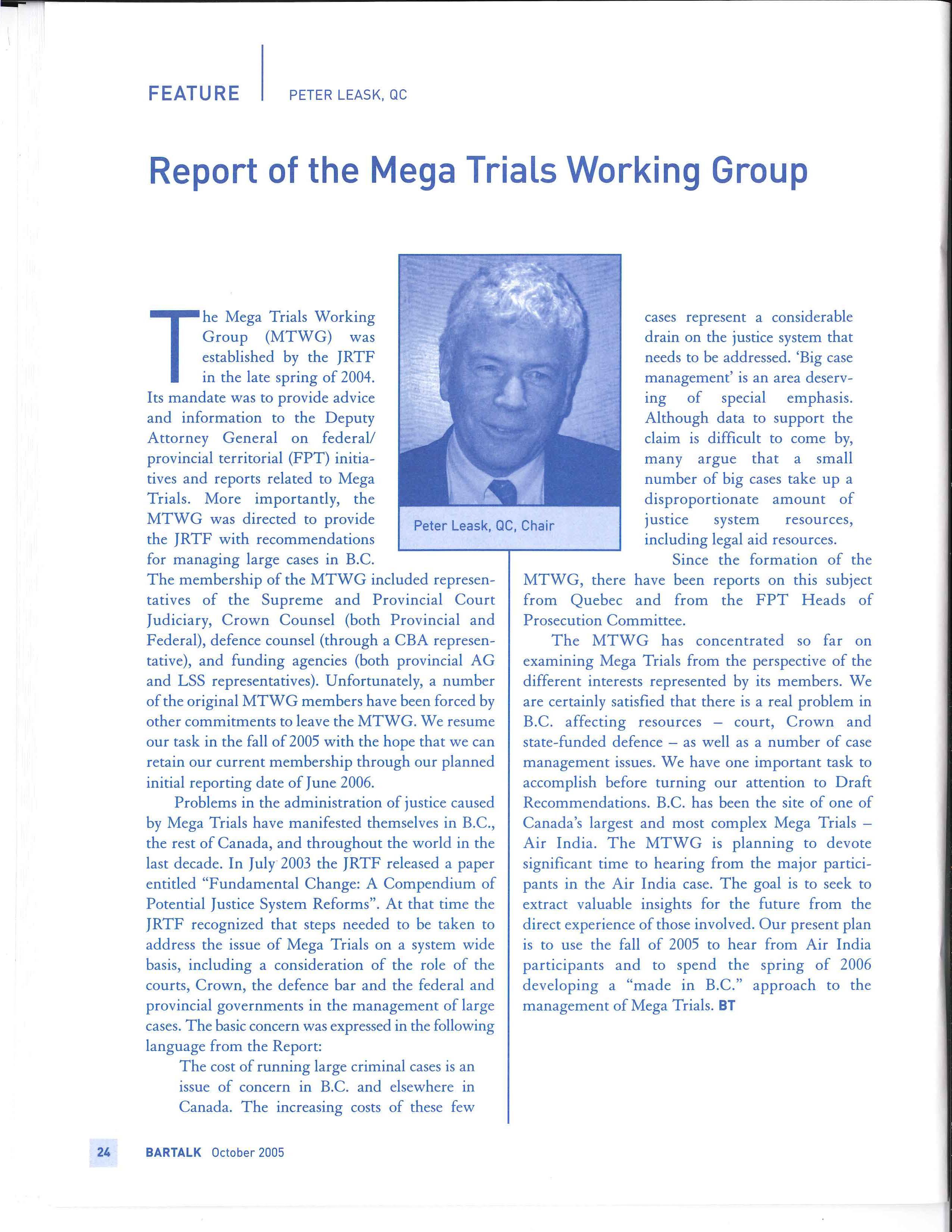
The Mega Tr ials Working Group (MTWG) wa s established by the JRTF in the late spring of 2004. Its mandate wa s to provide advice and informa t ion to the Deputy Attorney General on federal! provincial territorial (FPT) initiatives and reports related to Mega Trials. More importantly, the MTWG was directed to provide the JRTF with re commendations for managing large cases in B.C
The membership of the MTWG included representatives of the Supreme and Provincial Court Judiciary, Crown Counsel (both Provincial and Federal), defence counsel (through a CBA representative), and funding agen cies (both provincial AG and LSS representatives). Unfortunately, a number of the original MTWG members have been forced by other commitments to leave the MTWG We resume our task in the fall of 2005 with the hope that we can retain our current membership through our planned initial reporting date of June 2006.
Problems in the administration of justice caused by Mega Trials have manifested themselves in B C., the rest of Canada , and throughout the world in the last de cade. In July 2003 the JRTF released a paper entitled "Fundamental Change : A Compendium of Potential Justice System Reforms" At that time the JRTF recognized that steps needed to be taken to address the issue of Mega Trials on a system wide basis, including a consideration of the role of the courts, Crown, the defence bar and the federal and provincial governments in the management of large cases. The basic concern was expressed in the following language from the Report:
The cost of running large criminal ca ses is an issue of concern in B.C. and elsewhere in Canada The increasing costs of these few
cases represent a considerable drain on the justice system that needs to be addressed. 'Big case management' is an area deserving of special emphasis . Although data to support the claim is difficult to come by, many argue that a small number of big cases take up a disproportionate amount of justice system resources, including legal aid resources
Since the formation of the MTWG, there have been reports on this subject from Quebec and from the FPT Heads of Prosecution Committee.
The MTWG has concentrated so far on examining Mega Trials from the perspective of the different interests represented by its members. We are certainly satisfied that there is a real problem in B.C. affecting resources - court, Crown and state - funded defence - as well as a number of case management issues We have one important task to accomplish before turning our attention to Draft Recommendations B.C has been the site of one of Canada's largest and most complex Mega TrialsAir India The MTWG is planning to devote significant time to hearing from the major participants in the Air India case. The goal is to seek to extract valuable insights for the future from the direct experience of those involved. Our present plan is to use the fall of 2005 to hear from Air India participants and to spend the spring of 2006 developing a "made in B.C." approach to the management of Mega Trials. BT
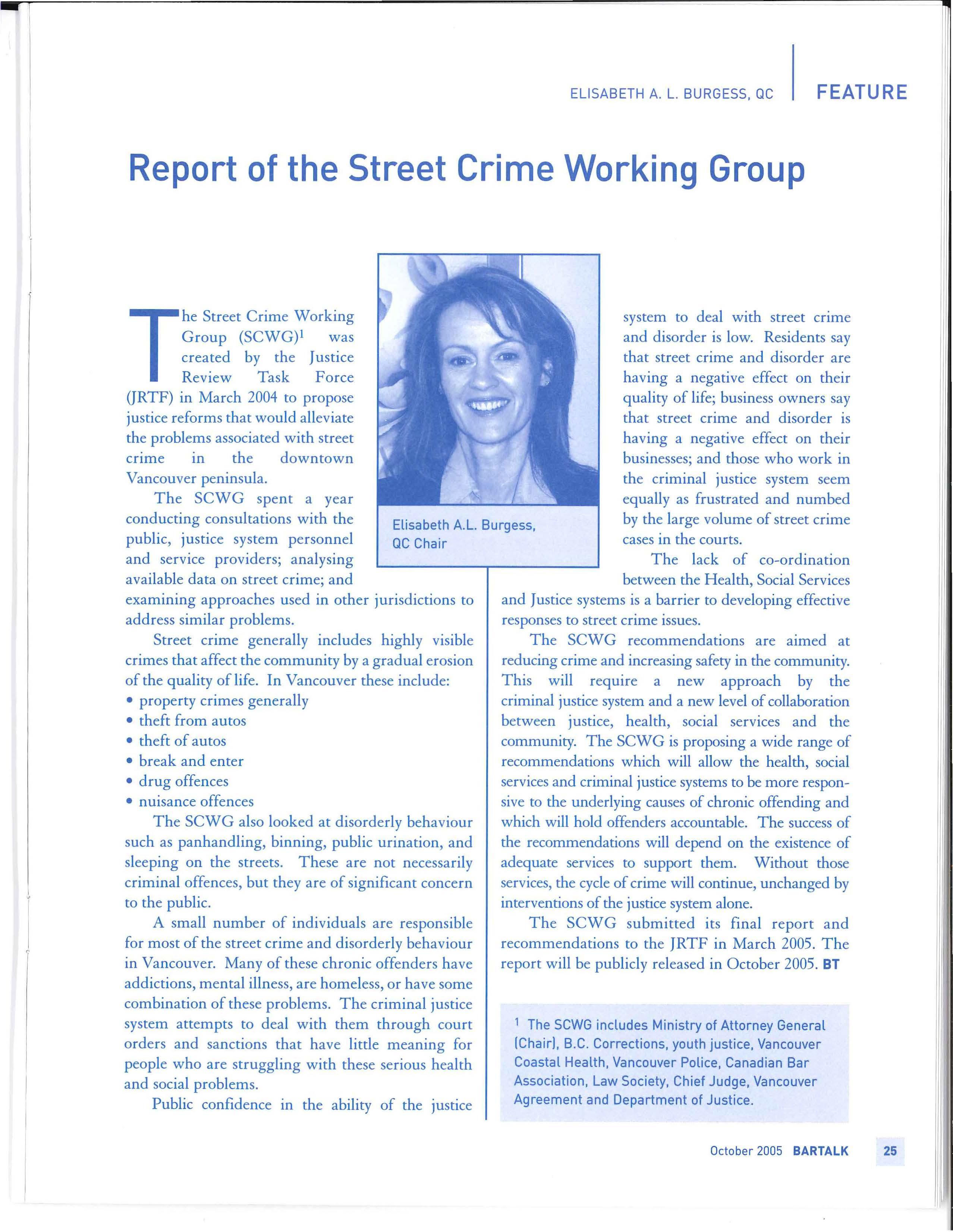
Report of the Street Crime Working Group
The Street Crime Working Group (SCWG) 1 was created by the Justice Review Task Force (JRTF) in March 2004 to propose justice reforms that would alleviate the problems associated with street crime in the downtown Vancouver peninsula.
The SCWG spent a year conducting consultations with the public, justice system personnel and service providers; analysing available data on street crime; and
Elisabeth A.L. Burgess, QC Chair
examining approaches used in other jurisdictions to address similar problems.
Street crime generally includes highly visib le crimes that affect the community by a gradual erosion of the quality of life. In Vancouver these include:
• property crimes generally
• theft from autos
• theft of autos
• break and enter
• drug offences
• nuisance offences
The SCWG also looked at disorderly behaviour such as panhandling, binning, public urination, and sleeping on the streets These are not necessarily criminal offences , but they are of significant concern to the public.
A small number of individuals are responsible for most of the street crime and disorderly behaviour in Vancouver. Many of these chronic offenders have addictions, mental illness, are homeless, or have some combination of these problems. The criminal justice system attempts to deal with them through court orders and sanctions that have little meaning for people who are struggling with these serious health and social problems.
Public confidence in the ability of the justice
system to deal with street crime and disorder is low. Residents say that street crime and disorder are having a negative effect on their quality of life; business owners say that street crime and disorder is having a negative effect on their businesses; and those who work in the criminal justice system seem equally as frustrated and numbed by the large volume of street crime cases in the courts.
The lack of co-ordination between the Health, Social Services and Justice systems is a barrier to developing effective responses to street crime issues.
The SCWG recommendations are aimed at reducing crime and increasing safety in the community. This will require a new approach by the criminal ju stice system and a new level of collaboration between justice, health, social services and the community. The SCWG is proposing a wide range of recommendations which will allow the health, social services and criminal justice systems to be more responsive to the underlying causes of chronic offending and which will hold offenders accountable. The success of the recommendations will depend on the existence of adequate services to support them. Without those services, the cycle of crime will continue, unchanged by interventions of the justice system alone
The SCWG submitted its final report and recommendations to the JRTF in March 2005. The report will be publicly released in October 2005. BT
1 The SCWG includes Ministry of Attorney General !Chair]. B.C. Corrections, youth justice, Vancouver Coastal Health, Vancouver Police, Canadian Bar Association, Law Society, Chief Judge, Vancouver Agreement and Department of Justice.
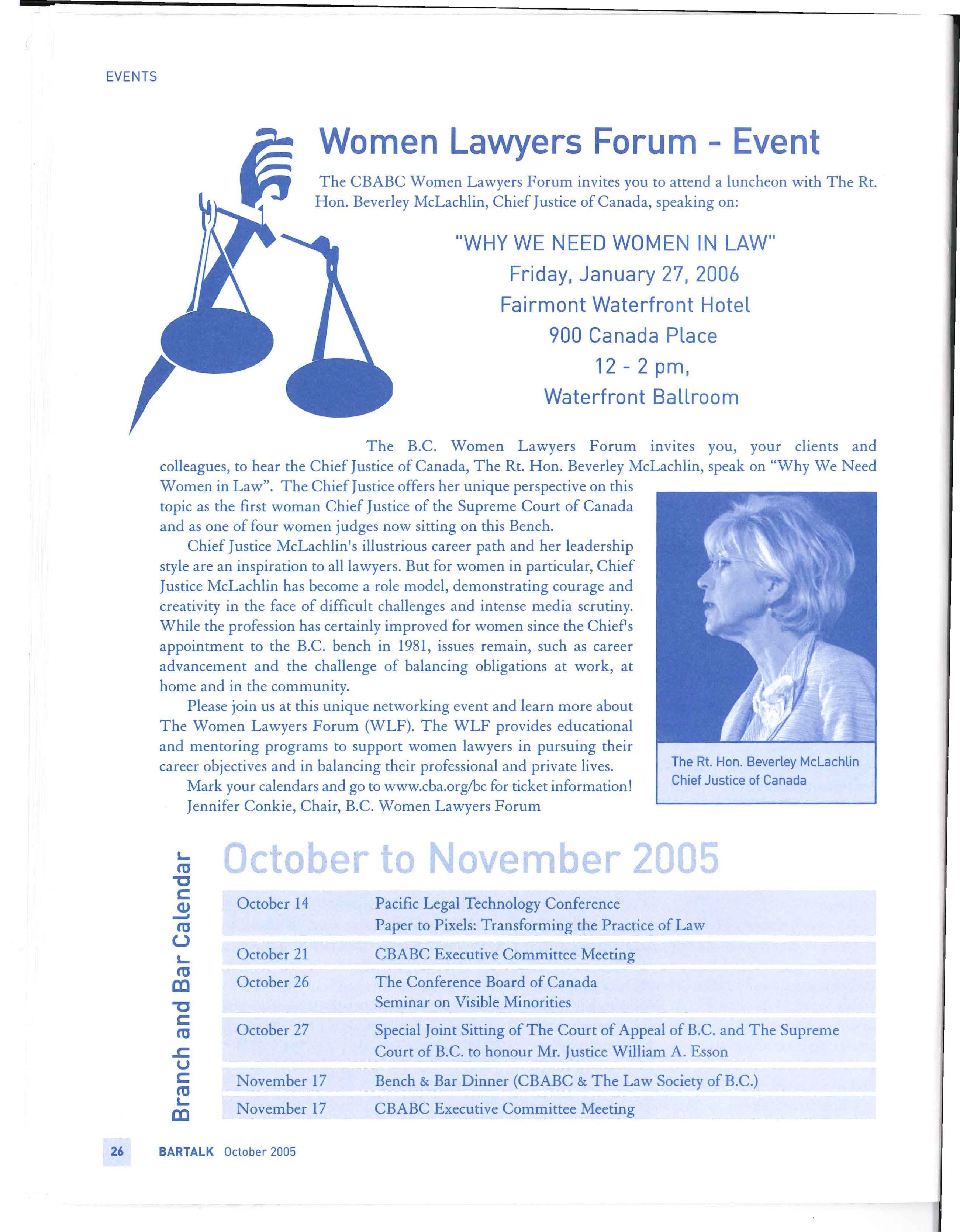
Women Lawyers Forum - Event
The CBABC Women Lawyers Forum invites you to a ttend a luncheon with The Rt Hon. Beverley McLachlin , Chief Justice of Canada, speaking on :
"WHY WE NEED WOMEN IN LAW"
Friday, January 27, 2006
Fairmont Waterfront Hotel
900 Canada Place
12- 2 pm, Waterfront Ballroom
The B C. Women Lawyers Forum invites you, your clients and colleagues, to hear the ChiefJustice of Canada, The Rt. Hon. Beverley McLachlin, speak on "Why We Need Women in Law". The ChiefJustice offers her unique perspective on this topic as the first woman Chief Justice of the Supreme Court of Canada and as one of four women judges now sitting on this Bench
Chief Justice McLachlin's illustrious career path and her leadership style are an inspiration to all lawyers . But for women in particular, Chief Justice McLachlin has become a role model, demonstrating courage and creativity in the face of difficult challenges and intense media scrutiny While the profession has certainly improved for women since the Chiefs appointment to the B.C. bench in 1981, issues remain, such as career advancement and the challenge of balancing obligations at work, at home and in the community
Please join us at this unique networking event and learn more about The Women Lawyers Forum (WLF). The WLF provides educational and mentoring programs to support women lawyers in pursuing their career objectives and in balancing their professional and private lives
Mark your calendars and go to www cba.org/bc for ticket information!
Jennifer Conkie, Chair, B.C. Women Lawyers Forum
Oc ober to November 2005
October 14
October 21
October 26
October 27
November 17
November 17
Pacific Legal Technology Conference Paper to Pixels: Transforming the Practice of Law
CBABC Executive Committee Meeting
The Conference Board of Canada Seminar on Visible Minorities
Special Joint Sitting of The Court of Appeal of B C . a nd The Supreme Court of B.C. to honour Mr. Justice William A . E sson
Bench & Bar Dinner (CBABC & The Law Society o f B.C.)
CBABC Executive Committee Meeting
The Rt. Hon. Beverley Mclachlin Chief Justice of Canada
Whistler Blackcomb
CBABC is happy to announce the return of the corporate discount program. We have teamed up to offer all of our members and families huge savings on single lift tickets, five-day Edge Cards, season's passes, and skilsnowboard lessons. The cut-off for Edge Cards is November lOth, so book early and save. We look forward to a great season up at the hill. Order forms are available online at www.cba.org/bc. See "Member Savings" under "Membership" or call Josey Schaefer at 1- 877669-9601 for more information.
Canucks
We are excited to see the return of the National Hockey League this year. CBABC has secured a limited number of tickets to select games, so reserve early to avoid disappointment. The season is already underway, and we hope to see the Canucks through to the Stanley Cup! Tickets are available by faxing in your order form (order forms are available at www.cba.org/bc)
Meeting Max
MeetingMax online bookings help you save time & money
The CBABC's new online hotel booking service is a hit! This new provider gives members the opportunity for even greater hotel savings and complimentary room upgrades in B.C. With help from our member service supplier, MeetingMax Inc., all CBABC members now have access to the service through our redesigned Branch website. MeetingMax Inc. is continually updating the CBABC's list of contacts and inspecting locations to be sure that the website is current The CBABC is proud of this new service for its members and hopes to provide great value for years to come. For details, visit www.cba.org/bc (see "Member Savings" under "Membership").
CBABC Member Services
E-mail News List
Want to find out which new benefits and promotions are available to you? Join the CBABC Member Services e-mail NEWS list and you'll receive a monthly e-mail message with what's new in Member Services, travel and accommodation discounts, special promotions, exclusive events and more. Upon joining, your e-mail address will be added to the confidential Member Services distribution list. For details, visit www.cba.org/bc, or e-mail members@bccba.org
Lawyers' Cases
CBABC is pleased to introduce its newest supplier of Lawyers Cases. "'Bugatti"" only uses quality full-grain leather for a classic design, which you will be proud to own. Looking for a perfect gift for clients or students? We can have these bags personalised and at your door in no time. Check out www.cba.org/bc [see "'Member Savings·· under ''Membership'') or call Josey Schaefer toll free at 1-888-687-3404 [ext. 306) for ordering information.
This Month's Featured CBABC Hotel: The Hyatt Regency Vancouver is quickly becoming a favourite of the Law community and rightfully so with a rate of $134/night for CBA members until the end of the year.
Bar Moves " 71
Have you recently changed firms or opened a new firm? Send submissions (maximum 25 words) to Bar Moves at cba@bccba org.
IIIII
TONY EDWARDS has moved his patent practice to Benson Edwards LLP (formerly Benson & Company) in Kelowna.
ANGELA S. KERSLAKE has moved her matrimonial law practice to "The Galbraith Professional Centre" located at 131 Eighth Street, New Westminster, B.C. V3M 3P6 .
DAN DE FRIAS has moved from in - house counsel with the U.S.W.A., Locall-424 in Prince George, to join the Fraser Health Authority as Advocacy Consultant , Labour Relations in New Westminster.
MERRILL SHEPARD has moved from Fasken Martineau DuMoulin LLP to join Donovan & Company, a Vancouver law firm practising exclusively in the area of aboriginal law.
Effective September 6, 2005, MICHAEL ADAM will be leaving the partnership and the Labour and Employment Practice at Alexander Holburn Beaudin & Lang to join Weyerhaeuser Company Ltd . as a Director of Labour Relations.
HEIDI A. TELSTAD has left Miller Thomson in Calgary t o join Sliman, Stander & Company's Chilliwack office where she will be practising general corporate and commercial law.
CAROLYN R. CHRISTIANSEN has relocated from MacLean Family Law Group in Vancouver to Nixon Wenger in Vernon , where she will continue to practise in the area of family law.
ROBERT PETERSON has moved from the Patrick G. Guy Law Corporation to the B.C Cancer Foundation where he will focus on major gifts and planned giving to support research and care at the B.C. Cancer Agency 's Vancouver Island Centre.
B.C. Reception
CBABC hosted a special reception at the Terminal City Club at the recent Canadian Legal Conference in Vancouver As is the tradition of the B.C Branch, this was the occasion on which the ··mantle of office"" was officially transferred from the outgoing to incoming President. 2004/05 President Michael Woodward presented Past President Robert Brun, QC with his President"s Medal, and 2005/06 President Meg Shaw presented Michael Woodward with his Medal. Incoming Executive Committee members were introduced, and Ms . Shaw introduced herself and her perspective on her coming year as President.
The B.C. Reception was also an opportunity to salute the success of the CBABC Women Lawyers Forum Chair Jennifer Conkie outlined the work of the Forum , including its mentoring, education and networking programs The B C Forum has inspired the formation of a National Forum, which hosted its first meeting at the CLC
VBA/CBA GOLF TOURNAMENT
The ninth annual CBANBA Golf Tournament was a huge success. Not only did the beautiful weather set the mood for a fun filled day, but the event raised funds, much needed for law students attending both UBC and UVic. The tournament, held
/ annually at the UBC Golf Course up in the University endowment lands in Vancouver's Point Grey peninsula, had one of the best turn-outs in its history. There was much anticipation throughout the day to see whether anyone would make a hole in one James Gopaulsingh of Lindsay Kenny had a near miss at hole 11, coming within inches of winning a 2005 Duccati bike!
We congratulate everyone who participated this year, especially the tournament winners Gordon McRae , Peter Goodwin, Craig Moulton, and Mark Horne. We would like to thank all of our sponsors who helped make this a memorable event and hope to see you all next spring for the tenth annual CBANBA Golf Tournament.
PROVINCIAL COURT SMALL CLAIMS HANDBOOK
Congratulations to the CBA/VBA Golf Tournament winners. [From Left the right): Gordon McRae, Craig Moulton, Mark Horne, Peter Goodwin, with CBABC Executive Officer M i riam Maisonville presenting the awards
• The
Continuing Legal Education Society of British Columbia
B.C.'s Provincial Court has seen major changes regarding small claims matters this year and CLE 's 2005 edition of the Provincial Court Small Claims Handbook covers all the details . Now available, this essential practice manual walks you step by step through a small claims matter and includes a full set of forms on disk
WILLS, ESTATES AND TRUSTS CONFERENCE 2005
CLE's upcoming Wills, Estates and Trusts Conference 2005 (November 3rd & 4th) will be available live, online , and by video repeat. Come for both days or select the one you need most. Day 1 will focus on Trusts, providing an in-depth look at a variety of investment and personal planning trusts, taxation of various types of trusts, as well as international tax implications on trust structures. Day 2 will focus on Estate Litigation. You'll take a ' snappers' approach in analysing the latest substantive and procedural legal developments, and receive practical tips, strategies, and advice for improving your ability to bring, defend, and mediate estate litigation cases
For more details on these or other CLE of B.C. Society's publications and events, watch for brochures, visit their website- www.cle.bc .ca, or call 604-893-2121 (Toll Free: 1-800-663-0437).
Grants Approved
The Board of Governors of the Law Foundation of B.C. met on June 25, 2005. Chair Heather Raven is pleased to announce that funding totalling $3, 799,914 has been approved for the following 17 continuing programs. In addition, the Foundation approved 32 projects for $1,110,807 at the june meeting. Most of the projects were listed in the August 2005 issue of the balance are listed as follows.
THE@LAW FOUNDATION
OF BRITISH COLUMBIA
Continuing Programs
$90,000 ABBOTSFORD COMMUNITY SERVICES SOCIETY Legal Advocacy Program
$57,160 ACTIVE SUPPORT AGAINST POVERTY Legal Advocacy Program
$90,000 B.C. COALITION TO ELIMINATE ABUSE OF SENIORS Legal Advocacy Program
$2,190,200 B.C. COURTHOUSE LIBRARY SOCIETY 2006 Operating Grant
$486,800 B.C. PUBLIC INTEREST ADVOCACY CENTRE 2005-2006 Operating Grant
$247,100 CANADIAN BAR ASSOCIATION, B.C. BRANCH Dial - A - Law, Lawyer Referral and Law Week
$40,000 CONTACT WOMEN'S GROUP SOCIETY Legal Advocacy Program
$81,102 CRANBROOK WOMEN'S RESOURCE SOCIETY Traveling Poverty Law Advocate Program
$70,000 KETTLE FRIENDSHIP SOCIETY Mental Health Legal Advocacy Program
$75,000 KI-LOW-NA FRIENDSHIP SOCIETY Legal Advocacy Services for Aboriginal People Living Off Reservation
$55,000 LEGAL SERVICES SOCIETY Pov Net Program
$42,992 MOSAIC Paralegal Advocacy Program
$45,000 MPA- MOTIVATION, POWER & ACHIEVEMENT SOCIETY Court Services Project
$58,960 PORT ALBERNI FRIENDSHIP CENTRE Legal Advocacy for Persons with Disabilities and Mental Health
$40,000 SOUTH FRASER WOMEN'S SERVICES SOCIETY Legal Advocacy Program
$71,100 SUPER PAGES Advertisement of Public Legal Services
$59,500 TOGETHER AGAINST POVERTY SOCIETY Legal Advocacy Program
Other Projects (in addition to 27 projects totalling $829,807 listed in Bar Talk August 2005)
$80,000 MILE ZERO METIS SOCIETY Outreach Legal Advocate Program
$6,000 MOSAIC Front Line Advocacy Workers ' Coordinator Project
$45,000 QUESNEL TILLICUM SOCIETY Poverty Law Information Worker
$100,000 UNIVERSITY OF BRITISH COLUMBIA Bursary, Scholarship and Fellowship Grants for Undergraduates
$50,000 UNIVERSITY OF VICTORIA Bursary, Scholarship and Fellowship Grants for Undergraduates
GRADUATE FELLOWSHIPS 2006/2007
VALUE:
Up to four [4] Awards of $13,750 each (subject to change].
CLOSING DATE:
January 5, 2006.
FIELD OF STUDY/ ELIGIBILITY:
Full time graduate studies in law or a law-related area. Applicants must either be residents of British Columbia; graduates of a British Columbia law school; or members of the British Columbia Bar
WHERE TENABLE:
Recognized universities in Canada, the U.S. or abroad. NOTE: The Law Foundation Graduate Fellowship is not available for the graduate programs of the Faculties of Law at the University of British Columbia and the University of Victoria as the Law Foundation makes separate grants to the Graduate Fellowship programs at these universities.
APPLICATION PROCEDURES:
Each application form must be typed and accompanied by a current resume summarizing your work and volunteer experience. Applicants should have official transcripts of all previous post-secondary study sent directly to the Law Foundation. Three letters of reference should be sent directly to the Law Foundation from persons such as former professors, employers or colleagues who can comment on your scholarship, abilities and personal qualities.
Please contact the Law Foundation for further information Law Foundation, 1340-605 Robson St, Vancouver BC V6B 5J3
E-mail: lfbc@tlfbc.org or Phone: 604-688-2337
Application forms are available at www lawfoundationbc org.
SERVICES
THE INTERPRETERS' GROUP INC: Cer't Translators, 100+ languages Global capabi lity. E & 0 Ins: Tel : 604-961-9341 or 1-888-828-9673
Cheryl Stephen delivers skills training, 604-739-0443 www MentorMuse com
INTELLECTUAL PROPERTY: Let us assist you in providing protection for your clients Douglas B Thompson Law CorporationRegistered Patent Agent, Registered Trade Mark Agent. Practice restricted to Intellectual Property. Victoria, B.C. (www BCpatents ca) E-mail: doug@BCpatents ca
POSITIONS AVAILABLE
LITIGATION: The law firm of Kaye Thome
Toews & Hansford r equires a junior to intermediate assoc iate for our expanding firm in Chilliwack Chilliwack is a growing, family oriented community which also offers many activities for the outdoor enthusiasts
Preference will be given to candidates who possess experience in personal injury, ICBC defence, general civil litigation and family law Extended medical benefit/dental package ava ilable We view all our associates as future partners Please fax curriculum vitae to (604) 792-1906 attention Patrick A. Thome , along with remuneration request.
WILLIAMS LAKE FIRMS SEEKS SOLICITOR
Established in 1949, serving the CaribooChilcotin area, solid client-base, great staff, and prospects of partnership.
Apply to Vanderburgh & Co
Attn: Angela Ammann aev@stardate.ca, www cariboolaw com
MISSING WILLS
Would any person or firm holding or hav in g knowledge of a Will of Henry &rr formerly of Vancouver Canada late of Rockhampton Queensland who d ied on the 03 April 2000 please contact the Public Trustee of Queensland, GPO Box 1449, Brisbane 4001, in the State of Quee n sland, Australia quoting reference OPU4-20271221 or e-mail Kevin Gorman@pt.qld.gov au.
Practice Restricted To WCB
Direct BarTalk advertising inquiries to:
J esse Tarbotton
Communications Coordinator
Tel: 604-646-7856 or 1-888 - 687-3404
E-mail: cba@bccba.org
• Claims and appeals
• Vice Chair at Review Board for 6 years
• More than 25 years personal injury litigation
Give them the firm foundation of a solid
Every child deserves the advantage of higher education, and the money simply has to be there when they're ready. That's why we offer secure RESPs, with guaranteed principal and steady investment growth. So please don't wait. Put their future in safe hands with Canada's oldest and largest Group RESP provider.*
Canadian Scholarship Trust Plan
The educated choice for RESPs since 1960
Call for information today: Alana Patte Sales Representative 604-293-0053 or
Distributed by C.S.T Consultants Inc. toll free 1-800·755·3914 alana.pattee@cstresp.co m www.cst.org (preferred supplier)
* Based on actual Education Assistance Payments to beneficiaries and assets under management as reported in the audited financial statements of Group RESP providers since 1990.
Important conditions and details of the plan are co ntained in the Prospectus Please read before investing.