The Canadian Bar Association British Columbia SCC Upholds Solicitor-Client Privilege
Lawyers' office files and fee information protected
In th e latest in a series of important Supreme Court of Canada cases in which the CBA has intervened, solicitor-client privilege has again been upheld as a protection for the public.
LeBel, J., writing for the majority in Maranda v . Richer said:
" This Court has shown itself to be mindful of the protection that must be afforded to solicitor-client privilege , which plays a fundamental role in the functioning of the criminal justice system . The confidentiality of the solicitor-client relationship is essential to the functioning of the criminal justice system and to the protection of the constitutional rights of accused persons It is important that lawyers , who are bound by stringent ethical rul es, not have their offices turned into archives for the use of the prosecution "
The Maranda decision is important in at least three respects: first, in providing such a strong statement of support from the Court for the principle of solicitor-client privilege and its importance within the criminal justice system; second, in its re-affirmation of the stringent review and factors that must be taken into account before a warrant can be issued to search a lawyers' office ; and third, in its determination that information relative to billings for fees and disbursements between a lawyer and client is considered privileged.
This latter point is consistent with the May 2003 B.C. Court of Appeal decision, Legal Ser v ices Society v. British Columbia (Information and Privacy Commissioner), which dealt with a journalist's request for details from the Legal Services Society with respect to legal aid l awyers ' billings; the Court ruled that this info r mation i s protected by
solicitor-client privilege
Limitation on the search of lawyers' offices was previously affirmed in the October 2002 SCC trilogy of Lavalee, White Ottenheimer & Baker, and Fink and although the case was decided subsequent to the preparation of arguments for the Maranda case, the Court did reference Lavalee in support of its decision. A third related case, Ville de Montreal c. La Societe d'energie Foster Wheeler Ltee, argued November 12 with the CBA as intervenor, will seek further confirmation of the requirements to protect solicitor-client privilege (see page 14)
Denis Jacques, of Grondin Poudrier Bernier, Quebec, appeared on behalf of the CBA as intervenor in both Maranda and Foster Wheeler
"I am very pleased that the Court received our Association's arguments in Maranda on the importance of solicitor-client privilege, and the obligation to minimize impairment of solicitor-client privilege in any case where a seizure is approved," said Mr. Jacques. "In both the Maranda and Foster Wheeler cases, we argued strongly that the relationship between a lawyer and client, and information provided within that relationship, cannot be taken by the authorities and used against the client."
Other intervenors in the Maranda case were: the Federation of Law Societies; the Barreau du Quebec; and the Attorney General of Quebec . The full text of the Maranda decision may be found at: www.lexum.umontreal.ca/ esc-sec/ en/ rec/html! 2003scc067.wpd html. •
Georges A. Goyer, QC Memorial Award
Madam Justice Lynn Smith honoured at Bench & Bar dinner
In the presence of 260 members of the legal profession, Madam Justice Lynn Smith received the Georges A. Goyer, QC Memorial Award at the Bench & Bar Dinner on November 20. The award is the highest honour bestowed by the Canadian Bar Association, B.C. Branch.
"As a practitioner, as an academic and as a judge, Madam Justice Smith has made, and continues to make, a distinguished contribution to the law, the profession and the community," said Albert (Bertie) McClean, QC in a letter supporting Madam Justice Smith's nomination.
Madam Justice Smith was recognized for being an inspirational role model throughout her career, from her days as a young practising lawyer taking important precedent-setting constitutional cases to the Supreme Court of Canada, as a former Dean at UBC, and in her present role as a thoughtful, careful judge in our courts.
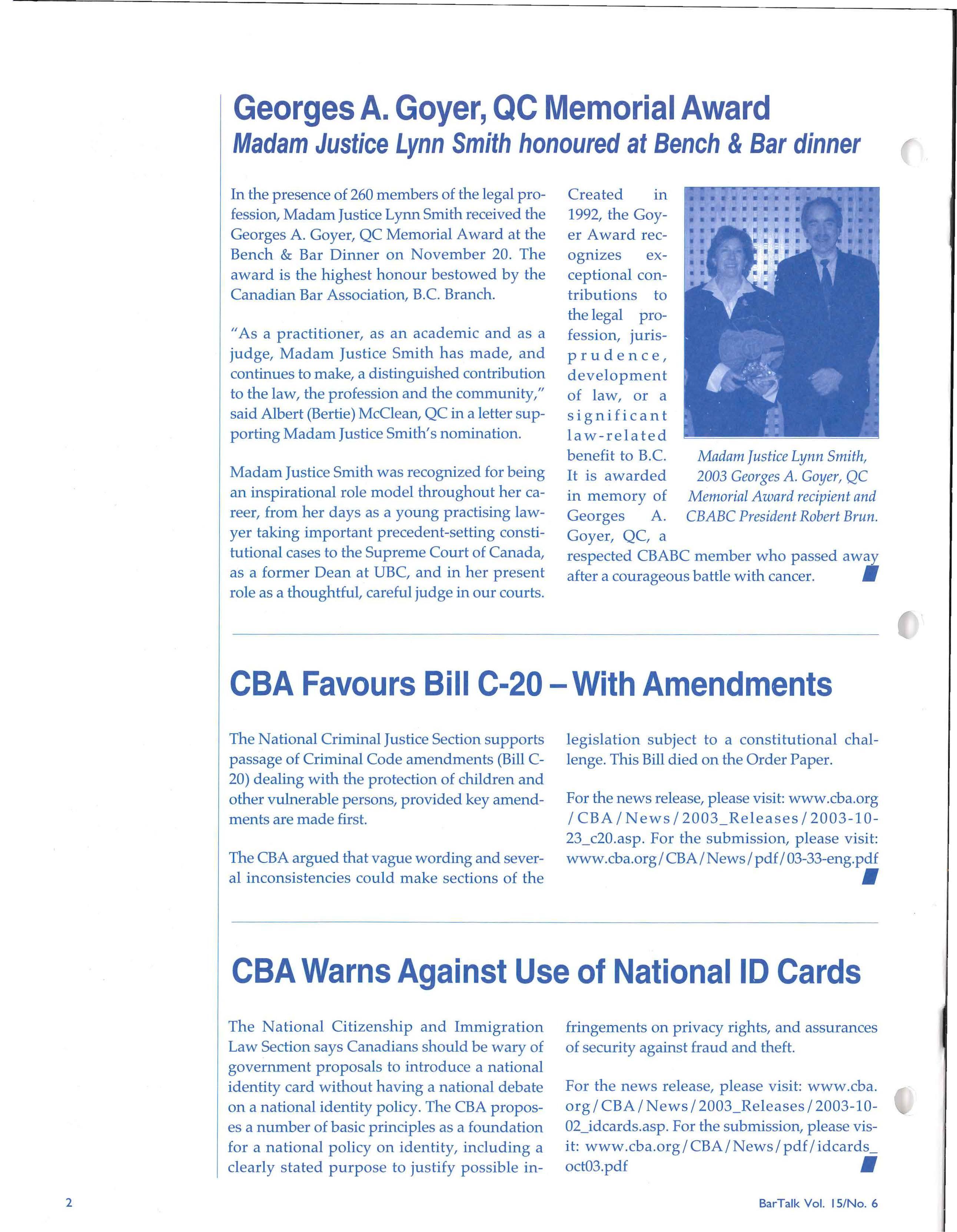
Created in 1992, the Goyer Award recognizes exceptional contributions to the legal profession, jurisprudence, development of law, or a significant law-related benefit to B.C. It is awarded in memory of Georges A. Goyer, QC, a Madam Justice Lynn Smith, 2003 Georges A. Goyer, QC Memorial Award recipient and CBABC President Robert Brun.
respected CBABC member who passed after a courageous battle with cancer. •
CBA Favours Bill C-20 -With Amendments
The National Criminal Justice Section supports passage of Criminal Code amendments (Bill C20) dealing with the protection of children and other vulnerable persons, provided key amendments are made first.
The CBA argued that vague wording and several inconsistencies could make sections of the
legislation subject to a constitutional challenge. This Bill died on the Order Paper.
For the news release, please visit: www.cba.org I CBA IN ews I 2003_Releases I 2003-1023_c20.asp. For the submission, please visit: www.cba.org I CBA/ News I pdf I 03-33-eng pdf
CBA Warns Against Use of NationaiiD Cards
The National Citizenship and Immigration Law Section says Canadians should be wary of government proposals to introduce a national identity card without having a national debate on a national identity policy. The CBA proposes a number of basic principles as a foundation for a national policy on identity, including a clearly stated purpose to justify possible in-
fringements on privacy rights, and assurances of security against fraud and theft.
For the news release, please visit: www.cba. org/ CBA/ News/ 2003 Releases I 2003-1002_idcards.asp. For the submission, please visit: www.cba.org/ CBA/News/pdf/idcards_ oct03.pdf
•
An Ancient and Honorable Profession
e are members of an ancient and honourable profession founded upon great traditions As Cicero observed over 2000 years ago:
" Est enim sine dubo dumus iuris consulti, totius oraculum civitatis - For the house of a great lawyer is assuredly th e oracular seat of th e whole community. "
Cicero, De Oratore, I, 45
The same is still true after all these years As lawyers practising today, these great traditions continue. While we have our detractors we should alwa y s be proud of our calling .
At a recent legal conference that I attended I was told of an event that occurred in the hotel elevator on the way to at-
raisers and community volunteers The list of these endeavours is endless.
As President of the Canadian Bar Association, B.C. Branch, I constantly witness the enormous amounts of time and energy given to our profession by volunteers who work with the CBA on committees, Section activities , law week events and on Provincial Council. The Canadian Bar Association, B C. Branch carries on its good work through the efforts of a volunteer army. Hundreds of our members give freely of their time. Thousands benefit from Section and committee activities Indeed, we are a profession of volunteers
All of the lawyers that I meet are passionately committed to fulfilling the enormous responsibility that goes hand in hand with the privilege of practising law.
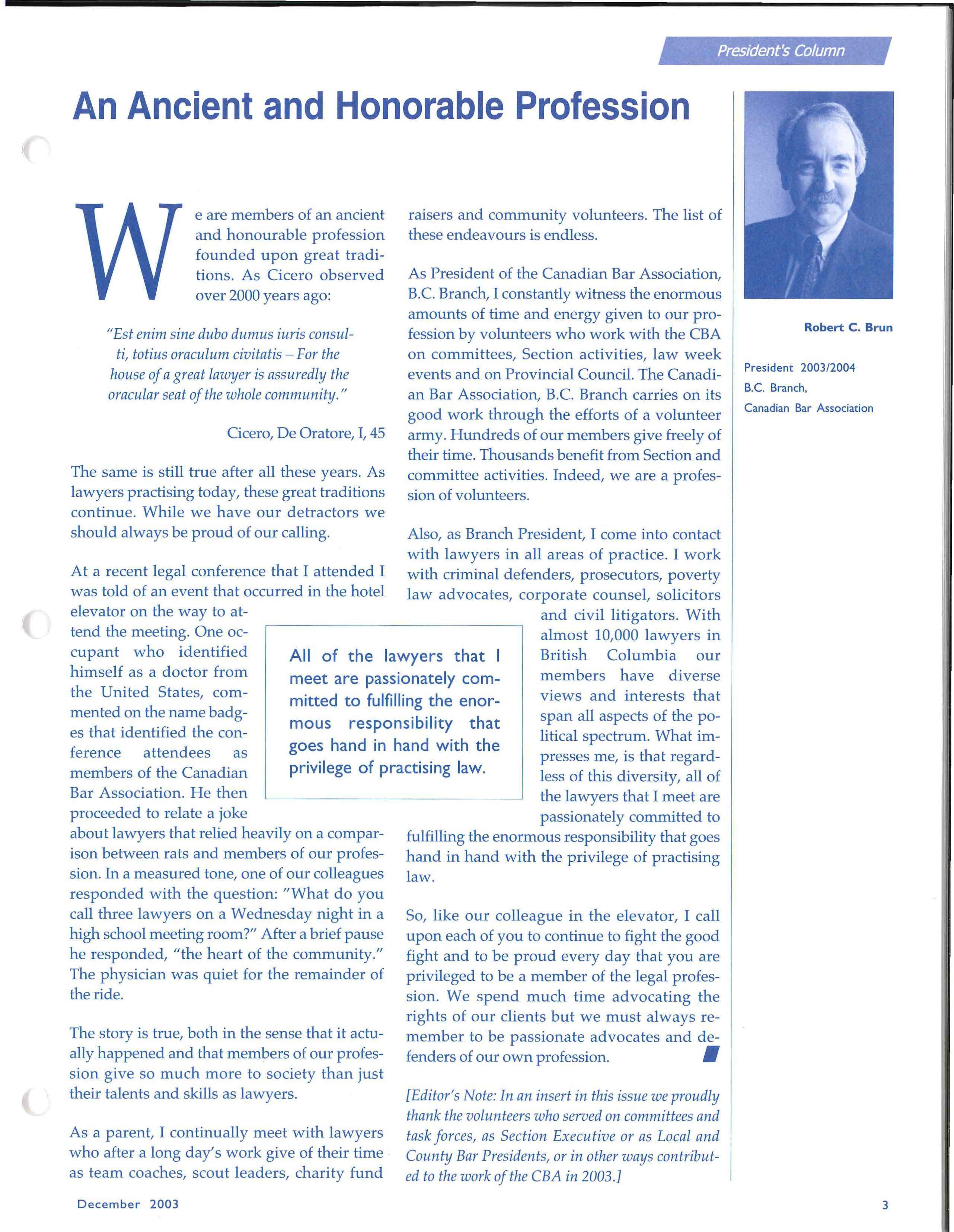
President 2003/2004
B C. Branch , Canadian Bar Association
Also, as Branch President, I come into contact with lawyers in all areas of practice . I work with criminal defenders, prosecutors, poverty law advocates, corporate counsel, solicitors and civil litigators. With tend the meeting. One occupant who identified himself as a doctor from the United States, commented on the name badges that identified the conference attendees as members of the Canadian Bar Association. He then
proceeded to relate a joke about lawyers that relied heavily on a comparison between rats and members of our profession. In a measured tone, one of our colleagues responded with the question: "What do you call three lawyers on a Wednesday night in a high school meeting room?" After a brief pause he responded, "the heart of the community ." The physician was quiet for the remainder of the ride.
The story is true, both in the sense that it actually happened and that members of our profession give so much more to society than just their talents and skills as lawyers.
As a parent, I continually meet with lawyers who after a long day's work give of their time as team coaches, scout leaders, charity fund
almost 10,000 lawyers in British Columbia our members have diverse views and interests that span all aspects of the political spectrum. What impresses me, is that regardless of this diversity, all of
the lawyers that I meet are passionately committed to fulfilling the enormous responsibility that goes hand in hand with the privilege of practising law
So, like our colleague in the elevator, I call upon each of you to continue to fight the good fight and to be proud every day that you are privileged to be a member of the legal profession We spend much time advocating the rights of our clients but we must always remember to be passionate advocates and defenders of our own profession •
[Editor 's Note : In an insert in this issu e we proudly thank th e volunteers who served on committees and task forces , as Section Executive or as Local and County Bar Presidents , or in other ways contributed to the work of the CBA in 2003 .]
Robert C. Brun
CBA Launches RRSP Service
The CBA is launching a new CBA service -just in time for the upcoming RRSP season. With the potential for member savings in management fees, the new plan is being introduced by CBA Financial Services, a new CBA company that offers a wide selection of investment choices to allow lawyers to save for their retirement.
"While low management fees will make this benefit attractive for all lawyers, it is important
to note that CBA members, their families and staff will save even more through an additional significant fee discount, " said John Hoyles, Executive Director of the CBA.
The RRSP benefit is offered in partnership with Manulife Pensions Operations and will be available for emolment through CBIA authorized sales representatives in time for the RRSP season JJ
Study On Access to Legal Aid
The CBA is encouraging the Senate of Canada to conduct a study on the status of and access to legal aid in Canada as soon as the new session of Parliament is called In September, the Red Chamber passed a motion introduced by Senator Catherine Callbeck of Prince Edward Island, calling on its Standing Committee on Legal and Constitutional Affairs to undertake the study The study, like many Bills before Parliament, died on the Order Paper when Parliament was prorogued in mid-November .
"Canada has always been a country that values social safety nets and places a strong em-
phasis on rights and social justice," said Senator Callbeck. "The fundamental gaps in the legal aid system threaten these values and are counter to the original purpose of legal aid. The legal aid system in Canada is suffering. It needs our immediate help, as Parliamentarians, if it is to fulfil its mandate of providing quality legal assistance to the many who need it ."
Legal aid is a CBA priority At its November meeting, the Board of Directors authorized fundraising for a test case to expand the constitutional right to publicly funded legal aid. JJ
CBA President Responds to National Post
A series of scathing attacks on the legal profession written by the Financial Post's Diane Francis during November has left many lawyers fuming Responding on behalf of the profession in three separate letters, CBA President Bill Johnson pointed out the flaws, inaccuracies, and misleading statements in the articles, and corrected them for the record . OBA President Jonathan Speigel also responded to theseries .
The articles called for banning lawyers from political office, attacked lawyer-client confidentiality, and accused lawyers of creating mak ework projects for them selves. Bill Johnson' s re-
sponses have refuted the claims with factual information and explanations of lawyers' ethical obligations to clients. JJ
Lawyer Referral Service
Lawyers are invited to par ti cipate in the Lawyer Referral Service A reg i stration form is posted at www.bccba org in the Members ' Guest Lounge For more information, cal l Lorna O'Grady at 604646 -7858 or tol l free 1-888-687-3404, ext 309
Funded by the Law Foundation of B C Public service of t he Canadian Bar Association , B C Branch
The CBABC sponsors 73 Sections which play a vital role in keeping members informed both on changes in the law, and legal and political issues affecting a given area of practice They are the main resource utilized by the CBABC in legislative review, law reform initiatives and in responding to matters affecting the profession. What follows is a sample of the recent activities of some Sections.
ABORIGINAL LAW-VANCOUVER
David Butcher and Chris Harvey, QC, spoke about the recent Provincial Court decision in R. v . Kapp et al, 2003 BCPC 279 . In this case comShelley Bentley mercia! fishers were charged with fishing on the Fraser River when the salmon fishery was open to fishers authorized under communal commercial licences issued to certain bands by the Department of Fisheries and Oceans (DFO) Shelley Bentley is in pr ivate under its Aboriginal Fishing Strategy. Judge practice at G. Davies & Kitchen held that the Regulations under which Company the licences were issued were inconsistent with section 15 of the Charter because the licensing program discriminated against other commercial fishers on the basis of race. In essence the Aboriginal Fishing Strategy required a bloodline connection to designated First Nations. The Attorney General of Canada has filed a Notice of Appeal in the Supreme Court of B.C. The appeal is set for Aprill9, 2004. The speakers said this case raises important issues about the DFO' s statutory right to manage the fishery according to social, political and economic objectives, as well as conservation and management. While the decision in the well-known Sparrow case dealt with the right of aboriginal people to fish for food and for social and ceremonial purposes, the B C.S C.'s decision in this case will focus on commercial rights.
FAMILY LAW-VICTORIA
Law Society Practice Advisor Fe licia Folk spoke about the most common i n s urance claims and complaints in family law . Most insurance claims in family law are in the pension ar e a . Cl ai ms counsel maintain that pens ions t e nd t o be treat e d as a n a fte r -thou g ht
even though they are generally complex and not well understood. They recommended sending clients to a pension consultant. A proper review of pensions involves gathering detailed information and usually contacting the pension authority directly. It is necessary to understand the kind of pension involved including the income stream consequences of voluntary and involuntary early retirement, remarriage, disability and change in spousal status.
Also significant is the number of claims arising in the failure to protect assets, especially neglecting to file CPL' s or restraining orders early in a dispute. Ms. Folk recommended investigating assets, including trusts, thoroughly and early on and advising credit card companies when a card is no longer jointly held.
The most common missed limitation periods are the one-year period for common law spousal support claims and the limitation for stepparent child support.
The main reasons for complaints against family lawyers are: failing to communicate with the client; taking on more than the lawyer can handle; not learning what the lawyer needs to know; not insulating oneself against the angry self-represented other party. With respect to self-represented litigants, Ms. Folk recommended not taking phone calls and insisting on written communication .
Ms Folk summarized by recommending that lawyers take care to communicate risk to clients and let them make the decisions about accepting risk. Without a lawyer's written evidence, the client's oral evidence will be accepted .
LABOUR LAW
The Personal Info rmation Prot ection A ct, Bill 38, governing the collection and use of personal inform a tion in the private sector, passed Third
UBC Family Law Research Project
The UBC Program on Dispute Resolution is conducting independent and confide ntia l resea r ch to identify the factors that facilitate or impede t he effective resolution of Supreme Court family law disputes. The research team is interviewing parties, counsel and mediators invo lved in ran d om ly se lecte d closed fam il y fil es.
In order to obtain a ba lanced view of these important issues, the input of experienced family law practitioners is critical. If you receive an inv itation to be interviewed, the research team hopes yo u will agree to participate.
T he project is managed by Kari Boyle and Sharon Sutherland and all activities are overseen by a Joint Management Committee.
For more information visit: www.disputereso lution.ubc.ca or e-mail kboyle@telus net or call 604-838-2149.
Section Talk
Con tin ue d fr om page 5
Reading and will become law on January 1st, 2004. Norman Trerise and David Blair present ed an analysis of this new legislation from the perspective of the employer and employee, respectively.
The discussion began with a comparison of this new B.C. legis l ation with the existing federal privacy legislation. The Personal Information Protection and Electronic Documents Act (PIPEDA) came into force in 2000 and was to be phased in over three years, allowing certain sectors to become compliant. When fully operational it will apply to: federal works and undertakings; the Northwest Territories and the Yukon; the personal health information sector; and the entire private sector in Canada unless by January 2004 a province has enacted substantially similar legislation. PIPEDA's goal is to ensure that an organization cannot collec t and distribute personal information without a person's consent and authorization. It governs the collection, use and disclosure of personal information from employees and requires the consent of employees with very limited exceptions.
Mr. Trerise commented that its overriding rationale is "reasonableness of purpose." If the purpose for the collection, use and disclosure is not reasonable there will be a contravention regardless of whether or not consent of the individual has been obtained. In Mr. Trerise's view the principles governing "reasonableness of purpose" are:
1. Accountability: Organizations must be accountable to the public for their use of information.
2. Justification: Organizations must identify the purpose for disclosure of information.
3 Consent: Organizations must obtain consent before collecting, using or disclosing information about individuals.
4. Limited collection: Information collected must be limited to that needed for the purpose.
s. Limited use in disclosure and retention of information: If any new purpose is motivating the use or disclosure it will be necessary for the organization to obtain a fresh consent.
6. Protection of privacy safeguards: Organizations must take precautions to ensure information remains private through the use of electronic codes or physical barriers to access, etc.
7 Openness and individual access: Organizations must make information readily available to the individual about whom it is collected.
8. Right of enforcement: Individuals have the right to challenge organizations and the way they handle information .
Both speakers were of the view that the new B.C. legislation will likely be declared "substantially similar" to the federal PIPED A.
The right of individuals to access information and to challenge employers who mishandle it are areas that are not well defined in B.C. The scope of this right will be defined through arbitration, rulings by federal privacy commissioners and through the federal courts. Mr. Trerise noted the extensive set of exceptions to the requirement of consent in the new B.C. legislation and speculated that this would be a major battleground for litigants.
POVERTY LAW
At a recent meeting, Carrie Gallant and Peter Eastwood outlined the role of UBC's new "CoRe Clinic" ("CoRe" for "conflict resolution") in providing mediation services to the public. The Clinic was set up to meet the needs of students and of litigants. Headed by lawyer, David Liden, CoRe provides further training and experience for students who have completed UBC Law School's ADR courses. CoRe charges a nominal fee to members of the public based on affordability Two students act as mediators in the presence of an experienced, qualified mediator. Anyone may use the Clinic's services. Once contacted, a Clinic intake worker contacts the other party involved in the dispute to find out if there is a willingness to mediate.
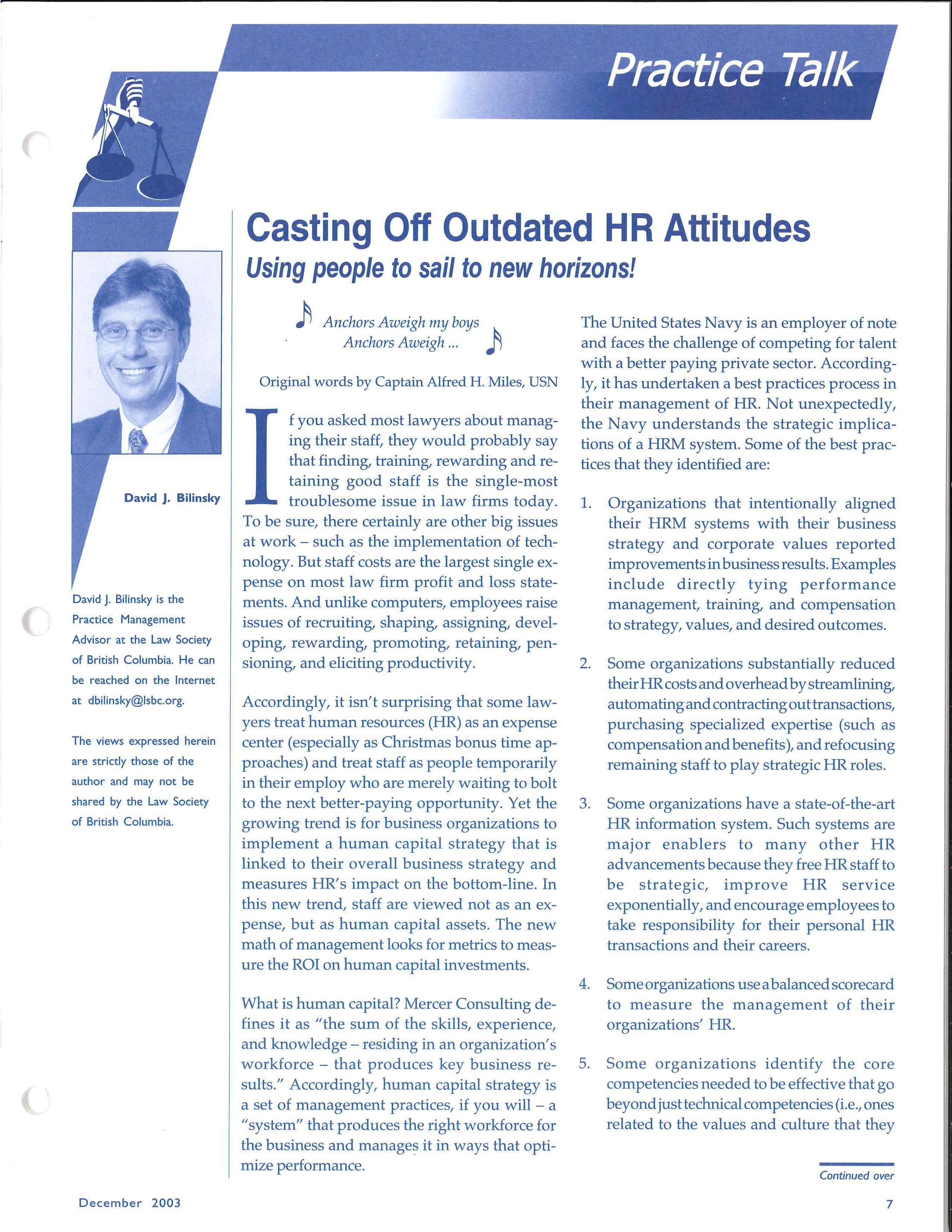
David J. Bilinsky Dav id J. Bil insky is the Practice Management Advisor at the Law Society of British Co lumbia He can be reached on the Internet at dbilinsky@lsbc org
The views expressed herein are str ictly those of the author and may not be shared by the Law Society of British Co lumbia.
Casting Off Outdated HR Attitudes Using people to sail to new horizons!
Anchors Aweigh my boys Anchors Aweigh ,) 1
Original words by Captain Alfred H.
Miles, USN
f you asked most lawyers about managing their staff, they would probably say that finding, training, rewarding and retaining good staff is the single-most troublesome issue in law firms today. To be sure, there certainly are other big issues at work - such as the implementation of technology. But staff costs are the largest single expense on most law firm profit and loss statements. And unlike computers, employees raise issues of recruiting, shaping, assigning, developing, rewarding, promoting, retaining, pensioning, and eliciting productivity.
Accordingly, it isn't surprising that some lawyers treat human resources (HR) as an expense center (especially as Christmas bonus time approaches) and treat staff as people temporarily in their employ who are merely waiting to bolt to the next better-paying opportunity. Yet the growing trend is for business organizations to implement a human capital strategy that is linked to their overall business strategy and measures HR's impact on the bottom-line. In t h is new trend, staff are viewed not as an expense, but as human capital assets. The new math of management looks for metrics to measure the ROI on human capital investments.
What is human capital? Mercer Consulting defines it as "the sum of the skills, experience, and knowledge- res i ding in an organization's workforce - that produces key business results." Accordingly, human capital strategy is a set of management practices, if you will -a "system" that produces the right workforce for the business and manages it in ways that optimize performance.
The United States Navy is an employer of note and faces the challenge of competing for talent with a better paying private sector. Accordingly, it has undertaken a best practices process in their management of HR. Not unexpectedly, the Navy understands the strategic implications of a HRM system. Some of the best practices that they identified are:
1. Organizations that intentionally aligned their HRM systems with their business strategy and corporate values reported improvements in business results. Examples include directly tying performance management, training, and compensation to strategy, values, and desired outcomes.
2. Some organizations substantially reduced their HR costs and overhead by streamlining, automating and contracting outtransactions, purchasing specialized expertise (such as compensation and benefits), and refocusing remaining staff to play strategic HR roles.
3. Some organizations have a state-of-the-art HR information system. Such systems are major enablers to many other HR advancements because they free HR staff to be strategic, improve HR service exponentially, and encourage employees to take responsibility for their personal HR transactions and their careers.
4. Some organizations use a balanced scorecard to measu r e the management of their organizations' HR.
5. Some organizations identify the core competencies needed to be effective that go beyond just technical competencies (i.e., ones related to the values and culture that they
LAP
Lawyers Assistance Program
LAP provides confidential support, counselling and referrals for lawyers, their families, support staff, judges and students suffering from alcohol and/or chemical dependency, stress, depression or just about any type of personal problem
For assistance or information on meetings and resources please call 604-685-2171 or toll free 1-888-685-217 1
The LAP office address is 415-1 08 0 Mainland Street, Vancouver, B.C. V6B 2T4.
Visit LAP on the Internet at www.lapbc com
Practice Talk
Continued from poge 7
want); they then select, promote, and develop people for these competencies.
6. Line managers have a primary responsibility for the state of human resources in the organization; HR managers are there to support them in this effort. Succession planning is taken seriously and focuses on the future needs of the organization. People are coached, developed, and tested in a variety of assignments. They often receive 360-degree feedback to help in development and measure progress.
7. Continuous learning is an integral part ofthe organization's culture, both for the individuals and for organization-wide development. Excellent organizations feel the imperative of continuous learning and act to make it happen.
What is perhaps remarkable in this document is the finding that the Navy needs "to build systems that fit Sailors and Marines rather than tr ying to make Sailors and Marines fit systems ." How often in the legal setting are we looking for people to fit jobs rather than building systems to use the best talents of people? And if the Navy can do this, surely law firms can become less regimented!
Here are some of the Navy's Task Force recommendations for getting under way: •
Cross-cutting Issues: Recruiting, retention and career paths are of such magnitude and so important that they should be strategic considerations in any discussion of HRM.
Continue HR Best Practices: The provisioning of HR best practices information is a priority concern of senior leadership.
Determine Strategic Direction: Improving human resource management starts with strategic planning. The need to focus on longer-term issues was identified.
Develop HR Professionals: TheNavyneeds HR professionals who understand the new roles and responsibilities ofhumanresource management. Theywilllookforpeoplewith the ability to adopt new roles, utilize modern information technology, and recruit I develop new members with organizational development, industrial psychology, and business management education and/ or experience.
Develop a Balanced Scorecard:
Organizations need to develop a balanced scorecard; first, to establish the set of leading and lagging indicators that reflect the health of the organization in terms of its strategic intent and, second, to focus accountability for achieving those ends. They also recommend studying human resource accounting techniques to learn more about managing people as assets instead of costs.
Exploit New Technology To Improve Quality of Work and Quality of Life: The edge in successful competition(e.g., the "war for talent") goes to those who seize opportunities and act. Technology can be used to improve personnel effectiveness and satisfaction. The DoN can either choose to adopt these in a measured fashion or to be a proactive, early adaptor. Leadership seizing the initiative is one way to show that people do come before platforms.
Support a Culture of Change: Current leaders need to understand the implications of change, need to become risk-takers, and should provide encouragement and support for trying new approaches. An effective future HRM system will be flexible and adaptive; specifically, authority must be delegated so that the organization can align its set of policies and practices with its mission and its changing environment.
By abandoning anchoring mindsets, by viewing HR as an investment that pays off over the long term and by adapting a position to a person's skill, experiences and knowledge rather than the person to the position, we then chart a strategic course to new horizons. •
Stuart Rennie
St ua rt Re nn ie is t he C BA BC Leg is lat ion & Law Refo r m Offi cer. He ca n be reache d at 60 4-949-149 0 (e-ma il srenn ie@b c cba. o rg)
Every effort is made to ensure the accuracy of the infor mation provided to you in this article but the information shou ld not be relied upon. Lawyers shou ld refer to the specific legis lat ive or regu latory provision. You will see a reference in some cases to the number of the Bill when it was introduced in the House This number may be different from the chapter number of the new Act which is quoted after the title of the Act and which is the proper citation for the Act. The Bill Number has been given to you to make it easier for you to note up the Bills you may have in your library.
A full Legislative Update is available to all Canadian Bar Association, B C. Branch members online at www .bccba.org. Listed below is a brief synopsis of legislative change introduced between the period September 5 to October 31 , 2003 Bills may be reviewed online at www.legis.gov.bc .ca
ACTS IN FORCE
Attorney General Statutes Amendment Act, 2002, s.B .C. 2002, c. 37 (Bill46)
Summary: B.C. Reg. 363 I 2003 amends B.C. Reg 217/2003 to change the date for section 3 of the Act to come into force . The new date for section 3 to come into force is February 1, 2004. Section 3 permits discounted payments for traffic violation fines paid within 30 days .
In Force: Section 3 in force February 1, 2004
Summary: BillS replaces the Foresters Act with a statute which will continue to regulate practice and standards for professional foresters and registered forest technologists. Sections 35 and 36 of Bill 35 make consequential amendments to the Foresters Act and Freedom of Information and Protection of Privacy Act
In Force: Sections 35 and 36 are in force November 5, 2003
Business Number Act, s.B.c. 2003, c. so (Bill36)
Summary: Sections 1 to 15 provide for the adoption of a business number as a common business identifier for B C. businesses
In Force: Sections 1 to 15 in force October 24, 2003
See R egulations To Note and Reports Available
Health Services Statutes Amendment Act, 2003, s.B.C. 2003, c. 33 (Bill33)
Summary: Sections 3 to 8 of Bill 33 amend the Hospital Insurance Act to: add new defini t ions of "Nisga'a Nation", the "PHSA" (Provincial Health Services Authority) and provide for annual payments for general hospital services by government to the Nisga'a Nation, the PHSA and regional health boards.
In Force: Sections 3 to 8 in force October 23, 2003
Community Care and Assisted Living Act (Bill 73), S B.C. 2002, c 75 (Bill 73)
Summary: Section 24 designates a person to be the assisted living registrar under the Act.
In Force: Section 24 in force October 3, 2003
Health Services Statutes Amendment Act, 2003, s B C. 2002, c. 16 (Bill18)
Summary: Sections 1 to 8 amend the Hospital Insurance Act to make consistent the rules between the Hospital Insurance Act and the Medicare Protection Act to grant coverage to individuals who would not otherwise be eligible for medical services, including individuals who are close to meeting residency requirements .
In Force: Sections 1 to 8 in force October 23, 2003
Foresters Act, s .B.c. 2003, c. 19 (BillS)
Miscellaneous Statutes Amendment Act, 2003, S.B.C. 2003, c. 7 (Billll)
Legislative Update
Continued from page 9
Summary: Bill 11 amends 22 statutes and repeals 11 statutes Section 8 repeals the Cattle (Horned) Act. Section 19 amends the Farm Practices Protection (Right to Farm) Act to redefine "board" to denote a provincial board under the Natural Products Marketing (B.C.) Act. Section 20 amends the Farm Practices Protection (Right to Farm) Act to rename a heading to Part 3 of the Act. Section 21 repeals a provision of that Act that established the Farm Practices Board. Section 22 repeals provisions that permitted the former British Columbia Marketing Board to provide the Farm Practices Board with administrative and other services. Section 24 amends the Freedom of Information and Protection of Privacy Act in Schedule 2 to eliminate references to the British Columbia Marketing Board and Farm Practices Board and replace them both with references to the British Columbia Farm Industry Review Board. Section 45 amends the Natural Products Marketing (B.C.) Act to redefine "board" to mean the British Columbia Farm Industry Review Board. Section 46 amends that Act to eliminate the British Columbia Marketing Board and replace it with British Columbia Farm Industry Review Board. Section 47 eliminates the power of a marketing board to appoint a marketing agency. Section 48 removes reference to a marketing agency and replaces it with a reference to a designated agency. Section 49 eliminates the power of a marketing commission to appoint a marketing agency. Section 50 amends the Public Sector Employers Act to eliminate the reference to the British Columbia Marketing Board and replace it with a reference to the British Columbia Farm Industry Review Board. Section 70 is a transitional provision.
In Force: Sections 8, 19 to 22, 24, 45 to 50 and 70 in force November 1, 2003
REGULATIONS TO NOTE
Business Number Act, creates the Business Number Regulation (effective October 24, 2003, B.C. Reg. 38812003)
Community Charter, Local Government Act and Vancouver Charter, all amend B C. Reg
380 I 93 (Local Government Elections Regulation) (effective on the date that section 120 (Oath or affirmation of office) of the Community Charter, S.B.C. 2003, c. 26, comes into force, B.C. Reg. 36512003)
Court Rules Act, amends B.C. Reg. 261193 (Small Claims Rules) to make Victoria a mediation registry (effective October 24, 2003, B.C. Reg. 37312003)
Securities Act, creates the National Instrument 51-101(Standards of Disclosure for Oil and Gas Activities), amends B.C. Reg. 378196 National Instrument 13-101 (System for Electronic Document Analysis and Retrieval (SEDAR)) regarding oil and gas reports, amends B.C. Reg. 42412000 National Instrument 44-101 (Short Form Prospectus Distributions) regarding oil and gas reports, amends B.C. Reg. 16512001 National Instrument 45-101 (Rights Offerings) regarding the application of the National Instrument 51-101 (Standards of Disclosure for Oil and Gas Activities), amends B.C. Reg . 26912001 Multilateral Instrument 45-102 (Resale of Securities) regarding the application of the National 51-101 (Standards of Disclosure for Ozl and Gas Activities), amends B C. Reg. 343198 National Instrument 71-101 (The Multi-jurisdictional Disclosure System) in section 11.3 by striking out "National Instrument 43-102 Guide for Engineers and Geologists submitting Oil and Gas Reports", amends B.C. Reg. 344198 Rule 71-801 (Implementing the Multi-jurisdictional Disclosure System under National Instrument 71-101) amends B.C. Reg. 194197, Securities Rules to repeal sections 109 (Property report for natural resource issuer) and sections 110 (Property report certificate concerning natural resource issuer) (all effective September 30, 2003, B C. Reg 34212003).
NEW BILLS TO NOTE
Information is current at the time of preparing this article: October 31, 2003. Lawyers should refer to the original version of the specific Bill for its current status at First, Second or Third Reading or Royal Assent.
(Chart ered) Act, including to: clarify and expand the powers and duties of th e council to self-regulate the institute and expand the institute's power to enter into education arrangements and establish new classes of membership .
In Force: By regulation
Business Corporations Amendment Act (No.2), 2003, (Bill86)
Summary: Further to the government's plan to implement the Business Corporations Amendment Act, 2003 (Bill 60) in the Spring 2004, Bill 86 amends the Business Corporations Act, including to replace some 15 sections of the current Bill 60 and to correct errors and clarify the application of provisions
In Force: By regulation
Columbia Basin Trust Amendment Act, 2003 (Bill 79)
Summary: Following the government's Core Services Review process, Bill 79 amends the Columbia Basin Trust Act including to : restructure the board of directors for the trust, link remuneration of the trust directors to directives of the Treasury Board, eliminate the duty to appoint one or more advisory committees, eliminate provisions relating to conflict of interest for directors, eliminate provisions relating to the submission and inspection of the trust's financial records, and the examination of the trust's financial and accounting operations .
In Force: By regulation
Community Charter Transitional Provisions, Consequential Amendments and Other Amendments Act, 2003, S B C. 2003, c. 52 (Bill 76)
Summary: Bill 76 replaces Bill 67 (First Reading Ma y 27, 2003). Bill 76 makes transitional provisions, including to : bylaws; regulations;
land; areas ; tax e s; and exemptions regarding th e Community Charter, S B C. 2003, c 26 (Bill 14). Bill 76 make s consequential amendments to 100 statutes . Bill 76 make s other amendments to the Community Charter.
In Force: By regulation subject to specified provisions coming into force on specific date s or retroactively
Health Professions Amendment Act (No. 2), 2003, (Bill81)
Summary: Bill 81 amends the Health Profe ss ion s Act to add a new Part 2 2 governing pharmacists and to make the contravention of dutie s governing the disclosure of patient record information an offence
In Force: By regulation
Local Government Bylaw Notice Enforcement Act, S B C. 2003, c 60 (Bill65)
Summary: Bill 65 creates local government dispute adjudicative systems to administer minor bylaw disputes. Subject to the regulations, local government s may designate bylaw contraventions which may be dealt with by bylaw notices under Bill 65 Local governments mu s t establish a bylaw notice dispute adjudication system Adjudicators, to be appointed by the deputy attorney general, will determine the disputes Collection by local governments of bylaw notice penalties is permitted, with amounts owing enforced as Provincial Court judgments.
In Force: By regulation
Motor Dealer Amendment Act, 2003, S.B.C. 2003, c. 61 (Bill74)
Summary: Bill 74 amends the Motor Dealer Act to permit the Minister to delegate authority to administer the Act to the appointed Motor Dealer Council of B.C. Bill 74 al so amends the Act to increase the regulation-making power for the licensing of salespersons
New Civil Trial Juror Fees
On Apri l I, 2003 the fees paid to jurors in criminal tria ls were raised in recognition that lengthy tria ls are occu r ring w ith increased frequency , and a long trial imposes a greater financia l hardsh ip on jurors than does a short trial
On November 3, 2 003 the fees paid to jurors by litigants increased to match those paid to jurors in crim ina l trials The new fee schedule provides $20 per day for the first I0 days of tria l, $60 per day fo r days I I to 49 and $ 100 per day for days 50 and thereafter.
Legislative Update
Continued from page I I
In Force: By regulation
Pacific National Exhibition Enabling and Validating Act (Bill83)
Summary: Bill 83, among other things, provides the City of Vancouver with the authority to appoint board members to the PNE board of directors. Bill 83 holds that, all previous actions and activities undertaken at Hastings Park since the Crown grant in 1889 to October 10, 2003 are conclusively deemed to have been done or undertaken, as the case may be, in accordance with the trust condition.
In Force: Specified sections deemed to have come into force on October 10, 2003 and January 1, 2004, respectively, and these are retroactive. Other specified sections come into force by regulation.
Pharmacy Operations And Drug Scheduling Act (Bill 82)
Summary: In May 2003, the government introduced the Pharmacists, Pharmacy Operations And Drug Scheduling Amendment Act, 2003 (Bill 54) Bill 54 is withdrawn and replaced by Bill 82. Bill 82 regulates pharmacy licenses, operations and inspection matters to be administered by the College of Pharmacists, transfers the regulation of pharmacy from the Pharmacists, Pharmacy Operations and Drug Scheduling Act to the Health Professions Act. Bill 82 also transfers the responsibility for managing requests to access the PharmaNet database (containing patient record and general drug information) from the College of Pharmacists to a new PharmaNet stewardship committee within the Ministry of Health Services.
In Force: By regulation
Police Complaint Commissioner Enabling and Validating Act, 2003 (Bill 80)
Summary: Bill 80 validates the appointment and actions of the current police complaint commissioner, the appointment of whom was incorrectly executed by Royal Commission, rather than by Order in Council as required by the Police Act.
In Force: On Royal Assent
Private Managed Forest Land Act
(Bill88)
Summary: Bill 88 repeals the Forest Land Reserve Act. While eliminating forest land reserves, Bill88 also establishes the Private Managed Forest Land Council. This Council will make regulations about forest practice standards that apply on privately owned forest land if the owner of the land has submitted a management commitment in respect of the land.
Summary: Bill 73 amends 13 statutes, including amendments to the: Assessment Act to add a definition of "revised assessment roll", Assessment Authority Act to eliminate the rule that the authority obtain the prior approval of the Minister before acquiring, holding or disposing of property, Community Charter to make consequential amendments as a result of the amendments to the Assessment Act made by Bill 73, Land Act to: give the Minister authority to refuse to receive an application for Crown land in specified circumstances. Bill 73 also amends the Land Title Act, including to add sufficiency and condition of highways on adjoining land as a requirement of subdivision approval. In a proceeding for the recovery of damages sustained through the deprivation of land, the limitation period is decreased from six years after the deprivation occurs to three years after the deprivation is discovered by the claimant
and in an action against the Attorney General for negligence or fault of the registrar, the limitation period is decreased from six years from the time the loss or damage occurred to three years after the loss or damage is discovered by the claimant. Bill 73 also amends the Sustainable Resource Management Statutes Amendment Act, 2002 to repeal a not-in-force provision in the Water Act and the Water Act to provide regional water managers with greater authority
In Force: On Royal Assent except for specified sections which come into force by regulation. Section 51 (Local Government Act) and section 83 (Amendment to Bill73) may be repealed by regulation. Section 86 (Confirmation and validation of B.C. Reg. 411/95 (Classification of Land as a Farm Regulation)) is deemed to have come into force on September 29, 1995 and is retroactive
Tenancy Statutes Amendment Act, 2003 (Bill
77)
Summary: Bill 77 amends the Manufactured Home Park Tenancy Act and the Residential Tenancy Act. Both of these statutes are not in force and come into force by regulation. Amendments to the Manufactured Home Park Tenancy Act include to: change the definition of "tenancy", amend rights of the tenants and landlords, require that a dispute that is linked substantially to a matter that is before the Supreme Court be submitted for arbitration, and eliminate the power to make regulations allowing simultaneous three-year rent increases.
Amendments to the Residential Tenancy Act include to : change the definition of "tenancy", expand the authority of the landlord to restrict pets not only in the rental unit but also on the residential property, require the landlord and tenant together to inspect the condition of the rental unit, amend rights of the tenants and landlords, require that a dispute that is linked substantially to a matter that is before the Supreme Court be submitted for arbitration and eliminate the power to make regulations allowing simultaneous three-year rent increases
Summary: Bill 87 amends the Unclaimed Property Act including to: add a definition of "unclaimed court funds" and include unclaimed court funds within the meaning of "unclaimed money deposit", require the administrator to make reasonable efforts to find every potential claimant to unclaimed court funds that are paid to the administrator, that meet or exceed a prescribed amount, set by regulation, and require the administrator to pay unclaimed court funds to a claimant only if a court determines that claimant is entitled to those funds . Bill 87 also permits regulations to be made to regulate unclaimed court funds after consultation with the judiciary and the recommendation of the Attorney General.
In Force: On Royal Assent
Youth Justice Act (Bill63)
Summary: Following the new Canadian Youth Criminal Justice Act, S. C. 2002, c. 1 (in force April I, 2003) which replaced the federal Youth Offenders Act, Bill 63 repeals and replaces the Young Offenders (B.C.) Act. Bill 63 regulates offence proceedings against young persons, youth probation officers and youth justice staff, youth justice programs and youth custody . Bill 63 also creates new offences or dispositions regarding the offences to: take contraband in or trespass of a youth custody centre or a correctional centre, unlawfully assist, aid or counsel a patient in leaving a mental health facility and trespass on school grounds.
In Force: By regulation
REPORTS AVAILABLE
2003/2004 Follow-up of Performance Reports (October 2003). Source: Auditor General. Available at: bcauditor.com/ AuditorGeneral.htrn
B.C. Single Business Number Project Progress Report (October 2003). Source: Ministry of Competition, Science and Enterprise. Available at: www.cse gov.bc ca/SBNP I reports_and_
Wrap It Up!
The Young LawyersVictoria Section w ill wrap gifts on December I0 and 17 in support of Mustard Seed, a charity which provides food bank and dropin services in Victoria
If you have something you 'd liked wrapped, please stop by the tab le at the Bay Centre, (first floor, underneath the esca lator s) between 5 and 9 p m Wrapping service is by donation.
Legislative Update
Continued from page 13
publications.htm
British Columbia Hydro and Power Authority Heritage Contract Inquiry (October 2003).
Source : Ministry of Energy and Mines. A vailable at : www.bcuc.com/Current_lnfo/BCH_ Heritage.htrnl.
Status of Treatment Injuries Discussion Paper (October 2003) Source: WCB. Available at: http: I I worksafebc.com I law_and_policy I consultation/ policy /law _40_10_180 asp. •
CBA at Supreme Court of Canada Intervention on
solicitor-client privilege
On November 12, the CBA intervened at the Supreme Court of Canada in a case involving issues of privilege and confidentiality under s . 9 of the Quebec Charter
In the case of Ville de Montreal c La Societe d'energie Foster Wheeler Ltee , Foster Wheeler sued the municipality for breach of contract when certain contracts were terminated. It sought to force the municipality to reveal confidential reports from lawyers advising on the contracts. The city objected to the lawyers being
asked to give evidence on their communications and advice in the matter, taking the position that this was precluded by professional confidentiality, given the purpose of the communication. The subpoenas were quashed by Quebec Superior Court, but reversed by the Court of Appeal.
The CBA extends its thanks to Denis Jacques of Grondin, Poudrier, Bernier in Quebec Ci!Y who acted as pro bono counsel for the CBA. •
National Sections Meet Department of Justice
This year's 15th annual Canadian Bar Association National Sections/Department of Justice conference brought key members of National Sections together with their counterparts at the federal government.
"These sessions result in a constructive exchange of views and priorities that inform both sides and bring us all closer to a better understanding of our legislative system," said national second vice-president Brian Tabor in his welcoming speech.
MEETING HIGHLIGHTS
• The Environmental Law Section opened its doors to any Section member who wanted to attend. Thirty-three members took up the offer and participated in discussions.
• Privacy Law Section members took advantage of the trip to Ottawa to meet with the Privacy Commissioner's Office .
• The Aboriginal Law and Alternative Dispute Resolution Sections met with the Minister responsible for residential schools to share their concerns.
• The Citizenship and Immigration Law Section met with their Justice counterparts to work together to develop a program for next spring's Immigration Law CLE.
More than 200 participants attended the oneday conference that was part of a three-day program including an orientation for National Section executives and the first ever get-together of CBA National Conference chairs •
Parking Tickets By E-Mail?
es - under the new Local Government Bylaw Notice Enforcement Act (the "Act"), if you haven't paid your parking fees, you may find that there is a parking ticket in your Palm Pilot e-mail (an "e-ticket") before you even leave the parking lot. Or if your dog barks all night, you may wake up to discover that you have been served (as it were) with an e-ticket.
The Act is an entirely new approach to local government bylaw enforcement. Under its provisions, minor bylaw disputes will be dealt with at the local government level instead of through the provincial court system. The Act is intended to address concerns about the expense and time involved in bylaw enforcement through the provincial court system, particularly minor bylaw infractions which are typically at the bottom of the court lists.
Municipalities can adopt the new system by: designating bylaw contraventions that can be dealt with under the new system; setting a penalty amount; establishing a time frame for paying or disputing notice of a bylaw contravention; and establishing a dispute adjudication system. The Act creates a ceiling of $500 as the maximum amount for fines or administrative penalties that can be dealt with under the new system. Matters where the amount at issue is more than $500 will continue to be resolved through the provincial court system
Municipalities may appoint "screening officers" whose function will be to review a bylaw enforcement notice before a dispute adjudication is scheduled. Screening officers will have the authority to cancel or confirm the bylaw notice and to enter into a compliance agreement with the person who received the bylaw notice . Under a compliance agreement, a person who received a bylaw notice would accept liability for the contravention and commit to an agreed-upon course of action (such as paying fines over time or keeping the dog quiet at night) .
If a compliance agreement isn't reached , the matter is referred to an adjudicator for resolution . Adjudicators will likely be private arbitrators paid prescribed fees to resolve the bylaw disputes on behalf of the municipality . The Attorney General will establish a roster of qualified adjudicators for the province and for municipalities adopting the new system.
The Act also modernizes the hearing structure for bylaw disputes by enabling hearings to take place by way of an oral hearing in person, by video conference or by telephone. The hearing can also take place and be resolved entirely in cyberspace, if available. Allowing disputes to be reso lved online is the most far-reaching aspect of the introduction of the Act Square Trade, an online dispute reso lution service provider for e-Bay, handled over 45,000 e-commerce disputes in less than a year . It would take the B C. Supreme Court more than 30 years to resolve an equivalent number of civil disputes at trial, so the potential for increased efficiency is substantial, in terms of both time and money, by moving to electronic methods of adjudication.
Under the Act, local governments that establish a bylaw notice dispute adjudication system are responsible for administering and funding the system, paying the adjudicators and paying the costs of administering the roster. The Act allows municipalities to recoup some of those costs by collecting a $25 fee from every person who is unsuccessful in a dispute adjudication hearing .
Determinations made by an adjudicator are final and although they may not be appealed, they may be reviewed on a question of law or lack of jurisdiction under the Judicial Review Procedure Act within 30 days after the determination is made.
The government has been working with the district of West Vancouver, the district of North Vancouver and the city of North Vancouver to attempt to create one new system for all three communities as a pilot project. •
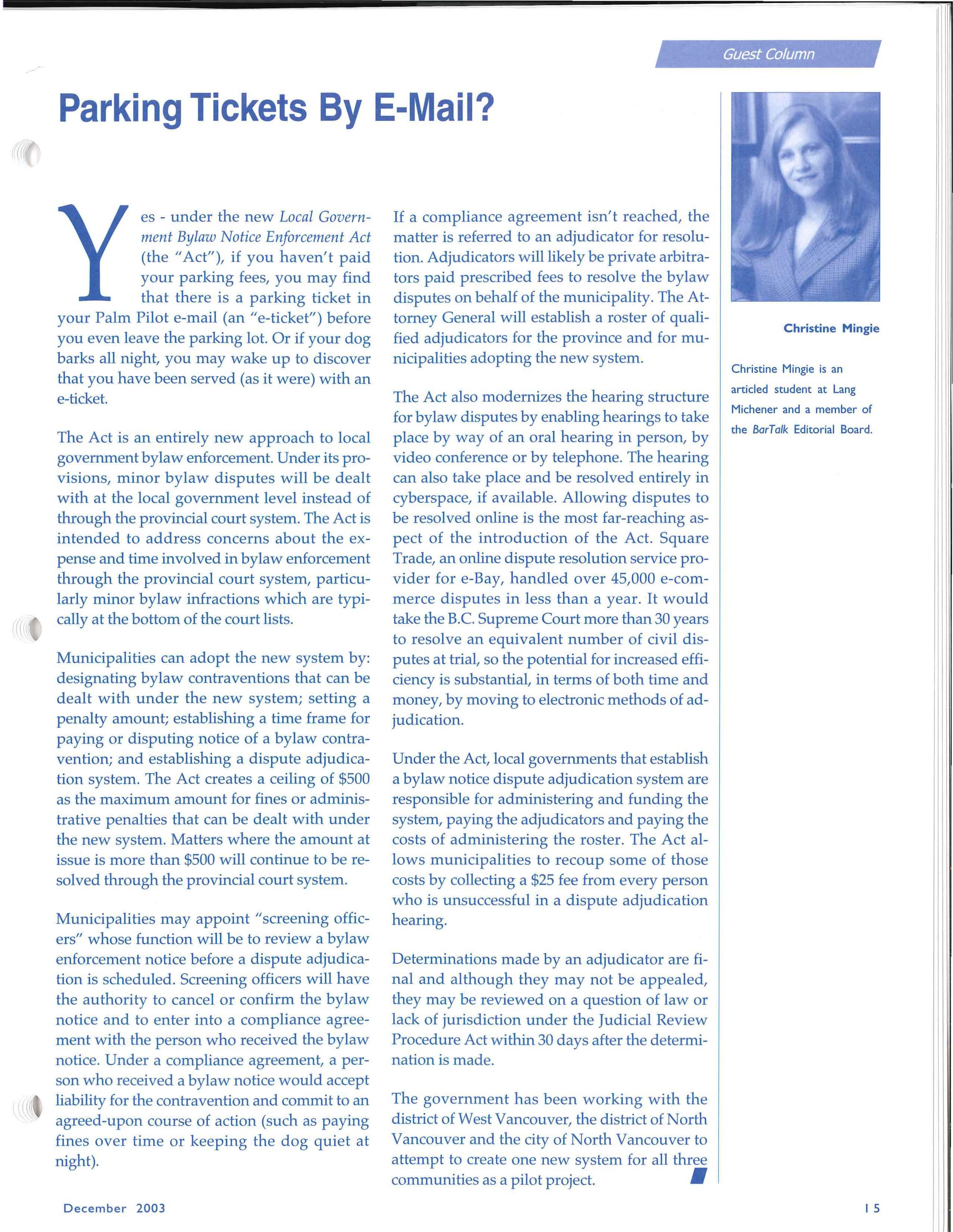
Christine Mingie
Christine Mingie is an articled student at Lang Michener and a member of the BarTalk Editorial Board
Susan Van Dyke
Susan Van Dyke, Principal, Van Dyke Marketing & Communications, is a law firm marketing consultant and can be reached at 604-876-7769 or svandyke@te lu s net.
Selling Legal Services
There's something fishy about it
kay, so you ' ve slogged through law school, your articles and perhaps a few years of practice and now you're expected to go out and bring in the big fish ,
too? Ohman.
Times have changed . Gone are the days when the streams were raging with plump salmon and all you needed to do was roll up a sleeve and reach in . Today there are fewer fish and many more rods .
When firms describe their marketing practices, they'll go on about lawyers attending events, taking clients to lunch, and so on - all the while assuring themselves they are actively practising business development techniques . Sorry, Charlie, but that's no longer enough.
Building long-term, mutually beneficial relationships with clients is done in small, easy casts, not single events. The best ones are caught at dawn, so you've got to start early. Give people a chance to get to know you and the value you bring- beyond legal advice .
Begin by thinking of ways you can help others - as in non-billable help - and your efforts will be memorable and likely rewarded. And you won't learn what you can do for someone el se by sitting alone in your office. Get out from behind your desk and get in front of clients and prospects.
So, how can I help a stranger, you ask? The process of learning what you can do for another person will lead to opportunities not normally discovered . For instance, we can share our thoughts and opinions, introduce people in our network or provide solutions to a problem or help identify goals and objectives.
And here's the kicker: it's dead easy . If I asked you to choose between introducing yourself to a stranger and selling them on your services, or instead, find a way to help that person, which method are you most likely to use? More importantly, which one will be more effective?
So, go ahead and ask a few open-ended que stions , such as:
What are your biggest challenges over the next year or so?
What are your goals?
What would you most like to change?
Whom can I connect you with?
What are your competitors doing?
How can I help you?
Answers to just two of these questions will uncover a slew of opportunities to reconnect in a helpful way later . It's often surprising just how much people will tell us. And as a lawyer - by definition, a trustworthy professional - you'll i learn more than most. By the way, a good rule of thumb is to regard the information you collect as confidential.
So now you're working on an issue together and you've offered to do something helpful. Another word of caution here : keep your promises or don't make them at all. Better yet, under promise and over deliver, but follow through. Calendarize it, etch it onto your forehead, or ask your secretary for help, but neglecting a promise will damage a budding relationship beyond repair.
Once they're hooked, keep the line tight and the contact warm. Follow-up on the issue with, "How did everything work out?" If you reach a dead end, ask another question from the list, or invite the person to an event or lunch and take along another person who will be a helpful contact for your prospect. Commit to conducting yourself in a relevant and genuine manner for a year -a whole year - on a focused list of prospects. After a y ear, re-evaluate your status with each individual, put those that didn't pan out on the backburner, and move some more fish- er, people, to the frying pan
Researching Cases on the Internet
M Practical tips and tricks
could probably count on one hand the number of lawyers who enjoy researching legal issues as much as I do If you are one of these hardy souls, and if you're already as internet savvy as , say, the average nine year old child, then you probably know these tips and more besides.
But if you prefer to minimize the time you (or your delegatees) spend researching issues, and if you haven't yet ventured beyond published digests or paid subscription databases, then read on. Here are some tips I've picked up researching cases all over North America
• The first step : find government-sponsored "court" Web sites Federal, provincial or state Web sites will generally direct you to online court decision databases, which tend to be reliable and fairly up-to-date.
• Consider material from Web sites hosted by other law firms, professional journals, and associations. Remember that anybody can slap up a Website,souseyourjudgmentand be conservative about your sources.
• When in doubt, cross -check material to ensure accuracy.
• Legislation is almost always current on government-sponsored Web sites, and may include former text versions as well. Check disclaimers for information about the scope and currency of the material.
• The higher the court, the more up-to-date the cases. Top federal courts may include online decisions that extend back 80 years or more, and are often updated on a daily basis. Provincial and/ or lower court databases generally extend back about 10 to 20 years, with updates every week. Again, check disclaimers
• British Columbia, Alberta, and Ontario provide a wide scope of online case material on their government sponsored Web sites.
Other jurisdictions, such as Nunavut, lack a strong online database. Tip: to spot-check older decisions, review recent materials and note the legislative and common law history
• If you routinely use Google or another search engine, you're probably familiar with Boolean logic; for example: "marital dissolution" AND ("insurance proceeds" OR divorce). Many databases allow you to look up specific cases by citation as well as party name(s). Be sure to document word associations, so every possibility is covered
• While reviewing cases, copy relevant quotes and toggle back and forth to your word processing program in another window, pasting quotes directly into your notes Keep printing to an absolute minimum.
• Remember to copy the citation It's no fun to find the quote that clinches your argument, only to realize later you have no idea where it came from.
• Remember to check case updates This is generally offered as a handy separate function by paid subscription sources, but needs a manual check by party name on internet databases.
• A surprising number of cases are available in out-of the way places. If nothing else works and you need to find text for a specific case, try conducting a general search by case name. I use Copernica, a meta-search engine which scans results from 14 common search engines and orders them for easy access.
• The final step is to cut, sort, and prepare your arguments. I work very fast scanning and copying information, so at the end I have a lot of material to pare down for an on-point analysis I also use a one-page "quick summary" with issues, conclusions, and jurisdictions, backed up with additional bullet points, quotes and citations •
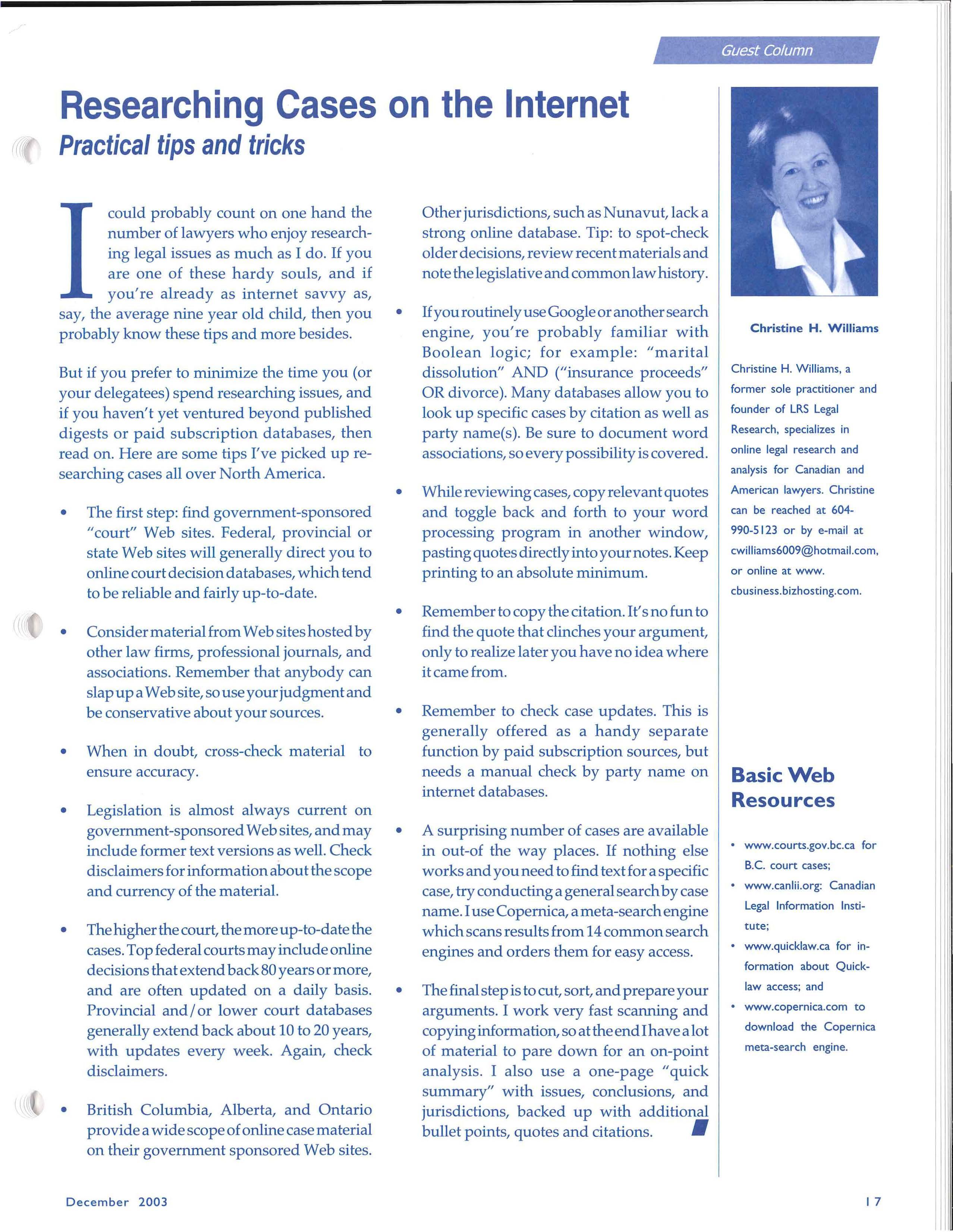
Christine H Williams, a former sole practitioner and founder of LRS Legal Research, special izes in online legal research and analysis for Canadian and American lawyers Christine can be reached at 604990-5123 or by e-mail at cw illiam s6009@hotmail com, or online at www cbusiness b izhosting com
Basic Web Resources
• www.courts gov bc ca for B C. court cases;
• www.canlii.org: Canadian Legal Information Institute; www.qu ic klaw ca for informat ion about Quicklaw access; and www.copernica .com to download the Copernica meta-search engine
Christine H. Williams
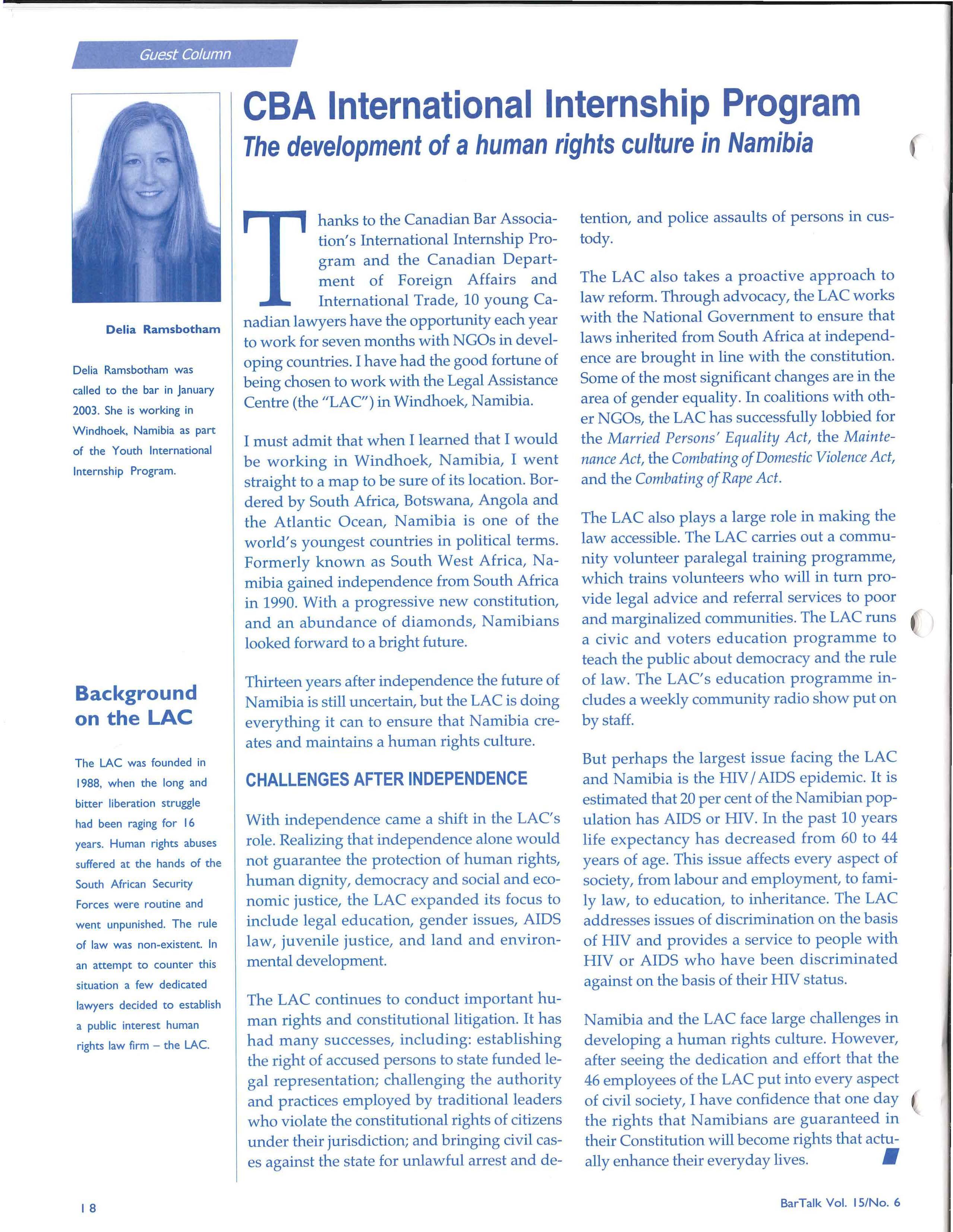
De lia Ra m sb o tham
De lia Ra ms bo tham w as
ca lled t o th e ba r in Ja nu a ry
2003 Sh e is working in Wi ndh oek, Nami bia as part
o f t he You th In ternationa l
Inte rn s h ip Progra m
Background
on the LAC
T he LA C was fo unded in 1988, whe n the long a nd bi tter liberation strugg le had been ragi ng for 16 years. Human rights abuses suffered at the hands of the South African Security Forces were routi ne and went unpunished. The ru le of law was non-ex iste nt. In a n attempt to cou nter this situation a few dedicated lawyers decided to estab lish a pub lic interest huma n rights law firm - the LAC.
CBA International Internship Program
The development of a human rights culture in Namibia
hanks t o the Canadian Bar Association's International Internship Program and the Canadian Department of Foreign Affairs and International Trade, 10 young Canadian lawyers have the opportunity each year to work for seven months with NGOs in deve loping countries. I have had the good fortune of being chosen to work with the Legal Assistance Centre (the "LAC") in Windhoek, Namibia.
I must admit that when I learned that I would be working in Windhoek, Namibia, I went straight to a map to be sure of its location. Bordered by South Africa, Botswana, Angola and the Atlantic Ocean, Namibia is one of the world's youngest countries in political terms. Formerly known as South Wes t Africa, Namibia gained independence from South Africa in 1990 With a progressive new constitution, and an abundance of diamonds, N amibians looked forward to a bright future.
Thirteen years after independence the future of Namibia is still uncertain, but the LAC is doing everything it can to ensure that Namibia creates and maintains a human rights culture.
CHALLENGES AFTER INDEPENDENCE
With independence came a shift in the LAC's role Realizing that independence alone would not guarantee the protection of human rights, human dignity, democracy and social and economic justice, the LAC expanded it s focus to include legal education, gender issues, AIDS law, juvenile justice, and land and environmental development.
The LAC continues to conduct important human rights and constitutional litigation It has had many successes, including : establishing the right of accused persons to state funded legal representation; challenging the authority and practices employed by traditional leaders who violate the constitutional rights of citizens under their jurisdiction; and bringing civil cases against the state for unlawful arrest and de-
tention, and police assaults of persons in custody.
The LAC also takes a proactive approach to law reform. Through advocacy, the LAC works with the National Government to ensure that laws inherited from South Africa at independence are b rought in line with the constitution Some of the most significant changes are in the area of gender equality In coalitions with other NGOs, the LAC has successfully lobbied for the Married Persons ' Equality Act, the Maintenance Act, the Combating of Domestic Violence Act, and the Combating of Rape Act.
The LAC also plays a large role in making the law accessible. The LAC carries out a community volunteer paralegal training programme, which t rains volunteers who will in turn provide legal advice and referral services to poor and marginalized communities. The LAC runs a civic and voters education programme to teach the public about democracy and the rule of law. The LAC's education programme includes a weekly community radio show put on by staff.
But perhaps the largest issue facing the LAC and Namibia is the HIV I AIDS epidemic It is estimated that 20 per cent of the Namibian population has AIDS or HIV. In the past 10 years life expectancy has decreased from 60 to 44 years of age This issue affects every aspect of society, from labour and employment, to family law, to education, to inheritance. The LAC addresses issues of discrimination on the basis of HIV and provides a service to people with HIV or AIDS who have been discriminated against on the basis of their HIV status.
Namibia and the LAC face large challenges in developing a human rights culture . However, after seeing the dedication and effort that the 46 employees of the LAC put into every aspect of civil society, I have confidence that one day the rights that N amibians are guaranteed in their Constitution will become rights that actually enhance their everyday lives •
Don't Spam Me!
Notes on the communication policy of the CBABC
confess that when I was an articled student all communication was by letter or telephone. But as we all know, over the years first came fax communication and then e-mail. We now live in a world where the volume of information that passes daily is almost overwhelming.
As well, in recent years, both as a result of changing attitudes reflected in legislation as well as the human response to the enormous volume of info rm ation being communicated, individuals more and more are jealously guarding their privacy and in some circumstances, placing limits on communication directed to them either by way of fax or electronically.
It is in that context that CBABC must operate. On the one hand, we know that our members want and need information that is relevant and timely. On the other hand, we occasionally receive grumbles fro m some members that some of the information we are sending to them, particularly electronically, is "spam."
I would like to assure you that it is the policy of CBABC to communicate only info r mation that we consider relevant and important to members. We receive and routine ly re ject requests for mass communications to members that do not fit those criteria. We also re ject requests from non-members and even some external legal organizations for lists of members' e-mail and/ or fax information.
We have adopted a policy that only in specific circumstances will we e-mail individual members directly, unless they have specifically requested that we do so in all cases. Most of our communication now is by fax and e-mai l to firms (depending on the preferred mode of communication).
Having said that, I would like to share a letter I recently received where we communicated information about an event to assist a member, Al Sutton, who was in need. The event in ques-
tion was one organized by Mr. Sutton's colleagues in the music industry. I did not see it as in any way competing or replacing assistance that may be available through the CBABC Lawyers Benevolent Fund Society, and thought it was information members would want to know. Here is the letter:
Dear Frank,
As you know Al Sutton was brutally assaulted on August 29, 2003. He was released from hospital on November 4, 2003. Al's injuries prevent him returning to practice now and remain career-threatening. He has beg un what will be a long rehabilitation process. The long term sequelae remain uncertain.
Al briefly attended the benefit dance that his friends in the music community organized November 7, 2003 . The dance was a great success and attended by about 600 people from the music and legal communities. Al was deeply moved at the outpouring of support he and his family received from his friends in music and law.
I respect your need to protect the e-mail and fax addresses of CBA members. I am very grateful for the assistance of the CBA in publishing a note about Al's circumstances and the opportunity to support a colleague. Many members attended and many more bought tickets. More importantly , the accompanying prayers, best wishes and other kind words of encouragment and support that members of the judiciary and the bar sent along were very much appreciated by Al and hi s parents. I know that Al will be thanking our colleagues personally when he is ab le.
The bar could not have learned about the need and the opportunity to support a fellow member without the assistance of the CBA. Thank you very much for helping members help members.
Sincerely,
D. Art Kewin, M.A., LL.B., CFP, CDS •
Once is never enough!
If you have changed firms , changed a ddr esses, have a new e-mai l address or phon e/fax numb er, you need to let us know. Letting the Law Society in on the secret is not enough!
Contact us at data@bccba org, phone 604687-3404 or fax 604-669960 I. (Toll free options : phone 1-888-687-3404 or fax 1-877-669-960 I).
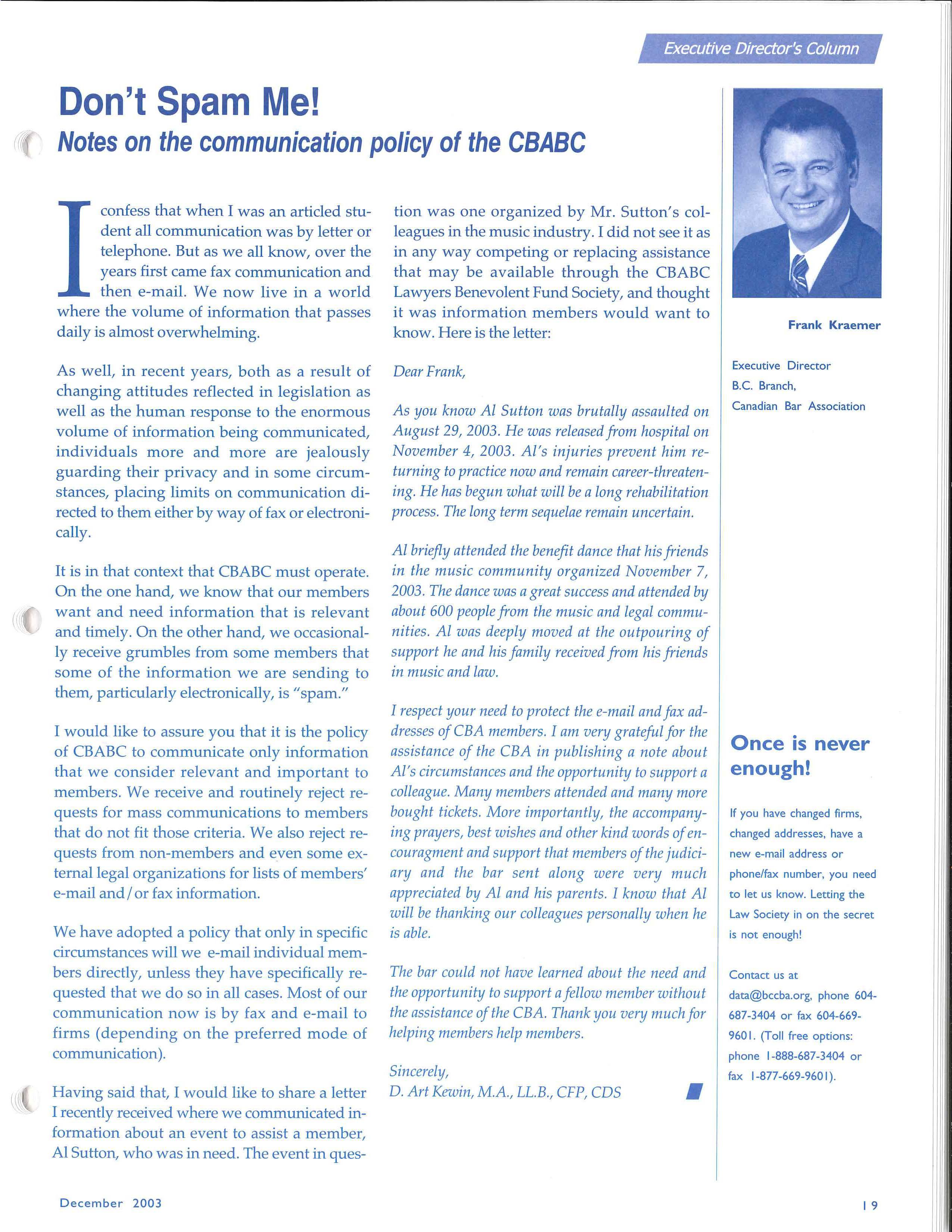
Frank Kraemer
Execut ive Director
B C. Branch , Canadian Bar Association
Lawyers Directory Online in 2004
he Canadian Bar Association, BC Branch is pleased to announce a new Lawyers Directory Web site that will go live in early January 2004. CBA members and the public will have access to information that is updated Patricia Jordan daily at www.bccbadirectory.org. Online information includes:
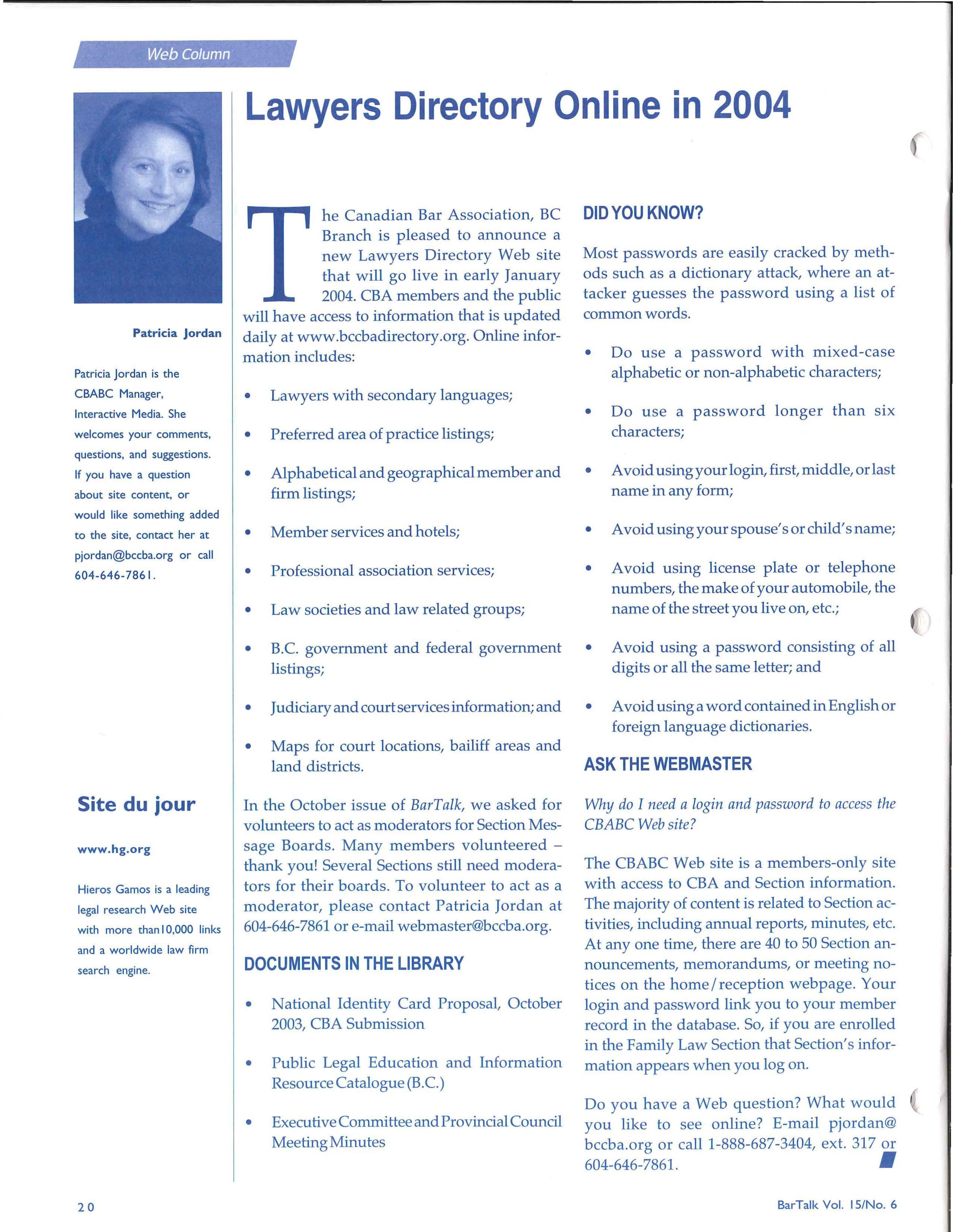
Patricia Jordan is the CBABC Manager, Interactive Media. She welcomes your comments, questions, and suggestions. If you have a question about site content, or would like something added to the site, contact her at pjordan@bccba.org or call 604-646-7861.
Site du jour
www . hg.org
Hieros Games is a leading legal research Web site with more than I0,000 links and a worldwide law firm search engine.
• Lawyers with secondary languages;
• Preferred area of practice listings;
• Alphabetical and geographical member and firm listings;
• Member services and hotels;
• Professional association services;
• Law societies and law related groups;
• B.C. government and federal government listings;
• Judiciary and court services information; and
• Maps for court locations, bailiff areas and
land districts.
In the October issue of BarTalk, we asked for volunteers to act as moderators for Section Message Boards. Many members volunteeredthank you! Several Sections still need moderators for their boards. To volunteer to act as a moderator, please contact Patricia Jordan at 604-646-7861 or e-mail webmaster@bccba.org.
DOCUMENTS IN THE LIBRARY
• National Identity Card Proposal, October 2003, CBA Submission
• Public Legal Education and Information Resource Catalogue (B. C.)
• Exe cutive Committee and Provincial Council Meeting Minutes
DID YOU KNOW?
Most passwords are easily cracked by methods such as a dictionary attack, where an attacker guesses the password using a list of common words.
• Do use a password with mixed-case alphabetic or non-alphabetic characters;
• Do use a password longer than six characters;
• A void using your login, first, middle, or last name in any form;
• A void using your spouse's or child's name;
• A void using license plate or telephone numbers, the make of your automobile, the name of the street you live on, etc.;
• A void using a password consisting of all digits or all the same letter; and
• A void using a word contained in English or foreign language dictionaries.
ASK THE WEBMASTER
Why do I need a login and password to access the CBABC Web site?
The CBABC Web site is a members-only site with access to CBA and Section information . The majority of content is related to Section activities, including annual reports, minutes, etc. At any one time, there are 40 to 50 Section announcements, memorandums, or meeting notices on the home I reception webpage. Your login and password link you to your member record in the database . So, if you are emolled in the Family Law Section that Section's information appears when you log on .
Do you have a Web question? What would you like to see online? E-mail pjordan@ bccba.org or call 1-888-687-3404, ext. 317 or 604-646-7861.
•
Viruses I Have Known
Why my partners are no longer nervous
told this little story to another lawyer I've been on a file with for the last four years, and he laughed hard enough that I decided to repeat it here, giving me an excuse to share the "virus" story province wide.
Many years ago, I articled and then practised at the old tweedy, Vancouver firm of Douglas Symes & Brissenden, where I worked with one Douglas Clarke, a man with a knack for the piano and entertaining, though borrowed oneliners. He suggested over beer and Dad's cookies one Friday night (DS & B being the only firm in North America where the beer fridge was always open but the Dad's cookies were under lock and key) that he and I forthwith leave DS & B, and start a two-man shop called "Clarke Wilson" , where we'd live off the avails of misdirected mail.
For those of you outside the Lower Mainland, there is still a firm called Clark Wilson, and my nostalgic view of life suggests that Doug was right. You see, there is no Douglas Symes anymore. It's dead. Blew up Passed on Ceased to be . It expired and went to meet its maker . It's pushing up the daisies. Its metabolic processes are now history It kicked the bucket, hopped the twig, bit the dust, snuffed it, breathed its last. Ceasing to be, it shuffled off its mortal coil, ran down the curtain and joined the bleedin' choir invisible. Bereft of life, it rests in peace, or more accurately pieces, throughout the Vancouver core Which is a sad thing because it was a fine place to practise from and had the best Christmas parties in town.
I am blamed for this death Which is an odd thing, because at least 15 y ears before its demi se, I left it for Connell Lightbody (then called Ra y Connell). So armed with this alibi, I see no rea son w h y I should someho w be blamed for DS & B' s end . I was s ome wh e re else at the time. But then again, Ra y Connell blew up t o o . But I ha v e an alibi fo r that one a s w ell. I h a d mov ed t o Ferguson Gifford .
All are gone . Connell Lightbody bit the dust in 1999, and Ferguson Gifford died the death of a thousand cuts around the same time. This is sad as well, because both were good firms filled to the gunwales with great lawyers.
I have worked at three medium sized Vancouver law firms in my 18 year career, all of which have, at some point in their lives, become resoundingly dead. I wasn't there for any of the deaths. But because I am the only lawyer to have worked at all three while they were alive, I am tainted with the brush of scandal. I am the common element that links all three deaths . Based on similar fact evidence, I am the curse, the bad news, the thing in the night, the enemy within, the trouble at the Mill, the virus. It makes my current partners nervous But because any publicity is good publicity (unless you're Martha Stewart or Michael Jackson), I have lived with it, until now.
Well, all I can say is thank God for Campney Murphy. With its unfortunate demise last summer, the curse has been broken. I never worked there I never had a file w i th anyone who worked there. I don't even think I darkened its door. The curse is lifted. I am forever in its debt.
But what surprises me about my dead and defunct law firms is the level of camaraderie that still exists between most ex-associates and expartners of my ex-firms I'm sure there's some bad blood somewhere (otherwise they ' d all be still in business). But I'm regularly invited to golf tournaments, reunions, lunches and other forms of wakes put on by my ex ' s, where people who haven't practised with each other in year s turn up and talk old times like a Shriner's con v e n tion without the hat s. Hopefull y, the alumni of Campney will learn what the respecti ve alumni of DS & B and Ferguson Gifford h ave le a rne d : ke e p hav ing th os e golf tournam ent s.
N o w that my curse h as been broken, maybe DS & B w ill s ta r t having Christm as partie s to o. •
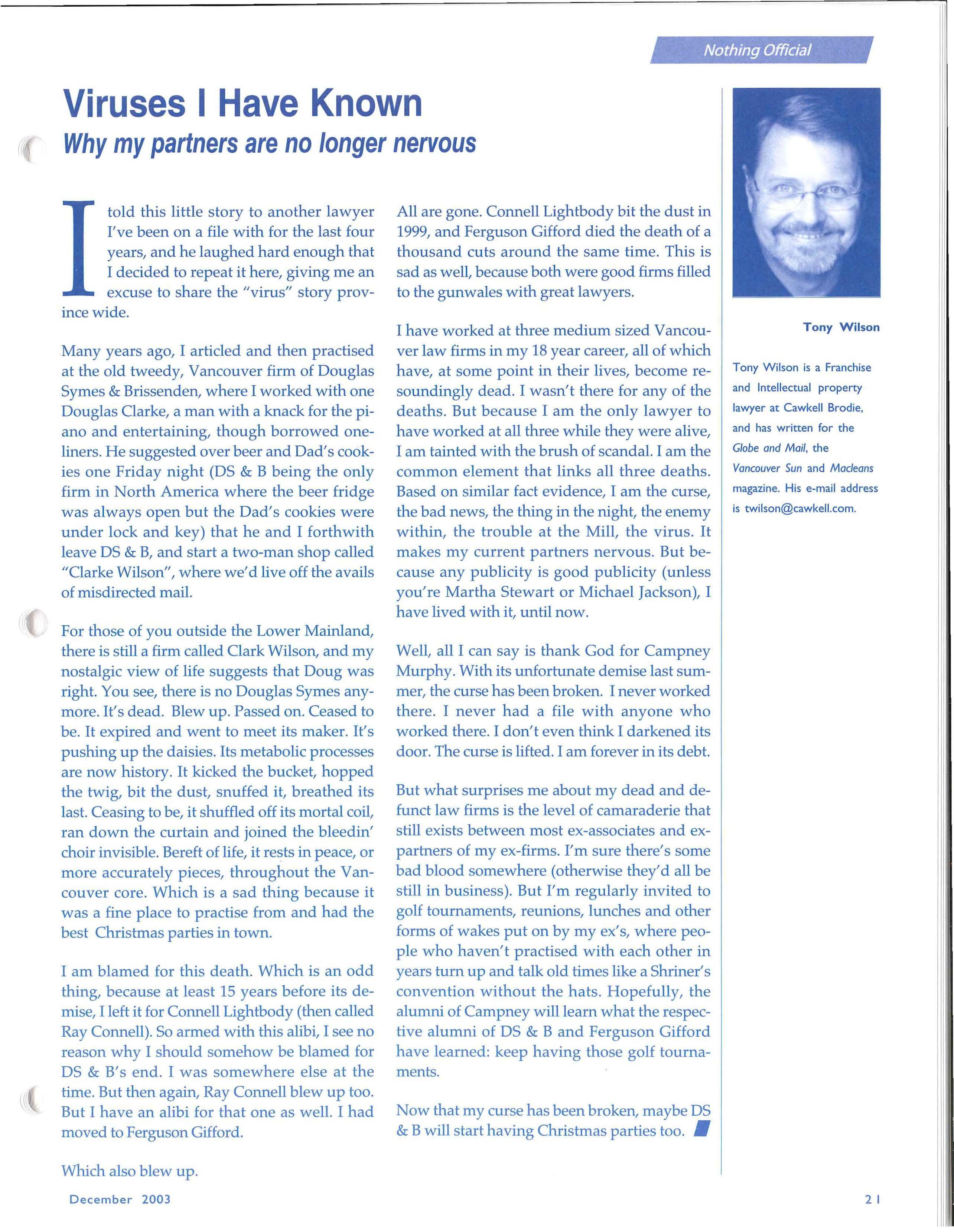
is a Franchise and Intellectual property lawyer at Cawkell Brodie, and has written for the Globe and Mail, the Vancouver Sun and Madeans magazine His e-mail address is twilson@cawkell.com
Which als o b le w up .
Tony Wilson
Tony Wilson
Two Annual Breakfasts
West Coast LEAF presents its I 7'"' Annual Equality
Breakfast on Friday, March 5, 2004 at the Hyatt Regency Hotel in Vancouver
The keynote speaker will be the Honourable Claire L'Heureux-Dube
T ickets go on sale in January. Corporate sponsorship is avai lable For details call 604-684-8772 or e-mail info@westcoastleaf.org.
LEAF presents its Annual Breakfast in Nanaimo on Saturday, February 28 , 2004 at the Dorchester Hotel , 70 Church Street. The guest speaker will be former MLA Darlene Marzari.
For ticket information call Signy Madden at 250-7418184 or e-mail signy@island net
For more information vis it www@westcoastleaf.org
UBC/CBA Mentor Reception An evening of introductions and awards
The annual UBC/ CBA Mentorship Reception was a great success this year, well attended by both students and members of the legal community. Gail Sahota, the CBA Representative at UBC, organized this year's reception with the help of the UBC Articling Committee and Career Services Office.
Special guests at the reception were Robert Brun, CBABC President, and Mary Anne Bobinski, Dean of UBC Law School.
There are 160 mentors participating in this year's program and the reception provided an initial meeting place for a number of them. Gail Sahota explained the importance of mentors to students, "Mentors are a unique and invaluable source of information to students because of their ability to provide an experienced view on the legal field and on balancing a legal career. They are a source of information that students may not otherwise have access to within the academic confines of law school."
The significance of the role played by Mentors is recognized by the Mentorship Reception, as are the accomplishments of some unique students. Kathy Grant was awarded the CBA I Department of Justice National Law School Essay Competition Prize and the Scotiabank Law Student Achievement Award. Agnes Huang, a second year law student, received the CBA Scholarship. Congratulations to both these students - may they continue their outstanding work in the future. •
Pushor Mitchell Holds "Pie A Partner" Event
"We had lots of clients who'd send a cheque and say 'I'll take 10 pies,"' said Paul Mitchell, of Pushor Mitchell in Kelowna. It was the great "Pie A Partner" event on October 24, which had staff and clients lining up to pay $5 and $20 respectively to toss a pie at one of the 12 target lawyers. Some lawyers had pies thrown at them by their own children.
Pushor Mitchell has held the "Pie A Partner" event for the past three years for the United Way, last year winning the charity's Corporate Spirit Award. This year the firm raised $13,500 for the United Way, of which about $2,000 was generated through the pie event. Congratulations to Pushor Mitchell, and to those who "took a pie" for the United Way- we thank you.
To view the " Pie A Partner" event photos, visit www.pushormitchell.com.
Kathy Grant Agnes Huang
Ron Sol mer takes one for the United Way at Pushor Mitchell's " Pie A Partner" event.
New on CBA Practicelink ...
Tips on reducing stress and retaining valuable employees
Practice Link - the CBA' s newest online member service - is regu larly updated with new articles and tips to help lawyers deal with the day - to - day issues of running a law practice. The site includes a blend of expansive guides on a variety of topics such as financial management, internet marketing and starting your own law firm, as well as quick and easy tips on getting accounts paid, what clients want, and much more.
This month on Practice Link, pick up some sanity savers and practical tips designed to relieve some of the stress that comes with working in the legal profession. From firm practice and finance tips to advice on nurturing personal relationships, this article will help you on your
way t o a less stressful and more rewarding legal prac tice.
For a quick read, be sure to check out "When Your Assets Have Feet"- an innovative look at how to develop your firm's corporate culture and retain your most valuable employees.
Coming soon to Practice Link . . . "Surviving Chaos in Times of Crisis": A disaster recovery guide for small to medium-sized law firms Plus, visit the site in December for a series of fun and useful holiday-related features.
For all this and much more, visit www.cba.org and click on "PracticeLink " •
Ad Hoc Judge A Wonder in the Workshop
While winds swirl around a Kamloops workshop, a man inside crafts trucks, trains, doll cribs and cradles, small wheelbarrows, barns and doll houses . The toys are destined for needy children near and far who dream of a new toy at Christmas.
For the past four years semi-retired Judge Terry Shupe has made toys for children in Karnloops, Croatia, Bosnia and some U S. States. The toys are delivered by Christmas Amalgamated, a Christmas charity in Karnloops
Judge Shupe's father was a carpenter who also made toys for children in need. "The toys are a family legend,"
Judge Terry Shupe (right) builds wooden toys for needy children with the help of his wife Lanni (left) and motherin-law Margaret Mcinnes (middle) says Judge Shupe "Father started many years ago but on a much smaller scale " Today, Judge Shupe builds the toys, and his wife Lanni and mother-in-law Margaret Mcinnes , paint the toys and knit or sew blankets and quilts for the tiny cradles - they also deliver the toys, along with Bob Mcinnes, Judge Shupe's father-inlaw The toys, however, are not for sale. "When
I need money I go judging," he says. "Giving toys makes me feel good. To watch my grandchildren ride the rocking horse you can't buy that."
To those who'd like to help children in need, Judge Shupe recommends , "Charity starts at home. Start giving to your community." •
Holt Renfrew Hosts Private Shopping Night
Members of the legal community and their guests decked the halls of Holt Renfrew at Vancouver's Pacific Centre for the Holiday Private Shopping Night on November 19 . Upon arrival, CBABC members received a gift bag full of
offerings from Holt's, including a $50 certificate valid towards purchases of $250 or more.
Complemented by delicious refreshments, a chic soundtrack and Holt Renfrew models displaying the season's fashions, the second CBABC Holt Renfrew Private Shopping Night of the year was a deemed great success! •
CBABC members explore Holt Renfrew gift bags, which held product samples and a $50 gift certificate valid toward purchases of $250 or more
Cariboo Bar AGM Planned for Wells
Beautiful Wells, B.C. is the site of the upcoming Cariboo Bar Association's annual general meeting February 19-22. In addition to enjoying the winter wonderland that is the Cariboo, there will be gourmet meals, wine tasting, educational activities, cross-country skiing, snow mobile tours, and a host of other activities. The Cariboo bar knows how to put on a good time; past meetings have included a Paintball Chal-
lenge, world class Yuk Yuk's stand-up comics, and guided local tours. Diarize this event and plan to attend.
For more information on the meeting, please contact Patricia Schmit, QC at Chudiak, Schmit & Company, 531 Reid Street, Quesnel, B.C. V2J 2M8 Call 250-992-8341 or e-mail
ps_law@quesnelbc.com
Lisa Ridgedale, Candice Alderson, and Nicole Ridgedale strike a fashionable pose at the Holt Renfrew private shopping night .
Mid-Winter Meeting 2004
Looking for a unique Northern experience? Want to learn about the culture, history and heritage of the Yukon? Then plan to attend the CBA's Mid-Winter Meeting of Council in Whitehorse, February 19-22, 2004.
If you're not a Council member and would like to attend, contact the B.C. Branch office for information on being named an alternate member of Council.
Participants will visit the MacBride Museum of the Yukon featuring Whitehorse history, the
Letter to the Editor
Re: Request for amusing harmless pranks, impersonations and practical jokes
I have a book going soon to publication on amusing and harmless pranks, impersonations and practical jokes by and to lawyers and other professionals in the justice system
Could I prevail on you to send on my request
YUKON CBA MIDWINTER 2004
Gold Rush, Mounties of the North, Native Cultures, and Sam McGee's Cabin. Also on the program is an evening at the Yukon Arts Centre showcasing Northern culinary treats and a fashion show withYukon First Nation traditional entertainers and drummers .
Highlighting the Council agenda is a debate on the CBA' s revised and updated Code of Professional Conduct. The new Code will contain revisions that will bring it up to date for the modern lawyer on subjects such as technology, alternate dispute resolution and rules for multi-disciplinary practices.
The Mid-Winter 2004 brochure, is posted online at: www.cba org.
that members send me their funniest prank from practice or law school?
Branch and Bar Calendar December 2003 - February 2004
December 5
December 6
December 12
December 18
January 9
January IS
January 20
February 6
February 19
February 19-22
Local & County Bar Presidents' Meeting (Richmond Delta Airport Hotel, 9:00 a.m. to 4:00 p.m.)
Provincial Council Meeting (R ichmond Delta Airport Hotel, 9:00 a.m. to 3:00 p.m.)
New West Bar Association, Annual Christmas Party (La Rustica Restaurant, New Westminster, 6:00 p.m cocktails, 7:00 p.m. dinner, Tickets: $50 Contact Ken Armstrong at 604-523-7096)
Kelowna Bar Association Meeting
Executive Committee Meeting (CBABC Boardroom)
Kelowna Bar Association Meeting
Annual Judges Dinner, hosted by New Westminster Bar Association (Sheraton Guildford, Surrey. Contact Ken Armstrong at 604-523-7096)
Executive Committee Meeting (CBABC Boardroom)
Kelowna Bar Association Meeting
CBA National Mid-Winter Meet ing (Whitehorse, YK)
To announce an upcoming event or meeting in the Branch and Bar Calendar, please call Sandra Webb at 604-687-3404 or to ll free 1-888-687-3404 (e-mail cba@bccba.org).
CLE Update
PUBLIC GUARDIAN AND TRUSTEE BREAKFAST SERIES
This series of four breakfast seminars is designed to explain the role of the Public Guardian and Trustee (PGT) under various statutes and to provide direction regarding process to those dealing with the PGT. The content of the series is based on the CLE Public Guardian and Trustee Handbook, and is planned in conjunction with the book's November 2003 update.
Session 1: January 13, 2004
Settling Minors' Personal Injury / Family Compensation Act Claims
Session 2: January 20, 2004
Guardianship of Minors and Litigation Guardianship of Parties Under Legal Disability
Session 3: January 27, 2004
Estate Issues
Session 4: February 3, 2004
Committeeship and Miscellaneous Issues Concerning Incapable Adults
For more information on this series and the Handbook, please visit www cle.bc.ca or contact the CLE customer service department at 604-893-2121 or 1-800-663-0437 •
Law Courts Education Society Project
"Developmental Disabilities and the Justice System"
Despite some positive changes in recent years, the justice system does not serve peop le with developmental disabilities well. In response to this concern, the Law Courts Education Society of B C. (the "Society) has developed an educational program to provide justice system staff with the necessary know ledge, skill sets, and resources to understand and interact with people who have developmental disabilities.
Developmental Disabilities and the Justice System: A Training Package enables police, lawyers, sheriffs, judges, court registry staff, probation officers and others to:
1. Recognize the unique justice-related needs of people with developmental disabilities;
2 . Identify a person with a developmental disability; and
3 Adapt their work routine to meet the needs of someone with a developmental disability .
To implement this unique education program across Canada, the Society is creating a national network of partners that includes justice system personnel, public legal education groups and developmental disability organizations
The Society will facilitate Train-the- Trainer workshops for partners to learn and plan how to deliver the program at local and regional levels.
Developing skills, knowledge and awareness within the justice system across Canada will help protect this vulnerable group of people who can easily become victimized and who are at risk to offend or re-offend.
The Training Package (a Facilitator's Guide and six-part video) includes information such as :
• The terminology, criteria, diagnosis and identification of a developmental disability;
• Experiences of developmentally disabled victims and offenders in the criminal justice system; and
• Effective strategies for communicating and interacting with a developmentally disabled person.
For more information on the program, or to participate in a workshop call 604-775-0209 (e-mail info@lawcourtsed.ca). •
Law Foundation of B.C. THEW LAw
FOUNJ5ATI6N
The Board of Governors of the Law Foundation is meeting from November 20 to 22, 2003. At that meeting, a new Chair of the Foundation will be elected, replacing Don Silversides, QC of Prince Rupert, whose term has ended The Law Foundation wishes to publicly thank Mr Silversides and acknowledge his remarkable contribution to the Law Foundation of British Columbia over the past eight years.
Profiles of a Law Foundation Funded Program and Project
B.C. CIVIL LIBERTIES ASSOCIATION
Founded in 1962, the B.C. Civil Liberties Association (BCCLA) is the oldest active human rights and civil liberties organization in Canada. Its mandate is to promote, defend, sustain, and extend civil liberties and human rights in B.C.
It has a vo luntary board of directors made up of individua l s from a wide range of backgrounds, including lawyers, academics, students, business people, and educators. The BCCLA board takes an active ro le in setting the policies and priorities of the organization at monthly board meetings and has active involvement in advocating civil liberties to government and private institutions, and before the courts The board of directors is supported in its work by a small, professional staff that works with board members to achieve the BCCLA's mandate. This is accomplished through casework, public education, research, law reform, and litigation.
The BCCLA's casework and educational activities provide direct service to hundreds of people each year. It provides individuals and groups who have civil liberties related concerns with information, advice, and assistance. The BCCLA assists complainants by using moral suasion.
The BCCLA provides input to all levels of government on public policy when civi l liberties are implicated. The BCCLA advocates for citizens' freedoms by making submissions during public consultations or by putting forth issues
on the public agenda. Its position papers on issues it considers are available at its Web site at www .bccla.org.
The BCCLA seeks to take legal action or intervene in precedent setting cases before the courts when all its efforts through moral suasion fail to convince the government or a group to respect civil liberties values The BCCLA is involved in a range of litigation which is achieved through the considerable contribution of lawyers who donate their time and expertise pro bono to represent the BCCLA. It has appeared before the Supreme Court of Canada, either as a principal litigant or as an intervener, nine times since 1998.
The Law Foundation has been providing core fund ing to the BCCLA since 1982. Its current grant is $134,000 per year.
B.C. PROVINCIAL COURT JUDGES ASSOCIATION
The Foundation provided $58,750 to the B.C. Provincial Court Judges Association for a pilot project Informational Handouts for Self-Represented Litigants that was completed in 2003
Under the leadership of His Honour Judge Takahashi, the Association produced four informational handouts, entitled "Court Etiquette", "Trial Preparation and Note-Taking Skills", "Basic Criminal Procedure" and "An Introduction to Legal Research and Resources " The objective of the project was to produce informational handouts for self-represented litigants to assist them in their understanding of the above four topics The material was made available to self-represented litigants in four provincial court houses in B.C. and also posted on the Provincial Court of B.C. Web site .
Project evaluators made recommendations on accessibility and distribution of the information that would be helpful for organizations interested in producing legal information for selfrepresented litigants in the future . •
BarTalk is published six times per year by the Canadian Bar Association, British Columbia Branch I Oth Floor 845 Cambie Street Vancouver, B.C. V6B 5T3
TEL: 604-687-3404
TOLL FREE in B C., outside the Lower Mainland: 1-888-687-3404
FAX: 604-669-960 I TOLL FREE in B C., outside the Lower Mainland: 1-877-669 - 960 I
This publication is intended for information purposes only and the information contained herein should not be applied to specific fact circumstances without the advice of counsel.
The Canadian Bar Association, B.C Branch represents more than I 0,000 members within British Columbia and is dedicated to improving and promoting access to justice, to reviewing legislation, initiating law reform measures and advancing and improving the administration of justice.
OF BRITIS II COWMBtA
Classified Ads WCB
Do you need help with WCB problems? Are you Plaintiffs counsel facing an ICBC Section 10 defence? ,---- 604-267-3033 -
• Extensive experience with WCB appeals
• Vice Chair at Review Board for 6 years
• Personal injury litigation for 25 years
• Available for WCB appeals , expert opinions, court applications and trials.
Vahan A. Ishkanian -
Barrister & Solicitor
Cell 604-868-3034 Fax 604-264-6133
vishkanian@pepito ca l!00-1200 W 73rd Ave Vancouver V6P 6G5
Place free ads online! www .bccba org has 2 areas to advertise. See " HR" & the " Lawyer Lounge ."
Online January 2004, buy your license today!
FOR LEASE-Vancouver law offi ce acros s fr om BC Supreme Court For a 3-4 person practice Call Ms. Lee 604-818 -9734 (lancarr @telus.net)
FURNISHED,FULLYEQUIPPEDOFFICE
SPACE WITH VIEW in downtown Vancou ver. Established boutique litigation firm has an office available in attractive premises on the 25th floor of Granville Square. Would suit individual with own practice Some referral work may be available Pay percent ofbillin g s. Call Elizabeth Liu at 604-662-3888 ore-mail eliu @ btllaw .com.
OFFICE SHARE - in beautifully appointed Yaletown law offices, with small litigation firm. Includes use of meeting room , secretarial station , kitchen and more. Pay fixed rent or percentage of billings Call Diane Dunbar at 604-662-7544 or e-mail dldunbar@ conkie-law.ca.
OFFICE SPACE available in downtown Vancouver opposite law courts . Ideal for sole practitioner. Just renovated. Call604-682-7243.
Chapters: Shake Hands With the Devil: The Failure of Humanity in Rwanda by Romeo Dallaire (1 o per cent off with CBA member card)
Vancouver Opera: "La Traviata" (CBA member price $95)
Whistler Blackcomb: Lift Tickets (Up to 20 per cent off with CBA discount)
Rogers AT & T: New Cell Phone and Plan (see insert for savings)
Barristers Bag: Top Grain Leather Handmade (CBA price $199)
: January 16
mailing date: February 6
Please direct BarTalk advertising inquiries to Sandra Webb, BarTalk Editor Tel: 604 -646-7856 Toll free : 1- 888 - 687-3404 , ext. 318 E -mail : cba @ bccba.org
Enter to Win .,.
BarTalk has a new contest open to CBA members The prize is a yoga mat and 10 classes of yoga at Bikram's Yoga College of India, located in Vancouver. The value of this prize is $165 .
To enter the contest, e-mai l cba@bccba.org with the sub j ect "BarTalk Contest" and tell us Bikram's full name All eligible entries will be entered in a draw . Contest closes December 31' 2003
About Bikram Yoga College of India
Bikram ' s Yoga College of India has certified yoga instructors and offers 75 c lasses per week The College is located at 2893 Cambie Street (604-876-9642) and 1650 Alberni Street (604-662-7722). BarTalk learned of the College when a Vancouver lawyer cal led to rave about its classes Your f i rst class at the College is free
About Bikram Yoga
Bikram yoga is practised in a very warm room (approximately 37° C) to warm muscles, allowing deeper stretching and sweating toxins f rom your skin For more information on this type of yoga, visit the College ' s Web site at www bikramyogavancouver.com