The Canadian Bar Association
British Columbia Lawyers: Prepare to Advise Your Clients
New legislation has broad implications across client groups
here is no question as to the sheer breadth and ambitious scope of the legislative agenda of the B.C. Government. It is not always proceeding with sufficient time for reflection, sober review and amendment. However, thereality for lawyers is that there exists now, or soon will be in effect, a significant body of legislation that will affect lawyers, businesses and the public.
Although some Acts relate to very narrow areas of law, there are two pieces of legislation that will affect a larger number of client groups across all areas: the new Business Corporations Act and Bill 38, the Personal Information Protection Act.
The Business Corporations Act replaces the B C. Company Act, and is the first major update of B.C. Company Law since 1973 It will require each of the almost 300,000 B.C. companies to be "transitioned" to the new Act within the next two years, or risk being struck off the Register.
For B.C. businesses, consultation with their lawyers about the new Act's provisions will help ensure that requirements are met. Lawyers practising in this area need to ensure they are prepared for the work ahead To assist, the Continuing Legal Education Society will hold a two day course, complete with a new B C. Business Corporation Practice Manual on September 22nd and 23 'd , 2003 (see www .cle.bc .ca) .
Bill38, the Personal Information Privacy Act, is a source of some controversy As of January 2004, all businesses and individuals will be governed b y the federal Personal Information Protection and Electronic Documents Act unless there is "sub-
stantially similar" provincial legislation in effect at that time. This legislation will have a significant impact on businesses, organizations and individuals.
In the B.C. Government's news release announcing Bill 38 on April 30, 2003, provincial Information and Privacy Commissioner David Loukidelis stated that the new Act would provide British Columbians with "broader coverage than the federal act" and would be "less complex." The accompanying backgrounder stated that "The federal act contains significant gaps in privacy protection for B.C. citizens. For example, it cannot cover employment records held by B.C. companies or personal information held by non-profit societies."
On May 6, 2003, the federal Privacy Commissioner, George Radwanski, publicly issued a lengthy letter to Minister of Management Services Sandy Santori, in which he stated that the legislation as proposed has "grave deficiencies" that, in his opinion, would make it impossible for him to recommend it as "substantially similar" to the federal legislation. This came as a major surprise to the B.C. Government and the many B.C. lawyers who consulted on and/ or helped draft the new legislation.
On May 14, House Leader Gary Collins announced that only 10 of the many remaining bills currently before the House would be passed in the Spring Session; the remainder would remain on the order papers until the Fall session Bill38 was not among the 10 •
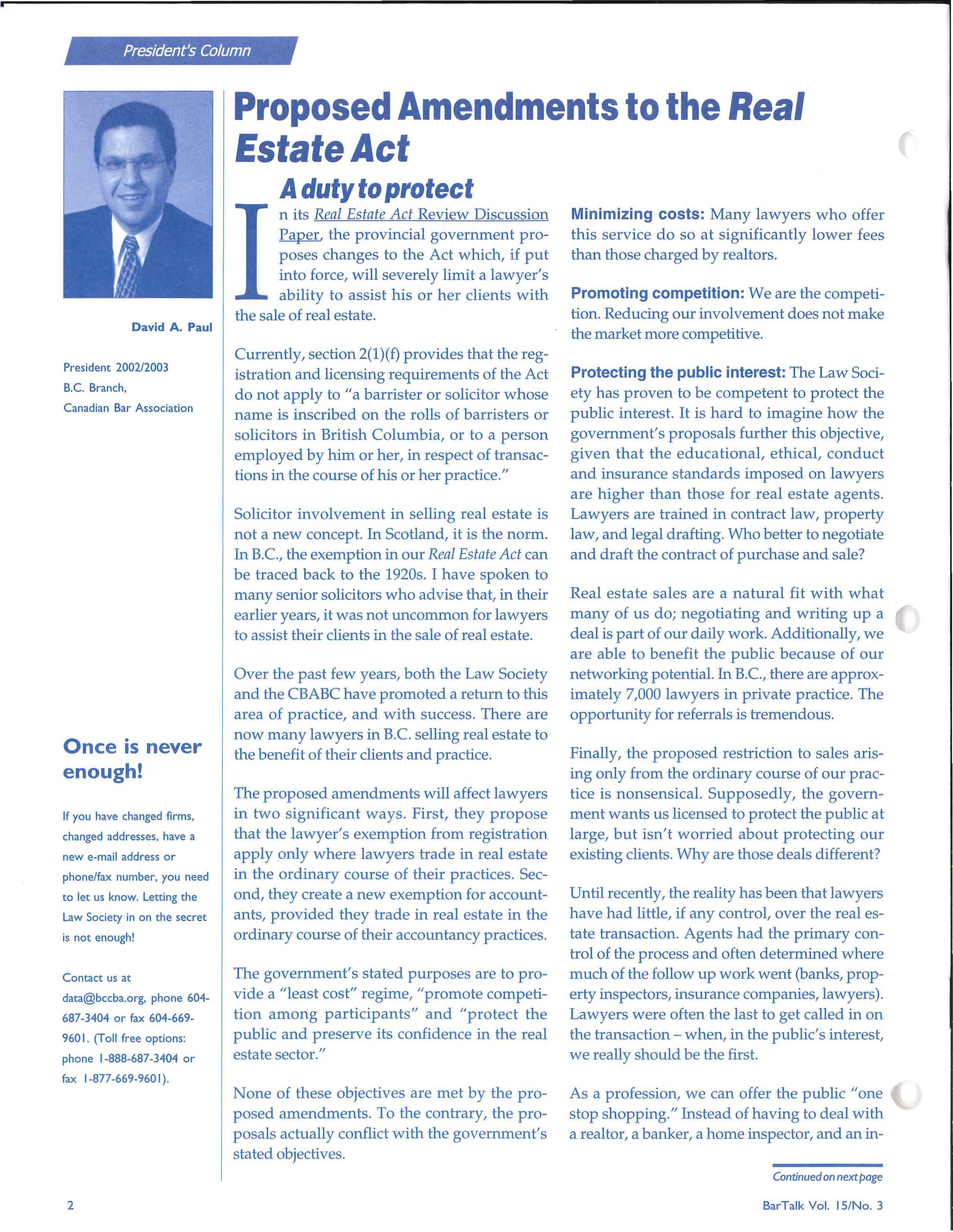
David A. Paul
Pres ident 20 02/2003
B.C. Branch, Canadian Bar Associat ion
Once is never enough!
If you have changed firms, changed addresses , have a new e-mai l address or phone/fax number , you need to let us know. Letting the Law Society in on the secret is not enough!
Contact us at data@bccba.org, phone 604687-3404 or fax 604-669960 I. (Toil free options: phone 1-888-687-3404 or fax 1-877-669 -960 I).
Proposed Amendments to the Real Estate Act
A duty to protect
n its Real Estate Act Review Discussion Paper, the provincial government proposes changes to the Act which, if put into force, will severely limit a lawyer's ability to assist his or her clients with the sale of real estate.
Currently, section 2(1)(£) provides that the registration and licensing requirements of the Act do not apply to "a barrister or solicitor whose name is inscribed on the rolls of barristers or solicitors in British Columbia, or to a person employed by him or her, in respect of transactions in the course of his or her practice."
Solicitor involvement in selling real estate is not a new concept. In Scotland, it is the norm In B.C., the exemption in our Real Estate Act can be traced back to the 1920s. I have spoken to many senior solicitors who advise that, in their earlier years, it was not uncommon for lawyers to assist their clients in the sale of real estate
Over the past few years, both the Law Society and the CBABC have promoted a return to this area of practice, and with success. There are now many lawyers in B C. selling real estate to the benefit of their clients and practice .
The proposed amendments will affect lawyers in two significant ways. First, they propose that the lawyer's exemption from registration apply only where lawyers trade in real estate in the ordinary course of their practices . Second , they create a new exemption for accountants, provided they trade in real estate in the ordinary course of their accountancy practices
The government's stated purposes are to provide a " least cost" regime , "promote competition among participants" and "protect the public and preserve its confidence in the real estate sector ."
None of these objectives are met by the proposed amendments To the contrary, the proposals actually conflict with the go v ernment's stated objectives.
Minimizing costs: Many lawyers who offer this service do so at significantly lower fees than those charged by realtors.
Promoting competition: We are the competition. Reducing our involvement does not make the market more competitive.
Protecting the public interest: The Law Society has proven to be competent to protect the public interest. It is hard to imagine how the government ' s proposals further this objective, given that the educational, ethical, conduct and insurance standards imposed on lawyers are higher than those for real estate agents . Lawyers are trained in contract law, property law, and legal drafting. Who better to negotiate and draft the contract of purchase and sale?
Real estate sales are a natural fit with what many of us do; negotiating and writing up a deal is part of our daily work. Additionally, we are able to benefit the public because of our networking potential. In B.C., there are approximately 7,000 lawyers in private practice. The opportunity for referrals is tremendous.
Finally, the proposed restriction to sales arising only from the ordinary course of our practice is nonsensical. Supposedly, the government wants us licensed to protect the public at large, but isn't worried about protecting our existing clients. Why are those deals different?
Until recently, the reality has been that lawyers have had little, if any control, over the real estate transaction. Agents had the primary control of the process and often determined where much of the follow up work went (banks, property inspectors, insurance companies, lawyers) Lawyers were often the last to get called in on the transaction- when, in the public's interest, we really should be the first.
As a profession, we can offer the public "one stop shopping." Instead of having to deal with a realtor, a banker, a home inspector, and an in-
Will the Practice of Law Prevail?
he only way in the modern service industry that lawyers can be successful is to demonstrate value added s ervice. "Value added " is best represented by the fact that lawyers are trained to do their "due diligence," provide insurance and practise by a stringent code of ethics, all designed to protect and benefit clients.
Lawyers provide clients with advice based on legal education, knowledge, training and experience. Our goal is to act in the best interest of the client.
Why are many lawyers reluctant to become involved in property transactions? Is it a fear of reprisal by realtors not referring transactions to them? Are lawyers unsure of how to proceed? Is it image?
Our experience has indicated that clients prefer to have their lawyers conduct the entire property transaction. In essence , it is a onestop service for the client. The lawyer is able to provide all property services to clients by using staff and third party service providers . Most property transactions conducted by our mem-
President's Column
Continued from page 2
surance agent, and not see a lawyer until after the contract has been signed, the current exemption allows the client to arrange everything through their lawyer, have independent and competent legal advice from the beginning of the process (before any obligations are entered), through to its completion, and to have the deal formalized in an expertly drafted contract.
This makes complete sense particularly when considering that the purchase and sale of a home is one of the most significant legal transactions undertaken by members of our society.
bers originate from the lawyer's files or within his/her firm .
Why refer a long-standing client to an unknown realtor?
The practice of law is being eroded and encroached upon by financial institutions that prepare their own security documents, financial advisors that suggest estate planning tips and mortgage brokers that purport to have the best deal.
Support The Network. It is an opportunity to share information and opinions with every B C. lawyer. Our strength is in the collective years of experience and numerous business and client contacts that we represent or associate with daily .
Complacent lawyers that remain on the fence may find that one day they have been legislated out of business
Send comments and opinions in regard to proposed changes of the Real Estate Act. Visit www fin.gov bc.ca/PT /fcsp/ consultREA.shtml •
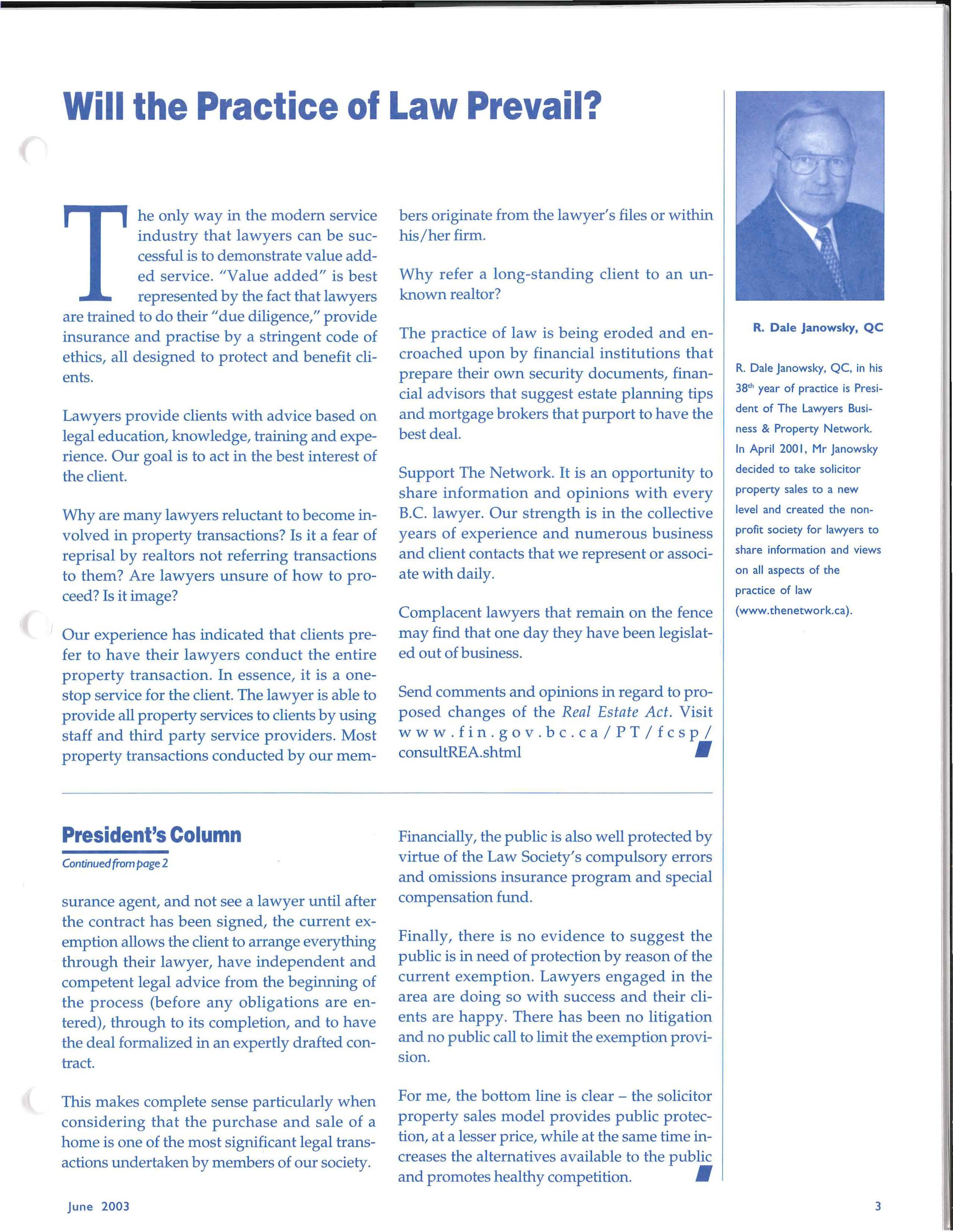
Dale Janowsky, QC,
38'h year of practice is President of The Lawyers Business & Property Network . In April 200 I , Mr Janowsky decided to take so li citor property sales to a new level and created the nonprofit society for lawyers to share information and views on a ll aspects of the practice of law (www.thenetwork ca).
Financially, the public is also well protected by virtue of the Law Society's compulsory errors and omissions insurance program and special compensation fund
Finally, there is no evidence to suggest the public is in need of protection by reason of the current exemption Lawyers engaged in the area are doing so with success and their clients are happy . There has been no litigation and no public call to limit the exemption provision.
For me , the bottom line is clear - the solicitor property sales model provides public protection, at a lesser price, while at the same time increases the alternatives available to the public and promotes healthy competition. •
R Dale janowsky, QC
R
in his
SolicitorClient Privilege Decision Online
For the full decision visit www courts.gov.bc.ca/ Jdb-txt/CA/03/02/ 2003BCCA0278.htm
CBABC in Court to Protect Solicitor-Client Privilege
Sole practitioner Greg DelBigio and Tamara Hunter of Davis & Company recently appeared in the B.C. Court of Appeal representing the Canadian Bar Association, B.C. Branch, in a case involving an issue of solicitor-client privilege arising under the Freedom of Information and Protection of Privacy Act.
A reporter made an FOI request to the Legal Services Society ("The Society") for a list of the names of the "top five" billing lawyers to legal aid in the areas of criminal law and immigration law during a specified period of time The Society was willing to disclose the payment amounts to the reporter but would not disclose the names of the top five billing lawyers.
The Society was concerned that releasing the lawyers' names could allow an assiduous researcher to identify the clients of those lawyers as legal aid recipients by searching public court records using the top billing lawyers' names.
The Society took the position that the terms of a client's retainer with a lawyer (including whether it is a legal aid retainer) is a matter of solicitor-client privilege and its confidentiality must therefore be carefully protected.
The CBABC obtained Intervenor status in the case and supported the position that the information should not be released because it could result in the release of solicitor-client privileged information. The Information and Privacy Commissioner ordered that solicitor-client privilege did not apply and the documents must be released. The Commissioner's decision was overturned by Mr. Justice Scarth of the Supreme Court of B.C.
CBABC Past President Carman Overholt, QC represented the CBABC before the Commissioner and before the Supreme Court of B.C. Mr . DelBigio and Ms. Hunter became involved when the matter was appealed by both the reporter and the Commissioner to the B.C. Court of Appeal.
The case involved a number of interesting issues, including the standard of review which ought to be applied when a court reviews a decision of the Information and Privacy Commissioner involving the interpretation and application of the law of solicitor-client privilege
The appeal was heard on April3, 2003 and the decision of Mr. Justice Scarth was upheld. •
Upcoming National Submissions to Government
CBA's commitment to advocacy in the interest of members is evident in a growing list of legislative initiatives on the roster between now and Parliament's summer break, expected in midJune. On the agenda of CBA National Sections and the Legislation and Law Reform Committee are submissions on:
• Bankruptcy and Insolvency Act;
• Criminal Code amendments- protection of children, sex offenders registry, international transfer of offenders;
• DivorceActamendments;
• NationalDefenceAct;
• One-year review of Anti-terrorism Act - in conjunction with the International Civil Liberties Monitoring Group; and
• Competition Act amendments.
Also in the works is a CBA intervention, at the SCC, on Maranda, a case dealing with lawyerclient privilege.
Recent submissions include a letter on April24 to the Ministers of Justice and Finance on GST retroactivity, and a submission to the House of Commons Standing Committee on Justice and Human Rights regarding marriage of same-sex couples . For details on CBA submissions, visit www cba org.
•
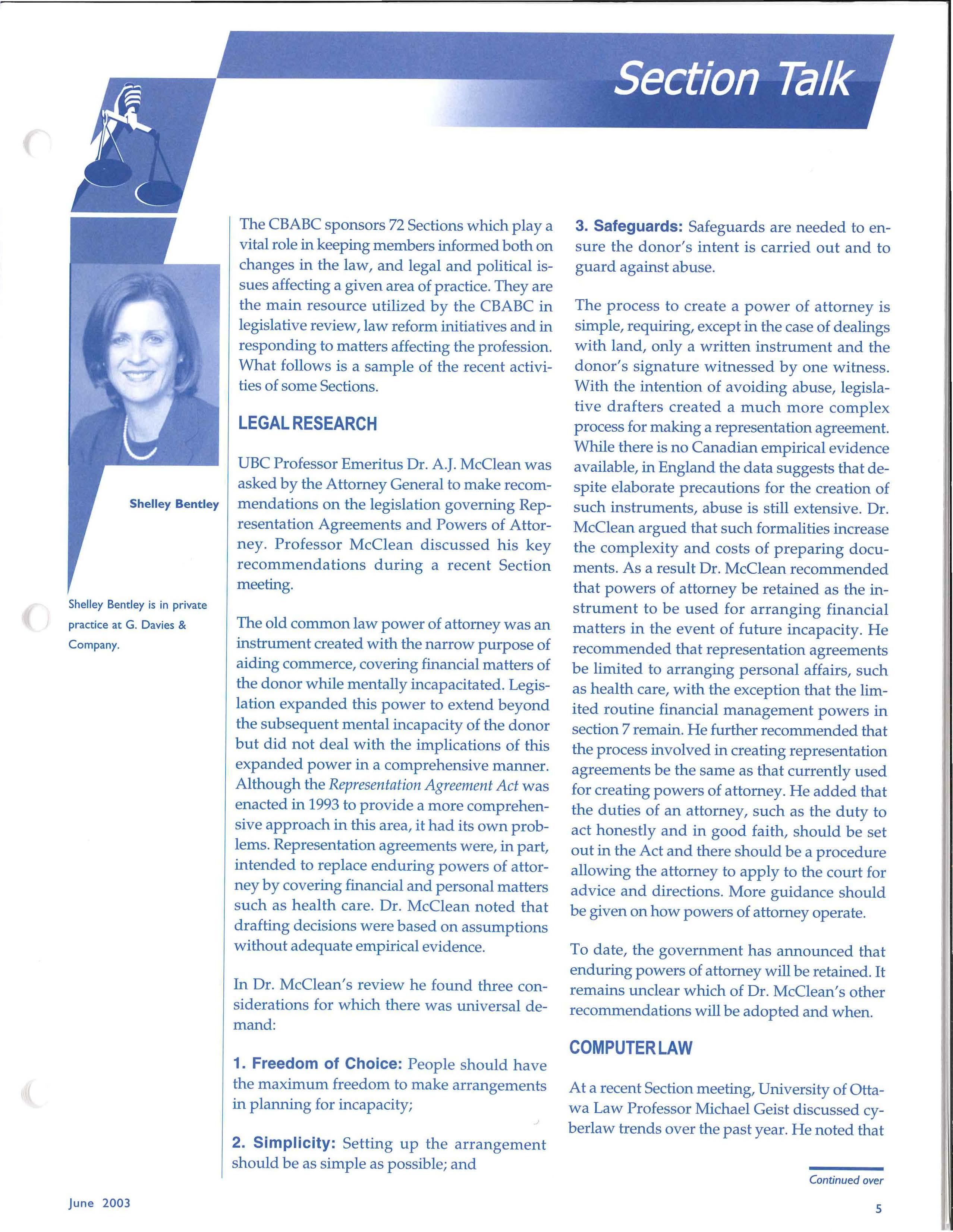
The CBABC sponsors 72 Sections which play a vital role in keeping members informed both on changes in the law, and legal and political issues affecting a given area of practice They are the main resource utilized by the CBABC in legislative review, law reform initiatives and in responding to matters affecting the profession . What follows is a samp le of the recent activities of some Sections.
LEGAL RESEARCH
UBC Professor Emeritus Dr A.J. McClean was asked by the Attorney General to make recommendations on the legislation governing Representation Agreements and Powers of Attorney. Professor McClean discussed his key recommendations during a recent Section meeting
The old common law power of attorney was an instrument created with the narrow purpose of aiding commerce, covering financial matters of the donor while mentally incapacitated. Legislation expanded this power to extend beyond the subsequent mental incapacity of the donor but did not deal with the implications of this expanded power in a comprehensive manner. Although the Representation Agreement Act was enacted in 1993 to provide a more comprehensive approach in this area, it had its own problems Representation agreements were, in part, intended to replace enduring powers of attorney by covering financial and personal matters such as health care Dr. McClean noted that drafting decisions were based on assumptions without adequate empirical evidence
In Dr. McClean's review he found three considerations for which there was universal demand :
1. Freedom of Choice: People should have the maximum freedom to make ar r angements in planning for incapacity;
2. Simplicity: Setting up the arrangement should be as simple as possible; and
3. Safeguards: Safeguards are needed to ensure the donor's intent is carried out and to guard against abuse.
The process to create a power of attorney is simple, requiring, except in the case of dealings with land, only a written instrument and the donor's signature witnessed by one witness. With the intention of avoiding abuse, legislative drafters created a much more complex process for making a representation agreement. While there is no Canadian empirical evidence available, in England the data suggests that despite elaborate precautions for the creation of such instruments, abuse is still extensive. Dr McClean argued that such formalities increase the complexity and costs of preparing documents As a result Dr McClean recommended that powers of attorney be retained as the instrument to be used for arranging financial matters in the event of future incapacity . He recommended that representation agreements be limited to arranging personal affairs, such as health care, with the exception that the limited routine financial management powers in section 7 remain . He further recommended that the process involved in creating representation agreements be the same as that currently used for creating powers of attorney. He added that the duties of an attorney, such as the duty to act honestly and in good faith, should be set out in the Act and there should be a procedure allowing the attorney to apply to the court for advice and directions . More guidance should be given on how powers of attorney operate .
To date , the government has announced that enduring powers of attorney will be retained. It remains unclear which of Dr. McClean's other recommendations will be adopted and when
COMPUTER LAW
At a recent Section meeting, University of Ottawa Law Professor Michael Geist discussed cyberlaw trends over the past year . He noted that
Shelley Bentley
Shelley Bentley is in p ri vate practice at G. Dav ies & Company
Section Enrolment 2003/2004
What will happen in the law next year? Find out by enrolling in one or several of the 2003/2004 CBABC Sections Keep up to date on new trends, tips and substantive issues in your area of practice. Section meetings increase your network of professional contacts and minutes provide valuable materials including case comments on current legal developments
Section enrolment forms will be mailed to every member in mid-July Enrolment in a CBABC Section automatically registers you, at no charge, in the corresponding National Section for additional information When you enrol in any of our 72 Sections you may access the CBABC Web site to peruse or download current and past materials, minutes and Section annual reports.
Plan to renew your membership!
Section Talk
Continued from page 5
there has been a fundamental reversal in cyberlaw principles. Until recently the approach to cyberlaw has been guided by three underlying principles:
1. Borderless Internet and bordered laws: Articulated in John Perry Barlow's 1996 Declaration of Independence of Cyberspace this principle holds that the government has no role in regulating online activity and the Internet has no borders
2. Regulation of code: Originating from Lawrence Lessig's book, Code, the idea is that online regulation comes from computer code, i.e., what technology allows, rather than from government.
3. Value and virtue of self-regulation: Government should not be involved in regulating online activity but rather industry and Internet users should regulate themselves.
Recently, Mr Geist noted a trend towards areversal of these principles:
Bordered Internet and borderless laws: Geographical borders are increasingly applied to the Internet. Ceo-identification software can pinpoint an Internet user's geographic location . Some Web sites are starting to limit access to users from certain locations Also some States are starting to draft laws to apply beyond their borders Examples of this are the U S Digital Millennium Copyright Act (DMCA), the Anti-Cybersquatting Consumer Protection Act, and the Children Online Privacy Protection Act In a recent case, a Russian programmer wrote a program to allow users to break the encryption on certain Adobe products. When this programmer traveled to the U.S. he was arrested and charged under the DMCA. U.S. companies are starting to send DMCA notices to other countries warning their Internet service providers to remove infringing content.
Regulating code: Rather than letting computer code regulate the computer world, legislators are beginning to regulate the content of computer code An example of this is the Hall-
ings Bill in the U S It requires anti-cop y ing technology to be embedded within certain d evices .
End of self-regulation: There is a greater push by governments and portions of the private sector for more government involvement in various cyberlaw issues such as spam and other online consumer protection and privacy issues.
FREEDOM OF INFORMATION & PRIVACY LAW
Roger McConchie reviewed Campbell v Mirror Newsgroup Newspapers Ltd., [2002] E W J. No 4496 (English Court of Appeal) remarking that this decision may have long lasting ramifications in the development of a new cause of action for invasion of privacy .
The Court allowed the Mirror's appeal of a decision in favour of model Naomi Campbell' s claim for damages for breach of confidence, invasion of privacy and breach of duty under the Data Protection Act 1998 . The Mirror had published an article that revealed Ms. Campbell to be a drug addict and showed a photo of her leaving a Narcotics Anonymous meeting Ms Campbell had previously asserted to the media that she did not take drugs.
In identifying the principles by which the law of confidentiality and the importance of th e freedom of expression must accommodate the Human Rights Act right to respect for private and family life, the Court of Appeal acknowledged that where a public figure chooses to make untrue pronouncements about his or her private life, the press will normally be entitled to put the record straight. The Court of Appeal has expressly approved, as a useful test of what information or conduct is private or confidential, whether disclosure or observation of the information or conduct would be highly offensive to a reasonable person of ordinary sensibilities. In approving the test, the Court of Appeal accepted that it embraced both the question of whether information was private and also the question of the degree of its significance but observed, "We do not consider that the test is any the worse for that."
•
David J. Bilinsky David J. Bilinsky is the Practice Management Advisor at the Law Society of British Columbia He can be reached on the Internet at dbilinsky@lsbc.org.
The views expressed herein are strictly those of the author and may not be shared by the Law Society of British Columbia.

SARS and the Legal Profession Lessons from Toronto and Asia
Be glad there 's one place in the world Where everybody knows your name , And they're always glad you came ... You want to go where everybody knows your name
Lyrics and Music : Gary Portnoy and Jud y Hart Angelo , theme to Cheers
ut what if you can't go to where everyone knows your name? What if SARS had really hit Vancouver and the simple fact of people coming into the office was not an option? What would have happened to your business?
Recall that in Toronto, people were quarantined for a minimum of two weeks . In Hong Kong, authorities issued controls that closed down organizations and prevented people from going to work. What would be the hit to your bottom line if your entire office ceased to do any work for two weeks or longer (andrecall, your costs don't take such a holiday)?
Once the quarantine period is over, what would be the costs of overtime, etc. in trying to play catch-up and restoration of the resultant loss of business and damage to your reputation?
Is your office equipped with a disaster-recovery plan? Does that recovery plan deal with the possibility that someone could come into your physical location and infect your employees thereby preventing your entire office staff from assembling? Most disaster recovery plans assume that a physical location could be destroyed (earthquake, fire, etc ) but it is implicit that at least some of the people in that office would survive the disaster and be able to get together and work from an alternate location.
SARS has done us all a favour akin to a vaccine that prevents a full-blown disease by ex-
posing us to a small amount of the active agent that in turn, promotes an immunizing response The events of 9-11 brought home the need for a disaster plan; SARS has shown that you need to identify the assumptions inherent in those recovery plans that would prevent the due execution of those plans . Let us run through some of the suggestions that have been put forward in this new world environment.
Prepare: PracticePro in Ontario created a booklet on Managing Practice Interruptions (available at: www.practicepro.ca/practice/ Practice_Interruptions booklet.pdf). This booklet is a great planning tool for thinking about and hardening yourself against the principle vulnerabilities that could seriously affect your law practice Rather than cover the points that are in that publication, I commend it to you.
Remote Access: Law firms run on computers and data networks. Can your office network be accessed remotely, with full access to all computer systems (files, word processing, accounting, practice management, research and communications, plus any specialized packages that you may use) from wherever your staff happen to be (such as home)? The Gartner Group identified how telecommuting could lessen the impact of health crises such as SARS Indeed, students in Asia were able to continue with their education via e-learning during the SARS crises
Paper: In most law firms, the files are a mix of electronic and paper-based information However, in a SARS situation, even if you have remote data access, you still could miss a limitation deadline due to the inability to go to the office and reference your paper calendar limita-
Lawyers Assistance Program
LAP pr o vi d es confid ent ia l
su pp ort, co un selling a nd re ferra ls fo r lawyers , t he ir
fa m ili es , su ppo rt staff, judges
an d st u de nts suffering fr om a lcoh ol an d/or c hemica l
d e pen d en cy , stress , depression or just ab o ut any t ype
o f pe rso na l p ro b lem
For ass istance or informa -
t ion o n meetings and res ou rces p lease ca ll
604-685 -217 1 or to ll free 1- 8 88 -6 85-2 17 1
The LAP office address is 415- 1080 Ma inl and Street , Vanc o uver , B.C. V6B 2T4
Vis it LAP on the Internet at www lapbc co m
Practice Talk
Contin u ed from page 7
tion system or review a paper file or documents on that file. Or you could be unable to review the file and do a closing. Or be unable to prepare for a trial scheduled for three weeks hence Or to produce a bill that is badly needed by the firm for cash-flow purposes September 11th, 2001 demonstrated the need for mirrored data systems - a duplicate of all data in an alternate physical loca t ion to bring yourself back up to speed if your office is destroyed. SARS demonstrated t he need for all information on all files to be d igitalized in order for your office to continue to operate in a distributed rather than a centralized manner This is a watershed moment. Scanning, imaging, OCR'ing and moving to pure e lectronic files has been something that most people feel is 'in the future .' Well, the future is now Abandoning paper not only makes sense from a loss-prevention and riskmanagemen t standpoint, it also makes sense from a workflow management perspective People often confuse paper with information - not realizing t hat it is the information - independent of the media on which it is found - that is importan t. Information can exist and has maximum momentum and power when it is in a digital form - and can be analyzed, stored in a database, transmitted, shared, searched, etc. Indeed, that is the principle power behind Adobe's PDF format- that the look and feel of information can be standardized across multiple electronic platforms It is a paper-independent medium (which can be hard-copy printed but it loses, rather than gains , utility when you do so) .
Telephone and communication systems: Do y ou have voice mail or do you use paper phone slips? If your office is closed, how do your clients contact you? Can you retrieve voice mail messages remotely? Can you re-rout e your office calls to your home number or cell phone? Can faxes be routed to your home? Can you fax from home? What about e-mail? Can you sign into your e-mail system? Can you perform legal research from home? How can you transfer dictation to your secretary? How can he / she transfer work product back to you? How do you transfer work product to your client s, government registries, and other lawyers? You may need to make arrangements to be able to deliver PDF's to agents who can do government filings and deliveries for you. If you used digital dictation systems, your voice files could be transferred via e-mail .
Insurance: Business interruption insurance can at least help offset the cos t s, if not the pain, caused by business disruption in certain circumstances Check with your broker to determine if you are adequately covered. Find out the downside to the insurance and what is not covered- and what you can do to reduce the impact of th ose factors Consider what other steps can be taken to ensure that your business systems are robust and can survive a disasterwhether that threat is biological, physical or electronic.
While you hope that you never have to rely on disaster planning and training, it is comforting to know that you have taken all reasonable steps to ensure that following the disaster , there still will be somewhere to go where everyone knows your name. Cheers! •
Member Dispute Resolution Program
tion - run by lawyer volunteers who will talk to you on a confidential basis to help work out disputes that aren ' t reportable Law Societ y matters This i s y our chance to talk the iss ue through with a lawy e r med i ator, and seek quiet counsel on how t o handle it. Check out the CBABC Web s ite f o r more informationwww.bccb a .o r g, or call the M e mber Dispute Hotline at 604- 646-7864 •
Stuart Rennie Stuart Renn ie is the CBABC Legislation & Law Reform Officer He can be reached at 60 4-949-1490 (e-mai l srennie@bccba.org).
Every effort is made to e nsure the accuracy of the in format ion p r o vided to yo u in this article but the informat ion shou ld not be re lied upon. Lawyers shou ld refer to the specific leg islative o r reg ul atory provis ion You will see a reference in some cases to the number of the Bill when it was introduced in the House. This number may be d ifferent from the chapter number of the new Act which is quoted after the t itle of the Act and which is the proper citation for the Act. The Bill Number has been given to you to make it easier for you to note up the Bil ls yo u may have in your library
Additional detail on the Legislative Update can be found in th e online issue of the June BarTalk, posted at www .bccba.org .
ACTS IN FORCE
Auditor General Act, s.B.C. 2003 , c 2 (Bill 9)
Amended: Consequential amendments made to the: Assessment Authority Act, R.S .B.C. 1996, c. 21; British Columbia Transit Act, R.S.B.C. 1996, c. 38; Budget Transparency and Ac countability Act, S B C. 2000, c 23; Capital Commission Act, R.S B C. 1996, c. 43; Community Servic es Interim Authorities Act, S B.C. 2002, c. 58; Creston Valley Wildlife Act, R.S B C. 1996, c. 84; Financial Administration Act, R.S.B.C. 1996, c. 138; Financial Information Act, R.S.B.C. 1996, c. 140; Greater Vancouver Transportation Authority Act, S.B C. 1998, c. 30; Homeowner Prot ection Act, S.B.C. 1998, c. 31; Income Tax Act, R.S.B C. 1996, c 215; Institute of Technology Act, R.S.B C. 1996, c 225; Legal Services Society Act, S.B.C. 2002, c . 30; Public Guardian and Tru stee Act, R.S B C. 1996, c. 383; School Act, R.S.B.C. 1996, c 412; University Act, R.S B C. 1996, c 468; Workers Compensation Act, R.S .B.C. 1996, c. 492
Transitional Provisions: None
Community, Aboriginal and Women's Services Statutes Amendment Act, 2003, S .B.C. 2003, c. 15 (Bill22)
Amended: Amendments made to 15 statutes
Transitional Provisions: None
Statutes Repealed: Community Care Facility Act, R.S.B C. 1996, c. 60 and Supplement to the Community Care Facility Act
Summary: Section 4 to 9 amend the First Peoples' Heritage, Language and Culture Act, R.S B C. 1996, c . 147 regarding the preamble to the Act, the First Peoples' Advisory Committee, the First Peoples' Heritage, Language and Culture Council and a reference to the Ministry of Finance .
In Force: Sections 4 to 9 in force April 11, 2003
Employee Investment Amendment Act, 2003, S.B C. 2003, c. 4 (BillS)
Amended: Employee Investment Act, R.S.B C. 1996, c 112
Statutes Repealed: Auditor General Act, Transitional Provisions: None
R.S B.C. 1996, c. 23
Summary: Bill 9 repeals the Auditor General Act and replaces it with an expanded statute . The new Act includes: procedures to appoint the Aud i tor General; a new mandate for the Auditor General, including reporting annuall y , in accordance with generally accepted auditing and assurance standards , to the Legi s lative Assembly on the financial stat e ments of the government r eporting entity; and a process to appoint external auditor s to governm e nt organizations
In Force: Act in force April4, 2003
Statutes Repealed: None
Summary: Section 8 amends section 28 of the Employe e Investment Act to clarify the registration process under which a corporation that meets the criteria for the registration under Part 1 (Employee Share Ownership Plans) or Part 2 (Employee Venture Capital Plans) of the Act, may share with an employee group in reimbursement b y the government of certain costs relating to the negotiation , evaluation and implementation of an employee share ownership plan or employee venture capital plan
Legislative Update
Continued from page 9
In Force: Section 8 in force March 28, 2003
Practice Management Resource Library
A new online resource aims to provide lawyers w ith inspiration, guidance, and ideas on practice management topics The Saskatchewan Legal Education Society has compiled information from sources across North America - there are more than 70 articles, pract ice tips, recommended titles, sample forms and links to browse through. Visit the site at www.sklesi.org
Amended: Health Authorities Act, R.S B C. 1996, c 180 Consequential amendments made to the: Criminal Records Review Act, R.S.B.C. 1996, c. 86; Freedom of Information and Protection of Privacy Act, R.S.B .C. 1996, c. 165; Ombudsman Act, R.S.B.C. 1996, c. 340; Property Transfer Tax Act, R.S.B.C. 1996, c. 378
Freedom of Information and Transitional Provisions: None Protection of Privacy Amend· ment Act, 2003, S.B.C. 2003, c. 5 (Bill Statutes Repealed: None 13)
Amended: Freedom of Information and Protection of Privacy Act, R.S .B.C. 1996, c. 165
Transitional Provisions: None
Statutes Repealed: None
Summary: Bill13 amends the Freedom of Information and Protection of Privacy Act including to: require that a public body must collect personal information directly from the individual unless the collection of the information is necessary for the medical treatment of an individual and it is not possible to collect the information directly from that individual; require a public body to ensure that an individual from whom it collects personal information or causes personal information to be collected is told about the collection; ensure that solicitor client privilege of a record is not waived as a result of the examination of the record under the Act by the commissioner's office; increase the commissioner's delegation powers; authorize a Supreme Court judge acting as an adjudicator to receive the commissioner's requests regarding disregarding a request or section 29 the right to request correction of personal information; and permit the commissioner to request authorization from a Supreme Court judge acting as an adjudicator to authorize the commissioner as head of a public body to disregard requests made under these provisions that would unreasonably interfere with the operations of the public body.
In Force: Act in force March 28, 2003
Health Authorities Amendment Act, 2002, S.B.C. 2002, c. 61 (Bill60)
Summary: Bill 60 amends the Health Authorities Act to delete references to community health councils and community health service societies. These were made unnecessary following the government's reorganization in 2001 of 52 health authorities into five regional health authorities and the one provincial health service authority.
In Force: Act in force March 14,2003
Human Rights Code Amendment Act, 2002, S.B.C. 2002, c. 62 (Bill64)
Amended: Human Rights Code, R.S.B.C. 1996, c . 210. Consequential amendment made to the Freedom of Information and Protection of Privacy Act, R.S.B C. 1996, c. 165, B.C. 1996, c. 73
Transitional Provisions: complaints
Statutes Repealed: None
Summary: In May 2002, the government introduced for public comment the exposure bill, the Human Rights Code Amendment Act, 2002 (Bill 53) (First Reading May 30, 2002) . Bill64 is the government's response to public comment received from Bill 53 as well as government's review of Bill 53. Bill 64 amends the Human Rights Code, including to eliminate the Human Rights Commission, Human Rights Advisory Council and all references to the commission and the commissioner of investigation and mediation regarding filing complaints , mediations and settlements, and replaces them with references to the tribunal. Bill 64 also eliminates investigations and makes the Minister responsible for developing and conducting public education and information programs, and permits the Minister to conduct research
and consultations.
In Force: Act in force March 31, 2003

Miscellaneous Statutes Amendment Act, 2003, S.B.C. 2003, c. 7 (Bill11)
Amended: Bill11 amends 22 statutes
Transitional Provisions: repeal of the Agricultural Credit Act, amendments to the Emergency Program Act, provincial board name change and continuation of proceedings regarding the Farm Practices Protection (Right to Farm) Act and Natural Products Marketing (BC) Act
Statutes Repealed: Bill11 repeals 11 statutes
Summary: Sections 27 and 28 amend the Hotel Guest Registration Act to extend the Act to all hotels whether located in a rural area or not and permit regulations to be made. Sections 29 and 30 amend the Hotel Keepers Act, including to create new offences regarding disturbing the peace and failing to leave the inn. Section 39 amends section 62 of the Miscellaneous Statutes Amendment Act (No.2), 1999 to repeal a section made obsolete by the repeal of the Travel Regulation Act. Section 60 repeals Telephone (Rural) Act, R.S.B.C. 1996, c. 450 . Section 61 repeals Travel Regulation Act, R.S.B.C. 1996, c. 460
In Force: Sections 27 to 30, 39, 60 and 61 in force March 28, 2003
respecting enforcement of standards for commercial vehicle carriers, vehicle inspection facilities and weigh scales to the Ministry of Public Safety and Solicitor General.
In Force: Act in force April1, 2003 •
Museum Act (Bill2)
Amended: Consequential amendments made to the: Document Disposal Act, R.S.B.C. 1996, c . 99; Election Act, R.S B C. 1996, c. 106; Financial Information Act, R.S.B.C. 1996, c. 140; Freedom of Information and Protection of Privacy Act, R.S.B.C. 1996, c 165; Ministry of Provincial Secretary and Government Services Act, R.S .B.C. 1996, c. 309; Recall and Initiative Act, R.S.B.C. 1996, c. 398
Transitional Provisions: transfer of assets, rights and responsibilities to the Crown corporation
Statutes Repealed: Museum Act, R.S.B.C. 1996, c. 326
Summary: Bill 2 repeals the Museum Act to make the Royal British Columbia Museum a Crown corporation and amalgamates under the corporation the B.C. Archives, Helmcken House and the Netherlands Carillon.
In Force: Act in force April1, 2003
West Coast LEAF & Family Law Legal Aid Affidavit Campaign
As we all know, in the spring of 2002 the provincial government slashed legal aid funding for poverty and fam ily matters. Without legal representation the rights of women and children are being compromised. As long as women in B.C. cannot know or assert their rights , they effectively have none.
Motor Vehicle Amendment Act, 2003, S.B.C. 2003, c. 11 (Bill17)
Amended: Motor Vehicle Act, R.S B.C. 1996, c. 318 Consequential amendment made to the Motor Vehicle Amendment Act (No. 2), 1997, S.B.C. 1997, c. 31
Transitional Provisions: payment by ICBC, show cause hearings, appeals and power to make regulations
Statutes Repealed: None
Summary: Bill 17 amends the Motor Vehicle Act to transfer the ICBC compliance operations
Small Business Venture Capital Amendment Act, 2003, S.B.C. 2003, c. 8, (Bill3)
Amended: Small Business Venture Capital Act, R.S.B.C. 1996, c. 429
Transitional Provisions: None
Statutes Repealed: None
Summary: Bill 3 amends the Small Business Venture Capital Act including to: amend definitions; change registration requirements; increase investment in small business by changing the criteria for investments; increase the maximum aggregate amount of investments
To respond to th is pres si ng issue West Coast LEAF is launching an Affidavit Campa ign The campaign will require volunteer lawyers in B.C. to assist in collecting affida vits from women who are facing family law matters without legal representation.
To find out more about this and other West Coast LEAF work, please call 604-684-8772 or visit www.westcoastleaf.org
Legislative Update
Continued from page I I
that a single small business may receive from venture capital corporations to $5 million from $3 million; and create new eligible business corporation tax credits.
In Force: Act in force March 28, 2003

Technical University of British Columbia Act, s.B.C. 1997, c. 54 (Bill30)
Amended: None
Transitional Provisions: None
Statutes Repealed: None
Summary: Bill 30 created the Technical University of British Columbia, in Surrey, that offered certificate, diploma and degree programs at the undergraduate and graduate levels in the applied, technological and related professional fields.
In Force: Act repealed March 31, 2003
Unclaimed Property Amendment Act, 2003, S.B.C. 2003, c.9 (Bill15)
Amended: Unclaimed Property Act, S.B.C. 1999, c. 48. Consequential amendments made to the: Business Corporations Act, S.B.C. 2002, c. 57; Company Act, R.S.B.C. 1996, c. 62; Credit Union Incorporation Act, R.S.B.C. 1996, c. 82; Debt Collection Act, R.S.B .C. 1996, c. 92; Employment Standards Act, R.S.B.C. 1996, c. 113; Financial Institutions Act, R.S.B.C. 1996, c. 141; Local Government Act, R.S.B.C. 1996, c. 323; Public Guardian and Trustee Act, R.S.B.C. 1996, c. 383, Railway Act, R.S.B.C. 1996, c. 395; and Real Estate Act, R.S.B.C. 1996, c. 397
Transitional Provisions: Unclaimed Property Act provisions and regulations
Statutes Repealed: None
Summary: Bill15 amends the Unclaimed Property Act to permit the government to transfer the operation of the unclaimed property scheme to • non-profit organizations.
In Force: Act in force March 31,2003 •
REGULATIONS TO NOTE
Coastal Ferry Act, designates specified properties as ferry terminal properties, highway properties and surplus highway properties (effective April1, 2003, B.C. Reg. 109 /2003).
Freedom of Information and Protection of Privacy Act, adds to the Act in Schedule 2 the B.C. Unclaimed Property Society (B.C. Reg. 153 /2003) and the Office of the B.C. Ferry Commissioner (B.C. Reg. 124/2003) (both effective April 1, 2003). See Acts in Force for Unclaimed Property Amendment Act and New Bills to Note for Coastal Ferry Act
Health Act, amends the Communicable Disease Regulation (B.C. Reg. 4/83) to add Severe Acute Respiratory Syndrome (SARS) (B.C. Reg. 155/2003 effective April1, 2003).
Land Act, amends B.C.Reg. 167/92 to change the schedule of applicable fees (B.C. Reg. 166/ 2003 effective Aprilll, 2003).
Land Title Act, amends B.C.Reg. 334/79 toreplace Form 9 Statement of Surveyor (B.C. Reg. 129/203 effective March 28, 2003).
Motor Vehicle Act, amends B.C. Reg. 26/58 including striking specified references to ICBC and "corporation" and substituting them with references to the director (B.C. Reg. 135/2003), creates the Director's Records and Access to Records Regu lation (B.C. Reg. 137 /2003) and creates the Show Cause Hearings and Reconsiderations Regulations (B.C. Reg. 138/2003) (all effective April1, 2003) .
Small Business Venture Capital Act, amends 390/98, to add provisions regarding eligible investments, permitted business corporation share transfers, minimum capital requirements, prescribed business activities and a new Form 2 Annual Return (B.C. Reg 145/ 2003 effective April1, 2003).
Unclaimed Property Act, creates a regulation to designate specific property (B C. Reg 147 I 2003 effective April1, 2003) and amends B.C. Reg 463/99 to set fees, set appeal periods, prescribe records retention periods affecting the administrator and provide a table to determine when reasonable efforts to locate and notify owners are required and when property that meets or exceeds the minimum value becomes unclaimed (B C. Reg. 148 / 2003 effective April 1, 2003).
NEW BILLS TO NOTE
Information is current at the time of preparing this article : April25, 2003 . Lawyers should refer to the original version of the specific Bill for its current status at First, Second or Third Reading or Royal Assent.
Coalbed Gas Act, s .B.c. 2003, c . 18 (Bill 16)
First Reading: March 25, 2003
Royal Assent: Aprill0,2003
Amended: None
Transitional Provisions: None
Statutes Repealed: None
Summary: Bill 16 enacts the legal principle that coalbed gas is a natural gas owned by the holder of natural gas rights. Bill 16 provides that no person has a right of action or compensation as a result of Bill16. Bill16 also permits the minister, if satisfied that it is necessary to do so for safety reasons, by regulation, to authorize coal owners or the holders of crown coal dispositions to vent or dispose of coal bed gas as directed .
In Force: On Royal Assent April10, 2003
Coastal Ferry Act, s B.C. 2003, c 14 (Bill 18)
First Reading: March 12, 2003
Royal Assent: March 27, 2003
Amended: Cons equential amendments made to the: Auditor General Act , R.S B.C. 1996, c. 23; Build ers Lien A ct, S B.C. 1997, c. 45; Ferry Act, R.S.B C. 1996, c. 136; Financial Administration Act, R.S B C. 1996, c 138; Financial Information Act, R.S.B .C. 1996, c . 140; Freedom of Information and Protection of Privacy Act, R.S B C. 1996, c 165; Ministry of Transportation and Highways Act, R.S.B.C. 1996, c 311; Municipal Aid Act, R.S B.C. 1996, c. 324; and Public Sector Pension Plans Act, S.B C. 1999, c 44
Transitional Provisions: None
Statutes Repealed: None
Summary: Bill18 eliminates B.C. Ferry Corporation as a Crown corporation and creates a new company : British Columbia Ferry Services Inc. B.C. Ferry Services Inc. will be regulated by a new entity, the British Columbia Ferry Authority . Employees of the B.C. Ferry Corporation are transferred to and become the employees of the new company. Notwithstanding the Labour R elations Code or collection agreements, ferry service is deemed an essential service necessary for the protection of the health, safety and welfare of the residents of B.C. The Minister may enter into contracts for coastal ferry services to operate one or more ferries on one or more specified ferry routes The Lieutenant Governor in Council may, by regulation, designate ferry properties and transfer them to the B.C. Transportation Financing Authority The office of B C. Ferries Commissioner is created to regulate each ferry operator in relation to the core ferry services provided by ferry operators and the tariffs that rna y be charged for those core ferry services A price cap for ferry tariffs on designated routes is established and a procedure for setting future price caps is created.
In Force: April1, 2003
Court Jurisdiction And Proceedings Transfer Act (Bill31)
First Reading: April8, 2003
Amended: None
Transitional Provisions: None
The online version of the Government of Canada's offic ial newspaper received official status effective April I, 2003. View the Canada Gazette on line at: www.canadagazette.gc .ca.
The legal profession can rely on the on line version of Parts I, II and Ill of the Canada Gazette in their proceedings and the courts can take judicial notice. The paper and online (PDF) versions will be published simu ltaneously. Both versions bear the Queen's Printer imprimatur.
Part I (not ices, appointments, proposed regulations, etc ) is publ ished every Saturday Part II (regulat ions, orders in council, orders and proclamations , etc.) is published every second Wednesday Published after Royal Assent , Part Ill conta ins recent Pub lic Acts of Pa rl iament and their enactment proclamations
On Trial- "Air India Trial" on the Internet
The Law Courts Education Society is helping people around the world fo ll ow the Air India trial over the Internet. On Trial is an educational Web site with trial updates alongside public legal educational content. The purpose is to help peop le understand the trial's developments through educat ion about the justice system in B C. and Canada
On Trial was conceived after the University of Glasgow in Scotland successfully produced a Web site about the Lockerbie trial, where two men were tried in relation to the 1988 tragedy of Pan Am Flight 103 On Trial marks the first time a Web site of this kind has been launched in Canada, but it is not expected to be the last. The Law Courts Education Society plans to create On Trial Web sites for other significant Canadian trials as part of its ongoing mandate
To visit On Trial- "Air India Trial", go to www airindiatrial ca
Legislative Update
Continued from page 13
Statutes Repealed: None
Summary: Bill 31 enacts the Uniform Law Conference of Canada's 1996 uniform statute: Court Jurisdiction and Proceedings Transfer Act Bill31 also provides statutory procedural rules that apply to determine jurisdiction for legal proceedings. These rules include rules to govern the transfer of legal proceedings to a court outside B.C. or to accept a transfer of a proceeding from a court outside B.C. Bill31 also serves as a necessary accompaniment to the Uniform Law Conference of Canada's uniform statute: Enforcement of Canadian Judgements and Decrees Act. This uniform statute is enacted by the Enforcement of Canadian Judgments and Decrees Act (Bill32)(First Reading April 8, 2003).
In Force: By regulation
Enforcement of Canadian Judgments and Decrees Act (Bill32)
First Reading: AprilS, 2003
Amended: Court Order Enforcement Act, R.S.B.C. 1996, c. 78, Court Rules Act, R.S.B.C. 1996, c. 80, Limitation Act, R.S.B.C. 1996, c. 266
Transitional Provisions: None
Statutes Repealed: Supplement to the Enforcement of Canadian Judgments Act, R.S.B.C. 1996, c. 78
Summary: Bill 32 enacts the Uniform Law Conference of Canada's uniform statute (Enforcement of Canadian Judgments and Decrees Act) and permits Canadian judgments to be registered for the purpose of enforcement. Under Bill 32, those applicable judgments, orders and decrees that originate in other provinces and territories may be registered in the B.C. Supreme Court and enforced in B.C. as if they were judgments, orders or decrees of a B.C. court. Bill32 also serves as a necessary accompaniment to the Uniform Law Conference of Canada's 1996 uniform statute: Court Jurisdiction and Pro -
ceedings Transfer Act . This uniform statute is enacted by the Court Jur isdiction and Proceedings Transfer Act (Bill 31)(First Reading April 8, ( 2003).
In Force: By regulation •
Forestry Revitalization Act, S.B.C. 2003, c. 17 (Bi1128)
First Reading: March 26, 2003
Royal Assent: March 31, 2003
Amended: None
Transitional Provisions: None
Statutes Repealed: None
Summary: Bill28 reduces the allowable annual cut of ungrouped licences as set out in a Schedule to the Act, reduces the area of certain timber licences as defined in the Act and reduces the allowable annual cut of licences in • groups of licences as set out in a Schedule to the Act. Bill29 provides for compensation to be paid by the government for affected timber licence holders arising out of reductions of harvesting rights under Bill28 for rights available to these licensees under the Forest Act. Bill 28 also creates the B.C. Forestry Revitalization Trust, whose purpose is to mitigate adverse financial impacts suffered by eligible persons as a result of restructuring of the forestry sector and forestry operations within B C., arising out of reductions made by Bill28.
In Force: On Royal Assent March 31, 2003 •
Forest (Revitalization) Amendment Act, 2003 (Bill29)
First Reading: March 26, 2003
Amended: Forest Act, R.S.B.C. 1996, c. 157
Transitional Provisions: regulations
Statutes Repealed: None
Summary: Bill 29 amends the Forest Act, including to: repeal and reduce regulatory provisions; create a new Division 3 .1 to regulate cut control matters; and provide relief for holders of replaceable licences, and of specific non-replaceable licences, from appurtenancy requirements, and processing requirements
In Force: By regulation except for the provision regarding job creation plans which comes into force on April 1, 2006 and the provision regarding cut control provisions which comes into force on July 1, 2003
Forests Statutes Amendment Act, 2003 (Bill 27)
First Reading: March 26, 2003
Amended: College of Applied Biology Act, S.B.C. 2002, c. 68, Freedom of Information and Protection of Privacy Act, R.S.B .C. 1996, c . 165, Forest Act, R.S B C. 1996, c. 157, Forests Statutes Amendment Act, 2002, S.B C. 2002, c. 45, Ministry of Forests Act, R.S B.C. 1996, c. 300
Transitional Provisions: Forest Act
Statutes Repealed: None
Summary: Bill 27 amends four statutes including the College of Appli ed Biology Act to add the College of Applied Biology to the list of governing bodies of professions or occupations to which the Freedom of Information and Protection of Privacy Act applies The Forest Act is amended to: create a new market-based pricing system, where the price of Crown timber harvested on all tenures will be based on the selling price of Crown timber competitive l y auctioned through B C. Timber Sales; streamline the administration process in awarding new woodlot licences; and replace the list of products into which timber and wood residue must be manufactured if not used in B.C. with a power to prescribe by regulation the extent of required manufacture . The For es ts Statutes Amendm ent Act, 2002 is amended to repeal an obsolete amendment that is not in force The Ministry afForests Act is amended to: create the position of a timber sales manager; add the discretion to designate persons to act tempo-
rarily in that capacity; and to repeal reporting requirements.
In Force: On Royal Assent, except for specified provisions which come into force by regulation
•
Health Services Statutes Amendment Act, 2003 (Bill33)
First Reading: April3, 2003
Amended: Food Safety Act, S B.C. 2002, c 28, Hospital Insurance Act, R.S .B.C. 1996, c . 204, Medicare Protection Act, R.S B C. 1996, c. 286
Transitional Provisions: None
Statutes Repealed: None
Summary: Bill 33 amends three statutes, including the: Food Safety Act to provide authority for regulations respecting alterations to food establishments; Hospital Insurance Act to provide for annual payments for general hospital services by government to the Nisga ' a Nation, the Provincial Health Services Authority and regional health boards; and Medicar e Protection Act to permit the Medical Services Commission to establish rules of practice, procedure and regulations for hearings respecting orders regarding medical or health care practitioners.
In Force: On Royal Assent, except for sections 3 to 8 regarding the Hospital Insurance Act which come into force by regulation.
Lawyers Assistance Program Luncheon
The Lawyers Ass istance Program invites lawyers to attend the ir third Annual Gratitude Lunch at 12:30 p m o n Friday, June 27, 2003 at the Law Courts Inn , 800 Smithe Street, in Vancouver. The LAP luncheon will honour Judge Mario Mondin w ith the ' Lawyers Helping Lawyers' award
Tickets are $50 each or $400 for a table of eight people. Please call LAP directly to purchase tickets, at 604-685-2171 or toll free 1-888-685-2171
Hospital District Amendment Act, 2003, S.B.C. 2003, c. 20 (Bill33)
First Reading: March 24, 2003
Royal Assent: April10, 2003
Amended: Hospital District Act, R.S.B .C. 1996, c. 202
Transitional Provisions: None
Statutes Repealed: None
Legislative Update
Continued from page 15
Summary: Bill33 amends the Hospital District Act including to permit the boards of regional hospital districts to select directors or alternative directors and to repeal specified provisions requiring the Minister to give approval.
In Force: By regulation
Procurement Services Act, s.B C. 2003, c. 22 (Bill23)
First Reading: March 13, 2003
Royal Assent: Aprill0,2003
Amended: Consequential amendments made to the: British Columbia Buildings Corporation Act, R.S.B.C. 1996, c. 33; Flood Relief Act, R.S.B.C. 1996, c. 151; Freedom of Information and Protection of Privacy Act, R.S.B.C. 1996, c. 165; Ministry of Agriculture and Food Act, R.S B.C. 1996, c. 296; and Ministry of Environment Act, R.S.B.C. 1996,c. 299
Transitional Provisions: None
Statutes Repealed: Purchasing Commission Act, R.S.B.C. 1996, c. 392
Summary: Bill 23 repeals the Purchasing Commission Act and replaces it with Bill 23. Bill 23 permits the Minister to contract and otherwise manage public sector procurement. Bill23 distinguishes, as specified, among the government, government organizations, local public bodies and participating jurisdictions. Under Bill23, the Minister may recommend, to government, government organizations and local public bodies, best practices to promote fair and open procurement, competition, demand aggregation, value for money, transparency and accountability
In Force: On Royal Assent April10, 2003
(Bill30)
First Reading: April1, 2003
Royal Assent: April10, 2003
Amended: Corporation Capital Tax Act, R.S.B C. 1996, c. 73; Fr eedom of Information and Protection of Privacy Act, R.S .B.C. 1996, c. 165; Hotel Room Tax Act, R.S.B.C. 1996, c. 207; Income Tax Act, R.S.B.C. 1996, c. 215; Land Tax Deferment Act, R.S.B C. 1996, c. 249; Logging Tax Act, R.S.B.C. 1996, c. 277; Mineral Tax Act, R.S.B.C. 1996, c. 291; Motor Fuel Tax Act, R.S.B.C. 1996, c. 31; Petroleum and Natural Gas Act, R.S.B.C. 1996, c. 361; Public Sector Employers Act, R.S.B.C. 1996, c. 384; School Act, R.S.B.C. 1996, c. 412; Social Service Tax Act, R.S.B.C. 1996, c. 431; and Tobacco Tax Act, R.S.B.C. 1996, c. 452
Transitional Provisions: Mineral Tax Act
Statutes Repealed: None
Provincial Revenue Statutes Amendment Act, 2003, S.B.C. 2003, c. 22
Summary: Bill 30 amends 13 statutes, including the: Corporation Capital Tax Act to provide that an authorized foreign bank may not de- ( duct any negative retained earnings from its aggregate paid up capital to determine its total paid up capital, expand the meaning of "avoidance transaction" to apply to a transaction undertaken primarily for the purpose of reducing taxes imposed by a jurisdiction outside of Canada; Freedom of Information and Protection of Privacy Act to amend the Schedule to remove reference to the Mineral Tax Review Board; Hotel Room Tax Act to provide that evidence that an assessment made or penalty imposed is proof, in the absence of evidence to the contrary, that the amount stated in the assessment or imposed as a penalty is due and owing, and the onus of proving otherwise is on the person assessed or penalized; Income Tax Act to authorize an official to provide taxpayer information to an official of the ministry for the monitoring of the federal minister and the Commissioner under a collection agreement, authorize the disclosure of taxpayer information to a police officer for the purpose of investigating an offence under the Criminal Code relating to an official; Land Tax Deferment Act to provide that an agreement to defer taxes is not terminated if the eligible property is disposed of in accordance with the regulations and that a
(
transferee must qualify for any subsequent deferral of tax; Logging Tax Act to allow the commissioner to assess a taxpayer at any time if the taxpayer has filed a waiver and provide for the revocation of a waiver by a taxpayer; Mineral Tax Act to replace the appeal to the Mineral Tax Review Board with an appeal to the minister and a further appeal to the Supreme Court and allow the commissioner to refund any mineral tax set aside or reduced on appeal; Motor Fuel Tax Act and the Social Service Tax Act both provide a six year limitation period for making an estimate or imposing a penalty and provide for an agreement that allows the director to consider a period beyond the six year estimate period and provide that evidence that an assessment made or a penalty imposed is proof, in the absence of evidence to the contrary, that the amount stated in the assessment or imposed as a penalty is due and owing, and the onus of proving otherwise is on the person assessed or penalized; Petroleum and Natural Gas Act to provide for the appointment of a royalty administrator and royalty collector; Public Sector Employers Act to amend the Schedule to remove a reference to the Mineral Tax Review Board; School Act to amend provisions respecting taxes; and Tobacco Tax Act to provide for an agreement that allows the director to consider a period beyond the six year assessment period or three year penalty period and provide that evidence that an assessment made or penalty imposed is proof, in the absence of evidence to the contrary, that the amount stated in the assessment or imposed as a penalty is due and owing, and the onus of proving otherwise is on the person assessed or penalized.
In Force: Various in force dates
Safety Authority Act (Bill20)
First Reading: March 24, 2003
Amended: None
Transitional Provisions: interim board appointments by minister, powers and duties of interim board, business plan
Statutes Repealed: None
Summary: Bill20 creates the British Columbia Safety Authority to administer safety standards for B C. The following Acts do not apply to the Authority: Budget Transparency and Accountability Act; Document Disposal Act; and the Financial Administration Act. Provisions of the Business Corporations Act may apply to the Authority by regulation
In Force: By regulation. Part 8 regarding transitional provisions is repealed by regulation
Safety Standards
Act(Bill19)
First Reading: March 24, 2003
Amended: Consequential amendments are made to the : Engineers and Geoscientists Act, R.S.B.C. 1996, c. 116; Hydro and Power Authority Act, R.S .B.C. 1996, c. 212; Pipelin e Act, R.S.B.C. 1996, c. 364; Railway Act, R.S.B .C. 1996, c. 395; Vancouver Charter, S.B.C. 1953, c. 55
Transitional Provisions: regulations and pilot equivalent standards
Statutes Repealed: Electrical Safety Act, R.S B.C. 1996, c 109, Elevating Devices Safety Act, R.S.B.C. 1996, c. 110, Gas Safety Act, R.S.B.C. 1996, c. 169, Power Engineers and Boiler and Pressure Vessel Safety Act, R.S.B.C. 1996, c. 368
Summary: Bill 19 repeals the Electrical Safety Act, Elevating Devices Safety Act, Gas Safety Act and Power Engineers and Boiler and Pressure Vessel Safety Act. They are replaced with the Safety Standards Act. Local governments may administer the Act with agreement of the province. Local governments may adopt the safety standards provided by the Act. The Act also provides for public access to registry information established to record the names of licensed contractors and former licensed contractors and any information required by this Act and the regulations . Other provisions regulate safety officers and managers, licensed contractors and certificates of qualification, enforcement, appeals and hearings .
In Force: On Royal Assent for section 6 (powe r s of local governments to adopt bylaws) and
Primer for Directors of Not-ForProfits
Are you a lawyer sitting on a board of directors or providing advice to not-forprofit organizations? Are you confused about your duties and responsibilities as a director? Don't be Just check out the Primer for Directors of Not-For-Profit Corporations, the latest CBA member benefit available in an easy -to-follow, online format
Commissioned by the Canadian Centre for Philanthropy - which the CBA supports through its Charities and Not-ForProfit Law Section - the primer offers expert advice and understanding with regard to the legal rights , obligations and responsibilities of those serving with notfor-profit corporations
View the primer at the Industry Canada Web site: http:// strategi s ic.gc.ca/ (search for "Pr imer for Directors")
Legislative Update
Continuedfrompage 17
Part 14 (transitional provisions) The remainder of the Act comes into force by regulation

Securities Amendment Act, 2003, S.B.C. 2003, c.24 (Bill24)
First Reading: March 25, 2003
Royal Assent: April10, 2003
Amended: Securities Act, R.S.B C. 1996, c. 418
Transitional Provisions: None
Statutes Repealed: None
Summary: Bill24 amends the Securities Act including to: permit security dealers and their salespersons to enter into legal relationships other than employer-employee relationships; clarify that insider trade reporting requirements and prohibition on trading securities using inside information applies to all types of securities related to a reporting issuer, even if those securities were not issued by the reporting issuer; and increase the Securities Commission powers of review to include quotation and trade reporting systems.
In Force: On Royal Assent April 10, 2003 except for specified sections which come into force by regulation
University of British Columbia Services Continuation Act, s.B C. 2003, c.10 (Bill21)
First Reading and Royal Assent: March 12, 2003
Amended: None
Transitional Provisions: None
Statutes Repealed: None
Summary: Bill21 imposes a 20 day cooling off period for striking Canadian Union of Public Employees (CUPE) Locals 2278 (teaching assistants/ESL instructors) and 2950 (library and support workers) and UBC. Bill21 orders CUPE to stop picketing and for CUPE and UBC to begin collective bargaining in good faith within 72 hours of Bill 21 becoming law in order to come to a contract settlement.
In Force: March 12, 2003. Bill 21 expires on March 31, 2003.
REPORTS AVAILABLE
Discussion Paper: Occupational Health and Safety Regulation under the Workers Compensation Act (March, 2003). Source: Workers' Compensation Board of B.C. Available at: www. worksafebc.com/law_and_policy I consultation/policy I default.asp.
Real Estate Act Discussion Paper (March, 2003). Source: Ministry of Finance. Available at:www fin.gov bc.ca /PT I fcsp I pdfs/ REApaper.pdf. •
CBA Promotion Makes Donation Possible
Last October, the Member Services Committee approved a Playdium Metrotown proposal to have CBABC members receive three hours of play for $20 when using a "VIP" CBA Playdium Playcard The program costs CBABC nothing, and a portion of the proceeds are earmarked for a CBABC designated
program On this occassion the refund has been split equally and donated to the Lawyers Assistance Program and the CBA Lawyers Benevolent Society.
More cards mean more donations-to obtain your Playdium Playcard, call Member Services at the CBABC office 604-687-3404 or toll free 1-888-687-3404, ext. 500. •
New Small Claims Mediation Rule
he Court Mediation Program (CMP) was established in 1998 to enlarge the pool of qualified mediators in B.C., enhance access to justice, and relieve backlog pressure on the court. Until now, the CMP operated in three registries : Surrey; Robson Square; and Nanaimo; on the authority of practice directions issued by the Office of the Chief Judge of the Provincial Court. On April 28, 2003, a new Small Claims Rule replaced the practice direction .
REFERRALS
Under the Practice Direction that preceded the Rule, referrals to the CMP came from:
1. voluntary election by the parties;
2. referral by a judge at a settlement conference;
3. mandatory referral of all construction cases; and
4. mandatory referral by date of reply .
Referrals to mediation differ by each registry but there is an overall referral rate of 25 per cent of the total caseload from the CMP registries
OUTCOMES
Data gathered shows an overall settlement rate of 60 per cent. Average satisfaction with the conduct of the mediation is 4.32 on a 5 point scale and 91 per cent of participants indicate they would use mediation again.
SMALL CLAIMS RULE 7.2
The new rule reflects many aspects of the practice direction, in place since the inception of the Program However, there are some significant additions to the rule. These include provisions setting out the consequences of not attending a mediation, and enforcement and confidentiality provisions .
The Rule applies to cases in designated media-
tion registries which, as of April 28, 2003, are Surrey, Robson Square, Nanaimo and North Vancouver There are plans to expand the Program to Victoria later in the year. Within the current registries the mediation rule applies to the following disputed claims:
• Claims that fall within a class of cases described in Schedule D - Schedule D currently includes construction cases and a specified number of cases from each registry bydateofreply;
• Claims referred to mediation from a settlement conference, with the consent of the parties; and
• Claims for which a Notice to Mediate has been filed with the registry
Schedule E describes classes of cases to which the rule does not apply and includes claims arising from a motor vehicle accident.
When a case is referred to mediation, the mediation coordinator sends a Notice of Mediation Session to all parties . Parties may apply to a judge for an exemption from the requirement to attend the mediation. The consequences of not attending a mediation session are similar to those for not attending a settlement conference.
When parties reach full or partial agreement, they must file an agreement form Agreements are drafted by the mediators and signed by the parties at the mediation. If the parties do not reach agreement on all issues, the registry sets a date for a settlement conference. The Rule includes enforcement mechanisms. •
Send your Letters to the Editor to:
Caroline N evin , BarTalk Senior Editor
Canadian Bar Association, B.C. Branch lOth Floor , 845 Cambie Street Vancouver , B C. V6B 5T3
Fax : 604-669-9601 _ -'
Toll free fax: 1-877-669-9601 -
E-mail: cnevin@bccba org
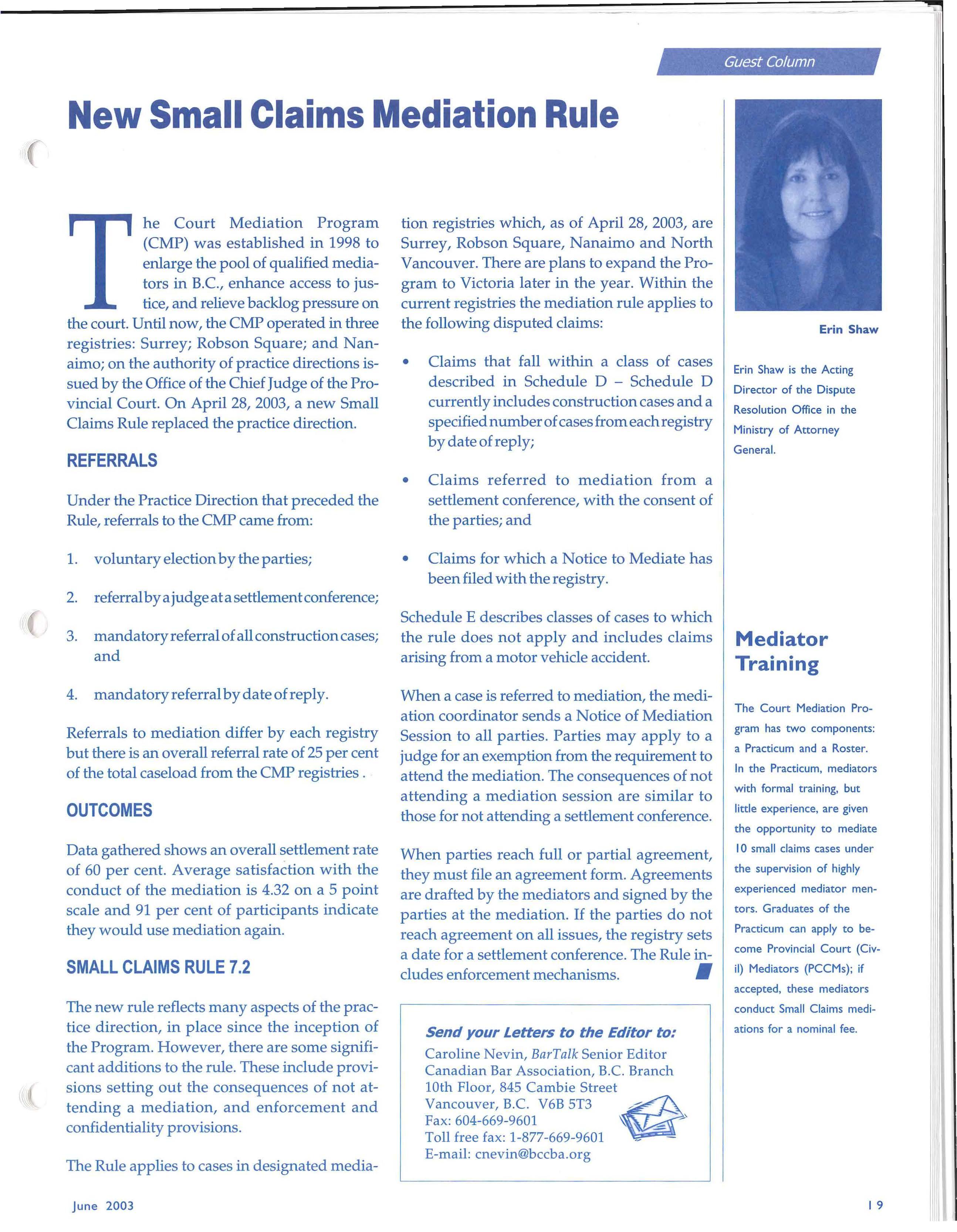
Er in Shaw is the Acting D irector of the D ispute Resolution Office in the Min istry of Attorney General.
Mediator Training
The Court Mediation Program has two components: a Practicum and a Roster. In the Practic um, mediators with formal training, but little expe r ience, are given the opportunity to mediate I0 sma ll claims cases under the supervision of highly experienced mediator mentors. Graduates of the Pract icum can apply to become Provincial Court (Civil) Mediators (PCCMs); if accepted , these mediators conduct Small Claims mediat ions for a nominal fee.
Erin Shaw
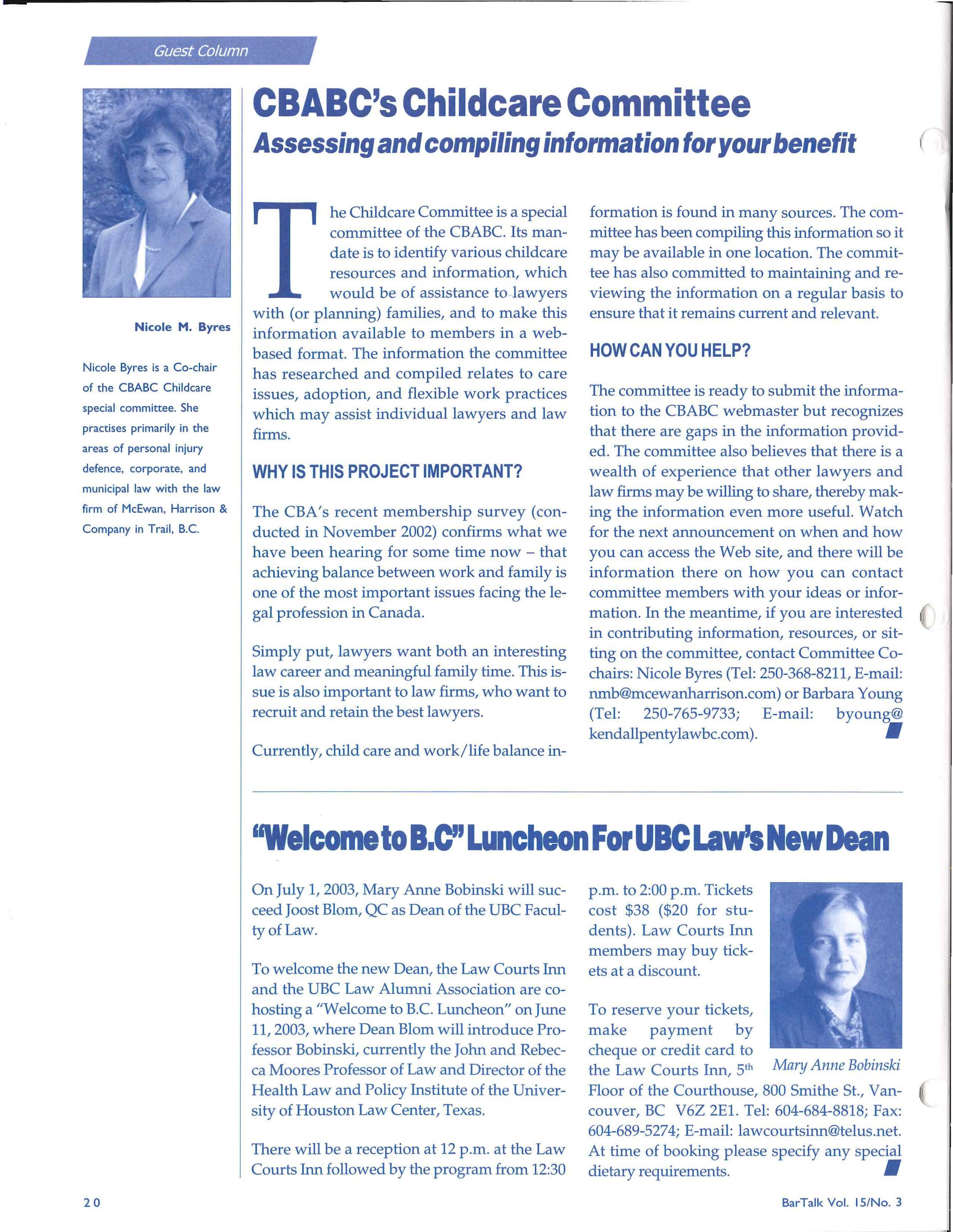
Nicole M. Byres
Nicole Byres is a Co-chair of the CBABC Ch il dcare special com mi ttee She practises primarily in the areas of personal injury defence, corporate , and municipal law with the law firm of McEwan , Harr ison & Company in Trail, B.C.
CBABC's Childcare Committee
Assessing
and
compiling
information for your benefit
he Childcare Committee is a special committee of the CBABC. Its mandate is to identify various childcare resources and information, which would be of assistance to lawyers with (or planning) families, and to make this information available to members in a webbased format. The information the committee has researched and compiled relates to care issues, adoption, and flexible work practices which may assist individual lawyers and law firms
WHY IS THIS PROJECT IMPORTANT?
The CBA's recent membership survey (conduc t ed in November 2002) confirms what we have been hearing for some time now - that achieving balance between work and fami ly is one of the most important issues facing the lega l profession in Canada
Simply put, lawyers want both an interesting law career and meaningful family time. This issue is also important to law firms, who want to recruit and retain the best lawyers.
Currently, child care and work/life balance in-
''Welcome to B.C"
formation is found in many sources The committee has been compiling this information so it may be available in one location The committee has also committed to maintaining and reviewing the information on a regular basis to ensure that it remains current and relevant.
HOW CAN YOU HELP?
The committee is ready to submit the information to the CBABC webmaster but recognizes that there are gaps in the information provided . The committee also believes that there is a wealth of experience that other lawyers and law firms may be willing to share, thereby making the information even more useful. Watch for the next announcement on when and how you can access the Web site, and there will be information there on how you can contact committee members with your ideas or information. In the meantime, if you are interested in contributing information, resources, or sitting on the committee, contact Committee Cochairs : Nicole Byres (Tel: 250-368-8211, E-mail: nmb@mcewanharrison.com) or Barbara Young (Tel: 250-765-9733; E-mail: byoung@ kendallpentylawbc.com). •
Luncheon ForUBC Law's New Dean
On July 1, 2003, Mary Anne Bobinski will succeed Joost Blom, QC as Dean of the UBC Faculty of Law
To welcome the new Dean, the Law Courts Inn and the UBC Law Alumni Association are cohosting a "Welcome to B.C. Luncheon" on June 11,2003, where Dean Blom will introduce Professor Bobinski, currently the John and Rebecca Moores Professor of Law and Dir ector of the Health Law and Policy Institute of the University of Houston Law Center, Texas.
There will be a reception at 12 p.m. at the Law Courts Inn followed by the program from 12 :30 p m to 2:00p.m Tickets co s t $38 ($20 for students). Law Courts Inn members may buy tickets at a d i scount.
To reser v e y our tickets , make payment by cheque or credit card to t he Law Court s Inn, 51h M ary Ann e Bobin ski Floor of the Courthou se, 800 Smithe St. , Vancouver, BC V6Z 2El. Tel : 604 -684-8818 ; Fax : 604-689-5274; E-mai l : lawcourtsinn@telus.net. At time of booking please specify an y special dietary requirements.
•
Professor Mary Anne Bobinski
A profile of USC's new Dean of Law
rofessor Mary Anne Bobinski has been appointed Dean of the Faculty of Law at the University of British Columbia effective July 1, 2003, following a year-long international recruitment process.
"The Faculty of Law at UBC managed to get exactly what it needs in Mary Anne Bobinskian energetic and gifted teacher, scholar and leader who has the ability to bring all the individual talents at UBC into a cohesive whole," says third-year law student David Miles, former President of the Law Student's Association who sat on the Dean Selection Committee atUBC.
"Mary Anne stood out as the type of leader that the Faculty of Law at UBC needs to make it the foremost legal education institution in Canada, and in the world," says Mr . Miles.
Professor Bobinski is currently Director of the University of Houston's Health Law & Policy Institute, recently named the number one health law program in the U.S by US News & World Report. The Health Law & Policy Institute was founded in 1978 to advance research in the merging areas of law, public policy and medicine . Professor Bobinski is also the John and Rebecca Moores Professor of Law at the University of Houston. The Moores Professorship honours tenured professo.rs who have made outstanding contributions in teaching, research and service, and who are scholars of national or international distinction
"Professor Bobinski brings a strong commitment to excellence in research, teaching and academic leadership, says UBC VP of Academic Barry McBride . "This, combined with her excellent administrative skills and impressive scholarly record, makes her an ideal fit for the position of Dean of Law. I am confident she will work with faculty members individually and collectively to cultivate and enhance scholarship and teaching. She will bring about change in a manner that inspires collegiality
and harmony with staff and students in a way that commands respect, and with the legal community to bring resources and prestige to the Faculty "
Professor Bobinski received her B.A. and J.D degrees, both summa cum laude, from the State University of New York at Buffalo After a judicial clerkship with Mr. Justice Max Rosenn of the United States Court of Appeals for the Third Circuit, Professor Bobinski obtained an LL.M from Harvard University She has been teaching at the University of Houston Law Center since 1989, and in 1998, she was appointed Associate Dean of Academic Affairs.
Articles written about Professor Bobinski during her tenure at the University of Houston refer to the "respect and reverence" she has earned from colleagues at the Law Center, and former students remember her classes as "an emiching part of their law school careers."
She has co-authored five law books on health care law and ethics, HIV law and policy, and medical ethics She is widely published in academic journals and is a frequent public speaker on health care issues ranging from medical malpractice, e-health and health care finance .
She is a member of the American Bar Association, the Association of American Law Schools, and a board member of the Montrose Clinic in Houston.
Professor Bobinski was awarded Houston's prestigious Ethel M. Baker Service Award for Outstanding Community Service in addition to several other awards including a Students' Advocates Award in 1998 and 1999, the Texas Human Rights Foundation Award for Meritorious Service in 1995, and the Bar Association President's Award for Human Rights.
Professor Bobinski succeeds Joost Blom, QC as Dean of the Faculty of Law. •
Mingie is an articled student at Lang Michener and a member of the BarTa/k Editorial Board
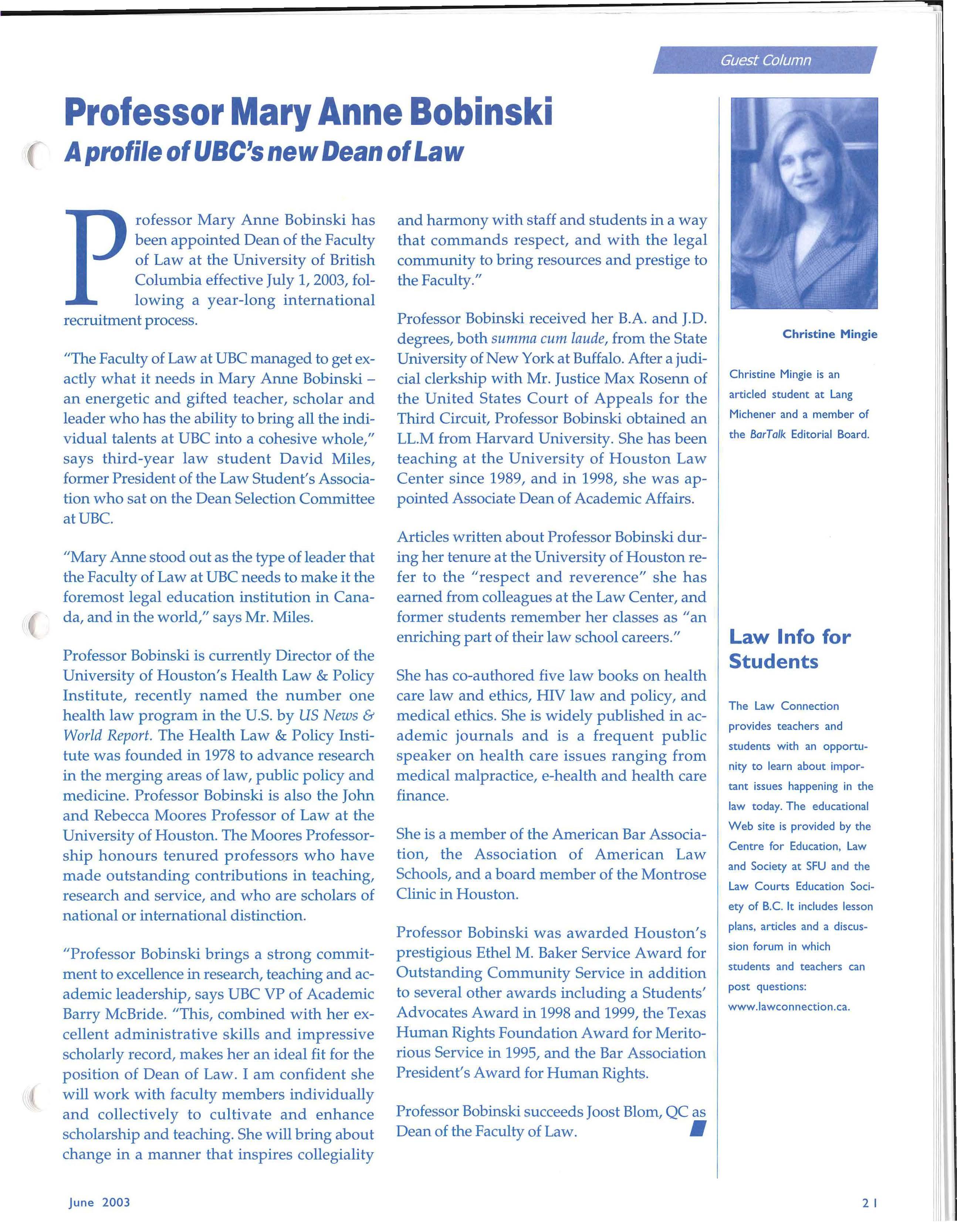
Law Info for Students
The Law Connection provides teachers and students with an opportunity to learn about important issues happening in the law today The educational Web site is provided by the Centre for Education, Law and Society at SFU and the Law Courts Education Society of B C. It includes lesson plans, articles and a discussion forum in wh ich students and teachers can post questions : www.lawconnection ca
Christine Mingie
Christine
Patricia Jordan
Patr icia Jordan is the CBABC Manager, Interact ive Med ia. She welcomes your comments, questions, and suggestions. If you ' re having difficulty finding a document online, need an answer , or would like something added to the site, contact her at pjordan@bccba.org or call 604-646-7861
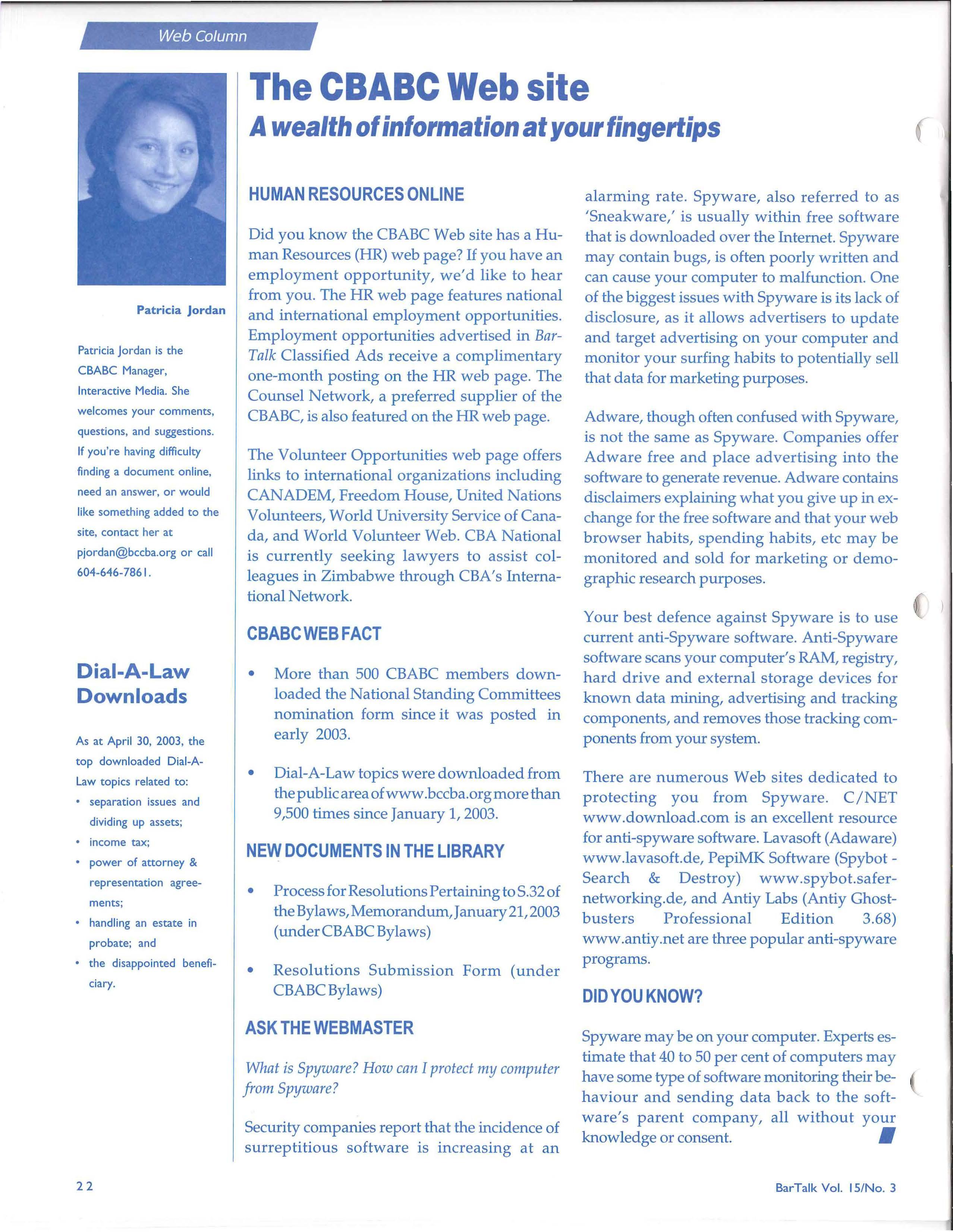
Dial-A-Law Downloads
As at Apr il 30, 2003, the to p down loaded D ia l-ALaw topics re lated to : separation issues and d ivid ing up assets; income tax;
• power of attorney & representation agreements;
han d ling an estate in probate; and
• the disappo inted be neficiary.
The CBABC Web site A wealth of information at your fingertips
HUMANRESOURCESONUNE
Did you know the CBABC Web site has a Human Resources (HR) web page? If you have an employment opportunity, we'd like to hear from you. The HR web page features national and international employment opportunities Employment opportunities advertised in BarTalk Classified Ads receive a complimentary one-month posting on the HR web page . The Counsel Network, a preferred supplier of the CBABC, is also featured on the HR web page.
The Volunteer Opportunities web page offers links to international organizations including CANADEM, Freedom House, United Nations Volunteers, World University Service of Canada, and World Volunteer Web CBA National is currently seeking lawyers to assist colleagues in Zimbabwe through CBA' s International Network
CBABCWEBFACT
• More than 500 CBABC members downloaded the National Standing Committees nomination form since it was posted in early 2003.
• Dial-A-Law topics were downloaded from the public area ofwww.bccba.org more than 9,500 times since January 1, 2003.
NEW DOCUMENTS IN THE UBRARY
• Process for Resolutions Pertaining to S.32 of theBylaws,Memorandum,January21,2003 (under CBABC Bylaws)
• Resolutions Submission Form (under CBABCBylaws)
ASK THE WEBMASTER
What is Spyware? How can I protect my computer from Spyware?
Security companies report that the incidence of surreptitious software is increasing at an
alarming rate. Spyware, also referred to as 'Sneakware,' is usually within free software that is downloaded over the Internet. Spyware may contain bugs, is often poorly written and can cause your computer to malfunction. One of the biggest issues with Spyware is its lack of disclosure, as it allows advertisers to update and target advertising on your computer and monitor your surfing habits to potentially sell that data for marketing purposes
Adware, though often confused with Spyware, is not the same as Spyware Companies offer Adware free and place advertising into the software to generate revenue. Adware contains disclaimers explaining what you give up in exchange for the free software and that your web browser habits, spending habits, etc may be monitored and sold for marketing or demographic research purposes.
Your best defence against Spyware is to use current anti-Spyware software Anti-Spyware software scans your computer's RAM, registry, hard drive and external storage devices for known data mining, advertising and tracking components, and removes those tracking components from your system.
There are numerous Web sites dedicated to protecting you from Spyware C/NET www.download.com is an excellent resource for anti-spyware software. Lavasoft (Adaware) www.lavasoft.de, PepiMK Software (SpybotSearch & Destroy) www spybot.safernetworking.de, and Antiy Labs (Antiy Ghostbusters Professional Edition 3.68) www.antiy.net are three popular anti-spyware programs .
DID YOU KNOW?
Spyware may be on your computer . Experts estimate that 40 to 50 per cent of computers may have some type of software monitoring their behaviour and sending data back to the software's parent company, all without your knowledge or consent.
•
CBA International Development Programs
The reputation of the Canadian Bar abroad continues to grow with ongoing work in four countries:
Cambodia: The first of four planned CBA training sessions for the newly-formed Bar school in Phnom Penh is under way. The program deals with contracts. The next three courses focus on: communicating with your client; negotiation and mediation; and commercial law.
China: CBA has recently signed a contract with CIDA to fund a Criminal Justice Reform Advocacy Project in China. Still in its infancy, the project will involve helping the criminal
CBABC President's Forum
section of the All China Lawyers Association to engage in law reform and provide advocacy skill training to its members.
Bangladesh: The CBA initiative in Bangladesh focuses on legal aid, juvenile justice and alternative dispute resolution. Implementation of the program begins in May .
Ethiopia: CIDA has just approved funding for the development and implementation of an alternative dispute resolution training session with the Ethiopian Bar Association.
For more information on CBA's International Development initiatives, visit www.cba.org •
Strategies for Developing a Successful and Profitable Practice
The CBABC presents the President's Forum on Strategies for Developing a Successful and Profitable Practice on Friday, June 20, 2003 at the Four Seasons Hotel in downtown Vancouver from 9:00a.m. to 3:30p m. Panel topics will include:
• Law Firm Marketing: Dispelling the Myths;
• Practising Law with Fewer Hours, More Fun, and Improved Profitability;
• When Assets Have Feet: Developing a Personal'Strategic Plan';
• Trends in Technology: Modernize Your Marketing; and
• Practice Tools& Techniques, An Introduction to CBA's 'PracticeLink'.
The Forum will be a unique and informative dialogue with representatives of large firms, boutiques, national firms, mid-size firms and inhouse marketing departments from around the province. The cost of this event is $150 and includes lunch Registration forms are available at www.bccba.org. •
Branch and Bar Calendar June - August 2003

June 1-4
June 3
June 18
June 20
June 21
June 26
July 3
July4
Aug. 11-22
6th International Conference on Restorative Justice (Vancouver, Coast Plaza Hotel)
Freedom Feast! A Banquet to Support the BC Civil Liberties Association (Vancouver , Floata
Seafood Restaurant, 400-180 Keefer Street, 6:30 p.m.)
CBABC Executive Committee Meeting (CBABC Boardroom)
CBABC President's Forum (Vancouver, Four Seasons Hotel, 791 W. Georgia St , 9 a m -3 :30 p.m.)
Provincial Council Meeting (Richmond , Delta Airport Hotel, 9:00 a.m )
CBA I VBA Seventh Annual Golf Tournament (Vancouver, UBC Golf Club, 5185 University Blvd)
Annual Westminster/Fraser Valley Bar Golf Tournament (Surrey , Guildford Golf & Country Club)
Committee Appointment Day
Restorative Justice Summer Training Institute , various courses (New Westminster, online info: www3 .telus.net/cjibc/train0 l .htm)
To announce an upcoming event or meeting in the Branch and Bar Calendar, please contact Sandra Webb at 604-687-3404, or toll free 1-888-687-3404 (e-mail cba@bccba.org)
Committee Volunteer Applications
The CBABC operates a number of committe e s formed to imp lement CBABC programs or to serve the interests of the profession and the pub li c
The dead line for 2003/ 2004 comm ittee volunteer appl ications has been extended to June 9, 2003 To volunteer on a committee co ntact Rose Fabbro at the CBABC office. Tel : 604646-7854 or to ll free 1-888-687-3404, ext. 313.
Law Week 2003 Committee Members
Stephen Cooke (Chair)
Madame Justice
Laura Gerow
Sabrina A li
Vivian Ch iang
Michae l Dunn
Joel Go ld
Barbara Sage
She lley Smith
Rose Fabb r o (CBABC staff member)
Law Week 2003: Activities Throughout B.C.
National Law Day ce l ebrates the anniver sary of the Charter of Rights and Freedoms. Across Canada, Law Day 2003 celebrations attracted record media attention. In Manitoba, events were covered on radio and television; and in Ottawa, the French-language daily, Le Droit, published a special supplement. In Atlantic Canada a se v enminute ATV news special compared Canadian courts to those portrayed on Ame r ican TV, using clips from the popular Law & Order series. Activities in Yukon were highli ghted in a newspaper supplement. In B.C., where Law Day has expanded to a full Law Week, a full page column by Ian Mulgrew in Th e Vancouver Sun on April 12 described B C.'s roster of activities.
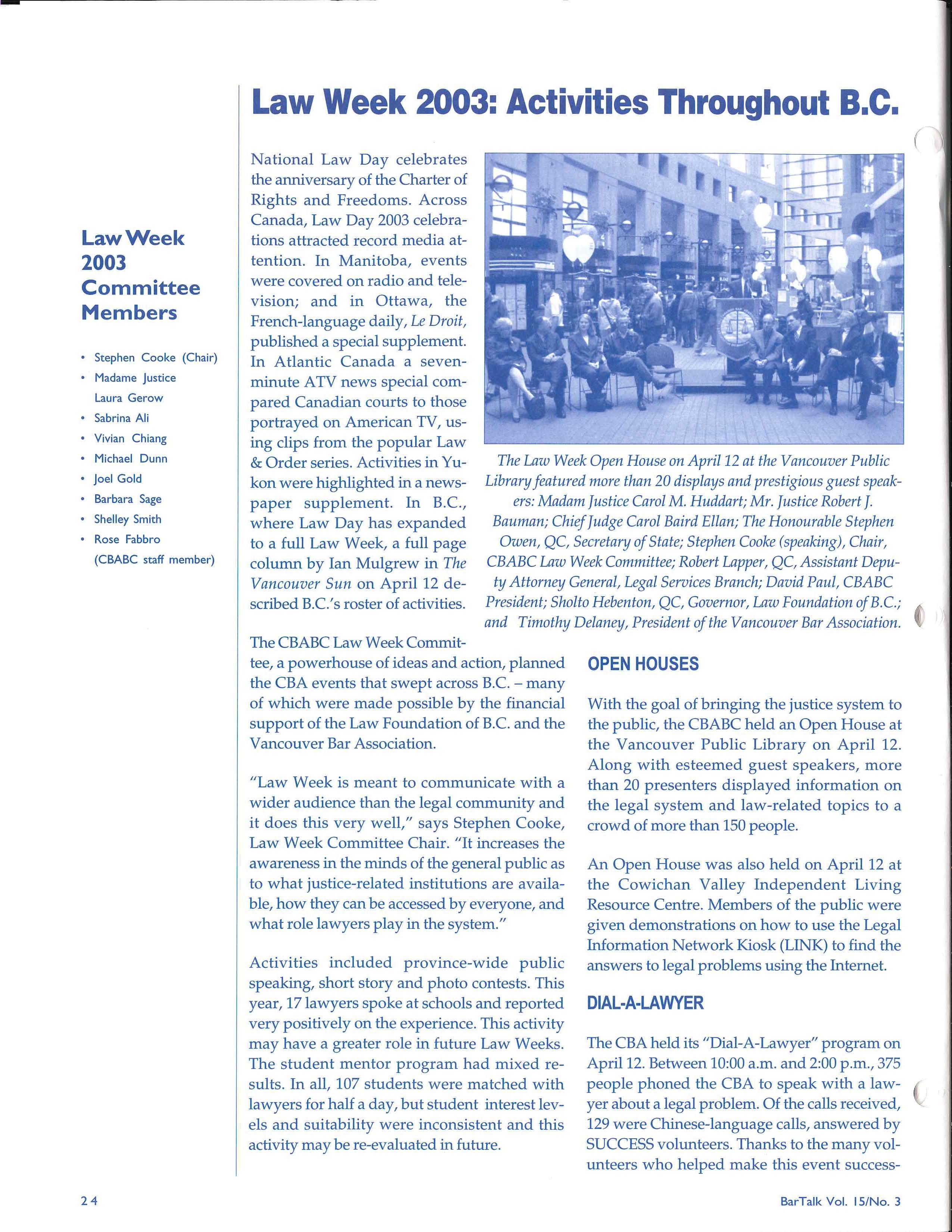
The Law Week Open House on April12 at the Vancouver Public Library featured more than 20 displays and prestigious guest speakers: Madam Justice Carol M . Huddart ; Mr . Justice Rob ert f. Bauman; Chief Judge Carol Baird Ellan; The Honourable Stephen Owen, QC, Secretary of State; Stephen Cooke (speaking), Chair , CBABC Law Week Committee; Robert Lapper, QC, Assistant Depu -
ty Attorney General, Legal Services Branch; David Paul , CBABC President; Sholto Hebenton, QC, Governor, Law Foundation of B.C.; 1:1 and Timothy Delaney, President of the Vancouver Bar Association. The CBABC Law Week Committee, a powerhouse of ideas and action, planned the CBA events that swept across B C. -many of which were made possible by the financial support of the Law Foundation of B.C. and the Vancouver Bar Association
"Law Week is meant to communicate with a wider audience than the legal community and it does this very well," says Stephen Cooke, Law Week Committee Chair. "It increases the awareness in the minds of the general public as to what justice-related institutions are available, how they can be accessed by everyone, and what role lawyers play in the system."
Activities included province-wide public speaking, short story and photo contests . This year, 17lawyers spoke at schools and reported very positively on the experience . This activity may have a greater role in future Law Weeks. The student mentor program had mixed results . In all , 107 students we r e matched with lawyers for half a day, but student interest le vels and suitability were inconsistent and this activity may be re-evaluated in future
OPEN HOUSES
With the goal of bringing the justice system to the public, the CBABC held an Open House at the Vancouver Pub l ic Library on April 12 Along with esteemed guest speakers , more than 20 presenters displayed information on the legal system and law-related topics to a crowd of mor e than 150 people
An Open House was also held on April 12 at the Cowichan Valley Independent Living Resource Centre. Members of the public were given demonstrations on how to use the Legal Information Network Kiosk (LINK) to find the answers to legal problems using the Internet.
DIAL-A-LAWYER
The CBA held its "Dial-A-Lawyer" program on April12 . Between 10 :00 a .m . and 2:00p.m ., 375 people phoned the CBA to speak with a lawyer about a legal problem . Of the calls received, 129 were Chinese-language calls, answered by SUCCESS volunteers. Thanks to the many volunteers who helped make this event success-
ful: Fiona Anderson; Barbara Bergen; Danielle Bretton; Helen Chiu; Michael Dunn; Brent Ellwyn; Mark Epstein; Nancy Harold; Cindy Henderson (UBC Law Student); Beverly Hoy; Shannon Kwok; Judith Lee; Richard Lee; Carla Lewis; Valerie Little; Paul Mendes; Grant Meng; Matthew Nathanson; Dana Neilson; Jeffery Oliver; Kathleen Packard; Sonny Parhar; Allan Parker; Greg Samuels; Helena Shum; Bonnie Teng; Kenneth Thornicroft; Ivan Tse; Eva Un; and Lawrence Wong. Thanks also to reception volunteers Sandra Li and Albert Ng and to The Vancouver Sun for its support.
MOCK TRIALS
In Kamloops, the trial of Regina v Brogue was staged and in Nanaimo, elementary students took part in the Peter Pan "abduction" mock trial. The Vernon Bar Association performed a mock trial of Regina v. Arthur of Logres to educate the public about the services available within their community
STUDENT CONTEST WINNERS
Short Story Contest: Winner: A Silver Lining, by Jessica Doherty (Seaquam Secondary, Delta); Second Place: A Delinquent's Reform, by Shazia Khan (L.A. Matheson Secondary, Surrey); and Third Place: A Plea of Help, by Tiffany White (Seaquam Secondary, Delta). The winning entries are posted at www bccba.org.
Photo Contest: Winner : D A.R.E , by Andrea Haugen (Kamloops Secondary); Second Place: Lack of Help, by Keri-Rose Thiessen (St. Thomas More Collegiate, Burnaby); and Third Place: A Little Piece of Paradise, by Katrina Wojcik (St. Thomas More Collegiate, Burnaby)
Public Speaking Contest: Winner: Kelsey Wheelhouse (W.L. Seaton, Vernon); First Runner-up: Adam Schneider (Brentwood College, Mill Bay); Second Runner-up: Michaelene Dustin (Elkford); and Third Runner-up: Jared Faber (Oak Bay, Victoria)
Twenty students from throughout B.C. participated in this contest. Thanks to the public speaking judges : Madame Justice Heather J. Holmes; Moncrief John Carstairs, QC; Professor Elizabeth Edinger; Anna Kelly Fung, QC; Kitty J. Heller; Terence E. LaLiberte, QC; Bruce Quayle; Elizabeth J. Rowbotham; and Catherine F. Wangler.
LAWWEEK2004
The future looks grand for Law Week! "The Law Week Committee is already planning Law Week 2004 which will include exciting new activities such as a five km run/walk," says Stephen Cooke. "With increased funding and effort, Law Week will help us shine a spotlight on the law and educate the public about the justice system and the role of lawyers within a"
Excerpt of Winning Short Story "A Silver Lining"
By Jessica Doherty, Seaquam Secondary, Delta (Full story online at www.bccba.org)
"You haven't gotten child support from Sam in six months?" She could hear Colleen's voice as they ate their lunches in the staff room today. Sarah, with an apple and a peanut butter sandwich, Colleen with one of those new microwavable meals. It smelt so good. "You should sue," Colleen continued, between bites. "That's what I did when the barbeque almost exploded in my backyard."
"I don't exactly have the money to sue, Col. . .look at me. I'm eating a peanut butter sandwich for the twentieth day in a row." A bitter chuckle escaped her -
"You don't necessarily need money. Have you ever thought of legal aid?" She actually hadn't, but only people with no money were that desperate. Surely there could be some other way , she thought. But now, lying on her couch at home, listening to her boys argue over the volume of the radio, a broken spring digging into her lower back, she knew that she was "people with no money". And there really wasn't some other way. Tomorrow, she thought, looking up at the clock. For now, she had to get ready for work.
CBA National 'Lawyers Care' Initiative
The National CBA Communications Committee has launched the next phase of the 'Lawyers Care' Initiative - an external member campaign The creative development of three print messages (completed in May) will be focus-tested in OttawaGat ineau, Ca lgary and Vancouver. There will a lso be a public focus group session in Vancouver
"The feedback from the focus groups will be used to analyze and shape the final campaign ," says National Commun icat ions Chair James Lebo of Calgary "The advertising campaign will be targeted to selected media and we expect the ads will run throughout the year, a ll subject to budget cons iderations."
For more information on the 'Lawyers Care' Initiative, visit www.cba.org.
New Westminster/ Fraser Valley Bar Golf Classic
The New Westminster/Fraser Valley Bar Golf Classic will be held Thursday, July 3'd at Guildford Golf Course in Surrey. Optional Texas scramb le format. Interested parties can contact Richard Molstad at 604-526-1821 for details.
CLE: New Books and Courses
THE NEW BUSINESS CORPORATIONS ACT -AN IN-DEPTH ANALYSIS, Sept. 22-23
The new B C. Business Corporations Act is the most significant change in B.C. company law in 30 years! Are you and your business clients ready for the new Act that will come into force this fall? The new Act replaces the Company Act, and will have a significant impact on every company in B.C. It's absolutely critical to know the full impact it will have on you and your clients Investing the time to learn about these important changes will make the transition easier for you and more profitable for your firm.
There are almost 280,000 active companies on the corporate register and every one of them will have to be brought into compliance with the provisions of the new Act within two years of the Act coming into force. You will need to be fully prepared for this very significant amount of new time-sensitive legal work. To get you up to speed, the CLE Society of BC will offer a two-day course on September 22"d and
Enhanced BCCLS Web site
The newly redesigned B.C. Courthouse Library Society Web site (www.bccls.bc.ca) is now available to members of the legal community of B.C., with more information and increased web-based functionality.
Some of the enhanced features of the Web site are :
Cases, Legislation, Court Rules: direct access to frequently requested information.
Databases: access to legal information indexes, including the B.C. Legal Literature Index (including indexing to CBABC Section Papers and The Advocate articles), Supreme Court of Canada Index, Unreported Decisions Index, and, for members of the Law Society of B.C., the B.C. Supreme Court Family Law Judgments.
• The Continuing al Education Soci ety of British
23'd entitled "The New B.C. Business Corporations Act- an In-Depth Analysis " This course will provide a thorough review and analysis of the entire statute. The materials for this course will be the new edition of the British Columbia Company Law Practice Manual. Register now to reserve your seat! Call CLE Customer Service at 604-893-2121 or visit www .cle .bc .ca
B.C. COMPANYLAWPRACTICEMANUAL2No EDITION
This authoritative guide to company law and practice, originally published in 1997, has been revised and updated to reflect changes required by the new Business Corporations Act This comprehensive two-volume practice manual was written by leading practitioners and reviewed by a distinguished editorial board , providing you with unique access to information you won't find anywhere else The manual maps every step of every transaction- from incorporation to dissolution. The 2"d edition will be published in September 2003 . •
BRITISH CoLUMBIA Cou RTHous E LmRARY SociETY
Links: reorganized useful links are now fully searchable.
Our Libraries: new locating tool, and complete contact information for all courthouse libraries in B.C., in addition to web pages dedicated to our six regional libraries (Kamloops, Kelowna, Nanaimo, New Westminster, Prince George, Victoria).
What's New: new search feature combined with the familiar browsing of legal topics
Staff in the Vancouver Courthouse Library and at the six regional libraries will be pleased to provide you with a site orientation. Please contact BCCLS through www.bccls.bc.ca, by e-mailing bccls@bccls.bc.ca or by calling 604660-2841 or 1-800-665-2570. •
Law Foundation of BC
PROFILE OF THE CHAIR
Donald Silversides, QC, of Prince Rupert, B.C. is Chair of the Law Foundation. Mr. Silversides joined the Board of Governors of the Law Foundation in 1996 and has served on a number of committees since, including: Small Grants, Civil Justice Reform, Finance and Administration, Abo-
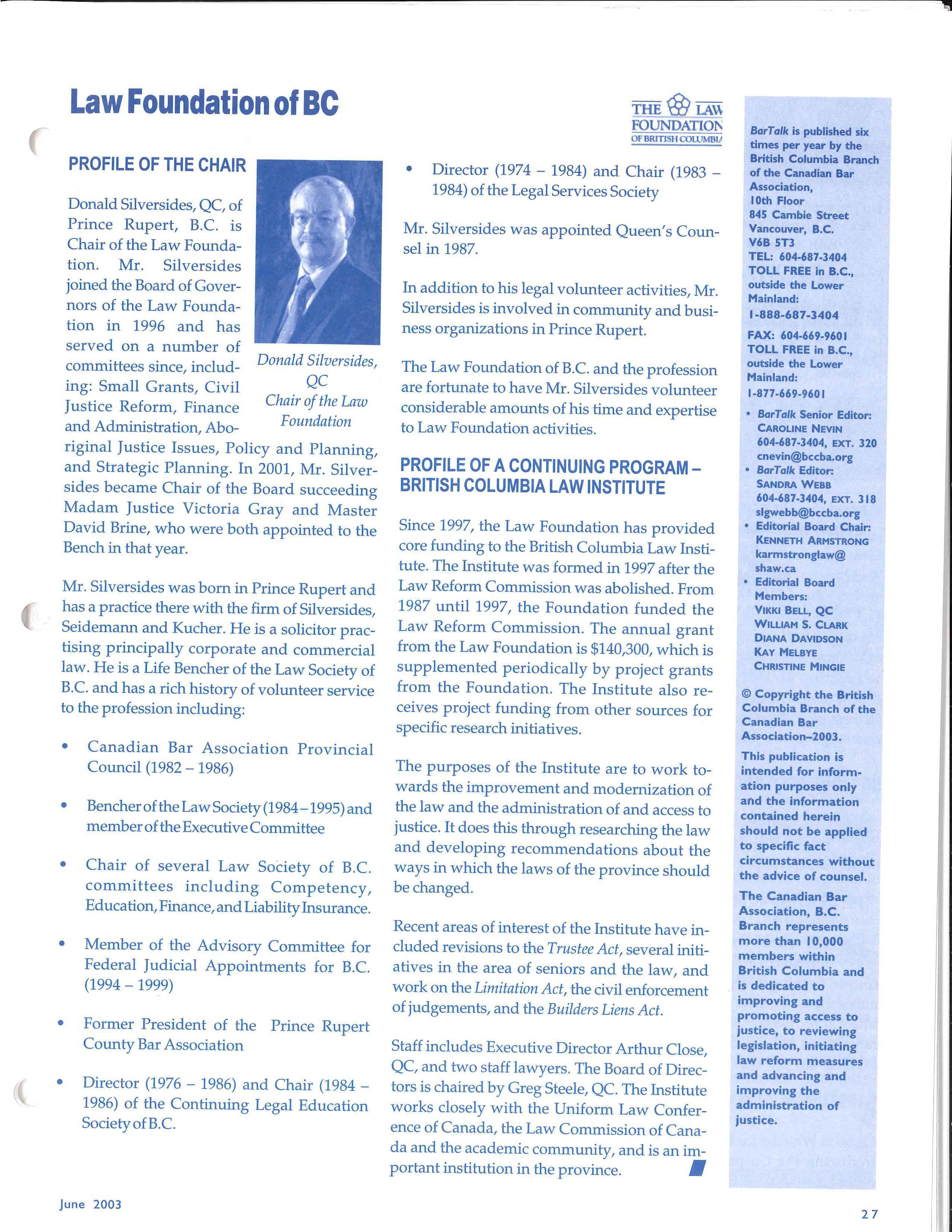
Donald Silversides, QC Chair of the Law Foundation
riginal Justice Issues, Policy and Planning, and Strategic Planning. In 2001, Mr. Silversides became Chair of the Board succeeding Madam Justice Victoria Gray and Master David Brine, who were both appointed to the Bench in that year.
Mr . Silversides was born in Prince Rupert and has a practice there with the firm of Silversides, Seidemann and Kucher. He is a solicitor practising principally corporate and commercial law. He is a Life Bencher of the Law Society of B C. and has a rich history of volunteer service to the profession including:
Canadian Bar Association Provincial Council (1982 -1986)
Bencher of the Law Society (1984 - 1995) and memberoftheExecutiveCommittee
Chair of several Law Society of B C. committees including Competency, Education, Finance, and Liability Insurance.
Member of the Advisory Committee for Federal Judicial Appointments for B.C. (1994- 1999)
Former President of the Prince Rupert County Bar Association
Director (1976 - 1986) and Chair (19841986) of the Continuing Legal Education Society ofB.C.
THE@IA\\ FOUNDATIOJS OF BR ITISI I COWMBU
• Director (1974 - 1984) and Chair (19831984) of the Legal Services Society
Mr Silversides was appointed Queen's Counsel in 1987.
In addition to his legal volunteer activities, Mr. Silversides is involved in community and business organizations in Prince Rupert.
The Law Foundation of B.C. and the profession are fortunate to have Mr. Silversides volunteer considerable amounts of his time and expertise to Law Foundation activities.
PROFILE OF A CONTINUING PROGRAMBRITISH COLUMBIA LAW INSTITUTE
Since 1997, the Law Foundation has provided core funding to the British Columbia Law Institute The Institute was formed in 1997 after the Law Reform Commission was abolished . From 1987 until 1997, the Foundation funded the Law Reform Commission. The annual grant from the Law Foundation is $140,300, which is supplemented periodically by project grants from the Foundation . The Institute also receives project funding from other sources for specific research initiatives.
The purposes of the Institute are to work towards the improvement and modernization of the law and the administration of and access to justice. It does this through researching the law and developing recommendations about the ways in which the laws of the province should be changed.
Recent areas of interest of the Institute have included revisions to the Truste e Act, several initiatives in the area of seniors and the law, and work on the Limitation Act, the civil enforcement of judgements, and the Builders Liens Act.
Staff includes Executive Director Arthur Close, QC, and two staff lawyers The Board of D ir ectors is cha ired by Greg Steele, QC. The Institute works closely with the Uniform Law Conference of Canada, the Law Commission of Canada and the academic community, and is an important institution in the province. •
BarTa/k is publish e d six times pe r year by th e British Columbia Branch of the Canadian Bar Association, lOth Floor 845 Cambie Street Vancouver, B.C. V6B STJ
TEL: 604-687-3404
TOLL FREE in B.C., outside the Lower Mainland: 1-888-687-3404
FAX: 604-669-960 I
TOLL FREE in B.C., outside the Lower Mainland: 1-877-669-960 I
• BarTa/k Senior Editor: CAROLINE NEVIN 604-687-3404, EXT. 320 cnevin@bccba.org
• BarTa/k Editor: SANDRA WEBB 604-687-3404, EXT. 318 slgwebb@bccba.org
• Editorial Board Chair: KENNETH ARMSTRONG karmstronglaw@ shaw.ca
• Editorial Board Members: VIKKI BELL, QC WILLIAM S. CLARK DIANA DAVIDSON KAY MELBYE CHRISTINE MINGlE
© Copyright the British Columbia Branch of the Canadian Bar Association-2003.
This publication is intended for information purposes only and the information contained herein should not be applied to specific fact circumstances without the advice of counsel.
The Canadian Bar Association, B.C. Branch represents more than I 0,000 members within British Columbia and is dedicated to improving and promoting access to justice, to reviewing legislation, initiating law reform measures and advancing and improving the administration of justice.
Do you need help with WCB problems?
Are you Plaintiffs counsel facing an ICBC Section lOdefence?
• Extensive experience withWCB appeals
• Vice Chair at Review Board for 6 years
• Personal injury litigation for 25 years
• Available for WCB appeals, expert opinions, court applications and trials .
Vahan A. Ishkanian
Cell 604-868-3034 Fax 604-264-6133
vishkanian@pepito.ca 1100-1200 W 73rd Ave Vancouver V6P 6G5
West Coast LEAF& Family law Lega/AidAffidavitCampaign
LEAF H AEJ see page 11 or www westcoastleaf.org
LITIGATION LAWYER required for Abbotsford law firm . Please forward resume, in confidence, to the attention ofJames L. Duignan Email: thefirm@linleyduignan.com Fax: 604859 -0843
OFFICE SPACE with a view available in the Burnaby Metrotown area for sublet. Wired for networking and phone system available Please call John at 604-876 - 5574.
NORTH SHORE PRACTICE FOR SALEwell-established solicitor ' s practice for sale Mainly conveyancing, but also wills , estates & company law. Lease available to suit. TURN KEY business. E -mail cba@bccba.org attention " Box 102"
Would any person having knowledge of the whereabouts of any last will prepared by Grant Fairley, aka Alexander Grant Fairley, please contact Davis & Fairley, Solicitors, #102 - 510 - 9'hAveN,POBox989,Golden,BCVOA 1HO Ph : 250-344-2241 Fax: 250-344-6118
STEPHENS & HOLMAN seeks an experienced plaintiffs personal injury lawyer. Fax resumes to 604 -736 -2867
Member Services

Please direct advertising inquiries to Sandra Webb at 604 -646-7856 or 1-888 -687 - 3404 , ext. 318 (e -mail cba@bccba.org).
CBABC members have access to a wide range of products, services and discounts. Member Services is continually adding and looking for ways you can get the most out of your membership! Visit www.bccba org for new additions. Your input is always welcome- send your suggestions to kjohnson@bccba org Member Services Hotline: 604-687 -3404 , ext. 500 or 1-888-687-3404, ext. 500.
BC LIONS FOOTBALL
CBA members receive special pricing on home game r - tickets! Regular season starts June 20th. See the insert inside BarTalk for pricing, or call Member Services.
"THE CENTRE" FOR PERFORMING
. CBA members receive 20 per cent off tickets on performances at The Centre fo r Performing Arts in Vancouver! Coming in September: The Full Monty, a "revealing" musical based on the hit movie; and Blast!, "The Broadway Musical for people who love Broadway Musicals." Prices range from $42.50 - $76.50 (after discount). Contact : Gina Mahil at 604-699-8767 (gmahil@centreinvancouver com)
WHISTLER BLACKCOMB SUMMER PROGRAM
Come to Whistler for the winter, but stay for the summer! Introducing the Corporate Club Summer Program - discounts available on tickets for the Whistler Mountain Bike
Park and Summer Sightseeing Tours, plus special pricing on Combo Passes (includes sightseeing, Westcoaster Luge and Mini-Golf) With each order, receive a Whistler Blackcomb Discount Card, valid until October 2004 (w hile quantities last) See the insert inside BarTalk.
PREFERRED HOTELS & TRAVEL SERVICES
Remember CBABC Preferred Hotels and other travel services when planning your summer vacation! Call Member Services or consult www bccba.org for a full list, from accommodations and car rentals to houseboat vacations .
ARTS CLUB AND STANLEY THEATRES
Receive a 20 per cent discount off regular-priced tickets by calling Cheryl Lang at 604-687-5315, ext. 254 and identifying yourself as a CBA member. Fully Committed plays at the Granville Island Stage until June 28; I Love You , You're Perfect, Now Ch ange begins July 31. Shirley Valentine plays at the Stanley Theatre July 17-August 24 . •