The Canadian Bar Association
Columbia
Why the Real Estate Act Matters What evil cured;
what principle for change?
or the majority of us, issues affecting the ability of a lawyer to conduct real estate transactions are not 'top of mind.' Here's why you should think about it now : the provincial government- supposed advocate of open-markets and healthy regulatory environments for the conduct of business- is proposing new legislation to limit the ability of lawyers to directly assist consumers in the purchase and sale of real estate At the same time, they are proposing to allow accountants to engage in certain real estate transactions, and to introduce an exclusive market for realtors on most other real estate transactions
Conducting a transaction that involves significant risks and resources for the consumer requires specific skills, experience, a regulatory framework and adequate insurance in order to protect the public However, there is no more stringent public protection than the regulatory framework in place when a consumer engages a lawyer who has experience and competency in dealing with real property transactions.
On what principled basis would a government seek to dismiss the public's right to have a lawyer conduct their real property transaction, and at less cost than with a realtor involved? What is the public policy argument for closing that option for consumers? And why would that option be closed at the same time as the door is newly opened for accountants to engage in the sale of real property as part of the conduct of business of their client? Will lawyers then be permitted to engage in the production of audited financial statements in the conduct of a corporate client' s business?
If the trivializing of the legal profession's skills, expertise and consumer protection role in any aspect of corporate life doesn't worry you, it should . If there is a higher standard to be upheld, it is for others to meet the legal profession's standard . No lawyer is allowed to engage in real property law without being competent to do so; to do otherwise, or to engage in any conduct unbecoming to the high standards of the legal profession, is to risk an entire career in law.
The Minister of Finance's ' Real Estate Act Review Discussion Paper' purports to introduce changes that will provide a "least cost" regulatory regime, "promote competition among participants," and " protect the public and preserve its confidence in the real estate sector " Sound principles, all. And the history of lawyer involvement in real estate transactions has met each of those principles squarely: as a self-governing profession, regulatory costs are borne by individual lawyers; lawyers have already been competently and effectively competing in the purchase and sale of real estate in Kamloops, Vancouver Island, Victoria and elsewhere, albeit with resistance from realtor groups, and providing lower cost transactions for consumers in the process; and we have been obligated to be insured since 1971
The proposed changes beg the question: what evil is cured by this new Act, and what principles are reall y behind it? At the moment, the Real Estate Board and the government may be the only ones with that answer. •
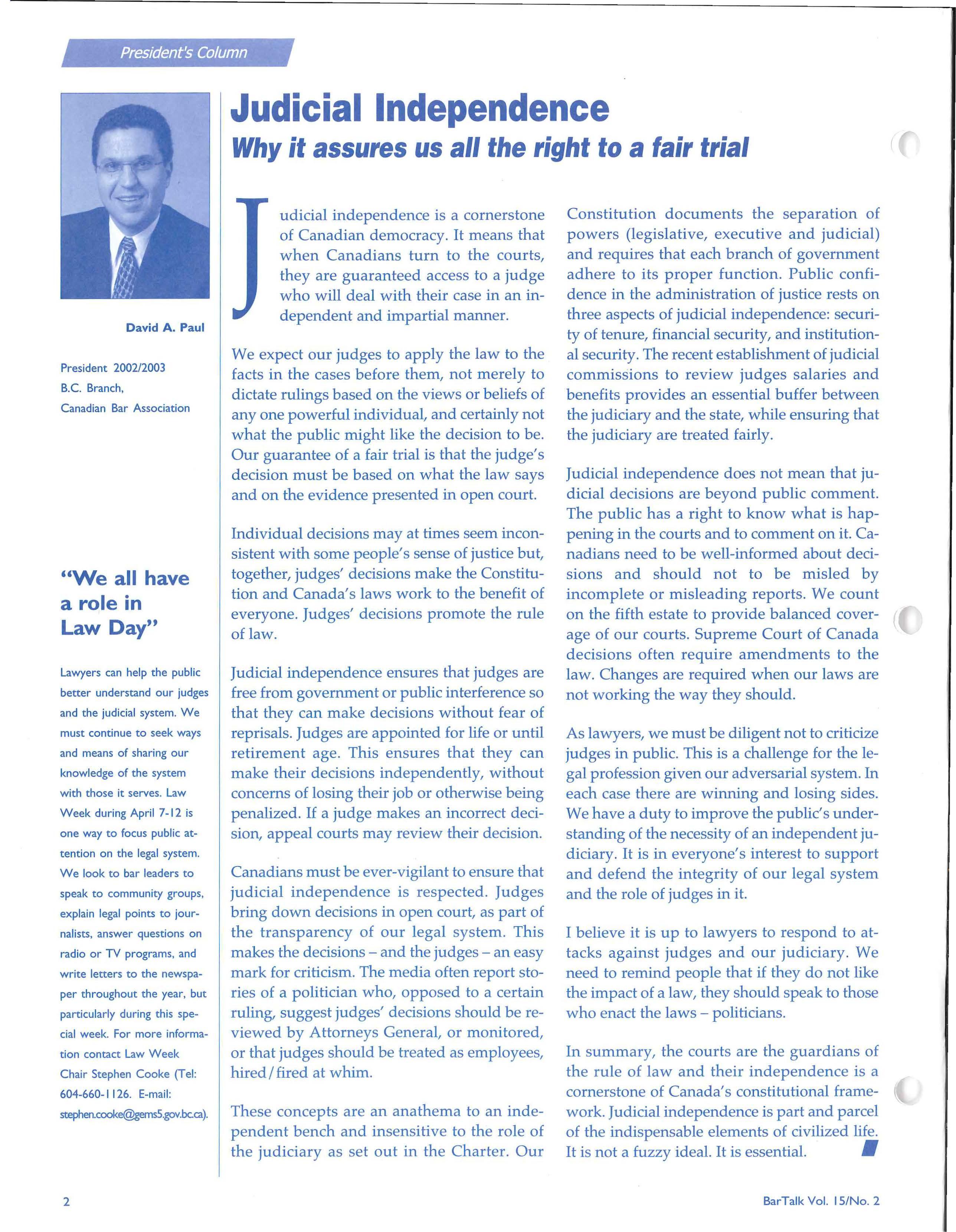
David A. Paul
President 2002/2003
B C. Branch, Canadian Bar Association
"We all have a
role
in Law Day"
Lawyers can help the public better understand our judges and the judicial system We must continue to seek ways and means of sharing our knowledge of the system with those it serves. Law Week during April 7-12 is one way to focus publ ic attent ion on the legal system. We look to bar leaders to speak to commun ity groups, explain legal points to journalists, answer questions on radio or TV programs, and write letters to the newspaper th r oughout the year , but particularly during this special week For more information contact Law Week
Chair Stephen Cooke (Tel: 604-660-1 126. E-mail : stephen.cooke@gemsS.gov bc.ca).
Judicial Independence
Why it assures us all the right to a fair trial
udicial independence is a cornerstone of Canadian democracy. It means that when Canadians turn to the courts, they are guaranteed access to a judge who will deal with their case in an independent and impartial manner.
We expect our judges to apply the law to the facts in the cases before them, not merely to dictate rulings based on the views or beliefs of any one powerful individual, and certainly not what the public might like the decision to be. Our guarantee of a fair trial is that the judge's decision must be based on what the law says and on the evidence presented in open court.
Individual decisions may at times seem inconsistent with some people's sense of justice but, together, judges' decisions make the Constitution and Canada's laws work to the benefit of everyone. Judges' decisions promote the rule of law.
Judicial independence ensures that judges are free from government or public interference so that they can make decisions without fear of reprisals. Judges are appointed for life or until retirement age. This ensures that they can make their decisions independently, without concerns of losing their job or otherwise being penalized. If a judge makes an incorrect decision, appeal courts may review their decision.
Canadians must be ever-vigilant to ensure that judicial independence is respected. Judges bring down decisions in open court, as part of the transparency of our legal system . This makes the decisions - and the judges - an easy mark for critic ism. The media often report stories of a politician who, opposed to a certain ruling, suggest judges' decisions should be reviewed by Attorneys General, or monitored , or that judges should be treated as employees, hired I fired at whim.
These concepts are an anathema to an independent bench and insensitive to the role of the judiciary as set out in the Charter. Our
Constitution documents the separation of powers (legislative, executive and judicial) and requires that each branch of government adhere to its proper function. Public confidence in the administration of justice rests on three aspects of judicial independence : security of tenure, financial security, and institutional security. The recent establishment of judicial commissions to review judges salaries and benefits provides an essential buffer between the judiciary and the state, while ensuring that the judiciary are treated fairly.
Judicial independence does not mean that judicial decisions are beyond public comment. The public has a right to know what is happening in the courts and to comment on it. Canadians need to be well-informed about decisions and should not to be misled by incomplete or misleading reports. We count on the fifth estate to provide balanced coverage of our courts. Supreme Court of Canada decisions often require amendments to the law. Changes are required when our laws are not working the way they should.
As lawyers, we must be diligent not to criticize judges in public. This is a challenge for the legal profession given our adversarial system. In each case there are winning and losing sides. We have a duty to improve the public's understanding of the necessity of an independent judiciary. It is in everyone's interest to support and defend the integrity of our legal system and the role of judges in it.
I believe it is up to lawyers to respond to attacks against judges and our judiciary. We need to remind people that if they do not like the impact of a law, they should speak to those who enact the laws - politicians.
In summary, the courts are the guardians of the rule of law and their independence is a cornerstone of Canada's constitutional framework. Judicial independence is part and parcel of the indispensable elements of civilized life. It is not a fuzzy ideal. It is essential. •
The Committees of CBABC
Have you thought about participating?
n this column I would like to describe Executive Committee and Council. LLRC refor you the structure and function of the CBABC' s 28 committees and extend an invitation to each of you to consider participating in a committee.
CBABC committees are created by resolution of Provincial Council. The purpose of committees is to undertake work within the mandate of each committee with a view to conducting investigations, preparing reports and providing advice and recommendations to the Executive Committee in relation to the work of the B.C. Branch.
There are 20 Standing Committees (excluding the Executive Committee) and eight Special Committees. St anding Committees undertake work that it is anticipated will always be needed. As you would expect, Standing Committees operate until such time as Council decides that they are no longer necessary. On the other hand, Special Committees undertake projects and particular pieces of work that are expected to be of a fixed term nature. They have a life of up to three years and may be extended for further terms but never for more than three years at a time
The Communications Committee and Government Relations Committee are good examples of Standing Committees The Child Care and Member Dispute Resolutions Committees are both Special Committees intended to complete work on particular projects for the Branch. If the nature of the work of a Special Committee changes, it may be converted into a Standing Committee by further resolution of Council. This may occur with the International Resources Network Committee within the next year.
Participating in the work of a committee can provide opportunities for interesting and challenging work as well as opportunities to network with colleagues. For example, the Legislation and Law Reform Committee (LLRC) is regularly asked for its advice on proposed legislative change for consideration by both the
cently undertook some very important work in connection with the provincial government's Civil Liability Review as well as proposed amendments to the Health Professions Act. Similarly, the Advisory Committee to the Judicial Council of B.C. prepares confidential reports for consideration by the Judicial Council of prospective candidates for appointment to the Provincial Court. I invite you to review the mandates of the CBABC's various committees which are included as an insert in this issue of BarTalk and are also available at www bccba.org in the CBA News Room
The work of committees is supported by a Committee Liaison. That position is currently held by Margaret Sasges of Victoria Her role is to ensure that all of the CBABC' s committees are operating effectively. The Committee Liaison participates in the annual appointment of members to committees, conducts the annual orientation session for Committee Chairs and ensures that committees prepare reports in a timely fashion, to name but a few of her functions. The committees are also supported by a staff Committee Coordinator who ensures that notices and minutes are received and circulated and generally provides support to the ongoing operation of the committees.
Annually, in early July, the Executive Committee meets to review qualifications of those who have volunteered for appointment to CBABC committees. Committee members are appointed for a two-year term and may be re-appointed for one further term of two years. Chairs of committees are appointed annually and may be appointed up to a total of three years. These term limits are intended to permit as many members as possible to participate while ensuring a certain level of continuity
In this issue of BarTalk as an insert you will find a Committee Volunteer Form together with information about the CBABC's Committees. I invite each of you to consider volunteering to participate in one or more of the Branch's committees. •
Once is never enough!
If you have ch anged firms , changed addresses, have a new e-ma il address or phone/fax number, you need to let us know. Letting the Law Society in on the secret is not enough!
Contact us at data@bccba .org, phone 604687 -3404 or fax 604-669960 I. (Toil free options: phone 1-888-687-3404 or fax 1-877-669-9601)
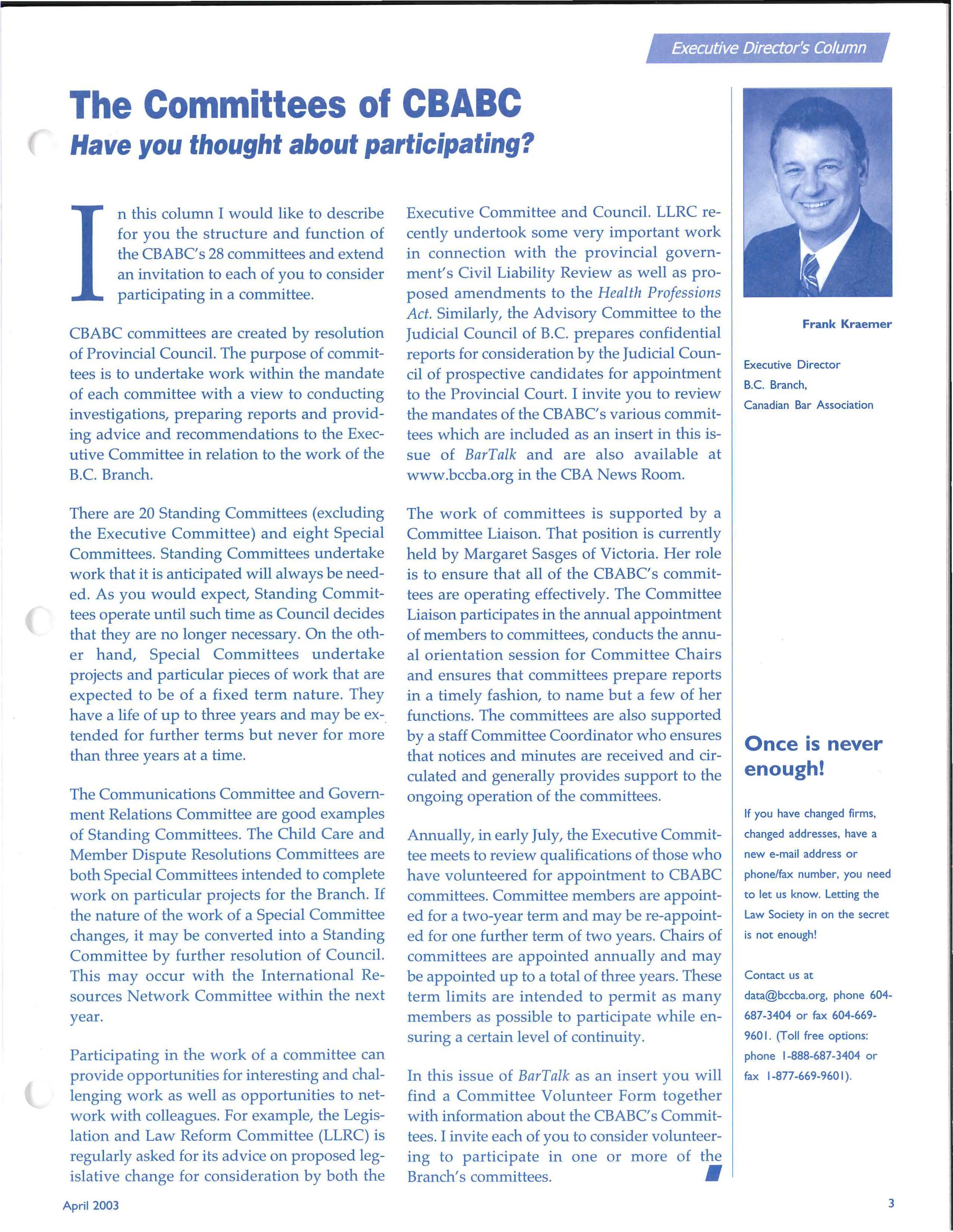
Frank Kraemer
Exe cutive Dire ct o r
B C. Br a nch, C a nadia n Bar Associat io n
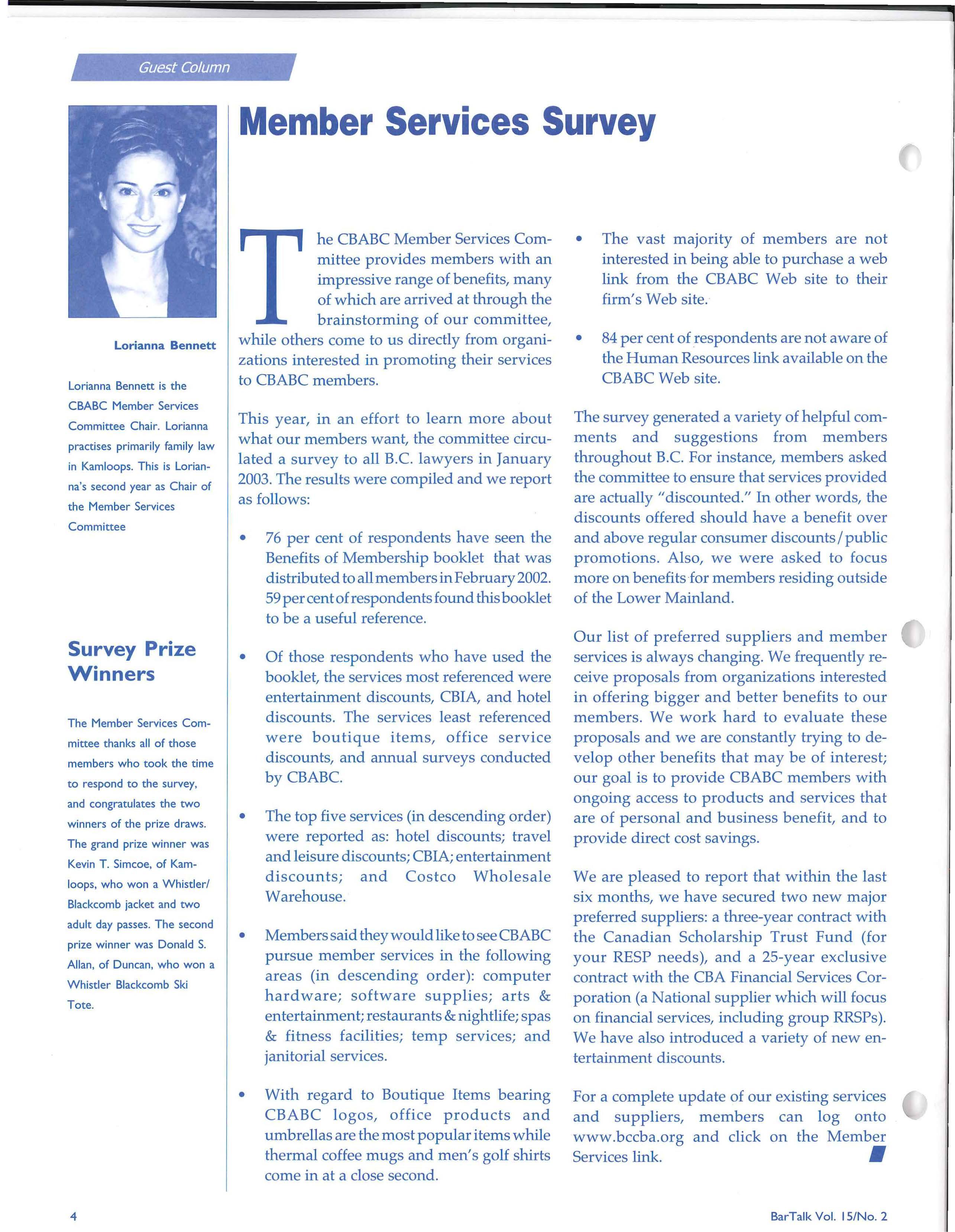
Lorianna Bennett
Lorianna Bennett is the CBABC Member Services Committee Chair. Lorianna practises primarily family law in Kamloops This is Lorianna's second year as Cha ir of the Member Services Committee
Member Services Survey
Survey Prize Winners
The Member Services Committee thanks all of those members who took the time to respond to the survey, and congratu lates the two winners of the prize draws. The grand prize winner was Kevin T. Simcoe, of Kamloops, who won a Whistler/ Blackcomb jacket and two adult day passes. The second prize winner was Donald S All an, of Duncan, who won a Whistler Blackcomb Ski Tote
he CBABC Member Services Committee provides members with an impressive range of benefits, many of which are arrived at through the brainstorming of our committee, while others come to us directly from organizations interested in promoting their services to CBABC members.
This year, in an effort to learn more about what our members want, the committee circulated a survey to all B.C. lawyers in January 2003 The results were compiled and we report as follows:
• 76 per cent of respondents have seen the Benefits of Membership booklet that was distributed to all members in February 2002. 59 per cent of respondents found this booklet to be a useful reference .
• Of those respondents who have used the booklet, the services most referenced were entertainment discounts, CBIA, and hotel discounts. The services least referenced were boutique items, office service discounts, and annual surveys conducted by CBABC.
• The top five services (in descending order) were reported as: hotel discounts; travel and leisure discounts; CBIA; entertainment discounts; and Costco Wholesale Warehouse.
• Members said they would like to see CBABC pursue member services in the following areas (in descending order): computer hardware; software supplies; arts & entertainment; restaurants & nightlife; spas & fitness facilities; temp services; and janitorial services.
• With regard to Boutique Items bearing CBABC logos, office products and umbrellas are the most popular items while thermal coffee mugs and men's golf shirts come in at a close second.
• The vast majority of members are not interested in being able to purchase a web link from the CBABC Web site to their firm's Web site
• 84 per cent of respondents are not aware of the Human Resources link available on the CBABC Web site.
The survey generated a variety of helpful comments and suggestions from members throughout B C. For instance, members asked the committee to ensure that services provided are actually "discounted." In other words, the discounts offered should have a benefit over and above regular consumer discounts I public promotions. Also, we were asked to focus more on benefits for members residing outside of the Lower Mainland
Our list of preferred suppliers and member services is always changing. We frequently receive proposals from organizations interested in offering bigger and better benefits to our members. We work hard to evaluate these proposals and we are constantly trying to develop other benefits that may be of interest; our goal is to provide CBABC members with ongoing access to products and services that are of personal and business benefit, and to provide direct cost savings.
We are pleased to report that within the last six months, we have secured two new major preferred suppliers: a three-year contract with the Canadian Scholarship Trust Fund (for your RESP needs), and a 25-year exclusive contract with the CBA Financial Services Corporation (a National supplier which will focus on financial services, including group RRSPs ) We have also introduced a variety of new entertainment discounts.
For a complete update of our existing services and suppliers, members can log onto www.bccba.org and click on the Member Services link.
•
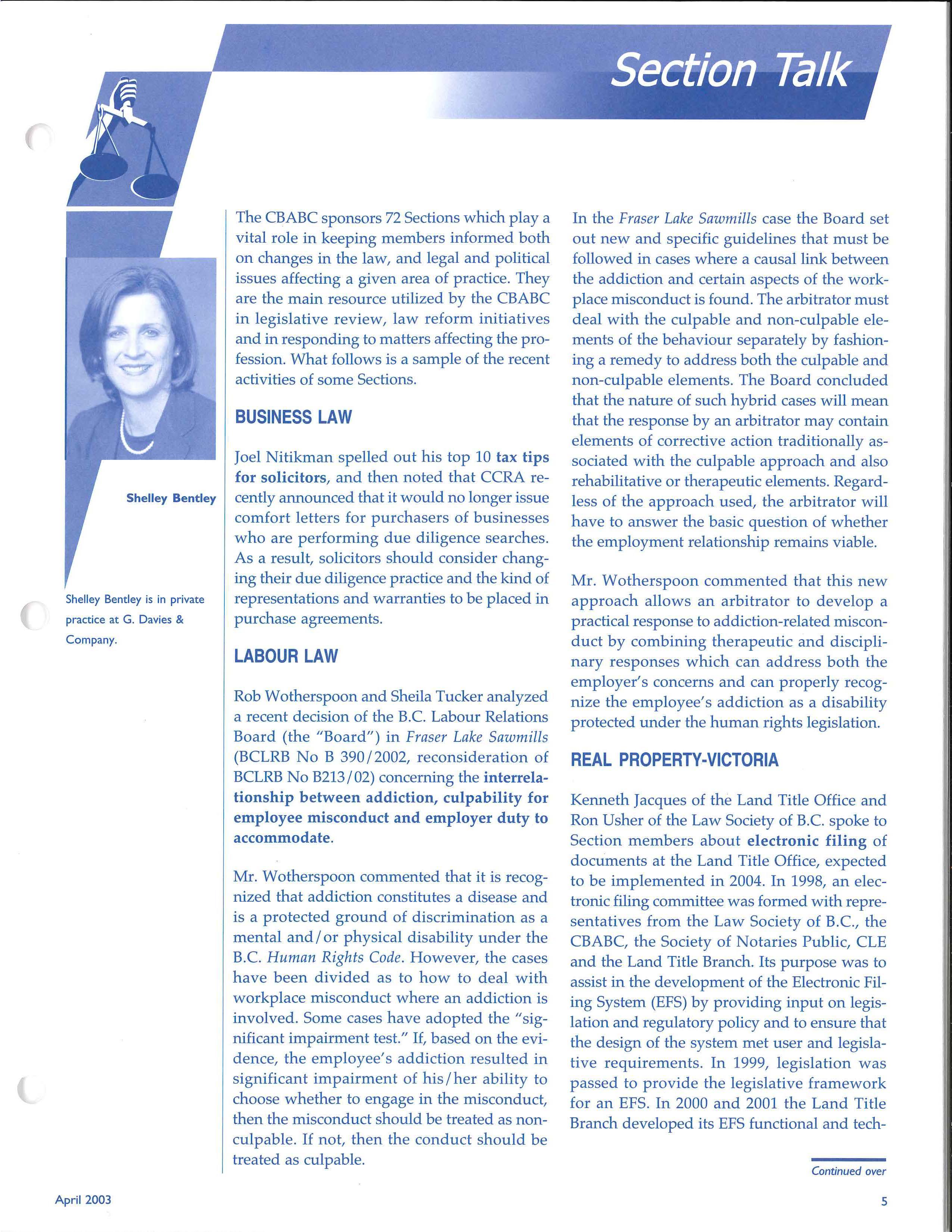
Shelley Bentley Shelley Bentley is in private practice at G. Davies & Company.
The CBABC sponsor s 72 Sections which play a vital role in keeping member s informed both on changes in the law, and legal and political issues affecting a given area of practice. They are the main resource utilized by the CBABC in legislative review, law reform initiatives and in responding to matters affecting the profession What follows is a sample of the recent activities of some Sections.
BUSINESS LAW
Joel Nitikman spelled out his top 10 tax tips for solicitors, and then noted that CCRA recently announced that it would no longer issue comfort letters for purchasers of businesses who are performing due diligence searches. As a result, solicitors should consider changing their due diligence practice and the kind of representations and warranties to be placed in purchase agreements.
LABOUR LAW
Rob Wotherspoon and Sheila Tucker analyzed a recent decision of the B.C. Labour Relations Board (the "Board") in Fraser Lake Sawmills (BCLRB NoB 390/2002, reconsideration of BCLRB No B213/02) concerning the interrelationship between addiction, culpability for employee misconduct and employer duty to accommodate.
Mr Wotherspoon commented that it is recognized that addiction constitutes a disease and is a protected ground of discrimination as a mental and I or physical disability under the B.C. Human Rights Code However, the cases have been divided as to how to deal with workplace misconduct where an addiction is involved. Some cases have adopted the " significant impairment test." If, based on the evidence, the employee's addiction resulted in significant impairment of his/her ability to choose whether to engage in the misconduct, then the misconduct should be treated as nonculpable If not, then the conduct should be treated as culpable
In the Fraser Lake Sawmills case the Board set out new and specific guidelines that must be followed in cases where a causal link between the addiction and certain aspects of the workplace misconduct is found . The arbitrator must deal with the culpable and non-culpable elements of the behaviour separately by fashioning a remedy to address both the culpable and non-culpable elements. The Board concluded that the nature of such hybrid cases will mean that the response by an arbitrator may contain elements of corrective action traditionally associated with the culpable approach and also rehabilitative or therapeutic elements Regardless of the approach used, the arbitrator will have to answer the basic question of whether the employment relationship remains viable.
Mr. Wotherspoon commented that this new approach allows an arbitrator to develop a practical response to addiction-related misconduct by combining therapeutic and disciplinary responses which can address both the employer's concerns and can properly recognize the employee's addiction as a disability protected under the human rights legislation.
REAL PROPERTY-VICTORIA
Kenneth Jacques of the Land Title Office and Ron Usher of the Law Society of B.C. spoke to Section members about electronic filing of documents at the Land Title Office, expected to be implemented in 2004 . In 1998, an electronic filing committee was formed with representatives from the Law Society of B C., the CBABC, the Society of Notaries Public, CLE and the Land Title Branch . Its purpose was to assist in the development of the Electronic Filing System (EFS) by providing input on legislation and regulatory policy and to ensure that the design of the system met user and legislative requirements. In 1999, legislation was passed to provide the legislative framework for an EFS. In 2000 and 2001 the Land Title Branch developed its EFS functional and tech-
Section Talk
Continued from page 5
New National Section: Privacy Law
At the CBA Mid-Winter meeting in Banff this past February the CBA Council approved the creation of a National Pr ivacy Law Sect ion CBABC Freedom of Information and Privacy Law Section members are automatically registered in this new corresponding National Sect ion
The CBA National office coordinates 30 Sections, each with active membership ranging from 70 to 4,775 members. Sect ion members are kept up -to-date on current developments in the law and inte ract with government and other agencies as appropriate
To jo in the CBABC Freedom of Information and Privacy Law Section and become a Nat ional Privacy Law member, please call the CBABC for an enrolment form.
nical architecture. In 2002, the Ministry of Sustainable Resource Management entered into a contract with the current operator of BC Online to develop the system The system contemplated is limited to the electronic submission of documents and does not encompass registration by an external use r.
Mr. Jacques exp l ained the concept of EFS by using an illustration of the way a transfer of land would occur
EFS has two parts: a forms p r eparation package and a communications package. Under EFS, the purchaser's lawyer searches the title and prepares a Form A Transfer and a Property Transfer Tax form using the system. The purchaser's lawyer then transmits the electronic Form A to the vendor's lawyer. The vendor's lawyer prints a copy and has the vendor execute it. This true copy is useful to evidence the vendor's intention to be bound, has the effect of delivery, and is an instruction to his or her lawyer to authorize the submission for registration.
The vendor's lawyer then affixes his or her electronic signature to the Form A and elec-
tronically forwards this to the purchaser's lawyer. The appropriate undertakings can be imposed using secure e -mail obtained through the Law Society.
The purchaser's lawyer can submit the electronic Form A transfer and Property Transfer Tax return on a date prior to the closing date and it will be held in a queue with a hold until a date specified by the submitting lawyer. Only when the hold is released is the Form A formally submitted for registration and received by the Land Title Office. When the Form A is received, the electronic signature is ver i fied, the purchaser's lawyer's BC Online account is debited for registration fees, and property transfer tax is paid by an electronic funds transfer from either a general or a trust account. The application is then electronically marked up. After mark-up an e-mail is automatically sent to the purchaser's lawyer that advises that the application is marked up and gives the pending number. At that point, from the Land Title Office perspective, everything remains as it is today . The Form A is converted to image, examined by an examiner and registered.
With a Law Society rule change it will be possible to transfer funds electronically between lawyers' trust accounts. •
VLAP Partners With Salvation Army Program
VOLUNTEER The Volunteer Legal LEGAL Advocacy Program ADVOCACY PROGRAM (VLAP) has been strengthened by a recent partnership created between the Salvation Army Pro Bono Program and VLAP. This program supports persons living with multiple sclerosis who are financially unable to afford legal assistance and are ineligible under any other program for legal representation
A vital success factor is the availability and access to the most important resource - volunteer lawyers and advocates. A working re l ationship with Davis and Company was
secured, resulting in a resource of volunteer lawyers committed to making a difference.
This collaboration will have a significant and positive impact on the lives of people with multiple sclerosis who do not have access to justice. The dedication of Davis and Company and the Salvation Army brings the MS Society one step closer to fulfilling their mandate of enabling people affected by MS to enhance their quality of life.
For more information or to volunteer, call Adrianne Boothroyd at 604-602-3204 or e-mail adrianne.boothroyd@mssociety .ca . •
David J. Bilinsky
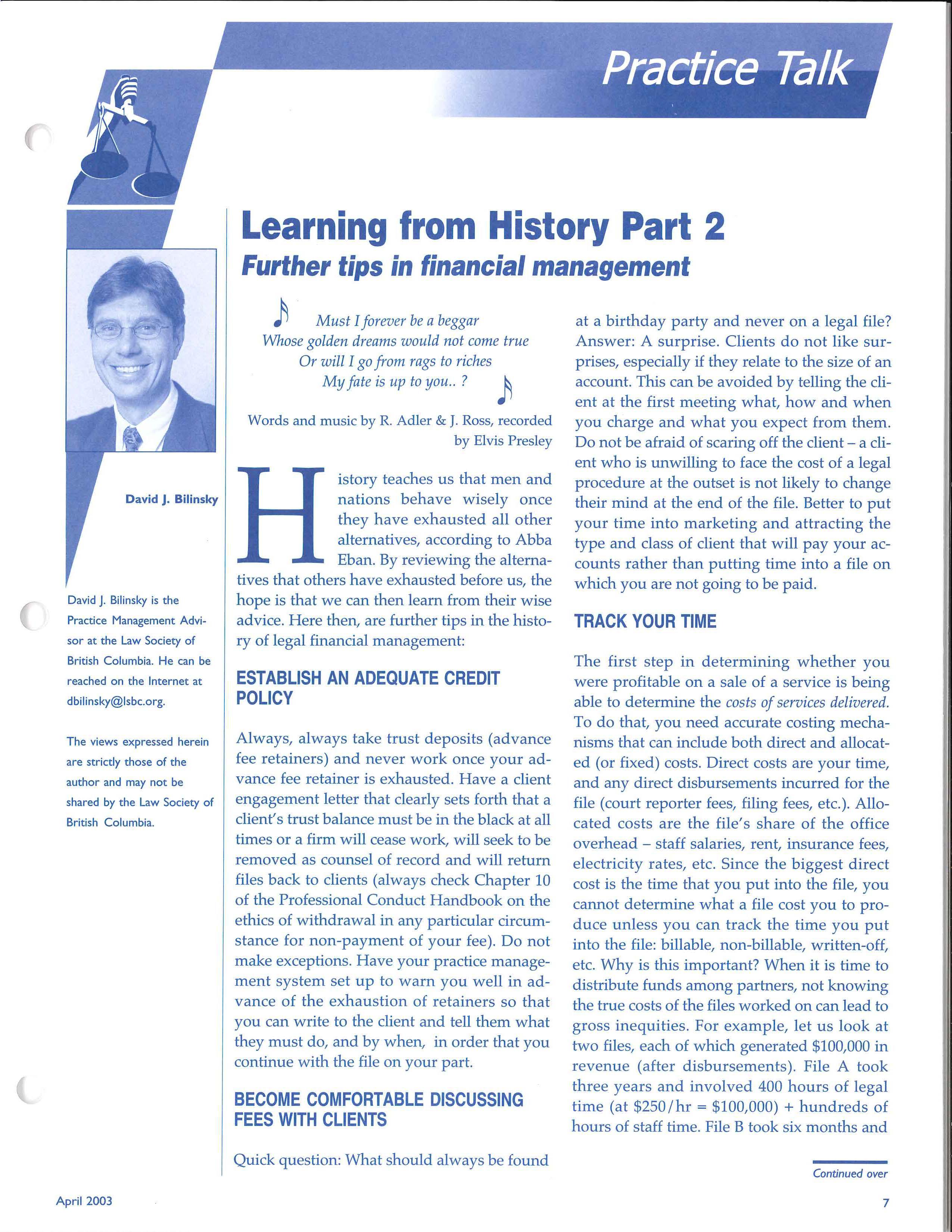
David J. Bili nsky is t he Pract ice Management Advisor at the Law Society of British Columbia He can be reached on the Internet at dbi linsky@ lsbc org.
The views expressed herei n are stri ct ly those of the author a nd may not be sha r ed by the Law Soc iety of British Columbia.
Learning from History Part 2 Further tips in financial management
Must I forever be a beggar
Whose go lden dreams would not come true Or will I go from rags to riches My fate is up to you ?
Words and music by R. Adler & J. Ross, recorded by Elvis Presley
istory teaches us that men and nations behave wisely once they have exhausted all other alternatives, according to Abba Eban. By reviewing the alternatives that others have exhausted before us, the hope is that we can then learn from their wise advice Here then, are further tips in the history of legal financial management:
ESTABLISH AN ADEQUATE CREDIT POLICY
Always, always take trust deposits (advance fee retainers) and never work once your advance fee retainer is exhausted. Have a client engagement letter that clearly sets forth that a client's trust balance must be in the b lack at all times or a firm will cease work, will seek to be removed as counsel of record and will return files back to clients (always check Chapter 10 of the Professional Conduct Handbook on the ethics of withdrawal in any particular circumstance for non-payment of your fee). Do not make exceptions. Have your practice management system set up to warn you well in advance of the exhaustion of retainers so that you can write to the client and tell them what they must do, and by when, in order that you continue with the file on your part.
BECOME COMFORTABLE DISCUSSING FEES WITH CLIENTS
Quick question: What should always be found
at a birthday party and never on a legal file?
Answer: A surprise. Clients do not like surprises, especially if they relate to the size of an account. This can be avoided by telling the client at the first meeting what, how and when you charge and what you expect from them. Do not be afraid of scaring off the client - a client who is unwilling to face the cost of a legal procedure at the outset is not likely to change their mind at the end of the file. Better to put your time into marketing and attracting the type and class of client that will pay your accounts rather than putting time into a file on which you are not going to be paid.
TRACK YOUR TIME
The first step in determining whether you were profitable on a sale of a service is being able to determine the costs of services delivered. To do that, you need accurate costing mechanisms that can include both direct and allocated (or fixed) costs. Direct costs are your time, and any direct disbursements incurred for the file (court reporter fees, filing fees, etc.). Allocated costs are the file's share of the office overhead - staff salaries, rent, insurance fees, electricity rates, etc . Since the biggest direct cost is the time that you put into the file, you cannot determine what a file cost you to produce unless you can track the time you put into the file: billable, non-billable, written-off, etc. Why is this important? When it is time to distribute funds among partners, not knowing the true costs of the files worked on can lead to gross inequities. For example, let us look at two files, each of which generated $100,000 in revenue (after disbursements). File A took three years and involved 400 hours of legal time (at $250/hr = $100,000) +hundreds of hours of staff time. File B took six months and
Lawyers Assistance Program
lAP provides confidential support, counselling and referra ls for lawyers, their families, support staff, judges and students suffering from alcohol and/or chemical dependency , stress , depression or just about any type of personal problem
For assistance or information on meetings and resources please call 604-6852171 or toll free 1-888-685-2171.
The lAP office is located at 415-1080 Mainland Street, Vancouver, B.C. V6B 2T4.
Practice Talk
Continued from page 7
100 hours of legal time (at $250 I hr = $25,000) and the same amount of staff time . Which file was more profitable? Not only was B more profitable, you could argue that File A resulted in a net loss to the firm since the total of legal and staff costs exceeded revenues. Yet, in most eat-what-you-kill systems, each file would be treated equally when it comes to determining partner compensation! Financial cost analysis can help you determine which files and practice areas yield the greatest return to the firm and which are black holes.
USE CURRENT AND FORMER CLIENTS AS MARKETING TOOLS
It is well understood that the best source of repeat and referral business is from existing satisfied clients. What is needed is a communication tool to make past clients feel connected to the firm and inform them of services that can be rendered by every member of the firm. A newsletter - hardcopy or electronic, that provides updates on the firm and topical news on areas of law that are of interest to the readersis a very good way to continue to foster the relationship. The readers will then have you and your services somewhere near the top of their minds and will be able to provide a quick recommendation when the need arises. There are of course, many other ways of marketing your services to your past and current clients. A good source of information and tips is the Law Marketing Portal (www.lawmarketing.com)
ESTABLISH YOUR FINANCIAL NEST EGG
There are ways to ensure your financial future -today. Set up at least one financial institution to automatically pull and invest money from your chequing account every month. It will take perhaps a few hours in total to establish and then you'll be investing, in good times and bad, without doing any work at all. You can set up instructions on how those funds are to be invested - in stocks, mutual funds, term deposits- but the important fact is to start planning now for your retirement. Once the account is established, take an interest in it and check it daily to monitor its performance.
Measure your return against stated goals- determine if you are being well served by your financial advisor Remember that you may lose in the short term, but over the long haul you will be adding to your financial stability and resilience.
DON'T USE THE LOTTERY AS A PARTNERSHIP RETIREMENT PLAN
One major issue facing smaller firms is dealing with introducing new partners and funding the buyout of existing but aging partners. Not having a succession plan that compensates the aging partner over time by establishing a retirement fund leads to the firm being unable to attract new partners; any interested new partners who are on the upswing are likely unwilling to contribute their billings to fund the exit of a diminishing partner. Furthermore, the lack of any retirement planning results in partners staying on simply to maintain a cash flow and not for any compelling business reasons .
DON'T FORGET HOW TO SMILE!
How do you greet your clients? Recall that attitudes are contagious- does yours reflect that you are busy, happy and looking for more business? Clients desire and seek out successful lawyers. Being glum about the stock market or your finances and the state of the economy, etc . may reflect the way you feel , but it may not be the best client development and retention tool. It also may not be a great way to approach your finances and your financial planning. Being cautiously optimistic allows you to keep your cynical side on alert while also exuding an air of confidence and competence to those around you. It may also be beneficial to reflect that notwithstanding the downturn out there, our predecessors have faced worse (the '29 crash was much more personally devastating and longer lasting).
Ambrose Bierce, never known as an optimist, said that history was: " An account, mostly false, of events, mostly unimportant, which are brought about b y ruler s, mostly knaves , and soldiers, mostly fools ." However, Johan Huizinga said that : "History is the interpretation of the significance that the past has for us ." Whether we are an optimist or a pessimist, our fate, whether rags or riches, lies in ourhands
Stuart Rennie Stuart Rennie is the CBABC Legislation & Law Reform Officer He can be reached at 604-949-1490 (e-mail srennie@bccba.org).
Every effort is made to ensure the accuracy of the information provided to you in this article but the information should not be relied upon. Lawyers should refer to the specific legislative or regulatory provision. You wi ll see a reference in some cases to the number of the Bill when it was introduced in the House This number may be different from the chapter number of the new Act which is quoted after the title of the Act and which is the proper citatio n for the Act The Bill Number has been given to you to make it easier for you to note up the Bills you may have in your library
Additional detail on the Legislative Update can be found in the online issue of the April BarTalk, posted at www.bccba.org.
ACTS IN FORCE
Budget Measures Implementation Act, 2001, S.B.C. 2001, c 3 (Bill4)
Amended: Corporation Capital Tax Act, R.S.B.C. 1996, c. 73, Home Owner Grant Act, R.S.B.C. 1996, c . 194, Hotel Room Tax Act, R.S.B.C. 1996, c. 207, Income Tax Act, R.S.B.C. 1996, c . 215, Logging Tax Act, R.S.B.C. 1996, c. 277, Motor Fuel Tax Act, R.S.B.C. 1996, c. 317, Social Service Tax Act, R.S.B.C. 1996, c. 431, Special Accounts Appropriation and Control Act, R.S.B.C. 1996, c. 436, Taxation (Rural Area) Act, R.S.B.C. 1996, c. 448, Tobacco Tax Act, R.S.B.C. 1996, c. 452
Transitional Provisions: regulation making power regarding the Hotel Room Tax Act, Income Tax Act, Logging Tax Act, Motor Fuel Tax Act and Social Service Tax Act
Statutes Repealed: None
Summary: Section 7 deletes the rule that persons entitled to a home owner grant under the Home Owner Grant Act be in receipt of a tax notice before being able to apply for a home owner grant. Section 8 removes the requirement under that Act that a collector must mail the determination to the applicant at the address shown on the tax notice.
In Force: Sections 7 and 8 are in force March 7, 2003
Transitional Provisions: Regarding validity of issued licences, enactments and existing regulations given legal effect and exemptions for existing personnel
Statutes Repealed: Horse Racing Act, R.S.B C. 1996, c. 198, Horse Racing Tax Act, R.S B C. 1996, c. 199, Lottery Act, R.S.B.C. 1996, c. 278, Lottery Corporation Act, R.S.B.C. 1996, c. 279
Summary: Section 14(2) to (4) governs the application of the balance of revenue for horse racing betting fees . Sections 15 to 17 provide for the collection of horse racing betting fees and duties of operators of racecourses and race meetings. Section 110 repeals the Horse Racing Act Section 111 repeals the Horse Racing Tax Act.
In Force: Sections 14 (2) to (4), 15 to 17, 110 and 111 in force April1, 2003
See Regulations to Note •
Health Planning Statutes Amendment Act, 2002, s.B.c. 2002, c. 15 (Bill19)
Amended: Freedom of Information and Protection of Privacy Act, R.S.B.C. 1996, c. 165, Health Emergency Act, R.S.B.C. 1996, c. 182, Health Professions Act, R.S.B.C. 1996, c. 183, Medical Practitioners Act, R.S.B.C. 1996, c. 285, Name Act, R.S.B.C. 1996, c. 328, Survivorship and Presumption of Death Act, R.S.B.C. 1996, c.444, Vital Statistics Act, R.S.B.C. 1996, c. 479
Transitional Provisions: Health Emergency Act, Hearing Aid Act and Name Act
Gaming Control Act, S.B.C. 2002, c. 14 (Bill 6)
Amended: Consequential amendments made to: Health Special Account Act, R.S.B.C. 1996, c. 185, Horse Racing Act, R.S.B.C. 1996, c. 198, Horse Racing Tax Act, R.S .B.C. 1996, c. 199
Statutes Repealed: Hearing Aid Act, R.S.B.C. 1996, c. 186, Seniors Advisory Council Act, R.S.B.C. 1996, c. 423
Summary: Section 28 provides that the amendments made by Bill19 to the Name Act do not apply if a person published the re-
Have you ordered your 2003
Directory?
With this year's Directory you receive a searchable CD-ROM, invaluab le for any office Order forms are ava ilable at www.bccba.org or e -mail your request for an order form to d irectory@bccba org
Legislative Update
Continued from page 9
quired notice before the coming into force of these Name Act amendments. Sections 18 to 20 of Bill 19 amend the Name Act to: require adults, applying for legal name change for themselves or their minor child, to provide proof of a criminal record check as a condition of approval of a name change; add a provision that permits sharing of this information as between the director and the RCMP; and permit regulations to be made establishing circumstances in which sharing of this information as between the director and the RCMP do not apply Sections 18 to 20 of Bill19 came into force on December 19, 2002 (B .C Reg . 381/2002) . The effect of the transitional provision in section 28 of Bill 19 is that, effective January 30, 2003, the Name Act amendments in sections 18 to 20 of Bill19 do not apply to an application for a name change published before December 19, 2002
In Force: Section 28 in force January 30, 2003
lnterjurisdictional Support Orders Act, s.B.C. 2002, c. 29 (Bill 23)
Amended: Supplement to the Enforcement of Canadian Judgments Act, R.S.B .C. 1996, c. 115, Family Maintenance Enforcement Act, R.S B C. 1996, c 127, Family Relations Act, R.S.B.C. 1996, c. 128
Transitional Provisions: Registration, variation and enforcement under the Family Maintenance Enforcement Act
Statutes Repealed: None
Summary: Bill 23 repeals and replaces Part 8 of the Family Relations Act, which regulated support orders in interjurisdictional matters.
In Force: Act in force January 31, 2003
See Regulations to Note
ity Act, R.S B C. 1996, c. 339
Amended: None
Transitional Provisions: None
Statutes Repealed: None
Summary: The Okanagan Valley Tree Fruit Authority Act is repealed. Under the Act, the corporation known as the Okanagan Valley Tree Fruit Authority was established in order to ensure a competitive, efficient and revitalized tree fruit industry in B.C.'s Interior
In Force: Act repealed May 31, 2003.
See also Regulations to Note •
School Amendment Act, 2002, S.B C. 2002, c. 53 (Bill 34)
Amended: School Act, R.S.B.C. 1996, c. 96
Transitional Provisions: District parents' advisory council, provincial funding, application of enrolment provisions and annual budget
Statutes Repealed: None
Summary: Section 33 amends the School Act to remove the requirement that the Minister approve of the disposal of land or improvements by a board .
In Force: Section 33 in force January 17, 2003
Securities Amendment Act, 2002, S.B.C. 2002, c. 32 (Bill 29)
Amended: Securities Act, R.S.B.C. 1996, c. 418. Consequential amendments are made to the: Company Act, R.S.B.C. 1996, c. 62 and M embers ' Conflict of Interest Act, R.S.B.C. 1996, c 287
Transitional Provisions: None
Statutes Repealed: None
Summary: Section 18 amends the Securitie s Act to repeal section 42 of the Act whi ch required a registered dealer to register notice of relevant changes.
In Force: Section 18 in force February 21, 2003 In Force: Act in force February 28, 2003
• See Regulations to Note (Strata Property Act)
Trustee Investment Statutes
Amendment Act, 2002, S.B.C. 2002, c 33 (Bill30)
Amended: Architects Act, R.S B.C. 1996, c. 17, Cemetery and Funeral Services Act, College and Institute Act, R.S.B.C. 1996, c 52, R.S.B.C. 1996, c. 45, Company Act, Farmers and Womens Institutes Act, R.S.B.C. 1996, c. 133, R.S .B.C. 1996, c. 62, Financial Administration Act, R.S.B.C. 1996, c. 138, Financial Institutions Act, R.S.B.C. 1996, c. 141, Institute ofTechnology Act, R.S.B.C. 1996, c. 225, Islands Trust Act, R.S.B.C. 1996, c. 239, Medical Practitioners Act, R.S.B.C. 1996, c. 285, Municipal Finance Authority Act, R.S.B C. 1996, c. 325, Public Guardian and Trustee Act, R.S.B.C. 1996, c. 383, Real Estate Act, R.S.B.C. 1996, c 397, Finance and Corporate Relations Statutes Amendment Act, 1998, S.B C. 1998, c. 7, Science Council Act, R.S.B C. 1996, c. 415, Society Act, R.S.B.C. 1996, c. 433, Strata Property Act, S.B.C. 1998, c. 43, Trustee Act, R.S B.C. 1996, c. 464, Workers Compensation Act, R.S.B .C. 1996, c. 492
Transitional Provisions: None
Statutes Repealed: None
Summary: Bill30 is based on the B.C. Law Institute report on the modernization of trustee investment powers . The Trustee Act is amended to replace the list of authorized trustee investments with a rule that permits trustees to invest generally, subject to the terms of the specific trust. Trustees are held to a duty of care, skill, diligence and judgment that a prudent investor would exercise in making investments. Trustees are not liable for loss under a trust if the overall investment strategy is prudent. The common law rules regarding assessment of the decisions of a trustee on an investment-by-investment basis and prohibition of losses from being offset by gains are abrogated Trustees may delegate to an agent the authority to invest trust property that a prudent investor might delegate in accordance with ordinary business practice Except as provided by section 15.1 (3) of the Trust ee Act, a corporation that is a trustee must not invest trust money in its own securities
REGULATIONS TO NOTE
Employment and Assistance Act and Employment and Assistan ce for Persons with Disabilities Act, amends section 59 of the Employment and Assistance Regulation (B C. Reg. 263 I 2002) under the Employment and Assistance Act, and amends section 57 of the Employment and Assistance for Persons With Disabilities Regulation (B C. Reg 265 I 2002) under the Employment and Assistance for Persons with Disabilities Act. Both new regulations provide that, despite restrictions on a crisis supplement for shelter and for an annual maximum monetary limit for crisis supplements, a crisis supplement may be provided for a family unit for: fuel for heating; cooking for meals; water; and hydro (effective January 27, 2003, B.C. Regs . 12/2003 and 13/2003).
Freedom of Information and Protection of Privacy Act, adding 19 public bodies now being covered under the Act (effective March 7, 2003, B.C. Reg 75/2003).
Gaming Control Act, repeals the Horse Racing Tax Regulation (B.C. Reg. 46/2000), amends the Gaming Control Regulation (B.C. Reg. 208 I 2002) regarding prescribing payment of horse race betting fees and reporting obligations of operators, amends the Interest Rates under Various Statutes Regulation (B.C. Reg. 386/92) (effective April1, 2003, B.C. Reg. 59/ 2003). Also, amends Gaming Control Regulation (B.C. Reg. 208/2002) regarding limits on slot machines, standards of eligibility for eligible organizations under Part 6 of the Act (effective February 20, 2003, B.C. Reg. 60/2003) and amends the Frequency and Time of Payments of Horse Race Betting Fees (B.C. Reg. 61/2003) requiring the lottery corporation to pay fees on a monthly basis (effective April1, 2003, B.C. Reg. 61/2003) .
Health Act, amends the Communicable Disease Regulation (B .C. Reg . 4/ 83) to require known or suspected persons with HIV to be reported to medical health officers and to permit a physician who reasonably believes that
Contract of Purchase and Sale forms available from the CBABC
The CBABC is a co-owner of the copyright in the standard form Contract of Purchase and Sale used by the B.C. Real Estate Association and associated Boa r ds .
Blank forms , avai lable from the CBABC, are convenient for the quick preparation of private purchase contracts and/or to give to sophisticated cl ients for the sale of their res id ential premises
Members may purchase forms individually, or in packages of I0. Prices:
• One package $16.00 (plus GST $1.12) = $17.12
Individual form $1 60 (plus GST $.56) = $2.16
Interested members may contact Rose Fabbro at the CBABC , 604-687-3404, ext. 3 13 or 1-888-687-3404 (e-mail rfabbro@bccba org)
Legislative Update
Continued from page I I
B.C. Securities Commission cuts paper chase
The B.C. Secur it ies Commission has unveiled a Webbased , interactive app lic ations filing system that w ill save time and money as well as " cut the paper chase" for ind ividuals and compan ies seeking flexibility under se c urities laws
Dubbed BCSC e-services, the Comm ission expects that the system's main users wil l be securities lawyers and company officials who need an exempt ion under securities laws for certain business transactions
With BCSC e-services, applications can be filed, assigned, and tracked immediately, without the delay of manual filing and data entry
The commission's e-services function is accessible through the BCSC Web s ite (www.bcsc.bc ca/is).
another person may be at risk of harm from persons with HIV to provide any relevant information to a medical health officer (effective May 1, 2003, B.C. Reg. 6212003).
Home Owner Grant Act, amends the Home Owner Grant Regulation (B C. Reg 100 I 2002) and repeals the Eligibility of Persons with Disabilities Regulation (B.C. Reg. 10112002) toreplace the definition of "person with disabilities" under applicable sections of the Home Owner Grant Regulation (effective February 18, 2003, B.C. Reg . 5112003).
Interjurisdictional Support Orders Act, the Interjurisdictional Support Orders Regulation (by B.C. Reg. 1512003) is made setting out the required time for notice under specified provisions of the Act, required financial information, currency conversion and list of reciprocating jurisdictions. As well, the following regulations are repealed: B C. Regs. 19 I 58, 204158, 118162, 127 I 62, 137 I 62, 143162, 3351 68, 63170, 119173, 120173, 432173, 716175, 391178, 26199 and 403199 (by B.C. Reg. 151 2003). B.C. Reg. 196164 is amended by the deletion of all references to the Reciprocal Enforcement of Maintenance Orders Act (effective January 31, 2003, B.C. Reg. 1612003).
Mental Health Act, amends the Mental Health Act Regulation (B.C. Reg. 233 I 99) to replace Forms 13 (Notification to Involuntary Patient of Rights) and 14 (Notification to Involuntary Patient under Age 16, Admitted by Parent or Guardian, of Rights) (effective February 27, 2003, B.C. Reg. 6812003).
Okanagan Valley Tree Fruit Authority Act, repeals B C. Reg. 109 I 2000, which prescribed that the Act will be repealed March 31, 2006 (effective May 31, 2003, B.C. Reg. 7412003).
Strata Property Act, amends Part 6 of the Strata Property Regulation (B C. Reg. 4312000) by adding a new section 6.11 to permit a strata corporation to make specified investments for the investment of money from the contingency reserve fund (effective February 28, 2003, B.C. Reg. 3312003)
Utilities Commission Act, repeals the obsolete Public Utilities Regulation (B C. Reg. 87 I 59) regarding passenger vehicles (effective February 27, 2003, B.C. Reg 6912003).
NEW BILLS TO NOTE
Information is current at the time of preparing this article: March 11, 2003. Lawyers should refer to the original version of the specific Bill for its current status at First, Second or Third Reading or Royal Assent.
Agrologists Act (Bill 4)
First Reading: February 24, 2003
Amended: None
Transitional Provisions: None
Statutes Repealed: Agrologists Act, R.S.B.C. 1996, c.12
Summary: Bill4 replaces Bill 79 which was introduced at First Reading on November 5, 2002 during the last session of the Legislature. Bill 4 repeals the Agrologists Act and replaces it • with a revised and updated statute which will continue to permit the B.C. Institute of Agrologists to regulate the profession of agrology.
In Force: By regulation •
Auditor General Act (Bill 9)
First Reading: February 24, 2003
Amended: Consequential amendments made to: Assessment Authority Act, R.S.B.C. 1996, c. 21, B C. Transit Act, R.S.B.C. 1996, c. 38, Budget Transparency and Accountability Act, S.B C. 2000, c. 23, Capital Commission Act, R.S .B.C. 1996, c. 43, Community Services Interim Authorities Act, S.B.C. 2002, c. 58, Creston Valley Wildlife Act, R.S B C. 1996, c. 84, Financial Administration Act, R.S.B.C. 1996, c. 138, Financial Information Act, R.S.B.C. 1996, c. 140, Greater Vancouver Transportation Authority Act, S.B .C. 1998, c. 30, Homeowner Protection Act, S.B.C. 1998, c 31, Income Tax Act, R.S B.C. 1996, c. 215, In stitute of Technology Act, R.S .B.C. 1996, c. 225, Legal Services Society Act, S.B.C. 2002, c. 30, Public Guardian and Trustee Act, R.S.B.C. 1996,
c 383, School Act, R.S.B.C. 1996, c. 412, University Act, R.S B C. 1996, c. 468, Workers Compensation Act, R.S.B.C. 1996, c. 492
Transitional Provisions: None
Statutes Repealed: Aud i tor Genera l Act, R.S.B.C. 1996, and c. 23
Summary: Bill 9 repeals the Auditor General Act and replaces it with an expanded statute.
In Force: By regu lation
•
Budget Measures Implementation Act, 2003 (Bill 6)
First Reading: February 18, 2003
Amended: Balanced Budget and Ministerial Accountability Act, S.B.C. 200 1, c. 28, BC Transportation Financing Authority Motor Fuel Tax Regu l ation (B .C. Reg. 272/93), Corporation Capital Tax Act, R.S.B.C. 1996, c. 73 Corporation Capital Tax Regul ation (B C. Reg. 79 I 96, as it read on June 6, 2000), Financial Administration Act, R.S B.C. 1996, c. 138, Greater Vancouver Transportation Authority Act, S .B.C. 1998, c. 30, Hospital District Act, R.S B.C. 1996, c. 202, Insurance Premium Tax Act, R.S.B.C. 1996, c. 232, Islands Trust Act, R.S.B.C. 1996, c . 239, Local Government Act, R.S.B C. 1996, c 323, Local Services Act, R.S .B.C. 1996, c . 276, Motor Fuel Tax Act, R.S.B.C. 1996, c. 317, Property Transfer Tax Act, R.S.B.C. 1996, c 378, Purchasing Commission Act, R.S.B.C. 1996, c. 392, Social S ervice Ta x Act, R.S B.C. 1996, c 431, Taxation (Rural Area) Act, R.S .B.C. 1996, c. 448, Tobacco Tax Act, R.S B C. 1996, c. 452, University Act, R.S B C. 1996, c. 468, University Endowment Land Act, R.S.B.C. 1996, c. 469, Vancouver Charter, S.B.C. 1953, c. 55
Transitional Provisions: Revised ministerial accountability rules in relation to expected federal healthcare funding, Regulations Act, Build B C. Act, Motor Fuel Tax Act, Property Tran sfer Tax Act, University Act, validation of interest calculation and authority for retroactive regulations
Statutes Repealed: None
Summary: Bill 6 amends 20 statutes or regula-
tions Bill 6 makes amendments, including to : Financial Administration Act to expand Treasury Board power to authorize payments from the consolidated revenue fund for public-private partnership projects; Motor Fuel Tax Act to increase taxes on gasoline and fuel; Property Transfer Tax Act to replace the definition of "first time home buyer"; Social Service Tax Act t o add a requirement that the commissioner impose a penalty against a person who certifies false information in a certification required for an exemption from tax, and limits the penalty period to six years; and to the Tobacco Tax Act to increase taxes on tobacco
I n Force: On Royal Assent for specified sections and various in force dates retroactive, including from June 1, 1999 for specified sections
Community Charter (Bill14)
First Reading: March 11, 2003
Amended: None
Transitiona l Provisions: None
Statutes Repealed: None
Summary: Bill14 creates the Community Charter which broadens municipal powers The Local Government Act, R.S B.C. 1996, c. 323 continues in force. Many provisions of the Local Government Act are incorporated into Bill 14. Bill14 permits municipalities greater jurisdiction in matters of community interest including: byl a ws; regulations; business regulation; activities in a public place; nuisances ; animals; and trees Municipal councils will be required to publish annua l reports and hold annual general meetings. New ethical rules apply to govern council members' conduct. Other provisions affect financial management, municipal revenue, bylaw enforcement, mediation and arbitration .
In Force: By regulation
Employee Investment Amendment Act, 2003 (Bill 8)
Zimbabwe Project
The C BA has teamed up w ith Z imbabwe ' s Lega l Reso u r ces Fo un dation (LRF) t o launch a o ne-year pi lot pro ject to create a test-case li t igatio n unit to he lp advance hu ma n rights. ' The objective of the unit is to promote h uman rights in Zimbabwe by he lping empower di sadvantaged people to use the lega l system ," says CBA Pres ident Simon Potter. "By in creas ing lega l awa r eness, the qua lity of just ic e is im p roved for the people of Zimbabwe " The aims of the $1 00,000 project, funded by the Canadian Internat ional Deve lopme nt Agency , are to : support test cases in Zimbabwe courts; carry out litigation and advocacy activ it ies; and enable the LRF to network with the Legal Resources Centre in South Africa Since Canada and Zimbabwe are Commonwea lth countries and both follow a commonlaw traditi o n, t h is project could lead to other possi b ilities for cooperat ion between the two co unt r ies.
Legislative Update
Continued from page 13
First Reading: February 19, 2003
Amended: Employee Investment Act, R.S.B.C. 1996, c. 112
Transitional Provisions: None
Statutes Repealed: None
Summary: Bill 8 amends the Employee Inv estment Act including to: eliminate the $10,000 lifetime tax credit limit for shareholders in registered employee share ownership plans; expand the eligibility criteria for registration as an employee venture capital corporation; eliminate the $20 million limit on the equity capital of an employee venture capital corporation; and permit labour-sponsored funds to invest up to $5 million in eligible small businesses without taking the investment of other venture capital corporations into account.
In Force: On Royal Assent, except section 7 regarding ministerial references which comes into force by regulation
•
Energy and Mines Statutes Amendment Act, 2003 (Bill 10)
First Reading: February 24, 2003
Amended: Coal Act, R.S .B.C. 1996, c. 51, Hydro and Power Authority Act, R.S .B.C. 1996, c. 212, Mineral Tenure Act, R.S.B.C. 1996, c. 292, Mines Act, R.S .B.C. 1996, c. 293, Petroleum and Natural Gas Act, R.S.B C. 1996, c 361, Utilities Commission Act, R.S.B.C. 1996, c. 473, Waste Management Act, R.S.B.C. 1996, c. 482
Transitional Provisions: None
Statutes Repealed: None
Summary: Bill 10 makes amendments to seven statutes, including the: Coal Act, Hydro and Power Authority Act to permit the Lieutenant Governor in Council to designate any support services agreement entered into by B.C. Hydro, Mineral Tenure Act, Mines Act, Petroleum
and Natural Gas Act to create a new water source well class, Utilities Commission Act to clarify that companies providing support services are not public utilities for the purposes of the Act and the Waste Management Act.
In Force: On Royal Assent except for specified sections that come into force by regulation
Foresters Act (Bill 5)
First Reading: February 12, 2003
Amended: Consequential amendments made to the : Foresters Act, S.B.C. 2003 and Freedom of Information and Protection of Privacy Act, R.S.B.C. 1996, c. 165 whereby, in specified sections, the "Association of B.C. Professional Foresters" is struck out and replaced by "Association of B.C. Forest Professionals"
Transitional Provisions: None
Statutes Repealed: Foresters Act, R.S.B C. 1996, c. 162
Summary: Bill 5 replaces Bill 78. Bill 78 was introduced in First Reading on November 25, 2002 during the last session of the Legislature BillS repeals the Foresters Act and it replaces it with a statute which will continue to regulate practice and standards for professional foresters and registered forest technologists.
In Force: By regulation
Freedom of Information and Protection of Privacy Amendment Act, 2003 (Bill13)
First Reading: February 26, 2003
Amended: Freedom of Information and Protection of Privacy Act, R.S B.C. 1996, c 165
Transitional Provisions: None
Statutes Repealed: None
Summary: Bill13 amends the Freedom of Information and Protection of Privacy Act including to: make amendments affecting the collection,
use and disclosure of iniormation collected by public bodies; ensure that solicitor client privilege of a record is not waived as a result of the examination of the record under the Act by the commissioner's office; increase the commissioner's delegation powers; and permit the commissioner to request authorization from a Supreme Court judge acting as an adjudicator to disregard specified requests that would unreasonably interfere with the operations of the public body because the requests are repetitious or are frivolous or vexatious.
In Force: By regulation
See also Regulations to Note
Income Tax Amendment Act, 2003 (Bill 7)
First Reading: February 18, 2003
Amended: Income Tax Act, R.S.B.C. 1996, c. 215
Transitional Provisions: None
Statutes Repealed: None
Summary: Bill 7 amends the Income Tax Act including to: expand the application of film, television, production services tax credits and regional and training tax credits; and to create a new book publishing tax credit.
In Force: On Royal Assent for specified sections. In force for specified sections April 1, 2003 and retroactive to October 1, 2002 for other specified sections
Farm) Act, R.S B C. 1996, c. 131, Financial Information Act, R.S.B C. 1996, c. 140, Freedom of Information and Protection of Privacy Act, R.S.B.C. 1996, c. 165, Hotel Guest Registration Act, R.S.B.C. 1996, c. 205, Hotel Keepers Act, R.S .B.C. 1996, c. 206, Livestock Act, R.S B.C. 1996, c 270, Local Government Act, R.S.B.C. 1996, c. 323, Miscellaneous Statutes Amendment Act (No. 2), 1999, S B.C. 1999, c. 38, Motor Carrier Act, R.S.B.C. 1996, c. 315, Motor Vehicle Act, R.S .B.C. 1996, c. 318, Natural Products Marketing (BC) Act, R.S.B.C. 1996, c. 330, Public Sector Employers Act, R.S.B.C. 1996, c. 384, Science Council Act, R.S.B.C. 1996, c. 415, Special Accounts Appropriation and Control Act, R.S.B.C. 1996, c. 436, University Endowment Land Act, R.S.B.C. 1996, c. 469, Vancouver Charter, S.B.C. 1953, c. 55, Water Protection Act, R.S.B.C. 1996, c. 484
Transitional Provisions: repeal the Agricultural Credit Act, amendments to the Emergency Program Act, provincial board name change and continuation of proceedings regarding the Farm Practices Protection (Right to Farm) Act and Natural Products Marketing (B.C.) Act
Aboriginal Law Conference
The National Aborig inal Law Section's annual CLE program, to be held April 25-26 at the Westin Nova Scotian in Halifax, will focus on Aboriginal ownership and management of resources in Canada. For more information on the program, contact Chantal Durocher at 1-800-267-8860 or e-mail chantald@cba.org.
Miscellaneous Statutes Amendment Act, 2003 (Bill11)
First Reading: February 25, 2003
Amended: Agricultural Produce Grading Act, R.S.B.C. 1996, c. 11, Agriculture, Fisheries and Food Statutes Amendment Act, 1997, S B.C. 1997, c. 14, Budget Transparency and Accountability Act, S.B.C. 2000, c. 23, Emergency Program Act, R.S.B.C. 1996, c. 111, Evidence Act, R.S.B.C. 1996, c. 124, Farm Practices Protection (Right to
Statutes Repealed: Agricultural Credit Act, R.S.B.C. 1996, c. 94, Bee Act, R.S.B.C. 1996, c. 29, B.C. Feed-grain Assistance Act, R.S.B.C. 1960, c. 36, Cattle (Horned) Act, R.S.B C. 1996, c. 44, Dairy Industry (B C.) Act, R.S.B.C. 1960, c 93, Holiday Shopping Regulation Act, R.S.B.C. 1996, c. 191, Livestock Protection Act, R.S.B.C. 1996, c. 273, Seed Grower Act, R.S.B C. 1996, c. 420, Synthetic Food Products Act, S.B C. 1971, c 61, Telephone (Rural) Act, R.S.B.C. 1996, c. 450, Travel Regulation Act, R.S.B.C. 1996, c. 460, Veterinary Laboratory Act, R.S.B.C. 1996, c. 477
Summary: Bill 11 amends 22 statutes and repeals 12 statutes. Bill11 repeals the : Agricultural Credit Act, Bee Act, B.C. Feed-grain Assistance Act, Cattle (Horned) Act, Dairy Industry (B C.) Act, Holiday Shopping Regulation Act, Livestock Protection Act, Seed Grower Act, Synthetic Food Products Act, Telephone (Rural) Act, Travel Regulation Act, and the Veterinary Laboratory Act, R.S.B.C. 1996, c . 477. Bill 11 makes amendments, including to the: Agricultural Produce Grading Act, Agriculture, Fisheries and Food Statutes Amendment Act, 1997, Budget Transparency and Accountability Act, Emergency Program Act,
Legislative Update

Ottawa Law Review calls for papers
The Ottawa Law Review is accepting papers for publication. The Review seeks scholarly articles that contribute to a diversity of opinions on legal issues, including articles with a Canadian , international, theoretical or comparative focus
The Review is an academic journal that is distributed to subscribers both natio na ll y and internationally.
The Ottawa Law Review is published bi-annually by students of the Faculty of Law, Common Law Section , University of Ottawa.
Lawyers are invited to submit three copies, together with an electronic version, of typed, double-spaced manusc r ipts for consideration in care of the Articles Editor to: Ottawa Law Review, Faculty of Law, Common Law Section, University of Ottawa , P O Box 450, STN A, 57 Louis Pasteur St , Ottawa, Ontario, KIN 6NS Te l: 613-562-5800, ext 3293 , fax: 613-562-5124, emai l: lawrev@uottawa ca
Legislative Update
Continued from page 15
Evidence Act to permit the court to receive witness evidence in a Provincial Court, Supreme Court or Court of Appeal proceeding by means of closed circuit television or other technology that allows simultaneous visual and oral communication between the court and a witness not physically present, Farm Practices Protection (Right to Farm) Act, Freedom of Information and Protection of Privacy Act, Hot el Guest Registration Act, Hotel Keepers Act to create new offences, Livestock Act, Local Government Act, Miscellaneous Statutes Amendment Act (No. 2) , 1999 , Motor Carrier Act, Motor Vehicle Act torequire psychologists, optometrists and medical practitioners to report a patient's medical condition when the condition makes it dangerous for the patient to drive a motor vehicle and the patient continues to drive after being warned of the danger, Natural Products Marketing (B C.) Act, Public Sector Employers Act, Science Council Act, Special Accounts Appropriation and Control Act, University Endowment Land Act, Vancouver Charter and the Water Protection Act.
In Force: On Royal Assent or b y regulation for specified sections. Some specified provisions come into force July 1, 2003 or April 1, 2004
Motor Vehicle Amendment Act, 2003 (Bill 17)
First Reading: March 11, 2003
Amended: Motor Vehicle Act, R.S.B.C. 1996, c 318 . Consequential amendment made to the Motor Vehicle Amendment Act (No . 2) , 1997, S.B.C. 1997, c 31
Transitional Provisions: payment by ICBC
Statutes Repealed: None
Summary: Bill 17 amends the Motor Vehicle Act to transfer the ICBC compliance operations respecting enforcement of standards for commercial vehicle carriers, vehicle inspection facilities and weigh scales to the Ministry of Public Safety and Solicitor General.
In Force: By regulation
Museum Act (Bill 2)
First Reading: February 17, 2003
Amended: Consequential amendments made to the: Document Disposal Act, R.S .B.C. 1996, c. 99, Election Act, R.S B C. 1996, c. 106, Financial Information Act, R.S B.C. 1996, c. 140, Freedom of Information and Protection of Privacy Act, R.S B C. 1996, c. 165, Ministry of Provincial Secretary and Government Services Act, R.S.B .C. 1996, c 309, Recall and Initiative Act, R.S.B.C. 1996, c. 398
Transitional Provisions: Transfer of assets, rights and responsibilities to the Crown corporation
Statutes Repealed: Museum Act, R.S B.C. 1996, c. 326
Summary: Bill 2 repeals the Museum Act to make the Royal B C. Museum a Crown corporation and amalgamates under that corpora- ( tion the B C. Archives, Helmcken House and the Netherlands Carillon.
In Force: By regulation •
Police Amendment Act, 2003 (Bill12)
First Reading: February 27, 2003
Amended: Police Act, R.S.B.C. 1996, c. 367
Transitional Provisions: None
Statutes Repealed: None
Summary: Bill 12 amends the Police Act to require law enforcement services to use a Minister-approved information management system.
In Force: On Royal Assent •
Small Business Venture Capital Amendment Act, 2003 (Bill3)
First Reading: February 18, 2003
Amended: Small Business Venture Capital Act, R.S B.C. 1996, c. 429
Transitional Provisions: None
Statutes Repealed: None
Summary: Bill 3 amends the Small Business Venture Capital Act including to: amend definitions; change registration requirements; increase investment in small business by changing the criteria for investments; increase the maximum aggregate amount of investments that a single small business may receive from venture capital corporations to $5 million from $3 million; and create new eligible business corporation tax credits
In Force: By regulation

Unclaimed Property Amendment Act, 2003 (Bill 15)
First Reading: March 5, 2003
Amended: Unclaimed Property Act, S.B.C. 1999, c. 48. Consequential amendments made to the: Business Corporations Act, S.B.C. 2002, c. 57, Company Act, R.S.B .C. 1996, c. 62, Credit Union Incorporation Act, R.S.B.C. 1996, c 82, Debt Collection Act, R.S.B.C. 1996, c. 92, Employment Standards Act, R.S.B.C. 1996, c. 113, Financial Institutions Act, R.S.B.C. 1996, c. 141, Local Government Act, R.S.B.C. 1996, c. 323, Public
April 7-12
April 10
April 12
April 12
April 25
April 30
May 13
May 14
May 14
May 16
June 1-4
June 18
June 20
June 21
Guardian and Trustee Act, R.S.B.C. 1996, c. 383, Rai lway Act, R.S.B.C. 1996, c 395, Real Estate Act, R.S.B.C. 1996, c. 397
Transitional Provisions: Unclaimed Property Act provisions and regulations
Statutes Repealed: None
Summary: Bill 15 amends the Unclaimed Property Act to permit the government to transfer the operation of the unclaimed property scheme to non-profit organizations.
In Force: By regulation
REPORTS AVAILABLE
Consultation Paper on the Variation and Termination of Trusts (February, 2003) . Source : B.C. Law Institute. Available at: www.bcli.org
Creditor Access to the Assets of a Purpose Trust (March, 2003). Source: B.C. Law Institute Available at: www.bcli.org
Nisga'a Treaty Second Annual Implementation Report 2001/2002 (February 2003). Source: B C. Minister Responsible for Treaty Negotiations and the Nisga' a Lisims Government. Available at: www.gov.bc.ca/tno/down/ nisga implementation_rpt2002.pdf.
Report on the Uniform Liens Act (January, 2003). Source: B C. Law Institute. Available at: www.bcli.org •
Branch and Bar Calendar April-June 2003
Law Week 2003
Law Week: Public Speaking Contest (Vancouver Law Courts, 4:30 p.m.)
Law Week: Open House (Vancouver Public Library, I:00-4:00 p m.)
Dial-A-Lawyer Day (CBABC office, I 0:00 a.m. to 2:00 p.m.)
Ist Annual B C. Symposium on Conflict Resolution (Vancouver, SFU Harbour Centre)
UBC Law and Society Seminar on Juries (UBC Robson Square, Room C 680, 7:00-8:30 p.m.)
New Westminster Bar Association Meeting (Westminster Club, 713 Columbia St, 5:30 p.m. Cocktails, 6:30 p.m. Dinner RSVP: Kenneth Armstrong at 604-523-7096)
CBABC Executive Committee Meeting (CBABC office)
Holt Renfrew "Private Shopping Night" (Vancouver, Pacific Centre, 6:30 - 8:30 p.m.)
Battle of the Bar Bands (Vancouver, Commodore Ballroom, 8 p.m. - midnight, doors open at 7 p.m.)
6th International Conference on Restorative Justice (Vancouver, Coast Plaza Hotel)
CBABC Executive Committee Meeting (CBABC office)
CBABC President's Forum (Vancouver, Four Seasons Hotel, 791 W. Georgia St., 9 a.m -3:30 p m.)
Provincial Council Meeting (Richmond, Delta Airport Hotel, 9 :00 a.m.)
To announce an upcoming event or meeting in the Branch and Bar Calendar, plea se contact Sandra Webb at 604-687-3404, or toll free 1-888-687-3404 (e-mail slgwebb@bccba.org) .
CCCA Spring Program
The Ca nadian C o rporate Cou nse l Asso ci at ion's 2003 National Spr ing Conference wi ll be he ld at the Westin Hotel in C algary from Apr il 27-29, 2003. The confe rence, e ntitled Corporate Counse l in a Changing Regulatory Environment, will prov ide adv ice and strategies for inhouse counsel to deal w ith today's rampant regulatory changes
Highlights of this year's program include welcoming remarks by Alberta Premier Ra lph Klein at the open ing night gala receptio n , an opening plenary on conducting business in a heav ily regulated world, 12 practica l workshops, and two roundtable discussions des igned specifically to address general counsels' and ch ief legal officers' pract ice an d management concerns
For more information, vis it www.cancorpcounsel.org/ confe r ences/conferencesframes htm
Edward Wilson
Edward Wilson practises real estate and municipal law at Lawson Lundell. He is past Chair of the Real Property-Vancouver Section and continues to be active ly involved in CBA and CLE matters. Mr Wilson has been the CBA's representative on the B C. Real Estate Association's Standard Forms Committee since 1996
More Information
A copy of the new undertakings and related materials can be found at www.bccba.org
Detai ls of what the Section felt constituted diligent and commercially reasonable efforts to obtain a discharge are also set out on the CBABC's Web site
Changes to Standard Real Estate Undertakings
n March 3, 2003 the Vancouver Real Property Section adopted a new form of standard undertakings that will change the way most real estate transactions in B.C. are closed
The CBA has long had a representative on the B C. Real Estate Association's Standard Forms Committee The Committee developed the Contract of Purchase and Sale that is used in more than 90 per cent of the residential sales throughout B.C. While the Contract has always addressed the closing procedure, prior to 1989, the closing provisions did not reflect the practice followed by lawyers. In 1989 the Court of Appeal in Norfolk v. Aikens (1989) 4 BCLR (2nd) 145 criticized the practice of closing on the basis of undertakings as that was a deviation from the strict terms of the Contract.
The Contract was subsequently amended to provide that the transaction would be closed on the basis of the CBA Standard Undertakings which were adopted following a consultation process to ensure that they reflected conveyancing practice in B.C.
WHY THE CHANGES
As a result of the "Wirick matter", it was felt that it was necessary to review the Standard Undertakings to see if the closing procedures could be improved upon so as to reduce the potential of a lawyer choosing not to honour their undertakings. Through an extensive consultation process led by the Vancouver Real Property Section, a number of options were considered. Ultimately, the "transparency option" was selected and incorporated into the Standard Undertakings . The Standard Undertakings have been circulated to and commented on by the Victoria and Okanagan Real Property Sections, the Society of Notary Publics and the Executive of the CBABC.
WHAT ARE THE CHANGES
The transparency option provides for the fol-
lowing changes to the conveyancing process when there are existing financial charges to be discharged. When the purchase monies are provided to the Seller's lawyer by the Buyer's lawyer, the Seller ' s lawyer must, within five business days after closing, provide the Buyer's lawyer with a copy of:
1. The Seller's lawyer's letter providing the existing mortgagee with the payout monies together with a copy of the payout cheque and evidence of its delivery; and
2. The payout statement or, where there is an "interalia mortgage," a letter from the existing mortgagee confirming that the monies paid were sufficient to payout the mortgage as it relates to that property.
The documents are to be provided to the Buyer's lawyer on his/her undertaking not torelease the financial information disclosed by such documentation to the Buyer unless they have not been provided with satisfactory evidence of the filing of a discharge within 60 days of the completion date The Seller's lawyer further undertakes to use diligent and commercially reasonable efforts to obtain the discharge in a timely manner.
ADOPTING TRANSPARENCY PROVISIONS
The use of the CBA Standard Undertakings has never been mandatory It was always anticipated that lawyers would continue to use their own form of undertakings, which are in most cases similar to the CBA Standard Undertakings. If the lawyers involved in a conveyance cannot agree as to the form of their respective undertakings, they should resort to the CBA Standard Undertakings Such a position is still available today. However with the change to the transparency option, law y ers should revise undertakings to incorporate transparency provisions . The new undertakings will soon reflect the practice in B.C., and to deviate from the practice potentially opens up lawyers to additional risks.
Welfare Law Update
he provincial government enacted major changes to B.C. welfare laws in 2002. The Employment and Assistance Act (EAA) and the Employment and Assistance for Persons with Disabilities Act (EAPDA) replaced previous legislation. There were also major changes to the corresponding regulations under the new Acts The changes are profound and affect the daily lives of tens of thousands of B.C. residents. However, few lawyers practise regularly in this area and the profession likely knows little of the changes The purpose of this column is to outline some of the many substantive and procedural changes in the legislation, and to introduce some of the related social policy and access to justice issues.
Under the EAA regulations, monthly welfare payments for support and shelter have been reduced for most recipients classified as employable . For those deemed employable, supplemental benefits such as crisis grants and childcare subsidies were scaled back, and other benefits such as homemaker services were eliminated. In what is arguably a contradiction to a legislative emphasis on recipients returning to the workforce, transition-to-work allowances have been eliminated.
Previous regulations exempted the first $100 per month of maintenance received or income earned from being deducted from subsequent benefits. These exemptions have been eliminated, effectively reducing the actual incomes of many recipients, most often women.
The consequences of breaching the legislation or the Criminal Code have increased dramatically For example, even a trivial amount of unreported income may contravene the law. A single fraud conviction under the Code relating to obtaining welfare benefits now automatically results in a lifetime ban from welfare The harshness of similar penalties in Ontario was well documented in the inquest findings into the death of Kimberly Rogers (http: I I dawn .thot.netl Kimberly Rogers I kria.html) .
The legislation changed the qualifying criteria for disabled individuals and eliminated the former designations of Disability Levels 1 and 2. There is now one disability status under the EAPDA and a status entitling a recipient to certain health supplements under the EAA if they are deemed to have "persistent multiple barriers to employment." The most significant change is that many thousands of recipients under both former designations have been required to re-qualify for a new status. There are concerns in the disability community over this re-qualifying process, including the possibility that a significant number of DB2 recipients will miss submitting the onerous re-qualifying documentation before the deadline It also appears that if there are more than a minimal number of denials for all the required re-applications, the decision appeal processes will be overwhelmed .
All recipients face a more restricted decision appeal process There is now essentially one opportunity for an internal Ministry reconsideration, and one opportunity for an appeal to the new Employment and Assistance Appeal Tribunal. Judicial review is the only subsequent alternative, and is viewed as inaccessible Many lay advocates who assist recipients have expressed concerns about the new appeal process. There are tight time limits for filing appeals, strict limits on the introduction of new supporting materials at the tribunal level, and recipients have a higher standard of proof to meet.
Realistic access to justice for EAA and EAPDA recipients in obtaining benefits and appealing benefits decisions has been significantly eroded by the elimination of poverty law advocacy staff at the Legal Services Society and the reduction or elimination of provincial funding for many community advocacy agencies While pro bono legal help is not a substitute for a properly funded legal aid system, members of the bar are urged to consider volunteering their services to pro bono clinics or to community agencies that provide assistance to welfare recipients (www probononet.bc.ca) •
Allan A. Parker has been involved in poverty law issues for 25 years He is Co-Chair of the CBABC Poverty Law Section, and is a Director of the Pro Bono Law of B C. Society. He recently contracted with the Legal Services Society as part-time counsel for their We lfare Law Consultation Services project.
The Reality in Dollars
An employable single person under 65 now receives a total payment of $510.00 per month , and an employable single parent with one child receives $1056 33 per month (inclusive of federal Family Bonus and Canada Child Tax Benefit). SPARC B C. estimates that these rates represent 44 per cent and 60 per cent respectively of what the minimum monthly living costs for such individuals really are (www sparc bc.ca)
Allan A. Parker
Courthouse Update
What's new, what's circuit, what's closed
embers of the bar will be in- 1. Burnaby - closed June 2, 2002 terested to note the recent openings of new courthouses in Sechelt and in Richmond. The province and municipalities constructed the new courthouses in joint initiatives. Sechelt paid the cost of $2.9 million dollars and the province provided a 20-year lease. In Richmond, the province paid $1.5 million toward the total cost of $6.1 million dollars and agreed to a 10-year lease Both facilities provide support offices and police accommodation in addition to other office space for various related services.
These announcements follow the closures of a number of courthouses in B.C. last year. The original proposal by the government to close courthouses at 24 locations around the province was met with consternation from both the legal profession and the provincial bench After discussions between the Attorney General and a number of justice system stakeholders the proposed closing date of some courthouses was slightly delayed.
After further discussions between the province and municipal representatives, various communities agreed to assume responsibility for capital costs for buildings or land to allow the use of certain courthouses for circuit courts. In return, the province agreed to lease the facilities. In discussions with a provincial representative, it appears that the average annual rental cost to the province is $35,000, except for very small locations that are rented at a cost of $350 per sitting day The following locations have circuit courts that are scheduling court hearings and appearances: 100 Mile House, Castelgar, Chase, Chetwynd, Creston, Hope , Houston, Princeton, and Vanderhoof.
The following circuit locations will commence when the s chedules for the judiciary have been organized: Fernie, Grand Forks, Kitimat, Lillooet, and Revelstoke .
The following courthouses have been permanently closed:
(a) Youth, family, small claims and traffic, now scheduled at the Vancouver, Robson Square location;
(b) Adult criminal, now scheduled at the Vancouver, Main Street location
2 Delta- closed November 1, 2002
(a) Youth, adult criminal, now scheduled at Richmond;
(b) Family, small claims and traffic, now scheduled at Surrey.
3. Invermere (to Cranbrook), Merritt (to Kamloops), Squamish (to North Vancouver)- closed August 1, 2002
4 Kimberley (to Cranbrook), Lytton (to Kamloops), Maple Ridge (to Port Coquitlam), Oliver (to Penticton), Parksville (to Nanaimo) - closed June 1, 2002
5 Sidney was closed by the NDP government and remains empty apart from partial office occupation.
While the need for the province to reduce costs is not disputed, there remain strong concerns as to whether there has been any overall savings from the above closures. There is a further question with respect to the assumption of capital costs by various municipalities for permanent courts and circuit courts. Is it theresponsibility of the province to provide access to justice, or should the municipal property owner be assuming that burden for the province as a whole?
•
'ilow "How a lawyer can help you" Build yo ur pr actice w ith this profe s" sion a l b ro chure on sa le a t cost
Contact Amber Gardner at 604-6873404 or 1-888-687-3404, extension325
Alice Finall
Alice Finall is a sole practitioner in Sidney, B.C. She is Chair of the Court Services Committee and was previously an elected member of Provincial Council for Victoria.
B.C. Human Rights Tribunal
Draft Rules of Practice and Procedure
n March 3t 2003 the new Human Rights Code (Bill 64) and a new set of Draft Rules of Practice and Procedure went into effect to govern B.C. human rights complaints . The rules cover the Tribunal's powers, the filing and delivery of communications, the making of a complaint, responding to a complaint, the management and streaming of complaints, alternate dispute resolution, pre-hearing applications and hearings and post-hearing matters There is also a set of forms to be used for various filings . The Rules are described below.
PART 1: General - states that the purpose of the rules is to facilitate the just and timely resolution of complaints filed with the Tribunal under the Human Rights Code, R.S.B .C. 1996, c. 210, as amended (the "Code"). Under Rule 3 the Tribunal's powers are extensive andessentially allow a member to change the Rules at their discretion. Under Rule 4 non-compliance with a rule or order of a tribunal member can lead to costs being awarded against the offending party or the claim being dismissed.
PART 2: Filing and Delivery of Communications - Participants may be represented by a lawyer, agent or themselves . Rules 6-9 deal with the technical requirements for providing an address for delivery, filing documents with the Tribunal and other participants.
PART 3: Making a Complaint and Responding to a Complaint - Rule 10 deals with the technical requirements of completing and filing the complaint form. Importantly, the complaint must be filed within six months of the last date of the alleged discrimination. Rule 13 deals with responding to a complaint. A response must be made within 14 days of the da y that the Tribunal served a copy of the complaint upon the respondent. Rule 13(11) states that the Tribunal will extend the time limits for certain filings where the complainant and the respondent have expressed an interest in early settlement. Rule 14 deals with
filing a complaint outside of the six-month time limit.
PART 4: Management and Streaming of
Complaints - Rule 15 deals with deferral of complaints if the complainant has commenced proceedings in another forum. Rule 16 states that the Tribunal manages complaints toward resolution by directing complaints into appropriate streams [Rule 17]; using alternate dispute resolution [Rule 21 ]; determining preliminary applications [Rule 23]; and hearing and deciding the complaint [Rule 34]. Under Rule 17 there are two streams of complaints : the standard stream, set by the requirement s of Rule 18; or the case-managed stream, set by a member under Rule 19 . The Tribunal will assign a complaint to the standard stream unless the parties request an expedited hearing under Rule 20 or the Tribunal determines that a complaint would be more appropriately cas e -managed by a member under Rule 19 . Some factors in this determination are the novelty and complexity of the is s ues, the likelihood of s ettlement, the remedies being sought and the potential for constitutional challenges. Under Rule 20 participants may request an expedited hearing (within three months) if the hearing of the complaint is not longer than two days .
PART
5:
ADR
and Settlement- Rule 21 allows the Tribunal to assist the parties to achieve resolution through mediation or structured negotiations. If a party does not want to participate in a settlement meeting, they must provide the Tribunal with the reason for not wanting to participate.
PART 6: Pre-hearing Applications-
This sets the pre-hearing application process. The applicant must find out the position of the other side and take practical steps to resolve the issue Rul e 27 allows for Intervenors who wi s h to be inv olved in the hearing of a complaint. Rule 30 states that a party may be liable for costs if they engage in improper conduct during the course of the complaint.
Guest columnists welcome
If you'd like to comment on recent developments in legis lat ion or the practice of law, we'd like to hear from you Please e - mail BarTalk Senior Ed itor Caro line Nevin (cnevi n@bccba.org).
David St. Pierre
David St Pierre is a Co-Chair of the CBABC Equality Committee and a crimina l defense lawyer with Cobb St. Pierre Barristers in Gastown
Lawyer Referral Service
We need your comments! Our goal is to encourage more CBABC members to join the Lawyer Referral Program and we want to hear your views on the already established "30 minutes for a $1 0 consultation fee." E-mail your comments to Lorna O'Grady, Lawyer Referral Supervisor at logrady@bccba.org.
Human Rights Tribunal
Continued from page 2 I
PART 7: Hearings
-Under Rule 34 hearings will be commenced by a Notice of Hearing. A hearing is open to the public. The parties may present relevant evidence, cross-examine witnesses and make submissions. Legal authorities that are to be relied upon must be provided to the other participants and be highlighted for the Tribunal.
PART 8: Post-hearing Matters-
The member will give written reasons for the final decision .
Publication Ban Alerts
Two years ago, Nova Scotia embarked on an innovative mission when it launched a pilot project to allow media and their lawyers to be notified electronically when a publication ban is requested. The CBA is urging jurisdictions across Canada to consider a similar process.
In February, the CBA's Media and Communications Law Section successfully brought forward a resolution to Council at the CBA' s Mid -Winter Meeting in Banff urging the adoption of procedures that will alert members of the public and media to publication ban orders, and provide a meaningful opportunity to oppose them.
"It's an attempt by the CBA to look at each jurisdiction and consider what works best," says Brian MacLeod Rogers, who helped draft the resolution . "We're not saying there's one magic solution for every jurisdiction, but it has to be introduced at the local level."
The CBA policy, adopted by Council at Banff, calls for provincial/ territorial authorities to adopt various procedures, primarily for sending timely notice of applications for discretionary publication bans, sealing orders and orders for in camera proceedings to media outlets and their representatives before issuance .
The resolution also asks that Crown counsel ensure that the judge presented with an appli-
All written Tribunal decisions are published, including on the Tribunal's Web site A party may file in B.C. Supreme Court the certified copy of the final decision containing the order for the purposes of enforcing the order .
This process contemplates a completely different method as to how human rights complaints will be dealt with There are deeply divided opinions as to whether this process is an appropriate way to deal with the very important issues involved in human rights cases. Stakeholders and affected parties are, no doubt, very interested to see how this process will work in practice. Only time will tell. •
cation for these orders is advised of the applicable law and procedures, and that all orders are made available to media and the public.
In Nova Scotia, when a party applies for a ban, it accesses a Web site (hosted by King's College in Halifax), and submits the details of the proposed ban. Within minutes, all subscribers to the free service - including media outlets and their legal counsel- receive notification of the proposed ban. The procedure is working well, according to Jim Rossiter of Merrick Holm in Halifax, one of the project's founders. Before the program was in place, media outlets would place frantic calls to their lawyers asking them to appear in court- with as little as 15-30 minutes notice - to represent their interests.
"In two years, the service has been used 18 times," says Rossiter. "It's been successful, but for all we know, there may have been applications we didn't know about. The true benefit has been educating lawyers and judges about notifying the media.
"I know it has had a dissuading effect on people applying for requests," Rossiter adds. Crown counsel have told him, he explains, that they now encourage clients not to apply for publication bans, as it may tip the media off to a case that would otherwise fly under their radar screen.
Building the World's Newest Country
Developing a justice system in East Timor
n opportunity to contribute to the UN' s efforts to rebuild a "post-conflict" country began with an e-mail saying "Can you come to East Timor on Monday?" I had been to Bhutan three years before with the UN Development Programme (UNDP) to help the court system in that country to develop a technology strategy. The task this time was even more daunting: to be part of an international UN team that would design a program to help the East Timorese government build a justice system.
The conflict in 1999 that saw the East Tirnorese break free from a quarter-century of Indonesian rule left East Timor in ruins As part of the rebuilding process, the UNDP brought 10 international legal and technology experts to the new country for a two-week period in February 2003 The team's ambitious objective was to design a three to five year program of assistance to build the capacity of the institutions in the East Tirnorese justice system.
THE DEVELOPMENT CHALLENGE
East Timor, independent since May 2002, is one of the world's least developed countries. More than 40 per cent of the population lives in income poverty, making it the poorest country in Asia Standards of health and education are low: life expectancy is only 57 years, and more than half the population is illiterate.
There are profound challenges to development. The infrastructure supporting the justice system was gutted during the conflict in 1999. The courts were destroyed, the prisons rendered inoperable, and the legal archives largely lost. In August 1999, there was not a single judge in East Timor. By 2000, after crashcourse training, 25 judges, 13 prosecutors, 10 public defenders, and 12 registrars were appointed by the transitional UN government on a probationary basis The shortage of judicial officials is likely to continue for some timethere is no law faculty in East Timor.
A further challenge is the complex, evolving legal framework. The East Timorese government has committed to developing a Portuguese-based civil law system. New laws are now being written. But where a new law hasn't been introduced, then the laws of the transitional UN government or the previous Indonesian common law system apply.
The net effect is a justice system that is, to put it mildly, straining at the seams . There is uncertainty over the roles and responsibilities of the various justice institutions (prosecutors frequently mediate even violent crimes, although no law authorizes this approach); there are growing delays in processing cases (the Court of Appeal, comprised of only one probationary judge, temporarily ceased functioning in 2002); and there are complaints of erratic orders and rulings not in compliance with the law (one-third of those currently in detention are being detained in violation of the law).
THE DEVELOPMENT STRATEGY
Both the government of East Timor and the UNDP recognize that a well functioning justice system is critical to successful nation building and, ultimately, human development. The assistance program designed by the UN team to develop the East Tirnorese justice system uses a "capacity building" strategy This approach seeks to build up in the East Timorese a sense of ownership of the vision and skills required to manage and evolve the justice system over time without the aid of international agencies. Key areas of intervention will include facilitating the definition of roles and responsibilities of the various justice system institutions, enhancing day-to-day institutional processes, and supporting the use of technology as a strategic tool to help the justice system achieve its objectives.
The UN defines human development as allowing people to lead a long and healthy life, to acquire knowledge, and to achieve a decent standard of living. The work toward that goal has just begun in East Timor. •
Drew j ackson is the Manager, New Media at the CLE Society of B C., responsible for the CLE Web site (www cle bc.ca) and other new media offerings. He was in East Timor working with the UN Development Programme in February 2003.
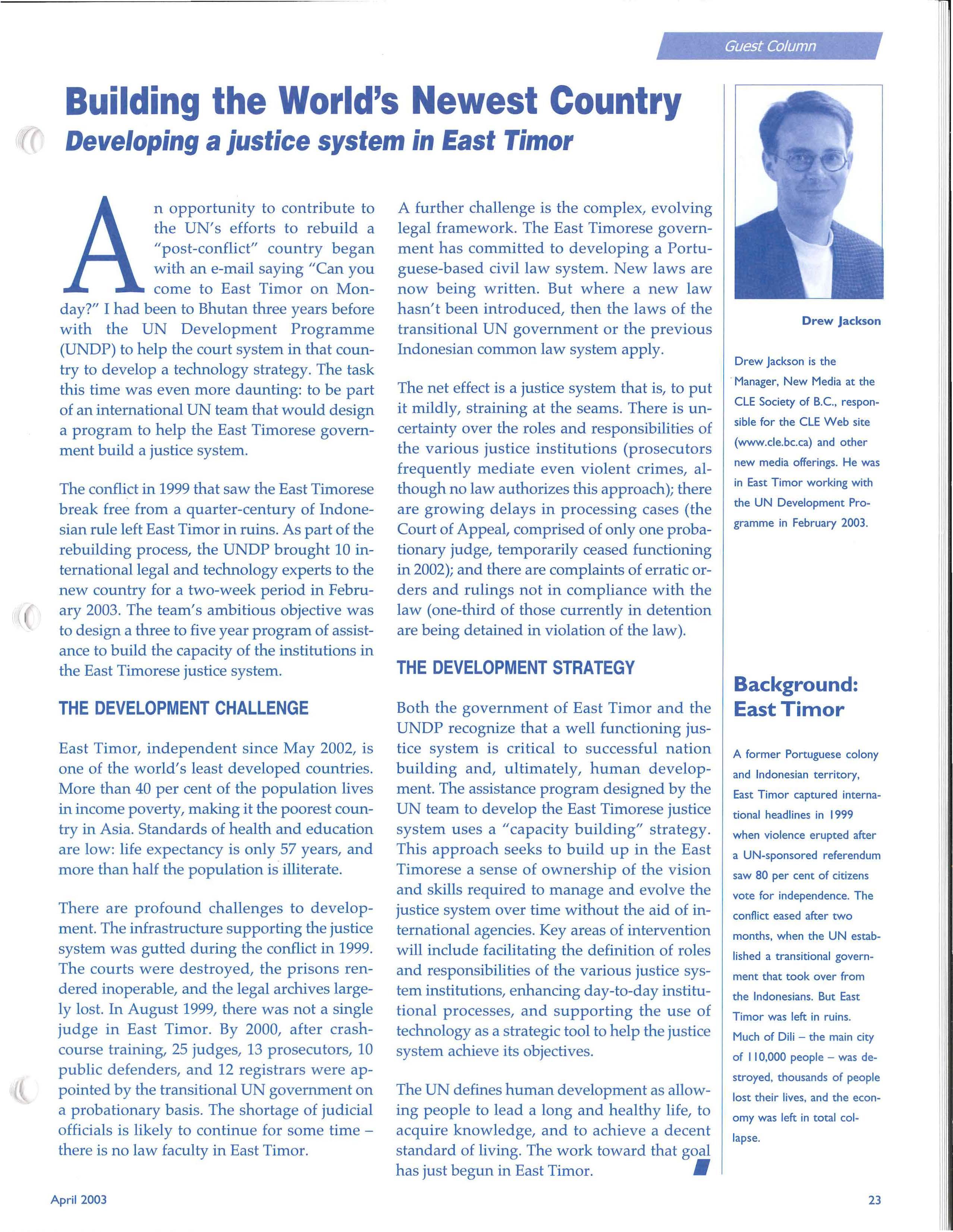
Background: East Timor
A former Portuguese colony and Indonesia n territory, East Timor captured internat ional headlines in 1999 when violence erupted after a UN-sponso r ed referendum saw 80 per cent of citizens vote for independence The conflict eased after two mo nths, when t he UN established a trans itiona l government that took over from the Indonesians But East Timor was left in ruins Much of Dili - the main city of II 0 ,000 people - was destroyed , thousands of people lost their lives , and the economy was left in total co llapse
Drew Jackson
Maureen Fitzgerald
Maureen F Fitzgerald
B.Com , LL.B , LL.M has written a book to help lawyers and professionals find the work they love The book, entitled Mission Possible - Creating a Mission for Ufe and Work, will be in bookstores this summer, and can currently be purchased for $19.95 (e-mai l mfitzgerald@primus.ca)
Lawyers Jumping Ship
Here 1s a floatation device
colleague called me yesterday and told me about another lawyer who had jumped ship - you know -left his law firm, decided to go out on his own, chose to follow his heart, couldn't take it any more and so on.
Upon reflection I realized the power of my friend's metaphor: Jumping Ship Did the lawyer jump into the ocean or was it just a lake? Did the ocean have sharks? Was it rough water? Did the lawyer have a lifeboat or perhaps a life preserver?
All my answers led me to conclude that jumping ship was a fairly risky thing to do and, all things considered, things were not looking good for this poor lawyer. In effect this lawyer had propelled himself off a safe and comfortable
• I will lose the status attached to a particular law firm;
• My colleagues will think I am copping out; and
• My family will think I am going through mid-life crisis.
The lawyer who just jumped would likely be able to dispel many of these assumptions. If you reflect on each right now, you can likely see that many are not grounded in reality and might never come true. For example, 1 suspect that the leaping lawyer will continue to work beside and across from many lawyers. He probably took with him many life-saving devices including close relationships and a solid reputation.
My own assumptions ship into icy cold water and we have no indication about how he would
If you are working in a situation that is not ideal, do not were dispelled two years ago when I jumped ship. I left my safe and comfortable position at the Law Society and decided to do what I really enjoyed. After all, at 42 with 10 years survive .
Metaphors reflect deeper hidden assumptions that we hold about reality. Perhaps this metaphor
let your assumptions prevent you from finding your ideal career. Be daring and courageous.
explains why each of us is afraid to make a change. Many of us secretly envy those who make the leap, yet we are unable to do it ourselves.
Perhaps you too hold many of the assumptions that other lawyers hold in relation to switching firms or changing careers. These include:
• I will never earn as much as I do now;
• I will be all alone;
• I will lose the reputation I have gained at this firm;
Through this process I have come to believe that if you are doing what you love, everything you need will come your way, and you will be happy and successful.
Your ideal life is located at a place where you can be your best and those around you bring out the best in you If you are working in a situation that is not ideal, do not let your as-
• I will lack access to other expert lawyers; of practice, surely I had some control over my career. I now practise as a Conflict Management Consultant, primarily doing harassment investigations and workplace mediations I love what I do and my clients appreciate the energy and passion I bring to my work.
sumptions prevent you from finding your ideal career. Be daring and courageous. Challenge the assumptions that prevent you from becoming truly successful. •
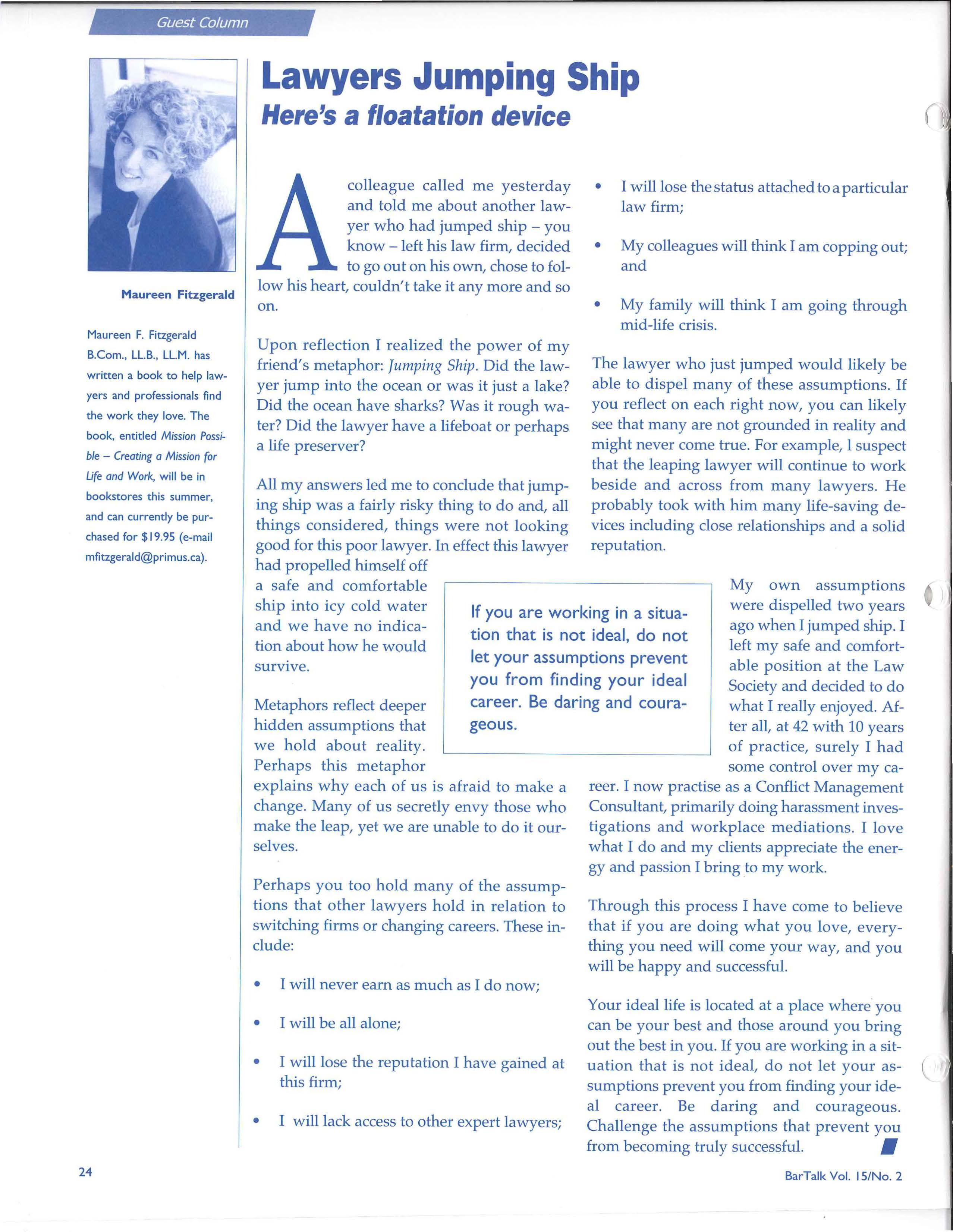
1,1
Ask A Librarian
Ask A Librarian is designed to answer queries regarding BCCLS services, sources for legal information , and legal reference questions. Reference staff at the Vancouver Courthouse Library will respond to your questions with quality research strategies and will refer to resources available through th e courthouse library system . All questions will be treated as anonymous. Please send your questions to 604-660-2841 , toll free 1-800-665-2570, fax 604-660-2821 or e-mail bccls@bccls.bc.ca
Q AI'm looking for a book - how can I tell if the Vancouver Library has it and whether it is on the shelf or checked out?
The Vancouver Courthouse Library recently implemented an automated circulation system. If you're looking for a book, check the online library catalogue at www.bccls.bc.ca to discover if the Vancouver library has the book, if the book is on the shelf or checked out and whether the book is for library use only If a book is checked out, the due date is shown and you can request that it be placed on reserve for you . When the book is returned you will be notified By the summer of 2003 you will be able to place your own reserves and also renew books that you have out. For the moment, all of these features apply only to the books in the Vancouver Courthouse Library . Borrowers using other courthouse library branches should check with their local library for availability of materials . As part of the new system, everyone borrowing books from the Vancouver Courthouse Library needs a library card; download the application form from www.bccls bc.ca/ borcard_form.htm or contact the Circulation Department at 604-660-2838
Q A
Where has the microfiche gone?
The library catalogue is no longer printed and reproduced on microfiche; it is available online at www bccls.bc.ca The online catalogue is user-friendly and searchable. Access the "Help" button for
explanations and suggestions or call the library if you have questions about using the catalogue
While the library catalogue is no longer on microfiche, the Vancouver Courthouse Library retains a wealth of historical material on microfiche. This includes materials such as pre-1865 English law reports, the Canada Gazette dating from 1841, House of Commons debates from 1870, B.C. statutes, proclamations and ordinances dating back to the 1850s and other useful sources In addition to these historical research gems, the library has more recent material on microform, such as older Labour Arbitration decisions, U.S. law reports, House of Commons and Senate committee reports , the Canada Treaty series, Federal and B C. Royal Commission reports and other items of interest. You can locate these materials by using the online library catalogue . For more information contact the Vancouver Courthouse Library. • Lawyer Referral Service
The Lawyer Referral Service invites lawyers to participate. A registration form is available at www .bccba.org in the Members' Guest Lounge . For more information , please contact Lorna O'Grady at 604.646 7858 or toll free 1.888.687 3404 ext 309
Patricia Jordan
Patricia Jordan is the CBABC Manager, Interactive Media She welcomes your comments, questions, and suggestions. If you're having difficulty find ing a document online, need an answer, or would like someth ing added to the site, contact her at pjordan@bccba.org or call 604-646-7861.
Get the Most From the CBABC Web site
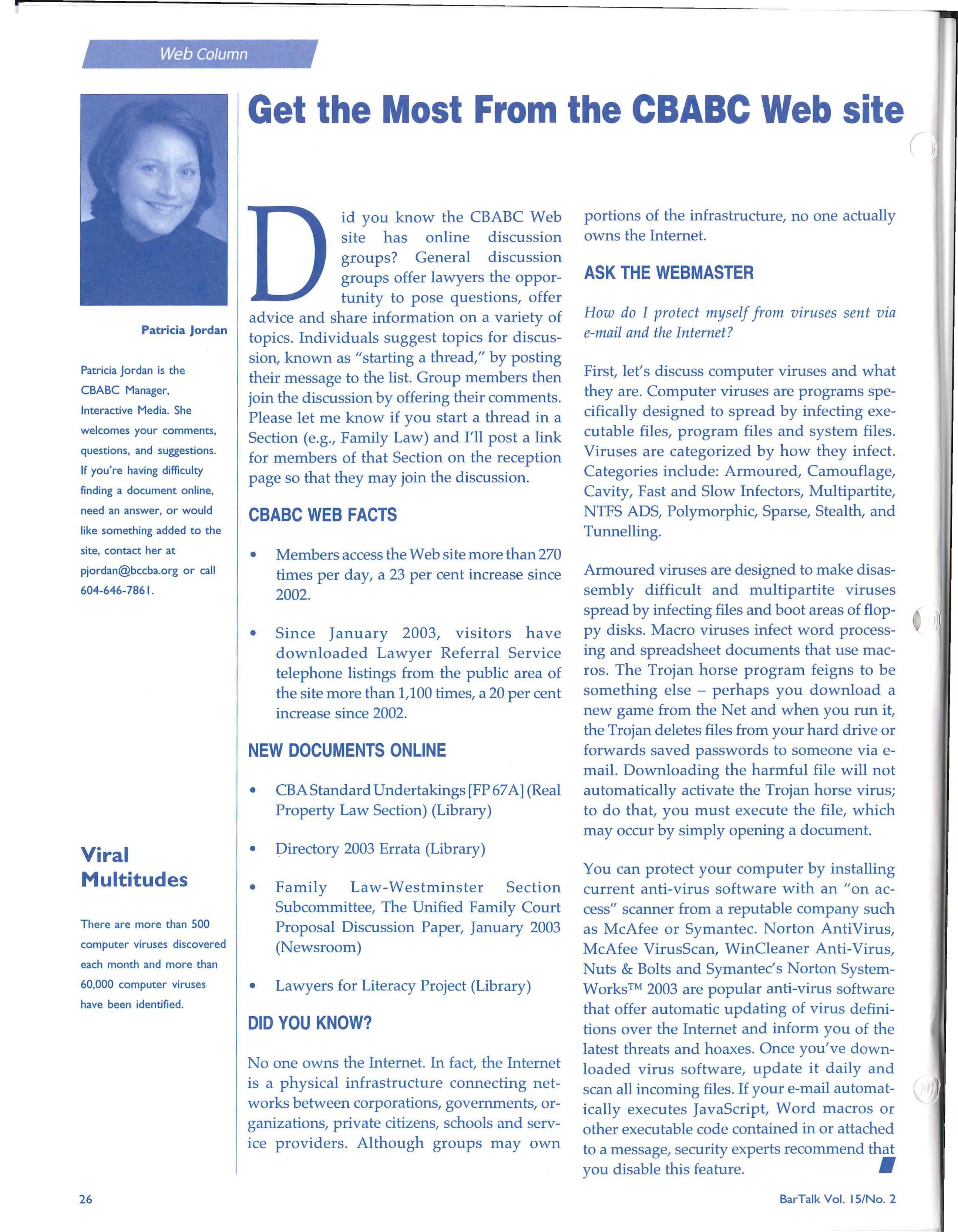
Viral Multitudes
There are more than 500 computer viruses discovered each month and more than 60,000 computer viruses have been identified.
id you know the CBABC Web site has online discussion groups? General discussion groups offer lawyers the opportunity to pose questions, offer advice and share information on a variety of topics. Individuals suggest topics for discussion, known as "starting a thread," by posting their message to the list. Group members then join the discussion by offering their comments. Please let me know if you start a thread in a Section (e.g., Family Law) and I'll post a link for members of that Section on the reception page so that they may join the discussion.
CBABC WEB FACTS
• Members access the Web site more than 270 times per day, a 23 per cent increase since 2002.
• Since January 2003, visitors have downloaded Lawyer Referral Service telephone listings from the public area of the site more than 1,100 times, a 20 per cent increase since 2002.
NEW DOCUMENTS ONLINE
• CBA Standard Undertakings [FP 67A] (Real Property Law Section) (Library)
• Directory 2003 Errata (Library)
• Family Law-Westminster Section Subcommittee, The Unified Family Court Proposal Discussion Paper, January 2003 (Newsroom)
• Lawyers for Literacy Project (Library)
DID YOU KNOW?
No one owns the Internet. In fact, the Internet is a physical infrastructure connecting networks between corporations, governments, organizations, private citizens, schools and service providers Although groups may own
portions of the infrastructure, no one actually owns the Internet.
ASK THE WEBMASTER
How do I protect myself from viruses sent via e-mail and the Internet?
First, let's discuss computer viruses and what they are. Computer viruses are programs specifically designed to spread by infecting executable files, program files and system files. Viruses are categorized by how they infect. Categories include: Armoured, Camouflage, Cavity, Fast and Slow Infectors, Multipartite, NTFS ADS, Polymorphic, Sparse, Stealth, and Tunnelling.
Armoured viruses are designed to make disassembly difficult and multipartite viruses spread by infecting files and boot areas of floppy disks. Macro viruses infect word processing and spreadsheet documents that use macros. The Trojan horse program feigns to be something else - perhaps you download a new game from the Net and when you run it, the Trojan deletes files from your hard drive or forwards saved passwords to someone via email. Downloading the harmful file will not automatically activate the Trojan horse virus; to do that, you must execute the file, which may occur by simply opening a document.
You can protect your computer by installing current anti-virus software with an "on access" scanner from a reputable company such as McAfee or Symantec. Norton AntiVirus, McAfee VirusScan, WinCleaner Anti-Virus, Nuts & Bolts and Symantec's Norton SystemWorks™ 2003 are popular anti-virus software that offer automatic updating of virus definitions over the Internet and inform you of the latest threats and hoaxes Once you've downloaded virus software, update it daily and scan all incoming files. If your e-mail automat- ( ically executes JavaScript, Word macros or other executable code contained in or attached to a message, security experts recommend that you disable this feature.
Hooplaw Raises Almost $40,000
On March 1, 2003 the Hooplaw Charitable Foundation held its annual Charity Basketball Tournament in support of children's charities. The event was again a resounding success. More than 200 lawyers, judges and law students participated in raising almost $40,000. This year's fundraising efforts were the most successful in the tournament's eight-year history. Twenty teams participated in two divisions with the UBC law students winning the competitive division and Borden Ladner Gerva i s LLP prevailing in the recreational division.
Tournament organizers would like to thank the following sponsors : Red Players compete in this year's Hooplaw, the most successful year in the tournament's eight-year history. Carpet Food Services, Axa Pacific Insurance and HSBC. In addition, special thanks to the following four law firms for their significant fundraising efforts: Blake Cassels & Graydon LLP, Clark Wilson, Borden Ladner Gervais LLP, and McCarthy Tetrault LLP. Hooplaw would like to thank all those individuals who participated or made a donation to this very worthwhile cause. If you were not able to participate this year, it's never too early to start getting in shape for next year . •
Nine Contest Winners As BarTalk Turns 15
To celebrate the 15th anniversary of BarTalk this year, we held a province-wide contest; winners and prizes are listed below. We thank the many sponsors who kindly donated prizes.
Kootenay: Two lift tickets for Resorts of the Canadian Rockies
Fernie Alpine Resort donated by Resorts of the Canadian Rockies. Winner: Ross Young
Nanaimo: Six lift tickets for m•un•$ip:::•hing<•n Mount Washington Alpine Resort. Winner: Morley McKeachie
Prince Rupert: Two lift tickets for Ski Smithers and a $25 Gift S111Uhers Cerhf1ca te for the ®
. M :J 1t1 [,)I j Q?12f I P1zza Wmner: T1m Smithers Klaassen
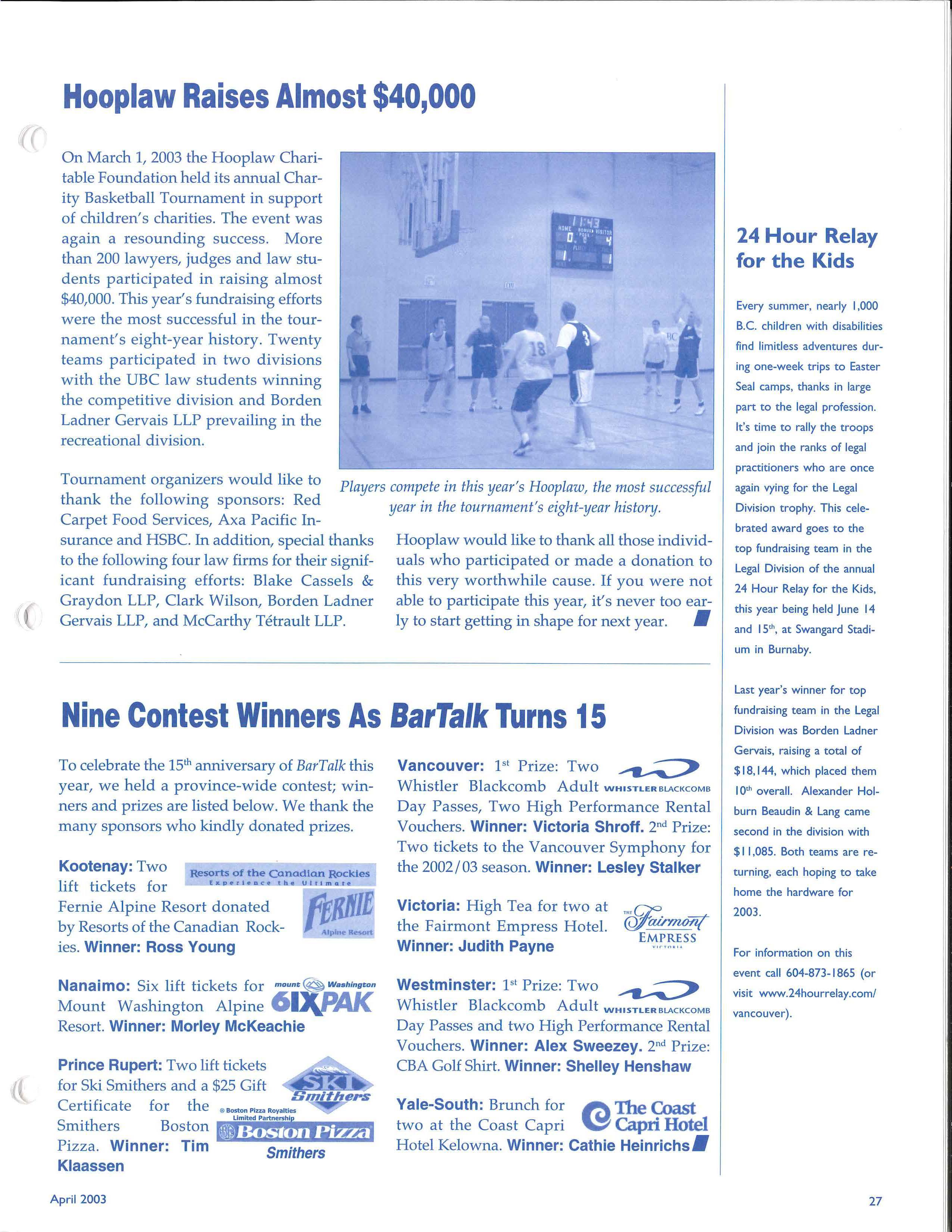
Vancouver: 1'' Prize: Two Whistler Blackcomb Adult wHrsTLERsLAcKcoMs Day Passes, Two High Performance Rental Vouchers. Winner: Victoria Shroff. 2nd Prize: Two tickets to the Vancouver Symphony for the 2002/03 season. Winner: Lesley Stalker
Victoria: High Tea for two at the Fairmont Empress Hotel. Winner: Judith Payne EMPRESS
Westminster: 1'' Prize: Two Whistler Blackcomb Adult wHrsnERsLAcKcoMs
Day Passes and two High Performance Rental Vouchers. Winner: Alex Sweezey. 2nd Prize: CBA Golf Shirt. Winner: Shelley Henshaw
Yale-South: Brunch for ,. The Coast two at the Coast Capri Capri Hotel Hotel Kelowna. Winner: Cathie Heinrichs.
24 Hour Relay for the Kids
Every summer , nearly I,000 B C. children with disabilities find limitless adventures during one-week trips to Easter Seal camps, thanks in large part to the legal profession It's time to rally the troops and join the ranks of legal practitioners who are once again vying for the Legal Division trophy Th is celebrated award goes to the top fundra ising team in the Legal Div isi on of the annual 24 Hour Relay for the Kids, this year being held June 14 and I5'\ at Swangard Stadium in Burnaby
Last year 's w inn er for top fundraising team in the Legal Div ision was Borden Ladner Gervais, rais ing a total of $18,144, wh ich placed them IO"' overall. Alexander Hoiburn Beaudin & Lang came second in the division with $1 I,085. Both teams are returning, each hoping to take home the hardware for 2003.
For information on this event call 604-873-1865 (or visit www.24hourrelay com/ vancouver).
See these cast members
April
25 & 26
in The Government Inspector
Hamish Cameron, QC
Me lani e Cheesman
Camille Ciarniello
Karen Douglas
Kerrie Everitt
Carol Fleischhaker
Rod Hay le y
Lorne Herlin
Scott Johnston
Thea Koshman
Miriam Kresivo
Gerald Lecovin, QC
• Ken Manning
Daniel Mcleod
Mandana Namazi
John Noble
• Darlene Patrick
Jim Poyner
Arthur Ross
Deborah Satanove
Vanessa J. Soon
Andrea Spence
Seema Tuit
Brian J. Wallace, QC
Joni Worton
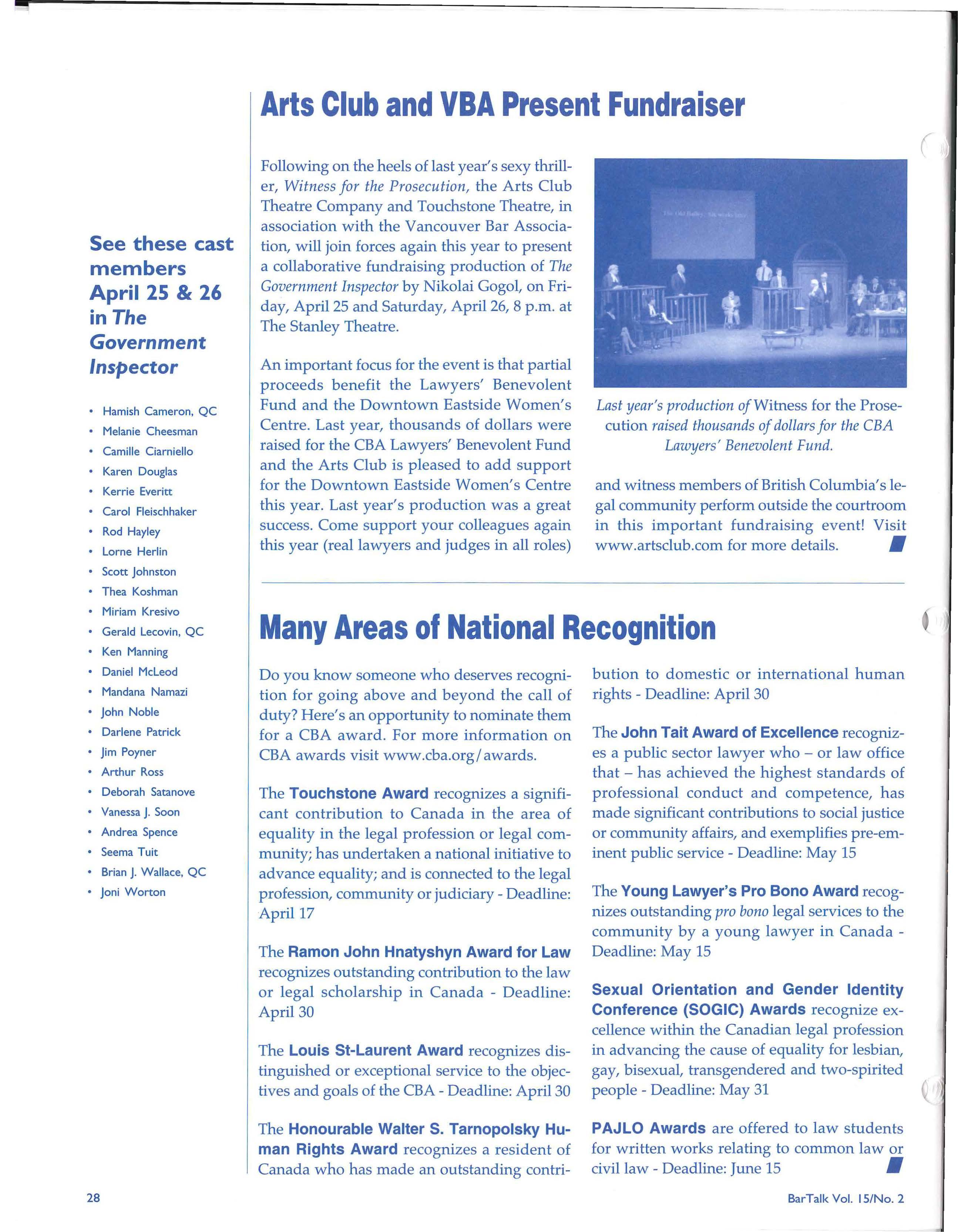
Arts Club and VBA Present Fundraiser
Following on the heels of last year's sexy thriller, Witness for the Pros ecution, the Arts Club Theatre Company and Touchstone Theatre, in association with the Vancouver Bar Association, will join forces again this year to present a collaborative fundraising production of The Government Inspector by Nikolai Gogol, on Friday, April 25 and Saturday, April 26, 8 p.m . at The Stanley Theatre.
An important focus for the event is that partial proceeds benefit the Lawyers' Benevolent Fund and the Downtown Eastside Women's Centre. Last year, thousands of dollars were raised for the CBA Lawyers' Benevolent Fund and the Arts Club is pleased to add support for the Downtown Eastside Women's Centre this year. Last year's production was a great success. Come support your colleagues again this year (real lawyers and judges in all roles)
Last year 's production of Witness for the Prosecution raised thousands of dollars for the CBA Lawyers ' Benevolent Fund.
and witness members of British Columbia's legal community perform outside the courtroom in this important fundraising e v ent! Visit www artsclub.com for more details •
Many Areas of National Recognition
Do you know someone who deserves recognition for going above and beyond the call of duty? Here's an opportunity to nominate them for a CBA award. For more information on CBA awards visit www.cba.org/ awards.
The Touchstone Award recognizes a significant contribution to Canada in the area of equality in the legal profession or legal community; has undertaken a national initiative to advance equality; and is connected to the legal profession, community or judiciary- Deadline: April17
The Ramon John Hnatyshyn Award for Law recognizes outstanding contribution to the law or legal scholarship in Canada - Deadline : April30
bution to domestic or international human rights - Deadline: April 30
The John Tait Award of Excellence recognizes a public sector lawyer who - or law office that - has achieved the highest standards of professional conduct and competence, has made significant contributions to social justice or community affairs, and exemplifies pre-eminent public service - Deadline: May 15
The Young Lawyer's Pro Bono Award recognizes outstanding pro bono legal services to the community by a young lawyer in CanadaDeadline: May 15
Sexual Orientation and Gender Identity Conference (SOGIC) Awards recognize excellence within the Canadian legal profession in advancing the cause of equality for lesbian, gay, bisexual, transgendered and two-spirited
The Louis St-Laurent Award recognizes distinguished or exceptional service to the objectives and goals of the CBA- Deadline : April30 people- Deadline: May 31 (
The Honourable Walter S. Tarnopolsky Human Rights Award recognizes a resident of Canada who has made an outstanding contri-
PAJLO Awards are offered to law students for written works relating to common law or civil law - Deadline: June 15
Letter to the Editor
Re: Civil Duty Counsel Program, New Westminster Registry
I would like to introduce the Civil Duty Counsel Program to members of the profession.
This Program is intended to help the Bench and Registry deal with the pre-existing issue of lay litigants who consume inordinate amounts of scarce court resources. It is not intended to replace services previously provided by legal aid or any other organization.
The concept is that civil duty counsel located in the public area of the New Westminster courthouse will provide free legal assistance of up to 30 minutes to persons in need of same. The extent of free assistance will be up to each counsel to decide in accordance with professional obligations and the objects of the Program. Counsel may draft documents, advise on process or strategy, or assist in Chambers. Initial legal assistance will be free but counsel will charge to notarize documents The notary fee will be negotiated between counsel and client. At present the Registry charges $31 for each notarization. After the initial assistance a private retainer may be negotiated between counsel and client. Each counsel will be responsible for all usual professional liability concerns such as conflicts of interest, record keeping and limitation date requirements.
Since May 24, 2002, James Iida and I have taken turns attending the New Westminster Courthouse for an hour or two on some week-
Member Services
Continued from back cover page
eludes a wine & cheese reception, modeling of the Spring and Summer lines, and a welcome gift including certificates valued up to $100 toward qualifying pur chases. A spectacular networking opportunity for the legal and medical professions RSVP to Kris Johnson by May 1, 2003 at 604-646-7855 (kjohnson@bccba.org) .
day mornings More recently, Kelly Russ and Stanley Foo have joined us . Many clients have had family and divorce related issues. Many others have had residential tenancy eviction problems . A few have had questions regarding personal injury, builder's liens, breaches of contract or estate matters. Some clients are repeat visitors. Not all clients seem to be impecunious; there is an opportunity to meet people who can afford to retain counsel. The Program may be better suited to lawyers who can be sure of their own conflict of interest problems. Lawyers with expertise in family law will do better . Junior counsel will benefit because there is a huge opportunity to learn through frequent contact with registry staff, sheriffs, other lawyers, and to a lesser extent, judges and masters. A lot will depend on the lawyer's relationship with courthouse staff.
This program is filling a niche, but we could do a better job if we had more lawyers involved. Any counsel interested in participating can contact me or speak to one of the other Civil Duty Counsel.
Yours truly,
George H. Richards, 604-588-6844, ext. 120 E-mail: richards.george@ richardslaw com •
Send your Letters to the Editor to: Caroline Nevin, BarTalk Senior Editor CBA, BC Branch, lOth Floor, 845 Cambie Street Vancouver, BC V6B 5T3 Fax: 604-669-9601 Toll free fax : 1-877-669-9601 E - mail: cnevin@bccba org
PLAYLAND OPENS FRIDAY, APRIL 18, 2003!
CBA members receive preferred pricing on Playland Ride Passports: just $18 (GST incl.), regular $24.55 (GST incl.). Playland opens April18, 2003 (weekends only); regular season begins June 16, 2003. Call Member Services for your Playland Ride Passport order form, or visit www bccba.org. •
Have an articling position to fill?
If you are cons idering hir ing a student for an articling position, there are still highly qualified third-year law students at both UBC and the UVic seek ing articling pos itions for the 2003/2004 term Moreover, the UBC and UVic Career Services offices would be pleased to assist you with your search; the offices will circulate your job posting and help you to identify qualified candidates.
UBC
Danielle Raymond, Director of Career Serv ices
Judy Pozsgay, Associate Director of Career Services
Tel : 604-822-0846 or 604822-6350
Fax : 604-822-81 08
E-mail: lawcdo@ interchange ubc.ca or pozsgay@law.ubc.ca
UVic
Nancy Pye, Ca r eer Deve lopment Officer
Tel : 250-472 -4719
Fax: 250-721-8146
E-mail: nancypye@uvic.ca
New Westminster/ Fraser Valley Bar Golf Classic
The New Westm inster/Fraser Va ll ey Bar Golf C lassic will be held Thursday, July 3'' at Gui ldford Go lf C ourse in Surrey. Optional Texas scramble format. Interested parties can contact Richard Molstad at 604-526-1821 for detai ls
CLE: New Books and Courses
Business Corporations Act Transition Guide
The new Business Corporations Act aims to create a more flexible business environment for B.C., but what does it mean for your corporate clients? What will a new board of directors look like? What does your corporate records department have to do to prepare? What do your clients have to do?
The Business Corporation Act Transition Guide contains commentary by John Lundell, Martin MacLachlan, Linda Parsons, and Liz Mueller, and tables of concordance. The guide has an overview by John Lundell, and reviews critical transition topics, such as directors and officers, registered and records offices, company articles, and important registry information.
The new Business Corporations Act will probably come into force in the Fall of 2003. There will be a number of significant changes from the existing Company Act, and within two years after it comes into force, all companies will be required to "roll over" under the new legislation. Join CLE on Thursday, May 22, 2003 at the Pan Pacific Hotel to receive an overview of the new Business Corporations Act from John Lundell. You will learn about various transition issues; find out what needs to be done or could be done now; find out what
• The Continuing Legal Education Society of Briti sh Co lumbia
you don't need to worry about at this time; and hear about how the new legislation will impact the Corporate Registry For more information visit www.cle.bc.ca
Labour & Employment Law Transition Guide
This handy, paperback guide consolidates the latest versions of the Employment Standards Act, Human Rights Code, Labour Relations Code, and Workers Compensation Act. Each Act is introduced by an overview, analyzing the significance of the changes to the legislation . Written by leading practitioners: Gwendoline C. Allison on the Employment Standards Act, Patricia J. Janzen on the Human Rights Code, Thomas A. Roper, QC on the Labour Relations Code, and Edward Bates on the Workers Compensation Act . The guide also includes Regulations under the Acts, giving practitioners all the current legislation in one source.
Community Charter
The Community Charter will establish a new legislative framework for B.C. municipalities. Come to the Sheraton Wall Centre on Thursday, May 29, 2003 and have your questions answered by people closest to the development and drafting process of this important new islation!
•
Making Death a Part of Life
On February 22 "Making Death a Part of Life," a public forum on death and dying, took place at the Vancouver Public Library. Display booths explored the choices available so that people can live with dignity while preparing for death, and offered information about support services for people in the final stages of life, and their caregivers More than 120 people stopped by the CBA booth, where they could talk with lawyers about Wills and Estates or the Dial-A-Law and Lawyer Referral programs. Thanks to Shelley Bentley, Noreen Brox, Susan Hart, Roger Holland, Nicole Todosichuk, and Anthony Wooster for volunteering their time.
•
Anthony Wooster and Nicole Todosichuk, two of the lawyers who staffed the CBA booth at the "Making Death a Part of Life" public forum.
Law Foundation of BC
Grants Approved
The Board of Governors of the Law Foundation of B.C. met on March 8, 2003. Chair Don Silversides, QC is pleased to announce that funding totalling $3,170,080 was approved for the following 18 continuing programs:
CANADIAN BAR ASSOCIATION, B.C. BRANCH
Law Week 2003 - $5,500
UNIVERSITY OF SASKATCHEWAN
Native Law Centre- Program of Legal Studies and Operating - $10,300
END LEGISLATED POVERTY
FLAWline Editor and Facilitator- $19,500
SEPARATION AND DIVORCE RESOURCE CENTRE
Volunteer and Legal Support Services Program - $40,600
BATIERED WOMEN'S SUPPORT SERVICES
Legal Advocacy Program - $50,480
LAW FOUNDATION GRADUATE FELLOWSHIPS
2003/2004 - $55,000
NORTH ISLAND ADVOCACY COALITION SOCIETY
Legal Advocacy Program- $84,600
NELSON DISTRICT COMMUNITY RESOURCES SOCIETY
Legal Advocacy Program - $105,400
WEST COAST LEGAL EDUCATION AND ACTION FUND ASSOCIATION
Operating- $111,700
WEST COAST DOMESTIC WORKERS' ASSOCIATION
Operating - $133,800
B.C. CIVIL LIBERTIES ASSOCIATION
Operating - $134,300
BRITISH COLUMBIA LAW INSTITUTE
Operating- $140,300
n:rn@uw FOUNDATION OF BRITISH COLUMBIA
UNIVERSITY OF VICTORIA, FACULTV OF LAW
Law Centre Clinical Program - $203,400
TENANTS' RIGHTS ACTION COALITION
Operating - $218,600
. LAW SOCIETY OF B.C.
Professional Legal Training Course - $233,800
PEOPLE'S LAW SCHOOL
Operating - $262,400
COMMUNITY LEGAL ASSISTANCE SOCIETY
Operating - $654,500
WEST COAST ENVIRONMENTAL LAW ASSOCIATION
Operating and Environmental Dispute Resolution Fund - $705,900
Governors also considered 85 Letters of Intent received under the Law Foundation's 2003 Project Initiative. Selected applicants are being invited to submit full applications for project funding to be adjudicated at the June 2003 Board of Governors meeting
Of note was the large percentage of proposals received for advocacy services. A strategy is being developed by the Law Foundation to assist smaller communities with limited access to justice.
Jeffrey Scouten of Vancouver and Bowen Island has been re-appointed by the CBABC for a second term as a Governor of the Law Foundation. Mr . Scouten currently serves on the Finance and Administration and the Diversity Committees
•
BarTa/k is published six times per year by the British Columbia Branch of the Canadian Bar Association, lOth Floor 845 Cambie Street Vancouver, B C. V6B STl
TEL: 604-687-3404
TOLL FREE in B.C., outside the Lower Mainland: 1-888-687-3404
FAX: 604-669-960 I
TOLL FREE in B.C., outside the Lower Mainland: 1-877-669-960 I
• BarTa/k Senior Editor: CAROLINE NEVIN 604-687-3404, EXT. 320 cnevin@bccba.org
• BarTa/k Editor: SANDRA WEBB 604-687-3404, EXT. 318 slgwebb@bccba.org
• Editorial Board Chair: KENNETH ARMSTRONG karmstronglaw@ shaw.ca
• Editorial Board Members: VIKKI BELL, QC WILLIAM S. CLARK
DIANA DAVIDSON KAY MELBYE CHRISTINE MINGlE
© Copyright the British Columbia Branch of the Canadian Bar Association-2003 .
This publication is intended for information purposes only and the information contained herein should not be applied to specific fact circumstances without the advice of counsel.
Vancouver Bar Association & Canadian Bar Association
The Canadian Bar Association, B.C. Branch represents more than I 0,000 members within British Columbia and is dedicated to improving and promoting access to justice, to reviewing legislation, initiating law reform measures and advancing and improving the administration of justice.
June 26, 2003
· See insert in this issue!
Get Help.
Get one of our
research .lawyers . t o n your s1de. on po1n legal research
• Our lawyers have extensive research experience
• We research civil and criminal issues
• We provide legal memoranda, facta, case summaries, quantum assessments
604.879.4280 fax 604 648.8930 info@oplr.com www oplr .c om ·-
IN HOUSE COUNSEL-A large multi-branch distributor/retailer HQ'd in the Lower Mainland seeks an energetic lawyer for a wide variety of responsibilities. The ideal candidate has experience in real estate and commercial law, civil and claims litigation, and employment law, 2-5 years call, and previous industry experience This is a full time position offering excellent benefits. If you feel you qualify , please email your resume stating salary requirements, to lawsearcb@telus.net before Apr 30/03.
Have an ad? www.bccba.org bas 2 areas to advertise. See the HR area & the Lawyer Lounge
JUNIORLITIGATIONLA WYERS WANTED-Vemon,B.C. Nixon Wenger, North Okanagan's largest law firm is seeking two highly motivated Junior Litigation Lawyers. Nixon Wenger is a law firm of 14 lawyers that has both a national and an international client base. Salary and Compensation package commensurate with experience. Please email resume in confidence to the attention of: Douglas G. Lemiski at dgl @nixonwenger.com or fax 1- 800-787-7273.
JUNIOR ASSOCIATE REQUIRED. Ridgway & Company is an established five lawyer firm in Duncan, B C. We are seeking a newly called lawyer interested in building a general practice emphasizing family, civil and criminal litigation Fax resume to Managing Partner at 250-746 -4070 by April 30, 2003.
JUNIORLITIGATIONLA WYER-Johnston, Lewis & Franklin is seeking a junior litigation lawyer with 2-6 years of experience in general litigation. As one of the larger fmns in Nanaimo , we offer an attractive compensation package as well as the opportunity for long term career potential. Forward yourresume to lawyers @jlf.ca or to 210-3260 Norwell Drive, Nanaimo, B.C. V9T 1X5 Attention : Richard Johnston
JUNIOR LITIGATION LAWYER required for busy Fraser Valley ?lawyer law firm. Please forward resume to: Campbell , Burton & McMullan, Attn: R. McMullan #202-22242 48th Ave., Langley B.C. V3A 3N5 Fax: 604-5335521 Email : rmcmullan@cbrnlawyers.com
Member Services
Next deadline: May 2 DISPLAY AD RATES 3 x 1 column
deadline: May 9 Next mailing date: May 30
Please direct advertising inquiries to Sandra Webb at 604-646-7856 or 1-888-687-3404, ext. 318 (e -mail cba@bccba.org)
The Battle of the Bar Bands retums to the Commodore
Ballroom on May 16!
See inserts for ticket order form
CBABC members have access to a wide range of products, services and discounts. Member Services is continually adding and looking for ways you can get th e most out of your membership! Be sure to visit www.bccba.org for new additions. Your input is always welcome. Send your suggestions to kjohnson@bccba.org . Member Services Hotline: 604-687-3404, ext. 500 or 1-888-687-3404, ext. 500.
ARTS CLUB AND STANLEY THEATRES
Receive a 20 per cent discount off regularpriced tickets by calling Cheryl Lang at 604687-5315, ext. 254 and identifying yourself as a CBA member. Zadie's Shoes plays at the Granville Island Stage until May 3. Dial M for Murder plays at the Stanley Theatre May 8 to June 8.
SPRING AT WHISTLER BLACKCOMB
WHISTLER BLACKCOMB
Planning to ski or board this spring? Purchase Spring Tickets from CBA and SAVE! Adult tickets: $41, Youth/Senior: $33, Child: $20 (all prices subject to GST). With your Spring Tickets, you'll receive a free two-hour ski or board demo!
Pick the skis or board you'd like to try, and they're yours to try for free . Plus, with each Spring Ticket order, you'll also receive the Whistler Blackcomb Discount Card, good for Winter and Summer savings until October 2004. Contact Member Services for your order form today!
CBA ANNOUNCES HOLT RENFREW "PRIVATE SHOPPING NIGHT"
CBABC, the BC Medical Association and Holt Renfrew present a "Private Shopping Night" on Wednesday, May 14,2003 from 6:30-8:30 p.m. at Holt Renfrew, Pacific Centre. Exclusive for members plus one guest, the evening in-