The Canadian Bar Association
British Columbia Client Confidentiality Needs Protection
CBA opposes proposed U.S. SEC rules
he Canadian Bar Association has voiced its strong objection to new rules being proposed by the U.S. Securities and Exchange Commission (SEC), under the Sarbanes-Oxley Act, that would jeopardize lawyer-client confidentiality. "The proposed SEC rules under consideration extend the reach of the Act and could have the effect of turning trusted legal advisors into securities police," says President Simon Potter, of Montreal.
In the CBA's submission filed prior to a December 17th hearing, the CBA warned that clients will be reluctant to disclose information to lawyers if they fear their lawyer will be compelled to alert authorities rather than to advise the client as to how to comply. The CBA also says lawyers will be leery of giving advice if they fear that they may have to report up the corporate ladder, withdraw from the case, and disclose to the SEC. These actions would breach the lawyers' ethical obligation to their client.
News of the CBA position was e-mailed to all members. The action sparked an unprecedented response from across the country "Best of luck in pursuing this matter," wrote one member, "in my opinion, the U.S regulators have gone way too far in their quest to cure the excesses of the Internet bubble " One member who disagreed wrote: "I submit that the large Bay Street firms and their well-financed corporate clients are quite capable of addressing their own concerns at the SEC without the subsidy of my CBA dues contribution." But others - the majority - praised the CBA position. "Thank you for standing up for the right of solicitor client privilege " was the overwhelming message .
"I am distressed at how this privilege is under attack in the USA, and by the threat that it will spread to Canada," wrote another member. "The CBA is again doing what it does best," read the e-mail. "Thanks so much to you and all the lawyers who contributed to this very important work."
After filing the CBA submission with the Commission, President Simon Potter attended the SEC debate in Washington and met with Canadian reporters to defend the interests of Canada's lawyers and their clients conducting business in the U.S News of the CBA position featured prominently in Canada's business media, on the national CP wire service, in the Globe and Mail's Report on Business, and Montreal's Le Devoir newspaper. Interviews and stories of the CBA objections were carried on CBC Newsworld, CTV Newsnet, ROB Television, RDI- TV Capital Action, and by CBC Radio News.
The CBA takes strong exception to th e proposed "noisy withdrawal" rule which requires lawyers to whistle-blow on their clients and report to Securities authorities any misconduct or violation lawyers "reasonably believe" may be contained in documents submitted to the SEC. " Canadian lawyers are already subject to rules of conduct which ensure that they behave in a highly ethical manner, " said Mr. Potter.
The CBA will continue to monitor the situation closely, respond as needed, and keep the profession advised of any developments on this important issue. •
David A. Paul
Pres ident 2002/2003
B.C. Branch , Canadian Bar Association
Once is never enough!
If you have changed firms, changed addresses, have a new e-mail address or phone/fax number, you need to let us know. Letting the Law Society in on the secret is not enough!
Contact us at data@bccba.org, phone 604687-3404 or fax 604-669960 I. (Toll free options: phone 1-888-687-3404 or fax 1-877-669-960 I).
Independent Poll Results Career and personal balance a top priority
n November 2002 Ipsos-Reid conducted a web and telephone survey of Canadian lawyers, asking them what they considered the most important issues facing lawyers today, and what they most cared about. The CBA-commissioned survey also asked them to rate their familiarity and satisfaction with CBA activities and services, and to rate them for relevance to their specific needs. Four quick highlights:
1. Public perception & the credibility of lawyers, and achieving a balance between family and work are the issues of highest concern among Canadian lawyers. Affordability of legal services to clients is also
2. frequently mentioned.
B.C. members, like their counter-parts from the East Coast, are sign - ificantly more likely than other
in other provinces in that we are more likely to browse rather than download materials.
The CBA conducts surveys to provide an opportunity for lawyers to express their views outside of a particular special interest or arena of participation in the CBA. Engaging a professional polling company ensures we get the views of a cross section of the profession, and learn what really matters to lawyers.
Overall, the survey represents a high level of satisfaction with CBA services. Our strengths are clearly in the advocacy, education and member services field, and I take from that a direction to stay focused
Public perception & the credibility of lawyers, and achieving a balance between family and work are the issues of highest concern among Canada's lawyers.
3. Canadian lawyers to list the marketing of legal services as a priority.
Satisfaction with the CBA is highest in relation to advocacy, education and communication, supplier arrangements and publications
4. The CBA' s work on public image and advocacy, and continuing education/ professionalism is rated most relevant to members.
Some interesting information emerged with respect to lawyers and their Internet and email activity. Only one per cent of respondents have no access to the Internet at home or the office. Members prefer to receive news and notices by e-mail, but want access to hard copies of more substantial publications.
About 60 per cent of survey participants have visited the CBA Web site, but that figure rises to 70 per cent in B.C. However, our online activity level differs in comparison to colleagues
on core business of the CBA. Another clear message I get from this survey is that while the CBA has worked effectively to meet the needs of its members, activities
to assist with balancing our work as lawyers with the quality of our personal and family life remains a top priority.
As a lawyer with a young family I certainly identify with the need to find professional and personal balance. Even before the poll was conducted I decided to make this issue the focus of this year's President's Forum. We will bring together experts and resources focussed on how to successfully establish and manage a law practice while maintaining a balanced and healthy personal life.
The President's Forum is currently scheduled for Friday June 20, 2003. I want this Forum to be successful and relevant to our members Please contact me or Forum co-chairs Meg Shaw or Diana Dorey, with your thoughts and suggestions.
As always, I invite members to contact me with your ideas on how the CBABC can assist our members in an increasingly stressful profession.
Advocacy protects BC lawyers
CBA National: Professional support and service
This is the second of a two-part series on what the CBA does for members. In my last column I described the work of the CBABC. In this column, my colleague John Hayles, National Executive Director, describes the work of the National side of our organization.
hy," I was asked at the December 2002 meeting of the CBABC Council, "does $230 of my annual membership fee go to the National CBA? What is this portion of my fee doing to benefit me?" My plain and honest answer: Plenty!
Each day, the National Canadian Bar Association provides professional, personal and practice support to all our members. The information box that
would follow Some months were pretty thin, and I made sure -because I had to - that every expenditure was justified. It was an experience that I'll never forget, and that I've kept foremost in my mind as Executive Director of the CBA.
In everything we do on your behalf as lawyers and members, we push our professionals to be the best and to stretch our resources, just as you do in practice. The acid test is: Are we using your dollars in the best way possible? That thinking pervades the financial decisions of our loyal and dedicated staff, professionals who take their responsibilities to you very seriously. The result is a culture of vigilance at the National CBA, as we meet the formidable challenges that define not only our association, accompanies this article provides more information, but examples include our public perception campaign and our widely praised Lawyers Care Initiative, not to
Three lpsos-Reid member polls ... report that the relevance to members of, and their satisfaction with, CBA activities and positions remain high, in the 80 per cent range.
but also the practice of law and the way Canadians see our profession.
Let's not overlook how important that last issue is. In a world defined by mention our advocacy on behalf of lawyers on Parliament Hill on everything from legal aid funding to solicitorclient privilege, and our Supreme Court of Canada interventions.
"But is my money well spent?" you ask. And so you should. As responsible business people, you have a right to the response. The answer is yes, and I can personally attest to it . Many of you might not know this, but my first 13 years in this profession were spent first as a sole practitioner in New Liskeard in Northern Ontario I learned first-hand about the realities and pressures of practice: meeting client needs (as they say today, clients are a 24/7 commitment), trying to generate billable time, paying staff salaries, maintaining overhead, and at the end of the week, taking home the (rapidly disappearing) leftover draw.
I learned back then that looking after the pennies meant that, in most cases, the dollars
instant communication, a B.C. occurrence- take the Robert Pickton case as an example - is news not only in Winnipeg and Halifax, but in capitals around the world. Or consider the Martin Wirick affair, an incident that affects public perception of lawyers not only in B.C., but across the country. When it comes to professional issues, I am convinced that our profession needs a strong national and international presence to represent and defend it; an authoritative voice that speaks with credibility, a proven track record and the clout of more than 100 years of speaking out on behalf of the profession.
B C. lawyers benefit when the CBA uses its national profile to defend lawyers vilified without cause, or to react when our system of justice and judicial independence are attacked B.C. lawyers benefit when the National CBA stands up for client rights as the federal gov-
Frank Kraemer
Executive Director
B.C. Branch, Canadian Bar Association
john Hoyles
Executive Director
Canad ian Bar Association
Call for Nominations: Standing Committees
The CBA seeks candidates for its National Standing Committees for 2003/2004. All CBA members are eligible to app ly for positions on the following committees:
Awards
• Communications
Continuing Legal Educat ion
Equality
Ethics and Professional Issues
• International Development
Judicial Compensation and Benefits
• Legal Aid Liaison
• Legislations and Law Reform
Resolutions, Constitution and Bylaws
Supreme Court of Canada Liaison
For information and an application form, contact Joanna Feder ici at the CBABC or visit www.bccba.org. The deadline for applications is noon, Tuesday, April IS, 2003
Executive Director's Column
Continued from page 3
ernment proposes laws and r e gistries that would restrict them . And as the impact of change ripples across the country, B.C. lawyers and the clients they serve need a national champion more than ever.
How do we ensure that the National CBA is working to further your goals and priorities? We constantly seek our members' opinions, here in B.C. and across the country. National CBA invests in research and member surveys on current and emerging issues, collecting data to help inform policy decisions (see President's Column , page 2)
This data confirms that National CBA and the CBABC are getting it right. Three Ipsos -Reid member polls over the past six years report that the relevance to members of, and their satisfaction with, CBA activities and positions remain high- in the 80 per cent range at minimum. Encouraged by this positive feedback, the Branch Executives that make up the national Board of Directors set policies and priorities that are voted on by the elected national Council. This Council, like the CBABC counterpart is an open, democratic body We
listen to our members because without our
members, there is no CBA.
But as successful as we ' ve been, we must continue to do more for less, using the tools at our disposal. National CBA's investment in database technology is an excellent illustration. All CBA member information is centralized and secured on our National CBA database Both the CBABC and individual members can access, edit and update their files as needed
centralized technology investment brings financial savings and cost efficiencies
Let me conclude by citing a timely example of National CBA value. As you may recall, CBA President Simon Potter recently shared with our members (via e-mail) the letter he wrote to the U .S. Securities Exchange Commission attacking proposed rules that would hurt Canadian lawyers and their clients. Within days, his inbox was flooded withe-mails from members across the country, offering overwhelming support of the CBA advocacy for solicitorclient privilege and member interests . It is the most recent demonstration of the beneficial
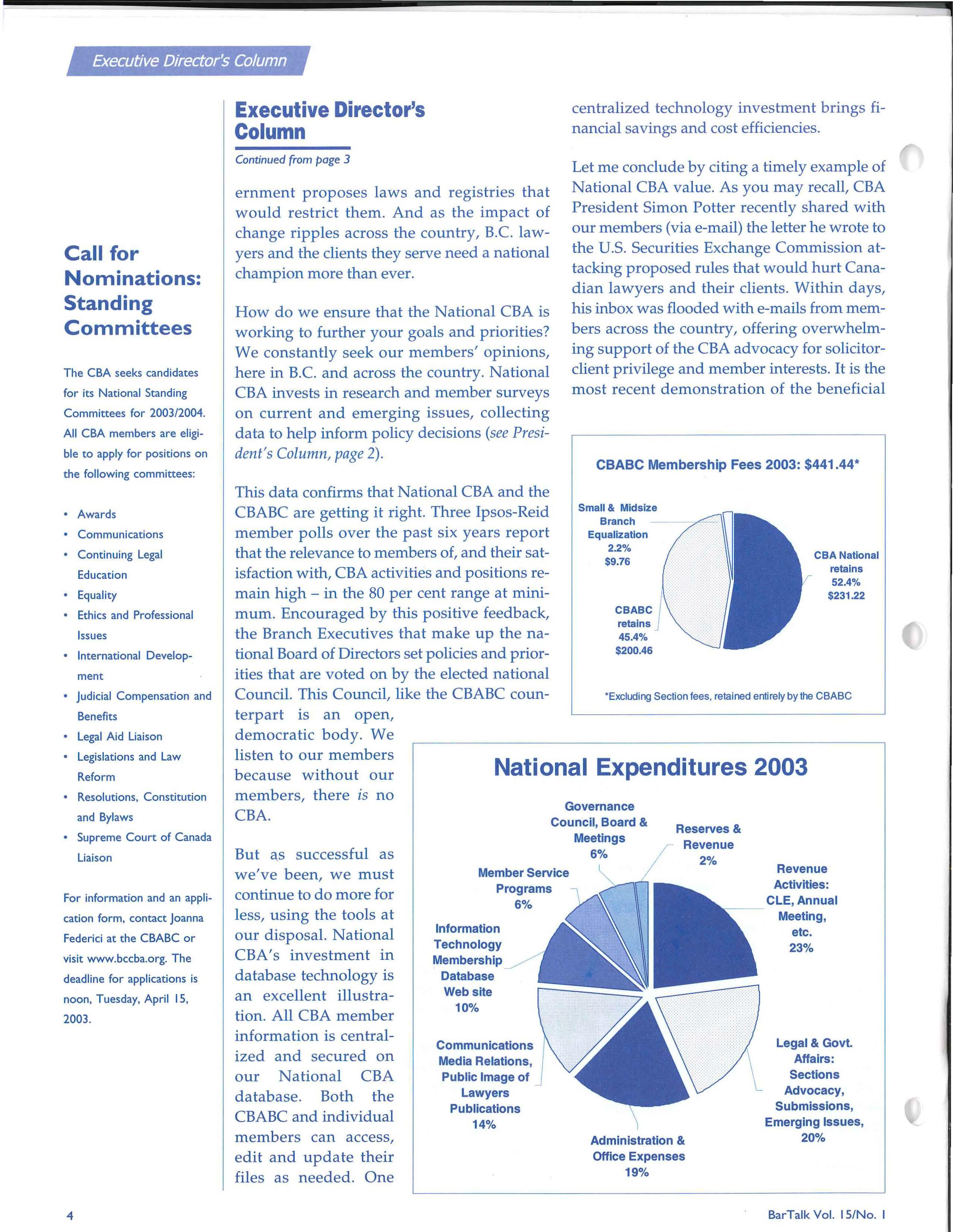
National Expenditures 2003
circle that makes our Association unique : members like you from B C. and elsewhere provide resources and priorities to the professionals at National CBA. We act on them, quickly and responsibly, to meet the needs
The National CIA
National advocacy
(68 submissions annually)
Solicitor-client privilege, Money l aundering, Legal aid, Anti-terrorism, Immigration consultants
Representing many interests
38 thousand members, 30 Sections, 24 Committees, 10 Conferences, 5 Companies
Member services
• Provide Continuing Legal Educat i on and professional and practice support
• Defend the public image of lawyers
• Offer national awards of excellence
• Lobby government in our professional interest
• Track trends and developments and provide e-news
• Facilitate member networking and peer support
• Offer member-only preferential insurance & investment programs
• 68 submissions to Parliament annually
and concerns of our members and to justify the faith you continue to place in us .
Got a question or comment? Call m e! 1-800-2678860 or e-mail johnh@cba.org.
•
Professional benefits
• Annual Justice Canada and National Sections meetings
• Young lawyers practice guides
• Model Code of Conduct (update ongoing)
• Fight for higher RRSP limits for lawyers
• Monitoring of changes in world trade rules
• Professional assistance for lawyers
• Protection of judicial independence
• Production of award-winning legal publications
Branch and member support
• Maintain online national member records
• Supply continuous online access for members and Branches
• Offer centralized Internet technology support
• Provide national media presence
• Daily interaction, sharing among Branch professionals
Celebrating Law Week
2003
" Access to Justice-Law Helping People" is the theme of th is year's Law Week, taking place April 7- 12, 2003
Each year, the CBABC works with partners in the justice system across B C. to bring together hundreds of schools, community groups, media outlets and legal organizations to celebrate the law and its contribution to Canadian society
Law Week activities include: Short Story Contest; Photo Contest;
• Student Mentor Program; Public Speaking Contest at the Vancouver Law Courts on April I0 ;
A strong, nation-wide organization of lawyers working for lawyers
Section Enrolment CLE Prizes
The CBABC and the Continuing Legal Education Society (CLE) are happy to announce the winners of the annual CBA Section enrolment draws. Members who enrolled in three or more Sections were eligible to win one of four prizes. Special thanks to CLE for providing the prizes, and congratulations to our winners:
1. A gift certificate for $700 to be used towards any CLE product(s) of the winner's choice
Winner: John McNamee, Burnaby
2. Complimentary registration to a regular, one day CLE Course (value $375)
Winner: Dennis Fitzpatrick, Vancouver
3 . Complimentary registration to a regular, one day CLE course (value $375).
Winner: Mailyne Ouellet, Victoria
4 . Gift certificate for $300 to be used toward any CLE product(s) of the winner's choice .
Winner: Stephen H Tick, Vancouver •
• Open House at the Vancouver Public Library on April 12; and Dial-A-Lawyer Day on April 12
Down load competition forms from www bccba org For more information call the CBABC office
Sponsored by the Canadian Bar Association, the Law Foundation of B.C., and the Vancouver Bar Association.
Have you ordered your 2003 Directory?
With this year's Directory you rece ive a searcha bl e CD-ROM, in va luable for any office. Order forms are avai la ble at www bc cb a.org or e-ma il you r request for an order form to directory@bccba.org
BarTalk Turns 15 in 2003
BarTalk was introduced in February 1989, when Jim Vilvang , QC was the CBABC President. The newsletter was, in fact, the sixth reincarnation of a Branch newsletter In 1986 a member survey was conducted which indicated one high priority of CBABC member s was to be kept better informed With this mission BarTalk was born, and its aim endures .
To celebrate the upcoming 15th anniversary of BarTalk, the CBABC has gathered an enviable assortment of prizes from all counties in the province. To enter the contest, simply tell us:
1. Your name;
2. Your county; and
3 One (at least) new BarTa lk article or topic you'd like to see us cover during 2003
Entrants will be eligible to win a prize in their home county . Send your suggestions to cba@bccba.org or fax 604-669-9601 or toll free 1-877-669 -9601. Contest closes Friday, March 7, 2003 at 4:30p .m.
The counties and their respective prizes are listed below . We thank the many sponsors who very kindly donated items for this contest.
Cariboo: One $50 gift certificate, donated by CBABC, for the Shogun Restaurant, located at the Coast Inn of the North
Kootenay: Two lift tickets 'Exper ence for Fernie Alpine Resort donated by Resort s of the Canadian Rockies
Nanaimo: Six lift tickets for Mount Washington Alpine Resort
Prince Rupert: Two lift tickets for Ski Smithers and a $25
Boston Pizza Pizza Smithers
Vancouver: 1"1 Prize: 2 Whistler Blackcomb Adult Day Passes, Two High Performance Rental WHIS
Vouchers. 2nd Prize: Two tickets to the Vancouver Symphony for the 2002/03 season
Victoria: High Tea for two at the Fairmont Empress Hotel EM PRESS
Westminster: 1'1 Prize : Two Whistler Blackcomb Adult Day WH ismu ew:KcOMe Passes and two High Performance Rental Vouchers . 2nd Prize: CBA Golf Shirt
Yale-North: Two tickets to the Two River Junction Dinner and Musical Revue donated byCBABC
Yale-South: Brunch for two at the Coast Capri Hotel Kelowna 1'1\ The Glast Hotel
CBA &VBA Golf Tournament
The CBABC and the Vancouver Bar Association are pleased to join forces to announce the 7th Annual Golf Tournament for the legal profession!
The tournament will be held Thursday, June 26, 2003 at the University Golf Club Participate in a fun-filled day of golf and prizes, the proceeds of which fund an annu a l award for
both a UBC and a UVic student who best exemplify the ideals serv ed by the CBA. Register early (before May 1) and pay $145 (incl . GST) . Players who register Ma y 1-June 13 pay $155 (incl GST) Registration fee includes 18 holes of golf- Best Ball Scramble Tournament, plus : buffet dinner; sandwich and beverage ticket for lunch; silent auction ; and loads of great prizes!!
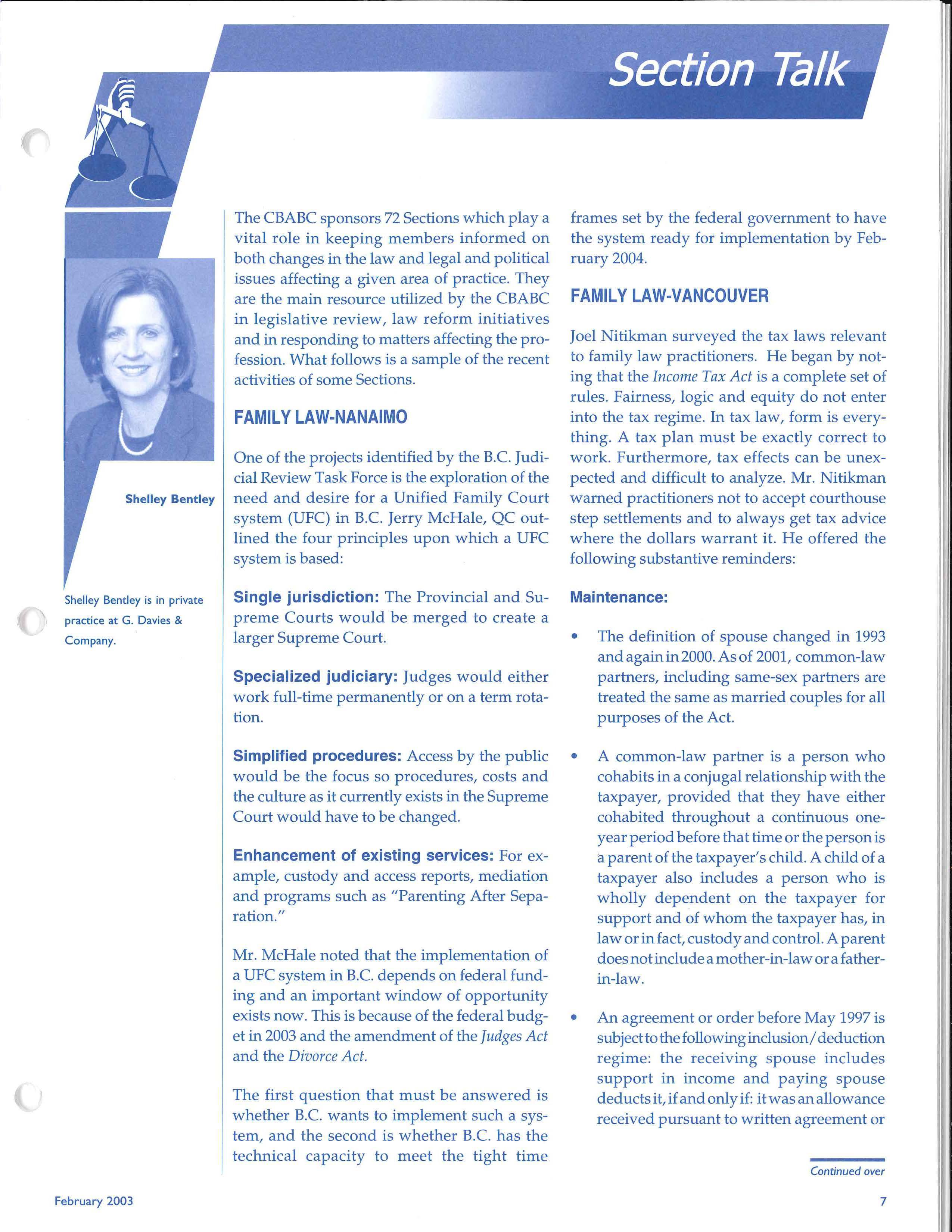
Shelley Bentley
She ll ey Bent ley is in private pract ice at G. Davies & Co mp a ny
The CBABC sponsors 72 Sections which play a vital role in keeping members informed on both changes in the law and legal and political issues affecting a given area of practice They are the main resource utilized by the CBABC in legislative review, law reform initiatives and in responding to matters affecting the profession. What follows is a sample of the recent activities of some Sections .
FAMILY LAW-NANAIMO
One of the projects identified by the B.C. Judicial Review Task Force is the exploration of the need and desire for a Unified Family Court system (UFC) in B C. Jerry McHale, QC outlined the four principles upon which a UFC system is based:
Single jurisdiction: The Provincial and Supreme Courts would be merged to create a larger Supreme Court.
Specialized judiciary: Judges would either work full-time permanently or on a term rotation .
Simplified procedures: Access by the public would be the focus so procedures, costs and the culture as it currently exists in the Supreme Court would have to be changed .
Enhancement of existing services: For example, custody and access reports, mediation and programs such as "Parenting After Separation."
Mr McHale noted that the implementation of a UFC system in B.C. depends on federal funding and an important window of opportunity exists now This is because of the federal budget in 2003 and the amendment of the Judges Act and the Divorce Act
The first question that must be answered is whether B.C. wants to implement such a system, and the second is whether B.C. has the technical capacity to meet the tight time
frames set by the federal government to have the system ready for implementation by February 2004
FAMILY LAW-VANCOUVER
Joel Nitikman surveyed the tax laws relevant to family law practitioners. He began by noting that the Income Tax Act is a complete set of rules . Fairness, logic and equity do not enter into the tax regime. In tax law, form is everything. A tax plan must be exactly correct to work. Furthermore, tax effects can be unexpected and difficult to analyze. Mr. Nitikman warned practitioners not to accept courthouse step settlements and to always get tax advice where the dollars warrant it. He offered the following substantive reminders :
Maintenance:
• The definition of spouse changed in 1993 andagainin2000.Asof 2001, common-law partners, including same-sex partners are treated the same as married couples for all purposes of the Act.
• A common-law partner is a person who cohabits in a conjugal relationship with the taxpayer, provided that they have either cohabited throughout a continuous oneyear period before that time or the person is a parent of the taxpayer's child . A child of a taxpayer also includes a person who is wholly dependent on the taxpayer for support and of whom the taxpayer has, in law or in fact, custody and control. A parent does not include a mother-in-law or a fatherin-law
• An agreement or order before May 1997 is subject to the following inclusion/ deduction regime : the receiving spouse includes support in income and paying spouse deductsit,ifandonlyif : itwasanallowance received purs u ant to written agreement or
Community Service Awards Deadline Extended
The deadline for nom inating a lawyer in your community for a CBABC Community Service Award in your county has been extended to Fe b ruary 28, 2003. Ensure your colleagues are recognized for their contributions, with local and media profile for the good work they do. Call the CBABC for a nomination form or download the form from www.bccba.org.
Section Talk
Continued from page 7
• •
court order; it was an allowance paid on a periodic basis; the payor and payee were living separate and apart; and the separation was due to marriage breakdown.
An agreement or order after April1997 is not included in the spouse or child's income and not deductible by the payor unless covering payments made before May 1997.
Generally, legal expenses to bring a right to income into existence are not deductible but legal expenses to enforce an existing right are deductible.
Child Care Expenses:
• CCRA's position on child care expense deductions in joint custody arrangements is a surprise to many. In a true 50/50 custody arrangement where one parent pays 100 per cent ofthe child care costs, that parent would only be able to claim 50 per cent of the child care costs as a deduction. This is because an individual is entitled to claim child care expenses to the extent that they were incurred with respect to the period of time that the child resided with him or her and enabled that person to engage in the activities listed in paragraph (a) of the definition of "child care expenses" e.g., work.
MUNICIPAL
Torn Barnes of Barnes Twining and Short outlined the new Building Bylaw Project undertaken by the Municipal Insurance Association of B.C. This Association began operations in the 1980's when many private insurers chose to abandon local government insurance because tort liability claims were too difficult to predict. Wide private law duties of care, increasing recovery for pure economic loss, the growth of class actions and joint and several liability in the municipal government context, led to the use of a risk management approach in establishing regulatory measures. The Building Bylaw Project's goal is to provide insured members with core building bylaw
wordings that can be adopted with minimal modification. This will standardize risk undertaken by local governments in regulating construction. The core provisions incorporate expressions of legislative intent and set out the scope of a building official's duty of care. They also define the standard of care having regard to the current edition of the B.C. Building Code and surrounding jurisprudence
REAL PROPERTY-VANCOUVER
Ralston Alexander, QC, outlined the recommendations of the Law Society's Paralegal Task Force to look at options for expanding the role of legal assistants, including certifying paralegals and creating a framework for the operation of independent paralegals The Section also discussed proposed amendments to standard undertakings for incorporating transparency provisions relating to the discharge of financial charges
WOMEN RAINMAKERS-VANCOUVER
Lyall Knott, QC stressed his belief that survival of practice depend on the ability to attract and retain clients. Along with meeting billing budgets, taking CLE courses, and participating in management, he suggested the following should be part of every day:
Do: Be a good lawyer. Provide good service. Make house calls. Return all phone calls before leaving for the end of the day. Exceed deadlines. Talk about and monitor your fees to prevent future problems and send work-inprogress on a weekly basis to keep the client informed. Say thank you for referrals, for your client's business and for having your account paid. Visit each client at least once a year. Know your client's business. Know your community. Join business organizations Understand relationships. Your relationship is not with the corporation but the people who work there. Be a problem-solver.
Don't: Don't bum bridges. Be courteous and restrain yourself. Don't transfer clients without a proper introduction Don't bill for "fivepoint snappers" e .g ., don't send a bill with 0.1 for a phone call from your client. Don't send wrong signals by appearing to be too busy to take on new work. Don't ever give up. •
David j. Bilinsky
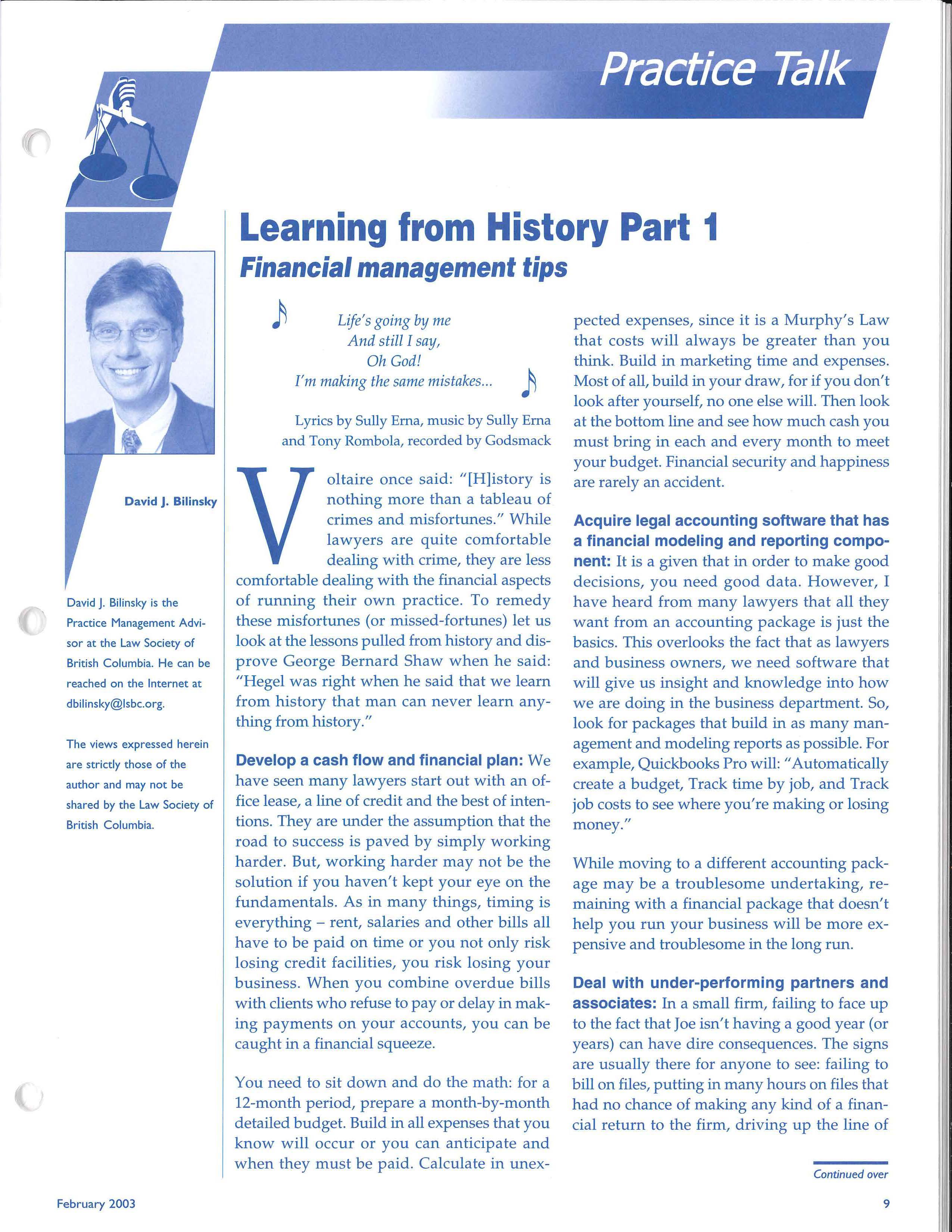
Dav id J. Bil in sky is the Pract ice Management Adv isor at the Law So c iety of Bri tish Columbia. He can be reached on the Internet at dbilinsky@lsb c. org
The views expressed herein are str ictly those of the author and may not be shared by the Law So ci ety o f British C olumbia
Learning from History Part 1 Financial management tips
Life's going by me
And still I say, Oh God!
I'm making the same mistakes
Lyrics by Sully Erna, music by Sully Erna and Tony Rombola , recorded by Godsmack
oltaire once said: "[H]istory is nothing more than a tableau of crimes and misfortunes." While lawyers are quite comfortable dealing with crime, they are less comfortable dealing with the financial aspects of running their own practice. To remedy these misfortunes (or missed-fortunes) let us look at the lessons pulled from history and disprove George Bernard Shaw when he said: "Hegel was right when he said that we learn from history that man can never learn anything from history "
Develop a cash flow and financial plan: We have seen many lawyers start out with an office lease, a line of credit and the best of intentions. They are under the assumption that the road to success is paved by simply working harder But, working harder may not be the solution if you haven't kept your eye on the fundamentals . As in many things, timing is everything - rent, salaries and other bills all have to be paid on time or you not only risk losing credit facilities, you risk losing your business When you combine overdue bills with clients who refuse to pay or delay in making payments on your accounts, you can be caught in a financial squeeze .
You need to sit down and do the math: for a 12 -month period, prepare a month-by-month detailed budget. Build in all expenses that you know will occur or you can anticipate and when they must be paid Calculate in unex-
pected expenses , since it is a Murphy's Law that costs will always be greater than you think. Build in marketing time and expenses Most of all, build in your draw, for if you don't look after yourself, no one else will. Then look at the bottom line and see how much cash you must bring in each and every month to meet your budget. Financial security and happiness are rarely an accident.
Acquire legal accounting software that has a financial modeling and reporting component: It is a given that in order to make good decisions , you need good data . However , I have heard from many lawyers that all they want from an accounting package is just the basics This overlooks the fact that as lawyers and business owners, we need software that will give us insight and knowledge into how we are doing in the business department. So, look for packages that build in as many management and modeling reports as possible. For example, Quickbooks Pro will : "Automatically create a budget, Track time by job, and Track job costs to see where you ' re making or losing money."
While moving to a different accounting package may be a troublesome undertaking, remaining with a financial package that doesn ' t help you run your business will be more expensive and troublesome in the long run
Deal with under-performing partners and associates: In a small firm, failing to face up to the fact that Joe isn't having a good year (or years) can have dire consequences The signs are usually there for anyone to see : failing to bill on files, putting in many hours on files that had no chance of making any kind of a financial return to the firm, driving up the line of
Lawyers Assistance Program
LAP provides confidential support, counselling and referrals for lawyers , their families, support staff, judges and students suffering from alcohol and/or chemical dependency , stress, depression or just about any type of personal problem.
For assistance or information on meetings and resources please call 604-6852171 or toll free 1-888-685-2171.
The LAP office is located at 41 5-1080 Mainland Street, Vancouver , B.C. V6B 2T4
Practice Talk
Continued from page 9
credit, continuing to take draws disproportionate to their income, ballooning accounts receivable and associated large write-downs, hostility expressed toward anyone who questioned his/her 'right' to a draw due to his/her status in the firm, and on and on
Have monthly meetings scheduled for the purpose of examining everyone's performance against stated financial goals: billable hour targets (WIP), expected file revenues against accumulated WIP, WIP billed (bills rendered), bills collected, accounts receivable balances (net increase or decrease), accounts written-off or deemed uncollectable, disbursements incurred, disbursements billed, disbursements written-off, status on files outstanding . It has long been stated that what gets measured gets done If everyone in the firm is required to undergo a monthly examination, then you have instilled a culture in the firm that is self-correcting - and if someone does get out of line, you have a decision to make and a forum within which it can be made.
Have a written office sharing or partnership agreement: One of the purposes of having a written agreement between all parties is that everyone knows the terms of the arrangement between them- the expectations, the consequences and the means to implement those consequences. Not having such an agreement between lawyers is the equivalent of a shoemake.r' s children running around barefoot.
Every partnership agreement should incorporate the requirement for adequate life and disability insurance to ensure that a partner who died or became disabled could be compensated for his/her share in the partnership and that the firm could pick up the pieces and carry on the business. Inadequate insurance can leave the deceased partner's family and remaining partners financially stuck or worse, in litigation .
Reduce your firm debt: Under-capitalization is endemic in small business, and law firms fall into this group. In fact, due to the constant need for and emphasis on taking out draws
and bonuses, lawyers do not tend to be big investors in their firms. This translates to firms being reluctant to leave capital in the firm for such investments as technology - even if that technology would produce long-term gainsdue to the impact on short-term cash flows.
Alternatively, if capital investment is required, firms tend to go into debt rather than encourage partners to invest in the firm . Carrying large amounts of debt reduces the resiliency of the firm to downturns in the financial environment. Furthermore, carrying large amounts of debt combined with a lack of a partnership agreement promotes positive performing partners fleeing a firm if they sense a downturnin effect, exacerbating an already bad situation.
Keep involved with the administration of your office: A good law office administrator or office manager is worth his/her weight in gold. However, lawyers, due to time and billing pressures, can be only too willing to delegate financial decisions to bookkeepers and others in the office- who may or may not have the training and abilities to run a business. Furthermore, it is rare to find a staff member no matter how well-intentioned or capable, who has the same interest in driving down costs and looking for more efficient ways of doing things as does an owner.
What to do? If you do delegate, do so in graduated steps and build in feedback loops that allow you to evaluate the effectiveness and efficiencies of the decisions made by the particular staff member. Periodically, pick at random a trade account with a supplier and review it to see if you have been well served. Are their costs competitive? Are you getting volume breaks and discounts? Can you strike a better deal by moving your business elsewhere? What extra services can you get them to render for the same cost? Can you consolidate your business to a few large vendors and drive a better deal for you and your clients?
So there are the first six tips for improving your financial future. In Part 2 we will explore these issues further, but now it is up to youafter all, it was Sir Winston Churchill who said: "History will be kind to me for I intend to write it." •
Stuart Rennie
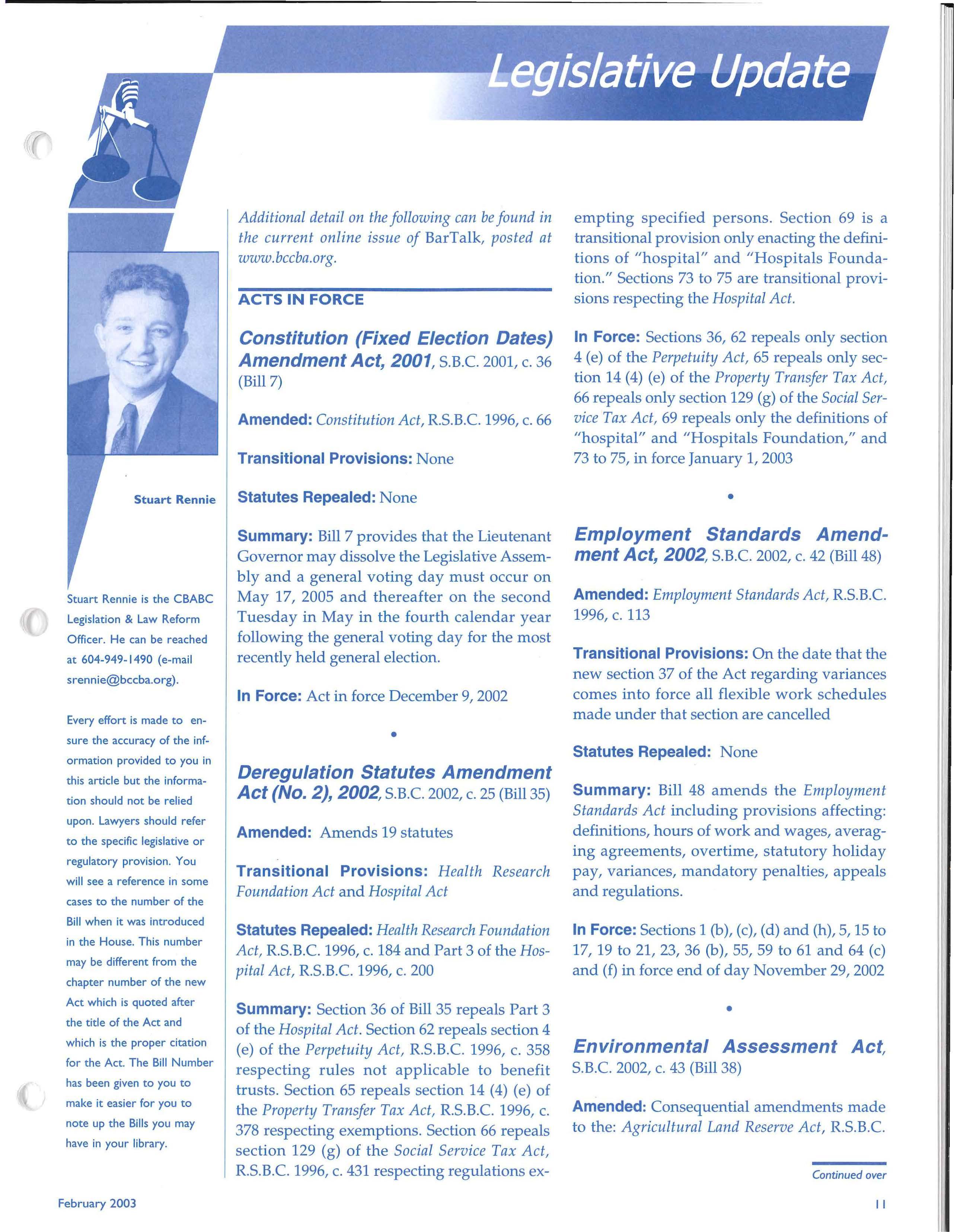
Stuart Rennie is the CBABC Leg is lation & Law Re form Offi cer. He ca n be reac h ed at 604 -949-149 0 (e-ma il srennie@bccba.org).
Every effort is made to ens u re t he accuracy of the information provided t o you in this article but the informati o n s houl d no t be r e lied upon Lawyers shou ld refer t o the specific legis lative o r regu latory p rovision. You will see a refere nce in some cases to t he nu mber of the Bill when it was introduced in the House. This n umber may be differe nt fr om the chapter num ber of the new Act wh ich is qu o ted after the tit le of the Act and which is the proper citat ion for the Act. The Bill Number has been give n to you to make it eas ier for you to note up the Bi ll s you may have in your library.
Additional detail on the following can be found in the current online issue of BarTalk, posted at www.bccba.org.
ACTS IN FORCE
Constitution (Fixed Election Dates)
Amendment Act, 2001, s .B.C. 2001, c. 36 (Bill 7)
Amended: Constitution Act, R.S B.C. 1996, c. 66
Transitional Provisions: None
Statutes Repealed: None
Summary: Bill 7 provides that the Lieutenant Governor may dissolve the Legislative Assembly and a general voting day must occur on May 17, 2005 and thereafter on the second Tuesday in May in t h e fourth calendar year following the general voting day for the most recently held general election.
In Force: Act in force December 9, 2002
Deregulation Statutes Amendment
Act (No. 2), 2002, S B.C. 2002, c. 25 (Bill35)
Amended: Amends 19 statutes
Transitional Provisions: Health Research Foundation Act and Hospital Act
Statutes Repealed: Health Research Foundation Act, R.S.B.C. 1996, c. 184 and Part 3 of the Hospital Act, R.S.B.C. 1996, c. 200
Summary: Section 36 of Bill 35 repeals Part 3 of the Hospital Act. Section 62 repeals section 4 (e) of the Perpetuity Act, R.S .B.C. 1996, c. 358 respecting rules not applicable to benefit trusts. Section 65 repeals section 14 (4) (e) of the Property Transfer Tax Act, R.S.B.C. 1996, c. 378 respecting exemptions. Section 66 repeals section 129 (g) of the Social Service Tax Act, R.S.B.C. 1996, c. 431 respecting regulations ex-
empting specified persons. Section 69 is a transitional provision only enacting the definitions of "hospital" and "Hospitals Foundation." Sections 73 to 75 are transitional provisions respecting the Hospital Act
In Force: Sections 36, 62 repeals only section 4 (e) of the Perpetuity Act, 65 repeals only section 14 (4) (e) of the Property Transfer Tax Act, 66 repeals only section 129 (g) of the Socia l Service Tax Act, 69 repeals only the definitions of "hospital" and "Hospitals Foundation," and 73 to 75, in force January 1, 2003
•
Employment Standards Amendment Act, 2002, s.B .C. 20o2, c. 42 (Bill48)
Amended: Employment Standards Act, R.S.B.C. 1996, c. 113
Transitional Provisions: On the date that the new section 37 of the Act regarding variances comes into force all flexible work schedules made under that section are cancelled
Statutes Repealed: None
Summary: Bill 48 amends the Employment Standards Act including provisions affecting: definitions, hours of work and wages, averaging agreements, overtime, statutory holiday pay, variances, mandatory penalties, appeals and regulations.
In Force: Sections 1 (b), (c), (d) and (h),5, 15 to 17, 19 to 21, 23, 36 (b), 55, 59 to 61 and 64 (c) and (f) in force end of day November 29,2002
•
Environmental Assessment Act, S.B.C. 2002, c. 43 (Bill 38)
Amended: Consequential amendments made to the: Agricultural Land Reserve Act, R.S .B.C.
Request for Comment: Payment of Jurors in Civil Trials
The government recently amended regulations to the jury Aa to change the fee paid to juro r s in criminal trials. The government is now considering making equivalent changes to the juror fees for civil trials Historically, the fees paid to jurors in criminal trials have been the same as the fee for jurors in civil trials.
However , prior to doing so , they are seeking input from the CBABC on whether the fees should continue to be parallel to the criminal fees and, if not, views as to whether the fees for civil jurors should change from current levels.
Anyone wishing to comment on this issue may contact Stuart Rennie, Legis lation and Law Reform Officer, prior to March I, 2003 E-ma il srennie@bccba org or fax 604-669 -960 I or 1-877-6699601
For comparison purposes , a chart of the fees paid to jurors in other provinces is availab le at www bccba.org in the Lawyer Lounge
Legislative Update
Continued from page I I
1996, c. 10, Drinking Water Pr otec tion A ct , S.B .C. 2001 , c 9, Fr eedom of Information and Prot ec tion of Pr ivacy A ct, R.S .B.C. 1996, c . 165, Lo cal Governm ent A ct, R.S.B C. 1996, c. 323 , Min eral Tenur e Act , R.S B.C. 1996, c. 292, Ni sga' a Final A gree ment A ct , S.B.C. 1999, c . 2
Transitional Provisions: Environm ental Asses sm ent Act, Utilitie s Commi s sion Act, S.B .C. 1980, c. 60 and Mine Developm ent Ass ess ment Act, S B.C. 1990, c. 55
Statutes Repealed: En v ironm ental A sses sment Act , R.S .B.C. 1996, c. 119
Summary:Bill 38 repeals the En v ironmental Assessm ent Act. Bill 38 eliminates the current requirement for a committee to review each project and replaces that process with broad discretion in requiring environmental assessment procedures on a project-by-project basis as determined for individual projects by the newly created Environmental Assessment Office
In Force: Act except section 52 (Agri cultural Land Res er ve A ct) in force December 30, 2002
Forests Statutes Amendment Act (No. 2), 2002, S.B C. 2002, c 76 (Bill 75)
Amended: Forest Act, R.S .B.C. 1996, c . 157, Fores t Practic es Cod e of Briti sh Columbia Act, R.S B C. 1996, c 159
Transitional Provisions: None
Statutes Repealed: None
Summary: Bill 75 amends the Forest Act including to expand the definition of " major licence " a s provided by the For es t (First Nations De ve lopm ent ) Amendm ent Ac t, 2002 , S B C. 2002, c. 44 (Bill41) . Bill75 also amends the Forest Practices Code of British Columbia Act, including to: incorporate streamlining provisions for a two-year transition period until the provisions of the Forest and Range Practices Act,
S .B .C. 2002, c. 69 (Bill 74 ) take e ffect , tran sfer the r e m a inin g la nd u se planning p rov i si on s o f the For est Practi ces Code to the Ministe r of Sustainable Resource Management, prov ide that the Nisga' a Final Agreement is not affected by the shift from silviculture prescriptions to site plans and to provide due diligence defences for actions covered under the Act. .
In Force: Act in force December 17, 2002 •
Health Planning Statutes Amendment Act, 2002, s .B.C. 2o02, c . 15 (Bill19)
Amended: Fr ee dom of Information and Prot ection of Privacy Act, R.S B C. 1996, c. 165, Health Em erge ncy A ct , R.S B C. 1996, c. 182, Health Profe ssions Act, R.S .B.C. 1996, c. 183, M edical Practition ers A ct , R.S B C. 1996, c. 285 , Name Act , R.S.B C. 1996, c. 328, Survivor ship and Pr esumption of Death Act , R.S .B.C. 1996, c . 444, Vital Statistics Act, R.S .B.C. 1996, c. 479
Transitional Provisions : Health Em erg ency Act, Hearing A id Act and Name Act
Statutes Repealed : Hearing Aid Act , R.S B.C. 1996, c . 186, Seniors Advisory Council A ct, R.S B C. 1996, c. 423
Summary: Sections 18 to 20 of Bill 19 am end the Nam e Act to : require adults applying for a legal name change for themselves or their minor child, who is at least 18 years old, to provide proof of a criminal record check as a condition of approval of a name change b y the Vital Statistics Agency and add a provision that permits sharing of this information between the director and the RCMP Section 22 amends the Survivorship and Presumption of Death Act to permit the Director of Vital Statistics to register a death after receiving an order of the court declaring a person to be presumed dead. Sections 24 and 25 amend the Vital Statistics Act to repeal an obsolete provision and require the Dire ctor of Vital Statistics to register a death after receiving a court order declaring a person to be presumed dead.
In Force: Sections 18 to 20 and 22 in force December 19, 2002. Sections 24 and 25 in force
December 9, 2002 . B.C. Reg . 376/2002 amends B.C. Reg. 336 / 2002 to clarify that section 13 enacts only section 10 (3) of Health Professions Act (in force December 31, 2002)
Local Government Statutes Amendment Act, 2000, S B C. 2ooo, c. 7 (Bill14)
Amended: Municipal Act, R.S B.C. 1996, c. 323 repealed and retitled the Local Government Act, R.S.B.C. 1996, c. 323, Municipal Finance Authority Act, R.S B C. 1996, c. 325, Park (Regional) Act, R.S .B.C. 1996, c . 345
Transitional Provisions: Voting, taxes, improvement and regional districts
Statutes Repealed : None
Summary: Bill 14 amends the Local Government Act including provisions affecting: definitions, directors' and commissioners' remuneration, voting and electoral areas, costs of service review or service withdrawal, financial operations of regional districts, commissioners appointed where payment default by municipality and community plans . Bill14 amends the Municipal Finance Authority Act regarding interim financing, debt reserve fund . Bill 14 amends the Park (Regional) Act regarding borrowing powers of regional parks boards.
In Force: Sections 2 (d) and (i), 94, 98, 105, 107, 114, 116 , 118, 138, 236, 237, 238 and 246 in force January 1, 2003
Miscellaneous Statutes Amendment Act (No.2), 1999, S.B.C. 1999, c 38 (Bill74)
Amended: Amends 38 statutes
Transitional Provisions : British Columbia Wine Act
Statutes Repealed: Repeals four statutes
Summary: Section 51 of Bill 74 repeals the Ministry of Social Service s and Housin g Act, R.S.B.C. 1996, c. 310 .
In Force: Section 51 in force December 9, 2002
•
Miscellaneous Statutes Amendment Act, 2002, S.B.C. 2002, c. 22 (Bill11)
Amended: Amends 10 statutes
Transitional Provisions: None
Statutes Repealed: Access to Education Act, S.B.C. 2001, c . 1
Summary: Section 7 of Bill11 amends the Municipalities Enabling and Validating Act (No 3) , S.B C. 2001, c. 44 and sections 30 to 38 of Bill11 amend the Vancouver Charter , S B.C. 1953, c. 55 to: transfer legal authority for the Gastown and Chinatown provincial heritage designations to the City of Vancouver, allow the city t o create heritage conservation areas, and eliminate payment of compensation for these designations Section 25 amends the Vancouv er Chart er to provide the city with broader investment powers.
In Force: Sections 7, 25 and 30 to 38 in force January 13, 2003
Notice to the Profession
Fax Filing Pilot Project Qanuary 7, 2003)
On February I, 2003, 14 court registries throughout B.C. implemented the Fax Filing Pilot Project to pilot the transmission of certain Supreme Court and Provinc ial Court civil documents by fax to the follow ing court registries : Ch illiwack, Cranbrook, Dawson Creek, Kamloops, Ke lowna, Nelson , Penticton , Prince George, Rossland, Salmon Arm , Smithers, Terrace, Vernon, and Williams Lake
Miscellaneous Statutes Amendment Act (No. 2), 2002, S.B C. 2002, c 48 (Bill 54)
Amended: Amends 26 statutes
Transitional Provisions: Liquor Appeal Board under Liquor Control and Licensing Act and Liquor Distribution Act
Statutes Repealed: Schedule to the Job Protection Act, R.S.B C. 1996, c 240
Summary: Sections 51 to 54 of Bill 54 amend the Mineral Tenure Act, R.S.B C. 1996, c 292 regarding: surface rights, right of entry on private land and compensation determined by Mediation and Arbitration Board, repea l of pro v ision to not obstruct use of private land and a new provision for restoration of leases or claims forf e ite d.
In Force: Sections 51 to 54 in force November 29,2002
The Pi lot Project will run from February I , 2003 to Ju ly 31, 2003
The full Notice to the Profession and the Practice Direction is available at www.courts.gov bc.ca (Supreme Court) and www.provincialcourt bc.ca (Provincial Court)
Legislative Update
Continued from page 13
Miscellaneous Statutes Amendment Act (No. 3}, 2002, S.B C. 2002, c. 63 (Bill62)
Amended: Amends 13 statutes
Transitional Provisions: Motor Vehicle Act regarding driving prohibitions
Statutes Repealed: Special Appropriations Act, R.S.B.C. 1996, c 437
Summary: Sections 2 to 5 of Bill 62 amend the Employment and Assistance Act, S.B.C. 2002, c. 40, Employment and Assistance for Persons with Disabilities Act, S.B C. 2002, c 41 to clarify that: the required form for persons seeking assistance to report is the form prescribed by the Minister and that the Minister has the power to impose sanctions on an applicant for conduct related to employment, 60 days before an applicant applies for disability assistance. Sections 7 and 8 amend the Escheat Act, R.S.B.C. 1996, c. 120 to permit the Attorney General to delegate responsibilities under the Act to any person and to transfer to the Attorney General specified powers of the Lieutenant Governor in Council. Section 9 amends the Freedom of Information and Protection of Privacy Act, R.S.B.C. 1996, c . 165 to require that, for committee deliberations to be protected by Cabinet confidentiality and not disclosed to the public under the Act, the government can designate any government committee to be a Cabinet committee where, at least one-third of Cabinet committee members are members of these designated committees and that these designated committees be designated by regulation.
In Force: Sections 2 to 5 in force January 1, 2003 Sections 7 and 8 are in force December 9, 2002 Section 9 in force November 1, 2002
479 Consequential amendments are made to the : Adoption Act, R.S .B.C. 1996, c . 5, Cemetery and Funeral Services Act, R.S.B C. 1996, c 45, Coroners Act, R.S.B.C. 1996, c. 72, Deregulation Statut es Amendment Act, 2002, S.B .C. 2002, c. 12, Health Planning Statutes Amendment Act, 2002, S.B .C. 2002, c. 15, Marriage Act, R.S .B.C. 1996, c. 282, Name Act , R.S.B C. 1996, c 328, Wills Act, R.S.B .C. 1996, c. 489
Transitional Provisions: None
Statutes Repealed: None
Summary: Bill 68 amends the Vital Statistics Act to give notice of hospital births, eliminate obsolete titles and processes, eliminate the current district registration system in order to permit the government to provide electronic data collection and other services under a centralized registration system, eliminate the requirement for schools to submit names and birthdates of their students, eliminate an obsolete provision that permitted churches to voluntarily file records of baptisms, marriages and burials.
In Force: Act in force December 19,2002
Vital Statistics Amendment Act, 2002, S.B.C. 2002, c. 74 (Bill 68)
Amended: Vital Statistics Act , R.S.B .C. 1996, c.
Workers Compensation Amendment Act, 2002, s .B.c. 2002, c . 56 (Bill49)
Amended: Workers Compensation Act, R.S.B.C. 1996, c. 492. Consequential amendments made to the Freedom of Information and Protection of Privacy Act, R.S .B.C. 1996, c . 165
Transitional Provisions: Division 3 of Part 1 regarding the scale of compensation for workers and dependants under the Workers Compensation Act
Statutes Repealed: None
Summary: Section 1(b) and (d) of Bill 49 amend the Worker s Comp ensation Act regarding the definitions "president" and "Board." Sections 5, 33(b), 35, 37 and 39 make amendments to the Act regarding references to the board of directors . Sections 26 to 32 amend the Act regarding the new structure for the board of directors. Section 47 makes a consequential
amendment to the Freedom of Information and Protection of Privacy Act.
In Force: Sections 1 (b) and (d), 5, 26 to 32, 33 (b), 35, 37, 39 and 47 are in force January 2, 2003
•
Workers Compensation Amendment Act (No. 2), 2002, s B.C. 2002, c. 66 (Bill63)
Amended: Workers Compensation Act, R.S.B C. 1996, c. 492. Consequential amendments made to the Freedom of Information and Protection of Privacy Act, R.S.B C. 1996, c 165
Transitional Provisions: Initial appeal tribunal appointments and review board, appeal division and medical review panel proceedings, unexercised appeal rights to review board and appeal division, application of policies to transitional proceedings, Chair's authority and regulations
Statutes Repealed: None
Summary: Section 7 of Bill 63 repeals provisions regarding medical review panels under the Workers Compensation Act Sections 34 and 36 set out transitional provisions regarding specified definitions and medical review panel proceedings under the Act.
In Force: Sections 7, 34 and 36 are in force November30,2002
REGULATIONS TO NOTE
Employment and Assistance Act and Employment and Assistance Act for Persons with Disabilities, adds a new section to the Employment and Assistance Regulation (B.C. Reg 263/2002) and the Employment and Assistance for Persons with Disabilities Regulation (B.C. Reg. 265/2002) to permit the Minister to provide a supplement of up to a maximum of $1,000 to or for a family unit that is eligible for income or disability assistance or hardship assistance (effective December 1, 2002, B C. Reg. 312/2002 and B C. Reg 313/ 2002).
Employment Standards Act, amends the Employment Standards Regulation (B.C. Reg 396/95) regarding definitions, overtime, exclusions and other provisions affecting talent agencies, mining companies and sales commissions (effective November 29, 2002 at the end of the day, B.C. Reg. 307 /2002)
Freedom of Information and Protection of Privacy Act, creates the Committees of the Executive Council Regulation (effective November 1, 2002, B.C. Reg. 290/2002).
Jury Act, amends B.C. Reg. 282/95 to increase the current fee paid to jurors in criminal trials from $20 for the first 10 days of trial and then $30 per day thereafter to $20 for the first 10 days of trial, then $60 a day for the 11th to the 49th day and then $100 a day for the 50th day of trial and thereafter (effective April 1, 2003, B.C. Reg 378/2002).
Public Sector Employers Act, prescribes the Senior Employee Base Salary Regulation at $125,000 which applies to the provisions under the Act regulating executive management compensation practices (effective November 29, 2002 B.C. Reg 319 /2002)
Workers Compensation Amendment Act (No. 2), 2002 (Bill 63), creates the Transitional Review and Appeal Regulation (effective March 3, 2003, B.C. Reg. 322/2002) and creates the Workers Compensation Act Appeal Regulation, which includes setting requirements for appointment to the appeal tribunal (effective March 3, 2003, B.C. Reg. 321/2002) .
NEW BILLS TO NOTE
Information is current at the time of preparing this article: January 3, 2003. Lawyers should refer to the original version of the specific Bill for its current status at First, Second or Third Reading or Royal Assent.
Acting Police Complaint Commissioner Continuation Act, s.B.C. 2002, c. 67 (Bill 77)
First Reading: November 18, 2002
Royal Assent: November 21, 2002
Amendments to Subrules 66(6) and (7)
In July 2002, amendments to Rule 66 expanded fast track litigation province wide. Previously the fast track procedure was available only in the Vancouver, New Westminster and Kamloops registries on a pi lot project basis
When the decision was made to expand Rule 66 province wide, the Rules Revis io n Committee examined the fast track procedure and one issue considered was whether to reta in the automatic exemption of personal injury actions as set out in Subrules 66(6) and (7). After deliberation, the Committee decided that the exemption should no longer be retained However, given the potential impact of such an amendment, the Committee seeks comment from members of the legal profession practising in this area before recommending the amendment
Any comments or suggestions should be sent to Jud it h Hoffman, Secretary, Rules Revision Committee, 800 Smithe Street, Vancouver, B C. V6Z 2E I no later than March IS, 2003
Legislative Update
Continued from page 15
Amended: None
Transitional Provisions: None
Statutes Repealed: None
Summary: Bill 77 provides that the acting police complaint commissioner continues to hold office until a person is appointed as the police complaint commissioner under the Polic e Act. Bill 77 is repealed on March 31, 2003 or on an earlier date prescribed by regulation.
In Force: On Royal Assent November 21, 2002
Agrologists Act (Bill 79)
First Reading: November 25,2002
Amended: None
Transitional Provisions: None
Statutes Repealed: A grologi s ts A ct , R.S .B.C. 1996, c. 12
Summary: Bill 79 repeals the Agrologists Act with an updated statute In addition, in light of the new Forest and Range Practi ces Act , S.B C. 2002, c . 69 (Bill 74), Bill 79 expands the definition of "agrology "
In Force: By regulation
College Of Applied Biology Act,
S.B .C. 2002, c. 68 (Bill 76)
First Reading: November 18, 2002
Royal Assent: November 21, 2002
Amended: None
Transitional Provisions: Proceedings, rules and appointments of the Association of Professional Biologists of B.C.
Statutes Repealed: None
Summary: Bill 76 creates the College of Applied Biology to regulate the profession of applied biology .
In Force: By regulation •
Community Care and Assisted Living Act (Bill 73), S.B.C. 2002, c 75 (Bill 73)
First Reading: November 4, 2002
Royal Assent: November 26,2002
Amended: Consequential amendments are made to the : Cemetery and Funeral Servi ces Act, R.S B.C. 1996, c. 45, Child Care BC Act, S.B C. 2001, c. 4, Child Care Subsidy Act, R.S B C. 1996, c. 26, Community Car e Facility Act, R.S .B.C. 1996, c. 60, Criminal Re cords ReviewAct , R.S .B.C.1996, c. 86, Health Authorities Act , R.S .B.C. 1996, c . 180, Health Care (Consent) and Care Facility (Admission) Act, R.S B.C. 1996, c. 181, Hospital Act, R.S B C. 1996, c 200, Hospital Insurance Act, R.S B.C. 1996, c 204, Human Tis su e Gift A ct, R.S .B.C. 1996, c. 211, Liquor Control and Licen sing Act, R.S.B.C. 1996, c. 267, Local Government Act , R.S B C. 1996, c. 323, Medicare Prot ec tion Act, R.S B C. 1996, c. 286, Mental Health Act, R.S B C. 1996, c 288, Pharmacists , Pharmacy Operations and Drug Scheduling Act, R.S .B.C. 1996,c.363
Transitional Provisions: None
Statutes Repealed: Community Care Facility Act, R.S.B.C. 1996, c 60 and Supplement to the Community Care Facility Act
Summary: Bill 73 replaces the Community Care Facility Act (Bill16)(April2002), including amendments to delegate increased responsibility to local health authorities to manage and enforce community care facility licences. Unlike the previous legislation, Bill 73 provides a new part regarding assisted living residences . Provincial standards for community care facilities and assisted living residences are permitted by regulation for the operation and maintenance of these facilities and residences Regulations are permitted to be made for other matters including: health and safety stan -
dards, application process, procedures for suspending and cancelling registration and any associated fees.
In Force: By regulation
I
Forest and Range Practices Act, S B C. 2002, c. 69 (Bill 74)
First Reading: November 4, 2002
Royal Assent: November 21, 2002
Amended: None
Transitional Provisions: None
Statutes Repealed: None
Summary: Bill 74 creates a new Forest and Range Practices Act with provisions respecting new forest stewardship and woodlot licence plans, requiring compliance with forest practices and range plans, protection of resources, compliance and enforcement, liability and required public disclosure .
In Force: By regulation
Foresters Act (Bill 78)
First Reading: November 25, 2002
Amended: None
Transitional Provisions: None
Statutes Repealed: ForestersAct,R.S B.C.1996, c 162
Summary: Bill 78 replaces the Foresters Act with a statute which will continue to regulate practice and standards for professional foresters and registered forest technologists In addition, in light of the new Forest and Range Practices Act , S.B.C. 2002, c. 69 (Bill 74), Bill 78 expands the definition of "practice of professional forestry."
In Force: By regulation
Forests Statutes Amendment Act (No. 2), 2002, S.B.C. 2002, c . 76 (Bill 75)
See Acts in Force
REPORTS AVAILABLE
B. C. Human Rights Tribunal: New Draft Rules and Forms (December 2002). Source: B.C. Human Rights Tribunal. Available at: www. bchrt.gov.bc.cal.
The Economic Impact of the 2010 Winter Olympic and Paralympic Games: An Update (November 2002) Source: Minister of State for 2010 Olympic Bid and the Ministry of Community, Aboriginal and Women's Services Available at: www .mcaws .gov .bc.cai2010Secretaria t I index.htm.
Energy for Our Future: A Plan for B.C. (November 2002). Source: Ministry of Energy and Mines . Available at : www.gov .bc .caleml popt I energyplan htm.
Managing Contaminated Sites on Provincial Lands (Report 5 December 2002) . Source: Office of the Auditor General of B.C. Available at: www .bcauditor.coml AuditorGeneral.htm.
Proposed Consumer Protection Act Discussion Paper (January 2003). Source: Ministry of Public Safety and Solicitor General. Available at: www.pssg gov.bc cal legisla tionl consumers I paper htm.
Proposed Pesticide Control Act and Regulation Amendments (November 2002) Source : Ministry of Water, Land and Air Protection . Available at: wlapwww.gov.bc.cal epdl epdpal ipmp I pestactl index html.
Waste Management Act Review: Compliance and Appeals Discussion •Papers (December 2002). Source : Ministry of Water, Land and Air Protection. Available at: wlapwww gov bc.cal epdlwaste_mgt_review I.
What Ifs: Seniors and Private Care Agreements (November 2002). Source: B C. Law Institute. Available at: www.bcli .orgl. •
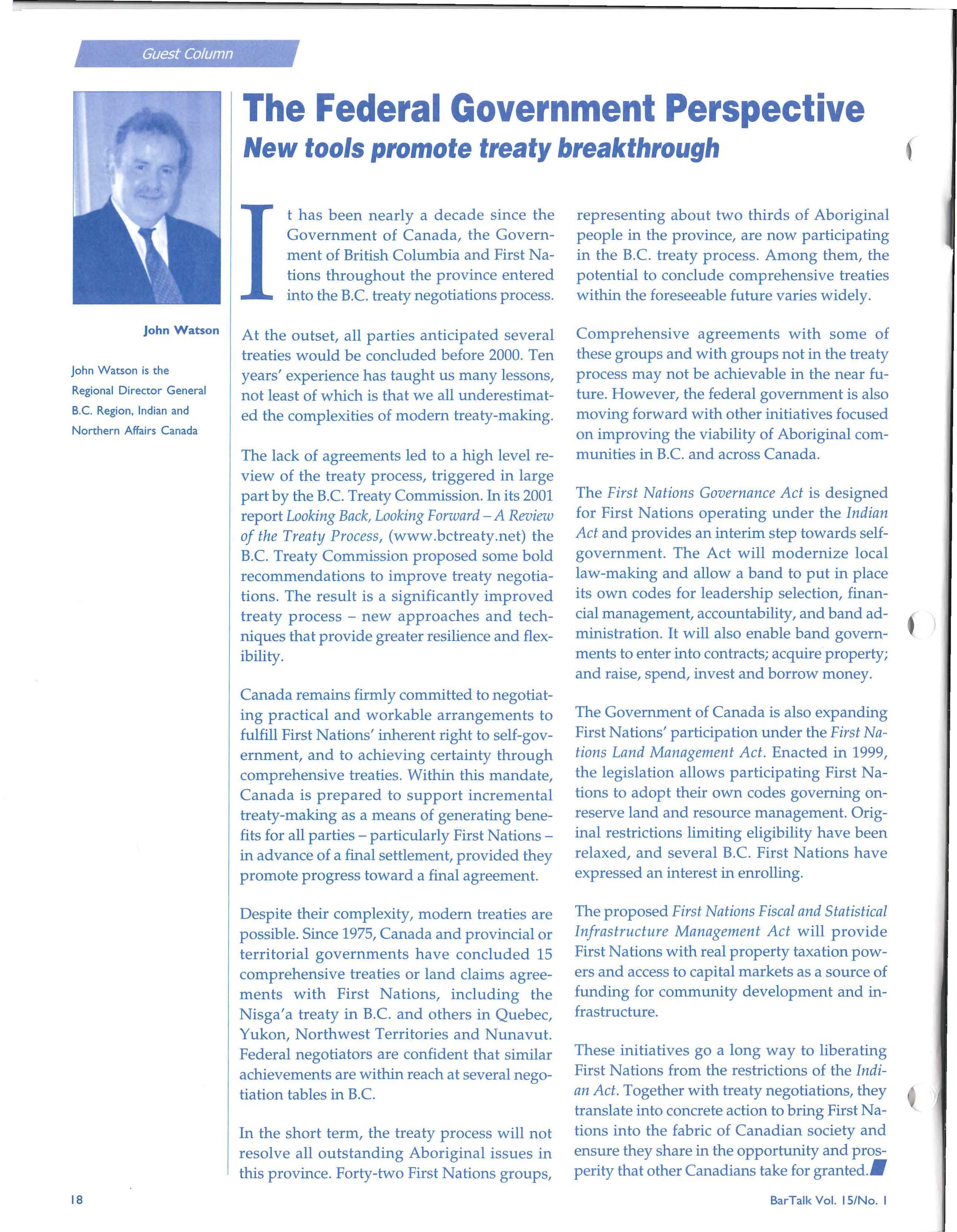
Jo hn Watson is the Regional D irector Genera l
B.C. Region, Indian and Northern Affa irs Cana d a
The Federal Government Perspective
New tools promote treaty breakthrough
t has been nearly a decade since the Government of Canada, the Government of British Columbia and First Nations throughout the province entered into the B C. treaty negotiations process.
At the outset, all parties anticipated several treaties would be concluded before 2000 . Ten years' experience has taught us many lessons, not least of which is that we all underestimated the complexities of modern treaty-making
The lack of agreements led to a high level review of the treaty process, triggered in large part by the B.C. Treaty Commission. In its 2001 report Looking Back, Looking Forward- A Review of the Treaty Process, (www.bctreaty.net) the B.C. Treaty Commission proposed some bold recommendations to improve treaty negotiations. The result is a significantly improved treaty process -new approaches and techniques that provide greater resilience and flexibility.
Canada remains firmly committed to negotiating practical and workable arrangements to fulfill First Nations' inherent right to self-government, and to achieving certainty through comprehensive treaties Within this mandate , Canada is prepared to support incremental treaty-making as a means of generating benefits for all parties- particularly First Nationsin advance of a final settlement, provided they promote progress toward a final agreement.
Despite their complexity, modern treaties are possible. Since 1975, Canada and provincial or territorial governments have concluded 15 comprehensive treaties or land claims agreements with First Nations, including the Nisga'a treaty in B.C. and others in Quebec, Yukon, Northwest Territories and Nunavut. Federal negotiators are confident that similar achievements are within reach at several negotiation tables in B.C.
In the short term, the treaty process will not resolve all outstanding Aboriginal issues in this province . Forty-two First Nations groups ,
representing about two thirds of Aboriginal people in the province, are now participating in the B.C. treaty process . Among them, the potential to conclude comprehensive treaties within the foreseeable future varies widely.
Comprehensive agreements with some of these groups and with groups not in the treaty process may not be achievable in the near future However, the federal government is also moving forward with other initiatives focused on improving the viability of Aboriginal communities in B.C. and across Canada.
The First Nations Governance Act is designed for First Nations operating under the Indian Act and provides an interim step towards selfgovernment. The Act will modernize local law-making and a ll ow a band to put in place its own codes for leadership selection, financial management, accountability, and band administration It will also enable band governments to enter into contracts; acquire property; and raise, spend, invest and borrow money.
The Government of Canada is also expanding First Nations' participation under the First Nations Land Management Act. Enacted in 1999, the leg i slation allows participating First Nations to adopt their own codes governing onreserve land and resource management. Original restrictions limiting eligibility have been relaxed, and several B.C. First Nations have expressed an interest in enrolling.
The proposed First Nations Fiscal and Statistical Infrastructur e Management Act will provide First Nations with real property taxation powers and access to capital markets as a source of funding for community development and infrastructure
These initiatives go a long way to liberating First Nations from the restrictions of the Indian Act. Together with treaty negotiations, they translate into concrete action to bring First Nations into the fabric of Canadian society and ensure they share in the opportunity and prosperity that other Canadians take for granted .•
John Watson
Cautious Optimism
First Nations perspective on the treaty process
he 1990s heralded a decade of optimism for the negotiated resolution of the land question and the recognition of the inherent authority of First Nations to govern themselves in their traditional territories . To achieve these objectives, Canada , B C. and First Nations established a process to negotiate treaties that were to address both the land question and self-government.
As a first step, Canada, B.C. and the First Nations Summit established the B C. Treaty Commission to facilitate the negotiation process. The Treaty Commission was also expected to ensure there was some semblance of a level playing field in the negotiation process. The role and effectiveness of the Treaty Commission is currently under review , as required by the agreement under which it was established.
Treaty Commissioners were appointed in 1993 and treaty negotiations began in 1994. Progress at the 42 negotiation tables has been slower than anticipated . To date, the parties have not successfully concluded any agreements-in-principle (AlPs) or treaties A number of AlPs initialed in 2001 by negotiators for the parties did not receive the necessary political support in the First Nations communities This was largely because the formula-driven land and financial re s ource packages were seen as insufficient to enable First Nations to achieve and maintain self-sufficiency. A s well, First Nations were being asked to make significant concessions, while receiving no assurance that the treaties would improve their standard of living
While progress has been slow on the negotiation front, First Nations have achieved a greater degree of success in litigation, beginning with Sparrow in 1990, through to the Delgamuukw decision in 1997 and the Campbell case in 2000 . Most recently, the B.C. Court of Appeal in the Council of the Haida Nation case, building on the Taku Riv er Tlingit case, found that both industry and government have a legal obligation to meaningfully consult with and accom-
modate the interests of First Nations For the most part, the federal and provincial governments have done little to implement these court decisions. The B.C. Government has reacted to the latest round of court decisions by focusing on preparing for litigation, rather than implementing the requirement to consult and accommodate
The unwillingnes s of the federal and provincial governments to adjust their negotiators' mandates to implement the advances in the courts has been the source of a great deal of frustration and delay at the negotiation tables. The B.C. Government's recent referendum that sought to limit First Nations' inherent right of self-government, which the B C. Supreme Court has determined is recognized and affirmed by the Constitution, also slowed negotiations. The federal government, for its part, recently issued notices to at least a dozen negotiating tables threatening to shut down negotiations due to "lack of progress "
In our view, the lack of progress is largely reflective of the level of political will to negotiate and conclude fair and comprehensive agreements. For example, until recently, the issue of compensation was not an item for negotiation. Ev en now, it is only an issue that may be "explored " at negotiation tables As well, notwithstanding court decisions from the Supreme Court of Canada which state Aboriginal title in B.C. has nev er been extinguished, neither Canada nor B.C. will recognize the existence of Aboriginal title to any part of B C. They state this must be proven through litigation .
For the time being, the legal uncertainty will continue and capital will be invested elsewhere. To achieve certainty, Canada and B.C. will have to provide mandates to their negotiators that are sufficiently broad and flexible to conclude fair treaties with Firs t Nation s.
Despite our considerable frustration, we remain hopeful that in the coming year AlPs will be reached at several tables. Only time will tell whether our optimism is well founded •
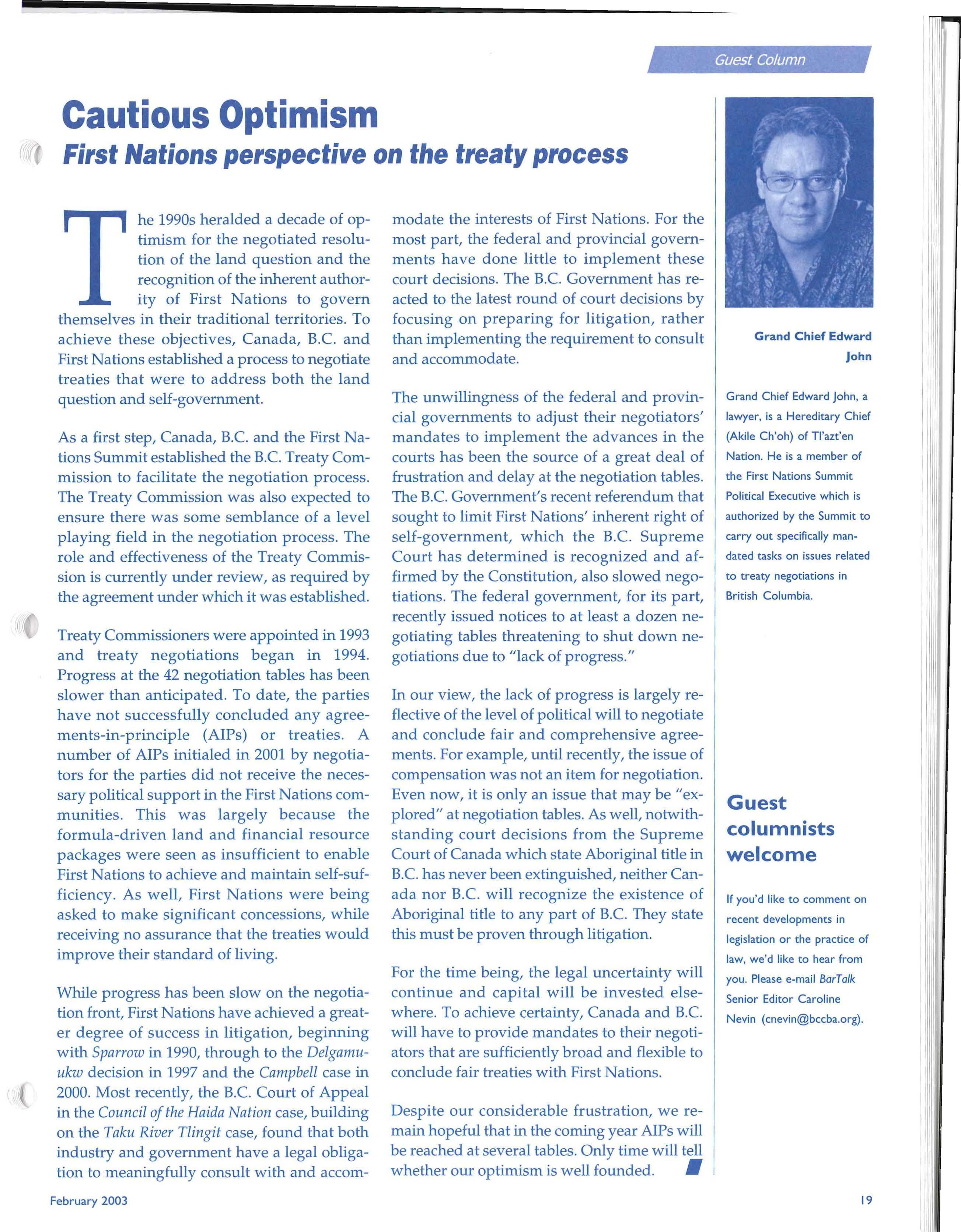
Grand Chief Edward John , a lawyer, is a Hereditary Chief (Akile Ch'oh) of
en Nation He is a member of the First Nations Summit Polit ica l Executive wh ic h is authorized by the Summit to carry out specifica ll y ma ndated tasks on issues re lated to treaty negotiations in British Columbia
Guest columnists welcome
If you'd like to comment on recent deve lopments in legislation or the practice of law , we'd like to h ear fro m you Please e-mai l BarTalk Se n ior Ed itor Caroline Nevin (cnevin@bccba.org).
Grand Chief Edward John
Tl'azt'
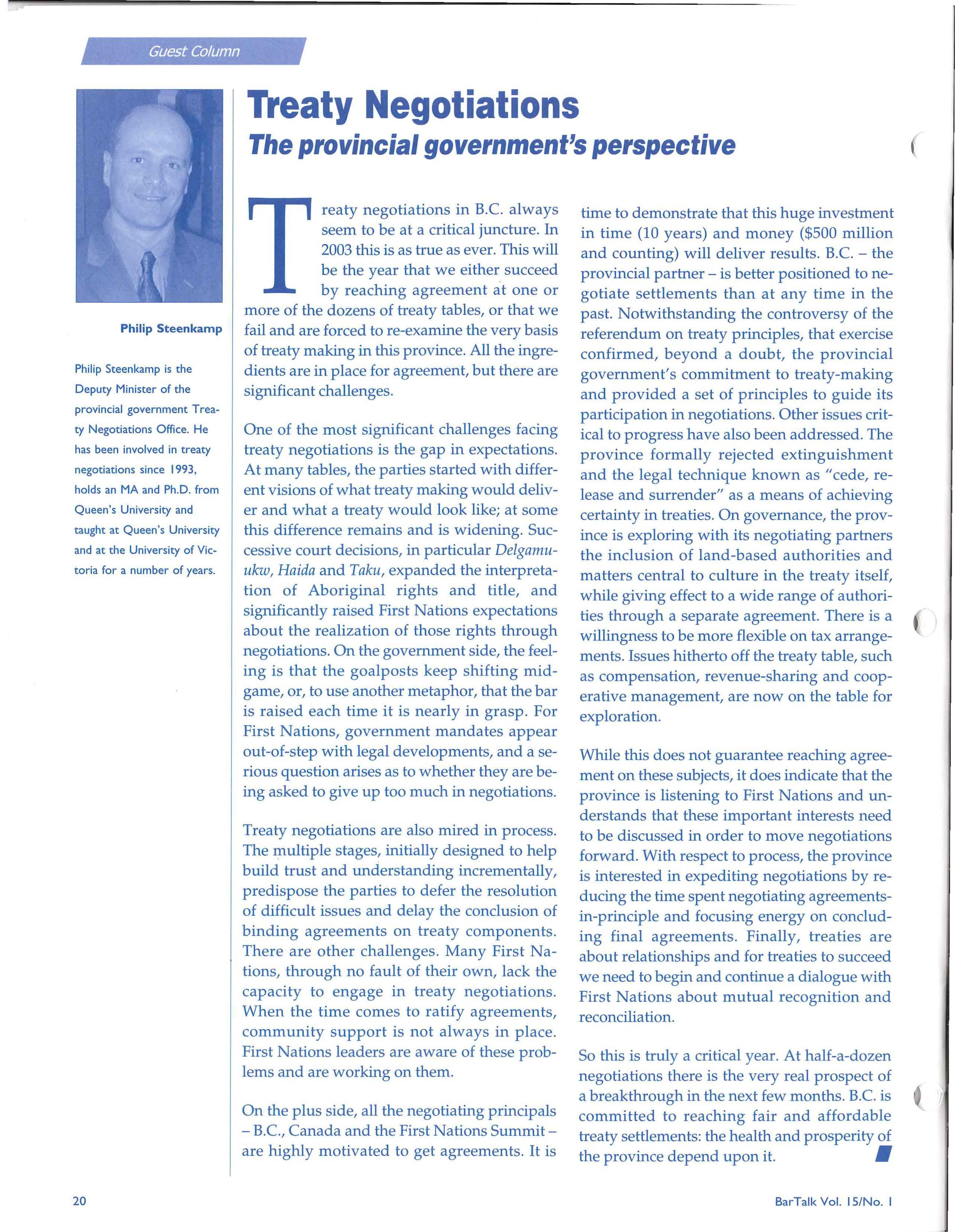
Philip Steenkamp is the Deputy Minister of the provincial government Treaty Negotiations Office He has been involved in treaty negotiations since 1993, holds an MA and Ph.D from Queen's University and taught at Queen ' s University and at the University of Victoria for a number of years
Treaty Negotiations The provincial government's perspective
reaty negotiations in B.C. always seem to be at a critical juncture . In 2003 this is as true as ever. This will be the year that we either succeed by reaching agreement at one or more of the dozens of treaty tables, or that we fail and are forced to re-examine the very basis of treaty making in this province. All the ingredients are in place for agreement, but there are significant challenges
One of the most significant challenges facing treaty negotiations is the gap in expectations. At many tables, the parties started with different visions of what treaty making would deliver and what a treaty would look like; at some this difference remains and is widening . Successive court decisions, in particular Delgamuukw , Haida and Taku, expanded the interpretation of Aboriginal rights and title, and significantly raised First Nations expectations about the realization of those rights through negotiations On the government side, the feeling i s that the goalpost s keep shifting midgame , or, to use another metaphor, that the bar is raised each time it is nearly in grasp For First Nations, government mandates appear out-of-step with legal developments, and a serious question arises as to whether they are being asked to give up too much in negotiations
Treaty negotiations are also mired in process. The multiple stages, initially designed to help build trust and understanding incrementally, predispose the parties to defer the resolution of difficult issues and delay the conclusion of binding agreements on treaty components. There are other challenges Many First Nations , through no fault of their own , lack the capacity to engage in treaty negotiations When the time comes to ratify agreements, community support is not always in place . First Nations leaders are aware of these problems and are working on them .
On the plus side, all the negotiating principals -B.C., Canada and the First Nations Summitare highly motivated to get agreements It is
time to demonstrate that this huge investment in time (10 years) and money ($500 million and counting) will deliver results. B C. - the provincial partner- is better positioned to negotiate settlements than at any time in the past. Notwithstanding the controversy of the referendum on treaty principles, that exercise confirmed, beyond a doubt, the provincial government's commitment to treaty-making and provided a set of principles to guide its participation in negotiations Other issues critical to progress have also been addressed. The province formally rejected extinguishment and the legal technique known as "cede, release and surrender " as a means of achieving certainty in treaties On governance , the province is exploring with its negotiating partners the inclusion of land-based authorities and matters central to culture in the treaty itself, while giving effect to a wide range of authorities through a separate agreement . There is a willingness to be more flexible on tax arrangements Issues hitherto off the treaty table, such as compensation, revenue-sharing and cooperative management, are now on the table for exploration .
While this does not guarantee reaching agreement on these subjects, it does indicate that the province is listening to First Nations and understands that these important interests need to be discussed in order to move negotiations forward With respect to process, the province is interested in expediting negotiations by reducing the time spent negotiating agreementsin-principle and focusing energy on concluding final agreements Finally, treaties are about relationships and for treaties to succeed we need to begin and continue a dialogue with First Nations about mutual recognition and reconciliation .
So this is truly a critical year. At half-a-dozen negotiations there is the very real prospect of a breakthrough in the next few months B C. is committed to reaching fair and affordable treaty settlements: the health and prosperity of the province depend upon it.
•
Philip Steenkamp
CBA Committee Report
Automobile Insurance Committee
he Automobile Insurance Committee, a Special Committee of the CBA, was initially created to address the concerns of members about the threat of the imposition of no-fault insurance . The Committee still ranks resisting any move towards no-fault insurance- in any guise- as its first priority . The risk of no-fault insurance being introduced appears to have receded for the present.
The Committee's second priority is to address areas of concern to members who practise in the automobile insurance arena . Both procedural and substantive matters are addressed
Recently, in response to Committee discussions with ICBC, the Corporation agreed it would no longer routinely require client's authorization to deal with counsel.
The Committee sought clarification of the Practice Direction regarding the disclosure of witness lists. The Committee was advised that the Practice Direction was not intended to compromise the substantive rights of the parties and is simply intended to encourage the practice of disclosing witness lists There are no sanctions provided for failure to comply, as a voluntary move towards disclosure is the objective
The Committee proposed reforms to s. 103 of Part 7 of the Insurance (Motor Vehicle) Regulation to avoid the needless waste of time and
February 7
February II
February 14-16
February 26
March 8
March II
March 12
Apri14-6
money in issuing accident benefit Writs when negotiations or litigation is ongoing regarding a tort claim. The government has recently replied with some concerns raised by ICBC and a meeting is planned with ICBC representatives in March to discuss those issues .
The Committee is seeking an avenue to ensure the Bar has a voice in establishing the BCMA tariff for the production of clinical records and medical reports
We successfully lobbied for the expansion of Rule 66, Fast Track Litigation, to all registries
The Committee's current major project is to propose significant revisions to the Underinsured Motorist Protection Regulation (UMP). The proposals include maintaining a database of UMP arbitration decisions . The Committee will be meeting with ICBC to discuss these amendments this spring .
The Committee ' s duties also include providing input to the Executive on matters affecting the practice of automobile insurance law and civil litigation in general.
The Committee's chief strength is the varied backgrounds of its members The plaintiff and defence Bar, mediators, arbitrators and other interested agencies are all represented on the Committee . The Committee maintains an active and positive relationship with both ICBC and the Trial Lawyers Association of B.C. •
Branch and Bar Calendar February - April 2003
Immigration Section Legal Conference "Diversifying Your Practice: A Workshop Course" (SFU, Harbour Centre)
New Westminster Bar Association (Westminster Club, New Westminster)
CBA National Mid-Winter Meeting (Banff, Alberta)
CBABC Executive Committee Meeting
Provincial Council Meeting (Richmond, Delta Airport Hotel, 9:00 a.m.)
New Westminster Bar Association (Westminster Club, New Westminster)
CBABC Executive Committee Meeting
CBABC Executive Committee Planning Meeting
To announce an upcoming event or meeting in the Branch and Bar Calendar, please contact Sandra Webb at 604-687-3404, or toll free 1-888-687-3404 (e-mail slgwebb@bccba.org)
Kew has practised for more than 20 years in the Trail area of the West Kootenays with a primary focus on persona l injury claims He is the Chair of the CBABC Automobile Insurance Comm ittee
Have a comment?
The Committee is always open to CBA members raising matters of concern and members should feel free to contact the Committee through Rose Fabbro at the CBABC (rfabbro@bccba org)
Michael Kew
Michael
Patricia jordan
Patricia Jordan is the CBABC Manager, Interactive Media She welcomes your comments , questions , and suggestions If you're having difficu lty find i ng a document online, need an answer, or would l ike something added to the site, contact her at pjordan@bccba.org or call 604-646-7861.
Online Legal Community A web-based resource built just tor you
e want to hear from you, as the CBABC Web site is your online legal resource . I invite you to send your comments and suggestions to webmaster@bccba org How are we doing? What would you like to see online?
Are you looking for Member Services information online? The Member Products and Services web page contains information on a variety of services : accommodation , banking, boutique items, car lease/rental/sales, communications, entertainment, health and wellnes s, insurance, investments, lawyer's cases, legal consulting, legal support services and products, photography, professional services, publications, standard contracts, travel, and wholesale warehouse 'What's New' has the latest offerings from Member Services .
CBABC WEB FACTS
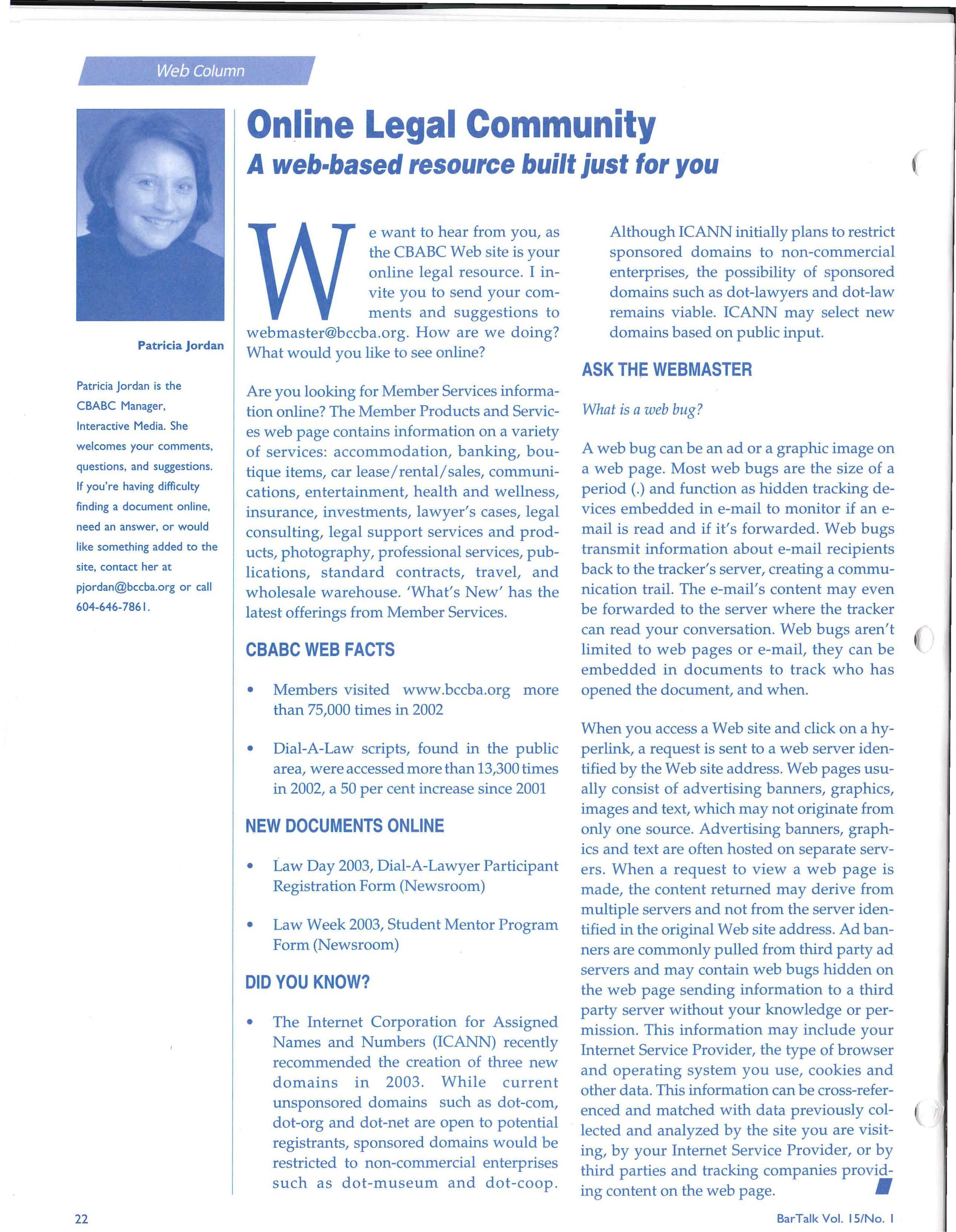
Although ICANN initially plans to restrict sponsored domains to non-commercial enterprises, the possibility of sponsored domains such as dot-lawyers and dot-law remains viable. ICANN may select new domains based on public input.
ASK THE WEBMASTER
What is a web bug?
A web bug can be an ad or a graphic image on a web page Most web bugs are the size of a period(.) and function as hidden tracking devices embedded in e-mail to monitor if an email is read and if it's forwarded. Web bugs transmit information about e-mail recipients back to the tracker's server, creating a communication trail. The e-mail's content may even be forwarded to the server where the tracker can read your conversation. Web bugs aren't limited to web pages or e-mail, they can be embedded in documents to track who has
• Members visited www.bccba org more opened the document, and when than 75,000 times in 2002
• Dial-A-Law scripts, found in the public area, were accessed more than 13,300 times in 2002, a 50 per cent increase since 2001
NEW DOCUMENTS ONLINE
• Law Day 2003, Dial-A-Lawyer Participant Registration Form (Newsroom)
• Law Week 2003, Student Mentor Program Form (Newsroom)
DID
YOU KNOW?
• The Internet Corporation for Assigned Names and Numbers (ICANN) recently recommended the creation of three new domains in 2003 . While current unsponsored domains such as dot-com, dot-org and dot-net are open to potential registrants, sponsored domains would be restricted to non-commercial enterprises such as dot-museum and dot-coop .
When you access a Web site and click on a hyperlink, a request is sent to a web server identified by the Web site address. Web pages usually consist of advertising banners, graphics, images and text, which may not originate from only one source. Advertising banners, graphics and text are often hosted on separate servers . When a request to view a web page is made , the content returned may derive from multiple servers and not from the server identified in the original Web site address . Ad banners are commonly pulled from third party ad servers and may contain web bugs hidden on the web page sending information to a third party server without your knowledge or permission. This information may include your Internet Service Provider, the type of browser and operating system y ou use, cookies and other data. This information can be cross-referenced and matched with data previously collected and analyzed by the site you are visiting, by your Internet Service Provider, or b y third parties and tracking companies prov iding content on the web page. •
New Year's Resolutions That Stick!
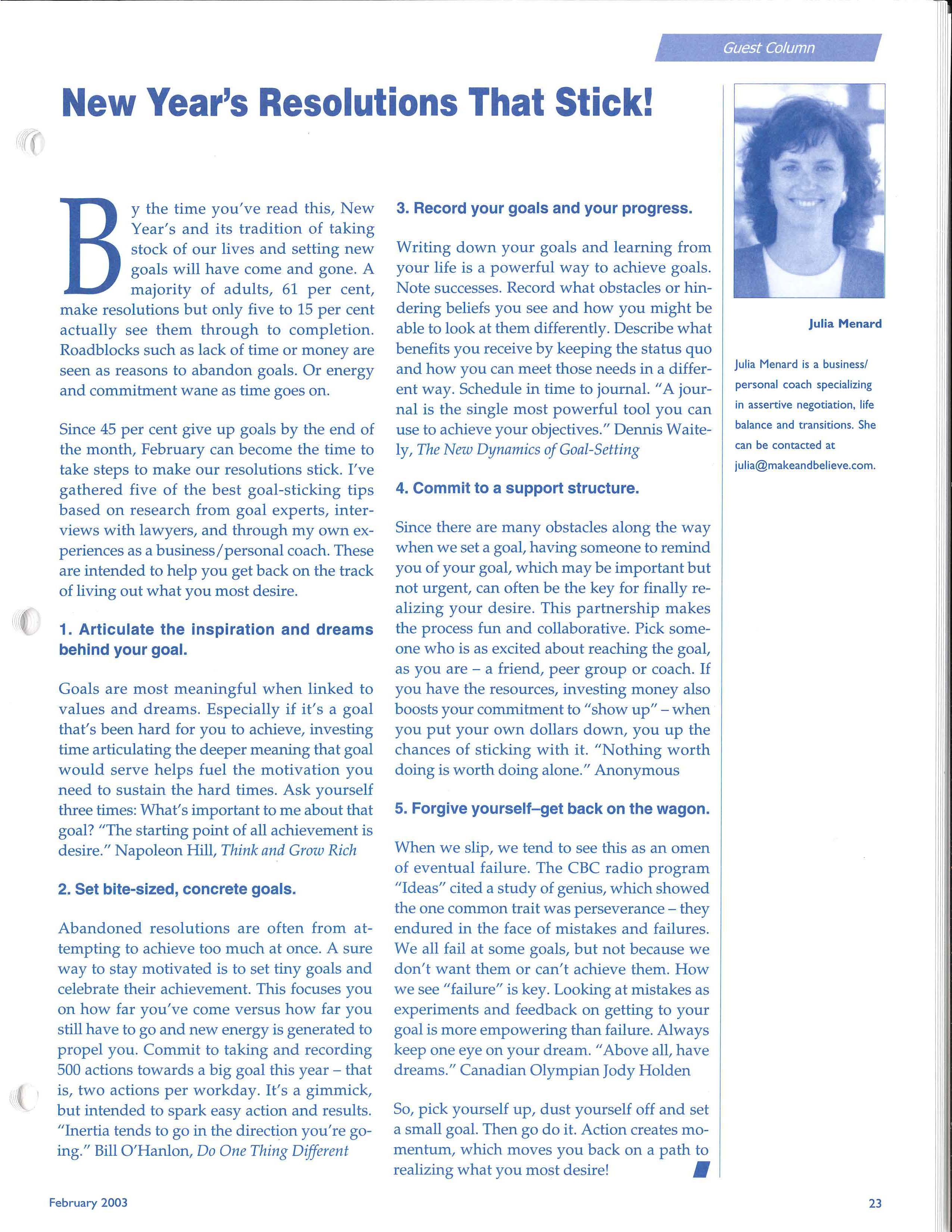
y the time you've read this, New Year's and its tradition of taking stock of our lives and setting new goa l s will have come and gone A majority of adults, 61 per cent, make reso lutions but only five to 15 per cent actually see them through to completion. Roadblocks such as lack of time or money are seen as reasons to abandon goa l s. Or energy and commitment wane as time goes on .
Since 45 per cent give up goals by the end of the month, February can become the time to take steps to make our resolutions stick. I've gathered five of the best goal - sticking tips based on research from goal experts, interviews with lawyers, and through my own experiences as a business/personal coach. These are intended to help you get back on the track of living out what you most desire.
1. Articulate the inspiration and dreams behind your goal.
Goals are most meaningful when linked to values and dreams. Especially if it's a goal that's been hard for you to achieve, investing time articulating the deeper meaning that goal would serve helps fuel the motivation you need to sustain the hard times . Ask yourself three times: What's important to me about that goal? "The starting point of all achievement is desire " Napoleon Hill, Think and Grow Rich
2. Set bite-sized, concrete goals.
Abandoned resolutions are often from attempting to achieve too much at once . A sure way to stay motivated is to set tiny goals and celebrate their achievement. This focuses you on how far you've come versus how far you still have to go and new energy is generated to propel you. Commit to taking and r e cording 500 actions towards a big goal this year - that is , two actions per workday It's a gimmick, but intended to spark easy action and results. "Inertia tends to go in the direction you're going." Bill O'Hanlon, Do One Thing Different
3 . Record your goals and your progress.
Writing down your goals and learning from your life is a powerful way to achieve goals Note successes Record what obstacles or hindering beliefs you see and how you might be ab le to look at them differently Describe what benefits you receive by keeping the status quo and how you can meet those needs in a different way Schedule in time to journal. "A journal is the single most powerful tool you can use to achieve your objectives " Dennis Waitely, The New Dynamics of Goa l- Setting
4. Comm it to a support stru cture.
Since there are many obstacles along the way when we set a goal, having someone to remind you of your goal, which may be important but not urgent, can often be the key for finally realizing your desire This partnership makes the process fun and collaborative. Pick someone who is as excited about reaching the goal, as you are - a friend, peer group or coach . If you have the resources, investing money also boosts your commitment to " show up" - when you put your own dollars down, you up the chances of sticking with it. "Nothing worth doing is worth doing alone ." Anonymous
5. Forgive yourself- get back on the wagon.
When we slip , we tend to see this as an omen of eventual failure. The CBC radio program "Ideas" cited a study of genius, which showed the one common trait was perseverance - they endured in the face of mistakes and failures . We all fail at some goals, but not because we don ' t want them or can't achieve them How we see "failure" is key . Looking at mistakes as experiments and feedback on getting to your goal is more empowering than failure . Always keep one eye on your dream " Above all, have dreams. " Canadian Olympian Jody Holden
So, pick yourself up, dust yourself off and set a small goal. Then go do it. Action creates momentum, which moves you back on a path to realizing what you most desire! •
J uli a Menard is a business/ pe r so na l coach s pecia li zing in ass e rtive negotiatio n, life balance a nd trans it ions. Sh e can be co ntacted at juli a@makean d be lieve .c o m .
Julia Menard
Gil Yaron
G il Yaron is Director of Law and Po li cy for the Shareho lder Association for Research and Educat ion (www.share.ca). He was ca ll ed to the Bar in 1998 and has been a Big Brother s ince 2000.
Being A Big Brother =Big Rewards
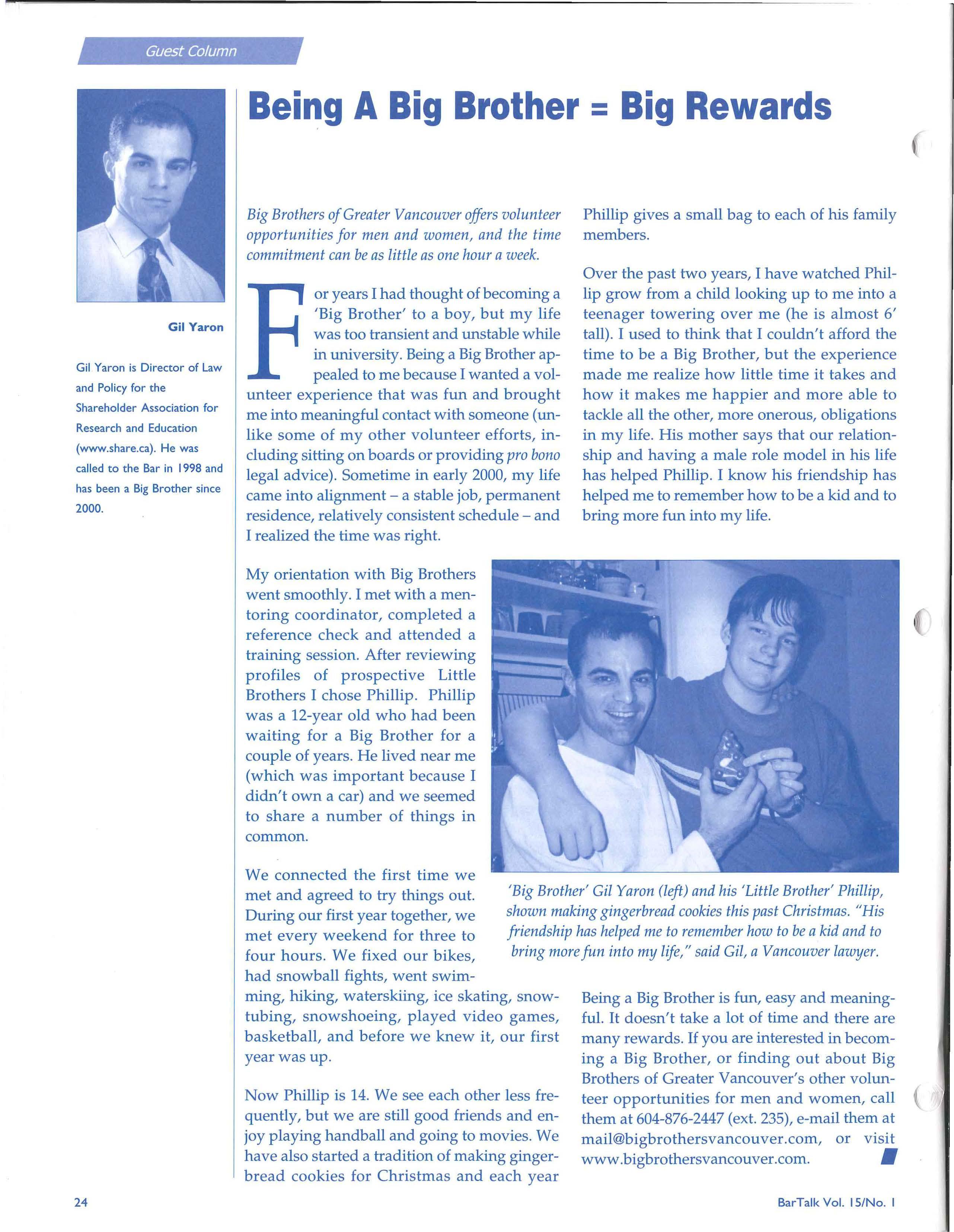
Big Brothers of Greater Vancouver offers volunteer Phillip gives a small bag to each of his family opportunities for men and women, and the time members. commitment can be as little as one hour a week.
or years I had thought of becoming a 'Big Brother' to a boy, but my life was too transient and unstable while in university . Being a Big Brother appealed to me because I wanted a volunteer experience that was fun and brought me into meaningful contact with someone (unlike some of my other volunteer efforts, including sitting on boards or providing pro bono legal advice) Sometime in early 2000, my life came into alignment- a stable job, permanent residence, relatively consistent schedule- and I realized the time was right.
My orientation with Big Brothers went smoothly I met with a mentaring coordinator, completed a reference check and attended a training session. After reviewing profiles of prospective Little Brothers I chose Phillip Phillip was a 12 -year old who had been waiting for a Big Brother for a couple of years. He lived near me (which was important because I didn't own a car) and we seemed to share a number of things in common.
We connected the first time we met and agreed to try things out. During our first year together, we met every weekend for three to four hours. We fixed our bikes, had snowball fights, went swim -
Over the past two years, I have watched Phillip grow from a child looking up to me into a teenager towering over me (he is almost 6' tall) I used to think that I couldn't afford the time to be a Big Brother, but the experience made me realize how little time it takes and how it makes me happier and more able to tackle all the other, more onerous, obligations in my life. His mother says that our relationship and having a male role model in his life has helped Phillip I know his friendship has helped me to remember how to be a kid and to bring more fun into my life.
'Big Brother' Gil Yaron (left) and his 'Little Brother' Phillip, shown making gingerbread cookies this past Christmas. "His friendship has helped me to remember how to be a kid and to bring more fun into my life," said Gil, a Vancouver lawyer.
ming, hiking, waterskiing, ice skating, snowtubing, snowshoeing, played video games, basketball, and before we knew it, our first year was up .
Now Phillip is 14. We see each other less frequently, but we are still good friends and enjoy playing handball and going to movies. We have also started a tradition of making gingerbread cookies for Christmas and each year
Being a Big Brother is fun, easy and meaningful. It doesn't take a lot of time and there are many rewards. If you are interested in becoming a Big Brother, or finding out about Big Brothers of Greater Vancouver's other volunteer opportunities for men and women, call ( them at 604-876-2447 (ext. 235), e-mail them at mail@bigbrothersvancouver com, or visit www.bigbrothersvancouver .com. •
UVic Educational Endowment
({ A comprehensive approach to Aboriginal justice
The current state of relations with Aboriginal peoples is one of the leading human rights, social justice and economic issues facing British Columbia and Canada During the past 20 years, Aboriginal rights, and title and other issues involving Aboriginal people have become more and more complex and important. I recall, when I was national President of the CBA in 1986, establishing "equal justice for native people" as my top priority . Yet, since that time nowhere near enough has been done in the law schools of our country to provide the range of courses desperately needed by both Aboriginal and non-Aboriginal students interested in this subject matter .
With this in mind, the University of Victoria Faculty of Law established the Educational Endowment for Aboriginal Justice. The endowment will fund the first Professorship of Aboriginal Justice and Governance in Canada. John Borrows, one of Canada's leading Aboriginal scholars, has assumed this Professorship which will significantly enhance legal education for Aboriginal and non-Aboriginal students. The Faculty of Law will admit more Aboriginal students Aboriginal educational and cultural support programs will be expanded, and there will be new course offerings in Aboriginal law and issues relating to Aboriginal peoples. The Faculty will develop new resources for the legal profession in collaboration with the Law Society, the ·continuing Legal Education Society and the judiciary. Law reform initiatives will be launched on matters that require resolution such as treaty negotiations, resource conflicts and economic development.
Both the First Nations Summit and the Union of B C. Indian Chiefs strongly support this initiative. When I agreed to help build financial support for the new Aboriginal justice initiative at UVic, I knew that I could also find a very impressive group of British Columbians who would work together to support the program and its ability to promote understanding
of Aboriginal issues and improve the lives of Aboriginal people and communities. Among the Endowment's esteemed patrons are: Thomas Berger, OC, QC; Mel Cooper, CM, OBC; David Foster, OC; John Fraser, PC, OC, OBC, CD, QC; Joe Gosnell, OC, OBC; Rick Hansen, CC, OBC; Michael Harcourt; Mobina Jaffer, GC, QC; Wendy John; Leonard Marchand, PC, CM; and Milton Wong, CM. The Board of Directors includes CBABC Past President Margaret Ostrowski, QC, Louise Mandell, QC, Marvin Storrow, QC and several other leading practitioners in Aboriginal law, as noted in the sidebar.
Our fundraising goal is $1 million . Over the past year, we received a grant of $500,000 from the Law Foundation, a grant of $100,000 from the Notary Foundation and numerous other contributions from private companies, individual donors and banks. We are now asking for the assistance of the legal profession for the last leg of our fundraising campaign
Legal institutions and the legal profession can play a key role in promoting reconciliation with Aboriginal peoples, and in developing just and sustaining social and economic relationships. I believe that education is the most effective tool at our disposal for promoting positive and enduring change. Any donation you can make will help us achieve our goals in the best interests of all concerned
To make a tax receiptable contribution, please send a cheque to: University of Victoria, Faculty of Law, PO Box 2400 STN CSC, Victoria, B.C. V8W 3H7. If you would like further information, please call the UVic Law Development Office at 250-721-8025 or e-mail pmaedel@uvic.ca. •
Battle of the Bar Bands
Friday, May 16, 2003 Commodore Ballroom
See page 32
Honourable Bryan Williams, QC
Bryan Williams served as Chief Justice of the Supreme Court of British Co lumbia from 1996 to 2000 He is associate counsel with the Vancouver law firm of Miller Thomson.
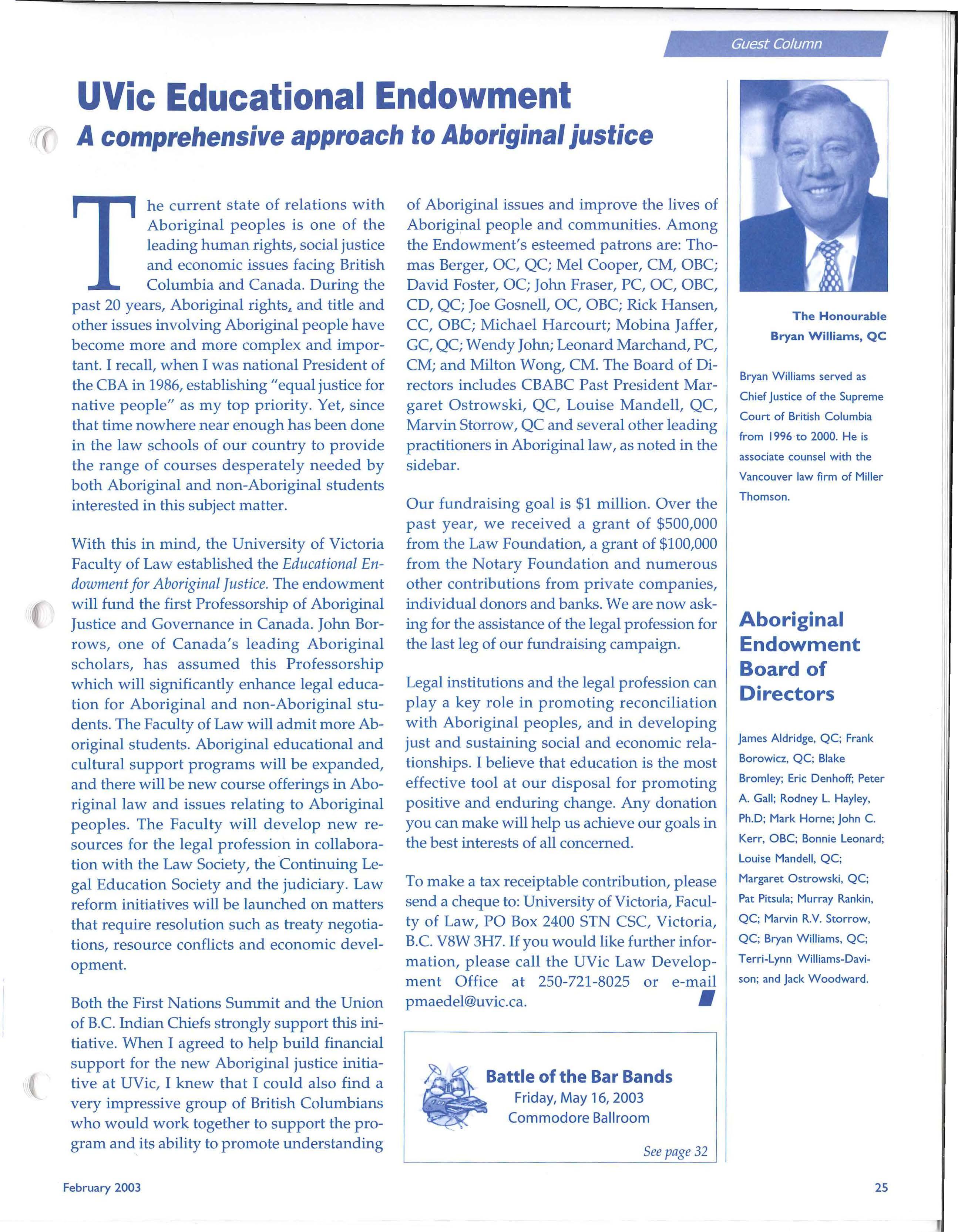
Aboriginal Endowment Board of Directors
James Aldridge, QC; Frank Borowicz, QC; Blake Bromley; Eric Denhoff; Peter A. Gall; Rodney L. Hayley, Ph.D; Mark Horne; John C. Ke r r, OBC; Bonn ie Leonard; Louise Mande ll , QC; Margaret Ostrowski , QC; Pat Pitsu la; Murray Rankin, QC; Marvin R.V. Storrow, QC; Bryan Wi ll iams, QC; Terr i-Lynn W ill iams-Dav ison; and Jack Woodward.
The
Gerry Ferguson Receives UVic Academic Honour
University of Victoria Law Professor Gerry Ferguson is one of the first recipients of the UVic Distinguished Professorships, the university's highest academic honour for faculty members. The Professorships were announced at the 2002 fall convocation ceremonies.
"This is the university ' s way of recognizing some of our faculty members who excel allround - individuals who are gifted classroom teachers, internationally respected scholars, and committed citizens of the university community," said UVic Vice-President Academic Jamie Cassels
Professor Ferguson, who joined UVic ' s law faculty in 1976, has a national and international reputation as a criminal law scholar, especially regarding Canadian criminal jury in-
CLENews
ABORIGINAL PRACTICE POINTS ART ICLES
Aboriginal rights and legal issues affect almost every practice area of the law. CLE's Web site (www. cl e .bc.ca) now features 20 full-length art icles, accessib l e for free, to guide lawyers through issues arising when they act for Aboriginal clients or in matters involving Aboriginal interes t s. The fully searchable articles, written by experienced practitioners, feature links to full-tex t legislation and selected cases The collection, developed with the support of the Law Foundation of B.C. , is located in the ' Practice Desk' area of the CLE Web site.
ONLINE CLE PUBLICATIONS PENDING!
Building on projects like the Aboriginal Practice Points collection and current awareness articles now available on the CLE Web site, CLE is working on placing its p r actice manuals online, to allow lawyers the opti on of purchasing manuals online CLE's first online manual , a pilot version of the popular BC Probate & Estate Administration Practice Manual , will be available this March. The full y searchable manual will have an easy-to -use web format,
structions . In 1988, he helped introduce co-operative education to UVic law and it remains the only co-op law program in Canada He was involved in creating the Akitsiraq law program where Inuit students in Nunavut are earning UVic law degrees without having to leave
Gerry Ferguson, UVic Distinguished Professorship recipient the north Mr. Ferguson will use his distinguished professorship to continue research into restorative justice.
•
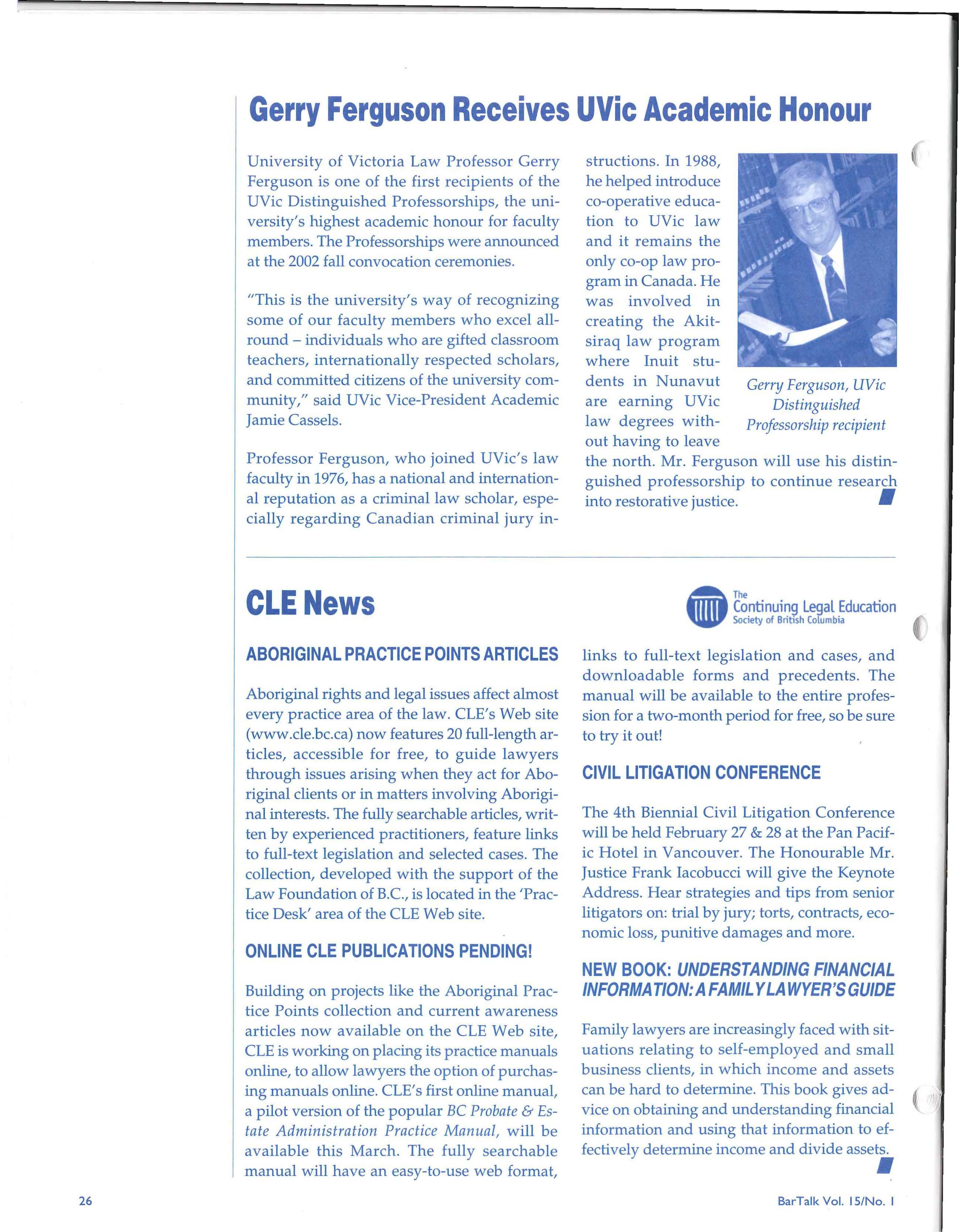
• The Continuing Leqal Education Society of Brit1s h Co[um bia
links to full-text legislation and cases, and downloadable forms and precedents . The manual will be available to the entire profession for a two-month period for free, so be sure to try it out!
CIVIL LITIGATION CONFERENCE
The 4th Biennial Civil Litigation Conference will be held February 27 & 28 at the Pan Pacific Hotel in Vancouver. The Honourab l e Mr. Justice Frank Iacobucci will give the Keynote Address . Hear strategies and tips from senior litigators on: trial by jury; torts, contracts, economic loss, punitive damages and more .
NEW BOOK: UNDERSTANDING FINANCIAL INFORMATION:
AFAMILY LAWYER'S GUIDE
Family lawyers are increasingly faced with situati on s relating to self-emplo y ed and small busine s s clients, in w hich income and assets can be hard to determine This book giv es advice on obtaining and understanding financial information and using that information to effecti v ely determine income and divide assets
Hooplaw Charity Basketball Tournament
Dust off your lay-up and dig out your high-tops. This year's Hooplaw Charity Basketball Tournament, in support of local children's charities, is scheduled for Saturday, March 1, 2003 at the Riverport complex in Richmond.
The Hooplaw Charitable Foundation organizes an annual charity basketball tournament to raise money for local children's charities that assist underprivileged or disadvantaged children. Since 1997 Hooplaw has brought together B.C. judges, lawyers, law students and corporate sponsors to raise money and awareness for various local children's charities.
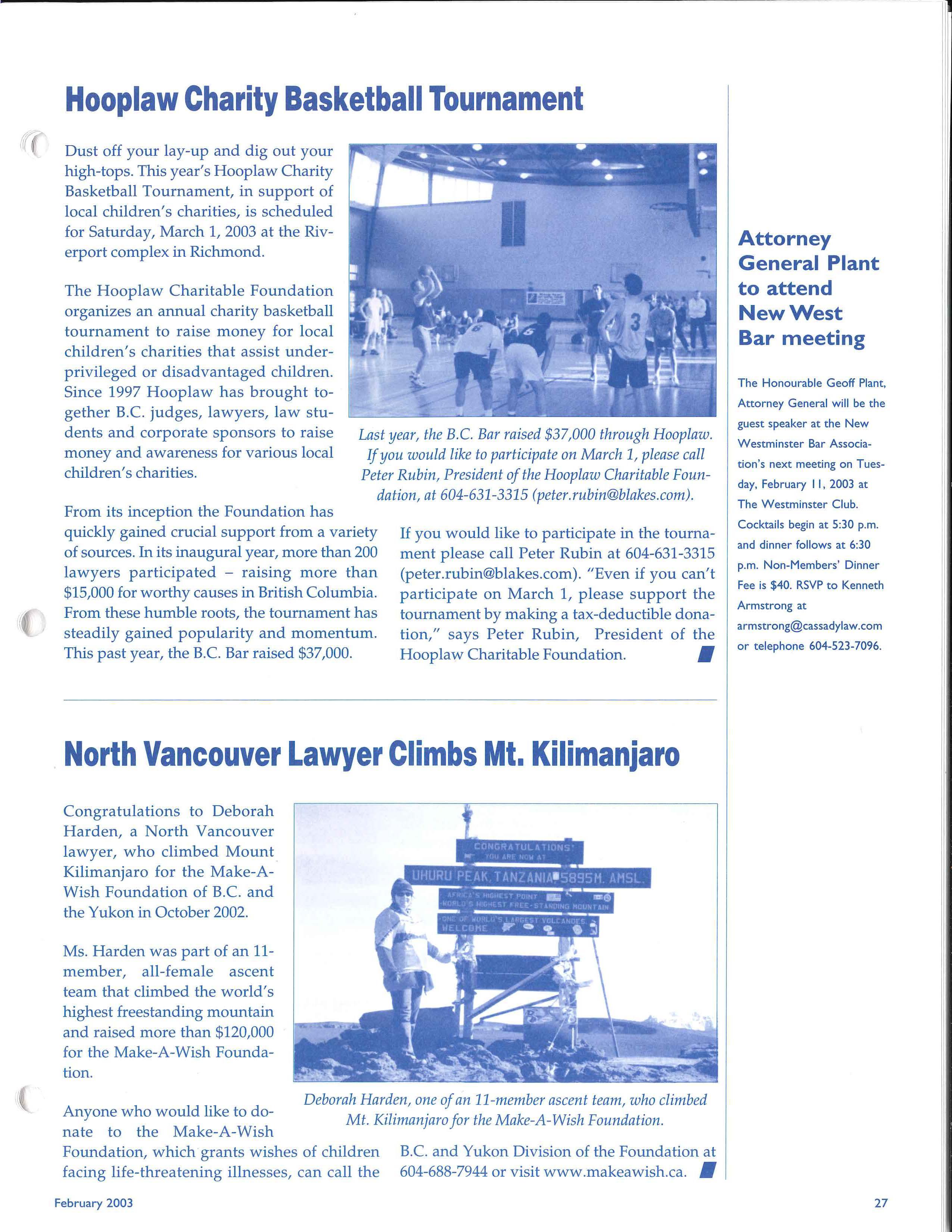
Last year, the B C. Bar raised $37,000 through Hooplaw. If you would like to participate on March 1, please call Peter Rubin, President of the Hooplaw Charitable Foundation, at 604-631-3315 (peter rubin@blakes.com).
From its inception the Foundation has quickly gained crucial support from a variety of sources . In its inaugural year, more than 200 lawyers participated - raising more than $15,000 for worthy causes in British Columbia. From these humble roots, the tournament has steadily gained popularity and momentum . This past year, the B.C. Bar raised $37,000
If you would like to participate in the tournament please call Peter Rubin at 604-631-3315 (peter.rubin@blakes com). "Even if you can't participate on March 1, please support the tournament by making a tax-deductible donation," says Peter Rubin, President of the Hoop law Charitable Foundation . •
North Vancouver Lawyer Climbs Mt. Kilimanjaro
Congratulations to Deborah Harden, a North Vancouver lawyer, who climbed Mount Kilimanjaro for the Make -AWish Foundation of B.C. and the Yukon in October 2002.
Ms. Harden was part of an 11member, all-female ascent team that climbed the world's highest freestanding mountain and raised more than $120,000 for the Make-A-Wish Foundation.
Anyone who would like to donate to the Make-A-Wish
,
for
Foundation, which grants wishes of children facing life-threatening illnesses, can call the B C. and Yukon Division of the Foundation at 604-688-7944 or v i sit www.makeawish .ca. •
Attorney General Plant to attend
New West Bar meeting
The Honourable Geoff Plant, Attorney Genera l will be the guest speaker at the New Westm inster Bar Association's next meet ing on T uesday, February I I, 2003 at The Westm inster Club Cocktails begin at 5:30 p.m and dinner follows at 6:30 p.m Non-Members' D inne r Fee is $40. RSVP to Ken neth Armstrong at armstrong@cassadylaw .com or te lephone 604-523-7096
Deborah Harden
one of an 11-member ascent team, who climbed Mt . Kilimanjaro
the Make-A- Wish Foundation .
Letters to the Editor
Re: BarTalkVol. 14/No. 5 "What's the right course in the Wirick case?"
I think it is unrealistic and unwise to implement any program that would entail unrestricted underwriting of lawyer's undertakings .
The response of the legal profession to the Wirick matter must provide for protection of the public, while being prudent and fair to the legal profession.
We as lawyers have not in the past "stood behind" undertakings of lawyers , except insofar as a breach of an undertaking might consist of a misappropriation or wrongful conversion of trust funds, thereby attracting possible application of the special compensation fund of the Law Society . I think if we are to go further than that, it must be through a carefully considered and properly administered form of fidelity insurance. We cannot ask the legal profession to accept unlimited liability for undertakings. No reasonable person would do it. Even extremely rich people who subscribe to be "Lloyd ' s names " face unlimited liability which is based upon carefully evaluated risks . And the financial rewards to the Lloyd's investor is perceived by the investor to warrant the risk.
If I deposit money in the bank, I should be able to trust that the banker is not a thief and will not steal my money. Yet there is an insurance limit of only $60,000 pursuant to the Canada Deposit Insurance Corporation. There are limitations on the insurance . I think if one were to ask the directors of the Royal Bank whether they would be prepared to do away with that program, and provide an indemnity for all deposits at all Canadian banks, they would consider that proposal ludicrous .
The losses in the present case may be in the range of $20 to $40 million . What if, in a future case, the losses were 10 times bigger, or 100 times bigger?
It would be unfair to ask the legal profession as a whole to pay for, or to be liable for, insur-
ing the " sanctity" of undertakings, when tho se undertakings are of primary importance to a segment of the legal profession only.
I think the only thing that makes sense is a transaction-based fidelity insurance program. Premiums would be payable in relation to the size of the transactions involved The premium should be paid for by the lawyer engaged in the transaction, out of fees , and should not be allowed to be shown as a disbursement on the bill. The public is rightly offended by any scheme which would ask the public to pay for lawyer's fidelity insurance Given the rarity of these problems, I would expect that in time the premiums necessary would become very small . The program might be administered by the Law Society, as is currently done with our professional liability insurance.
Yours truly,
Frits Verhoeven •
Re: BarTalkVol. 14/No. 6 "Tired of the Legal Aid Issue"
Racing to the end of the year I took a moment to review the BarTalk editorial on legal aid. After reading it I decided to take another moment to acknowledge its excellence.
Like most regular BarTalk readers I have come to expect good writing and a considered message in the editorials. The recent article surpasses that standard, providing a concise overview of many current issues relating to legal aid . It does so with a voice that accurately reflects the sentiments of the many lawyers who have been involved in the struggle to ensure people in B.C. have access to the legal services they require to protect their rights and resolve their legal problems.
Legal aid will survive in B C. only with the ongoing involvement and commitment of the Bar ( and will prosper only if it has support in the broader community The CBA's commitment to preserving legal aid and advancing the de-
bates around it are important to many and invaluable to the justice system itself. My thanks to all of you for engaging with this issue yet again.
Sincerely,
Mark Benton, Executive Director Legal Services Society
Re: BarTalk Vol. 14/No. 6 "So, what does CBABC do for members?"
I read with interest your article entitled "So, what does CBABC do for members?"
Over the years, I have been frustrated by people who suggested that the CBA does nothing for them. One thing that was not on your list of what the CBA does for its members, is a project that I have been involved with as the CBA' s representative for the last six years. It probably has touched the life of every CBA member, be it in a small way.
The BC Real Estate Association's Standard Forms Committee (the "Committee") is the group that has developed the standard form Contract of Purchase and Sale (the "Contract") used in over 90 per cent of residential real estate transactions in British Columbia . As you know, the Contract is jointly copyrighted by the B.C. Real Estate Association and the CBA. Since 1986, the CBA has had a representative on the Committee, which drafted and revised the terms of the Contract I have been that representative since 1996. For the 10 years before that, the CBA's representative was Jane Purdie, QC.
The development of the Contract allows for efficient conveyancing practices. Once lawyers and paralegals have determined that they are dealing with the Contract, they need not to review the standard terms in detail, as it will only include terms that they are familiar with.
Before the Contract was developed, every Real Estate Board and many real estate firms used their own form of contract of purchase and sale This meant lawyers had to spend additional time reviewing "standard boilerplate."
The Contract also benefits lawyers who never practise real estate law Most lawyers will use the Contract when buying or selling their own home, whether they use the service of a realtor or not. The Contract makes for easier negotiation of deals, as parties generally feel more comfortable using a standard form document, and helps keep everyone's conveyancing costs down.
Over the years, the Contract has been amended to address numerous issues that have arisen, including changes to reflect new conveyancing practices resulting from judicial decisions, changes to statutes and Land Title Office practices.
In addition, in my role as a member of the Committee and Past Chair of the Real Property Section, I developed the "CBA Standard Undertakings" which are incorporated by reference in the Contract I spent many tens of hours drafting, circulating, and then seeking input on those undertakings. Those undertakings are being currently revised to address issues that arose from the Wirick/ Gill matter. I am again involved in that process, spending many unpaid hours that will hopefully reduce the potential of a future Wirick/ Gill affair.
This may be a small item but it is something that probably has touched the professional and private lives of more lawyers than any other service of the CBA. Over the years I have spent well over 200 hours on the Committee's work. I think it is work that has served the profession and the public at large, well. I hope to see it on a future list.
Yours very truly,
Edward L. Wilson
We want to hear from you. Send your Letters to the Editor to: Caroline Nevin, BarTalk Senior Editor (cnevin@bccba.org)
Canadian Bar Association, British Columbia Branch
lOth Floor, 845 Cambie Street, Vancouver, B.C. V6B 5T3
Fax: 604-669-9601 or Fax toll free: 1-877-669-9601
West Coast LEAF Annual Equality Breakfast
West Coast LEAF presents its 16th Annual Equality Breakfast on Fr iday, March 7 at the Hyatt Regency Hotel. Doors open at 7:00 a m The breakfast will feature the dynamic and engaging Joanne St Lewis, Professor of Law at Un iversity of Ottawa and the author of Virtual justice: Systemic Racism and the Canadian Legal Profession
Proceeds from the breakfast, West Coast LEAF's signature fundraising event, will support public legal education programs in communities and schools. For ticket information please call 604684-8772 or e-mail breakfast@westcoastleaf org.
Member Services
CBABC members have access to a wide range of products , services and discounts . Member Services is continually adding and looking for ways you can get the most out of your membership! Be sure to visit www.bccba.org for new additions Your input is always welcome Send your suggestions to kjohnson@bccba.org. Member Services Hotline: 604-687-3404 , ext . 500 or 1-888-687-3404, ext. 500.
VANCOUVER
VANCOUVER OPERA
CBA members enjoy 31 per cent savings (including waiver of handling fees) with Vancouver Opera. Savour the power of grand operasensational singing, spectacular productions, romance and pageantry! For details see BarTalk inserts (Lower Mainland circulation only) or contact Member Services
ARTS CLUB AND STANLEY THEATRES
Receive a 20 per cent discount off regularpriced tickets by calling Natasha Klein at 604687-5315, ext. 254 and identifying yourself as a CBA member . Little Shop of Horrors plays at the Granville Island Stage until March 22. The Memory of Water, winner of the 2000 Laurence Olivier Award for best new comedy, plays at the Stanley March 6 to April 6.
PREFERRED HOTELS
If you're traveling within B.C., don't forget about CBABC Branch Preferred Hotels. The 2003 rates for our Preferred Hotels are available at www .bccba.org (Downtown Vancouver hotels only) or by contacting Member Services (Province-wide rates).
SUN PEAKS RESORT, KAMLOOPS •
CBA Members receive a 10 per cent discount at Sun Peaks on lift tickets, rentals, and various other products and services. Proof of CBA membership required. Contact Member Services for further info, or call Sun Peaks at 1-800807-3257.
VANCOUVER RAVENS LACROSSE
CBA members save up to 41 per cent on the following Vancouver Ravens games:
Sunday, March 16 at 1:00 p.m. v. Colorado Mammoth
Friday, March 28 at 7:30 p.m. v. Ottawa Rebel
See BarTalk insert for details or contact Member Services
WHISTLER BLACKCOMB
Member Services has Adult Bulk Tickets for sale for $53 (plus tax). For an order form, please visit www bccba.org or call Member Services. Phone orders cannot be acceptedinquiries only •
Victoria Law Centre Receives LSS Funding
Victoria's Law Centre student clinical program has reopened and will continue to offer lega l aid services to low income clients, thanks to project funding from the Legal Services Society and support from other donors.
The future of the Law Centre was placed in doubt last spring as a result of provincial funding cuts to legal aid . However, UVic permitted the law school to keep the program afloat while alternative funding was sought. The Legal Services Society will give the Law Centre
approximately $200,000 to deliver a family law pilot project for low-income, unrepresented people The project runs until March 2004.
UVic law faculty's clinical program has been offered to law students since 1977, and provides legal services to about 4,000 clients a year. Students earn credits and gain hands-on experience providing legal services to low-income persons not eligible for legal aid.
For details, visit www .thelawcentre
Law Foundation of BC
Grants Approved
The Board of Governors of the Law Foundation of B.C. met in November 2002 and approved funding totalling $4,261,300 for the following 2003 continuing programs.
B.C. COALITION OF PEOPLE WITH DISABILITIES
(Advocacy Access Program)- $136,900
B.C. FREEDOM OF INFORMATION AND PRIVACY ASSOCIATION
(Law Reform/Public Legal Education Program)- $20,800
B.C. HUMAN RIGHTS COALITION (Legal Advocacy and Education Program)$132,300
DEBATE/SPEECH ASSOCIATION OF B.C. (Law Foundation Cup Debates) - $14,300
DOWNTOWN EASTSIDE RESIDENTS' . ASSOCIATION
(Advocacy Services Program) - $103,300
DOWNTOWN EASTSIDE WOMEN'S CENTRE
(Legal Advocacy Program) - $33,000
GREATER VANCOUVER LAW STUDENTS' LEGAL ADVICE PROGRAM
(Operating) - $121,000
LAW FOUNDATION LAY ADVOCACY EDUCATION AND TRAINING FUND - $54,600
LAW COURTS EDUCATION SOCIETY
(Northern Public Legal Education Program for First Nations Communities)- $60,800
LAW SOCIETY OF BRITISH COLUMBIA
(CANLII Virtual Law Library) - $65,000
LEGAL SERVICES SOCIETY (Operating)- $3,272,500
UBC FACULTY OF LAW
(Projects/Scholarships) - $127,300 (First Nations Clinical Program)- $65,500
UVIC, FACULTY OF LAW
(Projects/Scholarships)- $54,000
lliEWuw FOUNDATION OF BRITISH COWMBIA
New Appointments to the Board of Governors
The Law Foundation is pleased to announce the appointment of five new Governors to the Board, each for a term of three years.
Madam Justice Pamela Kirkpatrick was called to the Bar in 1978 and practised law at McCarthy & McCarthy until 1989 when she was appointed Master of the Supreme Court of B.C. in Vancouver. She has been a Justice of the Supreme Court since 1992.
Warren T. Wilson, QC was called to the Bar in 1968 and appointed Queen's Counsel in 1993. He is a partner with the Vancouver firm of Borden Ladner Gervais. Mr. Wilson served on the CBA National and Provincial Council for six years, and chaired the CBA National Member Services Committee 1990-1991. Mr Wilson served as a Bencher of the Law Society of B.C. from 1991-1999 and as President in 1999.
Dev Dley was called to the Bar in 1979. He is Associate Counsel with the Kamloops firm Mair Jensen Blair. Previously, Mr. Dley was Commissioner for the Western Hockey League (1996-2000).
Grant J . Gray was called to the Bar in 1982. Mr. Gray is a sole practitioner and litigator in Kelowna. He served as a Director of the Legal Services Society until 2002.
Cindy McKinley is Manager, Human Resources Planning & Development, B.C. Hydro From 1980 until1993, Ms. McKinley worked for the federal government in various capacities, including policy, planning, and grant making .
The Foundation wishes to thank Madam Justice Alison Beames, Andrew Croll, Madam Justice Victoria Gray, and Marina Pratchett, QC, who concluded their terms in 2002, for their time and commitment to the Foundation.
•BarTa/k is published six times per year by the British Columbia Branch of the Canadian Bar Association, lOth Floor 845 Cambie Street Vancouver, B C V6B 5Tl
TEL: 604-687-3404
TOLL FREE in B.C., outside the Lower Mainland: 1-888-687-3404
FAX: 604-669-960 I
TOLL FREE in B.C., outside the Lower Mainland: 1-877-669-960 I
• BarTa/k Senior Editor: CAROLINE NEVIN 604-687-3404, EXT. 320 cnevin@bccba.org
• BarTa/k Editor: SANDRA WEBB 604-687-3404, EXT 318 slgwebb@bccba.org
• Editorial Board Chair: KENNETH ARMSTRONG karmstronglaw@ shaw.ca
• Editorial Board Members: VIKKI BELL, QC
WILLIAM S. CLARK
DIANA DAVIDSON
KAY MELBYE CHRISTINE MINGlE
© Copyright the British Columbia Branch of the Canadian Bar Association-2003
This publication is intended for information purposes only and the information contained herein should not be applied to specific fact circumstances without the advice of counsel.
The Canadian Bar Association, B.C. Branch represents more than I 0,000 members within British Columbia and is dedicated to improving and promoting access to justice, to reviewing legislation, initiating law reform measures and advancing and improving the administration of justice.
NEED A BREAK - BOOK A LOCUM
David Freeman Te l : 1-888-752-8846; Fax: 1-877-743-9623; e -mail lawyers@telus net
WCB
Do you need help with WCB problems? Are you Plaintiffs counsel facing an ICBC Section 10 defence?
r-- 604-267-3033 -
• Extens i ve experience withWCB appeals
• Vice Chair at Review Board for 6 years
• Personal injury litigation for 25 years
• Available for WCB appeals, expert opinions, court applications and trials
Vahan A. Ishkanian
Cell 604-868-3044 Fax 604 -264 -6133 vishkanian @pepito.ca
GENERAL PRACTITIONER seeks partner for very busy practice 4 + years experience required. Practice is located in booming Rocky Mountain town that is well suited for families and those who enjoy skiing , hiking, etc E-mail fairley@redshift.bc .ca or Davis & Fairley Box 989 Golden BC VOA lHO. Fax 250-344-6118
VANCOUVER TAX PRACTICE AVAILABLE - for sale or succession Well established with diversified clientele. Suitable for sole practitioner. To explore this opportunity in confidence , please telephone GODFREY CHOWNE or GRANT BEATSON, Management Consultants, at 604-609-6161.
LAWYER SOUGHT-Desperately seeking lawyer who handled affairs of late Michael Pappas. Please reply : Box 361, 4901 No. 3 Rd. , Ste. 114 , Richmond , BC V6X 3A5
WILLS & ESTATES SOLICITORMacaulay McColl is looking for a Solicitor, 5 years call or more, with some existing practice in Wills and Estates. Macaulay McColl is a smaller downtown Vancouver boutique firm with 10 litigators and one senior solicitor. It has a collegial atmosphere with excellent legal and administrative support and professional development. Please respond by fax or e-mail to Catherine Jacob s , Executive Director. Fax: 604687 -8716 E-Mail : cjacobs@macaulay com
LA WYERS REQUIRED- Braithwaite Boyle, one of Alberta's leading Accident Injury Law Firms, requires lawyers with minimum 2-3 years at the Bar for Edmonton and Calgary offices. Please send resume in confidence to: R. Hope at 11816-124 Street, Edmonton , AB T5L OM3 or by fax to 780-451 -9198.
mailing date: Aprilll
Please direct advertising inquiries to Sandra Webb at 604-646-7856 or 1-888-687 -3404 , ext. 318 (e -mail cba@bccba org)
Please see Member Services on page30 •
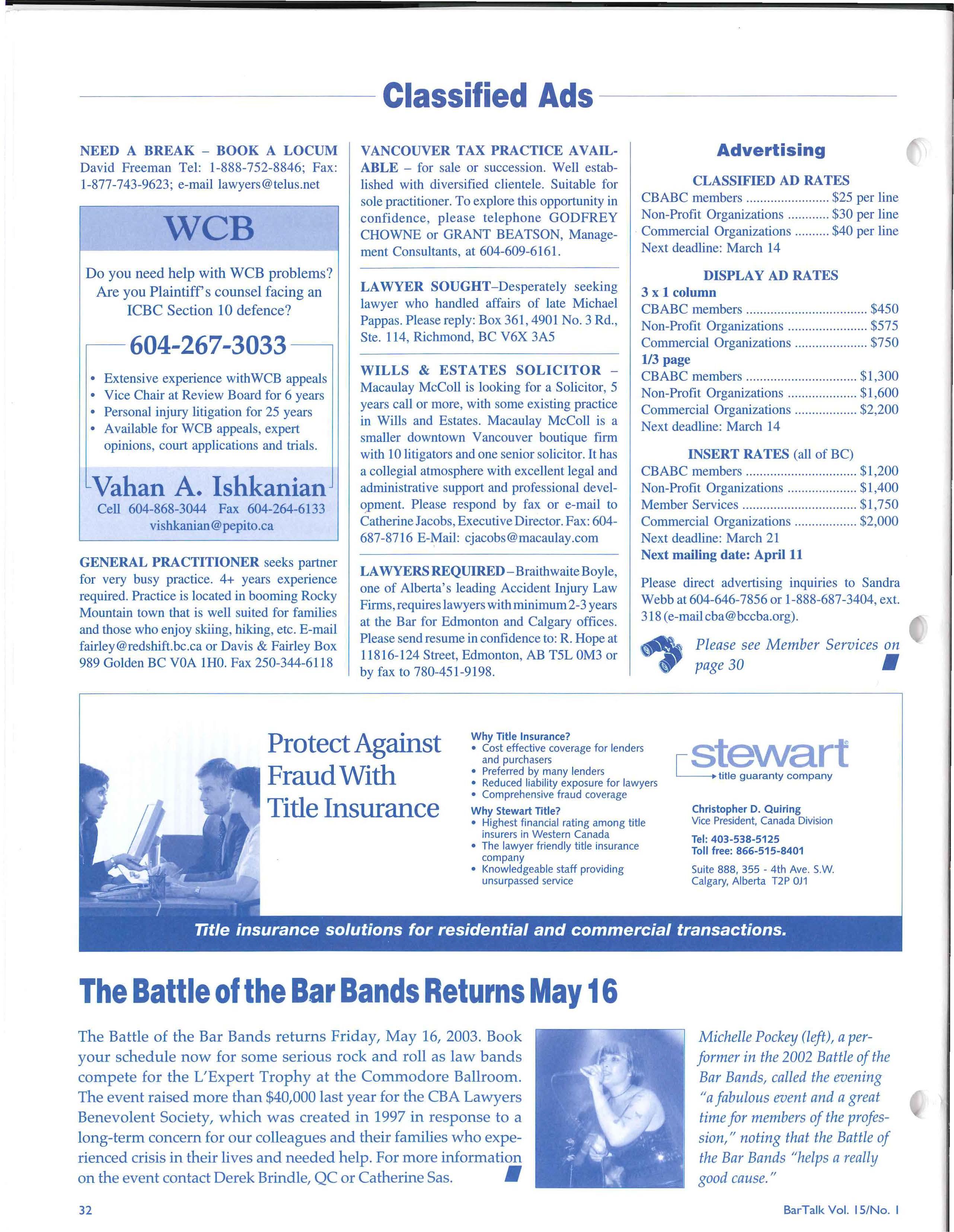
for lenders and purchasers
• Preferred by many lenders • Reduced liab ility exposure for lawye rs • Comprehensive fraud coverage Why Stewart Title? • Highest financial rating among title insurers in Western Canada • T he lawyer friendly t itle ins u rance company
• Knowledgeable staff providing unsurpassed service
The
Battle of the Bar Bands Returns May 16
The Battle of the Bar Bands returns Friday, May 16, 2003. Book your schedule now for some serious rock and roll as law bands compete for the L' Expert Trophy at the Commodore Ballroom. The event raised more than $40,000 last year for the CBA Lawyers Benevolent Society, which was created in 1997 in response to a long-term concern for our colleagues and their families who experienced crisis in their lives and n eeded help. For more information on the event contact Derek Brindle, QC or Catherine Sas •
Christopher D Qu i ring Vice Preside nt, Canada Division Tel: 403-538-5125 Toll free: 866-515-8401
Suite 888, 355 - 4th Ave. S W. Calgary, A l berta T2P OJ1
Michelle Pockey (left), a performer in the 2002 Battle of the Bar Bands, called the evening "a fabulous event and a great time for members of the profession," noting that the Battle of the Bar Bands "helps a really good cause "