The Canadian Bar Association British Columbia One Court for Family Law?
BC takes another look at UFC
The BC Justice Review Task Force, comprised of representatives of the Supreme Court, Provincial Court, Ministry of the Attorney General, Law Society (Chair), and CBABC Branch, recently released a discussion paper on the topic of creating a Unified Family Court (UFC). See www.bcjusticereview org.
At Family Law Section meetings throughout the province, members of the Task Force have been presenting the UFC concept and requesting feedback from members of the bar. The issue will also be discussed at the CBABC's annual meeting of Local and County Bar Presidents on December 6, and at Provincial Council on December 7. The Task Force is under timeline pressure: federal government budget priorities will be set early in 2003, and as this project requires and depends on a federal commitment of funds, there is some urgency to the Task Force's work.
In 1998, the federal government provided funding (in the form of UFC superior court justice appointments) to expand UFCs in Newfoundland, Ontario and Saskatchewan and to establish UFCs in Nova Scotia. Alberta has recently explored the idea, and has concluded that UFC should only be pursued if both levels of government are prepared to commit the resources needed to allow the UFC to do an effective job of managing family law matters.
The primary advantages of UFC, as identified in the Task Force report, include: potential savings in provincial court judge salaries (a rough example of opening seven UFC sites suggests a possible $2 million savings); and the ability to expand family justice services, paid for from the salary savings. Advantages to individuals
and families who access the family law system include: dealing with one court and one set of rules, rather than two levels of court for some aspects of their case; and having access to more comprehensive services, through family justice centers associated directly with the UFCs.
Although the consultations are not yet complete, there appears to be growing support among the bar. However, there are a few key questions which need to be resolved, including:
1. Given the potential savings in moving to UFCs, will there be an investment in restoring family law legal aid to ensure legal representation for those who need it? Unrepresented litigants are a growing concern in the courts, particularly when one party may be represented and the other not, there can be longstanding power imbalances, and the personal stakes in family law can be very high.
2. How will UFCs remove barriers to accessnot only geographic, but also procedural and financial- faced by litigants in superior courts? Technology, circuit courts, revised court rules and revised fee structures are all items that require an investment of financial resources and political will before provincial court can be removed as a family law option in some locations.
If you wish to provide input to the Task Force on this or any of the topics contained in the "Exploring Fundamental Change" discussion paper, visit www.bcjusticereview.org or contact the CBA or Law Society for a copy. •
David A. Paul
Tired of the Legal Aid Issue? You Bet. But
it's time to revive the debate
here are many issues before us as a profession, but perhaps the most important one facing us, both as lawyers and as members of Canadian society, is the issue of legal aid.
I know that there is fatigue on this issue. I know that many of us have fought hard for years and made every argument possible on the topic, as forcefully and passionately as civilized limits allow, to no avail. If anything, our legal aid system is in much worse shape now than at any time in my legal career. But that only heightens the need to speak out, in the face of the desperate need of those who require legal representation and cannot get it.
There are many men
must lead the way in fomenting that debate . As a society, we need to determine whether or not we are still committed to the founding principles of our system of justice - fairness , equality before the law, due process, the presumption of innocence until proven guilty, accessibility, and the right to legal counsel. When I look at the treatment of those without legal representation versus with it, I get a clear sense that those principles become less important in the eyes of some if there is a financial cost to society in putting them into practice
Lawyers are dedicated to upholding and protecting those principles every day There is a critical need for our society to re-examine the foundations of our justice system, and think and women in this province, not just the ones who make the news, who have had their hopes of legal representation eradicated with dire cuts to BC' s legal aid system. Increased provincial
In the middle lies a battlefield of hard about what the wounded families and individuals, principles mean in practice If they are still held to be important, each of us needs to tell those responsible for funding the justice system, both provincially lost in an imbalance of power with those who have the resources to use the justice system against them - including the government itself.
funding is denied on the basis that the federal government should be footing more of the bill; and the federal government won't step in because the provinces have argued vehemently for independence in spending, so there's no guarantee that more dollars to the provinces will result in a better justice system.
In the middle lies a battlefield of wounded families and individuals, lost in an imbalance of power with those who have the resources to use the justice system against them - including the government itself All this while close to $100 million dollars makes its way from paying clients' pockets to provincial coffers through a tax on legal services - a tax no other profession has to collect, nor any other lawyer in the country .
It's time to remind our politicians that they were elected to be leaders not just for economic gain, but for social improvement as well. They are the stewards of all that has come before, and while there is often an argument against maintaining the old ways of doing things, there is never an argument for abandoning the core principles that make a society worth living in
The legal aid system can and should be improved, but it won' t happen without a financial cost. Justice, real justice, with certain basic guarantees for every one of us, regardless of any lack of wealth or power, does not come for free - or at bargain basement prices •
It is clear to me that there is a major public discussion needed on this issue, and that lawyers and federally, that they must meet our expectations without finger pointing or political game playing. Put our money where we want it to go, because we are a lesser society without it.
So, what does CBABC do for members?
More than you might think
f you work in law, we work for you. The BC Branch exists to serve you, to promote the interests of the legal profession, monitor provincial legislation, advocate law reform, and provide legal service referrals and information to the public in a manner that enhances the image of lawyers .
As a member of the BC bar, you are also part of a national association of 37,000 lawyersensuring a strong voice on any national or provincial issue of concern to the profession As a CBA member, every practising lawyer in BC benefits from a strong, national organization of lawyers working for lawyers .
Thousands of CBA members throughout BC are involved in the Branch, through Committees, our active Sections, Provincial Council, and a variety of other volunteer contributions. Participation provides opportunities to interact with professional colleagues in a non-adversarial setting, and an invaluable way to be part of local and national discussions about current issues affecting the profession.
NETWORKING, INFORMATION SHARING &SKILLS ENHANCEMENT
One of the key benefits of be longing to a strong professional association is the ability to access the best in your business, through programs, activities and events that allow you to stay at the "top of your game" and to network with other lawyers.
Sections
The 72 Sections of the BC Branch connect you with others who share your interest in a particular area of law, and provide the opportunity to stay current on emerging issues. Sections are a resource for legislative review, law reform initiatives, media coverage, and in responding to the Law Society of BC on matters affecting the profession. Section members receive notices and minutes of the Sections for a nominal cost.
Branch Section meetings and their guest speakers produce many informative papers during the year, available either individually or as a set, at a nominal cost.
Annual Meetings and Forums
Two annual National CBA meetings occur every August and February. In addition, the BC Branch hosts annual President's Forums where knowledgeable individuals address current issues of concern. These events combine professional development with an opportunity to network with colleagues.
Practice Advisory Panels
Many Sections have established Practice Advisory Panels to provide practical advice, in substantive areas of law, to other lawyers. A list of volunteer panel members is published in the BC Branch Directory and online at www.bccba.org.
Mentor Program
Volunteer lawyers are matched with University of British Columbia and University of Victoria law students and participate in a variety of activities to increase student understanding of the legal profession and the practice of law.
Collegiality
CBABC co -sponsors events such as the Bench and Bar Dinner (with the Law Society of BC), the Annual Golf Tournament (with the Vancouver Bar Association), and other social events that bring lawyers and judges together in a relaxed atmosphere. The Branch's Member Dispute Resolution Committee is developing an informal process for members to resolve disputes and improve civility and collegiality within the profession.
Execut ive Director
BC Branch, Canadian Bar Asso ci ati o n
Once is never enough!
If yo u have changed firms, cha nged addresses, have a new e-mai l address or ph o ne/fax number, you need to let us know. Letting the Law Society in on the secret is not e nough!
C o ntact us at data@ bccba.org, pho ne 604687-3404 o r fax 604-669960 I. (Toil free options: phone 1-888-687-3404 or fax 1-877-669-960 I)
Frank Kraemer
Executive Director's Column
Conti nu ed from page 3
Local and County Bar Support
The CBABC provides support services to local and county bars, including electronic circulation of notices, hosting an annual Local and County Bar Presidents meeting with the Attorney General, Chief Justices, and other justice system partners, and publishing local bar events and accomplishments in BarTalk.
PUBLICATIONS/COMMUNICATIONS
Keeping members informed is a top priority of the CBABC. Most communication is through meetings of Provincial Council , Sections and Committees, visits to Local and County Bar Associations , publications , and the CBABC Web site .
Annual Report
The annual report highlights activities carried out during the fiscal year and contains audited financial statements . The publication provides an opportunity to review Section activities including speakers, special events and legislative and law reform efforts.
Bar News/Issue Alert
Timely bulletins are faxed or e-mailed to all members outlining issues affecting the profession.
BarTalk
Published six times per year, this newsletter includes "SectionTalk," "PracticeTalk," "Legislative Update," and guest columns. Articles address topical issues affecting the legal profession in BC. BarTalk is distributed to all BC Branch members, key government contacts, and news media.
BC Lawyers Telephone, Fax &Services Directory
This annual publication lists all BC lawyers both alphabetically and geographically, as well as law related organizations, courts, judges, commissions and profe ssional services For
the fir s t time, this invaluable resource will b e published in CD-ROM format in January 2003.
Surveys
The CBABC conducts annual surveys in co -operation with the Vancouver Association of Legal Administrators, to provide important information about salaries and benefits for BC legal administrative staff and lawyers .
Media Contacts Guide
The CBABC publishes in print and online, a list of key media contacts for reporters looking for background information and commentary on legal issues of the day These are primarily Section Chairs and Executive members who have volunteered to be available to help increase accuracy in reporting, and to promote the interests of the profession.
Lawyers Guide to the Media
A concise, eight-page booklet of media relations tips and strategies is free to any member on request . For those in the legal profession who are the focus of media attention, the CBABC also offers access to the Director of Communications for advice at any time by phone or e-mail.
Web site
The CBABC Web site is a members-only site with access to Section minutes and papers, CBA information, job listings and resume postings, news of interest to the legal profession, a calendar of events, Council and Executive Committee minutes, searchable archives of BarTalk and an online Members' Directory. Members-only bulletin boards, chat rooms and virtual meeting rooms are also available (see related article on page 26).
IMPROVING PUBLIC UNDERSTANDING AND ACCESS TO THE JUSTICE SYSTEM
The CBABC op erat es several programs designed to inform th e public about the law , legal services , and the benefits of seeking legal advice when problems arise. Branch members actively participate in these programs , cont ributing to a better public und erstandin g of th e law and the profess ion.
Dial-A-Law
The CBABC has operated the free Dial-A-Law information service since 1982, assisted by financial support from the Law Foundation of BC. Dial-A-Law provides province-wide, 24hour, toll-free telephone and Web site access to more than 130 scripts containing basic information on a wide range of legal topics Volunteers review scripts on a regular basis to ensure that they are current and accurate.
Lawyer Referral
Many Branch members are enrolled in Lawyer Referral, a provincial service administered by CBABC and funded by the Law Foundation of BC. Individuals who think they may have a legal problem are referred to a participating lawyer who provides an interview of up to half an hour for a $10 fee.
Law Week
Each year several thousand British Columbians receive information on the law and the legal profession through Law Week activities, coordinated by the CBABC. Activities include a "Dial-A-Lawyer" program, law court open houses, public speaking and essay competitions, mock trials, displays in libraries and schools, visits to the classroom by lawyers, and special features in the media .
Image of Lawyers
The CBABC works to educate the public, promote the legal profession and defend the independence of the judiciary. Through the national Lawyers Care Initiative, client relations materials have been developed in BC and used throughout the country to promote the relationship between clients and lawyers. Posters have been developed and distributed to all secondary schools in BC, to encourage students to re-examine their perceptions about lawyers and to educate themselves about the legal profession.
A VOICE IN IMPROVING BC'S JUSTICE SYSTEM
A strong provincial and national Association means a strong voice in all that impacts upon our
profession and the justice system With 10 , 000 members, the CBABC is listen ed to by government, the media , and th e public.
Committees
Members serve on 28 Branch standing and special committees, including Equality, Solicitors Practice Issues, Legal Aid and Automobile Insurance, to name but a few The Branch also appoints representatives to society boards, including the BC Courthouse Library Society, CLE, and the Law Foundation of BC.
Government Relations
The Branch often makes presentations to the government on issues of concern to CBA members The Government Relations Committee plays an important role in this, helping the Branch promote a better working relationship with members of government, official opposition and senior bureaucrats.
Legislation and Law Reform
The Branch actively promotes the development of good, practical laws. The Legislation and Law Reform committee is an avenue for members to help the provincial government ensure that legislation is understandable, workable and fair, and does not violate the rule of law. Through legislative review and law reform activities, the CBABC contributes to the administration of justice in BC. Last year, more than a dozen formal submissions were prepared by the Branch.
RECOGNIZING EXCELLENCE
The CBABC recognizes and publicly promotes significant achievements and significant contributions to the profession and society by members.
Community Service Awards
CBABC Community Service Awards annually recognize the valuable contributions of our members who serve our communities. The award recognizes CBA members who have demonstrated outstanding dedication, service and commitment to the community in each of the eight provincial counties
Executive Director's Column
Join the Banff Bus Tour!
Want a low stress, low cost, high fun-factor way to get to the Mid-Winter Meeting in Banff? Jo in the CBA Express , a luxury motor coach leaving Friday morning, Fe bruary 14, arriving back in Vancouver Sunday night Total cost for the two -way trip : an amazing $100, including all taxes and on-board movies!
The CBA Express will QDJx leave if there are enough people who tell us in advance they are in terested in climbing aboard Please contact Kris Johnson at 604687-3404, extension 500 or e-mail kjohnson@bccba org
We need 45 seats committed before January I0, so please don 't wait to let us know
Executive Director's Column
Continued from page 5
Georges A. Goyer, QC Memorial Award
This award for distinguished serv ice recognizes exceptional achievements in the law and is presented at the annual Bench and Bar Dinner.
President's Medal
The BC Branch President's Medal annually recognizes one or more of the following: legal academic proficiency, outstanding works of legal scholarship, significant contribution to the profession, or noteworthy contribution to Canadian public life .
Student Awards
A monetary award is presented to the law student who best exemplifies CBABC ideals at the University of British Columbia and the University of Victoria Criteria include student participation in activities supporting members of the profession, promotion of justice and law reform, equality, and demonstration of public and community service. Winners are selected by CBABC and law school representatives
New Awards
Two new awards have been approved, and the Awards Committee is currently developing criteria and selection processes for each One will recognize contributions in the area of pro bono work, and one will recognize contributions to issues of equality and diversity.
MEMBER SERVICES
The CBABC Member Services Committee and Branch staff work hard to evaluate proposals and to monitor existing suppliers of goods and services to the legal profession. Member Services provide direct benefits to lawyers through
qualit y p ro duct s, d is co unt s, an d fundin g of oth e r Br an ch progr a ms and a ctivitie s . M e mb e rs have acces s to special discounts and quality service through suppliers of auto leasing, banking, t e leconfere ncing, hotels, entertainment, legal support services and office supplies, insurance, business consulting and lawyer recruitment services .
FINANCES
CBABC provides all of these programs and serv ices from membership fees and other sources of revenue. The graphs below set out the Br anch ' s revenue and expenses for the current fiscal year, based on the budget approved by Provincial Council at its June 2002 meeting
If you are interested in participating in any of CBABC's programs , please contact the Branch office at 604-687-3404 or toll fre e 1-888-687-3404 (e-mail cba@bccba org) •
The BC Branch sponsors 72 Sections which play a vital role in keeping members informed on both changes in the law and legal and political issues affecting a given area of practice. They are the main resource utilized by the BC Branch in legislative review, law reform initiatives and in responding to matters affecting the profession What follows is a sample of the recent activities of some Sections .
BUSINESS AND CORPORATE COUNSEL (JOINT MEETING)
The new British Columbia Business Corporations Act was on the agenda as John Lundell from Lawson Lundell and Jill Sinkwich from the Financial Sector and Corporate Policy Branch described the primary policy objectives and gave details of the significant changes introduced by the new Act
Under the current Act a company's articles are contractual and allow companies the freedom to determine their own internal rules of conduct. The new Act will use the current "contract model" but will permit the rules to be changed more easily and to a greater extent than under the current Act. Provisions enhancing flexibility will be adopted particularly in the areas of corporate governance, corporate finance and fundamental corporate changes.
Another goal of the new Act is to reduce the regulatory burden on companies. It will require fewer filings at the corporate registry, remove overlap with the Securities Act, and remove the need to obtain the Registrar's permission for postponing annual general meetings or holding general meetings outside BC. It will remove unnecessary rules such as the requirement that companies have officers and that the company's president be a director.
The new Act will enable automation of the corporate registry by allowing certain records to be filed and corporate reorganizations to b e effected on a 24-hour-a-day basis
COMPUTER LAW
Nick Batistic, a senior insurance broker who specializes in technology, discussed technology, intellectual property and cyber risk related insurance. He identified six types of insurance coverage:
• Commercial/Comprehensive General Liability Insurance: Coverage for some Web site-related risks may be provided under "advertising injury" or "personal injury" clauses.
Infringement Abatement Insurance: This type of insurance helps cover the cost of enforcing patent, copyright and trademark rights.
Multimedia Professional Liability Insurance: This is errors and omissions coverage for publishers, broadcasters and software designers .
• • • • Intellectual Property Infringement Insurance: This is specifically aimed at defending an infringement action.
Internet Security Liability Insurance: This provides coverage for loss of money or electronic funds resulting from data theft.
• Trade Secret Insurance: This protects against loss of revenue resulting from theft of trade secrets, including theft by exemployees.
ENVIRONMENTAL
The Advisory Panel on Contaminated Sites invited Environmental Law Section members to provide comments on its Interim Report to the Ministry The Panel characterized the curr ent legislative regime as problematic for the allocation of diminishing ministerial resources It warned that if wholesale changes are not made to the Wast e Managem ent A ct and the
Shelley Bentley
Shelley Bentley is in private
pra ctice at G. Davies & Company
Section Talk
Continued from page 7
Contaminated Sites Regulation the currently unbearable delays will become worse .
The Panel advised that it is considering redefining the term "contaminated site" to one involving a two-step determination process. Whether a site meets the definition would first depend on the application of a numerical standard and second on an assessment of risk. This would mean that low risk sites would not be considered contaminated and hence remediation would be voluntary. A number of Section members commented that this redefining would result in increased litigation
To address problems created by staff cutbacks the Panel is recommending an independent system of licensed environmental professionals (LEP's) be established to allow resources to be focused on high-risk sites. These professionals will be multi-dis ciplinary professional engineers whose professional membership fees will assist in paying for the management of the qualification process
The Panel is recommending that cost recovery actions be either eliminated from the Act or limited to high-risk sites. Alternative dispute resolution will be recommended as the sole method for resolving disputes over contaminated sites in BC. A number of Section members expressed concern over this decision in light of the fact that ADR lacks a discovery mechanism and a precedent system and is only binding on parties in the absence of an error of law
The Panel informed the Section that by 2004/ 2005 the provincial government would no longer allocate money from general revenue to manage contaminated sites . Suggested alternative sources of funding are a wholesale tax or industry sponsored levy on gas and underground storage tank registration fees .
TAXATION
Peter Wong from Boughton Peterson Yang Anderson set out several structures for setting up professional practices using co-ownership
arrangements and corporate partnerships He revealed a sample CCRA ruling for a proposed structure designed to optimize flexibility and control on the part of individual professionals in determining hours of work, vacation and expenses incurred. The structure allows each professional to see a direct result between effort and time put into the practice and earnings, as well as to provide more options for estate planning and improve the position of each professional with respect to joint liability His paper can be ordered through the CBABC.
WILLS AND TRUSTS-VANCOUVER
Noreen Brox commented on Hall Estate v Marshall (2002 BCSC 893) in which costs were awarded personally against the executrix who brought an action seeking a determination that funds formerly held in a joint account were held on a resulting trust. The Court examined the relationship of the joint account holders, as well as evidence of the contribution and intent with respect to ownership of funds in the joint account. The Court observed that the absence of a conjugal relationship between the Deceased and Mr . Marshall was immaterial except perhaps as to the applicability of a presumption of advancement and resulting trust but noted a recent trend in case law to rely less on presumptions and more on evidence of actual intention . Of significance to the Court was the evidence of the close, caring relationship between the Deceased and Mr Marshall, as well as the fa ct that they had both made substantial contributions to the account and used the account for shared expenses. The action was dismissed with costs The executrix applied to vary the costs award on the basis that there had been a valid issue for the determination, the executrix had not stood to benefit personally and there was no estate to bear the costs. Her application was dismissed on the basis that "no order as to costs would deprive the successful defendants of their costs, despite the fact they offered to settle " The defendants then applied for an order to enforce the costs award against the plaintiff personally and were successful.
•
It's never to lat e to join Sections Contact the CBABC for a registration form or download one from www bccba.org. •
David J. Bilinsky is the Practice Management Advisor at the Law Society of British Columbia He can be reached on the Internet at dbilinsky@lsbc.o rg
T he views expressed herein are strictly those of the author and may not be shared by the Law Society of British Columbia
Practising by the Numbers Finance's Role in the Law Firm of the Future ...
Nothin ' from nothin' leaves nothin'
You gotta have somethin' if you wanna be with me
Nothin ' from nothin ' leaves nothin' You gotta have somethin' if you wanna be with me
Words and music written by Billy Preston and Bruce Fisher, recorded by Billy Preston
t is nearing financial year-end again and you will soon see your annual finance statements. With a sinking heart you look at the calendar and see circled in red the upcoming partners meeting to discuss this year's financial results Despite all attempts at improving your firm's performance over the last year, your efforts have not resulted in any major changes. Gazing upwards at the heavens, you wonder aloud if there isn't a better way of doing things
CFO Research Services in collaboration with Cap Gemini Ernst & Young have just released a paper entitled "CFOs: Driving Finance Transformation for the 21"1 Century" on the Internet (www. us. cgey .com I news I current_ news.asp?ID=249) and it provides food for thought for anyone wanting to increase the financial performance of their business. In their study, they looked at companies such as Allergan, American Express, Chevron Phillips, GE Capital, and Intel. The results set out in the paper are instructive when applied to lawyers and law firms :
• The top three priorities for the companies seeking to make their finance departments more responsive to the needs of the business were: accuracy of earnings and revenue forecasts, operational decision support and formulation of corporate strategy. Aside from hourly billing targets, how many law firms engage in revenue forecasting? How
many go further and compare expected vs actual results on a file-by-file basis? How many determine quantitatively if it is viable to maintain services in a legal area or move to a more profitable niche?
• The study found that in' cautious observer' companies, 46 per cent of finance's time is spent on transaction processing while in 'leader' companies, 24 per cent of finance's time is spend on these processes. In fact, the top four matters outsourced were: payroll, benefits, tax processes and internal audit. The four matters kept internally were: planning and budgeting, cost accounting, reporting, and cash management. How many law firms free up time for finance to work on higher, va lue-added analysis, by contracting out the basic accounting commodity processing?
• Leader companies developed dynamic budgets and forecasts based on operational drivers while cautious observer companies developed long-termline-item budgets and static forecasts. The implication seems clear - leaders had taken the time to integrate their accounting IT systems with other office systems to a point where they were able to deliver real-time, accurate financial information to management. How many firms have lawyers using case management systems that are integrated into their accounting system to provide accurate, realtime data?
• How many firms can determine whether any particular file in the office was profitable? Here we are not talking about fees collection, but determining the total of direct and allocated costs (commonly
Lawyers Assistance Program
LAP provides confidential support, counselling and referrals for lawyers, their families, support staff, judges and students suffering from alcohol and/or chemical dependency, stress, dep ression or just about any type of personal problem
For assistance or information on meetings and resources please ca ll 604-6852171 or toll free 1-888-685-2171.
The LAP office is located at 41 5-1080 Mainland Street, Vancouver, BC V6B 2T4
Practice Talk
Continued from page 9
known as the Costs of Services Rendered). Without hard data on the number of hours worked on a file and the file's share of office overhead including staff time, you would be hard-pressed to determine what a file cost the firm . Most firms simply look at the gross revenue generated at the conclusion of a file, but this can be misleading . For example, let us look at two files, each of which generated $100,000 in revenue (after disbursements). File A took three years and involved 400 hours of legal time (at $250/ hr = $100,000) +hundreds of hours of staff time. File B took six months and 100 hours of legal time (at $250 /hr = $25,000) and the same amount of staff time. Which file was more profitable? Not only was B more profitable, you could argue that File A resulted in a net loss to the firm since the total of legal and staff costs exceeded revenues. Yet, inmosteat-what-you-killsystems, each file would be treated equally when it comes to determining partner compensation! Financial analysis can help you determine which files and practice areas yield the greatest return to the firm and which are black holes.
Cautious observers were also likely to have transaction systems that were mostly legacy and non-integrated. By comparison, the increasing trend in legal software is to integrate accounting software into other office systems such as case management, among others. Forward thinking software developers realize that lawyers need to track and post all costs dynamically from the office systems directly into the financial system as well as have fingertip access into the analysis that is enabled by the integrated financial system
The biggest barriers to achieving finance transformation were : building the necessary employee skills, implementing the right enabling technology, building business unit support and ensuring senior management support. Contrast this with the perception th a t the accounting department eats
re source s and should be carefully managed to minimize expenses . Reality : devotin g resources to build, staff, and maintain the finance system results in big payoffs
Furthermore, successful transformations were deeply tied to cultural and human issues such as: developing new skills in the finance department (since you are moving from a reporting to a forecasting skill set), getting the support of senior management, and convincing business unit heads (such as other partners) to support the project. As with so many other projects in a law firm environment, ultimately it is the people side of the equation that determines success
What can you expect from a transformed finance department? The study found that reformed finance departments were active in strategic activities characterized as profitability analysis, partnering decisions, pricing decisions and demand forecasting. Part of this transformation involved developing financial and non-financial measures to support the implementation of strategy . Hillenbrand Industries was cited in the study as developing the following measures: financial (revenue growth, asset utilization and profit margins), customer (customer retention and revenue from key customers), process (logistics, research and development) and organizational learning (talent redeployment and business transformational activities) .
The paper found that, in the handful of companies that have transformed their finance departments, the results that they have achieved have been worth the effort. These companies reported that they achieved a lower cost of finance and more importantly, a greater strategic contribution from their finance departments Once success was demons trated, the project met with greater support as people began to see the value the change was creating.
Informational processing has brought powerful financial anal y sis tools within the grasp of the present-day law firm. Such analysis can result in more than just a lot of nothing left over at the end of the day
•
Stuart Rennie Stuart Rennie is the CBABC Legislation & Law Reform Officer. He can be reached at 604-949-1490 (e-mail srennie@bccba.org).
Every effort is made t o ensure the accuracy of the info rmation pro vided to you in this article but the information should not be relied upon. Lawyers should refer to the specific legislative or regulatory provision You will see a referen ce in some cases to the number of the Bill when it was introdu ced in the House. This number may be different from the chapter number of the new Act which is quoted after the title of the Act and which is the proper citation for the Act. The Bill Number has been given to you to make it easier for you to note up the Bills you may have in yo ur library.
Additional detail on the Legislative Update can be found in the online issue of the December BarTalk, posted at www.bccba.org.
ACTS IN FORCE
Deregulation Statutes Amendment
Act (No. 2), S.B.C. 2002, c. 25 (Bill 35)
Amended: Amends 19 statutes
Transitional Provisions: Health Research
Foundation Act and Hospital Act
Statutes Repealed: Health Research Foundation Act, R.S.B.C. 1996, c. 184 and Part 3 of the Hospital Act, R.S.B.C. 1996, c. 200
Summary: Sections 1 to 5 of Bill 35 amend the Barbers Act, R.S.B.C. 1996, c. 24 to: remove the Minister from appointing members to the Board of Examiners in Barbering, hearing appeals from actions and decisions of the Board of Examiners in Barbering and receiving certified returns from the association; and remove the Lieutenant Governor in Council from authority respecting the administration and enforcement of the Barbers Act and the making of rules by the Barbers' Association of BC. Sections 9 to 17 amend the Cosmetologists Act, R.S.B.C. 1996, c. 178 to: remove the Minister from appointing members to the board, hearing appeals, receiving a certified return of the association's affairs; remove the Lieutenant Governor in Council including from prescribing fees and approving the appointment of inspectors.
In Force: Sections 1 to 5 and sections 9 to 17 in force September 12, 2002
ment Act, 1997, S.B.C. 1997, c. 15, Cemetery and Funeral Services Act, R.S.B.C. 1996, c. 45, Chi ld Care BC Act, S.B.C. 2001, c 4, Community Care Facility Act, R.S.B.C. 1996, c. 60, Criminal Injury Compensation Act, R.S.B.C. 1996, c. 85, Debtor Assistance Act, R.S.B.C. 1996, c. 93, Evidence Act, R.S.B.C. 1996, c 124, Family Maintenance Enforcement Act, R.S B.C. 1996, c. 127, Family Rela t ions Act, R.S.B.C. 1996, c. 128, Freedom of Information and Protection of Privacy Act, R.S.B .C. 1996, c. 165, Hospital Act, R.S .B.C. 1996, c. 200, Vancouver Charter, S B.C. 1953, c 55
Transitional Provisions: Interpretation Act, regulations, status of recipient s under former Act, and appeals
Statutes Repealed: BC Benefits (Appeals) Ac t, R.S.B.C. 1996, c. 25, BC Benefits (Income Assistance) Act, R.S.B.C. 1996, c 27, BC Benefits (Youth Works) Act, R.S.B.C. 1996, c. 28
Summary: Bill 26 replaces and repeals the BC Benefits (Appeals) Act, BC Benefits (Income Assistance) Act and BC Benefits (Youth Works) Act. Bill 26 creates an employment assistance regime where applicants, who have completed two years of employment or employment insurance, qualify for income assistance and must enter into and comply with the conditions of an employment plan, including participation in government employment-related programs.
In Force: Act in force September 30, 2002 except sections 12, 14 (2) (b), 35 (2) (m) and (n) and 62 which come into force by future regulation.
Employment and Assistance Act, S.B.C. 2002, c. 40 (Bill 26)
Amended: Consequential amendments made to the: BC Benefits (Child Care Subsidy) Act, R.S .B.C. 1996, c. 26, BC Benefits Statutes Amend-
• Employment and Assistance For Persons With Disabilities Act, s.B.c. 2002, c. 41 (Bill 27)
Amended: Consequential amendments made
Community Service AwardsDon't Miss the Deadline!
December 31 is the deadline for nominating a lawyer in your community for a CBABC Community Service Award in your county Ensure your colleagues are recognized for their contributions , with local and media profile for the good work they do Call the CBABC for a nomination form or download the form from www.bccba.org
Legislative Update
Continued from page I I
to the: BC Benefits Statutes Amendment Act, 1997, S.B.C. 1997, c. 15, Community Care Facility Act, R.S B.C. 1996, c. 60, Criminal Injury Compensation Act, R.S .B.C. 1996, c. 85, Debtor Assistance Act, R.S.B.C. 1996, c. 93, Evidence Act, R.S B.C. 1996, c. 124, Family Maintenance Enforcement Act, R.S .B.C. 1996, c. 127, Family Relations Act, R.S.B.C. 1996, c. 128, Home Owner Grant Act, R.S B.C. 1996, c. 194, Hospital Act, R.S .B.C. 1996, c. 200, Land Tax Deferment Act, R.S.B.C. 1996, c. 249, Motor Fuel Tax Act, R.S B.C. 1996, c. 317
Transitional Provisions: Interpretation Act, regulations, status of recipients under former Act, and appeals
Statutes Repealed: Disability Benefits Program Act, R.S.B .C. 1996, c. 97
Summary: Bill 27 replaces the Disability Benefits Program Act. Bill 27 creates a disability assistance regime where applicants who qualify for disability or hardship assistance must enter into and comply with the conditions of an employment plan, including participation in government employment-related programs.
In Force: Act in force September 30, 2002
In Force: Act in force October 28, 2002
See also Regulations To Note and Acts In Force for the Miscellaneous Statutes Amendment Act (No. 3) , 2002, S.B.C. 2002, c. 63 (Bill 62)
Lobbyists Registration Act, s.B.C. 2001, c. 42 (Bill 20)
Amended: Consequential amendments made to the Freedom of Information and Protection of Privacy Act, R.S.B.C. 1996, c. 165
Transitional Provisions: None
Statutes Repealed: None
Summary: Bill 20 requires registration and regulation of paid lobbyists . Lobbyists, on contract or are regular employees of an organization, are required to provide disclosure to the registrar of the registry. The registrar of lobbyists is the Information and Privacy Commissioner who will have powers to enforce the provisions of the Act.
Miscellaneous Statutes Amendment Act (No. 3), 2002, S.B.C. 2002, c. 63 (Bill 62)
Amended: Amends 13 statutes
Transitional Provisions: Motor Vehicle Act regarding driving prohibitions
Statutes Repealed: Special Appropriations Act, R.S.B.C. 1996, c 437
Summary: Section 9 of Bill 62 amends the Freedom of Information and Protection of Privacy Act, R.S.B C. 1996, c. 165 to require that, for committee deliberations to be protected by Cabinet confidentiality and not disclosed to the public under the Act, the government can designate any government committee to be a Cabinet committee where at least one third of Cabinet committee members are members of these designated committees and that these designated committees be designated by regulation. This amendment comes about as a result of the Information and Privacy Commissioner decision in Office Of The Premier & Executive Council Operations And Ministry Of Skills Development & Labour (July 26, 2002) [2002] B C.I.P.C.D No 38.
In Force: Section 9 in force November 1, 2002
See also New Bills to Note
Miscellaneous Statutes Amendment Act (No. 2), 2002, S.B.C. 2002, c. 48 (Bill 54)
Amended: Amends 26 statutes
Transitional Provisions: Liquor Appeal Board under Liquor Control and Licensing Act and Liquor Distribution Act
Statutes Repealed: Schedule to the Job Protec-
tion Act, R.S B C. 1996, c 240
Summary: Sections 30 to 35 amend the Legislative Assembly Management Committee Act, R.S.B .C. 1996, c. 258 to transfer the authority for use and security of the grounds of the Legislative Assembly to the Speaker of the Legislative Assembly . Section 57 amends the Ministry of Transportation and Highways Act, R.S B.C 1996, c 311 to make a consequential amendment as a result of the amendments to the Legislative Assembly Management Committee Act
In Force: Sections 30 to 35 and 57 in force October 11, 2002
Office For Children and Youth Act, S.B.C. 2002, c. 50 (Bill 43)
Amended: Consequential amendments to the : Child, Family and Community Service Act, R.S.B C. 1996, c. 46, Coroners Act, R.S.B.C. 1996, c. 72, Freedom of Information and Protection of Privacy Act, R.S.B C. 1996, c 165
Transitional Provisions: Child, Youth and Family Advocacy Act, R.S.B.C. 1996, c. 47 and Children's Commission Act
Statutes Repealed: Child, Youth and Family Advocacy Act, R.S.B.C. 1996, c. 47 and Children's Commission Act, S.B.C. 1997, c. 11
Summary: Bill43 replaces the Child, Youth and Family Advocacy Act and the Children ' s Commission Act. Bill 43 provides for the appointment of the child and youth officer, whose functions are to provide support to children, youth and their families in obtaining services funded or provided by government. Bill 43 also requires the child and youth officer to undertake investigations with the same powers that the Supreme Court has for the trial of civil actions, provides protection for information accessed and collected about children and youth and requires a comprehensive review of the Act five years after it come s into force .
In Force: Act in force September 30, 2002
Securities Amendment Act, 2002, S B C. 2002, c. 32 (Bill29)
Amended: Securiti es Act, R.S.B.C. 1996, c 418. Consequential amendments made to the: Company Act, R.S.B C. 1996, c. 62 and Members' Conflict of Interest Act, R.S.B C. 1996, c 287
Transitional Provisions: None
Statutes Repealed: None
Summary: Bill 29 makes amendments to the Securities Act. Section 25 of Bill 29 creates a cause of action for damages or rescission for investors against an issuer and other related persons if the securities were issued under an exemption from the prospectus requirement and the required disclosure documents contain a misrepresentation. Section 26 creates a cause of action for damages or rescission for investors against an issuer that has issued securities under an exemption from the prospectus requirement but has failed to deliver the required disclosure documents to the investor Section 27 further allows investors two days after signature to rescind an agreement to purchase securities.
In Force: Sections 25 to 27 in force September 20, 2002
See also Regulations To Note under Securities Act for B.C. Reg. 260/2002
REGULATIONS TO NOTE
Lobbyists Registration Act creates the Lobbyists Registration Regulation which deems receipt of returns to the registar and which requires persons registering under the Act to pay a $150 fee for each separate contract a lobbyist undertakes, $150 annually for in-house lobbyists employed for businesses that operate for profit and $150 annually for senior officers of not-for-profit organizations who must register semi annually, paying $75 each time (effective October 28, 2002 B C. Reg 284/2002).
Securities Act creates the Multilateral Instrument 81-104 Commodity Pools to regulate publicly offered commodity pools (specialized publicly offered mutual funds that invest be-
Family Law Judgments at the BC Courthouse Library Society
The Supreme Court of BC recently decided to discontinue the pub lication of family law judgments on the Court Web site, except for a small number of judgments deemed to have precedent va lue. Since September 3, 2002, the BCCLS has received and stored all family Jaw judgments directly from the Supreme Court of BC. These unreported decisions are availab le to users for copy requests at $ 60 per page.
The BC Courthouse Library Society is in the process of creating a web-based fulltext searchab le database, to be made available to members of the Law Society through their Web site. The database shou ld be available by early 2003 Please contact the Vancouver Courthouse Library Reference Section regarding the Supreme Court of BC fami ly Jaw judgments, at 604-6602821, toll free at 1-800-665-2570 (e-mail bccls@bccls bc.ca)
Legislative Update
Continued from page 13
yond that permitted for conventional mutual funds) (effective November 1, 2002, B.C. Reg . 283/2002) and amends B.C. Reg 194/97 Securities Rules to prescribe civil liability provisions arising out of the operation of Part 4 of Multilateral Instrument 45-103 Capital Raising Exemptions (effective September 20, 2002, B.C. Reg 260/2002).
NEW BILLS TO NOTE
Information is current at the time of preparing this article: November 8, 2002. Lawyers should refer to the original version of the specific Bill for its current status at First, Second or Third Reading or Royal Assent.
Business Corporations Act, s.B.c. 2002, c. 57 (Bill 47)
First Reading: May 8, 2002
Royal Assent: October 31, 2002 (no amendments)
Amended: None
Transitional Provisions: Pre-existing companies regarding alteration of articles, registered and records office, name of specially limited company and head office and attorney for preexisting companies
Statutes Repealed: Company Act, R.S.B.C. 1996, c. 62 and Company Act, S.B.C. 1999, c. 27 (Bill85)
Summary: Bill47 was introduced in May 2002 as an exposure bill for public comment. Bill 47 is comprehensive company law reform, repealing and replacing the Company Act, R.S.B.C. 1996, c. 62 and Company Act, S.B.C. 1999, c 27 (Bill 85). Bill 47 makes changes to company law and procedure including amendments to provisions regulating: directors, finance, corporate governance and registry procedures.
In Force: By regulation
Community Services Interim Authorities Act, s .B.C. 2002, c. 58 (Bill65)
First Reading: October 21, 2002
Royal Assent: October 31, 2002 (no amendments)
Amended: None
Transitional Provisions: None
Statutes Repealed: None
Summary: Bill65 permits the Minister of Children and Family Development to create five Aboriginal authorities; five interim regional governance authorities; and one interim provincial community living authority to prepare for the establishment and operation of new permanent authorities. These will provide some or all of community services currently in place. These interim authorities are to prepare for the establishment and operation of new permanent authorities which will provide some or all of administrative services in place of the Ministry. These administrative services include legal services. Bill 65 provides for the structure of and appointment to these interim authorities. The Company Act and the Company Clauses Act do not apply to an interim authority, subject to future regulations that may determine that these Acts apply
In Force: On Royal Assent •
Drinking Water Protection Amendment Act, 2002, s.B C. 2002, c. 59 (Bill61)
First Reading: October 8, 2002
Royal Assent: October 31, 2002 (no amendments)
Amended: Drinking Water Prot ection Act, S.B.C. 2001, c. 9 (Bill 20)
Transitional Provisions: None
Statutes Repealed: None
Summary: Bill 61 amends the Drinking Water Protection Act to regulate drinking water systems in BC including to: transfer the duties of provincial drinking water coordinators to the provincial health officer those duties will be determined by the Minister and to provide express authority for an issuing official to include terms and conditions in a construction permit regarding a water supply system construction, installation, alteration or extension; and permit regulations to be made regarding reconsiderations and reviews and appeals
In Force: On Royal Assent
Election Statutes Amendment Act,
2002, S.B .C. 2002, c. 60 (Bill 59)
First Reading: May 29, 2002
Royal Assent: October 31, 2002 (no amendments)
Amended: Election Act, R.S.B.C. 1996, c 106 and Recall and Initiative Act, R.S.B.C. 1996, c. 398
Transitional Provisions: None
Statutes Repealed: None
Summary: Bill 59 amends the Election Act and Recall and Initiative Act to: repeal the $5,000 limit restrictions on third-party advertising during election campaigns; delete the requirement to publish detailed information about political opinion surveys (that requirement was held to be unconstitutional by the BC Supreme Court for violating the right under the Charter to freedom of expression); ban donations from charitable organizations to political parties for elections or recall campaigns but not for initiative campaigns; require the disclosure of any donation of labour during an election or recall campaign where the individuals donating their services and time are being compensated by employers (this ban does not apply to volunteers who provide their time or services without compensation).
In Force: On Royal Assent
Health Authorities Amendment Act, 2002, S.B.C. 2002, c 61 (Bill 60)
First Reading: October 7, 2002
Royal Assent: October 31, 2002 (no amendments)
Amended: Health Authorities Act, R.S.B.C. 1996, c. 180. Consequential amendments made to the: Criminal Records Review Act, R.S.B.C. 1996, c. 86, Freedom of Information and Protection of Privacy Act, R.S.B.C. 1996, c. 165, Ombudsman Act, R.S.B.C. 1996, c. 340, Property Transfer Tax Act, R.S.B .C. 1996, c. 378
Transitional Provisions: None
Statutes Repealed: None
Summary: Bill 60 amends the Health Authorities Act to delete references to community health councils and community health service societies which are unnecessary following the government's reorganization in 2001 of 52 health authorities into five regional health authorities and one provincial health service authority.
In Force: By regulation
Human Rights Code Amendment Act, 2002, S.B.C. 2002, c. 62 (Bill64)
First Reading: October 21, 2002
Royal Assent: October 31, 2002 (amended)
Amended: Human Rights Code, R.S B C. 1996, c. 210. Consequential amendment made to the Freedom of Information and Protection of Privacy Act, R.S.B C. 1996, c. 165
Transitional Provisions: Complaints filed with the commissioner of investigation and mediation
Statutes Repealed: None
Summary: In May 2002, the government introduced for public comment the exposure bill, the Human Rights Code Amendment Act, Continued
It's a launch! VBA has new Web site
The Vancouver Bar Association is pleased to announce the lau nch of their Web site (www vancouverbar.ca), coinciding with their I IO'h anniversary.
The Web site provides a handy resource for VBA members, offering current information about the many activities, events and programs sponsored by the Association Site features include:
• Description of the VBA History of the VBA
• VBA event information and calendar (interact ive) Articl ing Interview Guidelines
• Membership form Executive information Committee information
Li nks to law fi r ms , co u rts, other bar associations, law societies and law libraries.
Legislative Update
Continued from page 15
2002 (Bill 53) (First Reading May 30, 2002). Bill 64 is the government's response to public comment received from Bill 53 as well as government's review of Bill 53. Bill 64 amends the Human Rights Code, including to eliminate the Human Rights Commission, Human Rights Advisory Council and all references to the commission and the commissioner of investigation and mediation regarding filing complaints, mediations and settlements, and replaces them with references to the tribunal. Bill 64 also eliminates investigations and makes the Minister responsible for developing and conducting public education and information programs, and permits the Minister to conduct research and consultations.
In Force: By regulation
•
Lobbyists Registration Amendment Act, 2002 (Bill 72)
First Reading: October 31, 2002
Amended: Lobbyists Registration Act, S.B.C. 2001, c. 42
Transitional Provisions: Registration
Statutes Repealed: None
Summary: Bill 72 amends the Lobbyists Registration Act. Section 1 of Bill 72 expands the authority for government to make regulations to allow for different fees or fee waivers based on when a registration is filed or on the class of lobbyist. Section 2 of Bill 72 requires current consultant lobbyists to register their existing contacts with the registry.
In Force: Section 1 comes into force on Royal Assent. Section 2 is deemed to have come into force on October 28, 2002 and is retroactive to the extent necessary to give it effect on and after that date.
•
Manufactured Home Park Tenancy Act (Bill 71)
First Reading: October 30, 2002
Amended: None
Transitional Provisions: Rent increases, start of tenancy condition report, arbitrations started under former Act, arbitrators appointed under former Act, security deposits
Statutes Repealed: Residential Tenancy Act, R.S.B.C. 1996, c. 406
Summary: Bill 71 repeals and replaces provisions of the Residential Tenancy Act, R.S.B.C. 1996, c. 406 that applied to tenancies of manufactured home sites. Bill 71 contains similar provisions to those in the Residential Tenancy Act (Bill 70).
In Force: By regulation
See New Bills To Note For Residential Tenancy Act (Bill 70)
Miscellaneous Statutes Amendment Act (No. 3), 2002, s.B.C. 20o2, c. 63 (Bill 62)
First Reading: October 9, 2002
Royal Assent: October 31, 2002 (amended)
Amended: British Columbia Railway Act, R.S.B.C. 1996, c. 36, Employment and Assistance Act, S.B C. 2002, c 40, Emp loyment and Assistance for Persons with Disabilities Act, S.B.C. 2002, c. 41, Employment Standards Act, R.S.B.C. 1996, c 113, Escheat Act, R.S.B.C. 1996, c. 120, Freedom of Information and Protection of Privacy Act, R.S B.C. 1996, c. 165, Highway Act, R.S.B .C. 1996, c. 188, Interjurisdictional Support Orders Act, S.B.C. 2002, c. 29, Ministry of Transportation and Highways Act, R.S.B C. 1996, c. 311, Motor Vehicle Act, R.S.B.C. 1996, c. 318, Municipalities Enabling and Validating Act (No. 3), S.B.C. 2001, c. 44, Public Guardian and Trustee Act, R.S.B.C. 1996, c. 383, Vancouver Charter, S.B C. 1953, c. 55
Transitional Provisions: Motor Vehicle Act
garding driving prohibitions
Statutes Repealed: Special Appropriations Act, R.S.B.C. 1996, c. 437
Summary: Bill 62 amends 14 statutes Bill 62 amends the : British Columbia Railway Act to eliminate the legal duty of the British Columbia Railway to provide passenger rail service; and the Employment and Assistance Act and the Employment and Assistance for Persons with Disabilities Act to clarify that the Minister has the power to impose sanctions on an applicant for conduct related to employment, 60 days before an applicant applies for disability assistance.
Bill 62 also amends the Employment Standards Act to add a new section which provides, that for complaints filed with the Employment Standards Branch prior to May 30, 2002, the amount of wages an employer may be required by a determination to pay an employee is limited to the amount that became payable in the period beginning 24 months before the earlier complaint or termination of employment. That 24 month period was reduced to six months by the Employment Standards Amendment Act, 2002, S.B.C. 2002, c. 48 (Bill 48)(section 42 of Bill48 amended section 80 (1) (a) and (b) and (2) (a) (i) and (ii) of the Act)(in force May 30, 2002), and the Escheat Act to permit the Attorney General to delegate responsibilities under the Act to any person and transfer to the Attorney General powers now held by the Lieutenant Governor in Council.
Bill 62 also amends the Freedom of Information and Protection of Privacy Act to clarify which committee deliberations are to be protected by Cabinet confidentiality and not available for public disclosure (see Acts in Force) Bill 62 also amends the : Highway Act to permit public-private partnerships to fund the costs of construction and maintenance of arterial highways and to repeal the reference to the Vancouver Charter to remove the duty of the City of Vancouver to obtain the Minister's approval for zoning bylaws; Interjurisdictional Support Orders Act to repeal the incorrect reference to "reciprocating jurisdiction" and replace it with the correct reference to "reciprocating state"; and the Ministry of Transportation and Highways Act to add "referee" in addition to umpire and
arbitrator regarding contract claims. Bill 62 also amends the: Motor Vehicle Act, in section 94.5, to prohibit cross examination in a review of a 90-day driving prohibition for failing a breath test or refusing a breath test (this amendment comes about as a result of the BC Court of Appeal decision in Painton v Supt. Motor Vehicles, 2002 BCCA 516); Municipalities Enabling and Validating Act (No.3) to make valid zoning bylaws made by the City of Vancouver that are or were invalid by failing to comply with the Ministerial zoning bylaw approval requirement of section 54 (2) of the Highway Act; Public Guardian and Trustee Act to repeal the advisory board (its purpose to make recommendations regarding the general policy, strategic direction, the delivery of services and other matters relating to the functions of the office of the Public Guardian and Trustee) and related provisions
Bill 62 also repeals the Special Appropriations Act which permitted payments to be made out of the consolidated revenue fund for: Barkerville Historic Park; downtown revitalization; drug, alcohol and cigarette abuse prevention, forest, range and recreation resources; computerization of libraries across the Province; and urban transit (now to be funded through the standard budget process) and the Vancouver Charter to create a property tax exemption for the BC Cancer Agency Branch for its property in Vancouver.
In Force: Section 1 (British Columbia Railway Act) is deemed to come into force on October 31, 2002 and is retroactive. Sections 2 to 5, 7 to 9, and 24 (Employment and Assistance Act, Employment and Assistance for Persons with Disabilities Act, Escheat Act, Freedom of Information and Protection of Privacy Act, Special Appropriations Act) come into force by regulation. Section 6 (Employment Standards Act) is deemed to have come into force on May 30, 2002 and is retroactive Section 16 (Motor Vehicle Act) is deemed to have come into force on May 5, 1997 and is retroactive Section 25 (Vancouver Charter) comes into force on December 31, 2002, effective for the 2003 taxation year.
Pro Bono Goes High Tech
Pro Bono Law of BC is a new non-profit society, co-founded by the CBABC and Law Society of BC and funded by the Law Foundation of BC, to help community groups throughout BC link up with lawyers who want to volunteer their time and expertis e .
"We know that lawyers across BC provide many hours of pro bono service in their communities But also know that there are many lawyers who would like to help but don't know what opportunities exist, and many community groups that could really use their help. We're going to link the two together," said Vancouver lawyer Carman Overholt, President of Pro Bono Law of BC.
The Law Society of BC has expanded its insurance program to provide insurance coverage, free of charge, to non-practising lawyers, inhouse counse l, retired lawyers and Crown counsel who provide approved pro bono services Visit www probononet.bc.ca for more information and to learn about volunteer opportunities in your area.
Legislative Update
Continued from page I 7
Open Learning Agency Repeal Act (Bi/169)
First Reading: October 30, 2002
Third Reading: November 5, 2002
Amended: Open Learning Agency Act, R.S.B.C. 1996, c. 341
Transitional Provisions: Assets and liabilities of the Open Learning Agency to be assumed by the government on the repeal of the Act
Statutes Repealed: Open Learning Agency Act, R.S.B.C. 1996, c. 341
Summary: Bill 69 repeals the Open Learning Agency Act. The Open Learning Agency currently provides distance learning, educational broadcasting and other education and training related services. Bill 69 permits the board to be changed from 11 appointed members to at least one to 11 appointed members. The Minister is permitted to wind up the Agency.
In Force: By regulation
Public Sector Employers Amendment Act, 2002, S.B.C. 2002, c. 64 (Bill 66)
First Reading: October 21, 2002
Royal Assent: October 31, 2002 (no amendments)
Amended: Public Sector Employers Act, R.S.B.C. 1996, c. 384. Consequential amendment made to the Hydro and Power Authority Act, R.S.B.C. 1996, c. 212
Transitional Provisions: No action for damages against government or any person because of Bill 66
Statutes Repealed: None
Summary: Bill 66 amends the Public Sector Employers Act to regulate executive manage-
ment compensation practices. Bill 66 requires public sector employers to disclose to the Public Sector Employers' Council copies of employment contracts and other information that the Council requests for the purpose of monitoring compliance with employment compensation and employment termination standards. Bill 66 also adds a new Part 3.1 regulating exempt employee compensations and makes void provisions in employment contracts requiring the contract to be confidential.
In Force: On Royal Assent except for the new Part 3.1 regarding exempt employee compensation, in force on October 21, 2002, the date Bill 66 received First Reading in the Legislative Assembly.
Residential Tenancy Act (Bill 70)
First Reading: October 30, 2002
Amended: Consequential amendment made to the: Expropriation Act, R.S.B.C. 1996, c. 125, Guide Animal Act, R.S.B.C. 1996, c. 177, Hotel Keepers Act, R.S.B.C. 1996, c. 206, Human Rights Code, R.S.B.C. 1996, c. 210, Local Government Act, R.S.B.C. 1996, c. 323, Manufactured Home Act, R.S.B.C. 1996, c. 280, Real Estate Act, R.S .B.C. 1996, c. 397, Residential Tenancy Act, R.S.B.C. 1996, c. 406, Strata Property Act, S.B.C. 1998, c. 43.
Transitional Provisions: Rent increases, start of tenancy condition report, arbitrations started under former Act, arbitrators appointed under former Act, security deposits
Statutes Repealed: Residential Tenancy Act, R.S.B.C. 1996, c. 406
Summary: Bill 70 repeals and replaces the Residential Tenancy Act, R.S.B.C. 1996, c. 406. Bill 70 expands the list of persons to which the Act does not apply. Landlords are prohibited from charging tenants for application and processing fees. Landlords may prohibit or restrict pets in tenancy agreements. Landlords may collect a pet damage deposit in an amount up to one half of one month's rent.
Landlords are required to complete a condi-
((I
tion inspection report at the s tart and end of a tenancy or when a new pet is permitted and provide a cop y of that report to tenants If the tenant does not comply with the inspection, the tenant's right to return of a security deposit or a pet damage deposit, or both, is extinguished. If the landlord does not comply with the inspection requirements, the landlord's right to claim against a security deposit or a pet damage deposit, or both, is extinguished Landlords may retain security and or pet deposits if the tenant does not give the landlord a forwarding address within one year after the end of the tenancy. Landlords may inspect a rental unit monthly on notice to the tenant in accordance with the Act. Landlords must return the security deposit and pet damage deposit or file an arbitration for claim to same within 15 days after the later of the date the tenancy ends and the date the landlord receives the tenant's forwarding address.
Landlords may increase rent each 12 months in accordance with the regulations. Landlords must give a tenant notice of a rent increase at least three months before the effective date of the increase. Landlords may terminate a tenancy as a result of the illegal activity that has adversely affected or is likely to adversely affect the quiet enjoyment, security, safety or physical well-being of another occupant of the residential property, or has jeopardized or is likely to jeopardize a lawful right or interest of another occupant or the landlord. The power of an arbitrator to make a decision or an order is subject to any applicable policy guidelines established by the director .
In Force: By regulation
Transportation Investment Act, s.B.C. 2002, c. 65 (Bill 67)
First Reading: October 21, 2002
Royal Assent: October 31, 2002 (no amendments)
Amended: Consequential amendments made to the: Builders Lien Act, S B C. 1997, c. 45, Highway Act, R.S B.C. 1996, c. 188, Ministry of Transportation and Highways Act, R.S.B.C. 1996, c. 311, Motor Vehicle Act, R.S .B.C. 1996, c. 318
Transitional Provisions: None
Statutes Repealed: None
Summary: In May 2002, the government introduced for public comment the exposure bill, the Transportation Investment Act (Bill 57) (First Reading May 29, 2002, since withdrawn). Bill67 is the government's response to public comment received from Bill 57 Bill 67 permits the government to enter into publicprivate partnership agreements with private investors and operators to construct, improve, operate and maintain what are defined as "concession highways" in return for charging user fees and tolls Bill 67 provides that the public has the same right to access and use a concession highway as it does for a common highway.
Tolls are regulated, including review and appeal provisions Regulations are permitted to be made for matters necessary to carry out the purposes of Bill 67
In Force: By regulation
Vital Statistics Amendment Act, 2002 (Bi/168)
First Reading: October 30, 2002
Third Reading: November 4, 2002
Amended: Vital Statistics Act, R.S .B.C. 1996, c. 479. Consequential amendments are made to the: Adoption Act, R.S .B.C. 1996, c. 5, Cemetery and Funeral Services Act, R.S.B .C. 1996, c. 45, Coroners Act, R.S.B .C. 1996, c. 72, Deregulation Statutes Amendment Act, 2002 , S B C. 2002, c. 12, Health Planning Statutes Amendment Act , 2002, S.B.C. 2002, c. 15, Marriage Act, R.S .B.C. 1996, c 282, Name Act, R.S B.C. 1996, c 328, Wills Act, R.S.B C. 1996, c. 489
Transitional Provisions: None
Statutes Repealed: None
Summary: Bill 68 amends the Vital Statistics Act including to require, if no medical practi-
Solicitors' Issues Committee
The CBABC Solicitors' Issues Comm ittee was founded in October, 1998 to focus on issues of interest and importance unique to solicitors' practice Led initially by Margaret Ostrowski, QC , followed by Margaret Sasges, the committee has considered a broad variety of topics. Currently chaired by Terry Hartshorne, the committee invites all CBA members to raise current issues of concern Direct e-mail suggestions and comments to: t h sic@novus-tele.net or fax 604-669-960 I (toll free 1-877-669-960 I) , attention "Solicitors' Issues Committee."
Legislative Update
Continued from page 19
tioner attends at a birth, a nurse or other person or hospital management to give notice of a birth, eliminate obsolete titles and processes, eliminate the current district registration system in order to permit the government to provide electronic data collection and other services under a centralized registration system
In Force: By regulation •
Workers Compensation Amendment Act (No. 2), 20o2, s .B.c. 2002, c. 66 (Bill 63) (Replacing Work ers Compen s ation Amendm ent Act (No. 2), 2002 (Bill 56))
First Reading: October 10, 2002
Royal Assent: October 31, 2002 (no amendments)
Amended: Workers Comp ensation Act, R.S.B.C. 1996, c. 492 Consequential amendments made to the Fr eedom of Information and Prot ection of Privacy Act, R.S.B.C. 1996, c 165
Transitional Provisions: Initial appeal tribunal appointments and review board, appeal division and medical review panel proceedings, unexercised appeal rights to review board and appeal division, application of policies to transitional proceedings, Chair's authority and regulations
Statutes Repealed: None
Summary: Bill 63 replaces Bill 56 which the government has withdrawn. The main differences between Bills 63 and 56 are that Bill 63 includes provisions permitting health professional assistance and broader transitional provisions that were not present in Bill 56. Bill 63 amends the Workers Comp en s ation Act to: reduce, from three to two, the numbers of levels of review and appeal respecting the Workers Compensation Board (WCB). Bill63 eliminates the: Workers' Compensation Rev iew Board, the appeal division of the WCB, and provisions respecting medical review panels and
their juris diction to examine w orkers and ce rtify their medical findings. The Workers ' Compensation Appeal Tribunal is created as a final appeal body and powers are granted to it regarding its membership, appeal rights and procedure A review officer position is created, that person being a designated officer of the WCB. The WCB is prohibited from reopening, reviewing or reconsidering a matter that was subject of a decision of a review officer or a decision of the Workers' Compensation Appeal Tribunal. The review officer's decision is final, subject to any right to appeal to the Workers' Compensation Appeal Tribunal. The WCB is limited from reconsidering decisions that are more than three years old unless there are exceptional circumstances. The WCB is authorized to establish practices and procedures and recommend the use of ADR processe s.
In Force: By regulation
REPORTS AVAILABLE
Provincial Anxiety Disorders Strategy and The Depression Strategy Report (October 2002) Source : Minister of State for Mental Health. Available at: www.healthservices.gov. bc calmhdl.
The Health of Canadians - The Federal Role (Interim Report Volume 6) (October 2002). The Report recommends creation of a new federal I provincial I territorial committee to appoint a National Health Care Commissioner and Council. Source: The Standing Senate Committee on Social Affairs, Science and Technology Available at: www.parl.gc.cal37 l21parlbusl commbus I senate I com-e I soci-e I rep-e I repoct02vol6-e.htm.
Health Care Decisions and End-of-Life Issues: Terms of Reference for a Possible Project (September 2002) (BCLI Report No . 21) The BC Law Institute's (BCLI) Report contains the Terms of Reference to identify the issues and a possible study on healthcare decisions and end-of-life issues for the BC government arising out of the H ealth Car e (Cons ent) and Care Facility (Admission) Act, Representation A g ree ment Act, and Adult Guardianship Act (all as amended). Source: BCLI. Available at: www .bcli.org.
How Healthy Are We? (September 2002) The Report provides data on personal health indicators and the public health care system in BC. Source : Ministry of Health Planning. Available at: www.healthservices .gov .bc.ca/bchealthcare/.
Deregulation Quarterly Progress Report (September 2002) The Report provides data on completed and in-progress regulatory reforms . Source: Minister of State for Deregulation. Available at: www.gov bc ca/ deregulation/.
Report on Builders Liens and Arbitration (October 2002) (BCLI Report No. 22). The BCLI
report agrees with the submissions by the National CBAConstruction Law Section and proposes draft legislation for government to adopt the Uniform Law Conference of Canada Uniform Liens and Arbitration Provisions into the BC Builders Lien Act. Source: BCLI. Available at : www.bcli.org.
Report on the Health of British Columbians Annual Report 2001. (October 2002). The Annual Report provides data on the health of British Columbians, including a feature report on the health and well-being of Aboriginal people in BC. Source: Office of the Provincial Health Officer. Available at: www.healthplanning.gov.bc.ca/ pho. •
Respected Solicitor Receives Top CBA Honour
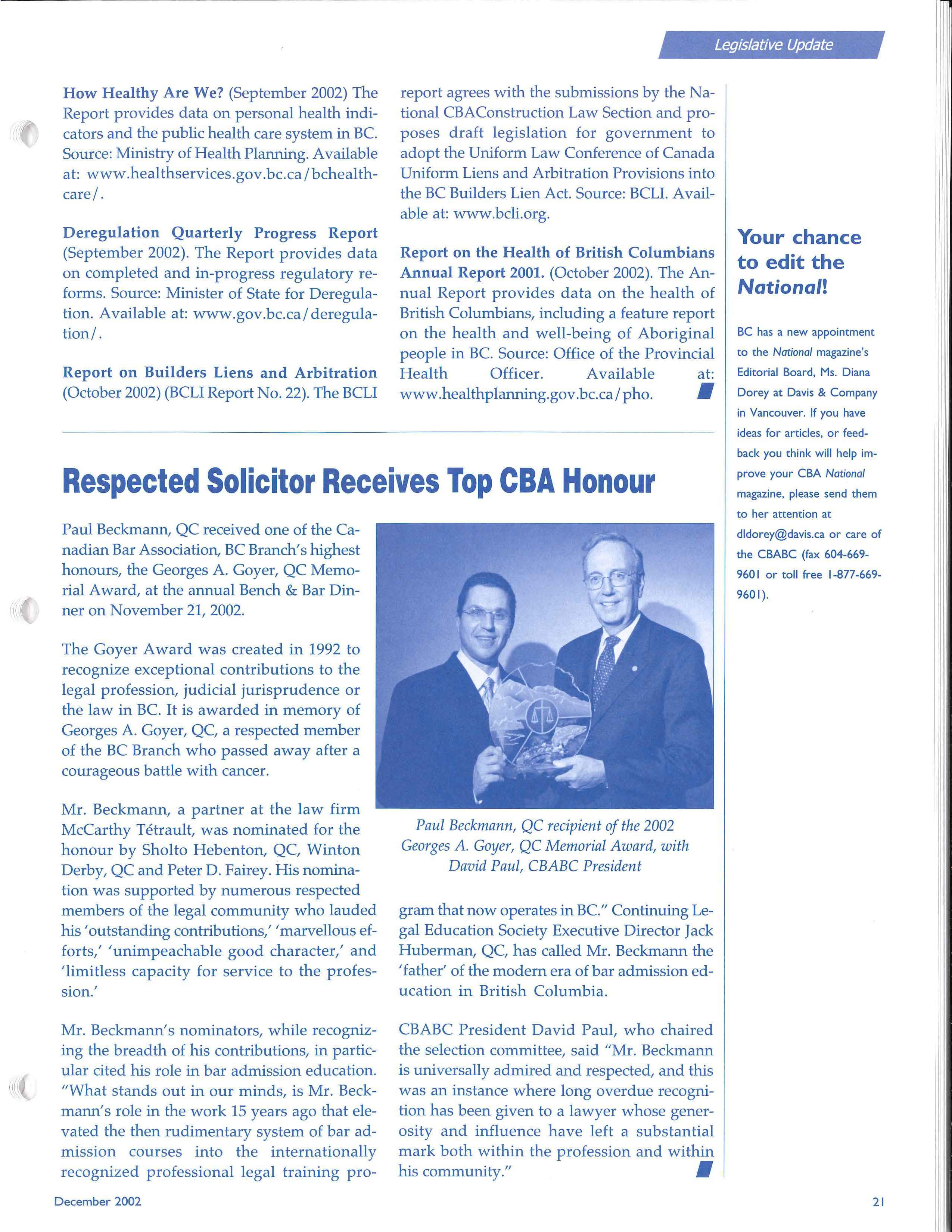
Paul Beckmann, QC received one of the Canadian Bar Association, BC Branch's highest honours, the Georges A. Goyer, QC Memorial Award, at the annual Bench & Bar Dinner on November 21, 2002.
The Goyer Award was created in 1992 to recognize exceptional contributions to the legal profession, judicial jurisprudence or the law in BC. It is awarded in memory of Georges A. Goyer, QC, a respected member of the BC Branch who passed away after a courageous battle with cancer.
Mr. Beckmann, a partner at the l aw firm McCarthy Tetrault, was nominated for the honour by Sholto Hebenton, QC, Winton Derby, QC and Peter D Fairey. His nomination was supported by numerous respected members of the legal community who lauded his' outstanding cont ributions,' 'marvellous efforts,' 'unimpeachable good character,' and 'limitless capacity for service to the profession '
Mr. Beckmann's nominators, while recognizing the breadth of his contributions, in particular cited his role in bar admission education. "What stands out in our minds, is Mr. Beckmann's role in the work 15 years ago that elevated the then rudimentary system of bar admission courses into the internationally recognized professional legal training pro-
gram that now operates in BC." Continuing Legal Education Society Executive Director Jack Huberman, QC, has called Mr Beckmann the 'father' of the modern era of bar admission education in British Columbia.
CBABC President David Paul, who chaired the selection committee, said "Mr. Beckmann is universally admired and respected, and this was an instance where long overdue recognition has been given to a lawyer whose generosity and influence have left a substantial mark both within the profession and within his community."
Your chance to edit the National!
BC has a new appointment to the National magazine 's Editorial Board, Ms. Diana Dorey at Davis & Company in Vancouver If you have ideas for articles, or feedback you think wi ll help improve your CBA National magazine, please send them to her attention at dldorey@davis ca or care of the CBABC (fax 604-669960 I or toll free 1-877-6699601).
Paul Beckmann, QC recipient of the 2002 Georges A. Goyer, QC Memorial Award, with David Paul, CBABC President
Sid Fattedad
Sid Fattedad is the Chief Financial Officer of the Workers' Compensation Board of British Columbia.
WCB Assessment Rate Remains $0.15
CBABC intervention results in rate holding
he WCB assessment rate for 2003 for law firms is $0.15 The board initially published a preliminary rate of $0.18 but as a result of a query from the Canadian Bar Association, BC Branch, and further review of the rate group's performance, the board has decided to hold the proposed increase in abeyance for reasons that are outlined below.
By way of background, on January 1, 1994 the Workers' Compensation Act was amended to extend WCB coverage to virtually all employers in BC. At that time the CBABC and Law Society made presentations to the WCB proposing to be initially placed in a group that included accountants and financial institutions with an assessment rate of $0.25 per $100 dollars of assessable payroll. Since 1994lawyers have paid the following rates: $0.25
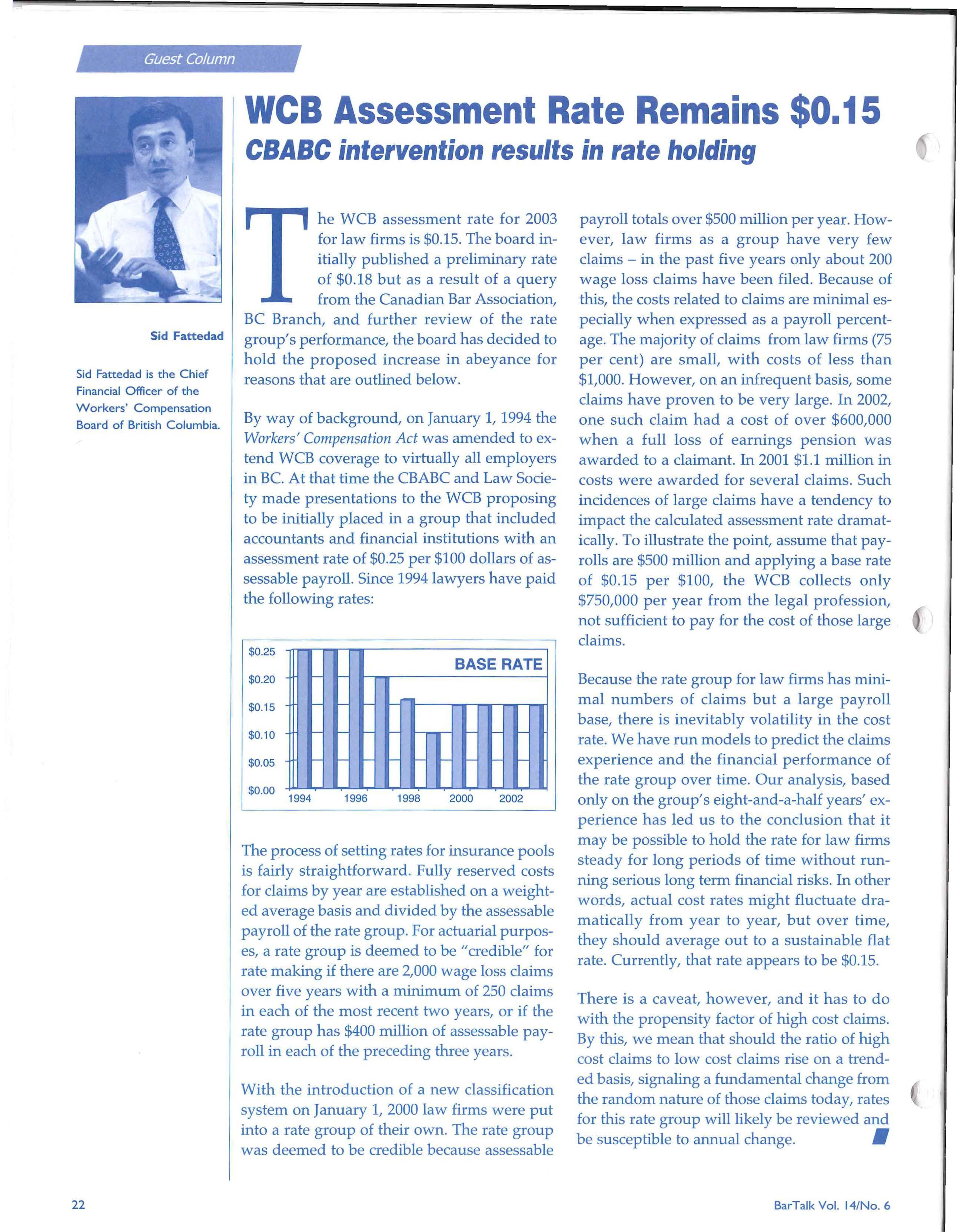
The process of setting rates for insurance pools is fairly straightforward Fully reserved costs for claims by year are established on a weighted average basis and divided by the assessable payroll of the rate group. For actuarial purposes, a rate group is deemed to be "credible" for rate making if there are 2,000 wage loss claims over five years with a minimum of 250 claims in each of the most recent two years, or if the rate group has $400 million of assessable payroll in each of the preceding three years
With the introduction of a new classification system on January 1, 2000 law firms were put into a rate group of their own. The rate group was deemed to be credible because assessable
payroll totals over $500 million per year. However, law firms as a group have very few claims- in the past five years only about 200 wage loss claims have been filed. Because of this, the costs related to claims are minimal especially when expressed as a payroll percentage. The majority of claims from law firms (75 per cent) are small, with costs of less than $1,000. However, on an infrequent basis, some claims have proven to be very large. In 2002, one such claim had a cost of over $600,000 when a full loss of earnings pension was awarded to a claimant. In 2001 $1.1 million in costs were awarded for several claims. Such incidences of large claims have a tendency to impact the calculated assessment rate dramatically. To illustrate the point, assume that payrolls are $500 million and applying a base rate of $0.15 per $100, the WCB collects only $750,000 per year from the legal profession, not sufficient to pay for the cost of those large claims.
Because the rate group for law firms has minimal numbers of claims but a large payroll base, there is inevitably volatility in the cost rate. We have run models to predict the claims experience and the financial performance of the rate group over time. Our analysis, based only on the group's eight-and-a-half years' experience has led us to the conclusion that it may be possible to hold the rate for law firms steady for long periods of time without running serious long term financial risks. In other words, actual cost rates might fluctuate dramatically from year to year, but over time, they should average out to a sustainable flat rate. Currently, that rate appears to be $0.15.
There is a caveat, however, and it has to do with the propensity factor of high cost claims By this, we mean that should the ratio of high cost claims to low cost claims r ise on a trended basis, signaling a fundamental change from the random nature of those claims today, rates for this rate group will likely be reviewed and be susceptible to annual change . •
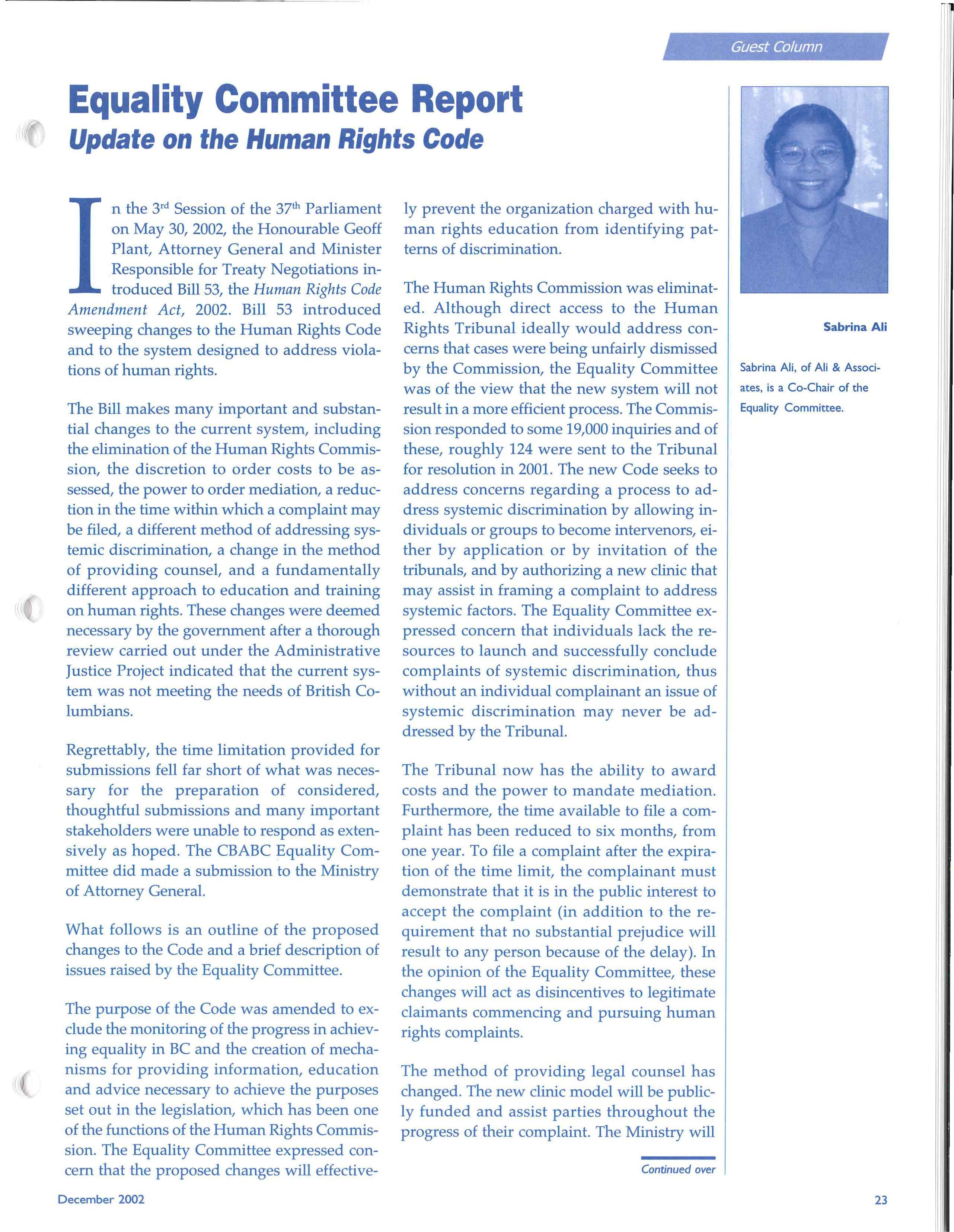
Equality Committee Report Update on the Human Rights Code
n the 3'd Session of the 37th Parliament on May 30, 2002, the Honourable Geoff Plant, Attorney General and Minister Responsible for Treaty Negotiations introduced Bill 53, the Human Rights Code Amendment Act, 2002. Bill 53 introduced sweeping changes to the Human Rights Code and to the system designed to address violations of human rights.
The Bill makes many important and substantial changes to the current system, including the elimination of the Human Rights Commission, the discretion to order costs to be assessed, the power to order mediation, a reduction in the time within which a complaint may be filed, a different method of addressing systemic discrimination, a change in the method of providing counsel, and a fundamentally different approach to education and training on human rights These changes were deemed necessary by the government after a thorough review carried out under the Administrative Justice Project indicated that the current system was not meeting the needs of British Columbians.
Regrettably, the time limitation provided for submissions fell far short of what was necessary for the preparation of considered, thoughtful submissions and many important stakeholders were unable to respond as extensively as hoped. The CBABC Equality Committee did made a submission to the Ministry of Attorney General.
What follows is an outline of the proposed changes to the Code and a brief description of issues raised by the Equality Committee
The purpose of the Code was amended to exclude the monitoring of the progress in achieving equality in BC and the creation of mechanisms for providing information, education and advice necessary to achieve the purposes set out in the legislation, which has been one of the functions of the Human Rights Commission. The Equality Committee expressed concern that the proposed changes will effective-
ly prevent the organization charged with human rights education from identifying patterns of discrimination.
The Human Rights Commission was eliminated. Although direct access to the Human Rights Tribunal ideally would address concerns that cases were being unfairly dismissed by the Commission, the Equality Committee was of the view that the new system will not result in a more efficient process The Commission responded to some 19,000 inquiries and of these, roughly 124 were sent to the Tribunal for resolution in 2001. The new Code seeks to address concerns regarding a process to address systemic discrimination by allowing individuals or groups to become intervenors, either by application or by invitation of the tribunals, and by authorizing a new clinic that may assist in framing a complaint to address systemic factors. The Equality Committee expressed concern that individuals lack the resources to launch and successfully conclude complaints of systemic discrimination, thus without an individual complainant an issue of systemic discrimination may never be addressed by the Tribunal.
The Tribunal now has the ability to award costs and the power to mandate mediation . Furthermore, the time available to file a complaint has been reduced to six months, from one year. To file a complaint after the expiration of the time limit, the complainant must demonstrate that i t is in the public interest to accept the complaint (in addition to the requirement that no substantial prejudice will result to any person because of the delay). In the opinion of the Equality Committee, these changes will act as disincentives to legitimate claimants commencing and pursuing human rights complaints.
The method of providing legal counsel has changed The new clinic model will be publicly funded and assist parties throughout the progress of their complaint. The Ministry will
Sabrina Ali
Sabrina Ali, of Ali & Associates, is a Co-Chair of the Equality Committee
Equality Committee Report
Continued from page 23
mandate the BC Human Rights Coalition to provide parties with advice and assistance prior to submission of a complaint and if accepted by the tribunal, extend the assistance throughout the mediation and settlement discussions. This assistance will be available to both complainants and respondents. The Ministry will also provide resources to the Community Legal Assistance Society (CLAS) to provide legal counsel to parties when a lawyer is needed at a tribunal hearing. The Equality Committee does not agree that provision of assistance to all parties results in equality The inequality of financial resources between complainant and respondent is not addressed by this measure. Further, the Equality Committee has concerns regarding conflict of interest in charging the same organization to advise both complainants and respondents in framing and advising with reference to the complaint.
Bill 53 also proposed the separation of education and adjudication functions, which may or may not be more efficient than the current system, however, there are concerns that an independent organization may not have access to information in order to provide the requisite education. Further, sufficient resources are required to properly educate and train the public with respect to human rights issues, and it is necessary, that regardless of the format, sufficient funding be allocated to perform this function. The Equality Committee recommended that broader, further and better consultation is required to address this issue.
The legislative changes flow from the Administrative Justice Project, announced July, 2001. The project has resulted in a flood of discussion and white papers on myriad topics, with typically little time for meaningful consulta-
tion The proposed amendments to the Human Rights Code provide an example . A background paper was expected to be issued in November of 2001, with a White Paper expected to be released at a later date Comments were requested by October 31,2001. The background paper was released in December of 2001 with comments requested by February 15, 2002. Many stakeholders felt that the time for response precluded comprehensive submissions and made the decision to await the White Paper. In early 2002, the government announced that there would be no White Paper. Stakeholders were then effectively given little notice that their sole opportunity for consultation was to meet the February 15, 2002 deadline Many stakeholders declined to comment, citing inadequacy of opportunity to consult and provide thoughtful submissions Bill 53 was introduced on the last day of sitting of Parliament in its 37th session, on May 30, 2002 . Comments were expected by October 15, 2002, with no submissions received after that date being considered. Given the extensive changes proposed by this legislation, it is imperative that stakeholders and the public be given a full opportunity to comment.
The short timeline for submissions to be filed seems to be a common problem that stakeholders are facing in the course of the Administrative Justice Project. The topics canvassed by this project are far-reaching and result in a complexity necessitating careful study. Stakeholders and the general public have effectively been accorded insufficient time for thoughtful review and comment on the proposed changes. As a result, many important stakeholders have been unable to provide proper submissions. Although it is not possible to quantitatively assess the likely result of these substantial government changes, there can be no doubt that they are profound and merit the input of all who have an interest in them •
Poster sets available from the CBABC $4 per ,..-----' set of three posters (incl. S&H). Poster text: Just what are lawyers capable of? Judge for yourself.
For the real story about Canada's legal profession, visit the Canadian Bar Association's Web site at www cba org / public
Collegiality in Family Law Practice
Demise of the pit bull
amily lawyers have a bit of a reputation for feuding. I've written acidic letters, hung up on a learned friend who was incoherent with fury, been hung up on in mid-rant. But in my personal life, I'm polite. I'd rather throw myself over a land mine than hurt someone' s feelings. I am impressed with my colleagues' hard work, intelligence, wardrobes. Why do I fall into the slough of rudeness and aggression? Here are some 4:00a.m. thoughts on collegiality or lack thereof.
He started it. I asked Lawyer X when I might expect his client's financial information. He shouted, "Go to hell." A terse exchange followed. "He started it/' is an excuse I refuse to accept from my five year old, and yet sometimes I react the way she would, whacking away with my little plastic shovel. As someone will always be "starting it/' a preferable response would be to use my (polite) words to tell X that I didn't appreciate his attitude .
Who started this? Y needed an order immediately. I had two motions and an overdue factum to deal with. Sighing, I phoned my client, listened while he vented and got instructions. I called Y to say we consented, and if she wanted me to sign her draft, I would be in courtrooms 30 and 32, and then at my office. Didn't see her at court. Half an hour later, as I struggled with the factum, Y called: "You're a liar You weren't at court." A terse exchange followed. If I hadn't been panicking about the factum, I could have waited for Y at court. At the very least, I might have avoided yelling at Y, who already wasn't having a good day.
You are now entering the Twilight Zone. After we argued a motion, Z was to prepare the order. Ten days went by, no word from Z. On Day 11, an articling student from Z' s firm appeared, bearing a draft order. The articling student said she would wait until I signed it. Was there a letter from Z explaining the urgency? No Did the student know what was urgent? No. I asked the student to find out what was urgent, and get back to me. The stu-
dent said she would wait until I signed the order. I said I would not be able to sign it that day The student sat in our lobby until we went home. Day 12 was a repeat of day It except it was a male articling student.
An acquaintance, observing a toupee resembling a jute roof, asked, "What could explain a thing like that?" What could explain Z's actions? I never discovered the reason for this sour moment in the history of collegiality.
The pit bull thing. I'm sharing these anecdotes because they make me laugh. (Stories in which I really acted like a jerk will be saved for another occasion.) Some lapses of collegiality are nothing to laugh about.
Lawyers and clients are influenced by the contentiousness built into the court system, which is reinforced by what we read and watch. On television, lawyers are always skewering one another with rapier-like comments. Clients conclude they need an aggressive lawyer: a pit bull. ("Think of me as a basset hound/' I told one potential client, who looked bummed out.) But whether we, our clients or the media are ready, change is on the way.
When I studied family law in 1982, the curriculum didn't include alternative dispute resolution. Lawyers now use mediation, four-way meetings and collaborative law. Provincial and Supreme Court programs divert family matters from litigation. That these approaches produce better, faster, cheaper results than court skirmishes is obvious to the least analytical member of the family bar (i.e., me). It's also obvious that collegiality contributes to success in ADK it derails when lawyers skewer one another with rapier-like comments.
Writers will suffer most from the demise of the pit bull thing. People discussing a problem is not gripping drama. But my clients are happier, and now that my insomnia is driven by fear of the CCRA and cellulite encroachment of flameouts with colleagues, I'm haE: p1er too. •
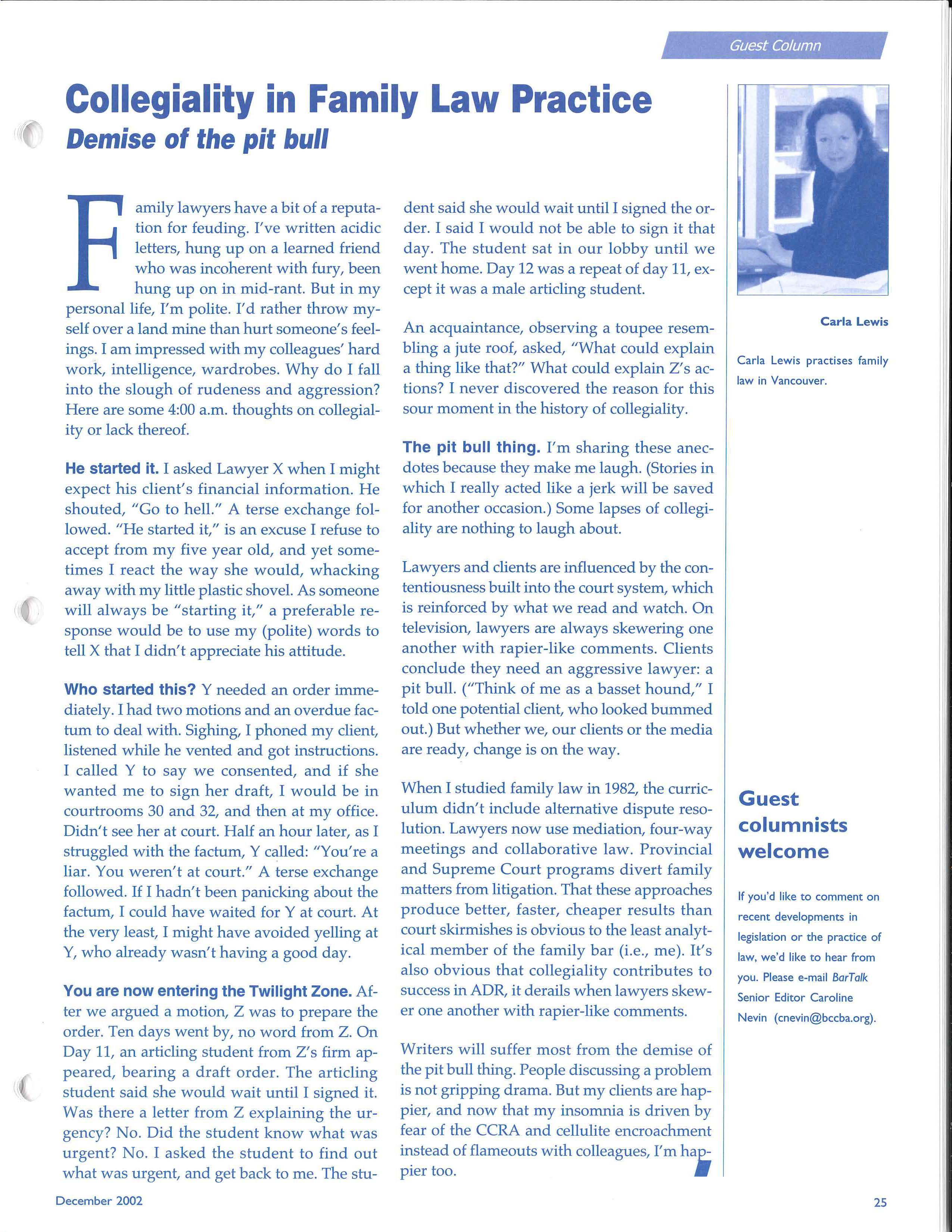
If you'd like to comment on recent developments in legislation or the practice of law, we'd like to hear from you. Please e-mail BarTa lk Senior Editor Caroline Nevin (cnevin@bccba.org)
Carla Lewis
Carla Lewis practises fami ly Jaw in Vancouver.
Patricia Jordan
Patricia Jordan is the CBABC Manager, Interactive Media. She welcomes your comments, questions , and suggestions If you're having difficu lty finding a document online, need an answer, or would like something added to the site, contact her at pjordan@bccba org or call 604-646-7861
Online Audio and Video Conference An online boardroom at your disposal
ne unique feature of the CBABC Web site (www.bccba org) is its online audio and video conference facility Located in the Meeting Room, the facility gives members the opportunity to meet and collaborate on documents in real time via the Internet through a private and secure connection.
Facility Features include:
•
Application sharing- review a Power Point presentation or jointly edit a document. Only the originating party needs to have the document's program installed on their computer.
Text discussion - record notes or action items from a meeting in real time as part of the collaborative process . Members may also use this feature to communicate privately with another participant without interrupting the audio communication of the meeting.
Whiteboard capabilities - the whiteboard is a multi-page, multi-user drawing board for participants to project graphics, sketch diagrams or organizational charts.
File transfer - using file transfer, a participant can send a file to one or all of the other participants- without disturbing the flow of the online meeting.
Using the facility requires more than a Commodore 64. The CBABC recommends that your computer have a large hard drive, a minimum of 128 MB random access memory (RAM) or dynamic random access memory (DRAM), a fast modem and a cable or digital subscriber line (DSL) service provider, rather than regular dial-up access. Since RAM determines speed, performance and to a lesser extent power, the more RAM you have, the faster your system will operate . Most computers are configured with a minimum of 64MB RAM As RAM is relatively inexpensive you
may consider increasing the RAM on your computer .
Unlike RAM, which is a computer's memory, the hard drive stores all data, files, programmes and software Hard drives are measured by their capacity and speed, and are measured in gigabytes - we recommend a minimum of six gigabytes.
Check with your telephone or cable company to see if they offer high-speed Internet access. High-speed dial-up access uses telephone lines to bring subscribers high-speed Internet access that is up to 30 times faster than 56K modems. Cable modems use the expanded bandwidth of TV cable to increase the speed of data transfer on the Internet. Note : Cable access slows with increased simultaneous users, whereas high-speed dial-up access remains constant, even during peak use.
NEW DOCUMENTS ONLINE
• Current Issues in Legislation and Law Reform (Library)
• Minutes of the Real Property-Vancouver Section meeting on the Law Society's investigation of the Wirick situation (CBABC Newsroom)
DID YOU KNOW?
• Canada ranks fourth in the world for DSL I broadband use behind South Korea, Hong Kong and Taiwan (based on DSL lines per 100 population)
• The number of holiday sales conducted online is expected to double in Canada in 2002
ASK THE WEBMASTER
Do you have a question regarding the site? What wou l d you like to see online? E-mail pjordan@bccba.org or call 1-888-687-3404, ext. 317 or 604-646-7861.
•
All the World is a Stage
Theatrical lawyers plot Murder on the Nile
or some Victoria lawyers Shakespeare's quote "All the world is a stage" takes on a different meaning as they briefly retire from the theatre of life in order to challenge the life of the Lawyers On Stage Theatre (LOST) is a troupe of thespian lawyers, legal support staff, sheriffs, and law students that annually present their talents and shortcomings in a main stage presentation for colleagues and the public.
Past productions include Twelve Angry Jurors, Breaker Morant, Tom Jones, and Romulus the Great. Last year LOST held a dinner theatre with a comedic improvisational piece written by the cast as things developed with a faulty time machine and 1970-ish sitcom characters.
This season, LOST returns to Victoria's MacPherson Theatre with their production of the Agatha Christie classic, Murder on the Nile -February 21 and 22, 2003. The story has all of the romance, intrigue, twists and turns that one would expect, and will be performed by a cast and crew of more than 30 lawyers, students and legal support staff.
LOST is a fundraiser for Kaleidoscope Theatre Productions Society, a non-profit, professional theatre company that has brought the arts to children in BC for the past 29 years. The society tours provincially, nationally and internationally with inspirational and educational artistic presentations for young people. LOST also offers the legal-minded an opportunity to express themselves in areas such as music design, sound design, props, set and costume de-
sign, all with the support of a professional theatre company.
Leslie Bland, Artistic Director of Kaleidoscope says, "Lawyers are in the communication business. They take a professional attitude while approaching tasks that perhaps they have never before been faced with. There is magic in theatre and also magic in their commitment."
But we all have a lot of fun as well.
LOST and the Kaleidoscope wish to thank the Victoria Bar Association and the Canadian Bar Association for their support! •
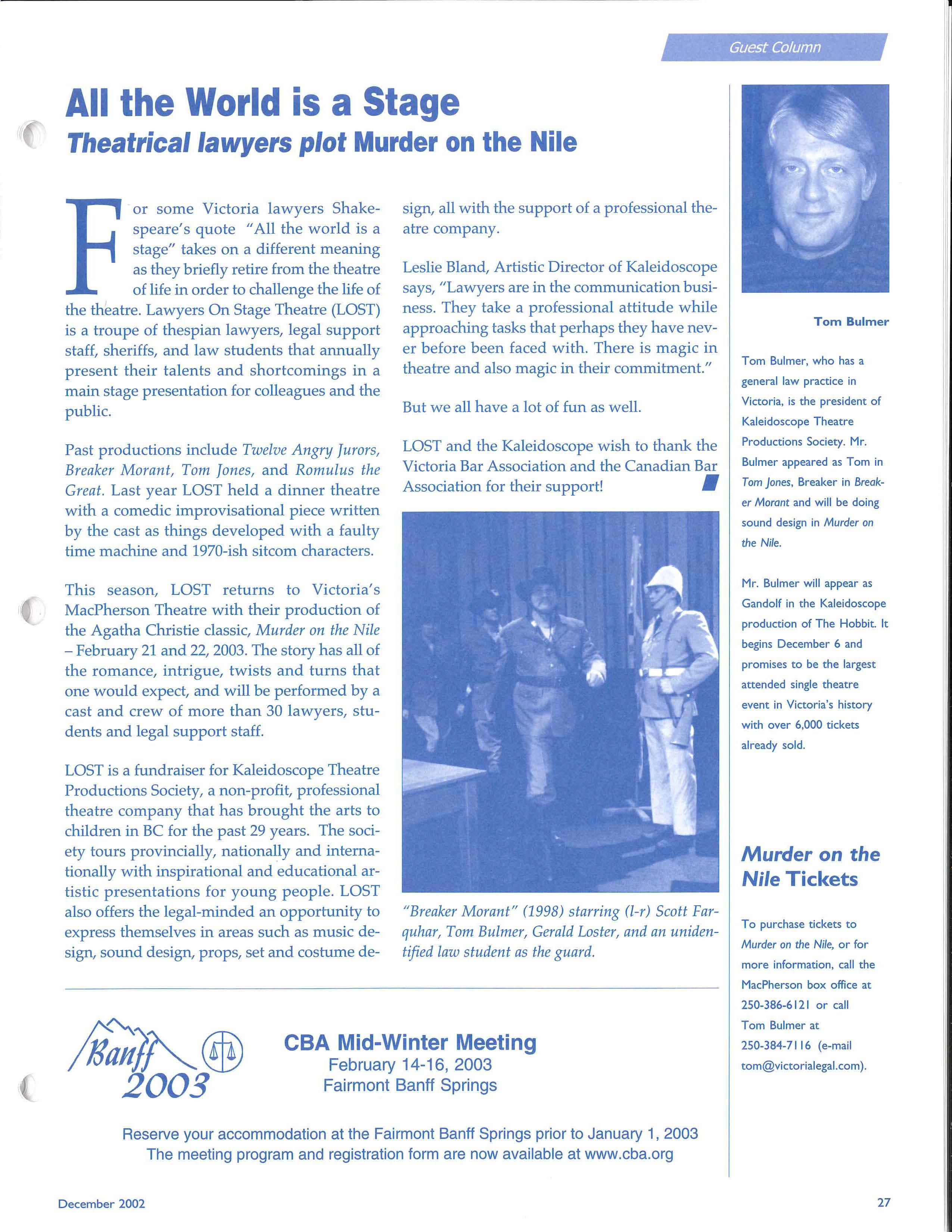
tified law student as the guard
CBA Mid-Winter Meeting
February 14-16, 2003
Fairmont Banff Springs
Reserve your accommodation at the Fairmont Banff Springs prior to January 1, 2003 The meeting program and registration form are now available at www.cba.org
Tom Bulmer, who has a general law practice in Victoria, is the president of Kaleidoscope Theatre Productions Society Mr Bulmer appeared as Tom in Tom jones , Breaker in Breaker Morant and wi ll be doing sound design in Murder on the Nile
Mr Bulmer will appear as Gandolf in the Kale idoscope production of The Hobbit It begins December 6 and promises to be the largest attended single theatre event in Victoria's history with over 6,000 tickets already sold
Murder on the Nile Tickets
To purchase tickets to Murder on the Nile, or for more information, call the MacPherson box office at 250-386-6121 or call Tom Bu lmer at 250-384-7116 (e-mail tom@victorialegal com)
"Breaker Morant" (1998) starring (l-r) Scott Farquhar, Tom Bulmer, Gerald Laster, and an uniden-
Tom Bulmer
CBABC Law Student Awards
The CBABC annually awards two $2,000 Student Awards to the law student w ho best exemplifies CBABC ideals at both the Univ ersi ty of British Columbia and the University of Victoria The CBABC is proud to announc e that the 2002 Student Award winners are Michael Feder, a third year law student at UBC and Kirsten Van Drunen, a first year law student at UVic.
Award criteria include student participation in activities supporting members of the profession; promotion of justice and law reform; equality; and demonstration of public and community service. Award recipients ar e selected by CBABC and law school representatives . •
Good Help Is Easy To Find
If you are considering hiring a student for an articling position, there are still a number of highly qualified third-yea r law students at both UBC and the UVic who are seeking articling positions for the 2003 I 2004 term . Moreover, the UBC and UVic Career Serv ices offices would be pleased to assist you with your search
Both offices have observed a significant drop in the number of articling positions available in the Lower Mainland and BC in general. In past years, only 7-10 per cent of the graduating class had not secured articling positions by early fall (summer being the primary recruiting period) . This year, however, that figure increased to a staggering 25-30 per cent at UBC and UVic . It is worth noting that these figures do not reflect the calibre of students still looking for articles . Indeed, a number of outstanding students with strong academic records are still available.
Articling is an important - not to mention, mandatory - stage in the legal training process . Articling principals, through their assistance and guidance, provide students with the requisite knowledge and skills to become competent legal professionals. Hiring an articling
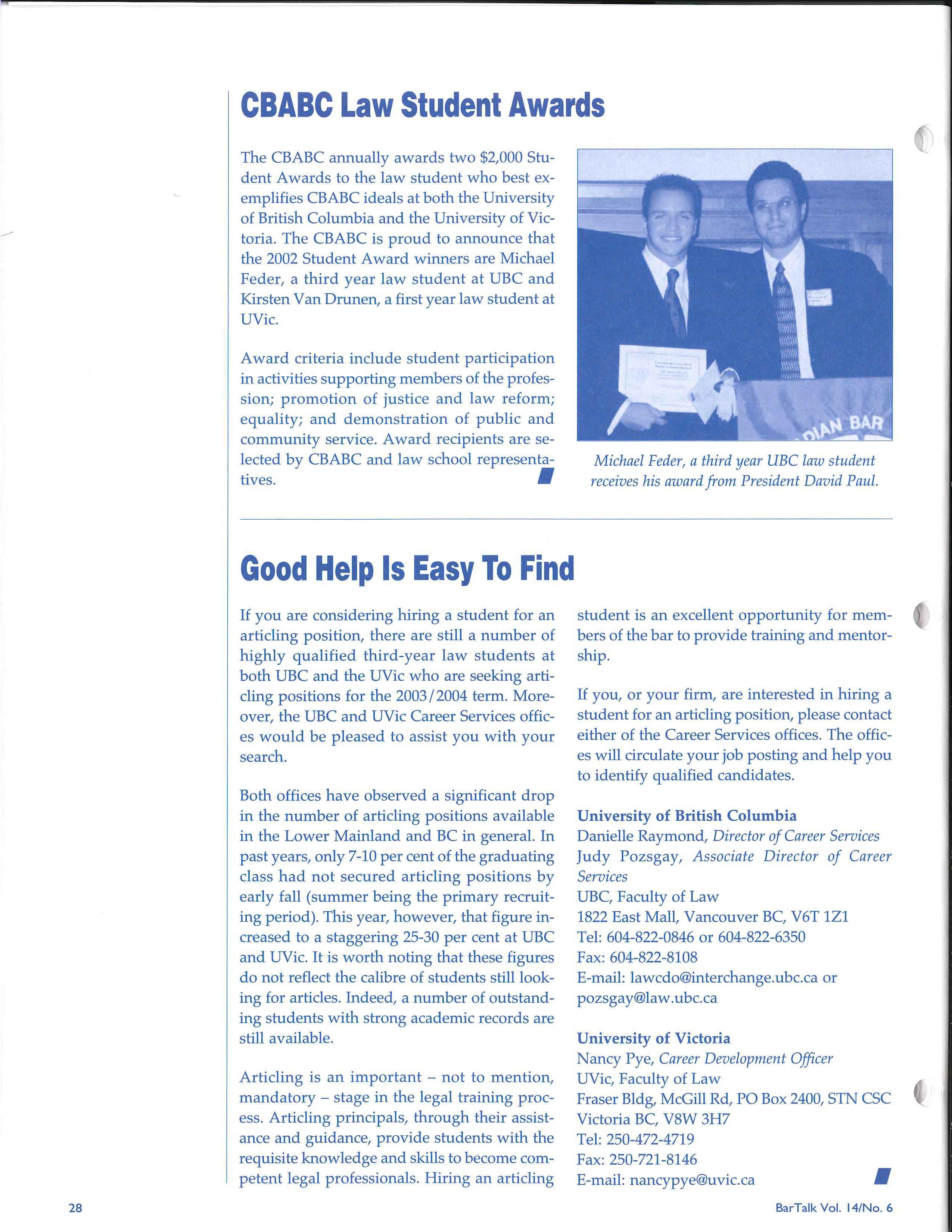
student is an excellent opportunity for members of the bar to provide training and mentorship
If you, or your firm, are interested in hiring a student for an articling position, please contact either of the Career Services offices The offices will circulate your job posting and help you to identify qualified candidates
University of British Columbia
Danielle Raymond, Director of Career Services
Judy Pozsgay, Associate Director of Career Services
UBC, Faculty of Law
1822 East Mall, Vancouver BC, V6T 1Z1 Tel: 604-822-0846 or 604-822-6350
Fax: 604-822 -8108
E-mail: lawcdo@interchange ubc ca or pozsgay@law .ubc .ca
University of Victoria
Nancy Pye, Career Development Officer
UVic, Faculty of Law
Fraser Bldg, McGill Rd, PO Box 2400, STN CSC Victoria BC, V8W 3H7
Tel: 250-472-4719
Fax : 250-721 -8146
E-mail : nancyp y e@uvic.ca
Michael Feder , a third year UBC law student receives his award from President David Paul.
Member
Branch members have access to a wide range of products, services and discounts Member Services is continually adding and looking for ways you can get the most out of your membership! Be sure to visit www.bccba org for new additions Your input is always welcome Send your suggestions to kjohnson@bccba.org . Member Services Hotline: 604-687-3404, ext . 500 or 1-888-687-3404, ext. 500 .
CANADIAN SCHOLARSHIP TRUST PLAN
The RESP Contribution deadline is December 31st!! Will your child collect the Canada Education Savings Grant?
CBABC now has a Registered Education Savings Plan with special benefits to CBA members . The Canadian Scholarship Trust Plan (CSTP) adds to parents' savings and had a weighted average rate of return this year of 10 .25 per cent in government guaranteed investments Contact Alana Pattee for details at 604-936-2161, toll free at 1-800-755-3914, or by e-mail: alanapattee@shaw.ca.
VANCOUVER CANUCKS
Tickets for CBA Nights with the Vancouver Canucks are now available for the 2003 games See inserts for the ticket order form.
WHISTLER BLACKCOMB
Member Services still has a limited quantity of adult bulk tickets for sale for $53 (plus tax). Look for details on the ticket order form (flipside of Canucks insert).
WIN A WEEKEND AT WHISTLER!
CBA members enjoy preferred pricing and privileges as members of the Lodging Ovations Club ... so tell other CBA members or friends about Lodging Ovations and you could both win a getaway to Whistler! When your friend enrols as a member, you'll both be entered into the draw . If your friend wins, you win too! Prize includes: two nights in a designer one-bedroom suite at First Tracks Lodge and two adult day ski passes. Visit www.bccba.org or contact CBABC Member Services for details.
ARTS CLUB AND STANLEY THEATRES
Receive a 20 per cent discount off regular -priced tickets by calling Natasha Klein at 604-687-5315, ext 254 and identifying yourself as a CBA member. Carol's Christmas, a modern seasonal comedy to lift your spirits, plays at the Granville Island Stage until Jan 4. Visit www artsclub.com for current and future productions . •
UBC Mentor Program Matches 120 Participants
This year approximately 120 mentor matches were made through the UBC-CBA Mentorship Program Participants included students in all three years of law school and the mentoring lawyers practised in a variety of areas of law (law firms, the univers ity, corporations, etc.).
The UBC Mentorship Program and annual Mentor Reception are CBABC-sponsored and organized by Soraya Jamal, the CBABC Representative on the Articling Committee at UBC law school.
This year's UBC Mentor Reception, held October 10 at Cecil Green House, was an important event for students. "The reception provides a comfortable environment for students, not only allowing them to break the ice and to develop a friendship with their own mentor, but also giving students the opportunity to meet other lawyers and students," said Ms. Jamal.
During the reception, the CBABC Student Award was presented to Michael Feder, and Amy Davison received the Scotiabank Law School Achievement Award. •
Letters to the Editor
This letter, originally sent to David Paul , BC Branch President, is reprinted with the permission of Mr. Allan Williams , QC.
Re: BarTalk Vol. 14/No. 5 "A Time of Challenge"
Dear Sir:
I have just read the October issue of BarTalk and your column, "A Time of Challenge."
Frankly, I don't understand why the issues in the Wirick Case give rise to the urgent challenge that is troubling you.
It has always been my understanding that the members of the legal profession, in recognition of the special privileges and the right of selfgovernance we enjoy, have accepted theresponsibility of protecting and compensating those clients and inno cent parties who suffer loss or damage by reason of the defalcation of our members. Therefore, whether the circumstances are as complex as they seem to be in the Wirick Case or otherwise, it is the obligation of the profession to hold harmless the innocent victim of the events. That being the case, then why all the discussion about insurance schemes or funding . The profession must step up and pay the price
If the media coverage is the source of your concern, the solution rests with the officials in the Law Society who raise such matters as "innocent party insurance". That is an internal matter for the profession and of no consequence to the media . How we fund our obligation is only a digression from the clear and simple statement of our obligation. That is what we must repeat as often as necessary. Most assuredly the Law Society officials must not publish solutions that suggest that lawyers will impose a special charge on their clients to meet the cost. Such action is unlawful and a negation of the obligation of our membership . So long as the Law Society allows such propositions to be published our membership can expect to be criticized, our basic position to be misunderstood and the media to attack us
If a method of raising the money is the issue, I suggest that we be prepared to accept a special assessment The media cannot confuse that proposition and our members will be reminded of our obligation
Yours truly,
Allan Williams, QC •
This letter is reprinted with the permission of Mr. David Roberts , QC.
Re: The Lawyer Referral Service
I shall be retiring from the practice of law on 31 December 2002. That being so, I would appreciate it if you would take my name off the lawyer referral list.
I have appreciated, over the many years that I have been on your list, the referrals I have received Some people I have been able to help, others I have not (largely because their cases were not meritorious or they were amongst the number of social misfits that we all have to endure politely and compassionately). One referral I had was a case that ended up in the Supreme Court of Canada [Editor's note: Kane v Board of Governors ofUBC] It is cited as authority in administrative law constantly .
I wish to end by saying that in my opinion the Lawyer Referral Service is one of the outstanding services for the public that the Canadian Bar Association administers
Yours faithfully,
David Roberts, QC
Send your Letters to the Editor to:
Caroline Nevin, BarTalk Senior Editor CBA, BC Branch, lOth Flr, 845 Cambie St. Vancouver, BC V6B 5T3
Fax : 604-669 -9601 Toll free fax: 1-877-669-9601
E-mail : cnevin@bccba .org
Law Foundation of BC
The Law Foundation is pleased to announce two new funding iniatives in 2003. To be eligible for funding, applicants must be a non-profit organizati on in British Columbia whose time-limited project falls within one or more of the five program objectives of the Foundation: legal aid, legal education, law reform, law libraries, or legal research.
The Law Foundation encourages applicants and projects that reflec t the diversity of British Columbia The Law Foundation's working definition of diversity is : Diversity includes age, class, different abilities, education, ethnicity, family, gender, marital/relationship status, race, religion, work experience, geographic size and location, and sexual orientation
New Projects Funding 2003
The Law Foundation has estab lished a New Projects budget of $500,000 for one-time projects for 2003. The maximum amount available for each project is $75,000.
The Law Foundation is particularly interested in receiving proposals for one-time projects in the following areas, listed alphabetically : Aborigina l justice, including Aborigina l women and children's justice issues; family law; poverty law; seniors and the law; youth and the law; projects that meet the needs of culturally diverse groups and rural and smaller communities; projects that address emergent needs.
The Law Foundation will consider proposals in areas other than those listed above as long as they fall within the program objectives of the Law Foundation.
There will be a two-stage application process: a Letter of Intent stage followed by selected applicants being inv ited to submit full applications. Please contact Law Foundation staff at 604-688-2337 to discuss your project prior to submitting a Letter of Intent form .
TlffiWuw FOUNDATION OF BRITISH COLUMBIA
To be considered, please submit a Letter of Intent form by 5:00 p.m., February 7, 2003 by mail, courier, or fax . Please do not e-mail Letter of Intent forms Selected applicants will be invited to submit full applications by Aprilll, 2003 for adjudication at the June 2003 Board of Governors' meeting.
Small Projects Funding 2003
The Law Foundation has established a budget of $100,000 for small, one -time projects for 2003 The Law Foundation encourages applications from organizations that are interested in implementing projects of a smaller scale. The maximum amount available for each timelimited small project is $15,000.
Please contact Law Foundation staff at 604688 -2337 to discuss your project prior to submitting your application.
To be considered at the 2003 June Board meeting, a Small Projects Application must be received by the Law Foundation no later than 5:00p.m. on Friday, March 14,2003.
Graduate Fellowships 200312004
Value : Up to four (4) Awards of $13,750 each. (subject to change)
Closing Date: all applications and support materials must be received by the Law Foundation offices by January 6, 2003. Late or incomplete applications will not be considered
APPLICATION DOCUMENTS
Letter of Intent forms, application guidelines and application forms for the above funding initiatives may be obtained from: www.lawfoundationbc .org; by e-mailing lfbc@telus net; by calling 604-688-2337; or by writing the Law Foundation of BC, 1340-605 Robson Street, Vancouver, BC V6B 5J3 •
BorTolk is published six times per year by the British Columbia Branch of the Canadian Bar Association, lOth Floor 845 Cambie Street Vancouver, BC V6B STJ
TEL: 604-687-3404
TOLL FREE in BC, outside the Lower Mainland: 1-888-687-3404
FAX: 604-669-960 I
TOLL FREE in BC, outside the Lower Mainland: 1-877-669-960 I
• BorTolk Senior Editor: CAROLINE NEVIN 604-687-3404, EXT. 320 cnevin@bccba.org
• BorTolk Editor: SANDRA WEBB 604-687-3404, EXT. 318 slgwebb@bccba.org
• Editorial Board Chair: KENNETH ARMSTRONG karmstronglaw@ shaw.ca
• Editorial Board Members: VIKKI BELL, QC
WILLIAI1 S. CLARK
DIANA DAVIDSON
KAY MELBYE
CHRISTINE MINGlE
© Copyright the British Columbia Branch of the Canadian Bar Association-2002
This publication is intended for inform· ation purposes only and the information contained herein should not be applied to specific fact circumstances without the advice of counsel.
The Canadian Bar Association, BC Branch represents more than I 0,000 members within British Columbia and is dedicated to improving and promoting access to justice, to reviewing legislation, initiating law reform measures and advancing and improving the administration of justice.
TAKE THAT BREAK - BOOK A LOCUM
David F reem an Ph one: 1-888 -752- 88 4 6; Fax : 1-877 -743 -9623; e -maillawyers@ tel us net
SEEKING A CONVEYANCING LAWYER
to buy a bus y E ast V ancou ver pr actice. Wills, m ortgag es & real estate. 80K. 60 4 -24 0 -9930
ASSOCIATE LAWYER SOUGHT-Office
sh are or fee split. Criminal Law, Fraser Valley. E -mail resume to Box #101 c/o cba@bccba org
TSCM - SWEEPS - Business & Residential
Newest Technology - Certified - Li c en sedBonded L u crativ e Referral Program
McCLEARY INVESTIGATION SERVICES
Toll Free 1-866-296-4745 M_I_S@telus.net
THE PROVINCIAL DIRECTORY CROSS
CANADA Finds Canadian Process Servers Fast. A c curate Listings by Location Save You Money. $19.99 Call Us Now 1-888 -891 -4141.
WCB
Do you need help with WCB problems? Are you Plaintiffs counsel facing an ICBC Section 10 defence?
-604-267-3033-
• Extensive experience submitting WCB appeals
• Vice Chair at Review Board for 6 years
• Personal injury litigation for 25 years
• Availab le for WCB appeals, expert opinions, court applications and trials .
Vahan A. Ishkanian
Cell 604-868-3044 Fax 604-264 -6133
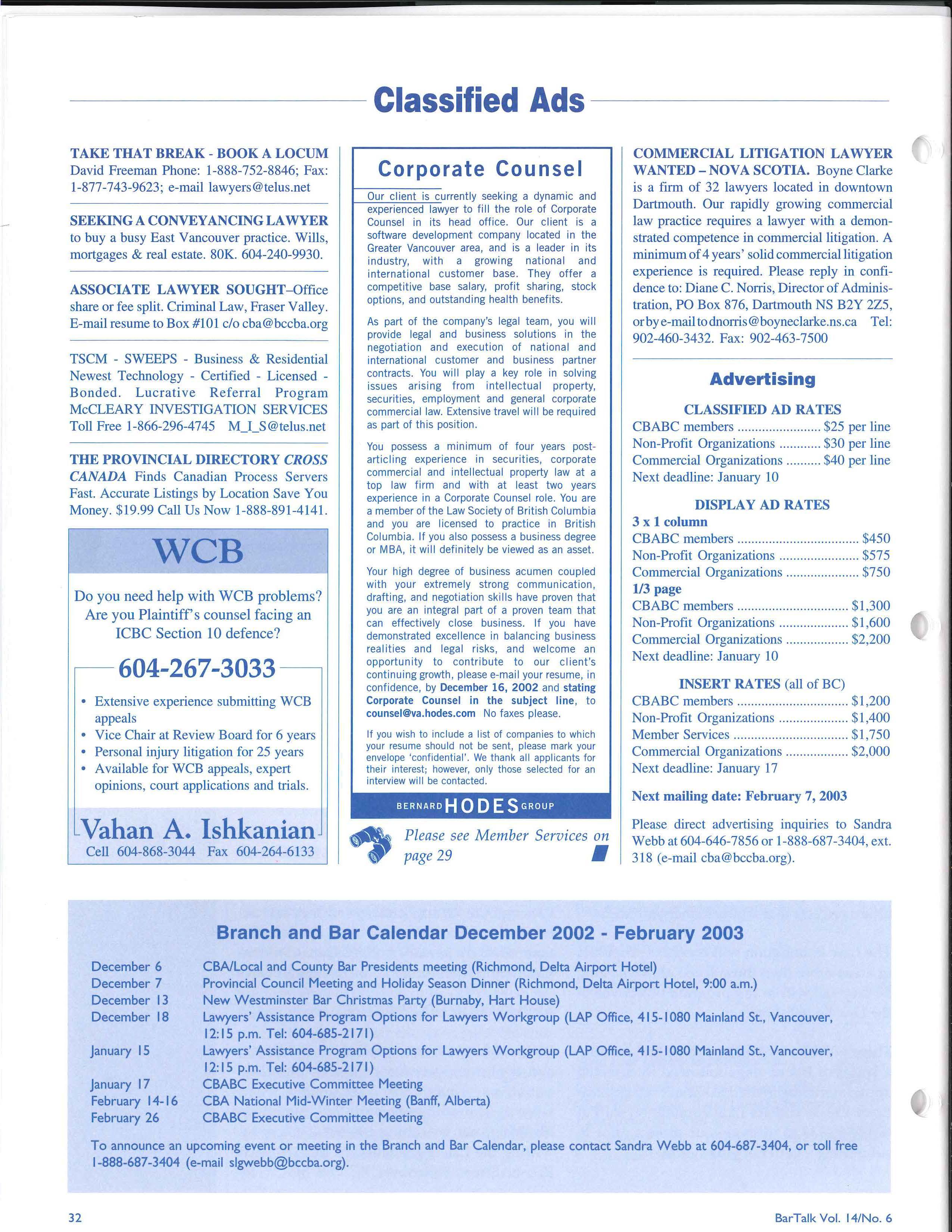
December 6
December 7
December 13
December 18
January 15
January 17
February 14- 16
February 26
Classified Ads
Corporate Counsel
Our cli ent is current ly seek ing a dynamic and ex perienced lawy er to fill the ro le of Corporate Counsel in its head offi ce. Our client is a so ftware developme nt co mp any located in t he Greater Va ncouve r are a, and is a lead er in its indus t ry , wi th a growing nati ona l and int er nati ona l customer ba se They offer a competitive base salary, prof it sharing, stock opti ons, and outst andin g he alth be nefits.
As part of the company's legal team, you will prov ide l ega l and busin ess solutions in the nego t iat i on and execu tio n of nation a l and international customer and bus iness partner contracts. You w i l l pl ay a ke y role i n so lving iss ues arising from i nte ll ec tua l pr operty, sec uritie s, empl oyment and general corporate commercial law. Exte nsiv e travel w ill be req uired as part of t his posi ti on.
You possess a min im um of fou r years postarti cling experience in securities, corporate commercial and i nte ll ectual prop erty law at a top l aw firm and w ith at leas t t wo yea rs experience in a Corporate Counse l role You are a m embe r of t he Law Society of Bri tis h Columb i a and you are l i cens ed to pract ice in Britis h Co lum bia If you also possess a busi ness degree or MBA , it wi l l de fin itely be viewed as an asset.
Yo ur h igh degre e of business acu men coup led with your extremely strong communicat ion , draft ing, and negot iation ski l ls have prove n t ha t you are an i ntegra l part of a proven team that can effect ive ly close bus i ness. If you have demonstrated exce llence in balancing business realities and l ega l risks, and welco me a n oppo rtun i ty to co ntribute to our client's co nt inuing growt h, ple as e e-mail you r resume , in confidence, by December 16, 2002 and stating Corpo rate Counsel in the subject line , to counsel@va. hodes .com No f axes p lease.
If you wish to include a lis t of companies to wh ich your resume shou ld not be sent, please mark your envelope 'confidential' We thank al l applicants for their interest ; however, only those selec te d for an interview wil l be contacted.
Please see Member Services on page 29 •
COMMERCIAL LITIGATION LAWYER WANTED - NOVA SCOTIA. Boy ne Clarke is a firm of 32 lawyers located in downtown Dartmouth O ur rap idly growing commercial law practice req uires a lawyer with a demonstra ted competence in commercial litigation A minimum of 4 years' solid c ommercial litigation experience is required. Please reply in confidence to: Diane C. Norris, Director of Administrati on, PO Box 876, Dartmouth NS B2Y 2Z5, or by e -mail to dnorris@ boyneclarke ns ca Tel : 902-4 60-3432 Fax: 902-46 3- 7 500
INSERT RATES (all of BC)
deadline : January 17
Next mailing date: February 7, 2003
Please direct advertising inquiries to Sandra Webb at 604-646 -7856 or 1-888 -687-3404, ext. 318 (e -mail cba@bccba org)
Branch and Bar Calendar December 2002 - February 2003
CBA/Local and County Bar Presidents meeting (Richmond, Delta Airport Hotel)
Provincial Council Meeting and Holiday Season Dinner (Richm o nd, Delta Airport Hotel, 9:00 a m )
New Westminster Bar Christmas Party (Burnaby, Hart House)
Lawyers' Assistance Program Options for Lawyers Workgroup (LAP Office, 4 15-1080 Mainland St , Vancouver, 12: 15 p.m. Tel: 604-685 -2171)
Lawyers' Assistance Program Options for Lawyers Workgroup (LAP Office, 415-1080 Mainland St , Vancouver, 12: 15 p.m. Tel : 604-685-2171)
CBABC Executive Committee Meeting
CBA National Mid-Winter Meeting (Banff, Alberta)
CBABC Executive Committee Meeting
To ann o unce an upcoming event or meeting in the Branch and Bar Calendar, please contact Sandra Webb at 604-687-3404, or toll free 1-888-687-3404 (e-mail slgwebb@bccba.org).
BERNARD H 0 DEs GROUP