The Canadian Bar Association British Columbia Lawyer-Client Privilege Protected sec strikes down provision to
n September 12, 2002, the Supreme Court of Canada struck down the provision of the Criminal Code of Canada that authorized searches of law offices, on the basis that such searches are prohibited under section 8 of the Canadian Charter of Rights and Freedoms.
The Canadian Bar Association welcomed the Supreme Court's decisions in Lavallee, White Ottenheimer & Baker, and Fink, which upheld the fundamental principle that clients' privileged communications with their lawyers must be protected.
Section 488 .1 of the Criminal Code sets the parameters for law office searches by police The court's decision strikes down that provision. The Supreme Court said that section 488.1 allowed unreasonable search and seizure, which is prohibited under section 8 of the Charter.
The cases came from three different provinces and were heard together by the Supreme Court. They considered government or police searches of law office files and the principle of solicitor-client privilege. CBA member Jim Lebo of Alberta argued the intervention on behalf of the CBA, with assistance from BC members. All CBA member participation was provided pro bono in this case.
Madam Justice Louise Arbour stated that: "Confidential communications to a lawyer represent an important exercise of the right to privacy, and they are central to the administration of justice in an adversarial system . Unjustified, or even accidental infringements of the privilege erode the public's confidence in the fairness of the criminal justice system "
search lawyers' offices
BC President David Paul was pleased with the result. "Solicitor-client privilege is an important cornerstone of our justice system. It ensures that when clients speak to their lawyers, the communication remains private, " said Mr. Paul. "Without that protection, police or government could seize confidential documents and use them in any investigation against the client."
The Court has emphasized that this privilege belongs to the client and can only be waived by the client. "The CBA strives to uphold this principle and believes that everyone who consults with a lawyer must be able to do so in confidence," said Mr . Paul.
The Canadian Bar Association, the Federation of Law Societies and the Law Society of Alberta intervened at the Supreme Court, arguing that the Court must be vigilant in protecting this fundamental right. Any exceptions to lawyerclient confidentiality must be clearly defined so lawyers understand the scope of lawyer-client privilege and their ethical obligations. The CBA recommended that section 488.1 be struck down, to uphold the principle of solicitor-client privilege.
Reform of law in this area is now required In its decision, the Supreme Court outlined 10 principles to guide Parliament in drafting a new law. The CBA has committed to working with the government in that process, as part of its law reform mandate .
Full text of the SCC decision can be found at www .lexum .umontreal.ca/ esc-sec/ en/ rec/ html/lavalle2.en.html. •
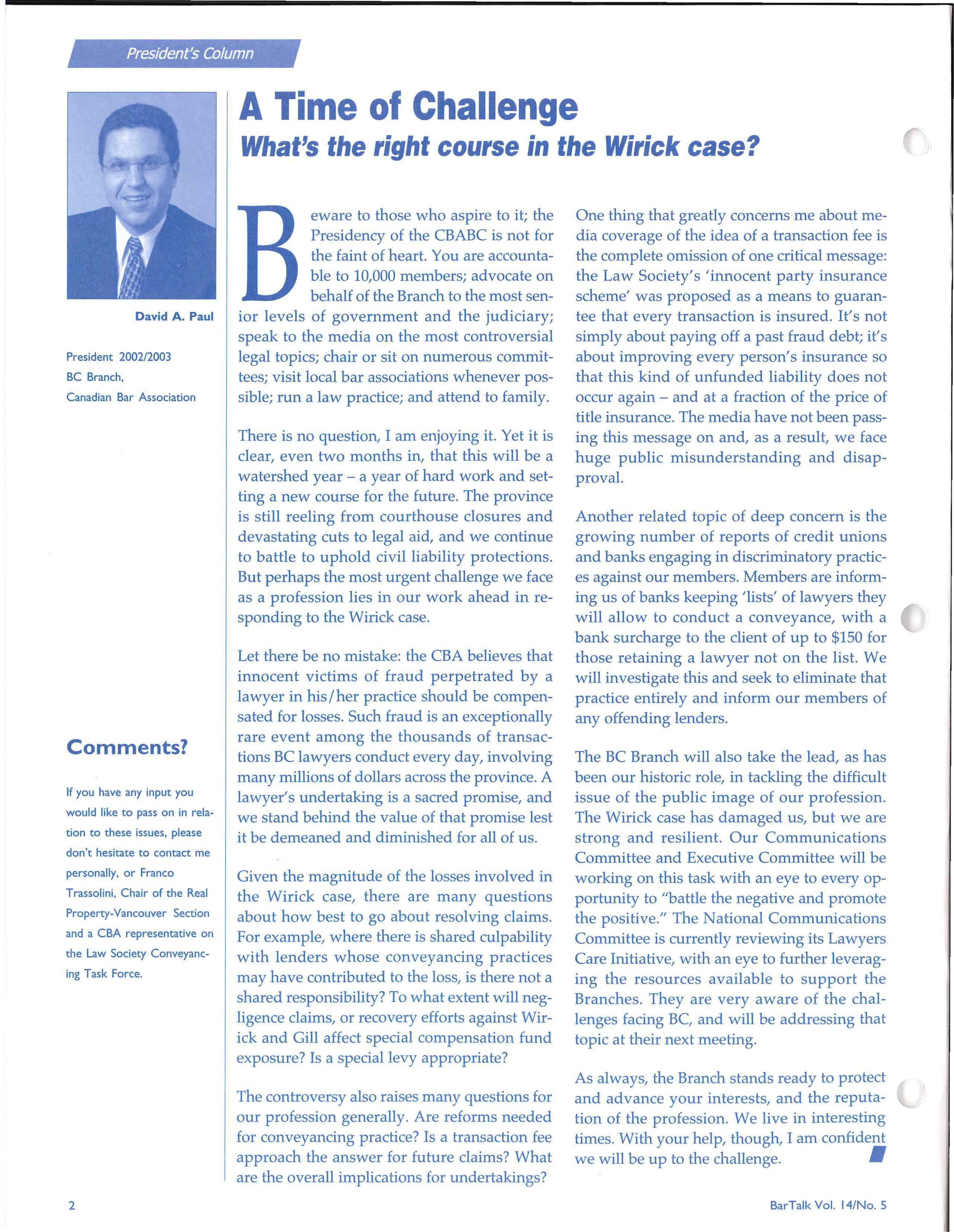
David A. Paul
President 2002/2003 BC Branch, Canadian Bar Association
Comments?
If you have any input you would like to pass on in relation to these issues, please don't hesitate to contact me personally, or Franco
T rassolini, Chair of the Real Property-Vancouver Section and a CBA representative on the Law Society Conveyancing Task Force.
A Time of Challenge
What's the right course in the Wirick case?
eware to those who aspire to it; the Presidency of the CBABC is not for the faint of heart. You are accountable to 10,000 members; advocate on behalf of the Branch to the most senior levels of government and the judiciary; speak to the media on the most controversial legal topics; chair or sit on numerous committees; visit local bar associations whenever possible; run a law practice; and attend to family.
There is no question, I am enjoying it. Yet it is clear, even two months in, that this will be a watershed year- a year of hard work and setting a new course for the future. The province is still reeling from courthouse closures and devastating cuts to legal aid, and we continue to battle to uphold civil liability protections. But perhaps the most urgent challenge we face as a profession lies in our work ahead in responding to the Wirick case.
Let there be no mistake : the CBA believes that innocent victims of fraud perpetrated by a lawyer in his/her practice should be compensated for losses. Such fraud is an exceptionally rare event among the thousands of transactions BC lawyers conduct every day, involving many millions of dollars across the province. A lawyer's undertaking is a sacred promise, and we stand behind the value of that promise lest it be demeaned and diminished for all of us.
Given the magnitude of the losses involved in the Wirick case, there are many questions about how best to go about resolving claims. For example, where there is shared culpability with lenders whose conveyancing practices may have contributed to the loss, is there not a shared responsibility? To what extent will negligence claims, or recovery efforts against Wirick and Gill affect special compensation fund exposure? Is a special levy appropriate?
The controversy also raises many questions for our profession generally Are reforms needed for conveyancing practice? Is a transaction fee approach the answer for future claims? What are the overall implications for undertakings?
One thing that greatly concerns me about media coverage of the idea of a transaction fee is the complete omission of one critical message: the Law Society's ' innocent party insurance scheme' was proposed as a means to guarantee that every transaction is insured . It's not simply about paying off a past fraud debt; it's about improving every person's insurance so that this kind of unfunded liability does not occur again - and at a fraction of the price of title insurance . The media have not been passing this message on and, as a result, we face huge public misunderstanding and disapproval.
Another related topic of deep concern is the growing number of reports of credit unions and banks engaging in discriminatory practices against our members . Members are informing us of banks keeping 'lists' of lawyers they will allow to conduct a conveyance, with a bank surcharge to the client of up to $150 for those retaining a lawyer not on the list. We will investigate this and seek to eliminate that practice entirely and inform our members of any offending lenders
The BC Branch will also take the lead, as has been our historic role, in tackling the difficult issue of the public image of our profession. The Wirick case has damaged us, but we are strong and resilient. Our Communications Committee and Executive Committee will be working on this task with an eye to every opportunity to "battle the negative and promote the positive." The National Communications Committee is currently reviewing its Lawyers Care Initiative, with an eye to further leveraging the resources available to support the Branches. They are very aware of the challenges facing BC, and will be addressing that topic at their next meeting.
As always, the Branch stands ready to protect and advance your interests, and the reputation of the profession . We live in interesting times. With your help, though, I am confident we will be up to the challenge. •
CBABC Executive Committee
he Branch Executive Committee plays a key role in overseeing the implementation of the will of Provincial Council. In my continuing series on CBABC governance, this column focuses on that role and the responsibilities of the Executive.
The Executive Committee consists of 10 members: the President; Vice -President; SecretaryTreasurer; Past President; four Officers-atLarge; an Equality Committee Representative; and a Young Lawyers Representative. (See page 15 for the names and biographies of the 2002/2003 Executive Committee.) My discussion here will be of a generic nature rather than dealing with individuals on the committee.
The Provincial Council is the legislative or policy-making body of the Branch, while the primary function of the Executive Committee is to execute Council's decisions. I should note, though, that between council meetings, the Executive Committee is authorized to exercise the powers of Provincial Council. This normally is only done when decisions must be made before Council can meet.
Under the bylaws, the Executive Committee is obliged to advise and assist the President in the duties of his or her office and report at each Council meeting on the business of the Branch. It is also authorized to appoint the Executive Director and an Associate Executive Director.
There are two specific positions on the Executive Committee with additional duties. The Equality Committee Representative's role is to promote the Branch's commitment to reflecting the diversity of its membership at all levels of the Branch, to ensure that diversity is implemented in accordance with the bylaws, to monitor the Branch's progress in this commitment and to assist the Executive Committee in the preparation and presentation of that portion of the annual report, dealing with equality and diversity accomplishments
The Young Lawyers Representative's role is to promote involvement of young lawyers in the CBA by encouraging them to become involved in Section and committee work, actively encouraging the formation of young lawyers Sections and involving law students in Branch activities. This representative also acts as a liaison to the Young Lawyers Section and the National Young Lawyers Conference and presents the concerns of young lawyers as they affect the Branch's operations and the practice of law generally to Council and the Executive Committee.
The Executive Committee meets monthly (except for December and August) for four to six hours and may also meet by conference call between meetings in order to deal with urgent matters.
The Committee deals with many matters, including appointments to Branch Committees, which are subsequently ratified by Council, as well as appointments to external organizations . It regularly reviews the Branch's finances and considers funding requests from members and external organizations.
Perhaps most importantly, it operates as a first stage for consideration of matters that are bound for Provincial Council. Many policy proposals that originate from the work of Branch Sections or Committees are considered by the Executive Committee and then passed on, usually with a recommendation, to Provincial Council for its consideration and decision. This process helps to streamline the heavy workload of Provincial Council.
The work of the Executive Committee is varied and challenging. Members who undertake this responsibility deserve our respect and admiration for their commitment and dedication. •
Need to contact a Executive Committee or Provincial Council member? Contact information is available at www.bccba.org Simply enter the "CBABC Newsroom" and select "Committees."
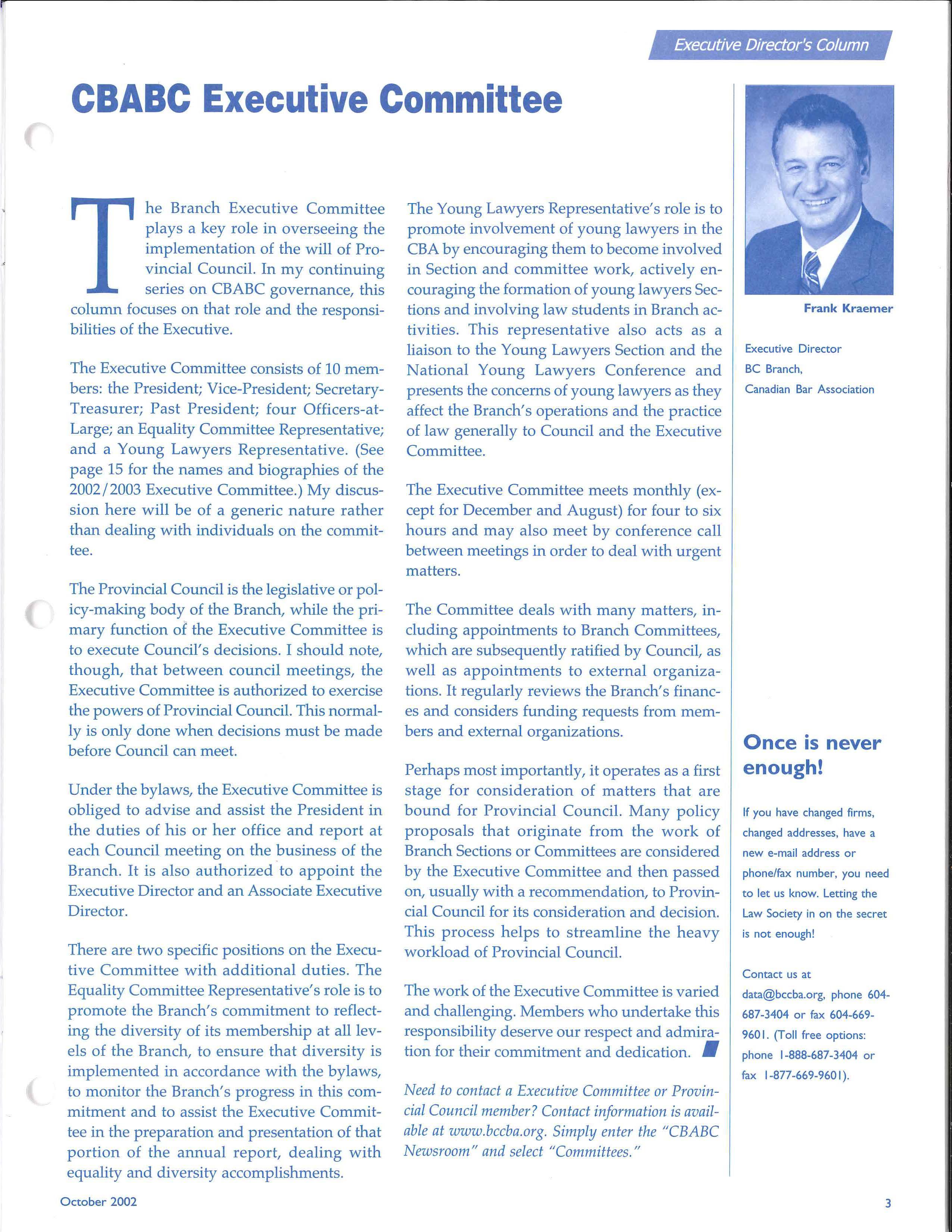
Execut ive Director BC Branch, Canad ian Bar Association
Once is never enough!
If you have changed firms, changed addresses, have a new e-mai l address or phone/fax number, you need to let us know. Letting the Law Society in on the secret is not e nough!
Contact us at data@bccba org, phone 604687-3404 or fax 604-669960 I. (Toil free options : phone 1-888-687-3404 or fax 1-877-669-960 I).
Frank Kraemer
NoWCB
premium rate increase for law firms this year
The Workers' Compensation Board recently announced a 20 per cent increase in the 2003 base rate for law firm employers Following intervention by the CBA on behalf of BC's lawyers, Sid Fattedad, WCB VP of Finance , initiated a review and on finding that certain unusual cost awards had skewed our profession 's rate trend, Mr. Fattedad will recommend that there be no WCB premium rate increase for law firms this year.
There will be an article by Mr Fattedad in the December BarTalk issue.
Civil Liability Review
At its September 21, 2002 meeting, CBABC Provincial Council considered Attorney General Geoff Plant's request for input on the Civil Liability Review.
Upon reviewing research by Law and Legislation Reform Officer Stuart Rennie and the Law Society of BC, and hearing oral presentations by the Trial Lawyers of BC, Council members debated the issue at some length. Council considered, following debate, the following resolution which was adopted by majority vote:
"CBABC opposes the government's plan to legislate sweeping changes to the law of civil liability and recovery without full consideration, consultation and a demonstrated need."
The resolution has been communicated to Attorney General Geoff Plant, and to all members by e-mail and facsimile. Any members who did not previously provide input on this issue but who wish to do so are encouraged to contact their local CBA representative. A complete list of representatives is available at www.bccba.org. •
CBA Fee Debated at Law Society AGM
Two-thirds majority confirms universality
The Annual General Meeting of the Law Society of BC was held on Friday September 20, 2002, at the Four Seasons Hotel in Vancouver and in eight other audio locations in the province More than 500 members attended to debate and vote on four key resolutions before the membership
The AGM proceedings began by acclaiming Bencher Peter Keighley to the position of Second Vice President of the Law Society. In keeping with the focus of the meeting resolutions, Victoria lawyer Sandra Harper asked Mr. Keighley whether or not he supported universal membership in the CBA. Mr. Keighley responded that he did
Resolution #2 was considered first, as an amendment to Resolution #1, seeking to remove the inclusion of the CBA fee in the Law Society practice fee . The resolution was moved by Gail Davidson, seconded by Tony Vecchio, and addressed by the largest number of speakers to the meeting. CBABC President David Paul, past TLABC president Jim Murphy, past Law Society Treasurer Warren Wilson, QC and Sandy Jakab-Hancock spoke against the amendment and in favour of universal membersh i p Dugald Christie, Anders Ourom, Cameron Ward and others spoke in favour of
the resolution. The amendment was defeated by a two-thirds majority.
The practice fee, which includes " an amount equivalent to the CBA fee," passed with little opposition, as did Resolution #3, moved by CBA past president Eric Rice, QC and CBABC past president John Waddell, QC. That resolution called on the Law Society to work cooperatively with the CBABC to address the matter of Law Society members who do not wish to be identified as CBA members. Resolution #4, moved by Lloyd Duhaime and seconded by Cameron Ward, which called for a referendum on universal membership, was withdrawn by the movers.
"This has been a difficult time, but also an uplifting one, in speaking with so many members who care passionately about the CBA and its value to the legal profession as a whole," said President Paul. "Now, we must reflect on what we can do as an Association to resolve the concerns of those members who are not as happy with the CBA, and who want us to do a better job of being responsive to their needs . If there is one thing this past year has taught us, it is the need to work to consult members more broadly on important issues and policy decisions of the Branch "
The BC Branch sponsors 72 Sections which play a vital role in keeping members informed on both changes in the law and legal and political issues affecting a given area of practice. They are the main resource utilized by the BC Branch in legislative review, law reform initiatives and in responding to matters affecting the profession. What follows is a sample of the recent activities of some Sections
ADA-VICTORIA
Dr George Irani provided Section members with a thought-provoking look at non-western approaches to conflict resolution with particular attention to Arab-Islamic models. Dr . Irani is currently a faculty member in the Conflict Analysis and Management Program at Royal Roads University and has spent the past 10 years working on conflict management models. He recommended looking into local traditions and indigenous rituals in designing reconciliation models especially in dea l ing with Arab-Islamic interests rather than using the Fisher-Ury style of interest-based "empowering of the individual" model.
FAMILY LAW-KAMLOOPS
Ken Hauser discussed some tax and estate planning issues that lawyers must deal with in the course of advising clients upon marital breakdown. He cautioned lawyers about the complexities of the tax treatment of child and spousal support payments as well as the ease with which capital gains tax can be triggered when transferring assets between spouses. He also cautioned against using RRSP's as security for support payments. CCRA has recently viewed this as "receiving a benefit" and has taxed the entire amount of the RRSP He reminded lawyers to be careful when advising clients whose spouses are non-residents of Canada. Tax treaties can complicate things.
Often lawyers draft separation agreements requiring the spouse who is obligated to pay maintenance to make a will incorporating the
relevant terms of the agreement. This is unnecessary if the obligation to pay support is properly drafted in the agreement. It would then be binding on the estate as a contractual promise. Requiring the provisions to be placed in a will could be problematic if the support obligation subsequently ends or is set aside. Mr. Hauser also cautioned lawyers about some of the traps involved in designating beneficiaries under life insurance and RRSP' s. It is very easy to make a mistake with unintended consequences There are different rules for life insurance and for RRSP' s and they can be complex.
INSURANCE LAW
Lyle Woodley, QC and Jan Lindsay led a discussion on the issue of joint retainers. This has become a hot topic in light of the recent decision of the Ethics Committee of the Law Society of BC to review the applicability of the Professional Conduct Handbook in an insurance context. Where a lawyer is defending a third party claim under a joint retainer with an insured and the insurer, ethical issues frequently arise. Mr. Woodley pointed to potential problems involving joint retainers outside the context of automobile insurance. He discussed situations where there are both insured and uninsured claims. In such situations it is important to advise the insured to obtain independent legal advice. This is also true where there is an insurance coverage limits issue. He also discussed difficulties where the insured says something that raises an issue with respect to whether the insured has breached the terms of the insurance policy. Both the insured and the insurer must be reminded throughout the joint retainer that no information will be kept confidential from any of the parties concerned. He spoke of a situation in which he was asked to provide a defence to an insured after providing a legal opinion on coverage to the insurer Mr. Woodley agreed to defend the insured if the insurer would agree to release a copy of the coverage opinion to the insured
Shelley Bentley Shelley Bentley is in private practice at G Davies & Company
Enrol today!
As of this date more than 2,200 members have enrolled in the 2002/03 Section activity year. Don't miss attending informative meetings and receiving worthwhile minutes and materials of our 72 Sections Last year 372 meetings were held Keep current on recent developments and practice trends It's not too late to enrol!
When you enrol in Sections you also have access to previous minutes, materials and annual reports on the CBABC Web site. An enrolment form can be downloaded from www.bccba.org or one can be faxed to you by calling the BC Branch office.
Section Talk
Continued from page 5
WOMEN'S PRACTICE AND EQUALITY ISSUES LAW
Linda Oprica, an experienced professional counselor who was recently named "Businesswoman of the Year" in the Comox Valley, spoke about finding a work/life balance or how to set ourselves up so that we are not on "spin" cycle. She identified her top 10 ways to take the "spin" out of your life cycle (or weed out the things in your life that do not support you or your values):
10 ways to take the "spin" out of your life cycle
1) Identify your values. (To help with this Ms. Oprica recommended that you think of your legacy: What do you want people to say about you when you've gone?)
2) Set priorities in the areas of self, work, family, financial, health, social and any other significant area of your life. Set one or two goals in each of these areas - be specific and start small.
3) Let go of perfection.
4) Keep YOUR standards, not those of the Jones'.
7) Do the best you can and then let go of the rest.
8) Choose wisely. Replace the "should's" and "have-to's" with "I choose to .... "
9) Say no.
10) Have a buddy to share ideas, plan & goals; hire a coach to keep you on track, challenge you and support you.
10 ways to build strong relationships
1) Be clear about the kinds of relationships you want.
2) Teach others how to treat you.
3) Don't allow others to become "tolerations" that drain your energy.
4) Come up with a strategy for managing "tolerations" that you cannot eliminate.
5) Be clear about your boundaries.
6) Communicate clearly and effectively. Request instead of complain.
7) Relationships teach you about yourself. Be irresistibly attractive to others by being your "best self "
8) Surround yourself with positive peoplechoose to spend time with them.
5) Taketimeforyourself;15minutesperday. 9) Be assertive.
6) Exercise 15 minutes per day minimum. Feed your body "healthfully ."
10) Knowwhentoletgo "Weed thegardenof friendship." •
New National Elder Law Section Formed
Following a growing practice in the USA and other jurisdictions, the CBA National Elder Law Section held its first meeting on August 11, 2002 at the CBA Annual Meeting in London, Ontario . Hugh McLellan of Vancouver was elected Vice Chair. The purpose of the Section is to improve the law affecting seniors; to educate the public, the Bar and the judiciary
on important Elder Law issues and to foster professionalism in the practice of Elder Law
CBABC members interested in forming a BC Elder Law Section are asked to contact Hugh McLellan at McLellan Herbert, 310-800 West Pender St., Vancouver, BC, V6C 2V6, 604-6835254 (lawyers@mclellanherbert.com). •
David J. Bilinsky
David J. Bilinsky is t he Practice Management Advisor at the Law Society of Br it ish Columb ia He can be reached on the Inter net at dbilinsky@lsbc org.
The views expressed herein are strictly those of the author and may not be shared by the Law Society of British Columbia
Taking Off the Blinders Opening yourself to new ways of problem solving
)lWe carry on in the same old way, no lesson learned from yesterday
Talk of changes lost in pages of paper work I believe it - How can we refuse to see I've received it - What could be our final destiny I believe that - Still we go on from day to day knowing what could be true
Wish I knew Wish I knew Open your eyes
You've got a great imagination )l
Words and Music: Anderson/Squire/ Howe I White I Sherwood, recorded by Yes
ou are back in the saddle after summer vacation - and reflecting, it seems like your vacation was eons ago At the time, you were out of your typical office environment and were happily engaged by new people, new situations, and new ideas. You reflect on how quickly you have fallen back into the 'same old, same old' ways of problem solving shortly after rejoining the 'modern' world. While the post-vacation 'dip' is quite natural, it highlights how easily we slide back into traditional mindsets in approaching our jobs How can we tap into that sense of freedom and openness to new ideas that we felt on our vacation and yet remain productive and efficient? Here are suggestions that have been put forward on increasing your creative approach :
• We interpret the world through mindsets; mental paradigms that allow us to respond quickly to problems . However, what can be a help can also be a hindrance, for mindsets can unintentionally lock us into ways of responding. A research study paradoxically found that the more you know about a given area, the harder it is to let go of your mindsets (experts would appear to have extreme difficulty in re-
examining or questioning the foundations for their beliefs- Kuhn, 1962).
Parts of our mindsets come from the tools that we use - how we go about solving problems. Here is an experiment you can do: Take the tool you use the most (it could be the telephone, e-mail, dictation or even launching an action) and the next time you reach for that tool- stop . Take a moment and ask yourself whether that tool has become a crutch for you and whether it has locked you into a pattern of behaviour . Now cast about for a different solution. If you usually dictate a formal letter, consider calling a face-to-face meeting - it may result in reaching a result faster than a long train of correspondence . Alternatively, if you spend 80 per cent of your day on the telephone, think of how you can achieve your goal without it. The important factor is to make the invisible walls around you real- and see how they form a box out of which you can climb.
So, mindsets are the root of the problem, eh? What, therefore, is the solution? More mindsets, of course! By developing more mental paradigms, we are able to draw on a wider range of tools and approaches when seeking solutions. How can you do this? 3M, the manufacturing company, fosters original thinking by encouraging their research people to complete their 'normal' work in 85 per cent of their work time - thereby freeing 15 per cent of their time to think out-of-the-box. Write a PostIt note for yourself- it works!
Ah, but law is a very conservative profession you say - courtesy of our
Lawyers Assistance Program
LAP provides confidential support, counselling and referrals for lawye r s, their families, support staff, judges a nd students su ffe ri ng from a lcohol a nd/ or chemica l dependency, stress, depression or just about any type o f personal prob lem
Fo r assistance or information on meetings and reso urc es ple ase call 604-685217 1 or to ll free 1-888-685-217 1.
The LAP office is located at 4 15- 1080 Main la nd Street, Vancouver , BC V6B 2T4
Practice Talk
Continued from page 7
training, we are programmed to follow precedent and proven ways
Question: are we any less conservative than, say, the USNavy?BarbaraHonegger, in a recentissue of Navy Newstand, reported on the launch of an innovative new-ideas incubator program called "Outliers" to help visionary thinkers up and down the chain of command hone their envelopebusting visions for military transformation. Honnegger reports that Barry Frew, Director of the Navy's Postgraduate School Centre for Executive Education, said, "We want the controversial, even heretical, ideas for mili t ary change that
•
the pride and joy of at least one leader or group who think they are doing great things The wise leader rocks the boat without swamping the boat or getting too close to the edge."
How can you approach problems differently? Stephen Covey, of 7 Habits fame, advises, "Begin with the End in Mind." This approach translates to tackling a problem by visioning the desired solution and working backwards. Rather than seeing the difficulties, you outflank them.
Another way to solve problems is to not think about them! Mathematicians rely on the critical function played by an incubation period. By relegating the problem to their unconscious, they have transferred their approach aren't easily incorporated into traditional militarysanctioned briefs or publications, to get them into the consciousness of the Defensive mechanisms (policy, reporting structures, systems and routines) can innocently crush new ideas and approaches. from left-brained deductive thinking to right-brained inductive thinking. In this way, problems that were insoluble after months of
Navy and mainstream America and we're going to work in faculty advisor-editorial teams with the Navy's as-yet-undiscovered geniuses to help them develop their ideas, get them out there, and start the dialogue to get them taken seriously."
What is the major ingredient in confronting mindsets? The cowardly lion hit it on the head: Courage. Allan W. Snyder, of the Centre for the Mind, Institute of Advanced Studies, Australian National University in Canberra said, "If you are not making your own waves, you probably will not catch any great ones. Organizations with total balance are probably so stable as to settle into inertia and stasis. They resist outside pressures for change and fail to adapt as messages arrive indicating that it is 'time to get a move on."' For example, Snyder says, "Most organizations plan for the use of new technologies in ways that maintain the status quo and waste the potential of the new tools. Such planning is often wrong -headed and wasteful. But it is also
hard work can be solved, literally, in a flash of insight.
Seek new inputs. One of the benefits of Internet search engines (such as Coogle) is that they are non-Boolean - they cast a wider net and pull in seemingly obtuse references. However, these loosely connected references can lead to new associations and new ideas .
Recalling the inherent structure of an organization can defeat new ideas since they challenge the status quo . Defensive mechanisms (policy, reporting structures, systems and routines) can innocently crush new ideas and approaches. The challenge for leaders is to maintain the balance between getting out today's work while keeping the door open for tomorrow's opportunities .
By opening ourselves to creative new approaches, we can free our imagmatlons in finding new ways to solve problems and get to 'Yes.'
•
Stuart Rennie Stuart Rennie is the CBABC Legislation & Law Reform Officer. He can be reached at 604-949-1490 (e-mail srenn ie@bccba.org).
Every effort is made to ensure the accuracy of the information provided to you in this art icle but the information should not be relied upon. Lawyers should refer to the specific legislative or regulatory provision You will see a reference in some cases to the number of the Bill when it was introduced in the House. This number may be different from the chapter number of the new Act which is quoted after the title of the Act and which is the proper citat ion for the Act The Bill Number has been given to you to make it easier for you to note up the Bills you may have in your library.
ACTS IN FORCE
Agricultural Land Commission Act, S.B.C. 2002, c. 36 (Bill21)
Amended: Consequential amendments are made to the: Cemetery and Funeral Services Act, R.S B.C.1996, c. 45, Cemetery and Funeral Services Act, R.S.B.C. 1996, c. 45, Forest Land Reserve Act, R.S .B.C. 1996, c. 158, Freedom of Information and Protection of Privacy Act, R.S.B.C. 1996, c 165, Greenbelt Act, R.S.B.C. 1996, c. 176, Hydro and Power Authority Privatization Act, R.S.B.C. 1996, c. 213, Islands Trust Act, R.S.B.C. 1996, c. 239, Local Government Act, R.S.B .C.1996, c. 323, School Act, R.S.B.C. 1996, c. 412, Waste Management Act, R.S.B.C. 1996, c. 482
Transitional Provisions: Land Reserve Commission Act, S.B.C. 1999, c. 14 and Agricultural Land Reserve Act, R.S.B.C. 1996, c. 10
Statutes Repealed: Agricultural Land Reserve Act, R.S.B.C. 1996, c. 10, Golf Course Development Moratorium Act, S.B.C. 1992, c. 8, Land Reserve Commission Act, S.B.C. 1999, c. 14, Soil Conservation Act, R.S.B.C. 1996, c. 434
Summary: Bill 21 repeals and replaces the: Agricultural Land Reserve Act, Land Reserve Commission Act and Soil Conservation Act. Bill21 establishes the Provincial Agricultural Land Commission, consisting of a chair and panels of three commissioners to be appointed from each of the province's six geographic areas, the: North, Interior, Islands, Okanagan, Kootenay and South Coastal. Bill21 provides for dispute resolution on community issues and rules for use and subdivision of agriculturalland reserve, sets restrictions for registrations under the Land Title Act or Strata Property Act for land used in an agricultural land reserve, authorizes public hearings for matters in the public interest and includes appeal, enforcement, offence and regulation-making provisions. Bill 21 extends voluntary delegation agreements to municipalities and other public bodies. The Bill
also amends the land use provisions of the Forest Land Reserve Act, and retains the forest land reserve designations and the authority of the commission to regulate forest practices for private forest reserve lands.
In Force: Act in force November 1, 2002 •
Corporation Capital Tax Amendment Act, 2002, S.B .C. 2002, c . 10 (Bill4)
Amended: Corporation Capital Tax Act, R.S.B.C. 1996, c. 73. Consequential amendments made to the Corporation Capital Tax Amendment Act, 2001, S.B.C. 2001, c. 30
Transitional Provisions: None
Statutes Repealed: None
Summary: Section 12 amends the Corporation Capital Tax Act, R.S.B.C.1996, c. 73 to change the formula for calculating the paid-up capital of authorized foreign banks to make it consistent with the taxation of domestic banks and to change the date for the repeal of section 7.1(3) from April1, 2002 to September 1, 2002.
In Force: Section 12 in force retroactive to February 19, 2002
Deregulation Statutes Amendment Act (No. 2), 2002, S.B C. 2002, c. 25 (Bill35)
Amended: Barbers Act, R.S.B.C. 1996, c. 24, College and Institute Act, R.S B.C. 1996, c. 52, Cosmetologists Act, R.S.B.C.1996, c.178, Financial Information Act, R.S.B.C. 1996, c. 140, Financial Institutions Act, R.S.B.C. 1996, c 141, Forest Act, R.S.B.C. 1996, c. 157, Forest Practices Code of British Columbia Act, R.S.B.C.1996, c.159,Freedom of Information and Protection of Privacy Act,
Kamloops Land Title Office
On November 29, 2002, the Application Receiving Centre at the Government Agent's office in Nelson will stop receiving applications for the Kamloops Land Title Office
All applications submitted to the Kamloops Land Title Office through the Nelson Application Receiving Centre on o r before November 28, 2002, must be dealt with directly with the Kamloops Land Title office after December 2, 2002 All applications dealing with titles in the Nelson Land Title District are to be submitted for registration comme ncing December 2, 2002, to the :
Kamloops Land Title Office 114-455 Co lumbia Street Kamloops, BC V2C 6K4 Tel: 250-828-4455
Legislative Update
Continued from page 9
R.S.B.C. 1996, c. 165, Home Owner Grant Act, R.S.B.C. 1996, c. 194, Mineral Tax Act, R.S.B.C. 1996, c. 291, Mineral Tenure Act, R.S.B.C. 1996, c. 292, Mines Act, R.S.B.C. 1996, c. 293, Motor Vehicle Act, R.S.B.C. 1996, c. 318, Perpetuity Act, R.S.B.C. 1996, c. 358, Petroleum and Natural Gas Act, R.S.B.C. 1996, c. 361, Property Transfer Tax Act, R.S.B.C. 1996, c. 378, Social Services Tax Act, R.S.B.C. 1996, c. 431, Society Act, R.S.B.C. 1996, c. 433, Vital Statistics Act, R.S.B.C. 1996, c. 479
Transitional Provisions: Health Research Foundation Act and Hospital Act
Statutes Repealed: Health Research Foundation Act, R.S.B.C. 1996, c. 184 and Part 3 of the Hospital Act, R.S.B.C. 1996, c. 200
Summary: Section 18 amends the Financial Information Act and section 31 of the Freedom of Information and Protection of Privacy Act to strike out "British Columbia Health Research Foundation." Section 32 repeals the Health Research Foundation Act. Regarding the Health Research Foundation Act: section 62, only with respect to the repeal of section 4 (f) of the Perpetuity Act, section 65, only with respect to the repeal of section 14 (4) (f) of the Property Transfer Tax, section 66, only with respect to the repeal of section 129 (h) of the Social Service Tax Act regarding the Health Research Foundation Act. Transitional provisions are made regarding the repeal of the Health Research Foundation Act in section 69( except the definitions of "hospital" and "Hospitals Foundation"}, sections 70 and 71. Sections 33 to 35 amend the Home Owner Grant Act to: remove the rule that current year taxes had to be unpaid at the time of application for the home owner grant, add a definition of "outstanding taxes" and add a power to refund to an owner any payment made on current year taxes which exceeds the amount of outstanding taxes net of the grant.
In Force: Sections 33 to 35 in force July 5, 2002
Sections 18, 31, 32, section 62 only with respect to the repeal of section 4 (f) of the Perpetuity Act, section 65 only with respect to the repeal of section 14 (4) (f) of the Property Transfer Tax Act, section 66 only with respect to the repeal of
section 129 (h) of the Social Service Tax Act, section 69 except the definitions of "hospital" and "Hospitals Foundation", and sections 70 and 71, in force July 12, 2002 •
Forest Statutes Amendment Act, 1998, S.B.C. 1998, c. 29 (Bill34)
Amended: Forest Act, R.S.B.C.1996, c.157, Forest Practices Code of British Columbia Act, R.S.B.C. 1996, c. 159. Consequential amendments made to the: Forests Statutes Amendment Act, 1997, S.B.C. 1997, c. 48, Special Accounts Appropriation and Control Act, R.S.B.C. 1996, c. 436, Waste Management Act, R.S.B.C. 1996, c. 482
Transitional Provisions: None
Statutes Repealed: None
Summary: Section 13(e) amends the Forest Act to add a power for the district manager to disqualify a person from being registered as a small business forest enterprise on the basis that this person did not enter into an agreement as required by the Act or for noncompliance with the agreement and to permit regulations to be made to specify the periods and criteria of disqualification.
In Force: Section 13(e) is in force July 5, 2002
Forest Statutes Amendment Act, 1997, S.B.C. 1997, c. 48 (Bill47)
Amended: Forest Act, R.S.B.C. 1996, c.157, Forest Practices Code of British Columbia Act, R.S.B.C. 1996, c. 159. Consequential amendments made to the: Supplement to the Forest Practices Code of British Columbia Act, Range Act, R.S.B.C. 1996, c. 396, Special Accounts Appropriation and Control Act, R.S.B C. 1996, c. 436,
Transitional Provisions: Evans Forest Products, appeals, cutting permits under current agreements, administrative remedies and forest development plans
Statutes Repealed: None
Summary: Section 40(a) amends the Forest Act authorizing regulations for payment of deposits and fees payable to the government.
In Force: Section 40(a) is in force July 5, 2002
Gaming Control Act, s.s.c. 2002, c. 14 (Bill 6)
Amended: Consequential amendments made to: Health Special Account Act, R.S.B.C. 1996, c. 185, Horse Racing Act, R.S.B.C. 1996, c.198, Horse Racing Tax Act, R.S.B.C. 1996, c. 199
Transitional Provisions: Regarding validity of issued licences, enactments and existing regulations given legal effect and exemptions for existing personnel
Statutes Repealed: Horse Racing Act, R.S.B.C. 1996, c. 198, Horse Racing Tax Act, R.S.B.C. 1996, c. 199, Lottery Act, R.S.B.C. 1996, c. 278, Lottery Corporation Act, R.S.B.C. 1996, c. 279
Summary: Bill 6 creates a comprehensive gaming statut e. It replaces the : Horse Racing Act, Horse Racing Tax Act, Lottery Act, Lottery Corporation Act. The BC Lottery Corporation is continued and provisions made regarding gaming and finances Provisions regulate gaming facilities. The Gaming Policy and Enforcement Branch is continued with increased authority to make registrations, conduct audits and investigations and provide enforcement. Licensed gaming events are managed by regulation and provisiOns regulating administration and enforcement of gaming events are made. Bill 6 permits eligible organizations to be given grants . Provisions regulate horse racing, registration of gaming services providers and workers.
In Force: Section 1, except the definitions of "gaming event", "licence", "lottery scheme" and "person", and sections 2 to 13, 14 (1), 18 to 29, 31 to 104, 105 (1) (a) and (d) to (u) and (8) to (11), 107 to 109 and 112 to 121 in force August 19,2002. Provisions to come into force by future regulation are those regarding: payment of revenue, horse racing betting fees and the repeals of the Horse Racing Act and the Horse Racing Tax Act.
Health Services Statutes Amendment Act, 2002, s B C. 20o2, c. 16 (Bill 18)
Amended: Hospital Insurance Act, R.S.B. C. 1996, c. 204, Medicare Protection Act, R.S.B.C. 1996, c 286
Transitional Provisions: None
Statutes Repealed: None
Summary: The Medicare Protection Act, R.S.B.C. 1996, c. 286 is amended to: change the powers of the Medical Services Commission, permit the commission to charge interest for improper billings, permit private insurance coverage for the cost of a service that is not covered by the Medical Services Plan if the service is provided by a health care practitioner who has elected to receive payment directly from beneficiaries, permit the Medical and Health Care Services Appeal Board panels to sit as one person for minor matters and dismiss cases where the complainant has not further pursued the appeal.
In Force: Sections 9 to 18 in force July 5, 2002
Notice to the Profession
Calderbank settlement letters (Sept 18, 2002)
The Supreme Court Rules Revision Committee seeks input from the bar about possib le cha nges to Ru le 37 which go verns offers to sett le to allow for the cont inued use of Ca lderbank letters where appropriate Committee members have expressed a desire to retain Ca/derbank letters While the comm ittee may decide against a ny action, two opti o ns are under consideratio n:
Labour Relations Code Amendment Act, 2002, S.B C. 2002, c. 47 (Bill42)
Amended: Labour Relations Code, R.S.B.C. 1996, c.244
Transitional Provisions: None
Statutes Repealed: None
Summary: In section 1, Bill 42 amends the Labour Relations Code to add a requirement that powers exercised under the Code must foster the employment of workers in economically viable businesses, encourage cooperative participation between employers and trade unions in resolving workplace issues, adapt to changes in the economy, develop workforce skills and develop a workforce and a work place that promotes productivity and ensure that the public interest is protected during labour
I) a new sub-ru le cou ld be added specifically preserving the Ca/derbank procedu r e in cases where Rule 37 cannot be used; or
2) repeal Ru le 37 and replace it w ith a codified form of Calderbank letters.
Please addre ss any suggestions or comments on the o pt ions identified in writing to: The Supreme Court Rules Revision C o mmittee: Attention Judith Hoffman, Van couver Law Courts, 800 Smithe St r eet, Van couver, BC, V6Z 2E I no later than January I S, 2003
The full Notice to the Profession is available at www co urts gov bc ca/sc
Forensic Pathology Workshop for Lawyers 2003
The University of Saskatchewan's Department of Anatomy and Cell Biology, College of Medicine, and the College of Law are pleased to present a special educational opportunity, for those individuals involved in the investigation of sudden death , in Banff March 7-9, 2003. Workshop organizers are proud to spotlight three international experts at this special event:
• Dr. Valerie Rao, Chief Medical Examiner, District 5, Florida;
• Dr. Emma Lew, Deputy Chief Medical Examiner, Miami-Dade County Medical Examiner 's Department, Florida; and
• Dr. David Dolinak, Deputy Chief Medical Examiner, Dallas County, Texas
Dr. Graeme Dowling, Chief Med ic a l Examiner of Alberta, will participate as workshop faculty.
For mo re information on this workshop, visit www.deathinvestigator.com.
Legislative Update
Continued from page I I
disputes. Sections 2 to 8 form the balance of Bill 42. Bill42 makes the prohibition on unfair labour practices in section 6(1) subject to the new section 8. The new section 8 creates a right for a person to express his or her views on any matter, including matters relating to an employer, a trade union or the representation of employees by a trade union, provided that the person does not use intimidation or coercion. Bill42 continues the Collective Agreement Arbitration Bureau: consisting of a director designated by the chair and other employees of the board designated by the director but eliminates the requirement that the director and employees be appointed under the Public Service Act. Bill 42 also makes discretionary the appointment: by the director of a mediator-arbitrator and by the chair of one vice chair as the associate chair of the Mediation Division and the Adjudication Division. Amendments also permit the chair to delegate powers of the board or director to the associate chairs, the registrar or one or more of the other members and add regulation-making power for presentations by employers and trade unions related to votes under the Code and to authorize fees payable for any services provided by the board or its staff under the Code.
In Force: Sections 2 to 8 are in force July 30, 2002. Section 1 in force September 1, 2002.
•
Liquor Statutes Amendment Act, 1999, S.B.C. 1999, c. 36 (Bill80)
Amended: Liquor Control and Licensing Act, R.S.B.C. 1996, c. 267 and Liquor Distribution Act, R.S.B.C. 1996, c. 268
Transitional Provisions: None
Statutes Repealed: None
Summary: Section 8 amends the Liquor Control and Licensing Act to permit the general manager to prescribe the form for an application for licences. The Act is amended by: section 1 (c) which repeals the definition of "products",
section 2(b) which repeals the power of the general manager to grant licences to all breweries, wineries and distilleries manufacturing in BC, section 4 (except the part enacting section 11.5 of the Liquor Control and Licensing Act) regarding licensing areas, section 5 (a) regarding conditions set for licenses, section 9 (except the part enacting section 16 (1.1) of the Liquor Control and Licensing Act) regarding prohibitions on issuing licences and the part of 17 that repeals section 26 regarding a club's visitors' register.
In Force: Section 8 in force August 12, 2002. Sections 1 (c), 2 (b), 4 except the part enacting section 11.5 of the Liquor Control and Licensing Act, 5 (a), 9 except the part enacting section 16 (1.1) of the Liquor Control and Licensing Act, and the part of 17 that repeals section 26 of the Liquor Control and Licensing Act are in force December 2, 2002 • Miscellaneous Statutes Amendment Act (No. 2), 2002, S.B C. 2002, c. 48 (Bill 54)
Amended: Assessment Act, R.S.B.C. 1996, c. 20, Constitution Act, R.S.B.C. 1996, c. 66, Ecological Reserve Act, R.S.B.C. 1996, c. 103, Freedom of Information and Protection of Privacy Act, R.S.B.C. 1996, c. 165, Greater Nanaimo Water District Act, S.B.C.1953 (2nd Session), c.41, Greater Vancouver Sewerage and Drainage District Act, S.B.C. 1956, c. 59, Greater Vancouver Water District Act, S.B.C. 1924, c. 22, Highway Act, R.S.B.C. 1996, c. 188, Land Surveyors Act, R.S.B.C. 1996, c. 248, Legislative Assembly Management Committee Act, R.S.B.C. 1996, c. 258, Liquor Control and Licensing Act, R.S.B.C.1996, c. 267, Liquor Distribution Act, R.S.B C. 1996, c. 268, Local Government Act, R.S.B.C. 1996, c. 323, Mental Health Act, R.S.B.C. 1996, c. 288, Mineral Tenure Act, R.S.B.C. 1996, c. 292, Mines Act, R.S.B.C. 1996, c. 293, Ministry of Transportation and Highways Act, R.S.B.C 1996, c. 311, Motor Vehicle Act, R.S.B.C. 1996, c 318, Municipalities Enabling and Validating Act (No. 3), S.B.C. 2001, c. 44, Protected Areas of British Columbia Act, S.B.C. 2000, c. 17, Public Sector Employers Act, R.S .B.C. 1996, c. 384, Public Sector Pension Plans Act, S B C.1999, c. 44, Public Service Labour Relations Act, R.S.B .C. 1996, c. 388, Regulatory Streamlining Miscellaneous Statutes Amendment Act, 2000, S.B.C. 2000, c. 11, Social
Service Tax Act, R.S.B .C. 1996, c. 431, Waste Management Act, R.S.B.C. 1996, c 482
Transitional Provisions: Liquor Appeal Board under Liquor Control and Licensing Act and Liquor Distribution Act
Statutes Repealed: Schedule to the Job Protection Act, R.S.B.C. 1996, c. 240
Summary: Sections 9 and 10 amend the Greater Vancouver Sewerage and Drainage District Act and section 59 amends the Municipalities Enabling and Validating Act (No . 3) regarding the purchase of the Ashcroft Ranch in the Interior of BC.
In Force: Sections 9, 10 and 59 in force July 26, 2002
Miscellaneous Statutes Amendment Act (No. 2), 2000, S.B.C. 2000, c. 26 (Bill24)
Amended: Total of 23 statutes amended
Transitional Provisions: Limitation Act, R.S B.C. 1996, c. 266 regarding dentists
Statutes Repealed: None
Summary: Section22 amends the Liquor Control and Licensing Act, R.S B.C. 1996, c. 267 to repeal power to permit fees to be levied by local governments and First Nations to cover the costs in assessing applications respecting liquor licences
In Force: Section 22 in force December 2, 2002
School Act to set new limits on teachers' collective agreements and to void any provision of a collective agreement that conflicts or is inconsistent with the Act
In Force: Section 8 (c) and (d) in force September 1, 2002
Public Education Flexibility And Choice Act, S.B.C. 2001, c. 3 (Bill 28)
Amended: School Act, R.S .B.C. 1996, c. 412
Transitional Provisions: None
Statutes Repealed: Public Education Labour Relations Act, R.S.B.C. 1996, c. 382
Public Safety and Solicitor General Statutes Amendment Act, 2002, s.B.C. 2002, c. 52 (Bill 51)
Amended: Crime Victim Assistance Act, S.B.C. 2001, c. 38, Criminal Injury Compensation Act, R.S.B.C. 1996, c 85, Criminal Records Review Act, R.S.B C. 1996, c. 86, Freedom of Information and Protection of Privacy Act, R.S.B.C. 1996, c. 165, Motion Picture Act, R.S.B.C. 1996, c. 314, Video Games Act, S.B .C. 2001, c. 22
Transitional Provisions: Criminal Records Review Act, Motion Picture Act and Crime Victim Assistance Act
Statutes Repealed: None
Summary: Section22repeals, amends and adds definitions to the Criminal Records Review Act. Section 23 (b) to (e) repeals and replaces definitions and removes the requirement for the deputy registrar to notify the registrar of the determination under the Act. Sections 24 to 34 amend the Act, including to replace the appeal to a panel with a reconsideration by the registrar of the deputy registrar's determination. That portion of section 35 that enacts section 27.2 of the Criminal Records Review Act regarding delegation of functions of the registrar and deputy registrar is amended. Sections 36 and 37 amend the Act to make regulations prescribing fees and to change references under the Act. Section 38 amends the Freedom of Information and Protection of Privacy Act to strike references to the now eliminated Criminal Record Check Appeal Panel and Motion Picture Appeal Board . Section 23 (a) adds a reference to the prescribed fee and the part of 35 enacting section 27.1 of the Act permits the registrar to waive the prescribed fee payable for a criminal record check.
In Force: Sections 22,23 (b) to (e) and 24 to 34,
Restorative Justice Facilitator Training
There will be a Restorative Justice Faci litator Training Conference in Victoria for Family Group Conference facilitators November 2-3, 2002 This two-day training provides an introduction to restorative justice and includes several role playing practices After the training and until they become secure in the process, new facilitators are recommended to pair up with experienced ones
Certificate on completion is provided by the REALJustice organization and the model is the one developed in Wagga Wagga, Australia, and presented in similar trainings provided by RCMP
Cost per person is $55 to cover materials , hospitality, etc For a brochure , contact Etta Connor at 250-6588922, fax 250-658-81 I0, or e-mail etta@connor bc ca
Legislative Update
Chief Justice Finch to speak at Alumni Breakfast
The UBC Law Alumni Association's next distinguished speaker will be the Honourable Chief Justice Lance Finch, of the BC Court of Appeal. He will speak on "The Office of the Chief Justice of British Columbia."
The alumni breakfast meeting will occur Friday, November IS at 7:30 a m at the Terminal City Club.
Tickets are $35, payab le to: Peter W. Brown Law Corporation, 2081 West 37"' Avenue, Vancouver, BC V6M I N7. No refunds after November 8
For more information call 604-261-0300 Space is limited, so reserve your ticket today!
Legislative Update
Continued from page 13
of the Criminal Records Review Act and sections 36 to 38 in force effective July 15, 2002 Sections 23 (a) and the part of 35 enacting section 27.1 of the Criminal Records Review Act are in force October 1, 2002.
identification required (from 1 ), reduce restrictions on types of facilities that can qualify for a liquor licence, increase flexibility on licensed capacity, permit increased restaurant service of liquor without food, increase flexibility on hours of operation (B C. Reg. 244 I 2002 effective December 2, 2002).
School Amendment Act, 2002, s.B.c. 2002, c. 53 (Bill34)
Amended: School Act, R.S B C. 1996, c. 96
Transitional Provisions: District parents' advisory council, provincial funding, application of enrollment provisions and annual budget
Statutes Repealed: None
Summary: Section 32 adds to the School Act the power for school boards to create entities for entrepreneurial activities to provide consulting, educational or administrative expertise or international education services.
In Force: Section 32 in force July 19, 2002
REGULATIONS TO NOTE
Cost ofConsumer Credit Disclosure Act amends B.C. Reg. 23512001 to extend the date when the Act (except sections 16(a), 64 and 65) and the disclosure regulation take effect from September 1, 2002 to December 1, 2002. (B C. Reg 239 I 2002 effective December 1, 2002).
Criminal Records Review Act sets the prescribed fee at $20 to be paid by a person requesting a criminal record check (B.C. Reg. 238 I 2002 effective October 1, 2002).
Liquor Control and Licensing Act amends B.C. Reg 608 I 76 including to: reduce liquor licence categories from 7 to 2 and licence classes from 19 to 2, reduce licence processes to 2 (food primary (restaurants) and liquor primary (bars and pubs)), require licensees to check identification if a patron appears to be under 25 (from age 19) and require 2 pieces of
Mortgage Brokers Act amends B C. Reg. 237 I 2001 to change the effective date from September 1, 2002 to December 1, 2002 B C. Reg. 237 I 2001 prescribes Cost of Consumer Credit Disclosure Act provisions to apply to the Mortgage Brokers Act (B C. Reg. 240 I 2002 effective December 1, 2002).
Motor Dealer Act amends B.C. Regs. 23812001 and 239 I 2001 to change the effective date from September 1, 2002 to December 1, 2002. B C. Reg. 238 I 2001 repeals specific provisions under the leasing regulation B C. Reg. 239 I 2001 prescribes Cost of Consumer Credit Disclosure Act provisions to apply to the Motor Dealer Act (B.C. Reg 24112002 and 24212002 effective December 1, 2002).
REPORTS AVAILABLE
On Balance: Guiding Principles for Administrative Justice Reform in British Columbia (August 2002). This White Paper proposes 52 recommendations for change to the more than 60 administrative tribunals in BC. The government's deadline for comment is November 15, 2002. Source: Ministry of Attorney General. Available at: www.gov.bc.cal ajp I.
Report on the Ultimate Limitation Period: Updating the Limitation Act (July 2002). The Report makes 9 recommendations for law reform, including that the ultimate limitation be reduced from 30 to 10 years. Source: BC Law Institute. Available at: www.bcli.org.
Revised Crown Counsel Spousal Policy. The Discussion Paper proposes revisions to the Criminal Justice Branch Spousal Assault Policy. The government's deadline for comment is October 28, 2002 Source: Ministry of Attorney General. Available at: www.ag.gov.bc.ca/legislation. •
Executive Committee 2002/2003
BarTalk th anks the memb ers of the 2002 /2003 Executive Committee for pro v iding the following biographies.
DAVID A. PAUL, PRESIDENT
David graduated from the University of Victoria Law School in 1986 . Since his call to the Bar in 1987, David has spent his professional career in Kamloops , where he was born and raised. His practice areas include Criminal Law, Family law, Personal Injury Law, Mediation, and Real Estate Sales. In 1997 he established the law firm of Paul & Company where he now practises with his sister, Lorianna Bennett. David is a member of the BC Trial Lawyers' Association, the BC Arbitration & Mediation Institute, and the BC Mediator Roster Society
Prior to his election to Provincial Council, David was actively involved in the profession at the local level. He served the Kamloops bar Association from 1990-1994 where he held various executive roles until his presidency in 1993-94. As well, David participated on the Law Day committee and he sat on the Advisory Committee for the University College of the Cariboo
David was first elected to Provincial Council in 1995. Between 1998 and 2001 he served as an Executive Committee member . David previously served as a member of the Branch's Supreme Court ADR Committee and the Communications Committee . He is a Past Chair of the following committees: Planning & Priorities; Nominating; Awards & Recognition; and BarTalk Editorial Board . David belongs to the Kamloops Criminal and Family Bar Sections and served as the Branch Section Coordinator between 1998 and 2000 During this period David also chaired the Sections Task Force.
Currently, David is the Executi v e Liaison to the Lawyers Property Exchange Committee, the Chair of the Provincial Court Judges Pensions and Salaries Committee, and the CBABC appointee to the Judicial Council of BC.
ROBERT BRUN, VICE-PRESIDENT
Robert was born in Whitehorse, Yukon Territories, in 1952 and attended elementary and secondary school in Vancouver . He received a Bachelor of Arts degree from UBC in 1974 and a Bachelor of Laws degree from UBC in 1977. He was called to the Bar of BC in 1978. Robert entered private practice in Vancouver in July of 1978, going to the Legal Services Department of the WCB in May of 1979 He remained there until July of 1984 when he entered into a partnership with Lyle Harris in Vancouver.
Since 1984, he has practised continuously in Vancouver, appearing frequently in the Supreme Court of BC and the BC Court of Appeal. On several occasions he has ventured before the Supreme Court of Canada
Robert is a frequent guest speaker at seminars put on by CLE and the Trial Lawyers Association of BC. He has been an active member of the Trial Lawyers Association of BC since 1991. He has been a member of the Canadian Bar Association since 1977 and was an Executive member of the Insurance Law Section
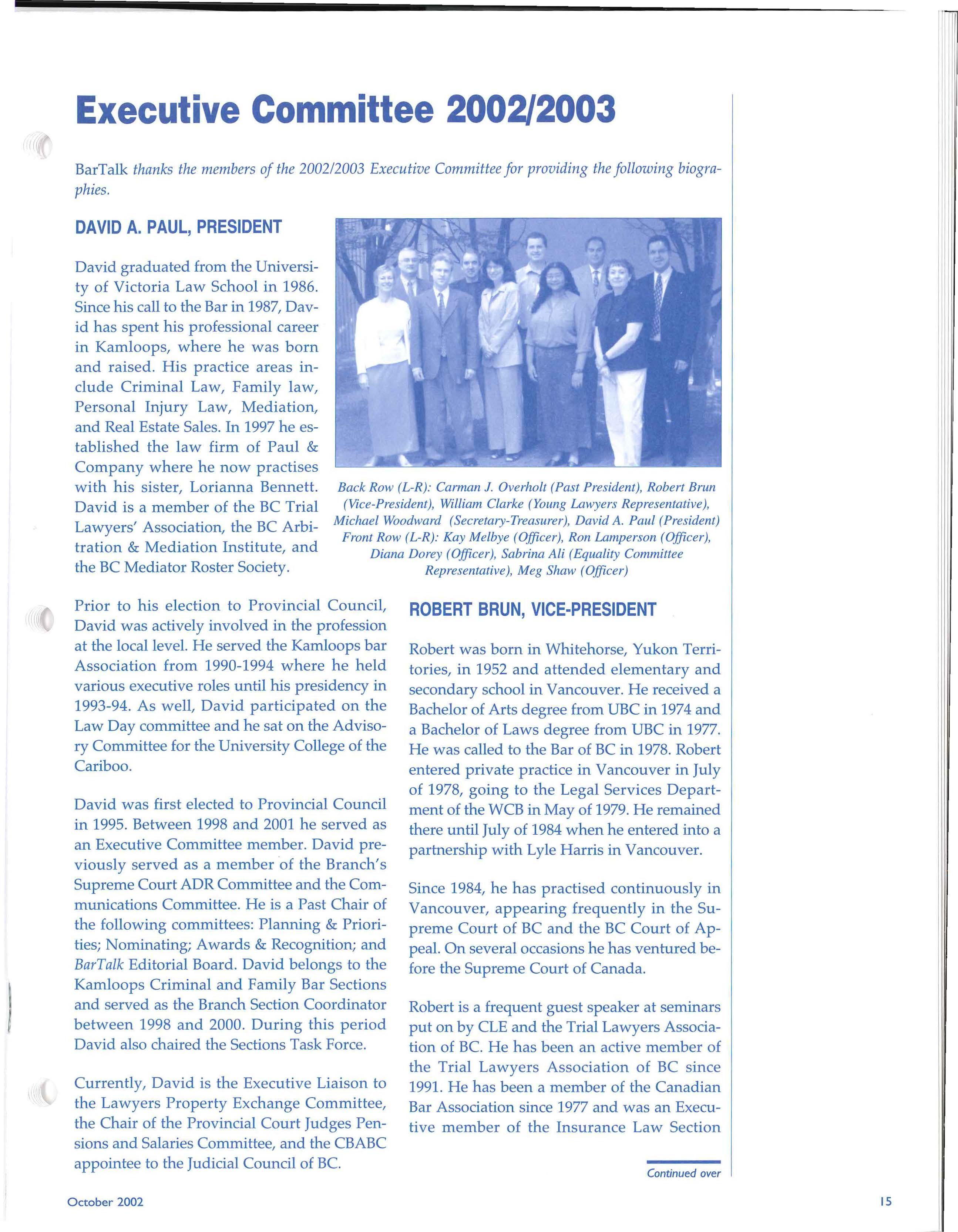
Back Row (L-R) : Carman J Ove rholt (Past President) , Rob e rt Brun (Vi ce -President) , William Clark e (Young Lawyers Representative) , Michael Woodward (Secretary-Treasure r) , David A Paul (President) Front Row (L-R): Kay M e lbye (Officer) , Ron Lamperson (Offi cer), Diana Dorey (Officer) , Sabrina Ali (Equality Committee Representative), Meg Shaw (Officer)
Executive Committee 2002/2003
Continued from poge 15
from 1991 to 1995. In 1997, he became an Elected member of the Provincial Council and is now in his second term. He was first elected to the Executive of the Provincial Council in 2000. Robert was Secretary- Treasurer during 2001/2002 .
MICHAEL C. WOODWARD, SECRETARY·TREASURER
Michael Woodward is a graduate in mathematics and law at UBC, and was called to the Bar in 1986. He is a founding Partner in the law firm of Woodward Walker, which acts for local government throughout the Province.
An elected member of CBA Council since 1997, Michael was elected to the Executive in 2001, and in 2002 elected as Secretary-Treasurer of the Branch
He is past-Chair of the Municipal Law Section and a member of the Labour and Environmental Sections as well. He has presented papers at several CLE courses, and authored the Municipal Law Chapter for CLE ' s Annual Review of Law and Practice for the past five years, and was course coordinator for a recent Municipal Law CLE program He frequently lectures for the Municipal Officers' Association, the Union of BC Municipalities, the Municipal Administration Training Institute, and the Capilano Administration Program
Following articles and three years as a labour 1 school law associate at Campney & Murphy, Michael spent two years with the municipal law firm Lidstone, Young, Anderson, followed by 11 years as a partner in the Municipal law firm Thompson & McConnell. He and his law partner Robert Walker founded Woodward Walker in mid-2002.
Michael is 46 years old, and resides in White Rock with his spouse and three children Summer Saturdays he rows boats and is a founding Director of the Nicomekl Rowing Club. In the winter, he skis, after a fashion.
CARMAN J. OVERHOLT, PAST PRESIDENT
Carman was born in London, Ontario in 1958 He received an Honours Bachelor of Arts degree in History in 1981 from the University of Western Ontario. In 1984, Carman received a Bachelor of Laws degree from Queen's University and was awarded the Tricolor Award for outstanding contribution to the University community Carman was called to the BC Bar in 1986.
Carman is a Past President of the Advocates Club, a past Director of the Law Courts Inn and a past member of the Executive of the Vancouver Bar Association. Carman has been involved in the activities of the CBA throughout his time at the bar, including service as a member of the organizing committee for the annual meeting in Vancouver in 1989 and the joint meeting of the CBA and Commonwealth Law Conference in Vancouver in 1996 More recently, Carman was the Chair of the President's Forum held in Vancouver in April1999 on 'The Business of Law' and the Co-chair of the President's Forum on 'Specialization and Success in the Practice of Law' held in Kelowna in April, 2000.
Carman was elected to the Provincial Council of the CBA in 1997 and to the Executive of the CBABC in 1998. In 2000, Carman was elected to the position of Secretary-Treasurer on the Executive. Carman is the Chair of the QC Appointment Committee, Co-Chair of the Joint Law Society of BC/CBABC Pro Bono Committee and the Chair and President of Pro Bono LawBC.
Carman has organized and chaired the annual Employment Law Conference for CLE for many years. He lectures frequently on labour, employment and human rights issues
Carman is a partner of the national firm, Fraser Milner Casgrain LLP where he practises labour and employment law .
SABRINA A.S. All, EQUALITY COMMITTEE REPRESENTATIVE
Sabrina was born in Guyana, South America in 1967 She received her Bachelor of Arts degree in Administrative and Commercial Studies
I (I
from the University of Western Ontario in 1989 and her Diploma in Honors Standing in Political Science from UWO in 1990. Sabrina received her Bachelor of Laws from the University of Saskatchewan in 1993. She ernbarked upon a backpacking adventure around Asia and was called to the BC bar in 1997.
Sabrina is Co-Chair of the Equality Committee, a member of the executive, on the Sections Standing Committee, an elected member of Provincial Council and acts as Executive Liaison for the International Resource Committee and the Law Week Committee, all of the CBABC. Sabrina is also a member of the Futures Committee of the Law Society of BC.
Sabrina runs her own practice in civil litigation.
BILL CLARKE, YOUNG LAWYERS REPRESENTATIVE
With a name like William Thomas Clarke III, it would seem that he was destined to be a lawyer, or at least aristocracy - we guess he will settle for being a lawyer.
William (Bill) Clarke attended the University of Alberta for his formal legal education, taking special interest in Criminal and Family Law. During this time he was employed at Berge & Company as a summer student, and then the Kelowna Courthouse Registry as a clerk in both the Supreme and Provincial Courts. He articled with the firm of Martin Johnson in Kelowna, and was called to the BC Bar in 1996. He practises Family Law, CFCSA litigation, and Criminal Defence at Martin Johnson, under the banner of the "Heritage Law Group."
Since graduation, Bill continues to be highly active in his community. He has acted as the Interim Chair of the U2K (University 2000) committee, in which he was instrumental in initiating a community-based movement that desired the conversion of the local UniversityCollege, to a full-status university . As an avid Rescue SCUBA Diver and Medic First Aid, he has served as a board member of Project COOL (Clean Our Okanagan Lake), in which he is an active fundraiser, and guiding hand. Bill is a l so very active in the Kelowna Dragon
Boat Festival, where his team just received the Bronze Medal in the September Races!
Since 1995, Bill Clarke has also been an active member in Sections, and has pursued the positions of Secretary, Vice-Chair, Co-Chair, and Chair of the Okanagan Criminal Justice Section. In this capacity he has been responsible for all aspects of organization and activism. In 2000, Bill was instrumental in creating a Young Lawyers-Okanagan Section Bill chairs the Articling Student Committee.
As a member of the Provincial Council Executive, he is eager to learn and contribute to the interests of the young lawyers of BC. As anyone who knows him will attest, if you have a concern he will listen and act.
DIANA L. DOREY, OFFICER
Travel to Asia with the OBA
Each year the Ontario Bar Association (OBA) arranges a foreign conference for its members to travel to different countr ies to meet with lawyers, judges, and judicial a uthorit ies in each of those countries The contact is usually made through social functions , receptions ho sted
In 1986, Diana received her Bachelor of Arts by Canad ian Consuls, Degree in criminology from Simon Fraser University and in 1987 she obtained a Masters of Philosophy Degree from the University of Cambridge in England. Diana graduated from UBC with her law degree in 1990. Diana articled with Davis & Company and during her articles, Diana was a Law Clerk at the Supreme Court of BC. Diana joined Davis & Company following her call to the Bar in November 1991.
Diana enjoys a diverse litigation practice at Davis & Company with an emphasis on employment and insurance litigation, and long term disability disputes. Diana has written and presented papers for CLE, the CBA, Pacific Business & Law Institute and the Human Resources Management Association.
Diana was elected to Provincial Council representing Vancouver County in May 2000. This is her second term on the Executive as an Officer. Last year Diana co-chai r ed the President's Forum on the Business of Law and served as the Executive Liaison to the Legislation and Law Reform and Communications Committees This year Diana will continue as the Executive Liaison for the Legislation and Law Reform Committee In August 2002 Diana was appointed to the Editorial Board for the National magazine.
Continued over
Ambassadors, and High Comm issioners
The OBA welcomes any BC members who wish to join the conference and enjoy the camaraderie of a legal trip to Asia
In 2003 (March 13-29), the foreign conference is going to Vietnam, Laos and Cambodia. Trip detai ls are available at www oba org (cl ick on the icon of the golden pagoda at the right hand side of the screen)
Executive Committee 2002/2003
Continued from page I 7
Diana is 39 years old and was born and raised in North Vancouver. Diana resides in North Vancouver with her spouse, Geoff Baragar, a Crown prosecutor, and they have two young girls.
RONALD G. LAMPERSON, OFFICER
Ron was born in Kamloops in 1962. Hereceived a Bachelor of Arts degree from UBC in 1985 and a Bachelor of Laws degree from UBC in 1989. Following articles with Braidwood, MacKenzie, Brewer & Greyell in Vancouver, Ron moved to Campbell River where he worked for six years as a Crown prosecutor. In 1996, he entered private practice with a solicitor in Qualicum Beach, forming the firm of Marshall & Lamperson. Ron has a general criminal and civil litigation practice.
Ron is a past president of the Campbell River Bar Association and of the Nanaimo County Bar Association. He is a member of the Trial Lawyers Association of BC and served on its Executive Committee in 2000/2001. He was involved in establishing the Salvation Army Pro Bono Legal Advice Program in Parksville/ Qualicum and continues to be a participating lawyer in the program.
Ron served as an elected member of Provincial Council from 1995 until earlier this year when he was elected as an Executive Committee member. He has been a member of various CBA committees including the Court Services Committee, the Nominating Committee and the Advisory Committee to the Judicial Council. Presently he is the executive liaison to the Membership Committee, the Member Services Committee and to the Advisory Committee to the Judicial Council.
KAY MELBYE, OFFICER
Kay was born in Victoria, BC in 1956. Kay was raised in Victoria, attending elementary and high school there. In 1980 Kay moved to Southern California where she lived and worked until returning to Victoria in 1990. After returning to Victoria with two young sons,
Kay attended undergraduate studies at the University of Victoria from 1991 through 1994. In September 1994 Kay began her legal education at the University of Victoria and obtained her law degree in May 1998. Kay articled with the law firm of Cook Roberts in Victoria and was called to the bar in May 1999 Kay continued to work at Cook Roberts after her call to the bar, practising civil litigation and family law, until March 2001. In March 2001, Kay made the move to the law firm of Brown Henderson on Oak Bay A venue in Victoria, only blocks from where she was raised and attended school. Kay continues to work at Brown Henderson and her practice is now primarily family law with some civil litigation.
Kay has been an elected member of Provincial Council representing Victoria County since 2000 and was elected to the Executive Committee in June 2002. Kay is former chair of the Women Rainmakers Section and is also a member of the Family Law, Civil Litigation and Dispute Resolution Sections. Kay is also a founding member of the Women's Advisory Committee which is a Special Committee formed with a mandate to pursue forming a Conference on women's advancement and recognition in the legal profession. Kay is the Executive Committee Liaison to the BarTalk Editorial Board and the Planning & Priorities Advisory Committee. In addition, Kay is a member of the executive of the Victoria Bar Association.
MEG (MARGUERITE) E. SHAW, OFFICER
Meg was born in Lethbridge, Alberta but has lived in BC since 1969. Meg graduated from the University of Victoria in 1983 with her Bachelor's degree in the Science of Nursing and from UBC in 1988 with her Bachelor's degree in Law.
Meg articled in Kelowna with the then firm of McAfee Harder and has been practising law in Kelowna since. She is with the firm Hattori & Shaw. Meg practises in the area of family law, mediation, wills and estates, and also practises as a CFCS mediator, child advocate, and ad hoc counsel for the Coroner's Service of BC. Meg has been an invited participant in discussion groups hosted by the Law Society on the topic of regulation of mediation, and by the
Federal Government and Provincial Government on the topic of proposed changes to the Divorce Act in the area of custody and access.
Meg first served as Chair of the Okanagan Family Law Section for three years, and attended two National Family Law Conferences as the delegate from BC. Meg was a Co-Chair for the Okanagan ADR Section, a member of the CBABC Communications Committee for two years, and was the Co-Chair of the President's Forum that was held in Kelowna in April2000.
Meg is currently completing her sixth year on
Provincial Council as an elected member from Yale County and her second year as an Officer on the Executive.
Meg is also a Director on the Board of the Registered Nurses Association of BC, and has been involved with committee work with Kiwanis and the Kelowna-Westbank YMYWCA. As well, Meg has been a guest lecturer for the Department of Nursing at the Okanagan University College and the Continuing Legal Education Society of BC. She has also provided pro bono services for the Central Okanagan Hospice Association and the Elizabeth Fry Society. •
Albert J. McClean, QC wins Hnatyshyn Award
The 2002 Ramon John Hnatyshyn Award for Law was awarded to Albert J. (Bertie) McClean, QC, of Vancouver, at the CBA National annual conference on August 10, 2002.
"Throughout his legal career, Professor McClean has contributed to legal scholarship," said CBA Past President Eric Rice, QC. "His outstanding contributions to law, particularly to the comparative law of trusts in Quebec and the common law jurisdictions is unsurpassed."
Throughout his career Professor McClean has been a legal scholar, an admired law professor, a respected Dean
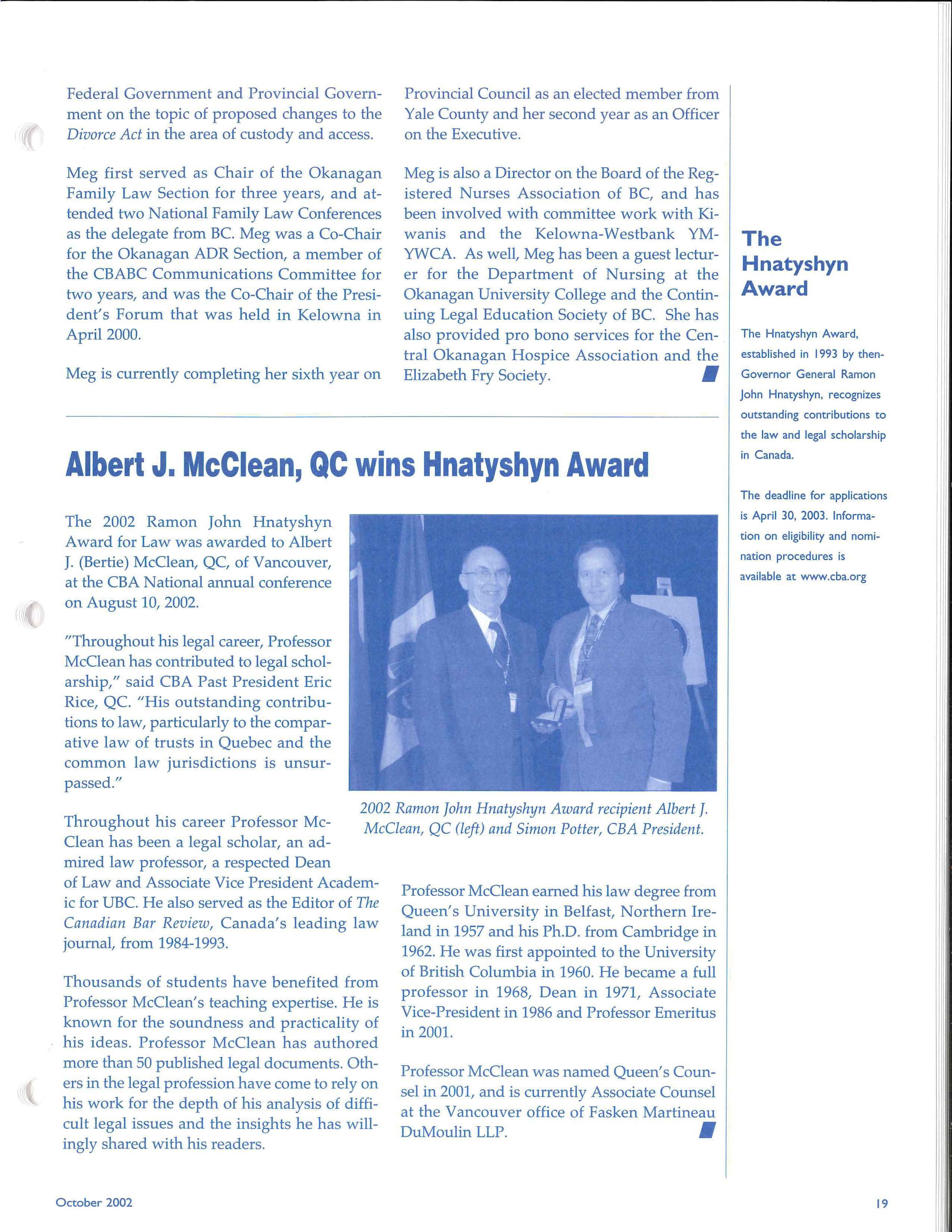
McClean, QC (left) and Simon Potter, CBA President.
of Law and Associate Vice President Academic for UBC. He also served as the Editor of The Canadian Bar Review, Canada's leading law journal, from 1984-1993.
Thousands of students have benefited from Professor McClean's teaching expertise. He is known for the soundness and practicality of his ideas. Professor McClean has authored more than 50 published legal documents . Others in the legal profession have come to rely on his work for the depth of his analysis of difficult legal issues and the insights he has willingly shared with his readers
Professor McClean earned his law degree from Queen's University in Belfast, Northern Ireland in 1957 and his Ph.D. from Cambridge in 1962 He was first appointed to the University of British Columbia in 1960. He became a full professor in 1968, Dean in 1971, Associate Vice-President in 1986 and Professor Emeritus in 2001.
Professor McClean was named Queen's Counsel in 2001, and is currently Associate Counsel at the Vancouver office of Fasken Martineau DuMoulin LLP
The Hnatyshyn Award
The Hnatyshyn Award, established in 1993 by thenGovernor General Ramon John Hnatyshyn, recognizes outstanding contribut ions to the law and legal scholarship in Canada
The deadline for appli cations is Apr il 30 , 2003. Information on eligibility and nomination procedures is available at www cba.org
2002 Ramon John Hnatyshyn Award recipient Albert J.
Patricia Jordan
Patricia Jordan is the CBABC Manager , Interactive Media She welcomes your comments , questions, and suggestions. If you're having difficulty finding a document online, need an answer, or would like something added to the site, contact her at pjordan@bccba.org or call 604-646-7861
Your Online Resource What's happening online
e've been busy . Since Octo- NEW
ber 2000, the CBABC has placed more than 3,500 documents online, the majority of which are related to Section activities and include annual reports, announcements, letters, memorandums, minutes and notices. If you missed a Section meeting, you can view the PowerPoint presentation online Are you looking for information on an upcoming Section meeting? The Home IReception web page has your Section "RSVP" link
Do you have office space to share, an employment opportunity, or skis to sell? We invite you to place a message on the Bulletin Board in the Lawyer Lounge. Employment and volunteer opportunities are also available in the Human Resources area. Recent ads included several employment opportunities at the WCB .
Check out the CBABC Events Calendar to find out what's happening at the Branch and around BC. Our new 2002/2003 Legal Conferences/Events/Forums PDF (printable document format) document offers current information on up coming legal events around the world. In April 2003, the First Edition of the American Football Cup of Lawyers will be held in Buenos Aires, Argentina - an exciting event with participants from more than 300 bar associations around the world. Learn more about Americup 2003 in the Lawyer Lounge (see Community Events) or see page 24.
The CBABC Newsroom is your online resource for committee information Executive Committee biographies are provided online, look for the " Executive Committee " link under Committees, then click on the member's name to view their biography Need to contact a Committee Chair, Committee Member, or an Elected Member by County? Contact information for all Committees is available in the CBABC Newsroom under "Committees. " Annual reports are also available in the Newsroom.
DOCUMENTS ONLINE
• Vala Surveys - Home I Reception
• Agreement Signed with Lawyers of Hunan Province, China - Home I Reception
• CBABC Bylaws Regulating the Affairs of the BC Branch - Library
• Executive Committee and Provincial Council Meeting Minutes - Library
• 2002/2003 Legal Conferences/Events/ Forums- Home/Reception
DID YOU KNOW?
• The CBABC Web site has had more than 69,000 visitors since January 2002.
• BarTalk has been accessed online at www.bccba.org more than 33,000 times since January 2002 .
• By 2005, there will be an estimated one billion Internet users.
ASK THE WEBMASTER
Do you have a question regarding the site? What would you like to see online?
What is a Click-Wrap Agreement?
Click-Wrap Agreements are contracts entered into over the Internet by two parties When a party posts terms on its Web site pursuant to goods or services, the purchaser is required to indicate his assent to be bound by the terms of the offer. By clicking on a button stating, I agree, a purchaser indicates his agreement to be bound and the contract is formed on the posted terms. No paper record is created nor is the signature of the purchaser required. The name "Click -Wrap" is derived from ShrinkWrap Agreements, by which most software is sold
Administrative Justice Project
he Administrative Justice Project's • white paper, "On Balance: Guiding Principles for Administrative Justice Reform in British Columbia" • was released by the Attorney Gen-
eral in early August. The white paper makes recommendations to government for significant reforms to BC's administrative justice system. Public comment on the white paper has been invited until November 15, 2002.
The Administrative Justice Project was established in July 2001 to recommend ways to ensure that administrative tribunals meet the needs of the people they serve, that their administrative processes are transparent, that their mandates are modern and relevant, and that they have the legislative powers and policy framework they require to carry out their independent mandates effectively
The white paper concludes a year-long review of BC' s administrative justice system. As part of its work, the Project facilitated the core services review of administrative tribunals and consulted widely with tribunal members, government officials, and the legal community . The Project also considered experiences in other Canadian and common law jurisdictions and produced background papers for public comment.
The white paper recommends that government undertake a two-year program of reform to strengthen the administrative justice system, improve public access and services, reduce complexity, and foster an appropriate balance between independent adjudicative decision-making and public accountability.
Key recommendations for changes within tribunals include :
• Establishing an appointment process that is open, transparent, and merit based;
• Adopting consiste nt practic e s for term, tenure , and termination of appointments;
Providing a role for tribunal chairs in the appointment of tribunal members;
Developing more consistent statutory powers so that t hose involved with administrative tribunals know what to
expect, including powers to call witnesses,
order the production of documents, make procedural rules, and determine what Wend i Mackay is the standard of review to apply to decisions; Director of the Administrative Justice
• Strengthening public accountability through operating agreements between host ministries and tribunals, clearly spelling out roles and responsibilities for tribunal management, planning, staffing, facilities and budgets.
Key recommendations for changes within ministries include :
• Consolidating tribunal services in fewer host ministries to build upon policy and planning expertise and accountability measures within ministries;
• Establishing a central administrative justice office within the Ministry of Attorney General.
Other planned initiatives will encourage better decision-making earlier in the adjudicative process. These initiatives will emphasize informal reviews, reconsiderations, and more opportunities to use alternative dispute resolution techniques that are appropriate and proportionate to the needs of each tribunal and the public they serve
A comprehensive and cost-effective public consultation strategy is being planned for this fall. Input from this consultation will help ensure that public resources are directed to areas where they will be most effecti v e and that the system itself will continue to be able to provide courteous service, timely decisions and fair treatment to every British Columbian who comes to an administrative tribunal for a decision or the resolution of a dispute. •
Project in the Min istry of Attorney General.
White Paper Comments
The wh ite paper on admin istrat ive justice reform , supporting reports, and background papers are availab le at www ag gov bc ca/ajp. Members of the lega l community are encouraged to provide comments to the Project on the white paper by : te l: 250-387-0058 , fax: 250-387-0079, e-ma il: ajp@gov bc.ca or mail : Administrative Justice Project , Ministry of Attorney General, PO Box 92 10, Stn Prov Govt, Victoria, BC V8W 9J I
Wendi Mackay
David Freeman
David Freeman is a full -time locum lawyer providing onsite service throughout BC and Alberta He can be contacted at 1-888-752-8846 (e-mail lawyers@telus net)
Guest columnists
welcome
If you'd like to comment on recent developments in legislation or the practice of law, we'd like to hear from you. Please e-mail BarTalk Senior Editor Caroline Nevin (cnevin@bccba.org).
Lifestyles The Locum Lawyer
orrowing a phrase from Gilbert & Sullivan "the sole practitioner's lot is not a happy one." Which sole practitioner has not felt frustrated from time to time with the difficulties of getting away on holiday or spending quality time with family?
A locum lawyer may provide a solution A locum lawyer is a substitute who will fully run a practice by handling files, meeting with clients, attending chambers where necessary; signing trust and general cheques with one of the lawyer's own staff, billing files and signing accounts so that income continues in the client lawyer's absence. Also, locums provide workoverload coverage working side by side with a lawyer.
WHY BE A LOCUM
One of the great advantages of locum work is the possibility of working when one chooses. Coupled with that is the opportunity of exploring this beautiful province while working away from home - you do have to be prepared to work wherever the demand calls.
QUALIFICATIONS
A locum must be able to work with a wide variety of people, broad areas of general practice and in very different communities. Locums must be computer literate: able to work on different word processing systems, programmes and telephone systems especially if the clientlawyer does not have full support staff.
WHAT TO EXPECT
On your first day at a new office, expect a varying reception from support staff; some are very relieved to be absolved of the responsibility for problems in the absence of their boss, while others are initially reticent. I find that the best way to break the ice is to sit down with the support staff, enjoy a cup of coffee, answer any queries and quickly learn that office's routine.
Locums do not have the luxury of time to settle into a new office, they have to be fully operative from the word 'go.' When the phone rings with a client who has to put in an offer by 12:00 noon, locums have to be able to deal effectively and immediately with that file.
PREPARATIONS
Locums can be away from home for anything from a week or two to a month or longer, either house-sitting (which is the more common) or in a motel. If you are house-sitting, which can include tending plants and pets, you have to hope that everything goes according to plan. On one occasion a client lawyer, in his last-minute rush to catch a plane had omitted to inform his neighbours that there would be someone staying in his home in his absence. That night I answered the door to find RCMP requiring my identity . Fortunately, I had provided for that situation with a signed letter from the client lawyer before he left.
Detailed check lists are needed to ensure sufficient clothes for the period including appropriate wear for court, bedding, linens and food; a locum lawyer should be completely self-sufficient.
THE PROFESSIONAL LOCUM
Locums should be prepared to provide an information package and detailed confirmations to ensure that both locum and client lawyer fully understand their commitment. Locums need to carefully plan their calendars and itineraries to take into account engagements in various locations of the province
THE LOCUM LIFESTYLE IS NOT FOR EVERYONE
A locum really has to be a 'hands on' type of person- willing to live out of a suitcase for weeks at a time, and ...a locum needs an understanding spouse I partner. •
Snapshots
Studying law in Vienna
ince 1979, American law schools have offered accredited law courses abroad during the summer. Originally, 18 law schools offered 28 different programs overseas - now there are 154 different programs offered by 85 law schools. One of the best summer law programs abroad is the "Vienna Program" offered jointly by Loyola University School of Law and the University of Vienna Juridicum. The American Bar Association, which evaluates courses offered by American law schools overseas called Loyola's "Vienna Program" first rate And indeed it is. This summer, during my articles, I studied abroad in Vienna for a month
The firs t part of the program was a two-week intensive course on the comparative legal systems and constitutions of Austria, Germany and the United States, which included an indepth overview of Roman civil law. It was taught by Professor Herbert Hausmaninger, a leading Austrian legal scholar, and Professor Patrick Hugg of Loyola University, the program director. The course included several state visits and guest lectures.
During the first week, we were invited to a private reception and tour of the Austrian Parliament as the guests of Austrian Second President Thomas Prinzhorn. The following week, Austrian Criminal Court of Appeal Judge Dr Michael Schwab, brought us on a tour of the court that concluded with a class lecture by Dr. Schwab and the President of the Criminal Court of Appeal, Dr. Alois Ramoser For most of us, though, the highlight of the first part of the program was a private visit to Austria's Constitutional Court where we met with the country's chief justice, President Professor Dr. Ludwig Adamovich, for a disc u ssion on comparative constitutional l aw .
During the second pa r t o f the program, students enrolled in seminars on various topics such as European Uni on law, international copyright law, European Human Rights and
business law, taught by Austrian law professors or practitioners . My European Union law course , for example, was taught by two Harvard law grads living in Vienna, practising international corporate law They brought a wealth of European corporate law experience to the course, unavailable in other summer law programs .
One of the unique aspects of the Vienna Program, compared to other summer law programs, were side trips to Prague, Salzburg and Venice organized by Loyola. After the first week of classes, we travelled to Prague for the weekend, and attended a Monday morning class at Prague's Charles University The next weekend, after our final exam in comparative law, we travelled to Salzburg for a weekend rendezvous with students from McGeorge School of Law who were studying International Human Rights with U.S. Supreme Court Justice Anthony M Kennedy On Monday, we joined the McGeorge students for a lecture by Justice Kennedy on American constitutional rights On the final weekend of the program, we travelled to Venice. Unlike the two previous side-trips, there were no classes scheduled in Venice and we were free to enjoy the city without hauling around our legal texts.
The Vienna Program was a phenomenal law school experience. Quite apart from the pleasure of studying in a city as architecturally divine as Vienna and the enormously fun side trips with professors and law students from aro u nd the globe, the courses were intellectually challenging and the legal scholarship was superb. As a result of demand from Vienna Program graduates, Loyola plans to offer CLE courses in Vienna for practicing lawyers in the summer of 2003 .
For student information on studying law abroad during the summer, visit the Web site of the American Bar Association at www abanet.org I legaled I study abroad I abroad .html. •
Christine Mingie
Christine Mingie is a third year law student at UBC.
Austrian Parliament
Venice
Am eric up 2003
The American Football C lub of Lawyers invites lawyers to participate in Americup 2003, schedu led for April 513 , 2003 in Mar Del Plata , Buenos Aires, Argentina. The Amer ican Football Club expects that lawyers from around the world will compete in the tournament, including, but not limited to , lawyers from Austria, Belgium, Brazil, Chile, Ecuador, England , Italy , Japan, Peru, Portugal, Spain, and the USA For information on the tournament, visit www gu-producciones com
Simon Potter Named New CBA National President
On August 14th, Simon V. Potter, of Ogilvy Renault in Montreal became the CBA President for the 2002 I 2003 term. In his inaugural address to the Annual Conference in London, Ontario, Mr . Potter discussed the relationship between the CBA and the federal government using the CBA positions on anti-
Simon V Potter
terrorism legislation and decriminalization of cannabis as examples. Mr. Potter intends to place a focus on listening to the legal profession this year. He says that the CBA should not only be the voice of legal profession in Canada, but its ears. The new CBA President plans to encourage members to look beyond their provincial and national borders and to help to make the CBA an even greater ally of members of the legal profession. Mr Potter specializes in commercial litigation, international trade law and administrative and competition law at the Montreal firm of Ogilvy Renault, where he has practised since 1975 . •
Coalition a First Step to CBA Legal Aid Test Case
The National CBA is forming a legal aid coalition as it prepares to select test cases to broaden the right to legal representation Daphne Dumont, QC, Past President of the CBA announced a three step program to help solve Canada's legal aid crisis. The plan includes (1) the formation of a coalition of nine organizations that have similar concerns regarding legal aid, (2) with coalition partners, taking our Legal Aid Watch to the grassroots, and (3) the selection of test cases to broaden the scope of a constitutional right to legal representation.
The Coalition includes the BC Public Interest Advocacy Centre, the Canadian Council for Refugees (Montreal) and ARCH: A Legal Resource Centre for Persons with Disabilities (Toronto), among others "These organizations bring extensive, firsthand experience with the grassroots impact of governments ' neglect of legal aid. This coalition will further increase our clout when lobbying governments," said Daphne Dumont, QC, CBA Past -President. For more information call Chantal Duguay-Hyatt at CBA National1-800-267-8860, ext. 109 •
Bench &Bar Dinner Tickets Available
The CBABC and the Law Society of BC invite members to attend the 18th Annual Bench & Bar Dinner on November 21 , 2002 at the Westin Bayshore Resort & Marina. The evening will include presentation of:
• • the CBABC Georges A Goyer, QC Memorial Award for Distinguished Service; and
the Law Society Award for outstanding contributions to the legal profession and the community 1
The evening's hosts will be David Paul, President, 2002/2003, Canadian Bar Association, BC Branch and Richard Gibbs, QC, President, 2002, Law Society of BC. Cocktails at 5:45 p.m. (cash bar), with dinner at 6:30p m
Seating is limited Tickets are $75 (incl GST) and are available while quantities last. For more information, please call Kris Johnson at 604 -687-3404, ext. 500 or toll free 1-888 - 6873404, ext. 500. •
Margaret Sasges Awarded President's Medal
Awarded by the CBABC president, the President's Medal recognizes one or more of the following: legal academic proficiency, outstanding works of legal scholarship, significant contribution to the profession, or noteworthy contribution to Canadian public life.
Margaret Sasges was presented with the President's Medal in recognition of her outstanding work and service as a member of Provincial Council, the Executive Committee for two terms, advancement of solicitors issues and, in particular, her work to organize the Branch's committee structure.
As a result of Margaret's leadership, a comprehensive system was created to ensure that the many CBABC committees operate at a high standard and that volunteers receive sufficient support from the Branch to perform the work of the committee as mandated by Provincial Council.
VALA Surveys Deadline Extended
Support Staff Compensation and Lawyer Hourly Rate Surveys are avail able exclusively to CBA and VALA members. Stay competitive
and know your market- see inserts for your order form. To participate in the survey, return your completed survey by October 25, 2002 .•
BC Courthouse Library Society
COPYRIGHT COMPLIANCE AND SELFSERVICE PHOTOCOPYING AT LIBRARIES
The BC Courthouse Library Society (BCCLS) has implemented new photocopy procedures to ensure compliance with fair dealing aspects of copyright law. New procedures include requesting that users abide by certain conditions when making photocopies on public access photocopiers and printers The procedures are in response to the judgment of the Federal Court of Appeal in CCH Canadian Ltd. v. Law Society of Upper Canada 2002 FCA 187. Users may still use copy cards in photocopiers but the BCCLS asks users to sign a notice of permitted photocopy practice when purchasing copy cards . The coin operation of photocopiers has been discontinued in order to ensure that permitted photocopy practice forms are signed prior to copying.
The BCCLS plans to make changes to full service photocopying procedures in the near fu-
ture, to require users to sign a notice of permitted photocopy practice prior to BCCLS staff commencing service photocopying. The Society will inform BCCLS users in advance of any procedure changes.
ONLINE CATALOGUE UPDATE
The BCCLS is upgrading its online catalogue system to provide more information to users regarding the status of the collection and for improved tracking of materials The new circulation system, to be introduced in November, will provide web - access to information regarding the loan status of materials in the Vancouver collection. In Vancouver, there will be new procedures for borrowing books and for the use of BCCLS library cards; loan policies will also change.
Full information will be provided to BCCLS users prior to the introduction of the new system. Stay tuned for further updates. •
Margaret Sasges
The MS Society ' s Volunteer Legal Advocacy Program (VLAP) was successfully launched in the Lower Mainland, Kamloops and Victoria in January 2002. MS can be a debilitating and unpredictable disease and persons living with MS are often faced with a variety of legal challenges involving human rights, employment equity, insurance, income security, estate planning and family law issues.
VLAP is presently recruiting volunteer lawyers who are able to commit to taking one legal case file per year and who are dedicated to supporting the unique needs of our members. In exchange for volunteering, the MS Society is able to offer lawyers a tax rece ipt for billable hours that they have volunteered to the program.
If you would like to make a significant difference in the life of someone with multiple sclerosis or have questions about VLAP please contact Adrianne Boothroyd at 604-6023204 or e-mail adrianne.boothroyd@ mssociety.ca.
Letter to the Editor
This letter was originally sent to the Globe & Mail and is reprinted with the permission of V. Victoria Shroff
Re: Gentleman Lawyers
Dear Messrs Beck and Gray :
I read the piece by Mr. Gray called " The Last of the Gentleman Lawyers" in the July 2, 2002 Review section and make the following observations:
Being a regular reader of Gra y and having actually paid money to see him in 'Billy Bishop' years ago, I have come to expect some wit, originality and insight from Gray . So, the title of the article notwithstanding, I read it.
The piece was not wholly without merit. I liked reading about Gray's affection for his legal counsel. Indeed Mr . G .C. Miller sounded like a gent. The rest of the piece however, was insulting to those of us in the legal profession. I suggest you do some research on the number of good things lawyers do and you would not at all be surprised that the vast majority of lawyers do act or seek to act in the best interest of their clients. Clients themselves can be a demanding and unreasonable crowd. You should take a peek at the ethics handbooks and perhaps then you would understand that we as lawyers take our oaths and professional commitments very seriously . This image about fleecing a hapless blighter of their last dime is erroneous and misguided . It is not uncommon

October 18
November 12
November 20
November 21
November 21
November 27
December 7
December 7
December 18
for lawyers to volunteer their services, lower their hourly rates, and do charity work.
From a young age I learned about the profession and business of law as my father is a gentleman lawyer. It was not unusual that he would voluntarily reduce his bills after a long trial. Not because the client asked, but because he is a person of fairness and integrity and felt it was a good thing to do.
Some think it is okay to continue to propagate ill-conceived lawyer myths in the form of bad jokes, but this is based on Hollywood formula thinking. To put it to you in Hollywood terms, there are a great many more Atticus type lawyers out there, just open your eyes
Yours truly,
V Victoria Shroff, barrister and solicitor
P .S. I would suggest you check the statistics on what profession does more volunteer work. Lawyers are known to be generous with their time . Contact the Canadian Bar Association if you want some figures. They can likely provide you stats on Lawyer Refereral, Dial-ALaw, Law Day, just to name a few. •
Send your Letters to the Editor to:
Caroline Nevin, BarTalk Senior Editor CBA, BC Branch, lOth Flr, 845 Cambie St. Vancouver , BC V6B 5T3
Fax: 604-669-9601 Toll free fax: 1-877-669-9601 E-mail: cnevin@bccba org
Branch and Bar Calendar August - October 2002
Pacific Legal Technology Conference (Vancouver Trade and Convention Centre)
New Westminster Bar Association AGM (The Westminster Club, 713 Columbia St., New Westminster, Cocktails 5:30 p.m., Dinner 6:30 p m. Non-members Dinner Fee $40 00
LAP Options for Lawyers Workgroup (415-1 080 Mainland Street, Vancouver, 12 : 15 p.m.)
Bench & Bar Dinner (Westin Bayshore Resort & Marina, Cocktails 5:45 p.m., Dinner 6:30 p.m.)
Executive Committee Meeting
Fraser Valley Bar Association Meeting (LaMasia Restaurant, Langley/Surrey Border, 6:00 p.m.)
Provincial Council Meeting (Delta Airport Hotel, Richmond, 9:00 a.m.)
Annual Holiday Seasonal Party (Delta Airport Hotel, Richmond)
LAP Options for Lawyers Workgroup (415-1 080 Mainland Street, Vancouver 12: 15 p.m.)
To announce an upcoming event or meeting in the Branch and Bar Calendar, please contact Sandra Webb at 604-687-3404, or toll free 1-888-687-3404 (e-mail slgwebb@bccba org).
Law Foundation of BC n:rn@uw
FOUNDATION OF BRITISH COLUMBIA Graduate Fellowships 2003/2004
VALUE
Up to four (4) Awards of $13,750 each. (subject to change)
CLOSING DATE
All applications and supporting material must be received at the Law Foundation offices by January 6, 2003 Late or incomplete applications will not be considered .
FIELD OF STUDY
Full time graduate studies in law or a lawrelated area.
WHERE TENABLE
Recognized univers ities in Canada, the U.S. or abroad. Note: The Law Foundation Graduate Fellowship is not available for the LL.M. program at UBC as the Law Foundation makes a separate grant to UBC's LL.M. Fellowship program.
ELIG IBILITY
Applicants must either be residents of BC; graduates of aBC law school; or members of the BC Bar
TERMS OF FELLOWSHIP
The Fellowships are available for the 2003 I 2004 academic year . If a recipient's program of study extends beyond one year, he I she may apply for a second Fellowship in the next year's competition. An award of a Fellowship for the first year of study does not constitute a commitment for further funding.
REPORTING
It is a condition of the Fellowship that a recipient submit two (2) reports to the Law Foundation: an interim report on the program of studies following the first term; and a final report, within three (3) months of the end of the
academic year on the program of study undertaken, the results obtained and the future career plans of the recipient.
SELECTION PROCESS
Applications will be assessed by a Fellowship Selection Committee composed of three Governors of the Law Foundation and one representative from each of the law faculties of UVic and UBC. Personal interviews of candidates may form a part of the selection process. In assessing app l ications, the Committee will consider not only a candidate's academic achievements but the likelihood of furtherance of the objectives of the Law Foundation and the possible benefits to the public of BC from making an award to a candidate. In assessing this likelihood, the Committee may take into consideration a candidate's:
a) leadership qualities;
b) involvement in community activities;
c) proposed course of study; and such other factors as the Committee deems relevant.
APPLICATION PROCEDURES
Application forms may be obtained from the Law Foundation, 1340-605 Robson Street, Vancouver, BC V6B 5J3 Each application form must be typed and accompanied by a current resume which summarizes your work and volunteer experience Applicants should have official transcripts of all previous post-secondary study sent directly to the Law Foundation. Three letters of reference should be sent directly to the Law Foundation from persons such as former professors, employers or colleagues who can comment on your scholarship, abilities and personal qualities.
The onus is on the applicant to ensure that all documents are submitted to the Law Foundation by the January 6, 2003 deadline •
BarTalk is published by the British Columbia Branch of the Canadian Bar Association, lOth Floor 845 Cambie Street Vancouver, BC V6B STl
TEL: 604-687-3404
TOLL FREE in BC, outside the Lower Mainland: 1-888-687-3404
FAX: 604-669 -960 I TOLL FREE in BC, outside the Lower Mainland: 1-877-669-960 I
• BarTalk Senior Editor: CAROLINE NEVIN, 604-687-3404, EXT. 320 cnevin@bccba.org
• BarTalk Editor: SANDRA WEBB 604-687-3404, EXT. 318 slgwebb@bccba org
• Legislation & Law Reform Officer: STUART RENNIE (in Port Moody) 604-949-1490 srennie@bccba.org
• Editorial Board
KENNETH ARMSTRONG, Chair VIKK.I BELL, QC WILLIAM S. CLARK DIANA DAVIDSON KAY MELBYE CHRISTINE MINGlE
© Copyright the British Columbia Branch of the Canadian Bar Association-2002.
This publication is intended for information purposes only and the information contained herein should not be applied to specific fact circumstances without the advice of counsel.
The Canadian Bar Association, BC Branch represents more than I 0,000 members within British Columbia and is dedicated to improving and promoting access to justice, to reviewing legislation, initiating law reform measures and advancing and improving the administration of justice.
TAKE THAT BREAK - BOOK A LOCUM
David Freeman Phone: 1-888-752-8846 ; Fax : 1-877 -743-9623; e-mai1lawyers@telus.net
Professional office at established downtown firm in the Scotia Tower -large corner office available, ideally located for a litigation practice (close proximity to courthouse) or a securities practice (close proximity to TSX and BCSC) Rent negotiable, will include reception, secretarial work station and use of boardroom Copier, fax and other equipment at agreed rates Reply in confidence to (604) 683 -7361.
SOLICITOR WANTED by Henley & Walden, established for 25 years in Sidn ey, Southern Vancouver Island . Excellent long term potential. Inquiries in confidence to: Karen at 1-800656 -7231 (kblow@ henleywalden com).
Breathe easier : stay healthier. Ask about Air Source, 1-866 -477 -7937. The ultimate air purification for homes, offices , businesses & industry
SEEKING A CONVEYANCING LAWYER
to buy a b usy East Vanco uver practice Wills , mortgages & real estate. 80K. 604 -240 -9930.
Classified Ads
INVERMERE in the East Kootenays- Well established Solicitor ' s practice for sale. Mainly conveyancing but also wills, estate s and company law. For further information , please contact Amanda Hubbard at 250-342-6904 or e-mail ahubbard@rockies net
TSCM - SWEEPS - Business & Residential Newest Technology - Certified - LicensedBonded . Lucrative Referral Program
McCLEARY INVESTIGATION SERVICES Toll Free 1-866 -296 -4745 M_I S@telus net
PRIME BURNABY FURNISHED OFFICE
Lougheed/Boundary , 31rg offices, file room for rent, 1 sm , 1 lrg. boardroom & reception shared with CA firm , irnmed , lease neg . 604 -320-5855
Senior corp , securities, finance , resources , BC/ UK solicitor seeks Vancouver FIT or PIT position in firm , industry or gov't. 604 -339 -9191.
SIL VERWING INVESTIGATIONS LTD
Service in Punjabi , Hindi, Urdu , Tagalog Lang. Witnes s locates & statements. Investigation! surveillance work T: 604-597 -2847 F : 604597-2864 www .silverwinginvestigations.com
Member Services
CLASSIFIED AD RATES
CBABC members $25 per line
Non -Profit Organizations $30 per line
Commercial Organizations $40 per line
One line
Please direct advertising inquiries to Sandra Webb at 604-646-7856 or 1-888-687-3404 , ext. 318 (e-mail cba@bccba org)
Branch members have access to a wide range of products, services and discounts . Member Services is continually adding and looking for ways you can get the most out of your membership! Be sure to visit www.bccba.org for new additions Your input is always welcome. Send your suggestions to kjohnson@bccba org. Member Services Hotline: 604-687-3404, ext 500 or 1-888-687-3404, ext 500 .,._t A/f -
PLA YDIUM PLAY CARDS
For the first time, Playdium Burnaby at Metrotown is offering a Corporate VIP Charity Card to CBA members Cardholders are eligible for two hours of play for just $20. That's a 10 per cent savings off regular walk-in pricing. Plus, each time you use your card, CBABC will make a donation to a CBA designated charity or program. If you did not receive your card inserted in this BarTalk issue and would like a Playdium Play Card, please call 604-687-3404, ext. 500.
VANCOUVER YWCA
-,__t)4 ,,. "'-
The CBABC is pleased to announce the Workplace Wellness Membership Program at the Vancouver YWCA Coed Health & Wellness Centre (535 Hornby Street). Identify yourself as a CBA member and receive a $75 savings on YWCA membership membership. This offer is available for CBA members and their families and staff. As the YWCA is an adult facility, this offer is available only to individuals 15 years or older. For further information, contact Maryann Rankin at the YWCA at 604-895 -5777.
WHISTLER BLACKCOMB
Order bulk ski tickets, Express Cards, Gold Cards and Adult Season's Passes today through the CBA/Whistler Blackcomb Corporate Club. Up to 21 per cent off adult tickets Look for your order form inside BarTalk For more information call 604 - 687-3404, ext 500 or visit www .bccba.org .
ARTS CLUB AND STANLEY THEATRES
Receive a 20 per cent discount off regular-priced tickets by calling Natasha Klein at 604-687-5315, ext 254 and identifying yourself as a CBA member.
West Side Story, Broadway's famous musical adaptation of Romeo and Juliet, plays at the Stanley Nov. 14 -Jan 12.
The Weir, an evening of ghostly tales, plays at the Granville Island Stage Oct. 17-Nov 16.