The Canadian Bar Association British Columbia
Enduring Powers of Attorney Remain
CBABC protects access to legal planning tool
ince the enactment of the new guardianship legislation, the CBABC has been actively involved in assisting the government and the Public Guardian and Trustee in addressing issues of concern related to Representation Agreements and to the previous government's announcement that it planned to eliminate enduring powers of attorney as an estate planning tool in BC.
On March 12, 2002, the Attorney General announced that enduring powers of attorney would be retained as the main tool for advance planning in financial and property matters, that Section 9 Representation Agreements would be limited to personal and health care matters, and that Section 7 Agreements would be available for limi t ed financial, personal and health care matters Legislative amendments will be enacted following a public consultation
The CBABC has been working hard to ensure that British Columbians have access to v i able, effective legal planning tools that serve to protect their interests . In the course of that effort, the CBABC has twice been successful in persuading the Attorney Genera l to delay the proposed elimination of enduring powers of attorney so that a comprehensive review of Representation Agreements could be conducted. A consultant, Professor Albert McClean, QC, was hired by the government to review in detail issues of concern related to powers of attorney and Representation Agreements Professor McClean's final report reflects the principal recommendations for action submitted by the CBABC (see www ag gov be ca I public I McCleanReport.pdf).
It has been the consistent position of the CBABC that a Representation Agreement as originally contemplated is an inadequate, cumbersome and relatively costly legal planning tool in the context of property management, and is not an effective replacement for an enduring power of attorney. In addition, the CBABC has expressed concern that complex legal planning requires professional legal counsel, and should not be left to paraprofessionals
The Government Relations Committee and CBABC Presidents Carman Overholt (2001102) and Margaret Ostrowski, QC (2000101) helped ensure that this issue was in the forefront of all CBABC interactions with government officials. The Solicitors ' Issue Committee, led by Margaret Sasges, and the Notaries Committee, led by Jim Herperger and Alice Finall, were also involved.
However, there is no question that the CBABC' s ability to achieve success on this issue was the direct result of the extraordinary pro bono efforts of a special committee of the CBABC Wills and Trusts Sections, led by Chair Carmen Theriault of Bull, Hausser & Tupper and supported by CBABC Legislation and Law Reform Officer Stuart Rennie. The Representation Agreement Act Review Committee has persevered to ensure choice and access to legal planning tools in BC, and we commend them all: William Bice, QC, Peter Bogardus, QC, Jim Herperger, Mark Horne, Fiona Hunter, Tom Kendall, Andrew MacKay, Gordon MacRae, Hugh McLellan, Ruth Magnusson, Margaret Mason, Elaine Reynolds, Margaret Sasges, Carmen Theriault and Linda Yardley. •
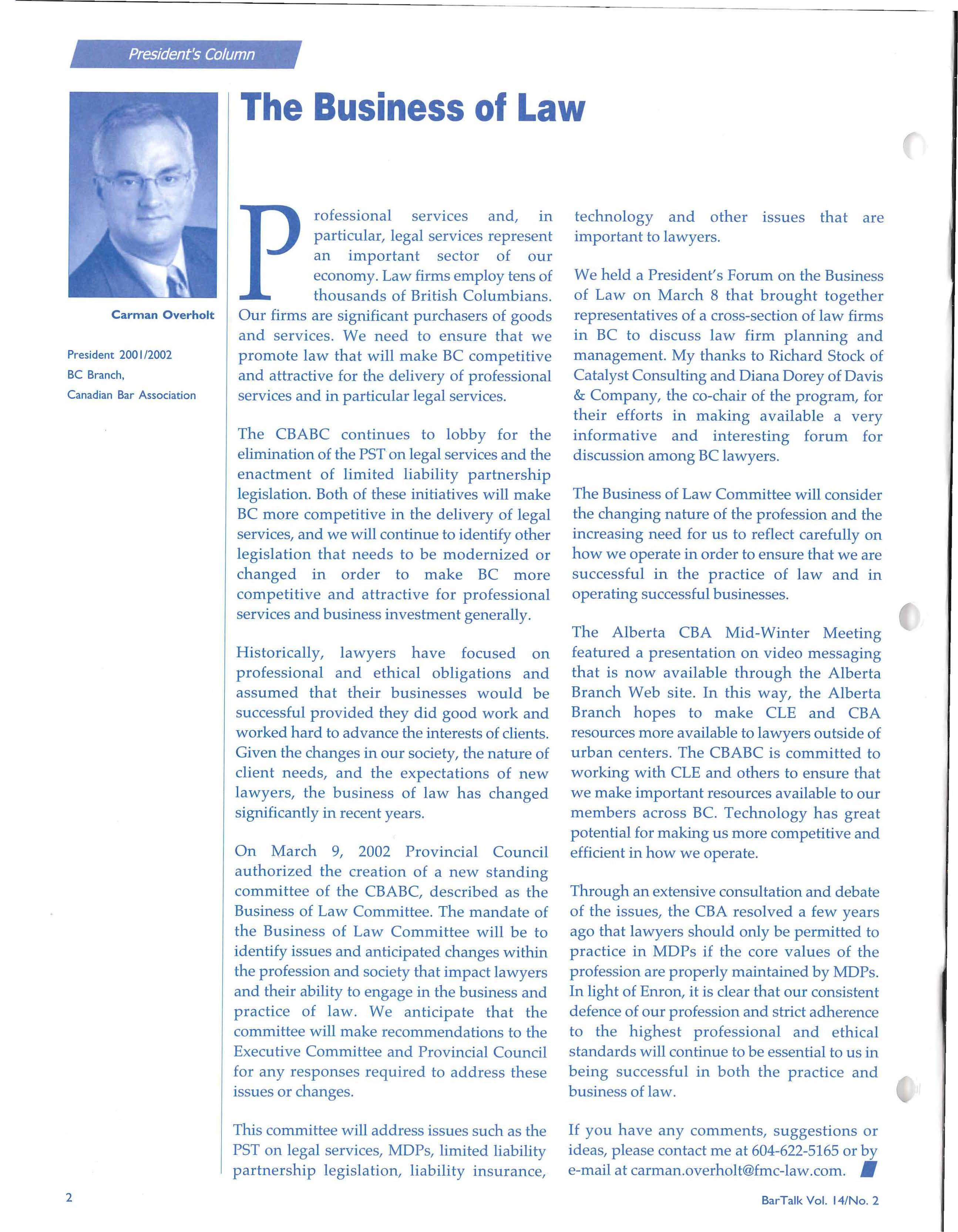
Carman Overholt
Presi dent 200 1/2002
The Business of Law
rofessional services and, in particular, legal services represent an important sector of our economy . Law firms employ tens of thousands of British Columbians Our firms are significant purchasers of goods and services We need to ensure that we promote law that will make BC competitive and attractive for the delivery of professional services and in particular legal services
The CBABC continues to lobby for the elimination of the PST on legal services and the enactment of limited liability partnership legislation . Both of these initiatives will make BC more competitive in the delivery of legal services, and we will continue to identify other legislation that needs to be modernized or changed in order to make BC more competitive and attractive for professional services and business investment generally.
Historically, lawyers have focused on professional and ethical obligations and assumed that their businesses would be successful provided they did good work and worked hard to advance the interests of clients Given the changes in our society, the nature of client needs, and the expectations of new lawyers, the business of law has changed significantly in recent years .
On March 9, 2002 Provincial Council authorized the creation of a new standing committee of the CBABC, described as the Business of Law Committee The mandate of the Business of Law Committee will be to identify issues and anticipated changes within the profession and society that impact lawyers and their ability to engage in the business and practice of law. We anticipate that the committee will make recommendations to the Executive Committee and Provincial Council for any responses required to address these issues or changes.
This committee will address issues such as the PST on legal services, MDP s, limited liability partnership legislation, liability insurance,
technology and other issues that are important to lawyers .
We held a President's Forum on the Business of Law on March 8 that brought together representatives of a cross -section of law firms in BC to discuss law firm planning and management. My thanks to Richard Stock of Catalyst Consulting and Diana Dorey of Davis & Company, the co-chair of the program, for their efforts in making available a very informative and interesting forum for discussion among BC lawyers
The Business of Law Committee will consider the changing nature of the profession and the increasing need for us to reflect carefully on how we operate in order to ensure that we are successful in the practice of law and in operating successful businesses
The Alberta CBA Mid-Winter Meeting featured a presentation on video messaging that is now available through the Alberta Branch Web site In this way, the Alberta Branch hopes to make CLE and CBA resources more available to lawyers outside of urban centers. The CBABC is committed to working with CLE and others to ensure that we make important resources available to our members across BC. Technology has great po t ential for making us more competitive and efficient in how we operate
Through an extensive consultation and debate of the issues, the CBA resolved a few years ago that lawyers should only be permitted to practice in MDPs if the core values of the profession are properly maintained by MDPs . In light of Enron, it is clear that our consistent defence of our profession and strict adherence to the highest professional and ethical standards will continue to be essential to us in being successful in both the practice and business of law
If you have any comments, suggestions or ideas, please contact me at 604-622 -5165 or by e-mail at carman overholt@fmc-law.com •
BC Branch,
Canadian Bar Association
Around the Branch
Some interesting statistics
n past columns I have described for you the many activities undertaken at the Branch, both by our Branch office staff and by our many volunteers. Occasionally, it is interesting to see the s t atistics Much of the activity of the Branch begins in September and ends in the late summer. Here are some samples of what has been happening since September 1, 2001.
CBABCmembers-10,036 members
New l aw student members- 96
Membership in Branch Committees - 210
Committee meetings held - 63
Members emolled in Sections - 2,817
Section meetings held - 242
2002 Directories sold - 12,950
Hits on the Branch Web site- 47,208 hits
Phone calls received by the Lawyer Referral Service - 26,799
Dial -A -Law telephone calls received- 16,731
Hits on the Dial-A-Law scripts on the CBABC Web site - 12,232
Lawyers who participate in the Lawyer Referral Service - 2,194
Whistler /Blackcomb ski passes sold -1,281 passes
Number of Executive Committee Meetings held- 5
Provincial Council Meetings held - 3 AND YET TO COME:
Members to be elected to Provin cial Council from around the Province- 21
Executive Committee Members to be elected - 10
Appointees to Branch Standing and Special Committe es- 65 appointees
Executive Committee P lanning and Regular Meetings- 6
Provincial Council Meetings - 1
Registrants for the annual CBA/VBA Golf Tournament - 144
Once is never enough!
If you have changed firms, changed addresses, have a new e-mail address or phone/fax number , you need to let us know Letting the Law Society in on the secret is not enough!
Contact us at data@bccba.org, phone 604687-3404 or fax 604-669960 I. (Toll free options : phone 1-888-687-3404 or fax 1-877-669-9601)
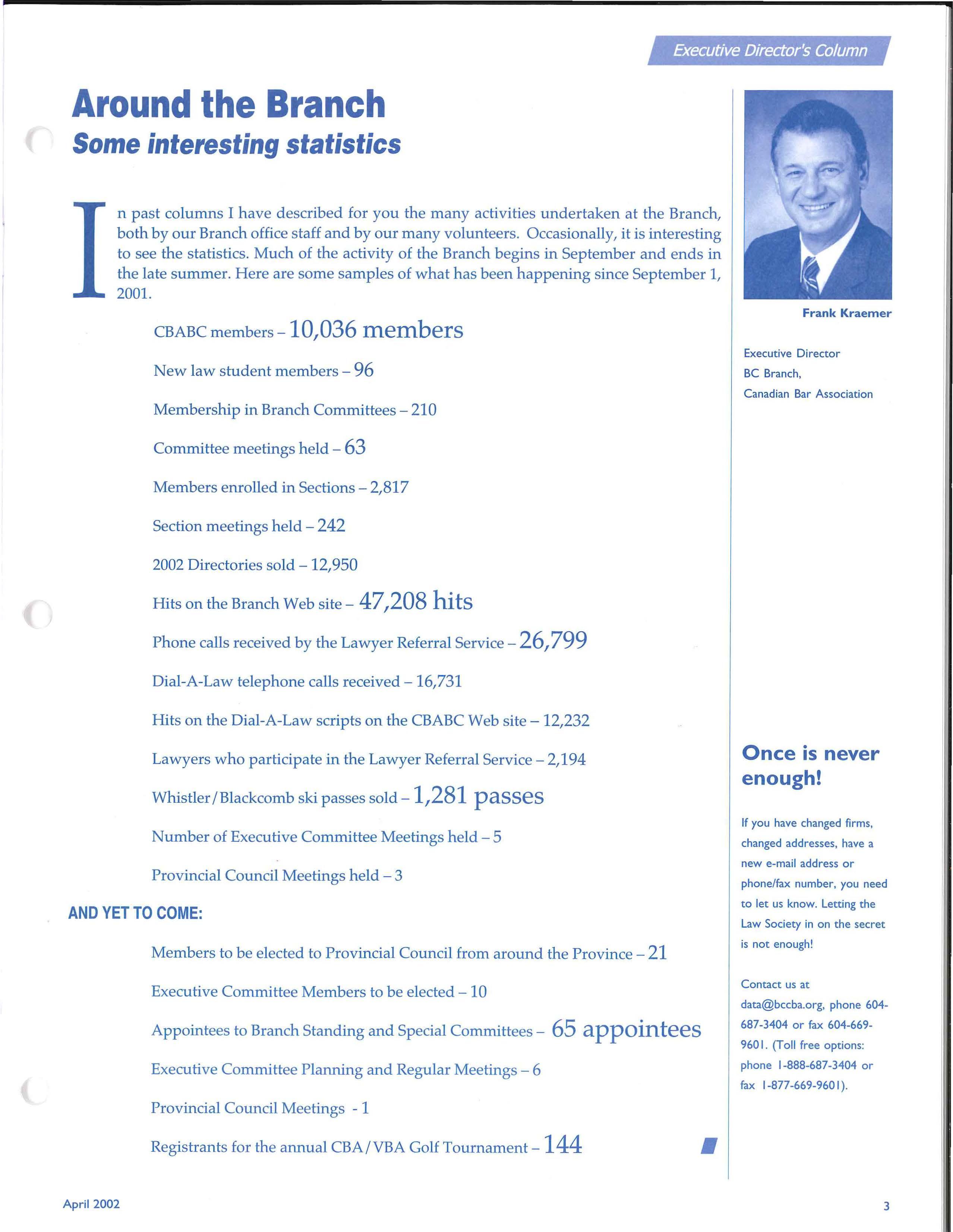
Frank Kraemer
Win Two Whistler/ Blackcomb lift tickets!
Simp ly tell us in what year UBC graduated its first Law Faculty Class. E-mail the correct answer to cba@bccba.org by Monday, April 22 at 4:30 p m. to be entered in the draw.
Need a hint? Visit the "Lawyer Lounge" at www bccba.org
National Urges Proper Legal Aid Funding in BC
CBA National is urging the government of BC to properly fund legal aid and to rethink its decision to close 24 courthouses across BC.
"The BC government's unprecedented course of action will dramatically erode the benefit and protection of the law for many BC residents, and destroy meaningful access to justice in the province, especially in civil law matters , " said Eric Rice, QC, CBA National President.
In a letter to Premier Gordon Campbell and Attorney General Geoff Plant, sent Feb. 21, CBA National called the BC government to task following announcements made in January that would see legal aid in BC cut by 40 per cent over the next three years and courthouses closed, many in northern and interior communities
"Our members see firsthand the grievous hardship that results from inadequate legal aid," said Mr. Rice "British Columbia's legal aid plan already turns away many worthy
recipients, especially women and children, immigrants and low income people facing threats to housing or income security "
The letter, based on a resolution passed unanimously by the CBA at its Mid-Winter Meeting of Council in Moncton, further urges the BC government to undertake a comprehensive review of the justice system "with a view to maintaining courthouses in local communities and determining where savings might be made to add funds to legal aid services."
The CBA resolution also criticized the BC government for backtracking on its commitment to dedicate money raised from a tax on legal services to legal aid. "Last year alone, some $91.6 million generated by the legal services tax has ended up in general revenues, not all in legal aid as promised. "
The resolution and letter are available at www.cba.org
LAW SOCIETY DEREGULATION PROJECT
WHAT: Call for submissions, thoughts and ideas on the question of what regulatory changes could be made to enhance business opportunities for lawyers without unduly compromising the Law Society' s mandate to protect the public interest.
WHY: Preparation of a coordinated and considered Branch submission to the LSBC's Business Opportunities Working Group , can be expected to have far more weight than a number of submissions from indiv iduals.
WHEN: By May 1, 2002 please. This is suggested with the objective of permitting preparation and assembly of these good ideas for the May 15 Executive Committee meeting, referral to Provincial Council itse lf on June 21 , and transmitta l to the Law Society by month end.
WHO: All CBABC members
WHERE: To Executive Committee member Michael Woodward 300-1676 Martin Drive, White Rock, BC V4A 6E7 Fax: 604-531-8402 Tel: 604-531-1421
E-mail : mwoodward @thompsonmcconnell.com
The BC Branch sponsors 72 Sections They play a vital role in keeping members up-todate on changes in the law and aware of legal and political issues affecting a given area of practice . They are the main resource utilized by the BC Branch in legislative review, law reform initiatives and in responding to matters affecting the profession. What follows is a sample of the recent activities of some Sections.
FREEDOM OF INFORMATION AND PRIVACY
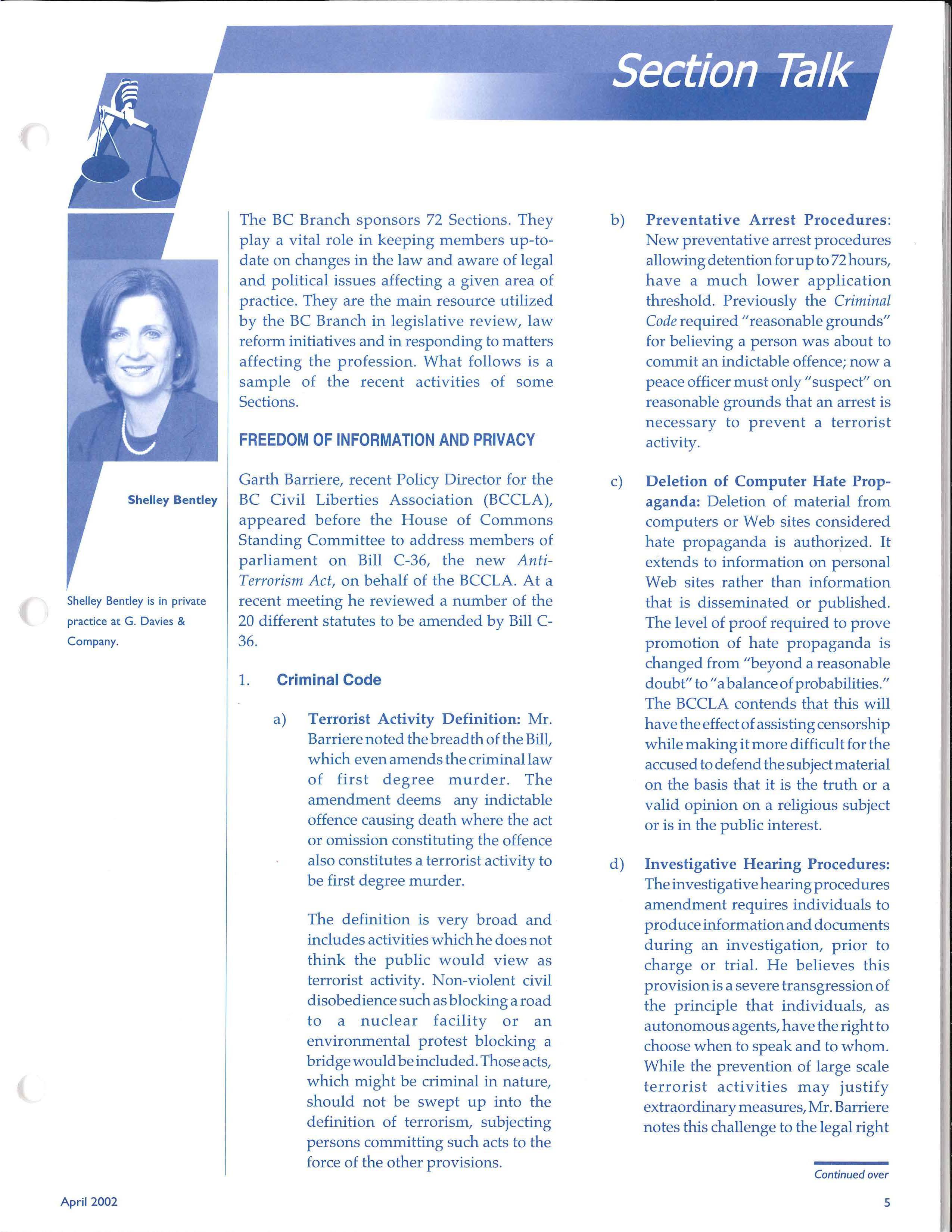
Garth Barriere, recent Policy Director for the Shelley Bentley BC Civil Liberties Association (BCCLA), appeared before the House of Commons Standing Committee to address members of parliament on Bill C-36, the new AntiTerrorism Act, on behalf of the BCCLA. At a She ll ey Bentley is in private recent meeting he reviewed a number of the 20 different statutes to be amended by Bill C36 practice at G Davies & Co m pany
1. Criminal Code
a) Terrorist Activity Definition: Mr Barriere noted the breadth of the Bill, which even amends the criminal law of first degree murder. The amendment deems any indictable offence causing death where the act or omission constituting the offence also constitutes a terrorist activity to be first degree murder.
The definition is very broad and includes activities which he does not think the public would view as terrorist activity. Non-violent civil disobedience such as blocking a road to a nuclear facility or an environmental protest blocking a bridge would be included. Those acts, which might be criminal in nature , should not be swept up into the definition of terrorism, subjecting persons committing such acts to the force of the other provisions
b) Preventative Arrest Procedures:
New preventative arrest procedures allowing detention for up to 72 hours, have a much lower application threshold . Previously the Criminal Code required "reasonable grounds" for believing a person was about to commit an indictable offence; now a peace officer must only "suspect" on reasonable grounds that an arrest is necessary to prevent a terrorist activity .
c) Deletion of Computer Hate Propaganda: Deletion of material from computers or Web sites considered hate propaganda is authorized . It extends to information on personal Web sites rather than information that is disseminated or published The level of proof required to prove promotion of hate propaganda is changed from "beyond a reasonable doubt" to" a balance of probabilities." The BCCLA contends that this will have the effect of assisting censorship while making it more difficult for the accused to defend the subject material on the basis that it is the truth or a valid opinion on a religious subject or is in the public interest.
d) Investigative Hearing Procedures:
The investigative hearing procedures amendment requires individuals to produce information and documents during an investigation, prior to charge or trial. He believes this provision is a severe transgression of the principle that individuals, as autonomous agents, have the right to choose when to speak and to whom. While the prevention of large scale terrorist activities may justify extraordinary measures, Mr Barriere notes this challenge to the legal right
Section Talk
Continued from page 5
to remain silent in the presence of state authority should not become a fixture in our society .
Official Secrets Act
Amendments to the Official Secrets Act would allow for the discretionary designation of a person as a "person permanently bound to secrecy", thereby adversely affecting a person's right to freedom of expression
National Defence Act
The amendment legalizes the Communications Security Establishment (CSE) that formerly existed under the the National Defence Department. The CSE is part of "Echelon," an international spy organization which includes the U.S., Canada, Australia, New Zealand and the European Economic Community, that intercepts satellite communications from around the world. In theory U.S. law enforcement agencies could spy on Canada but the CSE cannot spy on Canadians and vice versa. Mr. Barriere noted that there are no guaranteed protections of private communications. He suggested that amendments should provide for protections that, at minimum, mirror those found in the Privacy Act.
Canada Evidence Act
Changes would allow the Attorney General of Canada to prohibit disclosure of information in any proceeding to protect national security . In the first draft of Bill C36, the reasonableness of the certificate was not open to review by a court. He noted that judicial review of all government action is a fundamental and irreplaceable component of the proper relationship among the three arms of government and the citizens they serve.
5. Privacy Act, Access to Information Act, Persona/Information and Protection of Electronic Documents Act
Once the Attorney General of Canada issues a certificate these Acts do not apply . Various Privacy Commissioners across Canada attacked this provision It was then amended to allow an individual to challenge the certificate in Federal Court on the basis of whether the very broad criteria for granting a certificate have been met.
Mr Barriere expressed concern that Bill C-36 compels persons to speak in certain circumstances and displaces parliamentarians in determining civil and political rights. For instance, it will be left up to the executive to decide what protections of personal privacy are afforded individuals whose communications are intercepted by the CSE. Of greater concern, in his view, was the initial attempt to displace judicial involvement in supervising the discretionary decision-making powers at the ministerial level. Because of the uncertain impact of the provisions of Bill C-36 and the speed with which it was passed, Mr Barriere also recommended that all the provisions of the Bill be subject to a sunset clause
TAXATION
Elaine Reynolds discussed the repeal of the U.S. estate tax.The U.S estate and generation skipping taxes, but not the gift tax, will be eliminated by 2010 in a gradual phase-out. However, the 2001 Tax Relief Act contains a sunset clause. It provides that all provisions of this omnibus Act including the repeal of the U.S. estate tax do not apply for taxable years beginning after December 31, 2010. This means that without further congressional action the U.S. estate tax will only be repealed for the year 2010 and there will be a return to the current system in 2011 . The unpredictability of this arrangement causes estate planning to approach "oxymoron" status .
Even for Canadian estate planners the U.S estate tax presents a hurdle. For a non-U.S. citizen the U.S. estate tax applies to assets "situated" in the U.S. such as real estate or
shares in a U S domestic corporation, regardless of whether these shares trade on a Canadian exchange.
WILLS AND TRUSTS-VANCOUVER
Kirsten Jenkins, of Bull, Housser & Tupper, presented a case comment reminding lawyers of the importance of ensuring that an attorney acting under a power of attorney should deal with assets in a way that does not disturb the carefully structured estate plan of the donor.
In Desharnais v. TO Bank and TO Securities Inc (2001 B.C.S.C. 1695) Desharnais held a power of attorney for her incapacitated spouse, Hawthorne. He held an RRSP account at TD Bank that his spouse was advised to switch to
TD Evergreen, a different company. Prior to becoming incapacitated Hawthorne had designated Desharnais as the beneficiary of this RRSP account. When acting in her capacity as attorney, she transferred the account to Evergreen and this designation was lost. As a consequence the RRSP funds formed part of the estate when Hawthorne died a short time later. Hawthorne left a will but Desharnais was not named as a beneficiary. The Court held TD liable for failing to advise Desharnais of the consequences of the transfer . The Court also noted that under section 49 of the Law and Equity Act, as attorney, she had no power to make a beneficiary designation on behalf of her spouse. Only an annuitant can make a designation •
National 2002 Awards: Many Areas of Recognition
Has a friend or colleague gone above and beyond the call of duty? Do you know someone who deserves recognition? Well here's your opportunity to tell them how you feel and nominate them for one of the CBA' s prestigious awards. The nomination deadlines are approaching quickly, so don't delay. For more information on any of the following awards, please visit www.cba.org/ awards/.
The Touchstone Award recognizes an individual who has made a significant contribution to the nation in the area of equality in the legal profession or legal community; has undertaken a national initiative to advance equality; and is connected to the legal profession, community of the judiciary- Deadline: April17, 2002
The Ramon John Hnatyshyn Award for Law recognizes outstanding contribution to the law or legal scholarship in Canada - Deadline: April30, 2002
The Louis St-Laurent Award recognizes distinguished or exceptional service to the objectives and goals of the CBA - Deadline: April 30, 2002
The Honourable Walter S. Tarnopolsky Human Rights Award recognizes a resident of Canada who has made an outstanding contribution to domestic or international human rights - Deadline: April 30, 2002
The John Tait Award of Excellence recognizes a public sector lawyer who - or law office that - has achieved the highest standards of professional conduct and competence, has made significant contributions to social justice or community affairs, and exemplifies preeminent public service - Deadline: May 15, 2002
The Young Lawyer's Pro Bono Award recognizes outstanding pro bono legal services to the community by a young lawyer in Canada - Deadline: May 15, 2002
Sexual Orientation and Gender Identity Conference (SOGIC) Awards recognize excellence within the Canadian legal profession in advancing the cause of equality for lesbian, gay, bisexual, transgendered and two-spirited people - Deadline: May 31, 2002
Bands:
Friday, May 17th
Don't miss your chance to see which firm earns bragging rights this year! Lawyers and the ir bands will heat up the fabulous Commodore Ballroom for a long, hot night of music, drinks, food, dance and some down-and-dirty competitive fun with celebrity judges. Tickets are $100 for lawyers and $25 for non-lawyers - everyone welcome! All proceeds go to the Bar Benevolent Fund, helping lawyers and their families in need. More info? Call Derek Brindle at Singleton Urquhart, 604-682-7474
(e-mail dab@singleton.com)
What Should Your Client Agree to?
"Best Efforts" v. "Commercially Reasonable Efforts"
he term " best efforts" is widely used in contracts, including the areas of corporate I commercial, finance , real estate, employment, and construction law. A body of case law has developed around "best efforts" in recent years and depending upon your client's position in the business deal - that is, whether they are receiving the promise or giving the promise to use best efforts -you may wish to consider some of the more onerous implications of this term
In 1994, the Supreme Court of BC in Atmospheric Diving Systems Inc v International Hard Suits Inc. (89 B.C.L.R. (2d) 356) considered the meaning of the term "best efforts" in English and Canadian jurisprudence . Summarizing the principles from several cases, Justice Dorgan stated that: "'Best efforts' imposes a higher obligation than a 'reasonable effort ' ; 'Best efforts' means taking, in good faith, all reasonable steps to achieve the objective, carrying the process to its logical conclusion and leaving no stone unturned; 'Best efforts' includes doing everything known to be usual, necessary and proper for ensuring the success of the endeavour ... " Moreover, the court concluded that where the parties include a "best efforts" contract clause, they must intend that more than "reasonable efforts" be used.
The notion of "leaving no stone unturned" is a most onerous one and shou ld give any lawyer representing a client in a contract on a "best efforts" basis a moment of sober second thought An alternative term appearing in contracts is " commercially reasonable efforts."
The concept of commercial reasonableness has had a history in American jurisprudence and is conceivably an adjunct of the common-law concept that U.S. courts have implied into contracts generally - an obligation of "good faith and fair dealing." No similar commonlaw obligation has been applied in Canadian jurisprudence . However, in the personal property securities legislation of BC, Alberta
and Saskatchewan, rights and duties are to be performed both in "good faith" and a " commercially reasonable" manner. McLaren in Commercial Transactions (Toronto: Carswell, 1989) suggests that "commercially reasonable" establishes an objective standard established by business practices.
The concept of commercial reasonableness can be best described as the actions of the reasonably prudent business person in similar circumstances. It is both an objective and pragmatic standard of conduct, conditioned by the established practices of the business community. The concept is not fixed and rigid but rather is shaped by changing circumstances .
An American case Mallicoat v Volunteer Finance ((1966) 3 U.C.C. reporting service 1035 (Tennessee C.A )) described the standard of commercial reasonableness in a case where property was disposed of as, " . .. the requirement that the disposition shall be made in keeping with prevailing trade practices among reputable and responsible business and commercial enterprises engaged in the same or a similar business." For the most part, discussion regarding the meaning of the words "commercially reasonable" or a test for this concept is lacking in Canadian jurisprudence.
In drafting contracts, lawyers should put their mind to the standard by which the performance of the contractual obligations should be judged. In some cases, where good faith and the intention of the parties are vitally important - such as contracts for personal services - "best efforts" may be the more desired standard. In commercial transactions, however, the parties may prefer to agree to a standard of commercial reasonableness in accordance with the practices of their particular industry. Canadian lawyers should ( exercise caution, however, recognising that the standard of commercial reasonableness is still open to judicial interpretation . •
Corrine Fiesel
Corrine Fieser is an associate lawyer at Miller Thomson LLP and a member of the CBABC Solicitors' Issues Committee.
David J Bi li nsky
Dav id J. Bi lin sky is the Practice Management
Adv isor at t h e Law Society of British Co lu mb ia He can be reached on the Internet at db ilin sky@ ls bc.org
The views expressed herein are st r ictly those of the author and may not be shared by t h e Law Society of Brit ish Co lumbia
Innovation at the 'Pleading' Edge
Non-traditional approaches to the practice of law
If I could see somethingYou can see anything you want boy If I could be someoneyou can be anyone, celebrate boy. If I could do somethingWell you can do something, If I could do anythingWell can you do something out of this wor l d? .. Dreamer, you know you are a dreamer },
Words and Music by R. Hodgson and R. Davies, recorded by Supertramp
Imagine a law firm where everyone has the same sized private office (i n cluding every staff member) Where everyone gets to interview all proposed new staff and l awyer hires . Where full financial statements are shared among and read by everyone - including partners, associates and all staff members. Where legal invoices are sent with a blank space at the bottom with a heading "Value Adjustment Line" - inviting and empowering clients to decrease or increase the amount of any legal bill.
Sounds unbelievable? The time was March 1997 when the Summit Law Group was established in Seattle. It is n o w five years later. Summit Law Group has grown from 16 lawyers to 33. Every staff member still has an identically-sized private office with built-in furniture The law firm is located a mile from downtown where overheads a r e low -a big change for many of the l awyers who came from offices located in Seattle 's highest office tower. Dress is casual. And the "Value Adjustment Line"? It is still on every one of t h eir invoices and has resulted in up to five figure "write-ups" from appreciative clients. And windfall litigation payoffs have been shared among all staff members. Staff members, spouses (and 30 kids) are being
taken on a Seattle IV ancouver I Victoria cruise this year.
The firm i s not a bo u tique -it offers services in Corporate law, Labour Defence, Complex Litigation, Environmental and Commercial Leasing. C l ients are natio n a l in scopeincluding Weyerhaeuser, Starbucks and Trave ll ers Insurance. Revenues have grown steadily with doub l e-digit growth figures. The partners listen to people like Tom Peters and o ther innovative corporate gurus.
The firm is based on so li d economic thinking. Ren t is approximately half of w h at th ey would pay in central down t own Seattle. A ll attorneys are partners Junior partners have approximately 90 per cent of their i n come guaranteed. The remainder of their income is dependant on profits. Partners receive less guaranteed income (50-60 per cent) but stand to gain more from the office's profits. They don't charge t h eir clients for long dista n ce telephone calls, photocopies and faxesavoiding the 'nickel and diming' annoyances . Clients seem to like the fact that their l awyers are paying less in rent than they are. Lawyers and clients alike share a strong bottom l ine, results-based emphasis
And the 'value adjustment area' t o their bills? It turns out that it has resulted in relatively few changes to their accounts (the notable exceptions have been some large increases to bills) -but generated l ots of goodwill and feelings of empowerment and trust among clients. Marc G. Reynolds, the Executive Director of the firm, says that it "removes co n tention" from the lawyer-client relationship and makes the client feel like they are a 'partner' with the firm.
Lawyers Assistance Program
LAP provides confidential support, counselling and referrals for lawyers, their families, support staff, judges and students suffering from alcoho l and/or chemical dependency, stress, depression or just about any type of personal prob lem.
For assistance or information on meetings and resources please ca ll 604685-2171 or toll free 1-888685-2171.
The LAP office is located at 415-1080 Mainland Street, Vancouver, BC V6B 2T4.
Practice Talk
Continued from page 9
The firm believes in retreats - that include spouses and children. Growth is a discussion topic - the firm has added 11 lawyers in the last 12 months.
Will the firm continue in the form that it is currently cast? Probably not - it will continue to change and test assumptions that were deemed to be untouchable and unquestionable. Summit highlights that law firms can change and adopt new methods and new techniques without throwing out the economic realities on which any successful firm is based. Radical change can be adopted and clients attracted to firms which are willing to challenge 'traditional' ways of thinking about how legal services are delivered.
(www.summitlaw.com)
The second example of innovation in the legal arena is Cyber Secretaries (www.youdictate.com). It, too, was started by a lawyer, in Texas in 1997. It is based on a simple premise - that lawyers would make use of a dictation service where they could simply pick up the telephone, anytime, from anywhere - and dictate a letter, a memo, a pleading or any other document- and have it sent back to them by e-mail, proof-read, fully formatted (you can send them a template to follow) and ready to print.
The advantages? You do not need to hire a temporary employee, provide a computer, softWare, printer or other trappings. You don't have to pay overtime and you don't have to do any Human Resources functions or send in any WCB or CPP or CCRA remittances. You can dictate using a telephone, fax in handwritten notes, mail in a tape, e-mail a .wav file that you have recorded using your computer or e-mail in a Olympus DSS or Sony digital dictation file You can also use their own SpeakWrite software (not a voice recognition software but rather a voice recording package) and e-mail them the voice file. Following the templates that you have previously forwarded to them, they will format your dictation to suit your precedents (pleadings, letterhead, etc.) They will provide
you itemized billing codes for cost recovery and cost tracking purposes. You can even check on the progress of your work using their Web site. You can set up an address book containing the names and addresses of people to whom you usually refer to in your dictation (so the secretaries can ensure the names and addresses are correct). Cyber Secretaries transcriptionists are bonded and have signed non-disclosure and confidentiality agreements and are stated to be legal secretaries with law office experience.
The cost? $0 .01 US per word- an average cost of $3.50 US per page. This service has expanded to all 50 states and has a following in Canada (Kelowna seems to be particularly interested in their services). Considering their 'no hassle' manner of doing business, it appears to be particularly well suited to firms who have periodic needs for additional secretarial services. It marries the costs of production closely to the needs of a firm or lawyer .
These are two of the many examples of people who are not only challenging the traditional assumptions regarding how one must carry on the practice of law, but are thriving doing so. In some cases all it takes is to dare to dream .. .
Pacific Legal Technology Conference:
Innovation that Pays for Itself
Friday, October 18, 2002 Vancouver Trade & Convention Centre
Lawyers, legal assistants, IT people, administrators, legal researchers .. .mark your calendars now!
This conference features internationally acclaimed experts speaking in 17 educational sessions addressing the practical, results-oriented application of technology to the practice of law.
For more information e-mail daveb@lsbc.org
Chaired by Dave Bilinsky
Stuart Rennie Stuart Rennie is the CBABC Leg islation & Law Reform Officer. He can be reached at 604-949 - 1490 or e-mailed at srennie@bccba.org
Every effort is made to ensu r e the accuracy of the information prov ided to you in this article but the information should not be relied upon Lawyers shou ld refer to the specific legis lative or regulatory provision. You will see a reference in some cases to the number of the Bill when it was introduced in the House This number may be different from the chapter number of the new Act which is quoted after the title of the Act and whi c h is the proper citation for the Act. The Bill Number has been given to you to make it easier for you to note u p the Bills you may have in your library
ACTS IN FORCE
Finance and Corporate Relations Statutes Amendment Act, 2000, S.B .C. 2000, c. 25 (Bill 18)
Amended: Corporation Capital Tax Act, R.S B.C. 1996, c. 73, Financial Administration Act, R.S B C. 1996, c. 138, Financial Information Act, R.S.B.C. 1996, c. 140, Horse Racing Tax Act, R.S.B C.1996, c. 199, Hydro and Power Authority Act, R.S.B .C. 1996, c. 212, Income Tax Act, R.S.B C.1996, c. 215
Transitional Provisions: None
Statutes Repealed: None
Summary: Sections 1 to 7 of Bill18 amend the Corporation Capital Tax Act including provisions governing: foreign banks, aggregate paid up capital of foreign banks, regulations permitting incorporating a code, rule or standard published by a provincial, national or international body.
In Force: Sections 1 to 7 in force June 6, 2000 and are retroactive.
REGULATIONS TO NOTE
Adult Guardianship Act designates the Ministry of Children and Family Development as an agency pursuant to Part 3 of the Act (B.C. Reg 19 I 2002 effective February 11, 2002).
Balanced Budget and Ministerial Accountability Act requires the Minister of Provincial Revenue to earn $7 million in new revenue from audit and revenue compliance activity for the 200212003 fiscal year (B.C. Reg. 2412002 effective February 19, 2002), requires the Ministers of State for Intergovernmental Relations, Early Childhood Development, Community Charter, Women's Equality, Deregulation, Mental Health, Intermediate, Long Term and Home Care respectively, to meet expected results for the 200212003 fiscal year (B.C. Reg. 2512002 effective February 19, 2002) and exempts spec-
ified organizations from the application of service plans, major capital plans and annual service plan reports required under the Act (B C. Reg 27 I 2002 effective February 21, 2002).
Cost of Consumer Credit Disclosure Act amends B.C. Reg. 23512001 to extend the date when that regulation takes effect from March 1, 2002 to September 1, 2002. B.C. Reg. 235 I 2001 creates the disclosure regulation including regulation of the calculation and use of the annual percentage rate and provisions governing loan brokers (B C. Reg 31 I 2002 effective September 1, 2002)
Court Rules Act, amends B.C. Reg 221190 the Supreme Court Rules to eliminate increased costs under section 7 of Appendix B (Party and Party Costs)( B C. Reg 20 I 200 effective July 1, 2002).
Mortgage Brokers Act amends B C. Reg. 237 I 2001 to change the effective date from March 1, 2002 to September 1, 2002. B.C. Reg 237 I 2001 prescribes Cost of Con s umer Credit Disclo s ure Act provisions (B C. Reg. 33 I 2002 effective September 1, 2002).
Motor Dealer Act amends B.C. Regs . 238 I 2001 and 239 I 2001 to change the effective date from March 1, 2002 to September 1, 2002. B C. Reg. 238 I 2001 prescribes Cost of Consumer Credit Disclosure Act provisions. B.C. Reg. 239 I 2001 repeals: requirements for disclosure under a lease contract, deemed consumer protection provisions in a lease contract, use of plain language and a consumer notice in lease contracts. (B.C. Reg 3412002 effective September 1, 2002).
Workers Compensation Act, repeals B. C. Reg. 58 I 2001 and amends B.C. Reg. 296 I 97 Occupational Health and Safety Regulation to permit smoking in establishments and regulate workers' exposure to tobacco smoke in the hospitality industry (B.C. Reg 312002 effective May 1, 2002).
Cost of Consumer Credit Disclosure Delayed
By O r de r -i n-C o un cil
d e posite d Fe b r uary 22, 200 2, t he date fo r bringi ng
in t o fo rc e t h e Cost of Consumer Credit Dis closure Aa
a nd the Cost of Co nsu mer Credit Disclosure Regulatio n has been postponed u ntil Sep t ember I, 2002. Th e date for b ri ngin g t he leg is latio n in t o force was o r igina ll y set for March I , 2 00 2
T he d elay was granted at the request of some members of t he in d ustry w ho have no t bee n a bl e to convert the ir systems to meet the or igin a l dea dli ne. Len d ers w ho are rea dy to imp lement the n ew re q u irements may p r ocee d to do so as o f March I , 20 0 2 if they wis h
Legislative Update
Continued from page I I
NEW BILLS TO NOTE
Information is current at the time of preparing this article: March 11, 2002. Lawyers should refer to the original version of the specific Bill for its current status at First, Second or Third Reading or Royal Assent.
Budget Measures Implementation Act, 2002 (Bill 2)
Fi rst Reading: February 19, 2002
Amended: Emergency Program Act, R.S.B.C. 1996, c.l11, FinancialAdministrationAct, R.S.B.C. 1996, c. 138, Financial Information Act, R.S.B.C. 1996, c 140, Fish Protection Act, S.B.C. 1997, c 21, Forest Practices Code of British Columbia Act, R.S.B.C. 1996, c. 159, Forests Statutes Amendment Act, 1997, S B.C. 1997, c. 48, Freedom of Information and Protection of Privacy Act, R.S.B .C. 1996, c. 165, Schedule of the Job Protection Act, R.S.B.C. 1996, c 240, Miscellaneous Statutes Amendment Act (No . 3), 1997, S.B.C. 1997, c. 29, Regulatory Streamlining Miscellaneous Statutes Amendment Act, 2000, S.B.C. 2000, c. 11, Waste Management Act, R.S.B.C. 1996, c. 482, Water Act, R.S.B.C. 1996, c. 483, Wildlife Act, R.S.B .C. 1996, c. 488
Transit ional Provisions: Fisheries Renewal Act, Forest Renewal Act and Natural Resource Community Fund Act
Statutes Repealed: Fisheries Renewal Act, S.B.C. 1997, c. 22, Grazing Enhancement Special Account Act, R.S B.C.1996, c.175, Industrial Development Incentive Act, R.S .B.C. 1996, c. 221, Natural Resource Community Fund Act, R.S.B.C. 1996, c. 331, Science and Technology Fund Act, R.S.B.C. 1996, c. 414, Small Business Development Act, R.S B.C. 1996, c. 428
Summary: As part of the BC government's 2002 budget, Bill2 makes amendments including to the: Emergency Program Act to limit expenditures from the appropriation provided in order to respond to and recover from imminent and actual emergencies or disasters and to the Financial Administration Act to transfer authority to make prepaid capital advances from the
Minister of Finance to the ministers who are accountable for the capital projects. To meet the government's intention to eliminate business subsidies, Bill 2 repeals the: Fisheries Renewal Act, Forest Renewal Act, Grazing Enhancement Specia l Account Act, Industrial Development Incentive Act, Natural Resource Community Fund Act, Science and Technology Fund Act and Small Business Development Act. The repeal of these statutes requires consequential amendments to the: Financial Information Act, Fish Protection Act, Forest Practices Code of British Columbia Act, Forests Statutes Amendment Act, 1997, Freedom of Information and Protection of Privacy Act, Schedu le of the Job Protection Act, Misce ll aneous Statutes Amendment Act (No.3), 1997, Regulatory Streamlining Miscellaneous Statu t es Amendment Act, 2000, Waste Management Act, Water Act, Wildlife Act.
In Force: Sections 3,4, 5 (b) and (c), 6 to 12, 16, 21 to 26, 28 and 29 come into force by regulation.
Corporation Capital Tax Amendment Act, 2002 (Bill 4)
First Reading: February 19, 2002
Amended: Corporation Capital Tax Act, R.S.B .C. 1996, c. 73. Consequential amendments made to the Corporation Capita l Tax Amendment Act, 2001, S.B.C. 2001, c. 30
Transitional Provisions: None
Statutes Repealed: None
Summary: As part of the BC government's 2002 budget, Bill4 amends the Corporation Capital Tax Act including to: provide for newly defined terms, streamline the legis l ation to reflect the phase-out of capital tax on non-financial corporations, expand the investment allowance currently available t o credit unions to include all financial corporations and change the formula for calculating the paid-up capital of authorized foreign banks to make it consistent with the taxation of domestic banks
In Force: Sections 1 to 11, 13 to 22 and 24 to 30 come into force on September 1, 2002. Section 12 comes into force by regulation and when in
force is deemed to have come into force on February 19, 2002 and is retroactive .
Deregulation Statutes Amendment Act, 2002 (Bill 8)
First Reading : March 6, 2002
Amended: Supp lement to t h e Assessment Act, R.S.B .C.1996,c . 20, Debtor AssistanceAct,R.S.B.C. 1996, c. 93, Dike Maintenance Act, R.S.B.C. 1996, c 95, Drainage, Ditch and Dike Act, R.S.B.C.1996, c. 102, Financial Institut ions Act, R.S .B.C. 1996, c. 141, Freedom of Information and Protection of Privacy Act, R.S.B.C. 1996, c . 165, Supplement to the Income Tax Act, R.S B.C. 1996, c. 215, Livestock Act, R.S B.C. 1996, c 270, Local Government Act, R.S.B.C. 1996, c. 323, Municipalities Enab ling and Validating Act (No 3), S.B C. 2001, c 44, Name Act, R.S .B.C.1996, c. 328, Supplement to the Socia l Service Tax Act, R.S.B.C. 1996, c. 431, Wi ll s Act, R.S B.C. 1996, c. 489
Transitional Provisions: Cultural Foundation of British Co l umbia Act and Library Foundation of British Co lumbia Act
Statutes Repealed: Community Regulation Act, R.S.B.C.1960, c. 66, Cultural Foundation ofBritish Columbia Act, R.S.B.C. 1996, c. 90, Curfew Act, R.S.B.C.1996, c. 91, Dogwood, Rhododendron and Trillium Protection Act, R.S.B.C. 1996, c. 100, Supplement to the Health Act, R.S .B.C. 1996, c. 179, Library Foundation of British Columbia Act, R.S.B C. 1996, c. 265, Ministry of Industry and Small Business Development Act, R.S.B .C.1996, c. 302, Ministry of International Trade, Science and Investment Act, R.S .B.C. 1996, c. 305, Northern Deve lopment Act, S.B C. 1998, c. 17, Pawnbrokers Act, R.S.B C. 1996, c. 350, Premier ' s Advisory Council for Persons with Disabilit ies Act, R.S.B.C. 1996, c. 371, Public Service Bonding Act, R.S.B.C. 1996, c. 387, Specia l Enterprise Zone and Tax Relief Act, R.S.B.C. 1996, c. 438, Supplement to the Special Enterprise Zone and Tax ReliefAct, Tobacco Fee Act, S.B.C. 1998, c. 46, Trade and Convention Centre Act, R.S B C. 1996, c. 455, Universities Real Estate Development Corporation Act, S.B.C. 1965, c. 55, University Endowment Land Park Act, R.S.B.C. 1996, c. 470
Summary: Bill8 repeals 18 statutes and amends
13 statutes to remove regulatory requirements. Amendments are made to the: Supplement to the Assessment Act which is consequential to the repeal of the Special Enterpris e Zone and Tax Relief Act, Debtor Assistance Act whi ch is consequential to the repeal of the Public Service Bonding Act, Dike Maintenance Act to repeal matters now covered under the Emergency Program Act, Drainage, Ditch and Dike Act to repeal an obsolete drainage regulation program, Financial Institutions Act to eliminate requirement that a merged credit union apply for a business authorization and to reduce the number of required filings to the commission for an amalgamation of extraprovincial corporations, Freedom of Information and Protection of Privacy Act which is consequential to the repeal of the Northern Development Act, Income Tax Act which is consequential to the repeal of the Special Enterprise Zone and Tax Relief Act, Livestock Act to de lete definitions and licensing rules regarding artificia l insemination, Local Government Act to extend the defined terms of officer assigned responsibility to include Vancouver municipal officials and to permit the Board of Examiners to set employee qualifications and standards and to certify persons employed by improvement districts, Municipalities Enabling and Validating Act (No.3) to validate the actions of the Vancouver municipal officials before local government statute amendments came into force September 1998, Name Act to remove the requirement that a person who intends to apply for a change of name under the Name Act must first give notice of that intention in the Gazette and a local newspaper and provides more information to the means of giving notice of a change of name, Social Service Tax Act which is consequential to the repeal of the Special Enterprise Zone and Tax Relief Act, Wills Act to replace the rule that an application to ascertain whether a notice has been filed under the Act be written and prescribed by regulation with the rule that the application be in a form satisfactory to the D irector of Vita l Statistics.
In Force: Sections 1 to 21 in force on Royal Assent. Sections 22 and 23 regarding the Ministry of Industry and Small Business Development Act and Ministry of International Trade, Science and Investment Act come into force on April1, 2002. Sections 25 to 28 regarding the Name Act
Chief Justice Brenner to speak at UBC Law Alumni Distinguished Speakers Breakfast
Th e Honourable Dona ld I. Br e n ner, Ch ie f Just ice of the Supreme Court of BC, w ill speak at the U BC La w A lu mni Distingu is he d Speakers Breakfast o n Wednesday, A p ri l 24, 20 02 at 7 :30 a.m at t he T erm ina l C ity Cl u b. Ch ief Just ic e Bre nner w ill s peak on "Reflection on Two Yea r s (a lmost) as C hi ef Justice of the Supre me Court."
Reserve your seat for t his event by send ing a cheque for $35 , payab le to UBC Law A lu mni Association, c/o Faske n Martinea u , 21 0 01075 W Georgia St , Vancouver, BC V6E 2G2, attention Shanno n Borsoff. For more information , ca ll 604-631-3277.
International lawyers visit Vancouver for ESL training
Are you interested in teaching, hosting, mentoring or socializing with lawyers visiting from around the world? If so, please contact Judith Milliken, QC at 604816-495 I or e-mail judithmilliken@shaw.ca
Legislative Update
Continued from page 13
come into force by regulation.
Education Services Collective Agreement Act, S.B.C. 2002, c . 1 (Bill27)
First Reading: January 25, 2002
Amended: None
Transitional Provisions: None
Statutes Repealed: None
Summary: Bill 27 deems the collective agreement between the 45,000 member BC Teachers' Federation and the 60 school district BC Public School Employers' Association, including: section 2 to provide a 2.5 per cent wage increase each year to 2004, for a total wage increase of 7.5 per cent, section 3 to refer disputes to binding arbitration, section 4 to amalgamate collective agreements and deem the wage increase in section 2 to apply to collective agreements for 9 listed school districts, section 5 to permit the government to appoint a commission of inquiry to practices and procedures of collective bargaining, section 6 to make Bill 27 apply if there is conflict or consistency between Bill 27 and the Labour Relations Code or its regulations and section 7 to permit Bill27 to be repealed by regulation but that the collective agreement constituted under Bill27 remains in force until the expiry of the collective agreement.
In Force: Bill 27 came into force on Royal Assent on January 27, 2002.
•
Freedom Of Information And Protection Of Privacy Amendment Act, 2002 (Bill 7)
First Reading: March 5, 2002
Amended: Freedom ofinformation and Protection of Privacy Act, R.S.B.C. 1996, c. 165
Transitional Provisions: Freedom of Information and Prot ection of Privacy Act regarding modifications in the method of calculating time to apply after Bill 7 in force
Statutes Repealed: None
Summary: Bill 7 makes amendments to the Freedom of Information and Protection of Privacy Act including to: require an applicant to provide sufficient detail in making a request, exclude specific matters from the running of time for a public body to respond to an application, permit government to refuse to disclose third party information, permit, for the purposes of medical treatment, personal information about an individual to be collected from another person, authorize disclosure of personal information between public bodies, permit the commissioner to authorize the head of a public body not to respond to a request under specified sections where the request is repetitious, frivolous or vexatious, expand the powers of the commissioner to delegate specified matters and make specific orders, eliminate the requirement for publication of a personal information directory and replace it with a requirement for public disclosure of personal information held by government, including privacy impact assessments, require an applicant to file at a public body a request to be excused from paying fees and the public body must reply within 20 days of receipt, require the public body to provide to the applicant a written fee estimate and to permit a public body to impose a deposit that the applicant must pay, permit the minister rather than the Lieutenant Governor in Council to amend Schedules 2 and 3 regarding public bodies.
In Force: In force on Royal Assent. •
Gaming Control Act
(Bill 6)
First Reading: March 4, 2002
Amended: Consequential amendments made to: Health Special Account Act, R.S.B.C. 1996, c. 185, Horse Racing Act, R.S B C.1996, c 198, Horse Racing Tax Act, R.S.B.C. 1996, c. 199
Transitional Provisions: Regarding validity of issued licences, enactments and existing reg-
ulations given legal effect and exemptions for existing personnel
Statutes Repealed: Horse Racing Act, R.S.B.C. 1996, c.198, Horse Racing Tax Act, R.S.B C. 1996, c. 199, Lottery Act, R.S .B.C. 1996, c. 278, Lottery Corporation Act, R.S B.C. 1996, c. 279
Summary: Bill6 creates a comprehensive gaming statute. It replaces the: Horse Racing Act, Horse Racing Tax Act, Lottery Act, Lottery Corporation Act. The British Columbia Lottery Corporation is continued and provisions made regarding gaming, finances horse racing betting fees and gaming facilities The Gaming Policy and Enforcement Branch is continued with increased authority to make registrations, conduct audits and investigations and provide enforcement. Licensed gaming events are managed by regulation and provisions regulating administration and enforcement of gaming events are made Bill6 permits eligible organizations to be given grants. Provisions regulate horse racing, registration of gaming services providers and workers.
In Force: Act in force by regulation except for specified definitions and sections which are deemed to have come into force on May 28, 1986 and are retroactive
Health And Social Services Delivery Improvement Act, S B.C. 2002, c. 2 (Bill 29)
First Reading: January 25, 2002
Amended: Consequential amendments to the Health Authorities Act, R.S.B.C. 1996, c. 180
Transitional Provisions: Health Authorities Act regarding associations of trade unions
Statutes Repealed: Bill 29 includes amendments to: permit a health sector employer the right to reorganize service delivery to other health-sector employers, partnerships or joint ventures with other health sector employers, permit a health sector employer to assign an employee to any employer's worksite for a time specified by regulation, permit employers to contract outside of the collective agreement for services for acute care hospitals and non-clini-
cal services despite any collective agreement provis ion between the Health Employ e rs Association of BC (HEABC) and a trade union, nullify provisions of employment security and labour force adjustment agreements (issued on May 8, 1996 and included in collective agreement between HEABC and trade unions) after Bill29 is in force, replace the current directors of the Healthcare Labour Adjustment Society with an administrator appointed by the Minister to terminate the Society, permit layoffs and bumping of positions despite restrictions in collective agreements between the HEABC and trade unions, nullify provisions in accords signed between the government and public sector unions in 1999 and make collective agreements based on the accords void, restrict employment security provisions provided for in specified collective agreements between the government and public sector unions, permit an employer to withdraw from the health benefits trust if equivalent benefits to those under a collective agreement are provided, make any collective agreement requiring an employer to participate in the trust void, make Bill29 apply if there is a conflict or inconsistency between Bill29 and the Labour Code and regulations . Bill29 prohibits legal action for damages or compensation against the government or any person because of Bill 29, permits the government to make regulations regarding the transfer of employees of health sector employers, prescribing time periods and conditions for multi-work ass i gnments and layoffs and bumping provisions.
In Force: Bill 29 in force on Royal Assent on January 28, 2002
Can this much fun be legal?
The Vancouver Bar Association and the CBABC are pleased to once again join forces to announce this year's Golf Tournament for the legal profession!
The tournament w ill be held on Thursday, June 27, 2002 at the University Golf Club. Participate in a fun -filled day of golf and prizes, the proceeds of which fund an annual award for both a UBC and a UVic student who best exemplify the ideals served by the CBA.
Register early (before May I) and pay $140 (incl GST)
Players who register May IJune 13 pay $150 (incl. GST)
Registration fee includes 18 ho les of golf- Best Ball Scramb le Tournament , plus:
Medical Services Arbitration Act, S.B C. 2002, c. 4 (Bill 9)
First Reading: March 5, 2002
Amended: None
Transitional Provisions: None
Statutes Repealed: None
Summary: Bill9 cancels the binding arbitration
Buffet Dinner
Sandw ich and beverage
t icket for lunch
Loads of Great Prizes
Silent Auction
White Rock lawyer honoured at American trial lawyers convention
Congratulations to Joseph M. Prodor who won a 200 I Public Service Award at the Association of Tr ial Lawyers of America winter convention in February.
Mr. Prod or was presented the award "in recognition of immense service to victims of insurance industry wrongful conduct."
Legislative Update
Continued from page 15
set by government between the BC Medical Association (BCMA) and the Medical Services Commission (the Commission). Bill9 also cancels the effect of the arbitrator's decision. The arbitrator's decision was released on February 8, 2002 by the government-appointed arbitrator, the former BC Chief Justice Allan McEachern. Bill 9: makes void three provisions and amends two provisions of agreements made between the BCMA and the Commission to take effect on the day the Act comes into force and provides that no action for damages or compensation may be brought againstthe Commission, the government or any person because of the Act.
In Force: Act in force on Royal Assent on March 7, 2002.
•
Public Education Flexibility and Choice Act, S.B.C. 2002, c. 3 (Bill28)
First Reading: January 25, 2002
Amended: School Act, R.S.B.C. 1996, c 412 and Public Education Labour Relations Act, R.S.B .C. 1996, c. 382
Transitional Provisions: None
Statutes Repealed: None
Summary: Bill28 makes amendments including: for colleges and institutes, despite any provision in a collective agreement, the legal right to: set class sizes, assign faculty members to teach distributed learning courses, set terms or semesters, allocate professional development time and vacation time, and provide support for employees. A dispute resolution procedure is specified and Bill28 applies in the event of a conflict between Bill28 and the Labour Relations Code or its regulations. Bill28 also amends the School Act including to: impose new limits on and make void the content of a teachers' collective agreement regarding class size and staffing that conflicts with the provisions of Bill 28. An arbitrator is to be appointed to review the teach-
ers' collective agreement constituted under the Education Services Collective Agreement Act (Bill 27) to determine and delete any specified provisions that conflict or are inconsistent with specified provisions of the School Act
In Force: Sections 6 and 7 come into force by regulation. Section 8 (c) and (d) regarding prohibited terms in a teachers' collective agreement comes into force on July 1, 2002, unless a different date is established by regulation and the regulation establishing a different date may apply to one or more boards as specified in the regulation. Section 15 comes into force on July 1, 2002. The remainder of Bill 28 came into force on Royal Assent on January 28, 2002
Taxation Statutes Amendment Act, 2002 (Bill3)
First Reading: February 19, 2002
Amended: Assessment Authority Act, R.S.B.C. 1996, c. 21, Greater Vancouver Transportation Authority Act, S.B.C. 1998, c. 30, Home Owner Grant Act, R.S.B.C. 1996, c. 194, Hospital District Act, R.S B.C. 1996, c. 202, Income Tax Act, R.S.B.C. 1996, c. 215, Motor Fuel Tax Act, R.S.B.C. 1996, c. 317, School Act, R.S.B.C. 1996, c. 412, Social Service Tax Act, R.S.B.C. 1996, c. 431, Tobacco Tax Act, R.S.B.C. 1996, c. 452
Transitional Provisions: Petroleum and Natural Gas Act and Social Service Tax Act
Statutes Repealed: None
Summary: As part of the BC government's 2002 budget, Bill3 makes amendments including to the: Social Service Tax Act increasing the provincial sales tax for legal services from 7 per cent to 7.5 per cent, Greater Vancouver Transportation Authority Act to permit the Greater Vancouver Transportation Authority to set, by bylaw, a parking tax, Home Owner Grant Act to provide an additional $275 annually to homeowners with a permanent disability or who are living with a person with a permanent disability, Income Tax Act to increase from $200,000 to $300,000 the threshold for the small business income tax rate and to increase the refundable sales tax credit by increasing the amount per
adult to $75 from $50, Motor Fuel Tax Act to increase the TransLink motor fuel tax rate by two cents per litre, effective April1, 2002, School Act to permit the government to set more than one residential school tax rate within a school district, Social Service Tax Act to expand the sales tax exemption for parts used on exempt production machinery and equipment, to provide tax refunds for school purchases made with funds raised by parent advisory committees, to make pickup trucks and service vehicles qualify for the multi-jurisdictional vehicle tax, to exempt from tax boats and travel trailers brought to the province for personal use by non-resident individuals, increase tobacco taxes by $8 per carton and to raise generally the provincial sales tax rate from 7.0 to 7.5 per cent.
In Force: In force provisions vary and are retroactive from January 1, 1996 to December 31, 2001.
Vancouver Island Natural Gas Pipeline Amendment Act, 2002, S.B.C. 2002, c. s (B ill 5)
First Reading: February 27, 2002
Amended: Vancouver Island Natural Gas Pipeline Act, R.S.B.C. 1996, c. 474
Transitional Provisions: None
Statutes Repealed: None
Summary: Bill 5 makes amendments to the Vancouver Island Natural Gas Pipeiine Act to permit the minister instead of the Lieutenant-Governor in Council to enter into agreements required for the funding, construction and
operation of the pipeline, the granting of service area and any other related matters .
In Force: Act deemed to have come into force on December 20, 2001 and is retroactive.
REPORTS AVAILABLE
Administrative Justice Project Core Services Review Reports (February 2002 ). Core Services Review Reports are: Restructuring Administrative Justice Agencies and Report on the Core Services Review of the Children's Commission.
Source: Ministry of Attorney General. A vailable at: www.gov.bc.cal ajp I rptsl.
Administrative Justice Project Reports (February 2002). Statutory Powers and Procedures of Administrative Tribunals in British Columbia. Deadline for submissions is April15, 2002. Source: Ministry of Attorney General. A vailable at: www.gov.bc.cal ajplrptsl
Drinking Water Review Panel Final Report (February 2002). The Final Report makes recommendations for reform of the Drinking Water Protection Act, S.B.C. 2001, c. 9 (Bill20). Source: Ministry of Water, Land and Air Protection. Available at www.gov.bc.calwatlwql dw I Final_Repor Pt 2002_02. pdf.
Working Through The Wage Gap: Report Of The TaskForce On Pay Equity.(February2002). The Report makes recommendations for both legislative and non-legislative reform in two areas: equal pay for equal work and achieving equal economic opportunity by industry, including amendments to the Human Rights Code and Employment Standards Act. Source: Ministry of Attorney General. Available at: www.gov.bc.calagldownl working_through_the_wage_gap.pdf. •
Branch and Bar Calendar April - June 2002
April
April
April
May
May
June
June
June
Executive
Executive Committee Meeting - CBABC Boardroom
Executive
Executive
Provincial Council Meeting - Richmond, BC
VBA/CBABC Golf Tournament - University Golf Club
To have an upcoming event or meeting listed in the Branch and Bar Calendar, please contact Sandra Webb at 604-687-3404, or toll free 1-888-687-3404 (e-mail slgwebb@bccba.org).
Dress For SuccessVancouver
"Spring for Su its" a Cele bri ty Suit Drive and Silent Auction , will be held Apri l 24, 2002 from 5:30 p.m. to 8:30 p m at the Sheraton Vancouver Wall Centre Hotel. Tickets are $50 per person plus a donation of an interview-app r opriate suit
Among this year's ce lebrities and high profi le businesswomen will be the recent ly ret ired Madame Justice Proudfoot who will share her story about the suit she is donating Other participa nts include BC CTV's Pamela Martin and Bridgitte Anderson.
Dress For Success assists low-income women in making ta il ored transitions to the workforce by providing interview suits a nd att ire Once in the workforce women have the opportunity to join the Profess ional Women's Group, a job retention program which provides ongo ing ca r eer development and networking opportu ni t ies.
To make a financial or clothing donat ion, or to order tickets please call Dress For Succes s at 604408-7923.
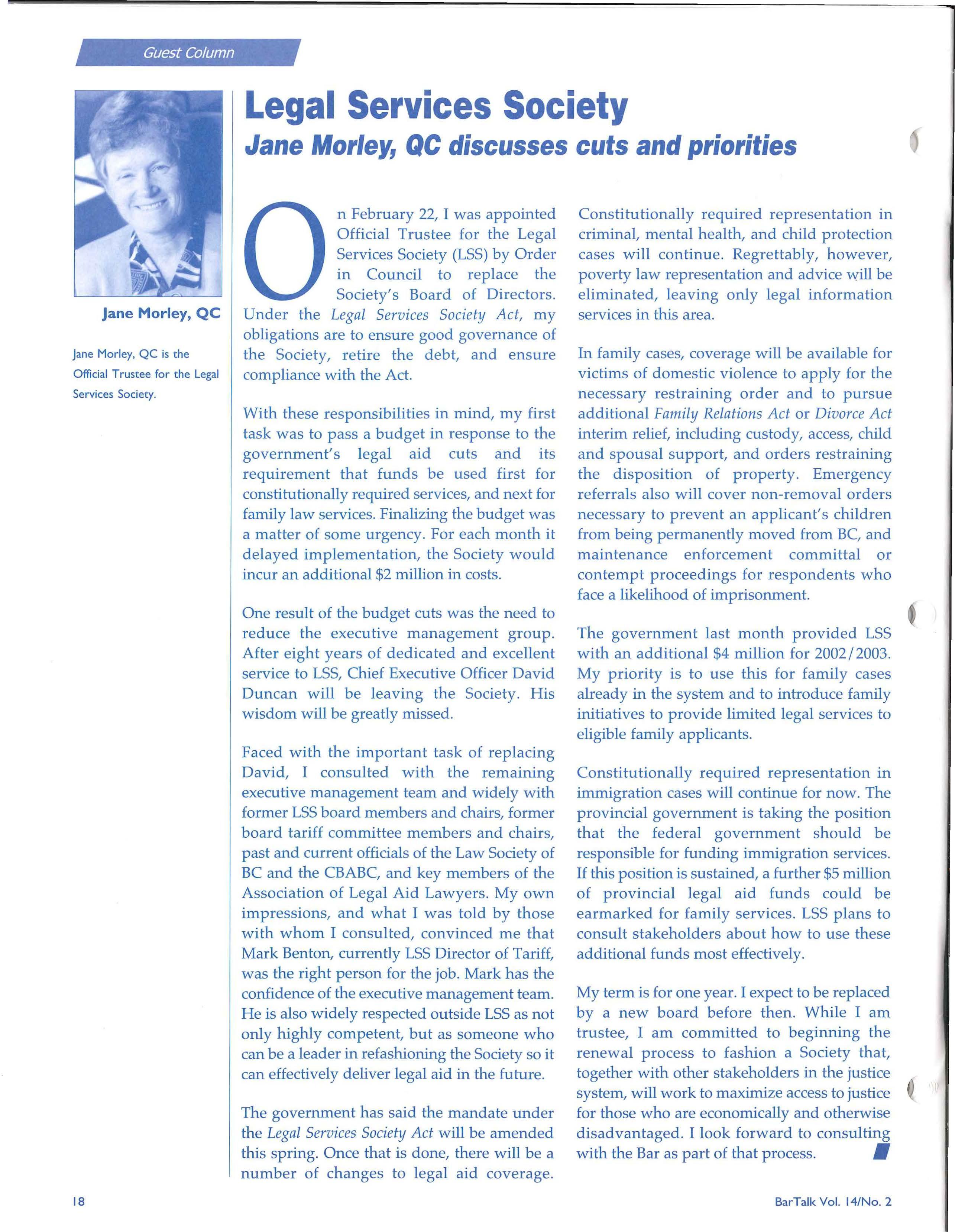
jane Morley, QC
Jane Morley, QC is the Official Trustee for the Legal Serv ices Society
Legal Services Society
Jane Morley, QC discusses cuts and priorities
n February 22, I wa s appointed Official Trustee for the Legal Services Society (LSS) by Order in Council to r e place the Society's Board of Director s . Under the Legal Services Society Act , my obligations are to ensure good gov ernance of the Society, retire the debt, and ensure compliance with the Act
With these responsibilities in mind, my first task was to pass a budget in response to the government's l egal aid cuts and its requirement that funds be used first for constitutionally required services, and next for family law services . Fina lizing the budget was a matter of some urgency. For each month it delayed implementation, the Society would incur an additional $2 million in costs
One result of the budget cuts was the need to reduce the executive management group . After eight years of dedicated and excellent service to LSS, Chief Executive Officer David Duncan will be leaving the Society His wisdom will be greatly missed .
Faced with the important task of replacing David, I consulted with the remaining executive management team and widely with former LSS board members and chairs, former board tariff committee members and chairs, past c;md current officials of the Law Society of BC and the CBABC, and key members of the Association of Legal Aid Lawyers. My own impressions , and what I was told by those with whom I consulted, convinced me that Mark Benton, currently LSS Director of Tariff, was the right person for the job. Mark has the confidence of the executive management team . He is also widely respected outside LSS as not only highly compe t ent, but as someone who can be a leader in refashioning the Society so it can effectively deliver legal aid in the future.
The government has said the mandate under the Lega l Services Society Act will be amended this spring . Once that is done, there will be a number of changes to legal aid coverage
Constitutionally required representation in criminal, mental health, and child protection cases will continue. Regrettably, however, poverty law representation and advice will be eliminated, leaving only legal information services in this area
In family cases, coverage will be available for victims of domestic violence to apply for the necessary restraining order and to pursue additional Family Relations Act or Divor ce Act interim relief, including custody, access, child and spousal support, and orders restraining the disposition of property Emergency referrals also will cover non-removal orders necessary to prevent an applicant's children from being permanently moved from BC, and maintenance enforcement committal or contempt proceedings for respondents who face a likelihood of imprisonment.
The government last month provided LSS with an additional $4 million for 2002/2003 . My priority is to use this for family cases already in the system and to introduce family initiatives to provide limited legal services to eligible family applicants.
Constitutionally required representation in immigration cases will continue for now. The provincial government is taking the position that the federal government should be responsible for funding immigration services If this position is sustained, a further $5 million of provincial legal aid funds could be earmarked for family services LSS plans to consult stakeholders about how to use these additional funds most effectively
My term is for one year. I expect to be replaced by a new board before then While I am trustee, I am committed to beginning the renewal process to fashion a Society that, together with other stakeholders in the justice system, will work to maximize access to justice for those who are economically and otherwise disadvantaged. I look forward to consulting with the Bar as part of that process.
Balancing Act
Genetics and privacy
rincipally, the federal Personal Information Protection and Electronic Documents Act (the "Act") is a tool for the control of personal information in the commercial setting, but the Act has painted personal health information with the same broad brush used for personal information in commerce. Divulging your posta l code to rent a movie is not the same as divulging information about your predisposition to various diseases or undesirable behaviours . Notably, however, the genetic code only indicates a person's predisposition towards a particular outcome; it does not, alone, determine any outcome. Factors such as exercise, diet and socioeconomic status significantly impact an individual's likelihood of developing an ailment, or having success in life.
The Act applies to personal health information and the Canadian federa l privacy commissioner recently indicated that genetic information is personal health information and therefore, the Act applies to genetic information (See speech text given September 13, 2001 to the UNESCO 8th Annual Bioethics Committee, Paris, France) . The Act needs to address the special nature and extreme sensitivity of the health information contained in the genetic code in a balanced manner that does not materially impair research or health science.
WHO OWNS YOU NOW?
The Act does not address the ownership of the actual sample of genetic material or the issue of who owns derivative products created from genetic information or samples. Some U.S. state governments have enacted legislation giving ownership of genetic material to individuals, but the biotechnology industry is using its influence on legislators to replace the ownership right with a right merely to protect such information.
Although some commentators have perceived this regression of personal rights negatively,
there is a risk in making genetic material "property"; once "property" is sold then it is gone for good. Your evil twin may make millions selling her genetic code, but suddenly you are the property of a biotech company .
PUBLIC CONFIDENCE AND PRIVATE FEARS
While questions remain regarding the ownership, treatment and privacy of genetic information and materialr individuals will be reluctant to provide their genetic information in the same way people are hesitant to submit personal information online due to privacy concerns Organizations need to implement practices that protect privacy so that individuals can submit their genetic information or samples for testing or research, with confidence
Organizations can, and should, avoid associating genetic data with identifiable individuals. This can be achieved through 'blinding' procedures that separate technical genetic information from information that identifies the individual. Separation should occur at the scientific and administrative levels and personal information should be stored offline to prevent unauthorized hackers from accessing the information Another practised method to encourage people to provide their genetic information is anonymous testing, known as "alias testing" where the donor remains unidentified. However, this practice could lead people to make fraudulent statements on applications for products like health insurance, if anonymous testing reveals a particular predisposition the disclosure of which might raise their costs for insurance or negate future claims.
Consent is a key issue in respect of divulging genetic information, and the Act is clear that obtaining any personal information from an individual must only be done with the individual's consent for a specific purpose . Taking the importance of consent a step
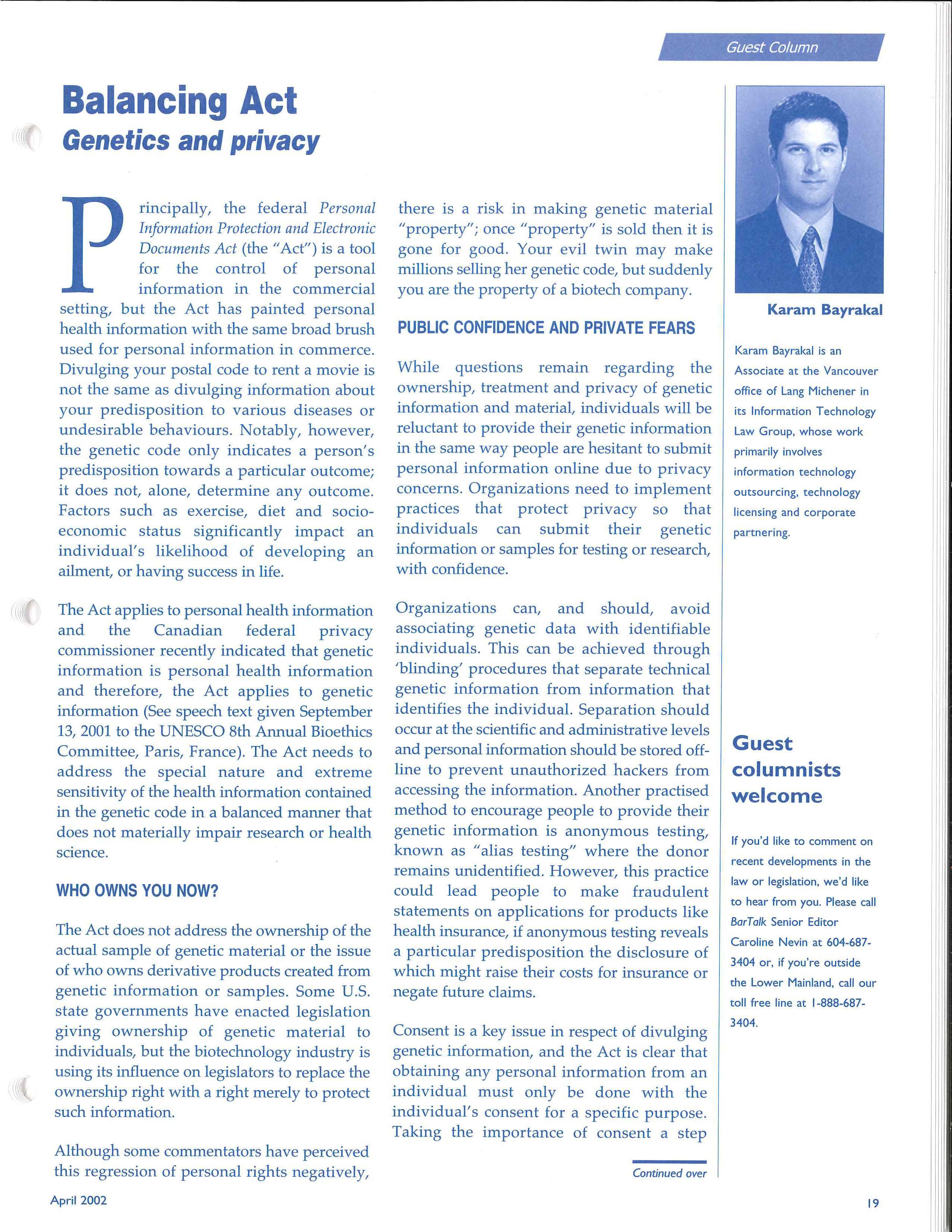
Karam Bayrakal is an Associate at the Vancouver office of Lang Michener in its Information Technology Law Group, whose work primari ly involves information technology outsourcing, technology licensing and corporate partnering
If you'd like to comment on recent developments in the law or legislation, we'd like to hear from you Please call BarTalk Senior Editor
Caroline Nevin at 604-6873404 or, if you're outside the Lower Mainland, call our toll free line at 1-888-6873404
Karam Bayrakal
Genetics and Privacy
Continued from page /9
further, the U.K.'s Human Genetics Commission intends to urge U.K. parliamentarians to criminalize the nonconsensual collection of genetic material of individuals. Bearing in mind that genetic material can be lifted from a restaurant glass or a computer keyboard, the concern becomes more relevant.
FUNDAMENTAL RIGHT
Privacy is considered one of the essential rights of Canadians, and Canadian legislators and the public need to ensure that a balance is struck between an individual's very fundamental interest in the privacy of their genetic information and the societal interest in understanding and utilizing genetic information for medical research and improvements to health science. •
Blood Samples Act Raises Serious Concerns
While the CBA's National Criminal Justice Section appreciates the need to protect frontline workers from possible exposure to potentially fatal viruses - including HIV - a number of serious concerns remain about Bill C-217, the Blood Samples Act "In our view, Bill C-217 is troubling legislation," says Heather Perkins-McVey of Ottawa, Chair of the CBA's National Criminal Justice Section "While the Bill seems to address a simple problem related to health matters, it raises several troubling issues," she explained in a letter to the Commons Standing Committee on Justice and Human Rights. (See letter text at www.cba.org).
Bill C-217, a Private Member's Bill, would allow mandatory blood sampling so that people who perform designated functionssuch as firefighters and first aid workers - or those who have acted as Good Samaritans, would know whether they have been exposed to hepatitis B or C, or HIV .
First and foremost, the CBA argued that an informed medical opinion is necessary to determine whether a blood sample should be taken. "We believe that the Bill is insufficiently tailored," said Perkins-McVey . "At a
minimum, there must be objective medical grounds to believe that a person is likely to have been infected with one of the viruses before infringing the bodily integrity of another individual."
The CBA further believes that safeguards must be in place to protect the privacy of the individual subjected to the test. "For example, in the case of a prisoner, how long after a blood sample was taken would it be before the entire prison population knew that the person had been tested for HIV?" asked Ms. PerkinsMcVey.
Finally, noted the CBA, in the absence of objective medical grounds, the Bill could lead to prejudice and discrimination. "The suspicion that a person might be infected, based on appearance, socio-economic status, sexual orientation or on any underlying stereotype, is clearly inadequate."
The CBA appear e d before the Standing Committee on Justice and Human Rights February 26, 2002. Marc David of Montreal, of the CBA's National Criminal Justice Section, presented the Section' s views . •
Your National News and Information Resource
Wondering what CBA National is doing for you? Visit www cba.org to read up on CBA's latest initiatives. You'll find submissions to Parliamentary committees, statements issued to the media, details on upcoming meetings and CLE programs, and much, much more. The Web site is updated regularly to keep you informed.
•
Watching You
Privacy rights and video surveillance
To permit unrestricted vid eo surveill ance by agents of th e state would seriously diminish th e degr ee of priv acy w e can reasonably exp ec t to enj oy in a free soci ety W e must always be alert to the fact that modern m ethods of electronic surv eillance have the potential , if uncontrolled , to annihilat e privacy. -Mr. Justice LaForest, Supreme Court of Canada
hat is privacy? Once described as the " right to be let alone " (Th e Right to Privacy by S D. Warren and L.D. Brandeis), privacy has evolved from that simple formulation to a modern understanding that focuses on the preservation of an individual's dignity and autonomy.
On February 7, 2002, the Privacy Commissioner of Canada, George Radwanski, presented his views regarding a Vancouver Police Department (VPD) proposal to create a wide-ranging network of public video surveillance to be initially targeted in the Downtown Eastside of Vancouver. In order to promote public debate on this issue, the CBABC and the BC Civil Liberties Association jointly sponsored this event, which was open to media and all interested members of the public. Commissioner Radwanski's appearance in Vancouver was just one of many he has made across the country rai sing public awareness about the issue of video surveillance and its potential impact upon citizens' privacy.
The Vancouver Police Department proposal recommends that 23 cameras be permanently mounted in the Downtown Eastside, Gastown, Chinatown and Strathcona communities. In addition, the VPD wants to add two mobile cameras to deal with the problems of displaced crime caused b y the s tationar y cameras The video cameras would have the capacity to pan whole streets and to zoom in on targets for close-up surveillance
Commissioner Radwanski stated that, in his view, video surveillance of public places is the most important privacy issue facing Canadian society today. The Commissioner's opinion is that, at most, video surveillance can displace crime, not reduce it. He provided a number of examples in both the U.S . and the U.K. where video surveillance had failed to deter crime
In his remarks, the Commissioner explained that after the tragic events of September 11, he recognized that privacy was not an absolute right. There clearly could be some circumstances where it was legitimate and necessary to sacrifice some elements of privacy in the interests of vital security precautions But he suggested that the burden of proof must always be on the state and state agents who suggest that such a sacrifice is necessary for security
The Commissioner recommended that any proposed measure to limit or infringe privacy must meet four very specific criteria First, it has to be demonstrably reasonable to address a specific problem. Second, it must be demonstrably likely to be effective in addressing that problem. Third, it must be proportional to the security benefit to be derived. Fourth, it must be demonstrable that no less privacy - invasive measure would suffice to achieve the same result Such a test would, in his view, create a carefully reasoned balance between the legitimate needs of law enforcement and security on one hand and the need to maintain Charter rights and freedoms and values on the other.
Following his address, a number of questions were put to the Commissioner which indicated that there is a wide range of views on this topic and that some attendees felt that the Commissioner was overstating the negative effect s of the proposed video surveillance on personal privacy and that the public should not expect to have privacy on public streets. These issues (and others) were further
T hi s art icle was su b m itted by Tamara Hunter , Cha ir of t he Freedom of Information and Privacy Law Section and Violet All ard , Secretary of the Freedom of Information and Privacy Law Section
Want to know more?
The full text of the Privacy Commissioner's February 7, 2002 presentation is available at the Privacy Commissioner ' s Web site www p r ivcom gc ca under the heading "Speeches", under "2002".
Bryan Williams
Bryan Williams , QC , is the Fundraising Chair for the Educational Endowment for Aboriginal Justice at the UVic Faculty of Law
UVic Faculty of Law
Educational Endowment For Aboriginal Justice
ecently I accepted the chairmanship of the Educational Endowment for Aboriginal Justice fundraising committee for the University of Victoria Faculty of Law. I feel this initiative is an important one and welcome an opportunity to inform others about this campaign.
During the last 20 years, aboriginal rights and title, and other issues involving native people have become more and more complex and important. It has seemed to me for some time now that what is missing from most law schools in Canada is a comprehensive program of aboriginal law I recall when I was National CBA President in 1986 establishing my top priority for the year, which was "equal justice for native people". Since that time, no where near enough has been done in the law schools of our country to make provision for a series of courses desperately needed by both aboriginal and non-aboriginal students interested in this subject matter.
Privacy Rights
Continued from page 2 I
discussed in a Question and Answer Session with the Commissioner for members of the CBA Freedom of Information and Privacy Law Section, following the Commissioner' s public address.
In our view, the Commissioner's proposal for a modified Oakes test to be applied before citizens' privacy rights are infringed is an interesting one and worthy of more public debate . While the right to privacy is not explicitly mentioned in our constitution, Canadian courts have found that a right to privacy is protected by certain provisions of the Charter which guarantee the right to "life,
A chair on aboriginal education is a strong move and an important step through the educational process toward reconciliation of those issues which exist between First Nations and the levels of government within Canada.
My first responsibility as fundraising chair was to find, and indeed I have found , a very impressive group of British Columbians who would work together through a fundraising committee to raise the funds necessary to fund the chair and accomplish the missions of the Educational Endowment for Aboriginal Justice. The UVic law school met its first responsibility by enticing Professor John Borrows, an outstanding educator in this field, to accept the chall enge as the first chair.
Of course, I would not use my opportunity in writing this article to try to "sell our product" . Let me just say that I cannot think of anything more rewarding than making a contribution to this Endowment Fund. •
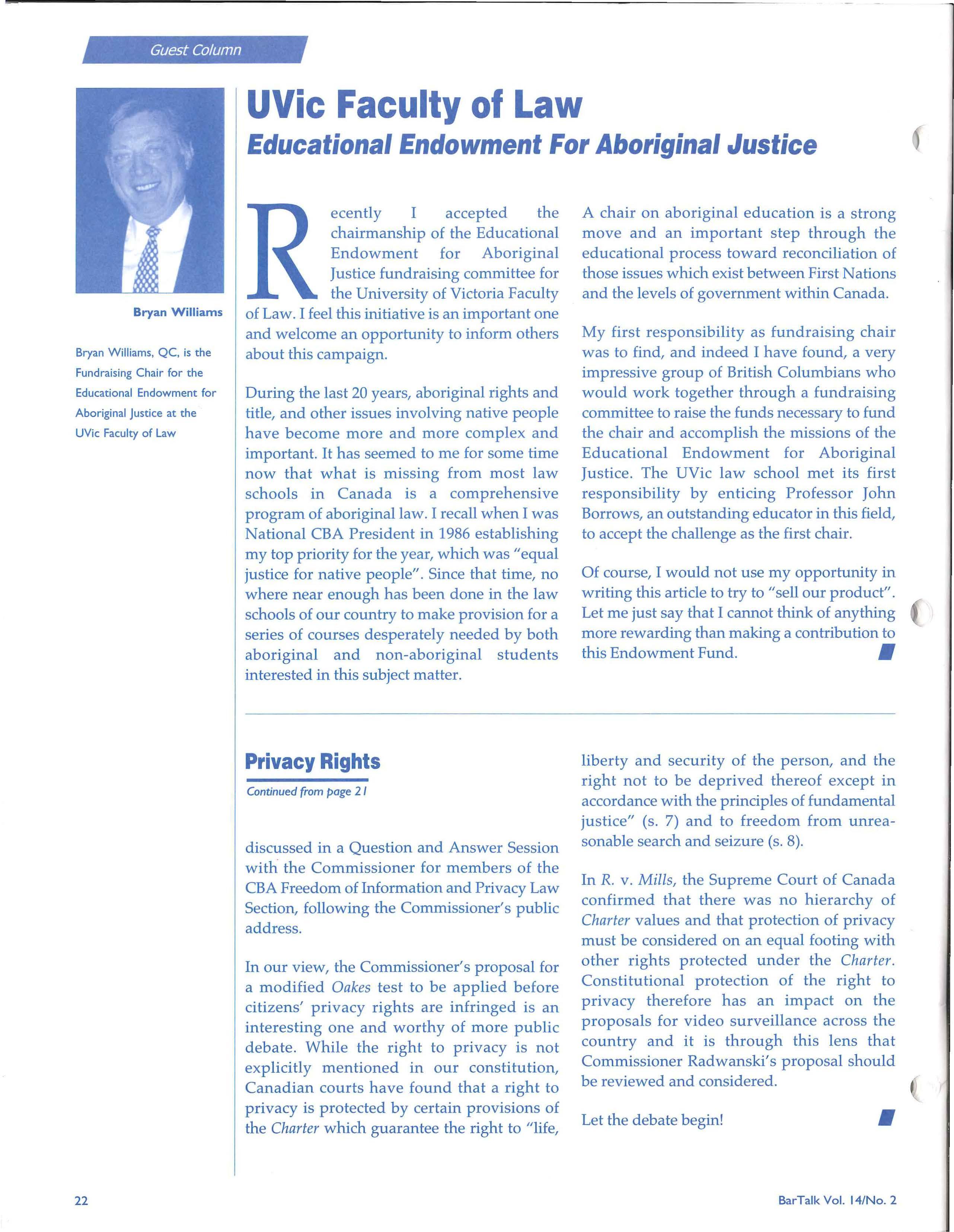
liberty and security of the person, and the right not to be deprived thereof except in accordance with the principles of fundamental justice" (s . 7) and to freedom from unreasonable search and seizure (s 8)
In R. v. Mills, the Supreme Court of Canada confirmed that there was no hierarchy of Charter values and that protection of privacy must be considered on an equal footing with other rights protected under the Charter. Constitutional protection of the right to privacy therefore has an impact on the proposals for video surveillance across the country and it is through this lens that Commissioner Radwanski' s proposal should be reviewed and considered.
Let the debate begin!
Report From the Land Title Branch
Electronic Filing System
Today, land title documents are typically created on a personal computer, printed, executed and physically delivered to the land title office. The proposed Electronic Filing System (EFS), expected to be implemented in 2004, will allow land title documents to be submitted electronically, eliminating the need for physical delivery. It is important to understand that the proposed scheme only contemplates the electronic submission of land transfer instruments to land title offices. It will not enable an external user to register a title or charge or make any entry in the title register. The title examination functions now performed by land title office staff will not be altered in any way.
Conceptually, land title documents will be created and signed in the same way they are today. When the firm responsible for submitting the forms to the land title office has in their possession either the originally signed paper copy or a copy of that copy, the lawyer or notary responsible applies their digital signature to the document. The act of applying a digital signature by a lawyer or notary certifies that an executed paper copy, or a copy of that copy, is in their possession Delivery of the executed paper copy is also used as the authority to submit the electronic version to the land title office for registration. Once the digital signature is applied to the document, the person responsible for submitting the documents can then sign on to BC OnLine and submit these documents to the land title office. When received by the land title office the electronic version is deemed to be the original for all purposes. The Land Title Branch has worked closely with the Law Society in developing the vision for this project The Law Society will act as the certification authority and will validate lawyers' electronic signatures each time a document is submitted electronically to a land title office. Within minutes of receipt of documents at a land title office electronic front counter, the automated process will mark up
the documents and advise the paralegal of the registration numbers of the documents submitted, land title fees collected and , if applicable, property transfer tax collected.
It is anticipated that land title fees will be collected using the existing BC OnLine draw down account and that Property Transfer Tax will be collected using a form of electronic funds transfer. The Land Title Branch is working closely with the Law Society in the development of the electronic funds transfer.
After markup, the electronic document is converted to image format and will then be examined by land title staff in the same way that it is today If the electronically submitted document is defected, the defect notice will be delivered electronically When the document is registered the automated system will send the applicant an e-mail notification of registration.
It will be possible to transmit applications anytime during the business hours of BC OnLine. Currently these hours are from 6 a.m . to 8 p.m. It will also be possible to request that a document be submitted on a day in the future. For example, it will be possible to specify that a document be held and submitted on the last day of the month.
Other services will be combined with the EFS. An activity advisory service will allow a user to receive, automatically, for a specified time period, an e-mail notice advising of any activity relating to a specific parcel. This can be used to be advised of any activity from the date of the initial search until final registration. There are numerous situations for which this service would be invaluable - e.g ., for a construction mortgage between advances to receive notice of claims of builders liens It will also be possible to request that title search information be downloaded in computer readable format so that in-house and off-theshelf legal software programs can use this information to pre-populate forms . •
Darcy Hammett is the Director of Programs, Standards and Policy at the Land Title Branch. He is currently the Project Director and Business Architect for the development of the Land Title Branch electronic filing system.
Key benefits of the Electronic Filing System:
Reduces the costs of doing business with the land title office; Provides the same level of service no matter where you live in Brit ish Columbia ; Notification of application numbers within minutes of submitting documents ; and Faster turn around time s
T his do c um ent is co mp r ised
o f e xcer pts from an articl e by ia n Mat her t hat was or igina ll y prin t ed in Maclea n's magazine o n
Fe br uary 4, 200 2. These
ex c e r pts are pr in ted here
w it h t he pe rmi ss ion o f both Ma cl ean's and Mr Mat her
Special thanks to T om
Fe nn e ll , of Maclean's, for his ass ista nce w ith the p r eparation o f this do cume nt.
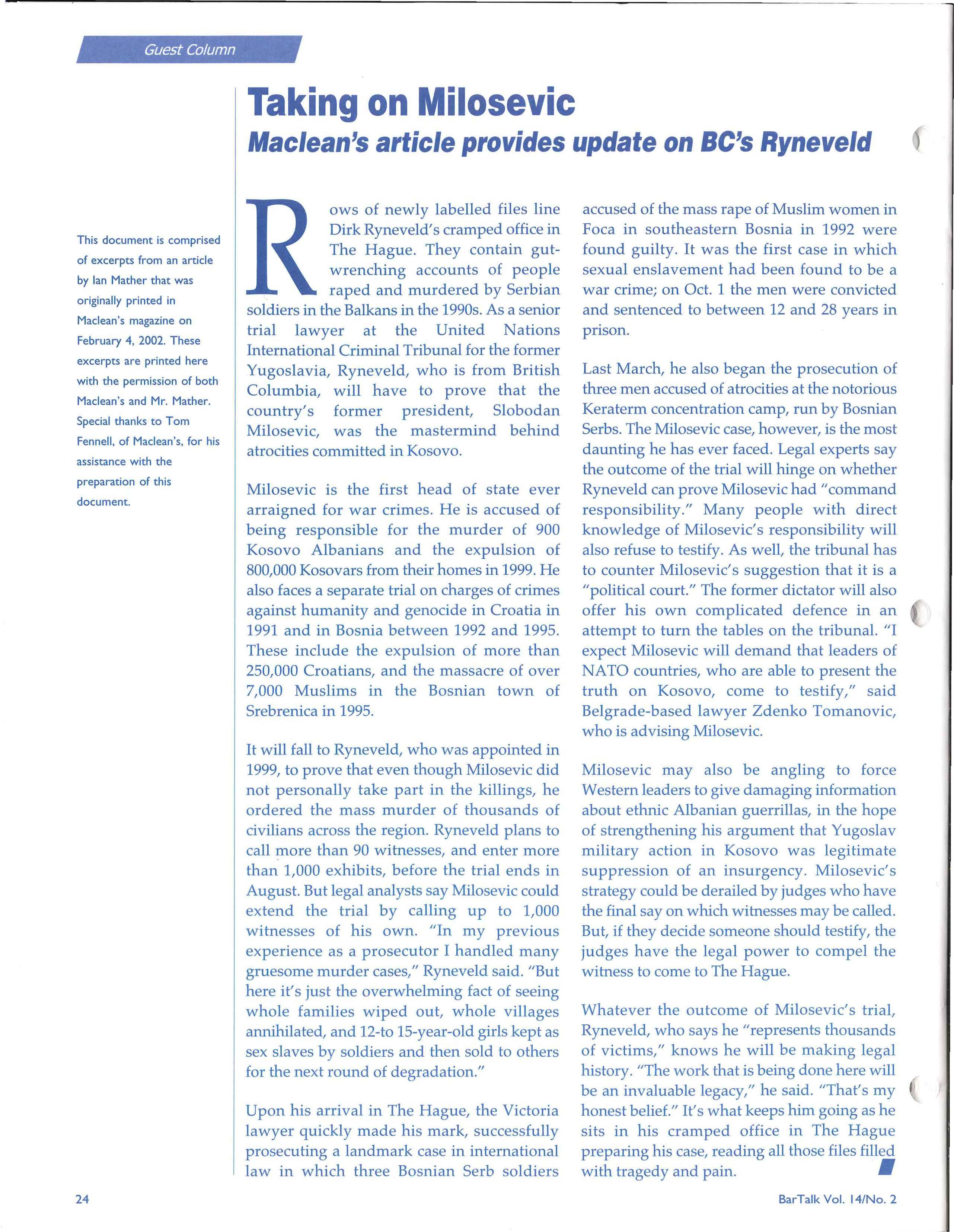
Taking on Milosevic
Maclean's article provides update on BC's Ryneveld
ows of newly labelled files line Dirk Ryneveld's cramped office in The Hague. They contain gutwrenching accounts of peop l e raped and murdered by Serbian soldiers in the Balkans in the 1990s. As a senior trial lawyer at the United Nations International Criminal Tribunal for the former Yugos l avia, Ryneveld, who is from British Columbia, will have to prove that the coun t ry's former president, Slobodan Milosevic, was the mastermind behind atrocities committed in Kosovo.
Mi l osevic is the first head of state ever arraigned for war crimes. He is accused of being responsible for the murder of 900 Kosovo Albanians and the expulsion of 800,000 Kosovars from their homes in 1999. He also faces a separa t e trial on charges of crimes against humanity and genocide in Croatia in 1991 and in Bosnia between 1992 and 1995. These include the expulsion of more than 250,000 Croatians, and the massacre of over 7,000 Muslims in the Bosnian town of Srebrenica in 1995.
It will fall to Ryneveld, who was appointed in 1999, to prove that even though Milosevic did not personally take part in the killings, he ordered the mass murder of thousands of civilians across the region. Ryneveld plans to call more than 90 witnesses, and enter more than 1,000 exhibits, before the trial ends in August. But legal analysts say Milosevic could extend the trial by calling up to 1,000 wi t nesses of his own. "In my previous experience as a prosecutor I handled many gruesome murder cases," Ryneveld said. "But here it's just the overwhelming fact of seeing whole families wiped out, whole villages annihilated, and 12-to 15-year-old girls kept as sex slaves by soldiers and then sold to others for the next round of degradation."
Upon his arrival in The Hague, the Victoria lawyer quickly made his mark, successfully prosecuting a landmark case in international law in which three Bosnian Serb soldiers
accused of the mass rape of Muslim women in Foca in southeastern Bosnia in 1992 were found guilty. It was the first case in which sexual enslavement had been found to be a war crime; on Oct. 1 the men were convicted and sentenced to between 12 and 28 years in prison.
Last March, he also began the prosecution of three men accused of atrocities at the notorious Keraterm concentration camp, run by Bosnian Serbs. The Milosevic case, however, is the most daunting he has ever faced. Legal experts say the ou t come of the trial will hinge on whether Ryneveld can prove Milosevic had "command responsibility." Many people with direct knowledge of Milosevic's responsibility will also refuse to testify . As we ll, the tribunal has t o counter Mi l osevic's suggestion that it is a "political court." The former dictator will also offer his own complicated defence in an attempt to turn the tables on the tribunal. "I expect Mil osevic will demand that leaders of NATO countries, who are able to present the truth on Kosovo, come to testify," said Belgrade-based lawyer Zdenko Tomanovic, who is advising Milosevic.
Milosevic may also be angling to force Western leaders to give damaging information about ethnic Albanian guerrillas, in the hope of strengthening his argument that Yugoslav military action in Kosovo was legitimate suppression of an insurgency . Milosevic's strategy could be derailed by judges who have the final say on which witnesses may be called. But, if they decide someone should testify, the judges have the legal power to compel the witness to come to The Hague.
Whatever the outcome of Milosevic' s trial, Ryneveld, who says he "represents thousands of victims," knows he will be making legal history. "The work that is being done here will be an invaluable legacy," he said. "That's my honest belief." It's what keeps him going as he sits in his cramped office in The Hague preparing his case, reading all those files filled with tragedy and pain.
Roundtable on Anti·Terrorism
A presentation by the Equality & Diversity Committee
n December 2001, the Branch's Equality and Diversity Committee presented a roundtable discussion about some of the challenges for lawyers and lawmakers in responding
Ravi Hira, QC, discussed some of the practical issues that might arise if one were prosecuting under this legislation, and some of the potential difficulties He went so far as to suggest the lack of need for this legislation,
to the threat of terrorism while remaining vigilant to protect individual equality and other constitutional rights . observing that the Criminal Code is more than Jennifer Conkie sufficient to protect us from terrorist threats. He gave the audience much to think about. Jennifer Conk i e practises commercial litigation with
Participants in this session were Professor Margot Young, this year's visiting Owen Chair at the UBC Faculty of Law (on leave from UVic), and Vancouver lawyers Palbinder Shergill and Ravi Hira, QC. Jennifer Conkie moderated the group. Senator Mobina Jaffer, scheduled to participate and speak about some of the Senate's concerns, was unable to attend at the last minute as she was in Ottawa writing the Senate subcommittee report to the House on the proposed legislation.
Professor Young spoke vigorously about her chief concern, that fringe and minority members of Canadian society might suffer further disenfranchisement, targeting and isolation as a result of the omnibus new legislation. She addressed the risk that, in moving so quickly to protect society generally, the government might enact law that would be harmful to groups and individuals already facing a struggl e to gain reasonable access to justice and the equal protection of the law. She mentioned aboriginal groups and their right to protest peacefully as an example of lawful expression that could well be compromised by the new Act. She urged the audience to consider the price of responding too fast legislatively in times of panic, and commended to us the thoughtful pieces in Essays on Canada's Anti - Terrorism Bill , published in November 2001 by the University of Toronto Press, and consisting of papers presented by a November conference sponsored by the U ofT Law Faculty.
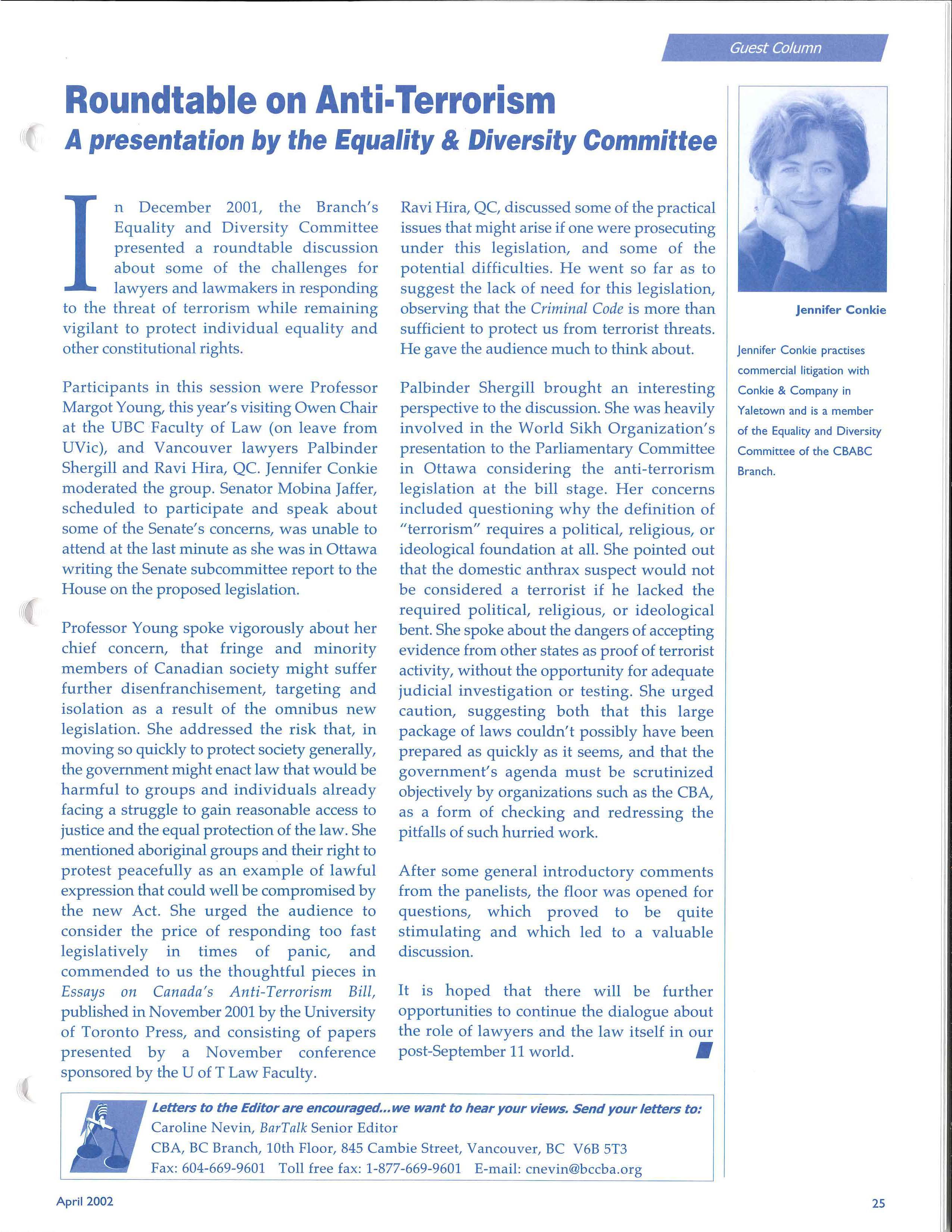
Palbinder Shergill brought an interesting perspective to the discussion. She was heavily involved in the World Sikh Organization's presentation to the Parliamentary Committee in Ottawa considering the anti-terrorism legislation at the bill stage . Her concerns included questioning why the definition of "terrorism" requires a political, religious, or ideological foundation at a ll. She pointed out that the domestic anthrax suspect would not be considered a terrorist if he lacked the required political, religious, or ideological bent. She spoke about the dangers of accepting evidence from other states as proof of terrorist activity, without the opportunity for adequate judicial investigation or testing. She urged caution, suggesting both that this large package of laws couldn't possibly have been prepared as quickly as it seems, and that the government's agenda must be scrutinized objectively by organizations such as the CBA, as a form of checking and redressing the pitfalls of such hurried work.
After some general introductory comments from the panelists, the floor was opened for questions, which proved to be quite stimulating and which led to a valuable discussion
It is hoped that there will be further opportunities to continue the dialogue about the role of lawyers and the law itself in our post-September 11 world. •
Letters to the Editor are encouraged... we want to hear your views. Send your letters to:
Caroline Nevin, BarTalk Senior Editor
CBA, BC Branch, lOth Floor, 845 Cambie Street, Vancouver, BC V6B 5T3
Fax: 604-669 -9601 Toll free fax: 1-877 -669 - 9601 E-mail: cnevin@bccba.org
Conk ie & Compa ny in Yaletown and is a member of t he Equa l ity and Diversity Committee o f the CBAB C Branch
Christine Mingie
Christine Mingie is a 2nd year law student at UBC and a member of the Bar Talk Editorial Board
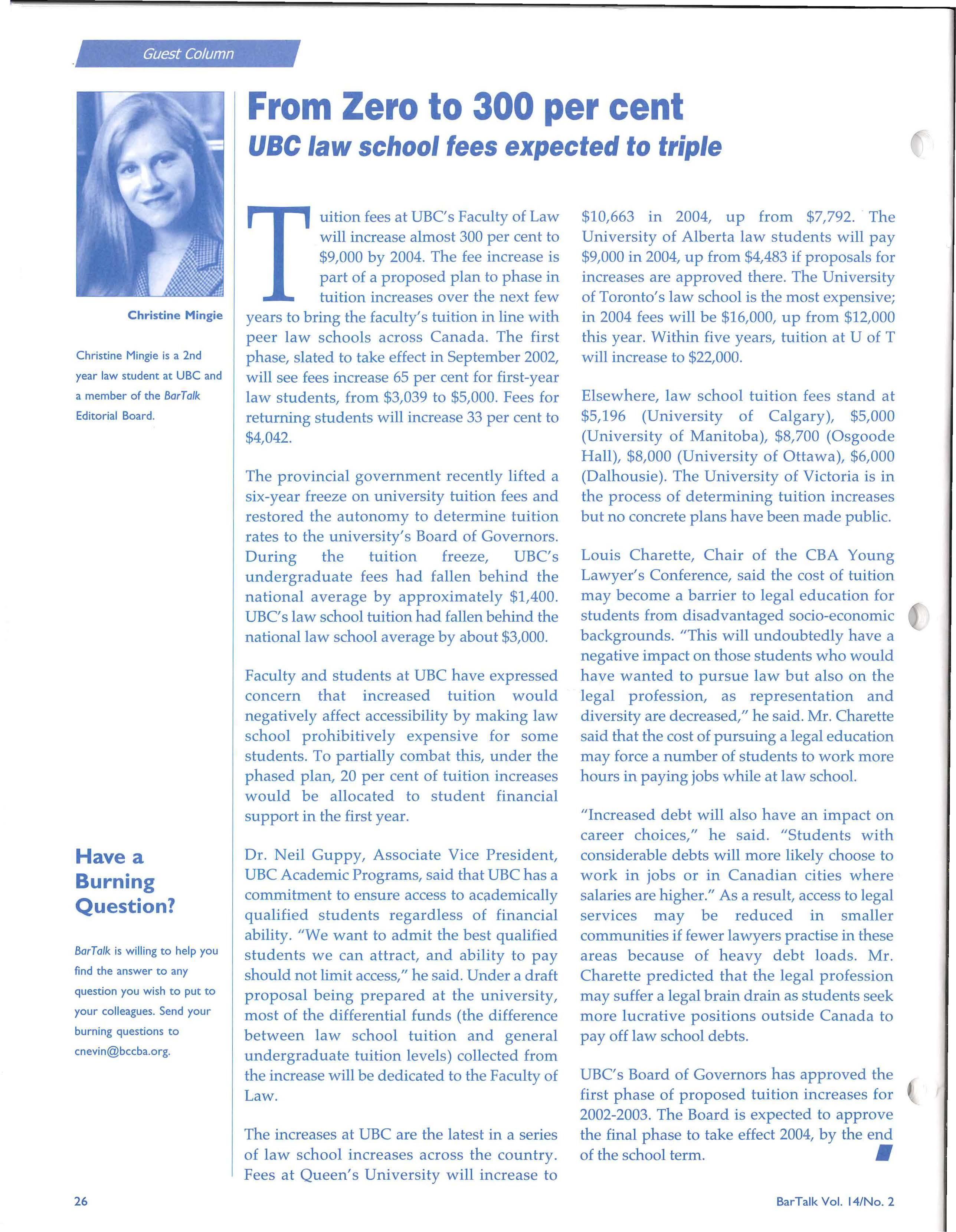
Have
a
Burning Question?
Bar Talk is w ill ing to help you find the answer to any question you wish to put to your colleagues Send your burning questions to cnevin@bccba org
From Zero to 300 per cent USC law school tees expected to triple
uition fees at UBC' s Faculty of Law will increase almost 300 per cent to $9,000 by 2004 . The fee increase is part of a proposed plan to phase in tuition increases over the next few
y e ars to bring the faculty ' s tuition in line with peer law schools across Canada The first phase, slated to take effect in September 2002, will see fees increase 65 per cent for first -year law students, from $3,039 to $5,000 Fees for returning students will increase 33 per cent to $4, 042
The provincial government recently lifted a six-year freeze on university tuition fees and restored the autonomy to determine tuition rates to the university's Board of Governors . During the tuition freeze, UBC's undergraduate fees had fallen behind the national average by approximately $1,400. UBC' s law school tuition had fallen behind the national law school average by about $3,000 .
Faculty and students at UBC have expressed concern that increased tuition would negatively affect accessibility by making law school prohibitively expensive for some students To partially combat this, under the phased plan, 20 per cent of tuition increases would be allocated to student financial support in the first year.
Dr. Neil Guppy, Associate Vice President, UBC Academic Programs, said that UBC has a commitment to ensure access to academically qualified students regardless of financial ability. "We want to admit the best qualified students we can attract, and ability to pay should not limit access, " he said. Under a draft proposal being prepared at the university, most of the differential funds (the difference between law school tuition and general undergraduate tuition levels) collected from the increase will be dedicated to the Faculty of Law
The increases at UBC are the latest in a series of law school increases across the country . Fees at Queen's University will increase to
$10,663 in 2004, up from $7, 792 . The University of Alberta law students will pay $9,000 in 2004, up from $4,483 if proposals for increases are approved there. The University of Toronto's law school i s the most expensive; in 2004 fees will be $16,000, up from $12, 000 this year. Within five years, tuition at U of T will increase to $22, 000
Elsewhere, law school tuition fees stand at $5,196 (University of Calgary), $5,000 (University of Manitoba) , $8,700 (Osgoode Hall) , $8,000 (University of Ottawa), $6, 000 (Dalhousie) . The University of Victoria is in the process of determining tuition increases but no concrete plans have been made public.
Louis Charette, Chair of the CBA Young Lawyer's Conference, said the cost of tuition may become a barrier to legal education for students from disadvantaged socio-economic backgrounds. "This will undoubtedly have a negative impact on those students who would have wanted to pursue law but also on the legal profession, as representation and diversity are decreased," he said. Mr Charette said that the cost of pursuing a legal education may force a number of students to work more hours in paying jobs while at law school.
"Increased debt will also have an impact on career choices," he said . "Students with considerable debts will more likely choose to work in jobs or in Canadian cities where salaries are higher." As a result, access to legal services may be reduced in smaller communities if fewer lawyers practise in these areas because of heavy debt loads Mr Charette predicted that the legal profession may suffer a legal brain drain as students seek more lucrative positions outside Canada to pay off law school debts.
UBC' s Board of Governors has approved the first phase of proposed tuition increases for 2002-2003. The Board is expected to approve the final phase to take effect 2004, by the end of the school term
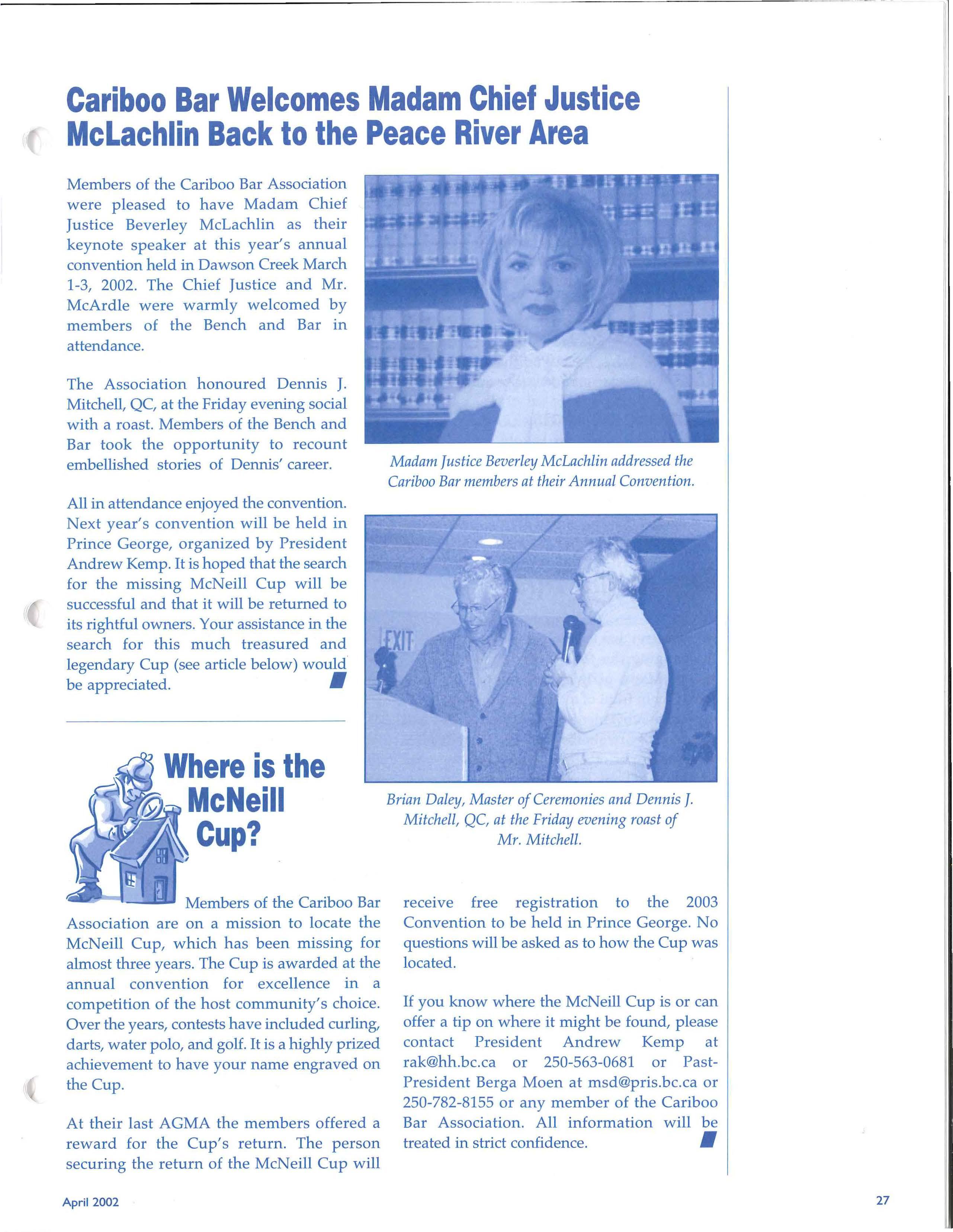
Cariboo Bar Welcomes Madam Chief Justice Mclachlin Back to the Peace River Area
Members of the Cariboo Bar Association were pleased to have Madam Chief Justice Beverley McLachlin as their keynote speaker at this year ' s annual convention held in Dawson Creek March 1-3, 2002 The Chief Justice and Mr McArdle were warmly welcomed by members of the Bench and Bar in attendance .
The Association honoured Dennis J. Mitchell, QC, at the Friday evening social with a roast. Members of the Bench and Bar took the opportunity to recount embellished stories of Dennis' career.
All in attendance enjoyed the convention. Next year's convention will be held in Prince George , organized by President Andrew Kemp. It is hoped that the search for the missing McNeill Cup will be successful and that it will be returned to its rightful owners. Your assistance in the search for this much treasured and legendary Cup (see article below) would be appreciated.
•
Where is the McNeill Cup?
Members of the Cariboo Bar Association are on a mission to locate the McNeill Cup, which has been missing for almost three years The Cup is awarded at the annual convention for excellence in a competition of the host community's choice . Over the years, contests have included curling, darts, water polo, and golf. It is a highly prized achievement to have your name engraved on the Cup .
At their last AGMA the members offered a reward for the Cup's return. The person securing the return of the McNeill Cup will
Brian Daley, Master of Ceremonies and Dennis ] Mitchell , QC, at the Friday evening roast of Mr Mitchell
receive free registration to the 2003 Convention to be held in Prince George. No questions will be asked as to how the Cup was located
If you know where the McNeill Cup is or can offer a tip on where it might be found, please contact President Andrew Kemp at rak@hh.bc ca or 250-563-0681 or PastPresident Berga Moen at msd@pris.bc .ca or 250-782-8155 or any member of the Cariboo Bar Association. All information will be treated in strict confidence.
•
Upcoming Them is Assembly
This year's Themis Assembly is on "Practice Development and Wellness for Women Lawyers" and will take place May 31 to June 2 at the Coast Plaza Suite Hotel at Stanley Park, in Vancouver. For more information on the conference, or to view the full conference schedu le, please visit www.themisassembly.com If you have any questions about the conference, please contact 604 -521 -5473 or rital@actraining com
BC Courthouse Library Society: New Services
UPGRADED WEB CATALOGUE
BCCLS recently upgraded their web catalogue . In addition to enhanced visual appeal , the catalogue is more flexible and offers more sophisticated searching capabilities than the previous version. Available on branch computers or by visiting www bccls.bc.ca, the catalogue offers access to all BCCLS collections, in all library locations . Please see What's New on the BCCLS Web site, or ask library staff for more information.
ELECTRONIC RESOURCES
BCCLS has purchased the Canadian Encyclopedic Digest, available in the six larger branches (Kamloops, Kelowna, Nanaimo,
Ergonomic Tips
It's no secret that technology's rapid evolution is changing the face of business at record speed Many people spend much of their workday in front of a computer making a few repetitive movements of their eyes, head and fingers. They retain the same body position for extended periods of time, making the incidence of body strain inevitable
Most office employees work in environments that are ergonomically incorrect, such that the workstation is poorly fitted to the person's body frame and daily movements. Effective office ergonomics, however, can help to combat this problem through proper workstation design, and utilizing equipment that helps prevent body strain. The primary goal of ergonomics is to minimize operator fatigue and discomfort The result not only improves health and comfort but can increase productivity too
Here are a few ergonomic tips :
• Organize your workstation so that everything is within a comfortable reach and use;
New Westminster, Prince George, and Victoria), and LegalTrac, a legal periodical index, available in the 30 libraries with computers.
SCANNING SERVICE
The Vancouver Courthouse Library has begun a new document scanning service whi ch will allow electronic delivery of documents . In place of photocopying, a document will be scanned and e-mailed as an Adobe Acrobat (pdf) file attachment. Document delivery methods now include electronic delivery (email), fax, and hardcopy delivery (pick-up, mail o r courier). Please contact the Vancouver library at 604-660-2841 or 1-800-665-2570 for pricing and details •
•
• Choose a chair with proper height and lumbar support to reduce muscle strain and body fatigue;
Document holders allow the operator to view material without straining the eyes, neck, shoulder, and back muscles; and
• Height adjustable keyboard-mouse trays can reduce wrist and arm strain and promote better posture.
An ergonomic professional can determine your office needs and recommend equipment to help reduce injuries All products should be installed to fit each user. Some suppliers will provide installation but not all provide product training. Training is essential because ergonomic products that are used improperly are not only less effective but can contribute to further damage Protecting your employees' health is key to happier and more productive workers
David Jacoby is owner of Jacoby Office Innovations Inc. Visit www .jacobyoffice .com for more information
Letters to the Editor
Together the BC Association of Community Law Offices and the Native Community Law Office Association of BC represent 26 community law offices and native community law offices across BC. We are writing on behalf of our member offices to express our support for the strong stand the CBA has been taking on behalf of the legal aid system in BC.
We look forward to continuing to work with the CBA in furtherance of our joint commitment to access to justice for all the citizens of British Columbia .
Your s sincerely, Maggie Bello, BCACLO President Charles McKay, NCLOABC President
Re : Lawyer jokes vs deserved recognition
I noticed the ongoing resolution at page 3 of your February issue. Lawyers receive recognition through payment by the private and business community as well as compensation from government sources There is a book called "Humour Is No Laughing Matter." Lawyer jokes are a recognition that lawyers perform a valuable service but extract a fee that clients would prefer to avoid . That is the source of the conflict, and without conflict there is no humour. The more serious the problem, the wealthier the client, the more lawyers are involved. What more bottom-line recognition could a profession ask for?
Yours truly, Harvey L. Gansner
On behalf of UVic Law faculty, staff and students, I would like to offer warm congratulations to Tim Livingston and Almira Esmail for winning the 4th annual Sopinka Cup, the National Trial Advocacy Competition in Ottawa, for UVic. The Cup was presented by Mr Justice Ian Binnie at a
banquet attended by the Chief Justice of Canada.
In addition to winning the Cup, Almira was recognized as the outstanding competitor in three of the five individual categories: Best Cross-Examination, Best Closing and Best Overall Advocate . She has been invited to attend the next annual meeting of the Association of Trial Lawyers of America where she will be recognized for her achievements Tim's cross-examination and opening came in for special mention by the judges. They called his cross 'perfect' , being edged out by Almira only because she had to deal with a more cantankerous witness. Tim's opening was the hit of the event - in the bilingual trial against the University of Moncton he gave his opening in perfect French, without referring to a single note.
The trial conducted by the team was presided over by Supreme Court of Canada Justice Bastarache. The jury of 12 consisted of judges and lawyers from across Canada including BC Supreme Court Justice Koenigsberg, and Madame Louise Charron of the Ontario Court of Appeal.
Our congratulations also go out to local lawyers Nils Jensen and Adrian Brooks, the two stalwarts who coached the team to victory. Others who assisted in preparation were Provincial Court Judges Quantz and Bracken, defence counsel Mayland McKimm, QC and Robin Baird, and a host of law students who acted as witnesses during the many practices
Almira and Tim represented the Faculty, the University and Western Canada Law Schools with distinction, exceeding the fine performance that won them the Western Canada Mcintyre Cup in February.
Congratulations to all. You have done us proud!
Andrew Petter, QC, Acting Dean UVic Faculty of Law
•Canadian Elected as LMA
PresidentElect
The Legal Marketing Association (LMA) is pleased to announce that Heather Gray- Grant, Marketing Director of the Vancouver Office of Fasken Martineau LLP, has been elected as President-Elect for the US-based organization Gray-Grant is the first non-American to take on this leadership role.
The LMA is the voice of legal marketing professionals and lawyers at firms looking to develop their practices
Correction
The late AI Bate was mistakenly referred to as AI Bates on Page 19 of the February 2002 Bar Talk issue
Law Foundation of BC Grants Approved
The Board of Governors of the Law Foundation of BC met on March 9, 2002. The Governors, at the meeting, were advised that, due to the continuing and unprecedented decline in interest rates, revenue for the Foundation for 2002 was now projected to be considerably less than in 2001. The situation is being monitored closely and will be reviewed again at the June Board meeting .
Funding totaling $3,166,400 has been approved for the following 18 continuing grantees:
BATTERED WOMEN'S SUPPORT SERVICES (Legal Advocacy Program 20021 2003)$46,800
BC CIVIL LIBERTIES ASSOCIATION
(Operating 200212003)- $134,300
BRITISH COLUMBIA LAW INSTITUTE
(Operating 200212003)- $140,300
CANADIAN BAR ASSOCIATION, BC BRANCH (Law Week 2002)- $5,500
COMMUNITY LEGAL ASSISTANCE SOCIETY (Operating 200212003)- $654,500
CONTINUING LEGAL EDUCATION SOCIETY (Professional Legal Training Course 2002 I 2003) -$233,800
END LEGISLATED POVERTY
(FLA Wline Public Legal Education Newsletter and Working Group 200212003)- $19,500
NELSON DISTRICT COMMUNITY RESOURCES SOCIETY
(Legal Advocacy Project 200212003)- $105,400
NORTH ISLAND ADVOCACY COALITION SOCIETY (Campbell River)
(Legal Advocacy Program 2002 I 2003) - $84,600
PEOPLE'S LAW SCHOOL SOCIETY
(Operating 200212003)- $262,400
SEPARATION AND DIVORCE RESOURCE CENTRE (Victoria)
(Volunteer and Legal Support Services Program 200212003)- $40,600
TENANTS' RIGHTS ACTION COALITION
(Legal Advocacy Project 200212003) - $218,600
UNIVERSITY OF SASKATCHEWAN (Native Law Centre- Program of Legal Studies and Operating 200212003)- $10,300
UNIVERSITY OF VICTORIA, FACULTY OF LAW (Law Centre Clinical Program 200212003)$203,400
WEST COAST DOMESTIC WORKERS' ASSOCIATION
(Legal Advocacy Project 200212003)- $133,800
WEST COAST ENVIRONMENTAL LAW ASSOCIATION
(Operating 200212003 and Environmental Di spute Resolution Fund)- $705,900
WEST COAST LEGAL EDUCATION AND ACTION FUND ASSOCIATION
LAW FOUNDATION GRADUATE FELLOWSHIPS (Operating 200212003)- $111,700 • (200212003)- $55,000
Law Week 2002
Freedom and the Charter in the 21st Century
As part of the CBA ' s continuing tradition of educating Canadians about their justice system, there will be an Open House at the Vancouver Library Main Branch on April 20,
2002 from 1-4 p.m. Displays by partners in the justice system, and guest speakers, will give people an inside look at all aspect s of how the justice system works •
Services
Branch members have access to a wide range of products, services and discounts Member Services is continually adding and looking for ways you can get the most out of your membership! Be sure to visit www bccba org for new additions Your input is always welcome Send your suggestions to kjohnson@bccba.org Member Services Hotline: 604-687-3404, ext 500 or 1-888-687-3404, ext. 500
COUNSEL NETWORK
The Counsel Network is pleased to announce the addition of Steve Seibel, Senior Consultant in January 2002. Mr. Seibel can be contacted at 604-643 - 1711 for your legal recru itment needs.
CHECK IN WITH LODGING OVATIONS (INTRAWEST)!
Lodging Ovations offers complimentary Lodging Ovations Club memberships to all CBA members Special privileges, benefits and savings year round at Intrawest properties throughout North America . Call 1-877-3911816 or to enrol on l ine visit www.lodgingovations .com/ club . Remember to identify yourself as a CBA member!
SPRING INTO FUN AT PLAYLAND
CBA members may purchase Playland General Passports (for persons taller than 48") for $18, (incl. GST) regular $24.56. See www.bccba.org for detai l s, restrictio n s, and order forms.
WHISTLER NORTHWIND
Let the Whistler Northwind Luxury Train set you on a getaway you'll never forget! Spend three days and two nights in luxurious surroundings. First class service, vintage dining car and lounge car, and spectacular scenery Round trip packages start at $1,020. For details, visit www.bccba .org or www.whistlernorthwi-nd com/ cbabc
THE ARTS CLUB AND STANLEY THEATRES
Receive a 20 per cent discount off regu l arpriced tickets by calling N atasha Klein at 604687-5315, ext 254 and identifying yourself as a CBAmember
Girl in the Goldfish Bowl plays at the Arts Club until Apr. 27 .
Agatha Christie's The Mousetrap plays at the Stanley May 16 - July 21.
New Benchmark Rate For Pooled Trust Accounts
Vancouver City Savings Credit Union, recognizing the negative impac t of l ow interest rates o n the Law Foundation's revenues and the need in the community for additional funding in the wake of government cuts, set a new Foundation benchmark rate of return to be paid on l awyers' poo led trust accounts.
Effective March 1, 2002, interest paid on lawyers' pooled trust accounts will be at a rate of prime less 2 .5 per cent. Law Foundation Chair Don Silversides, QC thanks Wayne Richter, Cash Management Manager, Business Services, for ensuring that Vancouver City Savings Credit Union will again reclaim the
leadership role in the rate of return paid to the Foundation.
Increased revenues enable the Law Foundation to fund programs designed to make the legal system accessible to British Columbians, particularly those people who may have the g r eatest problems of access to justice as a result of their economic, social, physical or mental special needs.
The Canadian Bar Association, BC Branch, the Law Society and the Law Foundation encourage lawyers to consider which financial institutions provide the best support to the Law Foundation when deciding where to place their trust accounts.
TEL: 604-687-3404
TOLL FREE in BC, outside the Lower Mainland: 1-888-687-3404
FAX: 604-669-9601
TOLL FREE in BC, outside the Lower Mainland: 1-877-669-960 I
• BarTalk Senior Editor: CAROLINE NEVIN, 604-687-3404, EXT. 320 cnevin@bccba.org
• BarTalk Editor: SANDRA WEBB 604-687-3404, EXT. 318 slgwebb@bccba.org
• Legislation & Law Reform Officer: STUART RENNIE (in Port Moody) 604-949-1490 srennie@bccba.arg
• Editorial Board
KENNETH ARMSTRONG, Chair VIKKI BELL, QC WILLIAM S. CLARK CHRISTINE MINGlE DAVID ROBERTS, QC
© Copyright the British Columbia Branch of the Canadian Bar Association-2002.
This publication is intended for information purposes only and the information contained herein should not be applied to specific fact circumstances without the advice of counsel.
• BarTalk is published by the British Columbia Branch of the Canadian Bar Association, lOth Floor 845 Cambie Street Vancouver, BC V6B 5T3
The BC Branch of the Canadian Bar Association represents more than 9,700 members within British Columbia and is dedicated to improve and promote access to justice, to review legislation, initiate law reform measures and advance and improve the administration of justice.
TAKE THAT BREAK- BOOK A LOCUM
David Freeman Phone: 1-888-752-8846 ; Fax : 1-8 77 -743-9623; e- maillawyers@telus.net
GASTOWN OFFICE SPACE-1050 sf overlooks heritage courtyard. Call 604-263-4203
NEW WEST BUILDING FOR SALE OR LEASE Next to Courthouse- Approx. 4500 sf. Exec. offices. Ca11604-916 - 1704
Anno
Classified Ads
WILL SEARCH Anyone with information on a will for Charlotte Margaret Foubert please contact Attorney Richard Hoss , 236 West Birch Shelton, WA 98584
NEW WEST SHARED OFFICE SPACE
Established lawyer with general practice seeks lawyer with own client base to share fully serviced office located near Courthouse and LTO. Cost negotiable . Call 604-526-4491.
LITIGATION AND PERSONAL INJURY LAWYER REQUIRED-Our firm seeks a junior lawyer with 1-5 years related experience. Please forward your resume in confidence to Buckley Hogan Law Office, 9453 120th St., Delta, BC V4C 6S2 Tel: 604-588-0431 Fax : 604-588-0062. E-maillawyers@buckho.com
Change of Address? E-mail address changes to data@bccba.org
The First Annual Western IT Law Spring Training Program
Vancouver, Wednesday, May 15-Friday, May 17, 2002 •
Fairmont Waterfront Hotel
The Canadian IT Law Association ("'T.Can") is proud to present The First Annual Western IT Law Spring Training Program in the Spring of 2002. This popular conference is a comprehensive , three day introductory -level program which will cover aU of the important Information Technology, Intellectual Property and Electronic Commerce issues with a practical and substantive approach . This is a very timely program which will be of interest not only to IT lawyers but also to those lawyers practicing in any corporate commercial field which touches on the technology area. The program, designed by leading IT and IP practitioners, will provide a comprehensive learning experience at a reasonable price. Th e emphasis will be on pra ctical knowledge: as part of the agenda, there will be an in depth analysi s of various IT agreements and a simulated negotiation of a computer system acquisition. As well, you will have an opportunity to meet and network with some of the leading IT, IP and £-commerce l awyers from across the country.
Don't miss the premiere information technology training program in the country.
Please see our website at www.it-can.ca to view the brochure or contac t Lisa Ptack at lptack@sprint.ca, for more information.
Law Week 2002: April15-20
"Freedom and the Charter in the 21st Century"
OPEN HOUSE Vancouver Library Main Branch, April20, 1-4 p.m.
Guest speakers and displays, by partners in the justice system, will give people an inside look at how the justice system works.
DIAL-A-LAWYER DAY offers free legal consu ltation to the public
This one-day program on Saturday, April 20 between 10 a .m. and 4 p.m ., gives people the opportunity to seek free legal advice from CBABC lawyer volunteers Call-in numbers: 604-687-3221 or 604-687-4680 Outside the Lower Mainland, 1-800-663-1919 or 1-800-565-5297.
Sponsored by the Canadian Bar Association, the Law Foundation of BC and th e Vancouver Bar Association
One line equals approximately 7 words
per
,000 Insert rates will increase in August 2002. Book your inserts now to reserve these low rates.
Please direct advertising inquiries to Sandra Webb at 604 -687 -3404 or 1-888 -687-3404 , ext. 318 (e -mail cba@bccba.org).