BC Branch constitutional conference • was a maJOr success
Historic Vancouver meeting attracted national media and a sell-out crowd
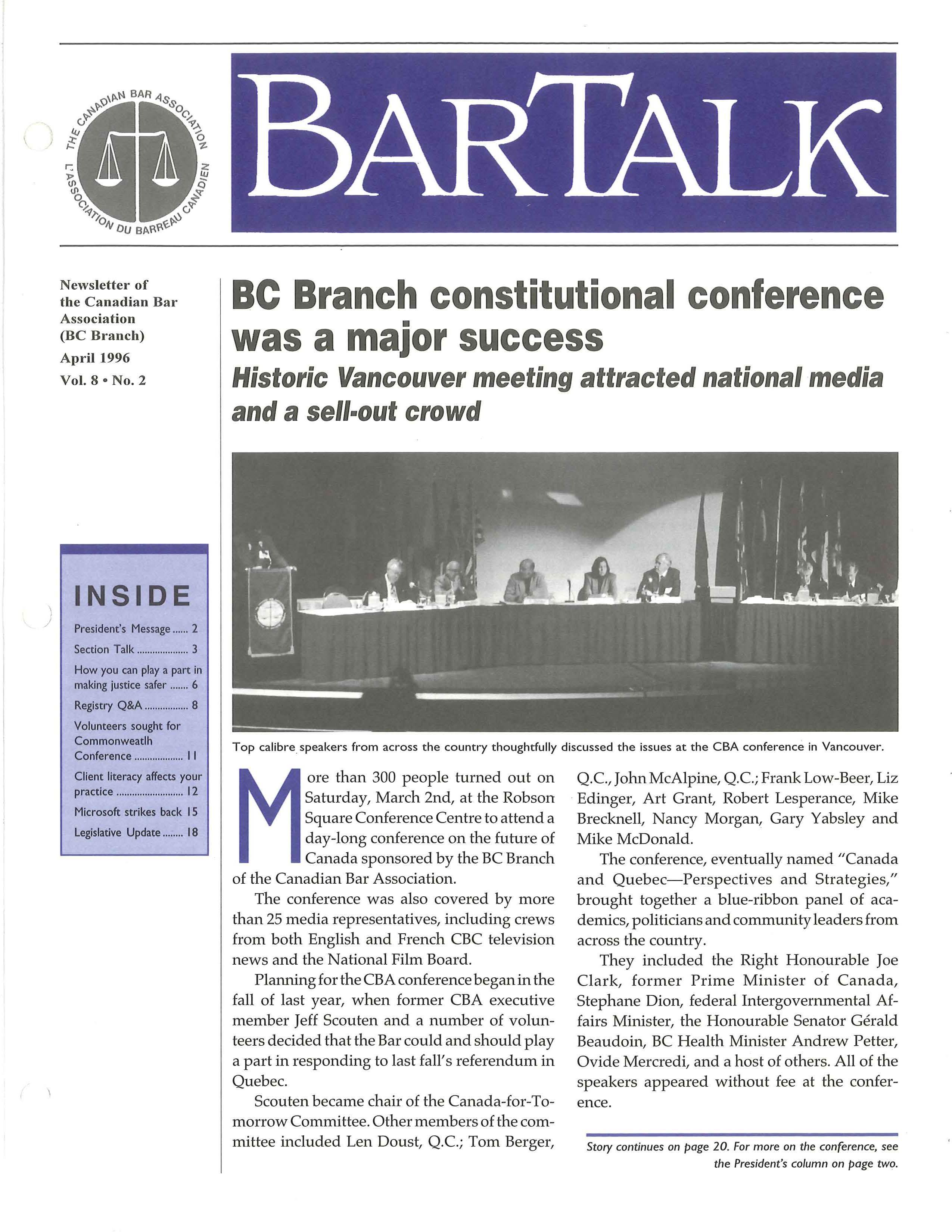
More than 300 people turned out on Saturday, March 2nd, at the Robson Square Conference Centre to attend a day-long conference on the future of Canada sponsored by the BC Branch of the Canadian Bar Association.
The conference was also covered by more than 25 media representatives, including crews from both English and French CBC television news and the National Film Board.
Planning for the CBA conference began in the fall of last year, when former CBA executive member Jeff Scouten and a number of volunteers decided that the Bar could and should play a part in responding to last fall's referendum in Quebec.
Scouten became chair of the Canada-for-Tomorrow Committee. Other members of the committee included Len Doust, Q.C.; Tom Berger,
Q.C., John McAlpine, Q C.; Frank Low-Beer, Liz Edinger, Art Grant, Robert Lesperance, Mike Brecknell, Nancy Morgan, Gary Yabsley and Mike McDonald.
The conference, eventually named "Canada and Quebec-Perspectives and Strategies," brought together a blue-ribbon panel of academics, politicians and community leaders from across the country.
They included the Right Honourable Joe Clark, former Prime Minister of Canada, Stephane Dion, federal Intergovernmental Affairs Minister, the Honourable Senator Gerald Beaudoin, BC Health Minister Andrew Petter, Ovide Mercredi, and a host of others. All of the speakers appeared without fee at the conference.
Top calibrespeakers from across the country thoughtfully discussed the issues at the CBA conference in Vancouver
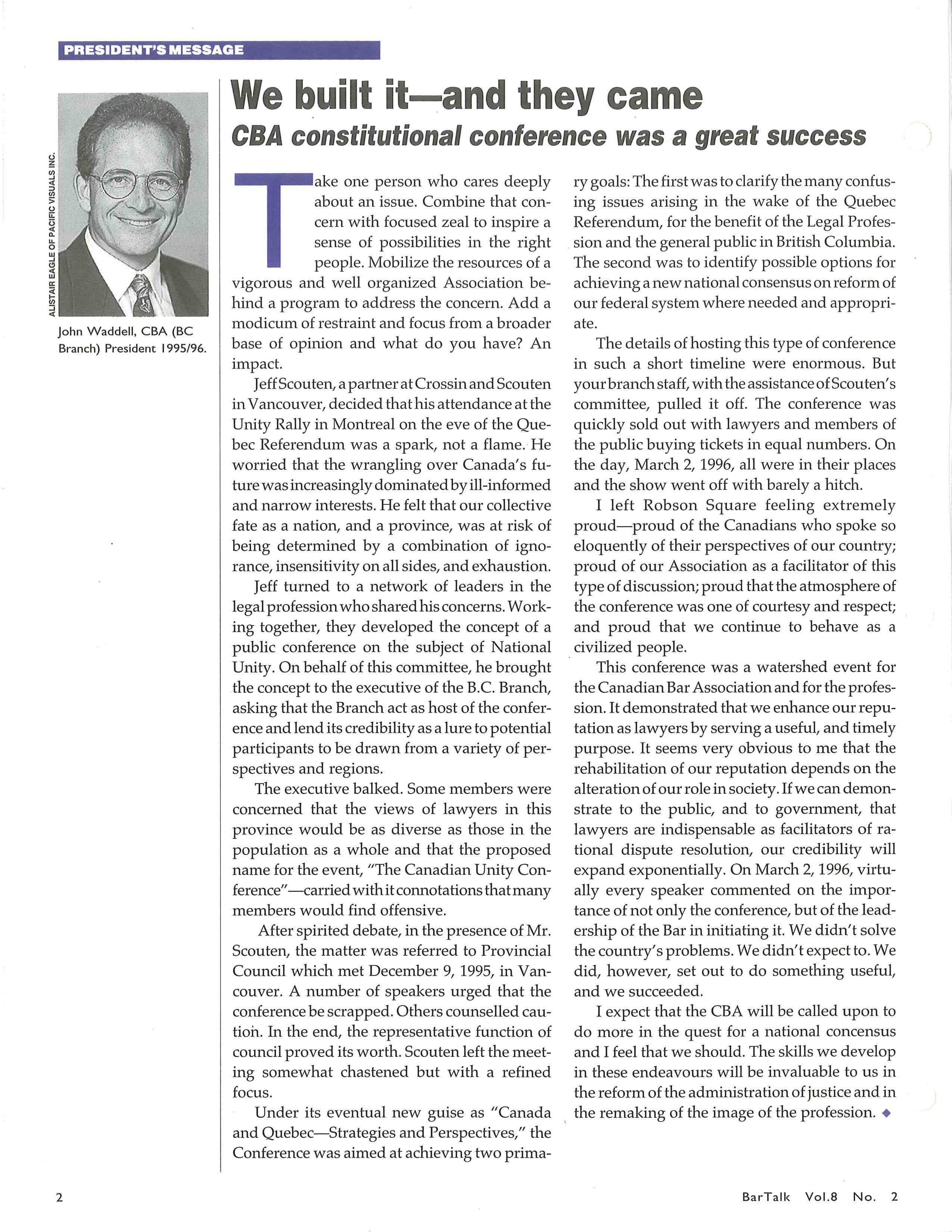
John Waddell, CBA (BC Branch) President 1995/96
We built it-and they came CBA const itut ional conference was a great success
Take one person who cares deeply about an issue. Combine that concern with focused zeal to inspire a sense of possibilities in the right people. Mobilize the resources of a vigorous and well organized Association behind a program to address the concern. Add a modicum of restraint and focus from a broader base of opinion and what do you have? An impact.
Jeff Scouten, a partner at Crossin and Scouten in Vancouver, decided that his attendance at the Unity Rally in Montreal on the eve of the Quebec Referendum was a spark, not a flame. He worried that the wrangling over Canada's future was increasingly dominated by ill-informed and narrow interests. He felt that our collective fate as a nation, and a province, was at risk of being determined by a combination of ignorance, insensitivity on all sides, and exhaustion Jeff turned to a network of leaders in the legal profession who shared his concerns. Working together, they developed the concept of a public conference on the subject of National Unity On behalf of this committee, he brought the concept to the executive of the B.C. Branch, asking that the Branch act as host of the conference and lend its credibility as a lure to potential participants to be drawn from a variety of perspectives and regions.
The executive balked. Some members were concerned that the views of lawyers in this province would be as diverse as those in the population as a whole and that the proposed name for the event, "The Canadian Unity Conference" -carried with it connotations that many members would find offensive.
After spirited debate, in the presence of Mr. Scouten, the matter was referred to Provincial Council which met December 9, 1995, in Vancouver. A number of speakers urged that the conference be scrapped. Others counselled caution In the end, the representative function of council proved its worth . Scouten left the meeting somewhat chastened but with a refined focus.
Under its eventual new guise as "Canada and Quebec-Strategies and Perspectives," the Conference was aimed at achieving two prima-
ry goals : The first was to clarify the many confusing issues arising in the wake of the Quebec Referendum, for the benefit of the Legal Profession and the general public in British Columbia. The second was to identify possible options for achieving a new national consensus on reform of our federal system where needed and appropriate
The details of hosting this type of conference in such a short timeline were enormous. But your branch staff, with the assistance of Scouten's committee, pulled it off. The conference was quickly sold out with lawyers and members of the public buying tickets in equal numbers. On the day, March 2, 1996, all were in their places and the show went off with barely a hitch.
I left Robson Square feeling extremely proud-proud of the Canadians who spoke so eloquently of their perspectives of our country; proud of our Association as a facilitator of this type of discussion; proud that the atmosphere of the conference was one of courtesy and respect; and proud that we continue to behave as a civilized people.
. This conference was a watershed event for the Canadian Bar Association and for the profession. It demonstrated that we enhance our reputation as lawyers by serving a useful, and timely purpose. It seems very obvious to me that the rehabilitation of our reputation depends on the alteration of our role in society. If we can demonstrate to the public, and to government, that lawyers are indispensable as facilitators of rational dispute resolution, our credibility will expand exponentially. On March 2, 1996, virtually every speaker commented on the importance of not only the conference, but of the leadership of the Bar in initiating it. We didn't solve the country's problems We didn't expect to. We did, however, set out to do something useful, and we succeeded.
I expect that the CBA will be called upon to do more in the quest for a national concensus and I feel that we should. The skills we develop in these endeavours will be invaluable to us in the reform of the administration of justice and in , the remaking of the image of the profession. +
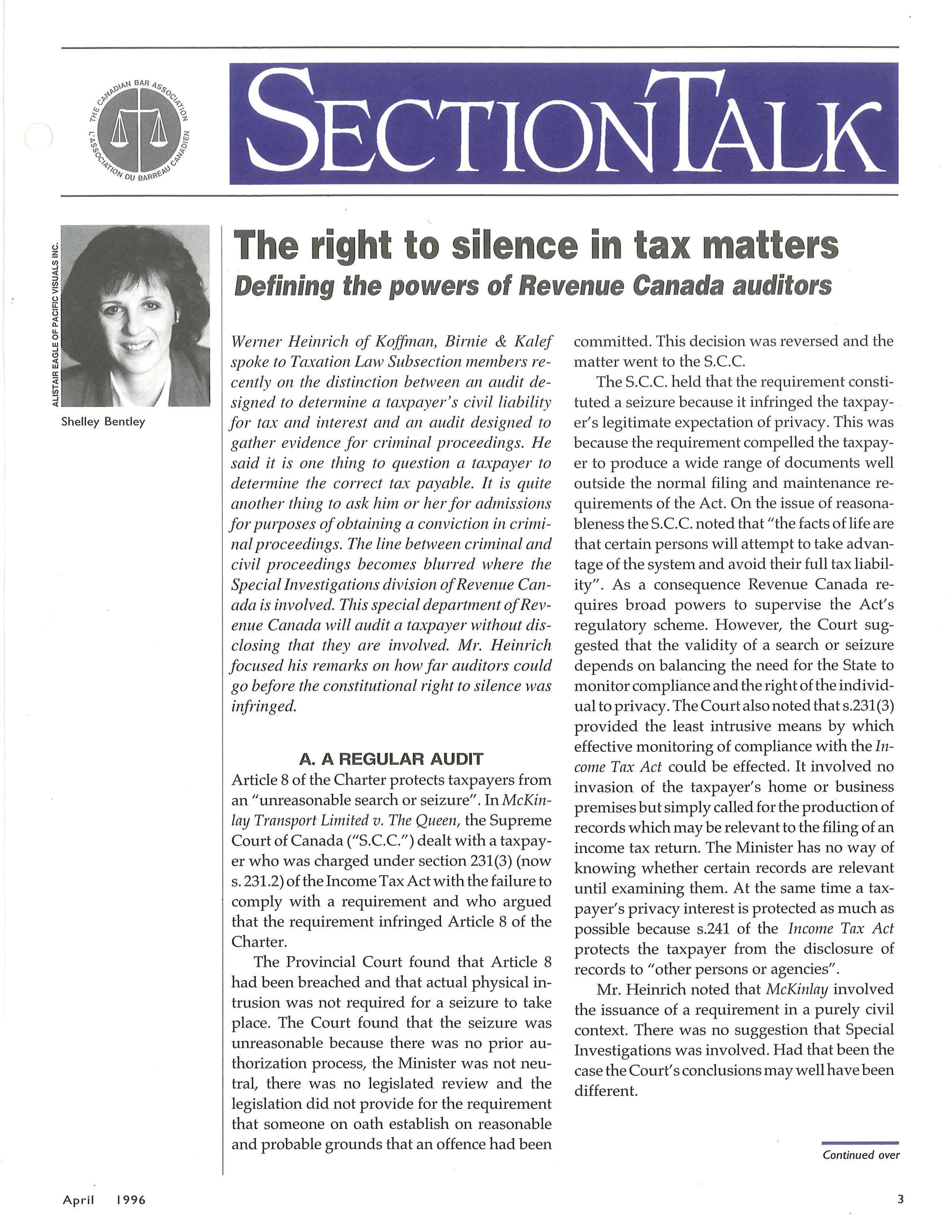
Shelley Bentley
The right to silence in tax matters Defining the powers of Revenue Canada auditors
Werner Heinrich of Koffman, Birnie & Kalef spoke to Taxation Law Subsection members recently on the distinction between an audit designed to determine a taxpayer's civil liability for tax and interest and an audit designed to gather evidence for criminal proceedings He said it is one thing to question a taxpayer to determine the correct ta x payable. It is quite another thing to ask him or her for admissions for pUiposes of obtaining a conviction in criminal proceedings. The line between criminal and civil proceedings becomes blurred where the Special Investigations division of Revenue Canada is involved. This special department of Revenue Canada will audit a taxpayer without disclosing that they are involved. Mr. Heinrich focused his remarks on how far auditors could go before the constitutional right to silence was infringed
A. A REGULAR AUDIT
Article 8 of the Charter protects taxpayers from an "umeasonable search or seizure". In McKinlay Transport Limited v. The Queen, the Supreme Court of Canada ("S.C.C.") dealt with a taxpayer who was charged under section 231(3) (now s. 231.2) of the Income Tax Act with the failure to comply with a requirement and who argued that the requirement infringed Article 8 of the Charter.
The Provincial Court found that Article 8 had been breached and that actual physical intrusion was not required for a seizure to take place. The Court found that the seizure was umeasonable because there was no prior authorization process, the Minister was not neutrat there was no legislated review and the legislation did not provide for the requirement that someone on oath establish on reasonable and probable grounds that an offence had been
committed . This decision was reversed and the matter went to the S.C. C.
The S .C. C. held that the requirement constituted a seizure because it infringed the taxpayer's legitimate expectation of privacy. This was because the requirement compelled the taxpayer to produce a wide range of documents well outside the normal filing and maintenance requirements of the Act. On the issue of reasonableness the S.C.C. noted that "the facts of life are that certain persons will attempt to take advantage of the system and avoid their full tax liability". As a consequence Revenue Canada requires broad powers to supervise the Act's regulatory scheme. However, the Court suggested that the validity of a search or seizure depends on balancing the need for the State to monitor compliance and the right ofthe individual to privacy . The Court also noted that s .231 (3) provided the least intrusive means by which effective monitoring of compliance with the Income Tax Act could be effected. It involved no invasion of the taxpayer's home or business premises but simply called for the production of records which may be relevant to the filing of an income tax return. The Minister has no way of knowing whether certain records are relevant until examining them. At the same time a taxpayer's privacy interest is protected as much as possible because s.241 of the Income Tax Act protects the taxpayer from the disclosure of records to "other persons or agencies".
Mr. Heimich noted that McKinlay involved the issuance of a requirement in a purely civil context. There was no suggestion that Special Investigations was involved. Had that been the case the Court's conclusions may well have been different.
Improve your trial advocacy skills
A video on cross-examination is available for loan or purchase from the BC Branch of the Canadian Bar Association
The videotape will show you two cross-examinations of the same witness by two different counsel using different approaches and styles. Prior to each examination, the counse l will tell you their approach to the cross-examination and, following, will discuss various aspects of the encounter. The videotape is structured so as to be used in different contexts: selfstudy at home, advocacy workshops, or seminars/lectures on cross-examination. You can show all the tape or only self-contained portions For more information , contact the BC Branch of the CBA at 687-3404.
The powers of Revenue Canada
Continued from poge 3
B . CO N ST ITUT IONAL CHALLE N GE
A r ticle 7: The ri ght to life, liberty and security of the person
Article 7 of the Charter provides that" everyone has the right to life, liberty, and security of the person" and "not to be deprived thereof except in accordance with the principles of fundamental justice" The "right to silence" is a fundamental tenet of our legal system. A person has the right to remain silent either as the accused at trial, or at the "investigation stage" (R. V. Symmonds).
1. Is suing a requirement after a taxpayer is charged with a criminal offence
In Alan Tylerv. M.N.R. the taxpayer was charged with importing and trafficking in narcotics. Revenue Canada became aware of the charges through the press and began investigating. A requirement was issued demanding, among other things, a signed asset and liability statement and a personal living expense statement which had to be "certified as being correct." The taxpayer sought an order of prohibition preventing Revenue Canada from using the statement in any criminal proceedings . and demanding the return of the information in its possession. The Federal Court of Appeal found that the communication to the RCMP of the information requested by Revenue Canada had the effect of "conscripting the appellant against himself" and that it deprived him, as an accused person, of his right to silence. The Court also noted that the signed statement had a direct bearing on the charge.
2. The investigation: requirements issued by Special Investigations
Special Investigations assumes conduct of files by three routes. First, it receives internal referrals from auditors who believe that there has been an evasion; second, it acts on information supplied by the public; third, it obtains referrals from police agencies. Special Investigations first determines if there is substance to the allegations and, if so, gathers evidence to support a prosecution.
If the right to silence applies to persons under investigation for an offence, the question becomes when does the investigation begin and when does the audit end? This dividing line is
essentially a question of fact and a matter of considerable judicial debate.
In the Morena case Special Investigations issued a requirement to a taxpayer suspected of illegally selling wine. The Federal Court acknowledged that the right to remain silent applied at the investigatory stage but then concluded that the right to silence presupposed the existence of a criminal process either at an "earlier or later stage" . The Court mentioned that the taxpayer had never been "accused of, arrested for, or simply detained in relation to any criminal offence". The Special Investigations auditor testified that the file was transferred to Special Investigations for simple audit purposes as they had no evidence that a crime had been committed. The Court accepted the auditor's testimony and concluded that the requirement had not been issued in a "criminal context" Mr. Heinrich remarked that one wonders why the file was transferred to Special Investigations if all that was being performed was a simple audit. One suspects that the audit had concluded that there was a reporting problem and the matter was referred to Special Investigations to investigate the possibility of a crime
The Ontario Provincial Court adopted a similar line of reasoning in R. v. M. E. Coghlan. The taxpayer was an accountant whose client's affairs were under audit. An auditor determined that there were "problems" with certain unreported shareholder benefits and referred the file to Special Investigations. A second auditor suspected tax evasion on the part of another group of the taxpayer's clients and also referred the matter. Special Investigations instructed the second auditor to obtain a whole series of documents because the investigator could not "resolve the problems which were revealed". After reviewing the documents, Special Investigations concluded it had reasonable and probable grounds for tax evasion and obtained a search warrant.
At trial the taxpayer argued that the warrantless search engaged in by the auditor under the requirement was unreasonable because it occurred at a time when a criminal offence was suspected and a criminal investigation had begun. The Crown argued that the audit was a normal "bona fide" audit, not a subterfuge to obtain evidence at a time when it had reasonable and probable grounds for believing an offence had been committed. The Court adopted the position that as. 231.1(1) search becomes unrea-
SECTION TALK
sonable once Revenue Canada decides to lay charges or suspects, on reasonable and probable grounds, that an offence was committed The Court adopted Special Investigations' position as to when this occurs; that an auditor can be sent in when tax evasion is suspected, but a search warrant must be applied for once they are convinced an offence has been committed.
A different result was reached inR. v. Caswell where the RCMP had advised Special Investigations of their belief that the taxpayers had accumulated "illicit wealth" through cocaine dealings
In R. v. Harris the B.C.S.C. acquitted the taxpayer of Narcotic Control Act charges because of an illegal search and seizure. Mr. Justice Oliver concluded that Revenue Canada cannot be said to act in a solely regulatory or administrative fashion when it acts "with the assistance and support of the Department of the Solicitor General, represented by the RCMP" . This is especially the case where Special Investigations operates two distinct groups, namely the General Enforcement Branch, concentrating on legitimately earned but undeclared income, and the Special Enforcement Branch, conducting investigations into undeclared income derived from illegal activities. ·
Where the latter group is involved a criminal context is readily apparent. The Court adopted the "predominant purpose test" to determine whether the evidence sought is compellable. The evidence is not compellable if" the predominant purpose for seeking the evidence is to obtain incriminating evidence against the person compelled to testify rather than some legitimate public purpose.
A key criterion in determining the predominant purpose is the relative importance of the evidence in subsequent proceedings. Where the evidence sought is of "slight importance" in the current proceedings but of great importance·in subsequent proceedings, the inference may be drawn that the real purpose for obtaining the evidence is its use in the subsequent proceedings.
In R. v. Norway Insulation Inc Mr Justice La Forme expressly disagreed with the comments in theCoghlancase that an audit was administrative as long as only a "suspicion" existed In that Court's view such an interpretation could lead Revenue Canada to view the authority of s. 231.1(1) of the Income Tax Act as never requiring a warrant under any circumstance because all
evidence could be obtained by relying on their subjective view of what constitutes mere "suspicion". The issue of the "reasonableness" of the search or seizure as required by the Charter would be a moot point.
Mr. Heinrich concluded that the breadth of a taxpayer's right to silence is a matter still open to debate. It seems clear that the involvement of Special Investigations brings the borderline perilously close to being in the criminal contex t. As such, the taxpayer should ass ert his or her right to silence where there is cause to do so
DO'S AND DON'TS IN OBTAINING AN EXPERT REPORT
Glen Urquhart, Q. C. a partner of Singleton Urquhart Scott gave advice to Construction Law Subsection members on retaining an expert and the preparation of an ex pert report.
Retaining an Expert
a) Statement of Assumed Facts
Counsel should prepare in a binder and deliver to the expert a Statement of Assumed Facts together with any relevant documents. An expert should not be allowed to draw inferences of fact from documents It is not properly part of the expert's role. The inferences drawn should be framed as assumptions that counsel has instructed him or her to make. It is inappropriate to provide the expert with access to discovery transcripts, witness statements, etc. Rather it is for counsel to delineate and articulate the facts which will be established at trial.
The Statement of Assumed Facts should be factual and in no way argumentative All facts which may bear on the expert's opinion, both for and against the client's position, must be set out as assumptions. It may be necessary to set out alternate sets of facts to guard against the possibility that the court's findings may not conform to a chosen set of facts. The expert should request any additional necessary facts. It is not necessary to cite the source of the assumed facts.
b) Questions for the expert
It is a good idea for counsel to draft and submit to the expert the written questions to which the expert is to respond. These questions can be fine-
Award nominations sought
Nominations are now being accepted for the Walter S Tarnopolsky Human Rights Award by the Canadian Section of the International Commission of Jurists.
This award annually recognizes outstanding achievement by a Canadian citizen in domestic or international human rights law. The award takes the form of a medallion and an honorarium of $1 ,000 and is presented at the Canadian Bar Association Annual Meeting.
All nominations must be submitted in writing to the Selection Committee on or before April 30th. Candidates must be Canadian citizens There are no posthumous awards.
Nominations must be submitted by individuals and include both nominee's and nominator 's name (including titles), address, telephone and fax numbers and the nominee 's Curriculum Vitae. The letter of nomination should outline the candidate's achievements.
The Selection Committee is comprised of representatives of the CBA, the Canadian Judges Conference (CJC), the Canadian Association of Law Teachers (CALT) and the ICJ. Nominations should be sent to:
La Prix Walter S. Tarnopolsky Award
902,50, rue O'Connor St. Ottawa, (ON) KIP 6L2
Tel: (613) 237-2925
Fax: (613) 237-0185
E-Mail: info@cba.org
Call for Nominations
1996-1997
The CBA is seeking candidates for its National Standing Committees for 19961997. All CBA members are eligible to apply for these positions.
For information and an application form, please contact the BC Branch or the National Office at 1-800- 2678860.
Deadline for applications: April I5, 1996
Free employment service
The BC Branch office maintains an emp loyment registry file Law firms looking for staff can register their requirements and lawyers looking for work may also register-at no charge.
Potentia l employers or those seeking employment can peruse the file at the BC Branch office. Other categories maintained include students seeking articles, support staff availab le and lawyers available for part-time work.
Call Fiona Watson at the BC Branch office (687-3404) to register your resume at no charge in the Employment Registry Law firms seek ing employees can also call Fiona to post a job placing or to review resumes on file.
Continued from Page Five
tuned in consultation with the expert. The final draft will be quoted in the expert's report.
c) Opinion
The third part of the report will be the opinion. Counsel must be careful not to interfere with the substance of the expert's report-not to influence the expert's objectivity. For expert testimony to be admissible it must be necessary to assist the trier of fact to form a judgment. The expert cannot usurp the role of the court by expressing an opinion on the very issue to be decided. The expert must not evaluate conflicting evidence, make findings of fact, allocate fault or responsibility, interpret contracts or other legal documents, advance arguments, either factual or legal, or state legal conclusions
Once a party calls an expert witness to testify all privilege which may earlier have attached to
this witnesses' documents prepared for the litigation is lost. In light of the court's view, one position is that all draft reports, documents, papers or notes and any changes to the expert's opinion must be preserved. The other position is that counsel should advise experts to discard their drafts as soon as they have been revised It is probably best to ask the expert to follow what has been his or her standard practice.
d) Qualifications
Instead of simply attaching a copy of the expert's resume, in addition, counsel should ask the expert to prepare a summary of experience and qualifications relevant to the area in question.
Mr. Urquhart recommended that all of the above do's and don'ts be set out in the form of instructions to the expert. +
Canadian Bar Association
FOUR SURVEYS IN ONE
• Lawyer and partner compensation
• Law firm practices
• Corporate counsel compensation
• Benefits, incentives, bonuses
Publishing date: June 15, 1996
./Final results presented by:
./Geographic region
./Firm size (No. of lawyers)
./Corporate sales
Only survey participants receive final report
OVER 80 POSITIONS SURVEYED
• Partners
• Associates (by year)
• Para Legals (by speciality)
• Patentffrademark
Title Agents/Searchers
• Legal Secretaries
• Administrative Staffs
• Corporate Counsel
Senior V.P.
Asst. V.P./General Counsel
Legal Counsel (41evels)
FOR FURTHER INFORMATION OR TO PARTICIPATE CONTACT:
Canadian Bar Association
Member Services
902-50 O'Connor St.
1-800-267-8860
·Personnel Systems
512-1 Nicholas St. Ottawa K1N 7B7
1-800-263-0491
Court security and you
How you can play a part in mak ing justice safer
On September Blast year, lawyer Graeme Keirstead was attacked in the New Westminster Law Courts building. The attack, by the 70-year - old husband of a client represented by Keirstead, left the young lawyer seriously injured. The attack caused serious concern about courtroom security among many counsel in British Cohunbia. Because of this, the Joint Court Sen1ices Committee asked the Court Services Branch of the Ministry of the Attorney General to advise how counsel can help to ensure that security is maintained and enhanced in courtrooms throughout the province The following article, by Policy & ProgramAnalyst Peter Robinson, was 'Written in response to that request.
Few serious security breaches have occurred in British Columbia courtrooms due, in part, to the professionalism of deputy sheriffs. The Office of the Sheriff assumed the court security role from the police with the creation of Court Services Branch in 1974. For over 20 years, deputy sheriffs have provided court security on a daily basis in courtrooms throughout the province.
In order for deputy sheriffs to fully carry out their court security responsibilities, they require the assistance of all court participants. Members of the Bar can assist deputy sheriffs in many ways to ensure better security For example, one means of assisting is to willingly submit to searches during high-security trials. Court Services' policy specifies that when it is necessary to search persons and their belongings prior to entering the courtroom, all persons will be required to be searched Exceptions may be made for crown and defense counsel, members of the jury and other Branch staff assigned to the trial at the discretion of the sheriff. By following this policy, the potential for security breaches would be mitigated, thereby enhancing the safety of all court participants.
In general, members of the Bar should contact the Sheriff's Office regarding any potential security concerns they may observe during their attendance at the courthouse. This may include reporting people who are acting suspiciously in the courthouse or informing the Sheriff's Office of any potential security risks present in the courthouse.
Counsel can assist court security by informing the Sheriff's Office as soon as possible of any security concerns which may be unique to their upcoming trial. Information that would assist the sheriff in determining the appropriate staffing level of a trial or any other security precautions should be communicated to the Sheriff's Office. The Sheriff's Office will review this information and staff the courtroom as appropriate, given limited resources.
Many courtrooms in the province have been designed with security in mind. Secure entrances from the holding area are usually located close to the prisoner docket and the Bench. Emergency buttons, sometimes referred to as "panic" buttons, are located in many courtrooms, out of sight, under the court clerk's desk. During an emergency in the courtroom, the activation of the button will alert the Sheriff's Office of the need for the attendance of security personnel.
During a courthouse emergency, whether it be real or a drill, all persons must follow the directions of the deputy sheriff. The sheriff in the building is the servor authority during a critical event. Depending upon the type of emergency (fire, bomb threat, hostage-taking, earthquake, etc.), court participants may be informed to either evacuate the building or take shelter.
Cooperating with deputy sheriffs while they are discharging their court security responsibilities will help to provide a safer and more secure environment for all court participants. •
New CBA Section approved
At the February 1, 1996 meeting of the Provincial Council a new section was approved . It is the Young Offenders, Victoria. The chair of the section is Dianne G. McDonald.
The group met informally for about five years prior to its official designation as a section. Since September it has been meeting on a monthly basis.
Those interested in joining the new group can phone McDonald at 389-1099 or fax her at 3889060. •
Photocopy cards for sale
The Vancouver Courhouse Library has recently installed a vending machine to sell photocopy cards for cash. Users can buy new cards for any amount they choose, or "top up" the photocopy cards they have purchased previously. The vending machine takes bills in denominations of two, five, ten and 20 dollars. It is available 24 hours a day , although purchasing cards on account still has to be done while the library is staffed. If you have any questions , please contact the reference staff at 6602841 or the photocopy/circulation staff at 660-2838.
By joanne Power Manager Registrar Program
If you have any interesting or unusual questions or comments about this column , please write directly to:
JOANNE
POWER
Manager, Registrar Programs
Law Courts
850 Burdett Ave. Victoria, B.C V6W IBS
s 49(3)
QIs there a local venue rule in cases of bankruptcy?
AYes. Under s.49(3) of the Bankruptcy and Insolvency Act, the assignment into bankruptcy is made "to the official receiver in the locality of the debtor". "Locality of a debtor" is defined by s.2 to mean the principal place
a) where the debtor has carried on business during the year immediately preceding his bankruptcy;
b) where the debtor has resided during the year immediately preceding his bankruptcy, or
c) in cases not coming within (a) or (b) where the greater portion of the debtor's property of the debtor is situated.
This point was canvassed briefly by the Honourable Mr. Justice Tysoe in oral reasons for judgment in the Bankruptcy of South Thompson Guest Ranch Ltd. (unreported, Vancouver Registry 159235 VA95).
A court has power under s.187(7) to transfer any proceedings under the Act to another bankruptcy district or division on satisfactory proof that the affairs of the bankrupt can be more economically administered within another bankruptcy district or division.
COURT ORDER ENFORCEMENT ACT
s.4(7)
QHow long is a garnishing order issued against wages pursuant to the Court Order Enforcement Act in effect? A fre-
quent problem arises when companies continue to send in payments on one garnishing order.
AThe garnishing order is in effect for "wages that would in the ordinary course of employment becoming owing, payable or due within 7 days after the date on which an affidavit had been sworn "
Registry staff should simply accept payment without reference to the date of the affidavit or payment of wages. This is an example of where the registry is essentially a simple repository. It would be inappropriate for the registry to, in effect, take the
initiative in ruling on a procedural matter by questioning whether to accept a payment in.
COURT ORDER INTEREST ACT
Q
Could you please advise as to how the prejudgment and post judgment interest rates are ascertained?
ABoth rates are based on the prime lending rate of the banker to the government. Twice a year, on January 1 and July 1, the Registrar is advised of the prime lending rate of CIBC, the banker to the government, by the Ministry of Finance and Corporate Relations. A schedule showing the various rates is then prepared and a copy distributed to each Supreme Court Registry.
COURT ORDER INTEREST ACT
s.1 & 7
QCan post judgment interest be calculated on a claim which includes prejudgment interest?
A Yes. Post judgment interest is calculated on the total amount awarded at the time of judgment, which likely includes both interest and costs.
EMPLOYMENT STANDARDS ACT
s 91
QWhat is a "Determination" filed by the Ministry of Skills, Training & Labour?
AThis replaces a certificate pursuant to s. 14 of the Employment Standards Act. A new Act was proclaimed November 1, 1995, which now allows for a "Determination" pursuant to s.91 of the Employment Standards Act. These are enforceable in the same manner as a judgment of the Supreme Court. You may still see the odd certificate because there is a transition section from the old Act to the new Act.
FAMILY RELATIONS ACT
s.36.1
Q
What is the effect of restraining orders registered with the Protection Order Registry which are later superseded by a final order of divorce?
AWe asked Mr. Justice Warren, the Chairman of the Family Law Committee, whether the initial restraining order will be considered · interim in light of the final divorce order . It was the opinion of Warren, J. That therestraining order is not rescinded by implication; unless, of course, it is rescinded specifically in the final order of divorce.
LEGAL PROFESSION ACT
s.71.1
Rule 57 (32.1)
QMust a Registrar sign a certificate under the Legal Profession Act for a bill that has been consented to by both parties?
AWhere no proceedings have been commenced, i.e.: by an appointment pursuant to the Legal Profession Act a Registrar has no authority to sign a certificate. If a file is opened by an appointment and the matter then settles by consent, however, a Registrar must issue the certificate This situation should be distinguished from the one where an appointment is taken out for a review and the client fails to appear. The solicitor must then satisfy the Registrar concerning the factors in s. 71 (1) before the Registrar will sign the certificate.
LEGAL PROFESSION ACT
s.71(3) & (4)
QIn what jurisdiction should a review of a lawyer's bill take place?
ASection 71 of the Legal Profession Act states:
"(3) Where the member's bill relates to a court proceeding, the appointment to review it shall, unless the parties otherwise agree, be taken out before the registrar in the registry where the proceeding was commenced or to which it was transferred.
(4) In a case other than that referred to in subsection (3), the appointment shall, unless the parties otherwise agree, be taken out before the registrar located nearest to the place of business of the member whose bill is being reviewed."
LEGAL PROFESSION ACT
s.71(5) (c)
QCan a paid periodic lawyer's bill be reviewed?
AThis question was answered in the negative by the Honourable Mr. Justice Hood in Morin, Grant v. Olsson, 37 C.P.C. (3d) 130; thereby distinguishing two earlier Court of Appeal decisions : Arctic Installations (Victoria) Ltd. v. Campney & Murphy, 22 C.P.c. (3d) 221 and Ladner Downs v. Crowley, 25 C.P.C. (2d) 189.
Hood, J. found a difference between an interim account and a periodic account:
"In my opinion, notwithstanding the title to each account, they are not interim accounts. They are not tentative or provisional, or payments on account. They are final accounts in that they relate to all professional services rendered within the time stipulated. They are not accounts which can be opened up, or re-billed or changed. They are periodic final accounts, and in my opinion each is a "bill" within the meaning of the word as used in the subject provisions.
"In reaching this conclusion I have considered not only the contents of the accounts, which on their face are conclusive for the services rendered during the stated period , but, as well, the dealings between the parties and the circumstances. I am satisfied that both parties intended each account to be the law firm's final account for the work it represented. That is what the parties agreed to, and that is the course of conduct which they followed. And in my view neither party should be entitled to invoke the entire contract principle followed in Crowley. I also rely on the decision in Robertson." 1
Having so concluded, he found a client who had paid a periodic bill lost the right to have it reviewed upon the expiration of three months (s. 71(5) (c)) notwithstanding that the retainer between the solicitor and the client was still ongoing.
1 Robertson, Ward Suderman & Bowes v. British Columbia Transit (1987), 25 C.P C. (2d) 276
Completing the Circle
The Canadian Bar Association ' s National Continuing Legal Education Committee and the National Aboriginal Law Section are offering a 11/ 2 day programme , " Contemporary Aboriginal Justice Models: Completing the Circle," April 26-27, 1996, in Kahnawake Mohawk Terr itory near Montreal , Quebec
The programme will consider various options for alternative justice systems, including domestic and international models. Presenters will include people who have designed and implemented these programmes
It will be of interest to al l legal practitioners who seek a better understanding of their aboriginal client.
Stop the Presses
Actually , help make sure that they're NOT stopped. The B C. Newspaper Foundation asks your support for their goal of excellence in journalism by attending the 8th annual, B C. Newspapers Awards Gala , May I I , 1996 The prestigious Awards Gala will be held at the Wall Centre Garden Hotel. Master of Ceremonies will be the renowned Bill Richardson Guest speaker will be veteran journalist and author Walter Stewart. His latest book is " Belly-up-The Spoils of Bankruptcy. " Stewart's subject at the event will be "The Myths of Journalism " For tickets or more information, contact the Foundation ' s Development Director, Scott McBride by phoning or faxing (604) 873-1949.
Continued from page 9
Rule 11(12)
QIs itnecessaryforadeputysherifftoswear an affidavit of service on a subpoena to debtor or would a certificate suffice?
ANo. See Rule 11(12): "Service or delivery by a sheriff may be proved by a certificate in Form 5 endorsed on a copy of the document served or delivered."
Rule 17(3)
QIn what circumstances, if any, is a lawyer's claim for legal services a debt or a liquidated demand such that, upon default of
appearance, final judgment may be taken for the amount of the claim?
AThis issue was canvassed by the Honourable Mr Justice Shaw in Eades v. Kootnikoff (unreported, Vancouver Registry C952713, August 1995).
The case concerned an appeal from a decision of a Deputy District Registrar rejecting a lawyer's application for final judgment in default of appearance. Shaw, J. found there may be some circumstances in which an agreement between a lawyer and a client will give rise to an account which may be considered, to use the words of Rule 17(3), "solely for recovery of a debt or liquidated demand", but rejected the appeal holding that the Deputy District Registrar was correct in refusing the application for default judgment. In paragraphs 21 and 22, Shaw, J. said:
"Typically, when lawyers are retained by clients and there is no agreement which specifies the fees and no scale of fees is provided by law, the law will imply a term that reasonable fees will be paid. What is reasonable is a matter of judgment and will depend on the particular circumstances: Yule v. City of Saskatoon (No.4) (1955), 16
W.W.R. 305 (Sask., Q.B.), affirmed (1955), 17
W.W.R. 296 (Sask., C.A.). Because the "reasonable fee" retainer is so common, I do not think that a reasonable inference can be drawn from the allegations that legal services were provided and accounts rendered
[that the] retainer agreement provided for a set fee or a precise method of calculation If a plaintiff wishes to enter final judgment for the amount of fees, the basis of the fees · should be clearly stated so the Registrar will have no difficulty in determining whether the claim is or is not for a debt or liquidated demand.
.In my opinion, there must be formula or basis, agreed or implied, upon which the quantum merit is capable of precise calculation. If not, then the claim must be considered as being for unliquidated damages."
Rule 41(18)
QCan a Registrar include an entitlement to costs at the appointment for settling an
A order? ·
Yes, Chernoff v. Insurance Corporation of B.C. (1992) 12 C.P.C. (3d) 220 When settling an order, a registrar can include for the benefit of a successful party a term entitling that party to costs except where the judge or master who pronounced the order has determined that costs should not follow the event.
Rule 51(9)
QCan correction tape be used on an affidavit filed for use in the Supreme Court?
AWhile Registry staff should never refuse to file such an affidavit, they should, however, initial the taped parts of the affidavit if the document is sworn in the course of their duties.
Rule 60(22) & Rule 64( I)
QAre the Reasons for Judgment issued in a Divorce Act proceeding or a Family Relations Act proceeding available to the public?
A Yes A practice direction issued by the Chief Justice on November 17, 1989, states "Reasons for Judgment should not be considered part of the court file, even though a copy may be kept there. Reasons for Judgment are in a different category from the court file and should be available to the public either
through the press file or b y an application to search a file upon the prop er fee being paid."
APPENDIXC
Schedule 1
Item 12
QWhat fee applies for filing a notice of appeal from the master or registrar?
AThi s falls under Item 12 Schedule 1 of Appendix C: "For filing an interlocutory application, whether by motion or praecipe, or any other application for which a fee is not payable under this schedule." •
Volunteers sought for Commonwealth Conference
Volunteers are still needed for thi s year's Canadian Bar Association Annual Meeting and the 11th Commonwealth Conference. People are needed to assist in the following ways:
• Registration desks
• Assisting guests to travel to various locations throughout the conference
• Providing help at the opening and closing gala events
• Assisting with sports and recreational registration
• Greeting guests at the airport
• Helping out with the children's program
If you'd like to volunteer for any one-or more-of these activities, or if you'd like to inquire about other activities in which you could be of service, contact Jim Vilvang at 661-9216 or fax 688-3830.
Volunteers who are also members of local sports organizations-such as golf and tennis clubs-are also sought to act as hosts for guests for the conference. If you'd like to sponsor a foursome or so at your club, please call BC Branch CBA Executive Director Robert Smethurst, Q.C. at 687-3404
Also required are more people to volunteer for the conference's "At Home" dinner program To extend a warm invitation for dinner at your home for one or more guests from the conference, please contact Moyra Dhaliwal, Chairperson, At Home Dinner Committee, c/o Department of Justice, 900-840 Howe Street, Van. BC V6Z 2S9 or call (604) 666-8246 or fax 666-1462.
A little more commitment will be required from those willing to volunteer as "Liaison Officers" for the conference. This would involve greeting the International and Special guests at the airport, driving them to their hotels and, perhaps, acting as their "aide de camp" during their stay in Vancouver.
Volunteers for this position will be required to attend a training session (probably in July) to ensure that the guests are properly welcomed and that all relevant protocols met. Some of the dutie s of the Liaison Officers would include :
• Initial correspondence with the special guest
• Providing an information kit to the guest
• Greeting guests at the airport
• Transporting guests to their hotels
• Liaison with consulates
• Identifying and attending to protocol issues
• Ensuring that guests are comfortable
• Addressing the individual needs of special guests
• Providing information
• Being a contact person for guests in case an emergency arises
• Providing a guest with a phone number where a liaison officer can be reached at any time
If you'd like to volunteer to act as a Liaison Officer, please call either William Skelly, Carman Overholt or Anjili I. Bahadoorsingh. All can be reached at 683-6991.
Finally, Vancouver law firms are still being sought to act as hosts during the conference. A highlight of the conference will be the traditional Monday evening law firm receptions to be held Monday, August 26, 1996. This is a wonderful opportunity for law firms to show their West Coast hospitality to partners and colleagues from across Canada as well as to Commonwealth lawyers and judges from around the world.
Law firms planning to host a CLA I CBA event outside the office should make their arrangements as soon as possible since August is one of Vancouver's busiest tourist months.
To volunteer your firm as a host for the conference, contact Terry LaLiberte at 669-8808. •
Celebrity Wine Auction
If you ' d like to sample wine graced with a celebrity ' s name, you ' ll enjoy a Celebrity Wine Auction sponsored by the Playwrights Theatre Centre on April 27th at the Vancouver Art Gallery. Wine tasting begins at 8 p m and the auction of speciality wines signed by the stars begins at 9 p.m.
Some of the celebrities that have s igned labe ls include Luciano Pavorotti, David Duchovny and Gillian Anderson (of the X-Files ,) Leslie Nielsen , k.d lang, Norman jewison, Robert Bateman, Evelyn Hart, jason Priestley , Ned Beatty, Cloris Leachman and Placido Dom ingo Dress is black t ie optional. Hors d'oeuvres from the Lazy Gourmet w ill be served. Tickets are $25 each and are available from all TicketMaster outlets or by phone, 2803311.
Playwrights Theatre Centre (formerly the New Play Centre) is a Vancouver-based professiona l theatre company dedicated to the development , production and promot ion of new works by Canadian playwrights
Do we understand each other?
Clear communication forms the fundamental basis of good lega l practice. You and your c li ents should, so far as is possible, share a common understanding. However , there are many obstacles to commun ic ation . On this page, Cheryl Stephens exp lains how literacy difficulties can effect how your client interprets wr itt en material. You 'll be able to find more about these issues in the information kit, Lawyers for Literacy, wh ich is being distributed to a ll law firms in BC.
Achieving the goal of mutual understanding does not a lw ays involve problems interpreting written documents. On the next page , David Bilinsky discusses more general issues involved in communicating with your clients and the importance of making an extra effort to reach understanding.
Literacy and Legal Literacy Did you realize they can be practice issues?
By Cheryl Stephens Legal education and communications consultant
Remember how you struggled to learn thorny legal concepts at law school? Did you ever wade through a 100-page judgement se arching for a ratio? At a family gathering, has a relative ever hauled out a legal document for you to translate into plain English that they could understand and act on it?
If these examples sound familiar, you'll appreciate why so many people want-and needlegal information that is clear, concise, and comprehensible. This need is even more acute for people whose literacy skills are marginal.
B.C. statistics show that 12% of adults cannot read or struggle just to read simple text. And 31% of B C. adults cannot cope with unfamiliar or complex information, such as reading and acting on a l awyer's letter . That means that at least one in three of your clients probably finds your writing difficult and, because it is important to them, frustrating.
Who are these people? Many senior citizens had only elementary school educa tion and their reading skills may be low by today' s standard. Many middle-aged people went to high school but have let their reading skills deteriorate. Along with many younger people, they have fallen out of the habit of reading - they get all their news from television and radio, all their entertainment from TV, films, and concerts.
Another group of people suffered during their developmental years from poverty, abuse, neglect, disabilities orracial discrimination. These are major roadblocks to a child's education . These children can have trouble concentrating at schoo l and may never learn to read adequately . Immigrants may be literate in their first language but strugg le with English while others are not literate in their first language and learn Engli sh slow ly.
Broady defined, literacy is the 'ability to understand and use printed information commonly faced in daily activities, at home, at work, and in the community. When these skills are weak, written legal material can create a formidable obstacle to use of the justice system.
You may not realize when one of your clients
experiences difficulty with written material. He or she may be a highly productive and very successful member of society. But watch out! Appearances can be deceiving. And remember-your clients' literacy can affect the delivery of legal services and their understanding of the legal issues confronting them.
As a lawyer, you are not expected to teach your clients to read. But there are steps you can take to help your clients grasp the legal context of their problem, the legal process required to resolve the problem, and the complex legal language and specialised terminology. The se steps involve improving client communications generally, modifying the way you establish the client record , and modifying other office practices.
It is worth your effort to take client-literacy into account because poor communication between you and your client can interfere with your client's ability to give you proper instructions and with your ability to obtain the appropriate remedy for your client. The benefits to lawyers of making these changes include clearer communication, increased efficiency in practice procedures, improved legal outcomes for your clients, and increased client confidence and satisfaction with your service. Clearer communication can contribute to fewer complaints about your service.
An information kit from Lawyers for Literacy, a project of the Plain Language Section of the BC Branch of the CBA, is being distributed to all sole practitioners and the managing partners of every law firm in BC. The purpose of the project and the kit is to assist lawyers to improve communications with their clients and thereby help clients, particularly those with difficulty using print materials, to access the justice system.
This kit will help you and other lawyer s in your firm to, first, identify clients who may have marginal literacy skills. You will then learn steps you can take to help your clients, including how to find some of the resources that are available in the community for further assistance.
If you have any questions, please call me at 739-0443, or Penny Bain at 733-7852, or Paul Winn at 443-5727. +
David J. Bilinsky Past-Chair, BC Branch Law Practice Management Section
Strive to communicate clearly with your clients
Misunderstanding can be costly
Two ships passing in the night. He doesn't seem to know which end is up. She's not in the same quadrant of deep space. All of these metaphors describe the symptoms of a failure of understanding between two human beings. When these two human beings happen to be lawyer and client, the miscommunication can take on certain consequences. Depending on the timing and the situation, these consequences can range from inconsequential to dire, for both the lawyer and the client.
Experienced, trusting
client, including opposing counsel, experts and witnesses, thinking that this will eventually produce the result desired by the client.
Time for some perception check s. Today , clients need less le gal work and more legal understanding and compassion(" deskside manner") . There is a saying that if you are holding a hammer, all the problems in the world start to look like nails How many times, as lawyers, have we tried to fit round pegs into square legal holes?
making it work takes a bit of time
Words and music by Doug Bennett, recorded by Doug and the slugs
Making it work takes a little longer clients unfailingly understand that they must communicate all they know about their case and their intentions for that case to their lawyer . But most of us have clients that have never used a lawyer before, and it is just human
nature to intentiona lly or unintentionally fail to disclose a key stumbling block against their case. When you are listening to opposing counsel's opening statement and a key bit of fact hits you between the eyes, the best you can do is maintain your poker face and resolve to do it better next time. Here the responsibility for effective client communication must rest on the shoulders of the lawyer.
David } Blllnsky Is a partner at Lakes Stralth & Blllnsky, and Is past-chair of the Law Practice Management Section, BC Branch, and can be reached on the Internet at lntegral@dlrect.ca.
As case loads grow, and the time and financial pressures increase on lawyers, there is a tendency to shorten the time spent with clients. This can be a false economy. Furthermore, because lawyer s understand the law and the legal process, we can fall into the trap that we think we know more about a client's case than our client. We then perversely put the majority of our time into speaking with everyone but our
At the first interview, have we assured ourselves that we fully understand the needs and expectations of the client? Do the y want a Cadillac result, but on a Chevrolet budget (even Chevys are expensive these days!)? Perhaps all they need is some direction and information Wrongly assuming that our client desires a Writ to be issued and their day in Court may only produce a confused client, besought by uncertainty, apprehension and anxiety. Or on that first interview, there may be a still, small voice from deep within yourself that may say that this client could be trouble, not only with fees but also with accepting your instructions, with disastrous outcomes for your case . After all, while the client is free to selec t any lawyer they wish, it is also the prerogative of the lawyer to select his or her clients. How can you communicate joint needs and expectations with clients for the betterment of your practice and the management of your files? Here is a selection of suggestions:
• There are at least three identifiable stages in dealing with a new client which require special attention. These are: the first interview, just before the biggest step in the case (the signing of the contract, or going to trial or hearing), and lastly, when sending the final bill. Each of these deserve special consideration
Communicating clearly with cl ients
Continued from page I 5
• What are your posture, mannerisms, and approach communicating to the client? Are you allowing interruptions such as telephone calls to interfere with the client's narrative? Are you tapping a pen or playing with a paper clip? Do you sit square and straight in your chair,leaning slightly forward, maintaining eye contact with your client? Are you making suitable "uh huh" sounds every so often? Your body language can subtly say that either you are interested, or that you wish the interview to be over.
• At the first interview, develop and use a common format and information checklist. Go over areas such as: "why are you here?" and "what do you want to achieve by this?" After all, they may be seeking simply to know that they are "in the right", for the satisfaction of their own conscience. By raising the issue of the client's expectations and what they will cost at the forefront, you will do both your client and you a service and may save yourself a lot of grief downstream.
• Do not be hesitant to raise your concerns about the case with the client at the start of and during the case. Your client is looking to you for professional help and guidance. By downplaying potentially adverse findings of facts and law, you may be setting yourself up for an irate client, an unpaid fee and perhaps an investigation by the Law Society and a report to your insurer.
• Assume the worst about what your client is telling you . I attended a seminar a little while ago and the speaker asked the audience to raise their hands if they never had a client lie to them . Needless to say, no one's hand went up. Better you uncover the unpleasantness now rather than later. (What do you say, clients don't lie? Of course not! They just don't have a proper appreciation of the truth!)
• At the first interview, discuss fees, disbursements and taxes, and how and when they will be paid. Counsel the client to make an informed decision as to whether or not they can afford the remedies they are seeking. Discuss what will happen if they lose, not only in terms of your bill but the costs of opposing counsel as well. Discuss the options open to them, legal and non-legal. You may gain a client's respect by indicating to them that their problem may
not be economically worthwhile to pursue, or be better solved in a non-legal way. If they still wish to proceed against your advice, tell them to seek another lawyer.
• Take the last 1 I 2 hour of the first interview, and ask the client "What is the one thing that you do not want to see exposed during these proceedings?" By raising the issue early on, and confronting it, you will be accomplishing at least two things: One, if the case proceeds, you will be better prepared to deal with it, and two, your client will realize that this issue or fact probably will come out in the proceedings, and they must be prepared to handle this. You may gain a measure of respect by being forthright, upfront and willing to deal with difficult issues.
• During the progress of the case, send your client copies of every piece of paper that comes across your desk, favourable or not, with your update on the file. Better to confront the dual demons of uncertainty and unfavourability early on rather than waiting for them to somehow go away. Being forewarned, you may be forearmed. Or, your client may decide to change their tactics or their views towards settling. After all, lawyers are not miracle workers, and your client deserves to know your comfort limits with the case.
• The pressures will be greatest just before the biggest step in the case . If your client is going to crack, this is it. You can help your client deal with this difficult time if they have complete trust in you and your judgment. This foundation must have been built from day one of the case. By properly communicating with your client, the chances of miscommunicated expectations, unsettling facts, unprepared attacks and unsettling disclosures will be reduced.
• Take time to do perception checks with your client throughout the file . Do they want to go to trial? Or, for example, is a messy divorce and property division necessarily what they are seeking? Are you assuming they want this matter to go on at full bore? It may be that they are uncertain and unclear on their alternatives, and a further discussion may be in order.
• Back yourself up. Send letters to your client outlining your discussions and the decided steps to be taken, and the costs of same . If you find yourself in a taxation hearing, will the Registrar tend to believe the client who has only dealt with one lawyer, or the lawyer who has dealt with many clients? Your documented file will go a long way towards persuading the trier
of fact toward s y our cau s e .
• At the time of the final bilt draft your docum ent with care. Afte r alt you are justifying not only your account to y our client, but your handling of the entire file Your bill at the ve r y least, should touch upon the step s taken, the risks a v erted, the positive result s obtained and mo s t importantly , the expectations fulfilled by you during the progress of the file. You are saying to your client, "I have fulfilled your reque s ts of me as your lawye r , and now it is your turn" (whether or not you h a ve fund s in tru s t).
• Always concentrate on the needs a nd expectations of the client, which may not be confined to legal i s sues. Build a positive relationship. Be frank and open When seeking instructions, use the time to emphasize the care
and e ffo r t you are and will be putting into the file D emon s trate that you a r e handling the file for the client because you are concerned with thei r legal and emotional w ell-b e ing . Show that your bein g paid i s the reward and result of good work, and not the rea s on you are handling th e file.
Inc r easingly today, lawyer s are being seen as general problem - solve r s. This new role casts our respon s ibilitie s towards client s in perhaps a different light than befor e Moreover, due to increasing economic p r essures , we are havin g to look at the p r actice of law as less of a p r ofes s ion and more like a business. Hopefully we can m e ld the best of both worlds and yet follow the prime directive to boldly go (on behalf of our client) where no one has gone before. +
Microsoft strikes back!
Soft ware g iant responds to BarTalk columnist
In our last issue ofBarTalk David Bilinksy took a shot at Microsoft's much ballyhooed Windows 95 operating system. Among other complaints about the product, Bilinsky reported that it could not be made to work on his Toshiba laptop computer. In the interests offairness , we asked Microsoft to respond and Lindsay Sparks, of Microsoft's Organi zation Customer Unit, took up the challenge. Here ' s his response:
Thank you for this opportunity to present an alternative view of the new Microsoft "Windows 95" operating system and its significance for the legal profession. With over 20 million copies in the marketplace, Windows 95 has become the fastest selling software product ever. One reason for this is that users can significantly increase their productivity by upgrading . Kelly Services, the world's largest provider of temporary office personnel, compared Microsoft Office for Windows 95 with the previous version and found that users are able to complete tasks 37% faster and with 36% greater accuracy. Furthermore, 70% required no additional training to use the product.
Of course, there are several users who are more conservative and like to wait for a product to be proven before taking the plunge, but the time has now come for anyone who values the time they spend on a computer to make the shift.
A good assessment of the current situation was given by Walter Mossberg in his "Personal Technology" column in the Wall Street Journal on February 1, 19961 Mossberg addresses many of the issues raised in your original article from an independent perspective and concludes that "Windows 95 has proven itself to be a solid, welldesigned product", and that "if your hardware is powerful enough, or you are willing and able to improve it sufficiently, it makes sense now to upgrade to Windows 95".
Here is a selection of benefits for users in the legal profession:
• Faster, easier management of information
• Find button locates files and documents in seconds
• Instant menu of most recently used files
• Easily recognizable long filenames
• Instant restoration of accidentally deleted files
• Desktop shortcuts to commonly used documents, both local and on a network
• Quickview preview of files before opening
• Faster, easier communications for attorneys to keep in touch from home, from the courthouse, from the client's office, or while travelling.
1 The full text of Mossberg ' s article is online at: http: I I ptech.wsj .comlhtml31 ptfebl.html.
Bilinsky retorts:
"Microsoft's article more or less confirms my own experience As Lindsay Sparks recommends, make sure you have hardware and software that can handle Windows 95. Despite an uphill battle, I perservered and was finally successful in installing Windows 95 on my laptop computer. However, it was NOT a route for the faint of heart."
• Built-in networking for all the most popular networks
• Built-in E-mail for both corporate networks and the Internet
• Built-in FAX for both sending and receiving faxes
• Widest possible choice of applications
• Excellent compatibility with existing Windows and MS-DOS applications
• Access to a new generation of applications specifically designed for Windows 95, including Microsoft Office for Windows 95 with Pleading and Table of Authorities Wizards to assist attorneys in document preparation
• Fast, easy, secure connections to legal resources on the Internet2
• Easy sign-up for MSNO, the Microsoft Network online service which offers full Internet access
• The Microsoft Internet Explorer can be downloaded at no charge from MSN, the Microsoft home page : http:/ /www.microsoft.com, and other on-line sources
• Easier mobile computing
• Built-in automatic power management maximizes notebook battery life
• "Briefcase" synchronizes documents between mobile and office or network systems to help you make sure you're working with the latest version of a brief, memorandum or other document
• Full support for PCMCIN plug-and-play portable devices (modems, network, hard disk, etc )
• Automatic configuration for online and off-line operation
• Direct cable networking uses an inexpensive serial or parallel cable to transfer files between laptop and desktop machines
• New accessibility options for physically challenged individuals includes features for the manual, visual, and hearing impaired
Because of these benefits, we have found that many members of the legal profession are very interested in upgrading to Microsoft Windows 95 Here are some recommendations for those individuals:
1) Check that you have the necessary hard-
ware to run Windows 95. We recommend a 486 or better with at least 8M RAM and 60M free disk space For a full set of requirements, consult your local reseller or the Microsoft home page at http: I I www .microsoft.com I windows I tryitout/how .htm. This page includes a system checker that you can download which will automatically verify your system's suitability for Windows 95.
2) Verify with your hardware vendor that your machine supports Windows 95. The chances are that it does, but your vendor can advise you of any special precautions that may be required for installation.
3) Perform a virus check on your system.
4) Backup all business and personal data on your system. This is a standard precaution that should be observed when updating or upgrading any operating system on any platform.
Our experience shows that very few people have encountered significant problems. This is confirmed by Mossberg who stc;ttes that "My mail from readers complaining of [big headaches installing Windows 95] has been remarkably light." In the unlikely event that such problems do occur, a backup will make it relatively easy to restore a working system.
5) Disable any utilities, screen savers, memory managers, shells, etc. that you may have running.
2An example of legal resources in Canada can be found at http : I I www .io org I -agahtan I
3 Personal Computer Memory Card Interface Adapter
If you follow this procedure, you will be able to install Windows 95 with absolutely minimal risk of disrupting your system. You will also be able to install new Windows 95 applications from dozens of vendors including Microsoft. Furthermore, almost all existing DOS and Windows applications will continue to run exactly as before Compatibility was a major design goal for Windows 95 and we tested over 2,500 Windows applications internally, with our 50,000 , beta testers evaluating many more. In the vast majority of cases Windows 3.1 applications run as well as, or better than they did under Microsoft Windows 3.1. In some cases minor adjustments and workarounds may be necessary. And in the few cases where an application will not run satisfactorily, there is almost certainly a Windows 95 version available from the manufacturer. You can check for compatibility with specific applications by consulting the Microsoft home page at http:/ /www.rnicrosoft.com. +
Resolutions passed by National Council at Mid-Winter Me.eting in Yellowknife
The following is a brief summ a ry of the Policy and Public Interest Resolutions pas sed by National Council :
1. The CBA urge s the Government of Canada and the Provincial and Territorial Gov e nunents to launch a public con s ultati ve proc ess on the Ratification of the International Labour Or g anization Convention 169 r egar ding Indigenou s and Tribal Populations.
2 The CBA urges the Government of Canada to amend the Immigration Act to define the practice of immigration law s o as to make it clear who can provide immigration con s ultant services and to make it clear who may practice immigration law.
3 The CBA urges persons in both voluntary and staff leadership positions in the legal profession to participate in training courses which address the issues of discrimination and harassment in all areas of professional conduct.
4. The CBA adopted a Public Interest Intervention Policy which will now be incorporated into the By-Laws of the association.
5. The CBA adopted a Federal Submission Policy clarifying the authority of the CBA and its constituent bodies, both National and Branch, to make submissions on federal matters . National Council also passed the following Internal Resolutions:
Executive Committee being given the power to appoint the Ex e cutive Director of the A s sociation
5. The Con s titution and By -Law s of the National Aboriginal Law Section w ere approved
6. The s ite for the 1999 Annual M e etin g ha s been set for Edmonton, Alberta and po ss ibl e s ite s for the 2000 Annual Meeting h ave now b ee n limited to Quebec and Halifax and th e matt e r has been refe rred to the Executive Committe e
7. The CBA urges the Government. of Canada to engage in a public cons ultation on the Ratification on the American Convention on Human Right s and recognition of the juri sdictionofthe lnter-AmericanCourtofHumanRights to hear individual complaints
8. The CBA has urged the Minister of Ju s tice and the Government of Canada to formall y raise with the Attorney General of the Government of the U.S.A. the non-disclosure of material affidavit evidence in the extradition of Leonard Peltier.
A number of other resolutions were defeated, referred or tabled to the 1996 Annual Meeting including the draft Declaration on the Rights of Indigenous Peoples, the language of the Code of Professional Conduct, a restructuring of the Law Practice Management Section, the term of office of the National Executive Committee and the purpose of the General Practitioners' Confer-
1. The National Executive Committee is to ence. • consult with the Branches, Finance and Planning Directorate and other Committees of the Association to consider establishing an appropriate fee level for judicial members and then report its recommendations for consideration by National Council at the 1996 Annual Meeting.
2. The By-Laws are clarified by confirming · the President's power to appoint special committees but making it clear that such appointments are subject to Council ratification.
3. Non-members of the CBA will be entitled to attend Annual or Mid-Winter Meetings but will be required to pay a higher fee than the fee paid by members of the association.
4. The By-Laws and Regulations of the CBA are amended to reflect changes to the roles of the Executive Director, the Executive Committee, the President and the Senior Officers, with the
Law Society &CBA heads meet with AG over LSS dispute
As this issue of BarTalk went to press, Law Society Treasurer Karen Nordlinger and BC Branch CBA President John Waddell were scheduled to meet with Attorney General Ujjal Dosanjh on March 27 in an effort to help resolve the continuing dispute over legal aid funding.
The dispute boiled over on March 20 when the board of the LSS announced that it would not take on any new cases after April 1st, 1996.
The LSS board and the provincial government have been deadlocked over budget restrictions for many months. According to LSS Executive Director David S Duncan, the society's fiscal situation has become critical, with an accumulated deficit of almost $22 million at the end of March . +
Executive announced for UBC Law Alumni Association
Lawyer Peter Brown is the new president of the USC Law Alumnni Association
The 1996 Executive Board includes Madam Justice MaryEllen Boyd (past president), Georgialee A Lang (secretary-treasurer), Maria Morellate , Lloyd McKenzie , Gillian Gardiner, Tricia Smith, Bob Die bolt, Master Alan Donaldson, Richard Berrow and Anna Fung
Ann Mclean
You will see a reference in some cases to the number of the Bill when it was introduced in the House. This number may be different from the chapter number of the new Act which is quoted after the title of the Act and which is the proper citation for the Act. The Bill Number has been given to you to make it easier for you to note up the Bills you may have in your library
Every effort is made to ensure the accuracy of the information provided to you in this article but the information should not be relied upon. Lawyers should refer to the specific legislative or regulatory provision.
ACTS IN FORCE
Motor Vehicle Amendment Act (No. 2),1995 , S.B C. 1995, c.43, (Bill 50), amends theMotor Vehicle Act, R.S.B.C. 1979, c.288, adding additional rules for the use of roadways and highways by cyclists. sections 14 - 21 of the Act in force Febmary 1, 1996
Treah; Commission Act, S.B.C.1993 , c.4, establishes the British Columbia Treaty Commission, a tripartite commission appointed by the federal and provincial governments and First Nations Summit, which will facilitate the negotiation of treaties among the governments and first nations.
in force March 1, 1996
Misce ll aneous 'statutes Amendment Act (No. 3), 1995 , S.B.C. 1995, c.53, (Bill 55), amends the Treaty Commission Act, S.B.C. 1993, c.4, confirming the validity of the prior appointment of commissioners.
section 39 of the Act in force March 1, 1996
Residential Tenancy Amendment Act, 1993, S.B.C. 1993 , c.68, amends the Residential Tenancy Act, S.B.C. 1984, c.15, providing that the registrar may publish arbitrators' decisions and authorizing regulations respecting a standard form tenancy agreement which may become applicable to all tenancies.
that portion of section 16 of the Act which enacts section 39 1(2) of the Residential Tenancy Act in force March 31, 1996 and section 2 of the Act (standard tenancy agreements) in force July 1, 1996
REGULATIONS TO NOTE
Child, Family and Communihj Service Act , B.C. Reg. 21 I 96, the Child and Family Review Board Regulation supersedes B.C. Reg. 450 1 95 of the same name, providing for the appointment, remuneration and expenses of the board and a review procedure.
effective January 29, 1996
Trade Practice Act , B.C. Reg. 134175, the Trade Practice Regulation No . 1 is amended to provide that it is a deceptive act or practice under s 3 of the Act to collect or attempt to collect from a consumer a fee for offering or attempting to arrange a loan unless the fee is deducted from the loan proceeds.
B.C. Reg 50 / 96 effective Febman; 15, 1996
Residential Tenancy Act , B.C. Reg 49 I 96, the Tenancy Agreement Regulation is made, prescribing the form of agreement and terms which must be included in a tenancy agreement. effective July 1, 1996 •
We're on the Net!
The BC Branch of the Canadian Bar Association can now be reached through the Internet. For general E-Mail, the address to reach us is cba@bccba org. If you wish to address your correspondence to someone in particular, please use the following addresses:
Robert Smethurst, Q.C., Executive Director: rsmethurst@bccba.org
Patti Graham, Direc t or of Administration: pgraham@bccba .org
Ry Glover, Communications Officer: rglover@bccba.org
Fran Hodgkins, Section Co-Ordinator fhodgkins@bccba org
Colin Campbell, Advertising Manager ccampbell@bccba.org
Margot White, Public Affairs Officer mwhite@bccba.org
Ann McLean, Legis lation and Law Reform Officer amclean@bccba org
E-Mail is the first step for the Branch into the Internet. Please take advantage of this convenient medium to contact us. It is hoped that a Branch web page can be established sometime in the near future We'll let you know when it's ready. •
In the last issue ofBarTalk, a reader took issue with an "elliptical expression" allegedly popetrated in an earlier issue of BarFax, the fax newsletter of the BC Branch of the CBA. The alleged offence was said to have been committed in the top headline ofthe said fax newsletter. For this issue, another reader contributes an alternate viewpoint.
To the Editor:
I read with interest the letter from Robert J. Harvey, Q C. in which he commented with displeasure on the Bm·Talk (sic) headline: "Government names Queen's Counsels ." Mr. Harvey noted that "The headline writer seems not to know that the plural of counsel is 'counsel'."
The Editor of BarTalk responded quite apologetically to Mr. Harvey's criticism, stating that "we would be so much happier were we able to let ourselves 'off the hook' with some rational excuse or combination of excuses ." Mr. Harvey is certainly right to suggest that" counsel" is the preferred plural of the word. For example, my edition of Fowler's Modem English Usage notes
that "Counsel has also the semi-concrete sense of the person or persons (never counsels) pleading for a party to a lawsuit..."
However, there is some authority for the use of" counsels " TheOxford English Dictionary states that one "rarely" finds "counsels" used as the plural, and offers by way of illustration a quotationfrom the writings ofThomas Jefferson: "They have ... changed one of their oldest counsels with the preparation of a memoir to establish this." But, then, who would rely with any confidence on an American in such weighty matters of grammar and style?
Yours very truly, Rodney L. Hayley, Lawson Lundell Lawson & Mcintosh
The Editor replies: The wonderful thing about grammar, as for the law as well, is that there is always room for the ex ception. And I, for one, will take my stand with the Americans and hereby withdraw the grovelling apologtj issued in the last BarTalk. +
Let your fingers do the walking CLE initiates new phone-in law updates
CLE is embarking on a new and exciting way of bringing the legal experts to you, rather than having you come to them. "BC Law in the Morning" is a series of four 1-hour updates in Civil Litigation, Family Law, Criminal Law and Real Estate Each update is scheduled for 8 a.m and includes presentations by some of the leading experts in each area of law. The materials will consist of digests of what your faculty consider to be the most important cases.
This new approach will make CLE available to you in your office, car, or home. You'll be able to "phone in" from wherever you have access to a touch-tone phone. To participate, all you have to do is register in advance with CLE and you'll receive a telephone number that allows you to connect to the conference call. Then, just before 8 a.m. on the morning of the seminar, dial in and you'll be connected to the most up-to-date information in your area of interest.
The list of faculty is impressive. The moderator for the four programs will be Jim Taylor, Q.C., of Taylor Jordan Chafetz . The other outstanding faculty are: Civil Litigation (May 12): The Honourable Chief Justice Allan McEachern and D. Barry Kirkham, Q.C.; Family Law (May 30): The Honourable MadamJustice Patricia M. Proudfoot, Trudi L. Brown, Q.C. and Jeffrey A. Rose; Criminal Law (June 6): Richard C.C. Peck, Q.C., Josiah Wood, and Robert H. Wright, Q.C. Real Estate (June 13): The Honourable Mr. Justice David Tysoe, Michael Kale£ and R. Keith Thompson.
Watch for your CLE mail for details or call our customer service staff at 893-2162 or 1-800663-0437. •
National Construction Law Round Table 1996
This year' s Construction Law programme will be offered in a Round Table format. Participants will have opportunity to learn from leading members of the national construction law bar who bring with them a variety of experiences and perspectives on current issues of importance to lawyers whose practice includes construction law matters. Time will also be dedicated to allow for discussion between conference participants and speakers. Topics will include: contractual issues, lien claims, damage claims, insurance and bonding issues, extraordinary remedies and different ways to resolve disputes such as ADR, litigation and partnering-all offered w ith a national focus , taking into account particular differences in dealing with federal contracts. For further information contact Nadine Lessard, Programme Coordinator, at the National CBA offices, 1-800267-8860.
BarTa/k is published by the British Columbia Branch of the Canadian Bar Association, lOth Floor
845 Cambie Street Vancouver, BC V6B 5Tl
TEL: (604) 687-3404
FAX: (604) 669-9601
• BarTalk Editor: RY GLOVER COMMUNICATIONS OFFICER 687-3404 rglover@bccba.org
• Legislation & Law Reform Officer: ANN MCLEAN (Victoria) 598-2860 amclean@bccba.org
• Section Talk Editor: SHELLEY BENTLEY, LL.B.
CIBC TRUST CORP. 665-1784
• Practice Talk Editor: DAVID BILINSKY, Lakes, Straith & Bilinsky 984-3646
The BC Branch of the Canadian Bar Association represents over 7,600 lawyers within British Columbia.
The BC Branch is dedicated to improve and promote access to justice, to review legislation, initiate law reform measures and advance and improve the administration of justice.
On behalf of the profession, the BC Branch works to improve and promote knowledge, skills, ethical standards and well-being of members of the legal profession and promotes the interests of its members.
CBA conference brought together thoughtful speakers from across the country
(Top left) Media turned out in force at the conference--both during the full se s sion and for the luncheon speech by Roger Fi s her, Profes s or, Harvard Law School. (Top right) Fo r mer Prim e Mini s ter Joe C lark shares a quiet moment with Senator Gerald Beaudoin (Left) BC Branch CBA Pre s ident John Waddell and federa l Intergovernmental Affa irs Minister Stephane D ion discuss some of the ideas broached dur ing the conference.
Conferenc e caused ripples ac ros s th e coun try
Continued from Page One
The conference caused a ripple effect that extended before and after the actual date when it took place . On the Friday immediately prior to the event, Tlu Vancouver Sun published a joint column by BC Branch President John Wad dell and Jeff Scouten on the Op-Ed page. The two warned that Canada was "sitting on a knife edge" after the narrow rejection of Quebec separation in last fall' s referendum
Coverage continued after the event with a rash of letters in local newspapers and printed excerpts from speeches by participants. Th e Sun printed comments by Marie Bourgeois, former president of the Federation des Francophones de la Colombia-Britannique, and The Globe and Mail printed
comments by Joe Clark. The Globe later printed a letter by John Waddell reacting to an earlier column critical of the conference by Lysiane Gagnon. There were many reactions to the conference by the participants themselves, who heartily enjoyed the spirited and thoughtful discussion. But perhaps the comment that best summed up the spirit of the day was printed later in a letter to the editor of The Sun
It read: "Last week, 350 citizens devoted a full Saturday, a sunny one, to sequester themselves in the dark caverns of Robson Square Conference Centre to listen to speakers representing a myriad of perspectives, experience and opinions about the future of Canada in a changing world. A true exchange spoken from the heart." +