Fair Auto Compensation Committee finds favour /fault with legislative proposals
In early September, ICBC President Robyn Allan asked for the Bar's comment on four major legislative proposals with these comments to be received by the end of September. After consideration by the B.C. Branch Oct/Nov 1992 Executive, it was agreed that the Branch would cooperate and solicit comment from the Bar as well as a response from a Branch Sub-Committee. Many members responded directly and the B.C. Branch's Fair Automobile Compensation Committee also met this unrealistiVolume 4 Number 6 . cally short timeline and provided a response.
Committee Chair Don Yule indicates that while their submission addressed the Corporation's immediate challenge to
respond to the four legislative initiatives, the Committee also intends to respond to the Corporation's larger challenge of ways to improve the current automobile compensation system by making it less costly and yet adhering to the principle of fairness.
Members of the B.C. Branch Fair Automobile Compensation Committee include: Don Yule, John Ankemann, Nicole Garson, Karl Warner, Rob Gourlay and Greg Steele.
Highlights of their report follow:
Collateral Benefits:
Initiatives that have the goal to eliminate overcompensation of persons injured through the fault of others, whether it be in motor vehicle or otherwise, is supported by the Committee. However, it is the Committee's opinion that the legislative proposal put forward by ICBC will not save money for the Corporation. Rather, it will result in the reimbursement Please turn to page 8
As of Nov .1, the B.C. Branch office is now located at lOth Floor - 845 Cambie Street, Vancouver V6B 5T3. Phone and FAX numbers remain the same: 687-3404; FAX 669-9601; Lawyer Referral687-3221; Dial-A - Law 687-4680 or toll-free 1-800-565-LAWS (5297)
Your B.C. Branch staff include: (front row, left to right) Vicki Streeter, Director of Administration; Daphne Seagram, Dial-A-Law;RuthFraser, Database Assistant; Robert Smethurst, Q.C., Executive Director; Dorothy Sawczuk,Assistant to Directors . (Back row, left to right) Colin Campbell, Directory Advertising; Kaayla Kenna, Bookkeeper; Johanna Block, Office Assistant; Fiona Wensrich, Receptionist; Tania Batten, Lawyer Referral; Barb Murphy, Executive Secretary; Larry Hnetka, Director of Communications (Missing from photo are Fran Hodgkins, Section Coordinator; Diana Tan, Bookkeeping Assistant; Inger Whelton, Dial-A-Law/Lawyer Referral and Jesse Smith, Lawyer Referral
Registry questions answered
by Power, Registrar Program
Q Does court order interest form part of the award when calculating contingency fees?
A Yes, the fees (usually a percentage) take court order interest into consideration. For example, $25,000.00 plus interest, then calculate the contingency fee.
Q Where is the stay applica· tion (to stop execution proceedings, etc.) filed with respect to an order under the Divorce Act?
A It is filed in the Court of Appeal. Pursuant to the Family Relations Act the Supreme Court deals with applications for a stay. This makes it important that the order for corollary relief set out which act the relief was obtained from
Q Can a Registrar certify a document pursuant to section 29 of the Evidence Act?
A Yes, but not in the Provincial Court.
Q Is there a time limit to file a party and party Bill of Costs under Appendix "B"?
A No, although keep in mind the expiration of Judgments , and Rule 57(43).
Q If a trUstee in Bankruptcy requests money out of court pursuant to Section 70 of the Bankruptcy Act should we comply?
A Our rules and enactments do not allow payment to the Trustee without an application to the court .
Q How does a party get before a Supreme Court Judge to ap· ply to extend time to tax a bill pursuant to the Legal Professions Act?
A Open the file with the Appointment to Tax, file a Motion
and Affidavit requesting an extension prior to the hearing. The cost will be $15.00 for the appointment and $20.00 for the motion.
Q Can a Party file a Notice of Motion with the originating process and speak to the Motion before time allowed for appearance?
A The party would have to apply for leave to give short notice or show on the face of the motion the applicant is proceeding Ex Parte.
Q If only one party appears at a chambers application does that party have to approve the order. (Rule 41 (8)?
A Yes, even if it is only the applicant who appears, approval must nevertheless appear on the order
Q What is the process to be followed when entering an amending order?
A Amending order is entered and attached to the original order, or stamp original to refer to amending order. Attach filed copy of amending order to original order in the file.
Q Can a Registrar deal with necessities of life, e.g., food, clothing, etc., at the hearing for discharge of a bankrupt?
A No, as of November the Bankruptcy Act does not deal with necessities .
Q Where is a default order and Judgment filed under the Orderly Payment of Debts Section?
A In any Supreme Court Registry. A Default order under OPD takes the matter out of the Bankruptcy Act. Section 237(3) "None of the provisions of Parts 1 to 1X of the Act applies to proceedings under this Part."
Q Where the applicant for a
resealing or ancillary grant is a Corporate executor or administrator, is an "Order-In-Council still required to exempt the ap· plicant from section 2(1) (d) of the "Trust Company Act"?
A No, The entire "Trust Company Act" was repealed in 1989, and has been replaced by the "Financial Institutions Act". Sections 70 and 71 of the "Financial Institutions Act". deal with the above concern. Any corporate applicant which must be made exempt from section 70 of the "Financial Institutions Act", must apply to the "Superintendent of Financial Institutions, 1900-1050 West Pender, Vancouver, B.C., V6E 3S7," for an Order stating that Section 70 does not apply to their corporation.
The estate file must either contain an Order exempting the corporation, or, a letter form the Superintendent stating that it is not necessary to exempt them under the Act.D
Giving advice on buying or selling a business?
On October 5, 1992, the Board of Governors of the Workers' Compensation Board of B.C. approved amendments to Policy No. 30:50:50 of the Assessment Policy Manual.
The changes relate to the rules governing the transfer of experience rating on assessments when there has been a change in the operation of an employer.
Under the new policy a transfer of experience rating may take place even when there has been a change in the legal owner of a business operation. For more details, contact the Assessment Department in the nearest Workers ' Compensation Board office.O
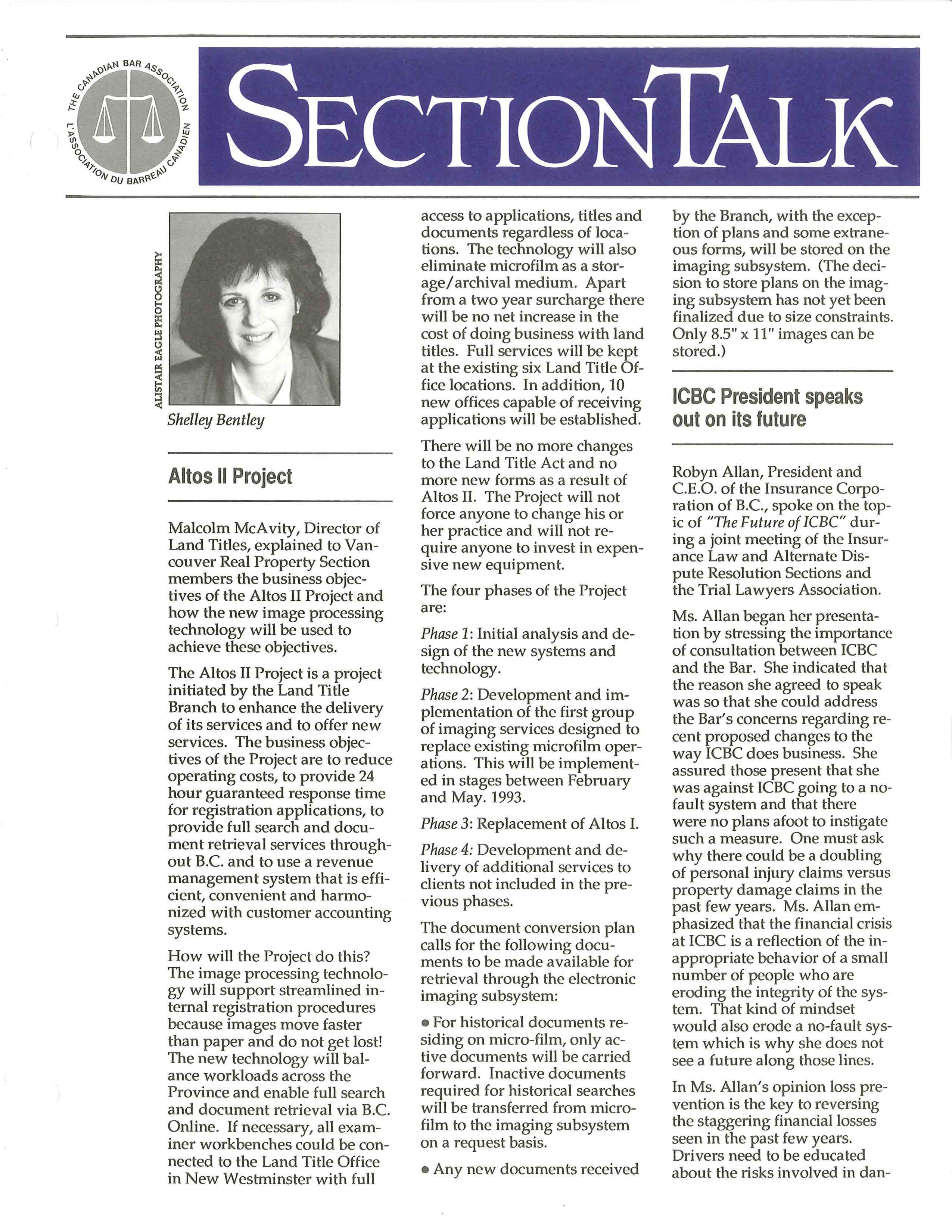
Shelley Bentley
Altos II Project
Malcolm McAvity, Director of Land Titles, explained to Vancouver Real Property Section members the business objectives of the Altos II Project and how the new image processing technology will be used to achieve these objectives.
The Altos II Project is a project initiated by the Land Title Branch to enhance the delivery of its services and to offer new services. The business objectives of the Project are to reduce operating costs, to provide 24 hour guaranteed response time for registration applications, to provide full search and document retrieval services throughout B.C. and to use a revenue management system that is efficient, convenient and harmonized with customer accounting systems.
How will the Project do this?
The image processing technology will support streamlined internal registration procedures because images move faster than paper and do not get lost! The new technology will balance workloads across the Province and enable full search and document retrieval via B.C. Online. If necessary, all examiner workbenches could be connected to the Land Title Office in New Westminster with full
access to applications, titles and documents regardless of locations The technology will also eliminate microfilm as astorage / archival medium. Apart from a two year surcharge there will be no net increase in the cost of doing business with land titles. Full services will be kept at the existing six Land Title Office locations. In addition, 10 new offices capable of receiving applications will be established.
There will be no more changes to the Land Title Act and no more new forms as a result of Altos II. The Project will not force anyone to change his or her practice and will not require anyone to invest in expensive new equipment.
The four phases of the Project are:
Phase 1: Initial analysis and design of the new systems and technology
Phase 2: Development and implementation of the first group of imaging services designed to replace existing microfilm operations. This will be implemented in stages between February and May. 1993.
Phase 3: Replacement of Altos I.
Phase 4: Development and delivery of additional services to clients not included in the previous phases.
The document conversion plan calls for the following documents to be made available for retrieval through the electronic imaging subsystem:
• For historical documents residing on micro-film, only active documents will be carried forward. Inactive documents required for historical searches will be transferred from microfilm to the imaging subsystem on a request basis.
• Any new documents received
by the Branch, with the exception of plans and some extraneous forms, will be sto r ed on the imaging subsystem. (The decision to store plans on the imaging subsystem has not yet been finalized due to size constraints. Only 8.5" x 11" images can be stored )
ICBC President spea ks out on its future
Robyn Allan, President and C.E O. of the Insurance Corporation of B.C., spoke on the topic of "The Future of ICBC" during a joint meeting of the Insurance Law and Alternate Dispute Resolution Sections and the Trial Lawyers Association.
Ms . Allan began her presentation by stressing the importance of consultation between ICBC and the Bar. She indicated that the reason she agreed to speak was so that she could address the Bar ' s concerns regarding recent proposed changes to the way ICBC does business. She assured those present that she was against ICBC going to a nofault system and that there were no plans afoot to instigate such a measure. One must ask why there could be a doubling of personal injury claims versus property damage claims in the past few years. Ms. Allan emphasized that the financial crisis at ICBC is a reflection of the inappropriate behavior of a small number of people who are eroding the integrity of the system. That kind of mindset would also erode a no -fault system which is why she does not see a future along those lines.
In Ms Allan's opinion loss prevention is the key to reversing the staggering financial losses seen in the past few years. Drivers need to be educated about the risks involved in dan-
SectionTalk (continued)
gerous driving. Clamping down on false or exaggerated claims is only one side of the picture.
If ICBC had kept on as they had been before Ms. Allan took over the predicted loss would have been approximately $200 million. ICBC likely would have been in insolvency by the year enp.
The ICBC President is determined to try to make ICBC financially viable by the end of 1993. Accordingly, ICBC's new bodily injury initiatives and property damage initiatives are only the beginning Legislation is also in the works governing court order interest rates and collateral benefits. Ms. Allan claims that double recovery does not provide incentive to anyone to go back to work and therefore ICBC is planning to deal with that legislatively. The first four legislative initiatives were described by Ms. Allan as follows:
1. Collateral benefits will be legislated out of existence.
2. Court order interest will be removed from claims for past wage loss and general damages.
3. The cost of future care will be paid out as incurred rather than awarded in a lump sum.
4. Early disclosure will be mandated.
Ms. Allan emphasized that these initiatives and those relating to property damage and bodily injury are meant to improve the system and keep premiums at a manageable level.
The bodily injury initiatives include limiting the amount recoverable on a settlement of mild and moderate whiplashes and prescribing that no injury claim will be settled where there is no accompanying property damage. As it stands there is a 14% rate increase predicted
for 1993. Ms. Allan hopes that these new initiatives will help to keep that lower.
Bill Huot and Colin Campbell, both with the Heritage Conservation Branch of the Provincial Government, addressed members of the Native Justice Section recently on the proposed new heritage conservation legislation as it relates to the stewardship of Aboriginal heritage sites and artifacts.
While the long term framework for stewardship of Aboriginal heritage resources will be shaped through treaty negotiations and constitutional restructuring, the proposed heritage legislation will be an interim measure until new arrangements are finalized. This proposed legislation provides improved stewardship for Aboriginal heritage resources:
• through strengthened legal enforcement of protection for aboriginal heritage resources;
• through formal recognition of Aboriginal descendants' rights to ownership of many archaeological artifacts; and
• by encouraging Aboriginal participation in the Province's heritage impact assessment and site management systems.
Prior to drafting the legislation, consultation with Aboriginal bands was sought by the Project Pride Ministerial Task Force. A common concern expressed by First Peoples was that the current protection of pre-contact sites is not adequately enforced against vandals and "pothunters." Another fundamental concern to Aboriginal groups
was that the existing heritage protection system is not sensitive to aboriginal cultural values. Instead it is geared more towards protecting sites and objects as archaeological resources - resources for the scientific study of past culturesrather than as the heritage legacy of living cultures. It was explained that Native groups view heritage very broadly, almost synonymously with their culture, encompassing such things as their language and music. Special concern was noted for the protection of spiritual sites - sites or areas valued because of their relation to religion, tradition or mythology. It was also noted that Native groups need a much stronger role in developing policy and in managing their off-reserve resources. They also stressed that the role of education is essential for achieving their goals of heritage conservation. Native groups feel they must play a direct role in interpreting their own culture. This legislation contains a number of tools to protect and conserve aboriginal heritage resources and to enable greater aboriginal participation in heritage resource management. However, some issues such as aboriginal land management, language preservation are beyond the mandate of the legislation.
The proposed legislation expands existing heritage protection tools and provides some new ones. These enforcement provisions will help protect sites and artifacts through a variety of injunctions, civil remedies and penalties. The legislation broadens automatic legal protection to include all sites that contain materials, artifacts or features that are evidence of human occupation or use prior to 1858. The 1858 date was chosen because it coincides with Please turn to page 8
You will see a reference to the number of the Bill (First Reading Bill Number) when it was introduced into the House. This number may be different from the chapter number of the new Act which is quoted after the title of the Act and which is the proper citation for the Act. The First Reading Bill Number has been given to you to make it easier for you to note up the Bills you may have in your library.
Every effort is made to ensure the accuracy of the information provided to you in this article but the information should not be relied upon. Lawyers should refer to the specific legislative or regulatory provision.
ACTS IN FORCE
Health Statutes Amendment Act, 1992, S.B.C. 1992, c.62, First Reading Bill Number 30, amends inter alia the
(a) Health Emergency Act, R.S.B.C. 1979, c.162, authorizing regulations prescribing fees for the service of documents relating to legal proceedings (see B.C. Reg. 391 /92),
(b) Hospital Act, R.S.B.C. 1979, c.176, deleting a confusing definition of "hospital" in section 29.1,
(c) Name Act, R.S.B.C. 1979, c.295, deleting the provisions which allowed for a choice of surnames by a person at the time of marriage and providing that a spouse by marriage may at any time use the surname he or she had immediately before the marriage or the surname he or she had at birth or by adoption or the surname of his or her spouse by marriage without court approval,
(d) Nurses (Licensed Practical) Act, R.S B C. 1979, c.300, providing that disciplinary proceedings may be conducted by a disciplinary committee, rather than the council,
(e) Vital Statistics Act, R.S.B.C. 1979, c.425, repealing the definition of "married woman" and repealing the provisions which required that a stillbirth be registered as a birth as well as a death, and
(f) Wills Act, R.S.B.C. 1979, c.434, amending the provisions dealing with the information maintenance and retrieval system for notices of executed wills filed with the Director of Vital Statistics under the Act, providing that the form of notice will be set by the Director and that a solicitor or notary may obtain a copy of a notice or access to the records by computer.
Act, except sections 1, 8 and 9 in force October 1, 1992
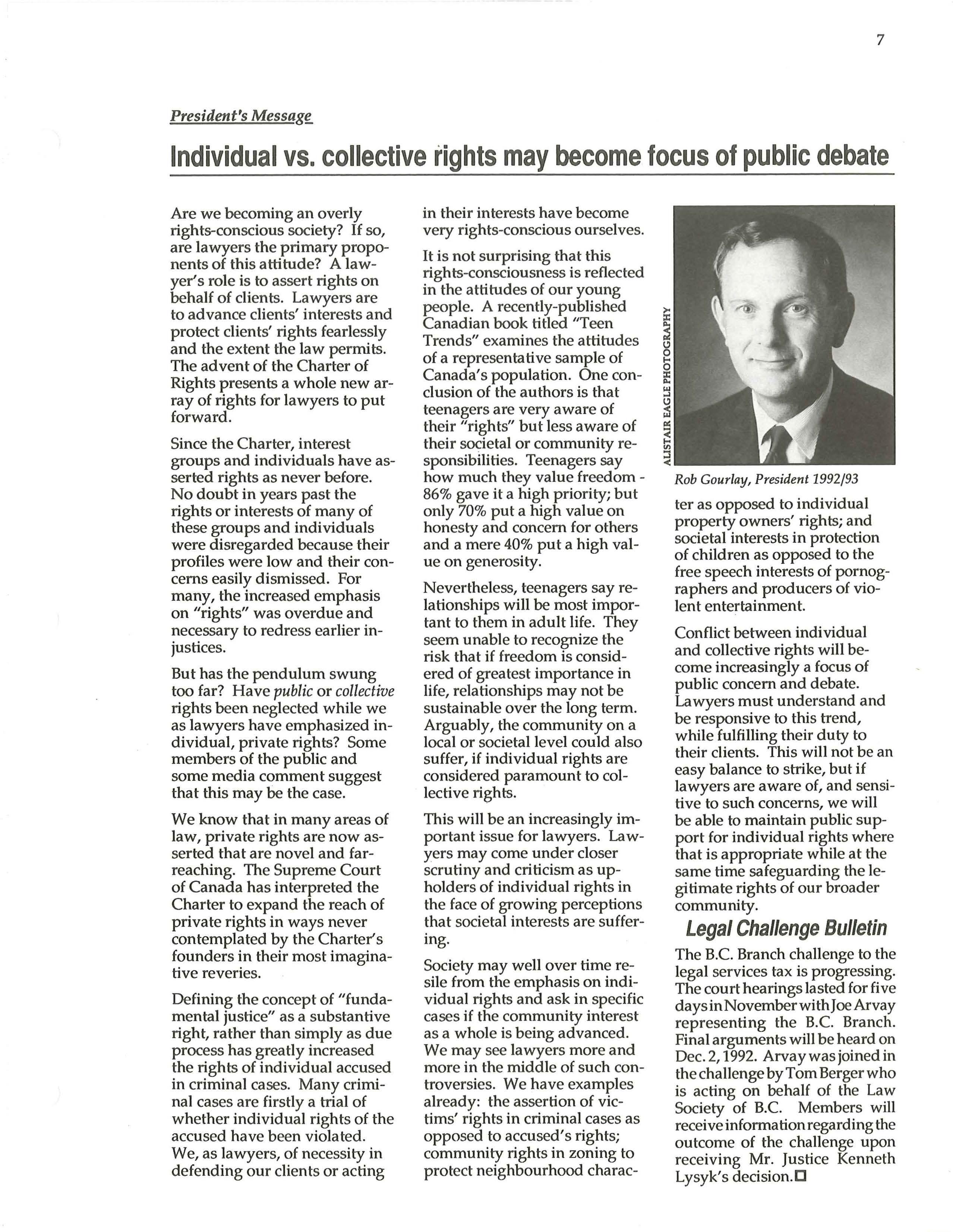
Ann McLean
Forest Amendment Act, 1992, S.B.C. 1992, c.40, First Reading Bill Number 61, amends the Forest Act, R.S.B.C. 1979, c.140, inter alia
(a) requiring the chief forester in most cases to determine an allowable annual cut before December 31, 1995 and thereafter at least once every five years after the last determination, for timber supply areas and tree farm licenses and to require that necessary information be provided,
(b) narrowing the categories of timber sale licenses which may be granted without advertising or competition,
(c) providing that an agreement may be refused where the applicant owes overdue amounts to the Crown,
(d) providing for the expiry of timber marks and making various amendments to the timber marking provisions,
(e) amending the provisions relating to scaling, (provisions for penalties for late scale returns and electronic transmission of large volume scale returns are not yet in force),
(f) adding additional provisions relating to timber cut in trespass, including silviculture requirements, providing that ignorance of boundaries between private and Crown land is not a defence and imposing a duty to know the location of such boundaries, and providing for Crown rights respecting cut timber, and
(g) increasing the enforcement powers of the Forest Service Act, except that part of section 35 which enacts section 75(2) , (3) and (7) of the Forest Act, in force October 1, 1992
Health Statutes Amendment Act (No.2), 1992, S.B.C. 1992, c.63, First Reading Bill Number 62,
Legislative Update (continued)
amends the Health Act, R.S.B.C. 1979, c.161, deleting redundant sections 21, 22, 27 and 28, dealing with the construction and operation of domestic waterworks systems and alterations to sewerage systems, but see B.C. Reg 230 /9 2, as amended by B.C. Reg 390/92, the Safe Drinking Water Regulation. The balance of the Act was brought into force September 18, 1992.
section 3 of the Act in force October 1, 1992
ElecHon Amendment Act, 1992, S.B.C. 1992, c .72, First Reading Bill Number 76, amends the Election Act, R.S.B.C. 1979, c.103, lowering the voting age to 18 years and allowing voters to register at a polling station.
in force October 1, 1992
Statute Revision Miscellaneous Amendment Act, 1992, S.B.C. 1992, c.55, First Reading Bill Number 45, amends inter alia the Library Act, R.S .B.C. 1979, c.235, deleting the Schedule which contained various forms, and providing for such forms to be prescribed by regulation (see B.C. Reg 407 /92).
sections 22- 25 in force October 16, 1992
Municipal Amendment Act, 1992, S.B.C. 1992, c 18, First Reading Bill Number 47, amends the Municipal Act, R.S.B.C. 1979, c.290 in many respects including inter alia
(a) deleting references to specific fees for clerical local government services and allowing the fees to be set by by-law,
(b) removing the limit on athletic commission fees payable by persons conducting contests or exhibitions and allowing the fees to be set by by -law, and
(c) allowing local governments to charge variable fees for subdivision applications and fees for inspections and other administrative matters related to development, subject to ministerial regulations.
sections 3, 16, 17, 36, 39, 55,62 and 92 in force October 16, 1992
Community Care Facility Amendment Act, 1990, S.B.C. 1990, c.37 amends the Community Care Facility Act R.S.B.C. 1979, c.57, removing the provisions referring to the Provincial Child Care Facilities Board and the Provincial Adult Care Facilities Licensing Board and providing authority to medical health officers, the director of licensing and the variance committee appointed by the minister The director has the power to vary, suspend or cancel a licence or interim permit to operate a community care facility. The minister may appoint an administrator to operate a community care facility where the health or safety of
persons cared for is at risk. The Community Care Facility Appeal Board is established to hear appeals from decisions made by the minister, the director, a medical health officer or a variance committee panel.
Act, except section 11(e), in force April1, 1993 [section 11(e) was brought into force Septembe r 27, 1990]
REGULATIONS TO NOTE
Corporation Capital Tax Act, B.C. Reg. 308/92, the Corporation Capital Tax Regulation is amended to provide rules for the calculation of interest on tax payable and refunds due.
B.C. Reg. 380/92 effective April1, 1992
Waste Management Act, B.C. Reg. 432 /82, the Waste Management Regulation is amended torequire a manager to provide notice of his or her intention to issue an operational certificate or an amended operational certificate and to allow a person who may be adversely affected by the issuance of an operational certificate to inspect the proposed certificate and provide comments to the manager.
B.C. Reg 401/92 effective October 8, 1992
Fire Services Act, B.C. Reg. 403/92, the British Columbia Fire Code Regulation is made, adopting with some changes and additions, the National Fire Code of Canada 1990 as it existed on January 1, 1992, and repealing B.C. Regs. 492/59, the Chimney, Fireplace, Smokepipe and Furnace Regulations; 175/62, the Fire Alarm Systems Regulation; 14/87, the Oil Burning Equipment Regulation; 63/78, the Public Hall and Theatre Safety Regulations; and 173/60, the Standard Fire Hose Thread Regulation.
effective December 1, 1992
REPORTS AVAILABLE
Report
Old Growth Strategy
A Strategic Plan for theRange Resources Program
Towards a Protected
Source
Ministry of Forests Integrated Resources Branch (Angela von Sacken356-5888)
Ministry of Forests Branch(387-6653) or Forest Service regional and district offices
Ministry of Environment, Areas Strategy for B.C. Lands and Parks (map brochure) Public Affairs-(387-9422)
President's Messag{L
Individual vs. collective rights may become focus of public debate
Are we becoming an overly rights-conscious society? If so, are lawyers the primary proponents of this attitude? A lawyer's role is to assert rights on behalf of clients. Lawyers are to advance clients' interests and protect clients' rights fearlessly and the extent the law permits . The advent of the Charter of Rights presents a whole new array of rights for lawyers to put forward.
Since the Charter, interest groups and individuals have asserted rights as never before. No doubt in years past the rights or interests of many of these groups and individuals were disregarded because their profiles were low and their concerns easily dismissed. For many, the increased emphasis on "rights" was overdue and necessary to redress earlier injustices.
But has the pendulum swung too far? Have public or collective rights been neglected while we as lawyers have emphasized individual, private rights? Some members of the public and some media comment suggest that this may be the case.
We know that in many areas of law, private rights are now asserted that are novel and farreaching. The Supreme Court of Canada has interpreted the Charter to expand the reach of private rights in ways never contemplated by the Charter's founders in their most imaginative reveries.
Defining the concept of "fundamental justice" as a substantive right, rather than simply as due process has greatly increased the rights of individual accused in criminal cases. Many criminal cases are firstly a trial of whether individual rights of the accused have been violated. We, as lawyers, of necessity in defending our clients or acting
in their interests have become very rights-conscious ourselves. It is not surprising that this rights-consciousness is reflected in the attitudes of our young people. A recently-published Canadian book titled "Teen Trends" examines the attitudes of a representative sample of Canada's population. One conclusion of the authors is that teenagers are very aware of their "rights" but less aware of their societal or community responsibilities. Teenagers say how much they value freedom86% gave it a high priority; but only 70% put a high value on honesty and concern for others and a mere 40% put a high value on generosity.
Nevertheless, teenagers say relationships will be most important to them in adult life. They seem unable to recognize the risk that if freedom is considered of greatest importance in life, relationships may not be sustainable over the long term. Arguably, the community on a local or societal level could also suffer, if individual rights are considered paramount to collective rights.
This will be an increasingly important issue for lawyers. Lawyers may come under closer scrutiny and criticism as upholders of individual rights in the face of growing perceptions that societal interests are suffering.
Society may well over time resile from the emphasis on individual rights and ask in specific cases if the community interest as a whole is being advanced. We may see lawyers more and more in the middle of such controversies. We have examples already: the assertion of victims' rights in criminal cases as opposed to accused's rights; community rights in zoning to protect neighbourhood charac-
ter as opposed to individual property owners' rights; and societal interests in protection of children as opposed to the free speech interests of pornographers and producers of violent entertainment.
Conflict between individual and collective rights will become increasingly a focus of public concern and debate. Lawyers must understand and be responsive to this trend, while fulfilling their duty to their clients. This will not be an easy balance to strike, but if lawyers are aware of, and sensitive to such concerns, we will be able to maintain public support for individual rights where that is appropriate while at the same time safeguarding the legitimate rights of our broader community.
Legal Challenge Bulletin
The B.C. Branch challenge to the legal services tax is progressing. The court hearings lasted for five days in November with Joe Arvay representing the B.C. Branch. Final arguments will be heard on Dec. 2, 1992. Arvay was joined in thechallengebyTomBergerwho is acting on behalf of the Law Society of B.C. Members will receiveinformationregardingthe outcome of the challenge upon receiving Mr. Justice Kenneth Lysyk's decision.[]
Rob Gourlay, President 1992{93
Fa
ir Auto Compensation Committee reports (continu ed trom pa ge 1l
of the payors of collateral benefits in those cases where it is necessary, and only to the extent necessary, to prevent overcompensation of injured victims. While ICBC has a legitimate interest to ensure that the rights of providers of such benefits are not circumvented, the Committee's position is that the determination of amounts to be paid are a private matter between the injured victims and the provider of such benefits in accordance with the existing common law, or if this is deemed deficient after proper evaluation, as amended by statute, or in accordance with contractual provisions where they exist.
Future Care Payment Plan
The Committee suggests that this proposal is not warranted by the anecdotal "evidence" to support it. The short-term apparent savings will be quickly outweighed by the longer-term administrative costs which will invariably arise . The public will perceive this proposal as being unfair to the victims of negligence who will have already endured the hardship of litigation to achieve their settlement or judgement. The Committee also suggests that future care cost awards can better be protected from dissipation, to the extent that it exists, by fostering greater use of structured settlements .
Abolition of Court Order Interest on General or N on- pencuniary Damages
The proposal to abolish court order interest on general damages has as its principal objective and rationale a desire to avoid double recovery. The Committee supports the objective of avoiding double recovery whereve r it occurs in the current system for compensation of automobile accidentvictims. However, the Corporation's implied assumption
that court order interest is only awarded to take into account of inflation is incorrect in principle . The Committee suggests that if the Corporation is suspicious that the existence of full court orde r inte r est encourages victims to drag out thei r claims, there appears to be at least an equal degree of suspicion, on the part of trial lawyers, that the abolition of the court order interest will encourage ICBC to make unrealistically low offers, knowing that claimants will have to wait a long time, due to court congestion, to obtain a "proper" awardatjudgement. The Committee also sug-
Interest ed in formin g a Po verty La w Sec tion?
While informal networks exist for lawyers practicing in the area of "poverty law", the proposed Section would provide a forum for such lawyers to meet and exchange information, engage in law reform and participate as an organized group in the activities of the CBA.
"Poverty law" is broadly defined as the practice of law for people living below the poverty level. Poor people face a unique range
Sec ti onTalk
(continued fr om page 4)
the Fraser River Gold Rush and the beginning of rapid European and Asian settlement and influences . It also marks the date of the establishment of B.C. at Fort Langley. If a site is of unknown origin, but may be pre1858, it is also protected. Automatic site protection applies whether a site is on public or private land, and only applies to lands unde r provincial jurisdiction. It is important to note, the r e is no compensation paid to owners whose p r operty values are affected by automatic protection.
gests that any change to the Court Order Interest Act should be applied to all litigation .
Early D is cl os ure
The Committee suggests that the proposal to mandate early exchange of expert evidence to 120 days befor e trial should be modified to a maximum of 60 days . TheComrnitteealsosuggeststhat a consistent policy throughout ICBC as to the basis on which they would pay for reports delivered early, will in itself result in the early deli very of expert reports. []
of legal problems beyond traditional areas of law . These problems may concern their relationships with government agencies, services and bureaucracies. The proposed Section would also be of interest to people who work in government, publicly funded agencies, academics and students. For more information regarding the proposed Section or to register your interest in participating, pleasecontactJohnSimpson, 10215225-104thAvenue,Surrey, B.C. V3R 6Y8 (Tel: 584-1080; F AX5848075). []
The proposed legislationalsoprovides incr eased opportunities for aboriginal descendants to claim ownership of artifacts other than burial remains. These special provisions only apply to ancient objects that are found in B.C. and were appa r ently lost, cached or abandoned before 1858 As a matter of course, the Province claims owne r ship for such objects, but the Crown's claim is specifically subordinate to that of a "true owner". If a non -descendant's claim on an artifact is ba sed only on possession their claim could be cancelled. []
Plain Language: Can it really work?
II Doing translations from legalese can be exhilarating. It matches the sense of liberation you get during spring cleanup, when you take some clutter you've been saving just in case you really needed it, put it in a garbage bag, and finally toss it out. I I
Bryan Schwartz, Professor of Law, University of Manitoba , Globe and Mail
Trapped in a mire of legalese and gobbledegook, lawyers know more than others how incomprehensible the language of law can be. Many lawyers agree that the language of law should be clearer, and some think plain language can achieve this goal. But is plain language a feasible alternative to traditional legal writing? Serious objections leap to mind:
Plain language isn't precise.
Lawyers doubt that simple language can adequately describe complex ideas. However, Joseph Kimble, (Associate Professor at the Thomas M. Cooley Law School and expert on legal writing), argues that no subject is so complex that it can't benefit from clearer writing. Complex writing makes a difficult concept even harder to understand. Clear writing allows the reader to concentrate on the concept itself, instead of figuring out the meaning of the words Finally, most difficult words in the language of law don't add precision at all. Since cease and desist both mean stop, why not just say stop?
Terms of art can't be reduced to plain language.
Certain terms of art such as hearsay and equity, have a precise, settled meaning. But these
words are few compared to all the words that make up a document. Just because a sentence contains the word plaintiff, doesn't mean the rest of the sentence can't be clear, understandable, and well organized.
Changing the language of law will create uncertainty in the law and cause litigation.
Writing with legal precision is vital. Because plain language rejects certain precedents and
a document written in plain language won't hold up in court. However, the CBA report, The Decline and Fall of Gobbledygook, states that there is no evidence that plain language documents lead to more litigation. Clarity leads to certainty.
by Rachel Hutton
Plain language is simpleminded, unpersuasive, "Dick and Jane" style prose.
Few would argue that Ernest Hemingway's writing lacks punch because it is easily understandable. Likewise, plain language is simple, but wellcrafted prose. It is writing that addresses a mature audience of readers It is clear and straightforward, not condescending.
Changing the way I write will take more time than it's worth.
Time may be money, but improving and simplifying your writing style is worth the effort. People demand clarity in documents, as studies by The Plain Language Institute show Surveys also show that judges prefer arguments that are well -organized, concise, and easy to follow. People will choose professionals who can clearly explain what they need to know. If lawyers want to satisfy clients' needs, they can't afford not to communicate effectively.
Writing For Your Audience
More than anything else, writing in plain language means thinking about your audience before you start to write.
•What do they need to know?
•What do they already know?
•What information is most important to them?
•How well do they read?
•What words and expressions are they familiar with?
•Should I set a formal or informal tone?
Organization and forethought are the essence of plain language.
Clear, straight-forward writing, and critical editing are the tools. The result is better communication .
PlainTalk is jointly sponsored by the CLE Plain Language Project and The Plain Language Institute of B.C. The Project teaches B.C. lawy ers plain language writing skills and converts legal precedents to plain language. The Institute promotes plain language in the broader context of government, business and the legal community. It also funds this column.
The Plain Language Institute of B C.
Lawyer referral program requires volunteers for new pan els
The Lawyer Referral program provided an all-time high of some 49,000 referrals to lawyers last year, said Craig Goebel, chair of the Lawyer Referral Advisory Committee
The B.C. Branch Lawyer Referral staff in Vancouver fielded over 43,000 inquiries last year of which over 37,000 were referred to lawyers who voluntarily participate in the program.
'Whileourcomputerupgradehas helped us to field these calls which average about 185 per day, the number of lawyers registering to participate has not increased significantly," added Goebel.
Lawyers in the Lower Mainland area are required for all panels butthe following panels urgently require registrations:
•Mentally and physically challenged
•Motor carrier and transportation
•Native law
•Women 's issues
•Customs
•Landlord / Tenant
Lawyer Referral, which has been operational since 1955, works through the voluntary assistance of lawyers throughout B.C. The Vancouver program has established 38differentpanelsin which some 2,000 lawyers are now registered in up to three panels of their choice.
"One of the most common public misconceptions of the program is that it is legal aid," said Goebel.
Through the program, lawyers agree to provide up to a one-half hour of consu Ita tion for the nominal fee of $10 The consultation assists the person in determining if he I she has a legal problem, what is involved, how long it might take to solve the problem, and the approximate cost toresolve the problem. Following the consultation, the lawyer and the
referral can agree to proceed at the lawyer's usual fees.
"The Advisory Committee from time to time has had requests from lawyers to raise the $10 consultation fee as lawyers assume this fee covers their costs of seeing the referral," added Goebel. "But the nominal fee is an important part of the program and is not intended to cover actual legal costs but rather serves as a 'user fee' to assist in ensuring that the referrals using the service are serious in following up on the lawyer referral."
The program is intended to assist the public to seek legal advice early before the problem becomes complicated and expensive. And it has been through the voluntary participationoflawyers through-
out B.C. that the program continues to be a valuable public service," noted Goebel.
Lawyer Referral operates in 18 locations throughout the province and operating costs are supported through a grant from the Law Foundation of B.C. The B.C. Branch Executive gratefully acknowledges the immense in-kind financial contribution of lawyers participating in the program and the able assistance of the Branch staff.
To register in the Vancouver and Lower Mainland program, call Dorothy Sawczuk at the B.C. Branch office (687-3404); other locations are listed in your local Yellow Pages under "Lawyer Referral."D
Freedom of Information & Privacy Legislation introduced
OnMay22, 1992 the Government introduced itslongawaitedFreedom of Information and Privacy Legislation. The Bill has now received a second reading and it is expected toreceive3rd reading before the end of this Session.
The Legislation covers all Government Ministries, Crown Corporations and over 200 Provincial Boards, Commissions and Agencies The Act provides a right of access to Government information and imposes an obligation on the Government to assist applicants making requests for information. The Actimposes time limits for responding torequest for information and obliges the Government to describe and list all records in its custody or under its control and to disseminate information on Government Records available to the public. The Bill also contains provisions for the protection of individual privacy by prohibiting the unauthorized collection, use and disclosure of personal information by public bodies. It also gives
individuals a right of access to and a right to request informa· tionofpersonalinforrnationabout themselves.
The Act will come into force by regulation of the Lieutenant Governor in Counsel. At the present time, it is anticipated that the Act will be in force by the Fall of 1993.
It is also expected that the Legislation will be extended to cover local bodies including Municipalities, School Boards, Hospital Boards, Colleges and Universities, and Self Governing Professions This further Legislation will likely be developed between now and the Spring of 1993 and introduced in the Spring 1993 session.
The Government has consulted with the CBA (B.C. Branch), regarding the development of the Legislation and the Branch has commented extensively on it. The Branch will be continuing to monitor the development and implementation of the Legislation.D
Member Services
enhance law firm profitability and provide Branch revenue
For over twenty years the CBA (B.C. Br anch) Member Services Committee has endeavoured to do three things: to provide useful programs, services and p r oducts to lawyers and their firms; to provide revenue to the B.C. Branch and to serve the public interest. In serving the public inte r est, the Lawyer Referral and Dial-A-Law programs have been well received by the people of British Columbia.
The range of services includes: the B.C. Lawyers Telephone, FAX and Services Directory; law firm consulting services; car purchase plan; courier services; holiday packages; hotel and resort discounts; insurance; legal recruiting services; support staff salary survey; airport parking discounts; wholesale warehouse memberships; office supplies and equipment endorsements among others.
The Committee meets monthly to evaluate and monitor these programs The members of the Committee are representative of various size law firms and geographic areas of British Columbia. B.C. Branch Executive Director Robert Smethurst and Bill Gorham co-chair the Committee. Committee Member Bruce Woolley of Stikeman, Elliott also represents the B.C. Branch on the National CBA Member Services Comrni ttee.
As the number of services offered to B.C. Branch members grows , the Committee is investigating ways of receiving member feedback to ensure that the members are receiving quality services.
Regular reports are provided to the Committee by service and product suppliers The service organizations and suppliers are permitted to market their services directly to the members as an "endorsed" service or product. If members report dissatis-
Q C.,
C. Branch
photo): George Cadman, Boughton Peterson Yang
Jack Huberman
faction with a service or product, the Committee follows up In some cases amendments are made to the Agreement with CBA or the Agreement is terminated if need be
In evaluating a proposed service, the Committee first endeavours to determine whether it will be of significant benefit to CBA members and secondly whether the service will secure a modest return to the B.C. Branch. However, if the proposal does not meet the first test of benefiting CBA members, the proposal is rejected.
"Last year endorsed services and products provided a net in-
come of over $105,000 to the Branch," said Robert Smethurst. "This income assists the Branch to supplement day-today services provided to members and helps to hold the line on annual membership fees."
Enquiries about the services provided by other CBA Branches leads the Committee to believe that the B.C. Branch is a leader in services to members throughout Canada
For more information regarding the B.C. Branch Member Services , you can refer to pages 15 to 19 in the 1993 B.C. Branch Lawyers Telephone, FAX and Services Directory.[]
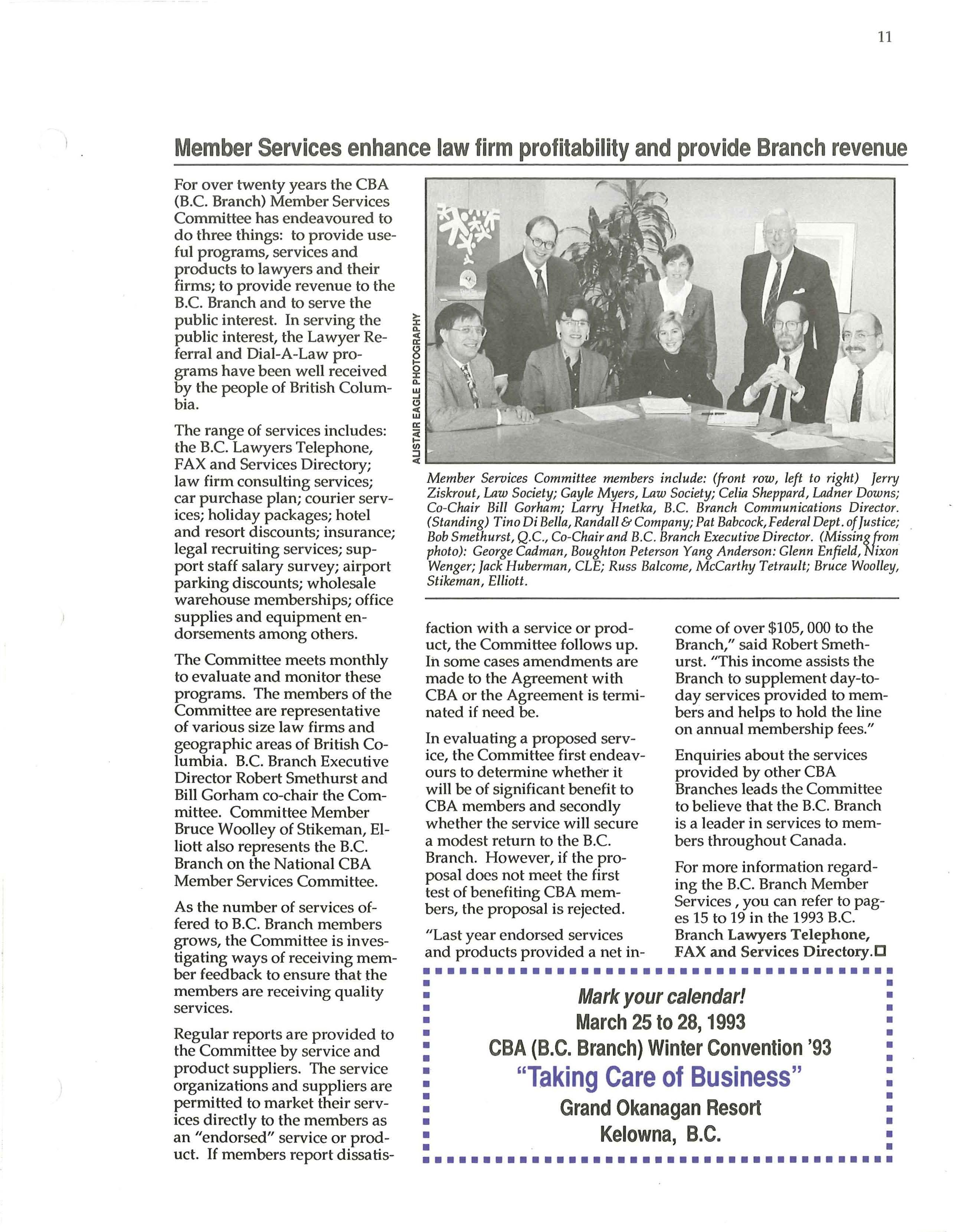
Member Services Committee members include: (front row, left to right) Jerry Ziskrout, Law Society; Gayle Myers, Law Society; Celia Sheppard, Ladner Downs; Co-Chair Bill Gorham ; Larry Hnetka, B C. Branch Communications Diredor (Standing) Tino DiBella, Randall & Company; Pat Babcock, Federal Dept. of Justice ; Bob Smethurst,
Co-Chair and B
Executive Director. (Missin!? from
Anderson: Glenn Enfield, Nixon Wenger;
, CLE; Russ Balcome, McCarthy Tetrault; Bruce Woolley, Stikeman, Elliott.
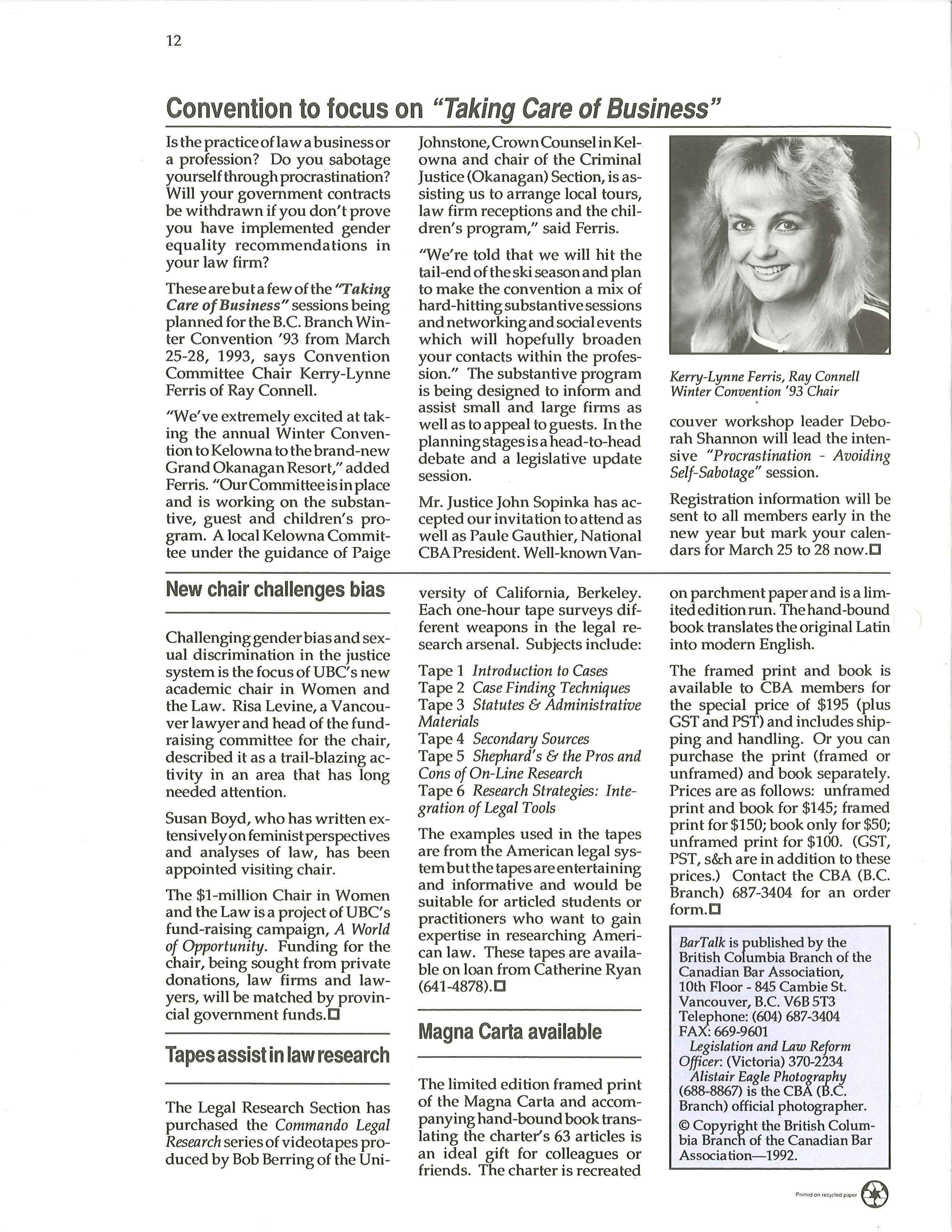
Convention to focus on "Taking Care of Business "
Is the practice of law a business or a profession? Do you sabotage yourself through procrastination? Will your government contracts be withdrawn if you don't prove you have implemented gender equality recommendations in your law firm?
These are but a few of the "Ta ki ng Ca re of B usi n es s " sessions being planned for the B.C. Branch Winter Convention '93 from March 25 - 28, 1993, says Convention Committee Chair Kerry -Lynne Ferris of Ray Connell .
"We've extremely excited at taking the annual Winter Convention to Kelowna to the brand-new Grand Okanagan Resort," added Ferris. "OurCommi ttee is in place and is working on the substantive, guest and children's program. A local Kelowna Committee under the guidance of Paige
New cha ir challenges bias
Challenging gender bias and sexual discrimination in the justice system is the focus of UBC' s new academic chair in Women and the Law. Risa Levine, a Vancouver lawyer and head of the fundraising committee for the chai r , described it as a trail-blazing activity in an area that has long needed attention.
Susan Boyd, who has written extensivelyonfeministperspectives and analyses of law, has been appointed visiting chair
The $1 -million Chair in Women and the Law is a project of UBC' s fund - raising campaign, A World of Opportunity. Funding for the chair, being sought fr om p r ivate donations, law firms and lawyers, will be matched by provincial government funds. []
Tapes ass ist inlaw research
The Legal Research Section has purchased the Commando Legal Research series of videotapes produced by Bob Berring of the Uni -
Johnstone, Crown Counsel inKelowna and chair of the Criminal Justice (Okanagan) Section, is assisting us to arrange local tou r s, law firm receptions and the children's program," said Fe rr is.
''We're told that we will hit the tail -end of the ski season and plan to make the convention a mix of ha r d -hitting s u bstantive session s and networking and social events which will hopefully broaden you r contacts within the profession." The substantive program is being designed to inform and assist small and la r ge firms a s well as to appeal to guests. In the planning stages is a head - to-head debate and a legislative update session
Mr. Justice John Sopinka has accepted our in vita tion to attend as well as Paule Gauthier, National CBAPresident. Well-known Van-
versity of California, Be r keley. Each one-hour tape surveys different weapons in the legal r esearch arsenal. Subjects include :
Tape 1 Introduction to Cases
Tape 2 Case Finding Techniques
Tape 3 Statutes & Administrative Materials
Tape 4 Secondary Sources
Tape 5 Shephard's & the Pros and Cons of On-Line Research
Tape 6 Research Strategies : Integration of Legal Tools
The examples used in the tapes are from the American legal system but the tapes are ente r taining and informative and would be suitable for articled students or practitioners who want to gain expertise in researching American law. These tapes are available on loan from Catherine Ryan (641-4878) .[]
Magna Carta ava il able
The limited edition framed print of the Magna Carta and accompanying hand-bound book translating the cha r ter's 63 articles is an ideal gift for colleagues or friends. The charter is recreated
couver workshop leade r Deborah Shannon will lead the intensive "Procrastination - Avoiding Self-Sabotage" session.
Registration information will be sent to all members early in the new year but mark you r calendars fo r March 25 to 28 now. []
on parchment paper and is a limited edition run. Thehand -bound book translates the original Latin into modern English .
The framed print and book is available to CBA members for the special price of $195 (plus GST and PST) and includes shipping and handling. Or you can purchase the print (framed or unframed) and book separately. Prices are as follows : unframed print and book fo r $145; framed print for $150; book only fo r $50; unframed print for $100 (GST, PST, s&h are in addition to these prices.) Contact the CBA (B.C. Branch) 687-3404 fo r an order fo r m. []
BarTalk is published by the British Columbia Branch of the Canadian Bar Association, 10th Floor - 845 Cambie St. Vancouver, B.C. V6B ST3 Telephone: (604) 687-3404 FAX: 669-9601
Legislation and Law Reform Officer: (Victoria) 370-2234