
HYDRAULIC EXCAVATOR SHOP MANUAL INDEX model CX40B CX50B 1 SPECIFICATIONS 2 MAINTENANCE 3 SYSTEM 4 DISASSEMBLING 5 TROUBLESHOOTING 6 ENGINE 7 INSTALLATION PROCEDURES FOR OPTIONALATTACHMENT 8 SUPPORTING DATA No.9-91940GB Printed by Studio ti - 22204 -2004.07
SAFETY PRECAUTIONS
0-1
GENERAL SAFETY INFORMATION
SWARNING
Do not operate or perform any maintenance on this machine until all instructions found in the OPERATION & MAINTENANCE MANUAL have been thoroughly read andunderstood.
Improper operation or maintenance of this machine may cause accidents and could result in serious injury or death.
Always keep the manual in storage. If it is missing or damaged, place an order with an authorized our Distributor for a replacement. If you have any questions, please consult an authorized our Distributor.
(1) Most accidents, which occur during operation, are due to neglect of precautionary measures and safety rules. Sufficient care should be taken to avoid these accidents. Erroneous operation, lubrication or maintenance services are very dangerous and may cause injury or death of personnel. Therefore all precautionary measures, NOTES, DANGERS, WARNINGS and CAUTIONS contained in the manual and on the machine should be read and understood by all personnel before starting any work with or on the machine.
(2) Operation, inspection, and maintenance should be carefully carried out, and safety must be given the first priority. Messages of safety are indicated with marks. The safety information contained in the manual is intended only to supplement safety codes, insurance requirements, local laws, rules and regulations.
(3) Messages of safety appear in the manual and on the machine: All messages of safety are identified by either word of "DANGER", "WARNING" and "CAUTION".
1) DANGER- Indicates an imminently hazardous situation which, if not avoided, will result in death or serious injury and is represented as follows:
SDANGER
2) WARNING- Indicates a potentially hazardous situation which, if not avoided, could result in death or serious injury and is represented as follows:
SWARNING
3) CAUTION- Indicates a potentially hazardous situation which, if not avoided, may result in minor or moderate injury. It may also be used to
alert against possible damage to the machine and its components and is represented as follows:
SCAUTION
(4) It is very difficult to forecast every danger that may occur during operation. However, safety can be ensured by fully understanding proper operating procedures for this machine according to methods recommended byManufacturer.
(5) While operating the machine, be sure to perform work with great care, so as not to damage the machine, or allow accidents to occur.
(6) Continue studying the manual until all Safety, Operation and Maintenance procedures are completely understood by all persons working with the machine.
0-2 SAFETY PRECAUTIONS
SAFETY PRECAUTIONS
SWARNING
The proper and safe lubrication and maintenance for this machine, recommended by Manufacturer, are outlined in the OPERATOR’S MANUAL for the machine.
Improper performance of lubrication or maintenance procedures are dangerous and could result in injury or death. Read and understand the MANUAL before performing any lubrication or maintenance.
The serviceman or mechanic may be unfamiliar with many of the systems on this machine. This makes it important to use caution when performing service work. A knowledge of the system and or components is important before the removal or disassembly of anycomponent.
Because of the size of some of the machine components, the serviceman or mechanic should check the weights noted in this manual. Use proper lifting procedures when removing any components. Weight of components table is shown in the section: SPECIFICATIONS.
The following is a list of basic precautions that must always be observed.
(1) Read and understand all Warning plates and decal on the machine before Operating, Maintaining or Repairing thismachine.
(2) Always wear protective glasses and protective shoes when working around machines. In particular, wear protective glasses when using hammers, punches or drifts on any part of the machine or attachments. Use welders gloves, hood/goggles, apron and the protective clothing appropriate to the welding job being performed. Do not wear loose fitting or torn clothing. Remove all rings from fingers, loose jewelry, confine long hair and loose clothing before working on this machinery.
(3) Disconnect the battery and hang a "Do Not Operate" tag in the Operators Compartment. Remove ignition keys.
(4) If possible, make all repairs with the machine parked on a level, hard surface. Block the machine so it does not roll while working on or under the machine. Hang a "Do Not Operate" tag in the OperatorsCompartment.
(5) Do not work on any machine that is supported only by lift, jacks or a hoist. Always use blocks or jack stands, capable of supporting the machine, before performing anydisassembly.
SWARNING
Do not operate this machine unless you have read and understand the instructions in the OPERATOR’S MANUAL. Improper machine operation is dangerous and could result in injury or death.
(6) Relieve all pressure in air, oil or water systems before any lines, fittings or related items are disconnected or removed. Always make sure all raised components are blocked correctly and be alert for possible pressure when disconnecting any device from a system that utilizespressure.
(7) Lower the bucket, dozer, or other attachments to the ground before performing any work on the machine. If this cannot be done, make sure the bucket, dozer, ripper or other attachment is blocked correctly to prevent itfrom dropping unexpectedly.
(8) Use steps and grab handles when mounting or dismounting a machine. Clean any mud or debris from steps, walkways or work platforms before using. Always face to the machine when using steps, ladders and walkways. When it is not possible to use the designed access system, provide ladders, scaffolds, or work platforms to perform safe repair operations.
(9) To avoid back injury, use a hoist when lifting components which weigh 20 kg (45 lbs) or more. Make sure all chains, hooks, slings, etc., are in good condition and are the correct capacity. Be sure hooks are positioned correctly. Lifting eyes are not to be side loaded during a lifting operation.
(10) To avoid burns, be alert for hot parts on machines which have just been stopped and hot fluids in lines, tubes andcompartments.
(11) Be careful when removing cover plates. Gradually back off the last two capscrews or nuts located at opposite ends of the cover or device and carefully pry cover loose to relieve any spring or other pressure, before removing the last two capscrews or nutscompletely.
(12) Be careful when removing filler caps, breathers and plugs on the machine. Hold a rag over the cap or plug to prevent being sprayed or splashed by liquids under pressure. The danger is even greater if the machine has just been stopped because fluids can be hot.
(13) Always use the proper tools that are in good condition and that are suited for the job at hand. Be
0-3 SAFETY PRECAUTIONS
sure you understand how to use them before performing any service work.
(14) Reinstall all fasteners with the same part number. Do not use a lesser quality fastener if replacements arenecessary.
(15) Repairs which require welding should be performed only with the benefit of the appropriate reference information and by personnel adequately trained and knowledgeable in welding procedures. Determine type of metal being welded and select correct welding procedure and electrodes, rods or wire to provide a weld metal strength equivalent at least to that of the parent metal. Make sure to disconnect battery before any welding procedures areattempted.
(16) Do not damage wiring during removal operations. Reinstall the wiring so it is not damaged nor will be damaged in operation of the machine by contacting sharp corners, or by rubbing against some object or hot surface. Do not connect wiring to a line containing fluid.
(17) Be sure all protective devices including guards and shields are properly installed and functioning correctly before starting a repair. If a guard or shield must be removed to perform the repair work, use extra caution and replace the guard or shield after repair iscompleted.
(18) The maintenance and repair work while holding the bucket raised is dangerous due to the possibility of a falling attachment. Don’t fail to lower the attachment and place the bucket to the ground before starting the work.
(19) Loose or damaged fuel, lubricant and hydraulic lines, tubes and hoses can cause fires. Do not bend or strike high pressure lines or install ones which have been bent or damaged. Inspect lines, tubes and hoses carefully. Do not check for leaks with your hands. Very small (pinhole) leaks can result in a high velocity oil stream that will be invisible close to the hose. This oil can penetrate the skin and cause personal injury. Use card-board or paper to locate pinholeleaks.
(20) Tighten connections to the correct torque. Make sure that all heat shields, clamps and guards are installed correctly to avoid excessive heat, vibration or rubbing against other parts during operation. Shields that protect against oil spray onto hot exhaust components in event of a line, tube or seal failure must be installed correctly.
(21) Do not operate a machine if any rotating part is damaged or contacts any other part during operation. Any high speed rotating component that has
been damaged or altered should be checked for balance before reusing.
(22) Be careful when servicing or separating the tracks (crawlers). Chips can fly when removing or installing a track (crawlers) pin. Wear safety glasses and long sleeve protective clothing. Tracks (crawlers) can unroll very quickly when separated. Keep away from front and rear of machine. The machine can move unexpectedly when both tracks (crawlers) are disengaged from the sprockets. Block the machine to prevent it frommoving.
0-4 SAFETY PRECAUTIONS
0-5 SAFETY PRECAUTIONS INDEX CX40B CX50B Title Index No. SPECIF I C A T IONS OUTLINE 1 SPECIFICATIONS 2 ATTACHMENT DIMENSIONS 3 MAINTENANCE TOOLS 11 STANDARD MAINTENANCE TIME TABLE 12 MAINTENANCE STANDARDS AND TEST PROCEDURES 13 S YST E M HYDRAULIC SYSTEM 22 ELECTRICAL SYSTEM 23 COMPONENTS SYSTEM 24 D I S ASS E MBLING WHOLE DISASSEMBLING & ASSEMBLING 31 ATTACHMENTS 32 UPPER SLEWING STRUCTURE 33 TRAVEL SYSTEM 34 T ROUBLESHOO T ING HYDRAULIC SYSTEM 42 ELECTRICAL SYSTEM 43 ENGINE 44 E / G ENGINE 51 OP T . D AT A SUPPORTING DATA 71 APPLICABLE MACHINES
1. OUTLINE
0-6 SAFETY PRECAUTIONS
TABLE OF CONTENTS 1.1 GENERAL PRECAUTIONS FOR REPAIRS 1-3 1.1.1 PREPARATION BEFORE DISASSEMBLING 1-3 1.1.2 SAFETY IN DISASSEMBLING AND ASSEMBLING 1-3 1.1.3 DISASSEMBLING AND ASSEMBLING HYDRAULIC EQUIPMENT 1-3 1.1.4 ELECTRICAL EQUIPMENT 1-4 1.1.5 HYDRAULIC PARTS 1-5 1.1.6 WELDING REPAIR 1-5 1.1.7 ENVIRONMENTAL MEASURE 1-5 1.2 INTERNATIONAL UNIT CONVERSION SYSTEM 1-6
1. OUTLINE
1-3
1.1 GENERAL PRECAUTIONS FOR REPAIRS
1.1.1 PREPARATION BEFORE DISASSEMBLING
(2) Suspend warning tag "DO NOT OPERATE" from the doorknob or the operating lever, and have a preliminary meeting before startingwork.

(3) Stop the engine before starting inspection and maintenance to prevent the operator being caught in machine.
(1) Understanding operatingprocedure
Read OPERATION & MAINTENANCE MANUAL carefully to understand the operating procedure.
(2) Cleaning machines
Remove soil, mud, and dust from the machine before carrying it into the service shop to prevent loss of work efficiency, damage of parts, and difficulty in rust prevention and dust protection while reassembling.
(3) Inspecting machines
Identify the parts to be disassembled before starting work, determine the disassembling procedure by yourself considering the workshop situations etc., and request procurement of necessary parts in advance.
(4) Recording
Record the following items for communication and prevention of recurring malfunction.
1) Inspection date andplace.
2) Model name, applicable machine number, and hour meter read.
3) Trouble condition, place andcause.
4) Visible oil leakage, water leakage and damage.
5) Clogging of filters, oil level, oil quality, oil contamination and loosening ofconnections.
6) Result of consideration if any problem exists based on the operation rate per month calculated from hour meter indication after the last inspection date.
(5) Arrangement and cleaning in serviceshop
1) Tools required for repair work.
2) Preparespace to place thedisassembled parts.
3) Prepare oil containers for draining oil etc.
1.1.2 SAFETY IN DISASSEMBLING AND ASSEMBLING

(4) Identify the location of a first-aid kit and a fire extinguisher, and also where to make contact in a state ofemergency.
(5) Choose a hard, level and safe place, and place the attachment on the ground securely.
(6) Use a lifter such as a crane to remove heavy parts (20 kg [45 lbs] or more) from themachine.
(7) Use proper tools, and replace or repair defective tools.
(8) Support the machine and attachment with supports or blocks if the work is performed in the lifted condition.
1.1.3 DISASSEMBLING ANDASSEMBLING HYDRAULIC EQUIPMENT
(1) Removing hydraulicequipment
1) Before disconnecting pipes, release the hydraulic pressure of the system, or open the return side cover and take out the filter.
2) Carefully drain oil of the removed pipes into a containers without spilling on the floor.
3) Apply plugs or caps on the pipe ends to avoid oil spillage and dustintrusion.
4) Clean off the external surface of the equipment before disassembling, and drain hydraulic and gear oil before placing it on theworkbench.
(2) Disassembling hydraulicequipment
1) Do not disassemble, reassemble or modify the hydraulic equipment without the permission of the manufacturer, who is not responsible for the performance and function of the product after modification.
2) When disassembling and reassembling for unavoidable reason, refer the work to qualified personnel who have the specific knowledge or completed the parts servicetraining.
3) Provide matching marks to facilitate reassembling work.

(1) Wear appropriate clothes with long sleeves, safety shoes, safety helmet and protectiveglasses.
4) Before starting the work, read the manual of disassembling procedure, if it is provided, and decide whether the work can be performed by yourself.
1-1 1. OUTLINE
5) Use the special jig and tools without fail if they are specified.
6) If it is hard to remove a part according to the procedure, do not try it by force but investigate the cause.
7) Place the removed parts in order and attach tags to facilitate thereassembling.
8) Note the location and quantity of parts commonly applied to multiplelocations.
(3) Inspecting parts
1) Ensure that the disassembled parts are free from seizure, interference and uneven contact.
2) Measure and record wear condition of parts and clearance.
3) If the problem is found in a part, repair or replace it with a new one.
(4) Reassembling hydraulicequipment
1) Turn ON the ventilation fan or open windows to maintain good ventilation prior to starting the cleaning ofparts.
2) Perform rough and finish cleaning before assembling.
3) Remove washing oil by air and apply clean hydraulic or gear oil forassembling.
4) Always replace the removed O-rings, backup rings and oil seals with new ones by applying grease in advance.
5) Remove dirt and moisture from and perform degreasing on the surface where liquid gasket to be applied.
6) Remove rust preventive agent from the new parts before use.
7) Fit bearings, bushings and oil seals using special jigs.
8) Assemble the parts utilizing matching marks.
9) Ensure all the parts are completely assembled after the work.
(5) Installing hydraulicequipment
1) Ensure hydraulic oil and lubricant are properly supplied.
2) Perform air bleeding when:
1. Hydraulic oilchanged
2. Parts of suction side pipingreplaced
3. Hydraulic pumpinstalled
4. Slewing motorinstalled
5. Travel motorinstalled
6. Hydraulic cylinderinstalled
SWARNING
Operation of the hydraulic equipment without filling hydraulic oil or lubricant or without performing air bleeding will result in damage to the equipment.
3) Perform air bleeding of the hydraulic pump and slewing motor after loosening the upper drain plug, starting the engine and keep it in low idle condition.
Complete the air bleeding when seeping of hydraulic oil is recognized, and tightlyplug.
4) Perform air bleeding of the travel motor and the hydraulic cylinders by running the engine for more than 5 minutes at low speed without load.
SWARNING
Do not allow the hydraulic cylinder to bottom on the stroke end just after the maintenance.
5) Perform air bleeding of pilot line by performing a series of digging, slewing andtravel.
6) Check hydraulic oil level after placing the attachment to the oil check position, and replenish oil ifnecessary.
1.1.4 ELECTRICALEQUIPMENT
(1) Do not disassemble electricalequipment.
(2) Handle it carefully not to drop and give a shock.
(3) Turn the key OFF prior to connecting and disconnecting work.
(4) Disconnect the connector by holding it and pressing the lock. Do not pull the wire to apply force to the caulking portion.
(5) Connect the connector and ensure it is completely locked.
(6) Turn the key OFF prior to touching the terminal of starter orgenerator.
(7) Remove the ground (earth) terminal of battery when handling tools around the battery or itsrelay.
(8) Do not splash water on the electrical equipment and connectors during machinewashing.
(9) Check for moisture adhesion inside the waterproof connector after pulling it out, since it is hard to remove moisture from theconnector.
1. OUTLINE 1-4
If moisture adhesion is found, dry it completely before the connection.
SWARNING
Battery electrolyte is hazardous. Battery electrolyte is dilute sulfuric acid. Exposure of skin or eyes to this liquid will cause burning or loss of eyesight.
If the exposure occurs, take the following emergency measures and seek the advice of a medical specialist.
• When skin exposed: Wash with water and soap sufficiently.
• When eyes exposed: Immediately wash away with city water continuously for more than 10minutes.
• When a large amount of the liquid flows out: Neutralize with sodium bicarbonate or wash away with citywater.
• When swallowed: Drink a large amount of milk or water.
• When clothes exposed: Immediately undress andwash.
1.1.5 HYDRAULIC PARTS
1.1.6 WELDING REPAIR
(1) Refer repair welding to qualified personnel according to the appropriateprocedure.
(2) Disconnect the ground (earth) cable of the battery before starting therepair. Failure to do so will cause damage to the electrical equipment.
(3) Move away the articles in advance that maycause fire if exposed tosparks.
(4) Before starting the repair of the attachment, do not fail to cover the plated surface of the piston rod with flameproof sheet to prevent it from being exposed to sparks.
1.1.7 ENVIRONMENTAL MEASURE
(1) Run the engine at the place that is sufficientlyventilated.
(2) Industrial waste disposal

Dispose of the following parts according to the relevant regulations:
Waste oil and waste container
Battery
(3) Precautions for handling hydraulicoil
Exposure of eyes to hydraulic oil will cause inflammation. Wear protective glasses before handling to avoid an accident. If an eye is exposed to the oil, take the following emergencymeasures:
(1) O-ring
• Ensure O-rings have elasticity and are notdamaged before use.
• Use the appropriate O-rings. O-rings are made of various kinds of materials having different hardness to apply to a variety of parts, such as the part for moving or fixed portion, subjected to high pressure, and exposed to corrosive fluid, even if the size is same.
• Fit the O-rings without distortion andbend.
• Always handle floating seals as apair.
(2) Flexible hose (F hose)
• Use the appropriate parts. Different parts are used depending on the working pressure even the size of fitting and the total length of the hose is same.
• Tighten the fitting at the specified torque. Ensure no kink, tension, interference nor oil leakage is recognized.
• When an eye exposed: Immediately wash away with city water sufficiently till stimulative feeling vanishes.
• When swallowed: Do not let vomit, and receive medical treatment immediately.
• When skin exposed: Wash with water and soap sufficiently.
(4) Others
Usereplacementpartsandlubricantsauthorizedas the genuineparts.
1. OUTLINE 1-5
1.2 INTERNATIONAL UNIT CONVERSION SYSTEM
(Based on MARKS’ STANDARD HANDBOOK FOR MECHANICAL ENGINEERS)
Introduction
Although this manual includes International System of Unit and Foot-Pound System of Units, if you need SI unit, refer to the following international system of units. Given hereinafter is an excerpt of the units that are related to this manual.
1. Etymology of SI Unites
French: Le Systeme International d’ Unites
English: International System of Units
2. Construction of SI UnitSystem
(3) Derived Units
(2) Supplementary units
(4) Derived Units bearing Peculiar Designations
Table 1-4
1. OUTLINE 1-6
Table 1-1
(1) Base units
UNIT SYMBOL Area square
m2 Volume cubic meter m3 Velocity meter
m/s
m/s
Density
Table 1-3 QUANTITY
meter
per second
Acceleration meter per second squared
2
kilogram per cubic meter kg/m3
Table 1-2 QUANTITY UNIT SYMBOL Plane angle radian rad Solid angle steradian sr QUANTITY UNIT SYMBOL Length meter m Mass kilogram kg Time second s Electric current ampere A Thermodynamic temperature kelvin K Amount of substance mol mol Luminous intensity candela cd Base units Table 1-1 Derived units of base units Table 1-2 SI units SI unit system Prefixes of SI (n-th power of 10, where n is an integer) Table 1-5 Supplementary units Table 1-2 Derived units Derived
units designations Table 1-4 QUANTITY UNIT SYMBOL FORMULA Frequency hertz Hz 1/s Force newton N kg • m/s 2 Pressure and Stress pascal Pa N/m2 Energy, Work andQuantityof heat joule J N•m Power watt W J/s Quantity of electricity coulomb C A•s Electric potential difference, Voltage, and Electromotive force volt V W/A Quantity of static electricity and Electric capacitance farad F C/V Electric resistance ohm V/A Celsius temperature celsius degree or degree C (t+273.15)K Illuminance lux lx lm/m2
bearing peculiar
(5) Prefixes of SI
(6) Unit Conversion
Table 1-6
QUANTITY Gravitational SI CONVERSION
*1 Units that are allowed to use.
1-7
1. OUTLINE
FACTORS giga G 109 mega M 106 kilo k 103 hecto h 102 deca da 10 deci d 10–1 centi c 10–2 milli m 10–3 micro 10–6 nano n 10–9 pico p 10–12
Table 1-5 PREFIX SYMBOL MULTIPLICATION
Mass kg kg Force kgf N 1 kgf = 9.807 N Torque kgf•m N•m kgf•m = 9.807 N•m Pressure kgf/cm2 MPa 1 kgf/cm2 = 0.09807 MPa Motive Power PS kW 1 PS = 0.7355 kW Revolution rpm min–1 r/min *1
FACTOR
2. SPECIFICATIONS
TABLE OF CONTENTS 2.1 COMPONENTS NAME 2-3 2.2 MACHINE DIMENSIONS 2-4 2.3 SPECIFICATIONS AND PERFORMANCE 2-6 2.4 MACHINE & COMPONENTS WEIGHT (DRY) 2-7 2.5 TRANSPORTATION 2-9 2.6 TYPE OF CRAWLER SHOES 2-11 2.7 TYPE OF BUCKET 2-12 2.8 ENGINE SPECIFICATIONS 2-14 2.8.1 SPECIFICATIONS 2-14 2.8.2 ENGINE PERFORMANCE CURVE 2-15
2. SPECIFICATIONS
2-1
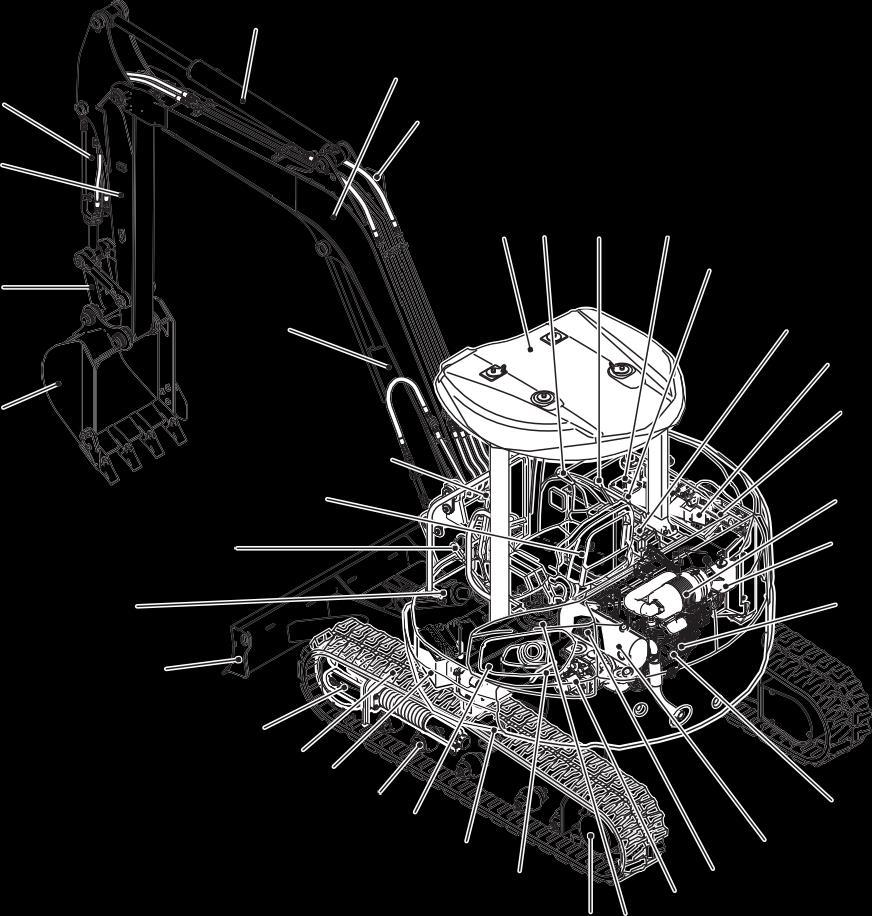

2.1
2. SPECIFICATIONS 32 30 36 33 34 15 16 17 8 18 35 31 19 12 37 3 13 11 5 14 4 29 1 28 24 27 20 25 2 7 26 6 23 21 9 22 10 No. NAME No. NAME No. NAME No. NAME 1 Engine 2 Oil filter 3 Radiator 4 Reservoir tank 5 Air cleaner 6 Muffler 7 Fuel tank 8 Hydraulic tank 9 Hydraulic pump 10 Slewing motor 11 Swing cylinder 12 Control valve 13 Travel lever 14 Safety lock lever 15 Canopy 16 Operating lever 17 Dozer operating lever 18 Throttle lever 19 Monitor panel (gauge cluster) 20 Battery 21 Swivel joint 22 Travel motor 23 Slewing bearing 24 Idler assy 25 Lower roller 26 Upper roller 27 Rubber crawler shoe 28 Dozer blade 29 Dozer cylinder 30 Boom 31 Boom cylinder 32 Arm cylinder 33 Light 34 Arm 35 Link 36 Bucket cylinder 37 Bucket 2-3
COMPONENTS NAME
BUY NOW download online Manual
>>