Ashalee Mohamed, Head of Canada, Sales & Go-To-Market at Xero
Navigating Economic Uncertainty and Trade Shifts
Corporate Leadership Excellence in 2025
Impact of AI-Powered Automation and Data-Driven Decisions
The Power of Purpose-Driven Leadership
How Canadian SMEs Lead With Innovation and Purpose How to Build Inclusion, Equity and Talent Resilience
CanadianSME Small Business Magazine
How Coven Women’s Health is Reimagining Hormonal Healthcare?
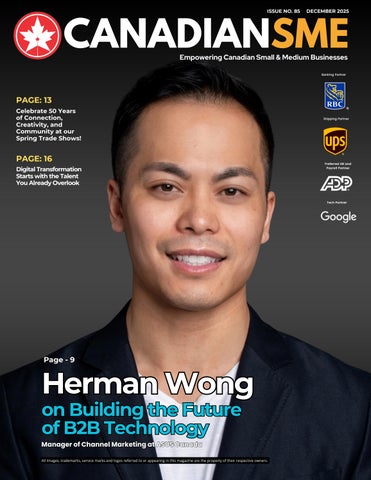
HermanWong onBuildingtheFuture ofB2BTechnology
In an exclusive interview with CanadianSME Small Business Magazine, Herman Wong, Senior Manager of Marketing at ASUS Canada, shares a grounded and insightful look into how technology, channel partnerships, and AI-enabled devices are reshaping the way Canadian businesses operate With more than 15 years of experience helping tech brands strengthen their commercial presence, Herman has built a reputation for bridging teams, simplifying complexity, and creating partner ecosystems that genuinely support business outcomes
InterviewBySKUddin
Herman Wong is a B2B marketing leader with over 15 years of experience helping technology brands build their commercial presence and enable better partnerships across Canada In his role as Senior Manager of Marketing at ASUS Canada, he brings together sales, product, and distribution teams to create clear, collaborative programs that support partners and meet real customer needs
ManagerofChannelMarketingatASUSCanada
Herman is known for his steady leadership style and his ability to make complex projects feel manageable He focuses on clarity, teamwork, and creating processes that help people do their best work Over the years, he has played an important role in shaping how ASUS shows up in the commercial market, whether that’s through partner enablement, improved communication, or helping teams stay aligned during large national initiatives.
You’ve spent more than 15 years helping technology brands build stronger channel and partner ecosystems. What drew you to B2B and channel marketing, and how has that experience shaped your approach at ASUS Canada?
What drew me to B2B and channel marketing was the chance to form deep strategic relationships that go beyond just selling a product its about enabling business transformation for customers and partners
Throughout my 15 years in the industry, I’ve always been motivated by ecosystems how the right technology, paired with the right partner network, can transform the way organizations operate For me, channel marketing is about being a trusted technology advisor
Working within this framework has shaped my approach at ASUS Canada in two ways: first, by focusing on clarity helping partners understand the breadth of solutions available, from AIpowered ExpertBook devices to ExpertCenter desktops designed for stability and scalability Second, by prioritizing alignment Channel success relies on seamlessly connecting product teams, sales, and partners, and ASUS’s end-to-end ecosystem makes that collaboration possible.
Ultimately, B2B and channel marketing allow me to build meaningful, trust-based relationships, and ASUS provides the innovation, credibility, and support structure that enable those partnerships to thrive
AI-powered PCs are becoming a major focus for many organizations. How is ASUS integrating AIenhanced features into ExpertBook and ExpertCenter devices to support modern, hybrid workstyles for Canadian businesses?
AI-powered PCs are becoming essential for organizations adapting to modern hybrid workstyles, and ASUS is integrating practical, collaborationfocused AI capabilities across its ExpertBook and ExpertCenter lineups to support this shift
ASUS AI ExpertMeet, a suite of tools designed to make virtual collaboration seamless, includes real-time meeting transcription with speaker identification, live captions, translation features, and content watermarking helping distributed teams communicate clearly, stay aligned, and work efficiently from any location.
To enhance the caliber of meetings and calls, these devices also add AI-powered noise-cancellation and camera enhancements, light auto-framing and background blur This ensures employees look and sound professional, wherever in the office, co-working space, or at home
With enterprise-grade durability, a secure BIOS, TPM, dual-BIOS protection, and centralized manageability via ASUS Control Center, ExpertBook and ExpertCenter devices give Canadian businesses a powerful, secure, and future-proofed platform for long-term hybrid deployment
Durability, security, and sustainability are now core buying criteria for SMBs and enterprises. What design choices and testing standards (such as military-grade durability and energyefficient, eco-certified components) set ASUS business devices apart in these areas?
Durability, security and sustainability are now nonnegotiable requirements for SMBs and enterprises and ASUS designs its business laptops and desktops with exactly these priorities in mind
The ExpertBook series undergoes rigorous militarygrade MIL-STD-810H testing up to 28 separate durability procedures, including drop tests, hinge cycles, panel pressure, spill resistance, port durability, and temperature stress testing These standards ensure devices remain reliable in demanding real-world environments, from field work to hybrid office setups
Security is reinforced through enterprise-grade hardware and software protection ASUS integrates features such as TPM 2 0, secure and customizable BIOS, dual-BIOS protection, multifactor authentication, Kensington lock support, and exclusive ASUS ExpertGuardian a hardware-to-software security framework designed to safeguard identity, data, and device integrity.
Sustainability is embedded throughout ASUS’s design process Devices incorporate energy-efficient components that exceed Energy Star standards, and ASUS has earned more than 90,000 global eco-labels for its products The company ’ s Net Zero Roadmap includes transitioning to 100% renewable energy in global operations and reducing carbon intensity across the supply chain all reflected in the materials, packaging, and efficiency of ASUS business devices
IT teams are under pressure to deploy, secure, and manage fleets of devices with limited resources. How does ASUS support IT lifecycle management — from deployment and image customization to remote management and aftersales support — to simplify life for IT leaders?
ASUS offers a range of management solutions and utilities to support deployment and ongoing fleet management ASUS’ Image Maker and AutoPilot options allow IT to create custom OS images, apply BIOS settings, and deploy devices at scale with minimal manual work
ASUS Configuration Tool, centralized driver packages, Hardware Diagnostics, and Cloud Recovery further streamline provisioning and maintenance helping IT quickly identify issues, restore systems, and keep fleets consistent
For ongoing management, ASUS Control Center delivers centralized visibility and remote control for device monitoring, software deployment, security policy enforcement, and troubleshooting, with Absolute Persistence adding advanced device tracking
Combined with up to 5-year onsite service, next-business-day support, and international warranty options, ASUS gives IT leaders a fully supported ecosystem that reduces workload and increases operational confidence
Looking ahead, what advice would you share with Canadian SMBs that want to modernize their technology stack responsibly balancing innovation in areas like AI with practical considerations around cost, reliability, and long-term support?
For Canadian SMBs looking to modernize responsibly, my biggest advice is to think in terms of long-term value rather than short-term upgrades AI and modern productivity tools can absolutely accelerate how teams work, but the foundation still needs to be reliable devices, strong security, and predictable support Start by identifying the workflows that create the most friction for your teams whether it’s collaboration, device management, or security and introduce AI where it meaningfully reduces that burden rather than adding complexity
Equally important is choosing technology partners that provide durability, enterprise-grade protection, and lifecycle support. For SMBs with limited IT resources, having devices that are easy to deploy, easy to secure, and easy to maintain will often generate more ROI than chasing the newest feature
Innovation should move at the pace of your business Adopt tools that enhance productivity and resilience today, while ensuring your technology stack can grow with you tomorrow
For five decades, the Canadian Gift Association (CanGift) has been at the heart of Canada’s vibrant giftware industry bringing together passionate makers, inspired designers, creative importers who source and share unique products from around the world, and dedicated retailers who connect these treasures with customers across the country
This milestone year is a celebration of everyone who has shaped our story from the visionary founders who launched our association and championed ownership of our first shows to the generations of exhibitors, and buyers who continue to make the Toronto Gift + Home Market, Alberta Gift + Home Market and our newest show the Atlantic Gift + Home Market essential destinations for our community.
We invite you to explore our shows where you’ll discover an incredible array of gift, home, fashion, souvenir, and lifestyle products that capture the spirit of creativity and innovation that defines our industry.
ImageCourtesy:CanGift
And because no milestone is complete without a celebration, we invite you to join us for a special 50th Anniversary Party on Monday, January 26 in Toronto! It’s our way of saying thank you to the amazing people who have supported CanGift for half a century. Click the link below to learn more and purchase tickets.
Here’s to fifty years of bringing people, products, and possibilities together—and to an exciting future filled with fresh ideas, new relationships, and endless inspiration.
Visit Canada’s Largest B2B National Spring
Show!
Canada’s National Spring Show is the must-attend B2B event of the season From January 25 – 29, 2026, our industry comes together to gather inspiration, capture insights, network and discover innovative solutions for your stores
Located exclusively in the South Building at the Toronto Congress Centre, this free event provides qualified buyers in the gift, home, fashion, and lifestyle categories with the opportunity to source product from the industry’s most trusted exhibitors
Product categories include Proudly Canadian presented by CFIB, Souvenirs, Hand Made, Housewares, Home Décor, Fashion, Toys, Gourmet Food, Jewellery, General Gift & More!
Sunday, January 25 to Wednesday January 28: 9 a.m. – 6 p.m.
Shop Local at Western Canada’s Longstanding Gift + Home Trade Show!
The Alberta show is the premier gift + home event servicing Western Canadian Retailers who value the availability of a wholesale venue closer to their homes and businesses
Over the course of 3 days, February 22 – 24, 2026, the Alberta Gift + Home Market will inspire, inform and entertain qualified attendees at the Edmonton Expo Centre!
100+ exhibitors will showcase products from new and established brands in the gift, home, fashion and lifestyle categories
While at the show enjoy free amenities such as parking, wifi, coat check and other surprises!
Sunday, February 22 & Monday, February 23: 10 a.m. – 6 p.m. Tuesday, February 24: 10 a.m. – 3 p.m. Thursday, January 29: 9 a.m. – 1 p.m.
We invite you to join us – Register Today! (link to: https://cangift.org/toronto-spring-gift-homemarket/register/)
We look forward to welcoming you to the show – Register Today! (link to: https://cangift.org/alberta-gift-homemarket/register/)
Shop East at the Atlantic Gift + Home Market + Craft East Buyers’ Expo
The Canadian Gift Association (CanGift) and Craft East Buyers’ Expo are proud to announce a landmark partnership to produce one of the largest gift and craft trade shows ever held in the Maritimes, taking place March 8–10, 2026, at the Halifax Convention Centre
This highly anticipated event will bring together nearly 200 Canadian exhibitors, showcasing the very best in giftware, home décor, and authentically Atlantic-made craft all under one roof Designed exclusively for qualified retail buyers, the show promises an unmatched opportunity to discover new products, source directly from makers and manufacturers, and forge valuable connections across multiple industries.
Sunday, March 8 & Monday, March 9: 10 a.m. – 6 p.m.
Tuesday, March 10: 10 a.m. – 3 p.m.
Join us in Halifax at the Atlantic Gift + Home Market –Register Today! (link to: https://cangift.org/atlanticgift-home-market/register/)
the Canadian Gift Association (CanGift)
The Canadian Gift Association (CanGift) is the voice and entrepreneurial spirit of Canadas $10 billion giftware industry. Since 1976, this not-for-profit association has worked hard to make its members more competitive and successful In today’s evolving market, CanGift remains committed to being a force for positive change, acting as the industry’s best-known and most trusted “partner in growth” for businesses big and small CanGift enables members to network, discover the latest trends, make new business relationships and strengthen existing ones through the Toronto Gift + Home Market (Toronto Congress Centre), Alberta Gift + Home Market (Edmonton EXPO Centre) and our newest show the Atlantic Gift + Home Market (Halifax Convention Centre) In addition to our face-toface marketing opportunities, we offer a portfolio of member benefits designed to contribute to the bottom-line success of our members
About
DigitalTransformation StartswiththeTalent
YouAlreadyOverlook
Running a small business today isn’t for the faint of heart. Customers expect quick responses, seamless service, and personalized experiences Operations need to hum efficiently, and competitors both local and global are stepping up with techdriven solutions
A small retailer uses automation to track inventory and never misses a sale.
A boutique accounting firm streamlines client communication through a secure online portal.
A local café nails scheduling with simple digital tools and keeps the team happy.
Technology alone isn’t enough transformation requires the right people to implement and optimize these tools For SMEs, that often means leveraging a resource that is highly skilled yet frequently overlooked: students
Why SMEs Struggle With Transformation
Digital transformation can feel overwhelming for small businesses
Budgets are tight, teams are lean, and buzzwords like AI, automation, and cloud computing can seem intimidating Many owners ask themselves: Is this type of innovation achievable for us?
The answer is yes, but only if SMEs pair practical tools with the right people
Small businesses don’t need enterpriselevel systems to innovate; they need skilled collaborators who can effectively implement solutions Students, with their technical expertise, adaptability, and digital fluency, are ideally suited to fill this role and accelerate transformation
Students as a Strategic Resource
Far from being inexperienced interns, today’s students are digitally fluent and capable of making an immediate impact Many SMEs assume students require too much guidance, but the reality is the opposite Students bring fresh perspectives, technical skills, and adaptability to help businesses implement new technologies and optimize operations
Our Riipen program data highlights this impact:
63% of SME employers reported increased interest in new or emerging technologies after collaborating with students through our program
60% saw a positive impact on the number of new technologies adopted
60% said their willingness to invest in emerging technologies over the next year increased
62% noted an improved ability to expand the use of new technologies
78% reported enhanced efficiency
75% said productivity improved
The data highlights just how much impact working with students can have, translating directly into efficiency, productivity, and innovation in everyday business operations
Imagine a computer science student joining your team for a short-term project They might automate repetitive processes that previously took hours, streamline workflows to run more efficiently, identify bottlenecks, and implement secure digital systems They adapt quickly to new tools, uncover opportunities for improvement, and integrate seamlessly with your team These aren’t interns fetching coffee; theyre collaborators who help your business thrive and innovate
By contributing these capabilities, students directly advance digital transformation They help small businesses adopt new technologies, optimize operations, and make data-driven decisions, all without overwhelming existing staff or budgets.
Practical Steps and Riipen’s FuturePath Program
Digital transformation doesn’t have to be overwhelming or expensive SMEs can start by identifying operational pain points, pairing them with talent, tracking improvements, and scaling successful initiatives
Students through FuturePath don’t just complete tasks; they implement digital initiatives, optimize processes, and introduce practical solutions that accelerate transformation SMEs gain fresh perspectives, measurable impact, and new capabilities while fostering a culture of learning and innovation
A Strategic Advantage for SMEs
The result is a win-win Businesses gain efficiency, insight, and innovation, while students gain real-world experience and confidence. By tapping into this underutilized talent, SMEs strengthen capacity, improve performance, and maintain a competitive edge in a digitally evolving marketplace
If your business is ready to work smarter, not harder, pairing your team with motivated students through programs like FuturePath can turn possibilities into tangible impact Practical digital transformation isn’t just about keeping up with technology;it's about sourcing the talent needed to play the vital role required to enable your business to innovate to the next stage and equip the next generation to thrive alongside you
https://wwwriipencom/futurepath/employers? utm campaign=futurepath employer program p c q2y25&utm source=canadian sme magazine& utm medium=partner&utm content=partner cana dian sme magazine futurepath employer lp or Book a call to speak with our
How Shannon Byrne Susko Built the Only Unified Growth System that CEOs Actually Use
Metronomics® founder and CEO, Shannon Byrne Susko, is a titan in executive leadership and corporate growth strategy. A bestselling author, award-winning coach, international speaker, and serial entrepreneur, Shannon's revolutionary Metronomics methodology has enabled thousands of Canadian and global businesses to grow with confidence, clarity, and quantifiable outcomes
Entrepreneurial Origin and Leadership Insights
Shannon Byrne Susko, a Whistler, British Columbia-based entrepreneur, started by founding and growing two software companies, Paradata Systems Inc and Subserveo, both of which were sold within 6 years of each other Facing the same leadership challenges many CEOs encounter, Shannon created the Metronomics Playbook, a repeatable system that connects strategy, execution, cash flow, and team accountability. This system ensures businesses dont just grow fast they grow strong and with endurance.
Asaserialfounder,CEO,andcoachto numerousbusinessCEO+Leadershipteams, Shannon'sexpertiseinformsherthought leadership.Empathy,discipline,anda brutallypragmaticapproachtodecisionmakingarethefoundationsofhercoaching style,whichguaranteethatteams understandwhatwinninglookslik d howtoachieveit.
Founding and Building Metronomics
To assist businesses in implementing a proven, data-driven system for scaling up, Susko launched Metronomics® in 2018 and assembled a global network of more than 90 trained coaches Through best-selling books, workshops, and a cloud-based platform, the Metronomics® approach combines financial management, strategy, execution, and accountability By using specific objectives and daily scoreboards, Shannon's approach ensures businesses move swiftly from foundation to momentum, providing teams and leaders with a blueprint for success at every stage of growth Globally, growth-minded CEOs and their leadership teams now rely heavily on her books: Metronomics, 3HAG Way, The Metronome Effect, and The M Game
Cutting Through the Noise with Metronomics
Metronomics eliminates the guesswork. It’s an evolving, integrated framework that combines the best of global business thought leadership into one cohesive system Instead of juggling fragmented ideas, CEOs and leadership teams get a clear, unified playbook for growth connecting strategy, execution, cash flow, and team health. And because Metronomics continuously adapts to proven practices, SMEs can grow confidently without chasing trends or reinventing the wheel.
In today’s crowded business landscape, CEOs are bombarded with frameworks, tools, and advice making it hard to know what truly works. For Canadian SMEs, this “noisy market” often means stitching together bits of strategy, execution, and financial models from multiple sources, hoping they fit Shannon Byrne Susko faced this same challenge when growing her first two companies, and it inspired her to create something better and repeatable
The 3HAG® Advantage
At the heart of Metronomics is Shannon’s revolutionary 3HAG® (Three-Year Highly Achievable Goal) framework, introduced in her bestselling book 3HAG Way. While many businesses struggle to turn vision into action, 3HAG bridges that gap by creating a clear, executable three-year roadmap–it gives leaders the tools to master their market and build a winning strategy.
3HAG® is a complete strategic system that helps businesses:
Analyze and understand their competitive landscape so decisions are grounded in market reality
Clarify positioning and differentiation, ensuring the company stands out in a crowded space
Validate strategy against real-world conditions, not just internal assumptions.
Translate strategy into execution through measurable milestones, scoreboards, and team alignment
By following the steps in 3HAG®, CEOs gain confidence that their three-year plan is achievable because it’s backed by deep market insight and a clear execution path Instead of chasing trends or piecing together fragmented advice, leaders use 3HAG® to cut through complexity and focus on what truly drives growth Shannon runs a CEO-only Growth Strategy Circle who meet together monthly to work on driving sustainable growth for their businesses.
Impact, Recognition, and Global Reach
Thousands of businesses globally are powered by Metronomics Case studies highlight significant gains in team retention, income, and profit following the application of her paradigm
In addition to winning the Sarah Kirke Award for Canada's Leading Women Entrepreneurs and BIV's Deal Maker of the Year (2011), Shannon has been named one of Canada's Top 40 Under 40 (2000), Top 25 Most Inspirational Women (2020), CEO Magazines Top 50 Women Over 50 (2025), was inducted into WXN’s Top 100 Most Powerful Women Hall of Fame (2023) and was on BIV’s BC500 2025 list She has coached and mentored numerous Canadian CEOs, business owners, and leadership cohorts who have grown their enterprises in record time with clarity and discipline
In addition to Metronomics, Shannon mentors aspiring founders, conducts workshops for women in leadership, and serves as Entrepreneur-inResidence at St Mary's University She assists CEOs, coaches, and leadership teams in creating successful, resilient organizations as a featured keynote speaker at events around Canada and the world
Whether on panels, podcasts, or in her bestselling books, Susko's message is that building companies with enduring cultural and financial influence is more critical to success than simply growing rapidly She continues to promote innovation and expansion across Canada's business ecosystem as a mentor and advocate for female entrepreneurs
Giving Back and Inspiring the Next Generation Conclusion
The path taken by Shannon Byrne Susko, the creator of Metronomics, is a testament to fortitude, vision, and unwavering creativity She is preparing Canadian businesses for a future of steady growth, capable teams, and long-lasting influence by providing CEO+Leadership teams with a repeatable growth playbook
Your role in staying updated is integral to our shared mission of fostering a community of innovators CanadianSME Magazine is a valuable treasure trove of entrepreneurial knowledge Click here to subscribe to our monthly editions for updates on Canadian businesses Follow our handle, @canadian sme, on X to stay updated on all business trends and developments Your support is crucial to our mission
Prior to ADP, Andrea held progressively senior HR leadership roles spanning over two decades, across multiple industries including Financial Services, Telecommunications, Manufacturing and Technology, with organizations such as Rogers Communications, AT&T Capital, Leitch Technology Corporation and IBM, (formerly DataMirror Corporation).
In an exclusive interview with CanadianSME Small Business Magazine, Andrea Wynter, Vice President of People at ADP Canada, discusses the growing “ghost benefits gap” and what it means for today’s workplaces. Drawing from her extensive experience in HR leadership, she breaks down why employees often overlook valuable perks, how organizations can boost engagement through clearer communication, and why strong people-focused strategies are essential for retention and wellbeing.
InterviewBySKUddin
As ADP Canada’s people leader, Andrea is focused on developing talent, building the organizational people strategy and driving forward the culture and values that are so important to ADP As a member of the Senior Leadership team, she leads and shapes ADP Canada’s efforts to fuel our growth strategy with our most valuable asset – our people
Since joining ADP in 2006, she continues to demonstrate a passion for the critical role she and her team play in enabling ADP Canada’s focus and vision where nothing gets in the way of people doing great work and creating conditions that allow everyone to reach their full potential
What is the "Ghost Benefits Gap," and what trends are making it more prevalent in Canadian organizations today?
The "Ghost Benefits Gap" highlights a key workplace challenge: companies offer personalized benefits, but employees often don’t know about or use them These unused perks are essentially invisible, defeating their purpose
Several factors can contribute to the gap In recent years, employers have expanded their benefits offerings to include highly personalized options, such as fertility support or eldercare resources However, if employees are unaware of these perks or uncertain about how to access them, they may go unused Additionally, with five generations in the workforce, employers must provide benefits options that appeal to various generations and ensure they’re aware of what is available to them When options arent clearly communicated, or when the volume of offerings feels overwhelming, employees are more likely to disengage
To address the "Ghost Benefits Gap," organizations need to first identify if it exists among their workforces By making benefits more visible and encouraging their use, companies can align their offerings with employee needs, increase engagement, and enhance employee well-being
With health benefit costs projected to rise sharply, how can employers ensure their investments genuinely enhance workforce wellbeing and retention?
To make benefits truly impactful, they need to be more than a checklist, they need to resonate with employees’ lives To make a big difference, leaders must prioritize ongoing communication -- not just during onboarding or open enrollment – but frequent reminders, manager-led conversations, and bite-sized updates throughout the year.
Tailoring is also key Employees at different life stages have different priorities; earlycareer professionals may value mental health support or student loan assistance, while those later in their careers may prioritize retirement planning When benefits reflect these diverse needs, employees are more likely to engage with them and stay with the organization
Despite personalized perks like mental health apps or menopause leave, why do many benefits remain underutilized, and what practical steps can companies take to make offerings more accessible and visible?
In my experience, benefits go unused for three main reasons: employees don’t know they exist, they don’t know how to access them, or they worry about how it will be perceived if they do
The solution is to simplify and normalize
Centralize all benefits in one easy-to-access platform, use clear and inclusive language, and spotlight offerings regularly For example, highlighting one benefit per month, paired with a real employee story, can make perks feel more tangible and relevant Amplifying stories around mental health, family care, etc also can help to reinforce an open, inclusive, safe and supportive environment.
Managers are also critical. When leaders at all levels are informed and confident in discussing available benefits, it creates a culture of openness and trust Employees are far more likely to engage when they see their leaders doing the same
What role should leadership play in overcoming stigma and building a workplace culture where employees feel empowered to use benefits— especially for mental health support?
Leadership plays a foundational role in shaping workplace culture When executives and managers are transparent about how they care for their own wellbeing; whether that’s taking a mental health day, using counseling services, or accessing specialized support - it sends a powerful message: using benefits is not a weakness, it’s a smart and healthy choice
This kind of modeling helps break down negative stigma while building psychological safety It also reinforces the idea that wellbeing is a shared priority across the organization. When leaders consistently “walk the talk” and support employees in accessing resources, it fosters a culture of trust, empathy, and long-term resilience
What final thoughts or advice would you share with SMB leaders striving to close the benefits gap and fuel employee engagement?
For small and mid-sized businesses, every dollar counts - so it’s not about offering every perk under the sun, it’s about making the most of what you do offer
Closing the “ghost benefits gap ” doesn’t require a massive budget It requires intention, consistency, and a culture where employee wellbeing is genuinely prioritized When people feel supported, they’re more engaged, more loyal, and more likely to thrive, and that’s good for both the team and the business
Canadian Women in Venture Capital (CWVC) has released its fifth annual Canadian Venture Capital Industry Compensation Report, offering the country's only comprehensive look at salary trends across the VC industry Based on responses from 203 industry professionals across the country, the 2025 edition examines how salaries, bonuses, and carried interest are changing and where gaps in fairness and representation persist
The report, which divides data into investment and operational positions, provides a national snapshot of how compensation varies by gender, seniority, and geography. It also represents new developments in workplace culture, perks, transparency, and long-term career sustainability
Signals of Progress and Persistent Gaps
This year ' s data shows significant movement in various categories, including salary increases and parental leave support However, it also highlights structural issues that continue to shape the sector “This year ’ s report shows meaningful shifts in how firms are thinking about compensation and employee benefits,” said Emily Tiessen, Head of Community at CWVC “It is encouraging to see progress in some areas, but the data also makes clear where work still needs to be done ”
McCarten also elaborated how, “Growth opportunities and compensation are consistently cited as the primary reasons why people leave the industry, so these findings help our colleagues build sustainable development paths, while also encouraging firms to build more consistent and equitable compensation practices ”
Key Trends Shaping the 2025 VC Landscape
While the entire report will be published soon, the high-level themes indicate substantial trends across Canada’s VC industry
1) 2) 3) 4) 5)
Compensation continues to climb especially at senior levels From 2020 to 2025, median compensation increased across most investment titles. Junior roles grow steadily, but compensation for VPs and Partners rises dramatically, showing increased competition for experienced leaders
Regional gaps are narrowing Pay for roles up to the Principal level is now fairly consistent across Central and Western Canada At the VP and Partner levels, salaries in Central Canada are no longer consistently higher, indicating a gradual convergence of regional pay systems
Gender discrepancies widen at the top Women in enterprise earn more than men in a variety of junior and mid-level professions However, the trend reverses at the leadership level, with women Partners earning less than men, highlighting ongoing hurdles to achieving senior-level salaries
Parental leave standards are converging Threequarters of respondents reported obtaining a wage increase of 76 to 100 percent, demonstrating increased uniformity and support for parental leave policies among VC businesses
Retention risks are increasing Career progression is becoming increasingly frustrating as flat hierarchies impede advancement Notably, one-third of the staff may depart the industry within the next three years a crucial indication for businesses looking to improve retention efforts
Supporting the Future of Canadian Venture Capital
As the only publication of its kind in Canada, CWVC's Compensation publication remains an essential benchmark for businesses, fund managers, and personnel leaders The organization has established itself as a major advocate for equity, transparency, and professional development in the industry
What Canadian Women in VC Stands For
Canadian Women in VC is a non-profit organization dedicated to fostering community, connection, and skill development opportunities for self-identified women working in venture capital Its purpose is to enable women and allies to help positively impact Canada's venture landscape
Your role in staying updated is integral to our shared mission of fostering a community of innovators CanadianSME Magazine is a valuable treasure trove of entrepreneurial knowledge Click here to subscribe to our monthly editions for updates on Canadian businesses Follow our handle, @canadian sme, on X to stay updated on all business trends and developments Your support is crucial to our mission
Building Effective Public Relations Strategies for 2026
Public relations (PR) has always focused on building credibility, trust and connections that influence customers, clients, and other stakeholders These priorities will continue in 2026, but SMEs must adjust to the evolving media channels, to AI-driven discovery that's reshaping how content is found and amplified, and to audiences demanding relevant content For small and mediumsized enterprises (SMEs), successful PR means adapting to these changes while staying true to their brand values
Name check: While "PR" may be the more recognized name for the business of influencing decisions, PR is also known as "communications" and "marketing communications".
Navigating The Shifting Media Landscape
The traditional press release is no longer the centerpiece of PR, it’s now one piece of an expanded communications ecosystem Media outlets increasingly blend traditional journalism with influencer-driven content, podcasts, and niche newsletters For SMEs, impactful PR means:
Diversifying who gets pitched: Go beyond mainstream and industry media outlets to include microinfluencers, vertical-specific podcasts, trade publications, and community-driven publications
Prioritizing credibility: Journalists and audiences alike are wary of spin. SMEs must provide transparent data, customer testimonials, real-world use cases, and thought leadership that adds genuine value.
Embracing multimedia storytelling: Video snippets, interactive infographics, and short-form social content are now essential complements to written PR
Understanding newsletters & niche channels: Platforms like Substack have become influential discovery channels. SMEs should treat newsletters and niche community-driven outlets as primary PR channels, not afterthoughts.
PR pros know that media is not a single channel but a constellation of voices, and they adapt by building relationships across the spectrum
Leveraging AI-Driven Discovery
Artificial intelligence is transforming how stories are surfaced, shared, and ranked. According to a recent Muck Rack report, 89% of AI citations come from earned media including news stories and other non-paid content If you want your SME to show up in AI-driven search results, or on your prospect's shortlist, you need thirdparty validation
Search engines, social platforms, and even newsroom tools increasingly rely on AI to decide what content gets visibility
For SMEs, this means PR strategies must be optimized for discovery:
AI-friendly content: Use structured data, clear headlines, and keyword-rich storytelling to ensure stories are easily indexed and surfaced by AI-driven platforms
Predictive insights: AI tools can analyze audience sentiment, trending topics, and competitor activity SMEs should integrate these insights into their PR planning to stay ahead of the curve
Personalized outreach: AI enables hypertargeted distribution, ensuring the right message reaches the right audience at the right time
Trade publications: Their reputation for trust and authority makes them prime sources for AI systems, which index them heavily in the search of credible voices. This influence is especially pronounced in B2B sectors where decision-makers turn to the trade press not only for product updates but for context, analysis, and independent validation These outlets deliver the proof points recognized by algorithms and executives
SMEs need to proactively design PR campaigns that thrive in algorithmic environments.
Meeting Evolving Audience Expectations
Elevated discernment and frugality will impact people in 2026 So, understanding what influences decision-makers is key They will expect SMEs to be transparent and relevant For brands, this requires:
Authenticity over polish: Audiences reward honesty. Sharing challenges, lessons learned, and behind-thescenes stories builds trust.
Purpose-driven narratives: Align PR with broader societal values including sustainability, inclusivity, and community impact.
Interactive engagement: Audiences want dialogue, not monologue. SMEs should foster two-way communication through live Q&As, social listening, and community forums.
Resilient PR strategies recognize that audiences are not passive consumers but active participants in shaping brand reputation
The Canadian Advantage: Local PR Support
For SMEs operating in Canada, or seeking to expand into Canadian markets, having Canadian-based PR support offers a distinct edge:
Local media relationships: Canadian PR professionals bring established contacts with national outlets as well as regional publications and niche industry platforms
Cultural fluency: Canada’s bilingual and multicultural environment demand nuanced messaging. Local PR support ensures campaigns resonate across English and French audiences, while respecting diverse cultural contexts
Trend alignment: Canadian PR teams are attuned to local business trends, from sovereignty initiatives to government-backed innovation programs. SMEs can leverage these insights to position themselves as leaders in the Canadian narrative.
Community credibility: Local PR support helps SMEs build grassroots trust by connecting with chambers of commerce, trade associations, and community organizations
In a globalized media environment, local expertise remains invaluable Canadian-based PR support ensures SMEs can amplify their stories with authenticity and relevance
Practical Steps for SMEs in 2026
To build resilient PR strategies, SMEs should:
Audit current PR assets: Identify gaps in media and influencer relationships, content formats, and audience engagement
Invest in AI tools: Use analytics platforms to monitor sentiment, discover trends, and optimize content
Develop bilingual assets: Ensure PR materials are accessible in both English and French to maximize reach in Canada
Build a crisis-ready plan: Anticipate reputational risks and prepare transparent, empathetic responses
Conclusion
Resilient PR in 2026 is about adaptability, authenticity, and alignment with both technological and cultural shifts SMEs that embrace evolving media dynamics, harness AI-driven discovery, and meet audience expectations will not only survive but thrive And for those operating in Canada, local PR support offers a powerful advantage bridging global strategies with local credibility
Trevor Campbell is a marketing communications veteran with experience in reputation management, public relations, digital communications and team building He’s connected brands and individuals with millions of people in North America, and managed agency and client teams. His industry experience includes work with start-ups to multinationals in B2B/B2C tech, financial and professional services, travel/tourism, and the not-for-profit sectors
Small Business Magazine, Paula Allen, Global Leader of Research and Client Insights at TELUS Health, shares her invaluable expertise on how organizations can foster healthier, more engaged workforces Paula dives into the evolving landscape of workplace mental health, discussing how TELUS Health’s innovative tools, like the Mental Health Index and Barometer, are empowering employers with the insights needed to address the growing mental health crisis
PaulaAllen, GlobalLeaderofResearchand
InterviewBySKUddin
Paula Allen is the Global Leader, Research & Client Insights at TELUS Health Paula is a wellrecognized expert in all areas of workplace mental health, learning strategies, disability management and drug plan management.
Building on a clinical background, she has more than 20 years of experience relating to workplace research, product development and operational leadership
She is a sought-after speaker by media, organizations, and conferences for her knowledge and expertise in current issues and the future direction of health, wellbeing, productivity, and related risk management
Paula is a Director on several Boards providing her expertise in health and health innovation for organizations including the Women’s College Hospital, the National Standard for Psychological Health and Safety in the Workplace, the Canadian Club of Toronto and One Mind at Work Guiding Council.
The TELUS Mental Health Index and the newly introduced Barometer provide deep insight into how employees are faring mentally and emotionally. How do these tools differ, and how do they collectively help employers make more informed decisions about workforce wellbeing?
The TELUS Mental Health Index is our ongoing pulse check on the mental health of working people around the world It provides a timely, data-driven snapshot of how employees are
feeling and functioning Our new Barometer, launched in October 2025, builds on that foundation It compiles findings from the previous year of Index report data and translates it into strategy: synthesizing trends, identifying the most pressing mental health risks, and providing actionable insights organizations can use to strengthen wellbeing in the workplace
The modern workforce is operating under immense pressure and employers have an opportunity to respond By normalizing mental health conversations, offering confidential and accessible support, and addressing financial wellbeing as part of total health, organizations can build resilient teams that thrive
The Barometer connects trust within organizations to higher engagement and lower burnout rates. What practical steps can small- and medium-sized businesses take to build these “high-trust” environments?
Trust is the foundation of employee engagement and a powerful antidote to
The 2025 Mental Health Index shows that financial stress remains a leading source of strain and that younger workers face unique challenges around stigma and disclosure. What do these insights reveal about the evolving pressures on the modern workforce?
The data is clear: financial strain continues to be one of the most significant stressors affecting mental health in the Canadian workforce, and its ripple effects touch every aspect of work and life Younger workers in particular are more sensitive to rising costs of living and job insecurity, and although conversations and tools around mental health are more accessible, many feel pressure from comparison culture and are more hesitant to disclose mental-health challenges at work due to workplace stigma and perceived impacts on their careers
burnout. For small and medium-sized businesses, building trust doesn’t require massive resources it starts with consistency in communication, transparency, and compassion When leaders show trust and respect for their teams, employees feel seen, supported, and safe to speak up, which strengthens engagement and performance
Leaders set the tone by talking openly about wellbeing, ensuring psychological safety through confidential support programs and creating policies that walk the talk Simple steps like regular check-ins, manager training and visible commitment to employee assistance programs can
ImageCourtesy:PaulaAllen
foster belonging and loyalty Employees trust what they can see and feel, and leaders that show genuine care for their wellbeing, follow-through on commitments, and support that meets their needs will foster stronger, more engaged organizations
How has the conversation around employee mental health evolved in recent years and what emerging trends do you believe will define the future of employee mental health?
In recent years, the conversation around employee mental health has moved from being an afterthought to a core business priority Post pandemic realities including economic uncertainty, rising anxiety, burnout, and financial stress have underscored the importance of tailored, proactive support over one size fits all solutions
The TELUS Mental Health Barometer also highlights the global challenge of meeting the diverse needs of a workforce spanning regions, cultures, generations, and life stages For example, financial instability is the leading source of stress for nearly half of Canadian workers, making financial counselling, debt management tools, and retirement planning critical In South Korea, where mental health stigma continues to appear particularly strong, prioritizing the confidentiality and privacy of support services is essential. In NewZealand, TELUS Health integrates traditional Māori healing (RongoāMāori) with modern mental health services, fostering trust and engagement in Māori communities
Looking ahead, emerging trends point to the need for integrated strategies that combine leadership training, culturally sensitive care and accessible digital tools, alongside early intervention pathways These approaches help normalize mental health conversations, reduce stigma, build trust, and create psychologically safe workplaces
As we collectively navigate a world where mental wellbeing is increasingly tied to productivity and retention, what final piece of advice would you offer SME leaders striving to create workplaces that truly care for their people?
Supporting wellbeing in the workplace rests on two pillars First, provide practical, easily accessible support that addresses the wellbeing challenges your team faces Second, build the environment and culture that consistently communicates what’s available, reinforce the importance of using wellbeing support, and train managers to model and uphold healthy workplace behaviours.
Xero Canada on Holiday Trends andEmpoweringCanadianSMBs
In an exclusive interview with CanadianSME Small Business Magazine,
Ashalee Mohamed, Head of Canada, Sales & Go-To-Market at Xero, shares her insights on how shifting consumer behaviour is shaping this year’s holiday season and what it means for small businesses across the country. Drawing from Xero’s latest Canadian Holiday Shopping Survey, Ashalee offers a candid look at how Canadians are choosing to support local entrepreneurs, even in the face of economic pressure, and why these choices carry meaningful longterm impact for the small business ecosystem
Ashalee Mohamed is a senior business leader with over 18 years of experience driving growth and leading highperformance teams across a variety of industries. As the Head of Canada, Sales & Go-To-Market (GTM) at Xero, Ashalee leads the Canadian GTM team, focusing on accelerating revenue growth and delivering operational excellence. She is deeply committed to empowering organizations to thrive, with a particular passion for supporting small businesses in Canada and contributing to the fundamental success of this vital sector in the Canadian economy
As Xero’s Canadian Holiday Shopping Survey reveals new spending trends, what findings most surprised you, and how do these insights reflect the current mindset of Canadian consumers towards supporting local small businesses?
What was most exciting to see in our research was the intention among Canadian consumers to roll up their sleeves and support small businesses
Despite the ongoing economic pressures that have been felt by most Canadians this year, nearly 1 in 7 plan to shop small this holiday season, and 69% said they believe shopping small is more important this year than in previous years. On top of that, 26% of Canadians also said they plan to spend more with small businesses this year. That’s a standout statistic for me because it demonstrates that Canadians are eager to uplift the small businesses in their community, even though it might cost them more to do it
Data indicates that individual consumer choices can significantly impact small business success. Can you share examples of how personal shopping decisions have made a difference for Canada’s SMBs, especially during the holiday season?
What does this data indicate for the Canadian small business economy as we head into the end of the year?
The findings indicate a positive signal for Canada’s small business economy For many small businesses, holiday sales can represent 20-30% or more of their annual revenue, so knowing that Canadians are invested in shopping small this year is in and of itself a positive marker for the sector This, in addition to more positive macro-economic markers and the Bank of Canada’s latest interest rate cut, points to positive momentum for the industry heading into 2026 As we head into the new year, I certainly hope the strong consumer intent we ’ ve seen in this data will carry forward and that consumers will continue to consider shopping small first when it comes to regular purchases they make
The idea that individual purchasing habits can’t make a difference for small businesses is simply a myth For small business owners, every sale matters, especially during the critical holiday sales season Even a small shift in consumer behaviour can have a massive impact on the success of a business For example, Xero data from earlier this year found that if Canadians shifted their spending over to small businesses by just 10% more, this could add as much as an extra $88 billion to the small business economy In turn, the boost from a jump in sales allows small businesses to create an ecosystem that strengthens the entire community. Small businesses rely on their communities more than large enterprises, meaning much of the dollars spent get reinvested back into the community Canadians have the power to make these impactful changes, which is why it’s so encouraging to see the data reinforce those intentions
Earlier this year, Xero data found that 84% of Canadian small businesses were expressing optimism. What concrete steps is Xero taking to help these businesses navigate macroeconomic challenges and leverage new technologies for sustainable growth?
Xero’s primary goal has always been to provide small businesses with the support they need to spend less of their time organizing their finances and more time on what matters most: running their business. Part of that commitment means empowering small businesses with easy-to-use features designed to simplify complex tasks and give them a clear view of their finances. Xero also connects customers with a community of advisors, partners, and experts to create a network of reliable resources to consult when needed
As we approach the year’s end, what practical advice would you offer to Canadian small business owners to maximize opportunities and overcome obstacles in this critical season?
First of all, I want to remind small business owners that 80% of Canadians say they feel a genuine sense of pride when they support a small business. Canadian customers have your back and want you to succeed this holiday season Trust, listen to, and engage with your community to stay connected with the people who plan to support your business this year Especially over the holidays, small businesses should lean into their local small business identity and make sure customers know they’re supporting a member of their community with their purchase Leverage ‘shop local’ and ‘shop small’ messaging where you can to further incentivize customers
Small businesses should also look for ways to make it easier for customers to support them Whether that looks like streamlining e-commerce sales or offering gift cards or personalized services, minor adjustments can go a long way toward turning those intentions into purchases. I would also encourage small business owners to stay organized and keep a careful eye on cash flow During peak seasons, clear visibility into your financial data is crucial to enabling adaptability and informing strategic business decisions
As the curtain lowers on 2025, Canada's corporate stage is crowded with small and medium-sized firms that have transformed uncertainty into opportunity. From national conferences to SME award galas, we see founders and executives who are changing leadership by combining innovation with resilience, profit and purpose, and technology and community
Their experiences, driven by actual market constraints and daring innovation, today serve as a realistic guide for entrepreneurs across the country looking to develop smarter, adapt faster, and establish firms that genuinely make a difference
There is a tremendous shift as SMEs rewrite the story of success and emerge as winners, bending uncertainty to accelerate growth, sustainability, and digital innovation Recent data suggests businesses thriving now are leading with purpose, resilience and vision
The increase in internet commerce has been one of the most apparent indicators this year According to forecasts, Canada's e-commerce market will be worth approximately USD 41 8 billion (CAD $56 billion) in 2025, with an annual growth rate of nearly 10%
For Canadian SMEs, this means genuine opportunities Retailers and manufacturers that have embraced online storefronts, subscription models, or direct-to-consumer (D2C) channels are expanding their national reach, frequently generating 30-50% sales increases following the digital transition It's no longer enough to simply "get online" the leading companies are carefully scaling e-commerce, relying on platforms such as Shopify or specialty markets while developing subscription boxes, loyalty clubs, and fulfillment strategies that keep up with consumer demands
Companies that use blind resume hiring and diverse teams are better equipped to respond swiftly to digital change (The direct link to digital growth is implicit ) The key point is that digital growth and human civilization are inextricably linked What this means to you:
Consider subscription-box models or specialist direct-to-consumer products to increase recurring revenue.
Select an e-commerce platform that seamlessly interacts with Canadian payment and shipping systems.
Integrate analytics into your online strategy early on track conversions, retention, and client lifetime value to ensure you capture more than simply clicks, but also long-term connections
Leading With Green Impact
Many Canadian award-winners in 2025 highlighted the importance of environmental and social impact in their business identities ChopValue, a Vancouver-based "circular economy " company, recycles spent chopsticks into high-performance furniture and décor The company has diverted millions of chopsticks, saving millions of kg CO₂e Such businesses demonstrate that sustainability can promote growth rather than just compliance
Canadian governm green activities thr procurement
ActionSteps:
Examine govern for sustainable circular econom
In marketing an highlight meas diverted or ene
Use sustainabil Canadian cons brands.
AIinOperations
In 2025, around 12.2% of Canadian businesses reported using AI to create goods or offer services, with approximately 17 9% expecting to implement AI software in the coming year AI is helping SMEs be recognized this year by streamlining customer service (chatbots), marketing (predictive analytics), operations (supply chain optimization), and human resources (skill-matching)
Top-tips:
Begin small: use an AI tool to automate a low-risk task (chatbot, email flow, inventory alert), then scale once it delivers ROI.
Monitor uptake, training, and change management tools alone will not transform culture.
Keep an eye on government funding: Canada's 2024 budget allocated more than CAD $2.4 billion to AI adoption, including support for SMEs.
Social Commerce
Invest in community management to make sure you ' re not just broadcasting but also actively listening to and responding to your audience. The emergence of "social commerce, " which involves creating communities and selling through social media platforms rather than merely promoting transactions, is another change By using platforms like Instagram, TikTok, and Facebook Shop to create meaningful engagement, Canadian SMEs identified in 2025 have taken advantage of this trend
Waystoleanin:
To turn followers into buyers, use ambassador clubs, influencer programs, or live shopping.
Integrate your e-commerce platform with your social media marketing efforts to turn "likes" into quantifiable sales.
Learning and Adapting on the Go
ForSMEsinCanadain2025–2026:
Create a "pivot playbook" that outlines how to measure results, try new concepts, and scale what works.
To stay ahead of changes in customer preferences, competitive strategies, or macro risks, conduct market research sprints every 3 months.
Encourage a leadership style that is transparent, empathetic, and collaborative; leaders who listen and take action create more resilient teams and respond more quickly.
The Roadmap Ahead for SMEs
Canadian SMEs are in a position of immense opportunity Firms that prosper in this phase of 2025 are doing more than just fixing operational problems; they are leading with purpose, developing communities of support, investing in technology and sustainability, and organizing their businesses for change The strategy emerging from national awards, summits, and industry studies is straightforward: digital + green + adaptive + people-centric
If you ' re currently managing or helping a Canadian SME, start by selecting one meaningful move in each of these four categories Take it one step at a time Take measurements Adjust it As the year comes to a close and 2026 approaches, the companies that will thrive aren't waiting; they're doing.
Your role in staying updated is integral to our shared mission of fostering a community of innovators CanadianSME Magazine is a valuable treasure trove of entrepreneurial knowledge Click here to subscribe to our monthly editions for updates on Canadian businesses Follow our handle, @canadian sme, on X to stay updated on all business trends and developments Your support is crucial to our mission
In an exclusive interview with CanadianSME Small Business Magazine, Patrick Armstrong, CEO and Co-Founder of Hyyve Inc , opens up about his mission to modernize real estate through transparency, competition, and technology From reshaping how sellers choose agents to building a full-service marketplace, Patrick shares the vision, strategy, and lessons driving Hyyve’s rapid rise in Canada’s PropTech landscape.
InterviewByKripaAnand
Patrick Armstrong is a seasoned Canadian entrepreneur and innovator, currently serving as the CEO and Co-Founder of Hyyve Inc., a platform transforming the real estate industry by enabling homeowners to receive competitive bids from qualified agents. Under his leadership, Hyyve has emerged as a pioneering force in PropTech, fostering transparency and efficiency in the agent selection process Armstrong’s vision extends beyond agent matchmaking – he is building a comprehensive real estate services marketplace that integrates trusted providers in mortgages, legal, inspections, and staging to streamline the entire home-buying & selling journey His goal is to ensure homeowners have access to top-tier representation and resources, maximizing both property value and transaction efficiency
Prior to Hyyve, Armstrong founded Snaile Inc., Canada’s leading smart parcel locker network, operating in over 55 cities and serving more than 350 customers nationwide. His tenure at Snaile was marked by significant growth and innovation, culminating in the company’s acquisition in August 2024. Armstrong’s entrepreneurial journey reflects a commitment to leveraging technology to transform traditional industries, creating customerfocused solutions that drive meaningful change
Inside Hyyve: Empowering
PatrickArmstrong, CEOandCo-FounderofHyyveInc.
The Canadian residential real estate market has long relied on traditional agent-seller relationships. What inspired you to flip this model with Hyyve, and what resistance or opportunities have you encountered as you introduce a performance-based, agent-bidding platform to such an established industry?
For decades, Canadian real estate has relied on personal referrals a friend recommends an agent, and that’s often where the search ends But a great agent for one seller isn’t always the right fit for another Every property, price point, and motivation is unique, yet the process has remained largely unchanged: pick someone you know and hope for the best
Hyyve was built to rethink that experience Instead of sellers chasing agents, verified professionals bid to represent them presenting upfront cash offers, flexible commissions, and marketing strategies Sellers can view these proposals side by side on a custom Hyyve dashboard, making clear, data-driven decisions about who’s best equipped to sell their home.
Some agents initially assumed “bidding” meant discounting, but quickly realized it’s about demonstrating value and strategy in a transparent marketplace
For sellers, the result is empowerment more clarity, more control, and more confidence in one of life’s biggest transactions For agents, it’s measurable return: they only pay if selected to represent a seller Every dollar goes toward a live, motivated opportunity effectively a 100% ROI model that benefits both sides
You’ve successfully scaled Snaile and are now building Hyyve into a nationwide platform. What are the most important lessons you’ve learned about taking a PropTech idea from concept to national scale, especially when it comes to earning trust and driving adoption among both consumers and industry professionals?
With anything new, there’s always resistance and that’s natural Real estate is built on relationships, and those relationships have served Canadians well for decades Hyyve isn’t here to replace that; we ’ re here to complement it. Our goal is to modernize how agents and sellers connect, not disrupt the trust that defines the industry
What emerges is a modern, transparent system that levels the playing field and raises the standard for everyone Sellers can now review agent proposals, commissions, and marketing strategies side-by-side on a single dashboard, making clear, data-driven decisions Agents, in turn, can showcase their skill and creativity in an open environment that rewards performance rather than proximity or referral
Since launching, we ’ ve seen daily interest from agents and home sellers across Canada who want this model in their own markets The excitement confirms what weve believed from the start that people are ready for a smarter, fairer, and more competitive way to connect Plans are already in the works to take Hyyve nationwide, and were incredibly excited about what’s ahead
Hyyve proves that modernization and tradition can coexist, and together, they make the real estate experience stronger for everyone
The PropTech space is increasingly competitive. How does Hyyve differentiate itself from other real estate tech solutions, and what strategies do you use to create defensible barriers to entry as you expand across Canada?
The PropTech space is crowded, but most platforms focus on leads not outcomes Hyyve stands apart because we start where motivation begins Every lead on Hyyve comes from a verified, motivated home seller who’s ready to list, not just “exploring ” That makes the opportunities on our platform hot, qualified, and conversion-ready from day one
Beyond that, our model is fundamentally different. Hyyve isn’t a referral or advertising site; it’s a verified bidding marketplace. Licensed, RECO-approved agents compete transparently for listings by submitting cash offers, commission structures, and marketing strategies that sellers can compare side-by-side on a secure dashboard Hyyve only earns a success fee from the winning agent’s bid meaning we succeed only when they do
Those mechanics, combined with secure ID verification through Stripe and partnerships with firms like iCommission and AI HomeDesign, create a defensible ecosystem thats difficult to replicate It’s not just technology; its infrastructure regulatory, financial, and operational built to scale responsibly across Canada
In short, Hyyve’s differentiation is trust, transparency, and traction: real agents, real sellers, real competition
Hyyve’s advisory board features leaders from RE/MAX and Right at Home Realty, and you’ve secured partnerships with companies like Carson Dunlop and Frank Mortgage. How do these collaborations shape your platform’s growth, and what role do strategic alliances play in building credibility and accelerating innovation for small businesses?
Strategic partnerships are one of the most important ingredients in building both credibility and momentum In real estate, trust is everything and aligning with respected industry leaders helps reinforce that we ’ re not trying to replace the existing system, but to strengthen it
Our advisory board includes leadership from RE/MAX, Right at Home Realty, and The Agency organizations that have helped shape Canadian real estate for decades Their collective insight ensures that as we innovate, we stay grounded in what actually works for agents and sellers on the front lines
We’ve also built partnerships with trusted service providers such as Carson Dunlop for home inspections, Frank Mortgage for financing, and Ownright for legal services creating a complete ecosystem that supports sellers through every stage of their transaction These alliances allow small businesses (agents, brokers, inspectors, lenders, and legal professionals) to collaborate and grow together within Hyyves transparent, performance-based model
Innovation, for us, isn’t about disruption; it’s about building systems that last. Each partnership adds another layer of expertise, trust, and value, enabling us to scale responsibly while delivering a seamless, modern experience for both sellers and agents
Looking back on your entrepreneurial journey from Snaile’s first customer win to launching Hyyve what advice would you offer to small and mediumsized business owners aiming to disrupt traditional industries or scale their ventures in Canada?
Looking back, the biggest lesson is that meaningful transformation only works when it’s built on trust Whether it was launching Snaile or now scaling Hyyve, the fundamentals haven’t changed: solve a real problem, communicate your value clearly, and stay adaptable No business plan survives its first challenge untouched you have to be resourceful, willing to pivot, and industrious enough to turn setbacks into momentum
For small and medium-sized businesses in Canada, patience and persistence are just as important as creativity. Our markets are smaller, our regulations stricter, and credibility takes time to earn But thats also an advantage because once you ’ ve proven your model here, you can scale it sustainably
It’s also vital to listen to customers, to partners, and to the market Stay curious, stay aware of innovation, and don’t let early success make you complacent Curiosity drives progress; it keeps your business evolving alongside your industry
My advice is simple: build partnerships, stay adaptable, and never stop learning Technology and opportunity will keep changing, but if you lead with integrity, curiosity, and a genuine commitment to improvement, you’ll build something that lasts
In today’s shifting economic environment, businesses are struggling hard and drawing on resilience to face uncertainty Small and medium-sized enterprises (SMEs) in Canada are still operating in an unpredictable global environment Resilience has emerged as a key business objective amid rapidly changing economic conditions, new trade dynamics, and rising geopolitical threats Today, SMEs who remain proactive, knowledgeable, and flexible those who see volatility as inspiration for innovation rather than a source of fear will succeed.
Understanding Economic Uncertainty in 2025
Economic uncertainty in Canada is currently caused by a combination of inflation adjustments, shifting interest rates, supply chain instability, and the spillover effects of global conflicts According to the Bank of Canada's 2025 Monetary Policy Report, inflation is declining but remains a concern for SMEs, while economic growth projections remain modest.
Many businesses are responding by revisiting quarterly estimates, reevaluating pricing strategies, and monitoring industry-specific developments The Bank of Canada's predictions and revisions remain critical tools for company planning For example, SMEs regularly evaluate the Bank's forward-looking indicators to estimate recruiting requirements, inventory purchases, and compensation adjustments. Reliable access to this data allows business leaders to make evidence-based decisions rather than emotional ones
Expanding and Diversifying Markets
Canada's trade environment is changing, with firms confronting fluctuating tariffs, supply disruptions, and new opportunities arising from trade agreements. As global markets reorient, diversity has emerged as one of the most effective risk-reduction techniques. The Trade Commissioner Service (TCS) helps SMEs navigate these changes by providing export strategies, market knowledge, and sector-specific insights
Canadian companies seeking stability are increasingly exploring new markets in Europe, Asia, and emerging countries Diversifying not only spreads risk but also positions businesses to capitalize on growth in areas less affected by North American economic volatility
Staying up to date on trade developments, whether through federal trade databases or local chambers of commerce, enables SMEs to assess currency risks, customs regulations, and logistics issues before expanding
Best Practices For Financial Flexibility
Strong financial management can make the difference between an SME staying afloat or sinking during turbulent times Maintaining cash flow, finding flexible financing, and controlling expenses are all critical The Business Development Bank of Canada (BDC) advises SMEs on cash flow planning and emergency funding solutions, especially during periods of credit tightness
The bank recommends that businesses stress-test their financial accounts, renegotiate supplier terms if needed, and postpone non-essential capital investments. Leaner operations, such as outsourcing, automation, or intentional costcutting, can give SMEs the breathing room they need to weather slowdowns
Building Agile Supply Chains
In tumultuous times, a resilient supply chain may make or destroy an SME Canadian organizations are progressively adopting diversified, technology-enabled, and localized supply strategies Rather than relying on a single supplier or location, businesses increasingly collaborate with several providers and use real-time tracking systems to predict potential delays
Kinaxis, an Ottawa-based global leader in supply chain management software, offers AI-powered predictive analytics to help organizations stay ahead of disruptions
Their technology enables SMEs to forecast surges, minimize stockouts, and respond rapidly to global shifts practices that have proven critical since the instability of 2020 For many businesses, nearshoring (bringing suppliers closer to Canada) has become an appealing option to reduce border risks and transportation delays
Adapting Product and Service Offerings
Canadian SMEs that prosper in uncertain environments tend to shift swiftly and strategically Whether releasing new digital items, experimenting with pricing, or changing sales channels, adaptability transforms obstacles into opportunities
This agility not only keeps cash flowing, but also guarantees that SMEs remain relevant to changing client behaviour
Leveraging Government Programs and Expert Advice
Canadian SMEs have access to a diverse set of government tools and financial initiatives to promote innovation, digital transformation, and export preparedness The Canada Digital Adoption Programme (CDAP), for example, connects businesses with experts to modernize operations, upgrade technology, and increase online sales
Other federal and provincial grants promote energy efficiency, export growth, training, and the adoption of technology Engaging with local chambers of commerce or industry associations also provides SMEs with access to advisory networks that help them make consistent, strategic decisions rather than reactive ones
Workforce Engagement and Adaptation
A company ' s personnel are among its most valuable assets during times of upheaval Clear communication, flexibility, and upskilling are critical to maintaining strong morale and consistent performance According to Great Place to Work Canada, organizations with high employee trust and open communication outperformed their competitors during difficult times
Many small and medium-sized enterprises (SMEs) have implemented hybrid work arrangements, extended internal training programs, and fostered feedback loops to help staff adapt to new objectives Cross-training employees to do various positions also helps firms stay operational during disruptions, improving both agility and employee engagement
Thriving in Uncertain Times
trade nnovate, grow, ate eparedness, uncertainty er e is more than e advantage es taken e
r shared ors re trove of scribe to our usinesses stay updated ur support is formation SmallBusiness orservices chanddue
In an exclusive interview with CanadianSME Small Business Magazine, Brent Allen, Head of Sales and Distribution at IG Wealth Management, shares an inside look at how the organization is reshaping advisor support, technology, and client experience as it approaches its 100th anniversary With decades of experience across advisory leadership, private wealth, and practice management, Brent has developed a rare, ground-level understanding of what advisors need to thrive and what Canadian families expect from a modern financial planning relationship
After graduating from Western University in London, Ontario, Brent spent 10 years as an IG Advisor, Division Manager and Regional Vice-President This experience gave him a broad insight into what makes IG clients tick.
“Everyone’s journey is different,” he says, “and it’s not easy to achieve financial freedom, to save for the future Time and time again I’ve seen how having a solid financial plan makes a big difference to people’s lives.”
This deep understanding of the challenges faced by both IG’s clients and IG Advisors has helped Brent during his IG career, including in roles as VP Private Wealth Management and VP Practice Management.
In his previous position as Head of Strategy and Business Operations, one of Brent’s key responsibilities was to find and introduce new ways to make it easier and more convenient for IG’s clients to save for their future, protect the wealth they’ve accumulated and reach their financial goals. He was constantly looking for ways to improve IG’s processes, including developing tools for financial planning, estate planning, tax efficiencies, insurance and mortgages, as well as innovations that elevate the client-advisor experience
Brent currently oversees sales and distribution operations, business development and the three IG advisor channels.
“Our priority is to be there for our clients every step of the way,” says Brent “We want them to feel confident that, with the planning expertise, financial software systems and broad range of investment solutions that we provide, when they follow the advice they receive from their IG Advisor, they’ll reach all of their goals.”
IG Wealth Management recently released the first installment of its Advisor Perception Industry Study. What were your key takeaways, and why did you feel it was important to capture perspective from advisors from across the Canadian wealth management industry?
The study underscored three clear, actionable themes: First, advisors want practical, easy-to-use technology that saves time and gives a complete view of the client; 56% say tech enablement is critical, yet roughly half of advisors rate their dealer’s support as only fair, including time-saving tools (49%) and integrated client-insight capabilities (45%)
Second, high-net-worth growth is a major focus (52%), but dedicated support for digital marketing and event infrastructure often falls short, with many rating dealer help as fair or below
Third, succession planning remains underserved. About one-third of advisors expect to retire within 10 years, yet a majority still lack a clearly defined plan This is an area where dealers can and should do more to support advisors
We ran this as a cross-industry pulse because advisors are the closest to end client and Canadians Their feedback is important as our industry continues to evolve, and advisors are aging Hearing directly from Advisors on technology expectations and connectedness, HNW support, and succession planning gives dealers specific feedback we can act on The dealers that listen to their advisors will retain them longer, and attract new ones that want to partner with them
The study highlights that more than half of advisors rate their dealer’s technology support as fair or below, even though many see tech as critical to efficiency and client experience. How is IG investing in tools and platforms to make financial planning, compliance and client engagement easier for advisors and their teams?
We’ve rebuilt our technology stack to be comprehensive, connected, and easy to use, because advisors told us that’s what matters Over the last five years we invested over $300M to integrate our CRM (Salesforce Financial Services) with Conquest Planning and a unified layer for digital forms, compliance, marketing portals, and investment analysis tools The aim is straightthrough processes, fewer clicks, and a complete client view in one place
These moves directly target the gaps the study surfaced: time-saving tools (49% rate dealer support as only fair) and integrated client insight (45%). We’re closing that gap by focusing on connectedness, usability, and practical support that helps advisors serve clients better, faster
High-net-worth client growth is a clear priority over the next five years, yet many advisors feel under-supported from their dealers when it comes to dedicated marketing tools, events and resources for HNW client growth. What specific supports and partnerships has IG put in place to help advisors attract, serve and retain HNW clients more effectively?
We’ve made it a strategic priority to empower advisors with the resources and partnerships needed to serve high-networth clients Some of the specific partnerships and support we have put in place include:
Private Company Advisory: We recently launched investment banking services tailored for small to medium-sized businesses, helping advisors support clients through business transitions, capital raises, and liquidity events.
InterVal Partnership: Advisors now have access to InterVal for real-time business valuation and personal tax analysis, giving clients actionable insights into both their company’s worth and their personal tax strategies.
ClearEstate Collaboration: We partnered with ClearEstate to streamline estate document preparation and provide hands-on settlement support, addressing a major pain point for HNW clients and their families.
IG Private Wealth Planning Experience: Our in-house team brings together tax, estate, insurance, philanthropy, and advanced planning experts to deliver holistic solutions for complex client needs
Cleveland Clinic Canada: We offer access to executive health assessments as part of our integrated offering, recognizing that well-being is a key concern for affluent clients.
Client Events & Digital Marketing: Advisors benefit from “seminars in a box,” turnkey event solutions, and ready-made digital marketing campaigns, making it easier to engage prospects and deepen relationships.
We’re committed to making IG the go-to partner for HNW growth, not just by providing tools, but by building a network of expertise and support that advisors can leverage to deliver truly differentiated value
One in three advisors expect to retire within 10 years, but a majority still lack a clear succession plan. Drawing on both your personal experience transitioning your own practice and IG’s approach to helping advisors prepare for their futures, what does a thoughtful succession plan look like, and how can dealers better support advisors through that process? How is IG supporting advisors during these preparations?
Succession planning is deeply personal, when I transitioned my own practice it was one of the most emotional experiences of my career You build long-term relationships with clients, and the primary concern is always “will the next advisor care as much as you do?” The most successful transitions start three to five years in advance, allowing time to identify and mentor the right successor, prepare and introduce clients, and ensure a smooth handover
Dealers have a responsibility to help advisors build that next generation of talent The industry has shifted to feebased advice; therefore it is much more difficult for a new advisor to break into the industry today vs 20 years ago. At IG, we ’ ve invested in a robust internship program, running over 300 students through our program in the past decade We are investing in this program to fill our talent funnel and ensure we have skilled, well trained, and experienced advisors ready to step in
Our approach includes:
Dedicated succession planning support: Advisors get access to practice support and systematic tools to guide them through every step of the succession planning process.
Next-gen talent development: We actively recruit, train, and introduce future advisors to practices well before transitions occur.
Guaranteed value for the practice and we back the financial transaction corporately so you have peace of mind that you will be paid for the value you created during your career.
Ultimately, a thoughtful plan is about preserving relationships and legacies Dealers must be proactive, not reactive, and provide the education, resources, and talent pipeline to make every transition a success both for advisors and their clients
As IG approaches its 100th anniversary, what do you see as the biggest shifts or opportunities shaping advisor businesses now and in 2026, and what advice would you offer to advisors who want to futureproof their practice while continuing to put clients at the centre of everything they do?
The future of our industry is the intersection of “human advice” and “technology ” Advisors who combine deep personal relationships with smart digital tools will be the most effective –clients want empathy, expertise, and convenience, not just one or the other
As we move into the Total Cost Reporting era, delivering tangible value is more important than ever Advisors have a choice in their back-office partner, and service excellence is within your control Service remains the number one complaint in our industry, so my advice is to make it your differentiator. Commit to responsiveness, transparency, and proactive support
Focus on solving complex problems for Canadians Whether it’s business succession, estate planning, or specializing in philanthropy, advisors who lean into complexity and offer holistic solutions will thrive Use technology to automate the routine daily tasks, focus your efforts on influencing your clients to execute the plans designed for them
At IG, we ’ re investing in platforms, partnerships, and talent to help advisors deliver on these promises The opportunity is to be both high-tech and high-touch, and to put clients at the absolute centre of every decision That’s how you future proof your practice and build a legacy that lasts
In 2025, Canadian small and medium-sized firms (SMEs) face increased uncertainty due to shifting labour markets, changing customer expectations, and global disruption Diversity and agility are two of the most potent instruments available to them When an SME embraces a diverse workforce and develops systems that can pivot rapidly, it gains a competitive advantage. Inclusive, flexible workplaces not only promote innovation and decision-making but also help small businesses weather volatility more effectively than their lessadaptive counterparts
Foundations of a Diverse and Agile Culture
Cultivating genuine diversity entails more than checking boxes It involves purposefully hiring, keeping, and promoting people from diverse backgrounds, accepting differences, recognizing various perspectives, and ensuring that career routes are open to all Meanwhile, agility entails empowering employees to adapt rapidly, flattening hierarchies, and allowing teams to pivot in reaction to market changes
In Canada, SMEs are increasingly recognizing this synergy A recent editorial in CanadianSME Small Business Magazine discusses how organizations that use blind resume screening and diverse hiring panels attract more talent and respond more effectively to change. A case study of a Quebecbased high-tech SME demonstrates that effective cultural diversity management leads to increased creativity and competitiveness
Today's progressive SMEs do more than just publish generic job ads. They utilize inclusive language, have diverse recruiting panels, offer unconscious bias training, and provide clear career routes for underrepresented staff.
Furthermore, initiatives such as mentorship for Indigenous workers and resources specifically designed for neurodiverse and emerging talent are featured in the 2025 list of Canada's Top Diversity Employers profiles
By collaborating with Indigenous or newcomer recruitment networks, creating mentorship circles for underrepresented talent, and reviewing job descriptions to eliminate discriminatory language, SMEs can emulate these methods These doable actions pay off: inclusive environments boost creativity, retain top talent, and improve financial results
Building Agility
In 2025, agility encompasses more than just "remote work flexibility." It includes flexible schedules, hybrid work possibilities, fast communication channels, and empowered teams that can experiment, fail quickly, and iterate SMEs who use such techniques position themselves for speed Enabling employee-led decision committees, implementing stand-up meetings, and reducing bureaucratic obstacles can speed decision-making
While there are fewer publicly documented SME case studies, the broader trend is clear: Canada's labour market study shows that 43% of SMEs predict as much or more telework in the medium future, with 65% already imposing no minimum office time
Allow teams to make tactical decisions locally rather than waiting for high-level management clearance. Use digital dashboards for real-time project status reports and brief feedback loops to keep things moving When leaders combine diverse thought with nimble execution, agility becomes a deeply embedded concept rather than a buzzword
Real‐World Impact
There is solid evidence that diversity promotes innovation According to the aforementioned Quebec SME study, wellmanaged cultural diversity leads to increased innovation and competitiveness On a broader level, inclusive workplaces, as measured by Great Place to Work® Canada, show higher levels of cooperation, retention, and performance For Canadian SMEs, this results in outcomes like:
More inventive ideas from teams with diverse perspectives.
Better alignment with diverse client populations throughout Canada.
Greater resilience: When market conditions change, inclusive teams are more likely to suggest new ideas, adapt, and pivot.
A more inclusive and agile culture is no longer a "nice-tohave " ; it is becoming a critical differentiator
Measuring and Evolving DEI and Agility
Overcoming Resistance and Barriers
BDC advises SMEs to set specific retention and equality goals and to examine their inclusion strategies annually Great Place to Work places a strong emphasis on monitoring essential behaviours, such as whether workers feel empowered to speak up, safe, and involved Regular evaluations of policy, language, and practice, together with feedback loops such as surveys and listening sessions, help ensure that advancements become the standard. Here are steps that SMEs can take:
Form small pilot teams to test new, inclusive, and agile processes, then scale what works. Explain why this matters (e.g., access to diverse talent, faster market response).
Provide managers with training in inclusive leadership, psychological safety, and agile workflows.
Choose simple digital collaboration tools and dashboards to track progress.
Celebrate early achievements such as inclusive recruiting, agile project success, and employee-led innovation.
Use anonymous feedback to identify issues, resistance, and hidden hurdles, and then address them.
Visible support for DEI and agility from senior executives leads to shifts in the company ' s mindset
Conclusion
Canadian SMEs that purposefully include diversity, inclusion, and agile work methods are better positioned to survive in a complicated, rapidly changing world They create teams that are innovative, resilient, and responsive They foster cultures in which every voice is heard and changing situations become opportunities rather than threats If you ' re running or advising an SME in 2025, include diversity strategy and agility into your business model not just as initiatives, but as core practices
Invest in inclusive hiring, empower teams on an organizational level, use data, and iterate frequently The end effect is a stronger culture, speedier pivots, and a sustainable competitive edge The future belongs to those who are open-minded, adaptive, and inclusive
Your role in staying updated is integral to our shared mission of fostering a community of innovators CanadianSME Magazine is a valuable treasure trove of entrepreneurial knowledge Click here to subscribe to our monthly editions for updates on Canadian businesses Follow our handle, @canadian sme, on X to stay updated on all business trends and developments Your support is crucial to our mission
In an exclusive interview with CanadianSME Small Business Magazine, Vincent Le, Partner at EY–Parthenon, shares his expert insights on operational restructuring and driving scalable growth in today’s fast-changing business landscape. As a leader in the Technology, Media, and Telecom (TMT) sector, Vincent leverages his extensive experience to guide businesses through complex change and performance improvement.
VincentLe, PartneratEY–Parthenon
InterviewBySKUddin
A Partner at EY–Parthenon, Vincent leads our Operational Restructuring capability nationally and is the Technology, Media, and Telecom (TMT) sector leader for EY-Parthenon Canada
Vincent and his team support companies through periods of complex change with a specialty in helping underperforming businesses preserve their value and improve top-line performance and profitability.
Having supported over 100 strategic acquisitions/divestitures, turnarounds and organizational realignments during his career, Vincent has a wealth of experience in rapid performance improvement, scalable growth, salesforce effectiveness, business operating model design, and technology-led transformation
He has a Bachelor of Science degree in Applied Mathematics from the University of Toronto, and an MBA from Lazaridis School of Business & Economics at Wilfrid Laurier University
How do you define “Time to Value” in today’s commerce environment, and what practical steps can SMBs take to achieve faster, more sustainable value from new technology investments?
“Time to Value” measures both the duration for brands to realize meaningful value from the platform and the actual value derived While speed of launch is important, the true objective is to unlock ongoing value that positions a business for future success
For small and medium-sized businesses, several practical strategies can accelerate this process Our recent report, The pursuit of Time to Value: unlocking agility and growth in today’s commerce market, highlights that choosing integrated, user-friendly platforms streamlines implementation (often up to 20% faster than alternative options) and reduces reliance on highly specialised technical staff
This is achieved by:
Leveraging modular ecosystems, such as robust app stores and partner networks, enables businesses to tailor solutions and scale efficiently
Establishing unified, high-quality data systems that are critical for real-time insights and better decisionmaking
Empowering teams through effective onboarding and continuous training fosters quicker adoption and greater agility
Moving away from traditional hierarchies towards flexible, outcome-driven processes encourages faster, customerfocused execution By taking these steps, SMBs can achieve quicker returns on their technology investments and build resilience for the future
With consumer expectations rapidly evolving, what are the most impactful innovations or tech solutions you’ve seen enable brands to stay agile and responsive to market shifts?
In today’s fast-paced commerce landscape, several innovations are making a significant impact on brand agility and responsiveness First and foremost, AI and automation are transforming how brands operate, with 85% of surveyed respondents for our study indicating they are acting on introducing emerging technologies This shift enables businesses to better anticipate consumer needs and respond in real time
Another key development is the rise of composable, API-first platforms Shopify, for example, offers a modular architecture that integrates with over 10,000 apps, allowing brands to quickly adapt to changing market conditions without heavy technical barriers Unified commerce solutions also play a crucial role by consolidating sales channels, inventory, and customer information, thereby supporting agile decision-making and enhancing customer engagement
Emerging technologies such as accelerated checkout tools and AI-powered support systems further boost conversion rates and customer satisfaction These innovations empower brands to launch new products and services faster, deliver highly personalized experiences, and pivot rapidly in response to evolving consumer expectations
Ultimately, embracing these solutions positions brands to stay ahead in an environment where agility and customer focus are vital for sustained success
From your experience leading operational restructuring at EY-Parthenon, what key elements should small businesses consider when rethinking their operating models to accelerate “Time to Value”?
From my experience at EY-Parthenon, small businesses looking to accelerate Time to Value should focus on three essentials:
Strategic alignment: Ensure your operating model reflects growth priorities Map core capabilities to objectives, eliminate non-value added processes, and streamline governance for faster decision-making
Agility and speed: Replace rigid systems with modular, technology-enabled solutions that scale quickly Build flexibility into processes use rapid diagnostics to identify bottlenecks early
Process reinvention: When implementing technologies, rethink business processes from the ground up. Question why processes exist, who they serve, and how they can be reinvented Don’t build around technological or legacy constraints Instead, design processes to be stakeholder and customer-focused
The goal is a balanced approach: clarity on strategy, operational agility, and a mindset of process reinvention In other words, a roadmap that minimizes risk while delivering measurable results early and often
Your recent report discusses unlocking growth by maximizing commerce investments. Can you share actionable insights or examples from your work that demonstrate success in this area?
Our report highlights several strategies that can help brands achieve measurable and sustainable commerce growth Accelerating time-to-market is crucial and adopting integrated, user-friendly platforms can accelerate implementation and increase the likelihood of on-schedule launches, enabling businesses to seize opportunities ahead of competitors Cost efficiency is another major advantage, and streamlined solutions with strong support ecosystems can enable companies to stay within budget and redirect resources toward innovation
As both an industry leader and advisor, what final advice would you offer small and medium-sized business owners seeking to build resilience and unlock scalable growth in a rapidly changing market?
For small and medium-sized businesses that are aiming to build resilience and unlock scalable growth in today’s dynamic market, they need to consider a holistic and strategic approach Investing in adaptable technology forms a strong foundation and by choosing platforms that evolve with your business and market trends, you can avoid the pitfalls of rigid systems that may hinder progress as circumstances shift. Equally important is fostering agility within operations and empowering teams to make swift, informed decisions, enabling your business to respond quickly to both new opportunities and unexpected challenges
Harnessing the power of unified, real-time data is another critical strategy Leveraging actionable insights not only informs smarter decision-making but also enables the delivery of personalized experiences that enhance customer engagement and loyalty To stay ahead, small and medium-sized businesses should embrace innovation by adopting emerging technologies and cultivating a culture that values continuous learning
Finally, building strong partnerships with industry experts and implementation partners can significantly reduce complexity and accelerate results By tapping into external expertise, businesses can ensure optimal use of resources and focus on what matters most delivering enduring value to their customers in an ever-evolving marketplace.
To adapt to the changing business landscape in 2025, Canadian small and medium-sized firms (SMEs) must rethink leadership strategies Today, leadership excellence is defined by cooperation and transparency, rather than command and control When leaders encourage participation, share information, and break down silos, they increase engagement, creativity, and agility Discover how Canadian SMEs can apply real-world examples, research-backed insights, and practical approaches
Choosing Collaboration Over Hierarchy
Collaborative leadership entails bringing diverse viewpoints together, dismantling the " we against them" mentality, and empowering teams to solve challenges together TELUS Corporation's "Leadership Philosophy" prioritizes collaboration and aims to engage all 35,000+ team members through a linked, socially-enabled, open approach
In the SME setting, this translates into rethinking team design and workflow:
Creating cross-functional teams to address challenges, including product development, customer experience, and process improvement
Implementing collaborative technologies and digital workplaces to promote transparency, asynchronous input, and shared decisionmaking.
Providing opportunities for team members at all levels, including front-line and support roles, to identify challenges and contribute suggestions
Canadian research supports this method A qualitative study of 62 SMEs in Ottawa found that participative management, open dialogue, and openness in communication were critical to a positive workplace culture
For Canadian SMEs wishing to lead differently, this means regularly seeking input and forming structured teams with diverse perspectives Avoid relying on segregated "department solves alone" thinking.
Transparency in Building Trust And Alignment
Transparent leadership involves disclosing corporate context (goals, performance, difficulties), making decision-making rationales visible, and seeking feedback When teams grasp the "why" and how their work fits into the bigger picture, trust and accountability grow According to a recent post from Great Place To Work® Canada, high-trust cultures grow when leaders demonstrate credibility, respect, and justice This includes open communication, delivering on promises, and providing access to information
Transparency in small and medium-sized enterprises (SMEs) might include monthly business status updates, dashboards that track progress against shared metrics, answering employee inquiries and demonstrating outcomes
However, researchers at Simon Fraser University have found that transparency alone does not ensure employee voice; leaders must also create safe psychological situations in which employees feel comfortable speaking up In practice, sharing is essential, but you must also actively seek out voices, establish secure feedback loops, and exhibit responsiveness.
Five Best‐practice Enablers
Consider the following five methods to build collab openness within your culture:
Define and communicate joint objectives and K explicit departmental and team objectives that the overarching business goals When everyone understands what success looks like and how th contributes to it, alignment occurs.
Implement digital dashboards and open progre tools. Provide visibility into work in progress by status, impediments, and wins available to the promotes shared accountability
Recognize contributions at all levels. Recognize wins not only by top executives, but also by peers, frontline contributors, and teams. Inclusive recognition builds culture.
Encourage two-way feedback and take action accordingly. Create methods (e.g., surveys, listening sessions, ideation forums) for employees to suggest improvements and track progress.
For example, promoting psychological safety and inclusive communication is critical. Provide frequent workshops on psychological safety and inclusive communication. Education fosters a shared language and abilities for open discourse, diverse input, and trustbuilding collaboration.
Shopify Inc and other large Canadian organizations emphasize the need to foster an open and transparent culture that encourages risk-taking, rapid iteration, and innovation Even with smaller SMEs, the same rationale applies: as you interact and share more, the firm becomes more adaptable and resilient
The Real‐world Impact For Canadian SMEs
Increased creativity and product launch velocity when teams feel empowered and information flows, ideas grow.
Improved talent retention and morale – trust and inclusion lower attrition while increasing engagement. Data from Canada indicates that clear information access and inclusive decisionmaking lead to increased motivation and belonging.
Open team designs and visibility reduce internal conflict and silos, leading to more agility and decreased stove-piped thinking.
In a rapidly changing business climate, Canadian SMEs must prioritize a leadership transformation Whether dealing with hybrid work, talent shortages, or digital upheaval, a collaboratively led, transparently managed organization is better prepared.
Addressing The Barriers
The Canadian economy relies heavily on SMEs, which employ 63 8% of the private-sector workers and account for 99 8% of all enterprises in the country The advantages of adopting collaborative and transparent leadership include: This type of change does not come without its problems Canadian SMEs frequently face resistance to change, entrenched silos, a lack of digital tool adoption, and ineffective meetings that sap energy rather than produce results
Here are the steps to overcome these barriers.
Create pilot teams: Begin with a cross-functional team to demonstrate effective collaboration, then expand upon the lessons learned.
Clarify the "why": Explain to the team why you ' re making changes, such as speedier innovation, improved retention, or a stronger customer focus. A defined objective leads to increased buy-in.
Train managers: Leadership in this approach necessitates new abilities such as listening, facilitation, transparency, and digital collaboration. Invest in training.
Select the appropriate tools: Collaboration and sharing require appropriate digital platforms (workspaces, dashboards) and behaviours (asynchronous meetings, open channels).
Iterate and refine: Use feedback loops to determine what works What is not? Adjust According to research, for employees to speak up, leadership transparency must be combined with psychological safety
Leading With Openness And Unity
By 2025, Canadian SMEs with leaders who aren't secluded behind closed doors and at the top will be the most resilient Instead of leading the team, they lead with it They don't speak in obscurity; they speak clearly They publicly disclose their progress and welcome input from all voices Stronger participation, more creative ideas, quicker execution, and greater trust are all possible when leaders go from power to empowerment and from secrecy to transparency.
The message is clear for anyone leading or counselling SMEs today: put teamwork first Make a commitment to openness Create an environment where all opinions are valued The moment to take action is now The future of SME leadership in Canada is open, collaborative, and trustdriven
Your role in staying updated is integral to our shared mission of fostering a community of innovators CanadianSME Magazine is a valuable treasure trove of entrepreneurial knowledge. Click here to subscribe to our monthly editions for updates on Canadian businesses. Follow our handle, @canadian sme, on X to stay updated on all business trends and developments Your support is crucial to our mission
He has trained thousands of executives across various industries and continues to advise fastgrowth start-ups through strategic consultancy Scott currently serves as Global Director at CEMG, the publishing and events group behind Elite Business, Elite Business Live, and Elite Franchise. Under his leadership, the group is expanding its global presence, with Elite Franchise reaching new international markets.
In this role, he drives brand growth, content strategy, and digital marketing initiatives focused on empowering SMEs A recognised and respected figure in entrepreneurial circles, Scott is also a host, keynote speaker, and contributor to leading industry platforms
In an exclusive interview with CanadianSME Small Business Magazine, Scott English, Global Director at CEMG and the driving force behind Elite Franchise Canada, shares how his global experience, industry insight, and passion for storytelling are helping shape a stronger, more connected franchise ecosystem in Canada
InterviewByMaheenBari
Scott is an award-winning entrepreneur, investor, and speaker with over 20 years of experience in the entrepreneurial media and franchise industries He has founded and co-founded multiple national media companies, spanning both traditional and digital publishing, as well as large-scale conferences, awards programs, and exhibitions
From the UK to Canada: What inspired you to launch Elite Franchise Canada, and how did your experience with Elite Business and the EF100 in the UK shape your approach to building a new platform for Canadian franchisors?
When I first came to Canada I saw a thriving franchise landscape However, it was one that lacked a national platform truly celebrating both established and emerging brands Having spent years building Elite Franchise and the EF100 in the UK, I’d seen firsthand how powerful it can be when franchisors are recognized for innovation, growth, and impact Not just revenue
With that in mind launching Elite Franchise Canada was about creating that same sense of community and prestige My UK experience taught me the importance of consistency, credibility, and storytelling Or, to put it another way, helping brands tell their journey rather than simply their numbers Canada has an incredible spirit of entrepreneurship, and I wanted to build something that connected franchisors, inspired new founders, and ultimately elevated the standards of the entire industry
Yet it wasn’t just the awards night itself, it was also the stories that came out of it, such as founders feeling seen, franchisees being inspired, and the community coming together in a way that truly celebrated what franchising in Canada stands for
Reflecting on the inaugural year of the EF100 Awards in Canada, what were some of the most significant challenges you faced, and can you share a breakthrough moment that defined your journey?
For me, the biggest challenge was awareness Launching a new awards program in a new country, even with a proven concept, requires trust Franchisors needed to know that EF100 Canada wasn’t just another awards event, but a long-term platform committed to transparency and excellence
The breakthrough moment came when we started receiving feedback from franchisors saying how proud they were to be recognized on a national stage Seeing respected brands (some with decades in business) standing alongside up-and-coming franchise systems reaffirmed that we were building something meaningful
You’ve mentioned the importance of community and connection in franchising. How did your first experiences in the Canadian franchise sector differ from your established network in the UK, and what lessons did you learn about building trust and relationships in a new market?
In the UK, we had years of relationships built through trust and collaboration, meaning people knew who we were and what we stood for In Canada, I had to start from scratch What struck me the most though was how welcoming and open the Canadian franchise community is and also how much value they place on authenticity
Building trust here has meant showing up consistently, listening before speaking, supporting others’ initiatives, and focusing on how we can add real value rather than replicate what we have done in the UK I quickly learned that franchising, no matter the country, is built on relationships It’s about celebrating people, not just performance
That experience has reinforced my belief that community must always come before competition Once people understand your mission is to lift the industry as a whole, the partnerships, conversations, and trust naturally follow
With the EF100 National Awards program expanding and new categories like ‘Highest New Entry of the Year’ and ‘Rising Star of the Year’ being introduced, what excites you most about the future of franchising in Canada, and how do you see EF100’s role evolving to support both legacy brands and emerging stars?
What excites me most is the pace of innovation and the sheer diversity of new brands entering the Canadian market We’re seeing younger founders reimagining franchising, building peoplefirst cultures, integrating sustainability, and leveraging technology to create more connected franchise networks
Ultimately, I see EF100 not only becoming the benchmark for franchise excellence in Canada, but also a hub for connection, mentorship, and learning If we can inspire even a handful of franchisors each year to think bigger and elevate their standards, then we ’ ve done our job
As a final thought, what advice would you offer to Canadian franchisors and founders who are looking to elevate their brand visibility and make a lasting impact in the national franchise landscape?
:
I’d say start with your story. Too many brands focus on growth metrics, but what truly connects with people is purpose. Why did you start? What impact are you making on your franchisees, your customers, and your community?
Visibility comes when you align authenticity with consistency Invest in your brand narrative, engage with the wider franchise community, and take part in initiatives that elevate the industry as a whole; not just your own success
And most importantly, stay adaptable Franchising is evolving faster than ever, and those who listen, learn, and lead with integrity will be the ones who build lasting legacies Canada’s franchise landscape is still writing its story and every founder has the chance to shape the next chapter
Entrepreneurs ar 2025 Canadian earnings to defin driven leadership behind resilient, businesses Thes attract talent, an both uncertainty
What is Purp
Purpose-driven l ethics, and the p Canada, entrepr clear mission, pr community outco colleagues and g
According to a 2 Purpose Econom organizations no statement, with h social (i.e., contr
ThePowerof Purpose-DrivenLeadership
BySkUddin
For small and medium-sized businesses (SMEs), leadership is about "why we exist" and "who we serve " rather than merely the next quarter's figures Purposedriven executives incorporate these answers into their strategy, culture, and daily decisions
According to research on leadership in SMEs, leaders who inspire, empower, and align team goals with a larger mission create greater participation and innovation
Purpose in Action Pictured Through Canadian Narratives
Across Canada, real-life examples show how purpose-driven leadership fosters loyal teams and great, meaningful brands For example, the environmentally conscious organization Waste Diversion Ontario pioneered collaborative recycling partnerships that diverted millions of tonnes of trash from landfills Despite working in a competitive market, their purpose kept them connected to the community and the environment
In another scenario, many SMEs identify purpose as a driver of resilience
According to a 2025 white paper from Social Mission Canada, organizations that prioritize purpose rather than treating it as an afterthought are better positioned to adapt and bounce back Consider a female-led tech business in Ontario that resolved to not just increase revenue but also offer mentorship and job opportunities to newcomers
ImageCourtesy:Canva
By expressing this dual goal, the entrepreneur attracted talented individuals willing to participate, increased client trust through transparency, and differentiated the brand in a congested market That is purposeful behaviour
Empowering Diversity, Inclusion and Social Impact
Purpose-driven leadership complements diversity, inclusion, and social impact Maple Leaf Foods, a multinational Canadian agribusiness, has integrated sustainability and food security into its core business strategy, resulting in measurable social impact and widespread market recognition A purpose-driven culture attracts and retains caring employees while also deepening consumer loyalty
The impact of purpose-driven SMEs goes well beyond business When organizations link their mission with local social or environmental issues, it causes ripple effects in their communities Raven Indigenous Capital Partners, for example, supports Indigenous founders and purposedriven finance across Canada, exemplifying effective leadership that links business and reconciliation while promoting community development
Another example: a mid-sized business in British Columbia transferred a portion of its income to young STEM initiatives in nearby Indigenous communities. What's the outcome? A stronger talent pipeline, increased community goodwill, and a compelling brand narrative For readers, the lesson is clear: purposedriven businesses prioritize more than profit They invest in people and places, with long-term financial and social returns
Purpose as Resilience Leadership That Lasts
In unpredictable times, purpose-driven organizations are more adaptable and less reactive According to the same Social Mission Canada document, by 2025, purpose and profit will be inextricably linked: " purpose is the new yardstick of success " in the SMEs
Companies that pivoted with purpose performed better during and after the pandemic While major brands such as Canada Goose shifted production to PPE and supported frontline workers, many Canadian SMEs followed suit, adjusting operations to meet community needs and aligning purpose and performance This dual approach improved brand authenticity and team morale
During times of disruption, purpose-driven leadership serves as a North Star For author-entrepreneurs like you reading this in Canada, the lesson is simple: when the objective is clear and purposeful, change becomes an opportunity rather than a setback.
Purpose-Driven Strategies for SMEs
For Canadian SMEs wishing to truly infuse purpose, try these few strategies:
Plan an annual retreat or strategy day to review your purpose and community goals.
Create and distribute a " purpose statement" to staff, stakeholders, and customers—make it clear and actionable.
Invite community leaders, social entrepreneurs, or impact-driven panellists to leadership or advisory meetings to bring new perspectives and accountability.
Organizations such as the Social Purpose Institute (part of United Way BC) provide coaching, workshops, and case studies for SMEs looking to incorporate purpose Their products help reduce the load on smaller teams and make the purpose journey more practical
When Canadian SMEs lead with purpose, they motivate their employees, encourage long-term growth, and strengthen their communities The real-life storylines emerging in 2025 demonstrate that purpose-driven leadership benefits everyone, not just businesses For you, whether you ' re scaling a startup, running a growing company, or mentoring the next entrepreneur, leading with purpose means considering who you serve and how you deliver value
Let that question guide your vision, strategy, and leadership Purpose is more than a luxury in Canada's changing corporate landscape; it is a legacy
Your role in staying updated is integral to our shared mission of fostering a community of innovators CanadianSME Magazine is a valuable treasure trove of entrepreneurial knowledge Click here to subscribe to our monthly editions for updates on Canadian businesses Follow our handle, @canadian sme, on X to stay updated on all business trends and developments Your support is crucial to our mission
In this exclusive interview with CanadianSME Small Business Magazine, Connie Tang, Director of Public Sector and Small Business at Rogers Cybersecure Catalyst, shares her insights into the ever-evolving cybersecurity landscape With over two decades of experience in building impactful programs for SMEs, municipalities, and startups, Connie provides a deep dive into the innovative efforts of the Catalyst to address Canada’s growing cybersecurity challenges
InterviewByKripaAnand
Connie Tang is the Director, Public Sector and Small Business at Rogers Cybersecure Catalyst, Toronto Metropolitan University’s national centre for training, innovation and collaboration in cybersecurity In her role at the Catalyst, she is responsible for developing cybersecurity training programs for municipalities, provincial governments, small to medium-sized businesses, and tech startups. Prior to joining the Catalyst, Connie was the Director of Strategy and Business Development of Research Impact Canada at York University, where she was responsible for the Centre’s partnerships and training for 40+ universities and colleges across Canada She’s worked in research communications, skills development with SMEs, and government relations Connie completed her MSc at the University of Toronto in chemistry and serves on the Board of Directors for the Toronto Region Conservation Authority An empathetic and action-oriented leader, Connie is passionate about testing new ways, rooted in evidence, to create community impact
Rogers Cybersecure Catalyst has become a central force in advancing cybersecurity training and innovation across Canada. How do you see startups and SMEs shaping the future of cybersecurity innovation, especially in protecting Ontario’s critical digital infrastructure?
Startups and small businesses will define the next wave of cybersecurity innovation In particular, these organizations inform Canada’s approach to protecting Ontario’s critical digital infrastructure However, the major industries in our province, ranging from advanced manufacturing to smart infrastructure, are often held hostage by legacy systems that weren’t designed to withstand today’s cyber threats That’s where startups shine They’re agile, creative, and unafraid to test new ideas in complex environments like operational technology systems that power everything from hospital equipment to power grids
Collaboration between academia, industry, and government is a recurring theme in your work. What does successful cross-sector collaboration look like in Canada’s cybersecurity landscape, and what outcomes has the Catalyst observed from these partnerships?
True collaboration occurs when academia, industry, and government come together with a shared goal to strengthen Canadas digital infrastructure Each brings something essential: universities contribute research and talent, industry brings realworld challenges and speed, and the government provides the policy and support needed to scale solutions nationally When these sectors unite around innovation, the outcomes are powerful, and we see that clearly in the Catalyst’s own programs
In the Cyber Challenge, the first 10 startups to advance through the program raised nearly $3 million in investment, generated $2 45 million in new sales, and filed six new IP applications all while developing solutions that tackle real risks in operational technology, IoT security, and data privacy It’s outcomes like these that are only possible when academia, industry, and government work together toward a shared vision.
We’ve seen a growing community of founders, mentors, and experts at the Catalyst who share knowledge openly and work toward common goals It’s watching founders, mentors, and experts sit at the same table, trading ideas and solving challenging problems together, that affirms our vision as we tackle the next frontier in cybersecurity
Canada’s cybersecurity talent gap continues to challenge both established firms and emerging players. What unique approaches is the Catalyst taking to equip new professionals and entrepreneurs with the skills and mindset needed to navigate this evolving field?
Canada’s cybersecurity talent gap isn’t just about a shortage of people, it’s really about a shortage of experience. At the Catalyst, we ’ re focused on bridging that gap by combining hands-on training with impactful mentorship
We also put an emphasis on building non-technical skills Our research shows that communication, problem-solving, and attention to detail are among the top qualities employers value, so we design training around real scenarios incident simulations, stakeholder briefings, and translating technical risks for non-technical teams Our focus is on supporting learners not just in how to build technology, but also in how to build true digital resilience
Scaling cybersecurity startups in Canada often requires access to capital, partnerships, and realworld validation. From your vantage point at the Catalyst, what ecosystem supports or initiatives are most crucial to help these innovators grow and make global impact?
The startups that succeed are the ones that have access to three things: capital, mentorship, and real world validation Our programs pair founders with experienced mentors, help them refine IP and go to market strategies, and connect them to potential customers Getting early pilots in critical sectors gives startups the chance to test, learn, and prove their solutions
Ultimately, the ecosystem itself, comprising all levels from private, public, and academic sectors, is what truly enables scaling It’s these connections, and the opportunities they create, that give Canadian startups the runway to grow, gain credibility, and make an impact
Looking ahead, how can small and mediumsized businesses strengthen their cyber resilience while continuing to innovate — and what key advice would you share with SMB leaders striving to embed cybersecurity into their growth strategies from day one?
Looking ahead, I think the key for SMBs is to treat cybersecurity not as a separate security checkbox, but as part of how they innovate and grow. From there, its about building simple, practical defenses that scale with the business. Small steps, such as regular employee training, clear incident response plans, and leveraging trusted tools, can make a big difference At the Catalyst, we see SMBs succeed faster when they initiate practices like embedding security into product design, operations, and company culture from day one, rather than retrofitting it later
Inclusive hiring, workplace diversity, and fair wage growth are critical to Canada's economic and social resilience when unemployment rates fluctuate and labour markets change In 2025, these elements will be major drivers of growth and innovation for small and medium-sized firms (SMEs), alongside societal requirements
Expanding the Talent Pool
In Canada, legislation is increasingly oriented toward integrating underrepresented minorities into the workforce, such as Indigenous peoples, newcomers, and people with disabilities For example, the Employment Strategy for Canadians with Disabilities establishes a framework to close the employment gap and help people with disabilities find and keep good jobs
For SMEs, inclusive recruiting can start with a simple assessment of job advertisements for inclusive language (e g , removing gendered terminology), promoting opportunities through platforms that target diverse talent (such as HireDiverse ca), and offering adjustments right away
Federal and regional incentives make inclusion feasible; initiatives like the government's hiring campaign for people with disabilities draw attention to business opportunities. Some Indigenous-owned SMEs collaborate with local governments to offer young internships, filling local job shortages and fostering stronger community relations
Workplace Diversity By Driving Innovation & Team Excellence
Diversity in the workplace now extends beyond representation to boost creativity, improve decision-making, and strengthen team dynamics The Employment Equity Act mandates federally regulated employers to go beyond purpose and take action by monitoring and reporting on the representation of women, Indigenous peoples, people with disabilities, and racialized groups
The Government of Canada's guidelines urge companies to "de-bias systems, not individuals," emphasizing the importance of properly designing internal procedures (hiring, promotion, and remuneration) to support inclusion For SMEs looking to develop effective diversity strategies, consider fostering mentorship programs across backgrounds and ages, setting voluntary benchmarks (such as gender parity in leadership), and forming affinity clubs to give underrepresented staff a voice
For example, Canadian tech firms in Toronto have established gender-parity goals and established mentorship networks that span from early-career to senior personnel, demonstrating how dedication leads to measurable change
Fair Wage Growth Moving Towards a Diverse, Resilient Future
With global uncertainties and shifts in employment patterns following the epidemic, fair wage growth emerges as both an ethical and strategic business goal Governments continue to raise minimum wages, extend income-support programs like the Canada Workers Benefit, and enforce pay transparency Offering living-wage rates, being explicit on pay bands and advancement, and implementing retention bonuses or benefits can all help SMEs reduce turnover and demonstrate that employees are valued
Example: In Alberta, a rise in the minimum wage to $16 per hour spurred food-service SMEs to rethink retention strategies, such as bonuses and flexible scheduling, to retain experienced employees during labour shortages
Social Procurement
Purchasing power is used in social procurement to promote workforce development, supplier diversity, and inclusion Purchasing with the intention of creating positive social impacts like greater supplier diversity or the inclusion of underrepresented groups is what the federal Policy on Social Procurement defines as social procurement Being a diverse supplier or aligning your company with inclusive recruiting and supply chain standards might help SMEs get contracts with big businesses or governments
For instance, the City of Toronto Social Procurement Program favours companies that exhibit inclusive recruiting and supplier practices by incorporating workforce development and supply chain diversity criteria into its procurement process
Future-Proofing the Workforce
Leadership qualities, flexible talent, and digital skills are key for the workplace of the future Canada helps SMEs invest in people from diverse backgrounds by providing training subsidies and initiatives specifically for underrepresented staff For instance, to break down barriers and develop talent pipelines, SMEs in Saskatchewan are collaborating with schools to offer digital skills boot camps open to women and migrant workers
For SMEs: Recognize that investing widely in talent is investing in resilience, apply for upskilling funds, and incorporate equitable training pathways
In addition to doing good, Canadian SMEs who support social procurement, fair salaries, workplace diversity, inclusive recruiting, and equitable upskilling are creating more resilient, future-proof companies Resilience becomes ingrained in the DNA, and innovation occurs organically when teams represent the full range of talent and when companies incorporate inclusiveness into their strategy
By doing this, your SME not only endures change but flourishes as a result Additionally, you support an economy that benefits all Canadians by doing this
Your role in staying updated is integral to our shared mission of fostering a community of innovators CanadianSME Magazine is a valuable treasure trove of entrepreneurial knowledge Click here to subscribe to our monthly editions for updates on Canadian businesses Follow our handle, @canadian sme, on X to stay updated on all business trends and developments Your support is crucial to our mission.
By the end of 2025, Canada will see a revolutionary change SMEs are at the center of initiatives to improve social justice, boost the economy, and fortify communities. Both the present and future prosperity of Canadians are shaped by the drive for sustainable development, trade expansion, improved infrastructure, and digital workforce tactics In today’s article, we will try to understand why economic and social development matter and go deep into the existing policies, proposed innovations and the road to building broad resilience
ImageCourtesy:Canva
Infrastructure improvements have been a top priority for the federal and provincial governments, who have invested billions in sustainable energy projects, affordable housing, next-generation transit (such as high-speed rail), and Indigenous partnerships Suggestions for SMEs include actively participating in community infrastructure planning, working with local governments on green projects, and investigating procurement contracts under the "Buy Canadian" policy. To improve regional logistics, generate employment, and open supply chains for small firms, significant investment is being made at the Port of Churchill, a vital northern shipping hub
The heliport project by Moose Cree First Nation serves as an example of how community involvement and infrastructure may work together to enhance services and lay the groundwork for future economic growth
Investing in Infrastructure: Smart Growth for Communities Trade Expansion: Resilient Global Strategies
By leveraging Canada's 15 free trade agreements and the new Strategic Exports Office, Canada's active trade agenda enables SMEs to expand beyond their home markets Export readiness and guidance on handling foreign shipping and compliance must be included Using export loans to scale sustainably, Quebec cleantech enterprises and prairie agribusinesses are collaborating with Export Development Canada to reach buyers in Asia and Europe
Prioritize consistent cash flow, diversify your income sources, invest in digital tools, and maintain a well-defined continuity strategy Boost cybersecurity, keep risk assessments up to date, and cultivate enduring relationships with clients and suppliers Utilize data to predict changes and make swift adjustments
Workforce Digitalization: Talent for the Future
A key component of Canada's goal is to develop digital talent Funding is available for SMEs to digitize operations, implement cloud and AI technologies, and provide employee training through initiatives such as the Canada Digital Adoption Program (CDAP) To generate ideas, create upskilling team guides, compile a list of government digital grant programs, and provide guidance on applying cybersecurity best practices To introduce e-commerce platforms, automate inventory, and reach new client groups in Canada and overseas, retailers in Toronto and rural stores are utilizing CDAP.
Social Inclusion: Building Equity
For instance, governments and Indigenous-owned businesses might collaborate to provide services and develop initiatives for cross-cultural leadership Employing local or underrepresented talent pools is another way SMEs may support social procurement
Inclusive Growth Fundamentals
Priorities for social development in Canada focus on community support, inclusiveness, and skill development, particularly for marginalized groups Companies may promote diversity while taking advantage of federal benefits such as the Canada Workers Benefit and targeted training subsidies Mentoring programs, inclusive hiring, and collaborations with neighbourhood organizations are great ways to instill social inclusion and equity
Encourage fair employment practices, invest in skill training, fortify regional alliances, and create initiatives that give disadvantaged groups access to opportunities. Support social innovation, foster Indigenous cooperation, and ensure small business owners have access to funding
Sustainability and Innovation: Leading the Change
Climate-resilient buildings and green energy subsidies for small enterprises are only two examples of economic policies driven by sustainability It is advisable to implement eco-friendly supply chains, apply for green grants, or enroll in eco-certification schemes An example from the real world is how SMEs in BC and Ontario are lowering their carbon footprints and expanding their markets by obtaining funding for solar installations and taking part in circular economy projects
British Columbia's indigenous-led businesses and collaborations demonstrate how inclusive trade and investment policies promote longterm, sustainable growth
The Path Forward
SMEs need to adapt to changing social and economic realities, innovate, and upskill as Canada's development accelerates Every firm will have a role to play in the next wave of growth, which will be based on cooperation, technology, equity, and resilience.
Scotiabank's Truth & Reconciliation Action Plan, which outlines 37 pledges the Bank has undertaken to rebuild trust with Indigenous Peoples, was released a year ago The first plan's commitments include boosting procurement spending with Indigenous suppliers, offering specialist leadership training to Indigenous employees, and providing specialized, in-depth information to assist the financial literacy needs of particular Indigenous Peoples
The summit's theme was "Activating the TRC's Call to Action #92," and it featured Indigenous company owners and corporate leaders from across Canada, as well as one from Australia, who discussed lessons learned, future steps, and progress in economic reconciliation.
Your role in staying updated is integral to our shared mission of fostering a community of innovators CanadianSME Magazine is a valuable treasure trove of entrepreneurial knowledge Click here to subscribe to our monthly editions for updates on Canadian businesses. Follow our handle, @canadian sme, on X to stay updated on all business trends and developments Your support is crucial to our mission
In an exclusive interview with CanadianSME Small Business Magazine, Alison Simpson, President and CEO of the Canadian Marketing Association, and Karla Congson, CEO and CTO of Agentiiv, share a timely and powerful perspective on what it will take for Canadian small businesses to compete in an AI-driven economy.
Together, they unpack the vision behind the You.Scaled. Accelerator Program, a national initiative designed to give SMBs and non-profits the strategic, technical, and operational support they need to adopt AI with confidence.
Alison is an accomplished executive leader, and an award-winning marketer with extensive brand and agency experience. Prior to CMA, she was president of several agencies and has served as marketing lead for top tier brands, including Holt Renfrew, Rogers Communications, and TMX Group. She is a director of the CNIB Foundation (Ontario + Quebec Regions) and serves on the Advisory Board for the Master of Management Analytics and Artificial Intelligence Program at the Smith School of Business
Karla Congson is a pioneering technology leader and serial entrepreneur at the forefront of AI innovation As CEO+CTO of Agentiiv, she architects proprietary AI agent platforms that transform how organizations harness artificial intelligence for enhanced productivity and risk management. She's received industry recognition through the following awards: Canada’s Top 50 Women Over 50 by The CEO Magazine, Women of Influence Entrepreneur Award in the "Ones To Watch" category and Women in AI Entrepreneur of the Year Finalist Karla is recognized for her contributions to advancing AI adoption and innovation in enterprise environments
KarlaCongson CEOandCTOofAgentiiv
What inspired the creation of the You.Scaled. Accelerator Program, and how does it address the real challenges faced by Canadian SMBs and nonprofits when considering AI adoption?
KARLA CONGSON
The inspiration came from watching Canadian small businesses face an impossible choice: invest precious resources in AI to stay competitive or focus on immediate survival while watching larger competitors pull further ahead When only 12% of Canadian businesses are using AI, we ' re creating a dangerous two-tiered economy and this matters because SMEs account for 63% of Canada's private sector jobs
The real challenge for small business owners isn't understanding that AI matters It's time They don't have time to evaluate dozens of AI tools, invest in extensive training, or hire technical expertise A small business owner ' s most valuable commodity is time, and the AI learning curve consumes enormous amounts of it
Canadian SMBs face significant hurdles—cost, expertise, and security concerns—in leveraging AI. What are the most persistent barriers you observe, and how does the You.Scaled. program directly help address or lower them?
ALISON SIMPSON
We consistently see the following hurdles: financial constraints, limited technical expertise, and uncertainty about how to adopt AI responsibly Other barriers include knowledge, trust, resources, and implementation For many SMBs and nonprofits, exploring AI requires investments they cannot justify, software subscriptions, training, consulting support, and time required to learn new tools that often feel out of reach On top of that, leaders can feel overwhelmed by the pace of change and be unsure of where to start, which creates hesitation and ultimately, inaction
This isn't charity; it's strategic national investment When we help 500 organizations across Canada adopt AI effectively, we ' re ensuring Canada's productivity transformation includes the businesses that employ the majority of working Canadians
The CMA teaches the strategic thinking, Agentiiv provides specialized agents that understand industry-specific workflows, and ongoing support ensures sustainable adoption
We're not just lowering individual barriers; we ' re removing the entire obstacle course
Collaboration is at the heart of You.Scaled.—with technology providers, business associations, and community organizations working together. How does this partnership model amplify impact, and what lessons can other industry leaders draw from it?
KARLA CONGSON
The partnership model amplifies impact through what I call "complementary incompleteness." Each partner brings something essential that the others can't replicate and no single partner can solve alone
Agentiiv provides the AI capability, but without the CMA's educational foundation, businesses wouldn't know how to use it strategically The CMA provides training, but without the technology platform, there's nothing to apply the learning to Ownr solves business setup challenges, but without operational capacity from AI, growth stalls Staples provides infrastructure, but without AI creating bandwidth, businesses can't leverage expanded operations
When all components work together, the whole becomes greater than the sum of parts A recipient doesn't just get AI tools, training or legal support they get a complete transformation pathway
The shared mission of strengthening Canadian small businesses is what makes this work That's bigger than any single organizational goal
Could you share a real-world example where Agentiiv’s platform made a tangible difference for a small business or consultant, empowering creativity and strategic growth? What does this shift from “execution to visionary mode” mean for entrepreneurship in Canada?
KARLA CONGSON
I received an email recently from a creative director running a small agency that perfectly captures this transformation He'd been grinding for years, buried in client deliverables, struggling to keep his business afloat while losing touch with why he loved the work
After three months with our platform, he met with a high-value prospect facing complex strategic challenges He listened deeply, asked provocative questions, and shaped a vision for solutions for the prospect
He fed his thoughts into our platform, and our agents transformed his creative thinking into three concrete deliverables: a comprehensive business strategy, a contract framework, and a compelling proposal. What would have taken him two weeks happened in hours
He later wrote me: "[Agentiiv] took my big ideas and gave them concrete form And more importantly, it gave my thinking new shape, which sparked new ideas in me My greatest value is in distillation, not trying to impress by delivering reams of content "
He became a strategic thinker again Talented people can focus on what only they can do creative strategy, relationship building, innovation while AI handles the execution that used to consume 80% of their time
When we multiply this across organizations, were not just improving productivity We're unleashing creative and strategic capacity that's been trapped in administrative execution
As you look to the future, what is your message for Canadian SMB leaders considering AI adoption for the first time, and how do you envision the ongoing role of programs like You.Scaled. in fostering an inclusive, resilient business environment?
ALISON SIMPSON
The message to Canadian SMB leaders is simple: AI is no longer a distant innovation It is a practical tool that can help you scale and compete, work more effectively, serve your customers better, and grow with confidence You don’t need to be an expert to begin, you don't have to figure it out alone, and you don’t need a large budget to see value What matters most is the willingness to explore and take the first step
Programs like You Scaled make that step significantly easier, by removing barriers that have historically limited AI adoption among small organizations
build a more inclusive and one where organizations of all , can participate in the digital now to lead the world in then entire economies rather Programs like You Scaled are on is achievable
Artificial intelligence (AI) and data-driven decisionmaking are revolutionizing everyday corporate operations in Canada These solutions enable SMEs to achieve greater efficiency, make smarter decisions, and gain a competitive advantage across many sectors
In recent years, small and medium-sized firms (SMEs) throughout Canada have shifted from viewing AI and analytics as luxuries to perceiving them as critical business tools According to a Microsoft Canada analysis dated June 2025, 71% of Canadian SMEs use AI or generative AI tools in their operations
Meanwhile, a Statistics Canada poll found that 12.2% of Canadian enterprises employed AI to create goods or deliver services in the previous 12 months (Q2 2025), up from 6 1% the year before On the analytics front, a recent report by the Canadian Federation of Independent Businesses (CFIB) discovered that, while 92% of SMEs use digital technologies, only 10% have fully integrated them across operations
What is AI-Powered Automation?
AI-powered automation refers to software and intelligent systems that handle repetitive or rule-based commercial operations, including scheduling, inventory management, customer care chatbots, and automated marketing These systems enable Canadian SMEs to save time, decrease human error, and grow operations without increasing staff Consider the success story of Ada Support (Toronto) This company offers AI-powered customer service automation for merchants and telecommunications firms, allowing them to manage thousands of consumer inquiries almost immediately
Many businesses use such technologies to transition from prototype experiments to live operations Automation not only replaces human labor, but it also allows for strategic thinking Routine chores are performed automatically, allowing SME leaders and teams to focus on development, service quality, and innovation
The Power of Data-Driven Decisions
Automation alone does not provide the complete picture Data-driven decision-making is the use of analytics, dashboards, business intelligence (BI) tools, and data signals to influence pricing, product launches, staffing, and marketing strategies In Canada, SMEs that use both analytics and automation outperform their competitors
According to a CFIB/Microsoft survey of 1,683 SME owners (April-June 2025), enterprises with higher digital adoption increased productivity by 29% on average and generated CA$1 60 for every dollar invested in digital tools According to another industry piece, 94% of Canadian small firms prioritized technology investment in 2025, with 76% expected to increase digital spending the following year For the SME reading this in Canada, the message is obvious Automating chores is beneficial, but collecting and acting on data is transformative
Real-World Impact on Operations
In practice, what does this look like? Some Canadian SMEs are automating invoice processing, human resource onboarding, supply chain logistics, and email advertising These operational improvements eliminate errors, improve the customer experience, and enable businesses to pivot swiftly when markets change For example, Ottawa fintech business MindBridge Ai employs AI to automate accounting firm bookkeeping and audits, freeing up human resources for strategic work and regulatory monitoring
In marketing and sales, SMEs use AI for customer segmentation, predictive product recommendations, customized email flows, and campaign optimization Shopify, for example, provides Canadian retailers with AIdriven product suggestions and automated retargeting, helping increase online sales and boost ad-spend ROI
In the supply chain, organizations use predictive analytics to forecast demand, optimize inventory levels, and reduce waste Kinaxis, an Ottawa-based supply chain provider, provides such capabilities to manufacturers and retailers, demonstrating that even small businesses can benefit from enterprise-level technology
Enhancing Customer Experience with AI
AI chatbots, sentiment analysis engines, and recommendation systems are becoming standard tools for Canadian SMEs seeking to differentiate their customer experience For example, Ada provides quick support for major Canadian brands, reducing customer wait times and increasing satisfaction This move enables SMEs to offer 24/7 service without requiring exponential workforce expansions
AI and Data Security: A Necessary Consideration
With immense power comes great responsibility Canadian SMEs exploring automation and data use must also negotiate the cybersecurity and data privacy landscapes A 2025 academic study found that while digital adoption boosts productivity, it often increases cyber risk particularly among enterprises with inexperienced governance. SMEs should consequently develop secure procedures that incorporate automation, ensuring data protection, legal compliance, and transparent use
Opportunities and Challenges
Despite tremendous momentum, gaps persist Canada still lags behind several peers in AI adoption; a survey found that, while Canadian SMEs are producing world-class AI research, actual commercial use lags, with current statistics showing very limited penetration in key areas Furthermore, while 92% of SMEs use digital technologies, just 10% fully integrate them
For Canadian SME leaders, the route forward is twofold: expand automation and analytics integration while also ensuring infrastructure, skills, and governance are in place Fortunately, initiatives such as the Canada Digital Adoption Programme (CDAP) provide grants and expert guidance for digital adoption.
The Future Is Smart
Adopting AI-powered automation and datadriven decisions is no longer an option in Canada's small-business environment; it is a competitive must These technologies are now the foundation of daily success, from optimizing operations and improving customer experience to making smarter strategic decisions To succeed in 2025 and beyond, Canadian SMEs should start small, build strategic competencies, secure data, and lead with insights rather than technology Your business operations not only become smarter, but also future-proofed
Your role in staying updated is integral to our shared mission of fostering a community of innovators CanadianSME Magazine is a valuable treasure trove of entrepreneurial knowledge Click here to subscribe to our monthly editions for updates on Canadian businesses Follow our handle, @canadian sme, on X to stay updated on all business trends and developments Your support is crucial to our mission
In an exclusive interview with CanadianSME Small Business Magazine, Dr. Michelle Jacobson, OBGYN and Co-Founder of Coven Women’s Health, shares how her frontline clinical experience and passion for evidence-based care led to the creation of a new model for women’s hormonal health She offers insight into the gaps women face, the innovations driving Coven’s virtual care approach, and the mission fueling her work to make menopause and hormonal support more accessible across Canada
Dr Michelle Jacobson is a menopause specialist in Toronto and cofounder of Coven Women’s Health She is an obstetrician and gynaecologist with a fellowship in Menopause from the University of Toronto, followed by a Masters of Health Science in translational research. She is the creator and director of the Society of OBGYNs of Canada's community of practice in Hereditary Breast and Ovarian Cancer and the primary author of the Canadian guidelines on the Gynaecologic Management of Hereditary Breast and Ovarian Cancer and Breast Cancer and Menopause. She is on the board of directors for the Canadian Menopause Society and Menopause Foundation of Canada
Coven Women’s Health was built on a deeply personal mission to transform women’s hormonal care. Can you share the moment that sparked the decision to create Coven Women’s Health, and how your personal and professional experiences shaped its foundation?
Coven Women’s Health was born from years of watching women struggle to access the multidisciplinary care they deserved The turning point for me was a series of clinical encounters where I saw highly capable, health-literate women arrive in my office after years of waiting and suffering As a
menopause specialist, I saw how fragmented care, long waits, and stigma around hormonal symptoms created unnecessary suffering I also experienced this personally as friends and colleagues sought my guidance because they couldn’t find reliable, patient-centred support I realized that if women inside the healthcare world couldn’t access good care, the situation for everyone else was even worse Coven Women’s Health was created to bridge that gap: evidencebased, collaborative, clinical care paired with compassionate, accessible, bespoke support It’s the care I believe all women deserve
Many women still struggle to access credible, supportive care for hormonal health issues. How is Coven Women’s Health addressing the gaps in Canada’s healthcare system and making hormonal care more accessible for women?
Canadian women face long wait times, limited specialist access, and inconsistent hormonal health education especially in perimenopause and menopause Coven Women’s Health was designed to close these gaps by offering timely, virtual, physician-led care
grounded in clear clinical pathways Our model ensures that every woman receives comprehensive assessment, evidencebased treatment options, and ongoing follow-up not rushed, transactional visits We’re also expanding access by removing geographical barriers; women across Canada will be able to connect with menopause experts who traditionally would only be available in major urban centres Beyond direct care, we focus on education: clear, science-driven content that empowers women to understand their symptoms and treatment choices By combining specialty expertise with virtual delivery, Coven Women’s Health helps women access the right care sooner avoiding years of misinformation, unnecessary suffering, and preventable health decline
You’ve emphasized that Coven Women’s Health’s model merges clinical expertise with thoughtful design and virtual accessibility. What innovations or practices have been most impactful in delivering compassionate, evidence-based care through a virtual platform?
Our virtual model was intentionally designed to feel personal, safe, and clinically robust. One of our most impactful innovations is the structured intake process, which allows women to share their symptoms, medical history, and goals in detail before their appointment something traditional clinics rarely offer It helps us make the visit more meaningful and ensures nothing important is overlooked We also use evidencebased care pathways so women receive consistent, high-quality treatment aligned with current guidelines Thoughtful design plays a big role: clear educational materials, accessible followup summaries, and personalized health plans help women feel informed rather than overwhelmed Virtual care also allows for continuity women can access their clinician without the barriers of travel, work disruption, or childcare The result is care that is clinically excellent but also deeply human
Misinformation around women’s health is widespread, especially online. As both a clinician and entrepreneur, how do you balance medical credibility with relatable communication to earn women’s trust in a crowded wellness landscape?
Women are inundated with conflicting information some wellintended, much of it inaccurate My goal is to cut through that noise by offering evidence-based guidance in a way that feels warm, non-judgmental, and practical Medical expertise matters, but so does meeting women where they are I avoid jargon, explain the “why” behind
recommendations, and validate women ’ s lived experiences a crucial step that is often missing in clinical settings At Coven Women’s Health, we use transparent, guideline-aligned messaging, but we deliver it with empathy Trust is built through consistency: when women see that we are both scientifically rigorous and genuinely invested in their wellbeing, they feel safe In a crowded landscape, credibility isn’t just about being correct it’s about being consistent, relatable, and clear.
As Coven Women’s Health continues to grow and reach more women, what message or advice would you like to leave with other small business leaders —especially those driven by purpose— to help them create impact while staying true to their mission?
Purpose-driven work requires resilience, clarity, and a willingness to evolve without losing sight of your mission. My advice in design thinking is to stay deeply connected to the problem you set out to solve keep listening to the people you serve Their needs will guide your decisions far more effectively than trends or external pressure Surround yourself with collaborators who share your values and challenge you thoughtfully Pick every member of your team thoughtfully And remember that impact takes time: building something meaningful is not linear There will be seasons of doubt, but if your mission is rooted in making people’s lives better, it’s worth pushing forward Lead with integrity, iterate, stay evidence-informed, and let purpose drive your growth
Canadian consumers are redefining what home means and how much they’re willing to invest in it Rising disposable incomes, shifting demographics, and a renewed sense of national pride are fueling a surge in spending on furniture, décor, and appliances For small businesses in the home goods sector, these changes present both challenges and unique opportunities
Small Businesses: At the Heart of the “Canadian EH” Movement
The surge in patriotic purchasing is especially relevant for small businesses Environics Analytics’ Shoppers Choice and SocialValues data shows that 15% of Canadians will choose Canadian-made products regardless of price, and 32% identify as “Proud Canadians” who are open to shifting their habits for quality, sustainability, or community impact. Small businesses, often locally owned and operated, are uniquely positioned to benefit from this cultural shift. By emphasizing local roots, craftsmanship, and community contributions, small retailers can build strong emotional connections with customers who want to support their neighbors and local economies
Leveraging Local Identity and Storytelling
For small businesses, storytelling is a powerful tool Sharing the origins of products, the artisans behind them, and the impact of each purchase on the local community can differentiate small retailers from larger chains In regions like Atlantic Canada and the Prairies, where supporting local businesses is part of community identity, small businesses can amplify their message through instore signage, digital campaigns, and partnerships with other local suppliers
Meeting Consumer Expectations: Value, Quality, and Flexibility
According to Environics Analytics’ HouseholdSpend data, Canadians have spent more than $4 billion annually on home refresh projects in the past year, value remains critical. Small businesses can compete by offering competitive pricing, loyalty programs, and flexible financing options Technology also plays a role more than half of consumers consult online reviews and product specifications before making a purchase, but most still buy in-store Small businesses can engage with seamless omnichannel strategies that connect digital research with the in-store experience, making it easy for customers to discover, research, and purchase local products
Adapting to Demographic Shifts
Distinct consumer segments have unique priorities what this means for small businesses is they can tailor their offerings to these groups, such as durable décor for older homeowners, affordable yet stylish options for younger renters, and multigenerational solutions for suburban families Understanding these segments allows small retailers to curate inventory and marketing that resonates with local needs
Building Trust and Loyalty
Patriotic purchasing is about more than pride, it’s about trust In uncertain times, consumers see buying Canadian as a way to strengthen the economy and preserve their nation. Small businesses, by virtue of their local presence and personal touch, can foster lasting relationships that go beyond transactions, sharing in that authenticity can transform casual shoppers into loyal advocates
The Bottom Line for Small Businesses
The home goods market is vibrant and full of opportunity for small businesses By embracing demographic shifts, leveraging the patriotic purchasing trend, and investing in digital engagement, small retailers can thrive in a sector where comfort, style, and national pride converge
Sophie Marai is a seasoned executive with over 15 years of leadership experience driving transformative growth across the retail and consumer packaged goods sectors. She has held pivotal roles at industry leaders including Walmart, Loblaws, and Home Depot, where she spearheaded enterprise-wide initiatives in customer strategy, assortment optimization, store format innovation, and integrated marketing
Michael Scida is vice-president of retail business development and Sophie Marai is vice-president of account management at Environics Analytics They specifically used best-in-class data from HouseholdSpend, Opticks powered by Vividata and SocialValues for this article, as well as the company’s PRIZM segmentation system to identify key consumer groups PRIZM is a registered trademark of Claritas, LLC Environics Analytics is the premier marketing, information and analytical services company in Canada, helping thousands of customers across every industry sector turn data and analytics into strategy, insights and results For more information connect Inquiries@environicsanalyticscom SophieMarai,
With her passion for solving complex business challenges, Sophie has led cross-functional teams to deliver measurable outcomes in market expansion, customer development, and end-to-end growth management
ImageCourtesy:Canva
HowCanadaIs BuildingaMore Resilient Economy
ByKripaAnand
The three main strategies in Canada's 2025 economic playbook improving infrastructure, increasing trade, and speeding up worker digitization are intended to promote resilience These pillars empower small and medium-sized enterprises (SMEs) to be creative, competitive, and socially significant in a world that is changing quickly and uncertainly.
Infrastructure Upgrades
The federal government of Canada is investing in nation-building infrastructure across generations The recently announced Budget 2025 allocates around $280 billion over five years (nearly $450 billion on a cash basis) for community protection, infrastructure development, and empowering Canadians in a changing global environment These investments include improved project finance structures, clean technology initiatives, and the acceleration of significant grid and energy infrastructure The opportunities are substantial for SMEs:
utilizing provincial and territorial procurement programs as well as federal infrastructure projects within the Buy Canadian policy framework.
establishing joint bids or consortia for community-led initiatives (such as trash management, renewable energy, and transit improvements).
taking part in public-private partnerships (P3s) and acting as suppliers or subcontractors in extensive supply chains for supplies, logistics, or construction.
In addition to improving housing and connectivity, this change to Canada's infrastructure plan also increases resilience by ensuring local communities are prepared to handle supply-chain and climate-related disruptions
Trade Expansion Beyond Borders for SMEs
The trading environment in Canada offers a huge growth platform According to the federal government, Canada has access to about 1 5 billion worldwide consumers through its 15 free trade agreements, which span 51 nations SME access to these international markets is also the focus of specific initiatives To reduce barriers and facilitate market access, Canada's free trade agreements (FTAs) include provisions tailored to SMEs under the "Small and Medium-sized Enterprises and Free Trade Agreements" initiative
Canadian SMEs are increasingly shaping the nation's export narrative, but they continue to face challenges when expanding internationally, according to the most recent Canada's State of Trade 2025 study
For SMEs looking to grow internationally:
Create a checklist for export readiness that covers logistics, compliance, and insights into international markets.
"Going global" is both feasible and timely thanks to this global network and federal assistance through the Trade Commissioner Service and other channels
Workforce Digitalization By Building Adaptivity & Talent
Thousands of businesses have benefited from nearly $1 billion in e-commerce development, workflow automation, and cybersecurity and artificial intelligence training through the Canada Digital Adoption Program (CDAP) Broadband programs that reach every region improve digital inclusiveness
The CDAP initiative has cleared the way for a more comprehensive understanding of digital preparedness among Canadian SMEs, even though it is currently closed to new applicants Essential actions for company executives include:
Utilizing digital advisory services to evaluate and put into practice cloud-based workflow, inventory management, and e-commerce systems.
To stay competitive, cybersecurity procedures and employee upskilling should be prioritized.
Adopting remote or hybrid talent models to have access to a larger pool of expertise from different parts of Canada.
SMEs that engage in workforce preparedness and digital workflows enhance their resilience and ability to react to challenges in a time when people, technology, and adaptability go hand in hand.
SME Digital Adoption Quick Start
Assess Your Needs Choose Essential Tools
Upskill Your Team Protect Your Systems Track Results
Social Inclusion: From Policy to Practice
Not only is resilience economic, it is also equitable Canada's policy frameworks view social inclusion as a fundamental component of progress, ensuring that a broader range of Canadians benefit from it through programs like the Canada Workers Benefit and assistance for Indigenous business engagement For small and medium businesses: Ensure procurement practices reflect diversity, implement inclusive hiring practices, and fund community mentorship initiatives
Sustainability & Innovation To Futureproof Canadian Businesses
Infrastructure, commerce, and digital workforce plans are all consistent with Canada's climate and innovation goals The federal strategy includes large-scale investments in renewable energy, low-carbon supply chains, and circular economy models SMEs may capitalize on this trend by applying for sustainability grants, gaining eco-certifications, and transitioning to waste-reduction and energy-efficient operations transforming "doing good" into "doing well "
Export Readiness Checklist
Market Validation
Choose Essential Tools
Upskill Your Team
Protect Your Systems
Track Results
Collaboration for Long-Term Resilience
Canada's developing economic strategy positions SMEs to drive innovation, growth, and social improvement. Forward-thinking enterprises will succeed by collaborating, digitizing, and diversifying, so contributing to a more resilient future for all Canadians
Your role in staying updated is integral to our shared mission of fostering a community of innovators CanadianSME Magazine is a valuable treasure trove of entrepreneurial knowledge Click here to subscribe to our monthly editions for updates on Canadian businesses Follow our handle, @canadian sme, on X to stay updated on all business trends and developments. Your support is crucial to our mission.
Canadian SMEs are powered by entrepr who lead with adaptability, willingness t their teams, and strengthen their comm
According to a recent survey, 71% of sm business owners in Canada believe thei company is doing "great" or "okay" right 78% are hopeful about the company ' s lo prospects despite economic uncertaint
92% of Canadian small firms use digital technologies, but just 10% have complet integrated them throughout operations, to a recent study by the Canadian Fede Independent Business (CFIB) This sugg large innovation gap This has led busin leaders to demonstrate resilience and c by transforming uncertainty into opportunity across provinces
Adapting to Change
Adaptability is now a survival strategy in the contemporary Canadian SME ecosystem, not merely a trendy term. Higher use of digital tools helped enterprises outperform their counterparts, according to a study of 1,683 business owners conducted between April and June 2025 Digital tools earned CA$1 60 for every dollar invested and increased productivity by an average of 29%
Take the Vancouver-based company AbCellera Biologics, which used an AI-enabled antibodydiscovery platform to expand internationally It began with just six scientists and today employs hundreds of people and has more than 100 joint drug programs The story focuses on how a Canadian founder transformed researchintensive operations into an internationally competitive corporation using technology and flexible business structures
The road map is now more evident than ever for typical Canadian SMEs:
In 2025, 71% of small and medium-sized enterprises in Canada will have implemented AI or generative AI capabilities.
Use AI, cloud computing, and automation to automate repetitive processes.
Switch to remote service delivery or digital sales channels.
Like larger businesses, keep your operating structure lean and test new product concepts quickly.
Instead of waiting for ideal circumstances, set up a tiny internal "innovation lab" with a dedicated time, budget, and staff to experiment and learn rapidly.
Canadian SMEs are making the most of uncertainty by fusing deliberate organizational agility with technology adoption.
Mentoring and Upskilling the Next Generation
In 2025, leadership will involve more than just growing a company; it will also include nurturing talent, exchanging knowledge, and fostering stronger communities The success rate of youthled businesses supported by specialized entrepreneurship programs is 60% higher in Canada, underscoring the critical role of structured mentorship
Through its Black Innovation Programs (BIP) and related vaults, the DMZ startup ecosystem in Toronto provides peer networking, incentives, and mentorship to Black-led tech businesses
Additionally, more than 400,000 women have previously benefited from the federal Women Entrepreneurship Strategy (WES) in starting or expanding their firms.
Community Engagement
More and more contemporary Canadian SMEs link social impact to commercial success A purposedriven approach builds trust, loyalty and brand reputation 2025 is the year to "double down on purpose, sustainability, and community," according to recent opinion As part of their growth plan, businesses are now sponsoring local events, implementing environmental practices, or starting volunteer programs.
The Role of Women and Diverse Leaders
Gender-focused, Indigenous, and newcomer-led ventures are reshaping Canadas entrepreneurial landscape According to the State of Women's Entrepreneurship in Canada 2025 study, womenowned enterprises currently account for 20% of total Canadian businesses (up from 17 6% in 2024)
WES programs provide money, mentoring, and access to worldwide markets Looking deeper, incubators like DMZ's BIP and other diversity-driven accelerators are helping underrepresented founders succeed
Actionable Tips To Build Resilience and Adaptation
Resilience is not an accident; it is designed Canadian founders are investing in frameworks, tools, and culture to stay ahead of the curve Here are the essential practical ideas for SME readers in 2025:
Audit your company ' s resilience: Examine fundamental processes, technology dependencies, supply-chain vulnerabilities, and personnel skill shortages.
Implement flexible work practices and digital pivots. Switch to hybrid/remote models, implement generative AI, and automate inventory or service workflows For example, organizations in the Canada Digital Adoption Program used funding to automate inventory management, strengthen cybersecurity, and build hybrid workforces.
Prepare for adaptation by using government grants: use programs such as WES, CDAP, and NRC IRAP (National Research Council of Canada) to cover the costs of adoption and expansion.
Building the Future Together
Canadian entrepreneurs succeeding in 2025 demonstrate the value of creativity, teamwork, and purpose By mentoring talent, promoting innovation, and supporting their communities, they pave the way for the next generation, transforming struggle into long-term opportunity
Our role is to synthesize these findings into insights that are understandable, motivating, and actionable Let us put a light on people who are setting the example so that others can follow in their footsteps and possibly outperform their competitors
Your role in staying updated is integral to our shared mission of fostering a community of innovators.
CanadianSME Magazine is a valuable treasure trove of entrepreneurial knowledge Click here to subscribe to our monthly editions for updates on Canadian businesses Follow our handle, @canadian sme, on X to stay updated on all business trends and developments Your support is crucial to our mission
Darren Chiu Ben Wise Co-Founderof Captivate(Author) Co-Founderof Captivate(Author)
The next time they met, the former enemy walked up to Franklin and started chatting like they were old friends They remained close until the guy died.
The Psychology of Investment: Why This Works
Here's a counterintuitive truth about influence: one of the most effective ways to build an alliance isn't by offering favours, but by asking for one
I know, I know It sounds like advice from that one friend who somehow keeps getting promoted for seemingly no reason We're all taught that influence flows from giving value - offering help, buying rounds, volunteering for everyone else's pet projects But one of history's craftiest politicians figured out the opposite approach works even better
The Franklin Effect
Benjamin Franklin faced a political rival who actively disliked him Think "refuses to make eye contact in the elevator" level of disdain Instead of kissing up or offering bribes, Franklin pulled a move that was pure genius: he asked the guy to lend him a rare book from his personal collection Not a Kindle recommendation An actual, "please trust me with your prized possession" request
The man was flattered He sent the book immediately Franklin returned it a week later with a thank-you note
Here's the psychology: your brain hates contradictions more than it hates Monday morning all-hands meetings When your actions don't match your attitudes, it creates mental friction that needs resolving
Thinkaboutit:
Attitude: "I don't like this Franklin guy He's probably the type who replies-all to company-wide emails "
Action: "I just did him a personal favour "
Your brain can't handle this inconsistency so it rewrites the story: "Why would I help someone I dislike? I must actually think he's alright "
Just like that, your brain rewrites the narrative to resolve the conflict You basically reverse-engineer respect by forcing your own brain to justify an act of generosity
Putting the Franklin Effect to Work: 3 Scenarios
Here's the psychology: your brain hates contradictions more than it hates Monday morning all-hands meetings When your actions don't match your attitudes, it creates mental friction that needs resolving
Turn Sales Pitches Into Consultations (How to Make Prospects Feel Indispensable)
Stop leading with "Let me show you our amazing product that’ll probably get you promoted." Instead, try: "I've been studying the new compliance headaches in your industry, and I know you ' re the expert here Could I get your take on whether we ' re reading this trend correctly?"
You're asking for their expertise, not pushing your agenda They invest 10 minutes of brain power, and suddenly they're mentally invested in your success
Transform Customers Into Co-Conspirators (The VIP Treatment They Actually Want)
Don't just send your best customers another discount with a subject line like "We Miss You!" (Translation: "Our numbers are down and we ' re desperate ") Ask them for something: betatest a feature, vote between logo options, or send a photo of your product in action
They're not just buying from you anymore - they're helping build your company This elevates them from customer to stakeholder, granting them psychological equity without complicating your cap table
Get Internal Buy-In Without Begging (Advanced Office Politics)
Need support from that senior colleague who barely acknowledges you exist? Skip the "here's what I can do for you " pitch
Try: "I'm finalising my exec presentation, and your Q3 analysis was spot-on Would you mind doing a quick logic check on my summary slide?"
Now they're invested in your win They helped create it, so they want it to succeed
Your Monthly Challenge
Pick one relationship you want to strengthen - a prospect, key client, or internal stakeholder Preferably not your boss's boss, because let's be realistic about your current influence level
Craft a small, genuine request that acknowledges their expertise Maybe ask for their opinion on an industry trend, a resource recommendation, or a quick sanity check on an idea
Make the ask, then watch what happens in your next interaction. You'll probably notice they're suddenly more engaged, more collaborative
The goal isn't free consulting - it's opening a psychological door When someone invests in you, even just10 minutes of their time and attention, their brain starts rooting for your success
Try it Your influence depends on it - and they'll thank you for reasons they cant quite articulate
MoreResources:
Adam Grants book, Give and Take: Why Helping Others Drives Our Success, provides an in depth framework for the Franklin Effect, exploring the dynamics of "givers," "takers," and "matchers" in the workplace
For the original academic study that tested Franklin’s ideas by Jon Jecker and David Landy, check out Liking a Person as a Function of Doing Him a Favour
Finally, for a deeper dive into Franklins life, including fascinating anecdotes on human behaviour, pick up The Autobiography of Benjamin Franklin