

December 2025
Intertie Study
Commissioned by

December 2025
Intertie Study
Commissioned by
Canada’s electricity system has historically delivered reliable, affordable, and low-emission electricity, with each province developing distinct and different resources, market, and regulatory frameworks to meet local needs. As demand for electricity is expected to increase, driven by economic growth, electrification of transport and industry, and emerging sectors, the necessity to expand the electric system and the value of optimizing the Canadian grid through enhanced interprovincial transmission has never been greater or more timely. Deloitte, commissioned by Electricity Canada, conducted a thorough analysis of Canada’s intertie network, examining both current usage and future supply-demand scenarios to assess how strategic transmission investments might support a resilient, affordable, and sustainable electricity system.
The analysis illustrated that Canada’s interprovincial interties already play a vital role in supporting reliability and market outcomes, with most connections operating at high utilization rates during peak periods. However, capacity is unevenly distributed, province-to-province from coast-to-coast, potentially resulting in regional constraints and limited flexibility to transfer electricity where it is most needed limiting Canada’s ambition of a more regionally optimized system. Looking ahead to 2040, supply-demand forecasts indicate that some provinces are likely to maintain surplus capacity, while others may face deficits under stress scenarios. These findings highlight the strategic value of optimizing interprovincial transmission to facilitate resource sharing, balance supply and demand, and support provinces with growing intermittent renewable generation, such as wind and solar. Enhanced interconnections would allow provinces with firm hydroelectric and nuclear resources to provide backup and reliability to those with variable supply and generation from intermittent renewables, improving overall system resilience.
Regional case studies further illustrate the benefits of coordinated transmission planning. For example, the Ontario–Quebec intertie demonstrates how complementary supply and seasonal demand patterns can be leveraged through strategic agreements, while Atlantic Canada’s reliance on eastward flows underscores the importance of expanding interties to meet future reliability and clean energy goals. Opportunities identified by the study include strengthening interties in Western Canada to support resource optimization, enabling Manitoba to mitigate future supply constraints through increased imports, expanding transmission links from Quebec and Newfoundland & Labrador to Atlantic Canada, and continuing to optimize the Ontario–Quebec corridor.
Unlocking the benefits of interprovincial transmission in Canada requires coordinated action across economic, governance, regulatory, and financing dimensions, with governments and utilities working together to define market opportunities, harmonize regulations, clarify federal-provincial roles, and establish equitable cost-sharing frameworks. Proactive, regionally coordinated planning and investment, supported by policy incentives and strong federal leadership, will be important for optimizing transmission to meet future electricity demand reliably and affordably, while preventing fragmented and inefficient infrastructure development. Electricity Canada is well positioned to lead stakeholder alignment and advance practical and timely recommendations, helping to build a more efficient, integrated, and resilient electricity system that supports Canada’s long-term economic and climate objectives.
Canada’s electricity system has historically delivered reliable, affordable service with one of the world’s lowest greenhouse gas emission intensities. In Canada’s province-by-province system, each province has developed unique supply side resources, regulatory structures and market instruments to meet to meet local demand, effectively managing generation, transmission, and distribution. Despite economic and population growth, electricity demand has remained stable over the past two decades due to energy conservation technologies and shifting customer loads Meanwhile, non-emitting and intermittent resources are increasingly cost-effective, while costs for traditional generation (i.e., hydroelectric, nuclear, and fossil fuels) have risen significantly relative to the 20th century, when a large majority of the current supply-side resources were built.
Looking ahead, electricity demand is expected to grow significantly, driven by economic growth, new sources of demand like AI data centers, and the electrification of transportation, heating, and industrial processes. At the same time, aging bulk and distribution level infrastructure will require replacement or refurbishment, and Canadian utilities will need to compete globally for a constrained supply of system components and domestically for skilled labor, both of which will drive up costs. These changes will challenge utilities to maintain reliability and affordability, while supporting economic and sustainability goals.
Canada can reliably and affordably expand its electricity system to support future growth and sustainability. Existing system efficiencies, diverse resources, experience in nuclear, hydroelectric, and wind development, active participation of Indigenous communities, and advancements in grid modernization all strengthen Canada’s position. Provinces share the ambition to expand their electricity systems to enable economic growth, and the federal government acknowledges its role in supporting provincial efforts as part of a broader strategy to strengthen national competitiveness. Achieving these goals will require renewed focus on reliability, affordability, economic enablement, and sustainability.
Electricity Canada has engaged Deloitte to assess the role of enhanced provincially interconnected transmission infrastructure in Canada’s future energy system.
Enhanced interprovincial transmission presents an opportunity to meet future electricity demand efficiently and affordably. By elevating transmission to a central pillar of national energy strategy and increasing integrated regional planning across provinces, Canada can unlock opportunities for meeting future demand while minimizing costs, enhancing system resilience, and advancing economic and nation-building goals.
Meeting future demand while minimizing costs:
Rising demand driven by needs of a growing economy and climate goals require substantial investment. Historically, provincial-focused planning, with transmission as secondary to generation, has led to national inefficiencies and missed opportunities, including overbuilding generating capacity and underutilizing intermittent renewable resources (e.g., solar, wind). A more integrated regional or national approach would promote system optimization and position transmission as a strategic enabler, reducing investment costs, supporting resource sharing, and improving reliability and affordability for ratepayers and taxpayers.
Enhancing system resiliency:
Each province has unique supply strengths and challenges. As the electricity system incorporates an expected increased share of more costly capacity resources and diverse and intermittent energy resources, coordinated optimization can lead to a stronger, more adaptable system that delivers value. Some provinces can develop certain generation types more cost-effectively due to geography, resources, and regulation. A
coordinated approach to interprovincial transmission, similar to shared ambitions in nuclear technology, can enhance reliability and maximize the use of low-cost, intermittent renewables. Improved connectivity allows regions to leverage their respective strengths, balance supply and demand, support each other during outages, and manage supply chain and labor constraints, increasing reliability and flexibility.
Advancing economic and nation-building goals:
Strengthening interprovincial transmission is a nation-building opportunity and an enabler of trade, economic integration, consumer affordability, and strategic investment across Canada. While interties have historically focused on reliability and prioritized US exports due to market size and pricing mechanisms, optimizing the Canadian electricity system now aligns with provincial and federal priorities. A modernized, interconnected grid not only enhances national economic development and resilience, promoting nationwide benefits. Importantly, the value of expanded transmission extends beyond the ratepayer by enabling new industrial activity, such as mining of critical minerals and data centres, which drives job creation, increases tax revenues, and contributes to economic prosperity for Canadians.
Given anticipated shifts in demand and supply, Canada should prioritize regionally coordinated transmission planning to deliver a secure, cost-effective, and future-ready electricity system. Achieving this requires a more formal, integrated planning process, with transmission considered proactively alongside bulk generation, distributed energy resources, non-wires alternatives, and demand-side measures, allowing all options to compete and contribute to a resilient electricity system.
This study examined the provincial intertie landscape, focusing on intertie capacity and utilization. Deloitte assessed provincial forecasts to identify supply-side resource requirements and the role of transmission as a resource. The study explored the premise that, to build the new capital-intensive system of the future required to deliver on and maximize economic growth opportunities, the sector must account for the unique characteristics of existing provincial systems, their potential for expansion, and the importance of leveraging all available resources, including generation, distribution, and, notably, interprovincial transmission. The study followed a three-phase approach designed to deliver data-driven insights based on data collection and validation, followed by an analysis of the current state of the interprovincial intertie system and a future state assessment of the provinces’ energy future. These insights informed where enhanced interprovincial transmission could deliver value, guiding recommendations for system optimization and identifying priority areas for future planning and investment.
Figure 1 – High level view of approach that was used for the study.

Data collection
Collect and validate all intertie and provincial energy system data

Current state assessment
Understand how interties are currently being used today
Future state assessment
Objective: Collect and validate all intertie and provincial energy system data
Determine how intertie usage might evolve in the future and their role in provincial energy system
Electricity Canada and Deloitte worked jointly to collect the relevant information required for the analysis by leveraging member data and publicly available sources1 [1]. Electricity Canada provided historical and forecasted information on energy consumption, peak demand, capacity supply, and energy supply for each province, along with contextual data such as generation retirements, planned assets, reliability metrics, stress events, and relevant policy considerations. Deloitte collected intertie-specific data, including capacity, total transfer capability, and peak and average intertie flows. Additionally, contextual information was collected such as operational constraints, planned upgrades, and curtailment or outage history. To ensure completeness and accuracy, Electricity Canada leveraged its member network to validate the dataset and supplement gaps. All sources were documented to maintain transparency.
Objective: Understand how interties are currently being used today
Using the validated intertie data, Deloitte assessed the current state of the interprovincial transmission intertie system. This involved visualizing a map view of the interties across the provinces along with key data for each intertie. Two key data points were leveraged to explore the current state of each intertie:
The amount of electric power that can be moved or transferred reliably from one area to another area of the interconnected transmission systems by way of all transmission lines (or paths) between those areas under specified system conditions [3] TTC is defined between provinces for east-west interties and between a province and a transmission operator/owner (e.g., RTO, ISO, etc.) for northsouth interties.
1 Where utility data was unavailable, supplementary information was primarily sourced from the Canadian Energy Regulator [2]
2. Peak demand utilization (%)
This metric provides an approximation of how the intertie is being used during the highest annual demand relative to the TTC. This is achieved by dividing the annual peak demand flow (MW) by the Intertie TTC (MW) It does not consider other factors including Transmission Reliability Margin (TRM), Available Transfer Capability (ATC), or relative market economics between jurisdictions that may impact utilization2 .
Both data points represent the average across 2023, 2024, and 2025. Where data for all three years was not available, the average was calculated using the years for which data was available. Data was sourced using publicly available information or directly from Electricity Canada members [1] This examination was done with an understanding that the common use cases for interties include reliability during grid emergencies, additional capacity, and market arbitrage.
With this visualization, data, and frame of reference for intertie usage in hand, Deloitte selected three interties to further research and support in demonstrating how the current intertie system is utilized today
Objective: Determine how intertie usage might evolve in the future and how interties should be considered when planning provincial energy systems
Deloitte identified illustrative future opportunities for provincially interconnected transmission infrastructure by conducting two sets of analysis based on the forecasted demand and supply to 2040 for each province.
1. Supply – Demand Ratio Analysis
This analysis compares each province’s projected 2040 effective capacity and peak demand (withinprovince demand), expressed as a normalized ratio, where (+/-) values indicate potential surplus or deficit. To assess system adequacy under varying conditions, two scenarios are modeled: (1) the Baseline scenario, which uses provincial forecasts for demand growth and planned capacity additions; and (2) the Stretched scenario, which applies an illustrative incremental15% increase to each province’s annual total demand forecast and a 25% reduction to annual incremental growth in generation capacity to reflect potential stressors such as extreme weather events, policy shifts that increase demand and permitting or supply chain constraints which slow build limits and growth in capacity infrastructure readiness. Demand data came from Electricity Canada member-validated data [1], with gaps filled using linear forecasting. Capacity data was sourced from the CER [2] or directly from members [1], considering only domestic generation except for Quebec’s Churchill Falls agreement [5] For both the Baseline and Stretched scenarios, capacity was adjusted to account for the effective load carrying capability (ELCC) of different generation resources (i.e., the ability for a generation source to reliably meet peak demand). It is assumed intermittent resources (wind and solar) have an ELCC of 0 and all other supply resources have an ELCC of 1. The resulting ratios provide a comparison across provinces, highlighting where risks may emerge and where surplus capacity could enable interprovincial support.
2. Intermittent Resource Analysis
The supply mix of each province was assessed between 2024 and 2040. Supply data came from the CER [3] or directly from Electricity Canada member-validated data [1] The installed capacity of intermittent resources, solar and wind, was collected and expressed as a percentage of the total installed capacity. This percentage was calculated both in 2024 and 2040 for each province. Each province was plotted on a 2x2 matrix indicating the current and future quantity of intermittent resources. The location of each province on this matrix provided useful insight into the role of
2 While not shown in this report, it is noted that TRM has a material impact on Alberta’s intertie transfer capability and utilization, and that mitigation measures to increase allowable flows are expected in 2029 [4, 24].
intermittent resources and where there could be opportunities and challenges which enhanced east-west interties could enable or mitigate.
Opportunities were identified by synthesizing insights from the current state and future state analyses. It is important to note that these results are preliminary in nature and subject to a few limitations:
• Canada’s territories were excluded from the study due to the absence of existing interties. It is noted that proposals exist for linkages between BC and the Yukon, and Manitoba and Nunavut that focus on access to provincial grids
• The current state analysis draws on data from the past 3 years that reflects recent operating conditions: hydro dominant provinces (BC, MB, and QC) have experienced drought in recent years [6], the ON–MB intertie remains capacity limited due to an ongoing equipment failure [1], and the AB–SK intertie was only recently restored after being offline for over a year [1]. As a result, historical trends may not be fully represented, however, results still provide an illustrative view on intertie utilization.
• The future state analysis assumes an ELCC of 0 for intermittent renewables for comparability, which may overstate deficits in high IRR provinces. Actual ELCC varies with system factors such as geographic diversity, peak demand alignment, and available storage.
• The future state analysis also does not assess engineering, siting, or cost details; instead, it offers illustrative examples of how enhanced interprovincial transmission could support an optimized future grid. These examples are neither exhaustive nor prescriptive but highlight potential roles for expanded transmission and areas for further exploration.
The hope is that this preliminary analysis will inform a more comprehensive evaluation that would require detailed system planning and cost-benefit analysis, beyond the scope of this study.
This section examines the present-day usage of Canada’s intertie system, drawing on averaged data from the past 3 years related to total transfer capability (TTC) and peak demand utilization. This analysis is supplemented by several case studies that provide contextual detail. It is important to note that these findings offer a high-level overview over a relatively short and recent period and do not fully capture the historical context, planned future upgrades, or nuanced operational dynamics of each intertie. As such, the results should be interpreted as a snapshot in time rather than a comprehensive depiction of intertie usage.
Figure 2 – Current state of Canadian interprovincial intertie system. Arrow sizes represent the TTC; arrow colours represent the intertie utilization.3, Error! Bookmark not defined. N/A data and grey arrows indicate where data was not available.
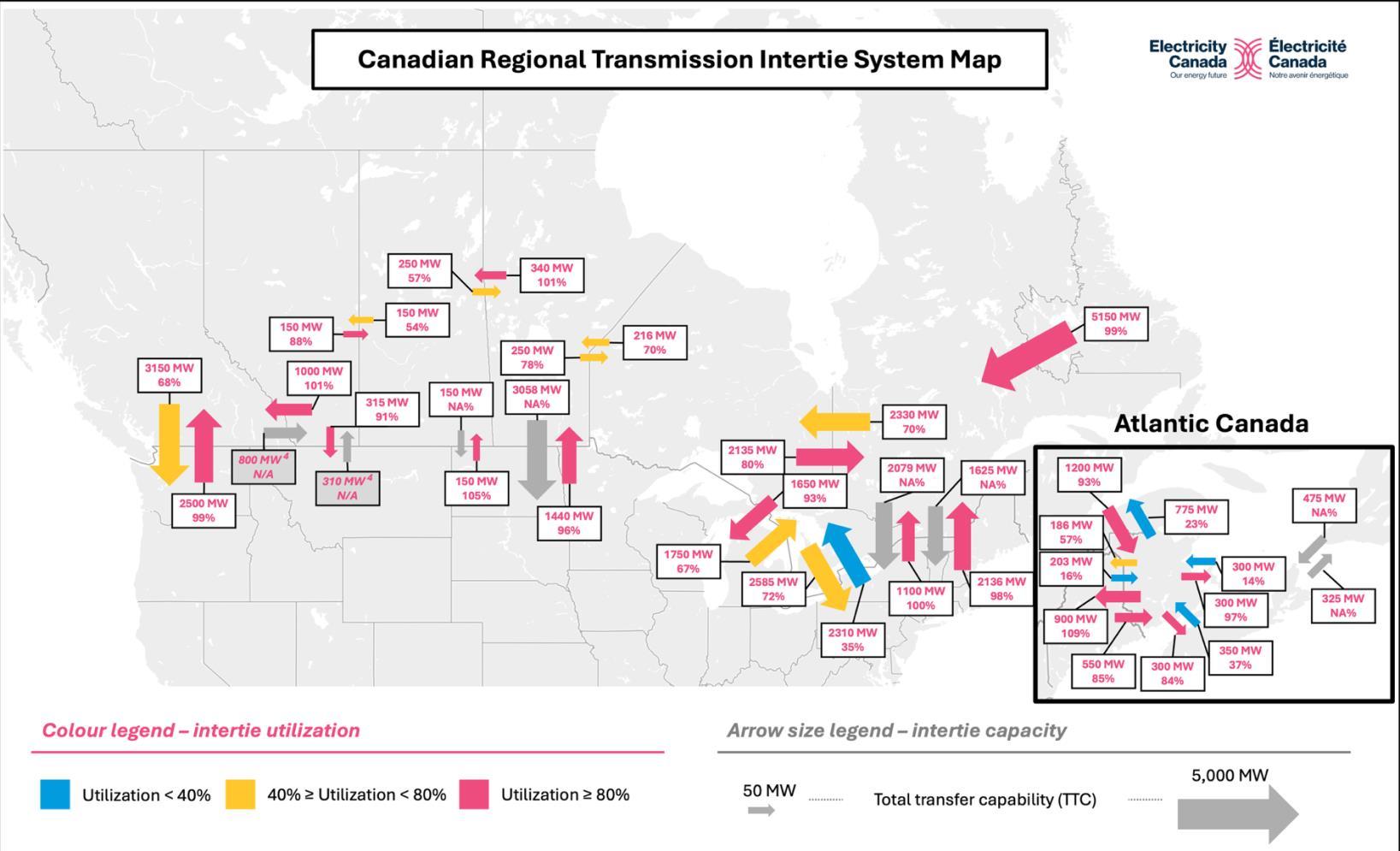
3 The intertie shown on the Saskatchewan-Manitoba border is the intertie connecting Manitoba to southern Saskatchewan (SK-S). The intertie connecting Manitoba to northern Saskatchewan was excluded from the study. The ON–MI and ON–MN interties are consolidated as both connect Ontario to regions operated by MISO.
4 BC and Montana share a combined flow gate. TTC between the two interties totals 1,110 MW with a combined utilization of 55%. Energy flows into Alberta on the combined BC and Montana path are limited due to Alberta reliability considerations. Alberta is targeting to implement mitigation measures to increase allowable flows by 2029 [1, 4, 24].
Table 1 – Organization of interties by TTC and utilization. N/A indicates where data was not available.
Canada’s intertie network consists of 20 major connections, evenly split between 10 east-west and 10 northsouth interties. The combined transfer capability is approximately 17 GW east-west and 28 GW north-south. Intertie utilization rates are high nationwide, averaging 72% for east-west interties and 79% for north-south interties. Notably, many interties operate near or above their TTC during peak periods, underscoring their critical role in supporting system reliability and facilitating economic and market outcomes.
Network capacity is unevenly distributed across the country. The largest interties are concentrated in northsouth corridors, the Quebec–Ontario–Labrador corridor, and British Columbia. This distribution reflects historical priorities for hydroelectric development, reliability requirements, and export opportunities to the United States. East-west capacity is comparatively limited in the central provinces (i.e., Alberta, Manitoba and Saskatchewan), resulting in two distinct regions and constraining energy transfers from coast to coast.
Across the last three years, high utilization on most interties highlights their strategic importance in supporting both reliability and economic outcomes. Where utilization is lower, this can reflect directional asymmetry, energy flows predominantly in one direction due to differing provincial supply–demand needs. In these cases, lower utilization does not indicate limited value; the intertie can still provide critical reliability support and operational flexibility. For example, east-to-west interties in Eastern Canada, exhibit low utilization (e.g., 23% NB->QC), as they are primarily used for west-to-east transfers (e.g., 93% QC->NB), where they carry significant volumes to the Atlantic region.
Overall, the data demonstrates that Canada’s intertie network plays a crucial role in supporting electricity reliability and facilitating energy markets, with most connections experiencing high utilization. However, the network’s uneven capacity distribution and directional flow patterns create regional constraints, particularly in central provinces and the Atlantic region. These findings highlight both the strengths and limitations of the current intertie system, pointing to potential areas for future capacity enhancement and operational optimization.
To provide additional context, three case studies have been included to examine intertie operations in greater detail across different jurisdictions. These examples are not intended to highlight specific regions as issues or models. Rather, they are selected to offer a closer look on intertie usage and operational dynamics over a 3-year period from 2023 to 2025. By analyzing these jurisdictions in more detail, we aim to present a clearer and more nuanced understanding of the current state of intertie utilization across Canada.
Atlantic Canada’s energy systems are in transition as provinces look to maintain reliability while phasing out coal-powered generation, refurbishing aging infrastructure, and bringing new renewable generation sources online. Electricity predominantly flows eastward, from Québec into New Brunswick then to the other provinces, creating directional utilization on interties.
New Brunswick is the critical hub for the Maritimes, annually importing up to 2 TWh from Hydro-Québec [7] and sending energy to Nova Scotia and Prince Edward Island. In view of the planned 2030 coal phaseout [8], the province is increasingly looking to firm imports as 40% of its electricity currently comes from the aging Point Lepreau nuclear station [9], and their primary dam (Mactaquac) requires a ~$7-9B refurbishment [10]. Upgrades to the supporting infrastructure for the Québec intertie are planned to be finished by 2029, but no new lines or major capacity additions have been finalized [1].
Nova Scotia is rapidly transitioning to wind and solar while phasing out coal-fired generation while importing electricity from New Brunswick and Newfoundland & Labrador, especially during low renewable output [11]. The intertie capacity with New Brunswick is set to be doubled via the Wasoqonatl Transmission Line, a new 345 kV corridor, which is forecasted to be in service by late 2028 and cost $685M with a portion of funding announced by the CIB and NRCan [12] [13]
Prince Edward Island imports 82% of its electricity from New Brunswick via submarine cables [1]. Wind provides approximately 58% of the island’s domestic capacity, and they rely on largely off-island sources for reliable and cost-effective energy [14]. Recent reports warn that Prince Edward Island faces a projected 27% capacity deficit by 2033 unless new resources and intertie expansions are developed [15]. As such, talks are underway on the potential for doubling the existing intertie capacity with New Brunswick [1]
Traditionally, a net exporter of their abundant hydroelectricity, recently, imports into British Columbia have often approach the maximum allowed because BC’s grid has faced multi-year droughts that cut hydro output by nearly 28% in 2024, requiring BC Hydro to import about 25% of its electricity needs from Alberta and the United States [16]. BC leverages imports from Alberta as Alberta’s grid, rich in natural gas and growing wind capacity, complements BC’s system to supply firm power during low hydro periods and winters peaks. Under non-drought conditions, market dynamics also favor BC importing low-cost Alberta power to engage in arbitrage by conserving water for future high-value exports. Conversely, BC supports Alberta during grid stress, such as the January 2024 cold snap [17], by exporting hydro during periods of lower generation from Alberta’s renewables. Whie intertie utilization is currently westward as the AESO has stricter limits on imports into Alberta for reliability reasons, there are plans to enable the intertie to support full flow capabilities with updates within the next 5 years. These plans include transmission infrastructure upgrades estimated to cost $150M [18, 19] and the procurement of ancillary services to support full imports on the ABBC/MT interties during all normal operating conditions [20].
Ontario and Quebec each benefit through the use of strategic agreements that help make efficient use of excess seasonal capacity. The two provinces have complementary seasonal demand peaks (Ontario in the summer and Quebec in the winter) which enables the ongoing 2024 agreement for an annual capacity swap
of 600 MW [1]. This active agreement is cost-effective for both provinces when considering alternatives including curtailing renewable electricity or building net-new generation capacity. Into the 2030s, under certain energy transition scenarios Ontario’s grid may become dual peaking [21]. The IESO and HydroQuebec are continuing to evaluate the opportunity for increasing current intertie capacity through upgrades and new connections [1]. The IESO is undergoing an Eastern Ontario Bulk Planning study (set to conclude in 2026) to examine the system's capability for transfers to and from Quebec [1].
Building on this current state understanding of today’s intertie system, the next section examines how these dynamics may evolve under future conditions.
This section explores the future electricity system across Canada and aims to understand the potential future role of the intertie system. The first step seeks to understand which provinces might face a supplydemand surplus or deficit in the future. Provinces with the potential of being short supply (i.e., deficit) could be candidates for enhanced east-west interties to strengthen their system. On the other hand, provinces forecasted to be long supply could benefit from enhanced interties to increase exports to provincial neighbors. The second step evaluates the role of intermittent resources in each province’s future supply stack. Provinces with a significant share of intermittent resources in their supply stack could benefit from enhanced east-west interties to enable improved reliability and energy export outcomes.
To complete the first step of the analysis, we compared provincial effective supply and demand under two scenarios: a Baseline and a Stretched scenario. The Stretched scenario is designed to address the limitations of point-in time forecasts, by accounting for planning uncertainty by layering in potential stressors such as higher than expected demand (e.g., extreme weather, outages, policy changes) and lower incremental supply (e.g., build delays, supply chain constraints, drought). For the second step, we analyzed the share of intermittent resources in each province’s supply mix for 2024 and 2040, mapping these on a 2×2 matrix to illustrate the evolving role of intermittent resources in each province.
This section compares each province’s projected peak demand against its effective capacity under two scenarios: Baseline and Stretched. To understand future system adequacy, our evaluation focuses on effective capacity rather than installed capacity, as it reflects the ability of provincial generation resources to reliably meet peak demand. In Figures 3a and 3b, provinces with a positive difference between effective capacity and peak demand are projected to have a surplus of capacity relative to demand, whereas provinces with a negative difference may experience deficits in meeting demand with domestic generation. To note, installed capacity is shown for reference purposes only but is not included in the supply-demand ratio analysis. Table 2 normalizes the difference between effective capacity and peak demand as a percentage of peak demand, providing a clear view of relative surplus or deficit across provinces.
Figures 3a (top) and 3b (bottom) – Baseline and Stretched Scenario of forecasted peak demand and effective capacity supply (GW) in 2040, by province. Effective capacity assumes an ELCC of 0 for IRRs. Installed capacity is shown for reference purposes but is not included in the analysis.
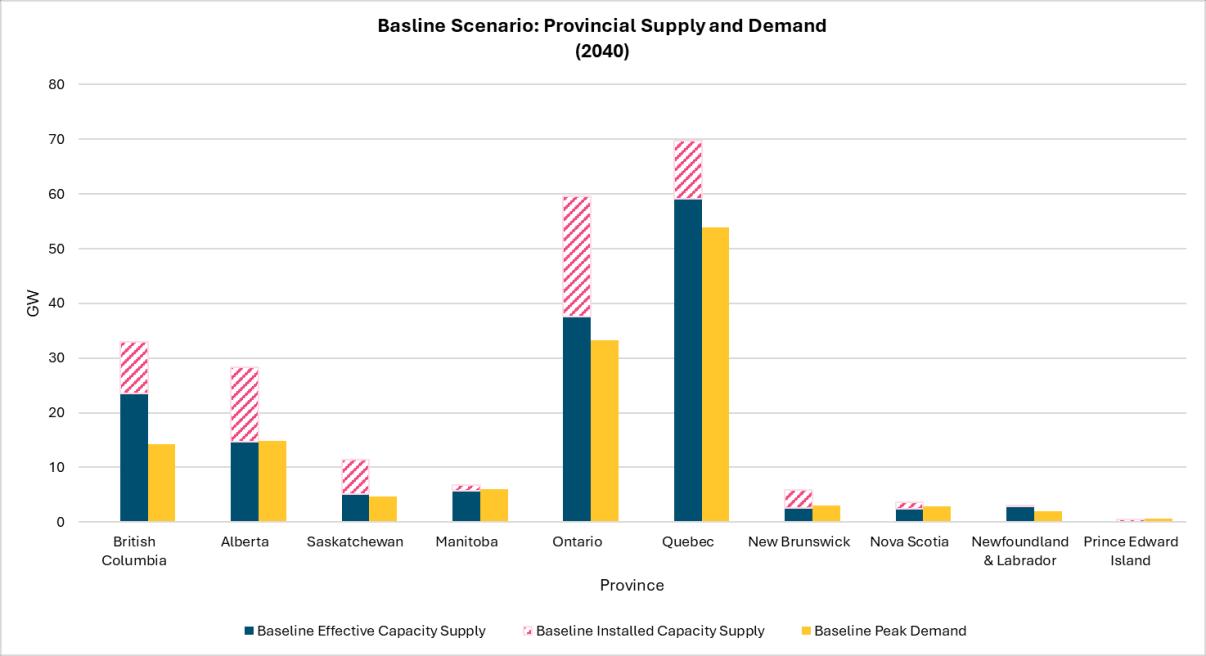
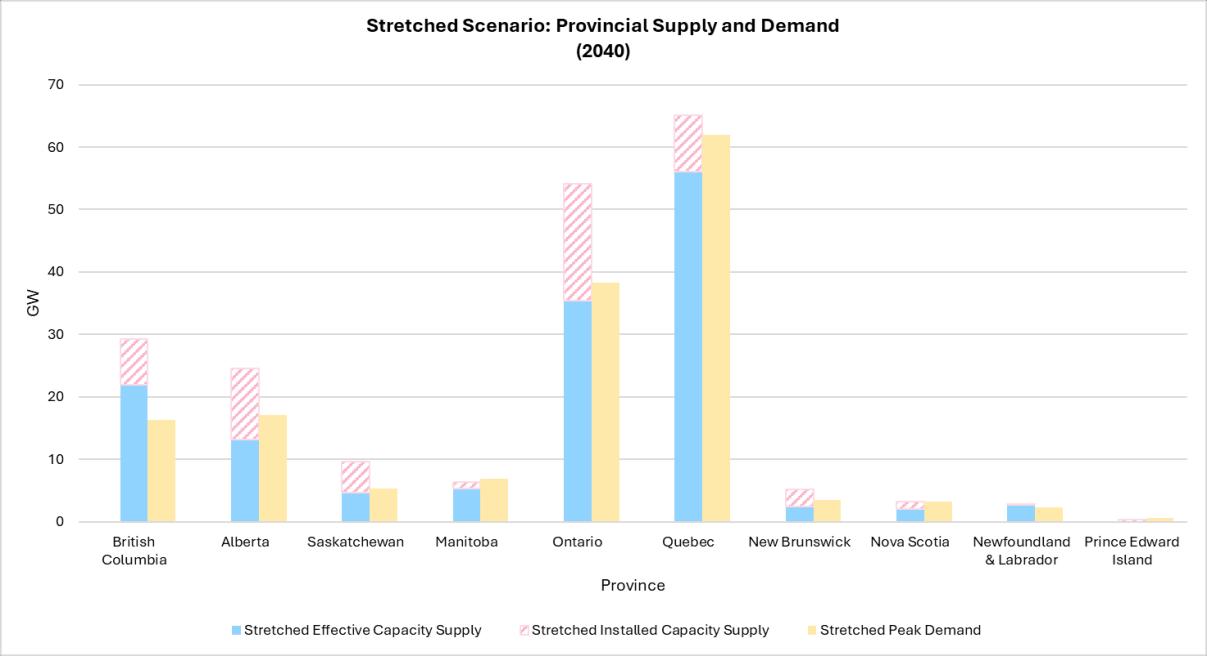
Table 2 – Effective capacity supply and peak demand ratio (%) in 2040, by province. The ratio is defined as (Effective Capacity – Demand) / Demand. (+/-) implies surplus or deficit of supply to meet demand. Effective capacity assumes an ELCC of 0 for IRRs. Provinces with potential deficits have been highlighted.
Provinces at risk of deficit
By 2040, under the Baseline Scenario, half of the provinces are projected to maintain positive supplydemand ratios, with British Columbia leading by a notable margin and Saskatchewan holding moderate surpluses. Ontario and Quebec are similar in standing with positive ratios, while Alberta and Manitoba may experience deficits, suggesting emerging constraints. Atlantic Canada shows a more varied outlook as Newfoundland & Labrador is the sole province that potentially will have a surplus, whereas the other eastern provinces may experience deficits
Under the Stretched Scenario, these interprovincial trends change as increased demand and delayed growth in domestic effective capacity buildout leads to significantly reduced ratios across the country. British Columbia and Newfoundland are projected to be the only provinces to maintain surpluses in capacity. All other provinces see their effective capacity to peak demand ratio tested under stress; Saskatchewan, Ontario, and Quebec which all previously held moderate positive ratios may shift into potential deficits and baseline deficits may widen in Alberta, Manitoba, and the remaining Atlantic provinces. This scenario highlights the need to leverage forecasted surplus regions, particularly BC and Newfoundland & Labrador, to support their neighbouring provinces at risk of deficits, through enhanced intertie connections.
The role of intermittent resources today and in the future is depicted for each province in Figure 4. Provinces in the bottom-left quadrant are low adopters of intermittent resources and continue to depend on traditional resources such as hydro power. Provinces in the top-left quadrant are emerging adopters of intermittent resources and are evolving their supply mix to include a significant amount of these resources in the future. Provinces in the top-right quadrant are the high adopters of intermittent resources who have significant intermittent capacity deployed today and aim to grow this out to 2040.
Figure 4 - Visual depiction of current and future intermittent resource deployment levels, by province.
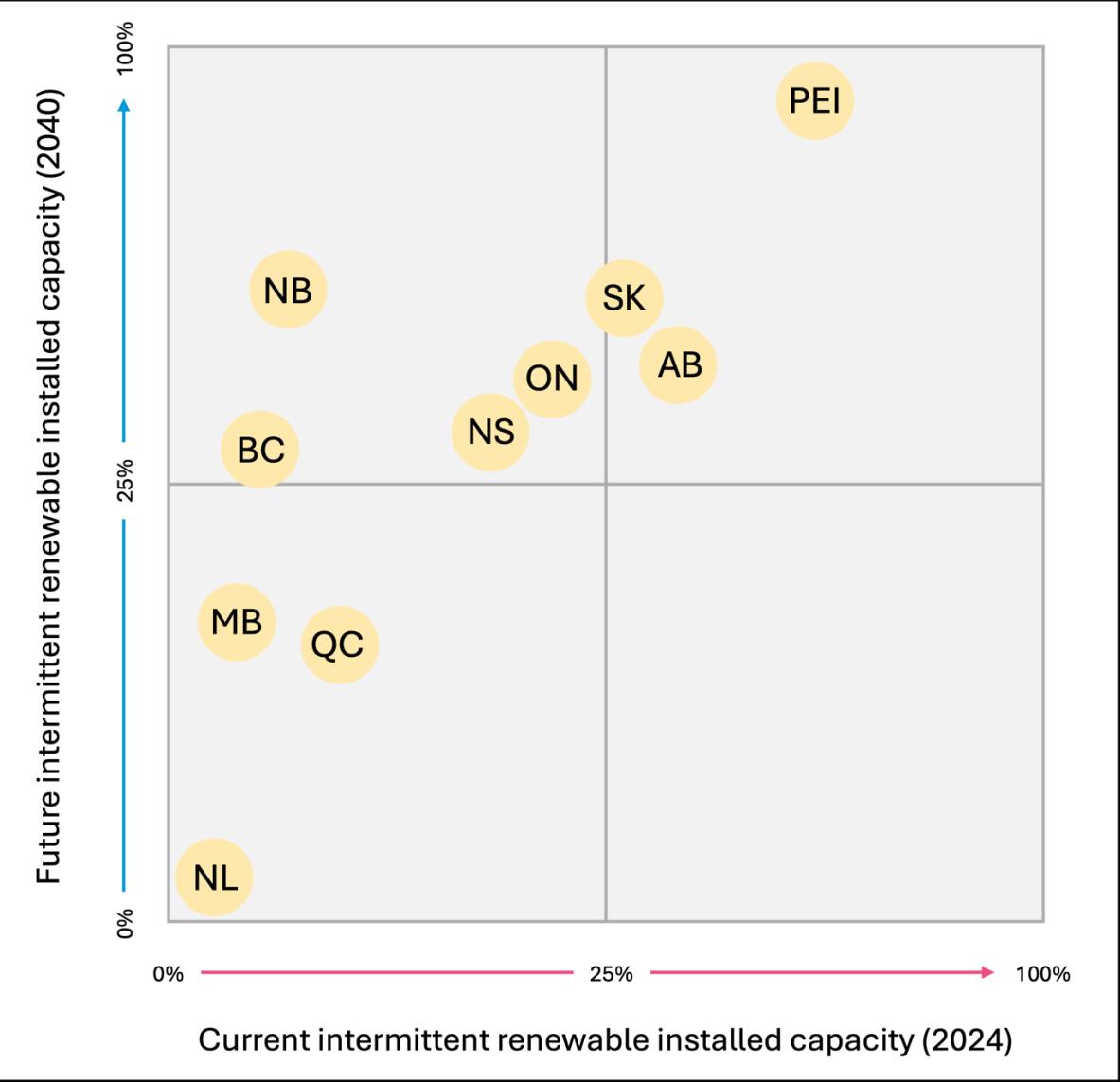
From this data, we see that Alberta, Saskatchewan and Prince Edward Island4 will deploy the largest relative quantities of intermittent resources. Meanwhile, British Columbia, New Brunswick, Nova Scotia, and Ontario plan to significantly grow their relative share of intermittent resources. All seven of these provinces might face reliability and resilience challenges with these increased levels of intermittent resource deployment. Interconnections enhance the utilization of variable resources, which will be critical as these provinces adapt to higher shares of intermittent generation. Newfoundland, Manitoba, and Quebec continue to rely on firm hydropower, natural gas, and nuclear to power their provinces. These provinces may be able to support the other seven provinces in meeting reliability and resilience goals through enhanced east-west interties.
These insights from the future state assessment combined with the current state assessment form the basis for identifying opportunities for enhanced interprovincial transmission, discussed in the next section.
4 On-island / domestic generation currently only meets a minor portion of PEI’s demand; the province imports 82% of its electricity from New Brunswick with talks on doubling intertie capacity in the future [1]
This section builds on current and future state analyses to identify illustrative opportunities for enhanced interprovincial transmission. These examples demonstrate transmission’s potential value under evolving conditions and highlight areas for further exploration.
Interties between British Columbia, Alberta, and Saskatchewan offer significant potential for regional optimization as all three provinces increasingly rely on intermittent resources. These connections could play a role to boost system resilience, enabling mutual support during supply disruptions or variability. The BC-AB intertie capability has been limited, and optimization of the existing infrastructure will lead to higher utilization [18], while the AB-SK intertie faces limited use and age-related asset challenges, rebuilding the line presents an opportunity to increase capacity5. Strengthening and better coordinating these interties would optimize resource sharing, balance supply and demand, and mitigate risks from intermittent generation, positioning Western Canada to manage future demand and reliability.
Currently, Manitoba has larger outward intertie capacity and utilization, suggesting it is a net exporter of electricity to Ontario and Saskatchewan, supported by its strong hydro resources. However, rising demand and limited new capacity may lead to future supply constraints, with neighboring provinces potentially holding surpluses. This creates an opportunity for Manitoba to import electricity and address supply gaps, especially as hydro-dependent provinces are vulnerable to variability during poor water years. Enhanced intertie use and coordinated planning with neighbors could boost Manitoba’s resiliency, reduce supply risks, and ensure reliable service as demand grows.
Interties from Quebec and Newfoundland and Labrador (NL) into Atlantic Canada present an opportunity to meet rising electricity demand and reduce vulnerability from intermittent renewables in New Brunswick, Nova Scotia, and PEI. Nova Scotia and PEI rely on imports from New Brunswick, and all three provinces experience adverse weather impacts simultaneously. Quebec and NL show surplus supply under both baseline and stress scenarios, while Nova Scotia and PEI face deficits. By expanding intertie capacity and enabling regional energy transfers, Quebec and NL can play a pivotal role in meeting the Atlantic provinces’ future needs, advancing both reliability and cleaner supply objectives
The Ontario–Quebec intertie exemplifies effective interprovincial collaboration, with both provinces optimizing energy flows through strategic agreements and infrastructure planning. Their complementary seasonal demand peaks enable efficient energy sharing and reduce the need for redundant capacity investments, even as both provinces plan significant future expansions. However, stressed scenarios reveal potential undersupply for Ontario and Quebec in 2040, -7% and -10% supply-demand ratio respectively. An integrated regional approach to east-west transmission could continue optimize existing assets, address supply challenges, and prevent costly overbuild.
5 The AB-SK intertie was recently returned to service after being offline for over a year due to an equipment failure. Plans are being explored to expand its capacity from 150 MW to 400-500 MW [1].
Electricity systems are developed under provincial jurisdiction, with transmission infrastructure primarily connecting local generation to domestic demand. As demand increases due to population growth, transportation and industrial electrification, and economic expansion (particularly in emerging sectors such as data centres and critical minerals mining), interprovincial transmission will be essential for reliably and affordably integrating new energy sources.
Our study holds that Canada’s network of east-west interties is effectively utilized, and contributes, per design, to system resilience, reliability and optimization. Over the next 10-25 years, forecasts suggest that some provinces may experience electricity surplus while others could face constraints. This presents opportunities to further optimize interprovincial transmission in response to accelerating demand and the growing importance of intermittent energy resources. However, it is important to note that these demand forecasts are inherently uncertain, increasing the risk associated with planning and developing long-term, capital-intensive energy systems, particularly if demand does not materialize where and when anticipated.
Provincially interconnected transmission infrastructure presents a significant opportunity for Canada to meet future electricity demand in an efficient and cost-effective manner, while also advancing economic growth and nation-building objectives. Taking proactive steps now to prioritize interprovincial transmission can help avoid the inefficiencies and higher costs associated with each province independently expanding its own electricity system. Elevating transmission to a central role in energy strategy, through regionally coordinated and integrated planning, will help ensure reliability, affordability, sustainability, and economic development. Adopting a comprehensive, system-wide approach that considers all resource options and timelines will maximize the effectiveness and resilience of Canada’s electricity system.
While there is increasing appreciation of the benefits of interprovincial transmission and coordinated regional electricity planning, several key barriers must be addressed to fully capture these opportunities. Targeted action in these areas will be important to advance interprovincial transmission and to establish a more integrated and efficient electricity system in Canada. Barriers include:
Market Structures: Over the past 50 years, provinces have developed markedly different electricity market structures, ranging from fully deregulated markets (e.g., Alberta), to competitive wholesale markets (e.g., Ontario and what is emerging Nova Scotia), to regulated markets (e.g., BC, Manitoba, and Quebec) These differences create challenges in forming mutually beneficial, long-term contracts necessary for capitalintensive, long-lived assets like transmission interties Historically, provincial interties have prioritized system reliability, with exports more often directed to the US due to larger demand and more attractive market mechanisms
To advance interprovincial transmission, it is essential to develop fair cost allocation frameworks that equitably distribute costs and benefits among participating provinces, private entities, and the federal government, reflecting the value derived from increased reliability, reduced costs, or environmental improvements Mechanisms such as regional capacity markets or transmission rights could support the creation of long-term revenue streams for provinces or private investors, incentivizing both the optimization of existing infrastructure and new transmission development. Consideration must also be given to enabling frameworks that allow for cost recovery and reasonable returns on transmission investments, while accommodating the diversity of provincial electricity market and regulatory structures. This will help prevent transmission development from being hindered by market differences.
→ Next step: Explore alternate and additional market instruments that may enhance the competitiveness and broader role of interprovincial transmission interties. These instruments must be designed to function within, and respect, the varying market structures and jurisdictions of each province.
Economic: Canada’s vast geography and low population density create financial challenges for developing new interprovincial intertie infrastructure. To fully understand the value of enhancing east-west interties, it is important to consider not only technical factors but also the broader national and regional strategic and macroeconomic benefits.
A key element of this evaluation is benefit accrual, which refers to the process of aggregating and allocating benefits of transmission projects among different parties. Calculating benefit accrual helps quantify the total value a project can deliver and provides a transparent basis for comparing benefits to costs. This approach supports fair and equitable cost-sharing among participants by aligning each party’s funding responsibility with the benefits they receive.
→ Next step: Strengthen the business case for east-west transmission in Canada by developing benefit accrual assessments and implementing policy mechanisms that incentivize investment and enable coordinated planning across jurisdictions.
Governance and planning: Clear roles and responsibilities for regional coordination are essential to support optimized regional transmission planning Currently, electricity generation and transmission fall primarily under provincial jurisdiction, resulting in differing regulations, standards, and priorities across provinces. Meanwhile, the federal government regulates international electricity transmission. This fragmentation can complicate efforts to pursue integrated, cross-provincial solutions. Furthermore, the absence of an overarching national or interprovincial framework to facilitate intertie transmission projects adds to the complexity of coordination. Examples of overarching system-level planning bodies include Europe’s ENTSOE [22] and Australian Energy Market Operator [23].
→ Next step: Establish an interprovincial or regional framework that accelerates transmission planning by clearly defining federal and provincial roles. For example, the framework could assign the federal government responsibility for coordination, funding, and regulatory support, while provincial governments and utilities oversee local implementation and operations.
Policy and regulation: Reduce barriers that currently limit interprovincial collaboration. Provinces have distinct energy strategies, and some maintain self-sufficiency regulations that can impede broader national alignment and restrict opportunities for shared infrastructure development and interprovincial system optimization. In an era of more uncertain demand forecasts, prioritizing self-sufficiency at the provincial level may result in overbuilding of infrastructure and lost interprovincial optimization Harmonizing electricity market rules and regulations across provinces would facilitate electricity trade and make interprovincial transmission projects more attractive to investors and stakeholders
→ Next step: Conduct a comprehensive, collaborative review to identify and address regulatory barriers to east-west electricity trade and interprovincial transmission planning, culminating in a coordinated plan with recommendations for harmonizing market rules, revising self-sufficiency regulations, and aligning provincial energy strategies.
Financing: Significant investment will be required to build the future electricity system. Unlike other types of infrastructure, which are often funded through a combination of users and taxpayers, electricity infrastructure is nearly always paid for directly by users. This traditional funding model places the financial responsibility primarily on ratepayers, whereas other public infrastructure benefits from broader taxpayer support. As the electricity sector is now being asked to undertake complex capital-intensive projects of national importance, the existing ratepayer-focused model may not be sufficient or equitable. There is an opportunity to optimize these investments by coordinating and sharing costs not only at the federal level, but also among provinces. Provinces will not always equally share the benefits of interties and thus a costbenefit framework between provinces would enable the best cost-sharing path between provinces. Costsharing mechanisms, alongside federal support, can help distribute financial risk, align interests, and ensure that the benefits and responsibilities of new transmission infrastructure are shared equitably. This is
especially important for projects that deliver national benefits, such as emissions reduction and improved grid reliability. In addition, targeted grants, low-interest loans, or loan guarantees from the federal government can further reduce high upfront costs of transmission projects
→ Next step: Establish a collaborative working group of federal, provincial, regulatory, and industry representatives to review financial barriers to transmission development and create a coordinated financing framework that defines cost-sharing and identifies where targeted federal support can most effectively accelerate investment and project delivery.
Provinces are already planning the next generation of electricity systems for 2050, and decisions made today will shape those outcomes for decades. If interprovincial transmission is not proactively assessed and considered now, Canada risks locking in costly, fragmented infrastructure that limits flexibility and resilience. Electricity Canada is uniquely positioned to assume a leadership role in advancing interprovincial transmission and regional electricity planning. By fostering alignment among stakeholders, Electricity Canada can co-develop well-founded recommendations regarding market incentives, structured regional planning, reducing regulatory barriers, establishing cost-sharing mechanisms and providing targeted support. This represents a significant opportunity to ensure that investments in transmission infrastructure support affordability, strengthen system resiliency, and advance Canada’s long-term economic and climate objectives.
[1] Electricity Canada, “Intertie Data Workbook: Validated Provincial and Intertie Dataset,” prepared for the Intertie Study, Dec. 2025.
[2] Canada Energy Regulator, “Canada’s Energy Future 2023: Energy Supply and Demand Projections to 2050,” 2023. [Online]. Available: https://www.cer-rec.gc.ca/en/data-analysis/canada-energy-future/2023/index.html
[3] North American Electric Reliability Corporation, “Transmission Transfer Capability,” May 1995. [Online]. Available: https://www.nerc.com/globalassets/initiatives/itcs/transmissiontransfercapability_may1995.pdf
[4] Alberta Electric System Operator, “Information Document Available Transfer Capability and Transfer Path Management ID #2011-001R,” Mar. 10, 2023. [Online]. Available: https://www.aeso.ca/assets/InformationDocuments/2011-001R-ATC-and-Transfer-Path-Management-2023-03-10.pdf
[5] Newfoundland & Labrador Hydro, “The Churchill Falls MOU: Just the Facts,” Sept. 2025. [Online]. Available: https://nlhydro.com/good-to-know/the-churchill-falls-mou-just-the-facts/
[6] B. Shingler, “Demand for cheap, clean hydropower is soaring. Can Quebec keep up?,” CBC News, Aug. 31, 2024. [Online]. Available: https://www.cbc.ca/news/climate/quebec-hydro-drought-hydroelectricity-climate-1.7309366
[7] Hydro-Québec, “A trio of agreements signed with New Brunswick,” Jan 2020. [Online]. Available: https://www.hydroquebec.com/clean-energy-provider/markets/new-brunswick.html
[8] NB Power, “Energizing Our Future: Strategic Plan 2023-2035,” Jun. 7, 2023. [Online]. Available: https://www.nbpower.com/media/1492376/energizing-our-future-strategic-plan-2023-2035-nb-power.pdf?06-07-2023
[9] Canada Energy Regulator, “Provincial and Territorial Energy Profiles – New Brunswick,” Jul 2025. [Online]. Available: https://www.cer-rec.gc.ca/en/data-analysis/energy-markets/provincial-territorial-energy-profiles/provincial-territorialenergy-profiles-new-brunswick.html
[10] J. Poitras, “Mactaquac Dam upgrade gets environmental go-ahead,” CBC News, Jun 13, 2025. [Online]. Available: https://www.cbc.ca/news/canada/new-brunswick/mactaquac-dam-upgrade-gets-environmental-go-ahead-1.7560785
[11] NS Power, “Clean Energy Sources,” 2025. [Online]. Available: https://www.nspower.ca/cleanandgreen/cleanenergy/clean-energy-sources
[12] Nova Scotia Energy Board, “Decision: Wasoqonatl Transmission Incorporated,” Nov. 20, 2025. [Online]. Available: https://nserbt.ca/sites/default/files/NSEB%20Board%20Decision%20%20Wasoqonatl%20Transmission%20Incorporated%20M12217.pdf
[13] Canada Infrastructure Bank, “CIB commits $217 million to Nova Scotia to New Brunswick (Wasoqonatl) Reliability Intertie,” Mar. 5, 2025. [Online]. Available: https://cib-bic.ca/en/medias/articles/cib-commits-217-million-to-novascotia-to-new-brunswick-wasoqonatl-reliability-intertie/
[14] Government of Prince Edward Island, “PEI Energy Strategy,” Nov. 2025. [Online]. Available: https://www.princeedwardisland.ca/en/information/environment-energy-and-climate-action/pei-energy-strategy
[15] Canadian Renewable Energy Association, “Affordable, clean electricity at the heart of PEI’s new 10-year energy strategy,” Oct. 30, 2025. [Online]. Available: https://renewablesassociation.ca/statement-affordable-clean-electricityat-the-heart-of-peis-new-10-year-energy-strategy/
[16] A. Judd and A. McArthur, “BC Hydro imported a quarter of the province’s power in the last 12 months,” Global News, Nov. 28, 2024. [Online]. Available: https://globalnews.ca/news/10892803/bc-hydro-imported-quarter-power-12-month
[17] Alberta Market Surveillance Administrator, “January and April 2024 Event Report,” Apr 2024. [Online]. Available: https://www.albertamsa.ca/assets/Documents/January-and-April-2024-Event-Report.pdf
[18] Alberta Electric System Operator, “AESO 2025 Long-Term Transmission Plan,” Jan. 2025. [Online]. Available: https://www.aeso.ca/assets/2025-AESO-Long-Term-Transmission-Plan.pdf
[19] Alberta Electric System Operator, “Government of Alberta Direction Letter: REM, Cost Allocation and Optimal Transmission Planning,” Dec. 10, 2024. [Online]. Available: https://www.aeso.ca/assets/direction-letters/Direction-Ltrfrom-Minister-REM_Tx-Policy_10Dec2024.pdf
[20] Alberta Electric System Operator, “Government of Alberta Direction Letter: Intertie Engagement, MATL Restoration and Ancillary Services to Support MATL and AB-BC Imports,” Oct. 14, 2025. [Online]. Available: https://www.aeso.ca/assets/direction-letters/AESO-Direction-Letter-on-Interties.pdf
[21] Independent Electricity System Operator, “Annual Planning Outlook: Engagement Webinar,” Nov. 18, 2025. [Online]. Available: https://www.ieso.ca/Sector-Participants/Engagement-Initiatives/Engagements/Annual-Planning-Outlook
[22] ENTSO-E, “European Network of Transmission System Operators for Electricity,” [Online]. Available: https://www.entsoe.eu. [Accessed: Dec. 15, 2025].
[23] AEMO, “Australian Energy Market Operator,” [Online]. Available: https://www.aemo.com.au. [Accessed: Dec. 15, 2025].
[24] Government of Alberta, “AESO Direction Letter on Interties,” Oct. 14, 2025. [Online]. Available: https://www.aeso.ca/assets/direction-letters/AESO-Direction-Letter-on-Interties.pdf

www.deloitte.ca
Deloitte, one of Canada's leading professional services firms, provides audit, tax, consulting, and financial advisory services. Deloitte LLP, an Ontario limited liability partnership, is the Canadian member firm of Deloitte Touche Tohmatsu Limited.
Deloitte refers to one or more of Deloitte Touche Tohmatsu Limited, a UK private company limited by guarantee, and its network of member firms, each of which is a legally separate and independent entity. Please see www.deloitte.com/about for a detailed description of the legal structure of Deloitte Touche Tohmatsu Limited and its member firms.
© Deloitte LLP and affiliated entities.