T OR PP SU
EDUCATION
ADVOCACY
THE
www.cabe.org
JOURNAL
www.facebook.com/ConnecticutAssociation-
Connecticut Association of Boards of Education Vol. 21, No. 7
The Leading Voice for Connecticut Public Education
Summer Fun!
Annual Condition of Education Released Robert Rader
EXECUTIVE DIRECTOR, CABE
At its June meeting, the State Board of Education “received” The Condition of Education (2015-16), which contains important information on many issues affecting our public schools. Key highlights from the 2015-16 report are below: • Connecticut’s student enrollment has declined by 4.6 percent over the past six years. • Though lower, enrollment is increasingly more diverse (i.e., 44
percent are nonwhite), poor. (i.e., 38 percent are eligible for free or reduced price meals), and with greater educational needs (i.e., 13.4 percent are students with disabilities while 6.7 percent are English learners). • While the composition of the student population is changing, the teaching force remains quite homogeneous (i.e., nearly 92 percent of certified staff are white). • Suspension/expulsion and chronic absenteeism rates are declining statewide; however, they continue See ANNUAL CONDITION page 8
Sheila McKay
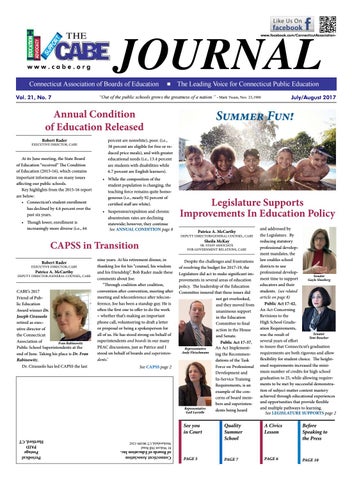
CABE’s 2017 Friend of Public Education Award winner Dr. Joseph Cirasuolo retired as executive director of the Connecticut Association of Fran Rabinowitz Public School Superintendents at the end of June. Taking his place is Dr. Fran Rabinowitz. Dr. Cirasuolo has led CAPSS the last
SR. STAFF ASSOCIATE FOR GOVERNMENT RELATIONS, CABE
nine years. At his retirement dinner, in thanking Joe for his “counsel, his wisdom and his friendship”, Bob Rader made these comments about Joe: “Through coalition after coalition, convention after convention, meeting after meeting and teleconference after teleconference, Joe has been a standup guy. He is often the first one to offer to do the work – whether that’s making an important phone call, volunteering to draft a letter or proposal or being a spokesperson for all of us. He has stood strong on behalf of superintendents and boards in our many PEAC discussions, just as Patrice and I stood on behalf of boards and superintendents.’ See CAPSS page 2
Connecticut Association of Boards of Education Inc.
Patrice A. McCarthy
DEPUTY DIRECTOR /GENERAL COUNSEL, CABE
Patrice A. McCarthy
Despite the challenges and frustrations of resolving the budget for 2017-19, the Legislature did act to make significant improvements in several areas of education policy. The leadership of the Education Committee insured that these issues did not get overlooked, and they moved from unanimous support in the Education Committee to final action in the House and Senate. Public Act 17-37, An Act ImplementRepresentative Andy Fleischmann ing the Recommendations of the Task Force on Professional Development and In-Service Training Requirements, is an example of the concerns of board members and superintenRepresentative dents being heard Gail Lavielle
and addressed by the Legislature. By reducing statutory professional development mandates, the law enables school districts to use professional developSenator ment time to support Gayle Slossberg educators and their students. (see related article on page 8) Public Act 17-42, An Act Concerning Revisions to the High School Graduation Requirements, Senator was the result of Toni Boucher several years of effort to insure that Connecticut’s graduation requirements are both rigorous and allow flexibility for student choice. The heightened requirements increased the minimum number of credits for high school graduation to 25, while allowing requirements to be met by successful demonstration of subject matter content mastery achieved through educational experiences and opportunities that provide flexible and multiple pathways to learning. See LEGISLATURE SUPPORTS page 2
See you in Court
Quality Summer School
A Civics Lesson
Before Speaking to the Press
PAGE 5
PAGE 7
PAGE 6
PAGE 10
81 Wolcott Hill Road Wethersfield, CT 06109-1242
EXECUTIVE DIRECTOR, CABE
Legislature Supports Improvements In Education Policy DEPUTY DIRECTOR/GENERAL COUNSEL, CABE
CAPSS in Transition Robert Rader
July/August 2017
“Out of the public schools grows the greatness of a nation.” - Mark Twain, Nov. 23,1900
Periodical Postage PAID Hartford, CT
2
The Journal – Connecticut Association of Boards of Education | July/August 2017
PRESIDENT COMMENTARY
Summertime Musings, 2017 Ann Gruenberg PRESIDENT, CABE
The field of education in the U.S.A. has, for a long time, operated with a set of assumptions or “givens”, which are often unspoken. These may range widely and some factors may have been challenged, including those related to diversity and violence. It is time to challenge practices that involve “business as usual”. One assumption, having the summers “off ”, evokes varying reactions depending on one’s point of view. Some react with the belief that teachers have an easy row to hoe. Others recognize the importance of taking valuable time to regroup and process, as well as to continue to engage in professional development. Few teachers would assert that their primary motivation for going into the field of education is to have summers off, but many others may hold this stereotypic view, including some parents who work all year round. The historical roots of this sojourn in the summer, of course, stems from the agricultural tradition and the (usually unpaid) employment of youth in the fields during growing and harvesting season. Given the industrialization of agriculture, along with the growing achievement gap, the possibility of restructuring schools so they meet all year round resurfaces. Might this have a positive impact on student outcomes? The realities of experiences gaps are all the more poignant when we see some children benefitting from quality time during family vacations, learning from travels and visiting different places. While other children may be stuck at
CAPSS IN TRANSITION
(continued from page 1) “We will miss him!” Incoming Executive Director Dr. Rabinowitz is also a good friend of CABE. Fran brings a wealth of experience to this statewide leadership position. In addition to serving as a classroom teacher and district administrator, she has served as the Associate Commissioner of Education for the Connecticut State Department of Education (SDE), the Superintendent of the Hamden Public Schools and, most recently, as the Interim Superintendent of the Bridgeport Public Schools. For over thirty years, Fran has proven herself as a strong, highly respected and terrific educational leader in the state. As Fran has prepared for the transition, Patrice and Bob met with her. Patrice said, “We have known Fran for many years and she will be a wonderful leader for CAPSS. She is smart, strategic and thoughtful. Her eyes are always on what’s best for the students.” Both of us and all CABE members wish Joe a healthy and happy retirement and very much look forward to working with Fran!
home, potentially without books or access to other cultural opportunities, potentially food and/or nutrition insecure without the meals provided by schools during the academic year. Some communities have stepped up to address the needs of young people all year long. All of this is especially painful as we launch the new fiscal year without a fully developed budget, and some districts have even needed to cancel summer school. The beginning of summer, usually experienced with at least some sense of relief, is this year accompanied by an often unspoken sense of apprehension and a fervent hope that the extended contention will yield to consensus or, at least, some degree of resolution. It is small comfort to know that Connecticut is not alone with many of these challenges. In Connecticut, one of the many challenges relates to the ongoing processing of the CCJEF case. While this is still a work in progress, there are pressures related to the redistribution of resources, as well as some undercurrents regarding the ways to address ongoing needs perpetuated by disparities. There are also varying perspectives on how, and how fast, to take action. “… We have much work to do to improve the odds that all of our children will have high expectations of themselves and high success rates in our schools. The schools can’t do this on our own.” This clearly articulated perspective was shared by Mary Broderick, former NSBA president, in 2004, on the occasion of the 50th anniversary of Brown vs the Board of Education, when she was CABE’s president. How have things changed since then? A new initiative for Connecticut’s State Board of Education, on which Donald Harris, CABE’s Vice President for Government Relations serves, is to increase the focus on recruitment of teachers who represent culturally diverse groups. It is sometimes hard to break away from the ongoing challenging circum-
LEGISLATURE SUPPORTS
(contiued from page 1) Public Act 17-220, An Act Concerning Education Mandate Relief, alters or eliminates several state mandates. It allows, rather than requires, boards of education to follow a unified regional calendar; makes modifications to the requirements for alternative education for expelled students; reduces the number of school employees who are required to receive training in student restraint and seclusion; and shortens the look back period for which boards of education must conduct background checks of perspective employees. The reduction of these mandates provides appropriate flexibility on the local level. Public Act 17-200, An Act Making Revisions to the Student Data Privacy Act
Mission: To assist local and regional boards of education in providing high quality education for all Connecticut children through effective leadership. Vision: CABE is passionate about strengthening public education through high-performing, transformative local school board/superintendent leadership teams that inspire success for each child.
Board of Directors
stances, especially when there is such a profound sense of unfinished business and the impending, perpetual sense of what “should” be done. At the same time, it is all the more important that we take pause, breathe deeply, create some respite, center, prioritize, and somehow figure out how to do the best we can, under the circumstances. We can take the time to reorganize, renew, and perhaps reenvision possibilities. Our commitment to social change, equity and clarity is essential to our ongoing work. This may be especially true when consensus is hard to reach and there are shortages of civility. To operate in the context of chronic crisis takes a toll. The nature of the shared work, through which we learn to acknowledge personal patterns and have the courage to change them, as needed, warrants full, aligned and attuned states of being. Our collective focus, now, is on systems and structures. We are working with other organizations to address systemic discrimination, which has been part of the fabric of our society. We are also building upon past initiatives to enhance social justice. It may help to remind ourselves of some of the challenges of the past. Langston Hughes asked, in 1951 “What happens to a dream deferred . . . does it dry up like a raisin in the sun . . .? Maybe it just sags, like a heavy load . . . . or does it explode . . .?” Whatever the potential answers to those questions, it is evident that it is healthy to make choices that reduce deferred dreams. of 2016, extends the date by which boards of education must meet the requirements of the law to July 1, 2018, allowing the opportunity to address the significant issues encountered when negotiating contracts with entities that have access to student data. Public Act 17-14, An Act Implementing the Recommendations of the Department of Education, removes the requirement that a period of in-school suspension be calculated as a student absence. Each of the laws received overwhelming support in the Legislature – with most of them passing unanimously in the Education Committee, House and Senate. CABE appreciates the perseverance of the Education Committee Leadership in moving this legislation forward!
EXECUTIVE COMMITTEE Ann Gruenberg | President, Hampton Robert Mitchell | First Vice President, Montville Donald Harris | Vice President for Government Relations, Bloomfield Elizabeth Brown | Vice President for Professional Development, Waterbury Bob Trefry | Secretary/Treasurer, CT Technical High School System Richard Murray | Immediate Past President, Killingly John Prins | Member at Large, Branford Lydia Tedone | NSBA Director, Simsbury AREA DIRECTORS Jonathan Moore | Area 1 Co-Director, Region 1 Michelle Lucian | Area 1 Co-Director, Plymouth Byran Hall | Area 2 Director, East Hartford Michael Purcaro | Area 3 Co-Director, Ellington Michele Arn | Area 3 Co-Director, Vernon Joan Trivella | Area 4 Director, Brooklyn Michelle Embree Ku | Area 5 Director, Newtown Jennifer Dayton | Area 6 Co-Director, Greenwich Karen Kleine | Area 6 Co-Director, Westport Roxane McKay | Area 7 Director, Wallingford Lon Seidman | Area 8 Director, Essex Sean Nugent | Area 9 Director, Preston ASSOCIATES Eileen Baker | Associate, Old Saybrook Sharon Beloin-Saavedra | Associate, New Britain Robert Guthrie | Associate, West Haven Robert Trefry | Associate, CT Technical High School System COMMITTEE CHAIRS Becky Tyrrell | Chair, Federal Relations, Plainville Bryan Hall | Chair, Resolutions, East Hartford Christopher Wilson | Chair, State Relations, Bristol CITY REPRESENTATIVES Richard Wareing | City Representative, Hartford Carlos Torre | City Representative, New Haven Jacqueline Heftman | City Representative, Stamford Charles Stango | City Representative, Waterbury STAFF
Robert Rader | Executive Director Patrice McCarthy | Deputy Director and General Counsel Rebecca Adams | Senior Staff Attorney Bonnie Carney | Senior Staff Associate for Publications Nicholas Caruso | Senior Staff Associate for Field Service and Coordinator of Technology Sheila McKay | Senior Staff Associate for Government Relations Vincent Mustaro | Senior Staff Associate for Policy Service Lisa Steimer | Senior Staff Associate for Professional Development Teresa Costa | Coordinator of Finance and Administration Pamela Brooks | Senior Administrative Associate for Policy Service and Search Services Terry DeMars | Administrative Associate for Policy Service Gail Heath | Administrative Associate for Government Relations Wilmarie Newton | Administrative Associate for Labor Relations Nancy Propfe | Administrative Assistant for Membership Services Corliss Ucci | Receptionist and Assistant to Executive Director
The CABE Journal (ISSN 1092-1818) is published monthly except a combined issue for July/August as a member service of the Connecticut Association of Boards of Education, 81 Wolcott Hill Road, Wethersfield, CT 06109, (860) 571-7446. CABE membership dues include $30 per person for each individual who receives The CABE Journal. The subscription rate for nonmembers is $75. Association membership dues include a subscription for each board member, superintendent, assistant superintendent and business manager. The companies and advertisements found in The CABE Journal are not necessarily endorsed by CABE. “Periodicals Postage Paid at Hartford, CT.” POSTMASTER: Send address changes to The CABE Journal, CABE, 81 Wolcott Hill Road, Wethersfield, CT 06109-1242. Email: bcarney@cabe.org. Members can find the CABE Journal online at: www.cabe.org/page.cfm?p=1024
The Journal – Connecticut Association of Boards of Education | July/August 2017
CABE Affiliate Members BUSINESS AFFILIATES DIAMOND MEMBER Finalsite GOLD MEMBERS
Berchem, Moses & Devlin Pullman & Comley Shipman & Goodwin Support for the Budgetary Process SILVER MEMBERS Anthem Blue Cross and Blue Shield Arthur J. Gallagher & Company Corporate Cost Control Milone & MacBroom, Inc. Zangari Cohn Cuthbertson Duhl & Grello PC BRONZE PLUS MEMBERS Cohen & Wolf, P.C. Coordinated Transportation Solutions Friar Associates Kainen, Escalera & McHale, P.C. Milliman, Inc. O & G Industries OneDigital Health and Benefits The S/L/A/M Collaborative BRONZE MEMBERS Brown & Brown Insurance Chinni & Meuser LLC Dattco Inc. ECG Engineering, PC Fusfoo Media LLC Goldstein & Peck, P.C. JCJ Architecture The Lexington Group Perkins & Eastman Solutions Employee Assistance Program Sources4Teachers Suisman Shapiro Attorneys at Law
EDUCATIONAL AFFILIATES
American School for the Deaf Area Cooperative Educational Services Capitol Region Education Council The College Board Connecticut Association for the Gifted Connecticut Association of School Business Officials Connecticut Center for School Change Connecticut School Buildings and Grounds Association Connecticut Technical High Schools Cooperative Educational Services EASTCONN EdAdvance LEARN Unified School District #1
3
EXECUTIVE DIRECTOR
Do We Need to Catch Up to . . . Estonia? Robert Rader
EXECUTIVE DIRECTOR, CABE
If you want to know what our future may look like, Estonia, of all places, may be the place to examine. While we think about the future of our children, believe it or not, it sure is helpful to look at this small nation, of just 1.3 million. It is about the size of the Bronx, sandwiched between Latvia, another tiny nation, and Russia. Why would anyone expect this nation, which was long under the dominance of the Soviet Union, to be the place to look for anyone’s future? Well, according to an article titled, Is Estonia a Preview of Our Tech Future? in the April 27th Fortune Magazine, this country did what few other countries could do – totally reinvent itself after the dominance of the USSR ended in 1991. Prior to that, Estonians would wait 10 years to get a landline phone. Because it was shut off from so much of the world, “the country had to reboot from zero.” Because of this, the nation, still concerned about Russian domination, has pushed itself into the digital world. What happened in Estonia, according to Fortune, was that once it gained independence, the country rid itself of its old analog systems and went digital—in a huge way. In 2000, the nation decided that Internet access is a basic human right. At the same time, it “passed a law giving digital signatures equal weight to handwritten ones… That single move created an entirely paperless system. Since no one was required to sign with a pen, there was no need for paper documents to pay taxes, open a bank account, obtain a mortgage, pick up a prescription, or perform most of life’s other tasks…” At birth, every citizen in Estonia receives a “unique string of 11 digits, a digital identifier that from then on is key to operating every aspect of that person’s life – the 21st Century version of a Social Security number.” Children learn computing at school, many starting in kindergarten. The nation relies on a “blockchain”, “essentially a distributed database” that is more secure than large databases. Estonians can file their taxes online “within minutes.” Elections are held online, from citizens’ home computers. All medical records are online and one gets a card and
can even go to Finland for medical care. Estonians developed Skype and are working on food-delivery robots, and an “online trading platform for early, nonIPO startups”. However, Estonia has suffered an online attack and many believe Russia was behind it. So, they opened a cyberdefense center and a “data embassy” in Luxembourg – a storage building to house an entire backup of Estonia’s data that will enjoy the same sovereign rights as a regular embassy but be able to reboot the country remotely in case of another attack.” So, think of the positives from a system that would eliminate paper and pen. We could get away from tasks like filling out medical forms every time we go to a doctor. The card would hold everything we need.
A Great Future?
While I am fascinated by what the Estonians have been able to do and I think computer education in the early years is
“It is up to the education community, especially school boards and superintendents, to decide whether technology is the driver of public education or a tool to be used to enhance education.” great, is this the best direction for us and our children? Certainly, the idea of more cybersecurity is very positive, but how could we even consolidate our information into our diverse, often corporation-driven society? I was writing this story on May 15th when the New York Times published a story entitled, How Google Took Over the Classroom. The story discusses how Google almost inadvertently took over the use of computer equipment in our schools by showing teachers and administrators Google’s many educational apps. Those teachers became cheerleaders for the use of Google products. Chromebooks, the low-cost laptops that are now ubiquitous in many schools where Microsoft hardware and Apple products used to dominate. “But by habituating students to its offerings at a young age, Google obtains something much
more valuable” – not only does it hook future customers at an early age, it obtains huge amounts of data as students use the tools. How the data is used is, of course, one of the most important issues in the educational community today. While Google says, according to the article, its “core education services (including Gmail, Calendar and Docs) is only used to provide the services themselves, so students can do things like communicate using email,” parents and others are concerned that the information can be used for advertising and other purposes. As we are wrestling with privacy and other considerations brought about by ESSA, it has become harder and harder for any of us to get away from technology. Where should we go from here? Is the Estonian system a model that we should emulate? Will we truly end up being paper-free as we’ve been promised for so many years now? If that is the road we decide to travel, how will we get there? Will Google, “a unit of the $652 billion Alphabet”, be the driver of that future? Are we surrendering our future and that of our children to Big Business? The Times article states this about the effects of Google’s (or other technologies’ effect): “Google is helping to drive a philosophical change in public education – prioritizing training children in skills like teamwork and problem-solving while de-emphasizing the teaching of traditional academic knowledge, like math formulas. It puts Google, and the tech economy, at the center of one of the great debates that has raged in American education for more than a century: whether the purpose of public schools is to turn out knowledgeable citizens or skilled workers.” It is up to the education community, especially school boards and superintendents, to decide whether technology is the driver of public education or a tool to be used to enhance education. Whatever is decided, the ramifications will be with us long into the future.
The Journal – Connecticut Association of Boards of Education | July/August 2017
4
CABE Speaking Out for Public Education East Hartford Board Chair Bryan Hall and CABE Area 2 Director speaking at a press conference challenging Education Secretary Betsy De Vos to come see a great district that’s on the rise!
CABE Workshop Highlights Collective Bargaining Participants from around the state listen to a discussions on options for reducing district costs. They also heard about long-term strategies for managing health care coverage to contain costs.
CABE Deputy Director and General Counsel Patrice McCarthy speaking at the CT Coalition for Public Education press conference supporting a commission to be created to help set an Educational Funding Formula.
Talented Student Showcase
2017 CABE/CAPSS Convention November 17-18 Out of the Public Schools Grows the Greatness of a Nation – Mark Twain Thanks to the good work of the CABE/ CAPSS Convention Committee the pieces of the Convention puzzle are coming together. The Convention Committee has selected two student musical groups to perform on Friday Talented Student Showcase Committee members included: l. to r. John and Saturday mornings. Prins (Branford), Lisa Steimer (CABE), Dave Erwin (Berlin) and Donna The selection process is Leake (retuired superintendent). always an enjoyable experience where the selection committee has the opportunity to review each entry and see on a large scale the many talented students that attend public schools in Connecticut. Yet, at the same time it is also a difficult meeting because the Committee cannot accept every group that submits an entry. The Convention Committee is pleased to announce the two groups that will be performing at the CABE/CAPSS Convention. The selected groups are the Killingly High School Chamber Choir who will perform on Friday morning and the Trumbull High School Chamber Singers who will perform on Saturday morning. They will be a great way to kick off the Convention each morning! We will have artwork from Captain Nathan Hale Middle School in Coventry, Lyman Memorial High School in Lebanon, and Housatonic Valley Regional High School in Region 1. Additionally, we will have two VEX Robotics teams with us from the CREC Academy of Science and Innovation in New Britain and the Plainville Middle School. Watch your email and The CABE Journal for more Convention news.
Attorney Patrick McHale of Kainen, Escalera & McHale
Attorney William R. Connon ofPullman & Comley
Rebecca Adams, Sr. Staff Attorney, CABE Attendees heard a summary of wage and benefit data from collective bargaing decisions and a summary of recent arbitration decisions.
Legislative Wrap-Up
Robert Rader, Executive Director, CABE
Patrice A. McCarthy, Deputy Director/General Counsel, CABE
Sheila McKay, Sr. Staff Associate for Government Relations, CABE
Rebecca Adams, Sr. Staff Attorney, CABE
Attendees received an update on legislation that was passed by the General Assembly. Topics included: education funding, teachers retirement system, high school graduation requirements, and mandates.
School Attorneys Annual Meeting Participants also received a legal update on cases that will have an effect on school districts.
Semi-annual meeting of the Connecticut School Attorneys Council held at the CABE office.
The Journal – Connecticut Association of Boards of Education | July/August 2017
5
See You in Court – The Nutmeg Board of Education
Should the Nutmeg Board think twice before accepting gifts? “. . . when soliciting and accepting gifts and donations, boards of education must think through the legal and practical implications of such action. . . . it may be best to accept donations for one-time expenditures, rather than continuing programs.” Thomas B. Mooney, Esq. SHIPMAN & GOODWIN
The Nutmeg Board of Education makes many mistakes. The latest imbroglio created by the board will be reported here each issue, followed by an explanation of what the board should have done. Though not intended as legal advice, these situations may help board members avoid common problems. It was a tough budget season in Nutmeg, and the Board of Education was forced to make difficult cuts just to start the new year with a balanced budget. To make matters worse, Town officials are whispering about possibly clawing back part of the appropriation to the Board if and when the General Assembly ever adopts a budget. These are difficult and uncertain times. Veteran Board member Bob Bombast has been concerned that the Board will need some help getting through the coming year. After reading about how private donations saved the July 4th Celebration in Nutmeg this year, Bob had one of his infamous brainstorms: the Nutmeg Public Schools should seek private donations to supplement the meager sums appropriated for the public schools in Nutmeg. Bob eagerly brought his ideas to the next meeting of the Nutmeg Board of Education. When the Board got to its standing agenda item, “New Business,” Bob raised his hand to be recognized. “Mr. Chairperson, I have some great new ideas to solve the Board’s financial problems,” Bob announced grandly. He didn’t notice the sighs and rolling of the eyes from his colleagues, and he blithely launched into his presentation. “Our problem is that we are not entrepreneurial and creative. We sit here with our hands outstretched waiting for the Town to provide us funds. We need the Town’s money, of course, but we need more.” “Where, pray tell, are we going to get these additional funds,” fellow Board member Mal Content asked. “We are a public agency reliant on taxpayer funds.” “We need to go out and find the money through private donations,” Bob answered. “In fact, I move that we spend $10,000 on a fundraising company now with the hope that we will garner $100,000, $200,000 or more later in private donations.” Penny Pincher, Bob’s ally on the Board, promptly seconded, and without further discussion, the Board approved the hiring of a company to target companies and wealthy residents for charitable donations to help support the Nutmeg Public Schools. Surprisingly, the fundraising was quite
successful. For example, the Nutmeg Football Friends offered $10,000 for new uniforms for the football team, and the League of Women’s Voters dug deep and promised $80,000 to fund a new Civics teaching position. One local dot.com magnate pledged to contribute $200,000 to provide every student at his son’s elementary school with a new MacBook. Another family offered $20,000 to restore the boys’ wrestling team, a sport that the Board had cut some years before. For once, a bright idea from Bob has paid off. Bob could not hide his glee when he was able to report on these and other donations offered by the public. He was shocked, therefore, when instead of simply accepting these gifts with gratitude, the other Board members started talking about whether to accept these gifts. “Don’t look a gift horse in the mouth,” Bob urged. “Just accept these gifts now before the donors get annoyed with our equivocation and change their minds!” Should the Board think twice before accepting these gifts? In a word, yes. Donations from the public can be helpful and enrich the school experience for students, and the statutes specifically authorize boards of education to accept gifts “for the educational benefit of students.” Conn. Gen. Stat. Section 10-237(c). However, the acceptance of gifts raises significant policy and legal issues that the Nutmeg Board of Education should think through. One basic issue is equity. The generosity of a rich parent in one school can create problems with other schools because of the Board’s legal obligations. Specifically, in setting forth the duties of boards of education, Conn. Gen. Stat. Section 10-220(a) provides that school boards “shall give all the children of the school district, . . . as nearly equal advantages as may be practicable; [and] shall provide an appropriate learning environment for all its students which includes (1) adequate instructional books, supplies, materials, equipment, staffing, facilities and technology, (2) equitable allocation of resources among its schools, (3) proper maintenance of facilities, and (4) a safe school setting.” (Emphasis added). Providing special advantages, goods or services to students in a single school because of the generosity of a wealthy benefactor is inconsistent with this obligation to allocate resources equitably. This duty applies irrespective of the source of the funds. Similarly, the source of funds spent is irrelevant under Title IX, which requires that school districts assure that opportunities for boys and girls are substantially proportionate. In measuring opportunities under Title IX, the United
States Department of Education and the federal courts will place great weight on comparative expenditures, irrespective of the source of the funds. Thus, accepting private contributions to support the football team or other boys sports can raise issues of equity under Title IX. Relying on private donations to support school activities also raises practical problems. For example, a benefactor may offer to cover the expenses of establishing a new sports team in a given year. As soon as that benefactor decides not to continue funding, however, the school district would face a difficult choice – eliminate the team and disappoint the participants, or reallocate resources from other areas and assume the financial obligation of supporting the team with public funds. Similar practical problems arise if a board of education chooses to fund a teaching position through private donations. The teacher who is hired will be a district employee irrespective of the source of the funding.
If the private donations for that purpose do not continue, the board will again either have to reallocate resources or eliminate the position. However, if the board eliminates the position and a layoff is necessary, the board may then incur the additional cost of unemployment compensation. In sum, when soliciting and accepting gifts and donations, boards of education must think through the legal and practical implications of such action. As a general rule, it may be best to accept donations for one-time expenditures, rather than continuing programs. Finally, we note that Bob sprung his idea on the Board under “New Business.” While such an agenda item may be appropriate under Robert’s Rules, such an agenda item would violate the Freedom of Information Act, because it fails fairly to apprise the public of the business to be transacted, as required by the FOIA. Attorney Thomas B. Mooney is a partner in the Hartford law firm of Shipman & Goodwin who works frequently with boards of education. Mooney is a regular contributor to the CABE Journal.
The Eighth Edition is here!!
A Practical Guide to Connecticut School Law by Thomas B. Mooney, Esq. Shipman & Goodwin The Guide comes with a CD which provides hyperlinks to many cases and statutes and will permit word searches as a supplement to the Index. The Eighth Edition was substantially rewritten to reflect statutory changes, significant case law developments in state and federal courts. Some of the numerous legal developments and update are as follows: School Safety and Security | Bullying Law Teacher Evaluation and Support | Teacher Tenure Act New Requirements for Professional Development Budget Issues | Prohibitions on Electronic Notifications of Referenda Minimum Budget Requirements |FMLA for Paraprofessionals Child Abuse and Neglect Reporting Requirements Uniform Regional School Calendars | Excusal | Student Assessments Pool Safety | Concussion Prevention and Education Sudden Cardiac Arrest Prevention and Education Administration and Storage of Epinephrine | Excused Absences Student Free Speech | Employee Free Speech
Order your copy TODAY by going to the CABE website: http://www.cabe.org/page.cfm?p=1239
6
The Journal – Connecticut Association of Boards of Education | July/August 2017
The Policy Corner Vincent A. Mustaro
SENIOR STAFF ASSOCIATE FOR POLICY SERVICE, CABE
A board of education’s major function through the fulfillment of its legislative role is to adopt policies to guide the operations of the school system. The development and adoption of board policy is one of the most important responsibilities of all boards of education.
The Role of the Policy Committee Policies are statements that set forth the purposes and prescribe in general terms the organization and program of the board. They establish a definite course of action to guide present and future direction while allowing flexibility for the day-to-day operation of the school system. The policies represent the “who, what and why.” Administrative regulations represent the “how.” Policies set the standard and administrative regulations provide the procedure to implementing that standard. The board and administration must work together as a cohesive unit to ensure board policy is clear, functional, and understood by all affected by it. Effective board policy development requires collaboration by the board of education, administration and staff. Board policy is the tool used to set a legally compliant standard for the district that aligns with the district’s philosophy, mission and vision. It keeps the board of education moving in the desired direction within a legally compliant standard.
Policy Committees
Within this framework and to better achieve this important responsibility, boards often establish a policy subcommittee to help develop and maintain the all-important policy manual. When volunteering to serve on the policy committee or having been assigned to such role, new members often express concern and uncertainty about what such membership involves. The weight of the responsibility is soon evident once the committee member is in possession of the district’s policy manual. In today’s educational climate, weight refers to both the importance of policy and to the ever increasing size of district manuals, as a result of legislative action impacting educational issues on the federal and state levels and with accompanying regulatory language. Serving on the district’s policy committee is an extremely important and time-consuming responsibility. Usually the board’s chairperson, as part of his/ her responsibilities, appoints commit-
never-ending process and responsibility. tee members and may also appoint the The committee also should evaluate any committee’s chairperson. It is important suggestions for board policy that may that appointees to any committee have demonstrated an interest in and a willing- originate from board members, the administration or the public. ness to participate on the policy com The committee’s role includes the recmittee. It is desirable to have, whenever ommended development of policies for possible, board members to participate adoption. Also, in consultation with the on a committee that may be related to an area of the board member’s expertise and/ superintendent and administration, the committee should or background. establish yearly Frequently newly “As we prepare for the priorities for policy elected members of start of another new, review and adoption the board of educaand set review goals tion are appointed challenging school year, and schedules. to serve on the polit is important to keep in It is important icy committee. This for the policy comaffords the oppormind that good board mittee to work with tunity for the new policy will provide the superintendent, member to become familiar with the the district with direction or his/her designee to set policy policy manual. and continuity.” priorities and to However, it determine the yearly is also extremely important to have some seasoned, veteran agenda of the committee to guide its work. The superintendent, in cooperation board members also serve on the comwith CABE’s policy and legal departments mittee to provide the voice of experience can help ensure that district policy is in to the policy development deliberations. compliance with state and federal laws Seasoned board members can help train and regulations. and mentor the new board members in As previously indicated, priorities the policy development and review profor policy amendment and development cess. should be done in consultation with Keep in mind that the policy comthe superintendent because of his/her mittee differs from all of the other board responsibility for the overall operation of committees because policy drives every the district’s educational program and the aspect of the district’s operations and implementation of the board’s policies. overlaps with all the other committees. The superintendent should recommend which policies need updating Serving on the policy committee also because they are inconsistent with current provides the means by which new board district practices and/or beliefs. Some members can gain valuable experience in policies may be unclear and need to be all different board oversight areas. The charge given to the policy commit- revised in order to avoid confusion in determining how to handle a situation. tee to guide its operation can differ from Further, there may be situations, idendistrict to district. However, most policy tified by the superintendent, where probcommittee charges include some common lems may arise because of the absence duties. The committee often reviews recof guiding policy language. New policy ommended board action on those policies may be required that reflects new district not specifically in the purview of another initiates and programs, such as a district’s board standing committee. implementation of a mastery-based learn Most importantly, the policy commiting program. tee oversees the review of the policies in the board’s policy manual on a continuing basis. The need to update, replace or add CABE as Policy Resource new policy due to legislative action or Use of CABE’s many policy resource’ new priorities of the board is an on-going, which include the quarterly publication,
The Policy Update Service, Policy Highlights, Policy Audit Service, Core Reference Policy Manual, and Customized Policy Service are valuable to help the policy committee and ultimately, the board, fulfill the important policy function. Also, by virtue of membership in CABE, basic policy information is always available to board members and superintendents upon request. This includes answers to your policy questions, review of written policies submitted by boards and the provision of sample policies when requested. Updates that are required by law usually do not involve much controversy or negotiations. The board in such instances is legally obligated to comply with the law. However, formal board adoption of the changes or new policy is still required. In addition, there are discretionary policies for the committee and board to consider. These are policies that communicate the board’s position on practices not specifically regulated or mandated by the law. However, discretionary policy may have legal implications and liability issues to be considered by the committee and the board. As we prepare for the start of another new, challenging school year, it is important to keep in mind that good board policy will provide the district with direction and continuity. Districts are most effective when boards of education use board policy to establish well thought out and reasonable standards which are then effectively implemented by the administration and staff. The role of the policy committee and the board in acting upon it recommendations is time consuming, but extremely important. Your work on policy, in addition to providing direction and continuity to the district’s operation, also provides a legacy for the district. Policy sets the district’s course, long after the individual board members are gone. Few jobs on a board of education are more important than serving on the policy committee. Your efforts are recognized, important, valuable and appreciated.
The Journal – Connecticut Association of Boards of Education | July/August 2017
The Importance of Quality Summer School afterschool programs tied in to what they In Outliers, published in 2008, Malcolm Gladwell covered many topics, but were learning during the regular school one that has stuck with me day. While, during our current “. . . a study financial difficulties, this is a concerns requiring students (especially in our underperthat showed hard pill to swallow, it is obviforming schools) to spend ous that more, not less time, more time at school, includthat it is at school is critical if we are to ing time over the summer. not teacher close the opportunity gap. He pointed to a study that According to State Departshowed that it is not teacher qualifications ment of Education (SDE) qualifications or class size or or class size Chief Turnaround Officer Desi curriculum that is the biggest Nesmith, research shows that obstacle to kids doing well – or curriculum “while middle-income students it is a lack of time spent on usually see a rise in reading perthat is the the subjects. formance during the summer Gladwell argues that biggest obstacle months, lower-income students students who “under-perto kids doing may lose two or more months form” do well and even learn of reading achievement. Over more than the students in well – it is a time, these reading and math “better” schools during the lack of time losses add up and make a signifschool year, but slide behind icant difference. By fifth grade, in summers, where other spent on the summer learning loss can leave students continue to learn, low-income students 2.5-3 years whether from their parents, subjects.” behind their peers. Efforts to their summer camps or their close the achievement gap during the other experiences. This argument is not new. Studies in school year alone may not be sufficient.” Massachusetts have shown improvement See SUMMER SCHOOL page 9 when students were provided with good
7
CABE Communications Awards
Karen Kleine (Westport) presents the 2017 CABE Award of Excellence for Educational Communication to the Monroe Board of Education.
We would like to say “THANK YOU” to the CABE staff and board of directors members who presented this year’s Communications Awards at local board of education meetings throughout the state. Michele Arn (Vernon) presented to the Ellington Board of Education; Jennifer Dayton (Greenwich) presented to the Stamford Board of Education; Michelle Embree Ku
(Newtown) presented to the Bethel, New Fairfield and Redding Boards of Education; Robert Guthrie (West Haven) presented to the Region 5 Board of Education; Bryan Hall (East Hartford) presented to the Bloomfield Board of Education; Jackie Heftman (Stamford) presented to the Greenwich Board of Education; Karen Kleine (Westport) presented to the Monroe Board of Education; Michelle Lucian (Plymouth) presented to the Wolcott Board of Education; Patrice McCarthy (CABE) presented to CREC; Roxane McKay (Wallingford) presented to the Woodbridge Board of Education; Jonathan Moore (Region 1) presented to the Region 6 Board of Education; Michael Purcaro (Ellington) presented to the Vernon Board of Education; Robert Rader, (CABE) presented to the Glastonbury Board of Education; Lon Seidman (Essex) presented to the East Hampton and Old Saybrook Boards of Education; Bob Trefry (CT Technical High School System) presented to C.E.S., Wilton and Trumbull Boards of Education; Joan Trivella, (Brooklyn) presented to EASTCONN; Becky Tyrrell (Plainville) presented to Newington and New Britain Boards of Education; and Karen Vibert (Bristol) presented to the Plainville Board of Education.
8
The Journal – Connecticut Association of Boards of Education | July/August 2017
A Civics Lesson Patrice A. McCarthy
DEPUTY DIRECTOR /GENERAL COUNSEL, CABE
Sheila McKay
SR. STAFF ASSOCIATE FOR GOVERNMENT RELATIONS, CABE
Students are taught about “how a bill becomes a law”, which gives them a basic understanding of the procedural steps in the legislative process. During the 2016 and 2017 legislative sessions, we saw an example of the legislative process at its best. Every step of the advocacy process is illustrated in the adoption of PA 17-37, An Act Implementing the Recommendations of the Task Force on Professional Development and In-Service Training Requirements for Educators.
Legislative Breakfast
At the CABE Area 8 Breakfast on January 22, 2016, the Old Saybrook Superintendent of Schools, Jan Perruccio raised concerns about the significant amount of statutorily required professional development mandates. She and her staff had examined the amount of time spent on the mandated professional development, and discovered that it utilizes all of their available professional development time. Board members and superintendents echoed these concerns, pointing out that they have no time to provide the professional development needed to meet the needs of individual educators and their students.
Meeting with Education Committee Co-Chairs
As it happened later that afternoon, we had a scheduled meeting with Senator Gayle Slossberg and Representative Andy Fleischmann, Education Committee CoChairs. We discussed concerns about the professional development mandates, and they expressed a willingness to pursue this issue. They encouraged us to come back with additional data regarding the time requirements to fulfill the existing statutory requirements.
Coalition Building
Working with the Connecticut Association of Public School Superintendents (CAPSS) and the Connecticut Association of Schools (CAS), we compiled data about the impact of these mandates on districts around the state.
The Education Committee held a public hearing, where they heard testimony about the specific impact these mandates had on the ability of school districts to provide meaningful professional development.
Legislature Establishes Task Force
The Task Force which included representatives of CABE, CAPSS, CAS, the Connecticut Education Association (CEA), the American Federation of Teachers (AFT), Connecticut Federation of School Administrators (CFSA), the Regional Education Service Centers (RESCs) and paraprofessionals met diligently, staffed by the State Department of Education, throughout the fall. We ultimately came to unanimous agreement on a series of recommendations for reduction in the existing statutory mandates, as well as ongoing review of new professional development requirements.
ANNUAL CONDITION (continued from page 1) to be evidenced disproportionately among students of color, poor students, English learners, and students with disabilities. • Students in grades four through eight are achieving, on average, around 64 to 65 percent of their growth targets on the Smarter Balanced growth model – the state target for this indicator is 100 percent. Students from high need backgrounds are growing at lower rates and achieving only around 57 to 58 percentage of their growth targets. • 40.7 percent of all students in grades 11 and 12 are meeting a college/career readiness benchmark on any exams. • High school graduation rates are
2017 Session
In the 2017 Legislative Session, the chairs of the Education Committee, which now included Senator Toni Boucher, agreed that the report of the Task Force merited a public hearing. This was one of CABE’s legislative priorities that we spoke about at CABE Legislative Breakfasts in 2017. Further, it was part of discussions with legislators, editorial boards and at Day on the Hill. Three members of the Task Force testified jointly in support of the Task Force recommendations – Bolton Superintendent Kristin Heckt, Kate Field from CEA, and Patrice McCarthy. The bill was passed unanimously by the Education Committee, the Senate and the House, and signed by the Governor on June 8th. Senate Bill 953 is now Public Act 17-37
Lessons Learned
Your concerns can be addressed and your voice can be heard. Critical to making change is having good data to support your position and outreach to legislators.
• About 72 percent of students in a high school graduating class enroll in a two- or four-year college/ university within one year of high school graduation. How does your district stack up on these figures? The best place to find out is through the Connecticut State Department of Education’s EdSight, http://edsight.ct.gov/ SASPortal/main.do. At the bottom of that page, you will find 2015-2016 Next Generation Accountability Results and 20152016 Profile and Performance Reports. These are disaggregated into districts and schools. The full Condition of Education is available on EdSight on the left hand side of the home page (http://edsight.ct.gov/ SASPortal/main.do).
Graduation Rates
Media Outreach
We discussed this issue in each of CABE’s meetings with editorial boards at the Hartford Courant, New London Day, the Norwich Bulletin and the New Haven Register. We also had the opportunity to inform the public about the issue on WTIC-AM radio.
rising and the graduation rate gap between student groups continues to shrink.
The four-year graduation cohort rate is the percentage of first-time ninth graders who graduate in four years or less with a regular high school diploma. Overall, Connecticut’s four-year graduation rate has increased over the past four years from 82.7 percent for the cohort of 2011 to 87.2 percent for the cohort of 2015. The graduation rates for students who are black, Hispanic, or eligible for free or reduced-priced meals have increased at a rate that is greater that than the state average. However, the four-year graduation rate for English learners and students with disabilities continues to be substantially lower and has only shown modest improvement in the past five years. % 2011 2012 2013 2014 2015 Change from 2011 All Students 82.7 84.8 85.5 87.0 87.2 5.4% Male
79.6
81.5 82.4
84.1
84.4 6.0%
Female
86.0
88.3 88.7
90.1
90.1 4.8%
Black/African American
71.2
73.0
78.6
78.1
Hispanic
64.2
68.6 70.2
74.0
74.8 16.5%
White
89.4
91.3 91.4
92.2
92.7 3.7%
Asian
92.2
91.9 93.2
93.5
94.8 2.8%
Eligible for Free Lunch
59.6
66.6
68.6
73.1
73.3
23.0%
English Learners
59.4
62.7
63.8
63.0
66.7
12.3%
Students with Disabilities
62.4
64.4
64.7
65.2
65.6
5.1%
75.7
9.7%
Source: PSIS Notes: The race categories that were created in 2012 - Native American or Alaska Native, Hawaiian or Pacific Islander, and Two or More Races - are not included in the above table because they do no yet have prior years of data. To see the complete data, please go to: http://edsight.ct.gov % change from 2011 is calculated as follows: 2015 minus 2011) divided by 2011 * 100.
What will C.O.P.S provide Your district? • • • •
A policy manual updated within days of a board meeting. Access to your policy manual 24/7 anywhere with Internet capability. Timesaving links to legal and cross references. A search engine specifically designed for board policy manuals.
• The ability to search other online districts for similar policies or language. • A happier staff that will have less paper to deal with.
If you would like additional information on CABE’s Connecticut Online Policy Service (C.O.P.S.), call Vincent Mustaro at 860-571-7446 or email vmustaro@cabe.org for full details.
The Journal – Connecticut Association of Boards of Education | July/August 2017
Available in the CABE Online Bookstore!
Understanding the Connecticut Freedom of Information Act (FOIA) and Access to Public Meetings and Records Fourth Edition
Written by: Mark J. Sommaruga, Esq. Pullman & Comley, LLC
An excellent book for Board Members, Superintendents and Administrators! to order the FOIA book go to the CABE Online Bookstore at: www. cabe.org/page.cfm?p=1256
People in the News The Connecticut Center for School Change announced recently the appointment of Richard Lemons as Executive Director effective July 1, 2017. Dr. Lemons served as Deputy Director of the Center for the past five years. Andrew Lackman, Executive Director, for years has retired. We wish them both the best!
“ A leader is a dealer in hope.” – Napoleon
9
CABE’s Government Relations Committee Preparing for Delegate Assembly | November 16
At the CABE Government Relations Committee meeting held on June 26, CABE Vice President for Government Relations Donald Harris (Bloomfield) and State Relations Chairman Chris Wilson (Bristol) led the disucssion.
SUMMER SCHOOL
(continued from page 7) I also have heard from teachers that much of what happens in summer school does not really add to the learning that goes on during the school year. So, I went to Michelle Doucette Cunningham, who is the executive director of the Connecticut After School Network and vice chair of the Willington Board of Education to understand the state of afterschool programs in our State. The Network is “dedicated to promotiing young people’s safety, health development and learning outside the traditional classroom by providing training and technical assistance to improve program quality; influencing policy on behalf of youth and families; and expanding funding opportunities.” Especially at a time like this, where so much is riding on the outcome of budget decisions, it is difficult to get a good handle on the state of summer school programs, she told me. “The lack of resources
has affected many programs. There is a mismatch between parents’ needs and summer programs. While it is important for districts to understand the issue of summer learning loss, without money it is especially hard to make progress in ensuring that all students who need these programs receive them.” “If funding is not there, programs and students will continue to fall behind,” she told me. “But, we are surveying schools, nonprofits and community organizations to understand their needs. A report will be published in January.” According to the Alliance District application, SDE requires districts to “create academic enrichment, tutorial and recreation programs or activities in school buildings during non-school hours and during the summer.” Nesmith added that “research supports that summer programs emphasizing both academic and social components lead to positive outcomes for students. These improved outcomes are reflected in higher school-year attendance and achievement,
increased motivation to learn, increased feelings of belonging, and reduced participation in risky behavior. These positive outcomes are most likely to result when programs begin in the early grades, are offered over multiple summers, and focus on prevention and development rather than remediation.” He stated that SDE requires the summer programs because they are effective if “well-planned to complement the school year, not necessarily be more of the same or an unconnected process. Summer instructional techniques are most effective when academic learning is woven into enrichment activities and youth development. Along with cherishing our time of relaxation and fun during the summer, we need to also ensure that we are supporting our youth in increasing their academic skills.” If you’d like to learn more about this area, the Network’s webpage can be found at http://ctafterschoolnetwork.org/. Robert Rader EXECUTIVE DIRECTOR, CABE
Suffield Completes Lighthouse Training Congratulations to the Suffield Board of Education. The board met 15 times since January, 2016 to learn how boards can effectively impact student achievement. Back Row: (L to R) Brian Hendrickson, Assistant Superintendent of Curriculum and Instruction; Michael Sepko, Board Member; Natalie Semyanko, Board Member; John Richter, Board Member; Jeanne Gee, Chair; Nick Caruso, CABE Staff; Matt Service, Board Member; Karten Berasi, Superintendent of Schools. Front Row: Kendra Wiesel, Board Member; Lori D’Ostuni, Board Secretary; Susi Keane, Board Member.
10
The Journal – Connecticut Association of Boards of Education | June 2017
CABE: Working for YOU
Individualized Workshops | Professional Development Opportunities Legal Services | Policy Services | Representing You Statewide and Nationally
By ensuring members receive the most up-to-date communications: • • • •
•
• •
Attended Hartford Foundation workshop on nonprofit budgeting. Prepared and published 2017 Education Law Summaries. Distributed the results of research regarding residency requirements for superintendents. Prepared material for Derby, Enfield, New Canaan, New London, Newtown, Plymouth, Region 14, Southington, Stratford and Winchester Boards of Education as part of the Custom Update Service. A contract was entered into with Ansonia Board of Education to develop a new policy manual for the district.
By helping school boards to increase student achievement:
Attended CCSU conference on Socio-Emotional Learning. Participated in NSPRA webinar Keeping our students safe: The hard truth about school safety and bullying - and 3 things you can do to fix it.
By promoting public education: •
Staffed meeting of CABE/CAPSS Convention Talented Student subcommittee. • Provided Lighthouse training, planning and community leadership sessions to Region #1, Suffield, Waterbury, and Winchester Boards of Education. • Sent four issues of Policy Highlights via email listserv covering topics that affect student achievement. This included: the use of physical restraints and seclusion, student handbooks, student discipline, and required and recommended notices to students and parents.
By representing Connecticut school boards on the state or national level:
Attended Joe Cirasuolo is retirement dinner (CAPSS). • Attended CAPSS International Education Committee Pilot District meeting. • Attended Graustein Memorial Fund’s Inspiring Equity Conference. • Participated in Anti-Defamation League meeting. • Attended Governor Malloy’s press conference on East Hartford Public Schools. • Attended SERC Dismantling Systemic Racism Conference debriefing. • Participated in nonprofit workshop on Strategic Governance. • Attended retirement reception for
•
•
• • • • • • • • • •
•
• • •
Andrew Lachman (Center for School Change). Participated in meeting and press conference with the Connecticut Coalition for Public Education on funding. Participated in WhatWillOurChildrenLose teleconference. Participated in LEAD CT meeting. Participated in National School Boards Association’s Executive Directors’ teleconference. Provided Lighthouse training for the Texas Association of School Boards. Attended CAPSS Technology subcommittee meeting. Attended Connecticut Commission for Education Technology meeting. Discussed student enrollment practices with State Department of Education legal staff. Participated in JumpStart Financial Literacy Board meeting. Attended CREC Council meetings to provide legislative updates. Participated in National Public Employers Labor Relations Association call and webinar on due process for district certified v. non-certified employees. Participated in conference call with the Assistant Secretary of the U.S. Office of Civil Rights and NSBA Council of School Attorneys representatives to discuss investigation and resolution practices. Participated in meetings of the special education Independent Educational Evaluations Task Force. Attended CT Public Employee Labor Relations Association annual conference. Attended State Board of Education meeting.
• • • •
Participated in CCJEF Steering committee meeting. Participated in CT School Attorneys Council meeting. Met with legislative leaders to discuss state budget. Participated in meeting of CT Bar Association Labor Employment Law Executive Committee.
•
By providing services to meet members needs: • • •
• • •
Attended State Department of Education workshop on principal training. Facilitated Goals Setting workshop with the Brooklyn and Litchfield Boards of Education. Provided an analysis and comparison of comparable contracts for paraprofessionals and secretarial staff for Orange school district collective bargaining. Created a collective bargaining data base for non-certified school district personnel. Staffed meetings of CABE’s Government Relations, Resolutions and State Relations Committees. Responded to 34 requests for legal and district operations information. The “Hot” Legal topics this month were: teacher termination hearings in public session; board and administration negotiations of salary agreements with non-union employees; practical considerations for setting the date of the annual school budget hearing and meeting and adjourning to referendum; timing of expulsion proceedings for mandatory expulsion when the offense is committed in the summer; administrative regulations review for effectiveness in carrying out the policy authorizing the
CABE-MEETING | CABE-MEETING CABE-MEETING | CABE-MEETING CABE-Meeting is a user-friendly online service offered by CABE specifically for school boards. Users can eliminate unnecessary paperwork, increase efficiency and reduce costs while enabling board members to utilize the latest in cutting edge technology. Using CABE-Meeting, the Meeting Manager can create an electronic meeting from developing the agenda to creating the minutes and everything in between.
CABE-Meeting Offers
Secure login access for board and district staff; access from any location with Internet access; search archived agenda and meeting related items in a flash; ability to download and print attachments; option to provide a public link to board meeting information
Your Subscription Provides
Access to CABE-Meeting; initial and ongoing training; support and maintenance; upgrades to the service
CABE Member Subscription Fees Initial Subscription – $3,000 Annual Maintenance – $1,500
If you have an interest in this service, contact
Lisa Steimer at 860-571-7446 or lsteimer@cabe.org.
•
;
Below are the highlights of activities that the CABE staff has undertaken on your behalf over the last month. We did this:
• • •
•
regulation; what is an emergency for purposes of holding an emergency meeting; application of the FOIA to charter school management organizations; role of school governance councils in superintendent searches; and records retention rules for non-educational records. Materials were prepared for East Hampton, Ellington, Gilbert School, Marlborough, New Fairfield, New Hartford and Windham Boards of Education as part of the Customized Policy Update Service. Entered into a contract with Stamford Board of Education to place its policy manual online using CABE’s Connecticut Online Policy Service (C.O.P.S.). Currently in the process of doing an audit of the Ledyard Board of Education policy manual. Entered into an agreement to do an audit of the policy manual of the Killingly Board of Education. In the process of revising policies based upon the legislative session and the federal ESSA.
By providing opportunities for members to learn how to better govern their districts:
Facilitated Roles and Responsibilities workshops with the Plainville Board of Education. • Participated in CABE Diversity Committee meeting. • Hosted orientation session for new CABE Area Directors. • Demonstrated CABE-Meeting for Weston and Region 1 board members and administrators. • Hosted, planned and implemented successful Legislative Wrap-Up (archived on CT-N) and Collective Bargaining workshop. • Participated in Partners’ Conference Call for CABE-Meeting. • Trained Weston central office staff on use of CABE-Meeting. • Facilitated Branford Board of Education self-evaluation meeting. • Facilitated Board Retreat for the Mansfield Board of Education. • Facilitated Roles Retreat preparation for the New Milford Board of Education. • Responded to 92 requests for policy information to 38 districts, two newspapers, the SDE and one out-of-state school board association on 60 topics. The topics of greatest interest included: alternate education, social media, lunch charging, service animals, criminal background checks, wellness, nondiscrimination, FMLA, sexual harassment, and Title IX. Further, districts continue to access CABE’s online Core Policy Reference Manual and/or online manuals posted by CABE for policy samples.
The Journal – Connectic6ut Association of Boards of Education | June 2017
11
The Media Message from Ann Baldwin, Baldwin Media Marketing, LLC
Important Things to Think About BEFORE You Speak to the Press As I continue to work on almost a daily basis with Boards of Education and school administrators, one of the biggest concerns that they express when dealing with the media is they feel that far too often they are “taken out of context”, or “misquoted.” Truth be told, that is usually the case, but when it is your word against the reporter’s, it is often a tough battle to fight. With that said, let me share some information that will put at least SOME of the control back in your court. Winning the social and traditional media game means you need a message that will resonate with your target audience. What is it that you want your school community to read or hear, regardless of the questions that you are being asked or the comments that others might be making on social media? Be a control freak: Enter every
interview or speaking opportunity with a clear plan. What are the messages that are most important for you to deliver? What do you want your “audience” to leave with? Is there a call to action? Finally (and probably most importantly), know when to stop talking! The more you say, the better the chance that you will be taken out of context. Say what you need to say and STOP!
I often get the comment, “the reporter asked such stupid questions”, and to that I say, there is no such thing as a bad question so long as you know how to give a good answer. Those who are the best at getting their point across are those who can deliver their pre-determined key messages, despite the question. In my opinion, some of the most effective spokespeople are those
who take a step back, regardless of someone’s deadline, and consider the following: • What is the key message to be delivered? • How can I make my message resonate? o It’s not only what you say, it’s how you say it that really counts. • Anticipate and think about the desired reaction. • The message must have substance and value to the target audience, or it is worthless. To be a bit nervous when dealing with the media is normal, but if you appear to be panicked then you have a real problem. Make sure that your comfort level is there and take time to make sure that you have a message that sticks. If you do it right you will have others supporting you and perhaps even repeating your words.
We Put STUDENTS FIRST Safe, Secure and Sensitive Special Education Transportation Management Services
866-280-1187
www.ctstransit.com
Nearly twenty years providing Special Education Transportation Services to many CT School Districts
Specially designed for in and out-of-district placements
A partnership between CTS, schools, transportation coordinators, parents and students
A network of pre-certified transportation companies especially equipped and licensed to provide special education transportation
Service is available for students using wheelchairs; aides may also be provided if needed
Fully documented trip histories using our automated scheduling and reservation system
Customer service lines open Monday through Friday from 7 am to 5 pm for trip reservations and handling weather-related delays
A NOT-FOR-PROFIT TRANSIT MANAGEMENT, TECHNOLOGY SOLUTIONS AND CONSULTING FIRM
12
The Journal – Connecticut Association of Boards of Education | July/August 2017
Serving the Legal Needs of Connecticut’s Boards of Education Pullman & Comley’s School Law practice works with school districts, their boards of education and administrators to find practical, innovative and cost effective solutions to the legal issues they face. We provide legal counsel to school districts in connection with reviewing and revising policies and procedures, Freedom of Information Act issues, student discipline matters, and addressing other challenges school districts face on a daily basis. Additionally, our attorneys have significant experience in successfully representing school districts with respect to: O
Special education issues
O
All aspects of employment and labor relations matters, including collective bargaining and counseling concerning employee discipline issues
O
Cases in the federal and state courts and before administrative agencies
William R. Connon 860.424.4385 wconnon@pullcom.com
Jonathan B. Orleans 203.330.2129 jorleans@pullcom.com
Rachel L. Ginsburg 860.424.4372 rginsburg@pullcom.com
Stephen M. Sedor 203.330.2137 ssedor@pullcom.com
Donald F. Houston 203.330.2245 dhouston@pullcom.com
John P. Shea, Jr. 860.424.4387 jshea@pullcom.com
Melinda B. Kaufmann 860.424.4370 mkaufmann@pullcom.com
Mark J. Sommaruga 860.424.4388 msommaruga@pullcom.com
Michael P. McKeon 860.424.4386 mmckeon@pullcom.com
Zachary D. Schurin 860.424.4389 zschurin@pullcom.com
Please visit Education Law Notes, our school law blog that covers issues of great interest to school districts, including labor and employment, special education, gender and disability rights, FOIA, social media, bullying and policies and procedures at http://schoollaw.pullcomblog.com/.
pullcom.com
BRIDGEPORT
HARTFORD
STAMFORD
WATERBURY
WHITE PLAINS
@pullmancomley
203.330.2000
860.424.4300
203.324.5000
203.573.9700
914.705.5355