B C
www.cabe.org
Vol. 23, No. 5
May, 2019
Excellence and Equity Update and Opportunity
View from the Capitol Patrice McCarthy
Deputy Director and General Counsel, CABE
Consultant, CABE
John Ramos
Consultant, CABE
officials at all levels of government to model civil discourse, and for school boards to provide opportunities for students to develop their skills in collaborative engagement, conflict resolution, and consensus building is now part of the NSBA Beliefs and Policies. CABE’s resolution on School Safety and Crime Prevention was also readopted. The resolution calls upon Congress to provide greater and sustained resources for local programs that are critical to school safety, including school resource officers, school counseling, interagency coordination, and mental health services. Delegates also adopted a new CABE resolution urging the federal government to avoid practices that force the separation of migrant children and their families seeking
CABE’s Diversity Committee, led by First Vice President Donald Harris (Bloomfield), has one more year of funding to support CABE member districts in taking advantage of its new Equity Toolkit. Thanks to grants from the Nellie Mae Foundation and the William Caspar Graustein Memorial Fund, CABE is able to support school boards in engaging their communities in conversations about excellence and equity. We are exploring the following questions: How do boards embrace the backgrounds and cultures of students and tap the richness of talents and backgrounds children bring to school? How do communities explore the challenges of a ‘mainstream’ school culture and potential advantages of a personalized learning approach? We also are helping communities consider if their boards of education reflect their communities and take action that would ensure their boards are culturally competent. Research shows that when boards have members that reflect the diversity in their communities, they are more sensitive to the needs of all their students. The Toolkit has been piloted in two communities and an updated version will be rolled out this Spring.
See CABE ENGAGES page 2
See EXCELLENCE & EQUITY page 7
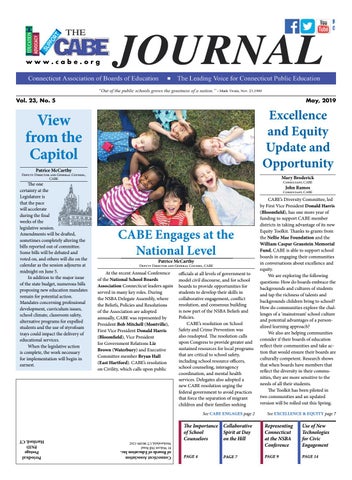
CABE Engages at the National Level Patrice McCarthy
Deputy Director and General Counsel, CABE
At the recent Annual Conference of the National School Boards Association Connecticut leaders again served in many key roles. During the NSBA Delegate Assembly, where the Beliefs, Policies and Resolutions of the Association are adopted annually, CABE was represented by President Bob Mitchell (Montville), First Vice President Donald Harris (Bloomfield), Vice President for Government Relations Liz Brown (Waterbury) and Executive Committee member Bryan Hall (East Hartford). CABE’s resolution on Civility, which calls upon public
81 Wolcott Hill Road Wethersfield, CT 06109-1242
Connecticut Association of Boards of Education Inc.
The one certainty at the Legislature is that the pace will accelerate during the final weeks of the legislative session. Amendments will be drafted, sometimes completely altering the bills reported out of committee. Some bills will be debated and voted on, and others will die on the calendar as the session adjourns at midnight on June 5. In addition to the major issue of the state budget, numerous bills proposing new education mandates remain for potential action. Mandates concerning professional development, curriculum issues, school climate, classroom safety, alternative programs for expelled students and the use of styrofoam trays could impact the delivery of educational services. When the legislative action is complete, the work necessary for implementation will begin in earnest.
Mary Broderick
The Importance of School Counselors
Collaborative Spirit at Day on the Hill
Representing Connecticut at the NSBA Conference
Use of New Technologies for Civic Engagement
PAGE 4
PAGE 7
PAGE 9
PAGE 14
Periodical Postage PAID Hartford, CT
2
The Journal – Connecticut Association of Boards of Education | May, 2019 PRESIDENT COMMENTARY
How Board Decisions Impact Teaching and Learning
Mission: To assist local and regional boards of education in providing high quality education for all Connecticut children through effective leadership. Vision: CABE is passionate about strengthening public education through high-performing, transformative local school board/ superintendent leadership teams that inspire success for each child.
Board of Directors
One important leadership responsibility of boards of education is to present a budget to municipal authorities that best balances the needs of the students and the obligation of the municipality to keep spending at a reasonable level. This balance is often difficult due to our state and federal governments not adequately fulfilling their fiscal responsibilities in a meaningful manner. The challenge for boards is to target most resources directly at areas that influence student achievement without ignoring structural needs that can be costly to ignore. We also have to do this while our sources of revenue are typically not yet defined – the State Legislature is usually finalizing the budget in the wee hours at the end of the Session after local budgets are adopted. This is a particular challenge for Boards of Education which answer to several different authorities. All Boards
receive authority through the Connecticut General Assembly, so they answer first to the Legislature. Since they are also charged with upholding the State’s interest in public education, boards of education also answer to the authority of the State Board of Education and the Commissioner. These multiple levels of governance make it even harder to prioritize what the local government believes is in the best interest of the children. Because of fiscal uncertainty, Boards often end up making important programmatic changes in grade configuration, professional development programs, scheduling, school closures and curriculum (to name a few) as part of the budgeting process rather than as educational decisions based on a long-term or strategic plan. I strongly suggest that boards try very hard to separate these important educational decisions from the budget process. Of course, you will have to vote on these within the budget process to pay for them, but that is different than making a strictly financial
decision. The hard decisions should be whether or not the new program will improve the district’s teaching and learning. Budgeting allows you to balance those priorities as best you can. Likewise, talks about sharing or consolidating services should be viewed from the lens of what is best for teaching and learning, and only then looking at it from a fiscal angle. These should all be considered as policy issues first, and financial issues second. This spring, the Montville Board of Education is going to start participation in the Lighthouse Project, a program CABE has been involved in for over ten years. This program is based on research that shows how boards in highly effective districts better govern their districts. Our board has high expectations that when we better understand how board decisions affect improved teaching and learning, that we will better be able to prioritize our budget dollars to focus on the work of the district. I’ll keep you up to date on how this all works out!
CABE ENGAGES
education.
entry or asylum into the United States, due to the traumatic and disruptive impact on the delivery of quality
involved in delivering numerous
Ø Bob Rader and Lydia Tedone facilitated one of the briefing sessions at the Delegate Assembly.
Robert Mitchell President, CABE
(continued from page 1)
Connecticut leaders were also professional development opportunities during the Conference.
Ø Bob, Patrice and Rebecca Adams Rieder presented a workshop on “Ten Practices to Avoid Legal Liability”. Ø Mary Broderick (Past President of CABE and NSBA) and Jack Reynolds (retired Connecticut superintendent) presented a workshop on Let’s Save Democracy – Modeling Excellence in Governance.
CABE Sr. Staff Associate for Professional Development and Communications, Lisa Steimer, presented a session on The Board’s Role in Public Relations and Communications at the April 10 Leadership Institute.
Ø Lydia Tedone, Past President of CABE and a member of the Simsbury Board of Education, continued her service on the NSBA Board of Directors representing the Northeast Region. Lydia and Donald Harris both served on the Policies and Resolutions Committee.
EXECUTIVE COMMITTEE Robert Mitchell | President, Montville Donald Harris | First Vice President, Bloomfield Elizabeth Brown | Vice President for Government Relations, Waterbury Christopher Wilson | V ice President for Professional Development, Bristol Michael Purcaro | Secretary/Treasurer, Ellington Ann Gruenberg | I mmediate Past President, Hampton Bryan Hall | Member at Large, East Hartford Lydia Tedone | NSBA Director, Simsbury AREA DIRECTORS Doug Pfenninger | Area 1 Director, Winchester Bryan Hall | Area 2 Co-Director, East Hartford Leonard Lockhart | Area 2 Co-Director, Windsor Michael Purcaro | Area 3 Co-Director, Ellington Michele Arn | Area 3 Co-Director, Vernon Joan Trivella | Area 4 Director, Brooklyn Mic helle Embree Ku | A rea 5 Co-Director, Newtown Frances Walton | Area 5 Co-Director, Ridgefield Karen Kleine | Area 6 Director, Westport George Kurtyka | Area 7 Director, Derby Lon Seidman | Area 8 Director, Essex Jonathan Gilman | Area 9 Co-Director, Bozrah Sean Nugent | Area 9 Co-Director, Preston ASSOCIATES Julie Ausere | Associate, Canton Eileen Baker | Associate, Old Saybrook Robert Guthrie | Associate, West Haven John Prins | Associate, Branford Robert Trefry | Associate, CT Technical High School System COMMITTEE CHAIRS Becky Tyrrell | Chair, Federal Relations, Plainville Bryan Hall | Chair, Resolutions, East Hartford Jennifer Dayton | Chair, State Relations, Greenwich CITY REPRESENTATIVES Betsy Allyn| City Representative, Stamford Charles Stango | City Representative, Waterbury STAFF
Robert Rader | Executive Director Patrice McCarthy | Deputy Director and General Counsel Rebecca Adams Rieder | Senior Staff Attorney Nicholas Caruso | Senior Staff Associate for Field Service and Coordinator of Technology Sheila McKay | Senior Staff Associate for Government Relations Vincent Mustaro | Senior Staff Associate for Policy Service Lisa Steimer | Senior Staff Associate for Professional Development and Communications Teresa Costa | Coordinator of Finance and Administration Pamela Brooks | S enior Administrative Associate for Policy Service and Search Services Terry DeMars | Administrative Associate for Policy Service Gail Heath | Administrative Associate for Government Relations Wilmarie Newton | Administrative Associate for Labor Relations Nancy Propfe | Administrative Assistant for Membership Services Corliss Ucci | Receptionist and Assistant to Executive Director
The CABE Journal (ISSN 1092-1818) is published monthly except a combined issue for July/August as a member service of the Connecticut Association of Boards of Education, 81 Wolcott Hill Road, Wethersfield, CT 06109, (860) 571-7446. CABE membership dues include $30 per person for each individual who receives The CABE Journal. The subscription rate for nonmembers is $75. Association membership dues include a subscription for each Board Member, Superintendent, Assistant Superintendent and Business Manager. The companies and advertisements found in The CABE Journal are not necessarily endorsed by CABE. “Periodicals Postage Paid at Hartford, CT.” POSTMASTER: Send address changes to The CABE Journal, CABE, 81 Wolcott Hill Road, Wethersfield, CT 06109-1242. Email: lsteimer@cabe.org. Members can find the CABE Journal online at: www.cabe.org/ page.cfm?p=1024
The Journal – Connecticut Association of Boards of Education | May, 2019
CABE Affiliate Members BUSINESS AFFILIATES DIAMOND MEMBER Finalsite PLATINUM MEMBER
Berchem Moses PC GOLD MEMBERS
Pullman & Comley Shipman & Goodwin Support for the Budgetary Process SILVER MEMBERS Anthem Blue Cross and Blue Shield Arthur J. Gallagher & Company Corporate Cost Control Digital Back Office ESS Milliman Milone & MacBroom, Inc. BRONZE PLUS MEMBERS Coordinated Transportation Solutions COUNTABILITY, Inc. JCJ Architecture OneDigital Health and Benefits The S/L/A/M Collaborative BRONZE MEMBERS Albert Risk Management Consultants Brown & Brown Chinni & Meuser LLC Dattco, Inc. Goldstein & Peck, P.C. Kainen, Escalera & McHale, P.C. The Lexington Group Perkins Eastman Zangari Cohn Cuthbertson Duhl & Grello
EDUCATIONAL AFFILIATES
American School for the Deaf Area Cooperative Educational Services Capitol Region Education Council The College Board Connecticut Association for the Gifted Connecticut Association of School Business Officials Connecticut Center for School Change Connecticut School Buildings and Grounds Association Connecticut Technical High Schools Cooperative Educational Services EASTCONN EdAdvance Explorations Charter School Girls Scouts of Connecticut Interdistrict School for the Arts and Communications (ISAAC) LEARN Unified School District #1
3
EXECUTIVE DIRECTOR COMMENTARY
Climate Change and Our Schools Robert Rader
Executive Director, CABE
At the National School Board’s Convention in March, the Pacific Region introduced a resolution stating that, “NSBA recognizes and understands the significant negative impact that rapid and ongoing climate change has on America’s schools, students, and their communities.” It called on NSBA to advocate for funding for school infrastructure and disaster relief due to natural catastrophes and extreme weather events.* Stated in the Rationale for the resolution is the belief that climate change “adversely effects [sic] student’s physical and mental health and negatively impacts student behavior”, and that these catastrophes and weather events “devastate local economies and therefore schools.” I asked one of CABE’s Business Affiliates, James LaPosta of JCJ Architecture, what types of changes he was seeing in school building construction or remodeling resulting from climate change. JCJ provides full planning, architecture and interior design services to school districts. He responded, “Our profession has been focused on the idea of resiliency in building and site design as a response to climate change. It’s about making sure that we can mitigate and recover quickly from storms and other events that may impact communities. I can’t say that our work has been significantly impacted much yet, but that is changing. On an elementary school that we are designing in Manchester by the Sea, MA, we moved mechanical equipment to a higher level because of the proximity to a small river and the concern over future flooding. The initial design was compliant with current flood zone regulations but in our meetings with the client there was concern that as a coastal community the flooding could be worse in the future... We are also seeing more and more districts opt for full air conditioning. This has been a trend over the last 20 years as the school year extends further into the summer months and districts want to use their buildings more year round. It’s still a topic of robust debate in many communities due to cost and tradition but the trend is definitely in the direction of better air quality and thermal comfort.” – Robert Rader
We can but sympathize with those in the Western part of the country as we watch as wildfires burn hotter and more homes and land are destroyed. We also are concerned about the effects that climate change will have on our own State and region. Whether (pun intended) you believe that climate change is man-made or a recurring natural phenomenon, we must be concerned about the possible effects of continuing warming of our atmosphere and the increased intensity of drought, storms and other “once in a century events” around the world.
Test Scores Effect
A March blog from Education Week headlined an article, “What Climate Change Might Mean for Test Scores”. The author, Sarah D. Sparks [an appropriate name!] summarized a new study from the College Board, Georgia State University, Harvard and UCLA that “rising temperatures and aging school buildings across the country could lead to falling academic performance and wider achievement gaps among students.” She wrote that “the average temperature across the United States will warm by five degrees Fahrenheit by 2050”, only 30 years away. Sparks wrote that after “accounting for students’ background, grade, and prior performance, the study found that for every degree hotter the average temperature in a school was in the year before the PSAT, its students showed a drop in scores equal to about 1 percent of their average learning for the year... Moreover, a particularly hot year continued to pull down students’ academic achievement two, three or even four years later.” The researchers found that these effects “fell more heavily on black and Hispanic students and students in low-income communities.” These students were more likely to be in the Southwest, and were less likely “than white or wealthier students to attend schools with up-to-date air conditioning systems.” The author said that while it is not clear exactly what causes the decline in test scores, she posits that “teachers may find it more difficult to focus when they are physically uncomfortable, and students may be more prone to fall asleep in class.” In addition,
higher temperatures “can also increase indoor air pollution... which is associated with lower memory and more chronic illness...” She also said that air conditioning in the schools reduced the effects of heat by 80 percent.
The Connecticut Angle
We are not immune from the effects of climate change — hurricanes, flooding and droughts have already hit the Northeast. We might be less affected by the severity of what climate change has begun to bring, but, that we must prepare to combat it. According to the National Oceanic and Atmospheric Administration’s National Centers for Environmental Information, temperatures “in Connecticut have increased about 3°F since the beginning of the 20th century… Sea level has risen 10-11 inches per century along the Connecticut coast, faster than global rate. Global sea level is projected to rise another 1 to 4 feet by 2100, with even greater rises possible for Connecticut.” Effects on air quality and the warming of the ocean water along our coast will be problematic in the years to come. In light of these changes, I found a 2016 Air Quality and Temperature Research Report from Connecticut’s Office of Legislative Research. It states that “neither the State Department of Education (SDE) nor the Department of Public Health tracks the number of public schools that have air conditioning, so OLR was unable to get any official numbers.”** However, we do know that the schools in our urban districts are in the lowest income areas in the State. The students in these schools need to feel comfortable on the hottest days, as much as suburban students — especially if we hope to close the achievement gap. Even if we provide See CLIMATE CHANGE page 7
4
The Journal – Connecticut Association of Boards of Education | May, 2019
The Importance of School Counselors Robert Rader
Executive Director, CABE
One of your district’s most important staff members are your school counselors.* It always has appeared to me that when districts were forced by budget issues to lay off employees, many of those who helped support students outside of the classroom were let go. However, school counselors are critical, especially as we focus on college and career readiness. I am part of two initiatives on ensuring that students have the most post-graduation opportunities. The Connecticut Voices for Children College and Career Readiness Alliance and the Connecticut Campaign for A Working Connecticut are both focused on helping ensure that the State has sufficient numbers of well-trained employee candidates and that students learn about future opportunities. School counselors are critical to helping students, often with help from their parents or guardians to make good decisions about their futures. As stated on SDE’s website, “Connecticut school counselors are certified and/or licensed profes-
sional educators with a minimum of a master’s degree in school counseling. This makes school counselors highly qualified to have a whole-child perspective who understand, prevent and
Norwalk Public Schools School Counseling Redesign Committee COMMITTEE CHARGE 1. Review and benchmark current roles and responsibilities of school counselors. 2. Review past practices of the American School Counseling Association (ASCA), national, state and regional programs, and the Hanover Report on School Counseling Practices. 3. Conduct Focus Group and Survey of stakeholders regarding satisfaction with current counseling service and the desired type and level of service. 4. Differentiate roles and responsibilities associated with effective counseling programs focusing on transitions, college and career counseling and consideration for areas of specialization (ELL, G/T, SWDs). 5. Specify and sequence the responsibilities for College Counseling and college-going tasks and activities for all students at each grade level 9-12 to include pre-college experiences and visits, financial planning (FAFSA) and scholarship opportunities. 6. Define the role of counselors in relation to Capstone requirement for graduation, to include career internships. 7. Develop a plan for implementation of Public Act No. 17-42 Section (c), (D), (g) and (j) to provide Personalized Student Success Plans. 8. Examine The Connecticut Comprehensive School Counseling Framework Model for implementation of social emotional curriculum in middle schools with emphasis on coping skills and strategies, executive order/study skills and developmental counseling programs. Develop an implementation plan for grades 6-8. 9. Recommend counselor to student rations at each level based upon regional, state and national norms and accreditation requirements. 10. Develop a comprehensive multi-year plan for professional development including a systemic plan for recruitment and retention of highly qualified school counselors, provision of clinical supervision and coaching of school counselors, necessary to implement redesign recommendations.
respond to the challenges presented today.” Lisa Steimer and I met with Executive Director Michelle Catucci of the Connecticut School Counselor Association during the Spring. She made the following points: •C onnecticut does not require school districts to have counselors at any level. Approximately 28 percent of elementary schools have counselors. Many of those in our elementary schools serve more than one school and/or are less than full-time. • There are approximately 1,400 counselors across the State. • There is more and more of an emphasis for counselors on socialemotional learning, in that students are coming to the schools with more stress and seem to have larger issues than before. This is consistent with what we have learned from Dr. Alice Forrester (see the April edition of the Journal) and Dr. Marc Brackett from Yale. • The Counselors Association is working with SDE to develop voluntary guidelines for counselors. One goal is to develop more consistency across districts for the work of counselors.
Meanwhile, in Norwalk
The Norwalk Public Schools are considering the role of school counselors in their schools. The School
Counseling Redesign Committee has been established, co-chaired by Chief of Specialized Learning Yvette Gorevitch and Fox Run Principal James Martinez. Board Member Julie Corbett is a Board Liaison and Committee Member. As stated in a local Norwalk newspaper, The Hour, the “20-person committee is tasked with implementing social-emotional curriculum in middle schools with an emphasis on coping skills and strategies, defining the role of counselors in relation to internships and capstone requirements ahead of graduation, examining models for developing a multiyear professional development plan for each student and retaining and recruiting highly qualified counselors.” I spoke with Ms. Corbett on March 22nd and the Committee is just beginning its work. She said she would “be glad to share information and ideas from the Committee with other school districts”. CABE will keep you posted as Norwalk moves ahead on this initiative. * Until a few years ago, they were called “guidance counselors”, but, now most are “school counselors”. The change concerned how they are certified. The certification is an 068 and is focused on 1) academics, 2) college and career readiness and 3) social-emotional learning.
The Journal – Connecticut Association of Boards of Education | May, 2019
5
See You in Court – The Nutmeg Board of Education
It’s “Expulsion Season” in Nutmeg Thomas B. Mooney, Esq. Shipman & Goodwin
The Nutmeg Board of Education makes many mistakes. The latest imbroglio created by the board will be reported here each issue, followed by an explanation of what the board should have done. Though not intended as legal advice, these situations may help board members avoid common problems.
With the arrival of spring and the coming of summer, incidents of student misbehavior increase in Nutmeg each year. This year, Mr. Superintendent has had his hands full in dealing with such matters, and during the executive session last week, he announced that the Board was now in “Expulsion Season.” “It’s going to be hard to deal with all of these expulsions,” he explained, “and I will need your help. When the secretary calls to see if you can serve on an expulsion case, please say yes, and when you serve, keep it simple and do what’s right.” Last night, the Board had its first expulsion hearing of the “season,” with veteran Board members Bob Bombast, Mal Content and Penny Pincher in attendance. Mr. Superintendent started the hearing by presenting the Board members with the arrest notification he had received concerning Joe Blow, now in his fifth year at Nutmeg Memorial High School. The notification stated that Joe was arrested for stealing a car and taking it on a joy ride. Mr. Superintendent then explained that, unfortunately for Joe, his misadventure ended in his crashing the car into a police cruiser. Mr. Superintendent concluded his presentation by recommending expulsion: “Joe Blow clearly does not meet our expectations for students at Nutmeg Memorial High School, and we need to send a message to the entire student body that criminal behavior will not be tolerated. Joe should be expelled for one calendar year!” Mal Content thanked Mr. Superintendent for his inspiring presentation, and he turned to Joe Blow, who was there with his parents, and he asked him what he had to say for himself. Joe was clearly nervous, but he did manage to tell the Board members that his lawyer told him not to say anything to anyone about his arrest, given the ongoing criminal proceedings. Bob Bombast was uncharacteristically sympathetic to Joe’s dilemma, and he explained to Joe that the case against him was strong and that he will be expelled unless he can explain himself. However, Joe simply repeated that his lawyer told him not to say anything about the situation. Bob Bombast was frustrated, but he remained sympathetic to Joe’s plight, stating “We really shouldn’t expel Joe if he can’t even defend himself.”
But Mr. Superintendent waived the arrest notification around, and he insisted that expulsion was the only appropriate response to Joe’s felonious conduct. At this point, Mal Content and Penny Pincher were getting impatient. “Look, Joe,” Mal began. “We have you dead to rights here, and if you just sit there without defending yourself, we have no real choice but to expel you.” But Joe just sat there looking uncomfortable. “OK, then,” Penny stated. “I move that Joe is expelled for one calendar year for his criminal behavior.” Mal promptly seconded Penny’s motion, and the Board members voted, Penny and Mal in favor of expulsion, Bob opposed. Has Joe been expelled? • • • • • • • • • • • • • • No. Connecticut General Statutes § 10-233d provides that three affirmative votes are required for expulsion, and whenever only three board members hear a case, the vote must be unanimous. Given Bob’s vote against expulsion, the motion failed, and Joe was not expelled. But this situation presents a host of other issues as well. First, the very recommendation for expulsion was improper here because the Board lacked the authority to expel Joe under these facts. In general, boards of education can expel students when they engage in misconduct on school property or at a school-sponsored activity. Expulsion may be imposed for off-campus conduct, however, only in limited circumstances, and otherwise school officials do not have jurisdiction over student behavior outside of school. By enacting the mandatory expulsion statutes, the General Assembly conferred jurisdiction on school officials over student misconduct in specified situations. Expulsion is mandatory in three situations of off-campus misconduct: (1) possession of a “firearm, as defined in 18 USC 921,” (2) possession and use of a firearm, deadly weapon, dangerous instrument or martial arts weapon in the commission of a crime, or (3) offering a controlled substance for sale or distribution. The requirement that expulsion be imposed for such conduct confers jurisdiction in such cases. Otherwise, school officials have jurisdiction over student misconduct off-campus only if the misconduct violates a publicized policy of the board of education and is “seriously disruptive of the educational process.” In 1998, the Connecticut Supreme Court gave further meaning to the quoted phrase, holding for these purposes that conduct is “seriously disruptive of the educational process” only if it severely impedes the day-to-day operation of
the school, a very high standard. Packer v. Thomaston Board of Education, 246 Conn. 89 (Conn. 1998). Given these limitations, the Nutmeg Board of Education clearly did not have the authority to expel Joe. He was accused of stealing a car off campus. Even if the accusation is correct, however, the action had nothing to do with the Nutmeg Public Schools, and accordingly the Board members had no authority to expel. That said, it is important to note that Joe’s dilemma was his problem, and the ongoing criminal proceedings would not prevent the Board from expelling him if the Board had the authority to do so. Students and their families have a right to a hearing before a student may be expelled. Such hearings are simply an opportunity to be heard, however, and students may choose whether or not to testify. In some cases, students are indeed advised not to testify by lawyers representing them in criminal proceedings, but that does not prevent an expulsion from going forward. Finally, we note that Mr. Superintendent was relying on the arrest notification as the basis for the expulsion of Joe. However, an expulsion must
be based on a finding that the student committed an expellable offense. An arrest notification conveys information, but it certainly does not prove that the student committed the offense for which he was arrested. To make matters worse, Mr. Superintendent told the Board members that Joe’s misadventure ended with a crash. Unless Mr. Superintendent was a witness to the crash, however, Mr. Superintendent’s statement was hearsay, a report of a statement made by another, offered for the truth of the assertion made. Reliance on hearsay statements at expulsion hearings raises significant issues of due process. Students facing expulsion should be able to confront their accusers, but one cannot cross-examine a hearsay statement, which is simply a report of something someone else said. In expulsion hearings, school officials should present direct evidence of the conduct they claim constitutes an expellable offense. Attorney Thomas B. Mooney is a partner in the Hartford law firm of Shipman & Goodwin who works frequently with boards of education. Mooney is a regular contributor to the CABE Journal. Shipman & Goodwin is a CABE Business Affiliate.
The Ninth Edition – Now Available!
A Practical Guide to Connecticut School Law by Thomas B. Mooney, Esq. Shipman & Goodwin
CABE is delighted to announce that the Ninth Edition of Tom Mooney’s Practical Guide to Connecticut School Law is now available. PRICING: CABE Members: $54.99; CABE Non-Members: $79.99; Students: $44.99 There have been many changes in school law in the last few years, and the Ninth Edition has been extensively revised to provide updated guidance on the legal issues that govern our schools. Changes include descriptions and commentary on:
• Changes in teacher evaluation and teacher tenure. • New rules regarding employee background checks. • New requirements concerning student data privacy. • New rules for suspension, expulsion and alternative educational opportunities. • Revised requirements governing seclusion and restraint. • The new “Every Student Succeeds Act” and how it has changed “No Child Left Behind Act” requirements. • The CCJEF case and ongoing litigation over equal educational opportunities. • The Minimum Budget Requirement and new duties to collaborate with town officials. • A host of other changes in the rules that boards of education and school administrators must follow.
6
The Journal – Connecticut Association of Boards of Education | May, 2019
The Journal – Connecticut Association of Boards of Education | May, 2019 CLIMATE CHANGE
(continued from page 3)
more classroom time to our students over summers, they will not benefit as greatly if they are so uncomfortable they can’t concentrate. Climate change will continue to be a concern for Connecticut, the nation and the whole world as we move deeper into the 21st Century. It is good to know (see sidebars) that Connecticut firms that renovate and/or build new schools are working to strengthen our schools’ ability to thrive even with climate change. * The resolution was eventually adopted, but in a form aimed at other, more current events. ** T h ere is a law, however, which states that boards of education that have schools with air conditioning must “operate then continuously (along with heating and ventilation systems) during hours when the buildings are occupied, with some exceptions (CSG section 10231e)”.
7
I also asked Business Affiliate, Kemp A. Morhardt of The S/L/A/M Collaborative, what he was seeing as a result of, or in preparation for continued climate change. S/L/A/M offers architecture, planning, interior design, landscape & site planning, structural engineering and construction services. His response: Most architects have always worked to maximize energy efficiency for their building designs to minimize operational costs for building owners. Connecticut has implemented high performance building standards... There are also other mandatory requirements for school buildings related to the learning environment. In my experience, owners and designers tend to focus on energy and water efficiency for school designs in an effort to reduce carbon footprint and preserve water resources. An energy efficient school building, if new, begins with optimal solar orientation to control solar gain as well as a high performance building envelope, coupled with energy efficient mechanical systems We’ve designed Connecticut school buildings that operate on “geothermal” principals where the building’s entire heating/cooling plant is obtained through a ground coupled water loop taking advantage of the earths year-round moderated temperature (~55 degrees F). We have also incorporated photovoltaic arrays to generate electricity from sunlight to help offset electricity purchased from the grid.
Other strategies include:
•D aylighting, which maximizes the use of natural light to minimize the use of artificial lighting and reduce electrical consumption; • Low flow plumbing fixtures, landscape plantings that require little to no irrigation and rain water collection to reduce water consumption; • Providing bike racks and shower/changing facilities to promote bicycling to work; • Providing dedicated parking spaces for carpool vehicles and ultra-low emission vehicles; • Providing electric car charging ports; and, • High reflectivity roofing to reduce heat island effect. – Robert Rader
Collaborative Spirit at Day on the Hill Patrice McCarthy
Deputy Director and General Counsel, CABE
The theme of collaboration and working together were emphasized in the remarks from all of the Education Committee leaders at CABE’s 2019 Day on the Hill. Education Committee Co-Chairs Senator Douglas McCrory and Representative Robert Sanchez, and Ranking Members Senator Eric Berthel and Representative Kathleen
EXCELLENCE & EQUITY
(continued from page 1)
The Waterbury and Ansonia Boards of Education hosted robust conversations which attracted about 70 participants each this fall and winter for rich, meaningful discussion about what students need to be successful. Moderated by trained local residents and ed-
McCarty each addressed the group and remained to hear the remarks of their colleagues. They even made the unprecedented request for a group photo of the leadership. The many board members, superintendents and students in attendance were heartened to learn that Representative McCarty, Representative Sanchez, and Senator Berthel all served on their local boards of education, and Senator McCrory is
long time educator. In his remarks, Senator McCrory expressed appreciation for “CABE’s expertise and input on all the issues”. On the topic of regionalization, both Representative Sanchez and Senator Berthel expressed support for shared services and local collaboration rather than forced regionalization. Representative McCarty expressed her appreciation for CABE’s advocacy,
research and visibility. Commissioner Dianna Wentzell also emphasized the collaborative relationship she has found in working with the Education Committee leadership. As we move into the final weeks of the 2019 legislative session, a continued collaborative effort will yield legislation that is most effective in supporting student achievement.
ucators, each community considered how to overcome barriers to excellence and motivate and engage students. Engaging communities in conversations about equity is a vital role school boards can play in encouraging open dialogue and fostering growth in cultural competency while strengthening the community-school relationship. The conversations sparked by the
process outlined in the Toolkit will help districts as they consider their Minority Teacher Recruitment Plan, as required under law. In addition, the Toolkit will help the board in reflecting the aspirations, needs and expectations of its community. CABE is now offering more school districts the opportunity to experience the Equity Toolkit, which includes
a guide for boards to engage diverse community stakeholders in conversations about race, equity, and cultural competence. Open to all school boards in Connecticut, preference will be given to CABE member districts where over 40% of students are eligible for free/reduced priced meals. Please contact Mary Broderick at mary-broderick@att.net for more information.
For an update or more information on vacancies go to our website: MARY BRODERICK, ED.D SENIOR CONSULTANT
cabe.org/page. cfm?p=1176
For more information contact
CABE Search Services
81 Wolcott Hill Road, Wethersfield, CT 06109
860-608-1763
Equal Opportunity Employer
8
The Journal – Connecticut Association of Boards of Education | May, 2019
The Media Message by John Henry Smith, Senior Public Relations Specialist, Baldwin Media Marketing, LLC
Surviving a Media Interview with No Regrets Remember Robert Durst? He’s the accused murderer whose life and alleged crimes were profiled in the HBO Series “The Jinx.” After repeatedly denying his role in three murders, Durst went to the bathroom after his last interview—wireless microphone still turned on and very much attached to him. It was at this time, he infamously uttered the following words to “himself ”: “What the hell did I do? Killed them all, of course.” That statement – which got recorded on his activated microphone--got Durst arrested. He’s currently awaiting trial. Of course – if he’s guilty – Durst deserved to fall victim to the dreaded “hot mic.” My hope is that his example will help keep YOU from getting caught saying something you wish you hadn’t in a situation where what you say can become part of the public record. In that spirit, here are my recommendations for how to get-in and get-out of a media interview without getting yourself into trouble:
1. Don’t Feel Obligated to Talk
It’s always OK to say “No” when asked for comment. In fact, in most organizations, it is preferable to refer interview requests to a designated spokesperson. If you are that spokesperson, there’s usually no downside to telling a reporter “I can’t comment at this time.” However, do ask the reporter what his or her deadline is and endeavor to find out something to feed this reporter well before that deadline.
2. Always Assume the Mic Is Hot
The Robert Durst example above is exhibit “A.” But, I’d be remiss if I didn’t mention another type of hot mic: the one on your phone. When a journalist contacts you by phone, it’s easy to forget in the midst of all the “Hello, how are you?” pleasantries that you are being interviewed from the moment you answer. Don’t take that time to make any flip remarks that could be taken out of context. Don’t say anything you wouldn’t want to see repeated to a mass audience. And, don’t feel like you have to fill the audio space if the reporter goes silent after you stop talking — that’s a classic ploy to get you say more
than you initially intended. Finally, remember you can ask a reporter you know and trust if the two of you can talk “off-the-record.” However, the phrase only works to protect you if you make the request BEFORE saying something you want to protect. “Off-the-Record” also needs the reporter to agree before it becomes valid. In other words, don’t ask for something to be “off-the-record” and continue sharing proprietary information without getting the reporter’s agreement first.
3. Remember the 15-Second Rule If you don’t get your main point(s) spoken in the first 15-seconds of your response to a question, there’s a high likelihood that your main point(s) will NEVER make air. Reporters are very time pressed to get their pieces done by their daily deadlines. That means they tend to use the first sound bite they come upon that remotely fits in their piece. Reporters are also under pressure to limit their final pieces to a certain word count or time limit. Based on my nearly 20 years in TV, I can tell you that TV reporters are usually
under extreme pressure to keep their pieces to between 60 to 90 seconds. That means they usually can’t use soundbites that last over 15 seconds. So, when giving answers to interview questions, get to the point and keep your answers “bite” size.
4. Rehearse
Sometimes, things are happening so fast, you don’t have time to rehearse. The good news is it doesn’t take much time to give some basic thought to what you want (or don’t want) to say. Remembering the “15 second rule”, make sure you identify your one or two key messages, get to them quickly and stick to them. If you have time after that--and you really should try to make time if you can--think about the toughest question(s) you could be asked and think of how you’ll answer. It’s always helped me to write talking points down if I have time. Even if I don’t directly refer to my written notes, the act of writing it down helps burn it into my memory. Remembering these four rules will make media interviews work for you instead of against you.
Dalio Philanthropies Pledges $100 Million
East Hartford Superintendent Nate Quesnel spoke at the press conference announcing the Dalio Philanthropies’ pledge of $100 million to Connecticut public education.
CABE Area 2 Co-Director and Member at Large Bryan Hall (East Hartford), East Hartford Barbara Dalio speaks about the Dalio Mayor Marcia Leclerc, East Hartford Superintendent Nate Quesnel look on as Governor Ned Philanthropies’ commitment to pubLamont announces the Dalio pledge. lic school students in Connecticut.
The Journal – Connecticut Association of Boards of Education | May, 2019
9
Representing Connecticut at NSBA Conference
CABE President Robert Mitchell (Montville), far right, is pictured with other school board association presidents.
CABE Deputy Director and General Counsel Patrice McCarthy, CABE Sr. Staff Attorney Rebecca Adams Rieder and CABE Executive Director Robert Rader presented Ten Best Practices to Avoid Liability.
CABE and NSBA Past President Mary Broderick and retired superintendent Jack Reynolds presented Let’s Save Democracy! Modeling Excellence in Governance.
(L. to r.) CABE Executive Director Robert Rader, CABE First Vice President Donald Harris (Bloomfield), NSBA Northeast Director Lydia Tedone (Simsbury), CABE Vice President for Government Relations Elizabeth Brown (Waterbury), CABE Deputy Director and General Counsel Patrice McCarthy, CABE Area 2 Co-Director and Member at Large Bryan Hall (East Hartford) and CABE President Robert Mitchell (Montville) represented Connecticut at the NSBA Delegate Assembly.
C.O.P.S
What will provide YOUR district? • A policy manual updated within days of a board meeting. • Access to your policy manual 24/7 anywhere with Internet capability. • Timesaving links to legal and cross references. • A search engine specifically designed for board policy manuals. • The ability to search other online districts for similar policies or language. • A happier staff that will have less paper to deal with.
If you would like additional information on CABE’s Connecticut Online Policy Service (C.O.P.S.), call
Vincent Mustaro at 860-571-7446 or email vmustaro@cabe.org for full details
10
The Journal – Connecticut Association of Boards of Education | May, 2019
The Journal – Connecticut Association of Boards of Education | May, 2019
11
THE POLICY CORNER Vincent A. Mustaro
Senior Staff Associate for Policy Service, CABE
Crowdfunding Requires Policy Direction Crowdfunding, a relatively new source of fundraising, is being widely used by the education community. NSBA’s Council of School Attorneys (COSA), in an issue of its Inquiry & Analysis, indicated that schools should approach this new trend with caution and carefully consider whether policies are necessary to regulate what teachers are doing online in the name of specific schools. A review of some of the publicly-available teacher posts on DonorsChoose.org, a popular crowdfunding site, revealed some concerning instances of potential liability. Crowdfunding can be broken down into two different types: those aimed at raising capital for a business venture and those aimed at raising funds for charitable donations. The charitable donation aspect of crowdfunding is the type most used in public schools, both for legal and practical reasons. The business venture crowdfunding is generally undertaken by start-up businesses in lieu of getting a traditional business capital loan. Donors are promised and expect to get some sort of return on their investment. It is a small-business financing model.
Liabilities
Donation-based crowdfunding sites, such as DonorsChoose.org, are popular with teachers and other individuals seeking to raise funds for their classes or schools. A COSA review of some of the educator posts on DonorsChoose.org revealed some significant legal issues within the teacher posts themselves. The issues included potential FERPA violations and liability under the Individuals with Disabilities Education Act (IDEA). Regulation by schools of individual teacher postings on crowdfunding sites, COSA indicated, is a bare minimum essential to prevent some legal issues. While many of the entries posted on the DonorsChoose.org site posed little-to-no legal liability, there were an alarming number of entries that did pose some potentially significant issues. This included a number of potential FERPA issues related to teacher-posted photographs, which were combined with specific written
“ Districts need to have regulatioins regarding who can raise funds on behalf of a school and what procedures and protections should be put into place to protect the district and school in such instances.” information in the posts about the classes. These descriptions could also legally be considered to be potential IDEA violations, and/or violations of specific district policies. Other posts, while they did not pose any particular threat of liability, painted the schools and/or districts in a very negative light when asking for funds. Most teacher crowdfunding posts aim to raise funds under the name of a specific school. Districts need to have regulations regarding who can raise funds on behalf of a school and what procedures and protections should be put into place to protect the district and school in such instances. Teachers should be prohibited from using the school’s name or any other identifying features unless the teacher is in full compliance with the procedures and/ or protocols established by the school district.
Safeguards
Some safeguards that should be put into place to protect schools are listed below. These protocols are designed to reduce potential liability caused by teacher crowdfunding posts. 1. Require Administrative Approval of all Postings Prior to Publication. Individuals wishing to raise funds for a particular class or school should first obtain written approval after providing pertinent details, such as the site on which the funds would be raised, a complete copy of the proposed listing, and a copy of the school
personnel’s personal profile to be listed on the site. Administrators should review the proposed posts to ensure that no potential legal liability, violation of state or federal laws, and/or violation of the district’s policy and/or procedures exists. The proposed posts should also be reviewed to ensure that the posts do not paint the district, school, or any of its employees or students in a negative light. Ideally, district regulations/procedures should prohibit all posting of student images on the site, limiting pictures to that of the classroom, the teacher and/or photos of students where the students are not identifiable (e.g., their hands, backs of heads, etc.). The administration should have the authority to deny permission for a teacher to crowdfund on behalf of the school and/or the teacher’s individual classroom where potential issues or violations are evident. When an administrator spots an issue that might have legal implications, legal counsel should be consulted. 2. Develop an Approved Site List; Permit Crowdfunding on Sites that Send Proceeds and/or Items Directly to the Schools, NOT the Individual Employee Funds raised and/or items purchased should go directly from the crowdfunding site to the school being served. Districts should require that funds and/or items be delivered directly to the school administrator. If districts decide to permit crowdfunding, schools should carefully consider all of the available sites and approve
only those that provide the safeguards deemed most appropriate by the school. 3. Ensure that Proceeds/Items Obtained through Crowdfunding Fulfill Stated Purpose Funds raised and/or items purchased via crowdfunding must be used for their designated purpose. District schools should have safety mechanisms in place to ensure that the funds/materials are being used as described. Districts should also make clear, via written policy and procedures, that all funds and/or materials are property of the district and shall remain with the district when the teacher terminates his or her employment with the school. 4. Require that all Crowdfunding Activities, and Activities being Funded, be Fully Compliant with Board Policies Teachers must be aware that crowdfunding postings and requests be compliant with board policies. Administrators reviewing and approving crowdfunding requests must review them for policy violations and deny any that do, or have the potential to, violate existing district policies.
Policy Implications
Reasonable measures are necessary to regulate the crowdfunding that may be done in the name of district schools. This fast-moving trend needs to be monitored for the onslaught of legal issues, legislation and best practices that will inevitably follow. Necessary measures include the adoption of a district policy either prohibiting or specifically and carefully restricting crowdfunding in the areas discussed. Heightened awareness and regulation of these practices protect the students, district, school, and teachers from potential liability. Policy and an accompanying administrative regulation, #3281.2, “Online Fundraising Campaigns – Crowdfunding,” are available upon request from CABE. Another approach is to add language to policy #3280, “Gifts, Grants and Bequests,” pertaining to this issue.
12
The Journal – Connecticut Association of Boards of Education | May, 2019
Meet the CABE Area 6 Director We began profiling the CABE Area Karen Kleine Directors in the January issue of the CABE Journal. CABE Area Directors and Co-Directors serve on the CABE Board of Directors and provide a vital communication link with the CABE Board of Directors and regional and local boards of education. This month, we profile Area 6 Director Karen Kleine (Westport). What made you want to join your local Board of Education? KLEINE: I was a PTA President for four years prior and wanted a new challenge that supported education.
Education? KLEINE: I am Chair of the Policy Committee. Last year we passed a new sexual harassment policy that relied on CABE’s expertise, advice from our law firm and input from parents, staff and students. It was a collaborative effort for which I earned applause at the public meeting!
what one piece of advice would you give to the newly elected you? KLEINE: Number one: Be patient! Change takes time, especially when going through various other funding bodies. Take time to build consensus. Number two: Understand that your job is to set policy and ask questions.
You’ll get many requests and at times think you should get involved in school issues, but that is the responsibility of the Superintendent and his/ her staff. That’s okay though, your main job is to set policy and let the Superintendent and his/her staff run the schools.
Why did you join the CABE Board of Directors? KLEINE: I wanted to support the good work that CABE does and strengthen my ties to other districts in my area.
How long have you served on your local Board of Education? KLEINE: Five years
What do you see as the most important work CABE does? KLEINE: Advocate for all districts in the state. Many of us do not have the time to go to Hartford on short notice and wait all day to testify. I also rely heavily on CABE policies. The policy department is very helpful.
What are you most proud of in your work on your local Board of
Looking back to when you first joined your local Board of Education,
Senator Norm Needleman convened a press conference on shared services on March 19. Among the speakers were Region 4 Superintendent Ruth Levy, Chester First Selectwoman Lauren Gister, Portland First Selectwoman Susan Bransfield, CABE Deputy Director and General Counsel Patrice McCarthy, and CABE Area 8 Director Lon Seidman (Essex).
The Journal – Connecticut Association of Boards of Education | May, 2019
13
CABE: Working for YOU
Individualized Workshops | Professional Development Opportunities Legal Services | Policy Services | Representing You Statewide and Nationally Below are the highlights of activities that the CABE staff has undertaken on your behalf over the last month. We did this:
B y providing opportunities for members to learn how to better govern their districts:
z Responded to 54 requests for policy information to 25 districts, one RESC and one newspaper on 44 topics. Further, districts continue to access CABE’s online Core Policy Reference Manual and/or online manuals posted by CABE for policy samples. The topics of greatest interest included administration of medication, public participation at board meetings, background checks, social networking, security plans, conflict of interest, observations in classrooms and suspension/expulsion. z Responded to 60 requests for legal information, labor relations and collective bargaining information and analysis from 34 member districts, two law firms, one state agency, and one RESC. Hot Topics: • Reasonable ADA accommodations for certified staff • Handling public comments about identified/identifiable students • The board’s limited role in employee discipline • Sending district and magnet school responsibilities for 504 plans, meetings, and plan implementation and costs • District cost share requirements for health insurance necessary to comply with the Affordable Care Act z Provided Community Leadership workshop (two parts) for Ellington Board of Education. z Provided Lighthouse training for Greenwich Board of Education. z Provided roles and responsibilities training for Region # 1, Canaan, Cornwall, Kent, North Canaan, Salisbury and Sharon Boards of Education and all elementary boards in region.
B y helping school boards to increase student achievement:
z Sent via email listserv two issues of “Policy Highlights” covering topics that affect student achievement. This included the fine arts, inclusion in the classroom, drug-free schools, use of crowdfunding, and emergency operations planning.
zD eveloped new community engagement training for School Governance Councils.
B y promoting public education:
z Attended CAPSS Board of Directors meeting. z Developed testimony on numerous legislative proposals.
B y attending Professional Development to strengthen staff knowledge and skills:
z Attended COSA and NSBA Annual Conference. z Attended National Public Labor Relations and Collective Bargaining annual training conference. z Training included, ADA accommodations, Title 9 Compliance, fall-out from and ongoing issues related to the Janus U.S. Supreme Court decision, school district legal liability for negligent oversight of employees and students. National Labor Board school law decisions. EEOC legal decisions affecting the Second Circuit, and more. z Earned continuing professional education credits to maintain CLRP – Certified Labor Relations Professional certification. z Attended Hartford Foundation for Public Giving workshop on the Potential of the Nonprofit Sector.
B y ensuring members receive the most up-to-date communications:
z Prepared materials as part of the Custom Policy Service for Enfield, Region #5, Sharon and Woodbridge. z Participated in television program with Peter Mezzitti, Valley Shore Community Television to talk about CABE.
B y providing services to meet member needs:
z As part of the Custom Update Service, materials were prepared for East Hampton, New Fairfield and the Gilbert School. z Completed the audit of the policy manual of the Danbury Public Schools. z Currently in the process of auditing the manual of the Falls Village (Canaan) School district . z Met with the Montville Board of Education Policy Committee to discuss policy needs.
zD iscussed with the Sharon District Policy Committee its policy needs. zP articipated in non-certified contract negotiations in Plymouth. zP rovided information, sample polices and support to Norwalk Board in successful effort to have board members endorse a code of ethics. z Performed research, provided information and support to Litchfield Board in successful efforts, working with the Town, to change Board of Education member terms from six to four years to recruit more candidates. z Discussed effective meetings with the Westport Board of Education. z Provided Board Goal Setting session for the West Haven Board of Education. z Presented CABE’s 15th Annual Leadership Institute. z Met with EdAdvance Board of Directors to discuss legislative issues. z Provided webinar on pending legislation.
B y helping districts operate efficiently and conserve resources:
z Distributed to subscribing districts the third volume of this year’s Policy Update Service publication. z Added new sample policies and made revisions to existing policies in CABE’s resource file of sample policies. z Performed wage and benefit analysis and comparisons for non-certified contracts, secretaries and paraprofessionals, for seven districts, two DRG B, three DRG D, two DRG C. Performed contract analysis regarding language to address the Janus decision for two districts. Performed overall contract language analysis for eight districts.
B y representing Connecticut school boards on the state or national level:
z Attended a meeting of the National Association of School labor relations professionals. z Became a member of the National Council of School Attorneys Collective Bargaining Committee. z Attended CAPSS Technology meeting. z Provided Roles workshop for the EASTCONN Board of Directors. z Participated in NSBA Delegate Assembly.
z Presented workshop at NSBA Convention “Avoiding Legal Liability”. z Participated in Jumpstart Financial Literacy Board meeting. z Participated in Special Education Cost Task Force meetings. z Attended CAS Board of Directors meeting. z Attended meeting on school construction contracts. z Met with Office of Policy and Management to discuss shared services. z Attended New England Secondary School Consortium Conference. z Interviewed by FOX61 on vaping issues in schools. z Interviewed by Education Week on professional development and social emotional learning. z Participated in meeting of CAPSS International Education Committee. z Hosted meeting of Connecticut Conference of Municipalities’ (CCM) Executive Committee and CABE Executive Committee. z Participated in meeting of CT Coalition for Public Education (CABE, CAPSS, CAS, AFT-CT, CEA, CFSA, CT-PTA and, ex officio, SDE). z Participated at SDE Minority Teacher Recruitment Oversight Council meeting. z Met with Michelle Catucci (Executive Director of Connecticut School Counselor Association) on the work that counselors do for our schools (see article page 4). z Participated in meeting of the Connecticut College and Career Readiness Alliance. z Participated in meetings at the NSBA Annual Convention, including the Executive Directors’ Liaison Committee, Executive Directors’ Conference Institute, the Delegate Assembly, the Northeast Region Reception, and meeting of the National Association of School Searchers. z Attended event at East Hartford High School and Reception at the Governor’s Mansion, where the Dalio Foundation announced a donation to public education in CT of $100 million over five years, to be matched by other foundations and givers and the State of Connecticut.
14
The Journal – Connecticut Association of Boards of Education | May, 2019
Public Agenda Tackles the Use of New Technologies for Civic Engagement Robert Rader
Executive Director, CABE
At a time when the world seems to be moving so fast and the trends in technology lead this transformation, it often seems that there is just no way to keep up. Board members and superintendents are besieged by emails, social media posts, and, cellphone calls, which often end up being robocalls. (No, I still don’t need to replace my windows!) Because of this onslaught, it can often seem virtually (and really) impossible to keep things orderly. The chaos of our days is only increased by the disorder of our technology. For our democracy to function effectively, our citizens, especially those in leadership positions like board members and superintendents, must be able to bring some order out of the chaos. Unless we figure out how to use these new technological tools effectively and efficiently, we can end up making decisions based on unsub-
stantiated facts, lies or stories that turn out to be just untrue. So it behooves board members and superintendents to learn as much as possible about new technologies. Public Agenda is a “nonpartisan, nonprofit research and public engagement organization.” Its role is to strengthen democracy and expand opportunity in America by fostering thoughtful public opinion, meaningful public participation and responsive public institutions.” The organization recently published Rewiring Democracy: Subconscious Technologies, Conscious Engagement, and the Future of Politics. While not specifically written for school boards, the thinking behind the paper is certainly beneficial, especially when district leadership considers how best to engage their communities. The paper’s premise is that “too often, the people working to strengthen democracy have been caught flat-footed by the pace of new trends and innovations.” While trends are always
difficult to understand while we are in the middle of the transformation, it is especially hard when the “experts on each individual trend are often isolated from one another, and there is no overarching map for everyone to see.” The writers hope that the paper “serves as an antidote for what seems to be the prevailing sentiment about the fate of democracy: deepening frustration and even resignation that our political system is ineffective and unpopular, without serious attention to how that system can be changed.” The writers see the dangers in the current situation, but, also opportunities that are being brought about by the growing sophistication of technology.
Subconscious Technologies
They identify two trends, the growth of “subconscious technologies”, which are those which use information and data about us, without us even realizing it. Certainly, the search engines of Google, the micro-targeting by FaceBook and the collection of
huge amounts of data by Amazon are only a few examples of how our “new” technologies are collecting information on our wants, connections and certainly, political leanings. Artificial Intelligence (AI) makes this connection so much easier.
Conscious Engagement
While this is occurring, so is “conscious engagement”, that is, the desire of so many people to make a difference, to “contribute to plans, causes and campaigns”. For example, crowd-sourcing platforms, such as that used by Barack Obama in 2008, raised “hundreds of millions of dollars through his campaign website, with an average donation of $68.” We also have seen the great outpouring of youth voice after the Parkland tragedy and that of women during the height of the #MeToo movement. The paper uses examples from See NEW TECHNOLOGIES page 15
The Journal – Connecticut Association of Boards of Education | May, 2019
CABE Deputy Director and General Counsel Patrice McCarthy testified on the fingerprinting bill.
NEW TECHNOLOGIES
(continued from page 14)
around the world to discuss how “direct voting” on public issues are “more convenient and secure”. During the 2018 elections, for example, West Virginia collaborated with Voatz to test a mobile app that uses facial recognition to verify and blockchain [a new type of internet technology] to keep voting documents secure.” Besides direct voting, there are now many technologies that provide opportunities for people to “share experiences, learn about issues, discuss policy options, and plan for action.” One of the first uses of a specific platform for this occurred in a “Text, Talk, Engage” event when former President Obama held a “National Dialogue on Mental Health.” Another example of this was in deciding how money should be expended in Brazil. “Participatory budgeting” or “PB” “has been adopted as a mandatory form of local decision-making by federal governments in Peru, the Dominican Republic, Kenya, South Korea, Indonesia and the Philippines.” There are certainly ways in which some of these new technologies can be manipulated (I’m looking at you, Russia!). However, considering new ways to vote and to further engage the public at a time when so few people vote and are so less involved in building social capital may be very appealing.
CABE Area 2 Co-Director and Member at Large Bryan Hall (East Hartford) testified before the Education Committee on March 13.
After discussion of what I would call “misuse” of the new technology, such as by China in repression of its citizens, the authors ask: “How should we govern intelligences that can absorb, analyze and use so much more data than we can?” The authors commented on some of their findings. I added some observations about how these may work for our members: • Opportunities for civic engagement are now greater than ever by use of the new technologies. School boards and superintendents can use new technologies to know what its community thinks of an issue or to provide education on a large scale about such an issue. Or, they can address a smaller group than the whole community, such as parents or other groups. • “Hyperlocal” online forums represent “another opportunity for scaling engagement.” So, rather than engaging with the whole community, a district could concentrate on a single school’s community. • Using the new technologies to contribute to and capitalize on data invites “participatory action research” (“PAR”) which engages people in building up the information needed to make decisions. “A core part of the philosophy of PAR is establish-
Did You Know?
For the price of CABE dues, your board and superintendent are eligible for: • Crisis communication help. • Superintendent search process workshop and written guide. • Workshops to help your School Governance Councils. • Webinars on various topical issues.
15
CABE Area 8 Director Lon Seidman (Essex) testified before the Education Committee on March 18 about making collaboration between districts more feasible.
ing trust and shared agreements between citizens and researchers on the knowledge they want to gain, why they think it will be valuable, and how they can achieve it. As we try to make the best use of technology to strengthen the fulfillment of the mission of our schools, we must not only think about what apps, for example, appear to be teaching students, but also the overall effects of technology on our students. Use of the latest tech, with bells and whistles,
may seem to be what some in your community are pushing, but it is up to the Board and Superintendent, working with staff, to ensure students are receiving the lessons that help them learn and grow. [Editor’s Note]: Rewiring Democracy is available at: https://www. publicagenda.org/pages/rewiring-democracy-subconscious-technologies-conscious-engagement-and-the-future-of-politics
CABE’s Unemployment Cost Management Service CABE has partnered with
Corporate Cost
Control
to offer support through a number of services to reduce costs and save staff time. Services include training and education, claims processing, charge auditing, hearings representation and budgeting/reporting.
For more information you may visit our website at http://www.cabe.org/page.cfm?p=1198 If you have questions or would like to receive a quote, contact Teresa Costa at CABE at 860-571-7446 or email tcosta@cabe.org
16
The Journal – Connecticut Association of Boards of Education | May, 2019