B C
www.cabe.org
Vol. 23, No. 7
July/August, 2019
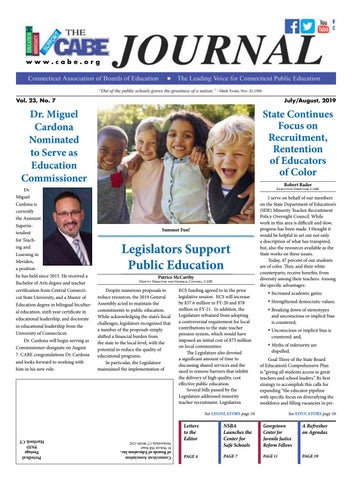
Dr. Miguel Cardona Nominated to Serve as Education Commissioner
State Continues Focus on Recruitment, Rentention of Educators of Color
Dr. Miguel Cardona is currently the Assistant Superintendent for Teaching and Learning in Meriden, a position he has held since 2015. He received a Bachelor of Arts degree and teacher certification from Central Connecticut State University, and a Master of Education degree in bilingual bicultural education, sixth year certificate in educational leadership, and doctorate in educational leadership from the University of Connecticut. Dr. Cardona will begin serving as Commissioner-designate on August 7. CABE congratulations Dr. Cardona and looks forward to working with him in his new role.
Executive Director, CABE
Robert Rader
Summer Fun!
Legislators Support Public Education Patrice McCarthy
Deputy Director and General Counsel, CABE
Despite numerous proposals to reduce resources, the 2019 General Assembly acted to maintain the commitments to public education. While acknowledging the state’s fiscal challenges, legislators recognized that a number of the proposals simply shifted a financial burden from the state to the local level, with the potential to reduce the quality of educational programs. In particular, the Legislature maintained the implementation of
ECS funding agreed to in the prior legislative session. ECS will increase by $37.6 million in FY-20 and $78 million in FY-21. In addition, the Legislature refrained from adopting a controversial requirement for local contributions to the state teacher pension system, which would have imposed an initial cost of $73 million on local communities. The Legislature also devoted a significant amount of time to discussing shared services and the need to remove barriers that inhibit the delivery of high quality, cost effective public education. Several bills passed by the Legislature addressed minority teacher recruitment. Legislation
I serve on behalf of our members on the State Department of Education’s (SDE) Minority Teacher Recruitment Policy Oversight Council. While work in this area is difficult and slow, progress has been made. I thought it would be helpful to set out not only a description of what has transpired, but, also the resources available as the State works on these issues. Today, 47 percent of our students are of color. They, and their white counterparts, receive benefits, from diversity among their teachers. Among the specific advantages: • Increased academic gains; • Strengthened democratic values; •B reaking down of stereotypes and unconscious or implicit bias is countered; •U nconscious or implicit bias is countered; and, •M yths of inferiority are dispelled. Goal Three of the State Board of Education’s Comprehensive Plan is “giving all students access to great teachers and school leaders.” Its first strategy to accomplish this calls for expanding “the educator pipeline with specific focus on diversifying the workforce and filling vacancies in pri-
See LEGISLATORS page 10
See EDUCATORS page 16
Letters to the Editor
NSBA Launches the Center for Safe Schools
Georgetown Center for Juvenile Justice Reform Fellows
A Refresher on Agendas
PAGE 4
PAGE 7
PAGE 11
PAGE 19
81 Wolcott Hill Road Wethersfield, CT 06109-1242
Connecticut Association of Boards of Education Inc.
Periodical Postage PAID Hartford, CT
2
The Journal – Connecticut Association of Boards of Education | July/August, 2019 PRESIDENT COMMENTARY Mission: To assist local and regional boards of education in providing high quality education for all Connecticut children through effective leadership.
A Post-Legislative Session Thank You! Robert Mitchell President, CABE
Another legislative session has come and gone and I want to take a minute to thank all the people who diligently worked on behalf of CABE to see that public schools were well represented at the Connecticut General Assembly this year. This work is often unsung. The contributions of CABE and its volunteer board members and staff alike, have a significant impact on what happens legislatively, frequently without recognition. Frankly, as a board member and a board chair, I am glad that CABE is there to represent the interests of boards of education and public education in general. There are lobbyists who represent many organizations and interests. Our legislators have to listen to many voices as they make decisions they feel will be in the best interests of the public. Connecticut’s school children were well represented this year at the Connecticut General Assembly. With continued state budget issues, it looked like the state legislature was going to try harder than ever to have local municipalities fund public education at an increased level. Or worse, cause cuts so egregious that education would be harmed. Let’s start with the volunteers. School board members from across the state, already busy doing the work of their local district, stepped up to do what had to be done in Hartford. Members and officers of the CABE Board of Directors really stepped up and reached out to their local legislators and testified when they could. Testifying before legislative committees is not for the faint-hearted. There are long lines and long waits. CABE staff helped, as they always do, to make it easier for those willing to go to Hartford and have their say, but it still can be an exhausting day. Those who couldn’t make a physical pres-
ence wrote e-mails and made phone calls when an important bill was up for discussion. Members of the CABE Government Relations and State Relations Committees did all they could to help ensure bills positively impacting public education passed and ones that did not have a positive impact did not pass. Particular thanks to the chairs of these committees; •L iz Brown, Vice President for Government Relations, Chair, Waterbury Board of Education; • J ennifer Dayton, Chair of the State Relations Committee, Board member, Greenwich Board of Education; and, •B ryan Hall, Chair of the CABE Resolutions Committee, Chair, East Hartford Board of Education. Numerous school boards took the time to write resolutions for the CABE Delegate Assembly, passed position statements on legislation before the Connecticut General Assembly and submitted written testimony to make sure their local legislators understood the impact of their decisions on their local constituents. Several boards hosted their local State Representatives and Senators at meetings or invited them to local events to help them understand what is going on in their districts and the challenges they face. Other boards hosted legislative breakfasts. Finally, I want to recognize the CABE staff, who make all of this look easy, (hint – it’s not!). CABE’s Deputy Director and General Counsel, Patrice McCarthy, Senior Staff Associate for Government Relations Sheila McKay, Administrative Associate for Government Relations, Gail Heath, Executive Director, Bob Rader and the rest of the CABE staff who worked tirelessly to make this legislative session a success. After the CABE Delegate Assembly set CABE’s positions for the year, they were passed on to the State Relations Committee to identify CABE’s
Vision: CABE is passionate about strengthening public education through high-performing, transformative local school board/ superintendent leadership teams that inspire success for each child.
Board of Directors legislative priorities. This was followed by organizing legislative breakfasts in each CABE area – finding locations, inviting board members, superintendents and local legislators to each event and presenting information at each to help inform our members and reps, alike. As the session started, the Government Relations staff made sure that CABE members understood each bill’s impact on their local district. Staff tracked every bill as they worked their way through the General Assembly and ensured that testimony (verbal and written) was presented and coordinated efforts to help board of education members testify. Patrice and Sheila were up at the Capitol to talk to leadership and rank and file legislators. They also reported out the results of the session in writing, through webinars, and in a Legislative Update workshop right after the session ended. It does not end there, however, because there are numerous policy issues in the aftermath of the session. Vin Mustaro, Senior Staff Associate for Policy Services, and the rest of the Policy Department, have to go through every piece of legislation and identify what superintendents and boards need to know to be compliant with changes in the law. I think this session was a very good one for public schools. There were numerous bills that could have helped districts, which mostly passed; and some rather odious bills that could have wreaked havoc on us all, that were rejected. I think CABE’s Government Relations activities were very successful, and that work helped all of our membership, from the smallest district to the largest. While sometimes the hardest to quantify in actual value to districts, these activities are a most important aspect of our CABE membership.
EXECUTIVE COMMITTEE Robert Mitchell | President, Montville Donald Harris | First Vice President, Bloomfield Elizabeth Brown | V ice President for Government Relations, Waterbury Christopher Wilson | V ice President for Professional Development, Bristol Michael Purcaro | Secretary/Treasurer, Ellington Ann Gruenberg | I mmediate Past President, Hampton Bryan Hall | Member at Large, East Hartford Lydia Tedone | NSBA Director, Simsbury AREA DIRECTORS Doug Pfenninger | Area 1 Director, Winchester Bryan Hall | Area 2 Co-Director, East Hartford Leonard Lockhart | Area 2 Co-Director, Windsor Michael Purcaro | Area 3 Co-Director, Ellington Michele Arn | Area 3 Co-Director, Vernon Joan Trivella | Area 4 Director, Brooklyn Mic helle Embree Ku | A rea 5 Co-Director, Newtown Frances Walton | Area 5 Co-Director, Ridgefield Karen Kleine | Area 6 Director, Westport George Kurtyka | Area 7 Director, Derby Lon Seidman | Area 8 Director, Essex Jonathan Gilman | Area 9 Co-Director, Bozrah Sean Nugent | Area 9 Co-Director, Preston ASSOCIATES Julie Ausere | Associate, Canton Eileen Baker | Associate, Old Saybrook Robert Guthrie | Associate, West Haven John Prins | Associate, Branford Robert Trefry | A ssociate, CT Technical High School System COMMITTEE CHAIRS Becky Tyrrell | Chair, Federal Relations, Plainville Bryan Hall | Chair, Resolutions, East Hartford Jennifer Dayton | Chair, State Relations, Greenwich CITY REPRESENTATIVES Darnell Goldson | City Representative, New Haven Betsy Allyn | C ity Representative, Stamford Charles Stango | City Representative, Waterbury STAFF
Robert Rader | Executive Director Patrice McCarthy | Deputy Director and General Counsel Rebecca Adams Rieder | Senior Staff Attorney Nicholas Caruso | Senior Staff Associate for Field Service and Coordinator of Technology Sheila McKay | Senior Staff Associate for Government Relations Vincent Mustaro | Senior Staff Associate for Policy Service Lisa Steimer | Senior Staff Associate for Professional Development and Communications Teresa Costa | Coordinator of Finance and Administration Pamela Brooks | S enior Administrative Associate for Policy Service and Search Services Terry DeMars | Administrative Associate for Policy Service Gail Heath | Administrative Associate for Government Relations Wilmarie Newton | Administrative Associate for Labor Relations Nancy Propfe | Administrative Assistant for Membership Services Corliss Ucci | Receptionist and Assistant to Executive Director
The CABE Journal (ISSN 1092-1818) is published monthly except a combined issue for July/August as a member service of the Connecticut Association of Boards of Education, 81 Wolcott Hill Road, Wethersfield, CT 06109, (860) 571-7446. CABE membership dues include $30 per person for each individual who receives The CABE Journal. The subscription rate for nonmembers is $75. Association membership dues include a subscription for each Board Member, Superintendent, Assistant Superintendent and Business Manager. The companies and advertisements found in The CABE Journal are not necessarily endorsed by CABE. “Periodicals Postage Paid at Hartford, CT.” POSTMASTER: Send address changes to The CABE Journal, CABE, 81 Wolcott Hill Road, Wethersfield, CT 06109-1242. Email: lsteimer@cabe.org. Members can find the CABE Journal online at: www.cabe.org/ page.cfm?p=1024
The Journal – Connecticut Association of Boards of Education | July/August, 2019
CABE Affiliate Members BUSINESS AFFILIATES DIAMOND MEMBER Finalsite PLATINUM MEMBER
Berchem Moses PC GOLD MEMBERS
Pullman & Comley Shipman & Goodwin Support for the Budgetary Process SILVER MEMBERS Anthem Blue Cross and Blue Shield Arthur J. Gallagher & Company Corporate Cost Control Digital Back Office ESS Milliman Milone & MacBroom, Inc. BRONZE PLUS MEMBERS Coordinated Transportation Solutions COUNTABILITY, Inc. JCJ Architecture OneDigital Health and Benefits The S/L/A/M Collaborative BRONZE MEMBERS Albert Risk Management Consultants Brown & Brown Chinni & Meuser LLC Dattco, Inc. Goldstein & Peck, P.C. Kainen, Escalera & McHale, P.C. The Lexington Group Perkins Eastman Zangari Cohn Cuthbertson Duhl & Grello
EDUCATIONAL AFFILIATES
American School for the Deaf Area Cooperative Educational Services Capitol Region Education Council The College Board Connecticut Association for the Gifted Connecticut Association of School Business Officials Connecticut Center for School Change Connecticut School Buildings and Grounds Association Connecticut School Counselor Association Connecticut Technical High Schools Cooperative Educational Services EASTCONN EdAdvance Explorations Charter School Girls Scouts of Connecticut Interdistrict School for the Arts and Communications (ISAAC) LEARN Unified School District #1
3
EXECUTIVE DIRECTOR COMMENTARY
What Do You Know About SEL? Robert Rader
Executive Director, CABE
Last November, Dr. Marc Brackett was the Friday morning keynote speaker at the CABE/CAPSS Convention. Despite a piece of the ceiling nearly clocking him in the head, he delivered a thoughtful, humorous discussion on the importance of providing social-emotional learning (SEL) to school staffs and students. Why is SEL important? Dr. Brackett responds that we are in the “worst place we’ve ever been in mental health” among students. Too many suffer from anxiety and depression. Our teachers are also stressed. Surveys show that too many are frustrated and overwhelmed. Certainly, those feelings are not a recipe for good school climates and happiness for our children or for educators. After the keynote, we continued to work with the Yale Center for Emotional Intelligence, where Dr. Brackett is the Founding Director of the Center and professor in the Child Study Center. CABE (Patrice McCarthy, Lisa Steimer and I) and CAPSS Executive Director Fran Rabinowitz worked with Dr. Brackett and others from the Center for EI on surveys that went out to board members and superintendents. We soon will be providing the results and suggestions for follow-up. We thank all who took the time to complete the surveys.
Seedlings Institute
In mid-July, I was honored to be invited to the Seedlings Institute for School Leaders, held over three days at Yale University. More than 100 people participated and The Seedlings Foundation sponsored it. While I was the only representative of boards of education, it was beneficial to be in the company of New York City superintendents and their staffs, superintendents from Connecticut and other school leaders from across the country. The three days were jam-packed with teaching, group exercises and opportunities to better understand how to infuse SEL throughout the school curriculum but, also supply
its principles for staff and others in school districts. “RULER”, the Center’s “evidence-based, systemic approach to SEL... that has been adopted by over 2,000 preschool to high schools across the United States and in other countries” was a major focus of the Institute. According to a website supported by the Center “‘RULER’ is an acronym that stands for the five skills of emotional intelligence: recognizing, understanding, labeling, expressing and regulating emotions. RULER also is the name of the approach to social and emotional learning created by the Yale Center… that supports positive emotional climates and the development of these skills in both students and the adults in their lives.”
Takeaways
Among the lessons I took from this exciting, fun and informative conference (and I don’t say that about many professional development opportunities): •T o understand this work, one must do a lot of work on oneself. Being in touch with your emotions and understanding your “triggers” is critical. It is not nearly enough to just say that SEL is a “good thing.” One must “do the work.” We learned the same lesson when we started to study implicit bias—one needs to understand oneself before trying to teach others. We learned to use the “Mood Meter”, to get a real sense of where you are emotionally. It is a basic graph where you can plot your emotions based on how “energized” and “pleasant” you feel, which Dr. Brackett stated, are critical indicators of your current feelings. If you are in the “red” and “high energy”, but, lacking a degree of “pleasantness”, watch out! Identifying and understanding what you are feeling is a large part of the training. You need to “name it [your emotion] in order to tame it!” •B oards should understand that this is not “just another class” for students. SEL teaches life lessons, which should provide skills that can help them throughout their lives. • I mplementation of RULER is a difficult job, especially as so many
teachers are suffering from “initiative fatigue”, but, in the end, it should prove valuable to your students, staff and board members The learning in school can lead to better student achievement and more satisfaction with school. SEL training also should be helpful to your staff as it provides tools for helping students who are struggling. One meta-analysis of 213 studies with 270,000 students showed an 11 percent gain on standardized achievement tests after one year of systemic teaching. While SEL is not one of the indicators in our Next Generation Accountability System, improving school climate and the well-being of educators will help districts improve their scores on the index. • I t is not an easy task to undertake this critical professional development and make it systemic in school districts. To be most effective, all members of staff need to receive professional development so that they are working off the “same page.” Lack of uniformity across districts makes it much harder to succeed. The mental health of students is now one of the leading issues before our boards. According to the Center’s Executive Director and Byram Hills (NY) Central School District Board President Scott Levy, mental health and SEL have become critical areas of focus for school districts across the country. Schools are adopting SEL to create and sustain safer and more supportive school climates with fewer instances of bullying and cyberbullying.
The Advantage of Happiness
At the same time I attended the Seedlings Conference, I was reading The Happiness Advantage: How a Positive Brain Fuels Success in Work and See SEL page 11
4
The Journal – Connecticut Association of Boards of Education | July/August, 2019
LETTERS TO THE EDITOR
Quality Professional Development To the Editor: I attended a meeting today (Tuesday, 6.18.19) of the Government and State Relations and Resolutions Committees where I took advantage of the occasion to praise the work of CABE Staff, Patrice McCarthy and Sheila McKay for their outstanding Legislative Update at the Legislative Office Building last month. (Although not front and center as were Patrice and Sheila, it should be clear that Gail Heath and Bob Rader are also deserving of the plaudits, as are the rest of the staff for all that they do.) I
pointed out that, yes, Board of Education members were there, but it was especially impressive that the people in the Legislative Office Building hearing room were representative of most, if not all, major Connecticut school law firms; school superintendents, assistant superintendents; and central office administrators. Their presence in the room is evidence of the extraordinary respect due and accorded to Association staff from and by those highly regarded practitioners and advisers whose professional lives are committed to Connecticut public education excellence.
I suggested that someone should make sure that CABE members and non-members alike hear about the quality service CABE’s experienced advocates provide on behalf of the organization. After the meetings, on the drive back to Branford, it struck me as a bit weird that an implication of my comment could have been that I was asking staff to pat themselves on the back for their own good work. I realized that it makes a lot more sense if the well-deserved recognition were to come from a CABE Board member. So here it is. Providing highly credible,
much appreciated and sought-after professional development for school board members? For school law attorneys? For senior district administrators and education professionals? Check. Check. And check. These are some of my reasons for believing that supporting CABE is a sine qua non for becoming an effective school board [member] in Connecticut. It’s as simple as that. Thank you! John Prins Board Member Branford Board of Education
Planning for your Summer Professional Development? To the Editor: As we get closer to the 2019 election it is only natural that political hopefuls will announce their candidacies. In time, we will hear from each on their specific political platform, optimally accompanied by a strategic plan to help their communities. In many communities, it feels like open season on boards of education. Education Reporter Valerie Straus of the Washington Post stated October, 2018 in the Washington Post, “It’s hard to find a public official today who, when talking about public schools, doesn’t talk about what a mess they are. Failing. Some of them are, in fact, failing kids.” In retrospect, however, I have to wonder, who in fact is failing who... Year after year, there is public scrutiny and criticism on the performance of Connecticut school districts. During my time while serving as a member of my local Board of Education, and in my more recent role as chairwoman these past 18 months I have gained an understanding about my local school system and education as a whole, but knew there was much more to learn. For example, I now know, that in addition to the wonderful hard working students, most districts are made up of many committed, talented educators and administrators. So where is the disconnect? Why is there this continuous perception of failure? I realized that if I had any hope
in identifying just that, I needed to take a deeper look at the facts, those obvious as well as those that may not be visible at the surface. Over the past year, I have done extensive research, taking into account supporting data from multiple resources, and hope you will consider the information I have to share. There is no denying that social justice and equality in education have come to the forefront. In my opinion, our educational system and school districts throughout the United States have been unfairly held responsible for narrowing the achievement gap. I believe it to be important that community members are educated as to the real challenges faced by both students and educators. According to a policy brief titled “Poverty and Potential: Out- ofSchool-Factors and School Success” written by David Berliner in 2009, the real limitations on school systems are outside-of-school factors in place before the child even becomes of school age. Unfortunately, these facts seem to have been disregarded and ignored by our political leaders for decades. Outside-of-school factors that tend to be prevalent in low-income communities include: 1. l ow birth-weight and non-genetic prenatal influences; 2. i nadequate medical, dental, and vision care, often a result of inadequate or no medical insurance; 3. food insecurity; 4. e nvironmental pollutants; 5. f amily relations and family stress;
6. n egative neighborhood characteristics; 7. lack of extended learning opportunities. These outside-of-school factors not only significantly affect student well-being and learning opportunities, but are related to physical, psychological, and social problems that children bring to school. Although these factors have a significant impact on cognitive development and student achievement, they remain outside of the scope and reach of the school districts held accountable for such deficiencies. Local level cities and towns across the country are unable to provide school districts resources for these challenges due to their own economical struggles. The economic profile and population is changing nationwide. Statistics show that in many states, particularly in urban neighborhoods, there is also an increase in the number of children referred to early intervention programs, such as the Birth-toThree program in Connecticut. In fact, just months ago Connecticut was awarded a new Preschool Development Grant. The grant application was highly competitive, and desperately needed by many. However, no state received more funding per target family than Connecticut. The fact is that the cost of living is lower in some areas of the state, resulting in a change of demographics for many struggling districts; I do believe however that many of those school systems are rising to the chal-
lenges presented. Preschool, instructional, after school, and summer programs are crucial in breaking the cycle of disadvantage, though many feel it is just these programs that are expendable, I ask board members to champion these initiatives. Instead of looking to find fault with school systems that remain underfunded or educators unjustly held accountable for student achievement, ask your town and state representatives to address the challenges many children face before they ever enter a school building. The key is to act preventively through parent education and community resources. Regardless of the funding a school district receives, many of the out-of-school factors remain out of reach for educators and cannot be controlled by the school district or the board of education. Having a supportive community is a key factor in student achievement. If the public places an emphasis on education, town officials will be inclined to comply with the school board’s budget. The result will be positive for your community. *If you hear a candidate say that their school system is failing, ask them to explain. More importantly, ask what are they going to do about it! Michele A. DeLucia, MAIOP, Chair East Haven Board of Education Adjunct Professor, Southern CT State University and a doctoral student in the EdD. Educational Leadership Program, with a concentration in Political Psychology.
The Journal – Connecticut Association of Boards of Education | July/August, 2019
5
See You in Court – The Nutmeg Board of Education
Will That “Little” Amendment Save Nutmeg a Bundle? Thomas B. Mooney, Esq. Shipman & Goodwin
The Nutmeg Board of Education makes many mistakes. The latest imbroglio created by the board will be reported here each issue, followed by an explanation of what the board should have done. Though not intended as legal advice, these situations may help board members avoid common problems.
The members of the Nutmeg Board are very concerned about whether and how they will make ends meet this year. The Town slashed their budget request during the appropriation process, and as things stand at the beginning of the new fiscal year, they are looking at a deficit approaching $1,000,000. Veteran Board member Bob Bombast warned his fellow Board members that they better do something and fast, and he promised to put on his thinking cap and to be back to his fellow Board members with some bright ideas. Realizing that he had to think outside the box, Bob reached out to Bruno, President of the Nutmeg Union of Teachers (NUTS), and they met for coffee. Bruno was sympathetic to Bob’s concerns about the projected deficit in the Board’s budget, explaining that he did not want the Board to have to lay off teachers to save money. “I have talked with our Executive Committee, and NUTS has two great suggestions for the Board of Education to save money,” Bruno announced grandly. “The first is an early retirement incentive program. If we can work together to adopt such a plan, the Board can save a bundle.” Bob was intrigued. “Some of these teachers should have retired long ago. Maybe we can get rid of some old deadwood and save money! What do you propose?” “We will keep it simple. Teachers with twenty or more years of service will be able to participate in the plan, and upon retirement, they will receive a payment of $40,000. After making those payments the Board will be even for the first year, and it will save for years to come on the cost difference between the teachers on the maximum step who retire and their replacements who are hired at the bottom of the scale!” Bob liked the sound of that, though he was hoping for more immediate savings, and he asked Bruno if he had any other bright ideas. “Of course!” Bruno responded. “The Board can save money right now if it offers teachers money to waive health insurance, say $3,000 for a teacher on a single plan and $6,000 for a family plan. Given that the cost of insurance is approaching $15,000 for an individual plan and $30,000
for a family plan, the Board will save a bundle whenever teachers take the waiver payment and get off the Board’s plan!” Bob thanked Bruno for his creative suggestions, and Bruno then suggested that they lock in these savings by putting both the early retirement plan and the insurance waiver in the contract so that they would not have to revisit these issues every year. “Done,” Bob responded. Bob then emailed his fellow Board members, informing them that he will be asking Mr. Board Attorney to put together a little contract amendment to present to the Board for action. What’s wrong with this picture? • • • • • • • • • • • • • • • Bob and the Board should read up on early retirement incentive plans. While carefully-structured plans can reduce costs, the plan that Bob and Bruno came up with will certainly be costly to the Board. The insurance waiver will be a loser as well. In considering any early retirement incentive plan, the board must take into account the fact that teachers retire every year. Therefore, the cost analysis must start by projecting how many teachers will retire in the normal course. That number should be excluded from any calculation of savings, because these teachers would have retired anyway. By contrast, the cost of any incentive paid to these teachers must be considered a cost of the plan. In sum, the projected cost “savings” of an early retirement incentive plan must be computed based on the salary savings from the teachers retiring in excess of the average number, because only these teachers may be considered to have been incentivized to retire. Moreover, those “savings” must then offset the costs of the incentives that are paid to all the teachers, including those who would have retired anyway. Only when the “savings” from the retirement of the incentivized teachers have covered the costs of the incentive payment for all retiring teachers will there be savings from the plan. In assessing the cost impact of a proposed early retirement incentive plan, boards of education must make accurate assumptions. The board should not assume that it will be able to hire all replacement teachers at the first step, given the possibility that some teachers will retire from shortage areas; a more realistic estimate for the cost of the replacement teachers would be MA track, step 5. The board must also decide how many teachers must retire under the plan in order to generate sufficient salary cost savings to justify the plan. Perhaps most
important, that number of teachers should be a “trigger” for the plan to go forward. The board won’t know what the participation will be until the plan is offered. Therefore, the plan should be expressly conditioned on the retirement of a specified number of teachers, and the board should reserve the right to withdraw the plan if that trigger number of retirements is not reached. In any event, such plans should never be included in the collective bargaining agreement. The premise of such plans is to incentivize teachers to retire earlier than they would without the plan. If such plans are available through the contract year after year, the incentive is lost, and teachers will simply retire when they wish, albeit then with a going-away present. While a carefully-designed retirement incentive plan can save money, such is not the case with an insurance waiver plan. Here, we must start with the premise that teachers (and other employees) will waive their insurance coverage only if they don’t need it. When employee premium cost sharing was minimal, a waiver might worked to induce an employee to move over to a spouse’s plan. However, with employee cost-sharing approaching
(and sometime exceeding) 20%, avoidance of the significant cost of insurance to the employee is incentive enough, and it is unlikely that paying the additional waiver amounts that Bruno suggested would induce any other employees to waive insurance. Rather, such payments will simply be a new cost to the board. Two points about the Nutmeg Board of Education may be helpful in closing. As board members know, it is important not to do board business on email for fear of conducting an illegal meeting over email. However, the definition of “meeting” under the FOIA excludes “strategy and negotiations with respect to collective bargaining.” Therefore, email discussion of negotiation strategy will not be considered a meeting. Finally, Bob should watch what he says. Referring to some teachers as “old deadwood” may come back to haunt him if he is ever the subject of an age discrimination complaint. Attorney Thomas B. Mooney is a partner in the Hartford law firm of Shipman & Goodwin who works frequently with boards of education. Mooney is a regular contributor to the CABE Journal. Shipman & Goodwin is a CABE Business Affiliate.
The Ninth Edition – Now Available!
A Practical Guide to Connecticut School Law by Thomas B. Mooney, Esq. Shipman & Goodwin
CABE is delighted to announce that the Ninth Edition of Tom Mooney’s Practical Guide to Connecticut School Law is now available. PRICING: CABE Members: $54.99; CABE Non-Members: $79.99; Students: $44.99 There have been many changes in school law in the last few years, and the Ninth Edition has been extensively revised to provide updated guidance on the legal issues that govern our schools. Changes include descriptions and commentary on:
• Changes in teacher evaluation and teacher tenure. • New rules regarding employee background checks. • New requirements concerning student data privacy. • New rules for suspension, expulsion and alternative educational opportunities. • Revised requirements governing seclusion and restraint. • The new “Every Student Succeeds Act” and how it has changed “No Child Left Behind Act” requirements. • The CCJEF case and ongoing litigation over equal educational opportunities. • The Minimum Budget Requirement and new duties to collaborate with town officials. • A host of other changes in the rules that boards of education and school administrators must follow.
6
The Journal – Connecticut Association of Boards of Education | July/August, 2019
The Journal – Connecticut Association of Boards of Education | July/August, 2019
7
NSBA Launches the Center for Safe Schools New Resource Addresses Wide-Ranging Safety Issues Facing Schools
The National School Boards Association announced the launch of the NSBA Center for Safe Schools (CSS), a new initiative that provides critical resources to help education leaders, administrators and the public enhance student and school safety. CSS focuses on four key areas — infrastructure, crisis and emergency management, whole child health and cyber security — to create and maintain safe and secure learning environments for students, staff and surrounding communities. “Safety is a top priority for public education leaders and communities
and the Center is a resource for them as they continue working to provide a secure learning environment. The Center works with all involved in educating and empowering these stakeholders on the variety of factors that impact school safety,” said NSBA Executive Director and CEO Thomas J. Gentzel. “Empowering these stakeholders on the variety of factors that impact school safety requires extensive collaboration, and CSS is an excellent platform to engage everyone in the shared objective to ensure every child’s emotional and physical safety at school.”
A nonpartisan, national platform, the Center is the culmination of planning with member state school boards associations. CSS will collaborate with national, state and local non-profit organizations in education to support CSS by providing insightful content and resources on school safety and offer a forum for all school leaders involved in safety, including school board members, superintendents, school resource officers, school counsellors, teachers, principals, community partners and business representatives. Through networking and sharing best practices, CSS will
serve as a needed resource to foster collaborative relationships and develop solutions best suited for the schools in the community. The public may access CSS and its resource library, which include webinars and white papers. Additional services are provided to NSBA’s state associations as a member benefit and on a subscription basis to district employees, law enforcement, parents and communities. SWORD™, the world’s first mobile threat detection platform offering schools real-time security intelligence, is the Center’s founding sponsor.
Student Advisory Council Recommendations to State Board of Education
Patrice McCarthy
Deputy Director and General Counsel, CABE
Members of the State Student Advisory Council on Education (SSACE) recently made their end of year presentation to the State Board of Education. SSACE was created by the Legislature in 1998 to give students a voice in education planning. The focus of their study was on educator diversity, and they offered the following recommendations: Ø Expand the state’s horizons. Use social media (i.e., Twitter, Snapchat, Instagram) to reach out to recent teacher graduates across the nation looking for job opportunities. Ø Consider “Grow Your Own” programs. Such programs create partnerships between states, districts and educator preparation programs. Ø Consider alternative teaching
Ø
Ø
Ø
Ø
programs. Minority teachers are more likely to pursue alternative routes when getting a teaching degree, due to socioeconomic disadvantages and the need to work while in school. Implement a Minority Teacher Preparation Program in universities and community colleges across Connecticut, such as the one at the University of Wisconsin. Require racial sensitivity/ diversity/implicit bias training or professional development for all teachers and administrators. Partner with state universities to establish stronger networking programs between colleges and teachers of color and other ethnicities. Provide mentoring opportunities for high school students of color and other ethnicities interested in teaching and college students in
For an update or more information on vacancies visit our website. MARY BRODERICK, ED.D SENIOR CONSULTANT
Ø
the field. Establish and strengthen district and statewide organizations for teachers of color and other ethnicities to create a better and more coherent support system.
The students identified an issue of ongoing focus for CABE and its Diversity Committee and were thorough and articulate in their presentation.
The Government Relations Committee met on June 18 to review their advocacy work for the year and start planning for next year.
N ew contrac t awards Playground Equipment
Telescopic Seating and Stadium/Grandstand Seating
For more information contact
CABE Search Services
81 Wolcott Hill Road, Wethersfield, CT 06109
860-608-1763
Equal Opportunity Employer
For more information, visit www.crec.org/marketplace
8
The Journal – Connecticut Association of Boards of Education | July/August, 2019
CABE Prepares to File an Amicus Brief in Support of the Trumbull Board of Education in the Second Circuit Court of Appeals Rebecca Adams Rieder Sr. Staff Attorney, CABE
Christine Sullivan of the law firm of Berchem Moses contacted the CABE legal department with a request for CABE to file an amicus brief, on behalf of the defendant, Trumbull Board of Education, in the case of D.S v. Trumbull Board of Education. The central issue in the case is the number and type of independent educational evaluations (IEE) for a child with a disability that the district must facilitate, and in most cases, pay for, under federal law, when a parent disagrees with the results of the district evaluation of the child. After discussing the case with attorney Sullivan, and reviewing the law and the case history, it is clear that this is an issue with the potential to impact all Connecticut school districts. Federal regulations, adopted under the Individuals with Disabilities Education Act (IDEA), have been,
thus far, interpreted to require school districts to allow, and often pay for, IEEs when the parents disagree with the district’s initial evaluation. The plaintiffs in this case content that districts must provide IEEs for disabilities when there has not yet been a district evaluation. For example, if the district evaluated a student for a sight related disability, the parent would have the right to an IEE related to sight AND hearing, autism, and all disabilities unrelated to the evaluation. Districts would be required to provide IEEs or allow parents to conduct them, even though there are not any evaluations with which the parents disagree. If the plaintiffs prevail, the scope of the legal obligations of school districts would be exponentially expanded under the IDEA. This case is what is known as a matter of first impression. That is, no case law has been identified on these regulations. If the parents were
2019 CABE / CAPSS
CONVENTION Every Student, Every Story
November 15-16, 2019 Mystic Marriott Hotel, Groton
CABE MEMBERS Click Here
for Early Bird Registration
Click Here
to Make Your Hotel Reservation
to prevail, it would be a significant expansion of the subject. This means that there is a possibility that the United States Supreme Court could agree to take the case, upon request to appeal the Second Circuit decision. A Supreme Court ruling would impact school districts throughout the country. Thus far, all rulings have been in favor of the Trumbull Board of Education. The Trumbull Board was successful at the due process hearing at the Connecticut State Department of Education. D.S.’s parent appealed the decision to the Connecticut District Court. The District Court, in a thorough and very well-reasoned decision, upheld the agency’s decision and ruled in favor of the Board. D.S.’s parents have appealed the lower court decision to the Second Circuit Court of Appeals. The Board’s brief is due the week of September 24, 2019. Overview of the law governing independent educational evaluations for children in special education Under the Federal Individuals with Disabilities Education Act: A parent has the right to an independent educational evaluation at public expense if the parent disagrees with an evaluation obtained by the public agency, unless: 1. Upon receiving the request for an IEE, the district files a due process complaint with the State Department of Education (SDE) to request a hearing to show that its evaluation is appropriate, and 2. The Department of Education’s final decision is that the agency’s evaluation is appropriate. If the hearing officer’s final decision is that the school district’s evaluation is appropriate, the parent still has the right to an independent educational evaluation, but not at public expense. A parent is entitled to only one independent educational evaluation at public expense each time the public agency conducts an evaluation with which the parent disagrees.
Case History
The district conducted a behavioral assessment. The parent disagreed
with the assessment and requested an individual evaluation in that area and in seven other areas, unrelated to the behavioral assessment, for which there were no evaluations with which to disagree. The parent did not request district assessments in any of those areas when requesting IEEs. The district agreed to a behavioral IEE but not the other 7. The parent filed a due process complaint with the State Department of Education, requesting that the hearing officer find that the denial of the IEEs violated due process and order the district to perform those evaluations. The SDE hearing officer denied the request for the additional evaluations and ruled that, under the IDEA, parents’ rights to IEEs is limited to evaluations which the district has conducted and with which the parent disagrees. She further held it was not appropriate for the parent to ask for IEEs in areas that did not have a relationship to the evaluation with which the parent disagreed - in this case, where the evaluation was deemed to be ‘behavior’. The parent appealed to the district court and the hearing officer’s decision was affirmed. The parent then appealed to the US Court of Appeals (United States Court of Appeals for the Second Circuit in DS v. Trumbull BOE) and that is now pending. CABE Deputy Director and General Counsel, Patrice McCarthy, reviewed the case in light of CABE’s criteria for filing amicus briefs. She recommended participation, noting that the Second Circuit includes Connecticut, New York, and Vermont and a decision in D.S. v. Trumbull Board of Education would be binding on school districts in all three states. And, in addition, the case could ultimately be addressed by the Supreme Court, and is, therefore, also potentially important to school districts nationally. The CABE Executive Committee accepted that recommendation and the CABE legal team is on the case. For questions or more information, please contact Patrice McCarthy or Rebecca Adams Rieder at CABE at 860-571-7446.
The Journal – Connecticut Association of Boards of Education | July/August, 2019
Connecticut School Attorneys Council Hold Mid-Year Meeting Patrice McCarthy
Deputy Director and General Counsel, CABE
The Connecticut School Attorneys Council met in the Rovins Conference Room at CABE in June. Patrice McCarthy provided an overview of the 2019 Legislative Session and Rebecca Adams Rieder provided an update on collective bargaining and labor relation issues. The roundtable discussion covered Section 504 accommodations at interdistrict magnet schools, participation in agricultural science and technology education programs, and Freedom of Information trends and cases.
9
State Board of Education June Meeting Patrice McCarthy
Deputy Director and General Counsel, CABE
The Connecticut Council of School Attorneys met on Friday, June 14 for a legislative update from Patrice McCarthy, CABE Deputy Director and General Counsel, and to discuss the implication for school districts of recently enacted legislation, current issues in union negotiations, and recent court decisions impacting Connecticut school districts. Kyle McClain, Council President, foreground right, asks Rebecca Adams Rieder, Senior Staff Attorney, about the Connecticut Supreme Court decision in New Milford Board of Educaiton v. New Milford Education Association.
At the June meeting of the State Board of Education the Oath of Office was administered to Erin Benham and Estela Lopez, both of whom were reappointed by Governor Lamont and confirmed by the General Assembly for an additional term as members of the State Board of Education. In addition, the State Board of Education re-elected Estela Lopez as Vice Chairperson of the Board. Congratulations!
10
The Journal – Connecticut Association of Boards of Education | July/August, 2019
The Media Message by John Henry Smith, Senior Public Relations Specialist, Baldwin Media Marketing, LLC
Putting the “Public” in Public Relations I’m the proud father of a fashion-obsessed, bottomless-pit-of-pizza-consumption eighth grade daughter. One day, we got word that our local high school – the school she’ll be attending as a freshman next school-year – would be having an open house. “Great,” wifey and I thought “the three of us can go and have a look around!” As the visit went on, though, we increasingly wondered if we had unwittingly stepped into a Saturday Night Live routine! Besides being in a group of people mostly old enough to be MY parents, the most mystifying part of this tour was our tour guide. My family and I expected a cheerful rundown of the school’s finest features. What we got instead was a series of: “This is our art room...it caught fire last year.” “Our music room is old and not exactly handicap friendly.” “The elevator hasn’t worked in a couple of years.” “Be careful you don’t trip over the buckets. We put them out to catch the rain from the leaky roof ” Yeah, we were THOROUGHLY confused – until someone explained to us that this tour was not intended for new students and their families. Instead, the tour sought to impress upon community members that they needed to vote “YES” on a referendum earmarking funds to remodel the school building. Oops! After I got done slapping myself for not reading the “Open House” announcement more carefully, the thought occurred to me that
LEGISLATORS
(continued from page 1)
establishes a minority educator loan reimbursement grant program, and expands the minority teacher incentive grant program to include students in the alternate route to certification. The Legislature also emphasized the need to create opportunities for the employment of at least 250 new minority teachers and administrators each year. Minority teacher recruitment and retention has been a priority for CABE’s Diversity Committee. Legislators also identified many
the school district had done a good job of organizing this gathering. A gymnasium full of people were there taking the tour in my time window. All of these tourists – except for us – appeared to be folks who could justify saying “I’ve got no school age kids, so fixing the school is not my problem.” But there they all were seeing and hearing about the problems first-hand before hearing a final sales pitch at the end of the tour while munching on macaroons. As a public relations professional, this whole episode naturally piqued my interest. While PR often seems focused on relating to media outlets, at its core, PR is about “relating” to the “public”. That relating can be accomplished through simple, everyday acts like making sure parents are kept well and promptly informed about any problems their kids are having in school. But as I’ve perused the web, I’ve come across fancier PR outreach exercises that have worked across the country. Here’s four that I find really interesting:
Superintendent’s Tea
You could substitute “coffee” or “pizza” or “dessert” or whatever consumable you think would be best to entice the community to come out and interact socially with decision makers in the school system. For examples of similar events that have been held successfully elsewhere, Google-search the following headlines: “Valley school superintendent hosts public coffee chats” issues of importance to school board members and superintendents, including social and emotional learning and the need for a positive school climate. CABE will continue to provide support and leadership to districts on these issues, building on Marc Brackett’s (Director, Yale Center for Emotional Intelligence) keynote speech at the 2018 CABE/CAPSS Convention. Several bills create the need for new or revised policies, including bullying, homeless students, special education and expulsion. CABE’s policy service will be providing districts with the tools to meet these new requirements.
“Enjoy Tea, District Update With Greenburgh Schools Superintendent”
Dads Take Your Child To School Day
According to the Pew Research Center, American moms put in nearly double the time American dads put in to raising their children. I will not in this space offer any opinion as to why that is so. What I will say is that we no doubt all agree that having highly engaged dads is a good thing in regards to better student outcomes. One way to encourage dads to become more engaged with their child’s education is to participate in the national “Dads Take Your Child to School” day. It’s scheduled this year for September 17. Check out the website, dadstakeyourchildtoschoolday.com, for more information.
Parent University
Many a parent over the years has lamented the fact that kids don’t exactly come with an owner’s manual. School districts across the country have taken advantage of this societal thirst for parenting tips by holding parent “universities.” These tend to be one or more free workshops in which professionals from the community present to parents tips on parenting issues like online safety and teaching kids financial literacy and life skills. Schools districts in New Haven, Stamford, Hartford, Bethel and Stratford have organized these workshops in the past. For more information, go to edsource.org and search “Parent University.”
Optimist Club Oratorical Contest
Full disclosure: I was a twotime medal winner in the Michigan OCOC back in my school days. The whole process started in school when I won the right to represent in the regional round. During the process, I met people – local news anchors, business owners, lawyers and such. They had all volunteered to be a part of the contest as judges or supporters. The contest has been around since 1928 and awards $150,000 in scholarship annually to contest winners. According to Optimists International, Connecticut participation in this contest is light to non-existent. That’s almost certainly because Connecticut is the ONLY state in the union without an active Optimist Club chapter. The. Only. One. That’s an opportunity to encourage/recruit the members of your school community to get club chapters rolling here again. For more information on Optimists International – including how to start a club – check out optimist. org. And for an example of how a school district has interacted with The Optimist Club Oratorical Contest, Google-search the L-A Times article titled, “Students bring their optimism to Ocean View School District speech contest”. Back to my family’s school visit once more, we eventually took the right school tour a few weeks later. Somehow, the fire in the art room never came up!
Did You Know? For the price of CABE dues, your board and superintendent are eligible for: • Unlimited telephone labor relations and negotiations advice • CABE Labor Relations survey information •E ducation Law Summaries
The Journal – Connecticut Association of Boards of Education | July/August, 2019
11
Georgetown Center for Juvenile Justice Reform Fellows Patrice McCarthy
Deputy Director and General Counsel, CABE
Patrice McCarthy, CABE; Devon McCormick, Tow Youth Justice Institute; Lauren Ruth, Connecticut Voices; Jill Ruggiero, Westport Police Department; Tiana Hill, Connecticut Child Health and Development Institute; Daisy Ortiz, Connecticut Judicial Department and Danielle Cooper, University of New Haven, have recently been selected as new members of the Georgetown University Center for Juvenile Justice Reform (CJJR) Fellows Network based on the approval of their Capstone Project. The team’s Capstone Project, Building Bridges for School Based Diversion, is focused on increasing school-based diversion knowledge and buy-in, and disseminating effective school-based diversion models. “The Connecticut team’s project seeks to increase school-based diversion practices throughout the state and organize statewide restorative conversations,” said Shay Bilchik, Director of CJJR. “Their work will
SEL
(continued from page 3)
Life, by Shawn Achor. He discusses that while conventional wisdom posits that once we succeed in our careers or relationships, we will be happy in life. He argues, however, that approaching life’s challenges with a positive approach will bring happiness. He describes boardrooms and classrooms where this principle has played out. Achor’s premise is consistent with that of the Center. If teachers and students (and everyone else) approach teaching, learning and other work with a more positive attitude, they will be less stressed and better positioned to succeed. While SEL has been derided in the past as soft, unscientific and unquantifiable, leading researchers now believe that it is critical to everyone’s wellbeing. Great strides have been made in the field. While there are other SEL programs available, based on what I saw and learned at Seedlings, I encourage board members and superintendents to consider instituting RULER in
provide guidance and strategies for schools to incorporate diversion programs, thereby reducing youth’s unnecessary involvement with the justice system.” Part of Georgetown University‘s McCourt School of Public Policy, CJJR advances a balanced, multisystems approach to reducing juvenile delinquency, fostering positive youth development, and holding youth accountable. The Center works nationwide to promote an evidencebased juvenile justice reform agenda, highlighting the research on policies and practices that work best to achieve better outcomes for children. Members of the Connecticut Team attended the School-Justice Partnerships and Diversion Pathways Certificate Program in September 2018, and were admitted to the CJJR Fellows Network in May 2019. This multiyear project will enhance engagement with statewide stakeholders and community partners to reduce exclusionary discipline and increase access to behavioral health services and supports for students. your district. The rewards of doing so will be well-worth it. Since I am not attached to any particular school district, I asked a veteran superintendent for his reaction to the institute. Dr. Steven Adamowski of Norwalk stated, “The training offered by the Seedlings Institute for School Leaders enables district leaders to build foundational support for teachers and principals using the RULER model and effectively plan for SEL implementation in their schools. Just as importantly, district leaders learn the ‘science’ of social and emotional learning. This includes important personal tools needed to model the recognition of emotions in self and others, understand the causes, and regulate emotions effectively - skills necessary to lead an emotionally intelligent adult culture aligned with students’ social and emotional learning goals.”
The CABE Board of Directors met on June 6 to approve the 2019-2020 CABE Budget which includes a 0 percent increase in dues.
C.O.P.S
What will provide YOUR district? • A policy manual updated within days of a board meeting. • Access to your policy manual 24/7 anywhere with Internet capability. • Timesaving links to legal and cross references. • A search engine specifically designed for board policy manuals. • The ability to search other online districts for similar policies or language. • A happier staff that will have less paper to deal with.
If you would like additional information on CABE’s Connecticut Online Policy Service (C.O.P.S.), call
Vincent Mustaro at 860-571-7446 or email vmustaro@cabe.org for full details
12
The Journal – Connecticut Association of Boards of Education | July/August, 2019
We Are Well Suited to Respond to the Legal Needs of Boards of Education Attorneys and Counselors at Law
Berchem Moses PC is a leading player in the State of Connecticut in the field of Education Law. With 10 attorneys dedicated to this specialized practice, we offer a long history of experience and deep resources. We promise the highest level of service in a more cost effective manner. We work with boards of education to address a myriad of complex issues including labor and employment, student issues, special education, general counsel, and other challenges facing educators today. Be sure to visit www.connecticuteducationlawblog.com where our attorneys regularly cover legal matters that pertain to Connecticut schools.
www.berchemmoses.com Milford
75 Broad Street Milford, CT 06460 Phone: 203-783-1200
Westport
1221 Post Road East Westport, CT 06880 Phone: 203-227-9545
The Journal – Connecticut Association of Boards of Education | July/August, 2019
13
THE POLICY CORNER Vincent A. Mustaro
Senior Staff Associate for Policy Service, CABE
Keep Your Policies Current As the start of another school year rapidly approaches, it is important to note that the policy responsibilities of boards of education remain ongoing. Remember that board policy is a living document. High functioning and successful school boards are always working on policy, even during the summer, because it is the backbone of the district and a core responsibility of the board. School boards by definition are policymaking bodies. Policy is the key work of boards of education. The board policy manual is the place where the policy decisions of the board are collected and published. Through policy boards establish the “ends” for the district, identifying who receives what benefits and how resources are prioritized. The staff implements board policy, establishing the “means” and identifying how to best proceed to reach the ends established by the board. In its basic form, the policy manual is a legal compliance document. There are state and federal statutes and regulations that require certain topics to be covered in the board policy manual. Other topics, while not expressly required, are recommended or desired in order to protect the board from potential liability. These are considered “good practice” policies. Beyond mere legal compliance, the policy manual is also the governing document of the school district. This is the place that staff, students, parents and community members should be able to look to hear the voice and positions of the board. The policy manual is the document that allows the board to make clear its leadership and direction for the district. How long has it been since you took a good look at your policy manual? Some boards are currently doing a complete update of their manual. Others may not have taken a close look at their manual in quite some time. Even if a policy manual revision project was recently completed, the need still exists to consider policy revision or new additions, especially in light of the last session of the General Assembly. All boards of education must view policy revision and updates as a
year-round ongoing task. An in-depth, thorough analysis of the board policy manual should be done periodically. This in-depth review process should involve the entire board, administrators and selected staff members. The services of CABE can be used to help accomplish this major task. Annual reviews, using CABE Policy Service materials, such as The Policy Update
contracts with staff bargaining groups also affects policy. If the board has difficulty making decisions for lack of information or the superintendent and board are confused about each other’s responsibilities, then it is time to review the district’s policy statements. Actually, virtually any school system function that isn’t functioning smoothly may indicate a need for policy
“ Policy must always be responsive to community needs and influences internal and external to the school system.” Service quarterly publication and Policy Highlights will go a long way toward keeping the board’s present policy manual current and viable, lessening or even eliminating the need for major revision projects. This annual review process need not be complicated but should be recognized as important for the board to do and appropriately scheduled as a viable annual board activity. Putting such an activity on the annual board calendar of responsibilities helps to insure that it will take place. The district may want to consider using CABE’s Policy Audit Service to determine the condition of its current policy manual and what steps need to be taken to bring it up to date. Policy must always be responsive to community needs and influences internal and external to the school system. Major reasons dictate the need to annually review, revise or adopt new policies. The passage of new federal and state laws, coupled with new regulations constantly impact policies. Judicial decisions of federal and state courts also influence policy. Negotiation of new
review. The annual policy review process can take many forms. One method is to plan a special board meeting, or a portion of a regular meeting, for this purpose. This process involves individual board members and administrators and/or the board’s policy subcommittee to prepare specific recommendations in advance of the meeting as to what policy revisions or new policies are needed. The annual policy meeting identifies and lists a practical number of policies, in priority order, to be addressed in the coming months. Timelines are established and responsibilities assigned. Also, policy revision frequently is initiated when the superintendent brings the need to review particular policy statements to the board’s attention or indicates the need for policy where it does not exist. Moreover, in addition to the superintendent, suggestions for review or for new policy statements may come from anyone within the school community: administrators, teachers, parents, students or community members.
Keep in mind that a crisis is no time to undertake a review or revision of any policy statement. It is another worthwhile practice for the board to review each section of the manual at appropriate times during the school year. For example, fiscal policies can be reviewed before the budget is formulated; personnel policies studied against statements made in staff negotiated agreements in advance of renegotiating with the bargaining unit. When reviewing policy, consider if the statement complies with state and federal laws and regulations and negotiated agreements and that the policy serves the educational purposes of the school system. Also, consider if the policy can be administered, and whether it is consistent with the school system’s vision, philosophy, goals and objectives as well as with other policies. Policies not meeting these criteria can become liabilities leading to possible litigation. If it is determined that the district needs to create new policies or to revise existing ones, it is prudent to take advantage of the work that’s already been done by others. CABE provides model policies that the local district can adapt. Sample policies are also available in CABE’s publication, The Connecticut Reference Manual of School Board Policies, Regulations, and Bylaws, available on the CABE website, and through subscribing to The Policy Update Service. It is necessary to determine if district student and employee handbooks reflect current board policy. Student handbooks represent one of the most direct means of disseminating and implementing board policies and administrative regulations. An in-depth, thorough analysis of the board policy manual should be periodically conducted, preferably using the assistance of CABE’s policy services. Annual reviews will help to keep the board’s policy manual current and viable between major revision projects. With a pattern of continued review, a board can be reasonably certain that its policies are legal, workable and current. It is necessary to recognize this review process as important — not continually postponed as other matters arise.
14
The Journal – Connecticut Association of Boards of Education | July/August, 2019
Meet the CABE Area 8 Director We began profiling the CABE Area Directors in the January issue of the CABE Journal. CABE Area Directors and Co-Directors serve on the Board of Directors and provide a vital communication link with the Board, staff and regional and local boards of education. This month, we profile Area 8 Director Lon Seidman (Essex). What made you want to join your local Board of Education? SEIDMAN: New England is unique in that our local governments depend on volunteers stepping up and doing their part to help keep our communities running smoothly. I believe very strongly in the importance of public education and the opportunities it provides to all children so I chose to contribute my time to our local schools. How long have you served on your local Board of Education? SEIDMAN: I have been on the Essex Board of Education for 16 years and
serving my 12th year as chairman. We are elected to six year terms in Essex. Prior to moving to town I served on the Westbrook Board of Education for two years.
upon us by the State of Connecticut. I’m proud of the relationships we have built and the creative ways we have solved problems together.
What are you most proud of in your work on your local Board of Education?
Why did you join the CABE Board of Directors?
Lon Seidman
SEIDMAN: Essex is part of the Region 4 school district. We share a regional high school and middle school with our partners in Chester and Deep River but maintain separate elementary schools each with their own board of education. We share a common central office but are governed by four boards of education and a fifth cost sharing entity. Despite this complexity we have worked collaboratively to align curriculum PK-12 and have come up with some very innovative ways to share services despite restrictions placed
SEIDMAN: CABE is an invaluable resource for Boards of Education in Connecticut. In addition to the many services CABE offers school districts they also do a tremendous job of deflecting the many “asteroids” the legislature knowingly and unknowingly hurls our way. I’m happy to contribute in a small way to help the organization continue this important work on behalf of our public schools. What do you see as the most important work CABE does? SEIDMAN: I see the whole of what
CABE offers as its most valuable asset. CABE is well positioned to help local boards no matter the issue big or small with staff support, professional development, and great networking opportunities for board members to share best practices and advice. I have found the board chairs listserv to be incredibly valuable as there’s always fellow board chairs and CABE staff ready to answer questions on a moment’s notice. Looking back to when you first joined your local Board of Education, what one piece of advice would you give to the newly elected you? SEIDMAN: Ask lots of questions and work to develop meaningful relationships with your colleagues, superintendent, staff, and other elected officials. Most of the problems we face as board members are solvable, and good relationships are the key to productively tackling challenges.
The Journal – Connecticut Association of Boards of Education | July/August, 2019
15
CABE: Working for YOU
Individualized Workshops | Professional Development Opportunities Legal Services | Policy Services | Representing You Statewide and Nationally Below are the highlights of activities that the CABE staff has undertaken on your behalf over the last month. We did this:
B y providing opportunities for members to learn how to better govern their districts: z Provided policy information in response to 43 requests to 28 districts, one newspaper and outof-state school board association on 47 topics. Further, districts continue to access CABE’s online Core Policy Reference Manual and/or online manuals posted by CABE for policy samples. The topics of greatest interest included food allergy management, special education, equity, and many technology-related issues/topics. z Spoke at Vernon Board of Education meeting on CABE programs, services and activities. z Provided Roles and Responsibilities workshop for Region 8 Board of Education. z Facilitated Board Retreat for New Haven Board of Education. z Provided Roles and Responsibilities workshop for Windsor Locks Board of Education. z Provided Board workshop for Scotland Board of Education. z Presented at and moderated the CABE Collective Bargaining and Labor Relations Workshop where topics included, addressing changes in union membership status in light of the Janus decision, CHRO processes and how best to avoid CHRO complaints, trends in union contracts and wage and benefits in recent contracts.
B y helping school boards to increase student achievement:
z Sent via email listserv three issues of “Policy Highlights” covering topics that affect student achievement. This included board member requests for information, the importance of civics education, on-line courses, lunch charging, smart phones in the classroom setting, and promoting civility in schools. z Presented at and facilitated discussion with Waterbury School Governance Councils regarding cultural competency and how School Governance Councils can support the Waterbury Public Schools in the work of celebrating diversity.
B y attending Professional Development to strengthen staff knowledge and skills: z Attended legal seminar presented by Shipman & Goodwin. z Attended Hartford Foundation for Public Giving workshop on Sustaining Financial Resilience. z Attended Seedlings Institute for Educational Leaders, which is a Yale Child Study Center program on social/emotional intelligence. z Attended Connecticut School Attorneys Council June meeting. z Attended NSBA Federation of Trainers and Meeting Planners annual conference. z Attended ConnPELRA annual collective bargaining and labor relations conference for municipal and Board of Education human relations staff and attorneys. z Participated in hands on demonstration of contract costing software with AdastraGov.
B y promoting public education:
z Attended CAPSS Board of Directors meeting, CAPSS meeting of retired superintendents, and CABE Legislative Wrap Up. z Met with the Montville Board of Education’s Policy Committee. z Discussed the legislative session on WDRC and WSHU.
B y ensuring members receive the most up-to-date communications: z As part of the Custom Policy Service, materials were prepared for Branford, Danbury, Montville, New Haven, Newtown, Sharon, and Woodbridge. z Provided an update on developing and emerging legal issues at the CABE Legislative Wrap Up. z Provided end-of-session advocacy report.
B y providing services to meet member needs: z As part of the Custom Update Service, materials were prepared for East Hampton, Ellington, The Gilbert School, New Fairfield, New Hartford, North Stonington, Putnam, West Haven and Windham.
z Working on the audit of the policy manual of the Ridgefield Public Schools. z Entered into an agreement to do an audit of the manual of the Lisbon Public Schools. z Entered into an agreement to do an audit of the manual of the East Granby Public Schools. z Entered into an agreement to post the manual of the Barkhamsted Board of Education online utilizing the Connecticut Online Policy service (C.O.P.S.) z Participated in CABE/CAPSS Convention Meeting on workshops for the Convention. z Discussed civics and the legislative process with Brooklyn elementary students. z Provided end-of-session Legislative Wrap Up workshop. z Staffed Government Relations and Resolutions Committee meetings. z Staffed CABE/CAPSS Convention Workshop Subcommittee and full Committee meetings. z Planned and implemented successful Board Chair Roundtable program. z Participated in partner conference call regarding CABE-Meeting with Kentucky School Boards Association. z Discussed Community Engagement with West Haven Public Schools administrative team. z Provided information in response to 112 legal and labor relations questions from 29 districts, one RESC, and four attorneys. Hot topics included: •M inimizing employee misuse and abuse of paid time off •P hysical education requirements cannot be met through extracurricular, in-part because those sports are not curriculum • Extending timelines for negotiating non-certified staff contracts •A gendas for subcommittee meetings cannot be amended because these are special meetings under the FOIA • S pecial education employees working as tutors during nonworking summer period •N o right for students attending private schools to participate in district courses or athletics • Th erapy/comfort animals •C onflicts of interest and nepotism
• Handling public comment complaints about district employees without violating Constitutional free speech rights • Board collaborative development district specific protocols for communications, requesting information, meetings, and email and social media • Specificity of non-discriminations notices and policies • Employee conduct while leading the pledge of allegiance is not public speech • Physical education curriculum requirements for middle school students z Presented the Bonnie Carney Excellence in Communications Award to the Wilton Superintendent and Board of Education for the development of outstanding budget presentation which tied district goals and priorities and progress in meeting goals to expenditures using data and student achievement. z Facilitated Griswold Board of Education self-evaluation. z Provided Trumbull Board of Education workshop on developing district process and protocols in and outside of meetings.
B y helping districts operate efficiently and conserve resources: z Added new sample policies and made revisions to existing policies in CABE’s resource file of sample policies. z Provided non-certified contracts and recent wage and benefit settlement data to 10 districts. z Provided superintendent contracts and wage and benefit data to four districts and two superintendents. z Analyzed and provided comparison information from like districts for non-certified contracts to five districts and contract language relating to agency fees to four districts.
B y representing Connecticut school boards on the state or national level: z Participated in meeting of the Connecticut Coalition on Public Education discussing the legislative session, other issues. Coalition See WORKING FOR YOU page 17
16 EDUCATORS
(continued from page 1)
ority shortage areas with high-quality educators.” Progress on the Indicators of Success on this goal include the following: • S DE has built an online repository of promising practices and models of success to attract, support, develop, and retain educators of color. It is called “EdKnowledge” and can be accessed at https://portal.ct.gov/sde in the coming weeks. • S DE has also developed a District Plan to Increase the Racial, Ethnic, and Linguistic Diversity of Your Educator Workforce: A Guidebook for Hiring and Selection. It was developed as a result of a fourpart workshop series created in collaboration with The Center on Great Teachers and Leaders and The Northeast Comprehensive Center. I attended those workshops and found them to be excellent. The guidebook, and companion resources, is “intended to support districts in the development and implementation of a plan to attract, recruit, hire, and select educators of color per the requirements outlined in P.A. 18-34”; •T EACH Connecticut.org, a digital
The Journal – Connecticut Association of Boards of Education | July/August, 2019
Statewide Percentage of Educators of Color October 2015 - 8.3% October 2016 - 8.5% October 2017 - 8.7% October 2018 - 8.9%
Statewide Percentage of Administrators of Color October 2015 - 12.24% October 2016 - 12.84% October 2017 - 12.94% October 2018 - 13.50%
For more information, see Edsight at http://edsight.ct.gov/SASPortal/main.do recruitment platform, aimed at attracting educators to the teaching profession has been operational since September 2018. New resources are available for aspiring educators including preparation program application checklists, one-to-one coaching, best practice guides, and an opportunity to win a $1000 scholarship. Currently, 16 educator preparation programs and 68 school districts are committed partners in the program; • Th e RESC/MTR Alliance contract, outlining three initiatives to attract, recruit, support, and retain educators of color into education was executed in March 2019. Deliverables include regional job fairs, district-based communities of practice, and potential seed money for local projects specifically aimed at diversifying the workforce;
• Th e Capitol Region Education Council (CREC) was granted full approval to offer an alternate route to certification (ARC) residency program leading to an endorsement in elementary education with a specific focus on recruiting and preparing candidates of color; and, • Th e Connecticut Troops to Teachers (CTTT) Program is closing out year one of a five-year grant period. Approximately 258 veterans are currently enrolled in the CTTT Program with 127 at various entry points in pursuing their career in education; • Th e Collaboration for Effective Educator Development, Accountability and Reform (CEEDAR) grant work is continuing to build and sustain EPP/PK-12 partnerships in support of highly-
effective clinical practices to better prepare, and therefore better retain, educators in the field. SDE continues to work toward attaining the goals set out in the State Board of Education’s Five-Year Comprehensive Plan to increase the racial, ethnic, and linguistic diversity of the workforce by implementing the strategies described above and seeking to engage partners to further the work: •B y 2021, increase the statewide percentage of educators of color from 4,393 (8.3%) to 5,300 (10%) and, •B y 2021, increase the statewide percentage of administrators of color from 412 (12.24%) to 525 (15%). We will keep you informed about what is happening in this area.
The Journal – Connecticut Association of Boards of Education | July/August, 2019
17
CABE LEGISLATIVE WRAP-UP – JUNE 11, 2019
CABE Deputy Director and General Counsel Patrice McCarthy and CABE Sr. Staff Associate for Government Relations Sheila McKay provided a briefing on what happened in the 2019 legislative session and the implications for school districts.
WORKING FOR YOU
(continued from page 1)
consists of CABE, CAPSS, CAS, CT PTA, CEA, AFT-CT, CFSA (administrators’ union) and, ex officio, SDE. z Participated in meeting, hosted by Connecticut Council for Education Reform, with statewide organizations interested in college and career readiness. z Attended the State Department of Education’s (SDE) Connecticut Principals Preparation Program at Sacred Heart University. z Participated in teleconference for the Campaign for Working Connecticut and met with representative of the Campaign, Richard Pearson. z Attended ADL Torch of Liberty event, honoring former Representative Bill Dyson. z Attended Connecticut Voices for Children meeting on its College and Career Readiness initiative. z Spoke at Quinnipiac School of Law Summit on the Opioid Crisis. z Attended Bristol Superintendent Susan Moreau’s retirement event. z Spoke to XQ representative about its “It’s a School Board Thing” campaign which is funded by the Gates Foundation. z Attended Statewide Child Preparedness Committee meeting on
resiliency. z Met with Steve Hernandez, Executive Director of the Commissions on Women, Children, Seniors and Equity on working together. z Attended meeting of the SDE Minority Teacher Recruitment Oversight Committee (see article, page ). z Attended Connecticut RESC Alliance Symposium entitled “A Conversation about Diversity, Inclusion and Equity in the School Workforce.” z Participant in the meeting and working session of the Commissioner’s Round Table for Family and Community Engagement. z Provided legislative updates at CREC Council meetings. z Participated in conference call on federal budget with Rep. DeLauro. z Met with legislators and staff on various education issues. z Represented CABE at Special Education Cost Task Force meetings. z Attended CCSU Teacher Leader Forum. z Attended School Discipline collaborative meeting. z Participated in end-of-session conference call with Governor Lamont. z Attended State Board of Education meeting.
CABE Sr. Staff Attorney Rebecca Adams Rieder provided a legal update.
CABE’s Unemployment Cost Management Service CABE has partnered with
Corporate Cost
Control
to offer support through a number of services to reduce costs and save staff time. Services include training and education, claims processing, charge auditing, hearings representation and budgeting/reporting.
For more information you may visit our website. If you have questions or would like to receive a quote, contact Teresa Costa at CABE at 860-571-7446 or email tcosta@cabe.org
18
The Journal – Connecticut Association of Boards of Education | July/August, 2019
The CABE/CAPSS Convention Committee met on June 28 to finalize workshops to be offered at the November 15-16 Convention.
“ Our chief want is someone who will inspire us to be what we know we could be.”
– Ralph Waldo Emerson
9th Annual
CABE Summer Leadership Conference AUGUST 7
Water’s Edge CLICK HERE TO REGISTER
Board chairs from across the state participated in the May 21 Board Chair Roundtable to discuss issues of imortance and share best practices.
Board of Education Candidate Workshops SEPTEMBER 5 C.E.S., Trumbull SEPTEMBER 9 Thomaston Central Office, Thomaston SEPTEMBER 11 EASTCONN, Hampton SEPTEMBER 17 ACES, North Haven SEPTEMBER 25 CREC, Hartford CLICK HERE TO REGISTER
The Journal – Connecticut Association of Boards of Education | July/August, 2019
19
UNDERSTANDING CONNECTICUT’S FOIA
More Than Just Words: A Refresher on Agendas Mark J. Sommaruga, Esq. Pullman & Comley, LLC
A significant number of the phone calls I receive regarding Connecticut’s Freedom of Information Act (“FOIA”) concern helping clients with drafting agenda items for public meetings that will pass legal muster. While I would greatly miss these many delightful conversations, here are some pointers that might help boards of education in the future with their agendas.
When (and where) must we post? The agenda of a meeting (whether a regular meeting or a special meeting) must be posted at least 24 hours prior to that meeting. A board of education’s agenda must be posted at both the board’s own central office and the office of the town/city clerk (or, in the case of regional school boards, the town clerks of all the member towns). While the FOIA does not require boards of education to post agendas for regular meetings on their websites, it does for special meetings.
Can we add to the agenda? Any business not placed on a regular meeting agenda may be added to the agenda only upon the affirmative vote of two-thirds of the board members present at the meeting. However, you cannot add items to the agenda of a special meeting.
Now the most frequent issuebeing specific (enough). Simply indicating that a meeting concerns “personnel” or “litigation” or “legal” matters (or, even worse, “old business”) is insufficient. Every agenda item (along with the motion and vote) must be specific enough to generally apprise the public of the action contemplated. This is especially true when the agenda concerns an item that will be discussed in executive session.
What about “litigation”? Both Connecticut’s Freedom of Information Commission (“FOIC”) and our courts have held that a meeting
agenda item of “possible litigation” (or “pending litigation”) is insufficient; the agenda item should at least identify the general nature or type of the litigation (or pending claim).
“Personnel matters”: This is a pet peeve of the FOIC and FOIA “nerds” (like yours truly). The FOIC has repeatedly held that simply listing that a “personnel” matter will be discussed is legally insufficient, as it does not adequately provide the public with notice of the nature of the “personnel” business that is contemplated. At the very least, the board must list the type of possible personnel action/matter being discussed; usually, from one of the following: appointment, employment, performance, evaluation, health, or dismissal. In addition, while the need for specificity in the agenda item does not include a requirement that the board identify by name any individual to be discussed at a meeting, the board will likely need to identify the type of employee being discussed (e.g., middle school teacher).
What about written attorneyclient privileged materials? The FOIC and our courts have recently held that agenda items such as “discussion concerning confidential attorney-client communication” or even “attorney/client privileged communication regarding personnel matter” were not specific enough, and thus were in violation of the FOIA. The logic in requiring some description of the type of personnel matter or the general nature of the litigation being discussed would also usually apply to requiring some general statement/description of the subject matter of the attorney’s written legal opinion (for example, that the opinion concerned the superintendent’s contract, a high school building project, or regional school district budget process issues). A broader/non-specific agenda item is permitted only in the rare circumstances where disclosure
of the subject matter of the privileged
discussion at a meeting. As such, in
communication would by itself reveal
addition to listing on the agenda that
the substance of the privileged com-
there may be “discussion” with regard
munication.
to a matter, it is also important to add that there may be “possible action” on
Listing “executive session” on the agenda? Merely listing “executive session” as an agenda item is insufficient. An
that same matter.
And (finally), you do not need to get to everything:
“executive session” is a manner in which
There is nothing in the FOIA that
to discuss board business; it is not an
requires a board to address all of the items
item of business in and of itself. While
listed on its agenda prior to adjournment
courteous, there is no need to even list
of the meeting. Thus, there is no violation
on the agenda that an “executive session”
of the FOIA if the board does not get or
may be taking place. What is most
does not discuss an item on its agenda
important is that the item that may be
before it adjourns. This may be especially
subject to executive session be described
handy for boards to remember during a
with sufficient specificity on the agenda.
long meeting.
Discussion v. action: An agenda must inform the public that action may be taken following any
Attorney Sommaruga is the author of “Understanding Connecticut’s Freedom of Information Act” (5th Edition 2018).
20
The Journal – Connecticut Association of Boards of Education | July/August, 2019