B C
www.cabe.org
Vol. 24, No. 10
October, 2020
State Board of Education Meets
CT Education System Gets Good Grade
Sheila McKay
Sheila McKay
Sr. Staff Associate for Government Relations, CABE
See STATE BOARD page 12
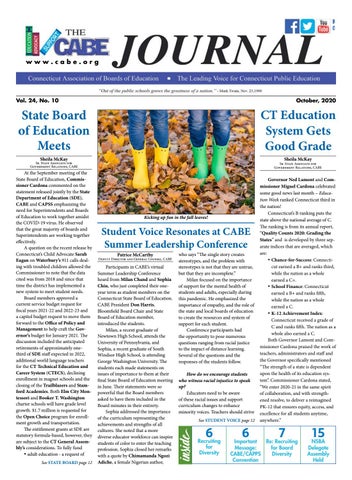
Kicking up fun in the fall leaves!
Student Voice Resonates at CABE Summer Leadership Conference Patrice McCarthy
Deputy Director and General Counsel, CABE
Participants in CABE’s virtual Summer Leadership Conference heard from Milan Chand and Sophia Chin, who just completed their oneyear term as student members on the Connecticut State Board of Education. CABE President Don Harris, Bloomfield Board Chair and State Board of Education member, introduced the students. Milan, a recent graduate of Newtown High School, attends the University of Pennsylvania, and Sophia, a recent graduate of South Windsor High School, is attending George Washington University. The students each made statements on issues of importance to them at their final State Board of Education meeting in June. Their statements were so powerful that the Board members asked to have them included in the Board minutes in their entirety. Sophia addressed the importance of the curriculum representing the achievements and strengths of all cultures. She noted that a more diverse educator workforce can inspire students of color to enter the teaching profession. Sophia closed her remarks with a quote by Chimamanda Ngozi Adiche, a female Nigerian author,
who says “The single story creates stereotypes, and the problem with stereotypes is not that they are untrue, but that they are incomplete.” Milan focused on the importance of support for the mental health of students and adults, especially during this pandemic. He emphasized the importance of empathy, and the role of the state and local boards of education to create the resources and system of support for each student. Conference participants had the opportunity to pose numerous questions ranging from racial justice to the impact of distance learning. Several of the questions and the responses of the students follow. How do we encourage students who witness racial injustice to speak up? Educators need to be aware of these racial issues and support curriculum changes to enhance minority voices. Teachers should strive See STUDENT VOICE page 12
inside
At the September meeting of the State Board of Education, Commissioner Cardona commented on the statement released jointly by the State Department of Education (SDE), CABE and CAPSS emphasizing the need for Superintendents and Boards of Education to work together amidst the COVID-19 virus. He observed that the great majority of boards and Superintendents are working together effectively. A question on the recent release by Connecticut’s Child Advocate Sarah Eagan on Waterbury’s 911 calls dealing with troubled children allowed the Commissioner to note that the data cited was from 2018 and since that time the district has implemented a new system to meet student needs. Board members approved a current service budget request for fiscal years 2021-22 and 2022-23 and a capitol budget request to move them forward to the Office of Policy and Management to help craft the Governor’s budget for January 2021. The discussion included the anticipated retirements of approximately onethird of SDE staff expected in 2022, additional world language teachers for the CT Technical Education and Career System (CTECS), declining enrollment in magnet schools and the closing of the Trailblazers and Stamford Academies. Both Elm City Montessori and Booker T. Washington charter schools will have grade level growth. $1.7 million is requested for the Open Choice program for enrollment growth and transportation. The entitlement grants at SDE are statutory formula-based, however, they are subject to the CT General Assembly’s considerations. To fully fund • a dult education - a request of
Sr. Staff Associate for Government Relations, CABE
6
Recruiting for Diversity
6
Governor Ned Lamont and Commissioner Miguel Cardona celebrated some good news last month – Education Week ranked Connecticut third in the nation! Connecticut’s B ranking puts the state above the national average of C. The ranking is from its annual report, “Quality Counts 2020: Grading the States” and is developed by three separate indices that are averaged, which are: •C hance-for-Success: Connecticut earned a B+ and ranks third, while the nation as a whole earned a C+. •S chool Finance: Connecticut earned a B+ and ranks fifth, while the nation as a whole earned a C. •K -12 Achievement Index: Connecticut received a grade of C and ranks fifth. The nation as a whole also earned a C. Both Governor Lamont and Commissioner Cardona praised the work of teachers, administrators and staff and the Governor specifically mentioned “The strength of a state is dependent upon the health of its education system”. Commissioner Cardona stated, “We enter 2020-21 in the same spirit of collaboration, and with strengthened resolve, to deliver a reimagined PK-12 that ensures equity, access, and excellence for all students anytime, anywhere.”
Important Message: CABE/CAPPS Convention
7
Re: Recruiting for Board Diversity
15
NSBA Delegate Assembly Held
2
The Journal – Connecticut Association of Boards of Education | October, 2020 PRESIDENT COMMENTARY
Thank You for Your Service Donald Harris President, CABE
As a veteran, I appreciate when community members recognize the sacrifices that those of us who served our country made and continue to go through on a regular basis. When a fellow citizen says the words, “Thank you for your service” it instills a sense of pride in all of us that our efforts were not in vain. There have been times when those sacrifices were not acknowledged, often due to the complexities that surround the mission of our military. Often it was the ones in the trenches who bore the brunt of community wrath for bad decisions made by others, or the uncontrollable conditions that made the results of that service questionable. It was unfair to the men and women who wore the uniform to have to pay for things that were out of their control. This was not what any of us signed up for. Now we have a similar situation in the time of the COVID-19 virus. Instead of the military, it is our educators who are thrust into a world that was unimaginable only a few short months ago. Aspiring educators attended college to learn how to teach and help young people grow to be successful adults. They recognized that they could make a difference to their community and help create a better world. It was rough enough, preCOVID-19, that the job was complicated by racial and social inequities.
Many teachers had to learn the hard way how poverty makes it so much harder to ensure each child has a successful education experience. Societal issues complicate teaching and learning and many communities have limited resources to deal with these issues outside of school. That revelation discouraged a fair number of teachers, guaranteeing that most of those who continued in the profession were there for the children in their care. They were dedicated to making the world a better place. Teachers also get frustrated that their job isn’t just about teaching. Children can’t learn if they are hungry or traumatized, and it often falls on the classroom teacher, as the first contact with those students, to sort all that out as best they can. This has always been a challenge, but COVID-19 has made the situation more dire. With all that, communities often criticize educators when the system is over-taxed and can’t perform as well as anyone would like. Many teachers I have known have felt under-appreciated for all they do. On top of all this, we add the threat of a global pandemic. Like everyone else, educators are stressed with the “usual” job of starting a school year filled with uncertainty and even greater non-education responsibilities. A lack of definite plans or a road map to success are not helping. I know successful, veteran teachers who are considering leaving the profession.
Mission: To assist local and regional boards of education in providing high quality education for all Connecticut children through effective leadership. Vision: CABE is passionate about strengthening public education through high-performing, transformative local school board/ superintendent leadership teams that inspire success for each child.
Board of Directors Many teachers have worked hard to prepare for the new school year, only to have their plans change as conditions change. I find most people like to have a pretty clear idea what their work is going to look like in the next week, month or year. COVID-19 throws all that out the window. It seems that there is a universal belief that our nation will not rebuild financially until everyone is back to work, and our schools are a big part of that plan going forward. Educators are feeling the pressure and need our help. My advice to board of education members is that we all need to talk up our staff members. Teachers and administrators are working hard to give our kids a fighting chance this year. They need to get some recognition for the hard work they are doing. Take time at your board of education meetings to recognize staff. Show your appreciation and communicate that message to others in your community. Lastly, your messages to your community need to reflect support for your staff. We all have a part to play in the school year being successful, starting with ensuring that our staff is highly motivated and ready to teach our children with energy and excitement. Make sure your staff members are getting the message, “Thank you for your service.”
EXECUTIVE COMMITTEE Donald Harris | President, Bloomfield Elizabeth Brown | First Vice President, Waterbury Michael Purcaro | V ice President for Government Relations, Ellington Bryan Hall | V ice President for Professional Development, East Hartford John Prins | Secretary/Treasurer, Branford Robert Mitchell | I mmediate Past President, Montville Christopher Wilson | Member at Large, Bristol Lydia Tedone | NSBA Director, Simsbury AREA DIRECTORS Bryan Hall | Area 2 Co-Director, East Hartford Leonard Lockhart | Area 2 Co-Director, Windsor Joan Trivella | Area 4 Director, Brooklyn Mic helle Embree Ku | A rea 5 Director, Newtown Karen Kleine | Area 6 Director, Westport George Kurtyka | Area 7 Co-Director, Derby Robert Guthrie | Area 7 Co-Director, West Haven Lon Seidman | Area 8 Director, Essex Sean Nugent | Area 9 Director, Preston ASSOCIATES Julie Auseré | Associate, Canton Eileen Baker | Associate, Old Saybrook Ethel Grant | Associate, Naugatuck Ann Gruenberg | Associate, Hampton Robert Trefry | A ssociate, CT Technical High School System Elaine Whitney | Associate, Westport COMMITTEE CHAIRS Leonard Lockhart | Chair, Resolutions, Windsor Becky Tyrrell | Chair, Federal Relations, Plainville Michelle Embree Ku | Chair, State Relations, Newtown CITY REPRESENTATIVES Ayesha Clarke | City Representative, Hartford Yesenia Rivera | City Representative, New Haven Charles Stango | City Representative, Waterbury STAFF
Robert Rader | Executive Director Patrice McCarthy | Deputy Director and General Counsel Nicholas Caruso | Senior Staff Associate for Field Services and Coordinator of Technology Sheila McKay | Senior Staff Associate for Government Relations Vincent Mustaro | Senior Staff Associate for Policy Service Lisa Steimer | Senior Staff Associate for Professional Development and Communications Teresa Costa | Coordinator of Finance and Administration Pamela Brooks | S enior Administrative Associate for Policy Service and Search Services Terry DeMars | Administrative Associate for Policy Service Gail Heath | Administrative Associate for Government Relations Wilmarie Newton | Administrative Associate for Labor Relations Nancy Propfe | Administrative Assistant for Membership Services Corliss Ucci | Receptionist and Assistant to Executive Director
The CABE Journal (ISSN 1092-1818) is published monthly except a combined issue for July/August as a member service of the Connecticut Association of Boards of Education, 81 Wolcott Hill Road, Wethersfield, CT 06109, (860) 571-7446. CABE membership dues include $30 per person for each individual who receives The CABE Journal. The subscription rate for nonmembers is $75. Association membership dues include a subscription for each Board Member, Superintendent, Assistant Superintendent and Business Manager. The companies and advertisements found in The CABE Journal are not necessarily endorsed by CABE. “Periodicals Postage Paid at Hartford, CT.” POSTMASTER: Send address changes to The CABE Journal, CABE, 81 Wolcott Hill Road, Wethersfield, CT 06109-1242. Email: lsteimer@cabe.org. Members can find the CABE Journal online at: www.cabe.org/ page.cfm?p=1024
The Journal – Connecticut Association of Boards of Education | October, 2020
CABE Affiliate Members BUSINESS AFFILIATES VALEDICTORIAN Connecticut Business Systems – A Xerox Company Finalsite SALUTATORIAN
Berchem Moses PC Shipman & Goodwin HIGH HONORS
Pullman & Comley HONOR ROLL Anthem Blue Cross and Blue Shield ESS JCJ Architecture SCHOLAR Brown & Brown Chinni & Meuser LLC Coordinated Transportation Solutions Dattco, Inc. Goldstein & Peck, P.C. Kainen, Escalera & McHale, P.C. The Lexington Group Network Support Co. OneDigital Health and Benefits Perkins Eastman T-Mobile The S/L/A/M Collaborative Zangari Cohn Cuthbertson Duhl & Grello, P.C.
EDUCATIONAL AFFILIATES American School for the Deaf Area Cooperative Educational Services (ACES) Capitol Region Education Council (CREC) The College Board Communities in Schools Connecticut Association of School Business Officials Connecticut Center for School Change Connecticut School Buildings and Grounds Association Connecticut School Counselor Association Connecticut Technical High Schools Cooperative Educational Services (C.E.S.) EASTCONN EdAdvance Exploratioins Charter School Integrated Day Charter School ISAAC LEARN
3
EXECUTIVE DIRECTOR COMMENTARY LESSONS FROM CHURCHILL:
The Splendid and the Vile by Erik Larson
Robert Rader
Executive Director, CABE
The COVID-19 pandemic has been at the top of the daily news since the middle of March when schools, offices and factories closed. This unprecedented period has been filled with news stories about the virus itself, possible cures or at least mitigating medicine, the constant drumbeat of deaths and the ridiculous argument that to eliminate or at least ameliorate the disease by wearing masks is an infringement on American liberties. For those who have lost family or friends to this disease, it is heartbreaking and we grieve with them. One of the most difficult aspects of these times, is uncertainty as to when we will and if we will, come back to anything approaching normal. We watch as restaurants, bars, department stores and other businesses that we considered part of our everyday life announce that they are furloughing workers or closing forever. It might seem odd that I have started an article on leadership lessons from Erik Larson’s newest book by discussing our present state of events. Those who have read or heard about this book, know it is about Winston Churchill’s first year in office as Great Britain’s prime minister.
A Little History
In dramatic fashion, Churchill, long “in the wilderness”, an outcast among British politicians, forecast the perils that he foresaw as Adolph Hitler assumed the chancellorship of Germany in 1933 and set the nation on a military and economic rebuilding path that eventually led to World War II. The war began when Germany invaded Poland on September 1, 1939. Pursuant to a “non-aggression pact” between the Soviet Union and Germany, the two nations split Poland in half and, while not allies, were not at war with each other until June 22, 1941. France and Great Britain declared war on Germany on September 3, 1939. To the astonishment of much of the world, France signed an armistice treaty with Germany, having had her troops quickly overrun. This left Great Britain facing the Nazis alone by June 22, 1940 until Hitler set his sights on
Russia in 1941. With Britain’s forces having surrendered or escaped by way of Dunkirk, the Germans now occupying northern France, the English were under siege from the Nazi air force just across the English Channel. Virtually everyone expected an invasion—it was thought of as a matter of when, not if the Germans would invade. The Luftwaffe began bombing England in what would become known as the Battle of Britain or the Blitz. Churchill became prime minister on May 10, 1940 as events worsened for England. The attacks on English ships and bombings of airfields, cities, and London is depicted by Larson in detail, viewing Churchill and his steadfastness and leadership in great detail, even as he illustrates the tremendous perseverance of the average English citizen and members of its armed forces. He writes of the nightly bombings ripping apart great swaths of the nation’s factories, cities and residential areas. The expectation was not that the threat over England would dissipate, but, it would end in invasion and the deaths of thousands, if not hundreds of thousands of citizens. However, despite the onslaught, the English persevered until Hitler gave up on invading Britain and attacked the Soviet Union. Why am I going into detail on this?
Leadership Lessons
Besides loving history*, I see lessons in how the English leader Churchill and the people of England behaved in the Battle of Britain. There are lessons in how Churchill used his oratorical powers at some of the darkest times in history. I will leave it to others to compare the leadership of Churchill and present-day American leaders. — A leader must be honest and inspire those he/she leads. Churchill stated, as the French surrendered, that he “expected that the battle of Britain is about to begin. Upon this battle depends the survival of Christian civilization. Upon it depends our own British life, and the long continuity of our institutions and our Empire… If we can stand up to him, all Europe may be free and the
life of the world may move forward into broad, sunlit uplands. But if we fail, then the whole world, including the United States, including all that we have known and cared for, will sink into the abyss of a new Dark Age made more sinister, and perhaps more protracted, by the lights of perverted science. Let us therefore brace ourselves to our duties, and so bear ourselves that if the British Empire and its Commonwealth last for a thousand years, men will still say, ‘This was their Finest Hour.’ ” I understand that the word, “Christian” does not show a sensitivity for all the people of Britain, but, it is an otherwise hugely inspiring quote. —A leader must be transparent about what he is asking for from the people. Churchill: “I would say to the House, as I said to those who have joined this Government, I have nothing to offer but blood, toil, tears and sweat.” —A leader must truthfully articulate his or her own view of the situation. Churchill told the English, after the battle of El Alamein, where the English crushed the Germans in North Africa, that, “this is not the end. It is not even the beginning of the end. but it is, perhaps, the end of the beginning.” —A leader must rally the people, even those who may not agree with him, in a crisis. Churchill got Chamberlain to serve in his cabinet, even though Churchill had scorched him when the latter was prime minister. —A leader must put the right people into the right positions. One of the more interesting narratives of Larson’s account is how Churchill got Lord Beaverbrook (Max Aiken), a hugely successful newspaper publisher, to become Minister of Supply and later, Minister of War Production. The See CHURCHILL page 11
4
The Journal – Connecticut Association of Boards of Education | October, 2020 See You in Court – The Nutmeg Board of Education
The Nutmeg Board Gets it Right! Thomas B. Mooney, Esq. Shipman & Goodwin
The Nutmeg Board of Education makes many mistakes. The latest imbroglio created by the board will be reported here each issue, followed by an explanation of what the board should have done. Though not intended as legal advice, these situations may help board members avoid common problems. The members of the Nutmeg Board of Education, masks and all, were happy finally to be meeting in person. “I never thought I would say this,” Ms. Chairperson said as he called the meeting to order, “but I missed you guys, and it is great to be together again. I look forward to a good meeting with all of you.” Board member Mal Content did not share Ms. Chairperson’s bonhomie, and in fact he was anxious about the meeting. “How can we be meeting here while the public still has to watch our meeting from home? This sounds like an FOI violation to me.” Veteran Board member Bob Bombast disagreed. “Oh chill out, Mal! Of course this is legal! I am sure that Mr. Superintendent checked with Ms. Board Attorney and that we got the all clear. Of course I am happy to be on television, but it is also nice to be here in person with my fellow Board members after all those Zoom meetings.” Mr. Superintendent perked up when he heard his name. “I admit that I had my doubts, because I thought that either we all had to meet remotely or we all had to meet in person. But Ms. Board Attorney checked with Tom Hennick at the FOIC, and he gave us the all clear to meet in person and to permit the public to participate remotely.” “You did well on that, Mr. Superintendent,” Bob Bombast responded. “But I wish I could say the same for your making a deal with the Nutmeg Union of Teachers (NUTS) without involving or even telling the Board. We Board members should be there whenever you make agreements with NUTS, and I was surprised to hear about the deal you made.” Board member Penny Pincher was surprised by Bob’s comments, and she asked Bob to explain. Bob responded that he’d read on Facebook that Mr. Superintendent made some special agreement with NUTS to deal with COVID-19 concerns related to opening school this year, and he asked Mr. Superintendent to explain himself. “You are making a big deal out of nothing,” Mr. Superintendent replied. “We planned all summer for our reopening, and I kept the Board apprised the entire time. Once we had our plan in place, the teachers’ union
came to me and asked to negotiate over the way our plans affected Nutmeg teachers.” “But we negotiated with NUTS last year!” Bob interjected. “I don’t know why we would have to negotiate with NUTS again already.” Penny Pincher weighed in. “Yes, for sure. We can’t be negotiating with NUTS over every little thing. Mr. Superintendent, the Personnel Committee does the negotiations around here. What do you think you were doing?” “I was just doing my job. The issues NUTS raised over teaching during the COVID-19 emergency all related to operational issues. Don’t you remember the CABE Workshop we all went to? You set policy, and I am responsible for running the show.” Mal Content piped up. “All I know is that the Board votes on negotiated agreements. When will you be bringing the agreement to the Board for approval?” “It’s a done deal,” responded Mr. Superintendent. “We are all set.” Did Mr. Superintendent exceed his authority by agreeing to a COVID-19 MOA with NUTS here? • • • • • • • • • • • • • • • The problem in Nutmeg was one of communication, not of authority. By statute, the superintendent is the “chief executive officer” of the board of education. Board of education members are responsible for setting policy to regulate the affairs of the school district, a legislative function that includes setting the budget. Board members can also serve a judicial function on certain occasions. But operational issues are the responsibility of the superintendent, the chief executive officer. Negotiations with teachers and other unions can and often also involve board members. That makes good sense because negotiations often involve financial commitments. Moreover, the rules set forth in negotiated agreements regulate district affairs in a manner similar to board policies. The problem in Nutmeg was one of communication, not of authority. In any event, such negotiations were consistent with district obligations under the Teacher Negotiation Act. That law requires that boards of education negotiate with the teachers’ exclusive bargaining representative over “salaries, hours and other conditions of employment.” Such negotiations are typically over the successor collective bargaining agreement, but teacher unions have the right to demand negotiations during the contract term when school districts make changes affecting working conditions. Moreover, such “mid-term” negotiations are governed by Conn. Gen. Stat.
§ 10-153f(e), which gives the parties only twenty-five days for any such negotiations and then twenty-five days for mediation before arbitration is imposed. In creating reopening plans in the time of COVID-19, school districts perforce changed working conditions, and teacher unions throughout the state exercised their rights to demand negotiations. Many of these negotiations were simple affairs, handled directly by the superintendent and the administration, because the issues were operational and did not involve the commitment of new funds. Other such negotiations have been more formal, including board negotiation committees and even mediation. There is no one “right” way to handle such negotiations, but good communication between superintendents and boards of education on these issues is imperative. Finally, clarification of the FOIA rules may be helpful as boards transition back to in-person meetings. Under Executive Order 7B (March 14, 2020), Governor Lamont suspended FOIA requirements “to permit any public agency to meet and take such actions authorized by the law without permitting or requiring in-person, public access to such meetings” as long as certain well-known requirements
are met, including assuring remote, real-time access for members of the public and recording the meeting. As boards of education and other public agencies move back to in-person meetings, the question arises whether public agencies may themselves meet in person while limiting the number of people who can attend or even not allowing the public to attend the meeting at all. Executive Order 7B provides public agencies the option to hold meetings without providing access to the public as long as they meet the conditions set out above. Significantly, it does not prohibit public agencies from meeting in person. Accordingly, it is permissible for boards of education to take a “hybrid” approach of meeting in person, but providing limited or no “in-person” public access to the meeting while assuring remote access to the public in accordance with Executive Order 7B. For once, the Nutmeg Board of Education did something right! Attorney Thomas B. Mooney is a partner in the Hartford law firm of Shipman & Goodwin who works frequently with boards of education. Mooney is a regular contributor to the CABE Journal. Shipman & Goodwin is a CABE Business Affiliate.
The Ninth Edition – Now Available!
A Practical Guide to Connecticut School Law by Thomas B. Mooney, Esq. Shipman & Goodwin
CABE is delighted to announce that the Ninth Edition of Tom Mooney’s Practical Guide to Connecticut School Law is now available. PRICING: CABE Members: $54.99; CABE Non-Members: $79.99; Students: $44.99 There have been many changes in school law in the last few years, and the Ninth Edition has been extensively revised to provide updated guidance on the legal issues that govern our schools. Changes include descriptions and commentary on:
• Changes in teacher evaluation and teacher tenure. • New rules regarding employee background checks. • New requirements concerning student data privacy. • New rules for suspension, expulsion and alternative educational opportunities. • Revised requirements governing seclusion and restraint. • The new “Every Student Succeeds Act” and how it has changed “No Child Left Behind Act” requirements. • The CCJEF case and ongoing litigation over equal educational opportunities. • The Minimum Budget Requirement and new duties to collaborate with town officials. • A host of other changes in the rules that boards of education and school administrators must follow.
The Journal – Connecticut Association of Boards of Education | October, 2020
5
Aim Higher
Creative legal solutions for Connecticut’s public schools – because sometimes it is rocket science.
Shipman & Goodwin’s school law attorneys have more than 40 years of experience, and represent over 100 public school districts, as well as public school member organizations and associations, on a full range of legal issues that they confront, from general education law to special education matters.
Our school law site, www.ctschoollaw.com is devoted entirely to emerging school law issues. Attorneys counsel clients, monitor legislation and provide periodic alerts and updates. We regularly present seminars, quarterly workshops, webinars and professional development workshops for schools on current topics of interest. Our Practice Group Co-Chair, Tom Mooney, has written A Practical Guide to Connecticut School Law, a comprehensive treatise on Connecticut school law, published by CABE and used by teachers, administrators and board of education members throughout the state.
Education is a core focus of our law firm. www.ctschoollaw.com
Contact: Thomas B. Mooney or Linda L. Yoder | 860.251.5000 | www.shipmangoodwin.com CONNECTICUT
|
NEW YORK
|
WASHINGTON DC
6
The Journal – Connecticut Association of Boards of Education | October, 2020
How Recruiting for Diversity Can Look to a Candidate Robert Rader
Executive Director, CABE
A recent BoardSource blog covered a difficult issue with insight that could help all Boards which are attempting to be more inclusive of people of color. The post was entitled, Recruiting for Board Diversity — Without Disrespecting People of Color and written by Jim Taylor, vice president of leadership initiatives and education, at BoardSource, which provides information and advice to nonprofit boards. Mr. Taylor focuses on “leading BoardSource’s efforts to position nonprofit boards for stronger leadership on diversity, inclusion, and equity.” The post, was written for nonprofit boards, especially their leadership. However, it is really applicable to many other situations. CABE’s Diversity,
Equity and Inclusion Committee has a goal of encouraging boards to “consider the importance of diversity… in public education”. While we understand that school boards don’t determine, in most cases, who serves on the Board since candidates are determined by political parties, this article applies to committee membership, hiring of employees and other situations that affect public education. Mr. Taylor explains that he has been distressed when he was asked to join a board and realized that it was as if whoever asked him was interested in him solely as a person of color, rather than valuing him for the many other things he might bring to a board. He divided 11 of his 13 “recruitment experiences” into five boards that he agreed to join “due to a mutual passion for the
AN IMPORTANT MESSAGE
regarding the 2020 CABE/ CAPSS Convention from Committee Chair Bryan Hall (East Hartford) on behalf of the CABE/CAPSS Convention Committee: It is important for superintendents and board members to remain focused on creating a strong learning environment for students in this unprecedented time. Because of this, planning for a multi-day Convention would be a distraction from that work. The Committee has decided to postpone our November Convention. We will continue our robust professional development offerings and work with individual boards, and plan to gather in the spring. As the Bonnie B. Carney Excellence in Communications and CABE Board Recognition Awards are both recognized at the Convention, the entry process of both is being delayed to allow you, your staff, and Board to focus on reopening schools and to coincide with a spring 2021 program. Wishing you all a successful 2020-2021 school year!
mission and a shared understanding of the alignment between what the board was seeking and what I could offer or six boards that I didn’t join due to a poor fit or inopportune timing” However, there is a third category which left him with “indelible moments”, which provided some valuable ‘lessons learned’. These were two times he did not join a board because he felt “disrespected during the board’s recruitment process – so disrespected that declining the invitation was an easy decision because I believed that the recruitment experience was a foreshadowing of the obstacles I would have faced as a board member.” In this case, he asked the recruiter “to share the ways he thought I could add value to the board; I wanted to know what prompted him to reach out to me, specifically. The board member seemed surprised and unprepared to answer the question, and just re-stated his board’s focus on becoming more diverse. His visible discomfort in directly answering my question revealed the real answer to me: I was being recruited because – and seemingly only because – I was Black and my board membership would support the organization’s board diversity goals. The board member didn’t appear to know much about my work or my skills and experiences (or else he considered them to be far less important than my race, from the board’s perspective), so based on his response I believed that I was being ‘tokenized’ – being recruited by a board not for my capability (in combination with my race), but so that the board could use my membership to portray to the public a misleading impression of its commitment to diversity, inclusion, and equity.” Now, Mr. Taylor always asks a recruiter, the “how can I add value to this board and organization” question as an initial litmus test whenever he meets with a board member to discuss potentially joining a board. If the recruiter is unable to answer the question to his satisfaction, “we may continue the dialogue but the real conversation, from my perspective, is effectively over. To be clear, I think this question of ‘how can I add value’ is essential for every potential board candidate to ask, and to which every recruiting organization should have a thoughtful response.” Mr. Taylor made it clear that he
was sharing, “not to discourage boards from recruiting for racial diversity. I believe that boards can and should prioritize recruiting for racial diversity, but race should not be the only lens that boards apply to the search. Boards that focus on race as the sole qualification for board membership are employing an overly simplistic approach that is disrespectful to the people of color who are being recruited. Boards should be applying multiple lenses as they consider their needs; racial identity should be part of that consideration – but not all of it.” He believes there’s “a better way” for predominantly white boards to plan and execute the process of recruiting people of color “to join their boards – a way that honors the vital importance of the task to the board’s continued effectiveness and respects the full value of the skills and attributes people of color can bring to boards”. Here are his recommendations and some of his questions to ponder before recruitment: • r eflect on the importance of
diversity on your Board “Have we identified our ‘blind spots’ as a board? Have we compared the current composition of our board in terms of the skills, expertise, cultural/ethnic demographics, and lived experiences to the optimal composition we would like to achieve so that we include a wider range of perspectives? Does our board’s composition signal a sincere commitment to understanding and sharing power with the communities we seek to serve? What do we understand about why it matters that we become more diverse? How will it impact the way that we lead our organization?
• e xpand and diversify your
network of potential candidates “Are we cultivating and recruiting candidates with diverse backgrounds and experiences? Are we expanding the board candidate search beyond our customary board recruitment networks? When we communicate with a board candidate who is a person of color, are we clearly articulating the organization’s mission and See RECRUITING page 7
The Journal – Connecticut Association of Boards of Education | October, 2020
7
Re: Recruiting for Board Diversity – Without Disrespecting People of Color Martha Brakeen-Harris CABE Consultant
In a perfect world, it would be wonderful if every board would follow the recommendations in Jim Taylor’s post. However, that is not the case and the reality is that some Boards are recruiting merely to fulfill diversity goals. We don’t know the actual
RECRUITING
(continued from page 6)
specifically naming the various ways that the candidate would add value and help the board fulfill its mission?” •b uild an inclusive and welcom-
ing culture “Are we positioning new board members to have a positive, long-term experience with the board; are we welcoming new members to the board and meaningfully engaging them in the work through participation on committees and/or
reasons why some board members who are chosen to recruit people are so unprepared, but, instead of walking away, this may be an opportunity for those who are being recruited to be true change agents. I had a similar experience as Mr. Taylor. I am an African American woman who was approached to join
a nonprofit board for what appeared solely to fulfill a diversity requirement. I thought about it and, instead of ending the conversation, I asked to meet with the board chair. I explained the recruitment encounter to him and said that despite how poor that meeting was, I would be interested in joining the board if he and I could have open
conversations about my board experience throughout my first term. I knew my path would have its rocky places, but I felt that this was an opportunity to bring awareness to those who never had an opportunity to work with an African American. I took the responsibility to help build
task forces? Are we assigning a mentor or “buddy” for them to contact with questions and/or ideas that they may initially feel more comfortable sharing oneon-one than in the context of the full board? Are we examining our long-standing practices regarding board social gatherings to make sure that they are inclusive to board members of color? Are we being intentional about inviting new board members of color to share their perspectives and opinions – opening the door to different ideas and conversa-
tions in the boardroom? Are we dedicating time for reflection on how our strategies and action plans have been impacted by the addition of more diverse voices and viewpoints? Are we reflecting on how we as a board have, perhaps, been fundamentally changed – changed in ways that will help us better identify the work that needs to be done and the most impactful approaches to doing it as we go forward? Mr. Taylor’s final thoughts included the real key to successfully adding people of color to your Board or staff: “Being thoughtful and intentional
about why diversity matters to your board and organization, and how the board is committed to cultivating a truly inclusive board culture – a board culture in which every board member’s perspective is welcomed, respected, and valued – is the only way to effectively diversify the board. Any board that fails to apply a more intentional, considerate approach in its outreach to people of color will struggle – deservedly – to recruit and retain people of color as board members.” For a copy of the full article, please contact Bob Rader or Martha Brackeen-Harris.
See RE: RECRUITING page 10
AC E S I N PA R T N E R S H I P WI T H
Thoughtexchange for Education Let all voices be heard! ACES has partnered with Thoughtexchange to offer support to school districts around strategic planning, staff and student experience, school safety, and community assessment, and more.
To learn more about Thoughtexchange Contact Emily Freel, Director, ACES Professional Development & School Improvement 1-203-407-4408 | efreel@aces.org | aces.org/thoughtexchange
8
The Journal – Connecticut Association of Boards of Education | October, 2020
THE POLICY CORNER Vincent A. Mustaro
Senior Staff Associate for Policy Service, CABE
Establish and Maintain Policy as a Top Priority Thankfully, boards do not need to readopt all of its policies because of the start of a new year. Policies, once adopted, continue in perpetuity until revised or rescinded. However, it is absolutely essential that board members and administrators be familiar with school system policies. The establishment and maintenance of policies remain a duty of the board of education that holds equal importance to the selection of a superintendent. In addition, it is reasonable for the board to expect the superintendent and other school administrators to have a broad working knowledge of the policies and administrative regulations in the district’s manual, especially during this time of the COVID-19 pandemic health emergency. In a time of desired world class standards, calls for quality education, higher student achievement, safe and secure schools, in the current health emergency, the role that policy plays, in the quality of education, is regretfully too easy to forget. A board of education exerts its leadership and helps to promote academic excellence, safety and security in the school district through policy. A school board’s major function is to fulfill its legislative role by adopting policies to guide the operation of the school system. The district’s policy manual is not a static publication. This point has been made very clear as superintendents and boards of education have operated through the pandemic health emergency and the impact on long-established board policies. The policy manual must be a dynamic collection of governing and administrative documents subject to change in response to a variety of factors. Being informed of the manual’s contents at a given point in time is no assurance that knowledge will be accurate tomorrow. Many circumstances produce an ongoing duty for all board members to become informed about the board’s policies and to continue to refresh that knowledge. This has become very evident as the board-superintendent leadership team has planned for this year’s reopening of school in a format creating a “new normal.” Knowledge of the board’s policies is a significant factor in the level and quality of service others expect of board members
and of which board members should expect of themselves. School districts must face the problems of quality control and community and employee satisfaction. This has recognizably become more difficult as the pandemic crisis continues. Districts must also meet the demands placed upon them by federal, state and local governments. Education decisions, a state function, has been delegated to lay boards whose job is to establish programs of learning, fund them, and hire competent professionals to manage them. This awesome board of education responsibility, which has grown significantly during the last seven months, raises two major school gov-
trators carry it out,” is one of the first things board members learn about their responsibilities. However, the line between governance and management is not clearly marked. Precious board meeting time is too often used discussing what should be routine decisions handled by the superintendent and the staff within the guidance of board adopted policy. A major function of policy is to convey necessary information to board members, administrators, employees, students, parents and community members. This information will establish boundaries, provide clear direction to the superintendent without usurping his or her professional judgment and allow discretionary
A Board of Education exerts its leadership and helps to promote academic excellence, safety and security in the school district through policy. ernance issues. First, the board must effectively control the schools without hampering the role and responsibilities of the professional staff. Next, the superintendent and staff must serve learners effectively without intruding into areas of legitimate board authority. Added to these two areas is the need to provide for the health, safety and security of all students and staff as we navigate the fluidity of the pandemic situation and its impact on the school system. These issues are resolved through the establishment of sound board policies and responsive administrative regulations. Through policy, defined as statements that set forth the purposes and prescribe the organization and program, the school board, provides direction to district staff to ensure a quality educational program. Policy reflects the board’s philosophy and intentions but allows administrative discretion in their operational implementation. Policy is not detailed directions for operating a school system or running a particular program; such directives, containing the who, what, when, and where are contained in administrative regulations. “Boards set policy and adminis-
action in dealing with district day-today occurrences. Board meeting time should involve more global discussions, such as issues pertaining to the improvement of student achievement. Sound policy will provide direction for administrative decisions When doubts arise regarding time spent on policy issues, consider the public’s expectations of the school board. The public expects students to learn within safe, friendly and challenging learning environments under the tutelage of proficient and caring teachers. The public holds the school board accountable for the manner in which the schools are governed, managed and for the results achieved. Well-defined, clear policies can serve as the basis for accountability and evaluation used to govern and improve the schools. Providing a sound basis for appraisal and accountability, policies facilitate the process of evaluating board and administrative practices. Policies establish direction, telling what the board wants and why. They set goals, assign authority and establish controls; all essential elements in considering accountability.
Ambiguity, confusion and trouble are avoided when policies are adopted, published and disseminated. A policy system helps ensure fair, consistent and uniform treatment of all students, parents, community members and employees. The public tends to trust in the consistency of written, established, and disseminated policy. Policies ensure that the board functions appropriately and legally as a governmental agency; that needs are assessed by the staff and community with appropriate goals set for programs and departments; that reliable measures are established for assessing programs and that evaluative criteria and reports support what the school system aspires to achieve. Board policies and decisions carry the weight of the law and establish a legal record. Policies provide the legal basis for most actions and help to ensure that board and administrative decisions comply with state and federal law and regulations and judicial decisions. An accurate policy manual can be viewed as a type of legal insurance. Board’s policies which are workable, practical and legal encourage good educational and business practices. Policy is an effective public relations tool, communicating the board’s goals, objectives, priorities and acceptable practices. It conveys the board’s basic philosophy and position on specific issues. Also, policies foster stability and continuity over time when board, organizational and staff changes occur. In conclusion, boards need policy for many reasons. Efficient, successful boards use organized, written policies in the decision-making process. Policies as a governance tool can liberate boards from the shackles of disorderly procedure and enable them to exercise more control, not less. The present health, political, economic and legislative environments will continue to have a momentous impact on our public schools. Therefore, there must be an ongoing commitment to the responsibility to become and remain familiar with the policy manual, to determine if the contents are up-to-date, to make the necessary changes and that the administration and board as a team stay abreast of policy considerations in a timely manner.
The Journal – Connecticut Association of Boards of Education | October, 2020
9
We Are Well Suited to Respond to the Legal Needs of Boards of Education Attorneys and Counselors at Law
Berchem Moses PC is a leading player in the State of Connecticut in the field of Education Law. With 10 attorneys dedicated to this specialized practice, we offer a long history of experience and deep resources. We promise the highest level of service in a more cost effective manner. We work with boards of education to address a myriad of complex issues including labor and employment, student issues, special education, general counsel, and other challenges facing educators today. Be sure to visit www.connecticuteducationlawblog.com where our attorneys regularly cover legal matters that pertain to Connecticut schools.
www.berchemmoses.com Milford
75 Broad Street Milford, CT 06460 Phone: 203-783-1200
Westport
1221 Post Road East Westport, CT 06880 Phone: 203-227-9545
10
The Journal – Connecticut Association of Boards of Education | October, 2020
RE: RECRUITING
(continued from page 7)
an inclusive culture on that board--for women as well as people of color. I asked to sit in on Investment Committee meetings and the next year was invited to join that committee. I gave suggestions to the chair about making sure to acknowledge my voice and I shared my opinion during board discussions. I found my own mentor. I asked to facilitate a workshop for the entire board on the issues that Mr. Taylor spoke about. I then became a member of the Executive Committee where I had an even stronger voice on policy issues.
After 10 years on the board, I felt that sustainable change had been made and I resigned. Some board members who were the most resistant to change have adjusted their mindsets and become allies in this work. Since my resignation, I have been invited to return on many occasions to give workshops or attend events. The board is very diverse and positive changes continue. Whenever I return, I’m so glad that I took the opportunity to be on the board, not merely to be solely a sitting member, but, to be a change agent. And, that has been a real positive for the board and its members.
C.O.P.S
What will provide YOUR district? • A policy manual updated within days of a board meeting. • Access to your policy manual 24/7 anywhere with Internet capability. • Time saving links to legal and cross references. • A search engine specifically designed for board policy manuals. • The ability to search other online districts for similar policies or language. • A happier staff that will have less paper to deal with.
On September 3, Kosta Diamantis, Deputy Secretary, Office of Policy and Management; Charlene Russell-Tucker, Deputy Commissioner, Connecticut State Department of Education; and John Frassinelli, Division Director, School Health, Nutrition, Family Services and Adult Education, Connecticut State Department of Education, presented a CABE webinar on Indoor Air Quality in Schools, facilitated by Robert Rader, CABE Executive Director and Patrice McCarthy, CABE Deputy Director and General Counsel.
If you would like additional information on CABE’s Connecticut Online Policy Service (C.O.P.S.), call Vincent Mustaro at 860-571-7446 or email vmustaro@cabe.org for full details
For an update or more information on vacancies go to our website:
MARY BRODERICK, ED.D
https://www.cabe.org/ page.cfm?p=1176
SENIOR CONSULTANT
For more information contact
CABE Search Services
81 Wolcott Hill Road, Wethersfield, CT 06109
860-608-1763
Equal Opportunity Employer
Prepare your school health office with
aSchool nurse supplies aAED and emergency response supplies
aBarrier guards aPersonal protective equipment
Available in the CREC MarketPlace.
aInfection prevention products and tools
aAir purifiers and filters
Think of your Association,,
CABE,
when you do your shopping! When you shop @AmazonSmile Amazon will make a donation to:
The Connecticut Association of Boards of Education, Inc. https://smile.amazon.com/ch/06-0767770
For more information, visit www.crec.org/marketplace
The Journal – Connecticut Association of Boards of Education | October, 2020 CHURCHILL
(continued from page 3)
man was absolutely vital, increasing production by unheard of numbers. Beaverbrook tried to quit on many occasions, but, Churchill knew how important he was and found ways to keep him in that critical position. Churchill was a unique person with many idiosyncrasies, including his love of alcohol and his nightowl work habits. However, his great strength of character and his ability to “tell the story” is unsurpassed. My favorite saying about this was from Edward R. Murray: “He mobilized the English language and sent it into battle.”
As we continue to struggle with COVID and its terrible toll on Americans, especially people of color, it is important to remember other times when great leaders stood up and made it clear that sacrifices must be made for the betterment of all. Larson’s book gives real insight and detail about how leaders can help us through unimaginable crises. And, to me, having learned in detail about what the British went through during the Blitz, wearing a mask to protect oneself and others, is not much of a sacrifice. * FYI: I was a friend of Erik Larson when we both attended Freeport High School, (NY).
People in the News
CABE Executive Director Robert Rader was appointed to an NSBA Situation Analysis Team for Strategic Planning. According to the letter on his selection, he was appointed because of his “current NSBA role [Liaison Committee member] and contributions”. It said this puts him “in a great position to advise us on current sector trends, organizational planning and values, and effective leadership. Further, we share the common interest of supporting our nation’s public schools for the best possible student outcomes.” Congratulations, Bob!
11
CABE-Meeting CABE-Meeting is a user-friendly online service offered by CABE specifically for school boards. Users can eliminate unnecessary paperwork, increase efficiency and reduce costs while enabling board members to utilize the latest in cutting edge technology. Using CABE-Meeting, the Meeting Manager can create an electronic meeting from developing the agenda to creating the minutes and everything in between.
• • • • •
CABE-MEETING OFFERS:
Secure login access for board and district staff Access from any location with Internet access Search archived agenda and meeting related items in a flash Ability to download and print attachments Option to provide a public link to board meeting information
YOUR SUBSCRIPTION PROVIDES: • • • •
Access to CABE-Meeting Initial and ongoing training Support and maintenance Upgrades to the service
CABE MEMBER SUBSCRIPTION FEES: Initial Subscription – $3,000 Annual Maintenance – $1,500
If you have an interest in this service, contact Lisa Steimer at 860-571-7446 or lsteimer@cabe.org
12
The Journal – Connecticut Association of Boards of Education | October, 2020
CABE SUMMER LEADERSHIP CONFERENCE
Business Manager Bernice Rizk (Naugatuck), COO Rich Carmelich (EdAdvance) and Director of Facilities/Transportation Coordinator Wayne Casper (Bloomfield) presented Session 5 of CABE’s Summer Leadership Conference on What School Boards Need to Know About Finance and Building Preparations and Maintenance in Light of COVID-19.
Rising college freshmen and former Student Members of the CT State Board of Education Sophia Chin (South Windsor) and Milan Chand (Newtown) presented Session 5, Student Voice, of CABE’s Summer Leadership Conference. CABE President Donald Harris (Bloomfield) introduced this program which was facilitated by CABE Deputy Director and General Counsel Patrice McCarthy.
STUDENT VOICE
to present multiple perspectives on the history of all cultures, and treat the culture and history of all their students with respect.
mental health needs and directing them to appropriate resources if necessary. Every student needs a trusted teacher or peer they can talk too, even if they do not need professional mental health intervention.
voice and engagement, not just a report on high school events. Both Sophia and Milan valued the support for meaningful student voice on State Boards of Education provided by the National Association of State Boards of Education.
What are the most effective resources to support student mental health? Professional development for all staff is important to develop their comfort in supporting students with
How can school board members enhance the role of student representatives on the local board of education? There should be clear expectations that the board values a real student
What was the experience of you, your peers and siblings with distance learning in Spring 2020? It was challenging for many students to learn effectively without the structure and routine of school.
(continued from page 1)
Board Development Available from CABE Nicholas Caruso, Jr.
Sr. Staff Associte for Field Service and Coordinator of Technology, CABE
During a normal election cycle, boards of education often work with CABE staff to provide new board member and candidate training (and a refresher for seasoned board members) as part of their professional development activities. After the last November election, many scheduled training sessions right after their busy budget season, to help new members understand the complex responsibility of school governance.
Did You Know?
For the price of CABE dues, your board and superintendent are eligible for: • Crisis communications help. • Superintendent search process workshop and written guide. • Webinars on various topical issues.
Boards have many important roles to play, including, • a cting as an agent of the state to ensure the state’s interest in public schools is upheld; • c reating and supporting the district’s budget; •p olicy development and adoption; and •h iring and evaluating the superintendent. Carrying out these roles can be difficult because governing is often more of an art than a science. Board members sometimes bring up issues that really are not within the “normal” activities of a board of education. Serving on a school board is a lot different than many board members think, and the earlier those new board members get a foundation of what boards do, the better. As the COVID-19 pandemic slammed into the state, boards found themselves saturated with meetings, and online meetings, at that. There is
no doubt that boards and superintendents have been on overload for the past six months. In this era of social distancing, the usual bonding that goes on with a board has been almost non-existent. The cultures that usually evolve as board members work together with their superintendent on a common purpose have not had a chance to develop. Many boards had to cancel their board development activities to make time for other work so there were few opportunities to develop a sense of cohesion. We strongly encourage you to start planning your Fall season and include some form of professional development into your schedules. CABE trainers will visit you, online or in-person (with the appropriate safeguards in place) at your convenience. A reminder to CABE member districts – there is no charge for this service. Please contact Nick Caruso (ncaruso@cabe. org) if you would like to discuss this further.
In addition, some students had to manage remote learning with caring for younger family members and increased time at their jobs. There is little motivation to complete busy work. Distance learning would be more engaging if the classes were live, allowing for student interaction. The personal connection between the teacher and student makes a big difference.
“ Children are the priority. Change is the reality. Collaboration is the strategy.”
– Judith Billings, Washington State Superintendent
STATE BOARD
(continued from page 1)
$837,382 for FY 2022 and $105 in FY 2023 was made •h ealth and welfare services – a request of $3.1 million in FY 2022 and an additional $105,044 in FY 2023 was made. • s pecial education excess cost - a request of $66.8 million in FY 2022 and an additional $4.9 million in FY 2023 was made. ECS is scheduled to reach full funding in 2028. $79 million in the next biennium is required to meet that projection. The State Board of Education meeting on November 4 will be held in the evening, no specific time scheduled yet, to allow more people to follow along in the work the board is conducting.
The Journal – Connecticut Association of Boards of Education | October, 2020
13
CABE: Working for YOU
Individualized Workshops | Professional Development Opportunities Legal Services | Policy Services | Representing You Statewide and Nationally Below are the highlights of activities that the CABE staff has undertaken on your behalf over the last month. We did this:
B y providing opportunities for members to learn how to better govern their districts: zH osted and facilitated weekly Board Chair Check-ins and Updates. zF acilitated two meetings of a board self-evaluation with the Stamford Board of Education. zF acilitated discussion of roles and responsibilities for the Branford Board of Education retreat. zR esponded to 87 requests for policy information from 46 districts, providing sample materials on 28 topics. Further, districts continue to access CABE’s online Core Policy Reference Manual and/or online manuals posted by CABE for policy samples. The topics of greatest interest again pertained to pandemic policies especially face mask/face covering, COVID-19 emergency measures, emergency FMLA leave, electronic meetings and travel advisory/quarantine. Title IX continues to remain a topic of considerable interest.
B y helping school boards to increase student achievement: z S ent were two issues of “Policy Highlights” via e-mail listserv covering topics that affect student achievement. Included topics pertained to fire drills and crisis response drills during the pandemic emergency, homeless education requirements as schools reopen, social and emotional learning, educator evaluation, length of school year and hours of instruction, new Title IX regulations, issues of equity, and revisions to the face mask policy.
B y attending Professional Development to strengthen staff knowledge and skills. zT ook part in American Society of Association Executives’ (ASAE) Annual Conference, attending keynote speeches, workshops and other online activities. zP articipated in CASEL webinars on issues of social emotional intelligence as schools reopen.
zA ttended weekly webinars on Facilitating for Students’ Sake. zA ttended weekly seminars by the NSBA Federation of State Association Trainers. zP articipated in various webinars provided by the SDE, law firms, NSBA, NEASC, and CASEL.
B y providing services to meet member needs: zW orked with Yale Center for Emotional Intelligence on providing information and course on social emotional skills. z S taffed CABE’s Resolutions and Government Relations Committee meetings. zP articipated in meeting of CABE Diversity, Equity and Inclusion Committee. zP articipated in NSBA workshop on equity issues. zH osted and facilitated CABE Summer Leadership Conference. zP osted policies online for districts utilizing the Connecticut Online Policy Service (COPS) for Westport, Orange, Avon, Barkhamsted, Region #18, Windsor, Canton and Somers. zU pdated the online Core Policy manual. zU pdated the policy section of the CABE website with new COVID-19 related policies. zR evised policies for East Hampton, Gilbert School, New Fairfield, New Hartford, Putnam, and Sterling as part of the Custom Update Service. zP articipated in two webinars pertaining to COVID-19 instructional issues.
Orientation and Delegate Assembly. zP articipated in CT Workforce Stakeholders meeting. zP articipated in NSBA/State Association Executive Directors’ update calls. zA ttended Education Committee meeting. zA ttended Massachusetts Association of School Committees’ (MASC) webinar on communicating with the public as schools reopen. zP articipated in Anti-Defamation League Regional Board meeting and webinar on discussing racial issues with children. zA ttended State Board of Education meetings. zD iscussed school reopening protocols on WTIC Face CT and channels 3, 30, and 61. zP articipated in NSBA State Association Counsel calls. zP articipated in NSBA Convention Manager calls. zM et with and attended webinar on
Miss Kendra Program with Dr. David Johnson (social-emotional programming). zH osted meeting of CABE Board of Directors. zC haired meeting of the Digital Learning Advisory Council for the Connecticut Commission of Educational Technology. zA ttended Board of Directors meeting of the Discovering Amistad organization. zA ttended the Freedom Forum, cosponsored by Discovering Amistad and Mystic Seaport.
B y ensuring members receive the most up-to-date communications: zP repared materials, as part of the Custom Policy Service for Enfield, Region #5 and Region #15. zR evised policies pertaining to COVID-19 issues, including those pertaining to face masks, sexual harassment, travel advisory, and school day and school year.
CABE Virtual Legal Issues Conference October 26-29, 2020
n Monday, October 26: Current Labor Relations and
Human Resource Issues n Tuesday, October 27: Special Education Issues n Wednesday, October 28: B oard Meetings in a Virtual or Hybrid World (FOIA, public participation) n Thursday, October 29: Extracurricular Activities, Transportation and Liability Go to: https://www.cabe.org/page.cfm?p=1141 to register for one or all four sessions.
B y representing Connecticut school boards on the state or national level: z I nterviewed by Peter Mezzitti on his cable program. zA ttended Governor’s webinars for municipal officials. zA ttended SDE/DOH/ Superintendents Tuesday morning webinars. zA ttended CAS Board of Directors meeting. zA ttended Partners meeting with SDE, CAPSS, CAS, CEA and AFT. zA ttended NSBA Delegate Assembly
CABE Deputy Director and General Counsel Patrice McCarthy spoke with NBC-CT about school districts receiving allocated COVID-19 relief funds.
14
The Journal – Connecticut Association of Boards of Education | October, 2020
The Media Message by Ann Baldwin, President and CEO, Baldwin Media Marketing, LLC
When It Comes to the Media: Stand Your Ground For this article I thought that it would be beneficial to share a recent experience that I had with a television news reporter and a school district (both of which I have chosen not to identify). This reporter contacted me about a call that they received in their newsroom regarding a parent who was upset that her middle school daughter was denied special education services by the district. She then stated that she was going to interview the mother and was hopeful that the Superintendent would also speak to the allegations on camera. My next step was to contact the Superin-
tendent, who stated that this was not the case and that the mother had actually met recently with the Director of Special Education and that they had a very productive conversation, and services were in place for this student, as they had been throughout her years in the district. I then contacted the reporter and explained the situation from the district’s perspective and explained what had recently transpired and that given the situation, there was nothing further that needed to be said. I also asked the reporter if she had the opportunity to meet the “student,” when she
interviewed the mother and she stated, “No, the mother wanted to keep her daughter out of this.” I then appealed to the reporter and asked her why she would move forward with a story of this nature, when all indications were that this individual was not being truthful in her allegations? Fast forward about an hour later and after appealing to the reporter to “do the right thing” she informed me that the story was not going to air. I immediately contacted the Superintendent and he was relieved and thankful for my efforts. The reason that I share this story is that the reality today is
that anyone today can call into a newsroom “tip hotline” and make, what in this case were false allegations, and the news media will jump on it. These stories can have a long-lasting negative impact on your district and sometimes you have to push back. It is okay to push back if the situation warrants it! This isn’t the first time that I have pushed back on the media on behalf of a school district and I am sure that it won’t be the last. In this case we were able to chalk one up as a victory!
The Journal – Connecticut Association of Boards of Education | October, 2020
15
National School Boards Association Delegate Assembly Held
Patrice McCarthy
Deputy Director and General Counsel, CABE
The National School Boards Association (NSBA) held its Delegate Assembly in a virtual format in mid August. The Delegate Assembly, originally scheduled for April, was limited to action on NSBA Policies, Beliefs
and Resolutions. Action on proposed changes to the Constitution and Bylaws was deferred to a later date. CABE was represented by CABE President Don Harris (Bloomfield), First Vice President Liz Brown (Waterbury) and Vice President for Professional Development Bryan Hall (East Hartford) as voting delegates.
CABE President and Delegate to the NSBA Delegate Assembly Donald Harris (Bloomfield), left, and CABE First Vice President and Delegate to the NSBA Delegate Assembly Elizabeth Brown (Waterbury), right, represented CABE at NSBA’s virtual Delegate Assembly held on August 14.
NSBA Immediate Past President ElizaBeth “Beth” Branham of South Carolina presided over the Delegate Assembly.
OCTOBER 2020
OBSERVANCES AND HOLIDAYS DATE OBSERVANCE/HOLIDAY Oct. 1-31 Crime Prevention Month Oct. 1-31 National Bullying Prevention Month Oct. 1-31 National Principals Month Oct. 1-31 Trick-or-Treat for UNICEF Oct. 5 Child Health Day Oct. 7 International Walk to School Day Oct. 4-10 National Metric Week Oct. 4-10 Fire Prevention Week Oct. 12 Columbus Day
DATE OBSERVANCE/HOLIDAY Oct. 12 Indigenous People’s Day Oct. 12-16 National School Lunch Week Oct. 16 World Food Day Oct. 18-24 National Character Counts Week Oct. 19-23 National School Bus Safety Week Oct. 23-31 Red Ribbon Week (DrugFree America) Oct. 24 Make a Difference Day Oct. 24 United Nations Day Oct. 31 Halloween
Immediate Past President Bob Mitchell (Montville) and Vice President for Government Relations Mike Purcaro (Ellington) served as alternates. Numerous resolutions submitted by CABE were adopted by the delegates. Those resolutions dealt with the Individuals with Disabilities Education Act (IDEA), school safety and crime
prevention, prevention of the forced separation of children and families, 21st century skills, and the need for differentiated assessment. While the virtual format posed some technical challenges for a few of the delegates, there was the opportunity for robust discussion during the Assembly.
16
The Journal – Connecticut Association of Boards of Education | October, 2020
Trusted Legal Counsel in Extraordinary Times Now more than ever, school districts, their boards of education and their administrators are turning to Pullman & Comley’s School Law practice for informed, accurate and timely information on the unprecedented legal issues they face in the age of COVID-19, including those surrounding the safe reopening of schools, remote learning, PPE protocols, and labor and employment matters. At the same time, our attorneys are counseling clients on new laws affecting school districts, including the Title IX regulations effective in August 2020, transgender athlete policies and the sexual harassment training obligations mandated by October 2020.
Please visit our Education Law Notes blog for up-to-the-minute alerts, commentary and insights on critical legal issues affecting educational institutions. Schoollaw.pullcomblog.com And, for critical information on the legal implications as a result of the COVID-19 pandemic, please visit our COVID-19 Focus page at pullcom.com to view recent publications, receive alerts, and to register for and view our webinar series related to the pandemic.
Our attorneys are accessible to their clients, responsive to concerns and always available to answer questions on these issues as well as on the challenges schools face on a routine basis in their daily operations.
pullcom.com
@pullmancomley
William R. Connon 860.424.4385 wconnon@pullcom.com
Zachary D. Schurin 860.424.4389 zschurin@pullcom.com
Melinda B. Kaufmann 860.424.4390 mkaufmann@pullcom.com
Stephen M. Sedor 203.330.2137 ssedor@pullcom.com
Michael P. McKeon 860.424.4386 mmckeon@pullcom.com
Mark J. Sommaruga 860.424.4388 msommaruga@pullcom.com
BRIDGEPORT
HARTFORD
SPRINGFIELD
STAMFORD
WATERBURY
WESTPORT
WHITE PLAINS
203.330.2000
860.424.4300
413.314.6160
203.324.5000
203.573.9700
203.254.5000
914.705.5355