B C
www.cabe.org
Vol. 24, No. 5
May, 2020
CABE Freezes Dues for 2020-21
Governance Lessons:
The COVID-19 Virus Patrice McCarthy
Robert Rader
Deputy Director and General Counsel, CABE
Executive Director, CABE
The heroic efforts of school boards and superintendents to deal with the impact of the public health crisis on our students, staff and families have reinforced many of the lessons about the importance of a strong board superintendent governance team, the value of clear policy, and the need to seek legal guidance. CABE staff, in supporting school boards, have observed these key lessons:
At its April 22nd meeting, the CABE Board of Directors voted unanimously to freeze dues for the fifth year in a row, believing that the next year will be difficult for our members as they reopen schools after the shutdown due to the coronavirus crisis. At this point, although we know that schools will remain closed at least until May 21st, uncertainty as to whether (and which) activities will resume for the remainder of this school year, the summer and next fall, has not yet be determined. What will be required in terms of social distancing and the many other questions which will arise will only be answered in the months ahead. The Regional Advisory Committees will be making recommendations over the next few months, but, we do not know what they will suggest and whether the State will agree with those recommendations. Board members noted that during the crisis, the Association had provided information, advice and opportunities to work with other districts to all CABE Members and Non-Members, which we have never done before. It was done in keeping with CABE’s mission to “assist local and regional Boards of Education in providing high quality public education for all Connecticut children through effective leadership.“
Communication is critical In times of crisis, everyone - board members, staff, parents, community - needs timely, accurate information. The spokesperson for the district, usually the superintendent, can insure that consistent information is provided.
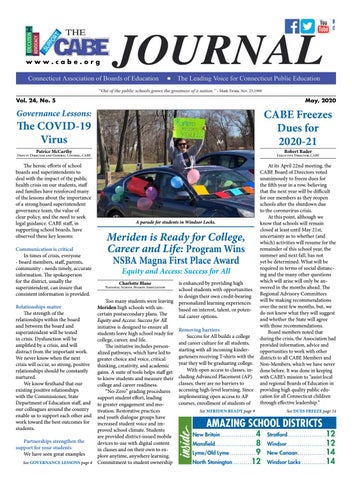
A parade for students in Windsor Locks.
Meriden is Ready for College, Career and Life: Program Wins NSBA Magna First Place Award Equity and Access: Success for All
is enhanced by providing high school students with opportunities to design their own credit-bearing Too many students were leaving personalized learning experiences Relationships matter Meriden high schools with unbased on interest, talent, or potenThe strength of the certain postsecondary plans. The tial career options. relationships within the board Equity and Access: Success for All and between the board and initiative is designed to ensure all Removing barriers superintendent will be tested students leave high school ready for Success for All builds a college in crisis. Dysfunction will be college, career, and life. and career culture for all students, amplified by a crisis, and will The initiative includes personstarting with all incoming kinderdistract from the important work. alized pathways, which have led to garteners receiving T-shirts with the We never know when the next greater choice and voice, critical year they will be graduating college. crisis will occur, so strong, positive thinking, creativity, and academic With open access to classes, inrelationships should be constantly gains. A suite of tools helps staff get nurtured. to know students and measure their cluding Advanced Placement (AP) classes, there are no barriers to We know firsthand that our college and career readiness. accessing high-level learning. Since existing positive relationships “No-Zero” grading procedures with the Commissioner, State implementing open access to AP support student effort, leading Department of Education staff, and to greater engagement and mocourses, enrollment of students of our colleagues around the country See MERIDEN READY page 9 tivation. Restorative practices enable us to support each other and and youth dialogue groups have work toward the best outcomes for increased student voice and imstudents. proved school climate. Students New Britain . . . . . . . . . . . . . . . . . 4 are provided district-issued mobile Partnerships strengthen the devices to use with digital content Mansfield. . . . . . . . . . . . . . . . . . . . 8 support for your students in classes and on their own to exLyme/Old Lyme. . . . . . . . . . . . . 9 We have seen great examples plore anytime, anywhere learning. North Stonington . . . . . . . . . 12 See GOVERNANCE LESSONS page 4 Commitment to student ownership Charlotte Blane
inside
National School Boards Association
See DUES FREEZE page 14
AMAZING SCHOOL DISTRICTS
12 Windsor. . . . . . . . . . . . . . . . . . . 12 New Canaan. . . . . . . . . . . . . . 14 Windsor Locks . . . . . . . . . . . . 14 Stratford. . . . . . . . . . . . . . . . . . .
2
The Journal – Connecticut Association of Boards of Education | May, 2020 PRESIDENT COMMENTARY
Board Leadership in a Time of Crisis Donald Harris President, CABE
Most of us look at serving on a board of education as a way of giving back to our community and to govern our districts; not manage them. I have always been a firm believer in boards staying in their lane, and not second-guessing the Superintendent for doing what he or she believes is in the best interest of the school district after getting direction from board policy. Now, during this unprecedented time, I feel this is more important than ever. I hear of board members deciding what online meeting platform to use or how meals should be distributed and I think this will only further confuse a difficult situation. The board should expect to hold a meeting and the staff should be responsible for putting it together. The board should trust that children will be fed. I would hazard a guess that this pandemic is the biggest challenge any superintendent has ever had to overcome. There is no playbook for many of the issues their administration is dealing with and they are working flat-out to get things done. They are responsible for developing and implementing an outof-school educational experience where none existed in any measurable way before the COVID-19 virus. They are responsible for ensuring children have food to eat, even when there is no place to feed
People in the News Jack Bryant, a member of the Stamford Board of Education and CABE Board of Directors, passed away on April 16, 2020 as a result of complications from the COVID-19 virus. Our condolences to Jack’s family and the Stamford Board of Education.
them. They are working to ensure the operations of the district keep moving forward, even when the buildings are closed and people are working from home. Many large corporations spend millions of dollars and months of effort preparing a stay-at-home work model. Our districts are doing it immediately with no additional funds. They are dealing with bus contracts, paraprofessionals and teachers, some of whom are working and some who are not. They are dealing with daily directives from the Governor, state and federal leaders. It is not, in any way, “business as usual”. During these times, the board needs to take a supporting role and provide the resources they can to assist the superintendent and staff to do their jobs. For them, it should also not be “business as usual”. Board members often assume unlimited access to their superintendent. However, in these times, the superintendent needs to be able to do his or her job first. I know of one superintendent who is besieged with hundreds of e-mails each day, some from elected officials, some from the Commissioner of Education and state officials, some from parents and other community members, and, yes, dozens from board of education members with an expectation that the superintendent must drop everything and respond to their question or concern. There will come a time when we can all go back and assess how effectively we did our jobs, but in the middle of a crisis, barring any critical implosion of leadership, boards need to step back and get out of the way. Our parents are concerned about their children’s health, safety and academic progress at a time when all are challenged beyond our capacity. We expect the superintendent to be a communicator to the community, as well as staff and parents.
Mission: To assist local and regional boards of education in providing high quality education for all Connecticut children through effective leadership. Vision: CABE is passionate about strengthening public education through high-performing, transformative local school board/ superintendent leadership teams that inspire success for each child.
Board of Directors The board chair should also be reaching out, but in a coordinated effort with the Central Office. The worst thing you can do is offer mixed messages to the community. I also discourage other board members from taking it upon themselves to broadcast information without regard to how it relates to the district’s messaging. We have seen, through the federal handling of the COVID-19 virus pandemic, that having multiple sources of information, not all working together, creates confusion and diminishes trust. As difficult as it is to develop a shared message, due to the separation we all currently face, it is most important to maintain a steady, accurate stream of information, and that starts with limiting the sources to a trusted few. I have heard “this too, shall pass” numerous times during the last few weeks and it is true. When the dust settles we will all go back to “normal”, although I suspect normal will look different than it did just a short time ago. I would also like to take a moment to thank the CABE staff for the work they have done during this crisis. They continue to provide boards with the most current information, allow access to each other and are there for all of us. CABE Executive Director, Bob Rader, Deputy Director and General Counsel, Patrice McCarthy, and the entire CABE staff have shown leadership and initiative during this time to ensure CABE is at the forefront of the response to the COVID-19 virus. We have opened up many of our services to non-members during this time to ensure all boards in Connecticut have the best support to help them govern through this crisis. I am proud to be President of such a fine organization.
EXECUTIVE COMMITTEE Donald Harris | President, Bloomfield Elizabeth Brown | First Vice President, Waterbury Michael Purcaro | V ice President for Government Relations, Ellington Bryan Hall | V ice President for Professional Development, East Hartford John Prins | Secretary/Treasurer, Branford Robert Mitchell | I mmediate Past President, Montville Christopher Wilson | Member at Large, Bristol Lydia Tedone | NSBA Director, Simsbury AREA DIRECTORS Bryan Hall | Area 2 Co-Director, East Hartford Leonard Lockhart | Area 2 Co-Director, Windsor Joan Trivella | Area 4 Director, Brooklyn Mic helle Embree Ku | A rea 5 Director, Newtown Karen Kleine | Area 6 Director, Westport George Kurtyka | Area 7 Director, Derby Lon Seidman | Area 8 Director, Essex Sean Nugent | Area 9 Director, Preston ASSOCIATES Julie Auseré | Associate, Canton Eileen Baker | Associate, Old Saybrook Ethel Grant | Associate, Naugatuck Ann Gruenberg | Associate, Hampton Robert Trefry | A ssociate, CT Technical High School System COMMITTEE CHAIRS Leonard Lockhart | Chair, Resolutions, Windsor Becky Tyrrell | Chair, Federal Relations, Plainville Michelle Embree Ku | Chair, State Relations, Newtown CITY REPRESENTATIVES Ayesha Clarke | City Representative, Hartford Yesenia Rivera | City Representative, New Haven Charles Stango | City Representative, Waterbury STAFF
Robert Rader | Executive Director Patrice McCarthy | Deputy Director and General Counsel Rebecca Adams Rieder | Senior Staff Attorney Nicholas Caruso | Senior Staff Associate for Field Services and Coordinator of Technology Sheila McKay | Senior Staff Associate for Government Relations Vincent Mustaro | Senior Staff Associate for Policy Service Lisa Steimer | Senior Staff Associate for Professional Development and Communications Teresa Costa | Coordinator of Finance and Administration Pamela Brooks | S enior Administrative Associate for Policy Service and Search Services Terry DeMars | Administrative Associate for Policy Service Gail Heath | Administrative Associate for Government Relations Wilmarie Newton | Administrative Associate for Labor Relations Nancy Propfe | Administrative Assistant for Membership Services Corliss Ucci | Receptionist and Assistant to Executive Director
The CABE Journal (ISSN 1092-1818) is published monthly except a combined issue for July/August as a member service of the Connecticut Association of Boards of Education, 81 Wolcott Hill Road, Wethersfield, CT 06109, (860) 571-7446. CABE membership dues include $30 per person for each individual who receives The CABE Journal. The subscription rate for nonmembers is $75. Association membership dues include a subscription for each Board Member, Superintendent, Assistant Superintendent and Business Manager. The companies and advertisements found in The CABE Journal are not necessarily endorsed by CABE. “Periodicals Postage Paid at Hartford, CT.” POSTMASTER: Send address changes to The CABE Journal, CABE, 81 Wolcott Hill Road, Wethersfield, CT 06109-1242. Email: lsteimer@cabe.org. Members can find the CABE Journal online at: www.cabe.org/ page.cfm?p=1024
The Journal – Connecticut Association of Boards of Education | May, 2020
CABE Affiliate Members BUSINESS AFFILIATES VALEDICTORIAN Finalsite SALUTATORIAN
Berchem Moses PC Shipman & Goodwin HIGH HONORS
Pullman & Comley HONOR ROLL Anthem Blue Cross and Blue Shield ESS JCJ Architecture SCHOLAR Brown & Brown Chinni & Meuser LLC Coordinated Transportation Solutions Dattco, Inc. Goldstein & Peck, P.C. Kainen, Escalera & McHale, P.C. The Lexington Group OneDigital Health and Benefits Perkins Eastman T-Mobile The S/L/A/M Collaborative Zangari Cohn Cuthbertson Duhl & Grello, P.C.
EDUCATIONAL AFFILIATES American School for the Deaf Area Cooperative Educational Services (ACES) Capitol Region Education Council (CREC) The College Board Communities in Schools Connecticut Association of School Business Officials Connecticut Center for School Change Connecticut School Buildings and Grounds Association Connecticut School Counselor Association Connecticut Technical High Schools Cooperative Educational Services (C.E.S.) EASTCONN EdAdvance Exploratioins Charter School Integrated Day Charter School ISAAC LEARN
3
EXECUTIVE DIRECTOR COMMENTARY
Reach Out, We’ll Be There! Robert Rader
Executive Director, CABE
You can imagine how intimidating it is to write a commentary for our members at the beginning of April, 2020, for an issue of the CABE Journal that will not be disseminated until the beginning of May! I cannot foresee how the next week will go – a whole month of prophecy is well beyond me. However, I want to help our members who are leading our districts in the challenging, difficult and sensitive world of the COVID-19 virus. While CABE has previously helped our members through difficult times, including September 11th, the Sandy Hook shootings and the Great Recession, the current time is so different. So much of our normal every day activities are shut down. Schools, businesses, industries, non-profits and other facilities are closed. Working from home, as I am doing as I write this, is the “new normal,” at least for now. I can already sense, at the beginning of April, that frustration and anxiety levels are high and we will certainly go through times of even greater stress as we come out of this crisis. While I joke that in nine months there will be more babies born (the “COVID generation”?), there will also be more divorces. People are dealing with the difficulty of being cooped up at home, unable to go to theaters, participate in their favorite sports or eat out at their usual restaurants and we are looking for answers… ones that no one has. Lots of Questions Will the summer’s heat knock out the virus? Will our schools be back to “normal” in the fall or will another outbreak make it impossible to keep schools open? During the Great Depression, people went to movies to escape the difficulties of their lives. Will sitting at home watching Netflix fulfill this need to keep our minds occupied and not
on the news? When we come out of the crisis, many decisions will have to be made: when do we reopen schools; what happens to graduation ceremonies; how will we work together on getting things back to the “old normal”? What will we learn from the crisis? Will distance-learning be a good substitute for the socialization aspects of the public schools? What can we expect from our social contract with the Federal Government? From the State? These are just some of the issues that every board member and superintendent will be thinking about, as will the Governor, Commissioner Cardona and the State Board. At CABE, with each staff member in seclusion at their homes, we question whether we will be able to hold our Summer Leadership Conference, our September and October workshops and even the CABE/ CAPSS Convention. Even if we go ahead with these opportunities, what will they look like? Will our members be willing to sit together for the keynotes, presentations or meals? Are we going to see, at some level, the need for a totally different way of providing professional development and networking, which are so critical to helping board members and superintendents be as effective as possible? Our Answers Even as these issues stand before us, we believe the best way to help you prepare for whatever the next few months will bring is by continuing to focus our efforts on providing information to you on a number of issues in different ways. We hope you have or will take advantage of these opportunities: •F rom the beginning of the cri-
sis, we have put information and resources on our website, at https://www.cabe.org/page.
cfm?p=1511; •W e provide opportunities for
our members to hear from “experts” on the issues before us. For example, on April 2nd, we hosted Dr. Marc Brackett and Scott Levy on Leading with Emotional Intelligence in Uncertain Times; on April 7th, we hosted a call with Alliance District Board Members and Superintendents with the CoChairs of the TaskForce on the Distribution of Technology, Superintendents Nathan Quesnel (East Hartford) and Paul Freeman (Guilford); and, on April 9th, we hosted a teleconference for all board members and superintendents with Education Commissioner Cardona. These discussions are recorded and the information can easily be accessed from https://www. cabe.org/page.cfm?p=1512;
• Th e Board Chair Listserv
provides the opportunity for Chairs to discuss the issues of the day. We see it primarily as the chair’s networking vehicle;
•W e also do a check-in and
update teleconference with Board Chairs once a week, Fridays at 2 p.m.; and
•W e continue to send out legal,
policy and other information directly to board members and superintendents, including individual information. Yes, we have continued to provide information in all of these areas and are beginning to provide professional development workshops to individual boards, through the
See WE’LL BE THERE page 7
4
The Journal – Connecticut Association of Boards of Education | May, 2020
NEW BRITAIN
Smith School is missed!
LESSONS LEARNED
(continued from page 1)
of communities coming together to deliver services to students – from meals to technology – and to support them emotionally – police departments reading to students online and creating a “back to online school” video with their K-9 unit. Policies will guide the district through challenging times – even when the specific challenge may not have been envisioned. Some districts have encountered
Frank and Henry (and mommy) miss school in New Britain!
areas where additional policies are needed. Districts have seen the need to either add and/or reexamine some key policy areas that take on greater prominence and importance in such times. These include, but are not limited to, policies pertaining to crisis management, succession planning, greater delegation of authority to the superintendent, distance learning, suspension of certain policies and bylaws, and student confidentiality issues. Further, Boards have had to determine how to implement their policies pertaining to key aspects
of the instructional program, transportation, food services, budgetary development, and board meetings, to name but a few, under extraordinary circumstances. Ask for legal guidance before you act Even in situations demanding urgent action, it is important to have legal guidance before you take an action that could be difficult to undo. Memoranda of Understanding with employees, student privacy and delivery of special education services are just a few of the issues with legal
Locked-In $avings
Reading is still taking place at DiLoreto School.
implications that have arisen. Maintaining focus on students leads to effective decisions The well-being and academic success of students is your primary responsibility. Like everyone, they are feeling stress and disruption in all aspects of their lives. Now more than ever their needs should guide your decision making. Learning never ends We will all learn from this experience and be better prepared for the next challenge – whatever form it takes.
For an update or more information on vacancies visit our website.
with
MARY BRODERICK, ED.D SENIOR CONSULTANT
For more information contact
CABE Search Services
81 Wolcott Hill Road, Wethersfield, CT 06109
For more information, visit www.crec.org/marketplace
860-608-1763
Equal Opportunity Employer
The Journal – Connecticut Association of Boards of Education | May, 2020
5
See You in Court – The Nutmeg Board of Education
FOIA, Policy and the COVID-19 Virus Thomas B. Mooney, Esq. Shipman & Goodwin
The Nutmeg Board of Education makes many mistakes. The latest imbroglio created by the board will be reported here each issue, followed by an explanation of what the board should have done. Though not intended as legal advice, these situations may help board members avoid common problems. The Nutmeg Board of Education has done its best to adjust to the new “normal” during the COVID-19 health emergency, and its virtual meetings were only Zoom-bombed once so far. In fact, after a period of adjustment, the various Board committee are stirring to life. Veteran Board member Bob Bombast is the Chairperson of the Policy Committee, and he recently called a meeting of the Committee to discuss whether and how the Board should revise its policies in light of the health emergency to make sure that seniors at Nutmeg Memorial High School graduate on time through the Nutmeg Distance Learning Plan. After careful reflection, he had the following agenda posted for a virtual meeting last week: “Discussion and possible action on Board policies.” Given the importance of policies to the operation of the district, several Board members were curious and not a little worried about what Bob had up his sleeve. Accordingly, they emailed Bob to find out, with copies to Penny Pincher and Mal Content, the other members of the Policy Committee. Bob promptly explained by return email to all Board members that he will be recommending to the Committee that it revise its policies to assure that high school students will get full credit for their online learning this semester, and he invited everyone to attend the meeting. The Policy Committee went ahead with its meeting last week as posted, which it held virtually on Zoom. Bob started the meeting by noting that he would not be entertaining public comment this meeting, given the exigencies of the situation. He proceeded to complain that he didn’t think that Nutmeg’s distance learning plan required
adequate synchronous instruction, and he asked Mr. Superintendent to explain. Mr. Superintendent said that he thought that the distance-learning plan was coming along nicely. The only rub was that the Nutmeg Union of Teachers had insisted that the extent of synchronous learning be left to the individual teacher. Happily, he continued, most teachers were willing to do some live instruction. Bob was not pleased with Mr. Superintendent’s answer, and he stated “That is ridiculous! We need to require that all teachers in Nutmeg provide live instruction.” Before Bob could go on with his rant, Nancy Newshound, ace reporter for the Nutmeg Now!, the online newspaper, interrupted Bob. “Point of order! This is a meeting of the Policy Committee. But I see that the entire membership of the Board is attending this virtual meeting, making it an illegal Board meeting. You have to end this meeting immediately or make the Board members not on the Committee leave!” Bob responded quickly. “This is a public meeting, and the other Board members have the same right to attend this meeting as you do!” Did the attendance of the Board members make this a Board meeting? • • • • • • • • • • • • • • • Under these circumstances, Nancy was wrong in her assertion. That said, Bob and the Policy Committee has raised two important issues that require discussion. To take the Freedom of Information Act (FOIA) issues first, it is clear that the meeting was properly considered a meeting of the Policy Committee. The FOIA anticipates such situations, and it expressly provides that “A quorum of the members of a public agency who are present at any event which has been noticed and conducted as a meeting of another public agency… shall not be deemed to be holding a meeting of the public agency of which they are members as a result of their presence at such event.” It is important, however, that other Board members in attendance be treated as other members of the
public so that the meeting does not morph into a meeting of the Board. There were, however, two FOIA violations before the meeting even started. The agenda for meetings of public agencies should fairly apprise the public of the business to be conducted, and “Discussion and possible action on Board policies” was inadequate. In addition, Bob’s email communications would likely be considered an illegal meeting. As to the merits, Bob has raised two very important points. First, the district should not subject implementation of its distance-learning plan to individual teacher choice. The Nutmeg Union of Teachers have every right to demand bargaining over the implementation of the distance-learning plan because it represents a significant change in working conditions. But boards of education have the right and responsibility to make basic policy decisions as to the modality of instruction during this health emergency. Any negotiations should be limited to the impact of
the changed working conditions, not about the basic elements of the distance-learning plan. While some teacher discretion is appropriate, basic expectations should be uniformly established so that all students receive appropriate instruction. Second, the Policy Committee should make sure that the Board has an appropriate policy in place regarding distance learning. Conn. Gen. Stat. § 10-221a(f) provides that boards of education may give credit for online learning, but only in accordance with a board policy that complies with the criteria in Section 10-221a(g): (A) the workload required by the on-line course is equivalent to that of a similar course taught in a traditional classroom setting, (B) the content is rigorous and aligned with curriculum guidelines approved by the State Board of Education, where appropriate, (C) the course engages students and has interactive comSee SEE YOU IN COURT page 7
The Ninth Edition – Now Available!
A Practical Guide to Connecticut School Law by Thomas B. Mooney, Esq. Shipman & Goodwin
CABE is delighted to announce that the Ninth Edition of Tom Mooney’s Practical Guide to Connecticut School Law is now available. PRICING: CABE Members: $54.99; CABE Non-Members: $79.99; Students: $44.99 There have been many changes in school law in the last few years, and the Ninth Edition has been extensively revised to provide updated guidance on the legal issues that govern our schools. Changes include descriptions and commentary on:
• Changes in teacher evaluation and teacher tenure. • New rules regarding employee background checks. • New requirements concerning student data privacy. • New rules for suspension, expulsion and alternative educational opportunities. • Revised requirements governing seclusion and restraint. • The new “Every Student Succeeds Act” and how it has changed “No Child Left Behind Act” requirements. • The CCJEF case and ongoing litigation over equal educational opportunities. • The Minimum Budget Requirement and new duties to collaborate with town officials. • A host of other changes in the rules that boards of education and school administrators must follow.
6
The Journal – Connecticut Association of Boards of Education | May, 2020
Aim Higher
Creative legal solutions for Connecticut’s public schools – because sometimes it is rocket science.
Shipman & Goodwin’s school law attorneys have more than 40 years of experience, and represent over 125 public school districts, as well as public school member organizations and associations, on a full range of legal issues that they confront, from general education law to special education matters.
Our school law site, www.ctschoollaw.com is devoted entirely to emerging school law issues. Attorneys counsel clients, monitor legislation and provide periodic alerts and updates. We regularly present seminars, quarterly workshops, webinars and professional development workshops for schools on current topics of interest. Our Practice Group Co-Chair, Tom Mooney, has written A Practical Guide to Connecticut School Law, a comprehensive treatise on Connecticut school law, published by CABE and used by teachers, administrators and board of education members throughout the state.
Education is a core focus of our law firm.
Facebook “f ” Logo
CMYK / .eps
Facebook “f ” Logo
CMYK / .eps
www.ctschoollaw.com
Contact: Thomas B. Mooney or Linda L. Yoder | 860.251.5000 | www.shipmangoodwin.com GREENWICH
|
HARTFORD
|
LAKEVILLE
|
NEW HAVEN
|
NEW YORK
|
OLD LYME
|
STAMFORD
|
WASHINGTON DC
The Journal – Connecticut Association of Boards of Education | May, 2020
7
Graduating in a time of COVID-19
How to Share the Stage and Celebrate Students During a National Pandemic Shannon Priem, APR
Former Public Information Director for the Oregon School Boards Association and Senior Content Specialist for Salem, Oregon Health
Editor’s Note: These ideas are relevant to celebrate the Class of 2020 regardless of the format of graduation. Connecticut seniors have expressed a strong desire for an in-person event. We do not want to assume graduations will be virtual at this point. The COVID-19 pandemic is wreaking havoc and creating uncertainty. But one thing is certain: The Class of 2020 will graduate this spring — somehow, somewhere. In this unfortunate time, those students deserve recognition for their hard work and achievement. Even if you have a “fauxmencement” to honor them, make it remarkable. Many of our daily tasks and activities have moved online. We are conducting meetings online and relying on technology to keep us connected. During this time of social distancing and virtual connection, our schools, students and their families are moving many of
WE’LL BE THERE
(continued from page 3)
Internet. No, your Association doesn’t have all the answers for where we will be in May, June, July, August or September. However, we know
SEE YOU IN COURT
(continued from page 5)
ponents, which may include, but are not limited to, required interactions between students and their teachers, participation in on-line demonstrations, discussion boards or virtual labs, (D) the program of instruction for such on-line coursework is planned, ongoing and systematic, and (E) the courses are (i) taught by teachers who are certified in the state or another state and have received training on teaching in an on-line
these rites of passage online as well. Virtual activities do not replace personal connections, but they are better than nothing and some are pretty good — all things considered. Before you make plans to expand your digital reach, check in with your technology staff or get a consultant. If you are wringing your hands over what platform you need to virtually convene a large group — or even a series of smaller ones, you can make graduation a simple “Facebook Live” streaming event, or hand it over to the creative forces — the grads themselves.
the juniors, too). You might get a remarkable, two-way interactive ceremony from a generation where digital is second nature. Test options with your IT staff (or get help) on the best platform to livestream a graduation ceremony or event. Your choice depends on if you want a one-way production, or interaction.
Start thinking themes: Be daring, historic Don’t just be the “Class of 2020.” This year’s class is graduating in an unprecedented time with memories — tragic and triumphant — that will endure for generations. To help you find your theme, consider stealing the COVID-19 acronym: Nineteen Ways to Commence Onward with Vitality, Inspiration and Dedication. Think of
creative ways to use the number 19: Top 19 in their class; 19 ways they served the community; 19 promises they’ll make; 19 best school memories. You’re not making light of a pandemic… you’re claiming their right to a future. Create your own meaning of COVID — or feel free to steal that one. Our gift. A less ambitious plan is to use the social distancing number — challenge your grads with ways to use the number six and post their ideas. What can you do six feet away? Six things I learned in school; six things I will do for my community, my world, myself. Send six cards to people who changed your life. Donate six dollars to a charity and explain why. Give a $6 tip. This could be your year to start a new approach — your 2020 graduating class can leap over barriers. After all, they’re the Class of Online Visual and Independent Determination, right? (Just providing another acronym idea here.) Ask your class leaders to plan their own graduation — a good online learning activity to earn credits (maybe
that helping to keep our members supplied with analysis, resources, opportunities to network and thoughtful best practices, we hope that we have been, as one chair mentioned to me, “a lifeline.” We will continue to reach out. We will be there, whether it’s for a
complicated issue or just the need for you to talk to someone involved in education. To paraphrase The Four Tops, “reach out, and we’ll be there.” As we see it, this crisis will help make public education stronger, more knowledgeable about its
own strengths and weakness and better able to deal with crises of the future. We’re passionate about helping you provide the best for students in this new world!
environment. As school districts implement instruction through remote learning, boards of education must assure that they have policies in place that conform to these requirements for granting credits for high school graduation. Finally, grading practices during this health emergency presents another policy question for boards of education to consider. Grading practices are left largely to local and regional school districts. Conn. Gen. Stat. § 10-220g is the
only statute governing grading, and it simply deals with weighted grades in honors and AP classes. However, on April 7, 2020, the Commissioner of Education issued guidance related to the special challenges presented by the COVID-19 health emergency. The Guidance states in part: “We suggest that schools adopt a locally guided Pass/ Fail protocol for grading while providing continued educational opportunities.” This guidance is not binding, and it provides options for school districts to consider. With
the end of the 2019-2020 school year approaching, however, it will be important for board members and superintendents promptly to decide whether and how to change their grading policies and practices in light of the health emergency this year. Attorney Thomas B. Mooney is a partner in the Hartford law firm of Shipman & Goodwin who works frequently with boards of education. Mooney is a regular contributor to the CABE Journal. Shipman & Goodwin is a CABE Business Affiliate.
Ideas for an easy, straightforward event • Th eme ideas: resilience, virtual, community, healing, creating a new world. You can flesh out this list. Consider a contest with the board/parent group/business leaders for the selection committee. •L ive stream the graduation ceremony, combined with embedded, pre-recorded video messages from the board chair, music performances, valedictorian, etc. •P ick your 10 people who See GRADUATING page 8
8
The Journal – Connecticut Association of Boards of Education | May, 2020
GRADUATING
(continued from page 7)
can gather (depending on current rules in your state); space them six feet apart on stage, with a board chair or superintendent “convening” the ceremony. •T rade off reading names of graduates as their photos flash on screen (find or get them sent in now), then slide into a gallery on the screen (and saved online). Ask seniors to send in a favorite (appropriate) photo. Make this year a creative community ceremony Consider delaying the ceremony into summer to create something amazing that involves the entire community. Post messages on reader boards and electronic banners wherever they exist. Approach your business leaders to ask each business to “adopt” a set of kids and maybe extend special deals, depending on the size of
your town. Ask churches — any organization that has an online presence — to celebrate your graduates. Every family of a graduate will hopefully be planning something, even small; ask if you can “host” something for them on your website or social media pages, even if it’s just their student’s photo, virtual hugs or “throwing the cap in the air” through video. Or, link to all their “ceremonies” from your district website. Ask families or graduates to submit creative ways they’re connecting; via photos or quick videos— an artistic stacking of sticks or wood, or hula hoops, for example. Start by asking, “how are you connecting” with the world? Good quotes are easy to Google. One of our favorites for the COVID era is this, from the Tempest by William Shakespeare: “O, brave new world, that has such people in it!” Those people are your class of 2020. Here’s an inspiring clip to see how the graduating class from Wellesley did it:
Think of your Association,,
CABE,
when you do your shopping! When you shop @AmazonSmile Amazon will make a donation to:
The Connecticut Association of Boards of Education, Inc. https://smile.amazon.com/ch/06-0767770
www.nytimes.com/interactive/2020/03/17/us/wellesley-college-graduation-coronavirus.html
Bows, salutes and elbow bumps to all!
MANSFIELD
The Butlers miss you in Mansfield!
YOUR JOB gets you more.
Get our Unlimited Premium plan for the price of our Unlimited Plus plan. Req. validation at sprint.com/verify. $10/mo./line discount on Unlimited Premium plan applied within 2 bills. 1 Hulu ad-supported plan per eligible Sprint acct. HD content varies by device & connection. Includes Tidal HiFi. Data deprioritization during congestion.
That’s an additional value of
875
$
line/year
ON US.
Value with Unlimited Premium compared to Unlimited Plus for 12 mo.
Limited time offers. Activ. Fee: Up to $30/line. Credit approval req. Reqs. eBill. Sprint Unlimited Premium Plan: Pay $70/mo. for line 1, $50/mo. for line 2 & $30/mo. /line for lines 3-5 with discount & autopay. (Switchers pay $10/mo./line for lines 3-5 until 4/30/21). Includes unlimited domestic calling, texting, data, & 100 GB/mo LTE MHS, VPN & P2P, reduced to 3G speeds after allotment. Third-party content/downloads are add’l charge. Plan not avail. for tablets or MBB devices. Select Int’l svcs. are included for phone lines. See sprint.com/globalroaming. Subsidized devices incur an add’l. $25/mo. charge. AutoPay: $5/mo. discount may not reflect on 1st bill. Hulu: Only available in the U.S. Incl. access to one Hulu ad-supported plan per each eligible Sprint account (excl. other Hulu plans and add-ons) while eligible Sprint plan is active and in good standing. Valid for new or returning Hulu subscribers or certain existing ad-supported plan subscribers. Select Hulu content streams in HD on supported devices subject to connectivity. Tablets may stream Hulu content via included Sprint Hot Spot or may subscribe to separate unlimited data plan for tablets. Not redeemable or refundable for cash or gift subscriptions. Hulu may place account on inactivity hold based on Hulu usage. Cancel Hulu anytime. See full offer terms at sprint.com/hulu. Amazon Prime: Included with select rate plans. Offer subject to change. Amazon Prime has a $12.99/month value. Amazon.com is not a sponsor of this promotion. Quality of Service (QoS): Customers who use more than 50 GB of data during a billing cycle will be deprioritized during times & places where the Sprint network is constrained. See sprint.com/networkmanagement for details. Usage Limitations: To improve data experience for the majority of users, throughput may be limited, varied or reduced on the network. Sprint may terminate service if off-network roaming usage in a month exceeds: (1) 800 min. or a majority of min.; or (2) 100 MB or a majority of KB. Prohibited use rules apply. See sprint.com/termsandconditions. Sprint Perks Discount: Phone lines only with Unlimited Premium. Credit approval req. Avail. for eligible company employees, university employees/students or org. members (ongoing verification). Acct. must remain in good standing to receive discount. Discount subj. to change according to the company’s/university’s/org.’s agmt. with Sprint & is avail. upon request. Exclusions apply. Limit 1 Sprint Perks Corp ID per acct. No add’l. discounts apply. Other Terms: Offer/coverage not available everywhere or for all phones/networks. Accounts that cancel lines within 30 days of activating on promo pricing may void savings. Included features/content may change or be discontinued at any time. May not be combined with other offers. Restrictions apply. See store or sprint.com for details © 2020 Sprint. All rights reserved. Sprint & the logo are trademarks of Sprint. All Amazon ®, TM & © are IP of Amazon.com, Inc. or its affiliates. Other marks are the property of their respective owners.
The Journal – Connecticut Association of Boards of Education | May, 2020
9
LYME / OLD LYME
Distance learning in Old Lyme / Lyme.
MERIDEN READY
(continued from page 1)
color has increased exponentially. The school board funds AP testing and voted to require all 11th-grade students to participate in an SAT preparation course. Middle school students can earn high school credits, while high school students are able to earn college credits. A summer bridge program held at the two high schools supports at-risk entering ninth-graders. The board’s curriculum committee created a High School 101 course to prepare students socially for high school. Follow-up during ninth grade is provided by on-track grade nine transition counselors. To increase credit accumulation and reduce failures, transition counselors provide intensive “case management” to a targeted group of underserved ninth-graders. Evidence of success Success for All has been high-
Creative distance learning the "Lyme /Old Lyme Way".
ly effective in increasing achievement, attendance, behavior, and graduation rates over the last decade. During this period, while both numbers of students eligible for free and reduced-price meals and students of color increased significantly, academic performance measures reveal the highest scores in district history. Other attendance and behavioral indicators also show growth. On the Connecticut Accountability Index, the Connecticut State Department of Education’s report card for districts, Students use mobile devices to access digital content. Meriden’s achievement growth from 2015 to 2019 in four years, up from 75 percent outpaced the state and the 33 urban several years ago. Most importantdistricts identified as the most ly, over the last five years, four-year economically challenged districts graduation rates have increased by in Connecticut. 20 percent. Behavioral indicators Meriden has 96 percent of also show highly positive results: ninth-graders on track to graduate
“ The pessimist complains about the wind. The optimist expects it to change. The leader adjusts the sails.”
– John Maxwell
Photo courtesy of Meriden Public Schools.
chronic absenteeism decreased by 23 percent, suspensions by 82 percent, and expulsions by 93 percent. This article first appeared as part of an article in the April 2020 American School Board Journal.
CABE has been keeping connected with weekly Board Chair Check-In and Update virtual meetings during the COVID-19 crisis. CABE has also hosted meetings for Alliance District board members and superintendents, superintendents’ administrative professionals, the Big 5 districts and more.
10
The Journal – Connecticut Association of Boards of Education | May, 2020
We Are Well Suited to Respond to the Legal Needs of Boards of Education Attorneys and Counselors at Law
Berchem Moses PC is a leading player in the State of Connecticut in the field of Education Law. With 10 attorneys dedicated to this specialized practice, we offer a long history of experience and deep resources. We promise the highest level of service in a more cost effective manner. We work with boards of education to address a myriad of complex issues including labor and employment, student issues, special education, general counsel, and other challenges facing educators today. Be sure to visit www.connecticuteducationlawblog.com where our attorneys regularly cover legal matters that pertain to Connecticut schools.
www.berchemmoses.com Milford
75 Broad Street Milford, CT 06460 Phone: 203-783-1200
Westport
1221 Post Road East Westport, CT 06880 Phone: 203-227-9545
The Journal – Connecticut Association of Boards of Education | May, 2020
11
THE POLICY CORNER Vincent A. Mustaro
Senior Staff Associate for Policy Service, CABE
Trauma Informed Schools Childhood trauma is a daily news occurrence, from school shootings, the opioid crisis, family separations and now the COVID-19 pandemic. Research indicates that about half of the country’s children experience at least one traumatic event before the age of 17. These are known as adverse childhood experiences (ACES). Many school children are living lives filled with trauma of one sort or another, often beyond their control. Increased public awareness is a necessary first step in our attempts to end the epidemic of childhood trauma harming children. Traumatic experiences, whether real or perceived, lead children to feel significant levels of helplessness, powerlessness and intense fear. A CDC-Kaiser Permanente ACE study identified that a strong relationship exists between the number of adverse experiences that people have in childhood and their later health outcomes. Children that experience more ACEs are more likely to experience serious later health-risk behaviors. Generally, the more ACES a child experiences, the worse the adult outcome. Studies have identified ten ACES. They include physical abuse, sexual abuse, emotional abuse, household substance abuse, household mental illness, domestic abuse, an incarcerated household member, parental separation or divorce, physical neglect, and emotional neglect. The statistics surrounding childhood mental health and trauma are startling and cause for concern. The need exists to invest in early interventions to prevent the long-term consequences of ACEs. Trauma and toxic stress prevent optimal development of the brain. The American Psychological Association has indicated that trauma can affect school performance, lower students’ academic performance, contribute to more school absences, increase the possibility of dropping out, result in more suspensions
and expulsions and impact a child’s reading ability. Teachers have a profound ability to support children that have experienced trauma. Trauma-informed practices can support children in the classroom and help them learn even if they haven’t experienced trauma. Many educators are being trained in trauma-informed practices. These practices transform schools into safe spaces for all students by building relationships through social/emotional learning, repairing relationships through restorative rather than punitive disciplinary techniques, and promoting self-care to maintain relationships when dealing with trauma takes its toll. Trauma-informed practices are an important tool to be embedded in the SEL activities and tiered support provided by a district. Research indicates that a child with one supportive relationship with a caring adult can lower stress hormones and reduce the impact of trauma. Schools also have contributed to student stress and where relationships take a back seat to test scores. Anxiety, depression, and aggressive behavior have increased in students. The emphasis on using standardized test scores to evaluate and categorize schools and teachers, too often, has taken time away from building relationships between teachers and students, many believe. The need exists to examine a child’s life outside of school and acknowledge the existence and prevalence of trauma in many children’s lives. Focusing on relationships does not mean forgetting about academic achievement. It means being committed to building a strong foundation to get us there. Teachers need the time to focus on building positive relationships with their students. A Trauma-Informed/ Sensitive School Trauma can impact learn-
ing behavior and relationships at school. Trauma sensitive schools are needed to have children feel safe in order to learn. Trauma sensitivity requires a whole school effort. A trauma sensitive school is a safe and respectful environment which enables students to build caring relationships with adults and peers, to self-regulate their emotions and behaviors and to succeed academically, while support is provided to their physical health and well-being. A focus on developing resilient, self-confident children can make major inroads. The first step can be creating or strengthening school-based mental health supports. Providing social, emotional and behavioral health resources for students is key. A trauma-informed school realizes the impact of trauma and understands potential paths for recovery; recognizes the signs and symptoms of trauma in students, teachers and staff; responds by integrating knowledge about trauma into its policies, procedures, and practices; and seeks to actively resist re-traumatization. Steps to Consider for Schools and Districts to become Trauma-Informed Approach Many avenues can be used to incorporate trauma-informed approaches in a school environment. A trauma-informed approach uses a holistic lens to explore domains that impact a student’s growth, development and learning. A priority is placed on relationships which focus on building connections between students and school. In addition, physical, social/emotional and academic safety for students and staff is promoted. Trauma is addressed proactively through teaching students self-regulation techniques. Districts and schools can take the following suggested steps to become trauma-informed:
•E stablish administrative and staff buy-in for creating a trauma-informed environment; •O rganize a team to plan trauma-informed approaches; •B uild partnerships with community agencies for training, consultation, resources and services; •P rovide ongoing training and professional development on topics which include chronic stress and trauma; instructional techniques for teaching traumatized students; nurturing relationships with students and creating safe and respectful environments; de-escalation techniques; restorative practices; and cultural competency; •R eview policies and procedures to ensure they reflect an understanding of trauma, remove barriers and prevent re-traumatization (e.g., discipline and restraint and seclusion); •E stablish a continuum of academic and nonacademic supports and interventions, ranging from promotion of skills to prevention and intervention; and •E mbed social and emotional skill building in learning activities. It is important and beneficial to first address staff well-being. Staff well-being is multi-faceted, and includes not only the physical, mental, and emotional health of the staff, but also includes making sure that staff have the appropriate tools, resources, and preparation to support students. At times, staff members’ own trauma and dysregulation may stand in the way of them being able to meet the social and emotional needs of their students. By putting a focus on helping staff become well, they can see the benefits of the approach and See TRAUMA page 14
12
The Journal – Connecticut Association of Boards of Education | May, 2020
NORTH STONINGTON
STRATFORD
Lauren wrote a story about her BFF!
Evan is engaged in distance learning in North Stonington.
Lily does an art project in North Stonington.
WINDSOR Windsor held a parade celebrating students.
We miss you Stratford Public Schools!
The Journal – Connecticut Association of Boards of Education | May, 2020
13
CABE: Working for YOU
Individualized Workshops | Professional Development Opportunities Legal Services | Policy Services | Representing You Statewide and Nationally Below are the highlights of activities that the CABE staff has undertaken on your behalf over the last month. We did this:
B y providing opportunities for members to learn how to better govern their districts: z Responded to 45 requests for policy information from 24 districts and one newspaper, providing sample materials on 30 topics. Further, districts continue to access CABE’s online Core Policy Reference Manual and/or online manuals posted by CABE for policy samples. The topics of greatest interest pertained to distance/eLearning, electronic participation at board meetings Bloodborne pathogens, social and emotional learning, use of facilities, testing, pandemics and suspension of board policies. B y helping school boards to increase student achievement: z Sent were two issues of “Policy Highlights” via e-mail listserv
covering topics that affect student achievement. Included topics pertained to policies impacted by the COVID-19 crisis, student confidentiality issues, and impact of executive orders on policies.
University. B y ensuring members receive the most up-to-date communications: z Held CABE Executive Committee meeting on our communications work with the Horan Group. z Prepared materials regarding COVID-19 to be distributed to board members and superintendents via email, CABE/Board Chair CheckIn and Updates, Meeting for Superintendents’ Administrative Professionals and other means of communication. z Prepared materials, as part of the Custom Policy Service for Danbury, Montville, New Haven and Sharon. z Published the third edition of the Policy Update Service quarterly publication.
B y representing Connecticut school boards on the state or national level: z Met with State Senate President Pro Tempore Martin Looney to discuss education issues. z Appeared on FOX 61, Channel 3, and WTIC-AM to discuss school board response to COVID-19. z Appeared on WNPR to discuss the extension of the school closures. z Attended Connecticut State Board of Education meeting. z Participated in Connecticut State Department of Education, NSBA, and Council of School Attorneys calls regarding B y promoting public education: COVID-19. z Staffed CABE Day on the Hill. z Provided online professional ttended the CAPSS Board of development for a Superintendent z A Directors meeting electronically. certification class at Sacred Heart
z Participated in Board Chairperson, Alliance Districts, Commissioner’s and Superintendents’ teleconferences. B y providing services to meet member needs: z Conducted webinar in preparation of CABE Day on the Hill. z Hosted Board of Education Chair teleconferences. z Worked with Yale Center for Emotional Intelligence on webinar and hosted it on April 2. z Completed the audit of the policy manual of Region 15. z Provided, as part of the Custom Update Service, policy updates for Newington and North Stonington. z Completed the audit of the policy manual of Region 15. B y attending Professional Development to strengthen staff knowledge and skills. z Attended Dr. Marc Brackett’s webinar through CASEL.
14
The Journal – Connecticut Association of Boards of Education | May, 2020
NEW CANAAN
Learning at all levels in New Canaan.
Georgaphy the distance learning way!
Let the music continue!
WINDSOR LOCKS
Distance learning is "thumbs up" in Windsor Locks!
TRAUMA
(continued from page 11)
better prepare themselves to serve their students. It is also critical for schools to engage key community partners. They can provide needed supports and services for students and can strengthen decision-making processes and keep schools connected to shifts in the external landscape that may impact their work. Policy Implications Trauma impacts learning and relationships. Schools must become trauma-sensitive in the implementation of policies to help children feel safe in order for them to learn.
The manner of implementation of existing policies, for example on safe school climate, student discipline, harassment, bullying and health can contribute to the creation of the total safe school climate, enabling students to succeed in school. A holistic approach to this issue must be taken. Many policies focus on relationships. These include, but are not limited to, safe school climate plans, bullying, discipline. restorative practices, harassment, child abuse, and counseling and health. Policy #6142.103, “Trauma Informed Schools,” pertains to this issue, as well as policy #6142.102, Social and Emotional Learning (SEL).
"Back to School" Day 1 in Windsor Locks.
Sources: “Healing Our Children-Insights on Trauma-informed practices in Education,” by Julie Kurtz, Co-Director, Trauma-Informed Practices in Early Childhood Education,
WestED.org. and “Trauma-Informed Schools Need Trauma-Informed Policies,” by Marion McGurk, Child’s World NEWS, 9/28/18.
DUES FREEZE
members over the next year – even if many events, such as professional development workshops must be done online. Secretary/Treasurer John Prins made the motion to freeze dues for 2020-21 after presenting a report on the current state of the budget, which was also accepted by the Board. Immediate Past President Robert Mitchell seconded the motion on dues. Invoices will be sent out in May.
(continued from page 1)
Members of the Board and Staff discussed the uncertainty of the immediate future as they contemplated the resources that will be needed by districts over the summer to help students make up for lost instruction and then the Fall. Board members felt that CABE has adequate reserves to continue to provide its services to school board
The Journal – Connecticut Association of Boards of Education | May, 2020
15
The Media Message by Ann Baldwin, President, Baldwin Media Marketing, LLC
How To Lead With Confidence in a Time of Crisis Who would have thought that just a few months ago, when schools first began to close due to the COVID-19 virus, that we would be where we are today? Every school district in our state had to quickly figure how to make distance learning a priority and more importantly, make it work for everyone. For some that meant figuring out how to provide internet access and technology for those students who didn’t have access. For others it meant dealing with getting parents and caregivers to buy into the process of on-line learning and for some the process was fairly easy, as these systems were already in
place. The challenge today is that everyone is not only watching how this process is going, in some cases traditional and social media are filled with critics, some who say that this type of learning is substandard and that the longer this continues, the more kids’ education will suffer. The good news is that the powerful messages coming from CABE and CAPSS, that on-line learning IS working, have been everywhere. Their voices are being heard on various television and radio stations, as well as in print. This is what I like to refer to as “proactive” communications –
getting out in front of an issue, as opposed to always responding to the negativity. These are unprecedented times that demand confident and effective leaders, now more than ever. As we all continue to work from virtual workplaces with competing priorities, we have to realize that for now, this is our new normal. Remember, especially now, that it is important as a leader to stay in your lane. Speak to what you know and to what you control. Please see the President’s Commentary on page 2 for further reference. Do not get caught up in neg-
ativity and avoid speculation. I think back to the time a few years back during a major power outage when the head of Northeast Utilities promised that all lights would be back on in 24-hours… guess what? That didn’t happen and he was out of a job. Proven leadership principles still work if you know how to pivot the culture, applaud effort, take ownership of shortfalls and share stories of success. As education leaders, this is the way to maintain a highly engaged and productive school community. How you lead in this time of crisis makes all the difference.
16
The Journal – Connecticut Association of Boards of Education | May, 2020
Serving the Legal Needs of Connecticut’s Boards of Education Pullman & Comley’s School Law practice works with school districts, their boards of education and administrators to find practical, innovative and cost effective solutions to the legal issues they face. We provide legal counsel to school districts in connection with reviewing and revising policies and procedures, Freedom of Information Act issues, student discipline matters, and addressing other challenges school districts face on a daily basis. Additionally, our attorneys have significant experience in successfully representing school districts with respect to: O
Special education issues
O
All aspects of employment and labor relations matters, including collective bargaining and counseling concerning employee discipline issues
O
Cases in the federal and state courts and before administrative agencies
Please visit Education Law Notes, our school law blog that covers issues of great interest to school districts, including labor and employment, special education, gender and disability rights, FOIA, social media, bullying and policies and procedures at http://schoollaw.pullcomblog.com/.
pullcom.com
@pullmancomley
William R. Connon 860.424.4385 wconnon@pullcom.com
Donald F. Houston 203.330.2245 dhouston@pullcom.com
Melinda B. Kaufmann 860.424.4390 mkaufmann@pullcom.com
Zachary D. Schurin 860.424.4389 zschurin@pullcom.com
Stephen M. Sedor 203.330.2137 ssedor@pullcom.com
Mark J. Sommaruga 860.424.4388 msommaruga@pullcom.com
Michael P. McKeon 860.424.4386 mmckeon@pullcom.com
BRIDGEPORT
HARTFORD
SPRINGFIELD
STAMFORD
WATERBURY
WESTPORT
WHITE PLAINS
203.330.2000
860.424.4300
413.314.6160
203.324.5000
203.573.9700
203.254.5000
914.705.5355