B C
www.cabe.org
Vol. 25, No. 6
June, 2021
CABE Enters New Partnership
A Well-Rounded Education:
What We’ve Lost and How the Arts Can Help Us Recover
Lisa Steimer
Sr. Staff Associate for Professional Development and Communications, CABE
Early this spring CABE entered into a partnership with BoardBook Premier®, a subsidiary of the Texas Association of School Boards (TASB). BoardBook Premier, an effective paperless board agenda preparation software, has been meeting the needs of school boards, government entities, and non-profits for the past 15 years. The agenda preparation software is easy to use, efficient, and has been proven to reduce costs associated with creating and managing board packets. This partnership came to be after months of CABE staff vetting a number of other paperless meeting products. Staff looked at the various products through the lens of what made most sense for school districts in Connecticut. CABE’s Executive Director Robert Rader had this to say about CABE’s partnership with BoardBook Premier “CABE is proud to partner with the Texas Association of School Boards to bring BoardBook Premier to our members. We spent much time doing our due diligence to ensure that we got the best product available to you, including strengthening the product we previously had, while ensuring the See CABE PARTNERSHIP page 11
Dee Hansen
Professor Emeritus, The Hartt School, University of Hartford
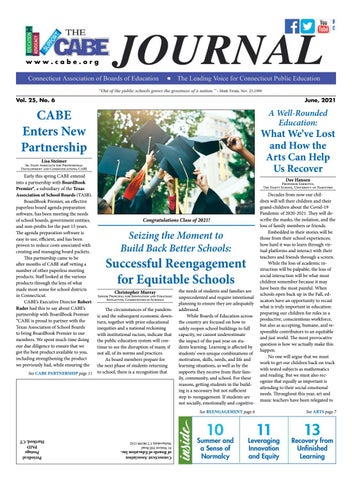
Congratulations Class of 2021!
Seizing the Moment to Build Back Better Schools:
Successful Reengagement for Equitable Schools Christopher Murray
Senior Principal for Innovation and Strategic Initiatives, Communities in Schools
The circumstances of the pandemic and the subsequent economic downturn, together with prior educational inequities and a national reckoning with institutional racism, indicate that the public education system will continue to see the disruption of many, if not all, of its norms and practices. As board members prepare for the next phase of students returning to school, there is a recognition that
the needs of students and families are unprecedented and require intentional planning to ensure they are adequately addressed. While Boards of Education across the country are focused on how to safely reopen school buildings to full capacity, we cannot underestimate the impact of the past year on students learning. Learning is affected by students’ own unique combinations of motivation, skills, needs, and life and learning situations, as well as by the supports they receive from their family, community, and school. For these reasons, getting students in the building is a necessary but not sufficient step to reengagement. If students are not socially, emotionally and cognitive-
Decades from now our children will tell their children and their grand-children about the Covid-19 Pandemic of 2020-2021. They will describe the masks, the isolation, and the loss of family members or friends. Embedded in their stories will be those from their school experiences; how hard it was to learn through virtual platforms and interact with their teachers and friends through a screen. While the loss of academic instruction will be palpable, the loss of social interaction will be what most children remember because it may have been the most painful. When schools open back up in the Fall, educators have an opportunity to recast what is truly important in education: preparing our children for roles in a productive, conscientious workforce, but also as accepting, humane, and responsible contributors to an equitable and just world. The most provocative question is how we actually make this happen. No one will argue that we must work to get our children back on track with tested subjects as mathematics and reading. But we must also recognize that equally as important is attending to their social-emotional needs. Throughout this year, art and music teachers have been relegated to
inside
See REENGAGEMENT page 6
10
Summer and a Sense of Normalcy
See ARTS page 7
11
Leveraging Innovation and Equity
13
Recovery from Unfinished Learning
81 Wolcott Hill Road Wethersfield, CT 06109-1242
Connecticut Association of Boards of Education Inc.
Periodical Postage PAID Hartford, CT
2
The Journal – Connecticut Association of Boards of Education | June, 2021 PRESIDENT COMMENTARY
Returning to Normal Donald Harris President, CABE
The difficult 2020-21 school year is ending. School systems are evaluating, using available data along with educator observations to determine plans going forward for the summer and the upcoming school year. Under ESSER II (Elementary and Secondary School Emergency Relief Fund) the Federal government has provided a large pot of money ($492.4 million) that will be made available to every school district to aid us all to jump-start the 2021-22 school year beginning in September. In my home district of Bloomfield, we have been told that sometime in June we will receive approximately $1.7 million from ESSER II. The available funds will be distributed by the State Department of Education only after a plan for the use of said funds has been submitted and approved. This is a snapshot of how the grant will be distributed in my district. In Bloomfield, the ESSER II plan was built as a sequential, cohesive plan that aligns all our spending plans to the priorities and goals outlined in the District Plan of Excellence for 20212024. The ESSER II Priorities are: • Academic supports, learning loss, learning acceleration, and recovery. • Family and community connections • School safety and socialemotional wellbeing of the ‘whole student’ and our school staff • Remote learning, staff development, and the digital divide. The four priorities are aligned with our four District Priorities: • Holistic Accountability • Rigorous Curriculum, Instruction, and Assessment • Positive school climate • Family and community engagement The following is a review of the programed plan of spending of our ESSER II Grant funding acknowledging the combining of the ESSER II Priority Areas with our District Priorities: • New open court Reading Program for elementary grade children, to vertically align reading instruction across grades K – 5.
• New Mathematics program that provides a comprehensive k-5 curriculum aligned to the Common Core State Standards for Mathematics. • New Mathematics program for grades 6 – 8 with a focus on preparing students for high school and success in algebra and beyond. • I-Ready is a comprehensive assessment and instruction program that empowers educators with resources to help all students succeed. This is done by the connection of Diagnostic data and Personalized Instruction. • Data Wise Project located at the Harvard Graduate School of Education. This offers training to build data use capacity for instructional staff to promote data-driven decision-making. • Summer Programming for grades K-12 including instructional and support staffing, transportation, supplies, and partnership costs for enrichment for not only 2021 but also continuous for the summer of 2022. • Extended School Year includes academic support, enrichment activities, and social/emotional learning. • Multiple extended day programming for grades K-8, providing unique instructional programming, enrichment opportunities, youth development and leadership, and social-emotional learning opportunities. • Technical and monitoring support of curriculum development and SRBI implementation. • Support synchronous and remote learning by purchasing technology equipment for classrooms and teachers. • High School Bridge Program supports students as they transition from middle school to high school amid the challenges of re-entry into full-time school in September 2021. • Provide additional professional development opportunities for
Mission: To assist local and regional boards of education in providing high quality education for all Connecticut children through effective leadership. Vision: CABE is passionate about strengthening public education through high-performing, transformative local school board/ superintendent leadership teams that inspire success for each child.
Board of Directors instructional staff. •P rovide Professional Development to six school-based staff using the UCONN Family Development Credentialing program. The program will be delivered as part of the noncertified staff development offerings throughout the 20212022 school year. •F amily-centered workshops throughout the 2021-2022 school year with a range of topics geared to families. Workshops can include but are not limited to: proficiency in Google classroom to support the teacher, filling out FAFSA forms during the college application process, how to access their student’s school data via the Parent Portal and how to leverage that knowledge to become a better advocate. •F amily support and Summer Programs – Increase family participation in the summer program and begin recruitment for the year-long extended day program. •E nergy Management System upgrade which controls HVAC in buildings That represents a footprint of the upgrades that can be provided within the Bloomfield Public Schools. This plan was developed by the Superintendent and staff with input from the Board of Education, teaching staff, Town Council, parents, and multiple stakeholders. The last point I would like to add is for everyone to pay attention to the child through the family support portion of this plan. We must never forget the trauma that our children have faced being away from school for more than a year as they begin to transition back to full-time. Utilize parents and school support staff and teachers to be assured that our children are feeling comfortable in our efforts to return to a sense of normalcy.
EXECUTIVE COMMITTEE Donald Harris | President, Bloomfield Elizabeth Brown | First Vice President, Waterbury Leonard Lockhart| Vice President for Government Relations, Windsor Bryan Hall | V ice President for Professional Development, East Hartford John Prins | Secretary/Treasurer, Branford Robert Mitchell | I mmediate Past President, Montville Christopher Wilson | Member at Large, Bristol Lydia Tedone | NSBA Director, Simsbury AREA DIRECTORS Bryan Hall | Area 2 Co-Director, East Hartford Leonard Lockhart | Area 2 Co-Director, Windsor Joan Trivella | Area 4 Director, Woodstock Academy Mic helle Embree Ku | A rea 5 Director, Newtown Karen Kleine | Area 6 Director, Westport George Kurtyka | Area 7 Co-Director, Derby Robert Guthrie | Area 7 Co-Director, West Haven Lon Seidman | Area 8 Director, Essex Sean Nugent | Area 9 Director, Preston ASSOCIATES Julie Auseré | Associate, Canton Eileen Baker | Associate, Old Saybrook Ethel Grant | Associate, Naugatuck Ann Gruenberg | Associate, Hampton Robert Trefry | A ssociate, CT Technical High School System Elaine Whitney | Associate, Westport COMMITTEE CHAIRS Leonard Lockhart | Chair, Resolutions, Windsor Becky Tyrrell | Chair, Federal Relations, Plainville Michelle Embree Ku | Chair, State Relations, Newtown CITY REPRESENTATIVES John Weldon | City Representative, Bridgeport Ayesha Clarke | City Representative, Hartford Andy George | City Representative, Stamford Yesenia Rivera | City Representative, New Haven Charles Stango | City Representative, Waterbury STAFF
Robert Rader | Executive Director Patrice McCarthy | Deputy Director and General Counsel Nicholas Caruso | Senior Staff Associate for Field Services and Coordinator of Technology Sheila McKay | Senior Staff Associate for Government Relations Vincent Mustaro | Senior Staff Associate for Policy Service Lisa Steimer | Senior Staff Associate for Professional Development and Communications Teresa Costa | Coordinator of Finance and Administration Pamela Brooks | S enior Administrative Associate for Policy Service and Search Services Terry DeMars | Administrative Associate for Policy Service Gail Heath | Administrative Associate for Government Relations Wilmarie Newton | Administrative Associate for Labor Relations Nancy Propfe | Administrative Assistant for Membership Services Corliss Ucci | Receptionist and Assistant to Executive Director
CABE Journal (ISSN 1092-1818) is published bi-monthly by Connecticut Association of Boards of Education, 81Wolcott Hill Road, Wethersfield, CT 06109. Periodicals postage Paid at Hartford, CT.” POSTMASTER: Send address changes to The CABE Journal, CABE, 81 Wolcott Hill Road, Wethersfield, CT 06109-1242. CABE membership dues include $30 per person for each individual who receives The CABE Journal. The subscription rate for nonmembers is $75. Association members dues include a subscription for each Board Member, Superintendent, Assistant Superintendent and Business Manager. The companies and advertisements found in The CABE Journal are not necessarily endorsed by CABE.
The Journal – Connecticut Association of Boards of Education | June, 2021
CABE Affiliate Members BUSINESS AFFILIATES VALEDICTORIAN Connecticut Business Systems – A Xerox Company Finalsite SALUTATORIAN
Berchem Moses PC Shipman & Goodwin HIGH HONORS
Pullman & Comley HONOR ROLL Anthem Blue Cross and Blue Shield ESS JCJ Architecture Newman/DLR Group SCHOLAR Brown & Brown Chinni & Meuser LLC Coordinated Transportation Solutions Dattco, Inc. Goldstein & Peck, P.C. Kainen, Escalera & McHale, P.C. The Lexington Group Network Support Co. OneDigital Health and Benefits Perkins Eastman T-Mobile The S/L/A/M Collaborative Zangari Cohn Cuthbertson Duhl & Grello, P.C.
EDUCATIONAL AFFILIATES American School for the Deaf Area Cooperative Educational Services (ACES) Capitol Region Education Council (CREC) The College Board Communities in Schools Connecticut Arts Administrators Association Connecticut Association of School Business Officials Connecticut School Buildings and Grounds Association Connecticut School Counselor Association Connecticut Technical High Schools Cooperative Educational Services (C.E.S.) EASTCONN EdAdvance Explorations Charter School Integrated Day Charter School ISAAC LEARN
3
EXECUTIVE DIRECTOR COMMENTARY
Being Comfortable with Being Uncomfortable Robert Rader
Executive Director, CABE
So much happened over the last year! While, of course, the COVID-19 crisis has affected everything we do, other issues have continued to percolate. A summer and fall of racial upheaval, including powerful protests over police killings of unarmed blacks, caused many of us to rethink our views on the criminal justice system, the school-to-prison pipeline and how they intersect with educational concerns. Issues came at school board members fast and furious—such as whether School Resource Officers are still suitable for our schools. Whether it was the New York Times’ 1619 Project, the last president’s strident reaction against it or our own need to come to terms with our history, many of us focused on the treatment of people of color, particularly African-Americans.
Backlash Focuses on Equity
A Washington Post article on May 3 discussed a “conservative” backlash across the country to “critical race theory”, a “decades-old academic framework that examines how policies and the law perpetuate systemic racism. It holds in part that racism is woven into the fabric of the nation’s history and life — a product of the system and not just individual bad actors.” While not necessarily called “critical race theory”, businesses, schools and other organizations have launched initiatives attempting to better understand the necessity for equity and diversity in our country and in our state. One cannot turn a blind eye to the heavy burden of a history of enslavement, discrimination and segregation and the impact of fewer prospects for advancement on people of color. We see it reflected in many statistics, but this one summarizes the difficulty of being Black in America: The median wealth of Black families ($17,000)—is less than one-tenth that of White families ($171,000).* We see the effects on our schools, especially when we look at almost all indicators in our State Accountability
System: academic assessments, academic growth, chronic absenteeism, graduation and other comparisons, including the number of students in honors courses. In all these areas, students of color often fall behind white students — not even close. In the long run, coming to grips with these issues is critical to our moving forward together. I have been reading Hymns of the Republic: The Story of the Final Year of the American Civil War by S. C. Gwynne. The author writes about the formerly enslaved men who fought for the Union and took tremendous numbers of casualties—not only because they were Union soldiers, but, because many Confederates saw them as “lesser” humans and slaughtered them, even as they tried to surrender. I bring that up because it is so important that we see how all Americans have fought for freedom. The history we understand about each other brings empathy—a key social-emotional key touchstones. The backlash to initiatives that examine inequities and diversity the Post describes is taking place as districts are adjusting to new ways of looking at our history and the state of our race relations. One could denigrate “critical race theory”, but, to me it’s a realistic way of examining where we are on these central issues. We know that attracting and retaining teachers and administrators of color works to the advantage of ALL students. Some districts have specifically tasked their Human Resources (or “Talent”) Departments to work on recruiting, retaining and supporting teachers and administrators of color. Diversity, Equity and Inclusion Committees have been established and some districts hired fulltime Equity Directors. While the State has taken credit for exceeding its five-year goal of increasing educator diversity by 10 percent there is still much to do. Over the last year, CABE has also focused on these issues. I have been serving on the Connecticut State Department of Education’s Minority Teacher Policy Oversight Committee and a new Committee on Educators
Rising, both of which are aimed at increasing the diversity of our teaching and administrative staff. Board Members and other Staff also have worked to ensure our sample policies, advice and commentaries in the CABE Journal provide the analysis and information you need in this area. We also have presented webinars (still available on our website), with CABE Equity Consultant Dr. Martha Brackeen-Harris, on Diversity, Equity and Inclusion (DEI) issues. During the last one, in early May, we discussed why names matter. This was particularly important as school boards and superintendents are participating intensely in conversations on these concerns. Language around equity needs to be understood, especially as over the next decades, over half of Americans will be of color and that the “minorities” will be the “majorities” in our schools shortly. CABE’s Board of Directors’ DEI Committee, working with the Northeast Regional Educational Laboratory sent out a survey to board members asking them about DEI issues in their communities, as well as information on their demographics. If you haven’t sent yours in yet, please do. Here’s a link to the survey: https://www.surveymonkey.com/r/93DKXKT.
What I Have Learned
I have learned a number of things over the last year. Thanks in part to Dr. Brackeen-Harris, I, too, have been on a journey on these DEI issues. I know how difficult it is to change systemic racism and that these concerns will be with us for many years. Through reading How to Be an Antiracist by Ibram Kendi, Caste by Isabel Wilkerson and White Fragility by Robin DiAngelo, I learned the importance of working on yourself first as you focus on these issues. Becoming comfortable in one’s discomfort, See UNCOMFORTABLE page 11
4
The Journal – Connecticut Association of Boards of Education | June, 2021 See You in Court – The Nutmeg Board of Education
Vaccinations, School Accommodations Hearing, and Impartiality – The Nutmeg Board in Action Thomas B. Mooney, Esq. Shipman & Goodwin The Nutmeg Board of Education makes many mistakes. The latest imbroglio created by the board will be reported here each issue, followed by an explanation of what the board should have done. Though not intended as legal advice, these situations may help board members avoid common problems. Peter Parent has long been suspicious of vaccines. When his son Petey reached preschool age last fall, Peter presented a duly-acknowledged religious exemption request, and Petey was admitted to preschool without a hitch. With the start of the 2021 legislative session and all the talk about eliminating the religious exemption, however, Peter became increasingly concerned about his Petey’s ability to attend kindergarten in the Nutmeg Public Schools this fall without having to get vaccinated. To be safe, in March Peter registered Petey at the Acorn Elementary School for the fall of 2021. When the General Assembly then passed Public Act 21-6, Peter thought that Petey was all set for kindergarten. But to be safe, Peter emailed Mr. Principal, asking him to confirm that Petey will be able to enter kindergarten at Acorn Elementary School next fall without having to be vaccinated. Mr. Principal didn’t quite know what to do with this request. From the articles he read in the newspaper, Mr. Principal understood that there was some sort of accommodation for students who had already asserted a religious exemption. However, giving Peter Parent a definitive answer was above Mr. Principal’s pay grade, and he kicked the question upstairs to Ms. Superintendent. Ms. Superintendent was also uncertain, and she told Mr. Principal just to tell Peter Parent that he would have to wait and find out in the fall. Peter Parent was irate to receive this “non-answer,” and he promptly hired prominent Nutmeg attorney, Bill Alot. Bill sent a letter to the Board Chairperson, demanding that the Board immediately hold a school-accommodations hearing for his client. Mr. Chairperson shared the letter with the other Board members and Ms. Superintendent when the Board convened into executive session at its next meeting, and he asked Ms. Superintendent what is going on with the Parent family. Ms. Superintendent explained
that she didn’t give Peter an answer for next fall because she was trying to get up to speed on the new law and simply didn’t know what to tell him. Bob Bombast asked Ms. Superintendent whether Petey has a religious exemption now, and she told him and the other Board members that he does. The Board discussed whether that exemption would be effective for kindergarten next year, and to be safe they decided to require that Petey be vaccinated. Ms. Superintendent emailed Attorney Bill Alot the next day: “After considering your request, the Nutmeg Board of Education has decided that Petey will have to be vaccinated before he attends kindergarten at Acorn Elementary. Let me know if you have questions.” Bill Alot responded almost immediately. “Peter Parent asked for a hearing, not a Star Chamber proceeding. When will the Board be holding the hearing we requested?” Does the Nutmeg Board of Education have a problem? • • • • • • • • • • • • • Yes, it does. The law specifically addresses students in Petey’s situation, though we do await further guidance on whether registration of a student for kindergarten next year would be considered “enrollment” in school. Also, the Board members need a lesson on due process. Until April 28, 2021, a child could be exempted from the requirement of vaccination as a condition for attending school if the parent or guardian presented a statement “that such immunization would be contrary to the religious beliefs of such child or the parents or guardian of such child,” which statement had to be acknowledged as described in the statute. Public Act 21-6 was effective upon passage (April 28, 2021), and, as widely reported, it amends Conn. Gen. Stat. § 10-204a to eliminate the religious exemption from the vaccination requirement. However, it includes provisions that will permit certain students to continue to attend school without complying with the vaccination requirements. The main exception provides: The immunization requirements provided for in subsection (a) of this section shall not apply to any child who is enrolled in kindergarten through twelfth grade on or before the effective date of this section if such child presented a statement, prior to the effective date of this section, from the parents or
guardian of such child that such immunization is contrary to the religious beliefs of such child or the parents or guardian of such child, and such statement was acknowledged [as set forth in the statue].” (Emphasis added). The intent of this provision is to permit certain students who are already attending a public school or non-public school in grades kindergarten through twelve with a religious exemption to continue to attend school without complying with the vaccination requirements. There is some question, however, about students, like Petey in Nutmeg, who are currently in preschool. To be entitled to the exemption, such students must have been enrolled in school prior to April 28, 2021 and their parents must have presented a duly-acknowledged statement of their religious objection before that date. The question in such cases is whether children so registered are considered “enrolled” in school prior to the effective date of Public Act 21-6. Where such preschool children are registered but not yet attending kin-
dergarten, it appears that such children are not “enrolled” and accordingly are not eligible to attend school as “legacy” students exempt from the vaccination requirements. As of this writing, we await further guidance on this point. Irrespective of how “enrollment” is interpreted, however, the exemption is not available to such students unless parents also presented the duly-acknowledged statement of religious objection prior to April 28, 2021. The law includes another provision affecting preschool students. If a student is currently attending preschool exempt from the vaccination requirements based on a religious objection that was duly acknowledged, that student may move on to kindergarten without complying with the vaccination requirement until either (1) the later of September 1, 2022 or within fourteen days of transferring to a Connecticut school subject to the vaccination requirements or (2) according to an alternative vaccination schedule if the student presents a certificate See SEE YOU IN COURT page 6
The Ninth Edition – Now Available!
A Practical Guide to Connecticut School Law by Thomas B. Mooney, Esq. Shipman & Goodwin
CABE is delighted to announce that the Ninth Edition of Tom Mooney’s Practical Guide to Connecticut School Law is now available. PRICING: CABE Members: $54.99; CABE Non-Members: $79.99; Students: $44.99 There have been many changes in school law in the last few years, and the Ninth Edition has been extensively revised to provide updated guidance on the legal issues that govern our schools. Changes include descriptions and commentary on:
• Changes in teacher evaluation and teacher tenure. • New rules regarding employee background checks. • New requirements concerning student data privacy. • New rules for suspension, expulsion and alternative educational opportunities. • Revised requirements governing seclusion and restraint. • The new “Every Student Succeeds Act” and how it has changed “No Child Left Behind Act” requirements. • The CCJEF case and ongoing litigation over equal educational opportunities. • The Minimum Budget Requirement and new duties to collaborate with town officials. • A host of other changes in the rules that boards of education and school administrators must follow.
The Journal – Connecticut Association of Boards of Education | June, 2021
5
Aim Higher
Creative legal solutions for Connecticut’s public schools – because sometimes it is rocket science.
Shipman & Goodwin’s school law attorneys have more than 40 years of experience, and represent over 100 public school districts, as well as public school member organizations and associations, on a full range of legal issues that they confront, from general education law to special education matters.
Arts from page 1
Our school law site, www.ctschoollaw.com is devoted entirely to emerging school law issues. Attorneys counsel clients, monitor legislation and provide periodic alerts and updates. We regularly present seminars, quarterly workshops, webinars and professional development workshops for schools on current topics of interest. Our Practice Group Co-Chair, Tom Mooney, has written A Practical Guide to Connecticut School Law, a comprehensive treatise on Connecticut school law, published by CABE and used by teachers, administrators and board of education members throughout the state.
Education is a core focus of our law firm. www.ctschoollaw.com
Contact: Thomas B. Mooney or Linda L. Yoder | 860.251.5000 | www.shipmangoodwin.com CONNECTICUT
|
NEW YORK
|
WASHINGTON DC
6 REENGAGEMENT
(continued from page 1)
ly engaged, learning will not happen. At a time when we are concerned about the learning gap exacerbated by the pandemic, we also must focus on addressing the engagement gap. This includes understanding barriers to engagement and working to remove those now while also recognizing that if conditions for learning are not experienced as equitable for all students, our
successes to engagement will be short lived. This moment requires rigorous attention to breaking down barriers to equitable learning that existed before– and have been exacerbated by–the pandemic. Equitable conditions for learning must place students at the center of a network of caring, trained adults inside schools and at home. Communities In Schools (CIS) is working at the forefront of these efforts with tools to reconnect, support and reengage.
The Role of Student and Family Engagement in Addressing Learning Loss
Prioritizing student engagement has become the critical driver of cultivating more equitable school climates in the coming school year and beyond. As school systems try to maximize learning during and after the pandemic and to reengage the school community, understanding and accommodating the individualities of the youth they serve
The Journal – Connecticut Association of Boards of Education | June, 2021 will be even more essential than before. It will be critical to first understand, assess and monitor student engagement in order to plan for and respond to engagement needs. The focus of these activities is reconnecting with students, supporting student and family recovery in the wake of the COVID-19 pandemic and school building closures, and addressing long-standing, and now exacerbated, inequities in our education system
The research with AIR shows that while a student may demonstrate a generally high-level of overall engagement, when we examine engagement within these four domains, we get a clearer picture of areas where a student’s engagement levels are being impacted by specific factors. This allows for schools to more effectively respond to student needs by tying supports to particular domains.
that impact a student’s opportunity for academic success and achievement. Partnering with the American Institutes for Research (AIR), Communities In Schools has developed a free toolkit for students, families and school staff to assess these critical areas of engagement. Engagement here is defined by four domains: • Emotional: Positive and negative feelings about school and learning. • Social: Relationships with teachers, other adults in the school, and peers; school belonging or connectedness. • Cognitive: Self-regulated learning, perceived relevance of schoolwork, use of deep learning strategies, motivation, and exerting cognitive strategies for the comprehension of complex ideas. • Behavioral: School-related conduct, involvement in learning, attendance, participation in school-related activities.
Assessing Your District’s Student Support System
We know that as Board Members, you are constantly balancing stakeholder needs, state and federal requirements, budgets, and particularly at this time the unexpected demands of an unprecedented set of circumstances. Now is a good time to take stock of your district’s current system and structure for student and family supports, consider doing a survey to learn from students and families where gaps might exist, and incorporate what you learn into plans for funding sources recently released. The American Rescue Plan (ARP) presents a unique opportunity for implementing new or reinforced models that reengage students in learning. As states, school districts, and schools think through the most impactful way to support students in their learning reengagement and recovery, they might consider using ARP funds to hire reengagement coordinators, or to provide social emotional and other wraparound supports. Schools alone cannot shoulder the enormous responsibility of closing the educational and emotional disruptions caused by the pandemic. With ARP funds, schools can partner with community-based nonprofit organizations to reach all students, build back their resiliency, and ensure they are on a path to the future they want. Editor’s Note: For access to the free resource toolkit offered by CABE’s education affiliate, Communities In Schools, please see https://www.communitiesinschools.org/k12/tools-schools/.
SEE YOU IN COURT
(continued from page 4)
from a physician, a physician assistant, advanced practice registered nurse, or local health agency stating that initial immunizations have been given to such student and additional immunizations are in process as recommended by those medical professionals, provided the student must be fully vaccinated according to the alternative vaccination schedule. Regardless of how “enrollment” is ultimately resolved, the Nutmeg Board of Education must understand its obligations when a parent or guardian makes a request for a school accommodations hearing. When a school district denies school accommodations to a child (which can include disputes over transportation or even bus stops), the parent or guardian has the right to request that the board of education conduct a hearing over whether the child should be provided school accommodations. When the board of education conducts such a hearing, due process requires that its members sit as impartial judges to hear the evidence and make a decision. Accordingly, the board members should not have prior discussion of the case among themselves or with the superintendent. Rather, they must make their decision based on the evidence presented at the hearing. If the board members need legal advice on the student’s legal rights, they should request and receive such advice. However, given the board member’s obligation to be impartial, legal advice on eligibility for school privileges should come from a lawyer other than the lawyer who is advising the superintendent on the matter. Attorney Thomas B. Mooney is a partner in the Hartford law firm of Shipman & Goodwin who works frequently with boards of education. Mooney is a regular contributor to the CABE Journal. Shipman & Goodwin is a CABE Business Affiliate.
Did You Know? For the price of CABE dues, your board and superintendent are eligible for: • Unlimited tailored workshops on issues such as FOIA, roles and responsibilities, board selfevaluation, and goal setting. • Unlimited advice on key educational issues from knowledgeable, expert professionals who have great experience in helping boards better serve their communities.
The Journal – Connecticut Association of Boards of Education | June, 2021
7
CABE VIRTUAL SPRING MEETING OF SUPERINTENDENTS’ ADMINISTRATIVE PROFESSIONALS
On April 28, CABE Deputy Director and General Counsel Patrice McCarthy and Sr. Staff Associate for Government Relations Sheila McKay presented a session on Legislative and Legal Issues as part of the Spring Virtual Meeting of Superintendents’ Administrative Professionals.
ARTS
(continued from page 1)
teaching “on a cart” or through virtual or hybrid instruction. It has devastated the interactions between students who cannot move in synchrony, sing and sense the pulse and pitch of others around them, or experience the guiding hand of their teacher as they create. Art and music rooms have been turned into space for the overflow of other classes to accommodate social distancing. The evisceration of arts programs in schools has most certainly undermined the quality of education and will have lasting impact if not seriously addressed. A well-rounded education involves developing and enriching the brain, emotionally, cognitively, and physically. While learning is a life-long endeavor, the early years prior to adulthood are critically significant in this developmen-
CABE Sr. Staff Associate for Professional Development and Communications Lisa Steimer introduced CABE DEI Consultant Dr. Martha Brackeen-Harris who presented a session on Implicit Bias.
tal growth. Research by neuroscientists and psychologists continually confirm that learning in and through the arts may arguably be the single most important means of accomplishing this educational trifecta.
Social-Emotional Learning (SEL)
Because of the highly social and interactive nature of the performing arts, SEL skills are a natural and predominant outcome of arts study. Through performing arts experiences, we learn to work toward a common goal, self-and peer-reflect in respectful and positive ways, demonstrate self-regulation, and social skills. Creativity, nurtured by the visual, media, and graphic arts, provides significant introspection, reflection, and expression so needed in personal growth. The arts naturally activate emotional response and through these processes we learn patience, perseverance, respect, and empathy. An excellent resource developed by The Center for Arts Education and Social Emotional Learning (ArtsEdSEL http:// selarts.org) helps us understand the relationship between social-emotional attributes such as self-awareness, self-management, social awareness, relationship skills, and respon-
sible decision-making and the National Standards for the Arts Artistic Processes: Create, Perform, Respond, Connect. A primary goal of the upcoming school year should be to provide opportunities for children to rebuild their SEL skills. Music, art, theatre/drama, and dance/ movement are critical to this effort.
Cognition (Thinking) and Workplace Skills
Neuroscientists have extensively researched executive functioning which is primarily located in the pre-frontal cortex of the brain. These skills are generally labeled 21st Century Workplace Skills and often described in district “Vision (or Portrait) of the Graduate” statements. These statements combine cognition with workplace qualities and are intended to illustrate what students should carry with them as a result of the school district’s educational offerings. These skills are not just directed at secondary students, however. They must begin at the elementary level and be reinforced for the entire K-12 experience.
Reading and Language Development
In addition to these important skills, a great deal of research confirms how music study reinforces reading and language development. Music is an auditory artform. We learn to discriminate, analyze, and associate sounds with symbols in both reading and music. To be able to successfully read, our ability to discern the nuances of language, its pitch, rhythm, stress, and phrasing is critical to the reading process. As in reading, music
study also teaches phonological awareness, or understanding sound. Learning in music reinforces reading and language development while at the same time teaching important life skills, thinking skills, and physical skills. An excellent source for research that is enlightening and user-friendly is the Auditory Neuroscience Laboratory at Northwestern University (www.brainvolts.northwestern.edu).
Physical Skills
When we glance into a music class, we often see children dancing or moving to the beat or singing and moving to a song (gross motor skills). If we watch an art class, children are using paint brushes or other tools to create their art (fine motor skills). We know that researchers have found that many children with reading problems also have trouble maintaining a steady beat, or synchronizing rhythms with a steady beat. Art teachers often are the ones who help children learn how to properly hold pencils or to use small, controlled strokes with their writing. The physical skills learned in arts classes are endless. Reading music reinforces the text reading process, the physical recognition of moving across the midline of the brain from left to right. Let us make the reopening of our schools joyous and productive. We must provide a well-rounded education for our children K-12. The Arts are vitally needed for this to happen. The author represents CABE Education Affiliate, Connecticut Arts Administrators Association.
8
The Journal – Connecticut Association of Boards of Education | June, 2021
THE POLICY CORNER Vincent A. Mustaro
Senior Staff Associate for Policy Service, CABE
Continuous Improvement: Policy Direction Improving the quality of K-12 education in America is a high priority. Achieving desired outcomes is crucial to improving education. Further, the processes that make those outcomes possible are also important. Continuous improvement is a promising approach that educators can use to achieve improved outcomes. The approach has been successfully used in healthcare, manufacturing and technology. Impressive results have been achieved by school districts utilizing the approach. Education Week stated “Continuous school improvement is a cyclical process intended to help groups of people in a system – from a class to a school district or even a network of many districts – set goals, identify ways to improve, and evaluate change in a sort of continuous feedback loop.” It has become a buzzword in policy and practice, as states, districts, and schools strive for systemic, long-term gains in student achievement. “Continuous improvement,” part of the educational vocabulary, has been used to describe efforts to improve instruction, district and school improvement plans, and state accountability systems. Continuous improvement is grounded in systems thinking from the 1930s. Such efforts have left much to be desired, due to poverty’s impact on school quality and student achievement. Continuous improvement principles are straightforward, but challenging to put into practice because of the many pressures impacting school districts. Yet, Phi Delta Kappa, through its AdvancED Improvement Network, has shown in more than 34,000 schools and school systems nationally and worldwide that such systems can improve outcomes for schools and students. The continuous improvement cycle consists of the four components of assess, analyze, adjust and repeat. Educational institutions are considered “living systems” comprised of interconnected parts consisting of classrooms, teachers, students, leaders, and outside stakeholders. A basic premise of continuous improvement is that organizational success is related to its ability to make sense of these interconnected elements.
Mark Elgart in Phi Delta Kappan, stated, “An effective continuous improvement system in a school system emphasizes the learner’s experience, stakeholder engagement, and data collection and analysis to guide and inform both planning and executing a school’s improvement journey.” In short, continuous improvement consists of quality improvement efforts that are evidence-based, integrated into the daily work of individuals, contextualized within a system and involves a series of repeated steps to achieve a given result. In classrooms, it refers to using timely and accurate data to regularly inform and improve teacher practice. At a school or district level the practice refers to efforts to improve operational practices and processes related to efficiency, effectiveness, and student outcomes. In all cases, continuous improvement involves a cyclical approach to problem solving. Multiple continuous improvement models are built on this same basic cycle. One long-standing model, “Plan, Do, Study, Act (PDSA)” illustrates the continuous improvement process. The PDSA cycle, a fourstep process, is useful in guiding continuous improvement to test a change practice in a real-world setting. Once the problem has been defined and an aim set, the cycle is used to guide rapid learning through four repeated steps as part of an ongoing cycle of improvement.
Plan-Do-Study-Act (PDSA) Cycles •P lan. A Continuous Improvement Team (team) studies a problem that needs to be solved, collects data on that problem, elaborates potential solutions to that problem and develops an action plan. •D o. The team implements the action plan and collects data on its intervention, and records developments. A specific change practice is tested. • S tudy. The team gauges the success of the intervention by comparing baseline and new data, analyzes results, and documents lessons learned. In this step participants use a guided protocol to examine
the data and consider the extent to which the specific targets or objectives for the previous step were met. •A ct. The team determines what to do with the results. The team may choose to adopt, adapt, or abandon its tested solution. This last step integrates all the learning generated throughout the process, which can be used to adjust the tools or processes being tested or to further the objectives or targets; to formulate new theories or predictions; and to make changes to the overarching aim. In this step participants may be ready to implement the change practice more broadly, or they may require another test in a different context or with other variables. Then the cycle begins again, to test different solutions or address new problems. Jane Best and Allison Dunlap, in Continuous Improvement in Schools and Districts: Policy Considerations provided that allowing for continuous improvement in schools and districts at the policy level requires consideration of numerous factors, including the following: 1. Fewer, Specific, and Measurable Goals: Schools with improvement projects frequently include more goals and action items than can be realistically implemented. A continuous improvement approach involves addressing fewer problems, testing potential solutions against specific, measurable goals. 2. Flexibility: A continuous improvement approach requires using rapid prototyping to test evidence- and context-based solutions. Schools and districts must have the flexibility to take risks, test possible solutions, and adjust programs midcourse. 3. Time: The process requires sufficient time to research and introduce new instructional strategies which increases the likelihood of successful implementation. 4. Data Use and Capacity: Participants must collect and use data to evaluate the efficacy of interventions, make midterm corrections, and plan future
actions. Such data must be timely, useful, reliable, and easily available. 5. Evaluation: Participants must regularly evaluate the efficacy of their interventions throughout a program and allow for midcourse corrections and changes. 6. Leadership: Leaders play a crucial role in successful continuous improvement efforts using a formal improvement methodology, creating a vision for improvement, enabling others to pursue that vision, and monitoring progress toward goals. 7. Knowledge Sharing: Successful efforts require that knowledge is shared across the organization. 8. Capacity Building and Stakeholder Investment: Introducing continuous improvement may require a major cultural shift requiring new practices to be incorporated into the daily work of all participants. Organizational structures may need to change. A toolkit available from the Northeast Regional Laboratory states that continuous improvement is premised on the following three core principles about how sustainable change is achieved: 1. Change takes time and involves collective effort. 2. C hange is context-specific and therefore requires constant adaptation, data collection, and learning. 3. Focusing on a series of small changes, combined with ongoing evidence collection and review, can lead to large-scale change. Different terms are used to represent continuous improvement philosophies and practices. Continuous improvement models and approaches include various approaches. All of the terms offer a systematic process through which practitioners engage in identifying needs, defining the problem, implementing new or modified practices, collecting data, and reflecting. Practitioners can also implement existing evidence-based strategies. Three essential questions guide the continuous improvement process: See IMPROVEMENT page 14
The Journal – Connecticut Association of Boards of Education | June, 2021
9
We Are Well Suited to Respond to the Legal Needs of Boards of Education Attorneys and Counselors at Law
Berchem Moses PC is a leading player in the State of Connecticut in the field of Education Law. With 10 attorneys dedicated to this specialized practice, we offer a long history of experience and deep resources. We promise the highest level of service in a more cost effective manner. We work with boards of education to address a myriad of complex issues including labor and employment, student issues, special education, general counsel, and other challenges facing educators today. Be sure to visit www.connecticuteducationlawblog.com where our attorneys regularly cover legal matters that pertain to Connecticut schools.
www.berchemmoses.com Milford
75 Broad Street Milford, CT 06460 Phone: 203-783-1200
Westport
1221 Post Road East Westport, CT 06880 Phone: 203-227-9545
10
The Journal – Connecticut Association of Boards of Education | June, 2021
A Conversation About Summer and a Sense of Normalcy Christopher Marino Clinical Director, Community Mental Health Affiliates, Inc. (CMHA)
On April 27, the CT Department of Public Health and the CT State Department of Education provided interim guidance for remote learning for the 2021-2022 school year. This guidance indicates that the need to mandate, due to public health necessity, that all school districts provide an option for students and their families to opt-in to a voluntary remote option after this school year is not anticipated. As we move from a year that in many cases was more virtual than in-person, what can parents and educators do over the summer months to bring ourselves and our children back to some sense of normalcy? 1. As a mental health professional, what do you feel that the overarching impact of remote learning has been on students and educators? I think when we step back and consider the individual experience of each student and educator, we’ll realize that the impact remote learning has had is going to be unique to each person. It is easy for us to quickly
make the assumption that for the first time, what are remote learning has been the best ways to re-intronothing but a challenging duce them to in-person adjustment for everyone. socialization? But for some students, reAs opportunities for mote learning has actually in-person socialization helped them feel more accontinue to increase, complished academically. many youth will be eager Even for some educators, to take advantage of these they have embraced the opportunities to reconprocess and have gotten nect with their friends Christopher Marino so creative that they have away from their screens. found ways to enjoy remote instrucOverall, we have seen tremendous retion. siliency and adaptability with our kids There is no disputing the fact that between wearing masks and socially remote learning has led to social, emo- distancing. So for many of these kids, tional and behavioral health challenges I expect we will continue to see them for many students and educators, but adapt to the expectations and limits I think we need to look at the impact of mask and safety protocols. The goal of remote learning from a strengths for adults is to avoid the assumption based perspective and instead ask the that all youth are excited for in-perquestion, “how well did students and son socialization. Many students will educators adjust to remote learning?” be returning next year with real and I think you’ll find that many students understandable fears of risk to their and educators learned a lot about physical health as well as challengthemselves and their abilities over the es adapting to socializing in-person course of the year as a result of remote again – not to mention the academic learning. pressures of being in-person again as well. It is recommended that educators 2. Given the fact that many stuand parents work together to develdents during COVID-19 have had to op clear and consistent language and deal with mask and safety protocols responses to their children’s eagerness
or hesitations. Validate those feelings for our youth and listen with the intent to understand. 3. What can parents and caregivers do over the summer months to prepare their children for returning to in-person learning and activities? We know that this summer is going to be different, but it doesn’t have to be like last year. I think families are already feeling that eagerness to travel again and visit places like parks and the beach. So, we’ll definitely see a lot of families take advantage of those outdoor opportunities. And as long as it can be done safely, I encourage families to do so. I think the main point here that I want to send to parents is that we don’t need to re-invent summer for our kids. We might have to get a little more creative with how we do things, but we don’t need to overcompensate. Kids need to feel like they can predict what is happening in their lives. Try to remember what your family enjoyed in summer 2019 – I think it’s hard for us to even remember what life was like before 2020 but it did See CONVERSATION page 12
The Journal – Connecticut Association of Boards of Education | June, 2021
11
Leveraging Innovation and Equity as an American Imperative: If Not Now, Then When? Michael T. Conner, Ed.D.
Superintendent, Middletown Public Schools
March 13, 2020, will forever be remembered as a turning point in the education space. Most will view the coronavirus pandemic as a historic economic disruptor – the magnitude of which has not been seen since the Spanish Flu of 1918. At the outset of the 2020 pandemic, many educators were forced to make radical shifts in operations, instruction, safety, and health. As we started to adjust to this ‘new normal’
UNCOMFORTABLE
(continued from page 3)
whether discussing white privilege, LGBTQ issues or even thinking about names, is a critical part of coming to terms with the world as it exists—and is key to building a world in which every person is valued by their skills, experiences and abilities, not on the
it became clear that education would undergo an unanticipated evolution. During this time, I read and was deeply influenced by the late Clayton Christensen’s book The Innovator’s Solution. The opening chapter establishes a provocative tone citing urgency as a seminal tenet for innovation, coupled with a growth mindset and rapid, iterative change. I started to think about specific elements of transformation – not your typical de jour reform practices but punctuated, foundational patterns for innovation,
creativity, and equity in education. In December 2020 I was notified of my selection as one of 25 national thought partners from the education industry appointed as Commissioners on the Learning 2025: National Commission on Student-Centered, Equity Focused Education. The culminating report – An American Imperative: A New Vision of Public Schools challenges us to ensure that no learner is marginalized as well as leveraging a reimagined education model for ALL students.
color of their skin, gender identity or their religion. While perhaps it would be easier to ignore the data as those leading the backlash seem to do, I think it’s crucial that we continue to help lead the hard work that has been going on. We need to address these disparities, and understand the obstacles to equality and equity that so many of our children
face. Only by doing so, will we address the needs of this generation and generations to come. *Taken from The Economic State of Black America in 2020; Joint Economic Committee, United States Congress.
Changing mindsets and grounding new mental models will take time, but we need only to focus on our ‘why’ to begin the journey. Leadership in the 2021- 2022 academic year will need to be courageous, impactful, and rooted in student-centric approaches that are equitable. My personal message is simple, “be bold – if not now, then when?”
CABE PARTNERSHIP
(continued from page 1)
price is reasonable.” CABE is the thirteenth school boards association to partner with BoardBook Premier. If you are interested in learning more about BoardBook Premier and how it can save you time and money, you may email Lisa Steimer at lsteimer@cabe.org or directly engage with the BoardBook staff by signing up for a live 30-minute webinar demonstration by visiting http:// boardbook.how-to-cut-meeting-preparation-time-in-half.sgizmo.com/s3/.
12
The Journal – Connecticut Association of Boards of Education | June, 2021
CABE LEADERS IN ACTION WEBINAR SERIES
On May 3, CABE DEI Consultant Dr. Martha Brackeen-Harris presented a webinar on Names Matter where we discussed terminology and insights as to why it is important for people to self-identify and how we respect that by how we use terminology.
CONVERSATION
(continued from page 10)
exist! Try to bring back as much as you can that you family already knows. Traditions, routines, anything that is familiar will be helpful to increase predictability and decrease anxiety children may be experiencing. Try to encourage playfulness with your kids, model it for them, and show them that it is okay to enjoy themselves and be happy and try new things. For our adolescents, especially those with driver licenses, there is going to be a lot of eagerness to get connected with their friends again. Parents may be holding a lot of anxiety and concerns rather than sharing in their teen’s excitement. In these situations, I encourage parents to have an open and honest conversation with their teens while remembering to validate their experience also. We have shown our kids that it is okay for them to begin to gain healthy control over things in their life again. 4. Students aren’t the only ones who have felt the impact of COVID-19, how stressful has this pandemic been on teachers and educators, and why? I think one thing that has happened during the pandemic is that educators were asked to be extraordinarily resilient during extraordinarily stressful times. When most people were being locked down and working less, teachers were being asked to work harder. Parents and students continued to hold high expectations for educators, and educators were putting just as high – if not higher – expectations on themselves. Under normal circumstances, educators are often able
On May 5, East Hartford Superintendent Nate Quesnel and New On May 6, CABE Executive Director Robert Rader facilitated Jersey School Boards Association Educator in Resident Vince a virtual conversation with NSBA CEO and Executive Director DeLucia presented a webinar on Preparing All Students for the Anna Maria Chávez on Public Education in 2021. Future: Addressing Learning Gaps of All Students.
to experience compassion satisfaction, which is the feeling we get when we are able to care for others successfully. When the pandemic suddenly locked down schools and forced everyone to remote learning, educators found themselves working harder but feeling like they were accomplishing less as attendance rates decreased and youth mental health concerns skyrocketed. Our educators didn’t give up though, and for most of the pandemic many of our educators experienced what something called compassion fatigue. This occurs when we care for others for a prolonged period and are exposed to the adverse experiences in their lives without experiencing enough compassion satisfaction. Many educators were left feeling helpless with educating and caring for their students remotely. But – throughout all of this adversity we have witnessed a beautiful rose grow through the cracks in the pavement. We have such resilient teachers. Our teachers continued to show up, get creative, and strengthen their own abilities as educators that they will carry with them into the future. After a year of so many personal and professional hardships, our educators are prepared now more than ever to re-connect with their students. Most importantly, district leadership must be aware of their responsibility in promoting wellness and self-care, and to remind their educators of the amazing accomplishments over the past year, and their courage and commitment that they continue to show to their students. 5. What advice/tools do you have for teachers and educators to practice self-care over the summer months? As a mental health professional, when I speak to clients about self-care
I often ask the following question: what meaning and purpose does this self-activity hold for you? The concept of self-care for many people involves some sort of activity to feel better quickly when we are feeling high levels of distress, and we hold the idea that we can continue to use this self-care activity for any future incidences of distress also. Unfortunately, when we understand self-care through this problem-solving lens we tend to try to use self-care activities only in moments of crisis. I often will work with clients on challenging them to change their understanding of self-care by incorporating wellness activities into their daily routines. When we do this, we begin to value our mental health and overall wellness differently, and see self-care as something with much more meaning in our lives. The other piece of advice I make sure to give to clients is to make sure they do not quantify their self-care. Devices that measure heart rates or track steps are wonderful for individuals trying to live healthier lives; but we need to be careful in assigning a number to our self-care practices to avoid putting any unnecessary pressure or burdens on ourselves. Instead, I encourage client to qualify their self-care. Describe how their self-care activities make them feel. Lastly, I would recommend that our educators engage in self-care activities this summer that they can continue to use throughout the school year as long as it does not cause any additional stress or burdens. We are all trying to regain control in our lives – self-care practices are an excellent place to start!
6. What resources do you suggest your school community should access should anyone need additional support? I suggest that district leaders begin building meaningful connections and partnerships with the experts in their communities over the summer months. As the Clinical Director of Outpatient Behavioral Health Services for Community Mental Health Affiliates, I have been fortunate enough to have established wonderful partnerships with local school districts that will have an immediate impact on their school communities over the summer and into the following school year. These kind of partnerships are critical to strengthening community resiliency and giving both students, their families, and educators a sense of predictability and re-assurance that they know where to get support and resources.
Meetings of Interest n Wednesday, June 2, 2021: Meeting of the Connecticut State Board of Education: Virtual meetings will be live streamed for public access. A link to the live stream will be available on the Board’s website the morning of the meeting at 9:30 a.m. n Wednesday, June 9, 2021: Last Day of 2021 Legislative Session
The Journal – Connecticut Association of Boards of Education | June, 2021
13
Recovery from Unfinished Learning
Patrice McCarthy
Deputy Directory and General Counsel, CABE
School boards in Connecticut and throughout the country are working to identify areas where students will need additional support – both academic and social emotional – as a result of the pandemic. A recent report by The Education Trust outlines the need to plan to address students’ “unfinished learning” – a term that refers to the fact that students may have been exposed to content while learning remotely, but have not yet had the opportunity to master the content. This term is probably more accurate than the “learning loss” term frequently used. Thanks to the outstanding efforts of educators and school boards, many students did have
meaningful educational experiences in a virtual or hybrid learning format. Among the strategies suggested in The Education Trust report to address unfinished learning are: • Target intensive tutoring in areas of math and reading by having an individual tutor work consistently with one or two students using a skill building curriculum aligned with the math or reading curriculum used at their school. • Expand learning time through afterschool, summer and in school programs. • Build stronger relationships between students and teachers and school staff to enhance students’ motivation. The report cites research indicating that extended learning
time must be carefully planned and delivered. To be effective, extended learning programs should: •O ffer 44 to 100 hours of extra learning annually to have a substantive impact on student learning; •U se curricula that is aligned with content in the regular school day and include the opportunity for individualized instruction, allowing teachers to tailor instruction to struggling and high–achieving students; • I nclude policies to engage attendance; •U tilize certified teachers; • I nsure equity in access to enrichment programs. Many Connecticut school districts are collaborating with community
partners to provide fun, social opportunities in addition to academic support this summer. Re-engaging those students who have been in a remote learning environment for over a year will be critical to their future success. The title of Hamden’s summer program “Operation Joy and Engagement”, captures the focus and spirit of the summer plans developed by many school districts. Resources from the American Rescue Plan Act (ARPA) will support school district programs. The ARPA requires that school districts use 20 percent of the funds to implement evidence-based interventions to address “unfinished instruction” and the disproportionate impact of COVID-19 on the most undeserved students.
The Asian-American Experiences That Deserve the Attention of Our Schools Vernon M. Billy
Executive Director of the California School Boards Association
[Editor’s Note: We were impressed by this commentary from Executive Director Vernon Billy of the California School Boards Association. While California has a much larger proportion of Asian-American students, the lessons are also applicable to Connecticut. For the sake of brevity, we eliminated the author’s history of discrimination against Asian-Americans. For the full article, follow this link to page 5: https://publications.csba.org/issue/ spring-2021/] California is home to the nation’s largest Asian American population, totaling 14 percent of its residents. Yet, while our state enjoys a reputation for embracing diversity, the reality of the current Asian American experience paints a different picture. In a study released in April by the Public Policy Institute of California, Asian Americans were found to be the most likely of all ethnic groups to say that race relations have worsened in the past year, with nearly half of all Asian American residents feeling that way compared to 43 percent of Californians overall. That makes sense as the news has been filled with incidents of verbal harassment, intimidation and physical attacks against people of Asian descent. From March 2020 to May 2020, the Asian Pacific Policy Planning Council documented more than 800
COVID-related hate incidents against Californians of Asian heritage, and the pace has not slowed even as California has made progress against the virus. In addition, the advocacy group Stop AAPI Hate used its online reporting tool to record more than 3,800 reports of hate incidents nationwide last year. The statistics also reveal a disturbing intersection between racism and misogyny. In a March 30 column in USA Today, Stop AAPI Hate founders noted that women reported harassment at a rate 2.3 times higher than men and often described a sexual component to the abuse. Overall, the hatred ranges from verbal harassment, to shunning, to being coughed or spat upon, to assault- and the alarming statistics do not include the large numbers that go unreported. Violence against people of Asian descent has largely been presented as a recent phenomenon, but the historical record shows that discrimination is a persistent feature of the Asian American experience, particularly in California… As those who have been entrusted with the governance of public schools, school leaders must consider how to present the full tapestry of American history - not to tear it down but to reinforce the historical conviction that we must work collectively as one to form the “more perfect union” that is idealized in the Constitution. We owe that to our students, to ourselves and to our country. This is, in part, the value of ethnic studies, which can
elevate forgotten or overlooked parts of the American story and illuminate the trials, triumphs and contributions of all its people. This inclusive philosophy can be reflected in all aspects of the school curriculum, so that students develop an appreciation of the myriad ways in which our past, present and future are connected. This kind of understanding, and the empathy it breeds, is crucial if we wish to push beyond the division that is ever-present in our society. Often, conversations around equity and positive school culture fail to fully include Asian American students, recognize their needs and address their concerns. We must avoid falling prey to the “model minority” trap that envelops Asian American students and obscures the very real issues that these students may be suffering. Many people are aware that Asian Americans, as a group, tend to have better high school graduation and college completion rates, and higher earnings than other ethnic and so-called racial groups. It is less well known that, in many districts, students of Southeast Asian heritage tend to have lower graduation and college completion rates than African Americans and Latinos, two student groups that are typically pictured when we discuss opportunity and achievement gaps. There are, however, examples of districts that are responding to this moment with increased services to support the social and emotional health of Asian American students. A
March 25 Education Week article noted that Anaheim Union High School District teacher Jeff Kim is launching an ethnic studies course that includes an ethnographic project where students trace their families’ migration to the United States and conduct oral histories on the experiences of family members who immigrated to America. The class will also feature civic engagement that pairs students with Asian American community organizations. It is true that our history and our present are littered with, and have at times been defined by, examples of racism. Acknowledging the persistence of interpersonal and institutional racism does not mean it is inevitable, nor does it give us license to ignore it or shrug our shoulders and accept it. In fact, the opposite is true, particularly for those who work in public schools. Our unique position gives us the opportunity and the responsibility to create the foundation for a better America, one where the next generation brings the nation closer to its stated values. It is the duty of governance teams and school leaders to set the tone for students, staff and community through policy and communication that creates a culture of respect for all people, and an institutional commitment to anti-bullying and equitable opportunities. We cannot change the past, but we can – and must - learn from it and improve upon it.
14
The Journal – Connecticut Association of Boards of Education | June, 2021
CABE: Working for YOU
Individualized Workshops | Professional Development Opportunities Legal Services | Policy Services | Representing You Statewide and Nationally Below are the highlights of activities that the CABE staff has undertaken on your behalf over the last month. We did this:
B y providing opportunities for members to learn how to better govern their districts: zF acilitated two meetings on CABEMeeting and the migration to BoardBook Premier. zM et with Monroe Superintendent Joseph Kobza and Norwich Free Academy Superintendent Brian Kelly on CABE programs, activities and services. zM et with representatives of the Enfield Board of Education on upcoming professional development. zR esponded to 53 requests for policy information from 30 districts and one RESC, providing sample materials on 43 topics. Further, districts continue to access CABE’s online Core Policy Reference Manual and/or online manuals posted by CABE for policy samples. The topics of greatest interest were those pertaining to sexual harassment, equity and diversity, civility, and bus driver drug testing. zF acilitated board self-evaluation for the Fairfield Board of Education.
B y helping school boards to increase student achievement:
z S ent two issues of “Policy Highlights” via e-mail listserv covering topics that affect student achievement. Included topics pertained to testing, accountability, summer school, relationship between school environment and achievement,
impact of school principals on student achievement and athletics.
B y ensuring members receive the most up-to-date communications:
zP repared materials, as part of the Custom Policy Service, for New Haven, Region 15, and Sharon. zR evised policies in the master resource file of policies and in the online Core Manual.
B y promoting public education:
zD iscussed return to in-person learning on NBC-CT. zD iscussed district flexibilities for graduation with New Haven Register. zH osted bi-weekly Board Chairperson teleconferences. z Attended CABE May webinars. zA ttended CAPSS Board of Directors meeting.
B y providing services to meet member needs:
zP rovided webinars to review actions of the Education and Appropriations Committees. zP osted policies online for districts utilizing the Connecticut Online Policy Service (COPS) for Griswold, Portland, Region 4, Ridgefield, Sterling, and Woodbridge. zR evised policies for East Hampton, New Fairfield, Putnam, Sterling, Union, and Windham as part of the Custom Update Service. zP articipated in a virtual meeting with Stamford to discuss policy issues. zU pdated the policy section of the CABE website.
zC ompleted the policy manual audit for Sterling. zW orking on audits of policy manuals for Wallingford and Hartford.
B y attending Professional Development to strengthen staff knowledge and skills:
zA ttended NSBA’s professional development for Executive Directors. zA ttended State Education Research Center (SERC) webinar on Dismantling Systemic Racism.
B y representing Connecticut school boards on the state or national level:
zA ttended NSBA 2021 Online Conference. z Attended SDE/DPH webinars. z Hosted CABE Board of Directors’ Diversity, Equity and Inclusion Committee meetings. zM et with New Jersey School Boards Association representatives on their pooling program. zA ttended SDE’s Partners’ (CABE, CAPSS, CEA, AFT-CT) meetings. zA ttended AccelerateCT subcommittee on Family and Community Engagement. zP articipated in SDE’s Minority Teacher Recruitment Oversight Policy Council meeting. zP articipated in the SDE Educators Rising Advisory Committee meeting. zH osted CABE’s Leaders in Action webinars on equity “Names Matter” with CABE Equity Consultant Dr. Martha Brackeen-Harris; addressing all students’ learning gaps (with NJSBA Scholar in Resident Vince De Lucia and East Hartford Superintendent Nate Quesnel); and, meeting with NSBA Executive Director Anna Maria Chávez. zA ttended State Board of Education meeting. zP articipated in Special Educator Leaders Committee meeting. zP articipated in NSBA Delegate Assembly. zD elivered workshop at NSBA online experience “10 Practices to Avoid Liability”. zP articipated in Family School Partnership Advisory Council meeting. zP articipated in NSBA State Association Counsel virtual meeting. zP articipated in NSBA Council of
School Attorneys seminars. zA ttended CAS Board of Directors meeting. zP articipated in SEL Collaborative meeting. zA ttended CREC Council meeting. zC haired Digital Learning Advisory Council meeting for the Connecticut Commission for Educational Technology. zP articipated in meeting with members of the National School Public Relations Association (NSPRA) from New England with regard to organizing a New England chapter of NSPRA. zP articipated in a planning meeting for the Connecticut Society of Association Executives (CSAE).
IMPROVEMENT
(continued from page 8)
1. W hat problem are we trying to solve? Participants must set clear and specific goals derived from a clear articulation of a problem or issue that requires attention. The aim statement should target a specific population, be time specific, and be measurable. 2. W hat change might we introduce and why? Continuous improvement requires key participants to develop, test, and implement change practices. Selecting, testing, and implementing these change practices are at the core of continuous improvement. 3. H ow will we know that a change is an improvement? An essential part of continuous improvement is examining whether the change practice has addressed the problem and made some meaningful improvement. Clear and specific measures to capture both the processes and the outcomes are at the heart of continuous improvement.
Policy Implications
In a school or school district, educators face many problems for which continuous improvement may be appropriate. A new policy, #0500.1, “Strategic Planning for Continuous Improvement,” with an accompanying regulation has been developed. This is an optional policy for inclusion in the district’s policy manual.
The Journal – Connecticut Association of Boards of Education | June, 2021
15
UNDERSTANDING CONNECTICUT’S FOIA
Can You Have a Meeting Without a Quorum? Mark J. Sommaruga, Esq. Pullman & Comley, LLC
By the time that this column is published, it is possible that we may know more about the future of remote meetings in Connecticut. However, due to publishing deadlines, I cannot now provide you with answers to that issue. In the meantime, let us discuss an interesting case regarding everyone’s favorite law, Connecticut’s Freedom of Information Act (“FOIA”). Specifically, the Connecticut Supreme Court answered the question regarding the circumstances under which one can have a meeting subject to the FOIA even without a quorum. What does the FOIA actually say? The FOIA’s “meeting” definition broadly covers “any hearing or other proceeding of a public agency, any convening or assembly of a quorum of a multimember public agency, and any communication by or to a quorum of a multimember public agency, whether in person or by means of electronic equipment, to discuss or act upon a matter over which the public agency has supervision, control, jurisdiction or advisory power.” So, do you need a quorum to have a meeting? The answer has been generally “yes, but.” A common (and generally correct) view had been that in the absence of a quorum, a “meeting” that is subject to the FOIA cannot occur. However, the FOIA’s “meeting” definition includes “any hearing or proceeding” of a public agency, which, unlike the rest of the definition, does not require the presence of a quorum. While there had been some conflicting rulings, both Connecticut’s Freedom of Information
Commission (“FOIC”) and the courts had previously found various instances where a “proceeding” constituted a “meeting” covered by the FOIA even in the absence of a quorum, such as: 1) a group of school board members gathering during a recess to review Robert’s Rules of Order and report back to the full board in public session, and 2) an “informal information session” held by the remaining members of a commission when a meeting was adjourned for lack of a quorum. What happened in City of Meriden v. FOIC? The FOIC was confronted with a case involving a gathering of city council leaders (the council majority and minority leaders and their deputies), along with the mayor and outgoing city manager, that was for the purpose of discussing the search for a new city manager. Even though this leadership grouping did not constitute a quorum of the city council, the FOIC found that the gathering of this grouping constituted a “proceeding” of the city council and thus was a meeting subject to the FOIA and its posting and open meetings requirements. The Connecticut Appellate Court then rejected the prior FOIC ruling and held that this gathering was not such a “hearing or proceeding” and thus (in the absence of a quorum) was not a meeting under the FOIA. The Appellate Court limited the circumstances in which such a “hearing or proceeding” covered by the FOIA would be found to take place to adjudicative type proceedings, for example, the taking of testimony, consideration of evidence and issuance of findings. The case then went before the Connecticut Supreme Court. In its March
Current Vacancy: Principal SCOTLAND ELEMENTARY SCHOOL MARY BRODERICK, ED.D
Application deadline: June 4, 2021.
SENIOR CONSULTANT
For more information contact
CABE Search Services
81 Wolcott Hill Road, Wethersfield, CT 06109
860-608-1763
Equal Opportunity Employer
12, 2021 decision, the Supreme Court rejected the Appellate Court’s ruling as being too narrow in terms of its construction of the term “proceeding.” However, the Supreme Court agreed with the Appellate Court that the gathering of this council leadership grouping was not a covered “proceeding” under the FOIA. The Supreme Court noted 1) the mayor and the retiring city manager had no authority to create a city manager search committee, and 2) there was no evidence that the leadership group was formed pursuant to any official resolution of the city council, and it had no independent, express authority to take any action regarding the formation of a search committee (or even hiring of a city manager) that could legally bind the city council. Rather, the city council as a whole had responsibility for hiring a new city manager. What does this legal mumbo jumbo mean? In order for a non-quorum grouping of a public agency to be considered to be a meeting, that grouping must
have been delegated authority to act by the agency. For example, a non-quorum grouping that has been (expressly or implicitly) authorized by a school board to take action or perform a task on behalf of the full board could constitute a meeting under the FOIA. In addition, there may even be circumstances where a grouping may be viewed to be a “committee” of the board, with the committee itself having its own responsibilities to post its meetings and comply with the FOIA. In the absence of action by the board to empower such a grouping (or to otherwise create a real or de facto committee), or in the absence of some sort of board authorized proceeding (for example, a public hearing on the budget or some other issue), a quorum generally is still needed to trigger the FOIA. Attorney Sommaruga is the author of “Understanding Connecticut’s Freedom of Information Act” (5th Edition 2018).
16
The Journal – Connecticut Association of Boards of Education | June, 2021
Trusted Legal Counsel in Extraordinary Times Now more than ever, school districts, their boards of education and their administrators are turning to Pullman & Comley’s School Law practice for informed, accurate and timely information on the unprecedented legal issues they face in the age of COVID-19, including those surrounding the safe reopening of schools, remote learning, PPE protocols, and labor and employment matters. At the same time, our attorneys are counseling clients on new laws affecting school districts, including the Title IX regulations effective in August 2020, transgender athlete policies and the sexual harassment training obligations mandated by October 2020.
Please visit our Education Law Notes blog for up-to-the-minute alerts, commentary and insights on critical legal issues affecting educational institutions. Schoollaw.pullcomblog.com And, for critical information on the legal implications as a result of the COVID-19 pandemic, please visit our COVID-19 Focus page at pullcom.com to view recent publications, receive alerts, and to register for and view our webinar series related to the pandemic.
Our attorneys are accessible to their clients, responsive to concerns and always available to answer questions on these issues as well as on the challenges schools face on a routine basis in their daily operations.
pullcom.com
@pullmancomley
William R. Connon 860.424.4385 wconnon@pullcom.com
Zachary D. Schurin 860.424.4389 zschurin@pullcom.com
Melinda B. Kaufmann 860.424.4390 mkaufmann@pullcom.com
Stephen M. Sedor 203.330.2137 ssedor@pullcom.com
Michael P. McKeon 860.424.4386 mmckeon@pullcom.com
Mark J. Sommaruga 860.424.4388 msommaruga@pullcom.com
BRIDGEPORT
HARTFORD
SPRINGFIELD
STAMFORD
WATERBURY
WESTPORT
WHITE PLAINS
203.330.2000
860.424.4300
413.314.6160
203.324.5000
203.573.9700
203.254.5000
914.705.5355