B C
www.cabe.org
Vol. 24, No. 6
June, 2020
Plan Your Board Training or Retreat Now
State Board of Education Meets Sheila McKay
Sr. Staff Associate for Government Relations, CABE
Nicholas Caruso
Senior Staff Associate for Field Service and Coordinator of Technology, CABE
I know we are all weary from the strain of trying to do business in this new, online environment, but boards are starting to think about returning to some level of normal in the next few weeks or months. We’ve been working with boards as best as we can, doing online sessions with board leadership and even some whole boards. I know that the strain of dealing with the COVID-19 virus has brought some boards closer together, and in others, exacerbated previous issues. I want you to know that CABE staff is here to assist you in any way possible, and we are starting to tentatively schedule meetings with boards for late June, July and August (and beyond). Of course, this is all dependent on the state of the pandemic at that point in time, but we encourage you to start thinking about providing professional development for your board of education. Whether
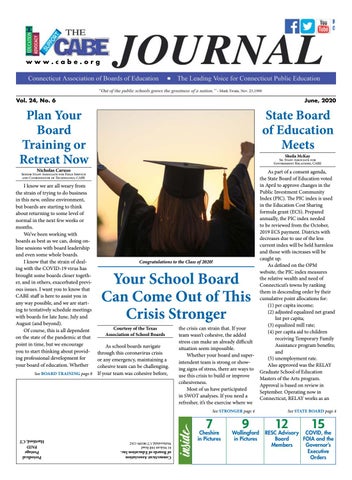
Congratulations to the Class of 2020!
Your School Board Can Come Out of This Crisis Stronger Courtesy of the Texas Association of School Boards
As school boards navigate through this coronavirus crisis or any emergency, maintaining a cohesive team can be challenging. See BOARD TRAINING page 8 If your team was cohesive before,
the crisis can strain that. If your team wasn’t cohesive, the added stress can make an already difficult situation seem impossible. Whether your board and superintendent team is strong or showing signs of stress, there are ways to use this crisis to build or improve cohesiveness. Most of us have participated in SWOT analyses. If you need a refresher, it’s the exercise where we
inside
See STRONGER page 4
7
Cheshire in Pictures
9
Wallingford in Pictures
As part of a consent agenda, the State Board of Education voted in April to approve changes in the Public Investment Community Index (PIC). The PIC index is used in the Education Cost Sharing formula grant (ECS). Prepared annually, the PIC index needed to be reviewed from the October, 2019 ECS payment. Districts with decreases due to use of the less current index will be held harmless and those with increases will be caught up. As defined on the OPM website, the PIC index measures the relative wealth and need of Connecticut’s towns by ranking them in descending order by their cumulative point allocations for: (1) per capita income; (2) adjusted equalized net grand list per capita; (3) equalized mill rate; (4) per capita aid to children receiving Temporary Family Assistance program benefits; and (5) unemployment rate. Also approved was the RELAY Graduate School of Education Masters of the Arts program. Approval is based on review in September. Operating now in Connecticut, RELAY works as an See STATE BOARD page 4
12
15
RESC Advisory COVID, the Board FOIA and the Members Governor’s Executive Orders
81 Wolcott Hill Road Wethersfield, CT 06109-1242
Connecticut Association of Boards of Education Inc.
Periodical Postage PAID Hartford, CT
2
The Journal – Connecticut Association of Boards of Education | June, 2020 PRESIDENT COMMENTARY
Leadership and Courage Donald Harris President, CABE
We live in uncertain times… If only I had a dollar for every time I’ve heard that statement over the last few weeks! Not only has the COVID-19 virus turned the world on its head in every conceivable way, in particular it has disrupted one of America’s most staid institutions, our public schools. While the COVID-19 virus is a nightmare scenario of epic proportions, it does offer us an opportunity to look forward and re-imagine how our schools could, and perhaps should, look different. We’ve tried for over 50 years to change the factory-modeled system designed to give a small percentage of children a first-rate education and prepare all the others for a factory economy, to give them the skills to perform a task, but not those needed to adapt to changing times. Even when enlightened educators have tried, they have been met by resistance from politicians, parents, higher education and others who have resisted dramatic change in favor of the status quo. This is our chance to finally do something about it, but it will take leadership and courage from school leaders, not the least of which are boards of education around the country and throughout Connecticut. A few areas of concern are: Equity The COVID-19 virus has once again shown the inequities between the haves and have-nots in our education system. The disparities between education offered to predominantly children of color and to others is exacerbated by the concentration of poverty in mostly Black and Latinx communities. The pandemic illustrates the disparities in teacher preparation, the avail-
ability of high bandwidth internet and even to the fact that poorer families are forced to work more hours and are less able to “hunker down” in their houses and assist their children with distance learning. This also affects the smaller, rural districts, which have problems of isolation and pockets of poverty. We need to keep this foremost in our minds as we move forward in envisioning what schools look like in the future. It will take leadership and courage. Distance Learning Educators have been trying for years to integrate distance learning into our public schools, with some success, but also with resistance. There is resistance from teachers unsure how to excel in this new medium and/or by teachers’ unions anxious to protect their members from being replaced by computers. It is also resisted by communities unwilling to expend the dollars necessary to provide adequate equipment and access, but also to provide the huge influx of professional development that is necessary to create and teach curricula designed to take advantage of technology. We can’t just bolt-on computers to how we’ve always taught before. Once again, the more affluent communities are much farther along in this and we need to have courage to address that, as well. It will take leadership and courage. Student Grouping There is healthy discussion taking place about how our schools will need to look drastically different to protect children and staff in the future. The traditional classroom, packed full of children put together by age may need to change. Smaller groupings and
Mission: To assist local and regional boards of education in providing high quality education for all Connecticut children through effective leadership. Vision: CABE is passionate about strengthening public education through high-performing, transformative local school board/ superintendent leadership teams that inspire success for each child.
Board of Directors blending of technology, home instruction and classroom instruction can work quite effectively when we break down artificial barriers. We will need to re-tool our education system. Once again, this will take resources that won’t be easily come by. It will take leadership and courage. Just a few issues we will need to address if we are to achieve this: •W e will need to guarantee the health and safety of all students and staff. This invariably will mean changes to scheduling, facilities, instruction and a whole host of things yet unforeseen. • I n this new world, teaching will look dramatically different. Boards of education will need to ensure that teachers have the skills to succeed with each child and that means providing high quality Professional Development. Administrators will also need to rethink how they do their job, with similar requirements. •W e will need to review how we care for our facilities. School entrances, cafeterias and classrooms, by design, concentrate children and adults into small areas to facilitate serving the needs of large groups of children. This is a worse-case situation when you are fighting a pandemic. In order to do all this, we are going to need money. Rethinking how we deliver education may allow us to redistribute some resources more effectively, but anyone who thinks we can do it cheaply will be sadly disillusioned. See LEADERSHIP page 8
EXECUTIVE COMMITTEE Donald Harris | President, Bloomfield Elizabeth Brown | First Vice President, Waterbury Michael Purcaro | V ice President for Government Relations, Ellington Bryan Hall | V ice President for Professional Development, East Hartford John Prins | Secretary/Treasurer, Branford Robert Mitchell | I mmediate Past President, Montville Christopher Wilson | Member at Large, Bristol Lydia Tedone | NSBA Director, Simsbury AREA DIRECTORS Bryan Hall | Area 2 Co-Director, East Hartford Leonard Lockhart | Area 2 Co-Director, Windsor Joan Trivella | Area 4 Director, Brooklyn Mic helle Embree Ku | A rea 5 Director, Newtown Karen Kleine | Area 6 Director, Westport George Kurtyka | Area 7 Director, Derby Lon Seidman | Area 8 Director, Essex Sean Nugent | Area 9 Director, Preston ASSOCIATES Julie Auseré | Associate, Canton Eileen Baker | Associate, Old Saybrook Ethel Grant | Associate, Naugatuck Ann Gruenberg | Associate, Hampton Robert Trefry | A ssociate, CT Technical High School System COMMITTEE CHAIRS Leonard Lockhart | Chair, Resolutions, Windsor Becky Tyrrell | Chair, Federal Relations, Plainville Michelle Embree Ku | Chair, State Relations, Newtown CITY REPRESENTATIVES Ayesha Clarke | City Representative, Hartford Yesenia Rivera | City Representative, New Haven Charles Stango | City Representative, Waterbury STAFF
Robert Rader | Executive Director Patrice McCarthy | Deputy Director and General Counsel Rebecca Adams Rieder | Senior Staff Attorney Nicholas Caruso | Senior Staff Associate for Field Services and Coordinator of Technology Sheila McKay | Senior Staff Associate for Government Relations Vincent Mustaro | Senior Staff Associate for Policy Service Lisa Steimer | Senior Staff Associate for Professional Development and Communications Teresa Costa | Coordinator of Finance and Administration Pamela Brooks | S enior Administrative Associate for Policy Service and Search Services Terry DeMars | Administrative Associate for Policy Service Gail Heath | Administrative Associate for Government Relations Wilmarie Newton | Administrative Associate for Labor Relations Nancy Propfe | Administrative Assistant for Membership Services Corliss Ucci | Receptionist and Assistant to Executive Director
The CABE Journal (ISSN 1092-1818) is published monthly except a combined issue for July/August as a member service of the Connecticut Association of Boards of Education, 81 Wolcott Hill Road, Wethersfield, CT 06109, (860) 571-7446. CABE membership dues include $30 per person for each individual who receives The CABE Journal. The subscription rate for nonmembers is $75. Association membership dues include a subscription for each Board Member, Superintendent, Assistant Superintendent and Business Manager. The companies and advertisements found in The CABE Journal are not necessarily endorsed by CABE. “Periodicals Postage Paid at Hartford, CT.” POSTMASTER: Send address changes to The CABE Journal, CABE, 81 Wolcott Hill Road, Wethersfield, CT 06109-1242. Email: lsteimer@cabe.org. Members can find the CABE Journal online at: www.cabe.org/ page.cfm?p=1024
The Journal – Connecticut Association of Boards of Education | June, 2020
CABE Affiliate Members BUSINESS AFFILIATES VALEDICTORIAN Connecticut Business Systems – A Xerox Company Finalsite SALUTATORIAN
Berchem Moses PC Shipman & Goodwin HIGH HONORS
Pullman & Comley HONOR ROLL Anthem Blue Cross and Blue Shield ESS JCJ Architecture SCHOLAR Brown & Brown Chinni & Meuser LLC Coordinated Transportation Solutions Dattco, Inc. Goldstein & Peck, P.C. Kainen, Escalera & McHale, P.C. The Lexington Group OneDigital Health and Benefits Perkins Eastman T-Mobile The S/L/A/M Collaborative Zangari Cohn Cuthbertson Duhl & Grello, P.C.
EDUCATIONAL AFFILIATES American School for the Deaf Area Cooperative Educational Services (ACES) Capitol Region Education Council (CREC) The College Board Communities in Schools Connecticut Association of School Business Officials Connecticut Center for School Change Connecticut School Buildings and Grounds Association Connecticut School Counselor Association Connecticut Technical High Schools Cooperative Educational Services (C.E.S.) EASTCONN EdAdvance Exploratioins Charter School Integrated Day Charter School ISAAC LEARN
3
EXECUTIVE DIRECTOR COMMENTARY
School Boards’ Role in Reopening: More Important Than Ever Robert Rader
Executive Director, CABE
Throughout Connecticut, the nation and even across the world, governance organizations are searching for their proper role as schools are beginning to reopen. Every state and district will have to find the right niche as the public health administrators, governors, school boards and all other stakeholders determine and implement protocols for reopening schools in the safest, most effective manner. Board members have a key oversight responsibility that continues even as we get closer to reopening schools. In this unprecedented situation, the board’s role is every bit as critical as it is in “normal” times; perhaps even more so... You would not think so. After all, with so much pressure being put on your staff to ensure that schools reopen safely, on the surface, one may think that boards should take a backseat to the staff. In some cases, you might be right. “Keep out of their way” may seem be the best advice. And there’s some truth in that. However, in uncommon times, the boards that step up are often the most effective and leave the strongest legacy. Let me explain: Boards have many responsibilities. For example, the CABE/CAPSS Governance Statement sets out in detail what the two organizations believe to be the best practices for boards and superintendents. There are at least 18 responsibilities that were identified as solely board “jobs”, and this number does not include the 15 responsibilities that are jointly shared by boards and superintendents. While the circumstances in each district will help determine when and the manner in which
such responsibilities are carried out, some are obviously tied to certain times of the year--in a “normal” year. Many of you have already done that this year. However, there are other roles and responsibilities that really come to the fore in a crisis situation – like the one we’re in. As we plan to reopen schools, let me suggest some roles of boards that are or will be critically important in the next few months: • Your oversight of your district
always continues, even in the face of the COVID-19 virus. Ensure that your policies align with the needs of your district and your superintendent and staff as they prepare for reopening. Sr. Staff Associate for Policy Services Vincent Mustaro has recommended new or amended sample policies that can help you with this. See issues of Policy Highlights posted in March, April and early May.
• Your relationship with your
superintendent is especially important as he or she leads your district in reopening schools. You never lose the right to ask questions or provide advice. Avoid, however those situations when answering those questions can take so much time of the superintendent he/she and other members of the staff cannot get their other work done. In these cases, it is time for the board and superintendent to candidly discuss this issue. Often, the solution is for the Board Chair to funnel the questions of individual board members so that they are prioritized and answered as time permits.
• Th ink strategically and let the
superintendent do the tactical tasks. Focus on longer-term issues that are important. Prioritize! • Y our role in “connecting
the will of the community to the education of its children” is even more critical as schools are reopened. We have heard about parents concerned about bringing their children back to school, teachers and other faculty having trouble dealing with change and students who have experienced trauma due to schools closing in March. Your role is to understand the measures that your district is taking to ensure the health and safety of all of your students, staff and others in the buildings and help members of the community, especially parents, understand what is occurring. The importance of communication with parents and other members of the community as this unprecedented situation proceeds was never more important. Understand that while the new measures, such as testing for the virus, social distancing within the classrooms and buses and even double sessions will work hardships on the community and staff, no prevention measures are 100% effective.
• J ust as nobody expected you
to be an expert on education when you got on your board, you are not expected to be an expert on the COVID-19 See REOPENING page 4
4
The Journal – Connecticut Association of Boards of Education | June, 2020 REOPENING
(continued from page 3)
virus or medical advice as to how to fight it. However, you should keep yourself updated as new guidance and recommendations are disseminated. Leave it to the experts to provide the information your district will need to get things restarted. With that knowledge, you can help shape decisions as issues come up and provide creative ideas, based on a real understanding of what is before you. •K eep up with what is happenCABE Deputy Director and General Counsel Patrice McCarthy spoke with FOX 61 on April 28 about the impact of the COVID-19 virus on Connecticut’s public schools.
STATE BOARD
Alternative Route to Certification program in 19 local districts and charter schools. Endorsement areas include Elementary Education Secondary Education, and in 7-12, - English, Mathematics, General Science, Biology, Chemistry, and
Physics. CARES funds for Connecticut have been federally approved and there will be quarterly reporting of expenses. In terms of reopening schools, student and caregiver input was discussed as was the general process on how decisions were being made at different levels.
STRONGER
ences and work together.
examine: • Strengths • Weaknesses • Opportunities • Threats We usually look at threats as those things that can prevent us from reaching our goals. In times of crisis, a threat can become a powerful force which unifies a group. There are two requirements for that to happen: • Th e threat comes from outside the group. • Th ere is cooperation among the group. Cooperation is the secret ingredient. Cooperating is always easier said than done, but it’s more essential now than ever. Without cooperation, there is little or no chance of defeating the threat, but cooperation can help overcome the threat. If there was ever a situation where these things were true, it’s now. We’re truly all in this together. Our success or failure depends upon our ability to put aside differ-
How school boards can build a more cohesive team Here are eight suggestions for effective teamwork based on the acronym COHESIVE. •C is for communication: Never before has timely, accurate, and transparent communication been more important. Each day takes us deeper into uncharted territory bringing new challenges. The board, superintendent, staff, and community must use all available avenues for two-way communication. •O is for organization: Many of our existing structures have been strained and disrupted, so it’s imperative that we work through restructuring and reorganizing our resources to meet the new needs. •H is for honoring our values: While we may have previously differed over issues, confronting a worldwide pandemic allows us to return to what is most important: The health, safety, and well-being of our communities. That takes
(continued from page 1)
(continued from page 1)
ing in other districts and what is recommended by the Regional Advisory Teams, which are organized by RESC. There is a school board member on every one of them. If you have helpful thoughts on issues facing your board or you have questions, ask them. There is list with their emails in this Journal on page 12.
When CABE and CAPSS discussed, amended and adoptprecedence now, and we’re all uniting to do our part to achieve that. •E is for emotions: With the abrupt changes we’re undergoing, we’re all experiencing myriad emotions. In order to work together to confront and mitigate the changes, we must acknowledge and manage our own emotions while recognizing and making allowances for those of others. •S is for setting well defined goals: In addition to the district and superintendent goals your team has in place, you’ll also want to set some interim goals for crisis management. With so many factors that are uncontrollable, it’s important to focus on what’s in your control. Once the crisis has been resolved, you’ll be able to reset and refocus on your other goals. • I is for innovation: We cannot solve a problem we’ve never seen before by doing things the way we always have. This is a great time to re-evaluate what we’ve thought of as the only way to do things,
ed the Governance Statement in June 2016, we did not foresee anything like what we are facing today. Sure, we could foresee the possibility of recessions and tough political times. This crisis, however, is hitting us economically, socially and educationally, all simultaneously. No one could have predicted it. Just as in “normal” times, however, the best practices in the Statement remains a pragmatic guide for boards and superintendents today. One test of its usefulness is whether it’s recommendations are applicable in unpredictable times, just as in more settled, stable times. I think the Statement is still worth considering in these times. We always saw it as a document to be tailored to the needs of the times and individual school districts. Combined with the leadership of boards and superintendents, public education will come out of this crisis, stronger than ever before. Bob Rader is CABE’s representative on the Reopen Connecticut PreK-12 Education Subcommittee. and adopt new ways to achieve goals. •V is for valuing everyone’s contribution: None of us is as strong as all of us. Each of us has unique skill sets that our team can use. It’s incredible what we can achieve if we put aside our differences and focus on a common goal. •E is for encouragement: As we continue to problem solve daily, we must celebrate the small successes. Many people have stepped up in extraordinary ways and every success empowers and encourages us to do even more. You might like to do a simple assessment of your board superintendent team to determine what you might like to work on together. Look at all 8 areas in the “COHESIVE” acronym and rate each: • E (Exceptional) • P (Proficient) • N (Needs Improvement) See related article, Plan Your Board Training or Retreat Now, on page one. Reprinted with permission of the Texas Association of School Boards (TASB).
The Journal – Connecticut Association of Boards of Education | June, 2020
5
See You in Court – The Nutmeg Board of Education
The Nutmeg Board Plans for the Fall Reopening of Schools Thomas B. Mooney, Esq. Shipman & Goodwin
The Nutmeg Board of Education makes many mistakes. The latest imbroglio created by the board will be reported here each issue, followed by an explanation of what the board should have done. Though not intended as legal advice, these situations may help board members avoid common problems. The Nutmeg Board of Education is getting used to the new normal, meeting remotely during the COVID-19 emergency. The Board members have enjoyed the convenience of meeting in their sweatpants in the comfort of their homes, and for the most part they were delighted not to have to listen to the public’s incessant complaints during Public Comment. The mood was somber, however, at the first remote meeting following Governor Lamont’s announcement that all Connecticut schools will remain closed for the rest of the school year. Wanting to lift everyone’s spirits at the beginning of the meeting, Mr. Chairperson went on and on about how Nutmeg teachers had really stepped up to implement high quality distance learning. But then Mr. Chairperson surprised Ms. Superintendent by calling on her to report to the Board and the public on the plans to reopen the Nutmeg Public Schools in the fall. “As much as I would like to provide that update,” Ms. Superintendent began, “it’s way too early. We are in the middle of planning for the new school year, and we will be reporting to you on our plans as soon as possible.” “Not so fast,” interrupted Board member Mal Content. “I don’t want to sit here like a potted plan while the Administration decides what we will be doing next fall. Board members should be in on the planning from the beginning.” “How would that even work?” responded Ms. Superintendent. “We are waiting for State guidance, and then my central office team needs to figure things out before we can present a plan to you Board members for your consideration.” “I have an idea,” interjected veteran Board member Bob Bombast. The other Board members groaned audibly when Bob spoke up, but Bob pressed on. “I agree with Mal that the Board members need to be in on the planning from the beginning, but I realize that we can’t really talk openly about all the options at a public Board meeting, especially when everyone is home and has nothing better to do than listen in to our meetings. So I propose that a Board member attend
each of the planning meetings that Ms. Superintendent will be holding.” Mal Content congratulated Bob on his great idea, and promptly made the related motion. Bob Bombast seconded the motion, and the other Board members quietly went along, figuring that there was no harm in humoring Bob and Mal. Thus emboldened, Bob then announced his “vision” for reopening in the fall. “Whatever the State says,” Bob began, “we will do more. Nothing is too good for the Nutmeg Public Schools and the children we serve. We will take every possible precaution to keep our children safe. We will be the model for Connecticut.” Board member Penny Pincher was not inspired by Bob’s speech, and she questioned the wisdom of Bob’s grand pronouncement. “Don’t get too far over your skis, Bob. We have no idea what these arrangements for the fall will cost.” Bob was undeterred, and he started in again, saying that, “We can’t put a price on safety . . . .” But Mr. Chairperson cut Bob off, explaining that Board member participation in the administrative planning process should suffice and that the Board should just be patient. Should Nutmeg be concerned about Bob’s aspirations? • • • • • • • • • • • • • • • Planning for the opening of school in the fall presents a huge challenge for school districts throughout the State. Student safety, of course, must be a primary concern. However, school districts must be realistic in balancing safety concerns with the need to educate their students. School officials who exercise discretion in doing their jobs are generally immune from liability under the principle of governmental immunity. However, there are three exceptions to this principle. Liability can be found (1) when the alleged acts involve malice, wantonness or intent to injure, rather than simple negligence, (2) when a statute permits lawsuits related to such actions, and (3) when the failure to act will subject an identifiable person to imminent harm. For our purposes here, the third exception is the most important because students in school are identifiable persons who may be harmed by negligent actions. School districts must be reasonable in writing policies and establishing procedures, whether for school reopening in the fall or otherwise. The following principles are applied to establish liability: (1) the defendant must owe the plaintiff a duty of care, (2) the defendant must have been unreasonable in the actions taken or not taken, (3) such unreasonable action
or inaction must cause an injury, and (4) the injury must be foreseeable. When board members or other school officials establish procedures, they are defining what is “reasonable” action, and a failure to follow those procedures can be considered unreasonable per se, with liability as a result. Accordingly, it is important for school officials to consider whether procedures proposed for reopening are doable. If a board of education adopts procedures for the reopening that are not realistic and therefore not followed in all respects, parents and others may claim that a sickness or injury to their child was “caused” by such failure to follow established procedures, and they may seek money damages. Not every failure to follow established procedures will result in liability. In 2014, the Connecticut Supreme Court clarified the “imminent harm” exception, holding that “the proper standard for determining whether a harm was imminent is whether it was apparent to the municipal defendant that the dangerous condition was so likely to cause harm that the defendant had a clear and unequivocal duty to act immediately to prevent the harm.” Haynes v. City of Middletown, 314 Conn. 303 (2014). Nonetheless, by adopting realistic procedures that will
be followed, school districts will avoid inviting litigation over a failure of school employees to comply with procedures. Finally, there is a problem with the Board’s plan to involve its members in administrative meetings so that Board members can be in on private planning discussions. The FOIA excludes “an administrative or staff meeting of a single-member public agency” from the definition of “public meeting.” Superintendents are “single-member public agencies,” and in accordance with this FOIA provision, they may hold meetings with their staff without posting the meetings in accordance with the FOIA. If board members attend those meetings, however, the Freedom of Information Commission may well hold that such meetings are no longer “administrative or staff meetings,” with the result that such meetings must be posted and, except for executive session, must be open to the public. Attorney Thomas B. Mooney is a partner in the Hartford law firm of Shipman & Goodwin who works frequently with boards of education. Mooney is a regular contributor to the CABE Journal. Shipman & Goodwin is a CABE Business Affiliate.
The Ninth Edition – Now Available!
A Practical Guide to Connecticut School Law by Thomas B. Mooney, Esq. Shipman & Goodwin
CABE is delighted to announce that the Ninth Edition of Tom Mooney’s Practical Guide to Connecticut School Law is now available. PRICING: CABE Members: $54.99; CABE Non-Members: $79.99; Students: $44.99 There have been many changes in school law in the last few years, and the Ninth Edition has been extensively revised to provide updated guidance on the legal issues that govern our schools. Changes include descriptions and commentary on:
• Changes in teacher evaluation and teacher tenure. • New rules regarding employee background checks. • New requirements concerning student data privacy. • New rules for suspension, expulsion and alternative educational opportunities. • Revised requirements governing seclusion and restraint. • The new “Every Student Succeeds Act” and how it has changed “No Child Left Behind Act” requirements. • The CCJEF case and ongoing litigation over equal educational opportunities. • The Minimum Budget Requirement and new duties to collaborate with town officials. • A host of other changes in the rules that boards of education and school administrators must follow.
6
The Journal – Connecticut Association of Boards of Education | June, 2020
Aim Higher
Creative legal solutions for Connecticut’s public schools – because sometimes it is rocket science.
Shipman & Goodwin’s school law attorneys have more than 40 years of experience, and represent over 125 public school districts, as well as public school member organizations and associations, on a full range of legal issues that they confront, from general education law to special education matters.
Our school law site, www.ctschoollaw.com is devoted entirely to emerging school law issues. Attorneys counsel clients, monitor legislation and provide periodic alerts and updates. We regularly present seminars, quarterly workshops, webinars and professional development workshops for schools on current topics of interest. Our Practice Group Co-Chair, Tom Mooney, has written A Practical Guide to Connecticut School Law, a comprehensive treatise on Connecticut school law, published by CABE and used by teachers, administrators and board of education members throughout the state.
Education is a core focus of our law firm.
Facebook “f ” Logo
CMYK / .eps
Facebook “f ” Logo
CMYK / .eps
www.ctschoollaw.com
Contact: Thomas B. Mooney or Linda L. Yoder | 860.251.5000 | www.shipmangoodwin.com GREENWICH
|
HARTFORD
|
LAKEVILLE
|
NEW HAVEN
|
NEW YORK
|
OLD LYME
|
STAMFORD
|
WASHINGTON DC
The Journal – Connecticut Association of Boards of Education | June, 2020
7
CHESHIRE
Ethan writes about missing his friends.
Keep your campus at it’s best and students ready™ for success
Your staff’s image is a reflection of your college or university — and that image will always be impressive in a clean, professional-looking uniform. With a Cintas full-service uniform rental program, there’s no laundry to do, no uniforms to buy and no repairs or maintenance to waste your time and money.
UNIFORMS & APPAREL Showing Mrs. Sweeney and Mrs. Weske some love!
offers a variety of products and services to help save you time and money through a contract with CREC and OMNIA. Let Cintas be the single source you depend on for solutions that help you stay ready™ with a clean workplace and positive image through:
Facility Services First Aid & Safety
•
Women’s Workwear
•
Carhartt ® Rental
•
High Image Apparel
•
Chef Works® Culinary Apparel
•
Cleanroom Garments
•
Flame Resistant Clothing (FRC)
•
High-Visibility Workwear Mrs. Carr-Georgeseu misses Charlie!
Your campus is too important to leave fire emergencies to chance. With our industry-trained technicians inspecting and servicing your fire For an update or extinguishers, sprinkler systems, alarm systems, emergency lights and more information more, your defenses will stay strong. Plus, Cintas Fire Protection provides vacancies visit to help you convenient consolidated billing and aon single point of contact our website. manage spend.
Deep Cleaning
MARY BRODERICK, ED.D
Uniforms & Apparel
•
Fire SENIOR Extinguisher Servicing CONSULTANT
Fire Protection
•
• Fire Alarm Monitoring Fire Extinguisher ForTraining more information contact
•
Fire Alarm Servicing
•
Light Servicing Wolcott Hill Road, Wethersfield, CT 06109 Kitchen 81 Suppression • Special Hazard System Servicing 860-608-1763 Suppression Servicing Equal Opportunity Employer
Lab Safety
For more information, visit FIRE PROTECTION www.crec.org/marketplace
•
Fire Sprinkler Servicing
Emergency and Exit CABE Search Services •
8
The Journal – Connecticut Association of Boards of Education | June, 2020
The five largest school districts met virtually to share conserns and successes on April 21.
“ If you can’t fly then run, if you can’t run walk then crawl, but whatever you do you have to keep moving forward.”
Think of your Association,,
CABE,
when you do your shopping! When you shop @AmazonSmile Amazon will make a donation to:
The Connecticut Association of Boards of Education, Inc. https://smile.amazon.com/ch/06-0767770
– Martin Luther King, Jr.
LEADERSHIP
these problems alone. It will require leadership from town governments, boards of education, the Department of Education and State Board of Education, the Connecticut General Assembly and the Federal government to make sure this generation isn’t permanently scarred educationally from this pandemic. It will take leadership and courage.
(continued from page 2)
The leadership in communities, both municipal and the board of education, will need to work together to solve a community problem. This cannot be considered simply a school problem – the solution is beyond the ability of boards of education to solve all
BOARD TRAINING
(continued from page 1)
it be self-evaluation, goal setting, a “roles” refresher (some boards didn’t have time for a real orientation or board training before the pandemic hit), a board retreat or anything else you might need, we are here to help. As we emerge from the aftermath of the COVID-19 virus,
boards are going to have to be strong advocates for our schools and working strategically to make our schools even better. CABE Field Services can assist you in that. If you want to discuss this in more detail, please contact Nick Caruso Senior Staff Associate for Field Service and Coordinator of Technology at ncaruso@cabe.org.
The Journal – Connecticut Association of Boards of Education | June, 2020
9
WALLINGFORD
Brothers hard at work.
Just keep swimming!
We miss our school!
10
The Journal – Connecticut Association of Boards of Education | June, 2020
We Are Well Suited to Respond to the Legal Needs of Boards of Education Attorneys and Counselors at Law
Berchem Moses PC is a leading player in the State of Connecticut in the field of Education Law. With 10 attorneys dedicated to this specialized practice, we offer a long history of experience and deep resources. We promise the highest level of service in a more cost effective manner. We work with boards of education to address a myriad of complex issues including labor and employment, student issues, special education, general counsel, and other challenges facing educators today. Be sure to visit www.connecticuteducationlawblog.com where our attorneys regularly cover legal matters that pertain to Connecticut schools.
www.berchemmoses.com Milford
75 Broad Street Milford, CT 06460 Phone: 203-783-1200
Westport
1221 Post Road East Westport, CT 06880 Phone: 203-227-9545
The Journal – Connecticut Association of Boards of Education | June, 2020
11
THE POLICY CORNER Vincent A. Mustaro
Senior Staff Associate for Policy Service, CABE
Policy Implementation for Admission / Enrollment of Students
School districts throughout Connecticut are currently involved with in-depth planning for the reopening of schools and what the new 2020-2021school year will encompass as a result of the extended COVID-19 caused cancellation of classes and school closures. A carry-over from the shortened normalcy of the last school year is that, once again, numerous parents/guardians will be enrolling their children for admission into our school districts. Recently, the Connecticut State Department of Education (CSDE) promulgated the Guidance for Connecticut School Districts: Enrollment Process and Practice. This document seeks to ensure that the information posted on district and school websites pertaining to the enrollment of children in district schools does not have the unintended effect of discouraging the enrollment of any student. Education Commissioner Dr. Miguel A. Cardona, stated, “In reviewing the approaches districts take to student enrollment and registration, CSDE identified as a best practice central registration pages that highlighted the district’s statement on inclusive enrollment. It is also particularly welcoming that some districts include on their websites a specific note to homeless students that the McKinneyVento Act provides protections in connection with the enrollment process and an affirmation of the allowance of registration regardless of citizenship.” The aforementioned Guidance provides information for districts regarding the enrollment process. It confirms the duty of school districts under federal civil rights laws to limit the decision of whether a child may enroll in school solely to checking the specific information necessary to confirming the student’s residency in the district and his/her age.
In making the enrollment determination, “it can be a violation of law to ask for information or documents that are not necessary for determining age or residency or to give parents/ guardians the impression that if they do not answer certain questions or provide certain documents, the child cannot enroll.” It is further suggested that districts should separate enrollment and data collection into two separate interactions. How this can be done is illustrated in the Guidance. The Guidance recommends that districts communicate to staff and parents/guardians that a child who resides in the district has a legal right to enroll in school if residency and age are confirmed. Also, a homeless child does not need to show residency. In addition, there are various ways of showing residency and age, and no specific documentation is required in order to enroll. The district may need to request additional information as part of its data collection obligations, but this will not affect the child’s enrollment. The Guidance provides helpful information to guide the enrollment and data collection process. Excerpts of that information follow. Residency in the District Districts should request only documentation which is useful in establishing town of residency. Districts should not, when determining residency, request documentation of citizenship or immigration status of a student or the student’s parents or guardian. Such documentation is not relevant to establishing residency. There are many documents which may be used to establish residency which will not have the effect of discouraging the parents of immigrant children,
documented or undocumented, from enrolling their children for school. Examples include lease agreements, a mortgage document, property tax receipt, current utility bill, cable or cell phone bill, proof of government benefits, a current driver’s license or automobile registration or insurance. If such documents cannot be provided because the parent and student live with someone else, an Affidavit of Residence from a parent, guardian or from the person with whom the child resides, signed before a notary or commissioner of the superior court, may be used.
and youth including homeless “unaccompanied youth” not in the custody of a parent or guardian. A school district must immediately enroll a homeless student and allow the student to attend school even if the student is unable to produce records normally required for enrollment, such as previous academic records, medical records, proof of residency, or other documentation. The district must then immediately contact the last school attended to obtain any relevant records and make appropriate referrals for required immunizations, health exams, and the like.
Proof of Age School districts have the right to determine a student’s age. An original or certified copy of a birth certificate is not the only way to verify a student’s age. Other documents may be accepted as proof of a student’s age and include, but are not limited to a photocopy of a birth certificate, earlier school records, state-issued identification document, passport, parent’s affidavit or unsworn statement as to a student’s age, a physician’s certificate verifying a student’s age or immunization records.
Children not living with parents or guardians A child may be entitled to school accommodations in the school district where the child resides even if the child is not living with a parent or guardian. If a child is living with relatives or nonrelatives, when it is the intention of the relatives or nonrelatives and of the child or the child’s parents or guardians that such residence is: (a) to be permanent; (b) provided without pay; and (c) not for the sole purpose of obtaining school accommodations; the child is entitled to all free school privileges accorded to resident children of the school district in which they then reside.
Social Security Number School districts may not deny enrollment to a student if his or her parent/guardian refuses to provide a social security number. If a school district chooses to request a social security number, the school district must indicate that disclosure is voluntary; provide the statutory or other basis as reason the district is requesting the number; and explain how the district will use the number. Homeless Children The federal McKinneyVento Homeless Assistance Act provides special legal protections for homeless children
Immunizations and Health Assessments Districts have critically important duties of ensuring compliance with statutory immunization and health assessment requirements. In light of the expectations of federal law concerning the right to enroll in school, a district’s implementation of immunization and health See POLICY page 12
12
The Journal – Connecticut Association of Boards of Education | June, 2020
RESC Regional Advisory Team Board of Education Members Regional Educational Service Center (RESC)
Board of Education Member
ACES
CES
CREC
EASTCONN
TOM DANEHY
CHIP DUMAIS
GREG FLORIO
GARY MALA
EMAIL: ebrown@waterbury.K12.ct.us
EMAIL: ageorge@stamfordct.gov
EMAIL: christopherwilson@bristolK12.org
EMAIL: joan.trivella@staffordct.com
EdAdvance
LEARN
JEFF KITCHING KATE ERIKSON
Executive Director Executive Director Executive Director Executive Director Executive Director Executive Director LIZ BROWN ANDY GEORGE CHRIS WILSON JOAN TRIVELLA MICHELLE KU BOB MITCHELL Woodstock Waterbury Board Stamford Board of Bristol Board of Newtown Board Montville Board of Academy; CABE Education; CREC of Education; CABE Education; CABE Imof Education; CABE Education Area 4 Director; Chair; CABE Board State Relations Chair mediate Past President First Vice President EASTCONN Board Member at Large
POLICY
(continued from page 11)
assessment requirements should be independent from, and should not delay, the decision whether to enroll a child. Completion of immunization and health assessment requirements may be required prior to a child’s attendance in school, but should not be required as pre-requisites for enrolling an appropriate-aged child residing in the district to attend school.
English Proficiency The parents/guardians of all new students enrolling for the first time and all re-enrolling students who have not previously attended a Connecticut public school must complete a Home Language Survey (HLS) at the time of enrollment. This may result in the student taking a screening exam. Neither the survey nor the exam are conditions of enrollment. The purpose of this process is to determine the student’s eligibility for ESL or bilingual programs. The student should be enrolled
EMAIL: kum_boe@newtown.k12.ct.us
first before the assessment is administered. Policy Implications A district’s enrollment process should focus on obtaining only the information required to establish residency and age. Other information should not be requested by the district as a condition of enrollment. Additional data collection may occur, but such collection should be completed in a manner that does not interfere with the child’s enrollment. Policy #5111, “Admission” and
EMAIL: rrmitch01@gmail.com
policy #5112, “Ages of Attendance” pertain to this topic. They are compliant with current legislation and reflect the information provided by the CSDE Guidance. In addition, policy #5118.1, “Homeless Students” addresses the responsibilities of school districts regarding such students, The modifications made to these policies, while not mandated, provide additional guidance to staff regarding the enrollment and admission processes.
The Journal – Connecticut Association of Boards of Education | June, 2020
13
CABE: Working for YOU
Individualized Workshops | Professional Development Opportunities Legal Services | Policy Services | Representing You Statewide and Nationally Below are the highlights of activities that the CABE staff has undertaken on your behalf over the last month. We did this: B y providing opportunities for members to learn how to better govern their districts: z Facilitated a superintendent search process webinar with the Madison Board of Education. z Facilitated a meeting of the biggest five school districts (Bridgeport, Hartford, New Haven, Stamford, Waterbury) Board Chairs and Superintendents on their needs during the pandemic. z Responded to 44 requests for policy information from 27 districts, providing sample materials on 27 topics. Further, districts continue to access CABE’s online Core Policy Reference Manual and/or online manuals posted by CABE for policy samples. The topics of greatest interest again pertained to pandemic policies, distance/ eLearning and electronic participation at board meetings. Other topics of interest included NARCAN, grading practices, curriculum development, testing, reference checks and staff personnel issues. z Met with the Region 15 Board of Education to discuss board roles and responsibilities. B y helping school boards to increase student achievement: z Sent were two issues of “Policy Highlights” via e-mail listserv covering topics that affect student achievement. Included topics pertained to policies impacted by distance learning during the COVID-19 crisis, online resources policy considerations, grading, attendance tracking and online learning implementation. B y ensuring members receive the most up-to-date communications: z Prepared materials, as part of the Custom Policy Service for Danbury, Montville, New Haven, Region #5, and Sharon. z Completed the fourth edition
of the Policy Update Service publication including new policies pertaining to the pandemic situation. zC ompleted review and analysis of 15 collective bargaining contracts for six districts in preparation for collective bargaining new contracts and reopening current contracts. Hot Topics: • Holding effective problem solving discussions with unions regarding staffing, salaries, wage freezes, wage deferrals, and other cuts in light of reduced municipal budgets. • Financial planning tools, including non-lapsing accounts, and special education contingency accounts • Remote graduations • Lessons learned during closure - what to keep and where to improve • Salaries and benefits for executive level administrators • Calculating per pupil expenditures • Board self-evaluations • Adapting superintendent evaluations to cover performance during school closure • Resuming in person meeting, under executive order 7B, with health department approval
z Provided, as part of the Custom Update Service, policy updates for East Hampton, New Fairfield, New Hartford, Newington, Putnam, Sterling and The Gilbert School. z Posted policies online for districts utilizing the Connecticut Online Policy Service (COPS) z Discussed board issues with superintendent from Stratford Board of Education. z Discussed board goals with superintendent from Tolland Board of Education. zP articipated in four members’ board of education meetings. B y attending Professional Development to strengthen staff knowledge and skills. z Participated in Regional Educational Laboratory for the Northeastern States on managing education resources in response to the Coronavirus Crisis. zP articipated in webinars offered by COSA, ASAE, NEASC, CBIA, and law firms addressing COVID-19 issues in schools and offices. z Participated in virtual meetings about virtual conferences.
B y representing Connecticut school boards on the state or national level: B y promoting public education: z Represented CABE on the z Appeared on Peter Mezzetti Reopen Connecticut PreK-12 Television Program for Valley Education Subcommittee. Shore Community Television. z Represented Connecticut zP articipated in media interviews on National School Boards discussing the response of school Association’s weekly Executive boards to the public health crisis Director Updates. on FOX 61, Channel 13, WTICz Represented boards of education AM, and WNPR. z Attended the CAPSS Board of Directors meeting electronically. z Participated in Pullman and Comley Webinar. B y providing services to meet member needs: z Hosted webinar presented by Executive Director Doug Casey of the CT Commission for Educational Technology and C.E.S. Executive Director and Chair of CAPSS Technology Committee Chip Dumais on technology issues.
on Commissioner Cardona’s Update with Partners. z Hosted Board Chairs’ Check-ins and Update meetings every Friday afternoon at 2:00 PM. z Participated in the Steering Committee meeting for Connecticut Voices for Children’s College and Career Readiness. z Participated in Anti-Defamation League webinar on anti-Semitism during this crisis. z Participated in discussion with Senator Blumenthal on workforce preparedness. z Participated in weekly calls with NSBA and state association counsel from across the country. z Participated in CREC Council meeting. z Participated in social and emotional learning task force meetings. z Chaired meeting of the Digital Advisory Council of the Connecticut Commission for Educational Technology. z Participated in virtual meetings of COSBAC and NSBA Convention Managers work alike group. zW orked with CASBO regarding data related to the cost of reopening schools in person and district non-lapsing accounts. zP articipated in a meeting of the Connecticut Commissioner of Education’s Round Table for Family Engagement. zP articipated in ConnPELRA meeting regarding considerations for employees returning to work. zA ttended COSA live webinar with the US Office of Civil Rights covering the new Title IX regulations.
CABE Executive Director Robert Rader, a member of the REopen Connecticut Advisory Group, participated in the May 11 Reopen Connecticut Roundtable which aired on CT-N. This program can be accessed on-demand at http://www.ctn.state.ct.us/.
14
The Journal – Connecticut Association of Boards of Education | June, 2020
The Media Message by Ann Baldwin, President amd CEO, Baldwin Media Marketing, LLC
The COVID-19 Virus:
Communicate Early and Often I think that we can all agree that since this all began; this has been one heck of a rollercoaster ride! The sudden shift to remote learning in the spring due to the COVID-19 virus truly revealed the stark challenges that public education faces in our state. As you are well aware, each and every community has their own unique situation. Whether it was students unable to access distance learning tools, those unable to connect to online content or video conferences with their teachers, or how to address social and emotional supports, everyone has had to find a solution and they did! These challenges also came with public relations issues for
some districts. People were quick to complain and criticize these initial efforts in both traditional and social media. Then came the shift in direction. As organizations like CABE and CAPSS emerged as thought leaders and made a huge effort to get out in front of these issues, by proactively speaking with the media and becoming “the go-to experts” in distance learning and the challenges that it presents, the dialogue changed. Being flexible and adjusting your messaging is key during times like these. This is new territory for all of us. What is critical is, as this situation continues to emerge, is that we all have to be prepared to adjust messages and decisions based on the changing
information. Yesterday’s message may have to be updated today. It is important to let your school community know that the situation is evolving and that much of the decision making is out of your hands. What this doesn’t mean is that you stop communicating. As you post new information and materials online, just be sure that your posts are dated and that the most recent updates are first, so that it’s clear which information is current. Put the COVID-19 virus information front and center. Sharing accurate information during a time of heightened concern is critical. Rumors and misinformation can distract from the facts
and only complicate the communications process. And finally, I know that I have said this before, but it is important that you stay in your lane and only speak to the issues within your jurisdiction. What I mean by that is health officials should take the lead in discussing the medical aspects of the crisis. This is also a good time to lean on your professional member organizations and on each other. It is always okay to lean on a colleague, or utilize resources available to CABE and CAPSS members. The bottom line is, when schools get the green light to go in whatever capacity that may be, everyone needs to be ready. That work starts now!
The Journal – Connecticut Association of Boards of Education | June, 2020
15
UNDERSTANDING CONNECTICUT’S FOIA
COVID-19, the FOIA and Governor Lamont’s Executive Orders Mark J. Sommaruga, Esq. Pullman & Comley, LLC
The COVID-19 related closures have caused practical concerns regarding how public agencies can conduct their business while complying with Connecticut’s Freedom of Information Act (“FOIA”). Most public gatherings are prohibited, as “social distancing” is necessary to address the pandemic. Many public agency offices are closed or have restricted operations. Open Meetings? Soon after declaring a State of Emergency, the Governor issued “Executive Order 7B”, which provides that the in-person open meeting requirements of the FOIA are suspended so as to permit a public agency to meet and take action without in-person, public access to such meetings, and to hold such meetings or proceedings remotely by conference call, videoconference or “other technology”, provided that the following conditions are met: 1) the public has the ability to view or listen to each meeting or proceeding “in real time, by telephone, video, or other technology”; 2) such meetings or proceedings are recorded or transcribed, and such recordings are then posted on the agency’s website within seven days of the meeting or proceeding, and made available “within a reasonable time” in the agency’s office; 3) the notice and agenda for a meeting or proceeding is posted on the agency’s website and must include information about how the meeting will be conducted and how the public can access it; 4) any materials relevant to matters on the agenda must be submitted to the agency at least twenty-four hours prior and posted on the agency’s website for public inspection prior to, during, and after the meeting; in addition, any exhibits to be submitted by the public must “to the extent feasible” also be submitted to the agency at least twenty-four hours prior to the meeting and similarly
posted on the agency’s website for public inspection; and 5) all speakers taking part in the meeting or proceeding must clearly state their name and title, if applicable, before speaking on each occasion that they speak. While Connecticut’s Freedom of Information Commission (“FOIC”) has accepted the idea of remote participation in meetings (provided that the members of the public could hear and identify all participants to a meeting); Understanding Connecticut’s Freedom of Information Act, By Mark J. Sommaruga (5th Edition 2018), pp. 6-7; Executive Order 7B provides greater flexibility by 1) superseding any contrary requirements in agency bylaws, town charters and ordinances that may have limited or prevented such remote participation/meetings, and 2) expressly envisioning that meetings may be conducted entirely via remote locations and electronic means (without even having a place for the public to attend). Agencies still have to ensure that the public can have access “in real time”, whether via (for example) a conference call, “zoom”, “go to meeting”, or via internet streaming coverage or use of social media. For public comments portion of a meeting, agencies could allow members of the public to dial in, e-mail, text, or even “tweet” questions or comments. These Executive Order provisions are obviously in place just during the current pandemic. However, the experiences during this period may inform how the FOIC construes the FOIA and the ability to rely upon “remote” or electronic meetings. If there are not many glitches, perhaps the FOIC will issue a new advisory opinion or decision endorsing or adopting some of these Executive Order provisions for “normal” times. What About Records? As of this date, there have been no executive orders addressing public agency obligations to comply with records requests under the FOIA.
However, without completely shirking their responsibilities, agencies can rest easier knowing that 1) the FOIA’s internal deadline for an agency to deny a FOIA request is based upon business days, and if an agency is closed, it obviously cannot comply with a request, and 2) as the FOIC’s prior guidance on what is a “prompt” reply recognizes that an agency has other work to complete, the fact that an agency is closed, short staffed, and/or manned by people working remotely (during a global pandemic) would likely be considered by the FOIC in measuring the adequacy/promptness of an agency’s response to FOIA requests. It would not seem fair to penalize public agencies for being late in complying with FOIA requests during the current State of Emergency, but likewise …
Deadlines For FOIC Complaints (i.e., what is good for the goose is good for the gander). Perhaps in light of the fact that public agencies might be closed (including to some degree the FOIC itself), Executive Order 7M suspends both the usual deadline for filing complaints with the FOIC (normally, 30 days from the violation) during the period of the ongoing State of Emergency, along with the usual deadline for the FOIC to issue decisions in cases. Be well and safe. Attorney Sommaruga is the author of “Understanding Connecticut’s Freedom of Information Act” (5th Edition 2018). Pullman & Comley, LLC is a CABE Business Affiliate.
16
The Journal – Connecticut Association of Boards of Education | June, 2020
Serving the Legal Needs of Connecticut’s Boards of Education Pullman & Comley’s School Law practice works with school districts, their boards of education and administrators to find practical, innovative and cost effective solutions to the legal issues they face. We provide legal counsel to school districts in connection with reviewing and revising policies and procedures, Freedom of Information Act issues, student discipline matters, and addressing other challenges school districts face on a daily basis. Additionally, our attorneys have significant experience in successfully representing school districts with respect to: O
Special education issues
O
All aspects of employment and labor relations matters, including collective bargaining and counseling concerning employee discipline issues
O
Cases in the federal and state courts and before administrative agencies
Please visit Education Law Notes, our school law blog that covers issues of great interest to school districts, including labor and employment, special education, gender and disability rights, FOIA, social media, bullying and policies and procedures at http://schoollaw.pullcomblog.com/.
pullcom.com
@pullmancomley
William R. Connon 860.424.4385 wconnon@pullcom.com
Donald F. Houston 203.330.2245 dhouston@pullcom.com
Melinda B. Kaufmann 860.424.4390 mkaufmann@pullcom.com
Zachary D. Schurin 860.424.4389 zschurin@pullcom.com
Stephen M. Sedor 203.330.2137 ssedor@pullcom.com
Mark J. Sommaruga 860.424.4388 msommaruga@pullcom.com
Michael P. McKeon 860.424.4386 mmckeon@pullcom.com
BRIDGEPORT
HARTFORD
SPRINGFIELD
STAMFORD
WATERBURY
WESTPORT
WHITE PLAINS
203.330.2000
860.424.4300
413.314.6160
203.324.5000
203.573.9700
203.254.5000
914.705.5355